EP2070593A1 - Catalyst composition and process for preparing linear alpha-olefins - Google Patents
Catalyst composition and process for preparing linear alpha-olefins Download PDFInfo
- Publication number
- EP2070593A1 EP2070593A1 EP07024462A EP07024462A EP2070593A1 EP 2070593 A1 EP2070593 A1 EP 2070593A1 EP 07024462 A EP07024462 A EP 07024462A EP 07024462 A EP07024462 A EP 07024462A EP 2070593 A1 EP2070593 A1 EP 2070593A1
- Authority
- EP
- European Patent Office
- Prior art keywords
- catalyst composition
- composition according
- compound
- catalyst
- oligomerization
- Prior art date
- Legal status (The legal status is an assumption and is not a legal conclusion. Google has not performed a legal analysis and makes no representation as to the accuracy of the status listed.)
- Granted
Links
- 239000003054 catalyst Substances 0.000 title claims abstract description 60
- 239000000203 mixture Substances 0.000 title claims abstract description 43
- 239000004711 α-olefin Substances 0.000 title claims abstract description 27
- 238000004519 manufacturing process Methods 0.000 title claims abstract description 16
- 238000006384 oligomerization reaction Methods 0.000 claims abstract description 34
- VGGSQFUCUMXWEO-UHFFFAOYSA-N Ethene Chemical compound C=C VGGSQFUCUMXWEO-UHFFFAOYSA-N 0.000 claims abstract description 32
- 239000005977 Ethylene Substances 0.000 claims abstract description 32
- 150000003950 cyclic amides Chemical class 0.000 claims abstract description 13
- 125000000217 alkyl group Chemical group 0.000 claims abstract description 9
- 239000000460 chlorine Substances 0.000 claims abstract description 8
- 125000003118 aryl group Chemical group 0.000 claims abstract description 7
- 239000007795 chemical reaction product Substances 0.000 claims abstract description 7
- HNJBEVLQSNELDL-UHFFFAOYSA-N pyrrolidin-2-one Chemical compound O=C1CCCN1 HNJBEVLQSNELDL-UHFFFAOYSA-N 0.000 claims abstract description 7
- 229910052794 bromium Chemical group 0.000 claims abstract description 6
- 229910052801 chlorine Inorganic materials 0.000 claims abstract description 6
- 125000003342 alkenyl group Chemical group 0.000 claims abstract description 5
- 125000003710 aryl alkyl group Chemical group 0.000 claims abstract description 5
- 125000000753 cycloalkyl group Chemical group 0.000 claims abstract description 5
- 150000003623 transition metal compounds Chemical class 0.000 claims abstract description 5
- WKBOTKDWSSQWDR-UHFFFAOYSA-N Bromine atom Chemical group [Br] WKBOTKDWSSQWDR-UHFFFAOYSA-N 0.000 claims abstract description 4
- GDTBXPJZTBHREO-UHFFFAOYSA-N bromine Chemical group BrBr GDTBXPJZTBHREO-UHFFFAOYSA-N 0.000 claims abstract description 4
- 125000001309 chloro group Chemical group Cl* 0.000 claims abstract description 3
- RDOXTESZEPMUJZ-UHFFFAOYSA-N anisole Chemical compound COC1=CC=CC=C1 RDOXTESZEPMUJZ-UHFFFAOYSA-N 0.000 claims description 20
- 150000001875 compounds Chemical class 0.000 claims description 19
- -1 zirconium carboxylate Chemical class 0.000 claims description 16
- 125000004432 carbon atom Chemical group C* 0.000 claims description 11
- UZKWTJUDCOPSNM-UHFFFAOYSA-N methoxybenzene Substances CCCCOC=C UZKWTJUDCOPSNM-UHFFFAOYSA-N 0.000 claims description 10
- 229910052726 zirconium Inorganic materials 0.000 claims description 7
- XEKOWRVHYACXOJ-UHFFFAOYSA-N Ethyl acetate Chemical compound CCOC(C)=O XEKOWRVHYACXOJ-UHFFFAOYSA-N 0.000 claims description 6
- 150000003755 zirconium compounds Chemical class 0.000 claims description 5
- WYURNTSHIVDZCO-UHFFFAOYSA-N Tetrahydrofuran Chemical compound C1CCOC1 WYURNTSHIVDZCO-UHFFFAOYSA-N 0.000 claims description 4
- YTPLMLYBLZKORZ-UHFFFAOYSA-N Thiophene Chemical compound C=1C=CSC=1 YTPLMLYBLZKORZ-UHFFFAOYSA-N 0.000 claims description 4
- JBKVHLHDHHXQEQ-UHFFFAOYSA-N epsilon-caprolactam Chemical group O=C1CCCCCN1 JBKVHLHDHHXQEQ-UHFFFAOYSA-N 0.000 claims description 4
- MTZQAGJQAFMTAQ-UHFFFAOYSA-N ethyl benzoate Chemical compound CCOC(=O)C1=CC=CC=C1 MTZQAGJQAFMTAQ-UHFFFAOYSA-N 0.000 claims description 4
- 239000003960 organic solvent Substances 0.000 claims description 4
- 239000001257 hydrogen Substances 0.000 claims description 3
- 229910052739 hydrogen Inorganic materials 0.000 claims description 3
- VOITXYVAKOUIBA-UHFFFAOYSA-N triethylaluminium Chemical compound CC[Al](CC)CC VOITXYVAKOUIBA-UHFFFAOYSA-N 0.000 claims description 3
- OIXUJRCCNNHWFI-UHFFFAOYSA-N 1,2-dioxane Chemical compound C1CCOOC1 OIXUJRCCNNHWFI-UHFFFAOYSA-N 0.000 claims description 2
- XYIBRDXRRQCHLP-UHFFFAOYSA-N ethyl acetoacetate Chemical compound CCOC(=O)CC(C)=O XYIBRDXRRQCHLP-UHFFFAOYSA-N 0.000 claims description 2
- YVIVRJLWYJGJTJ-UHFFFAOYSA-N gamma-Valerolactam Chemical compound CC1CCC(=O)N1 YVIVRJLWYJGJTJ-UHFFFAOYSA-N 0.000 claims description 2
- 125000000623 heterocyclic group Chemical group 0.000 claims description 2
- 229910052740 iodine Inorganic materials 0.000 claims description 2
- YLQBMQCUIZJEEH-UHFFFAOYSA-N tetrahydrofuran Natural products C=1C=COC=1 YLQBMQCUIZJEEH-UHFFFAOYSA-N 0.000 claims description 2
- 125000004435 hydrogen atom Chemical group [H]* 0.000 claims 1
- 150000002899 organoaluminium compounds Chemical class 0.000 abstract 1
- YXFVVABEGXRONW-UHFFFAOYSA-N Toluene Chemical compound CC1=CC=CC=C1 YXFVVABEGXRONW-UHFFFAOYSA-N 0.000 description 33
- 238000000034 method Methods 0.000 description 17
- 238000006243 chemical reaction Methods 0.000 description 15
- 230000008569 process Effects 0.000 description 15
- UHOVQNZJYSORNB-UHFFFAOYSA-N Benzene Chemical compound C1=CC=CC=C1 UHOVQNZJYSORNB-UHFFFAOYSA-N 0.000 description 12
- 229920000642 polymer Polymers 0.000 description 12
- 239000001993 wax Substances 0.000 description 12
- LIKMAJRDDDTEIG-UHFFFAOYSA-N 1-hexene Chemical compound CCCCC=C LIKMAJRDDDTEIG-UHFFFAOYSA-N 0.000 description 11
- 239000003426 co-catalyst Substances 0.000 description 11
- 230000000052 comparative effect Effects 0.000 description 10
- 238000009826 distribution Methods 0.000 description 9
- 239000000047 product Substances 0.000 description 9
- VXNZUUAINFGPBY-UHFFFAOYSA-N 1-Butene Chemical compound CCC=C VXNZUUAINFGPBY-UHFFFAOYSA-N 0.000 description 8
- 230000015572 biosynthetic process Effects 0.000 description 7
- 239000011261 inert gas Substances 0.000 description 7
- IJGRMHOSHXDMSA-UHFFFAOYSA-N Atomic nitrogen Chemical compound N#N IJGRMHOSHXDMSA-UHFFFAOYSA-N 0.000 description 6
- 239000004698 Polyethylene Substances 0.000 description 6
- 150000001336 alkenes Chemical class 0.000 description 5
- YNLAOSYQHBDIKW-UHFFFAOYSA-M diethylaluminium chloride Chemical compound CC[Al](Cl)CC YNLAOSYQHBDIKW-UHFFFAOYSA-M 0.000 description 5
- 230000000694 effects Effects 0.000 description 5
- 229920000573 polyethylene Polymers 0.000 description 5
- 239000002904 solvent Substances 0.000 description 5
- 239000006227 byproduct Substances 0.000 description 4
- 230000003197 catalytic effect Effects 0.000 description 4
- 229910052782 aluminium Inorganic materials 0.000 description 3
- 238000002474 experimental method Methods 0.000 description 3
- VLKZOEOYAKHREP-UHFFFAOYSA-N n-Hexane Chemical compound CCCCCC VLKZOEOYAKHREP-UHFFFAOYSA-N 0.000 description 3
- 229910052757 nitrogen Inorganic materials 0.000 description 3
- QIVUCLWGARAQIO-OLIXTKCUSA-N (3s)-n-[(3s,5s,6r)-6-methyl-2-oxo-1-(2,2,2-trifluoroethyl)-5-(2,3,6-trifluorophenyl)piperidin-3-yl]-2-oxospiro[1h-pyrrolo[2,3-b]pyridine-3,6'-5,7-dihydrocyclopenta[b]pyridine]-3'-carboxamide Chemical compound C1([C@H]2[C@H](N(C(=O)[C@@H](NC(=O)C=3C=C4C[C@]5(CC4=NC=3)C3=CC=CN=C3NC5=O)C2)CC(F)(F)F)C)=C(F)C=CC(F)=C1F QIVUCLWGARAQIO-OLIXTKCUSA-N 0.000 description 2
- CMAOLVNGLTWICC-UHFFFAOYSA-N 2-fluoro-5-methylbenzonitrile Chemical compound CC1=CC=C(F)C(C#N)=C1 CMAOLVNGLTWICC-UHFFFAOYSA-N 0.000 description 2
- HFGHRUCCKVYFKL-UHFFFAOYSA-N 4-ethoxy-2-piperazin-1-yl-7-pyridin-4-yl-5h-pyrimido[5,4-b]indole Chemical compound C1=C2NC=3C(OCC)=NC(N4CCNCC4)=NC=3C2=CC=C1C1=CC=NC=C1 HFGHRUCCKVYFKL-UHFFFAOYSA-N 0.000 description 2
- LFQSCWFLJHTTHZ-UHFFFAOYSA-N Ethanol Chemical compound CCO LFQSCWFLJHTTHZ-UHFFFAOYSA-N 0.000 description 2
- IMNFDUFMRHMDMM-UHFFFAOYSA-N N-Heptane Chemical compound CCCCCCC IMNFDUFMRHMDMM-UHFFFAOYSA-N 0.000 description 2
- PXHVJJICTQNCMI-UHFFFAOYSA-N Nickel Chemical compound [Ni] PXHVJJICTQNCMI-UHFFFAOYSA-N 0.000 description 2
- OFBQJSOFQDEBGM-UHFFFAOYSA-N Pentane Chemical compound CCCCC OFBQJSOFQDEBGM-UHFFFAOYSA-N 0.000 description 2
- QCWXUUIWCKQGHC-UHFFFAOYSA-N Zirconium Chemical compound [Zr] QCWXUUIWCKQGHC-UHFFFAOYSA-N 0.000 description 2
- WDENQIQQYWYTPO-IBGZPJMESA-N acalabrutinib Chemical compound CC#CC(=O)N1CCC[C@H]1C1=NC(C=2C=CC(=CC=2)C(=O)NC=2N=CC=CC=2)=C2N1C=CN=C2N WDENQIQQYWYTPO-IBGZPJMESA-N 0.000 description 2
- 150000001335 aliphatic alkanes Chemical class 0.000 description 2
- XAGFODPZIPBFFR-UHFFFAOYSA-N aluminium Chemical compound [Al] XAGFODPZIPBFFR-UHFFFAOYSA-N 0.000 description 2
- WERYXYBDKMZEQL-UHFFFAOYSA-N butane-1,4-diol Chemical compound OCCCCO WERYXYBDKMZEQL-UHFFFAOYSA-N 0.000 description 2
- MVPPADPHJFYWMZ-UHFFFAOYSA-N chlorobenzene Chemical compound ClC1=CC=CC=C1 MVPPADPHJFYWMZ-UHFFFAOYSA-N 0.000 description 2
- NNBZCPXTIHJBJL-UHFFFAOYSA-N decalin Chemical compound C1CCCC2CCCCC21 NNBZCPXTIHJBJL-UHFFFAOYSA-N 0.000 description 2
- 229920001903 high density polyethylene Polymers 0.000 description 2
- 239000004700 high-density polyethylene Substances 0.000 description 2
- 229930195733 hydrocarbon Natural products 0.000 description 2
- 150000002430 hydrocarbons Chemical class 0.000 description 2
- 239000000463 material Substances 0.000 description 2
- 239000000178 monomer Substances 0.000 description 2
- BKIMMITUMNQMOS-UHFFFAOYSA-N nonane Chemical compound CCCCCCCCC BKIMMITUMNQMOS-UHFFFAOYSA-N 0.000 description 2
- XULSCZPZVQIMFM-IPZQJPLYSA-N odevixibat Chemical compound C12=CC(SC)=C(OCC(=O)N[C@@H](C(=O)N[C@@H](CC)C(O)=O)C=3C=CC(O)=CC=3)C=C2S(=O)(=O)NC(CCCC)(CCCC)CN1C1=CC=CC=C1 XULSCZPZVQIMFM-IPZQJPLYSA-N 0.000 description 2
- 238000002360 preparation method Methods 0.000 description 2
- 239000007787 solid Substances 0.000 description 2
- KMIOJWCYOHBUJS-HAKPAVFJSA-N vorolanib Chemical compound C1N(C(=O)N(C)C)CC[C@@H]1NC(=O)C1=C(C)NC(\C=C/2C3=CC(F)=CC=C3NC\2=O)=C1C KMIOJWCYOHBUJS-HAKPAVFJSA-N 0.000 description 2
- GGQQNYXPYWCUHG-RMTFUQJTSA-N (3e,6e)-deca-3,6-diene Chemical compound CCC\C=C\C\C=C\CC GGQQNYXPYWCUHG-RMTFUQJTSA-N 0.000 description 1
- SCYULBFZEHDVBN-UHFFFAOYSA-N 1,1-Dichloroethane Chemical compound CC(Cl)Cl SCYULBFZEHDVBN-UHFFFAOYSA-N 0.000 description 1
- SEQRDAAUNCRFIT-UHFFFAOYSA-N 1,1-dichlorobutane Chemical compound CCCC(Cl)Cl SEQRDAAUNCRFIT-UHFFFAOYSA-N 0.000 description 1
- OCJBOOLMMGQPQU-UHFFFAOYSA-N 1,4-dichlorobenzene Chemical compound ClC1=CC=C(Cl)C=C1 OCJBOOLMMGQPQU-UHFFFAOYSA-N 0.000 description 1
- OKTJSMMVPCPJKN-UHFFFAOYSA-N Carbon Chemical group [C] OKTJSMMVPCPJKN-UHFFFAOYSA-N 0.000 description 1
- 239000004215 Carbon black (E152) Substances 0.000 description 1
- ZAMOUSCENKQFHK-UHFFFAOYSA-N Chlorine atom Chemical compound [Cl] ZAMOUSCENKQFHK-UHFFFAOYSA-N 0.000 description 1
- XDTMQSROBMDMFD-UHFFFAOYSA-N Cyclohexane Chemical compound C1CCCCC1 XDTMQSROBMDMFD-UHFFFAOYSA-N 0.000 description 1
- UFHFLCQGNIYNRP-UHFFFAOYSA-N Hydrogen Chemical compound [H][H] UFHFLCQGNIYNRP-UHFFFAOYSA-N 0.000 description 1
- 229920010126 Linear Low Density Polyethylene (LLDPE) Polymers 0.000 description 1
- CTQNGGLPUBDAKN-UHFFFAOYSA-N O-Xylene Chemical compound CC1=CC=CC=C1C CTQNGGLPUBDAKN-UHFFFAOYSA-N 0.000 description 1
- 238000004639 Schlenk technique Methods 0.000 description 1
- 150000001241 acetals Chemical class 0.000 description 1
- 239000012190 activator Substances 0.000 description 1
- 125000001931 aliphatic group Chemical group 0.000 description 1
- 230000002152 alkylating effect Effects 0.000 description 1
- 239000012300 argon atmosphere Substances 0.000 description 1
- 150000004945 aromatic hydrocarbons Chemical class 0.000 description 1
- 239000012298 atmosphere Substances 0.000 description 1
- QVGXLLKOCUKJST-UHFFFAOYSA-N atomic oxygen Chemical compound [O] QVGXLLKOCUKJST-UHFFFAOYSA-N 0.000 description 1
- KCXMKQUNVWSEMD-UHFFFAOYSA-N benzyl chloride Chemical compound ClCC1=CC=CC=C1 KCXMKQUNVWSEMD-UHFFFAOYSA-N 0.000 description 1
- 230000000711 cancerogenic effect Effects 0.000 description 1
- 229910052799 carbon Inorganic materials 0.000 description 1
- 231100000357 carcinogen Toxicity 0.000 description 1
- 239000003183 carcinogenic agent Substances 0.000 description 1
- 229920001577 copolymer Polymers 0.000 description 1
- DIOQZVSQGTUSAI-NJFSPNSNSA-N decane Chemical compound CCCCCCCCC[14CH3] DIOQZVSQGTUSAI-NJFSPNSNSA-N 0.000 description 1
- 230000007423 decrease Effects 0.000 description 1
- 238000006356 dehydrogenation reaction Methods 0.000 description 1
- 229940117389 dichlorobenzene Drugs 0.000 description 1
- 238000004817 gas chromatography Methods 0.000 description 1
- 229910052736 halogen Inorganic materials 0.000 description 1
- 150000002367 halogens Chemical group 0.000 description 1
- 150000002431 hydrogen Chemical group 0.000 description 1
- 239000003446 ligand Substances 0.000 description 1
- 229920001684 low density polyethylene Polymers 0.000 description 1
- 239000004702 low-density polyethylene Substances 0.000 description 1
- 239000000314 lubricant Substances 0.000 description 1
- 239000012968 metallocene catalyst Substances 0.000 description 1
- 230000004048 modification Effects 0.000 description 1
- 238000012986 modification Methods 0.000 description 1
- 239000002808 molecular sieve Substances 0.000 description 1
- DIOQZVSQGTUSAI-UHFFFAOYSA-N n-butylhexane Natural products CCCCCCCCCC DIOQZVSQGTUSAI-UHFFFAOYSA-N 0.000 description 1
- 229910052759 nickel Inorganic materials 0.000 description 1
- 239000012299 nitrogen atmosphere Substances 0.000 description 1
- TVMXDCGIABBOFY-UHFFFAOYSA-N octane Chemical compound CCCCCCCC TVMXDCGIABBOFY-UHFFFAOYSA-N 0.000 description 1
- JRZJOMJEPLMPRA-UHFFFAOYSA-N olefin Natural products CCCCCCCC=C JRZJOMJEPLMPRA-UHFFFAOYSA-N 0.000 description 1
- 150000002894 organic compounds Chemical class 0.000 description 1
- 150000002902 organometallic compounds Chemical class 0.000 description 1
- 125000002524 organometallic group Chemical group 0.000 description 1
- 239000001301 oxygen Substances 0.000 description 1
- 229910052760 oxygen Inorganic materials 0.000 description 1
- 239000012188 paraffin wax Substances 0.000 description 1
- 230000000704 physical effect Effects 0.000 description 1
- 229920000098 polyolefin Polymers 0.000 description 1
- 239000011541 reaction mixture Substances 0.000 description 1
- 230000009257 reactivity Effects 0.000 description 1
- URGAHOPLAPQHLN-UHFFFAOYSA-N sodium aluminosilicate Chemical compound [Na+].[Al+3].[O-][Si]([O-])=O.[O-][Si]([O-])=O URGAHOPLAPQHLN-UHFFFAOYSA-N 0.000 description 1
- 238000001228 spectrum Methods 0.000 description 1
- 229910001220 stainless steel Inorganic materials 0.000 description 1
- 239000010935 stainless steel Substances 0.000 description 1
- 239000004094 surface-active agent Substances 0.000 description 1
- 238000003786 synthesis reaction Methods 0.000 description 1
- 229930192474 thiophene Natural products 0.000 description 1
- 239000008096 xylene Substances 0.000 description 1
- DUNKXUFBGCUVQW-UHFFFAOYSA-J zirconium tetrachloride Chemical compound Cl[Zr](Cl)(Cl)Cl DUNKXUFBGCUVQW-UHFFFAOYSA-J 0.000 description 1
Classifications
-
- B—PERFORMING OPERATIONS; TRANSPORTING
- B01—PHYSICAL OR CHEMICAL PROCESSES OR APPARATUS IN GENERAL
- B01J—CHEMICAL OR PHYSICAL PROCESSES, e.g. CATALYSIS OR COLLOID CHEMISTRY; THEIR RELEVANT APPARATUS
- B01J31/00—Catalysts comprising hydrides, coordination complexes or organic compounds
- B01J31/02—Catalysts comprising hydrides, coordination complexes or organic compounds containing organic compounds or metal hydrides
- B01J31/04—Catalysts comprising hydrides, coordination complexes or organic compounds containing organic compounds or metal hydrides containing carboxylic acids or their salts
-
- B—PERFORMING OPERATIONS; TRANSPORTING
- B01—PHYSICAL OR CHEMICAL PROCESSES OR APPARATUS IN GENERAL
- B01J—CHEMICAL OR PHYSICAL PROCESSES, e.g. CATALYSIS OR COLLOID CHEMISTRY; THEIR RELEVANT APPARATUS
- B01J31/00—Catalysts comprising hydrides, coordination complexes or organic compounds
- B01J31/02—Catalysts comprising hydrides, coordination complexes or organic compounds containing organic compounds or metal hydrides
- B01J31/0201—Oxygen-containing compounds
- B01J31/0211—Oxygen-containing compounds with a metal-oxygen link
- B01J31/0212—Alkoxylates
-
- B—PERFORMING OPERATIONS; TRANSPORTING
- B01—PHYSICAL OR CHEMICAL PROCESSES OR APPARATUS IN GENERAL
- B01J—CHEMICAL OR PHYSICAL PROCESSES, e.g. CATALYSIS OR COLLOID CHEMISTRY; THEIR RELEVANT APPARATUS
- B01J31/00—Catalysts comprising hydrides, coordination complexes or organic compounds
- B01J31/02—Catalysts comprising hydrides, coordination complexes or organic compounds containing organic compounds or metal hydrides
- B01J31/0234—Nitrogen-, phosphorus-, arsenic- or antimony-containing compounds
- B01J31/0235—Nitrogen containing compounds
- B01J31/0252—Nitrogen containing compounds with a metal-nitrogen link, e.g. metal amides, metal guanidides
-
- B—PERFORMING OPERATIONS; TRANSPORTING
- B01—PHYSICAL OR CHEMICAL PROCESSES OR APPARATUS IN GENERAL
- B01J—CHEMICAL OR PHYSICAL PROCESSES, e.g. CATALYSIS OR COLLOID CHEMISTRY; THEIR RELEVANT APPARATUS
- B01J31/00—Catalysts comprising hydrides, coordination complexes or organic compounds
- B01J31/02—Catalysts comprising hydrides, coordination complexes or organic compounds containing organic compounds or metal hydrides
- B01J31/12—Catalysts comprising hydrides, coordination complexes or organic compounds containing organic compounds or metal hydrides containing organo-metallic compounds or metal hydrides
- B01J31/14—Catalysts comprising hydrides, coordination complexes or organic compounds containing organic compounds or metal hydrides containing organo-metallic compounds or metal hydrides of aluminium or boron
- B01J31/143—Catalysts comprising hydrides, coordination complexes or organic compounds containing organic compounds or metal hydrides containing organo-metallic compounds or metal hydrides of aluminium or boron of aluminium
-
- B—PERFORMING OPERATIONS; TRANSPORTING
- B01—PHYSICAL OR CHEMICAL PROCESSES OR APPARATUS IN GENERAL
- B01J—CHEMICAL OR PHYSICAL PROCESSES, e.g. CATALYSIS OR COLLOID CHEMISTRY; THEIR RELEVANT APPARATUS
- B01J31/00—Catalysts comprising hydrides, coordination complexes or organic compounds
- B01J31/16—Catalysts comprising hydrides, coordination complexes or organic compounds containing coordination complexes
- B01J31/22—Organic complexes
- B01J31/2204—Organic complexes the ligands containing oxygen or sulfur as complexing atoms
- B01J31/2208—Oxygen, e.g. acetylacetonates
-
- B—PERFORMING OPERATIONS; TRANSPORTING
- B01—PHYSICAL OR CHEMICAL PROCESSES OR APPARATUS IN GENERAL
- B01J—CHEMICAL OR PHYSICAL PROCESSES, e.g. CATALYSIS OR COLLOID CHEMISTRY; THEIR RELEVANT APPARATUS
- B01J31/00—Catalysts comprising hydrides, coordination complexes or organic compounds
- B01J31/26—Catalysts comprising hydrides, coordination complexes or organic compounds containing in addition, inorganic metal compounds not provided for in groups B01J31/02 - B01J31/24
- B01J31/38—Catalysts comprising hydrides, coordination complexes or organic compounds containing in addition, inorganic metal compounds not provided for in groups B01J31/02 - B01J31/24 of titanium, zirconium or hafnium
-
- C—CHEMISTRY; METALLURGY
- C07—ORGANIC CHEMISTRY
- C07C—ACYCLIC OR CARBOCYCLIC COMPOUNDS
- C07C2/00—Preparation of hydrocarbons from hydrocarbons containing a smaller number of carbon atoms
- C07C2/02—Preparation of hydrocarbons from hydrocarbons containing a smaller number of carbon atoms by addition between unsaturated hydrocarbons
- C07C2/04—Preparation of hydrocarbons from hydrocarbons containing a smaller number of carbon atoms by addition between unsaturated hydrocarbons by oligomerisation of well-defined unsaturated hydrocarbons without ring formation
- C07C2/06—Preparation of hydrocarbons from hydrocarbons containing a smaller number of carbon atoms by addition between unsaturated hydrocarbons by oligomerisation of well-defined unsaturated hydrocarbons without ring formation of alkenes, i.e. acyclic hydrocarbons having only one carbon-to-carbon double bond
- C07C2/08—Catalytic processes
- C07C2/26—Catalytic processes with hydrides or organic compounds
- C07C2/30—Catalytic processes with hydrides or organic compounds containing metal-to-carbon bond; Metal hydrides
-
- C—CHEMISTRY; METALLURGY
- C07—ORGANIC CHEMISTRY
- C07C—ACYCLIC OR CARBOCYCLIC COMPOUNDS
- C07C2/00—Preparation of hydrocarbons from hydrocarbons containing a smaller number of carbon atoms
- C07C2/02—Preparation of hydrocarbons from hydrocarbons containing a smaller number of carbon atoms by addition between unsaturated hydrocarbons
- C07C2/04—Preparation of hydrocarbons from hydrocarbons containing a smaller number of carbon atoms by addition between unsaturated hydrocarbons by oligomerisation of well-defined unsaturated hydrocarbons without ring formation
- C07C2/06—Preparation of hydrocarbons from hydrocarbons containing a smaller number of carbon atoms by addition between unsaturated hydrocarbons by oligomerisation of well-defined unsaturated hydrocarbons without ring formation of alkenes, i.e. acyclic hydrocarbons having only one carbon-to-carbon double bond
- C07C2/08—Catalytic processes
- C07C2/26—Catalytic processes with hydrides or organic compounds
- C07C2/32—Catalytic processes with hydrides or organic compounds as complexes, e.g. acetyl-acetonates
-
- B—PERFORMING OPERATIONS; TRANSPORTING
- B01—PHYSICAL OR CHEMICAL PROCESSES OR APPARATUS IN GENERAL
- B01J—CHEMICAL OR PHYSICAL PROCESSES, e.g. CATALYSIS OR COLLOID CHEMISTRY; THEIR RELEVANT APPARATUS
- B01J2231/00—Catalytic reactions performed with catalysts classified in B01J31/00
- B01J2231/20—Olefin oligomerisation or telomerisation
-
- B—PERFORMING OPERATIONS; TRANSPORTING
- B01—PHYSICAL OR CHEMICAL PROCESSES OR APPARATUS IN GENERAL
- B01J—CHEMICAL OR PHYSICAL PROCESSES, e.g. CATALYSIS OR COLLOID CHEMISTRY; THEIR RELEVANT APPARATUS
- B01J2531/00—Additional information regarding catalytic systems classified in B01J31/00
- B01J2531/30—Complexes comprising metals of Group III (IIIA or IIIB) as the central metal
- B01J2531/31—Aluminium
-
- B—PERFORMING OPERATIONS; TRANSPORTING
- B01—PHYSICAL OR CHEMICAL PROCESSES OR APPARATUS IN GENERAL
- B01J—CHEMICAL OR PHYSICAL PROCESSES, e.g. CATALYSIS OR COLLOID CHEMISTRY; THEIR RELEVANT APPARATUS
- B01J2531/00—Additional information regarding catalytic systems classified in B01J31/00
- B01J2531/40—Complexes comprising metals of Group IV (IVA or IVB) as the central metal
- B01J2531/48—Zirconium
-
- B—PERFORMING OPERATIONS; TRANSPORTING
- B01—PHYSICAL OR CHEMICAL PROCESSES OR APPARATUS IN GENERAL
- B01J—CHEMICAL OR PHYSICAL PROCESSES, e.g. CATALYSIS OR COLLOID CHEMISTRY; THEIR RELEVANT APPARATUS
- B01J27/00—Catalysts comprising the elements or compounds of halogens, sulfur, selenium, tellurium, phosphorus or nitrogen; Catalysts comprising carbon compounds
- B01J27/06—Halogens; Compounds thereof
- B01J27/135—Halogens; Compounds thereof with titanium, zirconium, hafnium, germanium, tin or lead
-
- C—CHEMISTRY; METALLURGY
- C07—ORGANIC CHEMISTRY
- C07C—ACYCLIC OR CARBOCYCLIC COMPOUNDS
- C07C2531/00—Catalysts comprising hydrides, coordination complexes or organic compounds
- C07C2531/02—Catalysts comprising hydrides, coordination complexes or organic compounds containing organic compounds or metal hydrides
- C07C2531/12—Catalysts comprising hydrides, coordination complexes or organic compounds containing organic compounds or metal hydrides containing organo-metallic compounds or metal hydrides
- C07C2531/14—Catalysts comprising hydrides, coordination complexes or organic compounds containing organic compounds or metal hydrides containing organo-metallic compounds or metal hydrides of aluminium or boron
-
- C—CHEMISTRY; METALLURGY
- C07—ORGANIC CHEMISTRY
- C07C—ACYCLIC OR CARBOCYCLIC COMPOUNDS
- C07C2531/00—Catalysts comprising hydrides, coordination complexes or organic compounds
- C07C2531/16—Catalysts comprising hydrides, coordination complexes or organic compounds containing coordination complexes
- C07C2531/22—Organic complexes
Definitions
- the present invention relates to a catalyst composition for oligomerization of ethylene and a process for preparing linear alpha-olefins by oligomerization of ethylene.
- Linear alpha-olefins having 4 to 20 carbon atoms are key feedstocks in the production of surfactants, plastisizers, synthetic lubricants and polyolefins.
- High purity alpha-olefins are particularly valuable in the production of low-density polyethylene and in the oxo process.
- the linear alpha-olefins are more reactive than the branched alpha-olefins; the branching at the a-carbon decreases the reactivity drastically.
- linear alpha-olefins having 6 to 18 carbon atoms are particularly useful and widely used in large quantities.
- linear olefins are the product of dehydrogenation of linear alkanes, the major portion of such products consists of the internal olefins. Preparation of alpha-olefins is based largely on oligomerization of ethylene.
- linear alpha-olefins are prepared usually by the catalytic oligomerization of ethylene in the presence of a Ziegler-type catalyst. Ethylene oligomerization produces a wide spectrum of LAO products having even-numbered carbon chain lengths. In recent years the drive to develop more advanced polyethylenes using metallocene catalysts has made extra demands on co-monomer alpha olefins. Co-monomers are used in polyethylene to control density and enhance particular physical properties. Butene-1 and hexene-1 are used in the production of high density polyethylene (HDPE) co-polymers.
- HDPE high density polyethylene
- Butene-1, hexene-1 and octene-1 are used in the production of linear low density polyethylene (LLDPE) co-polymers.
- LLDPE linear low density polyethylene
- the key factor in ethylene oligomerization is to get the desired selectivity and product distribution. Catalyst and process conditions play an important role in this area.
- US 3,644,563 discloses the use of a homogeneous organometallic nickel-based catalyst with appropriate bidentate ligands.
- the ethylene oligomerization is run in polar oxygen-containing solvents such as 1,4-butanediol, in which the catalyst is highly soluble but the end product hydrocarbon oligomers are not.
- the oligomerization is carried out at 120°C and 14 MPa (140 bar).
- the olefins obtained according to this process have a high linearity and their molecular weights follow a Shulz-Flory distribution. The process therefore has disadvantages of requiring rather drastic pressure and temperature conditions, and of giving a wide distribution of alpha olefins.
- Hexene-1 selectivity is around 13 wt%.
- US 4,783,573 discloses a catalytic system based on a zirconium/aluminum complex using anhydrous zirconium chloride with aluminum sesquichloride and triethyl aluminum in dry benzene solvent. These components are stirred under an argon atmosphere over a period of time to form the active catalyst complex. Thiophene is added to the catalyst presumably as a moderator.
- Examples of oligomerization at 120°C and 3,4 MPa carried out in dry benzene show an ability to manufacture alpha olefins with long chain lengths, with results as follows: C4 - 14.9 wt%, C6 - 15.1 wt%, C8 - 14.0 wt%, C10-C18 - 40.2 wt%, C20+ - 14.2 wt% and wax - 1.6 wt%.
- the disadvantage of the process is a low selectivity of light alpha olefin fractions (particularly hexene-1). Another disadvantage is a high reaction temperature.
- Another disadvantage of a process is benzene which used as a solvent is known carcinogen.
- WO 03/050126 A1 describes a zirconium based sulfonic complex combined with an alkylating organometallic compound, for example an alkylaluminumhalide which can be advantageously used as components of a catalyst for the oligomerization of ethylene, for the selective production of primary linear olefins having 4, 6 and 8 carbon atoms respectively.
- Said oligomerization catalysts particularly oriented towards mixtures of hexene-1 and octene-1 with selectivities in best example is 39 wt% and 25.9 wt%, respectively.
- the disadvantage of the catalyst is significantly low activity. According to some examples, high Al/Zr ratio (more than 100) is required in order to have a satisfactory catalyst activity.
- WO 80/00224 and DE 4338414 also teach a catalyst, which includes a zirconium carboxylate of the general formula (RCOO) m ZrCl 4-m and an organoaluminum compound of the formula R n AlX 3-n .
- RCOO general formula
- organoaluminum compound of the formula R n AlX 3-n organoaluminum compound of the formula R n AlX 3-n .
- the main disadvantages of that catalytic system is the formation of undesired and problematic byproducts such as wax and/or polymer (polyethylene, branched and/or cross-linked PE).
- the high catalyst/co-catalyst ratio can favor the low molecular weight oligomers but at the expense of making branched C10+ fractions.
- the maximum hexene-1 selectivity which can be achieved by using this catalyst system is ⁇ 18 wt%.
- US 5,496,783 describes a process for converting ethylene to linear alpha olefins in the presence of a catalyst consisting of a zirconium compound with an organic compound chosen from within class of acetals and ketals and with a chlorine or bromine-containing compound of aluminum hydrocarbyl.
- the catalyst has a good selectivity for the formation of light alpha olefins, mainly C4-C10, the distribution of the product among these compounds is too orientated towards the production of butene-1.
- the highest hexene-1 selectivity is about 31 wt%, where butene-1 is around 43 wt%.
- Another disadvantage of the process is the formation of polymer traces which eventually accumulate in the reactor and prevent a long production run. Hence another disadvantages of the process is a low activity of the catalyst.
- the first object is achieved by a catalyst composition for the oligomerization of ethylene, comprising: (i) at least one transition metal compound having the general formula MX m (OR') 4-m or MX m (OOCR') 4-m , wherein R' is an alkyl, alkenyl, aryl, aralkyl or cycloalkyl group, X is chlorine or bromine and m is from 0 to 4; and (ii) a reaction product of an organoaluminum compound and a cyclic amide.
- the transition metal compound is a zirconium compound.
- the zirconium compound is a zirconium carboxylate having the formula (R 2 COO) m ZrCl 4-m , wherein R 2 is alkyl, alkenyl, aryl, aralkyl or cycloalkyl group, and m is any number within the range from 0 to 4.
- the organoaluminum compound has the general formula R 1 n AlX 3-n or Al 2 X 3 R 1 3 , wherein R 1 represents an alkyl group having from 1 to 20 carbon atoms, X represents Cl, Br or I, n is any number within the range 1 ⁇ n ⁇ 2.
- the organoaluminum compound is Al(C 2 H 5 ) 3 , Al 2 Cl 3 (C 2 H 5 ) 3 , AlCl(C 2 H 5 ) 2 or mixtures thereof, wherein AlCl(C 2 H 5 ) 2 is preferred.
- the cyclic amide is selected from ⁇ -caprolactam, 2-pyrrolidone, ⁇ -valerolactam and mixtures thereof.
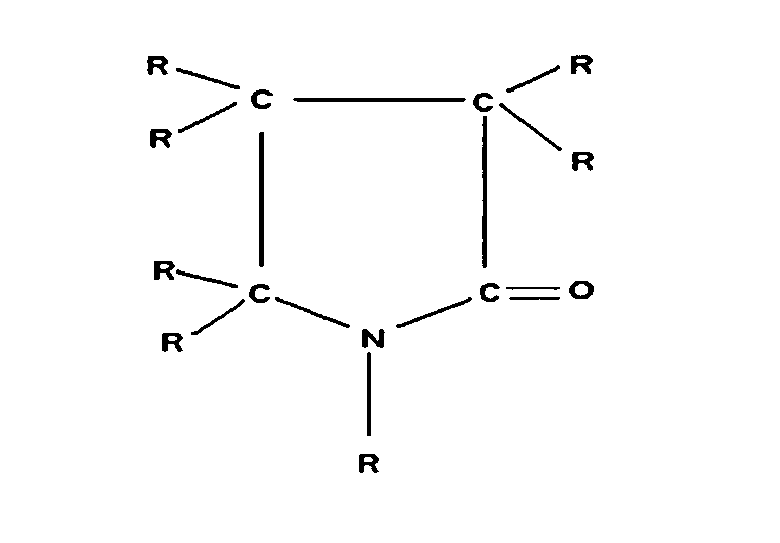
- the cyclic amide is 2-pyrrolidone having the formula: wherein R is independently selected from the group consisting of hydrogen, alkyl having from 1 to 20 carbon atoms, aryl having from 6 to 18 carbon atoms aralkyl having from 7 to 14 carbon atoms and heterocyclyl having from 2 to 9 carbon atoms. More preferably is R hydrogen.
- the catalyst composition may additionally comprise an electron donor compound, wherein the electron donor compound is preferably selected from the group consisting of ethyl acetate, ethyl acetoacetate, ethyl benzoate, anisole, tetrahydrofuran, 1,2-dioxane, thiophen and mixtures thereof, wherein anisole is most preferred.
- the electron donor compound is preferably selected from the group consisting of ethyl acetate, ethyl acetoacetate, ethyl benzoate, anisole, tetrahydrofuran, 1,2-dioxane, thiophen and mixtures thereof, wherein anisole is most preferred.
- the molar ratio of the organometallic transition metal compound and the electron donor compound is from 1:0,1 to 1:10, more preferably from 1:0,1 to 1:2.
- the molar ratio of the organoaluminum compound and the cyclic amide is 1:(0.1-1), more preferably 1:(0.1-0.5).
- According to the invention is also a process for preparing linear alpha-olefins by oligomerization of ethylene in the presence of an organic solvent and a catalyst composition, wherein the catalyst composition is as disclosed above.
- the addition of the cyclic amide i.e. the reaction product with the organoaluminum compound
- the new catalyst composition efforts higher yield of C 4 -C 10 portion, particularly C 6 fraction with higher purity of alpha-olefins.
- wax/polymer formation in the reactor is significantly reduced.
- the present invention describes a catalyst composition for the selective preparation of light alpha-olefins, C 4 -C 10 , particularly hexene-1, with a high yield.
- linear alpha-olefins of high linearity of above 90% within a desirable molecular weight range e.g. oligomers of C 4 -C 10 , can be produced.
- the catalyst composition exhibits high activity and productivity and requires relatively smaller amounts of co-catalyst than prior art catalysts in order to produce linear oligomers in a given molecular weight range. Besides no wax/polymer formation was formed during the process which efforts a long production run.
- the catalyst composition used in the production of linear alpha-olefins is preferably utilized in an inert organic solvent.
- suitable organic solvents include aromatic hydrocarbon solvents, unsubstituted or substituted with halogens, such as toluene, benzene, xylene, chlorobenzene, dichlorobenzene, chlorotoluene and the like, aliphatic paraffin hydrocarbons, such as pentane, hexane, heptane, octane, nonane, decane and the like, alicyclic hydrocarbon compounds, such as cyclohexane, decahydronaphthalene and the like, halogenated alkanes, such as dichloroethane, dichlorobutane and the like.
- a mixture of solvents may be used to control the products molecular weight distribution to obtain maximum selectivity to the desired olefin products.
- the organometallic transition metal compound and the optional electron donor can be mixed and kept for at least one year without any changes.
- the organometallic transition metal compound can be used without any electron donor for the selective oligomerization of ethylene to C 4 -C 10 -alpha-olefins.
- the addition of the electron donor to the catalyst composition can further increase the catalyst activity at least by 10% without effecting hexene-1 selectivity.
- the co-catalyst being the reaction product of the organoaluminum compound and the cyclic amide, was very surprisingly found to be useful for selective ethylene oligomerization towards C 4 -C 10 fraction with high selectivity of hexene-1.
- zirconium carboxylates are synthesized by known methods.
- a component A (zirconium carboxylate) and component B (anisole) were mixed with molar ratio of from about 1:0.1 to about 1:10, more preferably from about 1:0.1 to about 1:2.
- a component C diethyl aluminum chloride, DEAC
- the toluene solution of 2-pyrrolidone was added slowly dropwise (exothermic reaction) to the diethyl aluminum chloride under a reduced pressure and in the presence of an inert atmosphere (nitrogen).
- the prepared catalyst solution (component A and B, reaction product of C and D) is charged into a 2 liter stainless steel reactor. Ethylene was introduced into the reactor until the desired pressure was attained and maintained throughout the reaction at the desired temperature. Introduction of ethylene was continued in an amount necessary to maintain the reaction pressure. After the reaction was continued for 1 hour with maintaining the reaction conditions, the ethylene feeding is interrupted and the reaction was stopped by the addition of about 20 ml of ethanol. After bringing the temperature of the reaction mixture to 10°C, a sample of the solution was collected, by means of a valve situated at the bottom of the reactor and analyzed by gas chromatography to determine the quantity and the type of olefins formed. After eliminating the overpressure of ethylene, the reactor was opened and examined for any possible polymeric products.
- the oligomerization experiments according to the examples of the present invention result in an improved distribution of alpha-olefins (weight percent) with a high amount of C 6 . Additionally, the purity of the LAO fractions is significantly improved compared to the results of the comparative examples.
Landscapes
- Chemical & Material Sciences (AREA)
- Organic Chemistry (AREA)
- Chemical Kinetics & Catalysis (AREA)
- Engineering & Computer Science (AREA)
- Materials Engineering (AREA)
- Inorganic Chemistry (AREA)
- Catalysts (AREA)
- Organic Low-Molecular-Weight Compounds And Preparation Thereof (AREA)
- Low-Molecular Organic Synthesis Reactions Using Catalysts (AREA)
- Transition And Organic Metals Composition Catalysts For Addition Polymerization (AREA)
Abstract
Description
- The present invention relates to a catalyst composition for oligomerization of ethylene and a process for preparing linear alpha-olefins by oligomerization of ethylene.
- Linear alpha-olefins having 4 to 20 carbon atoms are key feedstocks in the production of surfactants, plastisizers, synthetic lubricants and polyolefins. High purity alpha-olefins are particularly valuable in the production of low-density polyethylene and in the oxo process. The linear alpha-olefins are more reactive than the branched alpha-olefins; the branching at the a-carbon decreases the reactivity drastically. In this regard, linear alpha-olefins having 6 to 18 carbon atoms are particularly useful and widely used in large quantities.
- Although linear olefins are the product of dehydrogenation of linear alkanes, the major portion of such products consists of the internal olefins. Preparation of alpha-olefins is based largely on oligomerization of ethylene.
- These linear alpha-olefins are prepared usually by the catalytic oligomerization of ethylene in the presence of a Ziegler-type catalyst. Ethylene oligomerization produces a wide spectrum of LAO products having even-numbered carbon chain lengths. In recent years the drive to develop more advanced polyethylenes using metallocene catalysts has made extra demands on co-monomer alpha olefins. Co-monomers are used in polyethylene to control density and enhance particular physical properties. Butene-1 and hexene-1 are used in the production of high density polyethylene (HDPE) co-polymers. Butene-1, hexene-1 and octene-1 are used in the production of linear low density polyethylene (LLDPE) co-polymers. The key factor in ethylene oligomerization is to get the desired selectivity and product distribution. Catalyst and process conditions play an important role in this area.
-
US 3,644,563 discloses the use of a homogeneous organometallic nickel-based catalyst with appropriate bidentate ligands. The ethylene oligomerization is run in polar oxygen-containing solvents such as 1,4-butanediol, in which the catalyst is highly soluble but the end product hydrocarbon oligomers are not. The oligomerization is carried out at 120°C and 14 MPa (140 bar). The olefins obtained according to this process have a high linearity and their molecular weights follow a Shulz-Flory distribution. The process therefore has disadvantages of requiring rather drastic pressure and temperature conditions, and of giving a wide distribution of alpha olefins. Hexene-1 selectivity is around 13 wt%. -
US 4,783,573 discloses a catalytic system based on a zirconium/aluminum complex using anhydrous zirconium chloride with aluminum sesquichloride and triethyl aluminum in dry benzene solvent. These components are stirred under an argon atmosphere over a period of time to form the active catalyst complex. Thiophene is added to the catalyst presumably as a moderator. Examples of oligomerization at 120°C and 3,4 MPa carried out in dry benzene show an ability to manufacture alpha olefins with long chain lengths, with results as follows: C4 - 14.9 wt%, C6 - 15.1 wt%, C8 - 14.0 wt%, C10-C18 - 40.2 wt%, C20+ - 14.2 wt% and wax - 1.6 wt%. The disadvantage of the process is a low selectivity of light alpha olefin fractions (particularly hexene-1). Another disadvantage is a high reaction temperature. Hence another disadvantage of a process is benzene which used as a solvent is known carcinogen. -
WO 03/050126 A1 - Further,
WO 80/00224 DE 4338414 also teach a catalyst, which includes a zirconium carboxylate of the general formula (RCOO)mZrCl4-m and an organoaluminum compound of the formula RnAlX3-n. The main disadvantages of that catalytic system is the formation of undesired and problematic byproducts such as wax and/or polymer (polyethylene, branched and/or cross-linked PE). The formation of wax and/or polymers, even in small amounts, has a bad impact to the entire technological process on producing oligomers, since by-products not only lower the yield of C4-C20 oligomers and its purity, but also reduce the working time of the process equipment, insofar as solid polymer accumulating in the reactors has to be periodically removed, which can be done only by interrupting the oligomerization process and hence, at the expense of lost time of the equipment. Another disadvantage of this catalyst system is the high co-catalyst/activator consumption. The catalyst/co-catalyst ratio is a key parameter that enables the modification of the alpha olefin distribution in this catalyst system. The high catalyst/co-catalyst ratio can favor the low molecular weight oligomers but at the expense of making branched C10+ fractions. The maximum hexene-1 selectivity which can be achieved by using this catalyst system is ~18 wt%. -
US 5,496,783 describes a process for converting ethylene to linear alpha olefins in the presence of a catalyst consisting of a zirconium compound with an organic compound chosen from within class of acetals and ketals and with a chlorine or bromine-containing compound of aluminum hydrocarbyl. Although the catalyst has a good selectivity for the formation of light alpha olefins, mainly C4-C10, the distribution of the product among these compounds is too orientated towards the production of butene-1. According to the examples the highest hexene-1 selectivity is about 31 wt%, where butene-1 is around 43 wt%. Another disadvantage of the process is the formation of polymer traces which eventually accumulate in the reactor and prevent a long production run. Hence another disadvantages of the process is a low activity of the catalyst. - It is therefore an object of the present invention to provide a catalyst composition which overcomes the drawbacks of the prior art, especially a catalyst composition shall be provided which can provide equivalent or even greater catalytic activity and increases the selectivity of the hexene-1 fraction.
- Additionally, a process for preparing linear alpha-olefins by oligomerization of ethylene shall be provided.
- The first object is achieved by a catalyst composition for the oligomerization of ethylene, comprising: (i) at least one transition metal compound having the general formula MXm (OR')4-m or MXm(OOCR')4-m, wherein R' is an alkyl, alkenyl, aryl, aralkyl or cycloalkyl group, X is chlorine or bromine and m is from 0 to 4; and (ii) a reaction product of an organoaluminum compound and a cyclic amide.
- Preferably, the transition metal compound is a zirconium compound.
- More preferably, the zirconium compound is a zirconium carboxylate having the formula (R2COO)mZrCl4-m, wherein R2 is alkyl, alkenyl, aryl, aralkyl or cycloalkyl group, and m is any number within the range from 0 to 4.
- In one embodiment, the organoaluminum compound has the general formula R1 nAlX3-n or Al2X3R1 3, wherein R1 represents an alkyl group having from 1 to 20 carbon atoms, X represents Cl, Br or I, n is any number within the range 1 ≤ n ≤ 2.
- Preferably, the organoaluminum compound is Al(C2H5)3, Al2Cl3(C2H5)3, AlCl(C2H5)2 or mixtures thereof, wherein AlCl(C2H5)2 is preferred.
- Moreover preferred is a catalyst composition wherein the cyclic amide has the general structure

- It is further preferred that the cyclic amide is selected from ε-caprolactam, 2-pyrrolidone, γ-valerolactam and mixtures thereof.
- Most preferably, the cyclic amide is 2-pyrrolidone having the formula:

- The catalyst composition may additionally comprise an electron donor compound, wherein the electron donor compound is preferably selected from the group consisting of ethyl acetate, ethyl acetoacetate, ethyl benzoate, anisole, tetrahydrofuran, 1,2-dioxane, thiophen and mixtures thereof, wherein anisole is most preferred.
- In one embodiment, the molar ratio of the organometallic transition metal compound and the electron donor compound is from 1:0,1 to 1:10, more preferably from 1:0,1 to 1:2.
- In another embodiment, the molar ratio of the organoaluminum compound and the cyclic amide is 1:(0.1-1), more preferably 1:(0.1-0.5).
- According to the invention is also a process for preparing linear alpha-olefins by oligomerization of ethylene in the presence of an organic solvent and a catalyst composition, wherein the catalyst composition is as disclosed above.
- Surprisingly, it was found that the addition of the cyclic amide, i.e. the reaction product with the organoaluminum compound, can alter the product distribution of ethylene oligomerization catalyst systems based on organometallic transition metal compounds and an organoaluminum co-catalyst. The new catalyst composition efforts higher yield of C4-C10 portion, particularly C6 fraction with higher purity of alpha-olefins. And at the same time wax/polymer formation in the reactor is significantly reduced. Thus, the present invention describes a catalyst composition for the selective preparation of light alpha-olefins, C4-C10, particularly hexene-1, with a high yield. With the process according to the present invention linear alpha-olefins of high linearity of above 90% within a desirable molecular weight range, e.g. oligomers of C4-C10, can be produced.
- Additionally, it was found that the catalyst composition exhibits high activity and productivity and requires relatively smaller amounts of co-catalyst than prior art catalysts in order to produce linear oligomers in a given molecular weight range. Besides no wax/polymer formation was formed during the process which efforts a long production run.
- The catalyst composition used in the production of linear alpha-olefins is preferably utilized in an inert organic solvent. The examples of suitable organic solvents include aromatic hydrocarbon solvents, unsubstituted or substituted with halogens, such as toluene, benzene, xylene, chlorobenzene, dichlorobenzene, chlorotoluene and the like, aliphatic paraffin hydrocarbons, such as pentane, hexane, heptane, octane, nonane, decane and the like, alicyclic hydrocarbon compounds, such as cyclohexane, decahydronaphthalene and the like, halogenated alkanes, such as dichloroethane, dichlorobutane and the like. A mixture of solvents may be used to control the products molecular weight distribution to obtain maximum selectivity to the desired olefin products.
- In order to simplify the process of ethylene oligomerization, the organometallic transition metal compound and the optional electron donor can be mixed and kept for at least one year without any changes. Of course, the organometallic transition metal compound can be used without any electron donor for the selective oligomerization of ethylene to C4-C10-alpha-olefins. However, it was surprisingly found that the addition of the electron donor to the catalyst composition can further increase the catalyst activity at least by 10% without effecting hexene-1 selectivity.
- The co-catalyst, being the reaction product of the organoaluminum compound and the cyclic amide, was very surprisingly found to be useful for selective ethylene oligomerization towards C4-C10 fraction with high selectivity of hexene-1.
- Additional features and advantages of the present invention will become apparent from the following detailed description of preferred embodiments with regard to the examples.
- All materials were handled in a nitrogen atmosphere using either schlenk techniques or nitrogen filled glove box. Nitrogen and toluene were supplied from a plant source and were dried by an additional bed of molecular sieves, if necessary.
- The synthesis of zirconium carboxylates are performed by known methods.
- A component A (zirconium carboxylate) and component B (anisole) were mixed with molar ratio of from about 1:0.1 to about 1:10, more preferably from about 1:0.1 to about 1:2.
- A component C (diethyl aluminum chloride, DEAC) and a toluene solution of component D (2-pyrrolidone) were mixed with molar ratio of about C:D = 1: (0.1-1), more preferably C:D = 1: (0.1-0.5). The toluene solution of 2-pyrrolidone was added slowly dropwise (exothermic reaction) to the diethyl aluminum chloride under a reduced pressure and in the presence of an inert atmosphere (nitrogen).
- The prepared catalyst solution (component A and B, reaction product of C and D) is charged into a 2 liter stainless steel reactor. Ethylene was introduced into the reactor until the desired pressure was attained and maintained throughout the reaction at the desired temperature. Introduction of ethylene was continued in an amount necessary to maintain the reaction pressure. After the reaction was continued for 1 hour with maintaining the reaction conditions, the ethylene feeding is interrupted and the reaction was stopped by the addition of about 20 ml of ethanol. After bringing the temperature of the reaction mixture to 10°C, a sample of the solution was collected, by means of a valve situated at the bottom of the reactor and analyzed by gas chromatography to determine the quantity and the type of olefins formed. After eliminating the overpressure of ethylene, the reactor was opened and examined for any possible polymeric products.
- The following examples are given to illustrate the scope of the invention. As will be apparent to those skilled in the art, numerous variations are possible and thus the scope of the invention should not be limited thereto.
- The results are summarized in Table 1 & 2.
- 200 ml toluene was placed in a 250 ml round bottom flask and 0.24 mmol Zr (i-C3H7COO)4 premixed with anisole having molar ratio to 1:0.75 was added to the flask. Then a new co-catalyst solution having molar ratio of components C/D = 1:0.15 was added to the mixture. The molar ratio of Al/Zr was 20. The catalyst solution thus formed was then transferred under a stream of inert gas to the reactor. A reaction was conducted at 70°C and 30 bar ethylene pressure. The oligomerization time was 60 minutes. 269 g of LAO are formed; a yield of 12294 g LAO/g Zr. No wax or polymer was formed.
- 200 ml toluene was placed in a 250 ml round bottom flask and 0.24 mmol Zr (i-C3H7COO)4 premixed with anisole having molar ratio to 1:0.75 was added to the flask. Then a new co-catalyst solution was added to the mixture with molar ratio components C:D = 1:0.25. The molar ratio of Al/Zr was 20. The catalyst solution thus formed was then transferred under a stream of inert gas to a reactor. A reaction was conducted at 70°C and 30 bar ethylene pressure. The oligomerization time was 60 minutes. 122 g of LAO was formed; a yield of 5575 g LAO/g Zr. No wax or polymer was formed.
- 200 ml toluene was placed in a 250 ml round bottom flask and 0.24 mmol Zr (i-C3H7COO)4 premixed with anisole having molar ratio to 1:0.75 was added to the flask. Then a new co-catalyst solution was added to the mixture with molar ratio components C:D = 1:0.25. The molar ratio of Al/Zr was 20. The catalyst solution thus formed was then transferred under a stream of inert gas to a reactor. A reaction was conducted at 90°C and 37 bar ethylene pressure. The oligomerization time was 60 minutes. 155 g of LAO was formed; a yield of 7084 g LAO/g Zr. No wax or polymer was formed.
- 200 ml toluene was placed in a 250 ml round bottom flask and 0.24 mmol Zr (i-C3H7COO)4 premixed with anisole having molar ratio to 1:0.75 was added to the flask. Then a new co-catalyst solution was added to the mixture with molar ratio components C:D = 1:0.17. The molar ratio of Al/Zr was 40. The catalyst solution thus formed was then transferred under a stream of inert gas to a reactor. A reaction was conducted at 60°C and 30 bar ethylene pressure. The oligomerization time was 60 minutes. 129 g of LAO was formed; a yield of 5895 g LAO/g Zr. No wax or polymer was formed.
- 200 ml toluene was placed in a 250 ml round bottom flask and 0.24 mmol Zr (i-C3H7COO)4 was added to the flask. No anisole was used this time. Then a new co-catalyst solution was added to the mixture with molar ratio of components C:D = 1:0.15. The molar ratio of Al/Zr was 20. The catalyst solution thus formed was then transferred under a stream of inert gas to a reactor. A reaction was conducted at 70°C and 30 bar ethylene pressure. The oligomerization time was 60 minutes. 210 g of LAO was formed; a yield of 9597 g LAO/g Zr. No wax or polymer was formed.
- 200 ml toluene, 0.25 mmol of Zr(i-C3H7COO)4 and neat diethyl aluminum chloride (DEAC) (Al/Zr = 40) were mixed in a 250 ml round bottom flask. The catalyst solution thus formed was then transferred under a stream of inert gas to a reactor. Reaction was conducted at 60°C and 30 bar ethylene pressure. Oligomerization time is 60 minutes. 370 g of LAO and 0.3 g of byproduct polyethylene was formed; a yield of 16228 g LAO / g Zr. A high amount of wax was formed which could not be correctly analysed by GC.
- 200 ml toluene, 0.25 mmol of Zr(i-C3H7COO)4 and neat ethyl aluminum sesquichloride (EASC) (Al/Zr = 35) were mixed in a 250 ml round bottom flask. The catalyst solution thus formed was then transferred under a stream of inert gas to the reactor. The reaction was conducted at 80°C and 30 bar ethylene pressure. Oligomerization time was 60 minutes. 213 g of LAO was formed; a yield of LAO 9342 g / g Zr. Traces of solid polymer were observed.
- The same procedure as in Example 7 was repeated, except that Al/Zr = 17.5. Reaction was conducted at 80°C and 30 bar ethylene pressure. Oligomerization time was 60 minutes. 460 g of LAO and 0.2 g of byproduct polyethylene are formed; a yield of 20175 g LAO / g Zr. A high amount of wax was formed which could not be correctly analysed by GC.
Table 1. Summary of the Oligomerization Experiments Examples Distribution of alpha olefins (wt%) C4 C6 C8 C10 C12-C18 C20+ Example 1 34.1 40.3 13.5 6 6 0.1 Example2 36 48.2 10.3 3 2.4 0.1 Example3 25.9 48.6 14.6 5.5 5 0.4 Example4 22.6 57.8 13.3 3.7 2.4 0.2 Example5 22 41.8 16.6 8.1 10.2 1.3 Example6(comparative) 28.5 12.3 13.5 13.4 20.2 12.1 Example7 (comparative) 34.9 18.5 15.8 11.6 17.1 2.1 Example8 (comparative) 13.8 10.4 10.8 12.1 39 13.9 Table 2. Summary of the Oligomerization Experiments Examples Purity of LAO fractions (%) C4 C6 C8 C10 C12 Example 1 99.5 98.1 98.7 91.7 90.8 Example2 99.4 98.9 97.5 92.3 91.2 Example3 99.9 98.5 98.5 91.1 90.5 Example4 98.2 97.8 98 91 90.8 Example5 99.1 97.3 98.5 91 90.5 Example6(comparative) 97.3 93.2 92.5 86.3 85.8 Example7 (comparative) 98.2 96.1 95 88.2 86 Example8 (comparative) 98.1 97.1 94.8 91.1 90.5 - As can be taken from Tables 1 and 2, the oligomerization experiments according to the examples of the present invention result in an improved distribution of alpha-olefins (weight percent) with a high amount of C6. Additionally, the purity of the LAO fractions is significantly improved compared to the results of the comparative examples.
- The features disclosed in the foregoing description and in the claims may, both separately and in any combination thereof, be material for realizing the invention in diverse forms thereof.
Claims (13)
- Catalyst composition for the oligomerization of ethylene, comprising:(i) at least one transition metal compound having the general formula MXm (OR')4-m or MXm(OOCR')4-m, wherein R' is an alkyl, alkenyl, aryl, aralkyl or cycloalkyl group, X is chlorine or bromine and m is from 0 to 4; and(ii) a reaction product of an organoaluminum compound and a cyclic amide.
- Catalyst composition according to claim 1, wherein the transition metal compound is a zirconium compound.
- Catalyst composition according to claim 2, wherein the zirconium compound is a zirconium carboxylate having the formula (R2COO)mZrCl4-m, wherein R2 is an alkyl, alkenyl, aryl, aralkyl or cycloalkyl group, and m is any number within the range 0 to 4.
- Catalyst composition according to any of the preceding claims, wherein the organoaluminum compound has the general formula R1 nAlX3-n or Al2X3R1 3, wherein R1 represents an alkyl group having from 1 to 20 carbon atoms, X represents Cl, Br or I, n is any number within the range 1 ≤ n ≤ 2.
- Catalyst composition according to claim 4, wherein the organoaluminum compound is Al(C2H5)3, Al2Cl3(C2H5)3, AlCl(C2H5)2 or mixtures thereof, wherein AlCl(C2H5)2 is preferred.
- Catalyst composition according to any of the preceding claims, wherein the cyclic amide has the general structure

- Catalyst composition according to any of the preceding claims, wherein the cyclic amide is selected from εcaprolactam, 2-pyrrolidone, γ-valerolactam, and mixtures thereof.
- Catalyst composition according to claim 7, wherein the cyclic amide is 2-pyrrolidone having the formula:
- Catalyst composition according to any of the preceding claims, additionally comprising an electron donor compound.
- Catalyst composition according to claim 9, wherein the electron donor compound is selected from the group consisting of ethyl acetate, ethyl acetoacetate, ethyl benzoate, anisole, tetrahydrofuran, 1,2-dioxane, thiophen and mixtures thereof, wherein anisole is most preferred.
- Catalyst composition according to any of the preceding claims 9 or 10, wherein the molar ratio of the organometallic transition metal compound and the electron donor compound is from 1:0,1 to 1:10, more preferably from 1:0,1 1 to 1:2.
- Catalyst composition according to any of the preceding claims, wherein the molar ratio of the organoaluminum compound and the cyclic amide is from 1:(0.1-1), more preferably 1:(0.1-0.5).
- Process for preparing linear alpha-olefins by oligomerization of ethylene in the presence of an organic solvent and a catalyst composition, wherein the catalyst composition is anyone according to any of the preceding claims.
Priority Applications (1)
| Application Number | Priority Date | Filing Date | Title |
|---|---|---|---|
| EP07024462A EP2070593B1 (en) | 2007-12-06 | 2007-12-18 | Catalyst composition and process for preparing linear alpha-olefins |
Applications Claiming Priority (2)
| Application Number | Priority Date | Filing Date | Title |
|---|---|---|---|
| EP07023618 | 2007-12-06 | ||
| EP07024462A EP2070593B1 (en) | 2007-12-06 | 2007-12-18 | Catalyst composition and process for preparing linear alpha-olefins |
Publications (3)
| Publication Number | Publication Date |
|---|---|
| EP2070593A1 true EP2070593A1 (en) | 2009-06-17 |
| EP2070593A8 EP2070593A8 (en) | 2009-12-02 |
| EP2070593B1 EP2070593B1 (en) | 2010-08-04 |
Family
ID=40336741
Family Applications (1)
| Application Number | Title | Priority Date | Filing Date |
|---|---|---|---|
| EP07024462A Not-in-force EP2070593B1 (en) | 2007-12-06 | 2007-12-18 | Catalyst composition and process for preparing linear alpha-olefins |
Country Status (16)
| Country | Link |
|---|---|
| US (1) | US9050587B2 (en) |
| EP (1) | EP2070593B1 (en) |
| JP (1) | JP5302329B2 (en) |
| KR (1) | KR101495385B1 (en) |
| CN (1) | CN101888901B (en) |
| AT (1) | ATE476254T1 (en) |
| BR (1) | BRPI0819972A2 (en) |
| CA (1) | CA2707120C (en) |
| DE (1) | DE602007008268D1 (en) |
| ES (1) | ES2349441T3 (en) |
| MX (1) | MX2010006217A (en) |
| MY (1) | MY159611A (en) |
| RU (1) | RU2456076C2 (en) |
| TW (1) | TWI434733B (en) |
| WO (1) | WO2009071164A1 (en) |
| ZA (1) | ZA201003058B (en) |
Cited By (3)
| Publication number | Priority date | Publication date | Assignee | Title |
|---|---|---|---|---|
| WO2014139861A1 (en) | 2013-03-11 | 2014-09-18 | Universität Bayreuth | Complexes for the catalytic oligomerization of olefins |
| WO2015118462A1 (en) * | 2014-02-06 | 2015-08-13 | Sabic Global Technologies B.V. | Modifying organoaluminum co-catalysts for improved performance |
| EP4319917A2 (en) * | 2021-05-26 | 2024-02-14 | Chevron Phillips Chemical Company Lp | Ethylene oligomerization processes |
Families Citing this family (5)
| Publication number | Priority date | Publication date | Assignee | Title |
|---|---|---|---|---|
| CN106536044A (en) | 2014-07-18 | 2017-03-22 | 沙特基础工业全球技术有限公司 | Catalyst composition and process for preparing linear alpha olefins |
| US10513473B2 (en) | 2015-09-18 | 2019-12-24 | Chevron Phillips Chemical Company Lp | Ethylene oligomerization/trimerization/tetramerization reactor |
| US10519077B2 (en) | 2015-09-18 | 2019-12-31 | Chevron Phillips Chemical Company Lp | Ethylene oligomerization/trimerization/tetramerization reactor |
| IN201921051272A (en) * | 2019-12-11 | 2022-01-06 | ||
| EP4183486A1 (en) | 2021-11-23 | 2023-05-24 | Indian Oil Corporation Limited | Process and catalyst composition for producing linear alpha olefins in high yield by ethylene oligomerization |
Citations (18)
| Publication number | Priority date | Publication date | Assignee | Title |
|---|---|---|---|---|
| US3100764A (en) * | 1960-08-04 | 1963-08-13 | Sun Oil Co | Control of pentane-soluble polymers in the polymerization of propylene |
| GB940125A (en) * | 1960-09-23 | 1963-10-23 | Basf Ag | Process for the polymerisation of mono-a-olefines with three or more carbon atoms |
| DE1570668A1 (en) * | 1964-06-05 | 1969-12-11 | Gen Aniline & Film Corp | Process for the production of halogenophores |
| GB1236759A (en) * | 1967-12-02 | 1971-06-23 | Hoechst Ag | Catalyst and process for the manufacture of uncrosslinked copolymers |
| US3644563A (en) | 1969-11-05 | 1972-02-22 | Shell Oil Co | Ethylene oligomerization |
| US3872072A (en) * | 1973-12-13 | 1975-03-18 | Firestone Tire & Rubber Co | New hydrogenation catalyst for elastomers, and the process of hydrogenation |
| WO1980000224A1 (en) | 1978-07-19 | 1980-02-21 | Inst Khim Fiz An Sssr | Catalyst for oligomerization of ethylene into higher alpha-olefins |
| US4224182A (en) * | 1979-03-07 | 1980-09-23 | Exxon Research & Engineering Co. | Novel hindered alkyl aluminum amide cocatalysts |
| US4783573A (en) | 1986-04-17 | 1988-11-08 | Idemitsu Petrochemical Company Limited | Process for preparing linear α-olefins |
| DE4338414C1 (en) | 1993-11-10 | 1995-03-16 | Linde Ag | Process for the preparation of linear olefins |
| US5496783A (en) | 1992-07-09 | 1996-03-05 | Institut Francais Du Petrole | Catalyst for the production of light alpha olefins by oligomerization of ethylene |
| US6103654A (en) * | 1997-02-25 | 2000-08-15 | Institut Francais Du Petrole | Catalytic composition and a process for converting ethylene to light alpha olefins |
| WO2003050126A1 (en) | 2001-12-13 | 2003-06-19 | Polimeri Europa S.P.A. | Complexes with sulfonic ligands for selective oligomerization of ethylene |
| EP1759766A1 (en) * | 2005-08-31 | 2007-03-07 | Saudi Basic Industries Corporation | Process for the preparation of linear alpha-olefins and catalyst used therein |
| EP1783145A1 (en) * | 2004-07-28 | 2007-05-09 | Mitsui Chemicals, Inc. | Olefin polymerization catalyst and method of polymerization using the catalyst |
| WO2007078679A2 (en) * | 2005-12-15 | 2007-07-12 | Zymes, Llc | Practical, cost-effective synthesis of ubiquinones |
| US20070161503A1 (en) * | 2004-03-16 | 2007-07-12 | Briggs John R | Aluminum phosphate-supported group 6 metal amide catalysts for oligomerization of ethylene |
| WO2007090412A2 (en) * | 2006-02-08 | 2007-08-16 | Saudi Basic Industries Corporation | A catalyst composition and a process for the oligomerization of ethylene |
Family Cites Families (7)
| Publication number | Priority date | Publication date | Assignee | Title |
|---|---|---|---|---|
| US3107764A (en) * | 1961-08-09 | 1963-10-22 | Little Inc A | One-way clutch |
| JP3388975B2 (en) * | 1995-03-02 | 2003-03-24 | 三菱化学株式会社 | Method for producing low α-olefin polymer |
| JP3911751B2 (en) * | 1996-02-02 | 2007-05-09 | 三菱化学株式会社 | Method for producing α-olefin low polymer |
| JPH10109946A (en) * | 1996-08-12 | 1998-04-28 | Mitsubishi Chem Corp | Method for producing α-olefin low polymer |
| US6455648B1 (en) * | 1999-12-29 | 2002-09-24 | Chevron Phillips Chemical Company Lp | Olefin production |
| JP5022546B2 (en) * | 2001-08-28 | 2012-09-12 | 出光興産株式会社 | Method for producing α-olefin low polymer |
| EP1548035A4 (en) * | 2002-09-11 | 2006-08-09 | Japan Polypropylene Corp | POLYMERIZATION CATALYST FOR (A) -OLEFINS AND PROCESS FOR PRODUCTION OF (A) -OLEFIN POLYMERS |
-
2007
- 2007-12-18 DE DE602007008268T patent/DE602007008268D1/en active Active
- 2007-12-18 ES ES07024462T patent/ES2349441T3/en active Active
- 2007-12-18 EP EP07024462A patent/EP2070593B1/en not_active Not-in-force
- 2007-12-18 AT AT07024462T patent/ATE476254T1/en not_active IP Right Cessation
-
2008
- 2008-11-11 CN CN200880119552.7A patent/CN101888901B/en not_active Expired - Fee Related
- 2008-11-11 JP JP2010536344A patent/JP5302329B2/en not_active Expired - Fee Related
- 2008-11-11 BR BRPI0819972-8A patent/BRPI0819972A2/en active Search and Examination
- 2008-11-11 WO PCT/EP2008/009495 patent/WO2009071164A1/en not_active Ceased
- 2008-11-11 US US12/734,982 patent/US9050587B2/en not_active Expired - Fee Related
- 2008-11-11 MY MYPI2010002211A patent/MY159611A/en unknown
- 2008-11-11 KR KR1020107010528A patent/KR101495385B1/en not_active Expired - Fee Related
- 2008-11-11 MX MX2010006217A patent/MX2010006217A/en active IP Right Grant
- 2008-11-11 CA CA2707120A patent/CA2707120C/en not_active Expired - Fee Related
- 2008-11-11 RU RU2010127740/04A patent/RU2456076C2/en not_active IP Right Cessation
- 2008-11-18 TW TW097144586A patent/TWI434733B/en not_active IP Right Cessation
-
2010
- 2010-04-30 ZA ZA2010/03058A patent/ZA201003058B/en unknown
Patent Citations (18)
| Publication number | Priority date | Publication date | Assignee | Title |
|---|---|---|---|---|
| US3100764A (en) * | 1960-08-04 | 1963-08-13 | Sun Oil Co | Control of pentane-soluble polymers in the polymerization of propylene |
| GB940125A (en) * | 1960-09-23 | 1963-10-23 | Basf Ag | Process for the polymerisation of mono-a-olefines with three or more carbon atoms |
| DE1570668A1 (en) * | 1964-06-05 | 1969-12-11 | Gen Aniline & Film Corp | Process for the production of halogenophores |
| GB1236759A (en) * | 1967-12-02 | 1971-06-23 | Hoechst Ag | Catalyst and process for the manufacture of uncrosslinked copolymers |
| US3644563A (en) | 1969-11-05 | 1972-02-22 | Shell Oil Co | Ethylene oligomerization |
| US3872072A (en) * | 1973-12-13 | 1975-03-18 | Firestone Tire & Rubber Co | New hydrogenation catalyst for elastomers, and the process of hydrogenation |
| WO1980000224A1 (en) | 1978-07-19 | 1980-02-21 | Inst Khim Fiz An Sssr | Catalyst for oligomerization of ethylene into higher alpha-olefins |
| US4224182A (en) * | 1979-03-07 | 1980-09-23 | Exxon Research & Engineering Co. | Novel hindered alkyl aluminum amide cocatalysts |
| US4783573A (en) | 1986-04-17 | 1988-11-08 | Idemitsu Petrochemical Company Limited | Process for preparing linear α-olefins |
| US5496783A (en) | 1992-07-09 | 1996-03-05 | Institut Francais Du Petrole | Catalyst for the production of light alpha olefins by oligomerization of ethylene |
| DE4338414C1 (en) | 1993-11-10 | 1995-03-16 | Linde Ag | Process for the preparation of linear olefins |
| US6103654A (en) * | 1997-02-25 | 2000-08-15 | Institut Francais Du Petrole | Catalytic composition and a process for converting ethylene to light alpha olefins |
| WO2003050126A1 (en) | 2001-12-13 | 2003-06-19 | Polimeri Europa S.P.A. | Complexes with sulfonic ligands for selective oligomerization of ethylene |
| US20070161503A1 (en) * | 2004-03-16 | 2007-07-12 | Briggs John R | Aluminum phosphate-supported group 6 metal amide catalysts for oligomerization of ethylene |
| EP1783145A1 (en) * | 2004-07-28 | 2007-05-09 | Mitsui Chemicals, Inc. | Olefin polymerization catalyst and method of polymerization using the catalyst |
| EP1759766A1 (en) * | 2005-08-31 | 2007-03-07 | Saudi Basic Industries Corporation | Process for the preparation of linear alpha-olefins and catalyst used therein |
| WO2007078679A2 (en) * | 2005-12-15 | 2007-07-12 | Zymes, Llc | Practical, cost-effective synthesis of ubiquinones |
| WO2007090412A2 (en) * | 2006-02-08 | 2007-08-16 | Saudi Basic Industries Corporation | A catalyst composition and a process for the oligomerization of ethylene |
Cited By (5)
| Publication number | Priority date | Publication date | Assignee | Title |
|---|---|---|---|---|
| WO2014139861A1 (en) | 2013-03-11 | 2014-09-18 | Universität Bayreuth | Complexes for the catalytic oligomerization of olefins |
| WO2015118462A1 (en) * | 2014-02-06 | 2015-08-13 | Sabic Global Technologies B.V. | Modifying organoaluminum co-catalysts for improved performance |
| US20170007994A1 (en) * | 2014-02-06 | 2017-01-12 | Sabic Global Technologies B.V. | Modifying organoaluminum co-catalysts for improved performance |
| US9724681B2 (en) * | 2014-02-06 | 2017-08-08 | Sabic Global Technologies B.V. | Modifying organoaluminum co-catalysts for improved performance |
| EP4319917A2 (en) * | 2021-05-26 | 2024-02-14 | Chevron Phillips Chemical Company Lp | Ethylene oligomerization processes |
Also Published As
| Publication number | Publication date |
|---|---|
| MX2010006217A (en) | 2010-06-23 |
| EP2070593B1 (en) | 2010-08-04 |
| TWI434733B (en) | 2014-04-21 |
| US9050587B2 (en) | 2015-06-09 |
| RU2456076C2 (en) | 2012-07-20 |
| EP2070593A8 (en) | 2009-12-02 |
| JP5302329B2 (en) | 2013-10-02 |
| TW200930456A (en) | 2009-07-16 |
| KR101495385B1 (en) | 2015-02-24 |
| CN101888901A (en) | 2010-11-17 |
| MY159611A (en) | 2017-01-13 |
| RU2010127740A (en) | 2012-01-20 |
| ZA201003058B (en) | 2011-07-27 |
| CN101888901B (en) | 2014-07-02 |
| US20110054130A1 (en) | 2011-03-03 |
| ATE476254T1 (en) | 2010-08-15 |
| CA2707120A1 (en) | 2009-06-11 |
| CA2707120C (en) | 2016-03-08 |
| DE602007008268D1 (en) | 2010-09-16 |
| BRPI0819972A2 (en) | 2015-06-16 |
| KR20100090254A (en) | 2010-08-13 |
| ES2349441T3 (en) | 2011-01-03 |
| JP2011505244A (en) | 2011-02-24 |
| WO2009071164A1 (en) | 2009-06-11 |
Similar Documents
| Publication | Publication Date | Title |
|---|---|---|
| EP2225033B1 (en) | Catalyst composition for oligomerization of ethylene oligomerization process and method for its preparation | |
| CA2087578C (en) | Preparing catalyst for olefin polymerization | |
| US8624042B2 (en) | Process for dimerization of ethylene to but-1-ene using a composition comprising a titanium-based complex and an alkoxy ligand functionalized by a heteroatom | |
| EP2070593B1 (en) | Catalyst composition and process for preparing linear alpha-olefins | |
| EP3171974B1 (en) | Catalyst composition and process for oligomerization of ethylene to produce 1-hexene and/or 1-octene | |
| US9260358B2 (en) | Process for oligomerization of olefins that uses a catalytic composition that comprises an organometallic complex that contains a phenoxy ligand that is functionalized by a heteroatom | |
| EP1759766B1 (en) | Process for the preparation of linear alpha-olefins and catalyst used therein | |
| US20210146346A1 (en) | Heteroatom Ligand, Oligomerization Catalyst Containing Same, and Method for Preparing Oligomer | |
| JP5475314B2 (en) | Complex catalyst and method for producing linear α-olefin using the same | |
| CA1298829C (en) | Catalytic systems for ethylene dimerization to 1-butene |
Legal Events
| Date | Code | Title | Description |
|---|---|---|---|
| PUAI | Public reference made under article 153(3) epc to a published international application that has entered the european phase |
Free format text: ORIGINAL CODE: 0009012 |
|
| AK | Designated contracting states |
Kind code of ref document: A1 Designated state(s): AT BE BG CH CY CZ DE DK EE ES FI FR GB GR HU IE IS IT LI LT LU LV MC MT NL PL PT RO SE SI SK TR |
|
| AX | Request for extension of the european patent |
Extension state: AL BA HR MK RS |
|
| RAP1 | Party data changed (applicant data changed or rights of an application transferred) |
Owner name: SAUDI BASIC INDUSTRIES CORPORATION Owner name: LINDE AG |
|
| RIN1 | Information on inventor provided before grant (corrected) |
Inventor name: AL-HAZMI, MOHAMMEDC/O SAUDI BASIC INDUSTRIES CORP. Inventor name: ALIYEV, VUGARC/O SAUDI BASIC INDUSTRIES CORP. Inventor name: MOSA, FUADC/O SAUDI BASIC INDUSTRIES CORP. |
|
| 17P | Request for examination filed |
Effective date: 20091210 |
|
| GRAP | Despatch of communication of intention to grant a patent |
Free format text: ORIGINAL CODE: EPIDOSNIGR1 |
|
| AKX | Designation fees paid |
Designated state(s): AT BE BG CH CY CZ DE DK EE ES FI FR GB GR HU IE IS IT LI LT LU LV MC MT NL PL PT RO SE SI SK TR |
|
| RIC1 | Information provided on ipc code assigned before grant |
Ipc: C07C 2/30 20060101ALI20100203BHEP Ipc: B01J 31/02 20060101ALI20100203BHEP Ipc: B01J 31/04 20060101AFI20100203BHEP Ipc: C07C 2/32 20060101ALI20100203BHEP Ipc: B01J 31/14 20060101ALI20100203BHEP Ipc: C07C 11/02 20060101ALI20100203BHEP Ipc: B01J 31/22 20060101ALI20100203BHEP Ipc: B01J 31/38 20060101ALI20100203BHEP Ipc: B01J 27/135 20060101ALI20100203BHEP |
|
| GRAS | Grant fee paid |
Free format text: ORIGINAL CODE: EPIDOSNIGR3 |
|
| GRAA | (expected) grant |
Free format text: ORIGINAL CODE: 0009210 |
|
| AK | Designated contracting states |
Kind code of ref document: B1 Designated state(s): AT BE BG CH CY CZ DE DK EE ES FI FR GB GR HU IE IS IT LI LT LU LV MC MT NL PL PT RO SE SI SK TR |
|
| REG | Reference to a national code |
Ref country code: GB Ref legal event code: FG4D |
|
| REG | Reference to a national code |
Ref country code: CH Ref legal event code: EP |
|
| REG | Reference to a national code |
Ref country code: IE Ref legal event code: FG4D |
|
| REF | Corresponds to: |
Ref document number: 602007008268 Country of ref document: DE Date of ref document: 20100916 Kind code of ref document: P |
|
| REG | Reference to a national code |
Ref country code: NL Ref legal event code: T3 |
|
| REG | Reference to a national code |
Ref country code: ES Ref legal event code: FG2A Effective date: 20101220 |
|
| LTIE | Lt: invalidation of european patent or patent extension |
Effective date: 20100804 |
|
| PG25 | Lapsed in a contracting state [announced via postgrant information from national office to epo] |
Ref country code: FI Free format text: LAPSE BECAUSE OF FAILURE TO SUBMIT A TRANSLATION OF THE DESCRIPTION OR TO PAY THE FEE WITHIN THE PRESCRIBED TIME-LIMIT Effective date: 20100804 Ref country code: AT Free format text: LAPSE BECAUSE OF FAILURE TO SUBMIT A TRANSLATION OF THE DESCRIPTION OR TO PAY THE FEE WITHIN THE PRESCRIBED TIME-LIMIT Effective date: 20100804 Ref country code: LT Free format text: LAPSE BECAUSE OF FAILURE TO SUBMIT A TRANSLATION OF THE DESCRIPTION OR TO PAY THE FEE WITHIN THE PRESCRIBED TIME-LIMIT Effective date: 20100804 |
|
| PG25 | Lapsed in a contracting state [announced via postgrant information from national office to epo] |
Ref country code: SI Free format text: LAPSE BECAUSE OF FAILURE TO SUBMIT A TRANSLATION OF THE DESCRIPTION OR TO PAY THE FEE WITHIN THE PRESCRIBED TIME-LIMIT Effective date: 20100804 Ref country code: PL Free format text: LAPSE BECAUSE OF FAILURE TO SUBMIT A TRANSLATION OF THE DESCRIPTION OR TO PAY THE FEE WITHIN THE PRESCRIBED TIME-LIMIT Effective date: 20100804 Ref country code: IS Free format text: LAPSE BECAUSE OF FAILURE TO SUBMIT A TRANSLATION OF THE DESCRIPTION OR TO PAY THE FEE WITHIN THE PRESCRIBED TIME-LIMIT Effective date: 20101204 Ref country code: CY Free format text: LAPSE BECAUSE OF FAILURE TO SUBMIT A TRANSLATION OF THE DESCRIPTION OR TO PAY THE FEE WITHIN THE PRESCRIBED TIME-LIMIT Effective date: 20100804 Ref country code: BG Free format text: LAPSE BECAUSE OF FAILURE TO SUBMIT A TRANSLATION OF THE DESCRIPTION OR TO PAY THE FEE WITHIN THE PRESCRIBED TIME-LIMIT Effective date: 20101104 Ref country code: PT Free format text: LAPSE BECAUSE OF FAILURE TO SUBMIT A TRANSLATION OF THE DESCRIPTION OR TO PAY THE FEE WITHIN THE PRESCRIBED TIME-LIMIT Effective date: 20101206 |
|
| PG25 | Lapsed in a contracting state [announced via postgrant information from national office to epo] |
Ref country code: SE Free format text: LAPSE BECAUSE OF FAILURE TO SUBMIT A TRANSLATION OF THE DESCRIPTION OR TO PAY THE FEE WITHIN THE PRESCRIBED TIME-LIMIT Effective date: 20100804 Ref country code: LV Free format text: LAPSE BECAUSE OF FAILURE TO SUBMIT A TRANSLATION OF THE DESCRIPTION OR TO PAY THE FEE WITHIN THE PRESCRIBED TIME-LIMIT Effective date: 20100804 Ref country code: GR Free format text: LAPSE BECAUSE OF FAILURE TO SUBMIT A TRANSLATION OF THE DESCRIPTION OR TO PAY THE FEE WITHIN THE PRESCRIBED TIME-LIMIT Effective date: 20101105 |
|
| PG25 | Lapsed in a contracting state [announced via postgrant information from national office to epo] |
Ref country code: DK Free format text: LAPSE BECAUSE OF FAILURE TO SUBMIT A TRANSLATION OF THE DESCRIPTION OR TO PAY THE FEE WITHIN THE PRESCRIBED TIME-LIMIT Effective date: 20100804 |
|
| PG25 | Lapsed in a contracting state [announced via postgrant information from national office to epo] |
Ref country code: SK Free format text: LAPSE BECAUSE OF FAILURE TO SUBMIT A TRANSLATION OF THE DESCRIPTION OR TO PAY THE FEE WITHIN THE PRESCRIBED TIME-LIMIT Effective date: 20100804 Ref country code: CZ Free format text: LAPSE BECAUSE OF FAILURE TO SUBMIT A TRANSLATION OF THE DESCRIPTION OR TO PAY THE FEE WITHIN THE PRESCRIBED TIME-LIMIT Effective date: 20100804 Ref country code: EE Free format text: LAPSE BECAUSE OF FAILURE TO SUBMIT A TRANSLATION OF THE DESCRIPTION OR TO PAY THE FEE WITHIN THE PRESCRIBED TIME-LIMIT Effective date: 20100804 Ref country code: RO Free format text: LAPSE BECAUSE OF FAILURE TO SUBMIT A TRANSLATION OF THE DESCRIPTION OR TO PAY THE FEE WITHIN THE PRESCRIBED TIME-LIMIT Effective date: 20100804 |
|
| PLBE | No opposition filed within time limit |
Free format text: ORIGINAL CODE: 0009261 |
|
| STAA | Information on the status of an ep patent application or granted ep patent |
Free format text: STATUS: NO OPPOSITION FILED WITHIN TIME LIMIT |
|
| 26N | No opposition filed |
Effective date: 20110506 |
|
| PG25 | Lapsed in a contracting state [announced via postgrant information from national office to epo] |
Ref country code: MC Free format text: LAPSE BECAUSE OF NON-PAYMENT OF DUE FEES Effective date: 20101231 |
|
| REG | Reference to a national code |
Ref country code: DE Ref legal event code: R097 Ref document number: 602007008268 Country of ref document: DE Effective date: 20110506 |
|
| PG25 | Lapsed in a contracting state [announced via postgrant information from national office to epo] |
Ref country code: IE Free format text: LAPSE BECAUSE OF NON-PAYMENT OF DUE FEES Effective date: 20101218 |
|
| PG25 | Lapsed in a contracting state [announced via postgrant information from national office to epo] |
Ref country code: IT Free format text: LAPSE BECAUSE OF NON-PAYMENT OF DUE FEES Effective date: 20101218 Ref country code: MT Free format text: LAPSE BECAUSE OF FAILURE TO SUBMIT A TRANSLATION OF THE DESCRIPTION OR TO PAY THE FEE WITHIN THE PRESCRIBED TIME-LIMIT Effective date: 20100804 |
|
| REG | Reference to a national code |
Ref country code: CH Ref legal event code: PL |
|
| PG25 | Lapsed in a contracting state [announced via postgrant information from national office to epo] |
Ref country code: LU Free format text: LAPSE BECAUSE OF NON-PAYMENT OF DUE FEES Effective date: 20101218 Ref country code: HU Free format text: LAPSE BECAUSE OF FAILURE TO SUBMIT A TRANSLATION OF THE DESCRIPTION OR TO PAY THE FEE WITHIN THE PRESCRIBED TIME-LIMIT Effective date: 20110205 |
|
| PG25 | Lapsed in a contracting state [announced via postgrant information from national office to epo] |
Ref country code: CH Free format text: LAPSE BECAUSE OF NON-PAYMENT OF DUE FEES Effective date: 20111231 Ref country code: LI Free format text: LAPSE BECAUSE OF NON-PAYMENT OF DUE FEES Effective date: 20111231 Ref country code: TR Free format text: LAPSE BECAUSE OF FAILURE TO SUBMIT A TRANSLATION OF THE DESCRIPTION OR TO PAY THE FEE WITHIN THE PRESCRIBED TIME-LIMIT Effective date: 20100804 |
|
| REG | Reference to a national code |
Ref country code: FR Ref legal event code: PLFP Year of fee payment: 9 |
|
| REG | Reference to a national code |
Ref country code: FR Ref legal event code: PLFP Year of fee payment: 10 |
|
| PGFP | Annual fee paid to national office [announced via postgrant information from national office to epo] |
Ref country code: NL Payment date: 20161212 Year of fee payment: 10 Ref country code: GB Payment date: 20161214 Year of fee payment: 10 Ref country code: DE Payment date: 20161213 Year of fee payment: 10 |
|
| PGFP | Annual fee paid to national office [announced via postgrant information from national office to epo] |
Ref country code: ES Payment date: 20161213 Year of fee payment: 10 Ref country code: BE Payment date: 20161213 Year of fee payment: 10 Ref country code: FR Payment date: 20161215 Year of fee payment: 10 Ref country code: IT Payment date: 20161221 Year of fee payment: 10 |
|
| REG | Reference to a national code |
Ref country code: DE Ref legal event code: R119 Ref document number: 602007008268 Country of ref document: DE |
|
| REG | Reference to a national code |
Ref country code: NL Ref legal event code: MM Effective date: 20180101 |
|
| GBPC | Gb: european patent ceased through non-payment of renewal fee |
Effective date: 20171218 |
|
| PG25 | Lapsed in a contracting state [announced via postgrant information from national office to epo] |
Ref country code: NL Free format text: LAPSE BECAUSE OF NON-PAYMENT OF DUE FEES Effective date: 20180101 |
|
| REG | Reference to a national code |
Ref country code: FR Ref legal event code: ST Effective date: 20180831 |
|
| REG | Reference to a national code |
Ref country code: BE Ref legal event code: MM Effective date: 20171231 |
|
| PG25 | Lapsed in a contracting state [announced via postgrant information from national office to epo] |
Ref country code: DE Free format text: LAPSE BECAUSE OF NON-PAYMENT OF DUE FEES Effective date: 20180703 Ref country code: IT Free format text: LAPSE BECAUSE OF NON-PAYMENT OF DUE FEES Effective date: 20171218 Ref country code: FR Free format text: LAPSE BECAUSE OF NON-PAYMENT OF DUE FEES Effective date: 20180102 |
|
| PG25 | Lapsed in a contracting state [announced via postgrant information from national office to epo] |
Ref country code: GB Free format text: LAPSE BECAUSE OF NON-PAYMENT OF DUE FEES Effective date: 20171218 Ref country code: BE Free format text: LAPSE BECAUSE OF NON-PAYMENT OF DUE FEES Effective date: 20171231 |
|
| REG | Reference to a national code |
Ref country code: ES Ref legal event code: FD2A Effective date: 20190703 |
|
| PG25 | Lapsed in a contracting state [announced via postgrant information from national office to epo] |
Ref country code: ES Free format text: LAPSE BECAUSE OF NON-PAYMENT OF DUE FEES Effective date: 20171219 |