EP2070578A1 - Process for the sequestration of CO2 by reaction with alkaline solid wastes - Google Patents
Process for the sequestration of CO2 by reaction with alkaline solid wastes Download PDFInfo
- Publication number
- EP2070578A1 EP2070578A1 EP07123303A EP07123303A EP2070578A1 EP 2070578 A1 EP2070578 A1 EP 2070578A1 EP 07123303 A EP07123303 A EP 07123303A EP 07123303 A EP07123303 A EP 07123303A EP 2070578 A1 EP2070578 A1 EP 2070578A1
- Authority
- EP
- European Patent Office
- Prior art keywords
- bars
- liquid effluent
- cations
- dispersion
- sequestration
- Prior art date
- Legal status (The legal status is an assumption and is not a legal conclusion. Google has not performed a legal analysis and makes no representation as to the accuracy of the status listed.)
- Withdrawn
Links
- 238000000034 method Methods 0.000 title claims abstract description 66
- 230000008569 process Effects 0.000 title claims abstract description 57
- 230000009919 sequestration Effects 0.000 title claims abstract description 41
- 239000002910 solid waste Substances 0.000 title claims abstract description 28
- 238000006243 chemical reaction Methods 0.000 title abstract description 27
- 239000000920 calcium hydroxide Substances 0.000 claims description 83
- AXCZMVOFGPJBDE-UHFFFAOYSA-L calcium dihydroxide Chemical compound [OH-].[OH-].[Ca+2] AXCZMVOFGPJBDE-UHFFFAOYSA-L 0.000 claims description 73
- 229910001861 calcium hydroxide Inorganic materials 0.000 claims description 73
- VTYYLEPIZMXCLO-UHFFFAOYSA-L Calcium carbonate Chemical compound [Ca+2].[O-]C([O-])=O VTYYLEPIZMXCLO-UHFFFAOYSA-L 0.000 claims description 46
- XLYOFNOQVPJJNP-UHFFFAOYSA-N water Substances O XLYOFNOQVPJJNP-UHFFFAOYSA-N 0.000 claims description 42
- 239000007788 liquid Substances 0.000 claims description 40
- 150000001768 cations Chemical class 0.000 claims description 37
- 239000006185 dispersion Substances 0.000 claims description 34
- CURLTUGMZLYLDI-UHFFFAOYSA-N Carbon dioxide Chemical compound O=C=O CURLTUGMZLYLDI-UHFFFAOYSA-N 0.000 claims description 30
- 229910002092 carbon dioxide Inorganic materials 0.000 claims description 27
- 229910000019 calcium carbonate Inorganic materials 0.000 claims description 23
- 239000010881 fly ash Substances 0.000 claims description 23
- 239000002699 waste material Substances 0.000 claims description 23
- 229910052500 inorganic mineral Inorganic materials 0.000 claims description 20
- 239000011707 mineral Substances 0.000 claims description 20
- 239000003245 coal Substances 0.000 claims description 15
- 238000002485 combustion reaction Methods 0.000 claims description 13
- 239000007787 solid Substances 0.000 claims description 11
- 239000003344 environmental pollutant Substances 0.000 claims description 10
- 231100000719 pollutant Toxicity 0.000 claims description 10
- 239000001569 carbon dioxide Substances 0.000 claims description 8
- 238000010438 heat treatment Methods 0.000 claims description 8
- 239000000725 suspension Substances 0.000 claims description 7
- 238000003756 stirring Methods 0.000 claims description 6
- 239000002244 precipitate Substances 0.000 claims description 5
- 229940082569 selenite Drugs 0.000 claims description 5
- MCAHWIHFGHIESP-UHFFFAOYSA-L selenite(2-) Chemical compound [O-][Se]([O-])=O MCAHWIHFGHIESP-UHFFFAOYSA-L 0.000 claims description 5
- DJHGAFSJWGLOIV-UHFFFAOYSA-K Arsenate3- Chemical compound [O-][As]([O-])([O-])=O DJHGAFSJWGLOIV-UHFFFAOYSA-K 0.000 claims description 4
- 229910019142 PO4 Inorganic materials 0.000 claims description 4
- QAOWNCQODCNURD-UHFFFAOYSA-L Sulfate Chemical compound [O-]S([O-])(=O)=O QAOWNCQODCNURD-UHFFFAOYSA-L 0.000 claims description 4
- 229940000489 arsenate Drugs 0.000 claims description 4
- ZCDOYSPFYFSLEW-UHFFFAOYSA-N chromate(2-) Chemical compound [O-][Cr]([O-])(=O)=O ZCDOYSPFYFSLEW-UHFFFAOYSA-N 0.000 claims description 4
- MEFBJEMVZONFCJ-UHFFFAOYSA-N molybdate Chemical compound [O-][Mo]([O-])(=O)=O MEFBJEMVZONFCJ-UHFFFAOYSA-N 0.000 claims description 4
- NBIIXXVUZAFLBC-UHFFFAOYSA-K phosphate Chemical compound [O-]P([O-])([O-])=O NBIIXXVUZAFLBC-UHFFFAOYSA-K 0.000 claims description 4
- 239000010452 phosphate Substances 0.000 claims description 4
- RYGMFSIKBFXOCR-UHFFFAOYSA-N Copper Chemical compound [Cu] RYGMFSIKBFXOCR-UHFFFAOYSA-N 0.000 claims description 3
- 229910052793 cadmium Inorganic materials 0.000 claims description 3
- BDOSMKKIYDKNTQ-UHFFFAOYSA-N cadmium atom Chemical compound [Cd] BDOSMKKIYDKNTQ-UHFFFAOYSA-N 0.000 claims description 3
- 150000001868 cobalt Chemical class 0.000 claims description 3
- 229910052802 copper Inorganic materials 0.000 claims description 3
- 239000010949 copper Substances 0.000 claims description 3
- 238000001914 filtration Methods 0.000 claims description 3
- 238000010979 pH adjustment Methods 0.000 claims description 3
- 229910021653 sulphate ion Inorganic materials 0.000 claims description 3
- 238000002156 mixing Methods 0.000 claims description 2
- 238000002474 experimental method Methods 0.000 description 29
- 235000011116 calcium hydroxide Nutrition 0.000 description 20
- 229910021532 Calcite Inorganic materials 0.000 description 16
- 235000010755 mineral Nutrition 0.000 description 16
- 239000007789 gas Substances 0.000 description 14
- 239000010893 paper waste Substances 0.000 description 8
- 238000001556 precipitation Methods 0.000 description 8
- 235000008733 Citrus aurantifolia Nutrition 0.000 description 7
- 235000011941 Tilia x europaea Nutrition 0.000 description 7
- 230000008859 change Effects 0.000 description 7
- 239000012530 fluid Substances 0.000 description 7
- 239000004571 lime Substances 0.000 description 7
- 239000002245 particle Substances 0.000 description 7
- 239000012265 solid product Substances 0.000 description 7
- 239000011575 calcium Substances 0.000 description 6
- 239000002994 raw material Substances 0.000 description 6
- OYPRJOBELJOOCE-UHFFFAOYSA-N Calcium Chemical compound [Ca] OYPRJOBELJOOCE-UHFFFAOYSA-N 0.000 description 5
- OKTJSMMVPCPJKN-UHFFFAOYSA-N Carbon Chemical compound [C] OKTJSMMVPCPJKN-UHFFFAOYSA-N 0.000 description 5
- 229910052791 calcium Inorganic materials 0.000 description 5
- 229910052799 carbon Inorganic materials 0.000 description 5
- 238000004519 manufacturing process Methods 0.000 description 5
- 239000000243 solution Substances 0.000 description 5
- BUGBHKTXTAQXES-UHFFFAOYSA-N Selenium Chemical compound [Se] BUGBHKTXTAQXES-UHFFFAOYSA-N 0.000 description 4
- 238000005119 centrifugation Methods 0.000 description 4
- 238000001816 cooling Methods 0.000 description 4
- 230000007613 environmental effect Effects 0.000 description 4
- 150000002500 ions Chemical class 0.000 description 4
- 230000007774 longterm Effects 0.000 description 4
- 239000000463 material Substances 0.000 description 4
- 239000010908 plant waste Substances 0.000 description 4
- 238000001878 scanning electron micrograph Methods 0.000 description 4
- 231100000331 toxic Toxicity 0.000 description 4
- 230000002588 toxic effect Effects 0.000 description 4
- 239000002351 wastewater Substances 0.000 description 4
- ODINCKMPIJJUCX-UHFFFAOYSA-N Calcium oxide Chemical compound [Ca]=O ODINCKMPIJJUCX-UHFFFAOYSA-N 0.000 description 3
- BVKZGUZCCUSVTD-UHFFFAOYSA-L Carbonate Chemical compound [O-]C([O-])=O BVKZGUZCCUSVTD-UHFFFAOYSA-L 0.000 description 3
- HEMHJVSKTPXQMS-UHFFFAOYSA-M Sodium hydroxide Chemical compound [OH-].[Na+] HEMHJVSKTPXQMS-UHFFFAOYSA-M 0.000 description 3
- 229910000831 Steel Inorganic materials 0.000 description 3
- 238000002441 X-ray diffraction Methods 0.000 description 3
- 239000003570 air Substances 0.000 description 3
- 150000001450 anions Chemical class 0.000 description 3
- 230000003993 interaction Effects 0.000 description 3
- 230000035484 reaction time Effects 0.000 description 3
- 238000004064 recycling Methods 0.000 description 3
- 230000004044 response Effects 0.000 description 3
- 229910052711 selenium Inorganic materials 0.000 description 3
- 239000011669 selenium Substances 0.000 description 3
- 239000007790 solid phase Substances 0.000 description 3
- 239000010959 steel Substances 0.000 description 3
- XKRFYHLGVUSROY-UHFFFAOYSA-N Argon Chemical compound [Ar] XKRFYHLGVUSROY-UHFFFAOYSA-N 0.000 description 2
- IJGRMHOSHXDMSA-UHFFFAOYSA-N Atomic nitrogen Chemical compound N#N IJGRMHOSHXDMSA-UHFFFAOYSA-N 0.000 description 2
- XTEGARKTQYYJKE-UHFFFAOYSA-M Chlorate Chemical compound [O-]Cl(=O)=O XTEGARKTQYYJKE-UHFFFAOYSA-M 0.000 description 2
- KWYUFKZDYYNOTN-UHFFFAOYSA-M Potassium hydroxide Chemical compound [OH-].[K+] KWYUFKZDYYNOTN-UHFFFAOYSA-M 0.000 description 2
- FAPWRFPIFSIZLT-UHFFFAOYSA-M Sodium chloride Chemical compound [Na+].[Cl-] FAPWRFPIFSIZLT-UHFFFAOYSA-M 0.000 description 2
- 239000003513 alkali Substances 0.000 description 2
- 238000013459 approach Methods 0.000 description 2
- 239000007864 aqueous solution Substances 0.000 description 2
- 230000015572 biosynthetic process Effects 0.000 description 2
- 239000010882 bottom ash Substances 0.000 description 2
- 239000006227 byproduct Substances 0.000 description 2
- 229910001748 carbonate mineral Inorganic materials 0.000 description 2
- 238000012512 characterization method Methods 0.000 description 2
- 239000003153 chemical reaction reagent Substances 0.000 description 2
- 238000005202 decontamination Methods 0.000 description 2
- 230000003588 decontaminative effect Effects 0.000 description 2
- KZHJGOXRZJKJNY-UHFFFAOYSA-N dioxosilane;oxo(oxoalumanyloxy)alumane Chemical compound O=[Si]=O.O=[Si]=O.O=[Al]O[Al]=O.O=[Al]O[Al]=O.O=[Al]O[Al]=O KZHJGOXRZJKJNY-UHFFFAOYSA-N 0.000 description 2
- 238000004090 dissolution Methods 0.000 description 2
- 239000000428 dust Substances 0.000 description 2
- 239000002803 fossil fuel Substances 0.000 description 2
- 229910052588 hydroxylapatite Inorganic materials 0.000 description 2
- WQYVRQLZKVEZGA-UHFFFAOYSA-N hypochlorite Chemical compound Cl[O-] WQYVRQLZKVEZGA-UHFFFAOYSA-N 0.000 description 2
- 230000014759 maintenance of location Effects 0.000 description 2
- 230000007246 mechanism Effects 0.000 description 2
- 239000000203 mixture Substances 0.000 description 2
- 229910052863 mullite Inorganic materials 0.000 description 2
- XYJRXVWERLGGKC-UHFFFAOYSA-D pentacalcium;hydroxide;triphosphate Chemical compound [OH-].[Ca+2].[Ca+2].[Ca+2].[Ca+2].[Ca+2].[O-]P([O-])([O-])=O.[O-]P([O-])([O-])=O.[O-]P([O-])([O-])=O XYJRXVWERLGGKC-UHFFFAOYSA-D 0.000 description 2
- -1 permanganate Chemical compound 0.000 description 2
- JRKICGRDRMAZLK-UHFFFAOYSA-L peroxydisulfate Chemical compound [O-]S(=O)(=O)OOS([O-])(=O)=O JRKICGRDRMAZLK-UHFFFAOYSA-L 0.000 description 2
- 239000012071 phase Substances 0.000 description 2
- 239000000843 powder Substances 0.000 description 2
- 239000000047 product Substances 0.000 description 2
- 239000002893 slag Substances 0.000 description 2
- 239000011780 sodium chloride Substances 0.000 description 2
- 239000002689 soil Substances 0.000 description 2
- 239000010414 supernatant solution Substances 0.000 description 2
- 238000012546 transfer Methods 0.000 description 2
- QGZKDVFQNNGYKY-UHFFFAOYSA-O Ammonium Chemical compound [NH4+] QGZKDVFQNNGYKY-UHFFFAOYSA-O 0.000 description 1
- ATRRKUHOCOJYRX-UHFFFAOYSA-N Ammonium bicarbonate Chemical compound [NH4+].OC([O-])=O ATRRKUHOCOJYRX-UHFFFAOYSA-N 0.000 description 1
- BTBUEUYNUDRHOZ-UHFFFAOYSA-N Borate Chemical compound [O-]B([O-])[O-] BTBUEUYNUDRHOZ-UHFFFAOYSA-N 0.000 description 1
- UGFAIRIUMAVXCW-UHFFFAOYSA-N Carbon monoxide Chemical compound [O+]#[C-] UGFAIRIUMAVXCW-UHFFFAOYSA-N 0.000 description 1
- DGAQECJNVWCQMB-PUAWFVPOSA-M Ilexoside XXIX Chemical compound C[C@@H]1CC[C@@]2(CC[C@@]3(C(=CC[C@H]4[C@]3(CC[C@@H]5[C@@]4(CC[C@@H](C5(C)C)OS(=O)(=O)[O-])C)C)[C@@H]2[C@]1(C)O)C)C(=O)O[C@H]6[C@@H]([C@H]([C@@H]([C@H](O6)CO)O)O)O.[Na+] DGAQECJNVWCQMB-PUAWFVPOSA-M 0.000 description 1
- FYYHWMGAXLPEAU-UHFFFAOYSA-N Magnesium Chemical compound [Mg] FYYHWMGAXLPEAU-UHFFFAOYSA-N 0.000 description 1
- IOVCWXUNBOPUCH-UHFFFAOYSA-M Nitrite anion Chemical compound [O-]N=O IOVCWXUNBOPUCH-UHFFFAOYSA-M 0.000 description 1
- BPQQTUXANYXVAA-UHFFFAOYSA-N Orthosilicate Chemical compound [O-][Si]([O-])([O-])[O-] BPQQTUXANYXVAA-UHFFFAOYSA-N 0.000 description 1
- NPYPAHLBTDXSSS-UHFFFAOYSA-N Potassium ion Chemical compound [K+] NPYPAHLBTDXSSS-UHFFFAOYSA-N 0.000 description 1
- 229910018143 SeO3 Inorganic materials 0.000 description 1
- LSNNMFCWUKXFEE-UHFFFAOYSA-N Sulfurous acid Chemical compound OS(O)=O LSNNMFCWUKXFEE-UHFFFAOYSA-N 0.000 description 1
- RTAQQCXQSZGOHL-UHFFFAOYSA-N Titanium Chemical compound [Ti] RTAQQCXQSZGOHL-UHFFFAOYSA-N 0.000 description 1
- 238000009825 accumulation Methods 0.000 description 1
- 239000003463 adsorbent Substances 0.000 description 1
- 238000013019 agitation Methods 0.000 description 1
- 150000004645 aluminates Chemical class 0.000 description 1
- 239000005354 aluminosilicate glass Substances 0.000 description 1
- 239000001099 ammonium carbonate Substances 0.000 description 1
- 235000012501 ammonium carbonate Nutrition 0.000 description 1
- 238000004458 analytical method Methods 0.000 description 1
- 229910052925 anhydrite Inorganic materials 0.000 description 1
- 239000008346 aqueous phase Substances 0.000 description 1
- 229910052786 argon Inorganic materials 0.000 description 1
- 230000008033 biological extinction Effects 0.000 description 1
- 239000012267 brine Substances 0.000 description 1
- 238000001354 calcination Methods 0.000 description 1
- OSGAYBCDTDRGGQ-UHFFFAOYSA-L calcium sulfate Chemical compound [Ca+2].[O-]S([O-])(=O)=O OSGAYBCDTDRGGQ-UHFFFAOYSA-L 0.000 description 1
- 238000009993 causticizing Methods 0.000 description 1
- 239000004568 cement Substances 0.000 description 1
- 150000001793 charged compounds Polymers 0.000 description 1
- 239000003638 chemical reducing agent Substances 0.000 description 1
- 229910001919 chlorite Inorganic materials 0.000 description 1
- 229910052619 chlorite group Inorganic materials 0.000 description 1
- QBWCMBCROVPCKQ-UHFFFAOYSA-N chlorous acid Chemical compound OCl=O QBWCMBCROVPCKQ-UHFFFAOYSA-N 0.000 description 1
- 238000000975 co-precipitation Methods 0.000 description 1
- 239000000084 colloidal system Substances 0.000 description 1
- 239000000567 combustion gas Substances 0.000 description 1
- 239000013078 crystal Substances 0.000 description 1
- 238000001514 detection method Methods 0.000 description 1
- SOCTUWSJJQCPFX-UHFFFAOYSA-N dichromate(2-) Chemical compound [O-][Cr](=O)(=O)O[Cr]([O-])(=O)=O SOCTUWSJJQCPFX-UHFFFAOYSA-N 0.000 description 1
- XPPKVPWEQAFLFU-UHFFFAOYSA-J diphosphate(4-) Chemical compound [O-]P([O-])(=O)OP([O-])([O-])=O XPPKVPWEQAFLFU-UHFFFAOYSA-J 0.000 description 1
- 235000011180 diphosphates Nutrition 0.000 description 1
- 239000003651 drinking water Substances 0.000 description 1
- 235000020188 drinking water Nutrition 0.000 description 1
- 230000000694 effects Effects 0.000 description 1
- 238000005868 electrolysis reaction Methods 0.000 description 1
- 239000012717 electrostatic precipitator Substances 0.000 description 1
- 230000008030 elimination Effects 0.000 description 1
- 238000003379 elimination reaction Methods 0.000 description 1
- 238000011066 ex-situ storage Methods 0.000 description 1
- 238000013213 extrapolation Methods 0.000 description 1
- 239000010433 feldspar Substances 0.000 description 1
- 239000010419 fine particle Substances 0.000 description 1
- 238000005188 flotation Methods 0.000 description 1
- 239000003546 flue gas Substances 0.000 description 1
- 239000007792 gaseous phase Substances 0.000 description 1
- 239000005431 greenhouse gas Substances 0.000 description 1
- 239000003673 groundwater Substances 0.000 description 1
- 230000036571 hydration Effects 0.000 description 1
- 238000006703 hydration reaction Methods 0.000 description 1
- NFMHSPWHNQRFNR-UHFFFAOYSA-N hyponitrous acid Chemical compound ON=NO NFMHSPWHNQRFNR-UHFFFAOYSA-N 0.000 description 1
- 239000011261 inert gas Substances 0.000 description 1
- SZVJSHCCFOBDDC-UHFFFAOYSA-N iron(II,III) oxide Inorganic materials O=[Fe]O[Fe]O[Fe]=O SZVJSHCCFOBDDC-UHFFFAOYSA-N 0.000 description 1
- 230000002427 irreversible effect Effects 0.000 description 1
- 238000002955 isolation Methods 0.000 description 1
- 239000010808 liquid waste Substances 0.000 description 1
- LBSANEJBGMCTBH-UHFFFAOYSA-N manganate Chemical compound [O-][Mn]([O-])(=O)=O LBSANEJBGMCTBH-UHFFFAOYSA-N 0.000 description 1
- 238000005259 measurement Methods 0.000 description 1
- 238000010907 mechanical stirring Methods 0.000 description 1
- 238000002844 melting Methods 0.000 description 1
- 230000008018 melting Effects 0.000 description 1
- 238000004452 microanalysis Methods 0.000 description 1
- 239000011859 microparticle Substances 0.000 description 1
- 230000000877 morphologic effect Effects 0.000 description 1
- 239000010813 municipal solid waste Substances 0.000 description 1
- 229910052757 nitrogen Inorganic materials 0.000 description 1
- 238000002103 osmometry Methods 0.000 description 1
- VLTRZXGMWDSKGL-UHFFFAOYSA-M perchlorate Inorganic materials [O-]Cl(=O)(=O)=O VLTRZXGMWDSKGL-UHFFFAOYSA-M 0.000 description 1
- VLTRZXGMWDSKGL-UHFFFAOYSA-N perchloric acid Chemical compound OCl(=O)(=O)=O VLTRZXGMWDSKGL-UHFFFAOYSA-N 0.000 description 1
- ACVYVLVWPXVTIT-UHFFFAOYSA-M phosphinate Chemical compound [O-][PH2]=O ACVYVLVWPXVTIT-UHFFFAOYSA-M 0.000 description 1
- OJMIONKXNSYLSR-UHFFFAOYSA-N phosphorous acid Chemical compound OP(O)O OJMIONKXNSYLSR-UHFFFAOYSA-N 0.000 description 1
- 239000010453 quartz Substances 0.000 description 1
- 230000005855 radiation Effects 0.000 description 1
- 239000012429 reaction media Substances 0.000 description 1
- 238000006722 reduction reaction Methods 0.000 description 1
- 238000005067 remediation Methods 0.000 description 1
- 230000000717 retained effect Effects 0.000 description 1
- 230000002441 reversible effect Effects 0.000 description 1
- 239000011435 rock Substances 0.000 description 1
- 229920006395 saturated elastomer Polymers 0.000 description 1
- 238000004626 scanning electron microscopy Methods 0.000 description 1
- 239000010865 sewage Substances 0.000 description 1
- 229910052604 silicate mineral Inorganic materials 0.000 description 1
- VYPSYNLAJGMNEJ-UHFFFAOYSA-N silicon dioxide Inorganic materials O=[Si]=O VYPSYNLAJGMNEJ-UHFFFAOYSA-N 0.000 description 1
- 239000002002 slurry Substances 0.000 description 1
- 239000011734 sodium Substances 0.000 description 1
- 229910052708 sodium Inorganic materials 0.000 description 1
- HPALAKNZSZLMCH-UHFFFAOYSA-M sodium;chloride;hydrate Chemical compound O.[Na+].[Cl-] HPALAKNZSZLMCH-UHFFFAOYSA-M 0.000 description 1
- 239000007858 starting material Substances 0.000 description 1
- 239000000126 substance Substances 0.000 description 1
- DHCDFWKWKRSZHF-UHFFFAOYSA-L thiosulfate(2-) Chemical compound [O-]S([S-])(=O)=O DHCDFWKWKRSZHF-UHFFFAOYSA-L 0.000 description 1
- 239000010936 titanium Substances 0.000 description 1
- 229910052719 titanium Inorganic materials 0.000 description 1
- 238000011282 treatment Methods 0.000 description 1
- 239000012498 ultrapure water Substances 0.000 description 1
- 238000010792 warming Methods 0.000 description 1
- 238000004056 waste incineration Methods 0.000 description 1
- 238000004065 wastewater treatment Methods 0.000 description 1
Images





Classifications
-
- B—PERFORMING OPERATIONS; TRANSPORTING
- B01—PHYSICAL OR CHEMICAL PROCESSES OR APPARATUS IN GENERAL
- B01D—SEPARATION
- B01D53/00—Separation of gases or vapours; Recovering vapours of volatile solvents from gases; Chemical or biological purification of waste gases, e.g. engine exhaust gases, smoke, fumes, flue gases, aerosols
- B01D53/34—Chemical or biological purification of waste gases
- B01D53/46—Removing components of defined structure
- B01D53/62—Carbon oxides
-
- B—PERFORMING OPERATIONS; TRANSPORTING
- B01—PHYSICAL OR CHEMICAL PROCESSES OR APPARATUS IN GENERAL
- B01D—SEPARATION
- B01D53/00—Separation of gases or vapours; Recovering vapours of volatile solvents from gases; Chemical or biological purification of waste gases, e.g. engine exhaust gases, smoke, fumes, flue gases, aerosols
- B01D53/26—Drying gases or vapours
- B01D53/261—Drying gases or vapours by adsorption
-
- C—CHEMISTRY; METALLURGY
- C01—INORGANIC CHEMISTRY
- C01F—COMPOUNDS OF THE METALS BERYLLIUM, MAGNESIUM, ALUMINIUM, CALCIUM, STRONTIUM, BARIUM, RADIUM, THORIUM, OR OF THE RARE-EARTH METALS
- C01F11/00—Compounds of calcium, strontium, or barium
- C01F11/02—Oxides or hydroxides
-
- C—CHEMISTRY; METALLURGY
- C01—INORGANIC CHEMISTRY
- C01F—COMPOUNDS OF THE METALS BERYLLIUM, MAGNESIUM, ALUMINIUM, CALCIUM, STRONTIUM, BARIUM, RADIUM, THORIUM, OR OF THE RARE-EARTH METALS
- C01F11/00—Compounds of calcium, strontium, or barium
- C01F11/18—Carbonates
-
- B—PERFORMING OPERATIONS; TRANSPORTING
- B01—PHYSICAL OR CHEMICAL PROCESSES OR APPARATUS IN GENERAL
- B01D—SEPARATION
- B01D2251/00—Reactants
- B01D2251/40—Alkaline earth metal or magnesium compounds
- B01D2251/404—Alkaline earth metal or magnesium compounds of calcium
-
- B—PERFORMING OPERATIONS; TRANSPORTING
- B01—PHYSICAL OR CHEMICAL PROCESSES OR APPARATUS IN GENERAL
- B01D—SEPARATION
- B01D2255/00—Catalysts
- B01D2255/10—Noble metals or compounds thereof
- B01D2255/102—Platinum group metals
- B01D2255/1021—Platinum
-
- B—PERFORMING OPERATIONS; TRANSPORTING
- B01—PHYSICAL OR CHEMICAL PROCESSES OR APPARATUS IN GENERAL
- B01D—SEPARATION
- B01D2255/00—Catalysts
- B01D2255/10—Noble metals or compounds thereof
- B01D2255/102—Platinum group metals
- B01D2255/1023—Palladium
-
- B—PERFORMING OPERATIONS; TRANSPORTING
- B01—PHYSICAL OR CHEMICAL PROCESSES OR APPARATUS IN GENERAL
- B01D—SEPARATION
- B01D2255/00—Catalysts
- B01D2255/50—Zeolites
-
- Y—GENERAL TAGGING OF NEW TECHNOLOGICAL DEVELOPMENTS; GENERAL TAGGING OF CROSS-SECTIONAL TECHNOLOGIES SPANNING OVER SEVERAL SECTIONS OF THE IPC; TECHNICAL SUBJECTS COVERED BY FORMER USPC CROSS-REFERENCE ART COLLECTIONS [XRACs] AND DIGESTS
- Y02—TECHNOLOGIES OR APPLICATIONS FOR MITIGATION OR ADAPTATION AGAINST CLIMATE CHANGE
- Y02C—CAPTURE, STORAGE, SEQUESTRATION OR DISPOSAL OF GREENHOUSE GASES [GHG]
- Y02C20/00—Capture or disposal of greenhouse gases
- Y02C20/40—Capture or disposal of greenhouse gases of CO2
-
- Y—GENERAL TAGGING OF NEW TECHNOLOGICAL DEVELOPMENTS; GENERAL TAGGING OF CROSS-SECTIONAL TECHNOLOGIES SPANNING OVER SEVERAL SECTIONS OF THE IPC; TECHNICAL SUBJECTS COVERED BY FORMER USPC CROSS-REFERENCE ART COLLECTIONS [XRACs] AND DIGESTS
- Y02—TECHNOLOGIES OR APPLICATIONS FOR MITIGATION OR ADAPTATION AGAINST CLIMATE CHANGE
- Y02P—CLIMATE CHANGE MITIGATION TECHNOLOGIES IN THE PRODUCTION OR PROCESSING OF GOODS
- Y02P20/00—Technologies relating to chemical industry
- Y02P20/151—Reduction of greenhouse gas [GHG] emissions, e.g. CO2
Definitions
- the present invention relates to a process of sequestration of CO 2 by reaction with alkaline solid wastes.
- Anions contained in wastewater are typically mobile in soils and groundwater since most natural materials have net negative surface charges.
- a number of anions, particularly inorganic oxyanions such as chromate, arsenate, molybdate, selenite and selenate can be toxic to humans or wildlife at ⁇ g/L to mg/L concentrations.
- the removal of the toxic oxyanions has been achieved by coprecipitation ( Roundhill, D. M., Koch, H. F., Chem. Soc. Rev. 31 (2002) 60 .; Harper, T. R., Kingham, N. W., Water Environ. Res. 64 (1992) 200 ), reverse osmometry ( Fox, K. R., Sorg, T.
- An alternative to reduce the CO 2 emission without modifying the energy production system is the retention or sequestration of carbon dioxide in stable geological reservoirs ( Bachu, S. Sequestration of CO2 in geological media: criteria and approach for site selection in response to climate change. Energy Convers. Manage. 2000, 41, 953-970 ; Bachu, S. Sequestration of CO2 in geological media in response to climate change: road map for site selection using the transform of the geological space into the CO2 phase space. Energy Convers. Manage. 2002, 43, 87-102 ; Bachu, S; Adams, J. J. Sequestration of CO2 in geological media in response to climate change: capacity of deep saline aquifers to sequester CO2 in solution. Energy Convers. Manage. 2003, 44, 3151-3175 ; Friedmann, S. J. Geological Carbon Dioxide Sequestration. Elements 2007, 3, 179-184 .).
- geological carbon sequestration consists of capturing gaseous CO 2 from emission sources and injecting it as a supercritical fluid in terrestrial reservoirs, such as saline aquifers, depleted oil and gas fields or deep coal seams.
- the supercritical CO 2 could be retained by stratigraphic or structural trapping (physical isolation), solubility trapping (dissolved in the aqueous phase) and/or hydrodynamic trapping (associated to long residence time of dissolved CO 2 -bearing fluids in aquifers).
- stratigraphic or structural trapping physical isolation
- solubility trapping dissolved in the aqueous phase
- hydrodynamic trapping associated to long residence time of dissolved CO 2 -bearing fluids in aquifers.
- the main scientific concerns inquiring the geological carbon sequestration applicability are the high pressure and temperature variations caused by the large CO 2 accumulation on the reservoirs. These thermodynamic variations could exert forces that diminish the reservoir confinement due to the formation of cracks and faults either in reservoir itself or in the cap
- the CO 2 pressure can decrease in the long term as a consequence of another retention mechanism: mineral trapping or mineralogical carbon sequestration.
- the stored CO 2 may transform to stable carbonate minerals by reactions with aqueous ions.
- this mechanism favours the permanent CO 2 sequestration, it is expected to be slow in geological formation (hundreds of years) due to the slow kinetics of silicate mineral dissolution and carbonate mineral precipitation.
- mineralogical carbon sequestration could contribute significantly to CO 2 sequestration in the proximity of the emission source, without the need of storing the gas into a geological reservoir.
- Montes-Hernandez et al. Montes-Hernandez G., Renard F., Geoffroy N., Charlet L. and Pironon J. (2007) Calcite precipitation from CO2-H2O-Ca(OH)2 slurry under high pressure of CO2.
- pure portlandite and other primary minerals may suppose a high economic and environmental cost as these are typically resources and not residues.
- the carbon dioxide concentration must be high, and this has been achieved by applying an elevated carbon dioxide pressure. Furthermore, this process needs a filtration step.
- One of the aims of the present invention is to provide a CO 2 sequestration process which does not require controlling the CO 2 pressure and the pH of the reaction medium.
- Another aim of the invention is to provide a CO 2 sequestration process allowing the recycling of plant wastes.
- Another aim of the invention is to provide a CO 2 sequestration process allowing the decontamination of liquid effluents contaminated by pollutants, such as inorganic oxyanions and/or cations.
- Still another aim of the invention is to provide a process of sequestration of CO 2 under mineral form.
- the present invention relates to the use of substantially alkaline solid wastes containing accessible CaO and/or Ca(OH) 2 for implementing a process of sequestration of CO 2 under mineral form and possibly purifying a liquid effluent if contaminated by pollutants such as inorganic oxyanions and/or cations, comprising a step of reacting said alkaline solid wastes with said liquid effluent to form a calcium hydroxide dispersion, at a non isobaric pressure and without external pH adjustment, at a temperature comprised from about 10 to about 60°C.
- alkaline solid waste refers to residues of industrial operation or process such as fossil fuel combustion (coal fly ash), Municipal Solid Waste Incineration (MSWI bottom ash), paper mill and production of steel (steel slag). These materials are alkaline and contain various oxides such as calcium comprising oxides in particular CaO and/or Ca(OH) 2 .
- accessible CaO and/or Ca(OH) 2 refers to CaO and/or Ca(OH) 2 contained in isolated waste or to isolated particles of CaO and/or Ca(OH) 2 and easily available to be dispersed in water and/or aqueous solution.
- the accessibility of CaO and/or Ca(OH) 2 can be verified by measuring the pH immediately after the dissolution of CaO and/or Ca(OH) 2 in said liquid effluent wherein the pH increases quasi instantaneously to 12.5.
- liquid effluent is meant a stream flowing out of a body of water, an outflow from a sewer or sewage system, a discharge of liquid waste, as from a factory, a nuclear plant. It can be pure water, or waste water contaminated by pollutants, that is something that pollutes, especially a waste material that contaminates air, soil, or water.
- oxyanions refers to a negatively charged polyatomic ion that contains oxide.
- examples of oxyanions are included in the following list: arsenate, aluminate, borate, carbonate, nitrite, hyponitrite, molybdate, silicate, phosphate, phosphite, hypophosphite, persulfate, selenite, sulfate, sulfite, hyposulfite, perchlorate, chlorate, chlorite, hypochlorite, chromate, permanganate, manganate, peroxydisulfate, dichromate, pyrophosphate, polyoxometalates such as phosphomolybdate and phosphotungstate or lead, cadmium, copper, or cobalt salts,
- cation is meant an ion or group of ions having a positive charge and characteristically moving toward the negative electrode in electrolysis. Examples of cations, but without being limited to, are included in the following list:
- calcium hydroxide dispersion refers to calcium hydroxide particles in suspension, i.e. not dissolved, in the liquid effluent. Said calcium hydroxide dispersion is formed by the irreversible hydration of lime in water: CaO + H 2 O ⁇ Ca ( OH ) 2
- non isobaric pressure is meant a pressure that is not constant during the process, i.e. variable between the beginning and the end of the process.
- external pH adjustment refers to the addition of an alkali such as for example NaOH, KOH or ammonium carbonate, to maintain an alkaline pH.
- the raw material used i.e. the alkaline solid waste
- the raw material used is alkaline enough, to avoid a further addition of an alkali, i.e. the pH is higher than 8.
- the present invention relates to the use of substantially alkaline solid wastes containing accessible CaO and/or Ca(OH) 2 for implementing a process of sequestration of CO 2 under mineral form and possibly purifying a liquid effluent if contaminated by pollutants such as inorganic oxyanions and/or cations, wherein the liquid effluent is free from inorganic oxyanions and cations, and is in particular pure water.
- substantially alkaline solid wastes containing accessible CaO and/or Ca(OH) 2 for implementing a process of sequestration of CO 2 under mineral form and possibly purifying a liquid effluent if contaminated by pollutants such as inorganic oxyanions and/or cations, wherein the liquid effluent is free from inorganic oxyanions and cations, and is in particular pure water.
- free from inorganic oxyanions and cations means that the oxyanions or the cations have been incorporated during the sequestration of CO 2 under mineral form, for example up to 20 mg of atomic selenium per gram of Ca(OH) 2 can be incorporated (see example 6), and therefore the liquid effluent contains only a residual part of oxyanions or cations and can be for example pure water such as demineralised water.
- the process allows the recycling of plant wastes and the reducing of carbon dioxide emissions.
- the present invention concerns the use of substantially alkaline solid wastes containing accessible CaO and/or Ca(OH) 2 for implementing a process of sequestration of CO 2 under mineral form and possibly purifying a liquid effluent if contaminated by pollutants such as inorganic oxyanions and/or cations, wherein the liquid effluent contains inorganic oxyanions and/or cations.
- the liquid effluent contaminated by pollutants such as inorganic oxyanions and/or cations, is decontaminated and leads to a liquid effluent free from inorganic oxyanions and cations.
- the process allows the recycling of plant wastes, the reducing of carbon dioxide emissions and the decontamination of liquid effluents contaminated by pollutants such as inorganic oxyanions and/or cations.
- the present invention relates to a process of sequestration of CO 2 under mineral form and possibly purifying a liquid effluent if contaminated by pollutants such as inorganic oxyanions and/or cations, comprising:
- the CO 2 source can be pure or concentrated CO 2 gas, i.e. CO 2 gas containing a small proportion of SO x or NO x , or a stream containing a low concentration of CO 2 gas such as flue gas or industrial off-gas or a mixture of CO 2 gas with an inert gas such as, for example, nitrogen, argon or air.
- initial pressure is meant the pressure of the CO 2 source when it is introduced into the calcium hydroxyde dispersion.
- the initial pressure is comprised from about 10 bars to about 40 bars.
- the CO 2 source introduced react with the Ca(OH)2 according to the following reaction: Ca ( OH ) 2 + CO 2 ⁇ CaCO 3 + H 2 O
- the reaction time is function of the different alkaline solid wastes used but generally, the reaction is carried out during two hours.
- the calcium carbonate obtained precipitates into the reactor leading to a suspension of CaCO 3 .
- the liquid effluent is free from inorganic oxyanions and cations, and is in particular pure water.
- the liquid effluent of the process of sequestration of carbon dioxide and of purifying a liquid effluent, above defined contains inorganic oxyanions and/or cations.
- the inorganic oxyanions contained in the liquid effluent of the process above defined are selected from the group consisting of sulphate, phosphate, chromate, arsenate, molybdate, selenite, and lead, cadmium, copper, or cobalt salts.
- the initial pressure of the CO 2 source of the process above defined is comprised from about 5 to about 40 bars, preferably from about 5 to about 30 bars, more preferably from about 5 to about 20 bars and in particular of about 10 bars.
- the pressure at the end of the step of reacting the CO 2 source with the calcium hydroxide dispersion of the process above defined is the equilibrium pressure between CO 2 source and said CaCO 3 suspension.
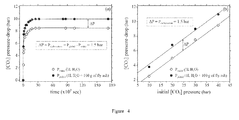
- the pressure of the process corresponds to the initial pressure. Then, when the reaction has been started, the CO 2 is consumed leading to a gradual decrease of the pressure of CO 2 to reach an equilibrium pressure between the gaseous phase and the suspension after carbonatation, i.e. when Ca(OH) 2 has completely disappeared ( figure 4a, figure 4b , figure 8a and figure 8b ).
- the variation of the pressure during a reaction time of two hours is comprised from about 4 to about 12 bars for an initial pressure comprised from about 5 bars to 40 bars and therefore the equilibrium pressure is comprised from 1 to 28 bars.
- the temperature of the process above defined is comprised from about 10°C to about 60°C, preferably from about 15°C to 40°C, more preferably from about 18°C to 30°C.
- the reaction rate is too low and if the temperature is above 60°C, the process will be difficult to be implemented on a large scale.
- the substantially alkaline solid wastes of the process are selected from the list consisting of coal combustion fly-ash and alkaline paper mill wastes.
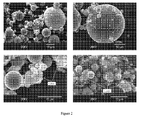
- the coal combustion fly ash is a powder composed mainly of spherical microparticles collected from electrostatic precipitators located at the outlet of the chimney were combustion gases are liberated into the atmosphere ( figure 2a and figure 2b ).
- this by-product so-called calcium mud, is the rejection of the calcination and conversion of calcium carbonate to lime for the causticizing of the black liquor ( figure 5 ).
- the percentage of CaO and/or Ca(OH) 2 can be very different according to the origin of the various wastes: for example a coal combustion fly-ash contains about from about 4 wt.% of lime (CaO) to about 16 wt.% of lime (CaO) and a paper mill waste contains from about 55 wt.% of Ca(OH) 2 to about 70 wt.% of Ca(OH) 2 .
- a coal combustion fly-ash contains about from about 4 wt.% of lime (CaO) to about 16 wt.% of lime (CaO)
- a paper mill waste contains from about 55 wt.% of Ca(OH) 2 to about 70 wt.% of Ca(OH) 2 .
- the percentage of CaO contained in the alkaline solid waste can be less than 4 wt.% or more than 16 wt. % and the percentage of Ca(OH) 2 can be less than 55 wt.% or more than 70 wt.%.
- coal combustion fly-ash used in the process above defined contains less than about 10% of CaO.
- the percentage of CaO contained in the fly-ash is low, less than 10%, but the yield is still good (81%, see example 2).
- the process above defined comprises the following steps:
- step a the CaO is transformed into Ca(OH) 2 according the following equation: CaO + H 2 O ⁇ Ca ( OH ) 2
- step b heating is necessary to accelerate the reaction rate when CO2 is introduced.
- step c) the CO 2 source is introduced.
- the CO 2 presented is pure CO 2 but can also be any other source of CO 2 described above.
- step d) the CO 2 reacts with Ca(OH)2 according the following reaction: Ca ( OH ) 2 + CO 2 ⁇ CaCO 3 + H 2 O
- the raw material used i.e. the alkaline solid waste allows to maintain the pH above 7 during the carbonatation until the complete exhaustion of Ca(OH) 2 ( figure 3 and 7 ), i.e. the complete reaction of Ca(OH) 2 with CO 2 .
- the system reaches therefore an equilibrium stage wherein the pH is comprised from 6,5 to 7.5.
- the reaction time is different in function of the raw material used, but is generally of about 2 hours.
- step e) the solid obtained is different according to the raw material used:
- the process above defined comprises the following steps:
- steps a) to d) are similar to the previous described process, except the water free from oxyanions and cations has been replaced by water containing oxyanions and/or cations.
- step e) the solid obtained contains in addition oxyanions and/or cations that have been entrapped in CaCO 3 .
- Example 1 CO 2 sequestration experiments in a stirred reactor using coal combustion fly-ash and pure water
- the reaction cell was depressurized for 15 minutes during the water cooling period. Then, water cooling at 30°C the reactor was disassembled, and the solid product was separated by centrifugation (30 minutes at 12,000 rpm), decanting the supernatant solutions. Finally, the solid product was dried directly in the centrifugation flasks for 48 h at 65°C.
- Example 2 The sequestered quantity of CO 2 by calcite precipitation using coal combustion fly-ash
- n CO ⁇ 2 P carbonation_pressure_drop ⁇ V RT
- P carbonation_pressure-drop 1.5 bar
- M CO2 is the molar mass of CO 2 (44.01 g/mol)
- w CaO is the starting mass of CaO in the reactor (4.1g)
- M CaO is the molar mass of CaO (56.077g/mol).
- the carbonation efficiency was equal to 82% after two hours of solid-fluid interactions at 30 and 60°C.
- the mineralogical characterization of the starting material and solid products was carried out by X-ray diffraction (XRD, powder method) using a D501 SIEMENS diffractometer.
- the experimental measurement parameters were 12s counting time per 0.02° 2 ⁇ step in the 5-80° 2 ⁇ range.
- the detection is performed by a kevex Si(Li) detector.
- Morphological analyses were also characterized by means of a scanning electron microscopy (SEM), with a JEOL JSM-5410 instrument, equipped with an energy dispersive system (EDS) for the chemical microanalysis.
- SEM scanning electron microscopy
- EDS energy dispersive system
- Example 4 CO 2 sequestration experiments in a stirred reactor using paper mill waste and pure water
- the CO 2 sequestration experiments were conducted on a 2 L (total volume) closed titanium-lined pressure reactor (Parr Instrument Co., USA, Model 4843) equipped with a heating jacket (furnace) ( Fig. 1 ).
- the autoclave was charged with 1L of Millipore MQ water (18.2 M ⁇ ) and 20 g of paper mill waste approximately.
- the waste particles were immediately dispersed with mechanical agitation (450 rpm) and the dispersion heated to 30 or 60 °C.
- 10, 20, 30 or 40 bar of CO 2 (provided by Linde Gas S.A.) was injected into the reactor by opening a valve and adjusting the pressure to the desired one, and the reaction was commenced. This initial pressure of CO 2 was equal to the total initial pressure in the system.
- the reactor was removed from the heating system and was immersed in cold water.
- the reaction cell was depressurized during the water cooling period (about 15 minutes).
- water cooling at 25 °C the reactor was disassembled, and the solid product was separated by centrifugation (30 minutes at 12,000 rpm), decanting the supernatant solutions.
- the solid product was dried directly in the centrifugation flasks for 48 h at 65 °C.
- PHREEQC Parkhust and Appelo, 2005
- Zero, negative or positive SI values indicate that the solutions are saturated, undersaturated and supersaturated, respectively, with respect to a solid phase (Table I). TABLE I Experiment Reactor content Time Temp.
- Example 5 Amount of sequestered CO 2 in a stirred reactor using paper mill waste and pure water.
- n carbonation_CO 2 ⁇ theoretical w Ca OH M Ca ⁇ OH 2
- M Ca ( OH )2 is the molar mass of Ca(OH) 2 (74.093 g mol -1 )
- Example 6 CO 2 sequestration experiments in a stirred reactor using alkaline solid waste and water containing oxyanions
- the operating mode is the same as in example 1 or 4, except that water containing oxyanions is used instead of pure water.
- the preliminary experiments carried out to scale laboratory show that proposed method is appropriated to study the uptake of toxic oxyanions from aqueous solutions.
Landscapes
- Chemical & Material Sciences (AREA)
- Organic Chemistry (AREA)
- Engineering & Computer Science (AREA)
- Life Sciences & Earth Sciences (AREA)
- Analytical Chemistry (AREA)
- General Chemical & Material Sciences (AREA)
- Oil, Petroleum & Natural Gas (AREA)
- Chemical Kinetics & Catalysis (AREA)
- Geology (AREA)
- Inorganic Chemistry (AREA)
- Environmental & Geological Engineering (AREA)
- Health & Medical Sciences (AREA)
- Biomedical Technology (AREA)
- Treating Waste Gases (AREA)
Abstract
Description
- The present invention relates to a process of sequestration of CO2 by reaction with alkaline solid wastes.
- Since several years, environmental concerns has presented an increased interest and the elimination of plant wastes such as alkaline wastes, in particular coal combustion or paper mill wastes, and wastewater become essential in this purpose.
- The global warming of Earth's near-surface, air and oceans in recent decades is a direct consequence of anthropogenic emission of greenhouse gases into the atmosphere such as CO2, CH4, N2O and CFCs (IPCC (Intergovernmental Panel on Climate Change, 2007). The CO2 emissions contribute approximately 60% to this climate change. From the time of the industrial revolution that started the 1860's, 75% of CO2 emissions discharged into the atmosphere are caused by the burning of fossil fuels (26.4 ± 1.1 Gt CO2 yr-1 for the 2000-2005 period), and the remaining 25% by land use change. Although oceans and terrestrial biosphere can take up high amounts of the CO2 emitted, about 45% remains in the atmosphere as stable species that may stay for many hundreds of years (IPCC (Intergovernmental Panel on Climate Change, 2007) The continuous increase of atmospheric CO2 might lead to stress on drinking water availability, species extinction, melting of ice sheets and coastal flooding.
- Another major environmental concern is the wastewater treatment. Anions contained in wastewater are typically mobile in soils and groundwater since most natural materials have net negative surface charges. A number of anions, particularly inorganic oxyanions such as chromate, arsenate, molybdate, selenite and selenate, can be toxic to humans or wildlife at µg/L to mg/L concentrations. The removal of the toxic oxyanions has been achieved by coprecipitation (Roundhill, D. M., Koch, H. F., Chem. Soc. Rev. 31 (2002) 60.; Harper, T. R., Kingham, N. W., Water Environ. Res. 64 (1992) 200), reverse osmometry (Fox, K. R., Sorg, T. J., J. Am. Water Works Assoc. 79 (1987) 81), chemical reduction to less soluble species (Eary, L. E., Rai, D., Environ. Sci. Technol. 28 (1988) 972), and adsorbing colloid flotation (ACF) methods (De Carlo, E. H., Thomas, D. M., Environ. Sci. Technol. 19 (1985) 538; Peng, F. F., Pingkuan, D. Ind. Eng. Chem. Res. 33 (1994) 922). These methods generally need large and complicated facilities due to various equipment and reagents used in a series of treatments. In addition, the removal of toxic oxyanions is much more difficult than that of the cations because anions with a similar, structure, such as sulphate and phosphate often coexist in nature with high concentrations. Searching effective adsorbents, reagents and/or novel methods for the removal of the oxyanions is important for environmental remediation.
- An alternative to reduce the CO2 emission without modifying the energy production system is the retention or sequestration of carbon dioxide in stable geological reservoirs (Bachu, S. Sequestration of CO2 in geological media: criteria and approach for site selection in response to climate change. Energy Convers. Manage. 2000, 41, 953-970; Bachu, S. Sequestration of CO2 in geological media in response to climate change: road map for site selection using the transform of the geological space into the CO2 phase space. Energy Convers. Manage. 2002, 43, 87-102; Bachu, S; Adams, J. J. Sequestration of CO2 in geological media in response to climate change: capacity of deep saline aquifers to sequester CO2 in solution. Energy Convers. Manage. 2003, 44, 3151-3175; Friedmann, S. J. Geological Carbon Dioxide Sequestration. .).
- Such a strategy, so-called geological carbon sequestration, consists of capturing gaseous CO2 from emission sources and injecting it as a supercritical fluid in terrestrial reservoirs, such as saline aquifers, depleted oil and gas fields or deep coal seams. In geological reservoirs, the supercritical CO2 could be retained by stratigraphic or structural trapping (physical isolation), solubility trapping (dissolved in the aqueous phase) and/or hydrodynamic trapping (associated to long residence time of dissolved CO2-bearing fluids in aquifers). However, the main scientific concerns inquiring the geological carbon sequestration applicability are the high pressure and temperature variations caused by the large CO2 accumulation on the reservoirs. These thermodynamic variations could exert forces that diminish the reservoir confinement due to the formation of cracks and faults either in reservoir itself or in the cap rocks.
- In terrestrial reservoirs, the CO2 pressure can decrease in the long term as a consequence of another retention mechanism: mineral trapping or mineralogical carbon sequestration. The stored CO2 may transform to stable carbonate minerals by reactions with aqueous ions. Although this mechanism favours the permanent CO2 sequestration, it is expected to be slow in geological formation (hundreds of years) due to the slow kinetics of silicate mineral dissolution and carbonate mineral precipitation. However, mineralogical carbon sequestration could contribute significantly to CO2 sequestration in the proximity of the emission source, without the need of storing the gas into a geological reservoir.
- Soong et al. (Soong, Y.; Fauth, D. L.; Howard, B. H.; Jones, J. R.; Harrison, D. K.; Goodman, A. L.; Gray, M. L.; Frommell, E. A. CO2 sequestration with brine solution and fly ashes. Energy Convers. Manage. 2006, 47, 1676-1685) propose the use of mineralogical carbon sequestration in controlled reactors as a viable approach to reduce CO2 emissions into the atmosphere using by-products from coal combustion in power plants (fly-ash) and oil and gas production (brine solutions).
- Montes-Hernandez et al. (Montes-Hernandez G., Renard F., Geoffroy N., Charlet L. and Pironon J. (2007) Calcite precipitation from CO2-H2O-Ca(OH)2 slurry under high pressure of CO2. J. Cryst. Growth 308, 228-236) propose an experimental method to synthesize fine particles of calcite by means of aqueous carbonation of pure portlandite at high pressure of CO2 (initial PCO2=55 bar) and moderate and high temperature (30 and 90 °C). However, the use of pure portlandite and other primary minerals may suppose a high economic and environmental cost as these are typically resources and not residues.
- Several sequestration processes of CO2 have been developed since many years by reacting with solid waste material at various pressure:
- a) some of them working at atmospheric pressure of CO2 using coal in pure water (
US 2004/0228788 ) or lime kiln dust, cement kiln dust or fly-ash in pure water (US 5,792,440 ). However, the use of atmospheric pressure of CO2 leads to a poor yield and a slow reaction rate ( Domingo et al., J. Calcite precipitation by a high-pressure CO2 carbonation route, J. of Supercritical Fluids, 2006, 36, 202-215 ). Moreover, the CO2 transfer being slow at this pressure, the process requires a high pressure reaction chamber ( Domingo et al., J. Calcite precipitation by a high-pressure CO2 carbonation route, J. of Supercritical Fluids, 2006, 36, 202-215 ). - b) other working under a high to moderate and constant pressure of CO2 by reaction with solid waste material (such as steel slag or paper bottom ash) in pure water to accelerate the reaction rate (
W02007/071633 ). - However, in order to achieve a high reaction rate, the carbon dioxide concentration must be high, and this has been achieved by applying an elevated carbon dioxide pressure. Furthermore, this process needs a filtration step.
- One of the aims of the present invention is to provide a CO2 sequestration process which does not require controlling the CO2 pressure and the pH of the reaction medium.
- Another aim of the invention is to provide a CO2 sequestration process allowing the recycling of plant wastes.
- Another aim of the invention is to provide a CO2 sequestration process allowing the decontamination of liquid effluents contaminated by pollutants, such as inorganic oxyanions and/or cations.
- Still another aim of the invention is to provide a process of sequestration of CO2 under mineral form.
- Therefore, in one aspect, the present invention relates to the use of substantially alkaline solid wastes containing accessible CaO and/or Ca(OH)2 for implementing a process of sequestration of CO2 under mineral form and possibly purifying a liquid effluent if contaminated by pollutants such as inorganic oxyanions and/or cations, comprising a step of reacting said alkaline solid wastes with said liquid effluent to form a calcium hydroxide dispersion, at a non isobaric pressure and without external pH adjustment, at a temperature comprised from about 10 to about 60°C.
- The expression "alkaline solid waste" refers to residues of industrial operation or process such as fossil fuel combustion (coal fly ash), Municipal Solid Waste Incineration (MSWI bottom ash), paper mill and production of steel (steel slag). These materials are alkaline and contain various oxides such as calcium comprising oxides in particular CaO and/or Ca(OH)2.
- The expression "accessible CaO and/or Ca(OH)2" refers to CaO and/or Ca(OH)2 contained in isolated waste or to isolated particles of CaO and/or Ca(OH)2 and easily available to be dispersed in water and/or aqueous solution. The accessibility of CaO and/or Ca(OH)2 can be verified by measuring the pH immediately after the dissolution of CaO and/or Ca(OH)2 in said liquid effluent wherein the pH increases quasi instantaneously to 12.5.
- By the expression "sequestration of CO2 under mineral form" is meant that CO2 is entrapped in a mineral, that is CO2 reacts with Ca(OH)2 or a mixture containing Ca(OH)2 to form CaCO3 mineral or a solid mineral containing CaCO3.
- By "liquid effluent" is meant a stream flowing out of a body of water, an outflow from a sewer or sewage system, a discharge of liquid waste, as from a factory, a nuclear plant. It can be pure water, or waste water contaminated by pollutants, that is something that pollutes, especially a waste material that contaminates air, soil, or water.
- The term "oxyanions" refers to a negatively charged polyatomic ion that contains oxide. Examples of oxyanions, but without being limited to, are included in the following list: arsenate, aluminate, borate, carbonate, nitrite, hyponitrite, molybdate, silicate, phosphate, phosphite, hypophosphite, persulfate, selenite, sulfate, sulfite, hyposulfite, perchlorate, chlorate, chlorite, hypochlorite, chromate, permanganate, manganate, peroxydisulfate, dichromate, pyrophosphate, polyoxometalates such as phosphomolybdate and phosphotungstate or lead, cadmium, copper, or cobalt salts, By "cation" is meant an ion or group of ions having a positive charge and characteristically moving toward the negative electrode in electrolysis. Examples of cations, but without being limited to, are calcium (Ca2+), magnésium (Mg2+), sodium (Na+), potassium (K+) and ammonium (NH4 +).
- The expression "calcium hydroxide dispersion" refers to calcium hydroxide particles in suspension, i.e. not dissolved, in the liquid effluent. Said calcium hydroxide dispersion is formed by the irreversible hydration of lime in water:
CaO + H 2 O → Ca(OH)2
- By "non isobaric pressure" is meant a pressure that is not constant during the process, i.e. variable between the beginning and the end of the process.
- The expression "external pH adjustment" refers to the addition of an alkali such as for example NaOH, KOH or ammonium carbonate, to maintain an alkaline pH.
- Therefore, in the present invention, the raw material used, i.e. the alkaline solid waste, is alkaline enough, to avoid a further addition of an alkali, i.e. the pH is higher than 8.
- In a preferred embodiment, the present invention relates to the use of substantially alkaline solid wastes containing accessible CaO and/or Ca(OH)2 for implementing a process of sequestration of CO2 under mineral form and possibly purifying a liquid effluent if contaminated by pollutants such as inorganic oxyanions and/or cations, wherein the liquid effluent is free from inorganic oxyanions and cations, and is in particular pure water.
- The expression "free from inorganic oxyanions and cations" means that the oxyanions or the cations have been incorporated during the sequestration of CO2 under mineral form, for example up to 20 mg of atomic selenium per gram of Ca(OH)2 can be incorporated (see exemple 6), and therefore the liquid effluent contains only a residual part of oxyanions or cations and can be for example pure water such as demineralised water.
- Therefore, in this embodiment the process allows the recycling of plant wastes and the reducing of carbon dioxide emissions.
- In another preferred embodiment, the present invention concerns the use of substantially alkaline solid wastes containing accessible CaO and/or Ca(OH)2 for implementing a process of sequestration of CO2 under mineral form and possibly purifying a liquid effluent if contaminated by pollutants such as inorganic oxyanions and/or cations, wherein the liquid effluent contains inorganic oxyanions and/or cations.
- In this embodiment, the liquid effluent, contaminated by pollutants such as inorganic oxyanions and/or cations, is decontaminated and leads to a liquid effluent free from inorganic oxyanions and cations.
- Therefore, in this embodiment the process allows the recycling of plant wastes, the reducing of carbon dioxide emissions and the decontamination of liquid effluents contaminated by pollutants such as inorganic oxyanions and/or cations.
- In another aspect, the present invention relates to a process of sequestration of CO2 under mineral form and possibly purifying a liquid effluent if contaminated by pollutants such as inorganic oxyanions and/or cations, comprising:
- a step of reacting a CO2 source, introduced under an initial pressure, with a calcium hydroxide dispersion in a liquid effluent, thus forming a CaCO3 suspension in said liquid effluent,
- said dispersion being obtained by mixing substantially alkaline solid wastes containing
- accessible CaO and/or Ca(OH)2 with said liquid effluent.
- The CO2 source can be pure or concentrated CO2 gas, i.e. CO2 gas containing a small proportion of SOx or NOx, or a stream containing a low concentration of CO2 gas such as flue gas or industrial off-gas or a mixture of CO2 gas with an inert gas such as, for example, nitrogen, argon or air.
- By "initial pressure" is meant the pressure of the CO2 source when it is introduced into the calcium hydroxyde dispersion.
- The initial pressure is comprised from about 10 bars to about 40 bars.
- The CO2 source introduced react with the Ca(OH)2 according to the following reaction:
Ca(OH)2 + CO 2 → CaCO 3 + H 2 O
- The reaction time is function of the different alkaline solid wastes used but generally, the reaction is carried out during two hours.
- The calcium carbonate obtained precipitates into the reactor leading to a suspension of CaCO3.
- In a preferred embodiment, in the process above defined, the liquid effluent is free from inorganic oxyanions and cations, and is in particular pure water.
- In another preferred embodiment, the liquid effluent of the process of sequestration of carbon dioxide and of purifying a liquid effluent, above defined, contains inorganic oxyanions and/or cations.
- In a more preferred embodiment, the inorganic oxyanions contained in the liquid effluent of the process above defined are selected from the group consisting of sulphate, phosphate, chromate, arsenate, molybdate, selenite, and lead, cadmium, copper, or cobalt salts.
- In another preferred embodiment, the initial pressure of the CO2 source of the process above defined is comprised from about 5 to about 40 bars, preferably from about 5 to about 30 bars, more preferably from about 5 to about 20 bars and in particular of about 10 bars.
- Below 5 bars, the pressure is too low and the reaction rate is greatly lowered and above 40 bars, the process will generally be difficult to be implemented on a large scale.
- In another preferred embodiment, the pressure at the end of the step of reacting the CO2 source with the calcium hydroxide dispersion of the process above defined is the equilibrium pressure between CO2 source and said CaCO3 suspension.
- Once the CO2 source has been introduced, the pressure of the process corresponds to the initial pressure. Then, when the reaction has been started, the CO2 is consumed leading to a gradual decrease of the pressure of CO2 to reach an equilibrium pressure between the gaseous phase and the suspension after carbonatation, i.e. when Ca(OH)2 has completely disappeared (
figure 4a, figure 4b ,figure 8a and figure 8b ). - The variation of the pressure during a reaction time of two hours is comprised from about 4 to about 12 bars for an initial pressure comprised from about 5 bars to 40 bars and therefore the equilibrium pressure is comprised from 1 to 28 bars.
- In a more preferred embodiment, the temperature of the process above defined is comprised from about 10°C to about 60°C, preferably from about 15°C to 40°C, more preferably from about 18°C to 30°C.
- If the temperature is below 10°C, the reaction rate is too low and if the temperature is above 60°C, the process will be difficult to be implemented on a large scale.
- In a preferred embodiment, the substantially alkaline solid wastes of the process are selected from the list consisting of coal combustion fly-ash and alkaline paper mill wastes.
- The coal combustion fly ash is a powder composed mainly of spherical microparticles collected from electrostatic precipitators located at the outlet of the chimney were combustion gases are liberated into the atmosphere (
figure 2a and figure 2b ). In the case of paper mill waste, this by-product, so-called calcium mud, is the rejection of the calcination and conversion of calcium carbonate to lime for the causticizing of the black liquor (figure 5 ). - The percentage of CaO and/or Ca(OH)2 can be very different according to the origin of the various wastes: for example a coal combustion fly-ash contains about from about 4 wt.% of lime (CaO) to about 16 wt.% of lime (CaO) and a paper mill waste contains from about 55 wt.% of Ca(OH)2 to about 70 wt.% of Ca(OH)2.
- Nevertheless, the percentage of CaO contained in the alkaline solid waste can be less than 4 wt.% or more than 16 wt. % and the percentage of Ca(OH)2 can be less than 55 wt.% or more than 70 wt.%.
- In a more preferred embodiment, coal combustion fly-ash used in the process above defined contains less than about 10% of CaO.
- In the particular case of coal combustion fly-ash, the percentage of CaO contained in the fly-ash is low, less than 10%, but the yield is still good (81%, see example 2).
- In another preferred embodiment, the process above defined comprises the following steps:
- (a) contacting substantially alkaline solid wastes with a liquid effluent free from inorganic oxyanions and cations, in particular with pure water, to obtain a dispersion of Ca(OH)2,
- (b) heating the dispersion of Ca(OH)2 at a temperature comprised from about 10°C to about 60°C, preferably from about 15°C to 40°C, more preferably from about 18°C to 30°C, to obtain a heated dispersion of Ca(OH)2,
- (c) introducing the CO2 source into the heated dispersion of Ca(OH)2 at an initial pressure comprised from about 5 bars to about 40 bars, preferably from about 5 bars to about 30 bars, more preferably from about 5 bars to about 20 bars and in particular of about 10 bars, to obtain a medium containing absorbed CO2 into the heated dispersion of Ca(OH)2,
- (d) stirring said medium obtained in step c) at a temperature comprised from about 10°C to about 60°C, preferably from about 15°C to 40°C, more preferably from about 18°C to 30°C until complete exhaustion of Ca(OH)2, to obtain a solid containing calcium carbonate,
- (e) recovering the solid containing calcium carbonate.
- The schematic experimental system for this process is represented in
figure 1 . - In step a), the CaO is transformed into Ca(OH)2 according the following equation:
CaO + H 2 O → Ca(OH)2
- In step b), heating is necessary to accelerate the reaction rate when CO2 is introduced.
- In step c), the CO2 source is introduced. In the case of the
figure 1 , the CO2 presented is pure CO2 but can also be any other source of CO2 described above. In step d), the CO2 reacts with Ca(OH)2 according the following reaction:
Ca(OH)2 + CO 2 → CaCO 3 + H 2 O
- The raw material used, i.e. the alkaline solid waste allows to maintain the pH above 7 during the carbonatation until the complete exhaustion of Ca(OH)2(
figure 3 and7 ), i.e. the complete reaction of Ca(OH)2 with CO2. The system reaches therefore an equilibrium stage wherein the pH is comprised from 6,5 to 7.5. - The reaction time is different in function of the raw material used, but is generally of about 2 hours.
- In step e), the solid obtained is different according to the raw material used:
- when the raw material used is paper mill waste, it contains the calcium carbonate formed (
figure 2c and figure 2d ), as a majority, because this waste contains only CaCO3 and portlandite (Ca(OH)2); - when the raw material used is coal combustion fly-ash, it contains calcium carbonate among other minerals (
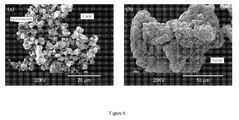
figure 6 ) because fly-ash is composed of mullite (20.8 wt.%), quartz (4.5 %), lime (4.1%), anhydrite (1.3%), K-feldspar (2.5 %), magnetite (0.5 %) and a chalco-aluminosilicate glass phase (66.4%). - In a more preferred embodiment, the process above defined comprises the following steps:
- (a) contacting substantially alkaline solid wastes with a liquid effluent containing inorganic oxyanions and/or cations to obtain a dispersion of Ca(OH)2,
- (b) heating the dispersion of Ca(OH)2 at a temperature comprised from about 10°C to about 60°C, preferably from about 15°C to 40°C, more preferably from about 18°C to 30°C, to obtain a heated dispersion of Ca(OH)2,
- (c) introducing the CO2 source into the heated dispersion of Ca(OH)2 at an initial pressure comprised from about 5 bars to about 40 bars, preferably from about 5 bars to about 30 bars, more preferably from about 5 bars to about 20 bars and in particular of about 10 bars, to obtain a medium containing absorbed CO2 into the heated dispersion of Ca(OH)2,
- (d) stirring said medium obtained in step c) at a temperature comprised from about 10°C to about 60°C, preferably from about 15°C to 40°C, more preferably from about 18°C to 30°C until complete exhaustion of Ca(OH)2, to obtain a calcium carbonate precipitate containing inorganic oxyanions and/or cations,
- (e) filtering the calcium carbonate precipitate to obtain a solid calcium carbonate containing inorganic oxyanions and/or cations on the one hand, and liquid effluent free from inorganic oxyanions and cations on the other hand.
- The schematic experimental system for this process is the same as above (
figure 1 ). - The steps a) to d) are similar to the previous described process, except the water free from oxyanions and cations has been replaced by water containing oxyanions and/or cations.
- In step e) the solid obtained contains in addition oxyanions and/or cations that have been entrapped in CaCO3.
-
-
Figure 1 shows a schematic experimental system for mineral sequestration of CO2 by aqueous carbonation of fly-ash in a stirred reactor. The CO2 source used is pure CO2 gas.- 1: Stirring system
- 2: Pressure gauge
- 3: Thermo-couple
- 4: gas CO2
- 5: 1L H2O + CO2 aq + alkaline solid waste
- 6: Furnace
- 7:Reactor PARR 4843
- 8: CO2
-
Figure 2a and 2b show SEM images of fly-ash before reaction andfigure 2c and 2d show SEM images of calcite particles precipitated during CO2 sequestration experiments. -
Figure 3 shows a XRD spectra of starting fly-ash and solid products after carbonation during 2 h. demonstrating the total consumption of lime and the production of calcite. (C: Calcite, M: Mullite, Q: Quartz, L: Lime). -
Figure 4a and 4b show the kinetic behaviour of pressure decrease in the reactor at 30°C and for 30 bar initial pressure of CO2 (4a) and the linear correlation between the pressure decrease at equilibrium and the initial pressure of CO2 (4b). -
Figure 5 shows the SEM image of paper mill waste before experimentation showing the initial crystals of portlandite, calcite and hydroxyapatite. -
Figure 6a and 6b show the SEM images of calcite particles precipitated during CO2 sequestration experiments. -
Figure 7 shows the XRD patterns of starting paper mill waste and solid products after carbonation during 2 and 48 h, demonstrating the total consumption of portlandite and the production of calcite (C: Calcite, P: Portlandite, H: Hydroxyapatite). -
Figure 8a and 8b show the linear correlation between the pressure drop and the initial pressure of CO2 for experiments at 30 °C, an initial pressure of CO2 equal to 10, 20, 30 and 40 bar and 2 h of carbonation (8a), and the kinetic behaviour of the CO2 pressure drop in the long-term experiment (48 h) at 30 °C and 30 bar of initial pressure of CO2 (8b). White squares: Pwater (1L H2O) Black squares: Pglobal (1L H2O + 20 g of paper waste) - In both, constant carbonation pressure drop of 2.5 bar is independent on the initial pressure of CO2.
- One litre of high-purity water with electrical resistivity of 18.2 MΩ cm and 100g of fly-ash were placed in a titanium reactor (autoclave Parr with internal volume of two litres). The fly-ash particles were immediately dispersed by mechanical stirring (450 rpm). The dispersion (solution + solid particles) was then heated to 30 or 60°C using an oven specifically adapted to the reactor. When the dispersion temperature was reached, 10, 20, 30 or 40 bar of CO2 (provided by Linde Gas S.A.) was injected in the reactor (see
Fig. 1 ). This was the initial pressure of CO2 which was equal to the total initial pressure in the system. After stirring during two hours, the reactor was removed from the heating system and was immersed into cold water. The reaction cell was depressurized for 15 minutes during the water cooling period. Then, water cooling at 30°C the reactor was disassembled, and the solid product was separated by centrifugation (30 minutes at 12,000 rpm), decanting the supernatant solutions. Finally, the solid product was dried directly in the centrifugation flasks for 48 h at 65°C. - A simplified method was developed to estimate the sequestered quantity of CO2 by carbonate precipitation. This method was partially described in the example 1. Herein, the pressure drop produced by the carbonation process of CaO (Eqs. 2 and 3):
CaO + H 2 O → Ca(OH)2 Eq. 2 Eq. 2
Ca(OH)2 + CO 2 → CaCO 3 + H 2 O Eq.3 Eq. 3
in the system was calculated by a simple pressure balance (Eq. 1):
- The carbonation pressure drop, Pcarbonation_pressure-drop was equal to 1.5 bar for all experiments (
Figure 4b ). It was independent on the initial pressure of CO2 (10, 20, 30, 40 bar) and was slightly affected by the temperature of reaction (30 and 60°C). The results of the pressure drop kinetics for 30 bar (as initial pressure of CO2) are shown onFigure 4a . Here, it was observed that the equilibrium of pressure drop was reached after about five hours of solid-fluid interaction. Considering that CO2 is an ideal gas, the quantity of CO2 consumed by the carbonation process can be calculated as follows:

where, nCO2 is the mol number of consumed CO2, calculated by Eq. 4 (0.05954 mol), MCO2 is the molar mass of CO2 (44.01 g/mol), wCaO is the starting mass of CaO in the reactor (4.1g) and MCaO is the molar mass of CaO (56.077g/mol). The carbonation efficiency was equal to 82% after two hours of solid-fluid interactions at 30 and 60°C. - Theoretically one ton of fly-ash containing 4.1% of lime could sequester 32.17kg of CO2. With our experimental protocol, 26.19kg of CO2 per ton of fly-ash (yield 81%) could be successfully sequestered into stable calcite. Indeed, this is an attractive result concerning the ex-situ mineral sequestration of CO2.
- The mineralogical characterization of the starting material and solid products was carried out by X-ray diffraction (XRD, powder method) using a D501 SIEMENS diffractometer. Working conditions were CoKα monochromatic radiation (λ=1.7902 Å), 37.5 mA and 40 kV. The experimental measurement parameters were 12s counting time per 0.02° 2θ step in the 5-80° 2θ range. The detection is performed by a kevex Si(Li) detector. Morphological analyses were also characterized by means of a scanning electron microscopy (SEM), with a JEOL JSM-5410 instrument, equipped with an energy dispersive system (EDS) for the chemical microanalysis.
- The results are shown in
figure 2a-d ,figure 5 andfigure 6 . - The CO2 sequestration experiments were conducted on a 2 L (total volume) closed titanium-lined pressure reactor (Parr Instrument Co., USA, Model 4843) equipped with a heating jacket (furnace) (
Fig. 1 ). In each experiment, the autoclave was charged with 1L of Millipore MQ water (18.2 MΩ) and 20 g of paper mill waste approximately. The waste particles were immediately dispersed with mechanical agitation (450 rpm) and the dispersion heated to 30 or 60 °C. When the temperature was reached, 10, 20, 30 or 40 bar of CO2 (provided by Linde Gas S.A.) was injected into the reactor by opening a valve and adjusting the pressure to the desired one, and the reaction was commenced. This initial pressure of CO2 was equal to the total initial pressure in the system. - A summary of the experiences carried out and the initial experimental conditions is shown in Table 1 below.
- A long-term experiment (48 hours) at 30 bar of initial pressure of CO2 allowed us to both optimize the experimental duration of the remaining experiments at 2 hours and study the kinetic evolution of the carbonation process.
- At the end of the experiment, the reactor was removed from the heating system and was immersed in cold water. The reaction cell was depressurized during the water cooling period (about 15 minutes). Then water cooling at 25 °C the reactor was disassembled, and the solid product was separated by centrifugation (30 minutes at 12,000 rpm), decanting the supernatant solutions. Finally, the solid product was dried directly in the centrifugation flasks for 48 h at 65 °C.
- Solution saturation indexes with respect to solid phases (SI=log(IAP/KS), where SI is the saturation index, IAP is the ion activity product and KS is the solid solubility product) and aqueous speciation of the leachates were calculated using the equilibrium geochemical speciation/mass transfer model PHREEQC (Parkhust and Appelo, 2005) and the database of the speciation model MINTEQ. Zero, negative or positive SI values indicate that the solutions are saturated, undersaturated and supersaturated, respectively, with respect to a solid phase (Table I).
TABLE I Experiment Reactor content Time Temp. Initial CO2 pressure Final CO2pressure CO2pressure-drop Carbonationpressure SI_calcite (h) (°C) (bar) (bar) (bar) (bar) Experiment 11L pure water + 20 g of paper waste 2 30 40 28 12 2.5 1.13 1L pure water + 20 Experiment 2 g of paper waste 2 30 30 20 10 2.5 1.25 1L pure water + 20 Experiment 3 g of paper waste 2 30 20 12.5 7.5 2.5 1.42 Experiment 4 1L pure water + 20 g of paper waste 2 30 10 5.3 4.7 2.2 1.71 Experiment 51L pure water + 20 g of paper waste 48 30 30 19 11 2.5 1.25 Experiment 61L pure water + 20 g of paper waste 2 60 30 21.5 8.5 3 1.52 - A simplified method was developed to estimate the quantity of CO2 sequestered by carbonate precipitation. This method was partially described in the example 4.
- Herein, the pressure drop produced by the carbonation process of Ca(OH)2 (Eq. 3) in the system was calculated by a simple pressure balance (Eq. 1). Knowing the pressure drop values in each experience (Table 1), the amount of CO2 consumed by calcite precipitation (n carbonation_CO2, real in mol) could be calculated using the ideal gas law:

where V is the reactor volume occupied with gas (1 L), T is the reaction temperature (≈ 303 °K) and R is the gas constant (0.08314472 L bar K-1 mol-1). - In experiments at 30 °C and 2 h of experimental duration, the pressure drop by portlandite carbonation was around 2.5 bar, independently of initial CO2 pressure (
Fig. 8a ). Although the results of the long-term experiment (48 h, 30 bar and 30 °C) show that the equilibrium is obtained after about 5 hours of solid-fluid interaction, the maximum pressure drop by carbonation is already reached at 2 hours of experiment (Fig. 8b ), and thus the experimental duration of the remaining experiments was correctly optimized. According to Eq. 6, the real amount consumed by carbonation was of 0.09923 mol of CO2. - Likewise, the theoretical amount of CO2 (n carbonation_CO2,theoretical ) that should be sequestered by carbonation process (i.e., if all calcium is carbonated) could be calculated based on both the stoichiometry of reaction (Eq. 3) and the quantity of portlandite contained into the paper mill waste (55 wt%):

where M Ca(OH)2 is the molar mass of Ca(OH)2 (74.093 g mol-1) and w Ca(OH)2 is the starting mass of Ca(OH)2 in the reactor (8.69 g) which was calculated as follows:
where mpaper_waste is the mass of paper mill waste used in the experiments (20 g), %portlahdite is the percentage of portlandite in the waste (55 wt%) and % water_content is the water content percentage in the waste (21 wt%). The theoretical amount of CO2 that should be sequestered is 0.11729 mol. This supposes a carbonation efficiency (CE) of 85% at 30 °C according to:
- In the experiment at high temperature (60 °C, 30 bar), the pressure drop by carbonation is slightly superior (3 bar), albeit the sequestered amount of CO2 and the carbonation efficiency are very similar since this process depends inversely on the reaction temperature (Eq. 6).
- Theoretically, the extrapolation of this experiment to real industrial scale would suppose a maximum CO2 sequestration capacity of 258.54 kg of CO2 per every ton of paper mill waste containing 55 wt% of portlandite. However, with our experimental protocol, 218.37 kg of CO2 per every ton of paper mill waste (84%) could be successfully sequestered into stable calcite. Obviously, this is an attractive result concerning the mineral trapping of CO2.
- The operating mode is the same as in example 1 or 4, except that water containing oxyanions is used instead of pure water. The preliminary experiments carried out to scale laboratory show that proposed method is appropriated to study the uptake of toxic oxyanions from aqueous solutions.
- For example, it was observed that the selenite oxyanion (SeO3 2-) is removed satisfactory during carbonation process (up to 20 mg of atomic selenium per gram of Ca(OH)2. Note, that in the polluted systems, a wastewater could contain up to 1 mg/L of selenium.
Claims (14)
- Use of substantially alkaline solid wastes containing accessible CaO and/or Ca(OH)2 for implementing a process of sequestration of CO2 under mineral form and possibly purifying a liquid effluent if contaminated by pollutants such as inorganic oxyanions, and/or cations, comprising a step of reacting said alkaline solid wastes with said liquid effluent to form a calcium hydroxide dispersion, at a non isobaric pressure and without external pH adjustment, at a temperature comprised from about 10 to about 60°C.
- Use of substantially alkaline solid wastes containing accessible CaO and/or Ca(OH)2 for implementing a process of sequestration of CO2 under mineral form according to claim 1, wherein said liquid effluent is free from inorganic oxyanions and cations, and is in particular pure water.
- Use of substantially alkaline solid wastes containing accessible CaO and/or Ca(OH)2 for implementing a process of sequestration of CO2 under mineral form and purifying a liquid effluent according to claim 1, wherein said liquid effluent contains inorganic oxyanions and/or cations.
- A process of sequestration of CO2 under mineral form and possibly purifying a liquid effluent if contaminated by pollutants such as inorganic oxyanions and/or cations, comprising:a step of reacting a CO2 source, introduced under an initial pressure, with a calcium hydroxide dispersion in a liquid effluent, thus forming a CaCO3 suspension in said liquid effluent,said dispersion being obtained by mixing substantially alkaline solid wastes containing accessible CaO and/or Ca(OH)2 with said liquid effluent.
- The process according to claim 4, wherein said liquid effluent is free from inorganic oxyanions and cations, and is in particular pure water.
- The process of sequestration of carbon dioxide and of purifying a liquid effluent according to claim 4, wherein said liquid effluent contains inorganic oxyanions, and/or cations.
- The process according to any of claims 4 to 6, wherein said inorganic oxyanions are selected from the group consisting of sulphate, phosphate, chromate, arsenate, molybdate, selenite; and lead, cadmium, copper, or cobalt salts.
- The process according to any of claims 4 to 7, wherein the initial pressure of the CO2 source is comprised from about 5 to about 40 bars, preferably from about 5 to about 30 bars, more preferably from about 5 to about 20 bars and in particular of about 10 bars.
- The process according to any of claims 4 to 8, wherein the pressure at the end of the step of reacting the CO2 source with the calcium hydroxide dispersion is the equilibrium pressure between CO2 source and said CaCO3 suspension.
- The process according to any of claims 4 to 9, wherein the temperature is comprised from about 10°C to about 60°C, preferably from about 15°C to 40°C, more preferably from about 18°C to 30°C.
- The process according to any of claims 4 to 10, wherein said substantially alkaline solid wastes are selected from the list consisting of coal combustion fly-ash and alkaline paper mill wastes.
- The process according to claim 11, wherein coal combustion fly-ash contains less than about 10% of CaO.
- The process according to any of claims 4 to 12, comprising the following steps:(a) contacting substantially alkaline solid wastes with a liquid effluent free from inorganic oxyanions and cations, in particular with pure water, to obtain a dispersion of Ca(OH)2,(b) heating the dispersion of Ca(OH)2 at a temperature comprised from about 10°C to about 60°C, preferably from about 15°C to 40°C, more preferably from about 18°C to 30°C, to obtain a heated dispersion of Ca(OH)2,(c) introducing the CO2 source into the heated dispersion of Ca(OH)2 at an initial pressure comprised from about 5 bars to about 40 bars, preferably from about 5 bars to about 30 bars, more preferably from about 5 bars to about 20 bars and in particular of about 10 bars, to obtain a medium containing absorbed CO2 into the heated dispersion of Ca(OH)2,(d) stirring said medium obtained in step c) at a temperature comprised from about 10°C to about 60°C, preferably from about 15°C to 40°C, more preferably from about 18°C to 30°C until complete exhaustion of Ca(OH)2, to obtain a solid containing calcium carbonate,(e) recovering the solid containing calcium carbonate.
- The process according to any of claims 4 to 12, comprising the following steps:(a) contacting substantially alkaline solid wastes with a liquid effluent containing inorganic oxyanions and/or cations to obtain a dispersion of Ca(OH)2,(b) heating the dispersion of Ca(OH)2 at a temperature comprised from about 10°C to about 60°C, preferably from about 15°C to 40°C, more preferably from about 18°C to 30°C, to obtain a heated dispersion of Ca(OH)2,(c) introducing the CO2 source into the heated dispersion of Ca(OH)2 at an initial pressure comprised from about 5 bars to about 40 bars, preferably from about 5 bars to about 30 bars, more preferably from about 5 bars to about 20 bars and in particular of about 10 bars, to obtain a medium containing absorbed CO2 into the heated dispersion of Ca(OH)2,(d) stirring said medium obtained in step c) at a temperature comprised from about 10°C to about 60°C, preferably from about 15°C to 40°C, more preferably from about 18°C to 30°C until complete exhaustion of Ca(OH)2, to obtain a calcium carbonate precipitate containing inorganic oxyanions and/or cations,(e) filtering the calcium carbonate precipitate to obtain a solid calcium carbonate containing inorganic oxyanions and/or cations on the one hand, and liquid effluent free from inorganic oxyanions and cations on the other hand.
Priority Applications (2)
| Application Number | Priority Date | Filing Date | Title |
|---|---|---|---|
| EP07123303A EP2070578A1 (en) | 2007-12-14 | 2007-12-14 | Process for the sequestration of CO2 by reaction with alkaline solid wastes |
| PCT/EP2008/066881 WO2009077358A1 (en) | 2007-12-14 | 2008-12-05 | Process for the sequestration of co2 by reaction with alkaline solid wastes |
Applications Claiming Priority (1)
| Application Number | Priority Date | Filing Date | Title |
|---|---|---|---|
| EP07123303A EP2070578A1 (en) | 2007-12-14 | 2007-12-14 | Process for the sequestration of CO2 by reaction with alkaline solid wastes |
Publications (1)
| Publication Number | Publication Date |
|---|---|
| EP2070578A1 true EP2070578A1 (en) | 2009-06-17 |
Family
ID=39535692
Family Applications (1)
| Application Number | Title | Priority Date | Filing Date |
|---|---|---|---|
| EP07123303A Withdrawn EP2070578A1 (en) | 2007-12-14 | 2007-12-14 | Process for the sequestration of CO2 by reaction with alkaline solid wastes |
Country Status (2)
| Country | Link |
|---|---|
| EP (1) | EP2070578A1 (en) |
| WO (1) | WO2009077358A1 (en) |
Cited By (13)
| Publication number | Priority date | Publication date | Assignee | Title |
|---|---|---|---|---|
| WO2011050385A1 (en) * | 2009-10-27 | 2011-05-05 | Walter Doyle | Method of sequestration of carbon dioxide |
| WO2011089290A1 (en) * | 2010-01-19 | 2011-07-28 | Universidad De Sevilla | Elimination of carbon dioxide and other atmospheric gases by means of calcium rich industrial waste |
| WO2012152963A1 (en) * | 2011-05-10 | 2012-11-15 | Universidad De Sevilla | Co2 and so2 capture method |
| EP2524898A1 (en) | 2011-05-16 | 2012-11-21 | Omya Development AG | Precipitated calcium carbonate from pulp mill waste having an improved brightness, method for the production and use thereof |
| US8741244B2 (en) | 2004-09-23 | 2014-06-03 | Skyonic Corporation | Removing carbon dioxide from waste streams through co-generation of carbonate and/or bicarbonate minerals |
| US8795508B2 (en) | 2009-12-18 | 2014-08-05 | Skyonic Corporation | Carbon dioxide sequestration through formation of group-2 carbonates and silicon dioxide |
| US9205375B2 (en) | 2007-09-20 | 2015-12-08 | Skyonic Corporation | Removing carbon dioxide from waste streams through co-generation of carbonate and/or bicarbonate minerals |
| US9359221B2 (en) | 2010-07-08 | 2016-06-07 | Skyonic Corporation | Carbon dioxide sequestration involving two-salt-based thermolytic processes |
| US9968883B2 (en) | 2014-01-17 | 2018-05-15 | Carbonfree Chemicals Holdings, Llc | Systems and methods for acid gas removal from a gaseous stream |
| US10583394B2 (en) | 2015-02-23 | 2020-03-10 | Carbonfree Chemicals Holdings, Llc | Carbon dioxide sequestration with magnesium hydroxide and regeneration of magnesium hydroxide |
| WO2021040509A1 (en) * | 2019-08-26 | 2021-03-04 | Petroliam Nasional Berhad (Petronas) | Method for sequestering carbon |
| US20230338896A1 (en) * | 2022-04-22 | 2023-10-26 | Greenore Cleantech (Shanghai) Co., Ltd | Coupling system of co2 capture in flue gas and co2 mineralization based on industrial solid waste |
| WO2025024155A1 (en) * | 2023-07-26 | 2025-01-30 | Saudi Arabian Oil Company | Methods for removing carbon dioxide from natural gas |
Families Citing this family (2)
| Publication number | Priority date | Publication date | Assignee | Title |
|---|---|---|---|---|
| ES2840723T3 (en) | 2015-12-22 | 2021-07-07 | ICSIP Pty Ltd | Procedure for capturing carbon dioxide from a gas stream |
| CN109513333A (en) * | 2018-09-26 | 2019-03-26 | 电子科技大学中山学院 | Method for absorbing carbon dioxide and atmospheric pollutants by using alkaline suspension |
Citations (3)
| Publication number | Priority date | Publication date | Assignee | Title |
|---|---|---|---|---|
| US5584905A (en) * | 1994-12-30 | 1996-12-17 | Wilson; Harold W. | Preparation of amendments and fertilizer products for agricultural soils by entrapment of acid gases by solid waste material |
| US20040228788A1 (en) * | 2003-02-26 | 2004-11-18 | Teruo Nagai | Carbon dioxide absorption and fixation method for flue gas |
| WO2007071633A1 (en) * | 2005-12-20 | 2007-06-28 | Shell Internationale Research Maatschappij B.V. | Process for sequestration of carbon dioxide |
-
2007
- 2007-12-14 EP EP07123303A patent/EP2070578A1/en not_active Withdrawn
-
2008
- 2008-12-05 WO PCT/EP2008/066881 patent/WO2009077358A1/en not_active Ceased
Patent Citations (3)
| Publication number | Priority date | Publication date | Assignee | Title |
|---|---|---|---|---|
| US5584905A (en) * | 1994-12-30 | 1996-12-17 | Wilson; Harold W. | Preparation of amendments and fertilizer products for agricultural soils by entrapment of acid gases by solid waste material |
| US20040228788A1 (en) * | 2003-02-26 | 2004-11-18 | Teruo Nagai | Carbon dioxide absorption and fixation method for flue gas |
| WO2007071633A1 (en) * | 2005-12-20 | 2007-06-28 | Shell Internationale Research Maatschappij B.V. | Process for sequestration of carbon dioxide |
Cited By (22)
| Publication number | Priority date | Publication date | Assignee | Title |
|---|---|---|---|---|
| US8741244B2 (en) | 2004-09-23 | 2014-06-03 | Skyonic Corporation | Removing carbon dioxide from waste streams through co-generation of carbonate and/or bicarbonate minerals |
| US9205375B2 (en) | 2007-09-20 | 2015-12-08 | Skyonic Corporation | Removing carbon dioxide from waste streams through co-generation of carbonate and/or bicarbonate minerals |
| WO2011050385A1 (en) * | 2009-10-27 | 2011-05-05 | Walter Doyle | Method of sequestration of carbon dioxide |
| US8795508B2 (en) | 2009-12-18 | 2014-08-05 | Skyonic Corporation | Carbon dioxide sequestration through formation of group-2 carbonates and silicon dioxide |
| WO2011089290A1 (en) * | 2010-01-19 | 2011-07-28 | Universidad De Sevilla | Elimination of carbon dioxide and other atmospheric gases by means of calcium rich industrial waste |
| ES2364420A1 (en) * | 2010-01-19 | 2011-09-02 | Universidad De Sevilla | ELIMINATION OF CARBON DIOXIDE AND OTHER ATMOSPHERIC GASES THROUGH CALCIUM RICH INDUSTRIAL WASTE. |
| US9359221B2 (en) | 2010-07-08 | 2016-06-07 | Skyonic Corporation | Carbon dioxide sequestration involving two-salt-based thermolytic processes |
| WO2012152963A1 (en) * | 2011-05-10 | 2012-11-15 | Universidad De Sevilla | Co2 and so2 capture method |
| ES2392280A1 (en) * | 2011-05-10 | 2012-12-07 | Universidad De Sevilla | CO2 AND SO2 CAPTURE PROCEDURE. |
| WO2012156231A1 (en) | 2011-05-16 | 2012-11-22 | Omya Development Ag | Precipitated calcium carbonate from pulp mill waste having an improved brightness, method for the production and use thereof |
| EP2524898A1 (en) | 2011-05-16 | 2012-11-21 | Omya Development AG | Precipitated calcium carbonate from pulp mill waste having an improved brightness, method for the production and use thereof |
| US9409788B2 (en) | 2011-05-16 | 2016-08-09 | Omya International Ag | Precipitated calcium carbonate from pulp mill waste having an improved brightness, method for the production and use thereof |
| US9944535B2 (en) | 2011-05-16 | 2018-04-17 | Omya International Ag | Precipitated calcium carbonate from pulp mill waste having an improved brightness, method for the production and use thereof |
| US9968883B2 (en) | 2014-01-17 | 2018-05-15 | Carbonfree Chemicals Holdings, Llc | Systems and methods for acid gas removal from a gaseous stream |
| US10583394B2 (en) | 2015-02-23 | 2020-03-10 | Carbonfree Chemicals Holdings, Llc | Carbon dioxide sequestration with magnesium hydroxide and regeneration of magnesium hydroxide |
| US11498029B2 (en) | 2015-02-23 | 2022-11-15 | Carbonfree Chemicals Holdings, Llc | Carbon dioxide sequestration with magnesium hydroxide and regeneration of magnesium hydroxide |
| US11772046B2 (en) | 2015-02-23 | 2023-10-03 | Carbonfree Chemicals Holdings, Llc | Carbon dioxide sequestration with magnesium hydroxide and regeneration of magnesium hydroxide |
| US12179148B2 (en) | 2015-02-23 | 2024-12-31 | Carbonfree Chemicals Holdings, Llc | Carbon dioxide sequestration with magnesium hydroxide and regeneration of magnesium hydroxide |
| WO2021040509A1 (en) * | 2019-08-26 | 2021-03-04 | Petroliam Nasional Berhad (Petronas) | Method for sequestering carbon |
| US20230338896A1 (en) * | 2022-04-22 | 2023-10-26 | Greenore Cleantech (Shanghai) Co., Ltd | Coupling system of co2 capture in flue gas and co2 mineralization based on industrial solid waste |
| US11839849B2 (en) * | 2022-04-22 | 2023-12-12 | Greenore Cleantech (Shanghai) Co., Ltd | Coupling system of CO2 capture in flue gas and CO2 mineralization based on industrial solid waste |
| WO2025024155A1 (en) * | 2023-07-26 | 2025-01-30 | Saudi Arabian Oil Company | Methods for removing carbon dioxide from natural gas |
Also Published As
| Publication number | Publication date |
|---|---|
| WO2009077358A1 (en) | 2009-06-25 |
Similar Documents
| Publication | Publication Date | Title |
|---|---|---|
| EP2070578A1 (en) | Process for the sequestration of CO2 by reaction with alkaline solid wastes | |
| Shu et al. | An innovative method for synergistic stabilization/solidification of Mn2+, NH4+-N, PO43− and F− in electrolytic manganese residue and phosphogypsum | |
| Montes-Hernandez et al. | Mineral sequestration of CO2 by aqueous carbonation of coal combustion fly-ash | |
| Jeon et al. | CO2 storage and CaCO3 production using seawater and an alkali industrial by-product | |
| Querol et al. | Synthesis of zeolites from coal fly ash: an overview | |
| Sun et al. | Sequestration of carbon dioxide by indirect mineralization using Victorian brown coal fly ash | |
| Burke et al. | Behavior of aluminum, arsenic, and vanadium during the neutralization of red mud leachate by HCl, gypsum, or seawater | |
| Mazzella et al. | CO2 uptake capacity of coal fly ash: Influence of pressure and temperature on direct gas-solid carbonation | |
| Jo et al. | Evaluation of factors affecting mineral carbonation of CO2 using coal fly ash in aqueous solutions under ambient conditions | |
| Nyambura et al. | Carbonation of brine impacted fractionated coal fly ash: implications for CO2 sequestration | |
| US20110091366A1 (en) | Neutralization of acid and production of carbonate-containing compositions | |
| JP4829610B2 (en) | Production method of adsorbent mainly composed of hydroxyapatite crystals | |
| US20110277670A1 (en) | Systems and methods for processing co2 | |
| WO2011102868A1 (en) | Neutralization of acid and production of carbonate-containing compositions | |
| Monasterio-Guillot et al. | CO2 sequestration and simultaneous zeolite production by carbonation of coal fly ash: Impact on the trapping of toxic elements | |
| WO2010132863A1 (en) | Systems and methods for processing co2 | |
| Yang et al. | Study on thermal decomposition process of semidry flue gas desulfurization ash | |
| Ruan et al. | Heavy metal and sintering characteristics of waste incineration fly ash: a study towards harmless disposal for fly ash within incineration plants | |
| Zhao et al. | A specific calcium silicate hydrate (PC/SP/CA-H) for simultaneous removal of phosphate and fluoride from low concentration water: Feasible and mechanisms research | |
| WO2022079133A1 (en) | Method of total processing of inorganic compounds in all states of aggregation | |
| JP2004025166A (en) | Method for insolubilizing anions, soil purifying agent, and method for purifying soil or groundwater | |
| Soto-Cruz et al. | Acid neutralisation capacity (ANC) of biomass ashes and its potential use for phosphogypsum leachate cleaning | |
| Soong et al. | Utilization of multiple waste streams for acid gas sequestration and multi‐pollutant control | |
| Eighmy et al. | Phosphate stabilization of municipal solid waste combustion residues: geochemical principles | |
| Costa | Accelerated carbonation of minerals and industrial residues for carbon dioxide storage |
Legal Events
| Date | Code | Title | Description |
|---|---|---|---|
| PUAI | Public reference made under article 153(3) epc to a published international application that has entered the european phase |
Free format text: ORIGINAL CODE: 0009012 |
|
| AK | Designated contracting states |
Kind code of ref document: A1 Designated state(s): AT BE BG CH CY CZ DE DK EE ES FI FR GB GR HU IE IS IT LI LT LU LV MC MT NL PL PT RO SE SI SK TR |
|
| AX | Request for extension of the european patent |
Extension state: AL BA HR MK RS |
|
| 17P | Request for examination filed |
Effective date: 20091104 |
|
| 17Q | First examination report despatched |
Effective date: 20091222 |
|
| AKX | Designation fees paid |
Designated state(s): AT BE BG CH CY CZ DE DK EE ES FI FR GB GR HU IE IS IT LI LT LU LV MC MT NL PL PT RO SE SI SK TR |
|
| STAA | Information on the status of an ep patent application or granted ep patent |
Free format text: STATUS: THE APPLICATION IS DEEMED TO BE WITHDRAWN |
|
| 18D | Application deemed to be withdrawn |
Effective date: 20110701 |