EP2070288B1 - Method for electing aggregator nodes in a network - Google Patents
Method for electing aggregator nodes in a network Download PDFInfo
- Publication number
- EP2070288B1 EP2070288B1 EP06847245A EP06847245A EP2070288B1 EP 2070288 B1 EP2070288 B1 EP 2070288B1 EP 06847245 A EP06847245 A EP 06847245A EP 06847245 A EP06847245 A EP 06847245A EP 2070288 B1 EP2070288 B1 EP 2070288B1
- Authority
- EP
- European Patent Office
- Prior art keywords
- node
- sensor
- sensor nodes
- subset
- aggregator
- Prior art date
- Legal status (The legal status is an assumption and is not a legal conclusion. Google has not performed a legal analysis and makes no representation as to the accuracy of the status listed.)
- Not-in-force
Links
Images
Classifications
-
- H—ELECTRICITY
- H04—ELECTRIC COMMUNICATION TECHNIQUE
- H04L—TRANSMISSION OF DIGITAL INFORMATION, e.g. TELEGRAPHIC COMMUNICATION
- H04L63/00—Network architectures or network communication protocols for network security
- H04L63/06—Network architectures or network communication protocols for network security for supporting key management in a packet data network
- H04L63/065—Network architectures or network communication protocols for network security for supporting key management in a packet data network for group communications
-
- H—ELECTRICITY
- H04—ELECTRIC COMMUNICATION TECHNIQUE
- H04L—TRANSMISSION OF DIGITAL INFORMATION, e.g. TELEGRAPHIC COMMUNICATION
- H04L67/00—Network arrangements or protocols for supporting network services or applications
- H04L67/01—Protocols
- H04L67/12—Protocols specially adapted for proprietary or special-purpose networking environments, e.g. medical networks, sensor networks, networks in vehicles or remote metering networks
-
- H—ELECTRICITY
- H04—ELECTRIC COMMUNICATION TECHNIQUE
- H04L—TRANSMISSION OF DIGITAL INFORMATION, e.g. TELEGRAPHIC COMMUNICATION
- H04L9/00—Cryptographic mechanisms or cryptographic arrangements for secret or secure communications; Network security protocols
- H04L9/008—Cryptographic mechanisms or cryptographic arrangements for secret or secure communications; Network security protocols involving homomorphic encryption
-
- H—ELECTRICITY
- H04—ELECTRIC COMMUNICATION TECHNIQUE
- H04L—TRANSMISSION OF DIGITAL INFORMATION, e.g. TELEGRAPHIC COMMUNICATION
- H04L9/00—Cryptographic mechanisms or cryptographic arrangements for secret or secure communications; Network security protocols
- H04L9/08—Key distribution or management, e.g. generation, sharing or updating, of cryptographic keys or passwords
- H04L9/0816—Key establishment, i.e. cryptographic processes or cryptographic protocols whereby a shared secret becomes available to two or more parties, for subsequent use
- H04L9/0819—Key transport or distribution, i.e. key establishment techniques where one party creates or otherwise obtains a secret value, and securely transfers it to the other(s)
- H04L9/083—Key transport or distribution, i.e. key establishment techniques where one party creates or otherwise obtains a secret value, and securely transfers it to the other(s) involving central third party, e.g. key distribution center [KDC] or trusted third party [TTP]
-
- H—ELECTRICITY
- H04—ELECTRIC COMMUNICATION TECHNIQUE
- H04L—TRANSMISSION OF DIGITAL INFORMATION, e.g. TELEGRAPHIC COMMUNICATION
- H04L9/00—Cryptographic mechanisms or cryptographic arrangements for secret or secure communications; Network security protocols
- H04L9/08—Key distribution or management, e.g. generation, sharing or updating, of cryptographic keys or passwords
- H04L9/0816—Key establishment, i.e. cryptographic processes or cryptographic protocols whereby a shared secret becomes available to two or more parties, for subsequent use
- H04L9/0838—Key agreement, i.e. key establishment technique in which a shared key is derived by parties as a function of information contributed by, or associated with, each of these
-
- H—ELECTRICITY
- H04—ELECTRIC COMMUNICATION TECHNIQUE
- H04L—TRANSMISSION OF DIGITAL INFORMATION, e.g. TELEGRAPHIC COMMUNICATION
- H04L2209/00—Additional information or applications relating to cryptographic mechanisms or cryptographic arrangements for secret or secure communication H04L9/00
- H04L2209/16—Obfuscation or hiding, e.g. involving white box
-
- H—ELECTRICITY
- H04—ELECTRIC COMMUNICATION TECHNIQUE
- H04L—TRANSMISSION OF DIGITAL INFORMATION, e.g. TELEGRAPHIC COMMUNICATION
- H04L2209/00—Additional information or applications relating to cryptographic mechanisms or cryptographic arrangements for secret or secure communication H04L9/00
- H04L2209/80—Wireless
- H04L2209/805—Lightweight hardware, e.g. radio-frequency identification [RFID] or sensor
-
- H—ELECTRICITY
- H04—ELECTRIC COMMUNICATION TECHNIQUE
- H04W—WIRELESS COMMUNICATION NETWORKS
- H04W24/00—Supervisory, monitoring or testing arrangements
-
- H—ELECTRICITY
- H04—ELECTRIC COMMUNICATION TECHNIQUE
- H04W—WIRELESS COMMUNICATION NETWORKS
- H04W40/00—Communication routing or communication path finding
- H04W40/02—Communication route or path selection, e.g. power-based or shortest path routing
-
- H—ELECTRICITY
- H04—ELECTRIC COMMUNICATION TECHNIQUE
- H04W—WIRELESS COMMUNICATION NETWORKS
- H04W84/00—Network topologies
- H04W84/18—Self-organising networks, e.g. ad-hoc networks or sensor networks
Definitions
- the present invention relates to a method for electing aggregator nodes in a network, wherein the network comprises a plurality of sensor nodes to measure data, and wherein at least one of the sensor nodes functions as aggregator node to aggregate sensored data obtained by at least a subset of the sensor nodes, and wherein the network further comprises at least one sink node to collect data aggregated by the aggregator nodes.
- WSNs wireless sensor networks
- Methods as mentioned above are well known in practice and are of special importance in the context of wireless sensor networks (WSNs).
- WSNs are ad-hoc networks, composed of small sensors with limited computation and energy capacities.
- All sensors of a sensor network are sensor nodes which communicate in a wireless way and which consist in general of a probe, a processing unit, a communication device and a battery.
- the sensor nodes comprise the functionality of data acquisition, communications and computation on a minimum of space. Due to their limited capacities sensor nodes, in general, don't comprise a tamper resistant unit.
- Wireless sensor networks are becoming increasingly popular in many spheres of live.
- monitoring and controlling machines controlling (intra- and extra-corporal) health parameters or environment monitoring (like temperature, humidity and seismic activity) should be mentioned here.
- environment monitoring like temperature, humidity and seismic activity.
- the range of application possibilities for sensor networks is almost infinite, though.
- specific fields such as examining the contamination of water or weather forecasting, for example, it is extremely advantageous that the sensor nodes can be realized in miniature size and that they can easily be fixed and used in regions hard to access.
- Critical parameters restricting under certain circumstances the application possibilities of sensor networks are in particular physically defined factors of the single sensor nodes, such as, for instance, the reach of their sender, processor power, battery capacity, existing storage space and the like. Since the single sensor nodes - in contrast to the sink node where the sensored data comes together - are physically restricted in many ways, the energy-efficient organization of the sensor network is of outstanding importance. In this context it first has to be stated that the transmission of all the sensored data to the sink node would cause by far too much data traffic, so the data is usually accumulated first within the network at special sensor nodes functioning as so called aggregator nodes. Sending all the sensored data to its final destination would result in a lifetime which would be unacceptably short since the energy consumption of the devices, i.e. the sensor nodes, during sending increases in a linear way with the amount of data to send.
- the lifetime of wireless sensor networks is divided into epochs with each epoch having a specific duration.
- An aggregator node is usually elected for the duration of one epoch during which it receives data from other sensor nodes, does in-network processing on these data and forwards the resulting data. For the next epoch a new sensor node is elected as aggregator node.
- An aggregator node election mechanism One major objective of an aggregator node election mechanism is to flatly balance the remaining energy resources of the single sensor nodes of the network. Consequently, sensor nodes with higher remaining energy resources should preferably be elected for the next epoch within the WSN.
- sensor nodes may have an interest to not become aggregator node since they do not want to waste their remaining energy.
- sensor nodes may have a contrarian interest, i.e. an interest to become aggregator node, since they intend to spy out as many data as possible.
- LEACH Low Energy Adaptive Clustering Hierarchy
- a method comprising feature of claim 1.
- a method is characterized in establishing pairwise secret keys between a current aggregator node and each sensor node of the subset of sensor nodes from which the current aggregator node obtains sensored data; at each of the sensor nodes of said subset, choosing a random number and encrypting the random number using the established key; providing a communication chain between the sensor nodes of said subset and summing the encrypted random numbers of all sensor nodes of said subset; and determining a new aggregator node on the basis of the resulting sum according to a predefined calculation scheme.
- any manipulation whatever the concrete motivation of a cheating sensor node may be, can be prevented when the whole election processes is carried out in a fully randomized way.
- a robust aggregation node election process with respect to cheating sensor nodes is the one where a sensor node's input to the decision process is as good as the input of any other involved sensor node.
- the election process is not based on any concrete election metric and attackers can't feed profitable values into the decision process in order to influence the aggregator node election in a controlled way.
- the current aggregator node can broadcast a multitude of data pairs, each data pair comprising a key k i and an identifier ID i , respectively, in a concealed manner to all sensor nodes of this subset.
- Each sensor node of the subset can then choose randomly one data pair from the multitude of data pairs and break the concealment to obtain the key k i .
- This procedure which is known - as seen by itself - as Merkle's Puzzle, allows for the establishment of pairwise secret keys between the aggregator node and each sensor node, i.e. the sensor nodes among themselves do not know the keys the other sensor nodes agreed upon.
- the concealment of the broadcasted data pairs can be achieved by way of an encryption.
- an encryption With respect to a low computational effort for the sensor nodes to break the encryption it is advantageous to choose a lightweight encryption. Concretely, it would be possible to use a weak block cipher, for example RC5.
- the number of data pairs broadcasted by the current aggregator node is specified, in an advantageous manner, according to given security requirements. Concretely, if one expects attackers that possess rather low capabilities it is sufficient to broadcast fewer data pairs than it might be in the case of a more powerful and potential attacker. On the assumption that the performance ratio of an attacker versus sensor nodes is available a security level is exactly measurable and the required number of broadcasted data pairs (as well as the strength of the applied encryption) can be exactly determined.
- each sensor node broadcasts the identifier of its chosen data pair.
- the broadcasted identifier can serve as a commitment so that each sensor node is able to check whether the other sensor nodes act conformably.
- a certain order of the sensor nodes within the communication chain is defined. For example, an order can be determined according to the distance of the sensor nodes to the current aggregator node. This process could be conducted according to a predefined protocol. Alternatively, the order could be determined dynamically or according to IDs of the sensor nodes. According to a further alternative the order is simply determined on the part of the current aggregator node, although, on the part of the current aggregator node, this method allows for certain exertion of influence on the election process.
- the current aggregator node can reveal all established keys after the summation of the encrypted random numbers is completed.
- each sensor can firstly check whether its own established key resides among the broadcasted keys. Additionally, it could be demanded that the aggregator also reveals which key fits to which concealed pair broadcasted at the beginning. This would prevent the collaboration of the aggregator with a malicious node to introduce new keys after the key agreement phase is over.
- each sensor node can sum the established keys and apply the resulting sum as a key to decrypt the sum of the encrypted random values. This operation is possible due to the double homomorphic characteristic of the employed encryption scheme. On the basis of the result of the decryption the new aggregator node can be determined.
- a time span ⁇ t can be defined giving the maximum allowed time span between the moment of broadcasting the data pairs by the current aggregator node and the moment of broadcasting the established keys. This feature takes into consideration that the current aggregator node can only cheat in a meaningful manner if it is aware of the final encrypted sum of the random values of all involved sensor nodes. By pre-configuring ⁇ t as specified above one can clearly restrict the remaining time for the current aggregator node to cheat by modifying keys in a meaningful way.
- the election process is aborted and restarted form the beginning if at least one sensor node registers any irregularities. For example, an abortion and restart of the election process can be performed if one of the sensor nodes registers that the current aggregator node broadcasts anything else than the actual established keys.
- the sensor network 1 is shown in the status of an epoch t in which the sensor node labeled as A t functions as aggregator node.
- a t functions as aggregator node.
- a protocol starts to randomly elect one of the sensor nodes S 1 to S n to be the next aggregator node A t+1 .
- the aggregator node election process in principal, can be distinguished in three phases:
- a second phase of the aggregator node election process is carried out.
- the goal of this second phase is to securely compute the sum of the sensors' contribution to the election process. Secure hereby means that the no node sees the contribution of any other node before the computation of the sum is over, preventing any cheater to influence the outcome in a controlled way.
- Each sensor node S i chooses its random contribution r i to the election process and encrypts it with E and K i .
- Each sensor node S i combines the result with the encrypted random contribution coming from other sensor nodes S i . More precisely, a communication chain between the nodes is provided, that is S 1 reports to S 2 , S 2 to S 3 , and so on.
- the aggregator node election process is terminated by a third phase.
- the actual aggregator node A t broadcasts the actual keys to all the sensor nodes S i .
Landscapes
- Engineering & Computer Science (AREA)
- Computer Networks & Wireless Communication (AREA)
- Signal Processing (AREA)
- Computer Security & Cryptography (AREA)
- Computing Systems (AREA)
- Health & Medical Sciences (AREA)
- General Health & Medical Sciences (AREA)
- Medical Informatics (AREA)
- Computer Hardware Design (AREA)
- General Engineering & Computer Science (AREA)
- Mobile Radio Communication Systems (AREA)
- Arrangements For Transmission Of Measured Signals (AREA)
Description
- The present invention relates to a method for electing aggregator nodes in a network, wherein the network comprises a plurality of sensor nodes to measure data, and wherein at least one of the sensor nodes functions as aggregator node to aggregate sensored data obtained by at least a subset of the sensor nodes, and wherein the network further comprises at least one sink node to collect data aggregated by the aggregator nodes.
- Methods as mentioned above are well known in practice and are of special importance in the context of wireless sensor networks (WSNs). WSNs are ad-hoc networks, composed of small sensors with limited computation and energy capacities.
- All sensors of a sensor network are sensor nodes which communicate in a wireless way and which consist in general of a probe, a processing unit, a communication device and a battery. The sensor nodes comprise the functionality of data acquisition, communications and computation on a minimum of space. Due to their limited capacities sensor nodes, in general, don't comprise a tamper resistant unit.
- Wireless sensor networks are becoming increasingly popular in many spheres of live. To provide examples where sensor networks are used, monitoring and controlling machines, controlling (intra- and extra-corporal) health parameters or environment monitoring (like temperature, humidity and seismic activity) should be mentioned here. The range of application possibilities for sensor networks is almost infinite, though. In specific fields, such as examining the contamination of water or weather forecasting, for example, it is extremely advantageous that the sensor nodes can be realized in miniature size and that they can easily be fixed and used in regions hard to access.
- Critical parameters restricting under certain circumstances the application possibilities of sensor networks are in particular physically defined factors of the single sensor nodes, such as, for instance, the reach of their sender, processor power, battery capacity, existing storage space and the like. Since the single sensor nodes - in contrast to the sink node where the sensored data comes together - are physically restricted in many ways, the energy-efficient organization of the sensor network is of outstanding importance. In this context it first has to be stated that the transmission of all the sensored data to the sink node would cause by far too much data traffic, so the data is usually accumulated first within the network at special sensor nodes functioning as so called aggregator nodes. Sending all the sensored data to its final destination would result in a lifetime which would be unacceptably short since the energy consumption of the devices, i.e. the sensor nodes, during sending increases in a linear way with the amount of data to send.
- In general, the lifetime of wireless sensor networks is divided into epochs with each epoch having a specific duration. An aggregator node is usually elected for the duration of one epoch during which it receives data from other sensor nodes, does in-network processing on these data and forwards the resulting data. For the next epoch a new sensor node is elected as aggregator node.
- One major objective of an aggregator node election mechanism is to flatly balance the remaining energy resources of the single sensor nodes of the network. Consequently, sensor nodes with higher remaining energy resources should preferably be elected for the next epoch within the WSN.
- On the other hand, with respect to malicious behavior it is important to take into account that there are some good reasons for sensor nodes to cheat during an aggregator election process. Motivation for cheating may be twofold: On the one hand sensor nodes may have an interest to not become aggregator node since they do not want to waste their remaining energy. On the other hand sensor nodes may have a contrarian interest, i.e. an interest to become aggregator node, since they intend to spy out as many data as possible.
- In Document J.N. Al-Karaki et al.: "Routing Techniques in Wireless Sensor Networks: A Survey", IEEE Wireless Communications, Volume 11, Issue 6, Dec. 2004, pages: 6-28 a method for electing aggregator nodes in wireless sensor networks is disclosed. More specifically, the document describes the commonly known Low Energy Adaptive Clustering Hierarchy (LEACH) protocol for aggregator selection in Wireless Sensor Networks. LEACH is a cluster-based protocol, which includes distributed cluster formation. LEACH randomly selects a few sensor nodes as cluster heads (CHs) and rotates this role to evenly distribute the energy load among the sensors in the network. After a given interval of time, randomized rotation of the role of CH is conducted so that uniform energy dissipation in the sensor network is obtained.
- It is an object of the present invention to improve and further develop a method of the initially described type for electing aggregator nodes in a network in such away that the aggregator node electing process is secure, trustable and fair in the sense that a single sensor node is not enabled to manipulate the electing process in whatever direction.
- In accordance with the invention, the aforementioned object is accomplished by a method comprising feature of
claim 1. According to this claim, such a method is characterized in
establishing pairwise secret keys between a current aggregator node and each sensor node of the subset of sensor nodes from which the current aggregator node obtains sensored data;
at each of the sensor nodes of said subset, choosing a random number and encrypting the random number using the established key;
providing a communication chain between the sensor nodes of said subset and summing the encrypted random numbers of all sensor nodes of said subset; and
determining a new aggregator node on the basis of the resulting sum according to a predefined calculation scheme. - According to the invention it has first been recognized that any manipulation, whatever the concrete motivation of a cheating sensor node may be, can be prevented when the whole election processes is carried out in a fully randomized way. Moreover, it has being found that a robust aggregation node election process with respect to cheating sensor nodes is the one where a sensor node's input to the decision process is as good as the input of any other involved sensor node. In accordance with the invention the election process is not based on any concrete election metric and attackers can't feed profitable values into the decision process in order to influence the aggregator node election in a controlled way.
- As regards the key agreement between the current aggregator node and each sensor node of the subset of sensor nodes from which the current aggregator node obtains sensor data, the current aggregator node can broadcast a multitude of data pairs, each data pair comprising a key ki and an identifier IDi, respectively, in a concealed manner to all sensor nodes of this subset. Each sensor node of the subset can then choose randomly one data pair from the multitude of data pairs and break the concealment to obtain the key ki. This procedure, which is known - as seen by itself - as Merkle's Puzzle, allows for the establishment of pairwise secret keys between the aggregator node and each sensor node, i.e. the sensor nodes among themselves do not know the keys the other sensor nodes agreed upon.
- The concealment of the broadcasted data pairs can be achieved by way of an encryption. With respect to a low computational effort for the sensor nodes to break the encryption it is advantageous to choose a lightweight encryption. Concretely, it would be possible to use a weak block cipher, for example RC5.
- As sending data is a very costly operation, the number of data pairs broadcasted by the current aggregator node is specified, in an advantageous manner, according to given security requirements. Concretely, if one expects attackers that possess rather low capabilities it is sufficient to broadcast fewer data pairs than it might be in the case of a more powerful and potential attacker. On the assumption that the performance ratio of an attacker versus sensor nodes is available a security level is exactly measurable and the required number of broadcasted data pairs (as well as the strength of the applied encryption) can be exactly determined.
- As a last step in the context of the key agreement it can be provided that each sensor node broadcasts the identifier of its chosen data pair. The broadcasted identifier can serve as a commitment so that each sensor node is able to check whether the other sensor nodes act conformably.
- As regard the summation process, it is possible that a certain order of the sensor nodes within the communication chain is defined. For example, an order can be determined according to the distance of the sensor nodes to the current aggregator node. This process could be conducted according to a predefined protocol. Alternatively, the order could be determined dynamically or according to IDs of the sensor nodes. According to a further alternative the order is simply determined on the part of the current aggregator node, although, on the part of the current aggregator node, this method allows for certain exertion of influence on the election process.
- In an especially advantageous manner, the encryption scheme E used for encrypting the random numbers ri under the keys Ki is homomorphic both with respect to the random numbers ri and to the key ki. This means that

- Concretely, a homomorphic encryption scheme as proposed by C. Castelluccia, E. Mykletun, and G. Tsudik in "Efficient Aggregation of encrypted data in Wireless Sensor Networks" could be employed.
- In order to give each sensor node the possibility to check that the aggregator node election process has being carried out correctly and that neither the current aggregator node nor any other sensor node has cheated the current aggregator node can reveal all established keys after the summation of the encrypted random numbers is completed. When the established keys are broadcasted by the current aggregator node each sensor can firstly check whether its own established key resides among the broadcasted keys. Additionally, it could be demanded that the aggregator also reveals which key fits to which concealed pair broadcasted at the beginning. This would prevent the collaboration of the aggregator with a malicious node to introduce new keys after the key agreement phase is over. Secondly, each sensor node can sum the established keys and apply the resulting sum as a key to decrypt the sum of the encrypted random values. This operation is possible due to the double homomorphic characteristic of the employed encryption scheme. On the basis of the result of the decryption the new aggregator node can be determined.
- As regards a further prevention of cheating, a time span Δt can be defined giving the maximum allowed time span between the moment of broadcasting the data pairs by the current aggregator node and the moment of broadcasting the established keys. This feature takes into consideration that the current aggregator node can only cheat in a meaningful manner if it is aware of the final encrypted sum of the random values of all involved sensor nodes. By pre-configuring Δt as specified above one can clearly restrict the remaining time for the current aggregator node to cheat by modifying keys in a meaningful way.
- To avoid any collaboration between the current aggregator node and one of the sensor nodes it can be provided that the election process is aborted and restarted form the beginning if at least one sensor node registers any irregularities. For example, an abortion and restart of the election process can be performed if one of the sensor nodes registers that the current aggregator node broadcasts anything else than the actual established keys.
- There are several ways how to design and further develop the teaching of the present invention in an advantageous way. To this end, it is to be referred to the patent claims subordinate to
patent claim 1 on the one hand, and to the following explanation of a preferred example of an embodiment of the invention illustrated by the figure on the other hand. In connection with the explanation of the preferred example of an embodiment of the invention by the aid of the figure, generally preferred embodiments and further developments of the teaching will be explained. - In the drawings:
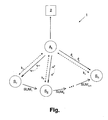
- The only FIG. is a schematic view of an embodiment of an application scenario of a method according to the invention for electing aggregator nodes in a network.
- Referring more particularly to the drawings, the only FIG. depicts an application scenario of a method according to the invention. The FIG. shows - as a scheme - a
senor network 1 with a multitude of sensor nodes being labeled according to their number by S1 to Sn. The data sensored by the sensor nodes S1 to Sn is aggregated by an aggregator node At. Usually upon the request from a sink node 2 - which is, in contrast to the sensor nodes Si and the aggregator node At, a specific device with sufficiently extensive physical resources -, the aggregator node At forwards the aggregated data to thesink node 2. For reasons of clarity, in the FIG. only one single aggregator node At is shown and no intermediate nodes between A, and thesink node 2 exist. - The
sensor network 1 is shown in the status of an epoch t in which the sensor node labeled as At functions as aggregator node. At the beginning of the next epoch t+1 a protocol starts to randomly elect one of the sensor nodes S1 to Sn to be the next aggregator node At+1. The aggregator node election process, in principal, can be distinguished in three phases: - The first phase is the key agreement phase. The goal of this phase is to establish pairwise secret keys between the current aggregator node At and each sensor node Si. For this purpose aggregator node At applies the so called Merkle's Puzzle to establish pairwise keys ki with each of the sensor nodes S1, ..., Sn. During this process, each sensor node Si broadcasts an identifier IDi connected to its key Ki which can be used as a commitment to this key afterwards if needed. Since the aggregator election process lasts only for a well defined short time interval, the security provided by the Merkle Puzzle only need to hold for this time. In the FIG. the key agreement is indicated by the dotted lines with arrows at both ends thereof.
- After the key agreement is completed a second phase of the aggregator node election process is carried out. The goal of this second phase is to securely compute the sum of the sensors' contribution to the election process. Secure hereby means that the no node sees the contribution of any other node before the computation of the sum is over, preventing any cheater to influence the outcome in a controlled way.
- Each sensor node Si chooses its random contribution ri to the election process and encrypts it with E and Ki. E(k, r) denotes the encryption of r under a key k by an encryption scheme E that is homomorphic in k and r. This means that

- Each sensor node Si combines the result with the encrypted random contribution coming from other sensor nodes Si. More precisely, a communication chain between the nodes is provided, that is S1 reports to S2, S2 to S3, and so on. Concretely, when Si receives

it computes
starting at S1 with SUM1 = E(k1, r1). Subsequently Si forwards SUMi to Si+1. The process ends when all n nodes have contributed to the encrypted sum of the contributions. - No sensor node Si can cheat in a meaningful manner since it cannot foresee the impact of its own random value ri on the final result R = r1 + ... + rn without knowing the contributions of the other sensor nodes Si which would require the knowledge of their keys.
- The aggregator node election process is terminated by a third phase. In this phase the actual aggregator node At broadcasts the actual keys to all the sensor nodes Si. Each Si decrypts SUMn by computing k = k1 + ... + kn and the decryption

- The senor node Si for which it holds that i =R mod n is determined as the new aggregator node At+1.
- Many modifications and other embodiments of the invention set forth herein will come to mind the one skilled in the art to which the invention pertains having the benefit of the teachings presented in the foregoing description and the associated drawings. Therefore, it is to be understood that the invention is not to be limited to the specific embodiments disclosed and that modifications and other embodiments are intended to be included within the scope of the appended claims. Although specific terms are employed herein, they are used in a generic and descriptive sense only and not for purposes of limitation.
Claims (14)
- A method for electing aggregator nodes in a network, wherein the network (1) comprises a plurality of sensor nodes (Si) to measure data, and wherein at least one of the sensor nodes (Si) functions as aggregator node (A) to aggregate sensored data obtained by at least a subset of the sensor nodes (Si), and wherein the network further comprises at least one sink node (2) to collect data aggregated by the aggregator nodes (A), the method comprising:establishing pairwise secret keys (ki) between a current aggregator node (At) and each sensor node (Si) of the subset of sensor nodes from which the current aggregator node (At) obtains sensored data;at each of the sensor nodes (Si) of said subset, choosing a random number (ri) and encrypting the random number (ri) using the established key (ki);providing a communication chain between the sensor nodes (Si) of said subset and summing the encrypted random numbers (ri) of all sensor nodes (Si) of said subset; anddetermining a new aggregator node (At+1) on the basis of the resulting sum according to a predefined calculation scheme.
- The method according to claim 1, wherein the current aggregator node (At), in the context of the key agreement, broadcasts a multitude of data pairs, each data pair comprising a key (ki) and an identifier (IDi), respectively, in a concealed manner to all sensor nodes (Si) of said subset.
- The method according to claim 2, wherein each sensor node (Si) of said subset chooses randomly one data pair from the multitude of data pairs and breaks the concealment to obtain the key (ki).
- The method according to claim 2 or 3, wherein the concealment of the broadcasted data pairs is achieved by way of a lightweight encryption.
- The method according to claim 4, wherein the broadcasted data pairs are encrypted with a weak block cipher or using a short key.
- The method according to any of claims 2 to 5, wherein the number of data pairs broadcasted by the current aggregator node (At) is specified according to given security requirements.
- The method according to any of claims 2 to 6, wherein each sensor node (Si) broadcasts the identifier (IDi) of its chosen data pair as a commitment.
- The method according to any of the preceding claims, wherein the order of the sensor nodes (Si) within the communication chain is determined according to a well defined rule.
- The method according to any of the preceding claims, wherein the encryption scheme E used for encrypting the random numbers (ri) under the keys (Ki) is homomorphic both with respect to the random numbers (ri) and to the keys (ki).
- The method according to claim 9, wherein, after completing the summation of the encrypted random numbers (ri), the current aggregator node (At) broadcasts the established keys (ki) to all sensor nodes (Si) of said subset.
- The method according to claim 9 or 10, wherein each sensor node (Si) of said subset sums the established keys (ki) and applies the resulting sum (k) to decrypt the sum of the encrypted random values (ri).
- The method according to any of the preceding claims, wherein the sensor node (Si) of said subset for which it holds that i = R mod n, with R denoting the sum of the random values (ri) is determined as new aggregator node (At+1).
- The method according to any of claims 10 to 12, wherein a maximum allowed time Δt is defined between the moment of broadcasting the data pairs and the moment of broadcasting the established keys (ki).
- The method according to any of the preceding claims, wherein the election process is aborted and restarted from the beginning if at least one sensor node (Si) registers any irregularities.
Applications Claiming Priority (1)
| Application Number | Priority Date | Filing Date | Title |
|---|---|---|---|
| PCT/IB2006/003898 WO2008041052A1 (en) | 2006-10-06 | 2006-10-06 | Method for electing aggregator nodes in a network |
Publications (3)
| Publication Number | Publication Date |
|---|---|
| EP2070288A1 EP2070288A1 (en) | 2009-06-17 |
| EP2070288B1 true EP2070288B1 (en) | 2012-08-29 |
| EP2070288B8 EP2070288B8 (en) | 2012-10-03 |
Family
ID=38261646
Family Applications (1)
| Application Number | Title | Priority Date | Filing Date |
|---|---|---|---|
| EP06847245A Not-in-force EP2070288B8 (en) | 2006-10-06 | 2006-10-06 | Method for electing aggregator nodes in a network |
Country Status (6)
| Country | Link |
|---|---|
| US (1) | US7907548B2 (en) |
| EP (1) | EP2070288B8 (en) |
| JP (1) | JP4902744B2 (en) |
| CN (1) | CN101513007B (en) |
| ES (1) | ES2390902T3 (en) |
| WO (1) | WO2008041052A1 (en) |
Families Citing this family (23)
| Publication number | Priority date | Publication date | Assignee | Title |
|---|---|---|---|---|
| US7609672B2 (en) * | 2006-08-29 | 2009-10-27 | Cisco Technology, Inc. | Method and apparatus for automatic sub-division of areas that flood routing information |
| US8009591B2 (en) * | 2006-11-30 | 2011-08-30 | Cisco Technology, Inc. | Automatic overlapping areas that flood routing information |
| KR101301775B1 (en) * | 2007-01-31 | 2013-09-02 | 삼성전자주식회사 | Method for executing distributed verification for measured data in sensor network and system for executing the method |
| JP5172944B2 (en) * | 2007-04-25 | 2013-03-27 | エヌイーシー ヨーロッパ リミテッド | How to aggregate data in a network |
| US7936732B2 (en) * | 2007-09-27 | 2011-05-03 | Cisco Technology, Inc. | Selecting aggregation nodes in a network |
| US8793497B2 (en) * | 2008-05-09 | 2014-07-29 | Qualcomm Incorporated | Puzzle-based authentication between a token and verifiers |
| EP2134034A1 (en) | 2008-06-10 | 2009-12-16 | Fujitsu Limited | Improvements in wireless sensor networks |
| EP2200234B1 (en) * | 2008-06-10 | 2012-10-24 | Fujitsu Limited | Improvements in wireless sensor networks |
| US8607057B2 (en) | 2009-05-15 | 2013-12-10 | Microsoft Corporation | Secure outsourced aggregation with one-way chains |
| US8583958B2 (en) * | 2010-11-15 | 2013-11-12 | Microsoft Corporation | Systems and methods of providing fast leader elections in distributed systems of simple topologies |
| WO2012073340A1 (en) * | 2010-11-30 | 2012-06-07 | 富士通株式会社 | Key update method, node, gateway, server, and network system |
| WO2012073339A1 (en) * | 2010-11-30 | 2012-06-07 | 富士通株式会社 | Key update method, node, gateway, server, and network system |
| WO2012103896A1 (en) * | 2011-01-31 | 2012-08-09 | Nec Europe Ltd. | Smart grid and method for operating a smart grid |
| US9565559B2 (en) * | 2011-04-21 | 2017-02-07 | Tata Consultancy Services Limited | Method and system for preserving privacy during data aggregation in a wireless sensor network |
| CN102263819A (en) * | 2011-07-18 | 2011-11-30 | 中交四航工程研究院有限公司 | System and method for monitoring engineering safety based on sensor network |
| CN102802151B (en) * | 2012-08-24 | 2015-03-25 | 山东省计算中心 | Wireless body area network symmetric key negotiation method |
| WO2014074041A1 (en) * | 2012-11-12 | 2014-05-15 | Telefonaktiebolaget Lm Ericsson (Publ) | Methods and nodes for verification of data |
| EP2800298A1 (en) * | 2013-04-29 | 2014-11-05 | Her Majesty The Queen, In Right Of Canada, As Represented by the Minister of National Defence | Method and system for calculations on encrypted data |
| CN104618997B (en) * | 2015-01-28 | 2018-04-24 | 西安电子科技大学 | A kind of data aggregation method based on non-uniform grid |
| CN105024892A (en) * | 2015-06-09 | 2015-11-04 | 上海冉能自动化科技有限公司 | A method and system realizing wireless communication between an instrument and a host computer |
| US10751235B2 (en) | 2017-04-14 | 2020-08-25 | Chad Robert Ernst | Adjustable camber wheelchair devices, systems and methods |
| US10671482B2 (en) * | 2017-09-12 | 2020-06-02 | Cohesity, Inc. | Providing consistency in a distributed data store |
| CN116182790B (en) * | 2023-01-03 | 2024-03-15 | 中交第四航务工程局有限公司 | Automatic monitoring device for settlement of ultra-soft foundation treatment of water transport engineering |
Family Cites Families (8)
| Publication number | Priority date | Publication date | Assignee | Title |
|---|---|---|---|---|
| US7203729B2 (en) * | 2001-04-20 | 2007-04-10 | Motorola Inc. | Method and apparatus for a communication network with nodes capable of selective cluster head operation |
| ATE349838T1 (en) * | 2003-11-19 | 2007-01-15 | Sony Deutschland Gmbh | COMMUNICATION SUBSYSTEM CONTROLLED INFORMATION DISTRIBUTION |
| JP4349142B2 (en) * | 2004-02-09 | 2009-10-21 | ソニー株式会社 | Wireless communication apparatus, wireless communication method, and computer program |
| US7561544B2 (en) * | 2004-10-27 | 2009-07-14 | Honeywell International Inc. | Machine architecture for event management in a wireless sensor network |
| US7881757B2 (en) * | 2004-12-21 | 2011-02-01 | Panasonic Corporation | Power management method of wireless nodes |
| CN1314240C (en) * | 2005-01-28 | 2007-05-02 | 北京邮电大学 | Wireless sensor network system and method supporting task reconfiguration |
| KR100718094B1 (en) * | 2005-09-21 | 2007-05-16 | 삼성전자주식회사 | Anomaly Data Processing Method in Wireless Sensor Network |
| CN100358310C (en) * | 2006-02-14 | 2007-12-26 | 北京邮电大学 | Wireless sensor network system and method supporting reconstruction of environment adaptive application |
-
2006
- 2006-10-06 US US12/444,557 patent/US7907548B2/en active Active
- 2006-10-06 CN CN200680055793.0A patent/CN101513007B/en not_active Expired - Fee Related
- 2006-10-06 ES ES06847245T patent/ES2390902T3/en active Active
- 2006-10-06 WO PCT/IB2006/003898 patent/WO2008041052A1/en not_active Ceased
- 2006-10-06 JP JP2009530952A patent/JP4902744B2/en not_active Expired - Fee Related
- 2006-10-06 EP EP06847245A patent/EP2070288B8/en not_active Not-in-force
Also Published As
| Publication number | Publication date |
|---|---|
| US20100098090A1 (en) | 2010-04-22 |
| JP2010506480A (en) | 2010-02-25 |
| ES2390902T3 (en) | 2012-11-19 |
| CN101513007B (en) | 2012-01-25 |
| CN101513007A (en) | 2009-08-19 |
| EP2070288B8 (en) | 2012-10-03 |
| JP4902744B2 (en) | 2012-03-21 |
| US7907548B2 (en) | 2011-03-15 |
| EP2070288A1 (en) | 2009-06-17 |
| WO2008041052A1 (en) | 2008-04-10 |
Similar Documents
| Publication | Publication Date | Title |
|---|---|---|
| US7907548B2 (en) | Method for electing aggregator nodes in a network | |
| Westhoff et al. | Concealed data aggregation for reverse multicast traffic in sensor networks: Encryption, key distribution, and routing adaptation | |
| Yadav et al. | An EAP-based mutual authentication protocol for WLAN-connected IoT devices | |
| JP5172944B2 (en) | How to aggregate data in a network | |
| Misbha | Lightweight key distribution for secured and energy efficient communication in wireless sensor network: An optimization assisted model | |
| Bohli et al. | A secure and resilient WSN roadside architecture for intelligent transport systems | |
| Chan et al. | A security framework for privacy-preserving data aggregation in wireless sensor networks | |
| Altisen et al. | SR3: Secure resilient reputation-based routing | |
| Munivel et al. | Efficient public key infrastructure implementation in wireless sensor networks | |
| Zhu et al. | Secure data aggregation in wireless sensor networks | |
| Babamir et al. | Achieving key privacy and invisibility for unattended wireless sensor networks in healthcare | |
| EP1955472B1 (en) | Key management | |
| Oliveira et al. | On the design of secure protocols for hierarchical sensor networks | |
| Smeets et al. | Cryptographic key management architecture for dynamic 6LoWPAN networks | |
| Yang et al. | A security mechanism for clustered wireless sensor networks based on elliptic curve cryptography | |
| Ilia et al. | Cryptographic key exchange in IPv6-based low power, lossy networks | |
| Frontera et al. | Bloom filter based collective remote attestation for dynamic networks | |
| Vučinić et al. | Requirements for a Lightweight AKE for OSCORE | |
| Yadav et al. | A Provably Secure Post-Quantum Based EDHOC Protocol | |
| Jie et al. | A Public Key Polynomial-based Key Pre-distribution Scheme for Large-Scale Wireless Sensor Networks. | |
| Verbauwhede et al. | Security for ambient intelligent systems | |
| Boujelben et al. | An efficient scheme for key pre-distribution in wireless sensor networks | |
| Zhang et al. | Energy cost of cryptographic session key establishment in a wireless sensor network | |
| Maivizhi et al. | Identity-based secure data aggregation in big data wireless sensor networks | |
| Techateerawat | Key distribution and distributed intrusion detection system in wireless sensor network |
Legal Events
| Date | Code | Title | Description |
|---|---|---|---|
| PUAI | Public reference made under article 153(3) epc to a published international application that has entered the european phase |
Free format text: ORIGINAL CODE: 0009012 |
|
| 17P | Request for examination filed |
Effective date: 20090204 |
|
| AK | Designated contracting states |
Kind code of ref document: A1 Designated state(s): AT BE BG CH CY CZ DE DK EE ES FI FR GB GR HU IE IS IT LI LT LU LV MC NL PL PT RO SE SI SK TR |
|
| AX | Request for extension of the european patent |
Extension state: AL BA HR MK RS |
|
| RIN1 | Information on inventor provided before grant (corrected) |
Inventor name: WESTHOFF, DIRK, DR. Inventor name: ARMKNECHT, FREDERIK |
|
| REG | Reference to a national code |
Ref country code: DE Ref legal event code: R079 Ref document number: 602006031788 Country of ref document: DE Free format text: PREVIOUS MAIN CLASS: H04L0029060000 Ipc: H04L0029080000 |
|
| RIC1 | Information provided on ipc code assigned before grant |
Ipc: G05B 19/418 20060101ALI20111215BHEP Ipc: H04L 9/32 20060101ALI20111215BHEP Ipc: H04L 9/08 20060101ALI20111215BHEP Ipc: H04L 29/06 20060101ALI20111215BHEP Ipc: H04L 29/08 20060101AFI20111215BHEP |
|
| GRAP | Despatch of communication of intention to grant a patent |
Free format text: ORIGINAL CODE: EPIDOSNIGR1 |
|
| GRAS | Grant fee paid |
Free format text: ORIGINAL CODE: EPIDOSNIGR3 |
|
| GRAA | (expected) grant |
Free format text: ORIGINAL CODE: 0009210 |
|
| DAX | Request for extension of the european patent (deleted) | ||
| RIN1 | Information on inventor provided before grant (corrected) |
Inventor name: ARMKNECHT, FREDERIK Inventor name: WESTHOFF, DIRK, DR. |
|
| AK | Designated contracting states |
Kind code of ref document: B1 Designated state(s): AT BE BG CH CY CZ DE DK EE ES FI FR GB GR HU IE IS IT LI LT LU LV MC NL PL PT RO SE SI SK TR |
|
| REG | Reference to a national code |
Ref country code: GB Ref legal event code: FG4D |
|
| REG | Reference to a national code |
Ref country code: CH Ref legal event code: EP |
|
| REG | Reference to a national code |
Ref country code: AT Ref legal event code: REF Ref document number: 573581 Country of ref document: AT Kind code of ref document: T Effective date: 20120915 |
|
| RAP2 | Party data changed (patent owner data changed or rights of a patent transferred) |
Owner name: NEC CORPORATION |
|
| REG | Reference to a national code |
Ref country code: IE Ref legal event code: FG4D |
|
| REG | Reference to a national code |
Ref country code: DE Ref legal event code: R082 Ref document number: 602006031788 Country of ref document: DE Representative=s name: ULLRICH & NAUMANN, DE Ref country code: DE Ref legal event code: R082 Ref document number: 602006031788 Country of ref document: DE Representative=s name: PATENT- UND RECHTSANWAELTE ULLRICH & NAUMANN P, DE |
|
| REG | Reference to a national code |
Ref country code: DE Ref legal event code: R096 Ref document number: 602006031788 Country of ref document: DE Effective date: 20121018 |
|
| REG | Reference to a national code |
Ref country code: ES Ref legal event code: FG2A Ref document number: 2390902 Country of ref document: ES Kind code of ref document: T3 Effective date: 20121119 |
|
| REG | Reference to a national code |
Ref country code: AT Ref legal event code: MK05 Ref document number: 573581 Country of ref document: AT Kind code of ref document: T Effective date: 20120829 |
|
| REG | Reference to a national code |
Ref country code: NL Ref legal event code: VDEP Effective date: 20120829 |
|
| REG | Reference to a national code |
Ref country code: LT Ref legal event code: MG4D Effective date: 20120829 |
|
| PG25 | Lapsed in a contracting state [announced via postgrant information from national office to epo] |
Ref country code: FI Free format text: LAPSE BECAUSE OF FAILURE TO SUBMIT A TRANSLATION OF THE DESCRIPTION OR TO PAY THE FEE WITHIN THE PRESCRIBED TIME-LIMIT Effective date: 20120829 Ref country code: AT Free format text: LAPSE BECAUSE OF FAILURE TO SUBMIT A TRANSLATION OF THE DESCRIPTION OR TO PAY THE FEE WITHIN THE PRESCRIBED TIME-LIMIT Effective date: 20120829 Ref country code: CY Free format text: LAPSE BECAUSE OF FAILURE TO SUBMIT A TRANSLATION OF THE DESCRIPTION OR TO PAY THE FEE WITHIN THE PRESCRIBED TIME-LIMIT Effective date: 20120829 Ref country code: LT Free format text: LAPSE BECAUSE OF FAILURE TO SUBMIT A TRANSLATION OF THE DESCRIPTION OR TO PAY THE FEE WITHIN THE PRESCRIBED TIME-LIMIT Effective date: 20120829 Ref country code: IS Free format text: LAPSE BECAUSE OF FAILURE TO SUBMIT A TRANSLATION OF THE DESCRIPTION OR TO PAY THE FEE WITHIN THE PRESCRIBED TIME-LIMIT Effective date: 20121229 |
|
| PG25 | Lapsed in a contracting state [announced via postgrant information from national office to epo] |
Ref country code: SE Free format text: LAPSE BECAUSE OF FAILURE TO SUBMIT A TRANSLATION OF THE DESCRIPTION OR TO PAY THE FEE WITHIN THE PRESCRIBED TIME-LIMIT Effective date: 20120829 Ref country code: LV Free format text: LAPSE BECAUSE OF FAILURE TO SUBMIT A TRANSLATION OF THE DESCRIPTION OR TO PAY THE FEE WITHIN THE PRESCRIBED TIME-LIMIT Effective date: 20120829 Ref country code: PT Free format text: LAPSE BECAUSE OF FAILURE TO SUBMIT A TRANSLATION OF THE DESCRIPTION OR TO PAY THE FEE WITHIN THE PRESCRIBED TIME-LIMIT Effective date: 20121231 Ref country code: SI Free format text: LAPSE BECAUSE OF FAILURE TO SUBMIT A TRANSLATION OF THE DESCRIPTION OR TO PAY THE FEE WITHIN THE PRESCRIBED TIME-LIMIT Effective date: 20120829 Ref country code: GR Free format text: LAPSE BECAUSE OF FAILURE TO SUBMIT A TRANSLATION OF THE DESCRIPTION OR TO PAY THE FEE WITHIN THE PRESCRIBED TIME-LIMIT Effective date: 20121130 Ref country code: BE Free format text: LAPSE BECAUSE OF FAILURE TO SUBMIT A TRANSLATION OF THE DESCRIPTION OR TO PAY THE FEE WITHIN THE PRESCRIBED TIME-LIMIT Effective date: 20120829 |
|
| PG25 | Lapsed in a contracting state [announced via postgrant information from national office to epo] |
Ref country code: RO Free format text: LAPSE BECAUSE OF FAILURE TO SUBMIT A TRANSLATION OF THE DESCRIPTION OR TO PAY THE FEE WITHIN THE PRESCRIBED TIME-LIMIT Effective date: 20120829 Ref country code: NL Free format text: LAPSE BECAUSE OF FAILURE TO SUBMIT A TRANSLATION OF THE DESCRIPTION OR TO PAY THE FEE WITHIN THE PRESCRIBED TIME-LIMIT Effective date: 20120829 Ref country code: EE Free format text: LAPSE BECAUSE OF FAILURE TO SUBMIT A TRANSLATION OF THE DESCRIPTION OR TO PAY THE FEE WITHIN THE PRESCRIBED TIME-LIMIT Effective date: 20120829 Ref country code: CZ Free format text: LAPSE BECAUSE OF FAILURE TO SUBMIT A TRANSLATION OF THE DESCRIPTION OR TO PAY THE FEE WITHIN THE PRESCRIBED TIME-LIMIT Effective date: 20120829 Ref country code: DK Free format text: LAPSE BECAUSE OF FAILURE TO SUBMIT A TRANSLATION OF THE DESCRIPTION OR TO PAY THE FEE WITHIN THE PRESCRIBED TIME-LIMIT Effective date: 20120829 |
|
| PG25 | Lapsed in a contracting state [announced via postgrant information from national office to epo] |
Ref country code: SK Free format text: LAPSE BECAUSE OF FAILURE TO SUBMIT A TRANSLATION OF THE DESCRIPTION OR TO PAY THE FEE WITHIN THE PRESCRIBED TIME-LIMIT Effective date: 20120829 Ref country code: MC Free format text: LAPSE BECAUSE OF NON-PAYMENT OF DUE FEES Effective date: 20121031 Ref country code: PL Free format text: LAPSE BECAUSE OF FAILURE TO SUBMIT A TRANSLATION OF THE DESCRIPTION OR TO PAY THE FEE WITHIN THE PRESCRIBED TIME-LIMIT Effective date: 20120829 |
|
| REG | Reference to a national code |
Ref country code: CH Ref legal event code: PL |
|
| PLBE | No opposition filed within time limit |
Free format text: ORIGINAL CODE: 0009261 |
|
| STAA | Information on the status of an ep patent application or granted ep patent |
Free format text: STATUS: NO OPPOSITION FILED WITHIN TIME LIMIT |
|
| REG | Reference to a national code |
Ref country code: IE Ref legal event code: MM4A |
|
| PG25 | Lapsed in a contracting state [announced via postgrant information from national office to epo] |
Ref country code: BG Free format text: LAPSE BECAUSE OF FAILURE TO SUBMIT A TRANSLATION OF THE DESCRIPTION OR TO PAY THE FEE WITHIN THE PRESCRIBED TIME-LIMIT Effective date: 20121129 Ref country code: IE Free format text: LAPSE BECAUSE OF NON-PAYMENT OF DUE FEES Effective date: 20121006 Ref country code: LI Free format text: LAPSE BECAUSE OF NON-PAYMENT OF DUE FEES Effective date: 20121031 Ref country code: CH Free format text: LAPSE BECAUSE OF NON-PAYMENT OF DUE FEES Effective date: 20121031 |
|
| 26N | No opposition filed |
Effective date: 20130530 |
|
| REG | Reference to a national code |
Ref country code: DE Ref legal event code: R097 Ref document number: 602006031788 Country of ref document: DE Effective date: 20130530 |
|
| PG25 | Lapsed in a contracting state [announced via postgrant information from national office to epo] |
Ref country code: TR Free format text: LAPSE BECAUSE OF FAILURE TO SUBMIT A TRANSLATION OF THE DESCRIPTION OR TO PAY THE FEE WITHIN THE PRESCRIBED TIME-LIMIT Effective date: 20120829 |
|
| PG25 | Lapsed in a contracting state [announced via postgrant information from national office to epo] |
Ref country code: LU Free format text: LAPSE BECAUSE OF NON-PAYMENT OF DUE FEES Effective date: 20121006 |
|
| PG25 | Lapsed in a contracting state [announced via postgrant information from national office to epo] |
Ref country code: HU Free format text: LAPSE BECAUSE OF FAILURE TO SUBMIT A TRANSLATION OF THE DESCRIPTION OR TO PAY THE FEE WITHIN THE PRESCRIBED TIME-LIMIT Effective date: 20061006 |
|
| REG | Reference to a national code |
Ref country code: FR Ref legal event code: PLFP Year of fee payment: 10 |
|
| REG | Reference to a national code |
Ref country code: FR Ref legal event code: PLFP Year of fee payment: 11 |
|
| REG | Reference to a national code |
Ref country code: FR Ref legal event code: PLFP Year of fee payment: 12 |
|
| REG | Reference to a national code |
Ref country code: FR Ref legal event code: PLFP Year of fee payment: 13 |
|
| REG | Reference to a national code |
Ref country code: DE Ref legal event code: R079 Ref document number: 602006031788 Country of ref document: DE Free format text: PREVIOUS MAIN CLASS: H04L0029080000 Ipc: H04L0065000000 |
|
| PGFP | Annual fee paid to national office [announced via postgrant information from national office to epo] |
Ref country code: FR Payment date: 20221028 Year of fee payment: 17 |
|
| PGFP | Annual fee paid to national office [announced via postgrant information from national office to epo] |
Ref country code: IT Payment date: 20221026 Year of fee payment: 17 Ref country code: GB Payment date: 20221019 Year of fee payment: 17 Ref country code: ES Payment date: 20221222 Year of fee payment: 17 Ref country code: DE Payment date: 20221019 Year of fee payment: 17 |
|
| REG | Reference to a national code |
Ref country code: DE Ref legal event code: R119 Ref document number: 602006031788 Country of ref document: DE |
|
| GBPC | Gb: european patent ceased through non-payment of renewal fee |
Effective date: 20231006 |
|
| PG25 | Lapsed in a contracting state [announced via postgrant information from national office to epo] |
Ref country code: GB Free format text: LAPSE BECAUSE OF NON-PAYMENT OF DUE FEES Effective date: 20231006 |
|
| PG25 | Lapsed in a contracting state [announced via postgrant information from national office to epo] |
Ref country code: GB Free format text: LAPSE BECAUSE OF NON-PAYMENT OF DUE FEES Effective date: 20231006 Ref country code: FR Free format text: LAPSE BECAUSE OF NON-PAYMENT OF DUE FEES Effective date: 20231031 Ref country code: DE Free format text: LAPSE BECAUSE OF NON-PAYMENT OF DUE FEES Effective date: 20240501 |
|
| REG | Reference to a national code |
Ref country code: ES Ref legal event code: FD2A Effective date: 20241128 |
|
| PG25 | Lapsed in a contracting state [announced via postgrant information from national office to epo] |
Ref country code: IT Free format text: LAPSE BECAUSE OF NON-PAYMENT OF DUE FEES Effective date: 20231006 |
|
| PG25 | Lapsed in a contracting state [announced via postgrant information from national office to epo] |
Ref country code: IT Free format text: LAPSE BECAUSE OF NON-PAYMENT OF DUE FEES Effective date: 20231006 |
|
| PG25 | Lapsed in a contracting state [announced via postgrant information from national office to epo] |
Ref country code: ES Free format text: LAPSE BECAUSE OF NON-PAYMENT OF DUE FEES Effective date: 20231007 |
|
| PG25 | Lapsed in a contracting state [announced via postgrant information from national office to epo] |
Ref country code: ES Free format text: LAPSE BECAUSE OF NON-PAYMENT OF DUE FEES Effective date: 20231007 |