EP2070241B1 - Uplink allocations for acknowledgement of downlink data - Google Patents
Uplink allocations for acknowledgement of downlink data Download PDFInfo
- Publication number
- EP2070241B1 EP2070241B1 EP07825156.8A EP07825156A EP2070241B1 EP 2070241 B1 EP2070241 B1 EP 2070241B1 EP 07825156 A EP07825156 A EP 07825156A EP 2070241 B1 EP2070241 B1 EP 2070241B1
- Authority
- EP
- European Patent Office
- Prior art keywords
- sub
- frame
- uplink
- downlink
- user equipment
- Prior art date
- Legal status (The legal status is an assumption and is not a legal conclusion. Google has not performed a legal analysis and makes no representation as to the accuracy of the status listed.)
- Active
Links
Images




Classifications
-
- H—ELECTRICITY
- H04—ELECTRIC COMMUNICATION TECHNIQUE
- H04L—TRANSMISSION OF DIGITAL INFORMATION, e.g. TELEGRAPHIC COMMUNICATION
- H04L1/00—Arrangements for detecting or preventing errors in the information received
- H04L1/12—Arrangements for detecting or preventing errors in the information received by using return channel
- H04L1/16—Arrangements for detecting or preventing errors in the information received by using return channel in which the return channel carries supervisory signals, e.g. repetition request signals
- H04L1/18—Automatic repetition systems, e.g. Van Duuren systems
- H04L1/1829—Arrangements specially adapted for the receiver end
- H04L1/1854—Scheduling and prioritising arrangements
-
- H—ELECTRICITY
- H04—ELECTRIC COMMUNICATION TECHNIQUE
- H04L—TRANSMISSION OF DIGITAL INFORMATION, e.g. TELEGRAPHIC COMMUNICATION
- H04L1/00—Arrangements for detecting or preventing errors in the information received
- H04L1/12—Arrangements for detecting or preventing errors in the information received by using return channel
- H04L1/16—Arrangements for detecting or preventing errors in the information received by using return channel in which the return channel carries supervisory signals, e.g. repetition request signals
- H04L1/1607—Details of the supervisory signal
-
- H—ELECTRICITY
- H04—ELECTRIC COMMUNICATION TECHNIQUE
- H04L—TRANSMISSION OF DIGITAL INFORMATION, e.g. TELEGRAPHIC COMMUNICATION
- H04L1/00—Arrangements for detecting or preventing errors in the information received
- H04L1/12—Arrangements for detecting or preventing errors in the information received by using return channel
- H04L1/16—Arrangements for detecting or preventing errors in the information received by using return channel in which the return channel carries supervisory signals, e.g. repetition request signals
- H04L1/18—Automatic repetition systems, e.g. Van Duuren systems
- H04L1/1829—Arrangements specially adapted for the receiver end
- H04L1/1864—ARQ related signaling
-
- H—ELECTRICITY
- H04—ELECTRIC COMMUNICATION TECHNIQUE
- H04L—TRANSMISSION OF DIGITAL INFORMATION, e.g. TELEGRAPHIC COMMUNICATION
- H04L5/00—Arrangements affording multiple use of the transmission path
- H04L5/003—Arrangements for allocating sub-channels of the transmission path
- H04L5/0053—Allocation of signalling, i.e. of overhead other than pilot signals
-
- H—ELECTRICITY
- H04—ELECTRIC COMMUNICATION TECHNIQUE
- H04L—TRANSMISSION OF DIGITAL INFORMATION, e.g. TELEGRAPHIC COMMUNICATION
- H04L5/00—Arrangements affording multiple use of the transmission path
- H04L5/0091—Signalling for the administration of the divided path, e.g. signalling of configuration information
-
- H—ELECTRICITY
- H04—ELECTRIC COMMUNICATION TECHNIQUE
- H04W—WIRELESS COMMUNICATION NETWORKS
- H04W72/00—Local resource management
- H04W72/04—Wireless resource allocation
- H04W72/044—Wireless resource allocation based on the type of the allocated resource
- H04W72/0446—Resources in time domain, e.g. slots or frames
-
- H—ELECTRICITY
- H04—ELECTRIC COMMUNICATION TECHNIQUE
- H04L—TRANSMISSION OF DIGITAL INFORMATION, e.g. TELEGRAPHIC COMMUNICATION
- H04L5/00—Arrangements affording multiple use of the transmission path
- H04L5/0001—Arrangements for dividing the transmission path
- H04L5/0003—Two-dimensional division
- H04L5/0005—Time-frequency
- H04L5/0007—Time-frequency the frequencies being orthogonal, e.g. OFDM(A) or DMT
-
- H—ELECTRICITY
- H04—ELECTRIC COMMUNICATION TECHNIQUE
- H04L—TRANSMISSION OF DIGITAL INFORMATION, e.g. TELEGRAPHIC COMMUNICATION
- H04L5/00—Arrangements affording multiple use of the transmission path
- H04L5/003—Arrangements for allocating sub-channels of the transmission path
- H04L5/0058—Allocation criteria
- H04L5/0064—Rate requirement of the data, e.g. scalable bandwidth, data priority
-
- H—ELECTRICITY
- H04—ELECTRIC COMMUNICATION TECHNIQUE
- H04W—WIRELESS COMMUNICATION NETWORKS
- H04W72/00—Local resource management
- H04W72/12—Wireless traffic scheduling
- H04W72/1263—Mapping of traffic onto schedule, e.g. scheduled allocation or multiplexing of flows
- H04W72/1268—Mapping of traffic onto schedule, e.g. scheduled allocation or multiplexing of flows of uplink data flows
-
- H—ELECTRICITY
- H04—ELECTRIC COMMUNICATION TECHNIQUE
- H04W—WIRELESS COMMUNICATION NETWORKS
- H04W72/00—Local resource management
- H04W72/20—Control channels or signalling for resource management
- H04W72/23—Control channels or signalling for resource management in the downlink direction of a wireless link, i.e. towards a terminal
Definitions
- This invention generally relates to communications, e.g., wireless communications, and more specifically to implicit signaling and defining uplink allocations for an acknowledgment of downlink data.
- HARQ hybrid automatic request process
- physical resources will be allocated in the uplink so that each allocated user equipment (UE) can transmit ACK/NACK (acknowledgement) information based on its reception.
- UE user equipment
- ACK/NACK acknowledgement
- the assumption for the downlink is that the HARQ is asynchronous, but it is expected that the UE's transmission of the ACK/NACK information (can be also referred to as ACK/NACK) will be time-wise tied to the associated downlink transmission.
- a dedicated physical control channel e.g., similar to a high speed dedicated physical control channel, HS-DPCCH, for high speed downlink packet access, HSDPA
- the acknowledgement information e.g., an ACK/NACK bit.
- the ACK/NACK information can be piggy-backed to the data transmission. Both the allocation in uplink and downlink will be decided by the Node B.
- a number of users multiplexed in downlink may change significantly from one sub-frame to another. Some of the factors contributing to such variations include:
- ACK/NACK For an asymmetrical traffic (or time-shifted as in the case of voice over internet protocol, VoIP), it will often happen that the ACK/NACK needs to be sent in uplink as "data-non-associated" transmission, e.g., on a separate physical channel tied to the downlink allocation.
- One option would be to reserve "space" for all active UEs, such that they all have a reservation channel for signaling corresponding to ACK/NACK. Since the uplink resources are orthogonal in time/frequency, any unused transmissions (even for control signaling) will imply that system capacity/throughput are wasted whenever such situations occur. In order to reduce the HARQ related signaling overhead/resource waste, resource assignments for such control signaling messages can be scheduled, but this would lead to excessive overhead in the downlink control signaling.
- the uplink transmissions will use a single-carrier FDMA (frequency-division multiple access), where the channel resources are inherently orthogonal to the different users, unlike CDMA (code-division multiple access) where all active UEs are transmitting at the same time and frequency, so a pre-reserved control channel in the uplink for acknowledging the downlink data would lead to a loss of uplink capacity if utilization is not 100%.
- FDMA frequency-division multiple access
- the network element may be a node B and the network element and the user equipment may be configured for wireless communications.
- the sub-frame may be 0.5 or 1 milliseconds.
- the predetermined number of sub-frames may be an integer of at least a value of one.
- the predetermined number may be provided in a specification.
- the method may further comprise: receiving a further downlink sub-frame comprising a user uplink resource allocation of a further plurality of users for the uplink sub-frame by at least one further user equipment from the network element, wherein the user uplink resource allocation comprises an uplink allocation for the at least one further user equipment, and the further downlink sub-frame being transmitted after the predetermined number of sub-frames following the downlink sub-frame; and transmitting the uplink sub-frame comprising a further ACK/NACK signal acknowledging receiving the data by the at least one further user equipment using the uplink allocation.
- the downlink subframe may further comprise a user uplink resource allocation of a further plurality of users for the uplink sub-frame and the method may further comprise: receiving the downlink sub-frame further comprising the user uplink resource allocation by at least one further user equipment, wherein the user uplink resource allocation comprises an uplink allocation for the at least one further user equipment; and transmitting the uplink sub-frame comprising a further ACK/NACK signal acknowledging receiving the data by the at least one further user equipment using the uplink allocation.
- the assigning by the at least one user equipment the control signaling resource may be performed using a number of sub-carriers within a physical resource block.
- a computer program product comprises: a computer readable storage structure embodying computer program code thereon for execution by a computer processor with the computer program code, wherein the computer program code comprises instructions for performing the first aspect of the invention, indicated as being performed by acomponent or a combination of components of the at least one user equipment or the network element.
- an apparatus is set out in the independent claim 7.
- the sub-frame may be 0.5 or 1 milliseconds.
- the predetermined number of sub-frames may be an integer of at least a value of one.
- the predetermined number may be provided in a specification.
- the network equipment may be further configured to provide a user uplink resource allocation of a further plurality of users for the uplink sub-frame in a further downlink sub-frame, the further downlink sub-frame being transmitted after the predetermined number of subframes following the downlink sub-frame, and wherein the further downlink subframe comprising the user uplink resource allocation for the uplink sub-frame is received by at least one further user equipment, wherein the user uplink resource allocation comprises an uplink allocation for the at least one further user equipment, and wherein the at least one further user equipment is configured to transmit the uplink sub-frame comprising a further ACK/NACK signal acknowledging receiving the data by using the uplink allocation.
- the downlink sub-frame may further comprise a user uplink resource allocation of a further plurality of users for the uplink sub-frame and the downlink sub-frame may be received by at least one further user equipment, wherein the user uplink resource allocation comprises an uplink allocation for the at least one further user equipment; and wherein the at least one further user equipment is configured to transmit the uplink sub-frame comprising a further ACK/NACK signal acknowledging receiving the data by using the uplink allocation.
- the assigning by the at least one user equipment the control signaling resource may be performed using a number of sub-carriers within a physical resource block.
- an integrated circuit may comprise the uplink scheduling and signal generating module and the eceiving/transmitting/processing module.
- the apparatus may be a user equipment for wireless communications.
- a communication system is set out in the independent claim 14.
- the network equipment may be further configured to provide a user uplink resource allocation of a further plurality of users for the uplink sub-frame in a further downlink sub-frame, the further downlink sub-frame being transmitted after the predetermined number of sub-frames following the downlink sub-frame
- the system may further comprise: at least one further user equipment, configured to receive the further downlink sub-frame comprising the user uplink resource allocation for the uplink sub-frame, wherein the user uplink resource allocation comprises an uplink allocation for the at least one further user equipment, and configured to transmit the uplink sub-frame comprising a further ACK/NACK signal acknowledging receiving the data using the uplink allocation.
- the downlink subframe may further comprise a user uplink resource allocation of a further plurality of users for the uplink sub-frame
- the system may further comprise: at least one further user equipment, configured to receive the downlink sub-frame further comprising the user uplink resource allocation, wherein the user uplink resource allocation comprises an uplink allocation for the at least one further user equipment, and for transmitting the uplink sub-frame comprising a further ACK/NACK signal acknowledging receiving the data using the uplink allocation.
- the network element may be a Node B and the network element and the user equipment may be configured for wireless communications.
- a new method, system, apparatus and software product are presented for implicit signaling and defining uplink allocations for an acknowledgment of downlink data using user downlink resource allocations, e.g., combined with user equipment (UE) detection of other user's allocations for data-non-associated signaling of HARQ (hybrid automatic request process) control information.
- sequences of the downlink resource allocations are used to pre-define associated uplink control signaling resources.
- the UE can derive its index of allocation such that this information comprised in the control signaling resource can be mapped into a (physical) resource to use for the uplink transmission.
- data-non-associated ACK/NACK transmissions as the acknowledgments of the downlink data (here "data” is interpreted in a broadest sense meaning any "information") transmissions are considered. It is further assumed that the resource allocation signaling is handled primarily in the downlink direction, such that uplink and downlink allocations are signalled in the downlink, e.g., the Node B can be in full control of all resource allocations.
- FIGS 1a and 1b One example among many others of the downlink allocation (or "allocation table") is shown in Figures 1a and 1b , wherein content of the resource allocation ( Figure 1b ) contains information on both uplink and downlink resource allocations, which can be used for defining the uplink allocations for the acknowledgments of the downlink data transmissions according to embodiments of the present invention described herein (see Implementation examples 1 and 2 below).
- the assumption in Figure 1a is that the downlink transmission is asynchronous, but it is expected that the UE's transmission of the ACK/NACK information can be time-wise tied to the received downlink transmission.
- the TTI transmission timing interval
- the sub-frame can have a similar meaning.
- TTI transmission timing interval
- the example presented in Figures 1a and 1b provides identical results.
- an allocation table is included only in every second sub-frame (e.g.. one per TTI). Since the TTI is not currently defined, it is more accurate to refer to a resource allocation table per one TTI in general, as applied to various embodiments of the present invention.
- a resource allocation table comprising lists 4a and 4b (as well as a cyclic redundancy check CRC, as shown) can be transmitted downlink (DL) during first two slots 4 of a sub-frame n both for the downlink data packet slots 6 and the uplink slots 8 of the uplink sub-frame n (the uplink sub-frame n is delayed relatively to the downlink sub-frame n by a time delay t needed for UE processing).
- the same is applied to a time slot 4-1 for a sub-frame n+1, and all other downlink sub-frames as shown in Figure 1a .
- a sub-frame may contain 14 OFDM symbols, of which the first 1-3 OFDM symbols may be assigned for carrying the resource allocation information.
- the UE At the end of sub-frame n, the UE has received the data packet 6 (last 5 time slots of the sub-frame n), and after some data processing it needs to transmit the associated ACK/NACK control signal.
- This processing delay will cause the ACK/NACK signal to be transmitted at uplink sub-frame 'n+k', where 'k' would typically be defined by a specification (both k and n are integers, k can be a value of one or more) or it can be negotiated between the node B and the UE (e.g., considering the UE capabilities).
- the ACK/NACK signal can be sent on an uplink (UL) sub-frame 8-1, according to embodiments of the present invention described herein.
- UL uplink
- a solution described herein is "overhead-optimized", such that as little control signaling overhead as possible is needed.
- the UE can define its uplink resource allocation for the uplink control signaling from the downlink allocation information, such that the scheduled users all know their allocation order in the downlink at the sub-frame n, and they can use this order or sequence to self-assign resources within an uplink signaling space for the n+k sub-frame to transmit the ACK/NACK signal acknowledging the downlink information (data) received during the slots 6 (see Figure 1a ) of the sub-frame n.
- This signaling space could be, for instance, a number of sub-carriers within a physical resource block, or it could be a code, in case a CDMA approach is used for the data-non-associated control signaling.
- the UE can use its resource assignment in the downlink transmitted during the sub-frame n to self-define its uplink control signaling resource during the sub-frame n+k for providing said ACK/NACK signal.
- the UE only needs to successfully receive the first allocation table (practically, information associated with the downlink data transmission), e.g., only during the sub-frame n shown in Figure 1a .
- the control signaling resource could be a CAZAC (constant amplitude zero auto-correlation) sequence which it transmitted using single carrier transmission on a time-frequency domain resource.
- the UE can assign the uplink control signaling resource for transmitting the ACK/NACK signal during the sub-frame n+k, as described herein, using data-not-associated transmission.
- the implementation method 1 can provide: a) ACK/NACK solution without a downlink signaling overhead (since it can be derived from already existing information), and b) the Node B with means for utilizing the dedicated control resources for data in the case wherein only few users are transmitted simultaneously in the downlink.
- the implementation method 2 can allow Node-B to utilize the unused resources (e.g. if many data associated users or a low number of users are multiplexed). It is noted that the robust operation of the concept in the implementation example 2 is dependent on correct detection of two allocation tables, which may imply more processing and data storage needed in the UE.
- the example given in the implementation example 2 is further expanded by assuming that the resource allocation information for the subframe n will contain information on the scheduled downlink users at the sub-frame n, while it contains uplink scheduling information for the uplink users at the sub-frame n+k.
- the need to decode two allocation tables to obtain the correct allocation information is alleviated.
- This example implementation is illustrated for the case of k equal to one (i.e., for the case when the TTI is equal to the sub-frame) in Figure 2 .
- the slots 4 of the downlink sub-frame n comprise the uplink resource allocation information for the uplink slots 8-1 of the uplink sub-frame n+1
- the slots 4-1 of the downlink sub-frame n+1 comprise the uplink resource allocation information for the uplink slots 8-2 of the uplink sub-frame n+2, etc.
- the scheduling delay of the uplink scheduled resources will increase by 'k' sub-frames, and it is expected k to be on the order of 1-4 ms (e.g., k can be 1, 2, 4, etc.).
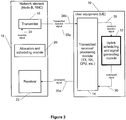
- Figure 3 shows one example among others of a block diagram which demonstrates signaling and defining uplink allocations for the acknowledgment of the downlink data, according to embodiments of the present invention.
- a user equipment 10 can comprise an uplink scheduling and signal generating module 12 and a transmitter/receiver/processing module 14.
- the module 12 can be generally viewed as means for assigning and a structural equivalence (or an equivalent structure) thereof.
- the module 14 can generally be transmitting and/or receiving means, e.g., a transceiver, or a structural equivalence (or equivalent structure) thereof.
- the user equipment 10 can be a wireless device, a portable device, a mobile communication device, a mobile phone, etc.
- a network element 16 e.g., a node B
- the module 12 (the same is applicable to the module 20 and 14 ) can be implemented as a software or a hardware module or a combination thereof. Furthermore, the module 12 (as well as 20 or 14 ) can be implemented as a separate block or can be combined with any other standard block or module or it can be split into several blocks according to their functionality.
- the transmitter/receiver/processing block 14 can be implemented in a plurality of ways and typically can include a transmitter, a receiver and a CPU (central processing unit), etc. The transmitter and receiver can be combined, for example, in one module such as transceiver, as known in the art.
- the module 14 provides an effective communication of the module 12 with the network element 16 as described below in more detail. All or selected modules of the user equipment 10 can be implemented using an integrated circuit, and all or selected modules of the network element 16 can be implemented using an integrated circuit as well.
- a downlink signal 34 (e.g., comprising the allocation slots 4 and the downlink data slots 6 shown in Figure 1a ) from the block 20 is transmitted (see signal 34a ) by the transmitter block 18 of the network element 16 to the transmitter/receiver/processing module 14 of the user equipment 10 and then forwarded (see signal 36 ) to the uplink scheduling and signal generating module 12.
- the module 12 assigns and provides an ACK/NACK signal 30 according to embodiments of the present invention described herein, which are then forwarded (signals 32a and 32b ) to the receiver block 22 of the network element 16.
- Figure 4a is a flow chart illustrating implementations corresponding to the implementation examples 1 and 2, which demonstrate signaling and defining uplink allocations for the acknowledgments of downlink transmitted information (data), according to embodiments of the present invention.
- a method according to an embodiment of the present invention in a first step 40 the network element provides to the user equipment the user resource allocation table comprised in the downlink sub-frame n for the DL and UL resource allocation in the sub-frame n.
- the user equipment successfully receives the resource allocation table for the downlink user allocation in the sub-frame n.
- the network element provides to the user equipment the user resource allocation table in the downlink subframe n+1 for the DL and UL resource allocation in the sub-frame n+k.
- a next step 46 it is determined whether the downlink sub-frame n+k was properly received for providing to the user the UL resource allocations. If that is not the case, in a next step 50 (this step corresponds to the implementation example 1), the user equipment self-assigns and transmits the ACK/NACK signal on the UL n+k sub-frame (e.g., piggy-backed to the data transmission or within some signaling space) using the downlink allocation information in the sub-frame n, according to embodiments of the present invention described herein (e.g., see the implementation example 1).
- a next step 48 it is further determined, whether the user allocated for the DL in the sub-frame n is also allocated for the UL sub-frame n+k (this step corresponds to the implementation example 2). If that is not the case, the process goes to step 50. If, however, it is determined that the user allocated for the DL in the sub-frame n is also allocated for the UL sub-frame n+k, in a next step 52, the user equipment transmits the ACK/NACK signal on the UL sub-frame n+k as allocated.
- Figure 4b is a flow chart demonstrating implementations corresponding to the implementation example 3, which demonstrate signaling and defining uplink allocations for acknowledgments of downlink data, according to embodiments of the present invention.
- a first step 60 the network element provides to the user equipment the user resource allocation table in the downlink sub-frame n for the DL resource allocation in the sub-frame n and for the UL resource allocation in the sub-frame n+1 (this step corresponds to the implementation example 3).
- a next step 62 the user equipment 10 successfully receives the resource allocation table in the sub-frame n. Then the process goes to steps 48, 50 and 52 which are described in regard to Figure 4a .
- the invention provides both a method and corresponding equipment consisting of various modules providing the functionality for performing the steps of the method.
- the modules may be implemented as hardware, or may be implemented as software or firmware for execution by a computer processor.
- firmware or software the invention can be provided as a computer program product including a computer readable storage structure embodying computer program code (i.e., the software or firmware) thereon for execution by the computer processor.
Landscapes
- Engineering & Computer Science (AREA)
- Signal Processing (AREA)
- Computer Networks & Wireless Communication (AREA)
- Mobile Radio Communication Systems (AREA)
Description
- This invention generally relates to communications, e.g., wireless communications, and more specifically to implicit signaling and defining uplink allocations for an acknowledgment of downlink data.
- In a new concept for a long-term evolution (LTE) of 3GPP (3rd Generation Partnership Project), the assumption is that multiple users can be multiplexed in the downlink direction within a single sub-frame, which may have a time duration of 1 ms, or within several consecutive sub-frames. Currently, the working assumption is that a transmission timing interval (TTI) for scheduled transmissions may have a duration of 1 ms. However, there are also discussions on whether it should be possible to have a shorter duration of a single user allocation when having persistent allocations. Current 3GPP terminology states that a 0.5 ms entity is a slot, while a pair of two slots constitutes a subframe, which in turn is the same length as the TTI. One of the expected key features for the LTE is extensive usage of HARQ (hybrid automatic request process) to enable fast recovery of erroneously received data packets. For each transmitted packet, physical resources will be allocated in the uplink so that each allocated user equipment (UE) can transmit ACK/NACK (acknowledgement) information based on its reception. The assumption for the downlink is that the HARQ is asynchronous, but it is expected that the UE's transmission of the ACK/NACK information (can be also referred to as ACK/NACK) will be time-wise tied to the associated downlink transmission. In cases where the UE does not have data to transmit in the uplink at the time of the ACK/NACK (data-non-associated control signaling) transmission, a dedicated physical control channel (e.g., similar to a high speed dedicated physical control channel, HS-DPCCH, for high speed downlink packet access, HSDPA) is assumed to carry the acknowledgement information (e.g., an ACK/NACK bit). Otherwise, in case of data-associated control signaling, the ACK/NACK information can be piggy-backed to the data transmission. Both the allocation in uplink and downlink will be decided by the Node B.
- A number of users multiplexed in downlink may change significantly from one sub-frame to another. Some of the factors contributing to such variations include:
- changes in traffic (burstiness) which means that varying number of users have different and fast varying amounts of data to transmit;
- issues related to different TTI sizes in uplink and issues of whether TTI size is cell or user specific and if it is paired to the downlink transmission or not;
- properties of radio-aware scheduling that cause variations in the number of users allocated per the sub-frame, etc.
- For an asymmetrical traffic (or time-shifted as in the case of voice over internet protocol, VoIP), it will often happen that the ACK/NACK needs to be sent in uplink as "data-non-associated" transmission, e.g., on a separate physical channel tied to the downlink allocation. One option would be to reserve "space" for all active UEs, such that they all have a reservation channel for signaling corresponding to ACK/NACK. Since the uplink resources are orthogonal in time/frequency, any unused transmissions (even for control signaling) will imply that system capacity/throughput are wasted whenever such situations occur. In order to reduce the HARQ related signaling overhead/resource waste, resource assignments for such control signaling messages can be scheduled, but this would lead to excessive overhead in the downlink control signaling.
- For the HSDPA, an associated control channel was set up for each data connection (the HS-DPCCH). However, for the LTE, it is assumed that the uplink transmissions will use a single-carrier FDMA (frequency-division multiple access), where the channel resources are inherently orthogonal to the different users, unlike CDMA (code-division multiple access) where all active UEs are transmitting at the same time and frequency, so a pre-reserved control channel in the uplink for acknowledging the downlink data would lead to a loss of uplink capacity if utilization is not 100%.
- Huawei: "Further considerations n multiplexing method of shared Control Channel in Uplink Single-Carrier FDMA", 3GPP Draft: R1-051430, 3rd Generation Partnership Project (3GPP), Mobile Competence Centre; Vol. RAN WG1, no. Seoul, Korea 20051101, November 2005 presents some considerations on multiplexing method of shared control channels (SCCH) in Evolved UTRA uplink radio access.
- The invention is defined and limited by the scope of appended claims 1-14. In the following description, any embodiment(s) referred to and not falling within the scope of the appended claims, is (are) merely example(s) useful to the understanding of the invention.
- According to a first aspect of the invention, a method is set out in the
independent claim 1. - According further to the first aspect of the invention, the network element may be a node B and the network element and the user equipment may be configured for wireless communications.
- According further to the first aspect of the invention, the sub-frame may be 0.5 or 1 milliseconds.
- Still further according to the first aspect of the invention, the predetermined number of sub-frames may be an integer of at least a value of one.
- According further to the first aspect of the invention, the predetermined number may be provided in a specification.
- According still further to the first aspect of the invention, after receiving the downlink sub-frame, the method may further comprise: receiving a further downlink sub-frame comprising a user uplink resource allocation of a further plurality of users for the uplink sub-frame by at least one further user equipment from the network element, wherein the user uplink resource allocation comprises an uplink allocation for the at least one further user equipment, and the further downlink sub-frame being transmitted after the predetermined number of sub-frames following the downlink sub-frame; and transmitting the uplink sub-frame comprising a further ACK/NACK signal acknowledging receiving the data by the at least one further user equipment using the uplink allocation.
- According still further to the first aspect of the invention, the downlink subframe may further comprise a user uplink resource allocation of a further plurality of users for the uplink sub-frame and the method may further comprise: receiving the downlink sub-frame further comprising the user uplink resource allocation by at least one further user equipment, wherein the user uplink resource allocation comprises an uplink allocation for the at least one further user equipment; and transmitting the uplink sub-frame comprising a further ACK/NACK signal acknowledging receiving the data by the at least one further user equipment using the uplink allocation.
- According yet further still to the first aspect of the invention, the assigning by the at least one user equipment the control signaling resource may be performed using a number of sub-carriers within a physical resource block.
- According to a second aspect of the invention, a computer program product comprises: a computer readable storage structure embodying computer program code thereon for execution by a computer processor with the computer program code, wherein the computer program code comprises instructions for performing the first aspect of the invention, indicated as being performed by acomponent or a combination of components of the at least one user equipment or the network element.
- According to a third aspect of the invention, an apparatus is set out in the independent claim 7.
- According further to the second aspect of the invention, the sub-frame may be 0.5 or 1 milliseconds.
- Still further according to the second aspect of the invention, the predetermined number of sub-frames may be an integer of at least a value of one.
- According further to the third aspect of the invention, the predetermined number may be provided in a specification.
- According still further to the third aspect of the invention, the network equipment may be further configured to provide a user uplink resource allocation of a further plurality of users for the uplink sub-frame in a further downlink sub-frame, the further downlink sub-frame being transmitted after the predetermined number of subframes following the downlink sub-frame, and wherein the further downlink subframe comprising the user uplink resource allocation for the uplink sub-frame is received by at least one further user equipment, wherein the user uplink resource allocation comprises an uplink allocation for the at least one further user equipment, and wherein the at least one further user equipment is configured to transmit the uplink sub-frame comprising a further ACK/NACK signal acknowledging receiving the data by using the uplink allocation.
- According yet further still to the third aspect of the invention, the downlink sub-frame may further comprise a user uplink resource allocation of a further plurality of users for the uplink sub-frame and the downlink sub-frame may be received by at least one further user equipment, wherein the user uplink resource allocation comprises an uplink allocation for the at least one further user equipment; and wherein the at least one further user equipment is configured to transmit the uplink sub-frame comprising a further ACK/NACK signal acknowledging receiving the data by using the uplink allocation.
- According further still to the third aspect of the invention, the assigning by the at least one user equipment the control signaling resource may be performed using a number of sub-carriers within a physical resource block.
- Yet still further according to the third aspect of the invention, an integrated circuit may comprise the uplink scheduling and signal generating module and the eceiving/transmitting/processing module.
- Yet further still according to the third aspect of the invention, the apparatus may be a user equipment for wireless communications.
- According to a fourth aspect of the invention, a communication system is set out in the
independent claim 14. - According further to the fourth aspect of the invention, the network equipment may be further configured to provide a user uplink resource allocation of a further plurality of users for the uplink sub-frame in a further downlink sub-frame, the further downlink sub-frame being transmitted after the predetermined number of sub-frames following the downlink sub-frame, and the system may further comprise: at least one further user equipment, configured to receive the further downlink sub-frame comprising the user uplink resource allocation for the uplink sub-frame, wherein the user uplink resource allocation comprises an uplink allocation for the at least one further user equipment, and configured to transmit the uplink sub-frame comprising a further ACK/NACK signal acknowledging receiving the data using the uplink allocation.
- Further according to the fourth aspect of the invention, the downlink subframe may further comprise a user uplink resource allocation of a further plurality of users for the uplink sub-frame, and the system may further comprise: at least one further user equipment, configured to receive the downlink sub-frame further comprising the user uplink resource allocation, wherein the user uplink resource allocation comprises an uplink allocation for the at least one further user equipment, and for transmitting the uplink sub-frame comprising a further ACK/NACK signal acknowledging receiving the data using the uplink allocation.
- Still further according to the fourth aspect of the invention, the network element may be a Node B and the network element and the user equipment may be configured for wireless communications.
-
-
Figures 1a and 1b are diagrams demonstrating the resource allocation signaling (Figure 1a ), wherein content of the resource allocation (Figure 1b ) contains information on both uplink and downlink resource allocations, which can be used for defining uplink allocations for acknowledgments of downlink data, according to an embodiment of the present invention; -
Figure 2 is a diagram demonstrating the resource allocation signaling by a network element, which can be used for defining uplink allocations for acknowledgments of downlink data, according to an embodiment of the present invention described in an implementation example 3. -
Figure 3 is a block diagram which demonstrates signaling and defining uplink allocations for an acknowledgment of downlink data, according to embodiments of the present invention; and -
Figures 4a and4b are flow charts demonstrating different implementations (Figure 4a corresponds to Examples 1 and 2, andFigure 4b corresponds to Example 3), which demonstrate signaling and defining uplink allocations for acknowledgments of downlink data, according to embodiments of the present invention. - A new method, system, apparatus and software product are presented for implicit signaling and defining uplink allocations for an acknowledgment of downlink data using user downlink resource allocations, e.g., combined with user equipment (UE) detection of other user's allocations for data-non-associated signaling of HARQ (hybrid automatic request process) control information. According to one embodiment, sequences of the downlink resource allocations are used to pre-define associated uplink control signaling resources. For example, the UE can derive its index of allocation such that this information comprised in the control signaling resource can be mapped into a (physical) resource to use for the uplink transmission.
- For describing various embodiments of the present invention, data-non-associated ACK/NACK transmissions as the acknowledgments of the downlink data (here "data" is interpreted in a broadest sense meaning any "information") transmissions are considered. It is further assumed that the resource allocation signaling is handled primarily in the downlink direction, such that uplink and downlink allocations are signalled in the downlink, e.g., the Node B can be in full control of all resource allocations. One example among many others of the downlink allocation (or "allocation table") is shown in
Figures 1a and 1b , wherein content of the resource allocation (Figure 1b ) contains information on both uplink and downlink resource allocations, which can be used for defining the uplink allocations for the acknowledgments of the downlink data transmissions according to embodiments of the present invention described herein (see Implementation examples 1 and 2 below). The assumption inFigure 1a is that the downlink transmission is asynchronous, but it is expected that the UE's transmission of the ACK/NACK information can be time-wise tied to the received downlink transmission. - In the example of
Figures 1a and 1b , there is a set ofusers 4a allocated for the downlink transmissions and another set ofusers 4b allocated for the uplink transmissions. Some of these users are downlink only, some are uplink only, and some are both uplink and downlink. Consider the case when a user equipment (UE) is allocated resources for the downlink transmission at a sub-frame 'n'. - For the purpose of the present invention, the TTI (transmission timing interval) and the sub-frame can have a similar meaning. In other words, for the case when TTI is equal to the sub-frame, the example presented in
Figures 1a and 1b provides identical results. However, if TTI is equal to two sub-frames (or more), then an allocation table is included only in every second sub-frame (e.g.. one per TTI). Since the TTI is not currently defined, it is more accurate to refer to a resource allocation table per one TTI in general, as applied to various embodiments of the present invention. - Moreover, a resource allocation
table comprising lists slots 4 of a sub-frame n both for the downlinkdata packet slots 6 and theuplink slots 8 of the uplink sub-frame n (the uplink sub-frame n is delayed relatively to the downlink sub-frame n by a time delay t needed for UE processing). The same is applied to a time slot 4-1 for a sub-frame n+1, and all other downlink sub-frames as shown inFigure 1a . Alternatively/in addition, a sub-frame may contain 14 OFDM symbols, of which the first 1-3 OFDM symbols may be assigned for carrying the resource allocation information. At the end of sub-frame n, the UE has received the data packet 6 (last 5 time slots of the sub-frame n), and after some data processing it needs to transmit the associated ACK/NACK control signal. This processing delay will cause the ACK/NACK signal to be transmitted at uplink sub-frame 'n+k', where 'k' would typically be defined by a specification (both k and n are integers, k can be a value of one or more) or it can be negotiated between the node B and the UE (e.g., considering the UE capabilities). For example, if k=1 (for the case when the TTI is equal to the sub-frame), then the ACK/NACK signal can be sent on an uplink (UL) sub-frame 8-1, according to embodiments of the present invention described herein. With regards to the data-non-associated control signaling, a solution described herein is "overhead-optimized", such that as little control signaling overhead as possible is needed. Implementation examples 1-3 for providing implicit signaling of resources for data-non-associated ACK/NACK signaling according to various embodiments are presented below. - In the example 1, it is presumed that the UE can define its uplink resource allocation for the uplink control signaling from the downlink allocation information, such that the scheduled users all know their allocation order in the downlink at the sub-frame n, and they can use this order or sequence to self-assign resources within an uplink signaling space for the n+k sub-frame to transmit the ACK/NACK signal acknowledging the downlink information (data) received during the slots 6 (see
Figure 1a ) of the sub-frame n. This signaling space could be, for instance, a number of sub-carriers within a physical resource block, or it could be a code, in case a CDMA approach is used for the data-non-associated control signaling. The key element here is that the UE can use its resource assignment in the downlink transmitted during the sub-frame n to self-define its uplink control signaling resource during the sub-frame n+k for providing said ACK/NACK signal. In this example, the UE only needs to successfully receive the first allocation table (practically, information associated with the downlink data transmission), e.g., only during the sub-frame n shown inFigure 1a . It is further noted that in one embodiment of the present invention, the control signaling resource could be a CAZAC (constant amplitude zero auto-correlation) sequence which it transmitted using single carrier transmission on a time-frequency domain resource. - Thus, even if the second allocation table during the n+k sub-frame (e.g., during the sub-frame n+1 for k=1) is not properly received, the UE can assign the uplink control signaling resource for transmitting the ACK/NACK signal during the sub-frame n+k, as described herein, using data-not-associated transmission. Then, it follows that the
implementation method 1 can provide: a) ACK/NACK solution without a downlink signaling overhead (since it can be derived from already existing information), and b) the Node B with means for utilizing the dedicated control resources for data in the case wherein only few users are transmitted simultaneously in the downlink. However, there could be wasted transmission resources for the users that are using data-associated transmission for the sub-frame 'n+k', if they have resources allocated for the transmission of the ACK/NACK too (which they may not be aware of since they did not properly receive the second allocation table). - In the example 2, the example given in the implementation example 1 is further expanded by presuming that the UE will constantly be monitoring the downlink allocation table such that it will be able to know the user allocations at the sub-frame 'n' and at the sub-frame 'n+k'. Assuming that the users know all allocations, the users, scheduled for the downlink transmission at the sub-frame n, can be separated into two categories: users who are scheduled for the uplink transmissions at the sub-frame n+k and users that are not scheduled for uplink transmissions at the sub-frame n+k (e.g., assuming successfully receiving the slots 4-1 shown in
Figure 1a for k=1, i.e., for the case when the TTI is equal to the sub-frame). Since the non-scheduled users during the subframe n+k all know their allocation order in the downlink at the sub-frame n, they can use this order or sequence to self-assign resources within the uplink signaling 'space' in the sub-frame n+k in the same way as described above in the implementation example 1. The other group of users with the scheduled uplink allocations at the sub-frame n+k can send the ACK/NACK signal using said scheduled uplink allocations. Thus theimplementation method 2 can allow Node-B to utilize the unused resources (e.g. if many data associated users or a low number of users are multiplexed). It is noted that the robust operation of the concept in the implementation example 2 is dependent on correct detection of two allocation tables, which may imply more processing and data storage needed in the UE. - In the example 3, the example given in the implementation example 2 is further expanded by assuming that the resource allocation information for the subframe n will contain information on the scheduled downlink users at the sub-frame n, while it contains uplink scheduling information for the uplink users at the sub-frame n+k. In this case, the need to decode two allocation tables to obtain the correct allocation information is alleviated. This example implementation is illustrated for the case of k equal to one (i.e., for the case when the TTI is equal to the sub-frame) in
Figure 2 . As seen inFigure 2 , theslots 4 of the downlink sub-frame n comprise the uplink resource allocation information for the uplink slots 8-1 of the uplink sub-frame n+1, and the slots 4-1 of the downlink sub-frame n+1 comprise the uplink resource allocation information for the uplink slots 8-2 of the uplink sub-frame n+2, etc. It is noted that the scheduling delay of the uplink scheduled resources will increase by 'k' sub-frames, and it is expected k to be on the order of 1-4 ms (e.g., k can be 1, 2, 4, etc.). -
Figure 3 shows one example among others of a block diagram which demonstrates signaling and defining uplink allocations for the acknowledgment of the downlink data, according to embodiments of the present invention. - In the example of
Figure 3 , auser equipment 10 can comprise an uplink scheduling andsignal generating module 12 and a transmitter/receiver/processing module 14. Themodule 12 can be generally viewed as means for assigning and a structural equivalence (or an equivalent structure) thereof. Also, themodule 14 can generally be transmitting and/or receiving means, e.g., a transceiver, or a structural equivalence (or equivalent structure) thereof. Theuser equipment 10 can be a wireless device, a portable device, a mobile communication device, a mobile phone, etc. In the example ofFigure 3 , a network element 16 (e.g., a node B) comprises atransmitter 18, an allocation andscheduling module 20 and areceiver 22. - According to an embodiment of the present invention, the module 12 (the same is applicable to the
module 20 and 14) can be implemented as a software or a hardware module or a combination thereof. Furthermore, the module 12 (as well as 20 or 14) can be implemented as a separate block or can be combined with any other standard block or module or it can be split into several blocks according to their functionality. The transmitter/receiver/processing block 14 can be implemented in a plurality of ways and typically can include a transmitter, a receiver and a CPU (central processing unit), etc. The transmitter and receiver can be combined, for example, in one module such as transceiver, as known in the art. Themodule 14 provides an effective communication of themodule 12 with thenetwork element 16 as described below in more detail. All or selected modules of theuser equipment 10 can be implemented using an integrated circuit, and all or selected modules of thenetwork element 16 can be implemented using an integrated circuit as well. - A downlink signal 34 (e.g., comprising the
allocation slots 4 and thedownlink data slots 6 shown inFigure 1a ) from theblock 20 is transmitted (seesignal 34a) by thetransmitter block 18 of thenetwork element 16 to the transmitter/receiver/processing module 14 of theuser equipment 10 and then forwarded (see signal 36) to the uplink scheduling andsignal generating module 12. Themodule 12 assigns and provides an ACK/NACK signal 30 according to embodiments of the present invention described herein, which are then forwarded (signals 32a and 32b) to thereceiver block 22 of thenetwork element 16. -
Figure 4a is a flow chart illustrating implementations corresponding to the implementation examples 1 and 2, which demonstrate signaling and defining uplink allocations for the acknowledgments of downlink transmitted information (data), according to embodiments of the present invention. - The flow chart of
Figure 4a only represents one possible scenario among others. The order of steps shown inFigure 4a is not absolutely required, so generally, the various steps can be performed out of order. In a method according to an embodiment of the present invention, in afirst step 40 the network element provides to the user equipment the user resource allocation table comprised in the downlink sub-frame n for the DL and UL resource allocation in the sub-frame n. In anext step 42, the user equipment successfully receives the resource allocation table for the downlink user allocation in the sub-frame n. In anext step 44, the network element provides to the user equipment the user resource allocation table in the downlink subframe n+1 for the DL and UL resource allocation in the sub-frame n+k. - In a
next step 46, it is determined whether the downlink sub-frame n+k was properly received for providing to the user the UL resource allocations. If that is not the case, in a next step 50 (this step corresponds to the implementation example 1), the user equipment self-assigns and transmits the ACK/NACK signal on the UL n+k sub-frame (e.g., piggy-backed to the data transmission or within some signaling space) using the downlink allocation information in the sub-frame n, according to embodiments of the present invention described herein (e.g., see the implementation example 1). If, however, it is determined that the downlink sub-frame n+k was properly received and provided the user UL resource allocations, in anext step 48, it is further determined, whether the user allocated for the DL in the sub-frame n is also allocated for the UL sub-frame n+k (this step corresponds to the implementation example 2). If that is not the case, the process goes to step 50. If, however, it is determined that the user allocated for the DL in the sub-frame n is also allocated for the UL sub-frame n+k, in anext step 52, the user equipment transmits the ACK/NACK signal on the UL sub-frame n+k as allocated. -
Figure 4b is a flow chart demonstrating implementations corresponding to the implementation example 3, which demonstrate signaling and defining uplink allocations for acknowledgments of downlink data, according to embodiments of the present invention. - The flow chart of
Figure 4b only represents one possible scenario among others. The order of steps shown inFigure 4b is not absolutely required, so generally, the various steps can be performed out of order. In a method according to an embodiment of the present invention, in afirst step 60 the network element provides to the user equipment the user resource allocation table in the downlink sub-frame n for the DL resource allocation in the sub-frame n and for the UL resource allocation in the sub-frame n+1 (this step corresponds to the implementation example 3). In anext step 62, theuser equipment 10 successfully receives the resource allocation table in the sub-frame n. Then the process goes tosteps Figure 4a . - As explained above, the invention provides both a method and corresponding equipment consisting of various modules providing the functionality for performing the steps of the method. The modules may be implemented as hardware, or may be implemented as software or firmware for execution by a computer processor. In particular, in the case of firmware or software, the invention can be provided as a computer program product including a computer readable storage structure embodying computer program code (i.e., the software or firmware) thereon for execution by the computer processor.
- It is noted that various embodiments of the present invention recited herein can be used separately, combined or selectively combined for specific applications.
- It is to be understood that the above-described arrangements are only illustrative of the application of the principles of the present invention. Numerous modifications and alternative arrangements may be devised by those skilled in the art without departing from the scope of the present invention defined by the appended claims.
Claims (14)
- A method, comprising:receiving, by at least one user equipment (120) from a network element (110), a downlink sub-frame comprising a user downlink resource allocation of a plurality of users and data for the downlink sub-frame, and a user uplink resource allocation for a second sub-frame, wherein said user downlink resource allocation comprises a downlink allocation for said at least one user equipment (120), and wherein said second sub-frame is transmitted after a predetermined number of sub-frames following said downlink sub-frame;determining whether the at least one user equipment (120) allocated downlink resource allocation has also been allocated uplink resource allocation for the second sub-frame;transmitting, during the second sub-frame, an uplink sub-frame comprising an ACK/NACK signal on the allocated uplink resource allocation if the user equipment has been allocated uplink resource allocation for the second sub-frame; and if the user equipment has not been allocated uplink resource allocation for the second subframe,assigning, by the at least one user equipment (120), a control signaling resource on the second sub-frame using said user downlink resource allocation received in said downlink sub-frame, andtransmitting, during the second sub-frame, an uplink sub-frame comprising an ACK/NACK signal acknowledging receiving said data by said at least one user equipment (120) using information comprised in said control signaling resource.
- The method of claim 1, wherein said network element (110) is a node B and said network element (110) and said user equipment (120) are configured for wireless communications.
- The method of claim 1, wherein after receiving said downlink sub-frame, the method further comprises:receiving a further downlink sub-frame comprising a user uplink resource allocation of a further plurality of users for said uplink sub-frame by at least one further user equipment (120) from the network element (110), wherein said user uplink resource allocation comprises an uplink allocation for said at least one further user equipment (120), and said further downlink sub-frame being transmitted after said predetermined number of sub-frames following said downlink sub-frame; andtransmitting said uplink sub-frame comprising a further ACK/NACK signal acknowledging receiving said data by said at least one further user equipment (120) using said uplink allocation.
- The method of claim 1, wherein said downlink sub-frame further comprises a user uplink resource allocation of a further plurality of users for said uplink sub-frame and the method further comprises:receiving said downlink sub-frame further comprising said user uplink resource allocation by at least one further user equipment, wherein said user uplink resource allocation comprises an uplink allocation for said at least one further user equipment (120); andtransmitting said uplink sub-frame comprising a further ACK/NACK signal acknowledging receiving said data by said at least one further user equipment (120) using said uplink allocation.
- The method of claim 1, wherein said assigning by the at least one user equipment (120) said control signaling resource is performed using a number of sub-carriers within a physical resource block.
- A computer program product comprising instructions which, when the programme is executed by a computer, cause the computer to carry out the method of claim 1.
- An apparatus, comprising:receiving means for receiving, from a network element (110), a downlink subframe comprising a user downlink resource allocation of a plurality of users and data for the downlink sub-frame, and a user uplink resource allocation for a second subframe, wherein said user downlink resource allocation comprises a downlink allocation for at least one user equipment (120), and wherein said second sub-frame is transmitted after a predetermined number of sub-frames following said downlink subframe;determining means for determining whether the at least one user equipment (120) allocated downlink resource allocation has also been allocated uplink resource allocation for the second sub-frame;transmitting means for transmitting, during the second sub-frame, an uplink sub-frame comprising an ACK/NACK signal on the allocated uplink resource allocation if the user equipment has been allocated uplink resource allocation for the second sub-frame; andassigning means for assigning, if the user equipment has not been allocated uplink resource allocation for the second sub-frame, a control signaling resource on the second sub-frame using said user downlink resource allocation received in said downlink sub-frame, andtransmitting means for transmitting, during the second sub-frame, an uplink sub-frame comprising an ACK/NACK signal acknowledging receiving said data by said at least one user equipment (120) using information comprised in said control signaling resource.
- The apparatus of claim 7, wherein said sub-frame is 0.5 or 1 milliseconds.
- The apparatus of claim 7, wherein said network element (110) is further configured to provide a user uplink resource allocation of a further plurality of users for said uplink sub-frame in a further downlink sub-frame, said further downlink subframe being transmitted after said predetermined number of sub-frames following said downlink sub-frame, and wherein
said further downlink sub-frame comprising said user uplink resource allocation for said uplink sub-frame is received by at least one further user equipment (120), wherein said user uplink resource allocation comprises an uplink allocation for said at least one further user equipment (120), and wherein
said at least one further user equipment (120) is configured to transmit said uplink sub-frame comprising a further ACK/NACK signal acknowledging receiving said data by using said uplink allocation. - The apparatus of claim 7, wherein said downlink sub-frame further comprises a user uplink resource allocation of a further plurality of users for said uplink subframe and said downlink sub-frame is received by at least one further user equipment (120), wherein said user uplink resource allocation comprises an uplink allocation for said at least one further user equipment (120); and wherein
said at least one further user equipment (120) is configured to transmit said uplink sub-frame comprising a further ACK/NACK signal acknowledging receiving said data by using said uplink allocation. - The apparatus of claim 7, wherein said assigning by the at least one user equipment (120) said control signaling resource is performed using a number of sub-carriers within a physical resource block.
- The apparatus of claim 7, wherein said apparatus is a user equipment (120) for wireless communications.
- The apparatus of claim 7, wherein said predetermined number of sub-frames is at least one of: at least a value of one, and a predetermined number provided in a specification.
- A communication system (100), comprising:a network element (110), configured to provide a downlink sub-frame comprising a user downlink resource allocation of a plurality of users in a downlink sub-frame and data for the downlink sub-frame, and a user uplink resource allocation for a second sub-frame, wherein said user downlink resource allocation comprises a downlink allocation for at least one user equipment; andat least one user equipment (120), configured to receive said downlink subframe comprising data and said user downlink resource allocation, and comprising the apparatus as claimed in any of claims 7 to 13.
Applications Claiming Priority (2)
| Application Number | Priority Date | Filing Date | Title |
|---|---|---|---|
| US84821106P | 2006-09-29 | 2006-09-29 | |
| PCT/IB2007/002742 WO2008038088A2 (en) | 2006-09-29 | 2007-09-20 | Uplink allocations for acknowledgement of downlink data |
Publications (3)
| Publication Number | Publication Date |
|---|---|
| EP2070241A2 EP2070241A2 (en) | 2009-06-17 |
| EP2070241A4 EP2070241A4 (en) | 2014-04-09 |
| EP2070241B1 true EP2070241B1 (en) | 2019-08-07 |
Family
ID=39230577
Family Applications (1)
| Application Number | Title | Priority Date | Filing Date |
|---|---|---|---|
| EP07825156.8A Active EP2070241B1 (en) | 2006-09-29 | 2007-09-20 | Uplink allocations for acknowledgement of downlink data |
Country Status (7)
| Country | Link |
|---|---|
| US (1) | US8665800B2 (en) |
| EP (1) | EP2070241B1 (en) |
| KR (2) | KR101081234B1 (en) |
| CN (1) | CN101542958B (en) |
| AU (1) | AU2007301647B2 (en) |
| PT (1) | PT2070241T (en) |
| WO (1) | WO2008038088A2 (en) |
Families Citing this family (33)
| Publication number | Priority date | Publication date | Assignee | Title |
|---|---|---|---|---|
| GB2440978B (en) * | 2006-08-16 | 2012-01-04 | Wireless Tech Solutions Llc | Wireless communication system, apparatus for supporting data flow and methods therefor |
| KR100809019B1 (en) * | 2006-12-06 | 2008-03-03 | 한국전자통신연구원 | A Look-Ahead Band Request Method in a Mobile Communication System and a Mobile Terminal Performing the Method |
| KR101384078B1 (en) | 2007-01-10 | 2014-04-09 | 삼성전자주식회사 | Method and apparatus for allocating and signalling ack/nack channel resources in wireless communication systems |
| EP3110058A1 (en) * | 2007-04-11 | 2016-12-28 | Telefonaktiebolaget LM Ericsson (publ) | Method and apparatus in a telecommunication system |
| US8614985B2 (en) * | 2007-06-15 | 2013-12-24 | Futurewei Technologies, Inc. | Method and apparatus for sharing a group resource in a wireless SDMA system |
| US8130780B2 (en) | 2007-06-15 | 2012-03-06 | Futurewei Technologies, Inc. | Method and apparatus for assigning resources in a wireless system with multiple regions |
| US8036166B2 (en) * | 2007-06-18 | 2011-10-11 | Nokia Corporation | Signaling of implicit ACK/NACK resources |
| US9544911B2 (en) * | 2007-08-10 | 2017-01-10 | Futurewei Technologies, Inc. | System and method for assigning communications resources in a wireless communications system |
| US8520611B2 (en) * | 2007-08-10 | 2013-08-27 | Nec Corporation | Communication system, and device, method, and program used for same |
| US9510360B2 (en) * | 2007-10-06 | 2016-11-29 | Alcatel-Lucent Usa Inc. | Method and apparatus for a coordinated scheduling method to avoid multiplexing of control and data for power limited users in the LTE reverse link |
| GB0721763D0 (en) * | 2007-11-06 | 2007-12-19 | Fujitsu Ltd | Frame structure for a wireless communication system |
| CN101222291B (en) * | 2008-01-05 | 2013-06-12 | 中兴通讯股份有限公司 | Transmission method and device used for physical ascending control channel |
| US9065646B2 (en) * | 2008-02-04 | 2015-06-23 | Nokia Solutions And Networks Oy | ACK/NACK channelization for resource blocks containing both ACK/NACK and CQI |
| JP4886073B2 (en) * | 2008-02-06 | 2012-02-29 | テレフオンアクチーボラゲット エル エム エリクソン(パブル) | Methods and devices related to downlink assignment |
| US8259662B2 (en) * | 2008-02-19 | 2012-09-04 | Futurewei Technologies | Method and apparatus for assigning persistent resources dynamically in a wireless communication system |
| US8837421B2 (en) | 2008-03-26 | 2014-09-16 | Nokia Siemens Neworks Oy | Channelization procedure for implementing persistent ACK/NACK and scheduling request |
| US8160014B2 (en) * | 2008-09-19 | 2012-04-17 | Nokia Corporation | Configuration of multi-periodicity semi-persistent scheduling for time division duplex operation in a packet-based wireless communication system |
| US8767632B2 (en) * | 2009-02-05 | 2014-07-01 | Motorola Mobility Llc | Method for uplink acknowledgement/non-acknowledgement messages in a wireless communication system |
| WO2011073737A1 (en) | 2009-12-18 | 2011-06-23 | Nokia Corporation | Method and apparatus for providing a communication scheme with reduced feedback delay |
| US8681679B2 (en) | 2009-12-21 | 2014-03-25 | Lg Electronics Inc. | Transmitting system and method for transmitting digital broadcast signal |
| CN103119861B (en) * | 2010-04-30 | 2016-04-06 | 韩国电子通信研究院 | The receiving/transmission method of control channel in wireless communication system |
| US8599763B2 (en) * | 2010-08-16 | 2013-12-03 | Qualcomm Incorporated | Timing control in a multi-point high speed downlink packet access network |
| US8804639B2 (en) * | 2010-10-04 | 2014-08-12 | Qualcomm Incorporated | Control channel resources for multi-bit ACK/NAK |
| KR101771550B1 (en) | 2010-10-15 | 2017-08-29 | 주식회사 골드피크이노베이션즈 | Method of Transmitting and Receiving Ack/Nack Signal and Apparatus Thereof |
| US9240852B2 (en) * | 2011-03-11 | 2016-01-19 | Lg Electronics Inc. | Method for receiving downlink control information and method for transmitting same, user equipment and base station |
| EP2745593B1 (en) * | 2011-08-15 | 2020-11-11 | Nokia Solutions and Networks Oy | Scheduling communications |
| GB2493780B (en) * | 2011-08-19 | 2016-04-20 | Sca Ipla Holdings Inc | Telecommunications apparatus and methods |
| CN104115540A (en) * | 2012-03-02 | 2014-10-22 | 诺基亚(中国)投资有限公司 | PUCCH resource management mechanism for coordinated multipoint operation |
| CN103891373B (en) * | 2012-09-26 | 2018-01-09 | 华为技术有限公司 | downlink data transmission method, base station and user equipment |
| CN111885738B (en) * | 2014-12-18 | 2022-09-02 | 华为技术有限公司 | Method for acquiring site equipment request, access point equipment and site equipment |
| US11452091B2 (en) * | 2016-02-04 | 2022-09-20 | Acer Incorporated | Device and method of handling hybrid automatic repeat request transmission |
| CN107105502B (en) * | 2016-02-19 | 2019-12-13 | 电信科学技术研究院 | A method and apparatus for allocating persistent scheduling resources and using the same to transmit data |
| US10772084B2 (en) * | 2017-01-09 | 2020-09-08 | Motorola Mobility Llc | Method and apparatus for scheduling information for a downlink data channel |
Family Cites Families (9)
| Publication number | Priority date | Publication date | Assignee | Title |
|---|---|---|---|---|
| US7352722B2 (en) * | 2002-05-13 | 2008-04-01 | Qualcomm Incorporated | Mitigation of link imbalance in a wireless communication system |
| KR20050044219A (en) * | 2003-11-07 | 2005-05-12 | 삼성전자주식회사 | Method for allocatting uplink feedback message resource in broadband wireless access communication system |
| KR20050081566A (en) * | 2004-02-14 | 2005-08-19 | 삼성전자주식회사 | Method for harq transmission of compressed mode in communication system using high speed downlink packet access scheme |
| US7388848B2 (en) * | 2004-03-26 | 2008-06-17 | Spyder Navigations L.L.C. | Method and apparatus for transport format signaling with HARQ |
| US8744465B2 (en) * | 2005-06-16 | 2014-06-03 | Qualcomm Incorporated | Resource allocation method in a communication system |
| KR100961743B1 (en) * | 2005-12-09 | 2010-06-07 | 삼성전자주식회사 | Apparatus and method for supporting relay service in multi-hop relay broadband wireless access communication system |
| US8059609B2 (en) * | 2006-03-20 | 2011-11-15 | Qualcomm Incorporated | Resource allocation to support single-user and multi-user MIMO transmission |
| KR20070105287A (en) * | 2006-04-25 | 2007-10-30 | 삼성전자주식회사 | Method and apparatus for performing complex automatic retransmission request of packet in mobile communication system |
| US8374161B2 (en) * | 2006-07-07 | 2013-02-12 | Qualcomm Incorporated | Method and apparatus for sending data and control information in a wireless communication system |
-
2007
- 2007-09-20 CN CN2007800420241A patent/CN101542958B/en active Active
- 2007-09-20 PT PT78251568T patent/PT2070241T/en unknown
- 2007-09-20 AU AU2007301647A patent/AU2007301647B2/en active Active
- 2007-09-20 KR KR1020097008801A patent/KR101081234B1/en active Active
- 2007-09-20 EP EP07825156.8A patent/EP2070241B1/en active Active
- 2007-09-20 KR KR1020117014699A patent/KR101234897B1/en active Active
- 2007-09-20 WO PCT/IB2007/002742 patent/WO2008038088A2/en not_active Ceased
- 2007-09-21 US US11/903,502 patent/US8665800B2/en active Active
Non-Patent Citations (1)
| Title |
|---|
| None * |
Also Published As
| Publication number | Publication date |
|---|---|
| CN101542958A (en) | 2009-09-23 |
| KR20090063272A (en) | 2009-06-17 |
| WO2008038088A2 (en) | 2008-04-03 |
| KR101081234B1 (en) | 2011-11-08 |
| PT2070241T (en) | 2019-10-31 |
| KR101234897B1 (en) | 2013-02-19 |
| US20080080422A1 (en) | 2008-04-03 |
| AU2007301647A1 (en) | 2008-04-03 |
| WO2008038088A3 (en) | 2008-07-31 |
| EP2070241A2 (en) | 2009-06-17 |
| EP2070241A4 (en) | 2014-04-09 |
| CN101542958B (en) | 2013-10-16 |
| US8665800B2 (en) | 2014-03-04 |
| AU2007301647B2 (en) | 2011-09-22 |
| KR20110094090A (en) | 2011-08-19 |
Similar Documents
| Publication | Publication Date | Title |
|---|---|---|
| US8665800B2 (en) | Uplink allocations for acknowledgement of downlink data | |
| US8345605B2 (en) | Transmission of bundled feedback in wireless networks | |
| US8184579B2 (en) | ACK/NAK repetition schemes in wireless networks | |
| US11032807B2 (en) | Uplink control information transmission in overlapping time domain resource | |
| EP4068664B1 (en) | Method, apparatus and computer program to map a downlink resource to a related uplink transmission | |
| US9113460B2 (en) | Mapping between logical and physical uplink control resource blocks in wireless networks | |
| US8755806B2 (en) | Transmission of feedback information on PUSCH in wireless networks | |
| JP5948423B2 (en) | Simultaneous reporting of ACK / NACK and channel state information using PUCCH format 3 resources | |
| EP2587706B1 (en) | Improved re-transmission capability in semi-persistent transmission | |
| US9276730B2 (en) | Dynamic uplink/downlink configuration for time division duplex | |
| US9520979B2 (en) | Method and apparatus for transmitting and receiving data | |
| JP5161976B2 (en) | Improved scheduling in cellular systems | |
| US20080046793A1 (en) | Method and apparatus for transmitting/receiving ack/nack in a frequency division multiple access system | |
| CN102647261B (en) | Scheduling signaling sending and response feedback method, system and equipment | |
| CN105991243A (en) | Data repeat transmission method and device | |
| CN107294660B (en) | ACK/NACK feedback sequence determination method and device | |
| CN101689984A (en) | Method for effectively transmitting control signal in wireless communication system | |
| CN107046719B (en) | Method, device and system for reducing transmission time delay of time division duplex | |
| KR20220047167A (en) | Method and apparatus for transmitting and receiving feedback information in communication system | |
| HK1131482B (en) | Uplink allocations for acknowledgement of downlink data | |
| HK1131482A (en) | Uplink allocations for acknowledgement of downlink data | |
| HK1193519A (en) | Simultaneous reporting of ack/nack and channel-state information using pucch format 3 resources |
Legal Events
| Date | Code | Title | Description |
|---|---|---|---|
| PUAI | Public reference made under article 153(3) epc to a published international application that has entered the european phase |
Free format text: ORIGINAL CODE: 0009012 |
|
| 17P | Request for examination filed |
Effective date: 20090407 |
|
| AK | Designated contracting states |
Kind code of ref document: A2 Designated state(s): AT BE BG CH CY CZ DE DK EE ES FI FR GB GR HU IE IS IT LI LT LU LV MC MT NL PL PT RO SE SI SK TR |
|
| AX | Request for extension of the european patent |
Extension state: AL BA HR MK RS |
|
| DAX | Request for extension of the european patent (deleted) | ||
| REG | Reference to a national code |
Ref country code: HK Ref legal event code: DE Ref document number: 1131482 Country of ref document: HK |
|
| A4 | Supplementary search report drawn up and despatched |
Effective date: 20140310 |
|
| RIC1 | Information provided on ipc code assigned before grant |
Ipc: H04L 1/16 20060101ALI20140304BHEP Ipc: H04L 1/18 20060101AFI20140304BHEP Ipc: H04L 5/00 20060101ALI20140304BHEP Ipc: H04W 72/12 20090101ALN20140304BHEP |
|
| RAP1 | Party data changed (applicant data changed or rights of an application transferred) |
Owner name: NOKIA CORPORATION |
|
| 17Q | First examination report despatched |
Effective date: 20150603 |
|
| RAP1 | Party data changed (applicant data changed or rights of an application transferred) |
Owner name: NOKIA TECHNOLOGIES OY |
|
| STAA | Information on the status of an ep patent application or granted ep patent |
Free format text: STATUS: EXAMINATION IS IN PROGRESS |
|
| GRAP | Despatch of communication of intention to grant a patent |
Free format text: ORIGINAL CODE: EPIDOSNIGR1 |
|
| STAA | Information on the status of an ep patent application or granted ep patent |
Free format text: STATUS: GRANT OF PATENT IS INTENDED |
|
| RIC1 | Information provided on ipc code assigned before grant |
Ipc: H04L 1/16 20060101ALI20190211BHEP Ipc: H04L 1/18 20060101AFI20190211BHEP Ipc: H04W 72/12 20090101ALN20190211BHEP Ipc: H04L 5/00 20060101ALI20190211BHEP |
|
| INTG | Intention to grant announced |
Effective date: 20190227 |
|
| GRAJ | Information related to disapproval of communication of intention to grant by the applicant or resumption of examination proceedings by the epo deleted |
Free format text: ORIGINAL CODE: EPIDOSDIGR1 |
|
| STAA | Information on the status of an ep patent application or granted ep patent |
Free format text: STATUS: EXAMINATION IS IN PROGRESS |
|
| GRAR | Information related to intention to grant a patent recorded |
Free format text: ORIGINAL CODE: EPIDOSNIGR71 |
|
| GRAS | Grant fee paid |
Free format text: ORIGINAL CODE: EPIDOSNIGR3 |
|
| STAA | Information on the status of an ep patent application or granted ep patent |
Free format text: STATUS: GRANT OF PATENT IS INTENDED |
|
| GRAA | (expected) grant |
Free format text: ORIGINAL CODE: 0009210 |
|
| STAA | Information on the status of an ep patent application or granted ep patent |
Free format text: STATUS: THE PATENT HAS BEEN GRANTED |
|
| INTC | Intention to grant announced (deleted) | ||
| RIC1 | Information provided on ipc code assigned before grant |
Ipc: H04L 1/18 20060101AFI20190620BHEP Ipc: H04L 5/00 20060101ALI20190620BHEP Ipc: H04L 1/16 20060101ALI20190620BHEP Ipc: H04W 72/12 20090101ALN20190620BHEP |
|
| INTG | Intention to grant announced |
Effective date: 20190627 |
|
| AK | Designated contracting states |
Kind code of ref document: B1 Designated state(s): AT BE BG CH CY CZ DE DK EE ES FI FR GB GR HU IE IS IT LI LT LU LV MC MT NL PL PT RO SE SI SK TR |
|
| REG | Reference to a national code |
Ref country code: GB Ref legal event code: FG4D |
|
| REG | Reference to a national code |
Ref country code: CH Ref legal event code: EP Ref country code: AT Ref legal event code: REF Ref document number: 1165463 Country of ref document: AT Kind code of ref document: T Effective date: 20190815 |
|
| REG | Reference to a national code |
Ref country code: DE Ref legal event code: R096 Ref document number: 602007059002 Country of ref document: DE |
|
| RAP2 | Party data changed (patent owner data changed or rights of a patent transferred) |
Owner name: NOKIA TECHNOLOGIES OY |
|
| REG | Reference to a national code |
Ref country code: IE Ref legal event code: FG4D |
|
| REG | Reference to a national code |
Ref country code: PT Ref legal event code: SC4A Ref document number: 2070241 Country of ref document: PT Date of ref document: 20191031 Kind code of ref document: T Free format text: AVAILABILITY OF NATIONAL TRANSLATION Effective date: 20191022 |
|
| REG | Reference to a national code |
Ref country code: NL Ref legal event code: FP |
|
| REG | Reference to a national code |
Ref country code: EE Ref legal event code: FG4A Ref document number: E018329 Country of ref document: EE Effective date: 20191017 |
|
| REG | Reference to a national code |
Ref country code: LT Ref legal event code: MG4D |
|
| PG25 | Lapsed in a contracting state [announced via postgrant information from national office to epo] |
Ref country code: BG Free format text: LAPSE BECAUSE OF FAILURE TO SUBMIT A TRANSLATION OF THE DESCRIPTION OR TO PAY THE FEE WITHIN THE PRESCRIBED TIME-LIMIT Effective date: 20191107 Ref country code: SE Free format text: LAPSE BECAUSE OF FAILURE TO SUBMIT A TRANSLATION OF THE DESCRIPTION OR TO PAY THE FEE WITHIN THE PRESCRIBED TIME-LIMIT Effective date: 20190807 Ref country code: LT Free format text: LAPSE BECAUSE OF FAILURE TO SUBMIT A TRANSLATION OF THE DESCRIPTION OR TO PAY THE FEE WITHIN THE PRESCRIBED TIME-LIMIT Effective date: 20190807 Ref country code: FI Free format text: LAPSE BECAUSE OF FAILURE TO SUBMIT A TRANSLATION OF THE DESCRIPTION OR TO PAY THE FEE WITHIN THE PRESCRIBED TIME-LIMIT Effective date: 20190807 |
|
| REG | Reference to a national code |
Ref country code: AT Ref legal event code: MK05 Ref document number: 1165463 Country of ref document: AT Kind code of ref document: T Effective date: 20190807 |
|
| PG25 | Lapsed in a contracting state [announced via postgrant information from national office to epo] |
Ref country code: ES Free format text: LAPSE BECAUSE OF FAILURE TO SUBMIT A TRANSLATION OF THE DESCRIPTION OR TO PAY THE FEE WITHIN THE PRESCRIBED TIME-LIMIT Effective date: 20190807 Ref country code: LV Free format text: LAPSE BECAUSE OF FAILURE TO SUBMIT A TRANSLATION OF THE DESCRIPTION OR TO PAY THE FEE WITHIN THE PRESCRIBED TIME-LIMIT Effective date: 20190807 Ref country code: IS Free format text: LAPSE BECAUSE OF FAILURE TO SUBMIT A TRANSLATION OF THE DESCRIPTION OR TO PAY THE FEE WITHIN THE PRESCRIBED TIME-LIMIT Effective date: 20191207 Ref country code: GR Free format text: LAPSE BECAUSE OF FAILURE TO SUBMIT A TRANSLATION OF THE DESCRIPTION OR TO PAY THE FEE WITHIN THE PRESCRIBED TIME-LIMIT Effective date: 20191108 |
|
| PG25 | Lapsed in a contracting state [announced via postgrant information from national office to epo] |
Ref country code: IT Free format text: LAPSE BECAUSE OF FAILURE TO SUBMIT A TRANSLATION OF THE DESCRIPTION OR TO PAY THE FEE WITHIN THE PRESCRIBED TIME-LIMIT Effective date: 20190807 Ref country code: RO Free format text: LAPSE BECAUSE OF FAILURE TO SUBMIT A TRANSLATION OF THE DESCRIPTION OR TO PAY THE FEE WITHIN THE PRESCRIBED TIME-LIMIT Effective date: 20190807 Ref country code: DK Free format text: LAPSE BECAUSE OF FAILURE TO SUBMIT A TRANSLATION OF THE DESCRIPTION OR TO PAY THE FEE WITHIN THE PRESCRIBED TIME-LIMIT Effective date: 20190807 Ref country code: AT Free format text: LAPSE BECAUSE OF FAILURE TO SUBMIT A TRANSLATION OF THE DESCRIPTION OR TO PAY THE FEE WITHIN THE PRESCRIBED TIME-LIMIT Effective date: 20190807 Ref country code: PL Free format text: LAPSE BECAUSE OF FAILURE TO SUBMIT A TRANSLATION OF THE DESCRIPTION OR TO PAY THE FEE WITHIN THE PRESCRIBED TIME-LIMIT Effective date: 20190807 |
|
| PG25 | Lapsed in a contracting state [announced via postgrant information from national office to epo] |
Ref country code: MC Free format text: LAPSE BECAUSE OF FAILURE TO SUBMIT A TRANSLATION OF THE DESCRIPTION OR TO PAY THE FEE WITHIN THE PRESCRIBED TIME-LIMIT Effective date: 20190807 Ref country code: IS Free format text: LAPSE BECAUSE OF FAILURE TO SUBMIT A TRANSLATION OF THE DESCRIPTION OR TO PAY THE FEE WITHIN THE PRESCRIBED TIME-LIMIT Effective date: 20200224 Ref country code: SK Free format text: LAPSE BECAUSE OF FAILURE TO SUBMIT A TRANSLATION OF THE DESCRIPTION OR TO PAY THE FEE WITHIN THE PRESCRIBED TIME-LIMIT Effective date: 20190807 Ref country code: CZ Free format text: LAPSE BECAUSE OF FAILURE TO SUBMIT A TRANSLATION OF THE DESCRIPTION OR TO PAY THE FEE WITHIN THE PRESCRIBED TIME-LIMIT Effective date: 20190807 |
|
| REG | Reference to a national code |
Ref country code: CH Ref legal event code: PL |
|
| REG | Reference to a national code |
Ref country code: DE Ref legal event code: R097 Ref document number: 602007059002 Country of ref document: DE |
|
| PLBE | No opposition filed within time limit |
Free format text: ORIGINAL CODE: 0009261 |
|
| STAA | Information on the status of an ep patent application or granted ep patent |
Free format text: STATUS: NO OPPOSITION FILED WITHIN TIME LIMIT |
|
| PG2D | Information on lapse in contracting state deleted |
Ref country code: IS |
|
| PG25 | Lapsed in a contracting state [announced via postgrant information from national office to epo] |
Ref country code: LI Free format text: LAPSE BECAUSE OF NON-PAYMENT OF DUE FEES Effective date: 20190930 Ref country code: CH Free format text: LAPSE BECAUSE OF NON-PAYMENT OF DUE FEES Effective date: 20190930 Ref country code: LU Free format text: LAPSE BECAUSE OF NON-PAYMENT OF DUE FEES Effective date: 20190920 Ref country code: IE Free format text: LAPSE BECAUSE OF NON-PAYMENT OF DUE FEES Effective date: 20190920 |
|
| REG | Reference to a national code |
Ref country code: BE Ref legal event code: MM Effective date: 20190930 |
|
| 26N | No opposition filed |
Effective date: 20200603 |
|
| PG25 | Lapsed in a contracting state [announced via postgrant information from national office to epo] |
Ref country code: BE Free format text: LAPSE BECAUSE OF NON-PAYMENT OF DUE FEES Effective date: 20190930 Ref country code: SI Free format text: LAPSE BECAUSE OF FAILURE TO SUBMIT A TRANSLATION OF THE DESCRIPTION OR TO PAY THE FEE WITHIN THE PRESCRIBED TIME-LIMIT Effective date: 20190807 |
|
| PG25 | Lapsed in a contracting state [announced via postgrant information from national office to epo] |
Ref country code: FR Free format text: LAPSE BECAUSE OF NON-PAYMENT OF DUE FEES Effective date: 20191007 |
|
| PG25 | Lapsed in a contracting state [announced via postgrant information from national office to epo] |
Ref country code: CY Free format text: LAPSE BECAUSE OF FAILURE TO SUBMIT A TRANSLATION OF THE DESCRIPTION OR TO PAY THE FEE WITHIN THE PRESCRIBED TIME-LIMIT Effective date: 20190807 |
|
| PG25 | Lapsed in a contracting state [announced via postgrant information from national office to epo] |
Ref country code: HU Free format text: LAPSE BECAUSE OF FAILURE TO SUBMIT A TRANSLATION OF THE DESCRIPTION OR TO PAY THE FEE WITHIN THE PRESCRIBED TIME-LIMIT; INVALID AB INITIO Effective date: 20070920 Ref country code: MT Free format text: LAPSE BECAUSE OF FAILURE TO SUBMIT A TRANSLATION OF THE DESCRIPTION OR TO PAY THE FEE WITHIN THE PRESCRIBED TIME-LIMIT Effective date: 20190807 |
|
| P01 | Opt-out of the competence of the unified patent court (upc) registered |
Effective date: 20230527 |
|
| PGFP | Annual fee paid to national office [announced via postgrant information from national office to epo] |
Ref country code: NL Payment date: 20250814 Year of fee payment: 19 |
|
| PGFP | Annual fee paid to national office [announced via postgrant information from national office to epo] |
Ref country code: PT Payment date: 20250918 Year of fee payment: 19 |
|
| PGFP | Annual fee paid to national office [announced via postgrant information from national office to epo] |
Ref country code: DE Payment date: 20250730 Year of fee payment: 19 |
|
| PGFP | Annual fee paid to national office [announced via postgrant information from national office to epo] |
Ref country code: TR Payment date: 20250912 Year of fee payment: 19 |
|
| PGFP | Annual fee paid to national office [announced via postgrant information from national office to epo] |
Ref country code: GB Payment date: 20250731 Year of fee payment: 19 |
|
| PGFP | Annual fee paid to national office [announced via postgrant information from national office to epo] |
Ref country code: EE Payment date: 20250808 Year of fee payment: 19 |