EP2070085B1 - Packet based echo cancellation and suppression - Google Patents
Packet based echo cancellation and suppression Download PDFInfo
- Publication number
- EP2070085B1 EP2070085B1 EP07838379A EP07838379A EP2070085B1 EP 2070085 B1 EP2070085 B1 EP 2070085B1 EP 07838379 A EP07838379 A EP 07838379A EP 07838379 A EP07838379 A EP 07838379A EP 2070085 B1 EP2070085 B1 EP 2070085B1
- Authority
- EP
- European Patent Office
- Prior art keywords
- voice
- packet
- voice packet
- targeted
- encoded
- Prior art date
- Legal status (The legal status is an assumption and is not a legal conclusion. Google has not performed a legal analysis and makes no representation as to the accuracy of the status listed.)
- Not-in-force
Links
Images


Classifications
-
- G—PHYSICS
- G10—MUSICAL INSTRUMENTS; ACOUSTICS
- G10L—SPEECH ANALYSIS TECHNIQUES OR SPEECH SYNTHESIS; SPEECH RECOGNITION; SPEECH OR VOICE PROCESSING TECHNIQUES; SPEECH OR AUDIO CODING OR DECODING
- G10L19/00—Speech or audio signals analysis-synthesis techniques for redundancy reduction, e.g. in vocoders; Coding or decoding of speech or audio signals, using source filter models or psychoacoustic analysis
- G10L19/04—Speech or audio signals analysis-synthesis techniques for redundancy reduction, e.g. in vocoders; Coding or decoding of speech or audio signals, using source filter models or psychoacoustic analysis using predictive techniques
- G10L19/08—Determination or coding of the excitation function; Determination or coding of the long-term prediction parameters
- G10L19/083—Determination or coding of the excitation function; Determination or coding of the long-term prediction parameters the excitation function being an excitation gain
-
- G—PHYSICS
- G10—MUSICAL INSTRUMENTS; ACOUSTICS
- G10L—SPEECH ANALYSIS TECHNIQUES OR SPEECH SYNTHESIS; SPEECH RECOGNITION; SPEECH OR VOICE PROCESSING TECHNIQUES; SPEECH OR AUDIO CODING OR DECODING
- G10L21/00—Speech or voice signal processing techniques to produce another audible or non-audible signal, e.g. visual or tactile, in order to modify its quality or its intelligibility
- G10L21/02—Speech enhancement, e.g. noise reduction or echo cancellation
- G10L21/0208—Noise filtering
- G10L2021/02082—Noise filtering the noise being echo, reverberation of the speech
Definitions
- an encoder In conventional communication systems, an encoder generates a stream of information bits representing voice or data traffic. This stream of bits is subdivided and grouped, concatenated with various control bits, and packed into a suitable format for transmission. Voice and data traffic may be transmitted in various formats according to the appropriate communication mechanism, such as, for example, frames, packets, subpackets, etc.
- transmission frame will be used herein to describe the transmission format in which traffic is actually transmitted.
- packet will be used herein to describe the output of a speech coder. Speech coders are also referred to as voice coders, or "vocoders,” and the terms will be used interchangeably herein.
- a vocoder extracts parameters relating to a model of voice information (such as human speech) generation and uses the extracted parameters to compress the voice information for transmission.
- Vocoders typically comprise an encoder and a decoder.
- a vocoder segments incoming voice information (e.g., an analog voice signal) into blocks, analyzes the incoming speech block to extract certain relevant parameters, and quantizes the parameters into binary or bit representation.
- the bit representation is packed into a packet, the packets are formatted into transmission frames and the transmission frames are transmitted over a communication channel to a receiver with a decoder.
- the packets are extracted from the transmission frames, and the decoder unquantizes the bit representations carried in the packets to produce a set of coding parameters.
- the decoder then re-synthesizes the voice segments, and subsequently, the original voice information using the unquantized parameters.
- vocoders are deployed in various existing wireless and wireline communication systems, often using various compression techniques.
- transmission frame formats and processing defined by one particular standard may be rather significantly different from those of other standards.
- CDMA standards support the use of variable-rate vocoder frames in a spread spectrum environment
- GSM standards support the use of fixed-rate vocoder frames and multi-rate vocoder frames.
- Universal Mobile Telecommunications Systems (UMTS) standards also support fixed-rate and multi-rate vocoders, but not variable-rate vocoders.
- UMTS Universal Mobile Telecommunications Systems
- One common occurrence throughout all communications systems is the occurrence of echo. Acoustic echo and electrical echo are example types of echo.
- Acoustic echo is produced by poor voice coupling between an earpiece and a microphone in handsets and/or hands-free devices. Electrical echo results from 4-to-2 wire coupling within PSTN networks. Voice -compressing vocoders process voice including echo within the handsets and in wireless networks, which results in returned echo signals with highly variable properties. The echoed signals degrade voice call quality.
- acoustic echo sound from a loudspeaker is heard by a listener at a near end, as intended. However, this same sound at the near end is also picked up by the microphone, both directly and indirectly, after being reflected. The result of this reflection is the creation of echo, which, unless eliminated, is transmitted back to the far end and heard by the talker at the far end as echo.
- FIG. 1 illustrates a voice over packet network diagram including a conventional echo canceller/suppressor used to cancel echoed signals.
- the conventional echo canceller/suppressor 100 If the conventional echo canceller/suppressor 100 is used in a packet switched network, the conventional echo canceller must completely decode the vocoder packets associated with voice signals transmitted in both directions to obtain echo cancellation parameters because all conventional echo cancellation operations work with linear uncompressed speech. That is, the conventional echo canceller/suppressor 100 must extract packet from the transmission frames, unquantize the bit representations carried in the packets to produce a set of coding parameters, and re-synthesize the voice segments before canceling echo. The conventional echo canceller/ suppressor then cancels echo using the re-synthesized voice segments.
- transmitted voice information is encoded into parameters (e.g., in the parametric domain) before transmission and conventional echo suppressors/cancellers operate in the linear speech domain
- conventional echo cancellation/ suppression in a packet switched network becomes relatively difficult, complex, may add encoding and/or decoding delay and/or degrade voice quality because of, for example, the additional tandeming coding involved.
- EP 1 521 240 A discloses a method for parametric domain echo suppression comprising the features of the preamble of claim 1.
- An example embodiment is directed to a method for packet-based echo suppression/cancellation according to the features of claim 1.
- Methods and apparatuses may perform echo cancellation and/or echo suppression depending on, for example, the particular application within a packet switched communication system.
- Example embodiments will be described herein as echo cancellation/suppression, an echo canceller/suppressor, etc.
- vocoder packets suspected of carrying echoed voice information will be referred to as targeted packets, and coding parameters associated with these targeted packets will be referred to as targeted packet parameters.
- Vocoder or parameter packets associated with originally transmitted voice information (e.g., potentially echoed voice information) from the far end used to determine whether targeted packets include echoed voice information will be referred to as reference packets.
- the coding parameters associated with the reference packets will be referred to as reference packet parameters.
- FIG. 1 illustrates a voice over packet network diagram including a conventional echo canceller/suppressor.
- Methods according to example embodiments may be implemented at existing echo cancellers/suppressors, such as the echo canceller/suppressor 100 shown in FIG. 1 .
- example embodiments may be implemented on existing Digital Signal Processors (DSPs), Field Programmable Gate Arrays (FPGAs), etc.
- DSPs Digital Signal Processors
- FPGAs Field Programmable Gate Arrays
- example embodiments may be used in conjunction with any type of terrestrial or wireless packet switched network, such as, a VoIP network, a VoATM network, TrFO networks, etc.
- CELP-based vocoders encode digital voice information into a set of coding parameters. These parameters include, for example, adaptive codebook and fixed codebook gains, pitch/adaptive codebook, linear spectrum pairs (LSPs) and fixed codebooks. Each of these parameters may be represented by a number of bits. For example, for a full-rate packet of Enhanced Variable Rate CODEC (EVRC) vocoder, which is a well-known vocoder, the LSP is represented by 28 bits, the pitch and its corresponding delta are represented by 12 bits, the adaptive codebook gain is represented by 9 bits and the fixed codebook gain is represented by 15 bits. The fixed codebook is represented by 120 bits.
- EVRC Enhanced Variable Rate CODEC
- the transmitted vocoder packets may include echoed voice information.
- the echoed voice information may be the same as or similar to originally transmitted voice information, and thus, vocoder packets carrying the transmitted voice information from the near end to the far end may be similar, substantially similar to or the same as vocoder packets carrying originally encoded voice information from the far end to the near end. That is, for example, the bits in the original vocoder packet may be similar, substantially similar, or the same as the bits in the corresponding vocoder packet carrying the echoed voice information.
- Packet domain echo cancellers/suppressors and/or methods for the same utilize this similarity in cancelling/suppressing echo in transmitted signals by adaptively adjusting coding parameters associated with transmitted packets.
- example embodiments will be described with regard to a CELP-based vocoder such as an EVRC vocoder.
- methods and/or apparatuses, according to example embodiments may be used and/or adapted to be used in conjunction with any suitable vocoder.
- FIG. 2 illustrates an echo canceller/suppressor, according to an example embodiment.
- the echo canceller/suppressor of FIG. 2 may buffer received original vocoder packets (reference packets) from the far end in a reference packet buffer memory 202.
- the echo canceller/suppressor may buffer targeted packets from the near end in a targeted packet buffer memory 204.
- the echo canceller/suppressor of FIG. 2 may further include an echo cancellation/suppression module 206 and a memory 208.
- the echo cancellation/suppression module 206 may cancel/suppress echo from a signal (e.g., transmitted and/or received) signal based on at least one encoded voice parameter associated with at least one reference packet stored in the reference packet buffer memory 202 and at least one targeted packet stored in the targeted packet buffer 204.
- the echo cancellation/suppression module 206, and methods performed therein, will be discussed in more detail below.
- the memory 208 may store intermediate values and/or voice packets such as voice packet similarity metrics, corresponding reference voice packets, targeted voice packets, etc. In at least on example embodiment, the memory 208 may store individual similarity metrics and/or overall similarity metrics. The memory 208 will be described in more detail below.
- the length of the buffer memory 204 may be determined based on a trajectory match length for a trajectory searching/matching operation, which will be described in more detail below. For example, if each vocoder packet carries a 20 ms voice segment and the trajectory match length is 120 ms, the buffer memory 204 may hold 6 targeted packets.
- the length of the buffer memory 202 may be determined based on the length of the echo tail, network delay and the trajectory match length. For example, if each vocoder packet carries a 20 ms voice segment, the echo tail length is equal to 180 ms and the trajectory match length is 120 ms (e.g., 6 packets), the buffer memory 202 may hold 15 reference packets. The maximum number of packets that may be stored in buffer 202 for reference packets may be represented by m.
- FIG. 2 illustrates two buffers 202 and 204, these buffers may be combined into a single memory.
- the echo tail length may be determined and/or defined by known network parameters of echo path or obtained using an actual searching process. Methods for determining echo tail length are well-known in the art. After having determined the echo tail length, methods according to at least some example embodiments may be performed within a time window equal to the echo tail length.
- the time window width may be equivalent to, for example, one or several transmission frames in length, or one or several packets in length. For example purposes, example embodiments will be described assuming that the echo tail length is equivalent to the length of a speech signal transmitted in a single transmission frame.
- Example embodiments may be applicable to any echo tail length by matching reference packets stored in buffer 202 with targeted packets carrying echoed voice information. Whether a targeted packet contains echoed voice information may be determined by comparing a targeted packet with each of m reference packets stored in the buffer 202.
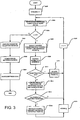
- FIG. 3 is a flow chart illustrating a method for echo cancellation/suppression, according to an example embodiment. The method shown in FIG. 3 may be performed by the echo cancellation/suppression module 206 shown in FIG. 2 .
- a counter value j may be initialized to 1.
- a reference packet R j may be retrieved from the buffer 202.
- the echo cancellation/suppression module 206 may compare the counter value j to a threshold value m.
- m may be equal to the number of reference packets stored in the buffer 202.
- the threshold value m may be equal to the number of packets transmitted in a single transmission frame.
- the value m may be extracted from the transmission frame header included in the transmission frame as is well-known in the art.
- the echo cancellation/suppression module 206 extracts the encoded parameters from reference packet R j at S308. Concurrently, at S308, the echo cancellation/suppression module 206 extracts encoded coding parameters from the targeted packet T. Methods for extracting these parameters are well-known in the art. Thus, a detailed discussion has been omitted for the sake of brevity. As discussed above, example embodiments are described herein with regard to a CELP-based vocoder.
- the reference packet parameters and the targeted packet parameters may include fixed codebook gains G f , adaptive codebook gains G a , pitch P and an LSP.
- the echo cancellation/suppression module 206 may perform double talk detection based on a portion of the encoded coding parameters extracted from the targeted packet T and the reference packet R j to determine whether double talk is present in the reference packet R j .
- echo cancellation/suppression need not be performed because echoed far end voice information is buried in the near end voice information, and thus, is imperceptible at the far end.
- Double talk detection may be used to determine whether a reference packet R j includes double talk.
- double talk may be detected by comparing encoded parameters extracted from the targeted packet T and encoded parameters extracted from the reference packet R j .
- the encoded parameters may be fixed codebook gains G f and adaptive codebook gains G a .
- a similarity evaluation between the encoded parameters extracted from the targeted packet T and the encoded parameters extracted from the reference packet R j may be performed at S312.
- the similarity evaluation may be used to determine whether to set each of a plurality of similarity flags based on the encoded parameters extracted from the targeted packet T, the encoded parameters extracted from the reference packet R j and similarity threshold values.
- the similarity flags may be referred to as similarity indicators.
- the similarity flags or similarity indicators may include, for example, a pitch similarity flag (or indicator) PM and a plurality of LSP similarity flags (or indicators).
- the plurality of LSP similarity flags may include a plurality of bandwidth similarity flags BM i and a plurality of frequency similarity matching flags FM i .
- P T is the pitch associated with the targeted packet
- P R is the pitch associated with the reference packet R j
- ⁇ p is a pitch threshold value.
- the pitch threshold value ⁇ p may be determined based on experimental data obtained according to the specific type of vocoder used. As shown in Equation (2), if the absolute value of the difference between the pitch P T and the pitch P R is less than or equal to the threshold value ⁇ p . the pitch P T is similar to the pitch P R and the pitch similarity flag PM may be set to 1. Otherwise, the pitch similarity flag PM may be set to 0.
- an LSP similarity evaluation may be used to determine whether the reference packet R j is similar to a targeted packet T.
- a CELP vocoder utilizes a 10 th order Linear Predictive Coding (LPC) predictive filter, which encodes 10 LSP values using vector quantization.
- LPC Linear Predictive Coding
- each LSP pair defines a corresponding speech spectrum formant.
- a formant is a peak in an acoustic frequency spectrum resulting from the resonant frequencies of any acoustic system.
- B i is the bandwidth of i-th formant
- F i is the center frequency of i-th formant
- LSP 2i and LSP 2i -1 are the i-th pair of LSP values.
- BT i is the i-th bandwidth associated with targeted packet T
- B Ri is the i-th bandwidth associated with reference packet R j
- F Ti is the i-th center frequency associated with targeted packet T
- F Ri is the i-th center frequency associated with reference packet R j
- ⁇ Fi is an i-th center frequency threshold.
- the frequency thresholds may be determined based on experimental data obtained according to the specific type of vocoder used.
- the reference packet R j may be considered similar to the targeted packet T.
- the reference packet R j is similar to targeted packet T if each of the parameter similarity indicators PM , BM i and FM i indicate such.
- the echo cancellation/suppression module 206 may then calculate an overall voice packet similarity metric at S316.
- the overall voice packet similarity metric may be, for example, an overall similarity metric S j .
- the overall similarity metric S j may indicate the overall similarity between targeted packet T and reference packet R j .
- the overall similarity metric S j associated with reference packet R j may be calculated based on a plurality of individual voice packet similarity metrics.
- the plurality of individual voice packet similarity metrics may be individual similarity metrics.
- the plurality of individual similarity metrics may be calculated based on at least a portion of the encoded parameters extracted from the targeted packet T and the reference packet R j .
- Each of the plurality of individual similarity metrics may be calculated concurrently.
- B Ti is the bandwidth of i-th formant for targeted packet T
- B Ri is the bandwidth of i-th formant for reference packet R j .
- F Ti is the center frequency for the i-th formant for the targeted packet T and F Ri is the center frequency of the i-th formant for the reference packet R j .
- each individual similarity metric may be weighted by a corresponding weighting function.
- ⁇ p is a similarity weighting constant for pitch similarity metric S p
- ⁇ LSP is an overall similarity weighting constant for LSP spectrum similarity metrics S Bi and S Fi
- ⁇ Bi is an individual similarity weighting constant for the bandwidth similarity metric S Bi
- ⁇ Fi is an individual similarity weighting constant for frequency similarity metric S Fi .
- the weighting constants may be determined and/or adjusted based on empirical data such that Equations (11) and (12) are satisfied.
- the echo cancellation/suppression module 206 may store the calculated overall similarity metric S j in memory 208 of FIG. 2 .
- the memory 208 may be any well-known memory, such as, a buffer memory.
- the echo cancellation/suppression module 206 determines that the reference packet R j is not similar to the targeted packet T, and thus, the targeted packet T is not carrying echoed voice information corresponding to the original voice information carried by reference packet R j .
- a vector trajectory matching operation may be performed at S321. Trajectory matching may be used to locate a correlation between a fixed codebook gain for the targeted packet and each fixed codebook gain for the stored reference packets. Trajectory matching may also be used to locate a correlation between the adaptive codebook gain for the targeted packet and the adaptive codebook gain for each reference packet vector. According to at least one example embodiment, vector trajectory matching may be performed using a Least Mean Square (LMS) and/or cross-correlation algorithm to determine a correlation between the targeted packet and each similar reference packet.
- LMS Least Mean Square
- the vector trajectory matching may be used to verify the similarity between the targeted packet and each of the stored similar reference packets.
- the trajectory vector matching at S321 may be used to filter out similar reference packets failing a correlation threshold.
- Overall similarity metrics S j associated with stored similar reference packets failing the correlation threshold may be removed from the memory 208.
- the correlation threshold may be determined based on experimental data as is well-known in the art.
- FIG. 3 illustrates a vector trajectory matching step at S321, this step may be omitted as desired by one of ordinary skill in the art.
- the remaining stored overall similarity metrics S j in the memory 208 may be searched to determine which of the similar reference packets includes echoed voice information.
- the similar reference packets may be searched to determine which reference packet matches the targeted packet.
- the reference packet matching the targeted packet may be the reference packet with the minimum associated overall similarity metric S j .
- the echo cancellation/suppression module 206 may cancel/suppress echo based on a portion of the encoded parameters extracted from the matching reference packet at S324. For example, echo may be cancelled/suppressed by adjusting (e.g., attenuating) gains associated with the targeted packet T. The gain adjustment may be performed based on gains associated with the matched reference packet, a gain weighting constant and the overall similarity metric associated with the matching reference packet.
- G fR ' is an adjusted gain for a fixed codebook associated with a reference packet
- W f is the gain weighting for the fixed codebook
- G aR ' is the adjusted gain for the adaptive codebook associated with the reference packet and W a is the gain weighting for the adaptive codebook.
- W f and W a may be equal to 1.
- these values may be adaptively adjusted according to, for example, speech characteristics (e.g., voiced or unvoiced) and/or the proportion of echo in targeted packets relative to reference packets.
- adaptive codebook gains and fixed codebook gains of targeted packets are attenuated. For example, based on the similarity of a reference and targeted packet, gains of adaptive and fixed codebooks in targeted packets may be adjusted.
- echo may be canceled/suppressed using extracted parameters in the parametric domain without decoding and re-encoding the targeted voice signal.
- the method of FIG. 3 may be performed for each reference packet R j stored in the buffer 202 and each targeted packet T stored in the buffer 204. That is, for example, the plurality of reference packets stored in the buffer 202 may be searched to find a reference packet matching each of the targeted packets in the buffer 204.
Landscapes
- Engineering & Computer Science (AREA)
- Computational Linguistics (AREA)
- Signal Processing (AREA)
- Health & Medical Sciences (AREA)
- Audiology, Speech & Language Pathology (AREA)
- Human Computer Interaction (AREA)
- Physics & Mathematics (AREA)
- Acoustics & Sound (AREA)
- Multimedia (AREA)
- Telephonic Communication Services (AREA)
- Cable Transmission Systems, Equalization Of Radio And Reduction Of Echo (AREA)
- Data Exchanges In Wide-Area Networks (AREA)
Abstract
Description
- In conventional communication systems, an encoder generates a stream of information bits representing voice or data traffic. This stream of bits is subdivided and grouped, concatenated with various control bits, and packed into a suitable format for transmission. Voice and data traffic may be transmitted in various formats according to the appropriate communication mechanism, such as, for example, frames, packets, subpackets, etc. For the sake of clarity, the term "transmission frame" will be used herein to describe the transmission format in which traffic is actually transmitted. The term "packet" will be used herein to describe the output of a speech coder. Speech coders are also referred to as voice coders, or "vocoders," and the terms will be used interchangeably herein.
- A vocoder extracts parameters relating to a model of voice information (such as human speech) generation and uses the extracted parameters to compress the voice information for transmission. Vocoders typically comprise an encoder and a decoder. A vocoder segments incoming voice information (e.g., an analog voice signal) into blocks, analyzes the incoming speech block to extract certain relevant parameters, and quantizes the parameters into binary or bit representation. The bit representation is packed into a packet, the packets are formatted into transmission frames and the transmission frames are transmitted over a communication channel to a receiver with a decoder. At the receiver, the packets are extracted from the transmission frames, and the decoder unquantizes the bit representations carried in the packets to produce a set of coding parameters. The decoder then re-synthesizes the voice segments, and subsequently, the original voice information using the unquantized parameters.
- Different types of vocoders are deployed in various existing wireless and wireline communication systems, often using various compression techniques. Moreover, transmission frame formats and processing defined by one particular standard may be rather significantly different from those of other standards. For example, CDMA standards support the use of variable-rate vocoder frames in a spread spectrum environment while GSM standards support the use of fixed-rate vocoder frames and multi-rate vocoder frames. Similarly, Universal Mobile Telecommunications Systems (UMTS) standards also support fixed-rate and multi-rate vocoders, but not variable-rate vocoders. For compatibility and interoperability between these communication systems, it may be desirable to enable the support of variable-rate vocoder frames within GSM and UMTS systems, and the support of non-variable rate vocoder frames within CDMA systems. One common occurrence throughout all communications systems is the occurrence of echo. Acoustic echo and electrical echo are example types of echo.
- Acoustic echo is produced by poor voice coupling between an earpiece and a microphone in handsets and/or hands-free devices. Electrical echo results from 4-to-2 wire coupling within PSTN networks. Voice -compressing vocoders process voice including echo within the handsets and in wireless networks, which results in returned echo signals with highly variable properties. The echoed signals degrade voice call quality.
- In one example of acoustic echo, sound from a loudspeaker is heard by a listener at a near end, as intended. However, this same sound at the near end is also picked up by the microphone, both directly and indirectly, after being reflected. The result of this reflection is the creation of echo, which, unless eliminated, is transmitted back to the far end and heard by the talker at the far end as echo.
-
FIG. 1 illustrates a voice over packet network diagram including a conventional echo canceller/suppressor used to cancel echoed signals. - If the conventional echo canceller/
suppressor 100 is used in a packet switched network, the conventional echo canceller must completely decode the vocoder packets associated with voice signals transmitted in both directions to obtain echo cancellation parameters because all conventional echo cancellation operations work with linear uncompressed speech. That is, the conventional echo canceller/suppressor 100 must extract packet from the transmission frames, unquantize the bit representations carried in the packets to produce a set of coding parameters, and re-synthesize the voice segments before canceling echo. The conventional echo canceller/ suppressor then cancels echo using the re-synthesized voice segments. - Because transmitted voice information is encoded into parameters (e.g., in the parametric domain) before transmission and conventional echo suppressors/cancellers operate in the linear speech domain, conventional echo cancellation/ suppression in a packet switched network becomes relatively difficult, complex, may add encoding and/or decoding delay and/or degrade voice quality because of, for example, the additional tandeming coding involved.
-
EP 1 521 240 Aclaim 1. - An example embodiment is directed to a method for packet-based echo suppression/cancellation according to the features of
claim 1. - The present invention will become more fully understood from the detailed description given herein below and the accompanying drawings, wherein like elements are represented by like reference numerals, which are given by way of illustration only and thus are not limiting of the present invention and wherein:
-
FIG. 1 is a diagram of a voice over packet network including a conventional echo canceller/suppressor; -
FIG. 2 illustrates an echo canceller/suppressor, according to an example embodiment; and -
FIG. 3 illustrates a method for echo cancellation/suppression, according to an example embodiment. - Methods and apparatuses, according to example embodiments, may perform echo cancellation and/or echo suppression depending on, for example, the particular application within a packet switched communication system. Example embodiments will be described herein as echo cancellation/suppression, an echo canceller/suppressor, etc.
- Hereinafter, for example purposes, vocoder packets suspected of carrying echoed voice information (e.g., voice information received at the near end and echoed back to the far end) will be referred to as targeted packets, and coding parameters associated with these targeted packets will be referred to as targeted packet parameters. Vocoder or parameter packets associated with originally transmitted voice information (e.g., potentially echoed voice information) from the far end used to determine whether targeted packets include echoed voice information will be referred to as reference packets. The coding parameters associated with the reference packets will be referred to as reference packet parameters.
- As discussed above,
FIG. 1 illustrates a voice over packet network diagram including a conventional echo canceller/suppressor. Methods according to example embodiments may be implemented at existing echo cancellers/suppressors, such as the echo canceller/suppressor 100 shown inFIG. 1 . For example, example embodiments may be implemented on existing Digital Signal Processors (DSPs), Field Programmable Gate Arrays (FPGAs), etc. In addition, example embodiments may be used in conjunction with any type of terrestrial or wireless packet switched network, such as, a VoIP network, a VoATM network, TrFO networks, etc. - One example vocoder used to encode voice information is a Code Excited Linear Prediction (CELP) based vocoder. CELP-based vocoders encode digital voice information into a set of coding parameters. These parameters include, for example, adaptive codebook and fixed codebook gains, pitch/adaptive codebook, linear spectrum pairs (LSPs) and fixed codebooks. Each of these parameters may be represented by a number of bits. For example, for a full-rate packet of Enhanced Variable Rate CODEC (EVRC) vocoder, which is a well-known vocoder, the LSP is represented by 28 bits, the pitch and its corresponding delta are represented by 12 bits, the adaptive codebook gain is represented by 9 bits and the fixed codebook gain is represented by 15 bits. The fixed codebook is represented by 120 bits.
- Referring still to
FIG. 1 , if echoed speech signals are present during encoding of voice information by the CELP vocoder at the near end, at least a portion of the transmitted vocoder packets may include echoed voice information. The echoed voice information may be the same as or similar to originally transmitted voice information, and thus, vocoder packets carrying the transmitted voice information from the near end to the far end may be similar, substantially similar to or the same as vocoder packets carrying originally encoded voice information from the far end to the near end. That is, for example, the bits in the original vocoder packet may be similar, substantially similar, or the same as the bits in the corresponding vocoder packet carrying the echoed voice information. - Packet domain echo cancellers/suppressors and/or methods for the same, according to example embodiments, utilize this similarity in cancelling/suppressing echo in transmitted signals by adaptively adjusting coding parameters associated with transmitted packets.
- For example purposes, example embodiments will be described with regard to a CELP-based vocoder such as an EVRC vocoder. However, methods and/or apparatuses, according to example embodiments, may be used and/or adapted to be used in conjunction with any suitable vocoder.
-
FIG. 2 illustrates an echo canceller/suppressor, according to an example embodiment. As shown, the echo canceller/suppressor ofFIG. 2 may buffer received original vocoder packets (reference packets) from the far end in a referencepacket buffer memory 202. The echo canceller/suppressor may buffer targeted packets from the near end in a targetedpacket buffer memory 204. The echo canceller/suppressor ofFIG. 2 may further include an echo cancellation/suppression module 206 and amemory 208. - The echo cancellation/
suppression module 206 may cancel/suppress echo from a signal (e.g., transmitted and/or received) signal based on at least one encoded voice parameter associated with at least one reference packet stored in the referencepacket buffer memory 202 and at least one targeted packet stored in the targetedpacket buffer 204. The echo cancellation/suppression module 206, and methods performed therein, will be discussed in more detail below. - The
memory 208 may store intermediate values and/or voice packets such as voice packet similarity metrics, corresponding reference voice packets, targeted voice packets, etc. In at least on example embodiment, thememory 208 may store individual similarity metrics and/or overall similarity metrics. Thememory 208 will be described in more detail below. - Returning to
FIG. 2 , the length of thebuffer memory 204 may be determined based on a trajectory match length for a trajectory searching/matching operation, which will be described in more detail below. For example, if each vocoder packet carries a 20 ms voice segment and the trajectory match length is 120 ms, thebuffer memory 204 may hold 6 targeted packets. - The length of the
buffer memory 202 may be determined based on the length of the echo tail, network delay and the trajectory match length. For example, if each vocoder packet carries a 20 ms voice segment, the echo tail length is equal to 180 ms and the trajectory match length is 120 ms (e.g., 6 packets), thebuffer memory 202 may hold 15 reference packets. The maximum number of packets that may be stored inbuffer 202 for reference packets may be represented by m. - Although
FIG. 2 illustrates twobuffers - In at least one example, the echo tail length may be determined and/or defined by known network parameters of echo path or obtained using an actual searching process. Methods for determining echo tail length are well-known in the art. After having determined the echo tail length, methods according to at least some example embodiments may be performed within a time window equal to the echo tail length. The time window width may be equivalent to, for example, one or several transmission frames in length, or one or several packets in length. For example purposes, example embodiments will be described assuming that the echo tail length is equivalent to the length of a speech signal transmitted in a single transmission frame.
- Example embodiments may be applicable to any echo tail length by matching reference packets stored in
buffer 202 with targeted packets carrying echoed voice information. Whether a targeted packet contains echoed voice information may be determined by comparing a targeted packet with each of m reference packets stored in thebuffer 202. -
FIG. 3 is a flow chart illustrating a method for echo cancellation/suppression, according to an example embodiment. The method shown inFIG. 3 may be performed by the echo cancellation/suppression module 206 shown inFIG. 2 . - Referring to
FIG. 3 , at S302, a counter value j may be initialized to 1. At S304, a reference packet Rj may be retrieved from thebuffer 202. At S306, the echo cancellation/suppression module 206 may compare the counter value j to a threshold value m. As discussed above, m may be equal to the number of reference packets stored in thebuffer 202. In this example, because the number of reference packets m stored in thebuffer 202 is equal to the number of reference packets transmitted in a single transmission frame, the threshold value m may be equal to the number of packets transmitted in a single transmission frame. In this case, the value m may be extracted from the transmission frame header included in the transmission frame as is well-known in the art. - At S306, if the counter value j is less than or equal to threshold value m, the echo cancellation/
suppression module 206 extracts the encoded parameters from reference packet Rj at S308. Concurrently, at S308, the echo cancellation/suppression module 206 extracts encoded coding parameters from the targeted packet T. Methods for extracting these parameters are well-known in the art. Thus, a detailed discussion has been omitted for the sake of brevity. As discussed above, example embodiments are described herein with regard to a CELP-based vocoder. For a CELP-based encoder, the reference packet parameters and the targeted packet parameters may include fixed codebook gains Gf, adaptive codebook gains Ga, pitch P and an LSP. - Still referring to
FIG. 3 , at S309, the echo cancellation/suppression module 206 may perform double talk detection based on a portion of the encoded coding parameters extracted from the targeted packet T and the reference packet Rj to determine whether double talk is present in the reference packet Rj. During voice segments including double talk, echo cancellation/suppression need not be performed because echoed far end voice information is buried in the near end voice information, and thus, is imperceptible at the far end. - Double talk detection may be used to determine whether a reference packet Rj includes double talk. In an example embodiment, double talk may be detected by comparing encoded parameters extracted from the targeted packet T and encoded parameters extracted from the reference packet Rj. In the above-discussed CELP vocoder example, the encoded parameters may be fixed codebook gains Gf and adaptive codebook gains Ga.
- The echo cancellation/
suppression module 206 may determine whether double talk is present according to the conditions shown in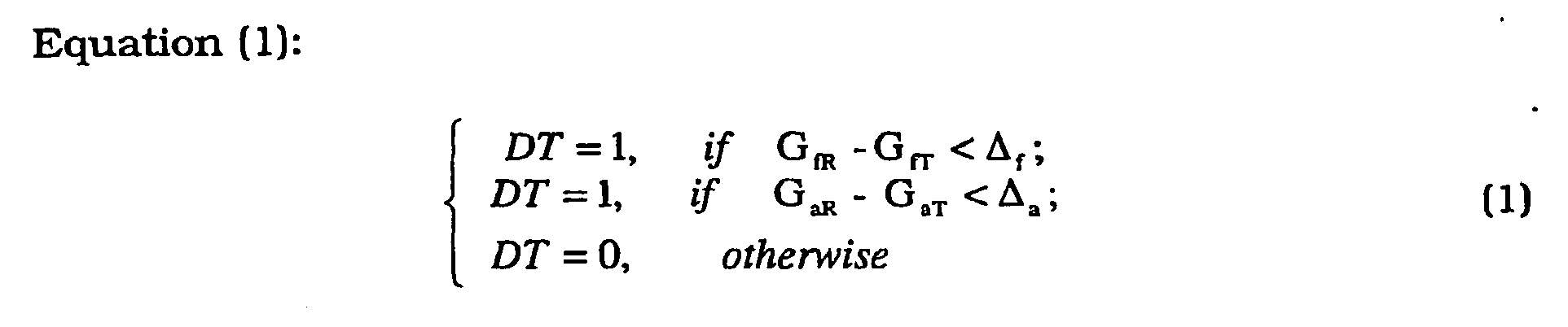
- According to Equation (1), if the difference between the fixed codebook gain G fR for the reference packet Rj and the fixed codebook gain GfT for the targeted packet T is less than a fixed codebook gain threshold value Δf, double talk is present in the reference packet Rj and the double talk detection flag DT may be set to 1 (e.g., DT = 1). Similarly, if the difference between the adaptive codebook gain G aR for the reference packet Rj and the adaptive codebook gain G aT for the targeted packet T is less than an adaptive codebook gain threshold value Δa, double talk is present in the reference packet Rj and the double talk detection flag DT may be set to 1 (e.g., DT = 1). Otherwise, double talk is not present in the reference packet Rj and the double talk detection flag may not be set (e.g., DT = 0).
- Referring back to
FIG. 3 , if the double talk detection flag DT is not set (e.g., DT = 0) at S310, a similarity evaluation between the encoded parameters extracted from the targeted packet T and the encoded parameters extracted from the reference packet Rj may be performed at S312. The similarity evaluation may be used to determine whether to set each of a plurality of similarity flags based on the encoded parameters extracted from the targeted packet T, the encoded parameters extracted from the reference packet Rj and similarity threshold values. - The similarity flags may be referred to as similarity indicators. The similarity flags or similarity indicators may include, for example, a pitch similarity flag (or indicator) PM and a plurality of LSP similarity flags (or indicators). The plurality of LSP similarity flags may include a plurality of bandwidth similarity flags BMi and a plurality of frequency similarity matching flags FMi .
- Still referring to S312 of
FIG. 3 , the cancellation/suppression module 206 may determine whether to set the pitch similarity flag PM for the reference packet Rj according to Equation (2):
- As shown in Equation (2), PT is the pitch associated with the targeted packet, PR is the pitch associated with the reference packet Rj and Δp is a pitch threshold value. The pitch threshold value Δp may be determined based on experimental data obtained according to the specific type of vocoder used. As shown in Equation (2), if the absolute value of the difference between the pitch PT and the pitch PR is less than or equal to the threshold value Δp . the pitch PT is similar to the pitch PR and the pitch similarity flag PM may be set to 1. Otherwise, the pitch similarity flag PM may be set to 0.
- Referring still to S312 of
FIG. 3 , similar to the above described pitch similarity evaluation method, an LSP similarity evaluation may be used to determine whether the reference packet Rj is similar to a targeted packet T. - Generally, a CELP vocoder utilizes a 10th order Linear Predictive Coding (LPC) predictive filter, which encodes 10 LSP values using vector quantization. In addition, each LSP pair defines a corresponding speech spectrum formant. A formant is a peak in an acoustic frequency spectrum resulting from the resonant frequencies of any acoustic system. Each particular formant may be expressed by bandwidth Bi given by Equation (3):

and center frequency Fi given by Equation (4):
- As shown in Equations (3) and (4), Bi is the bandwidth of i-th formant, Fi is the center frequency of i-th formant, and LSP2i and LSP 2i-1 are the i-th pair of LSP values.
- In this example, for a 10th order LPC predictive filter, 5 pairs of LSP values may be generated.
- Each of the first three formants may include significant or relatively significant spectrum envelope information for a voice segment. Consequently, LSP similarity evaluation may be performed based on the first three formants i = 1, 2 and 3.
- A bandwidth similarity flag BMi , indicating whether a bandwidth BTi associated with a targeted packet T is similar to a bandwidth BRi associated with the reference packet Rj, for each formant i, for i = 1, 2, 3, may be set according to Equation (5):

- As shown in Equation (5), BTi is the i-th bandwidth associated with targeted packet T, BRi is the i-th bandwidth associated with reference packet Rj and ΔBi is the i-th bandwidth threshold used to determine whether the bandwidths BTi and BRi are similar. If BMi = 1, both i-th bandwidths BTi and BRi are within a certain range of one another and may be considered similar. Otherwise, when BMi = 0, the i-th bandwidths BTi and BRi may not be considered similar. Similar to the pitch threshold, each bandwidth threshold may be determined based on experimental data obtained according to the specific type of vocoder used.
- Referring still to S312 of
FIG. 3 , whether an i-th frequency associated with the targeted packet T is similar to a corresponding i-th frequency associated with the reference packet Rj may be indicated by a frequency similarity flag FMi . The frequency similarity flag FMi may be set according to Equation (6):
- In Equation (6), FTi is the i-th center frequency associated with targeted packet T, FRi is the i-th center frequency associated with reference packet Rj and ΔFi is an i-th center frequency threshold. The i-th center frequency threshold ΔFi may be indicative of the similarity between i-th target and reference center frequencies FTi and FRi , for i = 1, 2 and 3. Similar to the pitch threshold and bandwidth thresholds, the frequency thresholds may be determined based on experimental data obtained according to the specific type of vocoder used.
- FMi is a center frequency similarity flag for the i-th bandwidth for a corresponding LSP pair. According to Equation (6), an FMi = 1 indicates that FTi and FRi are similar, whereas FMi = O, indicates that FTi and FRi are not similar.
- Returning to
FIG. 3 , if at S314 it is determined that each of the plurality of parameter similarity flags PM, BMi and FMi are set equal to 1, the reference packet Rj may be considered similar to the targeted packet T. In other words, the reference packet Rj is similar to targeted packet T if each of the parameter similarity indicators PM, BMi and FMi indicate such. - The echo cancellation/
suppression module 206 may then calculate an overall voice packet similarity metric at S316. The overall voice packet similarity metric may be, for example, an overall similarity metric Sj . The overall similarity metric Sj may indicate the overall similarity between targeted packet T and reference packet Rj. - In at least one example embodiment, the overall similarity metric Sj associated with reference packet Rj may be calculated based on a plurality of individual voice packet similarity metrics. The plurality of individual voice packet similarity metrics may be individual similarity metrics.
- The plurality of individual similarity metrics may be calculated based on at least a portion of the encoded parameters extracted from the targeted packet T and the reference packet Rj. In this example embodiment, the plurality of individual similarity metrics may include a pitch similarity metric Sp, bandwidth similarity metrics SBi , for i = 1, 2 and 3, and frequency similarity metrics SFi , for i = 1, 2 and 3. Each of the plurality of individual similarity metrics may be calculated concurrently.
- For example the pitch similarity metric Sp may be calculated according to Equation (7):

- The bandwidth similarity SBi for each of i formants may be calculated according to Equation (8):

- As shown in Equation (8) and as discussed above, B Ti is the bandwidth of i-th formant for targeted packet T, and B Ri is the bandwidth of i-th formant for reference packet Rj.
- Similarly, the center frequency similarity SFi for each of i formants may be calculated according to equation (9):

- As shown in Equation (9) and as discussed above, F Ti is the center frequency for the i-th formant for the targeted packet T and F Ri is the center frequency of the i-th formant for the reference packet Rj.
- After obtaining the plurality of individual similarity metrics, the overall similarity matching metric Sj may be calculated according to Equation (10):

- In Equation (10), each individual similarity metric may be weighted by a corresponding weighting function. As shown, αp is a similarity weighting constant for pitch similarity metric Sp , αLSP is an overall similarity weighting constant for LSP spectrum similarity metrics SBi and SFi, βBi is an individual similarity weighting constant for the bandwidth similarity metric SBi and βFi is an individual similarity weighting constant for frequency similarity metric SFi.
- The similarity weighting constants αp and αLSP may be determined so as to satisfy Equation (11) shown below.

- Similarly, individual similarity weighting constants βBi and βFi may be determined so as to satisfy Equation (12) shown below.

- According to at least some example embodiments, the weighting constants may be determined and/or adjusted based on empirical data such that Equations (11) and (12) are satisfied.
- Returning to
FIG. 3 , at S318, the echo cancellation/suppression module 206 may store the calculated overall similarity metric Sj inmemory 208 ofFIG. 2 . Thememory 208 may be any well-known memory, such as, a buffer memory. The counter value j is incremented j = j+1 at S320, and the method returns to S304. - Returning to S314 of
FIG. 3 , if any of the parameter similarity flags are not set, the echo cancellation/suppression module 206 determines that the reference packet Rj is not similar to the targeted packet T, and thus, the targeted packet T is not carrying echoed voice information corresponding to the original voice information carried by reference packet Rj. In this case, the counter value j may be incremented (j = j+1), and the method proceeds as discussed above. - Returning to S310 of
FIG. 3 , if double talk is detected in the reference packet Rj, the reference packet Rj may be discarded at S311, the counter value j may be incremented j =j+ 1 at S320 and the echo cancellation/suppression module 206 retrieves the next reference packet Rj frombuffer 202, at S304. After retrieving the next reference packet Rj from thebuffer 202, the process may proceed to S306 and repeat. - Returning to S306, if the counter value j is greater than threshold m, a vector trajectory matching operation may be performed at S321. Trajectory matching may be used to locate a correlation between a fixed codebook gain for the targeted packet and each fixed codebook gain for the stored reference packets. Trajectory matching may also be used to locate a correlation between the adaptive codebook gain for the targeted packet and the adaptive codebook gain for each reference packet vector. According to at least one example embodiment, vector trajectory matching may be performed using a Least Mean Square (LMS) and/or cross-correlation algorithm to determine a correlation between the targeted packet and each similar reference packet. Because LMS and cross-correlation algorithms are well-known in the art, a detailed discussion thereof has been omitted for the sake of brevity.
- In at least one example embodiment, the vector trajectory matching may be used to verify the similarity between the targeted packet and each of the stored similar reference packets. In at least one example embodiment, the trajectory vector matching at S321 may be used to filter out similar reference packets failing a correlation threshold. Overall similarity metrics Sj associated with stored similar reference packets failing the correlation threshold may be removed from the
memory 208. The correlation threshold may be determined based on experimental data as is well-known in the art. - Although the method of
FIG. 3 illustrates a vector trajectory matching step at S321, this step may be omitted as desired by one of ordinary skill in the art. - At S322, the remaining stored overall similarity metrics Sj in the
memory 208 may be searched to determine which of the similar reference packets includes echoed voice information. In other words, the similar reference packets may be searched to determine which reference packet matches the targeted packet. In example embodiments, the reference packet matching the targeted packet may be the reference packet with the minimum associated overall similarity metric Sj . - If the similarity metrics Sj are indexed in the memory (methods for doing which are well-known, and omitted for the sake of brevity) by targeted packet T and reference packet Rj, the overall similarity metrics may be expressed as S(T, Rj), for j = 1, 2, 3...m.
- Representing the overall similarity metrics as S(T, Rj), for j = 1, 2, 3...m, the minimum overall similarity metric Smin may be obtained using Equation (13):

- Returning again to
FIG. 3 , after locating the matching reference packet, the echo cancellation/suppression module 206 may cancel/suppress echo based on a portion of the encoded parameters extracted from the matching reference packet at S324. For example, echo may be cancelled/suppressed by adjusting (e.g., attenuating) gains associated with the targeted packet T. The gain adjustment may be performed based on gains associated with the matched reference packet, a gain weighting constant and the overall similarity metric associated with the matching reference packet. - For example, echo may be cancelled/suppressed by attenuating adaptive codebook gains as shown in Equation (14):

and/or fixed codebook gains as shown in Equation (15):
- As shown in Equation (14), GfR ' is an adjusted gain for a fixed codebook associated with a reference packet, and Wf is the gain weighting for the fixed codebook.
- As shown in Equation (15), GaR ' is the adjusted gain for the adaptive codebook associated with the reference packet and Wa is the gain weighting for the adaptive codebook. Initially, both Wf and Wa may be equal to 1. However, these values may be adaptively adjusted according to, for example, speech characteristics (e.g., voiced or unvoiced) and/or the proportion of echo in targeted packets relative to reference packets.
- According to example embodiments, adaptive codebook gains and fixed codebook gains of targeted packets are attenuated. For example, based on the similarity of a reference and targeted packet, gains of adaptive and fixed codebooks in targeted packets may be adjusted.
- According to example embodiments, echo may be canceled/suppressed using extracted parameters in the parametric domain without decoding and re-encoding the targeted voice signal.
- Although only a single iteration of the method shown in
FIG. 3 is discussed above, the method ofFIG. 3 may be performed for each reference packet Rj stored in thebuffer 202 and each targeted packet T stored in thebuffer 204. That is, for example, the plurality of reference packets stored in thebuffer 202 may be searched to find a reference packet matching each of the targeted packets in thebuffer 204. - The invention being thus described, it will be obvious that the same may be varied in many ways. Such variations are not to be regarded as a departure from the invention, and all such modifications are intended to be included within the scope of the invention.
Claims (10)
- A method for parametric domain echo suppression, the method comprising:selecting, from a plurality of reference voice packets encoded by a vocoder and received from a far end, a reference voice packet based on at least one encoded voice parameter associated with each of the plurality of reference voice packets and a targeted voice packet encoded by a vocoder and received from a near end; andsuppressing echo in the targeted voice packet based on the selected reference voice packet, the suppression being performed in the parametric domain,characterized in that
the at least one encoded voice parameter associated with each of the plurality of reference voice packets is selected from the group consisting of: a pitch, a bandwidth of a linear spectrum pair, and a frequency of a linear spectrum pair. - The method of claim 1, wherein the echo is suppressed by adjusting the at least one encoded voice parameter associated with the targeted voice packet based on the at least one encoded voice parameter associated with the selected reference voice packet.
- The method of claim 2, wherein the echo is suppressed by adjusting a plurality of encoded voice parameters associated with the targeted voice packet based on a corresponding plurality of encoded voice parameters associated with the selected reference voice packet.
- The method of claim 1, wherein the echo is suppressed by adjusting a gain of the at least one encoded voice parameter associated with the targeted voice packet based on a corresponding at least one encoded voice parameters associated with the selected reference voice packet.
- The method of claim 1, wherein the selecting step comprises:extracting at least one encoded voice parameter from the targeted packet and each of the plurality of reference voice packets;calculating, for each of a number of reference voice packets within the plurality of reference voice packets, at least one voice packet similarity metric based on the encoded voice parameter extracted from the reference voice packet and the targeted voice packet; andselecting the reference voice packet based on the calculated voice packet similarity metric.
- The method of claim 5, further comprising:determining which of the plurality of reference voice packets are similar to the targeted voice packet based on the encoded voice parameter associated with each reference voice packet and the targeted voice packet to generate the number of reference voice packets for which to calculate the at least one voice packet similarity metric.
- The method of claim 1, wherein the selecting step comprises:determining which of the plurality of reference voice packets are similar to the targeted voice packet based on the at least one encoded voice parameter associated with each of the plurality of reference voice packets and the targeted voice packet to generate a set of reference voice packets; andselecting the reference voice packet from the set of reference voice packets.
- The method of claim 7, wherein the determining step comprises:for each reference voice packet,
setting at least one similarity indicator based on the at least one encoded voice parameter associated with the targeted voice packet and the at least one encoded voice parameter associated with the reference voice packet; and
determining whether the reference voice packet is similar to the targeted voice packet based on the similarity indicator. - The method of claim 1, wherein the selecting step comprises:extracting a plurality of encoded voice parameters from the targeted voice packet and each of the reference voice packets;for each encoded voice parameter associated with each reference voice packet,
determining an individual similarity metric based on the encoded voice parameter for the reference voice packet and the targeted voice packet;for each reference voice packet,
determining an overall similarity metric based on the individual similarity metrics associated with the reference voice packet; andselecting the reference voice packet based on the overall similarity metric associated with each reference voice packet. - The method of claim 9, wherein the selecting step further comprises:comparing the overall similarity metrics to determine the minimum overall similarity metric; andselecting the reference voice packet associated with the minimum overall similarity metric.
Applications Claiming Priority (2)
| Application Number | Priority Date | Filing Date | Title |
|---|---|---|---|
| US11/523,051 US7852792B2 (en) | 2006-09-19 | 2006-09-19 | Packet based echo cancellation and suppression |
| PCT/US2007/020162 WO2008036246A1 (en) | 2006-09-19 | 2007-09-18 | Packet based echo cancellation and suppression |
Publications (2)
| Publication Number | Publication Date |
|---|---|
| EP2070085A1 EP2070085A1 (en) | 2009-06-17 |
| EP2070085B1 true EP2070085B1 (en) | 2012-05-16 |
Family
ID=38917442
Family Applications (1)
| Application Number | Title | Priority Date | Filing Date |
|---|---|---|---|
| EP07838379A Not-in-force EP2070085B1 (en) | 2006-09-19 | 2007-09-18 | Packet based echo cancellation and suppression |
Country Status (6)
| Country | Link |
|---|---|
| US (1) | US7852792B2 (en) |
| EP (1) | EP2070085B1 (en) |
| JP (1) | JP5232151B2 (en) |
| KR (1) | KR101038964B1 (en) |
| CN (1) | CN101542600B (en) |
| WO (1) | WO2008036246A1 (en) |
Families Citing this family (15)
| Publication number | Priority date | Publication date | Assignee | Title |
|---|---|---|---|---|
| AU2006323242B2 (en) * | 2005-12-05 | 2010-08-05 | Telefonaktiebolaget Lm Ericsson (Publ) | Echo detection |
| US8843373B1 (en) * | 2007-06-07 | 2014-09-23 | Avaya Inc. | Voice quality sample substitution |
| US20090168673A1 (en) * | 2007-12-31 | 2009-07-02 | Lampros Kalampoukas | Method and apparatus for detecting and suppressing echo in packet networks |
| JP5024154B2 (en) * | 2008-03-27 | 2012-09-12 | 富士通株式会社 | Association apparatus, association method, and computer program |
| WO2012010929A1 (en) * | 2010-07-20 | 2012-01-26 | Nokia Corporation | A reverberation estimator |
| CN103167196A (en) * | 2011-12-16 | 2013-06-19 | 宇龙计算机通信科技(深圳)有限公司 | Method and terminal for canceling communication echoes in packet-switched domain |
| CN103325379A (en) | 2012-03-23 | 2013-09-25 | 杜比实验室特许公司 | Method and device used for acoustic echo control |
| WO2014066367A1 (en) * | 2012-10-23 | 2014-05-01 | Interactive Intelligence, Inc. | System and method for acoustic echo cancellation |
| CN104468470B (en) | 2013-09-13 | 2017-08-01 | 阿尔卡特朗讯 | A kind of method and apparatus for being used to be grouped acoustic echo elimination |
| CN104468471B (en) | 2013-09-13 | 2017-11-03 | 阿尔卡特朗讯 | A kind of method and apparatus for being used to be grouped acoustic echo elimination |
| CN105096960A (en) * | 2014-05-12 | 2015-11-25 | 阿尔卡特朗讯 | Packet-based acoustic echo cancellation method and device for realizing wideband packet voice |
| US11546615B2 (en) | 2018-03-22 | 2023-01-03 | Zixi, Llc | Packetized data communication over multiple unreliable channels |
| US11363147B2 (en) | 2018-09-25 | 2022-06-14 | Sorenson Ip Holdings, Llc | Receive-path signal gain operations |
| AU2020396439A1 (en) * | 2019-12-02 | 2022-06-30 | Zixi, Llc | Packetized data communication over multiple unreliable channels |
| CN111613235A (en) * | 2020-05-11 | 2020-09-01 | 浙江华创视讯科技有限公司 | Echo cancellation method and device |
Family Cites Families (12)
| Publication number | Priority date | Publication date | Assignee | Title |
|---|---|---|---|---|
| US5233660A (en) * | 1991-09-10 | 1993-08-03 | At&T Bell Laboratories | Method and apparatus for low-delay celp speech coding and decoding |
| US5943645A (en) * | 1996-12-19 | 1999-08-24 | Northern Telecom Limited | Method and apparatus for computing measures of echo |
| US6011846A (en) * | 1996-12-19 | 2000-01-04 | Nortel Networks Corporation | Methods and apparatus for echo suppression |
| KR100240626B1 (en) * | 1997-11-25 | 2000-01-15 | 정선종 | Echo cancellation method and device in digital mobile communication system |
| AU6203300A (en) * | 1999-07-02 | 2001-01-22 | Tellabs Operations, Inc. | Coded domain echo control |
| US6804203B1 (en) * | 2000-09-15 | 2004-10-12 | Mindspeed Technologies, Inc. | Double talk detector for echo cancellation in a speech communication system |
| DE60029147T2 (en) * | 2000-12-29 | 2007-05-31 | Nokia Corp. | QUALITY IMPROVEMENT OF AUDIO SIGNAL IN A DIGITAL NETWORK |
| JP3984526B2 (en) * | 2002-10-21 | 2007-10-03 | 富士通株式会社 | Spoken dialogue system and method |
| EP1521240A1 (en) | 2003-10-01 | 2005-04-06 | Siemens Aktiengesellschaft | Speech coding method applying echo cancellation by modifying the codebook gain |
| US7352858B2 (en) * | 2004-06-30 | 2008-04-01 | Microsoft Corporation | Multi-channel echo cancellation with round robin regularization |
| US20060217971A1 (en) * | 2005-03-28 | 2006-09-28 | Tellabs Operations, Inc. | Method and apparatus for modifying an encoded signal |
| CN1719516B (en) * | 2005-07-15 | 2010-04-14 | 北京中星微电子有限公司 | Adaptive filter device and adaptive filtering method |
-
2006
- 2006-09-19 US US11/523,051 patent/US7852792B2/en not_active Expired - Fee Related
-
2007
- 2007-09-18 WO PCT/US2007/020162 patent/WO2008036246A1/en not_active Ceased
- 2007-09-18 KR KR1020097005531A patent/KR101038964B1/en not_active Expired - Fee Related
- 2007-09-18 JP JP2009527466A patent/JP5232151B2/en not_active Expired - Fee Related
- 2007-09-18 CN CN200780034439.4A patent/CN101542600B/en not_active Expired - Fee Related
- 2007-09-18 EP EP07838379A patent/EP2070085B1/en not_active Not-in-force
Also Published As
| Publication number | Publication date |
|---|---|
| CN101542600B (en) | 2015-11-25 |
| EP2070085A1 (en) | 2009-06-17 |
| WO2008036246B1 (en) | 2008-05-08 |
| KR20090051760A (en) | 2009-05-22 |
| JP2010503325A (en) | 2010-01-28 |
| CN101542600A (en) | 2009-09-23 |
| US20080069016A1 (en) | 2008-03-20 |
| JP5232151B2 (en) | 2013-07-10 |
| US7852792B2 (en) | 2010-12-14 |
| KR101038964B1 (en) | 2011-06-03 |
| WO2008036246A1 (en) | 2008-03-27 |
Similar Documents
| Publication | Publication Date | Title |
|---|---|---|
| KR101038964B1 (en) | Echo cancellation / suppression methods and devices | |
| EP1088205B1 (en) | Improved lost frame recovery techniques for parametric, lpc-based speech coding systems | |
| EP2535893B1 (en) | Device and method for lost frame concealment | |
| US6199035B1 (en) | Pitch-lag estimation in speech coding | |
| US8756054B2 (en) | Method for trained discrimination and attenuation of echoes of a digital signal in a decoder and corresponding device | |
| JP3102015B2 (en) | Audio decoding method | |
| EP0843301A2 (en) | Methods for generating comfort noise during discontinous transmission | |
| JPH07311597A (en) | Speech signal synthesis method | |
| JPH07311596A (en) | Linear prediction coefficient signal generation method | |
| US20040153313A1 (en) | Method for enlarging the band width of a narrow-band filtered voice signal, especially a voice signal emitted by a telecommunication appliance | |
| JP2004287397A (en) | Interoperable vocoder | |
| US20080312916A1 (en) | Receiver Intelligibility Enhancement System | |
| EP0899718A2 (en) | Nonlinear filter for noise suppression in linear prediction speech processing devices | |
| US7302385B2 (en) | Speech restoration system and method for concealing packet losses | |
| JP6626123B2 (en) | Audio encoder and method for encoding audio signals | |
| US20100054454A1 (en) | Method and apparatus for the detection and suppression of echo in packet based communication networks using frame energy estimation | |
| EP0747884A2 (en) | Codebook gain attenuation during frame erasures | |
| Gomez et al. | Recognition of coded speech transmitted over wireless channels | |
| US7089180B2 (en) | Method and device for coding speech in analysis-by-synthesis speech coders | |
| KR20150014607A (en) | Method and apparatus for concealing an error in communication system | |
| EP1521243A1 (en) | Speech coding method applying noise reduction by modifying the codebook gain | |
| WO2004015690A1 (en) | Speech communication unit and method for error mitigation of speech frames | |
| Park et al. | A packet loss concealment algorithm robust to burst packet loss using multiple codebooks and comfort noise for CELP-type speech coders | |
| HK1076907A (en) | Method and device for efficient frame erasure concealment in linear predictive based speech codecs |
Legal Events
| Date | Code | Title | Description |
|---|---|---|---|
| PUAI | Public reference made under article 153(3) epc to a published international application that has entered the european phase |
Free format text: ORIGINAL CODE: 0009012 |
|
| 17P | Request for examination filed |
Effective date: 20090420 |
|
| AK | Designated contracting states |
Kind code of ref document: A1 Designated state(s): AT BE BG CH CY CZ DE DK EE ES FI FR GB GR HU IE IS IT LI LT LU LV MC MT NL PL PT RO SE SI SK TR |
|
| AX | Request for extension of the european patent |
Extension state: AL BA HR MK RS |
|
| RAP3 | Party data changed (applicant data changed or rights of an application transferred) |
Owner name: LUCENT TECHNOLOGIES INC. |
|
| 17Q | First examination report despatched |
Effective date: 20100111 |
|
| GRAP | Despatch of communication of intention to grant a patent |
Free format text: ORIGINAL CODE: EPIDOSNIGR1 |
|
| DAX | Request for extension of the european patent (deleted) | ||
| GRAS | Grant fee paid |
Free format text: ORIGINAL CODE: EPIDOSNIGR3 |
|
| RAP1 | Party data changed (applicant data changed or rights of an application transferred) |
Owner name: ALCATEL LUCENT |
|
| GRAA | (expected) grant |
Free format text: ORIGINAL CODE: 0009210 |
|
| AK | Designated contracting states |
Kind code of ref document: B1 Designated state(s): AT BE BG CH CY CZ DE DK EE ES FI FR GB GR HU IE IS IT LI LT LU LV MC MT NL PL PT RO SE SI SK TR |
|
| REG | Reference to a national code |
Ref country code: GB Ref legal event code: FG4D |
|
| REG | Reference to a national code |
Ref country code: CH Ref legal event code: EP |
|
| REG | Reference to a national code |
Ref country code: AT Ref legal event code: REF Ref document number: 558413 Country of ref document: AT Kind code of ref document: T Effective date: 20120615 |
|
| REG | Reference to a national code |
Ref country code: IE Ref legal event code: FG4D |
|
| REG | Reference to a national code |
Ref country code: DE Ref legal event code: R096 Ref document number: 602007022758 Country of ref document: DE Effective date: 20120719 |
|
| REG | Reference to a national code |
Ref country code: NL Ref legal event code: VDEP Effective date: 20120516 |
|
| REG | Reference to a national code |
Ref country code: LT Ref legal event code: MG4D Effective date: 20120516 |
|
| PG25 | Lapsed in a contracting state [announced via postgrant information from national office to epo] |
Ref country code: FI Free format text: LAPSE BECAUSE OF FAILURE TO SUBMIT A TRANSLATION OF THE DESCRIPTION OR TO PAY THE FEE WITHIN THE PRESCRIBED TIME-LIMIT Effective date: 20120516 Ref country code: LT Free format text: LAPSE BECAUSE OF FAILURE TO SUBMIT A TRANSLATION OF THE DESCRIPTION OR TO PAY THE FEE WITHIN THE PRESCRIBED TIME-LIMIT Effective date: 20120516 Ref country code: SE Free format text: LAPSE BECAUSE OF FAILURE TO SUBMIT A TRANSLATION OF THE DESCRIPTION OR TO PAY THE FEE WITHIN THE PRESCRIBED TIME-LIMIT Effective date: 20120516 Ref country code: CY Free format text: LAPSE BECAUSE OF FAILURE TO SUBMIT A TRANSLATION OF THE DESCRIPTION OR TO PAY THE FEE WITHIN THE PRESCRIBED TIME-LIMIT Effective date: 20120516 Ref country code: PL Free format text: LAPSE BECAUSE OF FAILURE TO SUBMIT A TRANSLATION OF THE DESCRIPTION OR TO PAY THE FEE WITHIN THE PRESCRIBED TIME-LIMIT Effective date: 20120516 Ref country code: IS Free format text: LAPSE BECAUSE OF FAILURE TO SUBMIT A TRANSLATION OF THE DESCRIPTION OR TO PAY THE FEE WITHIN THE PRESCRIBED TIME-LIMIT Effective date: 20120916 |
|
| REG | Reference to a national code |
Ref country code: AT Ref legal event code: MK05 Ref document number: 558413 Country of ref document: AT Kind code of ref document: T Effective date: 20120516 |
|
| PG25 | Lapsed in a contracting state [announced via postgrant information from national office to epo] |
Ref country code: SI Free format text: LAPSE BECAUSE OF FAILURE TO SUBMIT A TRANSLATION OF THE DESCRIPTION OR TO PAY THE FEE WITHIN THE PRESCRIBED TIME-LIMIT Effective date: 20120516 Ref country code: GR Free format text: LAPSE BECAUSE OF FAILURE TO SUBMIT A TRANSLATION OF THE DESCRIPTION OR TO PAY THE FEE WITHIN THE PRESCRIBED TIME-LIMIT Effective date: 20120817 Ref country code: LV Free format text: LAPSE BECAUSE OF FAILURE TO SUBMIT A TRANSLATION OF THE DESCRIPTION OR TO PAY THE FEE WITHIN THE PRESCRIBED TIME-LIMIT Effective date: 20120516 Ref country code: PT Free format text: LAPSE BECAUSE OF FAILURE TO SUBMIT A TRANSLATION OF THE DESCRIPTION OR TO PAY THE FEE WITHIN THE PRESCRIBED TIME-LIMIT Effective date: 20120917 |
|
| PG25 | Lapsed in a contracting state [announced via postgrant information from national office to epo] |
Ref country code: BE Free format text: LAPSE BECAUSE OF FAILURE TO SUBMIT A TRANSLATION OF THE DESCRIPTION OR TO PAY THE FEE WITHIN THE PRESCRIBED TIME-LIMIT Effective date: 20120516 |
|
| PG25 | Lapsed in a contracting state [announced via postgrant information from national office to epo] |
Ref country code: EE Free format text: LAPSE BECAUSE OF FAILURE TO SUBMIT A TRANSLATION OF THE DESCRIPTION OR TO PAY THE FEE WITHIN THE PRESCRIBED TIME-LIMIT Effective date: 20120516 Ref country code: SK Free format text: LAPSE BECAUSE OF FAILURE TO SUBMIT A TRANSLATION OF THE DESCRIPTION OR TO PAY THE FEE WITHIN THE PRESCRIBED TIME-LIMIT Effective date: 20120516 Ref country code: AT Free format text: LAPSE BECAUSE OF FAILURE TO SUBMIT A TRANSLATION OF THE DESCRIPTION OR TO PAY THE FEE WITHIN THE PRESCRIBED TIME-LIMIT Effective date: 20120516 Ref country code: DK Free format text: LAPSE BECAUSE OF FAILURE TO SUBMIT A TRANSLATION OF THE DESCRIPTION OR TO PAY THE FEE WITHIN THE PRESCRIBED TIME-LIMIT Effective date: 20120516 Ref country code: CZ Free format text: LAPSE BECAUSE OF FAILURE TO SUBMIT A TRANSLATION OF THE DESCRIPTION OR TO PAY THE FEE WITHIN THE PRESCRIBED TIME-LIMIT Effective date: 20120516 Ref country code: RO Free format text: LAPSE BECAUSE OF FAILURE TO SUBMIT A TRANSLATION OF THE DESCRIPTION OR TO PAY THE FEE WITHIN THE PRESCRIBED TIME-LIMIT Effective date: 20120516 Ref country code: NL Free format text: LAPSE BECAUSE OF FAILURE TO SUBMIT A TRANSLATION OF THE DESCRIPTION OR TO PAY THE FEE WITHIN THE PRESCRIBED TIME-LIMIT Effective date: 20120516 |
|
| PG25 | Lapsed in a contracting state [announced via postgrant information from national office to epo] |
Ref country code: IT Free format text: LAPSE BECAUSE OF FAILURE TO SUBMIT A TRANSLATION OF THE DESCRIPTION OR TO PAY THE FEE WITHIN THE PRESCRIBED TIME-LIMIT Effective date: 20120516 |
|
| PLBE | No opposition filed within time limit |
Free format text: ORIGINAL CODE: 0009261 |
|
| STAA | Information on the status of an ep patent application or granted ep patent |
Free format text: STATUS: NO OPPOSITION FILED WITHIN TIME LIMIT |
|
| 26N | No opposition filed |
Effective date: 20130219 |
|
| PG25 | Lapsed in a contracting state [announced via postgrant information from national office to epo] |
Ref country code: MC Free format text: LAPSE BECAUSE OF NON-PAYMENT OF DUE FEES Effective date: 20120930 Ref country code: ES Free format text: LAPSE BECAUSE OF FAILURE TO SUBMIT A TRANSLATION OF THE DESCRIPTION OR TO PAY THE FEE WITHIN THE PRESCRIBED TIME-LIMIT Effective date: 20120827 |
|
| REG | Reference to a national code |
Ref country code: CH Ref legal event code: PL |
|
| REG | Reference to a national code |
Ref country code: DE Ref legal event code: R097 Ref document number: 602007022758 Country of ref document: DE Effective date: 20130219 |
|
| REG | Reference to a national code |
Ref country code: IE Ref legal event code: MM4A |
|
| PG25 | Lapsed in a contracting state [announced via postgrant information from national office to epo] |
Ref country code: IE Free format text: LAPSE BECAUSE OF NON-PAYMENT OF DUE FEES Effective date: 20120918 Ref country code: BG Free format text: LAPSE BECAUSE OF FAILURE TO SUBMIT A TRANSLATION OF THE DESCRIPTION OR TO PAY THE FEE WITHIN THE PRESCRIBED TIME-LIMIT Effective date: 20120816 Ref country code: CH Free format text: LAPSE BECAUSE OF NON-PAYMENT OF DUE FEES Effective date: 20120930 Ref country code: LI Free format text: LAPSE BECAUSE OF NON-PAYMENT OF DUE FEES Effective date: 20120930 |
|
| REG | Reference to a national code |
Ref country code: GB Ref legal event code: 732E Free format text: REGISTERED BETWEEN 20130926 AND 20131002 |
|
| REG | Reference to a national code |
Ref country code: FR Ref legal event code: GC Effective date: 20131018 |
|
| PG25 | Lapsed in a contracting state [announced via postgrant information from national office to epo] |
Ref country code: MT Free format text: LAPSE BECAUSE OF FAILURE TO SUBMIT A TRANSLATION OF THE DESCRIPTION OR TO PAY THE FEE WITHIN THE PRESCRIBED TIME-LIMIT Effective date: 20120516 |
|
| PG25 | Lapsed in a contracting state [announced via postgrant information from national office to epo] |
Ref country code: TR Free format text: LAPSE BECAUSE OF FAILURE TO SUBMIT A TRANSLATION OF THE DESCRIPTION OR TO PAY THE FEE WITHIN THE PRESCRIBED TIME-LIMIT Effective date: 20120516 |
|
| PG25 | Lapsed in a contracting state [announced via postgrant information from national office to epo] |
Ref country code: LU Free format text: LAPSE BECAUSE OF NON-PAYMENT OF DUE FEES Effective date: 20120918 |
|
| PG25 | Lapsed in a contracting state [announced via postgrant information from national office to epo] |
Ref country code: HU Free format text: LAPSE BECAUSE OF FAILURE TO SUBMIT A TRANSLATION OF THE DESCRIPTION OR TO PAY THE FEE WITHIN THE PRESCRIBED TIME-LIMIT Effective date: 20070918 |
|
| REG | Reference to a national code |
Ref country code: FR Ref legal event code: RG Effective date: 20141016 |
|
| REG | Reference to a national code |
Ref country code: FR Ref legal event code: PLFP Year of fee payment: 9 |
|
| REG | Reference to a national code |
Ref country code: FR Ref legal event code: PLFP Year of fee payment: 10 |
|
| PGFP | Annual fee paid to national office [announced via postgrant information from national office to epo] |
Ref country code: GB Payment date: 20160920 Year of fee payment: 10 Ref country code: DE Payment date: 20160921 Year of fee payment: 10 |
|
| PGFP | Annual fee paid to national office [announced via postgrant information from national office to epo] |
Ref country code: FR Payment date: 20160921 Year of fee payment: 10 |
|
| REG | Reference to a national code |
Ref country code: DE Ref legal event code: R119 Ref document number: 602007022758 Country of ref document: DE |
|
| GBPC | Gb: european patent ceased through non-payment of renewal fee |
Effective date: 20170918 |
|
| REG | Reference to a national code |
Ref country code: FR Ref legal event code: ST Effective date: 20180531 |
|
| PG25 | Lapsed in a contracting state [announced via postgrant information from national office to epo] |
Ref country code: GB Free format text: LAPSE BECAUSE OF NON-PAYMENT OF DUE FEES Effective date: 20170918 Ref country code: DE Free format text: LAPSE BECAUSE OF NON-PAYMENT OF DUE FEES Effective date: 20180404 |
|
| PG25 | Lapsed in a contracting state [announced via postgrant information from national office to epo] |
Ref country code: FR Free format text: LAPSE BECAUSE OF NON-PAYMENT OF DUE FEES Effective date: 20171002 |
|
| REG | Reference to a national code |
Ref country code: DE Ref legal event code: R082 Ref document number: 602007022758 Country of ref document: DE Representative=s name: BARKHOFF REIMANN VOSSIUS, DE Ref country code: DE Ref legal event code: R081 Ref document number: 602007022758 Country of ref document: DE Owner name: WSOU INVESTMENTS, LLC, LOS ANGELES, US Free format text: FORMER OWNER: ALCATEL LUCENT, PARIS, FR |