EP2069450B1 - Seal for a dispensing apparatus - Google Patents
Seal for a dispensing apparatus Download PDFInfo
- Publication number
- EP2069450B1 EP2069450B1 EP07804129.0A EP07804129A EP2069450B1 EP 2069450 B1 EP2069450 B1 EP 2069450B1 EP 07804129 A EP07804129 A EP 07804129A EP 2069450 B1 EP2069450 B1 EP 2069450B1
- Authority
- EP
- European Patent Office
- Prior art keywords
- valve
- thermoplastic elastomer
- propylene
- ethylene
- polymer
- Prior art date
- Legal status (The legal status is an assumption and is not a legal conclusion. Google has not performed a legal analysis and makes no representation as to the accuracy of the status listed.)
- Active
Links
Images


Classifications
-
- A—HUMAN NECESSITIES
- A61—MEDICAL OR VETERINARY SCIENCE; HYGIENE
- A61M—DEVICES FOR INTRODUCING MEDIA INTO, OR ONTO, THE BODY; DEVICES FOR TRANSDUCING BODY MEDIA OR FOR TAKING MEDIA FROM THE BODY; DEVICES FOR PRODUCING OR ENDING SLEEP OR STUPOR
- A61M15/00—Inhalators
-
- C—CHEMISTRY; METALLURGY
- C09—DYES; PAINTS; POLISHES; NATURAL RESINS; ADHESIVES; COMPOSITIONS NOT OTHERWISE PROVIDED FOR; APPLICATIONS OF MATERIALS NOT OTHERWISE PROVIDED FOR
- C09K—MATERIALS FOR MISCELLANEOUS APPLICATIONS, NOT PROVIDED FOR ELSEWHERE
- C09K3/00—Materials not provided for elsewhere
- C09K3/10—Materials in mouldable or extrudable form for sealing or packing joints or covers
-
- C—CHEMISTRY; METALLURGY
- C08—ORGANIC MACROMOLECULAR COMPOUNDS; THEIR PREPARATION OR CHEMICAL WORKING-UP; COMPOSITIONS BASED THEREON
- C08L—COMPOSITIONS OF MACROMOLECULAR COMPOUNDS
- C08L23/00—Compositions of homopolymers or copolymers of unsaturated aliphatic hydrocarbons having only one carbon-to-carbon double bond; Compositions of derivatives of such polymers
- C08L23/02—Compositions of homopolymers or copolymers of unsaturated aliphatic hydrocarbons having only one carbon-to-carbon double bond; Compositions of derivatives of such polymers not modified by chemical after-treatment
- C08L23/04—Homopolymers or copolymers of ethene
- C08L23/08—Copolymers of ethene
-
- C—CHEMISTRY; METALLURGY
- C08—ORGANIC MACROMOLECULAR COMPOUNDS; THEIR PREPARATION OR CHEMICAL WORKING-UP; COMPOSITIONS BASED THEREON
- C08L—COMPOSITIONS OF MACROMOLECULAR COMPOUNDS
- C08L23/00—Compositions of homopolymers or copolymers of unsaturated aliphatic hydrocarbons having only one carbon-to-carbon double bond; Compositions of derivatives of such polymers
- C08L23/02—Compositions of homopolymers or copolymers of unsaturated aliphatic hydrocarbons having only one carbon-to-carbon double bond; Compositions of derivatives of such polymers not modified by chemical after-treatment
- C08L23/10—Homopolymers or copolymers of propene
- C08L23/12—Polypropene
-
- C—CHEMISTRY; METALLURGY
- C08—ORGANIC MACROMOLECULAR COMPOUNDS; THEIR PREPARATION OR CHEMICAL WORKING-UP; COMPOSITIONS BASED THEREON
- C08L—COMPOSITIONS OF MACROMOLECULAR COMPOUNDS
- C08L23/00—Compositions of homopolymers or copolymers of unsaturated aliphatic hydrocarbons having only one carbon-to-carbon double bond; Compositions of derivatives of such polymers
- C08L23/02—Compositions of homopolymers or copolymers of unsaturated aliphatic hydrocarbons having only one carbon-to-carbon double bond; Compositions of derivatives of such polymers not modified by chemical after-treatment
- C08L23/10—Homopolymers or copolymers of propene
- C08L23/14—Copolymers of propene
- C08L23/142—Copolymers of propene at least partially crystalline copolymers of propene with other olefins
-
- C—CHEMISTRY; METALLURGY
- C08—ORGANIC MACROMOLECULAR COMPOUNDS; THEIR PREPARATION OR CHEMICAL WORKING-UP; COMPOSITIONS BASED THEREON
- C08L—COMPOSITIONS OF MACROMOLECULAR COMPOUNDS
- C08L23/00—Compositions of homopolymers or copolymers of unsaturated aliphatic hydrocarbons having only one carbon-to-carbon double bond; Compositions of derivatives of such polymers
- C08L23/02—Compositions of homopolymers or copolymers of unsaturated aliphatic hydrocarbons having only one carbon-to-carbon double bond; Compositions of derivatives of such polymers not modified by chemical after-treatment
- C08L23/10—Homopolymers or copolymers of propene
- C08L23/14—Copolymers of propene
- C08L23/145—Copolymers of propene with monomers having two or more carbon-to-carbon double bonds
-
- C—CHEMISTRY; METALLURGY
- C08—ORGANIC MACROMOLECULAR COMPOUNDS; THEIR PREPARATION OR CHEMICAL WORKING-UP; COMPOSITIONS BASED THEREON
- C08L—COMPOSITIONS OF MACROMOLECULAR COMPOUNDS
- C08L23/00—Compositions of homopolymers or copolymers of unsaturated aliphatic hydrocarbons having only one carbon-to-carbon double bond; Compositions of derivatives of such polymers
- C08L23/02—Compositions of homopolymers or copolymers of unsaturated aliphatic hydrocarbons having only one carbon-to-carbon double bond; Compositions of derivatives of such polymers not modified by chemical after-treatment
- C08L23/16—Ethylene-propylene or ethylene-propylene-diene copolymers
-
- C—CHEMISTRY; METALLURGY
- C08—ORGANIC MACROMOLECULAR COMPOUNDS; THEIR PREPARATION OR CHEMICAL WORKING-UP; COMPOSITIONS BASED THEREON
- C08L—COMPOSITIONS OF MACROMOLECULAR COMPOUNDS
- C08L53/00—Compositions of block copolymers containing at least one sequence of a polymer obtained by reactions only involving carbon-to-carbon unsaturated bonds; Compositions of derivatives of such polymers
-
- C—CHEMISTRY; METALLURGY
- C08—ORGANIC MACROMOLECULAR COMPOUNDS; THEIR PREPARATION OR CHEMICAL WORKING-UP; COMPOSITIONS BASED THEREON
- C08L—COMPOSITIONS OF MACROMOLECULAR COMPOUNDS
- C08L23/00—Compositions of homopolymers or copolymers of unsaturated aliphatic hydrocarbons having only one carbon-to-carbon double bond; Compositions of derivatives of such polymers
- C08L23/02—Compositions of homopolymers or copolymers of unsaturated aliphatic hydrocarbons having only one carbon-to-carbon double bond; Compositions of derivatives of such polymers not modified by chemical after-treatment
- C08L23/04—Homopolymers or copolymers of ethene
- C08L23/06—Polyethylene
-
- C—CHEMISTRY; METALLURGY
- C08—ORGANIC MACROMOLECULAR COMPOUNDS; THEIR PREPARATION OR CHEMICAL WORKING-UP; COMPOSITIONS BASED THEREON
- C08L—COMPOSITIONS OF MACROMOLECULAR COMPOUNDS
- C08L23/00—Compositions of homopolymers or copolymers of unsaturated aliphatic hydrocarbons having only one carbon-to-carbon double bond; Compositions of derivatives of such polymers
- C08L23/02—Compositions of homopolymers or copolymers of unsaturated aliphatic hydrocarbons having only one carbon-to-carbon double bond; Compositions of derivatives of such polymers not modified by chemical after-treatment
- C08L23/04—Homopolymers or copolymers of ethene
- C08L23/08—Copolymers of ethene
- C08L23/0807—Copolymers of ethene with unsaturated hydrocarbons only containing four or more carbon atoms
- C08L23/0815—Copolymers of ethene with unsaturated hydrocarbons only containing four or more carbon atoms with aliphatic 1-olefins containing one carbon-to-carbon double bond
Definitions
- the present invention relates to a valve having a seal material and, in particular, a seal material comprising a blend containing a polyolefin thermoplastic elastomer.
- the valve may be used for dispensing pressurised fluid in the form of an aerosol.
- the valve is particularly suitable for use in pressurised metered dose aerosol inhaler devices (pMDIs) and in medical check devices suitable for dispensing a pharmaceutical.
- pMDIs pressurised metered dose aerosol inhaler devices
- the valve may be used also in pumps and nasal delivery devices.
- Other examples include dry powder inhalers, syringe seals, stoppers for medicinal containers, pump seals.
- GB 1201918 It is known from GB 1201918 for example to provide dispensing apparatus in which pressurised fluid from a pressurised dispensing container is released by a valve in a controlled manner, the valve including elastomeric seals which are annular and which co-operate with a sliding valve stem to open and close fluid ports.
- FR-A-2,549,568 , WO 95/02651 and GB 2,148,912 and PCT/GB96/01551 ( WO 97/01611 ) each disclose further examples of such dispensing apparatus.
- the required material properties necessary for good seal performance for pharmaceutical applications include:
- the metering valves used in dispensing devices such as pMDIs are typically constructed from a mixture of metal and/or thermoplastic parts and elastomeric rubber parts.
- the seal itself typically comprises an elastomer such as a synthetic rubber, for example, nitrile rubber.
- the benefits of using "alloyed” or “blended” materials include high elasticity and low hardness.
- favourable values of elasticity and Shore Hardness (A) can be achieved when a softer elastomeric component is dispersed in a matrix of a thermoplastic material.
- seals comprising elastomeric materials typically involves steps for the curing/cross-linking of natural and synthetic rubbers.
- Accelerators are compounds which reduce the time required for curing/cross-linking of natural and synthetic rubbers. Examples include sulphur-based compounds. Accelerators may also act to improve the non-permeability characteristics and other physical properties of the rubber.
- Peroxides such as dicumyl peroxide can also be used to cure elastomers.
- the curing reaction can be variable and this may affect the material properties; in extreme cases, the material can become brittle.
- the products of the reaction have to be removed as they can deteriorate elastomer properties, for example ageing.
- Another problem is that peroxides are deactivated by antioxidants. Antioxidants are often required to enhance the ageing properties of the elastomer.
- the pMDI devices containing propellant and drug mixtures are pressurised at ambient temperatures typically up to 5 bar (500 kPa). Under these conditions the residual by-products from the curing/cross-linking reaction can migrate out and interfere with the drug mechanisms.
- US 2006/183861 relates to polymer blends and pellets and methods of producing the same.
- the present invention provides a valve for use in a pharmaceutical dispensing device, the valve having a seal formed from a blend comprising:
- the seal in the valve according to the present invention is formed from a material comprising a polyolefin thermoplastic elastomer with isotactic propylene crystallinity.
- seal as used herein is intended to encompass any sealing member or portion thereof present in a pharmaceutical dispensing device, including, but not limited to, gaskets, seats and seals, whether static or dynamic.
- seal may be provided as a separate component or may be formed integrally with the valve, i.e. be co-moulded.
- the polyolefin thermoplastic elastomer preferably comprises a copolymer or terpolymer of propylene and one or more alpha-olefins.
- the alpha-olefin is preferably selected from one or more of ethylene, butene, hexene, octene, and decene.
- the polyolefin thermoplastic elastomer preferably comprises propylene with from 2 to 25% isotactic crystallinity, more preferably from 5 to 15% isotactic crystallinity, still more preferably from 5 to 10% isotactic crystallinity.
- the polyolefin thermoplastic elastomer comprises at least 80% propylene co-monomer, more preferably at least 85% propylene co-monomer.
- the polyolefin thermoplastic elastomer is preferably semi-crystalline.
- the polyolefin elastomer preferably has a molecular weight (Mw) of at least 100,000, more preferably at least 130,000.
- Mw/Mn is preferably from 1.5 to 2.5, more preferably approximately 2.
- the polyolefin elastomer typically exhibits a peak crystalline melting temperature (measured by DSC) of 40 to 80°C, more typically 50 to 70°C.
- the preferred polyolefin elastomer comprises a copolymer of propylene and other alpha-olefins, preferably one of which is ethylene.
- the ratio of propylene is at least 80%.
- the isotactic propylene is preferably a linear-substituted hydrocarbon polymer in which all or substantially all of the substituent groups lie on the same side of the carbon chain.
- the polymer is preferably highly stereo-regular.
- Semicrystalline co- and ter-polymers of propylene and other alpha-olefins are preferred, preferably containing at least 80% propylene with isotactic stereochemistry.
- the polymer preferably exhibits a substantially uniform intermolecular / intramolecular distribution of composition and crystallinity.
- a preferred example of the polyolefin elastomer is Vistamaxx (RTM), which is manufactured by the Exxon Mobil Chemical Company.
- RTM Vistamaxx
- a polyolefin elastomer is also available from Dow under the name Versify (RTM).
- thermoplastic elastomer is preferably present in the blend in an amount of from 5 to 95 wt.%, more preferably 5 to 90 wt.%, still more preferably 50 to 90 wt.%
- the aforementioned polyolefin thermoplastic elastomer is combined or blended with a separate polymer.
- the polymer is preferably selected to increase the peak crystalline melting point of the blend.
- the polymer has a peak crystalline melting point that is greater than the peak crystalline melting point of the thermoplastic elastomer.
- the polymer will typically have a molecular weight that is greater than the molecular weight of the thermoplastic elastomer.
- the addition of the polymer has been found to improve the characteristics of the seal in pressurised metered dose aerosol inhaler devices (pMDIs). In particular, the shot weight and leakage characteristics. While not wishing to be bound by theory, it is believed that the improvements are linked to an increase in the peak crystalline melting point of the blend.
- the blend advantageously exhibits a peak crystalline melting temperature (measured by DSC) greater than 65°C, preferably greater than 75°C, more preferably greater than 85°C.
- the polymer is preferably selected from one or more of polypropylene and polyethylene, including copolymers and terpolymers thereof. If the polymer comprises polypropylene (or a copolymer or terpolymer thereof), then it will be appreciated that it is not the same as the thermoplastic elastomer.
- Preferred polymers for use in the blend according to the present invention include crystalline polypropylene, polypropylene copolymers, LDPE and HDPE.
- the polymer is preferably present in the blend in an amount of from 2 to 30 wt.%, more preferably 2 to 15 wt.%, still more preferably 5 to 15 wt.%.
- a preferred example of a polymer for use in the present invention is a polypropylene homopolymer such as Moplen H483R, which is manufactured by Basell.
- Suitable polymers include: random copolymer polypropylenes such as Innovene 200-OA25, which is manufactured by BP; Riblene MR10 LDPE, which is manufactured by Polimeri Europa; and Purell GA7760 HDPE, which is manufactured by Basell.
- the blend may further comprise EVA, for example Elvax 660 EVA (12% vinyl acetate), which is manufactured by DuPont.
- EVA may be present in the blend in an amount of from 1 to 20 wt.%, more preferably 1 to 10 wt.%.
- the inventors have found that a copolymer or terpolymer of propylene and an alpha-olefin can effectively be used in alloys or blends with other polymers and/or fillers to produce materials that function as effective sealing materials in pMDI devices.
- the seal material may also further comprise one or more additional thermoplastic components such as, for example, polymers selected from styrene-ethylene-ethylene-propylene, styrene-ethylene-propylene, styrene-butadiene-styrene, polyether block polyamide, polyether-polyester, ethylene-diene, polydimethylsiloxane/urea copolymers, and/or cyclo-olefin copolymers, including combinations of two or more thereof.
- the one or more additional thermoplastic components is/are typically present in the seal material in an amount of from 1 to 40 wt.%, preferably from 1 to 10 wt.%, still more preferably from 1 to 5 wt.%.
- the weight ratio of the one or more additional thermoplastic components to the polyolefin thermoplastic elastomer is preferably in the range of from 1:99 to 40:60.
- the seal material preferably further comprises a mineral and/or inorganic filler.
- Mineral fillers are preferable to carbon black in order to minimise the formation of polynuclear aromatic hydrocarbon compounds. Suitable examples include any of magnesium silicate, aluminium silicate, aluminium oxide, hydrated aluminium oxide, barium sulphate, Wollastonite, inorganic and organic fibrous fillers, inorganic and organic micro-spheres, silica, titanium oxide, zinc oxide, calcium carbonate, magnesium oxide, hydrated magnesium oxide, magnesium carbonate, magnesium aluminium silicate, aluminium hydroxide, talc, kaolin and clay, including combinations of two or more thereof.
- the filler may be coated with one or more coupling agents, for example silanes, titanates and zirconates.
- the filler is or comprises one or more of magnesium silicate, talc, calcined clay, nano particle clays, kaolin and/or amino silane coated clay or clay coated with a titanium or zirconate coupling agent.
- the filler is typically present in the seal material in an amount of from 1 to 40 wt. %, preferably from 1 to 30 wt.%, more preferably from 1 to 20 wt.%, still more preferably from 1 to 10 wt.%.
- the seal material preferably comprises both an additional thermoplastic component as herein described and a mineral/inorganic filler as herein described.
- the polymer alloys, mixtures or blends may be produced by conventional methods, for example using a twin-screw mixer extruder or by injection moulding.
- the seal may be produced by a process involving: providing a composition comprising a polyolefin thermoplastic elastomer with propylene crystallinity, the said polymer component, and optionally one or more additional thermoplastic components and optionally one or more fillers as herein described; and forming the composition into a seal.
- the step of forming the composition into a seal may involve one or more forming techniques such as compression moulding, injection moulding and/or extrusion.
- the seal material according to the present invention lends itself particularly to injection moulding and this is advantageous because it reduces manufacturing cycle times from minutes (6 - 10 minutes for compression/transfer moulding) to seconds (15 - 25 seconds for injection moulding). Injection moulding also results in reduced process waste compared to compression/transfer processes.
- the seal can also be co-moulded if desired with thermoplastics such as PBT, nylon and/or polyacetal.
- the present invention enables a seal material to be produced that is essentially free of a cross-linking agent if desired.
- the seal material may also be essentially free of a plasticizer.
- the seal material may also be essentially free of a processing aid.
- the seal material may also be essentially free of a compatiblising agent.
- the seal is formed from a material consisting of or consisting essentially of:
- the seal material in the valve according to the present invention is very clean having extractible levels of typically 8 to 500 ppm (by GC-MS).
- the seal material in the valve according to the present invention also has good sealing characteristics, which are comparable to those of conventional EPDM and nitrile elastomers. Surprisingly the elastomeric properties of the seal material are maintained at elevated conditions, for example 40°C/75%RH.
- the seal material may further comprise any of a reinforcement agent, processing aid, a plasticizer, a binder, a stabilizer, a retarder, a bonding agents, an antioxidant, a lubricant, a pigment, a wax, a resin, an antiozonants, a secondary accelerator or an activator, including combinations of two or more thereof.
- a reinforcement agent processing aid, a plasticizer, a binder, a stabilizer, a retarder, a bonding agents, an antioxidant, a lubricant, a pigment, a wax, a resin, an antiozonants, a secondary accelerator or an activator, including combinations of two or more thereof.
- antioxidants are 2:2'-methylene-bis(6-(1-methyl-cyclohexyl)-para-creosol) and octylated diphenylamine.
- a benefit of using a valve in accordance with the present invention in a pharmaceutical dispensing device is the relatively low levels of leachables and extractables that are present in the seal.
- seals prepared for use in the present invention may be ethanol extracted (i.e. washed by refluxing ethanol) to reduce the level of any leachable species that could migrate into drug mixtures, this step is not essential and can be dispensed with. This is in contrast to conventional thermoset rubbers, which do require an ethanol extraction.
- the seal material for use in the present invention has extractible levels of typically 8 to 500 ppm (by GC-MS). It will be appreciated that the extractible levels may be further reduced, if required, by performing an extraction step.
- the valve according to the present invention may be used a dispensing device, such as a pharmaceutical dispensing device.
- a dispensing device such as a pharmaceutical dispensing device.
- Specific examples include a nasal, pulmonary or transdermal delivery device.
- Preferred uses are in a pressurised metered dose aerosol inhaler device and in a medical check device suitable for dispensing a pharmaceutical.
- Other examples include dry powder inhalers, syringe seals, stoppers for medicinal containers, and pump seals.
- pharmaceutical as used herein is intended to encompass any pharmaceutical, compound, composition, medicament, agent or product which can be delivered or administered to a human being or animal, for example pharmaceuticals, drugs, biological and medicinal products.
- examples include antiallergics, analgesics, bronchodilators, antihistamines, therapeutic proteins and peptides, antitussives, anginal preparations, antibiotics, antiinflammatory preparations, hormones, or sulfonamides, such as, for example, a vasoconstrictive amine, an enzyme, an alkaloid, or a steroid, including combinations of two or more thereof.
- examples include isoproterenol [alpha-(isopropylaminomethyl) protocatechuyl alcohol], phenylephrine, phenylpropanolamine, glucagon, adrenochrome, trypsin, epinephrine, ephedrine, narcotine, codeine, atropine, heparin, morphine, dihydromorphinone, ergotamine, scopolamine, methapyrilene, cyanocobalamin, terbutaline, rimiterol, salbutamol, flunisolide, colchicine, pirbuterol, beclomethasone, orciprenaline, fentanyl, and diamorphine, streptomycin, penicillin, procaine penicillin, tetracycline, chlorotetracycline and hydroxytetracycline, adrenocorticotropic hormone and adrenocortical hormones, such as cor
- the pharmaceutical may be used as either the free base or as one or more salts conventional in the art, such as, for example, acetate, benzenesulphonate, benzoate, bircarbonate, bitartrate, bromide, calcium edetate, camsylate, carbonate, chloride, citrate, dihydrochloride, edetate, edisylate, estolate, esylate, fumarate, fluceptate, gluconate, glutamate, glycollylarsanilate, hexylresorcinate, hydrobromide, hydrochloride, hydroxynaphthoate, iodide, isethionate, lactate, lactobionate, malate, maleate, mandelate, mesylate, methylbromide, methylnitrate, methylsulphate, mucate, napsylate, nitrate, pamoate, (embonate), pantothenate, phosphate, diphosphate,
- Cationic salts may also be used, for example the alkali metals, e.g. Na and K, and ammonium salts and salts of amines known in the art to be pharmaceutically acceptable, for example glycine, ethylene diamine, choline, diethanolamine, triethanolamine, octadecylamine, diethylamine, triethylamine, 1-amino-2-propanol-amino-2-(hydroxymethyl)propane-1,3-diol, and 1-(3,4-dihydroxyphenyl)-2 isopropylaminoethanol.
- alkali metals e.g. Na and K
- ammonium salts and salts of amines known in the art to be pharmaceutically acceptable, for example glycine, ethylene diamine, choline, diethanolamine, triethanolamine, octadecylamine, diethylamine, triethylamine, 1-amino-2-propanol-amin
- the pharmaceutical will typically be one which is suitable for inhalation and may be provided in any suitable form for this purpose, for example as a powder or as a solution or suspension in a solvent or carrier liquid, for example ethanol.
- the pharmaceutical may, for example, be one which is suitable for the treatment of asthma.
- examples include salbutamol, beclomethasone, salmeterol, fluticasone, formoterol, terbutaline, sodium chromoglycate, budesonide and flunisolide, and physiologically acceptable salts (for example salbutamol sulphate, salmeterol xinafoate, fluticasone propionate, beclomethasone dipropionate, and terbutaline sulphate), solvates and esters, including combinations of two or more thereof.
- Individual isomers such as, for example, R-salbutamol, may also be used.
- the pharmaceutical may comprise of one or more active ingredients, an example of which is flutiform, and may optionally be provided together with a suitable carrier, for example a liquid carrier.
- a suitable carrier for example a liquid carrier.
- One or more surfactants may be included if desired.
- the present invention also provides a pharmaceutical dispensing device having a valve as herein described.
- the pharmaceutical dispensing device may be, for example, a nasal, pulmonary or transdermal delivery device.
- Preferred devices are a pharmaceutical metered dose aerosol inhaler device and a medical check device.
- the present invention also provides a dispensing apparatus for dispensing pressurised fluid comprising a valve body defining a chamber, a valve member extending movably through the chamber and through at least one annular seal cooperating with the valve member and the body to regulate the discharge of fluid, wherein the or at least one of the seals is as herein described with reference to the first aspect of the invention.
- Such a device may be used for dispensing medicine, pharmaceuticals, biological agents, drugs and/or products in solution or suspension as herein described.
- the dispensing apparatus comprises a pressurised dispensing container having a valve body provided with two annular valve seals through which a valve member is axially slidable, the seals being disposed at inlet and outlet apertures of a valve chamber so that the valve functions as a metering valve.
- the dispensing apparatus as herein described may comprise a pressurised dispensing container operatively connected to the valve body and containing the fluid to be dispensed and a hydrofluorocarbon propellant comprising propellant type 134a or 227.
- propellant types referred to in the present application is as specified in British Standard BS4580:1970 "Specification for number designations of organic refrigerants". Accordingly, propellant 134a is: 1,1,1,2-tetrafluoroethane CH2F-CF3 and propellant 227 is: 1,1,1,2,3,3,3 heptafluoropropane CF3-CHF-CF3.
- the fluid to be dispensed typically comprises a liquid or particulate product as a solution or suspension in a carrier liquid.
- the carrier liquid preferably comprises an alcohol such as ethanol.
- One or more surfactants may be present.
- the seal material as herein described may be used for all the gaskets/seals.
- the seal material as herein described may be used for the gasket or for the dynamics seal and the other seal may be a conventional synthetic rubber such as, for example, EPDM, nitrile, bromobutyl, butyl, chlorobutyl and neoprene.
- Tables 1 and 2 list a number of thermoplastic elastomer compositions in accordance with the present invention. 'Vistamaxx' and 'Versify' are used as the thermoplastic elastomer component in these examples.
- the Vistamaxx polymers are manufactured by ExxonMobil and Versify is manufactured by the Dow Chemical Company.
- Table 3 shows the peak crystalline melting temperature (Tpc) of the compositions defined in Tables 1 and 2. This information was obtained by DSC. Vistamaxx 1100 by itself shows a peak crystalline melting temperature of 60.3°C. It is noted that all the samples display a peak crystalline melting temperature of greater than that of Vistamaxx by itself.
- Increase in the peak crystalline melting point have been found to increase the service temperature stability of the seals according to the present invention.
- the seals exhibit elastomeric behaviour at higher temperatures and, as a consequence, offer stable shot weight and low leakage in dispensing devices such as MDIs.
- the shot weight performance of the blends 40°C/75% RH is also very consistent and comparable to the thermoset EPDM control (see Figure 2 ).
- EF221 is an alloy of Vistamaxx 1100 with isotactic PP (Moplen 483R) and 30 parts talc. Its shot weight at 40°C/75%RH is consistent and comparable to thermoset EPDM (see Figure 3 ).
- Sample EF203 is an alloy of Vistamaxx 1100 with 30 parts talc. Its shot weight is inconsistent
- thermoset EPDM thermoset EPDM
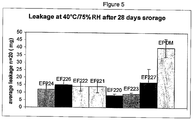
- seal blends according to the present invention is superior to EPDM at both ambient and 40°C/75% RH conditions (see Figure 5 ).
- Table 1 Examples of compositions according to the present invention Sample 216 217 218 219 220 221 222 223 224 225 226 227 228 229 230 Vistamaxx 2100 90 90 90 90 90 90 90 90 90 90 90 90 90 90 90 90 90 Talc 20 20 20 20 20 30 30 30 30 30 60 60 60 60 60 pp 10 10 10 PP / PE copolymer 10 10 10 LDPE 10 10 10 10 HDPE 10 10 10 10 EVA 10 10 10 10
- Table 2 Examples of compositions according to the present invention Sample 231 232 233 234 235 Versify 3200.01 90 90 90 Versify 3000.01 90 90 Talc 20 30 50 20 30 PP 10 10 PP/PE LDPE 10 HDPE 10 10 10 Table 3: The peak crystalline melting temperature of the compositions defined in Tables 1 and 2.
Landscapes
- Chemical & Material Sciences (AREA)
- Health & Medical Sciences (AREA)
- Organic Chemistry (AREA)
- Chemical Kinetics & Catalysis (AREA)
- Medicinal Chemistry (AREA)
- Polymers & Plastics (AREA)
- Engineering & Computer Science (AREA)
- Crystallography & Structural Chemistry (AREA)
- Materials Engineering (AREA)
- Pulmonology (AREA)
- Animal Behavior & Ethology (AREA)
- Anesthesiology (AREA)
- Biomedical Technology (AREA)
- Heart & Thoracic Surgery (AREA)
- Hematology (AREA)
- Life Sciences & Earth Sciences (AREA)
- Bioinformatics & Cheminformatics (AREA)
- General Health & Medical Sciences (AREA)
- Public Health (AREA)
- Veterinary Medicine (AREA)
- Sealing Material Composition (AREA)
- Compositions Of Macromolecular Compounds (AREA)
- Medical Preparation Storing Or Oral Administration Devices (AREA)
Description
- The present invention relates to a valve having a seal material and, in particular, a seal material comprising a blend containing a polyolefin thermoplastic elastomer. The valve may be used for dispensing pressurised fluid in the form of an aerosol. The valve is particularly suitable for use in pressurised metered dose aerosol inhaler devices (pMDIs) and in medical check devices suitable for dispensing a pharmaceutical. The valve may be used also in pumps and nasal delivery devices. Other examples include dry powder inhalers, syringe seals, stoppers for medicinal containers, pump seals.
- It is known from
GB 1201918 FR-A-2,549,568 WO 95/02651 GB 2,148,912 PCT/GB96/01551 WO 97/01611 - The required material properties necessary for good seal performance for pharmaceutical applications include:
- chemical compatibility (swell), tensile strength, permanent compression set, stress relaxation, elastic modulus, regulatory compliance, low permeability to fluids and gases, low levels of extractables and leachables, and stable properties after extraction.
- Accordingly, as well as the requirement for good engineering properties, there is a requirement for sanitary properties, including low levels of extractables and leachables, which might otherwise increase impurities of drug products to unacceptable levels, as well as potentially reacting with the drug product, vehicle or excipients. In this connection, products to be dispensed by the pMDI are commonly provided in solution or suspension in an alcohol base, this being particularly common in the dispensing of medicinal compounds for inhalation therapy.
- The metering valves used in dispensing devices such as pMDIs are typically constructed from a mixture of metal and/or thermoplastic parts and elastomeric rubber parts. The seal itself typically comprises an elastomer such as a synthetic rubber, for example, nitrile rubber.
- It is known from
WO 00/40479 - The benefits of using "alloyed" or "blended" materials include high elasticity and low hardness. For example, favourable values of elasticity and Shore Hardness (A) can be achieved when a softer elastomeric component is dispersed in a matrix of a thermoplastic material.
- The production of seals comprising elastomeric materials typically involves steps for the curing/cross-linking of natural and synthetic rubbers. Accelerators are compounds which reduce the time required for curing/cross-linking of natural and synthetic rubbers. Examples include sulphur-based compounds. Accelerators may also act to improve the non-permeability characteristics and other physical properties of the rubber.
- Peroxides such as dicumyl peroxide can also be used to cure elastomers. However, the curing reaction can be variable and this may affect the material properties; in extreme cases, the material can become brittle. Moreover the products of the reaction have to be removed as they can deteriorate elastomer properties, for example ageing.
Another problem is that peroxides are deactivated by antioxidants. Antioxidants are often required to enhance the ageing properties of the elastomer. - The pMDI devices containing propellant and drug mixtures are pressurised at ambient temperatures typically up to 5 bar (500 kPa). Under these conditions the residual by-products from the curing/cross-linking reaction can migrate out and interfere with the drug mechanisms.
- Accordingly, in most pharmaceutical applications it is also necessary to extract or wash the cured elastomer in order to remove surface residues and by-products resulting from the cure reaction and moulding process. Examples include ethanol and super-critical fluid extraction. Prolonged extraction times have been found, however, to result in a deterioration in material properties. Moreover, extraction processes add to production costs.
-
US 2006/183861 relates to polymer blends and pellets and methods of producing the same. - It is an object of the present invention to provide a valve for a dispensing apparatus which addresses at least some of the problems associated with the prior art.
- Accordingly, in a first aspect, the present invention provides a valve for use in a pharmaceutical dispensing device, the valve having a seal formed from a blend comprising:
- a thermoplastic elastomer including at least 80% of a propylene component with isotactic crystallinity in which all or substantially all of the substituent groups lie on the same side of the carbon chain; and
- a polymer selected from one or more of polypropylene, polyethylene and copolymers thereof, wherein the polymer has a melting point that is greater than the melting point of the thermoplastic elastomer.
- The present invention will now be further described. In the following passages different aspects of the invention are defined in more detail. Each aspect so defined may be combined with any other aspect or aspects unless clearly indicated to the contrary. In particular, any feature indicated as being preferred or advantageous may be combined with any other feature or features indicated as being preferred or advantageous.
- The seal in the valve according to the present invention is formed from a material comprising a polyolefin thermoplastic elastomer with isotactic propylene crystallinity.
- The term seal as used herein is intended to encompass any sealing member or portion thereof present in a pharmaceutical dispensing device, including, but not limited to, gaskets, seats and seals, whether static or dynamic.
- It will be appreciated that the seal may be provided as a separate component or may be formed integrally with the valve, i.e. be co-moulded.
- The polyolefin thermoplastic elastomer preferably comprises a copolymer or terpolymer of propylene and one or more alpha-olefins. The alpha-olefin is preferably selected from one or more of ethylene, butene, hexene, octene, and decene.
- The polyolefin thermoplastic elastomer preferably comprises propylene with from 2 to 25% isotactic crystallinity, more preferably from 5 to 15% isotactic crystallinity, still more preferably from 5 to 10% isotactic crystallinity.
- The polyolefin thermoplastic elastomer comprises at least 80% propylene co-monomer, more preferably at least 85% propylene co-monomer. The polyolefin thermoplastic elastomer is preferably semi-crystalline.
- The polyolefin elastomer preferably has a molecular weight (Mw) of at least 100,000, more preferably at least 130,000. The Mw/Mn is preferably from 1.5 to 2.5, more preferably approximately 2.
- The polyolefin elastomer typically exhibits a peak crystalline melting temperature (measured by DSC) of 40 to 80°C, more typically 50 to 70°C.
- The preferred polyolefin elastomer comprises a copolymer of propylene and other alpha-olefins, preferably one of which is ethylene. The ratio of propylene is at least 80%.
- The isotactic propylene is preferably a linear-substituted hydrocarbon polymer in which all or substantially all of the substituent groups lie on the same side of the carbon chain. The polymer is preferably highly stereo-regular.
- Semicrystalline co- and ter-polymers of propylene and other alpha-olefins are preferred, preferably containing at least 80% propylene with isotactic stereochemistry. The polymer preferably exhibits a substantially uniform intermolecular / intramolecular distribution of composition and crystallinity.
- A preferred example of the polyolefin elastomer is Vistamaxx (RTM), which is manufactured by the Exxon Mobil Chemical Company. A polyolefin elastomer is also available from Dow under the name Versify (RTM).
- The thermoplastic elastomer is preferably present in the blend in an amount of from 5 to 95 wt.%, more preferably 5 to 90 wt.%, still more preferably 50 to 90 wt.%
- In the present invention, the aforementioned polyolefin thermoplastic elastomer is combined or blended with a separate polymer. The polymer is preferably selected to increase the peak crystalline melting point of the blend. The polymer has a peak crystalline melting point that is greater than the peak crystalline melting point of the thermoplastic elastomer.
- The polymer will typically have a molecular weight that is greater than the molecular weight of the thermoplastic elastomer.
- The addition of the polymer has been found to improve the characteristics of the seal in pressurised metered dose aerosol inhaler devices (pMDIs). In particular, the shot weight and leakage characteristics. While not wishing to be bound by theory, it is believed that the improvements are linked to an increase in the peak crystalline melting point of the blend.
- Accordingly, the blend advantageously exhibits a peak crystalline melting temperature (measured by DSC) greater than 65°C, preferably greater than 75°C, more preferably greater than 85°C.
- The polymer is preferably selected from one or more of polypropylene and polyethylene, including copolymers and terpolymers thereof. If the polymer comprises polypropylene (or a copolymer or terpolymer thereof), then it will be appreciated that it is not the same as the thermoplastic elastomer.
- Preferred polymers for use in the blend according to the present invention include crystalline polypropylene, polypropylene copolymers, LDPE and HDPE.
- The polymer is preferably present in the blend in an amount of from 2 to 30 wt.%, more preferably 2 to 15 wt.%, still more preferably 5 to 15 wt.%.
- A preferred example of a polymer for use in the present invention is a polypropylene homopolymer such as Moplen H483R, which is manufactured by Basell.
- Other examples of suitable polymers include: random copolymer polypropylenes such as Innovene 200-OA25, which is manufactured by BP; Riblene MR10 LDPE, which is manufactured by Polimeri Europa; and Purell GA7760 HDPE, which is manufactured by Basell.
- The blend may further comprise EVA, for example Elvax 660 EVA (12% vinyl acetate), which is manufactured by DuPont.
The EVA may be present in the blend in an amount of from 1 to 20 wt.%, more preferably 1 to 10 wt.%. - The inventors have found that a copolymer or terpolymer of propylene and an alpha-olefin can effectively be used in alloys or blends with other polymers and/or fillers to produce materials that function as effective sealing materials in pMDI devices. Accordingly, the seal material may also further comprise one or more additional thermoplastic components such as, for example, polymers selected from styrene-ethylene-ethylene-propylene, styrene-ethylene-propylene, styrene-butadiene-styrene, polyether block polyamide, polyether-polyester, ethylene-diene, polydimethylsiloxane/urea copolymers, and/or cyclo-olefin copolymers, including combinations of two or more thereof. The one or more additional thermoplastic components is/are typically present in the seal material in an amount of from 1 to 40 wt.%, preferably from 1 to 10 wt.%, still more preferably from 1 to 5 wt.%.
- The weight ratio of the one or more additional thermoplastic components to the polyolefin thermoplastic elastomer is preferably in the range of from 1:99 to 40:60.
- The seal material preferably further comprises a mineral and/or inorganic filler. Mineral fillers are preferable to carbon black in order to minimise the formation of polynuclear aromatic hydrocarbon compounds. Suitable examples include any of magnesium silicate, aluminium silicate, aluminium oxide, hydrated aluminium oxide, barium sulphate, Wollastonite, inorganic and organic fibrous fillers, inorganic and organic micro-spheres, silica, titanium oxide, zinc oxide, calcium carbonate, magnesium oxide, hydrated magnesium oxide, magnesium carbonate, magnesium aluminium silicate, aluminium hydroxide, talc, kaolin and clay, including combinations of two or more thereof. The filler may be coated with one or more coupling agents, for example silanes, titanates and zirconates.
- Preferably, the filler is or comprises one or more of magnesium silicate, talc, calcined clay, nano particle clays, kaolin and/or amino silane coated clay or clay coated with a titanium or zirconate coupling agent. The filler is typically present in the seal material in an amount of from 1 to 40 wt. %, preferably from 1 to 30 wt.%, more preferably from 1 to 20 wt.%, still more preferably from 1 to 10 wt.%.
- The seal material preferably comprises both an additional thermoplastic component as herein described and a mineral/inorganic filler as herein described. The polymer alloys, mixtures or blends may be produced by conventional methods, for example using a twin-screw mixer extruder or by injection moulding. Thus, the seal may be produced by a process involving: providing a composition comprising a polyolefin thermoplastic elastomer with propylene crystallinity, the said polymer component, and optionally one or more additional thermoplastic components and optionally one or more fillers as herein described; and forming the composition into a seal. In this process the step of forming the composition into a seal may involve one or more forming techniques such as compression moulding, injection moulding and/or extrusion. The seal material according to the present invention lends itself particularly to injection moulding and this is advantageous because it reduces manufacturing cycle times from minutes (6 - 10 minutes for compression/transfer moulding) to seconds (15 - 25 seconds for injection moulding). Injection moulding also results in reduced process waste compared to compression/transfer processes. The seal can also be co-moulded if desired with thermoplastics such as PBT, nylon and/or polyacetal.
- The inventors have found that alloying or blending of semi-crystalline propylene co- or ter-polymers with inorganic/mineral fillers and/or thermoplastic components has yielded compositions with elastomeric properties suitable for sealing applications in pharmaceutical applications. It has surprising been found that this can be achieved without the use of plasticisers or processing aids or compatibilising agents, which are typically required for producing alloys/blends. Thus, the present invention enables a seal material to be produced that is essentially free of a cross-linking agent if desired. The seal material may also be essentially free of a plasticizer. The seal material may also be essentially free of a processing aid. The seal material may also be essentially free of a compatiblising agent.
- In a preferred embodiment, the seal is formed from a material consisting of or consisting essentially of:
- a polyolefin thermoplastic elastomer including a propylene component with semi-crystallinity, preferably a copolymer of propylene and an alpha-olefin;
- a polymer selected from one or more of polypropylene, polyethylene and copolymers thereof;
- optionally one or more additional thermoplastic components as herein described; and
- optionally one or more mineral and/or inorganic fillers as herein described; and
- any unavoidable impurities.
- The seal material in the valve according to the present invention is very clean having extractible levels of typically 8 to 500 ppm (by GC-MS).
- The seal material in the valve according to the present invention also has good sealing characteristics, which are comparable to those of conventional EPDM and nitrile elastomers. Surprisingly the elastomeric properties of the seal material are maintained at elevated conditions, for example 40°C/75%RH.
- Although not essential, if desired, the seal material may further comprise any of a reinforcement agent, processing aid, a plasticizer, a binder, a stabilizer, a retarder, a bonding agents, an antioxidant, a lubricant, a pigment, a wax, a resin, an antiozonants, a secondary accelerator or an activator, including combinations of two or more thereof. Examples of antioxidants are 2:2'-methylene-bis(6-(1-methyl-cyclohexyl)-para-creosol) and octylated diphenylamine.
- As mentioned above, a benefit of using a valve in accordance with the present invention in a pharmaceutical dispensing device is the relatively low levels of leachables and extractables that are present in the seal. Thus, while seals prepared for use in the present invention may be ethanol extracted (i.e. washed by refluxing ethanol) to reduce the level of any leachable species that could migrate into drug mixtures, this step is not essential and can be dispensed with. This is in contrast to conventional thermoset rubbers, which do require an ethanol extraction. As mentioned above, the seal material for use in the present invention has extractible levels of typically 8 to 500 ppm (by GC-MS). It will be appreciated that the extractible levels may be further reduced, if required, by performing an extraction step.
- The valve according to the present invention may be used a dispensing device, such as a pharmaceutical dispensing device. Specific examples include a nasal, pulmonary or transdermal delivery device. Preferred uses are in a pressurised metered dose aerosol inhaler device and in a medical check device suitable for dispensing a pharmaceutical. Other examples include dry powder inhalers, syringe seals, stoppers for medicinal containers, and pump seals.
- The term, pharmaceutical as used herein is intended to encompass any pharmaceutical, compound, composition, medicament, agent or product which can be delivered or administered to a human being or animal, for example pharmaceuticals, drugs, biological and medicinal products. Examples include antiallergics, analgesics, bronchodilators, antihistamines, therapeutic proteins and peptides, antitussives, anginal preparations, antibiotics, antiinflammatory preparations, hormones, or sulfonamides, such as, for example, a vasoconstrictive amine, an enzyme, an alkaloid, or a steroid, including combinations of two or more thereof. In particular, examples include isoproterenol [alpha-(isopropylaminomethyl) protocatechuyl alcohol], phenylephrine, phenylpropanolamine, glucagon, adrenochrome, trypsin, epinephrine, ephedrine, narcotine, codeine, atropine, heparin, morphine, dihydromorphinone, ergotamine, scopolamine, methapyrilene, cyanocobalamin, terbutaline, rimiterol, salbutamol, flunisolide, colchicine, pirbuterol, beclomethasone, orciprenaline, fentanyl, and diamorphine, streptomycin, penicillin, procaine penicillin, tetracycline, chlorotetracycline and hydroxytetracycline, adrenocorticotropic hormone and adrenocortical hormones, such as cortisone, hydrocortisone, hydrocortisone acetate and prednisolone, insulin, cromolyn sodium, and mometasone, including combinations of two or more thereof.
- The pharmaceutical may be used as either the free base or as one or more salts conventional in the art, such as, for example, acetate, benzenesulphonate, benzoate, bircarbonate, bitartrate, bromide, calcium edetate, camsylate, carbonate, chloride, citrate, dihydrochloride, edetate, edisylate, estolate, esylate, fumarate, fluceptate, gluconate, glutamate, glycollylarsanilate, hexylresorcinate, hydrobromide, hydrochloride, hydroxynaphthoate, iodide, isethionate, lactate, lactobionate, malate, maleate, mandelate, mesylate, methylbromide, methylnitrate, methylsulphate, mucate, napsylate, nitrate, pamoate, (embonate), pantothenate, phosphate, diphosphate, polygalacturonate, salicylate, stearate, subacetate, succinate, sulphate, tannate, tartrate, and triethiodide, including combinations of two or more thereof. Cationic salts may also be used, for example the alkali metals, e.g. Na and K, and ammonium salts and salts of amines known in the art to be pharmaceutically acceptable, for example glycine, ethylene diamine, choline, diethanolamine, triethanolamine, octadecylamine, diethylamine, triethylamine, 1-amino-2-propanol-amino-2-(hydroxymethyl)propane-1,3-diol, and 1-(3,4-dihydroxyphenyl)-2 isopropylaminoethanol.
- The pharmaceutical will typically be one which is suitable for inhalation and may be provided in any suitable form for this purpose, for example as a powder or as a solution or suspension in a solvent or carrier liquid, for example ethanol.
- The pharmaceutical may, for example, be one which is suitable for the treatment of asthma. Examples include salbutamol, beclomethasone, salmeterol, fluticasone, formoterol, terbutaline, sodium chromoglycate, budesonide and flunisolide, and physiologically acceptable salts (for example salbutamol sulphate, salmeterol xinafoate, fluticasone propionate, beclomethasone dipropionate, and terbutaline sulphate), solvates and esters, including combinations of two or more thereof. Individual isomers such as, for example, R-salbutamol, may also be used. As will be appreciated, the pharmaceutical may comprise of one or more active ingredients, an example of which is flutiform, and may optionally be provided together with a suitable carrier, for example a liquid carrier. One or more surfactants may be included if desired.
- According to a second aspect, the present invention also provides a pharmaceutical dispensing device having a valve as herein described. The pharmaceutical dispensing device may be, for example, a nasal, pulmonary or transdermal delivery device. Preferred devices are a pharmaceutical metered dose aerosol inhaler device and a medical check device.
- The present invention also provides a dispensing apparatus for dispensing pressurised fluid comprising a valve body defining a chamber, a valve member extending movably through the chamber and through at least one annular seal cooperating with the valve member and the body to regulate the discharge of fluid, wherein the or at least one of the seals is as herein described with reference to the first aspect of the invention.
- Such a device may be used for dispensing medicine, pharmaceuticals, biological agents, drugs and/or products in solution or suspension as herein described.
- In a preferred embodiment, the dispensing apparatus comprises a pressurised dispensing container having a valve body provided with two annular valve seals through which a valve member is axially slidable, the seals being disposed at inlet and outlet apertures of a valve chamber so that the valve functions as a metering valve.
- The dispensing apparatus as herein described may comprise a pressurised dispensing container operatively connected to the valve body and containing the fluid to be dispensed and a hydrofluorocarbon propellant comprising propellant type 134a or 227. The designation of propellant types referred to in the present application is as specified in British Standard BS4580:1970 "Specification for number designations of organic refrigerants". Accordingly, propellant 134a is: 1,1,1,2-tetrafluoroethane CH2F-CF3 and propellant 227 is: 1,1,1,2,3,3,3 heptafluoropropane CF3-CHF-CF3.
- The fluid to be dispensed typically comprises a liquid or particulate product as a solution or suspension in a carrier liquid. The carrier liquid preferably comprises an alcohol such as ethanol. One or more surfactants may be present.
- In the dispending apparatus according to the present invention, the seal material as herein described may be used for all the gaskets/seals. Alternatively, the seal material as herein described may be used for the gasket or for the dynamics seal and the other seal may be a conventional synthetic rubber such as, for example, EPDM, nitrile, bromobutyl, butyl, chlorobutyl and neoprene.
- The present invention will now be described further with reference to the following non-limiting examples in the Tables and Figures.
- Tables 1 and 2 list a number of thermoplastic elastomer compositions in accordance with the present invention. 'Vistamaxx' and 'Versify' are used as the thermoplastic elastomer component in these examples. The Vistamaxx polymers are manufactured by ExxonMobil and Versify is manufactured by the Dow Chemical Company.
- Other components in Table 1 are as follows:
- the talc is "Mistron Vapor R10C";
- the polypropylene (PP) homopolymer is Moplen 483R, manufactured by Basell;
- the random copolymer of propylene (PP) and ethylene (PE) is Innovene 200-CA25, manufactured by BP;
- the low density polyethylene (LDPE) is Riblene MR10, manufactured by Polimeri Europa;
- the high density polyethylene is Purell GA7760, manufactured by Bassell;
- the ethylene vinyl acetate (EVA) polymer is Elvax 660, manufactured by DuPont.
- Table 3 shows the peak crystalline melting temperature (Tpc) of the compositions defined in Tables 1 and 2. This information was obtained by DSC. Vistamaxx 1100 by itself shows a peak crystalline melting temperature of 60.3°C. It is noted that all the samples display a peak crystalline melting temperature of greater than that of Vistamaxx by itself.
- The addition of, for example, crystalline PP, PP copolymer, LDPE and/or HDPE increases the peak crystalline melting point of the blends. Increase in the peak crystalline melting point have been found to increase the service temperature stability of the seals according to the present invention. In particular, the seals exhibit elastomeric behaviour at higher temperatures and, as a consequence, offer stable shot weight and low leakage in dispensing devices such as MDIs.
- The performance of seal blends according to the present invention in an MDI valve using 134a + 5 % ethanol has been assessed. The shot weight performance at ambient is very consistent and comparable to thermoset EPDM control (see
Figure 1 ). - The shot weight performance of the
blends 40°C/75% RH is also very consistent and comparable to the thermoset EPDM control (seeFigure 2 ). - The effect of crystalline component in improving the thermal stability of the blends is further shown in
Figures 3 and 4 . EF221 is an alloy of Vistamaxx 1100 with isotactic PP (Moplen 483R) and 30 parts talc. Its shot weight at 40°C/75%RH is consistent and comparable to thermoset EPDM (seeFigure 3 ). Sample EF203 is an alloy of Vistamaxx 1100 with 30 parts talc. Its shot weight is inconsistent - compared to thermoset EPDM. This is thought to be due to its relatively poor thermal stability (see
Figure 4 ). - The leakage characteristics of seal blends according to the present invention is superior to EPDM at both ambient and 40°C/75% RH conditions (see
Figure 5 ). - The effect of removing talc on the peak crystalline melting temperature of sample EF 221 is examined in Table 4. Specifically, the relative amounts of Vistamaxx 1100 and polypropylene are kept the same, and simply the total amount of talc is reduced. It is seen that simply blending the thermoplastic elastomer Vistamaxx with a suitable polypropylene increases the peak crystalline melting temperature of the sample. Adding talc further increases the value.
- The effect of crystalline component on the shot weights at 40°C/75% RH of EF221 is examined in Table 5. EF203 (Vistamaxx 1100 with 30 parts talc) and thermoset EPDM are provided by way of comparison. Results show that addition of crystalline component to EF221 improves its thermal stability.
Table 1: Examples of compositions according to the present invention Sample 216 217 218 219 220 221 222 223 224 225 226 227 228 229 230 Vistamaxx 2100 90 90 90 90 90 Vistamaxx 1100 90 90 90 90 90 90 90 90 90 90 Talc 20 20 20 20 20 30 30 30 30 30 60 60 60 60 60 pp 10 10 10 PP / PE copolymer 10 10 10 LDPE 10 10 10 HDPE 10 10 10 EVA 10 10 10 Table 2: Examples of compositions according to the present invention Sample 231 232 233 234 235 Versify 3200.01 90 90 90 Versify 3000.01 90 90 Talc 20 30 50 20 30 PP 10 10 PP/ PE LDPE 10 HDPE 10 10 Table 3: The peak crystalline melting temperature of the compositions defined in Tables 1 and 2. Sample Tpc °C 216 115.45 217 109 218 104 219 77, 102 220 77.9 221 112 222 105 223 60, 86 224 72.6 225 77.6, 98 226 113 227 109 228 57, 84, 99 229 83.7 230 77, 98, 120 231 78, 116 232 103 233 66 234 87, 115 235 110 Table 4: The peak crystalline melting temperature of sample 221 with varying amounts of talc added. Sample Filler content (% by weight) Tpc Vistamaxx 1100 0 60.3 221A 0.0 95 221B 9.1 108.8 221C 16.7 109.6 222 30 112 Table 5: The effect of the crystalline component on the shot weights at 40°C/75% RH of EF221. EF203 is compared with thermoset EPDM. Alloy/ Storage time Shot weight at 40°C/75% RH Mean (mg) Max (mg) Min (mg) S.D EPDM 1 month 56 58.2 55.2 0.7 EF221 1month 55.6 57.2 54.6 0.6 EF203 2 weeks49.2 51.7 46.62 2.55 EF203 3 months40.5 44.02 35.50 4.48
Claims (11)
- A valve for use in a pharmaceutical dispensing device, the valve having a seal formed from a blend comprising:a thermoplastic elastomer including at least 80% of a propylene component with isotactic crystallinity in which all or substantially all of the substituent groups lie on the same side of the carbon chain; anda polymer selected from one or more of polypropylene, polyethylene and copolymers thereof, wherein the polymer has a melting point that is greater than the melting point of the thermoplastic elastomer.
- A valve as claimed in claim 1, wherein the thermoplastic elastomer comprises a copolymer or terpolymer of propylene and one or more alpha-olefin(s), wherein the alpha-olefin(s) is preferably selected from one or more of ethylene, butene, hexene, octene and decene.
- A valve as claimed in any one of the preceding claims, wherein the propylene component in the thermoplastic elastomer has from 2 to 25% isotactic crystallinity, preferably from 5 to 15% isotactic crystallinity.
- A valve as claimed in any one of the preceding claims, wherein the thermoplastic elastomer has a molecular weight (Mw) of at least 100,000.
- A valve as claimed in any one of the preceding claims, wherein said polymer:(a) has a molecular weight that is greater than the molecular weight of the thermoplastic elastomer; and/or(b) is selected to increase the peak crystalline melting point of the blend.
- A valve as claimed in any one of the preceding claims, wherein said polymer:(a) comprises polypropylene, preferably crystalline polypropylene; and/or(b) comprises a copolymer of polypropylene; and/or(c) comprises LDPE or HDPE; and/or(d) is present in the blend an amount of from 2 to 30 wt.%, preferably 5 to 15 wt.%.
- A valve as claimed in any one of the preceding claims, wherein the seal material comprises at least one of:(i) an additional thermoplastic component, and(ii) a mineral and/or inorganic filler
- A valve as claimed in claim 7, wherein the additional thermoplastic component comprises one or more polymers selected from styrene-ethylene-ethylene-propylene, styrene-ethylene-propylene, styrene-butadiene-styrene, polyether block polyamide, polyether-polyester, ethylene-diene, polydimethylsiloxane/urea copolymers, and/or cyclo-olefin copolymers, including combinations of two or more thereof.
- A valve as claimed in claim 7, wherein the filler is selected from one or more of clays, calcined clays, nano particle clays, talcs and amino-silane-coated clays and is preferably present in the seal material in an amount of from 1 to 40 wt. %, more preferably 1 to 30 wt.%.
- A valve as claimed in any one of the preceding claims, wherein the seal material is essentially free of at least one of:(a) a cross-linking agent;(b) a plasticizer;(c) a processing aid; and(d) a compatiblising agent.
- A pharmaceutical dispensing device having a valve as claimed in any of claims 1-10, which is preferably a pharmaceutical metered dose aerosol inhaler device.
Applications Claiming Priority (2)
| Application Number | Priority Date | Filing Date | Title |
|---|---|---|---|
| GB0617375A GB2441329B (en) | 2006-09-04 | 2006-09-04 | Seal for a dispensing apparatus |
| PCT/GB2007/003323 WO2008029111A1 (en) | 2006-09-04 | 2007-09-04 | Seal for a dispensing apparatus |
Publications (2)
| Publication Number | Publication Date |
|---|---|
| EP2069450A1 EP2069450A1 (en) | 2009-06-17 |
| EP2069450B1 true EP2069450B1 (en) | 2017-03-01 |
Family
ID=37137291
Family Applications (1)
| Application Number | Title | Priority Date | Filing Date |
|---|---|---|---|
| EP07804129.0A Active EP2069450B1 (en) | 2006-09-04 | 2007-09-04 | Seal for a dispensing apparatus |
Country Status (8)
| Country | Link |
|---|---|
| US (1) | US8110633B2 (en) |
| EP (1) | EP2069450B1 (en) |
| CN (1) | CN101511964B (en) |
| AR (1) | AR062639A1 (en) |
| BR (1) | BRPI0716447A2 (en) |
| ES (1) | ES2618829T3 (en) |
| GB (1) | GB2441329B (en) |
| WO (1) | WO2008029111A1 (en) |
Families Citing this family (12)
| Publication number | Priority date | Publication date | Assignee | Title |
|---|---|---|---|---|
| CA2604623C (en) | 2006-09-28 | 2018-10-30 | Tyco Healthcare Group Lp | Portable wound therapy system |
| US8298200B2 (en) | 2009-06-01 | 2012-10-30 | Tyco Healthcare Group Lp | System for providing continual drainage in negative pressure wound therapy |
| US9033942B2 (en) * | 2008-03-07 | 2015-05-19 | Smith & Nephew, Inc. | Wound dressing port and associated wound dressing |
| US20100324516A1 (en) | 2009-06-18 | 2010-12-23 | Tyco Healthcare Group Lp | Apparatus for Vacuum Bridging and/or Exudate Collection |
| EP2515961B1 (en) | 2009-12-22 | 2019-04-17 | Smith & Nephew, Inc. | Apparatuses for negative pressure wound therapy |
| RU2016111981A (en) | 2010-12-22 | 2018-11-27 | Смит Энд Нефью, Инк. | DEVICE AND METHOD FOR TREATING RAS WITH NEGATIVE PRESSURE |
| GB2499611B (en) * | 2012-02-22 | 2015-09-16 | Consort Medical Plc | Valved container assembly |
| EP3688091A1 (en) | 2017-09-29 | 2020-08-05 | Dow Global Technologies LLC | Thermoplastic polyolefin compositions useful for aldehyde abatement |
| GB201811449D0 (en) | 2018-07-12 | 2018-08-29 | Smith & Nephew | Apparatuses and methods for negative pressure wound therapy |
| GB202000574D0 (en) | 2020-01-15 | 2020-02-26 | Smith & Nephew | Fluidic connectors for negative pressure wound therapy |
| GB202001537D0 (en) | 2020-02-05 | 2020-03-18 | Consort Medical Plc | Pressurised dispensing container |
| EP3910021B1 (en) * | 2020-03-23 | 2025-08-20 | Sumitomo Chemical Company, Limited | Thermoplastic elastomer composition |
Family Cites Families (10)
| Publication number | Priority date | Publication date | Assignee | Title |
|---|---|---|---|---|
| GB9513084D0 (en) | 1995-06-27 | 1995-08-30 | Bespak Plc | Dispensing apparatus |
| US20040129737A1 (en) * | 1999-03-24 | 2004-07-08 | Anderson Gregor John, Mclennan | Valves for use in containers having valve stems slidably movable within round-edged sealing rings |
| US6943215B2 (en) | 2001-11-06 | 2005-09-13 | Dow Global Technologies Inc. | Impact resistant polymer blends of crystalline polypropylene and partially crystalline, low molecular weight impact modifiers |
| WO2003040201A1 (en) * | 2001-11-06 | 2003-05-15 | Dow Global Technologies Inc. | Isotactic propylene copolymers, their preparation and use |
| US7459500B2 (en) * | 2002-11-05 | 2008-12-02 | Dow Global Technologies Inc. | Thermoplastic elastomer compositions |
| KR100719403B1 (en) * | 2003-01-31 | 2007-05-17 | 듀폰-미츠이 폴리케미칼 가부시키가이샤 | Heat-sealable laminated film and package |
| FR2855829B1 (en) * | 2003-06-06 | 2005-09-09 | Valois Sas | VALVE JOINT AND FLUID PRODUCT DISPENSING DEVICE COMPRISING SUCH A JOINT |
| GB2410500B (en) * | 2004-01-29 | 2008-05-21 | Bespak Plc | Seal for a dispensing apparatus |
| EP1846498B1 (en) * | 2005-01-31 | 2013-08-14 | ExxonMobil Chemical Patents Inc. | Polymer blends and pellets and methods of producing same |
| GB2423994B (en) * | 2005-03-04 | 2008-07-30 | Bespak Plc | Seal for a dispensing apparatus |
-
2006
- 2006-09-04 GB GB0617375A patent/GB2441329B/en active Active
-
2007
- 2007-09-04 ES ES07804129.0T patent/ES2618829T3/en active Active
- 2007-09-04 WO PCT/GB2007/003323 patent/WO2008029111A1/en not_active Ceased
- 2007-09-04 CN CN2007800328103A patent/CN101511964B/en active Active
- 2007-09-04 US US12/439,922 patent/US8110633B2/en active Active
- 2007-09-04 AR ARP070103898A patent/AR062639A1/en active IP Right Grant
- 2007-09-04 BR BRPI0716447-5A2A patent/BRPI0716447A2/en not_active IP Right Cessation
- 2007-09-04 EP EP07804129.0A patent/EP2069450B1/en active Active
Non-Patent Citations (1)
| Title |
|---|
| None * |
Also Published As
| Publication number | Publication date |
|---|---|
| WO2008029111A1 (en) | 2008-03-13 |
| GB2441329A (en) | 2008-03-05 |
| ES2618829T3 (en) | 2017-06-22 |
| US8110633B2 (en) | 2012-02-07 |
| AR062639A1 (en) | 2008-11-19 |
| GB0617375D0 (en) | 2006-10-11 |
| EP2069450A1 (en) | 2009-06-17 |
| BRPI0716447A2 (en) | 2013-09-17 |
| GB2441329B (en) | 2011-06-29 |
| US20100000524A1 (en) | 2010-01-07 |
| CN101511964B (en) | 2013-11-06 |
| CN101511964A (en) | 2009-08-19 |
Similar Documents
| Publication | Publication Date | Title |
|---|---|---|
| US8110633B2 (en) | Seal for a dispensing apparatus | |
| US20120266871A1 (en) | Seal for a dispensing apparatus | |
| AU680530B2 (en) | Seals for use in an aerosol delivery device | |
| AU2024219491B2 (en) | Pressurised dispensing container | |
| EP1485443B1 (en) | Seal material for a dispensing apparatus | |
| US20030180228A1 (en) | Aerosol container for formulations of salmeterol xinafoate | |
| US8129474B2 (en) | Seal for a dispensing apparatus | |
| GB2410500A (en) | Seal for a pharmaceutical dispensing device | |
| WO2017021698A1 (en) | Seal for a dispensing apparatus | |
| US20050092679A1 (en) | Method of cleaning or purifying a polymer | |
| GB2445483A (en) | Seal for a pharmaceutical dispensing device | |
| CA3168854C (en) | Pressurised dispensing container | |
| GB2415699A (en) | Seal material for a dispensing apparatus | |
| WO2026022298A1 (en) | Method of filling a pressurised dispensing container and filled pressurised dispensing container |
Legal Events
| Date | Code | Title | Description |
|---|---|---|---|
| PUAI | Public reference made under article 153(3) epc to a published international application that has entered the european phase |
Free format text: ORIGINAL CODE: 0009012 |
|
| 17P | Request for examination filed |
Effective date: 20090403 |
|
| AK | Designated contracting states |
Kind code of ref document: A1 Designated state(s): AT BE BG CH CY CZ DE DK EE ES FI FR GB GR HU IE IS IT LI LT LU LV MC MT NL PL PT RO SE SI SK TR |
|
| AX | Request for extension of the european patent |
Extension state: AL BA HR MK RS |
|
| 17Q | First examination report despatched |
Effective date: 20091109 |
|
| DAX | Request for extension of the european patent (deleted) | ||
| GRAP | Despatch of communication of intention to grant a patent |
Free format text: ORIGINAL CODE: EPIDOSNIGR1 |
|
| INTG | Intention to grant announced |
Effective date: 20160920 |
|
| GRAS | Grant fee paid |
Free format text: ORIGINAL CODE: EPIDOSNIGR3 |
|
| GRAA | (expected) grant |
Free format text: ORIGINAL CODE: 0009210 |
|
| AK | Designated contracting states |
Kind code of ref document: B1 Designated state(s): AT BE BG CH CY CZ DE DK EE ES FI FR GB GR HU IE IS IT LI LT LU LV MC MT NL PL PT RO SE SI SK TR |
|
| REG | Reference to a national code |
Ref country code: GB Ref legal event code: FG4D |
|
| REG | Reference to a national code |
Ref country code: CH Ref legal event code: EP Ref country code: AT Ref legal event code: REF Ref document number: 871336 Country of ref document: AT Kind code of ref document: T Effective date: 20170315 |
|
| REG | Reference to a national code |
Ref country code: IE Ref legal event code: FG4D |
|
| REG | Reference to a national code |
Ref country code: DE Ref legal event code: R096 Ref document number: 602007049984 Country of ref document: DE |
|
| REG | Reference to a national code |
Ref country code: ES Ref legal event code: FG2A Ref document number: 2618829 Country of ref document: ES Kind code of ref document: T3 Effective date: 20170622 |
|
| REG | Reference to a national code |
Ref country code: NL Ref legal event code: MP Effective date: 20170301 |
|
| REG | Reference to a national code |
Ref country code: LT Ref legal event code: MG4D |
|
| REG | Reference to a national code |
Ref country code: AT Ref legal event code: MK05 Ref document number: 871336 Country of ref document: AT Kind code of ref document: T Effective date: 20170301 |
|
| PG25 | Lapsed in a contracting state [announced via postgrant information from national office to epo] |
Ref country code: LT Free format text: LAPSE BECAUSE OF FAILURE TO SUBMIT A TRANSLATION OF THE DESCRIPTION OR TO PAY THE FEE WITHIN THE PRESCRIBED TIME-LIMIT Effective date: 20170301 Ref country code: FI Free format text: LAPSE BECAUSE OF FAILURE TO SUBMIT A TRANSLATION OF THE DESCRIPTION OR TO PAY THE FEE WITHIN THE PRESCRIBED TIME-LIMIT Effective date: 20170301 Ref country code: GR Free format text: LAPSE BECAUSE OF FAILURE TO SUBMIT A TRANSLATION OF THE DESCRIPTION OR TO PAY THE FEE WITHIN THE PRESCRIBED TIME-LIMIT Effective date: 20170602 |
|
| PG25 | Lapsed in a contracting state [announced via postgrant information from national office to epo] |
Ref country code: LV Free format text: LAPSE BECAUSE OF FAILURE TO SUBMIT A TRANSLATION OF THE DESCRIPTION OR TO PAY THE FEE WITHIN THE PRESCRIBED TIME-LIMIT Effective date: 20170301 Ref country code: BG Free format text: LAPSE BECAUSE OF FAILURE TO SUBMIT A TRANSLATION OF THE DESCRIPTION OR TO PAY THE FEE WITHIN THE PRESCRIBED TIME-LIMIT Effective date: 20170601 Ref country code: AT Free format text: LAPSE BECAUSE OF FAILURE TO SUBMIT A TRANSLATION OF THE DESCRIPTION OR TO PAY THE FEE WITHIN THE PRESCRIBED TIME-LIMIT Effective date: 20170301 Ref country code: SE Free format text: LAPSE BECAUSE OF FAILURE TO SUBMIT A TRANSLATION OF THE DESCRIPTION OR TO PAY THE FEE WITHIN THE PRESCRIBED TIME-LIMIT Effective date: 20170301 |
|
| REG | Reference to a national code |
Ref country code: FR Ref legal event code: PLFP Year of fee payment: 11 |
|
| PG25 | Lapsed in a contracting state [announced via postgrant information from national office to epo] |
Ref country code: NL Free format text: LAPSE BECAUSE OF FAILURE TO SUBMIT A TRANSLATION OF THE DESCRIPTION OR TO PAY THE FEE WITHIN THE PRESCRIBED TIME-LIMIT Effective date: 20170301 |
|
| PG25 | Lapsed in a contracting state [announced via postgrant information from national office to epo] |
Ref country code: RO Free format text: LAPSE BECAUSE OF FAILURE TO SUBMIT A TRANSLATION OF THE DESCRIPTION OR TO PAY THE FEE WITHIN THE PRESCRIBED TIME-LIMIT Effective date: 20170301 Ref country code: EE Free format text: LAPSE BECAUSE OF FAILURE TO SUBMIT A TRANSLATION OF THE DESCRIPTION OR TO PAY THE FEE WITHIN THE PRESCRIBED TIME-LIMIT Effective date: 20170301 Ref country code: SK Free format text: LAPSE BECAUSE OF FAILURE TO SUBMIT A TRANSLATION OF THE DESCRIPTION OR TO PAY THE FEE WITHIN THE PRESCRIBED TIME-LIMIT Effective date: 20170301 Ref country code: CZ Free format text: LAPSE BECAUSE OF FAILURE TO SUBMIT A TRANSLATION OF THE DESCRIPTION OR TO PAY THE FEE WITHIN THE PRESCRIBED TIME-LIMIT Effective date: 20170301 |
|
| PG25 | Lapsed in a contracting state [announced via postgrant information from national office to epo] |
Ref country code: PL Free format text: LAPSE BECAUSE OF FAILURE TO SUBMIT A TRANSLATION OF THE DESCRIPTION OR TO PAY THE FEE WITHIN THE PRESCRIBED TIME-LIMIT Effective date: 20170301 Ref country code: IS Free format text: LAPSE BECAUSE OF FAILURE TO SUBMIT A TRANSLATION OF THE DESCRIPTION OR TO PAY THE FEE WITHIN THE PRESCRIBED TIME-LIMIT Effective date: 20170701 Ref country code: PT Free format text: LAPSE BECAUSE OF FAILURE TO SUBMIT A TRANSLATION OF THE DESCRIPTION OR TO PAY THE FEE WITHIN THE PRESCRIBED TIME-LIMIT Effective date: 20170703 |
|
| REG | Reference to a national code |
Ref country code: DE Ref legal event code: R097 Ref document number: 602007049984 Country of ref document: DE |
|
| PLBE | No opposition filed within time limit |
Free format text: ORIGINAL CODE: 0009261 |
|
| STAA | Information on the status of an ep patent application or granted ep patent |
Free format text: STATUS: NO OPPOSITION FILED WITHIN TIME LIMIT |
|
| PG25 | Lapsed in a contracting state [announced via postgrant information from national office to epo] |
Ref country code: DK Free format text: LAPSE BECAUSE OF FAILURE TO SUBMIT A TRANSLATION OF THE DESCRIPTION OR TO PAY THE FEE WITHIN THE PRESCRIBED TIME-LIMIT Effective date: 20170301 |
|
| 26N | No opposition filed |
Effective date: 20171204 |
|
| PG25 | Lapsed in a contracting state [announced via postgrant information from national office to epo] |
Ref country code: SI Free format text: LAPSE BECAUSE OF FAILURE TO SUBMIT A TRANSLATION OF THE DESCRIPTION OR TO PAY THE FEE WITHIN THE PRESCRIBED TIME-LIMIT Effective date: 20170301 |
|
| REG | Reference to a national code |
Ref country code: DE Ref legal event code: R119 Ref document number: 602007049984 Country of ref document: DE |
|
| REG | Reference to a national code |
Ref country code: CH Ref legal event code: PL |
|
| PG25 | Lapsed in a contracting state [announced via postgrant information from national office to epo] |
Ref country code: MC Free format text: LAPSE BECAUSE OF FAILURE TO SUBMIT A TRANSLATION OF THE DESCRIPTION OR TO PAY THE FEE WITHIN THE PRESCRIBED TIME-LIMIT Effective date: 20170301 |
|
| REG | Reference to a national code |
Ref country code: IE Ref legal event code: MM4A |
|
| REG | Reference to a national code |
Ref country code: BE Ref legal event code: MM Effective date: 20170930 |
|
| PG25 | Lapsed in a contracting state [announced via postgrant information from national office to epo] |
Ref country code: LU Free format text: LAPSE BECAUSE OF NON-PAYMENT OF DUE FEES Effective date: 20170904 |
|
| PG25 | Lapsed in a contracting state [announced via postgrant information from national office to epo] |
Ref country code: IE Free format text: LAPSE BECAUSE OF NON-PAYMENT OF DUE FEES Effective date: 20170904 Ref country code: DE Free format text: LAPSE BECAUSE OF NON-PAYMENT OF DUE FEES Effective date: 20180404 Ref country code: CH Free format text: LAPSE BECAUSE OF NON-PAYMENT OF DUE FEES Effective date: 20170930 Ref country code: LI Free format text: LAPSE BECAUSE OF NON-PAYMENT OF DUE FEES Effective date: 20170930 |
|
| PG25 | Lapsed in a contracting state [announced via postgrant information from national office to epo] |
Ref country code: BE Free format text: LAPSE BECAUSE OF NON-PAYMENT OF DUE FEES Effective date: 20170930 |
|
| REG | Reference to a national code |
Ref country code: FR Ref legal event code: PLFP Year of fee payment: 12 |
|
| PG25 | Lapsed in a contracting state [announced via postgrant information from national office to epo] |
Ref country code: MT Free format text: LAPSE BECAUSE OF NON-PAYMENT OF DUE FEES Effective date: 20170904 |
|
| PG25 | Lapsed in a contracting state [announced via postgrant information from national office to epo] |
Ref country code: HU Free format text: LAPSE BECAUSE OF FAILURE TO SUBMIT A TRANSLATION OF THE DESCRIPTION OR TO PAY THE FEE WITHIN THE PRESCRIBED TIME-LIMIT; INVALID AB INITIO Effective date: 20070904 |
|
| PG25 | Lapsed in a contracting state [announced via postgrant information from national office to epo] |
Ref country code: CY Free format text: LAPSE BECAUSE OF NON-PAYMENT OF DUE FEES Effective date: 20170301 |
|
| PG25 | Lapsed in a contracting state [announced via postgrant information from national office to epo] |
Ref country code: TR Free format text: LAPSE BECAUSE OF FAILURE TO SUBMIT A TRANSLATION OF THE DESCRIPTION OR TO PAY THE FEE WITHIN THE PRESCRIBED TIME-LIMIT Effective date: 20170301 |
|
| P01 | Opt-out of the competence of the unified patent court (upc) registered |
Effective date: 20230316 |
|
| REG | Reference to a national code |
Ref country code: ES Ref legal event code: PC2A Owner name: BESPAK EUROPE LIMITED Effective date: 20250527 |
|
| PGFP | Annual fee paid to national office [announced via postgrant information from national office to epo] |
Ref country code: GB Payment date: 20250905 Year of fee payment: 19 |
|
| PGFP | Annual fee paid to national office [announced via postgrant information from national office to epo] |
Ref country code: FR Payment date: 20250909 Year of fee payment: 19 |
|
| REG | Reference to a national code |
Ref country code: GB Ref legal event code: 732E Free format text: REGISTERED BETWEEN 20251204 AND 20251210 |
|
| PGFP | Annual fee paid to national office [announced via postgrant information from national office to epo] |
Ref country code: IT Payment date: 20250901 Year of fee payment: 19 |
|
| PGFP | Annual fee paid to national office [announced via postgrant information from national office to epo] |
Ref country code: ES Payment date: 20251205 Year of fee payment: 19 |