EP2068882B1 - Method of preparation of a soluble formulation of water-insoluble pentacyclic and tetracyclic terpenoids, a soluble formulation of a pentacyclic or tetracyclic terpenoid and a pharmaceutical composition containing this soluble formulation - Google Patents
Method of preparation of a soluble formulation of water-insoluble pentacyclic and tetracyclic terpenoids, a soluble formulation of a pentacyclic or tetracyclic terpenoid and a pharmaceutical composition containing this soluble formulation Download PDFInfo
- Publication number
- EP2068882B1 EP2068882B1 EP07801129.3A EP07801129A EP2068882B1 EP 2068882 B1 EP2068882 B1 EP 2068882B1 EP 07801129 A EP07801129 A EP 07801129A EP 2068882 B1 EP2068882 B1 EP 2068882B1
- Authority
- EP
- European Patent Office
- Prior art keywords
- group
- water
- soluble formulation
- substituents
- pentacyclic
- Prior art date
- Legal status (The legal status is an assumption and is not a legal conclusion. Google has not performed a legal analysis and makes no representation as to the accuracy of the status listed.)
- Not-in-force
Links
Images


Classifications
-
- C—CHEMISTRY; METALLURGY
- C07—ORGANIC CHEMISTRY
- C07J—STEROIDS
- C07J71/00—Steroids in which the cyclopenta(a)hydrophenanthrene skeleton is condensed with a heterocyclic ring
- C07J71/0036—Nitrogen-containing hetero ring
- C07J71/0042—Nitrogen only
- C07J71/0047—Nitrogen only at position 2(3)
-
- A—HUMAN NECESSITIES
- A61—MEDICAL OR VETERINARY SCIENCE; HYGIENE
- A61K—PREPARATIONS FOR MEDICAL, DENTAL OR TOILETRY PURPOSES
- A61K31/00—Medicinal preparations containing organic active ingredients
- A61K31/56—Compounds containing cyclopenta[a]hydrophenanthrene ring systems; Derivatives thereof, e.g. steroids
-
- A—HUMAN NECESSITIES
- A61—MEDICAL OR VETERINARY SCIENCE; HYGIENE
- A61K—PREPARATIONS FOR MEDICAL, DENTAL OR TOILETRY PURPOSES
- A61K47/00—Medicinal preparations characterised by the non-active ingredients used, e.g. carriers or inert additives; Targeting or modifying agents chemically bound to the active ingredient
- A61K47/50—Medicinal preparations characterised by the non-active ingredients used, e.g. carriers or inert additives; Targeting or modifying agents chemically bound to the active ingredient the non-active ingredient being chemically bound to the active ingredient, e.g. polymer-drug conjugates
- A61K47/69—Medicinal preparations characterised by the non-active ingredients used, e.g. carriers or inert additives; Targeting or modifying agents chemically bound to the active ingredient the non-active ingredient being chemically bound to the active ingredient, e.g. polymer-drug conjugates the conjugate being characterised by physical or galenical forms, e.g. emulsion, particle, inclusion complex, stent or kit
- A61K47/6949—Medicinal preparations characterised by the non-active ingredients used, e.g. carriers or inert additives; Targeting or modifying agents chemically bound to the active ingredient the non-active ingredient being chemically bound to the active ingredient, e.g. polymer-drug conjugates the conjugate being characterised by physical or galenical forms, e.g. emulsion, particle, inclusion complex, stent or kit inclusion complexes, e.g. clathrates, cavitates or fullerenes
- A61K47/6951—Medicinal preparations characterised by the non-active ingredients used, e.g. carriers or inert additives; Targeting or modifying agents chemically bound to the active ingredient the non-active ingredient being chemically bound to the active ingredient, e.g. polymer-drug conjugates the conjugate being characterised by physical or galenical forms, e.g. emulsion, particle, inclusion complex, stent or kit inclusion complexes, e.g. clathrates, cavitates or fullerenes using cyclodextrin
-
- B—PERFORMING OPERATIONS; TRANSPORTING
- B82—NANOTECHNOLOGY
- B82Y—SPECIFIC USES OR APPLICATIONS OF NANOSTRUCTURES; MEASUREMENT OR ANALYSIS OF NANOSTRUCTURES; MANUFACTURE OR TREATMENT OF NANOSTRUCTURES
- B82Y5/00—Nanobiotechnology or nanomedicine, e.g. protein engineering or drug delivery
-
- C—CHEMISTRY; METALLURGY
- C07—ORGANIC CHEMISTRY
- C07J—STEROIDS
- C07J63/00—Steroids in which the cyclopenta(a)hydrophenanthrene skeleton has been modified by expansion of only one ring by one or two atoms
- C07J63/008—Expansion of ring D by one atom, e.g. D homo steroids
Definitions
- the invention relates to a method of preparation of a soluble formulation of water-insoluble pentacyclic and tetracyclic terpenoids, a soluble formulation of a pentacyclic or tetracyclic terpenoid and a pharmaceutical composition containing this soluble formulation.
- Pentacyclic and tetracyclic terpenoids represent a group of natural substances - iso-prenoids, showing a large range of biological activities ( Dzubak, P.; Hajduch, M.; Vydra, D.; Hustova, A.; Kvasnica, M.; Biedermann, D.; Markova, L.; Urban, M.; Sarek, J. Nat. Prod. Rep. 2006, 23, 394-411 ), thanks to which they are getting into the focus of the pharmaceutical industry.
- neither modified nor semisynthetic derivatives of these natural substances possess optimum pharmacological properties.
- the solvents commonly used in the chemical practice, such as chloroform, acetone, ethyl acetate etc., cannot be used for dissolving for pharmaceutical purposes, for the reason of their incompatibility with living organisms.
- the triterpenoids reach the solubility between 10 and 50 mg/ml ( WO 92/09553 ).
- the inclusion compounds can be isolated from their solutions as solid substances in the form of powder by means of lyophilization.
- native triterpenoid carboxylic acids having a free carboxylic functional group can be dissolved in water-based media, but not their functional derivatives or terpenoids that do not have carboxylic functional group.
- the biologically active free triterpenoid acids having many disadvantageous pharmacological properties, e.g.
- WO 03/026603 discloses the preparation of formulations of sericosid dissolved in a solution containing water and a cyclodextrin.
- US 6403816 , WO 2005/090380 , WO 2006/053255 and JP 04316597 disclose formulating betulinic acid derivatives and other terpenoids in a solution containing water and beta-cyclodextrin.
- Object of the invention is a method of preparation of a soluble formulation of water-insoluble pentacyclic and tetracyclic triterpenoids, wherein the water-insoluble triterpenoid having a free hydroxy functional group is derivatized on this functional group with a substituent selected from the group comprising
- the substituents of general formula X a are selected from the group comprising succinate, glutarate, 3',3'-dimethylglutarate, 3',3'-dimethylsuccinate, tetrahydrophthalate, diglycolate or phthalate.
- the substituents of general formula X e are selected from the group comprising glucosyl, galactosyl, lactosyl and the 2-deoxyanalogues thereof.
- Biocompatible organic solvents e.g. ethanol or propylene glycol
- compounds facilitating the formation of inclusion complexes such as e.g. alkali carbonates or hydrogen carbonates can be the auxiliary substances.
- Object of the invention is further a soluble formulation of a pentacyclic or tetracyclic triterpenoid, containing an inclusion complex of the pentacyclic or tetracyclic terpenoid having its hydroxy group derivatized with a substituent selected from the group comprising:
- the substituents of general formula X a are selected from the group comprising succinate, glutarate, 3',3'-dimethylsuccinate, 3',3'-dimethylglutarate, tetrahydrophthalate, diglycolate or phthalate.
- the substituents of general formula X e are selected from the group comprising glucosyl, galactosyl, lactosyl and the 2-deoxyanalogues thereof.
- Biocompatible organic solvents e.g. ethanol or propylene glycol
- compounds facilitating the formation of inclusion complexes such as e.g. alkali carbonates or hydrogen carbonates can be the auxiliary substances.
- Object of the invention is further a pharmaceutical composition containing the soluble formulation according to the present invention and a pharmaceutically acceptable solvent.
- the pharmaceutically acceptable solvent is water.
- the method of preparation of the soluble formulations of water-insoluble pentacyclic and tetracyclic terpenoids consists of two steps: a) derivatization of the insoluble starting compound, b) preparation of the aqueous solution of the inclusion complex of the derivative and cyclodextrine.
- the general methods of derivatization of the insoluble pentacyclic and tetracyclic triterpenoids are designated H-1, H-1*, H-2, H-3, H-4, H-5, H-6, H-6*, H-7, H-7*, H-8, H-9, K-1 and are herein below demonstrated in specific examples.
- Method designations without asterisk stand for direct derivatization methods, whereas method designations with asterisk stand for derivatization methods going via benzyl-ester of triterpenic acid and leading to derivatives with two free carboxylic groups - one formed by the derivatization and the other being skeletal carboxylic group.
- the general methods of the preparation of the inclusion complex, comprising the dissolution of the substance are designated A and B.
- the evaporate was purified by column chromatography on silica gel by gradient elution from 10% ethyl acetate in hexane to 50% ethylacetate.
- the chromatographically uniform benzyl betulinate hemisuccinate was used in the next step without purification.
- the evaporate was purified by column chromatography on silica gel by gradient elution from 8% ethyl acetate in hexane to 25% ethyl acetate in hexane.
- the chromatographically uniform diglycolate 4x was lyophilized from tert-butylalcohol (406 mg; 66 %).
- the evaporate was purified by column chromatography on silica gel by gradient elution from 8% ethyl acetate in hexane to 25% ethyl acetate in hexane.
- the chromatographically uniform diglycolate 4x was lyophilized from tert-butylalcohol (406 mg; 66 %).
- Method A In a mixture of water (26.0 ml), sodium hydrogencarbonate solution (5.0 ml; saturated solution) and ethanol (7.0 ml; 99%), 2-hydroxypropyl- ⁇ -cyklodextrin (10.0 g) is dissolved at the temperature of 50 °C under vigorous stirring. Into the resulting colourless, viscous solution, soluble triterpene derivative (1.50 g) is added at once and the mixture is again vigorously stirred at the temperature of 50 °C. 20 to 40 min of stirring is usually necessary for a complete dissolution.
- the resulting clear solution is cooled to room temperature, filtered with a syringe filter (hydrophilic, pore size 0.22 ⁇ m) in order to be sterile and is placed in a refrigerator.
- the obtained solution can be stored in a freezer at - 20 °C until further use without any perceptible decomposition.
- Method B In a mixture of water (14.0 ml) and propylene glycol (6.0 ml), 2-hydroxypropyl-y-cyklodextrin (7.00 g) is dissolved at the temperature of 50 °C under vigorous stirring. Into the resulting colourless, viscous solution, soluble triterpene derivate (1.00 g) is added at once and is again vigorously stirred at the temperature of 50 °C. 20 to 40 min of stirring is usually necessary for a complete dissolution. After the triterpenoid is completely dissolved, the resulting clear solution is cooled to room temperature, filtered with a syringe filter (hydrophilic, pore size 0.22 ⁇ m) in order to be sterile and is placed in a refrigerator. The obtained solution can be stored in a freezer at - 20 °C until further use without any perceptible decomposition.
- Soluble cyclodextrin formulations of terpenoid compounds were administered without dilution to outbred mice CD-1 intragastrically (200 ⁇ l in a single dose) as aqueous solutions by injection syringe equipped with a gastric tube.
- Insoluble compounds were administered intragastrically as well (200 ⁇ l in a single dose), but in the form of aqueous suspensions in 0.5-1% carboxymethyl cellulose.
- time intervals 2, 4, 6, 8, 12 and 24 h blood was taken from the mice, the blood was centrifuged and the obtained plasma was subsequently analysed by HPLC-ESI MS technique.
- HPLC-ESI MS technique was used or the determination of the concentration of dissolved triterpenoids.
- the samples were measured in one analytical batch with calibration solutions and blind control.
- the sample for the measurement was prepared from 50 ⁇ l of aqueous solution containing the inclusion compound by dilution with methanol to the volume of 10 ml. Subsequently, 10 ⁇ l of the sample solution after the first dilution is further diluted to 1 ml by the mobile phase.
- the blind control was obtained from 50 ⁇ l of pre-prepared aqueous solution of 2-hydroxypropyl- ⁇ -cyklodextrin by dilution with methanol to 10 ml.
- the analysis was carried out at ODS Hypersil 125 x 2.1 mm, 5um, SN 0745415X, Thermo EC column, ODS 4.0 x 3.0 mm precolumn, Phenomenex, mobile phase A - 100 mmol/L aqueous solution of ammonium formate, pH is adjusted to 5 by formic acid, B - 100 mmol/L methanolic solution of ammonium formate, column temperature: 25 °C, linear gradient or isocratic elution, injected volume 30 ⁇ l. The concentration was determined by comparison with standard and calculated to the original solution containing the inclusion compound.
- mice The pharmacokinetic profiles of selected derivatives at oral administration to mice (compounds 2b, 3, 3b, 5a, 5e, 4v, 4i, 2i, 4t were administered as cyclodextrin formulations, compounds 5c, 5d, as carboxymethyl cellulose suspensions) are shown in Fig. 1 to 10 .
- the results prove oral availability of the soluble cyclodextrin terpenoid formulations, but not of the insoluble suspensions.
Landscapes
- Chemical & Material Sciences (AREA)
- Health & Medical Sciences (AREA)
- General Health & Medical Sciences (AREA)
- Organic Chemistry (AREA)
- Engineering & Computer Science (AREA)
- Medicinal Chemistry (AREA)
- Life Sciences & Earth Sciences (AREA)
- Pharmacology & Pharmacy (AREA)
- Nanotechnology (AREA)
- Public Health (AREA)
- Veterinary Medicine (AREA)
- Animal Behavior & Ethology (AREA)
- Epidemiology (AREA)
- Bioinformatics & Cheminformatics (AREA)
- Crystallography & Structural Chemistry (AREA)
- Biophysics (AREA)
- Molecular Biology (AREA)
- Biotechnology (AREA)
- General Engineering & Computer Science (AREA)
- Medical Informatics (AREA)
- Steroid Compounds (AREA)
- Pharmaceuticals Containing Other Organic And Inorganic Compounds (AREA)
- Medicinal Preparation (AREA)
Description
- The invention relates to a method of preparation of a soluble formulation of water-insoluble pentacyclic and tetracyclic terpenoids, a soluble formulation of a pentacyclic or tetracyclic terpenoid and a pharmaceutical composition containing this soluble formulation.
- Pentacyclic and tetracyclic terpenoids represent a group of natural substances - iso-prenoids, showing a large range of biological activities (Dzubak, P.; Hajduch, M.; Vydra, D.; Hustova, A.; Kvasnica, M.; Biedermann, D.; Markova, L.; Urban, M.; Sarek, J. Nat. Prod. Rep. 2006, 23, 394-411), thanks to which they are getting into the focus of the pharmaceutical industry. However, neither modified nor semisynthetic derivatives of these natural substances possess optimum pharmacological properties. Among their disadvantages belong namely low solubility in water-based media and further disadvantageous pharmacokinetic indicators such as low biological availability, short half-time of excretion and insufficient stability, which are unsuitable for carrying out in vivo tests in animals as well as for subsequent use in treatment of patients.
- The pentacyclic and tetracyclic terpenoids are almost water-insoluble, since they have rigid lipophilic skeleton, composed of 25 - 30 carbon atoms, even if they bear polar functional groups such as -OH, -COOH, =O, -NH2 etc. The solvents commonly used in the chemical practice, such as chloroform, acetone, ethyl acetate etc., cannot be used for dissolving for pharmaceutical purposes, for the reason of their incompatibility with living organisms. In the art it is known that in the presence of alkali carbonates or hydrogencarbonates, pentacyclic triterpenoid acids form inclusion compounds with cyclodextrins, these inclusion compounds being soluble in water-based media with the addition of suitable additives (
WO 92/09553 WO 92/09553 -
WO 03/026603 US 6403816 ,WO 2005/090380 ,WO 2006/053255 andJP 04316597 - From the above given reasons it is clear that for further development, it is necessary to prepare the derivatives of the insoluble biologically active pentacyclic and tetracyclic terpenoids that are soluble in water-based media, are bioavailable (preferably orally available), have a suitable half-time of excretion and are stable, i.e. that have optimum pharmacokinetic parameters.
- Object of the invention is a method of preparation of a soluble formulation of water-insoluble pentacyclic and tetracyclic triterpenoids, wherein the water-insoluble triterpenoid having a free hydroxy functional group is derivatized on this functional group with a substituent selected from the group comprising
- a) substituents of general formula Xa bound to the hydroxy group of the terpenoid, wherein Xa is -OC-R-COOH, wherein R is linear or branched C1 to C8 alkylene, linear or branched C3 to C8 oxaalkylene, linear or branched C1 to C8 alkenylene, C6 cycloalkylene, C6 cycloalkenylene, C6 arylene unsubstituted or substituted with halogen, hydroxyl or amino group:

- b) glycosylic substituents Xe bound by α or β glycosidic bound to the hydroxy group of the terpenoid, wherein Xe is selected from the group comprising glucosyl, galactosyl, arabinosyl, rhamnosyl, lactosyl, cellobiosyl, maltosyl and the 2-deoxyanalogues thereof:

- In a preferred embodiment of the invention, the substituents of general formula Xa are selected from the group comprising succinate, glutarate, 3',3'-dimethylglutarate, 3',3'-dimethylsuccinate, tetrahydrophthalate, diglycolate or phthalate.
- In a preferred embodiment of the invention, the substituents of general formula Xe are selected from the group comprising glucosyl, galactosyl, lactosyl and the 2-deoxyanalogues thereof.
- Biocompatible organic solvents, e.g. ethanol or propylene glycol, and compounds facilitating the formation of inclusion complexes, such as e.g. alkali carbonates or hydrogen carbonates can be the auxiliary substances.
- Object of the invention is further a soluble formulation of a pentacyclic or tetracyclic triterpenoid, containing an inclusion complex of the pentacyclic or tetracyclic terpenoid having its hydroxy group derivatized with a substituent selected from the group comprising:
- a) substituents of general formula Xa bound to the hydroxy group of the terpenoid, wherein Xa is -OC-R-COOH, wherein R is linear or branched C1 to C8 alkylene, linear or branched C3 to C8 oxaalkylene, linear or branched C1 to C8 alkenylene, C6 cycloalkylene, C6 cycloalkenylene, C6 arylene unsubstituted or substituted with halogen, hydroxyl or amino group;
- b) glycosylic substituents Xe bound by α or β glycosidic bound to the hydroxy group of the terpenoid, wherein Xe is selected from the group comprising glucosyl, galactosyl, arabinosyl, rhamnosyl, lactosyl, cellobiosyl, maltosyl and the 2-deoxyanalogues thereof,
- In a preferred embodiment of the invention, the substituents of general formula Xa are selected from the group comprising succinate, glutarate, 3',3'-dimethylsuccinate, 3',3'-dimethylglutarate, tetrahydrophthalate, diglycolate or phthalate.
- In a preferred embodiment of the invention, the substituents of general formula Xe are selected from the group comprising glucosyl, galactosyl, lactosyl and the 2-deoxyanalogues thereof.
- Biocompatible organic solvents, e.g. ethanol or propylene glycol, and compounds facilitating the formation of inclusion complexes, such as e.g. alkali carbonates or hydrogen carbonates can be the auxiliary substances.
- Object of the invention is further a pharmaceutical composition containing the soluble formulation according to the present invention and a pharmaceutically acceptable solvent.
- In a preferred embodiment according to the invention, the pharmaceutically acceptable solvent is water.
-
-
Fig. 1 represents the pharmacokinetic profile of the hemisuccinate 2b, administered in the form of aqueous solution of the inclusion complex with 2-hydroxypropyl-γ-cyclodextrin at the oral administration to mice. -
Fig. 2 represents the pharmacokinetic profile of the aldehyde 3, administered in the form of aqueous solution of the inclusion complex with 2-hydroxypropyl-γ-cyclodextrin at the oral administration to mice. -
Fig. 3 represents the pharmacokinetic profile of the hemisuccinate 3b, administered in the form of aqueous solution of the inclusion complex with 2-hydroxypropyl-γ-cyclodextrin at the oral administration to mice. -
Fig. 4 represents the pharmacokinetic profile of the hemisuccinate 5a, administered in the form of aqueous solution of the inclusion complex with 2-hydroxypropyl-γ-cyclodextrin at the oral administration to mice. -
Fig. 5 represents the pharmacokinetic profile of the diketone-dihemisuccinate 5e, administered in the form of aqueous solution of the inclusion complex with 2-hydroxypropyl-γ-cyclodextrin at the oral administration to mice. -
Fig. 6 represents the pharmacokinetic profiles of the compounds 5c, 5d, administered in the form of suspension with carboxymethyl cellulose (CMC) orally to mice. -
Fig. 7 represents the pharmacokinetic profile of the 2-deoxygalactoside 4v at oral administration to mice. -
Fig. 8 represents the pharmacokinetic profile of the glucoside 4i at oral administration to mice. -
Fig. 9 represents the pharmacokinetic profile of the hemiglutarate 2i at oral administration to mice. -
Fig. 10 represents the pharmacokinetic profile of the 3',3'-dimethylhemisuccinate 4t at oral administration to mice. - The method of preparation of the soluble formulations of water-insoluble pentacyclic and tetracyclic terpenoids consists of two steps: a) derivatization of the insoluble starting compound, b) preparation of the aqueous solution of the inclusion complex of the derivative and cyclodextrine.
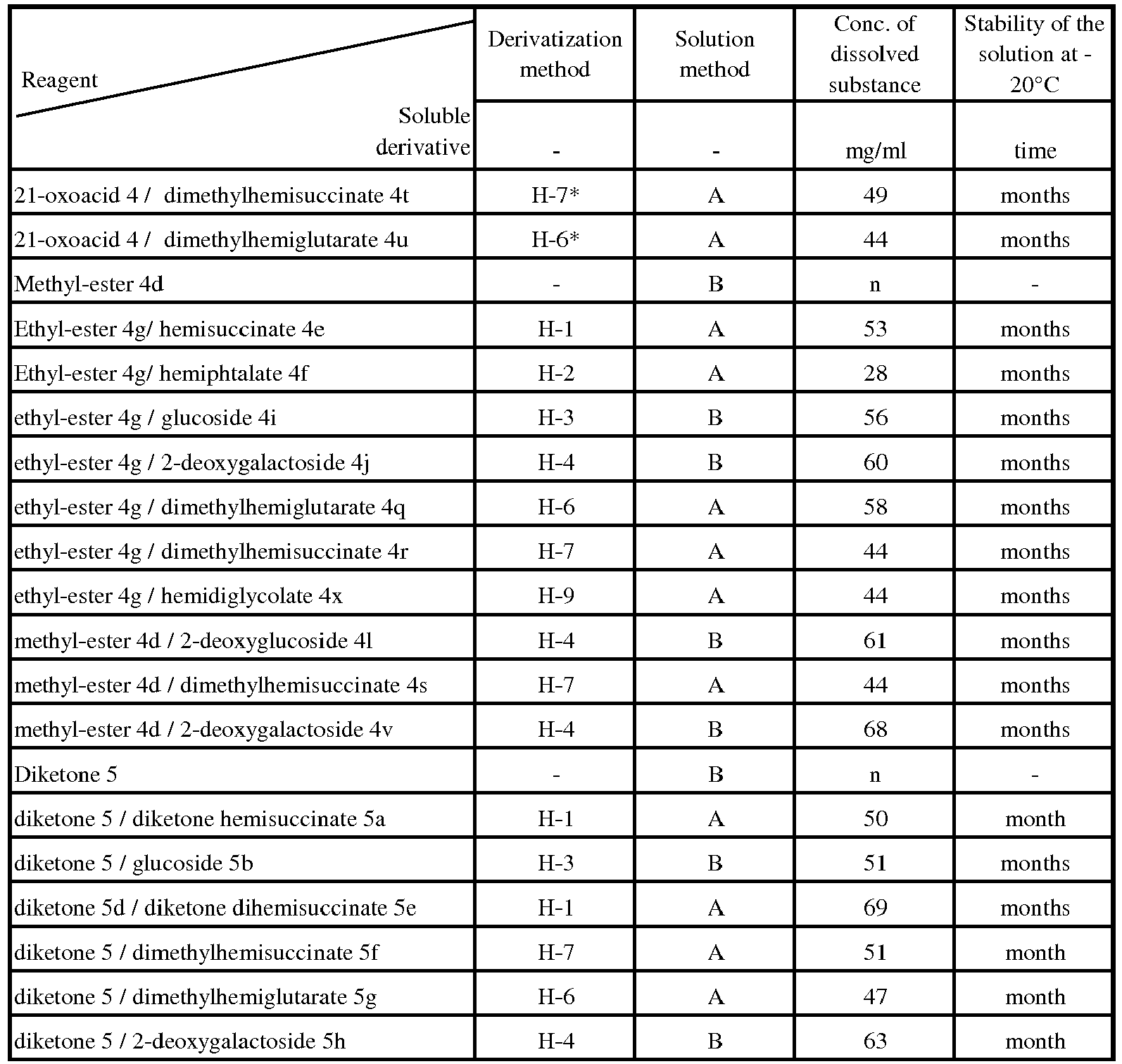
- All compounds described in the examples and their evaluated properties are summarized in Table 1 and represented in formulas 1 to 8.
- The general methods of derivatization of the insoluble pentacyclic and tetracyclic triterpenoids are designated H-1, H-1*, H-2, H-3, H-4, H-5, H-6, H-6*, H-7, H-7*, H-8, H-9, K-1 and are herein below demonstrated in specific examples. Method designations without asterisk stand for direct derivatization methods, whereas method designations with asterisk stand for derivatization methods going via benzyl-ester of triterpenic acid and leading to derivatives with two free carboxylic groups - one formed by the derivatization and the other being skeletal carboxylic group. The general methods of the preparation of the inclusion complex, comprising the dissolution of the substance, are designated A and B.
- Into a solution of betulin (1) (500 mg; 1.13 mmol) in pyridine (20 ml), succinic anhydride (1.2 g; 12.0 mmol) and N,N-dimethylaminopyridine, hereinafter DMAP (1.2 g; 10.0 mmol), were added and the reaction mixture was refluxed under stirring for 12 h. The course of the reaction was monitored by thin-layer chromatography, hereinafter TLC (hexane/ethyl acetate 1:1). The reaction mixture was then cooled down, diluted with ten-fold excess of water and extracted into ethyl acetate. Combined organic phases were shaken three times with 5% HCl, three times with water, dried with magnesium sulphate and the solvents were vacuum-dried at a rotary vacuum evaporator. The evaporate was purified by column chromatography on silica gel by gradient elution from 20% ethyl acetate in hexane to 100% ethyl acetate. The chromatographically uniform dihemisuccinate 1a was lyophilised from tert-butyl alcohol. The obtained hemisuccinate 1a (387 mg; 67 %) had the melting point 107 °C, [α]D = 10° (c = 0.44). 13C NMR spectrum: 14.8, 16.0, 16.1, 16.5, 18.1, 19.1, 20.8, 23.6, 25.2, 27.0, 27.9, 29.0, 29.0, 29.1, 29.3, 29.5, 29.6, 34.1, 34.4, 37.0, 37.6, 37.8, 38.4, 40.9, 42.7, 46.4, 47.7, 48.8, 50.3, 55.4, 63.2, 81.5, 109.9, 150.1, 171.8, 172.4, 177.8, 177.8.
- Into a solution of hydroxydiketone 5 (500 mg; 1.0 mmol) in the mixture of pyridine (15 ml) and tetrahydrofurane, hereinafter THF (5 ml), succinic anhydride (900 mg; 9.0 mmol) and DMAP (982 mg; 8.0 mmol) were added and the reaction mixture was refluxed under stirring for 12 h. The course of the reaction was monitored by TLC (hexane/ethyl acetate 1:1). The reaction mixture was then cooled down and worked-up analogically as in the preparation of the compound 1a. The chromatographically uniform hemisuccinate 5a was crystallized from the mixture acetonitrile/water. The obtained hemisuccinate 5a (383 mg; 64 %) had the m.p. 154 - 157 °C, [α]D = -99° (c = 0.24). 13C NMR spectrum: 16.1, 16.5, 16.7, 16.8, 18.0, 19.7, 19.8, 21.0, 23.5, 25.9, 27.4, 27.8, 27.9, 28.4, 28.9, 29.2, 34.5, 37.1, 37.8, 38.5, 41.5, 45.5, 46.1, 50.8, 50.8, 53.4, 55.4, 81.2, 150.6, 168.1, 171.0, 171.9, 177.6, 189.2, 194.3.
- To a mixture of betulinic acid (2) (500 mg; 1.1 mmol) and potassium carbonate (276 mg; 2.0 mmol) in N,N-dimethylformamide, hereinafter DMF (20 ml), benzylbromide (178 µl; 1,5 mmol) was added and the reaction mixture was stirred at room temperature for 24 h. The course of the reaction was monitored by TLC (toluene/diethyl ether 10:1). The reaction mixture was then diluted with ten-fold excess of water and extracted into ethyl acetate. Combined organic phases were shaken three times with 5% HCl, three times with water, dried with magnesium sulphate and the solvents were evaporated at a rotary vacuum evaporator. The evaporate was purified by column chromatography on silica gel, toluene being the mobile phase. The obtained crude benzyl betulinate (517 mg; 86 %) was used without purification in the next step.
- To a solution of benzyl betulinate (500 mg; 0.9 mmol) in pyridine (20 ml), succinic anhydride (900 mg; 9.0 mmol) and DMAP (982 mg; 8.0 mmol) were added and the reaction mixture was refluxed under stirring for 15 h. The course of the reaction was monitored by TLC (hexane/ethyl acetate 1:1). The reaction mixture was then cooled down, diluted with ten-fold excess of water and extracted into ethyl acetate. Combined organic extracts were shaken three times with 5% HCl, three times with water, dried with magnesium sulphate and the solvents were evaporated at a rotary vacuum evaporator. The evaporate was purified by column chromatography on silica gel by gradient elution from 10% ethyl acetate in hexane to 50% ethylacetate. The chromatographically uniform benzyl betulinate hemisuccinate was used in the next step without purification.
- To a solution of benzyl betulinate hemisuccinate (389 mg; 0,6 mmol) in the mixture of tetrahydrofurane (10 ml) and methanol (5 ml) palladium on carbon (50 mg; 10%) and 1,4-cyklohexadiene (568 µl; 6 mmol) were added and the reaction mixture was stirred at room temperature for 22 h. The course of the reaction was monitored by TLC (hexane/ethyl acetate 1:1). The reaction mixture was then filtered through diatomaceous earth and the eluate was evaporated at a rotary vacuum evaporator. By the crystallization of the evaporate from benzene, hemisuccinate 2e (366 mg; 91 %) having m.p. 265 °C, [α]D = 15° (c = 0.37) was obtained. 13C NMR spectrum: 14.6, 16.2, 16.2, 16.6, 18.2, 19.3, 20.9, 23.6, 25.4, 28.0, 29.2, 29.4, 29.7, 30.5, 32.1, 34.1, 37.1, 37.1, 37.9, 38.2, 38.4, 40.7, 42.4, 46.9, 49.2, 50.2, 55.3, 56.5, 81.5, 109.7, 150.3, 171.7, 178.3, 182.7.
- To a solution of ethyl betulinate (2a) (500 mg; 1.0 mmol) in pyridine (20 ml) phthalic anhydride (1.48 g; 10.0 mmol) and DMAP (366 mg; 3.0 mmol) were added and the reaction mixture was refluxed under stirring for 28 h. The course of the reaction was monitored by TLC (hexane/ethyl acetate 1:1). The reaction mixture was then cooled down and worked up and the product was purified analogically as in the preparation of the compound 1a. The chromatographically uniform hemiphthalate 2c was lyophilized from tert-butyl alcohol. The obtained hemiphthalate 2c (335 mg; 53 %) had m.p. 131 °C, [α]D = 26° (c = 0.45).
- To a solution of betuline (1) (500 mg; 1.13 mmol) in pyridine (20 ml), phthalic anhydride (1.33 g; 9.0 mmol) and DMAP (366 mg; 3.0 mmol) were added and the reaction mixture was refluxed under stirring for 37 h. The course of the reaction was monitored by TLC (hexane/ethyl acetate 1:1). The reaction mixture was then cooled down and worked up and the product was purified analogically as in the preparation of the compound 1a. The chromatographically uniform dihemiphthalate 1b was lyophilized from tert-butyl alcohol. The obtained dihemiphthalate 1b (633 mg; 76 %) had m.p. 178 - 180 °C, [α]D = 28° (c = 0.55).
-
- i) To a solution of ethylester 4g (1.00 g; 2.07 mmol) in dry acetonitrile (25 ml) 2,3,4,6-tetraacetyl-α-D-glucopyranosyl bromide (1.7 g; 4.1 mmol) and mercury cyanide (782 mg; 3.1 mmol) and the mixture was then refluxed under reflux condenser with the exclusion of air moisture. The course of the reaction was monitored by TLC (toluene/ether 6:1). The cooled-down reaction mixture was then bubbled through with moist hydrogensulphide, filtered through diatomaceous earth, the filtrate was diluted with ten-fold excess of water and extracted into ethyl acetate. Combined organic extracts were shaken three times with water, dried with magnesium sulphate and the solvents were evaporated at a rotary vacuum evaporator. The evaporate was purified by column chromatography on silica gel, toluene with diethyl ether gradient being the mobile phase. The obtained acetylated glucoside 4h (550 mg; 33 %) had m.p. 110 °C, [α]D =-33° (c = 0.32). IR spectrum: 1246 (C-O); 1609 (C=C); 1697, 1754 (C=O). 1H NMR spectrum: 0.73 s, 3H; 0.87 s, 3H; 0.90 s, 3H; 0.92 s, 3H; 1.02 s, 3H; 1.20 s, 3H; 1.22 s, 3H; (7×CH3); 1.26 t, 3H (J= 7.4; -CH2-CH3 ); 2.01 s, 3H; 2.03 s, 3H; 2.04 s, 3H; 2.09 s, 3H (4×CH3 COO); 2.46 d, 1H (J=18.6; H-22b); 2.46 m, 1H (ΣJ=12.0; H-16β); 2.68 dd, 1H (J1=12.7, J2=3.2; H-13β); 3.08 m, 1H, (ΣJ=16.4; H-3α); 3.20 septet, 1H (J=7.1; H-20); 3.69 m, 1H (J=20.0; H-5'); 4.10-4.28 m, 4H (O-CH2 , H-6'a,b); 4.54 d, 1H (J=8.1; H-1'); 5.01-5.09 m, 2H (H-4', H-2'); 5.18-5.24 m, 1H (ΣJ=24; H-3'). MS ESI m/z (%): [For C46H64O13, M+ 828], 829 ([M+H]+, 10); (851 ([M+Na]+, 40). Elemental analysis for C46H64O13: calculated C 66.64 %, H 8.27 %; found C 61.97 %, H 8.12%.
- ii) The obtained acetylated glucoside 4h (330 mg; 0.39 mmol) was mixed with dry methanol (10 ml) and metal sodium (5 mg) was added. The course of the reaction was monitored by reverse TLC (water/THF 1:1). The reaction mixture was then acidified with acetic acid to
pH 6 and evaporated at a rotary vacuum evaporator. Water was added to the evaporate and the resulting suspension was drained out and washed with water. The precipitate was dried in exsiccator over phosphorus(V) oxide. The obtained free glucoside 4i (180 mg; 0.28 mmol), 68 %) had m.p. 196.0 °C, [α]D = -46° (c = 0.29). IR spectrum: 1609 (C=C); 1697, 1724 (C=O); 3411 (O-H). 1H NMR spectrum: 0.82 s, 3H; 0.89 s, 3H; 0.93 s, 3H; 1.02 s, 3H; 1.03 s, 3H; 1.20 s, 3H; 1.21 s, 3H (7×CH3); 1.25 t, 3H (J=7.2; -CH2-CH3 ); 2.14 d, 1H (J=18.5; H-22b); 2.45 d, 1H (J=18.8; H-22a); 2.42-2.52 m, 1H (ΣJ=40; H-16β); 2.68 dd, 1H (J1=12.8, J2=2.6; H-13β); 3.13-3.50 m, 6H (H-3α, H-20, H-5', H-3', H-4', H-2'); 3.75-3.87 m, 2H (H-6'a,b); 4.10-4.24 m, 2H (O-CH2 ); 3.79 d, 1H (J=7,6; H-1'). MS ESI m/z (%): [For C38H6O9, M+ 660], 683 ([M+Na]+, 60). Elemental analysis for C38H6O9: calculated C 66.06 %, H 9.15 %; found C 66.39 %, H 8.98 %. -
- i) Into a solution of the triterpenic hydroxyderivative 4g (500 mg; 1.0 mmol) in dry acetonitrile (30 ml), tri-O-acetylgalactal (1.2 mmol), molecular sieve 4A (500 mg), lithium bromide (730 mg) and dried cation exchange resin in H+ cycle (900 mg) were added. The reaction mixture was stirred at room temperature for 12 hours. The course of the reaction was monitored by thin-layer chromatography, the mobile phase being hexane:ethyl acetate 2:1. The reaction mixture was then filtered through a diatomaceous earth layer and the column was then washed with ethyl acetate. The reaction mixture was diluted with water (50 ml), extracted with ethyl acetate (
2x 20 ml) and the organic phase was evaporated on a rotary vacuum evaporator. The evaporate was dissolved in chloroform (5 ml) and the solution was poured over a short column of silica gel (elution with ethyl acetate). The eluate was evaporated on a rotary vacuum evaporator. The crude product was then separated by column chromatography on silica gel, elution with toluene. The product was then lyophilized from 2-methylpropan-2-ol, white lyophilizate was obtained 4j (360 mg; 47 %) having melting point 100.8 °C, [α]D = +38.9° (c = 0.52). - ii) 2-deoxygalactoside 4j (200 mg; 0.26 mmol) was dissolved in dry methanol (300 ml) and catalytic amount of sodium (5 mg) was added into the solution. The course of the reaction was monitored by thin-layer chromatography on reverse phase (mobile phase water/tetrahydrofurane 1:1). The reaction mixture was neutralized with acetic acid and evaporated on a rotary vacuum evaporator. To the evaporate, water (300 ml) was added and the yielded precipitate of the product was filtered off. The filtration cake was washed with water. Obtained was white crystalline 2-deoxyglucoside 4k (161 mg; 97 %) having melting point of 158.0 °C and [α]D = +17.2° (c = 0.51).
-
- i) Into a solution of the triterpenic hydroxyderivative 4d (500 mg; 1.0 mmol) in dry acetonitrile (30 ml), tri-O-acetylglucal (1.2 mmol), molecular sieve 4A (500 mg), lithium bromide (730 mg) and dried cation exchange resin in H+ cycle (900 mg) were added. The reaction mixture was stirred at room temperature for 12 hours. The course of the reaction was monitored by thin-layer chromatography, the mobile phase being hexane:ethyl acetate 2:1. The reaction mixture was then filtered through a diatomaceous earth layer, and the column was washed with ethyl acetate. The reaction mixture was diluted with water (50 ml), extracted with ethyl acetate (
2x 20 ml) and the organic phase was evaporated on a rotary vacuum evaporator. The evaporate was dissolved in chloroform (5 ml) and the solution was poured over a short column of silica gel (elution with ethyl acetate). The eluate was evaporated on a rotary vacuum evaporator. The crude product was then separated by column chromatography on silica gel, eluted with toluene. The product was then lyophilized from 2-methylpropan-2-ol, obtained was white lyophilizate 41 (245 mg; 34 %), melting point 204.1 °C, [α]D = +24.2 (c = 0.43). - ii) 2-deoxyglucoside 41 (60 mg; 0.08 mmol) was dissolved in dry methanol (100 ml) and a catalytic amount of sodium (5 mg) was added into the solution. The course of the reaction was monitored by thin-layer chromatography on reverse phase (mobile phase water:tetrahydrofurane 1:1). The reaction mixture was neutralized with acetic acid and evaporated on a rotary vacuum evaporator. To the evaporate, water (100 ml) was added and the yielded precipitate of the product was filtered off. The filtration cake was washed with water. Obtained was white crystalline 2-deoxyglucoside 4m (39 mg; 74 %) having the melting point of 208.0 °C, [α]D = +14.0 (c = 0.40). 13C NMR spectrum: 15.7, 16.1, 16.5, 16.6, 18.0, 19.7, 19.8, 21.0, 21.6, 24.9, 27.5, 28.3, 28.9, 33.5, 34.7, 37.0, 37.6, 38.2, 38.3, 41.1, 45.1, 45.2, 47.4, 50.9, 52.4, 53.0, 55.4, 62.7, 68.6, 71.2, 72.1, 81.4, 93.1, 174.9, 145.5, 172.7, 208.0. MS m/z (%): [For C3H58O8, M+ 630], 653 ([M+Na]+, 30), 631 ([M+H]+, 30). For C37H58O8 (630.9) calculated: C 70.44 %, H 9.27 %. Found: C 70.58 %, H 9.13 %.
- Into a solution of methyl betulinate (2h) (500 mg; 0.94 mmol) in 2,4,6-trimethylpyridine (10 ml), glutaric anhydride (1.15 g; 10 mmol) and DMAP (50 mg; 0.4 mmol) were added and the reaction mixture was refluxed while stirring for 8 hours. The course of the reaction was monitored by TLC (toluene/diethyl ether 2:1). The reaction mixture was then cooled down, diluted with ten-fold excess of water and extracted into ethyl acetate. Combined organic phases were shaken three times with 5% HCl, three times with water, dried with magnesium sulphate and the solvents were evaporated on a rotary vacuum evaporator. The evaporate was purified by column chromatography on silica gel by gradient elution from 8% ethyl acetate in hexane to 25% ethyl acetate in hexane. By crystallization from 2,2,4-trimethylpentane hemiglutarate 2i (386 mg; 62 %) was obtained in the form of white crystals having m.p. 165 °C, [α]D +17.5 (c 0.32). IR spectrum: 1230 (C-O), 1641 (C=C), 1716 (C=O), 2430 - 3500 (COOH), 3521 (O-H). 1H NMR spectrum: 0.83 s, 3H; 0.83 s, 3H; 0.84 s, 3H; 0.91 s, 3H; 0.96s, 3H; 1.69 s, 3H, (6×CH3); 1.87-1.90 m, 2H; 1.92-2.00 pentet, 2H (J=7.2 Hz, H-33); 2.16-2.25 m, 2H; 2.37-2.41 t, 2H (J=7.3 Hz, H-32); 2.41-2.45 t, 2H (J=7.3 Hz, H-34); 3.00 m, 1H; 3.67 s, 3H (OCH3 ); 4.46-4.50 m, 1H (H-3α); 4.60 s, 1H (H-29 pro-E); 4.73 s, 1H (H-29 pro-Z). 13C NMR spectrum: 14.68, 15.94, 16.16, 16.54, 18.18, 19.34, 20.00, 20.89, 23.73, 25.46, 27.99, 29.66, 30.59, 32.16, 32.93, 33.64, 34.24, 36.96, 37.10, 37.82, 38.24, 38.36, 40.68, 42.38, 46.99, 49.45, 50.44, 51.25, 55.41, 56.55, 81.10, 109.61, 150.54, 172.62, 176.68, 178.27. MS, m/z (%): [Pro C36H56O6, M+ 584], 584 (M+, 3), 569 (2), 552 (1), 524 (3), 509 (1), 466 (1), 452 (15), 437 (7), 409 (5), 393 (4), 273 (3), 262 (12), 249 (6), 233 (5), 215 (6), 203 (14), 189 (37). Elemental analysis for C36H56O6: calculated C 73.93 %, H 9.65 %; found C 73.79 %, H 9.81 %.
- Into a solution of ethyl ester 4g (500 mg; 0.99 mmol) in 2,4,6-trimethylpyridine (10 ml), 3,3-dimethylglutaric anhydride (600 mg; 2.4 mmol) and DMAP (50 mg; 0.4 mmol) were added and the reaction mixture was refluxed while stirring for 8 hours. The course of the reaction was monitored by TLC (toluene/diethyl ether 5:1). The reaction mixture was then cooled down, diluted with ten-fold excess of water and extracted into ethyl acetate. Combined organic phases were shaken three times with 5% HCl, three times with water, dried with magnesium sulphate and the solvents were evaporated on a rotary vacuum evaporator. The evaporate was purified by column chromatography on silica gel by gradient elution from 8% ethyl acetate in hexane to 25% ethyl acetate in hexane. The chromatographically uniform dimethyl hemiglutarate 4q was lyophilized from tert-butylalcohol (375 mg; 59 %). 13C NMR spectrum: 14.15, 15.91, 16.62, 16.76, 18.11, 19.93, 20.16, 21.25, 23.68, 23.83, 24.03, 25.10, 27.63, 29.08, 30.80, 32.70, 33.51, 33.84, 34.79, 35.41, 37.12, 37.67, 37.81, 38.53, 41.29, 45.12, 45.52, 47.61, 50.99, 52.98, 55.43, 61.01, 81.24, 145.67, 171.82, 172.41, 174.32, 175.87, 207.36.
-
- i) Into a solution of benzyl 3β-hydroxy-21-oxolup-18-en-28-oate (500 mg; 0.89 mmol) in 2,4,6-trimethylpyridine (10 ml), 2,2-dimethylsuccinic anhydride (500 mg; 2.3 mmol) and DMAP (50 mg; 0.4 mmol) were added and the reaction mixture was refluxed while stirring for 8 hours. The course of the reaction was monitored by TLC (toluene/diethyl ether 5:1). The reaction mixture was then cooled down, diluted with ten-fold excess of water and extracted into ethyl acetate. Combined organic phases were shaken three times with 5% HCl, three times with water, dried with magnesium sulphate and the solvents were evaporated on a rotary vacuum evaporator. The evaporate was purified by column chromatography on silica gel by gradient elution from 8% ethyl acetate in hexane to 25% ethyl acetate in hexane. The chromatographically uniform benzyl 3β-(3',3'-dimethylsuccinyloxy)-21-oxolup-18-en-28-oate was lyophilized from tert-butylalcohol (380 mg; 55 %). 13C NMR spectrum: 15.85, 16.43, 16.50, 16.73, 18.04, 19.89, 20.25, 21.04, 23.52, 25.01, 25.10, 25.59, 27.54, 27.86, 28.87, 33.43, 34.77, 37.05, 37.69, 38.53, 40.44, 40.74, 41.19, 44.67, 45.05, 45.16, 47.41, 50.96, 52.91, 55.41, 66.52, 81.32, 128.34, 128.58, 135.80, 145.62, 170.92, 171.84, 173.89, 176.24, 207.30.
- ii) Into a solution of benzyl 3β-(3',3'-dimethylhemisukcinyloxy)-21-oxolup-18-en-28-oate (380 mg; 0.55 mmol) in ethanol (10 ml) and tetrahydrofurane (THF) (10 ml), cyklohexadiene (200 µl; 2.14 mmol) and Pd/C (150 mg; 10%) were added and the reaction mixture was stirred for 48 hours at laboratory temperature. The course of the reaction was monitored by TLC (toluene/diethyl ether 5:1). The reaction mixture was then filteres through a paper filter and the solvents were evaporated on a rotary vacuum evaporator. The dimethyl succinate 4t was lyophilized from tert-butylalcohol (312 mg; 95 %). 13C NMR spectrum: 15.85, 16.43, 16.50, 16.73, 18.04, 19.89, 20.25, 21.04, 23.52, 25.01, 25.10, 25.59, 27.54, 27.86, 28.87, 33.43, 34.77, 37.05, 37.69, 38.53, 40.44, 40.74, 41.19, 44.67, 45.05, 45.16, 47.41, 50.96, 52.91, 55.41, 81.32, 170.92, 171.84, 173.89, 176.24, 207.30.
- Into a solution of methyl betulinate (2h) (500 mg; 0.94 mmol) in 2,4,6-trimethylpyridine (10 ml), cis-1,2,3,6-tetrahydrophthalic anhydride (760 mg; 5 mmol) and DMAP (50 mg; 0.4 mmol) were added and the reaction mixture was refluxed while stirring for 8 hours. The course of the reaction was monitored by TLC (toluene/diethyl ether 5:1). The reaction mixture was then cooled down, diluted with ten-fold excess of water and extracted into ethyl acetate. Combined organic phases were shaken three times with 5% HCl, three times with water, dried with magnesium sulphate and the solvents were evaporated on a rotary vacuum evaporator. The evaporate was purified by column chromatography on silica gel by gradient elution from 8% ethyl acetate in hexane to 25% ethyl acetate in hexane. By crystallization from isooctane, hemitetrahydrophthalate 2m (510 mg; 78 %) was obtained in the form of white crystals having m.p. 224 °C, [α]D+9.5 (c 0.32). IR spectrum: 1235 (C-O), 1641 (C=C), 1716 (C=O), 2250 - 3490 (COOH), 3512 (O-H). 1H NMR spectrum: 0.80 s, 3H; 0.81 s, 3H; 0.83 s, 3H; 0.91 s, 3H; 0.96 s, 3H; 1.69 s, 3H, (6×CH3); 1.84-1.93 m, 2H; 2.18-2.25 m, 2H; 2.33-2.66 m, 4H (H-33, H-36); 3.00 m, 1H; 3.07-3.15 m, 2H (H-32, H-37); 3.67 s, 3H (OCH3 ); 4.47-4.53 m, 1H (H-3α); 4.60 s, 1H (H-29 pro-E); 4.73 s, 1H (H-29 pro-Z); 5.69 d, 2H (J=7.6 Hz, H-34, H-35). 13C NMR spectrum: 14.69, 15.94, 16.11, 16.51, 18.14, 19.33, 20.89, 23.51, 25.31, 25.45, 26.34, 27.80, 29.65, 30.58, 32.15, 34.22, 36.94, 37.08, 37.86, 38.23, 38.36, 39.67, 39.90, 40.68, 42.38, 46.98, 49.44, 50.40, 51.24, 55.43, 56.54, 81.61, 109.61, 125.11, 125.39, 150.54, 172.81, 176.66, 178.84. MS, m/z (%): [Pro C39H58O6, M+ 622], 622 (M+, 4), 607 (2), 579 (1), 562 (5), 452 (52), 437 (17), 409 (13), 393 (15), 273 (6), 262 (25), 249 (14), 233 (7), 215 (13), 203 (41), 189 (100). Elemental analysis: for C39H58O6 (622) calculated: C 75.20 %, H 9.39 %; found: C 75.08 %, H 9.48 %.
- Into a solution of ethyl ester 4g (500 mg; 0.99 mmol) in 2,4,6-trimethylpyridine (10 ml), diglycolic anhydride (500 mg; 2.3 mmol) and DMAP (50 mg; 0.4 mmol) were added and the reaction mixture was refluxed while stirring for 8 hours. The course of the reaction was monitored by TLC (toluene/diethyl ether 5:1). The reaction mixture was then cooled down, diluted with ten-fold excess of water and extracted into ethyl acetate. Combined organic phases were shaken three times with 5% HCl, three times with water, dried with magnesium sulphate and the solvents were evaporated on a rotary vacuum evaporator. The evaporate was purified by column chromatography on silica gel by gradient elution from 8% ethyl acetate in hexane to 25% ethyl acetate in hexane. The chromatographically uniform diglycolate 4x was lyophilized from tert-butylalcohol (406 mg; 66 %). 13C NMR spectrum: 14.16, 15.92, 16.51, 16.62, 16.77, 18.12, 19.98, 20.15, 21.30, 23.57, 25.13, 26.38, 27.48, 27.62, 28.04, 29.09, 29.68, 33.50, 34.77, 37.09, 37.86, 38.51, 41.29, 45.10, 47.61, 51.01, 52.96, 55.36, 61.05, 145.66, 171.66, 172.58, 174.27, 175.43, 207.27. (toluene/diethyl ether 5:1). The reaction mixture was then cooled down, diluted with ten-fold excess of water and extracted into ethyl acetate. Combined organic phases were shaken three times with 5% HCl, three times with water, dried with magnesium sulphate and the solvents were evaporated on a rotary vacuum evaporator. The evaporate was purified by column chromatography on silica gel by gradient elution from 8% ethyl acetate in hexane to 25% ethyl acetate in hexane. The chromatographically uniform benzyl 3β-(3',3'-dimethylsuccinyloxy)-21-oxolup-18-en-28-oate was lyophilized from tert-butylalcohol (380 mg; 55 %). 13C NMR spectrum: 15.85, 16.43, 16.50, 16.73, 18.04, 19.89, 20.25, 21.04, 23.52, 25.01, 25.10, 25.59, 27.54, 27.86, 28.87, 33.43, 34.77, 37.05, 37.69, 38.53, 40.44, 40.74, 41.19, 44.67, 45.05, 45.16, 47.41, 50.96, 52.91, 55.41, 66.52, 81.32, 128.34, 128.58, 135.80, 145.62, 170.92, 171.84, 173.89, 176.24, 207.30.
- ii) Into a solution of benzyl 3β-(3',3'-dimethylhemisukcinyloxy)-21-oxolup-18-en-28-oate (380 mg; 0.55 mmol) in ethanol (10 ml) and tetrahydrofurane (THF) (10 ml), cyklohexadiene (200 µl; 2.14 mmol) and Pd/C (150 mg; 10%) were added and the reaction mixture was stirred for 48 hours at laboratory temperature. The course of the reaction was monitored by TLC (toluene/diethyl ether 5:1). The reaction mixture was then filteres through a paper filter and the solvents were evaporated on a rotary vacuum evaporator. The dimethyl succinate 4t was lyophilized from tert-butylalcohol (312 mg; 95 %). 13C NMR spectrum: 15.85, 16.43, 16.50, 16.73, 18.04, 19.89, 20.25, 21.04, 23.52, 25.01, 25.10, 25.59, 27.54, 27.86, 28.87, 33.43, 34.77, 37.05, 37.69, 38.53, 40.44, 40.74, 41.19, 44.67, 45.05, 45.16, 47.41, 50.96, 52.91, 55.41, 81.32, 170.92, 171.84, 173.89, 176.24, 207.30.
- Into a solution of methyl betulinate (2h) (500 mg; 0.94 mmol) in 2,4,6-trimethylpyridine (10 ml), cis-1,2,3,6-tetrahydrophthalic anhydride (760 mg; 5 mmol) and DMAP (50 mg; 0.4 mmol) were added and the reaction mixture was refluxed while stirring for 8 hours. The course of the reaction was monitored by TLC (toluene/diethyl ether 5:1). The reaction mixture was then cooled down, diluted with ten-fold excess of water and extracted into ethyl acetate. Combined organic phases were shaken three times with 5% HCl, three times with water, dried with magnesium sulphate and the solvents were evaporated on a rotary vacuum evaporator. The evaporate was purified by column chromatography on silica gel by gradient elution from 8% ethyl acetate in hexane to 25% ethyl acetate in hexane. By crystallization from isooctane, hemitetrahydrophthalate 2m (510 mg; 78 %) was obtained in the form of white crystals having m.p. 224 °C, [α]D+9.5 (c 0.32). IR spectrum: 1235 (C-O), 1641 (C=C), 1716 (C=O), 2250 - 3490 (COOH), 3512 (O-H). 1H NMR spectrum: 0.80 s, 3H; 0.81 s, 3H; 0.83 s, 3H; 0.91 s, 3H; 0.96 s, 3H; 1.69 s, 3H, (6×CH3); 1.84-1.93 m, 2H; 2.18-2.25 m, 2H; 2.33-2.66 m, 4H (H-33, H-36); 3.00 m, 1H; 3.07-3.15 m, 2H (H-32, H-37); 3.67 s, 3H (OCH3 ); 4.47-4.53 m, 1H (H-3α); 4.60 s, 1H (H-29 pro-E); 4.73 s, 1H (H-29 pro-Z); 5.69 d, 2H (J=7.6 Hz, H-34, H-35). 13C NMR spectrum: 14.69, 15.94, 16.11, 16.51, 18.14, 19.33, 20.89, 23.51, 25.31, 25.45, 26.34, 27.80, 29.65, 30.58, 32.15, 34.22, 36.94, 37.08, 37.86, 38.23, 38.36, 39.67, 39.90, 40.68, 42.38, 46.98, 49.44, 50.40, 51.24, 55.43, 56.54, 81.61, 109.61, 125.11, 125.39, 150.54, 172.81, 176.66, 178.84. MS, m/z (%): [Pro C39H58O6, M+ 622], 622 (M+, 4), 607 (2), 579 (1), 562 (5), 452 (52), 437 (17), 409 (13), 393 (15), 273 (6), 262 (25), 249 (14), 233 (7), 215 (13), 203 (41), 189 (100). Elemental analysis: for C39H58O6 (622) calculated: C 75.20 %, H 9.39 %; found: C 75.08 %, H 9.48 %.
- Into a solution of ethyl ester 4g (500 mg; 0.99 mmol) in 2,4,6-trimethylpyridine (10 ml), diglycolic anhydride (500 mg; 2.3 mmol) and DMAP (50 mg; 0.4 mmol) were added and the reaction mixture was refluxed while stirring for 8 hours. The course of the reaction was monitored by TLC (toluene/diethyl ether 5:1). The reaction mixture was then cooled down, diluted with ten-fold excess of water and extracted into ethyl acetate. Combined organic phases were shaken three times with 5% HCl, three times with water, dried with magnesium sulphate and the solvents were evaporated on a rotary vacuum evaporator. The evaporate was purified by column chromatography on silica gel by gradient elution from 8% ethyl acetate in hexane to 25% ethyl acetate in hexane. The chromatographically uniform diglycolate 4x was lyophilized from tert-butylalcohol (406 mg; 66 %). 13C NMR spectrum: 14.16, 15.92, 16.51, 16.62, 16.77, 18.12, 19.98, 20.15, 21.30, 23.57, 25.13, 26.38, 27.48, 27.62, 28.04, 29.09, 29.68, 33.50, 34.77, 37.09, 37.86, 38.51, 41.29, 45.10, 47.61, 51.01, 52.96, 55.36, 61.05, 145.66, 171.66, 172.58, 174.27, 175.43, 207.27.
- Method A: In a mixture of water (26.0 ml), sodium hydrogencarbonate solution (5.0 ml; saturated solution) and ethanol (7.0 ml; 99%), 2-hydroxypropyl-γ-cyklodextrin (10.0 g) is dissolved at the temperature of 50 °C under vigorous stirring. Into the resulting colourless, viscous solution, soluble triterpene derivative (1.50 g) is added at once and the mixture is again vigorously stirred at the temperature of 50 °C. 20 to 40 min of stirring is usually necessary for a complete dissolution. After the triterpenoid is completely dissolved, the resulting clear solution is cooled to room temperature, filtered with a syringe filter (hydrophilic, pore size 0.22 µm) in order to be sterile and is placed in a refrigerator. The obtained solution can be stored in a freezer at - 20 °C until further use without any perceptible decomposition.
- Method B: In a mixture of water (14.0 ml) and propylene glycol (6.0 ml), 2-hydroxypropyl-y-cyklodextrin (7.00 g) is dissolved at the temperature of 50 °C under vigorous stirring. Into the resulting colourless, viscous solution, soluble triterpene derivate (1.00 g) is added at once and is again vigorously stirred at the temperature of 50 °C. 20 to 40 min of stirring is usually necessary for a complete dissolution. After the triterpenoid is completely dissolved, the resulting clear solution is cooled to room temperature, filtered with a syringe filter (hydrophilic, pore size 0.22 µm) in order to be sterile and is placed in a refrigerator. The obtained solution can be stored in a freezer at - 20 °C until further use without any perceptible decomposition.
- Soluble cyclodextrin formulations of terpenoid compounds, prepared in accordance with the aforementioned methods A or B, were administered without dilution to outbred mice CD-1 intragastrically (200 µl in a single dose) as aqueous solutions by injection syringe equipped with a gastric tube. Insoluble compounds were administered intragastrically as well (200 µl in a single dose), but in the form of aqueous suspensions in 0.5-1% carboxymethyl cellulose. In
time intervals - HPLC-ESI MS technique was used or the determination of the concentration of dissolved triterpenoids. The samples were measured in one analytical batch with calibration solutions and blind control. The sample for the measurement was prepared from 50 µl of aqueous solution containing the inclusion compound by dilution with methanol to the volume of 10 ml. Subsequently, 10 µl of the sample solution after the first dilution is further diluted to 1 ml by the mobile phase. The blind control was obtained from 50 µl of pre-prepared aqueous solution of 2-hydroxypropyl-γ-cyklodextrin by dilution with methanol to 10 ml. Subsequently, 10 µl of the blind control solution after the first dilution is further diluted to 1 ml by methanol. Stock solutions of standards (concentration 0.2 mg/ml) were prepared by weighing 2.00 mg of analyte to 10 ml graduated flask and dissolution in methanol. The calibration samples were then prepared by dilution of the stock solution with mobile phase (0.4 µg/ml resp. 4 µg/ml).
- The analysis was carried out at ODS Hypersil 125 x 2.1 mm, 5um, SN 0745415X, Thermo EC column, ODS 4.0 x 3.0 mm precolumn, Phenomenex, mobile phase A - 100 mmol/L aqueous solution of ammonium formate, pH is adjusted to 5 by formic acid, B - 100 mmol/L methanolic solution of ammonium formate, column temperature: 25 °C, linear gradient or isocratic elution, injected
volume 30 µl. The concentration was determined by comparison with standard and calculated to the original solution containing the inclusion compound. - The pharmacokinetic profiles of selected derivatives at oral administration to mice (compounds 2b, 3, 3b, 5a, 5e, 4v, 4i, 2i, 4t were administered as cyclodextrin formulations, compounds 5c, 5d, as carboxymethyl cellulose suspensions) are shown in
Fig. 1 to 10 . The results prove oral availability of the soluble cyclodextrin terpenoid formulations, but not of the insoluble suspensions.


Claims (12)
- A method of preparation of a soluble formulation of water-insoluble pentacyclic and tetracyclic triterpenoids, characterized in that the water-insoluble triterpenoid having a free hydroxy functional group is derivatized on this functional group with a substituent selected from the group comprisinga) substituents of general formula Xa bound to the hydroxy group of the terpenoid, wherein Xa is -OC-R-COOH, wherein R is linear or branched C1 to C8 alkylene, linear or branched C3 to C8 oxaalkylene, linear or branched C1 to C8 alkenylene, C6 cycloalkylene, C6 cycloalkenylene, C6 arylene unsubstituted or substituted with halogen, hydroxyl or amino group:
 b) glycosylic substituents Xe bound by α or β glycosidic bond to the hydroxy group of the terpenoid, wherein Xe is selected from the group comprising glucosyl, galactosyl, arabinosyl, rhamnosyl, lactosyl, cellobiosyl, maltosyl and the 2-deoxyanalogues thereof:and subsequently, the prepared derivative is dissolved in a solution containing water, a native or substituted γ-cyclodextrin and optionally pharmaceutically acceptable auxiliary substances, forming an inclusion derivative with the γ-cyclodextrin.
- The method according to claim 1, characterized in that the substituents of general formula Xa are selected from the group comprising succinate, glutarate, 3',3'-dimethylglutarate, 3',3'-dimethylsuccinate, tetrahydrophthalate, diglycolate or phthalate.
- The method according to claim 1, characterized in that the substituents of general formula Xe are selected from the group comprising glucosyl, galactosyl, lactosyl and the 2-deoxyanalogues thereof.
- The method according to any of claims 1 to 3, characterized in that the auxiliary substances are biocompatible organic solvents and/or compounds facilitating the formation of inclusion complexes selected from alkali carbonates or hydrogen carbonates.
- The method according to claim 4, characterized in that the biocompatible organic solvents are ethanol or propylene glycol.
- A soluble formulation of a pentacyclic or tetracyclic triterpenoid, containing an inclusion complex of the pentacyclic or tetracyclic terpenoid having its hydroxy group derivatized with a substituent selected from the group comprising:a) substituents of general formula Xa bound to the hydroxy group of the terpenoid, wherein Xa is -OC-R-COOH, wherein Xa is -OC-R-COOH, wherein R is linear or branched C1 to C8 alkylene, linear or branched C3 to C8 oxaalkylene, linear or branched C1 to C8 alkenylene, C6 cycloalkylene, C6 cycloalkenylene, C6 arylene unsubstituted or substituted with halogen, hydroxyl or amino group;b) glycosylic substituents Xe bound by α or β glycosidic bound to the hydroxy group of the terpenoid, wherein Xe is selected from the group comprising glucosyl, galactosyl, arabinosyl, rhamnosyl, lactosyl, cellobiosyl, maltosyl and the 2-deoxyanalogues thereof,with a native or substituted γ-cyclodextrin, and optionally water and pharmaceutically acceptable auxiliary substances.
- The soluble formulation according to claim 6, characterized in that the substituents of general formula Xa are selected from the group comprising succinate, glutarate, 3',3'-dimethylglutarate, 3',3'-dimethylsuccinate, tetrahydrophthalate, diglycolate or phthalate.
- The soluble formulation according to claim 6, characterized in that the substituents of general formula Xe are selected from the group comprising glucosyl, galactosyl, lactosyl and the 2-deoxyanalogues thereof.
- The soluble formulation according to any of claims 6 to 8, characterized in that the auxiliary substances are biocompatible organic solvents and compounds facilitating the formation of inclusion complexes selected from alkali carbonates or hydrogen carbonates.
- The soluble formulation according to claim 9, characterized in that the biocompatible organic solvents are ethanol or propylene glycol
- A pharmaceutical composition, characterized in that it contains the soluble formulation according to any of claims 6 to 10 and a pharmaceutically acceptable solvent.
- The pharmaceutical composition according to claim 11, characterized in that the pharmaceutically acceptable solvent is water.
Applications Claiming Priority (2)
| Application Number | Priority Date | Filing Date | Title |
|---|---|---|---|
| CZ20060606A CZ300722B6 (en) | 2006-09-27 | 2006-09-27 | Process for preparing inclusion complex of pentacyclic and tetracyclic terpenoids, process for preparing pharmaceutical composition containing this inclusion complex, inclusion complex of pentacyclic or tetracyclic terpenoid and pharmaceutical compos |
| PCT/CZ2007/000088 WO2008037226A2 (en) | 2006-09-27 | 2007-09-25 | Method of preparation of a soluble formulation of water-insoluble pentacyclic and tetracyclic terpenoids, a soluble formulation of a pentacyclic or tetracyclic terpenoid and a pharmaceutical composition containing this soluble formulation |
Publications (2)
| Publication Number | Publication Date |
|---|---|
| EP2068882A2 EP2068882A2 (en) | 2009-06-17 |
| EP2068882B1 true EP2068882B1 (en) | 2017-08-23 |
Family
ID=39081570
Family Applications (1)
| Application Number | Title | Priority Date | Filing Date |
|---|---|---|---|
| EP07801129.3A Not-in-force EP2068882B1 (en) | 2006-09-27 | 2007-09-25 | Method of preparation of a soluble formulation of water-insoluble pentacyclic and tetracyclic terpenoids, a soluble formulation of a pentacyclic or tetracyclic terpenoid and a pharmaceutical composition containing this soluble formulation |
Country Status (6)
| Country | Link |
|---|---|
| US (1) | US8653056B2 (en) |
| EP (1) | EP2068882B1 (en) |
| JP (1) | JP2010504921A (en) |
| CA (2) | CA2666437C (en) |
| CZ (1) | CZ300722B6 (en) |
| WO (1) | WO2008037226A2 (en) |
Families Citing this family (5)
| Publication number | Priority date | Publication date | Assignee | Title |
|---|---|---|---|---|
| CZ2008528A3 (en) * | 2008-09-01 | 2009-11-18 | Univerzita Karlova v Praze, Prírodovedecká fakulta | Triterpenoid derivatives for treating tumor diseases and pharmaceutical composition in which the derivatives are comprised |
| CZ301318B6 (en) * | 2008-11-13 | 2010-01-13 | Univerzita Palackého v Olomouci | 2-Deoxyglycosides of triterpenoids, process of their preparation and their use as medicament |
| JP6372025B2 (en) * | 2014-05-13 | 2018-08-15 | 日本製粉株式会社 | Chewing composition containing triterpenes |
| JP2019052105A (en) * | 2017-09-14 | 2019-04-04 | 国立大学法人静岡大学 | Oleanolic acid derivative |
| WO2023149727A1 (en) * | 2022-02-02 | 2023-08-10 | Sang Hyun Pyo | Novel betulin derivatives, and their manufacturing method and use as surfactant |
Family Cites Families (16)
| Publication number | Priority date | Publication date | Assignee | Title |
|---|---|---|---|---|
| DE2659466A1 (en) * | 1976-12-30 | 1979-02-15 | Roecar Holdings Nv | STEROLINE AND THEIR USE |
| JPH07583B2 (en) * | 1990-11-21 | 1995-01-11 | 北海道糖業株式会社 | Water-soluble pentacyclic triterpene clathrate compound, method for producing the same, and food, beverage and oral composition using the same |
| JPH04316597A (en) * | 1991-04-12 | 1992-11-06 | Kyokuto Internatl Corp | Ferulic acid ester of triterpene alcohol-branched cyclodextrin molecular compound |
| JP4105258B2 (en) * | 1997-08-19 | 2008-06-25 | 大塚製薬株式会社 | Cholestanol compound and medicine containing the same |
| US6403816B1 (en) * | 1997-09-30 | 2002-06-11 | Dabur Research Foundation | Betulinic acid derivatives having antiangiogenic activity, processes for producing such derivatives and their use for treating tumor associated angiogenesis |
| JP3282583B2 (en) * | 1998-05-08 | 2002-05-13 | 株式会社微生物化学研究所 | Adjuvant composition, vaccine using the same and novel saponin |
| KR20010080507A (en) * | 1998-11-18 | 2001-08-22 | 추후보정 | Novel betulinic acid derivatives, processes for preparing such derivatives and its use as cancer growth inhibitors |
| JP4351314B2 (en) * | 1998-12-24 | 2009-10-28 | 大塚製薬株式会社 | Cholestanol compound and medicine containing the same |
| GB2362648A (en) * | 2000-05-23 | 2001-11-28 | Univerzita Palackeho V Olomouc | Triterpenoid derivatives |
| JP5052730B2 (en) * | 2000-08-15 | 2012-10-17 | ブリガム ヤング ユニバーシティ | Steroid-derived antibiotics |
| DE10146500A1 (en) * | 2001-09-21 | 2003-04-17 | Beiersdorf Ag | Cosmetic and / or dermatological combination of active ingredients |
| GB0128071D0 (en) * | 2001-11-22 | 2002-01-16 | Cyclacel Ltd | Medicament |
| EP1594885B8 (en) * | 2003-02-11 | 2009-03-25 | Novelix Pharmaceuticals, Inc. | Medicament for inhibiting tumour growth |
| MXPA06010592A (en) * | 2004-03-17 | 2007-06-12 | Panacos Pharmaceuticals Inc | Pharmaceuticals salts of 3-o. |
| TW200628161A (en) * | 2004-11-12 | 2006-08-16 | Panacos Pharmaceuticals Inc | Novel betulin derivatives, preparation thereof and use thereof |
| TWI373473B (en) * | 2005-09-02 | 2012-10-01 | Otsuka Pharma Co Ltd | Anticancer agent |
-
2006
- 2006-09-27 CZ CZ20060606A patent/CZ300722B6/en not_active IP Right Cessation
-
2007
- 2007-09-25 WO PCT/CZ2007/000088 patent/WO2008037226A2/en not_active Ceased
- 2007-09-25 EP EP07801129.3A patent/EP2068882B1/en not_active Not-in-force
- 2007-09-25 US US12/443,304 patent/US8653056B2/en not_active Expired - Fee Related
- 2007-09-25 CA CA2666437A patent/CA2666437C/en not_active Expired - Fee Related
- 2007-09-25 JP JP2009529508A patent/JP2010504921A/en active Pending
- 2007-09-25 CA CA2762911A patent/CA2762911C/en not_active Expired - Fee Related
Non-Patent Citations (1)
| Title |
|---|
| None * |
Also Published As
| Publication number | Publication date |
|---|---|
| CA2762911C (en) | 2013-11-05 |
| US20090325919A1 (en) | 2009-12-31 |
| CZ300722B6 (en) | 2009-07-22 |
| CZ2006606A3 (en) | 2008-10-22 |
| CA2666437C (en) | 2012-04-24 |
| WO2008037226A2 (en) | 2008-04-03 |
| JP2010504921A (en) | 2010-02-18 |
| CA2666437A1 (en) | 2008-04-03 |
| WO2008037226A3 (en) | 2008-07-31 |
| US8653056B2 (en) | 2014-02-18 |
| EP2068882A2 (en) | 2009-06-17 |
| CA2762911A1 (en) | 2008-04-03 |
Similar Documents
| Publication | Publication Date | Title |
|---|---|---|
| US8278437B2 (en) | Hydroxypropyl-sulfobutyl-beta-cyclodextrin, the preparation method, the analytical method, and the pharmacutical application thereof | |
| CA2871025C (en) | Enzymatic process for obtaining 17 alpha-monoesters of cortexolone and/or its 9,11-dehydroderivatives | |
| DE2912331A1 (en) | NEW 17 BETA -THIOCARBOXYLATE FROM 3-OXO-ANDROST-4-EN- OR -ANDROSTA-1,4-DIENDE DERIVATIVES, THEIR PRODUCTION AND MEDICINAL PRODUCTS CONTAINING THEM | |
| Lee et al. | Physicochemical characteristics and bioavailability of a novel intestinal metabolite of ginseng saponin (IH901) complexed with β-cyclodextrin | |
| HU217446B (en) | Norepesic acid derivatives, process for their preparation and pharmaceutical compositions containing them | |
| CA2666437C (en) | Method of preparation of a soluble formulation of water-insoluble pentacyclic and tetracyclic terpenoids, a soluble formulation of a pentacyclic or tetracyclic terpenoid and a pharmaceutical composition containing this soluble formulation | |
| EP1132395B1 (en) | Process for the preparation of a pharmacologically active peptide | |
| US4332797A (en) | Chlorambucil derivatives | |
| HK60297A (en) | Androstane 17-carboxylic-acid esters, their preparation and medicaments containing them | |
| JP5566392B2 (en) | Triterpenoid 2-deoxyglycoside, process for its preparation and its use as a medicament | |
| US20060084615A1 (en) | Puerarin derivatives and their medical uses | |
| CN113214340A (en) | Antitumor glycyrrhetinic acid derivative and preparation method thereof | |
| WO2021244051A1 (en) | 11-o-mogrol oxime ether derivative and preparation method therefor | |
| CN112516331A (en) | Method for improving water solubility and bioavailability of hesperidin | |
| EP0886654A1 (en) | Thioureido-cyclodextrins particularly useful for solubilising antitumoral and antiparasitic agents, and methods for preparing same | |
| EP0875515B1 (en) | Sulfatation of estrogen mixtures | |
| AU2014233577B2 (en) | Enzymatic process for obtaining 17 alpha-monoesters of cortexolone and/or its 9,11-dehydroderivatives | |
| JP2640239B2 (en) | Protostar-13 (17) ene-3,16-dione compound | |
| EP1353699B1 (en) | Beta-cyclodextrin-drospirenone inclusion complexes | |
| KR100472303B1 (en) | Corticosteroid-21-sulfate sodium derivatives as colon-specific prodrugs | |
| JPS6132319B2 (en) | ||
| CN100406019C (en) | Solid molecular dispersion preparation of pennogenin compound | |
| CH693558A5 (en) | Anticancer composition, especially for treating melanoma, containing peptide with L-m-sarcolysine residue(s) as active agent and cyclodextrin sulfoalkyl ether as carrier providing high bioavailability | |
| JPH01131193A (en) | Ester derivative of 14alpha-hydroxy-androst-4-ene-3,6,17-trione | |
| US3264285A (en) | Novel 19-nor-testosterone-17-hemiacetals and -hemiacetal esters |
Legal Events
| Date | Code | Title | Description |
|---|---|---|---|
| PUAI | Public reference made under article 153(3) epc to a published international application that has entered the european phase |
Free format text: ORIGINAL CODE: 0009012 |
|
| 17P | Request for examination filed |
Effective date: 20090327 |
|
| AK | Designated contracting states |
Kind code of ref document: A2 Designated state(s): AT BE BG CH CY CZ DE DK EE ES FI FR GB GR HU IE IS IT LI LT LU LV MC MT NL PL PT RO SE SI SK TR |
|
| AX | Request for extension of the european patent |
Extension state: AL BA HR MK RS |
|
| DAX | Request for extension of the european patent (deleted) | ||
| 17Q | First examination report despatched |
Effective date: 20110216 |
|
| RIC1 | Information provided on ipc code assigned before grant |
Ipc: C07J 63/00 20060101ALI20170411BHEP Ipc: B82Y 5/00 20110101ALI20170411BHEP Ipc: C07J 71/00 20060101ALI20170411BHEP Ipc: A61K 31/56 20060101AFI20170411BHEP |
|
| GRAP | Despatch of communication of intention to grant a patent |
Free format text: ORIGINAL CODE: EPIDOSNIGR1 |
|
| GRAS | Grant fee paid |
Free format text: ORIGINAL CODE: EPIDOSNIGR3 |
|
| GRAA | (expected) grant |
Free format text: ORIGINAL CODE: 0009210 |
|
| INTG | Intention to grant announced |
Effective date: 20170706 |
|
| AK | Designated contracting states |
Kind code of ref document: B1 Designated state(s): AT BE BG CH CY CZ DE DK EE ES FI FR GB GR HU IE IS IT LI LT LU LV MC MT NL PL PT RO SE SI SK TR |
|
| REG | Reference to a national code |
Ref country code: GB Ref legal event code: FG4D |
|
| REG | Reference to a national code |
Ref country code: CH Ref legal event code: EP |
|
| REG | Reference to a national code |
Ref country code: AT Ref legal event code: REF Ref document number: 920605 Country of ref document: AT Kind code of ref document: T Effective date: 20170915 |
|
| REG | Reference to a national code |
Ref country code: IE Ref legal event code: FG4D |
|
| REG | Reference to a national code |
Ref country code: DE Ref legal event code: R096 Ref document number: 602007052100 Country of ref document: DE |
|
| REG | Reference to a national code |
Ref country code: NL Ref legal event code: MP Effective date: 20170823 |
|
| REG | Reference to a national code |
Ref country code: LT Ref legal event code: MG4D |
|
| REG | Reference to a national code |
Ref country code: AT Ref legal event code: MK05 Ref document number: 920605 Country of ref document: AT Kind code of ref document: T Effective date: 20170823 |
|
| PG25 | Lapsed in a contracting state [announced via postgrant information from national office to epo] |
Ref country code: LT Free format text: LAPSE BECAUSE OF FAILURE TO SUBMIT A TRANSLATION OF THE DESCRIPTION OR TO PAY THE FEE WITHIN THE PRESCRIBED TIME-LIMIT Effective date: 20170823 Ref country code: SE Free format text: LAPSE BECAUSE OF FAILURE TO SUBMIT A TRANSLATION OF THE DESCRIPTION OR TO PAY THE FEE WITHIN THE PRESCRIBED TIME-LIMIT Effective date: 20170823 Ref country code: AT Free format text: LAPSE BECAUSE OF FAILURE TO SUBMIT A TRANSLATION OF THE DESCRIPTION OR TO PAY THE FEE WITHIN THE PRESCRIBED TIME-LIMIT Effective date: 20170823 Ref country code: FI Free format text: LAPSE BECAUSE OF FAILURE TO SUBMIT A TRANSLATION OF THE DESCRIPTION OR TO PAY THE FEE WITHIN THE PRESCRIBED TIME-LIMIT Effective date: 20170823 Ref country code: NL Free format text: LAPSE BECAUSE OF FAILURE TO SUBMIT A TRANSLATION OF THE DESCRIPTION OR TO PAY THE FEE WITHIN THE PRESCRIBED TIME-LIMIT Effective date: 20170823 |
|
| PG25 | Lapsed in a contracting state [announced via postgrant information from national office to epo] |
Ref country code: ES Free format text: LAPSE BECAUSE OF FAILURE TO SUBMIT A TRANSLATION OF THE DESCRIPTION OR TO PAY THE FEE WITHIN THE PRESCRIBED TIME-LIMIT Effective date: 20170823 Ref country code: LV Free format text: LAPSE BECAUSE OF FAILURE TO SUBMIT A TRANSLATION OF THE DESCRIPTION OR TO PAY THE FEE WITHIN THE PRESCRIBED TIME-LIMIT Effective date: 20170823 Ref country code: IS Free format text: LAPSE BECAUSE OF FAILURE TO SUBMIT A TRANSLATION OF THE DESCRIPTION OR TO PAY THE FEE WITHIN THE PRESCRIBED TIME-LIMIT Effective date: 20171223 Ref country code: BG Free format text: LAPSE BECAUSE OF FAILURE TO SUBMIT A TRANSLATION OF THE DESCRIPTION OR TO PAY THE FEE WITHIN THE PRESCRIBED TIME-LIMIT Effective date: 20171123 Ref country code: GR Free format text: LAPSE BECAUSE OF FAILURE TO SUBMIT A TRANSLATION OF THE DESCRIPTION OR TO PAY THE FEE WITHIN THE PRESCRIBED TIME-LIMIT Effective date: 20171124 Ref country code: PL Free format text: LAPSE BECAUSE OF FAILURE TO SUBMIT A TRANSLATION OF THE DESCRIPTION OR TO PAY THE FEE WITHIN THE PRESCRIBED TIME-LIMIT Effective date: 20170823 |
|
| REG | Reference to a national code |
Ref country code: DE Ref legal event code: R119 Ref document number: 602007052100 Country of ref document: DE |
|
| PG25 | Lapsed in a contracting state [announced via postgrant information from national office to epo] |
Ref country code: CZ Free format text: LAPSE BECAUSE OF FAILURE TO SUBMIT A TRANSLATION OF THE DESCRIPTION OR TO PAY THE FEE WITHIN THE PRESCRIBED TIME-LIMIT Effective date: 20170823 Ref country code: RO Free format text: LAPSE BECAUSE OF FAILURE TO SUBMIT A TRANSLATION OF THE DESCRIPTION OR TO PAY THE FEE WITHIN THE PRESCRIBED TIME-LIMIT Effective date: 20170823 Ref country code: DK Free format text: LAPSE BECAUSE OF FAILURE TO SUBMIT A TRANSLATION OF THE DESCRIPTION OR TO PAY THE FEE WITHIN THE PRESCRIBED TIME-LIMIT Effective date: 20170823 |
|
| REG | Reference to a national code |
Ref country code: CH Ref legal event code: PL |
|
| PG25 | Lapsed in a contracting state [announced via postgrant information from national office to epo] |
Ref country code: EE Free format text: LAPSE BECAUSE OF FAILURE TO SUBMIT A TRANSLATION OF THE DESCRIPTION OR TO PAY THE FEE WITHIN THE PRESCRIBED TIME-LIMIT Effective date: 20170823 Ref country code: MC Free format text: LAPSE BECAUSE OF FAILURE TO SUBMIT A TRANSLATION OF THE DESCRIPTION OR TO PAY THE FEE WITHIN THE PRESCRIBED TIME-LIMIT Effective date: 20170823 Ref country code: IT Free format text: LAPSE BECAUSE OF FAILURE TO SUBMIT A TRANSLATION OF THE DESCRIPTION OR TO PAY THE FEE WITHIN THE PRESCRIBED TIME-LIMIT Effective date: 20170823 Ref country code: SK Free format text: LAPSE BECAUSE OF FAILURE TO SUBMIT A TRANSLATION OF THE DESCRIPTION OR TO PAY THE FEE WITHIN THE PRESCRIBED TIME-LIMIT Effective date: 20170823 |
|
| REG | Reference to a national code |
Ref country code: IE Ref legal event code: MM4A |
|
| REG | Reference to a national code |
Ref country code: BE Ref legal event code: MM Effective date: 20170930 |
|
| PG25 | Lapsed in a contracting state [announced via postgrant information from national office to epo] |
Ref country code: LU Free format text: LAPSE BECAUSE OF NON-PAYMENT OF DUE FEES Effective date: 20170925 |
|
| PLBE | No opposition filed within time limit |
Free format text: ORIGINAL CODE: 0009261 |
|
| REG | Reference to a national code |
Ref country code: FR Ref legal event code: ST Effective date: 20180531 |
|
| STAA | Information on the status of an ep patent application or granted ep patent |
Free format text: STATUS: NO OPPOSITION FILED WITHIN TIME LIMIT |
|
| GBPC | Gb: european patent ceased through non-payment of renewal fee |
Effective date: 20171123 |
|
| PG25 | Lapsed in a contracting state [announced via postgrant information from national office to epo] |
Ref country code: LI Free format text: LAPSE BECAUSE OF NON-PAYMENT OF DUE FEES Effective date: 20170930 Ref country code: CH Free format text: LAPSE BECAUSE OF NON-PAYMENT OF DUE FEES Effective date: 20170930 Ref country code: DE Free format text: LAPSE BECAUSE OF NON-PAYMENT OF DUE FEES Effective date: 20180404 Ref country code: IE Free format text: LAPSE BECAUSE OF NON-PAYMENT OF DUE FEES Effective date: 20170925 |
|
| 26N | No opposition filed |
Effective date: 20180524 |
|
| PG25 | Lapsed in a contracting state [announced via postgrant information from national office to epo] |
Ref country code: SI Free format text: LAPSE BECAUSE OF FAILURE TO SUBMIT A TRANSLATION OF THE DESCRIPTION OR TO PAY THE FEE WITHIN THE PRESCRIBED TIME-LIMIT Effective date: 20170823 Ref country code: BE Free format text: LAPSE BECAUSE OF NON-PAYMENT OF DUE FEES Effective date: 20170930 Ref country code: FR Free format text: LAPSE BECAUSE OF NON-PAYMENT OF DUE FEES Effective date: 20171023 |
|
| PG25 | Lapsed in a contracting state [announced via postgrant information from national office to epo] |
Ref country code: MT Free format text: LAPSE BECAUSE OF NON-PAYMENT OF DUE FEES Effective date: 20170925 |
|
| PG25 | Lapsed in a contracting state [announced via postgrant information from national office to epo] |
Ref country code: GB Free format text: LAPSE BECAUSE OF NON-PAYMENT OF DUE FEES Effective date: 20171123 |
|
| PG25 | Lapsed in a contracting state [announced via postgrant information from national office to epo] |
Ref country code: HU Free format text: LAPSE BECAUSE OF FAILURE TO SUBMIT A TRANSLATION OF THE DESCRIPTION OR TO PAY THE FEE WITHIN THE PRESCRIBED TIME-LIMIT; INVALID AB INITIO Effective date: 20070925 |
|
| PG25 | Lapsed in a contracting state [announced via postgrant information from national office to epo] |
Ref country code: CY Free format text: LAPSE BECAUSE OF NON-PAYMENT OF DUE FEES Effective date: 20170823 |
|
| PG25 | Lapsed in a contracting state [announced via postgrant information from national office to epo] |
Ref country code: TR Free format text: LAPSE BECAUSE OF FAILURE TO SUBMIT A TRANSLATION OF THE DESCRIPTION OR TO PAY THE FEE WITHIN THE PRESCRIBED TIME-LIMIT Effective date: 20170823 |
|
| PG25 | Lapsed in a contracting state [announced via postgrant information from national office to epo] |
Ref country code: PT Free format text: LAPSE BECAUSE OF FAILURE TO SUBMIT A TRANSLATION OF THE DESCRIPTION OR TO PAY THE FEE WITHIN THE PRESCRIBED TIME-LIMIT Effective date: 20170823 |