EP2067769A1 - Process for producing optically active beta-hydroxy-alpha-aminocarboxylic acid ester - Google Patents
Process for producing optically active beta-hydroxy-alpha-aminocarboxylic acid ester Download PDFInfo
- Publication number
- EP2067769A1 EP2067769A1 EP07828402A EP07828402A EP2067769A1 EP 2067769 A1 EP2067769 A1 EP 2067769A1 EP 07828402 A EP07828402 A EP 07828402A EP 07828402 A EP07828402 A EP 07828402A EP 2067769 A1 EP2067769 A1 EP 2067769A1
- Authority
- EP
- European Patent Office
- Prior art keywords
- group
- optionally substituted
- carbon atoms
- reaction
- acid ester
- Prior art date
- Legal status (The legal status is an assumption and is not a legal conclusion. Google has not performed a legal analysis and makes no representation as to the accuracy of the status listed.)
- Withdrawn
Links
- 238000000034 method Methods 0.000 title claims description 50
- 150000001412 amines Chemical class 0.000 claims abstract description 23
- 150000001732 carboxylic acid derivatives Chemical class 0.000 claims abstract description 23
- 150000002332 glycine derivatives Chemical class 0.000 claims abstract description 15
- 239000003054 catalyst Substances 0.000 claims abstract description 8
- 125000004432 carbon atom Chemical group C* 0.000 claims description 126
- 238000006243 chemical reaction Methods 0.000 claims description 91
- 150000001875 compounds Chemical class 0.000 claims description 86
- -1 sulfonyloxy group Chemical group 0.000 claims description 47
- XYFCBTPGUUZFHI-UHFFFAOYSA-N Phosphine Chemical compound P XYFCBTPGUUZFHI-UHFFFAOYSA-N 0.000 claims description 41
- 238000004519 manufacturing process Methods 0.000 claims description 41
- 125000000547 substituted alkyl group Chemical group 0.000 claims description 35
- 125000003710 aryl alkyl group Chemical group 0.000 claims description 30
- 125000003107 substituted aryl group Chemical group 0.000 claims description 28
- 125000002252 acyl group Chemical group 0.000 claims description 27
- BDAGIHXWWSANSR-UHFFFAOYSA-N methanoic acid Natural products OC=O BDAGIHXWWSANSR-UHFFFAOYSA-N 0.000 claims description 25
- 229910000073 phosphorus hydride Inorganic materials 0.000 claims description 21
- UFHFLCQGNIYNRP-UHFFFAOYSA-N Hydrogen Chemical compound [H][H] UFHFLCQGNIYNRP-UHFFFAOYSA-N 0.000 claims description 20
- 239000001257 hydrogen Substances 0.000 claims description 20
- 229910052739 hydrogen Inorganic materials 0.000 claims description 20
- 239000003446 ligand Substances 0.000 claims description 20
- 125000001424 substituent group Chemical group 0.000 claims description 20
- 125000004435 hydrogen atom Chemical group [H]* 0.000 claims description 19
- 229910052723 transition metal Inorganic materials 0.000 claims description 16
- 150000003624 transition metals Chemical class 0.000 claims description 16
- 239000002841 Lewis acid Substances 0.000 claims description 15
- 150000002148 esters Chemical group 0.000 claims description 15
- 150000007517 lewis acids Chemical class 0.000 claims description 15
- 239000000852 hydrogen donor Substances 0.000 claims description 14
- 238000006722 reduction reaction Methods 0.000 claims description 14
- XJDNKRIXUMDJCW-UHFFFAOYSA-J titanium tetrachloride Chemical compound Cl[Ti](Cl)(Cl)Cl XJDNKRIXUMDJCW-UHFFFAOYSA-J 0.000 claims description 14
- OSWFIVFLDKOXQC-UHFFFAOYSA-N 4-(3-methoxyphenyl)aniline Chemical compound COC1=CC=CC(C=2C=CC(N)=CC=2)=C1 OSWFIVFLDKOXQC-UHFFFAOYSA-N 0.000 claims description 12
- 229910052799 carbon Inorganic materials 0.000 claims description 12
- 235000019253 formic acid Nutrition 0.000 claims description 12
- 239000012279 sodium borohydride Substances 0.000 claims description 11
- 229910000033 sodium borohydride Inorganic materials 0.000 claims description 11
- 125000005017 substituted alkenyl group Chemical group 0.000 claims description 11
- 125000004426 substituted alkynyl group Chemical group 0.000 claims description 11
- 125000003277 amino group Chemical group 0.000 claims description 9
- 125000002887 hydroxy group Chemical group [H]O* 0.000 claims description 9
- 125000005843 halogen group Chemical group 0.000 claims description 8
- 239000003638 chemical reducing agent Substances 0.000 claims description 7
- 229910052757 nitrogen Inorganic materials 0.000 claims description 7
- 125000004433 nitrogen atom Chemical group N* 0.000 claims description 7
- 125000000623 heterocyclic group Chemical group 0.000 claims description 6
- 125000004423 acyloxy group Chemical group 0.000 claims description 5
- 238000009876 asymmetric hydrogenation reaction Methods 0.000 claims description 5
- 125000002883 imidazolyl group Chemical group 0.000 claims description 5
- UXVMQQNJUSDDNG-UHFFFAOYSA-L Calcium chloride Chemical compound [Cl-].[Cl-].[Ca+2] UXVMQQNJUSDDNG-UHFFFAOYSA-L 0.000 claims description 4
- 125000005194 alkoxycarbonyloxy group Chemical group 0.000 claims description 4
- 125000004104 aryloxy group Chemical group 0.000 claims description 4
- 239000001110 calcium chloride Substances 0.000 claims description 4
- 229910001628 calcium chloride Inorganic materials 0.000 claims description 4
- 125000004430 oxygen atom Chemical group O* 0.000 claims description 4
- OKTJSMMVPCPJKN-UHFFFAOYSA-N Carbon Chemical compound [C] OKTJSMMVPCPJKN-UHFFFAOYSA-N 0.000 claims description 3
- 125000005278 alkyl sulfonyloxy group Chemical group 0.000 claims description 3
- 150000001491 aromatic compounds Chemical class 0.000 claims description 3
- 125000005279 aryl sulfonyloxy group Chemical group 0.000 claims description 3
- 125000005415 substituted alkoxy group Chemical group 0.000 claims description 3
- 239000002994 raw material Substances 0.000 abstract description 5
- YMWUJEATGCHHMB-UHFFFAOYSA-N Dichloromethane Chemical compound ClCCl YMWUJEATGCHHMB-UHFFFAOYSA-N 0.000 description 90
- 239000002904 solvent Substances 0.000 description 76
- XEKOWRVHYACXOJ-UHFFFAOYSA-N Ethyl acetate Chemical compound CCOC(C)=O XEKOWRVHYACXOJ-UHFFFAOYSA-N 0.000 description 57
- VLKZOEOYAKHREP-UHFFFAOYSA-N n-Hexane Chemical compound CCCCCC VLKZOEOYAKHREP-UHFFFAOYSA-N 0.000 description 54
- 239000000203 mixture Substances 0.000 description 52
- ZMANZCXQSJIPKH-UHFFFAOYSA-N Triethylamine Chemical compound CCN(CC)CC ZMANZCXQSJIPKH-UHFFFAOYSA-N 0.000 description 51
- 239000012044 organic layer Substances 0.000 description 51
- 239000007810 chemical reaction solvent Substances 0.000 description 46
- XLYOFNOQVPJJNP-UHFFFAOYSA-N water Substances O XLYOFNOQVPJJNP-UHFFFAOYSA-N 0.000 description 44
- 239000000047 product Substances 0.000 description 36
- 239000000243 solution Substances 0.000 description 36
- YXFVVABEGXRONW-UHFFFAOYSA-N Toluene Chemical compound CC1=CC=CC=C1 YXFVVABEGXRONW-UHFFFAOYSA-N 0.000 description 33
- WYURNTSHIVDZCO-UHFFFAOYSA-N Tetrahydrofuran Chemical compound C1CCOC1 WYURNTSHIVDZCO-UHFFFAOYSA-N 0.000 description 28
- MVPPADPHJFYWMZ-UHFFFAOYSA-N chlorobenzene Chemical compound ClC1=CC=CC=C1 MVPPADPHJFYWMZ-UHFFFAOYSA-N 0.000 description 28
- 239000011541 reaction mixture Substances 0.000 description 27
- 238000004128 high performance liquid chromatography Methods 0.000 description 26
- LFQSCWFLJHTTHZ-UHFFFAOYSA-N Ethanol Chemical compound CCO LFQSCWFLJHTTHZ-UHFFFAOYSA-N 0.000 description 23
- MCTWTZJPVLRJOU-UHFFFAOYSA-N 1-methyl-1H-imidazole Chemical group CN1C=CN=C1 MCTWTZJPVLRJOU-UHFFFAOYSA-N 0.000 description 22
- RTZKZFJDLAIYFH-UHFFFAOYSA-N Diethyl ether Chemical compound CCOCC RTZKZFJDLAIYFH-UHFFFAOYSA-N 0.000 description 21
- HEDRZPFGACZZDS-MICDWDOJSA-N Trichloro(2H)methane Chemical compound [2H]C(Cl)(Cl)Cl HEDRZPFGACZZDS-MICDWDOJSA-N 0.000 description 20
- 238000000605 extraction Methods 0.000 description 20
- 230000003287 optical effect Effects 0.000 description 19
- CSNNHWWHGAXBCP-UHFFFAOYSA-L Magnesium sulfate Chemical compound [Mg+2].[O-][S+2]([O-])([O-])[O-] CSNNHWWHGAXBCP-UHFFFAOYSA-L 0.000 description 18
- VEXZGXHMUGYJMC-UHFFFAOYSA-N Hydrochloric acid Chemical compound Cl VEXZGXHMUGYJMC-UHFFFAOYSA-N 0.000 description 17
- KFZMGEQAYNKOFK-UHFFFAOYSA-N Isopropanol Chemical compound CC(C)O KFZMGEQAYNKOFK-UHFFFAOYSA-N 0.000 description 16
- 238000005917 acylation reaction Methods 0.000 description 14
- FYSNRJHAOHDILO-UHFFFAOYSA-N thionyl chloride Chemical compound ClS(Cl)=O FYSNRJHAOHDILO-UHFFFAOYSA-N 0.000 description 14
- 238000005160 1H NMR spectroscopy Methods 0.000 description 13
- 238000002156 mixing Methods 0.000 description 13
- 238000010835 comparative analysis Methods 0.000 description 12
- 238000010898 silica gel chromatography Methods 0.000 description 12
- 239000002585 base Substances 0.000 description 11
- ARBOVOVUTSQWSS-UHFFFAOYSA-N hexadecanoyl chloride Chemical compound CCCCCCCCCCCCCCCC(Cl)=O ARBOVOVUTSQWSS-UHFFFAOYSA-N 0.000 description 11
- GMMIFDTVFVYEQE-UHFFFAOYSA-N ethyl 2-acetamido-3-oxooctadecanoate Chemical compound CCCCCCCCCCCCCCCC(=O)C(NC(C)=O)C(=O)OCC GMMIFDTVFVYEQE-UHFFFAOYSA-N 0.000 description 10
- 239000012299 nitrogen atmosphere Substances 0.000 description 10
- HFPZCAJZSCWRBC-UHFFFAOYSA-N p-cymene Chemical compound CC(C)C1=CC=C(C)C=C1 HFPZCAJZSCWRBC-UHFFFAOYSA-N 0.000 description 10
- UHOVQNZJYSORNB-UHFFFAOYSA-N Benzene Chemical compound C1=CC=CC=C1 UHOVQNZJYSORNB-UHFFFAOYSA-N 0.000 description 9
- OKKJLVBELUTLKV-UHFFFAOYSA-N Methanol Chemical compound OC OKKJLVBELUTLKV-UHFFFAOYSA-N 0.000 description 9
- 229910052943 magnesium sulfate Inorganic materials 0.000 description 9
- 235000019341 magnesium sulphate Nutrition 0.000 description 9
- LRHPLDYGYMQRHN-UHFFFAOYSA-N N-Butanol Chemical compound CCCCO LRHPLDYGYMQRHN-UHFFFAOYSA-N 0.000 description 8
- AZFNGPAYDKGCRB-AGEKDOICSA-M [(1r,2r)-2-amino-1,2-diphenylethyl]-(4-methylphenyl)sulfonylazanide;1-methyl-4-propan-2-ylcyclohexane;ruthenium(2+);chloride Chemical compound [Ru+]Cl.CC(C)C1=CC=C(C)C=C1.C1=CC(C)=CC=C1S(=O)(=O)[N-][C@H](C=1C=CC=CC=1)[C@H](N)C1=CC=CC=C1 AZFNGPAYDKGCRB-AGEKDOICSA-M 0.000 description 8
- AYSWMGYACNNHQK-ZEEKBPLESA-N ethyl (2r,3r)-3-hydroxy-2-(octadecanoylamino)octadecanoate Chemical compound CCCCCCCCCCCCCCCCCC(=O)N[C@@H](C(=O)OCC)[C@H](O)CCCCCCCCCCCCCCC AYSWMGYACNNHQK-ZEEKBPLESA-N 0.000 description 8
- 125000002924 primary amino group Chemical group [H]N([H])* 0.000 description 8
- 238000001953 recrystallisation Methods 0.000 description 8
- 230000010933 acylation Effects 0.000 description 7
- 150000001721 carbon Chemical group 0.000 description 7
- 239000003795 chemical substances by application Substances 0.000 description 7
- 239000012043 crude product Substances 0.000 description 7
- AMBDTBHJFINMSE-UHFFFAOYSA-N ethyl 2-acetamidoacetate Chemical compound CCOC(=O)CNC(C)=O AMBDTBHJFINMSE-UHFFFAOYSA-N 0.000 description 7
- 230000035484 reaction time Effects 0.000 description 7
- IMFACGCPASFAPR-UHFFFAOYSA-N tributylamine Chemical compound CCCCN(CCCC)CCCC IMFACGCPASFAPR-UHFFFAOYSA-N 0.000 description 7
- 239000004215 Carbon black (E152) Substances 0.000 description 6
- VYPSYNLAJGMNEJ-UHFFFAOYSA-N Silicium dioxide Chemical compound O=[Si]=O VYPSYNLAJGMNEJ-UHFFFAOYSA-N 0.000 description 6
- VSCWAEJMTAWNJL-UHFFFAOYSA-K aluminium trichloride Chemical compound Cl[Al](Cl)Cl VSCWAEJMTAWNJL-UHFFFAOYSA-K 0.000 description 6
- 150000001408 amides Chemical class 0.000 description 6
- 150000004945 aromatic hydrocarbons Chemical class 0.000 description 6
- 238000009835 boiling Methods 0.000 description 6
- ZUOUZKKEUPVFJK-UHFFFAOYSA-N diphenyl Chemical compound C1=CC=CC=C1C1=CC=CC=C1 ZUOUZKKEUPVFJK-UHFFFAOYSA-N 0.000 description 6
- 238000004821 distillation Methods 0.000 description 6
- 239000003759 ester based solvent Substances 0.000 description 6
- 239000004210 ether based solvent Substances 0.000 description 6
- STCKGHUQTKSEPO-NHCUHLMSSA-N ethyl (2r,3r)-2-acetamido-3-hydroxyoctadecanoate Chemical compound CCCCCCCCCCCCCCC[C@@H](O)[C@@H](NC(C)=O)C(=O)OCC STCKGHUQTKSEPO-NHCUHLMSSA-N 0.000 description 6
- 150000008282 halocarbons Chemical class 0.000 description 6
- 229930195733 hydrocarbon Natural products 0.000 description 6
- 150000002430 hydrocarbons Chemical class 0.000 description 6
- 238000002844 melting Methods 0.000 description 6
- 230000008018 melting Effects 0.000 description 6
- UAEPNZWRGJTJPN-UHFFFAOYSA-N methylcyclohexane Chemical compound CC1CCCCC1 UAEPNZWRGJTJPN-UHFFFAOYSA-N 0.000 description 6
- 150000002825 nitriles Chemical class 0.000 description 6
- 238000000746 purification Methods 0.000 description 6
- 238000007086 side reaction Methods 0.000 description 6
- 239000011877 solvent mixture Substances 0.000 description 6
- 150000003462 sulfoxides Chemical class 0.000 description 6
- 239000000725 suspension Substances 0.000 description 6
- KZTJQXAANJHSCE-OIDHKYIRSA-N N-octodecanoylsphinganine Chemical compound CCCCCCCCCCCCCCCCCC(=O)N[C@@H](CO)[C@H](O)CCCCCCCCCCCCCCC KZTJQXAANJHSCE-OIDHKYIRSA-N 0.000 description 5
- 229910052801 chlorine Inorganic materials 0.000 description 5
- 125000001309 chloro group Chemical group Cl* 0.000 description 5
- 238000001514 detection method Methods 0.000 description 5
- 125000001495 ethyl group Chemical group [H]C([H])([H])C([H])([H])* 0.000 description 5
- 230000014759 maintenance of location Effects 0.000 description 5
- 125000002496 methyl group Chemical group [H]C([H])([H])* 0.000 description 5
- 238000000926 separation method Methods 0.000 description 5
- 125000003696 stearoyl group Chemical group O=C([*])C([H])([H])C([H])([H])C([H])([H])C([H])([H])C([H])([H])C([H])([H])C([H])([H])C([H])([H])C([H])([H])C([H])([H])C([H])([H])C([H])([H])C([H])([H])C([H])([H])C([H])([H])C([H])([H])C([H])([H])[H] 0.000 description 5
- 230000001629 suppression Effects 0.000 description 5
- 238000003786 synthesis reaction Methods 0.000 description 5
- JGFZNNIVVJXRND-UHFFFAOYSA-N N,N-Diisopropylethylamine (DIPEA) Chemical compound CCN(C(C)C)C(C)C JGFZNNIVVJXRND-UHFFFAOYSA-N 0.000 description 4
- 125000002777 acetyl group Chemical group [H]C([H])([H])C(*)=O 0.000 description 4
- 239000005456 alcohol based solvent Substances 0.000 description 4
- UPJGUAPWQVWPLH-UHFFFAOYSA-N ethyl 2-(octadecanoylamino)-3-oxooctadecanoate Chemical compound CCCCCCCCCCCCCCCCCC(=O)NC(C(=O)OCC)C(=O)CCCCCCCCCCCCCCC UPJGUAPWQVWPLH-UHFFFAOYSA-N 0.000 description 4
- KSURPZTYEZTWKV-UHFFFAOYSA-N ethyl 2-(octadecanoylamino)acetate Chemical compound CCCCCCCCCCCCCCCCCC(=O)NCC(=O)OCC KSURPZTYEZTWKV-UHFFFAOYSA-N 0.000 description 4
- 150000002431 hydrogen Chemical class 0.000 description 4
- 125000002958 pentadecyl group Chemical group [H]C([*])([H])C([H])([H])C([H])([H])C([H])([H])C([H])([H])C([H])([H])C([H])([H])C([H])([H])C([H])([H])C([H])([H])C([H])([H])C([H])([H])C([H])([H])C([H])([H])C([H])([H])[H] 0.000 description 4
- LPXPTNMVRIOKMN-UHFFFAOYSA-M sodium nitrite Chemical compound [Na+].[O-]N=O LPXPTNMVRIOKMN-UHFFFAOYSA-M 0.000 description 4
- YLQBMQCUIZJEEH-UHFFFAOYSA-N tetrahydrofuran Natural products C=1C=COC=1 YLQBMQCUIZJEEH-UHFFFAOYSA-N 0.000 description 4
- GETQZCLCWQTVFV-UHFFFAOYSA-N trimethylamine Chemical compound CN(C)C GETQZCLCWQTVFV-UHFFFAOYSA-N 0.000 description 4
- RYHBNJHYFVUHQT-UHFFFAOYSA-N 1,4-Dioxane Chemical compound C1COCCO1 RYHBNJHYFVUHQT-UHFFFAOYSA-N 0.000 description 3
- QTBSBXVTEAMEQO-UHFFFAOYSA-N Acetic acid Chemical compound CC(O)=O QTBSBXVTEAMEQO-UHFFFAOYSA-N 0.000 description 3
- WEVYAHXRMPXWCK-UHFFFAOYSA-N Acetonitrile Chemical compound CC#N WEVYAHXRMPXWCK-UHFFFAOYSA-N 0.000 description 3
- WKBOTKDWSSQWDR-UHFFFAOYSA-N Bromine atom Chemical group [Br] WKBOTKDWSSQWDR-UHFFFAOYSA-N 0.000 description 3
- XDTMQSROBMDMFD-UHFFFAOYSA-N Cyclohexane Chemical compound C1CCCCC1 XDTMQSROBMDMFD-UHFFFAOYSA-N 0.000 description 3
- IAZDPXIOMUYVGZ-WFGJKAKNSA-N Dimethyl sulfoxide Chemical compound [2H]C([2H])([2H])S(=O)C([2H])([2H])[2H] IAZDPXIOMUYVGZ-WFGJKAKNSA-N 0.000 description 3
- BZLVMXJERCGZMT-UHFFFAOYSA-N Methyl tert-butyl ether Chemical compound COC(C)(C)C BZLVMXJERCGZMT-UHFFFAOYSA-N 0.000 description 3
- ZMXDDKWLCZADIW-UHFFFAOYSA-N N,N-Dimethylformamide Chemical compound CN(C)C=O ZMXDDKWLCZADIW-UHFFFAOYSA-N 0.000 description 3
- KWYUFKZDYYNOTN-UHFFFAOYSA-M Potassium hydroxide Chemical compound [OH-].[K+] KWYUFKZDYYNOTN-UHFFFAOYSA-M 0.000 description 3
- HEMHJVSKTPXQMS-UHFFFAOYSA-M Sodium hydroxide Chemical compound [OH-].[Na+] HEMHJVSKTPXQMS-UHFFFAOYSA-M 0.000 description 3
- 125000001797 benzyl group Chemical group [H]C1=C([H])C([H])=C(C([H])=C1[H])C([H])([H])* 0.000 description 3
- 230000015572 biosynthetic process Effects 0.000 description 3
- 239000004305 biphenyl Substances 0.000 description 3
- 235000010290 biphenyl Nutrition 0.000 description 3
- 230000003197 catalytic effect Effects 0.000 description 3
- 150000001783 ceramides Chemical class 0.000 description 3
- UAOMVDZJSHZZME-UHFFFAOYSA-N diisopropylamine Chemical compound CC(C)NC(C)C UAOMVDZJSHZZME-UHFFFAOYSA-N 0.000 description 3
- 238000003379 elimination reaction Methods 0.000 description 3
- 125000001449 isopropyl group Chemical group [H]C([H])([H])C([H])(*)C([H])([H])[H] 0.000 description 3
- 239000010410 layer Substances 0.000 description 3
- GYNNXHKOJHMOHS-UHFFFAOYSA-N methyl-cycloheptane Natural products CC1CCCCCC1 GYNNXHKOJHMOHS-UHFFFAOYSA-N 0.000 description 3
- 150000002923 oximes Chemical class 0.000 description 3
- 125000006239 protecting group Chemical group 0.000 description 3
- HPALAKNZSZLMCH-UHFFFAOYSA-M sodium;chloride;hydrate Chemical class O.[Na+].[Cl-] HPALAKNZSZLMCH-UHFFFAOYSA-M 0.000 description 3
- 239000000126 substance Substances 0.000 description 3
- WSLDOOZREJYCGB-UHFFFAOYSA-N 1,2-Dichloroethane Chemical compound ClCCCl WSLDOOZREJYCGB-UHFFFAOYSA-N 0.000 description 2
- VHYFNPMBLIVWCW-UHFFFAOYSA-N 4-Dimethylaminopyridine Chemical compound CN(C)C1=CC=NC=C1 VHYFNPMBLIVWCW-UHFFFAOYSA-N 0.000 description 2
- ZCYVEMRRCGMTRW-UHFFFAOYSA-N 7553-56-2 Chemical group [I] ZCYVEMRRCGMTRW-UHFFFAOYSA-N 0.000 description 2
- QGZKDVFQNNGYKY-UHFFFAOYSA-N Ammonia Chemical compound N QGZKDVFQNNGYKY-UHFFFAOYSA-N 0.000 description 2
- HEDRZPFGACZZDS-UHFFFAOYSA-N Chloroform Chemical compound ClC(Cl)Cl HEDRZPFGACZZDS-UHFFFAOYSA-N 0.000 description 2
- IAZDPXIOMUYVGZ-UHFFFAOYSA-N Dimethylsulphoxide Chemical compound CS(C)=O IAZDPXIOMUYVGZ-UHFFFAOYSA-N 0.000 description 2
- YNQLUTRBYVCPMQ-UHFFFAOYSA-N Ethylbenzene Chemical compound CCC1=CC=CC=C1 YNQLUTRBYVCPMQ-UHFFFAOYSA-N 0.000 description 2
- OAKJQQAXSVQMHS-UHFFFAOYSA-N Hydrazine Chemical compound NN OAKJQQAXSVQMHS-UHFFFAOYSA-N 0.000 description 2
- XEEYBQQBJWHFJM-UHFFFAOYSA-N Iron Chemical compound [Fe] XEEYBQQBJWHFJM-UHFFFAOYSA-N 0.000 description 2
- TWRXJAOTZQYOKJ-UHFFFAOYSA-L Magnesium chloride Chemical compound [Mg+2].[Cl-].[Cl-] TWRXJAOTZQYOKJ-UHFFFAOYSA-L 0.000 description 2
- HPEUJPJOZXNMSJ-UHFFFAOYSA-N Methyl stearate Chemical compound CCCCCCCCCCCCCCCCCC(=O)OC HPEUJPJOZXNMSJ-UHFFFAOYSA-N 0.000 description 2
- BAVYZALUXZFZLV-UHFFFAOYSA-N Methylamine Chemical compound NC BAVYZALUXZFZLV-UHFFFAOYSA-N 0.000 description 2
- CRJGESKKUOMBCT-UHFFFAOYSA-N N-Acetyl-D-erythro-dihydrosphingosin Natural products CCCCCCCCCCCCCCCC(O)C(CO)NC(C)=O CRJGESKKUOMBCT-UHFFFAOYSA-N 0.000 description 2
- IMNFDUFMRHMDMM-UHFFFAOYSA-N N-Heptane Chemical compound CCCCCCC IMNFDUFMRHMDMM-UHFFFAOYSA-N 0.000 description 2
- CRJGESKKUOMBCT-VQTJNVASSA-N N-acetylsphinganine Chemical compound CCCCCCCCCCCCCCC[C@@H](O)[C@H](CO)NC(C)=O CRJGESKKUOMBCT-VQTJNVASSA-N 0.000 description 2
- PXHVJJICTQNCMI-UHFFFAOYSA-N Nickel Chemical compound [Ni] PXHVJJICTQNCMI-UHFFFAOYSA-N 0.000 description 2
- CTQNGGLPUBDAKN-UHFFFAOYSA-N O-Xylene Chemical compound CC1=CC=CC=C1C CTQNGGLPUBDAKN-UHFFFAOYSA-N 0.000 description 2
- KDLHZDBZIXYQEI-UHFFFAOYSA-N Palladium Chemical compound [Pd] KDLHZDBZIXYQEI-UHFFFAOYSA-N 0.000 description 2
- OFBQJSOFQDEBGM-UHFFFAOYSA-N Pentane Chemical compound CCCCC OFBQJSOFQDEBGM-UHFFFAOYSA-N 0.000 description 2
- JUJWROOIHBZHMG-UHFFFAOYSA-N Pyridine Chemical compound C1=CC=NC=C1 JUJWROOIHBZHMG-UHFFFAOYSA-N 0.000 description 2
- KJTLSVCANCCWHF-UHFFFAOYSA-N Ruthenium Chemical compound [Ru] KJTLSVCANCCWHF-UHFFFAOYSA-N 0.000 description 2
- 239000004280 Sodium formate Substances 0.000 description 2
- WQDUMFSSJAZKTM-UHFFFAOYSA-N Sodium methoxide Chemical compound [Na+].[O-]C WQDUMFSSJAZKTM-UHFFFAOYSA-N 0.000 description 2
- 229910021627 Tin(IV) chloride Inorganic materials 0.000 description 2
- HCHKCACWOHOZIP-UHFFFAOYSA-N Zinc Chemical compound [Zn] HCHKCACWOHOZIP-UHFFFAOYSA-N 0.000 description 2
- RZZDRSHFIVOQAF-UHFFFAOYSA-N [4-(5-diphenylphosphanyl-1,3-benzodioxol-4-yl)-1,3-benzodioxol-5-yl]-diphenylphosphane Chemical compound C=12OCOC2=CC=C(P(C=2C=CC=CC=2)C=2C=CC=CC=2)C=1C1=C2OCOC2=CC=C1P(C=1C=CC=CC=1)C1=CC=CC=C1 RZZDRSHFIVOQAF-UHFFFAOYSA-N 0.000 description 2
- 239000002253 acid Substances 0.000 description 2
- 125000003545 alkoxy group Chemical group 0.000 description 2
- 125000004453 alkoxycarbonyl group Chemical group 0.000 description 2
- 125000003910 behenoyl group Chemical group O=C([*])C([H])([H])C([H])([H])C([H])([H])C([H])([H])C([H])([H])C([H])([H])C([H])([H])C([H])([H])C([H])([H])C([H])([H])C([H])([H])C([H])([H])C([H])([H])C([H])([H])C([H])([H])C([H])([H])C([H])([H])C([H])([H])C([H])([H])C([H])([H])C([H])([H])[H] 0.000 description 2
- 125000003236 benzoyl group Chemical group [H]C1=C([H])C([H])=C(C([H])=C1[H])C(*)=O 0.000 description 2
- 125000001584 benzyloxycarbonyl group Chemical group C(=O)(OCC1=CC=CC=C1)* 0.000 description 2
- MUALRAIOVNYAIW-UHFFFAOYSA-N binap Chemical compound C1=CC=CC=C1P(C=1C(=C2C=CC=CC2=CC=1)C=1C2=CC=CC=C2C=CC=1P(C=1C=CC=CC=1)C=1C=CC=CC=1)C1=CC=CC=C1 MUALRAIOVNYAIW-UHFFFAOYSA-N 0.000 description 2
- UORVGPXVDQYIDP-UHFFFAOYSA-N borane Chemical compound B UORVGPXVDQYIDP-UHFFFAOYSA-N 0.000 description 2
- 150000001733 carboxylic acid esters Chemical class 0.000 description 2
- RWGFKTVRMDUZSP-UHFFFAOYSA-N cumene Chemical compound CC(C)C1=CC=CC=C1 RWGFKTVRMDUZSP-UHFFFAOYSA-N 0.000 description 2
- 238000010511 deprotection reaction Methods 0.000 description 2
- 125000001301 ethoxy group Chemical group [H]C([H])([H])C([H])([H])O* 0.000 description 2
- MODNBRPSTNDWSX-STYNFMPRSA-N ethyl (2r,3r)-2-amino-3-hydroxyoctadecanoate;hydrochloride Chemical compound Cl.CCCCCCCCCCCCCCC[C@@H](O)[C@@H](N)C(=O)OCC MODNBRPSTNDWSX-STYNFMPRSA-N 0.000 description 2
- MCZWPPNOFVMYHR-UHFFFAOYSA-N ethyl 2-formamido-3-oxooctadecanoate Chemical compound CCCCCCCCCCCCCCCC(=O)C(NC=O)C(=O)OCC MCZWPPNOFVMYHR-UHFFFAOYSA-N 0.000 description 2
- 229910052731 fluorine Inorganic materials 0.000 description 2
- 125000001153 fluoro group Chemical group F* 0.000 description 2
- 125000002485 formyl group Chemical group [H]C(*)=O 0.000 description 2
- 231100001261 hazardous Toxicity 0.000 description 2
- 125000000755 henicosyl group Chemical group [H]C([*])([H])C([H])([H])C([H])([H])C([H])([H])C([H])([H])C([H])([H])C([H])([H])C([H])([H])C([H])([H])C([H])([H])C([H])([H])C([H])([H])C([H])([H])C([H])([H])C([H])([H])C([H])([H])C([H])([H])C([H])([H])C([H])([H])C([H])([H])C([H])([H])[H] 0.000 description 2
- 238000005984 hydrogenation reaction Methods 0.000 description 2
- 150000007529 inorganic bases Chemical class 0.000 description 2
- 229910052740 iodine Inorganic materials 0.000 description 2
- 229910052741 iridium Inorganic materials 0.000 description 2
- GKOZUEZYRPOHIO-UHFFFAOYSA-N iridium atom Chemical compound [Ir] GKOZUEZYRPOHIO-UHFFFAOYSA-N 0.000 description 2
- 125000000959 isobutyl group Chemical group [H]C([H])([H])C([H])(C([H])([H])[H])C([H])([H])* 0.000 description 2
- AMXOYNBUYSYVKV-UHFFFAOYSA-M lithium bromide Chemical compound [Li+].[Br-] AMXOYNBUYSYVKV-UHFFFAOYSA-M 0.000 description 2
- KWGKDLIKAYFUFQ-UHFFFAOYSA-M lithium chloride Chemical compound [Li+].[Cl-] KWGKDLIKAYFUFQ-UHFFFAOYSA-M 0.000 description 2
- 125000002960 margaryl group Chemical group [H]C([*])([H])C([H])([H])C([H])([H])C([H])([H])C([H])([H])C([H])([H])C([H])([H])C([H])([H])C([H])([H])C([H])([H])C([H])([H])C([H])([H])C([H])([H])C([H])([H])C([H])([H])C([H])([H])C([H])([H])[H] 0.000 description 2
- AUHZEENZYGFFBQ-UHFFFAOYSA-N mesitylene Substances CC1=CC(C)=CC(C)=C1 AUHZEENZYGFFBQ-UHFFFAOYSA-N 0.000 description 2
- 125000001827 mesitylenyl group Chemical group [H]C1=C(C(*)=C(C([H])=C1C([H])([H])[H])C([H])([H])[H])C([H])([H])[H] 0.000 description 2
- 125000005948 methanesulfonyloxy group Chemical group 0.000 description 2
- 125000000956 methoxy group Chemical group [H]C([H])([H])O* 0.000 description 2
- 125000001160 methoxycarbonyl group Chemical group [H]C([H])([H])OC(*)=O 0.000 description 2
- PYNVPPTUKQBPHZ-UHFFFAOYSA-N methyl 2-(octadecanoylamino)-3-oxooctadecanoate Chemical compound CCCCCCCCCCCCCCCCCC(=O)NC(C(=O)OC)C(=O)CCCCCCCCCCCCCCC PYNVPPTUKQBPHZ-UHFFFAOYSA-N 0.000 description 2
- XHSSIAMKKYLJRP-UHFFFAOYSA-N methyl 2-(octadecanoylamino)acetate Chemical compound CCCCCCCCCCCCCCCCCC(=O)NCC(=O)OC XHSSIAMKKYLJRP-UHFFFAOYSA-N 0.000 description 2
- QSQLTHHMFHEFIY-UHFFFAOYSA-N methyl behenate Chemical compound CCCCCCCCCCCCCCCCCCCCCC(=O)OC QSQLTHHMFHEFIY-UHFFFAOYSA-N 0.000 description 2
- WTBAHSZERDXKKZ-UHFFFAOYSA-N octadecanoyl chloride Chemical compound CCCCCCCCCCCCCCCCCC(Cl)=O WTBAHSZERDXKKZ-UHFFFAOYSA-N 0.000 description 2
- 125000001997 phenyl group Chemical group [H]C1=C([H])C([H])=C(*)C([H])=C1[H] 0.000 description 2
- 125000000612 phthaloyl group Chemical group C(C=1C(C(=O)*)=CC=CC1)(=O)* 0.000 description 2
- BASFCYQUMIYNBI-UHFFFAOYSA-N platinum Chemical compound [Pt] BASFCYQUMIYNBI-UHFFFAOYSA-N 0.000 description 2
- BWHMMNNQKKPAPP-UHFFFAOYSA-L potassium carbonate Substances [K+].[K+].[O-]C([O-])=O BWHMMNNQKKPAPP-UHFFFAOYSA-L 0.000 description 2
- BDERNNFJNOPAEC-UHFFFAOYSA-N propan-1-ol Chemical compound CCCO BDERNNFJNOPAEC-UHFFFAOYSA-N 0.000 description 2
- 125000001436 propyl group Chemical group [H]C([*])([H])C([H])([H])C([H])([H])[H] 0.000 description 2
- 229910052703 rhodium Inorganic materials 0.000 description 2
- 239000010948 rhodium Substances 0.000 description 2
- MHOVAHRLVXNVSD-UHFFFAOYSA-N rhodium atom Chemical compound [Rh] MHOVAHRLVXNVSD-UHFFFAOYSA-N 0.000 description 2
- 229910052707 ruthenium Inorganic materials 0.000 description 2
- HLBBKKJFGFRGMU-UHFFFAOYSA-M sodium formate Chemical compound [Na+].[O-]C=O HLBBKKJFGFRGMU-UHFFFAOYSA-M 0.000 description 2
- 235000019254 sodium formate Nutrition 0.000 description 2
- 235000010288 sodium nitrite Nutrition 0.000 description 2
- 239000000758 substrate Substances 0.000 description 2
- 125000000472 sulfonyl group Chemical group *S(*)(=O)=O 0.000 description 2
- 229910052717 sulfur Inorganic materials 0.000 description 2
- 125000000999 tert-butyl group Chemical group [H]C([H])([H])C(*)(C([H])([H])[H])C([H])([H])[H] 0.000 description 2
- YTZKOQUCBOVLHL-UHFFFAOYSA-N tert-butylbenzene Chemical compound CC(C)(C)C1=CC=CC=C1 YTZKOQUCBOVLHL-UHFFFAOYSA-N 0.000 description 2
- VZGDMQKNWNREIO-UHFFFAOYSA-N tetrachloromethane Chemical compound ClC(Cl)(Cl)Cl VZGDMQKNWNREIO-UHFFFAOYSA-N 0.000 description 2
- 125000000383 tetramethylene group Chemical group [H]C([H])([*:1])C([H])([H])C([H])([H])C([H])([H])[*:2] 0.000 description 2
- HPGGPRDJHPYFRM-UHFFFAOYSA-J tin(iv) chloride Chemical compound Cl[Sn](Cl)(Cl)Cl HPGGPRDJHPYFRM-UHFFFAOYSA-J 0.000 description 2
- LMYRWZFENFIFIT-UHFFFAOYSA-N toluene-4-sulfonamide Chemical group CC1=CC=C(S(N)(=O)=O)C=C1 LMYRWZFENFIFIT-UHFFFAOYSA-N 0.000 description 2
- 125000005951 trifluoromethanesulfonyloxy group Chemical group 0.000 description 2
- 239000008096 xylene Substances 0.000 description 2
- 229910052725 zinc Inorganic materials 0.000 description 2
- 239000011701 zinc Substances 0.000 description 2
- VNDYJBBGRKZCSX-UHFFFAOYSA-L zinc bromide Chemical compound Br[Zn]Br VNDYJBBGRKZCSX-UHFFFAOYSA-L 0.000 description 2
- JIAARYAFYJHUJI-UHFFFAOYSA-L zinc dichloride Chemical compound [Cl-].[Cl-].[Zn+2] JIAARYAFYJHUJI-UHFFFAOYSA-L 0.000 description 2
- UAYWVJHJZHQCIE-UHFFFAOYSA-L zinc iodide Chemical compound I[Zn]I UAYWVJHJZHQCIE-UHFFFAOYSA-L 0.000 description 2
- UTAHFAJHGGPJEQ-UHFFFAOYSA-N (2-phenylphenyl)phosphane Chemical compound PC1=CC=CC=C1C1=CC=CC=C1 UTAHFAJHGGPJEQ-UHFFFAOYSA-N 0.000 description 1
- NAWXUBYGYWOOIX-SFHVURJKSA-N (2s)-2-[[4-[2-(2,4-diaminoquinazolin-6-yl)ethyl]benzoyl]amino]-4-methylidenepentanedioic acid Chemical compound C1=CC2=NC(N)=NC(N)=C2C=C1CCC1=CC=C(C(=O)N[C@@H](CC(=C)C(O)=O)C(O)=O)C=C1 NAWXUBYGYWOOIX-SFHVURJKSA-N 0.000 description 1
- HGAHYFLFWRSVDP-UHFFFAOYSA-N (30-chloro-30-oxotriacontyl) icosa-8,11-dienoate Chemical compound CCCCCCCCC=CCC=CCCCCCCC(=O)OCCCCCCCCCCCCCCCCCCCCCCCCCCCCCC(Cl)=O HGAHYFLFWRSVDP-UHFFFAOYSA-N 0.000 description 1
- GIWQSPITLQVMSG-UHFFFAOYSA-N 1,2-dimethylimidazole Chemical compound CC1=NC=CN1C GIWQSPITLQVMSG-UHFFFAOYSA-N 0.000 description 1
- IOILKZYWNMYWJY-UHFFFAOYSA-N 1-methyl-2-propan-2-ylimidazole Chemical compound CC(C)C1=NC=CN1C IOILKZYWNMYWJY-UHFFFAOYSA-N 0.000 description 1
- JVSFQJZRHXAUGT-UHFFFAOYSA-N 2,2-dimethylpropanoyl chloride Chemical compound CC(C)(C)C(Cl)=O JVSFQJZRHXAUGT-UHFFFAOYSA-N 0.000 description 1
- UINDRJHZBAGQFD-UHFFFAOYSA-N 2-ethyl-1-methylimidazole Chemical compound CCC1=NC=CN1C UINDRJHZBAGQFD-UHFFFAOYSA-N 0.000 description 1
- NJBCRXCAPCODGX-UHFFFAOYSA-N 2-methyl-n-(2-methylpropyl)propan-1-amine Chemical compound CC(C)CNCC(C)C NJBCRXCAPCODGX-UHFFFAOYSA-N 0.000 description 1
- 125000003903 2-propenyl group Chemical group [H]C([*])([H])C([H])=C([H])[H] 0.000 description 1
- TVHXQQJDMHKGGK-UHFFFAOYSA-N 4-(trifluoromethyl)benzenesulfonamide Chemical group NS(=O)(=O)C1=CC=C(C(F)(F)F)C=C1 TVHXQQJDMHKGGK-UHFFFAOYSA-N 0.000 description 1
- ORPXKVFCUSJGIS-UHFFFAOYSA-N 4-dodecylbenzenesulfonamide Chemical group CCCCCCCCCCCCC1=CC=C(S(N)(=O)=O)C=C1 ORPXKVFCUSJGIS-UHFFFAOYSA-N 0.000 description 1
- 125000004172 4-methoxyphenyl group Chemical group [H]C1=C([H])C(OC([H])([H])[H])=C([H])C([H])=C1* 0.000 description 1
- KHBQMWCZKVMBLN-UHFFFAOYSA-N Benzenesulfonamide Chemical group NS(=O)(=O)C1=CC=CC=C1 KHBQMWCZKVMBLN-UHFFFAOYSA-N 0.000 description 1
- KZMGYPLQYOPHEL-UHFFFAOYSA-N Boron trifluoride etherate Chemical compound FB(F)F.CCOCC KZMGYPLQYOPHEL-UHFFFAOYSA-N 0.000 description 1
- LNAHQHJVQIUQIX-UHFFFAOYSA-N CCC(CC1COC)=CC(P(c2ccccc2)c2ccccc2)=C1C1=C(COC)C=CC(C)C1P(c1ccccc1)c1ccccc1 Chemical compound CCC(CC1COC)=CC(P(c2ccccc2)c2ccccc2)=C1C1=C(COC)C=CC(C)C1P(c1ccccc1)c1ccccc1 LNAHQHJVQIUQIX-UHFFFAOYSA-N 0.000 description 1
- VYZAMTAEIAYCRO-UHFFFAOYSA-N Chromium Chemical compound [Cr] VYZAMTAEIAYCRO-UHFFFAOYSA-N 0.000 description 1
- RYGMFSIKBFXOCR-UHFFFAOYSA-N Copper Chemical compound [Cu] RYGMFSIKBFXOCR-UHFFFAOYSA-N 0.000 description 1
- ZAFNJMIOTHYJRJ-UHFFFAOYSA-N Diisopropyl ether Chemical compound CC(C)OC(C)C ZAFNJMIOTHYJRJ-UHFFFAOYSA-N 0.000 description 1
- 239000012448 Lithium borohydride Substances 0.000 description 1
- WRQNANDWMGAFTP-UHFFFAOYSA-N Methylacetoacetic acid Chemical compound COC(=O)CC(C)=O WRQNANDWMGAFTP-UHFFFAOYSA-N 0.000 description 1
- FXHOOIRPVKKKFG-UHFFFAOYSA-N N,N-Dimethylacetamide Chemical compound CN(C)C(C)=O FXHOOIRPVKKKFG-UHFFFAOYSA-N 0.000 description 1
- 229910021586 Nickel(II) chloride Inorganic materials 0.000 description 1
- XBDQKXXYIPTUBI-UHFFFAOYSA-M Propionate Chemical compound CCC([O-])=O XBDQKXXYIPTUBI-UHFFFAOYSA-M 0.000 description 1
- 229910052772 Samarium Inorganic materials 0.000 description 1
- RTAQQCXQSZGOHL-UHFFFAOYSA-N Titanium Chemical compound [Ti] RTAQQCXQSZGOHL-UHFFFAOYSA-N 0.000 description 1
- 229910052769 Ytterbium Inorganic materials 0.000 description 1
- QCWXUUIWCKQGHC-UHFFFAOYSA-N Zirconium Chemical compound [Zr] QCWXUUIWCKQGHC-UHFFFAOYSA-N 0.000 description 1
- AZFNGPAYDKGCRB-XCPIVNJJSA-M [(1s,2s)-2-amino-1,2-diphenylethyl]-(4-methylphenyl)sulfonylazanide;chlororuthenium(1+);1-methyl-4-propan-2-ylbenzene Chemical compound [Ru+]Cl.CC(C)C1=CC=C(C)C=C1.C1=CC(C)=CC=C1S(=O)(=O)[N-][C@@H](C=1C=CC=CC=1)[C@@H](N)C1=CC=CC=C1 AZFNGPAYDKGCRB-XCPIVNJJSA-M 0.000 description 1
- KXKVLQRXCPHEJC-UHFFFAOYSA-N acetic acid trimethyl ester Natural products COC(C)=O KXKVLQRXCPHEJC-UHFFFAOYSA-N 0.000 description 1
- 230000000397 acetylating effect Effects 0.000 description 1
- 125000003668 acetyloxy group Chemical group [H]C([H])([H])C(=O)O[*] 0.000 description 1
- 150000008065 acid anhydrides Chemical class 0.000 description 1
- 238000005903 acid hydrolysis reaction Methods 0.000 description 1
- 238000010306 acid treatment Methods 0.000 description 1
- 239000003905 agrochemical Substances 0.000 description 1
- 150000001298 alcohols Chemical class 0.000 description 1
- 150000004703 alkoxides Chemical class 0.000 description 1
- 125000000217 alkyl group Chemical group 0.000 description 1
- 229910021529 ammonia Inorganic materials 0.000 description 1
- VZTDIZULWFCMLS-UHFFFAOYSA-N ammonium formate Chemical compound [NH4+].[O-]C=O VZTDIZULWFCMLS-UHFFFAOYSA-N 0.000 description 1
- 150000008064 anhydrides Chemical class 0.000 description 1
- FAPDDOBMIUGHIN-UHFFFAOYSA-K antimony trichloride Chemical compound Cl[Sb](Cl)Cl FAPDDOBMIUGHIN-UHFFFAOYSA-K 0.000 description 1
- 125000003118 aryl group Chemical group 0.000 description 1
- 125000004429 atom Chemical group 0.000 description 1
- CIZVQWNPBGYCGK-UHFFFAOYSA-N benzenediazonium Chemical class N#[N+]C1=CC=CC=C1 CIZVQWNPBGYCGK-UHFFFAOYSA-N 0.000 description 1
- 125000000051 benzyloxy group Chemical group [H]C1=C([H])C([H])=C(C([H])=C1[H])C([H])([H])O* 0.000 description 1
- ZDZHCHYQNPQSGG-UHFFFAOYSA-N binaphthyl group Chemical group C1(=CC=CC2=CC=CC=C12)C1=CC=CC2=CC=CC=C12 ZDZHCHYQNPQSGG-UHFFFAOYSA-N 0.000 description 1
- 229910000085 borane Inorganic materials 0.000 description 1
- 229940106189 ceramide Drugs 0.000 description 1
- 150000001805 chlorine compounds Chemical class 0.000 description 1
- 125000002668 chloroacetyl group Chemical group ClCC(=O)* 0.000 description 1
- 229910052804 chromium Inorganic materials 0.000 description 1
- 239000011651 chromium Substances 0.000 description 1
- 229910017052 cobalt Inorganic materials 0.000 description 1
- 239000010941 cobalt Substances 0.000 description 1
- GUTLYIVDDKVIGB-UHFFFAOYSA-N cobalt atom Chemical compound [Co] GUTLYIVDDKVIGB-UHFFFAOYSA-N 0.000 description 1
- 229910052802 copper Inorganic materials 0.000 description 1
- 239000010949 copper Substances 0.000 description 1
- 239000002537 cosmetic Substances 0.000 description 1
- 125000000113 cyclohexyl group Chemical group [H]C1([H])C([H])([H])C([H])([H])C([H])(*)C([H])([H])C1([H])[H] 0.000 description 1
- 125000001511 cyclopentyl group Chemical group [H]C1([H])C([H])([H])C([H])([H])C([H])(*)C1([H])[H] 0.000 description 1
- 238000007257 deesterification reaction Methods 0.000 description 1
- 150000008049 diazo compounds Chemical class 0.000 description 1
- 125000000664 diazo group Chemical group [N-]=[N+]=[*] 0.000 description 1
- HPNMFZURTQLUMO-UHFFFAOYSA-N diethylamine Chemical compound CCNCC HPNMFZURTQLUMO-UHFFFAOYSA-N 0.000 description 1
- 229940043279 diisopropylamine Drugs 0.000 description 1
- QTHQYNCAWSGBCE-UHFFFAOYSA-N docosanoyl chloride Chemical compound CCCCCCCCCCCCCCCCCCCCCC(Cl)=O QTHQYNCAWSGBCE-UHFFFAOYSA-N 0.000 description 1
- 125000003438 dodecyl group Chemical group [H]C([H])([H])C([H])([H])C([H])([H])C([H])([H])C([H])([H])C([H])([H])C([H])([H])C([H])([H])C([H])([H])C([H])([H])C([H])([H])C([H])([H])* 0.000 description 1
- 230000000694 effects Effects 0.000 description 1
- CAMHHLOGFDZBBG-UHFFFAOYSA-N epoxidized methyl oleate Natural products CCCCCCCCC1OC1CCCCCCCC(=O)OC CAMHHLOGFDZBBG-UHFFFAOYSA-N 0.000 description 1
- 150000002170 ethers Chemical class 0.000 description 1
- 125000003754 ethoxycarbonyl group Chemical group C(=O)(OCC)* 0.000 description 1
- RHENGMMWQCHZGA-WOJBJXKFSA-N ethyl (2r,3r)-2-formamido-3-hydroxyoctadecanoate Chemical compound CCCCCCCCCCCCCCC[C@@H](O)[C@@H](NC=O)C(=O)OCC RHENGMMWQCHZGA-WOJBJXKFSA-N 0.000 description 1
- GMBCCEOJUWMBPF-UHFFFAOYSA-N ethyl 2-formamidoacetate Chemical compound CCOC(=O)CNC=O GMBCCEOJUWMBPF-UHFFFAOYSA-N 0.000 description 1
- 239000002360 explosive Substances 0.000 description 1
- 125000000524 functional group Chemical group 0.000 description 1
- 239000007789 gas Substances 0.000 description 1
- PDPJQWYGJJBYLF-UHFFFAOYSA-J hafnium tetrachloride Chemical compound Cl[Hf](Cl)(Cl)Cl PDPJQWYGJJBYLF-UHFFFAOYSA-J 0.000 description 1
- YUWFEBAXEOLKSG-UHFFFAOYSA-N hexamethylbenzene Chemical compound CC1=C(C)C(C)=C(C)C(C)=C1C YUWFEBAXEOLKSG-UHFFFAOYSA-N 0.000 description 1
- 238000011905 homologation Methods 0.000 description 1
- 150000004678 hydrides Chemical class 0.000 description 1
- IXCSERBJSXMMFS-UHFFFAOYSA-N hydrogen chloride Substances Cl.Cl IXCSERBJSXMMFS-UHFFFAOYSA-N 0.000 description 1
- 229910000041 hydrogen chloride Inorganic materials 0.000 description 1
- 238000007327 hydrogenolysis reaction Methods 0.000 description 1
- 238000011835 investigation Methods 0.000 description 1
- 229910052742 iron Inorganic materials 0.000 description 1
- FBAFATDZDUQKNH-UHFFFAOYSA-M iron chloride Chemical compound [Cl-].[Fe] FBAFATDZDUQKNH-UHFFFAOYSA-M 0.000 description 1
- RBTARNINKXHZNM-UHFFFAOYSA-K iron trichloride Chemical compound Cl[Fe](Cl)Cl RBTARNINKXHZNM-UHFFFAOYSA-K 0.000 description 1
- 229910052746 lanthanum Inorganic materials 0.000 description 1
- FZLIPJUXYLNCLC-UHFFFAOYSA-N lanthanum atom Chemical compound [La] FZLIPJUXYLNCLC-UHFFFAOYSA-N 0.000 description 1
- 239000007788 liquid Substances 0.000 description 1
- 239000012280 lithium aluminium hydride Substances 0.000 description 1
- OTCKOJUMXQWKQG-UHFFFAOYSA-L magnesium bromide Chemical compound [Mg+2].[Br-].[Br-] OTCKOJUMXQWKQG-UHFFFAOYSA-L 0.000 description 1
- 229910001623 magnesium bromide Inorganic materials 0.000 description 1
- 229910001629 magnesium chloride Inorganic materials 0.000 description 1
- BLQJIBCZHWBKSL-UHFFFAOYSA-L magnesium iodide Chemical compound [Mg+2].[I-].[I-] BLQJIBCZHWBKSL-UHFFFAOYSA-L 0.000 description 1
- 229910001641 magnesium iodide Inorganic materials 0.000 description 1
- WPBNNNQJVZRUHP-UHFFFAOYSA-L manganese(2+);methyl n-[[2-(methoxycarbonylcarbamothioylamino)phenyl]carbamothioyl]carbamate;n-[2-(sulfidocarbothioylamino)ethyl]carbamodithioate Chemical compound [Mn+2].[S-]C(=S)NCCNC([S-])=S.COC(=O)NC(=S)NC1=CC=CC=C1NC(=S)NC(=O)OC WPBNNNQJVZRUHP-UHFFFAOYSA-L 0.000 description 1
- HNQIVZYLYMDVSB-UHFFFAOYSA-N methanesulfonimidic acid Chemical group CS(N)(=O)=O HNQIVZYLYMDVSB-UHFFFAOYSA-N 0.000 description 1
- KUHHQOLYDNMSJW-UHFFFAOYSA-N methyl 2-hydroxydocosanoate Chemical compound CCCCCCCCCCCCCCCCCCCCC(O)C(=O)OC KUHHQOLYDNMSJW-UHFFFAOYSA-N 0.000 description 1
- OUFCLLRNNJZLOX-UHFFFAOYSA-N methyl 2-hydroxyoctadecanoate Chemical compound CCCCCCCCCCCCCCCCC(O)C(=O)OC OUFCLLRNNJZLOX-UHFFFAOYSA-N 0.000 description 1
- URZVPVBICGXGEG-UHFFFAOYSA-N methyl 2-oxooctadecanoate Chemical compound CCCCCCCCCCCCCCCCC(=O)C(=O)OC URZVPVBICGXGEG-UHFFFAOYSA-N 0.000 description 1
- UOPFIWYXBIHPIP-NHCUHLMSSA-N n-[(1r,2r)-2-amino-1,2-diphenylethyl]-4-methylbenzenesulfonamide Chemical compound C1=CC(C)=CC=C1S(=O)(=O)N[C@H](C=1C=CC=CC=1)[C@H](N)C1=CC=CC=C1 UOPFIWYXBIHPIP-NHCUHLMSSA-N 0.000 description 1
- UOPFIWYXBIHPIP-SFTDATJTSA-N n-[(1s,2s)-2-amino-1,2-diphenylethyl]-4-methylbenzenesulfonamide Chemical compound C1=CC(C)=CC=C1S(=O)(=O)N[C@@H](C=1C=CC=CC=1)[C@@H](N)C1=CC=CC=C1 UOPFIWYXBIHPIP-SFTDATJTSA-N 0.000 description 1
- KZTJQXAANJHSCE-VSJLXWSYSA-N n-[(2r,3r)-1,3-dihydroxyoctadecan-2-yl]octadecanamide Chemical compound CCCCCCCCCCCCCCCCCC(=O)N[C@H](CO)[C@H](O)CCCCCCCCCCCCCCC KZTJQXAANJHSCE-VSJLXWSYSA-N 0.000 description 1
- 125000001624 naphthyl group Chemical group 0.000 description 1
- 229910052759 nickel Inorganic materials 0.000 description 1
- QMMRZOWCJAIUJA-UHFFFAOYSA-L nickel dichloride Chemical compound Cl[Ni]Cl QMMRZOWCJAIUJA-UHFFFAOYSA-L 0.000 description 1
- 125000000449 nitro group Chemical group [O-][N+](*)=O 0.000 description 1
- 150000007530 organic bases Chemical class 0.000 description 1
- 238000006146 oximation reaction Methods 0.000 description 1
- 125000003854 p-chlorophenyl group Chemical group [H]C1=C([H])C(*)=C([H])C([H])=C1Cl 0.000 description 1
- 125000000636 p-nitrophenyl group Chemical group [H]C1=C([H])C(=C([H])C([H])=C1*)[N+]([O-])=O 0.000 description 1
- 125000001037 p-tolyl group Chemical group [H]C1=C([H])C(=C([H])C([H])=C1*)C([H])([H])[H] 0.000 description 1
- 229910052763 palladium Inorganic materials 0.000 description 1
- 239000003208 petroleum Substances 0.000 description 1
- 239000000825 pharmaceutical preparation Substances 0.000 description 1
- 229940127557 pharmaceutical product Drugs 0.000 description 1
- ABOYDMHGKWRPFD-UHFFFAOYSA-N phenylmethanesulfonamide Chemical group NS(=O)(=O)CC1=CC=CC=C1 ABOYDMHGKWRPFD-UHFFFAOYSA-N 0.000 description 1
- 229910052697 platinum Inorganic materials 0.000 description 1
- 229910000027 potassium carbonate Inorganic materials 0.000 description 1
- LPNYRYFBWFDTMA-UHFFFAOYSA-N potassium tert-butoxide Chemical compound [K+].CC(C)(C)[O-] LPNYRYFBWFDTMA-UHFFFAOYSA-N 0.000 description 1
- FLALGSYYVIWTFQ-UHFFFAOYSA-K propan-2-olate;titanium(4+);trichloride Chemical compound [Cl-].[Cl-].[Cl-].CC(C)O[Ti+3] FLALGSYYVIWTFQ-UHFFFAOYSA-K 0.000 description 1
- FVSKHRXBFJPNKK-UHFFFAOYSA-N propionitrile Chemical compound CCC#N FVSKHRXBFJPNKK-UHFFFAOYSA-N 0.000 description 1
- 239000011814 protection agent Substances 0.000 description 1
- UMJSCPRVCHMLSP-UHFFFAOYSA-N pyridine Natural products COC1=CC=CN=C1 UMJSCPRVCHMLSP-UHFFFAOYSA-N 0.000 description 1
- 238000010992 reflux Methods 0.000 description 1
- KZUNJOHGWZRPMI-UHFFFAOYSA-N samarium atom Chemical compound [Sm] KZUNJOHGWZRPMI-UHFFFAOYSA-N 0.000 description 1
- 150000003335 secondary amines Chemical class 0.000 description 1
- 239000007787 solid Substances 0.000 description 1
- 238000001308 synthesis method Methods 0.000 description 1
- 125000005931 tert-butyloxycarbonyl group Chemical group [H]C([H])([H])C(OC(*)=O)(C([H])([H])[H])C([H])([H])[H] 0.000 description 1
- 150000003512 tertiary amines Chemical class 0.000 description 1
- HIAIVILTZQDDNY-UHFFFAOYSA-J tin(4+);trifluoromethanesulfonate Chemical compound [Sn+4].[O-]S(=O)(=O)C(F)(F)F.[O-]S(=O)(=O)C(F)(F)F.[O-]S(=O)(=O)C(F)(F)F.[O-]S(=O)(=O)C(F)(F)F HIAIVILTZQDDNY-UHFFFAOYSA-J 0.000 description 1
- 229910052719 titanium Inorganic materials 0.000 description 1
- 239000010936 titanium Substances 0.000 description 1
- UBZYKBZMAMTNKW-UHFFFAOYSA-J titanium tetrabromide Chemical compound Br[Ti](Br)(Br)Br UBZYKBZMAMTNKW-UHFFFAOYSA-J 0.000 description 1
- 150000003623 transition metal compounds Chemical class 0.000 description 1
- WORJEOGGNQDSOE-ASTXPPQBSA-N trichloro(deuterio)methane;trideuterio(deuteriooxy)methane Chemical compound [2H]C(Cl)(Cl)Cl.[2H]OC([2H])([2H])[2H] WORJEOGGNQDSOE-ASTXPPQBSA-N 0.000 description 1
- 125000004044 trifluoroacetyl group Chemical group FC(C(=O)*)(F)F 0.000 description 1
- KAKQVSNHTBLJCH-UHFFFAOYSA-N trifluoromethanesulfonimidic acid Chemical group NS(=O)(=O)C(F)(F)F KAKQVSNHTBLJCH-UHFFFAOYSA-N 0.000 description 1
- 125000000391 vinyl group Chemical group [H]C([*])=C([H])[H] 0.000 description 1
- NAWDYIZEMPQZHO-UHFFFAOYSA-N ytterbium Chemical compound [Yb] NAWDYIZEMPQZHO-UHFFFAOYSA-N 0.000 description 1
- 229940102001 zinc bromide Drugs 0.000 description 1
- 239000011592 zinc chloride Substances 0.000 description 1
- 235000005074 zinc chloride Nutrition 0.000 description 1
- 229910052726 zirconium Inorganic materials 0.000 description 1
- DUNKXUFBGCUVQW-UHFFFAOYSA-J zirconium tetrachloride Chemical compound Cl[Zr](Cl)(Cl)Cl DUNKXUFBGCUVQW-UHFFFAOYSA-J 0.000 description 1
Classifications
-
- C—CHEMISTRY; METALLURGY
- C07—ORGANIC CHEMISTRY
- C07B—GENERAL METHODS OF ORGANIC CHEMISTRY; APPARATUS THEREFOR
- C07B53/00—Asymmetric syntheses
-
- C—CHEMISTRY; METALLURGY
- C07—ORGANIC CHEMISTRY
- C07C—ACYCLIC OR CARBOCYCLIC COMPOUNDS
- C07C227/00—Preparation of compounds containing amino and carboxyl groups bound to the same carbon skeleton
- C07C227/14—Preparation of compounds containing amino and carboxyl groups bound to the same carbon skeleton from compounds containing already amino and carboxyl groups or derivatives thereof
- C07C227/16—Preparation of compounds containing amino and carboxyl groups bound to the same carbon skeleton from compounds containing already amino and carboxyl groups or derivatives thereof by reactions not involving the amino or carboxyl groups
-
- C—CHEMISTRY; METALLURGY
- C07—ORGANIC CHEMISTRY
- C07C—ACYCLIC OR CARBOCYCLIC COMPOUNDS
- C07C231/00—Preparation of carboxylic acid amides
- C07C231/12—Preparation of carboxylic acid amides by reactions not involving the formation of carboxamide groups
Definitions
- the present invention relates to a process for producing an optically active ⁇ -hydroxy- ⁇ -aminocarboxylic acid ester which is important as a synthesis intermediate for pharmaceutical products, agrochemicals, chemical products and the like. More particularly, the present invention relates to a process for producing an optically active ⁇ -hydroxy- ⁇ -aminocarboxylic acid ester, especially an anti-form thereof, by asymmetrically reducing a ⁇ -keto- ⁇ -aminocarboxylic acid ester.
- the ⁇ -amino group of the ⁇ -keto- ⁇ -aminocarboxylic acid ester as a raw material is not allowed to have a substituent group and the synthesis method is limited, although the anti-form can be directly obtained. Further, the method (ii) cannot be widely applied, since the chemical structure of the raw material which can exhibit high steric selectivity is limited.
- the method (iv) involves a large number of steps and is thus complicated. Further, the method (iv) is not industrially advantageous, since an explosive diazo compound has to be used as an intermediate compound.
- the method (v) also involves a large number of steps and is thus complicated. Further, there is a problem in terms of safety and the method is not industrially advantageous, since hazardous hydrogen gas is used.
- the present inventors made various investigations to solve the above-mentioned problems; and consequently completed a process for directly and selectively producing an anti-form of optically active ⁇ -hydroxy- ⁇ -aminocarboxylic acid ester by asymmetric reduction of a ⁇ -keto- ⁇ -aminocarboxylic acid ester using a prescribed optically active amine complex as a catalyst.
- the present invention relates to a process for producing an optically active ⁇ -hydroxy- ⁇ -aminocarboxylic acid ester; comprising a step of asymmetric reduction reaction of a ⁇ -keto- ⁇ -aminocarboxylic acid ester represented by the general formula (2): wherein, R 4 is a hydrogen atom, an optionally substituted alkyl group having 1 to 21 carbon atoms, an optionally substituted alkenyl group having 2 to 21 carbon atoms, an optionally substituted alkynyl group having 2 to 21 carbon atoms, an optionally substituted aralkyl group having 7 to 20 carbon atoms, or an optionally substituted aryl group having 6 to 20 carbon atoms; R 5 is an optionally substituted alkyl group having 1 to 10 carbon atoms, an optionally substituted aralkyl group having 7 to 20 carbon atoms, or an optionally substituted aryl group having 6 to 20 carbon atoms; R 6 and R 7 each may be the same or different, and
- the present invention relates to a process for producing the ⁇ -keto- ⁇ -aminocarboxylic acid ester represented by the formula (2); comprising a step of reacting a glycine derivative represented by the general formula (5): wherein, R 5 is an optionally substituted alkyl group having 1 to 10 carbon atoms, an optionally substituted aralkyl group having 7 to 20 carbon atoms, or an optionally substituted aryl group having 6 to 20 carbon atoms; R 6 and R 7 each may be the same or different, and is a hydrogen atom, an optionally substituted alkyl group having 1 to 10 carbon atoms, an optionally substituted aralkyl group having 7 to 20 carbon atoms, an optionally substituted aryl group having 6 to 20 carbon atoms, an optionally substituted acyl group having 1 to 40 carbon atoms, or an amino-protecting group; and R 6 and R 7 may constitute a heterocycle together with the neighboring nitrogen atom, with a carboxylic acid
- the present invention relates to a ⁇ -keto- ⁇ -stearoylaminooctadecanoic acid ester represented by the general formula (15): wherein, R 5 is an optionally substituted alkyl group having 1 to 10 carbon atoms, an optionally substituted aralkyl group having 7 to 20 carbon atoms, or an optionally substituted aryl group having 6 to 20 carbon atoms.
- An anti-form of an optically active ⁇ -hydroxy- ⁇ -aminocarboxylic acid ester can be efficiently, simply and industrially advantageously produced by the process of the present invention.
- examples of the substituent groups on function groups constituting R 1 to R 8 , X, Y, Z, Ar and M include an alkyl group, an aryl group, an aralkyl group, an amino group, a nitro group, a sulfonyl group, a halogen atom, a hydroxyl group, an acyloxy group, an alkoxy group and the like; however, the substituent group is not limited to the examples.
- R 4 is a hydrogen atom, an optionally substituted alkyl group having 1 to 21 carbon atoms, an optionally substituted alkenyl group having 2 to 21 carbon atoms, an optionally substituted alkynyl group having 2 to 21 carbon atoms, an optionally substituted aralkyl group having 7 to 20 carbon atoms, or an optionally substituted aryl group having 6 to 20 carbon atoms.
- Examples of an optionally substituted alkyl group having 1 to 21 carbon atoms include a methyl group, an ethyl group, a propyl group, an isopropyl group, an isobutyl group, a tert-butyl group, a cyclopentyl group, a cyclohexyl group, a pentadecyl group, a 1-hydroxypentadecyl group, a dodecyl group and the like.
- Examples of an optionally substituted alkenyl group having 2 to 21 carbon atoms include a vinyl group, an allyl group, a trans-1-pentadecenyl group, a 3-hydroxy-trans-1-pentadeceyl group and the like.
- Examples of an optionally substituted alkynyl group having 2 to 21 carbon atoms include a 1-pentadecynyl group and the like.
- Examples of an optionally substituted aralkyl group having 7 to 20 carbon atoms include a benzyl group and the like.
- Examples of an optionally substituted aryl group having 6 to 20 carbon atoms include a phenyl group, a p-methoxyphenyl group, a p-chlorophenyl group, a p-nitrophenyl group, a p-tolyl group, a naphthyl group and the like.
- an optionally substituted alkyl group having 10 to 21 carbon atoms, an optionally substituted alkenyl group having 10 to 21 carbon atoms, and an optionally substituted alkynyl group having 10 to 21 carbon atoms are preferable, and an optionally substituted alkyl group having 11 to 21 carbon atoms, an optionally substituted alkenyl group having 11 to 21 carbon atoms, and an optionally substituted alkynyl group having 11 to 21 carbon atoms are more preferable, as R 4 in terms of usability of the compound (2).
- a pentadecyl group, a 1-hydroxypentadecyl group, a trans-1-pentadecenyl group, and a 1-pentadecynyl group are preferable.
- X is a halogen atom, an optionally substituted acyloxy group, an optionally substituted alkyloxycarbonyloxy group, an optionally substituted sulfonyloxy group, an optionally substituted alkyloxy group, an optionally substituted aryloxy group, or an optionally substituted imidazole group.
- halogen atoms such as a fluorine atom, a chlorine atom, a bromine atom and an iodine atom
- acyloxy groups such as an acetyloxy group, a trichloroacetyloxy group and a pivaloyloxy group
- alkyloxycarbonyloxy groups such as a methoxycarbonyloxy group, an ethoxycarbonyloxy group, an isopropyloxycarbonyloxy group and an isobutyloxycarbonyloxy group
- sulfonyloxy groups such as a methanesulfonyloxy group and a p-toluenesulfonyloxy group
- alkyloxy groups such as a methoxy group, an ethoxy group and a benzyloxy group
- aryloxy groups such as a phenyloxy group and a p-nitrophenyloxy group
- imidazole groups such as an imi
- a chlorine atom, a bromine atom, a methoxy group, an ethoxy group, a methoxycarbonyloxy group, an ethoxycarbonyloxy group, a trichloroacetyloxy group, a pivaloyloxy group and a N-methylimidazole group are preferable in terms of economic efficiency and yield.
- a chlorine atom is particularly preferable.
- R 5 is an optionally substituted alkyl group having 1 to 10 carbon atoms, an aralkyl group having 7 to 20 carbon atoms, or an optionally substituted aryl group having 6 to 20 carbon atoms.
- an optionally substituted alkyl group having 1 to 10 carbon atoms examples include a methyl group, an ethyl group, a propyl group, an isopropyl group, an isobutyl group, a tert-butyl group and the like.
- Specific examples of an optionally substituted aralkyl group having 7 to 20 carbon atoms and an optionally substituted aryl group having 6 to 20 carbon atoms include ones described above.
- a methyl group, an ethyl group, an isopropyl group and a benzyl group are preferable, and an ethyl group is more preferable, in terms of easiness of raw material synthesis and easiness of deesterification reaction.
- R 6 and R 7 each may be the same or different, and is a hydrogen atom, an optionally substituted alkyl group having 1 to 10 carbon atoms, an optionally substituted aralkyl group having 7 to 20 carbon atoms, an optionally substituted aryl group having 6 to 20 carbon atoms, an optionally substituted acyl having 1 to 40 carbon atoms, or an amino-protecting group.
- an optionally substituted alkyl group having 1 to 10 carbon atoms the optionally substituted aralkyl group having 7 to 20 carbon atoms and the optionally substituted aryl group having 6 to 20 carbon atoms include ones described above.
- Examples of an optionally substituted acyl having 1 to 40 carbon atoms include a formyl group, an acetyl group, a trifluoroacetyl group, a trichloroacetyl group, a chloroacetyl group, a benzoyl group, an octadecanoyl group, a 2-hydroxyoctadecanoyl group, a 2-oxooctadecanoyl group, a docosanoyl group, a 2-hydroxdocosanoyl group, a 30-(8,11-icosadienoyloxy)triacontanoyl group and the like.
- an amino-protecting group examples include protective groups described in " Protective Groups in Organic Synthesis 3rd ed. (Theodora W. Greene and Peter G. M. Wuts Ed., Wiley-Interscience; New York, 1999 )" excluding the above-mentioned optionally substituted alkyl group having 1 to 10 carbon atoms, optionally substituted aralkyl group, optionally substituted aryl group having 6 to 20 carbon atoms and optionally substituted acyl having 1 to 40 carbon atoms.
- alkoxycarbonyl groups such as a methoxycarbonyl group, an ethoxycarbonyl group, a benzyloxycarbonyl group and a tert-butoxycarbonyl group, and sulfonyl groups such as a p-nitrobenzenesulfonyl group which are easy to be deprotected.
- R 6 and R 7 may constitute a heterocycle together with the neighboring nitrogen atom.
- a phthaloyl group may be exemplified as such a functional group.
- R 6 and R 7 it is preferable as a definition of R 6 and R 7 that one of R 6 and R 7 is an optionally substituted acyl group having 1 to 40 carbon atoms, an optionally substituted aralkyl group having 7 to 20 carbon atoms, or an alkoxycarbonyl group having 1 to 21 carbon atoms and the other is hydrogen; or R 6 and R 7 constitute a heterocycle together with the neighboring nitrogen atom.
- one of R 6 and R 7 is an optionally substituted acyl group having 1 to 40 carbon atoms and the other is hydrogen.
- R 5 is the same as described above, and a methyl group or an ethyl group is preferable.
- the amount of the carboxylic acid derivative (6) to be used in the step is not particularly limited; however, the amount is generally 0.1 to 10 equivalent and preferably 0.5 to 3 equivalent, relative to the glycine derivative (5). If the carboxylic acid derivative (6) is more economical than the glycine derivative (5), it is preferable that the use amount of the carboxylic acid derivative (6) is larger; and if the carboxylic acid derivative (6) is more expensive than the glycine derivative (5), it is preferable that the use amount of the carboxylic acid derivative (6) is less.
- An amine to be used in the step is not particularly limited, and examples thereof include secondary amines such as diethylamine, diisopropylamine and diisobutylamine; and tertiary amines such as trimethylamine, triethylamine, tributylamine and diisopropylethylamine. Among the examples, triethylamine, tributylamine and diisopropylethylamine are preferable in terms of yield.
- the amount of an amine to be used in the step is not particularly limited; however, the amount is generally 0.5 to 10 equivalent and preferably 1 to 5 equivalent, relative to the glycine derivative (5).
- a Lewis acid to be used in the step is not particularly limited; and examples thereof include titanium tetrachloride, trichloroisopropyloxytitanium, titanium tetrabromide, zirconium tetrachloride, hafnium tetrachloride, aluminum chloride, iron trichloride, antimony chloride, tin tetrachloride, tin triflate and the like.
- titanium tetrachloride is preferable in terms of yield.
- the amount of a Lewis acid to be used in the step is not particularly limited; however, the amount is generally 0.5 to 10 equivalent and preferably 1 to 5 equivalent, relative to the glycine derivative (5).
- N-methylimidazole derivative it is preferable in the step to add an N-methylimidazole derivative at the time of the reaction depending on the substrate.
- the N-methylimidazole derivative to be added include N-methylimidazole, 2-methyl-N-methylimidazole, 2-ethyl-N-methylimidazole and 2-isopropyl-N-methylimidazole.
- N-methylimidazole is preferable in terms of economic efficiency.
- the use amount is not particularly limited; however, the amount is generally 0.5 to 10 equivalent, preferably 1 to 3 equivalent and more preferably 1 to 1.5 equivalent, relative to the carboxylic acid derivative (6).
- a reaction solvent to be used in the step is not particularly limited as long as the solvent does not inhibit the reaction; and examples thereof include hydrocarbon solvents such as pentane, hexane, heptane, cyclohexane, methylcyclohexane and petroleum ethers; ester solvents such as ethyl acetate and methyl acetate; aromatic hydrocarbon solvents such as toluene, chlorobenzene, benzene and xylene; nitrile solvents such as acetonitrile and propionitrile; ether solvents such as tert-butyl methyl ether, diethyl ether, diisopropyl ether, tetrahydrofuran and dioxane; amide solvents such as N,N-dimethylformamide and N,N-dimethylacetamide; sulfoxide solvents such as dimethyl sulfoxide; halogenated hydrocarbon solvents such as methylene chloride, 1,2-
- hexane, cyclohexane, methylcyclohexane, toluene, chlorobenzene, methylene chloride and 1,2-dichloroethane are preferable.
- Two or more of the solvents may be used in the form of a mixture. In case of using a solvent mixture, the mixing ratio is not particularly limited.
- a concentration of the carboxylic acid derivative (6) at the time of the reaction differs in accordance with a reaction solvent to be used; however, the reaction can be carried out generally in 1 to 50% (w/v) and preferably in 2 to 30% (w/v).
- a reaction temperature differs in accordance with the kinds and use amounts of the glycine derivative (5), the carboxylic acid derivative (6), a Lewis acid and an amine in addition to the kind of a reaction solvent to be used; however, the temperature is generally in a range of the melting point or higher and the boiling point or lower of the reaction solvent to be used. It is preferable to carry out the reaction at higher temperature in order to complete the reaction within a short time, and it is preferable to carry out the reaction at temperature set to be low in order to suppress side reaction.
- the temperature is generally -100 to 100°C and furthermore preferably -50 to 40°C.
- a reaction time differs in accordance with the kinds and use amounts of the glycine derivative (5), the carboxylic acid derivative (6), a Lewis acid, an amine and an N-methylimidazole derivative, the kind of a reaction solvent to be used, and a reaction temperature; however, the reaction time is generally about 1 to 24 hours when the reaction temperature is -50 to 40°C.
- a mixing order of the glycine derivative (5), the carboxylic acid derivative (6), a Lewis acid, an amine, an N-methylimidazole derivative, a reaction solvent and the like to be used in the step is arbitrary, and is not particularly limited; however, it is preferable to add the carboxylic acid derivative (6) to a mixture of the glycine derivative (5) and the N-methylimidazole derivative and further add the Lewis acid and the amine thereto.
- a step is described, in which a compound (9): corresponding to the above formula (6) wherein R 4 is an optionally substituted alkyl group having 11 to 21 carbon atoms, an optionally substituted alkenyl group having 11 to 21 carbon atoms, or an optionally substituted alkynyl group having 11 to 21 carbon atoms, is used to carry out the reaction to produce a ⁇ -keto- ⁇ -aminocarboxylic acid ester represented by the general formula (10):
- R 5 to R 7 in the above formulae (9) and (10) are the same as described above;
- R 9 is an optionally substituted alkyl group having 11 to 21 carbon atoms, an optionally substituted alkenyl group having 11 to 21 carbon atoms, or an optionally substituted alkynyl group having 11 to 21 carbon atoms, in the reaction of the step.
- the reaction may be carried out by the above-mentioned method; however, it is preferable in the reaction to use economical N-methylimidazole as an N-methylimidazole derivative in order to promote the reaction at high yield.
- a reaction temperature is preferably -50°C or higher, more preferably -40°C or higher, and particularly preferably -20°C or higher. Further, it is preferable to use chlorobenzene as a solvent.
- a common treatment for obtaining a product from a reaction mixture may be carried out as a post-treatment of the reaction.
- water, hydrochloric acid, alkaline water or the like may be added to a reaction mixture after the reaction, and extraction operation may be carried out by using a common extraction solvent such as ethyl acetate, diethyl ether, methylene chloride, toluene and hexane.
- the objective product can be obtained by removing a reaction solvent and an extraction solvent from an obtained extract in reduced pressure.
- the product obtained in such a manner may be subjected to a common purification such as silica gel chromatography, distillation, recrystallization or the like to further improve the purity, if necessary.
- * indicates a symmetric carbon atom. Since the compound (3) or (4) contains two asymmetric carbon atoms, there are two kinds of diastereomers. A compound like the compound (3) or (4) having relative steric configuration is referred to as an anti-form. The other diastereomer is referred to as a syn-form, and represented by the following general formula (23) or (24): wherein * indicates an asymmetric carbon atom; and R 4 , R 5 , R 6 and R 7 are the same as described above. According to the present invention method, a compound represented by the above formula (3) or (4) which is an anti-form can be preferentially produced.
- R 4 is a hydrogen atom
- the carbon atom substituted by the hydroxyl group at the 3-position of the compound (3) or (4) cannot be naturally an asymmetric atom. Accordingly, no diastereomer such as an anti-form or syn-form is present, since there is only one asymmetric carbon atom.
- a production process of the compound (2) is not particularly limited; and the process described above may be used; and also, for example, the compound may be produced by a conventionally known method such as a method in which a ⁇ -ketoester is treated with sodium nitrite for oximation of the ⁇ -position and only the oxime is reduced by hydrogenation to form an amino group.
- M is a transition metal; and examples thereof include palladium, rhodium, ruthenium, iridium, platinum, zirconium, titanium, chromium, cobalt, copper, nickel, zinc, manganese, iron, ytterbium, lanthanum and samarium.
- ruthenium, rhodium and iridium are preferable.
- R 1 and R 2 each may be the same or different; and is an optionally substituted alkyl group having 1 to 21 carbon atoms, an optionally substituted aryl group having 6 to 20 carbon atoms, or an optionally substituted aralkyl group having 7 to 20 carbon atoms; and R 1 and R 2 may constitute a a ring.
- R 1 and R 2 are preferably phenyl or tetramethylene in terms of steric selectivity of the reaction.
- R 3 is a hydrogen atom, an optionally substituted alkyl group having 1 to 21 carbon atoms, an optionally substituted aralkyl group having 7 to 20 carbon atoms, or an optionally substituted aryl group having 6 to 20 carbon atoms; and specific examples thereof include ones described above.
- a methyl group and a hydrogen atom are preferable and a hydrogen atom is particularly preferable, in terms of reaction yield and steric selectivity.
- Ar is an optionally substituted aromatic compound; and examples thereof include benzene, toluene, xylene, mesitylene, hexamethylbenzene, ethylbenzene, tert-butylbenzene, p-cymene, cumene and pentamethylcyclopentadianyl.
- p-cymene, benzene and mesitylene are preferable.
- Z is a halogen atom, an optionally substituted alkylsulfonyloxy group, an optionally substituted arylsulfonyloxy group, or an optionally substituted aralkylsulfonyloxy group; and examples thereof include a fluorine atom, a chlorine atom, a bromine atom, an iodine atom, a trilfuoromethanesulfonyloxy group, a methanesulfonyloxy group and a p-toluenesulfonyloxy group.
- a chlorine atom and a trifluoromethanesulfonyloxy group are preferable.
- Y is an oxygen atom, an optionally substituted alkylsulfonylamide group, an optionally substituted arylsulfonylamide group or an optionally substituted aralkylsulfonylamide group; and examples thereof include an oxygen atom; optionally substituted alkylsulfonylamide groups such as a methanesulfonylamide group, a trifluoromethanesulfonylamide group and a camphorsulfonylamide group; optionally substituted arylsulfonylamide groups such as a benzenesulfonylamide group, a p-toluenesulfonylamide group, a p-trifluoromethylbenzenesulfonylamide group, a p-dodecylbenzenesulfonylamide group and an o,m,p-nitrobenzenesulfonylamide group; and optionally substituted
- Examples of an optically active amine complex (1) include a RuCl[(R,R)-TsDPEN](p-cymene) complex, a RuCl[(S,S)-TsDPEN](p-cymene) complex, a RuOTf[(R,R)-TsDPEN](p-cymene) complex, and a RuOTf[(S,S)-TsDPEN](p-cymene) complex.
- the (S,S)-TsDPEN represents (1S,2S)-N-monotosyl-1,2-diphenylethylenediamine, and OTf represents a trifluoromethanesulfonyloxy group.
- a RuCl[(R,R)-TsDPEN](p-cymene) complex can be represented by the following formula (25): and the RuOTf[(R,R)-TsDPEN](p-cymene) complex can be represented by the following formula (26):
- the optically active amine complex (1) can be synthesized by a method described in J. Am. Chem. Soc. , 1996, 118, 2521 . Further, a commercialized product may be used.
- the optically active amine complex (1) to be used in the step may be one prepared previously and isolated and purified, or one prepared in a reaction mixture may be directly used.
- An amount of the optically active amine complex (1) to be used in the step is not particularly limited; however, the amount is generally 0.00001 to 1 equivalent and preferably 0.0001 to 0.2 equivalent, relative to a ⁇ -keto- ⁇ -aminocarboxylic acid ester represented by the above-mentioned formula (2).
- Hydrogen or a hydrogen donor compound to be used in the step is not particularly limited; and examples thereof include alcohols such as methanol, ethanol, n-propanol and isopropanol; formic acid; formic acid salts such as sodium formate and ammonium formate; and hydrogen. Particularly, formic acid, sodium formate and hydrogen are preferable, and formic acid is more particularly preferable, in terms of yield.
- An amount of a hydrogen donor compound to be used in the step is not particularly limited; however, the amount is generally 1 to 100 equivalent and preferably 1 to 10 equivalent, relative to a ⁇ -keto- ⁇ -aminocarboxylic acid ester represented by the above formula (4).
- a base may be used in the step.
- the base include inorganic bases such as sodium hydroxide, potassium hydroxide and potassium carbonate; alkoxides such as sodium methoxide and potassium tert-butoxide; and amines such as triethylamine, trimethylamine and ammonia.
- inorganic bases such as sodium hydroxide, potassium hydroxide and potassium carbonate
- alkoxides such as sodium methoxide and potassium tert-butoxide
- amines such as triethylamine, trimethylamine and ammonia.
- formic acid is used as a hydrogen donor compound
- triethylamine is particularly preferable to be used.
- a use amount is not particularly limited; however, the amount is generally 0.01 to 100 equivalent, preferably 0.1 to 10 equivalent and more preferably 1 to 10 equivalent, relative to a ⁇ -keto- ⁇ -aminocarboxylic acid ester represented by the above formula (2).
- a reaction solvent is not particularly required; and it is preferable to carry out the reaction without a solvent, since the reaction can be completed within a very short time and the use amount of a catalyst can be reduced.
- a reaction solvent may be used in accordance with a reaction substrate.
- a reaction solvent is not particularly limited as long as the solvent does not inhibit the reaction; and examples thereof include the above-mentioned hydrocarbon solvents; ester solvents; aromatic hydrocarbon solvents; nitrile solvents; ether solvents; amide solvents; sulfoxide solvents; halogenated hydrocarbon solvents; alcohol solvents such as methanol, ethanol, isopropanol and n-butanol; carboxylic acid solvents such as formic acid and acetic acid; and water. Further, two or more of the solvents may be used in form of a mixture. In case of using a solvent mixture, the mixing ratio is not particularly limited.
- a concentration of the ⁇ -keto- ⁇ -aminocarboxylic acid ester (2) at the time of carrying out the reaction differs in accordance with a reaction solvent to be used; however, the concentration is generally 1 to 50% (w/v) and preferably 4 to 30% (w/v) to carry out the reaction.
- a reaction temperature differs in accordance with the kinds and use amounts of an optically active transition metal complex and a hydrogen donor compound and the kind of a reaction solvent to be used; however, the temperature is generally in a range of the melting point or higher and the boiling point or lower of a reaction solvent to be used. It is preferable to carry out the reaction at higher temperature, in order to complete the reaction within a short time; and it is preferable to carry out the reaction at temperature set to be low, in terms of suppression of side reaction. It is generally -20 to 150°C and furthermore preferably 0 to 70°C.
- a reaction time differs in accordance with the kinds and use amounts of an optically active transition metal complex and a hydrogen donor compound to be used, the kind of a reaction solvent, and a reaction temperature; however, the time is generally about 1 to 36 hours when the reaction temperature is 0 to 70°C.
- a mixing order of the ⁇ -keto- ⁇ -aminocarboxylic acid ester (2), the optically active amine complex (1), hydrogen or a hydrogen donor compound, a reaction solvent and the like to be used in the step is arbitrary and is not particularly limited; however, it is preferable to add hydrogen or a hydrogen donor compound to a mixture of the ⁇ -keto- ⁇ -aminocarboxylic acid ester (2) and the optically active amine complex (1). Also when a base is added, it is preferable to add hydrogen or the hydrogen donor compound to a mixture of the ⁇ -keto- ⁇ -aminocarboxylic acid ester (2), the optically active amine complex (1) and the base.
- the hydrogen donor compound may be added at once for the reaction, or may be continuously or intermittently added while the reaction is promoted. If gas is generated along with the proceeding of the reaction, it is preferable to successively add the compound along with the proceeding of the reaction in terms of safety.
- a common treatment for obtaining a product from a reaction mixture may be carried out.
- water, hydrochloric acid, alkaline water or the like may be added to a reaction mixture on completion of the reaction; and extraction operation may be carried out by using a common extraction solvent such as ethyl acetate, diethyl ether, methylene chloride, toluene and hexane.
- the objective product can be obtained by removing a reaction solvent and an extraction solvent from an obtained extract in reduced pressure.
- the product obtained in such a manner may be subjected to a common purification such as silica gel chromatography, distillation, recrystallization or the like to further improve the purity, if necessary.
- Examples of a transition metal in a transition metal complex having an optically active phosphine ligand to be used in the step are ones exemplified for M in the above formula (1).
- An optically active phosphine ligand is not particularly limited; and examples thereof include binaphthyl type phosphine ligands represented by the general formula (16) (hereinafter, abbreviated as BINAP), biphenyl type phosphine ligands represented by the general formula (17) (hereinafter, abbreviated as MeO-BIPHEP), biphenyl type phosphine ligands represented by the general formula (18) (hereinafter, abbreviated as SEGPHOS), biphenyl type phosphine ligands represented by the general formula (19) (hereinafter, abbreviated as TUNEPHOS), bisphosphine ligands represented by the general formula (20) (hereinafter, abbreviated as DUPHOS), alkyl phosphine ligands represented by the general formula (21) (hereinafter, abbreviated as BISP), and biphenylphosphine ligands represented by the general formula (22) (
- BINAP DIOXANPHOS, TUNEPHOS, SEGPHOS and MeO-BIPHEP are preferable in terms of steric selectivity.
- a transition metal complex having an optically active phosphine ligand to be used in the step can be prepared by mixing a transition metal compound and an optically active phosphine ligand in a proper solvent.
- a complex previously prepared and isolated may be used, or a mixture prepared in a reaction mixture may be directly used.
- a use amount of a transition metal complex having an optically active phosphine ligand in the step is not particularly limited; and the amount is generally 0.00001 to 1 equivalent and preferably 0.0001 to 0.2 equivalent, relative to a ⁇ -keto- ⁇ -aminocarboxylic acid ester represented by the above formula (2).
- Hydrogen to be used in the step may be commonly hydrogen gas.
- a pressure of hydrogen gas is not particularly limited; and the pressure is generally in a range from 1 to 150 atmospheric pressure and preferably in a range from 5 to 100 atmospheric pressure. It is preferable to carry out the reaction at an increased pressure, in order to complete the reaction in a short time.
- a reaction solvent to be used in the step is not particularly limited as long as the solvent does not inhibit the reaction; and examples thereof include the above-mentioned hydrocarbon solvents; ester solvents; aromatic hydrocarbon solvents; nitrile solvents; ether solvents; amide solvents; sulfoxide solvents; halogenated hydrocarbon solvents; alcohol solvents; carboxylic acid solvents; and water.
- Two or more of solvents may be used in form of a mixture. In case of using a solvent mixture, a mixing ratio is not particularly limited.
- a concentration of the ⁇ -keto- ⁇ -aminocarboxylic acid ester (2) at the time of carrying out the reaction differs in accordance with a reaction solvent to be used; however, the concentration is generally 1 to 50% (w/v) and preferably 4 to 30% (w/v) to carry out the reaction.
- a reaction temperature differs in accordance with the kind and use amount of an optically active transition metal complex having an optically active phosphine ligand, the kind of a reaction solvent to be used, and hydrogen pressure; and the temperature is generally in a range of the melting point or higher and the boiling point or lower of a reaction solvent to be used. It is preferable to carry out the reaction at higher temperature in order to complete the reaction within a short time; and it is preferable to carry out the reaction at temperature set to be low in terms of suppression of side reaction.
- the temperature is generally -20 to 150°C and furthermore preferably 0 to 100°C.
- a reaction time differs in accordance with the kind and use amount of an optically active transition metal complex having an optically active phosphine ligand, a hydrogen pressure, the type of a reaction solvent to be used, and a reaction temperature; however, the time is generally about 1 to 36 hours when a reaction temperature is 0 to 100°C.
- a mixing order of the ⁇ -keto- ⁇ -aminocarboxylic acid ester (2), a transition metal complex having an optically active phosphine ligand, a hydrogen gas, a reaction solvent and the like to be used in the reaction is arbitrary, and the order is not particularly limited; however, a hydrogen gas may be added to a mixture of the ⁇ -keto- ⁇ -aminocarboxylic acid ester (2) and a transition metal complex having an optically active phosphine ligand.
- a common treatment for obtaining a product from a reaction mixture may be carried out.
- a reaction solvent may be simply removed from a reaction mixture.
- water, hydrochloric acid, alkaline water or the like may be added to a reaction mixture on completion of the reaction, and extraction operation may be carried out by using a common extraction solvent such as ethyl acetate, diethyl ether, methylene chloride, toluene and hexane.
- the objective product can be obtained by removing a reaction solvent and an extraction solvent from an obtained extracted solution in reduced pressure.
- the product obtained in such a manner may be subjected to a common purification such as silica gel chromatography, distillation, recrystallization or the like to further improve the purity, if necessary.
- Such a syn-form represented by the above formula (23) or (24), not such an anti-form represented by the above (3) or (4), can be produced in some cases by asymmetric hydrogenation in the step in accordance with the kinds of the ⁇ -keto- ⁇ -aminocarboxylic acid ester (2) and a transition metal complex having an optically active phosphine ligand to be used.
- the steric configuration of the hydroxyl group at the 3-position may be inversed to convert the syn-form to the anti-form, if necessary.
- a method for inversing the steric configuration of the hydroxyl group at the 3-position is not particularly limited; for example, a method of converting R 6 or R 7 of the compound (23) or (24) to an acyl group such as an acetyl group or an octadecanoyl group as necessary and then allowing thionyl chloride to act is examplified.
- a use amount of thionyl chloride at the time is not particularly limited; however the amount is generally 1 to 50 equivalent and preferably 1 to 10 equivalent, relative to the compound (23) or (24).
- a solvent to be used in an inverse operation is not particularly limited as long as the solvent does not inhibit the reaction.
- Examples thereof include hydrocarbon solvents; ester solvents; aromatic hydrocarbon solvents; nitrile solvents; ether solvents; amide solvents; sulfoxide solvents; halogenated hydrocarbon solvents; and thionyl chloride.
- hydrocarbon solvents include hydrocarbon solvents; ester solvents; aromatic hydrocarbon solvents; nitrile solvents; ether solvents; amide solvents; sulfoxide solvents; halogenated hydrocarbon solvents; and thionyl chloride.
- hexane, cyclohexane, methylcyclohexane, toluene, chlorobenzene, methylene chloride, tetrahydrofuran and thionyl chloride are preferable.
- Two or more of solvents may be used in form of a mixture. In case of using a solvent mixture, the mixing ratio is not particularly limited.
- a concentration of the compound (23) or (24) at the time of carrying out an inverse operation differs in accordance with a reaction solvent to be used; however, the concentration is generally 1 to 50% (w/v) and preferably 4 to 30% (w/v) to carry out the reaction.
- a reaction temperature during an inverse operation differs in accordance with the kind of the compound (23) or (24), a use amount of thionyl chloride and the kind of a reaction solvent to be used; however, the temperature is generally in a range of the melting point or higher and the boiling point or lower of a reaction solvent to be used. It is preferable to carry out the reaction at higher temperature in order to complete the reaction within a short time, and it is preferable to carry out the reaction at temperature set to be low in terms of suppression of side reaction.
- the temperature is generally -40 to 100°C and furthermore preferably -10 to 50°C.
- a reaction time of an inverse operation differs in accordance with the kind of the compound (23) and (24), a use amount of thionyl chloride, the kind of a reaction solvent and a reaction temperature; however, the time is generally about 1 to 24 hours when the reaction temperature is -10 to 50°C.
- a mixing order of the compound (23) or (24), thionyl chloride, a reaction solvent and the like to be used for an inversion operation is arbitrary and is not particularly limited.
- a common treatment for obtaining a product from a reaction mixture may be carried out.
- water, hydrochloric acid, alkaline water or the like may be added to a reaction mixture on completion of the reaction, and extraction operation may be carried out by using a common extraction solvent such as ethyl acetate, diethyl ether, methylene chloride, toluene and hexane.
- the objective product can be obtained by removing a reaction solvent and an extraction solvent from an obtained extract in reduced pressure.
- the product obtained in such a manner may be subjected to a common purification such as silica gel chromatography, distillation, recrystallization or the like to further improve the purity, of necessary.
- R 4 in an optically active 2-amino-1,3-diol derivative (7) or (8) is the same as described above.
- R 8 is an optionally substituted alkyl group or an alkanoyl group, having 11 to 40 carbon atoms; and examples thereof include a pentadecyl group, a heptadecyl group, a 1-hydroxyheptadecyl group, a 1-oxoheptadecyl group, a henicosyl group, a 1-hydroxyhenicosyl group and a 29-(8,11-icosadienoyloxy)nonacosyl group.
- a heptadecyl group, a 1-hydroxyheptadecyl group, a 1-oxoheptadecyl group, a henicosyl group, a 1-hydroxyhenicosyl group and a 29-(8,11-icosadienoyloxy)nonacosyl group are preferable in term of usability as a ceramide derivative.
- an amino-substituent group is converted into an acyl group if necessary
- R 6 and R 7 of the amino-substituent group in the compound (3) or (4) may be converted into an acyl group and hydrogen, respectively, or may not be converted.
- one of R 6 and R 7 in the compound (3) or (4) is hydrogen
- the substituent group excluding hydrogen may be eliminated and converted into an acyl group; and when both of R 6 and R 7 are substituent groups and not hydrogen, both amino substituent groups are eliminated and one of them may be converted into an acyl group.
- the compound (8) or (9) can be obtained, even if the amino substituent group is not converted into an acyl group; however, the acyl group of R 6 or R 7 may be eliminated and converted into a different acryl group.
- a step of converting an amino-substituent group to an acyl group may be carried out, for example, by performing elimination reaction of the amino substituent group after reduction of the ester part of the compound (3) or (4) and finally performing acylation reaction of the unsubstituted amino group, or by performing acylation reaction of the unsubstituted amino group after an elimination reaction of the amino substituent group and finally reducing the ester part.
- a reducing agent for reducing the ester part is not particularly limited; and examples thereof include sodium borohydride, lithium borohydride, lithium aluminum hydride, borane, disobutylaluminum hydride and hydrogen.
- sodium borohydride is preferable in terms of economic efficiency.
- An amount of a reducing agent to be used in a reduction reaction is not particularly limited; however, the amount is generally 0.5 to 10 equivalent and preferably 1 to 3 equivalent, relative to an optically active ⁇ -hydroxy- ⁇ -aminocarboxylic acid ester (3) or (4) or a compound obtained by converting the amino substituent group of the compound (3) or (4) into an acyl group.
- sodium borohydride as a reducing agent, since the reaction may be activated and/or epimeration during the reaction may be suppressed when the reduction is carried out in the presence of a Lewis acid.
- a Lewis acid is not particularly limited; and examples thereof include titanium tetrachloride, tin tetrachloride, boron trifluoride diethyl ether complex, zinc chloride, zinc bromide, zinc iodide, magnesium chloride, magnesium bromide, magnesium iodide, aluminum chloride, lithium chloride, lithium bromide, calcium chloride, iron chloride and nickel chloride.
- titanium tetrachloride tin tetrachloride, boron trifluoride diethyl ether complex
- zinc chloride zinc bromide, zinc iodide
- magnesium chloride magnesium bromide, magnesium iodide
- aluminum chloride lithium chloride, lithium bromide
- calcium chloride is preferable in terms of economic efficiency.
- a use amount of a Lewis acid to be coexisted is not particularly limited; however, the amount is generally 0.5 to 10 equivalent and preferably 1 to 3 equivalent, relative to an optically active ⁇ -hydroxy- ⁇ -aminocarboxylic acid ester (3) or (4) or a compound obtained by converting the amino-substituent group of the compound (3) or (4) into an acyl group.
- a reaction solvent to be used in the step is not particularly limited as long as the solvent does not inhibit the reaction; and examples thereof include the above-mentioned hydrocarbon solvents; ester solvents; aromatic hydrocarbon solvents; nitrile solvents; ether solvents; amide solvents; sulfoxide solvents; halogenated hydrocarbon solvents; alcohol solvents such as methanol, ethanol, isopropanol and n-butanol; and water.
- chlorobenzene, n-butanol, tetrahydrofuran and dioxane are preferable.
- Two or more of solvents may be used in form of a mixture. In case of using a solvent mixture, a mixing ratio is not particularly limited.
- a concentration of a compound to be subjected to a reduction reaction differs in accordance with a reaction solvent to be used; however, the concentration is generally 1 to 50% (w/v) and preferably 4 to 30% (w/v) to carry out the reaction.
- a reaction temperature differs in accordance with a compound to be subjected to the reduction reaction, the kind and use amount of a reducing agent, and the kind of a reaction solvent; however, the temperature is generally in a range of the melting point or higher and the boiling point or lower of a reaction solvent to be used. It is preferable to carry out the reaction at higher temperature in order to complete the reaction within a short time, and it is preferable to carry out the reaction at temperature set to be low in terms of suppression of side reaction.
- the temperature is generally -70 to 120°C and furthermore preferably 0 to 100°C.
- a reaction time differs in accordance with a compound to be subjected to a reduction reaction, the kind and use amount of a reducing agent, the kind of a reaction solvent, and a reaction temperature; however, the time is generally about 1 to 24 hours when the reaction temperature is 0 to 100°C.
- a mixing order of a compound to be subjected to a reduction reaction, a reducing agent, a reaction solvent and the like is arbitrary and is not particularly limited.
- a common treatment for obtaining a product from a reaction mixture may be carried out.
- water, hydrochloric acid, alkaline water or the like may be added to a reaction mixture after the reaction, and an extraction operation may be carried out by using a common extraction solvent such as ethyl acetate, diethyl ether, methylene chloride, toluene and hexane.
- the objective product can be obtained by removing a reaction solvent and an extraction solvent from an obtained extract in reduced pressure.
- the product obtained in such a manner may be subjected to a common purification such as silica gel chromatography, distillation, recrystallization or the like to further improve the purity, if necessary.
- the conversion reaction into an acyl group may be carried out generally by eliminating the substituent group of an amino group to give an unsubstituted amino group and then N-acylating the amino group with an acylation agent.
- An elimination reaction of an amino substituent group differs depending on the substituent group, and may be deprotection reaction described in " Protective Groups in Organic Synthesis 3rd ed. (Theodora W. Greene and Peter G. M. Wuts, Ed., Wiley-Interscience: New York, 1999 ) " in case of an amino-protecting group.
- an amino substituent group is an acetyl group or a methoxycarbonyl group
- the substituent group can be eliminated by an acid or a base
- a phthaloyl group the substituent group can be eliminated by acid hydrolysis or treatment with methylamine or hydrazine.
- the substituent group can be eliminated by hydrogenolysis.
- An acylation reaction of an unsubstituted amino group is carried out using an acylation agent.
- the acylation agent to be used include acid chlorides such as stearoyl chloride, pivaloyl chloride, docosanoic acid chloride and 30-(8,11-icosadienoyloxy)triacontanoic acid chloride; esters such as methyl stearate, methyl 2-hydroxystearate, methyl 2-oxostearate, methyl docosanoate and methyl 2-hydroxydocosanoate.
- the acylation reaction may be carried out using acid anhydrides or mixed anhydrides of a corresponding carboxylic acid.
- a use amount of an acylation agent to be used in an acylation reaction is not particularly limited; however, the amount is generally 0.5 to 10 equivalent and preferably 1 to 2 equivalent, relative to an optically active ⁇ -hydroxy- ⁇ -aminocarboxylic acid ester (3) or (4) or an ester part-reduced compound thereof.
- a base may be used in an acylation reaction, if necessary; and examples of the base to be used include the above-mentioned inorganic bases and organic bases such as triethylamine, pyridine and 4-dimethylaminopyridine.
- a use amount of a base to be used in an acylation reaction is not particularly limited; however, the amount is generally 0.01 to 10 equivalent and preferably 0.01 to 2 equivalent, relative to an optically active ⁇ -hydroxy- ⁇ -aminocarboxylic acid ester (3) or (4) or an ester part-reduced compound thereof.
- a reaction solvent to be used in the reaction is not particularly limited as long as the solvent does not inhibit the reaction; and examples thereof include hydrocarbon solvents; ester solvents; aromatic hydrocarbon solvents; nitrile solvents; ether solvents; amide solvents; sulfoxide solvents; halogenated hydrocarbon solvents; alcohol solvents; and water.
- hydrocarbon solvents include hydrocarbon solvents; ester solvents; aromatic hydrocarbon solvents; nitrile solvents; ether solvents; amide solvents; sulfoxide solvents; halogenated hydrocarbon solvents; alcohol solvents; and water.
- chlorobenzene, methylene chloride, n-butanol, tetrahydrofuran and dioxane are preferable.
- Two or more of solvents may be used in form of a mixture. In case of using a solvent mixture, a mixing ratio is not particularly limited.
- a concentration of an optically active ⁇ -hydroxy- ⁇ -aminocarboxylic acid ester (3) or (4) or an ester part-reduced compound thereof at the time of the reaction differs in accordance with a reaction solvent to be used; however, the concentration is generally 1 to 50% (w/v) and preferably 4 to 30% (w/v) to carry out the reaction.
- a reaction temperature differs in accordance with an optically active ⁇ -hydroxy- ⁇ -aminocarboxylic acid ester (3) or (4) or an ester part-reduced compound thereof to be used, the kind and use amount of an acylation agent, and the kind of a reaction solvent; however, the temperature is generally in a range of the melting point or higher and the boiling point or lower of a reaction solvent to be used. It is preferable to carry out the reaction at higher temperature in order to complete the reaction within a short time, and it is preferable to carry out the reaction at temperature set to be low in terms of suppression of side reaction.
- the temperature is generally -50 to 120°C and furthermore preferably 0 to 100°C.
- a reaction time differs in accordance with an optically active ⁇ -hydroxy- ⁇ -aminocarboxylic acid ester (3) or (4) or an ester part-reduced compound thereof to be used, the kind and use amount of an acylation agent, and the type of a reaction solvent, and a reaction temperature; however, the time is generally about 1 to 24 hours when the reaction temperature is 0 to 100°C.
- a mixing order of an optically active ⁇ -hydroxy- ⁇ -aminocarboxylic acid ester (3) or (4) or an ester part-reduced compound thereof, an acylation agent and a reaction solvent to be used in the reaction is arbitrary, and is not particularly limited.
- a common treatment for obtaining a product from a reaction mixture may be carried out.
- water, hydrochloric acid, alkaline water or the like may be added to a reaction mixture on completion of the reaction, and an extraction operation may be carried out by using a common extraction solvent such as ethyl acetate, diethyl ether, methylene chloride, toluene and hexane.
- the objective product can be obtained by removing a reaction solvent and an extraction solvent from an obtained extract in reduced pressure.
- the product obtained in such a manner may be subjected to a common purification such as silica gel chromatography, distillation, recrystallization or the like to further improve the purity, if necessary.
- a methylene chloride solution (100 ml) of N-formylglycine ethyl ester (1.31 g, 10 mmol) and N-methylimidazole (985.4 mg, 12 mmol) was cooled to -45°C, and a methylene chloride solution (10 ml) of palmitoyl chloride (2.85 mg, 10 mmol) was added thereto in nitrogen atmosphere. After the mixture was stirred for 20 minutes at the same temperature, a methylene chloride solution (10 ml) of titanium tetrachloride (6.78 mg, 35 mmol) and a methylene chloride solution (10 ml) of tributylamine (7.42 g, 40 mmol) were added thereto.
- a dehydrated THF solution (0.5 ml) of triethylamine (131.9 mg, 1.30 mmol) and a dehydrated THF solution (0.5 ml) of formic acid (64.2 mg, 1.37 mmol) were added to a dehydrated THF solution (4.0 ml) of RuCl[(R,R)-TsDPEN](p-cymene) complex (19.6 mg, 0.03 mmol) and ethyl 2-acetylamino-3-oxooctadecanoate (7.70 g, 0.20 mmol) synthesized in the same method as Example 1. After the mixture was stirred for 3 days at room temperature, the reaction solvent was removed in reduced pressure.
- (R,R)-TsDPEN is (1R,2R)-N-tosyl-1,2-diphenylethylenediamine (hereinafter, the same).
- 1 H NMR (400MHz, CDCl 3 / ppm) of anti-form ⁇ 0.88(t, 3H), 1.25-1.35 (m, 29H), 1.43-1.49(m, 2H), 2.07(s, 3H), 3.90-97(m, 1H), 4.24(m, 2H), 4.67(dd, 1H), 6.45(d, 1H)
- Triethylamine (1.32 g, 13.05 mmol) and formic acid (350 mg, 7.82 mmol) were added to a chlorobenzene solution (10.0 ml) of RuCl[(R,R)-TsDPEN] (p-cymene) complex (17.6 mg, 0.03 mmol) and ethyl 2-acetylamino-3-oxooctadecanoate (1.00 g, 2.61 mmol) synthesized in the same method as Example 1. After the reaction mixture was stirred for 15.5 hours at 40°C, water (10 mL) was added thereto and separation operation was carried out at 40°C to obtain the organic layer.
- Triethylamine (1.32 g, 13.05 mmol) and formic acid (350 mg, 7.82 mmol) were added to a chlorobenzene solution (10.0 ml) of RuCl[(R,R)-TsDPEN](p-cymene) complex (8.8 mg, 0.01 mmol) and ethyl 2-acetylamino-3-oxooctadecanoate (1.00 g, 2.61 mmol) synthesized in the same method as Example 1. After the reaction mixture was stirred for 3 days at 40°C, water (10 mL) was added thereto and separation operation was carried out at 40°C to obtain the organic layer.
- a dehydrated THF solution (0.5 ml) of triethylamine (131.7 mg, 1.30 mmol) and a dehydrated THF solution (0.5 ml) of formic acid (64.2 mg, 1.37 mmol) were added to a dehydrated THF solution (4.0 ml) of RuCl[(R,R)-TsDPEN](p-cymene) complex (19.6 mg, 0.03 mmol) and ethyl 2-formylamino-3-oxooctadecanoate (73.5 mg, 0.20 mmol) synthesized in the same method as Example 8. After the mixture was stirred for 3 days at room temperature, the reaction solvent was removed in reduced pressure.
- a methylene chloride solution (0.5 ml) of triethylamine (131.6 mg, 1. 30 mmol) and a methylene chloride solution (0.5 ml) of formic acid (64.5 mg, 1.37 mmol) were added to a methylene chloride solution (4.0 ml) of RuCl[(R,R)-TsDPEN](p-cymene) complex (18.9 mg, 0.03 mmol) and ethyl 2-octadecanoylamino-3-oxooctadecanoate (121.6 mg, 0.20 mmol) synthesized in the same method as Example 9.
- Triethylamine (830 mg, 8.20 mmol) and formic acid (227 mg, 4.93 mmol) were added to a chlorobenzene solution (15.0 ml) of RuCl[(R,R)-TsDPEN](p-cymene) complex (11.0 mg, 0.03 mmol) and ethyl 2-octadecanoylamino-3-oxooctadecanoate (1.00 g, 1.64 mmol) synthesized in the same method as Example 10. After the reaction mixture was stirred for 3 days at 40°C, water (10 mL) was added thereto and separation operation was carried out at 40°C to obtain the organic layer.
- Ethyl (2R,3R)-2-octadecanoylamino-3-hydroxyoctadecanoate (5.00 g, 8.17 mmol) synthesized in the same manner as Example 17 was added to a THF suspension (48 mL) containing sodium borohydride (0.62 mg, 16.34 mmol) at 0°C for 5 hour. After completion of the dropwise addition, calcium chloride (1.82 mg, 16.40 mmol) was added for 1 hour. After water was added to the reaction mixture, concentrated hydrochloric acid was added thereto to adjust pH of the mixture to be 1.5. The mixture was further stirred at 50°C for 1 hour, and the organic layer was separated.
Landscapes
- Chemical & Material Sciences (AREA)
- Organic Chemistry (AREA)
- Chemical Kinetics & Catalysis (AREA)
- Organic Low-Molecular-Weight Compounds And Preparation Thereof (AREA)
Abstract
Description
- The present invention relates to a process for producing an optically active β-hydroxy-α-aminocarboxylic acid ester which is important as a synthesis intermediate for pharmaceutical products, agrochemicals, chemical products and the like. More particularly, the present invention relates to a process for producing an optically active β-hydroxy-α-aminocarboxylic acid ester, especially an anti-form thereof, by asymmetrically reducing a β-keto-α-aminocarboxylic acid ester.
- Conventionally, the following processes is known as a process for producing an anti-form of an optically active β-hydroxy-α-aminocarboxylic acid ester by asymmetric reduction of a β-keto-α-aminocarboxylic acid ester.
- (i) A process to synthesize an anti-form by asymmetrically hydrogenating a racemic β-keto-α-aminocarboxylic acid ester with catalytic asymmetric hydrogenation reaction using a ruthenium-optically active phosphine complex catalyst to syn-selectively synthesize an optically active β-hydroxy-α-aminocarboxylic acid ester; and inversing the steric configuration of the hydroxyl group at β-position in the obtained ester (Patent Document 1).
- (ii) A process to anti-selectively synthesize an optically active β-hydroxy-α-aminocarboxylic acid ester by asymmetrically hydrogenating a β-keto-α-aminocarboxylic acid ester having no substituent group at the nitrogen atom with catalytic asymmetric hydrogenation reaction using a ruthenium-optically active phosphine complex catalyst (Patent Document 2).
- (iii) A process to anti-selectively synthesize an optically active β-hydroxy-α-phthalimidocarboxylic acid ester by asymmetrically hydrogenating a racemic β-keto-α-phthalimidocarboxylic acid ester with catalytic asymmetric hydrogenation reaction using a ruthenium-optically active phosphine complex catalyst (Patent Document 3).
In addition, a β-keto-α-amino-higher carboxylic acid ester having a long carbon chain is an important synthesis intermediate of a ceramide derivative useful for skin protection agents among β-keto-α-aminocarboxylic acid esters. The following processes are conventionally known as processes for producing a β-keto-α-amino-higher carboxylic acid ester. - (iv) A process to obtain methyl β-keto-α-acetylaminooctadecanoate by homologation of palmitoyl chloride with methyl acetoacetate; and then, diazonizing the product by a phenyldiazonium salt; and reducing the diazo group with zinc (Patent Document 1).
- (v) A method containing steps of oximating methyl β-keto-hexadecanoate with sodium nitrite; acetylating the hydroxyl group of the oxime; and successively reducing the oxime position by hydrogenation reaction (Patent Document 4).
- Patent Document 1:
JP 2976214 B - Patent Document 2:
W02005/005371 - Patent Document 3:
W02005/069930 - Patent Document 4:
JP 2733583 B
- Patent Document 1:
- However, syn-form is selectively obtained in the method (i); therefore, an extra step is required for inverting the steric configuration of the hydroxy group.
- In the method (ii), the α-amino group of the β-keto-α-aminocarboxylic acid ester as a raw material is not allowed to have a substituent group and the synthesis method is limited, although the anti-form can be directly obtained. Further, the method (ii) cannot be widely applied, since the chemical structure of the raw material which can exhibit high steric selectivity is limited.
- There is a problem in terms of safety in the method (iii), since hazardous hydrogen gas is used at high pressure. Further, the method (iii) is not industrially advantageous, since an expensive optically active phosphine ligand is used. Furthermore, the method (iii) cannot be widely applied, since chemical structure of the raw material is limited.
- The method (iv) involves a large number of steps and is thus complicated. Further, the method (iv) is not industrially advantageous, since an explosive diazo compound has to be used as an intermediate compound.
- The method (v) also involves a large number of steps and is thus complicated. Further, there is a problem in terms of safety and the method is not industrially advantageous, since hazardous hydrogen gas is used.
- The present inventors made various investigations to solve the above-mentioned problems; and consequently completed a process for directly and selectively producing an anti-form of optically active β-hydroxy-α-aminocarboxylic acid ester by asymmetric reduction of a β-keto-α-aminocarboxylic acid ester using a prescribed optically active amine complex as a catalyst.
- The present invention relates to a process for producing an optically active β-hydroxy-α-aminocarboxylic acid ester;
comprising a step of asymmetric reduction reaction of a β-keto-α-aminocarboxylic acid ester represented by the general formula (2):
in the presence of an optically active amine complex represented by the general formula (1):
and hydrogen or a hydrogen donor compound;
wherein, the optically active β-hydroxy-α-aminocarboxylic acid ester is represented by the following general formula (3) or general formula (4):

- Further, the present invention relates to a process for producing the β-keto-α-aminocarboxylic acid ester represented by the formula (2);
comprising a step of reacting a glycine derivative represented by the general formula (5):
with a carboxylic acid derivative represented by the general formula (6) :
in the presence of a Lewis acid and an amine. - Furthermore, the present invention relates to a β-keto-α-stearoylaminooctadecanoic acid ester represented by the general formula (15):

- An anti-form of an optically active β-hydroxy-α-aminocarboxylic acid ester can be efficiently, simply and industrially advantageously produced by the process of the present invention.
- Hereinafter, the present invention is described more in detail.
- In the specification, examples of the substituent groups on function groups constituting R1 to R8, X, Y, Z, Ar and M include an alkyl group, an aryl group, an aralkyl group, an amino group, a nitro group, a sulfonyl group, a halogen atom, a hydroxyl group, an acyloxy group, an alkoxy group and the like; however, the substituent group is not limited to the examples.
- First, a step is described, in which a glycine derivative represented by the general formula (5):


- In the above general formula (6), R4 is a hydrogen atom, an optionally substituted alkyl group having 1 to 21 carbon atoms, an optionally substituted alkenyl group having 2 to 21 carbon atoms, an optionally substituted alkynyl group having 2 to 21 carbon atoms, an optionally substituted aralkyl group having 7 to 20 carbon atoms, or an optionally substituted aryl group having 6 to 20 carbon atoms.
- Examples of an optionally substituted alkyl group having 1 to 21 carbon atoms include a methyl group, an ethyl group, a propyl group, an isopropyl group, an isobutyl group, a tert-butyl group, a cyclopentyl group, a cyclohexyl group, a pentadecyl group, a 1-hydroxypentadecyl group, a dodecyl group and the like.
- Examples of an optionally substituted alkenyl group having 2 to 21 carbon atoms include a vinyl group, an allyl group, a trans-1-pentadecenyl group, a 3-hydroxy-trans-1-pentadeceyl group and the like. Examples of an optionally substituted alkynyl group having 2 to 21 carbon atoms include a 1-pentadecynyl group and the like.
- Examples of an optionally substituted aralkyl group having 7 to 20 carbon atoms include a benzyl group and the like.
- Examples of an optionally substituted aryl group having 6 to 20 carbon atoms include a phenyl group, a p-methoxyphenyl group, a p-chlorophenyl group, a p-nitrophenyl group, a p-tolyl group, a naphthyl group and the like.
- Among the examples, an optionally substituted alkyl group having 10 to 21 carbon atoms, an optionally substituted alkenyl group having 10 to 21 carbon atoms, and an optionally substituted alkynyl group having 10 to 21 carbon atoms are preferable, and an optionally substituted alkyl group having 11 to 21 carbon atoms, an optionally substituted alkenyl group having 11 to 21 carbon atoms, and an optionally substituted alkynyl group having 11 to 21 carbon atoms are more preferable, as R4 in terms of usability of the compound (2). Especially, a pentadecyl group, a 1-hydroxypentadecyl group, a trans-1-pentadecenyl group, and a 1-pentadecynyl group are preferable.
- In the above formula (6), X is a halogen atom, an optionally substituted acyloxy group, an optionally substituted alkyloxycarbonyloxy group, an optionally substituted sulfonyloxy group, an optionally substituted alkyloxy group, an optionally substituted aryloxy group, or an optionally substituted imidazole group.
- Specific examples include halogen atoms such as a fluorine atom, a chlorine atom, a bromine atom and an iodine atom; acyloxy groups such as an acetyloxy group, a trichloroacetyloxy group and a pivaloyloxy group; alkyloxycarbonyloxy groups such as a methoxycarbonyloxy group, an ethoxycarbonyloxy group, an isopropyloxycarbonyloxy group and an isobutyloxycarbonyloxy group; sulfonyloxy groups such as a methanesulfonyloxy group and a p-toluenesulfonyloxy group; alkyloxy groups such as a methoxy group, an ethoxy group and a benzyloxy group; aryloxy groups such as a phenyloxy group and a p-nitrophenyloxy group; and imidazole groups such as an imidazole group and a N-methylimidazole group.
- Among the examples, a chlorine atom, a bromine atom, a methoxy group, an ethoxy group, a methoxycarbonyloxy group, an ethoxycarbonyloxy group, a trichloroacetyloxy group, a pivaloyloxy group and a N-methylimidazole group are preferable in terms of economic efficiency and yield. A chlorine atom is particularly preferable.
- In the above formula (5), R5 is an optionally substituted alkyl group having 1 to 10 carbon atoms, an aralkyl group having 7 to 20 carbon atoms, or an optionally substituted aryl group having 6 to 20 carbon atoms.
- Examples of an optionally substituted alkyl group having 1 to 10 carbon atoms include a methyl group, an ethyl group, a propyl group, an isopropyl group, an isobutyl group, a tert-butyl group and the like. Specific examples of an optionally substituted aralkyl group having 7 to 20 carbon atoms and an optionally substituted aryl group having 6 to 20 carbon atoms include ones described above. Among the examples, a methyl group, an ethyl group, an isopropyl group and a benzyl group are preferable, and an ethyl group is more preferable, in terms of easiness of raw material synthesis and easiness of deesterification reaction.
- R6 and R7 each may be the same or different, and is a hydrogen atom, an optionally substituted alkyl group having 1 to 10 carbon atoms, an optionally substituted aralkyl group having 7 to 20 carbon atoms, an optionally substituted aryl group having 6 to 20 carbon atoms, an optionally substituted acyl having 1 to 40 carbon atoms, or an amino-protecting group.
- Specific examples of an optionally substituted alkyl group having 1 to 10 carbon atoms, the optionally substituted aralkyl group having 7 to 20 carbon atoms and the optionally substituted aryl group having 6 to 20 carbon atoms include ones described above.
- Examples of an optionally substituted acyl having 1 to 40 carbon atoms include a formyl group, an acetyl group, a trifluoroacetyl group, a trichloroacetyl group, a chloroacetyl group, a benzoyl group, an octadecanoyl group, a 2-hydroxyoctadecanoyl group, a 2-oxooctadecanoyl group, a docosanoyl group, a 2-hydroxdocosanoyl group, a 30-(8,11-icosadienoyloxy)triacontanoyl group and the like.
- Examples of an amino-protecting group include protective groups described in "Protective Groups in Organic Synthesis 3rd ed. (Theodora W. Greene and Peter G. M. Wuts Ed., Wiley-Interscience; New York, 1999)" excluding the above-mentioned optionally substituted alkyl group having 1 to 10 carbon atoms, optionally substituted aralkyl group, optionally substituted aryl group having 6 to 20 carbon atoms and optionally substituted acyl having 1 to 40 carbon atoms. Among the examples, preferable are alkoxycarbonyl groups such as a methoxycarbonyl group, an ethoxycarbonyl group, a benzyloxycarbonyl group and a tert-butoxycarbonyl group, and sulfonyl groups such as a p-nitrobenzenesulfonyl group which are easy to be deprotected.
- R6 and R7 may constitute a heterocycle together with the neighboring nitrogen atom. A phthaloyl group may be exemplified as such a functional group.
- It is preferable as a definition of R6 and R7 that one of R6 and R7 is an optionally substituted acyl group having 1 to 40 carbon atoms, an optionally substituted aralkyl group having 7 to 20 carbon atoms, or an alkoxycarbonyl group having 1 to 21 carbon atoms and the other is hydrogen; or R6 and R7 constitute a heterocycle together with the neighboring nitrogen atom.
- It is more preferable that one of R6 and R7 is an optionally substituted acyl group having 1 to 40 carbon atoms and the other is hydrogen. In such a case, a formyl group, an acetyl group, a benzoyl group, an octadecanoyl group, a 2-hydroxyoctadecanoyl group, a 2-oxooctadecanoyl group, a docosanoyl group, a 2-hydroxydocosanoyl group and a 30-(8,11-icosadienoyloxy)triacontanoyl are preferable, and an octadecanoyl group is particularly preferable, as an optionally substituted acyl group having 1 to 40 carbon atoms in terms of easiness of deprotection and usability of the compound.
- The compound represented by the general formula (15):

- The amount of the carboxylic acid derivative (6) to be used in the step is not particularly limited; however, the amount is generally 0.1 to 10 equivalent and preferably 0.5 to 3 equivalent, relative to the glycine derivative (5). If the carboxylic acid derivative (6) is more economical than the glycine derivative (5), it is preferable that the use amount of the carboxylic acid derivative (6) is larger; and if the carboxylic acid derivative (6) is more expensive than the glycine derivative (5), it is preferable that the use amount of the carboxylic acid derivative (6) is less.
- An amine to be used in the step is not particularly limited, and examples thereof include secondary amines such as diethylamine, diisopropylamine and diisobutylamine; and tertiary amines such as trimethylamine, triethylamine, tributylamine and diisopropylethylamine. Among the examples, triethylamine, tributylamine and diisopropylethylamine are preferable in terms of yield.
- The amount of an amine to be used in the step is not particularly limited; however, the amount is generally 0.5 to 10 equivalent and preferably 1 to 5 equivalent, relative to the glycine derivative (5).
- A Lewis acid to be used in the step is not particularly limited; and examples thereof include titanium tetrachloride, trichloroisopropyloxytitanium, titanium tetrabromide, zirconium tetrachloride, hafnium tetrachloride, aluminum chloride, iron trichloride, antimony chloride, tin tetrachloride, tin triflate and the like. Among the examples, titanium tetrachloride is preferable in terms of yield.
- The amount of a Lewis acid to be used in the step is not particularly limited; however, the amount is generally 0.5 to 10 equivalent and preferably 1 to 5 equivalent, relative to the glycine derivative (5).
- It is preferable in the step to add an N-methylimidazole derivative at the time of the reaction depending on the substrate. Examples of the N-methylimidazole derivative to be added include N-methylimidazole, 2-methyl-N-methylimidazole, 2-ethyl-N-methylimidazole and 2-isopropyl-N-methylimidazole. Among the examples, N-methylimidazole is preferable in terms of economic efficiency.
- In case the N-methylimidazole derivative is used in the step, the use amount is not particularly limited; however, the amount is generally 0.5 to 10 equivalent, preferably 1 to 3 equivalent and more preferably 1 to 1.5 equivalent, relative to the carboxylic acid derivative (6).
- A reaction solvent to be used in the step is not particularly limited as long as the solvent does not inhibit the reaction; and examples thereof include hydrocarbon solvents such as pentane, hexane, heptane, cyclohexane, methylcyclohexane and petroleum ethers; ester solvents such as ethyl acetate and methyl acetate; aromatic hydrocarbon solvents such as toluene, chlorobenzene, benzene and xylene; nitrile solvents such as acetonitrile and propionitrile; ether solvents such as tert-butyl methyl ether, diethyl ether, diisopropyl ether, tetrahydrofuran and dioxane; amide solvents such as N,N-dimethylformamide and N,N-dimethylacetamide; sulfoxide solvents such as dimethyl sulfoxide; halogenated hydrocarbon solvents such as methylene chloride, 1,2-dichloroethane, chloroform and carbon tetrachloride. Among the examples, hexane, cyclohexane, methylcyclohexane, toluene, chlorobenzene, methylene chloride and 1,2-dichloroethane are preferable. Two or more of the solvents may be used in the form of a mixture. In case of using a solvent mixture, the mixing ratio is not particularly limited.
- A concentration of the carboxylic acid derivative (6) at the time of the reaction differs in accordance with a reaction solvent to be used; however, the reaction can be carried out generally in 1 to 50% (w/v) and preferably in 2 to 30% (w/v).
- A reaction temperature differs in accordance with the kinds and use amounts of the glycine derivative (5), the carboxylic acid derivative (6), a Lewis acid and an amine in addition to the kind of a reaction solvent to be used; however, the temperature is generally in a range of the melting point or higher and the boiling point or lower of the reaction solvent to be used. It is preferable to carry out the reaction at higher temperature in order to complete the reaction within a short time, and it is preferable to carry out the reaction at temperature set to be low in order to suppress side reaction. The temperature is generally -100 to 100°C and furthermore preferably -50 to 40°C.
- A reaction time differs in accordance with the kinds and use amounts of the glycine derivative (5), the carboxylic acid derivative (6), a Lewis acid, an amine and an N-methylimidazole derivative, the kind of a reaction solvent to be used, and a reaction temperature; however, the reaction time is generally about 1 to 24 hours when the reaction temperature is -50 to 40°C.
- A mixing order of the glycine derivative (5), the carboxylic acid derivative (6), a Lewis acid, an amine, an N-methylimidazole derivative, a reaction solvent and the like to be used in the step is arbitrary, and is not particularly limited; however, it is preferable to add the carboxylic acid derivative (6) to a mixture of the glycine derivative (5) and the N-methylimidazole derivative and further add the Lewis acid and the amine thereto.
- A step is described, in which a compound (9):


- R5 to R7 in the above formulae (9) and (10) are the same as described above; R9 is an optionally substituted alkyl group having 11 to 21 carbon atoms, an optionally substituted alkenyl group having 11 to 21 carbon atoms, or an optionally substituted alkynyl group having 11 to 21 carbon atoms, in the reaction of the step.
- Also in the step, the reaction may be carried out by the above-mentioned method; however, it is preferable in the reaction to use economical N-methylimidazole as an N-methylimidazole derivative in order to promote the reaction at high yield. A reaction temperature is preferably -50°C or higher, more preferably -40°C or higher, and particularly preferably -20°C or higher. Further, it is preferable to use chlorobenzene as a solvent.
- A common treatment for obtaining a product from a reaction mixture may be carried out as a post-treatment of the reaction. For example, water, hydrochloric acid, alkaline water or the like may be added to a reaction mixture after the reaction, and extraction operation may be carried out by using a common extraction solvent such as ethyl acetate, diethyl ether, methylene chloride, toluene and hexane. The objective product can be obtained by removing a reaction solvent and an extraction solvent from an obtained extract in reduced pressure. The product obtained in such a manner may be subjected to a common purification such as silica gel chromatography, distillation, recrystallization or the like to further improve the purity, if necessary.
- Next, a step is described, in which asymmetric reduction reaction of a β-keto-α-aminocarboxylic acid ester represented by the above formula (2) is carried out in the presence of an optically active amine complex represented by the general formula (1):


- In the above formulae (2), (3) and (4), R4, R5, R6 and R7 are the same as described above.
- In the above formulae (3) and (4), * indicates a symmetric carbon atom. Since the compound (3) or (4) contains two asymmetric carbon atoms, there are two kinds of diastereomers. A compound like the compound (3) or (4) having relative steric configuration is referred to as an anti-form. The other diastereomer is referred to as a syn-form, and represented by the following general formula (23) or (24):

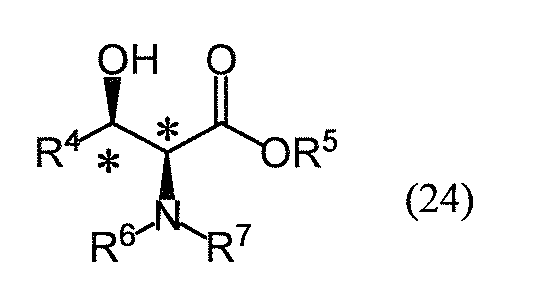
- In case that R4 is a hydrogen atom, the carbon atom substituted by the hydroxyl group at the 3-position of the compound (3) or (4) cannot be naturally an asymmetric atom. Accordingly, no diastereomer such as an anti-form or syn-form is present, since there is only one asymmetric carbon atom.
- A production process of the compound (2) is not particularly limited; and the process described above may be used; and also, for example, the compound may be produced by a conventionally known method such as a method in which a β-ketoester is treated with sodium nitrite for oximation of the α-position and only the oxime is reduced by hydrogenation to form an amino group.
- In the optically active amine complex (1) to be used in the step, * indicates an asymmetric carbon atom.
- M is a transition metal; and examples thereof include palladium, rhodium, ruthenium, iridium, platinum, zirconium, titanium, chromium, cobalt, copper, nickel, zinc, manganese, iron, ytterbium, lanthanum and samarium. Among the examples, ruthenium, rhodium and iridium are preferable.
- In the above formula (1), R1 and R2 each may be the same or different; and is an optionally substituted alkyl group having 1 to 21 carbon atoms, an optionally substituted aryl group having 6 to 20 carbon atoms, or an optionally substituted aralkyl group having 7 to 20 carbon atoms; and R1 and R2 may constitute a a ring. Examples of an optionally substituted alkyl group having 1 to 21 carbon atoms, an optionally substituted aryl group having 6 to 20 carbon atoms, and an optionally substituted aralkyl group having 7 to 20 carbon atoms include ones described above; and the ring group constituted by R1 and R2 together may include a tetramethylene group. R1 and R2 are preferably phenyl or tetramethylene in terms of steric selectivity of the reaction.
- R3 is a hydrogen atom, an optionally substituted alkyl group having 1 to 21 carbon atoms, an optionally substituted aralkyl group having 7 to 20 carbon atoms, or an optionally substituted aryl group having 6 to 20 carbon atoms; and specific examples thereof include ones described above. A methyl group and a hydrogen atom are preferable and a hydrogen atom is particularly preferable, in terms of reaction yield and steric selectivity.
- Ar is an optionally substituted aromatic compound; and examples thereof include benzene, toluene, xylene, mesitylene, hexamethylbenzene, ethylbenzene, tert-butylbenzene, p-cymene, cumene and pentamethylcyclopentadianyl. Among the examples, p-cymene, benzene and mesitylene are preferable.
- Z is a halogen atom, an optionally substituted alkylsulfonyloxy group, an optionally substituted arylsulfonyloxy group, or an optionally substituted aralkylsulfonyloxy group; and examples thereof include a fluorine atom, a chlorine atom, a bromine atom, an iodine atom, a trilfuoromethanesulfonyloxy group, a methanesulfonyloxy group and a p-toluenesulfonyloxy group. Among the examples, a chlorine atom and a trifluoromethanesulfonyloxy group are preferable.
- Y is an oxygen atom, an optionally substituted alkylsulfonylamide group, an optionally substituted arylsulfonylamide group or an optionally substituted aralkylsulfonylamide group; and examples thereof include an oxygen atom; optionally substituted alkylsulfonylamide groups such as a methanesulfonylamide group, a trifluoromethanesulfonylamide group and a camphorsulfonylamide group; optionally substituted arylsulfonylamide groups such as a benzenesulfonylamide group, a p-toluenesulfonylamide group, a p-trifluoromethylbenzenesulfonylamide group, a p-dodecylbenzenesulfonylamide group and an o,m,p-nitrobenzenesulfonylamide group; and optionally substituted aralkylsulfonylamide groups such as a benzylsulfonylamide group. Among the examples, a p-toluenesulfonylamide group and a camphorsulfonylamide group are preferable in terms of reaction yield and steric selectivity of the reaction.
- Examples of an optically active amine complex (1) include a RuCl[(R,R)-TsDPEN](p-cymene) complex, a RuCl[(S,S)-TsDPEN](p-cymene) complex, a RuOTf[(R,R)-TsDPEN](p-cymene) complex, and a RuOTf[(S,S)-TsDPEN](p-cymene) complex. The (S,S)-TsDPEN represents (1S,2S)-N-monotosyl-1,2-diphenylethylenediamine, and OTf represents a trifluoromethanesulfonyloxy group.
- For example, a RuCl[(R,R)-TsDPEN](p-cymene) complex can be represented by the following formula (25):


- The optically active amine complex (1) can be synthesized by a method described in J. Am. Chem. Soc. , 1996, 118, 2521. Further, a commercialized product may be used. The optically active amine complex (1) to be used in the step may be one prepared previously and isolated and purified, or one prepared in a reaction mixture may be directly used.
- An amount of the optically active amine complex (1) to be used in the step is not particularly limited; however, the amount is generally 0.00001 to 1 equivalent and preferably 0.0001 to 0.2 equivalent, relative to a β-keto-α-aminocarboxylic acid ester represented by the above-mentioned formula (2).
- Hydrogen or a hydrogen donor compound to be used in the step is not particularly limited; and examples thereof include alcohols such as methanol, ethanol, n-propanol and isopropanol; formic acid; formic acid salts such as sodium formate and ammonium formate; and hydrogen. Particularly, formic acid, sodium formate and hydrogen are preferable, and formic acid is more particularly preferable, in terms of yield.
- An amount of a hydrogen donor compound to be used in the step is not particularly limited; however, the amount is generally 1 to 100 equivalent and preferably 1 to 10 equivalent, relative to a β-keto-α-aminocarboxylic acid ester represented by the above formula (4).
- Further, a base may be used in the step. Examples of the base include inorganic bases such as sodium hydroxide, potassium hydroxide and potassium carbonate; alkoxides such as sodium methoxide and potassium tert-butoxide; and amines such as triethylamine, trimethylamine and ammonia. In case that formic acid is used as a hydrogen donor compound, it is preferable that a base is used, and triethylamine is particularly preferable to be used.
- In case that a base is used in the step, a use amount is not particularly limited; however, the amount is generally 0.01 to 100 equivalent, preferably 0.1 to 10 equivalent and more preferably 1 to 10 equivalent, relative to a β-keto-α-aminocarboxylic acid ester represented by the above formula (2).
- When a hydrogen donor compound or a base to be coexisted is in a state of a liquid, a reaction solvent is not particularly required; and it is preferable to carry out the reaction without a solvent, since the reaction can be completed within a very short time and the use amount of a catalyst can be reduced. However, a reaction solvent may be used in accordance with a reaction substrate. A reaction solvent is not particularly limited as long as the solvent does not inhibit the reaction; and examples thereof include the above-mentioned hydrocarbon solvents; ester solvents; aromatic hydrocarbon solvents; nitrile solvents; ether solvents; amide solvents; sulfoxide solvents; halogenated hydrocarbon solvents; alcohol solvents such as methanol, ethanol, isopropanol and n-butanol; carboxylic acid solvents such as formic acid and acetic acid; and water. Further, two or more of the solvents may be used in form of a mixture. In case of using a solvent mixture, the mixing ratio is not particularly limited.
- A concentration of the β-keto-α-aminocarboxylic acid ester (2) at the time of carrying out the reaction differs in accordance with a reaction solvent to be used; however, the concentration is generally 1 to 50% (w/v) and preferably 4 to 30% (w/v) to carry out the reaction.
- A reaction temperature differs in accordance with the kinds and use amounts of an optically active transition metal complex and a hydrogen donor compound and the kind of a reaction solvent to be used; however, the temperature is generally in a range of the melting point or higher and the boiling point or lower of a reaction solvent to be used. It is preferable to carry out the reaction at higher temperature, in order to complete the reaction within a short time; and it is preferable to carry out the reaction at temperature set to be low, in terms of suppression of side reaction. It is generally -20 to 150°C and furthermore preferably 0 to 70°C.
- A reaction time differs in accordance with the kinds and use amounts of an optically active transition metal complex and a hydrogen donor compound to be used, the kind of a reaction solvent, and a reaction temperature; however, the time is generally about 1 to 36 hours when the reaction temperature is 0 to 70°C.
- A mixing order of the β-keto-α-aminocarboxylic acid ester (2), the optically active amine complex (1), hydrogen or a hydrogen donor compound, a reaction solvent and the like to be used in the step is arbitrary and is not particularly limited; however, it is preferable to add hydrogen or a hydrogen donor compound to a mixture of the β-keto-α-aminocarboxylic acid ester (2) and the optically active amine complex (1). Also when a base is added, it is preferable to add hydrogen or the hydrogen donor compound to a mixture of the β-keto-α-aminocarboxylic acid ester (2), the optically active amine complex (1) and the base. The hydrogen donor compound may be added at once for the reaction, or may be continuously or intermittently added while the reaction is promoted. If gas is generated along with the proceeding of the reaction, it is preferable to successively add the compound along with the proceeding of the reaction in terms of safety.
- As a post-treatment of the reaction, a common treatment for obtaining a product from a reaction mixture may be carried out. For example, water, hydrochloric acid, alkaline water or the like may be added to a reaction mixture on completion of the reaction; and extraction operation may be carried out by using a common extraction solvent such as ethyl acetate, diethyl ether, methylene chloride, toluene and hexane. The objective product can be obtained by removing a reaction solvent and an extraction solvent from an obtained extract in reduced pressure. The product obtained in such a manner may be subjected to a common purification such as silica gel chromatography, distillation, recrystallization or the like to further improve the purity, if necessary.
- Next, a step is described, in which asymmetric reduction reaction of a compound represented by the above formula (2) is carried out using a transition metal complex having an optically active phosphine ligand as a catalyst, and the steric configuration of the hydroxyl group at the 3-position is inversed, if necessary, to produce an optically active β-hydroxy-α-aminocarboxylic acid ester represented by the above general formula (3) or (4).
- Examples of a transition metal in a transition metal complex having an optically active phosphine ligand to be used in the step are ones exemplified for M in the above formula (1).
- An optically active phosphine ligand is not particularly limited; and examples thereof include binaphthyl type phosphine ligands represented by the general formula (16) (hereinafter, abbreviated as BINAP), biphenyl type phosphine ligands represented by the general formula (17) (hereinafter, abbreviated as MeO-BIPHEP), biphenyl type phosphine ligands represented by the general formula (18) (hereinafter, abbreviated as SEGPHOS), biphenyl type phosphine ligands represented by the general formula (19) (hereinafter, abbreviated as TUNEPHOS), bisphosphine ligands represented by the general formula (20) (hereinafter, abbreviated as DUPHOS), alkyl phosphine ligands represented by the general formula (21) (hereinafter, abbreviated as BISP), and biphenylphosphine ligands represented by the general formula (22) (hereinafter, abbreviated as DIOXANPHOS).


- Among the examples, BINAP, DIOXANPHOS, TUNEPHOS, SEGPHOS and MeO-BIPHEP are preferable in terms of steric selectivity.
- A transition metal complex having an optically active phosphine ligand to be used in the step can be prepared by mixing a transition metal compound and an optically active phosphine ligand in a proper solvent. A complex previously prepared and isolated may be used, or a mixture prepared in a reaction mixture may be directly used.
- A use amount of a transition metal complex having an optically active phosphine ligand in the step is not particularly limited; and the amount is generally 0.00001 to 1 equivalent and preferably 0.0001 to 0.2 equivalent, relative to a β-keto-α-aminocarboxylic acid ester represented by the above formula (2).
- Hydrogen to be used in the step may be commonly hydrogen gas. A pressure of hydrogen gas is not particularly limited; and the pressure is generally in a range from 1 to 150 atmospheric pressure and preferably in a range from 5 to 100 atmospheric pressure. It is preferable to carry out the reaction at an increased pressure, in order to complete the reaction in a short time.
- A reaction solvent to be used in the step is not particularly limited as long as the solvent does not inhibit the reaction; and examples thereof include the above-mentioned hydrocarbon solvents; ester solvents; aromatic hydrocarbon solvents; nitrile solvents; ether solvents; amide solvents; sulfoxide solvents; halogenated hydrocarbon solvents; alcohol solvents; carboxylic acid solvents; and water. Two or more of solvents may be used in form of a mixture. In case of using a solvent mixture, a mixing ratio is not particularly limited.
- A concentration of the β-keto-α-aminocarboxylic acid ester (2) at the time of carrying out the reaction differs in accordance with a reaction solvent to be used; however, the concentration is generally 1 to 50% (w/v) and preferably 4 to 30% (w/v) to carry out the reaction.
- A reaction temperature differs in accordance with the kind and use amount of an optically active transition metal complex having an optically active phosphine ligand, the kind of a reaction solvent to be used, and hydrogen pressure; and the temperature is generally in a range of the melting point or higher and the boiling point or lower of a reaction solvent to be used. It is preferable to carry out the reaction at higher temperature in order to complete the reaction within a short time; and it is preferable to carry out the reaction at temperature set to be low in terms of suppression of side reaction. The temperature is generally -20 to 150°C and furthermore preferably 0 to 100°C.
- A reaction time differs in accordance with the kind and use amount of an optically active transition metal complex having an optically active phosphine ligand, a hydrogen pressure, the type of a reaction solvent to be used, and a reaction temperature; however, the time is generally about 1 to 36 hours when a reaction temperature is 0 to 100°C.
- A mixing order of the β-keto-α-aminocarboxylic acid ester (2), a transition metal complex having an optically active phosphine ligand, a hydrogen gas, a reaction solvent and the like to be used in the reaction is arbitrary, and the order is not particularly limited; however, a hydrogen gas may be added to a mixture of the β-keto-α-aminocarboxylic acid ester (2) and a transition metal complex having an optically active phosphine ligand.
- As a post-treatment of the reaction, a common treatment for obtaining a product from a reaction mixture may be carried out. For example, a reaction solvent may be simply removed from a reaction mixture. Otherwise, water, hydrochloric acid, alkaline water or the like may be added to a reaction mixture on completion of the reaction, and extraction operation may be carried out by using a common extraction solvent such as ethyl acetate, diethyl ether, methylene chloride, toluene and hexane. The objective product can be obtained by removing a reaction solvent and an extraction solvent from an obtained extracted solution in reduced pressure. The product obtained in such a manner may be subjected to a common purification such as silica gel chromatography, distillation, recrystallization or the like to further improve the purity, if necessary.
- Such a syn-form represented by the above formula (23) or (24), not such an anti-form represented by the above (3) or (4), can be produced in some cases by asymmetric hydrogenation in the step in accordance with the kinds of the β-keto-α-aminocarboxylic acid ester (2) and a transition metal complex having an optically active phosphine ligand to be used. When a syn-form is produced, the steric configuration of the hydroxyl group at the 3-position may be inversed to convert the syn-form to the anti-form, if necessary.
- A method for inversing the steric configuration of the hydroxyl group at the 3-position is not particularly limited; for example, a method of converting R6 or R7 of the compound (23) or (24) to an acyl group such as an acetyl group or an octadecanoyl group as necessary and then allowing thionyl chloride to act is examplified.
- A use amount of thionyl chloride at the time is not particularly limited; however the amount is generally 1 to 50 equivalent and preferably 1 to 10 equivalent, relative to the compound (23) or (24).
- A solvent to be used in an inverse operation is not particularly limited as long as the solvent does not inhibit the reaction. Examples thereof include hydrocarbon solvents; ester solvents; aromatic hydrocarbon solvents; nitrile solvents; ether solvents; amide solvents; sulfoxide solvents; halogenated hydrocarbon solvents; and thionyl chloride. Among the examples, hexane, cyclohexane, methylcyclohexane, toluene, chlorobenzene, methylene chloride, tetrahydrofuran and thionyl chloride are preferable. Two or more of solvents may be used in form of a mixture. In case of using a solvent mixture, the mixing ratio is not particularly limited.
- A concentration of the compound (23) or (24) at the time of carrying out an inverse operation differs in accordance with a reaction solvent to be used; however, the concentration is generally 1 to 50% (w/v) and preferably 4 to 30% (w/v) to carry out the reaction.
- A reaction temperature during an inverse operation differs in accordance with the kind of the compound (23) or (24), a use amount of thionyl chloride and the kind of a reaction solvent to be used; however, the temperature is generally in a range of the melting point or higher and the boiling point or lower of a reaction solvent to be used. It is preferable to carry out the reaction at higher temperature in order to complete the reaction within a short time, and it is preferable to carry out the reaction at temperature set to be low in terms of suppression of side reaction. The temperature is generally -40 to 100°C and furthermore preferably -10 to 50°C.
- A reaction time of an inverse operation differs in accordance with the kind of the compound (23) and (24), a use amount of thionyl chloride, the kind of a reaction solvent and a reaction temperature; however, the time is generally about 1 to 24 hours when the reaction temperature is -10 to 50°C.
- A mixing order of the compound (23) or (24), thionyl chloride, a reaction solvent and the like to be used for an inversion operation is arbitrary and is not particularly limited.
- As a post-treatment of the reaction, a common treatment for obtaining a product from a reaction mixture may be carried out. For example, water, hydrochloric acid, alkaline water or the like may be added to a reaction mixture on completion of the reaction, and extraction operation may be carried out by using a common extraction solvent such as ethyl acetate, diethyl ether, methylene chloride, toluene and hexane. The objective product can be obtained by removing a reaction solvent and an extraction solvent from an obtained extract in reduced pressure. The product obtained in such a manner may be subjected to a common purification such as silica gel chromatography, distillation, recrystallization or the like to further improve the purity, of necessary.
- Next, a step is described, in which the ester part of an optically active β-hydroxy-α-aminocarboxylic acid ester produced above and represented by the above (3) or (4) is reduced, and an amino-substituent group is converted into an acyl group if necessary, to produce an optically active 2-amino-1,3-diol derivative represented by the general formula (7) or the general formula (8):


- R4 in an optically active 2-amino-1,3-diol derivative (7) or (8) is the same as described above.
- R8 is an optionally substituted alkyl group or an alkanoyl group, having 11 to 40 carbon atoms; and examples thereof include a pentadecyl group, a heptadecyl group, a 1-hydroxyheptadecyl group, a 1-oxoheptadecyl group, a henicosyl group, a 1-hydroxyhenicosyl group and a 29-(8,11-icosadienoyloxy)nonacosyl group. Among the example, a heptadecyl group, a 1-hydroxyheptadecyl group, a 1-oxoheptadecyl group, a henicosyl group, a 1-hydroxyhenicosyl group and a 29-(8,11-icosadienoyloxy)nonacosyl group are preferable in term of usability as a ceramide derivative.
- The term, "an amino-substituent group is converted into an acyl group if necessary", means that R6 and R7 of the amino-substituent group in the compound (3) or (4) may be converted into an acyl group and hydrogen, respectively, or may not be converted. In case that one of R6 and R7 in the compound (3) or (4) is hydrogen, the substituent group excluding hydrogen may be eliminated and converted into an acyl group; and when both of R6 and R7 are substituent groups and not hydrogen, both amino substituent groups are eliminated and one of them may be converted into an acyl group.
- In case that one of R6 and R7 in the compound (3) or (4) is an acryl group and the other is hydrogen, the compound (8) or (9) can be obtained, even if the amino substituent group is not converted into an acyl group; however, the acyl group of R6 or R7 may be eliminated and converted into a different acryl group. Further, a step of converting an amino-substituent group to an acyl group may be carried out, for example, by performing elimination reaction of the amino substituent group after reduction of the ester part of the compound (3) or (4) and finally performing acylation reaction of the unsubstituted amino group, or by performing acylation reaction of the unsubstituted amino group after an elimination reaction of the amino substituent group and finally reducing the ester part.
- At first, a method for reducing the ester part of the compound (3) or (4) or a compound obtained by converting the amino substituent group of the compound (3) or (4) into an acyl group is described.
- A reducing agent for reducing the ester part is not particularly limited; and examples thereof include sodium borohydride, lithium borohydride, lithium aluminum hydride, borane, disobutylaluminum hydride and hydrogen. Among the examples, sodium borohydride is preferable in terms of economic efficiency.
- An amount of a reducing agent to be used in a reduction reaction is not particularly limited; however, the amount is generally 0.5 to 10 equivalent and preferably 1 to 3 equivalent, relative to an optically active β-hydroxy-α-aminocarboxylic acid ester (3) or (4) or a compound obtained by converting the amino substituent group of the compound (3) or (4) into an acyl group.
- It is preferable to use sodium borohydride as a reducing agent, since the reaction may be activated and/or epimeration during the reaction may be suppressed when the reduction is carried out in the presence of a Lewis acid.
- A Lewis acid is not particularly limited; and examples thereof include titanium tetrachloride, tin tetrachloride, boron trifluoride diethyl ether complex, zinc chloride, zinc bromide, zinc iodide, magnesium chloride, magnesium bromide, magnesium iodide, aluminum chloride, lithium chloride, lithium bromide, calcium chloride, iron chloride and nickel chloride. Among the example, calcium chloride is preferable in terms of economic efficiency.
- A use amount of a Lewis acid to be coexisted is not particularly limited; however, the amount is generally 0.5 to 10 equivalent and preferably 1 to 3 equivalent, relative to an optically active β-hydroxy-α-aminocarboxylic acid ester (3) or (4) or a compound obtained by converting the amino-substituent group of the compound (3) or (4) into an acyl group.
- A reaction solvent to be used in the step is not particularly limited as long as the solvent does not inhibit the reaction; and examples thereof include the above-mentioned hydrocarbon solvents; ester solvents; aromatic hydrocarbon solvents; nitrile solvents; ether solvents; amide solvents; sulfoxide solvents; halogenated hydrocarbon solvents; alcohol solvents such as methanol, ethanol, isopropanol and n-butanol; and water. Among the examples, chlorobenzene, n-butanol, tetrahydrofuran and dioxane are preferable. Two or more of solvents may be used in form of a mixture. In case of using a solvent mixture, a mixing ratio is not particularly limited.
- A concentration of a compound to be subjected to a reduction reaction differs in accordance with a reaction solvent to be used; however, the concentration is generally 1 to 50% (w/v) and preferably 4 to 30% (w/v) to carry out the reaction.
- A reaction temperature differs in accordance with a compound to be subjected to the reduction reaction, the kind and use amount of a reducing agent, and the kind of a reaction solvent; however, the temperature is generally in a range of the melting point or higher and the boiling point or lower of a reaction solvent to be used. It is preferable to carry out the reaction at higher temperature in order to complete the reaction within a short time, and it is preferable to carry out the reaction at temperature set to be low in terms of suppression of side reaction. The temperature is generally -70 to 120°C and furthermore preferably 0 to 100°C.
- A reaction time differs in accordance with a compound to be subjected to a reduction reaction, the kind and use amount of a reducing agent, the kind of a reaction solvent, and a reaction temperature; however, the time is generally about 1 to 24 hours when the reaction temperature is 0 to 100°C.
- A mixing order of a compound to be subjected to a reduction reaction, a reducing agent, a reaction solvent and the like is arbitrary and is not particularly limited.
- As a post-treatment of the reaction, a common treatment for obtaining a product from a reaction mixture may be carried out. For example, water, hydrochloric acid, alkaline water or the like may be added to a reaction mixture after the reaction, and an extraction operation may be carried out by using a common extraction solvent such as ethyl acetate, diethyl ether, methylene chloride, toluene and hexane. The objective product can be obtained by removing a reaction solvent and an extraction solvent from an obtained extract in reduced pressure. The product obtained in such a manner may be subjected to a common purification such as silica gel chromatography, distillation, recrystallization or the like to further improve the purity, if necessary.
- Next, a step of converting an amino-substituent group into an acyl group when necessary is described. The conversion reaction into an acyl group may be carried out generally by eliminating the substituent group of an amino group to give an unsubstituted amino group and then N-acylating the amino group with an acylation agent.
- An elimination reaction of an amino substituent group differs depending on the substituent group, and may be deprotection reaction described in "Protective Groups in Organic Synthesis 3rd ed. (Theodora W. Greene and Peter G. M. Wuts, Ed., Wiley-Interscience: New York, 1999) " in case of an amino-protecting group. For example, when an amino substituent group is an acetyl group or a methoxycarbonyl group, the substituent group can be eliminated by an acid or a base; and in case of a phthaloyl group, the substituent group can be eliminated by acid hydrolysis or treatment with methylamine or hydrazine. In case of a benzyloxycarbonyl group or a benzyl group, the substituent group can be eliminated by hydrogenolysis.
- An acylation reaction of an unsubstituted amino group is carried out using an acylation agent. Examples of the acylation agent to be used include acid chlorides such as stearoyl chloride, pivaloyl chloride, docosanoic acid chloride and 30-(8,11-icosadienoyloxy)triacontanoic acid chloride; esters such as methyl stearate, methyl 2-hydroxystearate, methyl 2-oxostearate, methyl docosanoate and methyl 2-hydroxydocosanoate. Further, the acylation reaction may be carried out using acid anhydrides or mixed anhydrides of a corresponding carboxylic acid.
- A use amount of an acylation agent to be used in an acylation reaction is not particularly limited; however, the amount is generally 0.5 to 10 equivalent and preferably 1 to 2 equivalent, relative to an optically active β-hydroxy-α-aminocarboxylic acid ester (3) or (4) or an ester part-reduced compound thereof.
- A base may be used in an acylation reaction, if necessary; and examples of the base to be used include the above-mentioned inorganic bases and organic bases such as triethylamine, pyridine and 4-dimethylaminopyridine.
- A use amount of a base to be used in an acylation reaction is not particularly limited; however, the amount is generally 0.01 to 10 equivalent and preferably 0.01 to 2 equivalent, relative to an optically active β-hydroxy-α-aminocarboxylic acid ester (3) or (4) or an ester part-reduced compound thereof.
- A reaction solvent to be used in the reaction is not particularly limited as long as the solvent does not inhibit the reaction; and examples thereof include hydrocarbon solvents; ester solvents; aromatic hydrocarbon solvents; nitrile solvents; ether solvents; amide solvents; sulfoxide solvents; halogenated hydrocarbon solvents; alcohol solvents; and water. Among the examples, chlorobenzene, methylene chloride, n-butanol, tetrahydrofuran and dioxane are preferable. Two or more of solvents may be used in form of a mixture. In case of using a solvent mixture, a mixing ratio is not particularly limited.
- A concentration of an optically active β-hydroxy-α-aminocarboxylic acid ester (3) or (4) or an ester part-reduced compound thereof at the time of the reaction differs in accordance with a reaction solvent to be used; however, the concentration is generally 1 to 50% (w/v) and preferably 4 to 30% (w/v) to carry out the reaction.
- A reaction temperature differs in accordance with an optically active β-hydroxy-α-aminocarboxylic acid ester (3) or (4) or an ester part-reduced compound thereof to be used, the kind and use amount of an acylation agent, and the kind of a reaction solvent; however, the temperature is generally in a range of the melting point or higher and the boiling point or lower of a reaction solvent to be used. It is preferable to carry out the reaction at higher temperature in order to complete the reaction within a short time, and it is preferable to carry out the reaction at temperature set to be low in terms of suppression of side reaction. The temperature is generally -50 to 120°C and furthermore preferably 0 to 100°C.
- A reaction time differs in accordance with an optically active β-hydroxy-α-aminocarboxylic acid ester (3) or (4) or an ester part-reduced compound thereof to be used, the kind and use amount of an acylation agent, and the type of a reaction solvent, and a reaction temperature; however, the time is generally about 1 to 24 hours when the reaction temperature is 0 to 100°C.
- A mixing order of an optically active β-hydroxy-α-aminocarboxylic acid ester (3) or (4) or an ester part-reduced compound thereof, an acylation agent and a reaction solvent to be used in the reaction is arbitrary, and is not particularly limited.
- As a post-treatment of the reaction, a common treatment for obtaining a product from a reaction mixture may be carried out. For example, water, hydrochloric acid, alkaline water or the like may be added to a reaction mixture on completion of the reaction, and an extraction operation may be carried out by using a common extraction solvent such as ethyl acetate, diethyl ether, methylene chloride, toluene and hexane. The objective product can be obtained by removing a reaction solvent and an extraction solvent from an obtained extract in reduced pressure. The product obtained in such a manner may be subjected to a common purification such as silica gel chromatography, distillation, recrystallization or the like to further improve the purity, if necessary.
- Hereinafter, the present invention is described with reference to examples; however, it is not intended that the present invention be limited to the illustrated examples.
- A methylene chloride solution (5.0 ml) of N-acetylglycine ethyl ester (72.5 mg, 0.50 mmol) and N-methylimidazole (50.4 mg, 0.61 mmol) was cooled to -45°C, and a methylene chloride solution (0.5 ml) of palmitoyl chloride (142.6 mg, 0.50 mmol) was added thereto in nitrogen atmosphere. After the mixture was stirred for 20 minutes at the same temperature, a methylene chloride solution (0.5 ml) of titanium tetrachloride (340.4 mg, 1.78 mmol) and a methylene chloride solution (0.5 ml) of tributylamine (372.4 mg, 2.01 mmol) were added thereto. The resulting mixture was stirred for 2 hours at -45°C. Water was added thereto, and the mixture was heated to room temperature, and the organic layer was separated. Further, the water layer was extracted twice with methylene chloride, and the organic layers were combined and dried with magnesium sulfate. After the solvent was removed in reduced pressure, the obtained crude product was purified by silica gel chromatography (Kieselgel 60 manufactured by Merck, hexane : ethyl acetate = 3 : 2) to obtain the title compound (148.8 mg, yield: 88%).
1H NMR (400MHz, CDCl3 / ppm): δ0.88(t, 3H), 1.25-1.36 (m, 29H), 2.07(s, 3H), 2.71(m, 2H), 4.26(q, 2H), 5.23(d, 1H), 6.62(d, 1H) - A dichloromethane solution (45.0 ml) of N-acetylglycine ethyl ester (1.50 g, 10.33 mmol) and N-methylimidazole (1.02 mg, 12.40 mmol) was cooled to -45°C, and palmitoyl chloride (2.84 g, 10.33 mmol) was added thereto in nitrogen atmosphere. After the mixture was stirred for 20 minutes at the same temperature, titanium tetrachloride (6.86 mg, 36.16 mmol) and triethylamine (4.18 g, 41.31 mmol) were added thereto. The resulting mixture was stirred for 2 hours at -45°C. Water (20 mL) was added thereto, and the mixture was heated to room temperature, and the organic layer was separated. It was confirmed by comparative analysis with sample product using HPLC that the organic layer contained 2.81 g of the title compound (yield: 71%).
- A toluene solution (33.0 ml) of N-acetylglycine ethyl ester (1.00 g, 6.89 mmol) and N-methylimidazole (679 mg, 8.27 mmol) was cooled to -20°C, and palmitoyl chloride (1.89 g, 6.89 mmol) was added thereto in nitrogen atmosphere. After the mixture was stirred for 30 minutes at the same temperature, titanium tetrachloride (4.57 mg, 24.12 mmol) and triethylamine (2.79 g, 27.56 mmol) were added thereto. The resulting mixture was stirred for 2 hours at -20°C. Water (20 mL) was added thereto, and the mixture was heated to room temperature, and the organic layer was separated. It was confirmed by comparative analysis with sample product using HPLC that the organic layer contained 1.75 g of the title compound (yield: 66%).
- A chlorobenzene solution (45.0 ml) of N-acetylglycine ethyl ester (1.50 g, 10.33 mmol) and N-methylimidazole (1.02 g, 12.40 mmol) was cooled to -20°C, and palmitoyl chloride (2.84 g, 10.33 mmol) was added thereto in nitrogen atmosphere. After the mixture was stirred for 45 minutes at the same temperature, titanium tetrachloride (6.86 mg, 36.16 mmol) and triethylamine (4.18 g, 41.31 mmol) were added thereto. The resulting mixture was stirred for 2 hours at -20°C. Water (20 mL) was added thereto, and the mixture was heated to room temperature, and the organic layer was separated. It was confirmed by comparative analysis with sample product using HPLC that the organic layer contained 2.92 g of the title compound (yield: 74%).
- A chlorobenzene solution (45.0 ml) of N-acetylglycine ethyl ester (1.50 g, 10.33 mmol) and N-methylimidazole (1.02 g, 12.40 mmol) was cooled to -10°C, and palmitoyl chloride (2.84 g, 10.33 mmol) was added thereto in nitrogen atmosphere. After the mixture was stirred for 45 minutes at the same temperature, titanium tetrachloride (6.86 mg, 36.16 mmol) and triethylamine (4.18 g, 41.31 mmol) were added thereto. The resulting mixture was stirred for 2 hours at -10°C. Water (20 mL) was added thereto, and the mixture was heated to room temperature, and the organic layer was separated. It was confirmed by comparative analysis with sample product using HPLC that the organic layer contained 2.92 g of the title compound (yield: 80%).
- A chlorobenzene solution (45.0 ml) of N-acetylglycine ethyl ester (1.50 g, 10.33 mmol) and N-methylimidazole (1.02 g, 12.40 mmol) was cooled to -10°C, and palmitoyl chloride (2.84 g, 10.33 mmol) was added thereto in nitrogen atmosphere. After the mixture was stirred for 45 minutes at the same temperature, titanium tetrachloride (6.86 mg, 36.16 mmol) and tributylamine (7.66g, 41.32 mmol) were added thereto. The resulting mixture was stirred for 2 hours at -10°C. Water (20 mL) was added thereto, and the mixture was heated to room temperature, and the organic layer was separated. It was confirmed by comparative analysis with sample product using HPLC that the organic layer contained 3.33 g of the title compound (yield: 84%).
- A chlorobenzene solution (45.0 ml) of N-acetylglycine ethyl ester (1.50 g, 10.33 mmol) and N-methylimidazole (1.02 g, 12.40 mmol) was cooled to 0°C, and palmitoyl chloride (2.84 g, 10.33 mmol) was added thereto in nitrogen atmosphere. After the mixture was stirred for 25 minutes at the same temperature, titanium tetrachloride (6.86 mg, 36.16 mmol) and triethylamine (4.18 g, 41.31 mmol) were added thereto. The resulting mixture was stirred for 2 hours at 0°C. Water (20 mL) was added thereto, and the mixture was heated to room temperature, and the organic layer was separated. It was confirmed by comparative analysis with sample product using HPLC that the organic layer contained 2.93 g of the title compound (yield: 74%).
- A methylene chloride solution (100 ml) of N-formylglycine ethyl ester (1.31 g, 10 mmol) and N-methylimidazole (985.4 mg, 12 mmol) was cooled to -45°C, and a methylene chloride solution (10 ml) of palmitoyl chloride (2.85 mg, 10 mmol) was added thereto in nitrogen atmosphere. After the mixture was stirred for 20 minutes at the same temperature, a methylene chloride solution (10 ml) of titanium tetrachloride (6.78 mg, 35 mmol) and a methylene chloride solution (10 ml) of tributylamine (7.42 g, 40 mmol) were added thereto. The resulting mixture was stirred for 3 hours at -45°C. After 100 ml of water was added thereto, and the mixture was heated to room temperature, and the organic layer was separated. Further, the water layer was extracted twice with methylene chloride. The organic layers were combined and dried with magnesium sulfate. After the solvent was removed in reduced pressure, the obtained crude product was purified by silica gel chromatography (Kieselgel 60 manufactured by Merck, solely ethyl acetate) to obtain the title compound (3.15 mg, yield: 85%).
1H NMR (400MHz, CDCl3 / ppm): δ0.88(t, 3H), 1.25-1.33(m, 29H), 2.73(m, 2H), 4.26(q, 2H), 5.28(d, 1H), 6.78(bs, 1H), 8.25(s, 1H) - A methylene chloride solution (100 ml) of N-octadecanoylglycine ethyl ester (3.70 g, 10 mmol) and N-methylimidazole (985.4 mg, 12 mmol) was cooled to -45°C, and a methylene chloride solution (10 ml) of palmitoyl chloride (2.76 mg, 9.74 mmol) was added thereto in nitrogen atmosphere. After the mixture was stirred for 20 minutes at the same temperature, a methylene chloride solution (10 ml) of titanium tetrachloride (6.81 mg, 35 mmol) and a methylene chloride solution (10 ml) of tributylamine (7.42 g, 40 mmol) were added thereto. The resulting mixture was stirred for 2 hours at -45°C. After 100 ml of water was added thereto and the mixture was heated to room temperature, the organic layer was separated. Further, the water layer was extracted twice with methylene chloride (100 ml), and the organic layers were combined and dried with magnesium sulfate. After the solvent was removed in reduced pressure, the obtained crude product was purified by silica gel chromatography (Kieselgel 60 manufactured by Merck, hexane : ethyl acetate = 4 : 1) to obtain the title compound (3.20 mg, yield: 54%).
1H NMR (400MHz, CDCl3 / ppm): δ0.88(m, 6H), 1.25-1.32(m, 59H), 2.27(t, 2H), 2.70(m, 2H), 4.25(m, 2H), 5.22(d, 1H), 6.58(d, 1H) - A chlorobenzene solution (33.0 ml) of N-octadecanoylglycine ethyl ester (2.00 g, 5.41 mmol) and N-methylimidazole (533 mg, 6.49 mmol) was cooled to -10°C, and palmitoyl chloride (1.49 g, 5.41 mmol) was added thereto in nitrogen atmosphere. After the mixture was stirred for 45 minutes at the same temperature, titanium tetrachloride (3.60 g, 18.94 mmol) and tributylamine (4.01 g, 21. 64 mmol) were added thereto. The resulting mixture was stirred for 1.5 hours at -10°C. After water (25 ml) was added thereto and the mixture was heated to room temperature, the organic layer was separated. It was confirmed by comparative analysis with sample product using HPLC that the organic layer contained 2.52 g of the title compound (yield: 77%).
- The title compound (yield: 36%) was obtained in the same manner as Example 9, except that N-octadecanoylglycine methyl ester is used instead of N-octadecanoylglycine ethyl ester in Example 9. 1H NMR (400MHz, CDCl3 / ppm): δ0.88(m, 6H), 1.25(m, 56H), 2.27(t, 2H), 2.70(m, 2H), 3.80(s, 3H), 5.24(d, 1H), 6.59(d, 1H)
- A dehydrated THF solution (0.5 ml) of triethylamine (131.9 mg, 1.30 mmol) and a dehydrated THF solution (0.5 ml) of formic acid (64.2 mg, 1.37 mmol) were added to a dehydrated THF solution (4.0 ml) of RuCl[(R,R)-TsDPEN](p-cymene) complex (19.6 mg, 0.03 mmol) and ethyl 2-acetylamino-3-oxooctadecanoate (7.70 g, 0.20 mmol) synthesized in the same method as Example 1. After the mixture was stirred for 3 days at room temperature, the reaction solvent was removed in reduced pressure. Water was added thereto, and the mixture was extracted with ethyl acetate three times. The organic layers were combined and dried with magnesium sulfate. After the solvent was removed in reduced pressure, the obtained crude product was purified by silica gel chromatography (Kieselgel 60 manufactured by Merck, solely ethyl acetate) to obtain the title compound (71.3 mg, yield: 94%). The product was analyzed by HPLC to find that anti-form : syn-form was 93 : 7 and the optical purity of the anti-form was 98% ee.
- Herein, (R,R)-TsDPEN is (1R,2R)-N-tosyl-1,2-diphenylethylenediamine (hereinafter, the same).
1H NMR (400MHz, CDCl3 / ppm) of anti-form: δ0.88(t, 3H), 1.25-1.35 (m, 29H), 1.43-1.49(m, 2H), 2.07(s, 3H), 3.90-97(m, 1H), 4.24(m, 2H), 4.67(dd, 1H), 6.45(d, 1H)
1H NMR (400MHz, CDCl3 / ppm) of syn- form: δ0.88(t, 3H), 1.25-1.35(m, 29H), 1.43-1.49(m, 2H), 2.07(s, 3H), 4.09-4.15(m, 1H), 4.24(m, 2H), 4.65(dd, 1H), 6.20(d, 1H) -
- Column: CHIRALPAK AD-H
- Column temperature: 25°C
- Moving phase: hexane / isopropanol = 95 / 5
- Flow speed: 0.5 ml/min
- Detection wavelength: 210 nm
- Retention time: anti-form - 18.9 minutes and 24.1 minutes syn-form - 29.7 minutes and 56.6 minutes
- Triethylamine (1.32 g, 13.05 mmol) and formic acid (350 mg, 7.82 mmol) were added to a chlorobenzene solution (10.0 ml) of RuCl[(R,R)-TsDPEN] (p-cymene) complex (17.6 mg, 0.03 mmol) and ethyl 2-acetylamino-3-oxooctadecanoate (1.00 g, 2.61 mmol) synthesized in the same method as Example 1. After the reaction mixture was stirred for 15.5 hours at 40°C, water (10 mL) was added thereto and separation operation was carried out at 40°C to obtain the organic layer. It was confirmed by comparative analysis of the organic layer with sample product using HPLC that the organic layer contained 0.96 g of the title compound (yield: 96%). Further, anti-form : syn-form was 95 : 5 and the optical purity of the anti-form was 97% ee.
- Triethylamine (1.32 g, 13.05 mmol) and formic acid (350 mg, 7.82 mmol) were added to a chlorobenzene solution (10.0 ml) of RuCl[(R,R)-TsDPEN](p-cymene) complex (8.8 mg, 0.01 mmol) and ethyl 2-acetylamino-3-oxooctadecanoate (1.00 g, 2.61 mmol) synthesized in the same method as Example 1. After the reaction mixture was stirred for 3 days at 40°C, water (10 mL) was added thereto and separation operation was carried out at 40°C to obtain the organic layer. It was confirmed by comparative analysis of the organic layer with sample product using HPLC that the organic layer contained 0.96 g of the title compound was contained (yield: 96%). Further, anti-form : syn-form was 98 : 2 and the optical purity of the anti-form was 97% ee.
- A dehydrated THF solution (0.5 ml) of triethylamine (131.7 mg, 1.30 mmol) and a dehydrated THF solution (0.5 ml) of formic acid (64.2 mg, 1.37 mmol) were added to a dehydrated THF solution (4.0 ml) of RuCl[(R,R)-TsDPEN](p-cymene) complex (19.6 mg, 0.03 mmol) and ethyl 2-formylamino-3-oxooctadecanoate (73.5 mg, 0.20 mmol) synthesized in the same method as Example 8. After the mixture was stirred for 3 days at room temperature, the reaction solvent was removed in reduced pressure. Water was added thereto and extraction with ethyl acetate was carried out three times. The organic layers were combined and dried with magnesium sulfate. After the solvent was removed in reduced pressure, the obtained crude product was purified by silica gel chromatography (Kieselgel 60 manufactured by Merck, hexane : ethyl acetate = 1 : 2) to obtain the title compound (64.6 mg, yield: 87%). The product was analyzed by HPLC to find that anti-form : syn-form was 95 : 5 and the optical purity of the anti-form was 96% ee.
1H NMR (400MHz, CDCl3 / ppm) of anti-form: δ0.88(t, 3H), 1.25-1.38(m, 29H), 1.43-1.58(m, 2H), 3.95(m, 1H), 4.23(m, 2H), 4.73(dd, 1H), 6.61(d, 1H), 8.24(s ,1H)
1H NMR (400MHz, CDCl3 / ppm) of syn-form: δ0.88(t, 3H), 1.25-1.38(m, 29H), 1.43-1.58(m, 2H), 3.95(m, 1H), 4.23(m, 2H), 4.73(dd, 1H), 6.52(d, 1H), 8.31(s, 1H) -
- Column: CHIRALPAK AD-H, two columns
- Column temperature: 25°C
- Moving phase: hexane / isopropanol = 9 / 1
- Flow speed: 0.5 ml/min
- Detection wavelength: 210 nm
- Retention time: anti-form - 22.2 minutes and 24.3 minutes syn-form = 39.2 minutes and 40.3 minutes
- A methylene chloride solution (0.5 ml) of triethylamine (131.6 mg, 1. 30 mmol) and a methylene chloride solution (0.5 ml) of formic acid (64.5 mg, 1.37 mmol) were added to a methylene chloride solution (4.0 ml) of RuCl[(R,R)-TsDPEN](p-cymene) complex (18.9 mg, 0.03 mmol) and ethyl 2-octadecanoylamino-3-oxooctadecanoate (121.6 mg, 0.20 mmol) synthesized in the same method as Example 9. After the mixture was stirred for 16 hours at room temperature, water was added thereto and extraction with methylene chloride was carried out three times. After the organic layers were combined and dried with magnesium sulfate, the solvent was removed in reduced pressure. The obtained crude product was purified by silica gel chromatography (Kieselgel 60 manufactured by Merck, hexane : ethyl acetate = 4 : 1) to obtain the title compound (109.6 mg, yield: 90%). The product was analyzed by HPLC to find that anti-form : syn-form was 91 : 9 and the optical purity of the anti-form was 95% ee.
1H NMR (400MHz, CDCl3 / ppm) of anti-form: δ0.88(t, 6H), 1.25-1.40(m, 59H), 1.43-1.58(m, 2H), 2.27(t, 2H), 3.94(m, 1H), 4.23(m, 2H), 4.66(dd, 1H), 6.43(d, 1H)
1H NMR (400MHz, CDCl3 / ppm) of syn-form: δ0.88(t, 6H), 1.25-1.40 (m, 59H), 1.43-1.58(m, 2H), 2.27(t, 2H), 4.12(m, 1H), 4.23(m, 2H), 4.66(dd, 1H), 6.15(d, 1H) -
- Column: SUMICHIRAL OA-4700
- Column temperature: 25°C
- Moving phase: hexane / isopropanol = 98 / 2
- Flow speed: 0.5 ml/min
- Detection wavelength: 210 nm
- Retention time: anti-form - 16.6 minutes and 18.9 minutes syn-form - 25.9 minutes and 34.2 minutes
- Triethylamine (830 mg, 8.20 mmol) and formic acid (227 mg, 4.93 mmol) were added to a chlorobenzene solution (15.0 ml) of RuCl[(R,R)-TsDPEN](p-cymene) complex (11.0 mg, 0.03 mmol) and ethyl 2-octadecanoylamino-3-oxooctadecanoate (1.00 g, 1.64 mmol) synthesized in the same method as Example 10. After the reaction mixture was stirred for 3 days at 40°C, water (10 mL) was added thereto and separation operation was carried out at 40°C to obtain the organic layer. After the organic layer was concentrated until the total amount became 3.11 g, 10 mL of AcOEt was added thereto and recrystallization was carried out to obtain 0.73 g of the title compound (yield: 74%). Anti-form : syn-form was 100 : 0 and the optical purity of the anti-form was 100% ee.
- Ethyl (2R,3R)-2-acetylamino-3-hydroxyoctadecanoate (1.00 g, 2.59 mmol) synthesized in the same method as Example 13 was suspended in an ethanol solution of about 30 wt% of hydrogen chloride, and the mixture was stirred for 15.5 hours in refluxing condition. After ethanol (10.0 mL) was added thereto, the mixture was cooled to 26°C. The precipitated solid was filtered to obtain 0.61 g of the title compound (yield: 62%).
1H NMR (400MHz, DMSO-d6 / ppm): δ1.16(t, 3H), 1.53-1.61(m, 29H), 1.71-1.79(m, 2H), 4.26(br, 1H), 4.27(s, 1H), 4.44-4.59(m, 2H), 5.91(d, 1H), 8.61(br, 2H) - Stearoyl chloride (227 mg, 4.93 mmol) was added to a THF solution (5.0 mL) of ethyl (2R,3R)-2-amino-3-hydroxyoctadecanoate hydrochloride (300 mg, 0.79 mmol) synthesized in the same method as Example 18 and triethylamine (239 mg, 2.37 mmol) at 27°C. After the reaction mixture was stirred at 60°C for 3 hours, water (5 mL) and AcOEt (5 mL) were added thereto and separation operation was carried out to obtain the organic layer. The organic layer was concentrated to obtain 0.48 g of a crude product containing the title compound (rough yield: 100%).
- Sodium borohydride (18.6 mg, 0.50 mmol) was added to a THF (5.0 mL) solution of ethyl (2R,3R)-2-octadecanoylamino-3-hydroxyoctadecanoate (150 mg, 0.25 mmol) synthesized in the same method as Example 19 at 60°C. After the reaction mixture was stirred at 60°C for 2.5 hours, water (1.5 mL) and AcOEt (5 mL) were added thereto and separation operation was carried out to obtain the organic layer. After the organic layer was washed with water (1.5 mL × 2 times), the organic layer was concentrated. Recrystallization in EtOH was carried out to obtain 76 mg of the title compound (yield: 55%). HPLC analysis was carried out to find that anti-form : syn-form was 92 : 8 and the optical purity of the anti-form was 99% ee.
1H NMR (400MHz, CDCl3-DMSO-d6 / ppm): δ0.88(t, 3H), 1.18-1.29(m, 54H), 1.45-1.52(m, 2H), 1.61-1.65(m, 2H), 2.22(dd, 2H), 3.65-3.68(m, 2H), 3.81-3.93(m, 1H), 6.64(d, 1H) -
- Column: SUMICHIRAL OA-4700
- Column temperature: 25°C
- Moving phase: hexane / isopropanol = 98 / 2
- Flow speed: 1.0 ml/min
- Detection wavelength: 210 nm
- Retention time: anti-form - 32.3 minutes and 37.1 minutes syn-form - 19.1 minutes and 23.1 minutes
- The title compound (yield: 64%) was obtained in the same manner as Example 10, except that N-octadecanoylglycine methyl ester is used instead of N-octadecanoylglycine ethyl ester in Example 10.
- A t-butyl methyl ether suspension (2 mL) containing ethyl (2R,3R)-2-octadecanoylamino-3-hydroxyoctadecanoate (100 mg. 0.16 mmol) synthesized in the same method as Example 17 and sodium borohydride (20.3 mg, 0.54 mmol) was stirred at 23°C for 48 hours. After water (5 mL) was added thereto, the reaction mixture was separated at 40°C to separate the organic layer. It was confirmed by comparative analysis of the obtained organic layer with sample product using HPLC that the organic layer contained 86.6 mg of the title compound (yield: 93%). HPLC analysis was carried out to find that anti-form : syn-form was 93 : 7 and the optical purity of the anti-form was 100% ee.
- The title compound (yield: 87%) was obtained in the same manner as Example 22, except that ethanol was used as a solvent instead of t-butyl methyl ether in Example 22. HPLC analysis was carried out to find that anti-form : syn-form was 88 : 12 and optical purity of the anti-form was 99% ee.
- An ethanol suspension (3 mL) containing ethyl (2R,3R)-2-acetylamino-3-hydroxyoctadecanoate (68.9 mg. 0.18 mmol) synthesized in the same method as Example 14 and sodium borohydride (21.1 mg, 0.53 mmol) was stirred at 23°C for 21 hours. After ethyl acetate and water were added thereto, the reaction mixture was stirred at 60°C for 1 hour. After the organic layer was separated, the organic layer was washed with saturated brine and dried with magnesium sulfate. The solvent was removed in reduced pressure. It was found that 54. 0 mg of the title compound was contained (yield: 88%). HPLC analysis was carried out to find that the optical purity of the anti-form was 99% ee.
1H NMR (400MHz, CDCl3-CD3OD / ppm): δ0.88(t, 3H), 1.18-1.30(m, 26H), 1.45-1.52(m, 2H), 2.03(s, 3H), 3.65-3.70(m, 2H), 3.73-3.80(m, 1H), 3.85-3.95(m, 1H), 6.93(d, 1H) -
- Column: CHIRALPAK AD-H
- Column temperature: 25°C
- Moving phase: hexane / isopropanol = 95 / 5
- Flow speed: 0.5 ml/min
- Detection wavelength: 210 nm
- Retention time: anti-form - 13.7 minutes and 18.4 minutes syn-form - 11.2 minutes and 12.7 minutes
- A THF suspension (0.3 mL) containing sodium borohydride (38.2 mg, 0.93 mmol) was heated to 60°C, and a THF solution (2.5 mL) of ethyl (2R,3R)-2-acetylamino-3-hydroxyoctadecanoate (250.1 mg. 0.62 mmol) synthesized in the same manner as Example 14 was added thereto dropwise for 5.5 hours. After completion of the dropwise addition, the mixture was further stirred at 60°C for 17 hours. After ethyl acetate and water were added thereto, the reaction mixture was stirred at 60°C for 1 hour. After the organic layer was separated, the organic layer was washed with saturated brine and dried with magnesium sulfate. The solvent was removed in reduced pressure. It was confirmed that 178.7 mg of the title compound was contained (yield: 84%). HPLC analysis was carried out to find that the optical purity of the anti-form was 99% ee.
- A THF suspension (2 mL) containing sodium borohydride (39.2 mg, 0.96 mmol) was heated to 60°C, and ethyl (2R,3R)-2-octadecanoylamino-3-hydroxyoctadecanoate (300.0 mg, 0.49 mmol) synthesized in the same manner as Example 17 was added for 2.5 hours. After completion of the dropwise addition, the mixture was further stirred at 60°C for 24 hours. After ethyl acetate and water were added thereto, the reaction mixture was stirred at 60°C for 1 hour. After the organic layer was separated, the obtained organic layer was washed with saturated brine and dried with magnesium sulfate. The solvent was removed in reduced pressure. It was confirmed that 219.4 mg of the title compound was contained (yield: 78%). HPLC analysis was carried out to find that anti-form : syn-form was 81 : 19 and the optical purity of the anti-form was 99% ee.
- Ethyl (2R,3R)-2-octadecanoylamino-3-hydroxyoctadecanoate (1.50 g, 2.46 mmol) synthesized in the same manner as Example 17 was added to a THF suspension (15 mL) containing sodium borohydride (271.9 mg, 7.38 mmol) at room temperature for 0.5 hours. After completion of the dropwise addition, aluminum chloride (984.0 mg, 7.38 mmol) was added for 1 hour. After water was added to the reaction mixture, concentrated hydrochloric acid was added thereto to adjust pH of the mixture to be 1.5. The resulting reaction mixture was further stirred at 50°C for 1 hour, and the organic layer was separated. It was confirmed by comparative analysis of the organic layer with sample product using HPLC that the organic layer contained 1.18 g of the title compound (yield: 84%). It was also found that anti-form : syn-form was 98 : 2 and the optical purity of the anti-form was 97% ee.
- Ethyl (2R,3R)-2-octadecanoylamino-3-hydroxyoctadecanoate (5.00 g, 8.17 mmol) synthesized in the same manner as Example 17 was added to a THF suspension (48 mL) containing sodium borohydride (0.62 mg, 16.34 mmol) at 0°C for 5 hour. After completion of the dropwise addition, calcium chloride (1.82 mg, 16.40 mmol) was added for 1 hour. After water was added to the reaction mixture, concentrated hydrochloric acid was added thereto to adjust pH of the mixture to be 1.5. The mixture was further stirred at 50°C for 1 hour, and the organic layer was separated. It was confirmed by comparative analysis of the organic layer with sample product using HPLC that the organic layer contained 4.41 g of the title compound (yield: 95%). It was also found that anti-form : syn-form was 98 : 2 and the optical purity of the anti-form was 99% ee.
Claims (14)
- A process for producing an optically active β-hydroxy-α-aminocarboxylic acid ester;
comprising a step of asymmetric reduction reaction of a β-keto-α-aminocarboxylic acid ester represented by the general formula (2):
in the presence of an optically active amine complex represented by the general formula (1):
and hydrogen or a hydrogen donor compound;
wherein, the optically active β-hydroxy-α-aminocarboxylic acid ester is represented by the following general formula (3) or general formula (4):

- The production process according to claim 1, wherein formic acid is used as the hydrogen donor compound.
- The production process according to claim 1 or 2, wherein the reaction is carried out in the presence of a base.
- A process for producing a β-keto-α-aminocarboxylic acid ester;
comprising a step of reacting a glycine derivative represented by the general formula (5):
with a carboxylic acid derivative represented by the general formula (6) :
in the presence of a Lewis acid and an amine;
wherein the β-keto-α-aminocarboxylic acid ester is represented by the general formula (2):
- The production process according to claim 4, wherein the Lewis acid is titanium tetrachloride.
- The production process according to claim 4 or 5, wherein R4 is an optionally substituted alkyl group having 11 to 21 carbon atoms, an optionally substituted alkenyl group having 11 to 21 carbon atoms, or an optionally substituted alkynyl group having 11 to 21 carbon atoms.
- The production process according to any one of claims 4 to 6, wherein the reaction is carried out at -40°C or higher.
- A process for producing an optically active β-hydroxy-α-aminocarboxylic acid ester represented by the general formula (3) or (4);
comprising a step of asymmetric hydrogenation reaction of the β-keto-α-aminocarboxylic acid ester obtained by the production process according to any one of claims 4 to 7 and represented by the general formula (2) using a transition metal complex having an optically active phosphine ligand as a catalyst;
and a step of inverting the steric configuration of the hydroxyl group at the 3-position, if necessary. - The production process according to any one of claims 1 to 3, wherein the β-keto-α-aminocarboxylic acid ester represented by the general formula (2) is obtained by the production process according to any one of claims 4 to 7.
- A process for producing an optically active 2-amino-1,3-diol derivative;
comprising a step of reducing the ester part of the optically active β-hydroxy-α-aminocarboxylic acid ester produced by the production process according to claim 1, 2, 3, 8, or 9 and represented by the general formula (3) or (4);
and a step of converting the substituent group at the amino group into an acyl group if necessary;
wherein the optically active 2-amino-1,3-diol derivative is represented by the general formula (7) or general formula (8):

- The production process according to claim 10, wherein a reducing agent for reducing the ester part is sodium borohydride.
- The production process according to claim 11, wherein the reduction is carried out in the presence of a Lewis acid.
- The production process according to claim 12, wherein the Lewis acid is calcium chloride.
- A β-keto-α-stearoylaminooctadecanoic acid ester represented by the general formula (15):

Applications Claiming Priority (3)
| Application Number | Priority Date | Filing Date | Title |
|---|---|---|---|
| JP2006261107 | 2006-09-26 | ||
| JP2006314035 | 2006-11-21 | ||
| PCT/JP2007/068629 WO2008041571A1 (en) | 2006-09-26 | 2007-09-26 | Process for producing optically active beta-hydroxy-alpha-aminocarboxylic acid ester |
Publications (1)
| Publication Number | Publication Date |
|---|---|
| EP2067769A1 true EP2067769A1 (en) | 2009-06-10 |
Family
ID=39268433
Family Applications (1)
| Application Number | Title | Priority Date | Filing Date |
|---|---|---|---|
| EP07828402A Withdrawn EP2067769A1 (en) | 2006-09-26 | 2007-09-26 | Process for producing optically active beta-hydroxy-alpha-aminocarboxylic acid ester |
Country Status (4)
| Country | Link |
|---|---|
| US (1) | US8207370B2 (en) |
| EP (1) | EP2067769A1 (en) |
| JP (1) | JP5274256B2 (en) |
| WO (1) | WO2008041571A1 (en) |
Cited By (2)
| Publication number | Priority date | Publication date | Assignee | Title |
|---|---|---|---|---|
| CN104024218A (en) * | 2011-10-31 | 2014-09-03 | 高砂香料工业株式会社 | Method for producing optically active beta-hydroxy-alpha-aminocarboxylic acid ester |
| CN113354554A (en) * | 2021-07-07 | 2021-09-07 | 浙江工业大学 | (2R,3S) -beta' -hydroxy-beta-amino acid ester derivative and preparation method thereof |
Families Citing this family (6)
| Publication number | Priority date | Publication date | Assignee | Title |
|---|---|---|---|---|
| US20120178675A1 (en) * | 2010-07-07 | 2012-07-12 | Biodel Inc. | Compositions And Methods For Modulating The Pharmacokinetics and Pharmacodynamics of Insulin |
| JP5825672B2 (en) | 2011-12-22 | 2015-12-02 | 高砂香料工業株式会社 | Method for producing high purity ceramides |
| US9403760B2 (en) * | 2013-03-14 | 2016-08-02 | Avanti Polar Lipids, Inc. | Compounds |
| AP2015008843A0 (en) | 2013-05-02 | 2015-11-30 | Pfizer | Imidazo-triazine derivatives as pde10 inhibitors |
| CN112441864B (en) * | 2019-08-30 | 2023-03-28 | 凯特立斯(深圳)科技有限公司 | Synthetic method of HIV protease inhibitor intermediate compound |
| CN112759535B (en) * | 2019-11-01 | 2024-04-05 | 广东东阳光药业股份有限公司 | Preparation method of PF-06651600 intermediate |
Family Cites Families (6)
| Publication number | Priority date | Publication date | Assignee | Title |
|---|---|---|---|---|
| JP2976214B2 (en) * | 1992-09-01 | 1999-11-10 | 高砂香料工業株式会社 | Method for producing optically active dihydrosphingosines |
| ATE155771T1 (en) | 1993-10-04 | 1997-08-15 | Quest Int | METHOD FOR PRODUCING CERAMIDES |
| US7504508B2 (en) * | 2002-10-04 | 2009-03-17 | Millennium Pharmaceuticals, Inc. | PGD2 receptor antagonists for the treatment of inflammatory diseases |
| CA2531898C (en) | 2003-07-10 | 2012-01-03 | Nissan Chemical Industries, Ltd. | Process for producing optically active .beta.-hydroxy-.alpha.-aminoc arboxylic acid derivative |
| WO2005069930A2 (en) | 2004-01-15 | 2005-08-04 | The Penn State Research Foundation | Asymmetric hydrogenation of alpha-amino carbonyl compounds |
| JP2006182681A (en) | 2004-12-27 | 2006-07-13 | Nippon Synthetic Chem Ind Co Ltd:The | Process for producing optically active (2R, 3R) -3-substituted-D-serine derivative, novel oxazole compound, and novel β-ketoamino acid derivative organic acid salt |
-
2007
- 2007-09-26 EP EP07828402A patent/EP2067769A1/en not_active Withdrawn
- 2007-09-26 US US12/311,325 patent/US8207370B2/en not_active Expired - Fee Related
- 2007-09-26 WO PCT/JP2007/068629 patent/WO2008041571A1/en not_active Ceased
- 2007-09-26 JP JP2008537482A patent/JP5274256B2/en not_active Expired - Fee Related
Non-Patent Citations (1)
| Title |
|---|
| See references of WO2008041571A1 * |
Cited By (3)
| Publication number | Priority date | Publication date | Assignee | Title |
|---|---|---|---|---|
| CN104024218A (en) * | 2011-10-31 | 2014-09-03 | 高砂香料工业株式会社 | Method for producing optically active beta-hydroxy-alpha-aminocarboxylic acid ester |
| EP2773611A4 (en) * | 2011-10-31 | 2015-07-08 | Takasago Perfumery Co Ltd | PROCESS FOR PRODUCING OPTICALLY ACTIVE HYDROXY-AMINOCARBOXYLIC ACID ESTER |
| CN113354554A (en) * | 2021-07-07 | 2021-09-07 | 浙江工业大学 | (2R,3S) -beta' -hydroxy-beta-amino acid ester derivative and preparation method thereof |
Also Published As
| Publication number | Publication date |
|---|---|
| WO2008041571A1 (en) | 2008-04-10 |
| US8207370B2 (en) | 2012-06-26 |
| JP5274256B2 (en) | 2013-08-28 |
| US20100022795A1 (en) | 2010-01-28 |
| JPWO2008041571A1 (en) | 2010-02-04 |
Similar Documents
| Publication | Publication Date | Title |
|---|---|---|
| US8207370B2 (en) | Process for producing optically active beta-hydroxy-alpha-aminocarboxylic acid ester | |
| Ooi et al. | Facile synthesis of l-Dopa tert-butyl ester by catalytic enantioselective phase-transfer alkylation | |
| Zhang et al. | Novel chiral P, N-ferrocene ligands in palladium-catalyzed asymmetric allylic alkylations | |
| Ito et al. | Efficient Preparation of New Rhodium‐and Iridium‐[Bis (oxazolinyl)‐3, 5‐dimethylphenyl] Complexes by C H Bond Activation: Applications in Asymmetric Synthesis | |
| AU2008265181A1 (en) | Process for the synthesis of intermediates of renin inhibitors such as aliskiren | |
| CN105198775A (en) | Preparation method of chiral N-Boc biphenyl alaninol | |
| DE69009237T2 (en) | Process for the preparation of optically active esters of 6-t-butoxy-3,5-dihydroxyhexanoic acid. | |
| CN107501112A (en) | A kind of Chiral Synthesis of chiral beta amino acids and the synthetic method of medicine intermediate | |
| Kałuża et al. | C2-symmetric hemiaminal ethers and diamines: New ligands for copper-catalyzed desymmetrization of meso-1, 2-diols and asymmetric Henry reactions | |
| CN102180823A (en) | Method for refining prolinamide | |
| García-Muñoz et al. | Base-promoted diastereoselective addition of nitromethane and nitroethane to N-tert-butylsulfinyl imines: synthesis of N-protected α-amino acids and amino ketones | |
| EP2368870A1 (en) | Process for producing optically active carboxylic acid | |
| JP2013060381A (en) | Method for producing n-acylamino triol | |
| JP6048762B2 (en) | Process for producing optically active β-hydroxy-α-aminocarboxylic acid ester | |
| CN101952242B (en) | Convergent synthesis of renin inhibitors and intermediates useful therein | |
| Nakao et al. | Synthesis of rhodotorulic acid and its 1, 4-dimethylated derivative | |
| CN106554301B (en) | A kind of preparation method of saxagliptin key intermediate | |
| CN105753726B (en) | Preparation method for asymmetrically synthesizing pregabalin | |
| CN102757365B (en) | Method for preparing peramivir key intermediate | |
| JP5704763B2 (en) | Production of trans-4-aminocyclopent-2-ene-1-carboxylic acid derivative | |
| AU753824B2 (en) | Substituted cyclopentenes, their preparation and their use for chiral scaffolds | |
| CA2673076A1 (en) | Process for the preparation and isolation of the individual stereoisomers of 1-amino, 3-substituted phenylcyclopentane carboxylates | |
| CN108602758B (en) | Process for preparing trans-4-amino-1-cyclohexanecarboxylic acids and derivatives thereof | |
| EP4186882A1 (en) | Method for producing optically active compound | |
| Petakamsetty et al. | Diastereoselective synthesis of furanose and pyranose substituted glycine and alanine derivatives via proline-catalyzed asymmetric α-amination of aldehydes |
Legal Events
| Date | Code | Title | Description |
|---|---|---|---|
| PUAI | Public reference made under article 153(3) epc to a published international application that has entered the european phase |
Free format text: ORIGINAL CODE: 0009012 |
|
| 17P | Request for examination filed |
Effective date: 20090326 |
|
| AK | Designated contracting states |
Kind code of ref document: A1 Designated state(s): AT BE BG CH CY CZ DE DK EE ES FI FR GB GR HU IE IS IT LI LT LU LV MC MT NL PL PT RO SE SI SK TR |
|
| AX | Request for extension of the european patent |
Extension state: AL BA HR MK RS |
|
| DAX | Request for extension of the european patent (deleted) | ||
| RAP1 | Party data changed (applicant data changed or rights of an application transferred) |
Owner name: KANEKA CORPORATION |
|
| RIC1 | Information provided on ipc code assigned before grant |
Ipc: C07C 227/32 20060101ALI20151030BHEP Ipc: C07C 233/18 20060101ALI20151030BHEP Ipc: C07C 233/47 20060101ALI20151030BHEP Ipc: C07C 227/16 20060101ALI20151030BHEP Ipc: C07C 229/22 20060101ALI20151030BHEP Ipc: C07B 53/00 20060101ALI20151030BHEP Ipc: C07C 231/12 20060101AFI20151030BHEP Ipc: C07B 61/00 20060101ALI20151030BHEP |
|
| RIC1 | Information provided on ipc code assigned before grant |
Ipc: C07C 227/32 20060101ALI20160406BHEP Ipc: C07B 53/00 20060101ALI20160406BHEP Ipc: C07C 233/47 20060101ALI20160406BHEP Ipc: C07C 229/22 20060101ALI20160406BHEP Ipc: C07C 227/16 20060101ALI20160406BHEP Ipc: C07C 231/12 20060101AFI20160406BHEP Ipc: C07C 233/18 20060101ALI20160406BHEP Ipc: C07B 61/00 20060101ALI20160406BHEP |
|
| STAA | Information on the status of an ep patent application or granted ep patent |
Free format text: STATUS: THE APPLICATION IS DEEMED TO BE WITHDRAWN |
|
| 18D | Application deemed to be withdrawn |
Effective date: 20160401 |