EP2067489B1 - Glyco-molecular imaging method for grade classification of liver fibrosis and its glyco-molecular imaging agent thereof - Google Patents
Glyco-molecular imaging method for grade classification of liver fibrosis and its glyco-molecular imaging agent thereof Download PDFInfo
- Publication number
- EP2067489B1 EP2067489B1 EP07122317.6A EP07122317A EP2067489B1 EP 2067489 B1 EP2067489 B1 EP 2067489B1 EP 07122317 A EP07122317 A EP 07122317A EP 2067489 B1 EP2067489 B1 EP 2067489B1
- Authority
- EP
- European Patent Office
- Prior art keywords
- galactopeptide
- liver
- thio
- glyco
- triphenylmethyl
- Prior art date
- Legal status (The legal status is an assumption and is not a legal conclusion. Google has not performed a legal analysis and makes no representation as to the accuracy of the status listed.)
- Active
Links
Images





Classifications
-
- A—HUMAN NECESSITIES
- A61—MEDICAL OR VETERINARY SCIENCE; HYGIENE
- A61K—PREPARATIONS FOR MEDICAL, DENTAL OR TOILETRY PURPOSES
- A61K51/00—Preparations containing radioactive substances for use in therapy or testing in vivo
- A61K51/02—Preparations containing radioactive substances for use in therapy or testing in vivo characterised by the carrier, i.e. characterised by the agent or material covalently linked or complexing the radioactive nucleus
- A61K51/04—Organic compounds
- A61K51/0491—Sugars, nucleosides, nucleotides, oligonucleotides, nucleic acids, e.g. DNA, RNA, nucleic acid aptamers
-
- A—HUMAN NECESSITIES
- A61—MEDICAL OR VETERINARY SCIENCE; HYGIENE
- A61K—PREPARATIONS FOR MEDICAL, DENTAL OR TOILETRY PURPOSES
- A61K49/00—Preparations for testing in vivo
- A61K49/06—Nuclear magnetic resonance [NMR] contrast preparations; Magnetic resonance imaging [MRI] contrast preparations
- A61K49/08—Nuclear magnetic resonance [NMR] contrast preparations; Magnetic resonance imaging [MRI] contrast preparations characterised by the carrier
- A61K49/10—Organic compounds
- A61K49/14—Peptides, e.g. proteins
Definitions
- the present invention relates to a molecular imaging method for quantification of liver fibrosis grade and its glyco-imaging agent with liver-targeting characteristics, wherein the agent combining with molecular imaging method could be used to differentiate the grade of liver fibrosis.
- liver fibrosis staging often depends on liver biopsy and Metavir classification, which is classified F0, F1, F2, F3, F4 according to the biopsy observation under microscopy.
- Metavir classification which is classified F0, F1, F2, F3, F4 according to the biopsy observation under microscopy.
- the biggest challenge for this method was its abhorrence by people for its latent danger. Besides, it is not accurate due to the frequent sampling error and deviation of individual observation. Furthermore, the result is qualitative and subjective but not quantitative and objective.
- US 5,118,798 discloses a neogalactoalbumin or galactose-bonded polylysine bound to a chelate forming compound such as DTPA which in turn is bound to a radioactive metallic element for use as a radioactive diagnostic or therapeutic agent for liver.
- US 5,679,323 discloses an MRI contrast agent which is internalized by hepatocytes for obtaining an MR image of the liver to provide a direct measure of liver function and regional difference in the state of the liver. SHIOMI S.
- US 4,401,647 discloses a galactosyl serum albumin-Tc-99m conjugate having from about 5 to 40 galactosyl groups for scintigraphic hepatic imaging and for use in a method for diagnosing liver disease states.
- This invention discloses a glyco-molecular imaging agent with liver-targeting characteristics and a method for synthesizing the same.
- This glyco-molecular agent allows to provide an exact image distribution and real hepatic cellular uptake value during molecular imaging, which objectively overcomes the numerous uncertainty of prior traditional clinic method.
- this bifunctional chelator has highly superior air stability than other bifunctional chelator.
- the storage time in room temperature is more than one year.
- Fig 1 is a graph showing the clinical examination steps for differentiate liver fibrosis grades.
- Fig 2 is a graph showing the concept of glyco-molecular imaging for liver targeting.
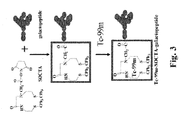
- Fig 3 is a graph showing the flow chart of preparation of Tc-99m-SOCTA-galactopeptide.
- Fig 4 is a graph showing the structure of SOCTA.
- Fig 5 is a graph showing mass spectrum of serum biomarkers with SELDI-TOF analysis.
- Fig 6 is a graph showing statistics of serum biomarkers with SELDI-TOF analysis.
- Fig 7 is a graph showing the differential expression of 15.1kD molecular weight protein in normal rat liver and fibrotic rat liver.
- Fig 8 is a graph showing the differential expression of 15.9kD molecular weight protein in normal rat liver and fibrotic rat liver.
- Fig 9 is a graph showing the present grading result of fibrotic liver by pathological examination.
- method 1 was executed by a glyco-molecular imaging technique for liver targeting. There is no necessity to do any invasive tissue biopsy or body fluids' sampling.
- the clinical examination steps including step 10 and step 11.
- people were i. v. injected by galactopeptide molecular imaging agent and then the total imaging signal per unit volume of liver was measured by medical imaging device in the step 11.
- the imaging agent could be radiopharmaceutical or magnetic contrast medium.
- radiopharmaceuticals such as Tc-99m-SOCTA-galactopeptide or Tc-99m-DTPA-galactopeptide, combining SPECT (single positron emission computed tomography) for total Y emitted count per unit volume of liver.
- magnétique contrast medium such as Mn-DTPA-glactopeptide or Gd-DTPA-galactopeptide
- MRI magnetic resonance imaging
- the present invention relates to a galactopeptide imaging agent, such as Tc-99m-SOCTA-galactopeptide, for liver fibrosis diagnosis.
- a galactopeptide imaging agent such as Tc-99m-SOCTA-galactopeptide
- the rationale is that the collagen hyperplasia in liver fibrosis will bring the ischemia phenomenon in fibrotic liver. The more collagen produced, the more ischemia existed. Since we know the ischemia will reduce the uptake of imaging agent in liver, we believe Tc-99m-SOCTA-galactopeptide in Fig 3 combining glyco-molecular imaging method for liver targeting could be used for grade differentiation of the fibrotic liver.
- the molecular imaging is a prior art, so we did not detail here.
- SOCTA means (succinimidyl-3,6-diaza-5-oxo-3-[2-((triphenyl-methyl)thio)ethyl]-8-[(triphenylmethyl)-thio]octanoate) and the structure thereof can be referred to in Fig 4 .
- Fig 2 is the graph showing the concept of glyco-molecular imaging for liver targeting. There is no necessity of any liver biopsy or body fluid's sampling. If Tc-99m-SOCTA-galactopeptide or Tc-99m-DTPA-galactopeptide was used as the imaging agent, they will target to liver GalNAc receptor and enter into liver cell by endocytosis after i.v. injection, combining the SPECT (single positron emission computered tomography), the emitted ⁇ ray and liver volume will be measured, then the ⁇ count per unit volume of liver will be measured for liver fibrosis classification.
- SPECT single positron emission computered tomography
- magnetic contrast medium such as Mn-D'fPA-galactopeptide or Gd-DTPA-galactopeptide
- Mn-D'fPA-galactopeptide or Gd-DTPA-galactopeptide was used as the imaging agent, they will target to liver GalNAc receptor and enter into liver cell by endocytosis after i.v. injection, combining MRI (magnetic resonance imaging), then the emitted magnetic resonance signal per unit volume of liver will be measured for liver fibrosis classification.
- Fig 3 is the preparation flow chart of Tc-99m-SOCTA-galactopetide.
- the preparation is fulfilled by conjugation of SOCTA with galactopeptide and then labeling with Tc-99m.
- the conjugation occurs by amino group of galactopeptide reacting with imidazole ester bond of SOCTA.
- the Tc-99m labeling occurs by linking Tc-99m with N 2 S 2 structure of SOCTA.
- SOCTA could be stored at room temperature lasting for more than one year due to its difficulty of water dissolution and stability at room temperature.
- liver fibrosis will cause collagen hyperplasia from the surrounding of portal vein to the surrounding of central vein gradually, so that the blood flow into liver cell, will expectedly reduced. That's why we propose the liver will be under ischemic status. The more collagen hyperplasia, the severity of ischemia. Since prior art indicates "the ischemic hepatic membrane has much lower Gal/GalNAc receptor and meanwhile, the endocytosis is also much less than the normal liver cell.”, we propose the fibrotic hepatic membrane has much lower Gal/GalNAc receptor, so that the endocytosis of Tc-99m-SOCTA-galactopeptide will much reduced. That's why we reasonablly derive Tc-99m-SOCTA-galactopeptide combining with the concept of glyco-molecular imaging for liver targeting could be used for liver fibrotic grade classification.
- hemoglobin a chain (Molecular weight 15.1kD) and hemoglobin ⁇ chain (molecular weight 15.9kD) will reduced under ischemic status.
- the results indicate the 15.1kD and 15.9kD exactly largely reduced in fibrotic liver. Please see Fig 5 and Fig 6 .
- the Fo grade of fibrotic liver has higher concentration of these two protein peaks.
- Fig 7 and 8 sections of 12 ⁇ m thickness were obtained on a cryostat at -18 °C and deposited on indium tin oxide coated conductive glass slides. Tissue sections were fixed by immersion in ethanol baths and allowed to dry for 30 min under vacuum. Matrix (for energy absorption in analysis of mass spectrometry) deposition onto the tissue section was performed sequentially with 20mg/mL sinapinic acid dissolved in 50% acetonitrile, 0.1% trifluoroacetic acid. MALDI MS spectra of the spotted tissue sections were acquired on an UltraFlex MALDI-TOF/TOF instrument. Either fig 7 or fig 8 supports fibrotic liver rat was under ischemic status. Fig 7 shows fibrotic liver rat has much less protein expression at 15197.2Da. Fig 8 shows fibrotic liver rat has much less protein expression at 15858.3Da.
- Liver fibrosis could be totally recovered or improved if early diagnosis of liver fibrosis and administration of proper therapeutical drug. Since glyco-molecular imaging for liver targeting could provide the tissue image distribution and get the quantitative value, it is beneficial to accurate grade classification of fibrotic liver.
- a molecular imaging agent, Tc-99m-SOCTA-galactopeptide was disclosed here which could be used for quantification the severity of fibrotic liver, including grade differentiation.
- galactopeptide has strong affinity with hepatic GalNAc receptor, and a chelator, such as SOCTA, was essential for linkage between galactopeptide and Tc-99m.
- DTPA anhydride DTPA: diethyl-triamine-penta-acetic acid
- DTPA anhydride reacts pretty quickly (often less than 2 hours) with amino group of galactopeptide in weak alkaline solution, but meanwhile, it is not easy for storage in room temperature because it is much unstable and easy to water-deliquescent.
- SOCTA is much stable and could be stored at room temperature lasting for more than one year. It reacts with galactopeptide much slowly, but it is much stable due to its difficult to water-deliquescent. Its longer shelf-life is an advantage to be an ingredient of imaging agent in a pharmaceutical factory.
- Fig 4 is the chemical structure of SOCTA.
- the imidazole ester bond of SOCTA has the potential to conjugate with the amino group of galactopeptide and the N 2 S 2 structure of SOCTA makes it be a good choice for Tc-99m labeling.
Landscapes
- Health & Medical Sciences (AREA)
- Life Sciences & Earth Sciences (AREA)
- Chemical & Material Sciences (AREA)
- Veterinary Medicine (AREA)
- Public Health (AREA)
- Epidemiology (AREA)
- Medicinal Chemistry (AREA)
- Animal Behavior & Ethology (AREA)
- General Health & Medical Sciences (AREA)
- Biochemistry (AREA)
- Nuclear Medicine, Radiotherapy & Molecular Imaging (AREA)
- Engineering & Computer Science (AREA)
- Radiology & Medical Imaging (AREA)
- Biotechnology (AREA)
- Molecular Biology (AREA)
- Proteomics, Peptides & Aminoacids (AREA)
- Physics & Mathematics (AREA)
- Optics & Photonics (AREA)
- Pharmacology & Pharmacy (AREA)
- Medicines Containing Antibodies Or Antigens For Use As Internal Diagnostic Agents (AREA)
Description
- The present invention relates to a molecular imaging method for quantification of liver fibrosis grade and its glyco-imaging agent with liver-targeting characteristics, wherein the agent combining with molecular imaging method could be used to differentiate the grade of liver fibrosis.
- In clinics, the liver fibrosis staging often depends on liver biopsy and Metavir classification, which is classified F0, F1, F2, F3, F4 according to the biopsy observation under microscopy. The biggest challenge for this method was its abhorrence by people for its latent danger. Besides, it is not accurate due to the frequent sampling error and deviation of individual observation. Furthermore, the result is qualitative and subjective but not quantitative and objective.
- It has been well documented by Lee laboratory since 1983 that multivalent galactopeptide has a strong "cluster effect" to enhance binding with hepatic Gal/GalNAc receptor. The Gal-terminated triantennary structure exhibits 106 fold stronger affinity than monovalent component structure. After binding, the galactopeptide will be endocytosis into hepatic cell. In 2004, Kwon's experiment indicates that the ischemic hepatic membrane has much lower Gal/GalNAc receptor and meanwhile, the endocytosis is also much less than the normal liver cell.
-
US 5,118,798 discloses a neogalactoalbumin or galactose-bonded polylysine bound to a chelate forming compound such as DTPA which in turn is bound to a radioactive metallic element for use as a radioactive diagnostic or therapeutic agent for liver.US 5,679,323 discloses an MRI contrast agent which is internalized by hepatocytes for obtaining an MR image of the liver to provide a direct measure of liver function and regional difference in the state of the liver. SHIOMI S. et al in "Use of scintigraphy with 99m technetium galactosyl human serum albumin for staging of primary biliary cirrhosis and assessment of prognosis", Journal of Gastroenterology and Hepatology, June 1999, p. 566-571 and SASAKI N. et al in "Clinical usefulness of scinitigraphy with 99mTc-galactosyl serum albumin for prognosis of cirrhosis of the liver", Journal of Nuclear Medicine: Official Publication, Society of Nuclear Medicine, Oct. 1999, p. 1652-1656 disclose use of scintigraphy with 99mTc-DTPA-galactosyl-human serum albumin for staging liver disease and prognosis.US 4,401,647 discloses a galactosyl serum albumin-Tc-99m conjugate having from about 5 to 40 galactosyl groups for scintigraphic hepatic imaging and for use in a method for diagnosing liver disease states. - This invention discloses a glyco-molecular imaging agent with liver-targeting characteristics and a method for synthesizing the same. This glyco-molecular agent allows to provide an exact image distribution and real hepatic cellular uptake value during molecular imaging, which objectively overcomes the numerous uncertainty of prior traditional clinic method.
- It is therefore an object of the present invention to provide a galactopeptide-containing agent for in vivo accurate grade classification of liver fibrosis, the use of which avoids liver biopsy or body fluid sampling, and allows, when injected, reading the total image signal per unit volume of liver within specified hours.
- It is therefore another object of the present invention to supply a glyco-molecular imaging agent for accurate quantification of the liver fibrosis grades, which is made by a bifunctional chelator both linking to galactopeptide and chelating with a metal, and a method for synthesizing the same. Particularly, this bifunctional chelator has highly superior air stability than other bifunctional chelator. The storage time in room temperature is more than one year.
- The above-mentioned objects are solved by the galactopeptide-containing agent for in vivo accurate grade classification of liver fibrosis according to
claim 1, the method for synthesizing glyco-molecular imaging agent for grade classification of liver fibrosis according to claim 4 and the glyco-molecular imaging agent for grade classification of liver fibrosis according to claim 6. Advantageous improvements of the invention are described by dependent claims. - The drawings, incorporated into and form a part of the disclosure, illustrate the embodiments and method related to this invention and will assist in explaining the detail of the invention.
-
Fig 1 is a graph showing the clinical examination steps for differentiate liver fibrosis grades. -
Fig 2 is a graph showing the concept of glyco-molecular imaging for liver targeting. -
Fig 3 is a graph showing the flow chart of preparation of Tc-99m-SOCTA-galactopeptide. -
Fig 4 is a graph showing the structure of SOCTA. -
Fig 5 is a graph showing mass spectrum of serum biomarkers with SELDI-TOF analysis. -
Fig 6 is a graph showing statistics of serum biomarkers with SELDI-TOF analysis. -
Fig 7 is a graph showing the differential expression of 15.1kD molecular weight protein in normal rat liver and fibrotic rat liver. -
Fig 8 is a graph showing the differential expression of 15.9kD molecular weight protein in normal rat liver and fibrotic rat liver. -
Fig 9 is a graph showing the present grading result of fibrotic liver by pathological examination. - According to
Fig 1 ,method 1 was executed by a glyco-molecular imaging technique for liver targeting. There is no necessity to do any invasive tissue biopsy or body fluids' sampling. The clinical examinationsteps including step 10 andstep 11. Instep 10, people were i. v. injected by galactopeptide molecular imaging agent and then the total imaging signal per unit volume of liver was measured by medical imaging device in thestep 11. In which, the imaging agent could be radiopharmaceutical or magnetic contrast medium. One example shows radiopharmaceuticals, such as Tc-99m-SOCTA-galactopeptide or Tc-99m-DTPA-galactopeptide, combining SPECT (single positron emission computed tomography) for total Y emitted count per unit volume of liver. Another example shows magnetic contrast medium, such as Mn-DTPA-glactopeptide or Gd-DTPA-galactopeptide, combining MRI (magnetic resonance imaging) for total magnetic resonance signal per unit volume of liver. Insteps 11, the measurement time is below 6 hours. - The present invention relates to a galactopeptide imaging agent, such as Tc-99m-SOCTA-galactopeptide, for liver fibrosis diagnosis. The rationale is that the collagen hyperplasia in liver fibrosis will bring the ischemia phenomenon in fibrotic liver. The more collagen produced, the more ischemia existed. Since we know the ischemia will reduce the uptake of imaging agent in liver, we believe Tc-99m-SOCTA-galactopeptide in
Fig 3 combining glyco-molecular imaging method for liver targeting could be used for grade differentiation of the fibrotic liver. The molecular imaging is a prior art, so we did not detail here. InFig 3 , SOCTA means (succinimidyl-3,6-diaza-5-oxo-3-[2-((triphenyl-methyl)thio)ethyl]-8-[(triphenylmethyl)-thio]octanoate) and the structure thereof can be referred to inFig 4 . -
Fig 2 is the graph showing the concept of glyco-molecular imaging for liver targeting. There is no necessity of any liver biopsy or body fluid's sampling. If Tc-99m-SOCTA-galactopeptide or Tc-99m-DTPA-galactopeptide was used as the imaging agent, they will target to liver GalNAc receptor and enter into liver cell by endocytosis after i.v. injection, combining the SPECT (single positron emission computered tomography), the emitted γ ray and liver volume will be measured, then the γ count per unit volume of liver will be measured for liver fibrosis classification. If magnetic contrast medium, such as Mn-D'fPA-galactopeptide or Gd-DTPA-galactopeptide, was used as the imaging agent, they will target to liver GalNAc receptor and enter into liver cell by endocytosis after i.v. injection, combining MRI (magnetic resonance imaging), then the emitted magnetic resonance signal per unit volume of liver will be measured for liver fibrosis classification. -
Fig 3 is the preparation flow chart of Tc-99m-SOCTA-galactopetide. The preparation is fulfilled by conjugation of SOCTA with galactopeptide and then labeling with Tc-99m. The conjugation occurs by amino group of galactopeptide reacting with imidazole ester bond of SOCTA. The Tc-99m labeling occurs by linking Tc-99m with N2S2 structure of SOCTA. SOCTA could be stored at room temperature lasting for more than one year due to its difficulty of water dissolution and stability at room temperature. - Theoretically, liver fibrosis will cause collagen hyperplasia from the surrounding of portal vein to the surrounding of central vein gradually, so that the blood flow into liver cell, will expectedly reduced. That's why we propose the liver will be under ischemic status. The more collagen hyperplasia, the severity of ischemia. Since prior art indicates "the ischemic hepatic membrane has much lower Gal/GalNAc receptor and meanwhile, the endocytosis is also much less than the normal liver cell.", we propose the fibrotic hepatic membrane has much lower Gal/GalNAc receptor, so that the endocytosis of Tc-99m-SOCTA-galactopeptide will much reduced. That's why we reasonablly derive Tc-99m-SOCTA-galactopeptide combining with the concept of glyco-molecular imaging for liver targeting could be used for liver fibrotic grade classification.
- Experimentally, hemoglobin a chain (Molecular weight 15.1kD) and hemoglobin β chain (molecular weight 15.9kD) will reduced under ischemic status. We observe the change of these two protein peaks in serum with SELDI-TOF mass spectrometry. The results indicate the 15.1kD and 15.9kD exactly largely reduced in fibrotic liver. Please see
Fig 5 andFig 6 . Infig. 5 , the Fo grade of fibrotic liver has higher concentration of these two protein peaks. By statistical analysis of these two protein peaks for 40 liver fibrostic patients inFig 6 , the Fo grade of fibrotic liver has significant difference and higher concentration in 15.9kD (p=0.02) and 15.1kD (p=0.27). - Similar results were shown in tissue profiling. In
Fig 7 and8 , sections of 12µ m thickness were obtained on a cryostat at -18 °C and deposited on indium tin oxide coated conductive glass slides. Tissue sections were fixed by immersion in ethanol baths and allowed to dry for 30 min under vacuum. Matrix (for energy absorption in analysis of mass spectrometry) deposition onto the tissue section was performed sequentially with 20mg/mL sinapinic acid dissolved in 50% acetonitrile, 0.1% trifluoroacetic acid. MALDI MS spectra of the spotted tissue sections were acquired on an UltraFlex MALDI-TOF/TOF instrument. Eitherfig 7 orfig 8 supports fibrotic liver rat was under ischemic status.Fig 7 shows fibrotic liver rat has much less protein expression at 15197.2Da.Fig 8 shows fibrotic liver rat has much less protein expression at 15858.3Da. - Both hemoglobin α chain and β chain reduced in serum and tissue indicate fibrotic liver was under ischemic status. Glyco-molecular imaging for liver targeting method provides image distribution and quantification data. So that if they could be properly labelled with radioisotope or magnetic contrast medium and i. v. injection into body, they will be able to use for grade classification of liver fibrosis and follow-up evaluation of the therapeutic effect.
- Liver fibrosis could be totally recovered or improved if early diagnosis of liver fibrosis and administration of proper therapeutical drug. Since glyco-molecular imaging for liver targeting could provide the tissue image distribution and get the quantitative value, it is beneficial to accurate grade classification of fibrotic liver.
- A molecular imaging agent, Tc-99m-SOCTA-galactopeptide, was disclosed here which could be used for quantification the severity of fibrotic liver, including grade differentiation. In which, galactopeptide has strong affinity with hepatic GalNAc receptor, and a chelator, such as SOCTA, was essential for linkage between galactopeptide and Tc-99m. Traditionally, DTPA anhydride (DTPA: diethyl-triamine-penta-acetic acid) was used usually. DTPA anhydride reacts pretty quickly (often less than 2 hours) with amino group of galactopeptide in weak alkaline solution, but meanwhile, it is not easy for storage in room temperature because it is much unstable and easy to water-deliquescent. Relatively, SOCTA is much stable and could be stored at room temperature lasting for more than one year. It reacts with galactopeptide much slowly, but it is much stable due to its difficult to water-deliquescent. Its longer shelf-life is an advantage to be an ingredient of imaging agent in a pharmaceutical factory.
-
Fig 4 is the chemical structure of SOCTA. The imidazole ester bond of SOCTA has the potential to conjugate with the amino group of galactopeptide and the N2S2 structure of SOCTA makes it be a good choice for Tc-99m labeling. - Although the present invention has been described with reference to the preferred embodiments, it will be understood that the invention is not limited to the details described thereof.
Claims (6)
- Galactopeptide-containing agent for in vivo accurate grade classification of liver fibrosis, which is done with glyco-molecular imaging technique for liver targeting without any necessity for tissue biopsy or body fluid's sampling, comprising measuring imaging signal per unit volume of liver with medical imaging device within a specified time, wherein the galactopeptide-containing imaging agent is Tc-99m-succinimidyl-3,6-diaza-5-oxo-3-[2-((triphenyl-methyl)thio) ethyl]-8-[(triphenylmethyl)-thio]octanoate-glactopeptide and wherein the galactopeptide is trivalent galactose.
- Galactopeptide-containing agent of claim 1, wherein the Tc-99m-succinimidyl-3,6-diaza-5-oxo-3-[2-((triphenyl-methyl)thio)ethyl]-8-[(triphenylmethyl)-thio] octanoate - -galactopeptide combining single position emission computed tomography is usable for measurement of total γ emitted per unit volume of liver.
- Galactopeptide-containing agent of claim 1, the specified reaction time of which is below 6 hours.
- A method for synthesizing glyco-molecular imaging agent with liver targeting for grade classification of liver fibrosis by taking a bifunctional chelator to conjugate galactopeptide and then chelating with a metal, wherein the bifunctional chelator has shelf life lasting for more than one year due to its difficulty for water-deliquescent and good stability at room temperature, wherein the metal is Tc-99m and wherein the bifunctional chelator is succinimidyl-3,6-diaza-5-oxo-3-[2-((triphenyl-methyl)thio) ethyl]-8-[(triphenylmethyl)-thio]octanoate and wherein the galactopeptide is trivalent galactose.
- The method of claim 4, wherein the imidazole ester bond of succinimidyl-3,6-diaza-5-oxo-3-[2-((triphenyl-methyl)thio) ethyl]-8-[(triphenylmethyl)-thio]octanoate is conjugated with the amino group of galactopeptide.
- A glyco-molecular imaging agent with liver targeting for grade classification of liver fibrosis being synthesized by taking a bifunctional chelator to conjugate galactopeptide and then chelating with a metal, wherein the bifunctional chelator is succinimidyl-3,6-diaza-5-oxo-3-[2-((triphenylmethyl)thio) ethyl]-8-[(triphenylmethyl)-thio]octanoate and wherein the galactopeptide is trivalent galactose and wherein the metal is Tc-99m, so that the galactopeptide-containing imaging agent is Tc-99m-succinimidyl-3,6-diaza-5-oxo-3-[2-((triphenyl-methyl)thio) ethyl] -8- [(triphenylmethyl)-thio]octanoate-galactopeptide.
Priority Applications (1)
| Application Number | Priority Date | Filing Date | Title |
|---|---|---|---|
| EP07122317.6A EP2067489B1 (en) | 2007-12-04 | 2007-12-04 | Glyco-molecular imaging method for grade classification of liver fibrosis and its glyco-molecular imaging agent thereof |
Applications Claiming Priority (1)
| Application Number | Priority Date | Filing Date | Title |
|---|---|---|---|
| EP07122317.6A EP2067489B1 (en) | 2007-12-04 | 2007-12-04 | Glyco-molecular imaging method for grade classification of liver fibrosis and its glyco-molecular imaging agent thereof |
Publications (2)
| Publication Number | Publication Date |
|---|---|
| EP2067489A1 EP2067489A1 (en) | 2009-06-10 |
| EP2067489B1 true EP2067489B1 (en) | 2014-07-23 |
Family
ID=39322804
Family Applications (1)
| Application Number | Title | Priority Date | Filing Date |
|---|---|---|---|
| EP07122317.6A Active EP2067489B1 (en) | 2007-12-04 | 2007-12-04 | Glyco-molecular imaging method for grade classification of liver fibrosis and its glyco-molecular imaging agent thereof |
Country Status (1)
| Country | Link |
|---|---|
| EP (1) | EP2067489B1 (en) |
Cited By (1)
| Publication number | Priority date | Publication date | Assignee | Title |
|---|---|---|---|---|
| JP2009133803A (en) * | 2007-11-30 | 2009-06-18 | Inst Nuclear Energy Research Rocaec | Method for discriminating liver fibrosis level and its carbohydrate medical imaging molecular contrast agent |
Family Cites Families (3)
| Publication number | Priority date | Publication date | Assignee | Title |
|---|---|---|---|---|
| US4401647A (en) | 1980-03-03 | 1983-08-30 | The Regents Of The University Of Ca | Radiolabeled neoglycopeptides |
| US5679323A (en) | 1986-07-03 | 1997-10-21 | Advanced Magnetics, Inc. | Hepatocyte-specific receptor-mediated endocytosis-type compositions |
| AU601536B2 (en) | 1986-12-30 | 1990-09-13 | Nihon Medi-Physics Co., Ltd. | High molecular compound comprising unit of asialoglycoprotein acceptor-directing compound and unit of chelate-forming compound chemically bonded thereto, and its utilization |
-
2007
- 2007-12-04 EP EP07122317.6A patent/EP2067489B1/en active Active
Cited By (1)
| Publication number | Priority date | Publication date | Assignee | Title |
|---|---|---|---|---|
| JP2009133803A (en) * | 2007-11-30 | 2009-06-18 | Inst Nuclear Energy Research Rocaec | Method for discriminating liver fibrosis level and its carbohydrate medical imaging molecular contrast agent |
Also Published As
| Publication number | Publication date |
|---|---|
| EP2067489A1 (en) | 2009-06-10 |
Similar Documents
| Publication | Publication Date | Title |
|---|---|---|
| Macholl et al. | In vivo pH imaging with 99mTc-pHLIP | |
| US7534418B2 (en) | Imaging agents | |
| Ahmed et al. | Diagnostic modalities and radiopharmaceuticals with particular importance of technetium-99m (99mTc) | |
| KR102290407B1 (en) | System and method for quantitative mapping of mitocondrial complex 1 | |
| US10385093B2 (en) | Estrogen receptor imaging agents | |
| Kim et al. | Radiolabeled phosphonium salts as mitochondrial voltage sensors for positron emission tomography myocardial imaging agents | |
| JP2005226021A (en) | Mannose receptor affinity compounds | |
| US8142759B2 (en) | Glyco-molecular imaging method for grade classification of liver fibrosis and its glyco-molecular imaging agent thereof | |
| CN106061512B (en) | Composition for imaging atherosclerosis and method for diagnosing atherosclerosis using the composition | |
| TWI417110B (en) | Glyco-molecular imaging agent for remaining liver function measurement | |
| EP2067489A1 (en) | Glyco-molecular imaging method for grade classification of liver fibrosis and its glyco-molecular imaging agent thereof | |
| JP2026507978A (en) | Use of a positronic myocardial fatty acid metabolism imaging agent and a positronic 18F-FDG myocardial glucose imaging agent for PET combined imaging - Patent Application 20070122999 | |
| US20250339568A1 (en) | Precursor and radiotracer for neuroendocrine theranostics | |
| US20180193493A1 (en) | Renal imaging agent | |
| AU2018381046B2 (en) | Radiolabeled progastrin in cancer diagnosis | |
| Eeda et al. | Design of 99mTc-labeled zinc-chelating imaging probe for SPECT imaging of the pancreas | |
| US20260108639A1 (en) | Complex for diagnosing non-alcoholic steatohepatitis, use, and contrast agent thereof | |
| US20240066157A1 (en) | Molecular imaging complex for positron emission tomography | |
| WO2011033112A2 (en) | 68ga-labeled human serum albumin | |
| JP2002275099A (en) | Probe for diagnostic imaging of amyloid-accumulating disease caused by compound containing benzocyazoline ring or benzoxazoline ring, and diagnostic imaging composition containing the same | |
| Tachatumvitoon | Development of technetium-99m labeled PSMA for SPECT prostate cancer imaging | |
| CA3085067C (en) | Radiolabeled progastrin in cancer diagnosis | |
| Wahl | Nuclear medicine techniques in breast imaging | |
| Van der Wall et al. | Nuclear cardiology and cardiac magnetic resonance | |
| WO2022157373A1 (en) | Compositions and kits for in vivo imaging of cardiac sarcoidosis |
Legal Events
| Date | Code | Title | Description |
|---|---|---|---|
| PUAI | Public reference made under article 153(3) epc to a published international application that has entered the european phase |
Free format text: ORIGINAL CODE: 0009012 |
|
| 17P | Request for examination filed |
Effective date: 20080407 |
|
| AK | Designated contracting states |
Kind code of ref document: A1 Designated state(s): AT BE BG CH CY CZ DE DK EE ES FI FR GB GR HU IE IS IT LI LT LU LV MC MT NL PL PT RO SE SI SK TR |
|
| AX | Request for extension of the european patent |
Extension state: AL BA HR MK RS |
|
| AKX | Designation fees paid |
Designated state(s): AT BE BG CH CY CZ DE DK EE ES FI FR GB GR HU IE IS IT LI LT LU LV MC MT NL PL PT RO SE SI SK TR |
|
| 17Q | First examination report despatched |
Effective date: 20110325 |
|
| GRAP | Despatch of communication of intention to grant a patent |
Free format text: ORIGINAL CODE: EPIDOSNIGR1 |
|
| INTG | Intention to grant announced |
Effective date: 20140116 |
|
| GRAP | Despatch of communication of intention to grant a patent |
Free format text: ORIGINAL CODE: EPIDOSNIGR1 |
|
| INTG | Intention to grant announced |
Effective date: 20140516 |
|
| GRAS | Grant fee paid |
Free format text: ORIGINAL CODE: EPIDOSNIGR3 |
|
| GRAA | (expected) grant |
Free format text: ORIGINAL CODE: 0009210 |
|
| AK | Designated contracting states |
Kind code of ref document: B1 Designated state(s): AT BE BG CH CY CZ DE DK EE ES FI FR GB GR HU IE IS IT LI LT LU LV MC MT NL PL PT RO SE SI SK TR |
|
| REG | Reference to a national code |
Ref country code: GB Ref legal event code: FG4D |
|
| REG | Reference to a national code |
Ref country code: CH Ref legal event code: EP |
|
| REG | Reference to a national code |
Ref country code: IE Ref legal event code: FG4D |
|
| REG | Reference to a national code |
Ref country code: AT Ref legal event code: REF Ref document number: 678494 Country of ref document: AT Kind code of ref document: T Effective date: 20140815 |
|
| REG | Reference to a national code |
Ref country code: DE Ref legal event code: R096 Ref document number: 602007037742 Country of ref document: DE Effective date: 20140828 |
|
| REG | Reference to a national code |
Ref country code: AT Ref legal event code: MK05 Ref document number: 678494 Country of ref document: AT Kind code of ref document: T Effective date: 20140723 |
|
| REG | Reference to a national code |
Ref country code: NL Ref legal event code: VDEP Effective date: 20140723 |
|
| REG | Reference to a national code |
Ref country code: LT Ref legal event code: MG4D |
|
| PG25 | Lapsed in a contracting state [announced via postgrant information from national office to epo] |
Ref country code: GR Free format text: LAPSE BECAUSE OF FAILURE TO SUBMIT A TRANSLATION OF THE DESCRIPTION OR TO PAY THE FEE WITHIN THE PRESCRIBED TIME-LIMIT Effective date: 20141024 Ref country code: LT Free format text: LAPSE BECAUSE OF FAILURE TO SUBMIT A TRANSLATION OF THE DESCRIPTION OR TO PAY THE FEE WITHIN THE PRESCRIBED TIME-LIMIT Effective date: 20140723 Ref country code: SE Free format text: LAPSE BECAUSE OF FAILURE TO SUBMIT A TRANSLATION OF THE DESCRIPTION OR TO PAY THE FEE WITHIN THE PRESCRIBED TIME-LIMIT Effective date: 20140723 Ref country code: FI Free format text: LAPSE BECAUSE OF FAILURE TO SUBMIT A TRANSLATION OF THE DESCRIPTION OR TO PAY THE FEE WITHIN THE PRESCRIBED TIME-LIMIT Effective date: 20140723 Ref country code: BG Free format text: LAPSE BECAUSE OF FAILURE TO SUBMIT A TRANSLATION OF THE DESCRIPTION OR TO PAY THE FEE WITHIN THE PRESCRIBED TIME-LIMIT Effective date: 20141023 Ref country code: PT Free format text: LAPSE BECAUSE OF FAILURE TO SUBMIT A TRANSLATION OF THE DESCRIPTION OR TO PAY THE FEE WITHIN THE PRESCRIBED TIME-LIMIT Effective date: 20141124 Ref country code: ES Free format text: LAPSE BECAUSE OF FAILURE TO SUBMIT A TRANSLATION OF THE DESCRIPTION OR TO PAY THE FEE WITHIN THE PRESCRIBED TIME-LIMIT Effective date: 20140723 |
|
| PG25 | Lapsed in a contracting state [announced via postgrant information from national office to epo] |
Ref country code: LV Free format text: LAPSE BECAUSE OF FAILURE TO SUBMIT A TRANSLATION OF THE DESCRIPTION OR TO PAY THE FEE WITHIN THE PRESCRIBED TIME-LIMIT Effective date: 20140723 Ref country code: NL Free format text: LAPSE BECAUSE OF FAILURE TO SUBMIT A TRANSLATION OF THE DESCRIPTION OR TO PAY THE FEE WITHIN THE PRESCRIBED TIME-LIMIT Effective date: 20140723 Ref country code: AT Free format text: LAPSE BECAUSE OF FAILURE TO SUBMIT A TRANSLATION OF THE DESCRIPTION OR TO PAY THE FEE WITHIN THE PRESCRIBED TIME-LIMIT Effective date: 20140723 Ref country code: CY Free format text: LAPSE BECAUSE OF FAILURE TO SUBMIT A TRANSLATION OF THE DESCRIPTION OR TO PAY THE FEE WITHIN THE PRESCRIBED TIME-LIMIT Effective date: 20140723 Ref country code: PL Free format text: LAPSE BECAUSE OF FAILURE TO SUBMIT A TRANSLATION OF THE DESCRIPTION OR TO PAY THE FEE WITHIN THE PRESCRIBED TIME-LIMIT Effective date: 20140723 Ref country code: IS Free format text: LAPSE BECAUSE OF FAILURE TO SUBMIT A TRANSLATION OF THE DESCRIPTION OR TO PAY THE FEE WITHIN THE PRESCRIBED TIME-LIMIT Effective date: 20141123 |
|
| REG | Reference to a national code |
Ref country code: DE Ref legal event code: R097 Ref document number: 602007037742 Country of ref document: DE |
|
| PG25 | Lapsed in a contracting state [announced via postgrant information from national office to epo] |
Ref country code: CZ Free format text: LAPSE BECAUSE OF FAILURE TO SUBMIT A TRANSLATION OF THE DESCRIPTION OR TO PAY THE FEE WITHIN THE PRESCRIBED TIME-LIMIT Effective date: 20140723 Ref country code: RO Free format text: LAPSE BECAUSE OF FAILURE TO SUBMIT A TRANSLATION OF THE DESCRIPTION OR TO PAY THE FEE WITHIN THE PRESCRIBED TIME-LIMIT Effective date: 20140723 Ref country code: SK Free format text: LAPSE BECAUSE OF FAILURE TO SUBMIT A TRANSLATION OF THE DESCRIPTION OR TO PAY THE FEE WITHIN THE PRESCRIBED TIME-LIMIT Effective date: 20140723 Ref country code: EE Free format text: LAPSE BECAUSE OF FAILURE TO SUBMIT A TRANSLATION OF THE DESCRIPTION OR TO PAY THE FEE WITHIN THE PRESCRIBED TIME-LIMIT Effective date: 20140723 Ref country code: IT Free format text: LAPSE BECAUSE OF FAILURE TO SUBMIT A TRANSLATION OF THE DESCRIPTION OR TO PAY THE FEE WITHIN THE PRESCRIBED TIME-LIMIT Effective date: 20140723 Ref country code: DK Free format text: LAPSE BECAUSE OF FAILURE TO SUBMIT A TRANSLATION OF THE DESCRIPTION OR TO PAY THE FEE WITHIN THE PRESCRIBED TIME-LIMIT Effective date: 20140723 |
|
| PLBE | No opposition filed within time limit |
Free format text: ORIGINAL CODE: 0009261 |
|
| STAA | Information on the status of an ep patent application or granted ep patent |
Free format text: STATUS: NO OPPOSITION FILED WITHIN TIME LIMIT |
|
| PG25 | Lapsed in a contracting state [announced via postgrant information from national office to epo] |
Ref country code: BE Free format text: LAPSE BECAUSE OF NON-PAYMENT OF DUE FEES Effective date: 20141231 |
|
| 26N | No opposition filed |
Effective date: 20150424 |
|
| PG25 | Lapsed in a contracting state [announced via postgrant information from national office to epo] |
Ref country code: LU Free format text: LAPSE BECAUSE OF FAILURE TO SUBMIT A TRANSLATION OF THE DESCRIPTION OR TO PAY THE FEE WITHIN THE PRESCRIBED TIME-LIMIT Effective date: 20141204 |
|
| REG | Reference to a national code |
Ref country code: CH Ref legal event code: PL |
|
| REG | Reference to a national code |
Ref country code: IE Ref legal event code: MM4A |
|
| PG25 | Lapsed in a contracting state [announced via postgrant information from national office to epo] |
Ref country code: CH Free format text: LAPSE BECAUSE OF NON-PAYMENT OF DUE FEES Effective date: 20141231 Ref country code: LI Free format text: LAPSE BECAUSE OF NON-PAYMENT OF DUE FEES Effective date: 20141231 Ref country code: IE Free format text: LAPSE BECAUSE OF NON-PAYMENT OF DUE FEES Effective date: 20141204 |
|
| PG25 | Lapsed in a contracting state [announced via postgrant information from national office to epo] |
Ref country code: SI Free format text: LAPSE BECAUSE OF FAILURE TO SUBMIT A TRANSLATION OF THE DESCRIPTION OR TO PAY THE FEE WITHIN THE PRESCRIBED TIME-LIMIT Effective date: 20140723 |
|
| REG | Reference to a national code |
Ref country code: FR Ref legal event code: PLFP Year of fee payment: 9 |
|
| PG25 | Lapsed in a contracting state [announced via postgrant information from national office to epo] |
Ref country code: MC Free format text: LAPSE BECAUSE OF FAILURE TO SUBMIT A TRANSLATION OF THE DESCRIPTION OR TO PAY THE FEE WITHIN THE PRESCRIBED TIME-LIMIT Effective date: 20140723 |
|
| PG25 | Lapsed in a contracting state [announced via postgrant information from national office to epo] |
Ref country code: HU Free format text: LAPSE BECAUSE OF FAILURE TO SUBMIT A TRANSLATION OF THE DESCRIPTION OR TO PAY THE FEE WITHIN THE PRESCRIBED TIME-LIMIT; INVALID AB INITIO Effective date: 20071204 Ref country code: MT Free format text: LAPSE BECAUSE OF FAILURE TO SUBMIT A TRANSLATION OF THE DESCRIPTION OR TO PAY THE FEE WITHIN THE PRESCRIBED TIME-LIMIT Effective date: 20140723 Ref country code: TR Free format text: LAPSE BECAUSE OF FAILURE TO SUBMIT A TRANSLATION OF THE DESCRIPTION OR TO PAY THE FEE WITHIN THE PRESCRIBED TIME-LIMIT Effective date: 20140723 Ref country code: BE Free format text: LAPSE BECAUSE OF FAILURE TO SUBMIT A TRANSLATION OF THE DESCRIPTION OR TO PAY THE FEE WITHIN THE PRESCRIBED TIME-LIMIT Effective date: 20140723 |
|
| REG | Reference to a national code |
Ref country code: FR Ref legal event code: PLFP Year of fee payment: 10 |
|
| REG | Reference to a national code |
Ref country code: FR Ref legal event code: PLFP Year of fee payment: 11 |
|
| PGFP | Annual fee paid to national office [announced via postgrant information from national office to epo] |
Ref country code: DE Payment date: 20251007 Year of fee payment: 19 |
|
| PGFP | Annual fee paid to national office [announced via postgrant information from national office to epo] |
Ref country code: GB Payment date: 20251007 Year of fee payment: 19 |
|
| PGFP | Annual fee paid to national office [announced via postgrant information from national office to epo] |
Ref country code: FR Payment date: 20251007 Year of fee payment: 19 |