EP2066746B1 - Monovinylidene aromatic polymers containing nonfunctionalized, nonmineral oil - Google Patents
Monovinylidene aromatic polymers containing nonfunctionalized, nonmineral oil Download PDFInfo
- Publication number
- EP2066746B1 EP2066746B1 EP07814801A EP07814801A EP2066746B1 EP 2066746 B1 EP2066746 B1 EP 2066746B1 EP 07814801 A EP07814801 A EP 07814801A EP 07814801 A EP07814801 A EP 07814801A EP 2066746 B1 EP2066746 B1 EP 2066746B1
- Authority
- EP
- European Patent Office
- Prior art keywords
- oil
- composition
- polymer
- rubbers
- nonmineral
- Prior art date
- Legal status (The legal status is an assumption and is not a legal conclusion. Google has not performed a legal analysis and makes no representation as to the accuracy of the status listed.)
- Not-in-force
Links
- 229920000642 polymer Polymers 0.000 title claims abstract description 70
- 125000003118 aryl group Chemical group 0.000 title claims abstract description 41
- 239000003921 oil Substances 0.000 claims abstract description 76
- 235000019198 oils Nutrition 0.000 claims abstract description 76
- 239000000203 mixture Substances 0.000 claims abstract description 59
- 239000002480 mineral oil Substances 0.000 claims abstract description 41
- 235000010446 mineral oil Nutrition 0.000 claims abstract description 40
- 239000008158 vegetable oil Substances 0.000 claims abstract description 18
- ZCYVEMRRCGMTRW-UHFFFAOYSA-N 7553-56-2 Chemical compound [I] ZCYVEMRRCGMTRW-UHFFFAOYSA-N 0.000 claims abstract description 16
- 229910052740 iodine Inorganic materials 0.000 claims abstract description 16
- 239000011630 iodine Substances 0.000 claims abstract description 16
- 235000015112 vegetable and seed oil Nutrition 0.000 claims abstract description 16
- 125000002887 hydroxy group Chemical group [H]O* 0.000 claims abstract description 12
- 229920005669 high impact polystyrene Polymers 0.000 claims abstract description 11
- 239000004797 high-impact polystyrene Substances 0.000 claims abstract description 11
- 239000004793 Polystyrene Substances 0.000 claims abstract description 5
- 229920002223 polystyrene Polymers 0.000 claims abstract description 5
- 235000012343 cottonseed oil Nutrition 0.000 claims abstract description 4
- 229920001971 elastomer Polymers 0.000 claims description 44
- 239000005060 rubber Substances 0.000 claims description 42
- 239000004014 plasticizer Substances 0.000 claims description 36
- 239000000178 monomer Substances 0.000 claims description 20
- 150000001993 dienes Chemical class 0.000 claims description 7
- 229920003244 diene elastomer Polymers 0.000 claims description 6
- 125000001997 phenyl group Chemical group [H]C1=C([H])C([H])=C(*)C([H])=C1[H] 0.000 claims description 6
- 125000000217 alkyl group Chemical group 0.000 claims description 5
- 238000000465 moulding Methods 0.000 claims description 5
- 229920000122 acrylonitrile butadiene styrene Polymers 0.000 claims description 4
- 125000004432 carbon atom Chemical group C* 0.000 claims description 4
- 238000001125 extrusion Methods 0.000 claims description 4
- NIXOWILDQLNWCW-UHFFFAOYSA-M Acrylate Chemical compound [O-]C(=O)C=C NIXOWILDQLNWCW-UHFFFAOYSA-M 0.000 claims description 3
- 244000105624 Arachis hypogaea Species 0.000 claims description 3
- 235000004977 Brassica sinapistrum Nutrition 0.000 claims description 3
- 229920002943 EPDM rubber Polymers 0.000 claims description 3
- 229920001195 polyisoprene Polymers 0.000 claims description 3
- 230000000379 polymerizing effect Effects 0.000 claims description 3
- 238000003856 thermoforming Methods 0.000 claims description 3
- 241001133760 Acoelorraphe Species 0.000 claims description 2
- 240000002791 Brassica napus Species 0.000 claims description 2
- 229920000181 Ethylene propylene rubber Polymers 0.000 claims description 2
- 244000020551 Helianthus annuus Species 0.000 claims description 2
- 235000003222 Helianthus annuus Nutrition 0.000 claims description 2
- 241000207836 Olea <angiosperm> Species 0.000 claims description 2
- 240000008042 Zea mays Species 0.000 claims description 2
- 235000005824 Zea mays ssp. parviglumis Nutrition 0.000 claims description 2
- 235000002017 Zea mays subsp mays Nutrition 0.000 claims description 2
- 125000005037 alkyl phenyl group Chemical group 0.000 claims description 2
- 229920005549 butyl rubber Polymers 0.000 claims description 2
- 235000005822 corn Nutrition 0.000 claims description 2
- 229920001038 ethylene copolymer Polymers 0.000 claims description 2
- 230000009477 glass transition Effects 0.000 claims description 2
- 229910052736 halogen Inorganic materials 0.000 claims description 2
- 150000002367 halogens Chemical class 0.000 claims description 2
- 229910052739 hydrogen Inorganic materials 0.000 claims description 2
- 239000001257 hydrogen Substances 0.000 claims description 2
- 125000004435 hydrogen atom Chemical group [H]* 0.000 claims description 2
- 125000002496 methyl group Chemical group [H]C([H])([H])* 0.000 claims description 2
- 235000020232 peanut Nutrition 0.000 claims description 2
- 229920002379 silicone rubber Polymers 0.000 claims description 2
- 229920000638 styrene acrylonitrile Polymers 0.000 claims description 2
- 239000000828 canola oil Substances 0.000 abstract description 5
- 235000019519 canola oil Nutrition 0.000 abstract description 5
- 239000002385 cottonseed oil Substances 0.000 abstract description 2
- 230000000052 comparative effect Effects 0.000 description 25
- 229920001577 copolymer Polymers 0.000 description 15
- PPBRXRYQALVLMV-UHFFFAOYSA-N Styrene Chemical compound C=CC1=CC=CC=C1 PPBRXRYQALVLMV-UHFFFAOYSA-N 0.000 description 14
- KAKZBPTYRLMSJV-UHFFFAOYSA-N Butadiene Chemical compound C=CC=C KAKZBPTYRLMSJV-UHFFFAOYSA-N 0.000 description 11
- 238000006116 polymerization reaction Methods 0.000 description 11
- CKQVRZJOMJRTOY-UHFFFAOYSA-N octadecanoic acid;propane-1,2,3-triol Chemical compound OCC(O)CO.CCCCCCCCCCCCCCCCCC(O)=O CKQVRZJOMJRTOY-UHFFFAOYSA-N 0.000 description 9
- YNQLUTRBYVCPMQ-UHFFFAOYSA-N Ethylbenzene Chemical compound CCC1=CC=CC=C1 YNQLUTRBYVCPMQ-UHFFFAOYSA-N 0.000 description 8
- 239000007788 liquid Substances 0.000 description 8
- 238000000034 method Methods 0.000 description 7
- ZQPPMHVWECSIRJ-KTKRTIGZSA-N oleic acid group Chemical group C(CCCCCCC\C=C/CCCCCCCC)(=O)O ZQPPMHVWECSIRJ-KTKRTIGZSA-N 0.000 description 7
- 230000000704 physical effect Effects 0.000 description 7
- 239000000126 substance Substances 0.000 description 7
- KWYUFKZDYYNOTN-UHFFFAOYSA-M Potassium hydroxide Chemical compound [OH-].[K+] KWYUFKZDYYNOTN-UHFFFAOYSA-M 0.000 description 6
- 239000010775 animal oil Substances 0.000 description 6
- DCXXMTOCNZCJGO-UHFFFAOYSA-N tristearoylglycerol Chemical compound CCCCCCCCCCCCCCCCCC(=O)OCC(OC(=O)CCCCCCCCCCCCCCCCC)COC(=O)CCCCCCCCCCCCCCCCC DCXXMTOCNZCJGO-UHFFFAOYSA-N 0.000 description 6
- 235000019486 Sunflower oil Nutrition 0.000 description 5
- 239000004676 acrylonitrile butadiene styrene Substances 0.000 description 5
- 239000000654 additive Substances 0.000 description 5
- -1 e.g. Substances 0.000 description 5
- 239000012467 final product Substances 0.000 description 5
- 239000002600 sunflower oil Substances 0.000 description 5
- RRHGJUQNOFWUDK-UHFFFAOYSA-N Isoprene Chemical compound CC(=C)C=C RRHGJUQNOFWUDK-UHFFFAOYSA-N 0.000 description 4
- 238000013019 agitation Methods 0.000 description 4
- 229920001519 homopolymer Polymers 0.000 description 4
- 238000004519 manufacturing process Methods 0.000 description 4
- 239000003549 soybean oil Substances 0.000 description 4
- 235000012424 soybean oil Nutrition 0.000 description 4
- HSLFISVKRDQEBY-UHFFFAOYSA-N 1,1-bis(tert-butylperoxy)cyclohexane Chemical compound CC(C)(C)OOC1(OOC(C)(C)C)CCCCC1 HSLFISVKRDQEBY-UHFFFAOYSA-N 0.000 description 3
- QTBSBXVTEAMEQO-UHFFFAOYSA-N Acetic acid Chemical compound CC(O)=O QTBSBXVTEAMEQO-UHFFFAOYSA-N 0.000 description 3
- 241000196324 Embryophyta Species 0.000 description 3
- XECAHXYUAAWDEL-UHFFFAOYSA-N acrylonitrile butadiene styrene Chemical compound C=CC=C.C=CC#N.C=CC1=CC=CC=C1 XECAHXYUAAWDEL-UHFFFAOYSA-N 0.000 description 3
- 230000006835 compression Effects 0.000 description 3
- 238000007906 compression Methods 0.000 description 3
- 235000014113 dietary fatty acids Nutrition 0.000 description 3
- 238000009826 distribution Methods 0.000 description 3
- 230000000694 effects Effects 0.000 description 3
- 239000000194 fatty acid Substances 0.000 description 3
- 229930195729 fatty acid Natural products 0.000 description 3
- 150000004665 fatty acids Chemical class 0.000 description 3
- 125000001188 haloalkyl group Chemical group 0.000 description 3
- 238000005984 hydrogenation reaction Methods 0.000 description 3
- 229910052500 inorganic mineral Inorganic materials 0.000 description 3
- 239000011707 mineral Substances 0.000 description 3
- SSDSCDGVMJFTEQ-UHFFFAOYSA-N octadecyl 3-(3,5-ditert-butyl-4-hydroxyphenyl)propanoate Chemical compound CCCCCCCCCCCCCCCCCCOC(=O)CCC1=CC(C(C)(C)C)=C(O)C(C(C)(C)C)=C1 SSDSCDGVMJFTEQ-UHFFFAOYSA-N 0.000 description 3
- 229920002857 polybutadiene Polymers 0.000 description 3
- 239000011541 reaction mixture Substances 0.000 description 3
- 235000013311 vegetables Nutrition 0.000 description 3
- 235000019482 Palm oil Nutrition 0.000 description 2
- 239000005062 Polybutadiene Substances 0.000 description 2
- 239000003963 antioxidant agent Substances 0.000 description 2
- 235000006708 antioxidants Nutrition 0.000 description 2
- 239000003795 chemical substances by application Substances 0.000 description 2
- 239000003431 cross linking reagent Substances 0.000 description 2
- 229940013317 fish oils Drugs 0.000 description 2
- 238000005227 gel permeation chromatography Methods 0.000 description 2
- 125000005456 glyceride group Chemical group 0.000 description 2
- 239000008187 granular material Substances 0.000 description 2
- 239000000463 material Substances 0.000 description 2
- 238000002156 mixing Methods 0.000 description 2
- 150000002825 nitriles Chemical class 0.000 description 2
- 238000004806 packaging method and process Methods 0.000 description 2
- 239000002540 palm oil Substances 0.000 description 2
- 239000003208 petroleum Substances 0.000 description 2
- 239000000047 product Substances 0.000 description 2
- 239000011145 styrene acrylonitrile resin Substances 0.000 description 2
- 239000006188 syrup Substances 0.000 description 2
- 235000020357 syrup Nutrition 0.000 description 2
- VZGDMQKNWNREIO-UHFFFAOYSA-N tetrachloromethane Chemical compound ClC(Cl)(Cl)Cl VZGDMQKNWNREIO-UHFFFAOYSA-N 0.000 description 2
- 238000011282 treatment Methods 0.000 description 2
- 150000003626 triacylglycerols Chemical class 0.000 description 2
- 239000000341 volatile oil Substances 0.000 description 2
- PMJHHCWVYXUKFD-SNAWJCMRSA-N (E)-1,3-pentadiene Chemical group C\C=C\C=C PMJHHCWVYXUKFD-SNAWJCMRSA-N 0.000 description 1
- WRIDQFICGBMAFQ-UHFFFAOYSA-N (E)-8-Octadecenoic acid Natural products CCCCCCCCCC=CCCCCCCC(O)=O WRIDQFICGBMAFQ-UHFFFAOYSA-N 0.000 description 1
- KYPOHTVBFVELTG-OWOJBTEDSA-N (e)-but-2-enedinitrile Chemical compound N#C\C=C\C#N KYPOHTVBFVELTG-OWOJBTEDSA-N 0.000 description 1
- XIRPMPKSZHNMST-UHFFFAOYSA-N 1-ethenyl-2-phenylbenzene Chemical class C=CC1=CC=CC=C1C1=CC=CC=C1 XIRPMPKSZHNMST-UHFFFAOYSA-N 0.000 description 1
- UVHXEHGUEKARKZ-UHFFFAOYSA-N 1-ethenylanthracene Chemical class C1=CC=C2C=C3C(C=C)=CC=CC3=CC2=C1 UVHXEHGUEKARKZ-UHFFFAOYSA-N 0.000 description 1
- HIDBROSJWZYGSZ-UHFFFAOYSA-N 1-phenylpyrrole-2,5-dione Chemical compound O=C1C=CC(=O)N1C1=CC=CC=C1 HIDBROSJWZYGSZ-UHFFFAOYSA-N 0.000 description 1
- IGGDKDTUCAWDAN-UHFFFAOYSA-N 1-vinylnaphthalene Chemical class C1=CC=C2C(C=C)=CC=CC2=C1 IGGDKDTUCAWDAN-UHFFFAOYSA-N 0.000 description 1
- LQJBNNIYVWPHFW-UHFFFAOYSA-N 20:1omega9c fatty acid Natural products CCCCCCCCCCC=CCCCCCCCC(O)=O LQJBNNIYVWPHFW-UHFFFAOYSA-N 0.000 description 1
- QSBYPNXLFMSGKH-UHFFFAOYSA-N 9-Heptadecensaeure Natural products CCCCCCCC=CCCCCCCCC(O)=O QSBYPNXLFMSGKH-UHFFFAOYSA-N 0.000 description 1
- NLHHRLWOUZZQLW-UHFFFAOYSA-N Acrylonitrile Chemical compound C=CC#N NLHHRLWOUZZQLW-UHFFFAOYSA-N 0.000 description 1
- 235000014698 Brassica juncea var multisecta Nutrition 0.000 description 1
- 235000006008 Brassica napus var napus Nutrition 0.000 description 1
- 235000006618 Brassica rapa subsp oleifera Nutrition 0.000 description 1
- 244000188595 Brassica sinapistrum Species 0.000 description 1
- 244000020518 Carthamus tinctorius Species 0.000 description 1
- 235000003255 Carthamus tinctorius Nutrition 0.000 description 1
- 244000060011 Cocos nucifera Species 0.000 description 1
- 235000013162 Cocos nucifera Nutrition 0.000 description 1
- XDTMQSROBMDMFD-UHFFFAOYSA-N Cyclohexane Chemical compound C1CCCCC1 XDTMQSROBMDMFD-UHFFFAOYSA-N 0.000 description 1
- 239000004593 Epoxy Substances 0.000 description 1
- 238000005033 Fourier transform infrared spectroscopy Methods 0.000 description 1
- 244000068988 Glycine max Species 0.000 description 1
- 235000010469 Glycine max Nutrition 0.000 description 1
- VQTUBCCKSQIDNK-UHFFFAOYSA-N Isobutene Chemical group CC(C)=C VQTUBCCKSQIDNK-UHFFFAOYSA-N 0.000 description 1
- 240000006240 Linum usitatissimum Species 0.000 description 1
- 235000004431 Linum usitatissimum Nutrition 0.000 description 1
- 241001465754 Metazoa Species 0.000 description 1
- VVQNEPGJFQJSBK-UHFFFAOYSA-N Methyl methacrylate Chemical compound COC(=O)C(C)=C VVQNEPGJFQJSBK-UHFFFAOYSA-N 0.000 description 1
- GYCMBHHDWRMZGG-UHFFFAOYSA-N Methylacrylonitrile Chemical compound CC(=C)C#N GYCMBHHDWRMZGG-UHFFFAOYSA-N 0.000 description 1
- 240000007817 Olea europaea Species 0.000 description 1
- 239000005642 Oleic acid Substances 0.000 description 1
- ZQPPMHVWECSIRJ-UHFFFAOYSA-N Oleic acid Natural products CCCCCCCCC=CCCCCCCCC(O)=O ZQPPMHVWECSIRJ-UHFFFAOYSA-N 0.000 description 1
- 229910019142 PO4 Inorganic materials 0.000 description 1
- 235000010678 Paulownia tomentosa Nutrition 0.000 description 1
- 240000002834 Paulownia tomentosa Species 0.000 description 1
- 235000019483 Peanut oil Nutrition 0.000 description 1
- 240000000528 Ricinus communis Species 0.000 description 1
- 235000004443 Ricinus communis Nutrition 0.000 description 1
- 150000001335 aliphatic alkanes Chemical class 0.000 description 1
- XYLMUPLGERFSHI-UHFFFAOYSA-N alpha-Methylstyrene Chemical compound CC(=C)C1=CC=CC=C1 XYLMUPLGERFSHI-UHFFFAOYSA-N 0.000 description 1
- 230000003078 antioxidant effect Effects 0.000 description 1
- 150000004945 aromatic hydrocarbons Chemical class 0.000 description 1
- 235000015278 beef Nutrition 0.000 description 1
- 230000015572 biosynthetic process Effects 0.000 description 1
- MPMBRWOOISTHJV-UHFFFAOYSA-N but-1-enylbenzene Chemical class CCC=CC1=CC=CC=C1 MPMBRWOOISTHJV-UHFFFAOYSA-N 0.000 description 1
- 235000014121 butter Nutrition 0.000 description 1
- CQEYYJKEWSMYFG-UHFFFAOYSA-N butyl acrylate Chemical compound CCCCOC(=O)C=C CQEYYJKEWSMYFG-UHFFFAOYSA-N 0.000 description 1
- 229910052799 carbon Inorganic materials 0.000 description 1
- 239000004359 castor oil Substances 0.000 description 1
- 235000019438 castor oil Nutrition 0.000 description 1
- 230000008859 change Effects 0.000 description 1
- YACLQRRMGMJLJV-UHFFFAOYSA-N chloroprene Chemical compound ClC(=C)C=C YACLQRRMGMJLJV-UHFFFAOYSA-N 0.000 description 1
- 239000003086 colorant Substances 0.000 description 1
- 150000001875 compounds Chemical class 0.000 description 1
- 239000000470 constituent Substances 0.000 description 1
- 239000000356 contaminant Substances 0.000 description 1
- 238000007334 copolymerization reaction Methods 0.000 description 1
- 125000004122 cyclic group Chemical group 0.000 description 1
- 238000000113 differential scanning calorimetry Methods 0.000 description 1
- 238000004821 distillation Methods 0.000 description 1
- 125000003700 epoxy group Chemical group 0.000 description 1
- 150000002148 esters Chemical class 0.000 description 1
- 238000000605 extraction Methods 0.000 description 1
- 235000004426 flaxseed Nutrition 0.000 description 1
- 235000013305 food Nutrition 0.000 description 1
- 239000003205 fragrance Substances 0.000 description 1
- 125000000524 functional group Chemical group 0.000 description 1
- ZEMPKEQAKRGZGQ-XOQCFJPHSA-N glycerol triricinoleate Natural products CCCCCC[C@@H](O)CC=CCCCCCCCC(=O)OC[C@@H](COC(=O)CCCCCCCC=CC[C@@H](O)CCCCCC)OC(=O)CCCCCCCC=CC[C@H](O)CCCCCC ZEMPKEQAKRGZGQ-XOQCFJPHSA-N 0.000 description 1
- 125000001475 halogen functional group Chemical group 0.000 description 1
- 238000010438 heat treatment Methods 0.000 description 1
- 229930195733 hydrocarbon Natural products 0.000 description 1
- 150000002430 hydrocarbons Chemical class 0.000 description 1
- 230000006872 improvement Effects 0.000 description 1
- 239000012535 impurity Substances 0.000 description 1
- 238000010348 incorporation Methods 0.000 description 1
- 239000004615 ingredient Substances 0.000 description 1
- QXJSBBXBKPUZAA-UHFFFAOYSA-N isooleic acid Natural products CCCCCCCC=CCCCCCCCCC(O)=O QXJSBBXBKPUZAA-UHFFFAOYSA-N 0.000 description 1
- 239000000314 lubricant Substances 0.000 description 1
- FPYJFEHAWHCUMM-UHFFFAOYSA-N maleic anhydride Chemical compound O=C1OC(=O)C=C1 FPYJFEHAWHCUMM-UHFFFAOYSA-N 0.000 description 1
- 238000005259 measurement Methods 0.000 description 1
- 239000000155 melt Substances 0.000 description 1
- 235000010755 mineral Nutrition 0.000 description 1
- 150000002823 nitrates Chemical class 0.000 description 1
- 235000014571 nuts Nutrition 0.000 description 1
- 239000004006 olive oil Substances 0.000 description 1
- 235000008390 olive oil Nutrition 0.000 description 1
- IPCSVZSSVZVIGE-UHFFFAOYSA-N palmitic acid group Chemical group C(CCCCCCCCCCCCCCC)(=O)O IPCSVZSSVZVIGE-UHFFFAOYSA-N 0.000 description 1
- 239000002245 particle Substances 0.000 description 1
- 238000005192 partition Methods 0.000 description 1
- 239000000312 peanut oil Substances 0.000 description 1
- KHMYONNPZWOTKW-UHFFFAOYSA-N pent-1-enylbenzene Chemical class CCCC=CC1=CC=CC=C1 KHMYONNPZWOTKW-UHFFFAOYSA-N 0.000 description 1
- 239000003209 petroleum derivative Substances 0.000 description 1
- 235000021317 phosphate Nutrition 0.000 description 1
- 150000003013 phosphoric acid derivatives Chemical class 0.000 description 1
- 239000000049 pigment Substances 0.000 description 1
- PMJHHCWVYXUKFD-UHFFFAOYSA-N piperylene Natural products CC=CC=C PMJHHCWVYXUKFD-UHFFFAOYSA-N 0.000 description 1
- 229920001084 poly(chloroprene) Polymers 0.000 description 1
- 229920000647 polyepoxide Polymers 0.000 description 1
- 239000002952 polymeric resin Substances 0.000 description 1
- 230000008569 process Effects 0.000 description 1
- 238000012545 processing Methods 0.000 description 1
- SCUZVMOVTVSBLE-UHFFFAOYSA-N prop-2-enenitrile;styrene Chemical compound C=CC#N.C=CC1=CC=CC=C1 SCUZVMOVTVSBLE-UHFFFAOYSA-N 0.000 description 1
- HJWLCRVIBGQPNF-UHFFFAOYSA-N prop-2-enylbenzene Chemical class C=CCC1=CC=CC=C1 HJWLCRVIBGQPNF-UHFFFAOYSA-N 0.000 description 1
- 238000000746 purification Methods 0.000 description 1
- 229920005989 resin Polymers 0.000 description 1
- 239000011347 resin Substances 0.000 description 1
- 238000000926 separation method Methods 0.000 description 1
- 238000000638 solvent extraction Methods 0.000 description 1
- 125000004079 stearyl group Chemical group [H]C([*])([H])C([H])([H])C([H])([H])C([H])([H])C([H])([H])C([H])([H])C([H])([H])C([H])([H])C([H])([H])C([H])([H])C([H])([H])C([H])([H])C([H])([H])C([H])([H])C([H])([H])C([H])([H])C([H])([H])C([H])([H])[H] 0.000 description 1
- 238000006467 substitution reaction Methods 0.000 description 1
- 150000005846 sugar alcohols Polymers 0.000 description 1
- 150000003467 sulfuric acid derivatives Chemical class 0.000 description 1
- 238000003815 supercritical carbon dioxide extraction Methods 0.000 description 1
- 229920003002 synthetic resin Polymers 0.000 description 1
- 239000003760 tallow Substances 0.000 description 1
- 238000009864 tensile test Methods 0.000 description 1
- 150000003505 terpenes Chemical class 0.000 description 1
- 235000007586 terpenes Nutrition 0.000 description 1
- GSECCTDWEGTEBD-UHFFFAOYSA-N tert-butylperoxycyclohexane Chemical compound CC(C)(C)OOC1CCCCC1 GSECCTDWEGTEBD-UHFFFAOYSA-N 0.000 description 1
- 238000012360 testing method Methods 0.000 description 1
- 229920001169 thermoplastic Polymers 0.000 description 1
- 239000004416 thermosoftening plastic Substances 0.000 description 1
- 238000004448 titration Methods 0.000 description 1
- 229920002554 vinyl polymer Polymers 0.000 description 1
- XLYOFNOQVPJJNP-UHFFFAOYSA-N water Substances O XLYOFNOQVPJJNP-UHFFFAOYSA-N 0.000 description 1
Classifications
-
- C—CHEMISTRY; METALLURGY
- C08—ORGANIC MACROMOLECULAR COMPOUNDS; THEIR PREPARATION OR CHEMICAL WORKING-UP; COMPOSITIONS BASED THEREON
- C08L—COMPOSITIONS OF MACROMOLECULAR COMPOUNDS
- C08L53/00—Compositions of block copolymers containing at least one sequence of a polymer obtained by reactions only involving carbon-to-carbon unsaturated bonds; Compositions of derivatives of such polymers
- C08L53/02—Compositions of block copolymers containing at least one sequence of a polymer obtained by reactions only involving carbon-to-carbon unsaturated bonds; Compositions of derivatives of such polymers of vinyl-aromatic monomers and conjugated dienes
-
- C—CHEMISTRY; METALLURGY
- C08—ORGANIC MACROMOLECULAR COMPOUNDS; THEIR PREPARATION OR CHEMICAL WORKING-UP; COMPOSITIONS BASED THEREON
- C08K—Use of inorganic or non-macromolecular organic substances as compounding ingredients
- C08K5/00—Use of organic ingredients
- C08K5/04—Oxygen-containing compounds
- C08K5/10—Esters; Ether-esters
- C08K5/101—Esters; Ether-esters of monocarboxylic acids
- C08K5/103—Esters; Ether-esters of monocarboxylic acids with polyalcohols
-
- C—CHEMISTRY; METALLURGY
- C08—ORGANIC MACROMOLECULAR COMPOUNDS; THEIR PREPARATION OR CHEMICAL WORKING-UP; COMPOSITIONS BASED THEREON
- C08L—COMPOSITIONS OF MACROMOLECULAR COMPOUNDS
- C08L51/00—Compositions of graft polymers in which the grafted component is obtained by reactions only involving carbon-to-carbon unsaturated bonds; Compositions of derivatives of such polymers
- C08L51/04—Compositions of graft polymers in which the grafted component is obtained by reactions only involving carbon-to-carbon unsaturated bonds; Compositions of derivatives of such polymers grafted on to rubbers
-
- C—CHEMISTRY; METALLURGY
- C08—ORGANIC MACROMOLECULAR COMPOUNDS; THEIR PREPARATION OR CHEMICAL WORKING-UP; COMPOSITIONS BASED THEREON
- C08L—COMPOSITIONS OF MACROMOLECULAR COMPOUNDS
- C08L55/00—Compositions of homopolymers or copolymers, obtained by polymerisation reactions only involving carbon-to-carbon unsaturated bonds, not provided for in groups C08L23/00 - C08L53/00
- C08L55/02—ABS [Acrylonitrile-Butadiene-Styrene] polymers
Definitions
- This invention relates to monovinylidene aromatic polymers.
- the invention relates to a composition of a monovinylidene aromatic polymer and a plasticizer comprising a mineral oil and a nonfunctionalized, nonmineral oil.
- Monovinylidene aromatic polymers including homopolymers such as general purpose polystyrene (GPPS), and copolymers, both with and without rubber, such as high impact polystyrene (HIPS), acrylonitrile-butadiene-styrene (ABS) and styrene- acrylonitrile (SAN), provide a cost effective range of physical properties that can be balanced to suit numerous applications.
- GPPS general purpose polystyrene
- ABS acrylonitrile-butadiene-styrene
- SAN styrene- acrylonitrile
- These types of polymers are frequently used in food and drink containers, packaging, consumer electronics, appliances and the like, and they can be produced by a variety of methods including molding and thermoforming from sheet material. For use in these applications, such polymers often require a balance of properties including good impact and heat resistance, flow and tensile strength and, depending upon the application, optics.
- Virtually all bulk polymers contain one or more additives for at least one of two purposes, i.e., to alter the properties of the polymer and to enhance the processability of the polymer.
- additives that alter the properties of the polymer include everything from pigments and fragrances used for aesthetic reasons to plasticizers for modifying mechanical properties.
- additives that enhance processability include everything from lubricants to prevent the polymer from sticking to process equipment, to compounds that alter the chemical structure of the polymer, e.g., crosslinking agents.
- plasticizers can serve both purposes. They can increase the flexibility of the finished product, and they can reduce the melt viscosity of the bulk polymer to facilitate molding or extrusion.
- Various criteria are used in selecting a plasticizer for a given application, and among these are cost, compatibility, stability, processability and permanence and/or biogradability.
- the plasticizer of choice for use with monovinylidene aromatic polymers has been mineral oil. Used in appropriate amounts, mineral oil provides improvement to the bulk polymer in terms of, among other things, flow. However, mineral oil as a petroleum product continues to rise in expense, and cost-effective substitutes are of continuing interest to the industry, particularly substitutes that will provide the same or better benefits as mineral oil but at lower usage levels.
- Selected vegetable oils have been identified as one possible class of such substitutes.
- USP 3,438.971 teaches the use of certain vegetable oils as "flexicizers" for monovinylidene aromatic hydrocarbon/unsaturated nitrile interpolymers blended with diene rubber. These oils are taught as preferably admixed with the interpolymer and rubber during extrusion blending, but the oil can also be added to the reaction mixture during the copolymerization of the styrene-acrylonitrile type monomers. These oils, however, have high (greater than 120) iodine and/or high (greater than 20) hydroxyl numbers.
- USP 2,485,592 describes molding compositions comprising thermoplastic vinyl aromatic resins combined with polyhydric alcohol esters as flow agents.
- WO 2001/48043 (Bayer Corp.) describes incorporation of unsaturated triglycerides in ABS polymers.
- the invention is a composition
- a composition comprising (A) a monovinylidene aromatic polymer, and (B) at least 0.1 weight percent (wt %), based on the weight of the monovinylidene aromatic polymer, of a plasticizer comprising mineral oil and a nonfunctionalized, nonmineral oil having (1) an iodine value less than 120, and (2) a hydroxyl number, expressed in milligrams of potassium hydroxide that is chemically equivalent to the activity of a specified weight in grams of the oil, of less than 20. This number reflects the amount of hydroxyl-bearing mono-, di- and triglycerides in the oil as either in a hydrolyzed oil or as in castor oil.
- the plasticizer contains less than 0.1 weight percent (based on the polymer) of functionalized non mineral oil.
- the composition is typically and preferably free of any significant amount of functionalized, nonmineral oil.
- the plasticizers of this invention are preferably admixed with the monomer or monomers from which the monovinylidene aromatic polymer is made, and are particularly well suited for plasticizing high (e.g., greater than 250,000) Mw monovinylidene aromatic polymers, with or without rubber.
- compositions of monovinylidene aromatic polymers and a plasticizer comprising a nonfunctionalized, nonmineral oil, with a mineral oil typically exhibit the same melt flow rate (MFR) and a higher Vicat heat distortion temperature as similar compositions containing twice as much plasticizer of only or mostly mineral oil, i.e., without any or with only a minor amount of nonfunctionalized, nonmineral oil.
- MFR melt flow rate
- Monovinylidene aromatic polymers mixed with a plasticizer of this invention also typically exhibit the same elongation at culture and a higher tensile strength than do similar polymers mixed with twice as much of a traditional plasticizer, e.g., Mineral oil.
- Mineral oil means oil derived principally from petroleum, typically from the distillation of petroleum to produce gasoline.
- Mineral oil is a mixture that contains a large number, e.g., hundreds, of different kinds of hydrocarbons, mainly alkanes and cyclic paraffins, and it is liquid at ambient conditions.
- Nonmineral oil means one or more of vegetable and animal oil.
- nonmineral oil typically (A) is a liquid at 45°C and atmospheric pressure, (B) has an iodine value less than 120, preferably less than 115 and more preferably less than 110, and typically greater than zero, more typically at least 20, even more typically at least 30, still more typically at least 40, yet more typically at least 50, preferably at least 60, more preferably of at least 70 and even more preferably at least 75, and (C) and has a hydroxyl number less than 20, preferably less than 15, more preferably less than 10 and even more preferably less than 5, but typically greater than zero.
- the nonmineral oils of this invention do not include essential oils.
- “Vegetable oil” means oil derived principally from plants, particularly the seeds and nuts of plants, and comprised largely of glycerides of the fatty acids, e.g., oleic, palmitic, stearic and linolenic.
- Animal oil means oil derived principally from animals, and those liquid under ambient conditions include fish oils, fish-liver oils, sperm oil. Animal oils typically have high fatty acid content.
- Oil means oil derived principally from flowers, stems and leaves. These oils are complex, volatile liquids, typically contain terpenes, and contain relatively little, if any, glycerides of the fatty acids.
- Nonfunctionalized, nonmineral oil means a vegetable and/or animal oil that has not been modified with one or more constituents or functional groups, e.g., nitrates, phosphates, sulfates, epoxies, etc., that would react or otherwise interfere with the manufacturing, processing and/or performance of the monovinylidene aromatic polymer for its intended purpose.
- Nonfunctionalized, nonmineral oils include, however, nonmineral oils that have been subjected to hydrogenation to one extent or another.
- Binder polymer means polymer molecules in the aggregate as opposed to individual polymer molecules.
- the physical properties of polymers e.g., melt flow rate, tensile strength, Vicat heat distortion temperature, etc., are measurements of the bulk polymer. Additives are added to and influence the properties of the bulk polymer.
- Plasticizer blend and similar terms mean a blend comprising less than 50 but more than 0.1 wt% of at least one mineral oil and 50 or more but less than 99.9 wt% of at least one nonfunctionalized, nonmineral oil.
- the blends are liquid at ambient conditions although they may contain one or more components that are not liquid at ambient conditions but are soluble at ambient conditions in one or more of the other components of the blend, e.g., palm oil soluble in mineral oil.
- the plasticizer blends contain at least about 1, more preferably at least 5, more preferably at least 15, more preferably at least 20, and even more preferably at least 25, wt% mineral oil, but preferably less than 45, more preferably less than 40 and even more preferably less than 35, wt% mineral oil.
- Free of any significant amount means less than 0.1 weight percent based on the weight of the monovinylidene aromatic polymer.
- High oleic oil and similar terms mean oil, e.g., a vegetable oil such as sunflower oil, with a sufficient oleic acid content to impart an iodine number to the oil from greater than zero to less than 120.
- the numerical ranges in this disclosure are approximate, and thus may include values outside of the range unless otherwise indicated. Numerical ranges include all values from and including the lower and the upper values; in increments of one unit, provided that there is a separation of at least two units between any lower value and any higher value. As an example, if a compositional, physical or other property, such as, for example, molecular weight, viscosity, melt index, etc., is from 100 to 1,000, it is intended that all individual values, such as 100, 101, 102, etc., and sub ranges, such as 100 to 144, 155 to 170, 197 to 200, etc., are expressly enumerated.
- a compositional, physical or other property such as, for example, molecular weight, viscosity, melt index, etc.
- Numerical ranges are provided within this disclosure for, among other things, the iodine value and hydroxy number of the nonfunctionalized, nonmineral oil, the relative amounts of mineral oil and nonmineral oil in a plasticizer blend, molecular weights and the like.
- Monovinylidene aromatic homopolymers and copolymers are produced by polymerizing monovinylidene aromatic monomers such as those described in USP 4,666,987 , 4,572,819 and 4,585,825 .
- the monovinylidene aromatic monomers suitable for producing the polymers and copolymers used in the practice of this invention are preferably of the following formula: in which R' is hydrogen or methyl, Ar is an aromatic ring structure having from 1 to 3 aromatic rings with or without alkyl, halo, or haloalkyl substitution, wherein any alkyl group contains 1 to 6 carbon atoms and haloalkyl refers to a halo substituted alkyl groups
- Ar is phenyl or alkylphenyl (in which the alkyl group of the phenyl ring contains 1 to 10, preferably 1 to 8 and more preferably 1 to 4, carbon atoms), with phenyl being most preferred.
- Typical monovinylidene aromatic monomers which can be used include: styrene, alpha-methylstyrene, all isomers of vinyl toluene, especially para-vinyltoluene, all isomers of ethyl styrene, propyl styrene, vinyl biphenyl, vinyl naphthalene, vinyl anthracene and the like, and mixtures thereof with styrene being the most preferred.
- the monovinylidene aromatic monomer can be copolymerized with one or more of a range of other copolymerizable monomers.
- Preferred comonomers include nitrile monomers such as acrylonitrile, methacrylonitrile and fumaronitrile; (meth)acrylate monomers such as methyl methacrylate or n-butyl acrylate; maleic anhydride and/or N-arylmaleimides such as N-phenylmaleimide, and conjugated and nonconjugated dienes.
- Representative copolymers include acrylonitrile-butadiene-styrene (ABS) and styrene-acrylonitrile (SAN) copolymers.
- the copolymers typically contain at least 1, preferably at least 2 and more preferably at least 5, wt% of units derived from the comonomer based on weight of the copolymer.
- the maximum amount of units derived from the comonomer is 40, preferably 35 and more preferably 30, wt % based on the weight of the copolymer.
- the weight average molecular weight (Mw) of the monovinylidene aromatic polymers used in the practice of this invention can vary widely.
- Mw is at least 100,000, preferably at least 120,000, more preferably at least 130,000 and most preferably at least 140,000 g/mol.
- Mw is less than or equal to 400,000, preferably less than or equal to 350,000, more preferably less than or equal to 300,000 and most preferably less than or equal to 250,000 g/mol.
- the nonfunctionalized, nonmineral oils of this invention are particularly well suited for plasticizing monovinylidene aromatic polymers with a Mw above 250,000, or above 300,000, or above 3 50,000.
- the nonfunctionalized, nonmineral oils of this invention are preferably added to the monomers and/or rubber from which the monovinylidene aromatic polymer is made.
- the number average molecular weight (Mn) of the monovinylidene aromatic polymers used in the practice of this invention can also vary widely. Again for reasons of mechanical strength, among others, typically the Mn is at least 30,000, preferably at least 40,000, more preferably at least 50,000 and most preferably at least 60,000 g/mol. Also for reasons of processability, among others, typically the Mn is less than or equal to 130,000, preferably less than or equal to about 120,000, more preferably less than or equal to 110,000 and most preferably less than or equal to 100,000 g/mol.
- the ratio of Mw/Mn also known as polydispersity or molecular weight distribution, can vary widely. Typically, this ratio is at least 2, and preferably greater than or equal to 2.3. The ratio typically is less than or equal to 4, and preferably less than or equal to 3.
- the Mw and Mn are typically determined by gel permeation chromatography using a polystyrene standard for calibration.
- the monovinylidene aromatic polymers and copolymers used in the practice of this invention can be blended or grafted with one or more rubbers to form a high impact monovinylidene aromatic polymer or copolymer, e.g., GPPS blended with a rubber, HIPS, ABS, etc.
- the rubber can be any unsaturated rubbery polymer having a glass transition temperature (Tg) of not higher than 0°C, preferably not higher than -20°C, as determined by ASTM D-756-52T.
- Tg is the temperature or temperature range at which a polymeric material shows an abrupt change in its physical properties, including, for example, mechanical strength.
- Tg can be determined by differential scanning calorimetry (DSC).
- the rubbers suitable for use in the present invention are those that have a solution viscosity in the range of 5 to 300 centipoise (cps, 5 percent by weight styrene at 20C) and Mooney viscosity of 5 to 100 (ML+1, 100°C).
- Suitable rubbers include, but are not limited to, diene rubbers, diene block rubbers, butyl rubbers, ethylene propylene rubbers, ethylenepropylene-diene monomer (EPDM) rubbers, ethylene copolymer rubbers, acrylate rubbers, polyisoprene rubbers, halogen-containing rubbers, silicone rubbers and mixtures of two or more of these rubbers.
- Suitable diene rubbers include, but are not limited to, conjugated 1,3-dienes, for example, butadiene, isoprene, piperylene, chloroprene, or mixtures of two or more of these dienes. Suitable rubbers also include homopolymers of conjugated 1,3-dienes and interpolymers of conjugated 1,3-dienes with one or more copolymerizable monoethylenically unsaturated monomers, for example, copolymers of isobutylene and isoprene.
- Preferred rubbers are diene rubbers such as polybutadiene, polyisoprene, polypiperylene, polychloroprene, or mixtures of diene rubbers, i.e., any rubbery polymers of one or more conjugated 1,3-dienes, with 1,3-butadiene being especially preferred.
- diene rubbers include homopolymers and copolymers of 1,3-butadiene with one or more copolymerizable monomers, such as monovinylidene aromatic monomers as described above, styrene being preferred.
- Preferred copolymers of 1,3-butadiene are block or tapered block rubbers of at least 30, more preferably at least 50, even more preferably at least 70, and still more preferably at least 90, wt% 1,3-butadiene rubber, and preferably up to 70, more preferably up to 50, even more preferably up to 30, and still more preferably up to 10, wt % monovinylidene aromatic monomer, all weights based on the weight of the 1,3-butadiene copolymer.
- the amount of rubber in the rubber-modified polymers of this invention can vary widely, and is often a function of the polymer which it is modifying.
- the rubber in ABS is typically present in an amount equal to or less than 40, preferably equal to or less than 30, more preferably equal to or less than 25, even more preferably equal to or less than 20, and most preferably equal to or less than 18 wt % based on the weight of the rubber-modified polymer.
- the rubber is typically present in an amount equal to or less than 20, preferably equal to or less than 15 and more preferably equal to or less than 10, wt % based on the weight of the rubber-modified polymer.
- any nonfunctionalized, nonmineral oil with the requisite iodine and hydroxyl numbers can be used in the practice of this invention.
- These oils typically include such vegetable oils as those derived from peanuts, cottonseed, olives, rapeseed, high-oleic sunflower, palm and corn , but typically do not include oils derived from coconuts, linseed, tung, oiticica, safflower, soybean and castor bean.
- these less preferred oils can perform well in this invention if subjected to one or more treatments, e.g., hydrogenation, that ensure an iodine value less than 120 and a hydroxyl number of less than 20.
- oils also include animal oils that are liquid at 45°C and atmospheric pressure, such as some fish oils, sperm oil and fish-liver oils, and can include lard, beef tallow and butter. These oils can be used alone or in combination with one or more other mineral or nonmineral oils.
- the nonfunctional, nonmineral oils are used in the absence of any significant amount of functionalized nonmineral oil, preferably in the near or complete absence of any such other functionalized nonmineral oil.
- the nonfunctional, nonmineral oils are used as a component of a plasticizer blend. Animal oils not liquid at 45°C and atmospheric pressure are disfavored for use in this invention.
- Nonfunctionalized vegetable oils such as palm, cottonseed, peanut, olive and canola oil, are the preferred nonfunctionalized nonmineral oils for use in the practice of this invention.
- nonfunctionalized, nonmineral oils are commercially available from a variety of different sources, and can be prepared by a variety of different methods, e.g., solvent extraction, physical extraction (e.g.; crushing, expeller-pressed, etc.), and supercritical carbon dioxide extraction. Other than standard purification treatments and perhaps hydrogenation, the oils are not functionalized and, preferably, not otherwise modified.
- the iodine number or value is expressed as grams of ionized iodine per 100 grams of sample, or I/100g sample, and it is measured according to ASTM D5554-95 (Re-approved 2001) substituting a 50/50 by volume mixture of cyclohexane and acetic acid for the carbon tetrachloride and auto-titration.
- the hydroxyl number or value is expressed in milligrams of potassium hydroxide that is chemically equivalent to the activity of a specified weight in grams of the oil, and it is measured according to ASTM E-1899-02. The hydroxyl number is exclusive of any increase due to the presence of water as an impurity or contaminant in the oil.
- the amount of plasticizer used in the compositions of this invention can vary widely, but typically the amount of such plasticizer in the composition is at least 0.1, preferably at least 0.5 and more preferably at least 1, wt % based on the total weight of the polymer.
- the only limits on the maximum amount of such a plasticizer in the compositions of this invention are those set by cost and practical considerations, but typically the maximum amount of plasticizer in these compositions does not exceed 10, preferably 5 and more preferably 3, wt % based on the total weight of the polymer.
- plasticizers used in the practice of this invention are used in the same manner as the known plasticizers, e.g., minerals oils, functionalized nonmineral oils, etc. These plasticizers can be added before and/or after the formation of the monovinylidene polymers. In one preferred embodiment, the plasticizer is added as part of the bulk reaction mixture, either prior to or just after the start of polymerization (e.g., within a few minutes of the start of polymerization), from which the monovinylidene polymer is made, without or without rubber, to promote thorough distribution of the oil throughout the polymer.
- the plasticizer is added as part of the bulk reaction mixture, either prior to or just after the start of polymerization (e.g., within a few minutes of the start of polymerization), from which the monovinylidene polymer is made, without or without rubber, to promote thorough distribution of the oil throughout the polymer.
- nonfunctionalized, nonmineral oil is required to achieve the same effect as is necessary with a mineral oil.
- one percent by weight of a vegetable oil of this invention in high impact polystyrene can produce the same MFR as two and half percent by weight of a mineral oil and still have a higher Vicat heat distortion temperature and tensile strength.
- the vegetable oils of this invention have a lower volatility than mineral oils which typically means that less vegetable oil is lost due to volatilization than mineral oil under similar conditions. This can also mean less die drip problems during fabrication of the monovinylidene aromatic polymer into various articles of manufacture.
- compositions of this invention can contain components other than the monovinylidene aromatic polymer and plasticizer comprising a nonfunctionalized, nonmineral oil, and these other components include anti-oxidants, colorants, lubricity agents, crosslinking agents. These other components are known in the art, and they are used in the same manner and amounts as they are used in known compositions of monovinylidene aromatic polymer and mineral oil.
- compositions of this invention can be used in the manufacture of various articles, including but not limited to, containers, packaging, components for consumer electronics and appliances. These compositions are used in the same manner as know compositions of monovinylidene aromatic polymers and mineral oil, e.g., extrusion, molding, thermoforming, etc.
- Plasticizers Comprising a Single Vegetable Oil
- plasticizers of this invention comprising a single vegetable oil (Examples 1-3) are compared with (i) white mineral oil (Comparative Example A), and (ii) soybean oil, a vegetable oil having an iodine value greater than 120 (Comparative Example B).
- High impact polystyrene (HIPS) is made by polymerizing styrene in the presence of rubber and the plasticizer in a 1.4-gram auger-type laboratory batch reactor fitted with heating elements and an agitator.
- the feed compositions are shown in Table 1. All values are expressed as wt% (or ppm) based on total feed.
- IRGANOX 1076 is octadecyl 3,5-di-(tert)-butyl-4-hydrocinnamate from Ciba Specialty Chemicals Corporation added as antioxidant.
- Mineral oil is DRAKENOL 600 from Penntico.
- TRIGONOX 22 is 1,1-bis (tert-butylperoxycyclohexane) from Akzo Nobel Polymer Chemicals.
- DIENE 55 is a polybutadiene rubber from FIRESTONE.
- the feed is charged into the reactor, and the reactor has a temperature and agitation polymerization profile as shown in Table 2.
- the polymerization syrup is de-volatilized in a vacuum oven at 240°C for approximately 1 hour.
- the polymer is then ground and extruded into granules, and the chemical and physical properties of the final product are then measured.
- Molar mass is measured using gel permeation chromatography based on polystyrene standards.
- Rubber particle size (RPS) is measured with Coulter Counter equipment using a 30-micron tube. The mean, median and the mode are used to describe the distribution. Rubber content is measured using FTIR method.
- Tensile testing is measured following ASTM D-638 on compression molded specimens. Flexural testing is measured following ASTM D 790 method on compression molded specimens. Izod impact resistance is measured on 0.125-inch thick compression molded specimens following ASTM-D256 method. Vicat softening temperature is measured according to ASTM-D1525, rate B. Melt flow rate is measured according to ASTM D1133, condition G (200°C/5Kg). The results are reported in Tables 3A and 3B.
- the palm stearine, canola and high oleic sunflower oils arc able to produce a comparable MFR and a comparable VICAT softening point.
- the tensile yield is improved.
- a mixture or palm stearine oil, a vegetable oil with an iodine value of 28.7, and white mineral oil is compared to a plasticizer comprising only mineral oil (Comparative Example C) and a plasticizer comprising only the palm stearine oil (Example 5).
- High impact polystyrene (HIPS) is made in the same manner and using the same ingredients as described above except that a mini-plant reactor is used in place of the laboratory batch reactor.
- the mini-plant set-up consists of three stirred tank reactors in series with each tank divided into three temperature zones for a total of nine temperature zones.
- the experimental compositions are described in fable 4, and the temperature and agitation polymerization profile or the reactor are described in Table 5.
- the polymerization syrup is de-volatilized in a devolatilizing extruder at 240°C and the final product is extruded into granules.
- the chemical and physical properties of the final product are measured using the same techniques as described above, and the results are reported in Tables 6A and 6B.
Landscapes
- Chemical & Material Sciences (AREA)
- Health & Medical Sciences (AREA)
- Chemical Kinetics & Catalysis (AREA)
- Medicinal Chemistry (AREA)
- Polymers & Plastics (AREA)
- Organic Chemistry (AREA)
- Compositions Of Macromolecular Compounds (AREA)
- Hydrogenated Pyridines (AREA)
- Production Of Liquid Hydrocarbon Mixture For Refining Petroleum (AREA)
- Lubricants (AREA)
- Polymerization Catalysts (AREA)
Abstract
Description
- This invention relates to monovinylidene aromatic polymers. In one aspect, the invention relates to a composition of a monovinylidene aromatic polymer and a plasticizer comprising a mineral oil and a nonfunctionalized, nonmineral oil.
- Monovinylidene aromatic polymers, including homopolymers such as general purpose polystyrene (GPPS), and copolymers, both with and without rubber, such as high impact polystyrene (HIPS), acrylonitrile-butadiene-styrene (ABS) and styrene- acrylonitrile (SAN), provide a cost effective range of physical properties that can be balanced to suit numerous applications. These types of polymers are frequently used in food and drink containers, packaging, consumer electronics, appliances and the like, and they can be produced by a variety of methods including molding and thermoforming from sheet material. For use in these applications, such polymers often require a balance of properties including good impact and heat resistance, flow and tensile strength and, depending upon the application, optics.
- Virtually all bulk polymers contain one or more additives for at least one of two purposes, i.e., to alter the properties of the polymer and to enhance the processability of the polymer. Those additives that alter the properties of the polymer include everything from pigments and fragrances used for aesthetic reasons to plasticizers for modifying mechanical properties. Those additives that enhance processability include everything from lubricants to prevent the polymer from sticking to process equipment, to compounds that alter the chemical structure of the polymer, e.g., crosslinking agents.
- Some additives, e.g., plasticizers, can serve both purposes. They can increase the flexibility of the finished product, and they can reduce the melt viscosity of the bulk polymer to facilitate molding or extrusion. Various criteria are used in selecting a plasticizer for a given application, and among these are cost, compatibility, stability, processability and permanence and/or biogradability.
- The plasticizer of choice for use with monovinylidene aromatic polymers has been mineral oil. Used in appropriate amounts, mineral oil provides improvement to the bulk polymer in terms of, among other things, flow. However, mineral oil as a petroleum product continues to rise in expense, and cost-effective substitutes are of continuing interest to the industry, particularly substitutes that will provide the same or better benefits as mineral oil but at lower usage levels.
- Selected vegetable oils have been identified as one possible class of such substitutes.
USP 3,438.971 teaches the use of certain vegetable oils as "flexicizers" for monovinylidene aromatic hydrocarbon/unsaturated nitrile interpolymers blended with diene rubber. These oils are taught as preferably admixed with the interpolymer and rubber during extrusion blending, but the oil can also be added to the reaction mixture during the copolymerization of the styrene-acrylonitrile type monomers. These oils, however, have high (greater than 120) iodine and/or high (greater than 20) hydroxyl numbers. These high numbers, in turn, limit the ability to admix these oils with the interpolymer and rubber during polymerization (e.g., the unsaturation and hydroxyl functionalities can interfere with the polymerization) and, as such, limit the ability of homogeneously admixing these oils with the interpolymer and rubber. Better homogeneous mixing is achieved if the oil, mineral or vegetable, is added to the monomers and rubber prior to or just after the start of polymerization than if it is added to the reaction mixture once the polymerization reaction is well established or after the polymerization reaction is completed. In the latter scenarios, the oil tends to remain in the interpolymer phase, i.e.. it tends not to partition into the rubber phase. This is particularly true with blends of rubber and high (e.g., greater than 200,000) weight average molecular weight (Mw) interpolymers. -
USP 2,485,592 describes molding compositions comprising thermoplastic vinyl aromatic resins combined with polyhydric alcohol esters as flow agents.WO 2001/48043 - In one embodiment the invention is a composition comprising (A) a monovinylidene aromatic polymer, and (B) at least 0.1 weight percent (wt %), based on the weight of the monovinylidene aromatic polymer, of a plasticizer comprising mineral oil and a nonfunctionalized, nonmineral oil having (1) an iodine value less than 120, and (2) a hydroxyl number, expressed in milligrams of potassium hydroxide that is chemically equivalent to the activity of a specified weight in grams of the oil, of less than 20. This number reflects the amount of hydroxyl-bearing mono-, di- and triglycerides in the oil as either in a hydrolyzed oil or as in castor oil. The plasticizer contains less than 0.1 weight percent (based on the polymer) of functionalized non mineral oil.
- The composition is typically and preferably free of any significant amount of functionalized, nonmineral oil. The plasticizers of this invention are preferably admixed with the monomer or monomers from which the monovinylidene aromatic polymer is made, and are particularly well suited for plasticizing high (e.g., greater than 250,000) Mw monovinylidene aromatic polymers, with or without rubber.
- Compositions of monovinylidene aromatic polymers and a plasticizer comprising a nonfunctionalized, nonmineral oil, with a mineral oil, typically exhibit the same melt flow rate (MFR) and a higher Vicat heat distortion temperature as similar compositions containing twice as much plasticizer of only or mostly mineral oil, i.e., without any or with only a minor amount of nonfunctionalized, nonmineral oil. Monovinylidene aromatic polymers mixed with a plasticizer of this invention also typically exhibit the same elongation at culture and a higher tensile strength than do similar polymers mixed with twice as much of a traditional plasticizer, e.g., Mineral oil.
- "Mineral oil" means oil derived principally from petroleum, typically from the distillation of petroleum to produce gasoline. Typically, Mineral oil is a mixture that contains a large number, e.g., hundreds, of different kinds of hydrocarbons, mainly alkanes and cyclic paraffins, and it is liquid at ambient conditions.
- "Nonmineral oil" means one or more of vegetable and animal oil. For purposes of this invention, nonmineral oil typically (A) is a liquid at 45°C and atmospheric pressure, (B) has an iodine value less than 120, preferably less than 115 and more preferably less than 110, and typically greater than zero, more typically at least 20, even more typically at least 30, still more typically at least 40, yet more typically at least 50, preferably at least 60, more preferably of at least 70 and even more preferably at least 75, and (C) and has a hydroxyl number less than 20, preferably less than 15, more preferably less than 10 and even more preferably less than 5, but typically greater than zero. The nonmineral oils of this invention do not include essential oils.
- "Vegetable oil" means oil derived principally from plants, particularly the seeds and nuts of plants, and comprised largely of glycerides of the fatty acids, e.g., oleic, palmitic, stearic and linolenic.
- "Animal oil" means oil derived principally from animals, and those liquid under ambient conditions include fish oils, fish-liver oils, sperm oil. Animal oils typically have high fatty acid content.
- "Essential oil" means oil derived principally from flowers, stems and leaves. These oils are complex, volatile liquids, typically contain terpenes, and contain relatively little, if any, glycerides of the fatty acids.
- "Nonfunctionalized, nonmineral oil" means a vegetable and/or animal oil that has not been modified with one or more constituents or functional groups, e.g., nitrates, phosphates, sulfates, epoxies, etc., that would react or otherwise interfere with the manufacturing, processing and/or performance of the monovinylidene aromatic polymer for its intended purpose. Nonfunctionalized, nonmineral oils include, however, nonmineral oils that have been subjected to hydrogenation to one extent or another.
- "Bulk polymer", "polymer resin" and like terms means polymer molecules in the aggregate as opposed to individual polymer molecules. The physical properties of polymers, e.g., melt flow rate, tensile strength, Vicat heat distortion temperature, etc., are measurements of the bulk polymer. Additives are added to and influence the properties of the bulk polymer.
- "Plasticizer blend" and similar terms mean a blend comprising less than 50 but more than 0.1 wt% of at least one mineral oil and 50 or more but less than 99.9 wt% of at least one nonfunctionalized, nonmineral oil. The blends are liquid at ambient conditions although they may contain one or more components that are not liquid at ambient conditions but are soluble at ambient conditions in one or more of the other components of the blend, e.g., palm oil soluble in mineral oil. Preferably the plasticizer blends contain at least about 1, more preferably at least 5, more preferably at least 15, more preferably at least 20, and even more preferably at least 25, wt% mineral oil, but preferably less than 45, more preferably less than 40 and even more preferably less than 35, wt% mineral oil.
- "Free of any significant amount" means less than 0.1 weight percent based on the weight of the monovinylidene aromatic polymer.
- "High oleic oil" and similar terms mean oil, e.g., a vegetable oil such as sunflower oil, with a sufficient oleic acid content to impart an iodine number to the oil from greater than zero to less than 120.
- The numerical ranges in this disclosure are approximate, and thus may include values outside of the range unless otherwise indicated. Numerical ranges include all values from and including the lower and the upper values; in increments of one unit, provided that there is a separation of at least two units between any lower value and any higher value. As an example, if a compositional, physical or other property, such as, for example, molecular weight, viscosity, melt index, etc., is from 100 to 1,000, it is intended that all individual values, such as 100, 101, 102, etc., and sub ranges, such as 100 to 144, 155 to 170, 197 to 200, etc., are expressly enumerated. For ranges containing values that are less than one or containing fractional numbers greater than one (e.g., 1.1, 1.5, etc.), one unit is considered to be 0.0001, 0.001, 0.01 or 0.1, as appropriate. For ranges containing single digit numbers less than ten (e.g., 1 two 5), one unit is typically considered to be 0.1. These are only examples of what is specifically intended, and all possible combinations of numerical values between the lowest value and the highest value enumerated, are to be considered to be expressly stated in this disclosure. Numerical ranges are provided within this disclosure for, among other things, the iodine value and hydroxy number of the nonfunctionalized, nonmineral oil, the relative amounts of mineral oil and nonmineral oil in a plasticizer blend, molecular weights and the like.
- Monovinylidene aromatic homopolymers and copolymers (individually and collectively referred to as "polymers" or "copolymers") are produced by polymerizing monovinylidene aromatic monomers such as those described in
USP 4,666,987 ,4,572,819 and4,585,825 . The monovinylidene aromatic monomers suitable for producing the polymers and copolymers used in the practice of this invention are preferably of the following formula: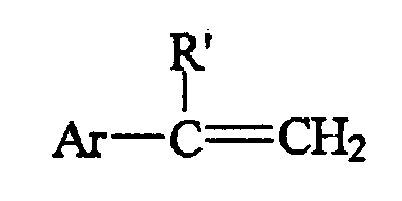
- The monovinylidene aromatic monomer can be copolymerized with one or more of a range of other copolymerizable monomers. Preferred comonomers include nitrile monomers such as acrylonitrile, methacrylonitrile and fumaronitrile; (meth)acrylate monomers such as methyl methacrylate or n-butyl acrylate; maleic anhydride and/or N-arylmaleimides such as N-phenylmaleimide, and conjugated and nonconjugated dienes. Representative copolymers include acrylonitrile-butadiene-styrene (ABS) and styrene-acrylonitrile (SAN) copolymers. The copolymers typically contain at least 1, preferably at least 2 and more preferably at least 5, wt% of units derived from the comonomer based on weight of the copolymer. Typically, the maximum amount of units derived from the comonomer is 40, preferably 35 and more preferably 30, wt % based on the weight of the copolymer.
- The weight average molecular weight (Mw) of the monovinylidene aromatic polymers used in the practice of this invention can vary widely. For reasons of mechanical strength, among others, typically the Mw is at least 100,000, preferably at least 120,000, more preferably at least 130,000 and most preferably at least 140,000 g/mol. For reasons of processability, among others, typically the Mw is less than or equal to 400,000, preferably less than or equal to 350,000, more preferably less than or equal to 300,000 and most preferably less than or equal to 250,000 g/mol. The nonfunctionalized, nonmineral oils of this invention are particularly well suited for plasticizing monovinylidene aromatic polymers with a Mw above 250,000, or above 300,000, or above 3 50,000. For monovinylidene aromatic polymers of these high Mw, the nonfunctionalized, nonmineral oils of this invention are preferably added to the monomers and/or rubber from which the monovinylidene aromatic polymer is made.
- Similar to the Mw, the number average molecular weight (Mn) of the monovinylidene aromatic polymers used in the practice of this invention can also vary widely. Again for reasons of mechanical strength, among others, typically the Mn is at least 30,000, preferably at least 40,000, more preferably at least 50,000 and most preferably at least 60,000 g/mol. Also for reasons of processability, among others, typically the Mn is less than or equal to 130,000, preferably less than or equal to about 120,000, more preferably less than or equal to 110,000 and most preferably less than or equal to 100,000 g/mol.
- Along with the Mw and Mn values, the ratio of Mw/Mn, also known as polydispersity or molecular weight distribution, can vary widely. Typically, this ratio is at least 2, and preferably greater than or equal to 2.3. The ratio typically is less than or equal to 4, and preferably less than or equal to 3. The Mw and Mn are typically determined by gel permeation chromatography using a polystyrene standard for calibration.
- The monovinylidene aromatic polymers and copolymers used in the practice of this invention can be blended or grafted with one or more rubbers to form a high impact monovinylidene aromatic polymer or copolymer, e.g., GPPS blended with a rubber, HIPS, ABS, etc. The rubber can be any unsaturated rubbery polymer having a glass transition temperature (Tg) of not higher than 0°C, preferably not higher than -20°C, as determined by ASTM D-756-52T. Tg is the temperature or temperature range at which a polymeric material shows an abrupt change in its physical properties, including, for example, mechanical strength. Tg can be determined by differential scanning calorimetry (DSC).
- The rubbers suitable for use in the present invention are those that have a solution viscosity in the range of 5 to 300 centipoise (cps, 5 percent by weight styrene at 20C) and Mooney viscosity of 5 to 100 (ML+1, 100°C). Suitable rubbers include, but are not limited to, diene rubbers, diene block rubbers, butyl rubbers, ethylene propylene rubbers, ethylenepropylene-diene monomer (EPDM) rubbers, ethylene copolymer rubbers, acrylate rubbers, polyisoprene rubbers, halogen-containing rubbers, silicone rubbers and mixtures of two or more of these rubbers. Also suitable are interpolymers of rubber-forming monomers with other copolymerizable monomers. Suitable diene rubbers include, but are not limited to, conjugated 1,3-dienes, for example, butadiene, isoprene, piperylene, chloroprene, or mixtures of two or more of these dienes. Suitable rubbers also include homopolymers of conjugated 1,3-dienes and interpolymers of conjugated 1,3-dienes with one or more copolymerizable monoethylenically unsaturated monomers, for example, copolymers of isobutylene and isoprene.
- Preferred rubbers are diene rubbers such as polybutadiene, polyisoprene, polypiperylene, polychloroprene, or mixtures of diene rubbers, i.e., any rubbery polymers of one or more conjugated 1,3-dienes, with 1,3-butadiene being especially preferred. Such rubbers include homopolymers and copolymers of 1,3-butadiene with one or more copolymerizable monomers, such as monovinylidene aromatic monomers as described above, styrene being preferred. Preferred copolymers of 1,3-butadiene are block or tapered block rubbers of at least 30, more preferably at least 50, even more preferably at least 70, and still more preferably at least 90, wt% 1,3-butadiene rubber, and preferably up to 70, more preferably up to 50, even more preferably up to 30, and still more preferably up to 10, wt % monovinylidene aromatic monomer, all weights based on the weight of the 1,3-butadiene copolymer.
- The amount of rubber in the rubber-modified polymers of this invention can vary widely, and is often a function of the polymer which it is modifying. For example, the rubber in ABS is typically present in an amount equal to or less than 40, preferably equal to or less than 30, more preferably equal to or less than 25, even more preferably equal to or less than 20, and most preferably equal to or less than 18 wt % based on the weight of the rubber-modified polymer. For HIPS, the rubber is typically present in an amount equal to or less than 20, preferably equal to or less than 15 and more preferably equal to or less than 10, wt % based on the weight of the rubber-modified polymer.
- Any nonfunctionalized, nonmineral oil with the requisite iodine and hydroxyl numbers can be used in the practice of this invention. These oils typically include such vegetable oils as those derived from peanuts, cottonseed, olives, rapeseed, high-oleic sunflower, palm and corn , but typically do not include oils derived from coconuts, linseed, tung, oiticica, safflower, soybean and castor bean. However, these less preferred oils can perform well in this invention if subjected to one or more treatments, e.g., hydrogenation, that ensure an iodine value less than 120 and a hydroxyl number of less than 20. These oils also include animal oils that are liquid at 45°C and atmospheric pressure, such as some fish oils, sperm oil and fish-liver oils, and can include lard, beef tallow and butter. These oils can be used alone or in combination with one or more other mineral or nonmineral oils. In one embodiment, the nonfunctional, nonmineral oils are used in the absence of any significant amount of functionalized nonmineral oil, preferably in the near or complete absence of any such other functionalized nonmineral oil. In other embodiments, the nonfunctional, nonmineral oils are used as a component of a plasticizer blend. Animal oils not liquid at 45°C and atmospheric pressure are disfavored for use in this invention. Nonfunctionalized vegetable oils, such as palm, cottonseed, peanut, olive and canola oil, are the preferred nonfunctionalized nonmineral oils for use in the practice of this invention.
- The nonfunctionalized, nonmineral oils are commercially available from a variety of different sources, and can be prepared by a variety of different methods, e.g., solvent extraction, physical extraction (e.g.; crushing, expeller-pressed, etc.), and supercritical carbon dioxide extraction. Other than standard purification treatments and perhaps hydrogenation, the oils are not functionalized and, preferably, not otherwise modified.
- The iodine number or value is expressed as grams of ionized iodine per 100 grams of sample, or I/100g sample, and it is measured according to ASTM D5554-95 (Re-approved 2001) substituting a 50/50 by volume mixture of cyclohexane and acetic acid for the carbon tetrachloride and auto-titration. The hydroxyl number or value is expressed in milligrams of potassium hydroxide that is chemically equivalent to the activity of a specified weight in grams of the oil, and it is measured according to ASTM E-1899-02. The hydroxyl number is exclusive of any increase due to the presence of water as an impurity or contaminant in the oil.
- The amount of plasticizer used in the compositions of this invention can vary widely, but typically the amount of such plasticizer in the composition is at least 0.1, preferably at least 0.5 and more preferably at least 1, wt % based on the total weight of the polymer. The only limits on the maximum amount of such a plasticizer in the compositions of this invention are those set by cost and practical considerations, but typically the maximum amount of plasticizer in these compositions does not exceed 10, preferably 5 and more preferably 3, wt % based on the total weight of the polymer.
- The plasticizers used in the practice of this invention are used in the same manner as the known plasticizers, e.g., minerals oils, functionalized nonmineral oils, etc. These plasticizers can be added before and/or after the formation of the monovinylidene polymers. In one preferred embodiment, the plasticizer is added as part of the bulk reaction mixture, either prior to or just after the start of polymerization (e.g., within a few minutes of the start of polymerization), from which the monovinylidene polymer is made, without or without rubber, to promote thorough distribution of the oil throughout the polymer.
- Typically less nonfunctionalized, nonmineral oil is required to achieve the same effect as is necessary with a mineral oil. For example, one percent by weight of a vegetable oil of this invention in high impact polystyrene can produce the same MFR as two and half percent by weight of a mineral oil and still have a higher Vicat heat distortion temperature and tensile strength. In addition, the vegetable oils of this invention have a lower volatility than mineral oils which typically means that less vegetable oil is lost due to volatilization than mineral oil under similar conditions. This can also mean less die drip problems during fabrication of the monovinylidene aromatic polymer into various articles of manufacture.
- The compositions of this invention can contain components other than the monovinylidene aromatic polymer and plasticizer comprising a nonfunctionalized, nonmineral oil, and these other components include anti-oxidants, colorants, lubricity agents, crosslinking agents. These other components are known in the art, and they are used in the same manner and amounts as they are used in known compositions of monovinylidene aromatic polymer and mineral oil.
- The compositions of this invention can be used in the manufacture of various articles, including but not limited to, containers, packaging, components for consumer electronics and appliances. These compositions are used in the same manner as know compositions of monovinylidene aromatic polymers and mineral oil, e.g., extrusion, molding, thermoforming, etc.
- The following examples are provided to illustrate various embodiments of the invention. They are not intended to limit the invention as otherwise described and claimed. All numerical values are approximate, and all parts and percentage are by weight unless otherwise indicated.
- Representative plasticizers of this invention comprising a single vegetable oil (Examples 1-3) are compared with (i) white mineral oil (Comparative Example A), and (ii) soybean oil, a vegetable oil having an iodine value greater than 120 (Comparative Example B). High impact polystyrene (HIPS) is made by polymerizing styrene in the presence of rubber and the plasticizer in a 1.4-gram auger-type laboratory batch reactor fitted with heating elements and an agitator. The feed compositions are shown in Table 1. All values are expressed as wt% (or ppm) based on total feed. IRGANOX 1076 is octadecyl 3,5-di-(tert)-butyl-4-hydrocinnamate from Ciba Specialty Chemicals Corporation added as antioxidant. Mineral oil is DRAKENOL 600 from Penntico. TRIGONOX 22 is 1,1-bis (tert-butylperoxycyclohexane) from Akzo Nobel Polymer Chemicals. DIENE 55 is a polybutadiene rubber from FIRESTONE.
Table 1 Experimental Compositions Comparative Example A Comparative Example B Comparative Example 1 Comparative Example 2 Comparative Example 3 Description 2.5% Mineral Oil 1% Soybean Oil 1% Palm Stearine 1% Canola Oil 1% High Oleic Sunflower Oil Iodine number n/m 128 28.7 102 86 % Ethyl Benzene (EB) 15.01 15.01 15 15 15 % IRGANOX 1076 0.14 0.14 0.14 0.14 0.14 % Nonmineral Oil 0 0.8 0.8 0.8 0.8 % Mineral Oil 1.99 0 0 0 0 % DIENE 55 5.26 5.26 5.25 5.26 5.25 TRIGONOX 22 (ppm) 299 300 300 300 300 Styrene balance balance balance balance balance n/m = not measured. - The feed is charged into the reactor, and the reactor has a temperature and agitation polymerization profile as shown in Table 2.
Table 2 Reactor Conditions for Laboratory Batch Reactor STEP SETPOINT (°C) TIME (hours:minutes) AGITATION (rpm) 0 25 1 98 0:50 75 2 115 0:50 75 3 122 0:50 40 4 130 1:20 40 5 141 1:00 25 6 155 1:00 25 7 170 1:00 25 - At the end of this profile, the polymerization syrup is de-volatilized in a vacuum oven at 240°C for approximately 1 hour. The polymer is then ground and extruded into granules, and the chemical and physical properties of the final product are then measured.
- Molar mass is measured using gel permeation chromatography based on polystyrene standards. Rubber particle size (RPS) is measured with Coulter Counter equipment using a 30-micron tube. The mean, median and the mode are used to describe the distribution. Rubber content is measured using FTIR method.
- Tensile testing is measured following ASTM D-638 on compression molded specimens. Flexural testing is measured following ASTM D 790 method on compression molded specimens. Izod impact resistance is measured on 0.125-inch thick compression molded specimens following ASTM-D256 method. Vicat softening temperature is measured according to ASTM-D1525, rate B. Melt flow rate is measured according to ASTM D1133, condition G (200°C/5Kg). The results are reported in Tables 3A and 3B.
Table 3A Chemical Properties of the Experimental Compositions Comparative Example A Comparative Example B Comparative Example 1 Comparative Example 2 Comparative Example 3 Description 2.5% Mineral Oil 1% Soybean Oil 1% Palm Stearine 1% Canola Oil 1% High Oleic Sunflower Oil Final Mw (g/mole) 213775 209300 193300 215300 221000 Final Mn (g/mole) 90839 89600 85700 90400 91400 Mw/Mn 2.35 2.34 2.26 2.38 2.42 RPS Mean (micron) 1.40 1.67 1.87 1.52 1.64 RPS Median (micron) 1.41 1.64 1.92 1.55 1.68 RPS Mode (micron) 1.50 1.98 2.21 1.67 1.67 % Rubber in final product 6.65 6.55 6.78 6.83 6.49 Table 3B Physical Properties of the Experimental Compositions Comparative Example A Comparative Example B Comparative Example 1 Comparative Example 2 Comparative Example 3 Description 2.5% Mineral Oil 1% Soybean Oil 1% Palm stearine 1% Canola Oil 1% High Oleic Sunflower Oil Tensile yield (psi) 2800 3015 2941 3205 3067 Tensile rupture (psi) 2050 2147 2205 2240 2333 Tensile modulus (10^5 psi) 2.56 2.55 2.59 2.64 2.58 Flexural strength, (psi) 5150 5150 5335 5464 5382 Flexural modulus. (psi) 267000 265800 264700 280900 283700 Izod (ft lb/in) 2.5 2.1 2.00 2.2 2.2 Vicat (°F) [°C] 215 [102] 218 [103] 218 (103) 219 [104] 218[103] Melt Flow Rate (g/10 min) 2.66 2.78 3.29 2.49 2.30 1000 psi = 6.8948 MPa - With less than half the amount of mineral oil, the palm stearine, canola and high oleic sunflower oils arc able to produce a comparable MFR and a comparable VICAT softening point. In addition the tensile yield is improved.
- A mixture or palm stearine oil, a vegetable oil with an iodine value of 28.7, and white mineral oil (Example 4) is compared to a plasticizer comprising only mineral oil (Comparative Example C) and a plasticizer comprising only the palm stearine oil (Example 5). High impact polystyrene (HIPS) is made in the same manner and using the same ingredients as described above except that a mini-plant reactor is used in place of the laboratory batch reactor. The mini-plant set-up consists of three stirred tank reactors in series with each tank divided into three temperature zones for a total of nine temperature zones. The experimental compositions are described in fable 4, and the temperature and agitation polymerization profile or the reactor are described in Table 5. At the end of this profile, the polymerization syrup is de-volatilized in a devolatilizing extruder at 240°C and the final product is extruded into granules. The chemical and physical properties of the final product are measured using the same techniques as described above, and the results are reported in Tables 6A and 6B.
Table 4 Experimental Compositions Comparative Example C Example 4 Comparative Example 5 Description 3.5% Mineral Oil 0.65% Mineral oil + 2.0% Palm Stearin 2.65% Palm Stearine Iodine number n/m n/m 28.7 % Ethyl Benzene (EB) 8.5 8.5 9.5 % IRGANOX 1076 0.05 0.05 0.05 % Nonmineral Oil 0 1.5 2.0 % Mineral Oil 3.5 0.50 0 % DIENE 55 5.4 5.4 5.4 TRIGONOX 22 (ppm) 0 0 0 Styrene balance balance balance Table 5 Reactor Conditions for Mini Plant ZONE SETPOINT (°C) TIME (hours:minutes) AGITATION (rpm) 1 128.0 0:35 175 2 135.0 0:35 175 3 140.0 0:35 175 4 144.0 0:35 70 5 149.1 0:35 70 6 158.0 0:35 70 7 162.9 0:35 25 8 168.0 0:35 25 9 122.0 0:35 25 Table 6A Chemical Properties of the Mini-Plant Experimental Compositions Comparative Example C Example 4 Comparative Example 1 Description 3.5% Mineral Oil 0.65% Mineral oil + 2.0% Palm Stearin 2.65% Palm Stearine Final Mw (g/mole) 147100 149000 143600 Final Man (g/mole) 63200 59800 58500 Mw/Mn 2.33 2.49 2.45 RPS Mean (micron) 2.73 2.93 3.64 RPS Median (micron) 2.86 3.16 4.17 RPS Mode (micron) 3.64 4.06 6.33 % Rubber in final product 7.46 7.10 6.60 Table 6B Physical Properties of the Mini-Plant Experimental Compositions Comparative Example C Example 4 Comparative Example 5 Description 3.5% Mineral Oil 0.65% Mineral oil + 2.0% Palm Stearin 2.65% Palm Stearine Tensile yield (MPa) 18.7 18.8 17.7 Tensile rupture (MPa) 19.5 20. 1 18.9 Tensile modulus (MPa) 1897 1903 1793 Izod (ft lb/in) 2.1 2.0 1.9 Vicat (°C) 98 98.6 97.8 Melt Flow Rate (g/10 min) 12.30 11.24 13.3 - Consistent with the results reported from the laboratory batch reactor, with only about 75 percent as much plasticizer as used in the Comparative Example C, the products of Examples 4 and 5 reported comparable tensile and impact numbers, and comparable Vicat and MFR values.
- Although the invention has been described in considerable detail by the preceding examples, this detail is for the purpose of illustration and is not to be construed as a limitation on the scope of the invention as described in the pending claims.
Claims (20)
- A composition comprising:(i) a monovinylidene aromatic polymer,(ii) at least 0.1 weight percent, based on the weight of the polymer, of a plasticizer comprising mineral oil and a nonfunctionalized, nonmineral oil having an iodine value less than 120 and a hydroxyl number of less than 20, wherein the the plasticizer contains less than 0.1 weight percent (based on the polymer) of functionalized nonmineral oil.
- The composition of Claim 1 in which the nonfunctionalized nonmineral oil is present in an amount of at least 0.5 weight percent based upon the weight of the polymer.
- The composition of Claim 1 in which the nonmineral oil has an iodine value between 20 and 115.
- The composition of Claim in which the nonmineral oil comprises a vegetable oil.
- The composition of Claim 1 in which the nonmineral oil comprises 50 or more wt% of the plasticizer.
- The composition of claim 4 in which the vegetable oil comprises oil derived from at least one of peanuts, cottonseed, olives, rapeseed, high-oleic sunflower, palm and corn.
- The composition of Claim 1 in which the polymer comprises units derived from a monovinylidene aromatic monomer of the formula:

- The composition of Claim 7 in which Ar is phenyl or alkylphenyl, and the alkyl group of the phenyl ring contains 1 to 10 carbon atoms.
- The composition of Claim 8 in which the alkyl group of the phenyl ring contains 1 to 4 carbon atoms.
- The composition of Claim 1 in which the monovinylidene aromatic polymer is blended or grafted with at least one rubber.
- The composition of Claim 10 in which the rubber has a glass transition temperature of not greater than 0°C.
- The composition of Claim 10 in which the rubber is selected from the group consisting of diene rubbers, diene block rubbers, butyl rubbers, ethylene propylene rubbers, ethylenepropylene-diene monomer rubbers, ethylene copolymer rubbers, acrylate rubbers, polyisoprene rubbers, halogen-containing rubbers and silicone rubbers.
- The composition of Claim 10 in which the rubber is present in an amount of less than 40 weight percent based upon the weight of the polymer.
- The composition of Claim 7 in which the polymer is general purpose polystyrene.
- The composition of Claim 10 in which the polymer is high impact polystyrene.
- The composition of Claim 10 in which the polymer is ABS.
- The composition of Claim 7 in which the polymer is SAN.
- An article prepared from the composition of Claim 1.
- The article of Claim 19 formed from extrusion, molding or thermoforming.
- The composition of Claim 1 formed by polymerizing monovinylidene aromatic monomers in the presence of a plasticizer comprising the nonfunctional, nonmineral oil.
Priority Applications (1)
| Application Number | Priority Date | Filing Date | Title |
|---|---|---|---|
| PL07814801T PL2066746T3 (en) | 2006-09-20 | 2007-09-11 | Monovinylidene aromatic polymers containing nonfunctionalized, nonmineral oil |
Applications Claiming Priority (3)
| Application Number | Priority Date | Filing Date | Title |
|---|---|---|---|
| US82626306P | 2006-09-20 | 2006-09-20 | |
| US82626906P | 2006-09-20 | 2006-09-20 | |
| PCT/US2007/078149 WO2008036530A2 (en) | 2006-09-20 | 2007-09-11 | Monovinylidene aromatic polymers containing nonfunctionalized, nonmineral oil |
Publications (2)
| Publication Number | Publication Date |
|---|---|
| EP2066746A2 EP2066746A2 (en) | 2009-06-10 |
| EP2066746B1 true EP2066746B1 (en) | 2011-02-09 |
Family
ID=38813075
Family Applications (1)
| Application Number | Title | Priority Date | Filing Date |
|---|---|---|---|
| EP07814801A Not-in-force EP2066746B1 (en) | 2006-09-20 | 2007-09-11 | Monovinylidene aromatic polymers containing nonfunctionalized, nonmineral oil |
Country Status (8)
| Country | Link |
|---|---|
| US (1) | US20100298486A1 (en) |
| EP (1) | EP2066746B1 (en) |
| JP (1) | JP2010504404A (en) |
| AT (1) | ATE497990T1 (en) |
| AU (1) | AU2007297470A1 (en) |
| DE (1) | DE602007012448D1 (en) |
| PL (1) | PL2066746T3 (en) |
| WO (1) | WO2008036530A2 (en) |
Families Citing this family (6)
| Publication number | Priority date | Publication date | Assignee | Title |
|---|---|---|---|---|
| CN101812262B (en) * | 2010-03-12 | 2012-12-19 | 艾伦塔斯电气绝缘材料(珠海)有限公司 | Air-dried insulating paint and preparation method thereof |
| US20140100310A1 (en) * | 2012-10-08 | 2014-04-10 | Teknor Apex Company | Thermoplastic elastomer compositions having biorenewable content |
| WO2022114221A1 (en) * | 2020-11-30 | 2022-06-02 | Psジャパン株式会社 | Styrene-based resin composition, and formed body thereof |
| JP7777406B2 (en) * | 2021-08-10 | 2025-11-28 | Psジャパン株式会社 | Styrenic resin composition and molded article thereof |
| JP7708731B2 (en) * | 2021-10-08 | 2025-07-15 | Psジャパン株式会社 | Styrenic resin composition and molded article thereof |
| JP7630473B2 (en) * | 2021-10-08 | 2025-02-17 | Psジャパン株式会社 | Styrenic resin composition and molded article thereof |
Citations (1)
| Publication number | Priority date | Publication date | Assignee | Title |
|---|---|---|---|---|
| US6673857B1 (en) * | 1999-05-03 | 2004-01-06 | Basf Aktiengesellschaft | Thermoplastic elastomer compositions |
Family Cites Families (13)
| Publication number | Priority date | Publication date | Assignee | Title |
|---|---|---|---|---|
| US2485592A (en) * | 1946-03-09 | 1949-10-25 | Dow Chemical Co | Molding compositions |
| US3096357A (en) * | 1960-05-04 | 1963-07-02 | Bohme Fettchemie Gmbh | Novel reaction products of a sulfuric acid and epoxides |
| US3438971A (en) * | 1967-06-22 | 1969-04-15 | Monsanto Co | Diene rubber-nitrile copolymer-unsaturated triglyceride blends having increased toughness |
| US4572819A (en) * | 1983-08-24 | 1986-02-25 | The Dow Chemical Company | Apparatus for anionic polymerization wherein the molecular weight of the polymer is closely controlled |
| US4585825A (en) * | 1983-09-30 | 1986-04-29 | The Dow Chemical Company | Monovinylidene aromatic polymer resins having added amounts of high molecular weight polymer |
| US4666987A (en) * | 1985-02-22 | 1987-05-19 | The Dow Chemical Company | In-mold polymerization of vinyl aromatic compound |
| DE60030328T2 (en) * | 1999-12-28 | 2007-08-30 | Lanxess Corp. | PROCESS FOR PREPARING EXTRUSIONABLE ABS POLYMERS WITH IMPROVED PROPERTIES |
| US6455623B1 (en) * | 2000-05-31 | 2002-09-24 | Sunrise Medical Hhg Inc. | Freeze-resistant fluid compositions |
| US6811824B2 (en) * | 2002-01-04 | 2004-11-02 | Marcus Oil And Chemical Corp. | Repulpable wax |
| US7211611B2 (en) * | 2003-12-11 | 2007-05-01 | Nike, Inc. | Rubber compositions with non-petroleum oils |
| MX2007000022A (en) * | 2004-06-25 | 2007-05-23 | Pittsburg State University | Modified vegetable oil-based polyols. |
| US20060105092A1 (en) * | 2004-11-12 | 2006-05-18 | Kraft Foods Holdings, Inc. | Trans-fatty acid free shortening |
| US20060121170A1 (en) * | 2004-12-06 | 2006-06-08 | Howard David L | Rubbery gels made from vegetable oils |
-
2007
- 2007-09-11 JP JP2009529304A patent/JP2010504404A/en not_active Withdrawn
- 2007-09-11 WO PCT/US2007/078149 patent/WO2008036530A2/en not_active Ceased
- 2007-09-11 US US12/439,956 patent/US20100298486A1/en not_active Abandoned
- 2007-09-11 AU AU2007297470A patent/AU2007297470A1/en not_active Abandoned
- 2007-09-11 AT AT07814801T patent/ATE497990T1/en not_active IP Right Cessation
- 2007-09-11 PL PL07814801T patent/PL2066746T3/en unknown
- 2007-09-11 EP EP07814801A patent/EP2066746B1/en not_active Not-in-force
- 2007-09-11 DE DE602007012448T patent/DE602007012448D1/en active Active
Patent Citations (1)
| Publication number | Priority date | Publication date | Assignee | Title |
|---|---|---|---|---|
| US6673857B1 (en) * | 1999-05-03 | 2004-01-06 | Basf Aktiengesellschaft | Thermoplastic elastomer compositions |
Also Published As
| Publication number | Publication date |
|---|---|
| ATE497990T1 (en) | 2011-02-15 |
| JP2010504404A (en) | 2010-02-12 |
| US20100298486A1 (en) | 2010-11-25 |
| EP2066746A2 (en) | 2009-06-10 |
| WO2008036530A3 (en) | 2008-07-24 |
| WO2008036530A2 (en) | 2008-03-27 |
| AU2007297470A1 (en) | 2008-03-27 |
| PL2066746T3 (en) | 2011-07-29 |
| DE602007012448D1 (en) | 2011-03-24 |
Similar Documents
| Publication | Publication Date | Title |
|---|---|---|
| DE60315454T2 (en) | BLOCK COPOLYMERS BASED ON CONJUGATED SERVICES AND MONOVINYLARENEY CONTAINING MIXTURES | |
| KR100375782B1 (en) | Linear block copolymer and resin composition containing the same | |
| CN101693778B (en) | PVC/ABS blend and pipe thereof | |
| US20100298486A1 (en) | Monovinylidene aromatic polymers containing nonfunctionalized, nonmineral oil | |
| JPWO2000008079A1 (en) | Linear block copolymer and resin composition containing same | |
| CN116444713B (en) | Preparation method and application of modified soybean oil plasticizer | |
| KR20090104080A (en) | Carboxylate Terminated Polymers and Their Use in Impact Resistance-Modified Plastics | |
| CN108948689A (en) | A kind of reactive extrursion method polydactyl acid-lignin composite material and preparation method | |
| AU2001259683B2 (en) | Monovinylidene aromatic polymers with improved toughness and rigidity and a process for their preparation | |
| US3446760A (en) | High impact styrene polymer containing ethylene-alkyl acrylate copolymer | |
| EP3478765B1 (en) | Polymer composition comprising at least one vinyl aromatic diene block copolymer and specific amounts of oil | |
| EP2113002B1 (en) | Method of preparing rubber comprising polymeric compositions and compositions | |
| US20110166295A1 (en) | Improved monovinylidene aromatic polymer compositions comprising poly-alpha-olefin additives | |
| KR20180118624A (en) | Rubber containing a modified vegetable oil and a composition containing the same | |
| CN110621739B (en) | High-softness, non-stick and transparent styrene thermoplastic elastomer composition | |
| EP0000146A1 (en) | Blends of phenolphthalein polycarbonates with rubber-modified monovinylidene aromatic copolymers | |
| EP4090703B1 (en) | Styrene butadiene block copolymers with low crosslinking | |
| CN1215112C (en) | Conjugated diene polymer compositions and rubber-reinforced styrene resin | |
| JP7777406B2 (en) | Styrenic resin composition and molded article thereof | |
| JP4490072B2 (en) | Transparent block copolymer and method for producing the same | |
| CN101210106A (en) | Low odor low total carbon emanation PC/ABS alloy and preparing method thereof | |
| CN101516989A (en) | Monovinylidene aromatic polymers containing nonfunctionalized, nonmineral oil | |
| CN119661784A (en) | Effect of vinyl-substituted aromatic monomers on nitrile migration | |
| CN1197816A (en) | ABS moulding compositions produced in emulsion-free manner and with very high notched bar impact strength | |
| CN117964982A (en) | Alcohol-resistant wiping polystyrene composition and preparation method and application thereof |
Legal Events
| Date | Code | Title | Description |
|---|---|---|---|
| PUAI | Public reference made under article 153(3) epc to a published international application that has entered the european phase |
Free format text: ORIGINAL CODE: 0009012 |
|
| 17P | Request for examination filed |
Effective date: 20090420 |
|
| AK | Designated contracting states |
Kind code of ref document: A2 Designated state(s): AT BE BG CH CY CZ DE DK EE ES FI FR GB GR HU IE IS IT LI LT LU LV MC MT NL PL PT RO SE SI SK TR |
|
| AX | Request for extension of the european patent |
Extension state: AL BA HR MK RS |
|
| 17Q | First examination report despatched |
Effective date: 20090728 |
|
| RIN1 | Information on inventor provided before grant (corrected) |
Inventor name: SCHRADER, DAVID Inventor name: LYSENKO, ZENON Inventor name: SCHROCK, ALAN K. Inventor name: MONTOYA-GONI, AMAIA Inventor name: CHAMBARD, GREGORY |
|
| DAX | Request for extension of the european patent (deleted) | ||
| GRAP | Despatch of communication of intention to grant a patent |
Free format text: ORIGINAL CODE: EPIDOSNIGR1 |
|
| RIC1 | Information provided on ipc code assigned before grant |
Ipc: C08L 55/02 20060101ALI20100707BHEP Ipc: C08L 51/04 20060101ALI20100707BHEP Ipc: C08L 53/02 20060101ALI20100707BHEP Ipc: C08K 5/103 20060101AFI20100707BHEP |
|
| RAP1 | Party data changed (applicant data changed or rights of an application transferred) |
Owner name: STYRON EUROPE GMBH |
|
| GRAS | Grant fee paid |
Free format text: ORIGINAL CODE: EPIDOSNIGR3 |
|
| GRAA | (expected) grant |
Free format text: ORIGINAL CODE: 0009210 |
|
| AK | Designated contracting states |
Kind code of ref document: B1 Designated state(s): AT BE BG CH CY CZ DE DK EE ES FI FR GB GR HU IE IS IT LI LT LU LV MC MT NL PL PT RO SE SI SK TR |
|
| REG | Reference to a national code |
Ref country code: GB Ref legal event code: FG4D |
|
| REG | Reference to a national code |
Ref country code: CH Ref legal event code: EP |
|
| REG | Reference to a national code |
Ref country code: IE Ref legal event code: FG4D |
|
| RAP2 | Party data changed (patent owner data changed or rights of a patent transferred) |
Owner name: DEUTSCHE BANK AG NEW YORK BRANCH |
|
| RAP2 | Party data changed (patent owner data changed or rights of a patent transferred) |
Owner name: STYRON EUROPE GMBH |
|
| REF | Corresponds to: |
Ref document number: 602007012448 Country of ref document: DE Date of ref document: 20110324 Kind code of ref document: P |
|
| REG | Reference to a national code |
Ref country code: DE Ref legal event code: R096 Ref document number: 602007012448 Country of ref document: DE Effective date: 20110324 |
|
| REG | Reference to a national code |
Ref country code: NL Ref legal event code: VDEP Effective date: 20110209 |
|
| 111Z | Information provided on other rights and legal means of execution |
Free format text: AT BE BG CH CY CZ DE DK EE ES FI FR GB GR HU IE IS IT LT LU LV MC MT NL PL PT RO SE SI SK TR Effective date: 20110128 |
|
| LTIE | Lt: invalidation of european patent or patent extension |
Effective date: 20110209 |
|
| PG25 | Lapsed in a contracting state [announced via postgrant information from national office to epo] |
Ref country code: GR Free format text: LAPSE BECAUSE OF FAILURE TO SUBMIT A TRANSLATION OF THE DESCRIPTION OR TO PAY THE FEE WITHIN THE PRESCRIBED TIME-LIMIT Effective date: 20110510 Ref country code: LT Free format text: LAPSE BECAUSE OF FAILURE TO SUBMIT A TRANSLATION OF THE DESCRIPTION OR TO PAY THE FEE WITHIN THE PRESCRIBED TIME-LIMIT Effective date: 20110209 Ref country code: LV Free format text: LAPSE BECAUSE OF FAILURE TO SUBMIT A TRANSLATION OF THE DESCRIPTION OR TO PAY THE FEE WITHIN THE PRESCRIBED TIME-LIMIT Effective date: 20110209 Ref country code: PT Free format text: LAPSE BECAUSE OF FAILURE TO SUBMIT A TRANSLATION OF THE DESCRIPTION OR TO PAY THE FEE WITHIN THE PRESCRIBED TIME-LIMIT Effective date: 20110609 Ref country code: SE Free format text: LAPSE BECAUSE OF FAILURE TO SUBMIT A TRANSLATION OF THE DESCRIPTION OR TO PAY THE FEE WITHIN THE PRESCRIBED TIME-LIMIT Effective date: 20110209 Ref country code: ES Free format text: LAPSE BECAUSE OF FAILURE TO SUBMIT A TRANSLATION OF THE DESCRIPTION OR TO PAY THE FEE WITHIN THE PRESCRIBED TIME-LIMIT Effective date: 20110520 |
|
| REG | Reference to a national code |
Ref country code: PL Ref legal event code: T3 |
|
| REG | Reference to a national code |
Ref country code: DE Ref legal event code: R082 Ref document number: 602007012448 Country of ref document: DE Representative=s name: HOFFMANN & EITLE, DE Ref country code: DE Ref legal event code: R082 Ref document number: 602007012448 Country of ref document: DE Representative=s name: HOFFMANN - EITLE, DE Ref country code: DE Ref legal event code: R082 Ref document number: 602007012448 Country of ref document: DE Representative=s name: HOFFMANN - EITLE PATENT- UND RECHTSANWAELTE PA, DE |
|
| PG25 | Lapsed in a contracting state [announced via postgrant information from national office to epo] |
Ref country code: FI Free format text: LAPSE BECAUSE OF FAILURE TO SUBMIT A TRANSLATION OF THE DESCRIPTION OR TO PAY THE FEE WITHIN THE PRESCRIBED TIME-LIMIT Effective date: 20110209 Ref country code: BG Free format text: LAPSE BECAUSE OF FAILURE TO SUBMIT A TRANSLATION OF THE DESCRIPTION OR TO PAY THE FEE WITHIN THE PRESCRIBED TIME-LIMIT Effective date: 20110509 Ref country code: CY Free format text: LAPSE BECAUSE OF FAILURE TO SUBMIT A TRANSLATION OF THE DESCRIPTION OR TO PAY THE FEE WITHIN THE PRESCRIBED TIME-LIMIT Effective date: 20110209 Ref country code: NL Free format text: LAPSE BECAUSE OF FAILURE TO SUBMIT A TRANSLATION OF THE DESCRIPTION OR TO PAY THE FEE WITHIN THE PRESCRIBED TIME-LIMIT Effective date: 20110209 Ref country code: AT Free format text: LAPSE BECAUSE OF FAILURE TO SUBMIT A TRANSLATION OF THE DESCRIPTION OR TO PAY THE FEE WITHIN THE PRESCRIBED TIME-LIMIT Effective date: 20110209 Ref country code: SI Free format text: LAPSE BECAUSE OF FAILURE TO SUBMIT A TRANSLATION OF THE DESCRIPTION OR TO PAY THE FEE WITHIN THE PRESCRIBED TIME-LIMIT Effective date: 20110209 |
|
| PG25 | Lapsed in a contracting state [announced via postgrant information from national office to epo] |
Ref country code: DK Free format text: LAPSE BECAUSE OF FAILURE TO SUBMIT A TRANSLATION OF THE DESCRIPTION OR TO PAY THE FEE WITHIN THE PRESCRIBED TIME-LIMIT Effective date: 20110209 Ref country code: EE Free format text: LAPSE BECAUSE OF FAILURE TO SUBMIT A TRANSLATION OF THE DESCRIPTION OR TO PAY THE FEE WITHIN THE PRESCRIBED TIME-LIMIT Effective date: 20110209 |
|
| PG25 | Lapsed in a contracting state [announced via postgrant information from national office to epo] |
Ref country code: RO Free format text: LAPSE BECAUSE OF FAILURE TO SUBMIT A TRANSLATION OF THE DESCRIPTION OR TO PAY THE FEE WITHIN THE PRESCRIBED TIME-LIMIT Effective date: 20110209 Ref country code: SK Free format text: LAPSE BECAUSE OF FAILURE TO SUBMIT A TRANSLATION OF THE DESCRIPTION OR TO PAY THE FEE WITHIN THE PRESCRIBED TIME-LIMIT Effective date: 20110209 Ref country code: CZ Free format text: LAPSE BECAUSE OF FAILURE TO SUBMIT A TRANSLATION OF THE DESCRIPTION OR TO PAY THE FEE WITHIN THE PRESCRIBED TIME-LIMIT Effective date: 20110209 |
|
| PGFP | Annual fee paid to national office [announced via postgrant information from national office to epo] |
Ref country code: FR Payment date: 20111005 Year of fee payment: 5 Ref country code: TR Payment date: 20110819 Year of fee payment: 5 |
|
| PLBE | No opposition filed within time limit |
Free format text: ORIGINAL CODE: 0009261 |
|
| STAA | Information on the status of an ep patent application or granted ep patent |
Free format text: STATUS: NO OPPOSITION FILED WITHIN TIME LIMIT |
|
| PGFP | Annual fee paid to national office [announced via postgrant information from national office to epo] |
Ref country code: IT Payment date: 20110926 Year of fee payment: 5 |
|
| 26N | No opposition filed |
Effective date: 20111110 |
|
| PGFP | Annual fee paid to national office [announced via postgrant information from national office to epo] |
Ref country code: BE Payment date: 20110927 Year of fee payment: 5 |
|
| REG | Reference to a national code |
Ref country code: DE Ref legal event code: R097 Ref document number: 602007012448 Country of ref document: DE Effective date: 20111110 |
|
| PG25 | Lapsed in a contracting state [announced via postgrant information from national office to epo] |
Ref country code: MC Free format text: LAPSE BECAUSE OF NON-PAYMENT OF DUE FEES Effective date: 20110930 |
|
| REG | Reference to a national code |
Ref country code: CH Ref legal event code: PL |
|
| GBPC | Gb: european patent ceased through non-payment of renewal fee |
Effective date: 20110911 |
|
| REG | Reference to a national code |
Ref country code: IE Ref legal event code: MM4A |
|
| PG25 | Lapsed in a contracting state [announced via postgrant information from national office to epo] |
Ref country code: IE Free format text: LAPSE BECAUSE OF NON-PAYMENT OF DUE FEES Effective date: 20110911 Ref country code: CH Free format text: LAPSE BECAUSE OF NON-PAYMENT OF DUE FEES Effective date: 20110930 Ref country code: LI Free format text: LAPSE BECAUSE OF NON-PAYMENT OF DUE FEES Effective date: 20110930 |
|
| PG25 | Lapsed in a contracting state [announced via postgrant information from national office to epo] |
Ref country code: GB Free format text: LAPSE BECAUSE OF NON-PAYMENT OF DUE FEES Effective date: 20110911 |
|
| PG25 | Lapsed in a contracting state [announced via postgrant information from national office to epo] |
Ref country code: MT Free format text: LAPSE BECAUSE OF FAILURE TO SUBMIT A TRANSLATION OF THE DESCRIPTION OR TO PAY THE FEE WITHIN THE PRESCRIBED TIME-LIMIT Effective date: 20110209 |
|
| BERE | Be: lapsed |
Owner name: STYRON EUROPE GMBH Effective date: 20120930 |
|
| PG25 | Lapsed in a contracting state [announced via postgrant information from national office to epo] |
Ref country code: LU Free format text: LAPSE BECAUSE OF NON-PAYMENT OF DUE FEES Effective date: 20110911 |
|
| REG | Reference to a national code |
Ref country code: FR Ref legal event code: ST Effective date: 20130531 |
|
| PG25 | Lapsed in a contracting state [announced via postgrant information from national office to epo] |
Ref country code: DE Free format text: LAPSE BECAUSE OF NON-PAYMENT OF DUE FEES Effective date: 20130403 Ref country code: BE Free format text: LAPSE BECAUSE OF NON-PAYMENT OF DUE FEES Effective date: 20120930 Ref country code: IS Free format text: LAPSE BECAUSE OF FAILURE TO SUBMIT A TRANSLATION OF THE DESCRIPTION OR TO PAY THE FEE WITHIN THE PRESCRIBED TIME-LIMIT Effective date: 20110209 |
|
| PG25 | Lapsed in a contracting state [announced via postgrant information from national office to epo] |
Ref country code: IT Free format text: LAPSE BECAUSE OF NON-PAYMENT OF DUE FEES Effective date: 20120911 Ref country code: FR Free format text: LAPSE BECAUSE OF NON-PAYMENT OF DUE FEES Effective date: 20121001 |
|
| REG | Reference to a national code |
Ref country code: DE Ref legal event code: R119 Ref document number: 602007012448 Country of ref document: DE Effective date: 20130403 |
|
| PG25 | Lapsed in a contracting state [announced via postgrant information from national office to epo] |
Ref country code: HU Free format text: LAPSE BECAUSE OF FAILURE TO SUBMIT A TRANSLATION OF THE DESCRIPTION OR TO PAY THE FEE WITHIN THE PRESCRIBED TIME-LIMIT Effective date: 20110209 |
|
| PG25 | Lapsed in a contracting state [announced via postgrant information from national office to epo] |
Ref country code: PL Free format text: LAPSE BECAUSE OF NON-PAYMENT OF DUE FEES Effective date: 20120911 |
|
| REG | Reference to a national code |
Ref country code: PL Ref legal event code: LAPE |
|
| PG25 | Lapsed in a contracting state [announced via postgrant information from national office to epo] |
Ref country code: TR Free format text: LAPSE BECAUSE OF NON-PAYMENT OF DUE FEES Effective date: 20120911 |