EP2066138A1 - Mobile communication system, user equipment, and method for reducing communication processing completion time used for them - Google Patents
Mobile communication system, user equipment, and method for reducing communication processing completion time used for them Download PDFInfo
- Publication number
- EP2066138A1 EP2066138A1 EP07807088A EP07807088A EP2066138A1 EP 2066138 A1 EP2066138 A1 EP 2066138A1 EP 07807088 A EP07807088 A EP 07807088A EP 07807088 A EP07807088 A EP 07807088A EP 2066138 A1 EP2066138 A1 EP 2066138A1
- Authority
- EP
- European Patent Office
- Prior art keywords
- rlc
- mac
- user equipment
- transmission request
- threshold value
- Prior art date
- Legal status (The legal status is an assumption and is not a legal conclusion. Google has not performed a legal analysis and makes no representation as to the accuracy of the status listed.)
- Granted
Links
- 238000000034 method Methods 0.000 title claims abstract description 39
- 238000004891 communication Methods 0.000 title claims abstract description 31
- 238000010295 mobile communication Methods 0.000 title claims description 14
- 238000012545 processing Methods 0.000 title description 10
- 230000005540 biological transmission Effects 0.000 claims abstract description 77
- 238000004904 shortening Methods 0.000 claims description 10
- 238000001514 detection method Methods 0.000 abstract description 6
- 230000006866 deterioration Effects 0.000 abstract description 4
- 238000012544 monitoring process Methods 0.000 abstract description 4
- 230000003111 delayed effect Effects 0.000 description 2
- 238000010586 diagram Methods 0.000 description 2
- 230000015556 catabolic process Effects 0.000 description 1
- 238000007796 conventional method Methods 0.000 description 1
- 238000006731 degradation reaction Methods 0.000 description 1
- 230000000694 effects Effects 0.000 description 1
- 238000011144 upstream manufacturing Methods 0.000 description 1
Images



Classifications
-
- H—ELECTRICITY
- H04—ELECTRIC COMMUNICATION TECHNIQUE
- H04L—TRANSMISSION OF DIGITAL INFORMATION, e.g. TELEGRAPHIC COMMUNICATION
- H04L1/00—Arrangements for detecting or preventing errors in the information received
- H04L1/12—Arrangements for detecting or preventing errors in the information received by using return channel
- H04L1/16—Arrangements for detecting or preventing errors in the information received by using return channel in which the return channel carries supervisory signals, e.g. repetition request signals
- H04L1/18—Automatic repetition systems, e.g. Van Duuren systems
- H04L1/1825—Adaptation of specific ARQ protocol parameters according to transmission conditions
-
- H—ELECTRICITY
- H04—ELECTRIC COMMUNICATION TECHNIQUE
- H04L—TRANSMISSION OF DIGITAL INFORMATION, e.g. TELEGRAPHIC COMMUNICATION
- H04L69/00—Network arrangements, protocols or services independent of the application payload and not provided for in the other groups of this subclass
- H04L69/28—Timers or timing mechanisms used in protocols
-
- H—ELECTRICITY
- H04—ELECTRIC COMMUNICATION TECHNIQUE
- H04W—WIRELESS COMMUNICATION NETWORKS
- H04W76/00—Connection management
- H04W76/30—Connection release
-
- H—ELECTRICITY
- H04—ELECTRIC COMMUNICATION TECHNIQUE
- H04W—WIRELESS COMMUNICATION NETWORKS
- H04W80/00—Wireless network protocols or protocol adaptations to wireless operation
- H04W80/02—Data link layer protocols
Definitions
- the present invention relates to a mobile communication system, a user equipment, and a communication ending period shortening method to be utilized in the system and the equipment. More particularly, the present invention relates to a method for shortening the communication ending period in a 3G (Third Generation) user equipment (UE).
- 3G Third Generation
- This transmission control device includes an RLC (Radio Link Control) header setting/piggyback STATUS-PDU setting block that adds control information indicating a transmission check to the existing transmission information to be transmitted when the control information indicating the transmission check with respect to the transmission information is requested from the reception side, and a STATUS-PDU retransmission buffer that stores an identification code of the transmission information having the control information indicating the transmission check added thereto in association with the control information indicating the transmission check.
- RLC Radio Link Control
- Fig. 1 illustrates a conventional operation.
- the operation on the UTRAN side and the UE operation are shown.
- the UTRAN receives the "RRC CONNECTION RELEASE COMPLETE MESSAGE" from the UE (b1 and b2 in Fig. 1 )
- the UTRAN network is cut off the air (b3 in Fig. 1 ), and the UE is put into an error monitoring state (b4 in Fig. 1 ).
- a synchronization check is then performed. If an out-of-synchronization state is detected (b7 in Fig. 1 ), a DCH ERR IND (INDicator) is detected (b9 in Fig. 1 ), and a DCH close request is issued (b10 in Fig. 1 ).
- a T312 timer is set at 3s(second), three seconds are required before DCH close procedure (cutoff procedure) is started.
- a the MAC-DATA-REQ(REQuest) transmission from the RLC to an MAC is repeated before a T313 timeout check is performed in the DCH synchronization check and a DCG Err IND procedure is carried out (3s).
- a DCG Err IND procedure is carried out (3s).
- the communication end is delayed.
- RLC-UM Unacknowledged Mode
- SIR deterioration [out sync (out of synchronization) is detected through an SIR (Signal-to-Interference Ratio) check
- the number of MAC-DATA-REQ transmission times is reduced, and the UE stops the MAC-DATA-REQ transmission before a DCH error detection after the synchronization check.
- the UE then moves on to the DCH clock procedure, and ends the communication.
- the exemplary object of the present invention is to provide a mobile communication system, a user equipment, and a communication ending period shortening method to be utilized in the system and equipment, that can solve the above problems and shorten the communication ending period.
- a mobile communication system is a mobile communication system that includes a user equipment including a hierarchical structure of RRC (Radio Resource Control), RLC (Radio Link Control), MAC (Medium Access Control), and PHY (PHYsical layer), wherein the user equipment makes a threshold value check on a RLC-UM (Unacknowledged Mode) transmission request from the RLC to the MAC based on the number of times for the RLC-UM transmission request between the RLC and the MAC, and controls the number of times for the RLC-UM transmission request in accordance with the threshold value check.
- RRC Radio Resource Control
- RLC Radio Link Control
- MAC Medium Access Control
- PHY Physical layer
- a user equipment is a user equipment that includes a hierarchical structure of RRC (Radio Resource Control), RLC (Radio Link Control), MAC (Medium Access Control), and PHY (PHYsical layer), wherein the user equipment makes a threshold value check on a RLC-UM (Unacknowledged Mode) transmission request from the RLC to the MAC based on the number of times for the RLC-UM transmission request between the RLC and the MAC, and controls the number of times for the RLC-UM transmission request in accordance with the threshold value check.
- RRC Radio Resource Control
- RLC Radio Link Control
- MAC Medium Access Control
- PHY Physical layer
- a communication ending period shortening method is a communication ending period shortening method to be utilized in a user equipment that includes a hierarchical structure of RRC (Radio Resource Control), RLC (Radio Link Control), MAC (Medium Access Control), and PHY (PHYsical layer), wherein the communication ending period shortening method includes making a threshold value check on a RLC-UM (Unacknowledged Mode) transmission request from the RLC to the MAC based on the number of times for the RLC-UM transmission request between the RLC and the MAC, and controlling the number of times for the RLC-UM transmission request in accordance with the threshold value check.
- RRC Radio Resource Control
- RLC Radio Link Control
- MAC Medium Access Control
- PHY Physical layer
- the UE stops the MAC-DATA-REQ transmission prior to a DCH (Dedicated CHannel) error detection after the synchronization check, and moves on to the DCH close procedure. The UE then ends the communication.
- DCH Dedicated CHannel
- the RLC-UM transmission request is repeated from the RLC to the MAC in the UE, the number of times for the MAC-DATA-REQ transmission is held at the MAC.
- a threshold value a designated number of MAC transmission times
- a L3 (Layer 3) message is sent from the UE to the UTRAN side.
- RRC Radio Resource Control
- the dedicated resources are released on the UTRAN side prior to the UE side after the first L3 message is arrived, and the communication might be cut off the air. Since the transmission request (MAC-DATA-REQ) from the RLC to the MAC is repeated in the RLC-MAC hierarchy in the UE after the UTRAN side is cut off the air, the DCH (Dedicated CHannel) close procedure is not carried out until a T313 timeout is determined after an error monitoring state through the synchronization check. As a result, the transmission request is repeated, thereby the communication cannot be ended (the dedicated resources and all the procedures cannot be ended).
- the number of MAC-DATA-REQ transmission times during the synchronization check is reduced, in the case of C-Plane (RLC-UM).
- the operation then moves on to the transmission end procedure, and the DCH close procedure is carried out.
- the communication is then ended (the dedicated resources and all the procedures are ended). In this manner, the period of time required for ending a communication can be shortened.
- the present invention can achieve the effect to shorten the period of time required for ending a communication.
- Fig. 2 illustrates a hierarchical structure of SW (software) and HW (hardware) of a user equipment (UE) in accordance with an exemplary embodiment of the present invention.
- a user equipment 1 includes a hierarchical structure including an RRC (Radio Resource Control) 11, an L2 (layer 2)-RLC (Radio Link Control) 12, an L2-MAC (Medium Access Control) 13, and an L1 (Layer 1)-PHY (PHYsical layer) 14.
- RRC Radio Resource Control
- L2 layer 2)-RLC
- L2-MAC Medium Access Control
- L1 Layer 1
- Layer 1 Layer 1
- PHY Physical layer
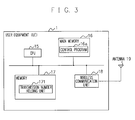
- Fig. 3 is a block diagram showing an example structure of the user equipment 1 in accordance with the exemplary embodiment of the present invention.
- the user equipment 1 includes a CPU (Central Processing Unit) 15, a main memory 16 that stores a control program 16a to be executed by the CPU 15, a memory 17 that includes a transmission number holding unit 171 for holding the number of times for an RLC-UM (Unacknowledged Mode) transmission request [MAC-DATA REQ(REQuest)] described later, a wireless communication unit 18, and an antenna 19.
- the CPU 15 executes the control program 16a to control the respective components of the user equipment 1, thereby realizing the processing operations of the respective layers of the hierarchical structure shown in Fig. 2 . The processing operations of the respective layers will be described later.
- Fig. 4 is a sequence chart of a processing operation of the mobile communication system in accordance with the exemplary embodiment of the present invention. Referring to Figs. 2 and 4 , the processing operation of the mobile communication system in accordance with the exemplary embodiment of the present invention, particularly, the processing operation to be performed in the user equipment 1, is described. The processing operation to be performed in the user equipment 1 shown in Fig. 4 is realized by the CPU 15 executing the control program 16a.
- the UTRAN When the UTRAN (NW: Network) receives an "RRC CONNECTION RELEASE COMPLETE MESSAGE" from the user equipment 1 (a1 and a2 in Fig. 4 ), the UTRAN is cut off the air (a3 in Fig. 4 ).
- the user equipment 1 is put into an error monitoring state at the MAC 13 (a4 of Fig. 4 ), and a synchronization check is performed. If the RLC-UM (Unacknowledged Mode) transmission request [MAC-DATA-REQ(REQuest)] is repeated (a5 in Fig. 4 ) after the UTRAN side is cut off the air in the setting from the RLC 12 to the MAC 13 in the hierarchy in the user equipment 1, at the point where SIR deterioration [out sync (out of synchronization)] is detected through an SIR (Signal-to-Interference Ratio) check (a7 in Fig.
- RLC-UM Unacknowledged Mode
- the user equipment 1 stops the MAC-DATA-REQ transmission prior to DCH (Dedicated CHannel) error detection after the synchronization check, and moves on to the DCH close procedure (a10 in Fig. 4 ). The user equipment 1 then ends the communication (a11 to a13 in Fig. 4 ).
- DCH Dedicated CHannel
- the number of the MAC-DATA-REQ transmission times is reduced in the case of RLC-UM. Then the user equipment 1 stops the MAC-DATA-REQ transmission prior to the detection of the DCH error after the synchronization check. The user equipment 1 then moves on to the DCH close procedure, and ends the communication. Thus, the time required for ending a communication is shortened.
- a check can be performed on the STATUS-PDU transmission, and the overhead due to the timer is eliminated.
- the throughput in data transferring can be improved.
Landscapes
- Engineering & Computer Science (AREA)
- Computer Networks & Wireless Communication (AREA)
- Signal Processing (AREA)
- Computer Security & Cryptography (AREA)
- Mobile Radio Communication Systems (AREA)
- Detection And Prevention Of Errors In Transmission (AREA)
- Communication Control (AREA)
Abstract
Description
- The present invention relates to a mobile communication system, a user equipment, and a communication ending period shortening method to be utilized in the system and the equipment. More particularly, the present invention relates to a method for shortening the communication ending period in a 3G (Third Generation) user equipment (UE).
- As a method for controlling transmission (retransmission), there has been a method for improving the throughput in data transferring while the STATUS-PDU (Protocol Data Unit) transmission can be checked, and the overhead due to the timer is eliminated (see
Patent Document 1, for example). - This transmission control device includes an RLC (Radio Link Control) header setting/piggyback STATUS-PDU setting block that adds control information indicating a transmission check to the existing transmission information to be transmitted when the control information indicating the transmission check with respect to the transmission information is requested from the reception side, and a STATUS-PDU retransmission buffer that stores an identification code of the transmission information having the control information indicating the transmission check added thereto in association with the control information indicating the transmission check.
- By the above method, however, it is necessary to prepare the STATUS-PDU retransmission buffer that stores the identification code of the transmission information having the control information indicating the transmission check added thereto in association with the control information indicating the transmission check. Therefore, the control operation in the UE becomes complicated, and an internal buffer is also required.
- When N308 at which the number of "RRC (Radio Resource Control) CONNECTION RELEASE COMPLETE MESSAGE" retransmission times reaches the maximum at an end of a communication is set at "1" in a transmitting and receiving operation between the UE and an UTRAN (Universal Terrestrial Radio Access Network), the corresponding message is transmitted from the UE twice. When T308 times out (Time-Out.) twice (V308 > N308), a DCH (Dedicated CHannel) is closed, and the operation transits to an idle state.
-
Fig. 1 illustrates a conventional operation. InFig. 1 , the operation on the UTRAN side and the UE operation are shown. When the UTRAN receives the "RRC CONNECTION RELEASE COMPLETE MESSAGE" from the UE (b1 and b2 inFig. 1 ), the UTRAN network is cut off the air (b3 inFig. 1 ), and the UE is put into an error monitoring state (b4 inFig. 1 ). A synchronization check is then performed. If an out-of-synchronization state is detected (b7 inFig. 1 ), a DCH ERR IND (INDicator) is detected (b9 inFig. 1 ), and a DCH close request is issued (b10 inFig. 1 ). If a T312 timer is set at 3s(second), three seconds are required before DCH close procedure (cutoff procedure) is started. - As for the DCH out-of-synchronization state (DCH error state), if the past 4 SIR values are equal to or larger than Quin, the number of In-sync times is counted up. If an In-sync state does not occur n312 times in a row before a T312 timeout occurs at m(= t312*10), the operation is in the T312 timeout state.
- In the conventional operation, a the MAC-DATA-REQ(REQuest) transmission from the RLC to an MAC (Medium Access Control) is repeated before a T313 timeout check is performed in the DCH synchronization check and a DCG Err IND procedure is carried out (3s). As a result, the communication end is delayed. However, if it is in an RLC-UM (Unacknowledged Mode) when SIR deterioration [out sync (out of synchronization) is detected through an SIR (Signal-to-Interference Ratio) check, the number of MAC-DATA-REQ transmission times is reduced, and the UE stops the MAC-DATA-REQ transmission before a DCH error detection after the synchronization check. The UE then moves on to the DCH clock procedure, and ends the communication.
- Patent Document 1: Japanese Patent Application Laid-Open No.
2005-094230 - By the above described conventional method, however, before the message from the UE is transmitted twice, a RLC-UM (Unacknowledged Mode) transmission setting disabled state [the transmission MAC(Medium Access Control)-STATUS-IND(INDicator) to the UTRAN remains in mode 01] continues (the off-the-air state of the UTRAN cannot be recognized on the UE side).
- This is because the setting for the second message transmission cannot be performed since the upstream synchronization on the UTRAN side is stopped at the time of the first message transmission. After three seconds in the setting disabled state, an out-of-synchronization state (DCH ERROR) is detected, and the operation is put into an idle state through the error detection. As a result, it takes some of the time to end the communication.
- Therefore, the exemplary object of the present invention is to provide a mobile communication system, a user equipment, and a communication ending period shortening method to be utilized in the system and equipment, that can solve the above problems and shorten the communication ending period.
- A mobile communication system according to the present invention is a mobile communication system that includes a user equipment including a hierarchical structure of RRC (Radio Resource Control), RLC (Radio Link Control), MAC (Medium Access Control), and PHY (PHYsical layer), wherein the user equipment makes a threshold value check on a RLC-UM (Unacknowledged Mode) transmission request from the RLC to the MAC based on the number of times for the RLC-UM transmission request between the RLC and the MAC, and controls the number of times for the RLC-UM transmission request in accordance with the threshold value check.
- A user equipment according to the present invention is a user equipment that includes a hierarchical structure of RRC (Radio Resource Control), RLC (Radio Link Control), MAC (Medium Access Control), and PHY (PHYsical layer), wherein the user equipment makes a threshold value check on a RLC-UM (Unacknowledged Mode) transmission request from the RLC to the MAC based on the number of times for the RLC-UM transmission request between the RLC and the MAC, and controls the number of times for the RLC-UM transmission request in accordance with the threshold value check.
- A communication ending period shortening method according to the present invention is a communication ending period shortening method to be utilized in a user equipment that includes a hierarchical structure of RRC (Radio Resource Control), RLC (Radio Link Control), MAC (Medium Access Control), and PHY (PHYsical layer), wherein the communication ending period shortening method includes making a threshold value check on a RLC-UM (Unacknowledged Mode) transmission request from the RLC to the MAC based on the number of times for the RLC-UM transmission request between the RLC and the MAC, and controlling the number of times for the RLC-UM transmission request in accordance with the threshold value check.
- Accordingly, in the mobile communication system of the present invention, if the RLC-UM (Unacknowledged Mode) transmission request [MAC-DATA-REQ(REQuest)] is repeated after the UTRAN (Universal Terrestrial Radio Access Network) side is cut off the air in the setting from the RLC (Radio Link Control) to the MAC (Medium Access Control) in the hierarchy in the UE (user equipment), at the point where SIR deterioration [out sync (out of synchronization)] is detected through a SIR (Signal-to-Interference Ratio) check, the UE stops the MAC-DATA-REQ transmission prior to a DCH (Dedicated CHannel) error detection after the synchronization check, and moves on to the DCH close procedure. The UE then ends the communication.
- When the RLC-UM transmission request is repeated from the RLC to the MAC in the UE, the number of times for the MAC-DATA-REQ transmission is held at the MAC. When the number of transmission times held at the MAC exceeds a threshold value (a designated number of MAC transmission times), the RLC is moved on to the transmission end procedure with a MAC-STATUS-IND(INDicator).
- When a communication is ended in a 3G (Third Generation) user equipment (UE), a L3 (Layer 3) message is sent from the UE to the UTRAN side. When the UTRAN receives an "RRC (Radio Resource Control) CONNECTION RELEASE COMPLETE MESSAGE", the dedicated resources and all the procedures of the UE are ended on the UTRAN side.
- When the L3 message are transmitted to the UTRAN side several times, the dedicated resources are released on the UTRAN side prior to the UE side after the first L3 message is arrived, and the communication might be cut off the air. Since the transmission request (MAC-DATA-REQ) from the RLC to the MAC is repeated in the RLC-MAC hierarchy in the UE after the UTRAN side is cut off the air, the DCH (Dedicated CHannel) close procedure is not carried out until a T313 timeout is determined after an error monitoring state through the synchronization check. As a result, the transmission request is repeated, thereby the communication cannot be ended (the dedicated resources and all the procedures cannot be ended).
- Accordingly, in the mobile communication system of the present invention, the number of MAC-DATA-REQ transmission times during the synchronization check is reduced, in the case of C-Plane (RLC-UM). The operation then moves on to the transmission end procedure, and the DCH close procedure is carried out. The communication is then ended (the dedicated resources and all the procedures are ended). In this manner, the period of time required for ending a communication can be shortened.
- With the above structure and operations, the present invention can achieve the effect to shorten the period of time required for ending a communication.
- The following is a description of exemplary embodiments of the present invention, with reference to the accompanying drawings.
Fig. 2 illustrates a hierarchical structure of SW (software) and HW (hardware) of a user equipment (UE) in accordance with an exemplary embodiment of the present invention. InFig. 2 , auser equipment 1 includes a hierarchical structure including an RRC (Radio Resource Control) 11, an L2 (layer 2)-RLC (Radio Link Control) 12, an L2-MAC (Medium Access Control) 13, and an L1 (Layer 1)-PHY (PHYsical layer) 14. When transmission is performed, transmission data for the respective layers are set in order of theRLC 12, theMAC 13, and thePHY 14. -
Fig. 3 is a block diagram showing an example structure of theuser equipment 1 in accordance with the exemplary embodiment of the present invention. InFig. 3 , theuser equipment 1 includes a CPU (Central Processing Unit) 15, amain memory 16 that stores acontrol program 16a to be executed by theCPU 15, amemory 17 that includes a transmissionnumber holding unit 171 for holding the number of times for an RLC-UM (Unacknowledged Mode) transmission request [MAC-DATA REQ(REQuest)] described later, awireless communication unit 18, and anantenna 19. TheCPU 15 executes thecontrol program 16a to control the respective components of theuser equipment 1, thereby realizing the processing operations of the respective layers of the hierarchical structure shown inFig. 2 . The processing operations of the respective layers will be described later. -
Fig. 4 is a sequence chart of a processing operation of the mobile communication system in accordance with the exemplary embodiment of the present invention. Referring toFigs. 2 and4 , the processing operation of the mobile communication system in accordance with the exemplary embodiment of the present invention, particularly, the processing operation to be performed in theuser equipment 1, is described. The processing operation to be performed in theuser equipment 1 shown inFig. 4 is realized by theCPU 15 executing thecontrol program 16a. - When the UTRAN (NW: Network) receives an "RRC CONNECTION RELEASE COMPLETE MESSAGE" from the user equipment 1 (a1 and a2 in
Fig. 4 ), the UTRAN is cut off the air (a3 inFig. 4 ). - The
user equipment 1 is put into an error monitoring state at the MAC 13 (a4 ofFig. 4 ), and a synchronization check is performed. If the RLC-UM (Unacknowledged Mode) transmission request [MAC-DATA-REQ(REQuest)] is repeated (a5 inFig. 4 ) after the UTRAN side is cut off the air in the setting from theRLC 12 to theMAC 13 in the hierarchy in theuser equipment 1, at the point where SIR deterioration [out sync (out of synchronization)] is detected through an SIR (Signal-to-Interference Ratio) check (a7 inFig. 4 ), theuser equipment 1 stops the MAC-DATA-REQ transmission prior to DCH (Dedicated CHannel) error detection after the synchronization check, and moves on to the DCH close procedure (a10 inFig. 4 ). Theuser equipment 1 then ends the communication (a11 to a13 inFig. 4 ). - When RLC-UM data is transmitted from the RLC 12 to the
MAC 13 in theuser equipment 1, the number of times for the MAC-DATA-REQ transmission is held at theMAC 13. When the number of transmission times held at the MAC exceeds a threshold value (a designated number of MAC transmission times), an MAC-STATUS-IND(INDicator) is notified (a12 inFig. 4 ) so that the operation in theuser equipment 1 moves on to the transmission end procedure. - In the conventional operation, during the time period in which a T313 timeout is detected through the DCH synchronization check, and a DCH Err IND procedure is issued (during 3s), the transmission of MAC-DATA-REQ from the RLC to the MAC is repeated, and the communication end is delayed.
- In the exemplary embodiment, on the other hand, when SIR degradation is detected through the SIR check (when "out sync" is detected), the number of the MAC-DATA-REQ transmission times is reduced in the case of RLC-UM. Then the
user equipment 1 stops the MAC-DATA-REQ transmission prior to the detection of the DCH error after the synchronization check. Theuser equipment 1 then moves on to the DCH close procedure, and ends the communication. Thus, the time required for ending a communication is shortened. - As described above, in the exemplary embodiment, a check can be performed on the STATUS-PDU transmission, and the overhead due to the timer is eliminated. Thus, the throughput in data transferring can be improved.
- This application is based upon and claims the benefit of priority from Japanese patent application No.
2006-253659, filed on September 20, 2006 -
-
Fig. 1 is a sequence chart showing a processing operation of a conventional mobile communication system; -
Fig. 2 illustrates a hierarchical structure of software and hardware of a user equipment in accordance with an exemplary embodiment of the present invention; -
Fig. 3 is a block diagram showing an example structure of the user equipment in accordance with the exemplary embodiment of the present invention; and -
Fig. 4 is a sequence chart showing a processing operation of the mobile communication system in accordance with the exemplary embodiment of the present invention. -
- 1
- user equipment
- 11
- RRC
- 12
- L2-RLC
- 13
- L2-MAC
- 14
- L1-PHY
- 15
- CPU
- 16
- main memory
- 16a
- control program
- 17
- memory
- 18
- wireless communication unit
- 19
- antenna
- 171
- transmission time holding unit
Claims (9)
- A mobile communication system that comprises a user equipment including a hierarchical structure of RRC (Radio Resource Control), RLC (Radio Link Control), MAC (Medium Access Control), and PHY (PHYsical layer),
wherein the user equipment makes a threshold value check on a RLC-UM (Unacknowledged Mode) transmission request from the RLC to the MAC based on the number of times for the RLC-UM transmission request between the RLC and the MAC, and controls the number of times for the RLC-UM transmission request in accordance with the threshold value check. - The mobile communication system according to claim 1, wherein the MAC holds the number of times for the RLC-UM transmission request between the RLC and the MAC, and performs the threshold value check.
- The mobile communication system according to claim 1 or 2, wherein the user equipment puts the RLC to move on to a procedure for stopping the RLC-UM transmission request transmission, when the number of times for the RLC-UM transmission request between the RLC and the MAC exceeds the threshold value.
- A user equipment that includes a hierarchical structure of RRC (Radio Resource Control), RLC (Radio Link Control), MAC (Medium Access Control), and PHY (PHYsical layer),
wherein the user equipment makes a threshold value check on a RLC-UM (Unacknowledged Mode) transmission request from the RLC to the MAC based on the number of times for the RLC-UM transmission request between the RLC and the MAC, and controls the number of times for the RLC-UM transmission request in accordance with the threshold value check. - The user equipment according to claim 4, wherein the MAC holds the number of times for the RLC-UM transmission request between the RLC and the MAC, and performs the threshold value check.
- The user equipment according to claim 4 or 5, wherein the user equipment puts the RLC to move on to a procedure for stopping the RLC-UM transmission request, when the number of times for the RLC-UM transmission request between the RLC and the MAC exceeds the threshold value.
- A communication ending period shortening method to be utilized in a user equipment that includes a hierarchical structure of RRC (Radio Resource Control), RLC (Radio Link Control), MAC (Medium Access Control), and PHY (PHYsical layer),
wherein the communication ending period shortening method includes making a threshold value check on a RLC-UM (Unacknowledged Mode) transmission request from the RLC to the MAC based on the number of times for the RLC-UM transmission request between the RLC and the MAC, and controlling the number of times for the RLC-UM transmission request in accordance with the threshold value check. - The communication ending period shortening method according to claim 7, wherein the MAC holds the number of times for the RLC-UM transmission request between the RLC and the MAC, and performs the threshold value check.
- The communication ending period shortening method according to claim 7 or 8, wherein the use equipment puts the RLC to move on to a procedure for stopping the RLC-UM transmission request transmission, when the number of times for the RLC-UM transmission request between the RLC and the MAC exceeds the threshold value.
Applications Claiming Priority (2)
| Application Number | Priority Date | Filing Date | Title |
|---|---|---|---|
| JP2006253659 | 2006-09-20 | ||
| PCT/JP2007/067679 WO2008035592A1 (en) | 2006-09-20 | 2007-09-11 | Mobile communication system, user equipment, and method for reducing communication processing completion time used for them |
Publications (3)
| Publication Number | Publication Date |
|---|---|
| EP2066138A1 true EP2066138A1 (en) | 2009-06-03 |
| EP2066138A4 EP2066138A4 (en) | 2013-04-03 |
| EP2066138B1 EP2066138B1 (en) | 2020-11-11 |
Family
ID=39200419
Family Applications (1)
| Application Number | Title | Priority Date | Filing Date |
|---|---|---|---|
| EP07807088.5A Active EP2066138B1 (en) | 2006-09-20 | 2007-09-11 | Mobile communication system, user equipment, and method for reducing communication processing completion time used for them |
Country Status (5)
| Country | Link |
|---|---|
| US (1) | US20100054119A1 (en) |
| EP (1) | EP2066138B1 (en) |
| JP (2) | JP5067372B2 (en) |
| CN (1) | CN101518149B (en) |
| WO (1) | WO2008035592A1 (en) |
Families Citing this family (1)
| Publication number | Priority date | Publication date | Assignee | Title |
|---|---|---|---|---|
| CN103516492B (en) * | 2012-06-18 | 2017-11-14 | 中兴通讯股份有限公司 | Data cache method and device |
Family Cites Families (13)
| Publication number | Priority date | Publication date | Assignee | Title |
|---|---|---|---|---|
| FI110831B (en) * | 1999-12-31 | 2003-03-31 | Nokia Corp | Procedure for intensifying data transfer and data transfer protocols |
| KR100789565B1 (en) * | 2001-04-07 | 2007-12-28 | 엘지전자 주식회사 | How to set up a radio bearer, how to perform encryption and change accordingly, and how to encrypt data |
| US7012981B2 (en) * | 2001-04-17 | 2006-03-14 | Cyntrust Communications, Inc. | Method and apparatus for improving data frame synchronization in a low SNR environment |
| JP4284013B2 (en) * | 2001-07-30 | 2009-06-24 | 富士通株式会社 | Transport channel list selection method and apparatus |
| US7269448B2 (en) * | 2001-11-09 | 2007-09-11 | Electronics And Telecommunications Research Institute | Method for recognizing request for data transmission by mobile/base station RRC using network transfer device |
| JP2003319458A (en) * | 2002-04-24 | 2003-11-07 | Mitsubishi Electric Corp | Communication system and communication control method |
| JP2005005967A (en) * | 2003-06-11 | 2005-01-06 | Nec Corp | Paging multiplexing method in mobile communication system and mobile communication system |
| JP4255346B2 (en) * | 2003-09-16 | 2009-04-15 | ソニー・エリクソン・モバイルコミュニケーションズ株式会社 | Retransmission control device, communication device, and retransmission control method |
| KR101000699B1 (en) * | 2004-04-19 | 2010-12-10 | 엘지전자 주식회사 | Data processing method in radio link control layer |
| EP1757047B1 (en) * | 2004-06-29 | 2019-11-06 | Nokia Technologies Oy | Method and apparatus for transmitting/receiving control message related to packet call service in an ip multimedia subsystem |
| KR20060013466A (en) * | 2004-08-07 | 2006-02-10 | 삼성전자주식회사 | Method for signaling status information of terminals for reverse packet transmission in soft handoff region |
| KR100678147B1 (en) * | 2005-01-05 | 2007-02-02 | 삼성전자주식회사 | Method and apparatus for controlling ARX related timer in broadband wireless access communication system and system therefor |
| JP4860287B2 (en) | 2005-02-10 | 2012-01-25 | 株式会社半導体エネルギー研究所 | Doping method and manufacturing method of field effect transistor |
-
2007
- 2007-09-11 JP JP2008535327A patent/JP5067372B2/en active Active
- 2007-09-11 EP EP07807088.5A patent/EP2066138B1/en active Active
- 2007-09-11 US US12/441,097 patent/US20100054119A1/en not_active Abandoned
- 2007-09-11 WO PCT/JP2007/067679 patent/WO2008035592A1/en not_active Ceased
- 2007-09-11 CN CN2007800350215A patent/CN101518149B/en active Active
-
2012
- 2012-06-21 JP JP2012139363A patent/JP5423843B2/en active Active
Non-Patent Citations (2)
| Title |
|---|
| ERICSSON: "RRC connection management - Rev 2", 3GPP DRAFT; GAHW-010257, 3RD GENERATION PARTNERSHIP PROJECT (3GPP), MOBILE COMPETENCE CENTRE ; 650, ROUTE DES LUCIOLES ; F-06921 SOPHIA-ANTIPOLIS CEDEX ; FRANCE, vol. TSG GERAN, no. Kista; 20010927, 27 September 2001 (2001-09-27), XP050413199, [retrieved on 2001-09-27] * |
| See also references of WO2008035592A1 * |
Also Published As
| Publication number | Publication date |
|---|---|
| JP2012213213A (en) | 2012-11-01 |
| WO2008035592A1 (en) | 2008-03-27 |
| JP5423843B2 (en) | 2014-02-19 |
| CN101518149B (en) | 2011-06-08 |
| US20100054119A1 (en) | 2010-03-04 |
| CN101518149A (en) | 2009-08-26 |
| EP2066138A4 (en) | 2013-04-03 |
| JP5067372B2 (en) | 2012-11-07 |
| JPWO2008035592A1 (en) | 2010-01-28 |
| EP2066138B1 (en) | 2020-11-11 |
Similar Documents
| Publication | Publication Date | Title |
|---|---|---|
| US6901063B2 (en) | Data delivery in conjunction with a hybrid automatic retransmission mechanism in CDMA communication systems | |
| EP1768339B1 (en) | Method and apparatus for handling timers during re-establishing receiving sides in a wireless communications system | |
| EP1689134A2 (en) | Method and apparatus for requesting/transmitting status report of a mobile communication system | |
| RU2487485C2 (en) | Method of controlling transmission window and retransmission and transmitting device | |
| RU2462821C2 (en) | Method to send repeat request and receiving device | |
| EP2014055B1 (en) | Uninterrupted transmission during a change in ciphering configuration | |
| US20100111019A1 (en) | Method and related communication device for parameter reconfiguration in a wireless communications system | |
| TWI444077B (en) | Method and related communication device for radio link control reconfiguration | |
| RU2463711C2 (en) | Packet communication method and receiving device | |
| EP2045950A2 (en) | Method and apparatus for triggering a poll function in a wireless communications system | |
| EP2107851B1 (en) | Establishing radio link control in wireless communication networks | |
| JP2007089174A (en) | Method and device for improving signal transmission rate in wireless communication system | |
| US8842526B2 (en) | Error recovery | |
| US20240422800A1 (en) | Data Transmission Method, Terminal, and Network-Side Device | |
| EP1944897B1 (en) | Communication device, radio communication terminal, radio base station and communication method | |
| EP2066138B1 (en) | Mobile communication system, user equipment, and method for reducing communication processing completion time used for them | |
| EP2865222B1 (en) | Radio resource control technique | |
| US8503478B2 (en) | Receiving apparatus, receiving method and program thereof | |
| JP2008118649A (en) | Method and device for processing protocol error in wireless communication system | |
| RU2456778C2 (en) | Method and device to complete message transfer in enhanced channel of arbitrary access | |
| US20130035102A1 (en) | Method and system for reducing mac-is reset ambiguity for common e-dch transmissions | |
| KR101680108B1 (en) | Method And Apparatus For Hand-Over | |
| EP1848153B1 (en) | A method of providing replay protection | |
| CN120513656A (en) | Communication method, device, apparatus, storage medium, chip, product, and program |
Legal Events
| Date | Code | Title | Description |
|---|---|---|---|
| PUAI | Public reference made under article 153(3) epc to a published international application that has entered the european phase |
Free format text: ORIGINAL CODE: 0009012 |
|
| 17P | Request for examination filed |
Effective date: 20090302 |
|
| AK | Designated contracting states |
Kind code of ref document: A1 Designated state(s): AT BE BG CH CY CZ DE DK EE ES FI FR GB GR HU IE IS IT LI LT LU LV MC MT NL PL PT RO SE SI SK TR |
|
| AX | Request for extension of the european patent |
Extension state: AL BA HR MK RS |
|
| RIC1 | Information provided on ipc code assigned before grant |
Ipc: H04L 29/08 20060101ALI20090515BHEP Ipc: H04L 1/16 20060101ALI20090515BHEP Ipc: H04W 4/00 20090101AFI20090515BHEP |
|
| RBV | Designated contracting states (corrected) |
Designated state(s): DE FR GB IT |
|
| DAX | Request for extension of the european patent (deleted) | ||
| A4 | Supplementary search report drawn up and despatched |
Effective date: 20130228 |
|
| RIC1 | Information provided on ipc code assigned before grant |
Ipc: H04W 4/00 20090101AFI20130222BHEP Ipc: H04L 29/06 20060101ALI20130222BHEP Ipc: H04L 1/18 20060101ALI20130222BHEP Ipc: H04L 1/16 20060101ALI20130222BHEP Ipc: H04L 29/08 20060101ALI20130222BHEP Ipc: H04L 1/20 20060101ALI20130222BHEP Ipc: H04W 76/06 20090101ALI20130222BHEP |
|
| STAA | Information on the status of an ep patent application or granted ep patent |
Free format text: STATUS: EXAMINATION IS IN PROGRESS |
|
| 17Q | First examination report despatched |
Effective date: 20170915 |
|
| REG | Reference to a national code |
Ref country code: DE Ref legal event code: R079 Ref document number: 602007060769 Country of ref document: DE Free format text: PREVIOUS MAIN CLASS: H04W0004000000 Ipc: H04L0001200000 |
|
| RIC1 | Information provided on ipc code assigned before grant |
Ipc: H04L 1/20 20060101AFI20200429BHEP |
|
| GRAP | Despatch of communication of intention to grant a patent |
Free format text: ORIGINAL CODE: EPIDOSNIGR1 |
|
| STAA | Information on the status of an ep patent application or granted ep patent |
Free format text: STATUS: GRANT OF PATENT IS INTENDED |
|
| INTG | Intention to grant announced |
Effective date: 20200709 |
|
| GRAS | Grant fee paid |
Free format text: ORIGINAL CODE: EPIDOSNIGR3 |
|
| GRAA | (expected) grant |
Free format text: ORIGINAL CODE: 0009210 |
|
| STAA | Information on the status of an ep patent application or granted ep patent |
Free format text: STATUS: THE PATENT HAS BEEN GRANTED |
|
| AK | Designated contracting states |
Kind code of ref document: B1 Designated state(s): DE FR GB IT |
|
| REG | Reference to a national code |
Ref country code: GB Ref legal event code: FG4D |
|
| REG | Reference to a national code |
Ref country code: DE Ref legal event code: R096 Ref document number: 602007060769 Country of ref document: DE |
|
| REG | Reference to a national code |
Ref country code: DE Ref legal event code: R097 Ref document number: 602007060769 Country of ref document: DE |
|
| PLBE | No opposition filed within time limit |
Free format text: ORIGINAL CODE: 0009261 |
|
| STAA | Information on the status of an ep patent application or granted ep patent |
Free format text: STATUS: NO OPPOSITION FILED WITHIN TIME LIMIT |
|
| 26N | No opposition filed |
Effective date: 20210812 |
|
| PG25 | Lapsed in a contracting state [announced via postgrant information from national office to epo] |
Ref country code: IT Free format text: LAPSE BECAUSE OF FAILURE TO SUBMIT A TRANSLATION OF THE DESCRIPTION OR TO PAY THE FEE WITHIN THE PRESCRIBED TIME-LIMIT Effective date: 20201111 |
|
| PGFP | Annual fee paid to national office [announced via postgrant information from national office to epo] |
Ref country code: DE Payment date: 20240918 Year of fee payment: 18 |
|
| PGFP | Annual fee paid to national office [announced via postgrant information from national office to epo] |
Ref country code: GB Payment date: 20240919 Year of fee payment: 18 |
|
| PGFP | Annual fee paid to national office [announced via postgrant information from national office to epo] |
Ref country code: FR Payment date: 20240925 Year of fee payment: 18 |