EP2066062A2 - Method and apparatus for setting a highest received state variable in a wireless communication system - Google Patents
Method and apparatus for setting a highest received state variable in a wireless communication system Download PDFInfo
- Publication number
- EP2066062A2 EP2066062A2 EP08020767A EP08020767A EP2066062A2 EP 2066062 A2 EP2066062 A2 EP 2066062A2 EP 08020767 A EP08020767 A EP 08020767A EP 08020767 A EP08020767 A EP 08020767A EP 2066062 A2 EP2066062 A2 EP 2066062A2
- Authority
- EP
- European Patent Office
- Prior art keywords
- state variable
- received state
- highest received
- sequence number
- value
- Prior art date
- Legal status (The legal status is an assumption and is not a legal conclusion. Google has not performed a legal analysis and makes no representation as to the accuracy of the status listed.)
- Granted
Links
Images



Classifications
-
- H—ELECTRICITY
- H04—ELECTRIC COMMUNICATION TECHNIQUE
- H04L—TRANSMISSION OF DIGITAL INFORMATION, e.g. TELEGRAPHIC COMMUNICATION
- H04L1/00—Arrangements for detecting or preventing errors in the information received
- H04L1/12—Arrangements for detecting or preventing errors in the information received by using return channel
- H04L1/16—Arrangements for detecting or preventing errors in the information received by using return channel in which the return channel carries supervisory signals, e.g. repetition request signals
- H04L1/18—Automatic repetition systems, e.g. Van Duuren systems
-
- H—ELECTRICITY
- H04—ELECTRIC COMMUNICATION TECHNIQUE
- H04L—TRANSMISSION OF DIGITAL INFORMATION, e.g. TELEGRAPHIC COMMUNICATION
- H04L1/00—Arrangements for detecting or preventing errors in the information received
- H04L1/12—Arrangements for detecting or preventing errors in the information received by using return channel
- H04L1/16—Arrangements for detecting or preventing errors in the information received by using return channel in which the return channel carries supervisory signals, e.g. repetition request signals
- H04L1/18—Automatic repetition systems, e.g. Van Duuren systems
- H04L1/1829—Arrangements specially adapted for the receiver end
- H04L1/1832—Details of sliding window management
Definitions
- the present invention relates to a method and apparatus for setting a highest received state variable in a wireless communication system according to the pre-characterizing clauses of claims 1 and 6.
- the third generation mobile telecommunication system (called 3G system) provides high frequency spectrum utilization, universal coverage, and high quality, high-speed multimedia data transmission, and also meets all kinds of QoS requirements simultaneously, providing diverse, flexible, two-way transmission services and better communication quality to reduce transmission interruption rates.
- LTE system Long Term Evolution wireless communication system
- MAC Medium Access Control
- RLC Radio Link Control
- AM is suitable for a high-accuracy data service, so that AM RLC layer supports functions of auto-retransmission, reordering, and so on.
- the reordering function is used to recover an order of protocol data units (PDUs), to make a PDU order processed by a receiver equal to a PDU order outputted from a transmitter.
- PDUs protocol data units
- VR(H) is a variable used in the reordering function, and as specified in related technical specifications, it holds a sequence number (SN) following the highest SN of any received AMD PDU (Acknowledged Mode Data Protocol Data Unit); the initial value of VR(H) is 0.
- SN sequence number
- the RLC entity receives a plurality of AMD PDUs, the RLC entity will set VR(H) to be an SN following the highest SN of the received AMD PDUs.
- AMD PDU is defined as a complete PDU carrying data in AM. That is to say, the prior art only considers the situation that AMD PDUs are not segmented, such that VR(H) is only updated based on SNs of complete PDUs.
- the LTE system can support PDU segmentation or re-segmentation. In such a case, the prior art cannot optimally or accurately update VR(H) when performing the reordering function, causing degradation of system efficiency or malfunction.
- FIG. 1 illustrates a schematic diagram of setting VR(H) in the prior art.
- VR(H) is set to be 4.
- VR(H) is set to be an SN following the highest SN of the received data PDUs, and that is, keeps 4.
- the data PDU P5 is not completely received at the time point T3 while the highest SN of the received data PDUs is 3, such that VR(H) keeps 4. Therefore, VR(H) is not accurately updated, which may cause errors in the reordering function, and the received PDUs cannot be arranged as the original order. As a result, delay or other problems may be introduced.
- the present invention aims at providing a method and apparatus for setting a highest received state variable in a wireless communication system, for timely updating the highest received state variable, to prevent system delay or malfunction, and keep normal operation.
- the claimed method for setting a highest received state variable in a receiver of a wireless communication system which comprises receiving a segment of a data protocol data unit having a sequence number greater than or equal to a value of the highest received state variable, and updating the value of the highest received state variable according to the sequence number of the data protocol data unit.
- the wireless communication system 1000 can be a 3G mobile telecommunication system, an LTE (long-term evolution) system or other mobile communication systems, and is briefly composed of a network and a plurality of UEs.
- the network and the UEs are simply utilized for illustrating the structure of the wireless communication system 1000.
- the network may comprise a plurality of base stations (Node Bs), radio network controllers and so on according to actual demands, and the UEs can be devices such as mobile phones, computer systems, etc.
- the network and the UE can be seen as a transmitter or receiver according to transmission direction, e.g., for uplink, the UE is the transmitter and the network is the receiver, and for downlink, the network is the transmitter and the UE is the receiver.
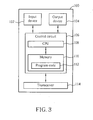
- FIG. 3 is a functional block diagram of a communication device 100 in a wireless communication system.
- the wireless communication system is preferably the LTE system.
- Fig. 3 only shows an input device 102, an output device 104, a control circuit 106, a central processing unit (CPU) 108, a memory 110, a program code 112, and a transceiver 114 of the communication device 100.
- the control circuit 106 executes the program code 112 in the memory 110 through the CPU 108, thereby controlling an operation of the communication device 100.
- the communication device 100 can receive signals input by a user through the input device 102, such as a keyboard, and can output images and sounds through the output device 104, such as a monitor or speakers.
- the transceiver 114 is used to receive and transmit wireless signals, delivering received signals to the control circuit 106, and outputting signals generated by the control circuit 106 wirelessly. From a perspective of a communication protocol framework, the transceiver 114 can be seen as a portion of Layer 1, and the control circuit 106 can be utilized to realize functions of Layer 2 and Layer 3.
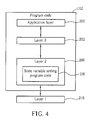
- Fig. 4 is a diagram of the program code 112 shown in Fig. 3 .
- the program code 112 includes an application layer 200, a Layer 3 202, and a Layer 2 206, and is coupled to a Layer 1 218.
- the Layer 3 202 comprises a Radio Resource Control layer and a PDCP (Packet Data Convergence Protocol) layer, and performs resource control.
- the PDCP layer can alternatively be considered to belong to Layer 2 206. Whether the PDCP layer belongs to the Layer 3 202 or the Layer 2 206 is not related to the present invention.
- the Layer 2 206 comprises an RLC layer and a MAC layer, and performs link control.
- the Layer 1 218 performs physical connections.
- the Layer 2 206 is composed of a transmitting side and a receiving side, and the receiving side can update or maintain a Highest received state variable VR(H).
- the embodiment of the present invention provides a state variable setting program code 220 for accurately setting the Highest received state variable VR(H), to prevent system malfunction.
- Fig. 5 illustrates a schematic diagram of a process 50.
- the process 50 is utilized for setting VR(H) in a receiver of the wireless communication system 1000, and comprises the following steps:
- the embodiment of the present invention updates VR(H) according to SN of the data PDU.
- the embodiment of the present invention can determine whether to update VR(H) even if the receiver does not receive a complete data PDU. As a result, VR(H) can be timely updated, to prevent system malfunction.
- the embodiment of the present invention when the receiver receives a segment of a data PDU, if SN of the data PDU is greater than or equal to VR(H), the embodiment of the present invention will update VR(H), preferably to be SN of the data PDU or SN of the data PDU plus 1. Take the situation shown in Fig. 1 for example.
- the embodiment of the present invention can set VR(H) to be 5 or 6, so as to prevent system delay or malfunction, to maintain normal operation.
- VR(H) is an SN following the highest SN of the received data PDUs; that is, the prior art determines whether to update VR(H) only when receiving a complete data PDU.
- the embodiment of the present invention determines whether to update VR(H) when receiving a segment of a data PDU, such that the present invention can timely update VR(H), to prevent system errors.
- the embodiment of the present invention can update VR(H). Therefore, the embodiment of the present invention can timely update VR(H), to prevent system delay or malfunction, and keep normal operation.
Landscapes
- Engineering & Computer Science (AREA)
- Computer Networks & Wireless Communication (AREA)
- Signal Processing (AREA)
- Mobile Radio Communication Systems (AREA)
- Communication Control (AREA)
Abstract
Description
- This application claims the benefit of
U.S. Provisional Application No. 60/990,919, filed on Nov 29, 2007 - The present invention relates to a method and apparatus for setting a highest received state variable in a wireless communication system according to the pre-characterizing clauses of
claims - The third generation mobile telecommunication system (called 3G system) provides high frequency spectrum utilization, universal coverage, and high quality, high-speed multimedia data transmission, and also meets all kinds of QoS requirements simultaneously, providing diverse, flexible, two-way transmission services and better communication quality to reduce transmission interruption rates.
- Long Term Evolution wireless communication system (LTE system), an advanced high-speed wireless communication system established upon the 3G mobile telecommunication system, supports only packet-switched transmission, and tends to implement both Medium Access Control (MAC) layer and Radio Link Control (RLC) layer in one single communication site, such as in Node B alone rather than in Node B and RNC (Radio Network Controller) respectively, so that the system structure becomes simple.
- To keep normal function in the LTE system, related technical specifications have defined operating methods, parameters and variables. For example, aimed at RLC layer, the prior art introduces a Highest received state variable VR(H), which is maintained by the receiving side of each AM (Acknowledged Mode) RLC entity. Generally, AM is suitable for a high-accuracy data service, so that AM RLC layer supports functions of auto-retransmission, reordering, and so on. The reordering function is used to recover an order of protocol data units (PDUs), to make a PDU order processed by a receiver equal to a PDU order outputted from a transmitter. VR(H) is a variable used in the reordering function, and as specified in related technical specifications, it holds a sequence number (SN) following the highest SN of any received AMD PDU (Acknowledged Mode Data Protocol Data Unit); the initial value of VR(H) is 0. Note that, "highest SN" means the last SN in a receiving window. For example, if SN is represented by 7 bits, namely SN = 0~63, then the highest SN within 62, 63 and 0 is 0.
- Therefore, if the RLC entity receives a plurality of AMD PDUs, the RLC entity will set VR(H) to be an SN following the highest SN of the received AMD PDUs. Note that, AMD PDU is defined as a complete PDU carrying data in AM. That is to say, the prior art only considers the situation that AMD PDUs are not segmented, such that VR(H) is only updated based on SNs of complete PDUs. However, when radio environment changes, the LTE system can support PDU segmentation or re-segmentation. In such a case, the prior art cannot optimally or accurately update VR(H) when performing the reordering function, causing degradation of system efficiency or malfunction.
- For example, please refer to
Fig. 1 , which illustrates a schematic diagram of setting VR(H) in the prior art. InFig. 1 , suppose an AM RLC entity has received data PDUs P1, P2, P3 with SN = 1, 2, 3 in a receiving window RCW at a time point T1. According to the prior art, VR(H) is set to be 4. At a time point T2, suppose the next data PDU P4 with SN = 4 is lost during transmission. Since the highest SN of the received data PDUs is 3, VR(H) keeps 4. Next, at a time point T3, suppose the next data PDU P5 with SN = 5 is composed of segments P5_1 and P5_2, and the segment P5_1 is lost during transmission, while the segment P5_2 is successively received. According to the prior art, VR(H) is set to be an SN following the highest SN of the received data PDUs, and that is, keeps 4. In short, the data PDU P5 is not completely received at the time point T3 while the highest SN of the received data PDUs is 3, such that VR(H) keeps 4. Therefore, VR(H) is not accurately updated, which may cause errors in the reordering function, and the received PDUs cannot be arranged as the original order. As a result, delay or other problems may be introduced. - Therefore, the prior art cannot accurately update VR(H), and may cause system malfunction.
- This in mind, the present invention aims at providing a method and apparatus for setting a highest received state variable in a wireless communication system, for timely updating the highest received state variable, to prevent system delay or malfunction, and keep normal operation.
- This is achieved by a method and apparatus for setting a highest received state variable in a wireless communication system according to
claims - As will be seen more clearly from the detailed description following below, the claimed method for setting a highest received state variable in a receiver of a wireless communication system, which comprises receiving a segment of a data protocol data unit having a sequence number greater than or equal to a value of the highest received state variable, and updating the value of the highest received state variable according to the sequence number of the data protocol data unit.
- In the following, the invention is further illustrated by way of example, taking reference to the accompanying drawings. Thereof
-
Fig. 1 , which illustrates a schematic diagram of setting VR(H) in the prior art. -
Fig. 2 is a schematic diagram of a wireless communications system. -
Fig. 3 is a function block diagram of a wireless communications device. -
Fig. 4 is a diagram of program code ofFig. 2 . -
Fig. 5 is a flowchart of a process according to an embodiment of the present invention. - Please refer to
Fig. 2 , which illustrates a schematic diagram of awireless communication system 1000. Thewireless communication system 1000 can be a 3G mobile telecommunication system, an LTE (long-term evolution) system or other mobile communication systems, and is briefly composed of a network and a plurality of UEs. InFig. 2 , the network and the UEs are simply utilized for illustrating the structure of thewireless communication system 1000. Practically, the network may comprise a plurality of base stations (Node Bs), radio network controllers and so on according to actual demands, and the UEs can be devices such as mobile phones, computer systems, etc. Besides, the network and the UE can be seen as a transmitter or receiver according to transmission direction, e.g., for uplink, the UE is the transmitter and the network is the receiver, and for downlink, the network is the transmitter and the UE is the receiver. - Please refer to
Fig. 3 , which is a functional block diagram of acommunication device 100 in a wireless communication system. The wireless communication system is preferably the LTE system. For the sake of brevity,Fig. 3 only shows aninput device 102, anoutput device 104, a control circuit 106, a central processing unit (CPU) 108, a memory 110, aprogram code 112, and atransceiver 114 of thecommunication device 100. In thecommunication device 100, the control circuit 106 executes theprogram code 112 in the memory 110 through the CPU 108, thereby controlling an operation of thecommunication device 100. Thecommunication device 100 can receive signals input by a user through theinput device 102, such as a keyboard, and can output images and sounds through theoutput device 104, such as a monitor or speakers. Thetransceiver 114 is used to receive and transmit wireless signals, delivering received signals to the control circuit 106, and outputting signals generated by the control circuit 106 wirelessly. From a perspective of a communication protocol framework, thetransceiver 114 can be seen as a portion ofLayer 1, and the control circuit 106 can be utilized to realize functions ofLayer 2 andLayer 3. - Please continue to refer to
Fig. 4. Fig. 4 is a diagram of theprogram code 112 shown inFig. 3 . Theprogram code 112 includes anapplication layer 200, aLayer 3 202, and aLayer 2 206, and is coupled to aLayer 1 218. TheLayer 3 202 comprises a Radio Resource Control layer and a PDCP (Packet Data Convergence Protocol) layer, and performs resource control. Note that the PDCP layer can alternatively be considered to belong toLayer 2 206. Whether the PDCP layer belongs to theLayer 3 202 or theLayer 2 206 is not related to the present invention. TheLayer 2 206 comprises an RLC layer and a MAC layer, and performs link control. TheLayer 1 218 performs physical connections. - In the LTE system, the
Layer 2 206 is composed of a transmitting side and a receiving side, and the receiving side can update or maintain a Highest received state variable VR(H). In such a situation, the embodiment of the present invention provides a state variablesetting program code 220 for accurately setting the Highest received state variable VR(H), to prevent system malfunction. Please refer toFig. 5 , which illustrates a schematic diagram of aprocess 50. Theprocess 50 is utilized for setting VR(H) in a receiver of thewireless communication system 1000, and comprises the following steps: - Step 500: Start.
- Step 502: Receive a segment of a data PDU having SN greater than or equal to VR(H).
- Step 504: Update VR(H) according to SN of the data PDU.
- Step 506: End.
- According to the
process 50, when a receiver receives a segment of a data PDU with SN greater than or equal to VR(H), the embodiment of the present invention updates VR(H) according to SN of the data PDU. In other words, once a segment of a data PDU is received, the embodiment of the present invention can determine whether to update VR(H) even if the receiver does not receive a complete data PDU. As a result, VR(H) can be timely updated, to prevent system malfunction. - Therefore, when the receiver receives a segment of a data PDU, if SN of the data PDU is greater than or equal to VR(H), the embodiment of the present invention will update VR(H), preferably to be SN of the data PDU or SN of the data PDU plus 1. Take the situation shown in
Fig. 1 for example. At the time point T3, since the receiver receives the segment P5_2 of the data PDU P5, and SN (= 5) of the data PDU P5 is greater than VR(H) (= 3), the embodiment of the present invention can set VR(H) to be 5 or 6, so as to prevent system delay or malfunction, to maintain normal operation. - Note that, as those skilled in the art recognized, high/low of SN is determined based upon time sequence. For example, if SN is represented by 7 bits, then the highest SN within 62, 63 and 0 is 0. Therefore, if VR(H) = 63, when a segment of a data PDU with SN = 0 is received, the embodiment of the present invention will update VR(H) to 0 or 1.
- In the prior art, VR(H) is an SN following the highest SN of the received data PDUs; that is, the prior art determines whether to update VR(H) only when receiving a complete data PDU. In comparison, the embodiment of the present invention determines whether to update VR(H) when receiving a segment of a data PDU, such that the present invention can timely update VR(H), to prevent system errors.
- In summary, when a segment of an AMD PDU with SN greater than or equal to VR(H) is received, the embodiment of the present invention can update VR(H). Therefore, the embodiment of the present invention can timely update VR(H), to prevent system delay or malfunction, and keep normal operation.
Claims (10)
- A method for setting a highest received state variable in a receiver of a wireless communication system comprising:receiving a segment of a data protocol data unit having a sequence number greater than or equal to a value of the highest received state variable (502);characterized by updating the value of the highest received state variable according to the sequence number of the data protocol data unit (504).
- The method of claim 1, characterized in that updating the value of the highest received state variable according to the sequence number of the data protocol data unit is setting the value of the highest received state variable to be the sequence number of the data protocol data unit.
- The method of claim 1, characterized in that updating the value of the highest received state variable according to the sequence number of the data protocol data unit is setting the value of the highest received state variable to be the sequence number of the data protocol data unit plus 1.
- The method of claim 1, characterized in that the receiver operates in an acknowledged mode.
- The method of claim 1, characterized in that the highest received state variable is utilized in a reordering function of the receiver.
- A communication device (100) utilized in a receiver of a wireless communication system for accurately setting a highest received state variable, the communication device (100) comprising:a processor (108) for executing a program code; anda memory (110) coupled to the processor (108) for storing the program code; wherein the program code comprises:characterized by updating the value of the highest received state variable according to the sequence number of the data protocol data unit (504).receiving a segment of a data protocol data unit having a sequence number greater than or equal to a value of the highest received state variable (502);
- The communication device of claim 6, characterized in that in the program code, updating the value of the highest received state variable according to the sequence number of the data protocol data unit is setting the value of the highest received state variable to be the sequence number of the data protocol data unit.
- The communication device of claim 6, characterized in that in the program code, updating the value of the highest received state variable according to the sequence number of the data protocol data unit is setting the value of the highest received state variable to be the sequence number of the data protocol data unit plus 1.
- The communication device of claim 6, characterized in that the communication device operates in an acknowledged mode.
- The communication device of claim 6, characterized in that the highest received state variable is utilized in a reordering function of the receiver.
Applications Claiming Priority (1)
| Application Number | Priority Date | Filing Date | Title |
|---|---|---|---|
| US99091907P | 2007-11-29 | 2007-11-29 |
Publications (3)
| Publication Number | Publication Date |
|---|---|
| EP2066062A2 true EP2066062A2 (en) | 2009-06-03 |
| EP2066062A3 EP2066062A3 (en) | 2010-02-24 |
| EP2066062B1 EP2066062B1 (en) | 2014-07-30 |
Family
ID=40347954
Family Applications (1)
| Application Number | Title | Priority Date | Filing Date |
|---|---|---|---|
| EP08020767.3A Active EP2066062B1 (en) | 2007-11-29 | 2008-11-28 | Method and apparatus for setting a highest received state variable in a wireless communication system |
Country Status (6)
| Country | Link |
|---|---|
| US (1) | US20090143063A1 (en) |
| EP (1) | EP2066062B1 (en) |
| JP (1) | JP5075100B2 (en) |
| KR (1) | KR101018731B1 (en) |
| CN (1) | CN101448333B (en) |
| TW (1) | TWI388172B (en) |
Families Citing this family (3)
| Publication number | Priority date | Publication date | Assignee | Title |
|---|---|---|---|---|
| US9055011B2 (en) * | 2010-08-31 | 2015-06-09 | Intel Corporation | Methods and apparatus for linked-list circular buffer management |
| CN108347308A (en) * | 2017-01-22 | 2018-07-31 | 成都鼎桥通信技术有限公司 | The method of reseptance and device of point multipoint message traffic |
| WO2019028826A1 (en) * | 2017-08-11 | 2019-02-14 | Qualcomm Incorporated | Radio link control reassembling techniques in wireless systems |
Citations (2)
| Publication number | Priority date | Publication date | Assignee | Title |
|---|---|---|---|---|
| US20050270996A1 (en) | 2004-04-19 | 2005-12-08 | Lg Electronics Inc. | Apparatus and method for enhanced UM RLC data handling |
| EP1720279A1 (en) | 1999-03-22 | 2006-11-08 | Telefonaktiebolaget LM Ericsson (publ) | Data discard mechanism for selective repeat protocol |
Family Cites Families (7)
| Publication number | Priority date | Publication date | Assignee | Title |
|---|---|---|---|---|
| KR100333730B1 (en) * | 1999-10-23 | 2002-04-25 | 오길록 | Method for Requesting Data Retransmission between Network Access Systems over Ethernet |
| KR101158912B1 (en) * | 2003-11-10 | 2012-06-21 | 엘지전자 주식회사 | Stall avoidance method using a window in hsdpa system |
| US7573879B2 (en) * | 2004-09-03 | 2009-08-11 | Intel Corporation | Method and apparatus for generating a header in a communication network |
| US7525908B2 (en) * | 2004-09-24 | 2009-04-28 | M-Stack Limited | Data unit management in communications |
| CN1323563C (en) | 2005-03-28 | 2007-06-27 | 华为技术有限公司 | Receiving method of multimedia brondiasting/group broadcast service control information |
| TWI387250B (en) * | 2006-05-03 | 2013-02-21 | Innovative Sonic Ltd | Method and apparatus of handling variable of rlc reset procedure during receiver-side-only re-establishment in wireless communications system |
| US20090097425A1 (en) * | 2007-10-01 | 2009-04-16 | Interdigital Patent Holdings, Inc. | Radio link control operations and enhanced duplicate detection in a wireless receiver |
-
2008
- 2008-11-28 KR KR1020080119524A patent/KR101018731B1/en active Active
- 2008-11-28 CN CN2008101823975A patent/CN101448333B/en active Active
- 2008-11-28 TW TW097146298A patent/TWI388172B/en active
- 2008-11-28 EP EP08020767.3A patent/EP2066062B1/en active Active
- 2008-11-28 US US12/324,894 patent/US20090143063A1/en not_active Abandoned
- 2008-12-01 JP JP2008306270A patent/JP5075100B2/en active Active
Patent Citations (2)
| Publication number | Priority date | Publication date | Assignee | Title |
|---|---|---|---|---|
| EP1720279A1 (en) | 1999-03-22 | 2006-11-08 | Telefonaktiebolaget LM Ericsson (publ) | Data discard mechanism for selective repeat protocol |
| US20050270996A1 (en) | 2004-04-19 | 2005-12-08 | Lg Electronics Inc. | Apparatus and method for enhanced UM RLC data handling |
Also Published As
| Publication number | Publication date |
|---|---|
| KR101018731B1 (en) | 2011-03-04 |
| US20090143063A1 (en) | 2009-06-04 |
| JP5075100B2 (en) | 2012-11-14 |
| KR20090056894A (en) | 2009-06-03 |
| TW200924468A (en) | 2009-06-01 |
| TWI388172B (en) | 2013-03-01 |
| JP2009135931A (en) | 2009-06-18 |
| CN101448333B (en) | 2011-12-21 |
| EP2066062B1 (en) | 2014-07-30 |
| EP2066062A3 (en) | 2010-02-24 |
| CN101448333A (en) | 2009-06-03 |
Similar Documents
| Publication | Publication Date | Title |
|---|---|---|
| EP1993226B1 (en) | Method and related apparatus for handling re-establishment of radio link control entity in a wireless communications system | |
| KR101032909B1 (en) | Method and apparatus for triggering poll function within a wireless communication system | |
| EP1690435B1 (en) | Method, system and transmitting side protocol entity for sending packet data units for unacknowledged mode services | |
| US8228938B2 (en) | Method and apparatus for preventing a miss-detection of duplicated packets and an out-of-sequence delivery to the higher layer in unacknowledged mode operation | |
| US20070293173A1 (en) | Method and apparatus for data framing in a wireless communications system | |
| EP2077691A2 (en) | Method and apparatus for performing buffer status reporting | |
| EP2107709B1 (en) | Method and apparatus of transmission time interval bundling management | |
| EP2206258A2 (en) | Method and apparatus for selecting a radio link control protocol data unit size | |
| EP2991418B1 (en) | Method and apparatus for multi-stream aggregation | |
| EP3504821B1 (en) | Communications devices, method and mobile communications system | |
| EP3177065A1 (en) | Data transmission method and base station | |
| US8159965B2 (en) | Method of comparing state variable or packet sequence number for a wireless communications system and related apparatus | |
| EP2099249A1 (en) | Method and apparatus for performing buffer status reporting | |
| CN112187414A (en) | Method and device for indicating data transmission condition | |
| US7852844B2 (en) | Method and related apparatus for reconfiguring size of a receiving window in a communications system | |
| EP1816806A1 (en) | Method of resetting radio link control entity in a mobile communications system and related apparatus | |
| EP1988657B1 (en) | Method and related apparatus for handling packet discard in a wireless communication system | |
| EP2066062B1 (en) | Method and apparatus for setting a highest received state variable in a wireless communication system | |
| EP2040498A1 (en) | Method for setting headers for RLC PDU segments | |
| EP1993313A2 (en) | Method and apparatus for polling transmission status in a wireless communications system | |
| WO2019134168A1 (en) | Radio link control (rlc) acknowledged mode (am) data reception | |
| US20090109951A1 (en) | Method and Apparatus for Counting Transmission Times of a PDU | |
| WO2013167339A1 (en) | Handling status data units from multiple data streams |
Legal Events
| Date | Code | Title | Description |
|---|---|---|---|
| PUAI | Public reference made under article 153(3) epc to a published international application that has entered the european phase |
Free format text: ORIGINAL CODE: 0009012 |
|
| 17P | Request for examination filed |
Effective date: 20081128 |
|
| AK | Designated contracting states |
Kind code of ref document: A2 Designated state(s): AT BE BG CH CY CZ DE DK EE ES FI FR GB GR HR HU IE IS IT LI LT LU LV MC MT NL NO PL PT RO SE SI SK TR |
|
| AX | Request for extension of the european patent |
Extension state: AL BA MK RS |
|
| PUAL | Search report despatched |
Free format text: ORIGINAL CODE: 0009013 |
|
| AK | Designated contracting states |
Kind code of ref document: A3 Designated state(s): AT BE BG CH CY CZ DE DK EE ES FI FR GB GR HR HU IE IS IT LI LT LU LV MC MT NL NO PL PT RO SE SI SK TR |
|
| AX | Request for extension of the european patent |
Extension state: AL BA MK RS |
|
| RIC1 | Information provided on ipc code assigned before grant |
Ipc: H04L 1/18 20060101AFI20100119BHEP |
|
| AKX | Designation fees paid |
Designated state(s): AT BE BG CH CY CZ DE DK EE ES FI FR GB GR HR HU IE IS IT LI LT LU LV MC MT NL NO PL PT RO SE SI SK TR |
|
| 17Q | First examination report despatched |
Effective date: 20120814 |
|
| GRAP | Despatch of communication of intention to grant a patent |
Free format text: ORIGINAL CODE: EPIDOSNIGR1 |
|
| INTG | Intention to grant announced |
Effective date: 20140220 |
|
| GRAS | Grant fee paid |
Free format text: ORIGINAL CODE: EPIDOSNIGR3 |
|
| RAP1 | Party data changed (applicant data changed or rights of an application transferred) |
Owner name: INNOVATIVE SONIC LIMITED |
|
| GRAA | (expected) grant |
Free format text: ORIGINAL CODE: 0009210 |
|
| AK | Designated contracting states |
Kind code of ref document: B1 Designated state(s): AT BE BG CH CY CZ DE DK EE ES FI FR GB GR HR HU IE IS IT LI LT LU LV MC MT NL NO PL PT RO SE SI SK TR |
|
| REG | Reference to a national code |
Ref country code: GB Ref legal event code: FG4D |
|
| REG | Reference to a national code |
Ref country code: CH Ref legal event code: EP |
|
| REG | Reference to a national code |
Ref country code: AT Ref legal event code: REF Ref document number: 680395 Country of ref document: AT Kind code of ref document: T Effective date: 20140815 |
|
| REG | Reference to a national code |
Ref country code: IE Ref legal event code: FG4D |
|
| REG | Reference to a national code |
Ref country code: DE Ref legal event code: R096 Ref document number: 602008033536 Country of ref document: DE Effective date: 20140911 |
|
| REG | Reference to a national code |
Ref country code: AT Ref legal event code: MK05 Ref document number: 680395 Country of ref document: AT Kind code of ref document: T Effective date: 20140730 |
|
| REG | Reference to a national code |
Ref country code: NL Ref legal event code: VDEP Effective date: 20140730 |
|
| REG | Reference to a national code |
Ref country code: LT Ref legal event code: MG4D |
|
| PG25 | Lapsed in a contracting state [announced via postgrant information from national office to epo] |
Ref country code: LT Free format text: LAPSE BECAUSE OF FAILURE TO SUBMIT A TRANSLATION OF THE DESCRIPTION OR TO PAY THE FEE WITHIN THE PRESCRIBED TIME-LIMIT Effective date: 20140730 Ref country code: FI Free format text: LAPSE BECAUSE OF FAILURE TO SUBMIT A TRANSLATION OF THE DESCRIPTION OR TO PAY THE FEE WITHIN THE PRESCRIBED TIME-LIMIT Effective date: 20140730 Ref country code: SE Free format text: LAPSE BECAUSE OF FAILURE TO SUBMIT A TRANSLATION OF THE DESCRIPTION OR TO PAY THE FEE WITHIN THE PRESCRIBED TIME-LIMIT Effective date: 20140730 Ref country code: PT Free format text: LAPSE BECAUSE OF FAILURE TO SUBMIT A TRANSLATION OF THE DESCRIPTION OR TO PAY THE FEE WITHIN THE PRESCRIBED TIME-LIMIT Effective date: 20141202 Ref country code: GR Free format text: LAPSE BECAUSE OF FAILURE TO SUBMIT A TRANSLATION OF THE DESCRIPTION OR TO PAY THE FEE WITHIN THE PRESCRIBED TIME-LIMIT Effective date: 20141031 Ref country code: ES Free format text: LAPSE BECAUSE OF FAILURE TO SUBMIT A TRANSLATION OF THE DESCRIPTION OR TO PAY THE FEE WITHIN THE PRESCRIBED TIME-LIMIT Effective date: 20140730 Ref country code: NO Free format text: LAPSE BECAUSE OF FAILURE TO SUBMIT A TRANSLATION OF THE DESCRIPTION OR TO PAY THE FEE WITHIN THE PRESCRIBED TIME-LIMIT Effective date: 20141030 Ref country code: BG Free format text: LAPSE BECAUSE OF FAILURE TO SUBMIT A TRANSLATION OF THE DESCRIPTION OR TO PAY THE FEE WITHIN THE PRESCRIBED TIME-LIMIT Effective date: 20141030 |
|
| PG25 | Lapsed in a contracting state [announced via postgrant information from national office to epo] |
Ref country code: LV Free format text: LAPSE BECAUSE OF FAILURE TO SUBMIT A TRANSLATION OF THE DESCRIPTION OR TO PAY THE FEE WITHIN THE PRESCRIBED TIME-LIMIT Effective date: 20140730 Ref country code: NL Free format text: LAPSE BECAUSE OF FAILURE TO SUBMIT A TRANSLATION OF THE DESCRIPTION OR TO PAY THE FEE WITHIN THE PRESCRIBED TIME-LIMIT Effective date: 20140730 Ref country code: PL Free format text: LAPSE BECAUSE OF FAILURE TO SUBMIT A TRANSLATION OF THE DESCRIPTION OR TO PAY THE FEE WITHIN THE PRESCRIBED TIME-LIMIT Effective date: 20140730 Ref country code: CY Free format text: LAPSE BECAUSE OF FAILURE TO SUBMIT A TRANSLATION OF THE DESCRIPTION OR TO PAY THE FEE WITHIN THE PRESCRIBED TIME-LIMIT Effective date: 20140730 Ref country code: HR Free format text: LAPSE BECAUSE OF FAILURE TO SUBMIT A TRANSLATION OF THE DESCRIPTION OR TO PAY THE FEE WITHIN THE PRESCRIBED TIME-LIMIT Effective date: 20140730 Ref country code: AT Free format text: LAPSE BECAUSE OF FAILURE TO SUBMIT A TRANSLATION OF THE DESCRIPTION OR TO PAY THE FEE WITHIN THE PRESCRIBED TIME-LIMIT Effective date: 20140730 Ref country code: IS Free format text: LAPSE BECAUSE OF FAILURE TO SUBMIT A TRANSLATION OF THE DESCRIPTION OR TO PAY THE FEE WITHIN THE PRESCRIBED TIME-LIMIT Effective date: 20141130 |
|
| PG25 | Lapsed in a contracting state [announced via postgrant information from national office to epo] |
Ref country code: DK Free format text: LAPSE BECAUSE OF FAILURE TO SUBMIT A TRANSLATION OF THE DESCRIPTION OR TO PAY THE FEE WITHIN THE PRESCRIBED TIME-LIMIT Effective date: 20140730 Ref country code: EE Free format text: LAPSE BECAUSE OF FAILURE TO SUBMIT A TRANSLATION OF THE DESCRIPTION OR TO PAY THE FEE WITHIN THE PRESCRIBED TIME-LIMIT Effective date: 20140730 Ref country code: IT Free format text: LAPSE BECAUSE OF FAILURE TO SUBMIT A TRANSLATION OF THE DESCRIPTION OR TO PAY THE FEE WITHIN THE PRESCRIBED TIME-LIMIT Effective date: 20140730 Ref country code: SK Free format text: LAPSE BECAUSE OF FAILURE TO SUBMIT A TRANSLATION OF THE DESCRIPTION OR TO PAY THE FEE WITHIN THE PRESCRIBED TIME-LIMIT Effective date: 20140730 Ref country code: RO Free format text: LAPSE BECAUSE OF FAILURE TO SUBMIT A TRANSLATION OF THE DESCRIPTION OR TO PAY THE FEE WITHIN THE PRESCRIBED TIME-LIMIT Effective date: 20140730 Ref country code: CZ Free format text: LAPSE BECAUSE OF FAILURE TO SUBMIT A TRANSLATION OF THE DESCRIPTION OR TO PAY THE FEE WITHIN THE PRESCRIBED TIME-LIMIT Effective date: 20140730 |
|
| REG | Reference to a national code |
Ref country code: DE Ref legal event code: R097 Ref document number: 602008033536 Country of ref document: DE |
|
| PLBE | No opposition filed within time limit |
Free format text: ORIGINAL CODE: 0009261 |
|
| STAA | Information on the status of an ep patent application or granted ep patent |
Free format text: STATUS: NO OPPOSITION FILED WITHIN TIME LIMIT |
|
| PG25 | Lapsed in a contracting state [announced via postgrant information from national office to epo] |
Ref country code: MC Free format text: LAPSE BECAUSE OF FAILURE TO SUBMIT A TRANSLATION OF THE DESCRIPTION OR TO PAY THE FEE WITHIN THE PRESCRIBED TIME-LIMIT Effective date: 20140730 Ref country code: BE Free format text: LAPSE BECAUSE OF NON-PAYMENT OF DUE FEES Effective date: 20141130 Ref country code: LU Free format text: LAPSE BECAUSE OF FAILURE TO SUBMIT A TRANSLATION OF THE DESCRIPTION OR TO PAY THE FEE WITHIN THE PRESCRIBED TIME-LIMIT Effective date: 20141128 |
|
| REG | Reference to a national code |
Ref country code: CH Ref legal event code: PL |
|
| 26N | No opposition filed |
Effective date: 20150504 |
|
| PG25 | Lapsed in a contracting state [announced via postgrant information from national office to epo] |
Ref country code: CH Free format text: LAPSE BECAUSE OF NON-PAYMENT OF DUE FEES Effective date: 20141130 Ref country code: LI Free format text: LAPSE BECAUSE OF NON-PAYMENT OF DUE FEES Effective date: 20141130 |
|
| REG | Reference to a national code |
Ref country code: IE Ref legal event code: MM4A |
|
| PG25 | Lapsed in a contracting state [announced via postgrant information from national office to epo] |
Ref country code: IE Free format text: LAPSE BECAUSE OF NON-PAYMENT OF DUE FEES Effective date: 20141128 |
|
| PG25 | Lapsed in a contracting state [announced via postgrant information from national office to epo] |
Ref country code: SI Free format text: LAPSE BECAUSE OF FAILURE TO SUBMIT A TRANSLATION OF THE DESCRIPTION OR TO PAY THE FEE WITHIN THE PRESCRIBED TIME-LIMIT Effective date: 20140730 |
|
| REG | Reference to a national code |
Ref country code: FR Ref legal event code: PLFP Year of fee payment: 8 |
|
| PG25 | Lapsed in a contracting state [announced via postgrant information from national office to epo] |
Ref country code: BE Free format text: LAPSE BECAUSE OF FAILURE TO SUBMIT A TRANSLATION OF THE DESCRIPTION OR TO PAY THE FEE WITHIN THE PRESCRIBED TIME-LIMIT Effective date: 20140730 Ref country code: TR Free format text: LAPSE BECAUSE OF FAILURE TO SUBMIT A TRANSLATION OF THE DESCRIPTION OR TO PAY THE FEE WITHIN THE PRESCRIBED TIME-LIMIT Effective date: 20140730 Ref country code: HU Free format text: LAPSE BECAUSE OF FAILURE TO SUBMIT A TRANSLATION OF THE DESCRIPTION OR TO PAY THE FEE WITHIN THE PRESCRIBED TIME-LIMIT; INVALID AB INITIO Effective date: 20081128 Ref country code: MT Free format text: LAPSE BECAUSE OF FAILURE TO SUBMIT A TRANSLATION OF THE DESCRIPTION OR TO PAY THE FEE WITHIN THE PRESCRIBED TIME-LIMIT Effective date: 20140730 |
|
| REG | Reference to a national code |
Ref country code: FR Ref legal event code: PLFP Year of fee payment: 9 |
|
| REG | Reference to a national code |
Ref country code: FR Ref legal event code: PLFP Year of fee payment: 10 |
|
| P01 | Opt-out of the competence of the unified patent court (upc) registered |
Effective date: 20230508 |
|
| PGFP | Annual fee paid to national office [announced via postgrant information from national office to epo] |
Ref country code: GB Payment date: 20250901 Year of fee payment: 18 |
|
| PGFP | Annual fee paid to national office [announced via postgrant information from national office to epo] |
Ref country code: FR Payment date: 20250826 Year of fee payment: 18 |
|
| PGFP | Annual fee paid to national office [announced via postgrant information from national office to epo] |
Ref country code: DE Payment date: 20250814 Year of fee payment: 18 |