EP2065747A2 - Helmet mount for Night Vision Goggles - Google Patents
Helmet mount for Night Vision Goggles Download PDFInfo
- Publication number
- EP2065747A2 EP2065747A2 EP08169579A EP08169579A EP2065747A2 EP 2065747 A2 EP2065747 A2 EP 2065747A2 EP 08169579 A EP08169579 A EP 08169579A EP 08169579 A EP08169579 A EP 08169579A EP 2065747 A2 EP2065747 A2 EP 2065747A2
- Authority
- EP
- European Patent Office
- Prior art keywords
- helmet
- socket
- ears
- power pack
- grooves
- Prior art date
- Legal status (The legal status is an assumption and is not a legal conclusion. Google has not performed a legal analysis and makes no representation as to the accuracy of the status listed.)
- Granted
Links
- 230000004297 night vision Effects 0.000 title claims abstract description 26
- 210000005069 ears Anatomy 0.000 claims abstract description 24
- 230000008878 coupling Effects 0.000 claims description 4
- 238000010168 coupling process Methods 0.000 claims description 4
- 238000005859 coupling reaction Methods 0.000 claims description 4
- IWEDIXLBFLAXBO-UHFFFAOYSA-N dicamba Chemical compound COC1=C(Cl)C=CC(Cl)=C1C(O)=O IWEDIXLBFLAXBO-UHFFFAOYSA-N 0.000 abstract description 20
- 230000001133 acceleration Effects 0.000 description 3
- 230000000712 assembly Effects 0.000 description 3
- 238000000429 assembly Methods 0.000 description 3
- 239000000463 material Substances 0.000 description 3
- 208000028373 Neck injury Diseases 0.000 description 2
- 230000007423 decrease Effects 0.000 description 2
- 238000000034 method Methods 0.000 description 2
- WHXSMMKQMYFTQS-UHFFFAOYSA-N Lithium Chemical compound [Li] WHXSMMKQMYFTQS-UHFFFAOYSA-N 0.000 description 1
- 230000006835 compression Effects 0.000 description 1
- 238000007906 compression Methods 0.000 description 1
- 229910052744 lithium Inorganic materials 0.000 description 1
- 230000007246 mechanism Effects 0.000 description 1
Images

Classifications
-
- G—PHYSICS
- G02—OPTICS
- G02B—OPTICAL ELEMENTS, SYSTEMS OR APPARATUS
- G02B23/00—Telescopes, e.g. binoculars; Periscopes; Instruments for viewing the inside of hollow bodies; Viewfinders; Optical aiming or sighting devices
- G02B23/12—Telescopes, e.g. binoculars; Periscopes; Instruments for viewing the inside of hollow bodies; Viewfinders; Optical aiming or sighting devices with means for image conversion or intensification
- G02B23/125—Telescopes, e.g. binoculars; Periscopes; Instruments for viewing the inside of hollow bodies; Viewfinders; Optical aiming or sighting devices with means for image conversion or intensification head-mounted
-
- A—HUMAN NECESSITIES
- A42—HEADWEAR
- A42B—HATS; HEAD COVERINGS
- A42B3/00—Helmets; Helmet covers ; Other protective head coverings
- A42B3/04—Parts, details or accessories of helmets
- A42B3/0406—Accessories for helmets
- A42B3/042—Optical devices
-
- H—ELECTRICITY
- H01—ELECTRIC ELEMENTS
- H01M—PROCESSES OR MEANS, e.g. BATTERIES, FOR THE DIRECT CONVERSION OF CHEMICAL ENERGY INTO ELECTRICAL ENERGY
- H01M50/00—Constructional details or processes of manufacture of the non-active parts of electrochemical cells other than fuel cells, e.g. hybrid cells
- H01M50/20—Mountings; Secondary casings or frames; Racks, modules or packs; Suspension devices; Shock absorbers; Transport or carrying devices; Holders
- H01M50/204—Racks, modules or packs for multiple batteries or multiple cells
- H01M50/207—Racks, modules or packs for multiple batteries or multiple cells characterised by their shape
- H01M50/213—Racks, modules or packs for multiple batteries or multiple cells characterised by their shape adapted for cells having curved cross-section, e.g. round or elliptic
-
- Y—GENERAL TAGGING OF NEW TECHNOLOGICAL DEVELOPMENTS; GENERAL TAGGING OF CROSS-SECTIONAL TECHNOLOGIES SPANNING OVER SEVERAL SECTIONS OF THE IPC; TECHNICAL SUBJECTS COVERED BY FORMER USPC CROSS-REFERENCE ART COLLECTIONS [XRACs] AND DIGESTS
- Y02—TECHNOLOGIES OR APPLICATIONS FOR MITIGATION OR ADAPTATION AGAINST CLIMATE CHANGE
- Y02E—REDUCTION OF GREENHOUSE GAS [GHG] EMISSIONS, RELATED TO ENERGY GENERATION, TRANSMISSION OR DISTRIBUTION
- Y02E60/00—Enabling technologies; Technologies with a potential or indirect contribution to GHG emissions mitigation
- Y02E60/10—Energy storage using batteries
Definitions
- This invention relates to an arrangement for coupling night vision goggle apparatus to a helmet, and more particularly, to such apparatus that automatically releases the goggle apparatus from an aviators helmet when the aviator is ejected from his aircraft.
- Night vision apparatus is commonly used by aviators to enhance their visibility while flying during night or other low light conditions.
- Conventional night vision apparatus comprises a night vision goggle including image intensifier tubes, lens assemblies and a complex mounting assembly that provides for numerous adjustments of the goggle position with respect to the user. All of these items combine to provide a relatively heavy device.
- Such apparatus also includes a relatively light weight power pack that houses a battery or batteries and a circuit board. The power pack is mechanically and electrically coupled to the goggle for operating the goggle and the power pack is, in turn, fixed to the aviators' helmet. As a consequence, the entire weight of the night vision apparatus is supported by the aviator's neck.
- the night vision apparatus comprises a night vision goggle intensifying low level light into a visible image and a power pack providing electric power operating the goggle.
- the helmet mount is adapted to be fixed on an aviator's helmet and includes a support band having an inner surface configured to seat on the front surface of a helmet.
- the support band has a pair of spaced apart ears extending from its outer surface in a generally forward direction. Each ear contains a socket on the surface facing the adjacent surface of the other ear.
- the power pack includes a spring loaded plunger assembly that cooperates with the sockets on the ears to releasably couple and uncouple the power pack and goggle to and from the support band.
- a support band 10 made of plastic or other suitable material.
- the support band 10 has an inner surface configured to seat on the front surface of a helmet, and one of a pair of mechanical fastener assembly components 12 used to secure the band to an aviator's helmet.
- Such fastener assemblies are well known in the art.
- the component 12 functions as an over the center clamp that cooperates with sockets on the helmet to fix the support band 10 to the aviator's helmet.
- the fastener assembly could be a screw arrangement or a harness arrangement or any other suitable arrangement.
- a power pack 14 which, as will be made clear hereinafter, is releasably coupled to the support band 10 and a night vision goggle 16 which is releasably coupled to the power pack so that the power pack can be coupled and uncoupled to the support band and the goggle can be coupled and uncoupled to the power pack without the use of tools.
- the goggle 16 and the power pack 14 are electrically connected so that the power pack operates the goggle.
- the releasable couplings between the power pack 14 and the support band 10 and between the power pack and the goggle 16 are configured so that the power pack and the goggles are released simultaneously, preferably as a unit, from the aviator's helmet when a predetermined g-force acts on the aviator.
- the power pack 14 includes a battery compartment 22 preferably molded from plastic or other suitable material.
- the battery compartment 22 is sized and shaped to receive a standard alkaline double AA battery or an L9 lithium battery or other usable battery. Alternatively, the battery compartment may be configured to receive two or more batteries.
- the battery compartment 22 includes battery contacts and electric leads to connect the battery to a printed circuit board which also includes the necessary electric leads and contacts for electrically coupling the printed circuit board to the goggle16.
- the power pack 14 further includes a second compartment also molded from plastic or other suitable material and formed by a front wall 24, a pair of side walls 26 (only one of which is shown) and a back wall (not shown). This second compartment includes a support arrangement to mount the printed circuit board as well as leads and contacts that connect from the battery to the printed circuit board and from the circuit board to the goggle 16.
- the night vision goggle 16 can be any such device that receives low level light and intensifies that light to present a viewable image to its user.
- the goggle 16 includes a pair of monoculars 30, 30 of any conventional type.
- Each of the monoculars 30 includes an objective lens 31 that receives low level ambient light and each includes an image intensification tube that intensifies the light and presents a visible images to an eye piece 33 at the end of the monocular opposite the objective lens.
- the goggle 16 is carried by adjustable mounting assembly 28, that provides for adjustment of the goggle relative to the aviator.
- adjustable mounting assembly may include a flip up mount that allows the goggle 16 to rotate between an operative position in front of the aviators eyes and an inoperative position located adjacent the front of the helmet and above the aviators eyes.
- adjustable mount assemblies usually include complex adjustment mechanisms for adjusting the goggle's horizontal distance relative to the aviator as well as its tilt and focus, and the interpupillary distance between the monoculars.
- the adjustable mount assembly 28 and thus the goggle 16 are coupled to the power pack 14 via a mounting receptacle 35.
- the receptacle 35 is formed with a pair of spaced apart ears 34, 34 which are generally parallel to the side walls 26, 26 of the second compartment 14.
- Each ear 34 contains a socket 36 on its inner surface, that is, the surface that faces the adjacent surface of the other ear.
- each socket 36 is in the form of a generally spherical depression, but it could be in the form of a through hole, a bore-counter-bore configuration or a variety of other configurations known in the art.
- the adjustable mount assembly 28 includes a housing portion 29 which carries a spring loaded plunger arrangement including a compression spring biasing a pair of plungers 32, 32 (only one of which is shown) outwardly of the end walls of the compartment 29.
- These plungers 32, 32 can be balls or are otherwise formed with spherical end surfaces that are inserted into the sockets 36, 36 to retain the adjustable mount assembly and binocular 16 on the receptacle 35.
- the spherical ends of the plunger 32, 32 can also rotate in the sockets 36, 36 to provide for the rotation of the goggle 16 between its operative and inoperative positions.
- the sockets 36, 36 can be machined or molded into the adjacent surfaces of the ears 34, 34 or the sockets and their below described grooves 38, 38 can be advantageously formed in inserts 50, 50 carried on the ears.
- One such insert is disclosed in co-pending US application 11/944,928 entitled “Universal Insert” filed 26. November 2007 and assigned to the assignee of this application.
- the sockets 36, 36 communicate with the outer edge of the ears 34, 34 via tapered grooves 38, 38.
- the largest arc length of the tapered grooves is open and is located adjacent the outer edge of the ears 34, 34 and the narrowest arc length is located adjacent the sockets 36, 36.
- the bottom surface of the grooves 38, 38 can be in the form of a ramp that inclines inwardly from the outer edge of the ears 34, 34 to the sockets 36, 36 so that the distance between the grooves decreases as the grooves approach the sockets.
- the spring loaded plungers 32, 32 are inserted into the open end of the grooves 38, 38 adjacent the outer edge of the ears 34, 34 and are pushed along the grooves so that the ramped bottom surfaces compresses the plungers until the spring loaded plungers expand into the sockets 36, 36.
- the plungers 32, 32 spring into the sockets 36, 36, the night vision goggle 16 and its mount assembly 28 are releasably and rotatably coupled to the mounting receptacle 35.
- the goggle 16 is pulled with sufficient force so that the concave wall of the sockets 36, 36 compresses the plungers 32, 32 and the plungers ride along the grooves 38, 38 until the goggle is free of the receptacle.
- the outer surface of the support band 10 is formed with a pair of ears 20, 20, which are spaced apart from each other and which extend in the forward direction.
- Each ear 20, 20 also contains sockets 40, 40 on the surface of the ear that faces the adjacent surface of the other ear.
- These sockets 40, 40 are also in the form of generally spherical depressions that cooperate with spring loaded plungers 42, 42 carried on the power pack 14 to releasably couple the power pack 14 to the support band 10.
- the plungers 42, 42 are carried in the power pack's second compartment and extend through the side walls 26, 26 thereof.
- each socket 40 also communicates with a groove 44.
- These grooves 44, 44 are tapered and ramped similar to the taper and ramp described with respect to grooves 38, 38.
- each groove 44 has an open end adjacent the outer edge of its associated ear 20 and this open end has a larger arc length than the end of the groove adjacent its associated socket40; and, the bottom surface of each groove inclines inwardly from the outer edge of its associated ear to its associated socket so that the distance between the grooves decreases as the grooves approach the sockets.
- the sockets 40, 40 and their associated grooves 44, 44 can be machined or molded in the ears 20, 20 or these sockets and grooves can be advantageously formed in inserts 50, 50 carried on the ears.
- the power pack 14 is coupled to the support band 10 by inserting the spring loaded plungers 42, 42 into the open end of the grooves 44, 44 and pushing the power pack so that the plungers ride along the grooves and expand into the sockets 40, 40 to releasably couple the power pack to the support band 10. Removal of the power pack 14 is accomplished by pulling the power pack in the forward direction so that the plungers 42, 42 are compressed and ride out of the sockets 40, 40 and along the grooves 44, 44 until the power pack is free of the support band 10.
- the goggle 16 is relatively heavy and the power pack 14 is relatively light. As a consequence the forces acting during an ejection could release the goggle 16 from the power pack 14 before the power pack is released from the support band 10. If the goggle 16 releases from the power pack 14 before the power pack releases from the support band 10, the power pack lacks sufficient weight to assure that it will separate from the support band.
- the support band 10 and the mounting assembly 28 are shown juxtaposed next to each other in a position of use.
- the grooves 44, 44 extend in the generally forward direction and that the grooves 38, 38 extend upwardly at an angle to the forward direction.
- the axis of the grooves 38, 38 thus forms an angle with the axis of the grooves 44, 44. In the embodiment described herein, the angle is about 45°, but other angles can be used.
- This angular arrangement helps to assure that both the power pack 14 and the goggle 16 are released as a single unit from the support band 10 when the pilot ejects from the aircraft.
- the upward angle of the grooves 44, 44 assures that the power pack 14 and goggles 16 are ejected from the helmet in an upward and outward direction and do not impact against the aviator or fall into his/her lap.
- the spring load between the plungers 42, 42 and the sockets 40, 40 is such that the power pack 14 and goggles 16 release from the support band 10 at a predetermined g-force, e.g., at least about 9 gs and preferably at about 11 gs.
Landscapes
- Physics & Mathematics (AREA)
- Astronomy & Astrophysics (AREA)
- General Physics & Mathematics (AREA)
- Optics & Photonics (AREA)
- Telescopes (AREA)
- Helmets And Other Head Coverings (AREA)
Abstract
Description
- This invention relates to an arrangement for coupling night vision goggle apparatus to a helmet, and more particularly, to such apparatus that automatically releases the goggle apparatus from an aviators helmet when the aviator is ejected from his aircraft.
- Night vision apparatus is commonly used by aviators to enhance their visibility while flying during night or other low light conditions. Conventional night vision apparatus comprises a night vision goggle including image intensifier tubes, lens assemblies and a complex mounting assembly that provides for numerous adjustments of the goggle position with respect to the user. All of these items combine to provide a relatively heavy device. Such apparatus also includes a relatively light weight power pack that houses a battery or batteries and a circuit board. The power pack is mechanically and electrically coupled to the goggle for operating the goggle and the power pack is, in turn, fixed to the aviators' helmet. As a consequence, the entire weight of the night vision apparatus is supported by the aviator's neck.
- When a pilot ejects from an aircraft, the cockpit canopy is ejected from the aircraft and then the aviator is ejected. The acceleration of the aircraft, wind entering the cockpit, the inclination of the aircraft and the large acceleration forces developed as the pilot is suddenly ejected from the aircraft, acting alone or in combination, provide a significant risk that the pilot will be injured.
- Because of the heavy weight of the night vision apparatus and because it is supported by the aviator's neck, there is a considerable risk that the apparatus will cause severe neck injuries to the aviator during the ejection.
- To reduce this risk of neck injury there are known arrangements that release the night vision goggles from the aviator's helmet as the aviator is subjected to severe acceleration forces during the ejection process. In the known arrangements, however, the relatively light weight power pack does not release. Thus, with the power pack fixed to the helmet, it, the power pack, has the potential to become entangled with the parachute risers during ejection. If the power pack becomes so entangled, it can interfere with the proper opening of the parachute providing additional risk to the aviator.
- Accordingly, it is desirable to have a mounting arrangement for night vision apparatus wherein both the goggle and the power pack are automatically released from the aviator's helmet as soon as possible during the ejection process.
- This invention provides a helmet mount for night vision apparatus that automatically releases the apparatus from an aviator's helmet when an ejection is initiated. The night vision apparatus comprises a night vision goggle intensifying low level light into a visible image and a power pack providing electric power operating the goggle. The helmet mount is adapted to be fixed on an aviator's helmet and includes a support band having an inner surface configured to seat on the front surface of a helmet. The support band has a pair of spaced apart ears extending from its outer surface in a generally forward direction. Each ear contains a socket on the surface facing the adjacent surface of the other ear. The power pack includes a spring loaded plunger assembly that cooperates with the sockets on the ears to releasably couple and uncouple the power pack and goggle to and from the support band.
- For a better understanding of the invention, reference is made to the following description of an exemplary embodiment thereof, considered in conjunction with the accompanying drawings, in which:
- Fig. 1
- is an exploded perspective view illustrating a support band and night vision apparatus; and
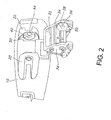
- Fig. 2
- is another perspective view showing the support band and part of the goggle mount juxtaposed to show the relative orientation of the grooves in each.
- Referring to
Fig. 1 there is shown asupport band 10 made of plastic or other suitable material. Thesupport band 10 has an inner surface configured to seat on the front surface of a helmet, and one of a pair of mechanicalfastener assembly components 12 used to secure the band to an aviator's helmet. Such fastener assemblies are well known in the art. As illustrated inFig.1 , thecomponent 12 functions as an over the center clamp that cooperates with sockets on the helmet to fix thesupport band 10 to the aviator's helmet. It is understood that the fastener assembly could be a screw arrangement or a harness arrangement or any other suitable arrangement. - Still referring to
Fig.1 , there is also shown apower pack 14 which, as will be made clear hereinafter, is releasably coupled to thesupport band 10 and anight vision goggle 16 which is releasably coupled to the power pack so that the power pack can be coupled and uncoupled to the support band and the goggle can be coupled and uncoupled to the power pack without the use of tools. Thegoggle 16 and thepower pack 14 are electrically connected so that the power pack operates the goggle. As will also be made clear hereinafter, the releasable couplings between thepower pack 14 and thesupport band 10 and between the power pack and thegoggle 16 are configured so that the power pack and the goggles are released simultaneously, preferably as a unit, from the aviator's helmet when a predetermined g-force acts on the aviator. - The
power pack 14 includes abattery compartment 22 preferably molded from plastic or other suitable material. Thebattery compartment 22 is sized and shaped to receive a standard alkaline double AA battery or an L9 lithium battery or other usable battery. Alternatively, the battery compartment may be configured to receive two or more batteries. As is usual, thebattery compartment 22 includes battery contacts and electric leads to connect the battery to a printed circuit board which also includes the necessary electric leads and contacts for electrically coupling the printed circuit board to the goggle16. To accommodate the circuit board, its leads and contacts, thepower pack 14 further includes a second compartment also molded from plastic or other suitable material and formed by afront wall 24, a pair of side walls 26 (only one of which is shown) and a back wall (not shown). This second compartment includes a support arrangement to mount the printed circuit board as well as leads and contacts that connect from the battery to the printed circuit board and from the circuit board to thegoggle 16. - The
night vision goggle 16 can be any such device that receives low level light and intensifies that light to present a viewable image to its user. In the exemplary embodiment shown here, thegoggle 16 includes a pair ofmonoculars monoculars 30 includes anobjective lens 31 that receives low level ambient light and each includes an image intensification tube that intensifies the light and presents a visible images to aneye piece 33 at the end of the monocular opposite the objective lens. - The
goggle 16 is carried byadjustable mounting assembly 28, that provides for adjustment of the goggle relative to the aviator. Such assembly may include a flip up mount that allows thegoggle 16 to rotate between an operative position in front of the aviators eyes and an inoperative position located adjacent the front of the helmet and above the aviators eyes. As is well known in the art, such adjustable mount assemblies usually include complex adjustment mechanisms for adjusting the goggle's horizontal distance relative to the aviator as well as its tilt and focus, and the interpupillary distance between the monoculars. - The
adjustable mount assembly 28 and thus thegoggle 16 are coupled to thepower pack 14 via amounting receptacle 35. Thereceptacle 35 is formed with a pair of spaced apartears side walls second compartment 14. Eachear 34 contains asocket 36 on its inner surface, that is, the surface that faces the adjacent surface of the other ear. In the exemplary embodiment disclosed herein, eachsocket 36 is in the form of a generally spherical depression, but it could be in the form of a through hole, a bore-counter-bore configuration or a variety of other configurations known in the art. - The
adjustable mount assembly 28 includes ahousing portion 29 which carries a spring loaded plunger arrangement including a compression spring biasing a pair ofplungers 32, 32 (only one of which is shown) outwardly of the end walls of thecompartment 29. Theseplungers sockets receptacle 35. The spherical ends of theplunger sockets goggle 16 between its operative and inoperative positions. - The
sockets ears grooves inserts US application 11/944,928 - The
sockets ears tapered grooves ears sockets grooves ears sockets - To couple the night vision binoculars to the adjustable mounting assembly, the spring loaded
plungers grooves ears sockets plungers sockets night vision goggle 16 and itsmount assembly 28 are releasably and rotatably coupled to the mountingreceptacle 35. To remove the goggle 16 from thereceptacle 35, the goggle is pulled with sufficient force so that the concave wall of thesockets plungers grooves - The outer surface of the
support band 10 is formed with a pair ofears ear sockets sockets plungers power pack 14 to releasably couple thepower pack 14 to thesupport band 10. As best seen inFig. 1 , theplungers side walls plungers plungers socket 40 also communicates with agroove 44. Thesegrooves grooves groove 44 has an open end adjacent the outer edge of its associatedear 20 and this open end has a larger arc length than the end of the groove adjacent its associated socket40; and, the bottom surface of each groove inclines inwardly from the outer edge of its associated ear to its associated socket so that the distance between the grooves decreases as the grooves approach the sockets. - The
sockets grooves ears inserts - The
power pack 14 is coupled to thesupport band 10 by inserting the spring loadedplungers grooves sockets support band 10. Removal of thepower pack 14 is accomplished by pulling the power pack in the forward direction so that theplungers sockets grooves support band 10. - As noted above, the
goggle 16 is relatively heavy and thepower pack 14 is relatively light. As a consequence the forces acting during an ejection could release the goggle 16 from thepower pack 14 before the power pack is released from thesupport band 10. If thegoggle 16 releases from thepower pack 14 before the power pack releases from thesupport band 10, the power pack lacks sufficient weight to assure that it will separate from the support band. - Referring specifically to
Fig. 2 , thesupport band 10 and the mountingassembly 28 are shown juxtaposed next to each other in a position of use. It can be seen that thegrooves grooves grooves grooves power pack 14 and thegoggle 16 are released as a single unit from thesupport band 10 when the pilot ejects from the aircraft. Moreover, the upward angle of thegrooves power pack 14 andgoggles 16 are ejected from the helmet in an upward and outward direction and do not impact against the aviator or fall into his/her lap. - In actual use the spring load between the
plungers sockets power pack 14 andgoggles 16 release from thesupport band 10 at a predetermined g-force, e.g., at least about 9 gs and preferably at about 11 gs. - While in the foregoing there has been disclosed an exemplary embodiment of the invention, it should be understood that the scope of the invention is set forth in the appended claims.
Claims (12)
- A helmet mount for night vision apparatus:said apparatus including a night vision goggle (16) intensifying low level light into a visible image and a power pack (14) providing electric power operating the goggle;said mount including a support band (10) having an inner surface configured to seat on the front surface of a helmet and adapted to be fixed thereto, and a pair of spaced apart ears (20) extending from the outer surface of the support band (10) in a generally forward direction, each ear containing a socket (40) on the surface facing the adjacent surface of the other ear;said power pack (14) including a spring loaded plunger assembly (42) that cooperates with the sockets to releasably couple and uncouple the power pack to and from the support band (10).
- A helmet mount in accordance with claim 1 wherein the spring loaded plunger assembly (42) uncouples from the sockets (40) under a predetermined g-force.
- A helmet mount in accordance with claim 1 or 2 wherein said spring loaded plunger assembly (42) includes a pair of spring loaded plungers (42, 42) carried by said power pack (14) and extending laterally therefrom, each plunger having a size and shape to seat in said sockets.
- A helmet mount in accordance with claim 3 wherein each socket (40) communicates with a groove (44) extending radially from the socket to the outer edge of the ear (20).
- A helmet mount in accordance with claim 4 wherein said grooves (44) taper from a larger dimension adjacent the outer edge of the ear (20) to a smaller dimension adjacent the socket (40).
- A helmet mount in accordance with claim 4 or 5 wherein the bottom surface of the grooves (44) form a ramp that compresses the plungers (42) as the plungers slide from the outer edge of the ear to the socket.
- A helmet mount in accordance with claim 1 including a mount assembly coupling and uncoupling the night vision goggle (16) to the power pack (14), said mount assembly comprising a receptacle (35) having a second pair of spaced apart ears (34) extending in a generally forward direction, each of such second pair of ears containing a socket (36) on their adjacent surfaces, and a spring loaded plunger assembly (32) carried by said night vision goggle that cooperates with said sockets (36) on said second pair of ears to releasably couple and uncouple said night vision goggles to and from said receptacle.
- A helmet mount in accordance with claim 7 wherein each socket (36) on said second pair of ears (34) communicates with a groove (38) extending radially from the socket to the outer edge of the ear.
- A helmet mount in accordance with claim 8 wherein said grooves (44) on said support band ears (20) extend in a generally forward direction and wherein the grooves (38) on said second pair of ears (34) extend at an angle thereto whereby the axis of the grooves on the second pair of ears intersects the axis of the grooves on the support band ears.
- A support for supporting night vision apparatus (16) on a helmet, said support comprising:a support band (10) having an inner surface configured to seat on the front surface of a helmet and adapted to be fixed thereto;said support band having a front surface found with a pair of spaced apart ears (20) extending from the front surface of said band;the adjacent face of each ear (20) containing a socket (40) and a groove (44) extending radially from the socket to the outer edge of the ear (20).
- A support in accordance with claim 10 wherein said grooves (44) taper from a larger dimension adjacent the outer edge to a smaller dimension adjacent the socket.
- A support in accordance with claim 10 or 11 wherein the bottom surface of the grooves (44) form a ramp.
Applications Claiming Priority (1)
| Application Number | Priority Date | Filing Date | Title |
|---|---|---|---|
| US11/944,942 US8087100B2 (en) | 2007-11-26 | 2007-11-26 | Helmet mount for night vision goggles |
Publications (3)
| Publication Number | Publication Date |
|---|---|
| EP2065747A2 true EP2065747A2 (en) | 2009-06-03 |
| EP2065747A3 EP2065747A3 (en) | 2011-08-10 |
| EP2065747B1 EP2065747B1 (en) | 2014-06-18 |
Family
ID=40377393
Family Applications (1)
| Application Number | Title | Priority Date | Filing Date |
|---|---|---|---|
| EP08169579.3A Expired - Fee Related EP2065747B1 (en) | 2007-11-26 | 2008-11-20 | Helmet mount for Night Vision Goggles |
Country Status (5)
| Country | Link |
|---|---|
| US (1) | US8087100B2 (en) |
| EP (1) | EP2065747B1 (en) |
| JP (1) | JP5563213B2 (en) |
| AU (1) | AU2008202675B2 (en) |
| IL (1) | IL191612A (en) |
Cited By (1)
| Publication number | Priority date | Publication date | Assignee | Title |
|---|---|---|---|---|
| WO2013175154A1 (en) | 2012-05-25 | 2013-11-28 | Neonight Lighting Solutions Limited | Helmet mounted bicyclist's lamp, adjustable fixture and method |
Families Citing this family (20)
| Publication number | Priority date | Publication date | Assignee | Title |
|---|---|---|---|---|
| GB2539107B (en) * | 2009-06-01 | 2017-04-05 | Wilcox Ind Corp | Helmet mount for viewing device |
| US20110113535A1 (en) | 2009-09-03 | 2011-05-19 | Lebel Stephane | Ballistic and Impact Protective System for Military Helmet Assembly |
| US20110113529A1 (en) * | 2009-10-14 | 2011-05-19 | Milioto Giuseppe Dino | Clip for headwear |
| JP2012151531A (en) * | 2011-01-14 | 2012-08-09 | Nec Corp | Faint light night vision device adjustment mount |
| US20130031692A1 (en) * | 2011-08-05 | 2013-02-07 | Michael Wayne Wratten | Helmet Accessory For Holding Tools |
| BR112014031506A2 (en) | 2012-06-18 | 2017-06-27 | Gentex Corp | helmet cover assembly that has at least mounting device |
| US10051908B2 (en) * | 2012-06-28 | 2018-08-21 | Revision Military S.A.R.L. | Helmet-mounted display |
| DE202013000740U1 (en) * | 2013-01-25 | 2013-02-18 | Headflat Gmbh | Universal holding device for a mobile multimedia terminal |
| WO2016078636A1 (en) * | 2014-11-21 | 2016-05-26 | Tormaxx Gmbh | Holding element for a camera and camera arrangement, holding element and a helmet |
| US9943127B2 (en) | 2015-11-30 | 2018-04-17 | Revision Military S.A.R.L. | Adjustable connector for a helmet accessory |
| WO2018169985A1 (en) | 2017-03-13 | 2018-09-20 | Gentex Corporation | Helmet mounted shroud |
| WO2018169981A1 (en) | 2017-03-13 | 2018-09-20 | Gentex Corporation | Modular shroud |
| KR102019502B1 (en) * | 2017-09-12 | 2019-09-06 | 윈비즈 주식회사 | A detachable multifunctional goggle for helmet |
| US11019870B2 (en) | 2018-11-21 | 2021-06-01 | Milwaukee Electric Tool Corporation | Hard hat lamp attachment system |
| CA3120705A1 (en) | 2018-11-21 | 2020-05-28 | Milwaukee Electric Tool Corporation | Hard hat lamp attachment system |
| US11327291B2 (en) | 2019-06-24 | 2022-05-10 | Elbit Systems Of America, Llc | Single actuation goggle positioning mounting assembly |
| CA3156721A1 (en) | 2019-11-14 | 2021-05-20 | Benjamin T. Jones | Hard hat attachment system and safety equipment |
| US11614612B2 (en) * | 2020-01-18 | 2023-03-28 | TNVC, Inc. | Modular binocular night vision device |
| US12155263B2 (en) | 2021-08-06 | 2024-11-26 | Galvion Ltd. | Helmet-mounted power system |
| CA3198060A1 (en) * | 2022-05-01 | 2023-11-01 | Norotos, Inc. | Night vision goggle system and apparatus |
Family Cites Families (29)
| Publication number | Priority date | Publication date | Assignee | Title |
|---|---|---|---|---|
| US3124238A (en) | 1964-03-10 | tyler | ||
| US4611883A (en) | 1981-05-01 | 1986-09-16 | Hughes Aircraft Company | Two-dimensional optics element for correcting aberrations |
| JPS6130034U (en) * | 1984-03-26 | 1986-02-22 | 日本電気株式会社 | Night vision glasses attachment mechanism |
| US4907296A (en) | 1988-06-21 | 1990-03-13 | The United States Of America As Represented By The Secretary Of The Army | Apache helmet mounting structure for aviators night vision imaging system (ANVIS) and method |
| US4953963A (en) * | 1989-08-17 | 1990-09-04 | Miller Alan K | Aviator's night vision system |
| US5176342A (en) | 1991-12-30 | 1993-01-05 | The United States Of America As Represented By The Secretary Of The Navy | Goggles emergency release apparatus |
| IL106013A (en) * | 1992-07-13 | 1994-12-29 | Litton Systems Inc | Flip-up mount for night vision system |
| US5367402A (en) | 1992-12-14 | 1994-11-22 | Itt Corporation | Helmet mounted night vision apparatus and method of separation |
| US5467479A (en) * | 1993-05-07 | 1995-11-21 | Varo Inc. | Night vision goggle mount |
| US5506730A (en) | 1993-09-09 | 1996-04-09 | Litton Systems, Inc. | Flip-up helmet mount for night vision goggle |
| US5542627A (en) | 1994-02-17 | 1996-08-06 | Itt Corporation | Quick release coupling apparatus and method for a helmet mounted night vision goggle arrangement |
| FR2742636B1 (en) * | 1995-12-26 | 1998-02-06 | Sextant Avionique | HELMET WITH NIGHT VISION DEVICE WITH OPTIMIZED SAFETY AND ERGONOMICS |
| US5703354A (en) * | 1996-02-28 | 1997-12-30 | Litton Systems, Inc. | Binocular night vision device and method of making and using the device |
| US6081094A (en) * | 1997-07-17 | 2000-06-27 | Itt Manufacturing Enterprises, Inc. | Clip-on power source for an aviator's night vision imaging system |
| US5914816A (en) | 1997-11-04 | 1999-06-22 | Norotos, Inc. | Helmet mount for night vision goggle |
| US6087660A (en) * | 1997-11-14 | 2000-07-11 | Litton Systems, Inc. | Night vision device and method |
| US6102033A (en) * | 1998-03-10 | 2000-08-15 | 3M Innovative Properties Company | Attachment system for replacement helmet respirator lens |
| US6472776B1 (en) * | 2000-03-30 | 2002-10-29 | Norotos, Inc. | Helmet mount for night vision device |
| US6457179B1 (en) | 2001-01-05 | 2002-10-01 | Norotos, Inc. | Helmet mount for night vision device |
| JP3517785B2 (en) * | 2001-05-16 | 2004-04-12 | 株式会社 トラスト | Mounting structure of protective cap and protective equipment |
| US6662370B1 (en) * | 2002-01-11 | 2003-12-16 | Itt Manufacturing Enterprises, Inc. | Night vision device helmet mount |
| US6751810B1 (en) | 2003-03-13 | 2004-06-22 | Norotos, Inc. | Shroud plate |
| US6862748B2 (en) | 2003-03-17 | 2005-03-08 | Norotos Inc | Magnet module for night vision goggles helmet mount |
| US6957449B2 (en) | 2003-04-04 | 2005-10-25 | Norotos, Inc. | Rotatable helmet mount |
| DE10322265A1 (en) | 2003-05-16 | 2004-12-09 | Stabilus Gmbh | Ball joint |
| US20050111097A1 (en) * | 2003-11-26 | 2005-05-26 | Iannarelli Thomas M. | Head mounted binoculars/range finder |
| US6938276B1 (en) | 2004-04-07 | 2005-09-06 | Norotos, Inc. | Shroud plate attachment |
| US7810168B2 (en) * | 2004-12-10 | 2010-10-12 | L-3 Insight Technology Incorporated | Method and apparatus for mounting a vision system |
| US7722279B2 (en) * | 2007-11-26 | 2010-05-25 | Itt Manufacturing Enterprises, Inc. | Universal insert |
-
2007
- 2007-11-26 US US11/944,942 patent/US8087100B2/en not_active Expired - Fee Related
-
2008
- 2008-05-21 IL IL191612A patent/IL191612A/en active IP Right Grant
- 2008-06-17 AU AU2008202675A patent/AU2008202675B2/en not_active Ceased
- 2008-11-20 JP JP2008296661A patent/JP5563213B2/en not_active Expired - Fee Related
- 2008-11-20 EP EP08169579.3A patent/EP2065747B1/en not_active Expired - Fee Related
Cited By (1)
| Publication number | Priority date | Publication date | Assignee | Title |
|---|---|---|---|---|
| WO2013175154A1 (en) | 2012-05-25 | 2013-11-28 | Neonight Lighting Solutions Limited | Helmet mounted bicyclist's lamp, adjustable fixture and method |
Also Published As
| Publication number | Publication date |
|---|---|
| AU2008202675A1 (en) | 2009-06-11 |
| US20090133179A1 (en) | 2009-05-28 |
| JP2009127187A (en) | 2009-06-11 |
| IL191612A0 (en) | 2008-12-29 |
| JP5563213B2 (en) | 2014-07-30 |
| IL191612A (en) | 2013-07-31 |
| EP2065747B1 (en) | 2014-06-18 |
| US8087100B2 (en) | 2012-01-03 |
| AU2008202675B2 (en) | 2012-08-30 |
| EP2065747A3 (en) | 2011-08-10 |
Similar Documents
| Publication | Publication Date | Title |
|---|---|---|
| EP2065747B1 (en) | Helmet mount for Night Vision Goggles | |
| US8181269B2 (en) | Night vision goggle mount with retractable stops | |
| US7722279B2 (en) | Universal insert | |
| US20040244099A1 (en) | Rotatable helmet mount | |
| US6472776B1 (en) | Helmet mount for night vision device | |
| US5542627A (en) | Quick release coupling apparatus and method for a helmet mounted night vision goggle arrangement | |
| US5822126A (en) | Helmet with night-vision device providing optimized safety and ergonomy | |
| EP0722109B1 (en) | Modular helmet-mounted display | |
| US7193783B2 (en) | Mounting/adjusting mechanism for vision enhancement system | |
| US8867128B2 (en) | Binocular system | |
| US4689834A (en) | Night vision goggle arrangement with automatic release | |
| US6081094A (en) | Clip-on power source for an aviator's night vision imaging system | |
| AU2003304241A1 (en) | Shroud plate | |
| US11969045B2 (en) | Helmet mount for night vision device | |
| AU2004227885B2 (en) | Rotatable helmet mount |
Legal Events
| Date | Code | Title | Description |
|---|---|---|---|
| PUAI | Public reference made under article 153(3) epc to a published international application that has entered the european phase |
Free format text: ORIGINAL CODE: 0009012 |
|
| AK | Designated contracting states |
Kind code of ref document: A2 Designated state(s): AT BE BG CH CY CZ DE DK EE ES FI FR GB GR HR HU IE IS IT LI LT LU LV MC MT NL NO PL PT RO SE SI SK TR |
|
| AX | Request for extension of the european patent |
Extension state: AL BA MK RS |
|
| RIC1 | Information provided on ipc code assigned before grant |
Ipc: H01M 2/10 20060101ALI20110225BHEP Ipc: F16B 2/16 20060101ALI20110225BHEP Ipc: A42B 3/04 20060101ALI20110225BHEP Ipc: G02B 23/12 20060101AFI20090302BHEP |
|
| PUAL | Search report despatched |
Free format text: ORIGINAL CODE: 0009013 |
|
| AK | Designated contracting states |
Kind code of ref document: A3 Designated state(s): AT BE BG CH CY CZ DE DK EE ES FI FR GB GR HR HU IE IS IT LI LT LU LV MC MT NL NO PL PT RO SE SI SK TR |
|
| AX | Request for extension of the european patent |
Extension state: AL BA MK RS |
|
| RIC1 | Information provided on ipc code assigned before grant |
Ipc: H01M 2/10 20060101ALI20110705BHEP Ipc: F16B 2/16 20060101ALI20110705BHEP Ipc: A42B 3/04 20060101ALI20110705BHEP Ipc: G02B 23/12 20060101AFI20110705BHEP |
|
| RIC1 | Information provided on ipc code assigned before grant |
Ipc: H01M 2/10 20060101ALI20110713BHEP Ipc: F16B 2/16 20060101ALI20110713BHEP Ipc: A42B 3/04 20060101ALI20110713BHEP Ipc: G02B 23/12 20060101AFI20110713BHEP |
|
| RIC1 | Information provided on ipc code assigned before grant |
Ipc: H01M 2/10 20060101ALI20110720BHEP Ipc: F16B 2/16 20060101ALI20110720BHEP Ipc: A42B 3/04 20060101ALI20110720BHEP Ipc: G02B 23/12 20060101AFI20110720BHEP |
|
| AKY | No designation fees paid | ||
| 17P | Request for examination filed |
Effective date: 20120119 |
|
| RBV | Designated contracting states (corrected) |
Designated state(s): DE FR GB |
|
| RAP1 | Party data changed (applicant data changed or rights of an application transferred) |
Owner name: EXELIS INC. |
|
| 17Q | First examination report despatched |
Effective date: 20120913 |
|
| GRAP | Despatch of communication of intention to grant a patent |
Free format text: ORIGINAL CODE: EPIDOSNIGR1 |
|
| INTG | Intention to grant announced |
Effective date: 20140109 |
|
| GRAS | Grant fee paid |
Free format text: ORIGINAL CODE: EPIDOSNIGR3 |
|
| GRAA | (expected) grant |
Free format text: ORIGINAL CODE: 0009210 |
|
| AK | Designated contracting states |
Kind code of ref document: B1 Designated state(s): DE FR GB |
|
| REG | Reference to a national code |
Ref country code: GB Ref legal event code: FG4D |
|
| REG | Reference to a national code |
Ref country code: DE Ref legal event code: R082 Ref document number: 602008032805 Country of ref document: DE Representative=s name: PATENTANWAELTE MAGENBAUER & KOLLEGEN PARTNERSC, DE Ref country code: DE Ref legal event code: R082 Ref document number: 602008032805 Country of ref document: DE Representative=s name: PATENTANWAELTE MAGENBAUER & KOLLEGEN, DE Ref country code: DE Ref legal event code: R082 Ref document number: 602008032805 Country of ref document: DE |
|
| REG | Reference to a national code |
Ref country code: DE Ref legal event code: R096 Ref document number: 602008032805 Country of ref document: DE Effective date: 20140731 |
|
| REG | Reference to a national code |
Ref country code: DE Ref legal event code: R097 Ref document number: 602008032805 Country of ref document: DE |
|
| PLBE | No opposition filed within time limit |
Free format text: ORIGINAL CODE: 0009261 |
|
| STAA | Information on the status of an ep patent application or granted ep patent |
Free format text: STATUS: NO OPPOSITION FILED WITHIN TIME LIMIT |
|
| 26N | No opposition filed |
Effective date: 20150319 |
|
| REG | Reference to a national code |
Ref country code: DE Ref legal event code: R119 Ref document number: 602008032805 Country of ref document: DE |
|
| GBPC | Gb: european patent ceased through non-payment of renewal fee |
Effective date: 20141120 |
|
| REG | Reference to a national code |
Ref country code: FR Ref legal event code: ST Effective date: 20150731 |
|
| PG25 | Lapsed in a contracting state [announced via postgrant information from national office to epo] |
Ref country code: GB Free format text: LAPSE BECAUSE OF NON-PAYMENT OF DUE FEES Effective date: 20141120 Ref country code: DE Free format text: LAPSE BECAUSE OF NON-PAYMENT OF DUE FEES Effective date: 20150602 |
|
| PG25 | Lapsed in a contracting state [announced via postgrant information from national office to epo] |
Ref country code: FR Free format text: LAPSE BECAUSE OF NON-PAYMENT OF DUE FEES Effective date: 20141201 |