EP2065438A2 - Improved polymer vulcanizate and process for the production thereof - Google Patents
Improved polymer vulcanizate and process for the production thereof Download PDFInfo
- Publication number
- EP2065438A2 EP2065438A2 EP08169326A EP08169326A EP2065438A2 EP 2065438 A2 EP2065438 A2 EP 2065438A2 EP 08169326 A EP08169326 A EP 08169326A EP 08169326 A EP08169326 A EP 08169326A EP 2065438 A2 EP2065438 A2 EP 2065438A2
- Authority
- EP
- European Patent Office
- Prior art keywords
- polymer
- lithium salt
- antioxidant
- polymer composition
- composition according
- Prior art date
- Legal status (The legal status is an assumption and is not a legal conclusion. Google has not performed a legal analysis and makes no representation as to the accuracy of the status listed.)
- Withdrawn
Links
- 229920000642 polymer Polymers 0.000 title claims abstract description 188
- 238000000034 method Methods 0.000 title claims abstract description 31
- 238000004519 manufacturing process Methods 0.000 title description 7
- 239000000203 mixture Substances 0.000 claims abstract description 82
- 239000003963 antioxidant agent Substances 0.000 claims abstract description 41
- 159000000002 lithium salts Chemical class 0.000 claims abstract description 40
- 229910003002 lithium salt Inorganic materials 0.000 claims abstract description 39
- 230000003078 antioxidant effect Effects 0.000 claims abstract description 36
- 239000000178 monomer Substances 0.000 claims abstract description 28
- 238000004073 vulcanization Methods 0.000 claims abstract description 27
- 229910052799 carbon Inorganic materials 0.000 claims abstract description 25
- OKTJSMMVPCPJKN-UHFFFAOYSA-N Carbon Chemical group [C] OKTJSMMVPCPJKN-UHFFFAOYSA-N 0.000 claims abstract description 23
- 230000032683 aging Effects 0.000 claims abstract description 20
- 239000012530 fluid Substances 0.000 claims abstract description 6
- 150000002825 nitriles Chemical class 0.000 claims description 41
- 229920001577 copolymer Polymers 0.000 claims description 37
- 239000000945 filler Substances 0.000 claims description 18
- 150000001993 dienes Chemical class 0.000 claims description 17
- 239000012736 aqueous medium Substances 0.000 claims description 16
- 230000008961 swelling Effects 0.000 claims description 16
- 150000001718 carbodiimides Chemical class 0.000 claims description 13
- 229920001971 elastomer Polymers 0.000 claims description 13
- XLYOFNOQVPJJNP-UHFFFAOYSA-N water Substances O XLYOFNOQVPJJNP-UHFFFAOYSA-N 0.000 claims description 12
- 239000011203 carbon fibre reinforced carbon Substances 0.000 claims description 9
- 229920001897 terpolymer Polymers 0.000 claims description 9
- XGZVUEUWXADBQD-UHFFFAOYSA-L lithium carbonate Chemical group [Li+].[Li+].[O-]C([O-])=O XGZVUEUWXADBQD-UHFFFAOYSA-L 0.000 claims description 8
- 239000000806 elastomer Substances 0.000 claims description 7
- 229910052808 lithium carbonate Inorganic materials 0.000 claims description 7
- LYCAIKOWRPUZTN-UHFFFAOYSA-N Ethylene glycol Chemical compound OCCO LYCAIKOWRPUZTN-UHFFFAOYSA-N 0.000 claims description 6
- 150000002978 peroxides Chemical class 0.000 claims description 6
- 239000002253 acid Substances 0.000 claims description 5
- ZNRLMGFXSPUZNR-UHFFFAOYSA-N 2,2,4-trimethyl-1h-quinoline Chemical compound C1=CC=C2C(C)=CC(C)(C)NC2=C1 ZNRLMGFXSPUZNR-UHFFFAOYSA-N 0.000 claims description 4
- 244000043261 Hevea brasiliensis Species 0.000 claims description 4
- PPBRXRYQALVLMV-UHFFFAOYSA-N Styrene Chemical compound C=CC1=CC=CC=C1 PPBRXRYQALVLMV-UHFFFAOYSA-N 0.000 claims description 4
- 229920003052 natural elastomer Polymers 0.000 claims description 4
- 229920001194 natural rubber Polymers 0.000 claims description 4
- 239000005062 Polybutadiene Substances 0.000 claims description 3
- 150000001412 amines Chemical class 0.000 claims description 3
- BVKZGUZCCUSVTD-UHFFFAOYSA-N carbonic acid Chemical compound OC(O)=O BVKZGUZCCUSVTD-UHFFFAOYSA-N 0.000 claims description 3
- 235000014113 dietary fatty acids Nutrition 0.000 claims description 3
- DMBHHRLKUKUOEG-UHFFFAOYSA-N diphenylamine Chemical class C=1C=CC=CC=1NC1=CC=CC=C1 DMBHHRLKUKUOEG-UHFFFAOYSA-N 0.000 claims description 3
- 239000000194 fatty acid Substances 0.000 claims description 3
- 229930195729 fatty acid Natural products 0.000 claims description 3
- 150000004665 fatty acids Chemical class 0.000 claims description 3
- WGCNASOHLSPBMP-UHFFFAOYSA-N hydroxyacetaldehyde Natural products OCC=O WGCNASOHLSPBMP-UHFFFAOYSA-N 0.000 claims description 3
- 229920001200 poly(ethylene-vinyl acetate) Polymers 0.000 claims description 3
- 229920002857 polybutadiene Polymers 0.000 claims description 3
- UJAWGGOCYUPCPS-UHFFFAOYSA-N 4-(2-phenylpropan-2-yl)-n-[4-(2-phenylpropan-2-yl)phenyl]aniline Chemical compound C=1C=C(NC=2C=CC(=CC=2)C(C)(C)C=2C=CC=CC=2)C=CC=1C(C)(C)C1=CC=CC=C1 UJAWGGOCYUPCPS-UHFFFAOYSA-N 0.000 claims description 2
- 239000005038 ethylene vinyl acetate Substances 0.000 claims description 2
- 239000002530 phenolic antioxidant Substances 0.000 claims description 2
- 229920001195 polyisoprene Polymers 0.000 claims description 2
- 150000003440 styrenes Chemical class 0.000 claims description 2
- RQVGZVZFVNMBGS-UHFFFAOYSA-N n-octyl-n-phenylaniline Chemical compound C=1C=CC=CC=1N(CCCCCCCC)C1=CC=CC=C1 RQVGZVZFVNMBGS-UHFFFAOYSA-N 0.000 claims 1
- 125000000286 phenylethyl group Chemical group [H]C1=C([H])C([H])=C(C([H])=C1[H])C([H])([H])C([H])([H])* 0.000 claims 1
- 229920006168 hydrated nitrile rubber Polymers 0.000 description 13
- 239000004594 Masterbatch (MB) Substances 0.000 description 10
- VYPSYNLAJGMNEJ-UHFFFAOYSA-N Silicium dioxide Chemical compound O=[Si]=O VYPSYNLAJGMNEJ-UHFFFAOYSA-N 0.000 description 10
- CDBYLPFSWZWCQE-UHFFFAOYSA-L Sodium Carbonate Chemical compound [Na+].[Na+].[O-]C([O-])=O CDBYLPFSWZWCQE-UHFFFAOYSA-L 0.000 description 10
- KAKZBPTYRLMSJV-UHFFFAOYSA-N Butadiene Chemical compound C=CC=C KAKZBPTYRLMSJV-UHFFFAOYSA-N 0.000 description 8
- 229920000459 Nitrile rubber Polymers 0.000 description 8
- -1 FEF Substances 0.000 description 7
- 230000001590 oxidative effect Effects 0.000 description 7
- 229920001568 phenolic resin Polymers 0.000 description 7
- RRHGJUQNOFWUDK-UHFFFAOYSA-N Isoprene Chemical compound CC(=C)C=C RRHGJUQNOFWUDK-UHFFFAOYSA-N 0.000 description 6
- 239000012190 activator Substances 0.000 description 6
- 239000000654 additive Substances 0.000 description 6
- 230000000996 additive effect Effects 0.000 description 6
- CPLXHLVBOLITMK-UHFFFAOYSA-N magnesium oxide Inorganic materials [Mg]=O CPLXHLVBOLITMK-UHFFFAOYSA-N 0.000 description 6
- 239000005060 rubber Substances 0.000 description 6
- 238000013329 compounding Methods 0.000 description 5
- 239000004615 ingredient Substances 0.000 description 5
- 229920005989 resin Polymers 0.000 description 5
- 239000011347 resin Substances 0.000 description 5
- 239000000377 silicon dioxide Substances 0.000 description 5
- 229910000029 sodium carbonate Inorganic materials 0.000 description 5
- 238000003860 storage Methods 0.000 description 5
- KUAZQDVKQLNFPE-UHFFFAOYSA-N thiram Chemical compound CN(C)C(=S)SSC(=S)N(C)C KUAZQDVKQLNFPE-UHFFFAOYSA-N 0.000 description 5
- KOMNUTZXSVSERR-UHFFFAOYSA-N 1,3,5-tris(prop-2-enyl)-1,3,5-triazinane-2,4,6-trione Chemical compound C=CCN1C(=O)N(CC=C)C(=O)N(CC=C)C1=O KOMNUTZXSVSERR-UHFFFAOYSA-N 0.000 description 4
- KXGFMDJXCMQABM-UHFFFAOYSA-N 2-methoxy-6-methylphenol Chemical compound [CH]OC1=CC=CC([CH])=C1O KXGFMDJXCMQABM-UHFFFAOYSA-N 0.000 description 4
- GWEVSGVZZGPLCZ-UHFFFAOYSA-N Titan oxide Chemical compound O=[Ti]=O GWEVSGVZZGPLCZ-UHFFFAOYSA-N 0.000 description 4
- XLOMVQKBTHCTTD-UHFFFAOYSA-N Zinc monoxide Chemical compound [Zn]=O XLOMVQKBTHCTTD-UHFFFAOYSA-N 0.000 description 4
- 229960002447 thiram Drugs 0.000 description 4
- WSFSSNUMVMOOMR-UHFFFAOYSA-N Formaldehyde Chemical compound O=C WSFSSNUMVMOOMR-UHFFFAOYSA-N 0.000 description 3
- 239000002841 Lewis acid Substances 0.000 description 3
- NINIDFKCEFEMDL-UHFFFAOYSA-N Sulfur Chemical compound [S] NINIDFKCEFEMDL-UHFFFAOYSA-N 0.000 description 3
- 229920005549 butyl rubber Polymers 0.000 description 3
- 239000006229 carbon black Substances 0.000 description 3
- 238000007906 compression Methods 0.000 description 3
- 230000006835 compression Effects 0.000 description 3
- 239000000446 fuel Substances 0.000 description 3
- 150000007517 lewis acids Chemical class 0.000 description 3
- 239000000395 magnesium oxide Substances 0.000 description 3
- 150000002989 phenols Chemical class 0.000 description 3
- 229910052717 sulfur Inorganic materials 0.000 description 3
- 239000011593 sulfur Substances 0.000 description 3
- TXUICONDJPYNPY-UHFFFAOYSA-N (1,10,13-trimethyl-3-oxo-4,5,6,7,8,9,11,12,14,15,16,17-dodecahydrocyclopenta[a]phenanthren-17-yl) heptanoate Chemical compound C1CC2CC(=O)C=C(C)C2(C)C2C1C1CCC(OC(=O)CCCCCC)C1(C)CC2 TXUICONDJPYNPY-UHFFFAOYSA-N 0.000 description 2
- SDJHPPZKZZWAKF-UHFFFAOYSA-N 2,3-dimethylbuta-1,3-diene Chemical compound CC(=C)C(C)=C SDJHPPZKZZWAKF-UHFFFAOYSA-N 0.000 description 2
- NLHHRLWOUZZQLW-UHFFFAOYSA-N Acrylonitrile Chemical compound C=CC#N NLHHRLWOUZZQLW-UHFFFAOYSA-N 0.000 description 2
- 229920002943 EPDM rubber Polymers 0.000 description 2
- VZCYOOQTPOCHFL-OWOJBTEDSA-N Fumaric acid Chemical compound OC(=O)\C=C\C(O)=O VZCYOOQTPOCHFL-OWOJBTEDSA-N 0.000 description 2
- NBIIXXVUZAFLBC-UHFFFAOYSA-N Phosphoric acid Chemical compound OP(O)(O)=O NBIIXXVUZAFLBC-UHFFFAOYSA-N 0.000 description 2
- 241000081649 Solanum medians Species 0.000 description 2
- 229920006170 Therban® Polymers 0.000 description 2
- 229910021626 Tin(II) chloride Inorganic materials 0.000 description 2
- 230000003679 aging effect Effects 0.000 description 2
- 150000001721 carbon Chemical group 0.000 description 2
- 150000001732 carboxylic acid derivatives Chemical class 0.000 description 2
- 239000003795 chemical substances by application Substances 0.000 description 2
- 238000009472 formulation Methods 0.000 description 2
- 150000002334 glycols Chemical class 0.000 description 2
- 125000004435 hydrogen atom Chemical group [H]* 0.000 description 2
- 125000002887 hydroxy group Chemical group [H]O* 0.000 description 2
- AXZKOIWUVFPNLO-UHFFFAOYSA-N magnesium;oxygen(2-) Chemical compound [O-2].[Mg+2] AXZKOIWUVFPNLO-UHFFFAOYSA-N 0.000 description 2
- 230000000704 physical effect Effects 0.000 description 2
- 150000003839 salts Chemical class 0.000 description 2
- 150000004756 silanes Chemical class 0.000 description 2
- 239000001119 stannous chloride Substances 0.000 description 2
- 238000012360 testing method Methods 0.000 description 2
- 239000004408 titanium dioxide Substances 0.000 description 2
- VZCYOOQTPOCHFL-UHFFFAOYSA-N trans-butenedioic acid Natural products OC(=O)C=CC(O)=O VZCYOOQTPOCHFL-UHFFFAOYSA-N 0.000 description 2
- 239000011787 zinc oxide Substances 0.000 description 2
- NOBYOEQUFMGXBP-UHFFFAOYSA-N (4-tert-butylcyclohexyl) (4-tert-butylcyclohexyl)oxycarbonyloxy carbonate Chemical compound C1CC(C(C)(C)C)CCC1OC(=O)OOC(=O)OC1CCC(C(C)(C)C)CC1 NOBYOEQUFMGXBP-UHFFFAOYSA-N 0.000 description 1
- PMJHHCWVYXUKFD-SNAWJCMRSA-N (E)-1,3-pentadiene Chemical group C\C=C\C=C PMJHHCWVYXUKFD-SNAWJCMRSA-N 0.000 description 1
- FCHGUOSEXNGSMK-UHFFFAOYSA-N 1-tert-butylperoxy-2,3-di(propan-2-yl)benzene Chemical compound CC(C)C1=CC=CC(OOC(C)(C)C)=C1C(C)C FCHGUOSEXNGSMK-UHFFFAOYSA-N 0.000 description 1
- SMZOUWXMTYCWNB-UHFFFAOYSA-N 2-(2-methoxy-5-methylphenyl)ethanamine Chemical compound COC1=CC=C(C)C=C1CCN SMZOUWXMTYCWNB-UHFFFAOYSA-N 0.000 description 1
- XMNIXWIUMCBBBL-UHFFFAOYSA-N 2-(2-phenylpropan-2-ylperoxy)propan-2-ylbenzene Chemical compound C=1C=CC=CC=1C(C)(C)OOC(C)(C)C1=CC=CC=C1 XMNIXWIUMCBBBL-UHFFFAOYSA-N 0.000 description 1
- NIXOWILDQLNWCW-UHFFFAOYSA-N 2-Propenoic acid Natural products OC(=O)C=C NIXOWILDQLNWCW-UHFFFAOYSA-N 0.000 description 1
- WKBOTKDWSSQWDR-UHFFFAOYSA-N Bromine atom Chemical compound [Br] WKBOTKDWSSQWDR-UHFFFAOYSA-N 0.000 description 1
- 239000004215 Carbon black (E152) Substances 0.000 description 1
- KCXVZYZYPLLWCC-UHFFFAOYSA-N EDTA Chemical compound OC(=O)CN(CC(O)=O)CCN(CC(O)=O)CC(O)=O KCXVZYZYPLLWCC-UHFFFAOYSA-N 0.000 description 1
- VQTUBCCKSQIDNK-UHFFFAOYSA-N Isobutene Chemical group CC(C)=C VQTUBCCKSQIDNK-UHFFFAOYSA-N 0.000 description 1
- 229920003346 Levapren® Polymers 0.000 description 1
- CERQOIWHTDAKMF-UHFFFAOYSA-N Methacrylic acid Chemical compound CC(=C)C(O)=O CERQOIWHTDAKMF-UHFFFAOYSA-N 0.000 description 1
- GYCMBHHDWRMZGG-UHFFFAOYSA-N Methylacrylonitrile Chemical compound CC(=C)C#N GYCMBHHDWRMZGG-UHFFFAOYSA-N 0.000 description 1
- 239000006057 Non-nutritive feed additive Substances 0.000 description 1
- OFOBLEOULBTSOW-UHFFFAOYSA-N Propanedioic acid Natural products OC(=O)CC(O)=O OFOBLEOULBTSOW-UHFFFAOYSA-N 0.000 description 1
- 150000007513 acids Chemical class 0.000 description 1
- 150000008360 acrylonitriles Chemical class 0.000 description 1
- 229910000147 aluminium phosphate Inorganic materials 0.000 description 1
- 150000001408 amides Chemical class 0.000 description 1
- 230000003712 anti-aging effect Effects 0.000 description 1
- 238000013459 approach Methods 0.000 description 1
- GDTBXPJZTBHREO-UHFFFAOYSA-N bromine Substances BrBr GDTBXPJZTBHREO-UHFFFAOYSA-N 0.000 description 1
- 229910052794 bromium Inorganic materials 0.000 description 1
- 150000001733 carboxylic acid esters Chemical class 0.000 description 1
- 150000001735 carboxylic acids Chemical class 0.000 description 1
- 229920003211 cis-1,4-polyisoprene Polymers 0.000 description 1
- 238000007796 conventional method Methods 0.000 description 1
- 239000002826 coolant Substances 0.000 description 1
- 239000013256 coordination polymer Substances 0.000 description 1
- 238000011161 development Methods 0.000 description 1
- 230000018109 developmental process Effects 0.000 description 1
- AFZSMODLJJCVPP-UHFFFAOYSA-N dibenzothiazol-2-yl disulfide Chemical compound C1=CC=C2SC(SSC=3SC4=CC=CC=C4N=3)=NC2=C1 AFZSMODLJJCVPP-UHFFFAOYSA-N 0.000 description 1
- 238000009826 distribution Methods 0.000 description 1
- 230000000694 effects Effects 0.000 description 1
- 150000002148 esters Chemical class 0.000 description 1
- HQQADJVZYDDRJT-UHFFFAOYSA-N ethene;prop-1-ene Chemical group C=C.CC=C HQQADJVZYDDRJT-UHFFFAOYSA-N 0.000 description 1
- 238000001125 extrusion Methods 0.000 description 1
- 239000010419 fine particle Substances 0.000 description 1
- 239000001530 fumaric acid Substances 0.000 description 1
- 229920000578 graft copolymer Polymers 0.000 description 1
- 238000010438 heat treatment Methods 0.000 description 1
- 229920001519 homopolymer Polymers 0.000 description 1
- 229930195733 hydrocarbon Natural products 0.000 description 1
- 150000002430 hydrocarbons Chemical class 0.000 description 1
- DLINORNFHVEIFE-UHFFFAOYSA-N hydrogen peroxide;zinc Chemical compound [Zn].OO DLINORNFHVEIFE-UHFFFAOYSA-N 0.000 description 1
- 238000005984 hydrogenation reaction Methods 0.000 description 1
- 238000007654 immersion Methods 0.000 description 1
- 238000010348 incorporation Methods 0.000 description 1
- VZCYOOQTPOCHFL-UPHRSURJSA-N maleic acid Chemical compound OC(=O)\C=C/C(O)=O VZCYOOQTPOCHFL-UPHRSURJSA-N 0.000 description 1
- 239000011976 maleic acid Substances 0.000 description 1
- 239000000463 material Substances 0.000 description 1
- 125000002560 nitrile group Chemical group 0.000 description 1
- 125000002347 octyl group Chemical group [H]C([*])([H])C([H])([H])C([H])([H])C([H])([H])C([H])([H])C([H])([H])C([H])([H])C([H])([H])[H] 0.000 description 1
- 150000001451 organic peroxides Chemical class 0.000 description 1
- 229920000620 organic polymer Polymers 0.000 description 1
- 230000003647 oxidation Effects 0.000 description 1
- 238000007254 oxidation reaction Methods 0.000 description 1
- ISWSIDIOOBJBQZ-UHFFFAOYSA-N phenol group Chemical group C1(=CC=CC=C1)O ISWSIDIOOBJBQZ-UHFFFAOYSA-N 0.000 description 1
- PMJHHCWVYXUKFD-UHFFFAOYSA-N piperylene Natural products CC=CC=C PMJHHCWVYXUKFD-UHFFFAOYSA-N 0.000 description 1
- 239000004014 plasticizer Substances 0.000 description 1
- 229920002587 poly(1,3-butadiene) polymer Polymers 0.000 description 1
- 229920001223 polyethylene glycol Polymers 0.000 description 1
- 239000000843 powder Substances 0.000 description 1
- 238000002360 preparation method Methods 0.000 description 1
- 239000012744 reinforcing agent Substances 0.000 description 1
- 238000012552 review Methods 0.000 description 1
- 150000003336 secondary aromatic amines Chemical class 0.000 description 1
- 235000011150 stannous chloride Nutrition 0.000 description 1
- 230000003068 static effect Effects 0.000 description 1
- 230000035882 stress Effects 0.000 description 1
- 229920003048 styrene butadiene rubber Polymers 0.000 description 1
- 239000004094 surface-active agent Substances 0.000 description 1
- 238000010998 test method Methods 0.000 description 1
- 229940105296 zinc peroxide Drugs 0.000 description 1
Images
Classifications
-
- C—CHEMISTRY; METALLURGY
- C08—ORGANIC MACROMOLECULAR COMPOUNDS; THEIR PREPARATION OR CHEMICAL WORKING-UP; COMPOSITIONS BASED THEREON
- C08K—Use of inorganic or non-macromolecular organic substances as compounding ingredients
- C08K3/00—Use of inorganic substances as compounding ingredients
- C08K3/18—Oxygen-containing compounds, e.g. metal carbonyls
- C08K3/24—Acids; Salts thereof
-
- C—CHEMISTRY; METALLURGY
- C08—ORGANIC MACROMOLECULAR COMPOUNDS; THEIR PREPARATION OR CHEMICAL WORKING-UP; COMPOSITIONS BASED THEREON
- C08K—Use of inorganic or non-macromolecular organic substances as compounding ingredients
- C08K3/00—Use of inorganic substances as compounding ingredients
- C08K3/18—Oxygen-containing compounds, e.g. metal carbonyls
- C08K3/24—Acids; Salts thereof
- C08K3/26—Carbonates; Bicarbonates
-
- C—CHEMISTRY; METALLURGY
- C08—ORGANIC MACROMOLECULAR COMPOUNDS; THEIR PREPARATION OR CHEMICAL WORKING-UP; COMPOSITIONS BASED THEREON
- C08K—Use of inorganic or non-macromolecular organic substances as compounding ingredients
- C08K5/00—Use of organic ingredients
- C08K5/0008—Organic ingredients according to more than one of the "one dot" groups of C08K5/01 - C08K5/59
- C08K5/005—Stabilisers against oxidation, heat, light, ozone
-
- C—CHEMISTRY; METALLURGY
- C08—ORGANIC MACROMOLECULAR COMPOUNDS; THEIR PREPARATION OR CHEMICAL WORKING-UP; COMPOSITIONS BASED THEREON
- C08L—COMPOSITIONS OF MACROMOLECULAR COMPOUNDS
- C08L15/00—Compositions of rubber derivatives
- C08L15/005—Hydrogenated nitrile rubber
-
- C—CHEMISTRY; METALLURGY
- C08—ORGANIC MACROMOLECULAR COMPOUNDS; THEIR PREPARATION OR CHEMICAL WORKING-UP; COMPOSITIONS BASED THEREON
- C08L—COMPOSITIONS OF MACROMOLECULAR COMPOUNDS
- C08L47/00—Compositions of homopolymers or copolymers of compounds having one or more unsaturated aliphatic radicals, at least one having two or more carbon-to-carbon double bonds; Compositions of derivatives of such polymers
Definitions
- the present invention relates to an improved polymer vulcanizate and to a process for the production thereof based on a novel polymer composition. More particularly, in one of its aspects, the present invention relates to nitrile polymer vulcanizates having improved hot air aging characteristics combined with an improved swelling resistence to aqueous media. In another of its aspects, the present invention relates to a polymer composition useful to produce such vulcanizates. In yet another of its aspects, the present invention relates to a method for improving the hot air aging characteristics and at the same time the swelling resistance to aqueous media of a nitrile polymer vulcanizate.
- Vulcanizates of copolymers of conjugated dienes and ⁇ , ⁇ -unsaturated nitriles such as acrylonitrile-butadiene copolymer, commonly known as nitrile rubber or NBR, are well known for their oil resistance. However, they contain carbon-carbon double bond unsaturation and therefore are susceptible to oxidative attack unless subjected to special compounding procedures for the production of oxidation resistant vulcanizates.
- Campomizzi et al. (US-A-6,214,922 ) have successfully demonstrated that the usage of a combination of antioxidants with bases significantly improves the hot air aging characteristics of hydrogenated nitrile vulcanizates.
- One preferred combination includes the usage sodium carbonate which has given the best results so far.
- the present invention provides a polymer composition comprising:
- a particularly preferred polymer composition comprises:
- the present invention provides a process for producing a polymer vulcanizate comprising the step of vulcanizing a polymer composition comprising:
- the present invention provides a vulcanizable composition comprising:
- the present invention provides a method for improving the hot air aging and aqueous fluid resistance characteristics of a polymer having a main polymer chain derived from
- the present invention provides a polymer vulcanizate having a hot air aging time to maintain at least 50% of its original elongation at break of at least about 504h at 170°C, and having improved swelling characteristics in aqueous media, the vulcanizate derived from a peroxide-based vulcanization system.
- aqueous systems are water, water vapor or mixtures of water with other polar media such as glycols, polyethylene glycols.
- the vulcanizates of the present invention are especially useful for application in systems which are in contact with aqueous media and at the same time with fuel and/or oil, because of the resistance of the vulcanizates to swelling in aqueous media and the oil/fuel resistance.
- Such systems are typically used in automotive coolant circuits.
- the vulcanizates of the present invention are therefore for example useful for application in systems which are in contact with aqueous media at least on one side requiring also fuel and/or oil resistance on another side, for example for fluid circuits in the automotive.
- the improvement in the hot air aging characteristics and the swelling resistance to aqueous systems of the vulcanizate of the present invention can manifest itself in a number of ways, including (by way of example only) an increase in: (i) the period of time needed for the vulcanizate to maintain at least 50% of its original 100% elongation at break at 170°C; (ii) the maximum service temperature to which the vulcanizate can be exposed for a specified period of time before dropping below 50% of original elongation at break values, and (iii) drastically limiting the volume and/or mass change after exposure to water and/or aqueos systems, when compared to a vulcanizate made without the additive (in the meaning of the present invention the additive is the combination of an antioxidant and a lithium salt and optionally at least one carbodiimide, at least one polycarbodiimide or mixtures thereof.
- the present vulcanizates may also be characterized by improvement (i.e., in comparison to a vulcanizate produced without the additive) in one or more of the following properties: aged hot fluid aging, aged compression set, aged dynamic elastic modulus (E'), aged dynamic viscous modulus (E"), aged static modulus, aged low temperature properties and aged hardness.
- the present invention provides a polymer composition comprising:
- the first component of the present polymer composition is a polymer (i) having a main polymer chain derived from: (ia) at least 30% by weight to 100% by weight based on the polymer of a first monomer which introduces at least one of a secondary carbon and a tertiary carbon to the main polymer chain, and (ib) in the range of from 0 to 70 % by weight based on the polymer of at least one other monomer.
- polymer is intended to have a broad meaning and is meant to encompass any polymer having a main polymer chain which comprises at least one secondary or tertiary carbon.
- a secondary carbon is a carbon atom having two hydrogen atoms bonded to it while a tertiary carbon is a carbon atom having one hydrogen atom bonded to it.
- the polymer may be a homopolymer, a copolymer, a terpolymer and the like. Also, it is possible to use a mixture of polymers provided at least one polymer in the mixture has the polymer main chain properties described above.
- the polymer suitable for use herein may be an elastomer (e.g., a hydrocarbon rubber), a graft polymer or block polymer of monomers having at least one ethylenically unsaturated bond and polymerizable through this unsaturation, and the like.
- elastomer e.g., a hydrocarbon rubber
- graft polymer or block polymer of monomers having at least one ethylenically unsaturated bond and polymerizable through this unsaturation and the like.
- Elastomers are well known to those of skill in the art.
- suitable elastomers may be selected from the group consisting of natural rubber (NR), cis-1,4-polyisoprene rubber (IR), polybutadiene rubber (BR), styrene-butadiene rubber (SBR), nitrile rubber like acrylonitrile-butadiene rubber (NBR), hydrogenated acrylonitrile-butadiene rubber (HNBR), other HNBR copolymers, HNBR terpolymers (including hydrogenated acrylonitrile, butadiene, unsaturated carboxylic acid ester terpolymers), ethylene-propylene monomer rubber (EPM), ethylene-propylene-diene monomer rubber (EPDM), ethylene-vinyl acetate rubber (EVM) and the like.
- NR natural rubber
- IR cis-1,4-polyisoprene rubber
- BR polybutadiene rubber
- SBR s
- the polymer used in the present polymer composition is an elastomer.
- the elastomer is selected from the group consisting of: a nitrile polymer, ethylene-propylene copolymer, ethylene-propylene-non conjugated diene terpolymer, ethylene-vinyl acetate copolymer, for example EVM with the trade names Levapren ® and Levamelt ® of Lanxess Germany GmbH, styrene/conjugated diene copolymer, hydrogenated styrene/conjugated diene copolymer, polyisoprene, natural rubber, polybutadiene and mixtures thereof.
- nitrile polymer is intended to have a broad meaning and is meant to encompass a copolymer of a conjugated diene and an unsaturated nitrile.
- the conjugated diene may be a C 4 -C 6 conjugated diene.
- suitable such conjugated dienes may be selected from the group comprising butadiene, isoprene, piperylene, 2,3-dimethyl butadiene and mixtures thereof.
- the preferred C 4 -C 6 conjugated diene may be selected from the group comprising butadiene, iso-prene and mixtures thereof.
- the most preferred C 4 -C 6 conjugated diene is butadiene.
- the unsaturated nitrile may be a C 3 -C 5 ⁇ , ⁇ -unsaturated nitrile.
- suitable such C 3 -C 5 ⁇ , ⁇ -unsaturated nitriles may be selected from the group comprising acrylonitrile, methacrylonitrile, ethacyrlonitrile and mixtures thereof.
- the most preferred C 3 -C 5 ⁇ , ⁇ -unsaturated nitrile is acrylonitrile.
- the nitrile polymer is selected from the group consisting of hydrogenated nitrile/conjugated diene copolymer, nitrile/conjugated diene copolymer, nitrile/conjugated diene/ethylenically unsaturated monomer terpolymer and hydrogenated nitrile/conjugated diene/ethylenically unsaturated monomer terpolymer. More preferably, the nitrile polymer is a hydrogenated nitrile/conjugated diene copolymer.
- the copolymer comprises from about 40 to about 85 weight percent of the copolymer of bound conjugated diene and from about 15 to about 60 weight percent of the copolymer of bound unsaturated nitrile. More preferably, the copolymer comprises from about 60 to about 75 weight percent of the copolymer of bound conjugated diene and from about 25 to about 40 weight percent of the copolymer of bound unsaturated nitrile. Most preferably, the copolymer comprises from about 60 to about 70 weight percent of the copolymer of bound conjugated diene and from about 30 to about 40 weight percent of the copolymer of bound unsaturated nitrile.
- the copolymer may further comprise a bound unsaturated carboxylic acid.
- suitable such bound unsaturated carboxylic acids may be selected from the group comprising fumaric acid, maleic acid, acrylic acid, methacrylic acid and mixtures thereof.
- the bound unsaturated carboxylic acid may be present in an amount of from about 1 to about 10 weight percent of the copolymer, with this amount displacing a corresponding amount of the conjugated diolefin.
- a third monomer may be used in production of the nitrile polymer.
- the third monomer is an unsaturated mono- or di-carboxylic acid or derivative thereof (e.g., esters, amides and the like).
- the invention may be used with fully or partially unsaturated nitrile polymers
- a particularly preferred group of nitrile polymers useful in the production of the present vulcanizate are hydrogenated or partially hydrogenated nitrile polymers (also known in the art as HNBR).
- the copolymer is hydrogenated (hydrogenated nitrile/conjugated diene copolymer) and comprises a residual carbon-carbon double bond unsaturation of less than about 30, more preferably from about 30 to about 0.05 mole percent, even more preferably from about 15 to about 0.05 mole percent, even more preferably from about 10.0 to about 0.05 mole percent, even more preferably from about 7.0 to about 0.05 mole percent, most preferably from about 5.5 to about 0.05 mole percent.
- the polymers preferably these elastomers, are well known in the art and are readily available to or may be produced by a person of skill in the art.
- the second component of the present polymer composition is at least one lithium salt (ii), preferably a lithium salt of a weak acid, preferably heving a pk a of at least about 9.0, more preferably of at least about 10.0, most preferably in the range of from about 10.0 to about 14.0.
- a lithium salt of a weak acid preferably heving a pk a of at least about 9.0, more preferably of at least about 10.0, most preferably in the range of from about 10.0 to about 14.0.
- Non-limiting examples of weak acids useful in the production of the above-mentioned lithium salt may be selected from the group consisting of carbonic acid, C 1 -C 50 fatty acids, ethylene diamine tetra(acetic acid), phosphoric acid and mixtures thereof.
- the weak acid is selected from carbonic acid and C 1 -C 30 fatty acids.
- the most preferred salt for use in the present polymer composition is lithium carbonate.
- the lithium salt is present in the polymer composition in an amount in the range of from 0.5 to 30 parts by weight, preferably in the range of from 1 to 20 parts by weight, most preferably in the range of from 2.5 to 9 parts by weight.
- the third component of the present polymer composition is at least one antioxidant.
- Suitable antioxidants are known by a person skilled in the art.
- Preferred antioxidants are selected from the group consisting of aminic antioxidants, preferably monofunctional or oligofunctional secondary aromatic amines or sterically hindered amines, and phenolic antioxidants, preferably monofunctional or oligofunctional substituted phenols. More preferably, the antioxidant is selected from alkylated and/or arylated diphenylamines and sterically hindered amines.
- the antioxidant is selected from the group consisting of 4,4'-bis-(1,1-dimethylbenzyl)-diphenylamine (CDPA), styrenated diphenylamine (SDPA; 4,4'-bis-(phenylethyl)-diphenylamine), 4,4'-bis(octyl)-diphenylamine (OCD) and 2,2,4-trimethyl-1,2-dihydroquinoline, polymerized (TMQ).
- CDPA 4,4'-bis-(1,1-dimethylbenzyl)-diphenylamine
- SDPA styrenated diphenylamine
- OCD 4,4'-bis-(octyl)-diphenylamine
- TMQ 2,2,4-trimethyl-1,2-dihydroquinoline, polymerized
- the antioxidant is present in the polymer composition in an amount of from about 0,5 to about 4 parts by weight per hundred parts by weight of the polymer.
- polymer vulcanizates having improved hot air aging characteristics combined with an improved swelling resistence to aqueous media are obtained by the usage of a combination of a lithium salt and an antioxidant in the polymer compositions of the present invention, especially in the vulcanizable polymer compositions of the present invention.
- a particularly preferred combination of a lithium salt and an antioxidant is the combination of lithium carbonate and CDPA, SDPA, OCD or TMQ.
- the polymer composition of the present invention comprises as a polymer a hydrogenated nitrile/conjugated diene copolymer, as lithium salt lithium carbonate and as antioxidant CDPA, SDPA, OCD or TMQ.
- the present polymer composition further comprises at least one carbodiimide, at least one polycarbodiimide or mixtures thereof.
- the preferred carbodiimide is available commercially under the tradenames Rhenogram ® P50 and Stabaxol ® P.
- This ingredient may be used in the present polymer composition in an amount in the range of from 0 to 15 parts by weight, more preferably in the range of from 0 to 10 parts by weight, even more preferably in the range of from 0 to 2 parts by weight.
- the polymer composition according to this invention preferably further comprises a filler (iv).
- a filler iv.
- suitable fillers include carbon black (e.g., FEF, MT, GPF and SRF), clays, titanium dioxide, silica fillers (with or without unsaturated silanes) and the like.
- the amount of filler is conventional.
- the filler is present in an amount in the range of from about 20 to about 130 parts by weight per hundred parts by weight of the polymer. More preferably, the filler is present in an amount in the range of from about 20 to about 100 parts by weight per hundred parts by weight of the polymer. Most preferably, the filler is present in an amount in the range of from about 40 to about 80 parts by weight per hundred parts by weight of the polymer.
- the present polymer composition further comprises a vulcanization system (iii).
- a vulcanization system iii.
- the suitable vulcanization system is conventional and the choice thereof is within the purview of a person skilled in the art.
- the vulcanization system used in the present invention comprises an organic peroxide (e.g., dicumyl peroxide, 2,2'-bis(tert-butylperoxy diisopropyl-benzene and the like).
- the vulcanization system used in the present invention comprises sulfur or a conventional sulfur-containing vulcanization product such as Vulkacit ® DM/C (benzothiazyl disulfide), Vulkacit ® Thiuram MS/C (tetramethyl thiuram monosulflde), Vulkacit ® Thiuram/C (tetramethyl thiuram disulfide), mixtures thereof and the like.
- sulfur-based vulcanization systems further comprise a peroxide such as zinc peroxide.
- the vulcanization system used in the present invention comprises a reactive phenol-formaldehyde resin and a Lewis acid activator.
- a reactive phenol-formaldehyde resins may be prepared by reacting a para-substituted phenol with a molar excess of formaldehyde - see, for example, United States patent 2,726,224 , the contents of which are hereby incorporated by reference.
- the use of such phenolformaldehyde resins in vulcanization systems for butyl rubber is well known.
- the vulcanization system used in the process according to this invention preferably contains at least about 3 parts by weight reactive phenol-formaldehyde resin per hundred parts by weight nitrile polymer. It is especially preferred to use from about 8 to about 16 parts by weight of the reactive phenol-formaldehyde resin per hundred parts by weight polymer. If more than about 16 parts by weight of the resin per hundred parts of nitrile polymer are employed, the entire composition tends to become resinous, and hence such high levels of resin are generally undesirable.
- the Lewis acid activator may be present as a separate component such as stannous chloride (SnCl 2 ) or poly(chlorobutadiene).
- the Lewis acid activator may be present within the structure of the resin itself- for example, bromomethylated alkyl phenol-formaldehyde resin (which may be prepared by replacing some of the hydroxyl groups of the methylol group of the resin discussed above with bromine).
- bromomethylated alkyl phenol-formaldehyde resin which may be prepared by replacing some of the hydroxyl groups of the methylol group of the resin discussed above with bromine.
- the use of such halogenated resins in vulcanization systems for butyl rubber is well known to those skilled in the art.
- the present invention further relates to a process for producing a polymer vulcanizate comprising the step of vulcanizing the polymer composition of the present invention comprising a vulcanization system. Suitable polymer compositions and vulcanization system are mentioned before.
- a particular preferred polymer composition comprises:
- the polymer, the lithium salt, the antioxidant, optionally further components as mentioned before and the vulcanization system may be admixed in any conventional manner known to the art.
- this polymer composition may be admixed on a two-roll rubber mill or an internal mixer.
- the preferred hydrogenated nitrile copolymer used in the present process tends to be quite stiff, and is prone to bag when mixed on a two-roll rubber mill.
- the addition of a reactive phenol-formaldehyde resin improves the mixing of the hydrogenated copolymer by reducing the bagging problem.
- the polymer composition is mixed in a conventional manner and the temperature thereof during mixing is maintained as is known in the art.
- a masterbatch is prepared in the first step by mixing a polymer (i), at least one lithium salt (ii) and optionally other compounding ingredients, preferably at least one filler like e.g. carbon black (e.g., FEF, MT, GPF and SRF), clays, titanium dioxide, or silica (with or without unsaturated silanes), in particular silica.
- a polymer (i) at least one lithium salt (ii) and optionally other compounding ingredients, preferably at least one filler like e.g. carbon black (e.g., FEF, MT, GPF and SRF), clays, titanium dioxide, or silica (with or without unsaturated silanes), in particular silica.
- such masterbatch typically comprises 30-70 % b.w., preferably 40 to 60% b.w., of the polymer (i) and 70-30 % b.w., preferably 60-40 % b.w.
- At least one lithium salt (ii) Based on the total weight of the masterbatch, optionally up to 10 % b.w. of other compounding ingredients like in particular silica can be used to prepare the masterbatch, with this amount displacing a corresponding amount of the polymer (i).
- a masterbatch according to the preceding description is e.g. commercially available from Rheinchemie Rheinau GmbH as Rhenogran ® Li 2 CO 3 -50.
- the inventive polymer composition is then prepared by mixing such masterbatch with further amounts of polymer (i), at least one antioxidant (iii), optionally further amounts of a filler (iv), and optionally at least one carbodiimide, at least one polycarbodiimide or mixtures thereof.
- the polymer (i) used to prepare the masterbatch may be identical or different to the polymer (i) subsequently mixed with the masterbatch to form the inventive polymer composition.
- Using such masterbatch for preparing the polymer composition according to the present invention allows a very homogeneous, spot-free and therefore advantageous distribution of the lithium salt in the polymer composition.
- the polymer composition is heated to a temperature in the range of from about 130° to about 200°C, preferably from about 140° to about 190°C, more preferably from about 150° to about 180°C.
- the heating is conducted for a period of from about 1 minutes to about 15 hours, more preferably from about 5 minutes to about 30 minutes.
- Other conventional compounding ingredients may also be included by mixing with the copolymer in the conventional manner.
- Such other compounding ingredients are used for their conventional purposes and include activators such as zinc oxide and magnesium oxide; plasticizers; processing aids; reinforcing agents; fillers; promoters and retarders in amounts well known in the art.
- the present invention relates to a polymer vulcanizate produced by the process mentioned before.
- the polymer vulcanizate has a hot air aging time to maintain at least 50% of its original elongation at break of at least about 504h at 170°C, and having improved swelling characteristics in aqueous media, the vulcanizate derived from a peroxide-based vulcanization system.
- the aqueous media has been defined before.
- the aqueous media is selected from the group consisting of water and water/glycol mixtures.
- glycol also relates to polycondensates of glycols.
- the present invention relates to a polymer vulcanizate having a hot air aging time to maintain at least 50% of its original elongation at break of at least about 504h at 170°C, and having improved swelling characteristics in aqueous media, the vulcanizate derived from a peroxide-based vulcanization system.
- Suitable and preferred polymers, lithium salts, antioxidants and suitable and preferred amounts of said components are mentioned before.
- the method further comprises admixing at least one carbodiimide, at least one polycarbodiimide or mixtures thereof with the polymer, the lithium salt and the antioxidant and/or admixing at least one filler with the polymer, the lithium salt and the antioxidant and/or admixing a vulcanization system with the polymer, the lithium salt and the antioxidant.
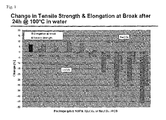
- Figure 1 shows the change in tensile strength (left column of each double columns) and elongation at break (right column of each double columns) after 24 hours at 100 °C of formulations of the HNBR vulcanizates Q 01 to Q 10 described in Table 1 of the subsequent Examples.
- the most left double columns represent Example Q 01 and the most right double columns represent Example Q 10.
- the double columns inbetween represent Examples Q 02 to Q 09 from left to right.
- Therban ® A 3407 a hydrogenated nitrile butadiene polymer commercially available from Lanxess Deutschland GmbH
- Corax ® N 550/30 carbon black, FEF (fast extrusion furnace) commercially available from Evonik-Degussa AG
- Zinkoxyd Aktiv ® activator; fine particles of precipitated zinc oxide commercially available from Lanxess für GmbH
- Maglite ® DE magnesium oxide, activator, commercially available from CP Hall
- Luvomaxx ® CDPA commercially available from Lehmann & Voss
- Dynamar ® RC-5251 Q sodium carbonate commercially available from Dyneon
- Edenor ® C 18 98-100 surfactant commercially available from Cognis GmbH
- TAIC Kettlitz-TAIC
- preparations of triallylisocyanurate (TAIC) on extremely fine silica as carrier in powder form commercially available from Kettlitz-Chemie
- Example Q01 - 10 The polymer composition used in Examples Q01 - 10 are shown in Table 1 .
- the polymer composition of Example Q01 and Q02 contain no special additive or lithium carbonate alone.
- Examples Q07-10 contain sodium carbonate, antioxidant and optionally carbodiimide or polycarbodiimides. Accordingly, these examples are provided for comparison purposes only and are outside the scope of the present invention.
- the components of the polymer composition were mixed in a Banbury mixer using conventional techniques.
- the polymer composition was vulcanized at 180°C for a period of 20 minutes.
- the tensile stress at rupture (“tensile strength") of the vulcanizates was determined in accordance with ASTM D412-80.
- Hot air aging properties of the vulcanizates were determined in accordance with ASTM-D573-88. Hardness properties were determined using a Type A Shore durometer in accordance with ASTM-D2240-81. The properties of the vulcanizates are reported in Table 2. The hot air aging properties of the vulcanizates are also illustrated in the Table 3 to 6.
- HNBR vulcanizates reported in Table 1 to 7 and illustrated in Figure 1 clearly illustrate the superiority of the hot air aging and siginificantly improved aqueous media swelling characteristics of the vulcanizates of Examples 3 to 6 (special additive used) when compared to the vulcanizate of Example 1 and 2 (conventional MgO additive or lithium carbonate only used).
- Table 7, as well as Figure 1 is particularly instructive in showing the significant improvement in the swelling resistance of the combinations of lithium carbonate with antioxidant and optionally carbodiimide or polycarbodiimide, respectively versus the sodium carbonate based combinations (reference) under the test conditions. This translates into a significant practical advantages in many of the conventional applications of the vulcanizates.
- HBNR Vulcanizate Properties after 24h@100°C in Water Specimen norm rod S2 stress-strain rod S2 RT storage time 24 h immersion in water @ 100°C Temperature 23 °C Q01 Q02 Q03 Q04 Q05 Q06 Q07 Q08 G09 Q10 T.S. Median MPa 27,5 27,3 26,5 26,5 25 24,7 23,1 20,2 21,3 17,2 E.B.
Landscapes
- Chemical & Material Sciences (AREA)
- Health & Medical Sciences (AREA)
- Chemical Kinetics & Catalysis (AREA)
- Medicinal Chemistry (AREA)
- Polymers & Plastics (AREA)
- Organic Chemistry (AREA)
- Compositions Of Macromolecular Compounds (AREA)
- Processes Of Treating Macromolecular Substances (AREA)
Abstract
(i) a polymer having a main polymer chain derived from
(ia) at least 30% by weight to 100% by weight based on the polymer of a first monomer which introduces at least one of a secondary carbon and a tertiary carbon to the main polymer chain, and
(ib) in the range of from 0 to 70 % by weight based on the polymer of at least one other monomer;
(ii) at least one lithium salt; and
(iii) at least one antioxidant is provided, as well as a process for producing a polymer vulcanizate comprising the step of vulcanizing the polymer composition mentioned above additionally comprising a vulcanization system. A method for improving the hot air aging and aqueous fluid resistance characteristics of the polymer mentioned above comprises the step of admixing said polymer with at least one lithium salt and at least one antioxidant is also provided.
Description
- The present invention relates to an improved polymer vulcanizate and to a process for the production thereof based on a novel polymer composition. More particularly, in one of its aspects, the present invention relates to nitrile polymer vulcanizates having improved hot air aging characteristics combined with an improved swelling resistence to aqueous media. In another of its aspects, the present invention relates to a polymer composition useful to produce such vulcanizates. In yet another of its aspects, the present invention relates to a method for improving the hot air aging characteristics and at the same time the swelling resistance to aqueous media of a nitrile polymer vulcanizate.
- The effects of oxidizing conditions on vulcanizates obtained from polymers having carbon-carbon double bond unsaturation have long been a problem, particularly in applications where the vulcanizates are exposed to elevated temperatures for extended periods of time. A variety of approaches have been developed in the art in an attempt to solve this problem.
- It is known that the carbon-carbon double bonds of such polymers activate the vulcanizate to oxidative attack. One solution to the problem of oxidative attack is to use polymers with few or no carbon-carbon double bonds. Examples of such polymers include butyl rubber (copolymers of isobutylene and isoprene) which typically contain from about 0.5 to about 3.0 mole percent of carbon-carbon double bond unsaturation, and ethylene-propylene copolymers which contain no such unsaturation.
- Certain applications, such as the various hoses and seals in the engine compartment of automobiles, require vulcanized polymers with a combination of oil resistance, and resistance to oxidative attack in air at elevated temperatures for extended periods of time. Vulcanizates of copolymers of conjugated dienes and α,β-unsaturated nitriles, such as acrylonitrile-butadiene copolymer, commonly known as nitrile rubber or NBR, are well known for their oil resistance. However, they contain carbon-carbon double bond unsaturation and therefore are susceptible to oxidative attack unless subjected to special compounding procedures for the production of oxidation resistant vulcanizates.
- In order to reduce the amount of carbon-carbon double bond unsaturation in NBR and yet retain the copolymer's oil resistance which is thought to be provided by the nitrile functional groups in the copolymer, methods have been developed to selectively hydrogenate the carbon-carbon double bond unsaturation of NBR without hydrogenating the nitrile groups to produce hydrogenated NBR or HNBR. Such hydrogenation is e.g. disclosed in British patent
1,558,491 - While the development of HNBR has been a significant advance in the art, there is still room for improvement.
-
Campomizzi et al. (US-A-6,214,922 ) have successfully demonstrated that the usage of a combination of antioxidants with bases significantly improves the hot air aging characteristics of hydrogenated nitrile vulcanizates. One preferred combination includes the usage sodium carbonate which has given the best results so far. - Other publications in the field are e.g.
Arnoldi et al. (US 2002/072557 A1 ), wherein anti-aging agents for organic polymers based on salts of sterically hindered phenolic compounds with at least two phenolic OH groups are disclosed. - However, even though the vulcanizates mentioned in
US-A-6,214,92 (Campomizzi ) are very useful for high temperature applications, when the vulcanizates mentioned inUS-A-6,214,92 are in contact with aqueous media, especially water, high swelling is observed limiting the usage of sodium carbonate for high temperature applications in the presence of aqueous media or water vapor. Specifically, there is a need to develop polymer vulcanizates with improved physical properties such as hot air aging having a swelling resistance to polar media such as water and aqueous systems. - It is an object of the present invention to obviate or mitigate at least one of the above-mentioned disadvantages of the prior art.
- It is another object of the present invention to provide a novel polymer vulcanizate.
- It is yet another object of the present invention to provide a novel process for producing said novel polymer vulcanizate.
- It is yet another object of the present invention to provide a novel polymer composition for producing a polmer vulcanizate.
- It is yet another object of the present invention to provide a novel method for improving the hot air aging characteristics of a polymer vulcanizate and at the same time improving the swelling resistance to polar media.
- Accordingly, in one of its aspects, the present invention provides a polymer composition comprising:
- (i) a polymer having a main polymer chain derived from
- (ia) at least 30% by weight to 100% by weight based on the polymer of a first monomer which introduces at least one of a secondary carbon and a tertiary carbon to the main polymer chain, and
- (ib) in the range of from 0 to 70 % by weight based on the polymer of at least one other monomer;
- (ii) at least one lithium salt; and
- (iii) at least one antioxidant.
- A particularly preferred polymer composition comprises:
- (i) a hydrogenated nitrile polymer;
- (ii) at least one lithium salt;
- (iii) at least one antioxidant;
- (iv) at least one filler;
- (v) a vulcanization system; and
- (vi) optionally at least one carbodiimide, at least one polycarbodiimide or mixtures thereof.
- In another of its aspects, the present invention provides a process for producing a polymer vulcanizate comprising the step of vulcanizing a polymer composition comprising:
- (i) a polymer having a main polymer chain derived from
- (ia) at least 30% by weight to 100% by weight based on the polymer of a first monomer which introduces at least one of a secondary carbon and a tertiary carbon to the main polymer chain, and
- (ib) in the range of from 0 to 70 % by weight based on the polymer of at least one other monomer;
- (ii) at least one lithium salt;
- (iii) at least one antioxidant; and a vulcanization system.
- In yet another of its aspects, the present invention provides a vulcanizable composition comprising:
- (i) a polymer having a main polymer chain derived from
- (ia) at least 30% by weight to 100% by weight based on the polymer of a first monomer which introduces at least one of a secondary carbon and a tertiary carbon to the main polymer chain, and
- (ib) in the range of from 0 to 70 % by weight based on the polymer of at least one other monomer;
- (ii) at least one lithium salt;
- (iii) at least one antioxidant; and a vulcanization system.
- In yet another of its aspects, the present invention provides a method for improving the hot air aging and aqueous fluid resistance characteristics of a polymer having a main polymer chain derived from
- (ia) at least 30% by weight to 100% by weight based on the polymer of a first monomer which introduces at least one of a secondary carbon and a tertiary carbon to the main polymer chain, and
- (ib) in the range of from 0 to 70 % by weight based on the polymer of at least one other monomer, comprising the step of admixing said polymer with at least one lithium salt and at least one antioxidant.
- In yet another of its aspects, the present invention provides a polymer vulcanizate having a hot air aging time to maintain at least 50% of its original elongation at break of at least about 504h at 170°C, and having improved swelling characteristics in aqueous media, the vulcanizate derived from a peroxide-based vulcanization system.
- Thus, it has been discovered that incorporation of a particular combination of an antioxidant and a lithium salt and optionally a carbodiimide or polycarbodiimide or mixtures thereof in a polymer vulcanizate results in an improvement in the hot air aging characteristics of the vulcanizate (i.e., an improvement in the resistance to oxidative attack in air at elevated temperature aging under oxidizing conditions) as well as - surprisingly and unexpected - at the same time in an improvement of the swelling resistance to aqueous systems, compared to the prior art. In the meaning of the present invention aqueous systems are water, water vapor or mixtures of water with other polar media such as glycols, polyethylene glycols. The vulcanizates of the present invention are especially useful for application in systems which are in contact with aqueous media and at the same time with fuel and/or oil, because of the resistance of the vulcanizates to swelling in aqueous media and the oil/fuel resistance. Such systems are typically used in automotive coolant circuits. The vulcanizates of the present invention are therefore for example useful for application in systems which are in contact with aqueous media at least on one side requiring also fuel and/or oil resistance on another side, for example for fluid circuits in the automotive. The improvement in the hot air aging characteristics and the swelling resistance to aqueous systems of the vulcanizate of the present invention can manifest itself in a number of ways, including (by way of example only) an increase in: (i) the period of time needed for the vulcanizate to maintain at least 50% of its original 100% elongation at break at 170°C; (ii) the maximum service temperature to which the vulcanizate can be exposed for a specified period of time before dropping below 50% of original elongation at break values, and (iii) drastically limiting the volume and/or mass change after exposure to water and/or aqueos systems, when compared to a vulcanizate made without the additive (in the meaning of the present invention the additive is the combination of an antioxidant and a lithium salt and optionally at least one carbodiimide, at least one polycarbodiimide or mixtures thereof. The present vulcanizates may also be characterized by improvement (i.e., in comparison to a vulcanizate produced without the additive) in one or more of the following properties: aged hot fluid aging, aged compression set, aged dynamic elastic modulus (E'), aged dynamic viscous modulus (E"), aged static modulus, aged low temperature properties and aged hardness.
- In one of its aspects, the present invention provides a polymer composition comprising:
- (i) a polymer having a main polymer chain derived from
- (ia) at least 30% by weight to 100% by weight based on the polymer of a first monomer which introduces at least one of a secondary carbon and a tertiary carbon to the main polymer chain, and
- (ib) in the range of from 0 to 70 % by weight based on the polymer of at least one other monomer;
- (ii) at least one lithium salt; and
- (iii) at least one antioxidant.
- The first component of the present polymer composition is a polymer (i) having a main polymer chain derived from: (ia) at least 30% by weight to 100% by weight based on the polymer of a first monomer which introduces at least one of a secondary carbon and a tertiary carbon to the main polymer chain, and (ib) in the range of from 0 to 70 % by weight based on the polymer of at least one other monomer.
- As used throughout this specification, the term "polymer" is intended to have a broad meaning and is meant to encompass any polymer having a main polymer chain which comprises at least one secondary or tertiary carbon. Those of skill in the art will understand that a secondary carbon is a carbon atom having two hydrogen atoms bonded to it while a tertiary carbon is a carbon atom having one hydrogen atom bonded to it. The polymer may be a homopolymer, a copolymer, a terpolymer and the like. Also, it is possible to use a mixture of polymers provided at least one polymer in the mixture has the polymer main chain properties described above.
- The polymer suitable for use herein may be an elastomer (e.g., a hydrocarbon rubber), a graft polymer or block polymer of monomers having at least one ethylenically unsaturated bond and polymerizable through this unsaturation, and the like.
- Elastomers are well known to those of skill in the art. Non-limiting examples of suitable elastomers may be selected from the group consisting of natural rubber (NR), cis-1,4-polyisoprene rubber (IR), polybutadiene rubber (BR), styrene-butadiene rubber (SBR), nitrile rubber like acrylonitrile-butadiene rubber (NBR), hydrogenated acrylonitrile-butadiene rubber (HNBR), other HNBR copolymers, HNBR terpolymers (including hydrogenated acrylonitrile, butadiene, unsaturated carboxylic acid ester terpolymers), ethylene-propylene monomer rubber (EPM), ethylene-propylene-diene monomer rubber (EPDM), ethylene-vinyl acetate rubber (EVM) and the like. Of course, subject to compatibility, mixtures of two or more of any of the foregoing polymers may be used herein.
- Preferably, the polymer used in the present polymer composition is an elastomer. More preferably, the elastomer is selected from the group consisting of: a nitrile polymer, ethylene-propylene copolymer, ethylene-propylene-non conjugated diene terpolymer, ethylene-vinyl acetate copolymer, for example EVM with the trade names Levapren® and Levamelt® of Lanxess Deutschland GmbH, styrene/conjugated diene copolymer, hydrogenated styrene/conjugated diene copolymer, polyisoprene, natural rubber, polybutadiene and mixtures thereof.
- As used throughout this specification, the term "nitrile polymer" is intended to have a broad meaning and is meant to encompass a copolymer of a conjugated diene and an unsaturated nitrile.
- The conjugated diene may be a C4-C6 conjugated diene. Non-limiting examples of suitable such conjugated dienes may be selected from the group comprising butadiene, isoprene, piperylene, 2,3-dimethyl butadiene and mixtures thereof. The preferred C4-C6 conjugated diene may be selected from the group comprising butadiene, iso-prene and mixtures thereof. The most preferred C4-C6 conjugated diene is butadiene.
- The unsaturated nitrile may be a C3-C5 α,β-unsaturated nitrile. Non-limiting examples of suitable such C3-C5 α,β-unsaturated nitriles may be selected from the group comprising acrylonitrile, methacrylonitrile, ethacyrlonitrile and mixtures thereof. The most preferred C3-C5 α,β-unsaturated nitrile is acrylonitrile.
- Preferably, the nitrile polymer is selected from the group consisting of hydrogenated nitrile/conjugated diene copolymer, nitrile/conjugated diene copolymer, nitrile/conjugated diene/ethylenically unsaturated monomer terpolymer and hydrogenated nitrile/conjugated diene/ethylenically unsaturated monomer terpolymer. More preferably, the nitrile polymer is a hydrogenated nitrile/conjugated diene copolymer.
- Preferably, the copolymer comprises from about 40 to about 85 weight percent of the copolymer of bound conjugated diene and from about 15 to about 60 weight percent of the copolymer of bound unsaturated nitrile. More preferably, the copolymer comprises from about 60 to about 75 weight percent of the copolymer of bound conjugated diene and from about 25 to about 40 weight percent of the copolymer of bound unsaturated nitrile. Most preferably, the copolymer comprises from about 60 to about 70 weight percent of the copolymer of bound conjugated diene and from about 30 to about 40 weight percent of the copolymer of bound unsaturated nitrile.
- Optionally, the copolymer may further comprise a bound unsaturated carboxylic acid. Non-limiting examples of suitable such bound unsaturated carboxylic acids may be selected from the group comprising fumaric acid, maleic acid, acrylic acid, methacrylic acid and mixtures thereof. The bound unsaturated carboxylic acid may be present in an amount of from about 1 to about 10 weight percent of the copolymer, with this amount displacing a corresponding amount of the conjugated diolefin.
- Further, a third monomer may be used in production of the nitrile polymer. Preferably, the third monomer is an unsaturated mono- or di-carboxylic acid or derivative thereof (e.g., esters, amides and the like). While the invention may be used with fully or partially unsaturated nitrile polymers, a particularly preferred group of nitrile polymers useful in the production of the present vulcanizate are hydrogenated or partially hydrogenated nitrile polymers (also known in the art as HNBR). Preferably, the copolymer is hydrogenated (hydrogenated nitrile/conjugated diene copolymer) and comprises a residual carbon-carbon double bond unsaturation of less than about 30, more preferably from about 30 to about 0.05 mole percent, even more preferably from about 15 to about 0.05 mole percent, even more preferably from about 10.0 to about 0.05 mole percent, even more preferably from about 7.0 to about 0.05 mole percent, most preferably from about 5.5 to about 0.05 mole percent.
- The polymers, preferably these elastomers, are well known in the art and are readily available to or may be produced by a person of skill in the art.
- The second component of the present polymer composition is at least one lithium salt (ii), preferably a lithium salt of a weak acid, preferably heving a pka of at least about 9.0, more preferably of at least about 10.0, most preferably in the range of from about 10.0 to about 14.0.
- Non-limiting examples of weak acids useful in the production of the above-mentioned lithium salt may be selected from the group consisting of carbonic acid, C1-C50 fatty acids, ethylene diamine tetra(acetic acid), phosphoric acid and mixtures thereof. Preferably, the weak acid is selected from carbonic acid and C1-C30 fatty acids. The most preferred salt for use in the present polymer composition is lithium carbonate.
- Preferably, the lithium salt is present in the polymer composition in an amount in the range of from 0.5 to 30 parts by weight, preferably in the range of from 1 to 20 parts by weight, most preferably in the range of from 2.5 to 9 parts by weight.
- The third component of the present polymer composition is at least one antioxidant. Suitable antioxidants are known by a person skilled in the art. Preferred antioxidants are selected from the group consisting of aminic antioxidants, preferably monofunctional or oligofunctional secondary aromatic amines or sterically hindered amines, and phenolic antioxidants, preferably monofunctional or oligofunctional substituted phenols. More preferably, the antioxidant is selected from alkylated and/or arylated diphenylamines and sterically hindered amines. Most preferably, the antioxidant is selected from the group consisting of 4,4'-bis-(1,1-dimethylbenzyl)-diphenylamine (CDPA), styrenated diphenylamine (SDPA; 4,4'-bis-(phenylethyl)-diphenylamine), 4,4'-bis(octyl)-diphenylamine (OCD) and 2,2,4-trimethyl-1,2-dihydroquinoline, polymerized (TMQ).
- Preferably, the antioxidant is present in the polymer composition in an amount of from about 0,5 to about 4 parts by weight per hundred parts by weight of the polymer.
- It has been found by the inventors of the present invention that polymer vulcanizates having improved hot air aging characteristics combined with an improved swelling resistence to aqueous media are obtained by the usage of a combination of a lithium salt and an antioxidant in the polymer compositions of the present invention, especially in the vulcanizable polymer compositions of the present invention. A particularly preferred combination of a lithium salt and an antioxidant is the combination of lithium carbonate and CDPA, SDPA, OCD or TMQ.
- Most preferably, the polymer composition of the present invention comprises as a polymer a hydrogenated nitrile/conjugated diene copolymer, as lithium salt lithium carbonate and as antioxidant CDPA, SDPA, OCD or TMQ.
- Optionally, the present polymer composition further comprises at least one carbodiimide, at least one polycarbodiimide or mixtures thereof. The preferred carbodiimide is available commercially under the tradenames Rhenogram®P50 and Stabaxol®P. This ingredient may be used in the present polymer composition in an amount in the range of from 0 to 15 parts by weight, more preferably in the range of from 0 to 10 parts by weight, even more preferably in the range of from 0 to 2 parts by weight.
- The polymer composition according to this invention preferably further comprises a filler (iv). The nature of the filler is not particularly restricted and the choice of suitable fillers is within the purview of a person skilled in the art. Non-limiting examples of suitable fillers include carbon black (e.g., FEF, MT, GPF and SRF), clays, titanium dioxide, silica fillers (with or without unsaturated silanes) and the like. The amount of filler is conventional. Preferably, the filler is present in an amount in the range of from about 20 to about 130 parts by weight per hundred parts by weight of the polymer. More preferably, the filler is present in an amount in the range of from about 20 to about 100 parts by weight per hundred parts by weight of the polymer. Most preferably, the filler is present in an amount in the range of from about 40 to about 80 parts by weight per hundred parts by weight of the polymer.
- Preferably, the present polymer composition further comprises a vulcanization system (iii). The suitable vulcanization system is conventional and the choice thereof is within the purview of a person skilled in the art.
- In one embodiment, the vulcanization system used in the present invention comprises an organic peroxide (e.g., dicumyl peroxide, 2,2'-bis(tert-butylperoxy diisopropyl-benzene and the like). In another embodiment, the vulcanization system used in the present invention comprises sulfur or a conventional sulfur-containing vulcanization product such as Vulkacit® DM/C (benzothiazyl disulfide), Vulkacit® Thiuram MS/C (tetramethyl thiuram monosulflde), Vulkacit® Thiuram/C (tetramethyl thiuram disulfide), mixtures thereof and the like. Preferably, such sulfur-based vulcanization systems further comprise a peroxide such as zinc peroxide.
- In yet another embodiment, the vulcanization system used in the present invention comprises a reactive phenol-formaldehyde resin and a Lewis acid activator. It is known to those skilled in the art that a reactive phenol-formaldehyde resins may be prepared by reacting a para-substituted phenol with a molar excess of formaldehyde - see, for example, United States patent
2,726,224 , the contents of which are hereby incorporated by reference. The use of such phenolformaldehyde resins in vulcanization systems for butyl rubber is well known. - The vulcanization system used in the process according to this invention preferably contains at least about 3 parts by weight reactive phenol-formaldehyde resin per hundred parts by weight nitrile polymer. It is especially preferred to use from about 8 to about 16 parts by weight of the reactive phenol-formaldehyde resin per hundred parts by weight polymer. If more than about 16 parts by weight of the resin per hundred parts of nitrile polymer are employed, the entire composition tends to become resinous, and hence such high levels of resin are generally undesirable.
- The Lewis acid activator may be present as a separate component such as stannous chloride (SnCl2) or poly(chlorobutadiene). Alternatively, the Lewis acid activator may be present within the structure of the resin itself- for example, bromomethylated alkyl phenol-formaldehyde resin (which may be prepared by replacing some of the hydroxyl groups of the methylol group of the resin discussed above with bromine). The use of such halogenated resins in vulcanization systems for butyl rubber is well known to those skilled in the art.
- The present invention further relates to a process for producing a polymer vulcanizate comprising the step of vulcanizing the polymer composition of the present invention comprising a vulcanization system. Suitable polymer compositions and vulcanization system are mentioned before.
- A particular preferred polymer composition comprises:
- (i) a hydrogenated nitrile polymer;
- (ii) at least one lithium salt;
- (iii) at least one antioxidant;
- (iv) at least one filler;
- (v) a vulcanization system; and
- (vi) optionally at least one carbodiimide, at least one polycarbodiimide or mixtures thereof.
- In the present process, the polymer, the lithium salt, the antioxidant, optionally further components as mentioned before and the vulcanization system may be admixed in any conventional manner known to the art. For example, this polymer composition may be admixed on a two-roll rubber mill or an internal mixer. The preferred hydrogenated nitrile copolymer used in the present process tends to be quite stiff, and is prone to bag when mixed on a two-roll rubber mill. The addition of a reactive phenol-formaldehyde resin improves the mixing of the hydrogenated copolymer by reducing the bagging problem.
- Thus, the polymer composition is mixed in a conventional manner and the temperature thereof during mixing is maintained as is known in the art.
- In a preferred embodiment of the process for preparing the polymer composition according to the present invention a masterbatch is prepared in the first step by mixing a polymer (i), at least one lithium salt (ii) and optionally other compounding ingredients, preferably at least one filler like e.g. carbon black (e.g., FEF, MT, GPF and SRF), clays, titanium dioxide, or silica (with or without unsaturated silanes), in particular silica. Based on the total weight of the masterbatch, such masterbatch typically comprises 30-70 % b.w., preferably 40 to 60% b.w., of the polymer (i) and 70-30 % b.w., preferably 60-40 % b.w. of at least one lithium salt (ii). Based on the total weight of the masterbatch, optionally up to 10 % b.w. of other compounding ingredients like in particular silica can be used to prepare the masterbatch, with this amount displacing a corresponding amount of the polymer (i). A masterbatch according to the preceding description is e.g. commercially available from Rheinchemie Rheinau GmbH as Rhenogran® Li2CO3-50. The inventive polymer composition is then prepared by mixing such masterbatch with further amounts of polymer (i), at least one antioxidant (iii), optionally further amounts of a filler (iv), and optionally at least one carbodiimide, at least one polycarbodiimide or mixtures thereof. The polymer (i) used to prepare the masterbatch may be identical or different to the polymer (i) subsequently mixed with the masterbatch to form the inventive polymer composition. Using such masterbatch for preparing the polymer composition according to the present invention allows a very homogeneous, spot-free and therefore advantageous distribution of the lithium salt in the polymer composition.
- In the present process according to this invention, it is preferred to heat the polymer composition to form vulcanizates using conventional procedures well known in the art. Preferably, the polymer composition is heated to a temperature in the range of from about 130° to about 200°C, preferably from about 140° to about 190°C, more preferably from about 150° to about 180°C. Preferably, the heating is conducted for a period of from about 1 minutes to about 15 hours, more preferably from about 5 minutes to about 30 minutes.
- Other conventional compounding ingredients may also be included by mixing with the copolymer in the conventional manner. Such other compounding ingredients are used for their conventional purposes and include activators such as zinc oxide and magnesium oxide; plasticizers; processing aids; reinforcing agents; fillers; promoters and retarders in amounts well known in the art.
- In a further embodiment the present invention relates to a polymer vulcanizate produced by the process mentioned before. Preferably, the polymer vulcanizate has a hot air aging time to maintain at least 50% of its original elongation at break of at least about 504h at 170°C, and having improved swelling characteristics in aqueous media, the vulcanizate derived from a peroxide-based vulcanization system. The aqueous media has been defined before. Preferably, the aqueous media is selected from the group consisting of water and water/glycol mixtures. In the meaning of the present invention glycol also relates to polycondensates of glycols.
- Further, the present invention relates to a polymer vulcanizate having a hot air aging time to maintain at least 50% of its original elongation at break of at least about 504h at 170°C, and having improved swelling characteristics in aqueous media, the vulcanizate derived from a peroxide-based vulcanization system.
- In a further embodiment the present invention relates to a method for improving the hot air aging and aqueous fluid resistance characteristics of a polymer having a main polymer chain derived from
- (ia) at least 30% by weight to 100% by weight based on the polymer of a first monomer which introduces at least one of a secondary carbon and a tertiary carbon to the main polymer chain, and
- (ib) in the range of from 0 to 70 % by weight based on the polymer of at least one other monomer, comprising the step of admixing said polymer with at least one lithium salt and at least one antioxidant.
- Suitable and preferred polymers, lithium salts, antioxidants and suitable and preferred amounts of said components are mentioned before.
- In further embodiments the method further comprises admixing at least one carbodiimide, at least one polycarbodiimide or mixtures thereof with the polymer, the lithium salt and the antioxidant and/or admixing at least one filler with the polymer, the lithium salt and the antioxidant and/or admixing a vulcanization system with the polymer, the lithium salt and the antioxidant.
-
Figure 1 shows the change in tensile strength (left column of each double columns) and elongation at break (right column of each double columns) after 24 hours at 100 °C of formulations of the HNBR vulcanizates Q 01 toQ 10 described in Table 1 of the subsequent Examples. The most left double columns represent Example Q 01 and the most right double columns representExample Q 10. The double columns inbetween represent Examples Q 02 to Q 09 from left to right. - Embodiments of the present invention will be illustrated with reference to the following Examples which are provided for illustrative purposes and should not be used to limit the scope of the invention. Unless otherwise stated, all parts in the Examples are parts by weight.
- In the subsequent Examples, the materials used include the following:
Therban® A 3407: a hydrogenated nitrile butadiene polymer commercially available from Lanxess Deutschland GmbH; Corax® N 550/30: carbon black, FEF (fast extrusion furnace) commercially available from Evonik-Degussa AG; Zinkoxyd Aktiv®: activator; fine particles of precipitated zinc oxide commercially available from Lanxess Deutschland GmbH; Maglite ® DE: magnesium oxide, activator, commercially available from CP Hall; Luvomaxx ® CDPA: commercially available from Lehmann & Voss; Dynamar® RC-5251 Q: sodium carbonate commercially available from Dyneon; Edenor® C 18 98-100: surfactant commercially available from Cognis GmbH TAIC (Kettlitz-TAIC): preparations of triallylisocyanurate (TAIC) on extremely fine silica as carrier in powder form commercially available from Kettlitz-Chemie GmbH & Co. KG Perkadox® BC-40 B-PD: Di(tert.-butylperoxyisopropyl)-bezene, granulated commercially available from Akzo Nobel AG - The following procedure was used for each of Examples 10. The polymer composition used in Examples Q01 - 10 are shown in Table 1. As will be apparent to those of skill in the art, the polymer composition of Example Q01 and Q02 contain no special additive or lithium carbonate alone. Examples Q07-10 contain sodium carbonate, antioxidant and optionally carbodiimide or polycarbodiimides. Accordingly, these examples are provided for comparison purposes only and are outside the scope of the present invention.
- The components of the polymer composition were mixed in a Banbury mixer using conventional techniques. The polymer composition was vulcanized at 180°C for a period of 20 minutes.
- The tensile stress at rupture ("tensile strength") of the vulcanizates was determined in accordance with ASTM D412-80. Hot air aging properties of the vulcanizates were determined in accordance with ASTM-D573-88. Hardness properties were determined using a Type A Shore durometer in accordance with ASTM-D2240-81. The properties of the vulcanizates are reported in Table 2. The hot air aging properties of the vulcanizates are also illustrated in the Table 3 to 6.
- The properties of the HNBR vulcanizates reported in Table 1 to 7 and illustrated in
Figure 1 clearly illustrate the superiority of the hot air aging and siginificantly improved aqueous media swelling characteristics of the vulcanizates of Examples 3 to 6 (special additive used) when compared to the vulcanizate of Example 1 and 2 (conventional MgO additive or lithium carbonate only used). Table 7, as well asFigure 1 is particularly instructive in showing the significant improvement in the swelling resistance of the combinations of lithium carbonate with antioxidant and optionally carbodiimide or polycarbodiimide, respectively versus the sodium carbonate based combinations (reference) under the test conditions. This translates into a significant practical advantages in many of the conventional applications of the vulcanizates.TABLE 1 : Formulation of the HNBR Vulcanisates Sample ID Ref Li-Carbonate Na-Carbonate Q01 Q02 Q03 Q04 Q05 Q06 Q07 Q08 Q09 Q10 THERBAN® A 3407 100 100 100 100 100 100 100 100 100 100 CORAX® N 550/30 45 45 45 45 45 45 45 45 45 45 ZINKOXYD AKTIV 2 2 2 2 2 2 2 2 2 2 MAGLITE® DE 3 3 3 3 3 3 3 3 3 3 LUVOMAXX® CDPA 1,1 1,1 1,1 1,1 1,1 1,1 1,1 1,1 1,1 LITHIUM CARBONATE 3 1,5 3 3 6 DYNAMAR® RC-5251 Q 1,5 3 3 6 STABILISATOR® 9000 3 3 EDENOR® C 18 98-100 0,5 0,5 0,5 0,5 0,5 0,5 0,5 0,5 0,5 0,5 TAIC (KETTLITZ-TAIC) 1,5 1,5 1,5 1,5 1,5 1,5 1,5 1,5 1,5 1,5 PERKADOX® BC-40 B-PD 7 7 7 7 7 7 7 7 7 7 TABLE 2: Physical Properties of the Unaged HNBR-Vulcanisates Specimen : norm rod S2 stress-strain rod S2 RT unaged : 0 h Temperature 23°C sample name Q01 Q02 Q03 Q04 Q05 Q06 Q07 Q08 Q09 Q10 T.S. Median MPa 25,7 25,5 25,1 24,3 23,2 24,3 24,5 24,5 23,3 24,1 E.B. Median % 400 331 399 397 394 391 379 386 385 379 Hardness ShA Shore A 65 68 66 65 65 64 60 54 58 46 S10 MPa 0,7 0,7 0,7 0,7 0,7 0,7 0,7 0,7 0,7 0,7 S25 MPa 1,1 1,2 1,1 1,1 1,2 1,1 1,1 1,1 1,2 1,1 S50 MPa 1,6 1,8 1,6 1,6 1,7 1,6 1,6 1,7 1,7 1,7 S100 MPa 3,5 4,3 3,3 3,3 3,3 3,4 3,6 3,7 3,5 3,5 S300 MPa 20,1 23,2 19,5 19 18,3 19,3 20,1 19,8 18,5 19,8 TABLE 3: HNBR Vulcanizate Properties after 168h@170°C Specimen : norm rod S2 stress-strain rod S2 RT storage time 168 h at 170°C Temperature 23°C Q01 Q02 Q03 Q04 Q05 Q06 Q07 Q08 Q09 Q10 TS Median MPa 19,7 18,9 17,9 17 21,1 15,9 11,7 9,7 12,9 8,6 EB Median % 356 291 371 395 351 369 510 532 537 507 Hardness ShA Shore A 77 79 77 78 76 78 78 77 75 77 S10 MPa 1,1 1,3 1,2 1,2 1,1 1,2 1,2 1,2 1,1 1,2 S25 MPa 2,1 2,4 2,1 2,1 1,9 2,2 2,1 2,1 1,8 2,1 S50 MPa 3,6 4,3 3,6 3,6 3,2 3,8 3,3 3,2 2,7 3,2 S100 MPa 7,8 9 7,6 7,2 6,7 7,3 5,8 5,2 4,7 4,9 S300 MPa 18,8 - 16,9 15,9 19,8 15,3 10,4 8,4 10,1 7,6 S10-Change % 57,1 85,7 71,4 71,4 57,1 71,4 71,4 71,4 57,1 71,4 S25-Change % 90,9 100,0 90,9 90,9 58,3 100,0 90,9 90,9 50,0 90,9 S 50-Change % 125,0 138,9 125,0 125,0 88,2 137,5 106,3 88,2 58,8 88,2 S 100-Change % 122,9 109,3 130,3 118,2 103,0 114,7 61,1 40,5 34,3 40,0 S 300-Change % -6,5 - -13,3 -16,3 8,2 -20,7 -48,3 -57,6 -45,4 -61,6 TS Change % -23,3 -25,9 -28,7 -30 -9,1 -34,6 -52,2 -60,4 -44,6 -64,3 EB Change % -11 -12 -7 -1 -11 -6 35 38 39 34 Hardness Change ShA Shore A 11 11 12 11 9 12 12 11 8 11 TABLE 4: HNBR Vulcanizate Properties after 336h@170°C Specimen : norm rod S2 stress-strain rod S2 RT storage time 336 h @ 170°C stress-strain rod S2 RT 23°C Q01 Q02 Q03 Q04 Q05 Q06 Q07 Q08 Q09 Q10 TS Median MPa 19,7 18 17,2 16,1 18,6 14,6 10,2 7,8 9,1 6,8 EB Median % 287 164 320 341 315 322 358 372 446 359 Hardness ShA Shore A 79 84 80 80 79 80 80 79 79 80 S10 MPa 1,4 1,7 1,3 1,4 1,3 1,4 1,3 1,4 1,3 1,4 S25 MPa 2,6 3,5 2,6 2,6 2,5 2,6 2,5 2,5 2,3 2,5 S50 MPa 4,8 6,7 4,6 4,5 4,4 4,7 4,1 4 3,6 3,8 S100 MPa 10,2 13,1 9,5 8,9 8,9 8,7 7,3 6,3 6 5,7 S300 MPa 19,7 - 17 15,9 18,5 14,5 10,1 7,6 8,9 6,6 S10-Change % 100,0 142,9 85,7 100,0 85,7 100,0 85,7 100,0 85,7 100,0 S25-Change % 136,4 191,7 136,4 136,4 108,3 136,4 127,3 127,3 91,7 127,3 S 50-Change % 200,0 272,2 187,5 181,3 158,8 193,8 156,3 135,3 111,8 123,5 S 100-Change % 191,4 204,7 187,9 169,7 169,7 155,9 102,8 70,3 71,4 62,9 S 300-Change % -2 - -12,8 -16,3 1,1 -24,9 -49,8 -61,6 -51,9 -66,7 TS Change % -23,3 -29,4 -31,5 -33,7 -19,8 -39,9 -58,4 -68,2 -60,9 -71,8 EB Change % -28 -50 -20 -14 -20 -18 -6 -4 16 -5 Hardness Change ShA Shore A 14 16 14 14 12 13 14 13 12 14 TABLE 5: HBNR Vulcanizate Properties after 504h@170°C Specimen : norm rod S2 stress-strain rod S2 RT storage time : 504 h @ 170°C Temperature 23°C Q01 Q02 Q03 Q04 Q05 Q06 Q07 Q08 Q09 Q10 TS Median MPa 21,4 13,5 19,3 18,1 19,6 16,4 12,2 9,5 10,1 8 EB Median % 166 50 205 229 224 227 228 183 258 159 Hardness ShA Shore A 84 89 83 83 83 83 82 82 82 84 S10 MPa 1,8 3 1,6 1,5 1,6 1,6 1,4 1,5 1,4 1,7 S25 MPa 3,6 7 3,3 3,1 3,2 3,2 2,8 3 2,7 3,3 S50 MPa 7,2 13,1 6,3 5,9 6 5,9 5 5,3 4,7 5,3 S100 MPa 14,8 - 12,7 11,5 12 11 9,1 8,4 7,8 7,6 S300 MPa - - - - - - - - - - S10-Change % 157,1 328,6 128,6 114,3 128,6 128,6 100,0 114,3 100,0 142,9 S25-Change % 227,3 483,3 200,0 181,8 166,7 190,9 154,5 172,7 125,0 200,0 S 50-Change % 350,0 627,8 293,8 268,8 252,9 268,8 212,5 211,8 176,5 211,8 S 100-Change % 322,9 - 284,8 248,5 263,6 223,5 152,8 127,0 122,9 117,1 S 300-Change % - - - - - - - - - - TS Change % -16,7 -47,1 -23,1 -25,5 -15,5 -32,5 -50,2 -61,2 -56,7 -66,8 EB Change % -59 -85 -49 -42 -43 -42 -40 -53 -33 -58 Hardness Change ShA Shore A 19 21 17 17 16 16 16 16 15 17 TABLE 6: Compression Set @160°C in Hot Air of HNBR Vulcanisates Specimen : C.S. (DIN A d=13 mm x 6,3 mm) from slab Compression Set A Q01 Q02 Q03 Q04 Q05 Q06 Q07 Q08 Q09 Q10 test method DIN ISO Time H 168 storage temperature °C 160 deformation (Ist) % 25 test temperature °C 23 C.S. % 56 46 57 51 58 54 49 51 56 47 Time H 336 C.S. % 63 54 60 62 63 59 55 55 67 53 Time H 504 C.S. % 67 62 66 68 71 64 58 59 68 59 Time H 1008 C.S. % 76 73 71 71 75 71 68 66 75 66 TABLE 7 : HBNR Vulcanizate Properties after 24h@100°C in Water Specimen : norm rod S2 stress-strain rod S2 RT storage time 24 h immersion in water @ 100°C Temperature 23 °C Q01 Q02 Q03 Q04 Q05 Q06 Q07 Q08 G09 Q10 T.S. Median MPa 27,5 27,3 26,5 26,5 25 24,7 23,1 20,2 21,3 17,2 E.B. Median % 404 342 400 396 389 380 311 262 285 203 S10 MPa 0,7 0,8 0,7 0,7 0,7 0,7 0,6 0,6 0,7 0,7 S25 MPa 1,2 1,3 1,2 1,2 1,2 1,2 1,1 1,1 1,2 1,3 S50 MPa 1,7 2 1,7 1,7 1,7 1,7 1,7 1,8 1,9 2,3 S100 MPa 3,7 5 3,8 3,6 3,4 3,7 4 4,6 4,4 5,9 S300 MPa 21 24,6 20,9 20,4 19 20,3 22,3 - - - Hardness ShA Shore A 65 68 66 65 65 64 60 54 58 46 S10-Change % 0 14,3 0 0 0 0 -14,3 -14,3 0 0 S25-Change % 9,1 8,3 9,1 9,1 0 9,1 0 0 0 18,2 S 50-Change % 6,3 11,1 6,3 6,3 0 6,3 6,3 5,9 11,8 35,3 S 100-Change % 5,7 16,3 15,2 9,1 3 8,8 11,1 24,3 25,7 68,6 S 300-Change % 4,5 6 7,2 7,4 3,8 5,2 10,9 - - - TS Change % 7 7,1 5,6 9,1 7,8 1,6 -5,7 -17,6 -8,6 -28,6 EB Change % 1 3 0 0 -1 -3 -18 -32 -26 -46 Hardness change ShA Shore A -0,63 0 0,03 -0,73 -1,4 -2,33 -5,67 -12,1 -9,34 -20,7 weight change % 1,29 2,94 2,6 3,27 3,35 3,3 15,72 26,04 25,48 48,02 Volume change % 0,97 2,73 2,56 3,22 3,39 3,33 17,44 29,28 28,59 54,99
Claims (26)
- A polymer composition comprising:(i) a polymer having a main polymer chain derived from(ia) at least 30% by weight to 100% by weight based on the polymer of a first monomer which introduces at least one of a secondary carbon and a tertiary carbon to the main polymer chain, and(ib) in the range of from 0 to 70 % by weight based on the polymer of at least one other monomer;(ii) at least one lithium salt; and(iii) at least one antioxidant.
- The polymer composition according to claim 1, wherein the polymer is an elastomer, preferably selected from the group consisting of a nitrile polymer, ethylene-propylene copolymer, ethylene-propylene-non conjugated diene terpolymer, ethylenevinyl acetate copolymer, styrene/conjugated diene copolymer, hydrogenated styrene/conjugated diene copolymer, polyisoprene, natural rubber, polybutadiene and mixtures thereof.
- The polymer composition according to claim 2, wherein the nitrile polymer is selected from the group consisting of hydrogenated nitrile/conjugated diene copolymer, nitrile/conjugated diene copolymer, nitrile/conjugated diene/ethylenically unsaturated monomer terpolymer and hydrogenated nitrile/conjugated diene/ethylenically unsaturated monomer terpolymer.
- The polymer composition according to claim 3, wherein the hydrogenated nitrile/conjugated diene copolymer comprises a residual carbon-carbon double bond unsaturation of less than about 30 mol percent.
- The polymer composition according to any one of claims 1 to 4, wherein the lithium salt is a lithium salt of a weak acid, preferably having a pka of at least about 9.0.
- The polymer composition according to claim 5, wherein the weak acid is selected from carbonic acid and C1-C30 fatty acids.
- The polymer composition according to claim 5 or 6, wherein the lithium salt is lithium carbonate.
- The polymer composition according to any of claims 1 to 7, wherein the lithium salt is present in an amount of from about 0.5 to about 30 parts by weight per hundred parts by weight of the polymer.
- The polymer composition according to any of claims 1 to 8, wherein the antioxidant is an aminic or phenolic antioxidant, preferably selected from the group consisting of alkylated and/or arylated diphenylamines and sterically hindered amines, even more preferably selected from the group consisting of 4,4'-bis-(1,1-dimethylbenzyl)-diphenylamine, 4,4'-bis(phenylethyl)-diphenylamine, 4,4'-bis(octyl(-diphenylamine) and 2,2,4-trimethyl-1,2-dihydroquinoline, polymerized.
- The polymer composition according to any of claims 1 to 9, wherein the antioxidant is present in an amount of from about 0,5 to about 4 parts by weight per hundred parts by weight of the polymer.
- The polymer composition according to any of claims 1 to 10, further comprising at least one carbodiimide, at least one polycarbodiimide or mixtures thereof.
- The polymer composition according to any of claims 1 to 11, further comprising a filler.
- The polymer composition according to any of claims 1 to 12, further comprising a vulcanization system.
- A polymer composition comprising:(i) a hydrogenated nitrile polymer;(ii) at least one lithium salt;(iii) at least one antioxidant;(iv) at least one filler;(v) a vulcanization system; and(vi) optionally at least one carbodiimide, at least one polycarbodiimide or mixtures thereof.
- A process for producing a polymer vulcanizate comprising the step of vulcanizing a polymer composition according to claim 13 or 14.
- A polymer vulcanizate obtainable by the process according to claim 15.
- A method for improving the hot air aging and aqueous fluid resistance characteristics of a polymer having a main polymer chain derived from(ia) at least 30% by weight to 100% by weight based on the polymer of a first monomer which introduces at least one of a secondary carbon and a tertiary carbon to the main polymer chain, and(ib) in the range of from 0 to 70 % by weight based on the polymer of at least one other monomer, comprising the step of admixing said polymer with at least one lithium salt and at least one antioxidant.
- The method defined in claim 18, wherein the polymer is a polymer as defined in any one of claims 1 to 4.
- The method defined in claim 17 or 18, wherein the lithium salt is a lithium salt as defined in any one of claims 5 to 7.
- The method defined in any one of claims 17 to 19, wherein the antioxidant is an antioxidant as defined in claim 9.
- The method defined in any one of claims 17 to 20, wherein the lithium salt is present in an amount of from about 0.5 to about 30 parts by weight per hundred parts by weight of the polymer.
- The method defined in any one of claims 17 to 21, further comprising admixing at least one carbodiimide, at least one polycarbodiimide or mixtures thereof with the polymer, the lithium salt and the antioxidant.
- The method defined in any one of claims 17 to 22, further comprising admixing at least one filler with the polymer, the lithium salt and the antioxidant.
- The method defined in any one of claims 17 to 23, further comprising admixing a vulcanization system with the polymer, the lithium salt and the antioxidant.
- A polymer vulcanizate having a hot air aging time to maintain at least 50% of its original elongation at break of at least about 504h at 170°C, and having improved swelling characteristics in aqueous media, the vulcanizate derived from a peroxide-based vulcanization system.
- A polymer vulcanizate according to claim 25, having a hot air aging time to maintain at least 50% of its original elongation at break of at least about 504h at 170°C, and having improved swelling characteristics in aqueous media, preferably selected from the group consisting of water and water/glycol mixtures, the vulcanizate derived from a peroxide-based vulcanization system.
Priority Applications (1)
| Application Number | Priority Date | Filing Date | Title |
|---|---|---|---|
| EP08169326A EP2065438A3 (en) | 2007-11-30 | 2008-11-18 | Improved polymer vulcanizate and process for the production thereof |
Applications Claiming Priority (2)
| Application Number | Priority Date | Filing Date | Title |
|---|---|---|---|
| EP07122012A EP2065437A1 (en) | 2007-11-30 | 2007-11-30 | Improved polymer vulcanizate and process for the production thereof |
| EP08169326A EP2065438A3 (en) | 2007-11-30 | 2008-11-18 | Improved polymer vulcanizate and process for the production thereof |
Publications (2)
| Publication Number | Publication Date |
|---|---|
| EP2065438A2 true EP2065438A2 (en) | 2009-06-03 |
| EP2065438A3 EP2065438A3 (en) | 2010-12-29 |
Family
ID=39430640
Family Applications (2)
| Application Number | Title | Priority Date | Filing Date |
|---|---|---|---|
| EP07122012A Withdrawn EP2065437A1 (en) | 2007-11-30 | 2007-11-30 | Improved polymer vulcanizate and process for the production thereof |
| EP08169326A Withdrawn EP2065438A3 (en) | 2007-11-30 | 2008-11-18 | Improved polymer vulcanizate and process for the production thereof |
Family Applications Before (1)
| Application Number | Title | Priority Date | Filing Date |
|---|---|---|---|
| EP07122012A Withdrawn EP2065437A1 (en) | 2007-11-30 | 2007-11-30 | Improved polymer vulcanizate and process for the production thereof |
Country Status (8)
| Country | Link |
|---|---|
| US (1) | US8552097B2 (en) |
| EP (2) | EP2065437A1 (en) |
| JP (1) | JP5489448B2 (en) |
| KR (1) | KR101596033B1 (en) |
| CN (1) | CN101445664B (en) |
| BR (1) | BRPI0805224A2 (en) |
| MX (1) | MX2008015173A (en) |
| TW (1) | TWI437040B (en) |
Cited By (1)
| Publication number | Priority date | Publication date | Assignee | Title |
|---|---|---|---|---|
| EP2700692A4 (en) * | 2011-09-13 | 2015-02-18 | Eagle Ind Co Ltd | HYDROGENATED NITRILE RUBBER COMPOSITION |
Families Citing this family (3)
| Publication number | Priority date | Publication date | Assignee | Title |
|---|---|---|---|---|
| CN102432929A (en) * | 2011-09-20 | 2012-05-02 | 李佃场 | Improved polymer vulcanizates and methods for making the same |
| KR20210004978A (en) * | 2018-04-19 | 2021-01-13 | 아란세오 도이치란드 게엠베하 | Use of vulcanizates comprising HNBR-PEG acrylate copolymers in contact with coolants |
| CN117083327A (en) * | 2021-03-16 | 2023-11-17 | 博里利斯股份公司 | Semiconducting polymer composition |
Citations (5)
| Publication number | Priority date | Publication date | Assignee | Title |
|---|---|---|---|---|
| US621492A (en) | 1899-03-21 | Half to charles leventry | ||
| US2726224A (en) | 1953-01-02 | 1955-12-06 | Us Rubber Co | Acceleration of the reaction between butyl rubber and dimethylol phenols by means of heavy metal halides, and product obtained thereby |
| GB1558491A (en) | 1975-09-03 | 1980-01-03 | Bayer Ag | Hydrogenation of polymers |
| US6214922B1 (en) | 1998-03-06 | 2001-04-10 | Bayer Inc. | Nitrile polymer vulcanizate and process for the production thereof |
| US20020072557A1 (en) | 2000-08-16 | 2002-06-13 | Eric Arnoldi | Anti-aging agents based on phenolic salts |
Family Cites Families (12)
| Publication number | Priority date | Publication date | Assignee | Title |
|---|---|---|---|---|
| JPS62197444A (en) * | 1986-02-24 | 1987-09-01 | Mitsui Toatsu Chem Inc | High-nitrile resin composition for calendering |
| JP3313836B2 (en) * | 1993-08-06 | 2002-08-12 | 旭電化工業株式会社 | Crystalline synthetic resin composition |
| JPH07149966A (en) * | 1993-11-30 | 1995-06-13 | Showa Denko Kk | Propylene resin composition and its production |
| JPH09272769A (en) * | 1996-04-05 | 1997-10-21 | Showa Kk | Chlorine-containing resin composition |
| JP3905638B2 (en) * | 1997-05-28 | 2007-04-18 | 三井化学株式会社 | Polyoxyalkylene polyol and derivatives thereof, and method for producing the polyoxyalkylene polyol |
| US6207794B1 (en) | 1997-05-28 | 2001-03-27 | Mitsui Chemical, Inc. | Polyoxyalkylene polyols, derivatives thereof, and process for producing the polyoxyalkylene polyols |
| WO1999054373A1 (en) * | 1998-04-17 | 1999-10-28 | Sanyo Chemical Industries, Ltd. | Curable composition and cured article thereof |
| JP2000355650A (en) * | 1999-06-15 | 2000-12-26 | Mitsubishi Chemicals Corp | Method for producing polyester elastomer |
| CA2338900A1 (en) * | 2001-02-28 | 2002-08-28 | Bayer Inc. | Articles for dynamic load applications |
| JP4273671B2 (en) * | 2001-03-06 | 2009-06-03 | 日本ゼオン株式会社 | Acrylic rubber composition and vulcanizate |
| CA2369900A1 (en) * | 2002-01-31 | 2003-07-31 | Bayer Inc. | Improved nitrile polymer vulcanizate and process for the production therof |
| DE102005059625A1 (en) * | 2005-12-14 | 2007-06-21 | Lanxess Deutschland Gmbh | Microgel-containing vulcanizable composition based on hydrogenated nitrile rubber |
-
2007
- 2007-11-30 EP EP07122012A patent/EP2065437A1/en not_active Withdrawn
-
2008
- 2008-11-18 EP EP08169326A patent/EP2065438A3/en not_active Withdrawn
- 2008-11-21 US US12/275,292 patent/US8552097B2/en not_active Expired - Fee Related
- 2008-11-26 BR BRPI0805224-7A patent/BRPI0805224A2/en not_active IP Right Cessation
- 2008-11-28 KR KR1020080119337A patent/KR101596033B1/en not_active Expired - Fee Related
- 2008-11-28 JP JP2008305215A patent/JP5489448B2/en not_active Expired - Fee Related
- 2008-11-28 TW TW097146083A patent/TWI437040B/en not_active IP Right Cessation
- 2008-11-28 MX MX2008015173A patent/MX2008015173A/en active IP Right Grant
- 2008-12-01 CN CN2008101784684A patent/CN101445664B/en not_active Expired - Fee Related
Patent Citations (5)
| Publication number | Priority date | Publication date | Assignee | Title |
|---|---|---|---|---|
| US621492A (en) | 1899-03-21 | Half to charles leventry | ||
| US2726224A (en) | 1953-01-02 | 1955-12-06 | Us Rubber Co | Acceleration of the reaction between butyl rubber and dimethylol phenols by means of heavy metal halides, and product obtained thereby |
| GB1558491A (en) | 1975-09-03 | 1980-01-03 | Bayer Ag | Hydrogenation of polymers |
| US6214922B1 (en) | 1998-03-06 | 2001-04-10 | Bayer Inc. | Nitrile polymer vulcanizate and process for the production thereof |
| US20020072557A1 (en) | 2000-08-16 | 2002-06-13 | Eric Arnoldi | Anti-aging agents based on phenolic salts |
Non-Patent Citations (1)
| Title |
|---|
| TAN ET AL., RUBBER CHEM. TECH., vol. 78, no. 3, 2005, pages 489 - 515 |
Cited By (1)
| Publication number | Priority date | Publication date | Assignee | Title |
|---|---|---|---|---|
| EP2700692A4 (en) * | 2011-09-13 | 2015-02-18 | Eagle Ind Co Ltd | HYDROGENATED NITRILE RUBBER COMPOSITION |
Also Published As
| Publication number | Publication date |
|---|---|
| KR20090056876A (en) | 2009-06-03 |
| BRPI0805224A2 (en) | 2011-10-18 |
| KR101596033B1 (en) | 2016-02-19 |
| CN101445664B (en) | 2013-11-06 |
| TW200936667A (en) | 2009-09-01 |
| TWI437040B (en) | 2014-05-11 |
| JP5489448B2 (en) | 2014-05-14 |
| EP2065438A3 (en) | 2010-12-29 |
| EP2065437A1 (en) | 2009-06-03 |
| MX2008015173A (en) | 2009-06-01 |
| US8552097B2 (en) | 2013-10-08 |
| US20090163631A1 (en) | 2009-06-25 |
| CN101445664A (en) | 2009-06-03 |
| JP2009132923A (en) | 2009-06-18 |
Similar Documents
| Publication | Publication Date | Title |
|---|---|---|
| EP0940429B1 (en) | Improved nitrile polymer vulcanizate and process for the production thereof | |
| EP2199326B1 (en) | Vulcanizable polymer compositions | |
| US8952099B2 (en) | Vulcanizable polymer compositions | |
| US8815984B2 (en) | Elastomeric compositions with improved heat resistance, compression set, and processability | |
| EP2334722B1 (en) | Hnbr compositions with very high filler levels having excellent processability and resistance to aggressive fluids | |
| US20050101737A1 (en) | Polymer blends comprising nitrile rubber | |
| US8552097B2 (en) | Polymer vulcanizate and process for the production thereof | |
| EP1512716B1 (en) | Nitrile polymer compositions for magnetic seal applications | |
| US20050288439A1 (en) | Elastomeric compositions having improved mechanical properties and scorch resistance | |
| EP1472313A1 (en) | Improved nitrile polymer vulcanizate and process for the production thereof | |
| JP2024109298A (en) | Rubber composition for sealing material and sealing material | |
| MXPA99002191A (en) | Improved vulcanization of nitrile polymer and procedure for your producc | |
| CA2265120A1 (en) | Improved nitrile polymer vulcanizate and process for the production thereof |
Legal Events
| Date | Code | Title | Description |
|---|---|---|---|
| PUAI | Public reference made under article 153(3) epc to a published international application that has entered the european phase |
Free format text: ORIGINAL CODE: 0009012 |
|
| AK | Designated contracting states |
Kind code of ref document: A2 Designated state(s): AT BE BG CH CY CZ DE DK EE ES FI FR GB GR HR HU IE IS IT LI LT LU LV MC MT NL NO PL PT RO SE SI SK TR |
|
| AX | Request for extension of the european patent |
Extension state: AL BA MK RS |
|
| PUAL | Search report despatched |
Free format text: ORIGINAL CODE: 0009013 |
|
| AK | Designated contracting states |
Kind code of ref document: A3 Designated state(s): AT BE BG CH CY CZ DE DK EE ES FI FR GB GR HR HU IE IS IT LI LT LU LV MC MT NL NO PL PT RO SE SI SK TR |
|
| AX | Request for extension of the european patent |
Extension state: AL BA MK RS |
|
| AKY | No designation fees paid | ||
| REG | Reference to a national code |
Ref country code: DE Ref legal event code: R108 |
|
| REG | Reference to a national code |
Ref country code: DE Ref legal event code: R108 Effective date: 20110907 |
|
| STAA | Information on the status of an ep patent application or granted ep patent |
Free format text: STATUS: THE APPLICATION IS DEEMED TO BE WITHDRAWN |
|
| 18D | Application deemed to be withdrawn |
Effective date: 20110629 |