EP2063918B1 - Compounds and methods for 18f labeled agents - Google Patents
Compounds and methods for 18f labeled agents Download PDFInfo
- Publication number
- EP2063918B1 EP2063918B1 EP07802326.4A EP07802326A EP2063918B1 EP 2063918 B1 EP2063918 B1 EP 2063918B1 EP 07802326 A EP07802326 A EP 07802326A EP 2063918 B1 EP2063918 B1 EP 2063918B1
- Authority
- EP
- European Patent Office
- Prior art keywords
- benzoyl
- val
- trp
- ala
- leu
- Prior art date
- Legal status (The legal status is an assumption and is not a legal conclusion. Google has not performed a legal analysis and makes no representation as to the accuracy of the status listed.)
- Active
Links
- 150000001875 compounds Chemical class 0.000 title claims description 217
- 238000000034 method Methods 0.000 title claims description 54
- 229910052757 nitrogen Inorganic materials 0.000 claims description 199
- 229910052731 fluorine Inorganic materials 0.000 claims description 189
- 229910052739 hydrogen Inorganic materials 0.000 claims description 178
- 239000000203 mixture Substances 0.000 claims description 157
- 108090000765 processed proteins & peptides Proteins 0.000 claims description 147
- 239000000126 substance Substances 0.000 claims description 101
- -1 -O-(C1-C4 alkyl) Chemical group 0.000 claims description 97
- IJGRMHOSHXDMSA-UHFFFAOYSA-N Atomic nitrogen Chemical compound N#N IJGRMHOSHXDMSA-UHFFFAOYSA-N 0.000 claims description 72
- 102000004196 processed proteins & peptides Human genes 0.000 claims description 68
- 239000011737 fluorine Substances 0.000 claims description 52
- 150000001413 amino acids Chemical class 0.000 claims description 50
- 125000002023 trifluoromethyl group Chemical group FC(F)(F)* 0.000 claims description 50
- 235000001014 amino acid Nutrition 0.000 claims description 48
- YCKRFDGAMUMZLT-UHFFFAOYSA-N Fluorine atom Chemical compound [F] YCKRFDGAMUMZLT-UHFFFAOYSA-N 0.000 claims description 45
- 125000001153 fluoro group Chemical group F* 0.000 claims description 37
- 150000003839 salts Chemical class 0.000 claims description 32
- 230000008878 coupling Effects 0.000 claims description 30
- 238000010168 coupling process Methods 0.000 claims description 30
- 238000005859 coupling reaction Methods 0.000 claims description 30
- 125000004093 cyano group Chemical group *C#N 0.000 claims description 30
- 150000007524 organic acids Chemical class 0.000 claims description 30
- 239000003795 chemical substances by application Substances 0.000 claims description 29
- 150000002148 esters Chemical class 0.000 claims description 29
- 150000001408 amides Chemical class 0.000 claims description 28
- 125000003118 aryl group Chemical group 0.000 claims description 28
- 150000007522 mineralic acids Chemical class 0.000 claims description 28
- 125000000217 alkyl group Chemical group 0.000 claims description 26
- 238000003384 imaging method Methods 0.000 claims description 26
- 230000008685 targeting Effects 0.000 claims description 25
- 239000012453 solvate Substances 0.000 claims description 24
- 125000000539 amino acid group Chemical group 0.000 claims description 22
- 125000000449 nitro group Chemical group [O-][N+](*)=O 0.000 claims description 21
- 108010051479 Bombesin Proteins 0.000 claims description 20
- 125000004432 carbon atom Chemical group C* 0.000 claims description 20
- 239000012216 imaging agent Substances 0.000 claims description 19
- 125000002496 methyl group Chemical group [H]C([H])([H])* 0.000 claims description 19
- 125000003710 aryl alkyl group Chemical group 0.000 claims description 17
- 125000001072 heteroaryl group Chemical group 0.000 claims description 17
- 102000005962 receptors Human genes 0.000 claims description 17
- 108020003175 receptors Proteins 0.000 claims description 17
- 229910003844 NSO2 Inorganic materials 0.000 claims description 15
- 125000001309 chloro group Chemical group Cl* 0.000 claims description 15
- 125000000753 cycloalkyl group Chemical group 0.000 claims description 14
- 125000000592 heterocycloalkyl group Chemical group 0.000 claims description 14
- 125000004169 (C1-C6) alkyl group Chemical group 0.000 claims description 13
- 238000004519 manufacturing process Methods 0.000 claims description 13
- 238000002059 diagnostic imaging Methods 0.000 claims description 12
- 239000001257 hydrogen Substances 0.000 claims description 12
- 125000000325 methylidene group Chemical group [H]C([H])=* 0.000 claims description 11
- 102000005157 Somatostatin Human genes 0.000 claims description 10
- 108010056088 Somatostatin Proteins 0.000 claims description 10
- 125000000250 methylamino group Chemical group [H]N(*)C([H])([H])[H] 0.000 claims description 10
- NHXLMOGPVYXJNR-ATOGVRKGSA-N somatostatin Chemical compound C([C@H]1C(=O)N[C@H](C(N[C@@H](CO)C(=O)N[C@@H](CSSC[C@@H](C(=O)N[C@@H](CCCCN)C(=O)N[C@@H](CC(N)=O)C(=O)N[C@@H](CC=2C=CC=CC=2)C(=O)N[C@@H](CC=2C=CC=CC=2)C(=O)N[C@@H](CC=2C3=CC=CC=C3NC=2)C(=O)N[C@@H](CCCCN)C(=O)N[C@H](C(=O)N1)[C@@H](C)O)NC(=O)CNC(=O)[C@H](C)N)C(O)=O)=O)[C@H](O)C)C1=CC=CC=C1 NHXLMOGPVYXJNR-ATOGVRKGSA-N 0.000 claims description 10
- 229960000553 somatostatin Drugs 0.000 claims description 10
- 102000003797 Neuropeptides Human genes 0.000 claims description 9
- 108090000189 Neuropeptides Proteins 0.000 claims description 9
- 239000003814 drug Substances 0.000 claims description 9
- 239000003937 drug carrier Substances 0.000 claims description 9
- 125000000876 trifluoromethoxy group Chemical group FC(F)(F)O* 0.000 claims description 9
- 108010003205 Vasoactive Intestinal Peptide Proteins 0.000 claims description 8
- 102400000015 Vasoactive intestinal peptide Human genes 0.000 claims description 8
- 239000002671 adjuvant Substances 0.000 claims description 8
- 239000003085 diluting agent Substances 0.000 claims description 8
- 208000037265 diseases, disorders, signs and symptoms Diseases 0.000 claims description 8
- VBUWHHLIZKOSMS-RIWXPGAOSA-N invicorp Chemical compound C([C@@H](C(=O)N[C@@H](CC(C)C)C(=O)N[C@@H](CC(N)=O)C(=O)N[C@@H](CO)C(=O)N[C@@H]([C@@H](C)CC)C(=O)N[C@@H](CC(C)C)C(=O)N[C@@H](CC(N)=O)C(O)=O)NC(=O)[C@H](CCCCN)NC(=O)[C@H](CCCCN)NC(=O)[C@@H](NC(=O)[C@H](C)NC(=O)[C@H](CCSC)NC(=O)[C@H](CCC(N)=O)NC(=O)[C@H](CCCCN)NC(=O)[C@H](CCCNC(N)=N)NC(=O)[C@H](CC(C)C)NC(=O)[C@H](CCCNC(N)=N)NC(=O)[C@@H](NC(=O)[C@H](CC=1C=CC(O)=CC=1)NC(=O)[C@H](CC(N)=O)NC(=O)[C@H](CC(O)=O)NC(=O)[C@@H](NC(=O)[C@H](CC=1C=CC=CC=1)NC(=O)[C@@H](NC(=O)[C@H](C)NC(=O)[C@H](CC(O)=O)NC(=O)[C@H](CO)NC(=O)[C@@H](N)CC=1NC=NC=1)C(C)C)[C@@H](C)O)[C@@H](C)O)C(C)C)C1=CC=C(O)C=C1 VBUWHHLIZKOSMS-RIWXPGAOSA-N 0.000 claims description 8
- XSXHWVKGUXMUQE-UHFFFAOYSA-N osmium dioxide Inorganic materials O=[Os]=O XSXHWVKGUXMUQE-UHFFFAOYSA-N 0.000 claims description 8
- 125000006340 pentafluoro ethyl group Chemical group FC(F)(F)C(F)(F)* 0.000 claims description 8
- 239000000546 pharmaceutical excipient Substances 0.000 claims description 8
- 125000006850 spacer group Chemical group 0.000 claims description 8
- UFHFLCQGNIYNRP-UHFFFAOYSA-N Hydrogen Chemical compound [H][H] UFHFLCQGNIYNRP-UHFFFAOYSA-N 0.000 claims description 7
- NINIDFKCEFEMDL-UHFFFAOYSA-N Sulfur Chemical group [S] NINIDFKCEFEMDL-UHFFFAOYSA-N 0.000 claims description 7
- 201000010099 disease Diseases 0.000 claims description 7
- 101800001982 Cholecystokinin Proteins 0.000 claims description 6
- 102100025841 Cholecystokinin Human genes 0.000 claims description 6
- 229940107137 cholecystokinin Drugs 0.000 claims description 6
- 229910052736 halogen Inorganic materials 0.000 claims description 6
- NOESYZHRGYRDHS-UHFFFAOYSA-N insulin Chemical compound N1C(=O)C(NC(=O)C(CCC(N)=O)NC(=O)C(CCC(O)=O)NC(=O)C(C(C)C)NC(=O)C(NC(=O)CN)C(C)CC)CSSCC(C(NC(CO)C(=O)NC(CC(C)C)C(=O)NC(CC=2C=CC(O)=CC=2)C(=O)NC(CCC(N)=O)C(=O)NC(CC(C)C)C(=O)NC(CCC(O)=O)C(=O)NC(CC(N)=O)C(=O)NC(CC=2C=CC(O)=CC=2)C(=O)NC(CSSCC(NC(=O)C(C(C)C)NC(=O)C(CC(C)C)NC(=O)C(CC=2C=CC(O)=CC=2)NC(=O)C(CC(C)C)NC(=O)C(C)NC(=O)C(CCC(O)=O)NC(=O)C(C(C)C)NC(=O)C(CC(C)C)NC(=O)C(CC=2NC=NC=2)NC(=O)C(CO)NC(=O)CNC2=O)C(=O)NCC(=O)NC(CCC(O)=O)C(=O)NC(CCCNC(N)=N)C(=O)NCC(=O)NC(CC=3C=CC=CC=3)C(=O)NC(CC=3C=CC=CC=3)C(=O)NC(CC=3C=CC(O)=CC=3)C(=O)NC(C(C)O)C(=O)N3C(CCC3)C(=O)NC(CCCCN)C(=O)NC(C)C(O)=O)C(=O)NC(CC(N)=O)C(O)=O)=O)NC(=O)C(C(C)CC)NC(=O)C(CO)NC(=O)C(C(C)O)NC(=O)C1CSSCC2NC(=O)C(CC(C)C)NC(=O)C(NC(=O)C(CCC(N)=O)NC(=O)C(CC(N)=O)NC(=O)C(NC(=O)C(N)CC=1C=CC=CC=1)C(C)C)CC1=CN=CN1 NOESYZHRGYRDHS-UHFFFAOYSA-N 0.000 claims description 6
- IZTQOLKUZKXIRV-YRVFCXMDSA-N sincalide Chemical compound C([C@@H](C(=O)N[C@@H](CCSC)C(=O)NCC(=O)N[C@@H](CC=1C2=CC=CC=C2NC=1)C(=O)N[C@@H](CCSC)C(=O)N[C@@H](CC(O)=O)C(=O)N[C@@H](CC=1C=CC=CC=1)C(N)=O)NC(=O)[C@@H](N)CC(O)=O)C1=CC=C(OS(O)(=O)=O)C=C1 IZTQOLKUZKXIRV-YRVFCXMDSA-N 0.000 claims description 6
- 125000000008 (C1-C10) alkyl group Chemical group 0.000 claims description 5
- 102000004862 Gastrin releasing peptide Human genes 0.000 claims description 5
- 108090001053 Gastrin releasing peptide Proteins 0.000 claims description 5
- QVGXLLKOCUKJST-UHFFFAOYSA-N atomic oxygen Chemical compound [O] QVGXLLKOCUKJST-UHFFFAOYSA-N 0.000 claims description 5
- UCMIRNVEIXFBKS-UHFFFAOYSA-N beta-alanine Chemical compound NCCC(O)=O UCMIRNVEIXFBKS-UHFFFAOYSA-N 0.000 claims description 5
- PUBCCFNQJQKCNC-XKNFJVFFSA-N gastrin-releasingpeptide Chemical compound C([C@@H](C(=O)N[C@@H](CC(C)C)C(=O)N[C@@H](CCSC)C(N)=O)NC(=O)CNC(=O)[C@@H](NC(=O)[C@H](C)NC(=O)[C@H](CC=1C2=CC=CC=C2NC=1)NC(=O)[C@H](CC=1N=CNC=1)NC(=O)[C@H](CC(N)=O)NC(=O)CNC(=O)[C@H](CCCN=C(N)N)NC(=O)[C@H]1N(CCC1)C(=O)[C@H](CC=1C=CC(O)=CC=1)NC(=O)[C@H](CCSC)NC(=O)[C@H](CCCCN)NC(=O)[C@@H](NC(=O)[C@H](CC(C)C)NC(=O)[C@@H](NC(=O)[C@@H](NC(=O)CNC(=O)CNC(=O)CNC(=O)[C@H](C)NC(=O)[C@H]1N(CCC1)C(=O)[C@H](CC(C)C)NC(=O)[C@H]1N(CCC1)C(=O)[C@@H](N)C(C)C)[C@@H](C)O)C(C)C)[C@@H](C)O)C(C)C)C1=CNC=N1 PUBCCFNQJQKCNC-XKNFJVFFSA-N 0.000 claims description 5
- 229910052760 oxygen Inorganic materials 0.000 claims description 5
- 239000001301 oxygen Substances 0.000 claims description 5
- QIVBCDIJIAJPQS-SECBINFHSA-N D-tryptophane Chemical compound C1=CC=C2C(C[C@@H](N)C(O)=O)=CNC2=C1 QIVBCDIJIAJPQS-SECBINFHSA-N 0.000 claims description 4
- 229910004679 ONO2 Inorganic materials 0.000 claims description 4
- 229910019142 PO4 Inorganic materials 0.000 claims description 4
- 125000003342 alkenyl group Chemical group 0.000 claims description 4
- 210000004027 cell Anatomy 0.000 claims description 4
- XVOYSCVBGLVSOL-UHFFFAOYSA-N cysteic acid Chemical compound OC(=O)C(N)CS(O)(=O)=O XVOYSCVBGLVSOL-UHFFFAOYSA-N 0.000 claims description 4
- 125000004475 heteroaralkyl group Chemical group 0.000 claims description 4
- 150000002431 hydrogen Chemical group 0.000 claims description 4
- VLTRZXGMWDSKGL-UHFFFAOYSA-M perchlorate Inorganic materials [O-]Cl(=O)(=O)=O VLTRZXGMWDSKGL-UHFFFAOYSA-M 0.000 claims description 4
- QNAYBMKLOCPYGJ-UHFFFAOYSA-N D-alpha-Ala Natural products CC([NH3+])C([O-])=O QNAYBMKLOCPYGJ-UHFFFAOYSA-N 0.000 claims description 3
- 102000004877 Insulin Human genes 0.000 claims description 3
- 108090001061 Insulin Proteins 0.000 claims description 3
- 230000003213 activating effect Effects 0.000 claims description 3
- 125000003545 alkoxy group Chemical group 0.000 claims description 3
- 125000004104 aryloxy group Chemical group 0.000 claims description 3
- 229940125396 insulin Drugs 0.000 claims description 3
- KIWSYRHAAPLJFJ-DNZSEPECSA-N n-[(e,2z)-4-ethyl-2-hydroxyimino-5-nitrohex-3-enyl]pyridine-3-carboxamide Chemical compound [O-][N+](=O)C(C)C(/CC)=C/C(=N/O)/CNC(=O)C1=CC=CN=C1 KIWSYRHAAPLJFJ-DNZSEPECSA-N 0.000 claims description 3
- 239000010452 phosphate Substances 0.000 claims description 3
- DFVFTMTWCUHJBL-BQBZGAKWSA-N statine Chemical class CC(C)C[C@H](N)[C@@H](O)CC(O)=O DFVFTMTWCUHJBL-BQBZGAKWSA-N 0.000 claims description 3
- IJYZHIOOBGIINM-WDSKDSINSA-N Arg-Ser Chemical group OC[C@@H](C(O)=O)NC(=O)[C@@H](N)CCCN=C(N)N IJYZHIOOBGIINM-WDSKDSINSA-N 0.000 claims description 2
- XNSKSTRGQIPTSE-ACZMJKKPSA-N Arg-Thr Chemical compound C[C@@H]([C@@H](C(=O)O)NC(=O)[C@H](CCCN=C(N)N)N)O XNSKSTRGQIPTSE-ACZMJKKPSA-N 0.000 claims description 2
- CPELXLSAUQHCOX-UHFFFAOYSA-M Bromide Chemical compound [Br-] CPELXLSAUQHCOX-UHFFFAOYSA-M 0.000 claims description 2
- 102000019034 Chemokines Human genes 0.000 claims description 2
- 108010012236 Chemokines Proteins 0.000 claims description 2
- VEXZGXHMUGYJMC-UHFFFAOYSA-M Chloride anion Chemical compound [Cl-] VEXZGXHMUGYJMC-UHFFFAOYSA-M 0.000 claims description 2
- 102000009024 Epidermal Growth Factor Human genes 0.000 claims description 2
- 102400001368 Epidermal growth factor Human genes 0.000 claims description 2
- 101800003838 Epidermal growth factor Proteins 0.000 claims description 2
- 102400000921 Gastrin Human genes 0.000 claims description 2
- 108010052343 Gastrins Proteins 0.000 claims description 2
- 101000904173 Homo sapiens Progonadoliberin-1 Proteins 0.000 claims description 2
- 108090000723 Insulin-Like Growth Factor I Proteins 0.000 claims description 2
- 102000004218 Insulin-Like Growth Factor I Human genes 0.000 claims description 2
- 102000014150 Interferons Human genes 0.000 claims description 2
- 108010050904 Interferons Proteins 0.000 claims description 2
- 108010002352 Interleukin-1 Proteins 0.000 claims description 2
- 108010002350 Interleukin-2 Proteins 0.000 claims description 2
- 108090000978 Interleukin-4 Proteins 0.000 claims description 2
- 108090001005 Interleukin-6 Proteins 0.000 claims description 2
- 108010063738 Interleukins Proteins 0.000 claims description 2
- 102000015696 Interleukins Human genes 0.000 claims description 2
- XNSAINXGIQZQOO-UHFFFAOYSA-N L-pyroglutamyl-L-histidyl-L-proline amide Natural products NC(=O)C1CCCN1C(=O)C(NC(=O)C1NC(=O)CC1)CC1=CN=CN1 XNSAINXGIQZQOO-UHFFFAOYSA-N 0.000 claims description 2
- 108010000684 Matrix Metalloproteinases Proteins 0.000 claims description 2
- 102000002274 Matrix Metalloproteinases Human genes 0.000 claims description 2
- 101710151321 Melanostatin Proteins 0.000 claims description 2
- 102400000064 Neuropeptide Y Human genes 0.000 claims description 2
- 102400001103 Neurotensin Human genes 0.000 claims description 2
- 101800001814 Neurotensin Proteins 0.000 claims description 2
- 102100024028 Progonadoliberin-1 Human genes 0.000 claims description 2
- 108010057464 Prolactin Proteins 0.000 claims description 2
- 102000003946 Prolactin Human genes 0.000 claims description 2
- XZKQVQKUZMAADP-IMJSIDKUSA-N Ser-Ser Chemical compound OC[C@H](N)C(=O)N[C@@H](CO)C(O)=O XZKQVQKUZMAADP-IMJSIDKUSA-N 0.000 claims description 2
- LDEBVRIURYMKQS-WISUUJSJSA-N Ser-Thr Chemical compound C[C@@H](O)[C@@H](C(O)=O)NC(=O)[C@@H](N)CO LDEBVRIURYMKQS-WISUUJSJSA-N 0.000 claims description 2
- 108050001286 Somatostatin Receptor Proteins 0.000 claims description 2
- 102000011096 Somatostatin receptor Human genes 0.000 claims description 2
- 101000996723 Sus scrofa Gonadotropin-releasing hormone receptor Proteins 0.000 claims description 2
- 239000000627 Thyrotropin-Releasing Hormone Substances 0.000 claims description 2
- 102400000336 Thyrotropin-releasing hormone Human genes 0.000 claims description 2
- 101800004623 Thyrotropin-releasing hormone Proteins 0.000 claims description 2
- DTQVDTLACAAQTR-UHFFFAOYSA-M Trifluoroacetate Chemical compound [O-]C(=O)C(F)(F)F DTQVDTLACAAQTR-UHFFFAOYSA-M 0.000 claims description 2
- 108060008682 Tumor Necrosis Factor Proteins 0.000 claims description 2
- 102000030621 adenylate cyclase Human genes 0.000 claims description 2
- 108060000200 adenylate cyclase Proteins 0.000 claims description 2
- 239000000556 agonist Substances 0.000 claims description 2
- 150000001450 anions Chemical class 0.000 claims description 2
- 239000005557 antagonist Substances 0.000 claims description 2
- 125000002102 aryl alkyloxo group Chemical group 0.000 claims description 2
- AOXOCDRNSPFDPE-UKEONUMOSA-N chembl413654 Chemical compound C([C@H](C(=O)NCC(=O)N[C@H](CC=1C2=CC=CC=C2NC=1)C(=O)N[C@H](CCSC)C(=O)N[C@H](CC(O)=O)C(=O)N[C@H](CC=1C=CC=CC=1)C(N)=O)NC(=O)[C@@H](C)NC(=O)[C@@H](CCC(O)=O)NC(=O)[C@@H](CCC(O)=O)NC(=O)[C@@H](CCC(O)=O)NC(=O)[C@H](CCC(O)=O)NC(=O)[C@H](CCC(O)=O)NC(=O)[C@H](CC(C)C)NC(=O)[C@H](CC=1C2=CC=CC=C2NC=1)NC(=O)[C@H]1N(CCC1)C(=O)CNC(=O)[C@@H](N)CCC(O)=O)C1=CC=C(O)C=C1 AOXOCDRNSPFDPE-UKEONUMOSA-N 0.000 claims description 2
- 229910001914 chlorine tetroxide Inorganic materials 0.000 claims description 2
- 229940116977 epidermal growth factor Drugs 0.000 claims description 2
- XLXSAKCOAKORKW-UHFFFAOYSA-N gonadorelin Chemical compound C1CCC(C(=O)NCC(N)=O)N1C(=O)C(CCCN=C(N)N)NC(=O)C(CC(C)C)NC(=O)CNC(=O)C(NC(=O)C(CO)NC(=O)C(CC=1C2=CC=CC=C2NC=1)NC(=O)C(CC=1NC=NC=1)NC(=O)C1NC(=O)CC1)CC1=CC=C(O)C=C1 XLXSAKCOAKORKW-UHFFFAOYSA-N 0.000 claims description 2
- 239000003102 growth factor Substances 0.000 claims description 2
- 125000004435 hydrogen atom Chemical group [H]* 0.000 claims description 2
- 239000003112 inhibitor Substances 0.000 claims description 2
- 102000006495 integrins Human genes 0.000 claims description 2
- 108010044426 integrins Proteins 0.000 claims description 2
- 229940047124 interferons Drugs 0.000 claims description 2
- 229940047122 interleukins Drugs 0.000 claims description 2
- XMBWDFGMSWQBCA-UHFFFAOYSA-M iodide Chemical compound [I-] XMBWDFGMSWQBCA-UHFFFAOYSA-M 0.000 claims description 2
- 229910052740 iodine Inorganic materials 0.000 claims description 2
- PCJGZPGTCUMMOT-ISULXFBGSA-N neurotensin Chemical compound C([C@@H](C(=O)N[C@@H]([C@@H](C)CC)C(=O)N[C@@H](CC(C)C)C(O)=O)NC(=O)[C@H]1N(CCC1)C(=O)[C@H](CCCN=C(N)N)NC(=O)[C@H](CCCN=C(N)N)NC(=O)[C@H]1N(CCC1)C(=O)[C@H](CCCCN)NC(=O)[C@H](CC(N)=O)NC(=O)[C@H](CCC(O)=O)NC(=O)[C@H](CC=1C=CC(O)=CC=1)NC(=O)[C@H](CC(C)C)NC(=O)[C@H]1NC(=O)CC1)C1=CC=C(O)C=C1 PCJGZPGTCUMMOT-ISULXFBGSA-N 0.000 claims description 2
- URPYMXQQVHTUDU-OFGSCBOVSA-N nucleopeptide y Chemical compound C([C@@H](C(=O)N[C@@H]([C@@H](C)CC)C(=O)N[C@@H](CC(N)=O)C(=O)N[C@@H](CC(C)C)C(=O)N[C@@H]([C@@H](C)CC)C(=O)N[C@@H]([C@@H](C)O)C(=O)N[C@@H](CCCNC(N)=N)C(=O)N[C@@H](CCC(N)=O)C(=O)N[C@@H](CCCNC(N)=N)C(=O)N[C@@H](CC=1C=CC(O)=CC=1)C(N)=O)NC(=O)[C@H](CC=1NC=NC=1)NC(=O)[C@H](CCCNC(N)=N)NC(=O)[C@H](CC(C)C)NC(=O)[C@H](C)NC(=O)[C@H](CO)NC(=O)[C@H](CC=1C=CC(O)=CC=1)NC(=O)[C@H](CC=1C=CC(O)=CC=1)NC(=O)[C@H](CCCNC(N)=N)NC(=O)[C@H](C)NC(=O)[C@H](CC(C)C)NC(=O)[C@H](CC(O)=O)NC(=O)[C@H](CCC(O)=O)NC(=O)[C@H](C)NC(=O)[C@H]1N(CCC1)C(=O)[C@H](C)NC(=O)[C@H](CC(O)=O)NC(=O)[C@H](CCC(O)=O)NC(=O)CNC(=O)[C@H]1N(CCC1)C(=O)[C@H](CC(N)=O)NC(=O)[C@H](CC(O)=O)NC(=O)[C@H]1N(CCC1)C(=O)[C@H](CCCCN)NC(=O)[C@H](CO)NC(=O)[C@H]1N(CCC1)C(=O)[C@@H](N)CC=1C=CC(O)=CC=1)C1=CC=C(O)C=C1 URPYMXQQVHTUDU-OFGSCBOVSA-N 0.000 claims description 2
- 230000001817 pituitary effect Effects 0.000 claims description 2
- 229940097325 prolactin Drugs 0.000 claims description 2
- XNSAINXGIQZQOO-SRVKXCTJSA-N protirelin Chemical compound NC(=O)[C@@H]1CCCN1C(=O)[C@@H](NC(=O)[C@H]1NC(=O)CC1)CC1=CN=CN1 XNSAINXGIQZQOO-SRVKXCTJSA-N 0.000 claims description 2
- 125000003107 substituted aryl group Chemical group 0.000 claims description 2
- 239000000758 substrate Substances 0.000 claims description 2
- 229940034199 thyrotropin-releasing hormone Drugs 0.000 claims description 2
- 102000003390 tumor necrosis factor Human genes 0.000 claims description 2
- VBEQCZHXXJYVRD-GACYYNSASA-N uroanthelone Chemical compound C([C@@H](C(=O)N[C@H](C(=O)N[C@@H](CS)C(=O)N[C@@H](CC(N)=O)C(=O)N[C@@H](CS)C(=O)N[C@H](C(=O)N[C@@H]([C@@H](C)CC)C(=O)NCC(=O)N[C@@H](CC=1C=CC(O)=CC=1)C(=O)N[C@@H](CO)C(=O)NCC(=O)N[C@@H](CC(O)=O)C(=O)N[C@@H](CCCNC(N)=N)C(=O)N[C@@H](CS)C(=O)N[C@@H](CCC(N)=O)C(=O)N[C@@H]([C@@H](C)O)C(=O)N[C@@H](CCCNC(N)=N)C(=O)N[C@@H](CC(O)=O)C(=O)N[C@@H](CC(C)C)C(=O)N[C@@H](CCCNC(N)=N)C(=O)N[C@@H](CC=1C2=CC=CC=C2NC=1)C(=O)N[C@@H](CC=1C2=CC=CC=C2NC=1)C(=O)N[C@@H](CCC(O)=O)C(=O)N[C@@H](CC(C)C)C(=O)N[C@@H](CCCNC(N)=N)C(O)=O)C(C)C)[C@@H](C)O)NC(=O)[C@H](CO)NC(=O)[C@H](CC(O)=O)NC(=O)[C@H](CC(C)C)NC(=O)[C@H](CO)NC(=O)[C@H](CCC(O)=O)NC(=O)[C@@H](NC(=O)[C@H](CC=1NC=NC=1)NC(=O)[C@H](CCSC)NC(=O)[C@H](CS)NC(=O)[C@@H](NC(=O)CNC(=O)CNC(=O)[C@H](CC(N)=O)NC(=O)[C@H](CC(C)C)NC(=O)[C@H](CS)NC(=O)[C@H](CC=1C=CC(O)=CC=1)NC(=O)CNC(=O)[C@H](CC(O)=O)NC(=O)[C@H](CC=1C=CC(O)=CC=1)NC(=O)[C@H](CO)NC(=O)[C@H](CO)NC(=O)[C@H]1N(CCC1)C(=O)[C@H](CS)NC(=O)CNC(=O)[C@H]1N(CCC1)C(=O)[C@H](CC=1C=CC(O)=CC=1)NC(=O)[C@H](CO)NC(=O)[C@@H](N)CC(N)=O)C(C)C)[C@@H](C)CC)C1=CC=C(O)C=C1 VBEQCZHXXJYVRD-GACYYNSASA-N 0.000 claims description 2
- 102100036519 Gastrin-releasing peptide Human genes 0.000 claims 3
- DNDCVAGJPBKION-DOPDSADYSA-N bombesin Chemical compound C([C@@H](C(=O)N[C@@H](CC(C)C)C(=O)N[C@@H](CCSC)C(N)=O)NC(=O)CNC(=O)[C@@H](NC(=O)[C@H](C)NC(=O)[C@H](CC=1NC2=CC=CC=C2C=1)NC(=O)[C@H](CCC(N)=O)NC(=O)[C@H](CC(N)=O)NC(=O)CNC(=O)[C@H](CC(C)C)NC(=O)[C@H](CCCNC(N)=N)NC(=O)[C@H](CCC(N)=O)NC(=O)[C@H]1NC(=O)CC1)C(C)C)C1=CN=CN1 DNDCVAGJPBKION-DOPDSADYSA-N 0.000 claims 3
- 125000004209 (C1-C8) alkyl group Chemical group 0.000 claims 2
- 238000012877 positron emission topography Methods 0.000 claims 2
- 238000012879 PET imaging Methods 0.000 claims 1
- YMWUJEATGCHHMB-UHFFFAOYSA-N Dichloromethane Chemical compound ClCCl YMWUJEATGCHHMB-UHFFFAOYSA-N 0.000 description 539
- XLYOFNOQVPJJNP-UHFFFAOYSA-N water Substances O XLYOFNOQVPJJNP-UHFFFAOYSA-N 0.000 description 329
- RTZKZFJDLAIYFH-UHFFFAOYSA-N Diethyl ether Chemical compound CCOCC RTZKZFJDLAIYFH-UHFFFAOYSA-N 0.000 description 303
- 229910001868 water Inorganic materials 0.000 description 286
- 239000000243 solution Substances 0.000 description 235
- DTQVDTLACAAQTR-UHFFFAOYSA-N Trifluoroacetic acid Chemical compound OC(=O)C(F)(F)F DTQVDTLACAAQTR-UHFFFAOYSA-N 0.000 description 201
- ZMXDDKWLCZADIW-UHFFFAOYSA-N N,N-Dimethylformamide Chemical compound CN(C)C=O ZMXDDKWLCZADIW-UHFFFAOYSA-N 0.000 description 194
- WEVYAHXRMPXWCK-UHFFFAOYSA-N Acetonitrile Chemical compound CC#N WEVYAHXRMPXWCK-UHFFFAOYSA-N 0.000 description 159
- 239000002904 solvent Substances 0.000 description 156
- 239000007787 solid Substances 0.000 description 149
- IAZDPXIOMUYVGZ-UHFFFAOYSA-N Dimethylsulphoxide Chemical compound CS(C)=O IAZDPXIOMUYVGZ-UHFFFAOYSA-N 0.000 description 131
- 239000011541 reaction mixture Substances 0.000 description 121
- BWHMMNNQKKPAPP-UHFFFAOYSA-L potassium carbonate Chemical compound [K+].[K+].[O-]C([O-])=O BWHMMNNQKKPAPP-UHFFFAOYSA-L 0.000 description 110
- 229960004132 diethyl ether Drugs 0.000 description 101
- 239000011347 resin Substances 0.000 description 82
- 229920005989 resin Polymers 0.000 description 82
- 238000004458 analytical method Methods 0.000 description 81
- 230000015572 biosynthetic process Effects 0.000 description 81
- 239000000047 product Substances 0.000 description 80
- 238000003786 synthesis reaction Methods 0.000 description 79
- UIIMBOGNXHQVGW-UHFFFAOYSA-M Sodium bicarbonate Chemical compound [Na+].OC([O-])=O UIIMBOGNXHQVGW-UHFFFAOYSA-M 0.000 description 66
- PMZURENOXWZQFD-UHFFFAOYSA-L Sodium Sulfate Chemical compound [Na+].[Na+].[O-]S([O-])(=O)=O PMZURENOXWZQFD-UHFFFAOYSA-L 0.000 description 63
- 238000004128 high performance liquid chromatography Methods 0.000 description 62
- 229910000027 potassium carbonate Inorganic materials 0.000 description 55
- 239000012071 phase Substances 0.000 description 54
- 238000004440 column chromatography Methods 0.000 description 50
- 238000010438 heat treatment Methods 0.000 description 50
- JGFZNNIVVJXRND-UHFFFAOYSA-N N,N-Diisopropylethylamine (DIPEA) Chemical compound CCN(C(C)C)C(C)C JGFZNNIVVJXRND-UHFFFAOYSA-N 0.000 description 49
- ITMCEJHCFYSIIV-UHFFFAOYSA-M triflate Chemical compound [O-]S(=O)(=O)C(F)(F)F ITMCEJHCFYSIIV-UHFFFAOYSA-M 0.000 description 49
- BDNKZNFMNDZQMI-UHFFFAOYSA-N 1,3-diisopropylcarbodiimide Chemical compound CC(C)N=C=NC(C)C BDNKZNFMNDZQMI-UHFFFAOYSA-N 0.000 description 48
- ISWSIDIOOBJBQZ-UHFFFAOYSA-N Phenol Chemical compound OC1=CC=CC=C1 ISWSIDIOOBJBQZ-UHFFFAOYSA-N 0.000 description 48
- BZLVMXJERCGZMT-UHFFFAOYSA-N Methyl tert-butyl ether Chemical compound COC(C)(C)C BZLVMXJERCGZMT-UHFFFAOYSA-N 0.000 description 46
- KRHYYFGTRYWZRS-BJUDXGSMSA-N ac1l2y5h Chemical compound [18FH] KRHYYFGTRYWZRS-BJUDXGSMSA-N 0.000 description 46
- 229940024606 amino acid Drugs 0.000 description 45
- 238000000746 purification Methods 0.000 description 37
- 238000002372 labelling Methods 0.000 description 33
- 229910000030 sodium bicarbonate Inorganic materials 0.000 description 33
- 235000017557 sodium bicarbonate Nutrition 0.000 description 33
- 229910052938 sodium sulfate Inorganic materials 0.000 description 32
- 235000011152 sodium sulphate Nutrition 0.000 description 32
- 206010028980 Neoplasm Diseases 0.000 description 31
- AUFVJZSDSXXFOI-UHFFFAOYSA-N 2.2.2-cryptand Chemical group C1COCCOCCN2CCOCCOCCN1CCOCCOCC2 AUFVJZSDSXXFOI-UHFFFAOYSA-N 0.000 description 30
- QTBSBXVTEAMEQO-UHFFFAOYSA-N acetic acid Substances CC(O)=O QTBSBXVTEAMEQO-UHFFFAOYSA-N 0.000 description 29
- OIRDBPQYVWXNSJ-UHFFFAOYSA-N methyl trifluoromethansulfonate Chemical compound COS(=O)(=O)C(F)(F)F OIRDBPQYVWXNSJ-UHFFFAOYSA-N 0.000 description 29
- 238000002347 injection Methods 0.000 description 28
- 239000007924 injection Substances 0.000 description 28
- IQDGSYLLQPDQDV-UHFFFAOYSA-N dimethylazanium;chloride Chemical compound Cl.CNC IQDGSYLLQPDQDV-UHFFFAOYSA-N 0.000 description 27
- XHFGWHUWQXTGAT-UHFFFAOYSA-N dimethylamine hydrochloride Natural products CNC(C)C XHFGWHUWQXTGAT-UHFFFAOYSA-N 0.000 description 25
- 230000002285 radioactive effect Effects 0.000 description 25
- VYPSYNLAJGMNEJ-UHFFFAOYSA-N Silicium dioxide Chemical compound O=[Si]=O VYPSYNLAJGMNEJ-UHFFFAOYSA-N 0.000 description 24
- 239000002244 precipitate Substances 0.000 description 24
- 238000005119 centrifugation Methods 0.000 description 23
- 239000006184 cosolvent Substances 0.000 description 23
- 238000000589 high-performance liquid chromatography-mass spectrometry Methods 0.000 description 23
- 238000011068 loading method Methods 0.000 description 23
- 239000006228 supernatant Substances 0.000 description 23
- ZGYICYBLPGRURT-UHFFFAOYSA-N tri(propan-2-yl)silicon Chemical compound CC(C)[Si](C(C)C)C(C)C ZGYICYBLPGRURT-UHFFFAOYSA-N 0.000 description 23
- 239000012043 crude product Substances 0.000 description 21
- 239000012153 distilled water Substances 0.000 description 21
- 238000003682 fluorination reaction Methods 0.000 description 20
- 235000005985 organic acids Nutrition 0.000 description 19
- QXZBMSIDSOZZHK-DOPDSADYSA-N 31362-50-2 Chemical compound C([C@@H](C(=O)N[C@@H](CC(C)C)C(=O)N[C@@H](CCSC)C(N)=O)NC(=O)CNC(=O)[C@@H](NC(=O)[C@H](C)NC(=O)[C@H](CC=1C2=CC=CC=C2NC=1)NC(=O)[C@H](CCC(N)=O)NC(=O)[C@H](CC(N)=O)NC(=O)CNC(=O)[C@H](CC(C)C)NC(=O)[C@H](CCCNC(N)=N)NC(=O)[C@H](CCC(N)=O)NC(=O)[C@H]1NC(=O)CC1)C(C)C)C1=CNC=N1 QXZBMSIDSOZZHK-DOPDSADYSA-N 0.000 description 18
- OKKJLVBELUTLKV-UHFFFAOYSA-N Methanol Chemical compound OC OKKJLVBELUTLKV-UHFFFAOYSA-N 0.000 description 18
- 102000013585 Bombesin Human genes 0.000 description 17
- 238000006243 chemical reaction Methods 0.000 description 16
- XEKOWRVHYACXOJ-UHFFFAOYSA-N Ethyl acetate Chemical compound CCOC(C)=O XEKOWRVHYACXOJ-UHFFFAOYSA-N 0.000 description 15
- 150000004677 hydrates Chemical class 0.000 description 15
- VLKZOEOYAKHREP-UHFFFAOYSA-N n-Hexane Chemical compound CCCCCC VLKZOEOYAKHREP-UHFFFAOYSA-N 0.000 description 15
- 238000002360 preparation method Methods 0.000 description 15
- 238000002600 positron emission tomography Methods 0.000 description 13
- 238000000163 radioactive labelling Methods 0.000 description 12
- 239000012217 radiopharmaceutical Substances 0.000 description 12
- 229940121896 radiopharmaceutical Drugs 0.000 description 12
- 230000002799 radiopharmaceutical effect Effects 0.000 description 12
- 239000002253 acid Substances 0.000 description 11
- 229930182852 proteinogenic amino acid Natural products 0.000 description 11
- 125000001424 substituent group Chemical group 0.000 description 11
- MOFRJTLODZILCR-UHFFFAOYSA-N 2-fluoro-5-formylbenzonitrile Chemical compound FC1=CC=C(C=O)C=C1C#N MOFRJTLODZILCR-UHFFFAOYSA-N 0.000 description 10
- 108091023037 Aptamer Proteins 0.000 description 10
- 239000003446 ligand Substances 0.000 description 10
- NROKBHXJSPEDAR-UHFFFAOYSA-M potassium fluoride Chemical compound [F-].[K+] NROKBHXJSPEDAR-UHFFFAOYSA-M 0.000 description 10
- 239000002243 precursor Substances 0.000 description 10
- PYLWMHQQBFSUBP-JZRMKITLSA-N fluoranylbenzene Chemical class [18F]C1=CC=CC=C1 PYLWMHQQBFSUBP-JZRMKITLSA-N 0.000 description 9
- 239000002773 nucleotide Substances 0.000 description 9
- 125000003729 nucleotide group Chemical group 0.000 description 9
- 238000010647 peptide synthesis reaction Methods 0.000 description 9
- 239000007790 solid phase Substances 0.000 description 9
- 125000003088 (fluoren-9-ylmethoxy)carbonyl group Chemical group 0.000 description 8
- VEXZGXHMUGYJMC-UHFFFAOYSA-N Hydrochloric acid Chemical compound Cl VEXZGXHMUGYJMC-UHFFFAOYSA-N 0.000 description 8
- GETQZCLCWQTVFV-UHFFFAOYSA-N trimethylamine Chemical group CN(C)C GETQZCLCWQTVFV-UHFFFAOYSA-N 0.000 description 8
- MTCFGRXMJLQNBG-REOHCLBHSA-N (2S)-2-Amino-3-hydroxypropansäure Chemical compound OC[C@H](N)C(O)=O MTCFGRXMJLQNBG-REOHCLBHSA-N 0.000 description 7
- 239000003153 chemical reaction reagent Substances 0.000 description 7
- 239000000725 suspension Substances 0.000 description 7
- SCYULBFZEHDVBN-UHFFFAOYSA-N 1,1-Dichloroethane Chemical compound CC(Cl)Cl SCYULBFZEHDVBN-UHFFFAOYSA-N 0.000 description 6
- QOSSAOTZNIDXMA-UHFFFAOYSA-N Dicylcohexylcarbodiimide Chemical compound C1CCCCC1N=C=NC1CCCCC1 QOSSAOTZNIDXMA-UHFFFAOYSA-N 0.000 description 6
- COLNVLDHVKWLRT-QMMMGPOBSA-N L-phenylalanine Chemical compound OC(=O)[C@@H](N)CC1=CC=CC=C1 COLNVLDHVKWLRT-QMMMGPOBSA-N 0.000 description 6
- DKGAVHZHDRPRBM-UHFFFAOYSA-N Tert-Butanol Chemical compound CC(C)(C)O DKGAVHZHDRPRBM-UHFFFAOYSA-N 0.000 description 6
- KZSNJWFQEVHDMF-UHFFFAOYSA-N Valine Chemical compound CC(C)C(N)C(O)=O KZSNJWFQEVHDMF-UHFFFAOYSA-N 0.000 description 6
- WETWJCDKMRHUPV-UHFFFAOYSA-N acetyl chloride Chemical compound CC(Cl)=O WETWJCDKMRHUPV-UHFFFAOYSA-N 0.000 description 6
- 239000012346 acetyl chloride Substances 0.000 description 6
- 150000007513 acids Chemical class 0.000 description 6
- 125000003275 alpha amino acid group Chemical group 0.000 description 6
- 230000000694 effects Effects 0.000 description 6
- 239000000700 radioactive tracer Substances 0.000 description 6
- 210000001519 tissue Anatomy 0.000 description 6
- 102100030671 Gastrin-releasing peptide receptor Human genes 0.000 description 5
- 101001010479 Homo sapiens Gastrin-releasing peptide receptor Proteins 0.000 description 5
- KDXKERNSBIXSRK-YFKPBYRVSA-N L-lysine Chemical compound NCCCC[C@H](N)C(O)=O KDXKERNSBIXSRK-YFKPBYRVSA-N 0.000 description 5
- AYFVYJQAPQTCCC-GBXIJSLDSA-N L-threonine Chemical compound C[C@@H](O)[C@H](N)C(O)=O AYFVYJQAPQTCCC-GBXIJSLDSA-N 0.000 description 5
- OUYCCCASQSFEME-QMMMGPOBSA-N L-tyrosine Chemical compound OC(=O)[C@@H](N)CC1=CC=C(O)C=C1 OUYCCCASQSFEME-QMMMGPOBSA-N 0.000 description 5
- 206010027476 Metastases Diseases 0.000 description 5
- 238000013459 approach Methods 0.000 description 5
- 239000007864 aqueous solution Substances 0.000 description 5
- 229910052799 carbon Inorganic materials 0.000 description 5
- 125000003178 carboxy group Chemical group [H]OC(*)=O 0.000 description 5
- 229960001760 dimethyl sulfoxide Drugs 0.000 description 5
- 229940093499 ethyl acetate Drugs 0.000 description 5
- 235000019439 ethyl acetate Nutrition 0.000 description 5
- KRHYYFGTRYWZRS-BJUDXGSMSA-M fluorine-18(1-) Chemical compound [18F-] KRHYYFGTRYWZRS-BJUDXGSMSA-M 0.000 description 5
- BTCSSZJGUNDROE-UHFFFAOYSA-N gamma-aminobutyric acid Chemical compound NCCCC(O)=O BTCSSZJGUNDROE-UHFFFAOYSA-N 0.000 description 5
- 230000009401 metastasis Effects 0.000 description 5
- LREHGRMLSDSXFN-UHFFFAOYSA-N methyl 4-(dimethylamino)-2-(trifluoromethyl)benzoate Chemical compound COC(=O)C1=CC=C(N(C)C)C=C1C(F)(F)F LREHGRMLSDSXFN-UHFFFAOYSA-N 0.000 description 5
- QJNVVJGYRQJUSQ-UHFFFAOYSA-N methyl 4-(dimethylamino)-3-fluorobenzoate Chemical compound COC(=O)C1=CC=C(N(C)C)C(F)=C1 QJNVVJGYRQJUSQ-UHFFFAOYSA-N 0.000 description 5
- 239000011698 potassium fluoride Substances 0.000 description 5
- 235000003270 potassium fluoride Nutrition 0.000 description 5
- LMBFAGIMSUYTBN-MPZNNTNKSA-N teixobactin Chemical compound C([C@H](C(=O)N[C@@H]([C@@H](C)CC)C(=O)N[C@@H](CO)C(=O)N[C@H](CCC(N)=O)C(=O)N[C@H]([C@@H](C)CC)C(=O)N[C@@H]([C@@H](C)CC)C(=O)N[C@@H](CO)C(=O)N[C@H]1C(N[C@@H](C)C(=O)N[C@@H](C[C@@H]2NC(=N)NC2)C(=O)N[C@H](C(=O)O[C@H]1C)[C@@H](C)CC)=O)NC)C1=CC=CC=C1 LMBFAGIMSUYTBN-MPZNNTNKSA-N 0.000 description 5
- 125000004213 tert-butoxy group Chemical group [H]C([H])([H])C(O*)(C([H])([H])[H])C([H])([H])[H] 0.000 description 5
- HVBSAKJJOYLTQU-UHFFFAOYSA-N 4-aminobenzenesulfonic acid Chemical compound NC1=CC=C(S(O)(=O)=O)C=C1 HVBSAKJJOYLTQU-UHFFFAOYSA-N 0.000 description 4
- JYSLFQTWNRYWJT-UHFFFAOYSA-N 8-(3,5-dichlorophenyl)sulfanyl-9-[3-(propan-2-ylamino)propyl]purin-6-amine Chemical compound N=1C2=C(N)N=CN=C2N(CCCNC(C)C)C=1SC1=CC(Cl)=CC(Cl)=C1 JYSLFQTWNRYWJT-UHFFFAOYSA-N 0.000 description 4
- LFQSCWFLJHTTHZ-UHFFFAOYSA-N Ethanol Chemical compound CCO LFQSCWFLJHTTHZ-UHFFFAOYSA-N 0.000 description 4
- KRHYYFGTRYWZRS-UHFFFAOYSA-M Fluoride anion Chemical compound [F-] KRHYYFGTRYWZRS-UHFFFAOYSA-M 0.000 description 4
- DHMQDGOQFOQNFH-UHFFFAOYSA-N Glycine Chemical compound NCC(O)=O DHMQDGOQFOQNFH-UHFFFAOYSA-N 0.000 description 4
- 101001071515 Homo sapiens Gastrin-releasing peptide Proteins 0.000 description 4
- KFZMGEQAYNKOFK-UHFFFAOYSA-N Isopropanol Chemical compound CC(C)O KFZMGEQAYNKOFK-UHFFFAOYSA-N 0.000 description 4
- LRQKBLKVPFOOQJ-YFKPBYRVSA-N L-norleucine Chemical compound CCCC[C@H]([NH3+])C([O-])=O LRQKBLKVPFOOQJ-YFKPBYRVSA-N 0.000 description 4
- 108091034117 Oligonucleotide Proteins 0.000 description 4
- 239000012131 assay buffer Substances 0.000 description 4
- IADUEWIQBXOCDZ-UHFFFAOYSA-N azetidine-2-carboxylic acid Chemical compound OC(=O)C1CCN1 IADUEWIQBXOCDZ-UHFFFAOYSA-N 0.000 description 4
- 239000011324 bead Substances 0.000 description 4
- 230000000975 bioactive effect Effects 0.000 description 4
- FJDQFPXHSGXQBY-UHFFFAOYSA-L caesium carbonate Chemical compound [Cs+].[Cs+].[O-]C([O-])=O FJDQFPXHSGXQBY-UHFFFAOYSA-L 0.000 description 4
- 229910000024 caesium carbonate Inorganic materials 0.000 description 4
- 238000011161 development Methods 0.000 description 4
- 230000018109 developmental process Effects 0.000 description 4
- 239000000032 diagnostic agent Substances 0.000 description 4
- 229940039227 diagnostic agent Drugs 0.000 description 4
- ZPWVASYFFYYZEW-UHFFFAOYSA-L dipotassium hydrogen phosphate Chemical compound [K+].[K+].OP([O-])([O-])=O ZPWVASYFFYYZEW-UHFFFAOYSA-L 0.000 description 4
- 229910000396 dipotassium phosphate Inorganic materials 0.000 description 4
- 238000001035 drying Methods 0.000 description 4
- 125000005843 halogen group Chemical group 0.000 description 4
- 238000001727 in vivo Methods 0.000 description 4
- 125000005647 linker group Chemical group 0.000 description 4
- 239000002609 medium Substances 0.000 description 4
- QBBPCOSJWMCMPG-UHFFFAOYSA-N methyl 2-bromo-4-(dimethylamino)benzoate Chemical compound COC(=O)C1=CC=C(N(C)C)C=C1Br QBBPCOSJWMCMPG-UHFFFAOYSA-N 0.000 description 4
- DLSMZBNKKTUSHI-UHFFFAOYSA-N methyl 2-bromo-5-(dimethylamino)benzoate Chemical compound COC(=O)C1=CC(N(C)C)=CC=C1Br DLSMZBNKKTUSHI-UHFFFAOYSA-N 0.000 description 4
- SVDLDBZMTKFPTM-UHFFFAOYSA-N methyl 2-chloro-4-(dimethylamino)-5-methylsulfonylbenzoate Chemical compound COC(=O)C1=CC(S(C)(=O)=O)=C(N(C)C)C=C1Cl SVDLDBZMTKFPTM-UHFFFAOYSA-N 0.000 description 4
- DUBJZBQCZFLZQH-UHFFFAOYSA-N methyl 2-chloro-4-(dimethylamino)benzoate Chemical compound COC(=O)C1=CC=C(N(C)C)C=C1Cl DUBJZBQCZFLZQH-UHFFFAOYSA-N 0.000 description 4
- PQXJXWHRTKTFAJ-UHFFFAOYSA-N methyl 2-chloro-5-(dimethylamino)benzoate Chemical compound COC(=O)C1=CC(N(C)C)=CC=C1Cl PQXJXWHRTKTFAJ-UHFFFAOYSA-N 0.000 description 4
- HZIZJQYULLDSRV-UHFFFAOYSA-N methyl 2-cyano-4-(dimethylamino)benzoate Chemical compound COC(=O)C1=CC=C(N(C)C)C=C1C#N HZIZJQYULLDSRV-UHFFFAOYSA-N 0.000 description 4
- DLHBZNDZKLXVOG-UHFFFAOYSA-N methyl 4-(dimethylamino)-2,3-difluorobenzoate Chemical compound COC(=O)C1=CC=C(N(C)C)C(F)=C1F DLHBZNDZKLXVOG-UHFFFAOYSA-N 0.000 description 4
- ZELUMYFXHSKXPB-UHFFFAOYSA-N methyl 4-(dimethylamino)-2,6-difluorobenzoate Chemical compound COC(=O)C1=C(F)C=C(N(C)C)C=C1F ZELUMYFXHSKXPB-UHFFFAOYSA-N 0.000 description 4
- TXVOCFPZXUJZQH-UHFFFAOYSA-N methyl 4-(dimethylamino)-2-fluorobenzoate Chemical compound COC(=O)C1=CC=C(N(C)C)C=C1F TXVOCFPZXUJZQH-UHFFFAOYSA-N 0.000 description 4
- SGFSPEHQIATLLK-UHFFFAOYSA-N methyl 4-(dimethylamino)-2-nitrobenzoate Chemical compound COC(=O)C1=CC=C(N(C)C)C=C1[N+]([O-])=O SGFSPEHQIATLLK-UHFFFAOYSA-N 0.000 description 4
- OHWHNDWJHMPFDR-UHFFFAOYSA-N methyl 4-(dimethylamino)-3-(trifluoromethoxy)benzoate Chemical compound COC(=O)C1=CC=C(N(C)C)C(OC(F)(F)F)=C1 OHWHNDWJHMPFDR-UHFFFAOYSA-N 0.000 description 4
- DCARBLUAUUNSJS-UHFFFAOYSA-N methyl 4-(dimethylamino)-3-(trifluoromethyl)benzoate Chemical compound COC(=O)C1=CC=C(N(C)C)C(C(F)(F)F)=C1 DCARBLUAUUNSJS-UHFFFAOYSA-N 0.000 description 4
- OYMFKCBASIXODY-UHFFFAOYSA-N methyl 4-(dimethylamino)-3-methylsulfonylbenzoate Chemical compound COC(=O)C1=CC=C(N(C)C)C(S(C)(=O)=O)=C1 OYMFKCBASIXODY-UHFFFAOYSA-N 0.000 description 4
- UHUDTAQUGQEPRL-UHFFFAOYSA-N methyl 4-(dimethylamino)-3-nitrobenzoate Chemical compound COC(=O)C1=CC=C(N(C)C)C([N+]([O-])=O)=C1 UHUDTAQUGQEPRL-UHFFFAOYSA-N 0.000 description 4
- FRUYANWFZGMPQI-UHFFFAOYSA-N methyl 5-(dimethylamino)-2-(trifluoromethyl)benzoate Chemical compound COC(=O)C1=CC(N(C)C)=CC=C1C(F)(F)F FRUYANWFZGMPQI-UHFFFAOYSA-N 0.000 description 4
- DOIYGTDENDGLSP-UHFFFAOYSA-N methyl 5-(dimethylamino)-2-methylsulfonylbenzoate Chemical compound COC(=O)C1=CC(N(C)C)=CC=C1S(C)(=O)=O DOIYGTDENDGLSP-UHFFFAOYSA-N 0.000 description 4
- MCILWQJVQABHJC-UHFFFAOYSA-N methyl 5-(dimethylamino)-2-nitrobenzoate Chemical compound COC(=O)C1=CC(N(C)C)=CC=C1[N+]([O-])=O MCILWQJVQABHJC-UHFFFAOYSA-N 0.000 description 4
- 150000004702 methyl esters Chemical class 0.000 description 4
- 230000020477 pH reduction Effects 0.000 description 4
- 125000001997 phenyl group Chemical group [H]C1=C([H])C([H])=C(*)C([H])=C1[H] 0.000 description 4
- 235000018102 proteins Nutrition 0.000 description 4
- 102000004169 proteins and genes Human genes 0.000 description 4
- 108090000623 proteins and genes Proteins 0.000 description 4
- 210000002966 serum Anatomy 0.000 description 4
- 235000000346 sugar Nutrition 0.000 description 4
- NQRYJNQNLNOLGT-UHFFFAOYSA-N tetrahydropyridine hydrochloride Natural products C1CCNCC1 NQRYJNQNLNOLGT-UHFFFAOYSA-N 0.000 description 4
- 210000001685 thyroid gland Anatomy 0.000 description 4
- UWTXJLHYJRFMOD-UHFFFAOYSA-M (2-fluoro-4-methoxycarbonylphenyl)-trimethylazanium;trifluoromethanesulfonate Chemical compound [O-]S(=O)(=O)C(F)(F)F.COC(=O)C1=CC=C([N+](C)(C)C)C(F)=C1 UWTXJLHYJRFMOD-UHFFFAOYSA-M 0.000 description 3
- CQXMKHWQQNZMSQ-UHFFFAOYSA-M (4-chloro-3-methoxycarbonylphenyl)-trimethylazanium;trifluoromethanesulfonate Chemical compound [O-]S(=O)(=O)C(F)(F)F.COC(=O)C1=CC([N+](C)(C)C)=CC=C1Cl CQXMKHWQQNZMSQ-UHFFFAOYSA-M 0.000 description 3
- 125000004178 (C1-C4) alkyl group Chemical group 0.000 description 3
- UKAUYVFTDYCKQA-UHFFFAOYSA-N -2-Amino-4-hydroxybutanoic acid Natural products OC(=O)C(N)CCO UKAUYVFTDYCKQA-UHFFFAOYSA-N 0.000 description 3
- FUOOLUPWFVMBKG-UHFFFAOYSA-N 2-Aminoisobutyric acid Chemical compound CC(C)(N)C(O)=O FUOOLUPWFVMBKG-UHFFFAOYSA-N 0.000 description 3
- CSCPPACGZOOCGX-UHFFFAOYSA-N Acetone Chemical compound CC(C)=O CSCPPACGZOOCGX-UHFFFAOYSA-N 0.000 description 3
- 208000024827 Alzheimer disease Diseases 0.000 description 3
- 206010006187 Breast cancer Diseases 0.000 description 3
- 208000026310 Breast neoplasm Diseases 0.000 description 3
- ROSDSFDQCJNGOL-UHFFFAOYSA-N Dimethylamine Chemical compound CNC ROSDSFDQCJNGOL-UHFFFAOYSA-N 0.000 description 3
- 101000841490 Homo sapiens Unique cartilage matrix-associated protein Proteins 0.000 description 3
- PMMYEEVYMWASQN-DMTCNVIQSA-N Hydroxyproline Chemical compound O[C@H]1CN[C@H](C(O)=O)C1 PMMYEEVYMWASQN-DMTCNVIQSA-N 0.000 description 3
- SJRJJKPEHAURKC-UHFFFAOYSA-N N-Methylmorpholine Chemical compound CN1CCOCC1 SJRJJKPEHAURKC-UHFFFAOYSA-N 0.000 description 3
- 239000004952 Polyamide Substances 0.000 description 3
- FAPWRFPIFSIZLT-UHFFFAOYSA-M Sodium chloride Chemical compound [Na+].[Cl-] FAPWRFPIFSIZLT-UHFFFAOYSA-M 0.000 description 3
- QAOWNCQODCNURD-UHFFFAOYSA-N Sulfuric acid Chemical compound OS(O)(=O)=O QAOWNCQODCNURD-UHFFFAOYSA-N 0.000 description 3
- ODHCTXKNWHHXJC-UHFFFAOYSA-N acide pyroglutamique Natural products OC(=O)C1CCC(=O)N1 ODHCTXKNWHHXJC-UHFFFAOYSA-N 0.000 description 3
- 125000001931 aliphatic group Chemical group 0.000 description 3
- 125000003277 amino group Chemical group 0.000 description 3
- 230000033115 angiogenesis Effects 0.000 description 3
- 125000004429 atom Chemical group 0.000 description 3
- 230000004071 biological effect Effects 0.000 description 3
- 238000009835 boiling Methods 0.000 description 3
- 201000011510 cancer Diseases 0.000 description 3
- 229960003692 gamma aminobutyric acid Drugs 0.000 description 3
- 102000056782 human Ucma Human genes 0.000 description 3
- 238000011503 in vivo imaging Methods 0.000 description 3
- 208000027866 inflammatory disease Diseases 0.000 description 3
- 230000002757 inflammatory effect Effects 0.000 description 3
- 238000012986 modification Methods 0.000 description 3
- 230000004048 modification Effects 0.000 description 3
- 201000006417 multiple sclerosis Diseases 0.000 description 3
- 230000004770 neurodegeneration Effects 0.000 description 3
- 208000015122 neurodegenerative disease Diseases 0.000 description 3
- 125000004433 nitrogen atom Chemical group N* 0.000 description 3
- 230000000269 nucleophilic effect Effects 0.000 description 3
- 230000003647 oxidation Effects 0.000 description 3
- 238000007254 oxidation reaction Methods 0.000 description 3
- 239000000816 peptidomimetic Substances 0.000 description 3
- 239000008194 pharmaceutical composition Substances 0.000 description 3
- 235000021317 phosphate Nutrition 0.000 description 3
- 210000002381 plasma Anatomy 0.000 description 3
- 229920002647 polyamide Polymers 0.000 description 3
- 208000023958 prostate neoplasm Diseases 0.000 description 3
- 238000012552 review Methods 0.000 description 3
- 206010039073 rheumatoid arthritis Diseases 0.000 description 3
- FSYKKLYZXJSNPZ-UHFFFAOYSA-N sarcosine Chemical compound C[NH2+]CC([O-])=O FSYKKLYZXJSNPZ-UHFFFAOYSA-N 0.000 description 3
- 238000002821 scintillation proximity assay Methods 0.000 description 3
- UKLNMMHNWFDKNT-UHFFFAOYSA-M sodium chlorite Chemical compound [Na+].[O-]Cl=O UKLNMMHNWFDKNT-UHFFFAOYSA-M 0.000 description 3
- 229960002218 sodium chlorite Drugs 0.000 description 3
- 229910052717 sulfur Inorganic materials 0.000 description 3
- 239000011593 sulfur Substances 0.000 description 3
- OGNSCSPNOLGXSM-UHFFFAOYSA-N (+/-)-DABA Natural products NCCC(N)C(O)=O OGNSCSPNOLGXSM-UHFFFAOYSA-N 0.000 description 2
- LSSQMISUDUUZCC-DWSYCVKZSA-N (2,5-dioxopyrrolidin-1-yl) 4-fluoranylbenzoate Chemical compound C1=CC([18F])=CC=C1C(=O)ON1C(=O)CCC1=O LSSQMISUDUUZCC-DWSYCVKZSA-N 0.000 description 2
- ZRMFNEFNQCRYLR-UHFFFAOYSA-M (2-cyano-4-methoxycarbonylphenyl)-trimethylazanium;trifluoromethanesulfonate Chemical compound [O-]S(=O)(=O)C(F)(F)F.COC(=O)C1=CC=C([N+](C)(C)C)C(C#N)=C1 ZRMFNEFNQCRYLR-UHFFFAOYSA-M 0.000 description 2
- RZYBZQCZGHTDDV-UHFFFAOYSA-M (3-chloro-4-methoxycarbonylphenyl)-trimethylazanium;trifluoromethanesulfonate Chemical compound [O-]S(=O)(=O)C(F)(F)F.COC(=O)C1=CC=C([N+](C)(C)C)C=C1Cl RZYBZQCZGHTDDV-UHFFFAOYSA-M 0.000 description 2
- QFLWZFQWSBQYPS-AWRAUJHKSA-N (3S)-3-[[(2S)-2-[[(2S)-2-[5-[(3aS,6aR)-2-oxo-1,3,3a,4,6,6a-hexahydrothieno[3,4-d]imidazol-4-yl]pentanoylamino]-3-methylbutanoyl]amino]-3-(4-hydroxyphenyl)propanoyl]amino]-4-[1-bis(4-chlorophenoxy)phosphorylbutylamino]-4-oxobutanoic acid Chemical compound CCCC(NC(=O)[C@H](CC(O)=O)NC(=O)[C@H](Cc1ccc(O)cc1)NC(=O)[C@@H](NC(=O)CCCCC1SC[C@@H]2NC(=O)N[C@H]12)C(C)C)P(=O)(Oc1ccc(Cl)cc1)Oc1ccc(Cl)cc1 QFLWZFQWSBQYPS-AWRAUJHKSA-N 0.000 description 2
- ZTEJJZFXUYWTGA-UHFFFAOYSA-N (4-carboxy-2-fluorophenyl)-trimethylazanium;trifluoromethanesulfonate Chemical compound [O-]S(=O)(=O)C(F)(F)F.C[N+](C)(C)C1=CC=C(C(O)=O)C=C1F ZTEJJZFXUYWTGA-UHFFFAOYSA-N 0.000 description 2
- 125000000229 (C1-C4)alkoxy group Chemical group 0.000 description 2
- MXPCZHSTOIKVST-UHFFFAOYSA-N 1-[3-amino-2,6-di(propan-2-yl)phenyl]-3-[1-butyl-4-[3-(2-hydroxyethoxy)phenyl]-2-oxo-1,8-naphthyridin-3-yl]urea;hydrochloride Chemical compound Cl.CC(C)C=1C=CC(N)=C(C(C)C)C=1NC(=O)NC=1C(=O)N(CCCC)C2=NC=CC=C2C=1C1=CC=CC(OCCO)=C1 MXPCZHSTOIKVST-UHFFFAOYSA-N 0.000 description 2
- FPIRBHDGWMWJEP-UHFFFAOYSA-N 1-hydroxy-7-azabenzotriazole Chemical compound C1=CN=C2N(O)N=NC2=C1 FPIRBHDGWMWJEP-UHFFFAOYSA-N 0.000 description 2
- PBLZLIFKVPJDCO-UHFFFAOYSA-N 12-aminododecanoic acid Chemical compound NCCCCCCCCCCCC(O)=O PBLZLIFKVPJDCO-UHFFFAOYSA-N 0.000 description 2
- QWCKQJZIFLGMSD-UHFFFAOYSA-N 2-Aminobutanoic acid Natural products CCC(N)C(O)=O QWCKQJZIFLGMSD-UHFFFAOYSA-N 0.000 description 2
- OYIFNHCXNCRBQI-UHFFFAOYSA-N 2-aminoadipic acid Chemical compound OC(=O)C(N)CCCC(O)=O OYIFNHCXNCRBQI-UHFFFAOYSA-N 0.000 description 2
- ZJFWCELATJMDNO-LMANFOLPSA-N 2-bromo-1-(4-fluoranylphenyl)ethanone Chemical compound [18F]C1=CC=C(C(=O)CBr)C=C1 ZJFWCELATJMDNO-LMANFOLPSA-N 0.000 description 2
- HRILPEMWERJNRC-AWDFDDCISA-N 3-(2,5-dioxopyrrol-1-yl)-N-[(4-(18F)fluoranylphenyl)methyl]benzamide Chemical compound C1(C=CC(N1C=1C=C(C(=O)NCC2=CC=C(C=C2)[18F])C=CC=1)=O)=O HRILPEMWERJNRC-AWDFDDCISA-N 0.000 description 2
- JMHGATOBRPWPBZ-UHFFFAOYSA-N 3-cyano-4-fluorobenzoic acid Chemical compound OC(=O)C1=CC=C(F)C(C#N)=C1 JMHGATOBRPWPBZ-UHFFFAOYSA-N 0.000 description 2
- KFJCXIOVAGJCKB-UHFFFAOYSA-N 4-(3-amino-1h-indazol-5-yl)-n-tert-butylbenzenesulfonamide Chemical compound C1=CC(S(=O)(=O)NC(C)(C)C)=CC=C1C1=CC=C(NN=C2N)C2=C1 KFJCXIOVAGJCKB-UHFFFAOYSA-N 0.000 description 2
- JJMDCOVWQOJGCB-UHFFFAOYSA-N 5-aminopentanoic acid Chemical compound [NH3+]CCCCC([O-])=O JJMDCOVWQOJGCB-UHFFFAOYSA-N 0.000 description 2
- PAYRUJLWNCNPSJ-UHFFFAOYSA-N Aniline Chemical compound NC1=CC=CC=C1 PAYRUJLWNCNPSJ-UHFFFAOYSA-N 0.000 description 2
- 201000009030 Carcinoma Diseases 0.000 description 2
- MBZXSJWDBIIBLL-GDVGLLTNSA-N Homoisoleucine Chemical compound CCC(C)C[C@H](N)C(O)=O MBZXSJWDBIIBLL-GDVGLLTNSA-N 0.000 description 2
- AGPKZVBTJJNPAG-UHNVWZDZSA-N L-allo-Isoleucine Chemical compound CC[C@@H](C)[C@H](N)C(O)=O AGPKZVBTJJNPAG-UHNVWZDZSA-N 0.000 description 2
- QWCKQJZIFLGMSD-VKHMYHEASA-N L-alpha-aminobutyric acid Chemical compound CC[C@H](N)C(O)=O QWCKQJZIFLGMSD-VKHMYHEASA-N 0.000 description 2
- ODKSFYDXXFIFQN-BYPYZUCNSA-N L-arginine Chemical compound OC(=O)[C@@H](N)CCCN=C(N)N ODKSFYDXXFIFQN-BYPYZUCNSA-N 0.000 description 2
- FFFHZYDWPBMWHY-VKHMYHEASA-N L-homocysteine Chemical compound OC(=O)[C@@H](N)CCS FFFHZYDWPBMWHY-VKHMYHEASA-N 0.000 description 2
- 125000000393 L-methionino group Chemical group [H]OC(=O)[C@@]([H])(N([H])[*])C([H])([H])C(SC([H])([H])[H])([H])[H] 0.000 description 2
- SNDPXSYFESPGGJ-UHFFFAOYSA-N L-norVal-OH Natural products CCCC(N)C(O)=O SNDPXSYFESPGGJ-UHFFFAOYSA-N 0.000 description 2
- 125000000174 L-prolyl group Chemical group [H]N1C([H])([H])C([H])([H])C([H])([H])[C@@]1([H])C(*)=O 0.000 description 2
- 125000000510 L-tryptophano group Chemical group [H]C1=C([H])C([H])=C2N([H])C([H])=C(C([H])([H])[C@@]([H])(C(O[H])=O)N([H])[*])C2=C1[H] 0.000 description 2
- TWRXJAOTZQYOKJ-UHFFFAOYSA-L Magnesium chloride Chemical compound [Mg+2].[Cl-].[Cl-] TWRXJAOTZQYOKJ-UHFFFAOYSA-L 0.000 description 2
- SECXISVLQFMRJM-UHFFFAOYSA-N N-Methylpyrrolidone Chemical compound CN1CCCC1=O SECXISVLQFMRJM-UHFFFAOYSA-N 0.000 description 2
- GRYLNZFGIOXLOG-UHFFFAOYSA-N Nitric acid Chemical compound O[N+]([O-])=O GRYLNZFGIOXLOG-UHFFFAOYSA-N 0.000 description 2
- NBIIXXVUZAFLBC-UHFFFAOYSA-N Phosphoric acid Chemical compound OP(O)(O)=O NBIIXXVUZAFLBC-UHFFFAOYSA-N 0.000 description 2
- 241000283984 Rodentia Species 0.000 description 2
- 206010039491 Sarcoma Diseases 0.000 description 2
- 201000010208 Seminoma Diseases 0.000 description 2
- 206010041067 Small cell lung cancer Diseases 0.000 description 2
- AYFVYJQAPQTCCC-UHFFFAOYSA-N THREONINE Chemical compound CC(O)C(N)C(O)=O AYFVYJQAPQTCCC-UHFFFAOYSA-N 0.000 description 2
- WYURNTSHIVDZCO-UHFFFAOYSA-N Tetrahydrofuran Chemical compound C1CCOC1 WYURNTSHIVDZCO-UHFFFAOYSA-N 0.000 description 2
- ISAKRJDGNUQOIC-UHFFFAOYSA-N Uracil Chemical compound O=C1C=CNC(=O)N1 ISAKRJDGNUQOIC-UHFFFAOYSA-N 0.000 description 2
- 108010046516 Wheat Germ Agglutinins Proteins 0.000 description 2
- 201000006083 Xeroderma Pigmentosum Diseases 0.000 description 2
- 230000002378 acidificating effect Effects 0.000 description 2
- PYMYPHUHKUWMLA-LMVFSUKVSA-N aldehydo-D-ribose Chemical compound OC[C@@H](O)[C@@H](O)[C@@H](O)C=O PYMYPHUHKUWMLA-LMVFSUKVSA-N 0.000 description 2
- 150000001412 amines Chemical class 0.000 description 2
- 150000003863 ammonium salts Chemical class 0.000 description 2
- 239000003242 anti bacterial agent Substances 0.000 description 2
- 238000003556 assay Methods 0.000 description 2
- IKADZPYEPSHGPY-UHFFFAOYSA-N benzene;n,n-dimethylmethanamine Chemical class CN(C)C.C1=CC=CC=C1 IKADZPYEPSHGPY-UHFFFAOYSA-N 0.000 description 2
- WPYMKLBDIGXBTP-UHFFFAOYSA-N benzoic acid group Chemical group C(C1=CC=CC=C1)(=O)O WPYMKLBDIGXBTP-UHFFFAOYSA-N 0.000 description 2
- 150000001576 beta-amino acids Chemical class 0.000 description 2
- 210000000481 breast Anatomy 0.000 description 2
- 239000000872 buffer Substances 0.000 description 2
- BVKZGUZCCUSVTD-UHFFFAOYSA-N carbonic acid Chemical compound OC(O)=O BVKZGUZCCUSVTD-UHFFFAOYSA-N 0.000 description 2
- 239000000969 carrier Substances 0.000 description 2
- 230000015556 catabolic process Effects 0.000 description 2
- 210000003679 cervix uteri Anatomy 0.000 description 2
- 238000012512 characterization method Methods 0.000 description 2
- 238000003776 cleavage reaction Methods 0.000 description 2
- 210000001072 colon Anatomy 0.000 description 2
- 238000009833 condensation Methods 0.000 description 2
- 230000005494 condensation Effects 0.000 description 2
- WZHCOOQXZCIUNC-UHFFFAOYSA-N cyclandelate Chemical compound C1C(C)(C)CC(C)CC1OC(=O)C(O)C1=CC=CC=C1 WZHCOOQXZCIUNC-UHFFFAOYSA-N 0.000 description 2
- OPTASPLRGRRNAP-UHFFFAOYSA-N cytosine Chemical compound NC=1C=CNC(=O)N=1 OPTASPLRGRRNAP-UHFFFAOYSA-N 0.000 description 2
- 238000006731 degradation reaction Methods 0.000 description 2
- 230000001419 dependent effect Effects 0.000 description 2
- KDQPSPMLNJTZAL-UHFFFAOYSA-L disodium hydrogenphosphate dihydrate Chemical compound O.O.[Na+].[Na+].OP([O-])([O-])=O KDQPSPMLNJTZAL-UHFFFAOYSA-L 0.000 description 2
- 229940079593 drug Drugs 0.000 description 2
- 125000006575 electron-withdrawing group Chemical group 0.000 description 2
- 238000005516 engineering process Methods 0.000 description 2
- 210000003238 esophagus Anatomy 0.000 description 2
- 125000001495 ethyl group Chemical group [H]C([H])([H])C([H])([H])* 0.000 description 2
- 238000001704 evaporation Methods 0.000 description 2
- 230000008020 evaporation Effects 0.000 description 2
- 238000002474 experimental method Methods 0.000 description 2
- 238000000605 extraction Methods 0.000 description 2
- 230000002349 favourable effect Effects 0.000 description 2
- 238000001914 filtration Methods 0.000 description 2
- 239000012467 final product Substances 0.000 description 2
- 230000003325 follicular Effects 0.000 description 2
- 125000000524 functional group Chemical group 0.000 description 2
- 210000000232 gallbladder Anatomy 0.000 description 2
- UHBYWPGGCSDKFX-VKHMYHEASA-N gamma-carboxy-L-glutamic acid Chemical compound OC(=O)[C@@H](N)CC(C(O)=O)C(O)=O UHBYWPGGCSDKFX-VKHMYHEASA-N 0.000 description 2
- UYTPUPDQBNUYGX-UHFFFAOYSA-N guanine Chemical compound O=C1NC(N)=NC2=C1N=CN2 UYTPUPDQBNUYGX-UHFFFAOYSA-N 0.000 description 2
- 150000002367 halogens Chemical class 0.000 description 2
- 125000005842 heteroatom Chemical group 0.000 description 2
- 125000000623 heterocyclic group Chemical group 0.000 description 2
- 239000005556 hormone Substances 0.000 description 2
- 229940088597 hormone Drugs 0.000 description 2
- IXCSERBJSXMMFS-UHFFFAOYSA-N hydrogen chloride Substances Cl.Cl IXCSERBJSXMMFS-UHFFFAOYSA-N 0.000 description 2
- 229910000041 hydrogen chloride Inorganic materials 0.000 description 2
- 125000002887 hydroxy group Chemical group [H]O* 0.000 description 2
- 238000000338 in vitro Methods 0.000 description 2
- 229910052500 inorganic mineral Inorganic materials 0.000 description 2
- INQOMBQAUSQDDS-UHFFFAOYSA-N iodomethane Chemical compound IC INQOMBQAUSQDDS-UHFFFAOYSA-N 0.000 description 2
- 229960004592 isopropanol Drugs 0.000 description 2
- 210000003734 kidney Anatomy 0.000 description 2
- 210000004185 liver Anatomy 0.000 description 2
- 210000004072 lung Anatomy 0.000 description 2
- 230000014759 maintenance of location Effects 0.000 description 2
- 201000001441 melanoma Diseases 0.000 description 2
- DWPCPZJAHOETAG-UHFFFAOYSA-N meso-lanthionine Natural products OC(=O)C(N)CSCC(N)C(O)=O DWPCPZJAHOETAG-UHFFFAOYSA-N 0.000 description 2
- DWRVHDWKWKFSAI-UHFFFAOYSA-N methyl 3,4-difluorobenzoate Chemical compound COC(=O)C1=CC=C(F)C(F)=C1 DWRVHDWKWKFSAI-UHFFFAOYSA-N 0.000 description 2
- MAJPSIMHGFFUTE-UHFFFAOYSA-N methyl 3-cyano-4-(dimethylamino)benzoate Chemical compound COC(=O)C1=CC=C(N(C)C)C(C#N)=C1 MAJPSIMHGFFUTE-UHFFFAOYSA-N 0.000 description 2
- UCOJKDQJOVWXRE-UHFFFAOYSA-N methyl 3-cyano-4-fluorobenzoate Chemical compound COC(=O)C1=CC=C(F)C(C#N)=C1 UCOJKDQJOVWXRE-UHFFFAOYSA-N 0.000 description 2
- BNUYNCHJMOWGOH-UHFFFAOYSA-N methyl 4-fluoro-2-(trifluoromethyl)benzoate Chemical compound COC(=O)C1=CC=C(F)C=C1C(F)(F)F BNUYNCHJMOWGOH-UHFFFAOYSA-N 0.000 description 2
- 125000001570 methylene group Chemical group [H]C([H])([*:1])[*:2] 0.000 description 2
- 235000010755 mineral Nutrition 0.000 description 2
- 239000011707 mineral Substances 0.000 description 2
- 125000002950 monocyclic group Chemical group 0.000 description 2
- 239000002858 neurotransmitter agent Substances 0.000 description 2
- 108020004707 nucleic acids Proteins 0.000 description 2
- 102000039446 nucleic acids Human genes 0.000 description 2
- 210000000056 organ Anatomy 0.000 description 2
- 239000012074 organic phase Substances 0.000 description 2
- 201000008968 osteosarcoma Diseases 0.000 description 2
- 210000001672 ovary Anatomy 0.000 description 2
- 210000000496 pancreas Anatomy 0.000 description 2
- 230000007030 peptide scission Effects 0.000 description 2
- VLTRZXGMWDSKGL-UHFFFAOYSA-N perchloric acid Chemical compound OCl(=O)(=O)=O VLTRZXGMWDSKGL-UHFFFAOYSA-N 0.000 description 2
- 210000001428 peripheral nervous system Anatomy 0.000 description 2
- WLJVXDMOQOGPHL-UHFFFAOYSA-N phenylacetic acid Chemical compound OC(=O)CC1=CC=CC=C1 WLJVXDMOQOGPHL-UHFFFAOYSA-N 0.000 description 2
- 238000002953 preparative HPLC Methods 0.000 description 2
- 210000002307 prostate Anatomy 0.000 description 2
- 125000006239 protecting group Chemical group 0.000 description 2
- 150000003254 radicals Chemical class 0.000 description 2
- 230000035484 reaction time Effects 0.000 description 2
- 238000011160 research Methods 0.000 description 2
- 230000007017 scission Effects 0.000 description 2
- 238000000926 separation method Methods 0.000 description 2
- 210000003491 skin Anatomy 0.000 description 2
- 208000000587 small cell lung carcinoma Diseases 0.000 description 2
- 150000003384 small molecules Chemical class 0.000 description 2
- 210000002784 stomach Anatomy 0.000 description 2
- 238000006467 substitution reaction Methods 0.000 description 2
- 229950000244 sulfanilic acid Drugs 0.000 description 2
- 208000001608 teratocarcinoma Diseases 0.000 description 2
- 238000012360 testing method Methods 0.000 description 2
- FPGGTKZVZWFYPV-UHFFFAOYSA-M tetrabutylammonium fluoride Chemical compound [F-].CCCC[N+](CCCC)(CCCC)CCCC FPGGTKZVZWFYPV-UHFFFAOYSA-M 0.000 description 2
- RWQNBRDOKXIBIV-UHFFFAOYSA-N thymine Chemical compound CC1=CNC(=O)NC1=O RWQNBRDOKXIBIV-UHFFFAOYSA-N 0.000 description 2
- 210000003932 urinary bladder Anatomy 0.000 description 2
- HBENZIXOGRCSQN-VQWWACLZSA-N (1S,2S,6R,14R,15R,16R)-5-(cyclopropylmethyl)-16-[(2S)-2-hydroxy-3,3-dimethylpentan-2-yl]-15-methoxy-13-oxa-5-azahexacyclo[13.2.2.12,8.01,6.02,14.012,20]icosa-8(20),9,11-trien-11-ol Chemical compound N1([C@@H]2CC=3C4=C(C(=CC=3)O)O[C@H]3[C@@]5(OC)CC[C@@]2([C@@]43CC1)C[C@@H]5[C@](C)(O)C(C)(C)CC)CC1CC1 HBENZIXOGRCSQN-VQWWACLZSA-N 0.000 description 1
- GNWBLLYJQXKPIP-ZOGIJGBBSA-N (1s,3as,3bs,5ar,9ar,9bs,11as)-n,n-diethyl-6,9a,11a-trimethyl-7-oxo-2,3,3a,3b,4,5,5a,8,9,9b,10,11-dodecahydro-1h-indeno[5,4-f]quinoline-1-carboxamide Chemical compound CN([C@@H]1CC2)C(=O)CC[C@]1(C)[C@@H]1[C@@H]2[C@@H]2CC[C@H](C(=O)N(CC)CC)[C@@]2(C)CC1 GNWBLLYJQXKPIP-ZOGIJGBBSA-N 0.000 description 1
- AQKBVSICZIOFAA-UHFFFAOYSA-M (2,2-dimethyl-1,3-dioxoinden-5-yl)-trimethylazanium;trifluoromethanesulfonate Chemical compound [O-]S(=O)(=O)C(F)(F)F.C1=C([N+](C)(C)C)C=C2C(=O)C(C)(C)C(=O)C2=C1 AQKBVSICZIOFAA-UHFFFAOYSA-M 0.000 description 1
- PGMNUZZMJLHSML-UHFFFAOYSA-M (2-bromo-4-nitrophenyl)-trimethylazanium;trifluoromethanesulfonate Chemical compound [O-]S(=O)(=O)C(F)(F)F.C[N+](C)(C)C1=CC=C([N+]([O-])=O)C=C1Br PGMNUZZMJLHSML-UHFFFAOYSA-M 0.000 description 1
- OIYMZVALCGOKCJ-UHFFFAOYSA-M (2-chloro-4-nitrophenyl)-trimethylazanium;trifluoromethanesulfonate Chemical compound [O-]S(=O)(=O)C(F)(F)F.C[N+](C)(C)C1=CC=C([N+]([O-])=O)C=C1Cl OIYMZVALCGOKCJ-UHFFFAOYSA-M 0.000 description 1
- RWNUHIUVCMIKMQ-UHFFFAOYSA-M (2-formyl-5-methoxyphenyl)-trimethylazanium;trifluoromethanesulfonate Chemical compound [O-]S(=O)(=O)C(F)(F)F.COC1=CC=C(C=O)C([N+](C)(C)C)=C1 RWNUHIUVCMIKMQ-UHFFFAOYSA-M 0.000 description 1
- FDKWRPBBCBCIGA-REOHCLBHSA-N (2r)-2-azaniumyl-3-$l^{1}-selanylpropanoate Chemical compound [Se]C[C@H](N)C(O)=O FDKWRPBBCBCIGA-REOHCLBHSA-N 0.000 description 1
- NMDDZEVVQDPECF-LURJTMIESA-N (2s)-2,7-diaminoheptanoic acid Chemical compound NCCCCC[C@H](N)C(O)=O NMDDZEVVQDPECF-LURJTMIESA-N 0.000 description 1
- IYKLZBIWFXPUCS-VIFPVBQESA-N (2s)-2-(naphthalen-1-ylamino)propanoic acid Chemical compound C1=CC=C2C(N[C@@H](C)C(O)=O)=CC=CC2=C1 IYKLZBIWFXPUCS-VIFPVBQESA-N 0.000 description 1
- RWLSBXBFZHDHHX-VIFPVBQESA-N (2s)-2-(naphthalen-2-ylamino)propanoic acid Chemical compound C1=CC=CC2=CC(N[C@@H](C)C(O)=O)=CC=C21 RWLSBXBFZHDHHX-VIFPVBQESA-N 0.000 description 1
- KAFZOLYKKCWUBI-HPMAGDRPSA-N (2s)-2-[[(2s)-2-[[(2s)-1-[(2s)-3-amino-2-[[(2s)-2-[[(2s)-2-(3-cyclohexylpropanoylamino)-4-methylpentanoyl]amino]-5-methylhexanoyl]amino]propanoyl]pyrrolidine-2-carbonyl]amino]-5-(diaminomethylideneamino)pentanoyl]amino]butanediamide Chemical compound N([C@@H](CC(C)C)C(=O)N[C@@H](CCC(C)C)C(=O)N[C@@H](CN)C(=O)N1[C@@H](CCC1)C(=O)N[C@@H](CCCN=C(N)N)C(=O)N[C@@H](CC(N)=O)C(N)=O)C(=O)CCC1CCCCC1 KAFZOLYKKCWUBI-HPMAGDRPSA-N 0.000 description 1
- MSECZMWQBBVGEN-LURJTMIESA-N (2s)-2-azaniumyl-4-(1h-imidazol-5-yl)butanoate Chemical compound OC(=O)[C@@H](N)CCC1=CN=CN1 MSECZMWQBBVGEN-LURJTMIESA-N 0.000 description 1
- ADJZXDVMJPTFKT-JTQLQIEISA-N (2s)-2-azaniumyl-4-(1h-indol-3-yl)butanoate Chemical compound C1=CC=C2C(CC[C@H](N)C(O)=O)=CNC2=C1 ADJZXDVMJPTFKT-JTQLQIEISA-N 0.000 description 1
- FMUMEWVNYMUECA-LURJTMIESA-N (2s)-2-azaniumyl-5-methylhexanoate Chemical compound CC(C)CC[C@H](N)C(O)=O FMUMEWVNYMUECA-LURJTMIESA-N 0.000 description 1
- RPGVFTUDMMGULT-UHFFFAOYSA-N (3-carboxy-4-chlorophenyl)-trimethylazanium;trifluoromethanesulfonate Chemical compound [O-]S(=O)(=O)C(F)(F)F.C[N+](C)(C)C1=CC=C(Cl)C(C(O)=O)=C1 RPGVFTUDMMGULT-UHFFFAOYSA-N 0.000 description 1
- DLJMUIPHACOQRY-UHFFFAOYSA-N (3-fluoro-4-methoxycarbonylphenyl)-trimethylazanium Chemical compound COC(=O)C1=CC=C([N+](C)(C)C)C=C1F DLJMUIPHACOQRY-UHFFFAOYSA-N 0.000 description 1
- BUZICZZQJDLXJN-GSVOUGTGSA-N (3R)-3-amino-4-hydroxybutanoic acid Chemical compound OC[C@H](N)CC(O)=O BUZICZZQJDLXJN-GSVOUGTGSA-N 0.000 description 1
- GLUJNGJDHCTUJY-RXMQYKEDSA-N (3R)-beta-leucine Chemical compound CC(C)[C@H]([NH3+])CC([O-])=O GLUJNGJDHCTUJY-RXMQYKEDSA-N 0.000 description 1
- PHDIJLFSKNMCMI-ITGJKDDRSA-N (3R,4S,5R,6R)-6-(hydroxymethyl)-4-(8-quinolin-6-yloxyoctoxy)oxane-2,3,5-triol Chemical compound OC[C@@H]1[C@H]([C@@H]([C@H](C(O1)O)O)OCCCCCCCCOC=1C=C2C=CC=NC2=CC=1)O PHDIJLFSKNMCMI-ITGJKDDRSA-N 0.000 description 1
- PJDINCOFOROBQW-LURJTMIESA-N (3S)-3,7-diaminoheptanoic acid Chemical compound NCCCC[C@H](N)CC(O)=O PJDINCOFOROBQW-LURJTMIESA-N 0.000 description 1
- DUVVFMLAHWNDJD-VIFPVBQESA-N (3S)-3-Amino-4-(1H-indol-3-yl)butanoic acid Chemical compound C1=CC=C2C(C[C@@H](CC(O)=O)N)=CNC2=C1 DUVVFMLAHWNDJD-VIFPVBQESA-N 0.000 description 1
- OFVBLKINTLPEGH-VIFPVBQESA-N (3S)-3-Amino-4-phenylbutanoic acid Chemical compound OC(=O)C[C@@H](N)CC1=CC=CC=C1 OFVBLKINTLPEGH-VIFPVBQESA-N 0.000 description 1
- NIVRJEWVLMOZNV-QWWZWVQMSA-N (3r,4r)-3-amino-4-hydroxypentanoic acid Chemical compound C[C@@H](O)[C@H](N)CC(O)=O NIVRJEWVLMOZNV-QWWZWVQMSA-N 0.000 description 1
- JHEDYGILOIBOTL-NTSWFWBYSA-N (3r,4s)-3-azaniumyl-4-methylhexanoate Chemical compound CC[C@H](C)[C@H]([NH3+])CC([O-])=O JHEDYGILOIBOTL-NTSWFWBYSA-N 0.000 description 1
- XOYSDPUJMJWCBH-VKHMYHEASA-N (3s)-3,5-diamino-5-oxopentanoic acid Chemical compound NC(=O)C[C@H](N)CC(O)=O XOYSDPUJMJWCBH-VKHMYHEASA-N 0.000 description 1
- IDNSGZOFDGAHTI-BYPYZUCNSA-N (3s)-3,6-diamino-6-oxohexanoic acid Chemical compound OC(=O)C[C@@H](N)CCC(N)=O IDNSGZOFDGAHTI-BYPYZUCNSA-N 0.000 description 1
- VNWXCGKMEWXYBP-YFKPBYRVSA-N (3s)-3-amino-6-(diaminomethylideneamino)hexanoic acid Chemical compound OC(=O)C[C@@H](N)CCCNC(N)=N VNWXCGKMEWXYBP-YFKPBYRVSA-N 0.000 description 1
- WNWGXNBQCXGVAU-UHFFFAOYSA-N (4-carboxy-3-chlorophenyl)-trimethylazanium;trifluoromethanesulfonate Chemical compound [O-]S(=O)(=O)C(F)(F)F.C[N+](C)(C)C1=CC=C(C(O)=O)C(Cl)=C1 WNWGXNBQCXGVAU-UHFFFAOYSA-N 0.000 description 1
- XUXTXSVLPIWZRS-UHFFFAOYSA-N (4-carboxy-3-fluorophenyl)-trimethylazanium;trifluoromethanesulfonate Chemical compound [O-]S(=O)(=O)C(F)(F)F.C[N+](C)(C)C1=CC=C(C(O)=O)C(F)=C1 XUXTXSVLPIWZRS-UHFFFAOYSA-N 0.000 description 1
- FUIUNTKTXOTDGV-UHFFFAOYSA-M (4-formyl-2-phenylmethoxyphenyl)-trimethylazanium;trifluoromethanesulfonate Chemical compound [O-]S(=O)(=O)C(F)(F)F.C[N+](C)(C)C1=CC=C(C=O)C=C1OCC1=CC=CC=C1 FUIUNTKTXOTDGV-UHFFFAOYSA-M 0.000 description 1
- FRJJJAKBRKABFA-TYFAACHXSA-N (4r,6s)-6-[(e)-2-[6-chloro-4-(4-fluorophenyl)-2-propan-2-ylquinolin-3-yl]ethenyl]-4-hydroxyoxan-2-one Chemical compound C(\[C@H]1OC(=O)C[C@H](O)C1)=C/C=1C(C(C)C)=NC2=CC=C(Cl)C=C2C=1C1=CC=C(F)C=C1 FRJJJAKBRKABFA-TYFAACHXSA-N 0.000 description 1
- CVIAHOXXRLQHHL-UHFFFAOYSA-N (5-chloro-8-hydroxyquinolin-7-yl)-trimethylazanium;trifluoromethanesulfonate Chemical compound [O-]S(=O)(=O)C(F)(F)F.C1=CC=NC2=C(O)C([N+](C)(C)C)=CC(Cl)=C21 CVIAHOXXRLQHHL-UHFFFAOYSA-N 0.000 description 1
- VGNCBRNRHXEODV-XXVHXNRLSA-N (6r,7r)-1-[(4s,5r)-4-acetyloxy-5-methyl-3-methylidene-6-phenylhexyl]-6-dodecoxy-4,7-dihydroxy-2,8-dioxabicyclo[3.2.1]octane-3,4,5-tricarboxylic acid Chemical compound C([C@@H](C)[C@H](OC(C)=O)C(=C)CCC12[C@H](O)[C@H](C(O2)(C(O)=O)C(O)(C(O1)C(O)=O)C(O)=O)OCCCCCCCCCCCC)C1=CC=CC=C1 VGNCBRNRHXEODV-XXVHXNRLSA-N 0.000 description 1
- MLYMSIKVLAPCAK-LURJTMIESA-N (S)-3-Amino-5-methylhexanoic acid Chemical compound CC(C)C[C@H](N)CC(O)=O MLYMSIKVLAPCAK-LURJTMIESA-N 0.000 description 1
- DPRJPRMZJGWLHY-HNGSOEQISA-N (e,3r,5s)-7-[5-(4-fluorophenyl)-3-propan-2-yl-1-pyrazin-2-ylpyrazol-4-yl]-3,5-dihydroxyhept-6-enoic acid Chemical compound OC(=O)C[C@H](O)C[C@H](O)/C=C/C=1C(C(C)C)=NN(C=2N=CC=NC=2)C=1C1=CC=C(F)C=C1 DPRJPRMZJGWLHY-HNGSOEQISA-N 0.000 description 1
- BWKMGYQJPOAASG-UHFFFAOYSA-N 1,2,3,4-tetrahydroisoquinoline-3-carboxylic acid Chemical compound C1=CC=C2CNC(C(=O)O)CC2=C1 BWKMGYQJPOAASG-UHFFFAOYSA-N 0.000 description 1
- RYHBNJHYFVUHQT-UHFFFAOYSA-N 1,4-Dioxane Chemical compound C1COCCO1 RYHBNJHYFVUHQT-UHFFFAOYSA-N 0.000 description 1
- SBKKXWSZVVDOLR-KXMUYVCJSA-N 1-(4-fluoranylphenyl)pyrrole-2,5-dione Chemical compound C1=CC([18F])=CC=C1N1C(=O)C=CC1=O SBKKXWSZVVDOLR-KXMUYVCJSA-N 0.000 description 1
- ASOKPJOREAFHNY-UHFFFAOYSA-N 1-Hydroxybenzotriazole Chemical compound C1=CC=C2N(O)N=NC2=C1 ASOKPJOREAFHNY-UHFFFAOYSA-N 0.000 description 1
- FJZNNKJZHQFMCK-LRDDRELGSA-N 1-[(3S,4R)-4-(2,6-difluoro-4-methoxyphenyl)-2-oxopyrrolidin-3-yl]-3-phenylurea Chemical compound C1(=CC(=CC(=C1[C@H]1[C@@H](C(=O)NC1)NC(=O)NC1=CC=CC=C1)F)OC)F FJZNNKJZHQFMCK-LRDDRELGSA-N 0.000 description 1
- YCGQPIRMLGEWMW-UHFFFAOYSA-N 1-[1-butyl-4-(3-methoxyphenyl)-2-oxo-1,8-naphthyridin-3-yl]-3-[4-[(dimethylamino)methyl]-2,6-di(propan-2-yl)phenyl]urea;hydrochloride Chemical compound Cl.CC(C)C=1C=C(CN(C)C)C=C(C(C)C)C=1NC(=O)NC=1C(=O)N(CCCC)C2=NC=CC=C2C=1C1=CC=CC(OC)=C1 YCGQPIRMLGEWMW-UHFFFAOYSA-N 0.000 description 1
- OXTVBHDILDPYAS-UHFFFAOYSA-N 1-[4-(aminomethyl)-2,6-di(propan-2-yl)phenyl]-3-[1-butyl-4-[3-(3-hydroxypropoxy)phenyl]-2-oxo-1,8-naphthyridin-3-yl]urea;hydrochloride Chemical compound Cl.CC(C)C=1C=C(CN)C=C(C(C)C)C=1NC(=O)NC=1C(=O)N(CCCC)C2=NC=CC=C2C=1C1=CC=CC(OCCCO)=C1 OXTVBHDILDPYAS-UHFFFAOYSA-N 0.000 description 1
- YKYWUHHZZRBGMG-JWTNVVGKSA-N 1-methyl-2-[[(1r,5s)-6-[[5-(trifluoromethyl)pyridin-2-yl]methoxymethyl]-3-azabicyclo[3.1.0]hexan-3-yl]methyl]benzimidazole Chemical compound C1([C@@H]2CN(C[C@@H]21)CC=1N(C2=CC=CC=C2N=1)C)COCC1=CC=C(C(F)(F)F)C=N1 YKYWUHHZZRBGMG-JWTNVVGKSA-N 0.000 description 1
- XAUQWYHSQICPAZ-UHFFFAOYSA-N 10-amino-decanoic acid Chemical compound NCCCCCCCCCC(O)=O XAUQWYHSQICPAZ-UHFFFAOYSA-N 0.000 description 1
- LBLYYCQCTBFVLH-UHFFFAOYSA-N 2-Methylbenzenesulfonic acid Chemical compound CC1=CC=CC=C1S(O)(=O)=O LBLYYCQCTBFVLH-UHFFFAOYSA-N 0.000 description 1
- CJLZUKCACMUYFP-GOSISDBHSA-N 2-[(5R)-4-[2-[3-(3-methylbutanoyloxy)phenyl]acetyl]-8-(trifluoromethyl)-1,2,3,5-tetrahydropyrido[2,3-e][1,4]diazepin-5-yl]acetic acid Chemical compound CC(C)CC(=O)OC1=CC=CC(CC(=O)N2[C@@H](C3=CC=C(N=C3NCC2)C(F)(F)F)CC(O)=O)=C1 CJLZUKCACMUYFP-GOSISDBHSA-N 0.000 description 1
- WAMWSIDTKSNDCU-UHFFFAOYSA-N 2-azaniumyl-2-cyclohexylacetate Chemical compound OC(=O)C(N)C1CCCCC1 WAMWSIDTKSNDCU-UHFFFAOYSA-N 0.000 description 1
- VNUCVEHCJZCMDP-UHFFFAOYSA-N 2-bromo-n-[(4-fluorophenyl)methyl]acetamide Chemical compound FC1=CC=C(CNC(=O)CBr)C=C1 VNUCVEHCJZCMDP-UHFFFAOYSA-N 0.000 description 1
- CGFMLBSNHNWJAW-UHFFFAOYSA-N 2-chloro-4,5-difluorobenzoic acid Chemical compound OC(=O)C1=CC(F)=C(F)C=C1Cl CGFMLBSNHNWJAW-UHFFFAOYSA-N 0.000 description 1
- MUQWLBDSRBARGV-UHFFFAOYSA-N 2-cyano-5-fluorobenzoic acid Chemical compound OC(=O)C1=CC(F)=CC=C1C#N MUQWLBDSRBARGV-UHFFFAOYSA-N 0.000 description 1
- ASJSAQIRZKANQN-UHFFFAOYSA-N 2-deoxypentose Chemical compound OCC(O)C(O)CC=O ASJSAQIRZKANQN-UHFFFAOYSA-N 0.000 description 1
- ZRNSSRODJSSVEJ-UHFFFAOYSA-N 2-methylpentacosane Chemical compound CCCCCCCCCCCCCCCCCCCCCCCC(C)C ZRNSSRODJSSVEJ-UHFFFAOYSA-N 0.000 description 1
- QIQDJNUUWYCZFZ-COJKEBBMSA-N 3-(18F)fluoranyl-5-nitrobenzamide Chemical compound C1=C(C=C(C=C1[N+](=O)[O-])[18F])C(=O)N QIQDJNUUWYCZFZ-COJKEBBMSA-N 0.000 description 1
- FHNLXNKFRGMOPW-UHFFFAOYSA-N 3-amino-2-sulfanylpropanoic acid Chemical compound NCC(S)C(O)=O FHNLXNKFRGMOPW-UHFFFAOYSA-N 0.000 description 1
- XABCFXXGZPWJQP-UHFFFAOYSA-N 3-aminoadipic acid Chemical compound OC(=O)CC(N)CCC(O)=O XABCFXXGZPWJQP-UHFFFAOYSA-N 0.000 description 1
- PECYZEOJVXMISF-UHFFFAOYSA-N 3-aminoalanine Chemical compound [NH3+]CC(N)C([O-])=O PECYZEOJVXMISF-UHFFFAOYSA-N 0.000 description 1
- OQEBBZSWEGYTPG-UHFFFAOYSA-N 3-aminobutanoic acid Chemical compound CC(N)CC(O)=O OQEBBZSWEGYTPG-UHFFFAOYSA-N 0.000 description 1
- MWDVCHRYCKXEBY-LBPRGKRZSA-N 3-chloro-n-[2-oxo-2-[[(1s)-1-phenylethyl]amino]ethyl]benzamide Chemical compound N([C@@H](C)C=1C=CC=CC=1)C(=O)CNC(=O)C1=CC=CC(Cl)=C1 MWDVCHRYCKXEBY-LBPRGKRZSA-N 0.000 description 1
- BXRLWGXPSRYJDZ-UHFFFAOYSA-N 3-cyanoalanine Chemical compound OC(=O)C(N)CC#N BXRLWGXPSRYJDZ-UHFFFAOYSA-N 0.000 description 1
- OVDGUTHABMXVMI-UHFFFAOYSA-N 3-nitro-4-(propylamino)benzoic acid Chemical compound CCCNC1=CC=C(C(O)=O)C=C1[N+]([O-])=O OVDGUTHABMXVMI-UHFFFAOYSA-N 0.000 description 1
- FZTIWOBQQYPTCJ-UHFFFAOYSA-N 4-[4-(4-carboxyphenyl)phenyl]benzoic acid Chemical compound C1=CC(C(=O)O)=CC=C1C1=CC=C(C=2C=CC(=CC=2)C(O)=O)C=C1 FZTIWOBQQYPTCJ-UHFFFAOYSA-N 0.000 description 1
- UOQXIWFBQSVDPP-COJKEBBMSA-N 4-fluoranylbenzaldehyde Chemical compound [18F]C1=CC=C(C=O)C=C1 UOQXIWFBQSVDPP-COJKEBBMSA-N 0.000 description 1
- PTPKGMXRSREZFB-UHFFFAOYSA-N 4-fluoro-3-(trifluoromethoxy)benzoic acid Chemical compound OC(=O)C1=CC=C(F)C(OC(F)(F)F)=C1 PTPKGMXRSREZFB-UHFFFAOYSA-N 0.000 description 1
- 125000002471 4H-quinolizinyl group Chemical group C=1(C=CCN2C=CC=CC12)* 0.000 description 1
- KUZSBKJSGSKPJH-VXGBXAGGSA-N 5-[(9R)-6-[(3R)-3-methylmorpholin-4-yl]-11-oxa-1,3,5-triazatricyclo[7.4.0.02,7]trideca-2,4,6-trien-4-yl]pyrazin-2-amine Chemical compound C[C@@H]1COCCN1c1nc(nc2N3CCOC[C@H]3Cc12)-c1cnc(N)cn1 KUZSBKJSGSKPJH-VXGBXAGGSA-N 0.000 description 1
- YSMODUONRAFBET-UHFFFAOYSA-N 5-hydroxylysine Chemical group NCC(O)CCC(N)C(O)=O YSMODUONRAFBET-UHFFFAOYSA-N 0.000 description 1
- ODHCTXKNWHHXJC-VKHMYHEASA-N 5-oxo-L-proline Chemical compound OC(=O)[C@@H]1CCC(=O)N1 ODHCTXKNWHHXJC-VKHMYHEASA-N 0.000 description 1
- RRELDGDKULRRDM-UHFFFAOYSA-N 6-[2-chloro-4-nitro-5-(oxan-4-yloxy)anilino]-3,4-dihydro-1H-quinolin-2-one Chemical compound [O-][N+](=O)c1cc(Cl)c(Nc2ccc3NC(=O)CCc3c2)cc1OC1CCOCC1 RRELDGDKULRRDM-UHFFFAOYSA-N 0.000 description 1
- FCBOUJYKAGWYQM-DEOSSOPVSA-N 6-[[(2s)-1-hydroxy-3-phenylpropan-2-yl]amino]-n-(2-phenoxyethyl)-2-(3,4,5-trimethoxyphenyl)pyridine-3-carboxamide Chemical compound COC1=C(OC)C(OC)=CC(C=2C(=CC=C(N[C@H](CO)CC=3C=CC=CC=3)N=2)C(=O)NCCOC=2C=CC=CC=2)=C1 FCBOUJYKAGWYQM-DEOSSOPVSA-N 0.000 description 1
- SLXKOJJOQWFEFD-UHFFFAOYSA-N 6-aminohexanoic acid Chemical compound NCCCCCC(O)=O SLXKOJJOQWFEFD-UHFFFAOYSA-N 0.000 description 1
- HBAQYPYDRFILMT-UHFFFAOYSA-N 8-[3-(1-cyclopropylpyrazol-4-yl)-1H-pyrazolo[4,3-d]pyrimidin-5-yl]-3-methyl-3,8-diazabicyclo[3.2.1]octan-2-one Chemical class C1(CC1)N1N=CC(=C1)C1=NNC2=C1N=C(N=C2)N1C2C(N(CC1CC2)C)=O HBAQYPYDRFILMT-UHFFFAOYSA-N 0.000 description 1
- UQXNEWQGGVUVQA-UHFFFAOYSA-N 8-aminooctanoic acid Chemical compound NCCCCCCCC(O)=O UQXNEWQGGVUVQA-UHFFFAOYSA-N 0.000 description 1
- VWPQCOZMXULHDM-UHFFFAOYSA-N 9-aminononanoic acid Chemical compound NCCCCCCCCC(O)=O VWPQCOZMXULHDM-UHFFFAOYSA-N 0.000 description 1
- 229930024421 Adenine Natural products 0.000 description 1
- GFFGJBXGBJISGV-UHFFFAOYSA-N Adenine Chemical compound NC1=NC=NC2=C1N=CN2 GFFGJBXGBJISGV-UHFFFAOYSA-N 0.000 description 1
- 241001136792 Alle Species 0.000 description 1
- 108010064733 Angiotensins Proteins 0.000 description 1
- 102000015427 Angiotensins Human genes 0.000 description 1
- IADUEWIQBXOCDZ-VKHMYHEASA-N Azetidine-2-carboxylic acid Natural products OC(=O)[C@@H]1CCN1 IADUEWIQBXOCDZ-VKHMYHEASA-N 0.000 description 1
- 208000014644 Brain disease Diseases 0.000 description 1
- ODFIRPLYRUOKIP-UHFFFAOYSA-N C(C)(C)C1(CCC(CC1)N=C=N)C(C)C Chemical compound C(C)(C)C1(CCC(CC1)N=C=N)C(C)C ODFIRPLYRUOKIP-UHFFFAOYSA-N 0.000 description 1
- 125000001433 C-terminal amino-acid group Chemical group 0.000 description 1
- QUMCIHKVKQYNPA-RUZDIDTESA-N C1(CCCCC1)CN1[C@@H](C=2N(C=3C=NC(=NC1=3)NC1=C(C=C(C(=O)NC3CCN(CC3)C)C=C1)OC)C(=NN=2)C)CC Chemical compound C1(CCCCC1)CN1[C@@H](C=2N(C=3C=NC(=NC1=3)NC1=C(C=C(C(=O)NC3CCN(CC3)C)C=C1)OC)C(=NN=2)C)CC QUMCIHKVKQYNPA-RUZDIDTESA-N 0.000 description 1
- 125000000882 C2-C6 alkenyl group Chemical group 0.000 description 1
- 125000003601 C2-C6 alkynyl group Chemical group 0.000 description 1
- XMWRBQBLMFGWIX-UHFFFAOYSA-N C60 fullerene Chemical class C12=C3C(C4=C56)=C7C8=C5C5=C9C%10=C6C6=C4C1=C1C4=C6C6=C%10C%10=C9C9=C%11C5=C8C5=C8C7=C3C3=C7C2=C1C1=C2C4=C6C4=C%10C6=C9C9=C%11C5=C5C8=C3C3=C7C1=C1C2=C4C6=C2C9=C5C3=C12 XMWRBQBLMFGWIX-UHFFFAOYSA-N 0.000 description 1
- WUZBOJXXYMKMMF-UHFFFAOYSA-N COC1=CC2=NC=3N(C(N(C(C=3N2C=C1)=O)CCC)=O)CCCCNC(=O)C1=CC=C(C=C1)S(=O)(=O)F Chemical compound COC1=CC2=NC=3N(C(N(C(C=3N2C=C1)=O)CCC)=O)CCCCNC(=O)C1=CC=C(C=C1)S(=O)(=O)F WUZBOJXXYMKMMF-UHFFFAOYSA-N 0.000 description 1
- 102000055006 Calcitonin Human genes 0.000 description 1
- 108060001064 Calcitonin Proteins 0.000 description 1
- OKTJSMMVPCPJKN-UHFFFAOYSA-N Carbon Chemical compound [C] OKTJSMMVPCPJKN-UHFFFAOYSA-N 0.000 description 1
- UGFAIRIUMAVXCW-UHFFFAOYSA-N Carbon monoxide Chemical compound [O+]#[C-] UGFAIRIUMAVXCW-UHFFFAOYSA-N 0.000 description 1
- 108010089448 Cholecystokinin B Receptor Proteins 0.000 description 1
- 108090001085 Cholecystokinin Receptors Proteins 0.000 description 1
- 102000004859 Cholecystokinin Receptors Human genes 0.000 description 1
- VYZAMTAEIAYCRO-UHFFFAOYSA-N Chromium Chemical compound [Cr] VYZAMTAEIAYCRO-UHFFFAOYSA-N 0.000 description 1
- KRKNYBCHXYNGOX-UHFFFAOYSA-K Citrate Chemical compound [O-]C(=O)CC(O)(CC([O-])=O)C([O-])=O KRKNYBCHXYNGOX-UHFFFAOYSA-K 0.000 description 1
- CYSWUSAYJNCAKA-FYJFLYSWSA-N ClC1=C(C=CC=2N=C(SC=21)OCC)OC1=CC=C(C=N1)/C=C/[C@H](C)NC(C)=O Chemical compound ClC1=C(C=CC=2N=C(SC=21)OCC)OC1=CC=C(C=N1)/C=C/[C@H](C)NC(C)=O CYSWUSAYJNCAKA-FYJFLYSWSA-N 0.000 description 1
- FBPFZTCFMRRESA-KVTDHHQDSA-N D-Mannitol Chemical compound OC[C@@H](O)[C@@H](O)[C@H](O)[C@H](O)CO FBPFZTCFMRRESA-KVTDHHQDSA-N 0.000 description 1
- FDKWRPBBCBCIGA-UWTATZPHSA-N D-Selenocysteine Natural products [Se]C[C@@H](N)C(O)=O FDKWRPBBCBCIGA-UWTATZPHSA-N 0.000 description 1
- UQBOJOOOTLPNST-UHFFFAOYSA-N Dehydroalanine Chemical compound NC(=C)C(O)=O UQBOJOOOTLPNST-UHFFFAOYSA-N 0.000 description 1
- 206010012289 Dementia Diseases 0.000 description 1
- FEWJPZIEWOKRBE-JCYAYHJZSA-N Dextrotartaric acid Chemical compound OC(=O)[C@H](O)[C@@H](O)C(O)=O FEWJPZIEWOKRBE-JCYAYHJZSA-N 0.000 description 1
- 108010016626 Dipeptides Proteins 0.000 description 1
- 108060002716 Exonuclease Proteins 0.000 description 1
- 239000007821 HATU Substances 0.000 description 1
- YZJSUQQZGCHHNQ-UHFFFAOYSA-N Homoglutamine Chemical compound OC(=O)C(N)CCCC(N)=O YZJSUQQZGCHHNQ-UHFFFAOYSA-N 0.000 description 1
- 102100037644 Kelch-like protein 41 Human genes 0.000 description 1
- 108050003242 Kelch-like protein 41 Proteins 0.000 description 1
- SNDPXSYFESPGGJ-BYPYZUCNSA-N L-2-aminopentanoic acid Chemical compound CCC[C@H](N)C(O)=O SNDPXSYFESPGGJ-BYPYZUCNSA-N 0.000 description 1
- QUOGESRFPZDMMT-UHFFFAOYSA-N L-Homoarginine Natural products OC(=O)C(N)CCCCNC(N)=N QUOGESRFPZDMMT-UHFFFAOYSA-N 0.000 description 1
- LOOZZTFGSTZNRX-VIFPVBQESA-N L-Homotyrosine Chemical compound OC(=O)[C@@H](N)CCC1=CC=C(O)C=C1 LOOZZTFGSTZNRX-VIFPVBQESA-N 0.000 description 1
- AHLPHDHHMVZTML-BYPYZUCNSA-N L-Ornithine Chemical compound NCCC[C@H](N)C(O)=O AHLPHDHHMVZTML-BYPYZUCNSA-N 0.000 description 1
- VUNPIAMEJXBAFP-QMMMGPOBSA-N L-beta-Homotyrosine Chemical compound OC(=O)C[C@@H](N)CC1=CC=C(O)C=C1 VUNPIAMEJXBAFP-QMMMGPOBSA-N 0.000 description 1
- QWVNCDVONVDGDV-YFKPBYRVSA-N L-beta-homomethionine Chemical compound CSCC[C@H](N)CC(O)=O QWVNCDVONVDGDV-YFKPBYRVSA-N 0.000 description 1
- QUOGESRFPZDMMT-YFKPBYRVSA-N L-homoarginine Chemical compound OC(=O)[C@@H](N)CCCCNC(N)=N QUOGESRFPZDMMT-YFKPBYRVSA-N 0.000 description 1
- SFSJZXMDTNDWIX-YFKPBYRVSA-N L-homomethionine Chemical compound CSCCC[C@H](N)C(O)=O SFSJZXMDTNDWIX-YFKPBYRVSA-N 0.000 description 1
- JTTHKOPSMAVJFE-VIFPVBQESA-N L-homophenylalanine Chemical compound OC(=O)[C@@H](N)CCC1=CC=CC=C1 JTTHKOPSMAVJFE-VIFPVBQESA-N 0.000 description 1
- UKAUYVFTDYCKQA-VKHMYHEASA-N L-homoserine Chemical compound OC(=O)[C@@H](N)CCO UKAUYVFTDYCKQA-VKHMYHEASA-N 0.000 description 1
- DWPCPZJAHOETAG-IMJSIDKUSA-N L-lanthionine Chemical compound OC(=O)[C@@H](N)CSC[C@H](N)C(O)=O DWPCPZJAHOETAG-IMJSIDKUSA-N 0.000 description 1
- HXEACLLIILLPRG-YFKPBYRVSA-N L-pipecolic acid Chemical compound [O-]C(=O)[C@@H]1CCCC[NH2+]1 HXEACLLIILLPRG-YFKPBYRVSA-N 0.000 description 1
- DGYHPLMPMRKMPD-UHFFFAOYSA-N L-propargyl glycine Natural products OC(=O)C(N)CC#C DGYHPLMPMRKMPD-UHFFFAOYSA-N 0.000 description 1
- PWHULOQIROXLJO-UHFFFAOYSA-N Manganese Chemical compound [Mn] PWHULOQIROXLJO-UHFFFAOYSA-N 0.000 description 1
- 229930195725 Mannitol Natural products 0.000 description 1
- JLTDJTHDQAWBAV-UHFFFAOYSA-N N,N-dimethylaniline Chemical compound CN(C)C1=CC=CC=C1 JLTDJTHDQAWBAV-UHFFFAOYSA-N 0.000 description 1
- 238000007126 N-alkylation reaction Methods 0.000 description 1
- TZYWCYJVHRLUCT-VABKMULXSA-N N-benzyloxycarbonyl-L-leucyl-L-leucyl-L-leucinal Chemical compound CC(C)C[C@@H](C=O)NC(=O)[C@H](CC(C)C)NC(=O)[C@H](CC(C)C)NC(=O)OCC1=CC=CC=C1 TZYWCYJVHRLUCT-VABKMULXSA-N 0.000 description 1
- AHVYPIQETPWLSZ-UHFFFAOYSA-N N-methyl-pyrrolidine Natural products CN1CC=CC1 AHVYPIQETPWLSZ-UHFFFAOYSA-N 0.000 description 1
- NPKSPKHJBVJUKB-UHFFFAOYSA-N N-phenylglycine Chemical compound OC(=O)CNC1=CC=CC=C1 NPKSPKHJBVJUKB-UHFFFAOYSA-N 0.000 description 1
- OPFJDXRVMFKJJO-ZHHKINOHSA-N N-{[3-(2-benzamido-4-methyl-1,3-thiazol-5-yl)-pyrazol-5-yl]carbonyl}-G-dR-G-dD-dD-dD-NH2 Chemical compound S1C(C=2NN=C(C=2)C(=O)NCC(=O)N[C@H](CCCN=C(N)N)C(=O)NCC(=O)N[C@H](CC(O)=O)C(=O)N[C@H](CC(O)=O)C(=O)N[C@H](CC(O)=O)C(N)=O)=C(C)N=C1NC(=O)C1=CC=CC=C1 OPFJDXRVMFKJJO-ZHHKINOHSA-N 0.000 description 1
- 101710163270 Nuclease Proteins 0.000 description 1
- AHLPHDHHMVZTML-UHFFFAOYSA-N Orn-delta-NH2 Natural products NCCCC(N)C(O)=O AHLPHDHHMVZTML-UHFFFAOYSA-N 0.000 description 1
- UTJLXEIPEHZYQJ-UHFFFAOYSA-N Ornithine Natural products OC(=O)C(C)CCCN UTJLXEIPEHZYQJ-UHFFFAOYSA-N 0.000 description 1
- 108091093037 Peptide nucleic acid Proteins 0.000 description 1
- 239000004793 Polystyrene Substances 0.000 description 1
- 229940124158 Protease/peptidase inhibitor Drugs 0.000 description 1
- KDCGOANMDULRCW-UHFFFAOYSA-N Purine Natural products N1=CNC2=NC=NC2=C1 KDCGOANMDULRCW-UHFFFAOYSA-N 0.000 description 1
- CZPWVGJYEJSRLH-UHFFFAOYSA-N Pyrimidine Chemical compound C1=CN=CN=C1 CZPWVGJYEJSRLH-UHFFFAOYSA-N 0.000 description 1
- ODHCTXKNWHHXJC-GSVOUGTGSA-N Pyroglutamic acid Natural products OC(=O)[C@H]1CCC(=O)N1 ODHCTXKNWHHXJC-GSVOUGTGSA-N 0.000 description 1
- 229940125907 SJ995973 Drugs 0.000 description 1
- 108010077895 Sarcosine Proteins 0.000 description 1
- 108010009583 Transforming Growth Factors Proteins 0.000 description 1
- 102000009618 Transforming Growth Factors Human genes 0.000 description 1
- 102400001320 Transforming growth factor alpha Human genes 0.000 description 1
- 101800004564 Transforming growth factor alpha Proteins 0.000 description 1
- 239000007983 Tris buffer Substances 0.000 description 1
- 241000700605 Viruses Species 0.000 description 1
- NELWQUQCCZMRPB-UBPLGANQSA-N [(2r,3r,4r,5r)-4-acetyloxy-5-(4-amino-5-ethenyl-2-oxopyrimidin-1-yl)-2-methyloxolan-3-yl] acetate Chemical compound CC(=O)O[C@@H]1[C@H](OC(C)=O)[C@@H](C)O[C@H]1N1C(=O)N=C(N)C(C=C)=C1 NELWQUQCCZMRPB-UBPLGANQSA-N 0.000 description 1
- ODUIXUGXPFKQLG-QWRGUYRKSA-N [2-(4-chloro-2-fluoroanilino)-5-methyl-1,3-thiazol-4-yl]-[(2s,3s)-2,3-dimethylpiperidin-1-yl]methanone Chemical compound C[C@H]1[C@@H](C)CCCN1C(=O)C1=C(C)SC(NC=2C(=CC(Cl)=CC=2)F)=N1 ODUIXUGXPFKQLG-QWRGUYRKSA-N 0.000 description 1
- BPHVNYAITJOGCW-UHFFFAOYSA-M [2-chloro-5-[2-(dimethylcarbamoyl)phenyl]sulfanyl-4-nitrophenyl]-trimethylazanium;trifluoromethanesulfonate Chemical compound [O-]S(=O)(=O)C(F)(F)F.CN(C)C(=O)C1=CC=CC=C1SC1=CC([N+](C)(C)C)=C(Cl)C=C1[N+]([O-])=O BPHVNYAITJOGCW-UHFFFAOYSA-M 0.000 description 1
- JLCPHMBAVCMARE-UHFFFAOYSA-N [3-[[3-[[3-[[3-[[3-[[3-[[3-[[3-[[3-[[3-[[3-[[5-(2-amino-6-oxo-1H-purin-9-yl)-3-[[3-[[3-[[3-[[3-[[3-[[5-(2-amino-6-oxo-1H-purin-9-yl)-3-[[5-(2-amino-6-oxo-1H-purin-9-yl)-3-hydroxyoxolan-2-yl]methoxy-hydroxyphosphoryl]oxyoxolan-2-yl]methoxy-hydroxyphosphoryl]oxy-5-(5-methyl-2,4-dioxopyrimidin-1-yl)oxolan-2-yl]methoxy-hydroxyphosphoryl]oxy-5-(6-aminopurin-9-yl)oxolan-2-yl]methoxy-hydroxyphosphoryl]oxy-5-(6-aminopurin-9-yl)oxolan-2-yl]methoxy-hydroxyphosphoryl]oxy-5-(6-aminopurin-9-yl)oxolan-2-yl]methoxy-hydroxyphosphoryl]oxy-5-(6-aminopurin-9-yl)oxolan-2-yl]methoxy-hydroxyphosphoryl]oxyoxolan-2-yl]methoxy-hydroxyphosphoryl]oxy-5-(5-methyl-2,4-dioxopyrimidin-1-yl)oxolan-2-yl]methoxy-hydroxyphosphoryl]oxy-5-(4-amino-2-oxopyrimidin-1-yl)oxolan-2-yl]methoxy-hydroxyphosphoryl]oxy-5-(5-methyl-2,4-dioxopyrimidin-1-yl)oxolan-2-yl]methoxy-hydroxyphosphoryl]oxy-5-(5-methyl-2,4-dioxopyrimidin-1-yl)oxolan-2-yl]methoxy-hydroxyphosphoryl]oxy-5-(6-aminopurin-9-yl)oxolan-2-yl]methoxy-hydroxyphosphoryl]oxy-5-(6-aminopurin-9-yl)oxolan-2-yl]methoxy-hydroxyphosphoryl]oxy-5-(4-amino-2-oxopyrimidin-1-yl)oxolan-2-yl]methoxy-hydroxyphosphoryl]oxy-5-(4-amino-2-oxopyrimidin-1-yl)oxolan-2-yl]methoxy-hydroxyphosphoryl]oxy-5-(4-amino-2-oxopyrimidin-1-yl)oxolan-2-yl]methoxy-hydroxyphosphoryl]oxy-5-(6-aminopurin-9-yl)oxolan-2-yl]methoxy-hydroxyphosphoryl]oxy-5-(4-amino-2-oxopyrimidin-1-yl)oxolan-2-yl]methyl [5-(6-aminopurin-9-yl)-2-(hydroxymethyl)oxolan-3-yl] hydrogen phosphate Polymers Cc1cn(C2CC(OP(O)(=O)OCC3OC(CC3OP(O)(=O)OCC3OC(CC3O)n3cnc4c3nc(N)[nH]c4=O)n3cnc4c3nc(N)[nH]c4=O)C(COP(O)(=O)OC3CC(OC3COP(O)(=O)OC3CC(OC3COP(O)(=O)OC3CC(OC3COP(O)(=O)OC3CC(OC3COP(O)(=O)OC3CC(OC3COP(O)(=O)OC3CC(OC3COP(O)(=O)OC3CC(OC3COP(O)(=O)OC3CC(OC3COP(O)(=O)OC3CC(OC3COP(O)(=O)OC3CC(OC3COP(O)(=O)OC3CC(OC3COP(O)(=O)OC3CC(OC3COP(O)(=O)OC3CC(OC3COP(O)(=O)OC3CC(OC3COP(O)(=O)OC3CC(OC3COP(O)(=O)OC3CC(OC3COP(O)(=O)OC3CC(OC3CO)n3cnc4c(N)ncnc34)n3ccc(N)nc3=O)n3cnc4c(N)ncnc34)n3ccc(N)nc3=O)n3ccc(N)nc3=O)n3ccc(N)nc3=O)n3cnc4c(N)ncnc34)n3cnc4c(N)ncnc34)n3cc(C)c(=O)[nH]c3=O)n3cc(C)c(=O)[nH]c3=O)n3ccc(N)nc3=O)n3cc(C)c(=O)[nH]c3=O)n3cnc4c3nc(N)[nH]c4=O)n3cnc4c(N)ncnc34)n3cnc4c(N)ncnc34)n3cnc4c(N)ncnc34)n3cnc4c(N)ncnc34)O2)c(=O)[nH]c1=O JLCPHMBAVCMARE-UHFFFAOYSA-N 0.000 description 1
- 150000008043 acidic salts Chemical class 0.000 description 1
- 125000000641 acridinyl group Chemical group C1(=CC=CC2=NC3=CC=CC=C3C=C12)* 0.000 description 1
- 229960000643 adenine Drugs 0.000 description 1
- 125000002723 alicyclic group Chemical group 0.000 description 1
- 125000005907 alkyl ester group Chemical group 0.000 description 1
- 125000005529 alkyleneoxy group Chemical group 0.000 description 1
- 125000000304 alkynyl group Chemical group 0.000 description 1
- YOFPFYYTUIARDI-UHFFFAOYSA-N alpha-aminosuberic acid Chemical compound OC(=O)C(N)CCCCCC(O)=O YOFPFYYTUIARDI-UHFFFAOYSA-N 0.000 description 1
- 229960002684 aminocaproic acid Drugs 0.000 description 1
- 125000002344 aminooxy group Chemical group [H]N([H])O[*] 0.000 description 1
- 239000001099 ammonium carbonate Substances 0.000 description 1
- 235000012501 ammonium carbonate Nutrition 0.000 description 1
- 150000001448 anilines Chemical class 0.000 description 1
- 230000000844 anti-bacterial effect Effects 0.000 description 1
- 229940088710 antibiotic agent Drugs 0.000 description 1
- 239000003429 antifungal agent Substances 0.000 description 1
- 229940121375 antifungal agent Drugs 0.000 description 1
- 239000012736 aqueous medium Substances 0.000 description 1
- PYMYPHUHKUWMLA-UHFFFAOYSA-N arabinose Natural products OCC(O)C(O)C(O)C=O PYMYPHUHKUWMLA-UHFFFAOYSA-N 0.000 description 1
- 125000004541 benzoxazolyl group Chemical group O1C(=NC2=C1C=CC=C2)* 0.000 description 1
- 125000001797 benzyl group Chemical group [H]C1=C([H])C([H])=C(C([H])=C1[H])C([H])([H])* 0.000 description 1
- WTOFYLAWDLQMBZ-LURJTMIESA-N beta(2-thienyl)alanine Chemical compound OC(=O)[C@@H](N)CC1=CC=CS1 WTOFYLAWDLQMBZ-LURJTMIESA-N 0.000 description 1
- SRBFZHDQGSBBOR-UHFFFAOYSA-N beta-D-Pyranose-Lyxose Natural products OC1COC(O)C(O)C1O SRBFZHDQGSBBOR-UHFFFAOYSA-N 0.000 description 1
- ADSALMJPJUKESW-UHFFFAOYSA-N beta-Homoproline Chemical compound OC(=O)CC1CCCN1 ADSALMJPJUKESW-UHFFFAOYSA-N 0.000 description 1
- 229940000635 beta-alanine Drugs 0.000 description 1
- 125000002619 bicyclic group Chemical group 0.000 description 1
- 238000004166 bioassay Methods 0.000 description 1
- JCZLABDVDPYLRZ-AWEZNQCLSA-N biphenylalanine Chemical compound C1=CC(C[C@H](N)C(O)=O)=CC=C1C1=CC=CC=C1 JCZLABDVDPYLRZ-AWEZNQCLSA-N 0.000 description 1
- 210000004369 blood Anatomy 0.000 description 1
- 239000008280 blood Substances 0.000 description 1
- 210000004556 brain Anatomy 0.000 description 1
- 229910052794 bromium Inorganic materials 0.000 description 1
- OSVHLUXLWQLPIY-KBAYOESNSA-N butyl 2-[(6aR,9R,10aR)-1-hydroxy-9-(hydroxymethyl)-6,6-dimethyl-6a,7,8,9,10,10a-hexahydrobenzo[c]chromen-3-yl]-2-methylpropanoate Chemical compound C(CCC)OC(C(C)(C)C1=CC(=C2[C@H]3[C@H](C(OC2=C1)(C)C)CC[C@H](C3)CO)O)=O OSVHLUXLWQLPIY-KBAYOESNSA-N 0.000 description 1
- 125000000484 butyl group Chemical group [H]C([*])([H])C([H])([H])C([H])([H])C([H])([H])[H] 0.000 description 1
- BBBFJLBPOGFECG-VJVYQDLKSA-N calcitonin Chemical compound N([C@H](C(=O)N[C@@H](CC(C)C)C(=O)NCC(=O)N[C@@H](CCCCN)C(=O)N[C@@H](CC(C)C)C(=O)N[C@@H](CO)C(=O)N[C@@H](CCC(N)=O)C(=O)N[C@@H](CCC(O)=O)C(=O)N[C@@H](CC(C)C)C(=O)N[C@@H](CC=1NC=NC=1)C(=O)N[C@@H](CCCCN)C(=O)N[C@@H](CC(C)C)C(=O)N[C@@H](CCC(N)=O)C(=O)N[C@@H]([C@@H](C)O)C(=O)N[C@@H](CC=1C=CC(O)=CC=1)C(=O)N1[C@@H](CCC1)C(=O)N[C@@H](CCCNC(N)=N)C(=O)N[C@@H]([C@@H](C)O)C(=O)N[C@@H](CC(N)=O)C(=O)N[C@@H]([C@@H](C)O)C(=O)NCC(=O)N[C@@H](CO)C(=O)NCC(=O)N[C@@H]([C@@H](C)O)C(=O)N1[C@@H](CCC1)C(N)=O)C(C)C)C(=O)[C@@H]1CSSC[C@H](N)C(=O)N[C@@H](CO)C(=O)N[C@@H](CC(N)=O)C(=O)N[C@@H](CC(C)C)C(=O)N[C@@H](CO)C(=O)N[C@@H]([C@@H](C)O)C(=O)N1 BBBFJLBPOGFECG-VJVYQDLKSA-N 0.000 description 1
- 229960004015 calcitonin Drugs 0.000 description 1
- FATUQANACHZLRT-KMRXSBRUSA-L calcium glucoheptonate Chemical compound [Ca+2].OC[C@@H](O)[C@@H](O)[C@H](O)[C@@H](O)C(O)C([O-])=O.OC[C@@H](O)[C@@H](O)[C@H](O)[C@@H](O)C(O)C([O-])=O FATUQANACHZLRT-KMRXSBRUSA-L 0.000 description 1
- 125000000609 carbazolyl group Chemical group C1(=CC=CC=2C3=CC=CC=C3NC12)* 0.000 description 1
- 125000004623 carbolinyl group Chemical group 0.000 description 1
- CREMABGTGYGIQB-UHFFFAOYSA-N carbon carbon Chemical compound C.C CREMABGTGYGIQB-UHFFFAOYSA-N 0.000 description 1
- 239000011203 carbon fibre reinforced carbon Substances 0.000 description 1
- 125000002915 carbonyl group Chemical group [*:2]C([*:1])=O 0.000 description 1
- 150000001732 carboxylic acid derivatives Chemical group 0.000 description 1
- 150000001735 carboxylic acids Chemical class 0.000 description 1
- 210000000170 cell membrane Anatomy 0.000 description 1
- 230000008859 change Effects 0.000 description 1
- 238000007385 chemical modification Methods 0.000 description 1
- 229910052801 chlorine Inorganic materials 0.000 description 1
- 125000004230 chromenyl group Chemical group O1C(C=CC2=CC=CC=C12)* 0.000 description 1
- 229910052804 chromium Inorganic materials 0.000 description 1
- 239000011651 chromium Substances 0.000 description 1
- 125000000259 cinnolinyl group Chemical group N1=NC(=CC2=CC=CC=C12)* 0.000 description 1
- 238000003759 clinical diagnosis Methods 0.000 description 1
- 230000002860 competitive effect Effects 0.000 description 1
- 229940125773 compound 10 Drugs 0.000 description 1
- 229940127206 compound 14d Drugs 0.000 description 1
- 229940126086 compound 21 Drugs 0.000 description 1
- 229940125898 compound 5 Drugs 0.000 description 1
- 238000007796 conventional method Methods 0.000 description 1
- 239000007822 coupling agent Substances 0.000 description 1
- 125000004122 cyclic group Chemical group 0.000 description 1
- 125000001995 cyclobutyl group Chemical group [H]C1([H])C([H])([H])C([H])(*)C1([H])[H] 0.000 description 1
- 125000000582 cycloheptyl group Chemical group [H]C1([H])C([H])([H])C([H])([H])C([H])([H])C([H])(*)C([H])([H])C1([H])[H] 0.000 description 1
- 125000000113 cyclohexyl group Chemical group [H]C1([H])C([H])([H])C([H])([H])C([H])(*)C([H])([H])C1([H])[H] 0.000 description 1
- 125000001511 cyclopentyl group Chemical group [H]C1([H])C([H])([H])C([H])([H])C([H])(*)C1([H])[H] 0.000 description 1
- 125000001559 cyclopropyl group Chemical group [H]C1([H])C([H])([H])C1([H])* 0.000 description 1
- 229940104302 cytosine Drugs 0.000 description 1
- 230000003247 decreasing effect Effects 0.000 description 1
- 125000002704 decyl group Chemical group [H]C([H])([H])C([H])([H])C([H])([H])C([H])([H])C([H])([H])C([H])([H])C([H])([H])C([H])([H])C([H])([H])C([H])([H])* 0.000 description 1
- 230000007812 deficiency Effects 0.000 description 1
- 239000000412 dendrimer Substances 0.000 description 1
- 229920000736 dendritic polymer Polymers 0.000 description 1
- 239000012351 deprotecting agent Substances 0.000 description 1
- 238000010511 deprotection reaction Methods 0.000 description 1
- 238000001514 detection method Methods 0.000 description 1
- MQUBEBJFHBANKV-UHFFFAOYSA-N di(propan-2-yl)silicon Chemical compound CC(C)[Si]C(C)C MQUBEBJFHBANKV-UHFFFAOYSA-N 0.000 description 1
- AQEFLFZSWDEAIP-UHFFFAOYSA-N di-tert-butyl ether Chemical compound CC(C)(C)OC(C)(C)C AQEFLFZSWDEAIP-UHFFFAOYSA-N 0.000 description 1
- 125000005982 diphenylmethyl group Chemical group [H]C1=C([H])C([H])=C(C([H])=C1[H])C([H])(*)C1=C([H])C([H])=C([H])C([H])=C1[H] 0.000 description 1
- 235000019797 dipotassium phosphate Nutrition 0.000 description 1
- 208000035475 disorder Diseases 0.000 description 1
- 239000002612 dispersion medium Substances 0.000 description 1
- 238000006073 displacement reaction Methods 0.000 description 1
- PMMYEEVYMWASQN-UHFFFAOYSA-N dl-hydroxyproline Natural products OC1C[NH2+]C(C([O-])=O)C1 PMMYEEVYMWASQN-UHFFFAOYSA-N 0.000 description 1
- 239000002532 enzyme inhibitor Substances 0.000 description 1
- YSMODUONRAFBET-UHNVWZDZSA-N erythro-5-hydroxy-L-lysine Chemical compound NC[C@H](O)CC[C@H](N)C(O)=O YSMODUONRAFBET-UHNVWZDZSA-N 0.000 description 1
- 125000004494 ethyl ester group Chemical group 0.000 description 1
- DEFVIWRASFVYLL-UHFFFAOYSA-N ethylene glycol bis(2-aminoethyl)tetraacetic acid Chemical compound OC(=O)CN(CC(O)=O)CCOCCOCCN(CC(O)=O)CC(O)=O DEFVIWRASFVYLL-UHFFFAOYSA-N 0.000 description 1
- 102000013165 exonuclease Human genes 0.000 description 1
- 238000009472 formulation Methods 0.000 description 1
- 229910003472 fullerene Inorganic materials 0.000 description 1
- 125000003838 furazanyl group Chemical group 0.000 description 1
- 125000002541 furyl group Chemical group 0.000 description 1
- 238000007429 general method Methods 0.000 description 1
- 150000004676 glycans Chemical class 0.000 description 1
- ZRALSGWEFCBTJO-UHFFFAOYSA-N guanidine group Chemical group NC(=N)N ZRALSGWEFCBTJO-UHFFFAOYSA-N 0.000 description 1
- 125000003187 heptyl group Chemical group [H]C([*])([H])C([H])([H])C([H])([H])C([H])([H])C([H])([H])C([H])([H])C([H])([H])[H] 0.000 description 1
- 125000004051 hexyl group Chemical group [H]C([H])([H])C([H])([H])C([H])([H])C([H])([H])C([H])([H])C([H])([H])* 0.000 description 1
- HNDVDQJCIGZPNO-UHFFFAOYSA-N histidine Natural products OC(=O)C(N)CC1=CN=CN1 HNDVDQJCIGZPNO-UHFFFAOYSA-N 0.000 description 1
- SFSJZXMDTNDWIX-UHFFFAOYSA-N homomethionine Natural products CSCCCC(N)C(O)=O SFSJZXMDTNDWIX-UHFFFAOYSA-N 0.000 description 1
- 229960002591 hydroxyproline Drugs 0.000 description 1
- 125000002883 imidazolyl group Chemical group 0.000 description 1
- 238000010348 incorporation Methods 0.000 description 1
- 238000011534 incubation Methods 0.000 description 1
- 125000003453 indazolyl group Chemical group N1N=C(C2=C1C=CC=C2)* 0.000 description 1
- XGCKLPDYTQRDTR-UHFFFAOYSA-H indium(iii) sulfate Chemical compound [In+3].[In+3].[O-]S([O-])(=O)=O.[O-]S([O-])(=O)=O.[O-]S([O-])(=O)=O XGCKLPDYTQRDTR-UHFFFAOYSA-H 0.000 description 1
- 125000003406 indolizinyl group Chemical group C=1(C=CN2C=CC=CC12)* 0.000 description 1
- 125000001041 indolyl group Chemical group 0.000 description 1
- 229940102223 injectable solution Drugs 0.000 description 1
- 230000010354 integration Effects 0.000 description 1
- 239000000543 intermediate Substances 0.000 description 1
- 238000001990 intravenous administration Methods 0.000 description 1
- 238000010253 intravenous injection Methods 0.000 description 1
- 238000011835 investigation Methods 0.000 description 1
- 125000001977 isobenzofuranyl group Chemical group C=1(OC=C2C=CC=CC12)* 0.000 description 1
- 125000000959 isobutyl group Chemical group [H]C([H])([H])C([H])(C([H])([H])[H])C([H])([H])* 0.000 description 1
- 125000000904 isoindolyl group Chemical group C=1(NC=C2C=CC=CC12)* 0.000 description 1
- 238000002955 isolation Methods 0.000 description 1
- 125000001972 isopentyl group Chemical group [H]C([H])([H])C([H])(C([H])([H])[H])C([H])([H])C([H])([H])* 0.000 description 1
- 125000001449 isopropyl group Chemical group [H]C([H])([H])C([H])(*)C([H])([H])[H] 0.000 description 1
- 125000005956 isoquinolyl group Chemical group 0.000 description 1
- 239000007951 isotonicity adjuster Substances 0.000 description 1
- 125000000842 isoxazolyl group Chemical group 0.000 description 1
- ZLVXBBHTMQJRSX-VMGNSXQWSA-N jdtic Chemical compound C1([C@]2(C)CCN(C[C@@H]2C)C[C@H](C(C)C)NC(=O)[C@@H]2NCC3=CC(O)=CC=C3C2)=CC=CC(O)=C1 ZLVXBBHTMQJRSX-VMGNSXQWSA-N 0.000 description 1
- HXEACLLIILLPRG-RXMQYKEDSA-N l-pipecolic acid Natural products OC(=O)[C@H]1CCCCN1 HXEACLLIILLPRG-RXMQYKEDSA-N 0.000 description 1
- 150000002605 large molecules Chemical class 0.000 description 1
- 150000002632 lipids Chemical class 0.000 description 1
- 229920002521 macromolecule Polymers 0.000 description 1
- 229910001629 magnesium chloride Inorganic materials 0.000 description 1
- 239000011572 manganese Substances 0.000 description 1
- 229910052748 manganese Inorganic materials 0.000 description 1
- 239000000594 mannitol Substances 0.000 description 1
- 235000010355 mannitol Nutrition 0.000 description 1
- 238000001819 mass spectrum Methods 0.000 description 1
- 239000000463 material Substances 0.000 description 1
- 239000011159 matrix material Substances 0.000 description 1
- 238000005259 measurement Methods 0.000 description 1
- 239000012528 membrane Substances 0.000 description 1
- TWXDDNPPQUTEOV-FVGYRXGTSA-N methamphetamine hydrochloride Chemical compound Cl.CN[C@@H](C)CC1=CC=CC=C1 TWXDDNPPQUTEOV-FVGYRXGTSA-N 0.000 description 1
- JHPAOEXOUXURFL-UHFFFAOYSA-N methyl 2,3,4-trifluorobenzoate Chemical compound COC(=O)C1=CC=C(F)C(F)=C1F JHPAOEXOUXURFL-UHFFFAOYSA-N 0.000 description 1
- YQUHULOBTDYMAG-UHFFFAOYSA-N methyl 2,4-difluorobenzoate Chemical compound COC(=O)C1=CC=C(F)C=C1F YQUHULOBTDYMAG-UHFFFAOYSA-N 0.000 description 1
- JENBPOJAZCPSEW-UHFFFAOYSA-N methyl 2-bromo-4-fluorobenzoate Chemical compound COC(=O)C1=CC=C(F)C=C1Br JENBPOJAZCPSEW-UHFFFAOYSA-N 0.000 description 1
- FCMQMRAFVRTHCR-UHFFFAOYSA-N methyl 2-bromo-5-fluorobenzoate Chemical compound COC(=O)C1=CC(F)=CC=C1Br FCMQMRAFVRTHCR-UHFFFAOYSA-N 0.000 description 1
- AYXSLWFGIGSIDJ-UHFFFAOYSA-N methyl 2-chloro-4,5-difluorobenzoate Chemical compound COC(=O)C1=CC(F)=C(F)C=C1Cl AYXSLWFGIGSIDJ-UHFFFAOYSA-N 0.000 description 1
- QAOYTVOVCMIPGY-UHFFFAOYSA-N methyl 2-chloro-4-(dimethylamino)-5-fluorobenzoate Chemical compound COC(=O)C1=CC(F)=C(N(C)C)C=C1Cl QAOYTVOVCMIPGY-UHFFFAOYSA-N 0.000 description 1
- SUHCMLBOLPHTHV-UHFFFAOYSA-N methyl 2-chloro-4-fluoro-5-methylsulfonylbenzoate Chemical compound COC(=O)C1=CC(S(C)(=O)=O)=C(F)C=C1Cl SUHCMLBOLPHTHV-UHFFFAOYSA-N 0.000 description 1
- YZDLPZNWBRBZMZ-UHFFFAOYSA-N methyl 2-chloro-4-fluorobenzoate Chemical compound COC(=O)C1=CC=C(F)C=C1Cl YZDLPZNWBRBZMZ-UHFFFAOYSA-N 0.000 description 1
- NRKMNOPYHIGOKT-UHFFFAOYSA-N methyl 2-chloro-5-fluorobenzoate Chemical compound COC(=O)C1=CC(F)=CC=C1Cl NRKMNOPYHIGOKT-UHFFFAOYSA-N 0.000 description 1
- BCYCPVRVZPDHEC-UHFFFAOYSA-N methyl 2-cyano-4-fluorobenzoate Chemical compound COC(=O)C1=CC=C(F)C=C1C#N BCYCPVRVZPDHEC-UHFFFAOYSA-N 0.000 description 1
- MDEIAFRKJRPGHY-UHFFFAOYSA-N methyl 2-cyano-5-(dimethylamino)benzoate Chemical compound COC(=O)C1=CC(N(C)C)=CC=C1C#N MDEIAFRKJRPGHY-UHFFFAOYSA-N 0.000 description 1
- CVFHFKWDNDKBOV-UHFFFAOYSA-N methyl 2-cyano-5-fluorobenzoate Chemical compound COC(=O)C1=CC(F)=CC=C1C#N CVFHFKWDNDKBOV-UHFFFAOYSA-N 0.000 description 1
- WKXJQUHWVURHDS-UHFFFAOYSA-N methyl 3-fluoro-3-nitrocyclohexa-1,5-diene-1-carboxylate Chemical compound COC(=O)C1=CC(F)([N+]([O-])=O)CC=C1 WKXJQUHWVURHDS-UHFFFAOYSA-N 0.000 description 1
- YBAZOLISUXINHV-UHFFFAOYSA-N methyl 4-fluoro-2-nitrobenzoate Chemical compound COC(=O)C1=CC=C(F)C=C1[N+]([O-])=O YBAZOLISUXINHV-UHFFFAOYSA-N 0.000 description 1
- HOVCTMDPKALOEL-UHFFFAOYSA-N methyl 4-fluoro-3-(trifluoromethoxy)benzoate Chemical compound COC(=O)C1=CC=C(F)C(OC(F)(F)F)=C1 HOVCTMDPKALOEL-UHFFFAOYSA-N 0.000 description 1
- IRYBOHVMFKZODT-UHFFFAOYSA-N methyl 4-fluoro-3-(trifluoromethyl)benzoate Chemical compound COC(=O)C1=CC=C(F)C(C(F)(F)F)=C1 IRYBOHVMFKZODT-UHFFFAOYSA-N 0.000 description 1
- YUVSGFLZOSEKEA-UHFFFAOYSA-N methyl 4-fluoro-3-methylsulfonylbenzoate Chemical compound COC(=O)C1=CC=C(F)C(S(C)(=O)=O)=C1 YUVSGFLZOSEKEA-UHFFFAOYSA-N 0.000 description 1
- CNJJSTPBUHAEFH-UHFFFAOYSA-N methyl 4-fluoro-3-nitrobenzoate Chemical compound COC(=O)C1=CC=C(F)C([N+]([O-])=O)=C1 CNJJSTPBUHAEFH-UHFFFAOYSA-N 0.000 description 1
- KGDQMNVZZNCLBF-UHFFFAOYSA-N methyl 5-fluoro-2-(trifluoromethyl)benzoate Chemical compound COC(=O)C1=CC(F)=CC=C1C(F)(F)F KGDQMNVZZNCLBF-UHFFFAOYSA-N 0.000 description 1
- LDQNVGIGTJSTKK-UHFFFAOYSA-N methyl 5-fluoro-2-methylsulfonylbenzoate Chemical compound COC(=O)C1=CC(F)=CC=C1S(C)(=O)=O LDQNVGIGTJSTKK-UHFFFAOYSA-N 0.000 description 1
- 230000003278 mimic effect Effects 0.000 description 1
- NBVXSUQYWXRMNV-UHFFFAOYSA-N monofluoromethane Natural products FC NBVXSUQYWXRMNV-UHFFFAOYSA-N 0.000 description 1
- QAPTWHXHEYAIKG-RCOXNQKVSA-N n-[(1r,2s,5r)-5-(tert-butylamino)-2-[(3s)-2-oxo-3-[[6-(trifluoromethyl)quinazolin-4-yl]amino]pyrrolidin-1-yl]cyclohexyl]acetamide Chemical compound CC(=O)N[C@@H]1C[C@H](NC(C)(C)C)CC[C@@H]1N1C(=O)[C@@H](NC=2C3=CC(=CC=C3N=CN=2)C(F)(F)F)CC1 QAPTWHXHEYAIKG-RCOXNQKVSA-N 0.000 description 1
- PHVXTQIROLEEDB-UHFFFAOYSA-N n-[2-(2-chlorophenyl)ethyl]-4-[[3-(2-methylphenyl)piperidin-1-yl]methyl]-n-pyrrolidin-3-ylbenzamide Chemical compound CC1=CC=CC=C1C1CN(CC=2C=CC(=CC=2)C(=O)N(CCC=2C(=CC=CC=2)Cl)C2CNCC2)CCC1 PHVXTQIROLEEDB-UHFFFAOYSA-N 0.000 description 1
- MUJNAWXXOJRNGK-UHFFFAOYSA-N n-[3-(6-methyl-1,2,3,4-tetrahydrocarbazol-9-yl)propyl]cyclohexanamine Chemical compound C1=2CCCCC=2C2=CC(C)=CC=C2N1CCCNC1CCCCC1 MUJNAWXXOJRNGK-UHFFFAOYSA-N 0.000 description 1
- BODLESUVCQEUII-UHFFFAOYSA-N n-[4-[2-(hydroxyamino)-2-oxoethyl]piperidin-4-yl]-4-[(2-methylquinolin-4-yl)methoxy]benzamide Chemical compound C=12C=CC=CC2=NC(C)=CC=1COC(C=C1)=CC=C1C(=O)NC1(CC(=O)NO)CCNCC1 BODLESUVCQEUII-UHFFFAOYSA-N 0.000 description 1
- XZMHJYWMCRQSSI-UHFFFAOYSA-N n-[5-[2-(3-acetylanilino)-1,3-thiazol-4-yl]-4-methyl-1,3-thiazol-2-yl]benzamide Chemical compound CC(=O)C1=CC=CC(NC=2SC=C(N=2)C2=C(N=C(NC(=O)C=3C=CC=CC=3)S2)C)=C1 XZMHJYWMCRQSSI-UHFFFAOYSA-N 0.000 description 1
- 125000003136 n-heptyl group Chemical group [H]C([H])([H])C([H])([H])C([H])([H])C([H])([H])C([H])([H])C([H])([H])C([H])([H])* 0.000 description 1
- 125000000740 n-pentyl group Chemical group [H]C([H])([H])C([H])([H])C([H])([H])C([H])([H])C([H])([H])* 0.000 description 1
- 125000004123 n-propyl group Chemical group [H]C([H])([H])C([H])([H])C([H])([H])* 0.000 description 1
- 125000001624 naphthyl group Chemical group 0.000 description 1
- 125000004593 naphthyridinyl group Chemical group N1=C(C=CC2=CC=CN=C12)* 0.000 description 1
- 229930014626 natural product Natural products 0.000 description 1
- 125000001971 neopentyl group Chemical group [H]C([*])([H])C(C([H])([H])[H])(C([H])([H])[H])C([H])([H])[H] 0.000 description 1
- 230000007935 neutral effect Effects 0.000 description 1
- QJGQUHMNIGDVPM-UHFFFAOYSA-N nitrogen group Chemical group [N] QJGQUHMNIGDVPM-UHFFFAOYSA-N 0.000 description 1
- 238000009206 nuclear medicine Methods 0.000 description 1
- 150000007523 nucleic acids Chemical class 0.000 description 1
- 238000007339 nucleophilic aromatic substitution reaction Methods 0.000 description 1
- 238000007344 nucleophilic reaction Methods 0.000 description 1
- 238000010534 nucleophilic substitution reaction Methods 0.000 description 1
- 239000002777 nucleoside Substances 0.000 description 1
- 125000003835 nucleoside group Chemical group 0.000 description 1
- 229920001542 oligosaccharide Polymers 0.000 description 1
- 150000002482 oligosaccharides Chemical class 0.000 description 1
- 229960003104 ornithine Drugs 0.000 description 1
- NPKKRSHVJIQBKU-UHFFFAOYSA-N ornogenin Natural products CC(OC(=O)C=Cc1ccccc1)C2(O)CCC3(O)C4(O)CC=C5CC(O)CCC5(C)C4CC(OC(=O)C=Cc6ccccc6)C23C NPKKRSHVJIQBKU-UHFFFAOYSA-N 0.000 description 1
- 230000003204 osmotic effect Effects 0.000 description 1
- PFGVNLZDWRZPJW-OPAMFIHVSA-N otamixaban Chemical compound C([C@@H](C(=O)OC)[C@@H](C)NC(=O)C=1C=CC(=CC=1)C=1C=C[N+]([O-])=CC=1)C1=CC=CC(C(N)=N)=C1 PFGVNLZDWRZPJW-OPAMFIHVSA-N 0.000 description 1
- 229940045681 other alkylating agent in atc Drugs 0.000 description 1
- 125000004430 oxygen atom Chemical group O* 0.000 description 1
- TVIDEEHSOPHZBR-AWEZNQCLSA-N para-(benzoyl)-phenylalanine Chemical compound C1=CC(C[C@H](N)C(O)=O)=CC=C1C(=O)C1=CC=CC=C1 TVIDEEHSOPHZBR-AWEZNQCLSA-N 0.000 description 1
- 239000002245 particle Substances 0.000 description 1
- 125000001147 pentyl group Chemical group C(CCCC)* 0.000 description 1
- 239000000137 peptide hydrolase inhibitor Substances 0.000 description 1
- 125000005327 perimidinyl group Chemical group N1C(=NC2=CC=CC3=CC=CC1=C23)* 0.000 description 1
- 125000004934 phenanthridinyl group Chemical group C1(=CC=CC2=NC=C3C=CC=CC3=C12)* 0.000 description 1
- 125000004625 phenanthrolinyl group Chemical group N1=C(C=CC2=CC=C3C=CC=NC3=C12)* 0.000 description 1
- 125000001791 phenazinyl group Chemical group C1(=CC=CC2=NC3=CC=CC=C3N=C12)* 0.000 description 1
- 150000002989 phenols Chemical class 0.000 description 1
- 125000001484 phenothiazinyl group Chemical group C1(=CC=CC=2SC3=CC=CC=C3NC12)* 0.000 description 1
- 125000005954 phenoxathiinyl group Chemical group 0.000 description 1
- 125000001644 phenoxazinyl group Chemical group C1(=CC=CC=2OC3=CC=CC=C3NC12)* 0.000 description 1
- 125000000951 phenoxy group Chemical group [H]C1=C([H])C([H])=C(O*)C([H])=C1[H] 0.000 description 1
- COLNVLDHVKWLRT-UHFFFAOYSA-N phenylalanine Natural products OC(=O)C(N)CC1=CC=CC=C1 COLNVLDHVKWLRT-UHFFFAOYSA-N 0.000 description 1
- 125000000286 phenylethyl group Chemical group [H]C1=C([H])C([H])=C(C([H])=C1[H])C([H])([H])C([H])([H])* 0.000 description 1
- NBIIXXVUZAFLBC-UHFFFAOYSA-K phosphate Chemical compound [O-]P([O-])([O-])=O NBIIXXVUZAFLBC-UHFFFAOYSA-K 0.000 description 1
- 239000008363 phosphate buffer Substances 0.000 description 1
- 125000002467 phosphate group Chemical group [H]OP(=O)(O[H])O[*] 0.000 description 1
- 150000004713 phosphodiesters Chemical class 0.000 description 1
- 150000003013 phosphoric acid derivatives Chemical class 0.000 description 1
- 125000004592 phthalazinyl group Chemical group C1(=NN=CC2=CC=CC=C12)* 0.000 description 1
- 230000035790 physiological processes and functions Effects 0.000 description 1
- HXEACLLIILLPRG-UHFFFAOYSA-N pipecolic acid Chemical compound OC(=O)C1CCCCN1 HXEACLLIILLPRG-UHFFFAOYSA-N 0.000 description 1
- 238000006068 polycondensation reaction Methods 0.000 description 1
- 229920001282 polysaccharide Polymers 0.000 description 1
- 239000005017 polysaccharide Substances 0.000 description 1
- 229920002223 polystyrene Polymers 0.000 description 1
- 230000004481 post-translational protein modification Effects 0.000 description 1
- 229910052700 potassium Inorganic materials 0.000 description 1
- CHKVPAROMQMJNQ-UHFFFAOYSA-M potassium bisulfate Chemical compound [K+].OS([O-])(=O)=O CHKVPAROMQMJNQ-UHFFFAOYSA-M 0.000 description 1
- 239000001120 potassium sulphate Substances 0.000 description 1
- 239000003755 preservative agent Substances 0.000 description 1
- 125000002924 primary amino group Chemical group [H]N([H])* 0.000 description 1
- 125000001436 propyl group Chemical group [H]C([*])([H])C([H])([H])C([H])([H])[H] 0.000 description 1
- 239000003223 protective agent Substances 0.000 description 1
- 125000001042 pteridinyl group Chemical group N1=C(N=CC2=NC=CN=C12)* 0.000 description 1
- 125000000561 purinyl group Chemical group N1=C(N=C2N=CNC2=C1)* 0.000 description 1
- 125000004309 pyranyl group Chemical group O1C(C=CC=C1)* 0.000 description 1
- 125000003373 pyrazinyl group Chemical group 0.000 description 1
- 125000003226 pyrazolyl group Chemical group 0.000 description 1
- 125000002098 pyridazinyl group Chemical group 0.000 description 1
- 125000004076 pyridyl group Chemical group 0.000 description 1
- 125000000714 pyrimidinyl group Chemical group 0.000 description 1
- 125000000168 pyrrolyl group Chemical group 0.000 description 1
- 238000011002 quantification Methods 0.000 description 1
- 125000002294 quinazolinyl group Chemical group N1=C(N=CC2=CC=CC=C12)* 0.000 description 1
- 125000005493 quinolyl group Chemical group 0.000 description 1
- 239000002287 radioligand Substances 0.000 description 1
- 230000003439 radiotherapeutic effect Effects 0.000 description 1
- 239000000376 reactant Substances 0.000 description 1
- 239000000018 receptor agonist Substances 0.000 description 1
- 229940044601 receptor agonist Drugs 0.000 description 1
- 239000002464 receptor antagonist Substances 0.000 description 1
- 229940044551 receptor antagonist Drugs 0.000 description 1
- 238000001525 receptor binding assay Methods 0.000 description 1
- RWWYLEGWBNMMLJ-YSOARWBDSA-N remdesivir Chemical compound NC1=NC=NN2C1=CC=C2[C@]1([C@@H]([C@@H]([C@H](O1)CO[P@](=O)(OC1=CC=CC=C1)N[C@H](C(=O)OCC(CC)CC)C)O)O)C#N RWWYLEGWBNMMLJ-YSOARWBDSA-N 0.000 description 1
- 238000009877 rendering Methods 0.000 description 1
- 125000000548 ribosyl group Chemical group C1([C@H](O)[C@H](O)[C@H](O1)CO)* 0.000 description 1
- 125000006413 ring segment Chemical group 0.000 description 1
- TZSZZENYCISATO-WIOPSUGQSA-N rodatristat Chemical compound CCOC(=O)[C@@H]1CC2(CN1)CCN(CC2)c1cc(O[C@H](c2ccc(Cl)cc2-c2ccccc2)C(F)(F)F)nc(N)n1 TZSZZENYCISATO-WIOPSUGQSA-N 0.000 description 1
- 229940043230 sarcosine Drugs 0.000 description 1
- 229940055619 selenocysteine Drugs 0.000 description 1
- ZKZBPNGNEQAJSX-UHFFFAOYSA-N selenocysteine Natural products [SeH]CC(N)C(O)=O ZKZBPNGNEQAJSX-UHFFFAOYSA-N 0.000 description 1
- 235000016491 selenocysteine Nutrition 0.000 description 1
- 238000007086 side reaction Methods 0.000 description 1
- 239000011734 sodium Substances 0.000 description 1
- DVWOYOSIEJRHKW-UIRZNSHLSA-M sodium (2S)-2-[[(2S)-2-[[(4,4-difluorocyclohexyl)-phenylmethoxy]carbonylamino]-4-methylpentanoyl]amino]-1-hydroxy-3-[(3S)-2-oxopyrrolidin-3-yl]propane-1-sulfonate Chemical compound FC1(CCC(CC1)C(OC(=O)N[C@H](C(=O)N[C@H](C(S(=O)(=O)[O-])O)C[C@H]1C(NCC1)=O)CC(C)C)C1=CC=CC=C1)F.[Na+] DVWOYOSIEJRHKW-UIRZNSHLSA-M 0.000 description 1
- 239000011780 sodium chloride Substances 0.000 description 1
- 238000010532 solid phase synthesis reaction Methods 0.000 description 1
- 239000007858 starting material Substances 0.000 description 1
- 150000003431 steroids Chemical class 0.000 description 1
- 239000011550 stock solution Substances 0.000 description 1
- TYFQFVWCELRYAO-UHFFFAOYSA-L suberate(2-) Chemical compound [O-]C(=O)CCCCCCC([O-])=O TYFQFVWCELRYAO-UHFFFAOYSA-L 0.000 description 1
- 150000008163 sugars Chemical class 0.000 description 1
- YBBRCQOCSYXUOC-UHFFFAOYSA-N sulfuryl dichloride Chemical compound ClS(Cl)(=O)=O YBBRCQOCSYXUOC-UHFFFAOYSA-N 0.000 description 1
- 239000001117 sulphuric acid Substances 0.000 description 1
- 235000011149 sulphuric acid Nutrition 0.000 description 1
- 230000002194 synthesizing effect Effects 0.000 description 1
- 229940095064 tartrate Drugs 0.000 description 1
- FRACPXUHUTXLCX-BELIEFIBSA-N tert-butyl N-{1-[(1S)-1-{[(1R,2S)-1-(benzylcarbamoyl)-1-hydroxy-3-[(3S)-2-oxopyrrolidin-3-yl]propan-2-yl]carbamoyl}-2-cyclopropylethyl]-2-oxopyridin-3-yl}carbamate Chemical compound CC(C)(C)OC(=O)NC1=CC=CN(C1=O)[C@@H](CC2CC2)C(=O)N[C@@H](C[C@@H]3CCNC3=O)[C@H](C(=O)NCC4=CC=CC=C4)O FRACPXUHUTXLCX-BELIEFIBSA-N 0.000 description 1
- 125000000999 tert-butyl group Chemical group [H]C([H])([H])C(*)(C([H])([H])[H])C([H])([H])[H] 0.000 description 1
- NPDBDJFLKKQMCM-UHFFFAOYSA-N tert-butylglycine Chemical compound CC(C)(C)C(N)C(O)=O NPDBDJFLKKQMCM-UHFFFAOYSA-N 0.000 description 1
- 125000005207 tetraalkylammonium group Chemical group 0.000 description 1
- 150000005621 tetraalkylammonium salts Chemical class 0.000 description 1
- 125000001712 tetrahydronaphthyl group Chemical group C1(CCCC2=CC=CC=C12)* 0.000 description 1
- 230000001225 therapeutic effect Effects 0.000 description 1
- 125000004627 thianthrenyl group Chemical group C1(=CC=CC=2SC3=CC=CC=C3SC12)* 0.000 description 1
- 125000001544 thienyl group Chemical group 0.000 description 1
- 150000003573 thiols Chemical class 0.000 description 1
- DZLNHFMRPBPULJ-UHFFFAOYSA-N thioproline Chemical compound OC(=O)C1CSCN1 DZLNHFMRPBPULJ-UHFFFAOYSA-N 0.000 description 1
- 229940113082 thymine Drugs 0.000 description 1
- 238000003325 tomography Methods 0.000 description 1
- 238000012546 transfer Methods 0.000 description 1
- 230000009466 transformation Effects 0.000 description 1
- 238000000844 transformation Methods 0.000 description 1
- AIYPFZXRUMBFGF-UHFFFAOYSA-M trifluoromethanesulfonate;trimethyl-(4-nitronaphthalen-1-yl)azanium Chemical compound [O-]S(=O)(=O)C(F)(F)F.C1=CC=C2C([N+](C)(C)C)=CC=C([N+]([O-])=O)C2=C1 AIYPFZXRUMBFGF-UHFFFAOYSA-M 0.000 description 1
- LENZDBCJOHFCAS-UHFFFAOYSA-N tris Chemical compound OCC(N)(CO)CO LENZDBCJOHFCAS-UHFFFAOYSA-N 0.000 description 1
- 125000002221 trityl group Chemical group [H]C1=C([H])C([H])=C([H])C([H])=C1C([*])(C1=C(C(=C(C(=C1[H])[H])[H])[H])[H])C1=C([H])C([H])=C([H])C([H])=C1[H] 0.000 description 1
- 238000004704 ultra performance liquid chromatography Methods 0.000 description 1
- 229940035893 uracil Drugs 0.000 description 1
- 239000003981 vehicle Substances 0.000 description 1
- 238000012800 visualization Methods 0.000 description 1
- 125000001834 xanthenyl group Chemical group C1=CC=CC=2OC3=CC=CC=C3C(C12)* 0.000 description 1
- ORQXBVXKBGUSBA-QMMMGPOBSA-N β-cyclohexyl-alanine Chemical compound OC(=O)[C@@H](N)CC1CCCCC1 ORQXBVXKBGUSBA-QMMMGPOBSA-N 0.000 description 1
Images


Classifications
-
- C—CHEMISTRY; METALLURGY
- C07—ORGANIC CHEMISTRY
- C07D—HETEROCYCLIC COMPOUNDS
- C07D405/00—Heterocyclic compounds containing both one or more hetero rings having oxygen atoms as the only ring hetero atoms, and one or more rings having nitrogen as the only ring hetero atom
- C07D405/02—Heterocyclic compounds containing both one or more hetero rings having oxygen atoms as the only ring hetero atoms, and one or more rings having nitrogen as the only ring hetero atom containing two hetero rings
- C07D405/04—Heterocyclic compounds containing both one or more hetero rings having oxygen atoms as the only ring hetero atoms, and one or more rings having nitrogen as the only ring hetero atom containing two hetero rings directly linked by a ring-member-to-ring-member bond
-
- C—CHEMISTRY; METALLURGY
- C07—ORGANIC CHEMISTRY
- C07K—PEPTIDES
- C07K14/00—Peptides having more than 20 amino acids; Gastrins; Somatostatins; Melanotropins; Derivatives thereof
- C07K14/435—Peptides having more than 20 amino acids; Gastrins; Somatostatins; Melanotropins; Derivatives thereof from animals; from humans
- C07K14/575—Hormones
- C07K14/655—Somatostatins
- C07K14/6555—Somatostatins at least 1 amino acid in D-form
-
- A—HUMAN NECESSITIES
- A61—MEDICAL OR VETERINARY SCIENCE; HYGIENE
- A61K—PREPARATIONS FOR MEDICAL, DENTAL OR TOILETRY PURPOSES
- A61K51/00—Preparations containing radioactive substances for use in therapy or testing in vivo
- A61K51/02—Preparations containing radioactive substances for use in therapy or testing in vivo characterised by the carrier, i.e. characterised by the agent or material covalently linked or complexing the radioactive nucleus
- A61K51/04—Organic compounds
-
- A—HUMAN NECESSITIES
- A61—MEDICAL OR VETERINARY SCIENCE; HYGIENE
- A61K—PREPARATIONS FOR MEDICAL, DENTAL OR TOILETRY PURPOSES
- A61K51/00—Preparations containing radioactive substances for use in therapy or testing in vivo
- A61K51/02—Preparations containing radioactive substances for use in therapy or testing in vivo characterised by the carrier, i.e. characterised by the agent or material covalently linked or complexing the radioactive nucleus
- A61K51/04—Organic compounds
- A61K51/08—Peptides, e.g. proteins, carriers being peptides, polyamino acids, proteins
-
- A—HUMAN NECESSITIES
- A61—MEDICAL OR VETERINARY SCIENCE; HYGIENE
- A61K—PREPARATIONS FOR MEDICAL, DENTAL OR TOILETRY PURPOSES
- A61K51/00—Preparations containing radioactive substances for use in therapy or testing in vivo
- A61K51/02—Preparations containing radioactive substances for use in therapy or testing in vivo characterised by the carrier, i.e. characterised by the agent or material covalently linked or complexing the radioactive nucleus
- A61K51/04—Organic compounds
- A61K51/08—Peptides, e.g. proteins, carriers being peptides, polyamino acids, proteins
- A61K51/088—Peptides, e.g. proteins, carriers being peptides, polyamino acids, proteins conjugates with carriers being peptides, polyamino acids or proteins
-
- A—HUMAN NECESSITIES
- A61—MEDICAL OR VETERINARY SCIENCE; HYGIENE
- A61P—SPECIFIC THERAPEUTIC ACTIVITY OF CHEMICAL COMPOUNDS OR MEDICINAL PREPARATIONS
- A61P35/00—Antineoplastic agents
-
- C—CHEMISTRY; METALLURGY
- C07—ORGANIC CHEMISTRY
- C07C—ACYCLIC OR CARBOCYCLIC COMPOUNDS
- C07C255/00—Carboxylic acid nitriles
- C07C255/49—Carboxylic acid nitriles having cyano groups bound to carbon atoms of six-membered aromatic rings of a carbon skeleton
- C07C255/58—Carboxylic acid nitriles having cyano groups bound to carbon atoms of six-membered aromatic rings of a carbon skeleton containing cyano groups and singly-bound nitrogen atoms, not being further bound to other hetero atoms, bound to the carbon skeleton
-
- C—CHEMISTRY; METALLURGY
- C07—ORGANIC CHEMISTRY
- C07K—PEPTIDES
- C07K14/00—Peptides having more than 20 amino acids; Gastrins; Somatostatins; Melanotropins; Derivatives thereof
- C07K14/435—Peptides having more than 20 amino acids; Gastrins; Somatostatins; Melanotropins; Derivatives thereof from animals; from humans
- C07K14/575—Hormones
- C07K14/57545—Neuropeptide Y
Definitions
- This invention relates to novel compounds suitable for radiolabeling or already being radiolabeled with halogen, more specifically with 18 F, a method of making such compounds, a composition comprising such compounds, their use for diagnostic imaging, a kit comprising a sealed vial containing a predetermined quantity of such novel compounds, such compounds for use as medicament, as diagnostic imaging agent and most specifically as imaging agent for Positron Emission Tomography.
- PET Positron Emission Tomography
- radionuclide chemistry and associated linkages underscore the need to optimize the attachment and labelling of chemical modifications of the biomolecule carrier, diluent, excipient or adjuvant.
- type of radionuclide, the type of biomolecule and the method used for linking them to one another may have a crucial effect onto the radiotracer properties.
- Peptides are biomolecules that play a crucial role in many physiological processes including actions as neurotransmitters, hormones, and antibiotics. Research has shown their importance in such fields as neuroscience, immunology, pharmacology and cell biology. Some peptides can act as chemical messenger. They bind to receptor on the target cell surface and the biological effect of the ligand is transmitted to the target tissue. Hence the specific receptor binding property of the ligand can be exploited by labelling the ligand with a radionuclide. Theoretically, the high affinity of the ligand for the receptor facilitates retention of the radio labeled ligand in receptor expressing tissues. However, it is still under investigation which peptides can efficiently be labeled and under which conditions the labelling shall occur. It is well known that receptor specificity of ligand peptide may be altered during chemical reaction. Therefore an optimal peptidic construct has to be determined.
- Tumors overexpress various receptor types to which peptide bound specifically.
- Boerman et al. provide a non exhaustive list of peptides binding to receptor involved in tumor, i.e. , somatostatin, vasoactive intestinal peptide (VIP), bombesin binding to gastrin-releasing peptide (GRP) receptor, gastrin, cholecystokinin (CCK) and calcitonin.
- the radionuclides used in PET scanning are typically isotopes with short half lives such as 11 C ( ⁇ 20 min), 13 N ( ⁇ 10 min), 15 O ( ⁇ 2 min), 68 Ga ( ⁇ 68 min) or 18 F ( ⁇ 110 min). Due to their short half lives, the radionuclides must be produced in a cyclotron which is not too far away in delivery-time from the PET scanner. These radionuclides are incorporated into biologically active compounds or biomolecules that have the function to vehicle the radionuclide into the body though the targeted site, for example a tumor.
- E.Garcia Garayoa et al. (“Chemical and biological characterization of new Re(CO)3/[99mTc](CO)3 bombesin Analogues.” Nucl. Med. Biol., 17-28; 2007 ) disclose a spacer between the radionuclide [ 99m Tc] and the bombesin wherein the spacer is - ⁇ -Ala- ⁇ -Ala- and 3,6-dioxa-8-aminooctanoic acid. E.Garcia Garayoa et al. conclude that the different spacer does not have a significant effect on stability or on receptor affinity.
- linkers have been specifically designed for a specific type of radionuclide and determine the type and chemical conditions of the radiobinding method.
- peptides have been conjugated to a macrocyclic chelator for labelling with 64 Cu, 86 Y, and 68 Ga for PET application.
- radionuclides interact with the in vivo catabolism resulting in unwanted physiologic effects and chelate attachment.
- the nucleophilic aromatic 18 F-fluorination reaction is of great importance for 18 F-labeled radiopharmaceuticals which are used as in vivo imaging agents for targeting and visualizing diseases, e.g. , solid tumors or diseases of brain.
- a very important technical goal in using 18 F-labeled radiopharmaceuticals is the quick preparation and administration of the radioactive compound due to the fact that the 18 F isotopes have a short half-life of about only 111 minutes.
- 18 F-labeled compounds are gaining importance due to the availability thereof as well as due to the development of methods for labeling biomolecules. It has been shown that some compounds labeled with 18 F produce images of high quality. Additionally, the longer lifetime of 18 F would permit longer imaging times and allow preparation of radiotracer batches for multiple patients and delivery of the tracer to other facilities, making the technique more widely available to clinical investigators. Additionally, it has been observed that the development of PET cameras and availability of the instrumentation in many PET centers is increasing. Hence, it is increasingly important to develop new tracers labeled with 18 F.
- the nucleophilic aromatic 18 F-fluorination reaction is of great importance for 18 F-labeled radiopharmaceuticals which are used as in vivo imaging agents targeting and visualizing diseases, e.g. , solid tumors.
- 18 F-labeled peptides are not prepared by direct fluorination. Hence, difficulties associated with the preparation of 18 F-labeled peptide were alleviated with the employment of prosthetic groups as shown below.
- prosthetic groups have been proposed in the literature, including N-succinimidyl-4-[ 18 F] fluorobenzoate, m-maleimido-N-(p-[ 18 F]fluorobenzyl)-benzamide, N-(p-[ 18 F]fluorophenyl) maleimide, and 4-[ 18 F] fluorophenacylbromide. Almost all of the methodologies currently used today for the labeling of peptides and proteins with 18 F utilize active esters of the fluorine labeled synthon.
- WO 2003/080544 A1 and WO 2004/080492 A1 relate to radiofluorination methods of bioactive peptides for diagnostics imaging using the 2-step method shown above.
- WO 2002/44144 A1 relates to nucleophilic reaction for preparing radiolabeled imaging agents using [ 18 F]fluoride to react with trimethylammoniumbenzene compounds.
- WO 2006/083424 A2 relates to [ 18 F]-radiolabeled compounds and the manufacture thereof.
- F-18 labeling of peptides via para-[18F]-fluorobenzoates is also a very common method either by coupling of the corresponding acid with additional activating agents (such as 1,3-dicyclohexylcarbodiimide/1-hydroxy-7-azabenzotriazole (DCC/HOAt) or N-[(dimethylamino)-1H-1,2,3-triazolyl[4,5]pyridine-1-yl-methylene]-N-methyl-methan-aminium hexafluorophosphate N-oxide ( HATU/DIPEA, Eur. J. Nucl. Med. Mol. Imaging., 2002, 29:754-759 ) or by isolated N-succinimidyl 4-[ 18 F]fluorobenzoate ( Nucl. Med. Biol., 1996, 23:365 ).
- additional activating agents such as 1,3-dicyclohexylcarbodiimide/1-hydroxy-7-azabenzotriazole (DCC/
- alkyl refers to a straight chain or branched chain alkyl group with 1 to 20 carbon atoms such as, for example methyl, ethyl, propyl, isopropyl, butyl, isobutyl, tert-butyl, pentyl, isopentyl, neopentyl, heptyl, hexyl, decyl.
- Alkyl groups can also be substituted, such as by halogen atoms, hydroxyl groups, C 1 -C 4 alkoxy groups or C 6 -C 12 aryl groups (which, intern, can also be substituted, such as by 1 to 3 halogen atoms). More preferably alkyl is C 1 -C 10 alkyl, C 1 -C 6 alkyl or C 1 -C 4 alkyl.
- cycloalkyl by itself or as part of another group, refers to mono- or bicyclic chain of alkyl group with 3 to 20 carbon atoms such as, for example cyclopropyl, cyclobutyl, cyclopentyl, cyclohexyl or cycloheptyl. More preferably cycloalkyl is C 3 -C 10 cycloalkyl or C 5 -C 8 cycloalkyl, most preferably C 6 cycloalkyl.
- heterocycloalkyl refers to groups having 3 to 20 mono- or bi-ring atoms of a cycloalkyl; and containing carbon atoms and 1, 2, 3 or 4 oxygen, nitrogen or sulfur heteroatoms. More preferably heterocycloalkyl is C 3 -C 10 heterocycloalkyl, C 5 -C 8 heterocycloalkyl or C 5 -C 14 heterocycloalkyl, most preferably C 6 heterocycloalkyl.
- aralkyl refers to aryl- substituted alkyl radicals such as benzyl, diphenylmethyl, triphenylmethyl, phenylethyl, phenylbutyl and diphenylethyl.
- aryloxy refers to aryl groups having an oxygen through which the radical is attached to a nucleus, examples of which are phenoxy.
- alkenyl and alkynyl are similarly defined as for alkyl, but contain at least one carboncarbon double or triple bond, respectively. More preferably C 2 -C 6 alkenyl and C 2 -C 6 alkynyl.
- unbranched or branched alkyl shall have the following meaning: a substituted or unsubstituted, straight or branched chain monovalent or divalent radical consisting substantially of carbon and hydrogen, containing no unsaturation and having from one to eight carbon atoms, e.g.methyl, ethyl, n-propyl, n-pentyl, 1,1-dimethylethyl (t-butyl), and n-heptyl.
- alkenyl refers to aromatic structure (aryl) coupled to alkenyl as defined above.
- alkoxy or alkyloxy
- aryloxy or aralkenyloxy
- aralkenyloxy refer to alkyl, aryl, and aralkenyl groups respectively linked by an oxygen atom, with the alkyl, aryl, and aralkenyl portion being as defined above.
- inorganic acid and “organic acid” refer to mineral acids, including, but not being limited to: acids such as carbonic, nitric, phosphoric, hydrochloric, perchloric or sulphuric acid or the acidic salts thereof such as potassium hydrogen sulphate, or to appropriate organic acids which include, but are not limited to: acids such as aliphatic, cycloaliphatic, aromatic, araliphatic, heterocyclic, carboxylic and sulphonic acids, examples of which are formic, acetic, trifluoracetic, propionic, succinic, glycolic, gluconic, lactic, malic, fumaric, pyruvic, benzoic, anthranilic, mesylic, fumaric, salicylic, phenylacetic, mandelic, embonic, methansulfonic, ethanesulfonic, benz
- aryl by itself or as part of another group refers to monocyclic or bicyclic aromatic groups containing from 6 to 12 carbon atoms in the ring portion, preferably 6-10 carbons in the ring portion, such as phenyl, naphthyl or tetrahydronaphthyl.
- heteroaryl by itself or as part of another group, refers to groups having 5 to 14 ring atoms; 6, 10 or 14 ⁇ (pi) electrons shared in a cyclic array; and containing carbon atoms and 1, 2, 3 or 4 oxygen, nitrogen or sulfur heteroatoms (where examples of heteroaryl groups are: thienyl, benzo[b]thienyl, naphtho[2,3-b]thienyl, thianthrenyl, furyl, pyranyl, isobenzofuranyl, benzoxazolyl, chromenyl, xanthenyl, phenoxathiinyl, 2 H -pyrrolyl, pyrrolyl, imidazolyl, pyrazolyl, pyridyl, pyrazinyl, pyrimidinyl, pyridazinyl, indolizinyl, isoindolyl,
- substituted it is meant to indicate that one or more hydrogens on the atom indicated in the expression using "substituted” is replaced with a selection from the indicated group, provided that the indicated atom's normal valency is not exceeded, and that the substitution results in a chemically stable compound, i. e. a compound that is sufficiently robust to survive isolation to a useful degree of purity from a reaction mixture, and formulation into a pharmaceutical composition.
- the substituent groups may be selected from halogen atoms, hydroxyl groups, C 1 -C 4 alkoxy groups or C 6 -C 12 aryl groups (which, intern, can also be substituted, such as by 1 to 3 halogen atoms).
- fluorine isotope refers to 18 F isotopes of the fluorine atomic element. Fluorine isotope 18 F is selected from radioactive isotope.
- amino acid sequence and “peptide” are defined herein as a polyamide obtainable by (poly)condensation of at least two amino acids.
- amino acid means any molecule comprising at least one amino group and at least one carboxyl group, but which has no peptide bond within the molecule.
- an amino acid is a molecule that has a carboxylic acid functionality and an amine nitrogen having at least one free hydrogen, preferably in alpha position thereto, but no amide bond in the molecule structure.
- a dipeptide having a free amino group at the N-terminus and a free carboxyl group at the C-terminus is not to be considered as a single “amino acid” in the above definition.
- the amide bond between two adjacent amino acid residues which is obtained from such a condensation is defined as "peptide bond”.
- the nitrogen atoms of the polyamide backbone may be independently alkylated, e.g. , with C 1 -C 6 -alkyl, preferably CH 3 .
- an amide bond as used herein means any covalent bond having the structure wherein the carbonyl group is provided by one molecule and the NH-group is provided by the other molecule to be joined.
- the amide bonds between two adjacent amino acid residues which are obtained from such a polycondensation are defined as "peptide bonds".
- the nitrogen atoms of the polyamide backbone (indicated as NH above) may be independently alkylated, e.g. , with -C 1 -C 6 -alkyl, preferably -CH 3 .
- an amino acid residue is derived from the corresponding amino acid by forming a peptide bond with another amino acid.
- an amino acid sequence may comprise naturally occurring and/or synthetic / artificial amino acid residues, proteinogenic and/or non-proteinogenic amino acid residues.
- the non-proteinogenic amino acid residues may be further classified as (a) homo analogues of proteinogenic amino acids, (b) ⁇ -homo analogues of proteinogenic amino acid residues and (c) further non-proteinogenic amino acid residues.
- amino acid residues may be derived from the corresponding amino acids, e.g. , from
- Cyclic amino acids may be proteinogenic or non-proteinogenic, such as Pro, Aze, Glp, Hyp, Pip, Tic and Thz.
- non-proteinogenic amino acid and “non-proteinogenic amino acid residue” also encompass derivatives of proteinogenic amino acids.
- the side chain of a proteinogenic amino acid residue may be derivatized thereby rendering the proteinogenic amino acid residue "non-proteinogenic”.
- derivatives of the C-terminus and/or the N-terminus of a proteinogenic amino acid residue terminating the amino acid sequence may be obtained from a proteinogenic amino acid residue.
- a proteinogenic amino acid residue is derived from a proteinogenic amino acid selected from the group consisting of Ala, Arg, Asn, Asp, Cys, Gln, Glu, Gly, His, Ile, Leu, Lys, Met, Phe, Pro, Ser, Thr, Trp, Tyr and Val either in L- or D-configuration; the second chiral center in Thr and Ile may have either R- or S-configuration. Therefore, for example, any posttranslational modification of an amino acid sequence, such as N-alkylation, which might naturally occur renders the corresponding modified amino acid residue "non-proteinogenic", although in nature said amino acid residue is incorporated in a protein.
- modified amino acids are selected from N-alkylated amino acids, ß-amino acids, ⁇ -amino acids, lanthionines, dehydro amino acids, and amino acids with alkylated guanidine moieties.
- peptidomimetic relates to molecules which are related to peptides, but with different properties.
- a peptidomimetic is a small protein-like chain designed to mimic a peptide. They typically arise from modification of an existing peptide in order to alter the molecule's properties. For example, they may arise from modifications to change the molecule's stability or biological activity. This can have a role in the development of drug-like compounds from existing peptides. These modifications involve changes to the peptide that will not occur naturally.
- peptide analogs by itself refers to synthetic or natural compounds which resemble naturally occurring peptides in structure and/or function.
- the term "pharmaceutically acceptable salt” relates to salts of inorganic and organic acids, such as mineral acids, includingacids such as carbonic, nitric or sulfuric acid, or organic acids, includingacids such as aliphatic, cycloaliphatic, aromatic, araliphatic, heterocyclic, carboxylic and sulphonic acids, examples of which are formic, acetic, trifluoroacetic, propionic, succinic, glycolic, gluconic, lactic, malic, fumaric, pyruvic, benzoic, anthranilic, mesylic, salicylic, phenylacetic, mandelic, embonic, methansulfonic, ethanesulfonic, benzenesulfonic, phantothenic, toluenesulfonic and sulfanilic acid.
- mineral acids includingacids such as carbonic, nitric or sulfuric acid
- organic acids includingacids such as alipha
- a chiral center or another form of an isomeric center is present in a compound having general chemical Formulae A, I, II, or IIIof the present invention, as given hereinafter, all forms of such isomers, including enantiomers and diastereoisomers, are intended to be covered herein.
- Compounds containing a chiral center may be used as a racemic mixture or as an enantiomerically enriched mixture, or the racemic mixture may be separated using well-known techniques and an individual enantiomer maybe used alone.
- both the cis-isomer and trans-isomers are within the scope of this invention.
- compounds may exist in tautomeric forms, such as keto-enol tautomers, each tautomeric form is contemplated as being included within the scope of the present invention whether existing in equilibrium or predominantly in one form.
- oligonucleotide shall have the following meaning: short sequences of nucleotides, typically with twenty or fewer bases. Examples are, but are not limited to, molecules named and cited in the book: " The aptamers handbook. Functional oligonuclides and their application” by Svenn Klussmann, Wiley-VCH, 2006 . An example for such an oligonucleotide is TTA1 ( J. Nucl. Med., 2006, April, 47(4):668-78 ).
- aptamer refers to an oligonucleotide, comprising from 4 to 100 nucleotides, wherein at least two single nucleotides are connected to each other via a phosphodiester linkage. Said aptamers have the ability to bind specifically to a target molecule (see, e.g. , M Famulok, G Mayer, "Aptamers as Tools in Molecular Biology and Immunology", in: “Combinatorial Chemistry in Biology, Current Topics in Microbiology and Immunology” (M Famulok, CH Wong, EL Winnacker, Eds.), Springer Verlag Heidelberg, 1999, Vol. 243, 123-136 ).
- Said aptamers may comprise substituted or non-substituted natural and non-natural nucleotides.
- Aptamers can be synthesized in vitro using, e.g. , an automated synthesizer.
- Aptamers according to the present invention can be stabilized against nuclease degradation, e.g. , by the substitution of the 2'-OH group versus a 2'-fluoro substituent of the ribose backbone of pyrimidine and versus 2'-O-methyl substituents in the purine nucleic acids.
- an aptamer can be protected against exonuclease degradation by inverting the 3' nucleotide to form a new 5'-OH group, with a 3' to 3' linkage to a penultimate base.
- nucleotide refers to molecules comprising a nitrogen-containing base, a 5-carbon sugar, and one or more phosphate groups.
- bases comprise, but are not limited to, adenine, guanine, cytosine, uracil, and thymine.
- non-natural, substituted or non-substituted bases are included.
- 5-carbon sugar comprise, but are not limited to, D-ribose, and D-2-desoxyribose. Also other natural and non-natural, substituted or non-substituted 5-carbon sugars are included.
- Nucleotides as used in this invention may comprise from one to three phosphates.
- halogen refers to F, Cl, Br and I.
- EWG electron-drawing group
- EWG electron withdrawing group
- -Q is hydrogen, unbranched or branched alkyl having from one to eight carbon atoms, aryl, heteroaryl, -O-(C 1 -C 4 alkyl), -CN, -halogen, -SO 2 -R 4 , -NO 2 or a condensed aryl or condensed heteroaryl wherein the respective subtituent can be in ortho, para or meta position in respect of the K group, wherein
- the invention further refers to pharmaceutically acceptable salts of inorganic or organic acids, hydrates, complexes, esters, amides, and solvates of the compounds having general chemical Formula I.
- -G is selected from the group comprising -F, -Cl, -Br, -NO 2 , -NR 4 SO 2 R 5 , -NR 4 COR 4 , -NR 4 COOR 5 , -C ⁇ N, -CONR 4 R 5 , -C ⁇ CR 4 , -COR 5 , -CF 3 , -COC 6 H 5 , -SO 2 CF 3 , -SO 2 R 5 , -SO 2 C 6 H 5 and -SO 2 N(R 5 ) 2 , wherein the respective subtituent can be in ortho, para or meta position in respect of the K group.
- -G is selected from the group comprising -F, -Cl, -Br, -NO 2 , -NR 4 SO 2 R 5 , -NR 4 COR 4 , -NR 4 COOR 5 , -C ⁇ N, -CONR 4 R 5 , -C ⁇ CR 4 , -COR 5 , -CF 3 and -SO 2 R 5 , wherein the respective subtituent can be in ortho, para or meta position in respect of the K group.
- -G is selected from a group comprising those members which have a value of the Hammet constant ⁇ ⁇ 0.35 (compare Chem. Rev., 1991, 91:165 , Table 1) and which contain a fluoro or a nitrogen atom selected from:
- -G is selected from a group comprising those members of the embodiment herein above which have a value of the Hammet constant ⁇ ⁇ 0.50 (compare Chem. Rev., 1991, 91:165 , Table 1) or which contain a fluoro atom selected from:
- -G is selected from a group comprising - F, -NO 2 , -OCF 2 CF 3 -OCF 3 , -C ⁇ N, -COCF 3 , -CF 3 , -CF 2 CF 3 , -CF 2 -CF 2 -CF 3 , -COCF 2 CF 2 CF 3 , -SO 2 CF 3 , -SO 2 CN, -SO 2 CF 2 CF 3 , -SO 2 N(R 5 ) 2 and SC(CF 3 ) 3 ,wherein the respective subtituent can be in ortho, para or meta position in respect of the K group.
- -G is selected from the group comprising those members with a value of the Hammet constant ⁇ ⁇ 0.50 (compare Chem. Rev., 1991, 91:165, Table 1) or which contain a sulfur or a fluoro atom selected from:
- -G is selected from the group comprising -F, -NR 4 SO 2 CF 3 , -OSO 2 CF 3 - OCF 2 CF 3 , -OCF 3 , -COCF 3 , -CF 3 , -SO 2 CF 3 , SO 2 R 5 and -SO 2 N(R 5 ) 2 ,wherein the respective subtituent can be in ortho, para or meta position in respect of the K group.
- a positive value of a Hammet constant is a measure of electron deficiency. It seems that certain combinations of substituents with particular atoms (nitrogen, sulfur and/or fluoro) are favourable over others. For example nitrogen or fluoro substituents combined with positive Hammet constants allow a 18 F radiolabeling with relative high radiochemical yields, whereas sulfur or fluoro atoms seem to guarantee radiolabeling reactions with only minor side reactions.
- -Q is -H, unbranched or branched alkyl having from one to eight carbon atoms, aryl, heteroaryl, -O-(C 1 -C 4 alkyl), - CN, -halogen, -SO 2 -R 4 -, -NO 2 or a condensed aryl or heteroaryl, wherein the respective subtituent can be in ortho, para or meta position in respect of the K group.
- -Q is -H, -C 1 -C 4 alkyl, -O-(C 1 -C 4 alkyl), -CN, -F, -Cl, -Br or -NO 2 ,wherein the respective subtituent can be in ortho, para or meta position in respect of the K group.
- -Q is -H, -CH 3 , -O-CH 3 , -CN, -F, -Cl or -NO 2 wherein the respective subtituent can be in ortho, para or meta position in respect of the K group.
- -Q is -H, -CN, -halogen, -SO 2 -R 4 or -NO 2 ,wherein the respective subtituent can be in ortho, para or meta position in respect of the K group.
- -Q is selected from -H, -CN, -F, -Cl, -Br or -NO 2 , more preferably from -H, -CN, -F or -NO 2 ,wherein the respective subtituent can be in ortho, para or meta position in respect of the K group.
- -Q is -H, -CN or -F wherein the respective subtituent can be in ortho, para or meta position in respect of the K group.
- compounds of Formula I , -G and -Q are independently from each other selected from -H, -CN, CF 3 , and -Cl.
- -G and -Q are independently from each other H, -CF 3 , or CN.
- -G and -Q are independently from each other H, -CF 3 , or -CN, whereas at least -G or -Q is -CF 3 or -CN.
- R 4 is hydrogen or unbranched or branched C 1 -C 6 alkyl, more preferably C 1 -C 4 alkyl, most preferably hydrogen or methyl.
- R 5 is unbranched or branched C 1 -C 6 alkyl, more preferably C 1 -C 4 alkyl, most preferably methyl.
- R 1 , R 2 and R 3 are independently from each other selected from the group comprising unbranched (linear) or branched alkyl having from one to eight carbon atoms or aralkyl.
- R 1 , R 2 and R 3 are independently from each other selected from the group comprising aralkyl or alkyl having from one to eight carbon atoms, whereas one of the three moieties ( R 1 , R 2 , R 3 ) can be resin-bound.
- R 1 , R 2 and R 3 are independently from each other selected from the group comprising aralkyl or alkyl having from one to eight carbon atoms, preferably C 1 -C 6 alkyl, whereas at least two moieties of the three moieties (R 1 , R 2 , R 3 ) are alkyl.
- R 1 , R 2 and R 3 are independently from each other selected from the group comprising C 1 -C 6 alkyl moieties.
- R 1 is aralkyl and R 2 and R 3 are each methyl.
- R 1 , R 2 and R 3 are each methyl.
- X - is CF 3 -C(O)O - , CF 3 S(O) 2 O - , C 4 F 9 S(O) 2 O - .
- X - is CF 3 -C(O)O - or CF 3 S(O) 2 O - .
- -L- is a bond, -CO-, -SO 2 -, -(CH 2 ) d -CO-, -SO-, or -C ⁇ C-CO-, wherein d is an integer of from 1 to 6.
- -L- is -CO-, -SO 2 - or -C ⁇ C-CO-.
- -L- is -CO- or -SO 2 -.
- the spacer -Y- is a natural or unnatural amino acid sequence or mixture thereof or a non-amino acid group.
- the spacer -Y- is an amino acid sequence with two (2) to twenty (20) amino acid residues.
- the spacer -Y- is Arg-Ser, Arg-Ava, Lys(Me)2- ⁇ -ala, Lys(Me)2-ser, Arg- ⁇ -ala, Ser-Ser, Ser-Thr, Arg-Thr, S-alkylcysteine, cysteic acid, thioalkylcysteine (S-S-Alkyl) or wherein k and l are independently selected in the range of from 0 to 4.
- the spacer -Y- is a non-amino acid moiety selected from the group comprising -NH-(CH 2 ) p -CO-, wherein p is an integer of from 2 to 10, -NH-(CH 2 -CH 2 -O)q-CH 2 -CH 2 -CO-, wherein q is an integer of from 0 to 5.
- cycloalkyl is selected from C 5 -C 8 cycloalkyl, more preferably C 6 atom cycloalkyl, and -NH-heterocycloalkyl-(CH 2 ) v -CO- wherein heterocycloalkyl is selected from C 5 -C 8 heterocycloalkyl containing carbon atoms and 1, 2, 3 or 4 oxygen, nitrogen or sulfur heteroatoms more preferably 1 to 2 heteroatom even more preferably 1 heteroatom and v is an integer of from 1 to 4, more preferably v is an integer of from 1 to 2
- U is a targeting agent being peptides comprising at least two amino acids.
- the targeting agent is a peptide of at least two amino acids that targets or directs the radionuclide attached to it to a specific site in a biological system.
- a targeting agent can be any peptide of at least two amino acids that binds to or accumulates at a target site in a mammalian body, i.e ., the peptide of at least two amino acids localizes to a greater extent at the target site than to surrounding tissue.
- the compounds of this invention are useful for the imaging of a variety of cancers including: carcinoma such as bladder, breast, colon, kidney, liver, lung, including small cell lung cancer, esophagus, gall-bladder, ovary, pancreas, stomach, cervix, thyroid, prostate and skin, hematopoetic tumors of lymphoid and myeloid lineage, tumors of mesenchymal origin, tumors of central peripheral nervous systems, other tumors, including melanoma, seminoma, teratocarcinoma, osteosarcoma, xeroderma pigmentosum, keratoxanthoma, thyroid follicular cancer and Karposi's sarcoma.
- carcinoma such as bladder, breast, colon, kidney, liver, lung, including small cell lung cancer, esophagus, gall-bladder, ovary, pancreas, stomach, cervix, thyroid, prostate and skin, hematopoetic tumors of lymphoid and myeloid line
- the use is not only for imaging of tumors, but also for imaging of inflammatory and/or neurodegenerative diseases, such as multiple sclerosis or Alzheimer's disease, or imaging of angiogenesis-associated diseases, such as growth of solid tumors, and rheumatoid arthritis.
- inflammatory and/or neurodegenerative diseases such as multiple sclerosis or Alzheimer's disease
- angiogenesis-associated diseases such as growth of solid tumors, and rheumatoid arthritis.
- the targeting agent U is a peptide comprising at least two amino acids, particularly one which has specificity to target the complex to a specific site in a biological system.
- biomolecules are sugars, oligosaccharides, polysaccharides, aminoacids, nucleic acids, nucleotides, nucleosides, oligonucleotides, proteins, peptides, peptidomimetics, antibodies, aptamers, lipids, hormones (steroid and nonsteroid), neurotransmitters, drugs (synthetic or natural), receptor agonists and antagonists, dendrimers, fullerenes, virus particles and other targeting molecules / biomolecules (e.g ., cancer targeting molecules).
- sugars oligosaccharides, polysaccharides, aminoacids, nucleic acids, nucleotides, nucleosides, oligonucleotides, proteins, peptides, peptidomimetics, antibodies, aptamers, lipids, hormones (steroid and nonsteroid), neurotransmitters, drugs (synthetic or natural), receptor agonists and antagonists, dendrimers, full
- the targeting agent U is a peptide comprising at least two amino acids.
- the targeting agent U may be a peptide comprising from 4 to 100 amino acids wherein the amino acids may be selected from natural and non-natural amino acids and also may comprise modified natural and non-natural amino acids.
- Examples for peptides as targeting agent targeting agent U are somatostatin and related peptides, somatostatin receptor specific peptides, neuropeptide Y and related peptides, neuropeptide Y 1 , bombesin and related peptides, gastrin, gastrin releasing peptide and related peptides, epidermal growth factor (EGF of various origin), insulin growth factor (IGF) and IGF-1, integrins ( ⁇ 3 ⁇ 1 , ⁇ v ⁇ 3 , ⁇ v ⁇ 5 , ⁇ IIb 3 ), LHRH agonists and antagonists, transforming growth factors, particularly TGF- ⁇ ; angiotensin; cholecystokinin receptor peptides, cholecystokinin (CCK); neurotensin, thyrotropin releasing hormone, pituitary adenylate cyclase activating peptide (PACAP) and the related peptides thereof, chemok
- More preferably targeting agent U may be selected from the group comprising bombesinand bombesin related peptides, preferably those having the sequences listed herein below, somatostatin and somatostatin related peptides, preferably those having the sequences listed herein below, and neuropeptide Y 1 and the neuropeptide Y 1 related peptides, preferably those having the sequences listed herein below, and vasoactive intestinal peptide (VIP).
- bombesinand bombesin related peptides preferably those having the sequences listed herein below
- somatostatin and somatostatin related peptides preferably those having the sequences listed herein below
- neuropeptide Y 1 and the neuropeptide Y 1 related peptides preferably those having the sequences listed herein below
- vasoactive intestinal peptide (VIP) vasoactive intestinal peptide
- targeting agent U may be selected from the group comprising bombesin, somatostatin, and neuropeptide Y 1 .
- targeting agent U may be bombesin.
- Bombesin is a fourteen amino acid peptide that is an analog of human Gastrin releasing peptide (GRP) that binds with high specificity to human GRP receptors present in prostate tumor, breast tumor and metastasis. Accordingly, as to an eighth aspect of the present invention, bombesin related peptides are provided.
- GRP Gastrin releasing peptide
- bombesin related peptides have the following sequence having Formula III: AA 1 -AA 2 -AA 3 -AA 4 -AA 5 -AA 6 -AA 7 -AA 8 -NT 1 T 2 (type A) Formula III, with:
- bombesin related peptides have the following sequence of formula IV: AA 1 -AA 2 -AA 3 -AA 4 -AA 5 -AA 6 -AA 7 -AA 8 -NT 1 T 2 (type B) Formula IV, with:
- targeting agent U may be selected from the group comprising bombesin related peptides having sequence III or IV.
- the invention also refers to bombesin related peptides that bind specifically to human GRP receptors present in prostate tumor, breast tumor and metastasis. More preferably a bombesin related peptide is additionally labeled with a fluorine isotope 18 F. The bombesin related peptide is preferably radiolabeled using the radiofluorination method of the present invention.
- somatostatin related peptides have the following sequences:
- neuropeptide Y 1 related peptides have the following sequences:
- peptide is tetrapeptide of the following sequences:
- Preferred as targeting agents U are peptides comprising from 4 to 100 amino acids.
- the targeting agent U may comprise a combination of any of the aforementioned bioactive molecules suitable to bind to a target site together with a reacting moiety which serves the linking between the bioactive molecule and the rest of the compound of the invention (Formulae I, II, III), wherein reacting moiety is selected from -NR 7 , -NR 7 -(CH 2 ) n -, -O-(CH 2 ) n - or -S-(CH 2 ) n -, wherein R 7 is hydrogen or unbranched or branched alkyl having from one to eight carbon atoms and n is an integer from 1 to 6 and wherein the suitable bioactive molecule is selected from peptide.
- the alkyl is unbranched or branched C 1 -C 6 alkyl, more preferably a methyl.
- U is NR 7 -peptide, or -(CH 2 ) n -peptide, -O-(CH 2 ) n - peptide or -S-(CH 2 ) n - peptide, - wherein n is an integer of from 1 to 6.
- U is -NR 7 -peptide, -(CH 2 ) n -peptide, wherein n is an integer of from 1 to 6.
- the precursor for a single step radiolabeling is selected from the following list wherein U is a bombesin related peptide selected from:
- the precursor for a single step radiolabeling is selected from the following list wherein U is somatostatin related peptides:
- the precursor for a single step radiolabeling is selected from the following list wherein U is neuropeptide Y 1 related peptideselected from:
- N + (R 1 )(R 2 )(R 3 ) X - group attached to the benzene ring can be displaced with 18 F fluorine isotope, to provide a chemically and biologically stable bond.
- the invention further refers to pharmaceutically acceptable salts of inorganic or organic acids, hydrates, complexes, esters, amides, and solvates of the compounds having general chemical Formula II.
- the present invention includes all of the salts of inorganic or organic acids thereof, hydrates, complexes, esters, amides, and solvates of the compounds of the invention.
- W is a 18 F flurorine isotope, preferably a radioactive 18 F fluorine isotope
- the compound of the invention having general chemical Formula II being radiopharmaceutically labelled with 18 F and has the following general chemical Formula IIA:
- -G and -Q are independently from each other selected from -H, -CN, CF 3 , and -Cl.
- -G and -Q are independently from each other H, -CF 3 , or CN.
- -G and -Q are independently from each other H, -CF 3 , or -CN, whereas at least -G or -Q is -CF 3 or -CN.
- the radiopharmaceutical compound labelled with 18 F is selected from the following list, wherein U is a bombesin related peptide selected from:
- the radiopharmaceutical labelled with 18 F is selected from the following list, wherein U is a somatostatin related peptide selected from:
- the radiopharmaceutical labelled with 18 F is selected from the following list, wherein U is a neuropeptide Y 1 related peptide selected from:
- the present invention also provides compositions comprising a compound having general chemical Formulae I or II or the pharmaceutically acceptable salts of inorganic or organic acids thereof, hydrates, complexes, esters, amides, and solvates thereof and a pharmaceutically acceptable carrier, diluent, excipient or adjuvant.
- Pharmaceutically acceptable carriers, diluents, excipients or adjuvants may include any and all solvents, dispersion media, antibacterial and antifungal agents, isotonic agents, enzyme inhibitors, transfer ligands such as glucoheptonate, tartrate, citrate, or mannitol.
- compositions may be formulated as sterile, pyrogen-free, parenterally acceptable aqueous solution which may optionally be supplied in lyophilized form.
- compositions of the invention may be provided as components of kits which may include buffers, additional vials, and instructions for use.
- the present invention provides a kit comprising a sealed vial containing a predetermined quantity of a compound having general chemical Formula I or the pharmaceutically acceptable salts of inorganic or organic acids thereof, hydrates, complexes, esters, amides, and solvates thereof and optionally a pharmaceutically acceptable carrier, diluent, excipient or adjuvant.
- compounds according to Formula II are provided for use as medicament.
- the invention relates to compounds having general chemical Formula IIA for use as a positron emitting tomography (PET) diagnostic agent, wherein the fluorine isotope is 18 F.
- PET positron emitting tomography
- the invention relates to the use of compound having general chemical Formula I for the manufacture of compounds having general chemical Formula IIA as a diagnostic agent.
- the use is for imaging of tumors, imaging of inflammatory and/or neurodegenerative diseases, such as multiple sclerosis or Alzheimer's disease, or imaging of angiogenesis-associated diseases, such as growth of solid tumors, and rheumatoid arthritis.
- the present invention relates to compound having general chemical Formula II for use in biological assays and chromatographic identification.
- compounds according to Formula II are provided for use as diagnostic imaging agent, preferably as imaging agent for PET applications.
- compounds having general chemical Formulae I or II of pharmaceutically acceptable salts of inorganic or organic acids thereof, hydrates, complexes, esters, amides, and solvates thereof are provided for the use in manufacturing of a medicament, more specifically for the manufacture of a diagnostic imaging agent and most specifically for the manufacture of a diagnostic imaging agent for imaging tissue at a target site using the imaging agent.
- the compounds of this invention are useful for the imaging of a variety of cancers including: carcinoma such as bladder, breast, colon, kidney, liver, lung, including small cell lung cancer, esophagus, gall-bladder, ovary, pancreas, stomach, cervix, thyroid, prostate and skin, hematopoetic tumors of lymphoid and myeloid lineage, tumors of mesenchymal origin, tumors of central peripheral nervous systems, other tumors, including melanoma, seminoma, teratocarcinoma, osteosarcoma, xeroderma pigmentosum, keratoxanthoma, thyroid follicular cancer and Karposi's sarcoma.
- carcinoma such as bladder, breast, colon, kidney, liver, lung, including small cell lung cancer, esophagus, gall-bladder, ovary, pancreas, stomach, cervix, thyroid, prostate and skin, hematopoetic tumors of lymphoid and myeloid line
- the use is for only for imaging of tumors, but also for imaging of inflammatory and/or neurodegenerative diseases, such as multiple sclerosis or Alzheimer's disease, or imaging of angiogenesis-associated diseases, such as growth of solid tumors, and rheumatoid arthritis.
- inflammatory and/or neurodegenerative diseases such as multiple sclerosis or Alzheimer's disease
- angiogenesis-associated diseases such as growth of solid tumors, and rheumatoid arthritis.
- the present invention refers to bombesin related peptides pursuant to the invention that bind specifically to human GRP receptors present in prostate tumor, breast tumor and metastasis.
- the radioactively labeled compounds according to Formula II provided by the invention may be administered intravenously in any pharmaceutically acceptable carrier, e.g ., conventional medium such as an aqueous saline medium, or in blood plasma medium, as a pharmaceutical composition for intravenous injection.
- a pharmaceutically acceptable carrier e.g ., conventional medium such as an aqueous saline medium, or in blood plasma medium
- Such medium may also contain conventional pharmaceutical materials such as, for example, pharmaceutically acceptable salts to adjust the osmotic pressure, buffers, and preservatives.
- Suitable pharmaceutical acceptable carriers are known to the person skilled in the art. In this regard reference can be made to e.g ., Remington's Practice of Pharmacy, 11th ed . and in J. of. Pharmaceutical Science & Technology, Vol. 52, No.
- the concentration of the compound having general chemical Formula II and the pharmaceutically acceptable carrier, for example, in an aqueous medium, varies with the particular field of use. A sufficient amount is present in the pharmaceutically acceptable carrier when satisfactory visualization of the imaging target (e.g ., a tumor) is achievable.
- the radiolabeled compounds having general chemical Formula II either as a neutral composition or as a salt with a pharmaceutically acceptable counter-ion are administered in a single unit injectable dose.
- the unit dose to be administered for a diagnostic agent has a radioactivity of about 0.1 mCi to about 100 mCi, preferably 1 mCi to 20 mCi.
- the radioactivity of the therapeutic unit dose is about 10 mCi to 700 mCi, preferably 50 mCi to 400 mCi.
- the solution to be injected at unit dosage is from about 0.01 ml to about 30 ml.
- imaging of the organ or tumor in vivo can take place in a matter of a few minutes. However, imaging takes place, if desired, in hours or even longer, after injecting into patients. In most instances, a sufficient amount of the administered dose will accumulate in the area to be imaged within about 0.1 of an hour to permit the taking of scintigraphic images. Any conventional method of scintigraphic imaging for diagnostic purposes can be utilized in accordance with this invention.
- the present invention refers to a method of preparing a compound having general chemical Formula II (method for fluorination and preferably radioflurination) using an appropriate fluorination agent.
- the method comprises the (single) step of coupling a compound having general chemical Formula I with a fluorination agent, more preferably the fluorination agent is a radioactive 18 F fluorine isotope derivate.
- the compound having general chemical Formula II may thereafter be converted into a pharmaceutically acceptable salts of inorganic or organic acids thereof, hydrates, complexes, esters, amides, and solvates thereof if desired.
- the reagents, solvents and conditions, which can be used for this fluorination are common and well-known to the skilled person in the field. See, e.g., J. Fluorine Chem., 27 (1985):117-191 .
- the compound having general chemical Formula I and its pharmaceutically acceptable salts of inorganic or organic acids thereof, hydrates, complexes, esters, amides, and solvates thereof is any preferred compound described above for obtaining any preferred compound having general chemical Formula II, more specifically any preferred compound having general chemical Formula IIA , or pharmaceutically acceptable salt, hydrate, ester, amide, and solvate thereof as described above.
- the step of fluorination more preferably radiofluorination of a compound having general chemical Formula I is carried out at a temperature at or below 90°C.
- the step of fluorination more preferably radiofluorination of a compound of Formula I is carried out at a temperature selected from a range from 10°C to 90°C.
- the method of fluorination more preferably radiofluorination occurs at a reaction temperature of from room temperature to 80°C.
- the step of fluorination more preferably radiofluorination of a compound of Formula I is carried out at a temperature selected from a range from 10°C to 70°C.
- the step of fluorination more preferably radiofluorination of a compound of Formula I is carried out at a temperature selected from a range from 30°C to 60°C.
- the step of fluorination more preferably radiofluorination of a compound of Formula I is carried out at a temperature selected from a range from 45 to 55°C.
- the step of fluorination more preferably radiofluorination of a compound of Formula I is carried out at a temperature at 50°C.
- the radioactive fluorine isotope derivate is 4,7,13,16,21,24-Hexaoxa-1,10-diazabicyclo[8.8.8]-hexacosane K18F (crownether salt Kryptofix K18F), K 18 F, H 18 F, KH 18 F 2 , Cs 18 F, Na 18 For tetraalkylammonium salt of 18 F (e.g.[F-18] tetrabutylammonium fluoride). Most preferably, the radioactive fluorine isotope derivate is K 18 F, H 18 F, or KH 18 F 2 .
- the solvents used in the present method may be DMF, DMSO, MeCN, DMA, DMAA, or mixture thereof, preferably the solvent is DMSO.
- a new method is warranted in which the final product is prepared in a single step from the precursor. Only one purification step is necessary thereby the preparation can be accomplished in a short time (considering the half-life of 18 F). In a typical prosthetic group preparation, very often temperatures of 100°C and above are employed. The invention provides methods to accomplish the preparation at temperatures (80°C or below) that preserve the biological properties of the final product. Additionally, single purification step is optionally carried out, thereby the preparation can be accomplished in a short time (considering the half-life of 18 F).
- 18 F-fluoride (up to 40 GBq) was azeotropically dried in the presence of Kryptofix 222 (5 mg in 1.5 ml MeCN) and cesium carbonate (2,3 mg in 0.5 ml water) by heating under a stream of nitrogen at 110-120°C for 20-30 minutes. During this time 3 ⁇ 1 ml MeCN were added and evaporated. After drying, a solution of the precursor (2 mg) in 150 ⁇ l DMSO was added. The reaction vessel was sealed and heated at 50-70°C for 5-15 mins to effect labeling. The reaction was cooled to room temperature and dilute with water (2.7 ml). The crude reaction mixture was analyzed using an analytical HPLC. The product was obtained by preparative radio HPLC to give to desired 18 F labeled peptide.
- Model compounds and peptides containing unnatural Histidine analogues 18 F-fluoride (up to 100GBq) was azeotropically dried in the presence of Kryptofix 222 (5mg in 1.5ml MeCN) and potassium carbonate (1 mg in 0.5ml water) or cesium carbonate (2.3mg in 0.5ml water) by heating under nitrogen at 100-120°C for 20-30 minutes. During this time 2-3 ⁇ 1ml MeCN were added and evaporated under vacuum or with a stream of nitrogen. After drying, a solution of the precursor (100-300 ⁇ l of 0.0025 - 0.08M mg in DMSO) was added. The reaction vessel was sealed and heated at 50-90°C for 5-15mins to effect labeling.
- Kryptofix 222 5mg in 1.5ml MeCN
- potassium carbonate (1 mg in 0.5ml water
- cesium carbonate 2.3mg in 0.5ml water
- the crude reaction mixture was analyzed by HPLC.
- the product peak was confirmed by co-injection of the reaction mixture with the F19 cold standard.
- the reaction mixture was diluted with water (4ml) and transferred to a semi-prep HPLC for purification.
- the product peak was collected diluted with water (10-20ml) and immobilized on a C18 separation cartridge.
- the pure F18-labeled product was eluted from the cartridge with EtOH (1-2ml).
- the reaction mixture was diluted with water (4ml) and transferred to a semi-prep HPLC for purification.
- the product peak was collected diluted with water (10-20ml) and immobilized on a C18 separation cartridge.
- the pure F18-labeled product was eluted from the cartridge with EtOH (1-2ml).
- the peptide portion of the molecule -L-Y-U can be conveniently prepared according generally established techniques known in the art of peptide synthesis, such as solid-phase peptide synthesis. They are amenable Fmoc-solid phase peptide synthesis, employing alternate protection and deprotection. These methods are well documented in peptide literature. (Reference: " Fmoc Solid Phase Peptide Synthesis” A practical approach”, Edited by W.C.Chan and P.D.White, Oxford University Press 2000 ) (For Abbreviations see Descriptions).
- Scheme 3 depicts an example of a synthetic route for forming a trimethylammonium substituted aromatic moiety containing peptide having general chemical Formula I and subsequent direct radiolabeling towards the corresponding 18 F-labeled compound having general chemical formula II.
- the synthesis starts with commercially available 2-Fluoro-5-formyl-benzonitrile ( 3 ) which is converted to the corresponding acid ( 4 ) by known oxidation methods, e.g ., use of chromium reagents, manganese reagents or other typical reagents which are well-known to experts and which can be taken from, but are not limited to, the methods described and cited in the book: " Modern oxidation methods" by Jan-Erling Bierevall, Wiley-VCH, 2004 .
- a useful method is, e.g ., the oxidation with sodium chlorite in phosphate-buffered tert-butanol solution.
- Acid ( 4 ) can be converted to the corresponding methyl ester with methanol and acetyl chloride ( Helv. Chim. Acta, 2005, 88, 7:1630-1657 ). But the preparation of other alkyl esters ( e.g ., ethyl ester) and other esterfication methods including variants under basic conditions are also possible and useful and are well known to experts.
- the displacement of fluoride ( 5 ) with dimethylamine or dimethylamine hydrochloride by nucleophilic aromatic substitution reaction can be carried out, e.g ., in a suspension of DMSO and potassium carbonate ( e.g ., Bioorg. Med. Chem. Lett., 10, 23, 2000:2603-2606 ).
- Useful other solvents can be selected from, but are not limited to, acetonitrile and DMF.
- the quarternisation of aniline ( 6 ) with methyl iodide, methyl triflate or other alkylating agents is carried out in boiling dichlormethane with normal or increased pressure ( e.g ., 1-10 bar).
- Other useful solvents for this reaction can be selected from, but are not limited to, acetone and dichloroethane.
- the crude product can be purified by reverse-phase column chromatography.
- the methyl ester ( 7 ) can be cleaved in boiling trifluoro acetic acid and water ( Bioorg. Med. Chem., 2003, 11:4189-4206 ) or under other acidic conditions.
- the acid ( 8 ) is coupled by solid phase synthesis (as shown in scheme 3) to solid-phase bound peptide to obtain amide ( 9 ) (or esters) by methods which are well known to experts.
- Typical condensating agents for those kinds of couplings are diisopropylcarbodiimid or dicyclohexylcarbodiimid, but also other condensating agents (see, e.g ., Chan and White ("Fmoc Solid Phase Peptide Synthesis - A Practical Approach "), are possible.
- the resin-bound peptide is then cleaved from the resin by acidification to obtain liberated peptide ( 10 ). The cleavage is also possible by other appropriate methods which are very much dependent on the kind of linker.
- the methods of peptide cleavage from resin are very well known to experts and described in literature (e.g ., Chan and White - "Fmoc Solid Phase Peptide Synthesis - A Practical Approach ").
- the purified peptide ( 10 ) is converted at 70°C ⁇ 45°C with [ 18 F] potassium fluoride, potassium carbonate and Kryptofix (4,7,13,16,21,24-Hexaoxa-1,10-diaza-bicyclo[8.8.8]hexacosane) in dimethylsulfoxide to obtain the desired 18 F-labeled peptide ( 11 ).
- the reagents and solvents which are used for this radiofluorination are common, well-known to experts since many years and described in many publications ( e.g., J. Fluorine Chem., 27 (1985):117-191 ). It was surprisingly found that the radiofluorination does take place and that the temperature can be decreased to ⁇ 90°C so that the peptide is not harmed or decomposed.
- the preferred temperature range for conducting the radioflurination of compounds according to Formula I is from 10°C to 90°C. More preferred is the temperature range of 10°C to 70°C. Even more preferred is the range of temperature from 35°C to 65°C. Further preferred is a range of temperature from 45°C to 55°C. Most preferred is a temperature of 50°C for carrying out the radiofluorination of compounds having general chemical Formula I to arrive at compounds having general chemical Formula II.
- Sulfonamide 13 was then treated in an aromatic nucleophilic substitution reaction with dimethylammonium hydrochloride and potassium carbonate in dimethylsulfoxide to obtain dimethylaniline 14.
- the aniline derivative 14 was quarternized with methyltriflate or methyl iodide in dichloromethane or dichloroethane towards ammonium salt 15.
- the resulting ester 15 was cleaved under acidic conditions, e.g ., in boiling trifluoro acetic acid and water ( Bioorg. Med. Chem., 2003, 11:4189-4206 ).
- the acid 16 was condensed to the resin-bound peptide by methods which are well known to experts.
- Typical condensating agents for those kinds of couplings are diisopropylcarbodiimid or dicyclohexylcarbodiimid, but also other condensating agents are possible and described. Examples are given in, but are not limited to, the methods described and cited in the book: Chan and White - "Fmoc Solid Phase Peptide Synthesis - A Practical Approach ".
- the resin-bound trimethylammonium peptide 17 is then cleaved from the resin by acidification to obtain liberated peptide ( 18 ).
- the cleavage is also possible by other appropriate methods which are very much dependent on the kind of linker.
- the methods of peptide cleavage from resin are very well known to experts.
- the reagents and solvents which are used for this radiofluorination are common, well-known to experts and are described in many publications ( e.g., J. Fluorine Chem., 27 (1985):117-191 ). Beside potassium carbonate as base also tetraalkyl ammonium carbonate is possible. It was surprisingly found that the radiofluorination does take place at the given mild temperatures so that the peptide is not harmed or decomposed.
- the preferred temperature range for conducting the radiofiuorination of compounds having general chemical Formula I is from 10°C to 90°C. More preferred is the temperature range of 10°C to 70°C. Even more preferred is the range of temperature from 35°C to 65°C. Further preferred is a range of temperature from 45°C to 55°C. Most preferred is a temperature of 50°C for carrying out the radiofluorination of compounds according to Formula I to arrive at compounds according to Formula II.
- More complex peptides can also be labeled directly in a one-step F-18 labeling procedure:
- the following fluorination-reaction (20 ⁇ 21; Scheme 5) is carried out in DMSO at 70°C at 15 min reaction times.
- HPLC-chromatogram represents the radioactive and the UV-version of the corresponding F-18 and F-19 fluoro-peptides (23 and 22), respectively.
- the Fluorination-reaction is also carried out in DMSO at 70°C at 15 min reaction time.
- the respective chromatogram is shown in Fig. 7 (HPLC chromatogram of reaction mixture with co-injection of the cold standard).
- Solid-phase peptide synthesis involves the stepwise addition of amino acid residues to a growing peptide chain that is linked to an insoluble support or matrix, such as polystyrene.
- the C-terminal residue of the peptide is first anchored to a commercially available support (e.g ., Rink amide resin) with its amino group protected with an N-protecting agent, fluorenylmethoxycarbonyl (FMOC) group.
- a commercially available support e.g ., Rink amide resin
- FMOC fluorenylmethoxycarbonyl
- the amino protecting group is removed with suitable deprotecting agent such as piperidine for FMOC and the next amino acid residue (in N-protected form) is added with a coupling agent such as dicyclohexylcarbodiimide (DCC), di-isopropyl-cyclohexylcarbodiimide (DCCI), hydroxybenzotriazole (HOBt).
- DCC dicyclohexylcarbodiimide
- DCCI di-isopropyl-cyclohexylcarbodiimide
- HOBt hydroxybenzotriazole
- -G -CN, -CF 3 , -F and others specified
- Example B describes the preparation of 5, 8 and 11.
- Ia-1 4-(Trimethylammonium)-3-cyano-benzoyl-Arg-Ava-Gln-Trp-Ala-Val-NMeGly-His-Sta-Leu-NH 2 : Molecular wt: Calculated: 1422.73, Found: 711.86 ((M + +1)/2)
- Table 1 lists all the trimethylammonium compounds precursors Ia-1 - Ia-25 used for F-18 labeling
- Table 2 lists all the F-19 compounds (IIB-a-1 to IIB-a-25) prepared for the chromatographic identification for products resulting from Ia-1 - Ia-25 used for F-18 labeling as well as binding affinities.
- the Table lists all other F-19 compounds used in the SA analysis for the selection of high affinity analogs. Measurement of binding constants is described in Example D.
- GRPR-containing membranes and WGA-PVT beads were mixed in assay buffer (50 mM Tris/HCl pH 7.2, 5 mM MgCl 2 , 1 mM EGTA, Complete protease inhibitor (Roche Diagnostics GmbH) and 0.3% PEI) to give final concentrations of approximately 100 ⁇ g/ml protein and 40 mglml PVT-SPA beads.
- the ligand 125 I-[Tyr 4 ]-Bombesin was diluted to 0.5 nM in assay buffer.
- the test compounds were dissolved in DMSO to give 1 mM stock solutions later on, they were diluted in assay buffer to 8 pM -1.5 ⁇ M.
- the assay was then performed as follows: First, 10 ⁇ l of compound solution to be tested for binding were placed in white 384 well plates (Optiplate-384, Perkin-Elmer). At next, 20 ⁇ l GRPR/WGA-PVT bead mixture and 20 ⁇ l of the ligand solution were added. After 90 minutes incubation at room temperature, another 50 ⁇ l of assay buffer were added, the plate sealed and centrifuged for 10 min at 520xg at room temperature. Signals were measured in a TopCount (Perkin Elmer) for 1 min integration time per well. The IC 50 was calculated by nonlinear regression using the GraFit data analysis software (Erithacus Software Ltd.). Furthermore, the K I was calculated based on the IC 50 for test compound as well as the K D and the concentration of the ligand 125 I-[Tyr 4 ]-Bombesin. Experiments were done with quadruple samples.
- the crude reaction mixture was analyzed using an analytical HPLC (Column Zorbax SB C18, 50 ⁇ 4.6 mm, 1.8 ⁇ , 2 ml/min, solvent A: H 2 O, solvent B: MeCN, gradient: 5%-95% B in 7 min or Column Econosphere C18 , 53 ⁇ 7 mm, 3 ⁇ , 3 ml/min (Alltech), solvent A: H 2 O + 0.1 % TFA, solvent B: MeCN/Water 9/1 + 0.1 % TFA, gradient: 5-95 % B in 7 min.
- the F-18 labeled product IIA-a-1 was confirmed by co-injection with the cold F-19 fluoro standard (IIB-a-1) on the Econsphere analytical HPLC.
- the product IIA-a-1 was obtained by preparative radio HPLC to give to desired F-18 labeled peptide.
- the compound a 70 ⁇ L of human serum containing the F-18 labeled peptide (5.89 MBq/mL) was incubated at 37°C for 90 min. An aliquot was withdrawn at various intervals and the purity assessed by HPLC. The purity was evaluated in ... (?) under two different conditions. Potassium hydrogen phosphate buffer system was used as a mobile phase to measure the stability of attached F-18 label.
- HPLC chromatograms are shown in Fig. 3 .
- Conditions for HPLC Column: C-18, Gradient: A: 10mM K 2 FiPO 4 pH: 9,04 ; B: 10mM K 2 HPO 4 pH: 9,04/ACN 3/ 7; Flow rate: 2 mL, 5% A to 95 % B in 7 min.
- Trifluoroacetic acid system was used as a mobile phase to measure the stability of the entire molecule.
- the resin was treated with a mixture of 0.85 ml trifluoroacetic acid, 0.05 ml distilled water, 0.05 ml phenol, 0.05 ml triisopropylsilane for 3h.
- the mixture was added in ca. 9 ml ice cold methyl tert-butyl ether.
- the solid was separated by centrifugation. Water was added to the solid and the supernatant was liophylized.
- the residue was purified by preparative RP-18 HPLC-MS with a water : acetonitril gradient and 0.1% trifluoro acetic acid as co-solvent to obtain the desired product (1d) in 30.0 % yield - 16.2 mg (0.0195 mmol).
- MS-ESI 683/685 (M + , 39 / 26)
- the crude reaction mixture was analyzed using an analytical HPLC (Column Zorbax SB C18, 50 ⁇ 4.6mm, 1.8 ⁇ , 2ml/min, solvent A: H2O, solvent B: MeCN, gradient: 5%-95% B in 7 mins or Column Econosphere C18 , 53 ⁇ 7mm, 3 ⁇ , 3ml/min (Alltech), solvent A: H2O + 0.1%TFA, solvent B: MeCN/Water 9/1 + 0.1% TFA, gradient: 5-95% B in 7 mins.
- the F-18 labeled product 1e was confirmed by co-injection with the cold F-19 fluoro standard on the Econsphere analytical HPLC.
- the crude reaction mixture was analyzed using an analytical HPLC (Column Zorbax SB C18, 50 ⁇ 4.6mm, 1.8 ⁇ , 2ml/min, solvent A: H 2 O, solvent B: MeCN, gradient: 5%-95% B in 7 mins or Column Econosphere C18 , 53 ⁇ 7mm, 3 ⁇ , 3ml/min (Alltech), solvent A: H2O + 0.1%TFA, solvent B: MeCN/Water 9/1 + 0.1 % TFA, gradient: 5-95% B in 7 mins.
- the F-18 labeled product (2g) was confirmed by co-injection with the cold F-19 fluoro standard on the Econsphere analytical HPLC.
- the resin was treated with a mixture of 0.85 ml trifluoroacetic acid, 0.05 ml distilled water, 0.05 ml phenol, 0.05 ml triisopropylsilane for 3h.
- the mixture was added in ca. 9 ml ice cold methyl tert-butyl ether.
- the solid was separated by centrifugation. Water was added to the solid and the supernatant was liophylized.
- the residue was purified by preparative RP-18 HPLC-MS with a water : acetonitril gradient and 0.1 % trifluoro acetic acid as co-solvent to obtain the desired product (3d) in 41.6 % yield - 20.0 mg (0.027 mmol).
- MS-ESI 590 (M + , 100)
- the crude reaction mixture was analyzed using an analytical HPLC (Column Zorbax SB C18, 50 ⁇ 4.6mm, 1.8 ⁇ , 2ml/min, solvent A: H2O, solvent B: MeCN, gradient: 5%-95% B in 7 mins or Column Econosphere C18 , 53 ⁇ 7mm, 3 ⁇ , 3ml/min (Alltech), solvent A: H2O + 0.1%TFA, solvent B: MeCN/Water 9/1 + 0.1 % TFA, gradient: 5-95% B in 7 mins.
- the F-18 labeled product 3e was confirmed by co-injection with the cold F-19 fluoro standard on the Econsphere analytical HPLC.
- the resin was treated with a mixture of 0.85 ml trifluoroacetic acid, 0.05 ml distilled water, 0.05 ml phenol, 0.05 ml triisopropylsilane for 3h.
- the mixture was added in ca. 9 ml ice cold methyl tert-butyl ether.
- the solid was separated by centrifugation. Water was added to the solid and the supernatant was liophylized.
- the residue was purified by preparative RP-18 HPLC-MS with a water: acetonitril gradient and 0.1% trifluoro acetic acid as co-solvent to obtain the desired product (4d) in 45,0 % yield - 24,7 mg (0.0293 mmol).
- MS-ESI 596 (M + , 100)
- the crude reaction mixture was analyzed using an analytical HPLC (Column Zorbax SB C18, 50 ⁇ 4.6mm, 1.8 ⁇ , 2ml/min, solvent A: H2O, solvent B: MeCN, gradient: 5%-95% B in 7 mins or Column Econosphere C18 , 53 ⁇ 7mm, 3 ⁇ , 3ml/min (Alltech), solvent A: H2O + 0.1%TFA, solvent B: MeCN/Water9/1 +0.1% TFA, gradient: 5-95% B in 7 mins.
- the F-18 labeled product 4e was confirmed by co-injection with the cold F-19 fluoro standard on the Econsphere analytical HPLC.
- the crude reaction mixture was analyzed using an analytical HPLC (Column Zorbax SB C18, 50 ⁇ 4.6mm, 1.8 ⁇ , 2ml/min, solvent A: H2O, solvent B: MeCN, gradient: 5%-95% B in 7 mins or Column Econosphere C18 , 53 ⁇ 7mm, 3 ⁇ , 3ml/min (Alltech), solvent A: H2O + 0.1%TFA, solvent B: MeCN/Water 9/1 + 0.1 % TFA, gradient: 5-95% B in 7 mins.
- the F-18 labeled product 5e was confirmed by co-injection with the cold F-19 fluoro standard on the Econsphere analytical HPLC.
- the resin was treated with a mixture of 0.85 ml trifluoroacetic acid, 0.05 ml dwastilled water, 0.05 ml phenol, 0.05 ml triisopropylsilane for 3h.
- the mixture was added in ca. 9 ml ice cold methyl tert-butyl ether.
- the solid was separated by centrifugation. Water was added to the solid and the supernatant was liophylized.
- the residue was purified by preparative RP-18 HPLC-MS with a water: acetonitril gradient and 0.1 % trifluoro acetic acid as co-solvent to obtain the desired product (6d) in 19,6 % yield - 9,75 mg (0.0127 mmol).
- MS-ESI 616 (M + , 100)
- the crude reaction mixture was analyzed using an analytical HPLC (Column Zorbax SB C18, 50 ⁇ 4.6mm, 1.8 ⁇ , 2ml/min, solvent A: H2O, solvent B: MeCN, gradient: 5%-95% B in 7 mins or Column Econosphere C18 , 53 ⁇ 7mm, 3 ⁇ , 3ml/min (Alltech), solvent A: H2O + 0.1%TFA, solvent B: MeCN/Water9/1 + 0.1% TFA, gradient: 5-95% B in 7 mins.
- the F-18 labeled product 6e was confirmed by co-injection with the cold F-19 fluoro standard on the Econsphere analytical HPLC.
- the crude reaction mixture was analyzed using an analytical HPLC (Column Zorbax SB C18, 50 ⁇ 4.6mm, 1.8 ⁇ , 2ml/min, solvent A: H2O, solvent B: MeCN, gradient: 5%-95% B in 7 mins or Column Econosphere C18, 53 ⁇ 7mm, 3 ⁇ , 3ml/min (Alltech), solvent A: H2O + 0.1%TFA, solvent B: MeCN/Water 9/1 + 0.1 % TFA, gradient: 5-95% B in 7 mins.
- the F-18 labeled product 7e was confirmed by co-injection with the cold F-19 fluoro standard on the Econsphere analytical HPLC.
- the crude reaction mixture was analyzed using an analytical HPLC (Column Zorbax SB C18, 50x4.6mm, 1.8 ⁇ , 2ml/min, solvent A: H2O, solvent B: MeCN, gradient: 5%-95% B in 7 mins or Column Econosphere C18 , 53x7mm, 3 ⁇ , 3ml/min (Alltech), solvent A: H2O + 0.1%TFA, solvent B: MeCN/Water 9/1 + 0.1% TFA, gradient: 5-95% B in 7 mins.
- the F-18 labeled product 8e was confirmed by co-injection with the cold F-19 fluoro standard on the Econsphere analytical HPLC.
- the resin was treated with a mixture of 0.85 ml trifluoroacetic acid, 0.05 ml distilled water, 0.05 ml phenol, 0.05 ml triisopropylsilane for 3h.
- the mixture was added in ca. 9 ml ice cold methyl tert-butyl ether.
- the solid was separated by centrifugation. Water was added to the solid and the supernatant was liophylized.
- the residue was purified by preparative RP-18 HPLC-MS with a water : acetonitril gradient and 0.1% trifluoro acetic acid as co-solvent to obtain the desired product (9d) obtained in 38% yield (20.0 mg, 0.0247 mmol).
- MS-ESI 665 (M + , 100)
- the crude reaction mixture was analyzed using an analytical HPLC (Column Zorbax SB C18, 50 ⁇ 4.6mm, 1.8 ⁇ , 2ml/min, solvent A: H2O, solvent B: MeCN, gradient: 5%-95% B in 7 mins or Column Econosphere C18 , 53 ⁇ 7mm, 3 ⁇ , 3ml/min (Alltech), solvent A: H2O + 0.1%TFA.
- solvent B MeCN/Water 9/1 +0.1% TFA, gradient: 5-95% B in 7 mins.
- the F-18 labeled product 9e was confirmed by co-injection with the non-radioactive F-19 fluoro standard on the Econsphere analytical HPLC.
- the resin was treated with a mixture of 0.85 ml trifluoroacetic acid, 0.05 ml dwastilled water, 0.05 ml phenol, 0.05 ml triisopropylsilane for 3h.
- the mixture was added in ca. 9 ml ice cold methyl tert-butyl ether.
- the solid was separated by centrifugation. Water was added to the solid and the supernatant was liophylized.
- the residue was purified by preparative RP-18 HPLC-MS with a water: acetonitril gradient and 0.1 % trifluoro acetic acid as co-solvent to obtain the desired product (10d) in 33 % yield - 17,7 mg (0.021 mmol).
- MS-ESI 675 (M + , 100)
- the crude reaction mixture was analyzed using an analytical HPLC (Column Zorbax SB C18, 50x4.6mm, 1.8 ⁇ , 2ml/min, solvent A: H20, solvent B: MeCN, gradient: 5%-95% B in 7 mins or Column Econosphere C18 , 53x7mm, 3 ⁇ , 3ml/min (Alltech), solvent A: H2O + 0.1%TFA, solvent B: MeCN/Water 9/1 + 0.1% TFA, gradient: 5-95% B in 7 mins.
- the F-18 labeled product 10e was confirmed by co-injection with the non-radioactive F-19 fluoro standard on the Econsphere analytical HPLC.
- the crude reaction mixture was analyzed using an analytical HPLC (Column Zorbax SB C18, 50 ⁇ 4.6mm, 1.8 ⁇ , 2ml/min, solvent A: H2O, solvent B: MeCN, gradient: 5%-95% B in 7 mins or Column Econosphere C18 , 53 ⁇ 7mm, 3 ⁇ , 3ml/min (Alltech), solvent A: H2O + 0.1%TFA. solvent B: MeCN/Water 9/1 + 0.1 % TFA, gradient: 5-95% B in 7 mins.
- the F-18 labeled product 11e was confirmed by co-injection with the non-radioactive F-19 fluoro standard on the Econsphere analytical HPLC.
- the resin was treated with a mixture of 0.85 ml trifluoroacetic acid, 0.05 ml distilled water, 0.05 ml phenol, 0.05 ml triisopropylsilane for 3h.
- the mixture was added in ca. 9 ml ice cold methyl tert-butyl ether.
- the solid was separated by centrifugation. Water was added to the solid and the supernatant was liophylized.
- the residue was purified by preparative RP-18 HPLC-MS with a water: acetonitril gradient and 0.1 % trifluoro acetic acid as co-solvent to obtain the desired product ( 12d ) in 21.5 % yield - 10.9 mg (0.014 mmol).
- MS-ESI 636 (M + , 100)
- the crude reaction mixture was analyzed using an analytical HPLC (Column Zorbax SB C18, 50x4.6mm, 1.8 ⁇ , 2ml/min, solvent A: H2O, solvent B: MeCN, gradient: 5%-95% B in 7 mins or Column Econosphere C18 , 53 ⁇ 7mm, 3 ⁇ , 3ml/min. (Alltech), solvent A: H 2 O + 0.1 %TFA, solvent B: MeCN/Water 9/1 + 0.1% TFA, gradient: 5-95% B in 7 mins.
- the F-18 labeled product 12e was confirmed by co-injection with the non-radioactive F-19 fluoro standard on the Econsphere analytical HPLC.
- the resin was treated with a mixture of 0.85 ml trifluoroacetic acid, 0.05 ml distilled water, 0.05 ml phenol, 0.05 ml triisopropylsilane for 3h.
- the mixture was added in ca. 9 ml ice cold methyl tert-butyl ether.
- the solid was separated by centrifugation. Water was added to the solid and the supernatant was liophylized.
- the residue was purified by preparative RP-18 HPLC-MS with a water : acetonitril gradient and 0.1% trifluoro acetic acid as co-solvent to obtain the desired product ( 13d ).
- MS-ESI 640 (M + , 100)
- the crude reaction mixture was analyzed using an analytical HPLC (Column Zorbax SB C18, 50 ⁇ 4.6mm, 1.8 ⁇ , 2ml/min, solvent A: H2O, solvent B: MeCN, gradient: 5%-95% B in 7 mins or Column Econosphere C18 , 53 ⁇ 7mm, 3 ⁇ , 3ml/min (Alltech), solvent A: H2O + 0.1%TFA, solvent B: MeCN/Water 9/1 + 0.1 % TFA, gradient: 5-95% B in 7 mins.
- the F-18 labeled product 13e was confirmed by co-injection with the non-radioactive F-19 fluoro standard on the Econsphere analytical HPLC.
- the resin was treated with a mixture of 0.85 ml trifluoroacetic acid, 0.05 ml distilled water, 0.05 ml phenol, 0.05 ml triisopropylsilane for 3h.
- the mixture was added in ca. 9 ml ice cold methyl tert-butyl ether.
- the solid was separated by centrifugation. Water was added to the solid and the supernatant was liophylized.
- the residue was purified by preparative RP-18 HPLC-MS with a water: acetonitril gradient and 0.1% trifluoro acetic acid as co-solvent to obtain the desired product ( 14e ) in 28 % yield - 14,6 mg (0.0182 mmol).
- MS-ESI 653 (M + , 100)
- the crude reaction mixture was analyzed using an analytical HPLC (Column Zorbax SB C18, 50x4.6mm, 1.8 ⁇ , 2ml/min, solvent A: H2O solvent B: MeCN, gradient: 5%-95% B in 7 mins or Column Econosphere C18 , 53 ⁇ 7mm, 3 ⁇ , 3ml/min (Alltech), solvent A: H 2 O + 0.1%TFA, solvent B: MeCN/Water 9/1 + 0.1% TFA, gradient: 5-95% B in 7 mins.
- the F-18 labeled product 14f was confirmed by co-injection with the non-radioactive F-19 fluoro standard on the Econsphere analytical HPLC.
- the resin was treated with a mixture of 0.85 ml trifluoroacetic acid, 0.05 ml distilled water, 0.05 ml phenol, 0.05 ml triisopropylsilane for 3h.
- the mixture was added in ca. 9 ml ice cold methyl tert-butyl ether.
- the solid was separated by centrifugation. Water was added to the solid and the supernatant was liophylized.
- the residue was purified by preparative RP-18 HPLC-MS with a water : acetonitril gradient and 0.1% trifluoro acetic acid as co-solvent to obtain the desired product ( 15d ) in 26 % yield - 13,9 mg (0.017 mmol).
- MS-ESI 675 (M + , 100)
- the crude reaction mixture was analyzed using an analytical HPLC (Column Zorbax SB C18, 50 ⁇ 4.6mm, 1.8 ⁇ , 2ml/min, solvent A: H2O, solvent B: MeCN, gradient: 5%-95% B in 7 mins or Column Econosphere C18 , 53 ⁇ 7mm, 3 ⁇ , 3ml/min (Alltech), solvent A: H2O + 0.1%TFA, solvent B: MeCN/Water 9/1 + 0.1% TFA, gradient: 5-95% B in 7 mins.
- the F-18 labeled product 15e was confirmed by co-injection with the non-radioactive F-19 fluoro standard on the Econsphere analytical HPLC.
- the resin was treated with a mixture of 0.85 ml trifluoroacetic acid, 0.05 ml distilled water, 0.05 ml phenol, 0.05 ml triisopropylsilane for 3h.
- the mixture was added in ca. 9 ml ice cold methyl tert-butyl ether.
- the solid was separated by centrifugation. Water was added to the solid and the supernatant was liophylized.
- the residue was purified by preparative RP-18 HPLC-MS with a water: acetonitril gradient and 0.1% trifluoro acetic acid as co-solvent to obtain the desired product ( 16d ) in 52% yield (27,2 mg, 0,0338 mmol).
- MS-ESI 655/657 (M + , 100/82)
- the crude reaction mixture was analyzed using an analytical HPLC (Column Zorbax SB C18, 50 ⁇ 4.6mm, 1.8 ⁇ , 2ml/min, solvent A: H2O, solvent B: MeCN, gradient: 5%-95% B in 7 mins or Column Econosphere C18 , 53 ⁇ 7mm, 3 ⁇ , 3ml/min (Alltech), solvent A: H2O + 0.1%TFA, solvent B: MeCN/Water 9/1 + 0.1 % TFA, gradient: 5-95% B in 7 mins.
- the F-18 labeled product 16e was confirmed by co-injection with the non-radioactive F-19 fluoro standard on the Econsphere analytical HPLC.
- the resin was treated with a mixture of 0.85 ml trifluoroacetic acid, 0.05 ml distilled water, 0.05 ml phenol, 0.05 ml triisopropylsilane for 3h.
- the mixture was added in ca. 9 ml ice cold methyl tert-butyl ether.
- the solid was separated by centrifugation. Water was added to the solid and the supernatant was liophylized.
- the residue was purified by preparative RP-18 HPLC-MS with a water: acetonitril gradient and 0.1 % trifluoro acetic acid as co-solvent to obtain the desired product ( 17d ) in 33% yield (17,2 g, 0.0214 mmol).
- MS-ESI 656 (M + , 100)
- the crude reaction mixture was analyzed using an analytical HPLC (Column Zorbax SB C18, 50 ⁇ 4.6mm, 1.8 ⁇ , 2ml/min, solvent A: H2O, solvent B: MeCN, gradient: 5%-95% B in 7 mins or Column Econosphere C18 , 53 ⁇ 7mm, 3 ⁇ , 3ml/min (Alltech), solvent A: H2O + 0.1%TFA, solvent B: MeCN/Water 9/1 + 0.1% TFA, gradient: 5-95% B in 7 mins.
- the F-18 labeled product 17e was confirmed by co-injection with the non-radioactive F-19 fluoro standard on the Econsphere analytical HPLC.
- the resin was treated with a mixture of 0.85 ml trifluoroacetic acid, 0.05 ml distilled water, 0.05 ml phenol, 0.05 ml triisopropylsilane for 3h.
- the mixture was added in ca. 9 ml ice cold methyl tert-butyl ether.
- the solid was separated by centrifugation. Water was added to the solid and the supernatant was liophylized.
- the residue was purified by preparative RP-18 HPLC-MS with a water : acetonitril gradient and 0.1% trifluoro acetic acid as co-solvent to obtain the desired product ( 18d ) in 31 % yield - 15,3 mg (0.020 mmol).
- MS-ESI 611/613 (M + +1, 100/41).
- the crude reaction mixture was analyzed using an analytical HPLC (Column Zorbax SB C18, 50 ⁇ 4.6mm, 1.8 ⁇ , 2ml/min, solvent A: H2O, solvent B: MeCN, gradient: 5%-95% B in 7 mins or Column Econosphere C18 , 53 ⁇ 7mm, 3 ⁇ , 3ml/min (Alltech), solvent A: H2O + 0.1%TFA, solvent B: MeCN/Water 9/1 + 0.1% TFA, gradient: 5-95% B in 7 mins.
- the F-18 labeled product 18e was confirmed by co-injection with the non-radioactive F-19 fluoro standard on the Econsphere analytical HPLC.
- the crude reaction mixture was analyzed using an analytical HPLC (Column Zorbax SB C18, 50x4.6mm, 1.8 ⁇ , 2ml/min, solvent A: H2O, solvent B: MeCN, gradient: 5%-95% B in 7 mins or Column Econosphere C18 , 53 ⁇ 7mm, 3 ⁇ , 3ml/min (Alltech), solvent A: H2O + 0.1%TFA, solvent B: MeCN/Water 9/1 + 0.1 % TFA, gradient: 5-95% B in 7 mins.
- the F-18 labeled product 19e was confirmed by co-injection with the non-radioactive F-19 fluoro standard on the Econsphere analytical HPLC.
- the resin was treated with a mixture of 0.85 ml trifluoroacetic acid, 0.05 ml distilled water, 0.05 ml phenol, 0.05 ml triisopropylsilane for 3h.
- the mixture was added in ca. 9 ml ice cold methyl tert-butyl ether.
- the solid was separated by centrifugation. Water was added to the solid and the supernatant was liophylized.
- the residue was purified by preparative RP-18 HPLC-MS with a water : acetonitril gradient and 0.1 % trifluoro acetic acid as co-solvent.
- the desired compound 20d was obtained in 43% yield (23,2 mg, 280 mmol).
- MS-ESI 681/683 (M + , 100).
- the crude reaction mixture was analyzed using an analytical HPLC (Column Zorbax SB C18, 50x4.6mm, 1.8 ⁇ , 2ml/min, solvent A: H2O, solvent B: MeCN, gradient: 5%-95% B in 7 mins or Column Econosphere C18 , 53 ⁇ 7mm, 3 ⁇ , 3ml/min (Alltech), solvent A: H2O + 0.1%TFA, solvent B: MeCN/Water 9/1 + 0.1 % TFA, gradient: 5-95% B in 7 mins.
- the F-18 labeled product 20e was confirmed by co-injection with the non-radioactive F-19 fluoro standard on the Econsphere analytical HPLC.
- the resin was treated with a mixture of 0.85 ml trifluoroacetic acid, 0.05 ml distilled water, 0.05 ml phenol, 0.05 ml triisopropylsilane for 3h.
- the mixture was added in ca. 9 ml ice cold methyl tert-butyl ether.
- the solid was separated by centrifugation. Water was added to the solid and the supernatant was liophylized.
- the residue was purified by preparative RP-18 HPLC-MS with a water: acetonitril gradient and 0.1 % trifluoro acetic acid as co-solvent.
- the desired compound 21 e was obtained in 38% yield (18,6 mg, 0.0247 mmol).
- MS-ESI 603 (M + , 100),
- the crude reaction mixture was analyzed using an analytical HPLC (Column Zorbax SB C18, 50x4.6mm, 1.8 ⁇ , 2ml/min, solvent A: H2O, solvent B: MeCN, gradient: 5%-95% B in 7 mins or Column Econosphere C18 , 53 ⁇ 7mm, 3 ⁇ , 3ml/min (Alltech), solvent A: H2O + 0.1%TFA. solvent B: MeCN/Water 9/1 + 0.1% TFA, gradient: 5-95% B in 7 mins.
- the F-18 labeled product 21f was confirmed by co-injection with the non-radioactive F-19 fluoro standard on the Econsphere analytical HPLC.
- the resin was treated with a mixture of 0.85 ml trifluoroacetic acid, 0.05 ml distilled water, 0.05 ml phenol, 0.05 ml triisopropylsilane for 3h.
- the mixture was added in ca. 9 ml ice cold methyl tert-butyl ether.
- the solid was separated by centrifugation. Water was added to the solid and the supernatant was liophylized.
- the residue was purified by preparative RP-18 HPLC-MS with a water: acetonitril gradient and 0.1% trifluoro acetic acid as co-solvent to obtain 22e in 37% yield (18.6 mg, 0,0241 mmol).
- MS-ESI 620/622 (M + , 100/34).
- the crude reaction mixture was analyzed using an analytical HPLC (Column Zorbax SB C18, 50 ⁇ 4.6mm, 1.8 ⁇ , 2ml/min, solvent A: H2O, solvent B: MeCN, gradient: 5%-95% B in 7 mins or Column Econosphere C18 , 53 ⁇ 7mm, 3 ⁇ , 3ml/min (Alltech), solvent A: H2O + 0.1%TFA, solvent B: MeCN/Water 9/1 +0.1% TFA, gradient: 5-95% B in 7 mins.
- the F-18 labeled product 22f was confirmed by co-injection with the non-radioactive F-19 fluoro standard on the Econsphere analytical HPLC.
- the crude reaction mixture was analyzed using an analytical HPLC (Column Zorbax SB C18, 50 ⁇ 4.6mm, 1.8 ⁇ , 2ml/min, solvent A: H2O, solvent B: MeCN, gradient: 5%-95% B in 7 mins or Column Econosphere C18 , 53 ⁇ 7mm, 3 ⁇ , 3ml/min (Alltech), solvent A: H2O + 0.1%TFA, solvent B: MeCN/Water 9/1 + 0.1 % TFA, gradient: 5-95% B in 7 mins.
- the F-18 labeled product 23b was confirmed by co-injection with the non-radioactive F-19 fluoro standard on the Econsphere analytical HPLC.
- the crude reaction mixture was analyzed using an analytical HPLC (Column Zorbax SB C18, 50x4.6mm, 1.8 ⁇ , 2ml/min, solvent A: H2O, solvent B: MeCN, gradient: 5%-95% B in 7 mins or Column Econosphere C18 , 53 ⁇ 7mm, 3 ⁇ , 3ml/min (Alltech), solvent A: H2O + 0.1%TFA, solvent B: MeCN/Water 9/1 + 0.1% TFA, gradient: 5-95% B in 7 mins.
- the F-18 labeled product 24b was confirmed by co-injection with the non-radioactive F-19 fluoro standard on the Econsphere analytical HPLC.
- the crude reaction mixture was analyzed using an analytical HPLC (Column Zorbax SB C18, 50 ⁇ 4.6mm, 1.8 ⁇ , 2ml/min, solvent A: H2O, solvent B: MeCN, gradient: 5%-95% B in 7 mins or Column Econosphere C18, 53x7mm, 3 ⁇ , 3ml/min (Alltech), solvent A: H2O + 0.1%TFA, solvent B: MeCN/Water 9/1 + 0.1% TFA, gradient: 5-95% B in 7 mins.
- the F-18 labeled product 25b was confirmed by co-injection with the non-radioactive F-19 fluoro standard on the Econsphere analytical HPLC.
- the crude reaction mixture was analyzed using an analytical HPLC (Column Zorbax SB C18, 50 ⁇ 4.6mm, 1.8 ⁇ , 2ml/min, solvent A: H2O, solvent B: MeCN, gradient: 5%-95% B in 7 mins or Column Econosphere C18, 53 ⁇ 7mm, 3 ⁇ , 3ml/min (Alltech), solvent A: H2O + 0.1%TFA, solvent B: MeCN/Water 9/1 + 0.1% TFA, gradient: 5-95% B in 7 mins.
- the F-18 labeled product 26b was confirmed by co-injection with the non-radioactive F-19 fluoro standard on the Econsphere analytical HPLC.
- the crude reaction mixture was analyzed using an analytical HPLC (Column Zorbax SB C18, 50 ⁇ 4.6mm, 1.8 ⁇ , 2ml/min, solvent A: H2O, solvent B: MeCN, gradient: 5%-95% B in 7 mins or Column Econosphere C18, 53x7mm, 3 ⁇ , 3ml/min (Alltech), solvent A: H2O + 0.1%TFA, solvent B: MeCN/Water 9/1 + 0.1 % TFA, gradient: 5-95% B in 7 mins.
- the F-18 labeled product 28b was confirmed by co-injection with the non-radioactive F-19 fluoro standard on the Econsphere analytical HPLC.
- the crude reaction mixture was analyzed using an analytical HPLC (Column Zorbax SB C18, 50 ⁇ 4.6mm, 1.8 ⁇ , 2ml/min, solvent A: H2O, solvent B: MeCN, gradient: 5%-95% B in 7 mins or Column Econosphere C18 , 53 ⁇ 7mm, 3 ⁇ , 3ml/min (Alltech), solvent A: H2O + 0.1%TFA, solvent B: MeCN/Water 9/1 + 0.1% TFA, gradient: 5-95% B in 7 mins.
- the F-18 labeled product 29b was confirmed by co-injection with the non-radioactive F-19 fluoro standard on the Econsphere analytical HPLC.
- the crude reaction mixture was analyzed using an analytical HPLC (Column Zorbax SB C18, 50 ⁇ 4.6mm, 1.8 ⁇ , 2ml/min, solvent A: H2O, solvent B: MeCN, gradient: 5%-95% B in 7 mins or Column Econosphere C18 , 53 ⁇ 7mm, 3 ⁇ , 3ml/min (Alltech), solvent A: H2O + 0.1%TFA, solvent B: MeCN/Water 9/1 + 0.1% TFA, gradient: 5-95% B in 7 mins.
- the F-18 labeled product 30b was confirmed by co-injection with the non-radioactive F-19 fluoro standard on the Econsphere analytical HPLC.
- the crude reaction mixture was analyzed using an analytical HPLC (Column Zorbax SB C18, 50 ⁇ 4.6mm, 1.8 ⁇ , 2ml/min, solvent A: H2O, solvent B: MeCN, gradient: 5%-95% B in 7 mins or Column Econosphere C18 , 53 ⁇ 7mm, 3 ⁇ , 3ml/min (Alltech), solvent A: H2O + 0.1%TFA, solvent B: MeCN/Water 9/1 + 0.1% TFA, gradient: 5-95% B in 7 mins.
- the F-18 labeled product 31b was confirmed by co-injection with the non-radioactive F-19 fluoro standard on the Econsphere analytical HPLC.
- the resin was treated with a mixture of 0.85 ml trifluoroacetic acid, 0.05 ml distilled water, 0.05 ml phenol, 0.05 ml triisopropylsilane for 3h.
- the mixture was added in ca. 9 ml ice cold methyl tert-butyl ether.
- the solid was separated by centrifugation. Water was added to the solid and the supernatant was liophylized.
- the residue was purified by preparative RP-18 HPLC-MS with a water: acetonitril gradient and 0.1% trifluoro acetic acid as co-solvent to obtain the desired product (32a) in 59% yield (24,2 mg (0.0384 mmol)).
- MS-ESI 598 (M + , 88)
- the crude reaction mixture was analyzed using an analytical HPLC (Column Zorbax SB C18, 50 ⁇ 4.6mm, 1.8 ⁇ , 2ml/min, solvent A: H2O, solvent B: MeCN, gradient: 5%-95% B in 7 mins or Column Econosphere C18 , 53 ⁇ 7mm, 3 ⁇ , 3ml/min (Alltech), solvent A: H2O + 0.1%TFA, solvent B: MeCN/Water 9/1 + 0.1% TFA, gradient: 5-95% B in 7 mins.
- the F-18 labeled product 32b was confirmed by co-injection with the non-radioactive F-19 fluoro standard on the Econsphere analytical HPLC.
- the crude reaction mixture was analyzed using an analytical HPLC (Column Zorbax SB C18, 50x4.6mm, 1.8 ⁇ , 2ml/min, solvent A: H2O, solvent B: MeCN, gradient: 5%-95% B in 7 mins or Column Econosphere C18 , 53 ⁇ 7mm, 3 ⁇ , 3ml/min (Alltech), solvent A: H2O + 0.1%TFA, solvent B: MeCN/Water 9/1 + 0.1% TFA, gradient: 5-95% B in 7 mins.
- the F-18 labeled product 33b was confirmed by co-injection with the non-radioactive F-19 fluoro standard on the Econsphere analytical HPLC.
- the crude reaction mixture was analyzed using an analytical HPLC (Column Zorbax SB C18, 50 ⁇ 4.6mm, 1.8 ⁇ , 2ml/min, solvent A: H2O, solvent B: MeCN, gradient: 5%-95% B in 7 mins or Column Econosphere C18 , 53 ⁇ 7mm, 3 ⁇ , 3ml/min (Alltech), solvent A: H2O + 0.1%TFA, solvent B: MeCN/Water 9/1 + 0.1% TFA, gradient: 5-95% B in 7 mins.
- the F-18 labeled product 34b was confirmed by co-injection with the non-radioactive F-19 fluoro standard on the Econsphere analytical HPLC.
- the resin was treated with a mixture of 0.85 ml trifluoroacetic acid, 0.05 ml distilled water, 0.05 ml phenol, 0.05 ml triisopropylsilane for 3h.
- the mixture was added in ca. 9 ml ice cold methyl tert-butyl ether.
- the solid was separated by centrifugation. Water was added to the solid and the supernatant was liophylized.
- the residue was purified by preparative RP-18 HPLC-MS with a water : acetonitril gradient and 0.1% trifluoro acetic acid as co-solvent to obtain the desired product (35e) in 55% yield - 30.5 mg (0.036 mmol).
- MS-ESI 705 (M + , 100).
- the crude reaction mixture was analyzed using an analytical HPLC (Column Zorbax SB C18, 50 ⁇ 4.6mm, 1.8 ⁇ , 2ml/min, solvent A: H2O, solvent B: MeCN, gradient: 5%-95% B in 7 mins or Column Econosphere C18 , 53 ⁇ 7mm, 3 ⁇ , 3ml/min (Alltech), solvent A: H2O + 0.1%TFA, solvent B: MeCN/Water 9/1 + 0.1% TFA, gradient: 5-95% B in 7 mins.
- the F-18 labeled product 35f was confirmed by co-injection with the non-radioactive F-19 fluoro standard on the Econsphere analytical HPLC.
- the crude reaction mixture was analyzed using an analytical HPLC (Column Zorbax SB C18, 50x4.6mm, 1.8 ⁇ , 2ml/min, solvent A: H2O, solvent B: MeCN, gradient: 5%-95% B in 7 mins or Column Econosphere C18 , 53 ⁇ 7mm, 3 ⁇ , 3ml/min (Alltech), solvent A: H2O + 0.1%TFA, solvent B: MeCN/Water 9/1 + 0.1% TFA, gradient: 5-95% B in 7 mins.
- the F-18 labeled product 36b was confirmed by co-injection with the non-radioactive F-19 fluoro standard on the Econsphere analytical HPLC.
- the crude reaction mixture was analyzed using an analytical HPLC (Column Zorbax SB C18, 50 ⁇ 4.6mm, 1.8 ⁇ , 2ml/min, solvent A: H2O, solvent B: MeCN, gradient: 5%-95% B in 7 mins or Column Econosphere C18 , 53 ⁇ 7mm, 3 ⁇ , 3ml/min (Alltech), solvent A: H2O + 0.1%TFA, solvent B: MeCN/Water 9/1 + 0.1% TFA, gradient: 5-95% B in 7 mins.
- the F-18 labeled product 37b was confirmed by co-injection with the non-radioactive F-19 fluoro standard on the Econsphere analytical HPLC.
- the crude reaction mixture was analyzed using an analytical HPLC (Column Zorbax SB C18, 50 ⁇ 4.6mm, 1.8 ⁇ , 2ml/min, solvent A: H2O, solvent B: MeCN, gradient: 5%-95% B in 7 mins or Column Econosphere C18 , 53 ⁇ 7mm, 3 ⁇ , 3ml/min (Alltech), solvent A: H20 + 0.1%TFA, solvent B: MeCN/Water 9/1 + 0.1% TFA, gradient: 5-95% B in 7 mins.
- the F-18 labeled product 38b was confirmed by co-injection with the non-radioactive F-19 fluoro standard on the Econsphere analytical HPLC.
- the resin was treated with a mixture of 0.85 ml trifluoroacetic acid, 0.05 ml distilled water, 0.05 ml phenol, 0.05 ml triisopropylsilane for 3h.
- the mixture was added in ca. 9 ml ice cold methyl tert-butyl ether.
- the solid was separated by centrifugation. Water was added to the solid and the supernatant was liophylized.
- the residue was purified by preparative RP-18 HPLC-MS with a water: acetonitril gradient and 0.1% trifluoro acetic acid as co-solvent.
- the desired compound 39 was obtained in 35% yield (12,2 mg, 0.012 mmol).
- MS-ESI 1237 (M + , 100),
- 18F-fluoride (2475MBq) was azeotropically dried in the presence of Kryptofix 222 (5mg in 1.5ml MeCN) and cesium carbonate (2.3mg in 0.5ml water) by heating under nitrogen at 120°C for 30 minutes. During this time 2 x 1ml MeCN were added and evaporated.
- reaction vial washed with 150 ⁇ l DMSO and this was also transferred to the vial containing water.
- This solution was transferred to a semi-prep HPLC (column: ACE 5 ⁇ C18, 250x10 mm, solvent A: H 2 O + 0.1%TFA, solvent B: MeCN/Water 9/1 + 0.1% TFA, gradient: 30%B for 5 min at 2 ml/min, then 30-70% B in 10 mins at 3 ml/min) and the desired F18 product peak was collected (253MBq, 20.4% d.c.).
- the F-18 labeled product was confirmed by co-injection with the F-19 cold standard on an analytical HPLC (Column ACE 3 ⁇ C18 50 ⁇ 4.6mm, 1ml/min (Agilent), solvent A: H 2 O + 0.1%TFA, solvent B: MeCN/Water 9/1 + 0.1 % TFA, gradient: 0% for 2min, then 0%B to 95%B in 7 mins).
- the resin was treated with a mixture of 0.85 ml trifluoroacetic acid, 0.05 ml distilled water, 0.05 ml phenol, 0.05 ml triisopropylsilane for 3h.
- the mixture was added in ca. 9 ml ice cold methyl tert-butyl ether.
- the solid was separated by centrifugation. Water was added to the solid and the supernatant was liophylized.
- the residue was purified by preparative RP-18 HPLC-MS with a water: acetonitril gradient and 0.1 % trifluoro acetic acid as co-solvent.
- the desired compound 40a was obtained in 28% yield (10,8 mg, 0.007 mmol).
- MS-ESI 1423 (M + , 100),
- 18 F-fluoride (2475MBq) was azeotropically dried in the presence of Kryptofix 222 (5mg in 1.5ml MeCN) and cesium carbonate (2.3mg in 0.5ml water) by heating under nitrogen at 120°C for 30 minutes. During this time 2 x 1ml MeCN were added and evaporated.
- the F-18 labeled product was confirmed by co-injection with the F-19 cold standard on an analytical HPLC (Column ACE 3 ⁇ C18 50 ⁇ 4.6mm, 1ml/min (Agilent), solvent A: H2O + 0.1%TFA, solvent B: MeCN/Water 9/1 + 0.1% TFA, gradient: 0% for 2min, then 0%B to 95%B in 7 mins).
- the resin was treated with a mixture of 0.85 ml trifluoroacetic acid, 0.05 ml distilled water, 0.05 ml phenol, 0.05 ml triisopropylsilane for 3h.
- the mixture was added in ca. 9 ml ice cold methyl tert-butyl ether.
- the solid was separated by centrifugation. Water was added to the solid and the supernatant was liophylized.
- the residue was purified by preparative RP-18 HPLC-MS with a water: acetonitril gradient and 0.1 % trifluoro acetic acid as co-solvent.
- the desired compound 41 a was obtained in 24% yield (9,0 mg, 0.006 mmol).
- MS-ESI 1394 (M + , 100)
- 18 F-fluoride (1419MBq) was azeotropically dried in the presence of Kryptofix 222 (5mg in 1.5ml MeCN) and potassium carbonate (1mg in 0.5ml water) by heating under nitrogen at 120°C for 30 minutes. During this time 2 x 1ml MeCN were added and evaporated.
- reaction mixture was diluted with water (4ml) and transferred to a semi-prep HPLC (column: Zorbax Bonus 5 ⁇ C18, 250 ⁇ 9.2 mm, solvent A: H2O + 0.1%TFA, solvent B: MeCN/Water9/1 + 0.1 % TFA, gradient: 29-34% B in 20 mins at 3ml/min) and the desired F18 product peak was collected (150MBq, 21.1 % d.c.).
- the F-18 labeled product was confirmed by co-injection with the F-19 cold standard on an analytical HPLC (Column Zorbax Bonus 5 ⁇ C18 250 ⁇ 4.6mm, 1ml/min (Agilent), solvent A: H2O + 0.1%TFA, solvent B: MeCN/Water 9/1 + 0.1 % TFA, gradient: 29%B to 34%B in 20 mins).
- the resin was treated with a mixture of 0.85 ml trifluoroacetic acid, 0.05 ml distilled water, 0.05 ml phenol, 0.05 ml triisopropylsilane for 3h.
- the mixture was added in ca. 9 ml ice cold methyl tert-butyl ether.
- the solid was separated by centrifugation. Water was added to the solid and the supernatant was liophylized.
- the residue was purified by preparative RP-18 HPLC-MS with a water: acetonitril gradient and 0.1% trifluoro acetic acid as co-solvent.
- the desired compound 42a was obtained in 32% yield (11,1 mg, 0.008 mmol).
- MS-ESI 1267 (M + , 100)
- 18F-fluoride (869MBq) was azeotropically dried in the presence of Kryptofix 222 (5mg in 1.5ml MeCN) and potassium carbonate (1mg in 0.5ml water) by heating under nitrogen at 120°C for 30 minutes. During this time 2 x 1ml MeCN were added and evaporated.
- reaction mixture was diluted with water (4ml) and transferred to a semi-prep HPLC (column: Zorbax Bonus 5 ⁇ C18, 250x9.2 mm, solvent A: H2O + 0.1%TFA, solvent B: MeCN/Water 9/1 + 0.1% TFA, gradient: 34-38% B in 20 mins at 3ml/min) and the desired F18 product peak was collected (184MBq, 37.8% d.c.).
- the F-18 labeled product was confirmed by co-injection with the F-19 cold standard on an analytical HPLC (Column Zorbax Bonus 5 ⁇ C18 250 ⁇ 4.6mm, 1ml/min (Agilent), solvent A: H2O + 0.1%TFA, solvent B: MeCN/Water 9/1 + 0.1 % TFA, gradient: 34%B to 38%B in 20 mins).
- the resin was treated with a mixture of 0.85 ml trifluoroacetic acid, 0.05 ml distilled water, 0.05 ml phenol, 0.05 ml triisopropylsilane for 3h.
- the mixture was added in ca. 9 ml ice cold methyl tert-butyl ether.
- the solid was separated by centrifugation. Water was added to the solid and the supernatant was liophylized.
- the residue was purified by preparative RP-18 HPLC-MS with a water: acetonitril gradient and 0.1% trifluoro acetic acid as co-solvent.
- the desired compound 43a was obtained in 29% yield (11,5 mg, 0.0072 mmol).
- MS-ESI 1480 (M + , 100)
- 18F-fluoride (835MBq) was azeotropically dried in the presence of Kryptofix 222 (5mg in 1.5ml MeCN) and cesium carbonate (2.3mg in 0.5ml water) by heating under nitrogen at 120°C for 30 minutes. During this time 2 x 1 ml MeCN were added and evaporated.
- reaction mixture was diluted with water (4ml) and transferred to a semi-prep HPLC (column: ACE 5 ⁇ C18 250x10 mm, solvent A: H 2 O + 0.1%TFA, solvent B: MeCN/Water 9/1 + 0.1 % TFA, gradient: 20% for 2min, then 20-60% B in 20 mins at 3ml/min) and the desired F18 product peak was collected (78MBq, 29.0% d.c.).
- the F-18 labeled product was confirmed by co-injection with the F-19 cold standard on an analytical HPLC (Column ACE C18, 50 ⁇ 4.6mm, 3 ⁇ , 2ml/min, solvent A: 10mM K 2 HPO 4 in H 2 O, solvent B: 10mM K 2 HPO 4 in MeCN/H2O (7:3), gradient: 5%-95% B in 7 mins).
- the crude reaction mixture was analyzed using an analytical HPLC (Column Zorbax SB C18, 50 ⁇ 4.6mm, 1.8 ⁇ , 2ml/min, solvent A: H2O, solvent B: MeCN, gradient: 5%-95% B in 7 mins or Column Econosphere C18 , 53 ⁇ 7mm, 3 ⁇ , 3ml/min (Alltech), solvent A: H2O + 0.1%TFA, solvent B: MeCN/Water 9/1 + 0.1% TFA, gradient: 5-95% B in 7 mins.
- the F-18 labeled product 44b was confirmed by co-injection with the non-radioactive F-19 fluoro standard ( J. Med. Chem. 2004, 47, 1413-1422 ) on the Econsphere analytical HPLC.
- the crude reaction mixture was analyzed using an analytical HPLC (Column Zorbax SB C18, 50 ⁇ 4.6mm, 1.8 ⁇ , 2ml/min, solvent A: H2O, solvent B: MeCN, gradient: 5%-95% B in 7 mins or Column Econosphere C18, 53 ⁇ 7mm, 3 ⁇ , 3ml/min (Alltech), solvent A: H2O + 0.1%TFA, solvent B: MeCN/Water 9/1 +0.1% TFA, gradient: 5-95% B in 7 mins.
- the F-18 labeled product 45b was confirmed by co-injection with the non-radioactive F-19 fluoro standard ( Tetrahedron 60 (2004) 8729-8738 ) on the Econsphere analytical HPLC.
- the crude reaction mixture was analyzed using an analytical HPLC (Column Zorbax SB C18, 50x4.6mm, 1.8 ⁇ , 2ml/min, solvent A: H2O, solvent B: MeCN, gradient: 5%-95% B in 7 mins or Column Econosphere C18, 53 ⁇ 7mm, 3 ⁇ , 3ml/min (Alltech), solvent A: H2O + 0.1%TFA, solvent B: MeCN/Water 9/1 + 0.1% TFA, gradient: 5-95% B in 7 mins.
- the F-18 labeled product 46b was confirmed by co-injection with the non-radioactive F-19 fluoro standard ( Tetrahedron 60 (2004) 8729-8738 ) on the Econsphere analytical HPLC.
- TTA1-trimethylammonium-solution was added. After heating at 80°C for 15 min.
- the crude reaction mixture was analyzed using an analytical HPLC (Column Zorbax SB C18, 50 ⁇ 4.6mm, 1.8 ⁇ , 2ml/min, solvent A: H 2 O, solvent B: MeCN, gradient: 0.1%-25% B in 7 mins or Column Econosphere C18 , 53 ⁇ 7mm, 3 ⁇ , 3ml/min (Alltech), solvent A: H 2 O + 0.1%TFA, solvent B: MeCN/Water 1/1+0.1% TFA, gradient: 0.1-25% B in 7 mins.
- the F-18 labeled product was approached by co-injection with the cold F-19 fluoro standard on the Econsphere analytical HPLC.
- the crude reaction mixture was analyzed using an analytical HPLC (Column ACE C18, 50 ⁇ 4.6mm, 3 ⁇ , 2ml/min, solvent A: 10mM K 2 HPO 4 in H 2 O, solvent B: 10mM K 2 HPO 4 in MeCN/H 2 O (7:3), gradient: 5%-95% B in 7 mins), the incorporation yield was 93.5%.
- the F-18 labeled product was confirmed by co-injection with the F-19 cold standard on an analytical HPLC (Column Altech Econsphere C18 RP, 53 ⁇ 7mm, 3 ⁇ , 3ml/min (Agilent), solvent A: H 2 O + 0.1%TFA, solvent B: MeCN/Water 9/1 + 0.1 % TFA, gradient: 5%B to 95%B in 7 mins).
- 18 F-fluoride (73MBq) was azeotropically dried in the presence of Kryptofix 222 (5mg in 1.5ml MeCN) and potassium carbonate (1mg in 0.5ml water) by heating under nitrogen at 120°C for 30 minutes. During this time 2 x 1ml MeCN were added and evaporated. After drying, a 0.04M solution of methyl 3-trifluoromethyl-4-trimethylammoniumbenzoate triflate salt in 300 ⁇ l DMSO was added. The reaction vessel was sealed and heated at 50°C for 15mins to effect labeling.
- the crude reaction mixture was analyzed using an analytical HPLC (Column ACE C18, 50 ⁇ 4.6mm, 3 ⁇ , 2ml/min, solvent A: 10mM K 2 HPO 4 in H 2 O, solvent B: 10mM K 2 HPO 4 in MeCN/H 2 O (7:3), gradient: 5%-95% B in 7 mins), the incorporation yield was 86.6%.
- the F-18 labeled product was confirmed by co-injection with the F-19 cold standard on an analytical HPLC (Column Zorbax SB, 50 ⁇ 4.6mm, 1.8 ⁇ , 3ml/min (Agilent), solvent A: H 2 O + 0.1%TFA, solvent B: MeCN/Water 9/1 + 0.1% TFA, gradient: 5%B to 95%B in 7 mins).
- the crude reaction mixture was analyzed using an analytical HPLC (Column ACE C18, 50 ⁇ 4.6mm, 3 ⁇ , 2ml/min, solvent A: 10mM K 2 HPO 4 in H 2 O, solvent B: 10mM K 2 HPO 4 in MeCN/H 2 O (7:3), gradient: 5%-95% B in 7 mins), the incorporation yield was 70.0%.
- the F-18 labeled product was confirmed by co-injection with the F-19 cold standard on an analytical HPLC (Column Zorbax SB, 250 ⁇ 4.6mm, 5 ⁇ , 1ml/min (Agilent), solvent A: H 2 O + 0.1%TFA, solvent B: MeCN/Water 9/1 + 0.1% TFA, gradient: 5%B to 95%B in 7 mins).
- 18 F-fluoride (839MBq) was azeotropically dried in the presence of Kryptofix 222 (5mg in 1.5ml MeCN) and cesium carbonate (2.3mg in 0.5ml water) by heating under nitrogen at 120°C for 30 minutes. During this time 2 x 1ml MeCN were added and evaporated. After drying, a solution of 1 mg methyl 2-fluoro-4-trimethylammoniumbenzoate triflate salt in 100 ⁇ l DMSO was added. The reaction vessel was sealed and heated at 70°C for 15mins to effect labeling.
- Kryptofix 222 5mg in 1.5ml MeCN
- cesium carbonate 2.3mg in 0.5ml water
- the crude reaction mixture was analyzed using an analytical HPLC (Column ACE C18, 50 ⁇ 4.6mm, 3 ⁇ , 2ml/min, solvent A: 10mM K 2 HPO 4 in H 2 O, solvent B: 10mM K 2 HPO 4 in MeCN/H 2 O (7:3), gradient: 5%-95% B in 7 mins), the incorporation yield was 86.1%.
- the F-18 labeled product was confirmed by co-injection with the F-19 cold standard on an analytical HPLC (Column Zorbax SB, 250 ⁇ 4.6mm, 5 ⁇ , 1ml/min (Agilent), solvent A: H 2 O + 0.1%TFA, solvent B: MeCN/Water 9/1 + 0.1% TFA, gradient: 5%B to 95%B in 7 mins).
- the crude reaction mixture was analyzed using an analytical HPLC (Column Zorbax SB C18, 50 ⁇ 4.6mm, 1.8 ⁇ , 2ml/min, solvent A: H 2 O, solvent B: water, gradient: 5%-95% B in 7 mins), the incorporation yield was 85.4%.
- 18 F-fluoride (123MBq) was azeotropically dried in the presence of Kryptofix 222 (5mg in 1.5ml MeCN) and cesium carbonate (2.3mg in 0.5ml water) by heating under nitrogen at 120°C for 30 minutes. During this time 2 x 1ml MeCN were added and evaporated. After drying, a solution of 1 mg methyl (3-cyano-4-trimethylammoniumbenzenesulfonyl-amino)-acetate triflate salt in 300 ⁇ l DMSO was added. The reaction vessel was sealed and heated at 70°C for 15mins to effect labeling.
- the crude reaction mixture was analyzed using an analytical HPLC (Column ACE C18, 50 ⁇ 4.6mm, 3 ⁇ , 2ml/min, solvent A: 10mM K 2 HPO 4 in H 2 O, solvent B: 10mM K 2 HPO 4 in MeCN/H 2 O (7:3), gradient: 5%-95% B in 7 mins), the incorporation yield was 77.6%.
- the crude reaction mixture was analyzed using an analytical HPLC (Column ACE C18, 50 ⁇ 4.6mm, 3 ⁇ , 2ml/min, solvent A: 10mM K 2 HPO 4 in H 2 O, solvent B: 10mM K 2 HPO 4 in MeCN/H 2 O (7:3), gradient: 5%-95% B in 7 mins).
- the product was obtained by preparative radio HPLC to give 301 MBq (51% d.c.) [column: Phenomenex Luna C18, 250x10mm, 5 ⁇ , solvent A: H 2 O + 0.1%TFA, solvent B: MeCN/Water 9/1 + 0.1% TFA, gradient: 5%B for 5min at 2ml/min, 5%B for 1 min at 3ml/min, then 5-60% B in 19 mins at 3ml/min].
- the crude reaction mixture was analyzed using an analytical HPLC (Column Zorbax SB C18, 50 ⁇ 4.6mm, 1.8 ⁇ , 2ml/min, solvent A: H 2 O, solvent B: MeCN, gradient: 5%-95% B in 7 mins or Column Econosphere C18 , 53x7mm, 3 ⁇ , 3ml/min (Alltech), solvent A: H 2 O + 0.1%TFA, solvent B: MeCN/Water 9/1 + 0.1% TFA, gradient: 5-95% B in 7 mins).
- the F-18 labeled product was confirmed by co-injection with the F-19 cold standard on the Econsphere analytical HPLC.
- the crude reaction mixture was analyzed using an analytical HPLC (Column Zorbax SB C18, 50x4.6mm, 1.8 ⁇ , 2ml/min, solvent A: H 2 O, solvent B: MeCN, gradient: 5%-95% B in 7 mins or Column Econosphere C18 , 53 ⁇ 7mm, 3 ⁇ , 3ml/min (Alltech), solvent A: H 2 O + 0.1% TFA, solvent B: MeCN/Water 9/1 + 0.1% TFA, gradient: 5-95% B in 7 mins.
- 18 F-fluoride (123MBq) was azeotropically dried in the presence of Kryptofix 222 (5mg in 1.5ml MeCN) and cesium carbonate (2.3mg in 0.5ml water) by heating under nitrogen at 120°C for 30 minutes. During this time 2 x 1ml MeCN were added and evaporated. After drying, a solution of 3-cyano-4-trimethylammoniumbenzoyl-Val- ⁇ Ala-Arg-Gly-NH 2 trifluoroacetate salt (ZK6012623, 2mg) in anhydrous DMSO (300 ⁇ l) was added. After heating at 70°C for 5 min.
- the crude reaction mixture was analyzed using an analytical HPLC (Column ACE C18, 50x4.6mm, 3 ⁇ , 2ml/min, solvent A: 10mM K 2 HPO 4 in H 2 O, solvent B: 10mM K 2 HPO 4 in MeCN/H 2 O (7:3), gradient: 5%-95% B in 7 mins), the incorporation yield was 77.0%.
- the F-18 labeled product was confirmed by co-injection with the F-19 cold standard on the same analytical column for analyzing the reaction mixture.
- 18 F-fluoride (2475MBq) was azeotropically dried in the presence of Kryptofix 222 (5mg in 1.5ml MeCN) and cesium carbonate (2.3mg in 0.5ml water) by heating under nitrogen at 120°C for 30 minutes. During this time 2 x 1ml MeCN were added and evaporated. A solution of 3-cyano-4-trimethylammoniumbenzoyl-Ava-Gln-Trp-Ala-Val-Gly-His-FA01010-Leu-NH 2 trifluoroacetate salt (2mg) in anhydrous DMSO (150 ⁇ l) was added. After heating at 70°C for 15 min. The reaction mixture was transferred to a vial containing water (4ml).
- reaction vial washed with 150 ⁇ l DMSO and this was also transferred to the vial containing water.
- This solution was transferred to a semi-prep HPLC (column: ACE 5 ⁇ C18, 250x10 mm, solvent A: H 2 O + 0.1%TFA, solvent B: MeCN/Water 9/1 + 0.1 % TFA, gradient: 30%B for 5min at 2ml/min, then 30-70% B in 10 mins at 3ml/min) and the desired F18 product peak was collected (253MBq, 20.4% d.c.).
- the F-18 labeled product was confirmed by co-injection with the F-19 cold standard on an analytical HPLC (Column ACE 3 ⁇ C18 50 ⁇ 4.6mm, 1ml/min (Agilent), solvent A: H 2 O + 0.1%TFA, solvent B: MeCN/Water 9/1 + 0.1% TFA, gradient: 0% for 2min, then 0%B to 95%B in 7 mins).
- 18 F-fluoride (2475MBq) was azeotropically dried in the presence of Kryptofix 222 (5mg in 1.5ml MeCN) and cesium carbonate (2.3mg in 0.5ml water) by heating under nitrogen at 120°C for 30 minutes. During this time 2 x 1ml MeCN were added and evaporated. A solution of 3-cyano-4-trimethylammoniumbenzoyl-Arg-Ava-Gln-Trp-Ala-Val-Gly-His(3Me)-Sta-Leu-NH 2 trifluoroacetate salt (2mg) in anhydrous DMSO (150 ⁇ l) was added. After heating at 70°C for 15 min.
- reaction mixture was transferred to a vial containing water (4ml).
- the reaction vial washed with 150 ⁇ l DMSO and this was also transferred to the vial containing water.
- This solution was transferred to a semi-prep HPLC (column: ACE 5 ⁇ C18, 250x10 mm, solvent A: H 2 O + 0.1%TFA, solvent B: MeCN/Water 9/1 + 0.1% TFA, gradient: 30%B for 5min at 2ml/min, then 30-70% B in 10 mins at 3ml/min) and the desired F18 product peak was collected (144MBq, 11.5% d.c.).
- the F-18 labeled product was confirmed by co-injection with the F-19 cold standard on an analytical HPLC (Column ACE 3 ⁇ C18 50x4.6mm, 1ml/min (Agilent), solvent A: H 2 O + 0.1%TFA, solvent B: MeCN/Water 9/1 + 0.1% TFA, gradient: 0% for 2min, then 0%B to 95%B in 7 mins).
- 18 F-fluoride (1419MBq) was azeotropically dried in the presence of Kryptofix 222 (5mg in 1.5ml MeCN) and potassium carbonate (1 mg in 0.5ml water) by heating under nitrogen at 120°C for 30 minutes. During this time 2 x 1m MeCN were added and evaporated. A solution of 3-cyano-4-trimethylammoniumbenzoyl-Arg- ⁇ Ala-Gln-Trp-Ala-Val-Gly-His(3Me)-Sta-Leu-NH 2 trifluoroacetate salt (2mg) in anhydrous DMSO (150 ⁇ l) was added. After heating at 50°C for 15 min.
- reaction mixture was diluted with water (4ml) and transferred to a semi-prep HPLC (column: Zorbax Bonus 5 ⁇ C18, 250x9.2 mm, solvent A: H 2 O + 0.1%TFA, solvent B: MeCN/Water 9/1 + 0.1% TFA, gradient: 29-34% B in 20 mins at 3ml/min) and the desired F18 product peak was collected (150MBq, 21.1% d.c.).
- the F-18 labeled product was confirmed by co-injection with the F-19 cold standard on an analytical HPLC (Column Zorbax Bonus 5 ⁇ C18 250x4.6mm, 1ml/min (Agilent), solvent A: H 2 O + 0.1%TFA, solvent B: MeCN/Water 9/1 + 0.1% TFA, gradient: 29%B to 34%B in 20 mins).
- reaction mixture was diluted with water (4ml) and transferred to a semi-prep HPLC (column: Zorbax Bonus 5 ⁇ C18, 250x9.2 mm, solvent A: H 2 O + 0.1%TFA, solvent B: MeCN/Water 9/1 + 0.1% TFA, gradient: 34-38% B in 20 mins at 3ml/min) and the desired F18 product peak was collected (184MBq, 37.8% d.c.).
- the F-18 labeled product was confirmed by co-injection with the F-19 cold standard on an analytical HPLC (Column Zorbax Bonus 5 ⁇ C18 250 ⁇ 4.6mm, 1ml/min (Agilent), solvent A: H 2 O + 0.1%TFA, solvent B: MeCN/Water 9/1 + 0.1 % TFA, gradient: 34%B to 38%B in 20 mins).
- reaction mixture was diluted with water (4ml) and transferred to a semi-prep HPLC (column: ACE 5 ⁇ C18 250x10 mm, solvent A: H 2 O + 0.1 %TFA, solvent B: MeCN/Water 9/1 + 0.1 % TFA, gradient: 20% for 2min, then 20-60% B in 20 mins at 3ml/min) and the desired F18 product peak was collected (78MBq, 29.0% d.c.).
- the F-18 labeled product was confirmed by co-injection with the F-19 cold standard on an analytical HPLC (Column ACE C18, 50 ⁇ 4.6mm, 3 ⁇ , 2ml/min, solvent A: 10mM K 2 HPO 4 in H 2 O, solvent B: 10mM K 2 HPO 4 in MeCN/H 2 O (7:3), gradient: 5%-95% B in 7 mins).
- Bombesin related peptide is Gln-Trp-Ala-Val-Gly-His-FA01010-Leu-NH2
- Radiolabeling of this bombesin related peptide with F-18 was carried out via the method.
- the radiochemical yield was approx. 27% (decay corrected) giving 76 MBq in 50 ⁇ l ethanol with a radiochemical purity of >99% by HPLC and a specific activity of ⁇ 480 GBq/ mmol.
- Nude mice bearing human prostate cancer PC-3 were injected with 100 ⁇ l radioactive peptide dissolved in PBS containing 135 kBq per animal. For blocking 100 ⁇ g unlabeled gastrin-releasing peptide was co-injected. One hour post injection the animals were sacrificed and organs dissected for counting in a gamma-counter. Values are expressed as percent of the injected dose per gram organ weight.
- %ID/g 1h Blocking %ID/g Tumor (% ID/g) 1,00 ⁇ 0,01 0,18 ⁇ 0,03 Blood (% ID/g 0,05 ⁇ 0,01 0,12 ⁇ 0,00 Muscle (% ID/g 0,02 ⁇ 0,00 0,03 ⁇ 0,02 Pancreas (% ID/g 0,34 ⁇ 0,03 0,10 ⁇ 0,02 Liver (% ID/g 0,35 ⁇ 0,13 0,39 ⁇ 0,05 Kidneys (% ID/g 0,24 ⁇ 0,02 0,71 ⁇ 0,12 Tumor/Tissue-Ratios T/ Blood 21,03 ⁇ 11,92 1.57 ⁇ 0.22 T/ Muscle 59,99 ⁇ 29,53 6,31 ⁇ 3,27
- Table 1 shows biodistribution in Nude mice bearing human prostate cancer PC-3 were injected with 100 ⁇ l radioactive peptide dissolved in PBS containing 135 kBq per animal.
- Figure 8 shows that tumor-tissue ratio of Bombesin related peptide Gln-Trp-Ala-Val-Gly-His-FA01010-Leu-NH2 is 2,5 time higher than the tumor - tissue ratio of 18F-choline (FCH) and 18F-FB-Lys-BN.
- Synthesis of H-Y-E Solid-phase peptide synthesis (SPPS) involves the stepwise addition of amino acid residues to a growing peptide chain that is linked to an insoluble support or matrix, such as polystyrene.
- SPPS Solid-phase peptide synthesis
- the C-terminal residue of the peptide is first anchored to a commercially available support (e.g ., Rink amide resin) with its amino group protected with an N-protecting agent, fluorenylmethoxycarbonyl (FMOC) group.
- a commercially available support e.g ., Rink amide resin
- FMOC fluorenylmethoxycarbonyl
- the amino protecting group is removed with suitable deprotecting agent such as piperidine for FMOC and the next amino acid residue (in N-protected form) is added with a coupling agents such as dicyclohexylcarbodiimide (DCC), di-isopropyl-cyclohexylcarbodiimide (DCCI), hydroxybenzotriazole (HOBt).
- DCC dicyclohexylcarbodiimide
- DCCI di-isopropyl-cyclohexylcarbodiimide
- HOBt hydroxybenzotriazole
Landscapes
- Health & Medical Sciences (AREA)
- Chemical & Material Sciences (AREA)
- Life Sciences & Earth Sciences (AREA)
- Organic Chemistry (AREA)
- Proteomics, Peptides & Aminoacids (AREA)
- Medicinal Chemistry (AREA)
- General Health & Medical Sciences (AREA)
- Public Health (AREA)
- Veterinary Medicine (AREA)
- Pharmacology & Pharmacy (AREA)
- Animal Behavior & Ethology (AREA)
- Gastroenterology & Hepatology (AREA)
- Physics & Mathematics (AREA)
- Endocrinology (AREA)
- Toxicology (AREA)
- Zoology (AREA)
- Epidemiology (AREA)
- Biochemistry (AREA)
- Biophysics (AREA)
- Genetics & Genomics (AREA)
- Molecular Biology (AREA)
- Optics & Photonics (AREA)
- Nuclear Medicine, Radiotherapy & Molecular Imaging (AREA)
- Chemical Kinetics & Catalysis (AREA)
- General Chemical & Material Sciences (AREA)
- Medicines Containing Antibodies Or Antigens For Use As Internal Diagnostic Agents (AREA)
- Medicines That Contain Protein Lipid Enzymes And Other Medicines (AREA)
- Peptides Or Proteins (AREA)
- Plural Heterocyclic Compounds (AREA)
- Nitrogen- Or Sulfur-Containing Heterocyclic Ring Compounds With Rings Of Six Or More Members (AREA)
- Heterocyclic Carbon Compounds Containing A Hetero Ring Having Oxygen Or Sulfur (AREA)
- Pyridine Compounds (AREA)
- Hydrogenated Pyridines (AREA)
- Organic Low-Molecular-Weight Compounds And Preparation Thereof (AREA)
Description
- This invention relates to novel compounds suitable for radiolabeling or already being radiolabeled with halogen, more specifically with 18F, a method of making such compounds, a composition comprising such compounds, their use for diagnostic imaging, a kit comprising a sealed vial containing a predetermined quantity of such novel compounds, such compounds for use as medicament, as diagnostic imaging agent and most specifically as imaging agent for Positron Emission Tomography.
- Over the last few years, in-vivo scanning using Positron Emission Tomography (PET) has increased. PET is both a medical and research tool. It is used heavily in clinical oncology for medical imaging of tumors and the search for metastasis, and for clinical diagnosis of certain diffuse brain diseases such as those causing various types of dementias. Radiotracers consisting of a radionuclide stably bound to a biomolecule are used for in vivo imaging of disorders.
- In designing an effective radiopharmaceutical tracer for use as a diagnostic agent, it is imperative that the drug has appropriate in vivo targeting and pharmacokinetic properties. Fritzberg et al. (J. Nucl. Med., 1992, 33:394) stated further that radionuclide chemistry and associated linkages underscore the need to optimize the attachment and labelling of chemical modifications of the biomolecule carrier, diluent, excipient or adjuvant. Hence the type of radionuclide, the type of biomolecule and the method used for linking them to one another may have a crucial effect onto the radiotracer properties.
- Peptides are biomolecules that play a crucial role in many physiological processes including actions as neurotransmitters, hormones, and antibiotics. Research has shown their importance in such fields as neuroscience, immunology, pharmacology and cell biology. Some peptides can act as chemical messenger. They bind to receptor on the target cell surface and the biological effect of the ligand is transmitted to the target tissue. Hence the specific receptor binding property of the ligand can be exploited by labelling the ligand with a radionuclide. Theoretically, the high affinity of the ligand for the receptor facilitates retention of the radio labeled ligand in receptor expressing tissues. However, it is still under investigation which peptides can efficiently be labeled and under which conditions the labelling shall occur. It is well known that receptor specificity of ligand peptide may be altered during chemical reaction. Therefore an optimal peptidic construct has to be determined.
- Tumors overexpress various receptor types to which peptide bound specifically. Boerman et al. (Seminar in Nuclear Medicine, 30(3) July, 2000; pp195-208) provide a non exhaustive list of peptides binding to receptor involved in tumor, i.e., somatostatin, vasoactive intestinal peptide (VIP), bombesin binding to gastrin-releasing peptide (GRP) receptor, gastrin, cholecystokinin (CCK) and calcitonin.
- The radionuclides used in PET scanning are typically isotopes with short half lives such as 11C (~20 min), 13N (~10 min), 15O (∼2 min), 68Ga (~68 min) or 18F (~110 min). Due to their short half lives, the radionuclides must be produced in a cyclotron which is not too far away in delivery-time from the PET scanner. These radionuclides are incorporated into biologically active compounds or biomolecules that have the function to vehicle the radionuclide into the body though the targeted site, for example a tumor.
- The linkage of the radionuclide to the biomolecule is done by various methods resulting in the presence or not of a linker between the radionuclide and the biomolecule. Hence, various linkers are known. C.J.Smith et al. ("Radiochemical investigations of 177Lu-DOTA-8-Aoc-BBN[7-14]NH2: an in vitro / in vivo assessment of the targeting ability of this new radiopharmaceutical for PC-3 human prostate cancer cells." Nucl. Med. Bio., 30(2):101-9; 2003) disclose radiolabeled bombesin wherein the linker is DOTA-X where X is a carbon tether. However, the radiolabel 177Lu (
half life - E.Garcia Garayoa et al. ("Chemical and biological characterization of new Re(CO)3/[99mTc](CO)3 bombesin Analogues." Nucl. Med. Biol., 17-28; 2007) disclose a spacer between the radionuclide [99mTc] and the bombesin wherein the spacer is -β-Ala-β-Ala- and 3,6-dioxa-8-aminooctanoic acid. E.Garcia Garayoa et al. conclude that the different spacer does not have a significant effect on stability or on receptor affinity.
- The above listed linkers have been specifically designed for a specific type of radionuclide and determine the type and chemical conditions of the radiobinding method.
- More recently, peptides have been conjugated to a macrocyclic chelator for labelling with 64Cu, 86Y, and 68Ga for PET application. However, such radionuclides interact with the in vivo catabolism resulting in unwanted physiologic effects and chelate attachment.
- The nucleophilic aromatic 18F-fluorination reaction is of great importance for 18F-labeled radiopharmaceuticals which are used as in vivo imaging agents for targeting and visualizing diseases, e.g., solid tumors or diseases of brain. A very important technical goal in using 18F-labeled radiopharmaceuticals is the quick preparation and administration of the radioactive compound due to the fact that the 18F isotopes have a short half-life of about only 111 minutes.
- 18F-labeled compounds are gaining importance due to the availability thereof as well as due to the development of methods for labeling biomolecules. It has been shown that some compounds labeled with 18F produce images of high quality. Additionally, the longer lifetime of 18F would permit longer imaging times and allow preparation of radiotracer batches for multiple patients and delivery of the tracer to other facilities, making the technique more widely available to clinical investigators. Additionally, it has been observed that the development of PET cameras and availability of the instrumentation in many PET centers is increasing. Hence, it is increasingly important to develop new tracers labeled with 18F.
- The nucleophilic aromatic 18F-fluorination reaction is of great importance for 18F-labeled radiopharmaceuticals which are used as in vivo imaging agents targeting and visualizing diseases, e.g., solid tumors.
- Various methods of radiofluorination have been published using different precursors or starting material for obtaining 18F-labeled peptides. Due to the smaller size of peptides, both higher target-to-background ratios and rapid blood clearance can often be achieved with radiolabeled peptides. Hence, short-lived positron emission tomography (PET) isotopes are potential candidates for labelling peptides. Among a number of positron-emitting nuclides, fluorine-18 appears to be the best candidate for labelling bioactive peptides by virtue of its favourable physical and nuclear characteristics. The major disadvantage of labelling peptides with 18F is the laborious and time-consuming preparation of the 18F labelling agents. Due to the complex nature of peptides and several functional groups associated with the primary structure, 18F-labeled peptides are not prepared by direct fluorination. Hence, difficulties associated with the preparation of 18F-labeled peptide were alleviated with the employment of prosthetic groups as shown below. Several such prosthetic groups have been proposed in the literature, including N-succinimidyl-4-[18F] fluorobenzoate, m-maleimido-N-(p-[18F]fluorobenzyl)-benzamide, N-(p-[18F]fluorophenyl) maleimide, and 4-[18F] fluorophenacylbromide. Almost all of the methodologies currently used today for the labeling of peptides and proteins with 18F utilize active esters of the fluorine labeled synthon.

- O = aliphatic, aromatic or hetero-aromatic, alicyclic
- 18F-O-RM = PROSTHETIC GROUP
- RM = reactive moiety
- LG = Leaving group that can be replaced by 18F
- X = functional group for reaction with RM
- Okarvi et al. ("Recent progress in fluorine- 18 labeled peptide radiopharmaceuticals." Eur. J. Nucl. Med., 2001 Jul; 28(7):929-38)) present a review of the recent developments in 18F-labeled biologically active peptides used in PET.
- Xianzhong Zhang et al. ("18F-labeled bombesin analogs for targeting GRP receptor-expressing prostate cancer." J. Nucl. Med., 47(3):492-501 (2006)) relate to the 2-step method detailed above. [Lys3]Bombesin ([Lys3]BBN) and aminocaproic acid-bombesin(7-14) (Aca-BBN(7-14)) were labeled with 18F by coupling the Lys3 amino group and Aca amino group, respectively, with N-succinimidyl-4-18F-fluorobenzoate (18F-SFB) under slightly basic condition (pH 8.5). Unfortunately, the obtained 18F-FB-[Lys3]BBN is metabolically relatively unstable having for result to reduce the extent of use of the 18F-FB-[Lys3]BBN for reliable imaging of tumor.
- Thorsten Poethko et al. ("Two-step methodology for high-yield routine radiohalogenation of peptides: 18F-labeled RGD and octreotide analogs." J. Nucl. Med., 2004 May; 45(5):892-902) relate to a 2-step method for labelling RGD and octreotide analogs. The method discloses the steps of radiosynthesis of the 18F-labeled aldehyde or ketone and the chemoselective ligation of the 18F-labeled aldehyde or ketone to the aminooxy functionalized peptide. However, therein Poethko et al. stated that direct no-carrier-added 18-F labeling of complex biomolecules such as peptides or antibodies is not possible. Therefore, various 18-F labelled prosthetic groups have been developed and applied for conjugation of biomolecules since - without them - nucleophilic substitution of peptides appeared to be not enabled due to the high basic conditions, and the denaturation of respective peptides.
- Thorsten Poethko et al. (") apply the 2-step method for the synthesis of 18F-labeled carbohydrated Tyr(3)-octreotate (TOCA) analogs with optimized pharmacokinetics suitable for clinical routine somatostatin-receptor (sst) imaging.
-
WO 2003/080544 A1 andWO 2004/080492 A1 relate to radiofluorination methods of bioactive peptides for diagnostics imaging using the 2-step method shown above. - The most crucial aspect in the successful treatment of any cancer is early detection. Likewise, it is crucial to properly diagnose the tumor and metastasis.
- Routine application of 18F-labeled peptides for quantitative in vivo receptor imaging of receptor-expressing tissues and quantification of receptor status using PET is limited by the lack of appropriate radiofluorination methods for routine large-scale synthesis of 18F-labeled peptides. There is a clear need for radiofluorination method that can be conducted rapidly without loss of receptor affinity by the peptide and leading to a positive imaging (with reduced background), wherein the radiotracer is stable and shows enhanced clearance properties.
The conversions of mono- (mainly para-) substituted trimethylammonium benzene derivatives (1) to substituted [18F]-fluoro-benzene derivatives (2) which may serve as radiopharmaceutical itself or as prosthetic group for the F-18 labeling of small and large molecules have been reported in the literature (Irie et al. 1982, Fluorine Chem., 27, (1985), 117-191; Haka et a/. 1989) (see Scheme 1).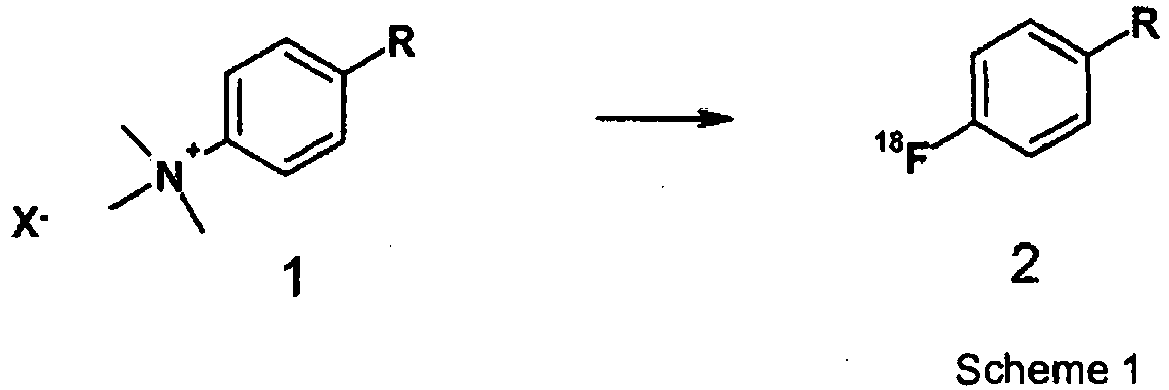
- There are only a few publications about nucleophilic aromatic 18F-fluorination reactions of trimethyl ammonium substituted aromatic derivatives which contain two or more substituents beside the trimethylammonium moiety:
- Oya et al. treated [2-Chloro-5-(2-dimethylcarbamoyl-phenylsulfanyl)-4-nitro-phenyl]-trimethyl-ammonium triflate with [18F] potassium fluoride and obtained the desired 18F-labeled compound (J. Med. Chem., 2002, 45(21):4716-4723).
- Li et al. report on the 18F-fluorination reaction of 4-(N,N,N-trimethylammonium)-3-cyano-3'-iodobenzophenone triflate (Bioconjugate Chemistry, 2003, 14(2):287-294).
- Enas et al. convert (2,2-Dimethyl-1,3-dioxo-indan-5-yl)-trimethyl-ammonium triflate into the desired 18F-labeled compound (J. Fluorine Chem., 1993, 63(3):233-41).
- Seimbille et al. and other groups have labeled (2-Chloro-4-nitro-phenyl)-trimethylammonium triflate successfully with 18F (J. Labelled Compd. Radiopharm., 2005, 48, 11:829-843).
- (2-Benzyloxy-4-formyl-phenyl)-trimethyl-ammonium triflate has successfully been labeled with 18F at high temperature (130°C) by Langer et. a/. (Bioorg. Med. Chem., EN; 9; 3; 2001:677-694).
- Lang et al. have radiolabeled trimethyl-(2-methyl-4-pentamethylphenyl methoxycarbonylphenyl)-ammonium triflate by using [18F] potassium fluoride (J. Med. Chem., 42, 9, 1999:1576-1586).
- Trimethyl-(4-nitro-naphthalen-1-yl)-ammonium triflate has been labeled with 18F by Amokhtari et al. (J. Labeled Compd. Radiopharm.; S42, 1 (1999):S622-S623).
- Lemaire et al. have converted (2-formyl-5-methoxy-phenyl)-trimethyl-ammonium triflate into the desired 18F-labeled product (J. Labeled Compd. Radiopharm., 44, 2001:S857-S859).
- VanBrocklin et al. describe the 18F labeling of (2-bromo-4-nitro-phenyl)-trimethylammonium triflate (J. Labeled Compd. Radiopharm., 44; 2001:S880-S882) and
- Cetir Centre Medic report on the successful 18F-labeling of (5-Chloro-8-hydroxy-quinolin-7-yl)-trimethyl-ammonium triflate (
EP 1 563 852 A1 - D.A.Sutton et al. ("Evaluation of 1-fluoro-2-nitro-4-trimethylammoniobenzene iodide, a protein-solubilizing agent", Biochem. J., 1972, 130:589-595) disclose model derivatives which consist of a benzene substituted with trimethylammonium, an electron withdrawing nitro group and a glycine, phenylalanine or acetyltyrosine.
- C.Lemaire et al. ("Highly enantioselective synthesis of no-carrier-added 6-[18F]fluoro-L-dopa by chiral phase-transfer alkylation", Eur. J. Org. Chem., 2004:2899-2904) disclose 2-[18F]fluoro-4,5-dimethoxybenzaldehyde to be used to prepare 6-[18F]fluoro-L-dopa.
- L.Lang et al. ("Development of fluorine-18-labeled 5-HT1A antagonists", J. Med. Chem., 1999, 42(9):1576-1586) disclose conversion of pentamethyl 4-(trimethylammonium trifluormethanesulfonate)benzoate and pentamethyl 3-methyl-4-(trimethylammonium trifluormethansulfonate)benzoate to the respective 18F substituted benzoyl chloride which is then coupled with WAY 100635 (N-{2-[4-(2-methoxyphenyl)-piperazino]ethyl}-N-(2-pyridyl)cyclohexanecarboxamide).
- S.Oya et al. ("New PET imaging agent for the serotonin transporter: [18F]ACF (2-[(-amino-4-chloro-5-fluorophenyl)thio]-N,N-dimethyl-benzenmethanamine)", J. Med. Chem., 2002, 45:4716-4723) disclose conversion of [2-chloro-5-(2-dimethylaminocarbonyl-phenylthio)-4-nitro-phenyl]trimethylammonium trifluoromethanesulfonate to the respective 18F substituted compound.
- M.J.Al-Darwich et al. ("Enantioselective synthesis of non-carrier-added (n.c.a.) (S)-4-chloro-2-[18F]fluorophenylalanine and (S)-(α-methyl)-4-chloro-2-[18F]fluorophenylalanine", J. Fluorine Chem., 1996, 80:117-124) disclose 4-chloro-2-trimethylammoniumbenzaldehyde triflate to be reacted to 4-chloro-2-[18F]fluorobenzaldehyde which are then further reacted to yield the title compounds.
- Y.Seimbille et al. ("Fluorine-18 labeling of 6,7-disubstituted anilinoquinazoline derivatives for positron emission tomography (PET) imaging of tyrosine kinase receptors: synthesis of 18F-Iressa and related molecular probes", J. Labeled Compd. Radiopharm., 2005, 48:829-843, i.a., report on the reaction of 3-chloro-4-trimethylammonium nitrobenzene trifluoromethanesulfonate to give 3-chloro-4-[18F]flouroaniline via 3-chloro-4-[18F]fluoro-nitro-benzene.
-
WO 2002/44144 A1 -
WO 2006/083424 A2 relates to [18F]-radiolabeled compounds and the manufacture thereof. - Most of these mentioned 18F-labeled aromatic derivatives which contain two or more additional substituents cannot be coupled to chemical functionalities like amines, thiols, carboxylic acids, phenols or other chemicals groups of complex molecules like peptides without further transformations.
- 18F labeling of more complex radiopharmaceuticals like peptides takes place in all known publications in a two- or multi-step strategy (see
Scheme 2, review article: Eur. J. Nucl. Med., 2001, 28:929-938). - For these kinds of 18F-labeling also mono-substituted trimethylammonium benzene derivatives are used and react in a first step with [18F] potassium fluoride to obtain substituted [18F]-fluoro-benzene derivatives. These compounds are then coupled in a second step to larger and more complex molecules like peptides, small molecules or nucleotides (see scheme 2).

- Especially 4-[18F]fluorobenzaldehyde has been used in many examples for F-18 labelling of complex molecules (e.g., J. Nucl. Med., 2004, 45(5):892-902). But also N-succinimidyl-8-[4'-[18F]fluorobenzylamino]suberate (Bioconjugate Chem., 1991, 2:44-49), 4-[18F]fluorophenacyl bromide and 3-[18F]fluoro-5-nitrobenzimidate (J. Nucl. Med., 1987, 28:462-470), m-maleimido-N-(p-[18F]fluorobenzyl)-benzamide (J. Labeled Compd. Radiopharm., 1989, 26:287-289,), N-{4-[4-[18F]fluorobenzylidene(aminooxy)-butyl}-maleimide (Bioconjugate Chem., 2003,14:1253-1259), [18F]N-(4-fluorobenzyl)-2-bromoacetamide (Bioconjugate Chem., 2000, 11:627-636) and [18F]-3,5-difluorophenyl azide (and 5 derivatives) (J. Org. Chem., 1995, 60:6680-6681) are known examples. F-18 labeling of peptides via para-[18F]-fluorobenzoates is also a very common method either by coupling of the corresponding acid with additional activating agents (such as 1,3-dicyclohexylcarbodiimide/1-hydroxy-7-azabenzotriazole (DCC/HOAt) or N-[(dimethylamino)-1H-1,2,3-triazolyl[4,5]pyridine-1-yl-methylene]-N-methyl-methan-aminium hexafluorophosphate N-oxide (HATU/DIPEA, Eur. J. Nucl. Med. Mol. Imaging., 2002, 29:754-759) or by isolated N-succinimidyl 4-[18F]fluorobenzoate (Nucl. Med. Biol., 1996, 23:365).
- None of these compounds and none of other published compounds allow a direct (one-step) labeling of peptides with 18F-fluoride.
- Therefore it is the object of the present invention to provide for a practical and mild technique for 18F labeling of peptides comprising at least two amino acids as targeting agents and to provide radiofluorination methods for obtaining radiotracer based on receptor specific peptides for the detection of tumors.
- The object of the present invention is solved as detailed herein below.
- A first aspect of the present invention refers to novel compounds having general chemical Formula A (general chemical Formula I), wherein K = N+(R1)(R2)(R3) X- and to pharmaceutically acceptable salts of inorganic or organic acids thereof, hydrates, complexes, esters, amides, and solvates thereof. These compounds are precursors for a single step labeling more preferably radiolabeling to yield the novel compounds according to the second aspect of the present invention.
- A second aspect of the present invention refers to novel compounds (radiopharmaceuticals, labeled 18F), having general chemical Formula A, wherein K = W (general chemical Formula II) and to pharmaceutically acceptable salts of inorganic or organic acids thereof, hydrates, complexes, esters, amides, and solvates thereof.
- Compounds having general chemical Formula A, wherein K = N+(R1)(R2)(R3) X- (general) chemical Formula I), can be converted into compounds having general chemical Formula A, wherein K = W (general chemical Formula II), by means of a one-step labeling more preferably radiolabeling reaction with a 18F fluorine isotope.
- A third aspect of the present invention refers to a one-step method of labeling more preferably radiolabeling compounds having general chemical Formula A, wherein K = N+(R1)(R2)(R3) X-, in order to arrive at compounds having general chemical Formula A, wherein K = W.
- A fourth aspect of the present invention refers to compositions, more preferably to diagnostic compositions, comprising a compound having general chemical Formula A, wherein K = N+(R1)(R2)(R3) X-, or a pharmaceutically acceptable salts of inorganic or organic acids thereof, hydrates, complexes, esters, amides, and solvates thereof and a pharmaceutically acceptable carrier, diluent, excipient or adjuvant. According to this fourth aspect the present invention further refers to compositions, more preferably diagnostic compositions, comprising a radiolabelled compound having general chemical Formula A, wherein K = W, or a pharmaceutically acceptable salts of inorganic or organic acids thereof, hydrates, complexes, esters, amides, and solvates thereof and a pharmaceutically acceptable carrier, diluent, excipient or adjuvant.
- A fifth aspect of the present invention refers to a kit for preparing a radiopharmaceutical preparation, said kit comprising a sealed vial containing a predetermined quantity of the compound of Formula A, wherein K = N+(R1)(R2)(R3) X-, or a pharmaceutically acceptable salts of inorganic or organic acids thereof, hydrates, complexes, esters, amides, and solvates thereof and further optionally an acceptable carrier, diluent, excipient or adjuvant supplied as a mixture with the compound having general chemical Formula I or independently for the manufacture of a compound having general chemical Formula II.
- A sixth aspect of the present invention refers to a compound having general chemical Formula A, wherein K = N+(R1)(R2)(R3) X- or W, or of a pharmaceutically acceptable salts of inorganic or organic acids thereof, hydrates, complexes, esters, amides, and solvates thereof for use as medicament and, if K = W, for use as diagnostic imaging agent and more specifically for use as imaging agent for PET.
- A seventh aspect of the present invention refers to a use of a compound having general chemical Formula A, wherein K = N+(R1)(R2)(R3) X- or W, or of a pharmaceutically acceptable salts of inorganic or organic acids thereof, hydrates, complexes, esters, amides, and solvates thereof for the manufacture of a medicament, more specifically for the manufacture of a diagnostic imaging agent and most specifically for the manufacture of a diagnostic imaging agent for imaging tissue at a target site using the imaging agent.
- Further aspects of the present invention are directed to methods and intermediates useful for synthesizing the tumor imaging compounds having general chemical Formulae I and II as described herein below.
- As used hereinafter in the description of the invention and in the claims, the term "alkyl", by itself or as part of another group, refers to a straight chain or branched chain alkyl group with 1 to 20 carbon atoms such as, for example methyl, ethyl, propyl, isopropyl, butyl, isobutyl, tert-butyl, pentyl, isopentyl, neopentyl, heptyl, hexyl, decyl. Alkyl groups can also be substituted, such as by halogen atoms, hydroxyl groups, C1-C4 alkoxy groups or C6-C12 aryl groups (which, intern, can also be substituted, such as by 1 to 3 halogen atoms). More preferably alkyl is C1-C10 alkyl, C1-C6 alkyl or C1-C4 alkyl.
- As used hereinafter in the description of the invention and in the claims, the term "cycloalkyl" by itself or as part of another group, refers to mono- or bicyclic chain of alkyl group with 3 to 20 carbon atoms such as, for example cyclopropyl, cyclobutyl, cyclopentyl, cyclohexyl or cycloheptyl. More preferably cycloalkyl is C3-C10 cycloalkyl or C5-C8 cycloalkyl, most preferably C6 cycloalkyl.
- As used hereinafter in the description of the invention and in the claims, the term "heterocycloalkyl", by itself or as part of another group, refers to groups having 3 to 20 mono- or bi-ring atoms of a cycloalkyl; and containing carbon atoms and 1, 2, 3 or 4 oxygen, nitrogen or sulfur heteroatoms. More preferably heterocycloalkyl is C3-C10 heterocycloalkyl, C5-C8 heterocycloalkyl or C5-C14 heterocycloalkyl, most preferably C6 heterocycloalkyl.
- As used hereinafter in the description of the invention and in the claims, the term "aralkyl" refers to aryl- substituted alkyl radicals such as benzyl, diphenylmethyl, triphenylmethyl, phenylethyl, phenylbutyl and diphenylethyl.
- As used hereinafter in the description of the invention and in the claims, the terms "aryloxy" refers to aryl groups having an oxygen through which the radical is attached to a nucleus, examples of which are phenoxy.
- As used hereinafter in the description of the invention and in the claims, the terms "alkenyl" and "alkynyl" are similarly defined as for alkyl, but contain at least one carboncarbon double or triple bond, respectively. More preferably C2-C6 alkenyl and C2-C6 alkynyl.
- As used hereinafter in the description of the invention and in the claims, the term " unbranched or branched alkyl" shall have the following meaning: a substituted or unsubstituted, straight or branched chain monovalent or divalent radical consisting substantially of carbon and hydrogen, containing no unsaturation and having from one to eight carbon atoms, e.g.methyl, ethyl, n-propyl, n-pentyl, 1,1-dimethylethyl (t-butyl), and n-heptyl.
- As used hereinafter in the description of the invention and in the claims, the terms "aralkenyl" refers to aromatic structure (aryl) coupled to alkenyl as defined above.
- As used hereinafter in the description of the invention and in the claims, the terms "alkoxy (or alkyloxy), aryloxy, and aralkenyloxy" refer to alkyl, aryl, and aralkenyl groups respectively linked by an oxygen atom, with the alkyl, aryl, and aralkenyl portion being as defined above.
- As used hereinafter in the description of the invention and in the claims, the terms "salts of inorganic or organic acids", "inorganic acid" and "organic acid" refer to mineral acids, including, but not being limited to: acids such as carbonic, nitric, phosphoric, hydrochloric, perchloric or sulphuric acid or the acidic salts thereof such as potassium hydrogen sulphate, or to appropriate organic acids which include, but are not limited to: acids such as aliphatic, cycloaliphatic, aromatic, araliphatic, heterocyclic, carboxylic and sulphonic acids, examples of which are formic, acetic, trifluoracetic, propionic, succinic, glycolic, gluconic, lactic, malic, fumaric, pyruvic, benzoic, anthranilic, mesylic, fumaric, salicylic, phenylacetic, mandelic, embonic, methansulfonic, ethanesulfonic, benzenesulfonic, phantothenic, toluenesulfonic, trifluormethansulfonic and sulfanilic acid, respectively.
- As used hereinafter in the description of the invention and in the claims, the term "aryl" by itself or as part of another group refers to monocyclic or bicyclic aromatic groups containing from 6 to 12 carbon atoms in the ring portion, preferably 6-10 carbons in the ring portion, such as phenyl, naphthyl or tetrahydronaphthyl.
- As used hereinafter in the description of the invention and in the claims, the term "heteroaryl" by itself or as part of another group, refers to groups having 5 to 14 ring atoms; 6, 10 or 14 π (pi) electrons shared in a cyclic array; and containing carbon atoms and 1, 2, 3 or 4 oxygen, nitrogen or sulfur heteroatoms (where examples of heteroaryl groups are: thienyl, benzo[b]thienyl, naphtho[2,3-b]thienyl, thianthrenyl, furyl, pyranyl, isobenzofuranyl, benzoxazolyl, chromenyl, xanthenyl, phenoxathiinyl, 2H-pyrrolyl, pyrrolyl, imidazolyl, pyrazolyl, pyridyl, pyrazinyl, pyrimidinyl, pyridazinyl, indolizinyl, isoindolyl, 3H-indolyl, indolyl, indazolyl, purinyl, 4H-quinolizinyl, isoquinolyl, quinolyl, phthalazinyl, naphthyridinyl, quinazolinyl, cinnolinyl, pteridinyl, 4aH-carbazolyl, carbazolyl, carbolinyl, phenanthridinyl, acridinyl, perimidinyl, phenanthrolinyl, phenazinyl, isothiazoly4, phenothiazinyl, isoxazolyl, furazanyl and phenoxazinyl groups).
- Whenever the term substituted is used, it is meant to indicate that one or more hydrogens on the atom indicated in the expression using "substituted" is replaced with a selection from the indicated group, provided that the indicated atom's normal valency is not exceeded, and that the substitution results in a chemically stable compound, i. e. a compound that is sufficiently robust to survive isolation to a useful degree of purity from a reaction mixture, and formulation into a pharmaceutical composition. The substituent groups may be selected from halogen atoms, hydroxyl groups, C1-C4 alkoxy groups or C6-C12 aryl groups (which, intern, can also be substituted, such as by 1 to 3 halogen atoms).
- As used hereinafter in the description of the invention and in the claims, the term "fluorine isotope" (F) refers to 18F isotopes of the fluorine atomic element. Fluorine isotope 18F is selected from radioactive isotope.
- As used hereinafter in the description of the invention and in the claims, the terms "amino acid sequence" and "peptide" are defined herein as a polyamide obtainable by (poly)condensation of at least two amino acids.
- As used hereinafter in the description of the invention and in the claims, the term "amino acid" means any molecule comprising at least one amino group and at least one carboxyl group, but which has no peptide bond within the molecule. In other words, an amino acid is a molecule that has a carboxylic acid functionality and an amine nitrogen having at least one free hydrogen, preferably in alpha position thereto, but no amide bond in the molecule structure. Thus, a dipeptide having a free amino group at the N-terminus and a free carboxyl group at the C-terminus is not to be considered as a single "amino acid" in the above definition. The amide bond between two adjacent amino acid residues which is obtained from such a condensation is defined as "peptide bond". Optionally, the nitrogen atoms of the polyamide backbone (indicated as NH above) may be independently alkylated, e.g., with C1-C6-alkyl, preferably CH3.
- An amide bond as used herein means any covalent bond having the structure

- As used hereinafter in the description of the invention and in the claims, an amino acid residue is derived from the corresponding amino acid by forming a peptide bond with another amino acid.
- As used hereinafter in the description of the invention and in the claims, an amino acid sequence may comprise naturally occurring and/or synthetic / artificial amino acid residues, proteinogenic and/or non-proteinogenic amino acid residues. The non-proteinogenic amino acid residues may be further classified as (a) homo analogues of proteinogenic amino acids, (b) β-homo analogues of proteinogenic amino acid residues and (c) further non-proteinogenic amino acid residues.
- Accordingly, the amino acid residues may be derived from the corresponding amino acids, e.g., from
- proteinogenic amino acids, namely Ala, Arg, Asn, Asp, Cys, Gln, Glu, Gly, His, Ile, Leu, Lys, Met, Phe, Pro, Ser, Thr, Trp, Tyr and Val; or
- non-proteinogenic amino acids, such as
- ○ homo analogues of proteinogenic amino acids wherein the sidechain has been extended by a methylene group, e.g., homoalanine (Hal), homoarginine (Har), homocysteine (Hcy), homoglutamine (Hgl), homohistidine (Hhi), homoisoleucine (Hil), homoleucine (Hle), homolysine (Hly), homomethionine (Hme), homophenylalanine (Hph), homoproline (Hpr), homoserine (Hse), homothreonine (Hth), homotryptophane (Htr), homotyrosine (Hty) and homovaline (Hva);
- ○ β-homo analogues of proteinogenic amino acids wherein a methylene group has been inserted between the α-carbon and the carboxyl group yielding β-amino acids, e.g., β-homoalanine (βHal), β-homoarginine (βHar), β-homoasparagine (βHas), β-homocysteine (βHcy), β-homoglutamine (βHgl), β-homohistidine (βHhi), β-homoisoleucine (βHil), β-homoleucine (βHle), β-homolysine (βHly), β-homomethionine (βHme), β-homophenylalanine (βHph), β-homoproline (βHpr), β-homoserine (βHse), β-homothreonine (βHth), β-homotryptophane (βHtr), β-homotyrosine (βHty) and β-homovaline (βHva);
- ○ further non-proteinogenic amino acids, e.g., α-aminoadipic acid (Aad), β-aminoadipic acid (βAad), α-aminobutyric acid (Abu), α-aminoisobutyric acid (Aib), β-alanine (βAla), 4-aminobutyric acid (4-Abu), 5-aminovaleric acid (5-Ava), 6-aminohexanoic acid (6-Ahx), 8-aminooctanoic acid (8-Aoc), 9-aminononanoic acid (9-Anc), 10-aminodecanoic acid (10-Adc), 12-aminododecanoic acid (12-Ado), α-aminosuberic acid (Asu), azetidine-2-carboxylic acid (Aze), β-cyclohexylalanine (Cha), aitrulline (Cit), dehydroalanine (Dha), γ-carboxyglutamic acid (Gla), α-cyclohexylglycine (Chg), propargylglycine (Pra), pyroglutamic acid (Glp), α-tert-butylglycine (Tie), 4-benzoylphenylalanine (Bpa), δ-hydroxylysine (Hyl), 4-hydroxyproline (Hyp), allo-isoleucine (alle), lanthionine (Lan), (1-naphthyl)alanine (1-Nal), (2-naphthyl)alanine (2-Nal), norleucine (Nle), norvaline (Nva), ornithine (Orn), phenylglycin (Phg), pipecolic acid (Pip), sarcosine (Sar), selenocysteine (Sec), statine (Sta), β-thienylalanine (Thi), 1,2,3,4-tetrahydroisochinoline-3-carboxylic acid (Tic), allo-threonine (aThr), thiazolidine-4-carboxylic acid (Thz), γ-aminobutyric acid (GABA), iso-cysteine (iso-Cys), diaminopropionic acid (Dpr), 2,4-diaminobutyric acid (Dab), 3,4-diaminobutyric acid (γβDab), biphenylalanine (Bip), phenylalanine substituted in para-position with -C1-C6 alkyl, -halide, -NH2, -CO2H or Phe(4-R) (wherein R = -C1-C6 alkyl, -halide, -NH2, or -CO2H); peptide nucleic acids (PNA, cf., P.E. Nielsen, Acc. Chem. Res., 32, 624-30);
- or their N-alkylated analogues, e.g. N-methylated analogues.
- Cyclic amino acids may be proteinogenic or non-proteinogenic, such as Pro, Aze, Glp, Hyp, Pip, Tic and Thz.
- For further examples and details can be derived from J.H. Jones, J. Peptide Sci., 2003, 9, 1-8.
- As used hereinafter in the description of the invention and in the claims, the terms "non-proteinogenic amino acid" and "non-proteinogenic amino acid residue" also encompass derivatives of proteinogenic amino acids. For example, the side chain of a proteinogenic amino acid residue may be derivatized thereby rendering the proteinogenic amino acid residue "non-proteinogenic". The same applies to derivatives of the C-terminus and/or the N-terminus of a proteinogenic amino acid residue terminating the amino acid sequence.
- As used hereinafter in the description of the invention and in the claims, a proteinogenic amino acid residue is derived from a proteinogenic amino acid selected from the group consisting of Ala, Arg, Asn, Asp, Cys, Gln, Glu, Gly, His, Ile, Leu, Lys, Met, Phe, Pro, Ser, Thr, Trp, Tyr and Val either in L- or D-configuration; the second chiral center in Thr and Ile may have either R- or S-configuration. Therefore, for example, any posttranslational modification of an amino acid sequence, such as N-alkylation, which might naturally occur renders the corresponding modified amino acid residue "non-proteinogenic", although in nature said amino acid residue is incorporated in a protein. Preferably modified amino acids are selected from N-alkylated amino acids, ß-amino acids, γ-amino acids, lanthionines, dehydro amino acids, and amino acids with alkylated guanidine moieties.
- As used hereinafter in the description of the invention and in the claims, the term "peptidomimetic" relates to molecules which are related to peptides, but with different properties. A peptidomimetic is a small protein-like chain designed to mimic a peptide. They typically arise from modification of an existing peptide in order to alter the molecule's properties. For example, they may arise from modifications to change the molecule's stability or biological activity. This can have a role in the development of drug-like compounds from existing peptides. These modifications involve changes to the peptide that will not occur naturally.
- As used hereinafter in the description of the invention and in the claims, the term "peptide analogs", by itself refers to synthetic or natural compounds which resemble naturally occurring peptides in structure and/or function.
- As used hereinafter in the description of the invention and in the claims, the term "pharmaceutically acceptable salt" relates to salts of inorganic and organic acids, such as mineral acids, includingacids such as carbonic, nitric or sulfuric acid, or organic acids, includingacids such as aliphatic, cycloaliphatic, aromatic, araliphatic, heterocyclic, carboxylic and sulphonic acids, examples of which are formic, acetic, trifluoroacetic, propionic, succinic, glycolic, gluconic, lactic, malic, fumaric, pyruvic, benzoic, anthranilic, mesylic, salicylic, phenylacetic, mandelic, embonic, methansulfonic, ethanesulfonic, benzenesulfonic, phantothenic, toluenesulfonic and sulfanilic acid.
- If a chiral center or another form of an isomeric center is present in a compound having general chemical Formulae A, I, II, or IIIof the present invention, as given hereinafter, all forms of such isomers, including enantiomers and diastereoisomers, are intended to be covered herein. Compounds containing a chiral center may be used as a racemic mixture or as an enantiomerically enriched mixture, or the racemic mixture may be separated using well-known techniques and an individual enantiomer maybe used alone. In cases in which compounds have unsaturated carbon-carbon double bonds, both the cis-isomer and trans-isomers are within the scope of this invention. In cases in which compounds may exist in tautomeric forms, such as keto-enol tautomers, each tautomeric form is contemplated as being included within the scope of the present invention whether existing in equilibrium or predominantly in one form.
- As used hereinafter in the description of the invention and in the claims, the term "oligonucleotide" shall have the following meaning: short sequences of nucleotides, typically with twenty or fewer bases. Examples are, but are not limited to, molecules named and cited in the book: " The aptamers handbook. Functional oligonuclides and their application" by Svenn Klussmann, Wiley-VCH, 2006. An example for such an oligonucleotide is TTA1 (J. Nucl. Med., 2006, April, 47(4):668-78).
- As used hereinafter in the description of the invention and in the claims, the term "aptamer" refers to an oligonucleotide, comprising from 4 to 100 nucleotides, wherein at least two single nucleotides are connected to each other via a phosphodiester linkage. Said aptamers have the ability to bind specifically to a target molecule (see, e.g., M Famulok, G Mayer, "Aptamers as Tools in Molecular Biology and Immunology", in: "Combinatorial Chemistry in Biology, Current Topics in Microbiology and Immunology" (M Famulok, CH Wong, EL Winnacker, Eds.), Springer Verlag Heidelberg, 1999, Vol. 243, 123-136). There are many ways known to the skilled person of how to generate such aptamers that have specificity for a certain target molecule. An example is given in
WO 01/09390 A - For the purpose of this invention, the term "nucleotide" refers to molecules comprising a nitrogen-containing base, a 5-carbon sugar, and one or more phosphate groups. Examples of said base comprise, but are not limited to, adenine, guanine, cytosine, uracil, and thymine. Also non-natural, substituted or non-substituted bases are included. Examples of 5-carbon sugar comprise, but are not limited to, D-ribose, and D-2-desoxyribose. Also other natural and non-natural, substituted or non-substituted 5-carbon sugars are included. Nucleotides as used in this invention may comprise from one to three phosphates.
- As used hereinafter in the description of the invention and in the claims, the term "halogen" refers to F, Cl, Br and I.
- In a first aspect the present invention refers to compounds having general chemical Formula A (general chemical Formula I), wherein K = N+(R1)(R2)(R3) X- :

- G is selected from the group comprising -F, -Cl, -Br, -I, -NO, -NO2, -NR4COCF3, -NR4SO2CF3, -N(R4)SO2R5, -N(CF3)2, -NHCSNHR4, -N(SO2R5)2, -N(O)=NCONH2, -NR4CN, -NHCSR5, -N≡C, -N=C(CF3)2, -N=NCF3, -N=NCN, -NR4COR4, -NR4COOR5, -OSO2CF3, -OSO2C6H5, -OCOR5, -ONO2, -OSO2R5, -O-C=CH2, -OCF2CF3, -OCOCF3, -OCN, -OCF3, -C≡N, -C(NO2)3, -COOR4, -CONR4R5, -C(S)NH2, -CH=NOR4, -CH2SO2R4, -COCF3, -CF3, -CF2Cl-CBr3, -CClF2, -CCl3, -CF2CF3, -C≡CR4, -CH=NSO2CF3, -CH2CF3, -COR5, -CH=NOR5, -CH2CONH2, -CSNHR5, -CH=NNHCSNH2, -CH=NNHCONHNH2, -C≡C-CF3, -CF=CFCF3, -CF2-CF2-CF3, -CR4(CN)2, -COCF2CF2CF3, -C(CF3)3, -C(CN)3, -CR4=C(CN)2, -1-pyrryl, -C(CN)=C(CN)2, -C-pyridyl, -COC6H5, -COOC6H5, -SOCF3, -SO2CF3, -SCF3, -SO2CN, -SCOCF3, -SOR5, -S(OR5), -SC≡CR4, -SO2R5, -SSO2R5, -SR5, -SSR4, -SO2CF2CF3, -SCF2CF3, -S(CF3)=NSO2CF3, -SO2C6H5, -SO2N(R5)2, -SO2C(CF3)3, -SC(CF3)3, -SO(CF3)=NSO2CF3, -S(O)(=NH)CF3, -S(O)(=NH)R5, -S-C=CH2, -SCOR5, -SOC6H5, -P(O)C3F7, -PO(OR5)2, -PO(N(R5)2)2, -P(N(R5)2)2, -P(O)R5 2, and -PO(OR5)2 or another electron-drawing group wherein the respective subtituent can be in ortho, para or meta position in respect of the K group,
- For the purposes of the present invention, the term "electron-drawing group" or "electron withdrawing group" (EWG) refers to a chemical moiety (substituent) which is attached to the benzene ring, which is able to decrease the electron density of the benzene ring and which is listed in Chem. Rev. (1991), 91, 165-195, Table1 (and further references therein) with values of σm or σp > 0;
-Q is hydrogen, unbranched or branched alkyl having from one to eight carbon atoms, aryl, heteroaryl,
-O-(C1-C4 alkyl), -CN, -halogen, -SO2-R4, -NO2 or a condensed aryl or condensed heteroaryl wherein the respective subtituent can be in ortho, para or meta position in respect of the K group,
wherein - R4 is hydrogen or unbranched or branched alkyl having from one to eight carbon atoms and
- R5 is unbranched or branched alkyl having from one to eight carbon atoms
- d is an integer of from 1 to 6,
- m and n, independently, are any integer of from 0 to 5,
- -E- is a bond, -S-, -O- or -NR9-,
- wherein R9 is H, C1-C10 alkyl, aryl, heteroaryl or aralkyl,
- p is any integer of from 1 to 3 ,
- R10, R11 and R12, independently, are selected from the group comprising H, C1-C10 alkyl, aryl, heteroaryl or aralkyl and
- R13 is H, substituted or non substituted, linear or branched C1-C6 alkyl, aryl, cycloalkyl, heterocycloalkyl, heteroaryl, aralkyl or heteroaralkyl,
- The invention further refers to pharmaceutically acceptable salts of inorganic or organic acids, hydrates, complexes, esters, amides, and solvates of the compounds having general chemical Formula I.
- In a preferred embodiment of the present invention, in the compounds having general chemical Formula I, -G is selected from the group comprising -F, -Cl, -Br, -NO2, -NR4SO2R5, -NHCSNHR4, -NR4CN, -NR4SO2CF3, -N≡C, -NR4COR4, -NR4COOR5, -OSO2R5, -OCF3, -C≡N, -COOR4, -CONR4R5, -COCF3, -CF2CF3, -C≡CR4, -COR5, -CH2CONH2, -CF3, -C≡C-CF3, -CF2-CF2-CF3, -C(CN)=C(CN)2, -COC6H5, -SO2CF3, - SCOCF3, -SO2R5, -SO2CF2CF3, -SO2C6H5, -SO2N(R5)2 and -PO(OR5)2, wherein the respective subtituent can be in ortho, para or meta position in respect of the K group.
- In a further preferred embodiment of the present invention, in the compounds having general chemical Formula I, -G is selected from the group comprising -F, -Cl, -Br, -NO2, -NR4SO2R5, -NR4COR4, -NR4COOR5, -C≡N, -CONR4R5, -C≡CR4, -COR5, -CF3, -COC6H5, -SO2CF3, -SO2R5, -SO2C6H5 and -SO2N(R5)2, wherein the respective subtituent can be in ortho, para or meta position in respect of the K group.
- In a further alternative embodiment of the present invention, in the compounds having general chemical Formula I, -G is selected from the group comprising -F, -Cl, -Br, -NO2, -NR4SO2R5, -NR4COR4, -NR4COOR5, -C≡N, -CONR4R5, -C≡CR4, -COR5, -CF3 and -SO2R5, wherein the respective subtituent can be in ortho, para or meta position in respect of the K group.
- In a further more preferred alternative embodiment of the present invention, in the compounds having general chemical Formula I, -G is selected from a group comprising those members which have a value of the Hammet constant σ ≥ 0.35 (compare Chem. Rev., 1991, 91:165, Table 1) and which contain a fluoro or a nitrogen atom selected from:
- F, -NO, -NO2, -NR4SO2CF3, -N(CF3)2, -N(SO2R5)2, -N(O)=NCONH2, -N=C, -N=NCF3, -N=NCN, -NR4COR4, -OSO2CF3, -OCOR5, -ONO2, -OCF2CF3, -OCOCF3, -OCN, -OCF3, -C≡N, -C(NO2)3, -CONR4R5, -CH=NOR4, -COCF3, -CF3, -CF2Cl-CBr3, -CClF2, -CF2CF3, -CH=NSO2CF3, -CH=NNHCSNH2, -CF=CFCF3, -CF2-CF2-CF3, -CR4(CN)2, -COCF2CF2CF3, -C(CF3)3, -C(CN)3, -CR4=C(CN)2, -C(CN)=C(CN)2, -SOCF3, -SO2CF3, -SCF3, -SO2CN, -SCOCF3, -SO2CF2CF3, -SCF2CF3, -S(CF3)=NSO2CF3, -SO2N(R5)2, -SO2C(CF3)3, -SC(CF3)3, -SO(CF3)=NSO2CF3, -S(O)(=NH)CF3, -S(O)(=NH)R5 and -P(O)C3F7, wherein the respective subtituent can be in ortho, para or meta position in respect of the K group.
- In a further even more preferred alternative embodiment of the present invention, in the compounds having general chemical Formula I, -G is selected from a group comprising those members of the embodiment herein above which have a value of the Hammet constant σ ≥ 0.50 (compare Chem. Rev., 1991, 91:165, Table 1) or which contain a fluoro atom selected from:
- F, -NO, -NO2, -NR4SO2CF3, -N(CF3)2, -N(O)=NCONH2, -N=NCF3, -N=NCN, -OSO2CF3, -ONO2, -OCF2CF3, -OCOCF3, -OCN, -OCF3, -C≡N, -C(NO2)3, -COCF3, -CF3, -CF2Cl-CBr3, -CClF2, -CF2CF3, -CH=NSO2CF3, -CF=CFCF3, -CF2-CF2-CF3, -CR4(CN) 2, -COCF2CF2CF3, -C(CF3)3, -C(CN)3, -CR4=C(CN)2, -C(CN)=C(CN)2, -SOCF3, -SO2CF3, -SCF3, -SO2CN, -SCOCF3, -SO2CF2CF3, -SCF2CF3, -S(CF3)=NSO2CF3. -SO2N(R5)2, -SO2C(CF3)3, -SC(CF3)3, -SO(CF3)=NSO2CF3, -S(O)(=NH)CF3 and -P(O)C3F7, wherein the respective subtituent can be in ortho, para or meta position in respect of the K group.
- In a further even more preferred alternative embodiment of the present invention, in the compounds having general chemical Formula I, -G is selected from a group comprising - F, -NO2, -OCF2CF3-OCF3, -C≡N, -COCF3, -CF3, -CF2CF3, -CF2-CF2-CF3, -COCF2CF2CF3, -SO2CF3, -SO2CN, -SO2CF2CF3, -SO2N(R5)2 and SC(CF3)3 ,wherein the respective subtituent can be in ortho, para or meta position in respect of the K group.
- In a further even more preferred alternative embodiment of the present invention, in the compounds having general chemical Formula I, -G is selected from the group comprising those members with a value of the Hammet constant σ ≥ 0.50 (compare Chem. Rev., 1991, 91:165, Table 1) or which contain a sulfur or a fluoro atom selected from:
- F, -NR4SO2CF3, -N(CF3)2, -N=NCF3, -OSO2CF3-OCF2CF3, -OCOCF3, -OCF3, -COCF3, -CF3, -CF2Cl-CBr3, -CClF2, -CF2CF3, -CH=NSO2CF3, -CF=CFCF3, -CF2-CF2-CF3, -COCF2CF2CF3, -C(CF3)3, -SOCF3, -SO2CF3, -SCF3, -SO2CN, -SO2R5, -SCOCF3, -SO2CF2CF3, -SCF2CF3, -S(CF3)=NSO2CF3, -SO2N(R5)2, -SO2C(CF3)3, -SC(CF3)3, -SO(CF3)=NSO2CF3, -S(O)(=NH)CF3 and -P(O)C3F7 ,wherein the respective subtituent can be in ortho, para or meta position in respect of the K group.
- In a further even more preferred alternative embodiment of the present invention, in the compounds having general chemical Formula I, -G is selected from the group comprising -F, -NR4SO2CF3, -OSO2CF3- OCF2CF3, -OCF3, -COCF3, -CF3, -SO2CF3, SO2R5 and -SO2N(R5)2 ,wherein the respective subtituent can be in ortho, para or meta position in respect of the K group.
- A positive value of a Hammet constant is a measure of electron deficiency. It seems that certain combinations of substituents with particular atoms (nitrogen, sulfur and/or fluoro) are favourable over others. For example nitrogen or fluoro substituents combined with positive Hammet constants allow a 18F radiolabeling with relative high radiochemical yields, whereas sulfur or fluoro atoms seem to guarantee radiolabeling reactions with only minor side reactions. It is for example known from literature that the choice of substituent can influence the ratio of ring fluorination versus methyl fluoride formation at trimethylammonium benzene derivatives with two substituents in total (review Coenen, "Fluorine-18 Labeling Methods: Features and Possibilities of Basic Reactions", 2006, in: P.A.Schubiger, M. Friebe, L.Lehmann, (eds), PET-Chemistry - The Driving Force in Molecular Imaging. Springer, Berlin Heidelberg, p.15-50, in particular p.23-26).
- In a further alternative embodiment of the present invention -G is selected from the group comprising -F, -Cl, -Br, -NO2, -OSO2R4, -OCF3, -C≡N, -COOR4, -CONR4R5, -COCF3, -CF2CF3, -COR5, -CF3, -C≡C-CF3, -CF2-CF2-CF3, -COC6H5, -SO2CF3, -SCOCF3, -SO2R5, -SO2CF2CF3, -SO2C6H5, -SO2N(R5)2, and -PO(OR5)2 and more preferably from -F, -Cl, -Br, -NO2, -C=N, -CF3, -SO2CF3, -SO2R5, -SO2C6H5, or -SO2N(R5)2 ,wherein the respective subtituent can be in ortho, para or meta position in respect of the K group.
- In a further preferred embodiment of the present invention, -Q is -H, unbranched or branched alkyl having from one to eight carbon atoms, aryl, heteroaryl, -O-(C1-C4alkyl), - CN, -halogen, -SO2-R4-, -NO2 or a condensed aryl or heteroaryl, wherein the respective subtituent can be in ortho, para or meta position in respect of the K group.
- In a more preferred embodiment of the present invention, -Q is -H, -C1-C4 alkyl, -O-(C1-C4 alkyl), -CN, -F, -Cl, -Br or -NO2 ,wherein the respective subtituent can be in ortho, para or meta position in respect of the K group.
- In an even more preferred embodiment of the present invention, -Q is -H, -CH3, -O-CH3, -CN, -F, -Cl or -NO2 wherein the respective subtituent can be in ortho, para or meta position in respect of the K group.
- In an alternative embodiment -Q is -H, -CN, -halogen, -SO2-R4 or -NO2 ,wherein the respective subtituent can be in ortho, para or meta position in respect of the K group.
- In a further alternative embodiment of the present invention -Q is selected from -H, -CN, -F, -Cl, -Br or -NO2, more preferably from -H, -CN, -F or -NO2 ,wherein the respective subtituent can be in ortho, para or meta position in respect of the K group.
- In a further alternative embodiment of the present invention, in the compounds having general chemical Formula I, -Q is -H, -CN or -F wherein the respective subtituent can be in ortho, para or meta position in respect of the K group.
- In a very preferred embodiment of the present invention, any of -G and -Q, more preferred -G, is in ortho, or less preferred, in para position relative to K = N+(R1)(R2)(R3) X-.
- In a preferred embodiment of compounds of Formula I, -G and -Q are independently from each other selected from -H, -CN, CF3, and -Cl.
- In a more preferred embodiment -G and -Q are independently from each other H, -CF3, or CN.
- In a even more preferred embodiment in a more preferred embodiment -G and -Q are independently from each other H, -CF3, or -CN, whereas at least -G or -Q is -CF3 or -CN.
- In a further preferred embodiment of the present invention, in the compounds having general chemical Formula I, R4 is hydrogen or unbranched or branched C1-C6 alkyl, more preferably C1-C4 alkyl, most preferably hydrogen or methyl.
- In a further preferred embodiment of the present invention, in the compounds having general chemical Formula I, R5 is unbranched or branched C1-C6 alkyl, more preferably C1-C4 alkyl, most preferably methyl.
- In a preferred embodiment of the present invention, in compounds having general chemical Formula I, R1 , R2 and R3 are independently from each other selected from the group comprising unbranched (linear) or branched alkyl having from one to eight carbon atoms or aralkyl.
- In another preferred embodiment of the present invention, in the compounds having general chemical Formula I, R1 , R2 and R3 are independently from each other selected from the group comprising aralkyl or alkyl having from one to eight carbon atoms, whereas one of the three moieties (R1 , R 2, R 3) can be resin-bound.
- In another preferred embodiment of the present invention, in the compounds having general chemical Formula I, R1 , R2 and R3 are independently from each other selected from the group comprising aralkyl or alkyl having from one to eight carbon atoms, preferably C1-C6 alkyl, whereas at least two moieties of the three moieties (R1, R2, R3) are alkyl.
- In another preferred embodiment of the present invention, in the compounds having general chemical Formula I, R1, R2 and R3 are independently from each other selected from the group comprising C1-C6 alkyl moieties.
- In another preferred embodiment of the present invention, in the compounds having general chemical Formula I, R1 is aralkyl and R2 and R3 are each methyl.
- In another preferred embodiment of the present invention, in the compounds having general chemical Formula I, R1 , R2 and R3 are each methyl.
- In a further preferred embodiment of the present invention, in the compound having general chemical Formula I, X- is CF3-C(O)O-, CF3S(O)2O-, C4F9S(O)2O-.
- In an even more preferred embodiment of the present invention, in the compound having general chemical Formula I, X- is CF3-C(O)O- or CF3S(O)2O-.
- In a further preferred embodiment of the present invention, -L- is a bond, -CO-, -SO2-, -(CH2)d-CO-, -SO-, or -C≡C-CO-, wherein d is an integer of from 1 to 6.
- In a more preferred embodiment of the present invention, in the compounds having general chemical Formula I, -L- is -CO-, -SO2- or -C≡C-CO-.
- In an even more preferred embodiment of the present invention, in the compounds having general chemical Formula I, -L- is -CO- or -SO2-.
- In a further preferred embodiment of the present invention, in the compound having general chemical Formula I, the spacer -Y- is a natural or unnatural amino acid sequence or mixture thereof or a non-amino acid group.
- In a more preferred embodiment of the present invention, in the compounds having general chemical Formula I, the spacer -Y- is an amino acid sequence with two (2) to twenty (20) amino acid residues.
- In an even more preferred embodiment of the present invention, in the compounds having general chemical Formula I, the spacer -Y- is Arg-Ser, Arg-Ava, Lys(Me)2-β-ala, Lys(Me)2-ser, Arg-β-ala, Ser-Ser, Ser-Thr, Arg-Thr, S-alkylcysteine, cysteic acid, thioalkylcysteine (S-S-Alkyl) or

- In an even more preferred embodiment of the present invention, in the compounds having general chemical Formula I, the spacer -Y- is a non-amino acid moiety selected from the group comprising
-NH-(CH2)p-CO-, wherein p is an integer of from 2 to 10,
-NH-(CH2-CH2-O)q-CH2-CH2-CO-, wherein q is an integer of from 0 to 5.
-NH-cycloalkyl-CO- wherein cycloalkyl is selected from C5-C8 cycloalkyl, more preferably C6 atom cycloalkyl, and
-NH-heterocycloalkyl-(CH2)v-CO- wherein heterocycloalkyl is selected from C5-C8 heterocycloalkyl containing carbon atoms and 1, 2, 3 or 4 oxygen, nitrogen or sulfur heteroatoms more preferably 1 to 2 heteroatom even more preferably 1 heteroatom and v is an integer of from 1 to 4, more preferably v is an integer of from 1 to 2 - U is a targeting agent being peptides comprising at least two amino acids.
- For the purposes of the present invention, the term "targeting agent" shall have the following meaning: The targeting agent is a peptide of at least two amino acids that targets or directs the radionuclide attached to it to a specific site in a biological system. A targeting agent can be any peptide of at least two amino acids that binds to or accumulates at a target site in a mammalian body, i.e., the peptide of at least two amino acids localizes to a greater extent at the target site than to surrounding tissue.
- The compounds of this invention are useful for the imaging of a variety of cancers including: carcinoma such as bladder, breast, colon, kidney, liver, lung, including small cell lung cancer, esophagus, gall-bladder, ovary, pancreas, stomach, cervix, thyroid, prostate and skin, hematopoetic tumors of lymphoid and myeloid lineage, tumors of mesenchymal origin, tumors of central peripheral nervous systems, other tumors, including melanoma, seminoma, teratocarcinoma, osteosarcoma, xeroderma pigmentosum, keratoxanthoma, thyroid follicular cancer and Karposi's sarcoma.
Most preferably, the use is not only for imaging of tumors, but also for imaging of inflammatory and/or neurodegenerative diseases, such as multiple sclerosis or Alzheimer's disease, or imaging of angiogenesis-associated diseases, such as growth of solid tumors, and rheumatoid arthritis. - Preferably the targeting agent U is a peptide comprising at least two amino acids, particularly one which has specificity to target the complex to a specific site in a biological system.
- Further preferred biomolecules are sugars, oligosaccharides, polysaccharides, aminoacids, nucleic acids, nucleotides, nucleosides, oligonucleotides, proteins, peptides, peptidomimetics, antibodies, aptamers, lipids, hormones (steroid and nonsteroid), neurotransmitters, drugs (synthetic or natural), receptor agonists and antagonists, dendrimers, fullerenes, virus particles and other targeting molecules / biomolecules (e.g., cancer targeting molecules).
- Preferably the targeting agent U is a peptide comprising at least two amino acids.
- The targeting agent U may be a peptide comprising from 4 to 100 amino acids wherein the amino acids may be selected from natural and non-natural amino acids and also may comprise modified natural and non-natural amino acids.
- Examples for peptides as targeting agent targeting agent U are somatostatin and related peptides, somatostatin receptor specific peptides, neuropeptide Y and related peptides, neuropeptide Y1, bombesin and related peptides, gastrin, gastrin releasing peptide and related peptides, epidermal growth factor (EGF of various origin), insulin growth factor (IGF) and IGF-1, integrins (α3β1, αvβ3, αvβ5, αIIb3), LHRH agonists and antagonists, transforming growth factors, particularly TGF-α; angiotensin; cholecystokinin receptor peptides, cholecystokinin (CCK); neurotensin, thyrotropin releasing hormone, pituitary adenylate cyclase activating peptide (PACAP) and the related peptides thereof, chemokines, substrates and inhibitors for cell surface matrix metalloproteinase, prolactin, tumor necrosis factor, interleukins (IL-1, IL-2, IL-4 or IL-6), interferons, vasoactive intestinal peptide (VIP) and the related peptides thereof. Such peptides comprise from 4 to 100 amino acids, wherein the amino acids are selected from natural and non-natural amino acids and also comprise modified natural and non-natural amino acids. Preferably targeting agent U is not insulin.
- More preferably targeting agent U may be selected from the group comprising bombesinand bombesin related peptides, preferably those having the sequences listed herein below, somatostatin and somatostatin related peptides, preferably those having the sequences listed herein below, and neuropeptide Y1 and the neuropeptide Y1 related peptides, preferably those having the sequences listed herein below, and vasoactive intestinal peptide (VIP).
- Even more preferably targeting agent U may be selected from the group comprising bombesin, somatostatin, and neuropeptide Y1.
- Even more preferably targeting agent U may be bombesin.
- Bombesin is a fourteen amino acid peptide that is an analog of human Gastrin releasing peptide (GRP) that binds with high specificity to human GRP receptors present in prostate tumor, breast tumor and metastasis. Accordingly, as to an eighth aspect of the present invention, bombesin related peptides are provided.
- In a more preferred embodiment, bombesin related peptides have the following sequence having Formula III:
AA1-AA2-AA3-AA4-AA5-AA6-AA7-AA8-NT1T2 (type A) Formula III,
with: - T1 = T2 =H or T1 = H,T2 = OH or T1 = CH3, T2 = OH
- AA1 = Gln, Asn, Phe(4-CO-NH2)
- AA2 = Trp, D-Trp
- AA3 = Ala, Ser, Val
- AA4 = Val, Ser, Thr
- AA5 = Gly, (N-Me)Gly
- AA6 = His, His(3-Me), (N-Me)His, (N-Me)His(3-Me)
- AA7 = Sta, Statine analogs and isomers, 4-Am,5-MeHpA, 4-Am,5-MeHxA, γ-substituted aminoacids
- AA8 = Leu, Cpa, Cba, CpnA, Cha, t-buGly, tBuAla, Met, Nle, iso-Bu-Gly
- In a more preferred embodiment, bombesin related peptides have the following sequence of formula IV:
AA1-AA2-AA3-AA4-AA5-AA6-AA7-AA8-NT1T2 (type B) Formula IV,
with: - T1 = T2 =H or T1 = H,T2 = OH or T1 = CH3, T2 = OH
- AA1 = Gln, Asn or Phe(4-CO-NH2)
- AA2 = Trp, D-Trp
- AA3 = Ala, Ser, Val
- AA4 = Val, Ser. Thr
- AA5 = βAla, β2 - and β3-amino acids as shown herein after

- AA6 = His, His(3-Me), (N-Me)His, (N-Me)His(3-Me)
- AA7 = Phe, Tha, Nal,
- AA8 = Leu, Cpa, Cba, CpnA, Cha, t-buGly, tBuAla, Met, Nle, iso-Bu-Gly.
- Therefore, in an even more preferred embodiment of the present invention targeting agent U may be selected from the group comprising bombesin related peptides having sequence III or IV.
- Thus, the invention also refers to bombesin related peptides that bind specifically to human GRP receptors present in prostate tumor, breast tumor and metastasis. More preferably a bombesin related peptide is additionally labeled with a fluorine isotope 18F. The bombesin related peptide is preferably radiolabeled using the radiofluorination method of the present invention.
- In a more preferred embodiment, somatostatin related peptides have the following sequences:
- Seq ID 104 ----c[Lys-(NMe)Phe-1Nal-D-Trp-Lys-Thr]
- Seq ID 105 ----c[Dpr-Met-(NMe)Phe-Tyr-D-Trp-Lys]
- In a more preferred embodiment, neuropeptide Y1 related peptides have the following sequences:
- Seq ID 106 -DCys-Leu-Ile-Thr-Arg-Cys-Arg-Tyr-NH2
- Seq ID 107 -DCys-Leu-Ile-Val-Arg-Cys-Arg-Tyr-NH2
(_ indicates disulfide bridge) - In a more preferred embodiment, peptide is tetrapeptide of the following sequences:
- valyl-β-alanyl-phenylalanyl-glycine amide
- valyl-β-alanyl-histidyl(π-Me)-glycine amide
- Preferred as targeting agents U are peptides comprising from 4 to 100 amino acids.
- In a further preferred embodiment of the present invention, the targeting agent U may comprise a combination of any of the aforementioned bioactive molecules suitable to bind to a target site together with a reacting moiety which serves the linking between the bioactive molecule and the rest of the compound of the invention (Formulae I, II, III), wherein reacting moiety is selected from -NR7, -NR7-(CH2)n-, -O-(CH2)n- or -S-(CH2)n-, wherein R7 is hydrogen or unbranched or branched alkyl having from one to eight carbon atoms and n is an integer from 1 to 6 and wherein the suitable bioactive molecule is selected from peptide.
- In a preferred embodiment of R7 the alkyl is unbranched or branched C1-C6 alkyl, more preferably a methyl.
- In a preferred embodiment U is NR7-peptide, or -(CH2)n-peptide, -O-(CH2)n- peptide or -S-(CH2)n- peptide, - wherein n is an integer of from 1 to 6.
- In a more preferred embodiment U is -NR7-peptide, -(CH2)n-peptide, wherein n is an integer of from 1 to 6.
- In a preferred embodiment, the precursor for a single step radiolabeling is selected from the following list wherein U is a bombesin related peptide selected from:
- Ia-1 4-(Trimethylammonium)-3-cyano-benzoyl-Arg-Ava-Gln-Trp-Ala-Val-NMeGly-His-Sta-Leu-NH2,
- Ia-2 4-(Trimethylammonium)-3-cyano-benzoyl-Arg-Ava-Gln-Trp-Ala-Val-Gly-His(Me)-Sta-Leu-NH2,
- Ia-3 4-(Trimethylammonium)-3-cyano-benzoyl-Arg-Ava-Gln-Trp-Ala-Val-NMeGly-His(3Me)-Sta-Leu-NH2,
- Ia-4 4-(Trimethylammonium)-3-cyano-benzoyl-1,4-cis-Achc-Gln-Trp-Ala-Val-Gly-His(3Me)-Sta-Leu-NH2,
- Ia-5 4-(Trimethylammonium)-3-cyano-benzoyl-Gln-Trp-Ala-Val-Gly-His(3Me)-Sta-Leu-NH2,
- Ia-6 4-(Trimethylammonium)-3-cyano-benzoyl-AOC-Gln-Trp-Ala-Val-Gly-His(3Me)-Sta-Leu-NH2,
- Ia-7 4-(Trimethylammonium)-3-cyano-benzoyl-Ava-Gln-Trp-Ala-Val-NMeGly-His(3Me)-Sta-Cpa-NH2,
- Ia-8 4-(Trimethylammonium)-3-cyano-benzoyl-Ava-Gln-Trp-Ala-Val-Gly-His(3Me)-4-Am,5-MeHpA-Leu-NH2,
- Ia-9 4-(Trimethylammonium)-3-cyano-benzoyl-Ava-Gln-Trp-Ala-Val-Gly-His(3Me)-Sta-Leu-NH2,
- Ia-10 4-(Trimethylammonium)-3-cyano-benzoyl-Lys(Me)2-ßAla-Gln-Trp-Ala-Val-Gly-His(3Me)-Sta-Leu-NH2,
- Ia-11 4-(Trimethylammonium)-3-cyano-benzoyl-Lys(Me)2-ßAla-Gln-Trp-Ala-Val-Gly-His(3Me)-Sta-Leu-NH2,
- Ia-12 4-(Trimethylammonium)-3-cyano-benzoyl-Arg-Ser-Gln-Trp-Ala-Val-Gly-His(3Me)-4-Am,5-MeHpA-Leu-NH2,
- Ia-13 4-(Trimethylammonium)-3-cyano-benzoyl-Ser-Ser-Gin-Trp-Ala-Val-Gly-His(3Me)-4-Am,5-MeHpA-Leu-NH2,
- Ia-14 4-(Trimethylammonium)-3-cyano-benzoyl-Lys(Me)2-Ser-Gln-Trp-Ala-Val-Gly-His(3Me)-4-AM-5-MeHpA-Leu-NH2,
- Ia-15 4-(Trimethylammonium)-3-cyano-benzoyl-Arg-Ser-Gln-Trp-Ala-Val-Gly-His(3Me)-Sta-Leu-NH2,
- Ia-16 4-(Trimethylammonium)-3-cyano-benzoyl-Lys(Me)2-ßAla-Gln-Trp-Ala-Val-Gly-His(3Me)-4-Am,5-MeHpA-Leu-NH2,
- Ia-17 4-(Trimethylammonium)-3-cyano-benzoyl-Ava-Gln-Trp-Ala-Val-Gly-His-4-Am,5-MeHpA--Leu-NH2,
- Ia-18 4-(Trimethylammonium)-3-trifluoromethyl-benzoyl-Arg-Ava-Gln-Trp-Ala-Val-Gly-His(3Me)-Sta-Leu-NH2,
- Ia-19 4-(Trimethylammonium)-3-trifluoromethyl-benzoyl-Arg-Ava-Gln-Trp-Ala-Val-NMeGly-His(3Me)-Sta-Leu-NH2,
- Ia-20 4-(Trimethylammonium)-3-trifluoromethyl-benzoyl-1,4-cis-Achc-Gln-Trp-Ala-Val-Gly-His(3Me)-Sta-Leu-NH2,
- Ia-21 4-(Trimethylammonium)-3-trifluoromethyl-benzoyl-Gln-Trp-Ala-Val-Gly-His(3Me)-Sta-Leu-NH2,
- Ia-22 4-(Trimethylammonium)-3-trifluoromethyl-benzoyl-Arg-βAla-Gln-Trp-Ala-Val-Gly-His(3Me)-4-Am,5-MeHpA-Leu-NH2,
- Ia-23 4-(Trimethylammonium)-3-cyano-benzoyl-Ava-Gln-Trp-Ala-Val-NMeGly-His(3Me)-4-Am,5-MeHpA-Cpa-NH2,
- Ia-24 4-(Trimethylammonium)-3-cyano-benzoyl -Ser-Ser-Gln-Trp-Ala-Val-Gly-His(3Me)-Sta-Leu-NH2,
- Ia-25 4-(Trimethylammonium)-3-cyano-benzoyl-DOA-Gln-Trp-Ala-Val-Gly-His(3Me) Sta-Leu-NH2,
- In a preferred embodiment, the precursor for a single step radiolabeling is selected from the following list wherein U is somatostatin related peptides:
- 1a-66: 4-(Trimethylammonium)-3-cyano-benzoyl-Ava-ε-c[Lys-(NMe)Phe-1Nal-D-Trp-Lys-Thr]
- 1a-67: 4-(Trimethylammonium)-3-cyano-benzoyl-Ava-β-c[Dpr-Met-(NMe)Phe-Tyr-D-Trp-Lys]
- In a preferred embodiment, the precursor for a single step radiolabeling is selected from the following list wherein U is neuropeptide Y1 related peptideselected from:
- 1a-68: 4-(Trimethylammonium)-3-cyano-benzoyl-Ava-DCys-Leu-Ile-Thr-Arg-Cys-Arg-Tyr-NH2]
- 1a-69: 4-(Trimethylammonium)-3-cyano-benzoyl-Ava-DCys-Leu-Ile-Val-Arg-Cys-Arg-Tyr-NH2]
- The N+(R1)(R2)(R3) X- group attached to the benzene ring can be displaced with 18F fluorine isotope, to provide a chemically and biologically stable bond.
- In a second aspect the present invention refers to compounds having general chemical Formula A (general chemical Formula II) wherein K = W:
- It has been found that compounds according to Formula I can be 18F-labeled surprisingly in a one-step radiofluorination reaction in order to arrive at compounds according to Formula A (general chemical Formula II), wherein K = W:

-U have the same meaning as depicted above for compounds having general chemical Formula I. This includes in particular all preferred embodiments mentioned above with regard to the residues and substituents K, R1, R2, R3, W, X-, -G, -Q, -L-,
-Y- and -U and all residues used to define these residues and substituents, such as e.g. R4, R5.
W is a 18F flurorine isotope, preferably a radioactive 18F fluorine isotope. - Surprisingly, it has been found that when Q or G are selected from the group of substituents listed in Chem Rev. (1999), Vol. 42, No. 9, 165-195, Table1 and have a σm and σp value < 0 for compound of formula I then one-step labelling is less or not suited for good or high radio-chemical yields.
- The invention further refers to pharmaceutically acceptable salts of inorganic or organic acids, hydrates, complexes, esters, amides, and solvates of the compounds having general chemical Formula II.
- Unless otherwise specified, when referring to the compounds having general chemical Formula I per se as well as to any pharmaceutical composition thereof the present invention includes all of the salts of inorganic or organic acids thereof, hydrates, complexes, esters, amides, and solvates of the compounds of the invention.
- Since W is a 18F flurorine isotope, preferably a radioactive 18F fluorine isotope, the compound of the invention having general chemical Formula II being radiopharmaceutically labelled with 18F and has the following general chemical Formula IIA:

- In a preferred embodiment of compounds of Formula IIA, -G and -Q are independently from each other selected from -H, -CN, CF3, and -Cl.
- In a more preferred embodiment -G and -Q are independently from each other H, -CF3, or CN.
- In a even more preferred embodiment In a more preferred embodiment -G and -Q are independently from each other H, -CF3, or -CN, whereas at least -G or -Q is -CF3 or -CN.
- In a preferred embodiment, the radiopharmaceutical compound labelled with 18F is selected from the following list, wherein U is a bombesin related peptide selected from:
- IIA-a-1 4-[18]Fluoro-3-cyano-benzoyl-Arg-Ava-Gln-Trp-Ala-Val-NMeGly-His-Sta-Leu-NH2,
- IIA-a-2 4-[18]Fluoro-3-cyano-benzoyl-Arg-Ava-Gln-Trp-Ala-Val-Gly-His(Me)-Sta-Leu-NH2,
- IIA-a-3 4-[18]Fluoro-3-cyano-benzoyl-Arg-Ava-Gln-Trp-Ala-Val-NMeGly-His(3Me)-Sta-Leu-NH2,
- IIA-a-4 4-[18]Fluoro-3-cyano-benzoyl-1,4-cis-Achc-Gln-Trp-Ala-Val-Gly-His(3Me)-Sta-Leu-NH2,
- IIA-a-5 4-[18]Fluoro-3-cyano-benzoyl-Gln-Trp-Ala-Val-Gly-His(3Me)-Sta-Leu-NH2,
- IIA-a-6 4-[18]Fluoro-3-cyano-benzoyl-AOC-Gln-Trp-Ala-Val-Gly-His(3Me)-Sta-Leu-NH2,
- IIA-a-7 4-[18]Fluoro-3-cyano-benzoyl-Ava-Gln-Trp-Ala-Val-NMeGly-His(3Me)-Sta-Cpa-NH2,
- IIA-a-8 4-[18]Fluoro-3-cyano-benzoyl-Ava-Gln-Trp-Ala-Val-Gly-His(3Me)-FA4-Am,5-MeHpA-Leu-NH2,
- IIA-a-9 4-[18]Fluoro-3-cyano-benzoyl-Ava-Gln-Trp-Ala-Val-Gly-His(3Me)-Sta-Leu-NH2,
- IIA-a-10 4-[18]Fluoro-3-cyano-benzoyl-Lys(Me)2-ßAla-Gln-Trp-Ala-Val-Gly-His(3Me)-Sta-Leu-NH2,
- IIA-a-11 4-[18]Fluoro-3-cyano-benzoyl-Lys(Me)2-ßAla-Gln-Trp-Ala-Val-Gly-His(3Me)-Sta-Leu-NH2,
- IIA-a-12 4-[18]Fluoro-3-cyano-benzoyl-Arg-Ser-Gln-Trp-Ala-Val-Gly-His(3Me)-4-Am,5-MeHpA-Leu-NH2,
- IIA-a-13 4-[18]Fluoro-3-cyano-benzoyl-Ser-Ser-Gln-Trp-Ala-Val-Gly-His(3Me)-4-Am,5-MeHpA-Leu-NH2,
- IIA-a-14 4-[18]Fluoro-3-cyano-benzoyl-Lys(Me)2-Ser-Gln-Trp-Ala-Val-Gly-His(3Me)-4-Am,5-MeHpA-Leu-NH2,
- IIA-a-15 4-[18]Fluoro-3-cyano-benzoyl-Arg-Ser-Gln-Trp-Ala-Val-Gly-His(3Me)-Sta-Leu-NH2,
- IIA-a-16 4-[18]Fluoro-3-cyano-benzoyl-Lys(Me)2-ßAla-Gln-Trp-Ala-Val-Gly-His(3Me)-4-Am,5-MeHpA-Leu-NH2,
- IIA-a-17 4-[18]Fluoro-3-cyano-benzoyl-Ava-Gln-Trp-Ala-Val-Gly-His-4-Am,5-MeHpA-Leu-NH2,
- IIA-a-18 4-[18]Fluoro-3-trifluoromethyl-benzoyl-Arg-Ava-Gln-Trp-Ala-Val-Gly-His(3Me)-Sta-LeuNH2,
- IIA-a-19 4-[18]Fluoro-3-trifluoromethyl-benzoyl-Arg-Ava-Gln-Trp-Ala-Val-NMeGly-His(3Me)-Sta-Leu-NH2,
- IIA-a-20 4-[18]Fluoro-3-trifluoromethyl-benzoyl-1,4-cis-Achc-Gln-Trp-Ala-Val-Gly-His(3Me)-Sta-Leu-NH2,
- IIA-a-21 4-[18]Fluoro-3-trifluoromethyl-benzoyl-Gln-Trp-Ala-Val-Gly-His(3Me)-Sta-Leu-NH2,
- IIA-a-22 4-[18]Fluoro-3-trifluoromethyl-benzoyl-Arg-ßAla-Gln-Trp-Ala-Val-Gly-His(3Me)-4-Am,5-MeHpA-Leu-NH2,
- 4-[18]Fluoro-3-cyano-benzoyl-(piperidyl-4-carbonyl)-Gln-Trp-Ala-Val-Gly-His(3Me)-Sta-Leu-NH2,
- 4-[18]Fluoro-3-cyano-benzoyl-(piperazin-1-yl-acetyl)-Gln-Trp-Ala-Val-Gly-His(3Me)-Sta-Leu-NH2,
- 4-[18]Fluoro-3-cyano-benzoyl-1,4-trans-Achc-Gln-Trp-Ala-Val-NMeGly-His-Sta-Leu-NH2,
- In a preferred embodiment, the radiopharmaceutical labelled with 18F is selected from the following list, wherein U is a somatostatin related peptide selected from:
- IIA-a-76: 4-[18]Fluoro-3-cyano-benzoyl- Ava-E-c[Lys-(NMe)Phe-1 Nal-D-Trp-Lys-Thr]
- IIA-a-77: 4-[18]Fluoro-3-cyano-benzoyl- Ava-p-c[Dpr-Met-(NMe)Phe-Tyr-D-Trp-Lys]
- In a preferred embodiment, the radiopharmaceutical labelled with 18F is selected from the following list, wherein U is a neuropeptide Y1 related peptide selected from:
- IIA-a-78: 4-[18]Fluoro-3-cyano-benzoyl- Ava-DCys-Leu-Ile-Thr-Arg-Cys-Arg-Tyr-NH2
- IIA-a-79: 4-[18]Fluoro-3-cyano-benzoyl- Ava- DCys-Leu-Ile-Val-Arg-Cys-Arg-Tyr-NH2
- In a fourth aspect, the present invention also provides compositions comprising a compound having general chemical Formulae I or II or the pharmaceutically acceptable salts of inorganic or organic acids thereof, hydrates, complexes, esters, amides, and solvates thereof and a pharmaceutically acceptable carrier, diluent, excipient or adjuvant. Pharmaceutically acceptable carriers, diluents, excipients or adjuvants may include any and all solvents, dispersion media, antibacterial and antifungal agents, isotonic agents, enzyme inhibitors, transfer ligands such as glucoheptonate, tartrate, citrate, or mannitol. Such compositions may be formulated as sterile, pyrogen-free, parenterally acceptable aqueous solution which may optionally be supplied in lyophilized form. The compositions of the invention may be provided as components of kits which may include buffers, additional vials, and instructions for use.
- In a fifth aspect, the present invention provides a kit comprising a sealed vial containing a predetermined quantity of a compound having general chemical Formula I or the pharmaceutically acceptable salts of inorganic or organic acids thereof, hydrates, complexes, esters, amides, and solvates thereof and optionally a pharmaceutically acceptable carrier, diluent, excipient or adjuvant.
- In a sixth aspect of the invention, compounds according to Formula II, including compounds having general chemical Formula IIA , are provided for use as medicament. Accordingly, the invention relates to compounds having general chemical Formula IIA for use as a positron emitting tomography (PET) diagnostic agent, wherein the fluorine isotope is 18F. More preferably, the invention relates to the use of compound having general chemical Formula I for the manufacture of compounds having general chemical Formula IIA as a diagnostic agent. Most preferably, the use is for imaging of tumors, imaging of inflammatory and/or neurodegenerative diseases, such as multiple sclerosis or Alzheimer's disease, or imaging of angiogenesis-associated diseases, such as growth of solid tumors, and rheumatoid arthritis.
- In another aspect, the present invention relates to compound having general chemical Formula II for use in biological assays and chromatographic identification.
- In another aspect of the invention compounds according to Formula II are provided for use as diagnostic imaging agent, preferably as imaging agent for PET applications.
- In a seventh aspect of the invention, compounds having general chemical Formulae I or II of pharmaceutically acceptable salts of inorganic or organic acids thereof, hydrates, complexes, esters, amides, and solvates thereof are provided for the use in manufacturing of a medicament, more specifically for the manufacture of a diagnostic imaging agent and most specifically for the manufacture of a diagnostic imaging agent for imaging tissue at a target site using the imaging agent.
- The compounds of this invention are useful for the imaging of a variety of cancers including: carcinoma such as bladder, breast, colon, kidney, liver, lung, including small cell lung cancer, esophagus, gall-bladder, ovary, pancreas, stomach, cervix, thyroid, prostate and skin, hematopoetic tumors of lymphoid and myeloid lineage, tumors of mesenchymal origin, tumors of central peripheral nervous systems, other tumors, including melanoma, seminoma, teratocarcinoma, osteosarcoma, xeroderma pigmentosum, keratoxanthoma, thyroid follicular cancer and Karposi's sarcoma.
- Most preferably, the use is for only for imaging of tumors, but also for imaging of inflammatory and/or neurodegenerative diseases, such as multiple sclerosis or Alzheimer's disease, or imaging of angiogenesis-associated diseases, such as growth of solid tumors, and rheumatoid arthritis.
- In an eigth aspect, the present invention refers to bombesin related peptides pursuant to the invention that bind specifically to human GRP receptors present in prostate tumor, breast tumor and metastasis.
- The radioactively labeled compounds according to Formula II provided by the invention may be administered intravenously in any pharmaceutically acceptable carrier, e.g., conventional medium such as an aqueous saline medium, or in blood plasma medium, as a pharmaceutical composition for intravenous injection. Such medium may also contain conventional pharmaceutical materials such as, for example, pharmaceutically acceptable salts to adjust the osmotic pressure, buffers, and preservatives. Among the preferred media are normal saline and plasma. Suitable pharmaceutical acceptable carriers are known to the person skilled in the art. In this regard reference can be made to e.g., Remington's Practice of Pharmacy, 11th ed. and in J. of. Pharmaceutical Science & Technology, Vol. 52, No. 5, Sept-Oct., p. 238-311, see table page 240 to 311.
The concentration of the compound having general chemical Formula II and the pharmaceutically acceptable carrier, for example, in an aqueous medium, varies with the particular field of use. A sufficient amount is present in the pharmaceutically acceptable carrier when satisfactory visualization of the imaging target (e.g., a tumor) is achievable. - In accordance with the invention, the radiolabeled compounds having general chemical Formula II either as a neutral composition or as a salt with a pharmaceutically acceptable counter-ion are administered in a single unit injectable dose. Any of the common carriers known to those with skill in the art, such as sterile saline solution or plasma, can be utilized after radiolabelling for preparing the injectable solution to diagnostically image various organs, and tumors in accordance with the invention. Generally, the unit dose to be administered for a diagnostic agent has a radioactivity of about 0.1 mCi to about 100 mCi, preferably 1 mCi to 20 mCi. For a radiotherapeutic agent, the radioactivity of the therapeutic unit dose is about 10 mCi to 700 mCi, preferably 50 mCi to 400 mCi. The solution to be injected at unit dosage is from about 0.01 ml to about 30 ml. For diagnostic purposes after intravenous administration, imaging of the organ or tumor in vivo can take place in a matter of a few minutes. However, imaging takes place, if desired, in hours or even longer, after injecting into patients. In most instances, a sufficient amount of the administered dose will accumulate in the area to be imaged within about 0.1 of an hour to permit the taking of scintigraphic images. Any conventional method of scintigraphic imaging for diagnostic purposes can be utilized in accordance with this invention.
- In a third aspect, the present invention refers to a method of preparing a compound having general chemical Formula II (method for fluorination and preferably radioflurination) using an appropriate fluorination agent. The method comprises the (single) step of coupling a compound having general chemical Formula I with a fluorination agent, more preferably the fluorination agent is a radioactive 18F fluorine isotope derivate. More preferabbly the compound having general chemical Formula II may thereafter be converted into a pharmaceutically acceptable salts of inorganic or organic acids thereof, hydrates, complexes, esters, amides, and solvates thereof if desired. The reagents, solvents and conditions, which can be used for this fluorination are common and well-known to the skilled person in the field. See, e.g., J. Fluorine Chem., 27 (1985):117-191.
- In a preferred embodiment of the method of preparing a compound having general chemical Formula A, wherein K = W comprises reacting a compound of general chemical Formula A, wherein K = -N+(R1)(R2)(R3) X- with a 18F fluorine isotope.
- In a preferred embodiment of the method, the compound having general chemical Formula I and its pharmaceutically acceptable salts of inorganic or organic acids thereof, hydrates, complexes, esters, amides, and solvates thereof is any preferred compound described above for obtaining any preferred compound having general chemical Formula II, more specifically any preferred compound having general chemical Formula IIA , or pharmaceutically acceptable salt, hydrate, ester, amide, and solvate thereof as described above.
- In a preferred method of preparing a compound having general chemical Formula II, the step of fluorination more preferably radiofluorination of a compound having general chemical Formula I is carried out at a temperature at or below 90°C.
- In a preferred method of preparing a compound of Formula II, the step of fluorination more preferably radiofluorination of a compound of Formula I is carried out at a temperature selected from a range from 10°C to 90°C.
- In a preferred embodiment, the method of fluorination more preferably radiofluorination occurs at a reaction temperature of from room temperature to 80°C.
- In a preferred method of preparing a compound of Formula II, the step of fluorination more preferably radiofluorination of a compound of Formula I is carried out at a temperature selected from a range from 10°C to 70°C.
- In a preferred method of preparing a compound of Formula II, the step of fluorination more preferably radiofluorination of a compound of Formula I is carried out at a temperature selected from a range from 30°C to 60°C.
- In a preferred method of preparing a compound of Formula II, the step of fluorination more preferably radiofluorination of a compound of Formula I is carried out at a temperature selected from a range from 45 to 55°C.
- In a preferred method of preparing a compound of Formula II, the step of fluorination more preferably radiofluorination of a compound of Formula I is carried out at a temperature at 50°C.
- More preferably, the radioactive fluorine isotope derivate is 4,7,13,16,21,24-Hexaoxa-1,10-diazabicyclo[8.8.8]-hexacosane K18F (crownether salt Kryptofix K18F), K18F, H18F, KH18F2, Cs18F, Na18For tetraalkylammonium salt of 18F (e.g.[F-18] tetrabutylammonium fluoride). Most preferably, the radioactive fluorine isotope derivate is K18F, H18F, or KH18F2.
- In a preferred embodiment the solvents used in the present method may be DMF, DMSO, MeCN, DMA, DMAA, or mixture thereof, preferably the solvent is DMSO.
- A new method is warranted in which the final product is prepared in a single step from the precursor. Only one purification step is necessary thereby the preparation can be accomplished in a short time (considering the half-life of 18F). In a typical prosthetic group preparation, very often temperatures of 100°C and above are employed. The invention provides methods to accomplish the preparation at temperatures (80°C or below) that preserve the biological properties of the final product. Additionally, single purification step is optionally carried out, thereby the preparation can be accomplished in a short time (considering the half-life of 18F).
- 18F-fluoride (up to 40 GBq) was azeotropically dried in the presence of Kryptofix 222 (5 mg in 1.5 ml MeCN) and cesium carbonate (2,3 mg in 0.5 ml water) by heating under a stream of nitrogen at 110-120°C for 20-30 minutes. During this
time 3 × 1 ml MeCN were added and evaporated. After drying, a solution of the precursor (2 mg) in 150 µl DMSO was added. The reaction vessel was sealed and heated at 50-70°C for 5-15 mins to effect labeling. The reaction was cooled to room temperature and dilute with water (2.7 ml). The crude reaction mixture was analyzed using an analytical HPLC. The product was obtained by preparative radio HPLC to give to desired 18F labeled peptide. - Model compounds and peptides containing unnatural Histidine analogues 18F-fluoride (up to 100GBq) was azeotropically dried in the presence of Kryptofix 222 (5mg in 1.5ml MeCN) and potassium carbonate (1 mg in 0.5ml water) or cesium carbonate (2.3mg in 0.5ml water) by heating under nitrogen at 100-120°C for 20-30 minutes. During this time 2-3 × 1ml MeCN were added and evaporated under vacuum or with a stream of nitrogen. After drying, a solution of the precursor (100-300µl of 0.0025 - 0.08M mg in DMSO) was added. The reaction vessel was sealed and heated at 50-90°C for 5-15mins to effect labeling. The crude reaction mixture was analyzed by HPLC. The product peak was confirmed by co-injection of the reaction mixture with the F19 cold standard. The reaction mixture was diluted with water (4ml) and transferred to a semi-prep HPLC for purification. The product peak was collected diluted with water (10-20ml) and immobilized on a C18 separation cartridge. The pure F18-labeled product was eluted from the cartridge with EtOH (1-2ml).
- 18F-fluoride (up to 100GBq) was azeotropically dried in the presence of Kryptofix 222 (5mg in 1.5ml MeCN) and cesium carbonate (2.3mg in 0.5ml water) by heating under nitrogen at 100-120°C for 20-30 minutes. During this time 2-3 × 1ml MeCN were added and evaporated under vacuum or with a stream of nitrogen. After drying, a solution of the precursor (100-300µl of 0.0025 - 0.08M mg in DMSO) was added. The reaction vessel was sealed and heated at 50-90°C for 5-15mins to effect labeling. The crude reaction mixture was analyzed by HPLC. The product peak was confirmed by co-injection of the reaction mixture with the F19 cold standard. The reaction mixture was diluted with water (4ml) and transferred to a semi-prep HPLC for purification. The product peak was collected diluted with water (10-20ml) and immobilized on a C18 separation cartridge. The pure F18-labeled product was eluted from the cartridge with EtOH (1-2ml).
- Without further elaboration, it is believed that one skilled in the art can, using the preceding description, utilize the present invention to its fullest extent. The following preferred specific embodiments are, therefore, to be construed as merely illustrative, and not limitative of the remainder of the disclosure in any way whatsoever.
- The following examples can be repeated with similar success by substituting the generically or specifically described reactants and/or operating conditions of this invention for those used in the preceding examples.
- The peptide portion of the molecule -L-Y-U can be conveniently prepared according generally established techniques known in the art of peptide synthesis, such as solid-phase peptide synthesis. They are amenable Fmoc-solid phase peptide synthesis, employing alternate protection and deprotection. These methods are well documented in peptide literature. (Reference: " Fmoc Solid Phase Peptide Synthesis" A practical approach", Edited by W.C.Chan and P.D.White, Oxford University Press 2000) (For Abbreviations see Descriptions).
- In the following two schematic examples are given of how to prepare a compound having general chemical Formula II using a compound having general chemical Formula I. The methods presented as schemes below are in principle suitable to generate compounds over the whole breadth of Formula II using compounds over the whole breadth of Formula I. The examples presented below are given merely to illustrate a way of labeling a compound having general chemical Formula I to arrive at a compound having general chemical Formula II and is not to be understood as to limit the invention to the methods exemplified herein.
-
Scheme 3 depicts an example of a synthetic route for forming a trimethylammonium substituted aromatic moiety containing peptide having general chemical Formula I and subsequent direct radiolabeling towards the corresponding 18F-labeled compound having general chemical formula II. - The synthesis starts with commercially available 2-Fluoro-5-formyl-benzonitrile (3) which is converted to the corresponding acid (4) by known oxidation methods, e.g., use of chromium reagents, manganese reagents or other typical reagents which are well-known to experts and which can be taken from, but are not limited to, the methods described and cited in the book: " Modern oxidation methods" by Jan-Erling Bäckvall, Wiley-VCH, 2004. A useful method is, e.g., the oxidation with sodium chlorite in phosphate-buffered tert-butanol solution.

- Acid (4) can be converted to the corresponding methyl ester with methanol and acetyl chloride (Helv. Chim. Acta, 2005, 88, 7:1630-1657). But the preparation of other alkyl esters (e.g., ethyl ester) and other esterfication methods including variants under basic conditions are also possible and useful and are well known to experts. The displacement of fluoride (5) with dimethylamine or dimethylamine hydrochloride by nucleophilic aromatic substitution reaction can be carried out, e.g., in a suspension of DMSO and potassium carbonate (e.g., Bioorg. Med. Chem. Lett., 10, 23, 2000:2603-2606). Useful other solvents can be selected from, but are not limited to, acetonitrile and DMF. The quarternisation of aniline (6) with methyl iodide, methyl triflate or other alkylating agents is carried out in boiling dichlormethane with normal or increased pressure (e.g., 1-10 bar). Other useful solvents for this reaction can be selected from, but are not limited to, acetone and dichloroethane. The crude product can be purified by reverse-phase column chromatography. The methyl ester (7) can be cleaved in boiling trifluoro acetic acid and water (Bioorg. Med. Chem., 2003, 11:4189-4206) or under other acidic conditions. The acid (8) is coupled by solid phase synthesis (as shown in scheme 3) to solid-phase bound peptide to obtain amide (9) (or esters) by methods which are well known to experts. Typical condensating agents for those kinds of couplings are diisopropylcarbodiimid or dicyclohexylcarbodiimid, but also other condensating agents (see, e.g., Chan and White ("Fmoc Solid Phase Peptide Synthesis - A Practical Approach"), are possible. The resin-bound peptide is then cleaved from the resin by acidification to obtain liberated peptide (10). The cleavage is also possible by other appropriate methods which are very much dependent on the kind of linker. The methods of peptide cleavage from resin are very well known to experts and described in literature (e.g., Chan and White - "Fmoc Solid Phase Peptide Synthesis - A Practical Approach"). The purified peptide (10) is converted at 70°C ± 45°C with [18F] potassium fluoride, potassium carbonate and Kryptofix (4,7,13,16,21,24-Hexaoxa-1,10-diaza-bicyclo[8.8.8]hexacosane) in dimethylsulfoxide to obtain the desired 18F-labeled peptide (11). The reagents and solvents which are used for this radiofluorination are common, well-known to experts since many years and described in many publications (e.g., J. Fluorine Chem., 27 (1985):117-191). It was surprisingly found that the radiofluorination does take place and that the temperature can be decreased to <90°C so that the peptide is not harmed or decomposed. The preferred temperature range for conducting the radioflurination of compounds according to Formula I is from 10°C to 90°C. More preferred is the temperature range of 10°C to 70°C. Even more preferred is the range of temperature from 35°C to 65°C. Further preferred is a range of temperature from 45°C to 55°C. Most preferred is a temperature of 50°C for carrying out the radiofluorination of compounds having general chemical Formula I to arrive at compounds having general chemical Formula II.
- Another example of a trimethyl ammonium derivative was prepared as shown in Scheme 4: Commercially
available sulfonylchloride 12 was coupled with the secondary amine sarcosin methyl ester to thesulfonamide 13 in dichlormethane and diisopropyl ethyl amine to scavenge hydrogen chloride. Other useful solvents for this reaction can be, but are not limited to, DMF, THF, dioxane, dichloroethane, diethylether and tert butyl ether. Other useful bases can be, but are not limited to, trimethylamine, N-methyl morpholine, NMP and sodium hydrogen carbonate.
-
Sulfonamide 13 was then treated in an aromatic nucleophilic substitution reaction with dimethylammonium hydrochloride and potassium carbonate in dimethylsulfoxide to obtaindimethylaniline 14. Theaniline derivative 14 was quarternized with methyltriflate or methyl iodide in dichloromethane or dichloroethane towardsammonium salt 15. The resultingester 15 was cleaved under acidic conditions, e.g., in boiling trifluoro acetic acid and water (Bioorg. Med. Chem., 2003, 11:4189-4206). The acid 16 was condensed to the resin-bound peptide by methods which are well known to experts. Typical condensating agents for those kinds of couplings are diisopropylcarbodiimid or dicyclohexylcarbodiimid, but also other condensating agents are possible and described. Examples are given in, but are not limited to, the methods described and cited in the book: Chan and White - "Fmoc Solid Phase Peptide Synthesis - A Practical Approach". The resin-boundtrimethylammonium peptide 17 is then cleaved from the resin by acidification to obtain liberated peptide (18). The cleavage is also possible by other appropriate methods which are very much dependent on the kind of linker. The methods of peptide cleavage from resin are very well known to experts. Examples are given in, but are not limited to, the methods described and cited in the book: Chan and White - "Fmoc Solid Phase Peptide Synthesis - A Practical Approach". The purified peptide (18) is converted at 70°C ± 45°C with [18F] potassium fluoride, potassium carbonate and Kryptofix (4,7,13,16,21,24-Hexaoxa-1,10-diaza-bicyclo[8.8.8]hexacosane) in dimethylsulfoxide to obtain the desired 18F-labeled peptide (19). The reagents and solvents which are used for this radiofluorination are common, well-known to experts and are described in many publications (e.g., J. Fluorine Chem., 27 (1985):117-191). Beside potassium carbonate as base also tetraalkyl ammonium carbonate is possible. It was surprisingly found that the radiofluorination does take place at the given mild temperatures so that the peptide is not harmed or decomposed. The preferred temperature range for conducting the radiofiuorination of compounds having general chemical Formula I is from 10°C to 90°C. More preferred is the temperature range of 10°C to 70°C. Even more preferred is the range of temperature from 35°C to 65°C. Further preferred is a range of temperature from 45°C to 55°C. Most preferred is a temperature of 50°C for carrying out the radiofluorination of compounds according to Formula I to arrive at compounds according to Formula II. - More complex peptides can also be labeled directly in a one-step F-18 labeling procedure: The following fluorination-reaction (20 → 21; Scheme 5) is carried out in DMSO at 70°C at 15 min reaction times.

- It is surprising that molecules with such a complex pattern of unprotected functionalities can be F-18 labeled easily under these mild conditions with high incorporation of F-18 fluoride. The chromatogram of
Fig. 6 shows the desired product as peak in the radioactive version, whereas the non-radioactive standard co-elutes in the UV-chromatogram (HPLC chromatogram of reaction mixture with co-injection of the cold standard). - Another example for the F-18 labelling of complex peptides is shown in the following Scheme 6:

- Again, the following HPLC-chromatogram represents the radioactive and the UV-version of the corresponding F-18 and F-19 fluoro-peptides (23 and 22), respectively. The Fluorination-reaction is also carried out in DMSO at 70°C at 15 min reaction time. The respective chromatogram is shown in
Fig. 7 (HPLC chromatogram of reaction mixture with co-injection of the cold standard). - Synthesis of H-Y--U: Solid-phase peptide synthesis (SPPS) involves the stepwise addition of amino acid residues to a growing peptide chain that is linked to an insoluble support or matrix, such as polystyrene. The C-terminal residue of the peptide is first anchored to a commercially available support (e.g., Rink amide resin) with its amino group protected with an N-protecting agent, fluorenylmethoxycarbonyl (FMOC) group. The amino protecting group is removed with suitable deprotecting agent such as piperidine for FMOC and the next amino acid residue (in N-protected form) is added with a coupling agent such as dicyclohexylcarbodiimide (DCC), di-isopropyl-cyclohexylcarbodiimide (DCCI), hydroxybenzotriazole (HOBt). Upon formation of a peptide bond, the reagents are washed from the support. After addition of the final residue of (Y), the peptide is attached to the solid support is ready for the coupling of X- N+(R1)(R2)(R3)--(C6H4(-G;-Q))--L-OH.
-

-

- To a suspension of the resin -Y--U--RESIN in DMF (0.1 to 0.25 mmol),
X- N+(R1)(R2)(R3)--(C6H4(-G))--L-OH (5, 8 or 11, 2 - 4 equivalents) was added along with 4-(4,6-dimethoxy-1,3,5-triazin-2-yl)-4-methylmorpholinium tetrafluoroborate. - Example B describes the preparation of 5, 8 and 11.
- After 3-8 hours, the resin was washed with DMF and dichloromethane. The peptide Ia) was isolated from the resin using TFA: diisopropylsilane:phenol:water cocktail with concomitant removal of the protecting groups of amino acids. The product was purified by HPLC using appropriate TFA: H2O: 0.1 TFA gradient using C18-reverse phase column. The products were identified by mass spectra.
- Table 1 lists all the trimethylammonium compounds precursors Ia-1 - Ia-25 used for F-18 labeling
-

- To a stirred solution of 15.0 g (97,6 mmol) 2-fluoro-5-formyl-benzonitrile (Aldrich), 150 ml dest. water and 630 ml t-butanol were added 40.8 g (361 mmol) sodium chlorite and 35.9 g (230 mmol) sodium hydrogen phosphate dihydrate. The reaction mixture was stirred over night and poured into a diluted aqueous hydrogen chloride solution (pH=3.5). The pH value was readjusted to pH=3.5 by aqueous hydrogen chloride. The aqueous solution was extracted trice with dichloromethane/isopropanol (10:1). The combined organic phases were dried (sodium sulfate) and concentrated. The residue was purified by extraction with sodium hydrogen carbonate solution and dichloromethane, acidification with aqueous solution and subsequent filtering. The solid
crude product 1 was obtained in 90% yield (14.5 g, 87.8 mmol) and was used for the next step without purification.
MS-ESI: 166 (M+ +1, 77),Elementary analysis: Calculated: C 58.19% H 2.44% F 11.51% N 8.48% Found: C 58.81% H 2.42% F 11.41 % N 8,47% - To a stirred suspension of 16.0 g (96,9 mmol) 1 and 161 ml methanol were added 30.4 g (387,6 mmol) acetyl chloride drop wisely at 0°C. The reaction mixture was stirred over night, filtered and concentrated. The residue was diluted with dichloromethane, washed with diluted sodium hydrogen carbonate solution, dried with sodium sulphate and concentrated. The residue was purified by column chromatography (hexane : ethylacetate). The desired
product 2 was obtained in 78,1% yield (13.5 g; 75.7 mmol) MS-ESI: 180 (M+ +1, 57),Elementary analysis: Calculated: C 60.34% H 3.38% F 10.60% N 7.82% Determined: C 60.51% H 3.39% F 10.57 % N 7,80% - To a stirred solution of 24.0 g (134 mmol) 2 and 240 ml dimethylsulphoxid were added 13.2 g (161 mmol) dimethylamine hydrochloride and 38,9 g (281 mmol) potassium carbonate. The reaction mixture was stirred over night and was reduced with high vacuum rotation evaporator at 65°C. The residue was diluted with dichloromethane, washed twice with water. The combined water phases were extracted with dichloromethane. The combined dichloromethane phases were washed with diluted sodium hydrogen carbonate solution, dried with sodium sulphate and concentrated. The oily
crude product 3 was obtained in 94% yield (25,7 g, 126 mmol) and was used for the next step without purification.
MS-ESI: 205 (M+ +1, 59),Elementary analysis: Calculated: C 64.69% H 5.92% N 13.72% Found: C 64.79 % H 5,95% N 13.69% - To a stirred solution of 6.16 g (30.2 mmol) 3 and 110 ml dichloromethane were added 50.0 g (302 mmol) methyltriflate (Aldrich) drop wisely. The reaction mixture was stirred over night and diethylether was added. After evaporation of one third of the solvent volume the desired compound precipitates and the rest of the solvent were decanted. The solid was washed extensively (ten times) with large amounts of diethylether. The solid was dried by use of oil pump vacuum and purified by (C-18) RP-column chromatography (acetonitril/water - gradient 1:99 to 80:20). The desired
compound 4 was obtained in 69 % yield (20.8 mmol, 7.68 g).
MS-ESI: 219 (M+, 100),Elementary analysis: Calculated: C 42.39% H 4.10% F 15.47% N 7.61% Found: C 42.42% H 4.12% F 15.41% N 7.59% - A solution of 4,01 g (10.9 mmol) 4, 95 ml dest. water and 95 ml trifluoroacetic acid was refluxed for 2 days. The reaction mixture was evaporated, dried by use of oil pump vacuum over night and treated with diethyl ether. The resulting solid was filtered, washed extensively with diethyl ether and dried by oil pump vacuum. The solid
crude product 5 was obtained in 93% yield (3.59 g, 10.1 mmol) andcrude compound 5 was used for the next step without purification.
MS-ESI: 205 (M+, 100),Elementary analysis: Calculated: C 40.68% H 3.70% F 16.09% N 7.91% Found: C 40.72% H 3.71% F 16.06 % N 7,91% -

- To a stirred solution of 4,48 g (22.5 mmol) 4-Fluoro-2-trifluoromethyl-benzoic acid methyl ester (Rarechem) and 60.0 ml dimethylsulfoxide were added 2.23 g (27.0 mmol) dimethylamine hydrochloride and 6.54 g (47.3 mmol) potassium carbonate. The reaction mixture was stirred for 8 h at 60°C in an autoclave and was reduced with high vacuum rotation evaporator at 65°C. The residue was diluted with dichloromethane, washed twice with water. The combined water phases were extracted with dichloromethane. The combined dichloromethane phases were washed with diluted sodium hydrogen carbonate solution, dried with sodium sulphate and concentrated. The oily crude was purified by column chromatography and the desired
product 6 was obtained in 72 % yield (4,00 g, 16,2 mmol).
MS-ESI: 248 (M+ +1, 78).Elementary analysis: C 53.44% H 4.89% F 23.05% N 5.67% Found: C 53.46% H 4.91 % F 23,04% N 5.64% - To a stirred solution of 3,09 g (12,5 mmol) 6 and 50 ml dichloromethane were added 20,5 g (125 mmol) methyltriflate (Aldrich) drop wisely. The reaction mixture was refluxed for 2 days then cooled to room temperature. Diethylether was added. The desired compound precipitated and the solvent was decanted. The solid was washed extensively (ten times) with large amounts of diethylether. The solid was dried by use of oil pump vacuum and purified by (C-18) RP-column chromatography (acetonitrile/water - gradient 1:99 to 80:20). The desired
compound 7 was obtained in 69% yield (3,55 g, 8,63 mmol).
MS-ESI: 262 (M+, 87),Elementary analysis: Calculated: C 37.96% H 3.68% F 27.71% N 3.41% Determined: C 38.01% H 3.63% F 27.69% N 3.41% - A solution of 2,84 g (6,92 mmol) 7, 60 ml dist. water and 60 ml trifluoroacetic acid was refluxed for 2 days. The reaction mixture was evaporated, dried by use of oil pump vacuum over night and treated with diethyl ether. The resulting solid was filtered, washed extensively with diethyl ether and dried by oil pump vacuum. The solid crude was obtained in 89% yield (2,45 g; 6.16 mmol) and
crude compound 8 was used for the next step without purification.
MS-ESI: 248 (M+, 59),Elementary analysis: Calculated; C 36.28% H 3.30% F 28.69% N 3.53% Determined: C 36.30 % H 3,32% F 28.67 % N 3,52% -

- a) 3-Fluoro-4-dimethylamino-benzoic acid methyl ester 9: To a stirred solution of 38,7g (225 mmol) 3.4-difluoro-benzoic acid methyl ester (Apollo) and 600 ml dimethylsulphoxide were added 22.3 g (270 mmol) dimethylamine hydrochloride and 65.4 g (473 mmol) potassium carbonate. The reaction mixture was stirred for 5 h at 55°C in an autoclave and was reduced with high vacuum rotation evaporator at 65°C. The residue was diluted with dichloromethane, washed twice with water. The combined water phases were extracted with dichloromethane. The combined dichloromethane phases were washed with diluted sodium hydrogen carbonate solution, dried with sodium sulphate and concentrated. The oily crude product 9 was obtained in 71% yield (31.5 g, 160.0 mmol) and was used for the next step without purification.
MS-ESI: 198 (M+ +1, 72).Elementary analysis: Calculated: C 60.91% H 6.13% F 9.63% N 7.10% Found: C 60.99% H 6.15% F 9.60% N 7.07% - To a stirred solution of 3,90 g (19,8 mmol) 9 and 70 ml dichloromethane were added 32.5 g (198 mmol) methyltriflate (Aldrich) drop wisely. The reaction mixture was stirred for 2.5 days at room temperature and diethylether was added. The desired compound precipitates and the solvent were decanted. The solid was washed extensively (ten times) with large amounts of diethylether. The solid was dried by use of oil pump vacuum and purified by (C-18) RP-column chromatography (acetonitril/water - gradient 1:99 to 80:20). The desired
compound 10 was obtained in 80% yield (5,72 g, 15.84 mmol).
MS-ESI: 212 (M+, 76),Elementary analysis: Calculated: C 39.89% H 4.18% F 21.03% N 3.88% Found: C 39.93% H 4.20% F 21.01% N 3.84% - A solution of 4,00 g (11.1 mmol) 10, 96 ml dest. water and 96 ml trifluoroacetic acid was refluxed for 2 days. The reaction mixture was evaporated, dried by use of oil pump vacuum over night and treated with diethyl ether. The resulting solid was filtered, washed extensively with diethyl ether and dried by oil pump vacuum. The solid crude product 11 was obtained in 92% yield (3.54 g, 10.2 mmol) and crude compound 11 was used for the next step without purification.
MS-ESI: 198 (M+, 76),Elementary analysis Calculated: C 38.04% H 3.77% F 21.88% N 4.03% Found: C 38.10% H 3.79% F 21.81 % N 4,00% - For the identification 18F-(C6H4(-G))--L-Y--U, reference standards 19F-(C6H4(-G))--L--Y--U were prepared according to the scheme shown below.

-
Compounds - Synthesis of H-Y--U--RESIN and coupling of 19F-(C6H4(-G))--L-OH were accomplished according to the methods described in Example A.
- Table 2 lists all the F-19 compounds (IIB-a-1 to IIB-a-25) prepared for the chromatographic identification for products resulting from Ia-1 - Ia-25 used for F-18 labeling as well as binding affinities. The Table lists all other F-19 compounds used in the SA analysis for the selection of high affinity analogs. Measurement of binding constants is described in Example D.
- In vitro binding affinity and specificity of Bombesin analogs for the
human bombesin 2 receptor (GRPR) were assessed via a competitive receptor-binding assay using 125I-[Tyr4]-Bombesin (Perkin Elmer; specific activity 81.4 TBq/mmol) as GRPR-specific radioligand. The assay was performed based on the scintillation proximity assay (SPA) technology (J.W.Carpenter et al., Meth. Mol. Biol., 2002; 190:31-49) using GRPR-containing cell membranes (Perkin Elmer) and wheat germ agglutinin (WGA)-coated PVT beads (Amersham Bioscience). - Briefly, GRPR-containing membranes and WGA-PVT beads were mixed in assay buffer (50 mM Tris/HCl pH 7.2, 5 mM MgCl2, 1 mM EGTA, Complete protease inhibitor (Roche Diagnostics GmbH) and 0.3% PEI) to give final concentrations of approximately 100 µg/ml protein and 40 mglml PVT-SPA beads. The ligand 125I-[Tyr4]-Bombesin was diluted to 0.5 nM in assay buffer. The test compounds were dissolved in DMSO to give 1 mM stock solutions later on, they were diluted in assay buffer to 8 pM -1.5 µM.
- The assay was then performed as follows: First, 10 µl of compound solution to be tested for binding were placed in white 384 well plates (Optiplate-384, Perkin-Elmer). At next, 20 µl GRPR/WGA-PVT bead mixture and 20 µl of the ligand solution were added. After 90 minutes incubation at room temperature, another 50 µl of assay buffer were added, the plate sealed and centrifuged for 10 min at 520xg at room temperature. Signals were measured in a TopCount (Perkin Elmer) for 1 min integration time per well. The IC50 was calculated by nonlinear regression using the GraFit data analysis software (Erithacus Software Ltd.). Furthermore, the KI was calculated based on the IC50 for test compound as well as the KD and the concentration of the ligand 125I-[Tyr4]-Bombesin. Experiments were done with quadruple samples.
- The Binding affinities measured for all the cold F-19 compounds are listed Table 2.
- In a 5 mL Wheaton vial, 18F-fluoride (up to 40GBq) was azeotropically dried in the presence of Kryptofix 222 (5 mg in 1.5 ml CH3CN) and potassium carbonate (1 mg in 0.5 ml water) or cesium carbonate (2,3 mg in 0.5 ml water) by heating under a stream of nitrogen at 110-120°C for 20-30 minutes. During this
time 3 × 1 ml CH3CN were added and evaporated. After drying, a solution of la-1 (2 mg) in 150 µl DMSO was added. The reaction vessel was sealed and heated at 50-70°C for 5-15 mins to effect labeling. The reaction was cooled to room temperature and diluted with water (2.7 ml). The crude reaction mixture was analyzed using an analytical HPLC (Column Zorbax SB C18, 50×4.6 mm, 1.8µ, 2 ml/min, solvent A: H2O, solvent B: MeCN, gradient: 5%-95% B in 7 min or Column Econosphere C18 , 53×7 mm, 3µ, 3 ml/min (Alltech), solvent A: H2O + 0.1 % TFA, solvent B: MeCN/Water 9/1 + 0.1 % TFA, gradient: 5-95 % B in 7 min. The F-18 labeled product IIA-a-1 was confirmed by co-injection with the cold F-19 fluoro standard (IIB-a-1) on the Econsphere analytical HPLC. - The product IIA-a-1 was obtained by preparative radio HPLC to give to desired F-18 labeled peptide.

- HPLC of Ia-1, IIA-a-1 and IIB-a-1 are shown in
Figs. 1 and2 . - Conditions for HPLC according to
Fig. 1 : - Column: C-18, Gradient: A: 10 % CH3CN: 90 % H2O, B:90 % CH3CN: 10 % H2O containing 0.1 % TFA (UPLC); Flow rate: 2 mL, 1 % A to 99 % B in 2 min.
- Conditions for HPLC according to
Fig. 2 : - Column: C-18, Gradient: A: 10mM K2HPO4 pH: 9,04 ; B: 10mM K2HPO4 pH: 9,04/
ACN 3/ 7; Flow rate: 2 mL, 5 % A to 95 % B in 7 min. Retention time IIA-a-1 - 5.01 min. IIB-a-1 - 4.89 min. - In a similar manner, Compounds shown in Table 1 (la-2 to Ia-22) were labeled with F-18 to yield F-18 labeled peptides, IIA-a-2 to IIA-a-22 (Table 3) respectively. The chromatographic behavior of IIA-a-2 to IIA-a-22 were compared with IIB-a-2 to IIB-a-22 respectively for complete characterization in rodent studies and imaging.
- To qualify for pre-clinical and clinical use, it is necessary to establish the stability of the compounds in human serum. The compound a 70 µL of human serum containing the F-18 labeled peptide (5.89 MBq/mL) was incubated at 37°C for 90 min. An aliquot was withdrawn at various intervals and the purity assessed by HPLC. The purity was evaluated in ... (?) under two different conditions. Potassium hydrogen phosphate buffer system was used as a mobile phase to measure the stability of attached F-18 label.
- HPLC chromatograms are shown in
Fig. 3 . Conditions for HPLC: Column: C-18, Gradient: A: 10mM K2FiPO4 pH: 9,04 ; B: 10mM K2HPO4 pH: 9,04/ACN 3/ 7; Flow rate: 2 mL, 5% A to 95 % B in 7 min. - Trifluoroacetic acid system was used as a mobile phase to measure the stability of the entire molecule.
- Column: C-18, Gradient: A: 10% CH3CN: 90 % H2O, B:90 % CH3CN: 10 % H2O containing 0.1 % TFA (chromatograms in
Fig. 4 ). - The above experiments clearly show that in the compounds of the present invention, the F-18 isotope and the [18]F-C6H4(-G,-Q)--L--Y---(IIA), targeting molecule of the invention are stable in human serum.
- In a similar manner, the compounds shown in Table 1 (Ia-1 to la-22) were labelled with F-18 to yield F-18 labelled peptides, IIA-a-1 to IIA-a-22 (Table 3) respectively. The chromatographic behaviour of IIA-a-1 to IIA-a-22 were compared with IIB-a-1 to IIB-a-22 respectively for complete characterization in rodent studies and imaging.
- To a stirred solution of 4,00g (20.6 mmol) 2-chloro-4-fluoro-benzoic acid methyl ester (Apollo) and 60 ml dimethylsulphoxid were added 2.03 g (24,7 mmol) dimethylamine. hydrochloride and 5,97 g (43.2 mmol) potassium carbonate. The reaction mixture was stirred over night and is reduced with high vacuum rotation evaporator at 65°C. The residue was diluted with dichloromethane, washed twice with water. The combined water phases were extracted with dichloromethane. The combined dichloromethane phases were washed with diluted sodium hydrogen carbonate solution, dried with sodium sulphate and concentrated. The oily crude product 1a was obtained in 99 % yield (4,36 g, 20.4 mmol) and was used for the next step without purification.
MS-ESI: 213 / 215 (M+ +1, 64 / 48).Elementary analysis: Calculated: C 56.21% H 5.66% N 6.56% Determined: C 56.39 % H 5,67% N 6.54% - To a stirred solution of 4.49 g (21.0 mmol) 1a and 75 ml dichloromethane were added 34,5 g (210 mmol) methyltriflate (Aldrich) drop wisely. The reaction mixture was stirred for 2 days at room temperature. 17 g (10 mmol) methyltriflate (Aldrich) were added and the reaction mixture was stirred at 40°C for 20 h. The reaction mixture was cooled to 20°C and diethylether was added. The desired compound precipitates and the solvent was decanted and the solid was washed extensively (ten times) with large amounts of diethylether. The solid was dried by use of oil pump vacuum and purified by (C-18) RP-column chromatography (acetonitril/water - gradient 1:99 to 80:20). The desired compound 1b was obtained in 86% yield (6,86 g, 18,1 mmol).
MS-ESI: 228/230 (M+ 81),Elementary analysis: Calculated: C 38.15% H 4.00% F 15.09% N 3.71% Determined: C 38.18% H 4.02% F 15.04% N 3.70% - A solution of 0.5 g (1.32 mmol) 1 b, 12 ml dest. water and 12 ml trifluoroacetic acid was refluxed for 2 days. The reaction mixture was evaporated, dried by use of oil pump vacuum over night and treated with diethyl ether. The resulting solid was filtered, washed extensively with diethyl ether and dried by oil pump vacuum. The solid crude 1c was obtained in 98% yield (471 mg, 1.3 mmol) and crude compound 1c was used for the next step without purification.
MS-ESI: 214 / 216 (M+, 89 / 56),Elementary analysis: Calculated: C 36.32% H 3.60% F 15.67% N 3.85% Determined: C 36.37% H 3.63% F 15.61 % N 3,83% - To a stirred solution of 72.8 mg (0.2 mmol) 1c in 1.5 ml dichloromethane and 0.25 ml dimethylformamid was added 65 mg (0.5 mmol) diisopropylethylamin and 0.031 ml (0.2 mmol) diisopropylcarbodiimid. The solution was added to 0.065 mmol Rink-resin-bound H-Trp(Boc)-Ala-Val-Leu-NH2 (loading 0.68 mmol/g) which was prepared by standard protocol. The mixture was shaken intensively for 4h. The mixture was filtered and washed with dimethylformamide. The coupling step was repeated. Thus, to a stirred solution of 69,4 mg (0.2 mmol) 1c in 1.5 ml dichloromethane and 0.25 ml dimethylformamid was added 65 mg (0.5 mmol) diisopropylethylamin and 0.031 ml (0.2 mmol) diisopropylcarbodiimid. The solution was added to the washed peptide resin and the mixture was again shaken intensively for 4h. The mixture was filtered and washed extensively with dimethylformamide and dichloromethane. The resin was treated with a mixture of 0.85 ml trifluoroacetic acid, 0.05 ml distilled water, 0.05 ml phenol, 0.05 ml triisopropylsilane for 3h. The mixture was added in ca. 9 ml ice cold methyl tert-butyl ether. The solid was separated by centrifugation. Water was added to the solid and the supernatant was liophylized. The residue was purified by preparative RP-18 HPLC-MS with a water : acetonitril gradient and 0.1% trifluoro acetic acid as co-solvent to obtain the desired product (1d) in 30.0 % yield - 16.2 mg (0.0195 mmol).
MS-ESI: 683/685 (M+, 39 / 26) - To a Wheaton vial (5ml) charged with Kryptofix 222 (5mg), potassium carbonate (1mg in 500µl water) and MeCN (1.5ml) the fluorine containing water (316MBq, 33µl) were added. The solvent was removed by heating at 120°C for 10 mins under a stream of nitrogen. Anhydrous MeCN (1ml) was added and evaporated as before. This step was repeated again. A solution of 1d (2mg) in anhydrous DMSO (300µl) was added. After heating at 80°C for 15 min. The crude reaction mixture was analyzed using an analytical HPLC (Column Zorbax SB C18, 50×4.6mm, 1.8µ, 2ml/min, solvent A: H2O, solvent B: MeCN, gradient: 5%-95% B in 7 mins or Column Econosphere C18 , 53×7mm, 3µ, 3ml/min (Alltech), solvent A: H2O + 0.1%TFA, solvent B: MeCN/Water 9/1 + 0.1% TFA, gradient: 5-95% B in 7 mins. The F-18 labeled product 1e was confirmed by co-injection with the cold F-19 fluoro standard on the Econsphere analytical HPLC.
- To a stirred solution of 15.0 g (97,6 mmol) 2-fluoro-5-formyl-benzonitrile (Aldrich), 150 ml dest. water and 630 ml t-butanol were added 40.8 g (361 mmol) sodium chlorite and 35.9 g (230 mmol) sodium hydrogen phosphate dihydrate. The reaction mixture was stirred over night and poured into a diluted aqueous hydrogen chloride solution (pH=3.5). The pH value was readjusted to pH=3.5 by aqueous hydrogen chloride. The aqueous solution was extracted trice with dichloromethane/isopropanol (10:1). The combined organic phases were dried (sodium sulphate) and concentrated. The residue was purified by extraction with sodium hydrogen carbonate solution and dichloromethane, acidification with aqueous solution and subsequent filtering. The solid crude product 2a was obtained in 90% yield (14.5 g, 87.8 mmol) and was used for the next step without purification.
MS-ESI: 166 (M++1, 77),Elementary analysis: Calculated: C 58.19% H 2.44% F 11.51% N 8.48% Determined: C 58.81% H 2.42% F 11.41 % N 8,47% - To a stirred suspension of 16.0 g (96,9 mmol) 2a and 161 ml methanol were added 30.4 g (387,6 mmol) acetyl chloride drop wisely at 0°C. The reaction mixture was stirred over night, filtered and concentrated. The residue was diluted with dichloromethane, washed with diluted sodium hydrogen carbonate solution, dried with sodium sulphate and concentrated. The residue was purified by column chromatography (hexane : ethylacetate). The desired product 2b was obtained in 78,1% yield (13.5 g; 75.7 mmol)
MS-ESI: 180 (M+ +1, 57),Elementary analysis: Calculated: C 60.34% H 3.38% F 10.60% N 7.82% Determined: C 60.51% H 3.39% F 10.57 % N 7,80% - To a stirred solution of 24.0 g (134 mmol) 2b and 240 ml dimethylsulphoxid were added 13.2 g (161 mmol) dimethylamine hydrochloride and 38,9 g (281 mmol) potassium carbonate. The reaction mixture was stirred over night and was reduced with high vacuum rotation evaporator at 65°C. The residue was diluted with dichloromethane, washed twice with water. The combined water phases were extracted with dichloromethane. The combined dichloromethane phases were washed with diluted sodium hydrogen carbonate solution, dried with sodium sulphate and concentrated. The oily crude product 2c was obtained in 94% yield (25,7 g, 126 mmol) and was used for the next step without purification.
MS-ESI: 205 (M+ +1, 59),Elementary analysis: Calculated: C 64.69% H 5.92% N 13.72% Determined: C 64.79 % H 5,95% N 13.69% - To a stirred solution of 6.16 g (30.2 mmol) 2c and 110 ml dichloromethane were added 50.0 g (302 mmol) methyltriflate (Aldrich) drop wisely. The reaction mixture was stirred over night and diethylether was added. After evaporation of one third of the solvent volume the desired compound precipitates and the rest of the solvent was decanted. The solid was washed extensively (ten times) with large amounts of diethylether. The solid was dried by use of oil pump vacuum and purified by (C-18) RP-column chromatography (acetonitril/water - gradient 1:99 to 80:20). The desired compound 2d was obtained in 69 % yield (20.8 mmol, 7.68 g).
MS-ESI: 219 (M+, 100),Elementary analysis: Calculated: C 42.39% H 4.10 % F 15,47% N 7.61% Determined: C 42.42% H 4.12% F 15.41% N 7.59% - A solution of 4,01 g (10.9 mmol) 2d, 95 ml dest. water and 95 ml trifluoroacetic acid was refluxed for 2 days. The reaction mixture was evaporated, dried by use of oil pump vacuum over night and treated with diethyl ether. The resulting solid was filtered, washed extensively with diethyl ether and dried by oil pump vacuum. The solid crude product 2e was obtained in 93% yield (3.59 g, 10.1 mmol) and crude compound 2e was used for the next step without purification.
MS-ESI: 205 (M+, 100),Elementary analysis: Calculated: C 40.68% H 3.70% F 16.09% N 7.91% Determined: C 40.72% H 3.71% F 16.06 % N 7,91% - To a stirred solution of 70.8 mg (0.2 mmol) 2e in 1.5 ml dichloromethane and 0.25 ml dimethylformamid was added 65 mg (0.5 mmol) diisopropylethylamin and 0.031 ml (0.2 mmol) diisopropylcarbodiimid. The solution was added to 0.065 mmol Rink-resin-bound H-Arg(Pbf)-Ala-His(π-Me)-Leu-NH2 (loading 0.68 mmol/g) which was prepared by standard protocol. The mixture was shaken intensively for 4h. The mixture was filtered and washed with dimethylformamide. The coupling step was repeated. Thus, to a stirred solution of 70.8 mg (0.2 mmol) 2e in 1.5 ml dichloromethane and 0.25 ml dimethylformamid was added 65 mg (0.5 mmol) diisopropylethylamin and 0.031 ml (0.2 mmol) diisopropylcarbodiimid. The solution was added to the washed peptide resin and the mixture was again shaken intensively for 4h. The mixture was filtered and washed extensively with dimethylformamide and dichloromethane. The resin was treated with a mixture of 0.85 ml trifluoroacetic acid, 0.05 ml distilled water, 0.05 ml phenol, 0.05 ml triisopropylsilane for 3h. The mixture was added in ca. 9 ml ice cold methyl tert-butyl ether. The solid was separated by centrifugation. Water was added to the solid and the supernatant was liophylized. The residue was purified by preparative RP-18 HPLC-MS with a water: acetonitril gradient and 0.1% trifluoro acetic acid as co-solvent to obtain the desired product (2f) in 27,0 % yield - 14,9 mg (0.0176 mmol).
MS-ESI: 698 (M+, 100). - To a Wheaton vial (5ml) charged with Kryptofix 222 (5mg), potassium carbonate (1mg in 500µl water) and MeCN (1.5ml) the fluorine containing water (356 MBq, 38 µl) were added. The solvent was removed by heating at 120°C for 10 mins under a stream of nitrogen. Anhydrous MeCN (1ml) was added and evaporated as before. This step was repeated again. A solution of 2f (2mg) in anhydrous DMSO (300µl) was added. After heating at 50°C for 10 min. The crude reaction mixture was analyzed using an analytical HPLC (Column Zorbax SB C18, 50×4.6mm, 1.8µ, 2ml/min, solvent A: H2O, solvent B: MeCN, gradient: 5%-95% B in 7 mins or Column Econosphere C18 , 53×7mm, 3µ, 3ml/min (Alltech), solvent A: H2O + 0.1%TFA, solvent B: MeCN/Water 9/1 + 0.1 % TFA, gradient: 5-95% B in 7 mins. The F-18 labeled product (2g) was confirmed by co-injection with the cold F-19 fluoro standard on the Econsphere analytical HPLC.
- To a stirred solution of 38,7g (225 mmol) 3.4-difluoro-benzoic acid methyl ester (Apollo) and 600 ml dimethylsulphoxid were added 22.3 g (270 mmol) dimethylamine hydrochloride and 65.4 g (473 mmol) potassium carbonate. The reaction mixture was stirred for 5h at 55°C in an autoclave and was reduced with high vacuum rotation evaporator at 65°C. The residue was diluted with dichloromethane, washed twice with water. The combined water phases were extracted with dichloromethane. The combined dichloromethane phases were washed with diluted sodium hydrogen carbonate solution, dried with sodium sulphate and concentrated. The oily crude product 3a was obtained in 71 % yield (31.5 g, 160.0 mmol) and was used for the next step without purification. MS-ESI: 198 (M+ +1, 72).
Elementary analysis: Calculated: C 60.91% H 6.13% F 9.63% N 7.10% Determined: C 60.99% H 6.15% F 9.60% N 7.07% - To a stirred solution of 3,90 g (19,8 mmol) 3a and 70 ml dichloromethane were added 32.5 g (198 mmol) methyltriflate (Aldrich) drop wisely. The reaction mixture was stirred for 2.5 days at roomtemperature and diethylether was added. The desired compound precipitates and the solvent was decanted. The solid was washed extensively (ten times) with large amounts of diethylether. The solid was dried by use of oil pump vacuum and purified by (C-18) RP-column chromatography (acetonitril/water - gradient 1:99 to 80:20). The desired compound 3b was obtained in 80% yield (5,72 g, 15.84 mmol).
MS-ESI: 212 (M+, 76),Elementary analysis: Calculated: C 39.89% H 4.18% F 21.03% N 3.88% Determined: C 39.93% H 4.20% F 21.01% N 3.84% - A solution of 4,00 g (11.1 mmol) 3b, 96 ml dest. water and 96 ml trifluoroacetic acid was refluxed for 2 days. The reaction mixture was evaporated, dried by use of oil pump vacuum over night and treated with diethyl ether. The resulting solid was filtered, washed extensively with diethyl ether and dried by oil pump vacuum. The solid crude product 3c was obtained in 92% yield (3.54 g, 10.2 mmol) and crude compound 3c was used for the next step without purification.
MS-ESI: 198 (M+, 76),Elementary analysis: Calculated: C 38.04% H 3.77% F 21.88% N 4.03% Determined: C 38.10% H 3.79% F 21.81 % N 4,00% - To a stirred solution of 69,4 mg (0.2 mmol) 3c in 1.5 ml dichloromethane and 0.25 ml dimethylformamid was added 65 mg (0.5 mmol) diisopropylethylamin and 0.031 ml (0.2 mmol) diisopropylcarbodiimid. The solution was added to 0.065 mmol Rink-resin-bound H-Gly-Thr(OtBu)-Tyr(O-tBu)-Ala-NH2 (loading 0.68 mmol/g) which was prepared by standard protocol. The mixture was shaken intensively for 4h. The mixture was filtered and washed with dimethylformamide. The coupling step was repeated. Thus, to a stirred solution of 69,4 mg (0.2 mmol) 3c in 1.5 ml dichloromethane and 0.25 ml dimethylformamid was added 65 mg (0.5 mmol) diisopropylethylamin and 0.031 ml (0.2 mmol) diisopropylcarbodiimid. The solution was added to the washed peptide resin and the mixture was again shaken intensively for 4h. The mixture was filtered and washed extensively with dimethylformamide and dichloromethane. The resin was treated with a mixture of 0.85 ml trifluoroacetic acid, 0.05 ml distilled water, 0.05 ml phenol, 0.05 ml triisopropylsilane for 3h. The mixture was added in ca. 9 ml ice cold methyl tert-butyl ether. The solid was separated by centrifugation. Water was added to the solid and the supernatant was liophylized. The residue was purified by preparative RP-18 HPLC-MS with a water : acetonitril gradient and 0.1 % trifluoro acetic acid as co-solvent to obtain the desired product (3d) in 41.6 % yield - 20.0 mg (0.027 mmol).
MS-ESI: 590 (M+, 100) - To a Wheaton vial (5ml) charged with Kryptofix 222 (5mg), potassium carbonate (1 mg in 500µl water) and MeCN (1.5ml) the fluorine containing water (405 MBq, 35µl) were added. The solvent was removed by heating at 120°C for 10 mins under a stream of nitrogen. Anhydrous MeCN (1ml) was added and evaporated as before. This step was repeated again. A solution of 3d (2mg) in anhydrous DMSO (300µl) was added. After heating at 80°C for 15 min. The crude reaction mixture was analyzed using an analytical HPLC (Column Zorbax SB C18, 50×4.6mm, 1.8µ, 2ml/min, solvent A: H2O, solvent B: MeCN, gradient: 5%-95% B in 7 mins or Column Econosphere C18 , 53×7mm, 3µ, 3ml/min (Alltech), solvent A: H2O + 0.1%TFA, solvent B: MeCN/Water 9/1 + 0.1 % TFA, gradient: 5-95% B in 7 mins. The F-18 labeled product 3e was confirmed by co-injection with the cold F-19 fluoro standard on the Econsphere analytical HPLC.
- To a stirred solution of 3,87 g (22.5 mmol) 2.4-difluoro-benzoic acid methyl ester (Apollo) and 60.0 ml dimethylsulphoxid were added 2.23 g (27.0 mmol) dimethylamine hydrochloride and 6.54 g (47.3 mmol) potassium carbonate. The reaction mixture was stirred for 5h at 55°C in an autoclave and was reduced with high vacuum rotation evaporator at 65°C. The residue was diluted with dichloromethane, washed twice with water. The combined water phases were extracted with dichloromethane. The combined dichloromethane phases were washed with diluted sodium hydrogen carbonate solution, dried with sodium sulphate and concentrated. The oily crude was purified by column chromatography and the desired product 4a was obtained in 55% yield (2.44 g, 12.4 mmol).
MS-ESI: 198 (M+ +1, 86).Elementary analysis: Calculated: C 60.91% H 6.13% F 9.63% N 7.10% Determined: C 60.95% H 6.14% F 9.59% N 7.08% - To a stirred solution of 2.46 g (12.5 mmol) 4a and 50 ml dichloromethane were added 20.5 g (125 mmol) methyltriflate (Aldrich) drop wisely. The reaction mixture was refluxed for 2 days. The solvent was carefully substituted by dichloroethan. The reaction mixture was refluxed for 2 days and then cooled to room temperature. Diethylether was added. The desired compound precipitates and the solvent was decanted. The solid was washed extensively (ten times) with large amounts of diethylether. The solid was dried by use of oil pump vacuum and purified by (C-18) RP-column chromatography (acetonitril/water - gradient 1:99 to 80:20). The desired compound 4b was obtained in 80% yield (3.61 g, 10.0 mmol).
MS-ESI: 212 (M+, 77),Elementary analysis: Calculated: C 39.89% H 4.18% F 21.03% N 3.88% Determined: C 39.94% H 4.21% F 21.00% N 3.85% - A solution of 2.50 g (6,92 mmol) 4b, 60 ml dest. water and 60 ml trifluoroacetic acid was refluxed for 2 days. The reaction mixture was evaporated, dried by use of oil pump vacuum over night and treated with diethyl ether. The resulting solid was filtered, washed extensively with diethyl ether and dried by oil pump vacuum. The solid crude product 4c was obtained in 100% yield (2.40 g; 6,92 mmol) and crude compound 4c was used for the next step without purification.
MS-ESI: 198 (M+ , 76),Elementary analysis: Calculated: C 38.04% H 3.77% F 21.88% N 4.03% Determined: C 38.09 % H 3,80% F 21.82 % N 4,01% - To a stirred solution of 69,4 mg (0.2 mmol) 4c in 1.5 ml dichloromethane and 0.25 ml dimethylformamid was added 65 mg (0.5 mmol) diisopropylethylamin and 0.031 ml (0.2 mmol) diisopropylcarbodiimid. The solution was added to 0.065 mmol Rink-resin-bound H-Lys(N-dimethyl)-Ala-Gly-Leu-NH2 (loading 0.68 mmol/g) which was prepared by standard protocol. The mixture was shaken intensively for 4h. The mixture was filtered and washed with dimethylformamide. The coupling step was repeated. Thus, to a stirred solution of 69,4 mg (0.2 mmol) 4c in 1.5 ml dichloromethane and 0.25 ml dimethylformamid was added 65 mg (0.5 mmol) diisopropylethylamin and 0.031 ml (0.2 mmol) diisopropylcarbodiimid. The solution was added to the washed peptide resin and the mixture was again shaken intensively for 4h. The mixture was filtered and washed extensively with dimethylformamide and dichloromethane. The resin was treated with a mixture of 0.85 ml trifluoroacetic acid, 0.05 ml distilled water, 0.05 ml phenol, 0.05 ml triisopropylsilane for 3h. The mixture was added in ca. 9 ml ice cold methyl tert-butyl ether. The solid was separated by centrifugation. Water was added to the solid and the supernatant was liophylized. The residue was purified by preparative RP-18 HPLC-MS with a water: acetonitril gradient and 0.1% trifluoro acetic acid as co-solvent to obtain the desired product (4d) in 45,0 % yield - 24,7 mg (0.0293 mmol).
MS-ESI: 596 (M+, 100) - To a Wheaton vial (5ml) charged with Kryptofix 222 (5mg), potassium carbonate (1mg in 500µl water) and MeCN (1.5ml) the fluorine containing water (385 MBq, 39µl) were added. The solvent was removed by heating at 120°C for 10 mins under a stream of nitrogen. Anhydrous MeCN (1ml) was added and evaporated as before. This step was repeated again. A solution of 4d (2mg) in anhydrous DMSO (300µl) was added. After heating at 90°C for 10 min. The crude reaction mixture was analyzed using an analytical HPLC (Column Zorbax SB C18, 50×4.6mm, 1.8µ, 2ml/min, solvent A: H2O, solvent B: MeCN, gradient: 5%-95% B in 7 mins or Column Econosphere C18 , 53×7mm, 3µ, 3ml/min (Alltech), solvent A: H2O + 0.1%TFA, solvent B: MeCN/Water9/1 +0.1% TFA, gradient: 5-95% B in 7 mins. The F-18 labeled product 4e was confirmed by co-injection with the cold F-19 fluoro standard on the Econsphere analytical HPLC.
- To a stirred solution of 4,28 g (22.5 mmol) 2.3.4-Trifluoro-benzoic acid methyl ester (Apollo) and 60.0 ml dimethylsulphoxid were added 2.23 g (27.0 mmol) dimethylamine hydrochloride and 6.54 g (47.3 mmol) potassium carbonate. The reaction mixture was stirred for 5h at 55°C in an autoclave and was reduced with high vacuum rotation evaporator at 65°C. The residue was diluted with dichloromethane, washed twice with water. The combined water phases were extracted with dichloromethane. The combined dichloromethane phases were washed with diluted sodium hydrogen carbonate solution, dried with sodium sulphate and concentrated. The oily crude was purified by column chromatography and the desired product 5a was obtained in 69 % yield (3.34 g, 15,5 mmol).
MS-ESI: 216 (M+ +1, 81).Elementary analysis: C 55.81% H 5.15% F 17.66% N 6.51% Determined: C 55.90% H 5.19% F 17.63 % N 6,48% - To a stirred solution of 2.69 g (12.5 mmol) 5a and 50 ml dichloromethane were added 20.5 g (125 mmol) methyltriflate (Aldrich) drop wisely. The reaction mixture was refluxed for 2 days then cooled to room temperature. Diethylether was added. The desired compound precipitates and the solvent was decanted. The solid was washed extensively (ten times) with large amounts of diethylether. The solid was dried by use of oil pump vacuum and purified by (C-18) RP-column chromatography (acetonitril/water - gradient 1:99 to 80:20). The desired compound 5b was obtained in 82% yield (3,88 g, 10.3 mmol).
MS-ESI: 230 (M+, 34),Elementary analysis: Calculated: C 38.00% H 3.72% F 25.04% N 3.69% Determined: C 38.04% H 3.74% F 25.00% N 3.67% - A solution of 2.63 g (6,92 mmol) 5b, 60 ml dest. water and 60 ml trifluoroacetic acid was refluxed for 2 days. The reaction mixture was evaporated, dried by use of oil pump vacuum over night and treated with diethyl ether. The resulting solid was filtered, washed extensively with diethyl ether and dried by oil pump vacuum. The solid crude product 5c was obtained in 89% yield (2.24 g; 6.16 mmol) and crude compound 5c was used for the next step without purification.
MS-ESI: 216 (M+, 77),Elementary analysis: Calculated: C 36.17% H 3.31% F 26.01% N 3.83% Determined: C 36.21% H 3.32% F 26.00 % N 3,81% - To a stirred solution of 73 mg (0.2 mmol) 5c in 1.5 ml dichloromethane and 0.25 ml dimethylformamid was added 65 mg (0.5 mmol) diisopropylethylamin and 0.031 ml (0.2 mmol) diisopropylcarbodiimid. The solution was added to 0.065 mmol Rink-resin-bound H-Val-Arg(Pbf)-Ser(OtBu)-Gly-NH2 (loading 0.68 mmol/g) which was prepared by standard protocol. The mixture was shaken intensively for 4h. The mixture was filtered and washed with dimethylformamide. The coupling step was repeated. Thus, to a stirred solution of 73 mg (0.2 mmol) 5c in 1.5 ml dichloromethane and 0.25 ml dimethylformamid was added 65 mg (0.5 mmol) diisopropylethylamin and 0.031 ml (0.2 mmol) diisopropylcarbodiimid. The solution was added to the washed peptide resin and the mixture was again shaken intensively for 4h. The mixture was filtered and washed extensively with dimethylformamide and dichloromethane. The resin was treated with a mixture of 0.85 ml trifluoroacetic acid, 0.05 ml distilled water, 0.05 ml phenol, 0.05 ml triisopropylsilane for 3h. The mixture was added in ca. 9 ml ice cold methyl tert-butyl ether. The solid was separated by centrifugation. Water was added to the solid and the supernatant was liophylized. The residue was purified by preparative RP-18 HPLC-MS with a water: acetonitril gradient and 0.1% trifluoro acetic acid as co-solvent to obtain the desired product (5d) in 39,5 % yield - 19,6 mg (0.0256 mmol).
MS-ESI: 616 (M+, 100) - To a Wheaton vial (5ml) charged with Kryptofix 222 (5mg), potassium carbonate (1mg in 500µl water) and MeCN (1.5ml) the fluorine containing water (319 MBq, 35µl) were added. The solvent was removed by heating at 120°C for 10 mins under a stream of nitrogen. Anhydrous MeCN (1ml) was added and evaporated as before. This step was repeated again. A solution of 5d (2mg) in anhydrous DMSO (300µl) was added. After heating at 50°C for 15 min. The crude reaction mixture was analyzed using an analytical HPLC (Column Zorbax SB C18, 50×4.6mm, 1.8µ, 2ml/min, solvent A: H2O, solvent B: MeCN, gradient: 5%-95% B in 7 mins or Column Econosphere C18 , 53×7mm, 3µ, 3ml/min (Alltech), solvent A: H2O + 0.1%TFA, solvent B: MeCN/Water 9/1 + 0.1 % TFA, gradient: 5-95% B in 7 mins. The F-18 labeled product 5e was confirmed by co-injection with the cold F-19 fluoro standard on the Econsphere analytical HPLC.
- To a stirred solution of 4,28 g (22.5 mmol) 2.4,6-Trifluoro-benzoic acid methyl ester (Apollo) and 60.0 ml dimethylsulphoxid were added 2.23 g (27.0 mmol) dimethylamine hydrochloride and 6.54 g (47.3 mmol) potassium carbonate. The reaction mixture was stirred for 5h at 55°C in an autoclave and was reduced with high vacuum rotation evaporator at 65°C. The residue was diluted with dichloromethane, washed twice with water. The combined water phases were extracted with dichloromethane. The combined dichloromethane phases were washed with diluted sodium hydrogen carbonate solution, dried with sodium sulphate and concentrated. The oily crude was purified by column chromatography and the desired product 6a was obtained in 74 % yield (3.59 g, 16.7 mmol).
MS-ESI: 216 (M+ +1, 69).Elementary analysis: C 55.81% H 5.15% F 17.66% N 6.51% Determined: C 55.89% H 5.18% F 17.64 % N 6,49% - To a stirred solution of 2.69 g (12.5 mmol) 6a and 50 ml dichloromethane were added 20.5 g (125 mmol) methyltriflate (Aldrich) drop wisely. The reaction mixture was refluxed for 2 days then cooled to room temperature. Diethylether was added. The desired compound precipitates and the solvent was decanted. The solid was washed extensively (ten times) with large amounts of diethylether. The solid was dried by use of oil pump vacuum and purified by (C-18) RP-column chromatography (acetonitrit/water - gradient 1:99 to 80:20). The desired compound 6b was obtained in 78% yield (3.70 g, 9,75 mmol),
MS-ESI: 230 (M+ , 55),Elementary analysis: Calculated: C 38.00% H 3.72% F 25.04% N 3.69% Determined: C 38.05% H 3.73% F 25.01% N 3.68% - A solution of 2.63 g (6,92 mmol) 6b, 60 ml dest. water and 60 ml trifluoroacetic acid was refluxed for 2 days. The reaction mixture was evaporated, dried by use of oil pump vacuum over night and treated with diethyl ether. The resulting solid was filtered, washed extensively with diethyl ether and dried by oil pump vacuum. The solid crude product 6c was obtained in 92% yield (2.38 g; 6.37 mmol) and crude compound 6c was used for the next step without purification.
MS-ESI: 216 (M+ , 70),Elementary analysis: Calculated: C 36.17% H 3.31% F 26.01% N 3.83% Determined: C 36.20% H 3.33% F 25.99 % N 3,82% - To a stirred solution of 73 mg (0.2 mmol) 6c in 1.5 ml dichloromethane and 0.25 ml dimethylformamid was added 65 mg (0.5 mmol) diisopropylethylamin and 0.031 ml (0.2 mmol) diisopropylcarbodiimid. The solution was added to 0.065 mmol Rink-resin-bound H-Gly-Pro-Phe-Val-NH2 (loading 0.68 mmol/g) which was prepared by standard protocol. The mixture was shaken intensively for 4h. The mixture was filtered and washed with dimethylformamide. The coupling step was repeated. Thus, to a stirred solution of 73 mg (0.2 mmol) 6c in 1.5 ml dichloromethane and 0.25 ml dimethylformamid was added 65 mg (0.5 mmol) diisopropylethylamin and 0.031 ml (0.2 mmol) diisopropylcarbodiimid. The solution was added to the washed peptide resin and the mixture was again shaken intensively for 4h. The mixture was filtered and washed extensively with dimethylformamide and dichloromethane. The resin was treated with a mixture of 0.85 ml trifluoroacetic acid, 0.05 ml dwastilled water, 0.05 ml phenol, 0.05 ml triisopropylsilane for 3h. The mixture was added in ca. 9 ml ice cold methyl tert-butyl ether. The solid was separated by centrifugation. Water was added to the solid and the supernatant was liophylized. The residue was purified by preparative RP-18 HPLC-MS with a water: acetonitril gradient and 0.1 % trifluoro acetic acid as co-solvent to obtain the desired product (6d) in 19,6 % yield - 9,75 mg (0.0127 mmol).
MS-ESI: 616 (M+, 100) - To a Wheaton vial (5ml) charged with Kryptofix 222 (5mg), potassium carbonate (1mg in 500µl water) and MeCN (1.5ml) the fluorine containing water (320 MBq, 37µl) were added. The solvent was removed by heating at 120°C for 10 mins under a stream of nitrogen. Anhydrous MeCN (1ml) was added and evaporated as before. This step was repeated again. A solution of 6d (2mg) in anhydrous DMSO (300µl) was added. After heating at 90°C for 15 min. The crude reaction mixture was analyzed using an analytical HPLC (Column Zorbax SB C18, 50×4.6mm, 1.8µ, 2ml/min, solvent A: H2O, solvent B: MeCN, gradient: 5%-95% B in 7 mins or Column Econosphere C18 , 53×7mm, 3µ, 3ml/min (Alltech), solvent A: H2O + 0.1%TFA, solvent B: MeCN/Water9/1 + 0.1% TFA, gradient: 5-95% B in 7 mins. The F-18 labeled product 6e was confirmed by co-injection with the cold F-19 fluoro standard on the Econsphere analytical HPLC.
- To a stirred solution of 5,24 g (22.5 mmol) 2-Bromo-4-fluoro-benzoic acid methyl ester (Rarechemicals) and 60.0 ml dimethylsulphoxid were added 2.23 g (27.0 mmol) dimethylamine hydrochloride and 6.54 g (47.3 mmol) potassium carbonate. The reaction mixture was stirred for 11 h at 70°C in an autoclave and was concentrated with high vacuum rotation evaporator at 65°C. The residue was diluted with dichloromethane, washed twice with water. The combined water phases were extracted with dichloromethane. The combined dichloromethane phases were washed with diluted sodium hydrogen carbonate solution, dried with sodium sulphate and concentrated. The oily crude was purified by column chromatography and the desired product 7a was obtained in 70 % yield (4,08 g, 15.8 mmol).
MS-ESI: 258/560 (M+ +1, 88/83).Elementary analysis: C 46.53% H 4.69% N 5.43% Determined: C 46,60%H 4.71% N 5.42% - To a stirred solution of 2,69 g (12,5 mmol) 7a and 50 ml dichloromethane were added 20,5 g (125 mmol) methyltriflate (Aldrich) drop wisely. The reaction mixture was refluxed for 2 days then cooled to room temperature. Diethylether was added. The desired compound precipitates and the solvent was decanted. The solid was washed extensively (ten times) with large amounts of diethylether. The solid was dried by use of oil pump vacuum and purified by (C-18) RP-column chromatography (acetonitril/water - gradient 1:99 to 80:20). The desired compound 7b was obtained in 69% yield (3,66 g, 8,63 mmol).
MS-ESI: 273/275 (M+ +1, 78/72),Elementary analysis: Calculated: C 34.14% H 3.58% F 13.50% N 3.32% Determined: C 34.17% H 3.59% F 13.47% N 3.31% - A solution of 2,92 g (6,92 mmol) 7b, 60 ml dest. water and 60 ml trifluoroacetic acid was refluxed for 2 days. The reaction mixture was evaporated, dried by use of oil pump vacuum over night and treated with diethyl ether. The resulting solid was filtered, washed extensively with diethyl ether and dried by oil pump vacuum. The solid crude product 7c was obtained in 87% yield (2,46 g; 6.02 mmol) and crude compound 7c was used for the next step without purification.
MS-ESI: 258/260 (M+ , 64/59),Elementary analysis: Calculated: C 32.37% H 3.21% F 13.96% N 3.43% Determined: C 32.41 % H 3,22% F 13.94 % N 3,42% - To a stirred solution of 81.6 mg (0.2 mmol) 7c in 1.5 ml dichloromethane and 0.25 ml dimethylformamid was added 65 mg (0.5 mmol) diisopropylethylamin and 0.031 ml (0.2 mmol) diisopropylcarbodiimid. The solution was added to 0.065 mmol Rink-resin-bound H-Gly-Phe-Ile-Gly-NH2 (loading 0.68 mmol/g) which was prepared by standard protocol. The mixture was shaken intensively for 4h. The mixture was filtered and washed with dimethylformamide. The coupling step was repeated. Thus, to a stirred solution of 81.6 mg (0.2 mmol) 7c in 1.5 ml dichloromethane and 0.25 ml dimethylformamid was added 65 mg (0.5 mmol) diisopropylethylamin and 0.031 ml (0.2 mmol) diisopropylcarbodiimid. The solution was added to the washed peptide resin and the mixture was again shaken intensively for 4h. The mixture was filtered and washed extensively with dimethylformamide and dichloromethane. The resin was treated with a mixture of 0.85 ml trifluoroacetic acid, 0.05 ml distilled water, 0.05 ml phenol, 0.05 ml triisopropylsilane for 3h. The mixture was added in ca. 9 ml ice cold methyl tert-butyl ether. The solid was separated by centrifugation. Water was added to the solid and the supernatant was liophylized. The residue was purified by preparative RP-18 HPLC-MS with a water : acetonitril gradient and 0.1 % trifluoro acetic acid as co-solvent to obtain the desired product (7d) in 24,6 % yield - 12,5 mg (0,016 mmol).
MS-ESI: 633/635 (M+, 100/88) - To a Wheaton vial (5ml) charged with Kryptofix 222 (5mg), potassium carbonate (1mg in 500µl water) and MeCN (1.5ml) the fluorine containing water (336 MBq, 35µl) were added. The solvent was removed by heating at 120°C for 10 mins under a stream of nitrogen. Anhydrous MeCN (1ml) was added and evaporated as before. This step was repeated again. A solution of 7d (2mg) in anhydrous DMSO (300µl) was added. After heating at 90°C for 12 min. The crude reaction mixture was analyzed using an analytical HPLC (Column Zorbax SB C18, 50×4.6mm, 1.8µ, 2ml/min, solvent A: H2O, solvent B: MeCN, gradient: 5%-95% B in 7 mins or Column Econosphere C18, 53×7mm, 3µ, 3ml/min (Alltech), solvent A: H2O + 0.1%TFA, solvent B: MeCN/Water 9/1 + 0.1 % TFA, gradient: 5-95% B in 7 mins. The F-18 labeled product 7e was confirmed by co-injection with the cold F-19 fluoro standard on the Econsphere analytical HPLC.
- To a stirred solution of 4,48 g (22.5 mmol) 4-fluoro-2-nitro-benzoic acid methyl ester (J. Fluorine Chem.; 63; 1-2; (1993); 25-30) and 60.0 ml dimethylsulphoxid were added 2.23 g (27.0 mmol) dimethylamine hydrochloride and 6.54 g (47.3 mmol) potassium carbonate. The reaction mixture was stirred for 7h at 60°C in an autoclave and was reduced with high vacuum rotation evaporator at 65°C. The residue was diluted with dichloromethane, washed twice with water. The combined water phases were extracted with dichloromethane. The combined dichloromethane phases were washed with diluted sodium hydrogen carbonate solution, dried with sodium sulphate and concentrated. The oily crude was purified by column chromatography and the desired product 8a was obtained in 61 % yield (3,08 g, 13,7 mmol).
MS-ESI: 225 (M+ +1, 71).Elementary analysis: C 53.57% H 5.39% N 12.49% Determined: C 53.60% H 5.40 % N 12,47% - To a stirred solution of 2,80 g (12,5 mmol) 8a and 50 ml dichloromethane were added 20,5 g (125 mmol) methyltriflate (Aldrich) drop wisely. The reaction mixture was refluxed for 2 days then cooled to room temperature. Diethylether was added. The desired compound precipitates and the solvent was decanted. The solid was washed extensively (ten times) with large amounts of diethylether. The solid was dried by use of oil pump vacuum and purified by (C-18) RP-column chromatography (acetonitril/water - gradient 1:99 to 80:20). The desired compound 8b was obtained in 45% yield (2,18 g, 5,63 mmol).
MS-ESI: 239 (M+ , 89),Elementary analysis: Calculated: C 37.12% H 3.89% F 14.68% N 7.21% Determined: C 37.15% H 3.90% F 14.67% N 7.19% - A solution of 2.68 g (6,92 mmol) 8b, 60 ml dest. water and 60 ml trifluoroacetic acid was refluxed for 2 days. The reaction mixture was evaporated, dried by use of oil pump vacuum over night and treated with diethyl ether. The resulting solid was filtered, washed extensively with diethyl ether and dried by oil pump vacuum. The solid crude was obtained in 96% yield (2,48 g; 6.64 mmol) and crude compound 8c was used for the next step without purification.
MS-ESI: 225 (M+ , 66),Elementary analysis: Calculated: C 35.30% H 3.50% F 15.23% N 7.48% Determined: C 35.31 % H 3,50% F 15.23 % N 7,47% - To a stirred solution of 75,0 mg (0.2 mmol) 8c in 1.5 ml dichloromethane and 0.25 ml dimethylformamid was added 65 mg (0.5 mmol) diisopropylethylamin and 0.031 ml (0.2 mmol) diisopropylcarbodiimid. The solution was added to 0.065 mmol Rink-resin-bound H-Ser(Ot-Bu)-Thr(OtBu)-Val-Gly-NH2 (loading 0.68 mmol/g) which was prepared by standard protocol. The mixture was shaken intensively for 4h. The mixture was filtered and washed with dimethylformamide. The coupling step was repeated. Thus, to a stirred solution of 75,0 mg (0.2 mmol) 8c in 1.5 ml dichloromethane and 0.25 ml dimethylformamid was added 65 mg (0.5 mmol) diisopropylethylamin and 0.031 ml (0.2 mmol) diisopropylcarbodiimid. The solution was added to the washed peptide resin and the mixture was again shaken intensively for 4h. The mixture was filtered and washed extensively with dimethylformamide and dichloromethane. The resin was treated with a mixture of 0.85 ml trifluoroacetic acid, 0.05 ml distilled water, 0.05 ml phenol, 0.05 ml triisopropylsilane for 3h. The mixture was added in ca. 9 ml ice cold methyl tert-butyl ether. The solid was separated by centrifugation. Water was added to the solid and the supernatant was liophylized. The residue was purified by preparative RP-18 HPLC-MS with a water : acetonitril gradient and 0.1% trifluoro acetic acid as co-solvent to obtain the desired product (8d) in 35% yield (16,3 mg, 0,0228 mmol).
MS-ESI: 569 (M+, 100) - To a Wheaton vial (5ml) charged with Kryptofix 222 (5mg), potassium carbonate (1mg in 500µl water) and MeCN (1.5ml) the fluorine containing water (376 MBq, 35µl) was added. The solvent was removed by heating at 120°C for 10 mins under a stream of nitrogen. Anhydrous MeCN (1ml) was added and evaporated as before. This step was repeated again. A solution of 8d (2mg) in anhydrous DMSO (300µl) was added. After heating at 80°C for 15 min. The crude reaction mixture was analyzed using an analytical HPLC (Column Zorbax SB C18, 50x4.6mm, 1.8µ, 2ml/min, solvent A: H2O, solvent B: MeCN, gradient: 5%-95% B in 7 mins or Column Econosphere C18 , 53x7mm, 3µ, 3ml/min (Alltech), solvent A: H2O + 0.1%TFA, solvent B: MeCN/Water 9/1 + 0.1% TFA, gradient: 5-95% B in 7 mins. The F-18 labeled product 8e was confirmed by co-injection with the cold F-19 fluoro standard on the Econsphere analytical HPLC.
- To a stirred solution of 4,03 g (22.5 mmol) 2-Cyano-4-fluoro-benzoic acid methyl ester (J. Med. Chem., 35; 24; (1992); 4613-4627) and 60.0 ml dimethylsulphoxid were added 2.23 g (27.0 mmol) dimethylamine hydrochloride and 6.54 g (47.3 mmol) potassium carbonate. The reaction mixture was stirred for 9h at 60°C in an autoclave and was concentrated with high vacuum rotation evaporator at 65°C. The residue was diluted with dichloromethane, washed twice with water. The combined water phases were extracted with dichloromethane. The combined dichloromethane phases were washed with diluted sodium hydrogen carbonate solution, dried with sodium sulphate and concentrated. The oily crude was purified by column chromatography and the desired product 9a was obtained in 85% yield (3.90 g, 19.1 mmol).
MS-ESI: 205 (M+ +1, 81).Elementary analysis: C 64.69% H 5.92% N 13.72% Determined: C 64.72% H 5.95 % N 13,70% - To a stirred solution of 2,55 g (12,5 mmol) 9a and 50 ml dichloromethane were added 20,5 g (125 mmol) methyltriflate (Aldrich) drop wisely. The reaction mixture was refluxed for 2 days then cooled to room temperature. Diethylether was added. The desired compound precipitates and the solvent was decanted. The solid was washed extensively (ten times) with large amounts of diethylether. The solid was dried by use of oil pump vacuum and purified by (C-18) RP-column chromatography (acetonitril/water - gradient 1:99 to 80:20). The desired compound 9b was obtained in 78% yield (3,59 g, 9,75 mmol).
MS-ESI: 219 (M+ +1, 79),Elementary analysis: Calculated: C 42.39% H 4.10% F 15.47% N 7.61% Determined: C 42.41% H 4.11% F 15.42% N 7.60% - A solution of 2,55 g (6,92 mmol) 9b, 60 ml dest. water and 60 ml trifluoroacetic acid was refluxed for 2 days. The reaction mixture was evaporated, dried by use of oil pump vacuum over night and treated with diethyl ether. The resulting solid was filtered, washed extensively with diethyl ether and dried by oil pump vacuum. The solid crude was obtained in 86% yield (2,10 g; 5.95 mmol) and crude compound 9c was used for the next step without purification.
MS-ESI: 205 (M+ , 76),Elementary analysis: Calculated: C 40.68% H 3.70% F 16.09% N 7.91% Determined: C 40.69 % H 3,71% F 16.07 % N 7,90% - To a stirred solution of 71.0 mg (0.2 mmol) 9c in 1.5 ml dichloromethane and 0.25 ml dimethylformamid was added 65 mg (0.5 mmol) diisopropylethylamin and 0.031 ml (0.2 mmol) diisopropylcarbodiimid. The solution was added to 0.065 mmol Rink-resin-bound H-Arg(Pbf)-Val-Gly-Phe-NH2 (loading 0.68 mmol/g) which was prepared by standard protocol. The mixture was shaken intensively for 4h. The mixture was filtered and washed with dimethylformamide. The coupling step was repeated. Thus, to a stirred solution of 71.0 mg (0.2 mmol) 9c in 1.5 ml dichloromethane and 0.25 ml dimethylformamid was added 65 mg (0.5 mmol) diisopropylethylamin and 0.031 ml (0.2 mmol) diisopropylcarbodiimid. The solution was added to the washed Rink-resin-bound peptide and the mixture was again shaken intensively for 4h. The mixture was filtered and washed extensively with dimethylformamide and dichloromethane. The resin was treated with a mixture of 0.85 ml trifluoroacetic acid, 0.05 ml distilled water, 0.05 ml phenol, 0.05 ml triisopropylsilane for 3h. The mixture was added in ca. 9 ml ice cold methyl tert-butyl ether. The solid was separated by centrifugation. Water was added to the solid and the supernatant was liophylized. The residue was purified by preparative RP-18 HPLC-MS with a water : acetonitril gradient and 0.1% trifluoro acetic acid as co-solvent to obtain the desired product (9d) obtained in 38% yield (20.0 mg, 0.0247 mmol).
MS-ESI: 665 (M+, 100) - To a Wheaton vial (5ml) charged with Kryptofix 222 (5mg), potassium carbonate (1 mg in 500µl water) and MeCN (1.5ml) the fluorine containing water (309 MBq, 35µl) was added. The solvent was removed by heating at 120°C for 10 mins under a stream of nitrogen. Anhydrous MeCN (1ml) was added and evaporated as before. This step was repeated again. A solution of 9d (2mg) in anhydrous DMSO (300µl) was added. After heating at 80°C for 15 min. The crude reaction mixture was analyzed using an analytical HPLC (Column Zorbax SB C18, 50×4.6mm, 1.8µ, 2ml/min, solvent A: H2O, solvent B: MeCN, gradient: 5%-95% B in 7 mins or Column Econosphere C18 , 53×7mm, 3µ, 3ml/min (Alltech), solvent A: H2O + 0.1%TFA. solvent B: MeCN/Water 9/1 +0.1% TFA, gradient: 5-95% B in 7 mins. The F-18 labeled product 9e was confirmed by co-injection with the non-radioactive F-19 fluoro standard on the Econsphere analytical HPLC.
- To a stirred solution of 5,23 g (22.5 mmol) 4-Fluoro-3-methanesulfonyl-benzoic acid methyl ester (J. Med. Chem.; 40; 13; 1997; 2017-2034) and 60.0 ml dimethylsulphoxid were added 2.23 g (27.0 mmol) dimethylamine hydrochloride and 6.54 g (47.3 mmol) potassium carbonate. The reaction mixture was stirred for 7h at 60°C in an autoclave and was concentrated with high vacuum rotation evaporator at 65°C. The residue was diluted with dichloromethane, washed twice with water. The combined water phases were extracted with dichloromethane. The combined dichloromethane phases were washed with diluted sodium hydrogen carbonate solution, dried with sodium sulphate and concentrated. The oily crude was purified by column chromatography and the desired product 10a was obtained in 56 % yield (3,24 g, 12,6 mmol).
MS-ESI: 258 (M+ +1, 81).Elementary analysis: C 51.35% H 5.88% N 5.44% Determined: C 51.37% H 5.90% N 5.42% - To a stirred solution of 3,22 g (12,5 mmol) 10a and 50 ml dichloromethane were added 20,5 g (125 mmol) methyltriflate (Aldrich) drop wisely. The reaction mixture was refluxed for 2 days then cooled to room temperature. Diethylether was added. The desired compound precipitates and the solvent was decanted. The solid was washed extensively (ten times) with large amounts of diethylether. The solid was dried by use of oil pump vacuum and purified by (C-18) RP-column chromatography (acetonitril/water - gradient 1:99 to 80:20). The desired compound 10b was obtained in 58% yield (3,05 g, 7,25 mmol).
MS-ESI: 272 (M+ , 88),Elementary analysis: Calculated: C 37.05% H 4.31% F 13.52% N 3.32% Determined: C 37.09% H 4.33% F 13.50% N 3.31% - A solution of 2,91 g (6,92 mmol) 10b, 60 ml dest. water and 60 ml trifluoroacetic acid was refluxed for 2 days. The reaction mixture was evaporated, dried by use of oil pump vacuum over night and treated with diethyl ether. The resulting solid was filtered, washed extensively with diethyl ether and dried by oil pump vacuum. The solid crude was obtained in 96% yield (2,70 g; 6.64 mmol) and crude compound 10c was used for the next step without purification.
MS-ESI: 258 (M+ , 93),Elementary analysis: Calculated: C 35.38% H 3.96% F 13.99% N 3.44% Determined: C 35.39 % H 3,96% F 13.97 % N 3,44% - To a stirred solution of 81.0 mg (0.2 mmol) 10c in 1.5 ml dichloromethane and 0.25 ml dimethylformamid was added 65 mg (0.5 mmol) diisopropylethylamin and 0.031 ml (0.2 mmol) diisopropylcarbodiimid. The solution was added to 0.065 mmol Rink-resin-bound H-Gly-Phe-Val-Leu-NH2 (loading 0.68 mmol/g) which was prepared by standard protocol. The mixture was shaken intensively for 4h. The mixture was filtered and washed with dimethylformamide. The coupling step was repeated. Thus, to a stirred solution of 81.0 mg (0.2 mmol) 10c in 1.5 ml dichloromethane and 0.25 ml dimethylformamid was added 65 mg (0.5 mmol) diisopropylethylamin and 0.031 ml (0.2 mmol) diisopropylcarbodiimid. The solution was added to the washed Rink-resin-bound peptide and the mixture was again shaken intensively for 4h. The mixture was filtered and washed extensively with dimethylformamide and dichloromethane. The resin was treated with a mixture of 0.85 ml trifluoroacetic acid, 0.05 ml dwastilled water, 0.05 ml phenol, 0.05 ml triisopropylsilane for 3h. The mixture was added in ca. 9 ml ice cold methyl tert-butyl ether. The solid was separated by centrifugation. Water was added to the solid and the supernatant was liophylized. The residue was purified by preparative RP-18 HPLC-MS with a water: acetonitril gradient and 0.1 % trifluoro acetic acid as co-solvent to obtain the desired product (10d) in 33 % yield - 17,7 mg (0.021 mmol).
MS-ESI: 675 (M+, 100) - To a Wheaton vial (5ml) charged with Kryptofix 222 (5mg), potassium carbonate (1mg in 500µl water) and MeCN (1.5ml) the fluorine containing water (399 MBq, 35µl) was added. The solvent was removed by heating at 120°C for 10 mins under a stream of nitrogen. Anhydrous MeCN (1ml) was added and evaporated as before. This step was repeated again. A solution of 10d (2mg) in anhydrous DMSO (300µl) was added. After heating at 80°C for 15 min. The crude reaction mixture was analyzed using an analytical HPLC (Column Zorbax SB C18, 50x4.6mm, 1.8µ, 2ml/min, solvent A: H20, solvent B: MeCN, gradient: 5%-95% B in 7 mins or Column Econosphere C18 , 53x7mm, 3µ, 3ml/min (Alltech), solvent A: H2O + 0.1%TFA, solvent B: MeCN/Water 9/1 + 0.1% TFA, gradient: 5-95% B in 7 mins. The F-18 labeled product 10e was confirmed by co-injection with the non-radioactive F-19 fluoro standard on the Econsphere analytical HPLC.
- To a stirred solution of 4,48 g (22.5 mmol) 4-Fluoro-3-nitro-benzoic acid methyl ester (Bioorg. Med. Chem.; 6; 8; 1998; 1185 - 1208) and 60.0 ml dimethylsulphoxid were added 2.23 g (27.0 mmol) dimethylamine hydrochloride and 6.54 g (47.3 mmol) potassium carbonate. The reaction mixture was stirred for 8h at 60°C in an autoclave and was reduced with high vacuum rotation evaporator at 65°C. The residue was diluted with dichloromethane, washed twice with water. The combined water phases were extracted with dichloromethane. The combined dichloromethane phases were washed with diluted sodium hydrogen carbonate solution, dried with sodium sulphate and concentrated. The oily crude was purified by column chromatography and the desired product 11a was obtained in 69 % yield (3,48 g, 15,5 mmol).
MS-ESI: 225 (M+ +1, 74).Elementary analysis: C 53.57% H 5.39% N 12.49% Determined: C 53.62% H 5.42 % N 12,46% - To a stirred solution of 2,80 g (12,5 mmol) 11a and 50 ml dichloromethane were added 20,5 g (125 mmol) methyltriflate (Aldrich) drop wisely. The reaction mixture was refluxed for 2 days then cooled to room temperature. Diethylether was added. The desired compound precipitates and the solvent was decanted. The solid was washed extensively (ten times) with large amounts of diethylether. The solid was dried by use of oil pump vacuum and purified by (C-18) RP-column chromatography (acetonitril/water - gradient 1:99 to 80:20). The desired compound 11 b was obtained in 71 % yield (3,44 g, 8,88 mmol).
MS-ESI: 239 (M+ , 82),Elementary analysis: Calculated: C 37.12% H 3.89% F 14.68% N 7.21% Determined: C 37.14% H 3.91% F 14.67% N 7.20% - A solution of 2.68 g (6,92 mmol) 11b, 60 ml dest. water and 60 ml trifluoroacetic acid was refluxed for 2 days. The reaction mixture was evaporated, dried by use of oil pump vacuum over night and treated with diethyl ether. The resulting solid was filtered, washed extensively with diethyl ether and dried by oil pump vacuum. The solid crude was obtained in 93% yield (2,41 g; 6.44 mmol) and crude compound 11c was used for the next step without purification.
MS-ESI: 225 (M+, 66),Elementary analysis: Calculated: C 35.30% H 3.50% F 15.23% N 7.48% Determined: C 35.32 % H 3,51% F 15.21 % N 7,46% - To a stirred solution of 75,0 mg (0.2 mmol) 11c in 1.5 ml dichloromethane and 0.25 ml dimethylformamid was added 65 mg (0.5 mmol) diisopropylethylamin and 0.031 ml (0.2 mmol) diisopropylcarbodiimid. The solution was added to 0.065 mmol Rink-resin-bound H-Thr(OtBu)-Val-Phe-Leu-NH2 (loading 0.68 mmol/g) which was prepared by standard protocol. The mixture was shaken intensively for 4h. The mixture was filtered and washed with dimethylformamide. The coupling step was repeated. Thus, to a stirred solution of 75,0 mg (0.2 mmol) 11c in 1.5 ml dichloromethane and 0.25 ml dimethylformamid was added 65 mg (0.5 mmol) diisopropylethylamin and 0.031 ml (0.2 mmol) diisopropylcarbodiimid. The solution was added to the washed peptide resin and the mixture was again shaken intensively for 4h. The mixture was filtered and washed extensively with dimethylformamide and dichloromethane. The resin was treated with a mixture of 0.85 ml trifluoroacetic acid, 0.05 ml distilled water, 0.05 ml phenol, 0.05 ml triisopropylsilane for 3h. The mixture was added in ca. 9 ml ice cold methyl tert-butyl ether. The solid was separated by centrifugation. Water was added to the solid and the supernatant was liophylized. The residue was purified by preparative RP-18 HPLC-MS with a water : acetonitril gradient and 0.1 % trifluoro acetic acid as co-solvent to obtain the desired product (11d) in 56% yield (30.1mg, 0.0364 mmol).
MS-ESI: 686 (M+, 100) - To a Wheaton vial (5ml) charged with Kryptofix 222 (5mg), potassium carbonate (1 mg in 500µl water) and MeCN (1.5ml) the fluorine containing water (344 MBq, 35µl) was added. The solvent was removed by heating at 120°C for 10 mins under a stream of nitrogen. Anhydrous MeCN (1ml) was added and evaporated as before. This step was repeated again. A solution of 11d (2mg) in anhydrous DMSO (300µl) was added. After heating at 65°C for 15 min. The crude reaction mixture was analyzed using an analytical HPLC (Column Zorbax SB C18, 50×4.6mm, 1.8µ, 2ml/min, solvent A: H2O, solvent B: MeCN, gradient: 5%-95% B in 7 mins or Column Econosphere C18 , 53×7mm, 3µ, 3ml/min (Alltech), solvent A: H2O + 0.1%TFA. solvent B: MeCN/Water 9/1 + 0.1 % TFA, gradient: 5-95% B in 7 mins. The F-18 labeled product 11e was confirmed by co-injection with the non-radioactive F-19 fluoro standard on the Econsphere analytical HPLC.
- To a stirred solution of 4,48 g (22.5 mmol) 4-Fluoro-3-trifluoromethyl-benzoic acid methyl ester (Rarechem) and 60.0 ml dimethylsulphoxid were added 2.23 g (27.0 mmol) dimethylamine hydrochloride and 6.54 g (47.3 mmol) potassium carbonate. The reaction mixture was stirred for 8h at 60°C in an autoclave and was reduced with high vacuum rotation evaporator at 65°C. The residue was diluted with dichloromethane, washed twice with water. The combined water phases were extracted with dichloromethane. The combined dichloromethane phases were washed with diluted sodium hydrogen carbonate solution, dried with sodium sulphate and concentrated. The oily crude was purified by column chromatography and the desired product 12a was obtained in 72 % yield (4,00 g, 16,2 mmol).
MS-ESI: 248 (M+ +1, 100).Elementary analysis: C 53.44% H 4.89% F 23.05% N 5.67% Determined: C 53.48% H 4.90% F 23.03% N 5.65% - To a stirred solution of 3.09 g (12.5 mmol) 12a and 50 ml dichloromethane were added 20.5 g (125 mmol) methyltriflate (Aldrich) drop wisely. The reaction mixture was refluxed for 2 days then cooled to room temperature. Diethylether was added. The desired compound precipitates and the solvent was decanted. The solid was washed extensively (ten times) with large amounts of diethylether. The solid was dried by use of oil pump vacuum and purified by (C-18) RP-column chromatography (acetonitril/water - gradient 1:99 to 80:20). The desired compound 12b was obtained in 69% yield (3.55 g, 8,63 mmol).
MS-ESI: 262 (M+, 67),Elementary analysis: Calculated: C 37.96% H 3.68% F 27.71% N 3.41% Determined: C 38.00% H 3.62% F 27.68% N 3.40% - A solution of 2.84 g (6,92 mmol) 12b, 60 ml dest. water and 60 ml trifluoroacetic acid was refluxed for 2 days. The reaction mixture was evaporated, dried by use of oil pump vacuum over night and treated with diethyl ether. The resulting solid was filtered, washed extensively with diethyl ether and dried by oil pump vacuum. The solid crude was obtained in 89% yield (2.45 g; 6.16 mmol) and crude compound 12c was used for the next step without purification.
MS-ESI: 248 (M+, 100),Elementary analysis: Calculated: C 36.28% H 3.30% F 28.69% N 3.53% Determined: C 36.29% H 3.31% F 28.67% N 3.51% - To a stirred solution of 79,4 mg (0.2 mmol) 12c in 1.5 ml dichloromethane and 0.25 ml dimethylformamid was added 65 mg (0.5 mmol) diisopropylethylamin and 0.031 ml (0.2 mmol) diisopropylcarbodiimid. The solution was added to 0.065 mmol Rink-resin-bound H-Val-ßAla-Phe-Gly-NH2 (loading 0.68 mmol/g) which was prepared by standard protocol. The mixture was shaken intensively for 4h. The mixture was filtered and washed with dimethylformamide. The coupling step was repeated. Thus, to a stirred solution of 79,4 mg (0.2 mmol) 12c in 1.5 ml dichloromethane and 0.25 ml dimethylformamid was added 65 mg (0.5 mmol) diisopropylethylamin and 0.031 ml (0.2 mmol) diisopropylcarbodiimid. The solution was added to the washed Rink-resin-bound peptide and the mixture was again shaken intensively for 4h. The mixture was filtered and washed extensively with dimethylformamide and dichloromethane. The resin was treated with a mixture of 0.85 ml trifluoroacetic acid, 0.05 ml distilled water, 0.05 ml phenol, 0.05 ml triisopropylsilane for 3h. The mixture was added in ca. 9 ml ice cold methyl tert-butyl ether. The solid was separated by centrifugation. Water was added to the solid and the supernatant was liophylized. The residue was purified by preparative RP-18 HPLC-MS with a water: acetonitril gradient and 0.1 % trifluoro acetic acid as co-solvent to obtain the desired product (12d) in 21.5 % yield - 10.9 mg (0.014 mmol).
MS-ESI: 636 (M+, 100) - To a Wheaton vial (5ml) charged with Kryptofix 222 (5mg), potassium carbonate (1mg in 500µl water) and MeCN (1.5ml) the fluorine containing water (356 MBq, 35µl) was added. The solvent was removed by heating at 120°C for 10 mins under a stream of nitrogen. Anhydrous MeCN (1ml) was added and evaporated as before. The step was repeated again. A solution of 12d (2mg) in anhydrous DMSO (300µl) was added. After heating at 50°C for 18 min. The crude reaction mixture was analyzed using an analytical HPLC (Column Zorbax SB C18, 50x4.6mm, 1.8µ, 2ml/min, solvent A: H2O, solvent B: MeCN, gradient: 5%-95% B in 7 mins or Column Econosphere C18 , 53×7mm, 3µ, 3ml/min. (Alltech), solvent A: H2O + 0.1 %TFA, solvent B: MeCN/Water 9/1 + 0.1% TFA, gradient: 5-95% B in 7 mins. The F-18 labeled product 12e was confirmed by co-injection with the non-radioactive F-19 fluoro standard on the Econsphere analytical HPLC.
- To a stirred solution of 4,48 g (22.5 mmol) 4-Fluoro-2-trifluoromethyl-benzoic acid methyl ester (Rarechem) and 60.0 ml dimethylsulphoxid were added 2.23 g (27.0 mmol) dimethylamine hydrochloride and 6.54 g (47.3 mmol) potassium carbonate. The reaction mixture was stirred for 8h at 60°C in an autoclave and was reduced with high vacuum rotation evaporator at 65°C. The residue was diluted with dichloromethane, washed twice with water. The combined water phases were extracted with dichloromethane. The combined dichloromethane phases were washed with diluted sodium hydrogen carbonate solution, dried with sodium sulphate and concentrated. The oily crude was purified by column chromatography and the desired product 13a was obtained in 72 % yield (4,00 g, 16,2 mmol).
MS-ESI: 248 (M+ +1, 78).Elementary analysis: C 53.44% H 4.89% F 23.05% N 5.67% Determined: C 53.46% H 4.91 % F 23,04% N 5.64% - To a stirred solution of 3,09 g (12,5 mmol) 13a and 50 ml dichloromethane were added 20,5 g (125 mmol) methyltriflate (Aldrich) drop wisely. The reaction mixture was refluxed for 2 days then cooled to room temperature. Diethylether was added. The desired compound precipitates and the solvent was decanted. The solid was washed extensively (ten times) with large amounts of diethylether. The solid was dried by use of oil pump vacuum and purified by (C-18) RP-column chromatography (acetonitril/water - gradient 1:99 to 80:20). The desired compound 13b was obtained in 69% yield (3,55 g, 8,63 mmol).
MS-ESI: 262 (M+ , 87),Elementary analysis: Calculated: C 37.96% H 3.68% F 27.71% N 3.41% Determined: C 38.01% H 3.63% F 27.69% N 3.41% - A solution of 2,84 g (6,92 mmol) 13b, 60 ml dest. water and 60 ml trifluoroacetic acid was refluxed for 2 days. The reaction mixture was evaporated, dried by use of oil pump vacuum over night and treated with diethyl ether. The resulting solid was filtered, washed extensively with diethyl ether and dried by oil pump vacuum. The solid crude was obtained in 89% yield (2,45 g; 6.16 mmol) and crude compound 13c was used for the next step without purification.
MS-ESI: 248 (M+ , 59),Elementary analysis: Calculated: C 36.28% H 3.30% F 28.69% N 3.53% Determined: C 36.30 % H 3,32% F 28.67 % N 3,52% - To a stirred solution of 79,4 mg (0.2 mmol) 13c in 1.5 ml dichloromethane and 0.25 ml dimethylformamid was added 65 mg (0.5 mmol) diisopropylethylamin and 0.031 ml (0.2 mmol) diisopropylcarbodiimid. The solution was added to 0.065 mmol Rink-resin-bound H-Val-ßAla-His(π-Me)-Gly-NH2 (loading 0.68 mmol/g) which was prepared by standard protocol. The mixture was shaken intensively for 4h. The mixture was filtered and washed with dimethylformamide. The coupling step was repeated. Thus, to a stirred solution of 79,4 mg (0.2 mmol) 13c in 1.5 ml dichloromethane and 0.25 ml dimethylformamid was added 65 mg (0.5 mmol) diisopropylethylamin and 0.031 ml (0.2 mmol) diisopropylcarbodiimid. The solution was added to the washed Rink-resin-bound peptide and the mixture was again shaken intensively for 4h. The mixture was filtered and washed extensively with dimethylformamide and dichloromethane. The resin was treated with a mixture of 0.85 ml trifluoroacetic acid, 0.05 ml distilled water, 0.05 ml phenol, 0.05 ml triisopropylsilane for 3h. The mixture was added in ca. 9 ml ice cold methyl tert-butyl ether. The solid was separated by centrifugation. Water was added to the solid and the supernatant was liophylized. The residue was purified by preparative RP-18 HPLC-MS with a water : acetonitril gradient and 0.1% trifluoro acetic acid as co-solvent to obtain the desired product (13d).
MS-ESI: 640 (M+, 100) - To a Wheaton vial (5ml) charged with Kryptofix 222 (5mg), potassium carbonate (1mg in 500µl water) and MeCN (1.5ml) the fluorine containing water (321 MBq, 35µl) was added. The solvent was removed by heating at 120°C for 10 mins under a stream of nitrogen. Anhydrous MeCN (1ml) was added and evaporated as before. This step was repeated again. A solution of 13d (2mg) in anhydrous DMSO (300µl) was added. After heating at 75°C for 20 min. The crude reaction mixture was analyzed using an analytical HPLC (Column Zorbax SB C18, 50×4.6mm, 1.8µ, 2ml/min, solvent A: H2O, solvent B: MeCN, gradient: 5%-95% B in 7 mins or Column Econosphere C18 , 53×7mm, 3µ, 3ml/min (Alltech), solvent A: H2O + 0.1%TFA, solvent B: MeCN/Water 9/1 + 0.1 % TFA, gradient: 5-95% B in 7 mins. The F-18 labeled product 13e was confirmed by co-injection with the non-radioactive F-19 fluoro standard on the Econsphere analytical HPLC.
- To a stirred suspension of 21,2g (96,9 mmol) 4-Fluoro-3-trifluoromethoxy-benzoic acid (JRD-Fluoro) and 161 ml methanol were added 30.4 g (387,6 mmol) acetyl chloride drop wisely at 0°C. The reaction mixture was stirred over night, filtered and concentrated. The residue was diluted with dichloromethane, washed with diluted sodium hydrogen carbonate solution, dried with sodium sulphate and concentrated. The residue was purified by column chromatography (hexane : ethylacetate). The desired product 14a was obtained in 75% yield (17.3 g; 72.7 mmol)
MS-ESI: 239 (M+ +1, 66),Elementary analysis: Calculated: C 45.39% H 2.54% F 31.91% Determined: C 45.41 % H 2,52% F 31.89% - To a stirred solution of 5.36 g (22.5 mmol) 14a and 60.0 ml dimethylsulphoxid were added 2.23 g (27.0 mmol) dimethylamine hydrochloride and 6.54 g (47.3 mmol) potassium carbonate. The reaction mixture was stirred for 8h at 60°C in an autoclave and was reduced with high vacuum rotation evaporator at 65°C. The residue was diluted with dichloromethane, washed twice with water. The combined water phases were extracted with dichloromethane. The combined dichloromethane phases were washed with diluted sodium hydrogen carbonate solution, dried with sodium sulphate and concentrated. The oily crude was purified by column chromatography and the desired product 14b was obtained in 69 % yield (4,09 g, 15.5 mmol).
MS-ESI: 264 (M+ +1, 100).Elementary analysis: C 50.20% H 4.60% F 21.65% N 5.32% Determined: C 50.22% H 4.61 % F 21,64% N 5.31% - To a stirred solution of 3,29 g (12,5 mmol) 14b and 50 ml dichloroethane were added 20,5 g (125 mmol) methyltriflate (Aldrich) drop wisely. The reaction mixture was refluxed for 2 days then cooled to room temperature. Diethylether was added. The desired compound precipitates and the solvent was decanted. The solid was washed extensively (ten times) with large amounts of diethylether. The solid was dried by use of oil pump vacuum and purified by (C-18) RP-column chromatography (acetonitril/water - gradient 1:99 to 80:20). The desired compound 14c was obtained in 57% yield (3,06 g, 7,13 mmol).
MS-ESI: 278 (M+, 82),Elementary analysis: Calculated: C 36.54% H 3.54% F 26.68% N 3.28% Determined: C 36.56% H 3.56% F 27.67% N 3.26% - A solution of 2,95g (6,92 mmol) 14c, 60 ml dest. water and 60 ml trifluoroacetic acid was refluxed for 2 days. The reaction mixture was evaporated, dried by use of oil pump vacuum over night and treated with diethyl ether. The resulting solid was filtered, washed extensively with diethyl ether and dried by oil pump vacuum. The solid crude was obtained in 94% yield (2,68 g; 6.50 mmol) and crude compound 14d was used for the next step without purification.
MS-ESI: 264 (M+, 100),Elementary analysis: Calculated: C 34.87% H 3.17% F 27.58% N 3.39% Determined: C 34.89 % H 3,19% F 27.56 % N 3,38% - To a stirred solution of 82.6 mg (0.2 mmol) 14d in 1.5 ml dichloromethane and 0.25 ml dimethylformamid was added 65 mg (0.5 mmol) diisopropylethylamin and 0.031 ml (0.2 mmol) diisopropylcarbodiimid. The solution was added to 0.065 mmol Rink-resin-bound H-Val-ßAla-Phe-Gly-NH2 (loading 0.68 mmol/g) which was prepared by standard protocol. The mixture was shaken intensively for 4h. The mixture was filtered and washed with dimethylformamide. The coupling step was repeated. Thus, to a stirred solution of 82.6 mg (0.2 mmol) 14d in 1.5 ml dichloromethane and 0.25 ml dimethylformamid was added 65 mg (0.5 mmol) diisopropylethylamin and 0.031 ml (0.2 mmol) diisopropylcarbodiimid. The solution was added to the washed Rink-resin-bound peptide and the mixture was again shaken intensively for 4h. The mixture was filtered and washed extensively with dimethylformamide and dichloromethane. The resin was treated with a mixture of 0.85 ml trifluoroacetic acid, 0.05 ml distilled water, 0.05 ml phenol, 0.05 ml triisopropylsilane for 3h. The mixture was added in ca. 9 ml ice cold methyl tert-butyl ether. The solid was separated by centrifugation. Water was added to the solid and the supernatant was liophylized. The residue was purified by preparative RP-18 HPLC-MS with a water: acetonitril gradient and 0.1% trifluoro acetic acid as co-solvent to obtain the desired product (14e) in 28 % yield - 14,6 mg (0.0182 mmol).
MS-ESI: 653 (M+, 100) - To a Wheaton vial (5ml) charged with Kryptofix 222 (5mg), potassium carbonate (1mg in 500µl water) and MeCN (1.5ml) the fluorine containing water (321 MBq, 35µl) was added. The solvent was removed by heating at 120°C for 10 mins under a stream of nitrogen, Anhydrous MeCN (1ml) was added and evaporated as before. This step was repeated again. A solution of 14e (2mg) in anhydrous DMSO (300µl) was added. After heating at 65°C for 10 min. The crude reaction mixture was analyzed using an analytical HPLC (Column Zorbax SB C18, 50x4.6mm, 1.8µ, 2ml/min, solvent A: H2O solvent B: MeCN, gradient: 5%-95% B in 7 mins or Column Econosphere C18 , 53×7mm, 3µ, 3ml/min (Alltech), solvent A: H2O + 0.1%TFA, solvent B: MeCN/Water 9/1 + 0.1% TFA, gradient: 5-95% B in 7 mins. The F-18 labeled product 14f was confirmed by co-injection with the non-radioactive F-19 fluoro standard on the Econsphere analytical HPLC.
- To a stirred solution of 4,48 g (22.5 mmol) 5-Fluoro-2-trifluoromethyl-benzoic acid methyl ester (Rarechem) and 60.0 ml dimethylsulphoxid were added 2.23 g (27.0 mmol) dimethylamine hydrochloride and 6.54 g (47.3 mmol) potassium carbonate. The reaction mixture was stirred for 8h at 60°C in an autoclave and was reduced with high vacuum rotation evaporator at 65°C. The residue was diluted with dichloromethane, washed twice with water. The combined water phases were extracted with dichloromethane. The combined dichloromethane phases were washed with diluted sodium hydrogen carbonate solution, dried with sodium sulphate and concentrated. The oily crude was purified by column chromatography and the desired product 15a was obtained in 72 % yield (4,00 g, 16,2 mmol).
MS-ESI: 248 (M+ +1, 100).Elementary analysis: C 53.44% H 4.89% F 23.05% N 5.67% Determined: C 53.45% H 4.90 % F 23,05% N 5.65% - To a stirred solution of 3,09 g (12,5 mmol) 15a and 50 ml dichloromethane were added 20,5 g (125 mmol) methyltriflate (Aldrich) drop wisely. The reaction mixture was refluxed for 2 days then cooled to room temperature. Diethylether was added. The desired compound precipitates and the solvent was decanted. The solid was washed extensively (ten times) with large amounts of diethylether. The solid was dried by use of oil pump vacuum and purified by (C-18) RP-column chromatography (acetonitril/water - gradient 1:99 to 80:20). The desired compound 15b was obtained in 69% yield (3,55 g, 8,63 mmol).
MS-ESI: 262 (M+ , 100),Elementary analysis: Calculated: C 37.96% H 3.68% F 27.71% N 3.41% Determined: C 38.00% H 3.69% F 27.68% N 3.40% - A solution of 2,84 g (6,92 mmol) 15b, 60 ml dest. water and 60 ml trifluoroacetic acid was refluxed for 2 days. The reaction mixture was evaporated, dried by use of oil pump vacuum over night and treated with diethyl ether. The resulting solid was filtered, washed extensively with diethyl ether and dried by oil pump vacuum. The solid crude was obtained in 89% yield (2,45 g; 6.16 mmol) and crude compound 15c was used for the next step without purification.
MS-ESI: 248 (M+ , 45),Elementary analysis: Calculated: C 36.28% H 3.30% F 28.69% N 3.53% Determined: C 36.31 % H 3,31% F 28.68 % N 3,51% - To a stirred solution of 79,4 mg (0.2 mmol) 15c in 1.5 ml dichloromethane and 0.25 ml dimethylformamid was added 65 mg (0.5 mmol) diisopropylethylamin and 0.031 ml (0.2 mmol) diisopropylcarbodiimid. The solution was added to 0.065 mmol Rink-resin-bound H-Val-ßAla-Trp(N-Boc)-Gly-NH2 (loading 0.68 mmol/g) which was prepared by standard protocol. The mixture was shaken intensively for 4h. The mixture was filtered and washed with dimethylformamide. The coupling step was repeated. Thus, to a stirred solution of 79,4 mg (0.2 mmol) 15c in 1.5 ml dichloromethane and 0.25 ml dimethylformamid was added 65 mg (0.5 mmol) diisopropylethylamin and 0.031 ml (0.2 mmol) diisopropylcarbodiimid. The solution was added to the washed Rink-resin-bound peptide and the mixture was again shaken intensively for 4h. The mixture was filtered and washed extensively with dimethylformamide and dichloromethane. The resin was treated with a mixture of 0.85 ml trifluoroacetic acid, 0.05 ml distilled water, 0.05 ml phenol, 0.05 ml triisopropylsilane for 3h. The mixture was added in ca. 9 ml ice cold methyl tert-butyl ether. The solid was separated by centrifugation. Water was added to the solid and the supernatant was liophylized. The residue was purified by preparative RP-18 HPLC-MS with a water : acetonitril gradient and 0.1% trifluoro acetic acid as co-solvent to obtain the desired product (15d) in 26 % yield - 13,9 mg (0.017 mmol).
MS-ESI: 675 (M+, 100) - To a Wheaton vial (5ml) charged with Kryptofix 222 (5mg), potassium carbonate (1mg in 500µl water) and MeCN (1.5ml) the fluorine containing water (316MBq, 33µl) was added. The solvent was removed by heating at 120°C for 10 mins under a stream of nitrogen. Anhydrous MeCN (1ml) was added and evaporated as before. This step was repeated again. A solution of 15d (2mg) in anhydrous DMSO (300µl) was added. After heating at 75°C for 18 min. The crude reaction mixture was analyzed using an analytical HPLC (Column Zorbax SB C18, 50×4.6mm, 1.8µ, 2ml/min, solvent A: H2O, solvent B: MeCN, gradient: 5%-95% B in 7 mins or Column Econosphere C18 , 53×7mm, 3µ, 3ml/min (Alltech), solvent A: H2O + 0.1%TFA, solvent B: MeCN/Water 9/1 + 0.1% TFA, gradient: 5-95% B in 7 mins. The F-18 labeled product 15e was confirmed by co-injection with the non-radioactive F-19 fluoro standard on the Econsphere analytical HPLC.
- To a stirred solution of 5,24 g (22.5 mmol) 2-Bromo-5-fluoro-benzoic acid methyl ester (Rarechemicals) and 60.0 ml dimethylsulphoxid were added 2.23 g (27.0 mmol) dimethylamine hydrochloride and 6.54 g (47.3 mmol) potassium carbonate. The reaction mixture was stirred for 11h at 70°C in an autoclave and was concentrated with high vacuum rotation evaporator at 65°C. The residue was diluted with dichloromethane, washed twice with water. The combined water phases were extracted with dichloromethane. The combined dichloromethane phases were washed with diluted sodium hydrogen carbonate solution, dried with sodium sulphate and concentrated. The oily crude was purified by column chromatography and the desired product 16a was obtained in 70 % yield (4,08 g, 15.8 mmol).
MS-ESI: 258/560 (M+ +1, 90/81).Elementary analysis: C 46.53% H 4.69% N 5.43% Determined: C 46,59% H 4.72% N 5.41% - To a stirred solution of 2,69 g (12,5 mmol) 16a and 50 ml dichloromethane were added 20,5 g (125 mmol) methyltriflate (Aldrich) drop wisely. The reaction mixture was refluxed for 2 days then cooled to room temperature. Diethylether was added. The desired compound precipitates and the solvent was decanted. The solid was washed extensively (ten times) with large amounts of diethylether. The solid was dried by use of oil pump vacuum and purified by (C-18) RP-column chromatography (acetonitril/water - gradient 1:99 to 80:20). The desired compound 16b was obtained in 79% yield (4,17 g, 9,88 mmol).
MS-ESI: 272/274 (M+, 89/80),Elementary analysis: Calculated: C 34.14% H 3.58% F 13.50% N 3.32% Determined: C 34.16% H 3.60% F 13.48% N 3.30% - A solution of 2,92 g (6,92 mmol) 16b, 60 ml dest. water and 60 ml trifluoroacetic acid was refluxed for 2 days. The reaction mixture was evaporated, dried by use of oil pump vacuum over night and treated with diethyl ether. The resulting solid was filtered, washed extensively with diethyl ether and dried by oil pump vacuum. The solid crude product 16c was obtained in 87% yield (2,46 g; 6.02 mmol) and crude compound 16c was used for the next step without purification.
MS-ESI: 258/260 (M+ , 78/69),Elementary analysis: Calculated: C 32.37% H 3.21% F 13.96% N 3.43% Determined: C 32.40 % H 3,22% F 13.95 % N 3,41% - To a stirred solution of 81.4 mg (0.2 mmol) 16c in 1.5 ml dichloromethane and 0.25 ml dimethylformamid was added 65 mg (0.5 mmol) diisopropylethylamin and 0.031 ml (0.2 mmol) diisopropylcarbodiimid. The solution was added to 0.065 mmol Rink-resin-bound H-Val-ßAla-Arg(Pbf)-Gly-NH2 (loading 0.68 mmol/g) which was prepared by standard protocol. The mixture was shaken intensively for 4h. The mixture was filtered and washed with dimethylformamide. The coupling step was repeated. Thus, to a stirred solution of 81.4 mg (0.2 mmol) 16c in 1.5 ml dichloromethane and 0.25 ml dimethylformamid was added 65 mg (0.5 mmol) diisopropylethylamin and 0.031 ml (0.2 mmol) diisopropylcarbodiimid. The solution was added to the washed Rink-resin-bound peptide and the mixture was again shaken intensively for 4h. The mixture was filtered and washed extensively with dimethylformamide and dichloromethane. The resin was treated with a mixture of 0.85 ml trifluoroacetic acid, 0.05 ml distilled water, 0.05 ml phenol, 0.05 ml triisopropylsilane for 3h. The mixture was added in ca. 9 ml ice cold methyl tert-butyl ether. The solid was separated by centrifugation. Water was added to the solid and the supernatant was liophylized. The residue was purified by preparative RP-18 HPLC-MS with a water: acetonitril gradient and 0.1% trifluoro acetic acid as co-solvent to obtain the desired product (16d) in 52% yield (27,2 mg, 0,0338 mmol).
MS-ESI: 655/657 (M+, 100/82) - To a Wheaton vial (5ml) charged with Kryptofix 222 (5mg), potassium carbonate (1mg in 500µl water) and MeCN (1.5ml) the fluorine containing water (334 MBq, 35µl) was added. The solvent was removed by heating at 120°C for 10 mins under a stream of nitrogen. Anhydrous MeCN (1ml) was added and evaporated as before. This step was repeated again. A solution of 16d (2mg) in anhydrous DMSO (300µl) was added. After heating at 90°C for 20 min. The crude reaction mixture was analyzed using an analytical HPLC (Column Zorbax SB C18, 50×4.6mm, 1.8µ, 2ml/min, solvent A: H2O, solvent B: MeCN, gradient: 5%-95% B in 7 mins or Column Econosphere C18 , 53×7mm, 3µ, 3ml/min (Alltech), solvent A: H2O + 0.1%TFA, solvent B: MeCN/Water 9/1 + 0.1 % TFA, gradient: 5-95% B in 7 mins. The F-18 labeled product 16e was confirmed by co-injection with the non-radioactive F-19 fluoro standard on the Econsphere analytical HPLC.
- To a stirred solution of 5,23 g (22.5 mmol) 5-Fluoro-2-methanesulfonyl-benzoic acid methyl ester (J. Med. Chem.; 40; 13; 1997; 2017-2034) and 60.0 ml dimethylsulphoxid were added 2.23 g (27.0 mmol) dimethylamine hydrochloride and 6.54 g (47.3 mmol) potassium carbonate. The reaction mixture was stirred for 7h at 60°C in an autoclave and was concentrated with high vacuum rotation evaporator at 65°C. The residue was diluted with dichloromethane, washed twice with water. The combined water phases were extracted with dichloromethane. The combined dichloromethane phases were washed with diluted sodium hydrogen carbonate solution, dried with sodium sulphate and concentrated. The oily crude was purified by column chromatography and the desired product 17a was obtained in 56 % yield (3,24 g, 12,6 mmol).
MS-ESI: 257 (M+ +1, 75).Elementary analysis: C 51.35% H 5.88% N 5.44% Determined: C 51.37% H 5.88 % N 5,42% - To a stirred solution of 3,22 g (12,5 mmol) 17a and 50 ml dichloromethane were added 20,5 g (125 mmol) methyltriflate (Aldrich) drop wisely. The reaction mixture was refluxed for 2 days then cooled to room temperature. Diethylether was added. The desired compound precipitates and the solvent was decanted. The solid was washed extensively (ten times) with large amounts of diethylether. The solid was dried by use of oil pump vacuum and purified by (C-18) RP-column chromatography (acetonitril/water - gradient 1:99 to 80:20). The desired compound 17b was obtained in 58% yield (3,05 g, 7,25 mmol).
MS-ESI: 272 (M+ , 69),Elementary analysis: Calculated: C 37.05% H 4.31% F 13.52% N 3.32% Determined: C 37.07% H 4.33% F 13.48% N 3.31% - A solution of 2,91 g (6,92 mmol) 17b, 60 ml dest. water and 60 ml trifluoroacetic acid was refluxed for 2 days. The reaction mixture was evaporated, dried by use of oil pump vacuum over night and treated with diethyl ether. The resulting solid was filtered, washed extensively with diethyl ether and dried by oil pump vacuum. The solid crude was obtained in 96% yield (2,70 g; 6.64 mmol) and crude compound 17c was used for the next step without purification.
MS-ESI: 258 (M+ +1, 69),Elementary analysis: Calculated: C 35.38% H 3.96% F 13.99% N 3.44% Determined: C 35.40 % H 3,97% F 13.96 % N 3,43% - To a stirred solution of 81.0 mg (0.2 mmol) 17c in 1.5 ml dichloromethane and 0.25 ml dimethylformamid was added 65 mg (0.5 mmol) diisopropylethylamin and 0.031 ml (0.2 mmol) diisopropylcarbodiimid. The solution was added to 0.065 mmol Rink-resin-bound H-Val-ßAla-Arg(Pbf)-Gly-NH2 (loading 0.68 mmol/g) which was prepared by standard protocol. The mixture was shaken intensively for 4h. The mixture was filtered and washed with dimethylformamide. The coupling step was repeated. Thus, to a stirred solution of 81.0 mg (0.2 mmol) 17c in 1.5 ml dichloromethane and 0.25 ml dimethylformamid was added 65 mg (0.5 mmol) diisopropylethylamin and 0.031 ml (0.2 mmol) diisopropylcarbodiimid. The solution was added to the washed Rink-resin-bound peptide and the mixture was again shaken intensively for 4h. The mixture was filtered and washed extensively with dimethylformamide and dichloromethane. The resin was treated with a mixture of 0.85 ml trifluoroacetic acid, 0.05 ml distilled water, 0.05 ml phenol, 0.05 ml triisopropylsilane for 3h. The mixture was added in ca. 9 ml ice cold methyl tert-butyl ether. The solid was separated by centrifugation. Water was added to the solid and the supernatant was liophylized. The residue was purified by preparative RP-18 HPLC-MS with a water: acetonitril gradient and 0.1 % trifluoro acetic acid as co-solvent to obtain the desired product (17d) in 33% yield (17,2 g, 0.0214 mmol).
MS-ESI: 656 (M+ , 100) - To a Wheaton vial (5ml) charged with Kryptofix 222 (5mg), potassium carbonate (1mg in 500µl water) and MeCN (1.5ml) the fluorine containing water (366 MBq, 35µl) was added. The solvent was removed by heating at 120°C for 10 mins under a stream of nitrogen. Anhydrous MeCN (1ml) was added and evaporated as before. This step was repeated again. A solution of 17d (2mg) in anhydrous DMSO (300µl) was added. After heating at 70°C for 18 min. The crude reaction mixture was analyzed using an analytical HPLC (Column Zorbax SB C18, 50×4.6mm, 1.8µ, 2ml/min, solvent A: H2O, solvent B: MeCN, gradient: 5%-95% B in 7 mins or Column Econosphere C18 , 53×7mm, 3µ, 3ml/min (Alltech), solvent A: H2O + 0.1%TFA, solvent B: MeCN/Water 9/1 + 0.1% TFA, gradient: 5-95% B in 7 mins. The F-18 labeled product 17e was confirmed by co-injection with the non-radioactive F-19 fluoro standard on the Econsphere analytical HPLC.
- To a stirred solution of 4,00g (20,6 mmol) 2-Chloro-5-fluoro-benzoic acid methyl ester (Rarechem) and 60 ml dimethylsulphoxid were added 2,03 g (24,7 mmol) dimethylamine hydrochloride and 5,97 g (43,2 mmol) potassium carbonate. The reaction mixture was stirred over night and was reduced with high vacuum rotation evaporator at 65°C. The residue was diluted with dichloromethane, washed twice with water. The combined water phases were extracted with dichloromethane. The combined dichloromethane phases were washed with diluted sodium hydrogen carbonate solution, dried with sodium sulphate and concentrated. The oily crude product 18a was obtained in 99% yield (4,46 g, 20,9 mmol) and was used for the next step without purification.
MS-ESI: 213/215 (M+ +1, 78 / 53).Elementary analysis: Calculated: C 56.21% H 5.66% N 6.56% Determined: C 56.29 % H 5,68% N 6.55% - To a stirred solution of 4.49 g (21.0 mmot) 18a and 75 ml dichloromethane were added 34,5 g (21.0 mmol) methyltriflate (Aldrich) drop wisely. The reaction mixture was stirred for 2 days at room temperature. 17 g (10 mmol) methyltriflate (Aldrich)were added and the reaction mixture was stirred at 40°C for 20 h. The reaction mixture was cooled to 20°C and diethylether was added. The desired compound precipitates and the solvent was decanted and the solid was washed extensively (ten times) with large amounts of diethylether. The solid was dried by use of oil pump vacuum and purified by (C-18) RP-column chromatography (acetonitril/water - gradient 1:99 to 80:20). The desired compound 18b was obtained in 86% yield (6,78 g, 18,1 mmol).
MS-ESI: 227/229 (M+, 78/21),Elementary analysis: Calculated: C 38.15% H 4.00% F 15.09% N 3.71% Determined: C 38.17% H 4.03% F 15.05% N 3.70% - A solution of 0.5 g (1,32 mmol) 18b, 12 ml dest. water and 12 ml trifluoroacetic acid was refluxed for 2 days. The reaction mixture was evaporated, dried by use of oil pump vacuum over night and treated with diethyl ether. The resulting solid was filtered, washed extensively with diethyl ether and dried by oil pump vacuum. The solid crude product 18c was obtained in 98% yield (471 mg, 1,3 mmol) and crude compound 18c was used for the next step without purification.
MS-ESI: 214/216 (M+, 89/51),Elementary analysis: Calculated: C 36.32% H 3.60% F 15.67% N 3.85% Determined: C 36.37 % H 3,63% F 15.61 % N 3,83% - To a stirred solution of 73.0 mg (0.2 mmol) 18c in 1.5 ml dichloromethane and 0.25 ml dimethylformamid was added 65 mg (0.5 mmol) diisopropylethylamin and 0.031 ml (0.2 mmol) diisopropylcarbodiimid. The solution was added to 0.065 mmol Rink-resin-bound H-Val-ßAla-Arg(Pbf)-Gly-NH2 (loading 0.68 mmol/g) which was prepared by standard protocol. The mixture was shaken intensively for 4h. The mixture was filtered and washed with dimethylformamide. The coupling step was repeated. Thus, to a stirred solution of 73.0 mg (0.2 mmol) 18c in 1.5 ml dichloromethane and 0.25 ml dimethylformamid was added 65 mg (0.5 mmol) diisopropylethylamin and 0.031 ml (0.2 mmol) diisopropylcarbodiimid. The solution was added to the washed Rink-resin-bound peptide and the mixture was again shaken intensively for 4h. The mixture was filtered and washed extensively with dimethylformamide and dichloromethane. The resin was treated with a mixture of 0.85 ml trifluoroacetic acid, 0.05 ml distilled water, 0.05 ml phenol, 0.05 ml triisopropylsilane for 3h. The mixture was added in ca. 9 ml ice cold methyl tert-butyl ether. The solid was separated by centrifugation. Water was added to the solid and the supernatant was liophylized. The residue was purified by preparative RP-18 HPLC-MS with a water : acetonitril gradient and 0.1% trifluoro acetic acid as co-solvent to obtain the desired product (18d) in 31 % yield - 15,3 mg (0.020 mmol).
MS-ESI: 611/613 (M+ +1, 100/41). - To a Wheaton vial (5ml) charged with Kryptofix 222 (5mg), potassium carbonate (1 mg in 500µl water) and MeCN (1.5ml) the fluorine containing water (384 MBq, 35µl) was added. The solvent was removed by heating at 120°C for 10 mins under a stream of nitrogen. Anhydrous MeCN (1ml) was added and evaporated as before. This step was repeated again. A solution of 18d (2mg) in anhydrous DMSO (300µl) was added. After heating at 80°C for 20 min. The crude reaction mixture was analyzed using an analytical HPLC (Column Zorbax SB C18, 50×4.6mm, 1.8µ, 2ml/min, solvent A: H2O, solvent B: MeCN, gradient: 5%-95% B in 7 mins or Column Econosphere C18 , 53×7mm, 3µ, 3ml/min (Alltech), solvent A: H2O + 0.1%TFA, solvent B: MeCN/Water 9/1 + 0.1% TFA, gradient: 5-95% B in 7 mins. The F-18 labeled product 18e was confirmed by co-injection with the non-radioactive F-19 fluoro standard on the Econsphere analytical HPLC.
- To a stirred solution of 4,48 g (22.5 mmol) 5-Fluoro-5-nitro-benzoic acid methyl ester (Rarechem) and 60.0 ml dimethylsulphoxid were added 2.23 g (27.0 mmol) dimethylamine hydrochloride and 6.54 g (47.3 mmol) potassium carbonate. The reaction mixture was stirred for 8h at 60°C in an autoclave and was reduced with high vacuum rotation evaporator at 65°C. The residue was diluted with dichloromethane, washed twice with water. The combined water phases were extracted with dichloromethane. The combined dichloromethane phases were washed with diluted sodium hydrogen carbonate solution, dried with sodium sulphate and concentrated. The oily crude was purified by column chromatography and the desired product 19a was obtained in 69 % yield (3,49 g, 15,5 mmol).
MS-ESI: 225 (M+ +1, 52).Elementary analysis: C 53.57% H 5.39% N 12.49% Determined: C 53.61% H 5.40 % N 12,47% - To a stirred solution of 2,80 g (12,5 mmol) 19a and 50 ml dichloromethane were added 20,5 g (125 mmol) methyltriflate (Aldrich) drop wisely. The reaction mixture was refluxed for 2 days then cooled to room temperature. Diethylether was added. The desired compound precipitates and the solvent was decanted. The solid was washed extensively (ten times) with large amounts of diethylether. The solid was dried by use of oil pump vacuum and purified by (C-18) RP-column chromatography (acetonitril/water - gradient 1:99 to 80:20). The desired compound 19b was obtained in 71 % yield (3,44 g, 8,88 mmol).
MS-ESI: 239 (M+ , 69),Elementary analysis: Calculated: C 37.12% H 3.89% F 14.68% N 7.21% Determined: C 37.14% H 3.91% F 14.66% N 7.20% - A solution of 2,46 g (6,92 mmol) 19b, 60 ml dest. water and 60 ml trifluoroacetic acid was refluxed for 2 days. The reaction mixture was evaporated, dried by use of oil pump vacuum over night and treated with diethyl ether. The resulting solid was filtered, washed extensively with diethyl ether and dried by oil pump vacuum. The solid crude was obtained in 93% yield (2,41 g; 6.44 mmol) and crude compound 19c was used for the next step without purification.
MS-ESI: 225 (M+ , 96),Elementary analysis: Calculated: C 35.30% H 3.50% F 15.23% N 7.48% Determined: C 35.34 % H 3,52% F 15.23 % N 7,47% - To a stirred solution of 75,0 mg (0.2 mmol) 19c in 1.5 ml dichloromethane and 0.25 ml dimethylformamid was added 65 mg (0.5 mmol) diisopropylethylamin and 0.031 ml (0.2 mmol) diisopropylcarbodiimid. The solution was added to 0.065 mmol Rink-resin-bound H-Val-ßAla-Phe-Gly-NH2 (loading 0.68 mmol/g) which was prepared by standard protocol. The mixture was shaken intensively for 4h. The mixture was filtered and washed with dimethylformamide. The coupling step was repeated. Thus, to a stirred solution of 75,0 mg (0.2 mmol) 19c in 1.5 ml dichloromethane and 0.25 ml dimethylformamid was added 65 mg (0.5 mmol) diisopropylethylamin and 0.031 ml (0.2 mmol) diisopropylcarbodiimid. The solution was added to the washed peptide resin and the mixture was again shaken intensively for 4h. The mixture was filtered and washed extensively with dimethylformamide and dichloromethane. The resin was treated with a mixture of 0.85 ml trifluoroacetic acid, 0.05 ml distilled water, 0.05 ml phenol, 0.05 ml triisopropylsilane for 3h. The mixture was added in ca. 9 ml ice cold methyl tert-butyl ether. The solid was separated by centrifugation. Water was added to the solid and the supernatant was liophylized. The residue was purified by preparative RP-18 HPLC-MS with a water: acetonitril gradient and 0.1 % trifluoro acetic acid as co-solvent 19d was obtained in 42% yield (20,8 mg, 0.0273 mmol).
MS-ESI: 614 (M+ , 100). - To a Wheaton vial (5ml) charged with Kryptofix 222 (5mg), potassium carbonate (1mg in 500µl water) and MeCN (1.5ml) the fluorine containing water (311 MBq, 35µl) was added. The solvent was removed by heating at 120°C for 10 mins under a stream of nitrogen. Anhydrous MeCN (1ml) was added and evaporated as before. This step was repeated again. A solution of 19d (2mg) in anhydrous DMSO (300µl) was added. After heating at 70°C for 12 min. The crude reaction mixture was analyzed using an analytical HPLC (Column Zorbax SB C18, 50x4.6mm, 1.8µ, 2ml/min, solvent A: H2O, solvent B: MeCN, gradient: 5%-95% B in 7 mins or Column Econosphere C18 , 53×7mm, 3µ, 3ml/min (Alltech), solvent A: H2O + 0.1%TFA, solvent B: MeCN/Water 9/1 + 0.1 % TFA, gradient: 5-95% B in 7 mins. The F-18 labeled product 19e was confirmed by co-injection with the non-radioactive F-19 fluoro standard on the Econsphere analytical HPLC.
- To a stirred solution of 6,00 g (22.5 mmol) 2-Chloro-4-fluoro-5-methanesulfonyl-benzoic acid methyl ester (J. Med. Chem.; 40; 13; 1997; 2017-2034) and 60.0 ml dimethylsulphoxid were added 2.23 g (27.0 mmol) dimethylamine hydrochloride and 6.54 g (47.3 mmol) potassium carbonate. The reaction mixture was stirred for 15h at 65°C in an autoclave and was reduced with high vacuum rotation evaporator at 65°C. The residue was diluted with dichloromethane, washed twice with water. The combined water phases were extracted with dichloromethane. The combined dichloromethane phases were washed with diluted sodium hydrogen carbonate solution, dried with sodium sulphate and concentrated. The oily crude was purified by column chromatography and the desired product 20a was obtained in 59 % yield (3,87 g, 13,3 mmol).
MS-ESI: 292/294 (M+ +1, 69/23).Elementary analysis: C 45.29% H 4.84% N 4.80% Determined: C 45.31% H 4.86 % N 4,78% - To a stirred solution of 3,65 g (12,5 mmol) 20a and 50 ml dichloromethane were added 20,5 g (125 mmol) methyltriflate (Aldrich) drop wisely. The reaction mixture was refluxed for 2 days then cooled to room temperature. Diethylether was added. The desired compound precipitates and the solvent was decanted. The solid was washed extensively (ten times) with large amounts of diethylether. The solid was dried by use of oil pump vacuum and purified by (C-18) RP-column chromatography (acetonitril/water - gradient 1:99 to 80:20). The desired compound 20b was obtained in 58% yield (3,31: g, 7,25 mmol).
MS-ESI: 307 (M+ , 100),Elementary analysis: Calculated: C 34.25% H 3.76% F 12.50% N 3.07% Determined: C 34.24% H 3.80% F 12.47% N 3.06% - A solution of 3,16 g (6,92 mmol) 20b, 60 ml dest. water and 60 ml trifluoroacetic acid was refluxed for 2 days. The reaction mixture was evaporated, dried by use of oil pump vacuum over night and treated with diethyl ether. The resulting solid was filtered, washed extensively with diethyl ether and dried by oil pump vacuum. The solid crude was obtained in 83% yield (2,53 g; 5.74 mmol) and crude compound 20c was used for the next step without purification.
MS-ESI: 293 (M+ , 48),Elementary analysis: Calculated: C 32.62% H 3.42% F 12.90% N 3.17% Determined: C 32.64 % H 3,44% F 12.89 % N 3,16% - To a stirred solution of 88,4 mg (0.2 mmol) 20c in 1.5 ml dichloromethane and 0.25 ml dimethylformamid was added 65 mg (0.5 mmol) diisopropylethylamin and 0.031 ml (0.2 mmol) diisopropylcarbodiimid. The solution was added to 0.065 mmol Rink-resin-bound H-Val-ßAla-Phe-Gly-NH2 (loading 0.68 mmol/g) which was prepared by standard protocol. The mixture was shaken intensively for 4h. The mixture was filtered and washed with dimethylformamide. The coupling step was repeated. Thus, to a stirred solution of 88,4 mg (0.2 mmol) 20c in 1.5 ml dichloromethane and 0.25 ml dimethylformamid was added 65 mg (0.5 mmol) diisopropylethylamin and 0.031 ml (0.2 mmol) diisopropylcarbodiimid. The solution was added to the washed Rink-resin-bound H-Val-ßAla-Phe-Gly-NH2 and the mixture was again shaken intensively for 4h. The mixture was filtered and washed extensively with dimethylformamide and dichloromethane. The resin was treated with a mixture of 0.85 ml trifluoroacetic acid, 0.05 ml distilled water, 0.05 ml phenol, 0.05 ml triisopropylsilane for 3h. The mixture was added in ca. 9 ml ice cold methyl tert-butyl ether. The solid was separated by centrifugation. Water was added to the solid and the supernatant was liophylized. The residue was purified by preparative RP-18 HPLC-MS with a water : acetonitril gradient and 0.1 % trifluoro acetic acid as co-solvent. The desired compound 20d was obtained in 43% yield (23,2 mg, 280 mmol).
MS-ESI: 681/683 (M+, 100). - To a Wheaton vial (5ml) charged with Kryptofix 222 (5mg), potassium carbonate (1mg in 500µl water) and MeCN (1.5ml) the fluorine containing water (322 MBq, 35µl) was added. The solvent was removed by heating at 120°C for 10 mins under a stream of nitrogen. Anhydrous MeCN (1ml) was added and evaporated as before. This step was repeated again. A solution of 20d (2mg) in anhydrous DMSO (300µl) was added. After heating at 90°C for 15 min. The crude reaction mixture was analyzed using an analytical HPLC (Column Zorbax SB C18, 50x4.6mm, 1.8µ, 2ml/min, solvent A: H2O, solvent B: MeCN, gradient: 5%-95% B in 7 mins or Column Econosphere C18 , 53×7mm, 3µ, 3ml/min (Alltech), solvent A: H2O + 0.1%TFA, solvent B: MeCN/Water 9/1 + 0.1 % TFA, gradient: 5-95% B in 7 mins. The F-18 labeled product 20e was confirmed by co-injection with the non-radioactive F-19 fluoro standard on the Econsphere analytical HPLC.
- To a stirred suspension of 16,0 g (96,9 mmol) 2-Cyano-5-fluoro-benzoic acid (Apollo) and 161 ml methanol were added 30.4 g (387,6 mmol) acetyl chloride drop wisely at 0°C. The reaction mixture was stirred over night, filtered and concentrated. The residue was diluted with dichloromethane, washed with diluted sodium hydrogen carbonate solution, dried with sodium sulphate and concentrated. The residue was purified by column chromatography (hexane : ethylacetate). The desired product 21a was obtained in 86.0 % yield (14,9 g; 83.3 mmol)
MS-ESI: 180 (M+ +1,100),Elementary analysis: Calculated: C 60.34% H 3.38% F 10.60% N 7.82% Determined: C 60.41 % H 3,39% F 10.58 % N 7,79% - To a stirred solution of 4.03 g (22,5 mmol) 21a and 60.0 ml dimethylsulphoxid were added 2.23 g (27.0 mmol) dimethylamine hydrochloride and 6.54 g (47.3 mmol) potassium carbonate. The reaction mixture was stirred for 15h at 65°C in an autoclave and was reduced with high vacuum rotation evaporator at 65°C. The residue was diluted with dichloromethane, washed twice with water. The combined water phases were extracted with dichloromethane. The combined dichloromethane phases were washed with diluted sodium hydrogen carbonate solution, dried with sodium sulphate and concentrated. The oily crude was purified by column chromatography and the desired product 21b was obtained in 89.0 % yield (4.09 g, 20.0 mmol).
MS-ESI: 205 (M+ +1, 100),Elementary analysis: Calculated: C 64.69% H 5.92% N 13.72% Determined: C 64.75 % H 5,94% N 13.68% - To a stirred solution of 2.55 g (12.5 mmol) 21b and 50 ml dichloromethane were added 20,5 g (125 mmol) methyltriflate (Aldrich) drop wisely. The reaction mixture was refluxed for 2 days then cooled to room temperature. Diethylether was added. The desired compound precipitates and the solvent was decanted. The solid was washed extensively (ten times) with large amounts of diethylether. The solid was dried by use of oil pump vacuum and purified by (C-18) RP-column chromatography (acetonitril/water - gradient 1:99 to 80:20). The desired compound 21c was obtained in 88% yield (4,05 g, 11.0 mmol).
MS-ESI: 219 (M+ 71),Elementary analysis: Calculated: C 42.39% H 4.10% F 15.47% N 7.61% Determined: C 42.41% H 4.13% F 15.45% N 7.60% - A solution of 4,01 g (10.9 mmol) 21c, 95 ml dest. water and 95 ml trifluoroacetic acid was refluxed for 2 days. The reaction mixture was evaporated, dried by use of oil pump vacuum over night and treated with diethyl ether. The resulting solid was filtered, washed extensively with diethyl ether and dried by oil pump vacuum. The solid crude product 21d was obtained in 96% yield (3,70 g, 10,5 mmol) and crude compound 21d was used for the next step without purification.
MS-ESI: 205 (M+ , 76),Elementary analysis: Calculated: C 40.68% H 3.70% F 16.09% N 7.91% Determined: C 40.70 % H 3,72% F 16.07 % N 7,90% - To a stirred solution of 70.8 mg (0.2 mmol) 21d in 1.5 ml dichloromethane and 0.25 ml dimethylformamid was added 65 mg (0.5 mmol) diisopropylethylamin and 0.031 ml (0.2 mmol) diisopropylcarbodiimid. The solution was added to 0.065 mmol Rink-resin-bound H-Val-ßAla-Arg(Pbf)-Gly-NH2 (loading 0.68 mmol/g) which was prepared by standard protocol. The mixture was shaken intensively for 4h. The mixture was filtered and washed with dimethylformamide. The coupling step was repeated. Thus, to a stirred solution of 70.8 mg (0.2 mmol) 21d in 1.5 ml dichloromethane and 0.25 ml dimethylformamid was added 65 mg (0.5 mmol) diisopropylethylamin and 0.031 ml (0.2 mmol) diisopropylcarbodiimid. The solution was added to the washed Rink-resin-bound peptide and the mixture was again shaken intensively for 4h. The mixture was filtered and washed extensively with dimethylformamide and dichloromethane. The resin was treated with a mixture of 0.85 ml trifluoroacetic acid, 0.05 ml distilled water, 0.05 ml phenol, 0.05 ml triisopropylsilane for 3h. The mixture was added in ca. 9 ml ice cold methyl tert-butyl ether. The solid was separated by centrifugation. Water was added to the solid and the supernatant was liophylized. The residue was purified by preparative RP-18 HPLC-MS with a water: acetonitril gradient and 0.1 % trifluoro acetic acid as co-solvent. The desired compound 21 e was obtained in 38% yield (18,6 mg, 0.0247 mmol).
MS-ESI: 603 (M+ , 100), - To a Wheaton vial (5ml) charged with Kryptofix 222 (5mg), potassium carbonate (1mg in 500µl water) and MeCN (1.5ml) the fluorine containing water (345 MBq, 35µl) was added. The solvent was removed by heating at 120°C for 10 mins under a stream of nitrogen. Anhydrous MeCN (1ml) was added and evaporated as before. This step was repeated again. A solution of 21e (2mg) in anhydrous DMSO (300µl) was added. After heating at 90°C for 15 min. The crude reaction mixture was analyzed using an analytical HPLC (Column Zorbax SB C18, 50x4.6mm, 1.8µ, 2ml/min, solvent A: H2O, solvent B: MeCN, gradient: 5%-95% B in 7 mins or Column Econosphere C18 , 53×7mm, 3µ, 3ml/min (Alltech), solvent A: H2O + 0.1%TFA. solvent B: MeCN/Water 9/1 + 0.1% TFA, gradient: 5-95% B in 7 mins. The F-18 labeled product 21f was confirmed by co-injection with the non-radioactive F-19 fluoro standard on the Econsphere analytical HPLC.
- To a stirred suspension of 5,0 g (26 mmol) 2-Chloro-4,5-difluoro-benzoic acid (Apollo) and 50 ml methanol were added 7,41 ml (104 mmol) acetyl chloride drop wisely at 0°C. The reaction mixture was stirred over night, filtered and concentrated. The residue was diluted with dichloromethane, washed with diluted sodium hydrogen carbonate solution, dried with sodium sulphate and concentrated. The residue was purified by column chromatography (hexane : ethylacetate). The desired product 22a was obtained in 84% yield (4,51 g, 21.8 mmol).
MS-ESI: 207 / 209 (M+ +1, 64 / 22).Elementary analysis: Calculated: C 46.51% H 2.44% F 18.39% Determined: C 46.59% H 2.46% F 18.35% - To a stirred solution of 23.1 g (112 mmol) 22a and 231 ml dimethylsulphoxid were added 10.0 g (123 mmol) dimethylamine hydrochloride and 32.4 g (234 mmol) potassium carbonate. The reaction mixture was stirred for 24h at 60°C in an autoclave and was reduced with high vacuum rotation evaporator at 65°C. The residue was diluted with dichloromethane, washed twice with water. The combined water phases were extracted with dichloromethane. The combined dichloromethane phases were washed with diluted sodium hydrogen carbonate solution, dried with sodium sulphate and concentrated. The oily crude was purified by column chromatography and the desired product 22b was obtained in 89,5% yield (23.1
g 100 mmol).
MS-ESI: 232 / 234 (M+ +1, 55 / 18).Elementary analysis: Calculated: C 51.85% H 4.79% F 8.20% N 6.05% Determined: C 51.89 % H 4,81 % F 8,18 % N 6,03% - To a stirred solution of 7.06 g (30.5 mmol) 22b and 100 ml dichloroethane were added 50 g (305 mmol) methyltriflate (Aldrich) drop wisely. The reaction mixture was stirred for 24 hours at 90°C and then cooled to room temperature. Diethylether was added. The desired compound precipitates and the solvent was decanted. The solid was washed extensively (ten times) with large amounts of diethylether. The solid was dried by use of oil pump vacuum and purified by (C-18) RP-column chromatography (acetonitril/water - gradient 1:99 to 80:20). The desired compound 22c was obtained in 91.1% yield (11.0 g; 27.8 mmol).
MS-ESI: 246/248 (M+, 100/32).Calculated: C 36.42% H 3.57% F 19.20% N 3.54% Determined: C 36,46% H 3.58% F 19.18% N 3.51% - A solution of 2.0 g (5.05 mmol) 22c, 45 ml dest. water and 45 ml trifluoroacetic acid was refluxed for 2 days. The reaction mixture was evaporated, dried by use of oil pump vacuum over night and treated with diethyl ether. The resulting solid was filtered, washed extensively with diethyl ether and dried by oil pump vacuum. The solid crude product 22d was obtained and crude compound 22d was used for the next step without purification. The desired crude compound 22d was obtained in 76% yield (1,46 g, 3,84 mmol).
MS-ESI: 232 / 234 (M+, 68/21).Calculated: C 34.61% H 3.17% F 19.91% N 3.67% Determined: C 34,66% H 3.19% F 19.94% N 3.66% - To a stirred solution of 76 mg (0.2 mmol) 22d in 1.5 ml dichloromethane and 0.25 ml dimethylformamid were added 0.031 ml (0.2 mmol) diisopropylcarbodiimid. The solution was added to 0.065 mmol Rink-resin-bound H-Val-ßAla-Phe-Gly-NH2 (loading 0.68 mmol/g) which was prepared by standard protocol. The mixture was shaken intensively for 4h. The mixture was filtered and washed with dimethylformamide The coupling step was repeated. Thus, to a stirred solution of 76 mg (0.2 mmol) 22d in 1.5 ml dichloromethane and 0.25 ml dimethylformamid was added 65 mg (0.5 mmol) diisopropylethylamin and 0.031 ml (0.2 mmol) diisopropylcarbodiimid. The solution was added to the washed Rink-resin-bound H-Val-ßAla-Phe-Gly-NH2 and the mixture was again shaken intensively for 4h. The mixture was filtered and washed extensively with dimethylformamide and dichloromethane. The resin was treated with a mixture of 0.85 ml trifluoroacetic acid, 0.05 ml distilled water, 0.05 ml phenol, 0.05 ml triisopropylsilane for 3h. The mixture was added in ca. 9 ml ice cold methyl tert-butyl ether. The solid was separated by centrifugation. Water was added to the solid and the supernatant was liophylized. The residue was purified by preparative RP-18 HPLC-MS with a water: acetonitril gradient and 0.1% trifluoro acetic acid as co-solvent to obtain 22e in 37% yield (18.6 mg, 0,0241 mmol). MS-ESI: 620/622 (M+, 100/34).
- To a Wheaton vial (5ml) charged with Kryptofix 222 (5mg), potassium carbonate (1mg in 500µl water) and MeCN (1.5ml) the fluorine containing water (319 MBq, 33µl) was added. The solvent was removed by heating at 120°C for 10 mins under a stream of nitrogen. Anhydrous MeCN (1ml) was added and evaporated as before. This step was repeated again. A solution of 22e (2mg) in anhydrous DMSO (300µl) was added. After heating at 90°C for 15 min. The crude reaction mixture was analyzed using an analytical HPLC (Column Zorbax SB C18, 50×4.6mm, 1.8µ, 2ml/min, solvent A: H2O, solvent B: MeCN, gradient: 5%-95% B in 7 mins or Column Econosphere C18 , 53×7mm, 3µ, 3ml/min (Alltech), solvent A: H2O + 0.1%TFA, solvent B: MeCN/Water 9/1 +0.1% TFA, gradient: 5-95% B in 7 mins. The F-18 labeled product 22f was confirmed by co-injection with the non-radioactive F-19 fluoro standard on the Econsphere analytical HPLC.
- To a stirred solution of 70.8 mg (0.2 mmol) 2e in 1.5 ml dichloromethane and 0.25 ml dimethylformamid was added 65 mg (0.5 mmol) diisopropylethylamin and 0.031 ml (0.2 mmol) diisopropylcarbodiimid. The solution was added to 0.065 mmol Rink-resin-bound H-Gly-Tyr(OtBu)-ßAla-Val-NH2 (loading 0.68 mmol/g) which was prepared by standard protocol. The mixture was shaken intensively for 4h. The mixture was filtered and washed with dimethylformamide. The coupling step was repeated. Thus, to a stirred solution of 70.8 mg (0.2 mmol) 2e in 1.5 ml dichloromethane and 0.25 ml dimethylformamid was added 65 mg (0.5 mmol) diisopropylethylamin and 0.031 ml (0.2 mmol) diisopropylcarbodiimid. The solution was added to the washed peptide resin and the mixture was again shaken intensively for 4h. The mixture was filtered and washed extensively with dimethylformamide and dichloromethane. The resin was treated with a mixture of 0.85 ml trifluoroacetic acid, 0.05 ml distilled water, 0.05 ml phenol, 0.05 ml triisopropylsilane for 3h. The mixture was added in ca. 9 ml ice cold methyl tert-butyl ether. The solid was separated by centrifugation. Water was added to the solid and the supernatant was liophylized. The residue was purified by preparative RP-18 HPLC-MS with a water: acetonitril gradient and 0.1% trifluoro acetic acid as co-solvent to obtain the desired product 23a in 40% yield (19,8 mg (0.0176 mmol)).
MS-ESI: 609 (M+, 67). - To a Wheaton vial (5ml) charged with Kryptofix 222 (5mg), potassium carbonate (1mg in 500µl water) and MeCN (1.5ml) the fluorine containing water (356 MBq, 35µl) was added. The solvent was removed by heating at 120°C for 10 mins under a stream of nitrogen. Anhydrous MeCN (1ml) was added and evaporated as before. This step was repeated again. A solution of 23a (2mg) in anhydrous DMSO (300µl) was added. After heating at 50°C for 15 min. The crude reaction mixture was analyzed using an analytical HPLC (Column Zorbax SB C18, 50×4.6mm, 1.8µ, 2ml/min, solvent A: H2O, solvent B: MeCN, gradient: 5%-95% B in 7 mins or Column Econosphere C18 , 53×7mm, 3µ, 3ml/min (Alltech), solvent A: H2O + 0.1%TFA, solvent B: MeCN/Water 9/1 + 0.1 % TFA, gradient: 5-95% B in 7 mins. The F-18 labeled product 23b was confirmed by co-injection with the non-radioactive F-19 fluoro standard on the Econsphere analytical HPLC.
- To a stirred solution of 70.8 mg (0.2 mmol) 2e in 1.5 ml dichloromethane and 0.25 ml dimethylformamid was added 65 mg (0.5 mmol) diisopropylethylamin and 0.031 ml (0.2 mmol) diisopropylcarbodiimid. The solution was added to 0.065 mmol Rink-resin-bound H-Ava-His(π-Me)-Sta-Leu-NH2 (loading 0.68 mmol/g) which was prepared by standard protocol. The mixture was shaken intensively for 4h. The mixture was filtered and washed with dimethylformamide. The coupling step was repeated. Thus, to a stirred solution of 70.8 mg (0.2 mmol) 2e in 1.5 ml dichloromethane and 0.25 ml dimethylformamid was added 65 mg (0.5 mmol) diisopropylethylamin and 0.031 ml (0.2 mmol) diisopropylcarbodiimid. The solution was added to the washed peptide resin and the mixture was again shaken intensively for 4h. The mixture was filtered and washed extensively with dimethylformamide and dichloromethane. The resin was treated with a mixture of 0.85 ml trifluoroacetic acid, 0.05 ml distilled water, 0.05 ml phenol, 0.05 ml triisopropylsilane for 3h. The mixture was added in ca. 9 ml ice cold methyl tert-butyl ether. The solid was separated by centrifugation. Water was added to the solid and the supernatant was liophylized. The residue was purified by preparative RP-18 HPLC-MS with a water: acetonitril gradient and 0.1% trifluoro acetic acid as co-solvent to obtain the desired product 24a in 38% yield (21.6 mg (0.023 mmol)).
MS-ESI: 727 (M+, 77). - To a Wheaton vial (5ml) charged with Kryptofix 222 (5mg), potassium carbonate (1 mg in 500µl water) and MeCN (1.5ml) the fluorine containing water (377 MBq, 35µl) was added. The solvent was removed by heating at 120°C for 10 mins under a stream of nitrogen. Anhydrous MeCN (1ml) was added and evaporated as before. This step was repeated again. A solution of 24a (2mg) in anhydrous DMSO (300µl) was added. After heating at 50°C for 15 min. The crude reaction mixture was analyzed using an analytical HPLC (Column Zorbax SB C18, 50x4.6mm, 1.8µ, 2ml/min, solvent A: H2O, solvent B: MeCN, gradient: 5%-95% B in 7 mins or Column Econosphere C18 , 53×7mm, 3µ, 3ml/min (Alltech), solvent A: H2O + 0.1%TFA, solvent B: MeCN/Water 9/1 + 0.1% TFA, gradient: 5-95% B in 7 mins. The F-18 labeled product 24b was confirmed by co-injection with the non-radioactive F-19 fluoro standard on the Econsphere analytical HPLC.
- To a stirred solution of 70.8 mg (0.2 mmol) 2e in 1.5 ml dichloromethane and 0.25 ml dimethylformamid was added 65 mg (0.5 mmol) diisopropylethylamin and 0.031 ml (0.2 mmol) diisopropylcarbodiimid. The solution was added to 0.065 mmol Rink-resin-bound H-N-MeGly-His(Tr)-Sta-Leu-NH2 (loading 0.68 mmol/g) which was prepared by standard protocol. The mixture was shaken intensively for 4h. The mixture was filtered and washed with dimethylformamide. The coupling step was repeated. Thus, to a stirred solution of 70.8 mg (0.2 mmol) 2e in 1.5 ml dichloromethane and 0.25 ml dimethylformamid was added 65 mg (0.5 mmol) diisopropylethylamin and 0.031 ml (0.2 mmol) diisopropylcarbodiimid. The solution was added to the washed peptide resin and the mixture was again shaken intensively for 4h. The mixture was filtered and washed extensively with dimethylformamide and dichloromethane. The resin was treated with a mixture of 0.85 ml trifluoroacetic acid, 0.05 ml distilled water, 0.05 ml phenol, 0.05 ml triisopropylsilane for 3h. The mixture was added in ca. 9 ml ice cold methyl tert-butyl ether. The solid was separated by centrifugation. Water was added to the solid and the supernatant was liophylized. The residue was purified by preparative RP-18 HPLC-MS with a water: acetonitril gradient and 0.1% trifluoro acetic acid as co-solvent to obtain the desired product 25a in 29% yield (16,0 mg (0.0189 mmol)).
MS-ESI: 698 (M+, 75). - To a Wheaton vial (5ml) charged with Kryptofix 222 (5mg), potassium carbonate (1 mg in 500µl water) and MeCN (1.5ml) the fluorine containing water (382 MBq, 35µl) was added. The solvent was removed by heating at 120°C for 10 mins under a stream of nitrogen. Anhydrous MeCN (1ml) was added and evaporated as before. This step was repeated again. A solution of 25a (2mg) in anhydrous DMSO (300µl) was added. After heating at 50°C for 15 min. The crude reaction mixture was analyzed using an analytical HPLC (Column Zorbax SB C18, 50×4.6mm, 1.8µ, 2ml/min, solvent A: H2O, solvent B: MeCN, gradient: 5%-95% B in 7 mins or Column Econosphere C18, 53x7mm, 3µ, 3ml/min (Alltech), solvent A: H2O + 0.1%TFA, solvent B: MeCN/Water 9/1 + 0.1% TFA, gradient: 5-95% B in 7 mins. The F-18 labeled product 25b was confirmed by co-injection with the non-radioactive F-19 fluoro standard on the Econsphere analytical HPLC.
- To a stirred solution of 70.8 mg (0.2 mmol) 2e in 1.5 ml dichloromethane and 0.25 ml dimethylformamid was added 65 mg (0.5 mmol) diisopropylethylamin and 0.031 ml (0.2 mmol) diisopropylcarbodiimid. The solution was added to 0.065 mmol Rink-resin-bound H-Val-ßAla-Arg(Pbf)-Gly-NH2 (loading 0.68 mmol/g) which was prepared by standard protocol. The mixture was shaken intensively for 4h. The mixture was filtered and washed with dimethylformamide. The coupling step was repeated. Thus, to a stirred solution of 70.8 mg (0.2 mmol) 2e in 1.5 ml dichloromethane and 0.25 ml dimethylformamid was added 65 mg (0.5 mmol) diisopropylethylamin and 0.031 ml (0.2 mmol) diisopropylcarbodiimid. The solution was added to the washed peptide resin and the mixture was again shaken intensively for 4h. The mixture was filtered and washed extensively with dimethylformamide and dichloromethane. The resin was treated with a mixture of 0.85 ml trifluoroacetic acid, 0.05 ml distilled water, 0.05 ml phenol, 0.05 ml triisopropylsilane for 3h. The mixture was added in ca. 9 ml ice cold methyl tert-butyl ether. The solid was separated by centrifugation. Water was added to the solid and the supernatant was liophylized. The residue was purified by preparative RP-18 HPLC-MS with a water : acetonitril gradient and 0.1% trifluoro acetic acid as co-solvent to obtain the desired product 26a in 47% yield (20.3 mg, 0.0305 mmol).
(19,5 mg (0.026 mmol)).
MS-ESI: 603 (M+, 100). - To a Wheaton vial (5ml) charged with Kryptofix 222 (5mg), potassium carbonate (1 mg in 500µl water) and MeCN (1.5ml) the fluorine containing water (344 MBq, 35µl) was added. The solvent was removed by heating at 120°C for 10 mins under a stream of nitrogen. Anhydrous MeCN (1ml) was added and evaporated as before. This step was repeated again. A solution of 26a (2mg) in anhydrous DMSO (300µl) was added. After heating at 50°C for 15 min. The crude reaction mixture was analyzed using an analytical HPLC (Column Zorbax SB C18, 50×4.6mm, 1.8µ, 2ml/min, solvent A: H2O, solvent B: MeCN, gradient: 5%-95% B in 7 mins or Column Econosphere C18, 53×7mm, 3µ, 3ml/min (Alltech), solvent A: H2O + 0.1%TFA, solvent B: MeCN/Water 9/1 + 0.1% TFA, gradient: 5-95% B in 7 mins. The F-18 labeled product 26b was confirmed by co-injection with the non-radioactive F-19 fluoro standard on the Econsphere analytical HPLC.
- To a stirred solution of 70.8 mg (0.2 mmol) 2e in 1.5 ml dichloromethane and 0.25 ml dimethylformamid was added 65 mg (0.5 mmol) diisopropylethylamin and 0.031 ml (0.2 mmol) diisopropylcarbodiimid. The solution was added to 0.065 mmol Rink-resin-bound H-Val-ßAla-His(Π-Me)-Gly-NH2 (loading 0.68 mmol/g) which was prepared by standard protocol. The mixture was shaken intensively for 4h. The mixture was filtered and washed with dimethylformamide. The coupling step was repeated. Thus, to a stirred solution of 70.8 mg (0.2 mmol) 2e in 1.5 ml dichloromethane and 0.25 ml dimethylformamid was added 65 mg (0.5 mmol) diisopropylethylamin and 0.031 ml (0.2 mmol) diisopropylcarbodiimid. The solution was added to the washed peptide resin and the mixture was again shaken intensively for 4h. The mixture was filtered and washed extensively with dimethylformamide and dichloromethane. The resin was treated with a mixture of 0.85 ml trifluoroacetic acid, 0.05 ml distilled water, 0.05 ml phenol, 0.05 ml triisopropylsilane for 3h. The mixture was added in ca. 9 ml ice cold methyl tert-butyl ether. The solid was separated by centrifugation. Water was added to the solid and the supernatant was liophylized. The residue was purified by preparative RP-18 HPLC-MS with a water: acetonitril gradient and 0.1% trifluoro acetic acid as co-solvent to obtain the desired product 27a in 33% yield (16,0 mg (0.0215 mmol)).
MS-ESI: 597 (M+, 100). - To a Wheaton vial (5ml) charged with Kryptofix 222 (5mg), potassium carbonate (1 mg in 500µl water) and MeCN (1.5ml) the fluorine containing water (367 MBq, 35µl) was added. The solvent was removed by heating at 120°C for 10 mins under a stream of nitrogen. Anhydrous MeCN (1ml) was added and evaporated as before. This step was repeated again. A solution of 27a (2mg) in anhydrous DMSO (300µl) was added. After heating at 50°C for 15 min the crude reaction mixture was analyzed using an analytical HPLC (Column Zorbax SB C18, 50x4.6mm, 1.8µ, 2ml/min, solvent A: H2O, solvent B: MeCN, gradient: 5%-95% B in 7 mins or Column Econosphere C18 , 53x7mm, 3µ, 3ml/min (Alltech), solvent A: H2O + 0.1%TFA, solvent B: MeCN/Water 9/1 + 0.1% TFA, gradient: 5-95% B in 7 mins. The F-18 labeled product 27b was confirmed by co-injection with the non-radioactive F-19 fluoro standard on the Econsphere analytical HPLC (
Fig. 5 ; HPLC chromatogram of reaction mixture with co-injection of the cold standard). - To a stirred solution of 70.8 mg (0.2 mmol) 2e in 1.5 ml dichloromethane and 0.25 ml dimethylformamid was added 65 mg (0.5 mmol) diisopropylethylamin and 0.031 ml (0.2 mmol) diisopropylcarbodiimid. The solution was added to 0.065 mmol Rink-resin-bound H-Val-ßAla-His(π-Me)-Leu-NH2 (loading 0.68 mmol/g) which was prepared by standard protocol. The mixture was shaken intensively for 4h. The mixture was filtered and washed with dimethylformamide. The coupling step was repeated. Thus, to a stirred solution of 70.8 mg (0.2 mmol) 2e in 1.5 ml dichloromethane and 0.25 ml dimethylformamid was added 65 mg (0.5 mmol) diisopropylethylamin and 0.031 ml (0.2 mmol) diisopropylcarbodiimid. The solution was added to the washed peptide resin and the mixture was again shaken intensively for 4h. The mixture was filtered and washed extensively with dimethylformamide and dichloromethane. The resin was treated with a mixture of 0.85 ml trifluoroacetic acid, 0.05 ml distilled water, 0.05 ml phenol, 0.05 ml triisopropylsilane for 3h. The mixture was added in ca. 9 ml ice cold methyl tert-butyl ether. The solid was separated by centrifugation. Water was added to the solid and the supernatant was liophylized. The residue was purified by preparative RP-18 HPLC-MS with a water: acetonitril gradient and 0.1 % trifluoro acetic acid as co-solvent to obtain the desired product 28a in 57% yield (29,8 mg (0.037 mmol)).
MS-ESI: 654 (M+, 100). - To a Wheaton vial (5ml) charged with Kryptofix 222 (5mg), potassium carbonate (1mg in 500µl water) and MeCN (1.5mm) the fluorine containing water (356 MBq, 35µl) was added. The solvent was removed by heating at 120°C for 10 mins under a stream of nitrogen. Anhydrous MeCN (1ml) was added and evaporated as before. This step was repeated again. A solution of 28a (2mg) in anhydrous DMSO (300µl) was added. After heating at 50°C for 15 min. The crude reaction mixture was analyzed using an analytical HPLC (Column Zorbax SB C18, 50×4.6mm, 1.8µ, 2ml/min, solvent A: H2O, solvent B: MeCN, gradient: 5%-95% B in 7 mins or Column Econosphere C18, 53x7mm, 3µ, 3ml/min (Alltech), solvent A: H2O + 0.1%TFA, solvent B: MeCN/Water 9/1 + 0.1 % TFA, gradient: 5-95% B in 7 mins. The F-18 labeled product 28b was confirmed by co-injection with the non-radioactive F-19 fluoro standard on the Econsphere analytical HPLC.
- To a stirred solution of 70.8 mg (0.2 mmol) 2e in 1.5 ml dichloromethane and 0.25 ml dimethylformamid was added 65 mg (0.5 mmol) diisopropylethylamin and 0.031 ml (0.2 mmol) diisopropylcarbodiimid. The solution was added to 0.065 mmol Rink-resin-bound H-Val-ßAla-Phe-Gly-NH2 (loading 0.68 mmol/g) which was prepared by standard protocol. The mixture was shaken intensively for 4h. The mixture was filtered and washed with dimethylformamide. The coupling step was repeated. Thus, to a stirred solution of 70.8 mg (0.2 mmol) 2e in 1.5 ml dichloromethane and 0.25 ml dimethylformamid was added 65 mg (0.5 mmol) diisopropylethylamin and 0.031 ml (0.2 mmol) diisopropylcarbodiimid. The solution was added to the washed peptide resin and the mixture was again shaken intensively for 4h. The mixture was filtered and washed extensively with dimethylformamide and dichloromethane. The resin was treated with a mixture of 0.85 ml trifluoroacetic acid, 0.05 ml distilled water, 0.05 ml phenol, 0.05 ml triisopropylsilane for 3h. The mixture was added in ca. 9 ml ice cold methyl tert-butyl ether. The solid was separated by centrifugation. Water was added to the solid and the supernatant was liophylized. The residue was purified by preparative RP-18 HPLC-MS with a water: acetonitril gradient and 0.1 % trifluoro acetic acid as co-solvent to obtain the desired product 29a in 46% yield (22,2 mg (0.0299 mmol)).
MS-ESI: 593 (M+, 100). - To a Wheaton vial (5ml) charged with Kryptofix 222 (5mg), potassium carbonate (1mg in 500µl water) and MeCN (1.5ml) the fluorine containing water (333 MBq, 35µl) was added. The solvent was removed by heating at 120°C for 10 mins under a stream of nitrogen. Anhydrous MeCN (1ml) was added and evaporated as before. This step was repeated again. A solution of 29a (2mg) in anhydrous DMSO (300µl) was added. After heating at 50°C for 15 min. The crude reaction mixture was analyzed using an analytical HPLC (Column Zorbax SB C18, 50×4.6mm, 1.8µ, 2ml/min, solvent A: H2O, solvent B: MeCN, gradient: 5%-95% B in 7 mins or Column Econosphere C18 , 53×7mm, 3µ, 3ml/min (Alltech), solvent A: H2O + 0.1%TFA, solvent B: MeCN/Water 9/1 + 0.1% TFA, gradient: 5-95% B in 7 mins. The F-18 labeled product 29b was confirmed by co-injection with the non-radioactive F-19 fluoro standard on the Econsphere analytical HPLC.
- To a stirred solution of 70.8 mg (0.2 mmol) 2e in 1.5 ml dichloromethane and 0.25 ml dimethylformamid was added 65 mg (0.5 mmol) diisopropylethylamin and 0.031 ml (0.2 mmol) diisopropylcarbodiimid. The solution was added to 0.065 mmol Rink-resin-bound H-Val-ßAla-Trp(Boc)-Gly-NH2 (loading 0.68 mmol/g) which was prepared by standard protocol. The mixture was shaken intensively for 4h. The mixture was filtered and washed with dimethylformamide. The coupling step was repeated. Thus, to a stirred solution of 70.8 mg (0.2 mmol) 2e in 1.5 ml dichloromethane and 0.25 ml dimethylformamid was added 65 mg (0.5 mmol) diisopropylethylamin and 0.031 ml (0.2 mmol) diisopropylcarbodiimid. The solution was added to the washed peptide resin and the mixture was again shaken intensively for 4h. The mixture was filtered and washed extensively with dimethylformamide and dichloromethane. The resin was treated with a mixture of 0.85 ml trifluoroacetic acid, 0.05 ml distilled water, 0.05 ml phenol, 0.05 ml triisopropylsilane for 3h. The mixture was added in ca. 9 ml ice cold methyl tert-butyl ether. The solid was separated by centrifugation. Water was added to the solid and the supernatant was liophylized. The residue was purified by preparative RP-18 HPLC-MS with a water: acetonitril gradient and 0.1% trifluoro acetic acid as co-solvent to obtain the desired product 30a in 41 % yield (20,8 mg (0.021 mmol)).
MS-ESI: 632 (M+, 100). - To a Wheaton vial (5ml) charged with Kryptofix 222 (5mg), potassium carbonate (1mg in 500µl water) and MeCN (1.5ml) the fluorine containing water (368 MBq, 35µl) was added. The solvent was removed by heating at 120°C for 10 mins under a stream of nitrogen. Anhydrous MeCN (1ml) was added and evaporated as before. This step was repeated again. A solution of 30a (2mg) in anhydrous DMSO (300µl) was added. After heating at 50°C for 15 min. The crude reaction mixture was analyzed using an analytical HPLC (Column Zorbax SB C18, 50×4.6mm, 1.8µ, 2ml/min, solvent A: H2O, solvent B: MeCN, gradient: 5%-95% B in 7 mins or Column Econosphere C18 , 53×7mm, 3µ, 3ml/min (Alltech), solvent A: H2O + 0.1%TFA, solvent B: MeCN/Water 9/1 + 0.1% TFA, gradient: 5-95% B in 7 mins. The F-18 labeled product 30b was confirmed by co-injection with the non-radioactive F-19 fluoro standard on the Econsphere analytical HPLC.
- To a stirred solution of 70.8 mg (0.2 mmol) 2e in 1.5 ml dichloromethane and 0.25 ml dimethylformamid was added 65 mg (0.5 mmol) diisopropylethylamin and 0.031 ml (0.2 mmol) diisopropylcarbodiimid. The solution was added to 0.065 mmol Rink-resin-bound H-Val-ßAla-Tyr(OtBu)-Gly-NH2 (loading 0.68 mmol/g) which was prepared by standard protocol. The mixture was shaken intensively for 4h. The mixture was filtered and washed with dimethylformamide. The coupling step was repeated. Thus, to a stirred solution of 70.8 mg (0.2 mmol) 2e in 1.5 ml dichloromethane and 0.25 ml dimethylformamid was added 65 mg (0.5 mmol) diisopropylethylamin and 0.031 ml (0.2 mmol) diisopropylcarbodiimid. The solution was added to the washed peptide resin and the mixture was again shaken intensively for 4h. The mixture was filtered and washed extensively with dimethylformamide and dichloromethane. The resin was treated with a mixture of 0.85 ml trifluoroacetic acid, 0.05 ml distilled water, 0.05 ml phenol, 0.05 ml triisopropylsilane for 3h. The mixture was added in ca. 9 ml ice cold methyl tert-butyl ether. The solid was separated by centrifugation. Water was added to the solid and the supernatant was liophylized. The residue was purified by preparative RP-18 HPLC-MS with a water: acetonitril gradient and 0.1% trifluoro acetic acid as co-solvent to obtain the desired product 31a in 36% yield (17,7 mg (0.0234 mmol)).
MS-ESI: 609 (M+, 100). - To a Wheaton vial (5ml) charged with Kryptofix 222 (5mg), potassium carbonate (1mg in 500µl water) and MeCN (1.5ml) the fluorine containing water (339 MBq, 35µl) was added. The solvent was removed by heating at 120°C for 10 mins under a stream of nitrogen. Anhydrous MeCN (1ml) was added and evaporated as before. This step was repeated again. A solution of 31a (2mg) in anhydrous DMSO (300µl) was added. After heating at 50°C for 15 min. The crude reaction mixture was analyzed using an analytical HPLC (Column Zorbax SB C18, 50×4.6mm, 1.8µ, 2ml/min, solvent A: H2O, solvent B: MeCN, gradient: 5%-95% B in 7 mins or Column Econosphere C18 , 53×7mm, 3µ, 3ml/min (Alltech), solvent A: H2O + 0.1%TFA, solvent B: MeCN/Water 9/1 + 0.1% TFA, gradient: 5-95% B in 7 mins. The F-18 labeled product 31b was confirmed by co-injection with the non-radioactive F-19 fluoro standard on the Econsphere analytical HPLC.
- To a stirred solution of 79,4 mg (0.2 mmol) 12c in 1.5 ml dichloromethane and 0.25 ml dimethylformamid was added 65 mg (0.5 mmol) diisopropylethylamin and 0.031 ml (0.2 mmol) diisopropylcarbodiimid. The solution was added to 0.065 mmol Rink-resin-bound H-Val-ßAla-His(π-Me)-Gly-NH2 (loading 0.68 mmol/g) which was prepared by standard protocol. The mixture was shaken intensively for 4h. The mixture was filtered and washed with dimethylformamide. The coupling step was repeated. Thus, to a stirred solution of 79.4 mg (0.2 mmol) 12c in 1.5 ml dichloromethane and 0.25 ml dimethylformamid was added 65 mg (0.5 mmol) diisopropylethylamin and 0.031 ml (0.2 mmol) diisopropylcarbodiimid. The solution was added to the washed Rink-resin-bound peptide and the mixture was again shaken intensively for 4h. The mixture was filtered and washed extensively with dimethylformamide and dichloromethane. The resin was treated with a mixture of 0.85 ml trifluoroacetic acid, 0.05 ml distilled water, 0.05 ml phenol, 0.05 ml triisopropylsilane for 3h. The mixture was added in ca. 9 ml ice cold methyl tert-butyl ether. The solid was separated by centrifugation. Water was added to the solid and the supernatant was liophylized. The residue was purified by preparative RP-18 HPLC-MS with a water: acetonitril gradient and 0.1% trifluoro acetic acid as co-solvent to obtain the desired product (32a) in 59% yield (24,2 mg (0.0384 mmol)).
MS-ESI: 598 (M+, 88) - To a Wheaton vial (5ml) charged with Kryptofix 222 (5mg), potassium carbonate (1 mg in 500µl water) and MeCN (1.5ml) the fluorine containing water (318 MBq, 35µl) was added. The solvent was removed by heating at 120°C for 10 mins under a stream of nitrogen. Anhydrous MeCN (1ml) was added and evaporated as before. This step was repeated again. A solution of 32a (2mg) in anhydrous DMSO (300µl) was added. After heating at 50°C for 15 min. The crude reaction mixture was analyzed using an analytical HPLC (Column Zorbax SB C18, 50×4.6mm, 1.8µ, 2ml/min, solvent A: H2O, solvent B: MeCN, gradient: 5%-95% B in 7 mins or Column Econosphere C18 , 53×7mm, 3µ, 3ml/min (Alltech), solvent A: H2O + 0.1%TFA, solvent B: MeCN/Water 9/1 + 0.1% TFA, gradient: 5-95% B in 7 mins. The F-18 labeled product 32b was confirmed by co-injection with the non-radioactive F-19 fluoro standard on the Econsphere analytical HPLC.
- To a stirred solution of 70.8 mg (0.2 mmol) 2e in 1.5 ml dichloromethane and 0.25 ml dimethylformamid was added 65 mg (0.5 mmol) diisopropylethylamin and 0.031 ml (0.2 mmol) diisopropylcarbodiimid. The solution was added to 0.065 mmol Rink-resin-bound H-Val-ßAla-Lys(Boc)-Gly-NH2 (loading 0.68 mmol/g) which was prepared by standard protocol. The mixture was shaken intensively for 4h. The mixture was filtered and washed with dimethylformamide. The coupling step was repeated. Thus, to a stirred solution of 70.8 mg (0.2 mmol) 2e in 1.5 ml dichloromethane and 0.25 ml dimethylformamid was added 65 mg (0.5 mmol) diisopropylethylamin and 0.031 ml (0.2 mmol) diisopropylcarbodiimid. The solution was added to the washed peptide resin and the mixture was again shaken intensively for 4h. The mixture was filtered and washed extensively with dimethylformamide and dichloromethane. The resin was treated with a mixture of 0.85 ml trifluoroacetic acid, 0.05 ml distilled water, 0.05 ml phenol, 0.05 ml triisopropylsilane for 3h. The mixture was added in ca. 9 ml ice cold methyl tert-butyl ether. The solid was separated by centrifugation. Water was added to the solid and the supernatant was liophylized. The residue was purified by preparative RP-18 HPLC-MS with a water: acetonitril gradient and 0.1 % trifluoro acetic acid as co-solvent to obtain the desired product 33a in 52% yield (24,5 mg (0.0338 mmol)).
MS-ESI: 575 (M+, 100). - To a Wheaton vial (5ml) charged with Kryptofix 222 (5mg), potassium carbonate (1mg in 500µl water) and MeCN (1.5ml) the fluorine containing water (301 MBq, 35µl) was added. The solvent was removed by heating at 120°C for 10 mins under a stream of nitrogen. Anhydrous MeCN (1ml) was added and evaporated as before. This step was repeated again. A solution of 33a (2mg) in anhydrous DMSO (300µl) was added. After heating at 50°C for 15 min. The crude reaction mixture was analyzed using an analytical HPLC (Column Zorbax SB C18, 50x4.6mm, 1.8µ, 2ml/min, solvent A: H2O, solvent B: MeCN, gradient: 5%-95% B in 7 mins or Column Econosphere C18 , 53×7mm, 3µ, 3ml/min (Alltech), solvent A: H2O + 0.1%TFA, solvent B: MeCN/Water 9/1 + 0.1% TFA, gradient: 5-95% B in 7 mins. The F-18 labeled product 33b was confirmed by co-injection with the non-radioactive F-19 fluoro standard on the Econsphere analytical HPLC.
- To a stirred solution of 70.8 mg (0.2 mmol) 2e in 1.5 ml dichloromethane and 0.25 ml dimethylformamid was added 65 mg (0.5 mmol) diisopropylethylamin and 0.031 ml (0.2 mmol) diisopropylcarbodiimid. The solution was added to 0.065 mmol Rink-resin-bound H-Val-ßAla-Met-Gly-NH2 (loading 0.68 mmol/g) which was prepared by standard protocol. The mixture was shaken intensively for 4h. The mixture was filtered and washed with dimethylformamide. The coupling step was repeated. Thus, to a stirred solution of 70.8 mg (0.2 mmol) 2e in 1.5 ml dichloromethane and 0.25 ml dimethylformamid was added 65 mg (0.5 mmol) diisopropylethylamin and 0.031 ml (0.2 mmol) diisopropylcarbodiimid. The solution was added to the washed peptide resin and the mixture was again shaken intensively for 4h. The mixture was filtered and washed extensively with dimethylformamide and dichloromethane. The resin was treated with a mixture of 0.85 ml trifluoroacetic acid, 0.05 ml distilled water, 0.05 ml phenol, 0.05 ml triisopropylsilane for 3h. The mixture was added in ca. 9 ml ice cold methyl tert-butyl ether. The solid was separated by centrifugation. Water was added to the solid and the supernatant was liophylized. The residue was purified by preparative RP-18 HPLC-MS with a water: acetonitril gradient and 0.1 % trifluoro acetic acid as co-solvent to obtain the desired product 34a in 37% yield (17,4 mg (0.024 mmol)).
MS-ESI: 577 (M+, 100). - To a Wheaton vial (5ml) charged with Kryptofix 222 (5mg), potassium carbonate (1mg in 500µl water) and MeCN (1.5ml) the fluorine containing water (383 MBq, 35µl) was added. The solvent was removed by heating at 120°C for 10 mins under a stream of nitrogen. Anhydrous MeCN (1ml) was added and evaporated as before. This step was repeated again. A solution of 34a (2mg) in anhydrous DMSO (300µl) was added. After heating at 50°C for 15 min. The crude reaction mixture was analyzed using an analytical HPLC (Column Zorbax SB C18, 50×4.6mm, 1.8µ, 2ml/min, solvent A: H2O, solvent B: MeCN, gradient: 5%-95% B in 7 mins or Column Econosphere C18 , 53×7mm, 3µ, 3ml/min (Alltech), solvent A: H2O + 0.1%TFA, solvent B: MeCN/Water 9/1 + 0.1% TFA, gradient: 5-95% B in 7 mins. The F-18 labeled product 34b was confirmed by co-injection with the non-radioactive F-19 fluoro standard on the Econsphere analytical HPLC.
- To a suspension of 6.90 g (0.05 mol) sarcosin hydrochloride and 19.5 g (0.15 mol) diisopropylethyl amin in 70.0 ml dichloromethane were added 11.5 g (0.055 mol) 3-cyano-4-fluoro-benzenesulfonyl chloride (Aldrich) in 50.0 ml dichloromethane dropwisely at 0°C. The suspension was stirred for 4h. The suspension was poured on 150 ml stirred ice/water mixture. The water phase was separated and extracted twice with dichlormethane. The combined dichloromethane phases were washed twice with diluted hydrogen chloride solution and subsequently with sodium hydrogen carbonate solution, dried with sodium sulphate and concentrated. The oily crude product 35a was purified by column chromatography (hexane : ethylacetate). The desired product 35a was obtained in 58,2% yield (8.32 g ; 29.1 mmol)
MS-ESI: 287 (M+ +1, 100).Elementary analysis: C 46.15% H 3.87% F 6.64% N 9.79% Determined: C 46.16% H 3.88% F 6.65% N 9.80% - To a stirred solution of 5.72 g (20.0 mmol) 35a and 60 ml dimethylsulphoxid were added 2.03 g (24,7 mmol) dimethylamine hydrochloride and 5,97 g (43.2 mmol) potassium carbonate. The reaction mixture was stirred over night and was reduced with high vacuum rotation evaporator at 60°C. The residue was diluted with dichloromethane, washed twice with water. The combined water phases were extracted with dichloromethane. The combined dichloromethane phases were washed with diluted sodium hydrogen carbonate solution, dried with sodium sulphate and concentrated. The oily crude product 35b was obtained in 95% yield (5.92 g, 19.9 mmol) and was used for the next step without purification.
MS-ESI: 312 (M+ +1, 100).Elementary analysis: C 50.15% H 5.50% N 13.50% Determined: C 50.18% H 5.52% N 13.48% - To a stirred solution of 3.89 g (12.5 mmol) 35b and 50 ml dichloromethane were added 20.5 g (125 mmol) methyltriflate (Aldrich) drop wisely. The reaction mixture was refluxed for 2 days then cooled to room temperature. Diethylether was added. The desired compound precipitates and the solvent was decanted. The solid was washed extensively (ten times) with large amounts of diethylether. The solid was dried by use of oil pump vacuum and purified by (C-18) RP-column chromatography (acetonitril/water - gradient 1:99 to 80:20). The desired compound 35c was obtained in 43 % yield (2,55 g, 5,375 mmol).
MS-ESI: 326 (M+, 100).Elementary analysis: C 37.89% H 4.24% F 11.99% N 8.84% Determined: C 37.92% H 4.26% F 11.96% N 8.86% - A solution of 2,38g (5,0 mmol) 35c, 50 ml dest. water and 50 ml trifluoroacetic acid was refluxed for 2 days. The reaction mixture was evaporated, dried by use of oil pump vacuum over night and treated with diethyl ether. The resulting solid was filtered, washed extensively with diethyl ether and dried by oil pump vacuum. The solid crude was obtained in 79% yield (1.82 g; 3,95 mmol) and crude compound 35d was used for the next step without purification.
MS-ESI: 312 (M+, 100).Elementary analysis: C 36.44% H 3.93% F 12.35% N 9.11% Determined: C 36.47% H 3.95% F 12.33% N 9.10% - To a stirred solution of 82,4 mg (0.2 mmol) 35d in 1.5 ml dichloromethane and 0.25 ml dimethylformamid was added 65 mg (0.5 mmol) diisopropylethylamin and 0.031 ml (0.2 mmol) diisopropylcarbodiimid. The solution was added to 0.065 mmol Rink-resin-bound H-Val-ßAla-His(π-Me)-Gly-NH2 (loading 0.68 mmol/g) which was prepared by standard protocol. The mixture was shaken intensively for 4h. The mixture was filtered and washed with dimethylformamide. The coupling step was repeated. Thus, to a stirred solution of 82 mg (0.2 mmol) 35d in 1.5 ml dichloromethane and 0.25 ml dimethylformamid was added 65 mg (0.5 mmol) diisopropylethylamin and 0.031 ml (0.2 mmol) diisopropylcarbodiimid. The solution was added to the washed Rink-resin-bound peptide and the mixture was again shaken intensively for 4h. The mixture was filtered and washed extensively with dimethylformamide and dichloromethane. The resin was treated with a mixture of 0.85 ml trifluoroacetic acid, 0.05 ml distilled water, 0.05 ml phenol, 0.05 ml triisopropylsilane for 3h. The mixture was added in ca. 9 ml ice cold methyl tert-butyl ether. The solid was separated by centrifugation. Water was added to the solid and the supernatant was liophylized. The residue was purified by preparative RP-18 HPLC-MS with a water : acetonitril gradient and 0.1% trifluoro acetic acid as co-solvent to obtain the desired product (35e) in 55% yield - 30.5 mg (0.036 mmol).
MS-ESI: 705 (M+ , 100). - To a Wheaton vial (5ml) charged with Kryptofix 222 (5mg), potassium carbonate (1mg in 500µl water) and MeCN (1.5ml) the fluorine containing water (344 MBq, 33µl) was added. The solvent was removed by heating at 120°C for 10 mins under a stream of nitrogen. Anhydrous MeCN (1ml) was added and evaporated as before. This step was repeated again. A solution of 35e (2mg) in anhydrous DMSO (300µl) was added. After heating at 50°C for 15 min. The crude reaction mixture was analyzed using an analytical HPLC (Column Zorbax SB C18, 50×4.6mm, 1.8µ, 2ml/min, solvent A: H2O, solvent B: MeCN, gradient: 5%-95% B in 7 mins or Column Econosphere C18 , 53×7mm, 3µ, 3ml/min (Alltech), solvent A: H2O + 0.1%TFA, solvent B: MeCN/Water 9/1 + 0.1% TFA, gradient: 5-95% B in 7 mins. The F-18 labeled product 35f was confirmed by co-injection with the non-radioactive F-19 fluoro standard on the Econsphere analytical HPLC.
- To a stirred solution of 70.8 mg (0.2 mmol) 2e in 1.5 ml dichloromethane and 0.25 ml dimethylformamid was added 65 mg (0.5 mmol) diisopropylethylamin and 0.031 ml (0.2 mmol) diisopropylcarbodiimid. The solution was stirred for 20 min and 34 mg (0.2 mmol) symphatomimetic 6-fluorodopamin (J. Fluorine Chem.; 74; 1; 1995; 113-122, CAS Nr. 71144-39-3) was added. The reaction mixture was stirred intensively for 8 h. The reaction mixture was evaporated in vacuum, diluted with dichloromethane : iso-propanol mixture (10:1) and washed twice with water. The combined water phases were extracted with dichloromethane. The combined organic phases were washed with brine, dried with sodium sulphate and concentrated. The oily crude was purified by RP column chromatography (water: acetonitril gradient) and the desired product 36a was obtained in 44 % yield (45 mg, 0.088 mmol).
MS-ESI: 358 (M+ , 100).Elementary analysis: C 47.34% H 4.17% F 14.98% N 8.28% Determined: C 47.36% H 4.19% F 14.97% N 8.27% - To a Wheaton vial (5ml) charged with Kryptofix 222 (5mg), potassium carbonate (1mg in 500µl water) and MeCN (1.5ml) the fluorine containing water (356 MBq, 35µl) was added. The solvent was removed by heating at 120°C for 10 mins under a stream of nitrogen. Anhydrous MeCN (1ml) was added and evaporated as before. This step was repeated again. A solution of 36a (2mg) in anhydrous DMSO (300µl) was added. After heating at 50°C for 15 min. The crude reaction mixture was analyzed using an analytical HPLC (Column Zorbax SB C18, 50x4.6mm, 1.8µ, 2ml/min, solvent A: H2O, solvent B: MeCN, gradient: 5%-95% B in 7 mins or Column Econosphere C18 , 53×7mm, 3µ, 3ml/min (Alltech), solvent A: H2O + 0.1%TFA, solvent B: MeCN/Water 9/1 + 0.1% TFA, gradient: 5-95% B in 7 mins. The F-18 labeled product 36b was confirmed by co-injection with the non-radioactive F-19 fluoro standard on the Econsphere analytical HPLC.
- To a stirred solution of 70.8 mg (0.2 mmol) 2e in 1.5 ml dichloromethane and 0.25 ml dimethylformamid was added 65 mg (0.5 mmol) diisopropylethylamin and 0.031 ml (0.2 mmol) diisopropylcarbodiimid. The solution was stirred for 20 min and 0.2 mmol estrogen antagonist didemethyltamoxifen (J. Pharm. Sci.; 82; 9; (1993); 927-933, CAS Nr. 80234-20-4) was added. The reaction mixture was stirred intensively for 8 h. The reaction mixture was evaporated in vacuum, diluted with dichloromethane and washed twice with water. The combined water phases were extracted with dichloromethane. The combined dichloromethane phases were washed with brine, dried with sodium sulphate and concentrated. The oily crude was purified by column chromatography and the desired product 37b was obtained in 56 % yield (76 mg, 0.112 mmol)
MS-ESI: 531 (M+ , 100).Elementary analysis: C 63.61% H 5.34% F 8.38% N 6.18% Determined: C 63.64% H 5.35% F 8.37% N 6.17% - To a Wheaton vial (5ml) charged with Kryptofix 222 (5mg), potassium carbonate (1 mg in 500µl water) and MeCN (1.5ml) the fluorine containing water (337 MBq, 35µl) was added. The solvent was removed by heating at 120°C for 10 mins under a stream of nitrogen. Anhydrous MeCN (1ml) was added and evaporated as before. This step was repeated again. A solution of 37a (2mg) in anhydrous DMSO (300µl) was added. After heating at 50°C for 15 min. The crude reaction mixture was analyzed using an analytical HPLC (Column Zorbax SB C18, 50×4.6mm, 1.8µ, 2ml/min, solvent A: H2O, solvent B: MeCN, gradient: 5%-95% B in 7 mins or Column Econosphere C18 , 53×7mm, 3µ, 3ml/min (Alltech), solvent A: H2O + 0.1%TFA, solvent B: MeCN/Water 9/1 + 0.1% TFA, gradient: 5-95% B in 7 mins. The F-18 labeled product 37b was confirmed by co-injection with the non-radioactive F-19 fluoro standard on the Econsphere analytical HPLC.
- To a stirred solution of 70.8 mg (0.2 mmol) 2e in 1.5 ml dichloromethane and 0.25 ml dimethylformamid was added 65 mg (0.5 mmol) diisopropylethylamin and 0.031 ml (0.2 mmol) diisopropylcarbodiimid. The solution was stirred for 20 min and 49 mg (0.2 mmol) alaphen (Pharm.Chem.J.(Engl.Transl.); 9; 3; (1975); p. 158; CAS Nr. 15269-42-8) was added. The reaction mixture was stirred intensively for 8 h. The reaction mixture was evaporated in vacuum, diluted with dichloromethane:isopropanol mixture (10:1) and washed twice with water. The combined water phases were extracted with dichloromethane. The combined dichloromethane phases were washed with brine, dried with sodium sulphate and concentrated. The oily crude was purified by RP column chromatography and the desired product 38a was obtained in 64 % yield (77 mg, 0.13 mmol).
MS-ESI: 394 (M+, 100)Elementary analysis: C 53.38% H 5.84% F 11.01% N 8.12% Determined: C 53.41% H 5.85% F 11.00% N 8.11% - To a Wheaton vial (5ml) charged with Kryptofix 222 (5mg), potassium carbonate (1mg in 500µl water) and MeCN (1.5ml) the fluorine containing water (364 MBq, 35µl) was added. The solvent was removed by heating at 120°C for 10 mins under a stream of nitrogen. Anhydrous MeCN (1ml) was added and evaporated as before. This step was repeated again. A solution of 38a (2mg) in anhydrous DMSO (300µl) was added. After heating at 50°C for 15 min. The crude reaction mixture was analyzed using an analytical HPLC (Column Zorbax SB C18, 50×4.6mm, 1.8µ, 2ml/min, solvent A: H2O, solvent B: MeCN, gradient: 5%-95% B in 7 mins or Column Econosphere C18 , 53×7mm, 3µ, 3ml/min (Alltech), solvent A: H20 + 0.1%TFA, solvent B: MeCN/Water 9/1 + 0.1% TFA, gradient: 5-95% B in 7 mins. The F-18 labeled product 38b was confirmed by co-injection with the non-radioactive F-19 fluoro standard on the Econsphere analytical HPLC.
- To a stirred solution of 70.8 mg (0.2 mmol) 2e in 1.5 ml dichloromethane and 0.25 ml dimethylformamid was added 65 mg (0.5 mmol) diisopropylethylamin and 0.031 ml (0.2 mmol) diisopropylcarbodiimid. The solution was added to 0.025 mmol Rink-resin-bound H-Ava-Gln-Trp-Ala-Val-Gly-His-(4-amino-5-metyl-heptanoic acid)-Leu-NH2 (loading 0.68 mmol/g) which was prepared by standard protocol. The mixture was shaken intensively for 4h. The mixture was filtered and washed with dimethylformamide. The coupling step was repeated. Thus, to a stirred solution of 70.8 mg (0.2 mmol) 2e in 1.5 ml dichloromethane and 0.25 ml dimethylformamid was added 65 mg (0.5 mmol) diisopropylethylamin and 0.031 ml (0.2 mmol) diisopropylcarbodiimid. The solution was added to the washed Rink-resin-bound peptide and the mixture was again shaken intensively for 4h. The mixture was filtered and washed extensively with dimethylformamide and dichloromethane. The resin was treated with a mixture of 0.85 ml trifluoroacetic acid, 0.05 ml distilled water, 0.05 ml phenol, 0.05 ml triisopropylsilane for 3h. The mixture was added in ca. 9 ml ice cold methyl tert-butyl ether. The solid was separated by centrifugation. Water was added to the solid and the supernatant was liophylized. The residue was purified by preparative RP-18 HPLC-MS with a water: acetonitril gradient and 0.1% trifluoro acetic acid as co-solvent. The desired compound 39 was obtained in 35% yield (12,2 mg, 0.012 mmol).
MS-ESI: 1237 (M+, 100), -

- 18F-fluoride (2475MBq) was azeotropically dried in the presence of Kryptofix 222 (5mg in 1.5ml MeCN) and cesium carbonate (2.3mg in 0.5ml water) by heating under nitrogen at 120°C for 30 minutes. During this time 2 x 1ml MeCN were added and evaporated. A solution of 3-cyano-4-trimethylammoniumbenzoyl-Ava-Gln-Trp-Ala-Val-Gly-His-(4-amino-5-metyl-heptanoic acid)-Leu-NH2 trifluoroacetate salt (2mg) (which was synthesized by standard solid phase Fmoc-peptide methods described and cited, e.g., in the book: Chan and White - "Fmoc Solid Phase Peptide Synthesis - A Practical Approach") in anhydrous DMSO (150µl) was added. After heating at 70°C for 15 min. The reaction mixture was transferred to a vial containing water (4ml). The reaction vial washed with 150 µl DMSO and this was also transferred to the vial containing water. This solution was transferred to a semi-prep HPLC (column: ACE 5µ C18, 250x10 mm, solvent A: H2O + 0.1%TFA, solvent B: MeCN/Water 9/1 + 0.1% TFA, gradient: 30%B for 5 min at 2 ml/min, then 30-70% B in 10 mins at 3 ml/min) and the desired F18 product peak was collected (253MBq, 20.4% d.c.). The F-18 labeled product was confirmed by co-injection with the F-19 cold standard on an analytical HPLC (Column
ACE 3µ C18 50×4.6mm, 1ml/min (Agilent), solvent A: H2O + 0.1%TFA, solvent B: MeCN/Water 9/1 + 0.1 % TFA, gradient: 0% for 2min, then 0%B to 95%B in 7 mins). - To a stirred solution of 70.8 mg (0.2 mmol) 2e in 1.5 ml dichloromethane and 0.25 ml dimethylformamid was added 65 mg (0.5 mmol) diisopropylethylamin and 0.031 ml (0.2 mmol) diisopropylcarbodiimid. The solution was added to 0.025 mmol Rink-resin-bound H-Arg-Ava-Gln-Trp-Ala-Val-Gly-His(□Me)-Sta-Leu-NH2 (loading 0.68 mmol/g) which was prepared by standard protocol. The mixture was shaken intensively for 4h. The mixture was filtered and washed with dimethylformamide. The coupling step was repeated. Thus, to a stirred solution of 70.8 mg (0.2 mmol) 2e in 1.5 ml dichloromethane and 0.25 ml dimethylformamid was added 65 mg (0.5 mmol) diisopropylethylamin and 0.031 ml (0.2 mmol) diisopropylcarbodiimid. The solution was added to the washed Rink-resin-bound peptide and the mixture was again shaken intensively for 4h. The mixture was filtered and washed extensively with dimethylformamide and dichloromethane. The resin was treated with a mixture of 0.85 ml trifluoroacetic acid, 0.05 ml distilled water, 0.05 ml phenol, 0.05 ml triisopropylsilane for 3h. The mixture was added in ca. 9 ml ice cold methyl tert-butyl ether. The solid was separated by centrifugation. Water was added to the solid and the supernatant was liophylized. The residue was purified by preparative RP-18 HPLC-MS with a water: acetonitril gradient and 0.1 % trifluoro acetic acid as co-solvent. The desired compound 40a was obtained in 28% yield (10,8 mg, 0.007 mmol).
MS-ESI: 1423 (M+ , 100), -

- 18F-fluoride (2475MBq) was azeotropically dried in the presence of Kryptofix 222 (5mg in 1.5ml MeCN) and cesium carbonate (2.3mg in 0.5ml water) by heating under nitrogen at 120°C for 30 minutes. During this time 2 x 1ml MeCN were added and evaporated. A solution of 3-cyano-4-trimethylammoniumbenzoyl-Arg-Ava-Gln-Trp-Ala-Val-Gly-His(3Me)-Sta-Leu-NH2 trifluoroacetate salt (2mg) (which was synthesized by standard solid phase Fmoc-peptide methods described and cited, e.g., in the book: Chan and White - "Fmoc Solid Phase Peptide Synthesis - A Practical Approach") in anhydrous DMSO (150µl) was added. After heating at 70°C for 15 min. The reaction mixture was transferred to a vial containing water (4ml). The reaction vial washed with 150µl DMSO and this was also transferred to the vial containing water. This solution was transferred to a semi-prep HPLC (column: ACE 5µ C18, 250x10 mm, solvent A: H2O + 0.1%TFA, solvent B: MeCN/Water 9/1 + 0.1% TFA, gradient: 30%B for 5min at 2ml/min, then 30-70% B in 10 mins at 3ml/min) and the desired F18 product peak was collected (144MBq, 11.5% d.c.). The F-18 labeled product was confirmed by co-injection with the F-19 cold standard on an analytical HPLC (Column
ACE 3µ C18 50×4.6mm, 1ml/min (Agilent), solvent A: H2O + 0.1%TFA, solvent B: MeCN/Water 9/1 + 0.1% TFA, gradient: 0% for 2min, then 0%B to 95%B in 7 mins). - To a stirred solution of 70.8 mg (0.2 mmol) 2e in 1.5 ml dichloromethane and 0.25 ml dimethylformamid was added 65 mg (0.5 mmol) diisopropylethylamin and 0.031 ml (0.2 mmol) diisopropylcarbodiimid. The solution was added to 0.025 mmol Rink-resin-bound H-Arg-ßAla-Gln-Trp-Ala-Val-Gly-His(3Me)-Sta-Leu-NH2 (loading 0.68 mmol/g) which was prepared by standard protocol. The mixture was shaken intensively for 4h. The mixture was filtered and washed with dimethylformamide. The coupling step was repeated. Thus, to a stirred solution of 70.8 mg (0.2 mmol) 2e in 1.5 ml dichloromethane and 0.25 ml dimethylformamid was added 65 mg (0.5 mmol) diisopropylethylamin and 0.031 ml (0.2 mmol) diisopropylcarbodiimid. The solution was added to the washed Rink-resin-bound peptide and the mixture was again shaken intensively for 4h. The mixture was filtered and washed extensively with dimethylformamide and dichloromethane. The resin was treated with a mixture of 0.85 ml trifluoroacetic acid, 0.05 ml distilled water, 0.05 ml phenol, 0.05 ml triisopropylsilane for 3h. The mixture was added in ca. 9 ml ice cold methyl tert-butyl ether. The solid was separated by centrifugation. Water was added to the solid and the supernatant was liophylized. The residue was purified by preparative RP-18 HPLC-MS with a water: acetonitril gradient and 0.1 % trifluoro acetic acid as co-solvent. The desired compound 41 a was obtained in 24% yield (9,0 mg, 0.006 mmol).
MS-ESI: 1394 (M+, 100) -

- 18F-fluoride (1419MBq) was azeotropically dried in the presence of Kryptofix 222 (5mg in 1.5ml MeCN) and potassium carbonate (1mg in 0.5ml water) by heating under nitrogen at 120°C for 30 minutes. During this time 2 x 1ml MeCN were added and evaporated. A solution of 3-cyano-4-trimethylammoniumbenzoyl-Arg-ßAla-Gln-Trp-Ala-Val-Gly-His(3Me)-Sta-Leu-NH2 trifluoroacetate salt (2mg) (which was synthesized by standard solid phase Fmoc-peptide methods described and cited , e.g., in the book: Chan and White - "Fmoc Solid Phase Peptide Synthesis - A Practical Approach") in anhydrous DMSO (150µl) was added. After heating at 50°C for 15 min. The reaction mixture was diluted with water (4ml) and transferred to a semi-prep HPLC (column: Zorbax Bonus 5µ C18, 250×9.2 mm, solvent A: H2O + 0.1%TFA, solvent B: MeCN/Water9/1 + 0.1 % TFA, gradient: 29-34% B in 20 mins at 3ml/min) and the desired F18 product peak was collected (150MBq, 21.1 % d.c.). The F-18 labeled product was confirmed by co-injection with the F-19 cold standard on an analytical HPLC (Column Zorbax Bonus 5µ C18 250×4.6mm, 1ml/min (Agilent), solvent A: H2O + 0.1%TFA, solvent B: MeCN/Water 9/1 + 0.1 % TFA, gradient: 29%B to 34%B in 20 mins).
- To a stirred solution of 70.8 mg (0.2 mmol) 2e in 1.5 ml dichloromethane and 0.25 ml dimethylformamid was added 65 mg (0.5 mmol) diisopropylethylamin and 0.031 ml (0.2 mmol) diisopropylcarbodiimid. The solution was added to 0.025 mmol Rink-resin-bound H-Arg-ßAla-Gln-Trp-Ala-Val-Gly-His(3Me)-Sta-Leu-NH2 (loading 0.68 mmol/g) which was prepared by standard protocol. The mixture was shaken intensively for 4h. The mixture was filtered and washed with dimethylformamide. The coupling step was repeated. Thus, to a stirred solution of 70.8 mg (0.2 mmol) 2e in 1.5 ml dichloromethane and 0.25 ml dimethylformamid was added 65 mg (0.5 mmol) diisopropylethylamin and 0.031 ml (0.2 mmol) diisopropylcarbodiimid. The solution was added to the washed Rink-resin-bound peptide and the mixture was again shaken intensively for 4h. The mixture was filtered and washed extensively with dimethylformamide and dichloromethane. The resin was treated with a mixture of 0.85 ml trifluoroacetic acid, 0.05 ml distilled water, 0.05 ml phenol, 0.05 ml triisopropylsilane for 3h. The mixture was added in ca. 9 ml ice cold methyl tert-butyl ether. The solid was separated by centrifugation. Water was added to the solid and the supernatant was liophylized. The residue was purified by preparative RP-18 HPLC-MS with a water: acetonitril gradient and 0.1% trifluoro acetic acid as co-solvent. The desired compound 42a was obtained in 32% yield (11,1 mg, 0.008 mmol).
MS-ESI: 1267 (M+, 100) -

- 18F-fluoride (869MBq) was azeotropically dried in the presence of Kryptofix 222 (5mg in 1.5ml MeCN) and potassium carbonate (1mg in 0.5ml water) by heating under nitrogen at 120°C for 30 minutes. During this time 2 x 1ml MeCN were added and evaporated. A solution of 3-cyano-4-trimethylammoniumbenzoyl-Ava-Gln-Trp-Ala-Val-Gly-His(3Me)-Sta-Leu -NH2 trifluoroacetate salt (2mg) (which was synthesized by standard solid phase Fmoc-peptide methods described and cited, e.g., in the book: Chan and White - "Fmoc Solid Phase Peptide Synthesis - A Practical Approach") in anhydrous DMSO (150µl) was added. After heating at 50°C for 15 min. The reaction mixture was diluted with water (4ml) and transferred to a semi-prep HPLC (column: Zorbax Bonus 5µ C18, 250x9.2 mm, solvent A: H2O + 0.1%TFA, solvent B: MeCN/Water 9/1 + 0.1% TFA, gradient: 34-38% B in 20 mins at 3ml/min) and the desired F18 product peak was collected (184MBq, 37.8% d.c.). The F-18 labeled product was confirmed by co-injection with the F-19 cold standard on an analytical HPLC (Column Zorbax Bonus 5µ C18 250×4.6mm, 1ml/min (Agilent), solvent A: H2O + 0.1%TFA, solvent B: MeCN/Water 9/1 + 0.1 % TFA, gradient: 34%B to 38%B in 20 mins).
- To a stirred solution of 79,4 mg (0.2 mmol) 12c in 1.5 ml dichloromethane and 0.25 ml dimethylformamid was added 65 mg (0.5 mmol) diisopropylethylamin and 0.031 ml (0.2 mmol) diisopropylcarbodiimid. The solution was added to 0.025 mmol Rink-resin-bound H-Arg-ßAla-Gln-Trp-Ala-Val-Gly-His(3Me)-Sta-Leu-NH2 (loading 0.68 mmol/g) which was prepared by standard protocol. The mixture was shaken intensively for 4h. The mixture was filtered and washed with dimethylformamide. The coupling step was repeated. Thus, to a stirred solution of 79,4 mg (0.2 mmol) 12c in 1.5 ml dichloromethane and 0.25 ml dimethylformamid was added 65 mg (0.5 mmol) diisopropylethylamin and 0.031 ml (0.2 mmol) diisopropylcarbodiimid. The solution was added to the washed Rink-resin-bound peptide and the mixture was again shaken intensively for 4h. The mixture was filtered and washed extensively with dimethylformamide and dichloromethane. The resin was treated with a mixture of 0.85 ml trifluoroacetic acid, 0.05 ml distilled water, 0.05 ml phenol, 0.05 ml triisopropylsilane for 3h. The mixture was added in ca. 9 ml ice cold methyl tert-butyl ether. The solid was separated by centrifugation. Water was added to the solid and the supernatant was liophylized. The residue was purified by preparative RP-18 HPLC-MS with a water: acetonitril gradient and 0.1% trifluoro acetic acid as co-solvent. The desired compound 43a was obtained in 29% yield (11,5 mg, 0.0072 mmol).
MS-ESI: 1480 (M+, 100) -

- 18F-fluoride (835MBq) was azeotropically dried in the presence of Kryptofix 222 (5mg in 1.5ml MeCN) and cesium carbonate (2.3mg in 0.5ml water) by heating under nitrogen at 120°C for 30 minutes. During this time 2 x 1 ml MeCN were added and evaporated. A solution of 3-trifluoromethyl-4-trimethylammoniumbenzoyl-Arg-Ava-Gln-Trp-Ala-Val-NMeGly-His(3Me)-Sta-Leu-NH2 trifluoroacetate salt (2mg) (which was synthesized by standard solid phase Fmoc-peptide methods described and cited, e.g., in the book: Chan and White - "Fmoc Solid Phase Peptide Synthesis - A Practical Approach") in anhydrous DMSO (150µl) was added. After heating at 70°C for 15 min the reaction mixture was diluted with water (4ml) and transferred to a semi-prep HPLC (column: ACE 5µ C18 250x10 mm, solvent A: H2O + 0.1%TFA, solvent B: MeCN/Water 9/1 + 0.1 % TFA, gradient: 20% for 2min, then 20-60% B in 20 mins at 3ml/min) and the desired F18 product peak was collected (78MBq, 29.0% d.c.). The F-18 labeled product was confirmed by co-injection with the F-19 cold standard on an analytical HPLC (Column ACE C18, 50×4.6mm, 3µ, 2ml/min, solvent A: 10mM K2HPO4 in H2O, solvent B: 10mM K2HPO4 in MeCN/H2O (7:3), gradient: 5%-95% B in 7 mins).
- To a
suspension 30 mg (1.3 mmol) sodium hydride in 2 ml dry THF 275 mg (1 mmol) 1-Benzyl-2,3-dihydro-1H-pyrrolo[2,3-b]quinolin-4-ylamine (J. Med. Chem. 2004, 47, 1413) in 1 ml dry THF were added drop wisely. The solution was stirred for 30 min at room temperature. A solution of 794 mg (2 mmol) 12c, 650 mg (5 mmol) diisopropylethylamin and 0. 31 ml (2.0 mmol) diisopropylcarbodiimid which was strirred in 8 ml DMF was added. The reaction mixture was stirred for 4 hours at room temperature and reduced with high vacuum rotation evaporator at 65°C. The residue was diluted with diethyl ether and filtered. The filter cake solid was purified by RP column chromatography (MeCN:water) to obtain 44a in 25% yield (163 mg, 0.25 mmol) after lyophylisation.
MS-ESI: 505 (M+, 100)Elementary analysis: Calculated: C 55.04% H 4.31% N 8.56% Determined: C 55.02% H 4.32% N 8.55% - To a Wheaton vial (5ml) charged with Kryptofix 222 (5mg), potassium carbonate (1mg in 500µl water) and MeCN (1.5ml) the fluorine containing water (364 MBq, 35µl) was added. The solvent was removed by heating at 120°C for 10 mins under a stream of nitrogen. Anhydrous MeCN (1ml) was added and evaporated as before. This step was repeated again. A solution of 44a (2mg) in anhydrous DMSO (300µl) was added. After heating at 50°C for 15 min. The crude reaction mixture was analyzed using an analytical HPLC (Column Zorbax SB C18, 50×4.6mm, 1.8µ, 2ml/min, solvent A: H2O, solvent B: MeCN, gradient: 5%-95% B in 7 mins or Column Econosphere C18 , 53×7mm, 3µ, 3ml/min (Alltech), solvent A: H2O + 0.1%TFA, solvent B: MeCN/Water 9/1 + 0.1% TFA, gradient: 5-95% B in 7 mins. The F-18 labeled product 44b was confirmed by co-injection with the non-radioactive F-19 fluoro standard (J. Med. Chem. 2004, 47, 1413-1422) on the Econsphere analytical HPLC.
- To a solution of 328 mg (1 mmol) 2-[(2-Pyridin-2-yl-quinoline-4-carbonyl)-amino]-ethylammonium chloride (Tetrahedron, (2004), 8729-8738) and 325 mg (2.5 mmol) diisopropylethylamine was added a solution of 748 mg (2 mmol) 12c, 650 mg (5 mmol) diisopropylethylamin and 0.31 ml (2.0 mmol) diisopropylcarbodiimid which was strirred in 8
ml DMF 20 min before. The reaction mixture wast stirred for 20 hours and was concentrated in vacuum. The residue was treated with diethyl ether - the supernatant was decanted and the solid was solved in water-acetonitrile. The product was purified by RP-column chromatography. The desired product 45a was obtained in 31% yield (201 mg, 0.31 mmol).
MS-ESI: 500 (M+, 100)Elementary analysis: Calculated: C 51.85% H 4.20% N 12.96% Determined: C 51.86% H 4.19% N 12.95% - To a Wheaton vial (5ml) charged with Kryptofix 222 (5mg), potassium carbonate (1mg in 500µl water) and MeCN (1.5ml) the fluorine containing water (387 MBq, 35µl) was added. The solvent was removed by heating at 120°C for 10 mins under a stream of nitrogen. Anhydrous MeCN (1ml) was added and evaporated as before. This step was repeated again. A solution of 45a (2mg) in anhydrous DMSO (300µl) was added. After heating at 50°C for 15 min. The crude reaction mixture was analyzed using an analytical HPLC (Column Zorbax SB C18, 50×4.6mm, 1.8µ, 2ml/min, solvent A: H2O, solvent B: MeCN, gradient: 5%-95% B in 7 mins or Column Econosphere C18, 53×7mm, 3µ, 3ml/min (Alltech), solvent A: H2O + 0.1%TFA, solvent B: MeCN/Water 9/1 +0.1% TFA, gradient: 5-95% B in 7 mins. The F-18 labeled product 45b was confirmed by co-injection with the non-radioactive F-19 fluoro standard (Tetrahedron 60 (2004) 8729-8738) on the Econsphere analytical HPLC.
- To a solution of 362 mg (1 mmol) (S)-2-(4'-Amino-biphenyl-4-sulfonylamino)-3-methyl-butyric acid methyl ester (
WO2007/16538A2
MS-ESI: 543 (M+, 100)Elementary analysis: Calculated: C 50.36% H 4.81% N 6.07% Determined: C 50.38% H 4.80% N 6.07% - To a Wheaton vial (5ml) charged with Kryptofix 222 (5mg), potassium carbonate (1mg in 500µl water) and MeCN (1.5ml) the fluorine containing water (321 MBq, 35µl) was added. The solvent was removed by heating at 120°C for 10 mins under a stream of nitrogen. Anhydrous MeCN (1ml) was added and evaporated as before. This step was repeated again. A solution of 46a (2mg) in anhydrous DMSO (300µl) was added. After heating at 50°C for 15 min. The crude reaction mixture was analyzed using an analytical HPLC (Column Zorbax SB C18, 50x4.6mm, 1.8µ, 2ml/min, solvent A: H2O, solvent B: MeCN, gradient: 5%-95% B in 7 mins or Column Econosphere C18, 53×7mm, 3µ, 3ml/min (Alltech), solvent A: H2O + 0.1%TFA, solvent B: MeCN/Water 9/1 + 0.1% TFA, gradient: 5-95% B in 7 mins. The F-18 labeled product 46b was confirmed by co-injection with the non-radioactive F-19 fluoro standard (Tetrahedron 60 (2004) 8729-8738) on the Econsphere analytical HPLC.
- To a stirred solution of 70.8 mg (0.2 mmol) 2e in 0.25 ml acetonitril was added 33 mg (0.25 mmol) diisopropylethylamin and 66 mg (0.2 mmol) 4-(4,6-dimethoxy-1,3,5-triazin-2-yl)-4-methylpiperidinium tetrafluoroborate (J. Am. Chem. Soc. 2005, 127, 48, 16912-16920). The reaction was stirred for 40 min. Five microliters of the reaction solution were added without further purification to 1.2 mg (100 nmol) TTA1 (Nucleic Acids Research, 2004, Vol. 32, No. 19, 5757-5765) dissolved in 20 µl buffer (pH ∼7). A solution of citric acid was added (pH-6). After incubation for 1 hr at 37°C, the product was purified by spin-filtration using a spin filter with a 10 kDa cut-off membrane (Microcon® MY-10, Amicon bioseparations). The residue on the filter was washed three times with acidified water (pH ∼6 - citric acid). The purity was determined by HPLC analyses.
- To a Wheaton vial (5ml) charged with Kryptofix 222 (5mg), potassium carbonate (1mg in 500µl water) and MeCN (1.5ml) the fluorine containing water (316MBq, 33µl) were added. The solvent was removed by heating at 120°C for 10 mins under a stream of nitrogen. Anhydrous MeCN (1ml) was added and evaporated as before. This step was repeated again,
- The above mentioned TTA1-trimethylammonium-solution was added. After heating at 80°C for 15 min. The crude reaction mixture was analyzed using an analytical HPLC (Column Zorbax SB C18, 50×4.6mm, 1.8µ, 2ml/min, solvent A: H2O, solvent B: MeCN, gradient: 0.1%-25% B in 7 mins or Column Econosphere C18 , 53×7mm, 3µ, 3ml/min (Alltech), solvent A: H2O + 0.1%TFA, solvent B: MeCN/
Water 1/1+0.1% TFA, gradient: 0.1-25% B in 7 mins. The F-18 labeled product was approached by co-injection with the cold F-19 fluoro standard on the Econsphere analytical HPLC. -

- 18F-fluoride (63MBq) was azeotropically dried in the presence of Kryptofix 222 (5mg in 1.5ml MeCN) and potassium carbonate (1 mg in 0.5ml water) by heating under nitrogen at 120°C for 30 minutes. During this time 2 x 1 ml MeCN were added and evaporated. After drying, a 0.04M solution of methyl 3-cyano-4-trimethylammoniumbenzoate triflate salt in 300µl DMSO was added. The reaction vessel was sealed and heated at 50°C for 15mins to effect labeling. The crude reaction mixture was analyzed using an analytical HPLC (Column ACE C18, 50×4.6mm, 3µ, 2ml/min, solvent A: 10mM K2HPO4 in H2O, solvent B: 10mM K2HPO4 in MeCN/H2O (7:3), gradient: 5%-95% B in 7 mins), the incorporation yield was 93.5%. The F-18 labeled product was confirmed by co-injection with the F-19 cold standard on an analytical HPLC (Column Altech Econsphere C18 RP, 53×7mm, 3µ, 3ml/min (Agilent), solvent A: H2O + 0.1%TFA, solvent B: MeCN/Water 9/1 + 0.1 % TFA, gradient: 5%B to 95%B in 7 mins).
-

- 18F-fluoride (73MBq) was azeotropically dried in the presence of Kryptofix 222 (5mg in 1.5ml MeCN) and potassium carbonate (1mg in 0.5ml water) by heating under nitrogen at 120°C for 30 minutes. During this time 2 x 1ml MeCN were added and evaporated. After drying, a 0.04M solution of methyl 3-trifluoromethyl-4-trimethylammoniumbenzoate triflate salt in 300µl DMSO was added. The reaction vessel was sealed and heated at 50°C for 15mins to effect labeling. The crude reaction mixture was analyzed using an analytical HPLC (Column ACE C18, 50×4.6mm, 3µ, 2ml/min, solvent A: 10mM K2HPO4 in H2O, solvent B: 10mM K2HPO4 in MeCN/H2O (7:3), gradient: 5%-95% B in 7 mins), the incorporation yield was 86.6%. The F-18 labeled product was confirmed by co-injection with the F-19 cold standard on an analytical HPLC (Column Zorbax SB, 50×4.6mm, 1.8µ, 3ml/min (Agilent), solvent A: H2O + 0.1%TFA, solvent B: MeCN/Water 9/1 + 0.1% TFA, gradient: 5%B to 95%B in 7 mins).
-

- 18F-fluoride (307MBq) was azeotropically dried in the presence of Kryptofix 222 (5mg in 1.5ml MeCN) and potassium carbonate (1mg in 0.5ml water) by heating under nitrogen at 120°C for 30 minutes. During this time 2 x 1ml MeCN were added and evaporated. After drying, a solution of 1 mg methyl 2-chloro-4-trimethylammoniumbenzoate triflate salt in 100µl DMSO was added. The reaction vessel was sealed and heated at 50°C for 15mins to effect labeling. The crude reaction mixture was analyzed using an analytical HPLC (Column ACE C18, 50×4.6mm, 3µ, 2ml/min, solvent A: 10mM K2HPO4 in H2O, solvent B: 10mM K2HPO4 in MeCN/H2O (7:3), gradient: 5%-95% B in 7 mins), the incorporation yield was 70.0%. The F-18 labeled product was confirmed by co-injection with the F-19 cold standard on an analytical HPLC (Column Zorbax SB, 250×4.6mm, 5µ, 1ml/min (Agilent), solvent A: H2O + 0.1%TFA, solvent B: MeCN/Water 9/1 + 0.1% TFA, gradient: 5%B to 95%B in 7 mins).
-

- 18F-fluoride (839MBq) was azeotropically dried in the presence of Kryptofix 222 (5mg in 1.5ml MeCN) and cesium carbonate (2.3mg in 0.5ml water) by heating under nitrogen at 120°C for 30 minutes. During this time 2 x 1ml MeCN were added and evaporated. After drying, a solution of 1 mg methyl 2-fluoro-4-trimethylammoniumbenzoate triflate salt in 100µl DMSO was added. The reaction vessel was sealed and heated at 70°C for 15mins to effect labeling. The crude reaction mixture was analyzed using an analytical HPLC (Column ACE C18, 50×4.6mm, 3µ, 2ml/min, solvent A: 10mM K2HPO4 in H2O, solvent B: 10mM K2HPO4 in MeCN/H2O (7:3), gradient: 5%-95% B in 7 mins), the incorporation yield was 86.1%. The F-18 labeled product was confirmed by co-injection with the F-19 cold standard on an analytical HPLC (Column Zorbax SB, 250×4.6mm, 5µ, 1ml/min (Agilent), solvent A: H2O + 0.1%TFA, solvent B: MeCN/Water 9/1 + 0.1% TFA, gradient: 5%B to 95%B in 7 mins).
-

- 18F-fluoride (751 MBq) was azeotropically dried in the presence of Kryptofix 222 (5mg in 1.5ml MeCN) and potassium carbonate (1 mg in 0.6ml water) by heating under nitrogen at 120°C for 30 minutes. During this time 2 x 1ml MeCN were added and evaporated. After drying, a solution of 1mg methyl 3-fluoro-4-trimethylammoniumbenzoate triflate salt in 100µl DMSO was added. The reaction vessel was sealed and heated at 50°C for 15mins to effect labeling. The crude reaction mixture was analyzed using an analytical HPLC (Column Zorbax SB C18, 50×4.6mm, 1.8µ, 2ml/min, solvent A: H2O, solvent B: water, gradient: 5%-95% B in 7 mins), the incorporation yield was 85.4%.
-

- 18F-fluoride (123MBq) was azeotropically dried in the presence of Kryptofix 222 (5mg in 1.5ml MeCN) and cesium carbonate (2.3mg in 0.5ml water) by heating under nitrogen at 120°C for 30 minutes. During this time 2 x 1ml MeCN were added and evaporated. After drying, a solution of 1 mg methyl (3-cyano-4-trimethylammoniumbenzenesulfonyl-amino)-acetate triflate salt in 300µl DMSO was added. The reaction vessel was sealed and heated at 70°C for 15mins to effect labeling. The crude reaction mixture was analyzed using an analytical HPLC (Column ACE C18, 50×4.6mm, 3µ, 2ml/min, solvent A: 10mM K2HPO4 in H2O, solvent B: 10mM K2HPO4 in MeCN/H2O (7:3), gradient: 5%-95% B in 7 mins), the incorporation yield was 77.6%.
-

- To a Wheaton vial (5ml) charged with Kryptofix 222 (5mg), potassium carbonate (1mg in 500µl water) and MeCN (1.5ml) the fluorine containing water (1160MBq, 80µl) were added. The solvent was removed by heating at 120°C for 10mins under a stream of nitrogen. Anhydrous MeCN (1 ml) was added and evaporated as before. This step was repeated again. A solution of 3-cyano-4-trimethylammoniumbenzoyl-D-Ala- D-Phe-NH2 trifluoroacetate salt (2mg) in anhydrous DMSO (300µl) was added. After heating at 50°C for 15 min. The reaction was cooled to room temperature and dilute with water (2.7ml). The crude reaction mixture was analyzed using an analytical HPLC (Column ACE C18, 50×4.6mm, 3µ, 2ml/min, solvent A: 10mM K2HPO4 in H2O, solvent B: 10mM K2HPO4 in MeCN/H2O (7:3), gradient: 5%-95% B in 7 mins). The product was obtained by preparative radio HPLC to give 301 MBq (51% d.c.) [column: Phenomenex Luna C18, 250x10mm, 5µ, solvent A: H2O + 0.1%TFA, solvent B: MeCN/Water 9/1 + 0.1% TFA, gradient: 5%B for 5min at 2ml/min, 5%B for 1 min at 3ml/min, then 5-60% B in 19 mins at 3ml/min].
-

- To a Wheaton vial (5ml) charged with Kryptofix 222 (5mg), potassium carbonate (1mg in 500µl water) and MeCN (1.5ml) the fluorine containing water (454MBq, 50µl) were added. The solvent was removed by heating at 120°C for 10mins under a stream of nitrogen. Anhydrous MeCN (1ml) was added and evaporated as before. This step was repeated again. A solution of 3-cyano-4-trimethylammoniumbenzoyl-Val-□Ala-Phe-Gly-NH2 trifluoroacetate salt (2mg) in anhydrous DMSO (300µl) was added. After heating at 50°C for 15 min. The crude reaction mixture was analyzed using an analytical HPLC (Column Zorbax SB C18, 50×4.6mm, 1.8µ, 2ml/min, solvent A: H2O, solvent B: MeCN, gradient: 5%-95% B in 7 mins or Column Econosphere C18 , 53x7mm, 3µ, 3ml/min (Alltech), solvent A: H2O + 0.1%TFA, solvent B: MeCN/Water 9/1 + 0.1% TFA, gradient: 5-95% B in 7 mins). The F-18 labeled product was confirmed by co-injection with the F-19 cold standard on the Econsphere analytical HPLC.
-

- To a Wheaton vial (5ml) charged with Kryptofix 222 (5mg), potassium carbonate (1mg in 500µl water) and MeCN (1.5ml) the fluorine containing water (316MBq, 33µl) were added. The solvent was removed by heating at 120°C for 10mins under a stream of nitrogen. Anhydrous MeCN (1ml) was added and evaporated as before. This step was repeated again. A solution of 3-cyano-4-trimethylammoniumbenzoyl-Val-□Ala-Arg-Gly-NH2 trifluoroacetate salt (ZK6005341, 2mg) in anhydrous DMSO (300µl) was added. After heating at 50°C for 15 min. The crude reaction mixture was analyzed using an analytical HPLC (Column Zorbax SB C18, 50x4.6mm, 1.8µ, 2ml/min, solvent A: H2O, solvent B: MeCN, gradient: 5%-95% B in 7 mins or Column Econosphere C18 , 53×7mm, 3µ, 3ml/min (Alltech), solvent A: H2O + 0.1% TFA, solvent B: MeCN/Water 9/1 + 0.1% TFA, gradient: 5-95% B in 7 mins.
-

- 18F-fluoride (123MBq) was azeotropically dried in the presence of Kryptofix 222 (5mg in 1.5ml MeCN) and cesium carbonate (2.3mg in 0.5ml water) by heating under nitrogen at 120°C for 30 minutes. During this time 2 x 1ml MeCN were added and evaporated. After drying, a solution of 3-cyano-4-trimethylammoniumbenzoyl-Val-□Ala-Arg-Gly-NH2 trifluoroacetate salt (ZK6012623, 2mg) in anhydrous DMSO (300µl) was added. After heating at 70°C for 5 min. The crude reaction mixture was analyzed using an analytical HPLC (Column ACE C18, 50x4.6mm, 3µ, 2ml/min, solvent A: 10mM K2HPO4 in H2O, solvent B: 10mM K2HPO4 in MeCN/H2O (7:3), gradient: 5%-95% B in 7 mins), the incorporation yield was 77.0%. The F-18 labeled product was confirmed by co-injection with the F-19 cold standard on the same analytical column for analyzing the reaction mixture.
-

- 18F-fluoride (2475MBq) was azeotropically dried in the presence of Kryptofix 222 (5mg in 1.5ml MeCN) and cesium carbonate (2.3mg in 0.5ml water) by heating under nitrogen at 120°C for 30 minutes. During this time 2 x 1ml MeCN were added and evaporated. A solution of 3-cyano-4-trimethylammoniumbenzoyl-Ava-Gln-Trp-Ala-Val-Gly-His-FA01010-Leu-NH2 trifluoroacetate salt (2mg) in anhydrous DMSO (150µl) was added. After heating at 70°C for 15 min. The reaction mixture was transferred to a vial containing water (4ml). The reaction vial washed with 150µl DMSO and this was also transferred to the vial containing water. This solution was transferred to a semi-prep HPLC (column: ACE 5µ C18, 250x10 mm, solvent A: H2O + 0.1%TFA, solvent B: MeCN/Water 9/1 + 0.1 % TFA, gradient: 30%B for 5min at 2ml/min, then 30-70% B in 10 mins at 3ml/min) and the desired F18 product peak was collected (253MBq, 20.4% d.c.). The F-18 labeled product was confirmed by co-injection with the F-19 cold standard on an analytical HPLC (Column
ACE 3µ C18 50×4.6mm, 1ml/min (Agilent), solvent A: H2O + 0.1%TFA, solvent B: MeCN/Water 9/1 + 0.1% TFA, gradient: 0% for 2min, then 0%B to 95%B in 7 mins). -

- 18F-fluoride (2475MBq) was azeotropically dried in the presence of Kryptofix 222 (5mg in 1.5ml MeCN) and cesium carbonate (2.3mg in 0.5ml water) by heating under nitrogen at 120°C for 30 minutes. During this time 2 x 1ml MeCN were added and evaporated. A solution of 3-cyano-4-trimethylammoniumbenzoyl-Arg-Ava-Gln-Trp-Ala-Val-Gly-His(3Me)-Sta-Leu-NH2 trifluoroacetate salt (2mg) in anhydrous DMSO (150µl) was added. After heating at 70°C for 15 min. The reaction mixture was transferred to a vial containing water (4ml). The reaction vial washed with 150µl DMSO and this was also transferred to the vial containing water. This solution was transferred to a semi-prep HPLC (column: ACE 5µ C18, 250x10 mm, solvent A: H2O + 0.1%TFA, solvent B: MeCN/Water 9/1 + 0.1% TFA, gradient: 30%B for 5min at 2ml/min, then 30-70% B in 10 mins at 3ml/min) and the desired F18 product peak was collected (144MBq, 11.5% d.c.). The F-18 labeled product was confirmed by co-injection with the F-19 cold standard on an analytical HPLC (Column ACE 3µ C18 50x4.6mm, 1ml/min (Agilent), solvent A: H2O + 0.1%TFA, solvent B: MeCN/Water 9/1 + 0.1% TFA, gradient: 0% for 2min, then 0%B to 95%B in 7 mins).
-

- 18F-fluoride (1419MBq) was azeotropically dried in the presence of Kryptofix 222 (5mg in 1.5ml MeCN) and potassium carbonate (1 mg in 0.5ml water) by heating under nitrogen at 120°C for 30 minutes. During this time 2 x 1m MeCN were added and evaporated. A solution of 3-cyano-4-trimethylammoniumbenzoyl-Arg-βAla-Gln-Trp-Ala-Val-Gly-His(3Me)-Sta-Leu-NH2 trifluoroacetate salt (2mg) in anhydrous DMSO (150µl) was added. After heating at 50°C for 15 min. The reaction mixture was diluted with water (4ml) and transferred to a semi-prep HPLC (column: Zorbax Bonus 5µ C18, 250x9.2 mm, solvent A: H2O + 0.1%TFA, solvent B: MeCN/Water 9/1 + 0.1% TFA, gradient: 29-34% B in 20 mins at 3ml/min) and the desired F18 product peak was collected (150MBq, 21.1% d.c.). The F-18 labeled product was confirmed by co-injection with the F-19 cold standard on an analytical HPLC (Column Zorbax Bonus 5µ C18 250x4.6mm, 1ml/min (Agilent), solvent A: H2O + 0.1%TFA, solvent B: MeCN/Water 9/1 + 0.1% TFA, gradient: 29%B to 34%B in 20 mins).
-

- 18F-fluoride (869MBq) was azeotropically dried in the presence of Kryptofix 222 (5mg in 1.5ml MeCN) and potassium carbonate (1 mg in 0.5ml water) by heating under nitrogen at 120°C for 30 minutes. During this time 2 x 1ml MeCN were added and evaporated. A solution of 3-cyano-4-trimethylammoniumbenzoyl-Ava-Gln-Trp-Ala-Val-Gly-His(3Me)-Sta-Leu -NH2 trifluoroacetate salt (2mg) in anhydrous DMSO (150µl) was added. After heating at 50°C for 15 min. The reaction mixture was diluted with water (4ml) and transferred to a semi-prep HPLC (column: Zorbax Bonus 5µ C18, 250x9.2 mm, solvent A: H2O + 0.1%TFA, solvent B: MeCN/Water 9/1 + 0.1% TFA, gradient: 34-38% B in 20 mins at 3ml/min) and the desired F18 product peak was collected (184MBq, 37.8% d.c.). The F-18 labeled product was confirmed by co-injection with the F-19 cold standard on an analytical HPLC (Column Zorbax Bonus 5µ C18 250×4.6mm, 1ml/min (Agilent), solvent A: H2O + 0.1%TFA, solvent B: MeCN/Water 9/1 + 0.1 % TFA, gradient: 34%B to 38%B in 20 mins).
-

- 18F-fluoride (835MBq) was azeotropically dried in the presence of Kryptofix 222 (5mg in 1.5ml MeCN) and cesium carbonate (2.3mg in 0.5ml water) by heating under nitrogen at 120°C for 30 minutes. During this time 2 x 1ml MeCN were added and evaporated. A solution of 3-trifluoromethyl-4-trimethylammoniumbenzoyl-Arg-Ava-Gln-Trp-Ala-Val-NMeGly-His(3Me)-Sta-Leu NH2 trifluoroacetate salt (2mg) in anhydrous DMSO (150µl) was added. After heating at 70°C for 15 min. The reaction mixture was diluted with water (4ml) and transferred to a semi-prep HPLC (column: ACE 5µ C18 250x10 mm, solvent A: H2O + 0.1 %TFA, solvent B: MeCN/Water 9/1 + 0.1 % TFA, gradient: 20% for 2min, then 20-60% B in 20 mins at 3ml/min) and the desired F18 product peak was collected (78MBq, 29.0% d.c.). The F-18 labeled product was confirmed by co-injection with the F-19 cold standard on an analytical HPLC (Column ACE C18, 50×4.6mm, 3µ, 2ml/min, solvent A: 10mM K2HPO4 in H2O, solvent B: 10mM K2HPO4 in MeCN/H2O (7:3), gradient: 5%-95% B in 7 mins).
-

Precursor Sequence Ava-Gln-Trp-Ala-Val-NMeGly-His(3Me)-Sta-Cpa-NH2 Ava-Gln-Trp-Ala-Val-Gly-His(3Me)-FA1010-Leu-NH2 Ava-Gln-Trp-Ala-Val-Gly-His(3Me)-Sta-Leu-NH2 Arg-ßAla-Gln-Trp-Ala-Val-Gly-His(3Me)-Sta-leu-NH2 Lys(Me)2-ßAla-Gln-Trp-Ala-Val-Gly-His(3Me)-Sta-Leu-NH2 Arg-Ser-Gln-Trp-Ala-Val-Gly-His(3Me)-FA01010-Leu-NH2 Ser-Ser-Gln-Trp-Ala-Val-Gly-His(3Me)-FA01010-Leu-NH2 Lys(Me)2-Ser-Gln-Trp-Ala-Val-Gly-His(3Me)FA01010-Leu-NH2 Arg-Ser-Gln-Trp-Ala-Val-Gly-His(3Me)-Sta-Leu-NH2 Lys(Me)2-ßAla-Gln-Trp-Ala-Val-Gly-His(3Me)-FA01010-Leu-NH2 Ava-Gln-Trp-Ala-Val-Gly-His-FA01010-Leu-NH2 Arg-Ava-Gln-Trp-Ala-Val-NMeGly-His-Sta-Leu-NH2 Arg-Ava-Gln-Trp-Ala-Val-Gly-His(3Me)-Sta-Leu-NH2 Arg-Ava-Gln-Trp-Ala-Val-NMeGly-His(3Me)-Sta-Leu-NH2 1,4-cis-Achc-Gln-Trp-Ala-Val-Gly-His(3Me)-Sta-Leu-NH2 Ava-Gln-Trp-Ala-Val-Gly-His(3Me)-Sta-Cpa-NH2 Ava-Gln-Trp-Ala-Val-NMeGly-His(3Me)-Fa01010-Cpa-NH2 Dioxa-Gln-Trp-Ala-Val-Gly-His(3Me)-Sta-Leu-NH2 Ser-Ser-Gln-Trp-Ala-Val-Gly-His(3Me)-Sta-Leu-NH2 -

F18 labeled Sequence Ava-Gln-Trp-Ala-Val-NMeGly-His(3Me)-Sta-Cpa-NH2 Ava-Gln-Trp-Ala-Val-Gly-His(3Me)-FA1010-Leu-NH2 Ava-Gln-Trp-Ala-Val-Gly-His(3Me)-Sta-Leu-NH2 Arg-ßAla-Gln-Trp-Ala-\/al-Gly-His(3Me)-Sta-Leu-NH2 Lys(Me)2-ßAla-Gln-Trp-Ala-Val-Gly-His(3Me)-Sta-Leu-NH2 Arg-Ser-Gln-Trp-Ala-Val-Gly-His(3Me)-FA01010-Leu-NH2 Ser-Ser-Gln-Trp-Ala-Val-Gly-His(3Me)-FA01010-Leu-NH2 Lys(Me)2-Ser-Gln-Trp-Ala-Val-Gly-His(3Me)-FA01010-Leu-NH2 Arg-Ser-Gln-Trp-Ala-Val-Gly-His(3Me)-Sta-Leu-NH2 Lys(Me)2-ßAla-Gln-Trp-Ala-Val-Gly-His(3Me)-FA01010-Leu-NH2 Ava-Gln-Trp-Ala-Val-Gly-Hls-FA01010-Leu-NH2 Arg-Ava-Gln-Trp-Ala-Val-NMeGly-His-Sta-Leu-NH2 Arg-Ava-Gln-Trp-Ala-Val-Gly-His(3Me)-Sta-Leu-NH2 Arg-Ava-Gln-Trp-Ala-Val-NMeGly-His(3Me)-Sta-Leu-NH2 1,4-cis-Achc-Gln-Trp-Ala-Val-Gly-His(3Me)-Sta-Leu-NH2 Ava-Gln-Trp-Ala-Val-Gly-His(3Me)-Sta-Cpa-NH2 Ava-Gln-Trp-Ala-Val-NMeGly-His(3Me)-Fa01010-Cpa-NH2 Dioxa-Gln-Trp-Ala-Val-Gly-His(3Me)-Sta-Leu-NH2 Ser-Ser-Gln-Trp-Ala-Val-Gly-His(3Me)-Sta-Leu-NH2 -

Precursor Sequence Arg-ßAla-Gln-Trp-Ala-Val-Gly-His(3Me)-FA01010-Leu-NH2 Arg-Ava-Gln-Trp-Ala-Val-NMeGly-His-Sta-Leu-NH2 Arg-Ava-Gln-Trp-Ala-Val-NMeGly-His(3Me)-Sta-Leu-NH2 Gln-Trp-Ala-Val-Gly-His(3Me)-Sta-Leu-NH2 -

F18 labeled Sequence Arg-ßAla-Gln-Trp-Ala-Val-Gly-His(3Me)-FA01010-Leu-NH2 Arg-Ava-Gln-Trp-Ala-Val-NMeGly-His-Sta-Leu-NH2 Arg-Ava-Gln-Trp-Ala-Val-NMeGly-His(3Me)-Sta-Leu-NH2 Gln-Trp-Ala-Val-Gly-His(3Me)-Sta-Leu-MH2 - All natural amino acids were represented by 3-letter codes. Unless otherwise stated all the aminoacids have L-configurations.
- Sta - Statine
- His(3Me) - 3 - methylhisitidine

- Ava - 5-aminovaleric acid
- AOC - 8-aminooctanoic acid
- tBuGly - t-butylglycine
- tBuAla - t-butylalanine
- ßhLeu - ß-homoleucine
- ßhIle - ß-homoisoleucine
- Lys(Me)2-□-N,N-dimethyllysine
- DOA - 3,6-dioxa-8-aminooctanoic acid
- 4-Am-5-MeHpA - 4-amino-5-methylheptanoic acid
- 4-Am-5-MeHxA - 4-amino-5-methylhexanoic acid
- 1,4-cis-ACHC-1,4-cis-aminocyclohexamecarboxylic acid
- AHMHxA - (3R,4S)-4-amino-3-hydroxy-5-methylhexanoic acid
- see
figure 13
wherein Bombesin related peptide is Gln-Trp-Ala-Val-Gly-His-FA01010-Leu-NH2 - Radiolabeling of this bombesin related peptide with F-18 was carried out via the method. The radiochemical yield was approx. 27% (decay corrected) giving 76 MBq in 50µl ethanol with a radiochemical purity of >99% by HPLC and a specific activity of ∼480 GBq/ mmol.
- Nude mice bearing human prostate cancer PC-3 were injected with 100 µl radioactive peptide dissolved in PBS containing 135 kBq per animal. For blocking 100 µg unlabeled gastrin-releasing peptide was co-injected. One hour post injection the animals were sacrificed and organs dissected for counting in a gamma-counter. Values are expressed as percent of the injected dose per gram organ weight.
1h %ID/ g 1h Blocking %ID/g Tumor (% ID/g) 1,00±0,01 0,18 ±0,03 Blood (% ID/ g 0,05 ±0,01 0,12 ±0,00 Muscle (% ID/ g 0,02 ±0,00 0,03 ±0,02 Pancreas (% ID/ g 0,34 ±0,03 0,10 ±0,02 Liver (% ID/ g 0,35 ±0,13 0,39 ±0,05 Kidneys (% ID/ g 0,24 ±0,02 0,71 ±0,12 Tumor/Tissue-Ratios T/ Blood 21,03 ±11,92 1.57 ±0.22 T/ Muscle 59,99 ±29,53 6,31 ±3,27 - It can be seen that 18F-labelled bombesin related peptide accumulates in tumor and the targeting agent 18F- labelled bombesin is specific since the blocking values are low in case of tumor and inchanged for the other tissue.
- Protocol as above
Table 1 - Table 1 shows biodistribution in Nude mice bearing human prostate cancer PC-3 were injected with 100 µl radioactive peptide dissolved in PBS containing 135 kBq per animal.
-
Figure 8 shows that tumor-tissue ratio of Bombesin related peptide Gln-Trp-Ala-Val-Gly-His-FA01010-Leu-NH2 is 2,5 time higher than the tumor - tissue ratio of 18F-choline (FCH) and 18F-FB-Lys-BN. - Synthesis of H-Y-E: Solid-phase peptide synthesis (SPPS) involves the stepwise addition of amino acid residues to a growing peptide chain that is linked to an insoluble support or matrix, such as polystyrene. The C-terminal residue of the peptide is first anchored to a commercially available support (e.g., Rink amide resin) with its amino group protected with an N-protecting agent, fluorenylmethoxycarbonyl (FMOC) group. The amino protecting group is removed with suitable deprotecting agent such as piperidine for FMOC and the next amino acid residue (in N-protected form) is added with a coupling agents such as dicyclohexylcarbodiimide (DCC), di-isopropyl-cyclohexylcarbodiimide (DCCI), hydroxybenzotriazole (HOBt). Upon formation of a peptide bond, the reagents are washed from the support. After addition of the final residue of (Y), the peptide is attached to the solid support is ready for the coupling of RG--L1--B1-OH.
wherein
U is a targeting agent being peptides comprising at least two amino acids,
X- is CF3S(O)2O-, C4F9(O)2O-, iodide anion, bromide anion, chloride anion, perchlorate anion (ClO4 -), phosphate anion, trifluoroacetate anion (CF3-C(O)O-), or the anion of another salt of an inorganic or organic acid,
K is N+(R1)(R2)(R3) X-
wherein
R1 , R2 and R3 are independently from each other selected from the group comprising substituted or unsubstituted alkyl and aralkyl.
Claims (40)
- A compound having general chemical Formula A
 - G is selected from the group comprising -F, -Cl, -Br, -I, -NO, -NO2, -NR4COCF3, -NR4SO2CF3, -N(R4)SO2R5, -N(CF3)2, -NHCSNHR4, -N(SO2R5)2, -N(O)=NCONH2, -NR4CN, -NHCSR5, -N≡C, -N=C(CF3)2, -N=NCF3, -N=NCN, -NR4COR4, -NR4COOR5, -OSO2CF3, -OSO2C6H5, -OCOR6, -ONO2, -OSO2R5, -O-C=CH2, -OCF2CF3, -OCOCF3, -OCN, -OCF3, -C=N, -C(NO2)3, -COOR4, -CONR4R5, -C(S)NH2, -CH=NOR4, -CH2SO2R4, -COCF3, -CF3, -CF2Cl-CBr3, -CClF2, -CCl3, -CF2CF3, -C≡CR4, -CH=NSO2CF3, -CH2CF3, -COR5, -CH=NOR5, -CH2CONH2, -CSNHR5, -CH=NNHCSNH2, -CH=NNHCONHNH2, -C≡C-CF3, -CF=CFCF3, -CF2-CF2-CF3, -CR4(CN)2, -COCF2CF2CF3, -C(CF3)3, -C(CN)3, -CR4=C(CN)2, -1-pyrryl, -C(CN)=C(CN)2, -C-pyridyl, -COC6H5, -COOC6H5, -SOCF3, -SO2CF3, -SCF3, -SO2CN, -SCOCF3, -SOR5, -S(OR5), -SC≡CR4, -SO2R5, -SSO2R5, -SR5, -SSR4, -SO2CF2CF3, -SCF2CF3, -S(CF3)=NSO2CF3, -SO2C6H5, -SO2N(R5)2, -SO2C(CF3)3, -SC(CF3)3, -SO(CF3)=NSO2CF3, -S(O)(=NH)CF3, -S(O)(=NH)R5, -S-C=CH2, -SCOR5, -SOC6H5, -P(O)C3F7, -PO(OR5)2, -PO(N(R5)2)2, -P(N(R5)2)2, -P(O)R5 2, and -PO(OR5)2 or another electron-drawing group wherein the respective subtituent can be in ortho, para or meta position in respect of the K group,- Q is hydrogen, unbranched or branched alkyl having from one to eight carbon atoms, aryl, heteroaryl, -O-(C1-C4 alkyl), -CN, -halogen, -SO2-R4, -NO2 or a condensed aryl or condensed heteroaryl wherein the respective subtituent can be in ortho, para or meta position in respect of the K group,whereinR4 is hydrogen or unbranched or branched alkyl having from one to eight carbon atoms andR5 is unbranched or branched alkyl having from one to eight carbon atoms,-L- is a bond, -CO-, -SO2-, -(CH2)d-CO-, -SO-, -C≡C-CO-, -[CH2]m E-[CH2]n-CO-, -[CH2]m-E-(CH2]n-SO2-, -C(=O)-O-, -NR10-, -O-, -(S)p-, -C(=O)NR12-, -C(=S)NR12-, -C(=S)O-, C1-C6 cycloalkyl, alkenyl, heterocycloalkyl, unsubstituted or substituted aryl or unsubstituted or substituted heteroaryl, aralkyl, heteroaralkyl, alkyloxy, aryloxy, aralkyloxy, -SO2NR13-, -NR13SO2-, -NR13C(=O)O-, -NR13C(=O)NR12-, - NH-NH- and -NH-O-,
whereind is an integer of from 1 to 6,m and n, independently, are any integer of from 0 to 5,-E- is a bond, -S-, -O- or -NR9-,wherein R9 is H, C1-C10 alkyl, aryl, heteroaryl or aralkyl,p is any integer of from 1 to 3 ,R10 and R12, independently, are selected from the group comprising H, C1-C10 alkyl, aryl, heteroaryl or aralkyl andR13 is H, substituted or non substituted, linear or branched C1-C6 alkyl, aryl, cycloalkyl, heterocycloalkyl, heteroaryl, aralkyl or heteroaralkyl,Y is a bond or a spacer,U is a targeting agent being peptides comprising at least two amino acids,X- is CF3S(O)2O- C4F9S(O)2O-, iodide anion, bromide anion, chloride anion, perchlorate anion (ClO4 -), phosphate anion, trifluoroacetate anion (CF3-C(O)O-), or the anion of another salt of an inorganic or organic acid,K is N+(R1)(R2)(R3) X- or W,
whereinR1, R2 and R3 are independently from each other selected from the group comprising substituted or unsubstituted alkyl and aralkyl,W is 18F,and a pharmaceutically acceptable salt of an inorganic or organic acid thereof, a hydrate, complex, ester, amide, and solvate thereof. - The compound according to any one of the preceding claims, wherein -L- is a bond, -CO-, -SO2-, -(CH2)d-CO-, -SO- or -C≡C-CO- and wherein d is an integer of from 1 to 6.
- The compound according to any one of the preceding claims, wherein -L- is -CO-, -SO2-, or -C≡C-CO-.
- The compound according to any one of the preceding claims, wherein -L- is -CO-, or -SO2-.
- The compound according to any one of the preceding claims, wherein -G is selected from the group comprising -F, -Cl, -Br, -NO2, -NR4SO2R5, -NR4COR4, - NR4COOR5, -C≡N, -CONR4R5, -C≡CR4, -COR5, -CF3 and -SO2R5 wherein the respective subtituent can be in ortho, para or meta position in respect of the K group.
- The compound according to any one of the preceding claims, wherein -Q is -H, -C1-C4 alkyl, -O-(C1-C4alkyl), -CN, -F, -Cl, -Br or -NO2 wherein the respective subtituent can be in ortho, para or meta position in respect of the K group.
- The compound according to any one of the preceding claims, wherein -Q is -H, methyl, -O-methyl, -CN, -F, -Cl, -Br or -NO2 wherein the respective subtituent can be in ortho, para or meta position in respect of the K group.
- The compound according to any one of the preceding claim, wherein -Q is -H, -CN or -F wherein the respective subtituent can be in ortho, para or meta position in respect of the K group.
- The compound according to any one of the preceding claims, wherein -G and -Q are independently from each other H, -CF3, or -CN, whereas at least -G or -Q is - CF3 or -CN.
- The compound according to any one of the preceding claims, wherein R4 is hydrogen or unbranched or branched C1-C6 alkyl.
- The compound according to any one of the preceding claims, wherein R5 is unbranched or branched C1-C8 alkyl.
- The compound according to any one of the preceding claims, wherein R1, R2 and R3 are independently from each other selected from the group comprising aralkyl or alkyl having from one to eight carbon atoms, whereas at least two moieties of R1, R2, R3 are alkyl.
- The compound according to any one of the preceding claims, wherein R1 is aralkyl and R2 and R3 are each methyl.
- The compound according to any one of the preceding claims, wherein R1, R2 and R3 are each methyl.
- The compound according to any one of the preceding claims, wherein X- is CF3-C(O)O-, CF3S(O)2O- or C4F8S(O)2O-.
- The compound according to any one of the preceding claims, wherein X- is CF3-C(O)O- or CF3S(O)2O-.
- The compound according to any one of the preceding claims, wherein the spacer Y is a natural or unnatural amino acid sequence or mixture thereof or a non-amino acid group.
- The compound according to any one of the preceding claims, wherein the spacer Y is an amino acid sequence with two (2) to twenty (20) amino acid residues.
- The compound according to any one of the preceding claims, wherein Y is Arg-Ser, Arg-Ava, Lys(Me)2-β-ala, Lys(Me)2-ser, Arg-β-ala, Ser-Ser, Ser-Thr, Arg-Thr, S-alkylcysteine, Cysteic acid, thioalkylcysteine (S-S-Alkyl) or

- The compound according to any of the preceding claims, wherein -Y- is a non-amino acid moiety selected from the group comprising- NH-(CH2)p-CO-, wherein p is an integer of from 2 to 10,- NH-(CH2-CH2-O)q-CH2-CH2-CO-, wherein q is an integer of from 0 to 5,- NH-cycloalkyl-CO- wherein cycloalkyl is selected from C5-C8 cycloalkyl, more preferably C6 atom cycloalkyl, and- NH-heterocycloalkyl-(CH2)v-CO- wherein heterocycloalkyl is selected from C5-C8 heterocycloalkyl containing carbon atoms and 1, 2, 3 or 4 oxygen, nitrogen or sulfur heteroatoms and v is an integer of from 1 to 4, more preferably v is an integer of from 1 to 2.
- The compound according to any one of the preceding claims, wherein U is a peptide comprising from 4 to 100 amino acids.
- The compound according to any one of the preceding claims, wherein U is selected from the group comprising somatostatin and related peptides, somatostatin receptor specific peptides, neuropeptide Y and related peptides, neuropeptide Y1, bombesin and related peptides, gastrin, gastrin releasing peptide and related peptides, epidermal growth factor (EGF of various origin), insulin growth factor (IGF) and IGF-1, integrins (α3β1, αvβ3, αvβ5, αIIb3), LHRH agonists and antagonists, receptor peptides, cholecystokinin (CCK); neurotensin, thyrotropin releasing hormone, pituitary adenylate cyclase activating peptide (PACAP) and the related peptides thereof, chemokines, substrates and inhibitors for cell surface matrix metalloproteinase, prolactin, tumor necrosis factor, interleukins (IL-1, IL-2, IL-4 or IL-6), interferons, vasoactive intestinal peptide (VIP) and the related peptides thereof.
- The compound according to any one of the preceding claims, wherein U is selected from the group comprising bombesin, somatostatin, neuropeptide Y1.
- The compound according to any one of the preceding claims, wherein U is selected from the group comprising bombesin related peptides having sequence III or IV:AA1-AA2-AA3-AA4-AA5-AA6-AA7-AA8-NT1T2 (type A) III, with:T1 = T2 =H or T1 = H, T2 = OH or T1 = CH3, T2 = OHAA1 = Gln, Asn, Phe(4-CO-NH2)AA2 = Trp, D-TrpAA3 = Ala, Ser, ValAA4 = Val, Ser, ThrAA5 = Gly, (N-Me)GlyAA6 = His, His(3-Me), (N-Me)His, (N-Me)His(3-Me) AA7 = Sta, Statine analogs and isomers, 4-Am,5-MeHpA, 4-Am,5-MeHxA, γ-substituted aminoacidsAA8 = Leu, Cpa, Cba, CpnA, Cha, t-buGly, tBuAla, Met, Nle, iso-Bu-GlyAA1-AA2-AA3-AA4-AA5-AA6-AA7-AA8-NT1T2 (type B) IV, with:T1 = T2 =H or T1 = H,T2 = OH or T1 = CH3, T2 = OHAA1 = Gln, Asn or Phe(4-CO-NH2)AA2 = Trp, D-TrpAA3 = Ala, Ser, ValAA4 = Val, Ser. ThrAA5 = βAla, β2- and β3-amino acids as shown herein after
 AA6 = His, His(3-Me), (N-Me)His, (N-Me)His(3-Me)AA7 = Phe, Tha, Nal,AA8 = Leu, Cpa, Cba, CpnA, Cha, t-buGly, tBuAla, Met, Nle, iso-Bu-Gly.
 - The compound according to any one of the preceding claims, wherein U is NR7-peptide, or -(CH2)n-peptide, -O-(CH2)n peptide or -S-(CH2)n- peptide, wherein n is an integer of from 1 to 6.
- The compound according to any one of the preceding claims, wherein R7 is hydrogen or unbranched or branched C1-C8 alkyl.
- The compound according to any one of the preceding claims, wherein R7 is hydrogen or methyl.
- The compound according to any one of the preceding claims, comprising• Ia-1 4-(Trimethylammonium)-3-cyano-benzoyl-Arg-Ava-Gln-Trp-Ala-Val-NMeGly-His-Sta-Leu-NH2,• Ia-2 4-(Trimethylammonium)-3-cyano-benzoyl-Arg-Ava-Gln-Trp-Ala-Val-Gly-His(Me)-Sta-Leu- NH2,• Ia-3 4-(Trimethylammonium)-3-cyano-benzoyl-Arg-Ava-Gln-Trp-Ala-Val-NMeGly-His(3Me)-Sta-Leu- NH2,• Ia-4 4-(Trimethylammonium)-3-cyano-benzoyl-1,4-cis-Achc-Gln-Trp-Ala-Val-Gly-His(3Me)-Sta-Leu-NH2,• Ia-5 4-(Trimethylammonium)-3-cyano-benzoyl-Gln-Trp-Ala-Val-Gly-His(3Me)-Sta-Leu-NH2,• Ia-6 4-(Trimethylammonium)-3-cyano-benzoyl-AOC-Gln-Trp-Ala-Va(-Gly-His(3Me)-Sta-Leu-NH2,• Ia-7 4-(Trimethylammonium)-3-cyano-benzoyl-Ava-Gln- Trp-Ala-Val-NMeGly-His(3Me)-Sta-Cpa-NH2,• Ia-8 4-(Trimethylammonium)-3-cyano-benzoyl-Ava-Gln-Trp-Ala-Val-Gly-His(3Me)-4-Am,5-MeHpA-Leu-NH2,• Ia-9 4-(Trimethylammonium)-3-cyano-benzoyl-Ava-Gln-Trp-Ala-Val-Gly-His(3Me)-Sta-Leu-NH2,• Ia-10 4-(Trimethylammonium)-3-cyano-benzoyl-Lys(Me)2-ßAla-Gln-Trp-Ala-Val-Gly-His(3Me)-Sta-Leu-NH2,• Ia-11 4-(Trimethylammonium)-3-cyano-benzoyl-Lys(Me)2-ßAla-Gln-Trp-Ala-Val-Gly-His(3Me)-Sta-Leu-NH2,• Ia-12 4-(Trimethylammonium)-3-cyano-benzoyl-Arg-Ser-Gln-Trp-Ala-Val-Gly-His(3Me)-4-Am,5-MeHpA-Leu-NH2,• Ia-13 4-(Trimethylammonium)-3-cyano-benzoyl-Ser-Ser-Gln- Trp-Ala-Val-Gly-His(3Me)-4-Am,5-MeHpA-Leu-NH2,• Ia-14 4-(Trimethylammonium)-3-cyano-benzoyl-Lys(Me)2-Ser-Gln-Trp-Ala-Val-Gly-His(3Me)-4-AM-5-MeHpA-Leu-NH2,• Ia-15 4-(Trimethylammonium)-3-cyano-benzoyl-Arg-Ser-Gln-Trp-Ala-Val-Gly-His(3Me)-Sta-Leu-NH2,• Ia-16 4-(Trimethylammonium)-3-cyano-benzoyl-Lys(Me)2-ßAla-Gln-Trp-Ala-Val-Gly-His(3Me)-4-Am,5-MeHpA-Leu-NH2,• Ia-17 4-(Trimethylammonium)-3-cyano-benzoyl-Ava-Gln-Trp-Ala-Val-Gly-His-4-Am,5-MeHpA- -Leu-NH2,• Ia-18 4-(Trimethylammonium)-3-trifluoromethyl-benzoyl-Arg-Ava-Gln-Trp-Ala-Val-Gly-His(3Me)-Sta-Leu-NH2,• Ia-19 4-(Trimethylammonium)-3-trifluoromethyl-benzoyl-Arg-Ava-Gln-Trp-Ala-Val-NMeGly-His(3Me)-Sta-Leu-NH2,• Ia-20 4-(Trim ethylammonium)-3-trifluoromethyl-benzoyl-1,4-cis-Achc-Gln-Trp-Ala-Val-Gly-His(3Me)-Sta-Leu-NH2,• Ia-21 4-(Trimethylammonium)-3-trifluoromethyl-benzoyl-Gln-Trp-Ala-Val-Gly-His(3Me)-Sta-Leu-NH2,• Ia-22 4-(Trimethylammonium)-3-trifluoromethyl-benzoyl-Arg-ßAla-Gh-Trp-Ala-Val-Gly-His(3Me)-4-Am,5-MeHpA-Leu-NH2,• Ia-23 4-(Trimethylammonium)-3-cyano-benzoyl-Ava-Gln-Trp-Ala-Val-NMeGly-His(3Me)-4-Am,5-MeHpA-Cpa-NH2,• Ia-24 4-(Trimethylammonium)-3-cyano-benzoyl -Ser-Ser-Gln-Trp-Ala-Val-Gly-His(3Me)-Sta-Leu-NH2,• Ia-25 4-(Trimethylammonium)-3-cyano-benzoyl-DOA-Gln-Trp-Ala-Val-Gly-His(3Me) Sta-Leu-NH2,• 1a-66: 4-(Trimethylammonium)-3-cyano-benzoyl- Ava-ε-c[Lys-(NMe)Phe-1Nal-D-Trp-Lys-Thr]• 1a-67: 4-(Tiimethylammonium)-3-cyano-benzoyl- Ava-β-c[Dpr-Met-(NMe)Phe-Tyr-D-Trp-Lys]• 1a-68: 4-(Trimethylammonium)-3-cyano-benzoyl- Ava-DCys-Leu-IIe-Thr-Arg-Cys-Arg-Tyr-NH2] and• 1a-69: 4-(Trimethylammonium)-3-cyano-benzoyl- Ava-Dcys-Leu-l le-Val-Arg-Cys-Arg-Tyr-NH2].
- The compound according to claim 1 selected from• IIA-a-1 4-[18]Fluoro-3-cyano-benzoyl-Arg-Ava-Gln-Trp-Ala-Val-NMeGly-His-Sta-Leu-NH2,• IIA-a-2 4-[18]Fluoro-3-cyano-benzoyl-Arg-Ava-Gln-Trp-Ala-Val-Gly-His(Me)-Sta-Leu-NH2,• IIA-a-3 4-[18]Fluoro-3-cyano-benzoyl-Arg-Ava-Gln-Trp-Ala-Val-NMeGly-His(3Me)-Sta-Leu-NH2,• IIA-a-4 4-[18]Fluoro-3-cyano-benzoyl-1,4-cis-Achc-Gln-Trp-Ala-Val-Gly-His(3Me)-Sta-Leu-NH2,• IIA-a-5 4-[18]Fluoro-3-cyano-benzoyl-Gln-Trp-Ala-Val-Gly-His(3Me)-Sta-Leu-NH2,• IIA-a-6 4-[18]Fluoro-3-cyano-benzoyl-AOC-Gln-Trp-Ala-Val-Gly-His(3Me)-Sta-Leu-NH2,• IIA-a-7 4-[18]Fluoro-3-cyano-benzoyl-Ava-Gln-Trp-Ala-Val-NMeGly-His(3Me)-Sta-Cpa-NH2,• IIA-a-8 4-[18]Fluoro-3-cyano-benzoyl-Ava-Gln-Trp-Ala-Val-Gly-His(3Me)-FA4-Am,5-MeHpA-Leu-NH2,• IIA-a-9 4-[18]Fluoro-3-cyano-benzoyl-Ava-Gln-Trp-Ala-Val-Gly-His(3Me)-Sta-Leu-NH2,• IIA-a-10 4-[18]Fluoro-3-cyano-benzoyl-Lys(Me)2-ßAla-Gln-Trp-Ala-Val-Gly-His(3Me)-Sta-Leu-NH2,• IIA-a-11 4-[18]Fluoro-3-cyano-benzoyl-Lys(Me)2-ßAla-Gln-Trp-Ala-Val-Gly-His(3Me)-Sta-Leu-NH2,• IIA-a-12 4-[18]Fluoro-3-cyano-benzoyl-Arg-Ser-Gln-Trp-Ala-Val-Gly-His(3Me)-4-Am, 5-MeHpA-Leu-NH2,• IIA-a-13 4-[18]Fluoro-3-cyano-benzoyl-Ser-Ser-Gln-Trp-Ala-Val-Gly-His(3Me)-4-Am,5-MeHpA-Leu-NH2,• IIA-a-14 4-[18]Fluoro-3-cyano-benzoyl-Lys(Me)2-Ser-Gln-Trp-Ala-Val-Gly-His(3Me)-4-Am,5-MeHpA-Leu-NH2,• IIA-a-15 4-[18]Fluoro-3-cyano-benzoyl-Arg-Ser-Gln-Trp-Ala-Val-Gly-His(3Me)-Sta-Leu-NH2,• IIA-a-16 4-[18]Fluoro-3-cyano-benzoyl-Lys(Me)2-ßAla-Gln-Trp-Ala-Val-Gly-His(3Me)-4-Am,5-MeHpA-Leu-NH2,• IIA-a-17 4-[18]Fluoro-3-cyano-benzoyl-Ava-Gln-Trp-Ala-Val-Gly-His-4-Am,5-MeHpA-Leu-NH2,• IIA-a-18 4-[18]Fluoro-3-trifluoromethyl-benzoyl-Arg-Ava-Gln-Trp-Ala-Val-Gly-His(3Me)-Sta-LeuNH2,• IIA-a-19 4-[18]Fluoro-3-trifluoromethyl-benzoyl-Arg-Ava-Gln-Trp-Ala-Val-NMeGly-His(3Me)-Sta-Leu-NH2,• IIA-a-20 4-[18]Fluoro-3-trifluoromethyl-benzoyl-1,4-cis-Achc-Gln-Trp-Ala-Val-Gly-His(3Me)-Sta-Leu-NH2,• IIA-a-21 4-[18]Fluoro-3-trifluoromethyl-benzoyl-Gln-Trp-Ala-Val-Gly-His(3Me)-Sta-Leu-NH2,• IIA-a-22 4-[18]Fluoro-3-trifluoromethyl-benzoyl-Arg-ßAla-Gln-Trp-Ala-Val-Gly-His(3Me)-4-Am,5-MeHpA-Leu-NH2,• 4-[18]Fluoro-3-cyano-benzoyl-(piperidyl-4-carbonyl)-Gln-Trp-Ala-Val-Gly-His(3Me)-Sta-Leu-NH2,• 4-[18]Fluoro-3-cyano-benzoyl-(piperazin-1-yl-acetyl)-Gln-Trp-Ala-Val-Gly-His(3Me)-Sta-Leu-NH2,• 4-[18]Fluoro-3-cyano-benzoyl-1,4-trans-Achc-Gln-Trp-Ala-Val-NMeGly-His-Sta-Leu-NH2,• IIA-a-76:4-[18]Fluoro-3-cyano-benzoyl-Ava-ε-c[Lys-(NMe)Phe- Nal-D-Trp-Lys-Thr]• IIA-a-77:4-[18]Fluoro-3-cyano-benzoyl-Ava-β-c[Dpr-Met-(NMe)Phe-Tyr-D-Trp-Lys]• IIA-a-78:4-[18]Fluoro-3-cyano-benzoyl-Ava-DCys-Leu-Ile-Thr-Arg-Cys-Arg-Tyr-NH2• IIA-a-79:4-[18]Fluoro-3-cyano-benzoyl-Ava-DCys-Leu-Ile-Val-Arg-Cys-Arg-Tyr-NH2
- Method of preparing a compound having general chemical Formula A, wherein K = W and W is fluorine isotope being 18F, according to any one of claims 1 - 29, in which method a compound having general chemical Formula A, wherein K = -N+(R1)(R2)(R3) X-, according to any one of claims 1 - 28 is labelled with said fluorine isotope.
- Method according to claim 30, comprising the step of coupling a compound having general chemical Formula A, wherein K = -N+(R1)(R2)(R3) X-, according to any one of claims 1 - 28, with a fluorine isotope 18F to form a compound having general chemical Formula A, wherein K = W and W is fluorine isotope being 18F according to anyone of claims 1 - 29, wherein K, R1, R2, R3, and X- defined as in the claims above.
- A composition comprising a compound having general chemical Formula A, wherein K = -N+(R1)(R2)(R3) X- or W and W is fluorine isotope being 18F, according to any one of claims 1 - 29, and a pharmaceutically acceptable carrier, diluent, adjuvant or excipient.
- A compound having general chemical Formula A, wherein K = W and W is fluorine isotope being 18F, according to any one of claims 1 - 29, or of a pharmaceutically acceptable salt of an inorganic or organic acid thereof, a hydrate, complex, ester, amide, and solvate for use in the imaging of tissue at a target site of diseases.
- A kit comprising a sealed vial containing a predetermined quantity of a compound having general chemical Formula A, wherein K = -N+(R1)(R2)(R3) X-, according to any one of claims 1 - 28, or a pharmaceutically acceptable salt of an inorganic or organic acid thereof, a hydrate, complex, ester, amide, and solvate thereof.
- A compound having general chemical Formula A, wherein K = -N+(R1)(R2)(R3) X- or W and W is fluorine isotope being 18F, according to any one of claims 1 - 29, or a pharmaceutically acceptable salt of an inorganic or organic acid thereof, a hydrate, complex, ester, amide, and solvate thereof for use as medicament.
- A compound having general chemical Formula A, wherein K = W and W is fluorine isotope being 18F according to any one of claims 1 - 29, or a pharmaceutically acceptable salt of an inorganic or organic acid thereof, a hydrate, complex, ester, amide, and solvate thereof for use as diagnostic imaging agent.
- A compound having general chemical Formula A, wherein K = W and W is fluorine isotope being 18F, according to any one of claim 1 - 29, or a pharmaceutically acceptable salt of an inorganic or organic acid thereof, a hydrate, complex, ester, amide, and solvate thereof for use as imaging agent for positron emission topography (PET).
- Use of a compound having general chemical Formula A, wherein K = -N+(R1)(R2)(R3) X- or W that is 18F, according to any one of claims 1 - 29, or of a pharmaceutically acceptable salt of an inorganic or organic acid thereof, a hydrate, complex, ester, amide, and solvate thereof for the manufacture of a medicament.
- Use of a compound having general chemical Formula A, wherein K = -N+(R1)(R2)(R3) X- or W that is 18F, according to any one of claims 1 - 29, or of a pharmaceutically acceptable salt of an inorganic or organic acid thereof, a hydrate, complex, ester, amide, and solvate thereof for the manufacture of a diagnostic imaging agent.
- The use according to claim 39 for the manufacture of a diagnostic imaging agent for PET imaging.
Priority Applications (5)
| Application Number | Priority Date | Filing Date | Title |
|---|---|---|---|
| EP20100183074 EP2289564A3 (en) | 2006-09-08 | 2007-09-07 | Derivatives of aniline as precursors for F18-labeling |
| EP11193716.5A EP2455105B1 (en) | 2006-09-08 | 2007-09-07 | Bombesin analogues |
| EP10183062.8A EP2279759A3 (en) | 2006-09-08 | 2007-09-07 | Compounds and methods for 18F labeled agents |
| EP16153790.7A EP3056509A1 (en) | 2006-09-08 | 2007-09-07 | Bombesin analogues for use in diagnosis |
| EP07802326.4A EP2063918B1 (en) | 2006-09-08 | 2007-09-07 | Compounds and methods for 18f labeled agents |
Applications Claiming Priority (4)
| Application Number | Priority Date | Filing Date | Title |
|---|---|---|---|
| EP06090166A EP1897885A1 (en) | 2006-09-08 | 2006-09-08 | Compounds and methods for F labelled agents |
| EP07090079A EP1985624A3 (en) | 2007-04-23 | 2007-04-23 | Single step method of radiofluorination of biologically active compounds or biomolecules |
| EP07802326.4A EP2063918B1 (en) | 2006-09-08 | 2007-09-07 | Compounds and methods for 18f labeled agents |
| PCT/EP2007/008042 WO2008028688A2 (en) | 2006-09-08 | 2007-09-07 | Compounds and methods for 18f labeled agents |
Related Child Applications (5)
| Application Number | Title | Priority Date | Filing Date |
|---|---|---|---|
| EP20100183074 Division-Into EP2289564A3 (en) | 2006-09-08 | 2007-09-07 | Derivatives of aniline as precursors for F18-labeling |
| EP11193716.5A Division EP2455105B1 (en) | 2006-09-08 | 2007-09-07 | Bombesin analogues |
| EP11193716.5A Division-Into EP2455105B1 (en) | 2006-09-08 | 2007-09-07 | Bombesin analogues |
| EP10183062.8A Division-Into EP2279759A3 (en) | 2006-09-08 | 2007-09-07 | Compounds and methods for 18F labeled agents |
| EP16153790.7A Division EP3056509A1 (en) | 2006-09-08 | 2007-09-07 | Bombesin analogues for use in diagnosis |
Publications (2)
| Publication Number | Publication Date |
|---|---|
| EP2063918A2 EP2063918A2 (en) | 2009-06-03 |
| EP2063918B1 true EP2063918B1 (en) | 2014-02-26 |
Family
ID=39031005
Family Applications (5)
| Application Number | Title | Priority Date | Filing Date |
|---|---|---|---|
| EP20100183074 Withdrawn EP2289564A3 (en) | 2006-09-08 | 2007-09-07 | Derivatives of aniline as precursors for F18-labeling |
| EP10183062.8A Withdrawn EP2279759A3 (en) | 2006-09-08 | 2007-09-07 | Compounds and methods for 18F labeled agents |
| EP11193716.5A Active EP2455105B1 (en) | 2006-09-08 | 2007-09-07 | Bombesin analogues |
| EP07802326.4A Active EP2063918B1 (en) | 2006-09-08 | 2007-09-07 | Compounds and methods for 18f labeled agents |
| EP16153790.7A Ceased EP3056509A1 (en) | 2006-09-08 | 2007-09-07 | Bombesin analogues for use in diagnosis |
Family Applications Before (3)
| Application Number | Title | Priority Date | Filing Date |
|---|---|---|---|
| EP20100183074 Withdrawn EP2289564A3 (en) | 2006-09-08 | 2007-09-07 | Derivatives of aniline as precursors for F18-labeling |
| EP10183062.8A Withdrawn EP2279759A3 (en) | 2006-09-08 | 2007-09-07 | Compounds and methods for 18F labeled agents |
| EP11193716.5A Active EP2455105B1 (en) | 2006-09-08 | 2007-09-07 | Bombesin analogues |
Family Applications After (1)
| Application Number | Title | Priority Date | Filing Date |
|---|---|---|---|
| EP16153790.7A Ceased EP3056509A1 (en) | 2006-09-08 | 2007-09-07 | Bombesin analogues for use in diagnosis |
Country Status (20)
| Country | Link |
|---|---|
| US (1) | US8557776B2 (en) |
| EP (5) | EP2289564A3 (en) |
| JP (2) | JP5603074B2 (en) |
| KR (1) | KR20090058553A (en) |
| AR (1) | AR062726A1 (en) |
| AU (1) | AU2007294124A1 (en) |
| BR (1) | BRPI0716554A2 (en) |
| CA (2) | CA2662449A1 (en) |
| CL (1) | CL2007002620A1 (en) |
| CO (1) | CO6150196A2 (en) |
| CR (1) | CR10654A (en) |
| IL (4) | IL197363A0 (en) |
| MA (1) | MA30780B1 (en) |
| MX (1) | MX2009002492A (en) |
| NO (1) | NO20091428L (en) |
| PE (1) | PE20080850A1 (en) |
| RU (1) | RU2009112716A (en) |
| TN (1) | TN2009000063A1 (en) |
| TW (1) | TW200829277A (en) |
| WO (1) | WO2008028688A2 (en) |
Families Citing this family (16)
| Publication number | Priority date | Publication date | Assignee | Title |
|---|---|---|---|---|
| AU2007294124A1 (en) | 2006-09-08 | 2008-03-13 | Bayer Schering Pharma Aktiengesellschaft | Compounds and methods for 18F labeled agents |
| KR20090119966A (en) * | 2007-03-01 | 2009-11-23 | 바이엘 쉐링 파마 악티엔게젤샤프트 | 18f fluoro-benzoyl labelled biological active compounds as diagnostic imaging agents as well as benzotriazol-1-yloxy-benzoyl, 2,5-dioxo-pyrrolidin-1-yloxy)benzoyl and trimethylammonio-benzoyl precursers |
| GB201013808D0 (en) | 2010-08-18 | 2010-09-29 | Ge Healthcare Ltd | Peptide radiotracer compositions |
| WO2012094334A1 (en) * | 2011-01-04 | 2012-07-12 | The United States Of America, As Represented By The Secretary, Department Of Health And Human Services | One-step 18f labeling of biological substrates and uses of 18f labeled biological substrates |
| US20140097078A1 (en) * | 2011-06-09 | 2014-04-10 | Ge Healthcare Limited | Distillation device and method |
| EP2970345B1 (en) * | 2013-03-15 | 2019-06-19 | Cancer Targeted Technology LLC | 18f-labeled psma-targeted pet imaging agents |
| GB201314936D0 (en) | 2013-08-21 | 2013-10-02 | Ge Healthcare Ltd | Radiolabelling method |
| GB201322456D0 (en) | 2013-12-18 | 2014-02-05 | Ge Healthcare Ltd | Radiotracer compositions and methods |
| WO2018152339A1 (en) * | 2017-02-17 | 2018-08-23 | Yale University | Radiolabeled pharmaceuticals and methods of making and using same |
| SG11202000167SA (en) | 2017-07-11 | 2020-02-27 | Synthorx Inc | Incorporation of unnatural nucleotides and methods thereof |
| KR20250145137A (en) | 2017-08-03 | 2025-10-13 | 신톡스, 인크. | Cytokine conjugates for the treatment of autoimmune diseases |
| AU2019256714A1 (en) * | 2018-04-20 | 2020-11-12 | The General Hospital Corporation | Acetylated prodrugs for delivery across the blood-brain barrier |
| US20200246467A1 (en) | 2019-02-06 | 2020-08-06 | Synthorx, Inc. | Il-2 conjugates and methods of use thereof |
| CN113150065B (en) * | 2021-03-11 | 2022-07-08 | 武汉英纳氏药业有限公司 | Synthetic peptide and application thereof |
| WO2022246118A2 (en) * | 2021-05-20 | 2022-11-24 | The Regents Of The University Of California | Pet imaging tracers |
| EP4692065A1 (en) | 2023-03-31 | 2026-02-11 | Nissan Chemical Corporation | Pyrazole compound and harmful organism control agent |
Family Cites Families (26)
| Publication number | Priority date | Publication date | Assignee | Title |
|---|---|---|---|---|
| US5723578A (en) * | 1987-09-24 | 1998-03-03 | The Administrators Of Tulane Educational Fund | Peptide analogs of bombesin |
| US5084555A (en) | 1989-08-21 | 1992-01-28 | The Administrators Of The Tulane Educational Fund | An octapeptide bombesin analog |
| WO1989002897A1 (en) | 1987-09-24 | 1989-04-06 | The Administrators Of The Tulane Educational Fund | Therapeutic peptides |
| JP2919889B2 (en) * | 1988-10-14 | 1999-07-19 | アドミニストレイターズ オブ ザ テューレイン エデュケイショナル ファンド | Therapeutic peptides |
| EP0474769B1 (en) * | 1989-06-02 | 1995-11-08 | Georgetown University | A method for the detection of anti-streptokinase antibodies |
| US6232071B1 (en) | 1990-06-11 | 2001-05-15 | Gilead Sciences, Inc. | Tenascin-C nucleic acid ligands |
| US5244883A (en) | 1990-11-29 | 1993-09-14 | The Administrators Of The Tulane Educational Fund | Nonapeptide bombesin antagonists |
| TW432073B (en) | 1995-12-28 | 2001-05-01 | Pfizer | Pyrazolopyridine compounds |
| BR9814484A (en) | 1997-12-24 | 2000-10-10 | Vertex Pharma | "aspartyl protease inhibitor prodrugs" |
| WO1999033795A1 (en) | 1997-12-24 | 1999-07-08 | Vertex Pharmaceuticals Incorporated | Prodrugs of aspartyl protease inhibitors |
| WO1999033792A2 (en) | 1997-12-24 | 1999-07-08 | Vertex Pharmaceuticals Incorporated | Prodrugs os aspartyl protease inhibitors |
| US6436989B1 (en) | 1997-12-24 | 2002-08-20 | Vertex Pharmaceuticals, Incorporated | Prodrugs of aspartyl protease inhibitors |
| US6639076B1 (en) | 1998-08-18 | 2003-10-28 | Eli Lilly And Company | Growth hormone secretagogues |
| US6855715B1 (en) | 1999-06-14 | 2005-02-15 | Eli Lilly And Company | Serine protease inhibitors |
| WO2002044144A2 (en) | 2000-11-30 | 2002-06-06 | Advanced Research And Technology Institute, Inc. | Nucleophilic approach for preparing radiolabeled imaging agents and associated compounds |
| GB0115927D0 (en) * | 2001-06-29 | 2001-08-22 | Nycomed Amersham Plc | Solid-phase nucleophilic fluorination |
| GB0206750D0 (en) | 2002-03-22 | 2002-05-01 | Amersham Plc | Radiofluorination methods |
| WO2003087069A2 (en) * | 2002-04-09 | 2003-10-23 | Eli Lilly And Company | Dipeptidic growth hormone secretagogues |
| ES2299749T3 (en) * | 2002-08-09 | 2008-06-01 | Astellas Pharma Europe B.V. | COMPOUNDS THAT JOIN P-SELECTINE. |
| US20080063599A1 (en) | 2002-11-18 | 2008-03-13 | Jorge Setoain Quinquer | Compounds Which Can Be Used To Diagnose And Monitor Diseases Associated With The Formation Of Amyloid Protein Fibrils |
| EP1597270A2 (en) * | 2003-02-20 | 2005-11-23 | University of South Florida | Peptidomimetic inhibitors of stat3 activity and their medical uses |
| GB0305704D0 (en) * | 2003-03-13 | 2003-04-16 | Amersham Plc | Radiofluorination methods |
| WO2006083424A2 (en) | 2004-12-28 | 2006-08-10 | The Trustees Of Columbia University In The City Of New York | Radiolabeled compounds and uses thereof |
| JP2009505962A (en) | 2005-07-29 | 2009-02-12 | バイエル・ヘルスケア・エルエルシー | Production and use of biphenyl amino acid derivatives for the treatment of obesity |
| US20080029548A1 (en) | 2006-05-05 | 2008-02-07 | Ann De Wree | Fabric treatment dispensing package |
| AU2007294124A1 (en) | 2006-09-08 | 2008-03-13 | Bayer Schering Pharma Aktiengesellschaft | Compounds and methods for 18F labeled agents |
-
2007
- 2007-09-07 AU AU2007294124A patent/AU2007294124A1/en not_active Abandoned
- 2007-09-07 EP EP20100183074 patent/EP2289564A3/en not_active Withdrawn
- 2007-09-07 US US11/851,910 patent/US8557776B2/en active Active
- 2007-09-07 EP EP10183062.8A patent/EP2279759A3/en not_active Withdrawn
- 2007-09-07 EP EP11193716.5A patent/EP2455105B1/en active Active
- 2007-09-07 JP JP2009527069A patent/JP5603074B2/en active Active
- 2007-09-07 RU RU2009112716/15A patent/RU2009112716A/en not_active Application Discontinuation
- 2007-09-07 KR KR1020097007141A patent/KR20090058553A/en not_active Ceased
- 2007-09-07 CA CA002662449A patent/CA2662449A1/en not_active Abandoned
- 2007-09-07 WO PCT/EP2007/008042 patent/WO2008028688A2/en not_active Ceased
- 2007-09-07 MX MX2009002492A patent/MX2009002492A/en not_active Application Discontinuation
- 2007-09-07 BR BRPI0716554-4A2A patent/BRPI0716554A2/en not_active IP Right Cessation
- 2007-09-07 CA CA2858907A patent/CA2858907A1/en not_active Abandoned
- 2007-09-07 EP EP07802326.4A patent/EP2063918B1/en active Active
- 2007-09-07 EP EP16153790.7A patent/EP3056509A1/en not_active Ceased
- 2007-09-10 CL CL200702620A patent/CL2007002620A1/en unknown
- 2007-09-10 AR ARP070103993A patent/AR062726A1/en unknown
- 2007-09-10 PE PE2007001212A patent/PE20080850A1/en not_active Application Discontinuation
- 2007-09-10 TW TW096133780A patent/TW200829277A/en unknown
-
2009
- 2009-02-27 TN TN2009000063A patent/TN2009000063A1/en unknown
- 2009-03-03 IL IL197363A patent/IL197363A0/en unknown
- 2009-03-05 CR CR10654A patent/CR10654A/en not_active Application Discontinuation
- 2009-03-06 CO CO09023386A patent/CO6150196A2/en unknown
- 2009-04-06 MA MA31764A patent/MA30780B1/en unknown
- 2009-04-07 NO NO20091428A patent/NO20091428L/en not_active Application Discontinuation
-
2011
- 2011-02-03 IL IL211033A patent/IL211033A0/en unknown
- 2011-03-03 IL IL211526A patent/IL211526A0/en unknown
- 2011-03-03 IL IL211527A patent/IL211527A0/en unknown
-
2013
- 2013-08-16 JP JP2013169253A patent/JP5722966B2/en active Active
Non-Patent Citations (2)
| Title |
|---|
| POETHKO T ET AL: "Two-step methodology for high-yield routine radiohalogenation of peptides: 18F-labeled RGD and Octreotide Analogs", JOURNAL OF NUCLEAR MEDICINE, SOCIETY OF NUCLEAR MEDICINE, RESTON, VA, US, vol. 45, no. 5, 1 May 2004 (2004-05-01), pages 892 - 902, XP002383247, ISSN: 0161-5505 * |
| SCHUBINGER P.A., LEHMANN L., FRIEBE M.: "PET Chemistry - The Driving Force in Molecular Imaging", part 4 2007, SPRINGER, article WESTER H.J., SCHOTTELIUS M.: "Fluorine-18 Labeling of Peptides and Proteins", pages: 80 - 83 * |
Also Published As
Similar Documents
| Publication | Publication Date | Title |
|---|---|---|
| US8557776B2 (en) | Compounds and methods for 18F labeled agents | |
| EP2146753A2 (en) | 18f fluoro-benzoyl labelled biological active compounds as diagnostic imaging agents as well as benzotriazol-1-yloxy-benzoyl , 2,5-dioxo-pyrrolidin-1-yloxy)benzoyl and trimethylammonio-benzoyl precursers thereof | |
| KR20110098812A (en) | Triaryl-Sulfonium Compounds, Kits, and Methods for Labeling with Positron Emission Isotopes | |
| JP2010503618A5 (en) | ||
| CN101547933A (en) | Radiofluorination | |
| US20090035215A1 (en) | Radiofluorination | |
| US20090022664A1 (en) | Radiolabelling via fluorination of aziridines | |
| CN101534867A (en) | Compounds and methods for 18f labeled agents | |
| CN101616694A (en) | 18F Fluoro-benzoyl-labeled biologically active compounds as diagnostic imaging agents and benzotriazol-1-yloxy-benzoyl, 2,5-dioxo-pyrrolidin-1-yloxy) Benzoyl and trimethylammonium-benzoyl precursors | |
| HK1134454A (en) | Compounds and methods for 18f labeled agents | |
| HK1138798A (en) | 18f fluoro-benzoyl labelled biological active coumpounds as diagnositic imaging agents as well as benzotriazol-1-yloxy-benzoyl, 2,5-dioxo-pyrrolidin-1-yloxy) benzoyl and trimethylammonio-benzoyl precursers | |
| EP1985624A2 (en) | Single step method of radiofluorination of biologically active compounds or biomolecules | |
| CN101578262A (en) | Radiolabelling via fluorination of aziridines | |
| HK1136550A (en) | Radiolabelling via fluorination of aziridines |
Legal Events
| Date | Code | Title | Description |
|---|---|---|---|
| PUAI | Public reference made under article 153(3) epc to a published international application that has entered the european phase |
Free format text: ORIGINAL CODE: 0009012 |
|
| AK | Designated contracting states |
Kind code of ref document: A2 Designated state(s): AT BE BG CH CY CZ DE DK EE ES FI FR GB GR HU IE IS IT LI LT LU LV MC MT NL PL PT RO SE SI SK TR |
|
| AX | Request for extension of the european patent |
Extension state: AL BA HR MK RS |
|
| 17P | Request for examination filed |
Effective date: 20090430 |
|
| RBV | Designated contracting states (corrected) |
Designated state(s): AT BE BG CH CY CZ DE DK EE ES FI FR GB GR HU IE IS IT LI LT LU LV MC MT NL PL PT RO SE SI SK TR |
|
| RAX | Requested extension states of the european patent have changed |
Extension state: RS Payment date: 20090513 Extension state: AL Payment date: 20090513 Extension state: BA Payment date: 20090513 Extension state: MK Payment date: 20090513 Extension state: HR Payment date: 20090513 |
|
| 17Q | First examination report despatched |
Effective date: 20091221 |
|
| RAP1 | Party data changed (applicant data changed or rights of an application transferred) |
Owner name: BAYER PHARMA AKTIENGESELLSCHAFT |
|
| RAP1 | Party data changed (applicant data changed or rights of an application transferred) |
Owner name: PIRAMAL IMAGING SA |
|
| GRAP | Despatch of communication of intention to grant a patent |
Free format text: ORIGINAL CODE: EPIDOSNIGR1 |
|
| INTG | Intention to grant announced |
Effective date: 20130830 |
|
| GRAS | Grant fee paid |
Free format text: ORIGINAL CODE: EPIDOSNIGR3 |
|
| GRAA | (expected) grant |
Free format text: ORIGINAL CODE: 0009210 |
|
| AK | Designated contracting states |
Kind code of ref document: B1 Designated state(s): AT BE BG CH CY CZ DE DK EE ES FI FR GB GR HU IE IS IT LI LT LU LV MC MT NL PL PT RO SE SI SK TR |
|
| AX | Request for extension of the european patent |
Extension state: AL BA HR MK RS |
|
| REG | Reference to a national code |
Ref country code: GB Ref legal event code: FG4D |
|
| REG | Reference to a national code |
Ref country code: CH Ref legal event code: EP |
|
| REG | Reference to a national code |
Ref country code: AT Ref legal event code: REF Ref document number: 653168 Country of ref document: AT Kind code of ref document: T Effective date: 20140315 |
|
| REG | Reference to a national code |
Ref country code: DE Ref legal event code: R096 Ref document number: 602007035240 Country of ref document: DE Effective date: 20140403 |
|
| REG | Reference to a national code |
Ref country code: IE Ref legal event code: FG4D |
|
| REG | Reference to a national code |
Ref country code: NL Ref legal event code: VDEP Effective date: 20140226 |
|
| REG | Reference to a national code |
Ref country code: AT Ref legal event code: MK05 Ref document number: 653168 Country of ref document: AT Kind code of ref document: T Effective date: 20140226 |
|
| REG | Reference to a national code |
Ref country code: LT Ref legal event code: MG4D |
|
| PG25 | Lapsed in a contracting state [announced via postgrant information from national office to epo] |
Ref country code: IS Free format text: LAPSE BECAUSE OF FAILURE TO SUBMIT A TRANSLATION OF THE DESCRIPTION OR TO PAY THE FEE WITHIN THE PRESCRIBED TIME-LIMIT Effective date: 20140626 Ref country code: LT Free format text: LAPSE BECAUSE OF FAILURE TO SUBMIT A TRANSLATION OF THE DESCRIPTION OR TO PAY THE FEE WITHIN THE PRESCRIBED TIME-LIMIT Effective date: 20140226 |
|
| PG25 | Lapsed in a contracting state [announced via postgrant information from national office to epo] |
Ref country code: PT Free format text: LAPSE BECAUSE OF FAILURE TO SUBMIT A TRANSLATION OF THE DESCRIPTION OR TO PAY THE FEE WITHIN THE PRESCRIBED TIME-LIMIT Effective date: 20140626 Ref country code: AT Free format text: LAPSE BECAUSE OF FAILURE TO SUBMIT A TRANSLATION OF THE DESCRIPTION OR TO PAY THE FEE WITHIN THE PRESCRIBED TIME-LIMIT Effective date: 20140226 Ref country code: SE Free format text: LAPSE BECAUSE OF FAILURE TO SUBMIT A TRANSLATION OF THE DESCRIPTION OR TO PAY THE FEE WITHIN THE PRESCRIBED TIME-LIMIT Effective date: 20140226 Ref country code: NL Free format text: LAPSE BECAUSE OF FAILURE TO SUBMIT A TRANSLATION OF THE DESCRIPTION OR TO PAY THE FEE WITHIN THE PRESCRIBED TIME-LIMIT Effective date: 20140226 Ref country code: FI Free format text: LAPSE BECAUSE OF FAILURE TO SUBMIT A TRANSLATION OF THE DESCRIPTION OR TO PAY THE FEE WITHIN THE PRESCRIBED TIME-LIMIT Effective date: 20140226 Ref country code: CY Free format text: LAPSE BECAUSE OF FAILURE TO SUBMIT A TRANSLATION OF THE DESCRIPTION OR TO PAY THE FEE WITHIN THE PRESCRIBED TIME-LIMIT Effective date: 20140226 |
|
| PG25 | Lapsed in a contracting state [announced via postgrant information from national office to epo] |
Ref country code: LV Free format text: LAPSE BECAUSE OF FAILURE TO SUBMIT A TRANSLATION OF THE DESCRIPTION OR TO PAY THE FEE WITHIN THE PRESCRIBED TIME-LIMIT Effective date: 20140226 Ref country code: BE Free format text: LAPSE BECAUSE OF FAILURE TO SUBMIT A TRANSLATION OF THE DESCRIPTION OR TO PAY THE FEE WITHIN THE PRESCRIBED TIME-LIMIT Effective date: 20140226 |
|
| PG25 | Lapsed in a contracting state [announced via postgrant information from national office to epo] |
Ref country code: RO Free format text: LAPSE BECAUSE OF FAILURE TO SUBMIT A TRANSLATION OF THE DESCRIPTION OR TO PAY THE FEE WITHIN THE PRESCRIBED TIME-LIMIT Effective date: 20140226 Ref country code: EE Free format text: LAPSE BECAUSE OF FAILURE TO SUBMIT A TRANSLATION OF THE DESCRIPTION OR TO PAY THE FEE WITHIN THE PRESCRIBED TIME-LIMIT Effective date: 20140226 Ref country code: CZ Free format text: LAPSE BECAUSE OF FAILURE TO SUBMIT A TRANSLATION OF THE DESCRIPTION OR TO PAY THE FEE WITHIN THE PRESCRIBED TIME-LIMIT Effective date: 20140226 Ref country code: DK Free format text: LAPSE BECAUSE OF FAILURE TO SUBMIT A TRANSLATION OF THE DESCRIPTION OR TO PAY THE FEE WITHIN THE PRESCRIBED TIME-LIMIT Effective date: 20140226 |
|
| REG | Reference to a national code |
Ref country code: DE Ref legal event code: R097 Ref document number: 602007035240 Country of ref document: DE |
|
| PG25 | Lapsed in a contracting state [announced via postgrant information from national office to epo] |
Ref country code: PL Free format text: LAPSE BECAUSE OF FAILURE TO SUBMIT A TRANSLATION OF THE DESCRIPTION OR TO PAY THE FEE WITHIN THE PRESCRIBED TIME-LIMIT Effective date: 20140226 Ref country code: ES Free format text: LAPSE BECAUSE OF FAILURE TO SUBMIT A TRANSLATION OF THE DESCRIPTION OR TO PAY THE FEE WITHIN THE PRESCRIBED TIME-LIMIT Effective date: 20140226 Ref country code: SK Free format text: LAPSE BECAUSE OF FAILURE TO SUBMIT A TRANSLATION OF THE DESCRIPTION OR TO PAY THE FEE WITHIN THE PRESCRIBED TIME-LIMIT Effective date: 20140226 |
|
| PLBE | No opposition filed within time limit |
Free format text: ORIGINAL CODE: 0009261 |
|
| STAA | Information on the status of an ep patent application or granted ep patent |
Free format text: STATUS: NO OPPOSITION FILED WITHIN TIME LIMIT |
|
| 26N | No opposition filed |
Effective date: 20141127 |
|
| REG | Reference to a national code |
Ref country code: DE Ref legal event code: R097 Ref document number: 602007035240 Country of ref document: DE Effective date: 20141127 |
|
| PG25 | Lapsed in a contracting state [announced via postgrant information from national office to epo] |
Ref country code: IT Free format text: LAPSE BECAUSE OF FAILURE TO SUBMIT A TRANSLATION OF THE DESCRIPTION OR TO PAY THE FEE WITHIN THE PRESCRIBED TIME-LIMIT Effective date: 20140226 |
|
| REG | Reference to a national code |
Ref country code: DE Ref legal event code: R119 Ref document number: 602007035240 Country of ref document: DE |
|
| PG25 | Lapsed in a contracting state [announced via postgrant information from national office to epo] |
Ref country code: LU Free format text: LAPSE BECAUSE OF FAILURE TO SUBMIT A TRANSLATION OF THE DESCRIPTION OR TO PAY THE FEE WITHIN THE PRESCRIBED TIME-LIMIT Effective date: 20140907 Ref country code: MC Free format text: LAPSE BECAUSE OF FAILURE TO SUBMIT A TRANSLATION OF THE DESCRIPTION OR TO PAY THE FEE WITHIN THE PRESCRIBED TIME-LIMIT Effective date: 20140226 |
|
| REG | Reference to a national code |
Ref country code: CH Ref legal event code: PL |
|
| GBPC | Gb: european patent ceased through non-payment of renewal fee |
Effective date: 20140907 |
|
| PG25 | Lapsed in a contracting state [announced via postgrant information from national office to epo] |
Ref country code: SI Free format text: LAPSE BECAUSE OF FAILURE TO SUBMIT A TRANSLATION OF THE DESCRIPTION OR TO PAY THE FEE WITHIN THE PRESCRIBED TIME-LIMIT Effective date: 20140226 |
|
| REG | Reference to a national code |
Ref country code: IE Ref legal event code: MM4A |
|
| REG | Reference to a national code |
Ref country code: DE Ref legal event code: R119 Ref document number: 602007035240 Country of ref document: DE Effective date: 20150401 |
|
| REG | Reference to a national code |
Ref country code: FR Ref legal event code: ST Effective date: 20150529 |
|
| PG25 | Lapsed in a contracting state [announced via postgrant information from national office to epo] |
Ref country code: GB Free format text: LAPSE BECAUSE OF NON-PAYMENT OF DUE FEES Effective date: 20140907 Ref country code: DE Free format text: LAPSE BECAUSE OF NON-PAYMENT OF DUE FEES Effective date: 20150401 Ref country code: LI Free format text: LAPSE BECAUSE OF NON-PAYMENT OF DUE FEES Effective date: 20140930 Ref country code: CH Free format text: LAPSE BECAUSE OF NON-PAYMENT OF DUE FEES Effective date: 20140930 |
|
| PG25 | Lapsed in a contracting state [announced via postgrant information from national office to epo] |
Ref country code: IE Free format text: LAPSE BECAUSE OF NON-PAYMENT OF DUE FEES Effective date: 20140907 Ref country code: FR Free format text: LAPSE BECAUSE OF NON-PAYMENT OF DUE FEES Effective date: 20140930 |
|
| PG25 | Lapsed in a contracting state [announced via postgrant information from national office to epo] |
Ref country code: BG Free format text: LAPSE BECAUSE OF FAILURE TO SUBMIT A TRANSLATION OF THE DESCRIPTION OR TO PAY THE FEE WITHIN THE PRESCRIBED TIME-LIMIT Effective date: 20140226 |
|
| PG25 | Lapsed in a contracting state [announced via postgrant information from national office to epo] |
Ref country code: GR Free format text: LAPSE BECAUSE OF FAILURE TO SUBMIT A TRANSLATION OF THE DESCRIPTION OR TO PAY THE FEE WITHIN THE PRESCRIBED TIME-LIMIT Effective date: 20140527 Ref country code: MT Free format text: LAPSE BECAUSE OF FAILURE TO SUBMIT A TRANSLATION OF THE DESCRIPTION OR TO PAY THE FEE WITHIN THE PRESCRIBED TIME-LIMIT Effective date: 20140226 |
|
| PG25 | Lapsed in a contracting state [announced via postgrant information from national office to epo] |
Ref country code: HU Free format text: LAPSE BECAUSE OF FAILURE TO SUBMIT A TRANSLATION OF THE DESCRIPTION OR TO PAY THE FEE WITHIN THE PRESCRIBED TIME-LIMIT; INVALID AB INITIO Effective date: 20070907 Ref country code: TR Free format text: LAPSE BECAUSE OF FAILURE TO SUBMIT A TRANSLATION OF THE DESCRIPTION OR TO PAY THE FEE WITHIN THE PRESCRIBED TIME-LIMIT Effective date: 20140226 |