EP2062630A1 - Method for the direct elution of reactive 18F fluoride from an anion exchange resin in an organic medium by the use of strong organic bases - Google Patents
Method for the direct elution of reactive 18F fluoride from an anion exchange resin in an organic medium by the use of strong organic bases Download PDFInfo
- Publication number
- EP2062630A1 EP2062630A1 EP07447064A EP07447064A EP2062630A1 EP 2062630 A1 EP2062630 A1 EP 2062630A1 EP 07447064 A EP07447064 A EP 07447064A EP 07447064 A EP07447064 A EP 07447064A EP 2062630 A1 EP2062630 A1 EP 2062630A1
- Authority
- EP
- European Patent Office
- Prior art keywords
- compound
- fluoride
- group
- elution process
- exchange resin
- Prior art date
- Legal status (The legal status is an assumption and is not a legal conclusion. Google has not performed a legal analysis and makes no representation as to the accuracy of the status listed.)
- Withdrawn
Links
- 238000000034 method Methods 0.000 title claims abstract description 55
- 238000010828 elution Methods 0.000 title claims description 36
- 239000003957 anion exchange resin Substances 0.000 title claims description 17
- 150000007530 organic bases Chemical class 0.000 title claims description 6
- KRHYYFGTRYWZRS-UHFFFAOYSA-M Fluoride anion Chemical compound [F-] KRHYYFGTRYWZRS-UHFFFAOYSA-M 0.000 title description 6
- 150000001875 compounds Chemical class 0.000 claims abstract description 53
- 239000000243 solution Substances 0.000 claims abstract description 24
- XLYOFNOQVPJJNP-UHFFFAOYSA-N water Substances O XLYOFNOQVPJJNP-UHFFFAOYSA-N 0.000 claims abstract description 19
- 239000001257 hydrogen Substances 0.000 claims abstract description 12
- 229910052739 hydrogen Inorganic materials 0.000 claims abstract description 12
- UFHFLCQGNIYNRP-UHFFFAOYSA-N Hydrogen Chemical compound [H][H] UFHFLCQGNIYNRP-UHFFFAOYSA-N 0.000 claims abstract description 10
- 230000002378 acidificating effect Effects 0.000 claims abstract description 10
- 238000001704 evaporation Methods 0.000 claims abstract description 10
- 230000008020 evaporation Effects 0.000 claims abstract description 10
- 230000015572 biosynthetic process Effects 0.000 claims abstract description 6
- 150000003839 salts Chemical class 0.000 claims abstract description 6
- 238000010669 acid-base reaction Methods 0.000 claims abstract description 4
- 239000007864 aqueous solution Substances 0.000 claims abstract 2
- 239000012141 concentrate Substances 0.000 claims abstract 2
- WEVYAHXRMPXWCK-UHFFFAOYSA-N Acetonitrile Chemical compound CC#N WEVYAHXRMPXWCK-UHFFFAOYSA-N 0.000 claims description 66
- ZMXDDKWLCZADIW-UHFFFAOYSA-N N,N-Dimethylformamide Chemical compound CN(C)C=O ZMXDDKWLCZADIW-UHFFFAOYSA-N 0.000 claims description 36
- IAZDPXIOMUYVGZ-UHFFFAOYSA-N Dimethylsulphoxide Chemical compound CS(C)=O IAZDPXIOMUYVGZ-UHFFFAOYSA-N 0.000 claims description 24
- WYURNTSHIVDZCO-UHFFFAOYSA-N Tetrahydrofuran Chemical compound C1CCOC1 WYURNTSHIVDZCO-UHFFFAOYSA-N 0.000 claims description 24
- 238000002372 labelling Methods 0.000 claims description 21
- OISVCGZHLKNMSJ-UHFFFAOYSA-N 2,6-dimethylpyridine Chemical compound CC1=CC=CC(C)=N1 OISVCGZHLKNMSJ-UHFFFAOYSA-N 0.000 claims description 18
- XEKOWRVHYACXOJ-UHFFFAOYSA-N Ethyl acetate Chemical compound CCOC(C)=O XEKOWRVHYACXOJ-UHFFFAOYSA-N 0.000 claims description 18
- GNOIPBMMFNIUFM-UHFFFAOYSA-N hexamethylphosphoric triamide Chemical compound CN(C)P(=O)(N(C)C)N(C)C GNOIPBMMFNIUFM-UHFFFAOYSA-N 0.000 claims description 18
- 239000002904 solvent Substances 0.000 claims description 17
- KRHYYFGTRYWZRS-BJUDXGSMSA-M fluorine-18(1-) Chemical compound [18F-] KRHYYFGTRYWZRS-BJUDXGSMSA-M 0.000 claims description 14
- -1 isobutyroninitrile Chemical compound 0.000 claims description 13
- RKMGAJGJIURJSJ-UHFFFAOYSA-N 2,2,6,6-tetramethylpiperidine Chemical compound CC1(C)CCCC(C)(C)N1 RKMGAJGJIURJSJ-UHFFFAOYSA-N 0.000 claims description 12
- GQHTUMJGOHRCHB-UHFFFAOYSA-N 2,3,4,6,7,8,9,10-octahydropyrimido[1,2-a]azepine Chemical compound C1CCCCN2CCCN=C21 GQHTUMJGOHRCHB-UHFFFAOYSA-N 0.000 claims description 12
- CSCPPACGZOOCGX-UHFFFAOYSA-N Acetone Chemical compound CC(C)=O CSCPPACGZOOCGX-UHFFFAOYSA-N 0.000 claims description 12
- RTZKZFJDLAIYFH-UHFFFAOYSA-N Diethyl ether Chemical compound CCOCC RTZKZFJDLAIYFH-UHFFFAOYSA-N 0.000 claims description 12
- JUJWROOIHBZHMG-UHFFFAOYSA-N Pyridine Chemical compound C1=CC=NC=C1 JUJWROOIHBZHMG-UHFFFAOYSA-N 0.000 claims description 12
- JFDZBHWFFUWGJE-UHFFFAOYSA-N benzonitrile Chemical compound N#CC1=CC=CC=C1 JFDZBHWFFUWGJE-UHFFFAOYSA-N 0.000 claims description 12
- YLQBMQCUIZJEEH-UHFFFAOYSA-N tetrahydrofuran Natural products C=1C=COC=1 YLQBMQCUIZJEEH-UHFFFAOYSA-N 0.000 claims description 12
- 238000006243 chemical reaction Methods 0.000 claims description 11
- XULIXFLCVXWHRF-UHFFFAOYSA-N 1,2,2,6,6-pentamethylpiperidine Chemical compound CN1C(C)(C)CCCC1(C)C XULIXFLCVXWHRF-UHFFFAOYSA-N 0.000 claims description 10
- OEBXWWBYZJNKRK-UHFFFAOYSA-N 1-methyl-2,3,4,6,7,8-hexahydropyrimido[1,2-a]pyrimidine Chemical compound C1CCN=C2N(C)CCCN21 OEBXWWBYZJNKRK-UHFFFAOYSA-N 0.000 claims description 10
- IMNIMPAHZVJRPE-UHFFFAOYSA-N triethylenediamine Chemical compound C1CN2CCN1CC2 IMNIMPAHZVJRPE-UHFFFAOYSA-N 0.000 claims description 10
- 150000001450 anions Chemical class 0.000 claims description 9
- 239000002585 base Substances 0.000 claims description 9
- VLKZOEOYAKHREP-UHFFFAOYSA-N n-Hexane Chemical compound CCCCCC VLKZOEOYAKHREP-UHFFFAOYSA-N 0.000 claims description 9
- BWZVCCNYKMEVEX-UHFFFAOYSA-N 2,4,6-Trimethylpyridine Chemical compound CC1=CC(C)=NC(C)=C1 BWZVCCNYKMEVEX-UHFFFAOYSA-N 0.000 claims description 8
- VHYFNPMBLIVWCW-UHFFFAOYSA-N 4-Dimethylaminopyridine Chemical compound CN(C)C1=CC=NC=C1 VHYFNPMBLIVWCW-UHFFFAOYSA-N 0.000 claims description 8
- LINDOXZENKYESA-UHFFFAOYSA-N TMG Natural products CNC(N)=NC LINDOXZENKYESA-UHFFFAOYSA-N 0.000 claims description 8
- 239000000203 mixture Substances 0.000 claims description 8
- 239000003960 organic solvent Substances 0.000 claims description 8
- 229950009414 pempidine Drugs 0.000 claims description 8
- 239000011347 resin Substances 0.000 claims description 8
- 229920005989 resin Polymers 0.000 claims description 8
- RYHBNJHYFVUHQT-UHFFFAOYSA-N 1,4-Dioxane Chemical compound C1COCCO1 RYHBNJHYFVUHQT-UHFFFAOYSA-N 0.000 claims description 6
- OEOPGVPCZRQSMQ-UHFFFAOYSA-N 2,2,4a,7,7-pentamethyl-3,4,5,6-tetrahydro-1h-1,8-naphthyridine Chemical compound C1CC(C)(C)N=C2NC(C)(C)CCC21C OEOPGVPCZRQSMQ-UHFFFAOYSA-N 0.000 claims description 6
- FVKFHMNJTHKMRX-UHFFFAOYSA-N 3,4,6,7,8,9-hexahydro-2H-pyrimido[1,2-a]pyrimidine Chemical compound C1CCN2CCCNC2=N1 FVKFHMNJTHKMRX-UHFFFAOYSA-N 0.000 claims description 6
- QTBSBXVTEAMEQO-UHFFFAOYSA-N Acetic acid Chemical compound CC(O)=O QTBSBXVTEAMEQO-UHFFFAOYSA-N 0.000 claims description 6
- WVDDGKGOMKODPV-UHFFFAOYSA-N Benzyl alcohol Chemical compound OCC1=CC=CC=C1 WVDDGKGOMKODPV-UHFFFAOYSA-N 0.000 claims description 6
- LFQSCWFLJHTTHZ-UHFFFAOYSA-N Ethanol Chemical compound CCO LFQSCWFLJHTTHZ-UHFFFAOYSA-N 0.000 claims description 6
- OKKJLVBELUTLKV-UHFFFAOYSA-N Methanol Chemical compound OC OKKJLVBELUTLKV-UHFFFAOYSA-N 0.000 claims description 6
- JGFZNNIVVJXRND-UHFFFAOYSA-N N,N-Diisopropylethylamine (DIPEA) Chemical compound CCN(C(C)C)C(C)C JGFZNNIVVJXRND-UHFFFAOYSA-N 0.000 claims description 6
- MUBZPKHOEPUJKR-UHFFFAOYSA-N Oxalic acid Chemical compound OC(=O)C(O)=O MUBZPKHOEPUJKR-UHFFFAOYSA-N 0.000 claims description 6
- ZMANZCXQSJIPKH-UHFFFAOYSA-N Triethylamine Chemical compound CCN(CC)CC ZMANZCXQSJIPKH-UHFFFAOYSA-N 0.000 claims description 6
- KRKNYBCHXYNGOX-UHFFFAOYSA-N citric acid Chemical compound OC(=O)CC(O)(C(O)=O)CC(O)=O KRKNYBCHXYNGOX-UHFFFAOYSA-N 0.000 claims description 6
- GKTNLYAAZKKMTQ-UHFFFAOYSA-N n-[bis(dimethylamino)phosphinimyl]-n-methylmethanamine Chemical compound CN(C)P(=N)(N(C)C)N(C)C GKTNLYAAZKKMTQ-UHFFFAOYSA-N 0.000 claims description 6
- YRNOSHBJMBLOSL-UHFFFAOYSA-N n-[tert-butylimino-bis(dimethylamino)-$l^{5}-phosphanyl]-n-methylmethanamine Chemical compound CN(C)P(N(C)C)(N(C)C)=NC(C)(C)C YRNOSHBJMBLOSL-UHFFFAOYSA-N 0.000 claims description 6
- UMJSCPRVCHMLSP-UHFFFAOYSA-N pyridine Natural products COC1=CC=CN=C1 UMJSCPRVCHMLSP-UHFFFAOYSA-N 0.000 claims description 6
- HXJUTPCZVOIRIF-UHFFFAOYSA-N sulfolane Chemical compound O=S1(=O)CCCC1 HXJUTPCZVOIRIF-UHFFFAOYSA-N 0.000 claims description 6
- 238000001035 drying Methods 0.000 claims description 5
- KYVBNYUBXIEUFW-UHFFFAOYSA-N 1,1,3,3-tetramethylguanidine Chemical compound CN(C)C(=N)N(C)C KYVBNYUBXIEUFW-UHFFFAOYSA-N 0.000 claims description 4
- BBMCTIGTTCKYKF-UHFFFAOYSA-N 1-heptanol Chemical compound CCCCCCCO BBMCTIGTTCKYKF-UHFFFAOYSA-N 0.000 claims description 4
- XWKFPIODWVPXLX-UHFFFAOYSA-N 2-methyl-5-methylpyridine Natural products CC1=CC=C(C)N=C1 XWKFPIODWVPXLX-UHFFFAOYSA-N 0.000 claims description 4
- XKRFYHLGVUSROY-UHFFFAOYSA-N Argon Chemical compound [Ar] XKRFYHLGVUSROY-UHFFFAOYSA-N 0.000 claims description 4
- IJGRMHOSHXDMSA-UHFFFAOYSA-N Atomic nitrogen Chemical compound N#N IJGRMHOSHXDMSA-UHFFFAOYSA-N 0.000 claims description 4
- OIFBSDVPJOWBCH-UHFFFAOYSA-N Diethyl carbonate Chemical compound CCOC(=O)OCC OIFBSDVPJOWBCH-UHFFFAOYSA-N 0.000 claims description 4
- KFZMGEQAYNKOFK-UHFFFAOYSA-N Isopropanol Chemical compound CC(C)O KFZMGEQAYNKOFK-UHFFFAOYSA-N 0.000 claims description 4
- FXHOOIRPVKKKFG-UHFFFAOYSA-N N,N-Dimethylacetamide Chemical compound CN(C)C(C)=O FXHOOIRPVKKKFG-UHFFFAOYSA-N 0.000 claims description 4
- LRHPLDYGYMQRHN-UHFFFAOYSA-N N-Butanol Chemical compound CCCCO LRHPLDYGYMQRHN-UHFFFAOYSA-N 0.000 claims description 4
- IMNFDUFMRHMDMM-UHFFFAOYSA-N N-Heptane Chemical compound CCCCCCC IMNFDUFMRHMDMM-UHFFFAOYSA-N 0.000 claims description 4
- OFBQJSOFQDEBGM-UHFFFAOYSA-N Pentane Chemical compound CCCCC OFBQJSOFQDEBGM-UHFFFAOYSA-N 0.000 claims description 4
- DKGAVHZHDRPRBM-UHFFFAOYSA-N Tert-Butanol Chemical compound CC(C)(C)O DKGAVHZHDRPRBM-UHFFFAOYSA-N 0.000 claims description 4
- KBPLFHHGFOOTCA-UHFFFAOYSA-N caprylic alcohol Natural products CCCCCCCCO KBPLFHHGFOOTCA-UHFFFAOYSA-N 0.000 claims description 4
- 229960004132 diethyl ether Drugs 0.000 claims description 4
- GGSUCNLOZRCGPQ-UHFFFAOYSA-N diethylaniline Chemical compound CCN(CC)C1=CC=CC=C1 GGSUCNLOZRCGPQ-UHFFFAOYSA-N 0.000 claims description 4
- 239000007789 gas Substances 0.000 claims description 4
- ZSIAUFGUXNUGDI-UHFFFAOYSA-N hexan-1-ol Chemical compound CCCCCCO ZSIAUFGUXNUGDI-UHFFFAOYSA-N 0.000 claims description 4
- PHTQWCKDNZKARW-UHFFFAOYSA-N isoamylol Chemical compound CC(C)CCO PHTQWCKDNZKARW-UHFFFAOYSA-N 0.000 claims description 4
- ZXEKIIBDNHEJCQ-UHFFFAOYSA-N isobutanol Chemical compound CC(C)CO ZXEKIIBDNHEJCQ-UHFFFAOYSA-N 0.000 claims description 4
- LYGJENNIWJXYER-UHFFFAOYSA-N nitromethane Chemical compound C[N+]([O-])=O LYGJENNIWJXYER-UHFFFAOYSA-N 0.000 claims description 4
- BKIMMITUMNQMOS-UHFFFAOYSA-N nonane Chemical compound CCCCCCCCC BKIMMITUMNQMOS-UHFFFAOYSA-N 0.000 claims description 4
- TVMXDCGIABBOFY-UHFFFAOYSA-N octane Chemical compound CCCCCCCC TVMXDCGIABBOFY-UHFFFAOYSA-N 0.000 claims description 4
- AQIXEPGDORPWBJ-UHFFFAOYSA-N pentan-3-ol Chemical compound CCC(O)CC AQIXEPGDORPWBJ-UHFFFAOYSA-N 0.000 claims description 4
- 239000003495 polar organic solvent Substances 0.000 claims description 4
- 239000002243 precursor Substances 0.000 claims description 4
- BDERNNFJNOPAEC-UHFFFAOYSA-N propan-1-ol Chemical compound CCCO BDERNNFJNOPAEC-UHFFFAOYSA-N 0.000 claims description 4
- SBYHFKPVCBCYGV-UHFFFAOYSA-N quinuclidine Chemical compound C1CC2CCN1CC2 SBYHFKPVCBCYGV-UHFFFAOYSA-N 0.000 claims description 4
- 150000003509 tertiary alcohols Chemical class 0.000 claims description 4
- JOLBYIRXXQJUOP-UHFFFAOYSA-N 2,8-dimethyldecane-2,8-diol Chemical compound CCC(C)(O)CCCCCC(C)(C)O JOLBYIRXXQJUOP-UHFFFAOYSA-N 0.000 claims description 3
- 239000000700 radioactive tracer Substances 0.000 claims description 3
- 238000003786 synthesis reaction Methods 0.000 claims description 3
- OCGWWLDZAFOHGD-UHFFFAOYSA-N 1,1,1-trifluoro-2-methylpropan-2-ol Chemical compound CC(C)(O)C(F)(F)F OCGWWLDZAFOHGD-UHFFFAOYSA-N 0.000 claims description 2
- AUHZEENZYGFFBQ-UHFFFAOYSA-N 1,3,5-Me3C6H3 Natural products CC1=CC(C)=CC(C)=C1 AUHZEENZYGFFBQ-UHFFFAOYSA-N 0.000 claims description 2
- FSXJJHHCBCMUEG-UHFFFAOYSA-N 1,4,6,11-tetraza-5-phosphabicyclo[3.3.3]undecane Chemical compound C1CNP2NCCN1CCN2 FSXJJHHCBCMUEG-UHFFFAOYSA-N 0.000 claims description 2
- SGUVLZREKBPKCE-UHFFFAOYSA-N 1,5-diazabicyclo[4.3.0]-non-5-ene Chemical compound C1CCN=C2CCCN21 SGUVLZREKBPKCE-UHFFFAOYSA-N 0.000 claims description 2
- GJFNRSDCSTVPCJ-UHFFFAOYSA-N 1,8-bis(dimethylamino)naphthalene Chemical compound C1=CC(N(C)C)=C2C(N(C)C)=CC=CC2=C1 GJFNRSDCSTVPCJ-UHFFFAOYSA-N 0.000 claims description 2
- IKECULIHBUCAKR-UHFFFAOYSA-N 2,3-dimethylbutan-2-ol Chemical compound CC(C)C(C)(C)O IKECULIHBUCAKR-UHFFFAOYSA-N 0.000 claims description 2
- IDOFMGSESVXXQI-UHFFFAOYSA-N 2,4,6-tritert-butylpyridine Chemical compound CC(C)(C)C1=CC(C(C)(C)C)=NC(C(C)(C)C)=C1 IDOFMGSESVXXQI-UHFFFAOYSA-N 0.000 claims description 2
- IPMWIUXFPAMZIB-UHFFFAOYSA-N 2,5-dimethyloct-3-yne-2,5-diol Chemical compound CCCC(C)(O)C#CC(C)(C)O IPMWIUXFPAMZIB-UHFFFAOYSA-N 0.000 claims description 2
- HVHZEKKZMFRULH-UHFFFAOYSA-N 2,6-ditert-butyl-4-methylpyridine Chemical compound CC1=CC(C(C)(C)C)=NC(C(C)(C)C)=C1 HVHZEKKZMFRULH-UHFFFAOYSA-N 0.000 claims description 2
- SUBFZYQWYBUTGO-UHFFFAOYSA-N 2-ethyl-n,n-di(propan-2-yl)butan-1-amine Chemical compound CCC(CC)CN(C(C)C)C(C)C SUBFZYQWYBUTGO-UHFFFAOYSA-N 0.000 claims description 2
- MSXVEPNJUHWQHW-UHFFFAOYSA-N 2-methylbutan-2-ol Chemical compound CCC(C)(C)O MSXVEPNJUHWQHW-UHFFFAOYSA-N 0.000 claims description 2
- YQHJFPFNGVDEDT-UHFFFAOYSA-N 2-tert-butyl-1,1,3,3-tetramethylguanidine Chemical compound CN(C)C(N(C)C)=NC(C)(C)C YQHJFPFNGVDEDT-UHFFFAOYSA-N 0.000 claims description 2
- VSCBATMPTLKTOV-UHFFFAOYSA-N 2-tert-butylimino-n,n-diethyl-1,3-dimethyl-1,3,2$l^{5}-diazaphosphinan-2-amine Chemical compound CCN(CC)P1(=NC(C)(C)C)N(C)CCCN1C VSCBATMPTLKTOV-UHFFFAOYSA-N 0.000 claims description 2
- DFRWCJYSXGNOFD-UHFFFAOYSA-N 4,6,11-tri(propan-2-yl)-1,4,6,11-tetraza-5-phosphabicyclo[3.3.3]undecane Chemical compound C1CN(C(C)C)P2N(C(C)C)CCN1CCN2C(C)C DFRWCJYSXGNOFD-UHFFFAOYSA-N 0.000 claims description 2
- WFHPXSHLCFHEIA-UHFFFAOYSA-N 4,6,11-tris(2-methylpropyl)-1,4,6,11-tetraza-5-phosphabicyclo[3.3.3]undecane Chemical compound C1CN(CC(C)C)P2N(CC(C)C)CCN1CCN2CC(C)C WFHPXSHLCFHEIA-UHFFFAOYSA-N 0.000 claims description 2
- 239000004215 Carbon black (E152) Substances 0.000 claims description 2
- 229940126062 Compound A Drugs 0.000 claims description 2
- XDTMQSROBMDMFD-UHFFFAOYSA-N Cyclohexane Chemical compound C1CCCCC1 XDTMQSROBMDMFD-UHFFFAOYSA-N 0.000 claims description 2
- NLDMNSXOCDLTTB-UHFFFAOYSA-N Heterophylliin A Natural products O1C2COC(=O)C3=CC(O)=C(O)C(O)=C3C3=C(O)C(O)=C(O)C=C3C(=O)OC2C(OC(=O)C=2C=C(O)C(O)=C(O)C=2)C(O)C1OC(=O)C1=CC(O)=C(O)C(O)=C1 NLDMNSXOCDLTTB-UHFFFAOYSA-N 0.000 claims description 2
- GSCCALZHGUWNJW-UHFFFAOYSA-N N-Cyclohexyl-N-methylcyclohexanamine Chemical compound C1CCCCC1N(C)C1CCCCC1 GSCCALZHGUWNJW-UHFFFAOYSA-N 0.000 claims description 2
- AMQJEAYHLZJPGS-UHFFFAOYSA-N N-Pentanol Chemical compound CCCCCO AMQJEAYHLZJPGS-UHFFFAOYSA-N 0.000 claims description 2
- PEGHITPVRNZWSI-UHFFFAOYSA-N [[bis(trimethylsilyl)amino]-dimethylsilyl]methane Chemical compound C[Si](C)(C)N([Si](C)(C)C)[Si](C)(C)C PEGHITPVRNZWSI-UHFFFAOYSA-N 0.000 claims description 2
- 239000003570 air Substances 0.000 claims description 2
- 150000001335 aliphatic alkanes Chemical class 0.000 claims description 2
- 125000001931 aliphatic group Chemical group 0.000 claims description 2
- 150000003973 alkyl amines Chemical class 0.000 claims description 2
- 229910052786 argon Inorganic materials 0.000 claims description 2
- 125000003118 aryl group Chemical group 0.000 claims description 2
- 235000019445 benzyl alcohol Nutrition 0.000 claims description 2
- 150000001735 carboxylic acids Chemical class 0.000 claims description 2
- 238000012993 chemical processing Methods 0.000 claims description 2
- DIOQZVSQGTUSAI-NJFSPNSNSA-N decane Chemical compound CCCCCCCCC[14CH3] DIOQZVSQGTUSAI-NJFSPNSNSA-N 0.000 claims description 2
- 125000005265 dialkylamine group Chemical group 0.000 claims description 2
- 150000002009 diols Chemical class 0.000 claims description 2
- 238000011010 flushing procedure Methods 0.000 claims description 2
- 238000010438 heat treatment Methods 0.000 claims description 2
- 229930195733 hydrocarbon Natural products 0.000 claims description 2
- 150000002430 hydrocarbons Chemical class 0.000 claims description 2
- NSRBCQCXZAYQHF-UHFFFAOYSA-N n-[[tert-butylimino-bis[[tris(dimethylamino)-$l^{5}-phosphanylidene]amino]-$l^{5}-phosphanyl]imino-bis(dimethylamino)-$l^{5}-phosphanyl]-n-methylmethanamine Chemical compound CN(C)P(N(C)C)(N(C)C)=NP(=NC(C)(C)C)(N=P(N(C)C)(N(C)C)N(C)C)N=P(N(C)C)(N(C)C)N(C)C NSRBCQCXZAYQHF-UHFFFAOYSA-N 0.000 claims description 2
- DIOQZVSQGTUSAI-UHFFFAOYSA-N n-butylhexane Natural products CCCCCCCCCC DIOQZVSQGTUSAI-UHFFFAOYSA-N 0.000 claims description 2
- 229910052757 nitrogen Inorganic materials 0.000 claims description 2
- 238000002414 normal-phase solid-phase extraction Methods 0.000 claims description 2
- 235000006408 oxalic acid Nutrition 0.000 claims description 2
- ISWSIDIOOBJBQZ-UHFFFAOYSA-N phenol group Chemical group C1(=CC=CC=C1)O ISWSIDIOOBJBQZ-UHFFFAOYSA-N 0.000 claims description 2
- 150000002989 phenols Chemical class 0.000 claims description 2
- 229920005862 polyol Polymers 0.000 claims description 2
- 150000003077 polyols Chemical class 0.000 claims description 2
- 150000003138 primary alcohols Chemical class 0.000 claims description 2
- 238000010926 purge Methods 0.000 claims description 2
- 150000003333 secondary alcohols Chemical class 0.000 claims description 2
- 238000006467 substitution reaction Methods 0.000 claims description 2
- GFYHSKONPJXCDE-UHFFFAOYSA-N sym-collidine Natural products CC1=CN=C(C)C(C)=C1 GFYHSKONPJXCDE-UHFFFAOYSA-N 0.000 claims description 2
- YZLHWBJVVXMBGF-UHFFFAOYSA-M tetrakis[[tris(dimethylamino)-$l^{5}-phosphanylidene]amino]phosphanium;fluoride Chemical compound [F-].CN(C)P(N(C)C)(N(C)C)=N[P+](N=P(N(C)C)(N(C)C)N(C)C)(N=P(N(C)C)(N(C)C)N(C)C)N=P(N(C)C)(N(C)C)N(C)C YZLHWBJVVXMBGF-UHFFFAOYSA-M 0.000 claims description 2
- 125000005270 trialkylamine group Chemical group 0.000 claims description 2
- IRKKKQOVDCZGGC-UHFFFAOYSA-M tris(dimethylamino)-[[tris(dimethylamino)-$l^{5}-phosphanylidene]amino]phosphanium;fluoride Chemical compound [F-].CN(C)[P+](N(C)C)(N(C)C)N=P(N(C)C)(N(C)C)N(C)C IRKKKQOVDCZGGC-UHFFFAOYSA-M 0.000 claims description 2
- 150000002222 fluorine compounds Chemical class 0.000 claims 4
- 150000004673 fluoride salts Chemical class 0.000 abstract 1
- BWHMMNNQKKPAPP-UHFFFAOYSA-L potassium carbonate Chemical compound [K+].[K+].[O-]C([O-])=O BWHMMNNQKKPAPP-UHFFFAOYSA-L 0.000 description 8
- 230000000694 effects Effects 0.000 description 7
- 229910000027 potassium carbonate Inorganic materials 0.000 description 4
- 235000015320 potassium carbonate Nutrition 0.000 description 4
- 238000011084 recovery Methods 0.000 description 4
- 239000002253 acid Substances 0.000 description 3
- 238000002360 preparation method Methods 0.000 description 3
- 239000003795 chemical substances by application Substances 0.000 description 2
- 150000002431 hydrogen Chemical class 0.000 description 2
- 238000000163 radioactive labelling Methods 0.000 description 2
- 239000012217 radiopharmaceutical Substances 0.000 description 2
- ZLMJMSJWJFRBEC-UHFFFAOYSA-N Potassium Chemical compound [K] ZLMJMSJWJFRBEC-UHFFFAOYSA-N 0.000 description 1
- OIBDVHSTOUGZTJ-PEBLQZBPSA-N [(2r,3r,4s,5s,6s)-3,4,6-triacetyloxy-5-(trifluoromethylsulfonyloxy)oxan-2-yl]methyl acetate Chemical compound CC(=O)OC[C@H]1O[C@@H](OC(C)=O)[C@@H](OS(=O)(=O)C(F)(F)F)[C@@H](OC(C)=O)[C@@H]1OC(C)=O OIBDVHSTOUGZTJ-PEBLQZBPSA-N 0.000 description 1
- 230000003213 activating effect Effects 0.000 description 1
- 238000005349 anion exchange Methods 0.000 description 1
- 238000009835 boiling Methods 0.000 description 1
- 150000001768 cations Chemical class 0.000 description 1
- 230000002301 combined effect Effects 0.000 description 1
- 238000002059 diagnostic imaging Methods 0.000 description 1
- 230000008030 elimination Effects 0.000 description 1
- 238000003379 elimination reaction Methods 0.000 description 1
- 238000000605 extraction Methods 0.000 description 1
- 150000002500 ions Chemical class 0.000 description 1
- 238000004519 manufacturing process Methods 0.000 description 1
- HGZNCRLCTDLORC-UHFFFAOYSA-N n-[bis(dimethylamino)-[2,4,4-trimethylpentan-2-ylimino-bis[[tris(dimethylamino)-$l^{5}-phosphanylidene]amino]-$l^{5}-phosphanyl]imino-$l^{5}-phosphanyl]-n-methylmethanamine Chemical compound CN(C)P(N(C)C)(N(C)C)=NP(N=P(N(C)C)(N(C)C)N(C)C)(N=P(N(C)C)(N(C)C)N(C)C)=NC(C)(C)CC(C)(C)C HGZNCRLCTDLORC-UHFFFAOYSA-N 0.000 description 1
- 238000010534 nucleophilic substitution reaction Methods 0.000 description 1
- 239000012071 phase Substances 0.000 description 1
- 239000003444 phase transfer catalyst Substances 0.000 description 1
- 229910052700 potassium Inorganic materials 0.000 description 1
- 239000011591 potassium Substances 0.000 description 1
- 229940121896 radiopharmaceutical Drugs 0.000 description 1
- 230000002799 radiopharmaceutical effect Effects 0.000 description 1
- 238000007614 solvation Methods 0.000 description 1
- DZLFLBLQUQXARW-UHFFFAOYSA-N tetrabutylammonium Chemical class CCCC[N+](CCCC)(CCCC)CCCC DZLFLBLQUQXARW-UHFFFAOYSA-N 0.000 description 1
Images
Classifications
-
- B—PERFORMING OPERATIONS; TRANSPORTING
- B01—PHYSICAL OR CHEMICAL PROCESSES OR APPARATUS IN GENERAL
- B01D—SEPARATION
- B01D15/00—Separating processes involving the treatment of liquids with solid sorbents; Apparatus therefor
- B01D15/08—Selective adsorption, e.g. chromatography
- B01D15/26—Selective adsorption, e.g. chromatography characterised by the separation mechanism
- B01D15/36—Selective adsorption, e.g. chromatography characterised by the separation mechanism involving ionic interaction, e.g. ion-exchange, ion-pair, ion-suppression or ion-exclusion
- B01D15/361—Ion-exchange
- B01D15/363—Anion-exchange
Definitions
- the present invention relates to methods for the preparation of reactive [18F] fluoride in a form suitable for efficient radiolabeling without an evaporation step by the use of an anion exchange resin and strong organic bases.
- [18F] fluoride is produced by irradiation of water, containing H 2 18 O, with protons resulting in the reaction 18 O(p, n) 18 F. Only a minor fraction of the [180] is converted. The [18F] isotope is then separated from the water and processed for production of a radiopharmaceutical agent.
- fluoride recovery is based on the use of an anion-exchange resin.
- the recovery is carried out in two steps, extraction and elution: first the anions (not only fluoride) are separated from the enriched [180] water and trapped on the said resin.
- the anions, including [18F] fluoride are then eluted into a mixture containing water, organic solvents, an activating agent or phase transfer agent or phase transfer catalyst, such as for example the complex potassium carbonate-Kryptofix 222 (K 2 CO 3 -K222) or a tetrabutylammonium salt.
- the [18F] fluoride radiochemical recovery yield is very effective, usually exceeding 99%.
- nucleophilic substitution requires anhydrous or very low water content solutions.
- an evaporation step or drying step is still necessary after recovery to remove the excess water. It usually consists in multiple azeotropic evaporations of acetonitrile or of low boiling temperature organic solvent. Such evaporations require several minutes.
- the current invention aims at avoiding the need for any evaporation at the stage of the elution on the anion-exchange resin.
- the invention aim to reduce the preparation duration, which results in an increase of the overall yield.
- a still further aim of the invention is to simplify the automated equipment used for the synthesis of a radiotracer.
- the invention aims at making the method suitable for implementation into automated "Lab-on-chip” systems.
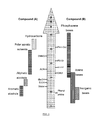
- Figure 1 shows the hydrogen acidity scale for first compound (A) and basicity scale for second compound (B) .
- the present invention is distinct from prior art by the fact that the composition of the eluting solution allows to release the [18F] activity from the anion exchange resin, so that the recovered solution is reactive and immediately usable for the labeling reactions without a further evaporation step.
- the eluting medium is an organic solution containing at least the following components: a first compound (A) which is a molecule that contains a least one acidic hydrogen and a second compound (B) that is a base sufficiently strong to be able to tear off the acidic hydrogen of compound (A) in an acid-base reaction, which leads to the formation of a salt (S).
- the occurrence of this reaction is related to the pKa of the acid hydrogen of first compound (A) and the pKA of the conjugated acid of the basic second compound (B), the one of the first compound (A) has to be lower than the one of conjugated acid of the second compound (B).
- This salt (S) brings anions that can exchange with the fluoride trapped on the resin and cations that allows the fluoride to be solubilized in the eluting medium, and of the excess of first compound (A) or second compound (B), which may enhance the solvation of the ions in the organic medium.
- said elution process is performed by passing the eluting solution through a solid phase extraction column containing an anion exchange resin.
- the [18F] fluoride is released from the resin in the eluting medium as specified above and is immediately usable for efficient radiolabeling.
- the column prior to the elution process, is rinsed with an organic solvent that allows the elimination of the residual water that may be undesirable for a subsequent chemical processing, whilst keeping the extracted anions trapped on the resin.
- this organic solvent can be selected among acetonitrile (ACN), dimethylsulfoxide (DMSO), dimethylacetamide, dimethylformamide (DMF), tetrahydrofuran (THF), diethylether, dioxane, ethyl acetate, acetone, isobutyroninitrile, benzonitrile, pyridine, diethylcarbonate, sulfolane, hexamethylphosphotriamide (HMPA/HMPT), etc. or a mix of these solvents.
- ACN acetonitrile
- DMSO dimethylsulfoxide
- DMF dimethylformamide
- THF tetrahydrofuran
- diethylether diethylether
- dioxane dioxane
- ethyl acetate acetone
- isobutyroninitrile benzonitrile
- pyridine diethylcarbonate
- sulfolane hexamethyl
- a non-polar organic solvent such as an hydrocarbon or an alkane
- a non-polar organic solvent such as an hydrocarbon or an alkane
- the non-polar organic solvent is selected in the group consisting of pentane, hexane, heptane, octane, nonane, decane and cyclohexane.
- a drying step comprising a flush of gas such as air, nitrogen or argon can be used to purge the column and eliminate most of the remaining solvent.
- this drying step is assisted by heating up the anion-exchange resin directly or using the flushing gas.
- the eluting medium is a low water content organic solution of the first compound (A) which is a molecule that contains a least one acidic hydrogen and a second compound (B) that is a base sufficiently strong to be able to tear off the acidic hydrogen of compound (A) in an acid-base reaction to form a salt (S). All these compounds are selected in such a way that it does not impact unfavorably on the yield of the subsequent labeling reaction.
- the organic solvent used to elute the anion exchange resin is preferably selected from the group consisting of acetonitrile (ACN), dimethylsulfoxide (DMSO), dimethylacetamide, dimethylformamide (DMF), tetrahydrofuran (THF), diethylether, dioxane, ethyl acetate, acetone, isobutyroninitrile, benzonitrile, pyridine, diethylcarbonate, sulfolane, hexamethylphosphotriamide (HMPA/HMPT), nitromethane, etc. and a mix of these solvents.
- ACN acetonitrile
- DMSO dimethylsulfoxide
- DMF dimethylformamide
- THF tetrahydrofuran
- diethylether diethylether
- dioxane dioxane
- ethyl acetate acetone
- isobutyroninitrile benzonitrile
- this solvent suitable for the labeling step is the first compound (A) of the present invention.
- the solvent used to elute the anion-exchange resin is first compound (A).
- the solvent used to elute the anion-exchange resin is second compound (B).
- the eluting medium is heated up to enhance the elution efficiency.
- the eluted medium is diluted in a solvent suitable for the labeling step such as acetonitrile (ACN), dimethylsulfoxide (DMSO), dimethylformamide (DMF), tetrahydrofuran (THF), dioxane, ethyl acetate, sulfolane, hexamethylphosphotriamide (HMPA/HMPT), nitromethane, etc. and a mix of these solvents.
- ACN acetonitrile
- DMSO dimethylsulfoxide
- DMF dimethylformamide
- THF tetrahydrofuran
- dioxane dioxane
- ethyl acetate sulfolane
- sulfolane hexamethylphosphotriamide
- HMPA/HMPT hexamethylphosphotriamide
- the first compound (A) is water.
- the first compound (A) used for the elution process is preferably selected from the group consisting of primary alcohols such as methanol, ethanol, n-propanol, n-butanol, amyl alcohol, n-hexyl alcohol, n-heptanol, benzyl alcohol or n-octanol; secondary alcohols such as isopropanol, isobutanol, isoamyl alcohol, and 3-pentanol
- primary alcohols such as methanol, ethanol, n-propanol, n-butanol, amyl alcohol, n-hexyl alcohol, n-heptanol, benzyl alcohol or n-octanol
- secondary alcohols such as isopropanol, isobutanol, isoamyl alcohol, and 3-pentanol
- the first compound (A) used for the elution process is preferably selected from the group consisting of tertiary alcohols, diols and polyols with 1 to 20 tertiary alcohol functions such as t-butanol, t-amyl alcohol, 2,3-dimethyl-2-butanol, 2-(trifluoromethyl)-2-propanol, 2,8-dimethyl-2,8-Decanediol and 2,5-dimethyl-3-Octyne-2,5-diol.
- tertiary alcohols such as t-butanol, t-amyl alcohol, 2,3-dimethyl-2-butanol, 2-(trifluoromethyl)-2-propanol, 2,8-dimethyl-2,8-Decanediol and 2,5-dimethyl-3-Octyne-2,5-diol.
- the first compound (A) used for the elution process is preferably selected from the group consisting of aromatic alcohols such as phenols, with 1 to 20 phenol functions.
- the compound (A) used for the elution process is preferably selected in the group of carboxylic acids such as for example acetic acid, oxalic acid, citric acid, etc.
- the second compound (B) is an organic base such as for example 2,4,6-Trimethylpyridine, 2,4,6-Collidine, 2-tert-Butyl-1,1,3,3-tetramethyl-guanidine, 2,3,4,6,7,8,9,10-Octahydropyrimidol[1,2-a]azepine, 1,4-Diazabicyclo(2.2.2)octane (TED), Triethylenediamine, N,N-Dicyclohexylmethylamine, N,N-Diethylaniline, N,N-Diisopropyl-2-ethylbutylamine, 2,6-Di-tert-butyl-4-methylpyridine, N-Ethyldiisopropylamine, 2,6-Lutidine, 2,6-Dimethylpyridine, 7-Methyl-1,5,7-triazabicyclo(4.4.0)dec-5-ene (MTBD), 1,3,4,6,7,8-trimethylpyrimidol
- the second compound (B) is preferably a phosphazene base such as 2-tert-Butylimino-2-diethylamino-1,3-dimethylperhydro-1,3,2-diazaphosphorine, tert-Butylimino-tris(dimethylamino)phosphorane, 1,1,1,3,3,3-Hexakis(dimethylamino)diphosphazenium fluoride, Imino-tris(dimethylamino)phosphorane, Phosphazene base P1-t-Bu, Phosphazene base P2-t-Bu, Phosphazene base P4-t-Bu, Tetrakis[tris(dimethylamino)phosphoranylidenamino] phosphonium fluoride.
- a phosphazene base such as 2-tert-Butylimino-2-diethylamino-1,3-dimethylperhydro-1,3,2-diazaphosphorine, tert-Butylim
- the second compound (B) is preferably a Verkade's base such as 2,8,9-Triisopropyl-2,5,8,9-tetraaza-1-phosphabicyclo[3.3.3]undecane and 2,8,9-Triisobutyl-2,5,8,9-tetraaza-1-phosphabicyclo[3.3.3]undecane.
- the functionalities brought by first compound A and second compound B can be on the same molecule, this molecule being used in the eluting medium.
- the precursor for the labeling reaction is contained in the eluting medium.
- the eluted organic solution containing the [18F] fluoride can be used for the synthesis of a PET radiotracer.
- the [18F] fluoride is then reactive for substitution reactions on both aliphatic and aromatic precursors.
- a suitable organic base i.e. compound (B)
- compound (B) identical to or different of the one used for the elution process can be added prior to labeling in the eluted [18F] fluoride solution to neutralize the excess of compound (A) present in the eluted medium after the elution process.
- a suitable organic molecule containing an acidic hydrogen i.e. compound (A)
- compound (A) identical to or different of the one used for the elution process
- compound (B) identical to or different of the one used for the elution process
- the cartridge was rinsed with 2 mL of acetonitrile.
- the cartridge was rinsed with 2 mL of acetonitrile.
- the cartridge was rinsed with 2 mL of acetonitrile.
- the cartridge was rinsed with 2 mL of acetonitrile.
Landscapes
- Chemical & Material Sciences (AREA)
- Analytical Chemistry (AREA)
- Chemical Kinetics & Catalysis (AREA)
- Organic Low-Molecular-Weight Compounds And Preparation Thereof (AREA)
- Medicines Containing Antibodies Or Antigens For Use As Internal Diagnostic Agents (AREA)
Abstract
The present invention relates to a method to extract out of an aqueous solution, concentrate and/or reformulate [18F] fluorides without any evaporation step characterised in that the eluting solution is a low water content, preferably <3% water, organic solution containing at least:
- a first compound (A) which is a molecule containing at least one acidic hydrogen and
- a second compound (B) which is a base sufficiently strong to be able to tear off the acidic hydrogen of first compound (A) in an acid-base reaction leading to the formation of a salt (S).
- a first compound (A) which is a molecule containing at least one acidic hydrogen and
- a second compound (B) which is a base sufficiently strong to be able to tear off the acidic hydrogen of first compound (A) in an acid-base reaction leading to the formation of a salt (S).
Description
- The present invention relates to methods for the preparation of reactive [18F] fluoride in a form suitable for efficient radiolabeling without an evaporation step by the use of an anion exchange resin and strong organic bases.
- [18F] fluoride is produced by irradiation of water, containing H2 18O, with protons resulting in the reaction 18O(p, n) 18F. Only a minor fraction of the [180] is converted. The [18F] isotope is then separated from the water and processed for production of a radiopharmaceutical agent.
- In the current practice, fluoride recovery is based on the use of an anion-exchange resin. The recovery is carried out in two steps, extraction and elution: first the anions (not only fluoride) are separated from the enriched [180] water and trapped on the said resin. The anions, including [18F] fluoride, are then eluted into a mixture containing water, organic solvents, an activating agent or phase transfer agent or phase transfer catalyst, such as for example the complex potassium carbonate-Kryptofix 222 (K2CO3-K222) or a tetrabutylammonium salt. The [18F] fluoride radiochemical recovery yield is very effective, usually exceeding 99%.
- The most usual labeling method, known as nucleophilic substitution, requires anhydrous or very low water content solutions. Thus, an evaporation step (or drying step) is still necessary after recovery to remove the excess water. It usually consists in multiple azeotropic evaporations of acetonitrile or of low boiling temperature organic solvent. Such evaporations require several minutes.
- The current trend in the automation of the preparation of radiopharmaceuticals for medical imaging is to develop "Lab-on-chip" devices. The aforementioned evaporation step is very difficult to implement within such a "Lab-on-chip" device.
- The current invention aims at avoiding the need for any evaporation at the stage of the elution on the anion-exchange resin.
- Further the invention aim to reduce the preparation duration, which results in an increase of the overall yield.
- A still further aim of the invention is to simplify the automated equipment used for the synthesis of a radiotracer.
- Further the invention aims at making the method suitable for implementation into automated "Lab-on-chip" systems.
-
Figure 1 shows the hydrogen acidity scale for first compound (A) and basicity scale for second compound (B) . - The present invention is distinct from prior art by the fact that the composition of the eluting solution allows to release the [18F] activity from the anion exchange resin, so that the recovered solution is reactive and immediately usable for the labeling reactions without a further evaporation step. The eluting medium is an organic solution containing at least the following components: a first compound (A) which is a molecule that contains a least one acidic hydrogen and a second compound (B) that is a base sufficiently strong to be able to tear off the acidic hydrogen of compound (A) in an acid-base reaction, which leads to the formation of a salt (S). The occurrence of this reaction is related to the pKa of the acid hydrogen of first compound (A) and the pKA of the conjugated acid of the basic second compound (B), the one of the first compound (A) has to be lower than the one of conjugated acid of the second compound (B). The elution process is made possible by the combined effects of this salt (S), which brings anions that can exchange with the fluoride trapped on the resin and cations that allows the fluoride to be solubilized in the eluting medium, and of the excess of first compound (A) or second compound (B), which may enhance the solvation of the ions in the organic medium. The smaller the anion of said salt and the more the negative charge is localized on this anion, the more this anion exchange process that allows the release of the [18F] activity from the anion exchange resin is efficient. In this process, the [18F] activity remains in solution at all times, contrary to the prior art where it is recovered in a "dry form" on the surface of a reactor, as a result of an evaporation step.
- According to the present invention, said elution process is performed by passing the eluting solution through a solid phase extraction column containing an anion exchange resin. The [18F] fluoride is released from the resin in the eluting medium as specified above and is immediately usable for efficient radiolabeling.
- In some embodiments of the present invention, prior to the elution process, the column is rinsed with an organic solvent that allows the elimination of the residual water that may be undesirable for a subsequent chemical processing, whilst keeping the extracted anions trapped on the resin.
- In some embodiments of the present invention, this organic solvent can be selected among acetonitrile (ACN), dimethylsulfoxide (DMSO), dimethylacetamide, dimethylformamide (DMF), tetrahydrofuran (THF), diethylether, dioxane, ethyl acetate, acetone, isobutyroninitrile, benzonitrile, pyridine, diethylcarbonate, sulfolane, hexamethylphosphotriamide (HMPA/HMPT), etc. or a mix of these solvents.
- In some embodiments of the present invention, a non-polar organic solvent, such as an hydrocarbon or an alkane, is passed through the column to eliminate most of the remaining water, whilst keeping the extracted anions trapped on the resin.
- In some preferred embodiments of the present invention, the non-polar organic solvent is selected in the group consisting of pentane, hexane, heptane, octane, nonane, decane and cyclohexane.
- In some embodiments of the present invention, prior to the elution process, a drying step comprising a flush of gas such as air, nitrogen or argon can be used to purge the column and eliminate most of the remaining solvent.
- In some embodiments of the invention this drying step is assisted by heating up the anion-exchange resin directly or using the flushing gas.
- More specifically, according to the invention, the eluting medium is a low water content organic solution of the first compound (A) which is a molecule that contains a least one acidic hydrogen and a second compound (B) that is a base sufficiently strong to be able to tear off the acidic hydrogen of compound (A) in an acid-base reaction to form a salt (S). All these compounds are selected in such a way that it does not impact unfavorably on the yield of the subsequent labeling reaction.
- In some embodiments of the invention, the organic solvent used to elute the anion exchange resin is preferably selected from the group consisting of acetonitrile (ACN), dimethylsulfoxide (DMSO), dimethylacetamide, dimethylformamide (DMF), tetrahydrofuran (THF), diethylether, dioxane, ethyl acetate, acetone, isobutyroninitrile, benzonitrile, pyridine, diethylcarbonate, sulfolane, hexamethylphosphotriamide (HMPA/HMPT), nitromethane, etc. and a mix of these solvents.
- In some embodiment of the invention this solvent suitable for the labeling step is the first compound (A) of the present invention.
- In some embodiments of the invention, the solvent used to elute the anion-exchange resin is first compound (A).
- In some embodiments of the invention, the solvent used to elute the anion-exchange resin is second compound (B).
- In some embodiments of the present invention the eluting medium is heated up to enhance the elution efficiency.
- In some embodiments of the invention the eluted medium is diluted in a solvent suitable for the labeling step such as acetonitrile (ACN), dimethylsulfoxide (DMSO), dimethylformamide (DMF), tetrahydrofuran (THF), dioxane, ethyl acetate, sulfolane, hexamethylphosphotriamide (HMPA/HMPT), nitromethane, etc. and a mix of these solvents.
- In some embodiments of the invention the first compound (A) is water.
- In some embodiments of the present invention, the first compound (A) used for the elution process is preferably selected from the group consisting of primary alcohols such as methanol, ethanol, n-propanol, n-butanol, amyl alcohol, n-hexyl alcohol, n-heptanol, benzyl alcohol or n-octanol; secondary alcohols such as isopropanol, isobutanol, isoamyl alcohol, and 3-pentanol
- In some embodiments of the present invention, the first compound (A) used for the elution process is preferably selected from the group consisting of tertiary alcohols, diols and polyols with 1 to 20 tertiary alcohol functions such as t-butanol, t-amyl alcohol, 2,3-dimethyl-2-butanol, 2-(trifluoromethyl)-2-propanol, 2,8-dimethyl-2,8-Decanediol and 2,5-dimethyl-3-Octyne-2,5-diol.
- In some embodiments of the present invention, the first compound (A) used for the elution process is preferably selected from the group consisting of aromatic alcohols such as phenols, with 1 to 20 phenol functions.
- In some embodiments of the present invention, the compound (A) used for the elution process is preferably selected in the group of carboxylic acids such as for example acetic acid, oxalic acid, citric acid, etc.
- In some embodiments of the present invention, the second compound (B) is an organic base such as for example 2,4,6-Trimethylpyridine, 2,4,6-Collidine, 2-tert-Butyl-1,1,3,3-tetramethyl-guanidine, 2,3,4,6,7,8,9,10-Octahydropyrimidol[1,2-a]azepine, 1,4-Diazabicyclo(2.2.2)octane (TED), Triethylenediamine, N,N-Dicyclohexylmethylamine, N,N-Diethylaniline, N,N-Diisopropyl-2-ethylbutylamine, 2,6-Di-tert-butyl-4-methylpyridine, N-Ethyldiisopropylamine, 2,6-Lutidine, 2,6-Dimethylpyridine, 7-Methyl-1,5,7-triazabicyclo(4.4.0)dec-5-ene (MTBD), 1,3,4,6,7,8-Hexahydro-1-methyl-2H-pyrimido[1,2-a]pyrimidine, 3,3,6,9,9-Pentamethyl-2,10-diazabicyclo-(4.4.0)dec-1-ene (PMDBD), 1,2,3,4,4a,5,6,7-Octahydro-2,2,4a,7,7-pentamethylnaphthyridine, 1,2,2,6,6-Pentamethylpiperidine (PMP), pempidine, 1,1,3,3-Tetramethylguanidine (TMG), N,N,N',N'-Tetramethyl-1,8-naphthalenediamine, 2,2,6,6-Tetramethylpiperidine (TMP), 1,5,7-Triazabicyclo(4.4.0)dec-5-ene, 1,3,4,6,7,8-Hexahydro-2H-pyrimido[1,2-a]pyrimidine (TBD), 2,4,6-Tri-tert-butylpyridine, Tris(trimethylsilyl)amine, Quinuclidine, 1,5,7-Triazabicyclo(4.4.0)dec-5-ene (TBD), 7-Methyl-1,5,7-triazabicyclo(4.4.0)dec-5-ene (MTBD), 1,8-Diazabicyclo[5.4.0]undec-7-ene (DBU), 1,5-Diazabicyclo[4.3.0]non-5-ene (DBN), 1,1,3,3-Tetramethylguanidine (TMG), Quinuclidine, 2,2,6,6-Tetramethylpiperidine (TMP), Pempidine (PMP), Tributlyamine, Triethylamine, 1,4-Diazabicyclo[2.2.2]octan (TED) 4-Dimethylaminopyridine (DMAP), 1,4-Diazabicyclo[2.2.2]octane (DABCO), 2,6-Lutidine, Pyridine (Py), alkylamines, dialkylamines, trialkylamines, Diisopropylethylamine (Hünig's Base).
- In some embodiments of the present invention, the second compound (B) is preferably a phosphazene base such as 2-tert-Butylimino-2-diethylamino-1,3-dimethylperhydro-1,3,2-diazaphosphorine, tert-Butylimino-tris(dimethylamino)phosphorane, 1,1,1,3,3,3-Hexakis(dimethylamino)diphosphazenium fluoride, Imino-tris(dimethylamino)phosphorane, Phosphazene base P1-t-Bu, Phosphazene base P2-t-Bu, Phosphazene base P4-t-Bu, Tetrakis[tris(dimethylamino)phosphoranylidenamino] phosphonium fluoride.
- In some embodiments of the present invention, the second compound (B) is preferably a Verkade's base such as 2,8,9-Triisopropyl-2,5,8,9-tetraaza-1-phosphabicyclo[3.3.3]undecane and 2,8,9-Triisobutyl-2,5,8,9-tetraaza-1-phosphabicyclo[3.3.3]undecane.
- In some embodiments of the invention, the functionalities brought by first compound A and second compound B can be on the same molecule, this molecule being used in the eluting medium.
- In some embodiments of the present invention, the precursor for the labeling reaction is contained in the eluting medium.
- The eluted organic solution containing the [18F] fluoride can be used for the synthesis of a PET radiotracer. The [18F] fluoride is then reactive for substitution reactions on both aliphatic and aromatic precursors.
- In some specific labeling reactions, a suitable organic base, i.e. compound (B), identical to or different of the one used for the elution process can be added prior to labeling in the eluted [18F] fluoride solution to neutralize the excess of compound (A) present in the eluted medium after the elution process.
- In some specific labeling reactions, a suitable organic molecule containing an acidic hydrogen, i.e. compound (A), identical to or different of the one used for the elution process can be added prior to labeling in the eluted [18F] fluoride solution to neutralize the excess of compound (B) present in the eluted medium after the elution process.
- About 2 mCi was trapped on a QMA cartridge, (preconditioned with K2CO3, rinsed and dried).
- The cartridge was rinsed with 2 mL of acetonitrile.
- An elution was performed with a solution containing 120 µL of DBU, 120 µL of water and 2 mL of ACN. 89% of the activity was eluted.
- About 2 mCi was trapped on a QMA cartridge, (preconditioned with K2CO3, rinsed and dried).
- The cartridge was rinsed with 2 mL of acetonitrile.
- An elution was performed with a solution containing 120 µL of Phosphazene base P1-t-Bu, 120 mg of 2,8-dimethyl-2,8-Decanediol and 2 mL of ACN. 76% of the activity was eluted.
- About 2 mCi was trapped on a QMA cartridge, (preconditioned with K2CO3, rinsed and dried).
- The cartridge was rinsed with 2 mL of acetonitrile.
- An elution was performed with a solution containing 120 µL of Phosphazene base P4-t-Oct (1M in hexane) and 2 mL of ACN. 96% of the activity was eluted.
- About 2 mCi was trapped on a QMA cartridge, (preconditioned with K2CO3, rinsed and dried).
- The cartridge was rinsed with 2 mL of acetonitrile.
- An elution was performed with a solution containing 120 µL of Phosphazene base P1-t-Bu, 120 µL of water and 0,5 mL of ACN. 98% of the activity was eluted.
- This elution was followed by a labeling step using 400 µL of the eluted fluoride, 1.5 mL of ACN and 40 mg of mannose triflate. The radioTLC labeling yield was 94%.
Claims (26)
- A method to extract out of an aqueous solution, concentrate and/or reformulate [18F] fluorides without any evaporation step, said method comprising the following steps of :- passing said aqueous [18F] fluoride solution or solvent through a solid phase extraction column containing an anion-exchange resin so that said [18F] fluorides are trapped on said resin ;- eluting said [18F] fluorides with an eluting solution so that to release said [18F] fluorides from said anion-exchange resin under the form of a solution which is reactive and immediately usable for a labeling reaction ;characterised in that the eluting solution is a low water content, preferably <3% water, organic solution containing at least:- a first compound (A) which is a molecule containing at least one acidic hydrogen and- a second compound (B) which is a base sufficiently strong to be able to tear off the acidic hydrogen of first compound (A) in an acid-base reaction leading to the formation of a salt (S).
- Method according to Claim 1, characterised in that, prior to the elution process, the column is rinsed with an organic solvent for eliminating the residual water that may be undesirable for a subsequent chemical processing, whilst keeping the extracted anions trapped on the resin.
- Method according to Claim 2, characterised in that said organic solvent is selected from the group consisting of acetonitrile (ACN), dimethylsulfoxide (DMSO), dimethylacetamide, dimethylformamide (DMF), tetrahydrofuran (THF), diethylether, dioxane, ethyl acetate, acetone, isobutyroninitrile, benzonitrile, pyridine, diethylcarbonate, sulfolane, hexamethylphosphotriamide (HMPA/HMPT) and a mix of these solvents.
- Method according to Claim 1, characterised in that a non-polar organic solvent, such as an hydrocarbon or an alkane, is passed through the column to eliminate most of the remaining water, whilst keeping the extracted anions trapped on the resin.
- Method according to Claim 4, characterised in that the non-polar organic solvent is selected from the group consisting of pentane, hexane, heptane, octane, nonane, decane and cyclohexane.
- Method according to Claim 1, characterised in that, prior to the elution process, a drying step comprising a flush of gas such as air, nitrogen or argon, is used to purge the column and eliminate most of the remaining solvent.
- Method according to Claim 6, characterised in that said drying step is assisted by heating up the anion-exchange resin directly or using the flushing gas.
- Method according to Claim 1, characterised in that the organic solvent used to elute the anion exchange resin is selected from the group consisting of acetonitrile (ACN), dimethylsulfoxide (DMSO), dimethylacetamide, dimethylformamide (DMF), tetrahydrofuran (THF), diethylether, dioxane, ethyl acetate, acetone, isobutyroninitrile, benzonitrile, pyridine, diethylcarbonate, sulfolane, hexamethylphosphotriamide (HMPA/HMPT), nitro-methane and a mix of these solvents.
- Method according to Claim 1, characterised in that the solvent suitable for the labeling step is first compound (A).
- Method according to Claim 1, characterised in that the solvent used to elute the anion- exchange resin is first compound (A).
- Method according to Claim 1, characterised in that the solvent used to elute the anion- exchange resin is second compound (B).
- Method according to Claim 1, characterised in that the eluting medium is heated up to enhance the elution efficiency.
- Method according to Claim 1, characterised in that the eluted medium is diluted in a solvent suitable for the labeling step selected from the group consisting of acetonitrile (ACN), dimethylsulfoxide (DMSO), dimethylformamide (DMF), tetrahydrofuran (THF), dioxane, ethyl acetate, sulfolane, hexamethylphosphotriamide (HMPA/HMPT), nitromethane and a mix of these solvents.
- Method according to Claim 1, characterised in that the first compound (A) is water.
- Method according to Claim 1, characterised in that the first compound (A) used for the elution process is selected from the group consisting of primary alcohols such as methanol, ethanol, n-propanol, n-butanol, amyl alcohol, n-hexyl alcohol, n-heptanol, benzyl alcohol or n-octanol; secondary alcohols such as isopropanol, isobutanol, isoamyl alcohol, and 3-pentanol.
- Method according to Claim 1, characterised in that the first compound (A) used for the elution process is selected from the group consisting of tertiary alcohols, diols and polyols with 1 to 20 tertiary alcohol functions such as t-butanol, t-amyl alcohol, 2,3-dimethyl-2-butanol, 2-(trifluoromethyl)-2-propanol, 2,8-dimethyl-2,8-Decanediol and 2,5-dimethyl-3-Octyne-2,5-diol.
- Method according to Claim 1, characterised in that the first compound (A) used for the elution process is selected from the group consisting of aromatic alcohols such as phenols, with 1 to 20 phenol functions.
- Method according to Claim 1, characterised in that the first compound (A) used for the elution process is selected from the group consisting of carboxylic acids such as acetic acid, oxalic acid and citric acid.
- Method according to Claim 1, characterised in that the second compound (B) is an organic base selected from the group consisting of 2,4,6-Trimethylpyridine, 2,4,6-Collidine, 2-tert-Butyl-1,1,3,3-tetramethyl-guanidine, 2,3,4,6,7,8,9,10-Octahydropyrimidol[1,2-a]azepine, 1,4-Diazabicyclo(2.2.2)octane (TED), Triethylenediamine, N,N-Dicyclohexylmethylamine, N,N-Diethylaniline, N,N-Diiso-propyl-2-ethylbutylamine, 2,6-Di-tert-butyl-4-methyl-pyridine, N-Ethyldiisopropylamine, 2,6-Lutidine, 2,6-Dimethylpyridine, 7-Methyl-1,5,7-triazabicyclo(4.4.0)dec-5-ene (MTBD), 1,3,4,6,7,8-Hexahydro-1-methyl-2H-pyrimido [1,2-a]pyrimidine, 3,3,6,9,9-Pentamethyl-2,10-diazabi-cyclo-(4.4.0)dec-1-ene (PMDBD), 1,2,3,4,4a,5,6,7-Octahydro-2,2,4a,7,7-pentamethylnaphthyridine, 1,2,2,6,6-Penta-methylpiperidine (PMP), pempidine, 1,1,3,3-Tetramethyl-guanidine (TMG), N,N,N',N'-Tetramethyl-1,8-naphthalene-diamine, 2,2,6,6-Tetramethylpiperidine (TMP), 1,5,7-Triazabicyclo(4.4.0)dec-5-ene, 1,3,4,6,7,8-Hexahydro-2H-pyrimido[1,2-a]pyrimidine (TBD), 2,4,6-Tri-tert-butylpyridine, Tris(trimethylsilyl)amine, Quinuclidine, 1,5,7-Triazabicyclo(4.4.0)dec-5-ene (TBD), 7-Methyl-1,5,7-triazabicyclo(4.4.0)dec-5-ene (MTBD), 1,8-Diazabicyclo [5.4.0] undec-7-ene (DBU), 1, 5-Diazabicyclo [4.3.0] non-5-ene (DBN), 1,1,3,3-Tetramethylguanidine (TMG), Quinuclidine, 2,2,6,6-Tetramethylpiperidine (TMP), Pempidine (PMP), Tributlyamine, Triethylamine, 1,4-Diazabicyclo[2.2.2]octan (TED), 4-Dimethylaminopyridine (DMAP), 1,4-Diazabicyclo[2.2.2]octane (DABCO), 2,6-Lutidine, Pyridine (Py), alkylamines, dialkylamines, trialkylamines, Diisopropylethylamine (Hünig's Base).
- Method according to Claim 1, characterised in that the compound (B) is a phosphazene base selected from the group consisting of 2-tert-Butylimino-2-diethylamino-1,3-dimethyl-perhydro-1,3,2-diazaphosphorine, tert-Butylimino-tris(dimethylamino)phosphorane, 1,1,1,3,3,3-Hexakis (dimethylamino)diphosphazenium fluoride, Imino-tris (dimethylamino)phosphorane, Phosphazene base P1-t-Bu, Phosphazene base P2-t-Bu, Phosphazene base P4-t-Bu and Tetrakis[tris(dimethylamino)phosphoranylidenamino] phosphonium fluoride.
- Method according to Claim 1, characterised in that the second compound (B) is a Verkade's base such as 2,8,9-Triisopropyl-2,5,8,9-tetraaza-1-phosphabicyclo[3.3.3]undecane and 2,8,9-Triisobutyl-2,5,8,9-tetraaza-1-phosphabicyclo[3.3.3]undecane.
- Method according to Claim 1, characterised in that the functionalities brought by compound A and compound B can be on the same molecule, this molecule being used in the eluting medium.
- Method according to Claim 1, characterised in that a precursor for the labeling reaction is contained in the eluting medium.
- Method according to Claim 1, characterised in that the eluted organic solution containing the [18F] fluoride is used for the synthesis of a PET radiotracer, the [18F] fluoride being then reactive for substitution reactions on both aliphatic and aromatic precursors.
- Method according to Claim 1, characterised in that, in some specific labeling reactions, a suitable organic base taken as second compound (B) identical to or different of the one used for the elution process is added prior to labeling in the eluted [18F] fluoride solution to neutralize the excess of first compound (A) present in the eluted medium after the elution process.
- Method according to Claim 1, characterised in that, in some specific labeling reactions, a suitable organic molecule containing an acidic hydrogen as first compound (A) identical to or different of the one used for the elution process is added prior to labeling in the eluted [18F] fluoride solution to neutralize the excess of second compound (B) present in the eluted medium after the elution process.
Priority Applications (5)
| Application Number | Priority Date | Filing Date | Title |
|---|---|---|---|
| EP07447064A EP2062630A1 (en) | 2007-11-20 | 2007-11-20 | Method for the direct elution of reactive 18F fluoride from an anion exchange resin in an organic medium by the use of strong organic bases |
| EP08783076A EP2164590B1 (en) | 2007-07-02 | 2008-07-01 | Method for the direct elution of reactive 18f fluoride from an anion exchange resin in an organic medium suitable for radiolabelling without any evaporation step by the use of strong organic bases |
| US12/664,615 US8491790B2 (en) | 2007-07-02 | 2008-07-01 | Method for the direct elution of reactive 18F fluoride from an anion exchange resin in an organic medium suitable for radiolabelling without any evaporation step by the use of strong organic bases |
| CN2008800226335A CN101687120B (en) | 2007-07-02 | 2008-07-01 | Method for the direct elution of reactive 18F fluoride ions from anion exchange resins in organic media suitable for radiolabeling by using a strong organic base without any evaporation step |
| PCT/BE2008/000048 WO2009003251A1 (en) | 2007-07-02 | 2008-07-01 | Method for the direct elution of reactive 18f fluoride from an anion exchange resin in an organic medium suitable for radiolabelling without any evaporation step by the use of strong organic bases |
Applications Claiming Priority (1)
| Application Number | Priority Date | Filing Date | Title |
|---|---|---|---|
| EP07447064A EP2062630A1 (en) | 2007-11-20 | 2007-11-20 | Method for the direct elution of reactive 18F fluoride from an anion exchange resin in an organic medium by the use of strong organic bases |
Publications (1)
| Publication Number | Publication Date |
|---|---|
| EP2062630A1 true EP2062630A1 (en) | 2009-05-27 |
Family
ID=39145419
Family Applications (2)
| Application Number | Title | Priority Date | Filing Date |
|---|---|---|---|
| EP07447064A Withdrawn EP2062630A1 (en) | 2007-07-02 | 2007-11-20 | Method for the direct elution of reactive 18F fluoride from an anion exchange resin in an organic medium by the use of strong organic bases |
| EP08783076A Not-in-force EP2164590B1 (en) | 2007-07-02 | 2008-07-01 | Method for the direct elution of reactive 18f fluoride from an anion exchange resin in an organic medium suitable for radiolabelling without any evaporation step by the use of strong organic bases |
Family Applications After (1)
| Application Number | Title | Priority Date | Filing Date |
|---|---|---|---|
| EP08783076A Not-in-force EP2164590B1 (en) | 2007-07-02 | 2008-07-01 | Method for the direct elution of reactive 18f fluoride from an anion exchange resin in an organic medium suitable for radiolabelling without any evaporation step by the use of strong organic bases |
Country Status (4)
| Country | Link |
|---|---|
| US (1) | US8491790B2 (en) |
| EP (2) | EP2062630A1 (en) |
| CN (1) | CN101687120B (en) |
| WO (1) | WO2009003251A1 (en) |
Families Citing this family (16)
| Publication number | Priority date | Publication date | Assignee | Title |
|---|---|---|---|---|
| EP2017359A3 (en) * | 2007-06-11 | 2009-08-05 | Trasis S.A. | Method for the elution of 18F fluoride trapped on an anion-exchange resin in a form suitable for efficient radiolabeling without any evaporation step |
| EP1990310A1 (en) * | 2007-04-23 | 2008-11-12 | Trasis S.A. | Method for the preparation of reactive 18F fluoride, and for the labeling of radiotracers, using a modified non-ionic solid support and without any evaporation step |
| EP2062630A1 (en) * | 2007-11-20 | 2009-05-27 | Trasis S.A. | Method for the direct elution of reactive 18F fluoride from an anion exchange resin in an organic medium by the use of strong organic bases |
| US9023316B2 (en) | 2010-04-08 | 2015-05-05 | Siemens Medical Solutions Usa, Inc. | Synthesis of 18F-labeled tracers in hydrous organic solvents |
| US10639608B2 (en) | 2010-04-08 | 2020-05-05 | Siemens Medical Solutions Usa, Inc. | System, device and method for preparing tracers and transferring materials during radiosynthesis |
| EP2569071B1 (en) | 2010-05-10 | 2015-07-08 | Technische Universität München | Method for the direct elution of reactive [18f]fluoride from an anion exchange resin in an organic medium suitable for radiolabelling without any evaporation step by the use of alkalimetal and alkaline earth metal cryptates |
| WO2012092394A1 (en) | 2010-12-29 | 2012-07-05 | Cardinal Health 414, Llc | Closed vial fill system for aseptic dispensing |
| US20130020727A1 (en) | 2011-07-15 | 2013-01-24 | Cardinal Health 414, Llc. | Modular cassette synthesis unit |
| WO2013012822A1 (en) | 2011-07-15 | 2013-01-24 | Cardinal Health 414, Llc | Systems, methods, and devices for producing, manufacturing, and control of radiopharmaceuticals |
| US20130022525A1 (en) * | 2011-07-15 | 2013-01-24 | Cardinal Health 414, Llc | Methods and compositions for drying in the preparation of radiopharmaceuticals |
| US9417332B2 (en) | 2011-07-15 | 2016-08-16 | Cardinal Health 414, Llc | Radiopharmaceutical CZT sensor and apparatus |
| US9067189B2 (en) | 2012-03-30 | 2015-06-30 | General Electric Company | Microfluidic device and a related method thereof |
| US9321866B2 (en) | 2012-06-11 | 2016-04-26 | The Regents Of The University Of Calfiornia | Polymer monoliths for solvent exchange in continuous flow microfluidic device |
| WO2014020035A1 (en) * | 2012-07-30 | 2014-02-06 | Technical University Of Denmark | Radiofluorination method |
| ES2912753T3 (en) | 2014-08-24 | 2022-05-27 | Max Planck Gesellschaft Zur Foerderung Der Wss | Method for the production of 18F-labeled active esters and their application exemplified by the preparation of a PSMA-specific PET label |
| CN118771310A (en) * | 2024-06-14 | 2024-10-15 | 四川大学华西医院 | A non-drying 18F-solution and its preparation method and application |
Citations (2)
| Publication number | Priority date | Publication date | Assignee | Title |
|---|---|---|---|---|
| WO1994021653A1 (en) * | 1993-03-22 | 1994-09-29 | General Electric Company | Method for making 2-fluoro-2-deoxyglucose |
| CN1887829A (en) * | 2006-06-23 | 2007-01-03 | 郭启勇 | Synthesis process of 18F lebeled positive electron radioactive tracer with ionic liquid as phase transfer catalyst |
Family Cites Families (7)
| Publication number | Priority date | Publication date | Assignee | Title |
|---|---|---|---|---|
| WO2005044758A1 (en) * | 2003-11-11 | 2005-05-19 | Nihon Medi-Physics Co., Ltd. | Process for producing radioactive-fluorine-labeled compound |
| EP1838431A4 (en) * | 2004-12-03 | 2012-08-22 | California Inst Of Techn | MICROFLUIDIC DEVICES WITH CIRCUITS FOR CHEMICAL REACTIONS |
| KR100789847B1 (en) | 2004-12-15 | 2007-12-28 | (주)퓨쳐켐 | Process for preparing organofluoro compound in alcohol solvent |
| US8206571B2 (en) * | 2006-06-27 | 2012-06-26 | Ge Healthcare Limited | Formation of [18F] fluoride complexes suitable for [18F] fluorinations |
| WO2008001098A1 (en) * | 2006-06-30 | 2008-01-03 | Ge Healthcare Limited | Electrochemical separation of [18f] fluoride from [180] water |
| EP2017359A3 (en) * | 2007-06-11 | 2009-08-05 | Trasis S.A. | Method for the elution of 18F fluoride trapped on an anion-exchange resin in a form suitable for efficient radiolabeling without any evaporation step |
| EP2062630A1 (en) * | 2007-11-20 | 2009-05-27 | Trasis S.A. | Method for the direct elution of reactive 18F fluoride from an anion exchange resin in an organic medium by the use of strong organic bases |
-
2007
- 2007-11-20 EP EP07447064A patent/EP2062630A1/en not_active Withdrawn
-
2008
- 2008-07-01 EP EP08783076A patent/EP2164590B1/en not_active Not-in-force
- 2008-07-01 WO PCT/BE2008/000048 patent/WO2009003251A1/en not_active Ceased
- 2008-07-01 CN CN2008800226335A patent/CN101687120B/en not_active Expired - Fee Related
- 2008-07-01 US US12/664,615 patent/US8491790B2/en not_active Expired - Fee Related
Patent Citations (2)
| Publication number | Priority date | Publication date | Assignee | Title |
|---|---|---|---|---|
| WO1994021653A1 (en) * | 1993-03-22 | 1994-09-29 | General Electric Company | Method for making 2-fluoro-2-deoxyglucose |
| CN1887829A (en) * | 2006-06-23 | 2007-01-03 | 郭启勇 | Synthesis process of 18F lebeled positive electron radioactive tracer with ionic liquid as phase transfer catalyst |
Non-Patent Citations (5)
| Title |
|---|
| COGNEAU M ET AL: "Production of a high purity <18>F radioactive beam", NUCLEAR INSTRUMENTS & METHODS IN PHYSICS RESEARCH, SECTION - A: ACCELERATORS, SPECTROMETERS, DETECTORS AND ASSOCIATED EQUIPMENT, ELSEVIER, AMSTERDAM, NL, vol. 420, no. 3, 11 January 1999 (1999-01-11), pages 489 - 493, XP004152304, ISSN: 0168-9002 * |
| DATABASE WPI Week 200746, Derwent World Patents Index; AN 2007-469231, XP002472192 * |
| DOUGLAS M. JEWETT, STEVEN A. TOORONGIAN, MICHAEL A. BACHELOR AND MICHAEL R. KILBOURN: "Extraction of [18F]fluoride from [18O]water by a fast fibrous anion exchange resin", INTERNATIONAL JOURNAL OF RADIATION APPLICATIONS AND INSTRUMENTATION. PART A. (APPLIED RADIATION AND ISOTOPES), vol. 41, no. 6, 1990, pages 583 - 586, XP002472191 * |
| MUKHOPADHYAY ET AL: "Radiosynthesis of 2'-deoxy-2'-[<18>F]-fluoro-5-methyl-1-beta-l-arabin ofuranosyluracil ([<18>F]-l-FMAU) for PET", APPLIED RADIATION AND ISOTOPES, ELSEVIER, OXFORD, GB, vol. 65, no. 8, 10 July 2007 (2007-07-10), pages 941 - 946, XP022145198, ISSN: 0969-8043 * |
| VASDEV ET AL: "Syntheses and in vitro evaluation of fluorinated naphthoxazines as dopamine D2/D3 receptor agonists: radiosynthesis, ex vivo biodistribution and autoradiography of [<18>F]F-PHNO", NUCLEAR MEDICINE AND BIOLOGY, ELSEVIER, NY, US, vol. 34, no. 2, 15 February 2007 (2007-02-15), pages 195 - 203, XP005890920, ISSN: 0969-8051 * |
Also Published As
| Publication number | Publication date |
|---|---|
| CN101687120A (en) | 2010-03-31 |
| EP2164590A1 (en) | 2010-03-24 |
| US20100196254A1 (en) | 2010-08-05 |
| CN101687120B (en) | 2013-12-18 |
| WO2009003251A1 (en) | 2009-01-08 |
| EP2164590B1 (en) | 2013-03-06 |
| US8491790B2 (en) | 2013-07-23 |
Similar Documents
| Publication | Publication Date | Title |
|---|---|---|
| EP2164590B1 (en) | Method for the direct elution of reactive 18f fluoride from an anion exchange resin in an organic medium suitable for radiolabelling without any evaporation step by the use of strong organic bases | |
| EP1990310A1 (en) | Method for the preparation of reactive 18F fluoride, and for the labeling of radiotracers, using a modified non-ionic solid support and without any evaporation step | |
| EP2115177B1 (en) | Method for the elution of 18f fluoride trapped on an anion-exchange phase in a form suitable for efficient radiolabeling without any evaporation step | |
| EP2406257B1 (en) | A new method for the preparation of solifenacin and new intermediate thereof | |
| US4599221A (en) | Recovery of uranium from wet process phosphoric acid by liquid-solid ion exchange | |
| US20100326918A1 (en) | Multi-column sequenced separation process for separating an ionic metal derivative | |
| EP1697383B1 (en) | Process for the purification of tacrolimus | |
| Zheng et al. | A novel process for erythromycin separation from fermentation broth by resin adsorption–aqueous crystallization | |
| WO2011141410A1 (en) | Method for the direct elution of reactive [18f]fluoride from an anion exchange resin in an organic medium suitable for radiolabelling without any evaporation step by the use of alkalimetal and alkaline earth metal cryptates | |
| CN104086564B (en) | A kind of preparation method of high-purity tamiros | |
| JP2008518237A (en) | Method for separation and purification of hydrocodone by preparative chromatography | |
| CN101142220A (en) | Isolation of Galantamine from Biological Material | |
| Abdellah et al. | Extraction of boron and vanadium from Abu Hamata alkali leach solution by using ion exchange resin | |
| US20170349535A1 (en) | Materials and methods for the selective recovery of monovalent products from aqueous solutions using continuous ion exchange | |
| DE3005163A1 (en) | Sepn. of molybdenum and vanadium by reactive ion exchange - where anion exchanger is treated with reducing agent so vanadate is removed as vanadyl salt soln | |
| RU2069868C1 (en) | Method for determination of radionuclides of strontium in natural objects | |
| Stan’kov et al. | Gas-chromatographic determination of trace S-[2-(N, N)-diethylamino) ethyl] methylphosphonothioic acid in water | |
| JP2010132573A (en) | Method for preparing catechins | |
| Ikin et al. | Non-aqueous Ion-Exchange Chromatography Using High Acid-base Concentration: A Strategy for Purifying Non-crystalline Pharmaceutical Intermediates. | |
| HK40015306A (en) | Solid phase conditioning | |
| NACHOD | NORMAN APPLEZWEIG | |
| Verkuijl | Chiral separation by enantioselective liquid-liquid extraction: from novel systems to continuous multistage processes | |
| HK40018023A (en) | Production method for radiohalogen-labeled compound and production method for raidopharmaceutical | |
| PL227247B1 (en) | Method for recovery of solvents from the production of poly(phenylene in the solvent/non-solvent system |
Legal Events
| Date | Code | Title | Description |
|---|---|---|---|
| PUAI | Public reference made under article 153(3) epc to a published international application that has entered the european phase |
Free format text: ORIGINAL CODE: 0009012 |
|
| AK | Designated contracting states |
Kind code of ref document: A1 Designated state(s): AT BE BG CH CY CZ DE DK EE ES FI FR GB GR HU IE IS IT LI LT LU LV MC MT NL PL PT RO SE SI SK TR |
|
| AX | Request for extension of the european patent |
Extension state: AL BA HR MK RS |
|
| AKX | Designation fees paid | ||
| REG | Reference to a national code |
Ref country code: DE Ref legal event code: 8566 |
|
| STAA | Information on the status of an ep patent application or granted ep patent |
Free format text: STATUS: THE APPLICATION IS DEEMED TO BE WITHDRAWN |
|
| 18D | Application deemed to be withdrawn |
Effective date: 20091130 |