EP2061459B1 - 3-(3-indolyl) propionic acid calcium salt and method of making 3-(3-indolyl) propionic acid free acid therefrom - Google Patents
3-(3-indolyl) propionic acid calcium salt and method of making 3-(3-indolyl) propionic acid free acid therefrom Download PDFInfo
- Publication number
- EP2061459B1 EP2061459B1 EP07814389A EP07814389A EP2061459B1 EP 2061459 B1 EP2061459 B1 EP 2061459B1 EP 07814389 A EP07814389 A EP 07814389A EP 07814389 A EP07814389 A EP 07814389A EP 2061459 B1 EP2061459 B1 EP 2061459B1
- Authority
- EP
- European Patent Office
- Prior art keywords
- ipa
- calcium
- acid
- indolyl
- water
- Prior art date
- Legal status (The legal status is an assumption and is not a legal conclusion. Google has not performed a legal analysis and makes no representation as to the accuracy of the status listed.)
- Active
Links
- 239000002253 acid Substances 0.000 title claims description 40
- GOLXRNDWAUTYKT-UHFFFAOYSA-N 3-(1H-indol-3-yl)propanoic acid Chemical compound C1=CC=C2C(CCC(=O)O)=CNC2=C1 GOLXRNDWAUTYKT-UHFFFAOYSA-N 0.000 title claims description 22
- AEDWFGVXKXHLEZ-UHFFFAOYSA-L calcium;3-(1h-indol-3-yl)propanoate Chemical compound [Ca+2].C1=CC=C2C(CCC(=O)[O-])=CNC2=C1.C1=CC=C2C(CCC(=O)[O-])=CNC2=C1 AEDWFGVXKXHLEZ-UHFFFAOYSA-L 0.000 title claims description 3
- 238000004519 manufacturing process Methods 0.000 title claims description 3
- 238000000034 method Methods 0.000 claims description 38
- 159000000007 calcium salts Chemical class 0.000 claims description 24
- 230000001376 precipitating effect Effects 0.000 claims description 2
- 238000005406 washing Methods 0.000 claims description 2
- 239000011575 calcium Substances 0.000 description 92
- OYPRJOBELJOOCE-UHFFFAOYSA-N Calcium Chemical compound [Ca] OYPRJOBELJOOCE-UHFFFAOYSA-N 0.000 description 91
- 229910052791 calcium Inorganic materials 0.000 description 91
- XEKOWRVHYACXOJ-UHFFFAOYSA-N Ethyl acetate Chemical compound CCOC(C)=O XEKOWRVHYACXOJ-UHFFFAOYSA-N 0.000 description 45
- XLYOFNOQVPJJNP-UHFFFAOYSA-N water Substances O XLYOFNOQVPJJNP-UHFFFAOYSA-N 0.000 description 44
- QTBSBXVTEAMEQO-UHFFFAOYSA-N Acetic acid Chemical compound CC(O)=O QTBSBXVTEAMEQO-UHFFFAOYSA-N 0.000 description 42
- 239000000203 mixture Substances 0.000 description 42
- 208000037265 diseases, disorders, signs and symptoms Diseases 0.000 description 29
- 239000000243 solution Substances 0.000 description 29
- 201000010099 disease Diseases 0.000 description 25
- 239000000546 pharmaceutical excipient Substances 0.000 description 20
- 239000000725 suspension Substances 0.000 description 20
- 239000008194 pharmaceutical composition Substances 0.000 description 17
- 239000003814 drug Substances 0.000 description 15
- LFQSCWFLJHTTHZ-UHFFFAOYSA-N Ethanol Chemical compound CCO LFQSCWFLJHTTHZ-UHFFFAOYSA-N 0.000 description 12
- SIKJAQJRHWYJAI-UHFFFAOYSA-N Indole Chemical compound C1=CC=C2NC=CC2=C1 SIKJAQJRHWYJAI-UHFFFAOYSA-N 0.000 description 12
- 150000001875 compounds Chemical class 0.000 description 12
- 238000001914 filtration Methods 0.000 description 12
- 238000009472 formulation Methods 0.000 description 12
- KFZMGEQAYNKOFK-UHFFFAOYSA-N Isopropanol Chemical compound CC(C)O KFZMGEQAYNKOFK-UHFFFAOYSA-N 0.000 description 11
- 235000002639 sodium chloride Nutrition 0.000 description 11
- WFDIJRYMOXRFFG-UHFFFAOYSA-N Acetic anhydride Chemical compound CC(=O)OC(C)=O WFDIJRYMOXRFFG-UHFFFAOYSA-N 0.000 description 10
- 230000015572 biosynthetic process Effects 0.000 description 10
- 239000003085 diluting agent Substances 0.000 description 10
- 108090000623 proteins and genes Proteins 0.000 description 10
- 239000002904 solvent Substances 0.000 description 10
- SMZOUWXMTYCWNB-UHFFFAOYSA-N 2-(2-methoxy-5-methylphenyl)ethanamine Chemical compound COC1=CC=C(C)C=C1CCN SMZOUWXMTYCWNB-UHFFFAOYSA-N 0.000 description 9
- NIXOWILDQLNWCW-UHFFFAOYSA-N 2-Propenoic acid Natural products OC(=O)C=C NIXOWILDQLNWCW-UHFFFAOYSA-N 0.000 description 9
- PEDCQBHIVMGVHV-UHFFFAOYSA-N Glycerine Chemical compound OCC(O)CO PEDCQBHIVMGVHV-UHFFFAOYSA-N 0.000 description 9
- 230000002600 fibrillogenic effect Effects 0.000 description 9
- 102000004169 proteins and genes Human genes 0.000 description 9
- 239000003826 tablet Substances 0.000 description 9
- IMNFDUFMRHMDMM-UHFFFAOYSA-N N-Heptane Chemical compound CCCCCCC IMNFDUFMRHMDMM-UHFFFAOYSA-N 0.000 description 8
- 210000004027 cell Anatomy 0.000 description 8
- 238000004128 high performance liquid chromatography Methods 0.000 description 8
- 230000036542 oxidative stress Effects 0.000 description 8
- 239000000843 powder Substances 0.000 description 8
- 238000002360 preparation method Methods 0.000 description 8
- 108090000765 processed proteins & peptides Proteins 0.000 description 8
- 239000011541 reaction mixture Substances 0.000 description 8
- 150000003839 salts Chemical class 0.000 description 8
- 241000124008 Mammalia Species 0.000 description 7
- 239000000543 intermediate Substances 0.000 description 7
- 102000004196 processed proteins & peptides Human genes 0.000 description 7
- 238000000746 purification Methods 0.000 description 7
- 150000003254 radicals Chemical class 0.000 description 7
- 108010090849 Amyloid beta-Peptides Proteins 0.000 description 6
- 102000013455 Amyloid beta-Peptides Human genes 0.000 description 6
- 229920000858 Cyclodextrin Polymers 0.000 description 6
- GUBGYTABKSRVRQ-QKKXKWKRSA-N Lactose Natural products OC[C@H]1O[C@@H](O[C@H]2[C@H](O)[C@@H](O)C(O)O[C@@H]2CO)[C@H](O)[C@@H](O)[C@H]1O GUBGYTABKSRVRQ-QKKXKWKRSA-N 0.000 description 6
- DNIAPMSPPWPWGF-UHFFFAOYSA-N Propylene glycol Chemical compound CC(O)CO DNIAPMSPPWPWGF-UHFFFAOYSA-N 0.000 description 6
- HEMHJVSKTPXQMS-UHFFFAOYSA-M Sodium hydroxide Chemical compound [OH-].[Na+] HEMHJVSKTPXQMS-UHFFFAOYSA-M 0.000 description 6
- 206010002022 amyloidosis Diseases 0.000 description 6
- VSGNNIFQASZAOI-UHFFFAOYSA-L calcium acetate Chemical compound [Ca+2].CC([O-])=O.CC([O-])=O VSGNNIFQASZAOI-UHFFFAOYSA-L 0.000 description 6
- 239000003795 chemical substances by application Substances 0.000 description 6
- 239000012065 filter cake Substances 0.000 description 6
- PZOUSPYUWWUPPK-UHFFFAOYSA-N indole Natural products CC1=CC=CC2=C1C=CN2 PZOUSPYUWWUPPK-UHFFFAOYSA-N 0.000 description 6
- RKJUIXBNRJVNHR-UHFFFAOYSA-N indolenine Natural products C1=CC=C2CC=NC2=C1 RKJUIXBNRJVNHR-UHFFFAOYSA-N 0.000 description 6
- 238000003786 synthesis reaction Methods 0.000 description 6
- 101710137189 Amyloid-beta A4 protein Proteins 0.000 description 5
- 101710151993 Amyloid-beta precursor protein Proteins 0.000 description 5
- 102100022704 Amyloid-beta precursor protein Human genes 0.000 description 5
- UXVMQQNJUSDDNG-UHFFFAOYSA-L Calcium chloride Chemical compound [Cl-].[Cl-].[Ca+2] UXVMQQNJUSDDNG-UHFFFAOYSA-L 0.000 description 5
- VEXZGXHMUGYJMC-UHFFFAOYSA-N Hydrochloric acid Chemical compound Cl VEXZGXHMUGYJMC-UHFFFAOYSA-N 0.000 description 5
- FAPWRFPIFSIZLT-UHFFFAOYSA-M Sodium chloride Chemical compound [Na+].[Cl-] FAPWRFPIFSIZLT-UHFFFAOYSA-M 0.000 description 5
- 229920002472 Starch Polymers 0.000 description 5
- DZHSAHHDTRWUTF-SIQRNXPUSA-N amyloid-beta polypeptide 42 Chemical compound C([C@@H](C(=O)N[C@@H](C)C(=O)N[C@@H](CCC(O)=O)C(=O)N[C@@H](CC(O)=O)C(=O)N[C@H](C(=O)NCC(=O)N[C@@H](CO)C(=O)N[C@@H](CC(N)=O)C(=O)N[C@@H](CCCCN)C(=O)NCC(=O)N[C@@H](C)C(=O)N[C@H](C(=O)N[C@@H]([C@@H](C)CC)C(=O)NCC(=O)N[C@@H](CC(C)C)C(=O)N[C@@H](CCSC)C(=O)N[C@@H](C(C)C)C(=O)NCC(=O)NCC(=O)N[C@@H](C(C)C)C(=O)N[C@@H](C(C)C)C(=O)N[C@@H]([C@@H](C)CC)C(=O)N[C@@H](C)C(O)=O)[C@@H](C)CC)C(C)C)NC(=O)[C@H](CC=1C=CC=CC=1)NC(=O)[C@@H](NC(=O)[C@H](CC(C)C)NC(=O)[C@H](CCCCN)NC(=O)[C@H](CCC(N)=O)NC(=O)[C@H](CC=1N=CNC=1)NC(=O)[C@H](CC=1N=CNC=1)NC(=O)[C@@H](NC(=O)[C@H](CCC(O)=O)NC(=O)[C@H](CC=1C=CC(O)=CC=1)NC(=O)CNC(=O)[C@H](CO)NC(=O)[C@H](CC(O)=O)NC(=O)[C@H](CC=1N=CNC=1)NC(=O)[C@H](CCCNC(N)=N)NC(=O)[C@H](CC=1C=CC=CC=1)NC(=O)[C@H](CCC(O)=O)NC(=O)[C@H](C)NC(=O)[C@@H](N)CC(O)=O)C(C)C)C(C)C)C1=CC=CC=C1 DZHSAHHDTRWUTF-SIQRNXPUSA-N 0.000 description 5
- 239000002775 capsule Substances 0.000 description 5
- 231100000433 cytotoxic Toxicity 0.000 description 5
- 230000001472 cytotoxic effect Effects 0.000 description 5
- 239000002552 dosage form Substances 0.000 description 5
- 239000003937 drug carrier Substances 0.000 description 5
- -1 e. g. as a carrier Substances 0.000 description 5
- 239000000796 flavoring agent Substances 0.000 description 5
- 239000007788 liquid Substances 0.000 description 5
- 210000002569 neuron Anatomy 0.000 description 5
- 230000008569 process Effects 0.000 description 5
- 239000007921 spray Substances 0.000 description 5
- 229940032147 starch Drugs 0.000 description 5
- 239000008107 starch Substances 0.000 description 5
- 235000019698 starch Nutrition 0.000 description 5
- 238000002560 therapeutic procedure Methods 0.000 description 5
- VTYYLEPIZMXCLO-UHFFFAOYSA-L Calcium carbonate Chemical compound [Ca+2].[O-]C([O-])=O VTYYLEPIZMXCLO-UHFFFAOYSA-L 0.000 description 4
- 206010014561 Emphysema Diseases 0.000 description 4
- 241000282412 Homo Species 0.000 description 4
- 150000007513 acids Chemical class 0.000 description 4
- 239000004480 active ingredient Substances 0.000 description 4
- 239000008186 active pharmaceutical agent Substances 0.000 description 4
- 230000032683 aging Effects 0.000 description 4
- 239000003963 antioxidant agent Substances 0.000 description 4
- 235000006708 antioxidants Nutrition 0.000 description 4
- 239000007900 aqueous suspension Substances 0.000 description 4
- 238000006243 chemical reaction Methods 0.000 description 4
- 238000002347 injection Methods 0.000 description 4
- 239000007924 injection Substances 0.000 description 4
- 238000007918 intramuscular administration Methods 0.000 description 4
- 239000008101 lactose Substances 0.000 description 4
- 239000007922 nasal spray Substances 0.000 description 4
- 238000007911 parenteral administration Methods 0.000 description 4
- 229920001223 polyethylene glycol Polymers 0.000 description 4
- 239000007787 solid Substances 0.000 description 4
- 239000007858 starting material Substances 0.000 description 4
- 239000000375 suspending agent Substances 0.000 description 4
- VHUUQVKOLVNVRT-UHFFFAOYSA-N Ammonium hydroxide Chemical compound [NH4+].[OH-] VHUUQVKOLVNVRT-UHFFFAOYSA-N 0.000 description 3
- 208000037259 Amyloid Plaque Diseases 0.000 description 3
- 206010002023 Amyloidoses Diseases 0.000 description 3
- 201000001320 Atherosclerosis Diseases 0.000 description 3
- WVDDGKGOMKODPV-UHFFFAOYSA-N Benzyl alcohol Chemical compound OCC1=CC=CC=C1 WVDDGKGOMKODPV-UHFFFAOYSA-N 0.000 description 3
- YMWUJEATGCHHMB-UHFFFAOYSA-N Dichloromethane Chemical compound ClCCl YMWUJEATGCHHMB-UHFFFAOYSA-N 0.000 description 3
- 201000010374 Down Syndrome Diseases 0.000 description 3
- 108010010803 Gelatin Proteins 0.000 description 3
- WQZGKKKJIJFFOK-GASJEMHNSA-N Glucose Natural products OC[C@H]1OC(O)[C@H](O)[C@@H](O)[C@@H]1O WQZGKKKJIJFFOK-GASJEMHNSA-N 0.000 description 3
- 208000023105 Huntington disease Diseases 0.000 description 3
- 208000009829 Lewy Body Disease Diseases 0.000 description 3
- 201000002832 Lewy body dementia Diseases 0.000 description 3
- 241001465754 Metazoa Species 0.000 description 3
- OKKJLVBELUTLKV-UHFFFAOYSA-N Methanol Chemical compound OC OKKJLVBELUTLKV-UHFFFAOYSA-N 0.000 description 3
- 206010028980 Neoplasm Diseases 0.000 description 3
- 208000018737 Parkinson disease Diseases 0.000 description 3
- 239000002202 Polyethylene glycol Substances 0.000 description 3
- 206010044688 Trisomy 21 Diseases 0.000 description 3
- 239000000443 aerosol Substances 0.000 description 3
- 239000000908 ammonium hydroxide Substances 0.000 description 3
- 206010002026 amyotrophic lateral sclerosis Diseases 0.000 description 3
- 239000001110 calcium chloride Substances 0.000 description 3
- 229910001628 calcium chloride Inorganic materials 0.000 description 3
- 201000011510 cancer Diseases 0.000 description 3
- 239000000969 carrier Substances 0.000 description 3
- 239000003086 colorant Substances 0.000 description 3
- 239000006071 cream Substances 0.000 description 3
- 230000006378 damage Effects 0.000 description 3
- 230000008021 deposition Effects 0.000 description 3
- 229940079593 drug Drugs 0.000 description 3
- 229920000159 gelatin Polymers 0.000 description 3
- 239000008273 gelatin Substances 0.000 description 3
- 235000019322 gelatine Nutrition 0.000 description 3
- 235000011852 gelatine desserts Nutrition 0.000 description 3
- 235000011187 glycerol Nutrition 0.000 description 3
- 239000012535 impurity Substances 0.000 description 3
- 239000004615 ingredient Substances 0.000 description 3
- 238000001990 intravenous administration Methods 0.000 description 3
- 239000006210 lotion Substances 0.000 description 3
- 239000000314 lubricant Substances 0.000 description 3
- 239000002480 mineral oil Substances 0.000 description 3
- 235000010446 mineral oil Nutrition 0.000 description 3
- 239000002674 ointment Substances 0.000 description 3
- 239000002244 precipitate Substances 0.000 description 3
- 238000001556 precipitation Methods 0.000 description 3
- 239000003755 preservative agent Substances 0.000 description 3
- 201000002212 progressive supranuclear palsy Diseases 0.000 description 3
- 238000001953 recrystallisation Methods 0.000 description 3
- 239000011780 sodium chloride Substances 0.000 description 3
- 239000008247 solid mixture Substances 0.000 description 3
- 238000007920 subcutaneous administration Methods 0.000 description 3
- 239000000126 substance Substances 0.000 description 3
- 239000000829 suppository Substances 0.000 description 3
- 229940124597 therapeutic agent Drugs 0.000 description 3
- 238000011282 treatment Methods 0.000 description 3
- 239000003981 vehicle Substances 0.000 description 3
- FJKROLUGYXJWQN-UHFFFAOYSA-N 4-hydroxybenzoic acid Chemical compound OC(=O)C1=CC=C(O)C=C1 FJKROLUGYXJWQN-UHFFFAOYSA-N 0.000 description 2
- 241000283690 Bos taurus Species 0.000 description 2
- CURLTUGMZLYLDI-UHFFFAOYSA-N Carbon dioxide Chemical compound O=C=O CURLTUGMZLYLDI-UHFFFAOYSA-N 0.000 description 2
- 208000020406 Creutzfeldt Jacob disease Diseases 0.000 description 2
- 208000003407 Creutzfeldt-Jakob Syndrome Diseases 0.000 description 2
- 208000010859 Creutzfeldt-Jakob disease Diseases 0.000 description 2
- DHMQDGOQFOQNFH-UHFFFAOYSA-N Glycine Chemical compound NCC(O)=O DHMQDGOQFOQNFH-UHFFFAOYSA-N 0.000 description 2
- 229920002153 Hydroxypropyl cellulose Polymers 0.000 description 2
- QIVBCDIJIAJPQS-VIFPVBQESA-N L-tryptophane Chemical compound C1=CC=C2C(C[C@H](N)C(O)=O)=CNC2=C1 QIVBCDIJIAJPQS-VIFPVBQESA-N 0.000 description 2
- CSNNHWWHGAXBCP-UHFFFAOYSA-L Magnesium sulfate Chemical compound [Mg+2].[O-][S+2]([O-])([O-])[O-] CSNNHWWHGAXBCP-UHFFFAOYSA-L 0.000 description 2
- 241001494479 Pecora Species 0.000 description 2
- 229920001214 Polysorbate 60 Polymers 0.000 description 2
- WCUXLLCKKVVCTQ-UHFFFAOYSA-M Potassium chloride Chemical compound [Cl-].[K+] WCUXLLCKKVVCTQ-UHFFFAOYSA-M 0.000 description 2
- 102000029797 Prion Human genes 0.000 description 2
- 108091000054 Prion Proteins 0.000 description 2
- ONIBWKKTOPOVIA-UHFFFAOYSA-N Proline Natural products OC(=O)C1CCCN1 ONIBWKKTOPOVIA-UHFFFAOYSA-N 0.000 description 2
- 208000006011 Stroke Diseases 0.000 description 2
- QAOWNCQODCNURD-UHFFFAOYSA-N Sulfuric acid Chemical compound OS(O)(=O)=O QAOWNCQODCNURD-UHFFFAOYSA-N 0.000 description 2
- QIVBCDIJIAJPQS-UHFFFAOYSA-N Tryptophan Natural products C1=CC=C2C(CC(N)C(O)=O)=CNC2=C1 QIVBCDIJIAJPQS-UHFFFAOYSA-N 0.000 description 2
- 208000018756 Variant Creutzfeldt-Jakob disease Diseases 0.000 description 2
- 230000005856 abnormality Effects 0.000 description 2
- 150000001413 amino acids Chemical class 0.000 description 2
- 150000008064 anhydrides Chemical class 0.000 description 2
- 230000003078 antioxidant effect Effects 0.000 description 2
- 239000007864 aqueous solution Substances 0.000 description 2
- 238000010533 azeotropic distillation Methods 0.000 description 2
- 239000011230 binding agent Substances 0.000 description 2
- 239000008280 blood Substances 0.000 description 2
- 210000004369 blood Anatomy 0.000 description 2
- 208000005881 bovine spongiform encephalopathy Diseases 0.000 description 2
- 210000004556 brain Anatomy 0.000 description 2
- 239000001639 calcium acetate Substances 0.000 description 2
- 235000011092 calcium acetate Nutrition 0.000 description 2
- 229960005147 calcium acetate Drugs 0.000 description 2
- 229910000019 calcium carbonate Inorganic materials 0.000 description 2
- 235000010216 calcium carbonate Nutrition 0.000 description 2
- 235000011116 calcium hydroxide Nutrition 0.000 description 2
- ZCCIPPOKBCJFDN-UHFFFAOYSA-N calcium nitrate Chemical compound [Ca+2].[O-][N+]([O-])=O.[O-][N+]([O-])=O ZCCIPPOKBCJFDN-UHFFFAOYSA-N 0.000 description 2
- TXTCTCUXLQYGLA-UHFFFAOYSA-L calcium;prop-2-enoate Chemical compound [Ca+2].[O-]C(=O)C=C.[O-]C(=O)C=C TXTCTCUXLQYGLA-UHFFFAOYSA-L 0.000 description 2
- 230000001713 cholinergic effect Effects 0.000 description 2
- 238000007906 compression Methods 0.000 description 2
- 230000006835 compression Effects 0.000 description 2
- 239000000356 contaminant Substances 0.000 description 2
- 238000013270 controlled release Methods 0.000 description 2
- 238000002425 crystallisation Methods 0.000 description 2
- 230000008025 crystallization Effects 0.000 description 2
- 239000007933 dermal patch Substances 0.000 description 2
- 238000004821 distillation Methods 0.000 description 2
- 238000010410 dusting Methods 0.000 description 2
- 239000000975 dye Substances 0.000 description 2
- 239000000839 emulsion Substances 0.000 description 2
- 150000002148 esters Chemical group 0.000 description 2
- 238000000605 extraction Methods 0.000 description 2
- 235000013355 food flavoring agent Nutrition 0.000 description 2
- 230000002496 gastric effect Effects 0.000 description 2
- 210000001035 gastrointestinal tract Anatomy 0.000 description 2
- 239000000499 gel Substances 0.000 description 2
- 239000008103 glucose Substances 0.000 description 2
- 150000004677 hydrates Chemical class 0.000 description 2
- 239000001863 hydroxypropyl cellulose Substances 0.000 description 2
- 235000010977 hydroxypropyl cellulose Nutrition 0.000 description 2
- 239000001866 hydroxypropyl methyl cellulose Substances 0.000 description 2
- 235000010979 hydroxypropyl methyl cellulose Nutrition 0.000 description 2
- 229920003088 hydroxypropyl methyl cellulose Polymers 0.000 description 2
- UFVKGYZPFZQRLF-UHFFFAOYSA-N hydroxypropyl methyl cellulose Chemical compound OC1C(O)C(OC)OC(CO)C1OC1C(O)C(O)C(OC2C(C(O)C(OC3C(C(O)C(O)C(CO)O3)O)C(CO)O2)O)C(CO)O1 UFVKGYZPFZQRLF-UHFFFAOYSA-N 0.000 description 2
- 238000001802 infusion Methods 0.000 description 2
- 230000002401 inhibitory effect Effects 0.000 description 2
- 208000014674 injury Diseases 0.000 description 2
- 230000003902 lesion Effects 0.000 description 2
- 239000007937 lozenge Substances 0.000 description 2
- HQKMJHAJHXVSDF-UHFFFAOYSA-L magnesium stearate Chemical compound [Mg+2].CCCCCCCCCCCCCCCCCC([O-])=O.CCCCCCCCCCCCCCCCCC([O-])=O HQKMJHAJHXVSDF-UHFFFAOYSA-L 0.000 description 2
- 238000002844 melting Methods 0.000 description 2
- 230000008018 melting Effects 0.000 description 2
- 229940097496 nasal spray Drugs 0.000 description 2
- 239000012299 nitrogen atmosphere Substances 0.000 description 2
- 239000003921 oil Substances 0.000 description 2
- 235000019198 oils Nutrition 0.000 description 2
- 238000005580 one pot reaction Methods 0.000 description 2
- 230000004792 oxidative damage Effects 0.000 description 2
- VLTRZXGMWDSKGL-UHFFFAOYSA-N perchloric acid Chemical compound OCl(=O)(=O)=O VLTRZXGMWDSKGL-UHFFFAOYSA-N 0.000 description 2
- 235000019271 petrolatum Nutrition 0.000 description 2
- 238000005191 phase separation Methods 0.000 description 2
- 239000003380 propellant Substances 0.000 description 2
- HFHDHCJBZVLPGP-UHFFFAOYSA-N schardinger α-dextrin Chemical compound O1C(C(C2O)O)C(CO)OC2OC(C(C2O)O)C(CO)OC2OC(C(C2O)O)C(CO)OC2OC(C(O)C2O)C(CO)OC2OC(C(C2O)O)C(CO)OC2OC2C(O)C(O)C1OC2CO HFHDHCJBZVLPGP-UHFFFAOYSA-N 0.000 description 2
- 208000008864 scrapie Diseases 0.000 description 2
- 159000000000 sodium salts Chemical class 0.000 description 2
- 239000003381 stabilizer Substances 0.000 description 2
- 238000003756 stirring Methods 0.000 description 2
- 238000013268 sustained release Methods 0.000 description 2
- 239000012730 sustained-release form Substances 0.000 description 2
- 230000002194 synthesizing effect Effects 0.000 description 2
- VDZOOKBUILJEDG-UHFFFAOYSA-M tetrabutylammonium hydroxide Chemical compound [OH-].CCCC[N+](CCCC)(CCCC)CCCC VDZOOKBUILJEDG-UHFFFAOYSA-M 0.000 description 2
- WGTYBPLFGIVFAS-UHFFFAOYSA-M tetramethylammonium hydroxide Chemical compound [OH-].C[N+](C)(C)C WGTYBPLFGIVFAS-UHFFFAOYSA-M 0.000 description 2
- 231100000331 toxic Toxicity 0.000 description 2
- 230000002588 toxic effect Effects 0.000 description 2
- YFMFNYKEUDLDTL-UHFFFAOYSA-N 1,1,1,2,3,3,3-heptafluoropropane Chemical compound FC(F)(F)C(F)C(F)(F)F YFMFNYKEUDLDTL-UHFFFAOYSA-N 0.000 description 1
- LVGUZGTVOIAKKC-UHFFFAOYSA-N 1,1,1,2-tetrafluoroethane Chemical compound FCC(F)(F)F LVGUZGTVOIAKKC-UHFFFAOYSA-N 0.000 description 1
- DDMOUSALMHHKOS-UHFFFAOYSA-N 1,2-dichloro-1,1,2,2-tetrafluoroethane Chemical compound FC(F)(Cl)C(F)(F)Cl DDMOUSALMHHKOS-UHFFFAOYSA-N 0.000 description 1
- OKMWKBLSFKFYGZ-UHFFFAOYSA-N 1-behenoylglycerol Chemical compound CCCCCCCCCCCCCCCCCCCCCC(=O)OCC(O)CO OKMWKBLSFKFYGZ-UHFFFAOYSA-N 0.000 description 1
- LEACJMVNYZDSKR-UHFFFAOYSA-N 2-octyldodecan-1-ol Chemical compound CCCCCCCCCCC(CO)CCCCCCCC LEACJMVNYZDSKR-UHFFFAOYSA-N 0.000 description 1
- BMYNFMYTOJXKLE-UHFFFAOYSA-N 3-azaniumyl-2-hydroxypropanoate Chemical compound NCC(O)C(O)=O BMYNFMYTOJXKLE-UHFFFAOYSA-N 0.000 description 1
- 229940090248 4-hydroxybenzoic acid Drugs 0.000 description 1
- 208000030507 AIDS Diseases 0.000 description 1
- 206010001497 Agitation Diseases 0.000 description 1
- 229920001450 Alpha-Cyclodextrin Polymers 0.000 description 1
- GUBGYTABKSRVRQ-XLOQQCSPSA-N Alpha-Lactose Chemical compound O[C@@H]1[C@@H](O)[C@@H](O)[C@@H](CO)O[C@H]1O[C@@H]1[C@@H](CO)O[C@H](O)[C@H](O)[C@H]1O GUBGYTABKSRVRQ-XLOQQCSPSA-N 0.000 description 1
- 208000024827 Alzheimer disease Diseases 0.000 description 1
- 206010003594 Ataxia telangiectasia Diseases 0.000 description 1
- 208000023275 Autoimmune disease Diseases 0.000 description 1
- 230000007082 Aβ accumulation Effects 0.000 description 1
- LSNNMFCWUKXFEE-UHFFFAOYSA-M Bisulfite Chemical compound OS([O-])=O LSNNMFCWUKXFEE-UHFFFAOYSA-M 0.000 description 1
- 206010057248 Cell death Diseases 0.000 description 1
- 108010077544 Chromatin Proteins 0.000 description 1
- 229920002785 Croscarmellose sodium Polymers 0.000 description 1
- 230000033616 DNA repair Effects 0.000 description 1
- 206010012239 Delusion Diseases 0.000 description 1
- 206010012289 Dementia Diseases 0.000 description 1
- 239000004338 Dichlorodifluoromethane Substances 0.000 description 1
- KCXVZYZYPLLWCC-UHFFFAOYSA-N EDTA Chemical compound OC(=O)CN(CC(O)=O)CCN(CC(O)=O)CC(O)=O KCXVZYZYPLLWCC-UHFFFAOYSA-N 0.000 description 1
- 241000282326 Felis catus Species 0.000 description 1
- 229930091371 Fructose Natural products 0.000 description 1
- 239000005715 Fructose Substances 0.000 description 1
- RFSUNEUAIZKAJO-ARQDHWQXSA-N Fructose Chemical compound OC[C@H]1O[C@](O)(CO)[C@@H](O)[C@@H]1O RFSUNEUAIZKAJO-ARQDHWQXSA-N 0.000 description 1
- 208000003736 Gerstmann-Straussler-Scheinker Disease Diseases 0.000 description 1
- 206010072075 Gerstmann-Straussler-Scheinker syndrome Diseases 0.000 description 1
- 239000004471 Glycine Substances 0.000 description 1
- 208000004547 Hallucinations Diseases 0.000 description 1
- 206010019196 Head injury Diseases 0.000 description 1
- 239000004705 High-molecular-weight polyethylene Substances 0.000 description 1
- 240000007472 Leucaena leucocephala Species 0.000 description 1
- 235000010643 Leucaena leucocephala Nutrition 0.000 description 1
- 240000003183 Manihot esculenta Species 0.000 description 1
- 235000016735 Manihot esculenta subsp esculenta Nutrition 0.000 description 1
- 229920000168 Microcrystalline cellulose Polymers 0.000 description 1
- 201000003793 Myelodysplastic syndrome Diseases 0.000 description 1
- 125000000729 N-terminal amino-acid group Chemical group 0.000 description 1
- GRYLNZFGIOXLOG-UHFFFAOYSA-N Nitric acid Chemical compound O[N+]([O-])=O GRYLNZFGIOXLOG-UHFFFAOYSA-N 0.000 description 1
- BUQBMBAUDOVTMA-UHFFFAOYSA-N O.[Ca].O.O.[Ca] Chemical compound O.[Ca].O.O.[Ca] BUQBMBAUDOVTMA-UHFFFAOYSA-N 0.000 description 1
- 235000019483 Peanut oil Nutrition 0.000 description 1
- 239000004264 Petrolatum Substances 0.000 description 1
- 206010036105 Polyneuropathy Diseases 0.000 description 1
- 229920002701 Polyoxyl 40 Stearate Polymers 0.000 description 1
- 208000024777 Prion disease Diseases 0.000 description 1
- 206010063837 Reperfusion injury Diseases 0.000 description 1
- 208000017442 Retinal disease Diseases 0.000 description 1
- 206010038923 Retinopathy Diseases 0.000 description 1
- VYPSYNLAJGMNEJ-UHFFFAOYSA-N Silicium dioxide Chemical compound O=[Si]=O VYPSYNLAJGMNEJ-UHFFFAOYSA-N 0.000 description 1
- 244000061456 Solanum tuberosum Species 0.000 description 1
- 235000002595 Solanum tuberosum Nutrition 0.000 description 1
- HVUMOYIDDBPOLL-XWVZOOPGSA-N Sorbitan monostearate Chemical compound CCCCCCCCCCCCCCCCCC(=O)OC[C@@H](O)[C@H]1OC[C@H](O)[C@H]1O HVUMOYIDDBPOLL-XWVZOOPGSA-N 0.000 description 1
- 239000004147 Sorbitan trioleate Substances 0.000 description 1
- PRXRUNOAOLTIEF-ADSICKODSA-N Sorbitan trioleate Chemical compound CCCCCCCC\C=C/CCCCCCCC(=O)OC[C@@H](OC(=O)CCCCCCC\C=C/CCCCCCCC)[C@H]1OC[C@H](O)[C@H]1OC(=O)CCCCCCC\C=C/CCCCCCCC PRXRUNOAOLTIEF-ADSICKODSA-N 0.000 description 1
- 235000021355 Stearic acid Nutrition 0.000 description 1
- 229930006000 Sucrose Natural products 0.000 description 1
- CZMRCDWAGMRECN-UGDNZRGBSA-N Sucrose Chemical compound O[C@H]1[C@H](O)[C@@H](CO)O[C@@]1(CO)O[C@@H]1[C@H](O)[C@@H](O)[C@H](O)[C@@H](CO)O1 CZMRCDWAGMRECN-UGDNZRGBSA-N 0.000 description 1
- 208000027418 Wounds and injury Diseases 0.000 description 1
- 240000008042 Zea mays Species 0.000 description 1
- 235000005824 Zea mays ssp. parviglumis Nutrition 0.000 description 1
- 235000002017 Zea mays subsp mays Nutrition 0.000 description 1
- 230000002159 abnormal effect Effects 0.000 description 1
- DPXJVFZANSGRMM-UHFFFAOYSA-N acetic acid;2,3,4,5,6-pentahydroxyhexanal;sodium Chemical compound [Na].CC(O)=O.OCC(O)C(O)C(O)C(O)C=O DPXJVFZANSGRMM-UHFFFAOYSA-N 0.000 description 1
- 230000001154 acute effect Effects 0.000 description 1
- 239000000654 additive Substances 0.000 description 1
- 230000000996 additive effect Effects 0.000 description 1
- 238000013019 agitation Methods 0.000 description 1
- 238000007605 air drying Methods 0.000 description 1
- WQZGKKKJIJFFOK-PHYPRBDBSA-N alpha-D-galactose Chemical compound OC[C@H]1O[C@H](O)[C@H](O)[C@@H](O)[C@H]1O WQZGKKKJIJFFOK-PHYPRBDBSA-N 0.000 description 1
- 150000003863 ammonium salts Chemical class 0.000 description 1
- 239000008346 aqueous phase Substances 0.000 description 1
- 239000008135 aqueous vehicle Substances 0.000 description 1
- 208000006673 asthma Diseases 0.000 description 1
- QVGXLLKOCUKJST-UHFFFAOYSA-N atomic oxygen Chemical compound [O] QVGXLLKOCUKJST-UHFFFAOYSA-N 0.000 description 1
- 235000019445 benzyl alcohol Nutrition 0.000 description 1
- WQZGKKKJIJFFOK-VFUOTHLCSA-N beta-D-glucose Chemical compound OC[C@H]1O[C@@H](O)[C@H](O)[C@@H](O)[C@@H]1O WQZGKKKJIJFFOK-VFUOTHLCSA-N 0.000 description 1
- 210000000941 bile Anatomy 0.000 description 1
- 230000037396 body weight Effects 0.000 description 1
- 210000004958 brain cell Anatomy 0.000 description 1
- AXCZMVOFGPJBDE-UHFFFAOYSA-L calcium dihydroxide Chemical compound [OH-].[OH-].[Ca+2] AXCZMVOFGPJBDE-UHFFFAOYSA-L 0.000 description 1
- XAAHAAMILDNBPS-UHFFFAOYSA-L calcium hydrogenphosphate dihydrate Chemical compound O.O.[Ca+2].OP([O-])([O-])=O XAAHAAMILDNBPS-UHFFFAOYSA-L 0.000 description 1
- 239000000920 calcium hydroxide Substances 0.000 description 1
- 229910001861 calcium hydroxide Inorganic materials 0.000 description 1
- 239000001506 calcium phosphate Substances 0.000 description 1
- 229910000389 calcium phosphate Inorganic materials 0.000 description 1
- 235000011010 calcium phosphates Nutrition 0.000 description 1
- 239000001569 carbon dioxide Substances 0.000 description 1
- 229910002092 carbon dioxide Inorganic materials 0.000 description 1
- 230000003833 cell viability Effects 0.000 description 1
- 230000019522 cellular metabolic process Effects 0.000 description 1
- 239000001913 cellulose Substances 0.000 description 1
- 235000010980 cellulose Nutrition 0.000 description 1
- 229920002678 cellulose Polymers 0.000 description 1
- 229940081733 cetearyl alcohol Drugs 0.000 description 1
- 238000002512 chemotherapy Methods 0.000 description 1
- 210000003483 chromatin Anatomy 0.000 description 1
- 239000011248 coating agent Substances 0.000 description 1
- 235000019868 cocoa butter Nutrition 0.000 description 1
- 229940110456 cocoa butter Drugs 0.000 description 1
- 238000004040 coloring Methods 0.000 description 1
- 230000000052 comparative effect Effects 0.000 description 1
- 238000010668 complexation reaction Methods 0.000 description 1
- 238000007796 conventional method Methods 0.000 description 1
- 235000005822 corn Nutrition 0.000 description 1
- 239000002537 cosmetic Substances 0.000 description 1
- 229960001681 croscarmellose sodium Drugs 0.000 description 1
- 235000010947 crosslinked sodium carboxy methyl cellulose Nutrition 0.000 description 1
- 229940097362 cyclodextrins Drugs 0.000 description 1
- 230000003436 cytoskeletal effect Effects 0.000 description 1
- 230000003013 cytotoxicity Effects 0.000 description 1
- 231100000135 cytotoxicity Toxicity 0.000 description 1
- 230000009615 deamination Effects 0.000 description 1
- 238000006481 deamination reaction Methods 0.000 description 1
- 230000003247 decreasing effect Effects 0.000 description 1
- 230000002950 deficient Effects 0.000 description 1
- 239000003405 delayed action preparation Substances 0.000 description 1
- 230000002939 deleterious effect Effects 0.000 description 1
- 231100000868 delusion Toxicity 0.000 description 1
- 230000001236 detergent effect Effects 0.000 description 1
- 230000001627 detrimental effect Effects 0.000 description 1
- 238000011161 development Methods 0.000 description 1
- 230000018109 developmental process Effects 0.000 description 1
- 239000008121 dextrose Substances 0.000 description 1
- 206010012601 diabetes mellitus Diseases 0.000 description 1
- 125000000664 diazo group Chemical group [N-]=[N+]=[*] 0.000 description 1
- 235000019700 dicalcium phosphate Nutrition 0.000 description 1
- 229940095079 dicalcium phosphate anhydrous Drugs 0.000 description 1
- PXBRQCKWGAHEHS-UHFFFAOYSA-N dichlorodifluoromethane Chemical compound FC(F)(Cl)Cl PXBRQCKWGAHEHS-UHFFFAOYSA-N 0.000 description 1
- 235000019404 dichlorodifluoromethane Nutrition 0.000 description 1
- 229940042935 dichlorodifluoromethane Drugs 0.000 description 1
- 229940087091 dichlorotetrafluoroethane Drugs 0.000 description 1
- 235000005911 diet Nutrition 0.000 description 1
- 230000037213 diet Effects 0.000 description 1
- 235000014113 dietary fatty acids Nutrition 0.000 description 1
- 150000004683 dihydrates Chemical class 0.000 description 1
- 238000007865 diluting Methods 0.000 description 1
- 238000011979 disease modifying therapy Methods 0.000 description 1
- 239000007884 disintegrant Substances 0.000 description 1
- 208000035475 disorder Diseases 0.000 description 1
- 239000002270 dispersing agent Substances 0.000 description 1
- 239000006185 dispersion Substances 0.000 description 1
- 238000004090 dissolution Methods 0.000 description 1
- 238000009826 distribution Methods 0.000 description 1
- 239000000890 drug combination Substances 0.000 description 1
- 229940112141 dry powder inhaler Drugs 0.000 description 1
- 229940047652 ear drops Drugs 0.000 description 1
- 230000000694 effects Effects 0.000 description 1
- 239000003995 emulsifying agent Substances 0.000 description 1
- 230000001804 emulsifying effect Effects 0.000 description 1
- 239000008387 emulsifying waxe Substances 0.000 description 1
- 206010015037 epilepsy Diseases 0.000 description 1
- BEFDCLMNVWHSGT-UHFFFAOYSA-N ethenylcyclopentane Chemical compound C=CC1CCCC1 BEFDCLMNVWHSGT-UHFFFAOYSA-N 0.000 description 1
- 230000029142 excretion Effects 0.000 description 1
- 239000002360 explosive Substances 0.000 description 1
- 239000000194 fatty acid Substances 0.000 description 1
- 229930195729 fatty acid Natural products 0.000 description 1
- 239000000945 filler Substances 0.000 description 1
- 235000003599 food sweetener Nutrition 0.000 description 1
- 239000012634 fragment Substances 0.000 description 1
- 230000004927 fusion Effects 0.000 description 1
- 229930182830 galactose Natural products 0.000 description 1
- 239000007789 gas Substances 0.000 description 1
- 239000007903 gelatin capsule Substances 0.000 description 1
- 229940049654 glyceryl behenate Drugs 0.000 description 1
- 239000008359 glycogelatin Substances 0.000 description 1
- 239000008187 granular material Substances 0.000 description 1
- 238000005469 granulation Methods 0.000 description 1
- 230000003179 granulation Effects 0.000 description 1
- 230000036541 health Effects 0.000 description 1
- 230000036571 hydration Effects 0.000 description 1
- 238000006703 hydration reaction Methods 0.000 description 1
- 150000005828 hydrofluoroalkanes Chemical class 0.000 description 1
- 239000000017 hydrogel Substances 0.000 description 1
- XMBWDFGMSWQBCA-UHFFFAOYSA-N hydrogen iodide Chemical compound I XMBWDFGMSWQBCA-UHFFFAOYSA-N 0.000 description 1
- 229940071870 hydroiodic acid Drugs 0.000 description 1
- 230000002209 hydrophobic effect Effects 0.000 description 1
- 238000002513 implantation Methods 0.000 description 1
- 239000003290 indole 3-propionic acid Substances 0.000 description 1
- 230000003834 intracellular effect Effects 0.000 description 1
- 238000000185 intracerebroventricular administration Methods 0.000 description 1
- 238000007917 intracranial administration Methods 0.000 description 1
- 238000010255 intramuscular injection Methods 0.000 description 1
- 239000007927 intramuscular injection Substances 0.000 description 1
- 238000007912 intraperitoneal administration Methods 0.000 description 1
- 238000007913 intrathecal administration Methods 0.000 description 1
- 239000003456 ion exchange resin Substances 0.000 description 1
- 229920003303 ion-exchange polymer Polymers 0.000 description 1
- 230000005865 ionizing radiation Effects 0.000 description 1
- 208000037906 ischaemic injury Diseases 0.000 description 1
- 230000000302 ischemic effect Effects 0.000 description 1
- 208000017169 kidney disease Diseases 0.000 description 1
- 238000011031 large-scale manufacturing process Methods 0.000 description 1
- 230000003859 lipid peroxidation Effects 0.000 description 1
- 229940057995 liquid paraffin Drugs 0.000 description 1
- 208000019423 liver disease Diseases 0.000 description 1
- 208000002780 macular degeneration Diseases 0.000 description 1
- 235000019359 magnesium stearate Nutrition 0.000 description 1
- 229910052943 magnesium sulfate Inorganic materials 0.000 description 1
- 235000019341 magnesium sulphate Nutrition 0.000 description 1
- 239000000463 material Substances 0.000 description 1
- 238000005259 measurement Methods 0.000 description 1
- 239000012528 membrane Substances 0.000 description 1
- 239000008108 microcrystalline cellulose Substances 0.000 description 1
- 229940016286 microcrystalline cellulose Drugs 0.000 description 1
- 235000019813 microcrystalline cellulose Nutrition 0.000 description 1
- 238000003801 milling Methods 0.000 description 1
- 150000002772 monosaccharides Chemical class 0.000 description 1
- 239000012452 mother liquor Substances 0.000 description 1
- 239000002324 mouth wash Substances 0.000 description 1
- 210000004877 mucosa Anatomy 0.000 description 1
- 229940100662 nasal drops Drugs 0.000 description 1
- 239000006199 nebulizer Substances 0.000 description 1
- 230000004770 neurodegeneration Effects 0.000 description 1
- 230000002981 neuropathic effect Effects 0.000 description 1
- 230000007171 neuropathology Effects 0.000 description 1
- 230000007935 neutral effect Effects 0.000 description 1
- 229910017604 nitric acid Inorganic materials 0.000 description 1
- 231100000252 nontoxic Toxicity 0.000 description 1
- 230000003000 nontoxic effect Effects 0.000 description 1
- 210000000633 nuclear envelope Anatomy 0.000 description 1
- GLDOVTGHNKAZLK-UHFFFAOYSA-N octadecan-1-ol Chemical compound CCCCCCCCCCCCCCCCCCO GLDOVTGHNKAZLK-UHFFFAOYSA-N 0.000 description 1
- QIQXTHQIDYTFRH-UHFFFAOYSA-N octadecanoic acid Chemical compound CCCCCCCCCCCCCCCCCC(O)=O QIQXTHQIDYTFRH-UHFFFAOYSA-N 0.000 description 1
- OQCDKBAXFALNLD-UHFFFAOYSA-N octadecanoic acid Natural products CCCCCCCC(C)CCCCCCCCC(O)=O OQCDKBAXFALNLD-UHFFFAOYSA-N 0.000 description 1
- 238000005457 optimization Methods 0.000 description 1
- 239000003960 organic solvent Substances 0.000 description 1
- 239000001301 oxygen Substances 0.000 description 1
- 229910052760 oxygen Inorganic materials 0.000 description 1
- 239000002245 particle Substances 0.000 description 1
- 239000006072 paste Substances 0.000 description 1
- 235000010603 pastilles Nutrition 0.000 description 1
- 239000000312 peanut oil Substances 0.000 description 1
- 229940066842 petrolatum Drugs 0.000 description 1
- 239000003208 petroleum Substances 0.000 description 1
- 239000008024 pharmaceutical diluent Substances 0.000 description 1
- 229940124531 pharmaceutical excipient Drugs 0.000 description 1
- 230000036314 physical performance Effects 0.000 description 1
- 239000006187 pill Substances 0.000 description 1
- 239000003495 polar organic solvent Substances 0.000 description 1
- 229920000642 polymer Polymers 0.000 description 1
- 230000007824 polyneuropathy Effects 0.000 description 1
- 239000001818 polyoxyethylene sorbitan monostearate Substances 0.000 description 1
- 235000010989 polyoxyethylene sorbitan monostearate Nutrition 0.000 description 1
- 229920002503 polyoxyethylene-polyoxypropylene Polymers 0.000 description 1
- 229940099429 polyoxyl 40 stearate Drugs 0.000 description 1
- 229940113124 polysorbate 60 Drugs 0.000 description 1
- 239000001267 polyvinylpyrrolidone Substances 0.000 description 1
- 229920000036 polyvinylpyrrolidone Polymers 0.000 description 1
- 235000013855 polyvinylpyrrolidone Nutrition 0.000 description 1
- 239000001103 potassium chloride Substances 0.000 description 1
- 235000011164 potassium chloride Nutrition 0.000 description 1
- 159000000001 potassium salts Chemical class 0.000 description 1
- 230000003389 potentiating effect Effects 0.000 description 1
- 239000002243 precursor Substances 0.000 description 1
- 230000002335 preservative effect Effects 0.000 description 1
- 230000003244 pro-oxidative effect Effects 0.000 description 1
- 239000000047 product Substances 0.000 description 1
- 235000013772 propylene glycol Nutrition 0.000 description 1
- 210000004129 prosencephalon Anatomy 0.000 description 1
- 230000017854 proteolysis Effects 0.000 description 1
- 230000005180 public health Effects 0.000 description 1
- 239000002516 radical scavenger Substances 0.000 description 1
- 238000011084 recovery Methods 0.000 description 1
- 230000009467 reduction Effects 0.000 description 1
- 230000001105 regulatory effect Effects 0.000 description 1
- 230000004043 responsiveness Effects 0.000 description 1
- 238000000926 separation method Methods 0.000 description 1
- 239000008159 sesame oil Substances 0.000 description 1
- 235000011803 sesame oil Nutrition 0.000 description 1
- 239000002453 shampoo Substances 0.000 description 1
- 239000000741 silica gel Substances 0.000 description 1
- 229910002027 silica gel Inorganic materials 0.000 description 1
- 150000004760 silicates Chemical class 0.000 description 1
- 208000019116 sleep disease Diseases 0.000 description 1
- WXMKPNITSTVMEF-UHFFFAOYSA-M sodium benzoate Chemical compound [Na+].[O-]C(=O)C1=CC=CC=C1 WXMKPNITSTVMEF-UHFFFAOYSA-M 0.000 description 1
- 239000004299 sodium benzoate Substances 0.000 description 1
- 235000010234 sodium benzoate Nutrition 0.000 description 1
- 239000001509 sodium citrate Substances 0.000 description 1
- NLJMYIDDQXHKNR-UHFFFAOYSA-K sodium citrate Chemical compound O.O.[Na+].[Na+].[Na+].[O-]C(=O)CC(O)(CC([O-])=O)C([O-])=O NLJMYIDDQXHKNR-UHFFFAOYSA-K 0.000 description 1
- 229940080313 sodium starch Drugs 0.000 description 1
- 230000003381 solubilizing effect Effects 0.000 description 1
- 239000004334 sorbic acid Substances 0.000 description 1
- 235000010199 sorbic acid Nutrition 0.000 description 1
- 229940075582 sorbic acid Drugs 0.000 description 1
- 239000001587 sorbitan monostearate Substances 0.000 description 1
- 235000011076 sorbitan monostearate Nutrition 0.000 description 1
- 229940035048 sorbitan monostearate Drugs 0.000 description 1
- 235000019337 sorbitan trioleate Nutrition 0.000 description 1
- 229960000391 sorbitan trioleate Drugs 0.000 description 1
- 239000003549 soybean oil Substances 0.000 description 1
- 235000012424 soybean oil Nutrition 0.000 description 1
- 241000894007 species Species 0.000 description 1
- 230000000087 stabilizing effect Effects 0.000 description 1
- 239000008117 stearic acid Substances 0.000 description 1
- 239000005720 sucrose Substances 0.000 description 1
- 239000002511 suppository base Substances 0.000 description 1
- 239000004094 surface-active agent Substances 0.000 description 1
- 239000003765 sweetening agent Substances 0.000 description 1
- 208000024891 symptom Diseases 0.000 description 1
- 239000006188 syrup Substances 0.000 description 1
- 235000020357 syrup Nutrition 0.000 description 1
- 239000000454 talc Substances 0.000 description 1
- 229910052623 talc Inorganic materials 0.000 description 1
- MHXBHWLGRWOABW-UHFFFAOYSA-N tetradecyl octadecanoate Chemical compound CCCCCCCCCCCCCCCCCC(=O)OCCCCCCCCCCCCCC MHXBHWLGRWOABW-UHFFFAOYSA-N 0.000 description 1
- 229940073455 tetraethylammonium hydroxide Drugs 0.000 description 1
- LRGJRHZIDJQFCL-UHFFFAOYSA-M tetraethylazanium;hydroxide Chemical compound [OH-].CC[N+](CC)(CC)CC LRGJRHZIDJQFCL-UHFFFAOYSA-M 0.000 description 1
- LPSKDVINWQNWFE-UHFFFAOYSA-M tetrapropylazanium;hydroxide Chemical compound [OH-].CCC[N+](CCC)(CCC)CCC LPSKDVINWQNWFE-UHFFFAOYSA-M 0.000 description 1
- 230000001225 therapeutic effect Effects 0.000 description 1
- 230000000451 tissue damage Effects 0.000 description 1
- 231100000827 tissue damage Toxicity 0.000 description 1
- 238000011200 topical administration Methods 0.000 description 1
- 230000000699 topical effect Effects 0.000 description 1
- 230000001988 toxicity Effects 0.000 description 1
- 231100000419 toxicity Toxicity 0.000 description 1
- 230000008733 trauma Effects 0.000 description 1
- QORWJWZARLRLPR-UHFFFAOYSA-H tricalcium bis(phosphate) Chemical compound [Ca+2].[Ca+2].[Ca+2].[O-]P([O-])([O-])=O.[O-]P([O-])([O-])=O QORWJWZARLRLPR-UHFFFAOYSA-H 0.000 description 1
- CYRMSUTZVYGINF-UHFFFAOYSA-N trichlorofluoromethane Chemical compound FC(Cl)(Cl)Cl CYRMSUTZVYGINF-UHFFFAOYSA-N 0.000 description 1
- 229940029284 trichlorofluoromethane Drugs 0.000 description 1
- 150000004684 trihydrates Chemical class 0.000 description 1
- 238000001291 vacuum drying Methods 0.000 description 1
- 238000003828 vacuum filtration Methods 0.000 description 1
- 235000013311 vegetables Nutrition 0.000 description 1
- 238000001238 wet grinding Methods 0.000 description 1
- 239000003871 white petrolatum Substances 0.000 description 1
Classifications
-
- C—CHEMISTRY; METALLURGY
- C07—ORGANIC CHEMISTRY
- C07D—HETEROCYCLIC COMPOUNDS
- C07D209/00—Heterocyclic compounds containing five-membered rings, condensed with other rings, with one nitrogen atom as the only ring hetero atom
- C07D209/02—Heterocyclic compounds containing five-membered rings, condensed with other rings, with one nitrogen atom as the only ring hetero atom condensed with one carbocyclic ring
- C07D209/04—Indoles; Hydrogenated indoles
- C07D209/10—Indoles; Hydrogenated indoles with substituted hydrocarbon radicals attached to carbon atoms of the hetero ring
- C07D209/18—Radicals substituted by carbon atoms having three bonds to hetero atoms with at the most one bond to halogen, e.g. ester or nitrile radicals
-
- A—HUMAN NECESSITIES
- A61—MEDICAL OR VETERINARY SCIENCE; HYGIENE
- A61P—SPECIFIC THERAPEUTIC ACTIVITY OF CHEMICAL COMPOUNDS OR MEDICINAL PREPARATIONS
- A61P1/00—Drugs for disorders of the alimentary tract or the digestive system
- A61P1/16—Drugs for disorders of the alimentary tract or the digestive system for liver or gallbladder disorders, e.g. hepatoprotective agents, cholagogues, litholytics
-
- A—HUMAN NECESSITIES
- A61—MEDICAL OR VETERINARY SCIENCE; HYGIENE
- A61P—SPECIFIC THERAPEUTIC ACTIVITY OF CHEMICAL COMPOUNDS OR MEDICINAL PREPARATIONS
- A61P11/00—Drugs for disorders of the respiratory system
-
- A—HUMAN NECESSITIES
- A61—MEDICAL OR VETERINARY SCIENCE; HYGIENE
- A61P—SPECIFIC THERAPEUTIC ACTIVITY OF CHEMICAL COMPOUNDS OR MEDICINAL PREPARATIONS
- A61P11/00—Drugs for disorders of the respiratory system
- A61P11/06—Antiasthmatics
-
- A—HUMAN NECESSITIES
- A61—MEDICAL OR VETERINARY SCIENCE; HYGIENE
- A61P—SPECIFIC THERAPEUTIC ACTIVITY OF CHEMICAL COMPOUNDS OR MEDICINAL PREPARATIONS
- A61P25/00—Drugs for disorders of the nervous system
-
- A—HUMAN NECESSITIES
- A61—MEDICAL OR VETERINARY SCIENCE; HYGIENE
- A61P—SPECIFIC THERAPEUTIC ACTIVITY OF CHEMICAL COMPOUNDS OR MEDICINAL PREPARATIONS
- A61P25/00—Drugs for disorders of the nervous system
- A61P25/08—Antiepileptics; Anticonvulsants
-
- A—HUMAN NECESSITIES
- A61—MEDICAL OR VETERINARY SCIENCE; HYGIENE
- A61P—SPECIFIC THERAPEUTIC ACTIVITY OF CHEMICAL COMPOUNDS OR MEDICINAL PREPARATIONS
- A61P25/00—Drugs for disorders of the nervous system
- A61P25/14—Drugs for disorders of the nervous system for treating abnormal movements, e.g. chorea, dyskinesia
-
- A—HUMAN NECESSITIES
- A61—MEDICAL OR VETERINARY SCIENCE; HYGIENE
- A61P—SPECIFIC THERAPEUTIC ACTIVITY OF CHEMICAL COMPOUNDS OR MEDICINAL PREPARATIONS
- A61P25/00—Drugs for disorders of the nervous system
- A61P25/14—Drugs for disorders of the nervous system for treating abnormal movements, e.g. chorea, dyskinesia
- A61P25/16—Anti-Parkinson drugs
-
- A—HUMAN NECESSITIES
- A61—MEDICAL OR VETERINARY SCIENCE; HYGIENE
- A61P—SPECIFIC THERAPEUTIC ACTIVITY OF CHEMICAL COMPOUNDS OR MEDICINAL PREPARATIONS
- A61P25/00—Drugs for disorders of the nervous system
- A61P25/28—Drugs for disorders of the nervous system for treating neurodegenerative disorders of the central nervous system, e.g. nootropic agents, cognition enhancers, drugs for treating Alzheimer's disease or other forms of dementia
-
- A—HUMAN NECESSITIES
- A61—MEDICAL OR VETERINARY SCIENCE; HYGIENE
- A61P—SPECIFIC THERAPEUTIC ACTIVITY OF CHEMICAL COMPOUNDS OR MEDICINAL PREPARATIONS
- A61P27/00—Drugs for disorders of the senses
-
- A—HUMAN NECESSITIES
- A61—MEDICAL OR VETERINARY SCIENCE; HYGIENE
- A61P—SPECIFIC THERAPEUTIC ACTIVITY OF CHEMICAL COMPOUNDS OR MEDICINAL PREPARATIONS
- A61P27/00—Drugs for disorders of the senses
- A61P27/02—Ophthalmic agents
-
- A—HUMAN NECESSITIES
- A61—MEDICAL OR VETERINARY SCIENCE; HYGIENE
- A61P—SPECIFIC THERAPEUTIC ACTIVITY OF CHEMICAL COMPOUNDS OR MEDICINAL PREPARATIONS
- A61P3/00—Drugs for disorders of the metabolism
- A61P3/08—Drugs for disorders of the metabolism for glucose homeostasis
- A61P3/10—Drugs for disorders of the metabolism for glucose homeostasis for hyperglycaemia, e.g. antidiabetics
-
- A—HUMAN NECESSITIES
- A61—MEDICAL OR VETERINARY SCIENCE; HYGIENE
- A61P—SPECIFIC THERAPEUTIC ACTIVITY OF CHEMICAL COMPOUNDS OR MEDICINAL PREPARATIONS
- A61P31/00—Antiinfectives, i.e. antibiotics, antiseptics, chemotherapeutics
- A61P31/12—Antivirals
- A61P31/14—Antivirals for RNA viruses
- A61P31/18—Antivirals for RNA viruses for HIV
-
- A—HUMAN NECESSITIES
- A61—MEDICAL OR VETERINARY SCIENCE; HYGIENE
- A61P—SPECIFIC THERAPEUTIC ACTIVITY OF CHEMICAL COMPOUNDS OR MEDICINAL PREPARATIONS
- A61P35/00—Antineoplastic agents
-
- A—HUMAN NECESSITIES
- A61—MEDICAL OR VETERINARY SCIENCE; HYGIENE
- A61P—SPECIFIC THERAPEUTIC ACTIVITY OF CHEMICAL COMPOUNDS OR MEDICINAL PREPARATIONS
- A61P37/00—Drugs for immunological or allergic disorders
-
- A—HUMAN NECESSITIES
- A61—MEDICAL OR VETERINARY SCIENCE; HYGIENE
- A61P—SPECIFIC THERAPEUTIC ACTIVITY OF CHEMICAL COMPOUNDS OR MEDICINAL PREPARATIONS
- A61P37/00—Drugs for immunological or allergic disorders
- A61P37/02—Immunomodulators
- A61P37/06—Immunosuppressants, e.g. drugs for graft rejection
-
- A—HUMAN NECESSITIES
- A61—MEDICAL OR VETERINARY SCIENCE; HYGIENE
- A61P—SPECIFIC THERAPEUTIC ACTIVITY OF CHEMICAL COMPOUNDS OR MEDICINAL PREPARATIONS
- A61P43/00—Drugs for specific purposes, not provided for in groups A61P1/00-A61P41/00
-
- A—HUMAN NECESSITIES
- A61—MEDICAL OR VETERINARY SCIENCE; HYGIENE
- A61P—SPECIFIC THERAPEUTIC ACTIVITY OF CHEMICAL COMPOUNDS OR MEDICINAL PREPARATIONS
- A61P7/00—Drugs for disorders of the blood or the extracellular fluid
-
- A—HUMAN NECESSITIES
- A61—MEDICAL OR VETERINARY SCIENCE; HYGIENE
- A61P—SPECIFIC THERAPEUTIC ACTIVITY OF CHEMICAL COMPOUNDS OR MEDICINAL PREPARATIONS
- A61P9/00—Drugs for disorders of the cardiovascular system
-
- A—HUMAN NECESSITIES
- A61—MEDICAL OR VETERINARY SCIENCE; HYGIENE
- A61P—SPECIFIC THERAPEUTIC ACTIVITY OF CHEMICAL COMPOUNDS OR MEDICINAL PREPARATIONS
- A61P9/00—Drugs for disorders of the cardiovascular system
- A61P9/10—Drugs for disorders of the cardiovascular system for treating ischaemic or atherosclerotic diseases, e.g. antianginal drugs, coronary vasodilators, drugs for myocardial infarction, retinopathy, cerebrovascula insufficiency, renal arteriosclerosis
Definitions
- AD Alzheimer's Disease
- AD is characterized by the appearance of structural abnormalities in the brain. These include cytoskeletal abnormalities in neurons and the appearance of amyloid deposits in senile plaques.
- Amyloid is the histological term for AD-related fibrillar peptides arranged in aggregated ⁇ -sheets that are doubly refractive when stained and viewed in polarized light.
- the principal components of amyloid are peptides that are 40 to 42 amino acids in length called the amyloid beta (“A ⁇ ") peptides (A ⁇ 1-40, A ⁇ 1-41, and A ⁇ 1-42, respectively).
- the A ⁇ peptides are derived from a larger precursor known as amyloid precursor protein ("APP”), and are also produced during normal cellular metabolism.
- APP amyloid precursor protein
- the A ⁇ peptides have a common N-terminus but differ at their respective C-termini.
- AD therapies have been focused on alleviating symptoms associated with the disease, such as depression, agitation, sleep disorders, hallucinations and delusions.
- the basal forebrain cholinergic system a region of the brain that is severely damaged in AD, has been a principal target of some experimental therapies. Attempts to influence the cholinergic system, however, have been generally ineffective.
- AD Alzheimer's disease
- a ⁇ protein is toxic to neurons, providing a possible connection between amyloid accumulation and neurodegeneration.
- Oxygen free radicals may be related to the cytotoxicity of A ⁇ protein.
- markers of oxidative injury are topographically associated with the neuropathologic lesions present in AD patients.
- antioxidants have been proposed as possible therapeutic agents.
- 3-(3-indolyl)propionic acid which is also known as indole-3-propionic acid or OXIGONTM
- 3-IPA has been shown to protect cultured neurons from the toxicity of the A ⁇ peptide and is currently being developed as a disease-modifying therapy for AD.
- U.S. Patent No. 6,395,768 discloses the use of 3-IPA in the free acid, salts or ester forms, for inhibiting the cytotoxic effects of A ⁇ protein on cells, for treating fibrillogenic diseases and for protecting cells from oxidative damage.
- suitable salts include pharmaceutically acceptable salts such as sodium salts, potassium salts and ammonium salts.
- 3-IPA is manufactured world-wide on an industrial scale.
- One method for synthesizing 3-IPA is by the deamination of tryptophan. This method, however, is not commercially viable because of the high cost of the tryptophan starting material and the production of a potentially explosive diazo intermediate, requiring the use of special facilities and equipment for synthesis on an industrial scale.
- Another method used to synthesize 3-IPA involves the initial preparation of a Meldrum's adduct intermediate in the presence of proline. See Rajeswaren J. Org. Chem. 199, 64, 1369 . However proline is considered to be too expensive to be used in the amounts consumed in the production-scale reaction.
- the standard, currently used method for large scale production of 3-IPA is a one-step, one-pot process that utilizes indole, acrylic acid, acetic anhydride and acetic acid as starting materials.
- This method has several drawbacks.
- the method typically requires considerable process optimization to produce reasonable yields of 3-IPA.
- the IPA produced is relatively impure and, thus, is unsuitable for use as a pharmaceutical ingredient until it is purified.
- Purification of the 3-IPA to a purity level that is acceptable for an active pharmaceutical ingredient is a time-consuming process requiring a number of recrystallization steps and the use (and subsequent disposal) of large volumes of solvents that are used for crystallization.
- the calcium salt of 3-IPA is much less soluble in water compared to the calcium salts of other acids present in a reaction mixture for the synthesis of 3-IPA (e.g ., acrylic acid or acetic acid).
- the low solubility in water of 3-IPA calcium salt is surprising because many other salts of 3-IPA, such as the sodium salt, are highly soluble in water.
- the low comparative solubility of the calcium salt of 3-IPA allows for easy removal of more soluble contaminants from the solid salt, which may then be converted subsequently to substantially pure 3-IPA.
- the methods of making 3-IPA with 3-IPA calcium as an intermediate improve upon existing methods of making pure 3-(3-indolyl)propionic acid.
- the prior methods of making 3-IPA require the use of large volumes of solvent for repeated extractions to remove acrylic acid and other contaminants from the product, and to avoid time-consuming and costly purification by filtration through silica gel, which would be problematic to conduct on a large scale.
- the present invention relates to a compound 3-(3-indolyl)propionic acid calcium salt or a hydrate thereof.
- the invention provides the calcium salt of 3-IPA ("3-IPA calcium"). In certain preferred embodiments the invention provides 3-IPA calcium in a substantially pure form.
- the invention provides methods of making substantially pure 3-IPA free acid from 3-IPA calcium, comprising converting 3-IPA free acid into 3-IPA calcium, precipitating and washing the 3-IPA calcium, and reconverting the 3-IPA calcium to substantially pure 3-IPA free acid.
- Preferred embodiments are set forth in the subclaims.
- compositions comprising 3-IPA calcium, preferably compositions comprising substantially pure 3-IPA calcium, more preferably compositions consisting essentially of pure 3-IPA calcium.
- the invention also discloses pharmaceutical compositions.
- 3-IPA calcium and compositions thereof may be used to treat the cytotoxic effects of amyloid beta protein on cells.
- 3-IPA calcium and compositions thereof for the preparation of a medicament to treat fibrillogenic diseases and other diseases or conditions in which free radicals or oxidative stress play a role.
- 3-IPA calcium and compositions thereof may be used for the preparation of a medicament to treat the cytotoxic effects of amyloid beta protein on cells.
- the present invention relates 3-IPA calcium, which has not been previously described. Also disclosed are pharmaceutical compositions containing 3-IPA calcium and methods of treating AD and other conditions in which free radicals or oxidative stress plays a role by administering to a subject a therapeutically effective amount of 3-IPA calcium.
- the higher melting point of 3-IPA calcium compared to the free acid form offers significant advantages for the preparation of solid compositions, such as tablets. Without being bound by any particular theory, the relatively lower melting point of the free acid form of 3-IPA may result in fusion of the compound during tablet compression, which will not occur during compression of the calcium salt form of the compound.
- the low solubility of 3-IPA calcium compared to the free acid form offers significant advantages for the preparation of formulations for sustained release, delivery by depot and injection.
- the present invention relates to a method of preparing the free acid of 3-IPA using 3-IPA calcium.
- the present invention is based in part on the unexpected and surprisingly low water solubility of 3-IPA calcium.
- 3-IPA is 3-(3-indolyl)propionic acid.
- 3-IPA calcium refers to the calcium salt of 3-(3-indolyl)propionic acid.
- the terms “treat,” “treating,” or “treatment” mean the reduction, amelioration, or alleviation, of AD and other fibrillogenic diseases such as, without limitation, prion-related diseases, diseases or conditions in which free radicals or oxidative stress plays a role, such as, aging, Parkinson's Disease, Huntington's Disease, Down's Syndrome, Lewy body dementia, amyotrophic lateral sclerosis, progressive supranuclear palsy, other forms of amyloidoses, stroke, atherosclerosis, emphysema, and some forms of cancer.
- prion-related diseases such as, without limitation, prion-related diseases, diseases or conditions in which free radicals or oxidative stress plays a role, such as, aging, Parkinson's Disease, Huntington's Disease, Down's Syndrome, Lewy body dementia, amyotrophic lateral sclerosis, progressive supranuclear palsy, other forms of amyloidoses, stroke, atherosclerosis, emphys
- fibrilogenic disease includes any disease or condition involving undesirable deposition of fibrils.
- diseases or conditions include, but are not limited to, AD, other amyloidoses, and prion diseases such as Creutzfeldt-Jakob disease in humans, bovine spongiform encephalopathy in cattle and scrapie in sheep.
- amyloid beta protein or "A ⁇ protein” refer to the related set of peptides that are derived proteolytically from the amyloid precursor protein (APP).
- APP amyloid precursor protein
- Other proteolytically derived fragments of APP also appear in amyloid plaques and these peptides are also included in the terms "amyloid beta protein” and "A ⁇ protein.”
- subject refers to a mammal (e.g ., any veterinary medicine patient such as a domesticated animal, such as a dog or cat), or a human patient.
- compositions of the invention refers to molecular entities and other ingredients of compositions that are physiologically tolerable and do not typically produce untoward reactions when administered to a mammal (e.g., a human).
- pharmaceutically acceptable means approved by a regulatory agency of the Federal or a state government or listed in the U.S. Pharmacopoeia or other generally recognized pharmacopeias for use in mammals, and more particularly in humans.
- 3-IPA calcium may be administered with one or more carriers.
- carrier applied to pharmaceutical compositions of the invention refers to a diluent, excipient, or vehicle with which 3-IPA calcium is administered.
- Such pharmaceutical carriers can be sterile liquids, such as water, saline solutions, aqueous dextrose solutions, aqueous glycerol solutions, and oils, including those of petroleum, animal, vegetable or synthetic origin, such as peanut oil, soybean oil, mineral oil, sesame oil and the like. Suitable pharmaceutical carriers are described in "Remington The Science and Practice of Pharmacy," 20th edition, (Alfonso R. Gennaro, ed. 2000).
- a “pharmaceutically acceptable excipient” means an excipient that is useful in preparing a pharmaceutical composition that is generally safe, non-toxic and neither biologically nor otherwise undesirable, and includes an excipient that is acceptable for veterinary use as well as human pharmaceutical use.
- a “pharmaceutically acceptable excipient” as used in the present application includes both one and more than one such excipient.
- a “therapeutically effective amount” means an amount of 3-IPA calcium that, when administered to a mammal for treating a state, disorder or condition, is sufficient to effect such treatment.
- the “therapeutically effective amount” will vary depending on the disease and its severity and the age, weight, physical condition and responsiveness of the mammal to be treated.
- Percent or “%” as used herein refers to the percentage by weight of the total composition.
- substantially pure 3-(3-indolyl)propionic acid or “substantially pure 3-IPA” refers to 3-IPA free acid of about 97.0% purity or greater, preferably about 98% purity or greater, and most preferably about 99% purity or greater.
- 3-IPA calcium is a dibasic salt having the chemical formula:
- 3-IPA calcium exists in the absence of water of hydration.
- 3-IPA calcium exists as a hydrate that is associated with between 0.25 and 10 water molecules on average, per molecule of 3-IPA calcium, e.g., 3-IPA calcium sesquihydrate, dihydrate, trihydrate, etc.
- 3-IPA calcium has the molecular formula C 22 H 20 N 2 O 4 Ca ⁇ XH 2 O, wherein X has a value between 0 and 10.
- 3-IPA calcium may be in a crystalline or amorphous form.
- crystalline forms of 3-IPA calcium may exist as polymorphs.
- the present invention encompasses all polymorphs and hydrates of 3-IPA calcium.
- Also disclosed is a method for treating or inhibiting the cytotoxic effects of A ⁇ protein on the cells of a mammal comprising exposing the cells of said mammal to a therapeutically effective amount of 3-IPA calcium.
- the cells are neuronal cells. More preferably, the neuronal cells are brain cells.
- Cytotoxic effects include decreased cell viability, increased lipid peroxidation, increased intracellular calcium levels, diffuse membrane blebbing, cell retraction, abnormal distribution of chromatin toward the nuclear membrane and karyorrhexis.
- fibrillogenic diseases include AD, other amyloidosis diseases, and prior-related diseases.
- diseases or conditions include aging, Parkinson's Disease, Huntington's Disease, Down's Syndrome, Lewy body dementia, amyotrophic lateral sclerosis, progressive supranuclear palsy, other forms of amyloidoses, stroke, atherosclerosis, emphysema, and some forms of cancer.
- 3-IPA calcium may be administered as a compound or in a pharmaceutical composition.
- 3-IPA calcium may be administered as a substantially pure compound.
- 3-IPA calcium may be administered as a compound that is 90% pure, 95% pure, 99% pure, 99.5% pure or 99.9% pure.
- Compositions may comprise an active ingredient consisting essentially of 3-IPA calcium.
- the active ingredient consists essentially of 3-IPA calcium having a purity of 90%, 95%, 99%, 99.5% or 99.9%.
- Compositions may comprise 3-IPA calcium in combination with one or more additional therapeutic agents for treating, e.g. , AD. These additional therapeutic agents include for example, antibodies specific for one or more A ⁇ protein sequences.
- compositions or formulation comprising 3-IPA calcium in association with a pharmaceutically acceptable excipient, diluent and/or carrier.
- the excipient, diluent and/or carrier must be "acceptable” in the sense of being compatible with the other ingredients of the formulation and not deleterious to the recipient thereof.
- compositions comprising 3-IPA calcium in association with a pharmaceutically acceptable excipient, diluent and/or carrier for use in therapy, and in particular, in the treatment of human or animal subjects suffering from a condition susceptible to amelioration by an anti-oxidant compound.
- composition comprising a therapeutically effective amount of 3-IPA calcium and a pharmaceutically acceptable excipient, diluent and/or carrier (including combinations thereof).
- 3-IPA calcium may be formulated for administration in any convenient way for use in human or veterinary medicine.
- pharmaceutical compositions comprising 3-IPA calcium adapted for use in human or veterinary medicine.
- Such compositions may be presented for use in a conventional manner with the aid of one or more suitable excipients, diluents and/or carriers.
- Acceptable excipients, diluents and carriers for therapeutic use are well known in the pharmaceutical art, and are described, for example, in " Remington The Science and Practice of Pharmacy," 20th edition, (Alfonso R. Gennaro, ed. 2000 ).
- the choice of pharmaceutical excipient, diluent and/or carrier can be selected with regard to the intended route of administration and standard pharmaceutical practice.
- the pharmaceutical compositions may comprise as - or in addition to - the excipient, diluent and/or carrier any suitable binder(s), lubricant(s), suspending agent(s), coating agent(s), solubilizing agent(s).
- Preservatives, stabilizers, dyes and even flavoring agents may be provided in the pharmaceutical composition.
- preservatives include sodium benzoate, sorbic acid and esters of p-hydroxybenzoic acid.
- Antioxidants and suspending agents may be also used.
- 3-IPA calcium may also be used in combination with a cyclodextrin.
- Cyclodextrins are known to form inclusion and non-inclusion complexes with drug molecules. Formation of a drug-cyclodextrin complex may modify the solubility, dissolution rate, bioavailability and/or stability property of a drug molecule. Drug-cyclodextrin complexes are generally useful for most dosage forms and administration routes. As an alternative to direct complexation with the drug the cyclodextrin may be used as an auxiliary additive, e. g. as a carrier, diluent or solubilizer. Alpha-, beta- and gamma-cyclodextrins are most commonly used and suitable examples are described in WO 91/11172 , WO 94/02518 and WO 98/55148 .
- 3-IPA calcium may be milled using known milling procedures such as wet milling to obtain a particle size appropriate for tablet formation and for other formulation types. Finely divided (nanoparticulate) preparations of 3-IPA calcium may be prepared by processes known in the art, for example see International Patent Publication WO 02/000196 .
- the routes for administration include one or more of: oral (e.g ., as a tablet, capsule, or as an ingestable solution), topical, mucosal (e.g ., as a nasal spray or aerosol for inhalation), nasal, parenteral ( e.g ., by an injectable form), gastrointestinal, intraspinal, intraperitoneal, intramuscular, intravenous, intrauterine, intraocular, intradermal, intracranial, intratracheal, intravaginal, intracerebroventricular, intracerebral, subcutaneous, ophthalmic (including intravitreal or intracameral), transdermal, rectal, buccal, epidural and sublingual.
- Preferable routes for administration include intramuscular, via depot formation, and rectal (by suppository).
- compositions disclosed herein may be formulated to be delivered using a mini-pump or by the mucosal route, for example, as a nasal spray or aerosol for inhalation or ingestable solution, or parenterally in which the composition is formulated by an injectable form, for delivery, by, for example, an intravenous, intramuscular or subcutaneous route.
- the formulation may also be designed as a slow-release oral formulation.
- the agent is to be delivered mucosally through the gastrointestinal mucosa, it should be able to remain stable during transit though the gastrointestinal tract; for example, it should be resistant to proteolytic degradation, stable at acid pH and resistant to the detergent effects of bile.
- compositions can be administered by inhalation, in the form of a suppository or pessary, topically in the form of a cosmetic, a lotion, solution, cream, ointment or dusting powder, by use of a skin patch, orally in the form of tablets containing excipients such as starch or lactose, or in capsules or ovules either alone or in admixture with excipients, or in the form of elixirs, solutions or suspensions containing flavoring or coloring agents, or they can be injected parenterally, for example intravenously, intramuscularly or subcutaneously.
- compositions may be best used in the form of a sterile aqueous suspension, which may contain other substances, for example enough salts, such as sodium chloride, potassium chloride, or magnesium sulfate, or monosaccharides, such as glucose, galactose or fructose, to make the solution isotonic with blood.
- buccal or sublingual administration the compositions may be administered in the form of tablets or lozenges, which can be formulated in a conventional manner.
- the compositions disclosed herein include those in a form especially formulated for particular routes of administration, and preferably for parenteral, oral, or rectal administration.
- the agents are delivered systemically (such as orally).
- pharmaceutical compositions containing 3-IPA calcium as the active pharmaceutical ingredient are delivered orally.
- the agent is in a form that is suitable for oral delivery.
- 3-IPA calcium is administered parenterally
- examples of such administration include one or more of: intravenously, intraarterially, intraperitoneally, intrathecally, intraventricularly, intraurethrally, intrasternally, intracranially, intramuscularly or subcutaneously administering the agent; and/or by using infusion techniques.
- 3-IPA calcium may be used in the form of a sterile aqueous suspension which may contain other substances, for example, enough salts (such as such as sodium chloride) or glucose to make the solution isotonic with blood.
- the aqueous suspensions should be suitably buffered (preferably to a pH of from 7 to 9), if necessary.
- the preparation of suitable parenteral formulations under sterile conditions is readily accomplished by standard pharmaceutical techniques well-known to those skilled in the art.
- 3-IPA calcium may also be formulated for parenteral administration as a depot preparation. Such long acting formulations may be administered by implantation (for example subcutaneously or intramuscularly) or by intramuscular injection.
- 3-IPA calcium may be formulated with suitable polymeric or hydrophobic materials (for example as an emulsion in an acceptable oil with appropriate surfactants) or ion exchange resins.
- 3-IPA calcium may be formulated for use in human or veterinary medicine by injection (e.g. by intravenous bolus injection or infusion or via intramuscular, subcutaneous or intrathecal routes) and may be presented in unit dose form, in ampoules, or other unit-dose containers, or in multi-dose containers, if necessary with an added preservative.
- the compositions for injection may be in the form of suspensions, solutions, or emulsions, in oily or aqueous vehicles, and may contain formulatory agents such as suspending, stabilizing, solubilizing and/or dispersing agents.
- the active ingredient may be in sterile powder form for reconstitution with a suitable vehicle, e.g. sterile, pyrogen-free water, before use.
- 3-IPA calcium can be administered ( e.g ., orally or topically) in the form of tablets, capsules, ovules, elixirs, solutions or suspensions, which may contain flavoring or coloring agents, for immediate-, delayed-, modified-, sustained-, pulsed-or controlled-release applications.
- the lower solubility of 3-IPA calcium compared to the free acid form of 3-IPA makes it especially suitable for use in sustained-release oral formulations, which will have slower gut transit times.
- 3-IPA calcium may also be presented for human or veterinary use in a form suitable for oral or buccal administration, for example in the form of solutions, gels, syrups, mouth washes or suspensions, or a dry powder for constitution with water or other suitable vehicle before use, optionally with flavoring and coloring agents.
- Solid compositions such as tablets, capsules, lozenges, pastilles, pills, boluses, powder, pastes, granules, bullets or premix preparations may also be used.
- Solid and liquid compositions for oral use may be prepared according to methods well known in the art. Such compositions may also contain one or more pharmaceutically acceptable carriers and excipients which may be in solid or liquid form.
- the tablets may contain excipients such as microcrystalline cellulose, lactose, sodium citrate, calcium carbonate, dibasic calcium phosphate and glycine, disintegrants such as starch (preferably corn, potato or tapioca starch), sodium starch glycollate, croscarmellose sodium and certain complex silicates, and granulation binders such as polyvinylpyrrolidone, hydroxypropylmethylcellulose (HPMC), hydroxypropylcellulose (HPC), sucrose, gelatin and acacia.
- excipients such as microcrystalline cellulose, lactose, sodium citrate, calcium carbonate, dibasic calcium phosphate and glycine
- disintegrants such as starch (preferably corn, potato or tapioca starch), sodium starch glycollate, croscarmellose sodium and certain complex silicates
- granulation binders such as polyvinylpyrrolidone, hydroxypropylmethylcellulose (HPMC), hydroxypropylcellulose (HPC),
- lubricating agents such as magnesium stearate, stearic acid, glyceryl behenate and talc may be included.
- Solid compositions of a similar type may also be employed as fillers in gelatin capsules.
- Preferred excipients in this regard include lactose, starch, a cellulose, milk sugar or high molecular weight polyethylene glycols.
- 3-IPA calcium may be combined with various sweetening or flavoring agents, coloring matter or dyes, with emulsifying and/or suspending agents and with diluents such as water, ethanol, propylene glycol and glycerin, and combinations thereof.
- 3-IPA calcium may also be administered orally in veterinary medicine in the form of a liquid drench such as a solution, suspension or dispersion of the active ingredient together with a pharmaceutically acceptable carrier or excipient.
- a liquid drench such as a solution, suspension or dispersion of the active ingredient together with a pharmaceutically acceptable carrier or excipient.
- the compound may also, for example, be formulated as suppositories e.g. containing conventional suppository bases (such as polyethylene glycol polymers, polyoxyl 40 stearate or polyoxyethylene sorbitan fatty acid esters) for use in human or veterinary medicine or as pessaries e.g ., containing conventional pessary bases (such as cocoa butter, glycerol/gelatin glyco-gelatin or polyethylene glycol).
- conventional suppository bases such as polyethylene glycol polymers, polyoxyl 40 stearate or polyoxyethylene sorbitan fatty acid esters
- pessaries such as cocoa butter, glycerol/gelatin glyco-gelatin or polyethylene glycol
- 3-IPA calcium may be formulated for topical administration, for use in human and veterinary medicine, in the form of ointments, creams, gels, hydrogels, lotions, solutions, shampoos, powders (including spray or dusting powders), pessaries, tampons, sprays, dips, aerosols, drops ( e.g ., eye ear or nose drops) or pour-ons.
- 3-IPA calcium can be formulated as a suitable ointment in which the compound is dissolved in, for example, a mixture with one or more of the following: mineral oil, liquid petrolatum, white petrolatum, propylene glycol, polyoxyethylene polyoxypropylene compound, emulsifying wax and water.
- 3-IPA calcium can also be formulated as a suitable lotion or cream, suspended or dissolved in, for example, a mixture of one or more of the following: mineral oil, sorbitan monostearate, a polyethylene glycol, liquid paraffin, polysorbate 60, cetyl esters wax, cetearyl alcohol, 2-octyldodecanol, benzyl alcohol and water.
- 3-IPA calcium may also be dermally or transdermally administered, for example, by use of a skin patch.
- 3-IPA calcium can be administered intranasally or by inhalation and is conveniently delivered in the form of a dry powder inhaler or an aerosol spray presentation from a pressurized container, pump, spray or nebulizer with the use of a suitable propellant, e.g. dichlorodifluoromethane, trichlorofluoromethane, dichlorotetrafluoroethane, a hydrofluoroalkane such as 1,1,1,2-tetrafluoroethane (HFA 134AT"”) or 1,1,1,2,3,3,3-heptafluoropropane (HFA 227EA), carbon dioxide or other suitable gas.
- a suitable propellant e.g. dichlorodifluoromethane, trichlorofluoromethane, dichlorotetrafluoroethane, a hydrofluoroalkane such as 1,1,1,2-tetrafluoroethane (HFA 134AT"") or 1,1,1,2,3,
- the dosage unit may be determined by providing a valve to deliver a metered amount.
- the pressurized container, pump, spray or nebuliser may contain a solution or suspension of 3-IPA calcium, e.g ., using a mixture of ethanol and the propellant as the solvent, which may additionally contain a lubricant, e. g. sorbitan trioleate.
- Capsules and cartridges for use in an inhaler or insufflator may be formulated to contain a powder mix of 3-IPA calcium and a suitable powder base such as lactose or starch.
- a physician will determine the actual dosage which will be most suitable for an individual subject.
- the specific dose level and frequency of dosage for any particular individual may be varied and will depend upon a variety of factors including the age, body weight, general health, sex, diet, mode and time of administration, rate of excretion, drug combination, the severity of the particular condition, and the individual undergoing therapy.
- the daily dosage level of the agent may be in single or divided doses.
- the amount of 3-IPA calcium effective for treating various diseases or conditions can be determined by conventional methods.
- 3-IPA calcium may be used to treat any condition that is caused, at least in part, by oxidative stress.
- 3-IPA calcium containing dosage forms are used to treat fibrillogenic diseases.
- fibrillogenic diseases include any disease or condition involving undesirable deposition of fibrils, such as amyloidosis diseases and prion-related diseases such as Creutzfeldt-Jakob disease and Gerstmann-Straussler-Scheinker disease in humans, bovine spongiform encephalopathy in cattle and scrapie in sheep.
- 3-IPA calcium containing dosage forms are useful in treating diseases where free radicals and/or oxidative stress play a role, such as, aging, Parkinson's Disease, Huntington's Disease, Down's Syndrome, Lewy body dementia, amyotrophic lateral sclerosis, progressive supranuclear palsy, amyloidosis diseases, atherosclerosis, emphysema, some forms of cancer, emphysema, asthma, diabetes and its consequences ( e.g.
- 3-IPA calcium containing formulations are also useful in providing protection against damage caused by ionizing radiation.
- 3-IPA calcium containing dosage forms may also be used to treat acute conditions such as trauma from injuries such as head injuries, and ischemic and reperfusion injuries such as stroke.
- Controlled-release 3-IPA calcium containing dosage forms may be used to treat AD.
- 3-IPA free acid can be synthesized on a large scale in a one-step, one-pot process from the starting materials indole, acrylic acid, acetic anhydride and acetic acid. See H E Johnson and D G Crosby (1960) J. Org. Chem. 25:569 . This process produces poor yields and much effort must be put into optimizing it before reasonable yields are achieved. The purity of 3-IPA produced by this process is unacceptable if the compound is to be used as an active pharmaceutical ingredient. Thus, further purification (e.g., by crystallization) is required. Purification requires the manipulation and subsequent disposal of large volumes of solvents for recrystallization which are toxic to individuals and detrimental to the environment.
- New methods of making 3-IPA free acid from 3-IPA calcium as described herein result in a higher purity of the free acid.
- the new method comprises the steps of converting 3-IPA free acid to the calcium salt, which has a surprisingly low solubility in water compared to the solubility of the calcium salts of the acrylic acid and acetic acid starting materials.
- 3-IPA calcium precipitates from the aqueous solution is collected by filtration and washed several times with water to remove water-soluble impurities, i.e ., acrylic acid calcium salt and acetic acid calcium salt.
- the pure 3-IPA calcium is then reconverted to the free acid.
- 3-IPA free acid can be converted to the calcium salt by any method known in the art.
- calcium chloride can be added to a solution of 3-IPA free acid to make the calcium salt, which is less soluble than the calcium salts of other acids present in the solution and will precipitate out of the solution.
- suitable calcium salts include calcium nitrate, calcium acetate, calcium hydroxide, calcium carbonate, calcium phosphate, and hydrates thereof.
- calcium acetate or calcium chloride is used in the methods of the invention.
- 3-IPA free acid can be converted to the calcium salt at a pH of 6-7 or higher in the presence of ammonium hydroxide by any method known in the art.
- calcium chloride can be added to a solution of 3-IPA free acid in aqueous ammonium hydroxide to form the calcium salt, which due to its lower solubility compared to calcium salts of other acids present in the solution, will precipitate from the solution.
- Other suitable bases for use in the methods of forming the calcium salt of 3-IPA include tetramethylammonium hydroxide, tetraethylammonium hydroxide, EDTA, tetrabutylammonium hydroxide, and tetrapropylammonium hydroxide.
- 3-IPA calcium can be isolated by any method known in the art.
- 3-IPA calcium is isolated by filtration, washed first with water and then with a solvent such as ethanol, isopropanol, ethyl acetate or T-butyl methyl ester to remove water and soluble impurities such as calcium acrylate and other neutral impurities present, and dried by, e.g., a vacuum or air drying.
- 3-IPA calcium can be converted to the free acid by any method known in the art.
- the calcium salt can be converted to the free acid by adding an aqueous solution of an excess of acid such as acetic acid to the calcium salt.
- suitable acids for use in the method of the invention include hydrochloric acid, hydrobromic acid, hydroiodic acid, perchloric acid, nitric acid, sulfonic acid and sulfuric acid.
- acetic acid is used in the method of the invention to convert 3-IPA acid calcium salt into the substantially pure free acid.
- the substantially pure 3-IPA free acid can be isolated by extraction with a suitable polar organic solvent such as ethyl acetate or methylene chloride, or preferably, by precipitation. Precipitation may be induced by, e.g ., diluting the solution of 3-IPA free acid with water and subsequently adding a water soluble organic solvent, such as ethanol or methanol. Any solvent or solvent system suitable for recrystallization of 3-IPA free acid may be used in this step. After precipitation and separation of the solid from the mother liquor, e.g ., by vacuum filtration, 3-IPA free acid is washed and then dried.
- a suitable polar organic solvent such as ethyl acetate or methylene chloride
- Precipitation may be induced by, e.g ., diluting the solution of 3-IPA free acid with water and subsequently adding a water soluble organic solvent, such as ethanol or methanol. Any solvent or solvent system suitable for recrystallization of 3-IPA free acid may be used in this step
- ethyl acetate (25 L) and water (69 L) were added.
- the pH was adjusted to 12 using 30% sodium hydroxide (32 L).
- the aqueous layer was extracted with ethyl acetate (2x25 L).
- Ethyl acetate (32 L) was added to the aqueous phase and the pH was adjusted to 6-7 using 32% HCl (0.8 L) at 4-7°C.
- the wet filter cake was dissolved in isopropyl alcohol (44 L) and water (120 L) was added within 1 hour at 20-25°C. The suspension was cooled to 5°C and stirred for 65 hours. 3-IPA was isolated by filtration, washed with water (32 L) and dried. 4.7 kg (36% yield, 99.87 area%, 98.89 w/w %).
- ethyl acetate (182 mL) and water (502 mL) were added.
- 30% sodium hydroxide (109 mL) was added and the pH was adjusted to 8.5 using 1M hydrochloric acid (3.5 mL).
- the aqueous layer was extracted with ethyl acetate (2x180mL).
- the pH was adjusted to 7.7 using acetic acid/water (1:1), and ethyl acetate (235 mL) was added at 15°C.
- the wet filter cake containing 99.74 area % 3-IPA calcium as determined by HPLC was dissolved in acetic acid (50.5 L) at 18-19°C and water (143 L) was added within 1 hour. (Step 2 , Scheme 2). The suspension was heated to 75°C and a clear solution was obtained. The reaction mixture was cooled down to 0°C within 4 hours. The suspension was stirred overnight at 0°C. Crude 3-IPA was collected by filtration and washed with water (39 L). The wet filter cake was dissolved in isopropyl alcohol (126 L) and water (366 L) was added within 1 hour at 20-22°C. The suspension was cooled to 0°C and stirred overnight. 3-IPA was isolated by filtration, washed with water (117 L) and dried 11.677 kg (81% recovery, 99.8 area % by HPLC).
Landscapes
- Health & Medical Sciences (AREA)
- Organic Chemistry (AREA)
- Chemical & Material Sciences (AREA)
- Bioinformatics & Cheminformatics (AREA)
- Engineering & Computer Science (AREA)
- Life Sciences & Earth Sciences (AREA)
- General Chemical & Material Sciences (AREA)
- Pharmacology & Pharmacy (AREA)
- Nuclear Medicine, Radiotherapy & Molecular Imaging (AREA)
- Animal Behavior & Ethology (AREA)
- General Health & Medical Sciences (AREA)
- Public Health (AREA)
- Veterinary Medicine (AREA)
- Medicinal Chemistry (AREA)
- Chemical Kinetics & Catalysis (AREA)
- Biomedical Technology (AREA)
- Neurosurgery (AREA)
- Neurology (AREA)
- Diabetes (AREA)
- Immunology (AREA)
- Pulmonology (AREA)
- Cardiology (AREA)
- Psychology (AREA)
- Hematology (AREA)
- Heart & Thoracic Surgery (AREA)
- Virology (AREA)
- Tropical Medicine & Parasitology (AREA)
- Obesity (AREA)
- Urology & Nephrology (AREA)
- Vascular Medicine (AREA)
- Communicable Diseases (AREA)
- Molecular Biology (AREA)
- Pain & Pain Management (AREA)
- Transplantation (AREA)
- AIDS & HIV (AREA)
- Oncology (AREA)
- Hospice & Palliative Care (AREA)
- Psychiatry (AREA)
- Endocrinology (AREA)
- Ophthalmology & Optometry (AREA)
Description
- Alzheimer's Disease ("AD") is the most common cause of dementia in the elderly. It has been estimated that AD affects up to 7% of people over the age of 65 and 40% of people over the age of 80. Because the elderly are the fastest growing segment of society, the number of people with AD in the United States and the cost incurred to care for them is predicted to triple within the next 25 years. Thus, AD is a major public health problem that will grow in the foreseeable future.
- AD is characterized by the appearance of structural abnormalities in the brain. These include cytoskeletal abnormalities in neurons and the appearance of amyloid deposits in senile plaques. "Amyloid" is the histological term for AD-related fibrillar peptides arranged in aggregated β-sheets that are doubly refractive when stained and viewed in polarized light. The principal components of amyloid are peptides that are 40 to 42 amino acids in length called the amyloid beta ("Aβ") peptides (Aβ 1-40, Aβ 1-41, and Aβ 1-42, respectively). The Aβ peptides are derived from a larger precursor known as amyloid precursor protein ("APP"), and are also produced during normal cellular metabolism. The Aβ peptides have a common N-terminus but differ at their respective C-termini.
- There is currently no cure for AD. AD therapies have been focused on alleviating symptoms associated with the disease, such as depression, agitation, sleep disorders, hallucinations and delusions. The basal forebrain cholinergic system, a region of the brain that is severely damaged in AD, has been a principal target of some experimental therapies. Attempts to influence the cholinergic system, however, have been generally ineffective.
- Other attempts to treat AD focus on preventing or ameliorating Aβ protein deposition. Aβ protein is toxic to neurons, providing a possible connection between amyloid accumulation and neurodegeneration. Because of the close association between AD and aging and the similarities in the neuropathologies of both conditions, oxidative stress has been proposed to play a role in the development of the lesions characteristic of AD. Oxygen free radicals may be related to the cytotoxicity of Aβ protein. Indeed, markers of oxidative injury are topographically associated with the neuropathologic lesions present in AD patients. As a result, antioxidants have been proposed as possible therapeutic agents.
- 3-(3-indolyl)propionic acid ("3-IPA," which is also known as indole-3-propionic acid or OXIGON™) is a naturally-occurring, potent antioxidant that acts as a radical scavenger without generating pro-oxidative intermediates. 3-IPA has been shown to protect cultured neurons from the toxicity of the Aβ peptide and is currently being developed as a disease-modifying therapy for AD.
U.S. Patent No. 6,395,768 discloses the use of 3-IPA in the free acid, salts or ester forms, for inhibiting the cytotoxic effects of Aβ protein on cells, for treating fibrillogenic diseases and for protecting cells from oxidative damage. Disclosed suitable salts include pharmaceutically acceptable salts such as sodium salts, potassium salts and ammonium salts. - 3-IPA is manufactured world-wide on an industrial scale. One method for synthesizing 3-IPA is by the deamination of tryptophan. This method, however, is not commercially viable because of the high cost of the tryptophan starting material and the production of a potentially explosive diazo intermediate, requiring the use of special facilities and equipment for synthesis on an industrial scale. Another method used to synthesize 3-IPA involves the initial preparation of a Meldrum's adduct intermediate in the presence of proline. See Rajeswaren J. Org. Chem. 199, 64, 1369. However proline is considered to be too expensive to be used in the amounts consumed in the production-scale reaction.
- The standard, currently used method for large scale production of 3-IPA is a one-step, one-pot process that utilizes indole, acrylic acid, acetic anhydride and acetic acid as starting materials. This method has several drawbacks. The method typically requires considerable process optimization to produce reasonable yields of 3-IPA. Moreover, the IPA produced is relatively impure and, thus, is unsuitable for use as a pharmaceutical ingredient until it is purified. Purification of the 3-IPA to a purity level that is acceptable for an active pharmaceutical ingredient is a time-consuming process requiring a number of recrystallization steps and the use (and subsequent disposal) of large volumes of solvents that are used for crystallization.
- Thus, there is a need for new and improved commercially viable means of synthesizing 3-IPA in large yields and with an acceptable purity, for use as an active pharmaceutical ingredient in pharmaceutical formulations.
- It has now been surprisingly discovered that the calcium salt of 3-IPA is much less soluble in water compared to the calcium salts of other acids present in a reaction mixture for the synthesis of 3-IPA (e.g., acrylic acid or acetic acid). The low solubility in water of 3-IPA calcium salt is surprising because many other salts of 3-IPA, such as the sodium salt, are highly soluble in water. The low comparative solubility of the calcium salt of 3-IPA allows for easy removal of more soluble contaminants from the solid salt, which may then be converted subsequently to substantially pure 3-IPA. The methods of making 3-IPA with 3-IPA calcium as an intermediate improve upon existing methods of making pure 3-(3-indolyl)propionic acid. The prior methods of making 3-IPA require the use of large volumes of solvent for repeated extractions to remove acrylic acid and other contaminants from the product, and to avoid time-consuming and costly purification by filtration through silica gel, which would be problematic to conduct on a large scale.
The present invention relates to a compound 3-(3-indolyl)propionic acid calcium salt or a hydrate thereof. - In certain embodiments the invention provides the calcium salt of 3-IPA ("3-IPA calcium"). In certain preferred embodiments the invention provides 3-IPA calcium in a substantially pure form.
- In certain embodiments the invention provides methods of making substantially pure 3-IPA free acid from 3-IPA calcium, comprising converting 3-IPA free acid into 3-IPA calcium, precipitating and washing the 3-IPA calcium, and reconverting the 3-IPA calcium to substantially pure 3-IPA free acid. Preferred embodiments are set forth in the subclaims.
- Also disclosed are compositions comprising 3-IPA calcium, preferably compositions comprising substantially pure 3-IPA calcium, more preferably compositions consisting essentially of pure 3-IPA calcium. The invention also discloses pharmaceutical compositions.
- Also disclosed are methods of using 3-IPA calcium and compositions thereof to treat fibrillogenic diseases and other diseases or conditions in which free radicals or oxidative stress play a role. 3-IPA calcium and compositions thereof may be used to treat the cytotoxic effects of amyloid beta protein on cells.
- Also disclosed are methods of using 3-IPA calcium and compositions thereof for the preparation of a medicament to treat fibrillogenic diseases and other diseases or conditions in which free radicals or oxidative stress play a role. 3-IPA calcium and compositions thereof may be used for the preparation of a medicament to treat the cytotoxic effects of amyloid beta protein on cells.
- The present invention relates 3-IPA calcium, which has not been previously described. Also disclosed are pharmaceutical compositions containing 3-IPA calcium and methods of treating AD and other conditions in which free radicals or oxidative stress plays a role by administering to a subject a therapeutically effective amount of 3-IPA calcium. The higher melting point of 3-IPA calcium compared to the free acid form offers significant advantages for the preparation of solid compositions, such as tablets. Without being bound by any particular theory, the relatively lower melting point of the free acid form of 3-IPA may result in fusion of the compound during tablet compression, which will not occur during compression of the calcium salt form of the compound. The low solubility of 3-IPA calcium compared to the free acid form offers significant advantages for the preparation of formulations for sustained release, delivery by depot and injection.
- In addition, the present invention relates to a method of preparing the free acid of 3-IPA using 3-IPA calcium. The present invention is based in part on the unexpected and surprisingly low water solubility of 3-IPA calcium.
- "3-IPA" is 3-(3-indolyl)propionic acid.
- "3-IPA calcium" refers to the calcium salt of 3-(3-indolyl)propionic acid.
- The terms "about" or "approximately" mean within an acceptable range for the particular parameter specified as determined by one of ordinary skill in the art, which will depend in part on how the value is measured or determined, e.g., the limitations of the measurement system. For example, "about" can mean a range of up to 20% of a given value. Alternatively, particularly with respect to biological systems or processes, the term can mean within an order of magnitude, preferably within 5-fold, and more preferably within 2-fold, of a value.
- As used herein, the terms "treat," "treating," or "treatment" mean the reduction, amelioration, or alleviation, of AD and other fibrillogenic diseases such as, without limitation, prion-related diseases, diseases or conditions in which free radicals or oxidative stress plays a role, such as, aging, Parkinson's Disease, Huntington's Disease, Down's Syndrome, Lewy body dementia, amyotrophic lateral sclerosis, progressive supranuclear palsy, other forms of amyloidoses, stroke, atherosclerosis, emphysema, and some forms of cancer.
- The term "fibrillogenic disease" as used herein includes any disease or condition involving undesirable deposition of fibrils. Such diseases or conditions include, but are not limited to, AD, other amyloidoses, and prion diseases such as Creutzfeldt-Jakob disease in humans, bovine spongiform encephalopathy in cattle and scrapie in sheep.
- The terms "amyloid beta protein" or "Aβ protein" refer to the related set of peptides that are derived proteolytically from the amyloid precursor protein (APP). Examples of species included in the terms "amyloid beta protein" and "Aβ protein" are Aβ 1-40, Aβ 1-41 and Aβ 1-42, which begin at a common N-terminal residue and extend, respectively, for 40, 41 and 42 amino acids. Other proteolytically derived fragments of APP also appear in amyloid plaques and these peptides are also included in the terms "amyloid beta protein" and "Aβ protein."
- The term "subject" refers to a mammal (e.g., any veterinary medicine patient such as a domesticated animal, such as a dog or cat), or a human patient.
- The phrase "pharmaceutically acceptable," as used in connection with compositions of the invention, refers to molecular entities and other ingredients of compositions that are physiologically tolerable and do not typically produce untoward reactions when administered to a mammal (e.g., a human). Preferably, as used herein, the term "pharmaceutically acceptable" means approved by a regulatory agency of the Federal or a state government or listed in the U.S. Pharmacopoeia or other generally recognized pharmacopeias for use in mammals, and more particularly in humans.
- 3-IPA calcium may be administered with one or more carriers. The term "carrier" applied to pharmaceutical compositions of the invention refers to a diluent, excipient, or vehicle with which 3-IPA calcium is administered. Such pharmaceutical carriers can be sterile liquids, such as water, saline solutions, aqueous dextrose solutions, aqueous glycerol solutions, and oils, including those of petroleum, animal, vegetable or synthetic origin, such as peanut oil, soybean oil, mineral oil, sesame oil and the like. Suitable pharmaceutical carriers are described in "Remington The Science and Practice of Pharmacy," 20th edition, (Alfonso R. Gennaro, ed. 2000).
- A "pharmaceutically acceptable excipient" means an excipient that is useful in preparing a pharmaceutical composition that is generally safe, non-toxic and neither biologically nor otherwise undesirable, and includes an excipient that is acceptable for veterinary use as well as human pharmaceutical use. A "pharmaceutically acceptable excipient" as used in the present application includes both one and more than one such excipient.
- A "therapeutically effective amount" means an amount of 3-IPA calcium that, when administered to a mammal for treating a state, disorder or condition, is sufficient to effect such treatment. The "therapeutically effective amount" will vary depending on the disease and its severity and the age, weight, physical condition and responsiveness of the mammal to be treated.
- "Percent" or "%" as used herein refers to the percentage by weight of the total composition.
- The term "substantially pure 3-(3-indolyl)propionic acid" or "substantially pure 3-IPA" refers to 3-IPA free acid of about 97.0% purity or greater, preferably about 98% purity or greater, and most preferably about 99% purity or greater.
- 3-IPA calcium is a dibasic salt having the chemical formula:

- In one embodiment, 3-IPA calcium exists in the absence of water of hydration. In another embodiment, 3-IPA calcium exists as a hydrate that is associated with between 0.25 and 10 water molecules on average, per molecule of 3-IPA calcium, e.g., 3-IPA calcium sesquihydrate, dihydrate, trihydrate, etc. Thus, 3-IPA calcium has the molecular formula C22H20N2O4Ca·XH2O, wherein X has a value between 0 and 10.
- 3-IPA calcium may be in a crystalline or amorphous form. In addition, crystalline forms of 3-IPA calcium may exist as polymorphs.
- The present invention encompasses all polymorphs and hydrates of 3-IPA calcium.
- Also disclosed is a method for treating or inhibiting the cytotoxic effects of Aβ protein on the cells of a mammal, comprising exposing the cells of said mammal to a therapeutically effective amount of 3-IPA calcium. Preferably, the cells are neuronal cells. More preferably, the neuronal cells are brain cells. Cytotoxic effects include decreased cell viability, increased lipid peroxidation, increased intracellular calcium levels, diffuse membrane blebbing, cell retraction, abnormal distribution of chromatin toward the nuclear membrane and karyorrhexis.
- Also disclosed is a method of treating fibrillogenic diseases in a subject, comprising administering to the subject a therapeutically effective amount of 3-IPA calcium to inhibit the formation of fibrils. Such fibrillogenic diseases include AD, other amyloidosis diseases, and prior-related diseases.
- Also disclosed is a method of treating a disease or condition in which free radicals and/or oxidative stress play a role. Such diseases or conditions include aging, Parkinson's Disease, Huntington's Disease, Down's Syndrome, Lewy body dementia, amyotrophic lateral sclerosis, progressive supranuclear palsy, other forms of amyloidoses, stroke, atherosclerosis, emphysema, and some forms of cancer.
- For use in therapy, 3-IPA calcium may be administered as a compound or in a pharmaceutical composition. 3-IPA calcium may be administered as a substantially pure compound. 3-IPA calcium may be administered as a compound that is 90% pure, 95% pure, 99% pure, 99.5% pure or 99.9% pure. Compositions may comprise an active ingredient consisting essentially of 3-IPA calcium. Preferably, the active ingredient consists essentially of 3-IPA calcium having a purity of 90%, 95%, 99%, 99.5% or 99.9%. Compositions may comprise 3-IPA calcium in combination with one or more additional therapeutic agents for treating, e.g., AD. These additional therapeutic agents include for example, antibodies specific for one or more Aβ protein sequences.
- Also disclosed is a pharmaceutical composition or formulation comprising 3-IPA calcium in association with a pharmaceutically acceptable excipient, diluent and/or carrier. The excipient, diluent and/or carrier must be "acceptable" in the sense of being compatible with the other ingredients of the formulation and not deleterious to the recipient thereof.
- Also disclosed is a pharmaceutical composition comprising 3-IPA calcium in association with a pharmaceutically acceptable excipient, diluent and/or carrier for use in therapy, and in particular, in the treatment of human or animal subjects suffering from a condition susceptible to amelioration by an anti-oxidant compound.
- Also disclosed is a pharmaceutical composition comprising a therapeutically effective amount of 3-IPA calcium and a pharmaceutically acceptable excipient, diluent and/or carrier (including combinations thereof).
- 3-IPA calcium may be formulated for administration in any convenient way for use in human or veterinary medicine. Also disclosed are pharmaceutical compositions comprising 3-IPA calcium adapted for use in human or veterinary medicine. Such compositions may be presented for use in a conventional manner with the aid of one or more suitable excipients, diluents and/or carriers. Acceptable excipients, diluents and carriers for therapeutic use are well known in the pharmaceutical art, and are described, for example, in "Remington The Science and Practice of Pharmacy," 20th edition, (Alfonso R. Gennaro, ed. 2000). The choice of pharmaceutical excipient, diluent and/or carrier can be selected with regard to the intended route of administration and standard pharmaceutical practice. The pharmaceutical compositions may comprise as - or in addition to - the excipient, diluent and/or carrier any suitable binder(s), lubricant(s), suspending agent(s), coating agent(s), solubilizing agent(s).
- Preservatives, stabilizers, dyes and even flavoring agents may be provided in the pharmaceutical composition. Examples of preservatives include sodium benzoate, sorbic acid and esters of p-hydroxybenzoic acid. Antioxidants and suspending agents may be also used.
- 3-IPA calcium may also be used in combination with a cyclodextrin. Cyclodextrins are known to form inclusion and non-inclusion complexes with drug molecules. Formation of a drug-cyclodextrin complex may modify the solubility, dissolution rate, bioavailability and/or stability property of a drug molecule. Drug-cyclodextrin complexes are generally useful for most dosage forms and administration routes. As an alternative to direct complexation with the drug the cyclodextrin may be used as an auxiliary additive, e. g. as a carrier, diluent or solubilizer. Alpha-, beta- and gamma-cyclodextrins are most commonly used and suitable examples are described in
WO 91/11172 WO 94/02518 WO 98/55148 - 3-IPA calcium may be milled using known milling procedures such as wet milling to obtain a particle size appropriate for tablet formation and for other formulation types. Finely divided (nanoparticulate) preparations of 3-IPA calcium may be prepared by processes known in the art, for example see International Patent Publication
WO 02/000196 - The routes for administration (delivery) include one or more of: oral (e.g., as a tablet, capsule, or as an ingestable solution), topical, mucosal (e.g., as a nasal spray or aerosol for inhalation), nasal, parenteral (e.g., by an injectable form), gastrointestinal, intraspinal, intraperitoneal, intramuscular, intravenous, intrauterine, intraocular, intradermal, intracranial, intratracheal, intravaginal, intracerebroventricular, intracerebral, subcutaneous, ophthalmic (including intravitreal or intracameral), transdermal, rectal, buccal, epidural and sublingual. Preferable routes for administration include intramuscular, via depot formation, and rectal (by suppository).
- There may be different composition/formulation requirements depending on the different delivery systems. The pharmaceutical compositions disclosed herein may be formulated to be delivered using a mini-pump or by the mucosal route, for example, as a nasal spray or aerosol for inhalation or ingestable solution, or parenterally in which the composition is formulated by an injectable form, for delivery, by, for example, an intravenous, intramuscular or subcutaneous route. The formulation may also be designed as a slow-release oral formulation.
- Where the agent is to be delivered mucosally through the gastrointestinal mucosa, it should be able to remain stable during transit though the gastrointestinal tract; for example, it should be resistant to proteolytic degradation, stable at acid pH and resistant to the detergent effects of bile.
- Where appropriate, the pharmaceutical compositions can be administered by inhalation, in the form of a suppository or pessary, topically in the form of a cosmetic, a lotion, solution, cream, ointment or dusting powder, by use of a skin patch, orally in the form of tablets containing excipients such as starch or lactose, or in capsules or ovules either alone or in admixture with excipients, or in the form of elixirs, solutions or suspensions containing flavoring or coloring agents, or they can be injected parenterally, for example intravenously, intramuscularly or subcutaneously. For parenteral administration, the compositions may be best used in the form of a sterile aqueous suspension, which may contain other substances, for example enough salts, such as sodium chloride, potassium chloride, or magnesium sulfate, or monosaccharides, such as glucose, galactose or fructose, to make the solution isotonic with blood. For buccal or sublingual administration the compositions may be administered in the form of tablets or lozenges, which can be formulated in a conventional manner.
The compositions disclosed herein include those in a form especially formulated for particular routes of administration, and preferably for parenteral, oral, or rectal administration. For some applications, the agents are delivered systemically (such as orally). In a particularly preferred embodiment, pharmaceutical compositions containing 3-IPA calcium as the active pharmaceutical ingredient are delivered orally. Hence, preferably the agent is in a form that is suitable for oral delivery. - If 3-IPA calcium is administered parenterally, then examples of such administration include one or more of: intravenously, intraarterially, intraperitoneally, intrathecally, intraventricularly, intraurethrally, intrasternally, intracranially, intramuscularly or subcutaneously administering the agent; and/or by using infusion techniques.
- For parenteral administration, 3-IPA calcium may be used in the form of a sterile aqueous suspension which may contain other substances, for example, enough salts (such as such as sodium chloride) or glucose to make the solution isotonic with blood. The aqueous suspensions should be suitably buffered (preferably to a pH of from 7 to 9), if necessary. The preparation of suitable parenteral formulations under sterile conditions is readily accomplished by standard pharmaceutical techniques well-known to those skilled in the art.
- In addition to the formulations described previously, the 3-IPA calcium may also be formulated for parenteral administration as a depot preparation. Such long acting formulations may be administered by implantation (for example subcutaneously or intramuscularly) or by intramuscular injection. Thus, for example, 3-IPA calcium may be formulated with suitable polymeric or hydrophobic materials (for example as an emulsion in an acceptable oil with appropriate surfactants) or ion exchange resins.
- 3-IPA calcium may be formulated for use in human or veterinary medicine by injection (e.g. by intravenous bolus injection or infusion or via intramuscular, subcutaneous or intrathecal routes) and may be presented in unit dose form, in ampoules, or other unit-dose containers, or in multi-dose containers, if necessary with an added preservative. The compositions for injection may be in the form of suspensions, solutions, or emulsions, in oily or aqueous vehicles, and may contain formulatory agents such as suspending, stabilizing, solubilizing and/or dispersing agents. Alternatively the active ingredient may be in sterile powder form for reconstitution with a suitable vehicle, e.g. sterile, pyrogen-free water, before use.
- 3-IPA calcium can be administered (e.g., orally or topically) in the form of tablets, capsules, ovules, elixirs, solutions or suspensions, which may contain flavoring or coloring agents, for immediate-, delayed-, modified-, sustained-, pulsed-or controlled-release applications. The lower solubility of 3-IPA calcium compared to the free acid form of 3-IPA makes it especially suitable for use in sustained-release oral formulations, which will have slower gut transit times.
- 3-IPA calcium may also be presented for human or veterinary use in a form suitable for oral or buccal administration, for example in the form of solutions, gels, syrups, mouth washes or suspensions, or a dry powder for constitution with water or other suitable vehicle before use, optionally with flavoring and coloring agents. Solid compositions such as tablets, capsules, lozenges, pastilles, pills, boluses, powder, pastes, granules, bullets or premix preparations may also be used. Solid and liquid compositions for oral use may be prepared according to methods well known in the art. Such compositions may also contain one or more pharmaceutically acceptable carriers and excipients which may be in solid or liquid form.
- The tablets may contain excipients such as microcrystalline cellulose, lactose, sodium citrate, calcium carbonate, dibasic calcium phosphate and glycine, disintegrants such as starch (preferably corn, potato or tapioca starch), sodium starch glycollate, croscarmellose sodium and certain complex silicates, and granulation binders such as polyvinylpyrrolidone, hydroxypropylmethylcellulose (HPMC), hydroxypropylcellulose (HPC), sucrose, gelatin and acacia.
- Additionally, lubricating agents such as magnesium stearate, stearic acid, glyceryl behenate and talc may be included.
- Solid compositions of a similar type may also be employed as fillers in gelatin capsules. Preferred excipients in this regard include lactose, starch, a cellulose, milk sugar or high molecular weight polyethylene glycols. For aqueous suspensions and/or elixirs, 3-IPA calcium may be combined with various sweetening or flavoring agents, coloring matter or dyes, with emulsifying and/or suspending agents and with diluents such as water, ethanol, propylene glycol and glycerin, and combinations thereof.
- 3-IPA calcium may also be administered orally in veterinary medicine in the form of a liquid drench such as a solution, suspension or dispersion of the active ingredient together with a pharmaceutically acceptable carrier or excipient.
- The compound may also, for example, be formulated as suppositories e.g. containing conventional suppository bases (such as polyethylene glycol polymers, polyoxyl 40 stearate or polyoxyethylene sorbitan fatty acid esters) for use in human or veterinary medicine or as pessaries e.g., containing conventional pessary bases (such as cocoa butter, glycerol/gelatin glyco-gelatin or polyethylene glycol).
- 3-IPA calcium may be formulated for topical administration, for use in human and veterinary medicine, in the form of ointments, creams, gels, hydrogels, lotions, solutions, shampoos, powders (including spray or dusting powders), pessaries, tampons, sprays, dips, aerosols, drops (e.g., eye ear or nose drops) or pour-ons.
- For application topically to the skin, 3-IPA calcium can be formulated as a suitable ointment in which the compound is dissolved in, for example, a mixture with one or more of the following: mineral oil, liquid petrolatum, white petrolatum, propylene glycol, polyoxyethylene polyoxypropylene compound, emulsifying wax and water.
- 3-IPA calcium can also be formulated as a suitable lotion or cream, suspended or dissolved in, for example, a mixture of one or more of the following: mineral oil, sorbitan monostearate, a polyethylene glycol, liquid paraffin, polysorbate 60, cetyl esters wax, cetearyl alcohol, 2-octyldodecanol, benzyl alcohol and water.
- 3-IPA calcium may also be dermally or transdermally administered, for example, by use of a skin patch.
- As indicated, 3-IPA calcium can be administered intranasally or by inhalation and is conveniently delivered in the form of a dry powder inhaler or an aerosol spray presentation from a pressurized container, pump, spray or nebulizer with the use of a suitable propellant, e.g. dichlorodifluoromethane, trichlorofluoromethane, dichlorotetrafluoroethane, a hydrofluoroalkane such as 1,1,1,2-tetrafluoroethane (HFA 134AT"") or 1,1,1,2,3,3,3-heptafluoropropane (HFA 227EA), carbon dioxide or other suitable gas. In the case of a pressurized aerosol, the dosage unit may be determined by providing a valve to deliver a metered amount. The pressurized container, pump, spray or nebuliser may contain a solution or suspension of 3-IPA calcium, e.g., using a mixture of ethanol and the propellant as the solvent, which may additionally contain a lubricant, e. g. sorbitan trioleate.
- Capsules and cartridges (made, for example, from gelatin) for use in an inhaler or insufflator may be formulated to contain a powder mix of 3-IPA calcium and a suitable powder base such as lactose or starch.
- Typically, a physician will determine the actual dosage which will be most suitable for an individual subject. The specific dose level and frequency of dosage for any particular individual may be varied and will depend upon a variety of factors including the age, body weight, general health, sex, diet, mode and time of administration, rate of excretion, drug combination, the severity of the particular condition, and the individual undergoing therapy.
- For oral and parenteral administration to humans, the daily dosage level of the agent may be in single or divided doses. The amount of 3-IPA calcium effective for treating various diseases or conditions can be determined by conventional methods.
- 3-IPA calcium may be used to treat any condition that is caused, at least in part, by oxidative stress. 3-IPA calcium containing dosage forms are used to treat fibrillogenic diseases. Examples of fibrillogenic diseases include any disease or condition involving undesirable deposition of fibrils, such as amyloidosis diseases and prion-related diseases such as Creutzfeldt-Jakob disease and Gerstmann-Straussler-Scheinker disease in humans, bovine spongiform encephalopathy in cattle and scrapie in sheep.
- 3-IPA calcium containing dosage forms are useful in treating diseases where free radicals and/or oxidative stress play a role, such as, aging, Parkinson's Disease, Huntington's Disease, Down's Syndrome, Lewy body dementia, amyotrophic lateral sclerosis, progressive supranuclear palsy, amyloidosis diseases, atherosclerosis, emphysema, some forms of cancer, emphysema, asthma, diabetes and its consequences (e.g. retinopathy and nephropathy), exercise-induced tissue damage and physical performance, autoimmune diseases, epilepsy, polyneuropathies, hepatic disorders, AIDS, macular degeneration, myelodysplastic syndrome, damage caused by chemotherapy, ataxia-telangiectasia and diseases caused by defective DNA repair genes. 3-IPA calcium containing formulations are also useful in providing protection against damage caused by ionizing radiation. 3-IPA calcium containing dosage forms may also be used to treat acute conditions such as trauma from injuries such as head injuries, and ischemic and reperfusion injuries such as stroke.
- Controlled-release 3-IPA calcium containing dosage forms may be used to treat AD.
- 3-IPA free acid can be synthesized on a large scale in a one-step, one-pot process from the starting materials indole, acrylic acid, acetic anhydride and acetic acid. See H E Johnson and D G Crosby (1960) J. Org. Chem. 25:569. This process produces poor yields and much effort must be put into optimizing it before reasonable yields are achieved. The purity of 3-IPA produced by this process is unacceptable if the compound is to be used as an active pharmaceutical ingredient. Thus, further purification (e.g., by crystallization) is required. Purification requires the manipulation and subsequent disposal of large volumes of solvents for recrystallization which are toxic to individuals and detrimental to the environment.
- New methods of making 3-IPA free acid from 3-IPA calcium as described herein result in a higher purity of the free acid. The new method comprises the steps of converting 3-IPA free acid to the calcium salt, which has a surprisingly low solubility in water compared to the solubility of the calcium salts of the acrylic acid and acetic acid starting materials. Thus, 3-IPA calcium precipitates from the aqueous solution, is collected by filtration and washed several times with water to remove water-soluble impurities, i.e., acrylic acid calcium salt and acetic acid calcium salt. The pure 3-IPA calcium is then reconverted to the free acid.
- 3-IPA free acid can be converted to the calcium salt by any method known in the art. For example, calcium chloride can be added to a solution of 3-IPA free acid to make the calcium salt, which is less soluble than the calcium salts of other acids present in the solution and will precipitate out of the solution. Other suitable calcium salts include calcium nitrate, calcium acetate, calcium hydroxide, calcium carbonate, calcium phosphate, and hydrates thereof. Preferably, calcium acetate or calcium chloride is used in the methods of the invention.
- 3-IPA free acid can be converted to the calcium salt at a pH of 6-7 or higher in the presence of ammonium hydroxide by any method known in the art. For example, calcium chloride can be added to a solution of 3-IPA free acid in aqueous ammonium hydroxide to form the calcium salt, which due to its lower solubility compared to calcium salts of other acids present in the solution, will precipitate from the solution. Other suitable bases for use in the methods of forming the calcium salt of 3-IPA include tetramethylammonium hydroxide, tetraethylammonium hydroxide, EDTA, tetrabutylammonium hydroxide, and tetrapropylammonium hydroxide.
- 3-IPA calcium can be isolated by any method known in the art. In general 3-IPA calcium is isolated by filtration, washed first with water and then with a solvent such as ethanol, isopropanol, ethyl acetate or T-butyl methyl ester to remove water and soluble impurities such as calcium acrylate and other neutral impurities present, and dried by, e.g., a vacuum or air drying.
- 3-IPA calcium can be converted to the free acid by any method known in the art. In general, the calcium salt can be converted to the free acid by adding an aqueous solution of an excess of acid such as acetic acid to the calcium salt. Other suitable acids for use in the method of the invention include hydrochloric acid, hydrobromic acid, hydroiodic acid, perchloric acid, nitric acid, sulfonic acid and sulfuric acid. Preferably, acetic acid is used in the method of the invention to convert 3-IPA acid calcium salt into the substantially pure free acid.
- The substantially pure 3-IPA free acid can be isolated by extraction with a suitable polar organic solvent such as ethyl acetate or methylene chloride, or preferably, by precipitation. Precipitation may be induced by, e.g., diluting the solution of 3-IPA free acid with water and subsequently adding a water soluble organic solvent, such as ethanol or methanol. Any solvent or solvent system suitable for recrystallization of 3-IPA free acid may be used in this step. After precipitation and separation of the solid from the mother liquor, e.g., by vacuum filtration, 3-IPA free acid is washed and then dried.
-
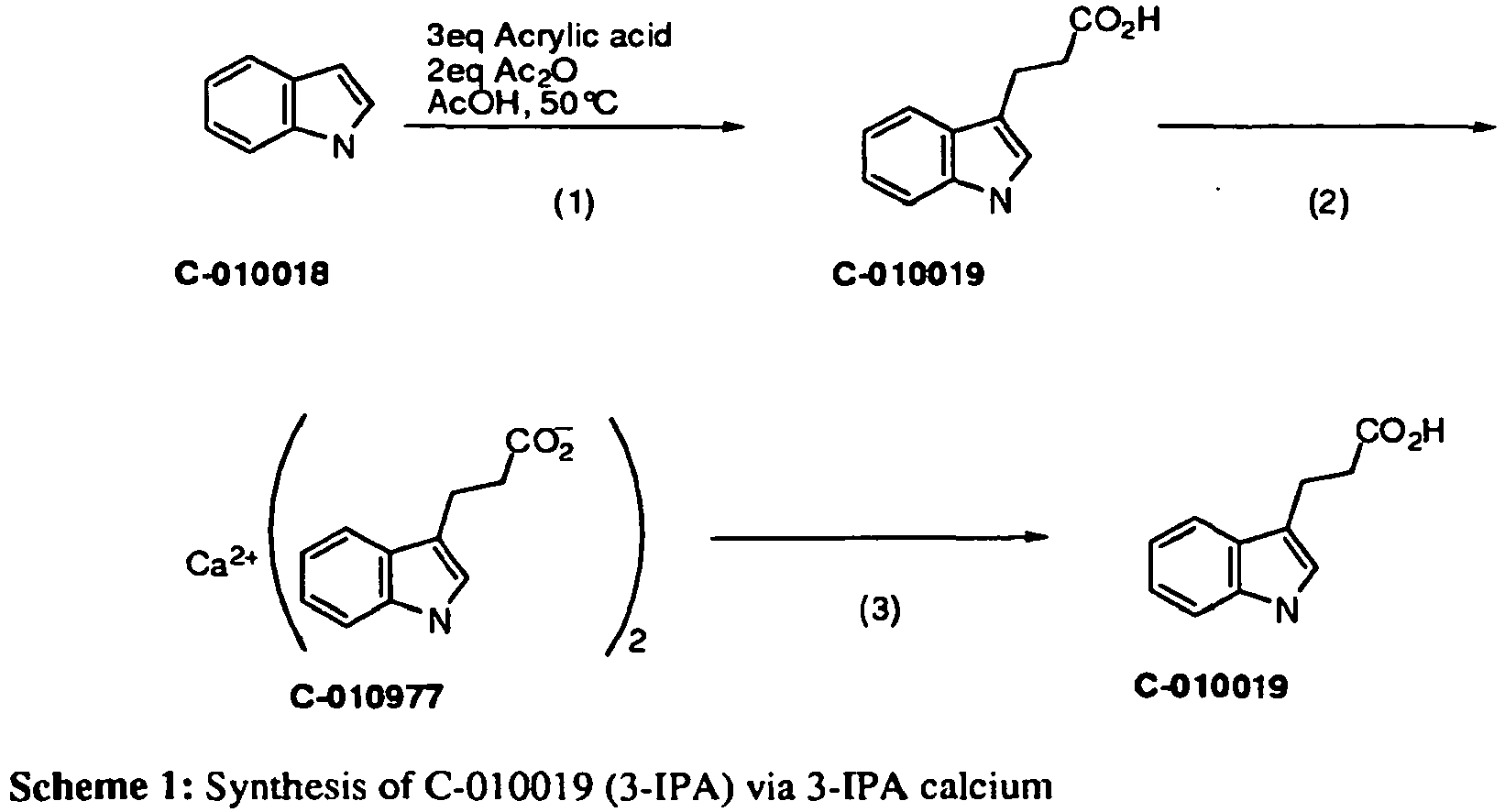
- Indole (8.015 kg), acetic acid (16 L), acrylic acid (3 eq., 14L) and acetic acid anhydride (2 eq., 13 L) were heated for 64 hours to 50°C under a nitrogen atmosphere. (Step 1, Scheme 1). The indole showed a conversion to 3-IPA of 98.6%. The reaction mixture was cooled to 18-20°C, water (22.5 L) was added and stirring was continued for 18 hours at 18-20°C. The resulting mixture showed no residual anhydrides, and the purity of 3-IPA was found to be 69.32 area % by high performance liquid chromatography (HPLC). Heptane (17.2 L) was added and 45 L of acetic acid / water were removed by azeotropic distillation (p= 90-140 mbar, IT= 28-32°C, OT=60-70°C). 17 L of heptane were removed by distillation (p=54-80 mbar, OT=60°C, IT=33-42°C). When the temperature of the reaction mixture reached 20°C, ethyl acetate (25 L) and water (69 L) were added. At a temperature between 0-10°C, the pH was adjusted to 12 using 30% sodium hydroxide (32 L). After phase separation at a temperature of 4-7°C, the aqueous layer was extracted with ethyl acetate (2x25 L). Ethyl acetate (32 L) was added to the aqueous phase and the pH was adjusted to 6-7 using 32% HCl (0.8 L) at 4-7°C.
- When the water/ethyl acetate mixture reached a temperature of 20°C, a saturated calcium acetate solution (39 L) was added within 1 hour and a suspension was formed. (Step 2, Scheme 1). The suspension was stirred at 15°C for 15 hours. 3-IPA calcium was collected by filtration and washed with a saturated calcium acetate solution (12 L), water (40 L) and ethyl acetate (40 L). The wet filter cake (containing 99.5 area % 3-IPA calcium by HPLC) was dissolved in acetic acid (31 L) at 18-20°C and water (88 L) was added within 1 hour. (Step 3, Scheme 1). The suspension was stirred overnight at 10°C. Crude 3-IPA was collected by filtration and washed with water (24 L). The wet filter cake was dissolved in isopropyl alcohol (44 L) and water (120 L) was added within 1 hour at 20-25°C. The suspension was cooled to 5°C and stirred for 65 hours. 3-IPA was isolated by filtration, washed with water (32 L) and dried. 4.7 kg (36% yield, 99.87 area%, 98.89 w/w %).
- Indole (58.59 g), acetic acid (120 mL), acrylic acid (3 eq., 103 mL) and acetic acid anhydride (2eq., 94 mL) were heated for 43 hours to 50°C under a nitrogen atmosphere. (Step 1, Scheme 1). The indole showed a conversion to 3-IPA of 97.9%. The reaction mixture was cooled to 20°C, water (164 mL) was added, and stirring was continued for 18 hours at 20°C. The resulting mixture showed no residual anhydrides. The purity of 3-IP A was found to be 72.12 area % by HPLC. Heptane (126 mL) was added and 230 mL of the acetic acid/water mixture was removed by azeotropic distillation (p=119 mbar, IT=21-40°C, OT=70°C). 92 mL of heptane were removed by distillation (119 mbar, OT=70°C, IT=40-50°C). When the temperature of the reaction mixture reached 20°C, ethyl acetate (182 mL) and water (502 mL) were added. When the reaction mixture reached a temperature between 5°C and 11°C, 30% sodium hydroxide (109 mL) was added and the pH was adjusted to 8.5 using 1M hydrochloric acid (3.5 mL). After phase separation occurred at a temperature of 15°C, the aqueous layer was extracted with ethyl acetate (2x180mL). The pH was adjusted to 7.7 using acetic acid/water (1:1), and ethyl acetate (235 mL) was added at 15°C.
- When the water/ethyl acetate mixture reached a temperature of 20°C, a saturated calcium chloride solution (224 mL) was added within 1 hour and a suspension formed. (Step 2, Scheme 1). The suspension was stirred at 15°C for 15 hours. 3-IPA calcium was collected by filtration and washed with a saturated calcium acetate solution (70 mL), water (295 mL) and ethyl acetate (295 mL). 29.3 g of the resulting wet filter cake (containing 98.7 area % of 3-IPA calcium by HPLC) was dissolved in acetic acid (115 mL) at 20°C and water (325 mL) was added within 5 minutes. (Step 3, Scheme 1). The suspension was heated to 71°C and a clear solution was obtained. The reaction mixture was cooled down to 0°C within 4 hours. The suspension was stirred overnight at 0°C. Crude 3-IPA was collected by filtration and was washed with water (88 mL). The wet filter cake was dissolved in isopropyl alcohol (160 mL) and water (440 mL) was added within 1 hour at 20-25°C. The suspension was cooled to 5°C and stirred overnight. 3-IPA was isolated by filtration, washed with water (116 mL) and dried. 16.6 g (35% yield, 99.7 area% by HPLC).
-

- 14.421 kg 3-IPA (97.4 area % by HPLC) were dissolved in water (51 L) and ammonium hydroxide solution (12.6 L, 25%). The resulting solution had a pH of 9. Ethyl acetate (51 L) was added. When the water/ethyl acetate mixture reached a temperature of 20°C, a saturated calcium chloride solution (20 L) was added within 1 hour and a suspension was formed. (Step 1, Scheme 3). The suspension was stirred at 20°C for 14 hours. 3-IPA calcium was collected by filtration and washed with water (14.5 L) and ethyl acetate (2x14.5 L). The wet filter cake containing 99.74 area % 3-IPA calcium as determined by HPLC was dissolved in acetic acid (50.5 L) at 18-19°C and water (143 L) was added within 1 hour. (Step 2, Scheme 2). The suspension was heated to 75°C and a clear solution was obtained. The reaction mixture was cooled down to 0°C within 4 hours. The suspension was stirred overnight at 0°C. Crude 3-IPA was collected by filtration and washed with water (39 L). The wet filter cake was dissolved in isopropyl alcohol (126 L) and water (366 L) was added within 1 hour at 20-22°C. The suspension was cooled to 0°C and stirred overnight. 3-IPA was isolated by filtration, washed with water (117 L) and dried 11.677 kg (81% recovery, 99.8 area % by HPLC).
Claims (4)
- 3-(3-Indolyl)propionic acid calcium salt or a hydrate thereof.
- A method of making substantially pure 3-(3-indolyl)propionic acid free acid, comprising the steps of:(a) converting 3-(3-indolyl)propionic acid free acid into a calcium salt;(b) precipitating and washing the calcium salt; and(c) reconverting the calcium salt into the free acid.
- The method of claim 2, wherein the substantially pure 3-(3-indolyl)propionic acid free acid has a purity of 97% or greater.
- The method of claim 3, wherein the substantially pure 3-(3-indolyl)propionic acid free acid has a purity of 99% or greater.
Applications Claiming Priority (2)
| Application Number | Priority Date | Filing Date | Title |
|---|---|---|---|
| US83998106P | 2006-08-23 | 2006-08-23 | |
| PCT/US2007/076645 WO2008024914A2 (en) | 2006-08-23 | 2007-08-23 | 3-(3-indolyl) propionic acid calcium salt and method of making 3-(3-indolyl) propionic acid free acid therefrom |
Publications (3)
| Publication Number | Publication Date |
|---|---|
| EP2061459A2 EP2061459A2 (en) | 2009-05-27 |
| EP2061459A4 EP2061459A4 (en) | 2010-05-26 |
| EP2061459B1 true EP2061459B1 (en) | 2012-12-26 |
Family
ID=39107683
Family Applications (1)
| Application Number | Title | Priority Date | Filing Date |
|---|---|---|---|
| EP07814389A Active EP2061459B1 (en) | 2006-08-23 | 2007-08-23 | 3-(3-indolyl) propionic acid calcium salt and method of making 3-(3-indolyl) propionic acid free acid therefrom |
Country Status (5)
| Country | Link |
|---|---|
| US (3) | US20080207731A1 (en) |
| EP (1) | EP2061459B1 (en) |
| JP (1) | JP2010501591A (en) |
| AU (1) | AU2007286651A1 (en) |
| WO (1) | WO2008024914A2 (en) |
Families Citing this family (6)
| Publication number | Priority date | Publication date | Assignee | Title |
|---|---|---|---|---|
| AU2012321345B2 (en) | 2011-10-03 | 2016-03-17 | The University Of Utah Research Foundation | Application of 5-HT6 receptor antagonists for the alleviation of cognitive deficits of down syndrome |
| US9744155B2 (en) * | 2012-03-28 | 2017-08-29 | Ixcela, Inc. | IPA as a therapeutic agent, as a protective agent, and as a biomarker of disease risk |
| US10036011B2 (en) * | 2016-02-11 | 2018-07-31 | Qiagen Waltham, Inc. | Scavenger compounds for improved sequencing-by-synthesis |
| US11041847B1 (en) | 2019-01-25 | 2021-06-22 | Ixcela, Inc. | Detection and modification of gut microbial population |
| WO2020185913A1 (en) * | 2019-03-12 | 2020-09-17 | Intellect Neurosciences, Inc. | Indole-3-propionic acids and salts and esters thereof for treating skin disorders |
| CN118105382A (en) * | 2024-04-07 | 2024-05-31 | 广东药科大学 | Application of indoleacrylic acid in the preparation of drugs for treating hyperlipidemia and atherosclerotic cardiovascular diseases |
Family Cites Families (7)
| Publication number | Priority date | Publication date | Assignee | Title |
|---|---|---|---|---|
| KR0166088B1 (en) | 1990-01-23 | 1999-01-15 | . | Cyclodextrin derivatives with increased water solubility and uses thereof |
| US5376645A (en) | 1990-01-23 | 1994-12-27 | University Of Kansas | Derivatives of cyclodextrins exhibiting enhanced aqueous solubility and the use thereof |
| GB9711643D0 (en) | 1997-06-05 | 1997-07-30 | Janssen Pharmaceutica Nv | Glass thermoplastic systems |
| JP5627160B2 (en) * | 1998-02-23 | 2014-11-19 | サウス、アラバマ、メディカル、サイエンス、ファウンデーションSouth Alabama Medical Science Foundation | Indole-3-propionic acid for use as a medicament, and salts and esters thereof |
| CN1285269C (en) * | 1999-01-27 | 2006-11-22 | 魏宏儒 | Chemical for preventing and treating vascular bundle diseases of plant |
| KR100786927B1 (en) | 2000-06-28 | 2007-12-17 | 스미스클라인비이참피이엘시이 | Wet Grinding Method |
| US7732479B2 (en) * | 2004-08-19 | 2010-06-08 | Tel Aviv University Future Technology Development L.P. | Compositions for treating amyloid associated diseases |
-
2007
- 2007-08-23 AU AU2007286651A patent/AU2007286651A1/en not_active Abandoned
- 2007-08-23 JP JP2009525782A patent/JP2010501591A/en active Pending
- 2007-08-23 WO PCT/US2007/076645 patent/WO2008024914A2/en not_active Ceased
- 2007-08-23 US US11/843,836 patent/US20080207731A1/en not_active Abandoned
- 2007-08-23 EP EP07814389A patent/EP2061459B1/en active Active
-
2010
- 2010-01-21 US US12/691,067 patent/US20100317710A1/en not_active Abandoned
-
2011
- 2011-05-24 US US13/114,641 patent/US20120095071A1/en not_active Abandoned
Also Published As
| Publication number | Publication date |
|---|---|
| US20100317710A1 (en) | 2010-12-16 |
| EP2061459A2 (en) | 2009-05-27 |
| US20080207731A1 (en) | 2008-08-28 |
| AU2007286651A1 (en) | 2008-02-28 |
| EP2061459A4 (en) | 2010-05-26 |
| WO2008024914A3 (en) | 2008-08-14 |
| WO2008024914A2 (en) | 2008-02-28 |
| JP2010501591A (en) | 2010-01-21 |
| US20120095071A1 (en) | 2012-04-19 |
Similar Documents
| Publication | Publication Date | Title |
|---|---|---|
| US20120095071A1 (en) | 3-(3-indolyl) propionic acid calcium salt and method of making 3-(3-indolyl) propionic acid free acid therefrom | |
| US10947183B2 (en) | Fenfluramine compositions and methods of preparing the same | |
| JP6591759B2 (en) | Nalmefene hydrochloride dihydrate | |
| JP2004517090A5 (en) | ||
| WO2008090382A1 (en) | Thiazole and oxazole derivatives for use in the treatment of prion diseases, cancer and conditions of the central nervous system as well as in the regulation of stem cells | |
| US9364449B2 (en) | Peptoid and synthetic oligomers, pharmaceutical compositions and methods of using same | |
| JPH09511516A (en) | Method for partitioning etodolac with glucamine derivatives | |
| EP1468009B1 (en) | Peptide purification | |
| KR102856276B1 (en) | 2-Fluorinated Bile Acids for the Treatment of Neurodegenerative Diseases | |
| EP3818068B1 (en) | Neuroactive steroids and methods of preparation | |
| EP1149101B1 (en) | 4-OXO-3,5-DIHYDRO-4$i(H)-PYRIDAZINO 4,5-$i(b)]INDOLE-1-CARBOXAMIDE DERIVATIVES, PREPARATION AND THERAPEUTIC USE | |
| JPS59231054A (en) | Novel dipeptides of l-5-hydroxytryptophan, manufacture and drug containing them | |
| JPH05310745A (en) | Dieradilactone and anti-inflammatory agents | |
| JP2003533498A (en) | Process for producing D-chiro-inositol and use of D-chiro-inositol obtained therefrom | |
| CN1974545B (en) | Long chain fatty acid amide compound and its application | |
| JP2019031524A (en) | Nalmefene hydrochloride dihydrate | |
| EP1492792B1 (en) | 3-heteroaryl-3,5-dihydro-4-oxo-4h-pyridazino¬4,5-b|indole-1-acetamide derivatives, preparation and use thereof in medicaments | |
| JP4493891B2 (en) | New derivatives of echinocandin, their production process and their use as antibacterial agents | |
| ES2416071T3 (en) | Method for preparing 1-amino-1,3,3,5,5-pentamethylcyclohexane | |
| HK1039941A1 (en) | Neurotrophin potentiators | |
| WO2026017628A1 (en) | Process for the purification of 2-amino-1,3-propanediol (serinol) | |
| JPH11509188A (en) | Polymorph of Prodrug 6-N- (L-ALA-L-ALA) Trovafloxacin | |
| HK40062202B (en) | 2-fluorinated bile acids for the treatment of neurodegenerative diseases | |
| HK40062202A (en) | 2-fluorinated bile acids for the treatment of neurodegenerative diseases | |
| JPWO1996034011A1 (en) | Purification method |
Legal Events
| Date | Code | Title | Description |
|---|---|---|---|
| PUAI | Public reference made under article 153(3) epc to a published international application that has entered the european phase |
Free format text: ORIGINAL CODE: 0009012 |
|
| 17P | Request for examination filed |
Effective date: 20090320 |
|
| AK | Designated contracting states |
Kind code of ref document: A2 Designated state(s): AT BE BG CH CY CZ DE DK EE ES FI FR GB GR HU IE IS IT LI LT LU LV MC MT NL PL PT RO SE SI SK TR |
|
| AX | Request for extension of the european patent |
Extension state: AL BA HR MK RS |
|
| A4 | Supplementary search report drawn up and despatched |
Effective date: 20100428 |
|
| 17Q | First examination report despatched |
Effective date: 20111007 |
|
| GRAP | Despatch of communication of intention to grant a patent |
Free format text: ORIGINAL CODE: EPIDOSNIGR1 |
|
| GRAS | Grant fee paid |
Free format text: ORIGINAL CODE: EPIDOSNIGR3 |
|
| GRAA | (expected) grant |
Free format text: ORIGINAL CODE: 0009210 |
|
| AK | Designated contracting states |
Kind code of ref document: B1 Designated state(s): AT BE BG CH CY CZ DE DK EE ES FI FR GB GR HU IE IS IT LI LT LU LV MC MT NL PL PT RO SE SI SK TR |
|
| AX | Request for extension of the european patent |
Extension state: AL BA HR MK RS |
|
| REG | Reference to a national code |
Ref country code: GB Ref legal event code: FG4D |
|
| REG | Reference to a national code |
Ref country code: CH Ref legal event code: EP |
|
| REG | Reference to a national code |
Ref country code: AT Ref legal event code: REF Ref document number: 590066 Country of ref document: AT Kind code of ref document: T Effective date: 20130115 |
|
| REG | Reference to a national code |
Ref country code: DE Ref legal event code: R096 Ref document number: 602007027679 Country of ref document: DE Effective date: 20130228 |
|
| PG25 | Lapsed in a contracting state [announced via postgrant information from national office to epo] |
Ref country code: FI Free format text: LAPSE BECAUSE OF FAILURE TO SUBMIT A TRANSLATION OF THE DESCRIPTION OR TO PAY THE FEE WITHIN THE PRESCRIBED TIME-LIMIT Effective date: 20121226 Ref country code: SE Free format text: LAPSE BECAUSE OF FAILURE TO SUBMIT A TRANSLATION OF THE DESCRIPTION OR TO PAY THE FEE WITHIN THE PRESCRIBED TIME-LIMIT Effective date: 20121226 Ref country code: LT Free format text: LAPSE BECAUSE OF FAILURE TO SUBMIT A TRANSLATION OF THE DESCRIPTION OR TO PAY THE FEE WITHIN THE PRESCRIBED TIME-LIMIT Effective date: 20121226 |
|
| REG | Reference to a national code |
Ref country code: AT Ref legal event code: MK05 Ref document number: 590066 Country of ref document: AT Kind code of ref document: T Effective date: 20121226 |
|
| REG | Reference to a national code |
Ref country code: LT Ref legal event code: MG4D |
|
| REG | Reference to a national code |
Ref country code: NL Ref legal event code: VDEP Effective date: 20121226 |
|
| PG25 | Lapsed in a contracting state [announced via postgrant information from national office to epo] |
Ref country code: SI Free format text: LAPSE BECAUSE OF FAILURE TO SUBMIT A TRANSLATION OF THE DESCRIPTION OR TO PAY THE FEE WITHIN THE PRESCRIBED TIME-LIMIT Effective date: 20121226 Ref country code: LV Free format text: LAPSE BECAUSE OF FAILURE TO SUBMIT A TRANSLATION OF THE DESCRIPTION OR TO PAY THE FEE WITHIN THE PRESCRIBED TIME-LIMIT Effective date: 20121226 Ref country code: GR Free format text: LAPSE BECAUSE OF FAILURE TO SUBMIT A TRANSLATION OF THE DESCRIPTION OR TO PAY THE FEE WITHIN THE PRESCRIBED TIME-LIMIT Effective date: 20130327 |
|
| PG25 | Lapsed in a contracting state [announced via postgrant information from national office to epo] |
Ref country code: EE Free format text: LAPSE BECAUSE OF FAILURE TO SUBMIT A TRANSLATION OF THE DESCRIPTION OR TO PAY THE FEE WITHIN THE PRESCRIBED TIME-LIMIT Effective date: 20121226 Ref country code: BG Free format text: LAPSE BECAUSE OF FAILURE TO SUBMIT A TRANSLATION OF THE DESCRIPTION OR TO PAY THE FEE WITHIN THE PRESCRIBED TIME-LIMIT Effective date: 20130326 Ref country code: BE Free format text: LAPSE BECAUSE OF FAILURE TO SUBMIT A TRANSLATION OF THE DESCRIPTION OR TO PAY THE FEE WITHIN THE PRESCRIBED TIME-LIMIT Effective date: 20121226 Ref country code: ES Free format text: LAPSE BECAUSE OF FAILURE TO SUBMIT A TRANSLATION OF THE DESCRIPTION OR TO PAY THE FEE WITHIN THE PRESCRIBED TIME-LIMIT Effective date: 20130406 Ref country code: SK Free format text: LAPSE BECAUSE OF FAILURE TO SUBMIT A TRANSLATION OF THE DESCRIPTION OR TO PAY THE FEE WITHIN THE PRESCRIBED TIME-LIMIT Effective date: 20121226 Ref country code: AT Free format text: LAPSE BECAUSE OF FAILURE TO SUBMIT A TRANSLATION OF THE DESCRIPTION OR TO PAY THE FEE WITHIN THE PRESCRIBED TIME-LIMIT Effective date: 20121226 Ref country code: CZ Free format text: LAPSE BECAUSE OF FAILURE TO SUBMIT A TRANSLATION OF THE DESCRIPTION OR TO PAY THE FEE WITHIN THE PRESCRIBED TIME-LIMIT Effective date: 20121226 Ref country code: IS Free format text: LAPSE BECAUSE OF FAILURE TO SUBMIT A TRANSLATION OF THE DESCRIPTION OR TO PAY THE FEE WITHIN THE PRESCRIBED TIME-LIMIT Effective date: 20130426 |
|
| PG25 | Lapsed in a contracting state [announced via postgrant information from national office to epo] |
Ref country code: PL Free format text: LAPSE BECAUSE OF FAILURE TO SUBMIT A TRANSLATION OF THE DESCRIPTION OR TO PAY THE FEE WITHIN THE PRESCRIBED TIME-LIMIT Effective date: 20121226 Ref country code: RO Free format text: LAPSE BECAUSE OF FAILURE TO SUBMIT A TRANSLATION OF THE DESCRIPTION OR TO PAY THE FEE WITHIN THE PRESCRIBED TIME-LIMIT Effective date: 20121226 Ref country code: NL Free format text: LAPSE BECAUSE OF FAILURE TO SUBMIT A TRANSLATION OF THE DESCRIPTION OR TO PAY THE FEE WITHIN THE PRESCRIBED TIME-LIMIT Effective date: 20121226 Ref country code: PT Free format text: LAPSE BECAUSE OF FAILURE TO SUBMIT A TRANSLATION OF THE DESCRIPTION OR TO PAY THE FEE WITHIN THE PRESCRIBED TIME-LIMIT Effective date: 20130426 |
|
| PG25 | Lapsed in a contracting state [announced via postgrant information from national office to epo] |
Ref country code: DK Free format text: LAPSE BECAUSE OF FAILURE TO SUBMIT A TRANSLATION OF THE DESCRIPTION OR TO PAY THE FEE WITHIN THE PRESCRIBED TIME-LIMIT Effective date: 20121226 |
|
| PLBE | No opposition filed within time limit |
Free format text: ORIGINAL CODE: 0009261 |
|
| STAA | Information on the status of an ep patent application or granted ep patent |
Free format text: STATUS: NO OPPOSITION FILED WITHIN TIME LIMIT |
|
| PG25 | Lapsed in a contracting state [announced via postgrant information from national office to epo] |
Ref country code: CY Free format text: LAPSE BECAUSE OF FAILURE TO SUBMIT A TRANSLATION OF THE DESCRIPTION OR TO PAY THE FEE WITHIN THE PRESCRIBED TIME-LIMIT Effective date: 20121226 |
|
| 26N | No opposition filed |
Effective date: 20130927 |
|
| PG25 | Lapsed in a contracting state [announced via postgrant information from national office to epo] |
Ref country code: IT Free format text: LAPSE BECAUSE OF FAILURE TO SUBMIT A TRANSLATION OF THE DESCRIPTION OR TO PAY THE FEE WITHIN THE PRESCRIBED TIME-LIMIT Effective date: 20121226 |
|
| REG | Reference to a national code |
Ref country code: DE Ref legal event code: R097 Ref document number: 602007027679 Country of ref document: DE Effective date: 20130927 |
|
| REG | Reference to a national code |
Ref country code: CH Ref legal event code: PL |
|
| GBPC | Gb: european patent ceased through non-payment of renewal fee |
Effective date: 20130823 |
|
| PG25 | Lapsed in a contracting state [announced via postgrant information from national office to epo] |
Ref country code: MC Free format text: LAPSE BECAUSE OF FAILURE TO SUBMIT A TRANSLATION OF THE DESCRIPTION OR TO PAY THE FEE WITHIN THE PRESCRIBED TIME-LIMIT Effective date: 20121226 Ref country code: LI Free format text: LAPSE BECAUSE OF NON-PAYMENT OF DUE FEES Effective date: 20130831 Ref country code: CH Free format text: LAPSE BECAUSE OF NON-PAYMENT OF DUE FEES Effective date: 20130831 Ref country code: DE Free format text: LAPSE BECAUSE OF NON-PAYMENT OF DUE FEES Effective date: 20140301 |
|
| REG | Reference to a national code |
Ref country code: DE Ref legal event code: R119 Ref document number: 602007027679 Country of ref document: DE Effective date: 20140301 |
|
| REG | Reference to a national code |
Ref country code: FR Ref legal event code: ST Effective date: 20140430 |
|
| PG25 | Lapsed in a contracting state [announced via postgrant information from national office to epo] |
Ref country code: IE Free format text: LAPSE BECAUSE OF NON-PAYMENT OF DUE FEES Effective date: 20130823 Ref country code: GB Free format text: LAPSE BECAUSE OF NON-PAYMENT OF DUE FEES Effective date: 20130823 |
|
| PG25 | Lapsed in a contracting state [announced via postgrant information from national office to epo] |
Ref country code: FR Free format text: LAPSE BECAUSE OF NON-PAYMENT OF DUE FEES Effective date: 20130902 |
|
| PG25 | Lapsed in a contracting state [announced via postgrant information from national office to epo] |
Ref country code: TR Free format text: LAPSE BECAUSE OF FAILURE TO SUBMIT A TRANSLATION OF THE DESCRIPTION OR TO PAY THE FEE WITHIN THE PRESCRIBED TIME-LIMIT Effective date: 20121226 Ref country code: MT Free format text: LAPSE BECAUSE OF FAILURE TO SUBMIT A TRANSLATION OF THE DESCRIPTION OR TO PAY THE FEE WITHIN THE PRESCRIBED TIME-LIMIT Effective date: 20121226 |
|
| PG25 | Lapsed in a contracting state [announced via postgrant information from national office to epo] |
Ref country code: HU Free format text: LAPSE BECAUSE OF FAILURE TO SUBMIT A TRANSLATION OF THE DESCRIPTION OR TO PAY THE FEE WITHIN THE PRESCRIBED TIME-LIMIT; INVALID AB INITIO Effective date: 20070823 Ref country code: LU Free format text: LAPSE BECAUSE OF NON-PAYMENT OF DUE FEES Effective date: 20130823 |