EP2061162A1 - Reduced feedback dynamic codebook transmission method for multi-antenna systems - Google Patents
Reduced feedback dynamic codebook transmission method for multi-antenna systems Download PDFInfo
- Publication number
- EP2061162A1 EP2061162A1 EP07425725A EP07425725A EP2061162A1 EP 2061162 A1 EP2061162 A1 EP 2061162A1 EP 07425725 A EP07425725 A EP 07425725A EP 07425725 A EP07425725 A EP 07425725A EP 2061162 A1 EP2061162 A1 EP 2061162A1
- Authority
- EP
- European Patent Office
- Prior art keywords
- codebook
- channel
- reduced
- codeword
- receiver
- Prior art date
- Legal status (The legal status is an assumption and is not a legal conclusion. Google has not performed a legal analysis and makes no representation as to the accuracy of the status listed.)
- Withdrawn
Links
- 238000000034 method Methods 0.000 title claims abstract description 45
- 230000005540 biological transmission Effects 0.000 title claims abstract description 12
- 238000005457 optimization Methods 0.000 claims abstract description 6
- 238000013139 quantization Methods 0.000 claims description 15
- 239000013598 vector Substances 0.000 claims description 14
- 239000011159 matrix material Substances 0.000 claims description 6
- 230000000295 complement effect Effects 0.000 claims description 4
- 238000005315 distribution function Methods 0.000 claims description 4
- 230000001186 cumulative effect Effects 0.000 claims description 3
- 229920000535 Tan II Polymers 0.000 claims description 2
- 238000012884 algebraic function Methods 0.000 claims description 2
- 230000004044 response Effects 0.000 claims description 2
- 235000015429 Mirabilis expansa Nutrition 0.000 abstract description 9
- 244000294411 Mirabilis expansa Species 0.000 abstract description 9
- 235000013536 miso Nutrition 0.000 abstract description 9
- 230000009467 reduction Effects 0.000 description 8
- 230000002596 correlated effect Effects 0.000 description 6
- 208000021907 Central cloudy dystrophy of François Diseases 0.000 description 5
- 238000004422 calculation algorithm Methods 0.000 description 4
- 230000006835 compression Effects 0.000 description 4
- 238000007906 compression Methods 0.000 description 4
- 238000005562 fading Methods 0.000 description 4
- 230000002123 temporal effect Effects 0.000 description 4
- 230000000875 corresponding effect Effects 0.000 description 3
- 238000013461 design Methods 0.000 description 3
- 238000010586 diagram Methods 0.000 description 3
- 230000008569 process Effects 0.000 description 3
- 238000012549 training Methods 0.000 description 3
- 230000007704 transition Effects 0.000 description 3
- 239000000654 additive Substances 0.000 description 2
- 230000000996 additive effect Effects 0.000 description 2
- 238000004891 communication Methods 0.000 description 2
- 230000000052 comparative effect Effects 0.000 description 2
- 239000003550 marker Substances 0.000 description 2
- 238000004088 simulation Methods 0.000 description 2
- 238000007476 Maximum Likelihood Methods 0.000 description 1
- 241001168730 Simo Species 0.000 description 1
- 238000004364 calculation method Methods 0.000 description 1
- 230000001413 cellular effect Effects 0.000 description 1
- 230000001934 delay Effects 0.000 description 1
- 230000001419 dependent effect Effects 0.000 description 1
- 230000000694 effects Effects 0.000 description 1
- 238000011156 evaluation Methods 0.000 description 1
- 230000007774 longterm Effects 0.000 description 1
- 238000013507 mapping Methods 0.000 description 1
- 238000010295 mobile communication Methods 0.000 description 1
- 238000012986 modification Methods 0.000 description 1
- 230000004048 modification Effects 0.000 description 1
- 238000012856 packing Methods 0.000 description 1
- 238000005192 partition Methods 0.000 description 1
- 230000002441 reversible effect Effects 0.000 description 1
- 238000000638 solvent extraction Methods 0.000 description 1
- 238000012546 transfer Methods 0.000 description 1
- 230000000007 visual effect Effects 0.000 description 1
Images


Classifications
-
- H—ELECTRICITY
- H04—ELECTRIC COMMUNICATION TECHNIQUE
- H04B—TRANSMISSION
- H04B7/00—Radio transmission systems, i.e. using radiation field
- H04B7/02—Diversity systems; Multi-antenna system, i.e. transmission or reception using multiple antennas
- H04B7/04—Diversity systems; Multi-antenna system, i.e. transmission or reception using multiple antennas using two or more spaced independent antennas
- H04B7/0413—MIMO systems
- H04B7/0417—Feedback systems
-
- H—ELECTRICITY
- H04—ELECTRIC COMMUNICATION TECHNIQUE
- H04B—TRANSMISSION
- H04B7/00—Radio transmission systems, i.e. using radiation field
- H04B7/02—Diversity systems; Multi-antenna system, i.e. transmission or reception using multiple antennas
- H04B7/04—Diversity systems; Multi-antenna system, i.e. transmission or reception using multiple antennas using two or more spaced independent antennas
- H04B7/06—Diversity systems; Multi-antenna system, i.e. transmission or reception using multiple antennas using two or more spaced independent antennas at the transmitting station
- H04B7/0613—Diversity systems; Multi-antenna system, i.e. transmission or reception using multiple antennas using two or more spaced independent antennas at the transmitting station using simultaneous transmission
- H04B7/0615—Diversity systems; Multi-antenna system, i.e. transmission or reception using multiple antennas using two or more spaced independent antennas at the transmitting station using simultaneous transmission of weighted versions of same signal
- H04B7/0619—Diversity systems; Multi-antenna system, i.e. transmission or reception using multiple antennas using two or more spaced independent antennas at the transmitting station using simultaneous transmission of weighted versions of same signal using feedback from receiving side
- H04B7/0621—Feedback content
- H04B7/0626—Channel coefficients, e.g. channel state information [CSI]
-
- H—ELECTRICITY
- H04—ELECTRIC COMMUNICATION TECHNIQUE
- H04B—TRANSMISSION
- H04B7/00—Radio transmission systems, i.e. using radiation field
- H04B7/02—Diversity systems; Multi-antenna system, i.e. transmission or reception using multiple antennas
- H04B7/04—Diversity systems; Multi-antenna system, i.e. transmission or reception using multiple antennas using two or more spaced independent antennas
- H04B7/06—Diversity systems; Multi-antenna system, i.e. transmission or reception using multiple antennas using two or more spaced independent antennas at the transmitting station
- H04B7/0613—Diversity systems; Multi-antenna system, i.e. transmission or reception using multiple antennas using two or more spaced independent antennas at the transmitting station using simultaneous transmission
- H04B7/0615—Diversity systems; Multi-antenna system, i.e. transmission or reception using multiple antennas using two or more spaced independent antennas at the transmitting station using simultaneous transmission of weighted versions of same signal
- H04B7/0619—Diversity systems; Multi-antenna system, i.e. transmission or reception using multiple antennas using two or more spaced independent antennas at the transmitting station using simultaneous transmission of weighted versions of same signal using feedback from receiving side
- H04B7/0636—Feedback format
- H04B7/0639—Using selective indices, e.g. of a codebook, e.g. pre-distortion matrix index [PMI] or for beam selection
-
- H—ELECTRICITY
- H04—ELECTRIC COMMUNICATION TECHNIQUE
- H04B—TRANSMISSION
- H04B7/00—Radio transmission systems, i.e. using radiation field
- H04B7/02—Diversity systems; Multi-antenna system, i.e. transmission or reception using multiple antennas
- H04B7/04—Diversity systems; Multi-antenna system, i.e. transmission or reception using multiple antennas using two or more spaced independent antennas
- H04B7/06—Diversity systems; Multi-antenna system, i.e. transmission or reception using multiple antennas using two or more spaced independent antennas at the transmitting station
- H04B7/0613—Diversity systems; Multi-antenna system, i.e. transmission or reception using multiple antennas using two or more spaced independent antennas at the transmitting station using simultaneous transmission
- H04B7/0615—Diversity systems; Multi-antenna system, i.e. transmission or reception using multiple antennas using two or more spaced independent antennas at the transmitting station using simultaneous transmission of weighted versions of same signal
- H04B7/0619—Diversity systems; Multi-antenna system, i.e. transmission or reception using multiple antennas using two or more spaced independent antennas at the transmitting station using simultaneous transmission of weighted versions of same signal using feedback from receiving side
- H04B7/0658—Feedback reduction
-
- H—ELECTRICITY
- H04—ELECTRIC COMMUNICATION TECHNIQUE
- H04B—TRANSMISSION
- H04B7/00—Radio transmission systems, i.e. using radiation field
- H04B7/02—Diversity systems; Multi-antenna system, i.e. transmission or reception using multiple antennas
- H04B7/04—Diversity systems; Multi-antenna system, i.e. transmission or reception using multiple antennas using two or more spaced independent antennas
- H04B7/06—Diversity systems; Multi-antenna system, i.e. transmission or reception using multiple antennas using two or more spaced independent antennas at the transmitting station
- H04B7/0697—Diversity systems; Multi-antenna system, i.e. transmission or reception using multiple antennas using two or more spaced independent antennas at the transmitting station using spatial multiplexing
Definitions
- the present invention relates to the field of wireless communication networks, and in particular to a reduced feedback dynamic codebook transmission method for multi-antenna systems.
- the invention can be used indifferently in standard and non-standard cellular networks, but some advantages are obviously derived from its possible use in wireless networks conforming with different standards, for example:
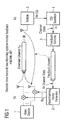
- FIG.1 shows the general diagram of a discrete-time transmit beamforming MISO system with limited feedback by the receiver RX to the transmitter TX, as disclosed in Ref.[7].
- the depicted structure is very general and is compliant with a lot of spatial multiplexing algorithms. This structure can also be extended to a MIMO system.
- Each baseband signal is weighted (precoded) by an its own complex weight w n (precode) calculated by a processor block 2 (Beamforming Vector Generator) of BS 1.
- the complex weights w n is a vector that spans a codebook H stored in both TX and RX.
- the Mobile 3 evaluates the downlink channel h n (a vector that collects all samples of the MISO pulse response) convoluted with the weight vector w n , which constitutes the Channel State Information (CSI), by any suitable optimization algorithm (e.g. ML) aimed to improve the quality of the reception at the Mobile 3 upon the knowledge of pilot tones.
- the CSI is forwarded to a Quantizer 4, which compresses it according to a quantization algorithm (briefly discussed soon) assuming that Mobile 3 has perfect knowledge of the forward channel (DL), and slow-rate feedback channel is considered as free of errors and delays.
- the latter according to an aperiodic feedback scheme, initiates a feedback of the index whenever the CSI changes ( J n ⁇ J n -1 ).
- the quantized index J n is fed back with lesser band consuming constraint than in absence of compression.
- the Beamforming Vector Generator 2 receives the quantized index J n from the feedback channel and uses it to address a new set of weights ⁇ w n +1 ⁇ at time n + 1 of the codebook H seen as a look-up table.
- Ref.[7] presently described, similarly to Ref.[5], Ref.[6], and Ref.[8] some temporal correlations in fading channel have been exploited for feedback reduction.
- Ref.[5] a tracking procedure for the channel subspace based on binary feedback has been considered.
- Ref.[6] and Ref.[8] the time-varying quantized channel is modelled as a Markov process and feedback reduction is achieved by dropping low probability transitions.
- the CSI Quantizer 4 maps the states of the channel-state Markov chain one-to-one to the members of the codebook H. This mapping also exists between the codebook members and the quantized values of the channel shape u n .
- the codebook H is designed by partitioning the channel shape space (unit hyper sphere) into N regions, called Voronoi cells in the specialized literature.
- P i , j ⁇ ⁇ , i 1 , ⁇ , N where ⁇ > 0 is a small positive number.
- the invention achieves said object by providing a method for quantizing dynamically the state information of a forward transmission channel sent back by a receiver to a transmitter equipped with n t antennas for transmitting n s streams on the forward channel according to a spatial multiplexing or beamforming scheme, the method including the following steps executed by the receiver at discrete time t +1:
- the step of indexing the codeword F t +1 spanning ⁇ ( F t ) at the receiver is driven by one-to-one associations between the 2 b d configurations of b ⁇ bits and the 2 b d codewords of ⁇ ( F t ), said associations map the reduced address space of ⁇ ( F t ) onto the larger address space of codebook ⁇ seen as a look-up table.
- the same one-to-one associations are assumed at the transmitter for de-indexing or demapping.
- the method of above is valid for MIMO and MISO systems, indifferently.
- the reduced codebook ⁇ ( F t ) can be modelled as a ball of radius ⁇ centred around F t and the chordal distance is the radius ⁇ itself.
- the step of estimating the radius ⁇ is performed by solving the following expression: where:
- the number b ⁇ of bits used to express the cardinality of ⁇ ( F t ) (or the value of radius ⁇ ), instead of being evaluated at each time slot, is assumed in suboptimal way as being lower than, or equal to, the bitrate currently available on the backward channel multiplied by the symbol time of the modulated transmission signal.
- the available bitrate can be communicated by the transmitting entity to the receiving entity each time it is changed, but this event happens at very slow time-interval in respect of symbol-time, so that the traffic of payload on the forward channel is not affected by these types of dedicated messages, significantly.
- the variant prevents the estimation of radius ⁇ analytically but it is less reliable in the fast tracking of channel fading.
- a closed loop MIMO wireless system consisting of a transmitter 6 equipped with n t transmit antennas and a receiver 7 equipped with n r receive antennas on the forward link.
- the forward channel H t at time slot t is modelled as a Rayleigh distributed n r ⁇ n t matrix having i.i.d. entries: and is arbitrarily correlated among different time slots.
- the receiver 7 is connected to the transmitter 6 through a reverse channel for user traffic (not shown) and through an additional low-rate (in-band) feedback channel. Without losing of generality, the feedback channel is supposed zero-delay and ideal.
- y t ⁇ n r ⁇ 1 is the received signal
- n t ⁇ CN 0 n r ⁇ 1 , ⁇ 2 I n r
- F t ⁇ n t ⁇ n s is the precoding matrix (or vector in case of beamforming).
- the precoder F t is dynamically adapted to channel conditions at time t +1 according to quantized CSI conveyed by the receiver 7 to transmitter 6 on the feedback channel (supposed ideal with zero-delay). In detail, at each time slot t +1 the following operations are executed:
- the nearly-optimal feedback load is evaluated for the closed loop system based on a feedback reduction procedure as said above.
- a nearly optimal value for distance ⁇ to be used in (6) is evaluated according to the temporal channel correlation.
- a closed-form upper bound on the corresponding feedback load is obtained by estimating the average cardinality of ⁇ ( F t , ⁇ ).
- the maximum quantization error length d m is a specific property of the codebook and has to be evaluated numerically.
- ⁇ is the optimal codebook based on Grassmannian manifold Ref.[10]
- a simple tight bound on d m is given by the following Rankin bound given in Ref.[11]: d m ⁇ n t - 1 ⁇ n w n t ⁇ n w - 1
- a closed-form upper bound on the reduced codebook ⁇ F t ⁇ ⁇ 0 ⁇ size is derived in the following according to the optimal reduced codebook (8) and the approximate quantization ball radius ⁇ 0 ⁇ given by (16).
- bounds (16) and (21) are tight for d m ⁇ 0 , i.e., when the granularity of quantization regions is low.
- bound (22) may be loose for moderately dense codebooks and a tighter approximation is given by: ⁇ F i ⁇ ⁇ ⁇ ⁇ 0 ⁇ + 2 ⁇ ⁇ ⁇ 2 ⁇ n t - 1 ⁇ n w , where ⁇ is the average quantization error length.
- the (17) is tight for ⁇ 1, which is the setting of most practical interest for the feedback compression technique previously discussed.
- the proposed feedback reduction algorithm is evaluated in terms of average rate performance for various codebook design criteria and system parameters.
- the channel at generic time slot t is distributed according to (1) and channel correlation is modeled by the AR(1) model (24).
- the feedback channel is assumed as error-free and zero-delay.
- Codebook ⁇ is taken from the Grassmannian manifold (4,1,64), see Ref.[2].
- the proposed feedback load estimation criterion (16) proves to be able to efficiently tune the feedback load according to channel correlation.
- the efficiency of the feedback load estimator (16) is confirmed in this case, too.
- the simulation shows that significant feedback reduction can be achieved for highly correlated channels and that the margin for feedback reduction increases with the density of the codebook.
Landscapes
- Engineering & Computer Science (AREA)
- Computer Networks & Wireless Communication (AREA)
- Signal Processing (AREA)
- Physics & Mathematics (AREA)
- Mathematical Physics (AREA)
- Radio Transmission System (AREA)
Abstract
- estimate a codeword F t+1 according to any suitable optimization method;
- index the codeword F t+1 into a reduced codebook Δ(F t ) belonging to a larger codebook Φ ;
- transmit on the backward channel the state information corresponding to the index of F t+1 spanning the reduced codebook Δ(F t );
- calculate a reduced codebook Δ(F t+1) including 2b

where i, j are generic index spanning the elements of codebook Φ, and d (□) is the chordal distance from F t+1:
and the transmitter at discrete time t + 1 is controlled to:
- receive on the backward channel said index of F t+1 and use it for retrieving F t+1 from the reduced codebook Δ(F t ) calculated by the transmitter at discrete time t ;
- multiply the actual sample of the baseband transmission signal by the codeword F t+1 and transmit the product on the forward channel;
- calculate a reduced codebook Δ(F t+1) according to the same expression used by the receiver (
Description
- The present invention relates to the field of wireless communication networks, and in particular to a reduced feedback dynamic codebook transmission method for multi-antenna systems. (Used acronyms description and bibliographic references are given at the end of the description).
The invention can be used indifferently in standard and non-standard cellular networks, but some advantages are obviously derived from its possible use in wireless networks conforming with different standards, for example: - 3GPP GSM and related GPRS, EDGE.
- 3GPP UMTS: WCDMA, FDD/TDD-CDMA, HSDPA, HSUPA, LTE.
- CDMA2000, PCS, UMB, Ambient Networks (AN).
- IEEE std 802.16-2004: "IEEE Computer Society and IEEE Microwave Theory and Techniques Society, "IEEE Standard for Local and Metropolitan Area Networks Part 16: Air Interface for Fixed Broadband Wireless Access Systems", IEEE Std 802.16-2004 (Revision of IEEE Std 802.16-2001), 1 October 2004",
- IEEE 802.16e-2005: "IEEE Computer Society and IEEE Microwave Theory and Techniques Society, "IEEE Standard for Local and Metropolitan Area Networks Part 16: Air Interface for Fixed Broadband Wireless Access Systems", Amendment 2: Physical and Medium Access Control Layers for Combined Fixed and Mobile Operation in Licensed Bands and Corrigendum 1; 28 February 2006"; (see entries: 8.4.8.3.6 and 8.4.5.4.10.1 to 8.4.5.4.10.15).
- IEEE std 802.16-2004/Cor2/2/D4 - Ref.[9]: "Draft standard for local and metropolitan area networks. Part 16 : Air Interface for Fixed and Mobile Broadband Wireless access Systems Corrigendum 2", May 2007. (see Ref.[9]).
- Another useful text for WiMAX is: "WiMAX Forum™ Mobile System Profile - Release 1.0 Approved Specification - (Revision 1.4.0: 2007-05-02)"; (see Tables 69 and 70).
- Closed loop schemes are regarded as an appealing technique for MIMO wireless systems, as they improve the reliability and throughput performance by adapting the spatial precoder according to channel conditions (informed transmitter) in bibliographic Reference [1].
Fig.1 shows the general diagram of a discrete-time transmit beamforming MISO system with limited feedback by the receiver RX to the transmitter TX, as disclosed in Ref.[7]. The depicted structure is very general and is compliant with a lot of spatial multiplexing algorithms. This structure can also be extended to a MIMO system. With reference tofig.1 , a Base Station (BS) 1 transmits, with N = 2 antennas, N = 2 signals relevant to the same user at a discrete time interval n corresponding to the symbol time Ts of a sample of the continuous signal. Each baseband signal is weighted (precoded) by an its own complex weight wn (precode) calculated by a processor block 2 (Beamforming Vector Generator) ofBS 1. The complex weights w n is a vector that spans a codebook H stored in both TX and RX.
The N = 2 streams are transmitted on the radio channel downlink to a Mobile Station 3, which receives both streams with a single antenna. The Mobile 3 evaluates the downlink channel h n (a vector that collects all samples of the MISO pulse response) convoluted with the weight vector w n , which constitutes the Channel State Information (CSI), by any suitable optimization algorithm (e.g. ML) aimed to improve the quality of the reception at the Mobile 3 upon the knowledge of pilot tones. The CSI is forwarded to aQuantizer 4, which compresses it according to a quantization algorithm (briefly discussed soon) assuming that Mobile 3 has perfect knowledge of the forward channel (DL), and slow-rate feedback channel is considered as free of errors and delays. The CSI Quantizer 4 maps the normalized channel vector u n = h n /∥h n ∥ (named the channel shape) onto a member of the codebook H and outputs its index Jn (the CSI) to the input of a cascaded block 5. The latter, according to an aperiodic feedback scheme, initiates a feedback of the index whenever the CSI changes (Jn ≠ J n-1). The quantized index Jn is fed back with lesser band consuming constraint than in absence of compression. At the transmission side the BeamformingVector Generator 2 receives the quantized index Jn from the feedback channel and uses it to address a new set of weights {w n+1} at time n + 1 of the codebook H seen as a look-up table.
In Ref.[7] presently described, similarly to Ref.[5], Ref.[6], and Ref.[8] some temporal correlations in fading channel have been exploited for feedback reduction. In Ref.[5] a tracking procedure for the channel subspace based on binary feedback has been considered. In Ref.[6], Ref.[7] and Ref.[8] the time-varying quantized channel is modelled as a Markov process and feedback reduction is achieved by dropping low probability transitions. The probability of each transition is obtained by statistical training of the Markov process. Turning the attention to Ref.[7], the CSI Quantizer 4 maps the states of the channel-state Markov chain one-to-one to the members of the codebook H. This mapping also exists between the codebook members and the quantized values of the channel shape u n . The codebook H is designed by partitioning the channel shape space (unit hyper sphere) into N regions, called Voronoi cells in the specialized literature. Compared with the case of no feedback compression, the feedback compression method based on dropping low probability transitions incurs the additional costs of storing additional tables defining the ε-neighbourhood of the Markov state i as:
where ε> 0 is a small positive number. - A lot of other techniques for an efficient design of the feedback channel have been proposed in the literature in case of, e.g., beamforming Ref.[2], and spatial multiplexing Ref.[3], and Ref.[4]. However, most of these schemes are pessimistic as they assume block fading channels and thus neglect temporal channel correlation in the feedback protocol design.
- In view of the state of the art described, it is an object of the present invention to provide a CSI reporting technique with reduced-bitrate which exploits the temporal correlation of the fading channel without any training of the channel model and any storage for additional tables are requested, in order to be more prone to practical implementation in wireless systems.
- The invention achieves said object by providing a method for quantizing dynamically the state information of a forward transmission channel sent back by a receiver to a transmitter equipped with nt antennas for transmitting ns streams on the forward channel according to a spatial multiplexing or beamforming scheme, the method including the following steps executed by the receiver at discrete time t+1:
- estimating a codeword F t+1 according to any suitable optimization method;
- indexing the codeword F t+1 into a reduced codebook Δ(F t ) belonging to a larger codebook Φ;
- transmitting on the backward channel the state information corresponding to the index of F t+1 spanning the reduced codebook Δ(F t );
- calculating a reduced codebook Δ(F t+1) including 2 b
δ orthogonal codewords of Φ according to the following expression: -

- receiving on the backward channel said index of F t+1 and using it for retrieving F t+1 from the reduced codebook Δ(F t ) calculated by the transmitter at discrete time t ;
- multiplying the actual sample of the baseband transmission signal by the codeword F t+1 and transmitting the product on the forward channel;
- calculating a reduced codebook Δ(F t+1) according to the same expression used by the receiver, as disclosed in
claim 1. - The step of indexing the codeword F t+1 spanning Δ(F t ) at the receiver is driven by one-to-one associations between the 2 b
d configurations of b δ bits and the 2 bd codewords of Δ(F t ), said associations map the reduced address space of Δ(F t ) onto the larger address space of codebook Φ seen as a look-up table. The same one-to-one associations are assumed at the transmitter for de-indexing or demapping. - The method of above is valid for MIMO and MISO systems, indifferently.
- Additional features of the present invention which are believed to be novel are set forth with particularity in the dependent claims.
- We remark that:
- The codeword F t ∈□ nt ×ns is a nt × ns precoding matrix (or a nt vector in case of beamforming), where □ nt ×ns is a complex vector space.
- The codebook Φ includes nw = nt × ns codewords (also termed precoders).
- The reduced codebook Δ(F t ) contains n δ ≤ nw codewords that can be indexed with bδ = ┌log2 nδ ┐+ ≤ b bits, where ┌ ┐+ indicates the approximation to the nearest higher integer.
- The chordal distance

- Especially for MISO systems, the reduced codebook Δ(F t ) can be modelled as a ball of radius δ centred around F t and the chordal distance is the radius δ itself. In such a case the step of estimating the radius δ is performed by solving the following expression:

- (F t ,δ) is the aforementioned nt -dimensional ball centred on F t ,

- G i is an nt ×ns unitary matrix belonging to an Ω(nt ,ns ) vector space encompassing all nt × ns unitary matrices definable on the codebook Φ,
- V(G i ) is a quantization (Voronoi) region associated to the ith codeword G i ∈Φ. Partition of a Codebook into adjacent Voronoi regions is a known concept.
In the next description the radius δ will be calculated in closed form; alternatively, an upper bound will be provided.
Profitably: - The method of the invention is independent of the role that a transmitting/receiving entity plays in the network, since either the Base Station (BS) or the Mobile Station (MS) could play the role of transmitting entity on the forward channel, with the only constraint that the MS be able to transmit with nt antennas.
- The method of the invention is independent of the number of transmitting antennas, and either a single or multiple antenna is possible at the receiver which estimates the CSI.
- The method of the invention is independent of the type of adopted spatial multiplexing scheme; for example, according to a beamforming scheme with ns =1, only one stream is transmitted by every antenna.
- Differently from literature, the method does not require any training of the channel model and is therefore more prone to practical implementation in wireless systems.
- Furthermore, no specific assumptions about channel statistics and codebook properties have been taken.
- With correlated time-varying channels the method allows a reduction of the feedback load with negligible loss of performance.
- According to a variant of the invention, the number bδ of bits used to express the cardinality of Δ(F t ) (or the value of radius δ), instead of being evaluated at each time slot, is assumed in suboptimal way as being lower than, or equal to, the bitrate currently available on the backward channel multiplied by the symbol time of the modulated transmission signal. The available bitrate can be communicated by the transmitting entity to the receiving entity each time it is changed, but this event happens at very slow time-interval in respect of symbol-time, so that the traffic of payload on the forward channel is not affected by these types of dedicated messages, significantly. The variant prevents the estimation of radius δ analytically but it is less reliable in the fast tracking of channel fading.
- The features of the present invention which are considered to be novel are set forth with particularity in the appended claims. The invention and its advantages may be understood with reference to the following detailed description of an embodiment thereof taken in conjunction with the accompanying drawings given for purely non-limiting explanatory purposes and wherein:
-
fig.1 shows the general diagram of a beamforming system with limited feedback operating according to a method of the known art; -
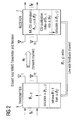
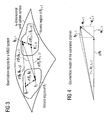
fig.2 shows the general diagram of a beamforming system with limited feedback operating according to the method of the present invention; - figg.3 and 4 show some vectorial representations referred to the quantization regions and correlated channel useful to understand the method of the invention;
-
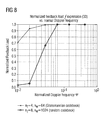
fig.5 shows a double family of comparative curves between simulated CCDF and an approximate closed form expression use in the calculation, encompassing different normalized Doppler frequency values taken as a variable parameter; - figg.6, 7 and 8 show different sets of curves reporting the numerical results of some comparative simulations between the quantization of the CSI according to known method and the method of the invention.
- In
fig.1 we see a closed loop MIMO wireless system consisting of atransmitter 6 equipped with nt transmit antennas and a receiver 7 equipped with nr receive antennas on the forward link. The forward channel H t at time slot t is modelled as a Rayleigh distributed nr × nt matrix having i.i.d. entries:
transmitter 6 through a reverse channel for user traffic (not shown) and through an additional low-rate (in-band) feedback channel. Without losing of generality, the feedback channel is supposed zero-delay and ideal. Thetransmitter 6 has nt inputs for a vector s t ∈□ ns ×1 that contains the modulated symbols for each independent data stream such that
- The
transmitter 6 multiplexes ns ≤ min{nr , nt } streams during every time slot t of the wireless channel by spatial multiplexing, see Ref.[1] or even IEEE 802.16e-2005, entry 8.4.8.3.6 (MIMO precoding matrix W). This includes beamforming by trivially setting ns = 1. The system transfer function at time slot t on the forward link is modelled as:
- Here y t ∈□ nr ×1 is the received signal, n t ∼CN(0 nr ×1,σ2 I n
r ) is the Gaussian i.i.d. additive noise and F t ∈□ nt ×ns is the precoding matrix (or vector in case of beamforming). According to current assumptions in wireless standard Ref.[9], the energy is equally split among the ns orthogonal streams (F t H F t = I ns ) such that F t spans ns dimensions over the nt dimensional space. - The precoder F t is dynamically adapted to channel conditions at time t+1 according to quantized CSI conveyed by the receiver 7 to
transmitter 6 on the feedback channel (supposed ideal with zero-delay). In detail, at each time slot t+1 the following operations are executed: - 1. the receiver 7, according to any suitable optimization criterion known in the art, e.g. ML, chooses the optimal precoder F t+1 from a subset Δ(F t ) of a pre-defined codebook Φ including nw codewords (precoders);
- 2. the receiver feeds back on the low-rate channel the index of precoder F t+1 spanning the reduced codebook Δ(F t );
- 3. the receiver calculates a reduced codebook Δ(F t+1) including 2 b
δ orthogonal codewords of Φ, according to the following expression:
where i, j are generic index spanning the elements of codebook Φ, and d(F i , F t+1) is the chordal distance from F t+1; - 4. the transmitter receives the quantized index and uses it to retrieve the precoder F t+1 from subset Δ(F t ) in correspondence of that index;
- 5. the transmitter multiply the actual baseband sample by precoder F t+1 and transmit the product;
- 6. The transmitter calculate a reduced codebook Δ(F t+1) as done in the receiver.
- Some definitions are introduced here to give support to the reduced codebook determination:
- Let Ω(nt,ns ) be the set of all nt ×ns unitary matrices. The chordal distance between two subspaces generating unitary matrices G i ∈Ω(nt ,ns ) and G j ∈Ω(nt ,ns ) (i.e., matrices whose columns spaces span ns dimensions over the available nt dimensions) is defined as:

where ϑ i,j ∈[0,π/2] is the angle between G i and G j , and ∥□∥ F is the Frobenius norm. - The quantization (Voronoi) region associated to the ith codeword G ¡ ∈Φ is defined as

- A ball B(G i ,δ) of radius δ centred on G ¡ ∈Ω(nt ,ns ) is defined as the subset of all matrices belonging to Ω(nt ,ns ) within a given distance δ from G j , Ref.[2]:


- In the successive description the nearly-optimal feedback load is evaluated for the closed loop system based on a feedback reduction procedure as said above. A nearly optimal value for distance δ to be used in (6) is evaluated according to the temporal channel correlation. A closed-form upper bound on the corresponding feedback load is obtained by estimating the average cardinality of Δ(F t ,δ).
- For simplicity, in the following a MISO system employing Maximum Ratio Transmission (MRT) is considered such that the unquantized (nt ×1) precoder at time t is

h t is mapped on F t ∈Φ as:
- The optimal reduced codebook Δ(F t ) is defined as:


where ε is an arbitrary threshold (0 ≤ ε ≤ 1). According to (8), δ 0 is the minimum distance such that the probability that the precoder F t+1 at time t+1 lies outside a ball of radius δ 0 centered on F t is ε. Condition (9) can be equivalently expressed as:
- The analytical solution of (10) is not practical as it is based on specific assumptions on the shape of the Voronoi region V(F t ). Therefore, in the following a general upper bound on δ0 is derived by avoiding any assumption on the Voronoi region shape. With reference to
fig.3 , it can be shown that:

- The maximum quantization error length d m is a specific property of the codebook and has to be evaluated numerically. However, in case Φ is the optimal codebook based on Grassmannian manifold Ref.[10], a simple tight bound on d m is given by the following Rankin bound given in Ref.[11]:


h t ,h t+1). The following is the analytical expression of a closed form forF d(h t,h t+1 )(□) to be used in (16), that will be derived later in the description: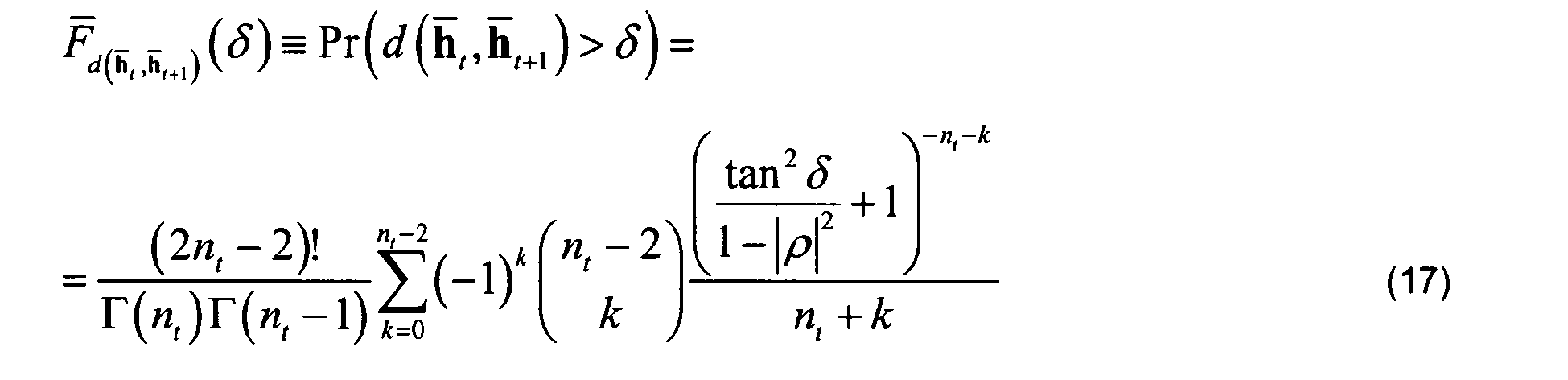
- A closed-form upper bound on the reduced codebook

ball radius 
h ¡)≤dm it holds (seefig.3 for visual reference):

where (11) has been plugged into (18) in the last passage. - Let A(F i ,δ) be the surface on the nt -dimensional unit sphere that is included in ball of radius δ centered in F i . It is shown in Ref.[2] that the ratio between A(F i ,δ) and the total surface of the unit sphere is:

- Assuming that the codewords are uniformly distributed on the unit sphere, the average number of codewords covered by A(F i ,δ) is:

where |Δ(F t ,δ)| is the cardinality of the reduced codebook. Therefore, an upper bound on the codebook (8) size is:
where

whereδ is the average quantization error length. - Here a closed form expression for Pr(d(
h t ,h t+1)>δ)≡F d(h t ,h t+1 )(δ) to be numerically inverted and plugged into (16) is derived. The time-varying MISO channel is modeled as an autoregressive AR(1) process commonly accepted as wireless channel model:
where is the correlation factor (0 ≤ ρ≤1). Assuming Clarke's channel model, ρ is related to the normalized channel Doppler frequency as:

- With reference to
fig.4 , let




- The distribution of d(
h t ,h t+1) is obtained directly from (27), however its expression is not suitable for practical usage in real-time systems. Therefore, in the following an approximate expression forF d(h t,h t+1 )(δ) that is tight for highly correlated channels (ρ→1) is derived. - It is first observed that for


in which Γ(nt ) is any algebraic function.
On the other hand, it can be shown that


F d(h t,h t+1 )(δ) of d(h t ,h t+1) is finally obtained by integrating (31) and substituting z = tan2 δ. -
Fig.5 shows the comparison between the (17) and the numerical CCDF of d (h t ,h t+1) in (27) for nt = 4 and for various values of ρ expressed as in Eq. (25). As expected, the (17) is tight for ρ→1, which is the setting of most practical interest for the feedback compression technique previously discussed. - Now with reference to the remaining figg.6, 7, and 8, the proposed feedback reduction algorithm is evaluated in terms of average rate performance for various codebook design criteria and system parameters. The channel at generic time slot t is distributed according to (1) and channel correlation is modeled by the AR(1) model (24). The average rate is evaluated according to Shannon's capacity:

- The following feedback schemes are evaluated:
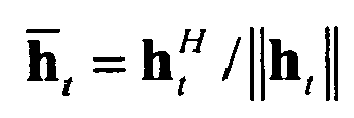
- Analog feedback (solid line): the optimal unquantized precoder
- Conventional quantized feedback ("x" marker): an independent feedback of b = ┌log2 nw ┐+ = 6 bits is sent on a time-slot basis.
- Reduced quantized feedback (dashed lines): the reduced feedback technique of the method of the invention is assumed and the reduced codebook includes the 2 b' nearest neighbors of F t . The feedback load is independent on Doppler frequency.
- Reduced quantized feedback ("o" marker): the reduced feedback technique of the method of the invention is assumed, and the feedback load is dynamically adjusted to channel normalized Doppler frequency. The actual feedback load is function of channel correlation according to (16).
-
Fig.6 shows the performance for a MISO system with nt = 4 transmit antennas and average SNR=1/σ2=20dB. Codebook Φ is taken from the Grassmannian manifold(4,1,64), see Ref.[2]. The proposed feedback load estimation criterion (16) proves to be able to efficiently tune the feedback load according to channel correlation.
-
Fig.7 shows the average rate for a MISO system with nt = 8 transmit antennas and SNR=20dB. A random codebook Φ with 1024 codewords leading to an uncompressed feedback load of b = ┌log2 nw ┐+ = 10 bit/time-slot is assumed. The efficiency of the feedback load estimator (16) is confirmed in this case, too. -
Fig.8 shows the normalized feedback load f: i.e. the ratio between the reduced feedback load (8) and the uncompressed feedback load:
- The simulation shows that significant feedback reduction can be achieved for highly correlated channels and that the margin for feedback reduction increases with the density of the codebook.
- Although the invention has been described with particular reference to a preferred embodiment, it will be evident to those skilled in the art, that the present invention is not limited thereto, but further variations and modifications may be applied without departing from the scope of the invention as defined by the annexed claims.
-
- 3GPP
- 3rd Generation Partnership Program
- ARn
- AutoRegressive-n
- ARMAn
- AutoRegressive Moving Average-n
- BS
- Base Station
- CCDF
- Complementary Cumulative Distribution Function
- CN(0,σ)
- Complex Normal (mean, standard deviation)
- CSI
- Channel State Information
- DL
- Downlink
- EGPRS
- Enhanced GPRS
- ETSI
- European Telecommunications Standards Institute
- FDD
- Frequency Division Duplexing
- GERAN
- GSM EDGE Radio Access Network
- GPRS
- General Packet Radio Service
- GSM
- Global System for Mobile communications
- IEEE
- Institute of Electrical and Electronics Engineers
- HSDPA
- High Speed Downlink Packet Access
- HSUPA
- High Speed Uplink Packet Access
- i.i.d.
- independent identically distributed
- LTE
- Long Term Evolution
- MIMO
- Multiple Input Multiple Output
- ML
- Maximum Likelihood
- MRT
- Maximum Ratio Transmission
- OFDM
- Orthogonal Frequency Division Multiplexing
- OFDMA
- Orthogonal Frequency Division Multiplex Access
- PCS
- Personal Communication System
- p.d.f.
- probability distribution function
- QoS
- Quality of Service
- SIMO
- Single Input Multiple Output
- SINR
- Signal to Interference and Noise Ratio
- SNR
- Signal to Noise Ratio
- TDD
- Time Division Duplexing
- TDMA
- Time Division Multiple Access
- UE
- User Equipment
- UL
- Uplink
- UMB
- Ultra Mobile Broadband
- UMTS
- Universal Mobile Telecommunication System
- UPE
- User Plane Entity
- UTRAN
- Universal Terrestrial Radio Access Network
- WCDMA
- Wideband Code Division Multiple Access
- WiMAX
- Worldwide Interoperability for Microwave Access
- WLAN
- Wireless Local Area Network
- AWGN
- Additive White Gaussian Noise
-
- [1] A. Paulraj, R. Nabar and D. Gore. Introduction to Space-Time Wireless Communications, Cambridge Univ. Press, May 2003.
- [2] D. J. Love, R. H. Heath, T. Strohmer, "Grassmannian Beamforming for Multiple-Input Multiple-Output Wireless Systems", IEEE Trans. on Inf. Theory, vol. 49, pp. 2735- 2747, Oct. 2003
- [3] D. J. Love, R. H. Heath, "Limited Feedback Unitary Precoding for Spatial Multiplexing Systems", IEEE Trans. on Inf. Theory, vol. 51, pp. 2967-2976, Aug. 2005.
- [4] N. Jindal, "MIMO Broadcast Channels with Finite Rate Feedback", IEEE Trans. on Inf. Theory, Vol. 52, pp 5045-5060, Nov. 2006.
- [5] B. C. Banister and J. R. Zeidler, "Feedback assisted stochastic gradient adaptation of multiantenna transmission," IEEE Trans. on Wireless Commun., vol. 4, no. 3, pp. 1121-1135, 2005.
- [6] C. Simon; G. Leus , "Feedback reduction for spatial multiplexing with linear precoding", in Proc. IEEE ICASSP, April 2007.
- [7] K. Huang, B. Mondal, R. W. Heath, J. G. Andrews, "Multi-Antenna Limited Feedback for Temporally-Correlated Channels: Feedback Compression", in Proc. Of IEEE Globecom, 2006.
- [8] K.-B. Huang, B. Mondal, R. W. Heath, Jr., and J. G. Andrews, "Mutli-antenna limited feedback systems for temporallycorrelated channels: Feedback rate and effect of feedback delay", submitted to IEEE Trans. on Inf. Theory, Mar., 2006.
- [9] IEEE 802.16-2004/Cor2/D4, "Draft standard for local and metropolitan area networks. Part 16: Air Interface for Fixed and Mobile Broadband Wireless .
- [10] A. Barg and D. Y. Nogin, "Bounds on packings of spheres in the Grassmann manifold," IEEE Trans. on Inf. Theory, vol. 48, pp. 2450-2454, Sept. 2002.
- [11] J. H. Conway, R. H. Hardin, and N. J. A. Sloane, "Packing lines, planes, etc.: Packings in Grassmannian spaces," Exper. Math., vol. 5, no. 2, pp. 139-159, 1996.
and the following steps executed by the transmitter at discrete time t+1:
Claims (11)
- Method for quantizing dynamically the state information of a forward transmission channel sent back by a receiver (7) to a transmitter (6) equipped with nt antennas for transmitting ns streams on the forward channel according to a spatial multiplexing or beamforming scheme, characterized in that includes the following steps executed by the receiver (7) at discrete time t+1:- estimating a codeword F t+1 according to any suitable optimization method;- indexing the codeword F t+1 into a reduced codebook Δ(F t ) belonging to a larger codebook Φ;- transmitting on the backward channel the state information corresponding to the index of F t+1 spanning the reduced codebook Δ(F t );- calculating a reduced codebook Δ(F t+1) including 2 bwhere i, j are generic index spanning the elements of codebook Φ, and d(□) is the chordal distance from F t+1:
δ orthogonal codewords of Φ according to the following expression:
and the following steps executed by the transmitter (6) at discrete time t+1:- receiving on the backward channel said index of F t+1 and using it for retrieving F t+1 from the reduced codebook Δ(F t ) calculated by the transmitter at discrete time t ;- multiplying, the actual sample of the baseband transmission signal by the codeword F t+1 and transmitting the product on the forward channel;- calculating a reduced codebook Δ(F t+1) according to the same expression used by the receiver (7). - The method of claim 1, characterized in that said chordal distance is expressed as:

- The method of claim 1 or 2, characterized in that the step at the receiver of indexing said codeword F t+1 spanning Δ(F t ) is driven by one-to-one associations between the 2 b
d configurations of b δ bits and the 2 bd codewords of Δ(F t ), said associations map the reduced address space of Δ(F t ) onto the larger address space of codebook Φ seen as a look-up table. - The method of claim 3, characterized in that the step at the transmitter of retrieving F t+1 from the reduced codebook Δ(F t ) uses the same one-to-one associations as in the receiver.
- The method of any claim from 1 to 4, characterized in that an optimal reduced codebook is defined as:
 • Pr(□) is the probability,• ε is an arbitrary threshold (0≤ε≤1),• δ 0 ≤δ is the minimum distance such that the probability that the codeword F t+1 at time t +1 lies outside a nt -dimensional ball B(F t ,δ0) of radius δ 0 centred on F t is ε,• G i is a nt ×ns unitary matrix belonging to an Ω(nt ,ns ) vector space encompassing all nt ×ns unitary matrices definable on the codebook Φ,• V(G i ) is a quantization region, called Voronoi region, associated to the ith codeword G i ∈Φ.
 - The method of claim 5, characterized in that an upper bound

h t ,h t+1) betweenh t ,h t+1, where:• vectorsh t ,h t+1 collect the samples of pulse response of forward channel at discrete times t and t+1,• • d m the maximum quantization error length specific of codebook Φ.
 - The method of claim 6, characterized in that aassuming that codewords F i are uniformly distributed on an unit sphere, than an upper bound on the size of reduced codebook is:

- The method of claim 7, characterized in that for moderately dense codebooks Φ a tighter approximation of said upper bound is given by:

δ is the average quantization error length. - The method of claim 6, characterized in that an analytical expression of said complementary cumulative distribution function to be inverted for obtaining the radius δ is:

where ρ∈is a correlation factor (0 ≤ ρ ≤ 1) related to the normalized channel Doppler frequency, and Γ(nt ) is any algebraic function.
- The method of claim 1, characterized in that said number b δ of bits is set in suboptimal way as being lower than, or equal to, the bitrate currently available on the backward channel multiplied by the symbol time of the modulated transmission signal.
- The method of claim 9, characterized in that said available bitrate is communicated by the transmitting entity to the receiving entity each time it is changed.
Priority Applications (2)
| Application Number | Priority Date | Filing Date | Title |
|---|---|---|---|
| EP07425725A EP2061162A1 (en) | 2007-11-15 | 2007-11-15 | Reduced feedback dynamic codebook transmission method for multi-antenna systems |
| PCT/EP2008/065224 WO2009062909A1 (en) | 2007-11-15 | 2008-11-10 | Reduced feedback dynamic codebook transmission method for multi-antenna systems |
Applications Claiming Priority (1)
| Application Number | Priority Date | Filing Date | Title |
|---|---|---|---|
| EP07425725A EP2061162A1 (en) | 2007-11-15 | 2007-11-15 | Reduced feedback dynamic codebook transmission method for multi-antenna systems |
Publications (1)
| Publication Number | Publication Date |
|---|---|
| EP2061162A1 true EP2061162A1 (en) | 2009-05-20 |
Family
ID=39494250
Family Applications (1)
| Application Number | Title | Priority Date | Filing Date |
|---|---|---|---|
| EP07425725A Withdrawn EP2061162A1 (en) | 2007-11-15 | 2007-11-15 | Reduced feedback dynamic codebook transmission method for multi-antenna systems |
Country Status (2)
| Country | Link |
|---|---|
| EP (1) | EP2061162A1 (en) |
| WO (1) | WO2009062909A1 (en) |
Cited By (3)
| Publication number | Priority date | Publication date | Assignee | Title |
|---|---|---|---|---|
| CN102025463A (en) * | 2010-12-20 | 2011-04-20 | 东南大学 | Feedback method of MIMO wireless communication system for down link |
| WO2014077809A1 (en) * | 2012-11-15 | 2014-05-22 | Nokia Siemens Networks Oy | Random precoder selection |
| CN110419188A (en) * | 2017-01-06 | 2019-11-05 | 株式会社Ntt都科摩 | How to Get Channel State Information |
Families Citing this family (4)
| Publication number | Priority date | Publication date | Assignee | Title |
|---|---|---|---|---|
| CN108390706B (en) * | 2018-01-30 | 2020-10-27 | 东南大学 | Large-scale MIMO channel state information feedback method based on deep learning |
| CN114641939B (en) * | 2019-10-30 | 2025-04-25 | 上海诺基亚贝尔股份有限公司 | Quantization Precoding in Massive MIMO Systems |
| US12610329B2 (en) | 2022-10-14 | 2026-04-21 | Nokia Technologies Oy | Adjusting a client device receiver parameter, and related devices, methods and computer programs |
| WO2026011357A1 (en) * | 2024-07-10 | 2026-01-15 | 北京小米移动软件有限公司 | Codeword transmission methods, apparatuses and storage medium |
-
2007
- 2007-11-15 EP EP07425725A patent/EP2061162A1/en not_active Withdrawn
-
2008
- 2008-11-10 WO PCT/EP2008/065224 patent/WO2009062909A1/en not_active Ceased
Non-Patent Citations (13)
| Title |
|---|
| "Draft standard for local and metropolitan area networks. Part 16: Air Interface for Fixed and Mobile Broadband Wireless Access Systems Corrigendum 2", IEEE 802.16-2004/COR2/D4, May 2007 (2007-05-01) |
| A. BARG; D. Y. NOGIN: "Bounds on packings of spheres in the Grassmann manifold", IEEE TRANS. ON INF. THEORY, vol. 48, September 2002 (2002-09-01), pages 2450 - 2454 |
| A. PAULRAJ; R. NABAR; D. GORE.: "Introduction to Space-Time Wireless Communications", May 2003, CAMBRIDGE UNIV. PRESS |
| AAZHANG B ET AL: "On beamforming with finite rate feedback in multiple-antenna systems", IEEE TRANSACTIONS ON INFORMATION THEORY, US, vol. 49, no. 10, 1 October 2003 (2003-10-01), pages 2562 - 2579, XP011102237, ISSN: 0018-9448 * |
| B. C. BANISTER; J. R. ZEIDLER: "Feedback assisted stochastic gradient adaptation of multiantenna transmission", IEEE TRANS. ON WIRELESS COMMUN., vol. 4, no. 3, 2005, pages 1121 - 1135 |
| C. SIMON; G. LEUS: "Feedback reduction for spatial multiplexing with linear precoding", PROC. IEEE ICASSP, April 2007 (2007-04-01) |
| D. J. LOVE; R. H. HEATH: "Limited Feedback Unitary Precoding for Spatial Multiplexing Systems", IEEE TRANS. ON LNF. THEORY, vol. 51, August 2005 (2005-08-01), pages 2967 - 2976 |
| D. J. LOVE; R. H. HEATH; T. STROHMER: "Grassmannian Beamforming for Multiple-Input Multiple-Output Wireless Systems", IEEE TRANS. ON LNF. THEORY, vol. 49, October 2003 (2003-10-01), pages 2735 - 2747 |
| J. H. CONWAY; R. H. HARDIN; N. J. A. SLOANE: "Packing lines, planes, etc.: Packings in Grassmannian spaces", EXPER. MATH., vol. 5, no. 2, 1996, pages 139 - 159 |
| K. HUANG ET AL.: "Multi-Antenna Limited Feedback for Temporally-Correlated Channels: Feedback Compression", PROC. OF IEEE GLOBECOM, 2006 |
| K.-B. HUANG ET AL.: "Mutli-antenna limited feedback systems for temporallycorrelated channels: Feedback rate and effect of feedback delay", IEEE TRANS. ON INF. THEORY, March 2006 (2006-03-01) |
| KAIBIN HUANG ET AL: "Markov Models for Limited Feedback MIMO Systems", ACOUSTICS, SPEECH AND SIGNAL PROCESSING, 2006. ICASSP 2006 PROCEEDINGS . 2006 IEEE INTERNATIONAL CONFERENCE ON TOULOUSE, FRANCE 14-19 MAY 2006, PISCATAWAY, NJ, USA,IEEE, 1 January 2006 (2006-01-01), pages IV - IV, XP031101134, ISBN: 978-1-4244-0469-8 * |
| N. JINDAL: "MIMO Broadcast Channels with Finite Rate Feedback", IEEE TRANS. ON LNF. THEORY, vol. 52, November 2006 (2006-11-01), pages 5045 - 5060 |
Cited By (4)
| Publication number | Priority date | Publication date | Assignee | Title |
|---|---|---|---|---|
| CN102025463A (en) * | 2010-12-20 | 2011-04-20 | 东南大学 | Feedback method of MIMO wireless communication system for down link |
| CN102025463B (en) * | 2010-12-20 | 2012-11-28 | 东南大学 | Feedback method of MIMO wireless communication system for down link |
| WO2014077809A1 (en) * | 2012-11-15 | 2014-05-22 | Nokia Siemens Networks Oy | Random precoder selection |
| CN110419188A (en) * | 2017-01-06 | 2019-11-05 | 株式会社Ntt都科摩 | How to Get Channel State Information |
Also Published As
| Publication number | Publication date |
|---|---|
| WO2009062909A1 (en) | 2009-05-22 |
Similar Documents
| Publication | Publication Date | Title |
|---|---|---|
| US8023457B2 (en) | Feedback reduction for MIMO precoded system by exploiting channel correlation | |
| US8934565B2 (en) | Reference signaling scheme using compressed feedforward codebooks for multi-user, multiple-input multiple-output (MU-MIMO) systems | |
| Huang et al. | Limited feedback beamforming over temporally-correlated channels | |
| US10230438B2 (en) | MIMO precoding enabling spatial multiplexing, power allocation and adaptive modulation and coding | |
| US9577730B2 (en) | Channel quality index feedback reduction for broadband systems | |
| US9124328B2 (en) | System and method for channel information feedback in a wireless communications system | |
| US8817904B2 (en) | Method for selecting a precoding matrix in a multiple input multiple output (“MIMO”) system | |
| US8626104B2 (en) | Generalized codebook design method for limited feedback systems | |
| US8675794B1 (en) | Efficient estimation of feedback for modulation and coding scheme (MCS) selection | |
| US20200136700A1 (en) | Channel Prediction for Adaptive Channel State Information (CSI) Feedback Overhead Reduction | |
| US9729272B2 (en) | Feedback with unequal error protection | |
| US20070191066A1 (en) | Structured codebook and successive beamforming for multiple-antenna systems | |
| US8787480B2 (en) | Method of determining channel state information | |
| CN102835056A (en) | System and method for reporting feedback information for adaptive codebooks | |
| US20160134342A1 (en) | Adaptive MIMO Feasibility feedback | |
| WO2009062909A1 (en) | Reduced feedback dynamic codebook transmission method for multi-antenna systems | |
| Khoshnevis et al. | On the asymptotic performance of multiple antenna channels with quantized feedback | |
| Mielczarek et al. | Vector quantized CSI prediction in linear multi-user MIMO systems | |
| Sorrentino et al. | Efficient precoder quantization for time-varying MIMO wireless channels | |
| WO2008152540A2 (en) | Method and apparatus for antenna selection in a multi-antenna system |
Legal Events
| Date | Code | Title | Description |
|---|---|---|---|
| PUAI | Public reference made under article 153(3) epc to a published international application that has entered the european phase |
Free format text: ORIGINAL CODE: 0009012 |
|
| AK | Designated contracting states |
Kind code of ref document: A1 Designated state(s): AT BE BG CH CY CZ DE DK EE ES FI FR GB GR HU IE IS IT LI LT LU LV MC MT NL PL PT RO SE SI SK TR |
|
| AX | Request for extension of the european patent |
Extension state: AL BA HR MK RS |
|
| 17P | Request for examination filed |
Effective date: 20091120 |
|
| 17Q | First examination report despatched |
Effective date: 20091215 |
|
| AKX | Designation fees paid |
Designated state(s): AT BE BG CH CY CZ DE DK EE ES FI FR GB GR HU IE IS IT LI LT LU LV MC MT NL PL PT RO SE SI SK TR |
|
| STAA | Information on the status of an ep patent application or granted ep patent |
Free format text: STATUS: THE APPLICATION IS DEEMED TO BE WITHDRAWN |
|
| 18D | Application deemed to be withdrawn |
Effective date: 20100626 |