EP2060636A1 - Verfahren zur Herstellung von L-Aminosäuren unter Verwendung von verbesserten Stämmen der Familie Enterobacteriaceae - Google Patents
Verfahren zur Herstellung von L-Aminosäuren unter Verwendung von verbesserten Stämmen der Familie Enterobacteriaceae Download PDFInfo
- Publication number
- EP2060636A1 EP2060636A1 EP08167366A EP08167366A EP2060636A1 EP 2060636 A1 EP2060636 A1 EP 2060636A1 EP 08167366 A EP08167366 A EP 08167366A EP 08167366 A EP08167366 A EP 08167366A EP 2060636 A1 EP2060636 A1 EP 2060636A1
- Authority
- EP
- European Patent Office
- Prior art keywords
- gene
- gene coding
- seq
- microorganisms
- coding
- Prior art date
- Legal status (The legal status is an assumption and is not a legal conclusion. Google has not performed a legal analysis and makes no representation as to the accuracy of the status listed.)
- Withdrawn
Links
- 150000008575 L-amino acids Chemical class 0.000 title claims abstract description 50
- 238000000034 method Methods 0.000 title claims description 54
- 238000004519 manufacturing process Methods 0.000 title claims description 25
- 241000588921 Enterobacteriaceae Species 0.000 title claims description 22
- 108090000623 proteins and genes Proteins 0.000 claims abstract description 166
- 102000004169 proteins and genes Human genes 0.000 claims abstract description 54
- 101150083354 glgS gene Proteins 0.000 claims abstract description 48
- 230000015572 biosynthetic process Effects 0.000 claims abstract description 24
- 229920002527 Glycogen Polymers 0.000 claims abstract description 22
- 229940096919 glycogen Drugs 0.000 claims abstract description 22
- 241000588724 Escherichia coli Species 0.000 claims description 102
- AYFVYJQAPQTCCC-GBXIJSLDSA-N L-threonine Chemical compound C[C@@H](O)[C@H](N)C(O)=O AYFVYJQAPQTCCC-GBXIJSLDSA-N 0.000 claims description 85
- 244000005700 microbiome Species 0.000 claims description 71
- 235000018102 proteins Nutrition 0.000 claims description 53
- 239000004473 Threonine Substances 0.000 claims description 48
- 229960002898 threonine Drugs 0.000 claims description 48
- 108700026244 Open Reading Frames Proteins 0.000 claims description 47
- KZSNJWFQEVHDMF-BYPYZUCNSA-N L-valine Chemical compound CC(C)[C@H](N)C(O)=O KZSNJWFQEVHDMF-BYPYZUCNSA-N 0.000 claims description 43
- UKAUYVFTDYCKQA-VKHMYHEASA-N L-homoserine Chemical compound OC(=O)[C@@H](N)CCO UKAUYVFTDYCKQA-VKHMYHEASA-N 0.000 claims description 39
- 238000000855 fermentation Methods 0.000 claims description 35
- 230000004151 fermentation Effects 0.000 claims description 35
- QIVBCDIJIAJPQS-VIFPVBQESA-N L-tryptophane Chemical compound C1=CC=C2C(C[C@H](N)C(O)=O)=CNC2=C1 QIVBCDIJIAJPQS-VIFPVBQESA-N 0.000 claims description 33
- 230000014509 gene expression Effects 0.000 claims description 33
- 102000004190 Enzymes Human genes 0.000 claims description 32
- 108090000790 Enzymes Proteins 0.000 claims description 32
- 108700028369 Alleles Proteins 0.000 claims description 31
- 150000001413 amino acids Chemical group 0.000 claims description 27
- 230000008569 process Effects 0.000 claims description 24
- 230000000694 effects Effects 0.000 claims description 22
- AGPKZVBTJJNPAG-WHFBIAKZSA-N L-isoleucine Chemical compound CC[C@H](C)[C@H](N)C(O)=O AGPKZVBTJJNPAG-WHFBIAKZSA-N 0.000 claims description 21
- 229930182844 L-isoleucine Natural products 0.000 claims description 21
- 229960000310 isoleucine Drugs 0.000 claims description 21
- 229960004295 valine Drugs 0.000 claims description 21
- MTCFGRXMJLQNBG-REOHCLBHSA-N (2S)-2-Amino-3-hydroxypropansäure Chemical compound OC[C@H](N)C(O)=O MTCFGRXMJLQNBG-REOHCLBHSA-N 0.000 claims description 20
- UKAUYVFTDYCKQA-UHFFFAOYSA-N -2-Amino-4-hydroxybutanoic acid Natural products OC(=O)C(N)CCO UKAUYVFTDYCKQA-UHFFFAOYSA-N 0.000 claims description 20
- OUYCCCASQSFEME-QMMMGPOBSA-N L-tyrosine Chemical compound OC(=O)[C@@H](N)CC1=CC=C(O)C=C1 OUYCCCASQSFEME-QMMMGPOBSA-N 0.000 claims description 20
- 229960004799 tryptophan Drugs 0.000 claims description 20
- WPLOVIFNBMNBPD-ATHMIXSHSA-N subtilin Chemical compound CC1SCC(NC2=O)C(=O)NC(CC(N)=O)C(=O)NC(C(=O)NC(CCCCN)C(=O)NC(C(C)CC)C(=O)NC(=C)C(=O)NC(CCCCN)C(O)=O)CSC(C)C2NC(=O)C(CC(C)C)NC(=O)C1NC(=O)C(CCC(N)=O)NC(=O)C(CC(C)C)NC(=O)C(NC(=O)C1NC(=O)C(=C/C)/NC(=O)C(CCC(N)=O)NC(=O)C(CC(C)C)NC(=O)C(C)NC(=O)CNC(=O)C(NC(=O)C(NC(=O)C2NC(=O)CNC(=O)C3CCCN3C(=O)C(NC(=O)C3NC(=O)C(CC(C)C)NC(=O)C(=C)NC(=O)C(CCC(O)=O)NC(=O)C(NC(=O)C(CCCCN)NC(=O)C(N)CC=4C5=CC=CC=C5NC=4)CSC3)C(C)SC2)C(C)C)C(C)SC1)CC1=CC=CC=C1 WPLOVIFNBMNBPD-ATHMIXSHSA-N 0.000 claims description 19
- 108091033319 polynucleotide Proteins 0.000 claims description 18
- 102000040430 polynucleotide Human genes 0.000 claims description 18
- 239000002157 polynucleotide Substances 0.000 claims description 18
- IFGCUJZIWBUILZ-UHFFFAOYSA-N sodium 2-[[2-[[hydroxy-(3,4,5-trihydroxy-6-methyloxan-2-yl)oxyphosphoryl]amino]-4-methylpentanoyl]amino]-3-(1H-indol-3-yl)propanoic acid Chemical compound [Na+].C=1NC2=CC=CC=C2C=1CC(C(O)=O)NC(=O)C(CC(C)C)NP(O)(=O)OC1OC(C)C(O)C(O)C1O IFGCUJZIWBUILZ-UHFFFAOYSA-N 0.000 claims description 18
- 108010055400 Aspartate kinase Proteins 0.000 claims description 17
- 230000001965 increasing effect Effects 0.000 claims description 17
- COLNVLDHVKWLRT-QMMMGPOBSA-N L-phenylalanine Chemical compound OC(=O)[C@@H](N)CC1=CC=CC=C1 COLNVLDHVKWLRT-QMMMGPOBSA-N 0.000 claims description 16
- GNGACRATGGDKBX-UHFFFAOYSA-N dihydroxyacetone phosphate Chemical compound OCC(=O)COP(O)(O)=O GNGACRATGGDKBX-UHFFFAOYSA-N 0.000 claims description 16
- 108010064711 Homoserine dehydrogenase Proteins 0.000 claims description 15
- DCXYFEDJOCDNAF-REOHCLBHSA-N L-asparagine Chemical compound OC(=O)[C@@H](N)CC(N)=O DCXYFEDJOCDNAF-REOHCLBHSA-N 0.000 claims description 15
- 239000002773 nucleotide Substances 0.000 claims description 15
- 125000003729 nucleotide group Chemical group 0.000 claims description 15
- 238000010923 batch production Methods 0.000 claims description 14
- WHUUTDBJXJRKMK-VKHMYHEASA-N L-glutamic acid Chemical compound OC(=O)[C@@H](N)CCC(O)=O WHUUTDBJXJRKMK-VKHMYHEASA-N 0.000 claims description 13
- AYFVYJQAPQTCCC-UHFFFAOYSA-N Threonine Natural products CC(O)C(N)C(O)=O AYFVYJQAPQTCCC-UHFFFAOYSA-N 0.000 claims description 13
- ROHFNLRQFUQHCH-YFKPBYRVSA-N L-leucine Chemical compound CC(C)C[C@H](N)C(O)=O ROHFNLRQFUQHCH-YFKPBYRVSA-N 0.000 claims description 12
- 241000588722 Escherichia Species 0.000 claims description 10
- HNDVDQJCIGZPNO-YFKPBYRVSA-N L-histidine Chemical compound OC(=O)[C@@H](N)CC1=CN=CN1 HNDVDQJCIGZPNO-YFKPBYRVSA-N 0.000 claims description 10
- 210000004027 cell Anatomy 0.000 claims description 10
- 229920001184 polypeptide Polymers 0.000 claims description 10
- 108090000765 processed proteins & peptides Proteins 0.000 claims description 10
- 102000004196 processed proteins & peptides Human genes 0.000 claims description 10
- 150000003839 salts Chemical class 0.000 claims description 10
- 229960001153 serine Drugs 0.000 claims description 10
- 229960004441 tyrosine Drugs 0.000 claims description 10
- WQZGKKKJIJFFOK-GASJEMHNSA-N Glucose Natural products OC[C@H]1OC(O)[C@H](O)[C@@H](O)[C@@H]1O WQZGKKKJIJFFOK-GASJEMHNSA-N 0.000 claims description 9
- KDXKERNSBIXSRK-YFKPBYRVSA-N L-lysine Chemical compound NCCCC[C@H](N)C(O)=O KDXKERNSBIXSRK-YFKPBYRVSA-N 0.000 claims description 9
- FFEARJCKVFRZRR-BYPYZUCNSA-N L-methionine Chemical compound CSCC[C@H](N)C(O)=O FFEARJCKVFRZRR-BYPYZUCNSA-N 0.000 claims description 9
- 230000003321 amplification Effects 0.000 claims description 9
- 230000000295 complement effect Effects 0.000 claims description 9
- 239000008103 glucose Substances 0.000 claims description 9
- 238000003199 nucleic acid amplification method Methods 0.000 claims description 9
- 239000013598 vector Substances 0.000 claims description 9
- 101710088194 Dehydrogenase Proteins 0.000 claims description 8
- 229930195722 L-methionine Natural products 0.000 claims description 8
- 108091000080 Phosphotransferase Proteins 0.000 claims description 8
- QIVBCDIJIAJPQS-UHFFFAOYSA-N Tryptophan Natural products C1=CC=C2C(CC(N)C(O)=O)=CNC2=C1 QIVBCDIJIAJPQS-UHFFFAOYSA-N 0.000 claims description 8
- 229960004452 methionine Drugs 0.000 claims description 8
- KLAKIAVEMQMVBT-UHFFFAOYSA-N p-hydroxy-phenacyl alcohol Natural products OCC(=O)C1=CC=C(O)C=C1 KLAKIAVEMQMVBT-UHFFFAOYSA-N 0.000 claims description 8
- 102000020233 phosphotransferase Human genes 0.000 claims description 8
- FFEARJCKVFRZRR-UHFFFAOYSA-N L-Methionine Natural products CSCCC(N)C(O)=O FFEARJCKVFRZRR-UHFFFAOYSA-N 0.000 claims description 7
- 229960001230 asparagine Drugs 0.000 claims description 7
- 229960005190 phenylalanine Drugs 0.000 claims description 7
- KPGXRSRHYNQIFN-UHFFFAOYSA-N 2-oxoglutaric acid Chemical compound OC(=O)CCC(=O)C(O)=O KPGXRSRHYNQIFN-UHFFFAOYSA-N 0.000 claims description 6
- 241000186226 Corynebacterium glutamicum Species 0.000 claims description 6
- DHMQDGOQFOQNFH-UHFFFAOYSA-N Glycine Chemical compound NCC(O)=O DHMQDGOQFOQNFH-UHFFFAOYSA-N 0.000 claims description 6
- QNAYBMKLOCPYGJ-REOHCLBHSA-N L-alanine Chemical compound C[C@H](N)C(O)=O QNAYBMKLOCPYGJ-REOHCLBHSA-N 0.000 claims description 6
- 102000011929 Succinate-CoA Ligases Human genes 0.000 claims description 6
- 108010075728 Succinate-CoA Ligases Proteins 0.000 claims description 6
- 239000000872 buffer Substances 0.000 claims description 6
- 230000002068 genetic effect Effects 0.000 claims description 6
- 230000001105 regulatory effect Effects 0.000 claims description 6
- 238000011144 upstream manufacturing Methods 0.000 claims description 6
- QDGAVODICPCDMU-UHFFFAOYSA-N 2-amino-3-[3-[bis(2-chloroethyl)amino]phenyl]propanoic acid Chemical compound OC(=O)C(N)CC1=CC=CC(N(CCCl)CCCl)=C1 QDGAVODICPCDMU-UHFFFAOYSA-N 0.000 claims description 5
- 239000002028 Biomass Substances 0.000 claims description 5
- QNAYBMKLOCPYGJ-UHFFFAOYSA-N D-alpha-Ala Natural products CC([NH3+])C([O-])=O QNAYBMKLOCPYGJ-UHFFFAOYSA-N 0.000 claims description 5
- QNAYBMKLOCPYGJ-UWTATZPHSA-N L-Alanine Natural products C[C@@H](N)C(O)=O QNAYBMKLOCPYGJ-UWTATZPHSA-N 0.000 claims description 5
- 239000004395 L-leucine Substances 0.000 claims description 5
- 235000019454 L-leucine Nutrition 0.000 claims description 5
- 241000607720 Serratia Species 0.000 claims description 5
- 101710124173 Tryptophan-specific transport protein Proteins 0.000 claims description 5
- 229960003767 alanine Drugs 0.000 claims description 5
- 229960002885 histidine Drugs 0.000 claims description 5
- 229960003136 leucine Drugs 0.000 claims description 5
- 229930029653 phosphoenolpyruvate Natural products 0.000 claims description 5
- DTBNBXWJWCWCIK-UHFFFAOYSA-N phosphoenolpyruvic acid Chemical compound OC(=O)C(=C)OP(O)(O)=O DTBNBXWJWCWCIK-UHFFFAOYSA-N 0.000 claims description 5
- 101150076849 rpoS gene Proteins 0.000 claims description 5
- 230000009466 transformation Effects 0.000 claims description 5
- 238000005406 washing Methods 0.000 claims description 5
- 108010062110 water dikinase pyruvate Proteins 0.000 claims description 5
- 102000003925 1,4-alpha-Glucan Branching Enzyme Human genes 0.000 claims description 4
- 108090000344 1,4-alpha-Glucan Branching Enzyme Proteins 0.000 claims description 4
- 101100106362 Bacillus subtilis (strain 168) yjcG gene Proteins 0.000 claims description 4
- 108010078791 Carrier Proteins Proteins 0.000 claims description 4
- 108010000898 Chorismate mutase Proteins 0.000 claims description 4
- 101100378385 Escherichia coli (strain K12) actP gene Proteins 0.000 claims description 4
- 101100375580 Escherichia coli (strain K12) yaaU gene Proteins 0.000 claims description 4
- 101100488434 Escherichia coli (strain K12) yibD gene Proteins 0.000 claims description 4
- 108700023224 Glucose-1-phosphate adenylyltransferases Proteins 0.000 claims description 4
- 102000007390 Glycogen Phosphorylase Human genes 0.000 claims description 4
- 108010046163 Glycogen Phosphorylase Proteins 0.000 claims description 4
- 239000004472 Lysine Substances 0.000 claims description 4
- 108010035004 Prephenate Dehydrogenase Proteins 0.000 claims description 4
- 108010024840 Sulfite Reductase (NADPH) Proteins 0.000 claims description 4
- 102000014701 Transketolase Human genes 0.000 claims description 4
- 108010043652 Transketolase Proteins 0.000 claims description 4
- 102100040653 Tryptophan 2,3-dioxygenase Human genes 0.000 claims description 4
- 101710136122 Tryptophan 2,3-dioxygenase Proteins 0.000 claims description 4
- 101150010999 aroP gene Proteins 0.000 claims description 4
- 230000021615 conjugation Effects 0.000 claims description 4
- 238000010924 continuous production Methods 0.000 claims description 4
- 101150019926 glgA gene Proteins 0.000 claims description 4
- 101150070444 glgB gene Proteins 0.000 claims description 4
- 101150013858 glgC gene Proteins 0.000 claims description 4
- 101150090624 glgP gene Proteins 0.000 claims description 4
- 101150008441 glgX gene Proteins 0.000 claims description 4
- 101150043515 pps gene Proteins 0.000 claims description 4
- 230000026683 transduction Effects 0.000 claims description 4
- 238000010361 transduction Methods 0.000 claims description 4
- OUYCCCASQSFEME-UHFFFAOYSA-N tyrosine Natural products OC(=O)C(N)CC1=CC=C(O)C=C1 OUYCCCASQSFEME-UHFFFAOYSA-N 0.000 claims description 4
- 108010037870 Anthranilate Synthase Proteins 0.000 claims description 3
- 108090000489 Carboxy-Lyases Proteins 0.000 claims description 3
- 102000014914 Carrier Proteins Human genes 0.000 claims description 3
- 101710147169 Catabolite repressor/activator Proteins 0.000 claims description 3
- 102000003983 Flavoproteins Human genes 0.000 claims description 3
- 108010057573 Flavoproteins Proteins 0.000 claims description 3
- 235000019766 L-Lysine Nutrition 0.000 claims description 3
- ONIBWKKTOPOVIA-BYPYZUCNSA-N L-Proline Chemical compound OC(=O)[C@@H]1CCCN1 ONIBWKKTOPOVIA-BYPYZUCNSA-N 0.000 claims description 3
- 229930195714 L-glutamate Natural products 0.000 claims description 3
- 229930182821 L-proline Natural products 0.000 claims description 3
- 108010043075 L-threonine 3-dehydrogenase Proteins 0.000 claims description 3
- 108010026217 Malate Dehydrogenase Proteins 0.000 claims description 3
- 102000013460 Malate Dehydrogenase Human genes 0.000 claims description 3
- 102100031551 Methionine synthase Human genes 0.000 claims description 3
- 108091000041 Phosphoenolpyruvate Carboxylase Proteins 0.000 claims description 3
- 102000001253 Protein Kinase Human genes 0.000 claims description 3
- 108010053763 Pyruvate Carboxylase Proteins 0.000 claims description 3
- 102100039895 Pyruvate carboxylase, mitochondrial Human genes 0.000 claims description 3
- 108010022394 Threonine synthase Proteins 0.000 claims description 3
- 102000006843 Threonine synthase Human genes 0.000 claims description 3
- 102100033451 Thyroid hormone receptor beta Human genes 0.000 claims description 3
- 101710093706 Tryptophan permease Proteins 0.000 claims description 3
- 108010075344 Tryptophan synthase Proteins 0.000 claims description 3
- 230000002238 attenuated effect Effects 0.000 claims description 3
- 230000006696 biosynthetic metabolic pathway Effects 0.000 claims description 3
- 210000000349 chromosome Anatomy 0.000 claims description 3
- 239000000470 constituent Substances 0.000 claims description 3
- 101150094831 cysK gene Proteins 0.000 claims description 3
- 230000007850 degeneration Effects 0.000 claims description 3
- 108010071598 homoserine kinase Proteins 0.000 claims description 3
- 101150073820 pntA gene Proteins 0.000 claims description 3
- 101150011666 pntB gene Proteins 0.000 claims description 3
- 238000002360 preparation method Methods 0.000 claims description 3
- 229960002429 proline Drugs 0.000 claims description 3
- 230000003362 replicative effect Effects 0.000 claims description 3
- 101150051662 yddG gene Proteins 0.000 claims description 3
- NQEQTYPJSIEPHW-UHFFFAOYSA-N 1-C-(indol-3-yl)glycerol 3-phosphate Chemical compound C1=CC=C2C(C(O)C(COP(O)(O)=O)O)=CNC2=C1 NQEQTYPJSIEPHW-UHFFFAOYSA-N 0.000 claims description 2
- PWKSKIMOESPYIA-UHFFFAOYSA-N 2-acetamido-3-sulfanylpropanoic acid Chemical compound CC(=O)NC(CS)C(O)=O PWKSKIMOESPYIA-UHFFFAOYSA-N 0.000 claims description 2
- 101150007902 ASPA gene Proteins 0.000 claims description 2
- 108050005273 Amino acid transporters Proteins 0.000 claims description 2
- 102000034263 Amino acid transporters Human genes 0.000 claims description 2
- 239000004475 Arginine Substances 0.000 claims description 2
- 108020004635 Complementary DNA Proteins 0.000 claims description 2
- 241000588698 Erwinia Species 0.000 claims description 2
- 101150099894 GDHA gene Proteins 0.000 claims description 2
- 108010070600 Glucose-6-phosphate isomerase Proteins 0.000 claims description 2
- 102000005731 Glucose-6-phosphate isomerase Human genes 0.000 claims description 2
- ODKSFYDXXFIFQN-BYPYZUCNSA-P L-argininium(2+) Chemical compound NC(=[NH2+])NCCC[C@H]([NH3+])C(O)=O ODKSFYDXXFIFQN-BYPYZUCNSA-P 0.000 claims description 2
- 102100023162 L-serine dehydratase/L-threonine deaminase Human genes 0.000 claims description 2
- 108090000856 Lyases Proteins 0.000 claims description 2
- 102000004317 Lyases Human genes 0.000 claims description 2
- 101150058595 MDH gene Proteins 0.000 claims description 2
- 108010038555 Phosphoglycerate dehydrogenase Proteins 0.000 claims description 2
- 108010086950 Phosphoribosylanthranilate isomerase Proteins 0.000 claims description 2
- 102100021762 Phosphoserine phosphatase Human genes 0.000 claims description 2
- 241000588768 Providencia Species 0.000 claims description 2
- 108010042687 Pyruvate Oxidase Proteins 0.000 claims description 2
- ODKSFYDXXFIFQN-UHFFFAOYSA-N arginine Natural products OC(=O)C(N)CCCNC(N)=N ODKSFYDXXFIFQN-UHFFFAOYSA-N 0.000 claims description 2
- 101150019536 aroF gene Proteins 0.000 claims description 2
- 101150076125 aroG gene Proteins 0.000 claims description 2
- 101150018055 aroH gene Proteins 0.000 claims description 2
- 125000003118 aryl group Chemical group 0.000 claims description 2
- 101150001544 crr gene Proteins 0.000 claims description 2
- 101150058227 cysB gene Proteins 0.000 claims description 2
- 101150041643 cysH gene Proteins 0.000 claims description 2
- 101150100268 cysI gene Proteins 0.000 claims description 2
- 101150036205 cysJ gene Proteins 0.000 claims description 2
- 101150025027 fruR gene Proteins 0.000 claims description 2
- 229940049906 glutamate Drugs 0.000 claims description 2
- 229930195712 glutamate Natural products 0.000 claims description 2
- 101150012186 mtr gene Proteins 0.000 claims description 2
- 230000007935 neutral effect Effects 0.000 claims description 2
- 101150053253 pgi gene Proteins 0.000 claims description 2
- 101150023849 pheA gene Proteins 0.000 claims description 2
- FDIKHVQUPVCJFA-UHFFFAOYSA-N phosphohistidine Chemical compound OP(=O)(O)NC(C(=O)O)CC1=CN=CN1 FDIKHVQUPVCJFA-UHFFFAOYSA-N 0.000 claims description 2
- 102000030592 phosphoserine aminotransferase Human genes 0.000 claims description 2
- 108010088694 phosphoserine aminotransferase Proteins 0.000 claims description 2
- 108010076573 phosphoserine phosphatase Proteins 0.000 claims description 2
- 101150060030 poxB gene Proteins 0.000 claims description 2
- 101150023641 ppc gene Proteins 0.000 claims description 2
- 101150109655 ptsG gene Proteins 0.000 claims description 2
- 101150045242 ptsH gene Proteins 0.000 claims description 2
- 101150118630 ptsI gene Proteins 0.000 claims description 2
- 101150096049 pyc gene Proteins 0.000 claims description 2
- 108020000318 saccharopine dehydrogenase Proteins 0.000 claims description 2
- 101150100082 sdaA gene Proteins 0.000 claims description 2
- 101150002295 serA gene Proteins 0.000 claims description 2
- 101150003830 serC gene Proteins 0.000 claims description 2
- 101150111745 sucA gene Proteins 0.000 claims description 2
- 101150055132 sucB gene Proteins 0.000 claims description 2
- 101150117385 sucC gene Proteins 0.000 claims description 2
- 101150031436 sucD gene Proteins 0.000 claims description 2
- 101150058720 tdh gene Proteins 0.000 claims description 2
- 101150014795 tktA gene Proteins 0.000 claims description 2
- 101150071019 tktB gene Proteins 0.000 claims description 2
- 101150099895 tnaA gene Proteins 0.000 claims description 2
- 101150037435 tnaB gene Proteins 0.000 claims description 2
- 101150006320 trpR gene Proteins 0.000 claims description 2
- 101150083154 tyrA gene Proteins 0.000 claims description 2
- 101150028338 tyrB gene Proteins 0.000 claims description 2
- 108010032655 Adenylyl-sulfate reductase Proteins 0.000 claims 1
- 101710170530 Cysteine synthase A Proteins 0.000 claims 1
- 101710138316 O-acetylserine sulfhydrylase Proteins 0.000 claims 1
- 230000010354 integration Effects 0.000 claims 1
- 229960003646 lysine Drugs 0.000 claims 1
- 230000037353 metabolic pathway Effects 0.000 claims 1
- 101150060936 serB gene Proteins 0.000 claims 1
- 238000012258 culturing Methods 0.000 abstract 1
- 235000001014 amino acid Nutrition 0.000 description 29
- 239000000047 product Substances 0.000 description 27
- 229940024606 amino acid Drugs 0.000 description 26
- 230000035772 mutation Effects 0.000 description 21
- 239000002609 medium Substances 0.000 description 20
- 238000003752 polymerase chain reaction Methods 0.000 description 13
- 108091028043 Nucleic acid sequence Proteins 0.000 description 12
- 238000009396 hybridization Methods 0.000 description 12
- 239000000203 mixture Substances 0.000 description 11
- 239000013612 plasmid Substances 0.000 description 11
- 101000742087 Bacillus subtilis (strain 168) ATP-dependent threonine adenylase Proteins 0.000 description 10
- 241000607715 Serratia marcescens Species 0.000 description 10
- 101000774739 Thermus thermophilus Aspartokinase Proteins 0.000 description 10
- 108020004414 DNA Proteins 0.000 description 9
- 230000002018 overexpression Effects 0.000 description 9
- 101150014006 thrA gene Proteins 0.000 description 9
- 108020004705 Codon Proteins 0.000 description 8
- 125000003275 alpha amino acid group Chemical group 0.000 description 8
- AVKUERGKIZMTKX-NJBDSQKTSA-N ampicillin Chemical compound C1([C@@H](N)C(=O)N[C@H]2[C@H]3SC([C@@H](N3C2=O)C(O)=O)(C)C)=CC=CC=C1 AVKUERGKIZMTKX-NJBDSQKTSA-N 0.000 description 7
- 229960000723 ampicillin Drugs 0.000 description 7
- 101150063051 hom gene Proteins 0.000 description 7
- 150000007523 nucleic acids Chemical class 0.000 description 7
- LGVJIYCMHMKTPB-UHFFFAOYSA-N 3-hydroxynorvaline Chemical group CCC(O)C(N)C(O)=O LGVJIYCMHMKTPB-UHFFFAOYSA-N 0.000 description 6
- QTBSBXVTEAMEQO-UHFFFAOYSA-N Acetic acid Chemical compound CC(O)=O QTBSBXVTEAMEQO-UHFFFAOYSA-N 0.000 description 6
- IJGRMHOSHXDMSA-UHFFFAOYSA-N Atomic nitrogen Chemical compound N#N IJGRMHOSHXDMSA-UHFFFAOYSA-N 0.000 description 6
- 108091026890 Coding region Proteins 0.000 description 6
- LFQSCWFLJHTTHZ-UHFFFAOYSA-N Ethanol Chemical compound CCO LFQSCWFLJHTTHZ-UHFFFAOYSA-N 0.000 description 6
- 241001295925 Gegenes Species 0.000 description 6
- PEDCQBHIVMGVHV-UHFFFAOYSA-N Glycerine Chemical compound OCC(O)CO PEDCQBHIVMGVHV-UHFFFAOYSA-N 0.000 description 6
- 239000001963 growth medium Substances 0.000 description 6
- 238000012217 deletion Methods 0.000 description 5
- 230000037430 deletion Effects 0.000 description 5
- 239000003814 drug Substances 0.000 description 5
- 238000003780 insertion Methods 0.000 description 5
- 230000037431 insertion Effects 0.000 description 5
- 102000039446 nucleic acids Human genes 0.000 description 5
- 108020004707 nucleic acids Proteins 0.000 description 5
- 238000011160 research Methods 0.000 description 5
- 108091008146 restriction endonucleases Proteins 0.000 description 5
- 239000000523 sample Substances 0.000 description 5
- 238000003786 synthesis reaction Methods 0.000 description 5
- -1 valine hydroxamate Chemical class 0.000 description 5
- OKTJSMMVPCPJKN-UHFFFAOYSA-N Carbon Chemical compound [C] OKTJSMMVPCPJKN-UHFFFAOYSA-N 0.000 description 4
- 241001646716 Escherichia coli K-12 Species 0.000 description 4
- ODKSFYDXXFIFQN-BYPYZUCNSA-N L-arginine Chemical compound OC(=O)[C@@H](N)CCCN=C(N)N ODKSFYDXXFIFQN-BYPYZUCNSA-N 0.000 description 4
- CKLJMWTZIZZHCS-REOHCLBHSA-N L-aspartic acid Chemical compound OC(=O)[C@@H](N)CC(O)=O CKLJMWTZIZZHCS-REOHCLBHSA-N 0.000 description 4
- CSNNHWWHGAXBCP-UHFFFAOYSA-L Magnesium sulfate Chemical compound [Mg+2].[O-][S+2]([O-])([O-])[O-] CSNNHWWHGAXBCP-UHFFFAOYSA-L 0.000 description 4
- NBIIXXVUZAFLBC-UHFFFAOYSA-N Phosphoric acid Chemical compound OP(O)(O)=O NBIIXXVUZAFLBC-UHFFFAOYSA-N 0.000 description 4
- 108091081024 Start codon Proteins 0.000 description 4
- 229930006000 Sucrose Natural products 0.000 description 4
- CZMRCDWAGMRECN-UGDNZRGBSA-N Sucrose Chemical compound O[C@H]1[C@H](O)[C@@H](CO)O[C@@]1(CO)O[C@@H]1[C@H](O)[C@@H](O)[C@H](O)[C@@H](CO)O1 CZMRCDWAGMRECN-UGDNZRGBSA-N 0.000 description 4
- QVGXLLKOCUKJST-UHFFFAOYSA-N atomic oxygen Chemical compound [O] QVGXLLKOCUKJST-UHFFFAOYSA-N 0.000 description 4
- 229910052799 carbon Inorganic materials 0.000 description 4
- 229940079593 drug Drugs 0.000 description 4
- 230000007613 environmental effect Effects 0.000 description 4
- 229960002989 glutamic acid Drugs 0.000 description 4
- 238000002703 mutagenesis Methods 0.000 description 4
- 231100000350 mutagenesis Toxicity 0.000 description 4
- 235000015097 nutrients Nutrition 0.000 description 4
- 239000001301 oxygen Substances 0.000 description 4
- 229910052760 oxygen Inorganic materials 0.000 description 4
- 239000013600 plasmid vector Substances 0.000 description 4
- 230000009467 reduction Effects 0.000 description 4
- 230000002829 reductive effect Effects 0.000 description 4
- 239000005720 sucrose Substances 0.000 description 4
- 238000013519 translation Methods 0.000 description 4
- HUNCSWANZMJLPM-UHFFFAOYSA-N 5-methyltryptophan Chemical compound CC1=CC=C2NC=C(CC(N)C(O)=O)C2=C1 HUNCSWANZMJLPM-UHFFFAOYSA-N 0.000 description 3
- 241000701959 Escherichia virus Lambda Species 0.000 description 3
- 229930064664 L-arginine Natural products 0.000 description 3
- ZDXPYRJPNDTMRX-VKHMYHEASA-N L-glutamine Chemical compound OC(=O)[C@@H](N)CCC(N)=O ZDXPYRJPNDTMRX-VKHMYHEASA-N 0.000 description 3
- 125000002842 L-seryl group Chemical group O=C([*])[C@](N([H])[H])([H])C([H])([H])O[H] 0.000 description 3
- 108091034117 Oligonucleotide Proteins 0.000 description 3
- KWYUFKZDYYNOTN-UHFFFAOYSA-M Potassium hydroxide Chemical compound [OH-].[K+] KWYUFKZDYYNOTN-UHFFFAOYSA-M 0.000 description 3
- MTCFGRXMJLQNBG-UHFFFAOYSA-N Serine Natural products OCC(N)C(O)=O MTCFGRXMJLQNBG-UHFFFAOYSA-N 0.000 description 3
- HEMHJVSKTPXQMS-UHFFFAOYSA-M Sodium hydroxide Chemical compound [OH-].[Na+] HEMHJVSKTPXQMS-UHFFFAOYSA-M 0.000 description 3
- JLCPHMBAVCMARE-UHFFFAOYSA-N [3-[[3-[[3-[[3-[[3-[[3-[[3-[[3-[[3-[[3-[[3-[[5-(2-amino-6-oxo-1H-purin-9-yl)-3-[[3-[[3-[[3-[[3-[[3-[[5-(2-amino-6-oxo-1H-purin-9-yl)-3-[[5-(2-amino-6-oxo-1H-purin-9-yl)-3-hydroxyoxolan-2-yl]methoxy-hydroxyphosphoryl]oxyoxolan-2-yl]methoxy-hydroxyphosphoryl]oxy-5-(5-methyl-2,4-dioxopyrimidin-1-yl)oxolan-2-yl]methoxy-hydroxyphosphoryl]oxy-5-(6-aminopurin-9-yl)oxolan-2-yl]methoxy-hydroxyphosphoryl]oxy-5-(6-aminopurin-9-yl)oxolan-2-yl]methoxy-hydroxyphosphoryl]oxy-5-(6-aminopurin-9-yl)oxolan-2-yl]methoxy-hydroxyphosphoryl]oxy-5-(6-aminopurin-9-yl)oxolan-2-yl]methoxy-hydroxyphosphoryl]oxyoxolan-2-yl]methoxy-hydroxyphosphoryl]oxy-5-(5-methyl-2,4-dioxopyrimidin-1-yl)oxolan-2-yl]methoxy-hydroxyphosphoryl]oxy-5-(4-amino-2-oxopyrimidin-1-yl)oxolan-2-yl]methoxy-hydroxyphosphoryl]oxy-5-(5-methyl-2,4-dioxopyrimidin-1-yl)oxolan-2-yl]methoxy-hydroxyphosphoryl]oxy-5-(5-methyl-2,4-dioxopyrimidin-1-yl)oxolan-2-yl]methoxy-hydroxyphosphoryl]oxy-5-(6-aminopurin-9-yl)oxolan-2-yl]methoxy-hydroxyphosphoryl]oxy-5-(6-aminopurin-9-yl)oxolan-2-yl]methoxy-hydroxyphosphoryl]oxy-5-(4-amino-2-oxopyrimidin-1-yl)oxolan-2-yl]methoxy-hydroxyphosphoryl]oxy-5-(4-amino-2-oxopyrimidin-1-yl)oxolan-2-yl]methoxy-hydroxyphosphoryl]oxy-5-(4-amino-2-oxopyrimidin-1-yl)oxolan-2-yl]methoxy-hydroxyphosphoryl]oxy-5-(6-aminopurin-9-yl)oxolan-2-yl]methoxy-hydroxyphosphoryl]oxy-5-(4-amino-2-oxopyrimidin-1-yl)oxolan-2-yl]methyl [5-(6-aminopurin-9-yl)-2-(hydroxymethyl)oxolan-3-yl] hydrogen phosphate Polymers Cc1cn(C2CC(OP(O)(=O)OCC3OC(CC3OP(O)(=O)OCC3OC(CC3O)n3cnc4c3nc(N)[nH]c4=O)n3cnc4c3nc(N)[nH]c4=O)C(COP(O)(=O)OC3CC(OC3COP(O)(=O)OC3CC(OC3COP(O)(=O)OC3CC(OC3COP(O)(=O)OC3CC(OC3COP(O)(=O)OC3CC(OC3COP(O)(=O)OC3CC(OC3COP(O)(=O)OC3CC(OC3COP(O)(=O)OC3CC(OC3COP(O)(=O)OC3CC(OC3COP(O)(=O)OC3CC(OC3COP(O)(=O)OC3CC(OC3COP(O)(=O)OC3CC(OC3COP(O)(=O)OC3CC(OC3COP(O)(=O)OC3CC(OC3COP(O)(=O)OC3CC(OC3COP(O)(=O)OC3CC(OC3COP(O)(=O)OC3CC(OC3CO)n3cnc4c(N)ncnc34)n3ccc(N)nc3=O)n3cnc4c(N)ncnc34)n3ccc(N)nc3=O)n3ccc(N)nc3=O)n3ccc(N)nc3=O)n3cnc4c(N)ncnc34)n3cnc4c(N)ncnc34)n3cc(C)c(=O)[nH]c3=O)n3cc(C)c(=O)[nH]c3=O)n3ccc(N)nc3=O)n3cc(C)c(=O)[nH]c3=O)n3cnc4c3nc(N)[nH]c4=O)n3cnc4c(N)ncnc34)n3cnc4c(N)ncnc34)n3cnc4c(N)ncnc34)n3cnc4c(N)ncnc34)O2)c(=O)[nH]c1=O JLCPHMBAVCMARE-UHFFFAOYSA-N 0.000 description 3
- 230000003698 anagen phase Effects 0.000 description 3
- 238000010364 biochemical engineering Methods 0.000 description 3
- 230000003197 catalytic effect Effects 0.000 description 3
- 238000006243 chemical reaction Methods 0.000 description 3
- 230000002950 deficient Effects 0.000 description 3
- 230000001419 dependent effect Effects 0.000 description 3
- 238000005516 engineering process Methods 0.000 description 3
- 235000019441 ethanol Nutrition 0.000 description 3
- 239000013613 expression plasmid Substances 0.000 description 3
- 238000012262 fermentative production Methods 0.000 description 3
- 239000000499 gel Substances 0.000 description 3
- 238000004255 ion exchange chromatography Methods 0.000 description 3
- 230000004060 metabolic process Effects 0.000 description 3
- 238000010369 molecular cloning Methods 0.000 description 3
- 229910052757 nitrogen Inorganic materials 0.000 description 3
- 230000003287 optical effect Effects 0.000 description 3
- 230000002028 premature Effects 0.000 description 3
- 238000000926 separation method Methods 0.000 description 3
- 239000007858 starting material Substances 0.000 description 3
- 239000000126 substance Substances 0.000 description 3
- 238000006467 substitution reaction Methods 0.000 description 3
- 235000000346 sugar Nutrition 0.000 description 3
- WTFXTQVDAKGDEY-UHFFFAOYSA-N (-)-chorismic acid Natural products OC1C=CC(C(O)=O)=CC1OC(=C)C(O)=O WTFXTQVDAKGDEY-UHFFFAOYSA-N 0.000 description 2
- OWEGMIWEEQEYGQ-UHFFFAOYSA-N 100676-05-9 Natural products OC1C(O)C(O)C(CO)OC1OCC1C(O)C(O)C(O)C(OC2C(OC(O)C(O)C2O)CO)O1 OWEGMIWEEQEYGQ-UHFFFAOYSA-N 0.000 description 2
- PJWIPEXIFFQAQZ-PUFIMZNGSA-N 7-phospho-2-dehydro-3-deoxy-D-arabino-heptonic acid Chemical compound OP(=O)(O)OC[C@@H](O)[C@@H](O)[C@H](O)CC(=O)C(O)=O PJWIPEXIFFQAQZ-PUFIMZNGSA-N 0.000 description 2
- GUBGYTABKSRVRQ-XLOQQCSPSA-N Alpha-Lactose Chemical compound O[C@@H]1[C@@H](O)[C@@H](O)[C@@H](CO)O[C@H]1O[C@@H]1[C@@H](CO)O[C@H](O)[C@H](O)[C@H]1O GUBGYTABKSRVRQ-XLOQQCSPSA-N 0.000 description 2
- 108010039224 Amidophosphoribosyltransferase Proteins 0.000 description 2
- QGZKDVFQNNGYKY-UHFFFAOYSA-N Ammonia Chemical compound N QGZKDVFQNNGYKY-UHFFFAOYSA-N 0.000 description 2
- NLXLAEXVIDQMFP-UHFFFAOYSA-N Ammonia chloride Chemical compound [NH4+].[Cl-] NLXLAEXVIDQMFP-UHFFFAOYSA-N 0.000 description 2
- 241000894006 Bacteria Species 0.000 description 2
- NGHMDNPXVRFFGS-IUYQGCFVSA-N D-erythrose 4-phosphate Chemical compound O=C[C@H](O)[C@H](O)COP(O)(O)=O NGHMDNPXVRFFGS-IUYQGCFVSA-N 0.000 description 2
- 229930091371 Fructose Natural products 0.000 description 2
- 239000005715 Fructose Substances 0.000 description 2
- RFSUNEUAIZKAJO-ARQDHWQXSA-N Fructose Chemical compound OC[C@H]1O[C@](O)(CO)[C@@H](O)[C@@H]1O RFSUNEUAIZKAJO-ARQDHWQXSA-N 0.000 description 2
- 241000606768 Haemophilus influenzae Species 0.000 description 2
- 241001235200 Haemophilus influenzae Rd KW20 Species 0.000 description 2
- SIKJAQJRHWYJAI-UHFFFAOYSA-N Indole Chemical compound C1=CC=C2NC=CC2=C1 SIKJAQJRHWYJAI-UHFFFAOYSA-N 0.000 description 2
- XUJNEKJLAYXESH-REOHCLBHSA-N L-Cysteine Chemical compound SC[C@H](N)C(O)=O XUJNEKJLAYXESH-REOHCLBHSA-N 0.000 description 2
- 235000014852 L-arginine Nutrition 0.000 description 2
- GGLZPLKKBSSKCX-YFKPBYRVSA-N L-ethionine Chemical compound CCSCC[C@H](N)C(O)=O GGLZPLKKBSSKCX-YFKPBYRVSA-N 0.000 description 2
- 229930182816 L-glutamine Natural products 0.000 description 2
- 125000003338 L-glutaminyl group Chemical group O=C([*])[C@](N([H])[H])([H])C([H])([H])C([H])([H])C(=O)N([H])[H] 0.000 description 2
- GUBGYTABKSRVRQ-QKKXKWKRSA-N Lactose Natural products OC[C@H]1O[C@@H](O[C@H]2[C@H](O)[C@@H](O)C(O)O[C@@H]2CO)[C@H](O)[C@@H](O)[C@H]1O GUBGYTABKSRVRQ-QKKXKWKRSA-N 0.000 description 2
- 239000006142 Luria-Bertani Agar Substances 0.000 description 2
- GUBGYTABKSRVRQ-PICCSMPSSA-N Maltose Natural products O[C@@H]1[C@@H](O)[C@H](O)[C@@H](CO)O[C@@H]1O[C@@H]1[C@@H](CO)OC(O)[C@H](O)[C@H]1O GUBGYTABKSRVRQ-PICCSMPSSA-N 0.000 description 2
- BVIAOQMSVZHOJM-UHFFFAOYSA-N N(6),N(6)-dimethyladenine Chemical compound CN(C)C1=NC=NC2=C1N=CN2 BVIAOQMSVZHOJM-UHFFFAOYSA-N 0.000 description 2
- 101100123718 Neurospora crassa (strain ATCC 24698 / 74-OR23-1A / CBS 708.71 / DSM 1257 / FGSC 987) pda-1 gene Proteins 0.000 description 2
- 108020004485 Nonsense Codon Proteins 0.000 description 2
- OAICVXFJPJFONN-UHFFFAOYSA-N Phosphorus Chemical compound [P] OAICVXFJPJFONN-UHFFFAOYSA-N 0.000 description 2
- 102000009097 Phosphorylases Human genes 0.000 description 2
- 108010073135 Phosphorylases Proteins 0.000 description 2
- 108020004511 Recombinant DNA Proteins 0.000 description 2
- 102000009661 Repressor Proteins Human genes 0.000 description 2
- 108010034634 Repressor Proteins Proteins 0.000 description 2
- 241000607142 Salmonella Species 0.000 description 2
- 241001138501 Salmonella enterica Species 0.000 description 2
- 241000607762 Shigella flexneri Species 0.000 description 2
- 229920002472 Starch Polymers 0.000 description 2
- QAOWNCQODCNURD-UHFFFAOYSA-N Sulfuric acid Chemical compound OS(O)(=O)=O QAOWNCQODCNURD-UHFFFAOYSA-N 0.000 description 2
- XSQUKJJJFZCRTK-UHFFFAOYSA-N Urea Chemical compound NC(N)=O XSQUKJJJFZCRTK-UHFFFAOYSA-N 0.000 description 2
- 241000589636 Xanthomonas campestris Species 0.000 description 2
- 238000009825 accumulation Methods 0.000 description 2
- 229910000147 aluminium phosphate Inorganic materials 0.000 description 2
- 230000001580 bacterial effect Effects 0.000 description 2
- WQZGKKKJIJFFOK-VFUOTHLCSA-N beta-D-glucose Chemical compound OC[C@H]1O[C@@H](O)[C@H](O)[C@@H](O)[C@@H]1O WQZGKKKJIJFFOK-VFUOTHLCSA-N 0.000 description 2
- GUBGYTABKSRVRQ-QUYVBRFLSA-N beta-maltose Chemical compound OC[C@H]1O[C@H](O[C@H]2[C@H](O)[C@@H](O)[C@H](O)O[C@@H]2CO)[C@H](O)[C@@H](O)[C@@H]1O GUBGYTABKSRVRQ-QUYVBRFLSA-N 0.000 description 2
- 229940041514 candida albicans extract Drugs 0.000 description 2
- 230000001413 cellular effect Effects 0.000 description 2
- 239000001913 cellulose Substances 0.000 description 2
- 229920002678 cellulose Polymers 0.000 description 2
- 230000008859 change Effects 0.000 description 2
- WTFXTQVDAKGDEY-HTQZYQBOSA-N chorismic acid Chemical compound O[C@@H]1C=CC(C(O)=O)=C[C@H]1OC(=C)C(O)=O WTFXTQVDAKGDEY-HTQZYQBOSA-N 0.000 description 2
- 230000002759 chromosomal effect Effects 0.000 description 2
- 238000010367 cloning Methods 0.000 description 2
- 238000010276 construction Methods 0.000 description 2
- JBDSSBMEKXHSJF-UHFFFAOYSA-N cyclopentanecarboxylic acid Chemical compound OC(=O)C1CCCC1 JBDSSBMEKXHSJF-UHFFFAOYSA-N 0.000 description 2
- 235000018417 cysteine Nutrition 0.000 description 2
- XUJNEKJLAYXESH-UHFFFAOYSA-N cysteine Natural products SCC(N)C(O)=O XUJNEKJLAYXESH-UHFFFAOYSA-N 0.000 description 2
- 229960002433 cysteine Drugs 0.000 description 2
- 235000014113 dietary fatty acids Nutrition 0.000 description 2
- 230000008030 elimination Effects 0.000 description 2
- 238000003379 elimination reaction Methods 0.000 description 2
- 229930195729 fatty acid Natural products 0.000 description 2
- 239000000194 fatty acid Substances 0.000 description 2
- 150000004665 fatty acids Chemical class 0.000 description 2
- 239000012634 fragment Substances 0.000 description 2
- 238000005469 granulation Methods 0.000 description 2
- 230000003179 granulation Effects 0.000 description 2
- 229940047650 haemophilus influenzae Drugs 0.000 description 2
- IPCSVZSSVZVIGE-UHFFFAOYSA-N hexadecanoic acid Chemical compound CCCCCCCCCCCCCCCC(O)=O IPCSVZSSVZVIGE-UHFFFAOYSA-N 0.000 description 2
- 230000006872 improvement Effects 0.000 description 2
- 238000010348 incorporation Methods 0.000 description 2
- 238000011534 incubation Methods 0.000 description 2
- 230000003834 intracellular effect Effects 0.000 description 2
- 101150109249 lacI gene Proteins 0.000 description 2
- 239000008101 lactose Substances 0.000 description 2
- 229910052943 magnesium sulfate Inorganic materials 0.000 description 2
- 235000019341 magnesium sulphate Nutrition 0.000 description 2
- 230000002503 metabolic effect Effects 0.000 description 2
- 230000000116 mitigating effect Effects 0.000 description 2
- 235000013379 molasses Nutrition 0.000 description 2
- LWGJTAZLEJHCPA-UHFFFAOYSA-N n-(2-chloroethyl)-n-nitrosomorpholine-4-carboxamide Chemical compound ClCCN(N=O)C(=O)N1CCOCC1 LWGJTAZLEJHCPA-UHFFFAOYSA-N 0.000 description 2
- FEMOMIGRRWSMCU-UHFFFAOYSA-N ninhydrin Chemical compound C1=CC=C2C(=O)C(O)(O)C(=O)C2=C1 FEMOMIGRRWSMCU-UHFFFAOYSA-N 0.000 description 2
- 230000037434 nonsense mutation Effects 0.000 description 2
- 238000012261 overproduction Methods 0.000 description 2
- COLNVLDHVKWLRT-UHFFFAOYSA-N phenylalanine Natural products OC(=O)C(N)CC1=CC=CC=C1 COLNVLDHVKWLRT-UHFFFAOYSA-N 0.000 description 2
- 229910052698 phosphorus Inorganic materials 0.000 description 2
- 239000011574 phosphorus Substances 0.000 description 2
- 239000000843 powder Substances 0.000 description 2
- 101150094644 rhtC gene Proteins 0.000 description 2
- 229920002477 rna polymer Polymers 0.000 description 2
- 125000000467 secondary amino group Chemical class [H]N([*:1])[*:2] 0.000 description 2
- 230000003248 secreting effect Effects 0.000 description 2
- 238000002741 site-directed mutagenesis Methods 0.000 description 2
- 239000011734 sodium Substances 0.000 description 2
- 239000008107 starch Substances 0.000 description 2
- 235000019698 starch Nutrition 0.000 description 2
- 238000005728 strengthening Methods 0.000 description 2
- KDYFGRWQOYBRFD-UHFFFAOYSA-N succinic acid Chemical compound OC(=O)CCC(O)=O KDYFGRWQOYBRFD-UHFFFAOYSA-N 0.000 description 2
- 150000003588 threonines Chemical class 0.000 description 2
- 239000011782 vitamin Substances 0.000 description 2
- 235000013343 vitamin Nutrition 0.000 description 2
- 229940088594 vitamin Drugs 0.000 description 2
- 229930003231 vitamin Natural products 0.000 description 2
- XLYOFNOQVPJJNP-UHFFFAOYSA-N water Substances O XLYOFNOQVPJJNP-UHFFFAOYSA-N 0.000 description 2
- 239000012138 yeast extract Substances 0.000 description 2
- OJCKRNPLOZHAOU-RSXXJMTFSA-N (1r,2r)-2-[(2s,4e,6e,8r,9s,11r,13s,15s,16s)-7-cyano-8,16-dihydroxy-9,11,13,15-tetramethyl-18-oxo-1-oxacyclooctadeca-4,6-dien-2-yl]cyclopentane-1-carboxylic acid Chemical compound O1C(=O)C[C@H](O)[C@@H](C)C[C@@H](C)C[C@@H](C)C[C@H](C)[C@@H](O)\C(C#N)=C\C=C\C[C@H]1[C@H]1[C@H](C(O)=O)CCC1 OJCKRNPLOZHAOU-RSXXJMTFSA-N 0.000 description 1
- PCTMTFRHKVHKIS-BMFZQQSSSA-N (1s,3r,4e,6e,8e,10e,12e,14e,16e,18s,19r,20r,21s,25r,27r,30r,31r,33s,35r,37s,38r)-3-[(2r,3s,4s,5s,6r)-4-amino-3,5-dihydroxy-6-methyloxan-2-yl]oxy-19,25,27,30,31,33,35,37-octahydroxy-18,20,21-trimethyl-23-oxo-22,39-dioxabicyclo[33.3.1]nonatriaconta-4,6,8,10 Chemical compound C1C=C2C[C@@H](OS(O)(=O)=O)CC[C@]2(C)[C@@H]2[C@@H]1[C@@H]1CC[C@H]([C@H](C)CCCC(C)C)[C@@]1(C)CC2.O[C@H]1[C@@H](N)[C@H](O)[C@@H](C)O[C@H]1O[C@H]1/C=C/C=C/C=C/C=C/C=C/C=C/C=C/[C@H](C)[C@@H](O)[C@@H](C)[C@H](C)OC(=O)C[C@H](O)C[C@H](O)CC[C@@H](O)[C@H](O)C[C@H](O)C[C@](O)(C[C@H](O)[C@H]2C(O)=O)O[C@H]2C1 PCTMTFRHKVHKIS-BMFZQQSSSA-N 0.000 description 1
- GMKMEZVLHJARHF-UHFFFAOYSA-N (2R,6R)-form-2.6-Diaminoheptanedioic acid Natural products OC(=O)C(N)CCCC(N)C(O)=O GMKMEZVLHJARHF-UHFFFAOYSA-N 0.000 description 1
- OCUSNPIJIZCRSZ-ZTZWCFDHSA-N (2s)-2-amino-3-methylbutanoic acid;(2s)-2-amino-4-methylpentanoic acid;(2s,3s)-2-amino-3-methylpentanoic acid Chemical compound CC(C)[C@H](N)C(O)=O.CC[C@H](C)[C@H](N)C(O)=O.CC(C)C[C@H](N)C(O)=O OCUSNPIJIZCRSZ-ZTZWCFDHSA-N 0.000 description 1
- SXOUIMVOMIGLHO-AATRIKPKSA-N (E)-3-(indol-2-yl)acrylic acid Chemical compound C1=CC=C2NC(/C=C/C(=O)O)=CC2=C1 SXOUIMVOMIGLHO-AATRIKPKSA-N 0.000 description 1
- PGNYNCTUBKSHHL-UHFFFAOYSA-N 2,3-diaminobutanedioic acid Chemical compound OC(=O)C(N)C(N)C(O)=O PGNYNCTUBKSHHL-UHFFFAOYSA-N 0.000 description 1
- PAWQVTBBRAZDMG-UHFFFAOYSA-N 2-(3-bromo-2-fluorophenyl)acetic acid Chemical compound OC(=O)CC1=CC=CC(Br)=C1F PAWQVTBBRAZDMG-UHFFFAOYSA-N 0.000 description 1
- QWCKQJZIFLGMSD-UHFFFAOYSA-N 2-Aminobutanoic acid Natural products CCC(N)C(O)=O QWCKQJZIFLGMSD-UHFFFAOYSA-N 0.000 description 1
- IFEKQNAXDMZERW-UHFFFAOYSA-N 2-amino-3-(2h-indazol-3-yl)propanoic acid Chemical compound C1=CC=CC2=C(CC(N)C(O)=O)NN=C21 IFEKQNAXDMZERW-UHFFFAOYSA-N 0.000 description 1
- GOJUJUVQIVIZAV-UHFFFAOYSA-N 2-amino-4,6-dichloropyrimidine-5-carbaldehyde Chemical group NC1=NC(Cl)=C(C=O)C(Cl)=N1 GOJUJUVQIVIZAV-UHFFFAOYSA-N 0.000 description 1
- DEBQMEYEKKWIKC-UHFFFAOYSA-N 2-azaniumyl-3-(4-fluoro-1h-indol-3-yl)propanoate Chemical compound C1=CC(F)=C2C(CC(N)C(O)=O)=CNC2=C1 DEBQMEYEKKWIKC-UHFFFAOYSA-N 0.000 description 1
- FPJGLSZLQLNZIW-UHFFFAOYSA-N 2-azaniumyl-3-(4-methyl-1h-indol-3-yl)propanoate Chemical compound CC1=CC=CC2=C1C(CC(N)C(O)=O)=CN2 FPJGLSZLQLNZIW-UHFFFAOYSA-N 0.000 description 1
- GDMRVYIFGPMUCG-UHFFFAOYSA-N 2-azaniumyl-3-(6-methyl-1h-indol-3-yl)propanoate Chemical compound CC1=CC=C2C(CC(N)C(O)=O)=CNC2=C1 GDMRVYIFGPMUCG-UHFFFAOYSA-N 0.000 description 1
- CDUUKBXTEOFITR-BYPYZUCNSA-N 2-methyl-L-serine Chemical compound OC[C@@]([NH3+])(C)C([O-])=O CDUUKBXTEOFITR-BYPYZUCNSA-N 0.000 description 1
- CXABZTLXNODUTD-UHFFFAOYSA-N 3-fluoropyruvic acid Chemical compound OC(=O)C(=O)CF CXABZTLXNODUTD-UHFFFAOYSA-N 0.000 description 1
- IRLPACMLTUPBCL-KQYNXXCUSA-N 5'-adenylyl sulfate Chemical compound C1=NC=2C(N)=NC=NC=2N1[C@@H]1O[C@H](COP(O)(=O)OS(O)(=O)=O)[C@@H](O)[C@H]1O IRLPACMLTUPBCL-KQYNXXCUSA-N 0.000 description 1
- INPQIVHQSQUEAJ-UHFFFAOYSA-N 5-fluorotryptophan Chemical compound C1=C(F)C=C2C(CC(N)C(O)=O)=CNC2=C1 INPQIVHQSQUEAJ-UHFFFAOYSA-N 0.000 description 1
- 108020005075 5S Ribosomal RNA Proteins 0.000 description 1
- YMEXGEAJNZRQEH-UHFFFAOYSA-N 6-Fluoro-DL-tryptophan Chemical compound FC1=CC=C2C(CC(N)C(O)=O)=CNC2=C1 YMEXGEAJNZRQEH-UHFFFAOYSA-N 0.000 description 1
- 101100295756 Acinetobacter baumannii (strain ATCC 19606 / DSM 30007 / JCM 6841 / CCUG 19606 / CIP 70.34 / NBRC 109757 / NCIMB 12457 / NCTC 12156 / 81) omp38 gene Proteins 0.000 description 1
- 229920001817 Agar Polymers 0.000 description 1
- 108020004774 Alkaline Phosphatase Proteins 0.000 description 1
- 102000002260 Alkaline Phosphatase Human genes 0.000 description 1
- KHOITXIGCFIULA-UHFFFAOYSA-N Alophen Chemical compound C1=CC(OC(=O)C)=CC=C1C(C=1N=CC=CC=1)C1=CC=C(OC(C)=O)C=C1 KHOITXIGCFIULA-UHFFFAOYSA-N 0.000 description 1
- ATRRKUHOCOJYRX-UHFFFAOYSA-N Ammonium bicarbonate Chemical compound [NH4+].OC([O-])=O ATRRKUHOCOJYRX-UHFFFAOYSA-N 0.000 description 1
- VHUUQVKOLVNVRT-UHFFFAOYSA-N Ammonium hydroxide Chemical compound [NH4+].[OH-] VHUUQVKOLVNVRT-UHFFFAOYSA-N 0.000 description 1
- 239000004254 Ammonium phosphate Substances 0.000 description 1
- DCXYFEDJOCDNAF-UHFFFAOYSA-N Asparagine Natural products OC(=O)C(N)CC(N)=O DCXYFEDJOCDNAF-UHFFFAOYSA-N 0.000 description 1
- OJCKRNPLOZHAOU-BNXNOGCYSA-N Borrelidin Natural products CC1CC(C)CC(C)C(O)C(=C/C=C/CC(OC(=O)CC(O)C(C)C1)C2CCCC2C(=O)O)C#N OJCKRNPLOZHAOU-BNXNOGCYSA-N 0.000 description 1
- 101710180847 Carbon storage regulator Proteins 0.000 description 1
- 244000060011 Cocos nucifera Species 0.000 description 1
- 235000013162 Cocos nucifera Nutrition 0.000 description 1
- 108700010070 Codon Usage Proteins 0.000 description 1
- CKLJMWTZIZZHCS-UHFFFAOYSA-N D-OH-Asp Natural products OC(=O)C(N)CC(O)=O CKLJMWTZIZZHCS-UHFFFAOYSA-N 0.000 description 1
- MTCFGRXMJLQNBG-UWTATZPHSA-N D-Serine Chemical compound OC[C@@H](N)C(O)=O MTCFGRXMJLQNBG-UWTATZPHSA-N 0.000 description 1
- 229930195711 D-Serine Natural products 0.000 description 1
- 102000053602 DNA Human genes 0.000 description 1
- 238000007399 DNA isolation Methods 0.000 description 1
- 238000001712 DNA sequencing Methods 0.000 description 1
- 108010016626 Dipeptides Proteins 0.000 description 1
- 241000701867 Enterobacteria phage T7 Species 0.000 description 1
- 101000793935 Escherichia coli Chloramphenicol acetyltransferase Proteins 0.000 description 1
- 241000702189 Escherichia virus Mu Species 0.000 description 1
- 108700039887 Essential Genes Proteins 0.000 description 1
- 230000005526 G1 to G0 transition Effects 0.000 description 1
- 108700039691 Genetic Promoter Regions Proteins 0.000 description 1
- 108700007698 Genetic Terminator Regions Proteins 0.000 description 1
- 239000004471 Glycine Substances 0.000 description 1
- 101100519490 Idiomarina loihiensis (strain ATCC BAA-735 / DSM 15497 / L2-TR) pepQ1 gene Proteins 0.000 description 1
- DGAQECJNVWCQMB-PUAWFVPOSA-M Ilexoside XXIX Chemical compound C[C@@H]1CC[C@@]2(CC[C@@]3(C(=CC[C@H]4[C@]3(CC[C@@H]5[C@@]4(CC[C@@H](C5(C)C)OS(=O)(=O)[O-])C)C)[C@@H]2[C@]1(C)O)C)C(=O)O[C@H]6[C@@H]([C@H]([C@@H]([C@H](O6)CO)O)O)O.[Na+] DGAQECJNVWCQMB-PUAWFVPOSA-M 0.000 description 1
- CKLJMWTZIZZHCS-UWTATZPHSA-N L-Aspartic acid Natural products OC(=O)[C@H](N)CC(O)=O CKLJMWTZIZZHCS-UWTATZPHSA-N 0.000 description 1
- 125000003412 L-alanyl group Chemical group [H]N([H])[C@@](C([H])([H])[H])(C(=O)[*])[H] 0.000 description 1
- QWCKQJZIFLGMSD-VKHMYHEASA-N L-alpha-aminobutyric acid Chemical compound CC[C@H](N)C(O)=O QWCKQJZIFLGMSD-VKHMYHEASA-N 0.000 description 1
- IXHTVNGQTIZAFS-BYPYZUCNSA-N L-arginine hydroxamate Chemical compound ONC(=O)[C@@H](N)CCCN=C(N)N IXHTVNGQTIZAFS-BYPYZUCNSA-N 0.000 description 1
- GHSJKUNUIHUPDF-BYPYZUCNSA-N L-thialysine Chemical compound NCCSC[C@H](N)C(O)=O GHSJKUNUIHUPDF-BYPYZUCNSA-N 0.000 description 1
- KDXKERNSBIXSRK-UHFFFAOYSA-N Lysine Natural products NCCCCC(N)C(O)=O KDXKERNSBIXSRK-UHFFFAOYSA-N 0.000 description 1
- 101100303649 Methanopyrus kandleri (strain AV19 / DSM 6324 / JCM 9639 / NBRC 100938) rpl24 gene Proteins 0.000 description 1
- 101100305808 Methanosarcina acetivorans (strain ATCC 35395 / DSM 2834 / JCM 12185 / C2A) rnp2 gene Proteins 0.000 description 1
- 101710181812 Methionine aminopeptidase Proteins 0.000 description 1
- 125000001429 N-terminal alpha-amino-acid group Chemical group 0.000 description 1
- ACFIXJIJDZMPPO-NNYOXOHSSA-N NADPH Chemical compound C1=CCC(C(=O)N)=CN1[C@H]1[C@H](O)[C@H](O)[C@@H](COP(O)(=O)OP(O)(=O)OC[C@@H]2[C@H]([C@@H](OP(O)(O)=O)[C@@H](O2)N2C3=NC=NC(N)=C3N=C2)O)O1 ACFIXJIJDZMPPO-NNYOXOHSSA-N 0.000 description 1
- 235000021314 Palmitic acid Nutrition 0.000 description 1
- 235000019483 Peanut oil Nutrition 0.000 description 1
- 102000010562 Peptide Elongation Factor G Human genes 0.000 description 1
- 108010077742 Peptide Elongation Factor G Proteins 0.000 description 1
- 239000001888 Peptone Substances 0.000 description 1
- 108010080698 Peptones Proteins 0.000 description 1
- 101100322882 Serratia marcescens thrA gene Proteins 0.000 description 1
- 235000019764 Soybean Meal Nutrition 0.000 description 1
- 235000021355 Stearic acid Nutrition 0.000 description 1
- NINIDFKCEFEMDL-UHFFFAOYSA-N Sulfur Chemical compound [S] NINIDFKCEFEMDL-UHFFFAOYSA-N 0.000 description 1
- 235000019486 Sunflower oil Nutrition 0.000 description 1
- 241001441724 Tetraodontidae Species 0.000 description 1
- 101000865057 Thermococcus litoralis DNA polymerase Proteins 0.000 description 1
- JZRWCGZRTZMZEH-UHFFFAOYSA-N Thiamine Natural products CC1=C(CCO)SC=[N+]1CC1=CN=C(C)N=C1N JZRWCGZRTZMZEH-UHFFFAOYSA-N 0.000 description 1
- 101710115749 Translational regulator CsrA Proteins 0.000 description 1
- KZSNJWFQEVHDMF-UHFFFAOYSA-N Valine Natural products CC(C)C(N)C(O)=O KZSNJWFQEVHDMF-UHFFFAOYSA-N 0.000 description 1
- 240000008042 Zea mays Species 0.000 description 1
- 235000005824 Zea mays ssp. parviglumis Nutrition 0.000 description 1
- 235000002017 Zea mays subsp mays Nutrition 0.000 description 1
- 230000002378 acidificating effect Effects 0.000 description 1
- 150000007513 acids Chemical class 0.000 description 1
- 239000012190 activator Substances 0.000 description 1
- 239000008272 agar Substances 0.000 description 1
- CDUUKBXTEOFITR-UHFFFAOYSA-N alpha-methylserine Natural products OCC([NH3+])(C)C([O-])=O CDUUKBXTEOFITR-UHFFFAOYSA-N 0.000 description 1
- 230000004075 alteration Effects 0.000 description 1
- 125000000539 amino acid group Chemical group 0.000 description 1
- 229910021529 ammonia Inorganic materials 0.000 description 1
- 239000001099 ammonium carbonate Substances 0.000 description 1
- 235000012501 ammonium carbonate Nutrition 0.000 description 1
- 235000019270 ammonium chloride Nutrition 0.000 description 1
- 235000011114 ammonium hydroxide Nutrition 0.000 description 1
- 229910000148 ammonium phosphate Inorganic materials 0.000 description 1
- 235000019289 ammonium phosphates Nutrition 0.000 description 1
- BFNBIHQBYMNNAN-UHFFFAOYSA-N ammonium sulfate Chemical compound N.N.OS(O)(=O)=O BFNBIHQBYMNNAN-UHFFFAOYSA-N 0.000 description 1
- 229910052921 ammonium sulfate Inorganic materials 0.000 description 1
- 235000011130 ammonium sulphate Nutrition 0.000 description 1
- 238000004458 analytical method Methods 0.000 description 1
- 235000019728 animal nutrition Nutrition 0.000 description 1
- 238000005571 anion exchange chromatography Methods 0.000 description 1
- RWZYAGGXGHYGMB-UHFFFAOYSA-N anthranilic acid Chemical compound NC1=CC=CC=C1C(O)=O RWZYAGGXGHYGMB-UHFFFAOYSA-N 0.000 description 1
- 239000003242 anti bacterial agent Substances 0.000 description 1
- 230000000340 anti-metabolite Effects 0.000 description 1
- 229940088710 antibiotic agent Drugs 0.000 description 1
- 229940100197 antimetabolite Drugs 0.000 description 1
- 239000002256 antimetabolite Substances 0.000 description 1
- 238000012231 antisense RNA technique Methods 0.000 description 1
- 238000013459 approach Methods 0.000 description 1
- 101150042295 arfA gene Proteins 0.000 description 1
- 235000009697 arginine Nutrition 0.000 description 1
- 235000009582 asparagine Nutrition 0.000 description 1
- 229940009098 aspartate Drugs 0.000 description 1
- 229960005261 aspartic acid Drugs 0.000 description 1
- 235000003704 aspartic acid Nutrition 0.000 description 1
- 150000001510 aspartic acids Chemical class 0.000 description 1
- 150000007514 bases Chemical class 0.000 description 1
- 230000033228 biological regulation Effects 0.000 description 1
- 238000009395 breeding Methods 0.000 description 1
- 230000001488 breeding effect Effects 0.000 description 1
- 239000006227 byproduct Substances 0.000 description 1
- 239000004202 carbamide Substances 0.000 description 1
- 150000001720 carbohydrates Chemical class 0.000 description 1
- 235000014633 carbohydrates Nutrition 0.000 description 1
- 230000006652 catabolic pathway Effects 0.000 description 1
- 230000015556 catabolic process Effects 0.000 description 1
- 238000005119 centrifugation Methods 0.000 description 1
- 239000003610 charcoal Substances 0.000 description 1
- 239000003795 chemical substances by application Substances 0.000 description 1
- 238000003776 cleavage reaction Methods 0.000 description 1
- 230000000052 comparative effect Effects 0.000 description 1
- 150000001875 compounds Chemical class 0.000 description 1
- 238000011437 continuous method Methods 0.000 description 1
- 235000005822 corn Nutrition 0.000 description 1
- 101150018621 cra gene Proteins 0.000 description 1
- 238000002425 crystallisation Methods 0.000 description 1
- 230000008025 crystallization Effects 0.000 description 1
- 101150000622 csrA gene Proteins 0.000 description 1
- 239000012228 culture supernatant Substances 0.000 description 1
- 101150112941 cysK1 gene Proteins 0.000 description 1
- 101150029709 cysM gene Proteins 0.000 description 1
- 238000010908 decantation Methods 0.000 description 1
- 230000003247 decreasing effect Effects 0.000 description 1
- 238000006731 degradation reaction Methods 0.000 description 1
- 238000001212 derivatisation Methods 0.000 description 1
- 238000001514 detection method Methods 0.000 description 1
- MNNHAPBLZZVQHP-UHFFFAOYSA-N diammonium hydrogen phosphate Chemical compound [NH4+].[NH4+].OP([O-])([O-])=O MNNHAPBLZZVQHP-UHFFFAOYSA-N 0.000 description 1
- AIUDWMLXCFRVDR-UHFFFAOYSA-N dimethyl 2-(3-ethyl-3-methylpentyl)propanedioate Chemical class CCC(C)(CC)CCC(C(=O)OC)C(=O)OC AIUDWMLXCFRVDR-UHFFFAOYSA-N 0.000 description 1
- ZPWVASYFFYYZEW-UHFFFAOYSA-L dipotassium hydrogen phosphate Chemical compound [K+].[K+].OP([O-])([O-])=O ZPWVASYFFYYZEW-UHFFFAOYSA-L 0.000 description 1
- 238000001962 electrophoresis Methods 0.000 description 1
- 230000002708 enhancing effect Effects 0.000 description 1
- 238000011156 evaluation Methods 0.000 description 1
- 238000002474 experimental method Methods 0.000 description 1
- 239000000284 extract Substances 0.000 description 1
- 238000000605 extraction Methods 0.000 description 1
- 239000011552 falling film Substances 0.000 description 1
- 239000003925 fat Substances 0.000 description 1
- 235000019197 fats Nutrition 0.000 description 1
- 238000001914 filtration Methods 0.000 description 1
- 238000005189 flocculation Methods 0.000 description 1
- 230000016615 flocculation Effects 0.000 description 1
- 238000005187 foaming Methods 0.000 description 1
- 235000013305 food Nutrition 0.000 description 1
- 231100000221 frame shift mutation induction Toxicity 0.000 description 1
- 230000037433 frameshift Effects 0.000 description 1
- 238000004108 freeze drying Methods 0.000 description 1
- 230000005021 gait Effects 0.000 description 1
- 239000007789 gas Substances 0.000 description 1
- 238000012239 gene modification Methods 0.000 description 1
- 238000010353 genetic engineering Methods 0.000 description 1
- 230000005017 genetic modification Effects 0.000 description 1
- 235000013617 genetically modified food Nutrition 0.000 description 1
- 235000013922 glutamic acid Nutrition 0.000 description 1
- 239000004220 glutamic acid Substances 0.000 description 1
- 150000002307 glutamic acids Chemical class 0.000 description 1
- ZDXPYRJPNDTMRX-UHFFFAOYSA-N glutamine Natural products OC(=O)C(N)CCC(N)=O ZDXPYRJPNDTMRX-UHFFFAOYSA-N 0.000 description 1
- 229960002743 glutamine Drugs 0.000 description 1
- 230000034659 glycolysis Effects 0.000 description 1
- 125000003630 glycyl group Chemical group [H]N([H])C([H])([H])C(*)=O 0.000 description 1
- 230000012010 growth Effects 0.000 description 1
- 239000003630 growth substance Substances 0.000 description 1
- HNDVDQJCIGZPNO-UHFFFAOYSA-N histidine Natural products OC(=O)C(N)CC1=CN=CN1 HNDVDQJCIGZPNO-UHFFFAOYSA-N 0.000 description 1
- 235000014304 histidine Nutrition 0.000 description 1
- 230000002209 hydrophobic effect Effects 0.000 description 1
- 125000002887 hydroxy group Chemical group [H]O* 0.000 description 1
- 230000001771 impaired effect Effects 0.000 description 1
- PZOUSPYUWWUPPK-UHFFFAOYSA-N indole Natural products CC1=CC=CC2=C1C=CN2 PZOUSPYUWWUPPK-UHFFFAOYSA-N 0.000 description 1
- PLVPPLCLBIEYEA-UHFFFAOYSA-N indoleacrylic acid Natural products C1=CC=C2C(C=CC(=O)O)=CNC2=C1 PLVPPLCLBIEYEA-UHFFFAOYSA-N 0.000 description 1
- RKJUIXBNRJVNHR-UHFFFAOYSA-N indolenine Natural products C1=CC=C2CC=NC2=C1 RKJUIXBNRJVNHR-UHFFFAOYSA-N 0.000 description 1
- 230000001939 inductive effect Effects 0.000 description 1
- 239000004615 ingredient Substances 0.000 description 1
- 230000005764 inhibitory process Effects 0.000 description 1
- 230000000977 initiatory effect Effects 0.000 description 1
- 239000002054 inoculum Substances 0.000 description 1
- 150000002484 inorganic compounds Chemical class 0.000 description 1
- 229910010272 inorganic material Inorganic materials 0.000 description 1
- 229910000358 iron sulfate Inorganic materials 0.000 description 1
- BAUYGSIQEAFULO-UHFFFAOYSA-L iron(2+) sulfate (anhydrous) Chemical compound [Fe+2].[O-]S([O-])(=O)=O BAUYGSIQEAFULO-UHFFFAOYSA-L 0.000 description 1
- 238000002955 isolation Methods 0.000 description 1
- 150000002519 isoleucine derivatives Chemical class 0.000 description 1
- 235000018977 lysine Nutrition 0.000 description 1
- 239000000463 material Substances 0.000 description 1
- 238000005259 measurement Methods 0.000 description 1
- 235000013372 meat Nutrition 0.000 description 1
- 230000007246 mechanism Effects 0.000 description 1
- GMKMEZVLHJARHF-SYDPRGILSA-N meso-2,6-diaminopimelic acid Chemical compound [O-]C(=O)[C@@H]([NH3+])CCC[C@@H]([NH3+])C([O-])=O GMKMEZVLHJARHF-SYDPRGILSA-N 0.000 description 1
- 108020004999 messenger RNA Proteins 0.000 description 1
- 239000002207 metabolite Substances 0.000 description 1
- 229910052751 metal Inorganic materials 0.000 description 1
- 239000002184 metal Substances 0.000 description 1
- 150000002739 metals Chemical class 0.000 description 1
- 229930182817 methionine Natural products 0.000 description 1
- 239000013586 microbial product Substances 0.000 description 1
- 230000002906 microbiologic effect Effects 0.000 description 1
- 101150068477 mlc gene Proteins 0.000 description 1
- 230000004048 modification Effects 0.000 description 1
- 238000012986 modification Methods 0.000 description 1
- 229910000402 monopotassium phosphate Inorganic materials 0.000 description 1
- 235000019796 monopotassium phosphate Nutrition 0.000 description 1
- 101150068440 msrB gene Proteins 0.000 description 1
- 231100000219 mutagenic Toxicity 0.000 description 1
- 230000003505 mutagenic effect Effects 0.000 description 1
- WQEPLUUGTLDZJY-UHFFFAOYSA-N n-Pentadecanoic acid Natural products CCCCCCCCCCCCCCC(O)=O WQEPLUUGTLDZJY-UHFFFAOYSA-N 0.000 description 1
- 238000001728 nano-filtration Methods 0.000 description 1
- QIQXTHQIDYTFRH-UHFFFAOYSA-N octadecanoic acid Chemical compound CCCCCCCCCCCCCCCCCC(O)=O QIQXTHQIDYTFRH-UHFFFAOYSA-N 0.000 description 1
- OQCDKBAXFALNLD-UHFFFAOYSA-N octadecanoic acid Natural products CCCCCCCC(C)CCCCCCCCC(O)=O OQCDKBAXFALNLD-UHFFFAOYSA-N 0.000 description 1
- 235000014593 oils and fats Nutrition 0.000 description 1
- 101150087557 omcB gene Proteins 0.000 description 1
- 101150115693 ompA gene Proteins 0.000 description 1
- 150000007524 organic acids Chemical class 0.000 description 1
- 235000005985 organic acids Nutrition 0.000 description 1
- 125000001477 organic nitrogen group Chemical group 0.000 description 1
- 230000036961 partial effect Effects 0.000 description 1
- 239000000312 peanut oil Substances 0.000 description 1
- 101150017363 pepQ gene Proteins 0.000 description 1
- 235000019319 peptone Nutrition 0.000 description 1
- 229940066779 peptones Drugs 0.000 description 1
- 230000002093 peripheral effect Effects 0.000 description 1
- PJNZPQUBCPKICU-UHFFFAOYSA-N phosphoric acid;potassium Chemical compound [K].OP(O)(O)=O PJNZPQUBCPKICU-UHFFFAOYSA-N 0.000 description 1
- 229920001522 polyglycol ester Polymers 0.000 description 1
- 239000002243 precursor Substances 0.000 description 1
- 239000013587 production medium Substances 0.000 description 1
- 230000004850 protein–protein interaction Effects 0.000 description 1
- 150000003212 purines Chemical class 0.000 description 1
- 230000014493 regulation of gene expression Effects 0.000 description 1
- 230000008844 regulatory mechanism Effects 0.000 description 1
- 230000002787 reinforcement Effects 0.000 description 1
- 230000003252 repetitive effect Effects 0.000 description 1
- 238000001223 reverse osmosis Methods 0.000 description 1
- 238000004007 reversed phase HPLC Methods 0.000 description 1
- 238000012552 review Methods 0.000 description 1
- JQXXHWHPUNPDRT-WLSIYKJHSA-N rifampicin Chemical compound O([C@](C1=O)(C)O/C=C/[C@@H]([C@H]([C@@H](OC(C)=O)[C@H](C)[C@H](O)[C@H](C)[C@@H](O)[C@@H](C)\C=C\C=C(C)/C(=O)NC=2C(O)=C3C([O-])=C4C)C)OC)C4=C1C3=C(O)C=2\C=N\N1CC[NH+](C)CC1 JQXXHWHPUNPDRT-WLSIYKJHSA-N 0.000 description 1
- 229960001225 rifampicin Drugs 0.000 description 1
- 101150091119 rpl18a gene Proteins 0.000 description 1
- 101150075881 rplX gene Proteins 0.000 description 1
- 101150036132 rpsG gene Proteins 0.000 description 1
- 230000007017 scission Effects 0.000 description 1
- 230000035945 sensitivity Effects 0.000 description 1
- 238000007086 side reaction Methods 0.000 description 1
- 230000011664 signaling Effects 0.000 description 1
- 229910052708 sodium Inorganic materials 0.000 description 1
- 239000004455 soybean meal Substances 0.000 description 1
- 239000003549 soybean oil Substances 0.000 description 1
- 235000012424 soybean oil Nutrition 0.000 description 1
- 241000894007 species Species 0.000 description 1
- 239000007921 spray Substances 0.000 description 1
- 238000001694 spray drying Methods 0.000 description 1
- 239000008117 stearic acid Substances 0.000 description 1
- 238000003756 stirring Methods 0.000 description 1
- 150000008163 sugars Chemical class 0.000 description 1
- 229910052717 sulfur Inorganic materials 0.000 description 1
- 239000011593 sulfur Substances 0.000 description 1
- 239000002600 sunflower oil Substances 0.000 description 1
- 230000001629 suppression Effects 0.000 description 1
- 239000000725 suspension Substances 0.000 description 1
- 230000009897 systematic effect Effects 0.000 description 1
- 230000002123 temporal effect Effects 0.000 description 1
- 235000019157 thiamine Nutrition 0.000 description 1
- KYMBYSLLVAOCFI-UHFFFAOYSA-N thiamine Chemical compound CC1=C(CCO)SCN1CC1=CN=C(C)N=C1N KYMBYSLLVAOCFI-UHFFFAOYSA-N 0.000 description 1
- 229960003495 thiamine Drugs 0.000 description 1
- 239000011721 thiamine Substances 0.000 description 1
- 239000010409 thin film Substances 0.000 description 1
- 230000007704 transition Effects 0.000 description 1
- 241001515965 unidentified phage Species 0.000 description 1
- 239000004474 valine Substances 0.000 description 1
- 150000003680 valines Chemical class 0.000 description 1
- 230000003313 weakening effect Effects 0.000 description 1
- 238000001262 western blot Methods 0.000 description 1
- 238000010626 work up procedure Methods 0.000 description 1
Images

Classifications
-
- C—CHEMISTRY; METALLURGY
- C12—BIOCHEMISTRY; BEER; SPIRITS; WINE; VINEGAR; MICROBIOLOGY; ENZYMOLOGY; MUTATION OR GENETIC ENGINEERING
- C12P—FERMENTATION OR ENZYME-USING PROCESSES TO SYNTHESISE A DESIRED CHEMICAL COMPOUND OR COMPOSITION OR TO SEPARATE OPTICAL ISOMERS FROM A RACEMIC MIXTURE
- C12P13/00—Preparation of nitrogen-containing organic compounds
- C12P13/04—Alpha- or beta- amino acids
- C12P13/08—Lysine; Diaminopimelic acid; Threonine; Valine
Definitions
- This invention relates to a process for the fermentative production of L-amino acids, in particular L-threonine, L-tryptophan, L-lysine, L-valine, L-isoleucine and L-homoserine, using recombinant microorganisms of the family Enterobacteriaceae, in which glgS gene, which encodes a protein that is involved as a regulator in the glycogen biosynthesis, amplified, in particular overexpressed, and these microorganisms.
- L-amino acids in particular L-threonine, L-tryptophan, L-lysine, L-valine, L-isoleucine and L-homoserine, are used in human medicine and in the pharmaceutical industry, in the food industry and in animal nutrition.
- L-amino acids are produced by fermentation of strains of Enterobacteriaceae, in particular Escherichia coli (E. coli) and Serratia marcescens. Because of the great importance is constantly working to improve the manufacturing process. Process improvements may include fermentation techniques, such as Stirring and supply of oxygen, or the composition of the nutrient media, such as the choice of sugar used or the sugar concentration during the fermentation, or the work-up to the product form, e.g. Ion exchange chromatography, or affect the intrinsic performance properties of the microorganism itself.
- Methods of mutagenesis, selection and mutant selection are used to eliminate the control mechanisms and to improve the performance characteristics of these microorganisms.
- strains are obtained which are resistant to antimetabolites, e.g. the threonine analogue is ⁇ -amino- ⁇ -hydroxyvaleric acid (AHV) or auxotrophic for metabolites of regulatory importance and L-amino acids such as e.g. Produce L-threonine.
- Resistance to the tryptophan analogue 5-methyl-DL-tryptophan (5-MT) distinguishes a strain that produces L-tryptophan.
- the growth phase-regulated and rpoS-dependent glgS gene encodes a protein that is involved as a regulator in glycogen biosynthesis, the overproduction of GlgS stimulates glycogen biosynthesis, a transposon insertion in the glgS gene leads to a decreased glycogen biosynthesis ( Hengge-Aronis and Fischer; Molecular Microbiology 6 (14): 1877-1886 (1992 ); Hengge-Aronis et al. Journal of Bacteriology 175 (1): 259-265 (1993 )).
- GlgS has no effect on the expression of the glgCAP operon, which encodes two essential genes of the glycogen biosynthetic pathway and glycogen phosphorylase, an enzyme of the glycogen degradation pathway (US Pat.
- the glgS expression is negatively regulated by the carbon storage regulator CsrA ( Yang et al., Journal of Bacteriology 178 (4): 1012-1017 (1996 )), the structure of GlgS has been elucidated Beglova et al. (European Journal of Biochemistry 246 (2): 301-310 (1997 )) and Kozlov et al. (BMC Biology 2 (1): 10 (2004 )) and indicates a function via a protein-protein interaction.
- the wild-type nucleotide sequence of the glgS gene of Escherichia coli was from Blattner et al. (Science 277 (5331), 1453-1474 (1997 )) and is available in the National Library of Medicine National Library of Medicine (Bethesda, MD, USA) national database of accession number U00096 (region: complementary (3189761-3189961)) and NC_000913. 2 (region: complementary (3189761-3189961) generally available.
- the inventors have set themselves the task of providing new measures for producing increased amounts of L-amino acids, in particular L-threonine, L-tryptophan, L-lysine, L-valine, L-isoleucine and L-homoserine.
- the invention relates to recombinant L-amino acid-producing microorganisms of the family Enterobacteriaceae, which is an amplified or overexpressed glgS gene encoding a protein which acts as a regulator in glycogen biosynthesis is involved, or contain nucleotide sequences encoding its gene product, and the increased L-amino acids, in particular L-threonine, L-tryptophan, L-lysine, L-valine, L-isoleucine and L-homoserine produce and in the cell or in the Enrich medium.
- L-amino acid-producing microorganisms of the family Enterobacteriaceae which is an amplified or overexpressed glgS gene encoding a protein which acts as a regulator in glycogen biosynthesis is involved, or contain nucleotide sequences encoding its gene product, and the increased L-amino acids, in particular L-threonine, L-tryptophan, L-
- the starting point for the comparison are in each case the microorganisms which are not recombinant for the glgS gene and which do not contain an amplified glgS gene and in which the amplification or overexpression according to the invention was not carried out.
- microorganisms include in particular microorganisms of the family Enterobacteriaceae, in which a polynucleotide is amplified which codes for a polypeptide whose amino acid sequence is at least 80% or at least 90%, in particular at least 95%, preferably at least 98% or at least 99%, particularly preferably 99.6% and very particularly preferably 100% is identical to an amino acid sequence selected from the group SEQ ID no. 2, SEQ ID NO. 4 and SEQ ID NO. 6, preferably SEQ ID no. 2, wherein the polypeptide has the activity of the glycogen synthesis protein GlgS.
- the invention likewise provides a process for the fermentative production of L-amino acids, in particular L-threonine, L-tryptophan, L-lysine, L-valine, L-isoleucine and L-homoserine, using recombinant microorganisms of the family Enterobacteriaceae of wild-type strains which in particular produce L-amino acids even before the amplification or overexpression according to the invention, and in which at least the glgS gene or nucleotide sequences coding for its gene product is / are intensified.
- L-amino acids in particular L-threonine, L-tryptophan, L-lysine, L-valine, L-isoleucine and L-homoserine
- Microorganisms which produce L-amino acid before the amplification or overexpression according to the invention do not include the wild-type strains and frequently used laboratory strains such as, among others, DH5 ⁇ , DH5 ⁇ mcr, W3110, MG1655, MC4100, Y1089, H560 and MM152.
- the described microorganisms are preferably used.
- L-amino acids or amino acids are one or more amino acids including their salts selected from the group L-asparagine, L-threonine, L-serine, L-glutamate, L-glycine, L-alanine, L-asparagine.
- Cysteine L-valine, L-methionine, L-proline, L-isoleucine, L-leucine, L-tyrosine, L-phenylalanine, L-histidine, L-lysine, L-tryptophan, L-arginine and L-homoserine , Especially preferred are L-threonine, L-tryptophan, L-lysine, L-valine, L-isoleucine and L-homoserine.
- amplification in this context describes the increase in the intracellular activity or concentration of one or more enzymes or proteins in a microorganism which are encoded by the corresponding DNA, for example by the copy number of the gene (s) of the ORF or ORFs are increased by at least one (1) copy, a functionally linked to a strong promoter to the gene, or a gene or allele or ORF encoding a corresponding enzyme or protein having a high activity and optionally combining these measures.
- the concentration of the protein can be determined by 1 and 2-dimensional protein gel separation and subsequent optical identification of the protein concentration with appropriate evaluation software in the gel.
- a common method for preparing the protein gels and for identifying the proteins is that of Hermann et al. (Electrophoresis, 22: 1712-23 (2001 )).
- the protein concentration can also be determined by Western blot hybridization with an antibody specific for the protein to be detected ( Sambrook et al., Molecular cloning: a laboratory manual. 2nd Ed.
- a gene or allele is chemically a polynucleotide. Another term for this is nucleic acid, in particular deoxyribonucleic acid.
- polypeptide and protein are interchangeable.
- An open reading frame is a segment of a nucleotide sequence which can encode or encode a protein or polypeptide or ribonucleic acid to which no function can be assigned according to the prior art. After assigning a function to the relevant section of the nucleotide sequence is generally spoken of a gene. Alleles are generally understood as alternative forms of a given gene. The forms are characterized by differences in the nucleotide sequence.
- the gene product is generally referred to as that of a nucleotide sequence, i. an ORF, a gene or an allele encoded protein or the encoded ribonucleic acid.
- the activity or concentration of the corresponding protein is generally increased by at least 10%, 25%, 50%, 75%, 100%, 150%, 200%, 300%, 400% or 500%. , Up to 1000% or 2000% based on the wild-type protein or on the activity or concentration of the protein increased in the non-recombinant for the corresponding enzyme or protein microorganism or parent strain.
- a non-recombinant microorganism or parent strain is understood to be the microorganism on which the enhancement or overexpression according to the invention is carried out.
- Enterobacteriaceae selected from the genera Escherichia, Erwinia, Providencia and Serratia.
- the genera Escherichia and Serratia are preferred. In the genus Escherichia in particular the species Escherichia coli and in the genus Serratia in particular the species Serratia marcescens mentioned.
- Recombinant microorganisms are generally generated by transformation, transduction or conjugation, or a combination of these methods, with a vector containing the desired gene, the desired ORF, an allele of this gene or ORF or parts thereof and / or an expression of the gene or ORFs amplifying promoter contains.
- This promoter may be the promoter resulting from the amplifying mutation from the own regulatory sequence upstream of the gene or ORF, or an efficient promoter may be fused to the gene or ORF.
- strains are used (parent strains or parent strains) which already have the ability to enrich the desired L-amino acid in the cell and / or to excrete in the surrounding nutrient medium or to accumulate in the fermentation broth.
- parent strains or parent strains which already have the ability to enrich the desired L-amino acid in the cell and / or to excrete in the surrounding nutrient medium or to accumulate in the fermentation broth.
- the term "produce" can also be used.
- the strains used for the measures of the invention have the ability ⁇ (at least) 0.25 g / l, ⁇ 0.5 g / l, ⁇ 1.0 g / l, ⁇ 1.5 g / l, ⁇ 2, 0 g / l, ⁇ 4 g / l or ⁇ 10 g / l of L-amino acid in ⁇ (maximum) 120 hours, ⁇ 96 hours, ⁇ 48 hours, ⁇ 36 hours, ⁇ 24 hours or ⁇ 12 hours in the cell and / or to accumulate or to accumulate in the nutrient medium or the fermentation broth.
- These may be strains produced by mutagenesis and selection, by recombinant DNA techniques or by a combination of both.
- the said L-amino acid-leaving strains produce one or more, preferably one or substantially one, amino acid selected from the group consisting of L-asparagine, L-threonine, L-serine, L-glutamate, L-glycine, L-alanine, L-asparagine.
- Cysteine L-valine, L-methionine, L-proline, L-isoleucine, L-leucine, L-tyrosine, L-phenylalanine, L-histidine, L-lysine, L-tryptophan, L-arginine and L-homoserine, preferably selected from the group L-threonine, L-tryptophan, L-lysine, L-valine, L-isoleucine and L-homoserine.
- L-amino acid or amino acid also includes their salts.
- one or substantially one amino acid takes into account that, in addition to the desired L-amino acid, one or more further of said L-amino acids (secondary amino acids) can be produced.
- the proportion of these secondary amino acids is ⁇ 0 to at most 40%, preferably ⁇ 0 to at most 20%, particularly preferably ⁇ 0 up to a maximum of 10% and very particularly preferably ⁇ 0 to at most 5%, based on the amount of the desired L-amino acid.
- L-threonine producing or excretory strains of the family Enterobacteriaceae preferably possess, among others, one or more of the genetic or phenotypic characteristics selected from the group: Resistance to ⁇ -amino- ⁇ -hydroxyvaleric acid, resistance to thialysin, resistance to ethionine, resistance to ⁇ -methylserine, resistance to diaminosuccinic acid, resistance to ⁇ -aminobutyric acid, resistance to borrelidin, resistance to cyclopentane-carboxylic acid, resistance to rifampicin, resistance to Valine analogues such as valine hydroxamate, resistance to purine analogs such as 6-dimethylaminopurine, need for L-methionine, possibly partial and compensable need for L-isoleucine, need for meso-diaminopimelic acid, auxotrophy for threonine-containing dipeptides, resistance to L-threonine Resistance to threonine raffinate
- L-tryptophan producing or exiting strains of the family Enterobacteriaceae preferably possess, among others, one or more of the genetic or phenotypic characteristics selected from the group: Resistance to 5-methyl-DL-tryptophan, resistance to 5-fluoro-tryptophan, resistance to 4-methyl-DL-tryptophan, resistance to 6-methyl-DL-tryptophan, resistance to 4-fluoro-tryptophan, resistance to 6- Fluoro-tryptophan, resistance to anthranilate, resistance to tryptazan, Resistance to indole, resistance to indole-acrylic acid, need for phenylalanine, need for tyrosine, optionally ability to use sucrose, amplification of the tryptophan operon, preferably the anthranilate synthase prefers the feed-back resistant form, a partially defective tryptophanyl-tRNA Synthase, attenuated tryptophan uptake, defective tryptophanase, inactivated
- Escherichia coli NZ10rhtA23 / pAL4 US 6,960,455 .
- L-isoleucine-producing or excretory strains of the family Enterobacteriaceae preferably possess, among others, one or more of the genetic or phenotypic characteristics selected from the group: Resistance to isoleucine analogs such as thiaisoleucine, resistance to ethionine, resistance to arginine hydroxamate, resistance to S- (2-aminoethyl) -L-cysteine, resistance to D-serine.
- the nucleotide sequences of the genes or open reading frame (ORF) of Escherichia coli are state of the art and may be that of Blattner et al. (Science 277: 1453-1462 (1997 )) published genome sequence of Escherichia coli be removed. It is known that the N-terminal amino acid methionine can be cleaved off by enzymes of its own (methionine aminopeptidase).
- nucleotide sequences for the glgS gene are also known (Accession No .: AE005674 (REGION: complementary (3181115-3181315) or AE014613 (REGION: complementary (3202310-3202513)) ,
- the glgS gene of Escherichia coli K12 is described inter alia by the following information:
- the gene product of the glgS gene is involved as a regulator in glycogen biosynthesis.
- the expression of the gene is controlled by SigmaS (rpoS) and induced in the stationary phase ( Hengge-Aronis and Fischer; Molecular Microbiology 6 (14): 1877-1886 (1992 ); Hengge-Aronis et al., Journal of Bacteriology 175 (1): 259-265 (1993 ); Beglova et al. (European Journal of Biochemistry 246 (2): 301-310 (1997 )).
- the encoded polypeptide GlgS has a length of 66 amino acids. Accession No .: NC_000913.2 (REGION Complementary (3189761-3189961)) Alternative gene name: b3049
- nucleic acid sequences can be found in National Library of Medicine (NCBI) databases of the National Library of Medicine (Bethesda, MD, USA), the nucleotide sequence database of the European Molecular Biology Laboratories (EMBL, Heidelberg, Germany and Cambridge, UK) or the DNA database from Japan (DDBJ, Mishima, Japan).
- NCBI National Library of Medicine
- the known sequence for the glgS gene of Escherichia coli is shown under SEQ ID no. 1 and the known sequences to the glgS gene of Shigella flexneri and Salmonella enterica under SEQ ID no. 3 or SEQ ID no. 5 is shown.
- the proteins encoded by these reading frames are shown as SEQ ID NO. 2, SEQ ID NO. 4 and SEQ ID NO. 6 shown.
- genes or open reading frames described in the specified text can be used according to the invention. Furthermore, alleles of the genes or open reading frames can be used, which result from the degeneracy of the genetic code or by function-neutral sense mutations ("sense mutations"). The use of endogenous genes or endogenous open reading frames is preferred.
- endogenous genes or “endogenous nucleotide sequences” is meant the genes present in the population of one species or open reading frames or alleles or nucleotide sequences.
- the alleles of the glgS gene which contain function-neutral sense mutations, include, among others, those which have not more than 15, preferably no more than 10 or no more than 5, very preferably no more than 3 or no more than 2 or at least one conservative amino acid substitution lead by encoded protein.
- the aromatic amino acids are called conservative exchanges when phenylalanine, tryptophan and tyrosine are exchanged.
- the hydrophobic amino acids are called conservative exchanges when leucine, isoleucine and valine are exchanged.
- the polar amino acids are called conservative exchanges when glutamine and asparagine are exchanged.
- the basic amino acids are called conservative exchanges when arginine, lysine and histidine are exchanged.
- the acidic amino acids are called conservative exchanges when aspartic and glutamic acids are interchanged.
- the hydroxyl-containing amino acids are called conservative exchanges when serine and threonine are interchanged.
- nucleotide sequences which code for variants of said proteins which additionally contain an extension or truncation at the N- or C-terminus by at least one (1) amino acid.
- This extension or truncation is not more than 5, 3 or 2 amino acids or amino acid residues.
- Suitable alleles include those that encode proteins in which at least one (1) amino acid is inserted (insertion) or deleted (deletion).
- the maximum number of such changes referred to as indices, may be 2, 3, 5 in no case but more than 10 amino acids.
- suitable alleles include those obtained by hybridization, in particular under stringent conditions using SEQ ID NO. 1, SEQ ID no. 3 or SEQ ID NO. 5 or parts thereof, in particular the coding regions or the complementary sequences, are available.
- the skilled worker is familiar with instructions for the identification of DNA sequences by means of hybridization, inter alia, in the handbook "The DIG System Users Guide for Filter Hybridization” by Boehringer Mannheim GmbH (Mannheim, Germany, 1993) and in Liebl et al. (International Journal of Systematic Bacteriology 41: 255-260 (1991 )).
- the hybridization takes place under stringent conditions, that is, only hybrids are formed in which the probe and target sequence, ie the polynucleotides treated with the probe, are at least 70% identical. It is known that the stringency of
- Hybridization including the washing steps by varying the buffer composition, the temperature and the salt concentration is influenced or determined.
- the hybridization reaction is generally performed at relatively low stringency compared to the washing steps (Hybaid Hybridization Guide, Hybaid Limited, Teddington, UK, 1996).
- a buffer corresponding to 5x SSC buffer at a temperature of about 50 ° C - 68 ° C can be used.
- probes can also hybridize with polynucleotides having less than 70% identity to the sequence of the probe. Such hybrids are less stable and are removed by washing under stringent conditions. This can be achieved, for example, by lowering the salt concentration to 2 ⁇ SSC and optionally subsequently 0.5 ⁇ SSC (The DIG System User's Guide for Filter Hybridization, Boehringer Mannheim, Mannheim, Germany, 1995), with a temperature of about 50 ° C.-68 ° C.
- polynucleotide fragments can be isolated, for example, at least 70% or at least 80% or at least 90%, at least 91%, at least 92%, at least 93%, at least 94%, at least 95%, at least 96%, at least 97%, at least 98% or at least 99% identity to the sequence of the probe used or to the nucleic acid sequence shown in SEQ ID NO. 1, SEQ ID no. 3 or SEQ ID NO. 5 have shown nucleotide sequences.
- Further instructions for hybridization are in the form of so-called kits on the market available (eg DIG Easy Hyb from Roche Diagnostics GmbH, Mannheim, Germany, Catalog No. 1603558).
- expression of genes or open reading frames or alleles or the catalytic properties of the protein can be increased to achieve enhancement. If necessary, both measures can be combined.
- the copy number of the corresponding genes or open reading frames can be increased, or the promoter and regulatory region or the ribosome binding site located upstream of the structural gene can be mutated.
- expression cassettes act, which are installed upstream of the structural gene.
- inducible promoters it is additionally possible to increase the expression in the course of fermentative L-threonine production, further advantageous may also be the use of promoters for gene expression, which allows a different temporal gene expression.
- genes, ORFs or gene constructs can either be present in different copy number plasmids or be integrated and amplified in the chromosome. Alternatively, overexpression of the genes in question can be achieved by changing the composition of the medium and culture.
- the copy number is increased by at least one (1) copy.
- vectors such as in the US 5,538,873 can be used described.
- Phages, such as the phage Mu, as shown in the. Can also be used as vectors EP 0332448 or the phage lambda ( ⁇ ).
- An increase in the copy number can also be achieved by further copying into another site of the chromosome - for example into the att site of the phage ⁇ ( Yu and Court, Gene 223, 77-81 (1998 )) - is installed.
- Pat EP 0 593 792 described to overexpress plasmid-bound genes.
- lacI Q allele the expression of plasmid-bound genes can be controlled ( Glascock and Weickert, Gene 223, 221-231 (1998 )).
- the activity of the promoters is increased by modification of their sequence by means of one or more nucleotide exchanges, by insertion (s) and / or deletion (s).
- the replacement of the promoter against a promoter with uniformly high expression for example, in genome-wide comparative expression analyzes during a fermentation process causes a uniform amplification.
- the change of a growth phase-dependent gene expression can, for example, as in Walker et al.
- start codon The sequence environment of the start codon can also be optimized since cooperating effects between the start codon and the flanking regions are described ( Stenstrom et al., Gene 273 (2): 259-65 (2001 ); Hui et al., EMBO Journal 3 (3): 623-9 (1984 )).
- plasmid vectors such as pACYC184-derived cloning vectors ( Bartolomé et al .; Gene 102: 75-78 (1991 )), pTrc99A ( Amann et al .; Gene 69: 301-315 (1988 )), pBR322 or pSC101 derivatives ( Bolivar et al., Gene 2: 95-113 (1977 ); Vocke and Bastia; Proceedings of the National Academy of Sciences USA 80 (21): 6557-6561 (1983 )) can be used.
- a strain transformed with a plasmid vector the plasmid vector carrying at least the glgS gene or nucleotide sequences or alleles coding for its gene product.
- transformation is understood to mean the uptake of an isolated nucleic acid by a host (microorganism).
- TA Brown Genetic Engineering for Beginners, Spektrum Akademischer Verlag, Heidelberg, 1993
- PCR polymerase chain reaction
- the generated mutations can be determined by DNA sequencing, for example, by the method of Sanger et al. (Proceedings of the National Academy of Sciences USA 74 (12): 5463-5467 (1977 )) and checked.
- the Quick Change Site-Directed Mutagenesis Kit from Stratagene (Amsterdam, The Netherlands) can be used.
- the glgS gene described in the prior art is derived from isolated Total DNA of a wild-type strain using the polymerase chain reaction (PCR) amplified, cloned into suitable plasmid vectors, and then subjected to the DNA mutagenesis process.
- PCR polymerase chain reaction
- the point mutations can already be obtained by PCR.
- the generated glgS alleles can be incorporated into suitable strains, for example, by transformation and the method of gene or allele exchange.
- a common method is that of Hamilton et al. (Journal of Bacteriology 174, 4617-4622 (1989 )) using a conditionally replicating pSC101 derivative pMAK705 or with pK03 (FIG. Link et al., Journal of Bacteriology 179: 6228-6237 ).
- Other methods described in the prior art such as those of Martinez-Morales et al. (Journal of Bacteriology 1999, 7143-7148 (1999 )) or that of Boyd et al. (Journal of Bacteriology 182, 842-847 (2000 )) can also be used.
- the mutations of glgS can also be carried out in expression plasmids so that the resulting proteins can be overproduced.
- L-amino acids in particular L-threonine, L-tryptophan, L-lysine, L-valine, L-isoleucine and L-homoserine with strains of the family Enterobacteriaceae
- endogenous genes is generally preferred.
- DHAP 3-deoxy -D-arabino-heptulosonate-7-phosphate
- Enterobacteriaceae L-threonine-producing microorganisms typically have a "feed back" resistant or desensitized aspartate kinase I / homoserine dehydrogenase I.
- "Feed back" resistant aspartate kinase / homoserine dehydrogenase is understood as meaning aspartate kinase / homoserine dehydrogenase enzymes (encoded by thrA , EC: 2.7.2.41.1.1.3), which has a lower sensitivity to inhibition by threonine or mixtures of threonine and the Threonine analogue ⁇ -amino- ⁇ -hydroxyvaleric acid (AHV) or AHV alone.
- thrA FBR alleles The genes or alleles encoding these desensitized enzymes are also referred to as thrA FBR alleles.
- the prior art describes thrA FBR alleles which code for aspartate kinase / homoserine dehydrogenase variants which have amino acid exchanges in comparison with the wild-type protein.
- the coding region of the wild-type thrA gene of Escherichia coli corresponding to accession number U00096.2 of the NCBI database (Bethesda, MD, USA) is shown in SEQ ID NO: 7 and the polypeptide encoded by this gene is shown in SEQ ID NO: 8.
- nucleotide sequence of the serratia marcescens thrA gene is known and available at NCBI under accession number X60821.
- the coding region of the wild-type thrA gene of Serratia marcescens is shown in SEQ ID NO: 9 and the polypeptide encoded by this gene is shown in SEQ ID NO: 10.
- Dehydrogenase against L-phenylalanine according to SEQ ID NO: 8.
- thrA FBR alleles described here which code for an aspartate kinase / homoserine dehydrogenase enzyme, can be overexpressed using the measures described above.
- L-amino acids in particular L-threonine, L-tryptophan, L-lysine, L-valine, L-isoleucine and L-homoserine
- L-threonine in particular L-threonine, L-tryptophan, L-lysine, L-valine, L-isoleucine and L-homoserine
- L-homoserine in addition to enhancing the glgS gene, eliminate undesired side reactions ( Nakayama: "Breeding of Amino Acid Producing Microorganisms", in: Overproduction of Microbial Products, Krumphanzl, Sikyta, Vanek (eds.), Academic Press, London, UK, 1982 ).
- the term "attenuation" in this context describes the reduction or elimination of the intracellular activity or concentration of one or more enzymes or proteins in a microorganism which are encoded by the corresponding DNA, for example by using a weaker promoter than in the case of the corresponding enzyme or enzyme
- a protein or non-recombinant microorganism or parent strain or a gene or allele is used which codes for a corresponding enzyme or protein with a low activity or inactivates the corresponding enzyme or protein or the open reading frame or the gene and optionally combines these measures.
- the activity or concentration of the corresponding protein is generally 0 to 75%, 0 to 50%, 0 to 25%, 0 to 10% or 0 to 5% of the activity or concentration of the wild-type protein, respectively the activity or concentration of the protein in the for the corresponding enzyme or protein non-recombinant microorganism or parent strain, lowered.
- a non-recombinant microorganism or parent strain is understood to be the microorganism on which the attenuation or elimination of the invention is carried out.
- the expression of the genes or open reading frames or the catalytic properties of the enzyme proteins can be reduced or eliminated. If necessary, both measures can be combined.
- the reduction of gene expression can be done by appropriate culture, by genetic modification (mutation) of the signal structures of gene expression or by antisense RNA technique.
- Signaling structures of gene expression include repressor genes, activator genes, operators, promoters, attenuators, ribosome binding sites, the start codon, and terminators. Information about this is the expert, among other things, for example Jensen and Hammer (Biotechnology and Bioengineering 58: 191-195 (1998 )), at Carrier and Keasling (Biotechnology Progress 15: 58-64 (1999 )), Franch and Gerdes (Current Opinion in Microbiology 3: 159-164 (2000 )), Kawano et al.
- Mutations are transitions, transversions, insertions and deletions of at least one (1) base pair or nucleotide.
- the effect of the mutation-induced amino acid exchange on enzyme activity is referred to as missense mutations or nonsense mutations.
- the missense mutation results in the replacement of a given amino acid in one protein for another, in particular a non-conservative amino acid substitution.
- the functionality or activity of the protein is impaired and reduced to a value of 0 to 75%, 0 to 50%, 0 to 25%, 0 to 10% or 0 to 5%.
- the nonsense mutation leads to a stop codon in the coding region of the gene and thus to premature termination of the translation.
- Insertions or deletions of at least one base pair in a gene result in frameshift mutations that result in the incorporation of incorrect amino acids or the premature termination of translation. If, as a consequence of the mutation, a stop codon arises in the coding region, this also leads to premature termination of the translation. Deletions of at least one (1) or more codons also typically result in complete loss of enzyme activity. The reduction of gene expression by suppression of a stop codon mutation in the coding region by suitable t-RNA suppressors is described in U.S. Pat WO 03/074719 described.
- Suitable mutations in the genes can be incorporated into suitable strains by gene or allele exchange.
- a common method is that of Hamilton et al. (Journal of Bacteriology 171: 4617-4622 (1989 )) described method of gene replacement using a conditionally replicating pSC101 derivative pMAK705.
- Other methods described in the prior art such as those of Martinez-Morales et al. (Journal of Bacteriology 181: 7143-7148 (1999 )) or that of Boyd et al. (Journal of Bacteriology 182: 842-847 (2000 ) can also be used.
- the measures for reinforcement and mitigation can be combined as desired.
- the performance of the isolated bacteria or fermentation process using the same with respect to one or more of the parameters selected from the group of product concentration (product per volume), product yield (product formed per carbon source consumed), and product formation (product formed per volume and time) or other process parameters and combinations thereof is at least 0.5%, at least 1%, at least 1.5% or at least 2% based on the non-recombinant microorganism or parent strain or the Fermentation process using the same increased.
- the microorganisms produced are produced in a batch process (batch culture), in a fed batch (feed process), in a repeated fed batch process (repetitive feed process) or in a batch process continuous process ( DE102004028859.3 or US5,763,230 ). Summaries of such procedures are in the textbook of Chmiel (Bioprocessing Technology 1. Introduction to Bioprocess Engineering (Gustav Fischer Verlag, Stuttgart, 1991 )) or in the textbook of Storhas (bioreactors and peripheral facilities (Vieweg Verlag, Braunschweig / Wiesbaden, 1994 )) available.
- the microorganism In a fed batch process, the microorganism is first cultured by means of a batch process (batch phase). Subsequently, the culture is a material for the production of essential feedstock, possibly also several feedstocks, added continuously or discontinuously (feed phase, feed phase). In the case of production of L-amino acids, this is a carbon source.
- a repeated fed-batch process is a fed-batch process in which, after completion of the fermentation, part of the resulting fermentation broth serves as inoculum for starting a renewed repeated fed-batch process. This cycle can be repeated several times if necessary. Repeated fed batch processes are for example in the WO 02/18543 and WO 05/014843 described.
- the culture medium to be used must suitably satisfy the requirements of the respective strains. Descriptions of culture media of various microorganisms are in the Manual of Methods for General Bacteriology of the American Society for Bacteriology (Washington DC, USA, 1981 ) contain. The terms culture medium, fermentation medium and nutrient medium or medium are mutually exchangeable.
- a culture medium contains, among other things, one or more carbon source (s), nitrogen source (s) and phosphorus source (s).
- sugars and carbohydrates such as e.g. Glucose, sucrose, lactose, fructose, maltose, molasses, starch and optionally cellulose, oils and fats, e.g. Soybean oil, sunflower oil, peanut oil and coconut fat, fatty acids such as e.g. Palmitic acid, stearic acid and linoleic acid, alcohols such as e.g. Glycerol and ethanol and organic acids, e.g. Acetic acid can be used. These substances can be used individually or as a mixture.
- oils and fats e.g. Soybean oil, sunflower oil, peanut oil and coconut fat
- fatty acids such as e.g. Palmitic acid, stearic acid and linoleic acid
- alcohols such as e.g. Glycerol and ethanol
- organic acids e.g. Acetic acid
- organic nitrogen-containing compounds such as peptones, yeast extract, meat extract, malt extract, corn steep liquor, soybean meal and urea or inorganic compounds such as ammonium sulfate, ammonium chloride, ammonium phosphate, ammonium carbonate and ammonium nitrate may be used.
- the nitrogen sources can be used singly or as a mixture.
- Phosphoric acid potassium dihydrogen phosphate or dipotassium hydrogen phosphate or the corresponding sodium-containing salts can be used as the phosphorus source.
- the culture medium must further contain salts of metals, such as magnesium sulfate or iron sulfate, necessary for growth. Finally, you can essential growth substances such as amino acids and vitamins are used in addition to the above-mentioned substances.
- suitable precursors can be added to the culture medium.
- the said feedstocks may be added to the culture in the form of a one-time batch or fed in a suitable manner during the cultivation.
- the fermentation is generally carried out at a pH of 5.5 to 9.0, especially 6.0 to 8.0.
- basic compounds such as sodium hydroxide, potassium hydroxide, ammonia or ammonia water or acidic compounds such as phosphoric acid or sulfuric acid are suitably used.
- antifoams such as e.g. Fatty acid polyglycol esters are used.
- suitable selective substances may be added to the medium, e.g. Antibiotics are added.
- oxygen or oxygen-containing gas mixtures e.g. Air entered into the culture.
- the temperature of the culture is usually 25 ° C to 45 ° C, and preferably 30 ° C to 40 ° C.
- the activity of the microorganisms leads to an accumulation or accumulation of the L-amino acid in the fermentation or culture broth.
- the culture is continued until a maximum of the desired L-amino acid has formed. This goal is usually reached within 10 hours to 160 hours. In continuous processes longer cultivation times are possible.
- a fermentation broth or culture broth is understood as meaning a fermentation medium in which a microorganism has been cultivated for a certain time and at a certain temperature.
- the resulting fermentation broth accordingly contains a) the biomass (cell mass) of the microorganism resulting from the multiplication of the cells of the microorganism, b) the L-amino acid formed during the fermentation, c) the organic by-products formed during the fermentation and d) the ingredients not consumed by the fermentation / of the fermentation medium used / fermentation media or fractions of the starting materials such as vitamins such as thiamine or salts such as magnesium sulfate.
- the "other" components of the fermentation broth are named.
- the culture or fermentation broth produced can then be collected and the desired L-amino acid or the L-amino acid-containing product recovered or isolated.
- the fermentation broth is optionally concentrated and then the L-amino acid purified or isolated in pure or almost pure form.
- Typical methods for purifying L-amino acids are ion exchange chromatography, crystallization, extraction and charcoal treatment. This gives substantially pure L-amino acids with a content of ⁇ 90 wt .-%, ⁇ 95 wt .-%, ⁇ 96 wt .-%, ⁇ 97 gene .-% ⁇ 98 wt .-% or ⁇ 99 wt. -%.
- biomass separation methods such as centrifugation, filtration, decantation, flocculation or a combination thereof are used.
- the resulting broth is then thickened or concentrated by known methods such as a rotary evaporator, thin film evaporator, falling film evaporator, reverse osmosis, nanofiltration or a combination thereof.
- This concentrated broth is then worked up by methods of freeze-drying, spray-drying, spray granulation or by other methods to a preferably free-flowing, finely divided powder.
- This free-flowing, finely divided powder can then be converted by suitable compacting or granulation process into a coarse-grained, free-flowing, storable and substantially dust-free product.
- the water is in this case removed more than 90%, so that the water content in the product is less than 10% by weight, less than 5% by weight, less than 4% by weight or less than 3% by weight.
- L-amino acids to determine the concentration at one or more time (s) in the course of the fermentation can be carried out by anion exchange chromatography with subsequent ninhydrin derivatization, as in Spackman et al. (Analytical Chemistry 30: 1190-1206 (1958 )), or it can be done by reversed phase HPLC, as in Lindroth et al. (Analytical Chemistry 51: 1167-1174 (1979 )).
- the inventive method is used for the fermentative production of L-amino acids, such as L-threonine, L-isoleucine, L-valine, L-methionine, L-homoserine, L-tryptophan and L-lysine, especially L-threonine, L-tryptophan , L-lysine, L-valine, L-isoleucine and L-homoserine.
- L-amino acids such as L-threonine, L-isoleucine, L-valine, L-methionine, L-homoserine, L-tryptophan and L-lysine, especially L-threonine, L-tryptophan , L-lysine, L-valine, L-isoleucine and L-homoserine.
- M9 and full media (LB) used for Escherichia coli are from JH Miller (A Short Course in Bacterial Genetics (1992), Cold Spring Harbor Laboratory Press) s.
- the isolation of plasmid DNA from Escherichia coli as well as all techniques for restriction, ligation, Klenow and alkaline phosphatase treatment are after Sambrook et al. (Molecular Cloning - A Laboratory Manual (1989) Cold Spring Harbor Laboratory Press) , Transformation of Escherichia coli is detected unless otherwise specified Chung et al. (Proceedings of the National Academy of Sciences of the United States of America 86: 2172-2175 (1989 )) carried out.
- the incubation temperature in the production of strains and transformants is 37 ° C.
- the chromosomal E. coli K12 MG1655 DNA used for the PCR was isolated according to the manufacturer's instructions with "Qiagen Genomic-tips 100 / G" (QIAGEN, Hilden, Germany). An approx. 260 bp DNA fragment was incubated with the specific primers under standard PCR conditions ( Innis et al. (1990) PCR Protocols. A Guide to Methods and Applications, Academic Press ) are amplified with the Vent DNA polymerase (New England Biolabs, Frankfurt, Germany).
- the PCR product (the amino acid sequence of the corresponding protein corresponds to SEQ ID No. 2) was cleaved with the restriction enzymes XbaI and HindIII and incubated with the vector pTrc99A (Pharmacia Biotech, Uppsala, Sweden) which had been digested with the enzymes XbaI and HindIII. ligated.
- E. coli strain TOP10 (Invitrogen, Paisley, UK) was transformed with the ligation mixture and cells carrying plasmid were selected on LB agar supplemented with 50 ⁇ g / ml ampicillin.
- the successful cloning could be detected after plasmid DNA isolation by the control cleavage with the enzymes HincI, HindIII and XbaI.
- the plasmid is called pTrc99AglgS ( FIG. 1 ) designated.
- the strain MG442 was transformed with the expression plasmid pTrc99AglgS described in Example 1 and with the vector pTrc99A and selected on LB agar with 50 ⁇ g / ml ampicillin plasmid-carrying cells. In this way, the strains MG442 / pTrc99AglgS and MG442 / pTrc99A arise. Selected single colonies were then reduced to minimal medium of the following composition: 3.5 g / l Na 2 HPO 4 .2H 2 O, 1.5 g / l KH 2 PO 4 , 1 g / l NH 4 Cl, 0.1 g / l.
- preculture medium of the following composition: 2 g / l yeast extract, 10 g / l (NH 4 ) 2 SO 4 , 1 g / l KH 2 PO 4 , 0.5 g / l MgSO 4 .7H 2 O, 15 g / l CaCO 3 , 20 g / l glucose, 50 mg / l ampicillin, and incubated for 16 hours at 37 ° C and 180 rpm on an ESR incubator from kuhner AG (Birsfelden, Switzerland).
- the concentration of L-threonine formed in the sterile-filtered culture supernatant with a Amino acid analyzer from Eppendorf-BioTronik (Hamburg, Germany) was determined by ion exchange chromatography and post-column reaction with ninhydrin detection.
- Table 1 shows the result of the experiment.
- Table 1 tribe OD (660 nm) L-threonine g / l MG442 5.6 1.4 MG442 / pTrc99A 3.0 1.3 MG442 / pTrc99AglgS 5.5 2.2
- Amp ampicillin resistance gene lacI: Gene for the repressor protein of the trc promoter P trc: trc promoter region, IPTG-inducible GLG: Coding region of the glgS gene 5S: 5S rRNA region rrnBT: rRNA terminator region
Landscapes
- Organic Chemistry (AREA)
- Chemical & Material Sciences (AREA)
- Engineering & Computer Science (AREA)
- Zoology (AREA)
- Life Sciences & Earth Sciences (AREA)
- Wood Science & Technology (AREA)
- Chemical Kinetics & Catalysis (AREA)
- Microbiology (AREA)
- General Chemical & Material Sciences (AREA)
- Biotechnology (AREA)
- Health & Medical Sciences (AREA)
- Biochemistry (AREA)
- Bioinformatics & Cheminformatics (AREA)
- General Engineering & Computer Science (AREA)
- General Health & Medical Sciences (AREA)
- Genetics & Genomics (AREA)
- Preparation Of Compounds By Using Micro-Organisms (AREA)
Abstract
Die Erfindung betrifft ein Verfahren zur Herstellung von L-Aminosäuren durch Fermentation von rekombinanten Mikroorganismen der Familie Enterobacteriaceae, dadurch gekennzeichnet, dass man
a) die die gewünschte L-Aminosäure produzierenden Mikroorganismen, in denen man das glgS-Gen oder für dessen Genprodukt kodierende Nukleotidsequenzen oder Allele verstärkt, insbesondere überexprimiert, in einem Medium kultiviert unter Bedingungen, bei denen die gewünschte L-Aminosäure im Medium oder in den Zellen angereichert wird, und
b) die gewünschte L-Aminosäure isoliert, wobei gegebenenfalls weitere Bestandteile der Fermentationsbrühe und/oder die Biomasse in ihrer Gesamtheit oder Anteilen (‰¥ 0 bis 100 %) im isolierten Produkt verbleiben oder vollständig entfernt werden.
Description
- Diese Erfindung betrifft ein Verfahren zur fermentativen Herstellung von L-Aminosäuren, insbesondere L-Threonin, L-Tryptophan, L-Lysin, L-Valin, L-Isoleucin und L-Homoserin, unter Verwendung von rekombinanten Mikroorganismen der Familie Enterobacteriaceae, in denen das glgS-Gen, welches für ein Protein kodiert, das als Regulator in die Glykogen-Biosynthese involviert ist, verstärkt, insbesondere überexprimiert wird, und diese Mikroorganismen.
- L-Aminosäuren, insbesondere L-Threonin, L-Tryptophan, L-Lysin, L-Valin, L-Isoleucin und L-Homoserin, finden in der Humanmedizin und in der pharmazeutischen Industrie, in der Lebensmittelindustrie und in der Tierernährung Anwendung.
- Es ist bekannt, dass L-Aminosäuren durch Fermentation von Stämmen der Enterobacteriaceae, insbesondere Escherichia coli (E. coli) und Serratia marcescens, hergestellt werden. Wegen der großen Bedeutung wird ständig an der Verbesserung der Herstellverfahren gearbeitet. Verfahrensverbesserungen können fermentationstechnische Maßnahmen, wie z.B. Rührung und Versorgung mit Sauerstoff, oder die Zusammensetzung der Nährmedien wie zum Beispiel die Auswahl des verwendeten Zuckers oder die Zuckerkonzentration während der Fermentation, oder die Aufarbeitung zur Produktform, durch z.B. Ionenaustauschchromatographie, oder die intrinsischen Leistungseigenschaften des Mikroorganismus selbst betreffen.
- In Wildtypstämmen verhindern strikte Regulationsmechanismen die über den Eigenbedarf hinausgehende Produktion von Stoffwechselprodukten wie Aminosäuren und deren Abgabe ins Medium. Die Konstruktion von aus Herstellersicht Aminosäure überproduzierenden Stämmen erfordert deshalb, diese Stoffwechselregulationen zu überwinden.
- Zur Beseitigung der Kontrollmechanismen und Verbesserung der Leistungseigenschaften dieser Mikroorganismen werden Methoden der Mutagenese, Selektion und Mutantenauswahl angewendet. Auf diese Weise erhält man Stämme, die resistent gegen Antimetabolite wie z.B. das Threonin-Analogon α-Amino-β-Hydroxyvaleriansäure (AHV) oder auxotroph für regulatorisch bedeutsame Metabolite sind und L-Aminosäuren wie z.B. L-Threonin produzieren. Resistenz gegen das Tryptophan-Analogon 5-Methyl-DL-Tryptophan (5-MT) zeichnet zum Beispiel einen Stamm aus, der L-Tryptophan produziert.
- Seit einigen Jahren werden ebenfalls Methoden der rekombinanten DNA-Technik zur gezielten Stammverbesserung L-Aminosäuren produzierender Stämme der Familie Enterobacteriaceae eingesetzt, indem man zum Beispiel einzelne Aminosäure-Biosynthesegene amplifiziert oder die Eigenschaften spezieller Gene verändert und die Auswirkung auf die Produktion untersucht. Zusammenfassende Informationen zur Zell- und Molekularbiologie von Escherichia coli und Salmonella sind in Neidhardt (ed): Escherichia coli and Salmonella, Cellular and Molecular Biology, 2nd edition, ASM Press, Washington, D.C., USA, (1996) zu finden. Eine Zusammenfassung zum Stoffwechsel und zur Produktion von L-Threonin ist veröffentlicht durch Debabov (Advances in Biochemical Engineering Vol.79, 113-136 (2003)).
- Das Wachstumsphasen-regulierte und rpoS-abhängige glgS-Gen kodiert für ein Protein, das als Regulator in die Glykogen-Biosynthese involviert ist, die Überproduktion von GlgS stimuliert die Glykogen-Biosynthese, eine Transposoninsertion im glgS-Gen führt zu einer verringerten Glykogen-Biosynthese (Hengge-Aronis und Fischer; Molecular Microbiology 6(14):1877-1886 (1992); Hengge-Aronis et al., Journal of Bacteriology 175(1):259-265 (1993)). GlgS wirkt nicht auf die Expression des glgCAP-Operons, kodierend für zwei wesentliche Gene des Glykogen-Biosynthese-Weges und die Glykogen-Phosphorylase, einem Enzym des Glykogen-Abbauweges (Hengge-Aronis und Fischer; Molecular Microbiology 6(14):1877-1886 (1992)). Die glgS Expression wird negativ reguliert durch den Carbon Storage Regulator CsrA (Yang et al., Journal of Bacteriology 178(4):1012-1017 (1996)), die Struktur von GlgS wurde aufgeklärt durch Beglova et al. (European Journal of Biochemistry 246(2):301-310 (1997)) und Kozlov et al. (BMC Biology 2(1):10 (2004)) und deutet auf eine Funktion über eine Protein-Protein-Wechselwirkung hin.
- Die Nukleotidsequenz der Wildform des glgS-Gens von Escherichia coli wurde von Blattner et al. (Science 277 (5331), 1453-1474 (1997)) bestimmt und ist in der Datenbank des National Center for Biotechnology Information (NCBI) der National Library of Medicin (Bethesda, MD, USA) unter den Zugangsnummern (accession number) U00096 (Region: komplementär(3189761-3189961)) sowie NC_000913.2 (Region: komplementär(3189761-3189961) allgemein verfügbar.
- Die Erfinder haben sich die Aufgabe gestellt, neue Maßnahmen zur Herstellung erhöhter Mengen von L-Aminosäuren, insbesondere L-Threonin, L-Tryptophan, L-Lysin, L-Valin, L-Isoleucin und L-Homoserin, bereitzustellen.
- Gegenstand der Erfindung sind rekombinante L-Aminosäure produzierende Mikroorganismen der Familie Enterobacteriaceae, die ein verstärktes oder überexprimiertes glgS-Gen, das für ein Protein kodiert, welches als Regulator in die Glykogen-Biosynthese involviert ist, oder für dessen Genprodukt kodierende Nukleotidsequenzen enthalten, und die vermehrt L-Aminosäuren, insbesondere L-Threonin, L-Tryptophan, L-Lysin, L-Valin, L-Isoleucin und L-Homoserin, produzieren und in der Zelle oder im Medium anreichern.
- Als Ausgangspunkt für den Vergleich dienen jeweils die für das glgS-Gen nicht rekombinanten Mikroorganismen, die kein verstärktes glgS-Gen enthalten und an denen die erfindungsgemäße Verstärkung oder Überexpression nicht durchgeführt wurde.
- Zu diesen Mikroorganismen gehören insbesondere Mikroorganismen der Familie Enterobacteriaceae, in denen ein Polynukleotid verstärkt wird, das für ein Polypeptid kodiert, dessen Aminosäuresequenz zu mindestens 80% oder mindestens 90%, insbesondere zu mindestens 95%, bevorzugt zu mindestens 98% oder mindestens 99%, besonders bevorzugt zu 99,6% und ganz besonders bevorzugt zu 100% identisch ist mit einer Aminosäuresequenz, ausgewählt aus der Gruppe SEQ ID No. 2, SEQ ID No. 4 und SEQ ID No. 6, bevorzugt SEQ ID No. 2, wobei das Polypeptid die Aktivität des Glykogen Synthese Proteins GlgS besitzt.
- Die genannten Mikroorganismen enthalten isolierte Polynukleotide, ausgewählt aus der Gruppe:
- a) Polynukleotid mit einer Nukleotidsequenz, ausgewählt aus SEQ ID No. 1, SEQ ID No. 3 oder SEQ ID No. 5 und den dazu komplementären Nukleotidsequenzen;
- b) Polynukleotid mit einer Nukleotidsequenz, die der SEQ ID No. 1, SEQ ID No. 3 oder SEQ ID No. 5 im Rahmen der Degeneration des genetischen Codes entspricht;
- c) Polynukleotidsequenz mit einer Sequenz, die mit der zur Sequenz SEQ ID No. 1, SEQ ID No. 3 oder SEQ ID No. 5 komplementären Sequenz unter stringenten Bedingungen hybridisiert, wobei die stringenten Bedingungen bevorzugt durch einen Waschschritt erreicht werden, in dem sich die Temperatur über einen Bereich von 64°C bis 68°C und die Salzkonzentration des Puffers über einen Bereich von 2xSSC bis 0,1xSSC erstrecken;
- d) Polynukleotid mit einer Sequenz SEQ ID No. 1, SEQ ID No. 3 oder SEQ ID No. 5, die funktionsneutrale Sinnmutanten enthält,
- Gegenstand der Erfindung ist ebenso ein Verfahren zur fermentativen Herstellung von L-Aminosäuren, insbesondere L-Threonin, L-Tryptophan, L-Lysin, L-Valin, L-Isoleucin und L-Homoserin, unter Verwendung von rekombinanten Mikroorganismen der Familie Enterobacteriaceae, nicht von Wildtypstämmen, die insbesondere bereits vor der erfindungsgemäßen Verstärkung oder Überexpression L-Aminosäuren produzieren, und in denen mindestens das glgS-Gen oder für dessen Genprodukt kodierende Nukleotidsequenzen verstärkt wird bzw. werden.
- Als vor der erfindungsgemäßen Verstärkung oder Überexpression L-Aminosäure produzierende Mikroorganismen zählen dabei nicht die Wildtypstämme und häufig benutzte Laborstämme wie unter anderen DH5α, DH5αmcr, W3110, MG1655, MC4100, Y1089, H560 und MM152.
- Bevorzugt werden die beschriebenen Mikroorganismen eingesetzt.
- Werden im folgenden L-Aminosäuren oder Aminosäuren erwähnt, sind damit eine oder mehrere Aminosäuren einschließlich ihrer Salze, ausgewählt aus der Gruppe L-Asparagin, L-Threonin, L-Serin, L-Glutamat, L-Glycin, L-Alanin, L-Cystein, L-Valin, L-Methionin, L-Prolin, L-Isoleucin, L-Leucin, L-Tyrosin, L-Phenylalanin, L-Histidin, L-Lysin, L-Tryptophan, L-Arginin und L-Homoserin gemeint. Besonders bevorzugt sind L-Threonin, L-Tryptophan, L-Lysin, L-Valin, L-Isoleucin und L-Homoserin.
- Der Begriff "Verstärkung" beschreibt in diesem Zusammenhang die Erhöhung der intrazellulären Aktivität oder Konzentration eines oder mehrerer Enzyme oder Proteine in einem Mikroorganismus, die durch die entsprechende DNA kodiert werden, indem man beispielsweise die Kopienzahl des Gens bzw. der Gene, des ORFs bzw. der ORFs um mindestens eine (1) Kopie erhöht, einen starken Promotor funktionell mit dem Gen verknüpft oder ein Gen oder Allel oder ORF verwendet, das für ein entsprechendes Enzym bzw. Protein mit einer hohen Aktivität kodiert und gegebenenfalls diese Maßnahmen kombiniert.
- Die Konzentration des Proteins kann über 1- und 2-dimensionale Proteingelauftrennung und anschließende optische Identifizierung der Proteinkonzentration mit enstprechender Auswertesoftware im Gel bestimmt werden. Eine gebräuchliche Methode zur Präparation der Proteingele und zur Identifizierung der Proteine ist die von Hermann et al. (Electrophoresis, 22:1712-23 (2001)) beschriebene Vorgehensweise. Die Proteinkonzentration kann ebenfalls durch Western-Blot-Hybridisierung mit einem für das nachzuweisende Protein spezifischen Antikörper (Sambrook et al., Molecular cloning: a laboratory manual. 2nd Ed. Cold Spring Harbor Laboratory Press, Cold Spring Harbor, N.Y., 1989) und anschließender optischer Auswertung mit entsprechender Software zur Konzentrationsbestimmung (Lohaus und Meyer (1998) Biospektrum 5:32-39; Lottspeich, Angewandte Chemie 38: 2630-2647 (1999)) bestimmt werden.
- Ein Gen oder Allel ist chemisch ein Polynukleotid. Ein anderer Begriff hierfür ist Nukleinsäure, insbesondere Desoxyribonukleinsäure.
- Die Begriffe Polypeptid und Protein sind gegenseitig austauschbar.
- Als offener Leserahmen (ORF, open reading frame) wird ein Abschnitt einer Nukleotidsequenz bezeichnet, der für ein Protein beziehungsweise Polypeptid oder Ribonukleinsäure kodiert oder kodieren kann, dem (der) nach dem Stand der Technik keine Funktion zugeordnet werden kann. Nach Zuordnung einer Funktion zu dem betreffenden Abschnitt der Nukleotidsequenz wird im Allgemeinen von einem Gen gesprochen. Unter Allelen versteht man im Allgemeinen alternative Formen eines gegebenen Gens. Die Formen zeichnen sich durch Unterschiede in der Nukleotidsequenz aus.
- Als Genprodukt bezeichnet man im Allgemeinen das von einer Nukleotidsequenz, d.h. einem ORF, einem Gen oder einem Allel kodierte Protein oder die kodierte Ribonukleinsäure.
- Durch die Maßnahmen der Verstärkung, insbesondere Überexpression, wird die Aktivität oder Konzentration des entsprechenden Proteins im allgemeinen um mindestens 10%, 25%, 50%, 75%, 100%, 150%, 200%, 300%, 400% oder 500%, maximal bis 1000% oder 2000% bezogen auf die des Wildtyp-Proteins beziehungsweise auf die Aktivität oder Konzentration des Proteins im für das entsprechende Enzym bzw. Protein nicht rekombinanten Mikroorganismus oder Elternstamm erhöht. Als nicht rekombinanter Mikroorganismus oder Elternstamm (parent strain) wird der Mikroorganismus verstanden, an dem die erfindungsgemäße Verstärkung oder Überexpression durchgeführt wird.
- Gegenstand der Erfindung ist ein Verfahren zur Herstellung von L-Aminosäuren durch Fermentation der erfindungsgemäßen rekombinanten Mikroorganismen der Familie Enterobacteriaceae, dadurch gekennzeichnet, dass man
- a) die die gewünschte L-Aminosäure produzierenden Mikroorganismen, in denen man das glgS-Gen oder für dessen Genprodukt kodierende Nukleotidsequenzen oder Allele verstärkt, insbesondere überexprimiert, in einem Medium kultiviert unter Bedingungen, bei denen die gewünschte L-Aminosäure im Medium oder in den Zellen angereichert wird, und,
- b) die gewünschte L-Aminosäure isoliert, wobei gegebenenfalls weitere Bestandteile der Fermentationsbrühe und/oder die Biomasse in ihrer Gesamtheit oder Anteilen (≥ 0 bis 100 %) im isolierten Produkt verbleiben oder vollständig entfernt werden.
- Die insbesondere rekombinanten Mikroorganismen mit einem verstärkten oder überexprimierten glgS-Gen, die ebenfalls Gegenstand der vorliegenden Erfindung sind, können L-Aminosäuren aus Glucose, Saccharose, Laktose, Fructose, Maltose, Melasse, gegebenenfalls Stärke, gegebenenfalls Cellulose oder aus Glycerin und Ethanol, gegebenenfalls auch aus Mischungen, herstellen. Es handelt sich um Vertreter der Familie Enterobacteriaceae, ausgewählt aus den Gattungen Escherichia, Erwinia, Providencia und Serratia. Die Gattungen Escherichia und Serratia werden bevorzugt. Bei der Gattung Escherichia ist insbesondere die Art Escherichia coli und bei der Gattung Serratia insbesondere die Art Serratia marcescens zu nennen.
- Rekombinante Mikroorganismen werden im Allgemeinen durch Transformation, Transduktion oder Konjugation, oder einer Kombination dieser Methoden, mit einem Vektor erzeugt, der das gewünschte Gen, den gewünschten ORF, ein Allel dieses Gens oder ORFs oder Teile davon und/oder einen die Exprimierung des Gens oder ORFs verstärkenden Promotor enthält. Bei diesem Promotor kann es sich um den durch verstärkende Mutation aus der eigenen, upstream des Gens oder ORFs befindlichen regulatorischen Sequenz hervorgegangenen Promotor handeln, oder es wurde ein effizienter Promotor mit dem Gen oder ORF fusioniert.
- Zur Herstellung der L-Aminosäure-anreichernden Stämme der Familie Enterbacteriaceae, welche ein verstärktes glgS-Gen enthalten, werden bevorzugt Stämme verwendet (Ausgangsstämme bzw. Elternstämme), die bereits die Fähigkeit besitzen, die gewünschte L-Aminosäure in der Zelle anzureichern und/oder in das sie umgebende Nährmedium auszuscheiden bzw. in der Fermentationsbrühe zu akkumulieren. Hierfür kann auch der Ausdruck "produzieren" verwendet werden. Insbesondere besitzen die für die Maßnahmen der Erfindung eingesetzten Stämme die Fähigkeit ≥ (mindestens) 0,25 g/l, ≥ 0,5 g/l, ≥ 1,0 g/l, ≥ 1,5 g/l, ≥ 2,0 g/l, ≥ 4 g/l oder ≥ 10 g/l an L-Aminosäure in ≤ (maximal) 120 Stunden, ≤ 96 Stunden, ≤ 48 Stunden, ≤ 36 Stunden, ≤ 24 Stunden oder ≤ 12 Stunden in der Zelle und/oder im Nährmedium bzw. der Fermentationsbrühe anzureichern bzw. zu akkumulieren. Hierbei kann es sich um Stämme handeln, die durch Mutagenese und Selektion, durch rekombinante DNA-Techniken oder durch eine Kombination beider Methoden hergestellt wurden.
- Die genannten L-Aminosäuren-ausscheidenden Stämme produzieren eine oder mehrere, bevorzugt eine oder im Wesentlichen eine Aminosäure ausgewählt aus der Gruppe L-Asparagin, L-Threonin, L-Serin, L-Glutamat, L-Glycin, L-Alanin, L-Cystein, L-Valin, L-Methionin, L-Prolin, L-Isoleucin, L-Leucin, L-Tyrosin, L-Phenylalanin, L-Histidin, L-Lysin, L-Tryptophan, L-Arginin und L-Homoserin, bevorzugt ausgewählt aus der Gruppe L-Threonin, L-Tryptophan, L-Lysin, L-Valin, L-Isoleucin und L-Homoserin. Der Begriff L-Aminosäure oder Aminosäure umfasst auch deren Salze.
- Der Begriff " eine oder im Wesentlichen eine Aminosäure" berücksichtigt, dass zusätzlich zu der gewünschten L-Aminosäure eine oder mehrer weitere der genannten L-Aminosäuren (Nebenaminosäuren) produziert werden können. Der Anteil dieser Nebenaminosäuren beträgt ≥ 0 bis maximal 40%, bevorzugt ≥ 0 bis maximal 20%, besonders bevorzugt ≥ 0 bis maximal 10% und ganz besonders bevorzugt ≥ 0 bis maximal 5% bezogen auf die Menge der gewünschten L-Aminosäure.
- Als zum Elternstamm geeignete, insbesondere L-Threonin produzierende bzw. ausscheidende Stämme der Gattung Escherichia, insbesondere der Art Escherichia coli sind beispielsweise zu nennen:
- Escherichia coli H4581 (
EP 0 301 572 ) - Escherichia coli KY10935 (Bioscience Biotechnology and Biochemistry 61(11):1877-1882 (1997)
- Escherichia coli VNIIgenetika MG442 (
US-A-4278,765 ) - Escherichia coli VNIIgenetika M1 (
US-A-4,321,325 ) - Escherichia coli VNIIgenetika 472T23 (
US-A-5,631,157 ) - Escherichia coli TH 14.97 (
WO 02/26993 - Escherichia coli TH 21.97 (
WO 02/26993 - Escherichia coli BKIIM B-3996 (
US-A-5,175,107 ) - Escherichia coli BKIIM B-3996ΔtdhΔpckA/pVIC40 (
WO 02/29080 - Escherichia coli kat 13 (
WO 98/04715 - Escherichia coli Kat 69.9 (
WO 02/26993 - Escherichia coli KCCM-10132 (
WO 00/09660 - Escherichia coli KCCM-10168 (
WO 01/14525 - Escherichia coli KCCM-10133 (
WO 00/09661 - Als zum Elternstamm geeignete L-Threonin produzierende bzw. ausscheidende Stämme der Gattung Serratia, insbesondere der Art Serratia marcescens sind beispielsweise zu nennen:
- Serratia marcescens HNr21 (Applied and Environmental Microbiology 38(6): 1045-1051 (1979))
- Serratia marcescens TLr156 (Gene 57(2-3): 151-158 (1987))
- Serratia marcescens T-2000 (Applied Biochemistry and Biotechnology 37(3): 255-265 (1992))
- L-Threonin produzierende oder ausscheidende Stämme aus der Familie der Enterobacteriaceae besitzen bevorzugt, unter anderen, ein oder mehrere der genetischen bzw. phänotypischen Merkmale ausgewählt aus der Gruppe:
Resistenz gegen α-Amino-β-Hydroxyvaleriansäure, Resistenz gegen Thialysin, Resistenz gegen Ethionin, Resistenz gegen α-Methylserin, Resistenz gegen Diaminobernsteinsäure, Resistenz gegen α-Aminobuttersäure, Resistenz gegen Borrelidin, Resistenz gegen Cyclopentan-Carboxylsäure, Resistenz gegen Rifampicin, Resistenz gegen Valin-Analoga wie beispielsweise Valinhydroxamat, Resistenz gegen Purinanaloga wie beispielsweise 6-Dimethylaminopurin, Bedürftigkeit für L-Methionin, gegebenenfalls partielle und kompensierbare Bedürftigkeit für L-Isoleucin, Bedürftigkeit für meso-Diaminopimelinsäure, Auxotrophie bezüglich Threonin-haltiger Dipeptide, Resistenz gegen L-Threonin, Resistenz gegen Threonin-Raffinat, Resistenz gegen L-Homoserin, Resistenz gegen L-Lysin, Resistenz gegen L-Methionin, Resistenz gegen L-Glutaminsäure, Resistenz gegen L-Aspartat, Resistenz gegen L-Leucin, Resistenz gegen L-Phenylalanin, Resistenz gegen L-Serin, Resistenz gegen L-Cystein, Resistenz gegen L-Valin, Empfindlichkeit gegenüber Fluoropyruvat, defekte Threonin-Dehydrogenase, gegebenenfalls Fähigkeit zur Saccharose-Verwertung, Verstärkung des Threonin-Operons, Verstärkung der Homoserin-Dehydrogenase I-Aspartatkinase I bevorzugt der feed back resistenten Form, Verstärkung der Homoserinkinase, Verstärkung der Threoninsynthase, Verstärkung der Aspartatkinase, gegebenenfalls der feed back resistenten Form, Verstärkung der Aspartatsemialdehyd-Dehydrogenase, Verstärkung der Phosphoenolpyruvat-Carboxylase, gegebenenfalls der feed back resistenten Form, Verstärkung der Phosphoenolpyruvat-Synthase, Verstärkung der Transhydrogenase, Verstärkung des RhtB-Genproduktes, Verstärkung des RhtC-Genproduktes, Verstärkung des YfiK-Genproduktes, Verstärkung einer Pyruvat-Carboxylase, und Abschwächung der Essigsäurebildung. - Als Elternstamm geeignete, L-Tryptophan produzierende bzw. ausscheidende Stämme der Gattung Escherichia, insbesondere der Art Escherichia coli sind beispielsweise zu nennen:
- Escherichia coli JP4735/pMU3028 (
US5,756,345 ) - Escherichia coli JP6015/pMU91 (
US5,756,345 ) - Escherichia coli SV164(pGH5) (
WO94/08031 - E. coli AGX17(pGX44) (NRRL B-12263) (
US4,371,614 ) - E. coli AGX6(pGX50)aroP (NRRL B-12264) (
US4,371,614 ) - Escherichia coli AGX17/pGX50,pACKG4-pps (
WO97/08333 - Escherichia coli ATCC 31743 (
CA1182409 ) - E. coli C534/pD2310,pDM136 (ATCC 39795) (
WO87/01130 - Escherichia coli JB102/p5LRPS2 (
US5,939,295 ). - L-Tryptophan produzierende oder ausscheidende Stämme aus der Familie der Enterobacteriaceae besitzen bevorzugt, unter anderen, ein oder mehrere der genetischen bzw. phänotypischen Merkmale ausgewählt aus der Gruppe:
Resistenz gegen 5-Methyl-DL-Tryptophan, Resistenz gegen 5-Fluoro-Tryptophan, Resistenz gegen 4-Methyl-DL-Tryptophan, Resistenz gegen 6-Methyl-DL-Tryptophan, Resistenz gegen 4-Fluoro-Tryptophan, Resistenz gegen 6-Fluoro-Tryptophan, Resistenz gegen Anthranilat, Resistenz gegen Tryptazan, Resistenz gegen Indol, Resistenz gegen Indol-Acrylsäure, Bedürftigkeit für Phenylalanin, Bedürftigkeit für Tyrosin, gegebenenfalls Fähigkeit zur Saccharose-Verwertung, Verstärkung des Tryptophan-Operons, bevorzugt der Anthranilat-Synthase bevorzugt der feed back resistenten Form, eine teilweise defekte Tryptophanyl-tRNA-Synthase, eine abgeschwächte Tryptophan-Aufnahme, eine defekte Tryptophanase, inaktivierte Repressorproteine, Verstärkung der Serin-Biosynthese, Verstärkung der Phophoenolpyruvat-Synthese, Verstärkung der D-Erythrose-4-Phosphat-Synthese, Verstärkung der 3-deoxy-D-arabino-heptulosonat-7-Phosphat(DHAP)-Synthese, Verstärkung der Chorismat-Biosynthese. - Als Elternstamm geeigneter, L-Homoserin ausscheidender bzw. produzierender Stamm der Gattung Escherichia, insbesondere der Art Escherichia coli ist beispielsweise zu nennen:
- Escherichia coli NZ10rhtA23/pAL4 (
US 6,960,455 ). - Als Elternstamm geeignete, L-Lysin ausscheidende bzw. produzierende Stämme der Gattung Escherichia, insbesondere der Art Escherichia coli sind beispielsweise zu nennen:
- Escherichia coli pDA1/TOC21R (= CNCM 1-167) (
FR-A-2511032 - Escherichia coli NRRL B-12199 (
US4,346,170 ) - Escherichia coli NRRL B-12185 (
US4,346,170 ). - Als Elternstamm geeignete, L-Isoleucin ausscheidende bzw. produzierende Stämme der Gattung Escherichia, insbesondere der Art Escherichia coli sind beispielsweise zu nennen:
- Escherichia coli H-8670 (FERM BP-4051) (
US5,460,958 ) - Escherichia coli H-8683 (FERM BP-4052) (
US5,460,958 ) - Escherichia coli FERM BP-3628 (
US5,362,637 ) - Escherichia coli FERM BP-3629 (
US5,362,637 ) - Escherichia coli FERM BP-3630 (
US5,362,637 ) - Escherichia coli H-9146 (FERM BP-5055) (
US5,695,972 ) - Escherichia coli H-9156 (FERM BP-5056) (
US5,695,972 ). - L-Isoleucin produzierende oder ausscheidende Stämme aus der Familie der Enterobacteriaceae besitzen bevorzugt, unter anderen, ein oder mehrere der genetischen bzw. phänotypischen Merkmale ausgewählt aus der Gruppe:
Resistenz gegen Isoleucin-Analoga wie Thiaisoleucin, Resistenz gegen Ethionin, Resistenz gegen Arginin-Hydroxamat, Resistenz gegen S-(2-Aminoethyl)-L-Cystein, Resistenz gegen D-Serin. - Als Elternstamm geeigneter, L-Valin ausscheidender bzw. produzierender Stamm der Gattung Escherichia, insbesondere der Art Escherichia coli ist beispielsweise zu nennen:
- Escherichia coli AJ11502 (NRRL B-12288) (
US-A-4391907 ). - Bei den der Erfindung zugrunde liegenden Arbeiten wurde gefunden, dass Mikroorganismen der Familie Enterobacteriaceae nach Überexpression des Gens glgS, oder dessen Allelen, vermehrt L-Aminosäuren, insbesondere L-Threonin, L-Tryptophan, L-Lysin, L-Valin, L-Isoleucin und L-Homoserin, produzieren und in der Zelle oder im Medium anreichern
- Die Nukleotidsequenzen der Gene oder offenen Leserahmen (ORF) von Escherichia coli gehören zum Stand der Technik und können der von Blattner et al. (Science 277: 1453-1462 (1997)) publizierten Genomsequenz von Escherichia coli entnommen werden. Es ist bekannt, dass durch wirtseigene Enzyme (Methionin-Aminopeptidase) die N-terminale Aminosäure Methionin abgespalten werden kann.
- Aus den ebenfalls zur Familie Enterobacteriaceae gehörenden Shigella flexneri und Salmonella enterica sind die Nukleotidsequenzen für das glgS-Gen ebenso bekannt (Accession No.: AE005674 (REGION: komplementär(3181115-3181315) bzw. AE014613 (REGION: komplementär(3202310-3202513)).
- Das glgS-Gen von Escherichia coli K12 wird unter anderem durch folgende Angaben beschrieben:
- Das Genprodukt des glgS-Gens, ein 7892-Da Protein, ist als Regulator in die Glykogen-Biosynthese involviert. Die Expression des Gens wird kontrolliert von SigmaS (rpoS) und in der Stationärphase induziert (Hengge-Aronis und Fischer; Molecular Microbiology 6(14):1877-1886 (1992); Hengge-Aronis et al., Journal of Bacteriology 175(1):259-265 (1993); Beglova et al. (European Journal of Biochemistry 246(2):301-310 (1997)). Das kodierte Polypeptid GlgS besitzt eine Länge von 66 Aminosäuren.
Accession No.: NC_000913.2 (REGION Komplementär(3189761-3189961)) Alternativer Genname: b3049 - Die Nukleinsäuresequenzen können den Datenbanken des National Center for Biotechnology Information (NCBI) der National Library of Medicine (Bethesda, MD, USA), der Nukleotidsequenz-Datenbank der European Molecular Biologies Laboratories (EMBL, Heidelberg, Deutschland bzw. Cambridge, UK) oder der DNA Datenbank von Japan (DDBJ, Mishima, Japan) entnommen werden.
- Der besseren Übersichtlichkeit halber sind die bekannte Sequenz zum glgS-Gen von Escherichia coli unter der SEQ ID No. 1 und die bekannten Sequenzen zum glgS-Gen von Shigella flexneri und Salmonella enterica unter der SEQ ID No. 3 bzw. SEQ ID No. 5 dargestellt. Die von diesen Leserahmen kodierten Proteine sind als SEQ ID No. 2, SEQ ID No. 4 und SEQ ID No. 6 dargestellt.
- Die in den angegebenen Textstellen beschriebenen Gene oder offenen Leserahmen können erfindungsgemäß verwendet werden. Weiterhin können Allele der Gene oder offene Leserahmen verwendet werden, die sich aus der Degeneriertheit des genetischen Codes oder durch funktionsneutrale Sinnmutationen ("sense mutations") ergeben. Die Verwendung endogener Gene bzw. endogener offener Leserahmen wird bevorzugt.
- Unter "endogenen Genen" oder "endogenen Nukleotidsequenzen" versteht man die in der Population einer Art vorhandenen Gene oder offene Leserahmen oder Allele beziehungsweise Nukleotidsequenzen.
- Zu den Allelen des glgS-Gens, welche funktionsneutrale Sinnmutationen enthalten, zählen unter anderem solche, die zu höchstens 15, bevorzugt zu höchstens 10 oder zu höchstens 5, ganz besonders bevorzugt zu höchstens 3 oder zu höchstens 2 oder zu mindestens einem konservativen Aminosäureaustausch in dem von ihnen kodierten Protein führen.
- Bei den aromatischen Aminosäuren spricht man von konservativen Austauschen wenn Phenylalanin, Tryptophan und Tyrosin gegeneinander ausgetauscht werden. Bei den hydrophoben Aminosäuren spricht man von konservativen Austauschen wenn Leucin, Isoleucin und Valin gegeneinander ausgetauscht werden. Bei den polaren Aminosäuren spricht man von konservativen Austauschen wenn Glutamin und Asparagin gegeneinander ausgetauscht werden. Bei den basischen Aminosäuren spricht man von konservativen Austauschen wenn Arginin, Lysin und Histidin gegeneinander ausgetauscht werden. Bei den sauren Aminosäuren spricht man von konservativen Austauschen wenn Asparaginsäure und Glutaminsäure gegeneinander ausgetauscht werden. Bei den Hydroxyl-Gruppen enthaltenden Aminosäuren spricht man von konservativen Austauschen wenn Serin und Threonin gegeneinander ausgetauscht werden.
- In gleicher Weise können auch solche Nukleotidsequenzen verwendet werden, die für Varianten der genannten Proteine kodieren, die zusätzlich am N- oder C-Terminus eine Verlängerung oder Verkürzung um mindestens eine (1) Aminosäure enthalten. Diese Verlängerung oder Verkürzung beträgt nicht mehr als 5, 3 oder 2 Aminosäuren oder Aminosäurereste.
- Zu den geeigneten Allelen zählen auch solche, die für Proteine kodieren, in denen mindestens eine (1) Aminosäure eingefügt (Insertion) oder entfernt (Deletion) ist. Die maximale Anzahl derartige als Indels bezeichneter Veränderungen kann 2, 3, 5 in keinem Falle aber mehr als 10 Aminosäuren betreffen.
- Zu den geeigneten Allelen gehören ferner solche die durch Hybridisierung, insbesondere unter stringenten Bedingungen unter Verwendung von SEQ ID No. 1, SEQ ID No. 3 oder SEQ ID No. 5 oder Teilen davon insbesondere der Kodierregionen bzw. der dazu komplementären Sequenzen, erhältlich sind.
- Anleitungen zur Identifizierung von DNA-Sequenzen mittels Hybridisierung findet der Fachmann unter anderem im Handbuch "The DIG System Users Guide for Filter Hybridization" der Firma Boehringer Mannheim GmbH (Mannheim, Deutschland, 1993) und bei Liebl et al. (International Journal of Systematic Bacteriology 41: 255-260 (1991)). Die Hybridisierung findet unter stringenten Bedingungen statt, das heißt, es werden nur Hybride gebildet, bei denen Sonde und Zielsequenz, d. h. die mit der Sonde behandelten Polynukleotide, mindestens 70% identisch sind. Es ist bekannt, dass die Stringenz der
- Hybridisierung einschließlich der Waschschritte durch Variieren der Pufferzusammensetzung, der Temperatur und der Salzkonzentration beeinflusst bzw. bestimmt wird. Die Hybridisierungsreaktion wird im Allgemeinen bei relativ niedriger Stringenz im Vergleich zu den Waschschritten durchgeführt (Hybaid Hybridisation Guide, Hybaid Limited, Teddington, UK, 1996).
- Für die Hybridisierungsreaktion kann beispielsweise ein Puffer entsprechend 5x SSC-Puffer bei einer Temperatur von ca. 50°C - 68°C eingesetzt werden. Dabei können Sonden auch mit Polynukleotiden hybridisieren, die weniger als 70% Identität zur Sequenz der Sonde aufweisen. Solche Hybride sind weniger stabil und werden durch Waschen unter stringenten Bedingungen entfernt. Dies kann beispielsweise durch Senken der Salzkonzentration auf 2x SSC und gegebenenfalls nachfolgend 0,5x SSC (The DIG System User's Guide for Filter Hybridisation, Boehringer Mannheim, Mannheim, Deutschland, 1995) erreicht werden, wobei eine Temperatur von ca. 50°C - 68°C, ca. 52°C - 68°C, ca. 54°C - 68°C, ca. 56°C - 68°C, ca. 58°C - 68°C, ca. 60°C - 68°C, ca. 62°C - 68°C, ca. 64°C - 68°C, ca. 66°C - 68°C eingestellt wird. Temperaturbereiche von ca. 64°C - 68°C oder ca. 66°C - 68°C werden bevorzugt. Es ist gegebenenfalls möglich die Salzkonzentration bis auf eine Konzentration entsprechend 0,2x SSC oder 0,1x SSC zu senken. Durch schrittweise Erhöhung der Hybridisierungstemperatur in Schritten von ca. 1 - 2°C von 50°C auf 68°C können Polynukleotidfragmente isoliert werden, die beispielsweise mindestens 70% oder mindestens 80% oder mindestens 90%, mindestens 91%, mindestens 92%, mindestens 93%, mindestens 94%, mindestens 95%, mindestens 96%, mindestens 97%, mindestens 98% oder mindestens 99% Identität zur Sequenz der eingesetzten Sonde bzw. zu den in SEQ ID No. 1, SEQ ID No. 3 oder SEQ ID No. 5 dargestellten Nukleotidsequenzen besitzen. Weitere Anleitungen zur Hybridisierung sind in Form sogenannter Kits am Markt erhältlich (z.B. DIG Easy Hyb von der Firma Roche Diagnostics GmbH, Mannheim, Deutschland, Catalog No. 1603558).
- Zur Erzielung einer Verstärkung können beispielsweise die Expression der Gene oder offenen Leserahmen oder Allele oder die katalytischen Eigenschaften des Proteins erhöht werden. Gegebenenfalls können beide Maßnahmen kombiniert werden.
- Zur Erzielung einer Überexpression kann beispielsweise die Kopienzahl der entsprechenden Gene oder offenen Leserahmen erhöht werden, oder es kann die Promotor- und Regulationsregion oder die Ribosomenbindungsstelle, die sich stromaufwärts des Strukturgens befindet, mutiert werden. In gleicher Weise wirken Expressionskassetten, die stromaufwärts des Strukturgens eingebaut werden. Durch induzierbare Promotoren ist es zusätzlich möglich, die Expression im Verlaufe der fermentativen L-Threonin-Produktion zu steigern, des weiteren vorteilhaft sein kann auch die Verwendung von Promotoren zur Genexpression, die eine andere zeitliche Genexpression ermöglicht. Auf der Ebene der translationalen Regulation der Genexpression ist es möglich, die Häufigkeit der Initiation (Anlagerung des Ribosoms an die m-RNA) oder die Geschwindigkeit der Elongation (Verlängerungsphase) zu erhöhen. Durch Maßnahmen zur Verlängerung der Lebensdauer der m-RNA wird ebenfalls die Expression verbessert. Weiterhin wird durch Verhinderung des Abbaus des Enzymproteins ebenfalls die Enzymaktivität verstärkt. Die Gene, ORFs oder Genkonstrukte können entweder in Plasmiden mit unterschiedlicher Kopienzahl vorliegen oder im Chromosom integriert und amplifiziert sein. Alternativ kann weiterhin eine Überexpression der betreffenden Gene durch Veränderung der Medienzusammensetzung und Kulturführung erreicht werden.
- Methoden der Überexpression sind im Stand der Technik hinlänglich - beispielsweise bei Makrides et al. (Microbiological Reviews 60 (3), 512-538 (1996)) - beschrieben. Durch Verwendung von Vektoren wird die Kopienzahl um mindestens eine (1) Kopie erhöht. Als Vektoren können Plasmide wie beispielsweise in der
US 5,538,873 beschrieben verwendet werden. Als Vektoren können ebenfalls Phagen, beispielsweise der Phage Mu, wie in derEP 0332448 beschrieben, oder der Phage lambda (λ) verwendet werden. Eine Erhöhung der Kopienzahl kann auch dadurch erzielt werden, dass eine weitere Kopie in eine weitere Stelle des Chromosoms - beispielsweise in die att-site des Phagen λ (Yu und Court, Gene 223, 77-81 (1998)) - eingebaut wird. In derUS 5,939,307 wird beschrieben, dass durch Einbau von Expressionskassetten oder Promotoren wie beispielsweise tac-Promotor, trp-Promotor, lpp-Promotor oder PL-Promotor und PR-Promotor des Phagen λ beispielsweise stromaufwärts des chromosomalen Threoninoperons eine Erhöhung der Expression erzielt werden konnte. In gleicher Weise können die Promotoren des Phagen T7, die gear-box-Promotoren, der nar-Promotor oder die Promotoren der Gene rrsG, rnpB, csrA, csrB, ompA, fusA, pepQ, rplX oder rpsG verwendet werden. Derartige Expressionskassetten oder Promotoren können auch verwendet werden um, wie in derEP 0 593 792 beschrieben, plasmidgebundene Gene zu überexprimieren. Durch Verwendung des lacIQ-Allels lässt sich wiederum die Expression plasmidgebundener Gene kontrollieren (Glascock und Weickert, Gene 223, 221-231 (1998)). Es ist weiterhin möglich, dass die Aktivität der Promotoren durch Modifikation ihrer Sequenz mittels einem oder mehreren Nukleotidaustauschen, durch Insertion (en)und/oder Deletion(en) erhöht ist. Der Austausch des Promotors gegen einen zum Beispiel in genomweit-vergleichenden Expressionsanalysen ermittelten Promotor mit gleichmäßig hoher Expression im Verlauf eines Fermentationsprozesses bewirkt eine gleichmäßige Verstärkung. Die Veränderung einer Wachstumsphasen-abhängigen Genexpression kann beispielsweise wie bei Walker et al. (Journal of Bacteriology 181: 1269-80 (1999)) beschrieben durch die Verwendung des Wachstumsphasen-abhängigen fis Promotors oder einer der dort beschriebenen Mutationen des fis Promotors erreicht werden. Die Geschwindigkeit der Elongation wird durch die Codon-Verwendung beeinflusst, durch den Gebrauch von Codons für im Elternstamm (parent strain) häufig vorkommenden t-RNAs kann die Genexpression verstärkt werden. Desweiteren kann der Austausch eines Start-Codons zu dem in Escherichia coli mit 77% am häufigsten vorkommenden Codon ATG die Translation erheblich verbessern, da das Codon AUG zwei- bis dreimal effektiver ist als zum Beispiel die Codons GUG und UUG (Khudyakov et al., FEBS Letters 232(2):369-71 (1988); Reddy et al., Proceedings of the National Academy of Sciences of the USA 82(17):5656-60 (1985)). Auch die Sequenzumgebung des Start-Codons kann optimiert werden, da zusammenwirkende Effekte zwischen dem Start-Codon und den flankierenden Bereichen beschrieben sind (Stenstrom et al., Gene 273(2):259-65 (2001); Hui et al., EMBO Journal 3(3):623-9 (1984)). - Allgemeine Anleitungen hierzu findet der Fachmann unter anderem bei Chang und Cohen (Journal of Bacteriology 134: 1141-1156 (1978)), bei Hartley und Gregori (Gene 13: 347-353 (1981)), bei Amann und Brosius (Gene 40: 183-190 (1985)), bei de Broer et al. (Proceedings of the National Academy of Sciences of the United States of America 80: 21-25 (1983)), bei LaVallie et al. (BIO/TECHNOLOGY 11: 187-193 (1993)), in
PCT/US97/13359 - In Enterobacteriaceae replizierbare Plasmidvektoren wie z.B. von pACYC184 abgeleitete Kloniervektoren (Bartolomé et al.; Gene 102: 75-78 (1991)), pTrc99A (Amann et al.; Gene 69: 301-315 (1988)), pBR322- oder pSC101-Derivate (Bolivar et al., Gene 2: 95-113 (1977); Vocke und Bastia; Proceedings of the National Academy of Sciences USA 80(21): 6557-6561 (1983)) können verwendet werden. In einem erfindungsgemäßen Verfahren kann man einen mit einem Plasmidvektor transformierten Stamm einsetzen, wobei der Plasmidvektor mindestens das glgS-Gen, oder für dessen Genprodukt kodierende Nukleotidsequenzen oder Allele trägt.
- Unter dem Begriff Transformation versteht man die Aufnahme einer isolierten Nukleinsäure durch einen Wirt (Mikroorganismus).
- Zur Erzeugung von glgS-Allelen, die in den für das erfindungsgemäße Verfahren eingesetzten Mikroorganismen zum Einsatz kommen, können unter anderem im Stand der Technik beschriebene Methoden zur gerichteten Mutagenese verwendet werden.
- Es können Verfahren der ortsgerichteten Mutagenese unter Verwendung mutagener Oligonukleotide (T. A. Brown: Gentechnologie für Einsteiger, Spektrum Akademischer Verlag, Heidelberg, 1993) oder der Polymerase-Kettenreaktion (PCR), wie sie im Handbuch von Gait: Oligonukleotide synthesis: A Practical Approach (IRL Press, Oxford, UK, 1984) oder von Newton und Graham (PCR, Spektrum Akademischer Verlag, Heidelberg, 1994) beschrieben sind, verwendet werden. Die erzeugten Mutationen können durch DNA-Sequenzierung beispielsweise nach der Methode von Sanger et al. (Proceedings of the National Academy of Science USA 74 (12): 5463-5467 (1977)) bestimmt und überprüft werden.
- Zur Konstruktion von Punktmutationen im glgS-Gen kann zum Beispiel das Quick Change Site-Directed Mutagenesis Kit der Firma Stratagene (Amsterdam, Niederlande) verwendet werden. Bei Verwendung dieser Methoden wird das im Stand der Technik beschriebene glgS-Gen ausgehend von isolierter Gesamt-DNA eines Wildtypstammes mit Hilfe der Polymerase-Kettenreaktion (PCR) amplifiziert, in geeignete Plasmidvektoren kloniert, und die DNA anschließend dem Mutageneseverfahren unterworfen. Mittels "GeneSOEing" (Gene Splicing by Overlap Extension, Horton, Molecular Biotechnology 3: 93-98 (1995)) können die Punktmutationen schon per PCR erhalten werden.
- Die erzeugten glgS-Allele können beispielsweise durch Transformation und das Verfahren des Gen- bzw. Allelaustausches in geeignete Stämme eingebaut werden.
- Eine gebräuchliche Methode ist die von Hamilton et al. (Journal of Bacteriology 174, 4617 - 4622 (1989)) beschriebene Methode des Genaustauschs mit Hilfe eines konditional replizierenden pSC101-Derivates pMAK705 oder mit pK03 (Link et al., Journal of Bacteriology 179 : 6228-6237). Andere im Stand der Technik beschriebene Methoden wie beispielsweise die von Martinez-Morales et al. (Journal of Bacteriology 1999, 7143-7148 (1999)) oder die von Boyd et al. (Journal of Bacteriology 182, 842-847 (2000)) können gleichfalls benutzt werden.
- Es ist ebenfalls möglich die erzeugten glgS-Allele durch Konjugation oder Transduktion in verschiedene Stämme zu überführen.
- Die Mutationen von glgS können ebenfalls in Expressionsplasmiden durchgeführt werden, so dass die resultierenden Proteine überproduziert werden können.
- Nähere Erläuterungen zu den Begriffen der Genetik und Molekularbiologie findet man in bekannten Lehrbüchern der Genetik und Molekularbiologie wie beispielsweise dem Lehrbuch von Birge (Bacterial and Bacteriophage Genetics, 4th ed., Springer Verlag, New York (USA), 2000) oder dem Lehrbuch von Berg, Tymoczko and Stryer (Biochemistry, 5th ed., Freeman and Company, New York (USA), 2002) oder dem Handbuch von Sambrook et al. (Molekular Cloning, A Laboratory Manual, (3-Volume Set), Cold Spring Harbor Laboratory Press, Cold Spring Harbor (USA), 2001).
- Weiterhin kann es für die erhöhte Produktion von L-Aminosäuren, insbesondere L-Threonin, L-Tryptophan, L-Lysin, L-Valin, L-Isoleucin und L-Homoserin mit Stämmen der Familie Enterobacteriaceae vorteilhaft sein, zusätzlich zur Verstärkung des glgS-Gens, ein oder mehrere Enzym(e) des bekannten Threonin-Biosyntheseweges oder Enzyme des anaplerotischen Stoffwechsels oder Enzyme für die Produktion von reduziertem Nicotinamid-Adenin-Dinukleotid-Phosphat oder Enzyme der Glykolyse oder PTS-Enzyme oder Enzyme des Schwefelstoffwechsels zu verstärken. Die Verwendung endogener Gene wird im Allgemeinen bevorzugt.
- Ebenso kann es für die Produktion von L-Trytophan mit Stämmen der Familie Enterobacteriaceae vorteilhaft sein, zusätzlich zur Verstärkung des glgS-Gens, ein oder mehrere Enzyme des bekannten Tryptophan-Biosyntheseweges oder Enzyme der Serin-Biosynthese oder Enzyme für die Produktion von 3-deoxy-D-arabino-heptulosonat-7-Phosphat (DHAP) und Chorismat zu verstärken. Die Verwendung endogener Gene wird im Allgemeinen bevorzugt.
- So können beispielsweise für die Produktion von L-Threonin gleichzeitig eines oder mehrere der Gene, ausgewählt aus der Gruppe
- mindestens ein Gen des für die Aspartatkinase, die Homoserin-Dehydrogenase, die Homoserinkinase und die Threoninsynthase kodierenden thrABC-Operons (
US-A-4,278,765 ), - das für die Pyruvat-Carboxylase kodierende pyc-Gen von Corynebacterium glutamicum (
WO 99/18228 - das für die Phosphoenolpyruvat-Synthase kodierende pps-Gen (Molecular and General Genetics 231(2): 332-336 (1992);
WO 97/08333 - das für die Phosphoenolpyruvat-Carboxylase kodierende ppc-Gen (
WO 02/064808 - die für die Untereinheiten der Transhydrogenase kodierenden Gene pntA und pntB (European Journal of Biochemistry 158: 647-653 (1986);
WO 95/11985 - das für das Threoninresistenz vermittelnde Protein kodierende Gen rhtC (
EP-A-1 013 765 ), - das für das Threonin-Export-Carrier-Protein kodierende thrE-Gen von Corynebacterium glutamicum (
WO 01/92545 - das für die Glutamat-Dehydrogenase kodierende gdhA-Gen (Nucleic Acids Research 11: 5257-5266 (1983); Gene 23: 199-209 (1983);
DE19907347 ), - das für die Phosphohistidin-Protein-Hexose-Phosphotransferase des Phosphotransferase-Systems PTS kodierende ptsH-Gen des ptsHIcrr-Operons (
WO 03/004674 - das für das Enzym I des Phosphotransferase-Systems PTS kodierende ptsI-Gen des ptsHIcrr-Operons (
WO 03/004674 - das für die Glucose-spezifische IIA Komponente des Phosphotransferase-Systems PTS kodierende crr-Gen des ptsHIcrr-Operons (
WO 03/004674 - das für die Glucose-spezifische IIBC Komponente kodierende ptsG-Gen (
WO 03/004670 - das für die Cystein-Synthase A kodierende cysK-Gen (
WO 03/006666 - das für den Regulator des cys-Regulons kodierende cysB-Gen (
WO 03/006666 - das für das Flavoprotein der NADPH-Sulfit-Reduktase kodierende cysJ-Gen des cysJIH-Operons (
WO 03/006666 - das für das Hämoprotein der NADPH-Sulfit-Reduktase kodierende cysI-Gen des cysJIH-Operons (
WO 03/006666 - das für die Adenylylsulfat-Reduktase kodierende cysH-Gen des cysJIH-Operons (
WO 03/006666 - das für die Decarboxylase Untereinheit der 2-Ketoglutarat Dehydrogenase kodierende sucA-Gen des sucABCD-Operons (
WO 03/008614 - das für die Dihydrolipoyltranssuccinase E2 Untereinheit der 2-Ketoglutarat Dehydrogenase kodierende sucB-Gen des sucABCD-Operons (
WO 03/008614 - das für die β-Untereinheit der Succinyl-CoA Synthetase kodierende sucC-Gen des suc ABCD-Operons (
WO 03/008615 - das für die α-Untereinheit der Succinyl-CoA Synthetase kodierende sucD-Gen des sucABCD-Operons (
WO 03/008615 - das Genprodukt des offenen Leserahmens (ORF) yjcG von Escherichia coli (Accession Number NC000913 (Region 4281276-4282925) des National Center for Biotechnology Information (NCBI, Bethesda, MD, USA), der besseren Übersichtlichkeit halber ist die Sequenz des yjcG-ORFs unter der SEQ ID No. 11 und die des von diesem Leserahmen kodierten Proteins als SEQ ID No. 12 dargestellt),,
- das Genprodukt des offenen Leserahmens (ORF) yibD von Escherichia coli (Accession Number AE000439 des National Center for Biotechnology Information (NCBI, Bethesda, MD, USA), der besseren Übersichtlichkeit halber ist die Sequenz des yibD-ORFs unter der SEQ ID No. 13 und die des von diesem Leserahmen kodierten Proteins als SEQ ID No. 14 dargestellt),
- das Genprodukt des offenen Leserahmens (ORF) yaaU von Escherichia coli (Accession Number NC000913 (Region 45807-47138) des National Center for Biotechnology Information (NCBI, Bethesda, MD, USA), der besseren Übersichtlichkeit halber ist die Sequenz des yaaU-ORFs unter der SEQ ID No. 15 und die des von diesem Leserahmen kodierten Proteins als SEQ ID No. 16 dargestellt),
- das für die Glykogen Synthase kodierende glgA-Gen (Accession Number NC000913 (Region 3,564,623 <-3,566,056) des National Center for Biotechnology Information (NCBI, Bethesda, MD, USA)),
- das für die Glukose-1-Phosphat Adenylyltransferase kodierende glgC-Gen (Accession Number NC000913 (Region 3,566,056 <- 3,567,351) des National Center for Biotechnology Information (NCBI, Bethesda, MD, USA)),
- das für die Glykogen Phosphorylase kodierende glgP-Gen (Accession Number NC000913 (Region 3,562,157 <-3,564,604) des National Center for Biotechnology Information (NCBI, Bethesda, MD, USA)),
- das für das 1,4-α-Glukan verzweigende Enzym kodierende glgB-Gen (Accession Number NC000913 (Region 3,569,339 <-3,571,525) des National Center for Biotechnology Information (NCBI, Bethesda, MD, USA)),
- das für die Glykogen Phosphorylase-α-1,6-Glukohydrolase kodierende glgX-Gen (Accession Number NC000913 (Region 3,567,369 <- 3,569,342) des National Center for Biotechnology Information (NCBI, Bethesda, MD, USA)),
- verstärkt, insbesondere überexprimiert werden.
- Desweiteren können beispielsweise für die Produktion von L-Tryptophan, gleichzeitig eines oder mehrere der Gene, ausgewählt aus der Gruppe
- mindestens ein Gen des für die Anthranilat-Synthase, die Antranilat-Phosphoribosyltransferase, die Phosphoribosylanthranilat-Isomerase, die Indol-3-Glyzerinphosphat-Synthase und die Tryptophan-Synthase kodierenden Tryptophan-Operons (Applied and Environmental Microbiology 38(2): 181-190 (1979)),
- das für die 3-Phosphoglycerat-Dehydrogenase kodierende serA-Gen (
WO87/01130 - das für die Phosphoserinphosphatase kodierende serB-Gen (
WO87/01130 - das für die Phosphoserinaminotransferase kodierende serC-Gen (
WO87/01130 - das für die L-Tyrosin sensitive DHAP-Synthase kodierende aroF-Gen (
WO87/01130 EP1270721 ) - das für die L-Phenylalanin sensitive DHAP-Synthase kodierende aroG-Gen (
WO87/01130 EP1270721 ) - das für die L-Tryptophan sensitive DHAP-Synthase kodierende aroH-Gen (
WO87/01130 EP1270721 ) - das für die Phosphoenolpyruvat-Synthase kodierende pps-Gen (
WO96/08567 - das für die Phosphoenolpyruvat-Carboxykinase kodierende pckA-Gen (
W02004/090125 ), - das für die Transketolase A kodierende tktA-Gen (
US5, 168, 056 ), - das für die Transketolase B kodierende tktB-Gen (
US5, 168, 056 ), - das Genprodukt des offenen Leserahmens (ORF) yddG von Escherichia coli (Accession Number NC000913 (Region 1544312-1545193) des National Center for Biotechnology Information (NCBI, Bethesda, MD, USA)),
- das für die Glykogen Synthase kodierende glgA-Gen (Accession Number NC000913 (Region 3,564,623 <-3,566,056) des National Center for Biotechnology Information (NCBI, Bethesda, MD, USA)),
- das für die Glukose-1-Phosphat Adenylyltransferase kodierende glgC-Gen (Accession Number NC000913 (Region 3,566,056 <- 3,567,351) des National Center for Biotechnology Information (NCBI, Bethesda, MD, USA)),
- das für die Glykogen Phosphorylase kodierende glgP-Gen (Accession Number NC000913 (Region 3,562,157 <-3,564,604) des National Center for Biotechnology Information (NCBI, Bethesda, MD, USA)),
- das für das 1,4-α-Glukan verzweigende Enzym kodierende glgB-Gen (Accession Number NC000913 (Region 3,569,339 <-3,571,525) des National Center for Biotechnology Information (NCBI, Bethesda, MD, USA)),
- das für die Glykogen Phosphorylase-α-1,6-Glukohydrolase kodierende glgX-Gen (Accession Number NC000913 (Region 3,567,369 <- 3,569,342) des National Center for Biotechnology Information (NCBI, Bethesda, MD, USA)),
- verstärkt, insbesondere überexprimiert werden.
- L-Threonin produzierende Mikroorganismen der Familie Enterobacteriaceae besitzen typischerweise eine "feed back" resistente bzw. desensibilisierte Aspartatkinase I/Homoserin-Dehydrogenase I. Unter "feed back" resistenter Aspartatkinase/Homoserin-Dehydrogenase versteht man Aspartatkinase/Homoserin-Dehydrogenase Enzyme (kodiert durch thrA, EC:2.7.2.41.1.1.3), die im Vergleich zur Wildform eine geringere Empfindlichkeit gegenüber der Hemmung durch Threonin oder Mischungen von Threonin und dem Threonin-Analogon α-Amino-β-Hydroxyvaleriansäure (AHV) oder AHV allein aufweisen. Die für diese desensibilisierten Enzyme kodierenden Gene bzw. Allele werden auch als thrAFBR-Allele bezeichnet. Im Stand der Technik sind thrAFBR-Allele beschrieben, die für Aspartatkinase/Homoserin-Dehydrogenase Varianten kodieren, welche Aminosäureaustausche im Vergleich zum Wildtypprotein besitzen.
- Die Kodierregion des Wildtyp thrA-Gens von Escherichia coli entsprechend der Zugangsnummer U00096.2 der NCBI Datenbank (Bethesda, MD, USA) ist in SEQ ID NO:7 und das von diesem Gen kodierte Polypeptid in SEQ ID NO:8 dargestellt.
- Auch die Nukleotidsequenz des thrA-Gens von Serratia marcescens ist bekannt und unter der Zugangsnummer X60821 beim NCBI verfügbar. Die Kodierregion des Wildtyp thrA-Gens von Serratia marcescens ist in SEQ ID NO:9 und das von diesem Gen kodierte Polypeptid in SEQ ID NO:10 dargestellt.
- Die für die Maßnahmen der Erfindung eingesetzten L-Threonin produzierenden Mikroorganismen der Familie Enterobacteriaceae verfügen bevorzugt über ein thrA-Allel, das für eine Aspartatkinase/Homoserin-Dehydrogenase Variante kodiert, welche die Aminosäuresequenz von SEQ ID NO:8 oder SEQ ID NO:10 besitzt, wobei diese eine oder mehrere der Aminosäureaustausche ausgewählt aus der Gruppe:
- ThrA E253K (Austausch von L-Glutaminsäure an Position 253 des kodierten Enzyms Aspartatkinase/Homoserin-Dehydrogenase gemäß SEQ ID NO:8 oder SEQ ID NO:10 gegen L-Lysin; siehe Research Disclosure 505, 537 (2006)),
- ThrA G330D (Austausch von Glycin an Position 330 des kodierten Enzyms Aspartatkinase/Homoserin-Dehydrogenase gemäß SEQ ID NO:8 oder SEQ ID NO:10 gegen L-Asparaginsäure; siehe Omori et al. (Journal of Bacteriology 175(3), 785-794 (1993)),
- ThrA S345F (Austausch von L-Serin an Position 345 des kodierten Enzyms Aspartatkinase/Homoserin-Dehydrogenase gemäß SEQ ID NO:8 oder SEQ ID NO:10 gegen L-Phenylalanin; siehe Lee et al., Journal of Bacteriology 185(18): 5442-5451 (2003)),
- ThrA S352, Austausch von L-Serin an Position 352 des kodierten Enzyms Aspartatkinase/Homoserin-Dehydrogenase gemäß SEQ ID NO:8 oder SEQ ID NO:10 gegen L-Phenylalanin, L-Tyrosin, L-Asparagin, L-Alanin, L-Arginin, L-Glutamin, L-Glutaminsäure, L-Histidin, L-Leucin, L-Methionin, L-Tryptophan oder L-Valin, bevorzugt gegen L-Phenylalanin; siehe Omori et al. (Journal of Bacteriology 175(3), 785-794 (1993) und Omori et al. (Journal of Bacteriology 175(4), 959-965 (1993),
- ThrA A479T (Austausch von L-Alanin an Position 479 des kodierten Enzyms Aspartatkinase/Homoserin-Dehydrogenase gemäß SEQ ID NO:8 oder SEQ ID NO:10 gegen L-Threonin; siehe Omori et al. (Journal of Bacteriology 175(3), 785-794 (1993)),
- Bevorzugt wird eines der thrAFBR-Allele thrA E253K (Austausch von L-Glutaminsäure an Position 253 des kodierten Enzyms Aspartatkinase/Homoserin-Dehydrogenase gegen L-Lysin)oder S345F (Austausch von L-Serin an Position 345 des kodierten Enzyms Aspartatkinase/Homoserin-Dehydrogenase gegen L-Phenylalanin) gemäß SEQ ID NO:8.
- Die hier beschriebenen thrAFBR-Allele, die für ein Aspartatkinase/Homoserin-Dehydrogenase Enzym kodieren, können mit den oben beschriebenen Maßnahmen überexprimiert werden.
- Weiterhin kann es für die erhöhte Produktion von L-Aminosäuren, insbesondere L-Threonin, L-Tryptophan, L-Lysin, L-Valin, L-Isoleucin und L-Homoserin vorteilhaft sein, zusätzlich zur Verstärkung des glgS-Gens, unerwünschte Nebenreaktionen auszuschalten (Nakayama: "Breeding of Amino Acid Producing Microorganisms", in: Overproduction of Microbial Products, Krumphanzl, Sikyta, Vanek (eds.), Academic Press, London, UK, 1982).
- So können beispielsweise für die Produktion von L-Threonin gleichzeitig eines oder mehrere der Gene, ausgewählt aus der Gruppe
- das für die Threonin-Dehydrogenase kodierende tdh-Gen (Journal of Bacteriology 169: 4716-4721 (1987)),
- das für die Malat-Dehydrogenase (E.C. 1.1.1.37) kodierende mdh-Gen (Archives in Microbiology 149: 36-42 (1987)),
- das für das Enzym Phosphoenolpyruvat-Carboxykinase kodierende pckA-Gen (
WO 02/29080 - das für die Pyruvat-Oxidase kodierende poxB-Gen (
WO 02/36797 - das für den DgsA-Regulator des Phosphotransferase-Systems kodierende dgsA-Gen (
WO 02/081721 - das für den Fructose-Repressor kodierende fruR-Gen (
WO 02/081698 - das für den Sigma38-Faktor kodierende rpoS-Gen (
WO 01/05939 - das für die Aspartat Ammonium-Lyase kodierende aspA-Gen (
WO 03/008603
abgeschwächt, insbesondere ausgeschaltet oder die Expression verringert werden. Diese Massnahmen werden gegebenenfalls zusätzlich zu bzw. in geeigneter Kombination mit den angegebenen Massnahmen zur Erhöhung der Threonin-Produktion durchgeführt. - Weiterhin kann es für die Produktion von L-Tryptophan vorteilhaft sein, zusätzlich zur Verstärkung des glgS-Gens, eines oder mehrere der Gene ausgewählt aus der Gruppe
- das für die Tryptophanase kodierende tnaA-Gen (
US4,371,614 ), - das für den Repressor des trp-Operons kodierende trpR-Gen (
US4,371,614 ) - das für die Chorismat-Mutase T und Prephenat-Dehydrogenase kodierende tyrA-Gen (
US4,371,614 ), - das für die Chorismat-Mutase P und Prephenat-Dehydrogenase kodierende pheA-Gen (
US4,371,614 ), - das für das Tryptophan spezifische Transportprotein kodierende mtr-Gen (
US5,756,345 ), - das für die Tryptophan-Permease kodierende tnaB-Gen (
US5, 756, 345 ), - das für den Transporter für aromatische Aminosäuren kodierende aroP-Gen (
US5,756,345 ), - das für die L-Serin Deaminase kodierende sdaA-Gen (
EP0149539 ), - das für die Glukose-6-Phosphat-Isomerase kodierende pgi-Gen (
WO87/01130 - das für die Tyrosin-Aminotransferase kodierende tyrB-Gen (
WO87/01130
abzuschwächen, insbesondere auszuschalten oder die Expression zu verringern. Diese Massnahmen werden gegebenenfalls zusätzlich zu bzw. in geeigneter Kombination mit den angegebenen Massnahmen zur Erhöhung der Tryptophan-Produktion durchgeführt. - Der Begriff "Abschwächung" beschreibt in diesem Zusammenhang die Verringerung oder Ausschaltung der intrazellulären Aktivität oder Konzentration eines oder mehrerer Enzyme bzw. Proteine in einem Mikroorganismus, die durch die entsprechende DNA kodiert werden, indem man beispielsweise einen schwächeren Promotor als im für das entsprechende Enzym bzw. Protein nicht rekombinanten Mikroorganismnus oder Elternstamm oder ein Gen bzw. Allel verwendet, das für ein entsprechendes Enzym bzw. Protein mit einer niedrigen Aktivität kodiert bzw. das entsprechende Enzym bzw. Protein oder den offenen Leserahmen oder das Gen inaktiviert und gegebenenfalls diese Maßnahmen kombiniert.
- Durch die Maßnahmen der Abschwächung wird die Aktivität oder Konzentration des entsprechenden Proteins im allgemeinen auf 0 bis 75%, 0 bis 50%, 0 bis 25%, 0 bis 10% oder 0 bis 5% der Aktivität oder Konzentration des Wildtyp-Proteins, beziehungsweise der Aktivität oder Konzentration des Proteins im für das entsprechende Enzym bzw. Protein nicht rekombinanten Mikroorganismus oder Elternstamm, herabgesenkt. Als nicht rekombinanter Mikroorganismus oder Elternstamm (parent strain) wird der Mikroorganismus verstanden, an dem die erfindungsgemäße Abschwächung oder Ausschaltung durchgeführt wird.
- Zur Erzielung einer Abschwächung können beispielsweise die Expression der Gene oder offenen Leserahmen oder die katalytischen Eigenschaften der Enzymproteine herabgesetzt bzw. ausgeschaltet werden. Gegebenenfalls können beide Maßnahmen kombiniert werden.
- Die Verringerung der Genexpression kann durch geeignete Kulturführung, durch genetische Veränderung (Mutation) der Signalstrukturen der Genexpression oder auch durch Antisense-RNA Technik erfolgen. Signalstrukturen der Genexpression sind beispielsweise Repressorgene, Aktivatorgene, Operatoren, Promotoren, Attenuatoren, Ribosomenbindungsstellen, das Startkodon und Terminatoren. Angaben hierzu findet der Fachmann unter anderem beispielsweise bei Jensen und Hammer (Biotechnology and Bioengineering 58: 191-195 (1998)), bei Carrier und Keasling (Biotechnology Progress 15: 58-64 (1999)), Franch und Gerdes (Current Opinion in Microbiology 3: 159-164 (2000)), Kawano et al. (Nucleic Acids Research 33(19), 6268-6276 (2005)) und in bekannten Lehrbüchern der Genetik und Molekularbiologie wie beispielsweise dem Lehrbuch von Knippers ("Molekulare Genetik", 6. Auflage, Georg Thieme Verlag, Stuttgart, Deutschland, 1995) oder dem von Winnacker ("Gene und Klone", VCH Verlagsgesellschaft, Weinheim, Deutschland, 1990).
- Mutationen, die zu einer Veränderung beziehungsweise Herabsetzung der katalytischen Eigenschaften von Enzymproteinen führen, sind aus dem Stand der Technik bekannt. Als Beispiele seien die Arbeiten von Qiu und Goodman (Journal of Biological Chemistry 272: 8611-8617 (1997)), Yano et al. (Proceedings of the National Academy of Sciences of the United States of America 95: 5511-5515 (1998)), Wente und Schachmann (Journal of Biological Chemistry 266: 20833-20839 (1991)) genannt. Zusammenfassende Darstellungen können bekannten Lehrbüchern der Genetik und Molekularbiologie wie z.B. dem von Hagemann ("Allgemeine Genetik", Gustav Fischer Verlag, Stuttgart, 1986) entnommen werden.
- Als Mutationen kommen Transitionen, Transversionen, Insertionen und Deletionen von mindestens einem (1) Basenpaar bzw. Nukleotid in Betracht. In Abhängigkeit von der Wirkung des durch die Mutation hervorgerufenen Aminosäureaustausches auf die Enzymaktivität wird von Fehlsinnmutationen ("missense mutations") oder Nichtsinnmutationen ("nonsense mutations") gesprochen. Die Fehlsinnmutation führt zu einem Austausch einer gegebenen Aminosäure in einem Protein gegen eine andere, wobei es sich insbesondere um einen nicht-konservativen Aminosäureaustausch handelt. Hierdurch wird die Funktionsfähigkeit bzw. Aktivität des Proteins beeinträchtigt und auf einen Wert von 0 bis 75%, 0 bis 50%, 0 bis 25%, 0 bis 10% oder 0 bis 5% reduziert. Die Nichtsinnmutation führt zu einem Stop-Kodon im Kodierbereich des Gens und damit zu einem vorzeitigen Abbruch der Translation. Insertionen oder Deletionen von mindestens einem Basenpaar in einem Gen führen zu Rasterverschiebungsmutationen ("frame shift mutations"), die dazu führen, dass falsche Aminosäuren eingebaut werden oder die Translation vorzeitig abbricht. Entsteht als Folge der Mutation ein Stop-Kodon im Kodierbereich, so führt dies ebenfalls zu einem vorzeitigen Abbruch der Translation. Deletionen von mindestens einem (1) oder mehreren Kodonen führen typischerweise ebenfalls zu einem vollständigen Ausfall der Enzymaktivität. Die Verringerung der Genexpression durch Suppression einer Stop-Kodon-Mutation im Kodierbereich durch geeignete t-RNA-Suppressoren ist in der
WO 03/074719 - Anleitungen zur Erzeugung derartiger Mutationen gehören zum Stand der Technik und können bekannten Lehrbüchern der Genetik und Molekularbiologie wie z.B. dem Lehrbuch von Knippers ("Molekulare Genetik", 6. Auflage, Georg Thieme Verlag, Stuttgart, Deutschland, 1995), dem von Winnacker ("Gene und Klone", VCH Verlagsgesellschaft, Weinheim, Deutschland, 1990) oder dem von Hagemann ("Allgemeine Genetik", Gustav Fischer Verlag, Stuttgart, 1986) entnommen werden.
- Geeignete Mutationen in den Genen können durch Gen- bzw. Allelaustausch in geeignete Stämme eingebaut werden.
- Eine gebräuchliche Methode ist die von Hamilton et al. (Journal of Bacteriology 171: 4617-4622 (1989)) beschriebene Methode des Genaustauschs mit Hilfe eines konditional replizierenden pSC101-Derivates pMAK705. Andere im Stand der Technik beschriebene Methoden wie beispielsweise die von Martinez-Morales et al. (Journal of Bacteriology 181: 7143-7148 (1999)) oder die von Boyd et al. (Journal of Bacteriology 182: 842-847 (2000)) können gleichfalls benutzt werden.
- Es ist ebenfalls möglich, Mutationen in den jeweiligen Genen oder Mutationen, die die Expression der jeweiligen Gene oder offenen Leserahmen betreffen, durch Konjugation oder Transduktion in verschiedene Stämme zu überführen.
- Gegebenenfalls können die Maßnahmen zur Verstärkung und zur Abschwächung beliebig kombiniert werden.
- Die Leistung der isolierten Bakterien bzw. des Fermentationsprozesses unter Verwendung derselben bezüglich eines oder mehrerer der Parameter ausgewählt aus der Gruppe der Produkt-Konzentration (Produkt pro Volumen), der Produkt-Ausbeute (gebildetes Produkt pro verbrauchter Kohlenstoff-Quelle) und der Produkt-Bildung (gebildetes Produkt pro Volumen und Zeit) oder auch anderer Prozess-Parameter und Kombinationen davon, wird um mindestens 0,5%, mindestens 1%, mindestens 1,5% oder mindestens 2% bezogen auf den nicht rekombinanten Mikroorganismus oder Elternstamm bzw. den Fermentationsprozess unter Verwendung desselben erhöht.
- Erfindungsgemäß werden die hergestellten Mikroorganismen im batch - Verfahren (Satzkultivierung), im fed batch (Zulaufverfahren), im repeated fed batch-Verfahren (repetitives Zulaufverfahren) oder in einem kontinuierlichen Verfahren (
DE102004028859.3 oderUS5,763,230 ) kultiviert. Zusammenfassungen über derartige Verfahren sind im Lehrbuch von Chmiel (Bioprozesstechnik 1. Einführung in die Bioverfahrenstechnik (Gustav Fischer Verlag, Stuttgart, 1991)) oder im Lehrbuch von Storhas (Bioreaktoren und periphere Einrichtungen (Vieweg Verlag, Braunschweig/Wiesbaden, 1994)) verfügbar. - Bei einem batch-Verfahren werden, mit wenigen Ausnahmen, wie beispielsweise Sauerstoff und pH-Korrekturmittel, sämtliche Einsatzstoffe in Form eines Ansatzes vorgelegt und der Mikrorganismus in dem erhaltenen Medium kultiviert.
- Bei einem fed batch-Verfahren wird der Mikrorganismus zunächst mittels eines batch-Verfahrens kultiviert (batch-Phase). Im Anschluss daran wird der Kultur ein für die Herstellung des Produktes wesentlicher Einsatzstoff, ggf. auch mehrere Einsatzstoffe, kontinuierlich oder diskontinuierlich hinzugefügt (Zulaufphase, feed-Phase). Im Falle der Herstellung von L-Aminosäuren handelt es sich hierbei um eine Kohlenstoffquelle.
- Bei einem repeated fed batch-Verfahren handelt es sich um ein fed batch-Verfahren, bei dem nach Abschluss der Fermentation ein Teil der erhaltenen Fermentationsbrühe als Inokulum zum Start eines erneuten repeated fed batch-Verfahrens dient. Dieser Zyklus kann ggf. mehrfach wiederholt werden. Repeated fed batch-Verfahren sind beispielsweise in der
WO 02/18543 WO 05/014843 - Bei einem kontinuierlichen Verfahren werden im Anschluß an ein batch- oder fed batch-Verfahren ein oder mehrere ggf. sämtliche Einsatzstoffe zu der Kultur kontinuierlich hinzugefügt und gleichzeitig Fermentationsbrühe entnommen. Kontinuierliche Verfahren sind beispielsweise in den Patentschriften
US 5,763,230 ,WO 05/014840 WO 05/014841 WO 05/014842 - Das zu verwendende Kulturmedium muss in geeigneter Weise den Ansprüchen der jeweiligen Stämme genügen. Beschreibungen von Kulturmedien verschiedener Mikroorganismen sind im Handbuch "Manual of Methods for General Bacteriology" der American Society for Bacteriology (Washington D.C., USA, 1981) enthalten. Die Begriffe Kulturmedium, Fermentationsmedium und Nährmedium bzw. Medium sind gegenseitig austauschbar.
- Im Allgemeinen enthält ein Kulturmedium unter anderem eine oder mehrere Kohlenstoffquelle(n), Stickstoffquelle(n) und Phosphorquelle(n).
- Als Kohlenstoffquelle können Zucker und Kohlehydrate wie z.B. Glucose, Saccharose, Laktose, Fructose, Maltose, Melasse, Stärke und gegebenenfalls Cellulose, Öle und Fette wie z.B. Sojaöl, Sonnenblumenöl, Erdnussöl und Kokosfett, Fettsäuren wie z.B. Palmitinsäure, Stearinsäure und Linolsäure, Alkohole wie z.B. Glycerin und Ethanol und organische Säuren wie z.B. Essigsäure verwendet werden. Diese Stoffe können einzeln oder als Mischung verwendet werden.
- Als Stickstoffquelle können organische Stickstoff-haltige Verbindungen wie Peptone, Hefeextrakt, Fleischextrakt, Malzextrakt, Maisquellwasser, Sojabohnenmehl und Harnstoff oder anorganische Verbindungen wie Ammoniumsulfat, Ammoniumchlorid, Ammoniumphosphat, Ammoniumcarbonat und Ammoniumnitrat verwendet werden. Die Stickstoffquellen können einzeln oder als Mischung verwendet werden.
- Als Phosphorquelle können Phosphorsäure, Kaliumdihydrogenphosphat oder Dikaliumhydrogenphosphat oder die entsprechenden Natrium-haltigen Salze verwendet werden.
- Das Kulturmedium muss weiterhin Salze von Metallen enthalten, wie z.B. Magnesiumsulfat oder Eisensulfat, die für das Wachstum notwendig sind. Schließlich können essentielle Wuchsstoffe wie Aminosäuren und Vitamine zusätzlich zu den oben genannten Stoffen eingesetzt werden. Dem Kulturmedium können überdies geeignete Vorstufen zugesetzt werden. Die genannten Einsatzstoffe können zur Kultur in Form eines einmaligen Ansatzes hinzugegeben oder in geeigneter Weise während der Kultivierung zugefüttert werden.
- Die Fermentation wird im Allgemeinen bei einem pH-Wert von 5,5 bis 9,0, insbesondere 6,0 bis 8,0, durchgeführt. Zur pH-Kontrolle der Kultur werden basische Verbindungen wie Natriumhydroxid, Kaliumhydroxid, Ammoniak bzw. Ammoniakwasser oder saure Verbindungen wie Phosphorsäure oder Schwefelsäure in geeigneter Weise eingesetzt. Zur Kontrolle der Schaumentwicklung können Antischaummittel wie z.B. Fettsäurepolyglykolester eingesetzt werden. Zur Aufrechterhaltung der Stabilität von Plasmiden können dem Medium geeignete selektiv wirkende Stoffe z.B. Antibiotika hinzugefügt werden. Um aerobe Bedingungen aufrechtzuerhalten, werden Sauerstoff oder Sauerstoffhaltige Gasmischungen wie z.B. Luft in die Kultur eingetragen. Die Temperatur der Kultur liegt normalerweise bei 25°C bis 45°C und vorzugsweise bei 30°C bis 40°C. Durch die Tätigkeit der Mikroorganismen kommt es zu einer Anreicherung bzw. Akkumulation der L-Aminosäure in der Fermentations- bzw. Kulturbrühe. Die Kultur wird solange fortgesetzt, bis sich ein Maximum an der gewünschten L-Aminosäure gebildet hat. Dieses Ziel wird normalerweise innerhalb von 10 Stunden bis 160 Stunden erreicht. Bei kontinuierlichen Verfahren sind längere Kultivierungszeiten möglich.
- Unter einer Fermentationsbrühe bzw. Kulturbrühe versteht man ein Fermentationsmedium, in dem ein Mikroorganismus für eine gewisse Zeit und bei einer gewissen Temperatur kultiviert wurde.
- Bei Abschluss der Fermentation enthält die entstandene Fermentationsbrühe dementsprechend a) die infolge der Vermehrung der Zellen des Mikroorganismus entstandene Biomasse (Zellmasse) des Mikroorganismus, b) die im Laufe der Fermentation gebildete L-Aminosäure, c) die im Laufe der Fermentation gebildeten organischen Nebenprodukte und d) die durch die Fermentation nicht verbrauchten Inhaltsstoffe des/ der eingesetzten Fermentationsmediums/ Fermentationsmedien bzw. Anteile der Einsatzstoffe wie beispielsweise Vitamine wie Thiamin oder Salze wie Magnesiumsulfat. Unter den Punkten a, c und d sind die "weiteren" Bestandteile der Fermentationsbrühe benannt.
- Die hergestellte Kultur- bzw. Fermentationsbrühe kann anschließend gesammelt und die gewünschte L-Aminosäure bzw. das L-Aminosäure-haltige Produkt gewonnen oder isoliert werden.
- In einer Verfahrensvariante wird die Fermentationsbrühe gegebenenfalls konzentriert und anschließend die L-Aminosäure gereinigt bzw. in reiner oder nahezu reiner Form isoliert. Typische Methoden zur Reinigung von L-Aminosäuren sind die Ionenaustauschchromatographie, die Kristallisation, Extraktionsverfahren und die Behandlung mit Aktivkohle. Hierdurch erhält man weitgehend reine L-Aminosäuren mit einem Gehalt von ≥ 90 Gew.-%, ≥ 95 Gew.-%, ≥ 96 Gew.-%, ≥ 97 Gen.-% ≥ 98 Gew.-% oder ≥ 99 Gew.-%.
- Es ist ebenfalls möglich in einer anderen Verfahrensvariante aus der hergestellten Fermentationsbrühe ein Produkt herzustellen, indem man die in der Fermentationsbrühe enthaltene Biomasse des Bakteriums vollständig (100%) oder nahezu vollständig d.h. mehr als oder größer als (>) 90%, >95%, >97%, >99% entfernt und die übrigen Bestandteile der Fermentationsbrühe weitgehend d.h. zu 30% - 100%, 40% - 100%, 50% - 100%, 60% - 100%, 70% - 100%, 80% - 100%, oder 90% - 100%, bevorzugt größer gleich (≥) 50%, ≥60%, ≥70%, ≥80%, ≥90% oder ≥95% oder auch vollständig (100%) im Produkt belässt.
- Zur Entfernung oder Abtrennung der Biomasse werden Separationsmethoden wie beispielsweise Zentrifugation, Filtration, Dekantieren, Flockung oder eine Kombination hieraus eingesetzt.
- Die erhaltene Brühe wird anschließend mit bekannten Methoden wie beispielsweise mit Hilfe eines Rotationsverdampfers, Dünnschichtverdampfers, Fallfilmverdampfers, durch Umkehrosmose, durch Nanofiltration oder einer Kombination hieraus eingedickt beziehungsweise konzentriert.
- Diese aufkonzentrierte Brühe wird anschließend durch Methoden der Gefriertrocknung, der Sprühtrocknung, der Sprühgranulation oder durch anderweitige Verfahren zu einem vorzugsweise rieselfähigen, feinteiligen Pulver aufgearbeitet. Dieses rieselfähige, feinteilige Pulver kann dann wiederum durch geeignete Kompaktier- oder GranulierVerfahren in ein grobkörniges, gut rieselfähiges, lagerbares und weitgehend staubfreies Produkt überführt werden. Das Wasser wird hierbei insgesamt zu mehr als 90% entfernt, sodass der Wassergehalt im Produkt kleiner als 10 Gew.-%, kleiner als Gew.-5%, kleiner als Gew.-4% oder kleiner 3 Gew.-% beträgt.
- Die Analyse von L-Aminosäuren zur Bestimmung der Konzentration zu einem oder mehreren Zeitpunkt(en) im Verlauf der Fermentation kann durch Anionenaustauschchromatographie mit anschließender Ninhydrin Derivatisierung erfolgen, so wie bei Spackman et al. (Analytical Chemistry 30: 1190-1206 (1958)) beschrieben, oder sie kann durch reversed phase HPLC erfolgen, so wie bei Lindroth et al. (Analytical Chemistry 51: 1167-1174 (1979)) beschrieben.
- Das erfindungsgemäße Verfahren dient zur fermentativen Herstellung von L-Aminosäuren, wie beispielsweise L-Threonin, L-Isoleucin, L-Valin, L-Methionin, L-Homoserin, L-Tryptophan und L-Lysin, insbesondere L-Threonin, L-Tryptophan, L-Lysin, L-Valin, L-Isoleucin und L-Homoserin.
- Die vorliegende Erfindung wird im Folgenden anhand von Ausführungsbeispielen näher erläutert.
- Verwendete Minimal- (M9) und Vollmedien (LB) für Escherichia coli sind von J.H. Miller (A Short Course in Bacterial Genetics (1992), Cold Spring Harbor Laboratory Press) beschrieben. Die Isolierung von Plasmid-DNA aus Escherichia coli sowie alle Techniken zur Restriktion, Ligation, Klenow- und alkalische Phosphatasebehandlung werden nach Sambrook et al. (Molecular Cloning - A Laboratory Manual (1989) Cold Spring Harbor Laboratory Press) durchgeführt. Die Transformation von Escherichia coli wird, wenn nicht anders beschrieben, nach Chung et al. (Proceedings of the National Academy of Sciences of the United States of America 86: 2172-2175 (1989)) durchgeführt.
- Die Bebrütungstemperatur bei der Herstellung von Stämmen und Transformanten ist 37°C.
- Konstruktion des Expressionsplasmides pTrc99AglgS
- Das Gen glgS aus E. coli K12 wurde unter Anwendung der Polymerase-Kettenreaktion (PCR) sowie synthetischer Oligonukleotiden amplifiziert. Ausgehend von der Nukleotidsequenz des glgS-Gens in E. coli K12 MG1655 (Accession Number NC_000913 (Region: complement(3189761-3189961)) wurden PCR-Primer synthetisiert (MWG Biotech, Ebersberg, Deutschland). Die Sequenzen der Primer wurden so modifiziert, dass Erkennungsstellen für Restriktionsenzyme entstanden. Für den glgS1-Primer wurde die Erkennungssequenz für XbaI und für den glgS2-Primer die Erkennungssequenz für HindIII gewählt, die in der unten dargestellten Nukleotidabfolge durch Unterstreichen markiert sind:
- glgS1: 5' - GGCCTCTAGA GGTATGCGAT AACCGGAGGA TG - 3'
- glgS2: 5' - CGGGCCATCA AGCTTGTTAT ATCAGTGC - 3'
- Die für die PCR eingesetzte chromosomale E. coli K12 MG1655 DNA wurde nach Herstellerangaben mit "Qiagen Genomic-tips 100/G" (QIAGEN, Hilden, Deutschland) isoliert. Ein ca. 260 bp großes DNA-Fragment konnte mit den spezifischen Primern unter Standard-PCR-Bedingungen (Innis et al. (1990) PCR Protocols. A Guide to Methods and Applications, Academic Press) mit der Vent-DNA-Polymerase (New England Biolabs, Frankfurt, Deutschland) amplifiziert werden.
- Das PCR-Produkt (die Aminosäuresequenz des korrespondierenden Proteins entspricht SEQ ID No. 2) wurde mit den Restriktionsenzymen XbaI und HindIII gespalten und mit dem Vektor pTrc99A (Pharmacia Biotech, Uppsala, Schweden), der mit den Enzymen XbaI und HindIII verdaut worden ist, ligiert. Der E. coli Stamm TOP10 (Invitrogen, Paisley, UK) wurde mit dem Ligationsansatz transformiert und Plasmid tragende Zellen auf LB Agar, der mit 50 µg/ml Ampicillin versetzt ist, selektioniert. Die erfolgreiche Klonierung konnte nach der Plasmid DNA Isolierung durch die Kontrollspaltung mit den Enzymen HincI, HindIII und XbaI nachgewiesen werden. Das Plasmid wird als pTrc99AglgS (
Figur 1 ) bezeichnet. - Herstellung von L-Threonin mit dem Stamm MG442/pTrc99AglgS Der L-Threonin produzierende E. coli Stamm MG442 ist in der Patentschrift
US-A- 4,278,765 beschrieben und bei der Russischen Nationalsammlung für industrielle Mikroorganismen (VKPM, Moskau, Russland) als CMIM B-1628 hinterlegt. - Der Stamm MG442 wurde mit dem in Beispiel 1 beschriebenen Expressionsplasmid pTrc99AglgS und mit dem Vektor pTrc99A transformiert und auf LB Agar mit 50 µg/ml Ampicillin Plasmid tragende Zellen selektioniert. Auf diese Weise entstehen die Stämme MG442/pTrc99AglgS und MG442/pTrc99A. Ausgewählte Einzelkolonien wurden anschließend auf Minimalmedium mit der folgenden Zusammensetzung: 3,5 g/l Na2HPO4*2H2O, 1,5 g/l KH2PO4, 1 g/l NH4Cl, 0,1 g/l MgSO4*7H2O, 2 g/l Glucose, 20 g/l Agar, 50 mg/l Ampicillin, weiter vermehrt. Die Bildung von L-Threonin wurde in batch Kulturen von 10 ml, die in 100 ml Erlenmeierkolben enthalten sind, überprüft. Dazu wurde 10 ml Vorkulturmedium der folgenden Zusammensetzung: 2 g/l Hefeextrakt, 10 g/l (NH4)2SO4, 1 g/l KH2PO4, 0,5 g/l MgSO4*7H2O, 15 g/l CaCO3, 20 g/l Glucose, 50 mg/l Ampicillin, beimpft und für 16 Stunden bei 37°C und 180 rpm auf einem ESR Inkubator der Firma Kühner AG (Birsfelden, Schweiz) inkubiert.
- Je 250 µl dieser Vorkultur wurden in 10 ml Produktionsmedium (25 g/l (NH4)2SO4, 2 g/l KH2PO4, 1 g/l MgSO4*7H2O, 0,03 g/l FeSO4*7H2O, 0,018 g/l MnSO4*1H2O, 30 g/l CaCO3, 20 g/l Glucose, 50 mg/l Ampicillin) überimpft und für 48 Stunden bei 37°C inkubiert. Die Bildung von L-Threonin durch den Ausgangsstamm MG442 wird in der gleichen Weise überprüft, wobei jedoch keine Zugabe von Ampicillin zum Medium erfolgt. Nach der Inkubation wurde die optische Dichte (OD) der Kultursuspension mit einem LP2W-Photometer der Firma Dr. Lange (Düsseldorf, Deutschland) bei einer Messwellenlänge von 660 nm bestimmt.
- Anschließend wurde die Konzentration an gebildetem L-Threonin im steril filtrierten Kulturüberstand mit einem Aminosäureanalysator der Firma Eppendorf-BioTronik (Hamburg, Deutschland) durch Ionenaustauschchromatographie und Nachsäulenreaktion mit Ninhydrindetektion bestimmt.
- In Tabelle 1 ist das Ergebnis des Versuches dargestellt.
Tabelle 1 Stamm OD (660 nm) L-Threonin g/l MG442 5,6 1,4 MG442/pTrc99A 3,0 1,3 MG442/pTrc99AglgS 5,5 2,2 -
- Figur 1:
- Karte des das glgS-Gen enthaltenden Plasmids pTrc99AglgS
- Längenangaben sind als ca.-Angaben aufzufassen. Die verwendeten Abkürzungen und Bezeichnungen haben folgende Bedeutung:
Amp: Ampicillinresistenzgen lacI: Gen für das Repressorprotein des trc-Promotors Ptrc: trc-Promotorregion, IPTG-induzierbar glgS: Kodierregion des glgS-Gens 5S: 5S rRNA-Region rrnBT: rRNA-Terminator-Region - Die Abkürzungen für die Restriktionsenzyme haben folgende Bedeutung
- HincII: Restriktionsendonuklease aus Haemophilus influenzae Rc
- HindIII: Restriktionsendonuklease aus Haemophilus influenzae Rd
- XbaI: Restriktionsendonuklease aus Xanthomonas campestris


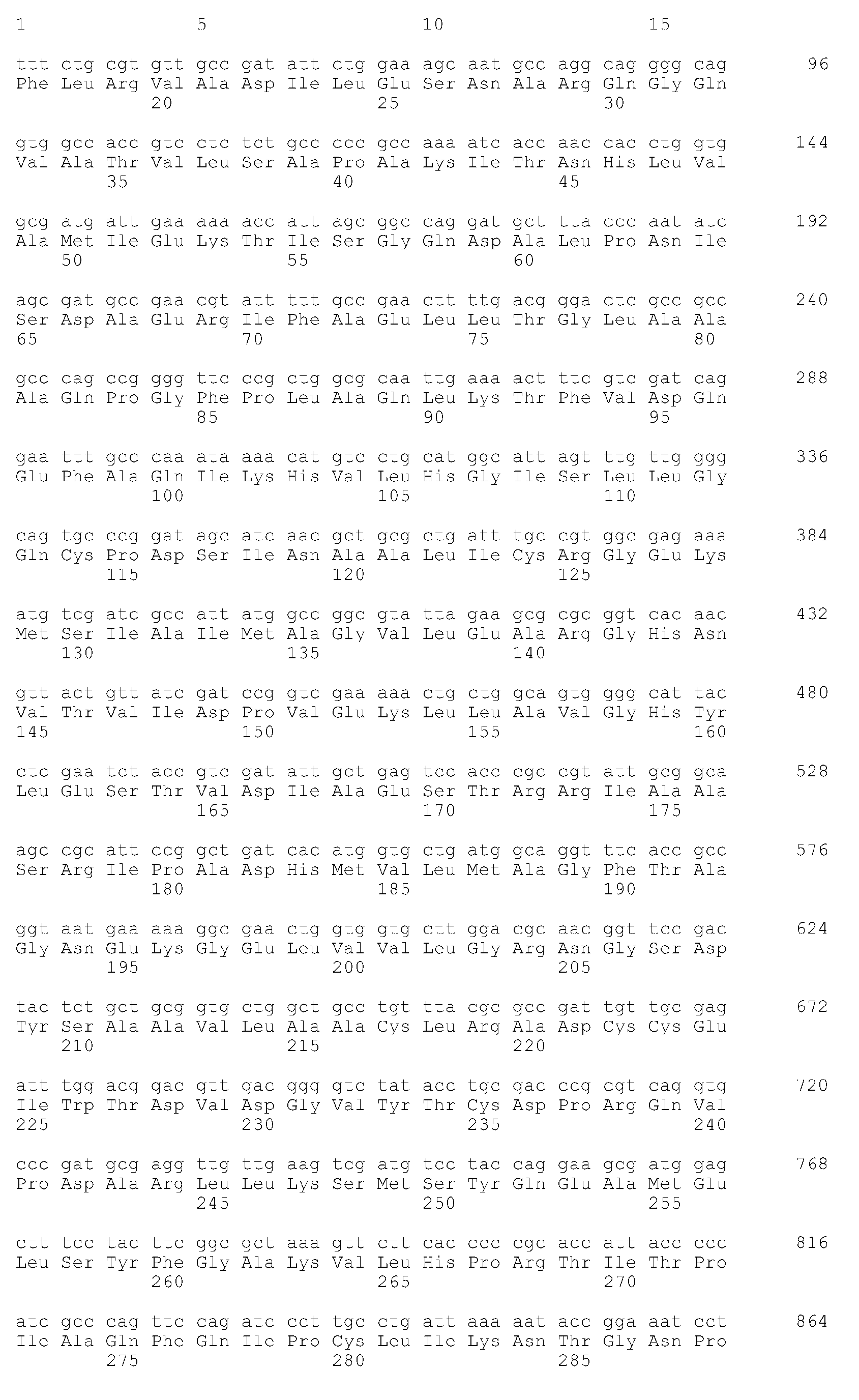


Claims (28)
- Rekombinante L-Aminosäuren produzierende Mikroorganismen der Familie Enterobacteriaceae, die ein verstärktes oder überexprimiertes glgS-Gen enthalten, welches für ein Protein kodiert, das als Regulator in die Glykogen-Biosynthese involviert ist.
- Mikroorganismen gemäss Anspruch 1, in denen ein dem glgS-Gen entsprechendes Polynukleotid verstärkt wird, das für ein Polypeptid kodiert, dessen Aminosäuresequenz zu mindestens 90% identisch ist mit einer Aminosäuresequenz, ausgewählt aus der Gruppe SEQ ID No. 2, SEQ ID No. 4 und SEQ ID No. 6 .
- Mikroorganismen gemäss Anspruch 2, dadurch gekennzeichnet, dass sie ein für das Protein GlgS kodierendes isoliertes Polynukleotid enthalten ausgewählt aus der Gruppe:a) Polynukleotid mit einer Nukleotidsequenz, ausgewählt aus SEQ ID No. 1, SEQ ID No. 3 oder SEQ ID No. 5 und den dazu komplementären Nukleotidsequenzen;b) Polynukleotid mit einer Nukleotidsequenz, die der SEQ ID No. 1, SEQ ID No. 3 oder SEQ ID No. 5 im Rahmen der Degeneration des genetischen Codes entspricht;c) Polynukleotidsequenz mit einer Sequenz, die mit der zur Sequenz SEQ ID No. 1 oder SEQ ID No. 3 komplementären Sequenz unter stringenten Bedingungen hybridisiert, wobei die stringenten Bedingungen durch einen Waschschritt erreicht werden, in dem sich die Temperatur über einen Bereich von 64°C bis 68°C und die Salzkonzentration des Puffers über einen Bereich von 2xSSC bis 0,1xSSC erstrecken;d) Polynukleotid mit einer Sequenz SEQ ID No. 1, SEQ ID No. 3 oder SEQ ID No. 5, die funktionsneutrale Sinnmutanten enthält,wobei die Polynukleotide für ein Protein kodieren, das als Regulator in die Glykogen-Biosynthese involviert ist.
- Mikroorganismen gemäss Anspruch 2, dadurch gekennzeichnet, dass das Polypeptid eine Aminosäuresequenz besitzt, die zu wenigstens 95% identisch ist mit einer der Sequenzen ausgewählt aus der Gruppe SEQ ID No. 2, SEQ ID No. 4 und SEQ ID No. 6.
- Mikroorganismen gemäss Anspruch 2, dadurch gekennzeichnet, dass das Polypeptid die Aminosäuresequenz aufweist, die 100% identisch ist mit einer der Sequenzen, ausgewählt aus der Gruppe SEQ ID No. 2, SEQ ID No. 4 und SEQ ID No. 6.
- Mikroorganismen gemäss den Ansprüchen 1 bis 5, dadurch gekennzeichnet, dass sie durch Transformation, Transduktion, Konjugation oder eine Kombination dieser Methoden hergestellt werden, mit einem Vektor, der das glgS-Gen, ein Allel dieses Gens oder Teile davon und/oder einen Promotor enthält.
- Mikroorganismen gemäss den Ansprüchen 1 bis 6, in denen die Kopienzahl des glgS-Gens oder der Allele um mindestens 1 erhöht bezogen auf die Kopienzahl des glgS-Gens im für das glgS-Gen nicht rekombinanten Mikroorganismus oder Elternstamm vorliegt.
- Mikroorganismen gemäss Anspruch 7, dadurch gekennzeichnet, dass die Erhöhung der Kopienzahl des glgS-Gens um mindestens 1 durch Integration des Gens oder der Allele in das Chromosom der Mikroorganismen bewirkt wird.
- Mikroorganismen gemäss Anspruch 7, dadurch gekennzeichnet, dass die Erhöhung der Kopienzahl des glgS-Gens um mindestens 1 durch einen extrachromosomal replizierenden Vektor erzielt wird.
- Mikroorganismen gemäss den Ansprüchen 1 bis 9, dadurch gekennzeichnet, dass man zur Erzielung der Verstärkunga) die Promotor- und Regulationsregion oder die Ribosomenbindungsstelle stromaufwärts des glgS-Gens mutiert, oderb) Expresssionskassetten oder Promotoren stromaufwärts des glgS-Gens einbaut.
- Mikroorganismen gemäss den Ansprüchen 1 bis 9, dadurch gekennzeichnet, dass die Expression des glgS-Gens unter der Kontrolle eines die Expression des Gens verstärkenden Promotors steht.
- Mikroorganismen gemäss den Ansprüchen 1 bis 11,
dadurch gekennzeichnet, dass durch die Verstärkung des glgS-Gens die Konzentration oder Aktivität des glgS-Genproduktes (Proteins) um mindestens 10% erhöht sind, bezogen auf die Aktivität oder Konzentration des Genproduktes im für das glgS-Gen nicht rekombinanten Mikroorganismus oder Elternstamm. - Mikroorganismen gemäss den Ansprüchen 1 bis 12,
dadurch gekennzeichnet, dass die Mikroorganismen aus den Gattungen Escherichia, Erwinia, Providencia und Serratia ausgewählt sind. - Mikroorganismen gemäss Anspruch 13, dadurch gekennzeichnet, dass zusätzlich weitere Gene des Biosyntheseweges der gewünschten L-Aminosäure verstärkt, insbesondere überexprimiert vorliegen.
- Mikroorganismen gemäss den Ansprüchen 1 bis 14,
dadurch gekennzeichnet, dass sie L-Threonin, L-Tryptophan, L-Lysin, L-Valin, L-Isoleucin oder L-Homoserin produzieren. - Verfahren zur Herstellung von L-Aminosäuren durch Fermentation von rekombinanten Mikroorganismen der Familie Enterobacteriaceae, dadurch gekennzeichnet, dass mana) die die gewünschte L-Aminosäure produzierenden Mikroorganismen gemäß den Ansprüchen 1 bis 15 in einem Medium kultiviert unter Bedingungen, bei denen die gewünschte L-Aminosäure im Medium oder in den Zellen angereichert wird, undb) die gewünschte L-Aminosäure isoliert, wobei gegebenenfalls weitere Bestandteile der Fermentationsbrühe und/oder die Biomasse in ihrer Gesamtheit oder Anteilen (≥ 0 bis 100%) im isolierten Produkt verbleiben oder vollständig entfernt werden.
- Verfahren gemäss Anspruch 16 , dadurch gekennzeichnet, dass man zur Herstellung von L-Threonin Mikroorganismen fermentiert, in denen man zusätzlich gleichzeitig eines oder mehrere der Gene, ausgewählt aus der Gruppe:a) mindestens ein Gen des für die Aspartatkinase, die Homoserin-Dehydrogenase, die Homoserinkinase und die Threoninsynthase kodierenden thrABC-Operons,b) das für die Pyruvat-Carboxylase kodierende pyc-Gen von Corynebacterium glutamicum,c) das für die Phosphoenolpyruvat-Synthase kodierende pps-Gen,d) das für die Phosphoenolpyruvat-Carboxylase kodierende ppc-Gen,e) die für die Untereinheiten der Pryridin-Transhydrogenase kodierenden Gene pntA und pntB,f) das für das Threoninresistenz vermittelnde Protein kodierende Gen rhtC,g) das für das Threonin-Export-Carrier-Protein kodierende thrE-Gen aus Corynebacterium glutamicum,h) das für die Glutamat-Dehydrogenase kodierende gdhA-Gen,i) das für die Phosphohistidin-Protein-Hexose-Phosphotransferase kodierende ptsH-Gen,j) das für das Enzym I des Phosphotransferase-Systems kodierende ptsI-Gen,k) das für die Glucose-spezifische IIA Komponente kodierende crr-Gen,l) das für die Glucose-spezifische IIBC Komponente kodierende ptsG-Gen,m) das für die Cystein-Synthase A kodierende cysK-Gen,n) das für den Regulator des cys-Regulons kodierende cysB-Gen,o) das für das Flavoprotein der NADPH-Sulfit-Reduktase kodierende cysJ-Gen,p) das für das Hämoprotein der NADPH-Sulfit-Reduktase kodierende cysI-Gen,q) das für die Adenylylsulfat-Reduktase kodierende cysH-Gen,r) das für die Decarboxylase Untereinheit der 2-Ketoglutarat Dehydrogenase kodierende sucA-Gen,s) das für die Dihydrolipoyltranssuccinase E2 Untereinheit der 2-Ketoglutarat Dehydrogenase kodierende sucB-Gen,t) das für die β-Untereinheit der Succinyl-CoA Synthetase kodierende sucC-Gen,u) das für die α-Untereinheit der Succinyl-CoA Synthetase kodierende sucD-Gen,v) das Genprodukt des offenen Leserahmens (ORF) yjcG von Escherichia coli,w) das Genprodukt des offenen Leserahmens (ORF) yibD von Escherichia coli,x) das Genprodukt des offenen Leserahmens (ORF) yaaU von Escherichia coli,y) das für die Glykogen Synthase kodierende glgA-Gen (Accession Number NC000913 (Region 3,564,623 <-3,566,056) des National Center for Biotechnology Information (NCBI, Bethesda, MD, USA)),z) das für die Glukose-1-Phosphat Adenylyltransferase kodierende glgC-Gen (Accession Number NC000913 (Region 3,566,056 <- 3,567,351) des National Center for Biotechnology Information (NCBI, Bethesda, MD, USA)),aa) das für die Glykogen Phosphorylase kodierende glgP-Gen (Accession Number NC000913 (Region 3,562,157 <-3,564,604) des National Center for Biotechnology Information (NCBI, Bethesda, MD, USA)),bb) das für das 1,4-α-Glukan verzweigende Enzym kodierende glgB-Gen (Accession Number NC000913 (Region 3,569,339 <- 3,571,525) des National Center for Biotechnology Information (NCBI, Bethesda, MD, USA)),cc) das für die Glykogen Phosphorylase-α-1,6-Glukohydrolase kodierende glgX-Gen (Accession Number NC000913 (Region 3,567,369 <- 3,569,342) des National Center for Biotechnology Information (NCBI, Bethesda, MD, USA)),verstärkt, insbesondere überexprimiert.
- Verfahren gemäss den Ansprüchen 1 bis 16, dadurch gekennzeichnet, dass man zur Herstellung von L-Tryptophan Mikroorganismen der Familie Enterobacteriaceae fermentiert, in denen man zusätzlich gleichzeitig eines oder mehrere der Gene, ausgewählt aus der Gruppe:a) mindestens ein Gen des für die Anthranilat-Synthase, die Antranilat-Phosphoribosyltransferase, die Phosphoribosylanthranilat-Isomerase, die Indol-3-Glyzerinphosphat-Synthase und die Tryptophan-Synthase kodierenden Tryptophan-Operons,b) das für die 3-Phosphoglycerat-Dehydrogenase kodierende serA-Gen,c) das für die Phosphoserinphosphatase kodierende serB-Gen,d) das für die Phosphoserinaminotransferase kodierende serC-Gen,e) das für die L-Tyrosin sensitive DHAP-Synthase kodierende aroF-Gen,f) das für die L-Phenylalanin sensitive DHAP-Synthase kodierende aroG-Gen,g) das für die L-Tryptophan sensitive DHAP-Synthase kodierende aroH-Gen,h) das für die Phosphoenolpyruvat-Synthase kodierende pps-Gen,i) das für die Phosphoenolpyruvat-Carboxykinase kodierende pckA-Gen,j) das für die Transketolase A kodierende tktA-Gen,k) das für die Transketolase B kodierende tktB-Gen, undl) das Genprodukt des offenen Leserahmens (ORF) yddG von Escherichia coli,m) das für die Glykogen Synthase kodierende glgA-Gen (Accession Number NC000913 (Region 3,564,623 <-3,566,056) des National Center for Biotechnology Information (NCBI, Bethesda, MD, USA)),n) das für die Glukose-1-Phosphat Adenylyltransferase kodierende glgC-Gen (Accession Number NC000913 (Region 3,566,056 <- 3,567,351) des National Center for Biotechnology Information (NCBI, Bethesda, MD, USA)),o) das für die Glykogen Phosphorylase kodierende glgP-Gen (Accession Number NC000913 (Region 3,562,157 <-3,564,604) des National Center for Biotechnology Information (NCBI, Bethesda, MD, USA)),p) das für das 1,4-α-Glukan verzweigende Enzym kodierende glgB-Gen (Accession Number NC000913 (Region 3,569,339 <- 3,571,525) des National Center for Biotechnology Information (NCBI, Bethesda, MD, USA)),q) das für die Glykogen Phosphorylase-α-1,6-Glukohydrolase kodierende glgX-Gen (Accession Number NC000913 (Region 3,567,369 <- 3,569,342) des National Center for Biotechnology Information (NCBI, Bethesda, MD, USA)),verstärkt, insbesondere überexprimiert.
- Verfahren gemäss den Ansprüchen 17 bis 18, dadurch gekennzeichnet, dass man Mikroorganismen einsetzt, in denen die Stoffwechselwege zumindest teilweise abgeschwächt sind, die die Bildung der gewünschten L-Aminosäure verringern.
- Verfahren gemäss den Ansprüchen 1 bis 17 und 19,
dadurch gekennzeichnet, dass man zur Herstellung von L-Threonin Mikroorganismen fermentiert, in denen man zusätzlich gleichzeitig eines oder mehrere der Gene, ausgewählt aus der Gruppe:a) das für die Threonin-Dehydrogenase kodierende tdh-Gen,b) das für die Malat-Dehydrogenase kodierende mdh-Gen,c) das für die Phosphoenolpyruvat-Carboxykinase kodierende pckA-Gen,d) das für die Pyruvat-Oxidase kodierende poxB-Gen,e) das für den DgsA-Regulator des Phosphotransferase-Systems kodierende dgsA-Gen,f) das für den Fructose-Repressor kodierende fruR-Gen,g) das für den Sigma38-Faktor kodierende rpoS-Gen, undh) das für die Aspartat Ammonium-Lyase kodierende aspA-Genabschwächt, insbesondere ausschaltet oder die Expression verringert. - Verfahren gemäss den Ansprüchen 1 bis 16 oder 18 bis 19, dadurch gekennzeichnet, dass man zur Herstellung von L-Tryptophan Mikroorganismen der Familie Enterobacteriaceae fermentiert, in denen man zusätzlich gleichzeitig eines oder mehrere der Gene, ausgewählt aus der Gruppe:a) das für die Tryptophanase kodierende tnaA-Gen,b) das für den Repressor des trp-Operons kodierende trpR-Gen,c) das für die Chorismat-Mutase T und Prephenat-Dehydrogenase kodierende tyrA-Gen,d) das für die Chorismat-Mutase P und Prephenat-Dehydrogenase kodierende pheA-Gen,e) das für das Tryptophan spezifische Transportprotein kodierende mtr-Gen,f) das für die Tryptophan-Permease kodierende tnaB-Gen,g) das für den Transporter für aromatische Aminosäuren kodierende aroP-Gen,h) das für die L-Serin Deaminase kodierende sdaA-Gen,i) das für die Glukose-6-Phosphat-Isomerase kodierende pgi-Gen, undj) das für die Tyrosin-Aminotransferase kodierende tyrB-Genabschwächt, insbesondere ausschaltet oder die Expression verringert.
- Verfahren gemäss den Ansprüchen 16 und 19, dadurch gekennzeichnet, dass man L-Aminosäuren, ausgewählt aus der Gruppe L-Asparagin, L-Serin, L-Glutamat, L-Glycin, L-Alanin, L-Cystein, L-Valin, L-Methionin, L-Prolin, L-Isoleucin, L-Leucin, L-Tyrosin, L-Phenylalanin, L-Histidin, L-Lysin, L-Tryptophan, L-Arginin und L-Homoserin herstellt.
- Verfahren gemäss den Ansprüchen 16 und 19, dadurch gekennzeichnet, dass man L-Aminosäuren, ausgewählt aus der Gruppe L-Threonin, L-Tryptophan, L-Lysin, L-Valin, L-Isoleucin und L-Homoserin herstellt.
- Verfahren gemäss den Ansprüchen 16 und 19, dadurch gekennzeichnet, dass die Mikroorganismen in einem batch - Verfahren kultiviert werden.
- Verfahren gemäss den Ansprüchen 16 und 19, dadurch gekennzeichnet, dass die Mikroorganismen in einem fed batch - Verfahren kultiviert werden.
- Verfahren gemäss den Ansprüchen 16 und 19, dadurch gekennzeichnet, dass die Mikroorganismen in einem repeated fed batch-Verfahren kultiviert werden.
- Verfahren gemäss den Ansprüchen 16 und 19, dadurch gekennzeichnet, dass die Mikroorganismen in einem kontinuierlichen Verfahren kultiviert werden.
- Verfahren gemäss den Ansprüchen 16 und 19, dadurch gekennzeichnet, dass die Konzentration der L-Aminosäure zu einem oder mehreren Zeitpunkt(en) im Verlauf der Fermentation bestimmt wird.
Applications Claiming Priority (1)
| Application Number | Priority Date | Filing Date | Title |
|---|---|---|---|
| DE102007054250 | 2007-11-14 |
Publications (1)
| Publication Number | Publication Date |
|---|---|
| EP2060636A1 true EP2060636A1 (de) | 2009-05-20 |
Family
ID=40337241
Family Applications (1)
| Application Number | Title | Priority Date | Filing Date |
|---|---|---|---|
| EP08167366A Withdrawn EP2060636A1 (de) | 2007-11-14 | 2008-10-23 | Verfahren zur Herstellung von L-Aminosäuren unter Verwendung von verbesserten Stämmen der Familie Enterobacteriaceae |
Country Status (1)
| Country | Link |
|---|---|
| EP (1) | EP2060636A1 (de) |
Citations (54)
| Publication number | Priority date | Publication date | Assignee | Title |
|---|---|---|---|---|
| US4278765A (en) | 1978-06-30 | 1981-07-14 | Debabov Vladimir G | Method for preparing strains which produce aminoacids |
| US4321325A (en) | 1978-07-13 | 1982-03-23 | Debabov Vladimir G | Process for producing L-threonine |
| US4346170A (en) | 1979-07-23 | 1982-08-24 | Ajinomoto Company, Incorporated | Method for producing L-lysine by fermentation |
| US4371614A (en) | 1980-08-22 | 1983-02-01 | Ajinomoto Co., Inc. | E.Coli bacteria carrying recombinant plasmids and their use in the fermentative production of L-tryptophan |
| FR2511032A1 (fr) | 1981-08-07 | 1983-02-11 | Centre Nat Rech Scient | Nouveaux plasmides et souches bacteriennes transformees et leur application a la synthese de lysine |
| US4391907A (en) | 1979-12-13 | 1983-07-05 | Ajinomoto Company Incorporated | Method for producing L-valine by fermentation |
| CA1182409A (en) | 1980-11-05 | 1985-02-12 | Tadayuki Imanaka | Plasmids constructed by gene manipulation, strains of escherichia coli carrying them, and process of tryptophan production using said strains |
| EP0149539A2 (de) | 1984-01-13 | 1985-07-24 | Stauffer Chemical Company | Mutante Stämme mit Mangel an L-Serindeaminase-Aktivität und ihre Verwendung |
| WO1987001130A1 (en) | 1985-08-15 | 1987-02-26 | Stauffer Chemical Company | Tryptophan producing microorganism |
| EP0301572A2 (de) | 1987-07-31 | 1989-02-01 | Kyowa Hakko Kogyo Co., Ltd. | Verfahren zur fermentativen Herstellung von L-Threonin |
| EP0332448A2 (de) | 1988-03-11 | 1989-09-13 | The University of Tokyo | Supraleitende optoelektronische Einrichtungen |
| US5168056A (en) | 1991-02-08 | 1992-12-01 | Purdue Research Foundation | Enhanced production of common aromatic pathway compounds |
| US5175107A (en) | 1988-10-25 | 1992-12-29 | Ajinomoto Co., Inc. | Bacterial strain of escherichia coli bkiim b-3996 as the producer of l-threonine |
| WO1994008031A1 (de) | 1992-09-28 | 1994-04-14 | Consortium für elektrochemische Industrie GmbH | Mikroorganismen für die produktion von tryptophan und verfahren zu ihrer herstellung |
| EP0593792A1 (de) | 1992-10-14 | 1994-04-27 | Ajinomoto Co., Inc. | Neuartiges L-threoninproduzierendes Mikrobakterium und eine Herstellungsmethode für L-Threonin |
| US5362637A (en) | 1991-11-11 | 1994-11-08 | Kyowa Hakko Kogy Co., Ltd. | Process for producing L-isoleucine and ethionine by isoleucine analog resistant strains of E. coli |
| WO1995011985A1 (en) | 1993-10-28 | 1995-05-04 | Ajinomoto Co., Inc. | Process for producing substance |
| US5460958A (en) | 1992-10-27 | 1995-10-24 | Kyowa Hakko Kogyo Co., Ltd. | Process for producing L-isoleucine by S-2-aminoethyl-L-cysteine or D-Serine resistant strains of E coli |
| WO1996008567A1 (en) | 1994-09-16 | 1996-03-21 | Texas A & M University System | Microorganisms and methods for overproduction of dahp by cloned pps gene |
| WO1997008333A1 (fr) | 1995-08-30 | 1997-03-06 | Ajinomoto Co., Inc. | Procede de production d'acides amines levogyres |
| US5695972A (en) | 1995-05-31 | 1997-12-09 | Kyowa Hakko Kogyo Co., Ltd. | Method for producing L-isoleucine with a fermentation process |
| WO1998004715A1 (en) | 1996-07-30 | 1998-02-05 | Archer-Daniels-Midland Company | Novel strains of escherichia coli, methods of preparing the same and use thereof in fermentation processes for l-threonine production |
| US5756345A (en) | 1995-09-05 | 1998-05-26 | Degussa Aktiengesellschaft | Production of tryptophan by the bacterium Escherichia coli |
| US5763230A (en) | 1996-03-22 | 1998-06-09 | Triple-A B.V. P/A Produkschap Voor Veevoedor | Amino acid fermentation processes |
| WO1999018228A2 (de) | 1997-10-04 | 1999-04-15 | Forschungszentrum Jülich GmbH | Verfahren zur mikrobiellen herstellung von aminosäuren der aspartat- und/oder glutamatfamilie und im verfahren einsetzbare mittel |
| US5939295A (en) | 1996-03-29 | 1999-08-17 | Archer Daniels Midland Company | Production of tryptophan by microorganisms |
| WO2000009661A1 (en) | 1998-08-14 | 2000-02-24 | Daesang Corporation | Novel microorganisms and method for producing l-threonine using the same |
| WO2000009660A1 (en) | 1998-08-14 | 2000-02-24 | Daesang Corporation | Novel microorganisms and method for producing l-threonine using the same |
| EP1013765A1 (de) | 1998-12-23 | 2000-06-28 | Ajinomoto Co., Ltd. | Gen und Verfahren zur Herstellung von L-Aminosäuren |
| DE19907347A1 (de) | 1999-02-20 | 2000-08-24 | Degussa | Verfahren zur fermentativen Herstellung von L-Aminosäuren unter Verwendung coryneformer Bakterien |
| WO2001005939A1 (fr) | 1999-07-19 | 2001-01-25 | Ajinomoto Co., Inc. | Procede de production d'une substance cible par fermentation |
| WO2001014525A1 (en) | 1999-08-26 | 2001-03-01 | Daesang Corporation | Microorganisms and methods for producing threonine |
| WO2001092545A1 (en) | 2000-05-27 | 2001-12-06 | Degussa Ag | Process for the fermentative preparation of l-threonine |
| WO2002018543A2 (en) | 2000-08-31 | 2002-03-07 | Degussa Ag | Fermentation process for the preparation of l-threonine |
| WO2002026993A1 (en) | 2000-09-28 | 2002-04-04 | Archer-Daniels-Midland Company | Escherichia coli strains which over-produce l-threonine and processes for the production of l-threonine by fermentation |
| WO2002029080A2 (en) | 2000-09-30 | 2002-04-11 | Degussa Ag | Fermentation process for the preparation of l-amino acids using strains of the family enterobacteriaceae |
| WO2002036797A2 (en) | 2000-11-04 | 2002-05-10 | Degussa Ag | Process for the fermentative preparation of l-amino acids using strains of the enterobacteriaceae family |
| WO2002064808A1 (en) | 2001-02-13 | 2002-08-22 | Cheil Jedang Corporation | Method for l-threonine production |
| WO2002081698A2 (en) | 2001-04-03 | 2002-10-17 | Degussa Ag | Process for the production of l-amino acids using strains of the family enterobacteriaceae that contain an attenuated frur gene |
| EP1270721A1 (de) | 1990-11-30 | 2003-01-02 | Ajinomoto Co., Inc. | Rekombinante DNS-Sequenzen kodierend für Enzyme frei von Feedback-Inhibition, Plasmide, die diese Sequenzen enthalten, transformierte Mikroorganismen, nützlich für Produktion aromatischer Aminosäuren, und deren Verfahren zur Herstellung durch Fermentation |
| WO2003004674A2 (en) | 2001-07-06 | 2003-01-16 | Degussa Ag | Process for the preparation of l-amino acids using strains of the enterobacteriaceae family |
| WO2003006666A2 (en) | 2001-07-11 | 2003-01-23 | Degussa Ag | Process for the preparation of l-amino acids using strains of the enterobacteriaceae family |
| WO2003008615A2 (en) | 2001-07-18 | 2003-01-30 | Degussa Ag | Process for the preparation of l-amino acids using strains of the enterobacteriaceae family which contain an enhanced succ or sucd gene |
| WO2003008603A2 (en) | 2001-07-18 | 2003-01-30 | Degussa Ag | Process for the preparation of l-amino acids using strains of the enterobacteri acea family which contain an attenuated aspa gene |
| WO2003074719A2 (en) | 2002-03-07 | 2003-09-12 | Degussa Ag | Amino acid-producing bacteria and a process for preparing l-amino acids |
| WO2004090149A1 (en) * | 2003-04-09 | 2004-10-21 | Degussa Ag | Process for the production of l-amino acids using strains of the enterobacteriaceae family which contain an enhance yfidd orf and/or pfld gene |
| WO2004090125A2 (en) | 2003-04-07 | 2004-10-21 | Ajinomoto Co., Inc. | Method for producing l-amino acid using bacteria having enhanced expression of the gene pcka |
| WO2005014843A2 (en) | 2003-08-12 | 2005-02-17 | Degussa Ag | A process for preparing l-threonine |
| WO2005014841A1 (en) | 2003-08-01 | 2005-02-17 | Degussa Ag | Process for the preparation of l-threonine |
| WO2005014842A1 (en) | 2003-08-01 | 2005-02-17 | Degussa Ag | Process for the preparation of l-threonine |
| WO2005014840A1 (en) | 2003-08-01 | 2005-02-17 | Degussa Ag | Process for the preparation of l-threonine |
| US6960455B2 (en) | 2000-04-26 | 2005-11-01 | Ajinomoto Co., Inc. | Methods of making amino acids using E. coli transformed with csc genes |
| WO2006078050A2 (en) * | 2005-01-19 | 2006-07-27 | Ajinomoto Co., Inc. | A method for producing an l-amino acid using a bacterium of the enterobacteriaceae family having a pathway of glycogen biosynthesis disrupted |
| US9713359B2 (en) | 2015-05-06 | 2017-07-25 | Yu Hsieh Industrial Co., Ltd. | Shoe body with arch suspended support |
-
2008
- 2008-10-23 EP EP08167366A patent/EP2060636A1/de not_active Withdrawn
Patent Citations (60)
| Publication number | Priority date | Publication date | Assignee | Title |
|---|---|---|---|---|
| US4278765A (en) | 1978-06-30 | 1981-07-14 | Debabov Vladimir G | Method for preparing strains which produce aminoacids |
| US4321325A (en) | 1978-07-13 | 1982-03-23 | Debabov Vladimir G | Process for producing L-threonine |
| US4346170A (en) | 1979-07-23 | 1982-08-24 | Ajinomoto Company, Incorporated | Method for producing L-lysine by fermentation |
| US4391907A (en) | 1979-12-13 | 1983-07-05 | Ajinomoto Company Incorporated | Method for producing L-valine by fermentation |
| US4371614A (en) | 1980-08-22 | 1983-02-01 | Ajinomoto Co., Inc. | E.Coli bacteria carrying recombinant plasmids and their use in the fermentative production of L-tryptophan |
| CA1182409A (en) | 1980-11-05 | 1985-02-12 | Tadayuki Imanaka | Plasmids constructed by gene manipulation, strains of escherichia coli carrying them, and process of tryptophan production using said strains |
| FR2511032A1 (fr) | 1981-08-07 | 1983-02-11 | Centre Nat Rech Scient | Nouveaux plasmides et souches bacteriennes transformees et leur application a la synthese de lysine |
| EP0149539A2 (de) | 1984-01-13 | 1985-07-24 | Stauffer Chemical Company | Mutante Stämme mit Mangel an L-Serindeaminase-Aktivität und ihre Verwendung |
| WO1987001130A1 (en) | 1985-08-15 | 1987-02-26 | Stauffer Chemical Company | Tryptophan producing microorganism |
| EP0301572A2 (de) | 1987-07-31 | 1989-02-01 | Kyowa Hakko Kogyo Co., Ltd. | Verfahren zur fermentativen Herstellung von L-Threonin |
| EP0332448A2 (de) | 1988-03-11 | 1989-09-13 | The University of Tokyo | Supraleitende optoelektronische Einrichtungen |
| US5631157A (en) | 1988-10-25 | 1997-05-20 | Ajinomoto Co., Inc. | Bacterial strain of Escherichia coli VNII genetika 472T23 as the producer of L-threonine |
| US5538873A (en) | 1988-10-25 | 1996-07-23 | Ajinomoto Co., Inc. | Bacterial strain of escherichia coli BKIIM B-3996 as the producer of l-threonine |
| US5175107A (en) | 1988-10-25 | 1992-12-29 | Ajinomoto Co., Inc. | Bacterial strain of escherichia coli bkiim b-3996 as the producer of l-threonine |
| EP1270721A1 (de) | 1990-11-30 | 2003-01-02 | Ajinomoto Co., Inc. | Rekombinante DNS-Sequenzen kodierend für Enzyme frei von Feedback-Inhibition, Plasmide, die diese Sequenzen enthalten, transformierte Mikroorganismen, nützlich für Produktion aromatischer Aminosäuren, und deren Verfahren zur Herstellung durch Fermentation |
| US5168056A (en) | 1991-02-08 | 1992-12-01 | Purdue Research Foundation | Enhanced production of common aromatic pathway compounds |
| US5362637A (en) | 1991-11-11 | 1994-11-08 | Kyowa Hakko Kogy Co., Ltd. | Process for producing L-isoleucine and ethionine by isoleucine analog resistant strains of E. coli |
| WO1994008031A1 (de) | 1992-09-28 | 1994-04-14 | Consortium für elektrochemische Industrie GmbH | Mikroorganismen für die produktion von tryptophan und verfahren zu ihrer herstellung |
| EP0593792A1 (de) | 1992-10-14 | 1994-04-27 | Ajinomoto Co., Inc. | Neuartiges L-threoninproduzierendes Mikrobakterium und eine Herstellungsmethode für L-Threonin |
| US5460958A (en) | 1992-10-27 | 1995-10-24 | Kyowa Hakko Kogyo Co., Ltd. | Process for producing L-isoleucine by S-2-aminoethyl-L-cysteine or D-Serine resistant strains of E coli |
| WO1995011985A1 (en) | 1993-10-28 | 1995-05-04 | Ajinomoto Co., Inc. | Process for producing substance |
| WO1996008567A1 (en) | 1994-09-16 | 1996-03-21 | Texas A & M University System | Microorganisms and methods for overproduction of dahp by cloned pps gene |
| US5695972A (en) | 1995-05-31 | 1997-12-09 | Kyowa Hakko Kogyo Co., Ltd. | Method for producing L-isoleucine with a fermentation process |
| WO1997008333A1 (fr) | 1995-08-30 | 1997-03-06 | Ajinomoto Co., Inc. | Procede de production d'acides amines levogyres |
| US5756345A (en) | 1995-09-05 | 1998-05-26 | Degussa Aktiengesellschaft | Production of tryptophan by the bacterium Escherichia coli |
| US5763230A (en) | 1996-03-22 | 1998-06-09 | Triple-A B.V. P/A Produkschap Voor Veevoedor | Amino acid fermentation processes |
| US5939295A (en) | 1996-03-29 | 1999-08-17 | Archer Daniels Midland Company | Production of tryptophan by microorganisms |
| US5939307A (en) | 1996-07-30 | 1999-08-17 | The Archer-Daniels-Midland Company | Strains of Escherichia coli, methods of preparing the same and use thereof in fermentation processes for l-threonine production |
| WO1998004715A1 (en) | 1996-07-30 | 1998-02-05 | Archer-Daniels-Midland Company | Novel strains of escherichia coli, methods of preparing the same and use thereof in fermentation processes for l-threonine production |
| WO1999018228A2 (de) | 1997-10-04 | 1999-04-15 | Forschungszentrum Jülich GmbH | Verfahren zur mikrobiellen herstellung von aminosäuren der aspartat- und/oder glutamatfamilie und im verfahren einsetzbare mittel |
| WO2000009660A1 (en) | 1998-08-14 | 2000-02-24 | Daesang Corporation | Novel microorganisms and method for producing l-threonine using the same |
| WO2000009661A1 (en) | 1998-08-14 | 2000-02-24 | Daesang Corporation | Novel microorganisms and method for producing l-threonine using the same |
| EP1013765A1 (de) | 1998-12-23 | 2000-06-28 | Ajinomoto Co., Ltd. | Gen und Verfahren zur Herstellung von L-Aminosäuren |
| DE19907347A1 (de) | 1999-02-20 | 2000-08-24 | Degussa | Verfahren zur fermentativen Herstellung von L-Aminosäuren unter Verwendung coryneformer Bakterien |
| WO2001005939A1 (fr) | 1999-07-19 | 2001-01-25 | Ajinomoto Co., Inc. | Procede de production d'une substance cible par fermentation |
| WO2001014525A1 (en) | 1999-08-26 | 2001-03-01 | Daesang Corporation | Microorganisms and methods for producing threonine |
| US6960455B2 (en) | 2000-04-26 | 2005-11-01 | Ajinomoto Co., Inc. | Methods of making amino acids using E. coli transformed with csc genes |
| WO2001092545A1 (en) | 2000-05-27 | 2001-12-06 | Degussa Ag | Process for the fermentative preparation of l-threonine |
| WO2002018543A2 (en) | 2000-08-31 | 2002-03-07 | Degussa Ag | Fermentation process for the preparation of l-threonine |
| WO2002026993A1 (en) | 2000-09-28 | 2002-04-04 | Archer-Daniels-Midland Company | Escherichia coli strains which over-produce l-threonine and processes for the production of l-threonine by fermentation |
| WO2002029080A2 (en) | 2000-09-30 | 2002-04-11 | Degussa Ag | Fermentation process for the preparation of l-amino acids using strains of the family enterobacteriaceae |
| WO2002036797A2 (en) | 2000-11-04 | 2002-05-10 | Degussa Ag | Process for the fermentative preparation of l-amino acids using strains of the enterobacteriaceae family |
| WO2002064808A1 (en) | 2001-02-13 | 2002-08-22 | Cheil Jedang Corporation | Method for l-threonine production |
| WO2002081698A2 (en) | 2001-04-03 | 2002-10-17 | Degussa Ag | Process for the production of l-amino acids using strains of the family enterobacteriaceae that contain an attenuated frur gene |
| WO2002081721A2 (en) | 2001-04-03 | 2002-10-17 | Degussa Ag | Process for the production of l-amino acids using strains of the family enterobacteriaceae that contain an attenuated dgsa gene |
| WO2003004670A2 (en) | 2001-07-06 | 2003-01-16 | Degussa Ag | Process for the preparation of l-amino acids using strains of the enterobacteriaceae family with enhanced pts-g expression |
| WO2003004674A2 (en) | 2001-07-06 | 2003-01-16 | Degussa Ag | Process for the preparation of l-amino acids using strains of the enterobacteriaceae family |
| WO2003006666A2 (en) | 2001-07-11 | 2003-01-23 | Degussa Ag | Process for the preparation of l-amino acids using strains of the enterobacteriaceae family |
| WO2003008615A2 (en) | 2001-07-18 | 2003-01-30 | Degussa Ag | Process for the preparation of l-amino acids using strains of the enterobacteriaceae family which contain an enhanced succ or sucd gene |
| WO2003008614A2 (en) | 2001-07-18 | 2003-01-30 | Degussa Ag | Process for the preparation of l-amino acids using strains of the enterobacteriaceae family which contain an enhanced suca or sucb gene |
| WO2003008603A2 (en) | 2001-07-18 | 2003-01-30 | Degussa Ag | Process for the preparation of l-amino acids using strains of the enterobacteri acea family which contain an attenuated aspa gene |
| WO2003074719A2 (en) | 2002-03-07 | 2003-09-12 | Degussa Ag | Amino acid-producing bacteria and a process for preparing l-amino acids |
| WO2004090125A2 (en) | 2003-04-07 | 2004-10-21 | Ajinomoto Co., Inc. | Method for producing l-amino acid using bacteria having enhanced expression of the gene pcka |
| WO2004090149A1 (en) * | 2003-04-09 | 2004-10-21 | Degussa Ag | Process for the production of l-amino acids using strains of the enterobacteriaceae family which contain an enhance yfidd orf and/or pfld gene |
| WO2005014841A1 (en) | 2003-08-01 | 2005-02-17 | Degussa Ag | Process for the preparation of l-threonine |
| WO2005014842A1 (en) | 2003-08-01 | 2005-02-17 | Degussa Ag | Process for the preparation of l-threonine |
| WO2005014840A1 (en) | 2003-08-01 | 2005-02-17 | Degussa Ag | Process for the preparation of l-threonine |
| WO2005014843A2 (en) | 2003-08-12 | 2005-02-17 | Degussa Ag | A process for preparing l-threonine |
| WO2006078050A2 (en) * | 2005-01-19 | 2006-07-27 | Ajinomoto Co., Inc. | A method for producing an l-amino acid using a bacterium of the enterobacteriaceae family having a pathway of glycogen biosynthesis disrupted |
| US9713359B2 (en) | 2015-05-06 | 2017-07-25 | Yu Hsieh Industrial Co., Ltd. | Shoe body with arch suspended support |
Non-Patent Citations (86)
| Title |
|---|
| "Cellular and Molecular Biology", 1996, ASM PRESS, article "Escherichia coli and Salmonella" |
| "Gene und Klone", 1990, VCH VERLAGSGESELLSCHAFT |
| "Hybaid Hybridisation Guide", 1996, HYBAID LIMITED |
| "Manual of Methods for General Bacteriology", 1981, AMERICAN SOCIETY FOR BACTERIOLOGY |
| "Overproduction of Microbial Products, Krumphanzl", 1982, ACADEMIC PRESS, article "Breeding of Amino Acid Producing Microorganisms" |
| "The DIG System Users Guide for Filter Hybridization", 1993, FIRMA BOEHRINGER MANNHEIM GMBH |
| ADVANCES IN BIOCHEMICAL ENGINEERING, vol. 79, 2003, pages 113 - 136 |
| AMANN ET AL., GENE, vol. 69, 1988, pages 301 - 315 |
| AMANN; BROSIUS, GENE, vol. 40, 1985, pages 183 - 190 |
| APPLIED AND ENVIRONMENTAL MICROBIOLOGY, vol. 38, no. 2, 1979, pages 181 - 190 |
| APPLIED AND ENVIRONMENTAL MICROBIOLOGY, vol. 38, no. 6, 1979, pages 1045 - 1051 |
| APPLIED BIOCHEMISTRY AND BIOTECHNOLOGY, vol. 37, no. 3, 1992, pages 255 - 265 |
| ARCHIVES IN MICROBIOLOGY, vol. 149, 1987, pages 36 - 42 |
| BARTOLOME ET AL., GENE, vol. 102, 1991, pages 75 - 78 |
| BEGLOVA ET AL., EUROPEAN JOURNAL OF BIOCHEMISTRY, vol. 246, no. 2, 1997, pages 301 - 310 |
| BERG; TYMOCZKO; STRYER: "Biochemistry", 2002, FREEMAN AND COMPANY |
| BIOSCIENCE BIOTECHNOLOGY AND BIOCHEMISTRY, vol. 61, no. 11, 1997, pages 1877 - 1882 |
| BIRGE: "Bacterial and Bacteriophage Genetics", 2000, SPRINGER VERLAG |
| BLATTNER ET AL., SCIENCE, vol. 277, 1997, pages 1453 - 1462 |
| BLATTNER ET AL., SCIENCE, vol. 277, no. 5331, 1997, pages 1453 - 1474 |
| BOLIVAR ET AL., GENE, vol. 2, 1977, pages 95 - 113 |
| BOYD ET AL., JOURNAL OF BACTERIOLOGY, vol. 182, 2000, pages 842 - 847 |
| BROER ET AL., PROCEEDINGS OF THE NATIONAL ACADEMY OF SCIENCES OF THE UNITED STATES OF AMERICA, vol. 80, 1983, pages 21 - 25 |
| CARRIER; KEASLING, BIOTECHNOLOGY PROGRESS, vol. 15, 1999, pages 58 - 64 |
| CHANG; COHEN, JOURNAL OF BACTERIOLOGY, vol. 134, 1978, pages 1141 - 1156 |
| CHMIEL: "Bioprozesstechnik 1. Einführung in die Bioverfahrenstechnik", 1991, GUSTAV FISCHER VERLAG |
| CHUNG ET AL., PROCEEDINGS OF THE NATIONAL ACADEMY OF SCIENCES OF THE UNITED STATES OF AMERICA, vol. 86, 1989, pages 2172 - 2175 |
| EUROPEAN JOURNAL OF BIOCHEMISTRY, vol. 158, 1986, pages 647 - 653 |
| FRANCH; GERDES, CURRENT OPINION IN MICROBIOLOGY, vol. 3, 2000, pages 159 - 164 |
| GAIT: "Oligonukleotide synthesis: A Practical Approach", 1984, IRL PRESS |
| GENE, vol. 23, 1983, pages 199 - 209 |
| GENE, vol. 57, no. 2-3, 1987, pages 151 - 158 |
| GLASCOCK; WEICKERT, GENE, vol. 223, 1998, pages 221 - 231 |
| HAGEMANN: "Allgemeine Genetik", 1986, GUSTAV FISCHER VERLAG |
| HAMILTON ET AL., JOURNAL OF BACTERIOLOGY, vol. 171, 1989, pages 4617 - 4622 |
| HARTLEY; GREGORI, GENE, vol. 13, 1981, pages 347 - 353 |
| HENGGE-ARONIS ET AL., JOURNAL OF BACTERIOLOGY, vol. 175, no. 1, 1993, pages 259 - 265 |
| HENGGE-ARONIS R ET AL: "IDENTIFICATION AND MOLECULAR ANALYSIS OF GLGS A NOVEL GROWTH-PHASE-REGULATED AND RPOS-DEPENDENT GENE INVOLVED IN GLYCOGEN SYNTHESIS IN ESCHERICHIA-COLI", MOLECULAR MICROBIOLOGY, WILEY-BLACKWELL PUBLISHING LTD, GB, vol. 6, no. 14, 1 January 1992 (1992-01-01), pages 1877 - 1886, XP009108156, ISSN: 0950-382X * |
| HENGGE-ARONIS; FISCHER, MOLECULAR MICROBIOLOGY, vol. 6, no. 14, 1992, pages 1877 - 1886 |
| HERMANN ET AL., ELECTROPHORESIS, vol. 22, 2001, pages 1712 - 23 |
| HUI ET AL., EMBO JOURNAL, vol. 3, no. 3, 1984, pages 623 - 9 |
| INNIS ET AL.: "PCR Protocols. A Guide to Methods and Applications", 1990, ACADEMIC PRESS |
| J.H. MILLER: "A Short Course in Bacterial Genetics", 1992, COLD SPRING HARBOR LABORATORY PRESS |
| JENSEN; HAMMER, BIOTECHNOLOGY AND BIOENGINEERING, vol. 58, 1998, pages 191 - 195 |
| JOURNAL OF BACTERIOLOGY, vol. 169, 1987, pages 4716 - 4721 |
| JOURNAL OF BACTERIOLOGY, vol. 174, 1989, pages 4617 - 4622 |
| KAWANO ET AL., NUCLEIC ACIDS RESEARCH, vol. 33, no. 19, 2005, pages 6268 - 6276 |
| KHUDYAKOV ET AL., FEBS LETTERS, vol. 232, no. 2, 1988, pages 369 - 71 |
| KNIPPERS: "Molekulare Genetik", 1995, GEORG THIEME VERLAG |
| KOZLOV ET AL., BMC BIOLOGY, vol. 2, no. 1, 2004, pages 10 |
| LAVALLIE ET AL., BIO/TECHNOLOGY, vol. 11, 1993, pages 187 - 193 |
| LEE ET AL., JOURNAL OF BACTERIOLOGY, vol. 185, no. 18, 2003, pages 5442 - 5451 |
| LIEBL ET AL., INTERNATIONAL JOURNAL OF SYSTEMATIC BACTERIOLOGY, vol. 41, 1991, pages 255 - 260 |
| LINDROTH ET AL., ANALYTICAL CHEMISTRY, vol. 51, 1979, pages 1167 - 1174 |
| LINK ET AL., JOURNAL OF BACTERIOLOGY, vol. 179, pages 6228 - 6237 |
| LLOSA ET AL., PLASMID, vol. 26, 1991, pages 222 - 224 |
| LOHAUS; MEYER, BIOSPEKTRUM, vol. 5, 1998, pages 32 - 39 |
| LOTTSPEICH, ANGEWANDTE CHEMIE, vol. 38, 1999, pages 2630 - 2647 |
| MAKRIDES ET AL., MICROBIOLOGICAL REVIEWS, vol. 60, no. 3, 1996, pages 512 - 538 |
| MARTINEZ-MORALES ET AL., JOURNAL OF BACTERIOLOGY, vol. 181, 1999, pages 7143 - 7148 |
| MARTINEZ-MORALES ET AL., JOURNAL OF BACTERIOLOGY, vol. 1999, 1999, pages 7143 - 7148 |
| MOLECULAR AND GENERAL GENETICS, vol. 231, no. 2, 1992, pages 332 - 336 |
| NUCLEIC ACIDS RESEARCH, vol. 11, 1983, pages 5257 - 5266 |
| OMORI ET AL., JOURNAL OF BACTERIOLOGY, vol. 175, no. 3, 1993, pages 785 - 794 |
| OMORI ET AL., JOURNAL OF BACTERIOLOGY, vol. 175, no. 4, 1993, pages 959 - 965 |
| OVERLAP EXTENSION, HORTON, MOLECULAR BIOTECHNOLOGY, vol. 3, 1995, pages 93 - 98 |
| QIU; GOODMAN, JOURNAL OF BIOLOGICAL CHEMISTRY, vol. 272, 1997, pages 8611 - 8617 |
| QUANDT; KLIPP, GENE, vol. 80, 1989, pages 161 - 169 |
| REDDY ET AL., PROCEEDINGS OF THE NATIONAL ACADEMY OF SCIENCES OF THE USA, vol. 82, no. 17, 1985, pages 5656 - 60 |
| RESEARCH DISCLOSURE, vol. 505, 2006, pages 537 |
| SAMBROOK ET AL.: "Molecular Cloning - A Laboratory Manual", 1989, COLD SPRING HARBOR LABORATORY PRESS |
| SAMBROOK ET AL.: "Molecular cloning: a laboratory manual", 1989, COLD SPRING HARBOR LABORATORY PRESS |
| SAMBROOK ET AL.: "Molekular Cloning, A Laboratory Manual", vol. 3, 2001, COLD SPRING HARBOR LABORATORY PRESS |
| SANGER ET AL., PROCEEDINGS OF THE NATIONAL ACADEMY OF SCIENCE USA, vol. 74, no. 12, 1977, pages 5463 - 5467 |
| SPACKMAN ET AL., ANALYTICAL CHEMISTRY, vol. 30, 1958, pages 1190 - 1206 |
| STENSTROM ET AL., GENE, vol. 273, no. 2, 2001, pages 259 - 65 |
| STORHAS: "Bioreaktoren und periphere Einrichtungen", 1994, VIEWEG VERLAG |
| T. A. BROWN: "Gentechnologie für Einsteiger", 1993, SPEKTRUM AKADEMISCHER VERLAG |
| THE DIG SYSTEM USER'S GUIDE FOR FILTER HYBRIDISATION, 1995 |
| VOCKE; BASTIA, PROCEEDINGS OF THE NATIONAL ACADEMY OF SCIENCES USA, vol. 80, no. 21, 1983, pages 6557 - 6561 |
| WALKER ET AL., JOURNAL OF BACTERIOLOGY, vol. 181, 1999, pages 1269 - 80 |
| WENTE; SCHACHMANN, JOURNAL OF BIOLOGICAL CHEMISTRY, vol. 266, 1991, pages 20833 - 20839 |
| WINNACKER: "Gene und Klone", 1990, VCH VERLAGSGESELLSCHAFT |
| YANG ET AL., JOURNAL OF BACTERIOLOGY, vol. 178, no. 4, 1996, pages 1012 - 1017 |
| YANO ET AL., PROCEEDINGS OF THE NATIONAL ACADEMY OF SCIENCES, vol. 95, 1998, pages 5511 - 5515 |
| YU; COURT, GENE, vol. 223, 1998, pages 77 - 81 |
Similar Documents
| Publication | Publication Date | Title |
|---|---|---|
| EP1715056B1 (de) | Verfahren zur Herstellung von L-Aminosäuren unter Verwendung verbesserter Stämme der Familie Enterobacteriaceae | |
| EP2133420B1 (de) | Verfahren zur Herstellung von L-Aminosäuren unter Verwendung von verbesserten Stämmen der Familie Enterobacteriaceae | |
| DE602004010896T2 (de) | Verfahren zur herstellung von l-aminosäuren unter verwendung von stämmen der enterobacteriaceae familie welche das galp gen, das für ein galaktose-proton-symporter kodiert, überexprimieren | |
| EP2129786B1 (de) | Verfahren zur herstellung von l-aminosäuren unter verwendung von stämmen der familie enterobacteriaceae | |
| EP1715055B1 (de) | Verfahren zur Herstellung von L-Aminosäuren unter Verwendung verbesserter Stämme der Familie Enterobacteriaceae | |
| EP1776451B1 (de) | Verfahren zur herstellung von l-aminosäuren unter verwendung von stämmen der familie enterobacteriaceae | |
| EP1719814B1 (de) | Verfahren zur Herstellung von L-Aminosäuren unter Verwendung von verbesserten Stämmen der Familie Enterobacteriaceae | |
| DE102004003411A1 (de) | Verfahren zur Herstellung von L-Aminosäuren unter Verwendung von Stämmen der Familie Enterobacteriaceae | |
| EP2465869B1 (de) | Verfahren zur Herstellung von L-Aminosäuren unter Verwendung von verbesserten Stämmen der Familie Enterobacteriaceae | |
| EP2163613A2 (de) | Verfahren zur Herstellung von organisch-chemischen Verbindungen unter Verwendung von verbesserten Stämmen der Familie Enterobacteriaceae | |
| EP2098597A1 (de) | Verfahren zur Herstellung von L-Aminosäuren unter Verwendung von verbesserten Stämmen der Familie Enterobacteriaceae | |
| DE10361268A1 (de) | Verfahren zur fermentativen Herstellung von L-Aminosäuren unter Verwendung von Stämmen der Familie Enterobacteriaceae | |
| DE102004003410A1 (de) | Verfahren zur Herstellung von L-Aminosäuren unter Verwendung von Stämmen der Familie Enterobacteriaceae | |
| DE102004005836A1 (de) | Verfahren zur Herstellung von L-Aminosäuren unter Verwendung von Stämmen der Familie Enterobacteriaceae | |
| EP2036979B1 (de) | Verfahren zur Herstellung von L-Aminosäuren unter Verwendung von verbesserten Stämmen der Familie Enterobacteriaceae | |
| EP1719818B1 (de) | Verfahren zur Herstellung von L-Aminosäuren unter Verwendung von Stämmen der Familie Enterobacteriaceae mit verstärkter Expression von ytfQ-ORF | |
| EP2267145A1 (de) | Verfahren zur Herstellung von L-Aminosäuren unter Verwendung von verbesserten Stämmen der Familie Enterobacteriaceae | |
| EP2060636A1 (de) | Verfahren zur Herstellung von L-Aminosäuren unter Verwendung von verbesserten Stämmen der Familie Enterobacteriaceae | |
| EP1895011A1 (de) | Verfahren zur Herstellung von L-Aminosäuren unter Verwendung von verbesserten Stämmen der Familie Enterobacteriaceae | |
| EP1894942A1 (de) | Verfahren zur Herstellung von L-Aminosäuren unter Verwendung von verbesserten Stämmen der Familie Enterobacteriaceae | |
| EP1975241A1 (de) | Verfahren zur Herstellung von L-Aminosäuren unter Verwendung von verbesserten Stämmen der Familie Enterobacteriaceae | |
| DE10361192A1 (de) | Verfahren zur fermentativen Herstellung von L-Aminosäuren unter Verwendung von Stämmen der Familie Enterobacteriaceae |
Legal Events
| Date | Code | Title | Description |
|---|---|---|---|
| PUAI | Public reference made under article 153(3) epc to a published international application that has entered the european phase |
Free format text: ORIGINAL CODE: 0009012 |
|
| 17P | Request for examination filed |
Effective date: 20081023 |
|
| AK | Designated contracting states |
Kind code of ref document: A1 Designated state(s): AT BE BG CH CY CZ DE DK EE ES FI FR GB GR HR HU IE IS IT LI LT LU LV MC MT NL NO PL PT RO SE SI SK TR |
|
| AX | Request for extension of the european patent |
Extension state: AL BA MK RS |
|
| STAA | Information on the status of an ep patent application or granted ep patent |
Free format text: STATUS: THE APPLICATION HAS BEEN WITHDRAWN |
|
| 18W | Application withdrawn |
Effective date: 20090625 |