EP2059541B1 - New nanoporous crystalline form of syndiotactic polystyrene, processes for its preparation and related molecular-complex crystalline forms - Google Patents
New nanoporous crystalline form of syndiotactic polystyrene, processes for its preparation and related molecular-complex crystalline forms Download PDFInfo
- Publication number
- EP2059541B1 EP2059541B1 EP07826074A EP07826074A EP2059541B1 EP 2059541 B1 EP2059541 B1 EP 2059541B1 EP 07826074 A EP07826074 A EP 07826074A EP 07826074 A EP07826074 A EP 07826074A EP 2059541 B1 EP2059541 B1 EP 2059541B1
- Authority
- EP
- European Patent Office
- Prior art keywords
- molecular
- crystalline
- chloroform
- crystalline form
- complex
- Prior art date
- Legal status (The legal status is an assumption and is not a legal conclusion. Google has not performed a legal analysis and makes no representation as to the accuracy of the status listed.)
- Not-in-force
Links
- 238000000034 method Methods 0.000 title claims abstract description 25
- 238000002360 preparation method Methods 0.000 title claims abstract description 7
- 229920010524 Syndiotactic polystyrene Polymers 0.000 title abstract description 29
- 238000004519 manufacturing process Methods 0.000 claims abstract description 7
- HEDRZPFGACZZDS-UHFFFAOYSA-N Chloroform Chemical compound ClC(Cl)Cl HEDRZPFGACZZDS-UHFFFAOYSA-N 0.000 claims description 36
- 239000000463 material Substances 0.000 claims description 27
- 238000002441 X-ray diffraction Methods 0.000 claims description 16
- WEVYAHXRMPXWCK-UHFFFAOYSA-N Acetonitrile Chemical compound CC#N WEVYAHXRMPXWCK-UHFFFAOYSA-N 0.000 claims description 15
- PPBRXRYQALVLMV-UHFFFAOYSA-N Styrene Chemical compound C=CC1=CC=CC=C1 PPBRXRYQALVLMV-UHFFFAOYSA-N 0.000 claims description 13
- 238000000605 extraction Methods 0.000 claims description 13
- CSCPPACGZOOCGX-UHFFFAOYSA-N Acetone Chemical compound CC(C)=O CSCPPACGZOOCGX-UHFFFAOYSA-N 0.000 claims description 12
- 229920000642 polymer Polymers 0.000 claims description 12
- TYMLOMAKGOJONV-UHFFFAOYSA-N 4-nitroaniline Chemical compound NC1=CC=C([N+]([O-])=O)C=C1 TYMLOMAKGOJONV-UHFFFAOYSA-N 0.000 claims description 10
- CURLTUGMZLYLDI-UHFFFAOYSA-N Carbon dioxide Chemical compound O=C=O CURLTUGMZLYLDI-UHFFFAOYSA-N 0.000 claims description 10
- 239000007788 liquid Substances 0.000 claims description 10
- 238000011282 treatment Methods 0.000 claims description 9
- 239000002904 solvent Substances 0.000 claims description 8
- 229920001577 copolymer Polymers 0.000 claims description 6
- 229910002092 carbon dioxide Inorganic materials 0.000 claims description 5
- 239000001569 carbon dioxide Substances 0.000 claims description 5
- 229920001519 homopolymer Polymers 0.000 claims description 5
- 230000003287 optical effect Effects 0.000 claims description 4
- RUKJCCIJLIMGEP-ONEGZZNKSA-N 4-dimethylaminocinnamaldehyde Chemical compound CN(C)C1=CC=C(\C=C\C=O)C=C1 RUKJCCIJLIMGEP-ONEGZZNKSA-N 0.000 claims description 3
- 150000001336 alkenes Chemical class 0.000 claims description 3
- 125000002877 alkyl aryl group Chemical group 0.000 claims description 3
- 125000004432 carbon atom Chemical group C* 0.000 claims description 3
- 238000000926 separation method Methods 0.000 claims description 3
- 125000003107 substituted aryl group Chemical group 0.000 claims description 3
- JKQUXSHVQGBODD-VOTSOKGWSA-N 1-(4-Methoxyphenyl)-2-nitroethylene Chemical compound COC1=CC=C(\C=C\[N+]([O-])=O)C=C1 JKQUXSHVQGBODD-VOTSOKGWSA-N 0.000 claims description 2
- 238000007479 molecular analysis Methods 0.000 claims description 2
- 239000000178 monomer Substances 0.000 claims description 2
- 238000000638 solvent extraction Methods 0.000 claims description 2
- 238000007669 thermal treatment Methods 0.000 claims description 2
- PIAOLBVUVDXHHL-VOTSOKGWSA-N β-nitrostyrene Chemical compound [O-][N+](=O)\C=C\C1=CC=CC=C1 PIAOLBVUVDXHHL-VOTSOKGWSA-N 0.000 claims description 2
- 239000008204 material by function Substances 0.000 claims 1
- 238000002835 absorbance Methods 0.000 description 8
- 238000002267 linear dichroism spectroscopy Methods 0.000 description 5
- 238000001179 sorption measurement Methods 0.000 description 5
- OKKJLVBELUTLKV-UHFFFAOYSA-N Methanol Chemical compound OC OKKJLVBELUTLKV-UHFFFAOYSA-N 0.000 description 3
- 238000000137 annealing Methods 0.000 description 3
- 150000001875 compounds Chemical class 0.000 description 3
- 239000000843 powder Substances 0.000 description 3
- 239000004793 Polystyrene Substances 0.000 description 2
- CUFNKYGDVFVPHO-UHFFFAOYSA-N azulene Chemical compound C1=CC=CC2=CC=CC2=C1 CUFNKYGDVFVPHO-UHFFFAOYSA-N 0.000 description 2
- 238000002425 crystallisation Methods 0.000 description 2
- 230000008025 crystallization Effects 0.000 description 2
- 238000005259 measurement Methods 0.000 description 2
- 239000008188 pellet Substances 0.000 description 2
- 229920002223 polystyrene Polymers 0.000 description 2
- 229920006395 saturated elastomer Polymers 0.000 description 2
- 239000000126 substance Substances 0.000 description 2
- 229910016523 CuKa Inorganic materials 0.000 description 1
- 238000001157 Fourier transform infrared spectrum Methods 0.000 description 1
- 230000015572 biosynthetic process Effects 0.000 description 1
- 229910052799 carbon Inorganic materials 0.000 description 1
- 239000002131 composite material Substances 0.000 description 1
- 239000002178 crystalline material Substances 0.000 description 1
- 238000003795 desorption Methods 0.000 description 1
- 238000002474 experimental method Methods 0.000 description 1
- 239000008246 gaseous mixture Substances 0.000 description 1
- 238000007699 photoisomerization reaction Methods 0.000 description 1
- 230000010287 polarization Effects 0.000 description 1
- 239000002861 polymer material Substances 0.000 description 1
- 238000001228 spectrum Methods 0.000 description 1
- 229920001169 thermoplastic Polymers 0.000 description 1
- 239000004416 thermosoftening plastic Substances 0.000 description 1
- 230000007704 transition Effects 0.000 description 1
- 239000013598 vector Substances 0.000 description 1
- 239000012855 volatile organic compound Substances 0.000 description 1
Images
Classifications
-
- C—CHEMISTRY; METALLURGY
- C08—ORGANIC MACROMOLECULAR COMPOUNDS; THEIR PREPARATION OR CHEMICAL WORKING-UP; COMPOSITIONS BASED THEREON
- C08F—MACROMOLECULAR COMPOUNDS OBTAINED BY REACTIONS ONLY INVOLVING CARBON-TO-CARBON UNSATURATED BONDS
- C08F12/00—Homopolymers and copolymers of compounds having one or more unsaturated aliphatic radicals, each having only one carbon-to-carbon double bond, and at least one being terminated by an aromatic carbocyclic ring
- C08F12/02—Monomers containing only one unsaturated aliphatic radical
- C08F12/04—Monomers containing only one unsaturated aliphatic radical containing one ring
- C08F12/06—Hydrocarbons
- C08F12/08—Styrene
-
- B—PERFORMING OPERATIONS; TRANSPORTING
- B01—PHYSICAL OR CHEMICAL PROCESSES OR APPARATUS IN GENERAL
- B01D—SEPARATION
- B01D71/00—Semi-permeable membranes for separation processes or apparatus characterised by the material; Manufacturing processes specially adapted therefor
- B01D71/06—Organic material
- B01D71/28—Polymers of vinyl aromatic compounds
- B01D71/281—Polystyrene
-
- C—CHEMISTRY; METALLURGY
- C08—ORGANIC MACROMOLECULAR COMPOUNDS; THEIR PREPARATION OR CHEMICAL WORKING-UP; COMPOSITIONS BASED THEREON
- C08J—WORKING-UP; GENERAL PROCESSES OF COMPOUNDING; AFTER-TREATMENT NOT COVERED BY SUBCLASSES C08B, C08C, C08F, C08G or C08H
- C08J7/00—Chemical treatment or coating of shaped articles made of macromolecular substances
- C08J7/02—Chemical treatment or coating of shaped articles made of macromolecular substances with solvents, e.g. swelling agents
-
- B—PERFORMING OPERATIONS; TRANSPORTING
- B01—PHYSICAL OR CHEMICAL PROCESSES OR APPARATUS IN GENERAL
- B01D—SEPARATION
- B01D2323/00—Details relating to membrane preparation
- B01D2323/219—Specific solvent system
- B01D2323/225—Use of supercritical fluids
-
- C—CHEMISTRY; METALLURGY
- C08—ORGANIC MACROMOLECULAR COMPOUNDS; THEIR PREPARATION OR CHEMICAL WORKING-UP; COMPOSITIONS BASED THEREON
- C08J—WORKING-UP; GENERAL PROCESSES OF COMPOUNDING; AFTER-TREATMENT NOT COVERED BY SUBCLASSES C08B, C08C, C08F, C08G or C08H
- C08J2325/00—Characterised by the use of homopolymers or copolymers of compounds having one or more unsaturated aliphatic radicals, each having only one carbon-to-carbon double bond, and at least one being terminated by an aromatic carbocyclic ring; Derivatives of such polymers
- C08J2325/02—Homopolymers or copolymers of hydrocarbons
- C08J2325/04—Homopolymers or copolymers of styrene
- C08J2325/06—Polystyrene
Definitions
- the present invention relates to a process for preparing a new nanoporous crystalline form of syndiotactic polystyrene, to the thus obtained crystalline form, to the molecular-complex crystalline forms obtained by exposition of such form to low-molecular-mass molecules, and to the related processes for their preparation.
- the present invention is located in the technical-scientific fields of industrial chemistry and engineering. More specifically, in the area of molecular analysis and separation for the nanoporous form and in the area of functionalized polymer material, mainly with particular optical and electrical properties, for the molecular-complex forms.
- syndiotactic polystyrene is a thermoplastic semi-crystalline polymeric material which presents an extremely complex polymorphism.
- two crystalline forms ⁇ and ⁇
- ⁇ and ⁇ characterized by a trans-planar zig-zag chain conformation
- ⁇ and ⁇ which are obtained from solution manufacture processes
- ⁇ and ⁇ which are obtained from solution manufacture processes
- the ⁇ form is a nanoporous crystalline form, which can be obtained by removal of low molecular weight guest molecules from molecular-complex crystalline forms (clathrate or intercalate).
- Such ⁇ -form is characterized by a X-ray diffraction, pattern presenting higher intensity reflections at 2 ⁇ (CuK ⁇ ) ⁇ 8.4°, 10.6°, 13.4°, 16.8°, 20.7°, 23.5°.
- Samples with the ⁇ -form can absorb from liquid or gaseous mixtures in the crystalline phase (i.e. to form molecular-complex phases), volatile organic compounds, also when those compounds are present at low concentrations and thus such samples can be used for molecular separation and sensorics.
- planar or quasi-planar guest molecules of molecular-complex crystalline phases obtained from the ⁇ -form are generally oriented with their molecular plane nearly perpendicular to the polymer host chain-axes. This can be shown for example (as described in details in the article: " A Clear-Cut Experimental Method to Discriminate between In-Plane and Out-of-Plane Molecular Transition Moments" from A.R Albunia, G. Milano, V. Venditto, G.Guerra, J. Am. Chem. Soc.
- the nanoporous ⁇ form after sorption of polar guest molecules can lead to molecular-complex phases with planar or quasi-planar guests being nearly parallel to the polymer chain-axes.
- the infra-red absorbance peaks of the guest molecules corresponding to out-of plane and in-plane vibrational modes present negative and positive LD r values, respectively.
- the ⁇ crystalline form is characterized by a x-ray diffraction pattern presenting higher intensity reflections at 2 ⁇ (CuK ⁇ ) ⁇ 9.2°, 10.5°, 14.0°, 16.2°; 19.9°, 28.5°.
- Materials containing the ⁇ crystalline form can be obtained by annealing at temperature in the range 110-170°C of materials obtained from solution processes.
- a detailed description of the various processes allowing to obtain the s-PS ⁇ form is reported in the article: " Polymorphism of syndiotactic polystyrene: ⁇ phase crystallization induced by bulky non-guest solvents" by P.Rizzo. A.R.Albunia, G.Guerra Polymer 2005, 46, 9549 .
- the treatments of materials in ⁇ form in said step b) of the process of the present invention can be carried out with liquid or vapour phase chloroform.
- the operative conditions for the treatment are known from the state of the art; however temperatures between room temperature and 70°C are preferred.
- the complete obtaining of a molecular complex with chloroform can be determined, for example, from x-ray diffraction pattern on the basis of the vanishing of the reflection at 2 ⁇ (CuK ⁇ ) ⁇ 9.2°.
- the extraction processes of chloroform in said step c) can be carried out by liquid or supercritical carbon dioxide, operating at pressures between 50 and 350 bar and temperature between 20 and 70°C. Extraction processes with other solvents being volatile "guests" of the s-PS nanoporous phases such as, for example, acetone or acetonitrile are also efficient.
- syndiotactic polystyrene a polymer with syndiotactic sequences of the polymer chain long enough to allow the polymer crystallization is meant.
- Such polymer can be for example synthesized following the method described in the European patent N° 0271875 -Himont Italia.
- a new nanoporous crystalline form of s-PS thereafter named ⁇ which is also object of the present invention, is obtainable, this form being characterized by a X-ray diffraction pattern presenting high intensity reflections at 2 ⁇ (CuK ⁇ ) ⁇ 6.9°, 8.2°, 13.8°, 16.4°, 20.5°, 23° is obtainable.
- polymeric materials containing said ⁇ form in a fraction between 5 and 70 wt% are also obtainable.
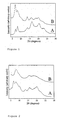
- the X-ray diffraction pattern of a non-oriented semi-crystalline sample in ⁇ form is reported in Figure 1A .
- the equatorial profile of the X-ray diffraction pattern of monoaxially oriented semi-crystalline sample in ⁇ form is reported in Figure 1B .
- the nanoporous form ⁇ After sorption of polar guest, the nanoporous form ⁇ , is able to form molecular-complex phases with planar or quasi-planar guest nearly parallel with respect to the polymer chain axes.
- the infra-red absorbance peaks of the guest molecules when present in monoaxially oriented samples, present negative and positive LD r values, respectively.
- Further object of the present invention is a process for preparing molecular-complex crystalline phases from the nanoporous ⁇ crystalline form with polar guest molecules having molecular planes nearly parallel with respect to the polymer chain axes, comprising the following steps:
- the polymeric material being in the ⁇ crystalline form is preferably treated with solutions of polar molecules with concentrations higher than 10%.
- concentration of the solution containing the polar molecules will be chosen on the basis of the molecular solubility.
- polar molecules p-nitro-aniline and 4-(dimethyl-amino)cinnamaldehyde are particularly preferred.
- Acetone and acetonitrile are preferred as solvents.
- the treatment temperature of said step a) is usually room temperature but temperatures below 130°C can also be used.
- Extraction in said step b) is preferably carried out through thermal treatments at temperature below 70°C or through liquid or supercritical carbon dioxide, operating at pressures between 50 and 350 bar and temperature between 20 and 70°C.
- Such crystalline forms with molecular-complexes are characterized by the presence of a X-ray diffraction peak in the range 2 ⁇ (CuK ⁇ ) 6.6°-7.2° and of a second diffraction peak in the range 2 ⁇ (CuK ⁇ ) 7.8°-8.2°, and by an intensity ratio (determined as the ratio between the peak intensities in the pattern of non-oriented samples) between 0.2 and 3.
- Such crystalline forms are normally present in semi-crystalline materials with crystallinity degrees between 5-70%.
- molecular-complex crystalline phases s-PS/guest obtained in samples in crystalline ⁇ form by sorption of guest molecules with dipole moment higher than 2 Debye.
- Suitable polar guests are for example, p -nitroaniline, 4-methoxy- ⁇ -nitrostyrene, p -(dimethyl-amino)cinnamaldehyde, and trans- ⁇ -nitrostyrene.
- infra-red linear dichroism measurements show that the guest molecular planes are oriented nearly parallel to the polymer chain axes of the crystalline phase.
- the infra-red absorbance peaks corresponding to out-of plane and in-plane vibrational modes present negative and positive LD r values, respectively.
- the syndiotatic polystyrene homopolymer was supplied as pellets by "DOW Chemical” under the trademark Questra 101.
- the powder obtained is desiccated at 60° for 2h. Then, after annealing at 160°C for 12h, the powder presents the ⁇ -form.
- the ⁇ -form powder is treated with liquid chloroform at room temperature for 20h.
- the materials obtained present the new nanoporous ⁇ crystalline phase, as shown on the x-ray diffraction pattern (CuK ⁇ ) reported in Figure 1A .
- the x-ray diffraction pattern obtained shows higher intensity reflections at 2 ⁇ (CuK ⁇ ) ⁇ 6.9°, 8.2°, 13.8°, 16.4°, 20.5°, 23°.
- the crystallinity degree, evaluated from the ratio of the diffraction area due to the crystalline phase and the total diffraction area, is equal to c.a. 40%.
- the syndiotatic polystyrene homopolymer was supplied as pellets by "DOW Chemical” under the trademark Questra 101.
- Monoaxially oriented films with a thickness of c.a. 30 ⁇ m are obtained from extruded films stretched monoaxially, at draw ratio ⁇ ⁇ 3 at constant deformation rate of 0.1 s -1 in the temperature range 105-110°C. Such oriented films were crystallized into ⁇ -form by exposure to CS 2 vapors followed by desorption.
- Monoaxially oriented ⁇ -form films have been obtained from monoaxially stretched ⁇ form films by annealing at 160°C for 12 hours.
- the oriented film being in the ⁇ form is treated with liquid chloroform at room temperature for 4h. Then, the film is treated with a extraction procedure by liquid acetonitrile for 10 min. After extraction, a polymeric material with a chloroforom content below 0.1 wt% is obtained.
- the film obtained presents the new nanoporous crystalline form ⁇ as shown from the X-ray diffraction patterns.
- the equatorial profile is reported in Figure 1B .
- the diffraction pattern shows high intensity reflections at 2 ⁇ (CuK ⁇ ) ⁇ 6.9°, 8.2°, 13.9°, 16.3°, 20.5°, 23°.
- a monoaxially stretched s-PS film being in ⁇ form obtained according to the procedure of Example 2 is used.
- the film being in ⁇ form is treated at room temperature for 90 min with an acetone solution saturated with p-nitroaniline which is a compound with a dipole moment equal to 6.2 Debye.
- the film treated with p-nitroaniline is characterized by an equatorial profile of the X-ray diffraction pattern ( Fig. 2A ) showing higher intensity reflections at 2 ⁇ (CuK ⁇ ) ⁇ 6.9°, 8.1°, 10°, 13.7°, 16°, 20°.
Landscapes
- Chemical & Material Sciences (AREA)
- Chemical Kinetics & Catalysis (AREA)
- Health & Medical Sciences (AREA)
- Medicinal Chemistry (AREA)
- Polymers & Plastics (AREA)
- Organic Chemistry (AREA)
- Addition Polymer Or Copolymer, Post-Treatments, Or Chemical Modifications (AREA)
- Manufacture Of Macromolecular Shaped Articles (AREA)
- Peptides Or Proteins (AREA)
- Processes Of Treating Macromolecular Substances (AREA)
Abstract
Description
- The present invention relates to a process for preparing a new nanoporous crystalline form of syndiotactic polystyrene, to the thus obtained crystalline form, to the molecular-complex crystalline forms obtained by exposition of such form to low-molecular-mass molecules, and to the related processes for their preparation.
- The present invention is located in the technical-scientific fields of industrial chemistry and engineering. More specifically, in the area of molecular analysis and separation for the nanoporous form and in the area of functionalized polymer material, mainly with particular optical and electrical properties, for the molecular-complex forms.
- It is well-known that syndiotactic polystyrene (s-PS) is a thermoplastic semi-crystalline polymeric material which presents an extremely complex polymorphism. In particular, two crystalline forms (α and β) characterized by a trans-planar zig-zag chain conformation can be obtained by melt manufacture processes, while two other crystalline forms (γ and δ which are obtained from solution manufacture processes) are characterized by a s(2/1)2 helical chain conformation.
- Furthermore, it is also well-known that the δ form is a nanoporous crystalline form, which can be obtained by removal of low molecular weight guest molecules from molecular-complex crystalline forms (clathrate or intercalate). Such δ-form is characterized by a X-ray diffraction, pattern presenting higher intensity reflections at 2θ (CuKα) ≃ 8.4°, 10.6°, 13.4°, 16.8°, 20.7°, 23.5°. Samples with the δ-form can absorb from liquid or gaseous mixtures in the crystalline phase (i.e. to form molecular-complex phases), volatile organic compounds, also when those compounds are present at low concentrations and thus such samples can be used for molecular separation and sensorics.
- Materials based on s-PS presenting molecular-complex crystalline phases with various guest molecules have been proposed as advanced materials (see in particular: 1) Stegmaier, P.; De Girolamo Del Mauro,A.; Venditto,V.; Guerra,G. Optical recording materials based on photoisomerization of guest molecules of a polymeric crystalline host phase. Adv.Mater. 17, 1166-1168, 2005. 2) Uda, Y.; Kaneko, F.; Tanigaki, N.; Kawaguchi, T. The first example of a polymer-crystal-organic-dye composite material: The clathrate phase of syndiotactic polystyrene with azulene Adv. Mater. 17, 1846-1850, 2005.).
- Several structural studies by means of X-ray diffraction and infrared linear dichroism have clearly shown that planar or quasi-planar guest molecules of molecular-complex crystalline phases obtained from the δ-form, are generally oriented with their molecular plane nearly perpendicular to the polymer host chain-axes. This can be shown for example (as described in details in the article: "A Clear-Cut Experimental Method to Discriminate between In-Plane and Out-of-Plane Molecular Transition Moments" from A.R Albunia, G. Milano, V. Venditto, G.Guerra, J. Am. Chem. Soc. 2005, 127, 13114-13115) with the positive or negative sign of the relative limear dicroism value LDr = 3(A∥- A┴)/(A∥+2A┴), A∥ and A┴ being the measured absorbance intensities for electric vectors (polarized light) parallel and perpendicular to the streching direction, respectively. In particular, guest molecule infra-red absorbance peaks corresponding to vibrational modes being out of the molecular plane (out-of plane) or in the molecular plane (in-plane) show positive and negative LDr values, respectively.
- Through a new preparation process it has now been found a new nanoporous crystalline form of syndiotactic polystyrene, thereafter named ε, which can give rise to a new molecular-complex crystalline phases after its exposition to low-molecular-mass compounds.
- In particular the nanoporous ε form, after sorption of polar guest molecules can lead to molecular-complex phases with planar or quasi-planar guests being nearly parallel to the polymer chain-axes. Actually, for such molecular complexes when present in monoaxially strectched samples, the infra-red absorbance peaks of the guest molecules corresponding to out-of plane and in-plane vibrational modes present negative and positive LDr values, respectively.
- It is therefore an object of the present invention a process for preparing polymeric materials based on s-PS containing the ε crystalline form, comprising the following steps:
- a) preparation of polymeric materials based on s-PS containing the γ crystalline form;
- b) treatment of said materials with chloroform vapours until the obtaining of a molecular complex phase with chloroform and
- c) extraction of chloroform and obtaining of polymeric materials based on s-PS containing the ε crystalline phase,
- It is well-known from literature that the γ crystalline form is characterized by a x-ray diffraction pattern presenting higher intensity reflections at 2θ (CuKα) ≃ 9.2°, 10.5°, 14.0°, 16.2°; 19.9°, 28.5°. Materials containing the γ crystalline form can be obtained by annealing at temperature in the range 110-170°C of materials obtained from solution processes. A detailed description of the various processes allowing to obtain the s-PS γ form is reported in the article: "Polymorphism of syndiotactic polystyrene: γ phase crystallization induced by bulky non-guest solvents" by P.Rizzo. A.R.Albunia, G.Guerra Polymer 2005, 46, 9549.
- The treatments of materials in γ form in said step b) of the process of the present invention can be carried out with liquid or vapour phase chloroform. The operative conditions for the treatment are known from the state of the art; however temperatures between room temperature and 70°C are preferred. The complete obtaining of a molecular complex with chloroform can be determined, for example, from x-ray diffraction pattern on the basis of the vanishing of the reflection at 2θ (CuKα) ≃ 9.2°.
- The extraction processes of chloroform in said step c) can be carried out by liquid or supercritical carbon dioxide, operating at pressures between 50 and 350 bar and temperature between 20 and 70°C. Extraction processes with other solvents being volatile "guests" of the s-PS nanoporous phases such as, for example, acetone or acetonitrile are also efficient.
- The present description contains three drawings showing:
-
Fig 1 . the x-ray diffraction patterns of s-PS samples presenting the new ε crystalline form: (A) non-oriented sample, (B) monoaxially stretched film (equatorial profile); -
Fig 2 . the equatorial profiles of x-ray diffraction patterns of monoaxially stretched s-PS films containing molecular-complex crystalline phases with p-nitro-aniline obtained by sorption of such polar guest in films being: (A) in ε form, (B) in δ form; -
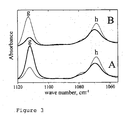
Fig.3 the FTIR spectra collected with polarization light perpendicular (thin lines) and parallel (thick lines) to the film stretching direction of monoaxially stretched films containing molecular-complex crystalline phases s-PS/p-nitroaniline obtained by sorption of this polar guest in films being: (A) in ε form, (B) in δ form. - Under syndiotactic polystyrene (s-PS), a polymer with syndiotactic sequences of the polymer chain long enough to allow the polymer crystallization is meant. Such polymer can be for example synthesized following the method described in the European patent N°
0271875 -Himont Italia. In the definition of syndiotactic polystyrene, in the present invention, in addition to syndiotactic polystyrene homopolymers, are also included styrene copolymers with CH2=CH-R olefins, wherein R is an alkylaryl or a substituted aryl radical with 6-20 carbon atoms, or with other copolymerizable ethylenically unsaturated comonomers, such copolymers being characterized by a prevailingly syndiotactic microstructure and by a molar content of styrene larger than 40%. - Through the procedure of the present invention, a new nanoporous crystalline form of s-PS, thereafter named ε which is also object of the present invention, is obtainable, this form being characterized by a X-ray diffraction pattern presenting high intensity reflections at 2θ (CuKα) ≃ 6.9°, 8.2°, 13.8°, 16.4°, 20.5°, 23° is obtainable. Moreover, polymeric materials containing said ε form in a fraction between 5 and 70 wt% are also obtainable.
- The X-ray diffraction pattern of a non-oriented semi-crystalline sample in ε form is reported in
Figure 1A . The equatorial profile of the X-ray diffraction pattern of monoaxially oriented semi-crystalline sample in ε form, is reported inFigure 1B . - After sorption of polar guest, the nanoporous form ε, is able to form molecular-complex phases with planar or quasi-planar guest nearly parallel with respect to the polymer chain axes. As a matter of fact for such molecular complexes, when present in monoaxially oriented samples, the infra-red absorbance peaks of the guest molecules, corresponding to out-of plane and in-plane vibrational modes, present negative and positive LDr values, respectively.
- Further object of the present invention is a process for preparing molecular-complex crystalline phases from the nanoporous ε crystalline form with polar guest molecules having molecular planes nearly parallel with respect to the polymer chain axes, comprising the following steps:
- a) treatment of polymeric material being in the ε crystalline form with solutions of polar molecules with concentration higher than 2 wt%, using as solvent volatile guests of syndiotactic polystyrene;
- b) solvent extraction from said polymeric material and obtaining of a molecular-complex crystalline phase.
- The polymeric material being in the ε crystalline form is preferably treated with solutions of polar molecules with concentrations higher than 10%. The exact concentration of the solution containing the polar molecules will be chosen on the basis of the molecular solubility. Among polar molecules, p-nitro-aniline and 4-(dimethyl-amino)cinnamaldehyde are particularly preferred. Acetone and acetonitrile are preferred as solvents. The treatment temperature of said step a) is usually room temperature but temperatures below 130°C can also be used.
- Extraction in said step b) is preferably carried out through thermal treatments at temperature below 70°C or through liquid or supercritical carbon dioxide, operating at pressures between 50 and 350 bar and temperature between 20 and 70°C.
- Further object of the present invention are the molecular-complex crystalline forms s-PS/guest obtainable with the process previously claimed, by exposition of ε crystalline phases to low-molecular-mass guest molecules. Such crystalline forms with molecular-complexes are characterized by the presence of a X-ray diffraction peak in the range 2θ (CuKα) 6.6°-7.2° and of a second diffraction peak in the range 2θ (CuKα) 7.8°-8.2°, and by an intensity ratio (determined as the ratio between the peak intensities in the pattern of non-oriented samples) between 0.2 and 3. Such crystalline forms are normally present in semi-crystalline materials with crystallinity degrees between 5-70%.
- Particularly relevant for their optical and electrical properties, are the molecular-complex crystalline phases s-PS/guest obtained in samples in crystalline ε form by sorption of guest molecules with dipole moment higher than 2 Debye. Suitable polar guests are for example, p-nitroaniline, 4-methoxy-β-nitrostyrene, p-(dimethyl-amino)cinnamaldehyde, and trans-β-nitrostyrene. In these cases, infra-red linear dichroism measurements show that the guest molecular planes are oriented nearly parallel to the polymer chain axes of the crystalline phase. As a matter of fact, for these molecular complexes, when present in monoaxially stretched samples, the infra-red absorbance peaks corresponding to out-of plane and in-plane vibrational modes present negative and positive LDr values, respectively.
- The following examples are supplied in order to illustrate the invention without limiting the scope thereof.
- The syndiotatic polystyrene homopolymer was supplied as pellets by "DOW Chemical" under the trademark Questra 101. The polymer dissolved in chloroform (1 wt% solution) at 110°C, is precipitated in methanol. The powder obtained is desiccated at 60° for 2h. Then, after annealing at 160°C for 12h, the powder presents the γ-form.
- The γ-form powder is treated with liquid chloroform at room temperature for 20h. The material is treated with a chloroform extraction procedure by supercritical carbon dioxide (T = 45°C, P = 200 bar, extraction time t= 30 min). After extraction, a polymeric material with a chloroforom content below 0.1 wt% is obtained.
- The materials obtained present the new nanoporous ε crystalline phase, as shown on the x-ray diffraction pattern (CuKα) reported in
Figure 1A . The x-ray diffraction pattern obtained shows higher intensity reflections at 2θ (CuKα) ≃ 6.9°, 8.2°, 13.8°, 16.4°, 20.5°, 23°. The crystallinity degree, evaluated from the ratio of the diffraction area due to the crystalline phase and the total diffraction area, is equal to c.a. 40%. - The syndiotatic polystyrene homopolymer was supplied as pellets by "DOW Chemical" under the trademark Questra 101. Monoaxially oriented films with a thickness of c.a. 30 µm are obtained from extruded films stretched monoaxially, at draw ratio λ ≈ 3 at constant deformation rate of 0.1 s-1 in the temperature range 105-110°C. Such oriented films were crystallized into δ-form by exposure to CS2 vapors followed by desorption. Monoaxially oriented γ-form films have been obtained from monoaxially stretched δ form films by annealing at 160°C for 12 hours.
- The oriented film being in the γ form is treated with liquid chloroform at room temperature for 4h. Then, the film is treated with a extraction procedure by liquid acetonitrile for 10 min. After extraction, a polymeric material with a chloroforom content below 0.1 wt% is obtained.
- The film obtained presents the new nanoporous crystalline form ε as shown from the X-ray diffraction patterns. In particular, the equatorial profile is reported in
Figure 1B . The diffraction pattern shows high intensity reflections at 2θ (CuKα) ≈ 6.9°, 8.2°, 13.9°, 16.3°, 20.5°, 23°. - A monoaxially stretched s-PS film being in ε form obtained according to the procedure of Example 2 is used.
- The film being in ε form is treated at room temperature for 90 min with an acetone solution saturated with p-nitroaniline which is a compound with a dipole moment equal to 6.2 Debye.
- The film treated with p-nitroaniline is characterized by an equatorial profile of the X-ray diffraction pattern (
Fig. 2A ) showing higher intensity reflections at 2θ (CuKα) ≃ 6.9°, 8.1°, 10°, 13.7°, 16°, 20°. - For comparison, the equatorial profile of the X-ray diffraction pattern (CuKa) of a s-PS film being in δ form treated with an acetone solution saturated with p-nitroaniline is also shown in
Figure 2B . Such diffraction pattern does not display any reflection for 2θ (CuKα) smaller than 8°. - Infrared linear dichroism spectra for the films of
Figure 2A and 2B reported inFigure 3A and 3B , respectively, show that the infrared absorbance peaks of p-nitroaniline are dichroic both for the sample obtained from the ε form and for the sample obtained from the δ form. This indicates the formation, in both cases, of molecular complex crystalline phases with s-PS and the polar guest. - Moreover, the measurements of the infrared linear dichroism of
Figure 3 show that the two molecular-complex crystalline phases are totally different. Indeed, while the dichroism of the absorbance peaks of the polymer host is almost identical (see for example the peak at 1069 cm-1 inFigure 3 ), the dichroism of the absorbance peaks of the guest is of opposite sign (see for example the peak at 1112 cm-1 inFigure 3 ). - In particular, the relative linear dichroism values LDr evaluated for the peak at 1112 cm-1, corresponding to an "in-plane" vibrational mode, is equal to +1.1 and - 0.89 for samples of
Figure 3A and 3B , respectively. This clearly indicates that the molecular plane of the p-nitroaniline is nearly parallel to the chain axes of the crystalline phase for the molecular-complex obtained from the ε form, while it is nearly perpendicular to this direction in the case of the molecular-complex obtained from the δ form.
Claims (16)
- Process for preparing polymeric materials based on s-PS containing the ε crystalline phase, comprising the following steps:a) preparation of polymeric materials based on s-PS containing the γ crystalline form;b) treatment of said materials with chloroform until a molecular complex phase with chloroform is obtained andc) extraction of chloroform and obtaining of polymeric materials based on s-PS containing the ε crystalline formwherein s-PS represents a styrene homopolymer or styrene copolymers with CH2=CH-R olefins, wherein R is an alkylaryl or a substituted-aryl radical with 6-20 carbon atoms, or with other copolymerizable ethylenically unsaturated monomers, such copolymers being characterized by a microstructure prevailingly syndiotactic and by a molar content of styrene larger than 40%.
- The process according to claim 1, wherein in said step b) the said treatment with chloroform can be achieved with liquid chloroform or with chloroform vapours.
- The process according to at least one of the previous claims, wherein in said step c) the said chloroform extraction, is carried out by liquid or supercritical carbon dioxide operating at pressures between 50 and 350 bar and temperature between 20 and 70°C.
- The process according to at least one of claims 1 and 2, wherein in said step c) said chloroform extraction is carried out by solvents being volatile guest of s-PS nanoporous phases.
- The process according to claim 4 wherein said solvents are selected from the class formed by acetone or acetonitrile.
- Polymeric materials based on s-PS containing the ε crystalline form obtainable from the process as claimed in claims 1 to 5.
- ε crystalline form of s-PS according to claim 6 characterized by a X-ray diffraction pattern showing high intensity reflections at 2θ (CuKα) ≃ 6.9°, 8.2°, 13.8°, 16.4°, 20.5°, 23°.
- Use of the materials as claimed in claim 6 or 7 for molecular analysis and separation.
- Process for the preparation of molecular-complex crystalline phases starting from the s-PS nanoporous crystalline form ε with polar guest molecules with molecular planes nearly parallel to the polymeric chain axis, comprising the following steps:a) Treatment of a polymeric material containing the ε crystalline form with solutions of polar molecules with concentration higher than 2 wt% using volatile guests of s-PS as solvent;b) solvent extraction from said polymeric material and obtaining of a molecular-complex crystalline phase.
- The process according to claim 9, wherein said polar guest molecules have a dipole moment larger than 2 Debye.
- The process according to claim 10, wherein said molecules are selected from the class formed by p-nitroaniline, 4-methoxy-β-nitrostyrene, p-(dimethylamino)cinnamaldehyde, and trans-β-nitrostyrene.
- The process according to at least one of claims 9 to 11, wherein in said step a) preferred solvents are acetone and acetonitrile and the treatment temperature is between room temperature and 130°C.
- The process according to at least one of claims 9 to 12, wherein in said step b) said extraction is carried out by thermal treatments at temperatures below 70°C or by liquid or supercritical carbon dioxide at pressures between 50 and 350 bar and temperature between 20 and 70°C.
- s-PS/guest molecular-complex crystalline forms, obtainable according to the process claimed in claims 9 to 13.
- Crystalline forms according to claim 14 characterized by the presence of a first diffraction peak in the range 2θ (CuKα) 6.6°-7.2° and of a second diffraction peak in the range 2θ (CuKα) 7.8°-8.2°, and by an intensity ratio (determined as the ratio between the peak intensities in patterns of non-oriented samples) between 0.2 and 3.
- Use of the crystalline forms as claimed in claims 14 to 15 in a quantity between 5 and 70 wt% as functional materials in optical and electrical devices.
Applications Claiming Priority (2)
| Application Number | Priority Date | Filing Date | Title |
|---|---|---|---|
| IT000022A ITSA20060022A1 (en) | 2006-08-22 | 2006-08-22 | NEW NANOPOROSAL CRYSTALLINE SHAPE OF SINDIOTACTIC POLYSTYRENE AND CRYSTALLINE FORMS WITH MOLECULAR DERIVED COMPLEX. |
| PCT/IB2007/053332 WO2008023331A2 (en) | 2006-08-22 | 2007-08-21 | New nanoporous crystalline form of syndiotactic polystyrene, processes for its preparation and related molecular-complex crystalline forms |
Publications (2)
| Publication Number | Publication Date |
|---|---|
| EP2059541A2 EP2059541A2 (en) | 2009-05-20 |
| EP2059541B1 true EP2059541B1 (en) | 2010-06-23 |
Family
ID=39032312
Family Applications (1)
| Application Number | Title | Priority Date | Filing Date |
|---|---|---|---|
| EP07826074A Not-in-force EP2059541B1 (en) | 2006-08-22 | 2007-08-21 | New nanoporous crystalline form of syndiotactic polystyrene, processes for its preparation and related molecular-complex crystalline forms |
Country Status (6)
| Country | Link |
|---|---|
| US (1) | US7956155B2 (en) |
| EP (1) | EP2059541B1 (en) |
| AT (1) | ATE471953T1 (en) |
| DE (1) | DE602007007342D1 (en) |
| IT (1) | ITSA20060022A1 (en) |
| WO (1) | WO2008023331A2 (en) |
Families Citing this family (5)
| Publication number | Priority date | Publication date | Assignee | Title |
|---|---|---|---|---|
| IT1404157B1 (en) | 2010-12-30 | 2013-11-15 | Nano Active Film S R L | NANOPOROSAL CRYSTALLINE FORM DISORDERED WITH SINDIOTACTIC POLYSTYRENE, ITS PREPARATION PROCESS AND ITEMS INCLUDING THE SAME. |
| WO2013155088A1 (en) | 2012-04-09 | 2013-10-17 | University Of Washington Through Its Center For Commercialization | A method to enhance cell nucleation density in solid-state foams |
| JP6632053B2 (en) * | 2015-08-24 | 2020-01-15 | 国立大学法人静岡大学 | A method for producing a molded article containing syndiotactic polystyrene and a method for producing a composite molded article. |
| JP2017110311A (en) * | 2015-12-16 | 2017-06-22 | 東洋紡株式会社 | Manufacturing method of syndiotactic polystyrene fiber |
| CN115572411A (en) * | 2022-10-27 | 2023-01-06 | 南京大学 | A kind of fluorescent polystyrene microplastic and its preparation method and application |
-
2006
- 2006-08-22 IT IT000022A patent/ITSA20060022A1/en unknown
-
2007
- 2007-08-21 AT AT07826074T patent/ATE471953T1/en not_active IP Right Cessation
- 2007-08-21 US US12/377,317 patent/US7956155B2/en not_active Expired - Fee Related
- 2007-08-21 EP EP07826074A patent/EP2059541B1/en not_active Not-in-force
- 2007-08-21 DE DE602007007342T patent/DE602007007342D1/en active Active
- 2007-08-21 WO PCT/IB2007/053332 patent/WO2008023331A2/en not_active Ceased
Also Published As
| Publication number | Publication date |
|---|---|
| WO2008023331A3 (en) | 2008-05-15 |
| US7956155B2 (en) | 2011-06-07 |
| EP2059541A2 (en) | 2009-05-20 |
| ITSA20060022A1 (en) | 2008-02-23 |
| WO2008023331A8 (en) | 2008-07-03 |
| ATE471953T1 (en) | 2010-07-15 |
| DE602007007342D1 (en) | 2010-08-05 |
| US20100210806A1 (en) | 2010-08-19 |
| WO2008023331A2 (en) | 2008-02-28 |
Similar Documents
| Publication | Publication Date | Title |
|---|---|---|
| US7956155B2 (en) | Nanoporous crystalline form of syndiotactic polystyrene, processes for its preparation and related molecular-complex crystalline forms | |
| JP4680184B2 (en) | Lyotropic liquid crystal systems based on perylenetetracarboxylic acid dibenzimidazole sulfo derivatives | |
| JP4429317B2 (en) | Sulfo derivatives of perylene tetracarboxylic acid dibenzimidazole containing oxo group of perylene nucleus forming part of para-quinoid bond, lyotropic liquid crystal system and anisotropic film containing the same, and production method thereof | |
| Ziganshin et al. | Thermally induced diphenylalanine cyclization in solid phase | |
| CN111819476B (en) | Polarizer and image display device | |
| JP6808072B2 (en) | Polarizer and image display device | |
| Giese et al. | Tuning the photonic properties of chiral nematic mesoporous organosilica with hydrogen-bonded liquid-crystalline assemblies | |
| Kloos et al. | On the order and orientation in liquid crystalline polymer membranes for gas separation | |
| EP2332942A1 (en) | Polymerizable chiral compound, polymerizable liquid crystalline composition, liquid crystalline polymer, and optical isomer | |
| Wang et al. | Diazocine as a Versatile Building Block Enables Excellent Photoswitching and Chromic Properties in Self-Assembled Organogels | |
| Hsieh et al. | Pillared-bilayer metal-organic framework membranes for dehydration of isopropanol | |
| CN105473648A (en) | Method for producing ion-exchange membrane and ion-exchange membrane obtained thereby | |
| Radziszewski et al. | Fourier-transform infrared linear dichroism. Stretched polyethylene as a solvent in IR spectroscopy | |
| WO2018070933A1 (en) | Fluorescent porous organic frameworks containing molecular rotors for chemical sensing | |
| Albunia et al. | Control of guest transport in polymer films by structure and orientation of nanoporous-crystalline phases | |
| Gayle et al. | Fluorinated 2D conjugated porous organic polymer films with modular structural topology for controlled molecular sieving | |
| JPH03131644A (en) | Production of styrene-based polymer film | |
| JPS62163710A (en) | Polymer/liquid crystal composite semipermeable membrane and its use | |
| CN102791749B (en) | Polymerizable chiral compounds, polymerizable liquid crystal compositions, liquid crystalline polymers and optically anisotropic conductors | |
| Agnes et al. | Crystal structure analyses facilitate understanding of synthesis protocols in the preparation of 6, 6′-dibromo-substituted BINOL compounds | |
| KR20180111257A (en) | Coating type thin layer polarizing film and manufacturing method thereof and compounds using the same | |
| Ibragimov | Further development of the general rule correlating guest space topology and guest content in polymorphs of the given inclusion compound with crystallization temperatures | |
| Kim et al. | Mechanistic study on selective inclusion of xylenes into guanidinium p-toluenesulfonate host frame | |
| CN100457755C (en) | Sulfo derivative, lyotropic liquid crystal system and anisotropic film containing sulfo derivative, and manufacturing methods of sulfo derivative and lyotropic liquid crystal system and anisotropic film | |
| CN100334086C (en) | Lyotropic liquid crystal systems based on perylenetetracarboxylic acid dibenzimidazole sulfoderivatives |
Legal Events
| Date | Code | Title | Description |
|---|---|---|---|
| PUAI | Public reference made under article 153(3) epc to a published international application that has entered the european phase |
Free format text: ORIGINAL CODE: 0009012 |
|
| 17P | Request for examination filed |
Effective date: 20090203 |
|
| AK | Designated contracting states |
Kind code of ref document: A2 Designated state(s): AT BE BG CH CY CZ DE DK EE ES FI FR GB GR HU IE IS IT LI LT LU LV MC MT NL PL PT RO SE SI SK TR |
|
| AX | Request for extension of the european patent |
Extension state: AL BA HR MK RS |
|
| RAP1 | Party data changed (applicant data changed or rights of an application transferred) |
Owner name: UNIVERSITA' DEGLI STUDI DI SALERNO |
|
| 17Q | First examination report despatched |
Effective date: 20090612 |
|
| DAX | Request for extension of the european patent (deleted) | ||
| GRAP | Despatch of communication of intention to grant a patent |
Free format text: ORIGINAL CODE: EPIDOSNIGR1 |
|
| RIC1 | Information provided on ipc code assigned before grant |
Ipc: C08F 12/08 20060101AFI20100104BHEP Ipc: B01D 71/28 20060101ALI20100104BHEP Ipc: G01N 21/77 20060101ALN20100104BHEP Ipc: G01N 21/19 20060101ALN20100104BHEP Ipc: C08L 25/06 20060101ALI20100104BHEP Ipc: C08J 7/02 20060101ALI20100104BHEP |
|
| GRAS | Grant fee paid |
Free format text: ORIGINAL CODE: EPIDOSNIGR3 |
|
| GRAA | (expected) grant |
Free format text: ORIGINAL CODE: 0009210 |
|
| AK | Designated contracting states |
Kind code of ref document: B1 Designated state(s): AT BE BG CH CY CZ DE DK EE ES FI FR GB GR HU IE IS IT LI LT LU LV MC MT NL PL PT RO SE SI SK TR |
|
| REG | Reference to a national code |
Ref country code: CH Ref legal event code: EP |
|
| REG | Reference to a national code |
Ref country code: IE Ref legal event code: FG4D |
|
| REF | Corresponds to: |
Ref document number: 602007007342 Country of ref document: DE Date of ref document: 20100805 Kind code of ref document: P |
|
| REG | Reference to a national code |
Ref country code: NL Ref legal event code: VDEP Effective date: 20100623 |
|
| PG25 | Lapsed in a contracting state [announced via postgrant information from national office to epo] |
Ref country code: LT Free format text: LAPSE BECAUSE OF FAILURE TO SUBMIT A TRANSLATION OF THE DESCRIPTION OR TO PAY THE FEE WITHIN THE PRESCRIBED TIME-LIMIT Effective date: 20100623 Ref country code: SE Free format text: LAPSE BECAUSE OF FAILURE TO SUBMIT A TRANSLATION OF THE DESCRIPTION OR TO PAY THE FEE WITHIN THE PRESCRIBED TIME-LIMIT Effective date: 20100623 |
|
| LTIE | Lt: invalidation of european patent or patent extension |
Effective date: 20100623 |
|
| PG25 | Lapsed in a contracting state [announced via postgrant information from national office to epo] |
Ref country code: AT Free format text: LAPSE BECAUSE OF FAILURE TO SUBMIT A TRANSLATION OF THE DESCRIPTION OR TO PAY THE FEE WITHIN THE PRESCRIBED TIME-LIMIT Effective date: 20100623 Ref country code: LV Free format text: LAPSE BECAUSE OF FAILURE TO SUBMIT A TRANSLATION OF THE DESCRIPTION OR TO PAY THE FEE WITHIN THE PRESCRIBED TIME-LIMIT Effective date: 20100623 Ref country code: FI Free format text: LAPSE BECAUSE OF FAILURE TO SUBMIT A TRANSLATION OF THE DESCRIPTION OR TO PAY THE FEE WITHIN THE PRESCRIBED TIME-LIMIT Effective date: 20100623 Ref country code: SI Free format text: LAPSE BECAUSE OF FAILURE TO SUBMIT A TRANSLATION OF THE DESCRIPTION OR TO PAY THE FEE WITHIN THE PRESCRIBED TIME-LIMIT Effective date: 20100623 |
|
| PG25 | Lapsed in a contracting state [announced via postgrant information from national office to epo] |
Ref country code: PL Free format text: LAPSE BECAUSE OF FAILURE TO SUBMIT A TRANSLATION OF THE DESCRIPTION OR TO PAY THE FEE WITHIN THE PRESCRIBED TIME-LIMIT Effective date: 20100623 |
|
| PG25 | Lapsed in a contracting state [announced via postgrant information from national office to epo] |
Ref country code: NL Free format text: LAPSE BECAUSE OF FAILURE TO SUBMIT A TRANSLATION OF THE DESCRIPTION OR TO PAY THE FEE WITHIN THE PRESCRIBED TIME-LIMIT Effective date: 20100623 Ref country code: EE Free format text: LAPSE BECAUSE OF FAILURE TO SUBMIT A TRANSLATION OF THE DESCRIPTION OR TO PAY THE FEE WITHIN THE PRESCRIBED TIME-LIMIT Effective date: 20100623 |
|
| PG25 | Lapsed in a contracting state [announced via postgrant information from national office to epo] |
Ref country code: PT Free format text: LAPSE BECAUSE OF FAILURE TO SUBMIT A TRANSLATION OF THE DESCRIPTION OR TO PAY THE FEE WITHIN THE PRESCRIBED TIME-LIMIT Effective date: 20101025 Ref country code: CY Free format text: LAPSE BECAUSE OF FAILURE TO SUBMIT A TRANSLATION OF THE DESCRIPTION OR TO PAY THE FEE WITHIN THE PRESCRIBED TIME-LIMIT Effective date: 20100623 Ref country code: CZ Free format text: LAPSE BECAUSE OF FAILURE TO SUBMIT A TRANSLATION OF THE DESCRIPTION OR TO PAY THE FEE WITHIN THE PRESCRIBED TIME-LIMIT Effective date: 20100623 Ref country code: IS Free format text: LAPSE BECAUSE OF FAILURE TO SUBMIT A TRANSLATION OF THE DESCRIPTION OR TO PAY THE FEE WITHIN THE PRESCRIBED TIME-LIMIT Effective date: 20101023 Ref country code: RO Free format text: LAPSE BECAUSE OF FAILURE TO SUBMIT A TRANSLATION OF THE DESCRIPTION OR TO PAY THE FEE WITHIN THE PRESCRIBED TIME-LIMIT Effective date: 20100623 Ref country code: SK Free format text: LAPSE BECAUSE OF FAILURE TO SUBMIT A TRANSLATION OF THE DESCRIPTION OR TO PAY THE FEE WITHIN THE PRESCRIBED TIME-LIMIT Effective date: 20100623 Ref country code: BE Free format text: LAPSE BECAUSE OF FAILURE TO SUBMIT A TRANSLATION OF THE DESCRIPTION OR TO PAY THE FEE WITHIN THE PRESCRIBED TIME-LIMIT Effective date: 20100623 |
|
| PG25 | Lapsed in a contracting state [announced via postgrant information from national office to epo] |
Ref country code: IT Free format text: LAPSE BECAUSE OF FAILURE TO SUBMIT A TRANSLATION OF THE DESCRIPTION OR TO PAY THE FEE WITHIN THE PRESCRIBED TIME-LIMIT Effective date: 20100623 Ref country code: MC Free format text: LAPSE BECAUSE OF NON-PAYMENT OF DUE FEES Effective date: 20100831 |
|
| PG25 | Lapsed in a contracting state [announced via postgrant information from national office to epo] |
Ref country code: DK Free format text: LAPSE BECAUSE OF FAILURE TO SUBMIT A TRANSLATION OF THE DESCRIPTION OR TO PAY THE FEE WITHIN THE PRESCRIBED TIME-LIMIT Effective date: 20100623 |
|
| PLBE | No opposition filed within time limit |
Free format text: ORIGINAL CODE: 0009261 |
|
| STAA | Information on the status of an ep patent application or granted ep patent |
Free format text: STATUS: NO OPPOSITION FILED WITHIN TIME LIMIT |
|
| PG25 | Lapsed in a contracting state [announced via postgrant information from national office to epo] |
Ref country code: GR Free format text: LAPSE BECAUSE OF FAILURE TO SUBMIT A TRANSLATION OF THE DESCRIPTION OR TO PAY THE FEE WITHIN THE PRESCRIBED TIME-LIMIT Effective date: 20100924 |
|
| 26N | No opposition filed |
Effective date: 20110324 |
|
| REG | Reference to a national code |
Ref country code: DE Ref legal event code: R097 Ref document number: 602007007342 Country of ref document: DE Effective date: 20110323 |
|
| PG25 | Lapsed in a contracting state [announced via postgrant information from national office to epo] |
Ref country code: IE Free format text: LAPSE BECAUSE OF NON-PAYMENT OF DUE FEES Effective date: 20100821 |
|
| PG25 | Lapsed in a contracting state [announced via postgrant information from national office to epo] |
Ref country code: MT Free format text: LAPSE BECAUSE OF FAILURE TO SUBMIT A TRANSLATION OF THE DESCRIPTION OR TO PAY THE FEE WITHIN THE PRESCRIBED TIME-LIMIT Effective date: 20100623 |
|
| REG | Reference to a national code |
Ref country code: CH Ref legal event code: PL |
|
| PG25 | Lapsed in a contracting state [announced via postgrant information from national office to epo] |
Ref country code: CH Free format text: LAPSE BECAUSE OF NON-PAYMENT OF DUE FEES Effective date: 20110831 Ref country code: LI Free format text: LAPSE BECAUSE OF NON-PAYMENT OF DUE FEES Effective date: 20110831 |
|
| PG25 | Lapsed in a contracting state [announced via postgrant information from national office to epo] |
Ref country code: LU Free format text: LAPSE BECAUSE OF NON-PAYMENT OF DUE FEES Effective date: 20100821 Ref country code: BG Free format text: LAPSE BECAUSE OF FAILURE TO SUBMIT A TRANSLATION OF THE DESCRIPTION OR TO PAY THE FEE WITHIN THE PRESCRIBED TIME-LIMIT Effective date: 20100623 Ref country code: HU Free format text: LAPSE BECAUSE OF FAILURE TO SUBMIT A TRANSLATION OF THE DESCRIPTION OR TO PAY THE FEE WITHIN THE PRESCRIBED TIME-LIMIT Effective date: 20101224 |
|
| PG25 | Lapsed in a contracting state [announced via postgrant information from national office to epo] |
Ref country code: TR Free format text: LAPSE BECAUSE OF FAILURE TO SUBMIT A TRANSLATION OF THE DESCRIPTION OR TO PAY THE FEE WITHIN THE PRESCRIBED TIME-LIMIT Effective date: 20100623 |
|
| REG | Reference to a national code |
Ref country code: DE Ref legal event code: R082 Ref document number: 602007007342 Country of ref document: DE Representative=s name: SCHUMACHER & WILLSAU PATENTANWALTSGESELLSCHAFT, DE |
|
| PG25 | Lapsed in a contracting state [announced via postgrant information from national office to epo] |
Ref country code: BG Free format text: LAPSE BECAUSE OF FAILURE TO SUBMIT A TRANSLATION OF THE DESCRIPTION OR TO PAY THE FEE WITHIN THE PRESCRIBED TIME-LIMIT Effective date: 20100923 |
|
| PG25 | Lapsed in a contracting state [announced via postgrant information from national office to epo] |
Ref country code: ES Free format text: LAPSE BECAUSE OF FAILURE TO SUBMIT A TRANSLATION OF THE DESCRIPTION OR TO PAY THE FEE WITHIN THE PRESCRIBED TIME-LIMIT Effective date: 20101004 |
|
| REG | Reference to a national code |
Ref country code: FR Ref legal event code: PLFP Year of fee payment: 9 |
|
| PGFP | Annual fee paid to national office [announced via postgrant information from national office to epo] |
Ref country code: DE Payment date: 20150821 Year of fee payment: 9 Ref country code: GB Payment date: 20150819 Year of fee payment: 9 |
|
| PGFP | Annual fee paid to national office [announced via postgrant information from national office to epo] |
Ref country code: FR Payment date: 20150820 Year of fee payment: 9 |
|
| REG | Reference to a national code |
Ref country code: DE Ref legal event code: R119 Ref document number: 602007007342 Country of ref document: DE |
|
| GBPC | Gb: european patent ceased through non-payment of renewal fee |
Effective date: 20160821 |
|
| REG | Reference to a national code |
Ref country code: FR Ref legal event code: ST Effective date: 20170428 |
|
| PG25 | Lapsed in a contracting state [announced via postgrant information from national office to epo] |
Ref country code: GB Free format text: LAPSE BECAUSE OF NON-PAYMENT OF DUE FEES Effective date: 20160821 Ref country code: FR Free format text: LAPSE BECAUSE OF NON-PAYMENT OF DUE FEES Effective date: 20160831 Ref country code: DE Free format text: LAPSE BECAUSE OF NON-PAYMENT OF DUE FEES Effective date: 20170301 |