EP2058303A1 - Method for producing piperidin-4-one-derivative - Google Patents
Method for producing piperidin-4-one-derivative Download PDFInfo
- Publication number
- EP2058303A1 EP2058303A1 EP07829479A EP07829479A EP2058303A1 EP 2058303 A1 EP2058303 A1 EP 2058303A1 EP 07829479 A EP07829479 A EP 07829479A EP 07829479 A EP07829479 A EP 07829479A EP 2058303 A1 EP2058303 A1 EP 2058303A1
- Authority
- EP
- European Patent Office
- Prior art keywords
- group
- formula
- acid
- piperidin
- iii
- Prior art date
- Legal status (The legal status is an assumption and is not a legal conclusion. Google has not performed a legal analysis and makes no representation as to the accuracy of the status listed.)
- Granted
Links
- 238000004519 manufacturing process Methods 0.000 title claims abstract description 17
- -1 ether compound Chemical class 0.000 claims abstract description 34
- VRJHQPZVIGNGMX-UHFFFAOYSA-N 4-piperidinone Chemical class O=C1CCNCC1 VRJHQPZVIGNGMX-UHFFFAOYSA-N 0.000 claims abstract description 16
- 239000002253 acid Substances 0.000 claims abstract description 16
- RTZKZFJDLAIYFH-UHFFFAOYSA-N ether Substances CCOCC RTZKZFJDLAIYFH-UHFFFAOYSA-N 0.000 claims abstract description 16
- QAOWNCQODCNURD-UHFFFAOYSA-N sulfuric acid group Chemical class S(O)(O)(=O)=O QAOWNCQODCNURD-UHFFFAOYSA-N 0.000 claims abstract description 15
- AVXURJPOCDRRFD-UHFFFAOYSA-N Hydroxylamine Chemical compound ON AVXURJPOCDRRFD-UHFFFAOYSA-N 0.000 claims abstract description 14
- 125000004122 cyclic group Chemical group 0.000 claims abstract description 10
- 239000002841 Lewis acid Substances 0.000 claims abstract description 9
- 150000007517 lewis acids Chemical class 0.000 claims abstract description 9
- CSCPPACGZOOCGX-UHFFFAOYSA-N Acetone Chemical class CC(C)=O CSCPPACGZOOCGX-UHFFFAOYSA-N 0.000 claims abstract description 7
- 150000004820 halides Chemical class 0.000 claims abstract description 6
- 239000000126 substance Substances 0.000 claims abstract description 4
- 150000001875 compounds Chemical class 0.000 claims description 55
- 238000006243 chemical reaction Methods 0.000 claims description 39
- LFQSCWFLJHTTHZ-UHFFFAOYSA-N Ethanol Chemical compound CCO LFQSCWFLJHTTHZ-UHFFFAOYSA-N 0.000 claims description 18
- 238000000034 method Methods 0.000 claims description 14
- 125000000623 heterocyclic group Chemical group 0.000 claims description 13
- 125000001424 substituent group Chemical group 0.000 claims description 13
- 125000000962 organic group Chemical group 0.000 claims description 12
- 125000000524 functional group Chemical group 0.000 claims description 11
- 125000004435 hydrogen atom Chemical group [H]* 0.000 claims description 11
- 150000001732 carboxylic acid derivatives Chemical class 0.000 claims description 9
- 150000003997 cyclic ketones Chemical class 0.000 claims description 5
- 125000002252 acyl group Chemical group 0.000 claims description 4
- 125000002947 alkylene group Chemical group 0.000 claims description 3
- 125000002915 carbonyl group Chemical group [*:2]C([*:1])=O 0.000 claims description 3
- 125000001183 hydrocarbyl group Chemical group 0.000 claims 1
- 239000003905 agrochemical Substances 0.000 abstract description 4
- 239000000825 pharmaceutical preparation Substances 0.000 abstract description 4
- 229940127557 pharmaceutical product Drugs 0.000 abstract description 4
- 150000007513 acids Chemical class 0.000 abstract description 2
- YXFVVABEGXRONW-UHFFFAOYSA-N Toluene Chemical compound CC1=CC=CC=C1 YXFVVABEGXRONW-UHFFFAOYSA-N 0.000 description 39
- OKKJLVBELUTLKV-UHFFFAOYSA-N Methanol Chemical compound OC OKKJLVBELUTLKV-UHFFFAOYSA-N 0.000 description 30
- 150000002430 hydrocarbons Chemical group 0.000 description 22
- HEMHJVSKTPXQMS-UHFFFAOYSA-M Sodium hydroxide Chemical compound [OH-].[Na+] HEMHJVSKTPXQMS-UHFFFAOYSA-M 0.000 description 21
- BGTOWKSIORTVQH-UHFFFAOYSA-N cyclopentanone Chemical compound O=C1CCCC1 BGTOWKSIORTVQH-UHFFFAOYSA-N 0.000 description 19
- VEXZGXHMUGYJMC-UHFFFAOYSA-N Hydrochloric acid Chemical compound Cl VEXZGXHMUGYJMC-UHFFFAOYSA-N 0.000 description 16
- 239000000243 solution Substances 0.000 description 16
- XEKOWRVHYACXOJ-UHFFFAOYSA-N Ethyl acetate Chemical compound CCOC(C)=O XEKOWRVHYACXOJ-UHFFFAOYSA-N 0.000 description 15
- WEVYAHXRMPXWCK-UHFFFAOYSA-N Acetonitrile Chemical compound CC#N WEVYAHXRMPXWCK-UHFFFAOYSA-N 0.000 description 13
- LYCAIKOWRPUZTN-UHFFFAOYSA-N Ethylene glycol Chemical compound OCCO LYCAIKOWRPUZTN-UHFFFAOYSA-N 0.000 description 12
- 239000000047 product Substances 0.000 description 12
- FVAUCKIRQBBSSJ-UHFFFAOYSA-M sodium iodide Chemical compound [Na+].[I-] FVAUCKIRQBBSSJ-UHFFFAOYSA-M 0.000 description 12
- QTBSBXVTEAMEQO-UHFFFAOYSA-N Acetic acid Chemical compound CC(O)=O QTBSBXVTEAMEQO-UHFFFAOYSA-N 0.000 description 9
- 230000015572 biosynthetic process Effects 0.000 description 9
- VLKZOEOYAKHREP-UHFFFAOYSA-N n-Hexane Chemical compound CCCCCC VLKZOEOYAKHREP-UHFFFAOYSA-N 0.000 description 9
- 238000003786 synthesis reaction Methods 0.000 description 9
- CSNNHWWHGAXBCP-UHFFFAOYSA-L Magnesium sulfate Chemical compound [Mg+2].[O-][S+2]([O-])([O-])[O-] CSNNHWWHGAXBCP-UHFFFAOYSA-L 0.000 description 8
- 239000010410 layer Substances 0.000 description 8
- 238000004128 high performance liquid chromatography Methods 0.000 description 7
- 150000002576 ketones Chemical class 0.000 description 7
- 235000011121 sodium hydroxide Nutrition 0.000 description 7
- 239000002904 solvent Substances 0.000 description 7
- KFZMGEQAYNKOFK-UHFFFAOYSA-N Isopropanol Chemical compound CC(C)O KFZMGEQAYNKOFK-UHFFFAOYSA-N 0.000 description 6
- MUBZPKHOEPUJKR-UHFFFAOYSA-N Oxalic acid Chemical compound OC(=O)C(O)=O MUBZPKHOEPUJKR-UHFFFAOYSA-N 0.000 description 6
- DNIAPMSPPWPWGF-UHFFFAOYSA-N Propylene glycol Chemical compound CC(O)CO DNIAPMSPPWPWGF-UHFFFAOYSA-N 0.000 description 6
- WGQKYBSKWIADBV-UHFFFAOYSA-N benzylamine Chemical compound NCC1=CC=CC=C1 WGQKYBSKWIADBV-UHFFFAOYSA-N 0.000 description 6
- BDAGIHXWWSANSR-UHFFFAOYSA-N methanoic acid Natural products OC=O BDAGIHXWWSANSR-UHFFFAOYSA-N 0.000 description 6
- 239000012044 organic layer Substances 0.000 description 6
- 238000000746 purification Methods 0.000 description 6
- 125000002723 alicyclic group Chemical group 0.000 description 5
- 125000001931 aliphatic group Chemical group 0.000 description 5
- XLYOFNOQVPJJNP-UHFFFAOYSA-N water Substances O XLYOFNOQVPJJNP-UHFFFAOYSA-N 0.000 description 5
- HEDRZPFGACZZDS-UHFFFAOYSA-N Chloroform Chemical compound ClC(Cl)Cl HEDRZPFGACZZDS-UHFFFAOYSA-N 0.000 description 4
- YLQBMQCUIZJEEH-UHFFFAOYSA-N Furan Chemical compound C=1C=COC=1 YLQBMQCUIZJEEH-UHFFFAOYSA-N 0.000 description 4
- OFOBLEOULBTSOW-UHFFFAOYSA-N Malonic acid Chemical compound OC(=O)CC(O)=O OFOBLEOULBTSOW-UHFFFAOYSA-N 0.000 description 4
- WYURNTSHIVDZCO-UHFFFAOYSA-N Tetrahydrofuran Chemical compound C1CCOC1 WYURNTSHIVDZCO-UHFFFAOYSA-N 0.000 description 4
- 125000002029 aromatic hydrocarbon group Chemical group 0.000 description 4
- XBDQKXXYIPTUBI-UHFFFAOYSA-N dimethylselenoniopropionate Natural products CCC(O)=O XBDQKXXYIPTUBI-UHFFFAOYSA-N 0.000 description 4
- 229940093476 ethylene glycol Drugs 0.000 description 4
- 125000005842 heteroatom Chemical group 0.000 description 4
- 229910052943 magnesium sulfate Inorganic materials 0.000 description 4
- 235000019341 magnesium sulphate Nutrition 0.000 description 4
- 235000009518 sodium iodide Nutrition 0.000 description 4
- OSWFIVFLDKOXQC-UHFFFAOYSA-N 4-(3-methoxyphenyl)aniline Chemical compound COC1=CC=CC(C=2C=CC(N)=CC=2)=C1 OSWFIVFLDKOXQC-UHFFFAOYSA-N 0.000 description 3
- ZCYVEMRRCGMTRW-UHFFFAOYSA-N 7553-56-2 Chemical group [I] ZCYVEMRRCGMTRW-UHFFFAOYSA-N 0.000 description 3
- UHOVQNZJYSORNB-UHFFFAOYSA-N Benzene Chemical compound C1=CC=CC=C1 UHOVQNZJYSORNB-UHFFFAOYSA-N 0.000 description 3
- YMWUJEATGCHHMB-UHFFFAOYSA-N Dichloromethane Chemical compound ClCCl YMWUJEATGCHHMB-UHFFFAOYSA-N 0.000 description 3
- SIKJAQJRHWYJAI-UHFFFAOYSA-N Indole Chemical group C1=CC=C2NC=CC2=C1 SIKJAQJRHWYJAI-UHFFFAOYSA-N 0.000 description 3
- 238000006683 Mannich reaction Methods 0.000 description 3
- ZMXDDKWLCZADIW-UHFFFAOYSA-N N,N-Dimethylformamide Chemical compound CN(C)C=O ZMXDDKWLCZADIW-UHFFFAOYSA-N 0.000 description 3
- RWRDLPDLKQPQOW-UHFFFAOYSA-N Pyrrolidine Chemical compound C1CCNC1 RWRDLPDLKQPQOW-UHFFFAOYSA-N 0.000 description 3
- FAPWRFPIFSIZLT-UHFFFAOYSA-M Sodium chloride Chemical class [Na+].[Cl-] FAPWRFPIFSIZLT-UHFFFAOYSA-M 0.000 description 3
- 235000011054 acetic acid Nutrition 0.000 description 3
- 125000006615 aromatic heterocyclic group Chemical group 0.000 description 3
- 150000004945 aromatic hydrocarbons Chemical group 0.000 description 3
- JFDZBHWFFUWGJE-UHFFFAOYSA-N benzonitrile Chemical compound N#CC1=CC=CC=C1 JFDZBHWFFUWGJE-UHFFFAOYSA-N 0.000 description 3
- 150000002009 diols Chemical class 0.000 description 3
- 235000019253 formic acid Nutrition 0.000 description 3
- IXCSERBJSXMMFS-UHFFFAOYSA-N hydrogen chloride Substances Cl.Cl IXCSERBJSXMMFS-UHFFFAOYSA-N 0.000 description 3
- 229910000041 hydrogen chloride Inorganic materials 0.000 description 3
- RAXXELZNTBOGNW-UHFFFAOYSA-N imidazole Natural products C1=CNC=N1 RAXXELZNTBOGNW-UHFFFAOYSA-N 0.000 description 3
- 229910052740 iodine Inorganic materials 0.000 description 3
- 239000012299 nitrogen atmosphere Substances 0.000 description 3
- RYHBNJHYFVUHQT-UHFFFAOYSA-N 1,4-Dioxane Chemical compound C1COCCO1 RYHBNJHYFVUHQT-UHFFFAOYSA-N 0.000 description 2
- FCEHBMOGCRZNNI-UHFFFAOYSA-N 1-benzothiophene Chemical group C1=CC=C2SC=CC2=C1 FCEHBMOGCRZNNI-UHFFFAOYSA-N 0.000 description 2
- RPCDMNZVBSZIGP-UHFFFAOYSA-N 3-benzyl-1,5,3-dioxazepane Chemical compound C=1C=CC=CC=1CN1COCCOC1 RPCDMNZVBSZIGP-UHFFFAOYSA-N 0.000 description 2
- KDCGOANMDULRCW-UHFFFAOYSA-N 7H-purine Chemical group N1=CNC2=NC=NC2=C1 KDCGOANMDULRCW-UHFFFAOYSA-N 0.000 description 2
- 0 C[O+]CN(*)C[O+] Chemical compound C[O+]CN(*)C[O+] 0.000 description 2
- YNQLUTRBYVCPMQ-UHFFFAOYSA-N Ethylbenzene Chemical compound CCC1=CC=CC=C1 YNQLUTRBYVCPMQ-UHFFFAOYSA-N 0.000 description 2
- AFVFQIVMOAPDHO-UHFFFAOYSA-N Methanesulfonic acid Chemical compound CS(O)(=O)=O AFVFQIVMOAPDHO-UHFFFAOYSA-N 0.000 description 2
- LRHPLDYGYMQRHN-UHFFFAOYSA-N N-Butanol Chemical compound CCCCO LRHPLDYGYMQRHN-UHFFFAOYSA-N 0.000 description 2
- IMNFDUFMRHMDMM-UHFFFAOYSA-N N-Heptane Chemical compound CCCCCCC IMNFDUFMRHMDMM-UHFFFAOYSA-N 0.000 description 2
- 229930040373 Paraformaldehyde Natural products 0.000 description 2
- YGYAWVDWMABLBF-UHFFFAOYSA-N Phosgene Chemical compound ClC(Cl)=O YGYAWVDWMABLBF-UHFFFAOYSA-N 0.000 description 2
- NBIIXXVUZAFLBC-UHFFFAOYSA-N Phosphoric acid Chemical compound OP(O)(O)=O NBIIXXVUZAFLBC-UHFFFAOYSA-N 0.000 description 2
- NQRYJNQNLNOLGT-UHFFFAOYSA-N Piperidine Chemical compound C1CCNCC1 NQRYJNQNLNOLGT-UHFFFAOYSA-N 0.000 description 2
- KYQCOXFCLRTKLS-UHFFFAOYSA-N Pyrazine Chemical compound C1=CN=CC=N1 KYQCOXFCLRTKLS-UHFFFAOYSA-N 0.000 description 2
- JUJWROOIHBZHMG-UHFFFAOYSA-N Pyridine Chemical compound C1=CC=NC=C1 JUJWROOIHBZHMG-UHFFFAOYSA-N 0.000 description 2
- KAESVJOAVNADME-UHFFFAOYSA-N Pyrrole Chemical compound C=1C=CNC=1 KAESVJOAVNADME-UHFFFAOYSA-N 0.000 description 2
- SMWDFEZZVXVKRB-UHFFFAOYSA-N Quinoline Chemical group N1=CC=CC2=CC=CC=C21 SMWDFEZZVXVKRB-UHFFFAOYSA-N 0.000 description 2
- YTPLMLYBLZKORZ-UHFFFAOYSA-N Thiophene Chemical compound C=1C=CSC=1 YTPLMLYBLZKORZ-UHFFFAOYSA-N 0.000 description 2
- DTQVDTLACAAQTR-UHFFFAOYSA-N Trifluoroacetic acid Chemical compound OC(=O)C(F)(F)F DTQVDTLACAAQTR-UHFFFAOYSA-N 0.000 description 2
- WETWJCDKMRHUPV-UHFFFAOYSA-N acetyl chloride Chemical compound CC(Cl)=O WETWJCDKMRHUPV-UHFFFAOYSA-N 0.000 description 2
- 239000012346 acetyl chloride Substances 0.000 description 2
- DZBUGLKDJFMEHC-UHFFFAOYSA-N acridine Chemical group C1=CC=CC2=CC3=CC=CC=C3N=C21 DZBUGLKDJFMEHC-UHFFFAOYSA-N 0.000 description 2
- 150000001298 alcohols Chemical class 0.000 description 2
- 229910052783 alkali metal Inorganic materials 0.000 description 2
- 150000001340 alkali metals Chemical class 0.000 description 2
- 229910052784 alkaline earth metal Inorganic materials 0.000 description 2
- 150000001342 alkaline earth metals Chemical class 0.000 description 2
- 239000007864 aqueous solution Substances 0.000 description 2
- 125000003710 aryl alkyl group Chemical group 0.000 description 2
- 125000003118 aryl group Chemical group 0.000 description 2
- 239000012298 atmosphere Substances 0.000 description 2
- IJOOHPMOJXWVHK-UHFFFAOYSA-N chlorotrimethylsilane Chemical compound C[Si](C)(C)Cl IJOOHPMOJXWVHK-UHFFFAOYSA-N 0.000 description 2
- 239000000470 constituent Substances 0.000 description 2
- 125000000753 cycloalkyl group Chemical group 0.000 description 2
- 230000018044 dehydration Effects 0.000 description 2
- 238000006297 dehydration reaction Methods 0.000 description 2
- VAYGXNSJCAHWJZ-UHFFFAOYSA-N dimethyl sulfate Chemical compound COS(=O)(=O)OC VAYGXNSJCAHWJZ-UHFFFAOYSA-N 0.000 description 2
- LIKFHECYJZWXFJ-UHFFFAOYSA-N dimethyldichlorosilane Chemical compound C[Si](C)(Cl)Cl LIKFHECYJZWXFJ-UHFFFAOYSA-N 0.000 description 2
- 150000002148 esters Chemical class 0.000 description 2
- 238000010438 heat treatment Methods 0.000 description 2
- 230000007062 hydrolysis Effects 0.000 description 2
- 238000006460 hydrolysis reaction Methods 0.000 description 2
- 125000002887 hydroxy group Chemical group [H]O* 0.000 description 2
- 125000001624 naphthyl group Chemical group 0.000 description 2
- 235000006408 oxalic acid Nutrition 0.000 description 2
- CTSLXHKWHWQRSH-UHFFFAOYSA-N oxalyl chloride Chemical compound ClC(=O)C(Cl)=O CTSLXHKWHWQRSH-UHFFFAOYSA-N 0.000 description 2
- 229920002866 paraformaldehyde Polymers 0.000 description 2
- 125000001997 phenyl group Chemical group [H]C1=C([H])C([H])=C(*)C([H])=C1[H] 0.000 description 2
- 235000019260 propionic acid Nutrition 0.000 description 2
- 229960004063 propylene glycol Drugs 0.000 description 2
- 235000013772 propylene glycol Nutrition 0.000 description 2
- IUVKMZGDUIUOCP-BTNSXGMBSA-N quinbolone Chemical compound O([C@H]1CC[C@H]2[C@H]3[C@@H]([C@]4(C=CC(=O)C=C4CC3)C)CC[C@@]21C)C1=CCCC1 IUVKMZGDUIUOCP-BTNSXGMBSA-N 0.000 description 2
- 230000009257 reactivity Effects 0.000 description 2
- 238000000926 separation method Methods 0.000 description 2
- XHFLOLLMZOTPSM-UHFFFAOYSA-M sodium;hydrogen carbonate;hydrate Chemical class [OH-].[Na+].OC(O)=O XHFLOLLMZOTPSM-UHFFFAOYSA-M 0.000 description 2
- 239000000758 substrate Substances 0.000 description 2
- 229910052717 sulfur Inorganic materials 0.000 description 2
- YBBRCQOCSYXUOC-UHFFFAOYSA-N sulfuryl dichloride Chemical compound ClS(Cl)(=O)=O YBBRCQOCSYXUOC-UHFFFAOYSA-N 0.000 description 2
- FYSNRJHAOHDILO-UHFFFAOYSA-N thionyl chloride Chemical compound ClS(Cl)=O FYSNRJHAOHDILO-UHFFFAOYSA-N 0.000 description 2
- JOXIMZWYDAKGHI-UHFFFAOYSA-N toluene-4-sulfonic acid Chemical compound CC1=CC=C(S(O)(=O)=O)C=C1 JOXIMZWYDAKGHI-UHFFFAOYSA-N 0.000 description 2
- 125000004178 (C1-C4) alkyl group Chemical group 0.000 description 1
- UGUHFDPGDQDVGX-UHFFFAOYSA-N 1,2,3-thiadiazole Chemical group C1=CSN=N1 UGUHFDPGDQDVGX-UHFFFAOYSA-N 0.000 description 1
- WSLDOOZREJYCGB-UHFFFAOYSA-N 1,2-Dichloroethane Chemical compound ClCCCl WSLDOOZREJYCGB-UHFFFAOYSA-N 0.000 description 1
- FLBAYUMRQUHISI-UHFFFAOYSA-N 1,8-naphthyridine Chemical group N1=CC=CC2=CC=CN=C21 FLBAYUMRQUHISI-UHFFFAOYSA-N 0.000 description 1
- 125000004973 1-butenyl group Chemical group C(=CCC)* 0.000 description 1
- FZKCAHQKNJXICB-UHFFFAOYSA-N 2,1-benzoxazole Chemical group C1=CC=CC2=CON=C21 FZKCAHQKNJXICB-UHFFFAOYSA-N 0.000 description 1
- UXGVMFHEKMGWMA-UHFFFAOYSA-N 2-benzofuran Chemical compound C1=CC=CC2=COC=C21 UXGVMFHEKMGWMA-UHFFFAOYSA-N 0.000 description 1
- 125000000094 2-phenylethyl group Chemical group [H]C1=C([H])C([H])=C(C([H])=C1[H])C([H])([H])C([H])([H])* 0.000 description 1
- 125000003903 2-propenyl group Chemical group [H]C([*])([H])C([H])=C([H])[H] 0.000 description 1
- NLSGSQOGXWCVDG-UHFFFAOYSA-N 3-benzyl-3-azabicyclo[3.2.1]octan-8-one;ethene Chemical group C=C.O=C1C(C2)CCC1CN2CC1=CC=CC=C1 NLSGSQOGXWCVDG-UHFFFAOYSA-N 0.000 description 1
- YEJRWHAVMIAJKC-UHFFFAOYSA-N 4-Butyrolactone Chemical group O=C1CCCO1 YEJRWHAVMIAJKC-UHFFFAOYSA-N 0.000 description 1
- QCQCHGYLTSGIGX-GHXANHINSA-N 4-[[(3ar,5ar,5br,7ar,9s,11ar,11br,13as)-5a,5b,8,8,11a-pentamethyl-3a-[(5-methylpyridine-3-carbonyl)amino]-2-oxo-1-propan-2-yl-4,5,6,7,7a,9,10,11,11b,12,13,13a-dodecahydro-3h-cyclopenta[a]chrysen-9-yl]oxy]-2,2-dimethyl-4-oxobutanoic acid Chemical compound N([C@@]12CC[C@@]3(C)[C@]4(C)CC[C@H]5C(C)(C)[C@@H](OC(=O)CC(C)(C)C(O)=O)CC[C@]5(C)[C@H]4CC[C@@H]3C1=C(C(C2)=O)C(C)C)C(=O)C1=CN=CC(C)=C1 QCQCHGYLTSGIGX-GHXANHINSA-N 0.000 description 1
- ZSCDRSWJZRRPGN-UHFFFAOYSA-N 4-oxahomoadamantan-5-one Chemical group C1C(C2)C(=O)OC3CC1CC2C3 ZSCDRSWJZRRPGN-UHFFFAOYSA-N 0.000 description 1
- WKBOTKDWSSQWDR-UHFFFAOYSA-N Bromine atom Chemical group [Br] WKBOTKDWSSQWDR-UHFFFAOYSA-N 0.000 description 1
- JWYXZJIPWLIKSZ-UHFFFAOYSA-N C(c1ccccc1)N(CC1CC2)CC2C11OCCO1 Chemical compound C(c1ccccc1)N(CC1CC2)CC2C11OCCO1 JWYXZJIPWLIKSZ-UHFFFAOYSA-N 0.000 description 1
- JHZPNBKZPAWCJD-UHFFFAOYSA-N CCOC(C(CCC1)C1=O)=O Chemical compound CCOC(C(CCC1)C1=O)=O JHZPNBKZPAWCJD-UHFFFAOYSA-N 0.000 description 1
- ULMIQDSAACVGII-UHFFFAOYSA-N CCOC(C1(CN(Cc2ccccc2)CC2CC1)C2=O)=O Chemical compound CCOC(C1(CN(Cc2ccccc2)CC2CC1)C2=O)=O ULMIQDSAACVGII-UHFFFAOYSA-N 0.000 description 1
- CIQMOGCLHBWDNU-UHFFFAOYSA-N CCOCN(Cc1ccccc1)COCC Chemical compound CCOCN(Cc1ccccc1)COCC CIQMOGCLHBWDNU-UHFFFAOYSA-N 0.000 description 1
- ASVAVJAWZMCMNB-UHFFFAOYSA-N CN1COC(CCCC2)C2OC1 Chemical compound CN1COC(CCCC2)C2OC1 ASVAVJAWZMCMNB-UHFFFAOYSA-N 0.000 description 1
- RTJNEDVSNFNIJU-UHFFFAOYSA-N CN1COCN(C)COC1 Chemical compound CN1COCN(C)COC1 RTJNEDVSNFNIJU-UHFFFAOYSA-N 0.000 description 1
- PNNVFPNJIKZKEA-UHFFFAOYSA-N CN1COc(cccc2)c2OC1 Chemical compound CN1COc(cccc2)c2OC1 PNNVFPNJIKZKEA-UHFFFAOYSA-N 0.000 description 1
- UNMYWSMUMWPJLR-UHFFFAOYSA-L Calcium iodide Chemical compound [Ca+2].[I-].[I-] UNMYWSMUMWPJLR-UHFFFAOYSA-L 0.000 description 1
- 239000004215 Carbon black (E152) Substances 0.000 description 1
- VEXZGXHMUGYJMC-UHFFFAOYSA-M Chloride anion Chemical compound [Cl-] VEXZGXHMUGYJMC-UHFFFAOYSA-M 0.000 description 1
- XDTMQSROBMDMFD-UHFFFAOYSA-N Cyclohexane Chemical compound C1CCCCC1 XDTMQSROBMDMFD-UHFFFAOYSA-N 0.000 description 1
- XTHFKEDIFFGKHM-UHFFFAOYSA-N Dimethoxyethane Chemical compound COCCOC XTHFKEDIFFGKHM-UHFFFAOYSA-N 0.000 description 1
- CPELXLSAUQHCOX-UHFFFAOYSA-N Hydrogen bromide Chemical group Br CPELXLSAUQHCOX-UHFFFAOYSA-N 0.000 description 1
- 239000012359 Methanesulfonyl chloride Substances 0.000 description 1
- 229910017333 Mo(CO)6 Inorganic materials 0.000 description 1
- YNAVUWVOSKDBBP-UHFFFAOYSA-N Morpholine Chemical group C1COCCN1 YNAVUWVOSKDBBP-UHFFFAOYSA-N 0.000 description 1
- FXHOOIRPVKKKFG-UHFFFAOYSA-N N,N-Dimethylacetamide Chemical compound CN(C)C(C)=O FXHOOIRPVKKKFG-UHFFFAOYSA-N 0.000 description 1
- GRYLNZFGIOXLOG-UHFFFAOYSA-N Nitric acid Chemical compound O[N+]([O-])=O GRYLNZFGIOXLOG-UHFFFAOYSA-N 0.000 description 1
- CTQNGGLPUBDAKN-UHFFFAOYSA-N O-Xylene Chemical compound CC1=CC=CC=C1C CTQNGGLPUBDAKN-UHFFFAOYSA-N 0.000 description 1
- DCDAOVIVXGHHHU-UHFFFAOYSA-N O=C1C2CN(Cc3ccccc3)CC1CC2 Chemical compound O=C1C2CN(Cc3ccccc3)CC1CC2 DCDAOVIVXGHHHU-UHFFFAOYSA-N 0.000 description 1
- ZCQWOFVYLHDMMC-UHFFFAOYSA-N Oxazole Chemical compound C1=COC=N1 ZCQWOFVYLHDMMC-UHFFFAOYSA-N 0.000 description 1
- PCNDJXKNXGMECE-UHFFFAOYSA-N Phenazine Natural products C1=CC=CC2=NC3=CC=CC=C3N=C21 PCNDJXKNXGMECE-UHFFFAOYSA-N 0.000 description 1
- XBDQKXXYIPTUBI-UHFFFAOYSA-M Propionate Chemical compound CCC([O-])=O XBDQKXXYIPTUBI-UHFFFAOYSA-M 0.000 description 1
- CVQUWLDCFXOXEN-UHFFFAOYSA-N Pyran-4-one Chemical compound O=C1C=COC=C1 CVQUWLDCFXOXEN-UHFFFAOYSA-N 0.000 description 1
- WTKZEGDFNFYCGP-UHFFFAOYSA-N Pyrazole Chemical compound C=1C=NNC=1 WTKZEGDFNFYCGP-UHFFFAOYSA-N 0.000 description 1
- CZPWVGJYEJSRLH-UHFFFAOYSA-N Pyrimidine Chemical compound C1=CN=CN=C1 CZPWVGJYEJSRLH-UHFFFAOYSA-N 0.000 description 1
- VYPSYNLAJGMNEJ-UHFFFAOYSA-N Silicium dioxide Chemical compound O=[Si]=O VYPSYNLAJGMNEJ-UHFFFAOYSA-N 0.000 description 1
- DHXVGJBLRPWPCS-UHFFFAOYSA-N Tetrahydropyran Chemical compound C1CCOCC1 DHXVGJBLRPWPCS-UHFFFAOYSA-N 0.000 description 1
- FZWLAAWBMGSTSO-UHFFFAOYSA-N Thiazole Chemical compound C1=CSC=N1 FZWLAAWBMGSTSO-UHFFFAOYSA-N 0.000 description 1
- 229910021627 Tin(IV) chloride Inorganic materials 0.000 description 1
- PTFCDOFLOPIGGS-UHFFFAOYSA-N Zinc dication Chemical compound [Zn+2] PTFCDOFLOPIGGS-UHFFFAOYSA-N 0.000 description 1
- 125000004036 acetal group Chemical group 0.000 description 1
- KXKVLQRXCPHEJC-UHFFFAOYSA-N acetic acid trimethyl ester Natural products COC(C)=O KXKVLQRXCPHEJC-UHFFFAOYSA-N 0.000 description 1
- 238000005903 acid hydrolysis reaction Methods 0.000 description 1
- 125000004423 acyloxy group Chemical group 0.000 description 1
- 150000001338 aliphatic hydrocarbons Chemical class 0.000 description 1
- 125000003342 alkenyl group Chemical group 0.000 description 1
- 125000003545 alkoxy group Chemical group 0.000 description 1
- 125000004453 alkoxycarbonyl group Chemical group 0.000 description 1
- 125000000217 alkyl group Chemical group 0.000 description 1
- 125000000304 alkynyl group Chemical group 0.000 description 1
- PQLAYKMGZDUDLQ-UHFFFAOYSA-K aluminium bromide Chemical compound Br[Al](Br)Br PQLAYKMGZDUDLQ-UHFFFAOYSA-K 0.000 description 1
- 229910000147 aluminium phosphate Inorganic materials 0.000 description 1
- VSCWAEJMTAWNJL-UHFFFAOYSA-K aluminium trichloride Chemical compound Cl[Al](Cl)Cl VSCWAEJMTAWNJL-UHFFFAOYSA-K 0.000 description 1
- 150000001408 amides Chemical class 0.000 description 1
- 125000003277 amino group Chemical group 0.000 description 1
- 125000004397 aminosulfonyl group Chemical group NS(=O)(=O)* 0.000 description 1
- VMPVEPPRYRXYNP-UHFFFAOYSA-I antimony(5+);pentachloride Chemical compound Cl[Sb](Cl)(Cl)(Cl)Cl VMPVEPPRYRXYNP-UHFFFAOYSA-I 0.000 description 1
- 239000012300 argon atmosphere Substances 0.000 description 1
- 125000005098 aryl alkoxy carbonyl group Chemical group 0.000 description 1
- 125000002102 aryl alkyloxo group Chemical group 0.000 description 1
- 125000005161 aryl oxy carbonyl group Chemical group 0.000 description 1
- 125000004104 aryloxy group Chemical group 0.000 description 1
- 125000004429 atom Chemical group 0.000 description 1
- 230000004888 barrier function Effects 0.000 description 1
- RFRXIWQYSOIBDI-UHFFFAOYSA-N benzarone Chemical compound CCC=1OC2=CC=CC=C2C=1C(=O)C1=CC=C(O)C=C1 RFRXIWQYSOIBDI-UHFFFAOYSA-N 0.000 description 1
- PASDCCFISLVPSO-UHFFFAOYSA-N benzoyl chloride Chemical compound ClC(=O)C1=CC=CC=C1 PASDCCFISLVPSO-UHFFFAOYSA-N 0.000 description 1
- 125000001797 benzyl group Chemical group [H]C1=C([H])C([H])=C(C([H])=C1[H])C([H])([H])* 0.000 description 1
- 238000009835 boiling Methods 0.000 description 1
- WTEOIRVLGSZEPR-UHFFFAOYSA-N boron trifluoride Chemical compound FB(F)F WTEOIRVLGSZEPR-UHFFFAOYSA-N 0.000 description 1
- 125000000484 butyl group Chemical group [H]C([*])([H])C([H])([H])C([H])([H])C([H])([H])[H] 0.000 description 1
- XQPRBTXUXXVTKB-UHFFFAOYSA-M caesium iodide Inorganic materials [I-].[Cs+] XQPRBTXUXXVTKB-UHFFFAOYSA-M 0.000 description 1
- 229910001640 calcium iodide Inorganic materials 0.000 description 1
- 125000003739 carbamimidoyl group Chemical group C(N)(=N)* 0.000 description 1
- 125000003917 carbamoyl group Chemical group [H]N([H])C(*)=O 0.000 description 1
- 125000003178 carboxy group Chemical group [H]OC(*)=O 0.000 description 1
- 239000007795 chemical reaction product Substances 0.000 description 1
- 239000003153 chemical reaction reagent Substances 0.000 description 1
- 239000007810 chemical reaction solvent Substances 0.000 description 1
- 229910052801 chlorine Inorganic materials 0.000 description 1
- 125000001309 chloro group Chemical group Cl* 0.000 description 1
- VZWXIQHBIQLMPN-UHFFFAOYSA-N chromane Chemical compound C1=CC=C2CCCOC2=C1 VZWXIQHBIQLMPN-UHFFFAOYSA-N 0.000 description 1
- OTAFHZMPRISVEM-UHFFFAOYSA-N chromone Chemical compound C1=CC=C2C(=O)C=COC2=C1 OTAFHZMPRISVEM-UHFFFAOYSA-N 0.000 description 1
- 238000004440 column chromatography Methods 0.000 description 1
- DXNQRSHWTHCVFM-UHFFFAOYSA-M copper trifluoromethanesulfonate Chemical compound [Cu+2].[O-]S(=O)(=O)C(F)(F)F DXNQRSHWTHCVFM-UHFFFAOYSA-M 0.000 description 1
- 238000002425 crystallisation Methods 0.000 description 1
- 230000008025 crystallization Effects 0.000 description 1
- 125000004093 cyano group Chemical group *C#N 0.000 description 1
- 125000000392 cycloalkenyl group Chemical group 0.000 description 1
- 125000001316 cycloalkyl alkyl group Chemical group 0.000 description 1
- 125000001995 cyclobutyl group Chemical group [H]C1([H])C([H])([H])C([H])(*)C1([H])[H] 0.000 description 1
- 125000000596 cyclohexenyl group Chemical group C1(=CCCCC1)* 0.000 description 1
- 125000000113 cyclohexyl group Chemical group [H]C1([H])C([H])([H])C([H])([H])C([H])(*)C([H])([H])C1([H])[H] 0.000 description 1
- 125000004210 cyclohexylmethyl group Chemical group [H]C([H])(*)C1([H])C([H])([H])C([H])([H])C([H])([H])C([H])([H])C1([H])[H] 0.000 description 1
- 125000000640 cyclooctyl group Chemical group [H]C1([H])C([H])([H])C([H])([H])C([H])([H])C([H])(*)C([H])([H])C([H])([H])C1([H])[H] 0.000 description 1
- 125000002433 cyclopentenyl group Chemical group C1(=CCCC1)* 0.000 description 1
- 125000001511 cyclopentyl group Chemical group [H]C1([H])C([H])([H])C([H])([H])C([H])(*)C1([H])[H] 0.000 description 1
- 125000004851 cyclopentylmethyl group Chemical group C1(CCCC1)C* 0.000 description 1
- 125000001559 cyclopropyl group Chemical group [H]C1([H])C([H])([H])C1([H])* 0.000 description 1
- 238000006114 decarboxylation reaction Methods 0.000 description 1
- 125000002704 decyl group Chemical group [H]C([H])([H])C([H])([H])C([H])([H])C([H])([H])C([H])([H])C([H])([H])C([H])([H])C([H])([H])C([H])([H])C([H])([H])* 0.000 description 1
- 229960004132 diethyl ether Drugs 0.000 description 1
- DENRZWYUOJLTMF-UHFFFAOYSA-N diethyl sulfate Chemical compound CCOS(=O)(=O)OCC DENRZWYUOJLTMF-UHFFFAOYSA-N 0.000 description 1
- 229940008406 diethyl sulfate Drugs 0.000 description 1
- 238000004821 distillation Methods 0.000 description 1
- 125000003438 dodecyl group Chemical group [H]C([H])([H])C([H])([H])C([H])([H])C([H])([H])C([H])([H])C([H])([H])C([H])([H])C([H])([H])C([H])([H])C([H])([H])C([H])([H])C([H])([H])* 0.000 description 1
- 229960004756 ethanol Drugs 0.000 description 1
- 150000002170 ethers Chemical class 0.000 description 1
- 229940052303 ethers for general anesthesia Drugs 0.000 description 1
- 125000001495 ethyl group Chemical group [H]C([H])([H])C([H])([H])* 0.000 description 1
- 125000002534 ethynyl group Chemical group [H]C#C* 0.000 description 1
- 238000000605 extraction Methods 0.000 description 1
- 238000001914 filtration Methods 0.000 description 1
- 229910052731 fluorine Inorganic materials 0.000 description 1
- 125000001153 fluoro group Chemical group F* 0.000 description 1
- 125000002485 formyl group Chemical group [H]C(*)=O 0.000 description 1
- UPWPDUACHOATKO-UHFFFAOYSA-K gallium trichloride Chemical compound Cl[Ga](Cl)Cl UPWPDUACHOATKO-UHFFFAOYSA-K 0.000 description 1
- 239000007789 gas Substances 0.000 description 1
- 150000008282 halocarbons Chemical class 0.000 description 1
- 125000005843 halogen group Chemical group 0.000 description 1
- ARGGOKUVIPUXPJ-UHFFFAOYSA-N hexahydro-2h-3,5-methanocyclopenta[b]furan-2-one Chemical group C1C2C3OC(=O)C2CC1C3 ARGGOKUVIPUXPJ-UHFFFAOYSA-N 0.000 description 1
- 125000004051 hexyl group Chemical group [H]C([H])([H])C([H])([H])C([H])([H])C([H])([H])C([H])([H])C([H])([H])* 0.000 description 1
- 229930195733 hydrocarbon Natural products 0.000 description 1
- 230000003301 hydrolyzing effect Effects 0.000 description 1
- PZOUSPYUWWUPPK-UHFFFAOYSA-N indole Natural products CC1=CC=CC2=C1C=CN2 PZOUSPYUWWUPPK-UHFFFAOYSA-N 0.000 description 1
- RKJUIXBNRJVNHR-UHFFFAOYSA-N indolenine Natural products C1=CC=C2CC=NC2=C1 RKJUIXBNRJVNHR-UHFFFAOYSA-N 0.000 description 1
- 229910052500 inorganic mineral Inorganic materials 0.000 description 1
- 125000000959 isobutyl group Chemical group [H]C([H])([H])C([H])(C([H])([H])[H])C([H])([H])* 0.000 description 1
- 125000003384 isochromanyl group Chemical group C1(OCCC2=CC=CC=C12)* 0.000 description 1
- 229960004592 isopropanol Drugs 0.000 description 1
- 125000001449 isopropyl group Chemical group [H]C([H])([H])C([H])(*)C([H])([H])[H] 0.000 description 1
- ZLTPDFXIESTBQG-UHFFFAOYSA-N isothiazole Chemical compound C=1C=NSC=1 ZLTPDFXIESTBQG-UHFFFAOYSA-N 0.000 description 1
- CTAPFRYPJLPFDF-UHFFFAOYSA-N isoxazole Chemical compound C=1C=NOC=1 CTAPFRYPJLPFDF-UHFFFAOYSA-N 0.000 description 1
- 229910052747 lanthanoid Inorganic materials 0.000 description 1
- 229910001641 magnesium iodide Inorganic materials 0.000 description 1
- BLQJIBCZHWBKSL-UHFFFAOYSA-L magnesium iodide Chemical compound [Mg+2].[I-].[I-] BLQJIBCZHWBKSL-UHFFFAOYSA-L 0.000 description 1
- 229910052751 metal Inorganic materials 0.000 description 1
- 239000002184 metal Substances 0.000 description 1
- 229940098779 methanesulfonic acid Drugs 0.000 description 1
- QARBMVPHQWIHKH-UHFFFAOYSA-N methanesulfonyl chloride Chemical compound CS(Cl)(=O)=O QARBMVPHQWIHKH-UHFFFAOYSA-N 0.000 description 1
- 125000002496 methyl group Chemical group [H]C([H])([H])* 0.000 description 1
- 235000010755 mineral Nutrition 0.000 description 1
- 239000011707 mineral Substances 0.000 description 1
- 150000007522 mineralic acids Chemical class 0.000 description 1
- 229910017604 nitric acid Inorganic materials 0.000 description 1
- 150000002825 nitriles Chemical class 0.000 description 1
- 125000000449 nitro group Chemical group [O-][N+](*)=O 0.000 description 1
- 229910052757 nitrogen Inorganic materials 0.000 description 1
- 125000004433 nitrogen atom Chemical group N* 0.000 description 1
- 125000002868 norbornyl group Chemical group C12(CCC(CC1)C2)* 0.000 description 1
- TVMXDCGIABBOFY-UHFFFAOYSA-N octane Chemical compound CCCCCCCC TVMXDCGIABBOFY-UHFFFAOYSA-N 0.000 description 1
- 150000007524 organic acids Chemical class 0.000 description 1
- 125000004043 oxo group Chemical group O=* 0.000 description 1
- 125000001820 oxy group Chemical group [*:1]O[*:2] 0.000 description 1
- 125000005740 oxycarbonyl group Chemical group [*:1]OC([*:2])=O 0.000 description 1
- 229910052760 oxygen Inorganic materials 0.000 description 1
- 125000004430 oxygen atom Chemical group O* 0.000 description 1
- 125000001037 p-tolyl group Chemical group [H]C1=C([H])C(=C([H])C([H])=C1*)C([H])([H])[H] 0.000 description 1
- 125000001147 pentyl group Chemical group C(CCCC)* 0.000 description 1
- RLOWWWKZYUNIDI-UHFFFAOYSA-N phosphinic chloride Chemical compound ClP=O RLOWWWKZYUNIDI-UHFFFAOYSA-N 0.000 description 1
- IPNPIHIZVLFAFP-UHFFFAOYSA-N phosphorus tribromide Chemical compound BrP(Br)Br IPNPIHIZVLFAFP-UHFFFAOYSA-N 0.000 description 1
- FAIAAWCVCHQXDN-UHFFFAOYSA-N phosphorus trichloride Chemical compound ClP(Cl)Cl FAIAAWCVCHQXDN-UHFFFAOYSA-N 0.000 description 1
- 125000004193 piperazinyl group Chemical group 0.000 description 1
- BDERNNFJNOPAEC-UHFFFAOYSA-N propan-1-ol Chemical compound CCCO BDERNNFJNOPAEC-UHFFFAOYSA-N 0.000 description 1
- 125000001436 propyl group Chemical group [H]C([*])([H])C([H])([H])C([H])([H])[H] 0.000 description 1
- 125000002568 propynyl group Chemical group [*]C#CC([H])([H])[H] 0.000 description 1
- 125000006239 protecting group Chemical group 0.000 description 1
- PBMFSQRYOILNGV-UHFFFAOYSA-N pyridazine Chemical compound C1=CC=NN=C1 PBMFSQRYOILNGV-UHFFFAOYSA-N 0.000 description 1
- UMJSCPRVCHMLSP-UHFFFAOYSA-N pyridine Natural products COC1=CC=CN=C1 UMJSCPRVCHMLSP-UHFFFAOYSA-N 0.000 description 1
- 238000004445 quantitative analysis Methods 0.000 description 1
- JWVCLYRUEFBMGU-UHFFFAOYSA-N quinazoline Chemical group N1=CN=CC2=CC=CC=C21 JWVCLYRUEFBMGU-UHFFFAOYSA-N 0.000 description 1
- 239000002994 raw material Substances 0.000 description 1
- 230000035484 reaction time Effects 0.000 description 1
- 238000001953 recrystallisation Methods 0.000 description 1
- 238000010992 reflux Methods 0.000 description 1
- WFUBYPSJBBQSOU-UHFFFAOYSA-M rubidium iodide Inorganic materials [Rb+].[I-] WFUBYPSJBBQSOU-UHFFFAOYSA-M 0.000 description 1
- RNLLHJJKVFXQKX-UHFFFAOYSA-M scandium(3+);trifluoromethanesulfonate Chemical compound [Sc+3].[O-]S(=O)(=O)C(F)(F)F RNLLHJJKVFXQKX-UHFFFAOYSA-M 0.000 description 1
- 125000002914 sec-butyl group Chemical group [H]C([H])([H])C([H])([H])C([H])(*)C([H])([H])[H] 0.000 description 1
- 239000000741 silica gel Substances 0.000 description 1
- 229910002027 silica gel Inorganic materials 0.000 description 1
- 238000010898 silica gel chromatography Methods 0.000 description 1
- 125000003808 silyl group Chemical group [H][Si]([H])([H])[*] 0.000 description 1
- 125000004646 sulfenyl group Chemical group S(*)* 0.000 description 1
- 125000000475 sulfinyl group Chemical group [*:2]S([*:1])=O 0.000 description 1
- 125000000472 sulfonyl group Chemical group *S(*)(=O)=O 0.000 description 1
- 125000004434 sulfur atom Chemical group 0.000 description 1
- HIFJUMGIHIZEPX-UHFFFAOYSA-N sulfuric acid;sulfur trioxide Chemical compound O=S(=O)=O.OS(O)(=O)=O HIFJUMGIHIZEPX-UHFFFAOYSA-N 0.000 description 1
- NBNBICNWNFQDDD-UHFFFAOYSA-N sulfuryl dibromide Chemical compound BrS(Br)(=O)=O NBNBICNWNFQDDD-UHFFFAOYSA-N 0.000 description 1
- 125000000999 tert-butyl group Chemical group [H]C([H])([H])C(*)(C([H])([H])[H])C([H])([H])[H] 0.000 description 1
- DLYUQMMRRRQYAE-UHFFFAOYSA-N tetraphosphorus decaoxide Chemical compound O1P(O2)(=O)OP3(=O)OP1(=O)OP2(=O)O3 DLYUQMMRRRQYAE-UHFFFAOYSA-N 0.000 description 1
- 125000003441 thioacyl group Chemical group 0.000 description 1
- HFRXJVQOXRXOPP-UHFFFAOYSA-N thionyl bromide Chemical compound BrS(Br)=O HFRXJVQOXRXOPP-UHFFFAOYSA-N 0.000 description 1
- 229930192474 thiophene Natural products 0.000 description 1
- VNXUJPCYZSNXDG-UHFFFAOYSA-N thiopyran-4-one Chemical group O=C1C=CSC=C1 VNXUJPCYZSNXDG-UHFFFAOYSA-N 0.000 description 1
- HPGGPRDJHPYFRM-UHFFFAOYSA-J tin(iv) chloride Chemical compound Cl[Sn](Cl)(Cl)Cl HPGGPRDJHPYFRM-UHFFFAOYSA-J 0.000 description 1
- XJDNKRIXUMDJCW-UHFFFAOYSA-J titanium tetrachloride Chemical compound Cl[Ti](Cl)(Cl)Cl XJDNKRIXUMDJCW-UHFFFAOYSA-J 0.000 description 1
- 125000001425 triazolyl group Chemical group 0.000 description 1
- FAQYAMRNWDIXMY-UHFFFAOYSA-N trichloroborane Chemical compound ClB(Cl)Cl FAQYAMRNWDIXMY-UHFFFAOYSA-N 0.000 description 1
- ITMCEJHCFYSIIV-UHFFFAOYSA-N triflic acid Chemical compound OS(=O)(=O)C(F)(F)F ITMCEJHCFYSIIV-UHFFFAOYSA-N 0.000 description 1
- 125000000391 vinyl group Chemical group [H]C([*])=C([H])[H] 0.000 description 1
- 229920002554 vinyl polymer Polymers 0.000 description 1
- 230000003245 working effect Effects 0.000 description 1
- 239000008096 xylene Substances 0.000 description 1
- ZMLPZCGHASSGEA-UHFFFAOYSA-M zinc trifluoromethanesulfonate Chemical compound [Zn+2].[O-]S(=O)(=O)C(F)(F)F ZMLPZCGHASSGEA-UHFFFAOYSA-M 0.000 description 1
Classifications
-
- C—CHEMISTRY; METALLURGY
- C07—ORGANIC CHEMISTRY
- C07D—HETEROCYCLIC COMPOUNDS
- C07D221/00—Heterocyclic compounds containing six-membered rings having one nitrogen atom as the only ring hetero atom, not provided for by groups C07D211/00 - C07D219/00
- C07D221/02—Heterocyclic compounds containing six-membered rings having one nitrogen atom as the only ring hetero atom, not provided for by groups C07D211/00 - C07D219/00 condensed with carbocyclic rings or ring systems
- C07D221/22—Bridged ring systems
-
- C—CHEMISTRY; METALLURGY
- C07—ORGANIC CHEMISTRY
- C07D—HETEROCYCLIC COMPOUNDS
- C07D221/00—Heterocyclic compounds containing six-membered rings having one nitrogen atom as the only ring hetero atom, not provided for by groups C07D211/00 - C07D219/00
- C07D221/02—Heterocyclic compounds containing six-membered rings having one nitrogen atom as the only ring hetero atom, not provided for by groups C07D211/00 - C07D219/00 condensed with carbocyclic rings or ring systems
- C07D221/22—Bridged ring systems
- C07D221/24—Camphidines
-
- C—CHEMISTRY; METALLURGY
- C07—ORGANIC CHEMISTRY
- C07D—HETEROCYCLIC COMPOUNDS
- C07D491/00—Heterocyclic compounds containing in the condensed ring system both one or more rings having oxygen atoms as the only ring hetero atoms and one or more rings having nitrogen atoms as the only ring hetero atoms, not provided for by groups C07D451/00 - C07D459/00, C07D463/00, C07D477/00 or C07D489/00
- C07D491/02—Heterocyclic compounds containing in the condensed ring system both one or more rings having oxygen atoms as the only ring hetero atoms and one or more rings having nitrogen atoms as the only ring hetero atoms, not provided for by groups C07D451/00 - C07D459/00, C07D463/00, C07D477/00 or C07D489/00 in which the condensed system contains two hetero rings
- C07D491/10—Spiro-condensed systems
- C07D491/113—Spiro-condensed systems with two or more oxygen atoms as ring hetero atoms in the oxygen-containing ring
Definitions
- the present invention relates to a novel method for producing a piperidin cyclic ketal derivative which is a useful intermediate for agricultural chemicals or pharmaceutical products.
- the object of the present invention is to provide a method for producing a piperidin-4-one skeleton represented by an isotropane skeleton which has a high yield and a superior working property, and thus can be used industrially.
- cyclic bis(aminol)ether compounds can be afforded at a high yield and are stable, and further that the cyclic bis(aminol)ether compounds react in good yield to give piperidin-4-one derivatives with a cheaper reagent than when using chain bis(aminol)ether compounds.
- the present invention relates to (1) a method for producing a piperidin-4-one derivative represented by formula (III-a) or formula (III-b), (wherein R represents a hydrogen atom or an organic group, R 1 - R 4 each independently represents a hydrogen atom or an organic group, R 11 and R 12 each independently represents a hydrogen atom, hydrocarbon group, acyl group or heterocyclic group, and R 11 and R 12 may together form a chemically acceptable ring structure), wherein the method comprises allowing a cyclic bis(aminol)ether compound represented by formula (I) (wherein R means the same as above, and dotted line represents a functional group which forms a chemically acceptable ring structure) to react with an acetone derivative represented by formula (II) (wherein R 1 - R 4 means the same as above, and R 1 and R 3 may together represent a functional group which forms a chemically acceptable ring structure), in the presence of at least one substance selected from the group consisting of a protonic acid, Lewis acid, acid hal
- An "organic group" for the substituents R, R 1 - R 4 , and R 13 may be any group that does not inhibit the reaction of the present invention (e.g., a group which is unreactive under reaction conditions of the present method, or a group which is not a steric barrier to the present reaction), where the examples include a hydrocarbon group and heterocyclic group.
- the hydrocarbon group and heterocyclic group also include a hydrocarbon group and heterocyclic group having substituents.
- the hydrocarbon group includes an aliphatic hydrocarbon group, alicyclic hydrocarbon group, aromatic hydrocarbon group, and a group in which these hydrocarbon groups are bound.
- Examples of the aliphatic hydrocarbon group include an alkyl group having about 1 to 20 carbons (preferably 1 to 10, more preferably 1 to 3) such as methyl, ethyl, propyl, isopropyl, butyl, isobutyl, s-butyl, t-butyl, pentyl, hexyl, decyl and dodecyl groups; an alkenyl group having about 2 to 20 carbons (preferably 2 to 10, more preferably 2 or 3) such as vinyl, allyl and 1-butenyl groups; an alkynyl group having about 2 to 20 carbons (preferably 2 to 10, more preferably 2 or 3) such as ethinyl and propynyl groups.
- an alkyl group having about 1 to 20 carbons preferably 1 to 10, more preferably 1 to 3
- alkenyl group having about 2 to 20 carbons (preferably 2 to 10, more preferably 2 or 3) such as vinyl, allyl and 1-butenyl groups
- Examples of the alicyclic hydrocarbon group include an cycloalkyl group having about 3 to 20 carbons (preferably 3 to 15, more preferably 5 to 8) such as cyclopropyl, cyclobutyl, cyclopentyl, cyclohexyl and cyclooctyl groups; a cycloalkenyl group having about 3 to 20 carbons (preferably 3 to 15, more preferably 5 to 8) such as cyclopentenyl and cyclohexenyl groups; and a cross-linked cyclic hydrocarbon group such as a perhydronaphthalene-1-yl group, and norbornyl, adamantly and tetracyclo[4.4.0.1 2,5 .1 7,10 ]dodecane-3-yl groups.
- Examples of the aromatic hydrocarbon group include a group having about 6 to 14 carbons (preferably 6 to 10) such as phenyl, naphthyl and anthranil groups.
- hydrocarbon group in which an aliphatic hydrocarbon group and an alicyclic hydrocarbon group are bound examples include a cycloalkyl-alkyl group such as cyclopentylmethyl, cyclohexylmethyl and 2-cyclohexylethyl groups.
- examples of the hydrocarbon group wherein an aliphatic hydrocarbon group and an aromatic hydrocarbon group are bound include an aralkyl group (e.g., a C 7-18 aralkyl group such as benzyl and phenethyl), and an alkyl-substituted aryl group (e.g., a phenyl group or a naphthyl group wherein about 1 to 4 C 1-4 alkyl groups are substituted, such as 4-methylphenyl and 2-ethylnaphthyl).
- an aralkyl group e.g., a C 7-18 aralkyl group such as benzyl and phenethyl
- an alkyl-substituted aryl group e.g., a phenyl group or a naphthyl group wherein about 1 to 4 C 1-4 alkyl groups are substituted, such as 4-methylphenyl and 2-ethylnaphthyl
- hydrocarbon groups described above may have various substituents.
- substituents include hydrocarbon groups enumerated above, as well as a halogen atom (e.g., fluorine atom, chlorine atom, bromine atom and iodine atom), hydroxyl group, oxo group, substituted oxy group (e.g., alkoxy group, aryloxy group, aralkyloxy group, acyloxy group), substituted oxycarbonyl group (e.g., alkoxycarbonyl group, aryloxycarbonyl group, aralkyloxycarbonyl group), acyl group, formyl group, acetal group, ketal group, substituted or unsubstitued carbamoyl group, substituted or unsubstitued carbazoyl group, substituted or unsubstitued amidino group, thioacyl group, substituted or unsubstituted dithiocarbonyl group, substituted or unsubsti
- the heterocyclic group includes an aromatic heterocyclic ring and a non-aromatic heterocyclic ring.
- the heterocyclic ring include a heterocyclic ring comprising an oxygen atom as a hetero atom (e.g., a 5-membered ring such as furan, tetrahydrofuran, oxazole, isooxazole and ⁇ -butyrolactone rings; a 6-membered ring such as 4-oxo-4H-pyrane, tetrahydropyrane and morpholine rings; a condensed ring such as benzofuran, isobenzofuran, 4-oxo-4H-chromene, chromane and isochromane rings; a cross-linked ring such as 3-oxatricyclo[4.3.1.1 4,8 ]undecane-2-one ring and 3-oxatricyclo[4.2.1.0 4,8 ]nonane-2-one ring), a heterocyclic ring compris
- the "functional group which forms a chemically acceptable ring structure” is exemplified by a divalent hydrocarbon group having 1 to 20 carbons, a hydrocarbon group having 1 to 20 carbons which comprises 1 or more hetero atoms such as N, O and S.
- a hydrocarbon group herein is exemplified by those monovalent hydrocarbon groups enumerated above for the "organic group” except that the monovalent hydrocarbon group is replaced by a divalent hydrocarbon group.
- These hydrocarbon groups may comprise a substituent, and the examples of the substituent include those similar to the substituents exemplified above for the "organic group”.
- An alkylene group having 2 to 5 carbons is preferably exemplified.
- a compound represented by formula (II) can be exemplified by the following compounds.
- a cyclic ketone body is preferably exemplified which is represented by formula (IV) having a structure in which R 1 and R 3 together form a ring.
- R 11 and R 12 each independently represents a hydrogen atom, hydrocarbon group, acyl group or heterocyclic group, where specific examples thereof include those similar to the appropriate examples among the specific examples for the "organic group".
- Each atom in such functional group may comprise a substituent within a chemically acceptable range, where the specific examples thereof include those similar to the specific examples for the "organic group”.
- R 11 and R 12 may together form a ring structure within a chemically acceptable range, where specific examples thereof include those similar to the specific examples for the dotted line in formula (I).
- the reaction between a cyclic bis(aminol)ether compound represented by formula (I) and an acetone derivative represented by formula (II) is conducted in the presence of at least one substance selected from the group consisting of a protonic acid, Lewis acid, acid halide and dialkyl sulfuric acid.
- the ratio of a cyclic bis(aminol)ether compound and an acetone derivative may be appropriately selected by considering such as reactivity and the raw material cost.
- the usage amount of bis(aminol)ether compound is 0.1 - 10 mol, preferably 0.5 - 2 mol, relative to 1 mol of the acetone derivative.
- Examples of the protonic acid for use in the present invention include an inorganic acid such as a hydrochloric acid, hydrogen chloride, sulfuric acid, nitric acid and phosphoric acid; and an organic acid such as formic acid, acetic acid, trifluoroacetic acid, p-toluenesulfonic acid, methanesulfonic acid, and trifluoromethanesulfonic acid.
- an inorganic acid such as a hydrochloric acid, hydrogen chloride, sulfuric acid, nitric acid and phosphoric acid
- organic acid such as formic acid, acetic acid, trifluoroacetic acid, p-toluenesulfonic acid, methanesulfonic acid, and trifluoromethanesulfonic acid.
- mineral acids are particularly preferred, where hydrogen chloride and hydrochloric acid are preferably exemplified.
- Examples of the Lewis acid for use in the present invention include a metal carbonyl complex such as aluminum(III) bromide, aluminum(III) chloride, gallium(III) chloride, ferric(III) chloride, antimony(V) chloride, tin(IV) chloride, titanium(IV) chloride, zinc(II) chrolide, boron(III) fluoride, boron(III) chloride, copper(II) trifluoromethanesulfonic acid, zinc(II) trifluoromethanesulfonic acid, diphosphorous pentoxide, Mo(CO) 6 ; a complex of a trifluoromethanesulfonic acid lanthanoid series represented by scandium(III) trifluoromethanesulfonic acid; and (R 101 ) n SiX 4-n .
- a metal carbonyl complex such as aluminum(III) bromide, aluminum(III) chloride, gallium(III) chloride, ferric(III) chloride, antimony
- R 101 represents a hydrocarbon group
- n 1 or 3, where n being 2 or 3 is particularly preferred.
- R 101 's may be the same or different.
- X represents a bromide atom, chloride atom or iodine atom.
- a hydrocarbon group herein may be any group which does not inhibit the action of a Lewis acid, and includes an aliphatic hydrocarbon group, alicyclic hydrocarbon group, aromatic hydrocarbon group, and a group in which these hydrocarbon groups are bound. The examples thereof include those similar to the exemplifications for the "organic group" above.
- the Lewis acid is (R 101 ) n SiX 4-n and X is not an iodine atom
- either an iodized product of an alkali metal or an iodized product of an alkaline earth metal may further be used together.
- the iodized product of an alkali metal or the iodized product of an alkaline earth metal include KI, NaI, RbI, CsI, CaI 2 and MgI 2 , where NaI and KI are preferred.
- a highly reactive acid derivative such as an acid halide or dialkyl sulfuric acid may also be used other than those referred to in the above.
- these acid derivatives include acetyl chloride, benzoyl chloride, oxalyl chloride, methanesulfonyl chloride, thionyl chloride, thionyl bromide, sulfuryl chloride, sulfuryl bromide, phosphinic chloride, phosphorous trichloride, phosphorous tribromide, phosgene, phosgene derivative, dimethyl sulfate, and diethyl sulfate.
- the protonic acid, Lewis acid, acid halide and dialkyl sulfuric acid may each be used alone or may be used in combination of 2 or more kinds thereof. Usage amount of these may be appropriately selected and it is preferred to be in a range of 0.01 - 5 mol, more preferably 0.1 - 2.0 mol or 0.1 - 1 mol, relative to 1 mol of a compound represented by formula (I).
- Examples of the solvent for use in the method of the present invention include: water; alcohols such as methanol, ethanol, propanol, isopropanol and butanol; an aliphatic hydrocarbon such as hexane, heptane and octane; an alicyclic hydrocarbon such as cyclohexane; an aromatic hydrocarbon such as benzene, toluene, xylene and ethyl benzene; a halogenated hydrocarbon such as chloroform, dichloromethane and 1,2-dichloroethane; an ether such as diethylether, dimethoxyethane, tetrahydrofuran and dioxane; an amide such as N,N-dimethylformamide and N,N-dimethylacetamide; a nitrile such as acetonitril and benzonitrile; and an ester such as methyl acetate and ethyl acetate
- solvents may be used alone or in combination of 2 or more kinds thereof. It is especially preferred to use alcohols. Usage amount of the solvent is not particularly limited and may be appropriately selected according to such as types of the reaction system. Usually, an appropriate amount is about 0.5 fold or more in the mass ratio relative to the bis(aminol)ether compound.
- compounds represented by formula (III-a) or formula (III-b) can be obtained by selecting reaction conditions.
- a ketone body represented by formula (III-a) is obtained by reacting a compound represented by formula (I) and a compound represented by formula (II).
- a compound represented by formula (III-a) is obtained by reacting a compound represented by formula (I) and a compound represented by formula (II).
- a compound (formula (III-b')) is further obtained which is afforded as a result that diols derived from a compound represented by formula (I) is further reacted with a ketone body represented by formula (III-a) so that a cyclic ketal is formed by the diols in a compound represented by formula (III-b). Further, a compound thus obtained which is represented by formula (III-b') can be derivatized to a ketone body represented by formula (III-a) by hydrolyzing the ketal moiety.
- a ketone body represented by formula (III-a) reacts with an alcohol and/or carboxylic acid in the system and a compound represented by formula (III-b) is also obtained.
- a compound represented by formula (III-b) can be obtained in good yield by allowing an alcohol and/or carboxylic acid to preferentially react to the ketone moiety of a ketone body represented by formula (III-a) than to diols derived from a compound represented by formula (I).
- the alcohol for use is not particularly limited where the examples include methanol, ethanol, isopropanol, ethyleneglycol and propyleneglycol.
- Examples of the carboxylic acid for use include a formic acid, acetic acid, propionic acid, oxalic acid and malonic acid.
- An alcohol or carboxylic acid for use in the third reaction is not particularly limited, where the specific examples include methanol, ethanol, isopropanol, ethyleneglycol, propyleneglycol, formic acid, acetic acid, propionic acid, oxalic acid and malonic acid.
- the usage amount of an alcohol or carboxylic acid is not particularly limited, where a range of 2 - 100 mol relative to 1 mol of a compound represented by formula (I) is preferred, and a range of 2 - 10 mol or 2 - 5 mol is more preferred.
- the alcohol or carboxylic acid may be used alone or may be used as a reaction solvent in combination with other solvent.
- compound represented by formula (III-b) can be derivatized to a ketone body represented by formula (III-a) by conducting a hydrolysis on the ketal moiety.
- the reaction temperature is not particularly limited and may be appropriately selected according to the types of the reaction constituent or the solvent. Usually, a reaction is conducted at from -50°C to the boiling temperature of the reaction constituent or the solvent, preferably at 0 to 50°C.
- the reaction time is also not particularly limited, where reaction is usually conducted for 5 min to 10 hours, preferably for 30 min to 3 hours.
- the reaction may be conducted at normal pressure or under increased pressure.
- the reaction atmosphere is not particularly limited as long as the reaction is not inhibited, which, for example, may be any one of such as air atmosphere, nitrogen atmosphere and argon atmosphere. Further, a reaction may be conducted by any method such as a batch reaction, semi-batch reaction and sequential reaction.
- reaction products can be separated and purified by a separation means such as filtration, concentration, distillation, extraction, crystallization, recrystallization, column chromatography, or a separation means consisting of a combination of these means.
- a separation means such as filtration, concentration, distillation, extraction, crystallization, recrystallization, column chromatography, or a separation means consisting of a combination of these means.
- reaction solution was poured into a saturated sodium bicarbonate water, which was then extracted with ethyl acetate.
- the organic layer was washed with a saturated saline, dried with magnesium sulfate, filtered and concentrated to obtain compound (1') as a crude purification product, which was further separated and purified using a silica gel column chromatography (hexane/ethyl acetate) to obtain 1.01 g of the target compound (1') (78% yield).
- reaction solution was poured into a saturated sodium bicarbonate water and extracted with ethyl acetate.
- the organic layer was washed with a saturated saline, dried with magnesium sulfate, filtered and concentrated to obtain compound (1') as a crude purification product.
- a HPLC analysis revealed that the yield was 83.4%.
- Methanol was then distilled away by vacuum concentration, water and toluene were sequentially added thereto, and the toluene layer was preparatively separated by adjusting pH to 12 or higher with 28% caustic soda.
- the aqueous layer was extracted again with toluene and held together with the toluene layer previously separated. From the obtained toluene layer, 3-Benzyl-3-aza-bicyclo[3.2.1]octan-8-one dimethyl ketal compound (1) was extracted with 6N hydrochloric acid (300 ml) into the aqueous layer as a hydrochloride salt. This aqueous solution was hydrolyzed by heating for 1 hour at 100°C.
- reaction solution was adjusted to pH3 with 28% caustic soda and washed with chloroform.
- aqueous layer was further added with 28% caustic soda to adjust pH to 12 or higher, which was then extracted with toluene.
- HPLC quantitative analysis of thus obtained toluene solution (82.8 g) revealed that this solution contains compound (3) by 52.6 wt% and that the throughout yield through 3 steps was 66.1% when employing the benzylamine used as a standard.
- the organic layer was extracted twice with 3N hydrochloric acid, and 28% sodium hydroxide was added to the aqueous layer to adjust the pH to 12 or higher.
- the aqueous layer was extracted with toluene, and the organic layer was dried with magnesium sulfate, filtered and concentrated to obtain 2.51 g of the target compound (1) as a crude purification product.
- the present invention enabled production of piperidin-4-one derivatives in a good yield at an industrial scale by using a cyclic bis(aminol)ether.
- a piperidin-4-one derivative produced by the method of the present invention is a useful intermediate for agricultural chemicals or pharmaceutical products as represented by isotropane, and the production method of the present invention is industrially highly useful.
Landscapes
- Chemical & Material Sciences (AREA)
- Organic Chemistry (AREA)
- Organic Low-Molecular-Weight Compounds And Preparation Thereof (AREA)
- Hydrogenated Pyridines (AREA)
- Other In-Based Heterocyclic Compounds (AREA)
- Nitrogen Condensed Heterocyclic Rings (AREA)
- Pharmaceuticals Containing Other Organic And Inorganic Compounds (AREA)
- Low-Molecular Organic Synthesis Reactions Using Catalysts (AREA)
- Plural Heterocyclic Compounds (AREA)
Abstract
Description
- The present invention relates to a novel method for producing a piperidin cyclic ketal derivative which is a useful intermediate for agricultural chemicals or pharmaceutical products.
- Among piperidin-4-one derivatives useful as an intermediate for agricultural chemicals or pharmaceutical products, it is known that an isotropane derivative having cross-linked structure is produced, for example, by a method wherein cyclopentanone is cyclized in One Step by using a Double Mannich reaction, as shown by the following formula (Patent Reference 1).
-

- On the other hand, as an improved method of the Double Mannich reaction, a method is known wherein a chain bis(aminol)ether is reacted with a cyclic ketone in the presence of a Lewis acid (see Non-patent Reference 1).
-
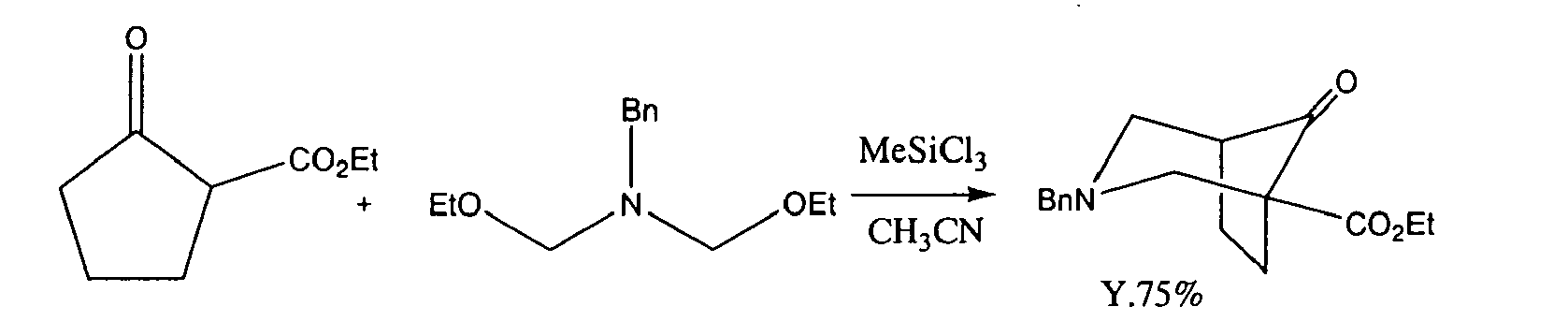
-
- Patent Reference 1: Published Japanese translation of PCT International Publication No.
6-5063443 - Non-patent Reference 1: Synlett, 2004, (13), 2359-2363
- However, the method described in Patent Reference 1, in spite of its short process duration, had a drawback in that its industrial utility is poor because of the low yield. Further, the method described in Non-patent Reference 1 is poor in industrial utility and lacks versatility in spite of its superior yield, because the method had drawbacks such that it is sometimes hard to be handled as it gives low yield of chain bis(aminol)ethers and thus being unstable; substrates for the Mannich reaction are restricted to only those substrates with a relatively high reactivity; yield of the resultant ester body products is low, since the products are degraded when subjected to hydrolysis or decarboxylation under normal conditions.
The object of the present invention is to provide a method for producing a piperidin-4-one skeleton represented by an isotropane skeleton which has a high yield and a superior working property, and thus can be used industrially. - The present inventors had made a keen study to solve the above mentioned objects and found out that cyclic bis(aminol)ether compounds can be afforded at a high yield and are stable, and further that the cyclic bis(aminol)ether compounds react in good yield to give piperidin-4-one derivatives with a cheaper reagent than when using chain bis(aminol)ether compounds.
- The present invention relates to (1) a method for producing a piperidin-4-one derivative represented by formula (III-a) or formula (III-b),

wherein the method comprises allowing a cyclic bis(aminol)ether compound represented by formula (I)
to react with an acetone derivative represented by formula (II)
in the presence of at least one substance selected from the group consisting of a protonic acid, Lewis acid, acid halide and dialkyl sulfuric acid; (2) the method for producing a piperidin-4-one derivative according to (1),
wherein the functional group which forms a chemically acceptable ring structure in formula (I) is an alkylene group; (3) the method for producing a piperidin-4-one derivative according to (1) or (2), wherein a compound represented by formula (II) is a cyclic ketone body represented by formula (IV)
- Substituents for cyclic bis(aminol)ether compounds represented by formula (I), acetone derivatives represented by formula (II), piperidin-4-one derivatives represented by formula (III-a) or formula (III-b), and cyclic ketone bodies represented by formula (IV) in the present invention are described below.
An "organic group" for the substituents R, R1 - R4, and R13 may be any group that does not inhibit the reaction of the present invention (e.g., a group which is unreactive under reaction conditions of the present method, or a group which is not a steric barrier to the present reaction), where the examples include a hydrocarbon group and heterocyclic group. - The hydrocarbon group and heterocyclic group also include a hydrocarbon group and heterocyclic group having substituents. The hydrocarbon group includes an aliphatic hydrocarbon group, alicyclic hydrocarbon group, aromatic hydrocarbon group, and a group in which these hydrocarbon groups are bound.
Examples of the aliphatic hydrocarbon group include an alkyl group having about 1 to 20 carbons (preferably 1 to 10, more preferably 1 to 3) such as methyl, ethyl, propyl, isopropyl, butyl, isobutyl, s-butyl, t-butyl, pentyl, hexyl, decyl and dodecyl groups; an alkenyl group having about 2 to 20 carbons (preferably 2 to 10, more preferably 2 or 3) such as vinyl, allyl and 1-butenyl groups; an alkynyl group having about 2 to 20 carbons (preferably 2 to 10, more preferably 2 or 3) such as ethinyl and propynyl groups. - Examples of the alicyclic hydrocarbon group include an cycloalkyl group having about 3 to 20 carbons (preferably 3 to 15, more preferably 5 to 8) such as cyclopropyl, cyclobutyl, cyclopentyl, cyclohexyl and cyclooctyl groups; a cycloalkenyl group having about 3 to 20 carbons (preferably 3 to 15, more preferably 5 to 8) such as cyclopentenyl and cyclohexenyl groups; and a cross-linked cyclic hydrocarbon group such as a perhydronaphthalene-1-yl group, and norbornyl, adamantly and tetracyclo[4.4.0.12,5.17,10]dodecane-3-yl groups.
Examples of the aromatic hydrocarbon group include a group having about 6 to 14 carbons (preferably 6 to 10) such as phenyl, naphthyl and anthranil groups. - Examples of the hydrocarbon group in which an aliphatic hydrocarbon group and an alicyclic hydrocarbon group are bound include a cycloalkyl-alkyl group such as cyclopentylmethyl, cyclohexylmethyl and 2-cyclohexylethyl groups. Further, examples of the hydrocarbon group wherein an aliphatic hydrocarbon group and an aromatic hydrocarbon group are bound include an aralkyl group (e.g., a C7-18 aralkyl group such as benzyl and phenethyl), and an alkyl-substituted aryl group (e.g., a phenyl group or a naphthyl group wherein about 1 to 4 C1-4 alkyl groups are substituted, such as 4-methylphenyl and 2-ethylnaphthyl).
- The hydrocarbon groups described above may have various substituents. Examples of such substituents include hydrocarbon groups enumerated above, as well as a halogen atom (e.g., fluorine atom, chlorine atom, bromine atom and iodine atom), hydroxyl group, oxo group, substituted oxy group (e.g., alkoxy group, aryloxy group, aralkyloxy group, acyloxy group), substituted oxycarbonyl group (e.g., alkoxycarbonyl group, aryloxycarbonyl group, aralkyloxycarbonyl group), acyl group, formyl group, acetal group, ketal group, substituted or unsubstitued carbamoyl group, substituted or unsubstitued carbazoyl group, substituted or unsubstitued amidino group, thioacyl group, substituted or unsubstituted dithiocarbonyl group, substituted or unsubstituted sulfamoyl group, substituted or unsubstituted sulfenyl group, substituted or unsubstituted sulfinyl group, substituted or unsubstituted sulfonyl group, substituted or unsubstituted amino group, nitro group, silyl group, cyano group, heterocyclic group, and a hydroxyl group or carboxyl group that are protected by a common protecting group. Further, an aromatic or non-aromatic hydrocarbon ring or an aromatic or non-aromatic heterocyclic ring may be condensed to the rings of an alicyclic hydrocarbon group or aromatic hydrocarbon ring.
- The heterocyclic group includes an aromatic heterocyclic ring and a non-aromatic heterocyclic ring. Examples of the heterocyclic ring include a heterocyclic ring comprising an oxygen atom as a hetero atom (e.g., a 5-membered ring such as furan, tetrahydrofuran, oxazole, isooxazole and γ-butyrolactone rings; a 6-membered ring such as 4-oxo-4H-pyrane, tetrahydropyrane and morpholine rings; a condensed ring such as benzofuran, isobenzofuran, 4-oxo-4H-chromene, chromane and isochromane rings; a cross-linked ring such as 3-oxatricyclo[4.3.1.14,8]undecane-2-one ring and 3-oxatricyclo[4.2.1.04,8]nonane-2-one ring), a heterocyclic ring comprising a sulfur atom as a hetero atom (e.g., 5-membered ring such as thiophene, thiazole, isothiazole and thiadiazole rings; a 6-membered ring such as 4-oxo-4H-thiopyrane ring; and a condensed ring such as benzothiophene ring), and a heterocyclic ring comprising a nitrogen atom as a hetero atom (e.g., a 5-membered ring such as pyrrole, pyrrolidine, pyrazole, imidazole and triazole rings; a 6-membered ring such as pyridine, pyridazine, pyrimidine, pyrazine, piperidine and piperazine rings; a condensed ring such as indole, indoline, quinoline, acridine, naphthyridine, quinazoline and purine rings). These heterocyclic rings may comprise a substituent similar to those substituents that may be comprised in the hydrocarbon groups enumerated above.
- With respect to the compounds represented by formulae (I), (II), (III-a), (III-b) and (IV), the "functional group which forms a chemically acceptable ring structure" is exemplified by a divalent hydrocarbon group having 1 to 20 carbons, a hydrocarbon group having 1 to 20 carbons which comprises 1 or more hetero atoms such as N, O and S. A hydrocarbon group herein is exemplified by those monovalent hydrocarbon groups enumerated above for the "organic group" except that the monovalent hydrocarbon group is replaced by a divalent hydrocarbon group. These hydrocarbon groups may comprise a substituent, and the examples of the substituent include those similar to the substituents exemplified above for the "organic group". An alkylene group having 2 to 5 carbons is preferably exemplified.
- The dotted line in formula (I) is specifically exemplified by the following functional groups.


- Specific examples of a compound represented by formula (I) include following compounds.


- A compound represented by formula (II) can be exemplified by the following compounds. Particularly, a cyclic ketone body is preferably exemplified which is represented by formula (IV) having a structure in which R1 and R3 together form a ring.


- In formula (III-b) obtained by the reaction of the present invention, R11 and R12 each independently represents a hydrogen atom, hydrocarbon group, acyl group or heterocyclic group, where specific examples thereof include those similar to the appropriate examples among the specific examples for the "organic group". Each atom in such functional group may comprise a substituent within a chemically acceptable range, where the specific examples thereof include those similar to the specific examples for the "organic group". Further, R11 and R12 may together form a ring structure within a chemically acceptable range, where specific examples thereof include those similar to the specific examples for the dotted line in formula (I).
- In the present invention, the reaction between a cyclic bis(aminol)ether compound represented by formula (I) and an acetone derivative represented by formula (II) is conducted in the presence of at least one substance selected from the group consisting of a protonic acid, Lewis acid, acid halide and dialkyl sulfuric acid.
The ratio of a cyclic bis(aminol)ether compound and an acetone derivative may be appropriately selected by considering such as reactivity and the raw material cost. Usually, the usage amount of bis(aminol)ether compound is 0.1 - 10 mol, preferably 0.5 - 2 mol, relative to 1 mol of the acetone derivative. - Examples of the protonic acid for use in the present invention include an inorganic acid such as a hydrochloric acid, hydrogen chloride, sulfuric acid, nitric acid and phosphoric acid; and an organic acid such as formic acid, acetic acid, trifluoroacetic acid, p-toluenesulfonic acid, methanesulfonic acid, and trifluoromethanesulfonic acid. Among these, mineral acids are particularly preferred, where hydrogen chloride and hydrochloric acid are preferably exemplified.
- Examples of the Lewis acid for use in the present invention include a metal carbonyl complex such as aluminum(III) bromide, aluminum(III) chloride, gallium(III) chloride, ferric(III) chloride, antimony(V) chloride, tin(IV) chloride, titanium(IV) chloride, zinc(II) chrolide, boron(III) fluoride, boron(III) chloride, copper(II) trifluoromethanesulfonic acid, zinc(II) trifluoromethanesulfonic acid, diphosphorous pentoxide, Mo(CO)6; a complex of a trifluoromethanesulfonic acid lanthanoid series represented by scandium(III) trifluoromethanesulfonic acid; and (R101)nSiX4-n.
In the formula (R101)nSiX4-n, R101 represents a hydrocarbon group, n represents 1 or 3, where n being 2 or 3 is particularly preferred. When n is 2 or more, R101's may be the same or different. X represents a bromide atom, chloride atom or iodine atom. A hydrocarbon group herein may be any group which does not inhibit the action of a Lewis acid, and includes an aliphatic hydrocarbon group, alicyclic hydrocarbon group, aromatic hydrocarbon group, and a group in which these hydrocarbon groups are bound. The examples thereof include those similar to the exemplifications for the "organic group" above.
Further, when the Lewis acid is (R101)nSiX4-n and X is not an iodine atom, either an iodized product of an alkali metal or an iodized product of an alkaline earth metal may further be used together. Examples of the iodized product of an alkali metal or the iodized product of an alkaline earth metal include KI, NaI, RbI, CsI, CaI2 and MgI2, where NaI and KI are preferred. - In the present invention, a highly reactive acid derivative such as an acid halide or dialkyl sulfuric acid may also be used other than those referred to in the above. Examples of these acid derivatives include acetyl chloride, benzoyl chloride, oxalyl chloride, methanesulfonyl chloride, thionyl chloride, thionyl bromide, sulfuryl chloride, sulfuryl bromide, phosphinic chloride, phosphorous trichloride, phosphorous tribromide, phosgene, phosgene derivative, dimethyl sulfate, and diethyl sulfate.
The protonic acid, Lewis acid, acid halide and dialkyl sulfuric acid may each be used alone or may be used in combination of 2 or more kinds thereof. Usage amount of these may be appropriately selected and it is preferred to be in a range of 0.01 - 5 mol, more preferably 0.1 - 2.0 mol or 0.1 - 1 mol, relative to 1 mol of a compound represented by formula (I). - Examples of the solvent for use in the method of the present invention include: water; alcohols such as methanol, ethanol, propanol, isopropanol and butanol; an aliphatic hydrocarbon such as hexane, heptane and octane; an alicyclic hydrocarbon such as cyclohexane; an aromatic hydrocarbon such as benzene, toluene, xylene and ethyl benzene; a halogenated hydrocarbon such as chloroform, dichloromethane and 1,2-dichloroethane; an ether such as diethylether, dimethoxyethane, tetrahydrofuran and dioxane; an amide such as N,N-dimethylformamide and N,N-dimethylacetamide; a nitrile such as acetonitril and benzonitrile; and an ester such as methyl acetate and ethyl acetate. These solvents may be used alone or in combination of 2 or more kinds thereof. It is especially preferred to use alcohols.
Usage amount of the solvent is not particularly limited and may be appropriately selected according to such as types of the reaction system. Usually, an appropriate amount is about 0.5 fold or more in the mass ratio relative to the bis(aminol)ether compound. - In the method of the present invention, compounds represented by formula (III-a) or formula (III-b) can be obtained by selecting reaction conditions.
As a first reaction, a ketone body represented by formula (III-a) is obtained by reacting a compound represented by formula (I) and a compound represented by formula (II).

As a third reaction, when using an alcohol as a solvent, and/or when a carboxylic acid is used as an acid in the reaction system in the above reaction (the second reaction), a ketone body represented by formula (III-a) reacts with an alcohol and/or carboxylic acid in the system and a compound represented by formula (III-b) is also obtained.
An alcohol or carboxylic acid for use in the third reaction is not particularly limited, where the specific examples include methanol, ethanol, isopropanol, ethyleneglycol, propyleneglycol, formic acid, acetic acid, propionic acid, oxalic acid and malonic acid. The usage amount of an alcohol or carboxylic acid is not particularly limited, where a range of 2 - 100 mol relative to 1 mol of a compound represented by formula (I) is preferred, and a range of 2 - 10 mol or 2 - 5 mol is more preferred. The alcohol or carboxylic acid may be used alone or may be used as a reaction solvent in combination with other solvent.
Thus obtained compound represented by formula (III-b) can be derivatized to a ketone body represented by formula (III-a) by conducting a hydrolysis on the ketal moiety. - The reaction temperature is not particularly limited and may be appropriately selected according to the types of the reaction constituent or the solvent. Usually, a reaction is conducted at from -50°C to the boiling temperature of the reaction constituent or the solvent, preferably at 0 to 50°C. The reaction time is also not particularly limited, where reaction is usually conducted for 5 min to 10 hours, preferably for 30 min to 3 hours. The reaction may be conducted at normal pressure or under increased pressure. The reaction atmosphere is not particularly limited as long as the reaction is not inhibited, which, for example, may be any one of such as air atmosphere, nitrogen atmosphere and argon atmosphere. Further, a reaction may be conducted by any method such as a batch reaction, semi-batch reaction and sequential reaction.
- After completion of the reaction, the reaction products can be separated and purified by a separation means such as filtration, concentration, distillation, extraction, crystallization, recrystallization, column chromatography, or a separation means consisting of a combination of these means.
- The present invention is explained in more detail in the following examples, but the present invention is not limited to these examples.
-

- 1.50 g (10 mmol) of sodium iodide was added to acetonitrile (5 ml) and dissolved under nitrogen atmosphere. 1.09 g (10 mmol) of chlorotrimethylsilane was added dropwise thereto, stirred for 20 min, cooled to 0° C, and 0.42 g (5 mmol) of cyclopentanone was added and stirred for 20 min. Thereto, an acetonitrile (3 ml) solution of 0.97 g (5 mmol) of 3-Benzyl-[1,5,3]dioxazepane(2) was added dropwise for 10 min at the same temperature, which resultant was then restored to room temperature and stirred for 2.5 h. The reaction solution was poured into a saturated sodium bicarbonate water, which was then extracted with ethyl acetate. The organic layer was washed with a saturated saline, dried with magnesium sulfate, filtered and concentrated to obtain compound (1') as a crude purification product, which was further separated and purified using a silica gel column chromatography (hexane/ethyl acetate) to obtain 1.01 g of the target compound (1') (78% yield).
- 0.26 g (1 mmol) of compound (1') purified on a silica gel column was dissolved in 1,4-dioxane (1 ml), to which 30% fuming sulfuric acid (0.3 ml) was added dropwise and stirred for 30 min. The reaction solution was poured into an ice-cold water, which was then neutralized with 1M aqueous sodium hydroxide and extracted with hexane/ethyl acetate. The organic layer was washed with a saturated saline, dried with magnesium sulfate, filtered and concentrated to obtain 3-Benzyl-3-aza-bicyclo[3.2.1]octan-8-one compound (3) as a crude purification product. A HPLC analysis revealed that the yield was 96.0%.
- 30.0 g (1 mol) of paraformaldehyde, 31.0 g (1 mol) of ethyleneglycol, and 53.6 g (0.5 mol) of benzylamine were added to a toluene solution (200 ml), and the resultant was heated to undergo an azeotropic dehydration. The reaction was stopped when almost 18 g (1 mol) of water was distilled away and 89.2 g of compound (2) (purity content: -92%) was obtained as a crude purification product.
- 0.83 g (5.5 mmol) of sodium iodide was added and dissolved in acetonitrile (5 ml) under nitrogen atmosphere. Thereto, 0.71 g (5.5 mmol) of dichlorodimethylsilane was added dropwise, stirred for 20 min, cooled to 0°C, added with 0.42 g (5 mmol) of cyclopentanone, and stirred for 20 min. To the resultant, an acetonitrile solution (3 ml) of 0.97 g (5 mmol) of 3-Benzyl-[1,5,3]dioxazepane(2) was added dropwise at the same temperature for 10 min, which resultant was then restored to room temperature and stirred for 1 hour. The reaction solution was poured into a saturated sodium bicarbonate water and extracted with ethyl acetate. The organic layer was washed with a saturated saline, dried with magnesium sulfate, filtered and concentrated to obtain compound (1') as a crude purification product. A HPLC analysis revealed that the yield was 83.4%.
-
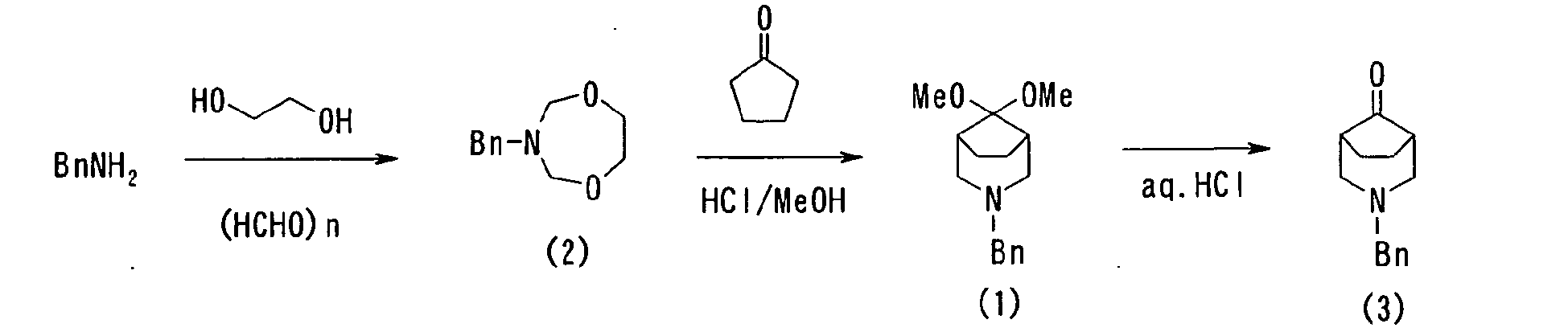
- 20.6 g (0.63 mol) of 92% paraformaldehyde, 19.6 g (0.31 mol) of ethyleneglycol, and 32.2 g (0.30 mol) of benzylamine was added sequentially to toluene (60 ml) and subjected to an azeotropic dehydration for 30 min by heating at reflux temperature to obtain compound (2). Compound (2) was subjected to the next step without being particularly purified.
This compound was diluted with methanol (300 ml), to which 26.5 g (0.32 mol) of cyclopentanone was added, 43.8 g (1.2 mol) of a hydrogen chloride gas was blowed in at 0°C, and stirred for 4 hours at room temperature. Methanol was then distilled away by vacuum concentration, water and toluene were sequentially added thereto, and the toluene layer was preparatively separated by adjusting pH to 12 or higher with 28% caustic soda. The aqueous layer was extracted again with toluene and held together with the toluene layer previously separated. From the obtained toluene layer, 3-Benzyl-3-aza-bicyclo[3.2.1]octan-8-one dimethyl ketal compound (1) was extracted with 6N hydrochloric acid (300 ml) into the aqueous layer as a hydrochloride salt. This aqueous solution was hydrolyzed by heating for 1 hour at 100°C.
The reaction solution was adjusted to pH3 with 28% caustic soda and washed with chloroform. Thus obtained aqueous layer was further added with 28% caustic soda to adjust pH to 12 or higher, which was then extracted with toluene. The HPLC quantitative analysis of thus obtained toluene solution (82.8 g) revealed that this solution contains compound (3) by 52.6 wt% and that the throughout yield through 3 steps was 66.1% when employing the benzylamine used as a standard. -

- 1.35 g (10 mmol) of sulfuryl chloride, 0.84 g (10 mmol) of cyclopentanone, and 0.15 g (0.15 mmol) of a concentrated sulfuric acid were sequentially added to methanol (10 ml) at 0°C, and stirred for 15 min at the same temperature. Thereto, 1.93 g (10 mmol) of compound (2) was added dropwise for 10 min at the same temperature, which resultant was then restored to room temperature and stirred for 4 hours.
To the reaction solution, water (10 ml) was added, followed by addition of 4.28 g (30 mmol) of 28% aqueous sodium hydroxide under ice-cold conditions, and then the resultant was extracted with toluene (20 ml). The organic layer was extracted twice with 3N hydrochloric acid (12.5 ml), then the aqueous solution containing thus obtained compound (1) was refluxed under heat for 2 hours so that it was hydrolyzed to give compound (3). A HPLC analysis revealed that compound (3) was produced as a major product at a purity of 80.3 Area% (thus obtained compound (3) can be used without performing any particular purification). -

- A concentrated hydrochloric acid (10 ml) was slowly added to 0.84 g (10 mmol) of cyclopentanone at 0°C, then 1.93 g (10 mmol) of compound (2) was added dropwise for 5 min at the same temperature. The resultant was restored to room temperature and was left to stand overnight.
A HPLC analysis of the reaction solution confirmed that the compounds (3) and (1') were produced at the phase ratio of 53:47. -

- 0.84 g (10 mmol) of cyclopentanone was added to methanol (10 ml) and dissolved, which was cooled to 0°C and 1.29 g (10 mmol) of dichlorodimethylsilane was added dropwise and subsequently 0.15 g (0.15 mmol) of a concentrated sulfuric acid was added, and stirred for 15 min. Thereto, 1.93 g (10 mmol) of compound (2) was added dropwise for 10 min at the same temperature, which resultant was restored to room temperature and stirred for 2 hours.
A 28% aqueous sodium hydroxide solution was added to the reaction solution and extracted twice with toluene. The organic layer was extracted twice with 3N hydrochloric acid, and 28% sodium hydroxide was added to the aqueous layer to adjust the pH to 12 or higher. The aqueous layer was extracted with toluene, and the organic layer was dried with magnesium sulfate, filtered and concentrated to obtain 2.51 g of the target compound (1) as a crude purification product. -

- 25.2 g (0.1 mol) of dimethyl sulfate was added to methanol (80 ml) at room temperature, then 34.89 g (corresponding to 0.1 mol) of a methanol solution of compound (2), and 9.2 g (0.11 mol) of cyclopentanone were simultaneously added dropwise for 30 min at 40°C.
After this reaction solution had been left stand overnight, a HPLC analysis was conducted and it was confirmed that compound (1) was produced at a production yield of 43 mol%. -

- 1.93 g (10 mmol) of compound (2) and 0.84 g (10 mmol) of cyclopentanone were added to methanol (10 ml), to which 2.34 g (30 mmol) of acetyl chloride was added dropwise for 10 min at the same temperature and further stirred for 3 hours.
A HPLC analysis of the reaction solution confirmed that compound (1) was produced at a production yield of 64 mol%. - The present invention enabled production of piperidin-4-one derivatives in a good yield at an industrial scale by using a cyclic bis(aminol)ether. A piperidin-4-one derivative produced by the method of the present invention is a useful intermediate for agricultural chemicals or pharmaceutical products as represented by isotropane, and the production method of the present invention is industrially highly useful.
Claims (4)
- A method for producing a piperidin-4-one derivative represented by formula (III-a) or formula (III-b),

wherein the method comprises allowing a cyclic bis(aminol)ether compound represented by formula (I)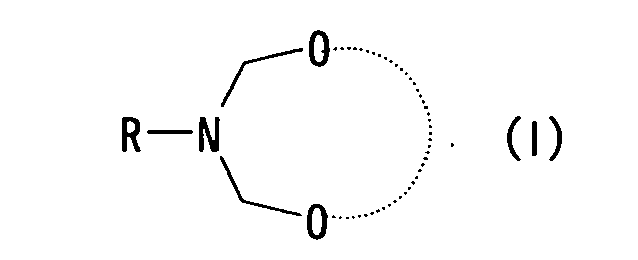
to react with an acetone derivative represented by formula (II)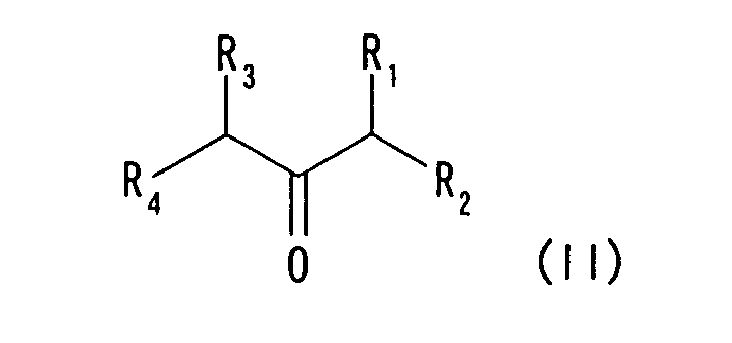
in the presence of at least one substance selected from the group consisting of a protonic acid, Lewis acid, acid halide and dialkyl sulfuric acid. - The method for producing a piperidin-4-one derivative according to claim 1, wherein the functional group which forms a chemically acceptable ring structure in formula (I) is an alkylene group.
- The method for producing a piperidin-4-one derivative according to claim 1 or 2, wherein a compound represented by formula (II) is a cyclic ketone body represented by formula (IV)

- The method for producing a piperidin-4-one derivative according to any one of claims 1 to 3, wherein the reaction is conducted in the presence of an alcohol or carboxylic acid.
Applications Claiming Priority (2)
| Application Number | Priority Date | Filing Date | Title |
|---|---|---|---|
| JP2006277086 | 2006-10-11 | ||
| PCT/JP2007/069741 WO2008044701A1 (en) | 2006-10-11 | 2007-10-10 | Method for producing piperidin-4-one derivative |
Publications (3)
| Publication Number | Publication Date |
|---|---|
| EP2058303A1 true EP2058303A1 (en) | 2009-05-13 |
| EP2058303A4 EP2058303A4 (en) | 2009-08-05 |
| EP2058303B1 EP2058303B1 (en) | 2010-08-18 |
Family
ID=39282894
Family Applications (1)
| Application Number | Title | Priority Date | Filing Date |
|---|---|---|---|
| EP07829479A Not-in-force EP2058303B1 (en) | 2006-10-11 | 2007-10-10 | Method for producing a piperidin-4-one-derivative |
Country Status (10)
| Country | Link |
|---|---|
| US (1) | US8173802B2 (en) |
| EP (1) | EP2058303B1 (en) |
| JP (1) | JP5088893B2 (en) |
| KR (1) | KR101106517B1 (en) |
| CN (1) | CN101522635B (en) |
| AT (1) | ATE478051T1 (en) |
| DE (1) | DE602007008579D1 (en) |
| ES (1) | ES2349369T3 (en) |
| IL (1) | IL197773A (en) |
| WO (1) | WO2008044701A1 (en) |
Family Cites Families (3)
| Publication number | Priority date | Publication date | Assignee | Title |
|---|---|---|---|---|
| AU1161292A (en) | 1991-01-09 | 1992-08-17 | Smithkline Beecham Plc | Azabicydic and azatricydic derivatives, process and intermediates for their preparation and pharmaceutical compositions containing them |
| EP2000455A3 (en) | 2005-06-30 | 2010-12-01 | Asahi Kasei Chemicals Corporation | Process for production of substituted cyclopentanone |
| JP4994772B2 (en) * | 2006-10-11 | 2012-08-08 | 日本曹達株式会社 | Method for producing piperidin-4-one derivative using bisaminol ether compound |
-
2007
- 2007-10-10 US US12/311,315 patent/US8173802B2/en not_active Expired - Fee Related
- 2007-10-10 CN CN2007800372479A patent/CN101522635B/en not_active Expired - Fee Related
- 2007-10-10 AT AT07829479T patent/ATE478051T1/en not_active IP Right Cessation
- 2007-10-10 DE DE602007008579T patent/DE602007008579D1/en active Active
- 2007-10-10 KR KR1020097006599A patent/KR101106517B1/en not_active Expired - Fee Related
- 2007-10-10 WO PCT/JP2007/069741 patent/WO2008044701A1/en not_active Ceased
- 2007-10-10 EP EP07829479A patent/EP2058303B1/en not_active Not-in-force
- 2007-10-10 JP JP2008538737A patent/JP5088893B2/en not_active Expired - Fee Related
- 2007-10-10 ES ES07829479T patent/ES2349369T3/en active Active
-
2009
- 2009-03-24 IL IL197773A patent/IL197773A/en active IP Right Grant
Non-Patent Citations (2)
| Title |
|---|
| No further relevant documents disclosed * |
| See also references of WO2008044701A1 * |
Also Published As
| Publication number | Publication date |
|---|---|
| KR101106517B1 (en) | 2012-01-20 |
| JP5088893B2 (en) | 2012-12-05 |
| WO2008044701A1 (en) | 2008-04-17 |
| IL197773A (en) | 2012-10-31 |
| ATE478051T1 (en) | 2010-09-15 |
| CN101522635A (en) | 2009-09-02 |
| IL197773A0 (en) | 2009-12-24 |
| EP2058303A4 (en) | 2009-08-05 |
| EP2058303B1 (en) | 2010-08-18 |
| DE602007008579D1 (en) | 2010-09-30 |
| CN101522635B (en) | 2012-08-29 |
| KR20090047555A (en) | 2009-05-12 |
| JPWO2008044701A1 (en) | 2010-02-12 |
| US20100004455A1 (en) | 2010-01-07 |
| US8173802B2 (en) | 2012-05-08 |
| ES2349369T3 (en) | 2010-12-30 |
Similar Documents
| Publication | Publication Date | Title |
|---|---|---|
| KR20150040340A (en) | Process and intermediates for preparing integrase inhibitors | |
| SU847919A3 (en) | Method of preparing derivatives of 2-(4-aroylpiperazinyl-1)-4-amino-6,7-dimethoxyquinazoline | |
| EP2058303B1 (en) | Method for producing a piperidin-4-one-derivative | |
| EP2483246B1 (en) | Process for preparing biphenyl imidazole compounds | |
| WO2022097115A1 (en) | An improved process for preparation of prohexadione and its calcium salt | |
| JP4994772B2 (en) | Method for producing piperidin-4-one derivative using bisaminol ether compound | |
| EP0284076B1 (en) | Process for preparing (+)-1,2-dihydro-3H-pyrrolo[1,2-a]pyrrole-1-carboxylic acid and related compounds | |
| CN110016023B (en) | Simple preparation method of palbociclib | |
| US4254043A (en) | Method for the acylation of heterocyclic compounds | |
| CN116693442A (en) | A kind of 4-methoxypyrrole derivative and its synthetic method | |
| CN104892491B (en) | Method for synthesizing paroxetine chiral intermediate | |
| KR20020052213A (en) | Process for the preparation of 6-methyl-2-(4-methyl-phenyl)-imidazo[1,2-a]pyrimidine-3-(n,n-dimethyl-acetamide) and intermediates | |
| JP7854496B2 (en) | 4-methoxypyrrole derivatives and their synthesis methods | |
| KR100301335B1 (en) | Method for preparing alpha-aryl-gamma-butyrolactone | |
| NO147838B (en) | INTERMEDIATE FOR USE IN PREPARATION OF THE HYPOTENSIVE AGENT 2- (4- (2-FUROYL) PIPERAZIN-1-YL) -4-AMINO-6,7-DIMETOXYKINAZOLINE | |
| CA2584349A1 (en) | Process for the preparation of 2-methylspiro(1,3-oxathiolane-5,3') quiniclidine | |
| JP3843400B2 (en) | Process for producing alkyl monosubstituted hydroquinones | |
| KR960010343B1 (en) | Imidazole derivative | |
| CN113816955B (en) | RET kinase inhibitor intermediate and preparation method thereof | |
| HU192136B (en) | Process for producing a 2-thiophfene-acetic acid derivative | |
| US5235065A (en) | Process for the preparation of a d-(+)-biotin intermediate | |
| JP2539261B2 (en) | Imidazole derivative | |
| KR100856133B1 (en) | Improved process for preparing atorvastatin | |
| KR20110053355A (en) | 1,6: Production method of 2,3-dione-hydro-beta-D-mannopyranose | |
| KR100531117B1 (en) | New 3,4-diexomethylene tetrahydropyrane derivatives, and process for preparing them |
Legal Events
| Date | Code | Title | Description |
|---|---|---|---|
| PUAI | Public reference made under article 153(3) epc to a published international application that has entered the european phase |
Free format text: ORIGINAL CODE: 0009012 |
|
| 17P | Request for examination filed |
Effective date: 20090304 |
|
| AK | Designated contracting states |
Kind code of ref document: A1 Designated state(s): AT BE BG CH CY CZ DE DK EE ES FI FR GB GR HU IE IS IT LI LT LU LV MC MT NL PL PT RO SE SI SK TR |
|
| AX | Request for extension of the european patent |
Extension state: AL BA HR MK RS |
|
| A4 | Supplementary search report drawn up and despatched |
Effective date: 20090702 |
|
| 17Q | First examination report despatched |
Effective date: 20091002 |
|
| GRAP | Despatch of communication of intention to grant a patent |
Free format text: ORIGINAL CODE: EPIDOSNIGR1 |
|
| RTI1 | Title (correction) |
Free format text: METHOD FOR PRODUCING A PIPERIDIN-4-ONE-DERIVATIVE |
|
| DAX | Request for extension of the european patent (deleted) | ||
| GRAS | Grant fee paid |
Free format text: ORIGINAL CODE: EPIDOSNIGR3 |
|
| GRAA | (expected) grant |
Free format text: ORIGINAL CODE: 0009210 |
|
| AK | Designated contracting states |
Kind code of ref document: B1 Designated state(s): AT BE BG CH CY CZ DE DK EE ES FI FR GB GR HU IE IS IT LI LT LU LV MC MT NL PL PT RO SE SI SK TR |
|
| REG | Reference to a national code |
Ref country code: GB Ref legal event code: FG4D |
|
| REG | Reference to a national code |
Ref country code: CH Ref legal event code: EP Ref country code: CH Ref legal event code: NV Representative=s name: SCHMAUDER & PARTNER AG PATENT- UND MARKENANWAELTE |
|
| REG | Reference to a national code |
Ref country code: IE Ref legal event code: FG4D |
|
| REF | Corresponds to: |
Ref document number: 602007008579 Country of ref document: DE Date of ref document: 20100930 Kind code of ref document: P |
|
| REG | Reference to a national code |
Ref country code: NL Ref legal event code: VDEP Effective date: 20100818 |
|
| REG | Reference to a national code |
Ref country code: ES Ref legal event code: FG2A Effective date: 20101217 |
|
| LTIE | Lt: invalidation of european patent or patent extension |
Effective date: 20100818 |
|
| PG25 | Lapsed in a contracting state [announced via postgrant information from national office to epo] |
Ref country code: AT Free format text: LAPSE BECAUSE OF FAILURE TO SUBMIT A TRANSLATION OF THE DESCRIPTION OR TO PAY THE FEE WITHIN THE PRESCRIBED TIME-LIMIT Effective date: 20100818 Ref country code: FI Free format text: LAPSE BECAUSE OF FAILURE TO SUBMIT A TRANSLATION OF THE DESCRIPTION OR TO PAY THE FEE WITHIN THE PRESCRIBED TIME-LIMIT Effective date: 20100818 Ref country code: LT Free format text: LAPSE BECAUSE OF FAILURE TO SUBMIT A TRANSLATION OF THE DESCRIPTION OR TO PAY THE FEE WITHIN THE PRESCRIBED TIME-LIMIT Effective date: 20100818 |
|
| PG25 | Lapsed in a contracting state [announced via postgrant information from national office to epo] |
Ref country code: SI Free format text: LAPSE BECAUSE OF FAILURE TO SUBMIT A TRANSLATION OF THE DESCRIPTION OR TO PAY THE FEE WITHIN THE PRESCRIBED TIME-LIMIT Effective date: 20100818 Ref country code: PT Free format text: LAPSE BECAUSE OF FAILURE TO SUBMIT A TRANSLATION OF THE DESCRIPTION OR TO PAY THE FEE WITHIN THE PRESCRIBED TIME-LIMIT Effective date: 20101220 Ref country code: IS Free format text: LAPSE BECAUSE OF FAILURE TO SUBMIT A TRANSLATION OF THE DESCRIPTION OR TO PAY THE FEE WITHIN THE PRESCRIBED TIME-LIMIT Effective date: 20101218 Ref country code: BG Free format text: LAPSE BECAUSE OF FAILURE TO SUBMIT A TRANSLATION OF THE DESCRIPTION OR TO PAY THE FEE WITHIN THE PRESCRIBED TIME-LIMIT Effective date: 20101118 Ref country code: CY Free format text: LAPSE BECAUSE OF FAILURE TO SUBMIT A TRANSLATION OF THE DESCRIPTION OR TO PAY THE FEE WITHIN THE PRESCRIBED TIME-LIMIT Effective date: 20100818 Ref country code: PL Free format text: LAPSE BECAUSE OF FAILURE TO SUBMIT A TRANSLATION OF THE DESCRIPTION OR TO PAY THE FEE WITHIN THE PRESCRIBED TIME-LIMIT Effective date: 20100818 |
|
| PG25 | Lapsed in a contracting state [announced via postgrant information from national office to epo] |
Ref country code: LV Free format text: LAPSE BECAUSE OF FAILURE TO SUBMIT A TRANSLATION OF THE DESCRIPTION OR TO PAY THE FEE WITHIN THE PRESCRIBED TIME-LIMIT Effective date: 20100818 Ref country code: BE Free format text: LAPSE BECAUSE OF FAILURE TO SUBMIT A TRANSLATION OF THE DESCRIPTION OR TO PAY THE FEE WITHIN THE PRESCRIBED TIME-LIMIT Effective date: 20100818 Ref country code: NL Free format text: LAPSE BECAUSE OF FAILURE TO SUBMIT A TRANSLATION OF THE DESCRIPTION OR TO PAY THE FEE WITHIN THE PRESCRIBED TIME-LIMIT Effective date: 20100818 Ref country code: GR Free format text: LAPSE BECAUSE OF FAILURE TO SUBMIT A TRANSLATION OF THE DESCRIPTION OR TO PAY THE FEE WITHIN THE PRESCRIBED TIME-LIMIT Effective date: 20101119 Ref country code: SE Free format text: LAPSE BECAUSE OF FAILURE TO SUBMIT A TRANSLATION OF THE DESCRIPTION OR TO PAY THE FEE WITHIN THE PRESCRIBED TIME-LIMIT Effective date: 20100818 |
|
| PG25 | Lapsed in a contracting state [announced via postgrant information from national office to epo] |
Ref country code: DK Free format text: LAPSE BECAUSE OF FAILURE TO SUBMIT A TRANSLATION OF THE DESCRIPTION OR TO PAY THE FEE WITHIN THE PRESCRIBED TIME-LIMIT Effective date: 20100818 |
|
| PG25 | Lapsed in a contracting state [announced via postgrant information from national office to epo] |
Ref country code: SK Free format text: LAPSE BECAUSE OF FAILURE TO SUBMIT A TRANSLATION OF THE DESCRIPTION OR TO PAY THE FEE WITHIN THE PRESCRIBED TIME-LIMIT Effective date: 20100818 Ref country code: RO Free format text: LAPSE BECAUSE OF FAILURE TO SUBMIT A TRANSLATION OF THE DESCRIPTION OR TO PAY THE FEE WITHIN THE PRESCRIBED TIME-LIMIT Effective date: 20100818 Ref country code: EE Free format text: LAPSE BECAUSE OF FAILURE TO SUBMIT A TRANSLATION OF THE DESCRIPTION OR TO PAY THE FEE WITHIN THE PRESCRIBED TIME-LIMIT Effective date: 20100818 Ref country code: CZ Free format text: LAPSE BECAUSE OF FAILURE TO SUBMIT A TRANSLATION OF THE DESCRIPTION OR TO PAY THE FEE WITHIN THE PRESCRIBED TIME-LIMIT Effective date: 20100818 Ref country code: MC Free format text: LAPSE BECAUSE OF NON-PAYMENT OF DUE FEES Effective date: 20101031 |
|
| PLBE | No opposition filed within time limit |
Free format text: ORIGINAL CODE: 0009261 |
|
| STAA | Information on the status of an ep patent application or granted ep patent |
Free format text: STATUS: NO OPPOSITION FILED WITHIN TIME LIMIT |
|
| 26N | No opposition filed |
Effective date: 20110519 |
|
| REG | Reference to a national code |
Ref country code: DE Ref legal event code: R097 Ref document number: 602007008579 Country of ref document: DE Effective date: 20110519 |
|
| PG25 | Lapsed in a contracting state [announced via postgrant information from national office to epo] |
Ref country code: IE Free format text: LAPSE BECAUSE OF NON-PAYMENT OF DUE FEES Effective date: 20101010 |
|
| PG25 | Lapsed in a contracting state [announced via postgrant information from national office to epo] |
Ref country code: IT Free format text: LAPSE BECAUSE OF NON-PAYMENT OF DUE FEES Effective date: 20101010 Ref country code: MT Free format text: LAPSE BECAUSE OF FAILURE TO SUBMIT A TRANSLATION OF THE DESCRIPTION OR TO PAY THE FEE WITHIN THE PRESCRIBED TIME-LIMIT Effective date: 20100818 |
|
| PG25 | Lapsed in a contracting state [announced via postgrant information from national office to epo] |
Ref country code: LU Free format text: LAPSE BECAUSE OF NON-PAYMENT OF DUE FEES Effective date: 20101010 Ref country code: HU Free format text: LAPSE BECAUSE OF FAILURE TO SUBMIT A TRANSLATION OF THE DESCRIPTION OR TO PAY THE FEE WITHIN THE PRESCRIBED TIME-LIMIT Effective date: 20110219 |
|
| PG25 | Lapsed in a contracting state [announced via postgrant information from national office to epo] |
Ref country code: TR Free format text: LAPSE BECAUSE OF FAILURE TO SUBMIT A TRANSLATION OF THE DESCRIPTION OR TO PAY THE FEE WITHIN THE PRESCRIBED TIME-LIMIT Effective date: 20100818 |
|
| REG | Reference to a national code |
Ref country code: FR Ref legal event code: PLFP Year of fee payment: 9 |
|
| REG | Reference to a national code |
Ref country code: FR Ref legal event code: PLFP Year of fee payment: 10 |
|
| REG | Reference to a national code |
Ref country code: FR Ref legal event code: PLFP Year of fee payment: 11 |
|
| PGFP | Annual fee paid to national office [announced via postgrant information from national office to epo] |
Ref country code: FR Payment date: 20171024 Year of fee payment: 11 Ref country code: DE Payment date: 20171019 Year of fee payment: 11 |
|
| PGFP | Annual fee paid to national office [announced via postgrant information from national office to epo] |
Ref country code: GB Payment date: 20171019 Year of fee payment: 11 Ref country code: CH Payment date: 20171019 Year of fee payment: 11 Ref country code: IT Payment date: 20171023 Year of fee payment: 11 Ref country code: ES Payment date: 20171121 Year of fee payment: 11 |
|
| REG | Reference to a national code |
Ref country code: DE Ref legal event code: R119 Ref document number: 602007008579 Country of ref document: DE |
|
| REG | Reference to a national code |
Ref country code: CH Ref legal event code: PL |
|
| GBPC | Gb: european patent ceased through non-payment of renewal fee |
Effective date: 20181010 |
|
| PG25 | Lapsed in a contracting state [announced via postgrant information from national office to epo] |
Ref country code: DE Free format text: LAPSE BECAUSE OF NON-PAYMENT OF DUE FEES Effective date: 20190501 |
|
| PG25 | Lapsed in a contracting state [announced via postgrant information from national office to epo] |
Ref country code: LI Free format text: LAPSE BECAUSE OF NON-PAYMENT OF DUE FEES Effective date: 20181031 Ref country code: CH Free format text: LAPSE BECAUSE OF NON-PAYMENT OF DUE FEES Effective date: 20181031 Ref country code: FR Free format text: LAPSE BECAUSE OF NON-PAYMENT OF DUE FEES Effective date: 20181031 |
|
| PG25 | Lapsed in a contracting state [announced via postgrant information from national office to epo] |
Ref country code: IT Free format text: LAPSE BECAUSE OF NON-PAYMENT OF DUE FEES Effective date: 20181010 Ref country code: GB Free format text: LAPSE BECAUSE OF NON-PAYMENT OF DUE FEES Effective date: 20181010 |
|
| REG | Reference to a national code |
Ref country code: ES Ref legal event code: FD2A Effective date: 20191129 |
|
| PG25 | Lapsed in a contracting state [announced via postgrant information from national office to epo] |
Ref country code: ES Free format text: LAPSE BECAUSE OF NON-PAYMENT OF DUE FEES Effective date: 20181011 |