EP2057268B1 - A dna vaccine for curing chronic hepatitis b and a method of preparing same - Google Patents
A dna vaccine for curing chronic hepatitis b and a method of preparing same Download PDFInfo
- Publication number
- EP2057268B1 EP2057268B1 EP06783600.7A EP06783600A EP2057268B1 EP 2057268 B1 EP2057268 B1 EP 2057268B1 EP 06783600 A EP06783600 A EP 06783600A EP 2057268 B1 EP2057268 B1 EP 2057268B1
- Authority
- EP
- European Patent Office
- Prior art keywords
- hbv
- dna vaccine
- pgx10
- protein
- amino acid
- Prior art date
- Legal status (The legal status is an assumption and is not a legal conclusion. Google has not performed a legal analysis and makes no representation as to the accuracy of the status listed.)
- Not-in-force
Links
Images


Classifications
-
- C—CHEMISTRY; METALLURGY
- C07—ORGANIC CHEMISTRY
- C07K—PEPTIDES
- C07K14/00—Peptides having more than 20 amino acids; Gastrins; Somatostatins; Melanotropins; Derivatives thereof
- C07K14/005—Peptides having more than 20 amino acids; Gastrins; Somatostatins; Melanotropins; Derivatives thereof from viruses
-
- A—HUMAN NECESSITIES
- A61—MEDICAL OR VETERINARY SCIENCE; HYGIENE
- A61K—PREPARATIONS FOR MEDICAL, DENTAL OR TOILETRY PURPOSES
- A61K39/00—Medicinal preparations containing antigens or antibodies
- A61K39/12—Viral antigens
-
- A—HUMAN NECESSITIES
- A61—MEDICAL OR VETERINARY SCIENCE; HYGIENE
- A61K—PREPARATIONS FOR MEDICAL, DENTAL OR TOILETRY PURPOSES
- A61K39/00—Medicinal preparations containing antigens or antibodies
- A61K39/12—Viral antigens
- A61K39/29—Hepatitis virus
- A61K39/292—Serum hepatitis virus, hepatitis B virus, e.g. Australia antigen
-
- A—HUMAN NECESSITIES
- A61—MEDICAL OR VETERINARY SCIENCE; HYGIENE
- A61K—PREPARATIONS FOR MEDICAL, DENTAL OR TOILETRY PURPOSES
- A61K39/00—Medicinal preparations containing antigens or antibodies
- A61K39/39—Medicinal preparations containing antigens or antibodies characterised by the immunostimulating additives, e.g. chemical adjuvants
-
- A—HUMAN NECESSITIES
- A61—MEDICAL OR VETERINARY SCIENCE; HYGIENE
- A61P—SPECIFIC THERAPEUTIC ACTIVITY OF CHEMICAL COMPOUNDS OR MEDICINAL PREPARATIONS
- A61P1/00—Drugs for disorders of the alimentary tract or the digestive system
- A61P1/16—Drugs for disorders of the alimentary tract or the digestive system for liver or gallbladder disorders, e.g. hepatoprotective agents, cholagogues, litholytics
-
- A—HUMAN NECESSITIES
- A61—MEDICAL OR VETERINARY SCIENCE; HYGIENE
- A61P—SPECIFIC THERAPEUTIC ACTIVITY OF CHEMICAL COMPOUNDS OR MEDICINAL PREPARATIONS
- A61P31/00—Antiinfectives, i.e. antibiotics, antiseptics, chemotherapeutics
- A61P31/12—Antivirals
-
- C—CHEMISTRY; METALLURGY
- C07—ORGANIC CHEMISTRY
- C07K—PEPTIDES
- C07K14/00—Peptides having more than 20 amino acids; Gastrins; Somatostatins; Melanotropins; Derivatives thereof
- C07K14/435—Peptides having more than 20 amino acids; Gastrins; Somatostatins; Melanotropins; Derivatives thereof from animals; from humans
- C07K14/52—Cytokines; Lymphokines; Interferons
- C07K14/54—Interleukins [IL]
- C07K14/5434—IL-12
-
- C—CHEMISTRY; METALLURGY
- C12—BIOCHEMISTRY; BEER; SPIRITS; WINE; VINEGAR; MICROBIOLOGY; ENZYMOLOGY; MUTATION OR GENETIC ENGINEERING
- C12N—MICROORGANISMS OR ENZYMES; COMPOSITIONS THEREOF; PROPAGATING, PRESERVING, OR MAINTAINING MICROORGANISMS; MUTATION OR GENETIC ENGINEERING; CULTURE MEDIA
- C12N15/00—Mutation or genetic engineering; DNA or RNA concerning genetic engineering, vectors, e.g. plasmids, or their isolation, preparation or purification; Use of hosts therefor
- C12N15/09—Recombinant DNA-technology
- C12N15/63—Introduction of foreign genetic material using vectors; Vectors; Use of hosts therefor; Regulation of expression
- C12N15/79—Vectors or expression systems specially adapted for eukaryotic hosts
- C12N15/85—Vectors or expression systems specially adapted for eukaryotic hosts for animal cells
-
- A—HUMAN NECESSITIES
- A61—MEDICAL OR VETERINARY SCIENCE; HYGIENE
- A61K—PREPARATIONS FOR MEDICAL, DENTAL OR TOILETRY PURPOSES
- A61K39/00—Medicinal preparations containing antigens or antibodies
- A61K2039/51—Medicinal preparations containing antigens or antibodies comprising whole cells, viruses or DNA/RNA
- A61K2039/53—DNA (RNA) vaccination
-
- A—HUMAN NECESSITIES
- A61—MEDICAL OR VETERINARY SCIENCE; HYGIENE
- A61K—PREPARATIONS FOR MEDICAL, DENTAL OR TOILETRY PURPOSES
- A61K39/00—Medicinal preparations containing antigens or antibodies
- A61K2039/555—Medicinal preparations containing antigens or antibodies characterised by a specific combination antigen/adjuvant
- A61K2039/55511—Organic adjuvants
- A61K2039/55522—Cytokines; Lymphokines; Interferons
- A61K2039/55527—Interleukins
- A61K2039/55538—IL-12
-
- C—CHEMISTRY; METALLURGY
- C12—BIOCHEMISTRY; BEER; SPIRITS; WINE; VINEGAR; MICROBIOLOGY; ENZYMOLOGY; MUTATION OR GENETIC ENGINEERING
- C12N—MICROORGANISMS OR ENZYMES; COMPOSITIONS THEREOF; PROPAGATING, PRESERVING, OR MAINTAINING MICROORGANISMS; MUTATION OR GENETIC ENGINEERING; CULTURE MEDIA
- C12N2730/00—Reverse transcribing DNA viruses
- C12N2730/00011—Details
- C12N2730/10011—Hepadnaviridae
- C12N2730/10111—Orthohepadnavirus, e.g. hepatitis B virus
- C12N2730/10122—New viral proteins or individual genes, new structural or functional aspects of known viral proteins or genes
-
- C—CHEMISTRY; METALLURGY
- C12—BIOCHEMISTRY; BEER; SPIRITS; WINE; VINEGAR; MICROBIOLOGY; ENZYMOLOGY; MUTATION OR GENETIC ENGINEERING
- C12N—MICROORGANISMS OR ENZYMES; COMPOSITIONS THEREOF; PROPAGATING, PRESERVING, OR MAINTAINING MICROORGANISMS; MUTATION OR GENETIC ENGINEERING; CULTURE MEDIA
- C12N2730/00—Reverse transcribing DNA viruses
- C12N2730/00011—Details
- C12N2730/10011—Hepadnaviridae
- C12N2730/10111—Orthohepadnavirus, e.g. hepatitis B virus
- C12N2730/10134—Use of virus or viral component as vaccine, e.g. live-attenuated or inactivated virus, VLP, viral protein
-
- C—CHEMISTRY; METALLURGY
- C12—BIOCHEMISTRY; BEER; SPIRITS; WINE; VINEGAR; MICROBIOLOGY; ENZYMOLOGY; MUTATION OR GENETIC ENGINEERING
- C12N—MICROORGANISMS OR ENZYMES; COMPOSITIONS THEREOF; PROPAGATING, PRESERVING, OR MAINTAINING MICROORGANISMS; MUTATION OR GENETIC ENGINEERING; CULTURE MEDIA
- C12N2800/00—Nucleic acids vectors
- C12N2800/10—Plasmid DNA
- C12N2800/106—Plasmid DNA for vertebrates
- C12N2800/107—Plasmid DNA for vertebrates for mammalian
Definitions
- the present invention relates to a DNA vaccine for curing chronic Hepatitis B virus, and a method of preparing the DNA vaccine.
- HBV Hepatitis B virus
- Lamivudine (Brand name: Fpivir-HBV; Manufacturer: GlaxoSmithKline) is a nucleoside analog and primarily serves to inhibit the activity of an HBV polymerase: Lamivudine effectively suppresses virus replication during a treatment period.
- Lamivudine effectively suppresses virus replication during a treatment period.
- the treatment efficacy of lamivudine is temporary and is as low as about 20%.
- long-term efficacy of lamivudine has been limited due to emergency of YMDD-mutants of HBV during lamivudine treatment, that is, approximately 24% after one year of treatment, approximately 38% after two years of treatment, approximately 54% after three years of treatment, and approximately 66% after four years of treatment, as described in an article by Leung NW, et al, Hepatology 2001, 33:1527-1532 .
- Adefovir and entecavir also act as competitive inhibitors of HBV polymerase.
- adefovir and entecavir demonstrate substantially the same efficacy level as lamivudine, they have much smaller incidence rates of drug-resistant HBV mutants than lamivudine, allowing improved therapy over lamivudine in view of drug-resistance ( NEJM 2003, 348:800 ; NEJM 2003, 348:808 ).
- these chemical drugs had fundamental limitation in which serum HBV DNA levels and alanine aminotransferase (ALT) levels may increase again in most patients after withdrawal of administration.
- IFN- a (Brand name: Intron-A; Manufacturer: Schering-Plough) generally increases the immune response of a host, whereby exhibits therapeutic effects such as inhibiting reproduction of HBV.
- IFN- ⁇ may cause serious side effects and therapeutic effect of IFN- ⁇ is merely 25 - 30%. Accordingly, in order to overcome the shortcomings of the existing therapeutic drugs, there is a need for new therapeutic drugs with high safety and efficacy.
- CD4 T cell immune response as described in Liver, 1998, 18:405 ; Vaccine. 2001, 19: 2395 , or a CD8 T cell immune response, as described in J Exp Med. 1995, 181:1047 ; J Infect Dis. 1993, 168:1133 , which are more potent, specific to multiple antigens (to be abbreviated to "multi-specific” hereinafter) for the treatment and recovery of chronic hepatitis B patients.
- the first attempt made for the treatment of hepatitis 13 was recombinant protein vaccine using surface antigen.
- a vaccine-treated group seemed cured in terms of loss of HBV DNA and induction of HBsAg seroconversion.
- no difference in the efficacy of the recombinant protein vaccine was made between vaccine-treated group and placebo-controlled group ( J Hepatol, 2001 34; 917 ).
- a DNA vaccine is advantageous in that an antigen can be expressed in the DNA in vivo, undergoing both endogenous and exogenous processes to be loaded on MHC class I and II, thereby simultaneously inducing CD4 and CD8 T cell responses.
- DNA vaccines encoding envelope antigen were administered to normal individuals, both an antibody response and a cell-mediated immune response were induced, and no particular side effects were detected.
- HBV PreS2-S DNA vaccines encoding envelope protein
- T cell proliferation capability was induced to two patients, but the induced T cell responses were only transient and very weak.
- immune responses were induced to several patients, there still exists a need for improvement of DNA vaccines which can induce cell-mediated immune responses in a more potent and effective manner.
- WO20040361210 A2 describes the use of a multiple-epitope construct for inducing an immune response against HBV in an individual.
- DE10339927 A1 describes the use of at least two surface antigens of HBV and by excluding the use of the HBV core antigen.
- US6249201 B1 describes a nucleic acid vaccine composed of surface antigens of HBV.
- the present invention provides a new DNA vaccine for treatment of chronic Hepatitis B, and a method for preparing the DNA vaccine.
- the subject matter for which protection is sought is as defined in the claims.
- the present invention provides a Hepatitis B virus (HBV DNA vaccine ⁇ 11> comprising two expression vectors, wherein one expression vector comprises polynucleotide sequences encoding hepatitis B surface antigen (HBsAg) and L protein, and the other expression vector comprises polynucleotide sequences encoding core protein and polymerase, wherein the polynucleotide sequence encoding HBsAg comprises the polynucleotide sequence of SEQ. ID. NO: 1, the polynucleotide sequence encoding L protein comprises the polynucleotide sequence of SEQ. ID. NO: 2, the polynucleotide sequence encoding core protein comprises the polynucleotide sequence of SEQ. ID. NO: 9, and the polynucleotide sequence encoding polymerase comprises the polynucleotide sequence of SEQ. ID. NO: 10.
- HBV DNA vaccine ⁇ 11> comprising two expression vectors, wherein one expression vector comprises polyn
- the DNA vaccine may further include IL-12, furthermore IL-12 variant, as an immune adjuvant.
- the present invention further provides a method for providing the DNA vaccine.
- the present invention also provides the use of the DNA vaccine in a method for curing
- a DNA vaccine comprising antigenic genes encoding hepatitis B surface antigen (HBsAg), L protein, a core, and a polymerase, the antigenic genes codon-optimized to increase expression levels.
- the present invention provides a DNA vaccine comprising multiple antigens, not a single antigen.
- the DNA vaccine of the present invention can induce an immune response specific to the multiple antigens.
- the DNA vaccine of the present invention uses a core, which is a structural gene of HBV, and a polymerase, which is a non-structural gene, in addition to the HBV surface gene, like in the conventional DNA vaccine.
- the DNA vaccine of the present invention considerably increases expression levels of the multiple antigens through codon optimization. It is commonly known that a limited expression level of viral protein results from an insufficient amount of tRNA species of viral codons in a host, which is one of ways to avoid host defense mechanism ( J Mol Biol. 1982 158:573 ). In order to increase expression levels of viral genes in human body, many attempts are being made to provide high expression levels of codons prevalent in human cells and high GC content. In particular, these attempts are primarily made with HIV, HPV or HCV models. It was confirmed that use of these model vaccines increased the expression levels, resulting in enhanced antibody and cell-mediated immune responses ( J Virol. 2003 77:4928 J Virol. 2000 74:4839 Gene Ther.
- the present invention is directed to develop a DNA vaccine with an enhanced expression rate of antigen by codon-optimizing various antigenic genes of HBV.
- the DNA vaccine includes a plasmid (pGX10 S/L) encoding HBsAg antigen, which is a HBV surface gene, and pre-S1/S2/S (L protein) antigen, and a plasmid (pGX10 core/Pol) encoding a core antigen and a polymerase antigen (see FIG. 1 ).
- the present invention is used as DNA vaccine for treatment of patients infected with chronic HBV, the inventors of the present invention developed two types of plasmids expressing HBV antigen of genotype C and named pGX10 S/L and pGX10 core/Pol, respectively.
- the plasmid pGX10 S/L is an expression vector constructed such that the codon-optimized HBV S and L (large) glycoprotein (L protein) antigens are independently transcribed under the control of cytomegalovirus (CMV) promoters.
- the S antigen (M54923) was codon-optimized by GenScript Corp. (www.genescript.com) so as to be compatible to human.
- the L antigen (AF052576) was also codon-optimized by GenScript Corp. so as to be compatible to human.
- signal sequence of human tissue-type plasminogen activator (tpa) was linked to the 5'-end of L antigen, and an amino acid at position No.
- the plasmid pGX10 core/Pol is an expression vector constructed such that genes of the core and polymerase (Pol) antigens are independently transcribed under the control of CMV promoters.
- the core antigen (M54923) was codon-optimized for gene synthesis by GenScript Corp. (www.genescript.com).
- signal sequence of human tissue-type plasminogen activator (tpa) was linked to the 5'-end of the core antigen.
- the Pol antigen is an expression vector constructed in the same manner as pGX10 Pol ( Gene Ther.
- the pGX10 vector used to develop the two plasmids is an expression vector having early promoter/enhancer sequences of cytomegalovirus (CMV) and adenovirus tripartite leader/intron, as indicated by TPL in FIG. 1 , poly (A) sequence of SV40, as indicated by SVpA in FIG. 1 , and has already been used as a DNA vaccine vector in small animal and clinical studies. More detailed explanation about the pGX10 vector is described in the previous application filed by the inventors of the present invention (Korean Patent Application No. 2003-0028080 ).
- the present invention provides a DNA vaccine further including an immune adjuvant capable of enhancing cell-mediated immune responses, thereby facilitating the therapeutic effect of chronic HBV.
- the present invention provides a DNA vaccine including a gene encoding interleukin 12 variant as the immune adjuvant.
- the present invention provides a DNA vaccine including a plasmid (pGX10 IL-12m, see FIG. 1 ) expressing a gene encoding the interleukin 12 variant.
- the interleukin-12 variant used as an immune adjuvant for the DNA vaccine was previously developed by the inventors of the present invention. Compared to a wild-type interleukin-12, the variant-type interleukin-12 induces long-lasting CD4 and CD8 T cell responses, which are specific to hepatitis C virus (HCV) antigen ( Nat Biotechnol. 2002 20: 381 , see Korean Patent No. 10-399728 , etc.). More concretely, the interleukin-12 variant has an IL-12p40 subunit mutant gene which can secrete IL-12, but not p40 homodimer.
- HCV hepatitis C virus
- the expression vector including the IL-12p40 subunit mutant gene is constructed to inhibit the secretion of IL-12p40 but to normally secrete IL-12p70 that retains the immune activity of IL-12 by replacing the codon for Asn at the amino acid residue of 222 (human) or of 220 (mouse) of IL-12p40 with another codon.
- IL-12p40 is known to act as a competitive inhibitor of active form of IL-12, IL-12p70.
- the IL-12 variant having the above-described properties can be useful for HBV antigen specific immune responses and therapeutic effect.
- the present invention provides a method for preparing the DNA vaccine.
- the multi-specific DNA vaccine having high expression rate of antigen and capable of effectively inducing cell-mediated immune responses is preferably prepared by a method comprising the steps of: (1) codon-optimizing antigenic genes encoding hepatitis B surface antigen (HBsAg), L protein, and a core; and (2) inserting the codon-optimized antigenic genes for the HBsAg, the L protein, and the core, and a gene encoding a polymerase, whether it has been either codon-optimized or not, to one or more expression vectors.
- HBsAg hepatitis B surface antigen
- the genes encoding the codon-optimized HBsAg and L protein are inserted together to a single expression vector.
- the two genes inserted together to the single expression vector are expressed by individual promoters, respectively.
- the genes encoding the codon-optimized core and polymerase are inserted together to a single expression vector, and it is more preferable that these two genes inserted together to the single expression vector are expressed by individual promoters, respectively.
- an appropriate expression vector known to those skilled in the art as along as it can be expressed in Eukaryotic cells. More preferably; pGX10 vector may be used as the expression vector, as disclosed in Korean Patent Application No. 2003-0028080 filed by the inventors of the present invention.
- the method for preparing the DNA vaccine according to the present invention may further comprise the inclusion of an immune adjuvant.
- an immune adjuvant Any known immune adjuvant as long as it may induce cell-mediated immune responses and be safe is preferably used as the immune adjuvant of the present invention.
- the immune adjuvant may be an expression vector comprising a gene encoding an IL-12 variant, which was previously developed by the inventors of the present invention.
- the gene encoding an IL-12 variant is preferably mutated such that the codon for Asn, which is an amino acid residue 222 of human IL-12p40 represented by SEQ. ID. No 23, is substituted with another codon for a different amino acid, more preferably with the codon for Leu, Gln, or Ile.
- the gene encoding an IL-12 variant is preferably mutated such that the codon for Asn, which is an amino acid residue 220 of mouse IL-12p40, is substituted with another codon, more preferably with the codon for Leu or Ile.
- the pGX10 vector according to a preferred embodiment of the present invention may be used as the expression vector for expressing the IL-12 variant, but not limited thereto.
- the DNA vaccine according to the present invention can further facilitate induction of multi-specific T cell immune responses by further comprising the gene encoding IL-12 variant as an immune adjuvant.
- the present invention provides a composition for use in curing chronic hepatitis B comprising the HBV vaccine according to the present invention as an active ingredient.
- the HBV vaccine according to the present invention induces multi-specific T cell immune responses, it can be effectively used as the vaccine for the treatment of the chronic HBV.
- the vaccine of the invention may be used together with not only the gene encoding an IL-12 variant or other immune adjuvants but also a pharmaceutical carrier or excipient that may be widely used in the art.
- the vaccine composition is formulated for humans or animals and can be administered through various routes including oral, intraperitoneal, intravenous, subcutaneous, intramuscular, intracutaneous, and intranasal administration.
- the vaccine composition is formulated as an injection to be administered.
- the injection may be prepared using aqueous solvents such as saline solutions or Ringer solutions; or non-aqueous solvents such as vegetable oils, higher fatty acid esters (e.g., ethyl oleic acid, or the like), alcohols (e.g., ethanol, benzylalchol, propyleneglycol, glycerin, or the like).
- the injection may include pharmaceutical carriers, including a stabilizer for preventing degeneration, such as ascorbic acid, sodium bisulfite, sodium pyrophosphate, butylated hydroxyanisole (BHA), tocopherol, ethylenediamine tetraacetic acid (EDTA), or the like, an emulsifier, a buffering agent for adjusting a pH level, a preservative for prohibiting growth of microorganisms, such as phenylmercuric nitrate, thimerosal, benzalkonium chloride, phenol, cresol, benzyl alcohol, or the like.
- a stabilizer for preventing degeneration such as ascorbic acid, sodium bisulfite, sodium pyrophosphate, butylated hydroxyanisole (BHA), tocopherol, ethylenediamine tetraacetic acid (EDTA), or the like
- BHA butylated hydroxyanisole
- EDTA ethylenediamine tetraacetic acid
- composition according to the present invention is administered in a pharmaceutically effective amount.
- pharmaceutically effective amount is a sufficient dose enough to demonstrate a vaccination effect or a small dose enough to prevent the occurrence of side effects or an excessive immune response.
- the pharmaceutically effective dose depends on the type of antigen administered, and other factors which those skilled in the medical arts will recognize, for example, patient' s age, weight, health condition, sex, drug sensitivity, administration route, or administration method.
- the composition according to the present invention may be administered at once, or may be divided into a number of smaller doses to be administered at varying intervals of time.
- the HBV DNA vaccine according to the present invention comprising genes encoding codon-optimized HBV multiple antigens exhibit excellent antibody response and cell-mediated immune responses, as observed from naive mice and HBV transgenic mice models, compared with HB-100 vaccine previously prepared by the inventors of the present invention (that is, a DNA vaccine comprising genes encoding HBV core, S protein, polymerase, and PreS1/PreS2 which are not codon-optimized, and a gene encoding IL-12 variant, as immune adjuvants) ( Gene Therapy, 2006 13: 1110 - 1117 ).
- the HBV vaccine according to the present invention effectively induces HBV antigen specific immune responses and therapeutic effect.
- the DNA vaccine according to the present invention could further facilitate induction of therapeutic responses by further comprising the gene encoding IL-12 variant as the immune adjuvant.
- the HBV DNA vaccine according to the present invention can be more effectively-used for the treatment of chronic hepatitis B than the conventional HBV DNA vaccine.
- EXAMPLE 1-1 Preparation of plasmid pGX10 S/L
- gene of HBsAg (SEQ. ID. No 1) was synthesized by Genscript Corp., yielding a plasmid pUC57-S CO .
- the plasmid pUC57-S CO was digested with EcoR I and Not I, and pGX10) was also digested with EcoR I and Not I. These plasmids are linked together to finally construct pGX10-S co .
- pGX10 S As a control, a gene without codon modification was synthesized by Genscript Corp., yielding a plasmid pUC57-S in substantially the same manner as described above.
- codon-optimized genes SEQ. ID No 2
- glycine was replaced by alanine and amino acids 91-110 were removed
- plasmids pUC57-PreS1/S2 co were then obtained.
- TPAs tissue plasminogen activator signal sequence
- the pGX10-S CO vector was partially digested with Pst I, that is, only a Pst I site located within the S co gene was digested while a Pst I site located at the pGX10 vector side is not digested. Then, the partially digested vector was digested with Asp 718, only a 5'-end portion of the S CO -gene was removed, followed by linking together using only the vector portion, thereby preparing pGX10-TPAs-L CO . Next, in order to amplify an overall area of a CMV promoter of pGX10, inclusive of even an SV40 enhancer, Sal I CMVp (SEQ.
- the vector was digested with Sal I and a CMV-TPL-TPAs-L co -SVpA/EnhS CO fragment was inserted into the restriction site of the vector, produced by digesting pGX10 S co with Sal I, thereby completing the target plasmid pGX10 S/L simultaneously expressing S and L antigens using dual promoters within a single vector, in such a manner that genes are expressed using CMV promoters positioned at 5'-end portions of the respective genes.
- a gene in the form of fusion protein was synthesized by Genscript Corp., yielding a plasmid pUC57-TPAs-core CO (SEQ ID. No 9) with 5'-end EcoR I and 3'-end Not I and Xho I restriction enzyme recognition sites.
- the plasmid pUC57-TPAs-core CO was digested with EcoR I and Xho I, and pGX10 was also digested with EcoR I and Xho I. These plasmids are linked together to finally construct pGX10-TPAs-core CO (SEQ ID. No 9).
- pGX10 core without codon optimization to be used as a control and pGX10 core with codon optimization and unfused TPAs the respective genes were synthesized by Genscript Corp., yielding the target genes by cloning in substantially the same manner as described above.
- Pol antigen gene synthesis was designed such that glycoprotein signal sequence (gDs, AAN74642) and HA epitope (AAB01168) of herpes simplex virus (HSV) were linked to an N-terminal area of a Pol antigenic gene using two glycine residues as linkers, as described in Gene Ther. 2006 13: 1110 - 1117 .
- Pst I was formed at 5'-end and Not I was formed at 3'-end, and gene synthesis was made by Genscript Corp., thereby acquiring pUC57-gDs-HA-Pol with gDs-HA-Pol(SEQ. ID No 10) inserted into the pUC57 vector.
- the acquired pUC57-gDs-HA-Pol was digested with Pst I and Not I, pGX10 was digested with Pst I and Not I, and the resultant fragments were linked together, thereby constructing pGX10-gDs-HA-pol.
- pGEM-CMV-TPL-MCS-SVpA/Enh was digested with Pst I and Xba I
- pGX10-gDs-HA-Pol was digested with Pst I and Xba I
- the resultant fragments were linked together, thereby constructing a vector pGEM-CMV-TPL-gDs-HA-Pol-SvpA/Enh.
- the constructed vector pGEM-CMV-TPL-gDs-HA-Pol-SvpA/Enh was digested with Sal I and a CMV-TPL-gDs-HA-Pol-SvpA/Enh portion was inserted into a portion obtained by digesting pGX10-TPAs-core CO with Sal I, thereby completing the plasmid pGX10 core/Pol simultaneously expressing core and Pol antigens using dual promoters within a single vector.
- RT-PCR PCR System 2400, Perkin Elmer
- human B cell activated with PMA phorbol myristic acetate
- cDNAs AF180563 encoding human p35 subunit of 820 bp and human p40 subunit of 1,050 bp were obtained.
- hp35 (S) SEQ. ID No 11
- hp35 (AS) SEQ. ID No 12
- hp40 SEQ. ID No 13
- hp 40(AS) SEQ. ID No 14
- Each amplified cDNA was subcloned into vector pBluescriptSK+ (Stratagene).
- Each of genes encoding P35 and p40 subunits was inserted into SmaI site of the vector pBluescriptSK+, thereby preparing pSK-hp35 (3.8kb) and pSK-hp40 (4.1kb).
- the IRES gene of EMCV was produced by RT-PCR and digested with restriction enzyme EcoR V. The resulting DNA fragment was inserted into EcoR V site of vector pSK to form a vector pSK- IRES of 3. 6kb.
- IRES (S) SEQ. ID No 15
- IRES (AS) SEQ. ID No 16
- Plasmid pSK-hp35 was digested with restriction enzymes EcoR V and Not I and filled with T4 DNA polymerase to obtain hp35 fragment of 0.8kb.
- This DNA fragment was inserted into DNA fragment of 3.6kb formed by digesting vector pSK-IRES with restriction enzyme EcoR V to construct pSK-hp35/IRES of 4.4kb.
- Plasmid pSK-hp35/IRES was digested with restriction enzymes Sma I and Cla I and ligated with a ligase so that the portion of the restriction enzyme site upstream of hp35 was removed.
- the hp40 DNA fragment of 1.1kb obtained by digesting pSK-hp40 with restriction enzymes Nco I and Not I was inserted into pSK-hp35/IRES to construct a plasmid that co-expresses the genes encoding p35 and p40 subunits.
- the thus obtained plasmid is designated pSK-hp35/IRES/hp40.
- telomere sequence was digested with restriction enzymes NcoI and NotI and inserted into vector pBluescriptSK+ of 3. 0kb, which had been digested with restriction enzyme SmaI, to construct plasmid pSK-hp40-N222L of 4. 1kb.
- hp40-N222L fragment of plasmid pSK-hp40-N222L was obtained using the restriction enzymesNco I and Not I and substituted with hp40 fragment of plasmid pSK-hp35-IRES-hp40, thereby preparing plasmid pSK-hp35-IRES-hp40-N222L of 5.5 kb.
- PCR amplification was carried out using hIL-12(S) (SEQ. ID No 21) and hIL-12((AS) (SEQ. ID No 22) as primers and vector pSK-hp35-IRES-hp40-N222L as template, thereby obtaining fragment hp35-IRES-hp40-N222L.
- This fragment was digested with restriction enzyme XhoI and inserted into vector pGX10, which had been digested with restriction enzyme XhoI, to construct plasmid pGX10-hIL-12m (or pGX10-hIL-12N22L) of 6.1kb.
- the inventors of the present invention attempted to confirm the expression efficiency of the antigens encoded by the plasmids prepared by using an in-vitro cell culture system, For this purpose, we used COS-7 cells (ATCC, CRL-1651), C2C12 cells (ATCC, CRL-1772), and HeLa cells (ATCC, CCL-2).
- pGX10 gDsS, pGX10 S and pGX10 S co were transfected with pGX10 and pGL2 luc (Promega) as control vectors by a lipofection method (Invitrogen), thereby acquiring supernatant and cells, which will now be briefly described.
- pGX10 and pGL2 luc Promega
- pGX10 and pGL2 luc Promega
- DMEM serum free media
- the cells were harvested 48 hour later and placed in a 1 ml cell culture lysis buffer (Promega) to collect cell lysates.
- a variation of transfection efficiency that is, in order to removea variable which may be caused by a difference in transfection efficacy between plasmids
- 0.05 ⁇ g of luciferase gene was mixed with the prepared plasmids before the transfection, and cell lysate and supernatant having substantially the same luciferase activity level were taken for ELISA assay. Then, expression levels of HBsAg were measured using an HBsAg ELISA kit (Dong-A Pharm.).
- a required amount of strip was taken and fixed on a frame, and a concentrated conjugate solution and a diluted conjugatesolution were mixed in a ratio of 1:25.
- 100 ⁇ l of a sample solution was placed in the respective wells of the plate, and 25 ⁇ l of a preformed conjugate solution was placed to each well, which was then reacted at 37 for 90 minutes.
- a substrate solution was diluted by a substrate buffering solution (1:100), and washed with a washing solution 5 times. A surplus washing solution was completely removed using a hygroscopic sheet, and 100 ⁇ l of a preformed substrate solution was placed, followed by reacting at room temperature. As a result, as confirmed from FIG.
- the expression level of pGX10 S co having codon optimized HBsAg gene was much higher than that of pGX10 S having a wild-type HBsAg gene.
- the expression level of pGX10 S co was higher than that of pGX10 gDsS of HB-100 vaccine, which was previously developed by the inventors of the present invention, as described in EXAMPLE 3.
- pGX100-core, pGX10-core co , and pGX10 tpa-core co were transacted into HeLa cells by a lipofection method (Invitrogen).
- RIP radioimmunoprecipitation
- used media were all removed, and the cells were allowed to stand in culture media DMEM lacking fetal bovine serum -(FBS), methionine (Met) and cysteine (Cys) for 30 minutes.
- NET gel buffer equivalent to the quantity of the sample was added to each sample of the acquired supernatants (cell lysates), and 3 ⁇ l of HBV patient antisera was added thereto, followed by incubating at 4 for 6 hours. After addition of 30 ⁇ l of protein A-G agarose gel, incubation was further performed at 4 for 2 hours. After centrifugation, the supernatant was removed and 1 ml of RIPA buffer was added for vortexing, thereby resuspending the resultant solution. After washing with washing buffer (10 mM Tris-HCl (pH7.5), 0.1% NP-40) 4 times, 30 ⁇ l of 1X SDS gel loading buffer was added to the resultant solution and then boiled for 5 minutes.
- the inventors of the present invention attempted to confirm expression efficiency of each antigen in HB-110 containing pGX10 S/L, pGX10 core/Pol, and pGX10 IL-12m.
- HB-110 and HB-100 as a comparison group were transfected into C2C12 cell, HeLa cell or COS-7 cell.
- HB-110 was prepared by mixing 50% of pGX10 S/L, 25% of pGX10 core/Pol, and 25% of pGX10 IL-12m and a total amount of HB-110 used was 2 ⁇ g.
- HB-100 is a DNA vaccine previously prepared by the inventors of the present invention, as disclosed in Gene Therapy, 2006 13: 1110 - 1117 , that is, a combination of 25% of pGX10 gDsS, 18.75% of pGX10 S1/S2/X, 18.75% of pGX10 core, 12.5% of pGX10 Pol, and 25% of pGX10 IL-12m and a total amount of HB-100 used was 2 ⁇ g.
- X denotes an X gene of HBV, i.e., HBx.
- C2C12 cell and HeLa cell were used. As described above, the C2C12 cell and the HeLa cell were cultured in DMEM containing 10% FBS (Gibco-BRL, USA). 5 X 10 5 cells were distributed in a 60 mm plate, cells were grown for 24 hours, and then transfected into 2 ⁇ g of each of HB-110 and HB-100 using lipofectamine (Invitrogen). 48 hours after lipofection, the cells were harvested for ELISA assay. Normalization of the variation of transfection efficiency is performed in the above-described manner.
- luciferase gene was mixed together before the transfection, and cell lysate and supernatant having substantially the same luciferase activity level were taken for ELISA assay.
- the HBsAg expression efficiency of HB-110 was higher than that of HB-100, which was developed by previously prepared by the inventors of the present invention.
- HB-110 and HB-100 were transfected to COS-7 cell and HeLa cell using lipofectamine (Invitrogen). 48 hours after lipofection, the cells were harvested. Cell lysate having substantially the same luciferase activity level was taken for electrophoresis. After performing electrophoresis in 10% SDS-polyacrylamide gel, the resultant product was subjected to immunoblotting. An anti-PreS1 monoclonal antibody (Aprogen Co.) was used to detect a pre-S1/S2 protein. As shown in the left view of FIG. 4 , HB-110 exhibited enhanced expression efficiency.
- the full-form of L protein encoded by HB-110 was detected by ELISA assay.
- anti-PreS1 or anti-PreS2 monoclonal antibody (Aprogen Co.) as a capture antibody (capture Ab) was diluted in 1000 times, and an HRP-eonjugated ant-HBsAg polyclonal antibody contained in an HBsAg ELISA kit (Green-Cross) was used.
- HB-110 and HB-100 exhibited the expected results, that is, HB-110 confirmed the expression of L protein in both HeLa and COS-7 cells while HB-100 as well as pGX10-transfected sample hardly expressed L-protein.
- COS-7 cells were used.
- the COS-7 cells were transfected in the above-described manner, 48 hours after transfection, the cells were harvested. Cell lysates having substantially the same luciferase activity level were taken for electrophoresis, and RIP (radioimmunoprecipitation) was then performed. To avoid non-specific coupling,pre-clearing was performed using healthy human serum. To detect a core protein, RIP was performed with chronic hepatitis patient serum. As a result, as shown in FIG. 5 , core protein generate by HB-110 was detectedin both cell lysate and supernatant and the detected level of HB-110 was slightly higher than that of HB-100.
- COS-7 cells were transfected in the above-described manner, 48 hours after transfection, the cells were harvested and cell lysates were taken for electrophoresis, followed by immunoblotting. Since an antibody capable of directly detecting a polymerase protein is not available, an HA epitope was linked to the 5'-end of a polymerase, and the expression of the polymerase protein was detected using an anti-HA monoclinic antibody, as confirmed from FIG. 6 .
- the expression levels of Pol antigen in HB-110 and HB-100 were substantially the same with each other(data not shown). This is thought to be due to the Pol antigen in the form of gDs-HA-Pol included in the expression vector pGX10.
- the inventors of the present invention carried out experiments for immunization of small animals. To this end, HB-100 and HB-110 were dissolved in 200 ⁇ l of PBS, respectively, to be used as DNA vaccine. The first administration was performed by injecting 200 ⁇ l of a DNA vaccine into both legs (100 ⁇ l per each hind leg muscle) of 6 Balb/c mice per each group. The second and third intramuscular injections followed at 2 weeks interval.
- HB-100 25 ⁇ g of pGX10 gDsS, 18.75 ⁇ g of pGX10 S1/S2/X, 18.75 ⁇ g of pGX10 core, 12.5 ⁇ g of pGX10 Pol, and 25 ⁇ g of pGX10 IL-12m were used.
- HB-110 50 ⁇ g of pGX10 S/L, 25 ⁇ g of pGX10 core/Pol, and 25 ⁇ g of pGX10 IL-12m were used.
- mice were anesthetized at each administration time, and blood was collected from the infraorbital vein of each mouse using a heparinized capillary tube.
- spleen cells were collected to be used for experiments.
- HBsAg Fizgerald Ab&Ag, USA
- HBcAg Koma biotech. USA
- these plasmids were distributed to different 96-well plates (Nunc, F96 immunoplate) by 50 ⁇ l each, to then be left at 37 for 2 hours.
- mice serum was diluted with by a buffer solution(1:50), prepared by adding 5% skim milk to the washing solution, and added to each well by 50 ⁇ l, which was then reacted at 37 for 1.5 hour.
- HRP-conjugated anti-mouse immunoglobulin (anti-total IgG) antibodies were diluted with a buffer solution in 3000 times and distribute to each well by 50 ⁇ l, followed by reacting at room temperature for one hour. Then, after washing with testing buffer solution 5 times, each 50 ⁇ l of a 1:1 mixed solution of tetramethylbenzidine (TMB) substrate (manufactured by KPL) and peroxidase substrate solution B (manufactured by KPL) was added to each well and allowed to stand undisturbed at room temperature.
- TMB tetramethylbenzidine
- each 50 ⁇ l of 2N H 2 SO 4 was distributed to each well to stop the color reaction.
- the absorbance of each well was measured at 450 nm using a microplate reader.
- FIG. 7 when HB-110 was injected, the anti-HBs antibody response and anti-HBc antibody response were induced efficiently in proportion to the number of injection times, while the antibody response was very weak in mice administered with HB-100.
- IFN-g ELISPOT analysis was repeatedly performed twice after pooling spleen cells taken from 3 immunized mice.
- the coating antibody (BD Pharmingen) for IFN-g was diluted with PBS in a concentration of 5 ⁇ g/ml, and 50 ⁇ l of the diluted antibody solution was distributed into a 96-well plate -(Millipore, 0.45m, Bedford, MA), which was then left at room temperature for over 12 hours. The remaining antibody solution was removed by suction.
- the plate was washed with PBS twice, and 200 ⁇ l of a medium for animal cell culture (RPMI-1640 containing 50 units/ml penicillin, 50 ⁇ g/ml streptomycin, 50 ⁇ M-mercaptoethanol, 2 mM L-glutamine, 1 mM sodium pyruvate, 20 units/ml recombinant murine IL-2 and 10% FBS (standard fetal bovine serum, HyClone) was added into each well. After allowing the plate to stand at 37 for over 2 hours, the medium was removed by suction again. The isolated spleen cells were added into each well by 1x10 6 , 3.3x10 5 and 1.1x10 5 cells/well, respectively.
- a medium for animal cell culture RPMI-1640 containing 50 units/ml penicillin, 50 ⁇ g/ml streptomycin, 50 ⁇ M-mercaptoethanol, 2 mM L-glutamine, 1 mM sodium pyruvate, 20 units/ml re
- Biotin-conjugated anti-IFN-g mAb (BD Pharmingen) was diluted with blocking buffer, prepared by adding 1% BSA to the washing solution, to adjust the concentration to 2 ⁇ g/ml, which was then added into each well by 50 ⁇ l, followed by reacting for 2 hours. After washing with the washing solution (PBS-T, 0.05%) 5 times, the plate was filled with streptavidin-AKP solution diluted again by the blocking buffer (1:2000), which was then reacted for 1 hour. Upon completion of the reaction, washing was performed with washing solution (PBS-T, 0.05%) 7 times.
- HB-110 showed increased SFC counts, suggesting that CD4 T cell responses were induced more efficiently by HB-110 than by HB-100.
- HB-110 and HBV-100 induced immune responses in similar levels, which is thought to be due to the Pol antigen in the form of gDs-HA-Pol included in the expression vector pGX10.
- HB-110-IL-12m which includes 25 ⁇ g of pGX10 vector, instead of 25 ⁇ g of IL-12m, was injected twice at a 2 week interval.
- the group administered with HB-110 including IL-12m showed enhanced antibody and cell-mediated immune responses, compared to the HB-110-IL-12m without IL-12m, as observed by ELISA and IFN-g ELISPOT assays. More concretely, the HBsAg specific cell-mediated immune response was enhanced by about two times, and the cell-mediated immune response which is specific to HBcAg was enhanced by about three times. This suggests that IL-12m, which is one of constituents of HB-110 DNA vaccine, can effectively enhance antibody and cell-mediated immune responses when usedas an immune adjuvant.
- HBV transgenic mice in which replication of an HBV full genome is detected in liver cells, were used in evaluation ( Proc. Natl. Acad. Sci. USA 1989, 86: 207 ).
- 100 ⁇ g of a DNA sample was dissolved in 200 ml of PBS, and the resultant solution was intramuscularly injected into the leg of each mouse.
- 3 mice per group were used and the administration was made 4 times in total at 2-week intervals. Blood was collected from the infraorbital vein of each mouse at each administration time.
- spleen cells were collected to be used in measuring cell-mediated immune responses.
- the methods of determining the levels of the cell-mediated immune response and antibody response are the same as described in EXAMPLE 4.
- FIG. 10 similarly to the results observed from Babl/c mice, a relatively high level of anti-HBs antibody response was induced to HBV transgenic mice by HB-110, and the level of the anti-HBs antibody response induced was increased in proportion to the number of injection times. On the other hand, a very weak level of antibody response was induced to the HBV transgenic mice by HBV-100. As shown in FIG.
- the HB-110 DNA vaccine includes multiple antigens.
- the present invention aimed at investigating the capability of inducing each antigen specific cell-mediated immune response in HBV transgenic mice and the required number of injection times to induce significant immune responses.
- HB-110 DNA vaccine was injected to 3 mice per group once, twice and three times, respectively, and 2 weeks after HB-110 injection, spleen cells were collected to investigate cell-mediated immune responses. As a result, as shown in FIG. 12 , as the number of injection times was increased, the overall cell-mediated immune response increased and a detectable level of immune response was induced by antigen.
- a cell-mediated immune response which is specific to HBsAg and PreS1/S2
- the immune response induced was weak when HB-110 was injected once.
- the immune response was better induced when HB-110 was injected twice and 3 times.
- the immune response induced was weak when HB-110 was injected once and twice.
- the immune response was better induced when HB-110 was injected 3 times.
- an undetectable level of immune response was induced when HB-110 was injected once. Meanwhile, a weak immune response was induced when NB-110 was injected twice and 3 times.
- HB-110 comprises IL-12m as an immune adjuvant.
- the present invention aimed at investigating the effect of IL-12m exerted on the therapeutic effect of HB-110.
- an HBsAg ELISA kit (Green-Cross) was used. The expression level was quantified based on HBsAg purchased from Fizgerald Ab&Ag, and mouse serum was diluted with PBS in 50 times to be used as a sample. As shown in FIG.
- the mice showed a decrease of approximately 30% in the serum HBsAg level.
- a plasmid expressing these antigens was administered to the mice with pGX10 IL-12m injected into the plasmid in the form of HB-110, the mice showed a decrease of approximately 90% in the serum HBsAg level.
- the present invention proposes that IL-12m plays an important role in the therapeutic effect as confirmed in HBV transgenic mice when used with HB-110 DNA vaccine.
- the present invention provides a DNA vaccine comprising antigenic genes encoding a hepatitis B surface antigen (HBsAg), a core antigen, and a polymerase antigen, so that not only an antibody response but also a cell-mediated immune response can be effectively induced immune responses, which are specific to multiple antigens, thereby providing a desirable preventive and therapeutic DNA vaccine demonstrating both preventive and therapeutic effects against chronic Hepatitis B.
- the genes included in the DNA vaccine preferably encode the antigens which have been codon-optimized so as to optimize the expression of antigens in mammals. Accordingly, the expression level of the DNA vaccine of the invention can be enhanced in mammals, thereby effectively inducing immune responses.
Landscapes
- Health & Medical Sciences (AREA)
- Life Sciences & Earth Sciences (AREA)
- Chemical & Material Sciences (AREA)
- General Health & Medical Sciences (AREA)
- Organic Chemistry (AREA)
- Medicinal Chemistry (AREA)
- Genetics & Genomics (AREA)
- Virology (AREA)
- Veterinary Medicine (AREA)
- Public Health (AREA)
- Pharmacology & Pharmacy (AREA)
- Animal Behavior & Ethology (AREA)
- Engineering & Computer Science (AREA)
- Microbiology (AREA)
- Chemical Kinetics & Catalysis (AREA)
- General Chemical & Material Sciences (AREA)
- Immunology (AREA)
- Bioinformatics & Cheminformatics (AREA)
- Mycology (AREA)
- Epidemiology (AREA)
- Molecular Biology (AREA)
- Zoology (AREA)
- Gastroenterology & Hepatology (AREA)
- Biochemistry (AREA)
- Biophysics (AREA)
- Nuclear Medicine, Radiotherapy & Molecular Imaging (AREA)
- Proteomics, Peptides & Aminoacids (AREA)
- Biomedical Technology (AREA)
- Biotechnology (AREA)
- General Engineering & Computer Science (AREA)
- Communicable Diseases (AREA)
- Wood Science & Technology (AREA)
- Toxicology (AREA)
- Physics & Mathematics (AREA)
- Oncology (AREA)
- Plant Pathology (AREA)
- Medicines Containing Antibodies Or Antigens For Use As Internal Diagnostic Agents (AREA)
- Peptides Or Proteins (AREA)
Description
- The present invention relates to a DNA vaccine for curing chronic Hepatitis B virus, and a method of preparing the DNA vaccine.
- Since the first case report of HBV (Hepatitis B virus) in 1966, HBV is now known to have infected more than 300 million people worldwide and approximately 50 million people are newly infected with HBV. Chronic hepatitis B infection accounts for approximately 80% of liver cancer patients worldwide and approximately 75% of HBV cases are found in Asian countries. In addition, HBV infections lead one in every four persons to severe liver diseases, including liver cancer and death. HBV affects approximately 5-8% of the Korea's population.
- Transmission from mother to infant during the perinatal period is a major source of HBV transmission in Korea. Particularly, approximately 90% of infants who become infected will develop chronic HBV infection.
- Currently clinically approved drugs for use in treatment of chronic hepatitis B include lamivudine, and interferon-alpha (IFN-α). Recently, adefovir and entecavir have been approved by the Food and Drug Administration (FDA) for use in treatment of chronic HBV infection. Lamivudine (Brand name: Fpivir-HBV; Manufacturer: GlaxoSmithKline) is a nucleoside analog and primarily serves to inhibit the activity of an HBV polymerase: Lamivudine effectively suppresses virus replication during a treatment period. However, immediately after cessation of treatment, viral rebound occurs in the majority of patients, resulting in liver injury. The treatment efficacy of lamivudine is temporary and is as low as about 20%. In addition, long-term efficacy of lamivudine has been limited due to emergency of YMDD-mutants of HBV during lamivudine treatment, that is, approximately 24% after one year of treatment, approximately 38% after two years of treatment, approximately 54% after three years of treatment, and approximately 66% after four years of treatment, as described in an article by Leung NW, et al, Hepatology 2001, 33:1527-1532. Adefovir and entecavir also act as competitive inhibitors of HBV polymerase. While adefovir and entecavir demonstrate substantially the same efficacy level as lamivudine, they have much smaller incidence rates of drug-resistant HBV mutants than lamivudine, allowing improved therapy over lamivudine in view of drug-resistance (NEJM 2003, 348:800; NEJM 2003, 348:808). However, these chemical drugs had fundamental limitation in which serum HBV DNA levels and alanine aminotransferase (ALT) levels may increase again in most patients after withdrawal of administration. IFN- a(Brand name: Intron-A; Manufacturer: Schering-Plough) generally increases the immune response of a host, whereby exhibits therapeutic effects such as inhibiting reproduction of HBV. However, IFN-α may cause serious side effects and therapeutic effect of IFN-α is merely 25 - 30%. Accordingly, in order to overcome the shortcomings of the existing therapeutic drugs, there is a need for new therapeutic drugs with high safety and efficacy.
- Many recent clinical studies have emphasized the importance of a CD4 T cell immune response, as described in Liver, 1998, 18:405; Vaccine. 2001, 19: 2395, or a CD8 T cell immune response, as described in J Exp Med. 1995, 181:1047; J Infect Dis. 1993, 168:1133, which are more potent, specific to multiple antigens (to be abbreviated to "multi-specific" hereinafter) for the treatment and recovery of chronic hepatitis B patients. That is to say, patients naturally having recovered from hepatitis B showed multi-specific and sustained CD4 and CD8 T cell immune responses, while chronic hepatitis B patients showed weak and temporary CD4 and CD8 T cell immune responses, which are induced only to some HBV epitopes. In addition, there have been reports that these T cells have poor proliferation capacity and low cytokine synthesis capability. Approximately 1-2% of chronic hepatitis B patients have found to be naturally cured. Before seroconversion of HBsAg, which is one of treatment markers for chronic hepatitis B, a cell-mediated immune response is observed, by which the cell-mediated immune response is important in the treatment of chronic hepatitis B (J Hepatol, 2006 2; [Epub ahead of print]). These researches support demands for therapeutics capable of inducing a potent and multi-specific, cell-mediated immune response for the treatment of hepatitis B.
- The first attempt made for the treatment of hepatitis 13 was recombinant protein vaccine using surface antigen. After initial 6-month treatment with the recombinant protein vaccine, a vaccine-treated group seemed cured in terms of loss of HBV DNA and induction of HBsAg seroconversion. However, after 1-year treatment with the recombinant protein vaccine, no difference in the efficacy of the recombinant protein vaccine was made between vaccine-treated group and placebo-controlled group (J Hepatol, 2001 34; 917). Even when a HBV large protein was used as the vaccine, neither CD4 T cell response nor antigen-specific CD8 T cell response was induced (Vaccine, 2002 20; 3598). These results indicate that while the recombinant protein vaccine can be effective in preventing HBV infection, it would not be suitable for the treatment of hepatitis B. An alternative attempt was made to induce a CD8 T cell response using peptide epitope specifically recognized by cytotoxic T lymphocytes (CTL). The peptides of HBV core-specific helper T-cell (Th) or CTL epitopes and tetanus toxoid (TT) as a control were administered to normal individuals, and a CTL response specific to the antigen was well recognized (J Clin Invest, 1995 95;341). However, the test with chronic HBV patients showed weak CTL response, and association with viral reduction was detectable (Hepatology, 1999 30: 531).
- Another attempt for treating chronic hepatitis B is DNA vaccination for encoding HBV antigens. A DNA vaccine is advantageous in that an antigen can be expressed in the DNA in vivo, undergoing both endogenous and exogenous processes to be loaded on MHC class I and II, thereby simultaneously inducing CD4 and CD8 T cell responses. In practice, when DNA vaccines encoding envelope antigen were administered to normal individuals, both an antibody response and a cell-mediated immune response were induced, and no particular side effects were detected. However, when DNA vaccines encoding envelope protein (HBV PreS2-S) were administered to patients with chronic hepatitis B, HBV DNA loss was observed from only one of 10 patients (Hepatology, 2004 40: 874). In addition, T cell proliferation capability was induced to two patients, but the induced T cell responses were only transient and very weak. Adcordingly, while immune responses were induced to several patients, there still exists a need for improvement of DNA vaccines which can induce cell-mediated immune responses in a more potent and effective manner.
-
WO20040361210 A2 DE10339927 A1 describes the use of at least two surface antigens of HBV and by excluding the use of the HBV core antigen.US6249201 B1 describes a nucleic acid vaccine composed of surface antigens of HBV. - The present invention provides a new DNA vaccine for treatment of chronic Hepatitis B, and a method for preparing the DNA vaccine. The subject matter for which protection is sought is as defined in the claims.
- In particular the present invention provides a Hepatitis B virus (HBV DNA vaccine <11> comprising two expression vectors, wherein one expression vector comprises polynucleotide sequences encoding hepatitis B surface antigen (HBsAg) and L protein, and the other expression vector comprises polynucleotide sequences encoding core protein and polymerase, wherein the polynucleotide sequence encoding HBsAg comprises the polynucleotide sequence of SEQ. ID. NO: 1, the polynucleotide sequence encoding L protein comprises the polynucleotide sequence of SEQ. ID. NO: 2, the polynucleotide sequence encoding core protein comprises the polynucleotide sequence of SEQ. ID. NO: 9, and the polynucleotide sequence encoding polymerase comprises the polynucleotide sequence of SEQ. ID. NO: 10.
- In the present invention, the DNA vaccine may further include IL-12, furthermore IL-12 variant, as an immune adjuvant.
- The present invention further provides a method for providing the DNA vaccine.
- The present invention also provides the use of the DNA vaccine in a method for curing
-
-
FIG. 1 is a schematic diagram of HB-110, which is a DNA vaccine according to a preferred embodiment of the present invention. HB-110 consists of three expression vectors; pGX10 S/L constructed to express HBV surface antigen (HBsAg) and L protein, pGX10 core/Pol constructed to express HBV core and polymerase, and pGX10 IL-12m constructed to expressinterleukin 12 variant. -
FIG. 2 illustrates gene expression enhanced by codon-optimizing the gene of HBsAg (FIG. 2A ) and the gene of HBV core (FIG. 2B ). -
FIG. 3 is a graphical representation of HBsAg levels expressed in C2C12 and HeLa cells by HB-100 and HB-110 DNA vaccines as determined by ELISA. -
FIG. 4 is a graphical representation for comparison of HBV L glycoprotein levels expressed in COS-7 and HeLa cells by HB-100 and HB-110 DNA vaccines as determined by Western blot and ELISA. -
FIG. 5 is a graphical representation for comparison of HBV core antigen levels expressed in COS-7 cells by HBV-100 and HB-110 DNA vaccines as determined by radioimmunoprecipitation (RIP). -
FIG. 6 is a graphical representation of HBV polymerase antigen levels expressed in COS-7 cells by HB-110 DNA vaccine as determined by Western blot. -
FIG. 7 is a graphical representation for comparison of antibody responses against HBsAg and HBV core antigen induced in Balb/c mice by HB-100 and HBV-110 DNA vaccines. -
FIG. 8 is a graphical representation for comparison of cell-mediated immune responses specific to HBsAg, core antigen, PreS1/S antigen, and polymerase antigen induced in Balb/c mice by HB-100 and HB-110 DNA vaccines. -
FIG. 9 is a graphical representation for comparison of proliferation efficacy of IL-12m on antibody responses and cell-mediated immune responses in Balb/c mice groups with and without IL-12m of HB-110. -
FIG. 10 is a graphical representation for comparison of HBsAg-specific antibody responses induced in HBV transgenic mice by HB-100 and HB-110 DNA vaccines. -
FIG. 11 is a graphical representation for comparison of cell-mediated immune responses specific to HBsAg and PreS1/S2 antigen induced by HB-100 and HB-110 DNA vaccines in HBV transgenic mice. -
FIG. 12 is a graphical representation of cell-mediated immune responses specific to multiple antigens induced in HBV transgenic mice by injecting HB-110 once, twice and three times, respectively. -
FIG. 13 is a graphical representation of the therapeutic effect of IL-12m as determined by a decrease in the serum HBsAg level when adding IL-12 variant to HBV transgenic mice. - In order to achieve the objects, in one aspect of the present invention, there is provided a DNA vaccine comprising antigenic genes encoding hepatitis B surface antigen (HBsAg), L protein, a core, and a polymerase, the antigenic genes codon-optimized to increase expression levels.
- In other words, the present invention provides a DNA vaccine comprising multiple antigens, not a single antigen. In order to enhance the therapeutic effect of chronic HBV infection, the DNA vaccine of the present invention can induce an immune response specific to the multiple antigens. In particular, the DNA vaccine of the present invention uses a core, which is a structural gene of HBV, and a polymerase, which is a non-structural gene, in addition to the HBV surface gene, like in the conventional DNA vaccine.
- In addition, the DNA vaccine of the present invention considerably increases expression levels of the multiple antigens through codon optimization. It is commonly known that a limited expression level of viral protein results from an insufficient amount of tRNA species of viral codons in a host, which is one of ways to avoid host defense mechanism (J Mol Biol. 1982 158:573). In order to increase expression levels of viral genes in human body, many attempts are being made to provide high expression levels of codons prevalent in human cells and high GC content. In particular, these attempts are primarily made with HIV, HPV or HCV models. It was confirmed that use of these model vaccines increased the expression levels, resulting in enhanced antibody and cell-mediated immune responses (J Virol. 2003 77:4928 J Virol. 2000 74:4839 Gene Ther. 2003 10:686). To date, no report has yet been proposed that expression levels of HBV models were increased through codon optimization. The present invention is directed to develop a DNA vaccine with an enhanced expression rate of antigen by codon-optimizing various antigenic genes of HBV.
- The DNA vaccine includes a plasmid (pGX10 S/L) encoding HBsAg antigen, which is a HBV surface gene, and pre-S1/S2/S (L protein) antigen, and a plasmid (pGX10 core/Pol) encoding a core antigen and a polymerase antigen (see
FIG. 1 ). - The present invention is used as DNA vaccine for treatment of patients infected with chronic HBV, the inventors of the present invention developed two types of plasmids expressing HBV antigen of genotype C and named pGX10 S/L and pGX10 core/Pol, respectively.
- The plasmid pGX10 S/L is an expression vector constructed such that the codon-optimized HBV S and L (large) glycoprotein (L protein) antigens are independently transcribed under the control of cytomegalovirus (CMV) promoters. The S antigen (M54923) was codon-optimized by GenScript Corp. (www.genescript.com) so as to be compatible to human. The L antigen (AF052576) was also codon-optimized by GenScript Corp. so as to be compatible to human. In addition, in order to facilitate extracellular secretion, signal sequence of human tissue-type plasminogen activator (tpa) was linked to the 5'-end of L antigen, and an amino acid at position No. 2, i.e., glycine, the secretion of which has been known to be suppressed by myristylation, was replaced by alanine. Then, the amino acids at position Nos. 91∼110, known to suppress the secretion of L antigen through allowing to retain L antigen in ER (Endoplasmic Reticulum), were eliminated. (Virology 1995 213: 57) (see
FIG. 1 ). - The plasmid pGX10 core/Pol is an expression vector constructed such that genes of the core and polymerase (Pol) antigens are independently transcribed under the control of CMV promoters. The core antigen (M54923) was codon-optimized for gene synthesis by GenScript Corp. (www.genescript.com). In addition, similar to the case of the L antigen, in order to facilitate extracellular secretion, signal sequence of human tissue-type plasminogen activator (tpa) was linked to the 5'-end of the core antigen. The Pol antigen is an expression vector constructed in the same manner as pGX10 Pol (Gene Ther. 2006 13: 1110 - 1117), which is one of constituents of the therapeutic DNA vaccine HB-100 developed by the inventors of the present invention proposed in the previous research and synthesized by GenScript Corp., which will now be briefly described. In order to facilitate extracellular secretion, signal sequence (gDs) of glycoprotein gD of herpes simplex virus (HSV) was linked to the forefront 5'-end of the Pol antigen. In addition, in order to confirm expression, HA epitopes of influenza virus were inserted between gDs and Pol antigen (see
FIG. 1 ). - The pGX10 vector used to develop the two plasmids is an expression vector having early promoter/enhancer sequences of cytomegalovirus (CMV) and adenovirus tripartite leader/intron, as indicated by TPL in
FIG. 1 , poly (A) sequence of SV40, as indicated by SVpA inFIG. 1 , and has already been used as a DNA vaccine vector in small animal and clinical studies. More detailed explanation about the pGX10 vector is described in the previous application filed by the inventors of the present invention (Korean Patent Application No.2003-0028080 - The present invention provides a DNA vaccine further including an immune adjuvant capable of enhancing cell-mediated immune responses, thereby facilitating the therapeutic effect of chronic HBV. Preferably, the present invention provides a DNA vaccine including a
gene encoding interleukin 12 variant as the immune adjuvant. - The present invention provides a DNA vaccine including a plasmid (pGX10 IL-12m, see
FIG. 1 ) expressing a gene encoding theinterleukin 12 variant. - The interleukin-12 variant used as an immune adjuvant for the DNA vaccine was previously developed by the inventors of the present invention. Compared to a wild-type interleukin-12, the variant-type interleukin-12 induces long-lasting CD4 and CD8 T cell responses, which are specific to hepatitis C virus (HCV) antigen (Nat Biotechnol. 2002 20: 381, see Korean Patent No.
10-399728 - Further, the present invention provides a method for preparing the DNA vaccine.
- The multi-specific DNA vaccine having high expression rate of antigen and capable of effectively inducing cell-mediated immune responses is preferably prepared by a method comprising the steps of: (1) codon-optimizing antigenic genes encoding hepatitis B surface antigen (HBsAg), L protein, and a core; and (2) inserting the codon-optimized antigenic genes for the HBsAg, the L protein, and the core, and a gene encoding a polymerase, whether it has been either codon-optimized or not, to one or more expression vectors.
- The genes encoding the codon-optimized HBsAg and L protein are inserted together to a single expression vector. Preferably, the two genes inserted together to the single expression vector are expressed by individual promoters, respectively. It is also preferable that the genes encoding the codon-optimized core and polymerase are inserted together to a single expression vector, and it is more preferable that these two genes inserted together to the single expression vector are expressed by individual promoters, respectively. Here, an appropriate expression vector known to those skilled in the art as along as it can be expressed in Eukaryotic cells. More preferably; pGX10 vector may be used as the expression vector, as disclosed in Korean Patent Application No.
2003-0028080 - The method for preparing the DNA vaccine according to the present invention may further comprise the inclusion of an immune adjuvant. Any known immune adjuvant as long as it may induce cell-mediated immune responses and be safe is preferably used as the immune adjuvant of the present invention. Particularly, the immune adjuvant may be an expression vector comprising a gene encoding an IL-12 variant, which was previously developed by the inventors of the present invention. Here, the gene encoding an IL-12 variant is preferably mutated such that the codon for Asn, which is an amino acid residue 222 of human IL-12p40 represented by SEQ. ID. No 23, is substituted with another codon for a different amino acid, more preferably with the codon for Leu, Gln, or Ile. Alternatively, the gene encoding an IL-12 variant is preferably mutated such that the codon for Asn, which is an amino acid residue 220 of mouse IL-12p40, is substituted with another codon, more preferably with the codon for Leu or Ile. The pGX10 vector according to a preferred embodiment of the present invention may be used as the expression vector for expressing the IL-12 variant, but not limited thereto. The DNA vaccine according to the present invention can further facilitate induction of multi-specific T cell immune responses by further comprising the gene encoding IL-12 variant as an immune adjuvant.
- Furthermore, the present invention provides a composition for use in curing chronic hepatitis B comprising the HBV vaccine according to the present invention as an active ingredient.
- As described above, since the HBV vaccine according to the present invention induces multi-specific T cell immune responses, it can be effectively used as the vaccine for the treatment of the chronic HBV. Here, the vaccine of the invention may be used together with not only the gene encoding an IL-12 variant or other immune adjuvants but also a pharmaceutical carrier or excipient that may be widely used in the art.
- The vaccine composition is formulated for humans or animals and can be administered through various routes including oral, intraperitoneal, intravenous, subcutaneous, intramuscular, intracutaneous, and intranasal administration. Preferably, the vaccine composition is formulated as an injection to be administered. The injection may be prepared using aqueous solvents such as saline solutions or Ringer solutions; or non-aqueous solvents such as vegetable oils, higher fatty acid esters (e.g., ethyl oleic acid, or the like), alcohols (e.g., ethanol, benzylalchol, propyleneglycol, glycerin, or the like). The injection may include pharmaceutical carriers, including a stabilizer for preventing degeneration, such as ascorbic acid, sodium bisulfite, sodium pyrophosphate, butylated hydroxyanisole (BHA), tocopherol, ethylenediamine tetraacetic acid (EDTA), or the like, an emulsifier, a buffering agent for adjusting a pH level, a preservative for prohibiting growth of microorganisms, such as phenylmercuric nitrate, thimerosal, benzalkonium chloride, phenol, cresol, benzyl alcohol, or the like.
- The composition according to the present invention is administered in a pharmaceutically effective amount. The term "pharmaceutically effective amount" is a sufficient dose enough to demonstrate a vaccination effect or a small dose enough to prevent the occurrence of side effects or an excessive immune response. The pharmaceutically effective dose depends on the type of antigen administered, and other factors which those skilled in the medical arts will recognize, for example, patient' s age, weight, health condition, sex, drug sensitivity, administration route, or administration method. The composition according to the present invention may be administered at once, or may be divided into a number of smaller doses to be administered at varying intervals of time.
- As described above, the HBV DNA vaccine according to the present invention comprising genes encoding codon-optimized HBV multiple antigens exhibit excellent antibody response and cell-mediated immune responses, as observed from naive mice and HBV transgenic mice models, compared with HB-100 vaccine previously prepared by the inventors of the present invention (that is, a DNA vaccine comprising genes encoding HBV core, S protein, polymerase, and PreS1/PreS2 which are not codon-optimized, and a gene encoding IL-12 variant, as immune adjuvants) (Gene Therapy, 2006 13: 1110 - 1117). Particularly, the HBV vaccine according to the present invention effectively induces HBV antigen specific immune responses and therapeutic effect. Particularly, it could be confirmed that the DNA vaccine according to the present invention could further facilitate induction of therapeutic responses by further comprising the gene encoding IL-12 variant as the immune adjuvant.
- Therefore, the HBV DNA vaccine according to the present invention can be more effectively-used for the treatment of chronic hepatitis B than the conventional HBV DNA vaccine.
- The invention will be described in greater detail by way of specific examples. The following examples are offered for illustrative purposes, and are not intended to limit the invention in any manner.
- First, in order to achieve codon optimization of HBsAg, a gene sequence with 5'-end EcoR I and 3'-end Not I was determined, gene of HBsAg (SEQ. ID. No 1) was synthesized by Genscript Corp., yielding a plasmid pUC57-SCO. The plasmid pUC57-SCO was digested with EcoR I and Not I, and pGX10) was also digested with EcoR I and Not I. These plasmids are linked together to finally construct pGX10-Sco. In constructing pGX10 S as a control, a gene without codon modification was synthesized by Genscript Corp., yieldinga plasmid pUC57-S in substantially the same manner as described above. In amino acid sequences of PreS1/S2, codon-optimized genes (SEQ. ID No 2), in which glycine was replaced by alanine and amino acids 91-110 were removed, were first synthesized by Genescript Corp. and plasmids pUC57-PreS1/S2co were then obtained. TPAs (tissue plasminogen activator signal sequence) was formed such that two oligonucleotides TPA-1 represented by SEQ.
ID No 3 and TPA-2 1 represented by SEQ. ID No 4 have EcoR I and Not I based on nucleotides, as published in PROTEIN EXPRES PURIF, 1998 14: 8∼12, so as to be complementarily combined with each other, thereby preparing double-stranded DNA. Thereafter, the prepared double-stranded DNA was inserted into pSK(+) vector (manufactured by Stratagene). Then, pSK(+)-TPAs was digested with EcoR I and Not I, pUC57-PreS1/S2CO was digested with EcoR I and Not I, and the DNA fragments were then linked together, thereby obtaining pSK(+)-TPAs-PreS1/S2CO. - In order to prepare L protein by combining TPAs-PreS1/S2CO gene derived from pSK(+)-TPAs-PreS1/S2CO with HBsAg antigenic gene, a primer Asp718TPAs (SEQ. ID No 5) including Asp 718 and Nco I restriction enzyme recognition sites and a Pst I Sco primer (SEQ. ID No 6) including Pst I restriction enzyme recognition site and 5'-end portion sequences of SCO, were synthesized. PCR was performed using pSK(+)-TPAs-PreS1/S2CO as a template, and the PCR product was digested with Asp718 and Pst I. The pGX10-SCO vector was partially digested with Pst I, that is, only a Pst I site located within the Sco gene was digested while a Pst I site located at the pGX10 vector side is not digested. Then, the partially digested vector was digested with Asp 718, only a 5'-end portion of the SCO-gene was removed, followed by linking together using only the vector portion, thereby preparing pGX10-TPAs-LCO. Next, in order to amplify an overall area of a CMV promoter of pGX10, inclusive of even an SV40 enhancer, Sal I CMVp (SEQ. ID No 7) and Sa1 I SVpA/Enh primer (SEQ. ID No 8) were synthesized. PCR was performed using pGX10 as a template, the PCR product was immediately linked with pGEM-T-Easy vector (manufactured by Promega), thereby constructing pGEM-CMV-TPL-MCS-SVpA/Enh. Then, pGEM-CMV-TPL-MCS-SVpA/Enh was digested with Asp 718 and Xho I, and the resultant fragments were linked with pGX10-TPAs-LCO to construct pGEM-CMV-TPL-TPAs-Lco-SVpA/Enh. Finally, the vector was digested with Sal I and a CMV-TPL-TPAs-Lco-SVpA/EnhSCO fragment was inserted into the restriction site of the vector, produced by digesting pGX10 Sco with Sal I, thereby completing the target plasmid pGX10 S/L simultaneously expressing S and L antigens using dual promoters within a single vector, in such a manner that genes are expressed using CMV promoters positioned at 5'-end portions of the respective genes.
- Based on TPAs sequence and amino acid sequence of core protein, which has been described in EXAMPLE 1-1, a gene in the form of fusion protein was synthesized by Genscript Corp., yielding a plasmid pUC57-TPAs-coreCO (SEQ ID. No 9) with 5'-end EcoR I and 3'-end Not I and Xho I restriction enzyme recognition sites. The plasmid pUC57-TPAs-coreCO was digested with EcoR I and Xho I, and pGX10 was also digested with EcoR I and Xho I. These plasmids are linked together to finally construct pGX10-TPAs-coreCO (SEQ ID. No 9). In constructing pGX10 core without codon optimization to be used as a control and pGX10 core with codon optimization and unfused TPAs, the respective genes were synthesized by Genscript Corp., yielding the target genes by cloning in substantially the same manner as described above.
- In order to express Pol antigen, gene synthesis was designed such that glycoprotein signal sequence (gDs, AAN74642) and HA epitope (AAB01168) of herpes simplex virus (HSV) were linked to an N-terminal area of a Pol antigenic gene using two glycine residues as linkers, as described in Gene Ther. 2006 13: 1110 - 1117. Pst I was formed at 5'-end and Not I was formed at 3'-end, and gene synthesis was made by Genscript Corp., thereby acquiring pUC57-gDs-HA-Pol with gDs-HA-Pol(SEQ. ID No 10) inserted into the pUC57 vector. The acquired pUC57-gDs-HA-Pol was digested with Pst I and Not I, pGX10 was digested with Pst I and Not I, and the resultant fragments were linked together, thereby constructing pGX10-gDs-HA-pol.
- To construct pGX10 core/Pol, pGEM-CMV-TPL-MCS-SVpA/Enh was digested with Pst I and Xba I, pGX10-gDs-HA-Pol was digested with Pst I and Xba I, and the resultant fragments were linked together, thereby constructing a vector pGEM-CMV-TPL-gDs-HA-Pol-SvpA/Enh. Finally, the constructed vector pGEM-CMV-TPL-gDs-HA-Pol-SvpA/Enh was digested with Sal I and a CMV-TPL-gDs-HA-Pol-SvpA/Enh portion was inserted into a portion obtained by digesting pGX10-TPAs-coreCO with Sal I, thereby completing the plasmid pGX10 core/Pol simultaneously expressing core and Pol antigens using dual promoters within a single vector.
- Using RT-PCR (PCR System 2400, Perkin Elmer) with complementary primers from NC37 cell, human B cell activated with PMA (phorbol myristic acetate), cDNAs (AF180563) encoding human p35 subunit of 820 bp and human p40 subunit of 1,050 bp were obtained. hp35 (S) (SEQ. ID No 11) and hp35 (AS) (SEQ. ID No 12) were used in amplifying the human p35 subunit, and hp40 (S) (SEQ. ID No 13) and hp 40(AS) (SEQ. ID No 14) were used in amplifying the human p40 subunit. Each amplified cDNA was subcloned into vector pBluescriptSK+ (Stratagene). Each of genes encoding P35 and p40 subunits was inserted into SmaI site of the vector pBluescriptSK+, thereby preparing pSK-hp35 (3.8kb) and pSK-hp40 (4.1kb).
- In order to construct a bicistronic vector co-expressing the genes encoding p35 and p40 subunits, the IRES gene of EMCV was produced by RT-PCR and digested with restriction enzyme EcoR V. The resulting DNA fragment was inserted into EcoR V site of vector pSK to form a vector pSK- IRES of 3. 6kb. IRES (S) (SEQ. ID No 15) and IRES (AS) (SEQ. ID No 16) were used for amplification of IRES. Plasmid pSK-hp35 was digested with restriction enzymes EcoR V and Not I and filled with T4 DNA polymerase to obtain hp35 fragment of 0.8kb. This DNA fragment was inserted into DNA fragment of 3.6kb formed by digesting vector pSK-IRES with restriction enzyme EcoR V to construct pSK-hp35/IRES of 4.4kb. Plasmid pSK-hp35/IRES was digested with restriction enzymes Sma I and Cla I and ligated with a ligase so that the portion of the restriction enzyme site upstream of hp35 was removed. The hp40 DNA fragment of 1.1kb obtained by digesting pSK-hp40 with restriction enzymes Nco I and Not I was inserted into pSK-hp35/IRES to construct a plasmid that co-expresses the genes encoding p35 and p40 subunits. The thus obtained plasmid is designated pSK-hp35/IRES/hp40.
- Primary PCR was carried out using T7(S) (SEQ. ID No 17) primer and hp40-N222L antisense(AS) (SEQ. ID No 18) primer and pSK-hp40 as template to substitute amino acid 222, asparagine, of hp40 with leucine. Similarly, secondary PCR was conducted using T3(AS) (SEQ. ID No 19) primer and hp40-N222L sense(S) (SEQ. ID No 20) primer. As the result, two PCR fragments sharing common site including mutational point were formed. The third PCR was carried out using a mixture of those fragments as template and T7(S) primer and T3(AS) primer to produce fusion product thereof. The resulting fusion DNA fragment was digested with restriction enzymes NcoI and NotI and inserted into vector pBluescriptSK+ of 3. 0kb, which had been digested with restriction enzyme SmaI, to construct plasmid pSK-hp40-N222L of 4. 1kb. hp40-N222L fragment of plasmid pSK-hp40-N222L was obtained using the restriction enzymesNco I and Not I and substituted with hp40 fragment of plasmid pSK-hp35-IRES-hp40, thereby preparing plasmid pSK-hp35-IRES-hp40-N222L of 5.5 kb. Finally, in order to transfer hp35-IRES-hp40-N222L fragment to pGX10 vector, PCR amplification was carried out using hIL-12(S) (SEQ. ID No 21) and hIL-12((AS) (SEQ. ID No 22) as primers and vector pSK-hp35-IRES-hp40-N222L as template, thereby obtaining fragment hp35-IRES-hp40-N222L. This fragment was digested with restriction enzyme XhoI and inserted into vector pGX10, which had been digested with restriction enzyme XhoI, to construct plasmid pGX10-hIL-12m (or pGX10-hIL-12N22L) of 6.1kb.
- The inventors of the present invention attempted to confirm the expression efficiency of the antigens encoded by the plasmids prepared by using an in-vitro cell culture system, For this purpose, we used COS-7 cells (ATCC, CRL-1651), C2C12 cells (ATCC, CRL-1772), and HeLa cells (ATCC, CCL-2).
- To confirm the expression efficiency of HBsAg, pGX10 gDsS, pGX10 S and pGX10 Sco were transfected with pGX10 and pGL2 luc (Promega) as control vectors by a lipofection method (Invitrogen), thereby acquiring supernatant and cells, which will now be briefly described. One day before transfection, the cells were plated on each 60 mm-dish to confluency of about 80-90%. On the day of transfection, 0.05 µg of DNA and 20 µl of lipofectamine were added to 0.5 ml of serum free media (DMEM) (Biowhittacker, Cambrex) in two sets of eppendorf tubes, and then stirred gently, followed by allowing the mixed solution to stand undisturbed at room temperature. After 30 minutes, the resultant mixed solution was dispensed on the cells. 6 hours after transition, the resultant product was washed with serum free DMEM media twice, and the culture media were changed freshly, that is, from the serum free DMEM media into DMEM media containing 5% FBS (fetal bovine serum). Supernatants were taken 10, 24, 35 and 48 hours after transfection. The cells were harvested 48 hour later and placed in a 1 ml cell culture lysis buffer (Promega) to collect cell lysates. In order to normalize a variation of transfection efficiency, that is, in order to removea variable which may be caused by a difference in transfection efficacy between plasmids, 0.05 µg of luciferase gene was mixed with the prepared plasmids before the transfection, and cell lysate and supernatant having substantially the same luciferase activity level were taken for ELISA assay. Then, expression levels of HBsAg were measured using an HBsAg ELISA kit (Dong-A Pharm.). To be summarized, a required amount of strip was taken and fixed on a frame, and a concentrated conjugate solution and a diluted conjugatesolution were mixed in a ratio of 1:25. 100 µl of a sample solution was placed in the respective wells of the plate, and 25 µl of a preformed conjugate solution was placed to each well, which was then reacted at 37 for 90 minutes. Before completion of the reaction, a substrate solution was diluted by a substrate buffering solution (1:100), and washed with a washing solution 5 times. A surplus washing solution was completely removed using a hygroscopic sheet, and 100 µl of a preformed substrate solution was placed, followed by reacting at room temperature. As a result, as confirmed from
FIG. 2A , in both the cell lysates and supernatants of HeLa cell and C2Cl2 cell, the expression level of pGX10 Sco having codon optimized HBsAg gene was much higher than that of pGX10 S having a wild-type HBsAg gene. In addition, the expression level of pGX10 Sco was higher than that of pGX10 gDsS of HB-100 vaccine, which was previously developed by the inventors of the present invention, as described in EXAMPLE 3. - To confirm the expression of core antigen, the procedure was carried out in substantially the same manner as the above-described transfection. That is to say, pGX100-core, pGX10-coreco, and pGX10 tpa-coreco were transacted into HeLa cells by a lipofection method (Invitrogen). To perform RIP (radioimmunoprecipitation), used media were all removed, and the cells were allowed to stand in culture media DMEM lacking fetal bovine serum -(FBS), methionine (Met) and cysteine (Cys) for 30 minutes. After removing the DMEM media, incubation was carried out in media supplemented with 100 mCi [35S]Met and 1% dialysed FBS for 4 hours. After washing with ice-cold PBS twice, the cells were treated with 0.5 ml of cell lysis buffer and placed on ice for 20 minutes. After collecting cells, the cells were sheared using a 1 cc syringe several times, subjected to centrifugation, thereby acquiring supernatants (cell lysates). Then, a volume of NET gel buffer equivalent to the quantity of the sample was added to each sample of the acquired supernatants (cell lysates), and 3 µl of HBV patient antisera was added thereto, followed by incubating at 4 for 6 hours. After addition of 30 µl of protein A-G agarose gel, incubation was further performed at 4 for 2 hours. After centrifugation, the supernatant was removed and 1 ml of RIPA buffer was added for vortexing, thereby resuspending the resultant solution. After washing with washing buffer (10 mM Tris-HCl (pH7.5), 0.1% NP-40) 4 times, 30 µl of 1X SDS gel loading buffer was added to the resultant solution and then boiled for 5 minutes. After centrifugation, the supernatant was loaded for SDS-PAGE(sodium dodecyl sulphate-polyacrylamide gel electrophoresis). After running the electrophoresis sufficiently, the gel was dipped in salicylic acid for 30 minutes and dried to be exposed to a film. As a result, as confirmed from
FIG. 2B , pGX10 core and pGX10 tpa-coreco each having codon optimized HBsAg gene had increased expression levels compared to pGX10 core. - The inventors of the present invention attempted to confirm expression efficiency of each antigen in HB-110 containing pGX10 S/L, pGX10 core/Pol, and pGX10 IL-12m.
- To confirm the expression efficiency, HB-110 and HB-100 as a comparison group were transfected into C2C12 cell, HeLa cell or COS-7 cell. HB-110 was prepared by mixing 50% of pGX10 S/L, 25% of pGX10 core/Pol, and 25% of pGX10 IL-12m and a total amount of HB-110 used was 2 µg. HB-100 is a DNA vaccine previously prepared by the inventors of the present invention, as disclosed in Gene Therapy, 2006 13: 1110 - 1117, that is, a combination of 25% of pGX10 gDsS, 18.75% of pGX10 S1/S2/X, 18.75% of pGX10 core, 12.5% of pGX10 Pol, and 25% of pGX10 IL-12m and a total amount of HB-100 used was 2 µg. In pGX10 S1/S2/X plasmid, X denotes an X gene of HBV, i.e., HBx.
- To confirm the expression of HBsAg from HB-110 and HB-100, C2C12 cell and HeLa cell were used. As described above, the C2C12 cell and the HeLa cell were cultured in DMEM containing 10% FBS (Gibco-BRL, USA). 5
X 105 cells were distributed in a 60 mm plate, cells were grown for 24 hours, and then transfected into 2 µg of each of HB-110 and HB-100 using lipofectamine (Invitrogen). 48 hours after lipofection, the cells were harvested for ELISA assay. Normalization of the variation of transfection efficiency is performed in the above-described manner. That is to say, luciferase gene was mixed together before the transfection, and cell lysate and supernatant having substantially the same luciferase activity level were taken for ELISA assay. As confirmed fromFIG. 3 , in both cell lysate and supernatant, the HBsAg expression efficiency of HB-110 was higher than that of HB-100, which was developed by previously prepared by the inventors of the present invention. - To confirm the expression efficiency of L glycoprotein, 2 µg of each of HB-110 and HB-100 were transfected to COS-7 cell and HeLa cell using lipofectamine (Invitrogen). 48 hours after lipofection, the cells were harvested. Cell lysate having substantially the same luciferase activity level was taken for electrophoresis. After performing electrophoresis in 10% SDS-polyacrylamide gel, the resultant product was subjected to immunoblotting. An anti-PreS1 monoclonal antibody (Aprogen Co.) was used to detect a pre-S1/S2 protein. As shown in the left view of
FIG. 4 , HB-110 exhibited enhanced expression efficiency. The full-form of L protein encoded by HB-110 was detected by ELISA assay. In order to detect L protein, anti-PreS1 or anti-PreS2 monoclonal antibody (Aprogen Co.) as a capture antibody (capture Ab) was diluted in 1000 times, and an HRP-eonjugated ant-HBsAg polyclonal antibody contained in an HBsAg ELISA kit (Green-Cross) was used. As shown in the right view ofFIG. 4 , HB-110 and HB-100 exhibited the expected results, that is, HB-110 confirmed the expression of L protein in both HeLa and COS-7 cells while HB-100 as well as pGX10-transfected sample hardly expressed L-protein. - To confirm the expression of core proteins in HB-110 and HB-100, COS-7 cells were used. The COS-7 cells were transfected in the above-described manner, 48 hours after transfection, the cells were harvested. Cell lysates having substantially the same luciferase activity level were taken for electrophoresis, and RIP (radioimmunoprecipitation) was then performed. To avoid non-specific coupling,pre-clearing was performed using healthy human serum. To detect a core protein, RIP was performed with chronic hepatitis patientserum. As a result, as shown in

FIG. 5 , core protein generate by HB-110 was detectedin both cell lysate and supernatant and the detected level of HB-110 was slightly higher than that of HB-100. - To confirm the expression of a Pol antigen in HB-110, COS-7 cells were transfected in the above-described manner, 48 hours after transfection, the cells were harvested and cell lysates were taken for electrophoresis, followed by immunoblotting. Since an antibody capable of directly detecting a polymerase protein is not available, an HA epitope was linked to the 5'-end of a polymerase, and the expression of the polymerase protein was detected using an anti-HA monoclinic antibody, as confirmed from
FIG. 6 . The expression levels of Pol antigen in HB-110 and HB-100 were substantially the same with each other(data not shown). This is thought to be due to the Pol antigen in the form of gDs-HA-Pol included in the expression vector pGX10. - The inventors of the present invention carried out experiments for immunization of small animals. To this end, HB-100 and HB-110 were dissolved in 200µl of PBS, respectively, to be used as DNA vaccine. The first administration was performed by injecting 200 µl of a DNA vaccine into both legs (100 µl per each hind leg muscle) of 6 Balb/c mice per each group. The second and third intramuscular injections followed at 2 weeks interval. In case of HB-100, 25 µg of pGX10 gDsS, 18.75 µg of pGX10 S1/S2/X, 18.75µg of pGX10 core, 12.5 µg of pGX10 Pol, and 25 µg of pGX10 IL-12m were used. In case of HB-110, 50 µg of pGX10 S/L, 25 µg of pGX10 core/Pol, and 25 µg of pGX10 IL-12m were used. To investigate antibody responses induced after immunisation, the respective mice were anesthetized at each administration time, and blood was collected from the infraorbital vein of each mouse using a heparinized capillary tube. To investigate cell-mediated immune responses, 2 weeks after the last administration, spleen cells were collected to be used for experiments.
- To investigate antibody responses, blood collected from each mouse was let to stand at room temperature for one hour. Then, after 5 minute centrifuging at 10,000 rpm, only the supernatant was taken to acquire serum. First, HBsAg (Fizgerald Ab&Ag, USA) was diluted in a concentration of 0.1 µ g/ml, HBcAg (Koma biotech. USA) was diluted in a concentration of 3 µg/ml, and these plasmids were distributed to different 96-well plates (Nunc, F96 immunoplate) by 50 µl each, to then be left at 37 for 2 hours. The contents in each 96-well plate were poured out, and washed 3 times with a PBS washing solution (0.05% PBS-T manufactured by GibcoBRL) containing 0.05% tween 20 (Sigma). The mouse serum was diluted with by a buffer solution(1:50), prepared by adding 5% skim milk to the washing solution, and added to each well by 50 µl, which was then reacted at 37 for 1.5 hour. On completion of the reaction, followed by washing with a washing solution (PBS-T, 0.05%) 5 times, HRP-conjugated anti-mouse immunoglobulin (anti-total IgG) antibodies were diluted with a buffer solution in 3000 times and distribute to each well by 50 µl, followed by reacting at room temperature for one hour. Then, after washing with testing buffer solution 5 times, each 50 µl of a 1:1 mixed solution of tetramethylbenzidine (TMB) substrate (manufactured by KPL) and peroxidase substrate solution B (manufactured by KPL) was added to each well and allowed to stand undisturbed at room temperature. When the color of each well turns to blue, each 50 µl of 2N H2SO4 was distributed to each well to stop the color reaction. The absorbance of each well was measured at 450 nm using a microplate reader. As shown in
FIG. 7 , when HB-110 was injected, the anti-HBs antibody response and anti-HBc antibody response were induced efficiently in proportion to the number of injection times, while the antibody response was very weak in mice administered with HB-100. - IFN-g ELISPOT analysis was repeatedly performed twice after pooling spleen cells taken from 3 immunized mice. Particularly, the coating antibody (BD Pharmingen) for IFN-g was diluted with PBS in a concentration of 5 µ g/ml, and 50 µl of the diluted antibody solution was distributed into a 96-well plate -(Millipore, 0.45m, Bedford, MA), which was then left at room temperature for over 12 hours. The remaining antibody solution was removed by suction. The plate was washed with PBS twice, and 200 µl of a medium for animal cell culture (RPMI-1640 containing 50 units/ml penicillin, 50 µg/ml streptomycin, 50 µM-mercaptoethanol, 2 mM L-glutamine, 1 mM sodium pyruvate, 20 units/ml recombinant murine IL-2 and 10% FBS (standard fetal bovine serum, HyClone) was added into each well. After allowing the plate to stand at 37 for over 2 hours, the medium was removed by suction again. The isolated spleen cells were added into each well by 1x10⁶, 3.3x10⁵ and 1.1x10⁵ cells/well, respectively. In order to investigate the HBV antigen specific immune response, 20-mer peptides (Peptron, Korea) were synthesized with 10-amino-acid overlaps based on amino acid sequences of antigens of HB-110. The synthesized peptides were mixed by antigen and added to each to finally reach 1 µg/well. Then, the 96-well plate was cultured at 37, 5% CO2 incubator without agitation for 20 hours. After incubation, contents in the 96-well plate were poured out, and washed with a PBS washing solution containing 0.05% tween 20 (Sigma)(PBS-T, 0.05%) three times. Biotin-conjugated anti-IFN-g mAb (BD Pharmingen) was diluted with blocking buffer, prepared by adding 1% BSA to the washing solution, to adjust the concentration to 2 µg/ml, which was then added into each well by 50 µl, followed by reacting for 2 hours. After washing with the washing solution (PBS-T, 0.05%) 5 times, the plate was filled with streptavidin-AKP solution diluted again by the blocking buffer (1:2000), which was then reacted for 1 hour. Upon completion of the reaction, washing was performed with washing solution (PBS-T, 0.05%) 7 times. A mixture of 66 µl of NBT (Promega) and 33 µl of BCIP (Promega) was added to 10 ml of an alkaline phosphate buffer, and 50 µl of the resultant solution was added to each well to induce color development. The color reaction was stopped using tap water when a required size spot was observed (10-30 minutes). The 96-well plate was dried at room temperature, and then the number of cells secreting IFN-g was measured by using a microscope. As shown in
FIG. 8 showing the cell-mediated immune responses, when a group administered with HB-110 showed statistically significant enhancement in the spot forming cell (SFC) count which is specific to HBsAg, core, and PreS1/S2 antigen, compared to a group administered with HB-100. In addition, not only when a peptide pool was used as a stimulant but also when a HBsAg protein or a core protein was used as a stimulant, HB-110 showed increased SFC counts, suggesting that CD4 T cell responses were induced more efficiently by HB-110 than by HB-100. In case of cell-mediated immune responses specific to Pol antigen, both HB-110 and HBV-100 induced immune responses in similar levels, which is thought to be due to the Pol antigen in the form of gDs-HA-Pol included in the expression vector pGX10. - To confirm the effect of enhanced immunity of IL-12m among constituents of HB-110, 9 Balb/c mice per group were used in experiments. For experiment groups, administration was performed twice at a 2 week interval. That is to say, for one group, the first administration was performed by injecting 100 µl of HB-110 (50 µg of pGX10 S/L, 25 µg of pGX10 core/Pol, and 25 µg of pGX10 IL-12m). The second injection followed at a 2 week interval. For the other group, HB-110-IL-12m, which includes 25 µg of pGX10 vector, instead of 25 µg of IL-12m, was injected twice at a 2 week interval. On the second week after the second intramuscular injection, antibody and cell-mediated immune responses were induced in the above-described manner. As a result, as shown in
FIG. 9 , the group administered with HB-110 including IL-12m showed enhanced antibody and cell-mediated immune responses, compared to the HB-110-IL-12m without IL-12m, as observed by ELISA and IFN-g ELISPOT assays. More concretely, the HBsAg specific cell-mediated immune response was enhanced by about two times, and the cell-mediated immune response which is specific to HBcAg was enhanced by about three times. This suggests that IL-12m, which is one of constituents of HB-110 DNA vaccine, can effectively enhance antibody and cell-mediated immune responses when usedas an immune adjuvant. - In order to evaluate the therapeutic effect of a DNA vaccine for HBV treatment, developed by the inventors of the present invention, HBV transgenic mice, in which replication of an HBV full genome is detected in liver cells, were used in evaluation (Proc. Natl. Acad. Sci. USA 1989, 86: 207). Like Balb/c mouse models, 100 µg of a DNA sample was dissolved in 200 ml of PBS, and the resultant solution was intramuscularly injected into the leg of each mouse. As shown in
FIG. 10 ,3 mice per group were used and the administration was made 4 times in total at 2-week intervals. Blood was collected from the infraorbital vein of each mouse at each administration time. 2 weeks after the last administration, spleen cells were collected to be used in measuring cell-mediated immune responses. The methods of determining the levels of the cell-mediated immune response and antibody response are the same as described in EXAMPLE 4. As shown inFIG. 10 , similarly to the results observed from Babl/c mice, a relatively high level of anti-HBs antibody response was induced to HBV transgenic mice by HB-110, and the level of the anti-HBs antibody response induced was increased in proportion to the number of injection times. On the other hand, a very weak level of antibody response was induced to the HBV transgenic mice by HBV-100. As shown inFIG. 11 , showing cell-mediated immune responses determined by IFN-g ELISPOT assay, the overall cell-mediated immune response, which is specific to HBsAg, was a weak level. In other words, 5∼12 ISCs (interferon gamma secreting cells) per 106 splenocytes were detected from three mice administered with HB-110. Not greater than 5 ISCs per 106 splenocytes were detected from two of three mice in a group administered with HB-100. Meanwhile, the cell-mediated immune response to PreS1/S2 significantly increased, unlike the cell-mediated immune response to HBsAg. In particular, the cell-mediated immune response, which is specific to preS1/S2, was efficiently induced to all three mice administered with HB-110. By contrast, three mice administered with HB-100 showed very weak immune responses, that is, not greater than 5 ISCs per 106 splenocytes. - The HB-110 DNA vaccine includes multiple antigens. In this regard, the present invention aimed at investigating the capability of inducing each antigen specific cell-mediated immune response in HBV transgenic mice and the required number of injection times to induce significant immune responses. HB-110 DNA vaccine was injected to 3 mice per group once, twice and three times, respectively, and 2 weeks after HB-110 injection, spleen cells were collected to investigate cell-mediated immune responses. As a result, as shown in
FIG. 12 , as the number of injection times was increased, the overall cell-mediated immune response increased and a detectable level of immune response was induced by antigen. In case of a cell-mediated immune response, which is specific to HBsAg and PreS1/S2, the immune response induced was weak when HB-110 was injected once. By contrast, the immune response was better induced when HB-110 was injected twice and 3 times. In case of a cell-mediated immune response, which is specific to a core antigen, the immune response induced was weak when HB-110 was injected once and twice. By contrast, the immune response was better induced when HB-110 was injected 3 times. In case of a cell-mediated immune response, which is specific to a Pol antigen, an undetectable level of immune response was induced when HB-110 was injected once. Meanwhile, a weak immune response was induced when NB-110 was injected twice and 3 times. - In the mice immunized with HB-110, antibody and cell-mediated immune responses were well induced. To confirm the therapeutic effect of HB-110, the effect of reducing serum HBsAg levels are measured. In particular, HB-110 comprises IL-12m as an immune adjuvant. The present invention aimed at investigating the effect of IL-12m exerted on the therapeutic effect of HB-110. In addition, to investigate the expression level of serum HBsAg, which is a transgenic gene, an HBsAg ELISA kit (Green-Cross) was used. The expression level was quantified based on HBsAg purchased from Fizgerald Ab&Ag, and mouse serum was diluted with PBS in 50 times to be used as a sample. As shown in
FIG. 13 , when only a plasmid expressing pGX10 S/L and pGX10 core/Pol antigens was administered to the mice without IL-12m, the mice showed a decrease of approximately 30% in the serum HBsAg level. On the other hand, when a plasmid expressing these antigens was administered to the mice with pGX10 IL-12m injected into the plasmid in the form of HB-110, the mice showed a decrease of approximately 90% in the serum HBsAg level. Accordingly, the present invention proposes that IL-12m plays an important role in the therapeutic effect as confirmed in HBV transgenic mice when used with HB-110 DNA vaccine. - As described above, the present invention provides a DNA vaccine comprising antigenic genes encoding a hepatitis B surface antigen (HBsAg), a core antigen, and a polymerase antigen, so that not only an antibody response but also a cell-mediated immune response can be effectively induced immune responses, which are specific to multiple antigens, thereby providing a desirable preventive and therapeutic DNA vaccine demonstrating both preventive and therapeutic effects against chronic Hepatitis B. The genes included in the DNA vaccine preferably encode the antigens which have been codon-optimized so as to optimize the expression of antigens in mammals. Accordingly, the expression level of the DNA vaccine of the invention can be enhanced in mammals, thereby effectively inducing immune responses.
- <110>POSTECH FOUNDATION POSCO DONG-A PHARM.CO.,LTD Genexine Inc. DAEWOONG PHARMACEUTICAL CO.,LTD
- <120> A DNA vaccine for curing chronic hepatitis B and a method of preparing same
- <160> 24
- <170> KopatentIn 1.71
- <210> 1
<211> 695
<212> DNA
<213> Artificial Sequence - <220>
<223> HBsAg - <400> 1

- <210> 2
<211> 563
<212> DNA
<213> Artificial Sequence - <220>
<223> PreS1/S2, conflict(2, from 91 to 110) - <400> 2

- <210> 3
<211> 80
<212> DNA
<213> Artificial Sequence - <220>
<223> TPA-1 - <400> 3

- <210> 4
<211> 80
<212> DNA
<213> Artificial Sequence - <220>
<223> TPA-2 - <400> 4

- <210> 5
<211> 26
<212> DNA
<213> Artificial Sequence - <220>
<223> Asp 718 TPAs - <400> 5

- <210> 6
<211> 66
<212> DNA
<213> Artificial Sequence - <220>
<223> primer - <400> 6

- <210> 7
<211> 23
<212> DNA
<213> Artificial Sequence - <220>
<223> SalI CMVp - <400> 7

- <210> 8
<211> 18
<212> DNA
<213> Artificial Sequence - <220>
<223> SalI SV40 Enh - <400> 8

- <210> 9
<211> 651
<212> DNA
<213> Artificial Sequence - <220>
<223> tpa-coreCO - <400> 9
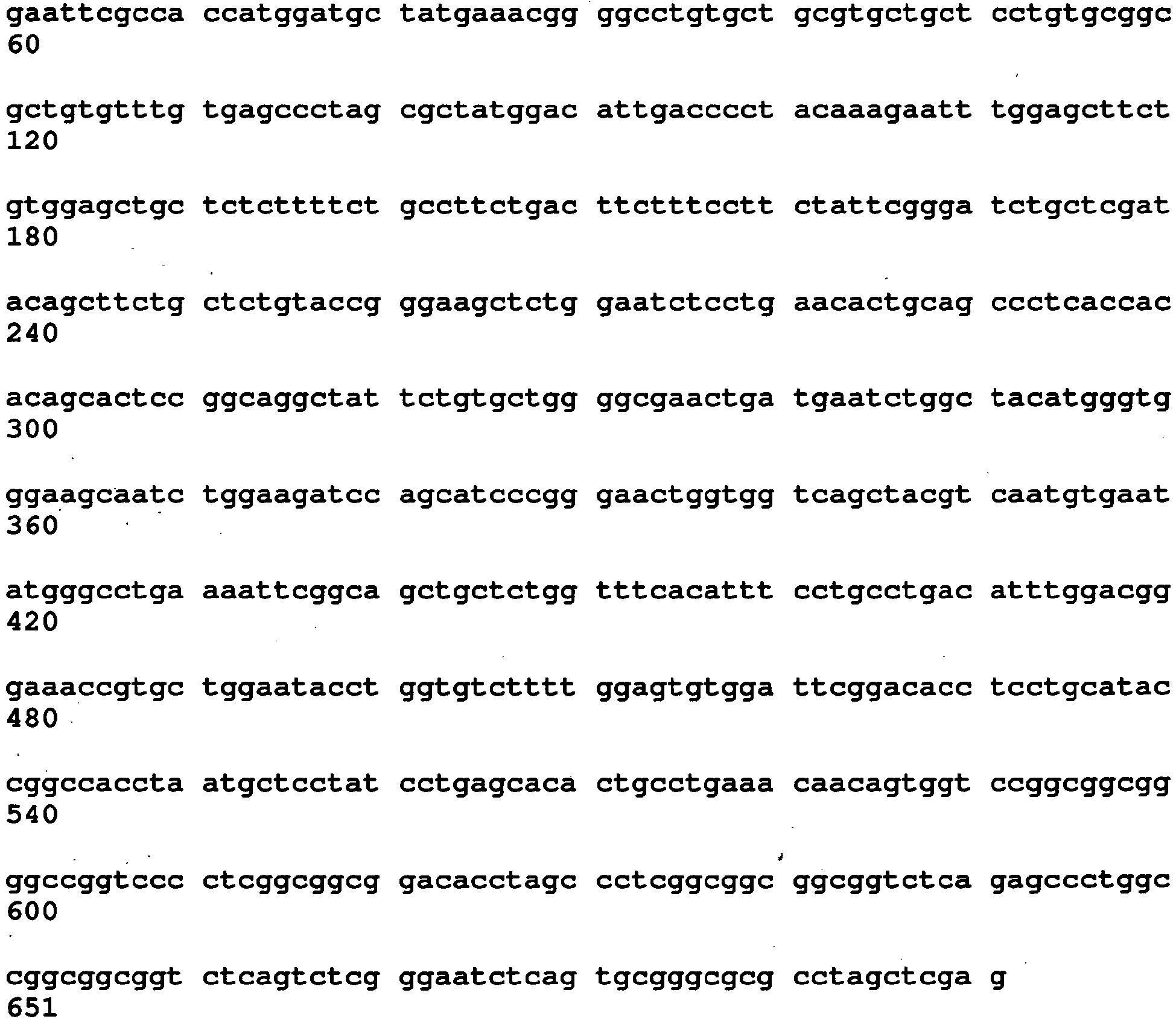
- <210> 10
<211> 2723
<212> DNA
<213> Artificial Sequence - <220>
<223> gDs-HA-pol - <400> 10


- <210> 11
<211> 25
<212> DNA
<213> Artificial Sequence - <220>
<223> hp35(S) - <400> 11
<210> 12

<211> 17
<212> DNA
<213> Artificial Sequence - <220>
<223> hp35(AS) - <400> 12

- <210> 13
<211> 27
<212> DNA
<213> Artificial Sequence - <220>
<223> hp40 (S) - <400> 13

- <210> 14
<211> 26
<212> DNA
<213> Artificial Sequence - <220>
<223> hp40(AS) - <400> 14

- <210> 15
<211> 20
<212> DNA
<213> Artificial Sequence - <220>
<223> IRES (S) - <400> 15

- <210> 16
<211> 21
<212> DNA
<213> Artificial Sequence - <220>
<223> IRES(AS) - <400> 16

- <210> 17
<211> 22
<212> DNA
<213> Artificial Sequence - <220>
<223> T7(S) - <400> 17

- <210> 18
<211> 21
<212> DNA
<213> Artificial Sequence - <220>
<223> hp40-N222L(AS) - <400> 18

- <210> 19
<211> 20
<212> DNA
<213> Artificial Sequence - <220>
<223> T3(AS) - <400> 19

- <210> 20
<211> 21
<212> DNA
<213> Artificial Sequence - <220>
<223> hp40-N222L(S) - <400> 20

- <210> 21
<211> 20
<212> DNA
<213> Artificial Sequence - <220>
<223> hIL-12(S) - <400> 21

- <210> 22
<211> 19
<212> DNA
<213> Artificial Sequence - <220>
<223> hIL-12(AS) - <400> 22

- <210> 23
<211> 328
<212> PRT
<213> Artificial Sequence - <220>
<223> human IL-12p40 - <400> 23


- <210> 24
<211> 335
<212> PRT
<213> Artificial Sequence - <220>
<223> mouse IL-12p40 - <400> 24


Claims (22)
- A Hepatitis B virus (HBV) DNA vaccine comprising two expression vectors, wherein one expression vector comprises polynucleotide sequences encoding hepatitis B surface antigen (HBsAg) and L protein, and the other expression vector comprises polynucleotide sequences encoding core protein and polymerase, wherein the polynucleotide sequence encoding HBsAg comprises the polynucleotide sequence of SEQ. ID. NO: 1, the polynucleotide sequence encoding L protein comprises the polynucleotide sequence of SEQ. ID. NO: 2, the polynucleotide sequence encoding core protein comprises the polynucleotide sequence of SEQ. ID. NO: 9, and the polynucleotide sequence encoding polymerase comprises the polynucleotide sequence of SEQ. ID. NO: 10.
- The HBV DNA vaccine of claim 1, wherein the polynucleotide sequences of the HBsAg, L protein and core protein encode codon-optimized antigens.
- The HBV DNA vaccine of claim 1, wherein two polynucleotide sequences inserted together into a single expression vector are expressed by individual promoters, respectively.
- The HBV DNA vaccine of claim 1, wherein the expression vector comprising polynucleotide sequences encoding HBsAg and L protein is pGX10 S/L vector as shown in fig 1 and the expression vector comprising polynucleotide sequences encoding core protein and polymerase is pGX10 core/Pol vector as shown in Fig 1.
- The HBV DNAvaccine of claim 1, further comprising an immune adjuvant.
- The HBV DNA vaccine of claim 5, wherein the immune adjuvant is a gene encoding IL-12 variant.
- The HBV DNA vaccine of claim 6, wherein the IL-12 variant is mutated such that Asn, which is an amino acid residue 222 of human IL-12p40 represented by SEQ. ID. No 23, is substituted with a different amino acid.
- The HBV DNA vaccine of claim 6, wherein the IL-12 variant is mutated such that Asn, which is an amino acid residue 220 of mouse IL-12p40 represented by SEQ. ID. No 24, is substituted with a different amino acid.
- The HBV DNA vaccine of claim 7, wherein the different amino acid is selected from the group consisting of Leu, Gln and Ile.
- The HBV DNA vaccine of claim 8, wherein the different amino acid is selected from the group consisting of Leu and Ile.
- The HBV DNA vaccine of anyone of claims 1 to 9, further comprising a pharmaceutically acceptable carrier or excipient.
- A method for preparing the Hepatitis B virus (HBV) DNA vaccine according to claim 1, comprising:(1) codon-optimizing polynucleotide sequence encoding hepatitis B surface antigen (HBsAg), L protein, and a core protein; and(2) inserting the codon-optimized polynucleotide sequences encoding the HBsAg and L protein together into a single expression vector and inserting the codon-optimized polynucleotide sequence encoding the core protein and polynucleotide sequence encoding a polymerase of HBV together into another expression vector.
- The method of claim 12, wherein the expression vector comprising polynucleotide sequences encoding HBsAg and L protein is pGX10 S/L vector as shown in fig 1, and the expression vector comprising polynucleotide sequences encoding core protein and polymerase is pGX10 core/Pol as shown in fig 1.
- The method of claim 12, wherein the two polynucleotide sequences inserted together to the single expression vector are expressed by individual promoters, respectively.
- The method of claim 12, further comprising the inclusion of an immune adjuvant.
- The method of claim 12, wherein the immune adjuvant is a gene encoding 1L-12 variant.
- The method of claim 16, wherein the gene encoding 1L-12 variant is mutated such that the codon for Asn, which is an amino acid residue 222 of human 1L-12p40 represented by SEQ. ID. No 23, is substituted with another codon for a different amino acid.
- The method of claim 16, wherein the gene encoding 1L-12 variant is mutated such that the codon for Asn, which is an amino acid residue 220 of mouse 1L-12p40 represented by SEQ. ID. No 24, is substituted with another codon for a different amino acid.
- The method of claim 17, wherein the different amino acid is selected from the group consisting of Leu, Gln and Ile.
- The method of claim 18, wherein the different amino acid is selected from the group consisting of Leu and Ile.
- The method of claim 16 or 17, wherein the inclusion of an immune adjuvant that is a gene encoding 1L-12 variant into an expression vector.
- The HBV DNA vaccine of anyone of claims 1 to 11 for use in a method of treating chronic Hepatitis B.
Applications Claiming Priority (1)
| Application Number | Priority Date | Filing Date | Title |
|---|---|---|---|
| PCT/KR2006/003181 WO2008020656A1 (en) | 2006-08-14 | 2006-08-14 | A dna vaccine for curing chronic hepatitis b and a method of preparing same |
Publications (3)
| Publication Number | Publication Date |
|---|---|
| EP2057268A1 EP2057268A1 (en) | 2009-05-13 |
| EP2057268A4 EP2057268A4 (en) | 2011-03-09 |
| EP2057268B1 true EP2057268B1 (en) | 2014-08-13 |
Family
ID=39082171
Family Applications (1)
| Application Number | Title | Priority Date | Filing Date |
|---|---|---|---|
| EP06783600.7A Not-in-force EP2057268B1 (en) | 2006-08-14 | 2006-08-14 | A dna vaccine for curing chronic hepatitis b and a method of preparing same |
Country Status (3)
| Country | Link |
|---|---|
| EP (1) | EP2057268B1 (en) |
| CN (1) | CN101573449B (en) |
| WO (1) | WO2008020656A1 (en) |
Cited By (1)
| Publication number | Priority date | Publication date | Assignee | Title |
|---|---|---|---|---|
| US11497808B2 (en) | 2019-09-30 | 2022-11-15 | Gilead Sciences, Inc. | HBV vaccines and methods treating HBV |
Families Citing this family (20)
| Publication number | Priority date | Publication date | Assignee | Title |
|---|---|---|---|---|
| WO2009022236A2 (en) | 2007-08-16 | 2009-02-19 | Tripep Ab | Immunogen platform |
| WO2009130588A2 (en) * | 2008-04-22 | 2009-10-29 | Tripep Ab | Immunogen platform |
| WO2010086743A2 (en) * | 2009-02-02 | 2010-08-05 | Chrontech Pharma Ab | Compositions and methods that enhance an immune response |
| CN101502650B (en) * | 2009-03-10 | 2011-12-28 | 邢益平 | Hepatitis B nucleic acid vaccine with optimized codon |
| BR112012002628B1 (en) | 2009-08-07 | 2021-09-08 | Transgene Sa | IMMUNOGENIC COMPOSITION, NUCLEIC ACID MOLECULE, VECTOR, INFECTIOUS VIRAL PARTICLE, TRANSGENIC MICROORGANISM, COMPOSITION, USES OF THE IMMUNOGENIC COMPOSITION AND KIT OF PARTS |
| US10076570B2 (en) | 2009-08-07 | 2018-09-18 | Transgene S.A. | Composition for treating HBV infection |
| CN102233136B (en) * | 2010-04-30 | 2013-05-08 | 北京凯因科技股份有限公司 | Recombinant plasmid vaccine for treating hepatitis B and composition thereof |
| CN102233137B (en) * | 2010-04-30 | 2013-02-20 | 北京凯因科技股份有限公司 | Recombinant plasmid DNA vaccine composition for treating Hepatitis B |
| JP2014500875A (en) * | 2010-11-19 | 2014-01-16 | ベイジン カイン テクノロジー シェア−ホールディング シーオー., エルティーディー. | DNA vaccine composition for prevention and treatment of hepatitis B |
| TWI623618B (en) | 2011-07-12 | 2018-05-11 | 傳斯堅公司 | Hbv polymerase mutants |
| EP3522920A2 (en) | 2016-10-10 | 2019-08-14 | Transgene SA | Immunotherapeutic product and mdsc modulator combination therapy |
| GB201705765D0 (en) * | 2017-04-10 | 2017-05-24 | Univ Oxford Innovation Ltd | HBV vaccine |
| EA202091513A1 (en) | 2017-12-19 | 2020-09-09 | Янссен Сайенсиз Айрлэнд Анлимитед Компани | VACCINES AGAINST HEPATITIS B VIRUS (HBV) AND THEIR APPLICATION |
| US11020476B2 (en) | 2017-12-19 | 2021-06-01 | Janssen Sciences Ireland Unlimited Company | Methods and compositions for inducing an immune response against Hepatitis B Virus (HBV) |
| US11389531B2 (en) | 2017-12-19 | 2022-07-19 | Janssen Sciences Ireland Unlimited Company | Methods and apparatus for the delivery of hepatitis B virus (HBV) vaccines |
| CA3141003A1 (en) * | 2019-06-18 | 2020-12-24 | Helen Horton | Combination of hepatitis b virus (hbv) vaccines and pd-l1 inhibitors |
| WO2020255010A1 (en) * | 2019-06-18 | 2020-12-24 | Janssen Sciences Ireland Unlimited Company | Combination of recombinant interleukin 12 construct and hepatitis b virus (hbv) vaccines |
| US20220226467A1 (en) * | 2019-06-18 | 2022-07-21 | Janssen Sciences Ireland Unlimited Company | Arenavirus vectors for hepatitis b virus (hbv) vaccines and uses thereof |
| WO2022133230A1 (en) * | 2020-12-18 | 2022-06-23 | Janssen Pharmaceuticals, Inc. | Combination therapy for treating hepatitis b virus infection |
| WO2024159517A1 (en) * | 2023-02-03 | 2024-08-08 | 南方科技大学 | Hepatitis b mrna and vaccine and use thereof |
Family Cites Families (5)
| Publication number | Priority date | Publication date | Assignee | Title |
|---|---|---|---|---|
| KR100399728B1 (en) | 2000-03-15 | 2003-09-26 | 주식회사 프로젠 | Genes of IL-12p40 subunit mutated for improving the activity of IL-12 and use thereof for DNA vaccine adjuvant |
| KR100472297B1 (en) | 2001-09-27 | 2005-03-07 | 주식회사 두산 | Lysophospholipids Composition with Water Solubility |
| JP2007509614A (en) * | 2003-10-21 | 2007-04-19 | メルボルン ヘルス | Detection and application of HBV variants |
| US20080274134A1 (en) * | 2004-06-15 | 2008-11-06 | Norbert Schulke | Hiv-1 Neutralizing Antibodies Elicited By Trimeric Hiv-1 Envelope Glycoprotein Complex |
| WO2006039739A1 (en) * | 2004-10-13 | 2006-04-20 | Melbourne Health | Hepatitis b viral (hbv) mutants detection and application |
-
2006
- 2006-08-14 CN CN2006800561033A patent/CN101573449B/en not_active Expired - Fee Related
- 2006-08-14 EP EP06783600.7A patent/EP2057268B1/en not_active Not-in-force
- 2006-08-14 WO PCT/KR2006/003181 patent/WO2008020656A1/en not_active Ceased
Cited By (3)
| Publication number | Priority date | Publication date | Assignee | Title |
|---|---|---|---|---|
| US11497808B2 (en) | 2019-09-30 | 2022-11-15 | Gilead Sciences, Inc. | HBV vaccines and methods treating HBV |
| US11730808B2 (en) | 2019-09-30 | 2023-08-22 | Gilead Sciences, Inc. | HBV vaccines and methods treating HBV |
| US12364751B2 (en) | 2019-09-30 | 2025-07-22 | Gilead Sciences, Inc. | HBV vaccines and methods treating HBV |
Also Published As
| Publication number | Publication date |
|---|---|
| CN101573449A (en) | 2009-11-04 |
| WO2008020656A1 (en) | 2008-02-21 |
| EP2057268A1 (en) | 2009-05-13 |
| EP2057268A4 (en) | 2011-03-09 |
| CN101573449B (en) | 2013-09-18 |
Similar Documents
| Publication | Publication Date | Title |
|---|---|---|
| CN101573449B (en) | DNA vaccine for treating chronic hepatitis B and its preparation method | |
| TWI555531B (en) | Composition for treating hbv infection | |
| US9987352B2 (en) | Yeast-based compositions and methods for the treatment or prevention of hepatitis delta virus infection | |
| CN103476426B (en) | Yeast-based therapeutic for chronic hepatitis B virus infection | |
| TWI623618B (en) | Hbv polymerase mutants | |
| US20250242014A1 (en) | Hepatitis b immunisation regimen and compositions | |
| EP2978449B1 (en) | Compositions and methods for the treatment or prevention of human immunodeficiency virus infection | |
| JP2024161488A (en) | Hepatitis B immunization regimens and compositions | |
| Li et al. | A truncated C-terminal fragment of Mycobacterium tuberculosis HSP70 gene enhanced potency of HBV DNA vaccine | |
| EP2391383B1 (en) | Codon-optimized hepatitis b virus core antigen (hbcag) | |
| Alekseeva et al. | Enhancement of the expression of HCV core gene does not enhance core-specific immune response in DNA immunization: advantages of the heterologous DNA prime, protein boost immunization regimen | |
| JP2021506771A (en) | Hepatitis B immunization regimen and composition | |
| Kim et al. | Enhanced immunogenicity of DNA fusion vaccine encoding secreted hepatitis B surface antigen and chemokine RANTES | |
| Qing et al. | Construction of an HBV DNA vaccine by fusion of the GM-CSF gene to the HBV-S gene and examination of its immune effects in normal and HBV-transgenic mice | |
| Sanyal et al. | A review of multiple approaches towards an improved hepatitis B vaccine | |
| KR100841732B1 (en) | DNA vaccine for the treatment of chronic hepatitis B and a method of manufacturing the same | |
| Hong et al. | Lentivector expressing HBsAg and immunoglobulin Fc fusion antigen induces potent immune responses and results in seroconversion in HBsAg transgenic mice | |
| EP1274851B1 (en) | A nucleic acid construct encoding a processing component derived from the n-terminal region of the hepatitis virus orf2, and an antigenic polypeptide | |
| CA2453260C (en) | Vaccine formulation potentiated by the combination of a dna and an antigen | |
| AU2001243941B2 (en) | A nucleic acid construct encoding a processing component derived from the n-terminal region of the hepatitis virus ORF2, and an antigenic polypeptide | |
| US20160215023A1 (en) | Simple vaccines from dna launched suicidal flaviviruses | |
| 김채영 | Preclinical study on a novel DNA vaccine (HB-110) for the treatment of chronic Hepatitis B virus infection | |
| KR20030089291A (en) | Vector for dna vaccine having high expression effects and vaccine for hepatitis using the vector | |
| NZ705184B2 (en) | Yeast-based therapeutic for chronic hepatitis b infection |
Legal Events
| Date | Code | Title | Description |
|---|---|---|---|
| PUAI | Public reference made under article 153(3) epc to a published international application that has entered the european phase |
Free format text: ORIGINAL CODE: 0009012 |
|
| 17P | Request for examination filed |
Effective date: 20090316 |
|
| AK | Designated contracting states |
Kind code of ref document: A1 Designated state(s): AT BE BG CH CY CZ DE DK EE ES FI FR GB GR HU IE IS IT LI LT LU LV MC NL PL PT RO SE SI SK TR |
|
| AX | Request for extension of the european patent |
Extension state: AL BA HR MK RS |
|
| RAP1 | Party data changed (applicant data changed or rights of an application transferred) |
Owner name: DAEWOONG PHARMACEUTICAL CO., LTD. Owner name: DONG-A PHARMACEUTICAL CO., LTD. Owner name: GENEXINE CO., LTD. Owner name: POSTECH FOUNDATION |
|
| A4 | Supplementary search report drawn up and despatched |
Effective date: 20110207 |
|
| 17Q | First examination report despatched |
Effective date: 20120109 |
|
| DAX | Request for extension of the european patent (deleted) | ||
| RAP1 | Party data changed (applicant data changed or rights of an application transferred) |
Owner name: DAEWOONG PHARMACEUTICAL CO., LTD. Owner name: POSTECH FOUNDATION Owner name: GENEXINE, INC. Owner name: DONG-A PHARMACEUTICAL CO., LTD. |
|
| GRAP | Despatch of communication of intention to grant a patent |
Free format text: ORIGINAL CODE: EPIDOSNIGR1 |
|
| INTG | Intention to grant announced |
Effective date: 20140313 |
|
| GRAS | Grant fee paid |
Free format text: ORIGINAL CODE: EPIDOSNIGR3 |
|
| GRAA | (expected) grant |
Free format text: ORIGINAL CODE: 0009210 |
|
| AK | Designated contracting states |
Kind code of ref document: B1 Designated state(s): AT BE BG CH CY CZ DE DK EE ES FI FR GB GR HU IE IS IT LI LT LU LV MC NL PL PT RO SE SI SK TR |
|
| REG | Reference to a national code |
Ref country code: GB Ref legal event code: FG4D |
|
| REG | Reference to a national code |
Ref country code: AT Ref legal event code: REF Ref document number: 682301 Country of ref document: AT Kind code of ref document: T Effective date: 20140815 Ref country code: CH Ref legal event code: EP |
|
| REG | Reference to a national code |
Ref country code: IE Ref legal event code: FG4D |
|
| REG | Reference to a national code |
Ref country code: DE Ref legal event code: R096 Ref document number: 602006042694 Country of ref document: DE Effective date: 20140925 |
|
| REG | Reference to a national code |
Ref country code: NL Ref legal event code: VDEP Effective date: 20140813 |
|
| REG | Reference to a national code |
Ref country code: AT Ref legal event code: MK05 Ref document number: 682301 Country of ref document: AT Kind code of ref document: T Effective date: 20140813 |
|
| REG | Reference to a national code |
Ref country code: LT Ref legal event code: MG4D |
|
| PG25 | Lapsed in a contracting state [announced via postgrant information from national office to epo] |
Ref country code: LT Free format text: LAPSE BECAUSE OF FAILURE TO SUBMIT A TRANSLATION OF THE DESCRIPTION OR TO PAY THE FEE WITHIN THE PRESCRIBED TIME-LIMIT Effective date: 20140813 Ref country code: BG Free format text: LAPSE BECAUSE OF FAILURE TO SUBMIT A TRANSLATION OF THE DESCRIPTION OR TO PAY THE FEE WITHIN THE PRESCRIBED TIME-LIMIT Effective date: 20141113 Ref country code: FI Free format text: LAPSE BECAUSE OF FAILURE TO SUBMIT A TRANSLATION OF THE DESCRIPTION OR TO PAY THE FEE WITHIN THE PRESCRIBED TIME-LIMIT Effective date: 20140813 Ref country code: SE Free format text: LAPSE BECAUSE OF FAILURE TO SUBMIT A TRANSLATION OF THE DESCRIPTION OR TO PAY THE FEE WITHIN THE PRESCRIBED TIME-LIMIT Effective date: 20140813 Ref country code: GR Free format text: LAPSE BECAUSE OF FAILURE TO SUBMIT A TRANSLATION OF THE DESCRIPTION OR TO PAY THE FEE WITHIN THE PRESCRIBED TIME-LIMIT Effective date: 20141114 Ref country code: ES Free format text: LAPSE BECAUSE OF FAILURE TO SUBMIT A TRANSLATION OF THE DESCRIPTION OR TO PAY THE FEE WITHIN THE PRESCRIBED TIME-LIMIT Effective date: 20140813 Ref country code: PT Free format text: LAPSE BECAUSE OF FAILURE TO SUBMIT A TRANSLATION OF THE DESCRIPTION OR TO PAY THE FEE WITHIN THE PRESCRIBED TIME-LIMIT Effective date: 20141215 |
|
| PG25 | Lapsed in a contracting state [announced via postgrant information from national office to epo] |
Ref country code: AT Free format text: LAPSE BECAUSE OF FAILURE TO SUBMIT A TRANSLATION OF THE DESCRIPTION OR TO PAY THE FEE WITHIN THE PRESCRIBED TIME-LIMIT Effective date: 20140813 Ref country code: IS Free format text: LAPSE BECAUSE OF FAILURE TO SUBMIT A TRANSLATION OF THE DESCRIPTION OR TO PAY THE FEE WITHIN THE PRESCRIBED TIME-LIMIT Effective date: 20141213 Ref country code: CY Free format text: LAPSE BECAUSE OF FAILURE TO SUBMIT A TRANSLATION OF THE DESCRIPTION OR TO PAY THE FEE WITHIN THE PRESCRIBED TIME-LIMIT Effective date: 20140813 Ref country code: LV Free format text: LAPSE BECAUSE OF FAILURE TO SUBMIT A TRANSLATION OF THE DESCRIPTION OR TO PAY THE FEE WITHIN THE PRESCRIBED TIME-LIMIT Effective date: 20140813 |
|
| REG | Reference to a national code |
Ref country code: DE Ref legal event code: R119 Ref document number: 602006042694 Country of ref document: DE |
|
| PG25 | Lapsed in a contracting state [announced via postgrant information from national office to epo] |
Ref country code: NL Free format text: LAPSE BECAUSE OF FAILURE TO SUBMIT A TRANSLATION OF THE DESCRIPTION OR TO PAY THE FEE WITHIN THE PRESCRIBED TIME-LIMIT Effective date: 20140813 |
|
| REG | Reference to a national code |
Ref country code: CH Ref legal event code: PL |
|
| PG25 | Lapsed in a contracting state [announced via postgrant information from national office to epo] |
Ref country code: EE Free format text: LAPSE BECAUSE OF FAILURE TO SUBMIT A TRANSLATION OF THE DESCRIPTION OR TO PAY THE FEE WITHIN THE PRESCRIBED TIME-LIMIT Effective date: 20140813 Ref country code: DK Free format text: LAPSE BECAUSE OF FAILURE TO SUBMIT A TRANSLATION OF THE DESCRIPTION OR TO PAY THE FEE WITHIN THE PRESCRIBED TIME-LIMIT Effective date: 20140813 Ref country code: BE Free format text: LAPSE BECAUSE OF NON-PAYMENT OF DUE FEES Effective date: 20140831 Ref country code: LI Free format text: LAPSE BECAUSE OF NON-PAYMENT OF DUE FEES Effective date: 20140831 Ref country code: SK Free format text: LAPSE BECAUSE OF FAILURE TO SUBMIT A TRANSLATION OF THE DESCRIPTION OR TO PAY THE FEE WITHIN THE PRESCRIBED TIME-LIMIT Effective date: 20140813 Ref country code: CH Free format text: LAPSE BECAUSE OF NON-PAYMENT OF DUE FEES Effective date: 20140831 Ref country code: RO Free format text: LAPSE BECAUSE OF FAILURE TO SUBMIT A TRANSLATION OF THE DESCRIPTION OR TO PAY THE FEE WITHIN THE PRESCRIBED TIME-LIMIT Effective date: 20140813 Ref country code: CZ Free format text: LAPSE BECAUSE OF FAILURE TO SUBMIT A TRANSLATION OF THE DESCRIPTION OR TO PAY THE FEE WITHIN THE PRESCRIBED TIME-LIMIT Effective date: 20140813 Ref country code: IT Free format text: LAPSE BECAUSE OF FAILURE TO SUBMIT A TRANSLATION OF THE DESCRIPTION OR TO PAY THE FEE WITHIN THE PRESCRIBED TIME-LIMIT Effective date: 20140813 |
|
| REG | Reference to a national code |
Ref country code: IE Ref legal event code: MM4A |
|
| PG25 | Lapsed in a contracting state [announced via postgrant information from national office to epo] |
Ref country code: MC Free format text: LAPSE BECAUSE OF FAILURE TO SUBMIT A TRANSLATION OF THE DESCRIPTION OR TO PAY THE FEE WITHIN THE PRESCRIBED TIME-LIMIT Effective date: 20140813 Ref country code: PL Free format text: LAPSE BECAUSE OF FAILURE TO SUBMIT A TRANSLATION OF THE DESCRIPTION OR TO PAY THE FEE WITHIN THE PRESCRIBED TIME-LIMIT Effective date: 20140813 |
|
| PLBE | No opposition filed within time limit |
Free format text: ORIGINAL CODE: 0009261 |
|
| STAA | Information on the status of an ep patent application or granted ep patent |
Free format text: STATUS: NO OPPOSITION FILED WITHIN TIME LIMIT |
|
| REG | Reference to a national code |
Ref country code: FR Ref legal event code: ST Effective date: 20150612 |
|
| 26N | No opposition filed |
Effective date: 20150515 |
|
| GBPC | Gb: european patent ceased through non-payment of renewal fee |
Effective date: 20141113 |
|
| PG25 | Lapsed in a contracting state [announced via postgrant information from national office to epo] |
Ref country code: DE Free format text: LAPSE BECAUSE OF NON-PAYMENT OF DUE FEES Effective date: 20150303 |
|
| PG25 | Lapsed in a contracting state [announced via postgrant information from national office to epo] |
Ref country code: FR Free format text: LAPSE BECAUSE OF NON-PAYMENT OF DUE FEES Effective date: 20141013 Ref country code: IE Free format text: LAPSE BECAUSE OF NON-PAYMENT OF DUE FEES Effective date: 20140814 |
|
| PG25 | Lapsed in a contracting state [announced via postgrant information from national office to epo] |
Ref country code: GB Free format text: LAPSE BECAUSE OF NON-PAYMENT OF DUE FEES Effective date: 20141113 |
|
| PG25 | Lapsed in a contracting state [announced via postgrant information from national office to epo] |
Ref country code: SI Free format text: LAPSE BECAUSE OF FAILURE TO SUBMIT A TRANSLATION OF THE DESCRIPTION OR TO PAY THE FEE WITHIN THE PRESCRIBED TIME-LIMIT Effective date: 20140813 |
|
| PG25 | Lapsed in a contracting state [announced via postgrant information from national office to epo] |
Ref country code: LU Free format text: LAPSE BECAUSE OF NON-PAYMENT OF DUE FEES Effective date: 20140814 Ref country code: TR Free format text: LAPSE BECAUSE OF FAILURE TO SUBMIT A TRANSLATION OF THE DESCRIPTION OR TO PAY THE FEE WITHIN THE PRESCRIBED TIME-LIMIT Effective date: 20140813 Ref country code: HU Free format text: LAPSE BECAUSE OF FAILURE TO SUBMIT A TRANSLATION OF THE DESCRIPTION OR TO PAY THE FEE WITHIN THE PRESCRIBED TIME-LIMIT; INVALID AB INITIO Effective date: 20060814 Ref country code: BE Free format text: LAPSE BECAUSE OF FAILURE TO SUBMIT A TRANSLATION OF THE DESCRIPTION OR TO PAY THE FEE WITHIN THE PRESCRIBED TIME-LIMIT Effective date: 20140813 |