EP2057137B1 - S-(+)-7-[3-n-substituted amino-2-hydroxypropoxy]flavones - Google Patents
S-(+)-7-[3-n-substituted amino-2-hydroxypropoxy]flavones Download PDFInfo
- Publication number
- EP2057137B1 EP2057137B1 EP07805638.9A EP07805638A EP2057137B1 EP 2057137 B1 EP2057137 B1 EP 2057137B1 EP 07805638 A EP07805638 A EP 07805638A EP 2057137 B1 EP2057137 B1 EP 2057137B1
- Authority
- EP
- European Patent Office
- Prior art keywords
- compound
- group
- flavone
- hydroxy
- treated
- Prior art date
- Legal status (The legal status is an assumption and is not a legal conclusion. Google has not performed a legal analysis and makes no representation as to the accuracy of the status listed.)
- Not-in-force
Links
- 229930003944 flavone Natural products 0.000 title description 7
- 235000011949 flavones Nutrition 0.000 title description 7
- 150000002213 flavones Chemical class 0.000 title description 5
- 150000001875 compounds Chemical class 0.000 claims description 60
- 238000000034 method Methods 0.000 claims description 24
- HEMHJVSKTPXQMS-UHFFFAOYSA-M Sodium hydroxide Chemical compound [OH-].[Na+] HEMHJVSKTPXQMS-UHFFFAOYSA-M 0.000 claims description 21
- 150000002632 lipids Chemical class 0.000 claims description 16
- 208000001072 type 2 diabetes mellitus Diseases 0.000 claims description 15
- 230000008569 process Effects 0.000 claims description 11
- 150000003839 salts Chemical class 0.000 claims description 11
- 230000000694 effects Effects 0.000 claims description 10
- LFQSCWFLJHTTHZ-UHFFFAOYSA-N Ethanol Chemical compound CCO LFQSCWFLJHTTHZ-UHFFFAOYSA-N 0.000 claims description 8
- 241000124008 Mammalia Species 0.000 claims description 7
- 229910052739 hydrogen Inorganic materials 0.000 claims description 7
- 239000001257 hydrogen Substances 0.000 claims description 7
- KDSNLYIMUZNERS-UHFFFAOYSA-N 2-methylpropanamine Chemical compound CC(C)CN KDSNLYIMUZNERS-UHFFFAOYSA-N 0.000 claims description 6
- ANOUKFYBOAKOIR-UHFFFAOYSA-N 3,4-dimethoxyphenylethylamine Chemical compound COC1=CC=C(CCN)C=C1OC ANOUKFYBOAKOIR-UHFFFAOYSA-N 0.000 claims description 6
- KWYUFKZDYYNOTN-UHFFFAOYSA-M Potassium hydroxide Chemical compound [OH-].[K+] KWYUFKZDYYNOTN-UHFFFAOYSA-M 0.000 claims description 6
- -1 iso pentenyl Chemical group 0.000 claims description 6
- 238000010992 reflux Methods 0.000 claims description 6
- KDLHZDBZIXYQEI-UHFFFAOYSA-N Palladium on carbon Substances [Pd] KDLHZDBZIXYQEI-UHFFFAOYSA-N 0.000 claims description 5
- 150000001412 amines Chemical class 0.000 claims description 5
- 230000003178 anti-diabetic effect Effects 0.000 claims description 5
- 239000003472 antidiabetic agent Substances 0.000 claims description 5
- JJWLVOIRVHMVIS-UHFFFAOYSA-N isopropylamine Chemical compound CC(C)N JJWLVOIRVHMVIS-UHFFFAOYSA-N 0.000 claims description 5
- YBRBMKDOPFTVDT-UHFFFAOYSA-N tert-butylamine Chemical compound CC(C)(C)N YBRBMKDOPFTVDT-UHFFFAOYSA-N 0.000 claims description 5
- BRLQWZUYTZBJKN-GSVOUGTGSA-N (+)-Epichlorohydrin Chemical compound ClC[C@@H]1CO1 BRLQWZUYTZBJKN-GSVOUGTGSA-N 0.000 claims description 4
- ZAJHRPXJNRTBKO-UHFFFAOYSA-N 1a-phenyl-6-propoxy-7ah-oxireno[2,3-b]chromen-7-one Chemical class O1C2C(=O)C=3C(OCCC)=CC=CC=3OC21C1=CC=CC=C1 ZAJHRPXJNRTBKO-UHFFFAOYSA-N 0.000 claims description 4
- ZZLQHXCRRMUGQJ-UHFFFAOYSA-N 2'-Hydroxyflavone Natural products OC1=CC=CC=C1C1=CC(=O)C2=CC=CC=C2O1 ZZLQHXCRRMUGQJ-UHFFFAOYSA-N 0.000 claims description 4
- VEXZGXHMUGYJMC-UHFFFAOYSA-N Hydrochloric acid Chemical compound Cl VEXZGXHMUGYJMC-UHFFFAOYSA-N 0.000 claims description 4
- UFHFLCQGNIYNRP-UHFFFAOYSA-N Hydrogen Chemical compound [H][H] UFHFLCQGNIYNRP-UHFFFAOYSA-N 0.000 claims description 4
- 239000003054 catalyst Substances 0.000 claims description 4
- 238000006264 debenzylation reaction Methods 0.000 claims description 4
- HVQAJTFOCKOKIN-UHFFFAOYSA-N flavonol Chemical class O1C2=CC=CC=C2C(=O)C(O)=C1C1=CC=CC=C1 HVQAJTFOCKOKIN-UHFFFAOYSA-N 0.000 claims description 4
- 238000002360 preparation method Methods 0.000 claims description 4
- 150000003152 propanolamines Chemical class 0.000 claims description 4
- 150000003892 tartrate salts Chemical class 0.000 claims description 4
- FWEOJIHINZZOHE-UHFFFAOYSA-N 4-(2-methoxyphenyl)piperazin-1-amine Chemical compound COC1=CC=CC=C1N1CCN(N)CC1 FWEOJIHINZZOHE-UHFFFAOYSA-N 0.000 claims description 3
- DAURIJZNKHAJSE-UHFFFAOYSA-N 4-phenylpiperazin-1-amine Chemical compound C1CN(N)CCN1C1=CC=CC=C1 DAURIJZNKHAJSE-UHFFFAOYSA-N 0.000 claims description 3
- 125000000051 benzyloxy group Chemical group [H]C1=C([H])C([H])=C(C([H])=C1[H])C([H])([H])O* 0.000 claims description 3
- HQABUPZFAYXKJW-UHFFFAOYSA-N butan-1-amine Chemical compound CCCCN HQABUPZFAYXKJW-UHFFFAOYSA-N 0.000 claims description 3
- 238000006243 chemical reaction Methods 0.000 claims description 3
- 150000002431 hydrogen Chemical class 0.000 claims description 3
- 125000002496 methyl group Chemical group [H]C([H])([H])* 0.000 claims description 3
- VZCYOOQTPOCHFL-OWOJBTEDSA-N Fumaric acid Chemical compound OC(=O)\C=C\C(O)=O VZCYOOQTPOCHFL-OWOJBTEDSA-N 0.000 claims description 2
- WUGQZFFCHPXWKQ-UHFFFAOYSA-N Propanolamine Chemical compound NCCCO WUGQZFFCHPXWKQ-UHFFFAOYSA-N 0.000 claims description 2
- 150000003973 alkyl amines Chemical class 0.000 claims description 2
- FKPSBYZGRQJIMO-UHFFFAOYSA-M benzyl(triethyl)azanium;hydroxide Chemical compound [OH-].CC[N+](CC)(CC)CC1=CC=CC=C1 FKPSBYZGRQJIMO-UHFFFAOYSA-M 0.000 claims description 2
- 238000009903 catalytic hydrogenation reaction Methods 0.000 claims description 2
- 125000004122 cyclic group Chemical group 0.000 claims description 2
- VZCYOOQTPOCHFL-OWOJBTEDSA-L fumarate(2-) Chemical class [O-]C(=O)\C=C\C([O-])=O VZCYOOQTPOCHFL-OWOJBTEDSA-L 0.000 claims description 2
- 238000010438 heat treatment Methods 0.000 claims description 2
- BDERNNFJNOPAEC-UHFFFAOYSA-N propan-1-ol Chemical compound CCCO BDERNNFJNOPAEC-UHFFFAOYSA-N 0.000 claims description 2
- 150000003890 succinate salts Chemical class 0.000 claims description 2
- VZCYOOQTPOCHFL-UHFFFAOYSA-N trans-butenedioic acid Natural products OC(=O)C=CC(O)=O VZCYOOQTPOCHFL-UHFFFAOYSA-N 0.000 claims description 2
- WQZGKKKJIJFFOK-GASJEMHNSA-N Glucose Natural products OC[C@H]1OC(O)[C@H](O)[C@@H](O)[C@@H]1O WQZGKKKJIJFFOK-GASJEMHNSA-N 0.000 description 65
- 239000008103 glucose Substances 0.000 description 65
- 210000004369 blood Anatomy 0.000 description 45
- 239000008280 blood Substances 0.000 description 45
- 241000699670 Mus sp. Species 0.000 description 42
- OKKJLVBELUTLKV-UHFFFAOYSA-N Methanol Chemical compound OC OKKJLVBELUTLKV-UHFFFAOYSA-N 0.000 description 30
- 238000011282 treatment Methods 0.000 description 26
- KXYWDZHSCSOAGU-NDEPHWFRSA-N 2-[3,5-bis(phenylmethoxy)phenyl]-7-[(2s)-3-(tert-butylamino)-2-hydroxypropoxy]chromen-4-one Chemical compound C=1C(OC[C@@H](O)CNC(C)(C)C)=CC=C(C(C=2)=O)C=1OC=2C(C=C(OCC=1C=CC=CC=1)C=1)=CC=1OCC1=CC=CC=C1 KXYWDZHSCSOAGU-NDEPHWFRSA-N 0.000 description 23
- HVYWMOMLDIMFJA-DPAQBDIFSA-N cholesterol Natural products C1C=C2C[C@@H](O)CC[C@]2(C)[C@@H]2[C@@H]1[C@@H]1CC[C@H]([C@H](C)CCCC(C)C)[C@@]1(C)CC2 HVYWMOMLDIMFJA-DPAQBDIFSA-N 0.000 description 19
- 230000008859 change Effects 0.000 description 16
- KXYWDZHSCSOAGU-MUUNZHRXSA-N 2-[3,5-bis(phenylmethoxy)phenyl]-7-[(2r)-3-(tert-butylamino)-2-hydroxypropoxy]chromen-4-one Chemical compound C=1C(OC[C@H](O)CNC(C)(C)C)=CC=C(C(C=2)=O)C=1OC=2C(C=C(OCC=1C=CC=CC=1)C=1)=CC=1OCC1=CC=CC=C1 KXYWDZHSCSOAGU-MUUNZHRXSA-N 0.000 description 15
- YXFVVABEGXRONW-UHFFFAOYSA-N Toluene Chemical compound CC1=CC=CC=C1 YXFVVABEGXRONW-UHFFFAOYSA-N 0.000 description 15
- NGUOSJCZPQFPPX-MRXNPFEDSA-N 2-(3,5-dihydroxyphenyl)-7-[(2r)-2-hydroxy-3-(propan-2-ylamino)propoxy]chromen-4-one Chemical compound C=1C(OC[C@H](O)CNC(C)C)=CC=C(C(C=2)=O)C=1OC=2C1=CC(O)=CC(O)=C1 NGUOSJCZPQFPPX-MRXNPFEDSA-N 0.000 description 13
- YQMNSZSNYGWDBP-UHFFFAOYSA-N 2-[3,5-bis(phenylmethoxy)phenyl]-7-hydroxychromen-4-one Chemical compound C=1C(O)=CC=C(C(C=2)=O)C=1OC=2C(C=C(OCC=1C=CC=CC=1)C=1)=CC=1OCC1=CC=CC=C1 YQMNSZSNYGWDBP-UHFFFAOYSA-N 0.000 description 13
- 239000000203 mixture Substances 0.000 description 13
- 108010023302 HDL Cholesterol Proteins 0.000 description 11
- 239000002904 solvent Substances 0.000 description 11
- 150000003626 triacylglycerols Chemical class 0.000 description 11
- RNXXZGMYZLQECV-MUUNZHRXSA-N 2-[3,5-bis(phenylmethoxy)phenyl]-7-[(2r)-2-hydroxy-3-(propan-2-ylamino)propoxy]chromen-4-one Chemical compound C=1C(OC[C@H](O)CNC(C)C)=CC=C(C(C=2)=O)C=1OC=2C(C=C(OCC=1C=CC=CC=1)C=1)=CC=1OCC1=CC=CC=C1 RNXXZGMYZLQECV-MUUNZHRXSA-N 0.000 description 10
- 241001465754 Metazoa Species 0.000 description 10
- 230000001708 anti-dyslipidemic effect Effects 0.000 description 10
- HTZCNXWZYVXIMZ-UHFFFAOYSA-M benzyl(triethyl)azanium;chloride Chemical compound [Cl-].CC[N+](CC)(CC)CC1=CC=CC=C1 HTZCNXWZYVXIMZ-UHFFFAOYSA-M 0.000 description 10
- 206010012601 diabetes mellitus Diseases 0.000 description 10
- 210000002966 serum Anatomy 0.000 description 10
- 230000002058 anti-hyperglycaemic effect Effects 0.000 description 9
- HEDRZPFGACZZDS-UHFFFAOYSA-N Chloroform Chemical compound ClC(Cl)Cl HEDRZPFGACZZDS-UHFFFAOYSA-N 0.000 description 8
- PMZURENOXWZQFD-UHFFFAOYSA-L Sodium Sulfate Chemical compound [Na+].[Na+].[O-]S([O-])(=O)=O PMZURENOXWZQFD-UHFFFAOYSA-L 0.000 description 8
- NOESYZHRGYRDHS-UHFFFAOYSA-N insulin Chemical compound N1C(=O)C(NC(=O)C(CCC(N)=O)NC(=O)C(CCC(O)=O)NC(=O)C(C(C)C)NC(=O)C(NC(=O)CN)C(C)CC)CSSCC(C(NC(CO)C(=O)NC(CC(C)C)C(=O)NC(CC=2C=CC(O)=CC=2)C(=O)NC(CCC(N)=O)C(=O)NC(CC(C)C)C(=O)NC(CCC(O)=O)C(=O)NC(CC(N)=O)C(=O)NC(CC=2C=CC(O)=CC=2)C(=O)NC(CSSCC(NC(=O)C(C(C)C)NC(=O)C(CC(C)C)NC(=O)C(CC=2C=CC(O)=CC=2)NC(=O)C(CC(C)C)NC(=O)C(C)NC(=O)C(CCC(O)=O)NC(=O)C(C(C)C)NC(=O)C(CC(C)C)NC(=O)C(CC=2NC=NC=2)NC(=O)C(CO)NC(=O)CNC2=O)C(=O)NCC(=O)NC(CCC(O)=O)C(=O)NC(CCCNC(N)=N)C(=O)NCC(=O)NC(CC=3C=CC=CC=3)C(=O)NC(CC=3C=CC=CC=3)C(=O)NC(CC=3C=CC(O)=CC=3)C(=O)NC(C(C)O)C(=O)N3C(CCC3)C(=O)NC(CCCCN)C(=O)NC(C)C(O)=O)C(=O)NC(CC(N)=O)C(O)=O)=O)NC(=O)C(C(C)CC)NC(=O)C(CO)NC(=O)C(C(C)O)NC(=O)C1CSSCC2NC(=O)C(CC(C)C)NC(=O)C(NC(=O)C(CCC(N)=O)NC(=O)C(CC(N)=O)NC(=O)C(NC(=O)C(N)CC=1C=CC=CC=1)C(C)C)CC1=CN=CN1 NOESYZHRGYRDHS-UHFFFAOYSA-N 0.000 description 8
- NGUOSJCZPQFPPX-INIZCTEOSA-N 2-(3,5-dihydroxyphenyl)-7-[(2s)-2-hydroxy-3-(propan-2-ylamino)propoxy]chromen-4-one Chemical compound C=1C(OC[C@@H](O)CNC(C)C)=CC=C(C(C=2)=O)C=1OC=2C1=CC(O)=CC(O)=C1 NGUOSJCZPQFPPX-INIZCTEOSA-N 0.000 description 7
- GOUCKLACVIBWAJ-UHFFFAOYSA-N 2-[3,5-bis(phenylmethoxy)phenyl]-7-(oxiran-2-ylmethoxy)chromen-4-one Chemical compound C=1C=C2C(=O)C=C(C=3C=C(OCC=4C=CC=CC=4)C=C(OCC=4C=CC=CC=4)C=3)OC2=CC=1OCC1CO1 GOUCKLACVIBWAJ-UHFFFAOYSA-N 0.000 description 7
- 208000001145 Metabolic Syndrome Diseases 0.000 description 7
- 208000008589 Obesity Diseases 0.000 description 7
- 235000020824 obesity Nutrition 0.000 description 7
- 201000000690 abdominal obesity-metabolic syndrome Diseases 0.000 description 6
- 235000012000 cholesterol Nutrition 0.000 description 6
- 206010022489 Insulin Resistance Diseases 0.000 description 5
- 238000013459 approach Methods 0.000 description 5
- 230000037396 body weight Effects 0.000 description 5
- 239000003795 chemical substances by application Substances 0.000 description 5
- 230000000052 comparative effect Effects 0.000 description 5
- 238000003786 synthesis reaction Methods 0.000 description 5
- XLYOFNOQVPJJNP-UHFFFAOYSA-N water Substances O XLYOFNOQVPJJNP-UHFFFAOYSA-N 0.000 description 5
- BRLQWZUYTZBJKN-VKHMYHEASA-N (-)-Epichlorohydrin Chemical compound ClC[C@H]1CO1 BRLQWZUYTZBJKN-VKHMYHEASA-N 0.000 description 4
- RNXXZGMYZLQECV-NDEPHWFRSA-N 2-[3,5-bis(phenylmethoxy)phenyl]-7-[(2s)-2-hydroxy-3-(propan-2-ylamino)propoxy]chromen-4-one Chemical compound C=1C(OC[C@@H](O)CNC(C)C)=CC=C(C(C=2)=O)C=1OC=2C(C=C(OCC=1C=CC=CC=1)C=1)=CC=1OCC1=CC=CC=C1 RNXXZGMYZLQECV-NDEPHWFRSA-N 0.000 description 4
- 102000004877 Insulin Human genes 0.000 description 4
- 108090001061 Insulin Proteins 0.000 description 4
- 230000001315 anti-hyperlipaemic effect Effects 0.000 description 4
- QVGXLLKOCUKJST-UHFFFAOYSA-N atomic oxygen Chemical compound [O] QVGXLLKOCUKJST-UHFFFAOYSA-N 0.000 description 4
- 230000015572 biosynthetic process Effects 0.000 description 4
- 239000012043 crude product Substances 0.000 description 4
- 201000010099 disease Diseases 0.000 description 4
- 208000037265 diseases, disorders, signs and symptoms Diseases 0.000 description 4
- 229940079593 drug Drugs 0.000 description 4
- 239000003814 drug Substances 0.000 description 4
- 150000002212 flavone derivatives Chemical class 0.000 description 4
- 230000001965 increasing effect Effects 0.000 description 4
- 229940125396 insulin Drugs 0.000 description 4
- 238000007410 oral glucose tolerance test Methods 0.000 description 4
- 239000012044 organic layer Substances 0.000 description 4
- 230000036542 oxidative stress Effects 0.000 description 4
- 229910052760 oxygen Inorganic materials 0.000 description 4
- 239000001301 oxygen Substances 0.000 description 4
- 239000000047 product Substances 0.000 description 4
- 229910052938 sodium sulfate Inorganic materials 0.000 description 4
- 235000011152 sodium sulphate Nutrition 0.000 description 4
- GOUCKLACVIBWAJ-NDEPHWFRSA-N 2-[3,5-bis(phenylmethoxy)phenyl]-7-[[(2r)-oxiran-2-yl]methoxy]chromen-4-one Chemical compound C=1C=C2C(=O)C=C(C=3C=C(OCC=4C=CC=CC=4)C=C(OCC=4C=CC=CC=4)C=3)OC2=CC=1OC[C@H]1CO1 GOUCKLACVIBWAJ-NDEPHWFRSA-N 0.000 description 3
- GOUCKLACVIBWAJ-MUUNZHRXSA-N 2-[3,5-bis(phenylmethoxy)phenyl]-7-[[(2s)-oxiran-2-yl]methoxy]chromen-4-one Chemical compound C=1C=C2C(=O)C=C(C=3C=C(OCC=4C=CC=CC=4)C=C(OCC=4C=CC=CC=4)C=3)OC2=CC=1OC[C@@H]1CO1 GOUCKLACVIBWAJ-MUUNZHRXSA-N 0.000 description 3
- HBAQYPYDRFILMT-UHFFFAOYSA-N 8-[3-(1-cyclopropylpyrazol-4-yl)-1H-pyrazolo[4,3-d]pyrimidin-5-yl]-3-methyl-3,8-diazabicyclo[3.2.1]octan-2-one Chemical class C1(CC1)N1N=CC(=C1)C1=NNC2=C1N=C(N=C2)N1C2C(N(CC1CC2)C)=O HBAQYPYDRFILMT-UHFFFAOYSA-N 0.000 description 3
- 201000001320 Atherosclerosis Diseases 0.000 description 3
- 108010007622 LDL Lipoproteins Proteins 0.000 description 3
- 239000003524 antilipemic agent Substances 0.000 description 3
- 150000002118 epoxides Chemical group 0.000 description 3
- 229930003935 flavonoid Natural products 0.000 description 3
- 150000002215 flavonoids Chemical class 0.000 description 3
- 235000017173 flavonoids Nutrition 0.000 description 3
- 230000002440 hepatic effect Effects 0.000 description 3
- 210000002540 macrophage Anatomy 0.000 description 3
- VLKZOEOYAKHREP-UHFFFAOYSA-N n-Hexane Chemical compound CCCCCC VLKZOEOYAKHREP-UHFFFAOYSA-N 0.000 description 3
- 230000003647 oxidation Effects 0.000 description 3
- 238000007254 oxidation reaction Methods 0.000 description 3
- 108010071584 oxidized low density lipoprotein Proteins 0.000 description 3
- 230000008506 pathogenesis Effects 0.000 description 3
- 239000008194 pharmaceutical composition Substances 0.000 description 3
- 108090000623 proteins and genes Proteins 0.000 description 3
- 239000011541 reaction mixture Substances 0.000 description 3
- 238000012360 testing method Methods 0.000 description 3
- 230000000476 thermogenic effect Effects 0.000 description 3
- ASWBNKHCZGQVJV-UHFFFAOYSA-N (3-hexadecanoyloxy-2-hydroxypropyl) 2-(trimethylazaniumyl)ethyl phosphate Chemical compound CCCCCCCCCCCCCCCC(=O)OCC(O)COP([O-])(=O)OCC[N+](C)(C)C ASWBNKHCZGQVJV-UHFFFAOYSA-N 0.000 description 2
- OATVCUWYKUWTKD-UHFFFAOYSA-N 3-(3-amino-2-hydroxypropoxy)-2-phenylchromen-4-one Chemical class O1C2=CC=CC=C2C(=O)C(OCC(O)CN)=C1C1=CC=CC=C1 OATVCUWYKUWTKD-UHFFFAOYSA-N 0.000 description 2
- QGZKDVFQNNGYKY-UHFFFAOYSA-N Ammonia Chemical compound N QGZKDVFQNNGYKY-UHFFFAOYSA-N 0.000 description 2
- 102000018616 Apolipoproteins B Human genes 0.000 description 2
- 108010027006 Apolipoproteins B Proteins 0.000 description 2
- BRLQWZUYTZBJKN-UHFFFAOYSA-N Epichlorohydrin Chemical compound ClCC1CO1 BRLQWZUYTZBJKN-UHFFFAOYSA-N 0.000 description 2
- MHAJPDPJQMAIIY-UHFFFAOYSA-N Hydrogen peroxide Chemical compound OO MHAJPDPJQMAIIY-UHFFFAOYSA-N 0.000 description 2
- KFZMGEQAYNKOFK-UHFFFAOYSA-N Isopropanol Chemical compound CC(C)O KFZMGEQAYNKOFK-UHFFFAOYSA-N 0.000 description 2
- 208000017442 Retinal disease Diseases 0.000 description 2
- 206010038923 Retinopathy Diseases 0.000 description 2
- GAMYVSCDDLXAQW-AOIWZFSPSA-N Thermopsosid Natural products O(C)c1c(O)ccc(C=2Oc3c(c(O)cc(O[C@H]4[C@H](O)[C@@H](O)[C@H](O)[C@H](CO)O4)c3)C(=O)C=2)c1 GAMYVSCDDLXAQW-AOIWZFSPSA-N 0.000 description 2
- 230000004913 activation Effects 0.000 description 2
- 239000000556 agonist Substances 0.000 description 2
- 150000001299 aldehydes Chemical class 0.000 description 2
- 239000012298 atmosphere Substances 0.000 description 2
- 102000012740 beta Adrenergic Receptors Human genes 0.000 description 2
- 108010079452 beta Adrenergic Receptors Proteins 0.000 description 2
- 230000003399 chemotactic effect Effects 0.000 description 2
- XENVCRGQTABGKY-ZHACJKMWSA-N chlorohydrin Chemical compound CC#CC#CC#CC#C\C=C\C(Cl)CO XENVCRGQTABGKY-ZHACJKMWSA-N 0.000 description 2
- 238000001514 detection method Methods 0.000 description 2
- 238000011161 development Methods 0.000 description 2
- 235000005911 diet Nutrition 0.000 description 2
- 230000037213 diet Effects 0.000 description 2
- 239000003085 diluting agent Substances 0.000 description 2
- 238000006073 displacement reaction Methods 0.000 description 2
- 239000003937 drug carrier Substances 0.000 description 2
- 230000001747 exhibiting effect Effects 0.000 description 2
- 238000002474 experimental method Methods 0.000 description 2
- 210000000497 foam cell Anatomy 0.000 description 2
- 230000036541 health Effects 0.000 description 2
- 238000004128 high performance liquid chromatography Methods 0.000 description 2
- 230000006872 improvement Effects 0.000 description 2
- 230000005764 inhibitory process Effects 0.000 description 2
- 239000000543 intermediate Substances 0.000 description 2
- 208000017169 kidney disease Diseases 0.000 description 2
- 230000004048 modification Effects 0.000 description 2
- 238000012986 modification Methods 0.000 description 2
- 210000001616 monocyte Anatomy 0.000 description 2
- 230000003287 optical effect Effects 0.000 description 2
- 230000001590 oxidative effect Effects 0.000 description 2
- ULSIYEODSMZIPX-UHFFFAOYSA-N phenylethanolamine Chemical class NCC(O)C1=CC=CC=C1 ULSIYEODSMZIPX-UHFFFAOYSA-N 0.000 description 2
- 230000003389 potentiating effect Effects 0.000 description 2
- 102000004169 proteins and genes Human genes 0.000 description 2
- 150000003254 radicals Chemical class 0.000 description 2
- 102000014452 scavenger receptors Human genes 0.000 description 2
- 108010078070 scavenger receptors Proteins 0.000 description 2
- 238000002560 therapeutic procedure Methods 0.000 description 2
- 230000035924 thermogenesis Effects 0.000 description 2
- 210000001519 tissue Anatomy 0.000 description 2
- 230000001988 toxicity Effects 0.000 description 2
- 231100000419 toxicity Toxicity 0.000 description 2
- 239000003981 vehicle Substances 0.000 description 2
- VHBFFQKBGNRLFZ-UHFFFAOYSA-N vitamin p Natural products O1C2=CC=CC=C2C(=O)C=C1C1=CC=CC=C1 VHBFFQKBGNRLFZ-UHFFFAOYSA-N 0.000 description 2
- IIZPXYDJLKNOIY-JXPKJXOSSA-N 1-palmitoyl-2-arachidonoyl-sn-glycero-3-phosphocholine Chemical compound CCCCCCCCCCCCCCCC(=O)OC[C@H](COP([O-])(=O)OCC[N+](C)(C)C)OC(=O)CCC\C=C/C\C=C/C\C=C/C\C=C/CCCCC IIZPXYDJLKNOIY-JXPKJXOSSA-N 0.000 description 1
- MXZROAOUCUVNHX-UHFFFAOYSA-N 2-Aminopropanol Chemical class CCC(N)O MXZROAOUCUVNHX-UHFFFAOYSA-N 0.000 description 1
- AHZSEFLARCKRBD-UHFFFAOYSA-N 2-phenyl-3-propoxychromen-4-one Chemical compound O1C2=CC=CC=C2C(=O)C(OCCC)=C1C1=CC=CC=C1 AHZSEFLARCKRBD-UHFFFAOYSA-N 0.000 description 1
- MCCZLKPPEPSZAU-UHFFFAOYSA-N 3',5'-dihydroxyflavone Chemical compound OC1=CC(O)=CC(C=2OC3=CC=CC=C3C(=O)C=2)=C1 MCCZLKPPEPSZAU-UHFFFAOYSA-N 0.000 description 1
- 108060003345 Adrenergic Receptor Proteins 0.000 description 1
- 102000017910 Adrenergic receptor Human genes 0.000 description 1
- 108010005094 Advanced Glycation End Products Proteins 0.000 description 1
- 229940077274 Alpha glucosidase inhibitor Drugs 0.000 description 1
- 210000002237 B-cell of pancreatic islet Anatomy 0.000 description 1
- AZVPAIFHRYGOGX-LRHAYUFXSA-N CC(C(C)=N)NC[C@H](COc(cc1OC(c2cc(O)cc(N=O)c2)=C2)ccc1C2=O)O Chemical compound CC(C(C)=N)NC[C@H](COc(cc1OC(c2cc(O)cc(N=O)c2)=C2)ccc1C2=O)O AZVPAIFHRYGOGX-LRHAYUFXSA-N 0.000 description 1
- 0 CC[C@@](COc(c(*)c1*)c(*)c(OC(c2cc(*)c(*)c(S)c2)=C2)c1C2=O)O Chemical compound CC[C@@](COc(c(*)c1*)c(*)c(OC(c2cc(*)c(*)c(S)c2)=C2)c1C2=O)O 0.000 description 1
- 208000024172 Cardiovascular disease Diseases 0.000 description 1
- 208000021910 Cerebral Arterial disease Diseases 0.000 description 1
- 241001000171 Chira Species 0.000 description 1
- MYMOFIZGZYHOMD-UHFFFAOYSA-N Dioxygen Chemical compound O=O MYMOFIZGZYHOMD-UHFFFAOYSA-N 0.000 description 1
- 208000032928 Dyslipidaemia Diseases 0.000 description 1
- 102000015303 Fatty Acid Synthases Human genes 0.000 description 1
- 108010039731 Fatty Acid Synthases Proteins 0.000 description 1
- 241000282412 Homo Species 0.000 description 1
- 206010060378 Hyperinsulinaemia Diseases 0.000 description 1
- 206010020772 Hypertension Diseases 0.000 description 1
- 206010022491 Insulin resistant diabetes Diseases 0.000 description 1
- OUYCCCASQSFEME-QMMMGPOBSA-N L-tyrosine Chemical compound OC(=O)[C@@H](N)CC1=CC=C(O)C=C1 OUYCCCASQSFEME-QMMMGPOBSA-N 0.000 description 1
- 108010028554 LDL Cholesterol Proteins 0.000 description 1
- 238000008214 LDL Cholesterol Methods 0.000 description 1
- 208000017170 Lipid metabolism disease Diseases 0.000 description 1
- 108091000080 Phosphotransferase Proteins 0.000 description 1
- 241000283984 Rodentia Species 0.000 description 1
- 108010074436 Sterol Regulatory Element Binding Protein 1 Proteins 0.000 description 1
- 201000010390 abdominal obesity-metabolic syndrome 1 Diseases 0.000 description 1
- 230000005856 abnormality Effects 0.000 description 1
- 238000010521 absorption reaction Methods 0.000 description 1
- 230000035508 accumulation Effects 0.000 description 1
- 238000009825 accumulation Methods 0.000 description 1
- 230000009471 action Effects 0.000 description 1
- 230000003213 activating effect Effects 0.000 description 1
- 125000000746 allylic group Chemical group 0.000 description 1
- 239000003888 alpha glucosidase inhibitor Substances 0.000 description 1
- 229910021529 ammonia Inorganic materials 0.000 description 1
- 230000001195 anabolic effect Effects 0.000 description 1
- 230000002402 anti-lipaemic effect Effects 0.000 description 1
- 230000003078 antioxidant effect Effects 0.000 description 1
- 230000036528 appetite Effects 0.000 description 1
- 235000019789 appetite Nutrition 0.000 description 1
- 230000009286 beneficial effect Effects 0.000 description 1
- 230000008901 benefit Effects 0.000 description 1
- 230000004071 biological effect Effects 0.000 description 1
- 238000012925 biological evaluation Methods 0.000 description 1
- 235000019577 caloric intake Nutrition 0.000 description 1
- 125000004432 carbon atom Chemical group C* 0.000 description 1
- 230000003197 catalytic effect Effects 0.000 description 1
- 230000001364 causal effect Effects 0.000 description 1
- 210000004027 cell Anatomy 0.000 description 1
- 230000002490 cerebral effect Effects 0.000 description 1
- 230000001684 chronic effect Effects 0.000 description 1
- 238000004440 column chromatography Methods 0.000 description 1
- 238000010668 complexation reaction Methods 0.000 description 1
- 239000000470 constituent Substances 0.000 description 1
- 208000029078 coronary artery disease Diseases 0.000 description 1
- 230000006378 damage Effects 0.000 description 1
- 230000007547 defect Effects 0.000 description 1
- 238000013461 design Methods 0.000 description 1
- 230000001066 destructive effect Effects 0.000 description 1
- 229910001882 dioxygen Inorganic materials 0.000 description 1
- 238000009510 drug design Methods 0.000 description 1
- 230000002708 enhancing effect Effects 0.000 description 1
- 238000011156 evaluation Methods 0.000 description 1
- 230000004129 fatty acid metabolism Effects 0.000 description 1
- 150000002185 fatty acyl-CoAs Chemical class 0.000 description 1
- 235000013305 food Nutrition 0.000 description 1
- 238000013467 fragmentation Methods 0.000 description 1
- 238000006062 fragmentation reaction Methods 0.000 description 1
- 230000007760 free radical scavenging Effects 0.000 description 1
- 239000013505 freshwater Substances 0.000 description 1
- 230000002068 genetic effect Effects 0.000 description 1
- 230000009229 glucose formation Effects 0.000 description 1
- 230000010030 glucose lowering effect Effects 0.000 description 1
- 238000007446 glucose tolerance test Methods 0.000 description 1
- 125000003055 glycidyl group Chemical group C(C1CO1)* 0.000 description 1
- 201000001421 hyperglycemia Diseases 0.000 description 1
- 230000035879 hyperinsulinaemia Effects 0.000 description 1
- 230000001771 impaired effect Effects 0.000 description 1
- 230000002401 inhibitory effect Effects 0.000 description 1
- 108010042209 insulin receptor tyrosine kinase Proteins 0.000 description 1
- 230000003914 insulin secretion Effects 0.000 description 1
- 229960004592 isopropanol Drugs 0.000 description 1
- 239000000787 lecithin Substances 0.000 description 1
- 229940067606 lecithin Drugs 0.000 description 1
- 235000010445 lecithin Nutrition 0.000 description 1
- 239000003446 ligand Substances 0.000 description 1
- 230000006372 lipid accumulation Effects 0.000 description 1
- 230000003859 lipid peroxidation Effects 0.000 description 1
- 230000000512 lipotoxic effect Effects 0.000 description 1
- 210000004185 liver Anatomy 0.000 description 1
- 125000003588 lysine group Chemical group [H]N([H])C([H])([H])C([H])([H])C([H])([H])C([H])([H])C([H])(N([H])[H])C(*)=O 0.000 description 1
- 238000004519 manufacturing process Methods 0.000 description 1
- 230000007246 mechanism Effects 0.000 description 1
- 230000002503 metabolic effect Effects 0.000 description 1
- 208000011661 metabolic syndrome X Diseases 0.000 description 1
- 229910021645 metal ion Inorganic materials 0.000 description 1
- XZWYZXLIPXDOLR-UHFFFAOYSA-N metformin Chemical compound CN(C)C(=N)NC(N)=N XZWYZXLIPXDOLR-UHFFFAOYSA-N 0.000 description 1
- 229960003105 metformin Drugs 0.000 description 1
- 150000002772 monosaccharides Chemical class 0.000 description 1
- 210000003205 muscle Anatomy 0.000 description 1
- 230000035772 mutation Effects 0.000 description 1
- 208000031225 myocardial ischemia Diseases 0.000 description 1
- 238000010534 nucleophilic substitution reaction Methods 0.000 description 1
- 235000021401 pellet diet Nutrition 0.000 description 1
- 208000030613 peripheral artery disease Diseases 0.000 description 1
- 230000002093 peripheral effect Effects 0.000 description 1
- 238000005502 peroxidation Methods 0.000 description 1
- 239000003614 peroxisome proliferator Substances 0.000 description 1
- 230000000144 pharmacologic effect Effects 0.000 description 1
- 239000003444 phase transfer catalyst Substances 0.000 description 1
- ISWSIDIOOBJBQZ-UHFFFAOYSA-M phenolate Chemical compound [O-]C1=CC=CC=C1 ISWSIDIOOBJBQZ-UHFFFAOYSA-M 0.000 description 1
- 125000001997 phenyl group Chemical class [H]C1=C([H])C([H])=C(*)C([H])=C1[H] 0.000 description 1
- 125000001095 phosphatidyl group Chemical group 0.000 description 1
- 102000020233 phosphotransferase Human genes 0.000 description 1
- 230000004962 physiological condition Effects 0.000 description 1
- 150000008442 polyphenolic compounds Chemical class 0.000 description 1
- 230000000291 postprandial effect Effects 0.000 description 1
- 230000002035 prolonged effect Effects 0.000 description 1
- 230000001737 promoting effect Effects 0.000 description 1
- 238000000746 purification Methods 0.000 description 1
- 230000009257 reactivity Effects 0.000 description 1
- 102000005962 receptors Human genes 0.000 description 1
- 108020003175 receptors Proteins 0.000 description 1
- 238000007142 ring opening reaction Methods 0.000 description 1
- 229930000044 secondary metabolite Natural products 0.000 description 1
- 230000000276 sedentary effect Effects 0.000 description 1
- 230000001235 sensitizing effect Effects 0.000 description 1
- 230000019491 signal transduction Effects 0.000 description 1
- 230000000638 stimulation Effects 0.000 description 1
- 238000003756 stirring Methods 0.000 description 1
- 125000001424 substituent group Chemical group 0.000 description 1
- 238000006467 substitution reaction Methods 0.000 description 1
- 230000001225 therapeutic effect Effects 0.000 description 1
- 239000003053 toxin Substances 0.000 description 1
- 229910052723 transition metal Inorganic materials 0.000 description 1
- 150000003624 transition metals Chemical class 0.000 description 1
- GXPHKUHSUJUWKP-UHFFFAOYSA-N troglitazone Chemical compound C1CC=2C(C)=C(O)C(C)=C(C)C=2OC1(C)COC(C=C1)=CC=C1CC1SC(=O)NC1=O GXPHKUHSUJUWKP-UHFFFAOYSA-N 0.000 description 1
- 229960001641 troglitazone Drugs 0.000 description 1
- GXPHKUHSUJUWKP-NTKDMRAZSA-N troglitazone Natural products C([C@@]1(OC=2C(C)=C(C(=C(C)C=2CC1)O)C)C)OC(C=C1)=CC=C1C[C@H]1SC(=O)NC1=O GXPHKUHSUJUWKP-NTKDMRAZSA-N 0.000 description 1
- 238000005303 weighing Methods 0.000 description 1
- 230000004584 weight gain Effects 0.000 description 1
- 235000019786 weight gain Nutrition 0.000 description 1
Classifications
-
- C—CHEMISTRY; METALLURGY
- C07—ORGANIC CHEMISTRY
- C07D—HETEROCYCLIC COMPOUNDS
- C07D311/00—Heterocyclic compounds containing six-membered rings having one oxygen atom as the only hetero atom, condensed with other rings
- C07D311/02—Heterocyclic compounds containing six-membered rings having one oxygen atom as the only hetero atom, condensed with other rings ortho- or peri-condensed with carbocyclic rings or ring systems
- C07D311/04—Benzo[b]pyrans, not hydrogenated in the carbocyclic ring
- C07D311/22—Benzo[b]pyrans, not hydrogenated in the carbocyclic ring with oxygen or sulfur atoms directly attached in position 4
- C07D311/26—Benzo[b]pyrans, not hydrogenated in the carbocyclic ring with oxygen or sulfur atoms directly attached in position 4 with aromatic rings attached in position 2 or 3
- C07D311/28—Benzo[b]pyrans, not hydrogenated in the carbocyclic ring with oxygen or sulfur atoms directly attached in position 4 with aromatic rings attached in position 2 or 3 with aromatic rings attached in position 2 only
- C07D311/30—Benzo[b]pyrans, not hydrogenated in the carbocyclic ring with oxygen or sulfur atoms directly attached in position 4 with aromatic rings attached in position 2 or 3 with aromatic rings attached in position 2 only not hydrogenated in the hetero ring, e.g. flavones
-
- A—HUMAN NECESSITIES
- A61—MEDICAL OR VETERINARY SCIENCE; HYGIENE
- A61P—SPECIFIC THERAPEUTIC ACTIVITY OF CHEMICAL COMPOUNDS OR MEDICINAL PREPARATIONS
- A61P3/00—Drugs for disorders of the metabolism
- A61P3/06—Antihyperlipidemics
-
- A—HUMAN NECESSITIES
- A61—MEDICAL OR VETERINARY SCIENCE; HYGIENE
- A61P—SPECIFIC THERAPEUTIC ACTIVITY OF CHEMICAL COMPOUNDS OR MEDICINAL PREPARATIONS
- A61P3/00—Drugs for disorders of the metabolism
- A61P3/08—Drugs for disorders of the metabolism for glucose homeostasis
- A61P3/10—Drugs for disorders of the metabolism for glucose homeostasis for hyperglycaemia, e.g. antidiabetics
Definitions
- the present invention relates to S-(+)-7-[3-N- substituted amino-2-hydroxypropoxy] flavones and salts thereof.
- the present invention relates to synthesis of suitably substituted flavone derivatives exhibiting pronounced antidiabetic and antidyslipidemic activities. More particularly the invention relates to synthesis of S-(+)-7-[3 N-substitutedamino-2-hydroxypropoxy] flavones of formula I and pharmaceutical composition containing these derivatives, as described in the following description.
- Type II insulin resistant diabetes mellitus accounts for 90-95% of all diabetes. Changed sedentary life style has contributed towards affliction of the disease to adult population also. The main force driving this increasing incidence is a staggering increase in obesity, the single most important contributor to the pathogenesis of diabetes mellitus. Prolonged disease condition leads to chronic macrovascular complications such as retinopathy and nephropathy. The disease is collectively referred, as metabolic syndrome encompasses type II diabetes and common constellation of closely linked clinical features. Characteristic factors include insulin resistance per se, obesity, hypertension and a common form of dyslipidemia and low high-density lipoprotein cholesterol.
- Metabolic syndrome is associated with marked increased incidence of coronary, cerebral and peripheral artery disease [ Executive summary of the third report of the National Cholesterol Program Expert Panel on detection, evaluation and treatment of high blood cholesterol in adults (2001), J. Am. Med. Assoc. 285, 2486-2496 ].
- Insulin resistance can be due to multiple defects in signal transduction such as impaired activation of insulin receptor-tyrosine kinase and reduced activation of insulin-stimulated phosphatidyl inositol-3-hydroxy kinase.
- the resistance of insulin due to diet-induced obesity [ Elchebly, M. et al. (1999), Science, 283, 1544 .] has given the critical role of obesity in the development of insulin resistance and other features of the metabolic syndrome. Successful approaches attenuating appetite and/or enhancing energy expenditure will prove to be of great benefit in preventing and treating type II diabetes.
- oxygen toxicity is brought about by oxygen species such as hydrogen peroxide and oxy radicals and damage living tissue.
- the active oxygen species are associated with diabetes mellitus and are destructive towards various tissues as occurring in diabetes mellitus.
- peroxidation and diseases such as diabetes mellitus, atherosclerosis and myocardial ischemia in terms of radical oxidation.
- Glucose is oxidized under oxidative stress to highly reactive species, which ultimately reacts with proteins.
- Glucose like other ⁇ -hydroxy aldehydes, can enolize and thereby reduce molecular oxygen under physiological conditions, catalyzed by transition metals, yielding ⁇ -keto aldehydes and oxidizing intermediates. These secondary compounds are more reactive than monosaccharides and can react with proteins to form cross-linked Maillard products ( Simon P. Wolff et al. 1991; Free Radical Biology and Medicine, 10, 339-352 .).
- Oxidative stress also modifies lipids. Like glucose, LDL also undergoes oxidative modification to form modified LDL (oxidized LDL). The actual oxidation process is believed to begin with lipid peroxidation, followed by fragmentation to give short chain aldehydes. These aldehydes in turn react with the lysine residues of apo-B, creating a new epitope, which is recognized by the scavenger receptor of macrophages. During this same process, lecithin is converted to lysolecithin, which is a selective chemotactic agent for monocytes.
- the uptake of oxidized LDL continues until the macrophage is so engorged with cholesteryl esters that it transforms into a foam cell. Groups of these foam cells constitute a fatty streak, the earliest hallmark of atherosclerosis.
- sulphonylureas which increase insulin secretion from pancreatic beta cells
- Metformin which acts to reduce hepatic glucose production
- peroxisome proliferator activated receptor-y agonists which enhance insulin action
- ⁇ -glucosidase inhibitors interfere with gut glucose absorption.
- These therapies have limited efficacy, limited tolerability and mechanism-based toxicity. Of particular concern is the tendency for most treatments to enhance weight gain.
- a problem particular to the sulphonylureas is that many patients who respond initially become refractory to treatment overtime.
- Flavonoids produce such biological effects through their free radical scavenging antioxidant activities and metal ion chelating abilities. ( Cotelle, N. et al, Free Rad. Biol. Med. 1992, 13, 211 ). These properties led us to utilize flavones for the synthesis of hybrid molecules as antidiabetic and antidyslipidemic agents by substitution with thermogenic as well as insulin sensitizing pharmacophores. In our earlier application we have made claim for 7-N substituted 2-hydoxy propoxy flavone as potent antilipidemic and antidyslipidemic agent. Here we claim antidiabetic and antidyslipidemic activity of their optical enantiomers.
- WO 2006/040621 A Council Scient Ind Res, Pratap Ram et al., 20 April 2006 discloses substituted flavone derivatives which exhibit anti hyperglycaemic and antidyslipidemic activity.
- EP-A-0 288 077 discloses 7-[3-[(3,4-dihydroxyphenethyl)amino]-2-hydroxypropoxy]flavone hydrobromide in the treatment of rat anaphylaxis.
- EP-A-0 064 165 (Pennwalt Corp) 10 November 1982 discloses 7-(3-n-propylamino-2-hydroxypropoxy)-2,3-diphenylchromone and studies its effect as an antihypertensive agent.
- the main objective of the present invention is to provide S-(+)-7-[3-N-substituted amino-2-hydroxypropoxy] flavones and salts thereof.
- Another object of the present invention is to provide process for preparation of compound of formula I.
- Yet another object of the present invention is to provide a pharmaceutical composition containing these flavone derivatives and a pharmaceutically acceptable carrier or diluent thereof.
- Yet another object of the present invention is to provide a method for treating type II diabetes and associated hyperlipidemic conditions in a mammal by administering a pharmaceutically acceptable amount of compound of formula I optionally along with pharmaceutically acceptable excipents.
- the present disclosure provides an optically active compound of general formula I and salts thereof: wherein R' is selected from a group consisting of t-butyl amine, n-butylamine, isobutylamine, iso-propyl amine, 4-phenyl-piperazine-1-ylamine, 4-(2-methoxyphenyl)-piperazin-1-ylamine, and 3, 4-dimethoxy phenethyl amine; wherein R 1 , R 2 and R 3 are selected from the group consisting of hydrogen, methyl or iso pentenyl; R 4 , R 5 and R 6 are selected from the group consisting of OH, O-alkyl, O-benzyl, O-substituted phenyl or combination thereof.
- Another aspect of the present disclosure provides a pharmaceutical composition
- a pharmaceutical composition comprising the compound of formula I and pharmaceutically acceptable quantities of a conventional pharmaceutically acceptable carrier or diluent thereof.
- the compound of formula I is used along with pharmaceutically acceptable quantities of conventional lipid lowering agents and / or conventional sugar lowering agents.
- Yet another aspect of the present disclosure provides a method for treating type II diabetes and associated hyperlipidemic conditions in mammals by administering a pharmaceutically effective amount of compound of formula I, optionally with other conventional diabetic and lipid lowering agents.
- Yet another aspect of the present disclosure provides a method of treating macrovascular conditions such as retinopathy and nephropathy in mammals by administering a pharmaceutically effective amount of the compound of formula I, optionally with other conventional diabetic and lipid lowering agents.
- the range of pharmaceutically effective dose is 10-250 mg / Kg body weight of the compound.
- Still another aspect of the present disclosure provides a compound of formula (4) of configuration R.
- Still another aspect of the present disclosure provides a compound of formula (7) of configuration S.
- Yet another aspect of the present disclosure provides a compound of formula (9) of configuration R.
- Yet another aspect of the present disclosure provides a compound of formula (11) of configuration S.
- Still another aspect of the present disclosure provides a compound having formula I or a pharmaceutically acceptable salt thereof, wherein the representative compounds are:
- the base is selected from the group consisting of sodium hydroxide, potassium hydroxide and benzyltriethylammonium hydroxide.
- the amine used is selected from the group consisting of alkylamines from a group of cyclic and acyclic alkyl part.
- the alcohol used is selected from the group consisting of ethanol and propanol.
- the debenzylation is carried out using Pd-C as catalyst under hydrogen pressure ranging between 40-100 psi (276-690 kPa).
- the salt of general formula is selected from the group consisting of hydrochloride, fumarate and tartrates
- the present disclosure provides a method of treating type II diabetes and dislipidemia in mammals, said method comprising the step of administering pharmaceutically effective amount of compound of formula I, and salts thereof, optionally with the pharmaceutically acceptable exciepients.
- the pharmaceutically effective amount of compound of formula I is in the range of 10-100 mg. /kg-body weight.
- the subject may be selected from animals including human.
- the compound of formula I showed maximum fall in blood glucose was recorded to be around 61.1% at a dose around 25 mg/kg body weight.
- the compound (S)-(+)-7-(3- tert- butylamino-2-hydroxypropoxy)-3', 5'-dibenzyloxyflavone (7) showed an elevation of 33.2% was measured in HDL-cholesterol level than the control ones at dose around 25 mg/kg body weight.
- ED 50 of compound of general formula I is in the range of 17.84 to 32.93 mg/kg.
- the compound (S)-(+)-7-(3- tert- butylamino-2-hydroxypropoxy)-3', 5'-dibenzyloxyflavone (7) enhances HDL-C more than two folds as compared to the racemic compound at a dose of 25mg/kg body weight.
- Aryloxypropanolamines are well established pharmacophore for ⁇ -adrenergic receptors and therefore various enantioselective syntheses for example, using chiral glycerol-1, 2-acetonide [ Danilewicz J.C., Kemp .J.E.G., J. Med. Chem., 16168 (1973 )], glycidylarenesulfonate [ Klunder J.M., Onami T. Sharpless K.B., J. Org. Chem 54, 1295 (1989 )] or epi -chlorohydrin [ Baldwin J.J., Raab A.W., Mensler K., Arison B.H.., McClure D.
- the epoxide thus obtained was treated with appropriate amine in methanol to yield desired amino propanol derivative.
- the purity of these compounds was ascertained by HPLC on comparison of the racemic mixture graph with that of the enantiomers graph.
- the HPLC study was performed on Chira Sphere NT (250 mm x 0.4 mm, 5 ⁇ m, Merck) column using a mixture of solvent hexane: iso-propanol: methanol: ammonia (in a ratio of 60:40:5:0.5 ml) at the flow rate of 2ml/min and peak detection at 240 nm under UV.
- the graph of one of the mixtures and its enantiomers are given in figure III.
- mice C57BL/KsBom-db/db mice (12 - 18 weeks old), weighing around 35 + g bred in the animal house of CDRI, Lucknow, were used in the present experiments.
- the mice were housed in groups of 3 to 5 (same sex) in a room controlled for temperature (23 ⁇ 2.0 °C) and 12/12 hours light/dark cycle (lights on at 6.00 am). Body weight of each animal was measured daily from day 1 to day 10 of the experiment. All animals had free access to fresh water and normal pellet diet except on the day of the postprandial protocol (day 6) and during the overnight fast before the OGTT on day 10. The animals always had access to water during experimental periods. Blood glucose was checked every morning up till day 10.
- Table 3 and Fig X presents the antidyslipidemic activity profile of (S)-(+)-7-(3- tert -butylamino-2-hydroxy propoxy)-3', 5'-dibenzyloxyflavone (7, S-002-853 S) in db/db mice at 25 mg/kg dose level.
- a lowering in the case of serum cholesterol and triglycerides by the treatment of (S)-(+)-7-(3- tert -butylamino-2-hydroxylpropoxy)-3', 5'-dibenzyloxyflavone (7, S-002-853 S) was recorded which was around 21.8% and 14.5%, respectively, at 25 mg/kg dose.
- Serum lipid profile (mg/dl) Triglycerides Cholesterol HDL-Chol Sham treated 135 ⁇ 3.32 238 ⁇ 24.6 37.2 ⁇ 1.92 S-002-853 S (25 mg/kg) 115 ⁇ 2.82 185 ⁇ 51.4 49.5 ⁇ 8.36 % change compared to control -14.5 -21.8 +33.2 - denotes decrease + denotes increase Values are Mean ⁇ SE of 6 animals per group
- Tables 4 and 6 presents antihyperglycemic and antidyslipidemic activity profile of the db/db mice treated with (S)-(+)-7-(3- tert -butylamino-2-hydroxypropoxy)-3',5'-dibenzyloxyflavone (7, S-002-853 S) at 10 mg/kg dose. Though, at this dose level it showed fall in blood glucose profile from day 3 of treatment and remained till the end of study. However, it was not statistically significant on any day post treatment.
- Fig XI shows the graphical presentation of blood glucose profile versus days of treatment at 10mg/kg dose level.
- Table 5 and Fig XII presents effect of the 10 days treatment of the compound on glucose tolerance of the db/db mice. This effect was calculated to be around 27.6% but was not statistically significant.
- Table 6 and fig XIII presents the antidyslipidemic activity profile of (S)-(+)-7-(3- tert -butylamino-2-hydroxypropoxy)-3', 5'-dibenzyloxyflavone ( 7, S-002-853 S ) in db/db mice at 10 mg/kg dose level.
- Table 4 Blood glucose profile of sham treated and (S)-(+)-7-(3- tert -butylamino-2-hydroxypropoxy)-3',5'-dibenzyloxyflavone (7, S-002-853 S) treated db/db mice.
- Serum lipid profile (mg/dl) Triglycerides Cholesterol HDL-Chol Sham treated 134 ⁇ 12.7 104 ⁇ 8.27 56.0 ⁇ 2.45 S-002-853 (S) (10 mg/kg) 110 ⁇ 4.08 87.5 ⁇ 3.00 66.4 ⁇ 2.87 % change compared to control -17.9 -16.3 +17.4 - denotes decrease + denotes increase Values are Mean ⁇ SE of 4 animals per group
- Tables 7 and 9 present antihyperglycemic and antidyslipidemic activity profile of the db/db mice treated with (4, S-002-853 R) at 25 mg/kg dose. At this dose level, though the blood glucose profile of S-002-853 (R) treated mice was lowered from day 3 and it remained the same through the period of study. However, there was found no significant difference in the blood glucose profile between the two groups at any day. Fig XIV shows the graphical presentation of blood glucose profile versus days of treatment at 25 mg/kg dose level. There was also found no difference in oral glucose tolerance curve between the sham treated and S-002-853 (R) treated db/db mice. (Table 8; Figure XV).
- Table 9 presents the lipid profile of S-002-853 R and sham treated groups. There was found no significant lowering in either the case of serum cholesterol or triglycerides by the treatment of (R)-(-)-7-(3- tert -butylamino-2-hydroxypropoxy)-3',5'-dibenzyloxyflavone (4, S-002-853, R). There was also found no significant difference in the HDL-cholesterol levels between the sham and S-002-853 (R) treated groups (Table 9, fig XVI).
- Table 7 Blood glucose profile of sham treated and (R)-(-)-7-(3- tert -butylamino-2-hydroxypropoxy)-3',5'-dibenzyloxyflavone (4, S-002-853 R) treated db/db mice.
- Blood glucose profile min post glucose load -30 0 30 60 90 120 Sham treated 16.5 ⁇ 8.08 21.0 ⁇ 5.81 33.1 ⁇ 0.45 25.9 ⁇ 0.31 21.0 ⁇ 2.68 18.4 ⁇ 2.39 S-002-853 (R) treated (25 mg/kg) 13.6 ⁇ 0.46 20.3 ⁇ 4.74 34.3 ⁇ 16.9 25.9 ⁇ 9.75 24.5 ⁇ 9.13 23.0 ⁇ 10.0 % change compared to control -17.4 -3.30 +3.70 0.00 +17.0 +24.9 Blood glucose values are Mean ⁇ SE of 3 animals per group.
- Serum lipid profile (mg/dl) Triglycerides Cholesterol HDL-Chol Sham treated 147.0 ⁇ 30.6 150.0 ⁇ 4.51 53.6 ⁇ 4.93 S-002-853 (R) treated (25 mg/kg) 132.0 ⁇ 11.5 144.0 ⁇ 7.37 58.0 ⁇ 6.24 % change compared to control -9.72 -3.72 +8.06 Values are Mean ⁇ SE of 3 animals per group
- Table 10 presents the blood glucose profile of sham and S-002-857 S treated db/db mice. It is evident from the results that S-002-857 (S) treatment lowered the blood glucose profile of db/db mice. It is evident from the results that 25.0 mg/kg S-002-857 (S) treatment lowered the blood glucose profile from day 4th and continued till the end. An average blood glucose lowering was calculated to be around 20 % in this case with S-002-857 (S). The lowering in blood glucose was statistically significant from day 7 to 9 where around 37.4, 36.8 and 43.3 % effect was observed.
- Figure XVII is the graphical presentation of blood glucose profile versus days of treatment at 25 mg/kg dose level.
- Table 11 and figure XVIII presents the oral glucose tolerance curves of sham treated and S-002-857 (S) treated db/db mice. An overall improvement of 27 % was evident in the case with S-002-857 (S) at 25.0 mg/kg compared to sham treated group
- Table 12 and figure XIX presents the lipid profile of sham and S-002-857 S treated db/db mice. It is evident from the result that 25.0 mg/kg S-002-857 S) treated db/db mice had though lowered serum cholesterol, triglycerides profile compared to sham treated db/db mice but these profiles were not statistically significant. However, an elevation of 17.3% was noted in HDL-cholesterol level in S-002-857 (S) treated db/db mice compared to the sham treated controls.
- Table 10 Blood glucose profile of sham treated and (S)-(+) -7-(2-Hydroxy-3-isopropyl aminopropoxy)- 3', 5'-dihydroxy flavone (11, S-002-857 S) treated db/db mice.
- Serum lipid profile (mg/dl) Triglycerides Cholesterol HDL-Chol Sham treated 133 ⁇ 7.00 171 ⁇ 4.73 56.0 ⁇ 1.00 S-002-857 (S) (25 mg/kg) 124 ⁇ 3.51 152 ⁇ 7.00 65.0 ⁇ 6.03 % change compared to control -6.54 -11.2 +17.3 3', 5'-dihydroxy flavone (11, S-002-857 S) treated db / db mice. Values are Mean ⁇ SE of 3 animals per group.
- Table 13 presents the blood glucose profile of sham and 25.0 mg/kg S-002-857 R treated db/db mice. A marginal fall in blood glucose profile was observed from day 4th in S-002-857 R treated db/db mice compared to sham treated ones, which more or less remained the same till the end of the study.
- Figure XX is the graphical presentation of blood glucose profile versus days of treatment of vehicle and S-002-857 R at 25 mg/kg dose level, respectively. There was no significant effect on blood glucose profile was observed on any day post treatment.
- Table 14 and figure XXI presents the effect of S-002-857 (R) on glucose tolerance of the db/db mice. Though, slight improvement in glucose tolerance was observed in db/db mice treated with 25.0 mg/kg S-002-857 R but it was not found statistically significant.
- Table 15 and figure XXII present the lipid profiles of sham and S-002-857 R treated db/db mice. There was found no statistically significant difference between the serum cholesterol, triglycerides and HDL-cholesterol levels of sham and 25.0 mg/kg S-002-857 R treated db/db mice.
- Table 13 Blood glucose profile of (R)-(-)-7-(2-hydroxy-3-isopropyl aminopropoxy)-3',5'-dihydroxyflavone (9, S-002-857 R) treated db/db mice compared to sham treated control.
- Serum lipid profile (mg/dl) Triglycerides Cholesterol HDL-Chol Sham treated 133 ⁇ 7.00 171 ⁇ 4.73 56.0 ⁇ 1.00 S-002-857 (R) treated (25 mg/kg) 130 ⁇ 3.06 160 ⁇ 6.66 59.0 ⁇ 2.65 % change compared to control -1.72 -6.18 +5.35
- Table 16 and 17 presents the comparative antihyperglycemic and antihyperlipidemic profiles of racemic mixture and the two isomers of S-002-853 in db/db mice. It is evident from the data that S-isomer has marked antihyperglycemic and antihyperlipidemic effect compared to racemic mixture at 25.0 mg/kg dose. R-isomer has insignificant antihyperglycemic or antihyperlipidemic effects Table 16.
Landscapes
- Chemical & Material Sciences (AREA)
- Organic Chemistry (AREA)
- Health & Medical Sciences (AREA)
- Diabetes (AREA)
- General Chemical & Material Sciences (AREA)
- General Health & Medical Sciences (AREA)
- Hematology (AREA)
- Obesity (AREA)
- Engineering & Computer Science (AREA)
- Chemical Kinetics & Catalysis (AREA)
- Veterinary Medicine (AREA)
- Medicinal Chemistry (AREA)
- Nuclear Medicine, Radiotherapy & Molecular Imaging (AREA)
- Public Health (AREA)
- Pharmacology & Pharmacy (AREA)
- Life Sciences & Earth Sciences (AREA)
- Animal Behavior & Ethology (AREA)
- Bioinformatics & Cheminformatics (AREA)
- Emergency Medicine (AREA)
- Endocrinology (AREA)
- Pharmaceuticals Containing Other Organic And Inorganic Compounds (AREA)
- Organic Low-Molecular-Weight Compounds And Preparation Thereof (AREA)
Description
- The present invention relates to S-(+)-7-[3-N- substituted amino-2-hydroxypropoxy] flavones and salts thereof. The present invention relates to synthesis of suitably substituted flavone derivatives exhibiting pronounced antidiabetic and antidyslipidemic activities. More particularly the invention relates to synthesis of S-(+)-7-[3 N-substitutedamino-2-hydroxypropoxy] flavones of formula I and pharmaceutical composition containing these derivatives, as described in the following description.
- Type II insulin resistant diabetes mellitus accounts for 90-95% of all diabetes. Changed sedentary life style has contributed towards affliction of the disease to adult population also. The main force driving this increasing incidence is a staggering increase in obesity, the single most important contributor to the pathogenesis of diabetes mellitus. Prolonged disease condition leads to chronic macrovascular complications such as retinopathy and nephropathy. The disease is collectively referred, as metabolic syndrome encompasses type II diabetes and common constellation of closely linked clinical features. Characteristic factors include insulin resistance per se, obesity, hypertension and a common form of dyslipidemia and low high-density lipoprotein cholesterol. Metabolic syndrome is associated with marked increased incidence of coronary, cerebral and peripheral artery disease [Executive summary of the third report of the National Cholesterol Program Expert Panel on detection, evaluation and treatment of high blood cholesterol in adults (2001), J. Am. Med. Assoc. 285, 2486-2496].
- The role of peripheral and hepatic insulin resistance in the pathogenesis of diabetes mellitus is undisputed. Insulin resistance can be due to multiple defects in signal transduction such as impaired activation of insulin receptor-tyrosine kinase and reduced activation of insulin-stimulated phosphatidyl inositol-3-hydroxy kinase. The resistance of insulin due to diet-induced obesity [Elchebly, M. et al. (1999), Science, 283, 1544.] has given the critical role of obesity in the development of insulin resistance and other features of the metabolic syndrome. Successful approaches attenuating appetite and/or enhancing energy expenditure will prove to be of great benefit in preventing and treating type II diabetes. Abnormalities of fatty acid metabolism are increasingly recognized as key components of the pathogenesis of the metabolic syndrome and type II diabetes. A critical player in potentiating the promoting effect of hyperinsulinaemia on hepatic lipid accumulation is the anabolic transcription factor SREBP-1, which upregulates genes such as that for fatty acid synthase [Shimomura, I. et al. (2000), Mol. Cell, 6, 77-86.]. These observations support a unified "lipotoxicity" hypothesis, which states that metabolic syndrome and type II diabetes can be caused by the accumulation of triglycerides and long chain fatty-acyl-CoA in liver and muscle. The third causal factor of metabolic syndrome is oxidative stress. Excess levels of oxygen in the living body can also pose a serious health threat; the so-called oxygen toxicity is brought about by oxygen species such as hydrogen peroxide and oxy radicals and damage living tissue. The active oxygen species are associated with diabetes mellitus and are destructive towards various tissues as occurring in diabetes mellitus. There have been many reports discussing relationships between peroxidation and diseases such as diabetes mellitus, atherosclerosis and myocardial ischemia in terms of radical oxidation. Glucose is oxidized under oxidative stress to highly reactive species, which ultimately reacts with proteins. Glucose, like other α-hydroxy aldehydes, can enolize and thereby reduce molecular oxygen under physiological conditions, catalyzed by transition metals, yielding α-keto aldehydes and oxidizing intermediates. These secondary compounds are more reactive than monosaccharides and can react with proteins to form cross-linked Maillard products (Simon P. Wolff et al. 1991; Free Radical Biology and Medicine, 10, 339-352.).
- Oxidative stress also modifies lipids. Like glucose, LDL also undergoes oxidative modification to form modified LDL (oxidized LDL). The actual oxidation process is believed to begin with lipid peroxidation, followed by fragmentation to give short chain aldehydes. These aldehydes in turn react with the lysine residues of apo-B, creating a new epitope, which is recognized by the scavenger receptor of macrophages. During this same process, lecithin is converted to lysolecithin, which is a selective chemotactic agent for monocytes. The monocytes enter the subendothelium and undergo a phenotypic change to a macrophage, which avidly take up the oxidized LDL via the scavenger receptor. The uptake of oxidized LDL continues until the macrophage is so engorged with cholesteryl esters that it transforms into a foam cell. Groups of these foam cells constitute a fatty streak, the earliest hallmark of atherosclerosis. By inhibiting the oxidation of LDL, it is hoped that the modification of apo-B and the production of chemotactic lysolecithin can be prevented and in-turn the atherosclerosis.
- At present, therapy for type II diabetes relies mainly on several approaches intended to reduce the hyperglycemia itself: sulphonylureas which increase insulin secretion from pancreatic beta cells; Metformin which acts to reduce hepatic glucose production, peroxisome proliferator activated receptor-y agonists which enhance insulin action and α-glucosidase inhibitors interfere with gut glucose absorption. These therapies have limited efficacy, limited tolerability and mechanism-based toxicity. Of particular concern is the tendency for most treatments to enhance weight gain. A problem particular to the sulphonylureas is that many patients who respond initially become refractory to treatment overtime.
- The increasing prevalence of obesity and its associated co-morbidities including type II diabetes and related cardiovascular disorders has stimulated efforts to develop effective new approaches in the treatment of this condition. While most therapeutic approaches involve altering the balance of metabolic energy by reducing energy intake, an alternative approach for the management of obesity is to affect an increase in the rate of energy expenditure. In 1984, compounds of the phenethanolamine class as shown below having thermogenic properties in rodents were first disclosed. Despite their structural similarity to known β1 and β2 adrenoceptor ligands, pharmacological studies indicated that these compounds stimulated a third or 'atypical' β-adrenergic receptor (β-AR) that is now described as β3-AR. β3 agonist also increased insulin sensitivity and glucose utilization. Later studies suggested that Tyr 64 Arg β3-AR mutation in the human population plays a role in the development of diabetes mellitus and/or obesity in some individuals possessing this genetic variant [Turner, N. C.; (1996), DDT, 1, 109-116]. Among phenethanolamine compounds as thermogenic agent acting on β3-adrenergic receptor, CL-316,243 is exhibiting promising activity in humans.


- The paradigm of current drug design has shifted from single target to multi target drug called network models which suggest that partial inhibition of a surprisingly small number of targets can be more efficient than the complete inhibition of a single target. Troglitazone is such a drug which had pharmacophores to focus two targets however it failed because of its toxic metabolites. In order to design drug for metabolic syndrome X we targeted oxidative stress and stimulation of thermogenesis. We tried to amalgamate the pharmacophore for above targets in a single molecule. Flavonoids were selected as basic skeleton to attach phamacophore for thermogenesis. Flavonoids are among the most ubiquitous groups of polyphenolic compounds in foods of plant origin. As integral constituents of the diet, they may exert a wide range of beneficial effects on human health. Flavonoids produce such biological effects through their free radical scavenging antioxidant activities and metal ion chelating abilities. (Cotelle, N. et al, Free Rad. Biol. Med. 1992, 13, 211). These properties led us to utilize flavones for the synthesis of hybrid molecules as antidiabetic and antidyslipidemic agents by substitution with thermogenic as well as insulin sensitizing pharmacophores. In our earlier application we have made claim for 7-N substituted 2-hydoxy propoxy flavone as potent antilipidemic and antidyslipidemic agent. Here we claim antidiabetic and antidyslipidemic activity of their optical enantiomers.
-
WO 2006/040621 A , Council Scient Ind Res, Pratap Ram et al., 20 April 2006 discloses substituted flavone derivatives which exhibit anti hyperglycaemic and antidyslipidemic activity. - E. S. C. Wu et al., "Flavones. 3. Synthesis, Biological Activities, and Conformational analysis of Isoflavone Derivatives and Related Compounds", J. Med. Chem., vol. 35, 1992, pages 3519-3525, discloses a series of 2-alkylisoflavone derivatives and studies their antihypertensive activity.
- He X et al., "Synthesis Of Flavone And Flavanone-7-O-Isopropanolamine Derivatives And Their Antiarrhythmic Activity", Zhongguo Yaowu Huaxue Zazhi - Chinese Journal Of Medical Chemistry, Gai-Kai Bianjibu, Shenyang, CN, vol. 1, no. 1, 1990, pages 11-20, discloses flavone derivatives and studies their antiarrythmic activity.
-
EP-A-0 288 077 (Pennwalt Corp), 26 October 1988, discloses 7-[3-[(3,4-dihydroxyphenethyl)amino]-2-hydroxypropoxy]flavone hydrobromide in the treatment of rat anaphylaxis. - Wu E S C et al., "Flavones 2. Synthesis And Structure-Activity Relationship Of Flavodilol And Its Analogues A Novel Class Of Antihypertensive Agents With Catecholamine Depleting Properties", Journal Of Medicinal Chemistry, American Chemical Society, Washington, US, vol. 32, no. 1, 1989, pages 183-192, discloses a series of flavonoxypropanolamines and studies their antihypertensive activity.
-
EP-A-0 064 165 (Pennwalt Corp) 10 November 1982 discloses 7-(3-n-propylamino-2-hydroxypropoxy)-2,3-diphenylchromone and studies its effect as an antihypertensive agent. - Wang Ding et al., "Synthesis Of Some (2-Hydroxy-3-Aminopropoxy) Flavones", Yao Hsueh Hsueh Pao - Acta Pharmaceutica Sinica, Beijing, CN, vol. 15, no. 4, 1980, pages 253-256, discloses the preparation of (2-Hydroxy-3-Aminopropoxy) Flavones.
- The main objective of the present invention is to provide S-(+)-7-[3-N-substituted amino-2-hydroxypropoxy] flavones and salts thereof.
- Another object of the present invention is to provide process for preparation of compound of formula I.
- Yet another object of the present invention is to provide a pharmaceutical composition containing these flavone derivatives and a pharmaceutically acceptable carrier or diluent thereof.
- Yet another object of the present invention is to provide a method for treating type II diabetes and associated hyperlipidemic conditions in a mammal by administering a pharmaceutically acceptable amount of compound of formula I optionally along with pharmaceutically acceptable excipents.
- The present invention is as defined in the claims. The present invention will now be defined with reference to the following clauses:
- 1. An optically active compound selected from the group consisting of:
- (a) S-(+)-7-(3-tert-Butylamino-2-hydroxy-propoxy)-3',5'-dibenzyloxy-flavone (7);
- (b) S-(+)-7-(3-iso-Propylamino-2-hydroxy-propoxy)-3', 5'-dibenzyloxy- flavone (10); or
- (c) S-(+)-7-(3-iso-Propylamino-2-hydroxy-propoxy)-3', 5'-dihydroxy - flavone (11).
- 2. A compound according to clause 1, wherein the compound is;

- 3. A compound according to clause 1, wherein the compound is;

- 4. A compound according to clause 1, wherein the salt of the compound is selected from group consisting of hydrochloride, succinates, fumarates and tartrates.
- 5. A compound according to clause 1, wherein the compound exhibits antidiabetic and lipid lowering activity at a dose ranging between 10-250 mg /Kg-body weight.
- 6. A compound according to any one of clauses 1 to 5 for use in a method of treating type II diabetes and dislipidemia in mammals, said method comprising the step of administering a pharmaceutically effective amount of the compound, optionally with the pharmaceutically acceptable exciepients.
- Accordingly, the present disclosure provides an optically active compound of general formula I and salts thereof:


wherein R1, R2 and R3 are selected from the group consisting of hydrogen, methyl or iso pentenyl; R4, R5 and R6 are selected from the group consisting of OH, O-alkyl, O-benzyl, O-substituted phenyl or combination thereof. - Another aspect of the present disclosure provides a pharmaceutical composition comprising the compound of formula I and pharmaceutically acceptable quantities of a conventional pharmaceutically acceptable carrier or diluent thereof.
- In yet another aspect of the present disclosure, the compound of formula I is used along with pharmaceutically acceptable quantities of conventional lipid lowering agents and / or conventional sugar lowering agents.
- Yet another aspect of the present disclosure provides a method for treating type II diabetes and associated hyperlipidemic conditions in mammals by administering a pharmaceutically effective amount of compound of formula I, optionally with other conventional diabetic and lipid lowering agents.
- Yet another aspect of the present disclosure provides a method of treating macrovascular conditions such as retinopathy and nephropathy in mammals by administering a pharmaceutically effective amount of the compound of formula I, optionally with other conventional diabetic and lipid lowering agents.
- In yet another aspect of the present disclosure, the range of pharmaceutically effective dose is 10-250 mg / Kg body weight of the compound.
- Still another aspect of the present disclosure provides a compound of formula (4) of configuration R.

- Still another aspect of the present disclosure provides a compound of formula (7) of configuration S.

- Yet another aspect of the present disclosure provides a compound of formula (9) of configuration R.
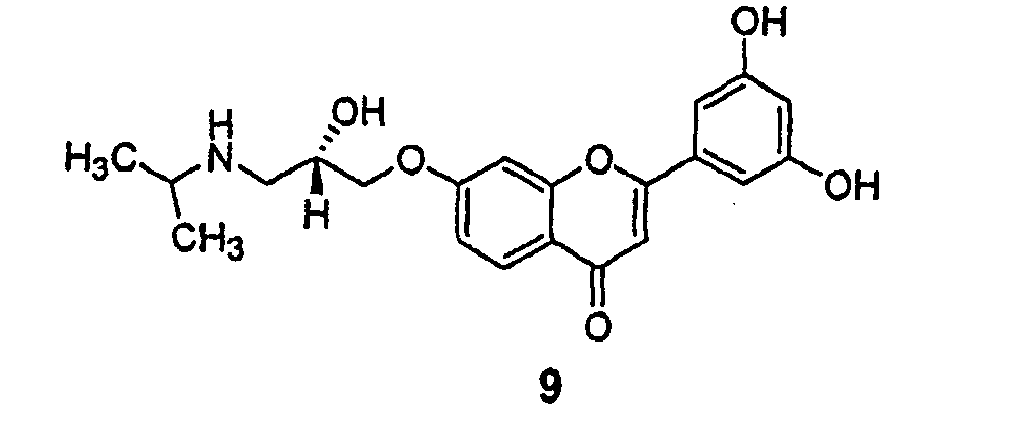
- Yet another aspect of the present disclosure provides a compound of formula (11) of configuration S.

- Still another aspect of the present disclosure provides a compound having formula I or a pharmaceutically acceptable salt thereof, wherein the representative compounds are:
- a) R-(-)-7-(3-tert-Butylamino-2-hydroxy-propoxy)-3', 5'-dibenzyloxy-flavone (4);
- b) S-(+) - 7- (3-tert-Butylamino-2-hydroxy-propoxy)-3', 5'-dibenzyloxy-flavone (7)
- c) R-(-)-7-(3-iso-propylamino-2-hydroxy-propoxy) - 3', 5'-dibenzyloxy - flavone (8);
- d) R-(-)-7-(3-iso-propylamino-2-hydroxy-propoxy) - 3', 5'-dihydroxy - flavone (9);
- e) S-(+)-7-(3-iso-Propylamino-2-hydroxy-propoxy) - 3', 5'-dibenzyloxy- flavone (10);
- f) S-(+)-7-(3-iso-Propylamino-2-hydroxy-propoxy) - 3', 5'-dihydroxy- flavone (11).
- Accordingly the present invention provides a process for preparation of compound of general formula I, comprising the steps of:
- (i) reacting substituted hydroxyflavone of general formula A wherein R1, R2 and R3 are selected from the group consisting of hydrogen, methyl or iso pentenyl; wherein R4, R5 and R6 are selected from the group consisting of O-alkyl, O-benzyl, O-substituted hydroxy, phenyl or combination thereof, with optically active R or S epichlorohydrin followed by reaction with a base to obtain the inverted 2,3-epoxy-propoxy-flavones of compound of formula B,

- (ii) heating the 2,3-epoxy-propoxy-flavones of the formula B as obtained in step (i) under reflux, with an amine in an alcohol to yield propanolamines of formula C wherein R' is selected from a group consisting of t-butyl amine, n-butylamine, isobutylamine, iso-propyl amine, 4-phenyl-piperazine-1-ylamine, 4-(2-methoxyphenyl)-piperazin-1-ylamine, and 3, 4-dimethoxy phenethyl amine,

- (iii) subjecting the propanolamine obtained in step (ii) for debenzylation using catalytic hydrogenation process to yield corresponding hydroxy flavone derived propanolamines of general formula C wherein R4, R5, and R6 are selected from the group of H, OH and O-methoxy.

- (iv) converting the compound of formula C into salts by known method.
- In an embodiment of the invention, the base is selected from the group consisting of sodium hydroxide, potassium hydroxide and benzyltriethylammonium hydroxide.
- In another embodiment of the invention, the amine used is selected from the group consisting of alkylamines from a group of cyclic and acyclic alkyl part.
- In another embodiment of the invention, the alcohol used is selected from the group consisting of ethanol and propanol.
- In another embodiment of the invention, the debenzylation is carried out using Pd-C as catalyst under hydrogen pressure ranging between 40-100 psi (276-690 kPa).
- In another embodiment of the invention, the salt of general formula is selected from the group consisting of hydrochloride, fumarate and tartrates
- Accordingly the present disclosure provides a method of treating type II diabetes and dislipidemia in mammals, said method comprising the step of administering pharmaceutically effective amount of compound of formula I, and salts thereof, optionally with the pharmaceutically acceptable exciepients.
- In an aspect of the disclosure, the pharmaceutically effective amount of compound of formula I is in the range of 10-100 mg. /kg-body weight.
- In another aspect of the disclosure, the subject may be selected from animals including human.
- In another embodiment of the invention, the compound of formula I showed maximum fall in blood glucose was recorded to be around 61.1% at a dose around 25 mg/kg body weight.
- In a further embodiment of the invention, the compound (S)-(+)-7-(3-tert-butylamino-2-hydroxypropoxy)-3', 5'-dibenzyloxyflavone (7) showed an elevation of 33.2% was measured in HDL-cholesterol level than the control ones at dose around 25 mg/kg body weight.
- In yet another embodiment of the invention, ED50 of compound of general formula I is in the range of 17.84 to 32.93 mg/kg.
- In another embodiment of the invention, the compound (S)-(+)-7-(3-tert-butylamino-2-hydroxypropoxy)-3', 5'-dibenzyloxyflavone (7) enhances HDL-C more than two folds as compared to the racemic compound at a dose of 25mg/kg body weight.
- Aryloxypropanolamines are well established pharmacophore for β-adrenergic receptors and therefore various enantioselective syntheses for example, using chiral glycerol-1, 2-acetonide [Danilewicz J.C., Kemp .J.E.G., J. Med. Chem., 16168 (1973)], glycidylarenesulfonate [Klunder J.M., Onami T. Sharpless K.B., J. Org. Chem 54, 1295 (1989)] or epi-chlorohydrin [Baldwin J.J., Raab A.W., Mensler K., Arison B.H.., McClure D. E., J.Org. Chem. 43, 4876 (1978)] and [Seki T., Kanada A., Nakao T., Shiraiwa M., Asano H., Miyazawa K., Ishimori T., Minami N., Shibata K., Yasuda K., Chem Pharma Bull 46(1), 84 (1998)] are known in literature. A phenoxide anion reacts with glycidyl derivative either at C-1 or C-3 depending on the reactivity substituent at allylic position of oxyrane. The attack at C-1 causes direct displacement of X (path a) in case of arenesulfonate whereas that at C-3 in case of epi-chlorohydrin causes epoxide ring opening, which following internal displacement of the leaving group X (path b) as shown in Fig I results the product of opposite configuration to path a. We synthesized the optical isomers of our product following path b.

- Therefore when the reaction of flavone was carried out with (R)-epi-chlorohydrin at 120°C without the solvent, the intermediate chlorohydrin was obtained in an excellent yield. The chlorohydrin without purification taken in toluene and treated with aqueous NaOH in presence of catalytic amount of phase transfer catalyst triethylbenzylammonium chloride (TEBA) to give S-isomer in 79% yield with 95% ee. Thus the nucleophilic substitution reaction at 120°C proceeded at the terminal C atom of the epoxide ring with high regioselectivity, probably via activating complexation (Fig II) as presumed by McClure D.E., Arison B.H., Baldwin J.J., J. Am. Chem. Soc., 101, 3666(1979).

- The epoxide thus obtained was treated with appropriate amine in methanol to yield desired amino propanol derivative. The purity of these compounds was ascertained by HPLC on comparison of the racemic mixture graph with that of the enantiomers graph. The HPLC study was performed on Chira Sphere NT (250 mm x 0.4 mm, 5µm, Merck) column using a mixture of solvent hexane: iso-propanol: methanol: ammonia (in a ratio of 60:40:5:0.5 ml) at the flow rate of 2ml/min and peak detection at 240 nm under UV. The graph of one of the mixtures and its enantiomers are given in figure III.

- A mixture of 3', 5'-dibenzyloxy-7-hydroxy flavone (1, 1.0 gm, 2.2 mmol) and (S)-epi-chlorohydrin (1.0 ml, 12.0 mmol) was stirred for about 2 hrs at 120°C. The cooled reaction mixture was taken in toluene and to this was added dropwise a solution of NaOH (10 mg, 0.25 mmol) and benzyltriethyl ammonium chloride (10 mg, 0.04 mmol) in water with stirring at room temperature for 2 hrs, and the organic layer was separated, dried over sodium sulphate and solvent evaporated under reduced pressure to give crude 3', 5'-dibenzyloxy-7-(2, 3-epoxy-propoxy) flavone (3) of R- configuration.
Yield (900 mg, 80%) - The above (R)-3', 5'-dibenzyloxy -7-(2, 3-epoxy-propoxy) flavone (600 mg, 4.9 mmol) and tert-butyl amine (0.26 ml, 9.8 mmol) in dry methanol (50 ml) was stirred at reflux for about 6 hrs. The solvent was evaporated at reduced pressure and the crude product was purified by column chomatography to afford (R)-(-) 7-(3-tert- butylamino-2-hydroxypropoxy)-3', 5'-dibenzyloxyflavone (4) Yield (650 mg, 93%); m.p 158°C; [α]D=- 8.6 (c=1.5%, CHCl3).

- A mixture of 3', 5 '-dibenzyloxy-7-hydroxy flavone (1) (1.2 g, 2.6 mmol) and (R)-epi- chlorohydrin (1.12 ml, 15.0 mmol) was stirred for about 2 hrs at 120°C. The cooled reaction mixture was taken in toluene and to this was added a solution of NaOH (15mg., 0.37mmol) and benzyltriethylammoniumchloride (15 mg, 0.06 mmol) in.water, stirred at room temperature for 2 hrs. The organic layer was separated, dried over sodium sulphate and solvent removed under reduced pressure to give crude (S)-(+)-7-(2, 3-epoxy-propoxy)- 3', 5'-dibenzyloxy flavone (6). Yield (1.12 g, 83%)
- The solution of above (S)-3', 5'-dibenzyloxy -7-(2, 3-epoxy-propoxy)-flavone (500 mg, 4.9 mmol) in dry methanol (50 ml) and tert-butyl amine (0.2 ml,9.8 mmol) was stirred at reflux for about 6 hrs. The solvent removed at reduced pressure and crude product was purified by column chromatography to afford (S)-(+)-7-(3-tert-butylamino-2-hydroxy-propoxy)-3' 5'-dibenzyloxy-flavone (7). Yield (520 mg, 93%); m.p165°; [α]D= +9.0 (c=20 mg/7.5 ml of CHCl3).

- A mixture of 3', 5'-dibenzyloxy-7-hydroxy-flavone (1) (1 g, 2.2 mmol) and S-epi-chlorohydrin (1.0 ml, 12.0 mmol) was stirred for about 2 hrs at 120 °C. The cooled mixture was taken in toluene and to this was added a solution of NaOH (10 mg, 0.25 mmol) and benzyltriethyl ammonium chloride (10 mg, 0.04 mmol) in water and stirred at room temperature for 2 hrs. The organic layer was separated, dried over sodium sulphate and evaporated under reduced pressure to give crude R-3', 5'-dibenzyloxy-7-(2, 3-epoxy-propoxy)-flavone (3). Yield (900 mg, 80%)
- The solution of above (R)-3', 5'-dibenzyloxy-7-(2,3-epoxy-propoxy)-flavone (600 mg,4.9 mmol) and iso- propylamine (0.5 ml,14.7 mmol) in dry methanol (50 ml) was stirred at reflux for about 6 hrs. The solvent was removed at reduced pressure and the crude product so obtained was purified by column chomatography to give (R) - 7-(2-hydroxy-3-isopropyl amino-propoxy)-3', 5'-dibenzyloxy flavone (8) Yield (550 mg, 79%)
- (R)-3', 5'-Dibenzyloxy-7-(2-hydroxy-3-isopropyl amino-propoxy) flavone (300 mg, 2.12 mmol) was shaken in dry methanol (40 ml) with 10 % Pd/C (quantity sufficient) under hydrogen atmosphere. The catalyst was filtered and the solvent removed under reduced pressure to give the product (R) -(+)-7-(2-hydroxy-3-isopropylamino-propoxy)- 3', 5'-dihydroxy flavone (9), Yield (200 mg, 98%) m.p; 124°C; [α]D = -9 (c=20 mg/ 7.5 ml of 2% CHCl3/MeOH).

- A mixture of 3', 5'-dibenzyloxy-7-hydroxyflavone (1.2 g, 2.6 mmol) and R-epi-chlorohydrin (1.2 ml, 15.0 mmol) was stirred for about 2 hrs at 120°. The cooled reaction mixture was taken in toluene and to this was added a solution of NaOH (15 mg,0.37 mol) and benzyltriethyl ammonium chloride (15 mg,0.06 mmol) in water and stirred at room temperature for 2 hrs. The organic layer was separated, dried over sodium sulphate and solvent removed under reduced pressure to give crude S-3', 5'-dibenzyloxy-7-(2, 3-epoxy-propoxy) flavone (6) Yield (1.12 g, 83%).
- The solution of above (S) -7-(2, 3-epoxy-propoxy)-3',5'-dibenzyloxy- flavone (500 mg, 4.9 mmol) and iso-propylamine(0.3 ml, 14.7 mmol) in dry methanol (50 ml) was stirred at reflux for about 6 hrs. The solvent removed at reduced at reduced pressure the crude product so obtained was purified by column chomatography to afford (S) - 7-(2-hydroxy-3-isopropyl amino-propoxy)-3', 5'-dibenzyloxy- flavone (10) Yield (440 mg,79%).
- (S)-7-(2-Hydroxy-3-isopropylamino-propoxy)-3',5'-dibenzyloxy-flavone (250 mg, 2.12 mmol) in dry methanol (40 ml) and 10% Pd/C (sufficient amount) was shaken in hydrogen atmosphere at about 40 psi (276 kPa). The catalyst was filtered and solvent removed to give the product (S)-(+) -7-(2-hydroxy-3-iso-propylamino-propoxy) - 3', 5'-dihydroxy-flavone (11) Yield (160 mg, 98%); m.p.130°C; [α]D=+15.4 (c=20 mg/ 7.5 ml of 2% CHCl3/MeOH).

- C57BL/KsBom-db/db mice (12 - 18 weeks old), weighing around 35 + g bred in the animal house of CDRI, Lucknow, were used in the present experiments. The mice were housed in groups of 3 to 5 (same sex) in a room controlled for temperature (23 ± 2.0 °C) and 12/12 hours light/dark cycle (lights on at 6.00 am). Body weight of each animal was measured daily from day 1 to day 10 of the experiment. All animals had free access to fresh water and normal pellet diet except on the day of the postprandial protocol (day 6) and during the overnight fast before the OGTT on day 10. The animals always had access to water during experimental periods. Blood glucose was checked every morning up till day 10. On day 10 an oral glucose tolerance test (OGTT) was performed after an overnight fasting. Blood glucose was measured at -30.0 min and test compounds were administered. The blood glucose was again measured at 0 min just post treatment and at this juncture glucose solution was given at a dose of 3 gm/kg to all the groups including the vehicle treated group. The blood glucose levels were checked at 30 min, 60 min, 90 min and 120 min post glucose administration. The data was analyzed for its significance on Prism software.
- It is evident from the data that compound (7, S-002-853 S) exhibit significant antihyperglycemic and antidyslipidemic activity in db/db mice at 25 mg/kg dose. At this dose it showed maximum fall in blood glucose profile at day 6 of treatment as shown in the table 1. The maximum percentage fall in blood glucose was recorded to be around 61.1%. Fig VIII shows the graphical presentation of blood glucose profile versus days of treatment at 25 mg/kg dose level. Fig IX and table 2 presents effect of the 10 days treatment of the compound on glucose tolerance of the db/db mice. This effect was calculated to be around 45.3 %.
- Table 3 and Fig X presents the antidyslipidemic activity profile of (S)-(+)-7-(3-tert-butylamino-2-hydroxy propoxy)-3', 5'-dibenzyloxyflavone (7, S-002-853 S) in db/db mice at 25 mg/kg dose level. A lowering in the case of serum cholesterol and triglycerides by the treatment of (S)-(+)-7-(3-tert-butylamino-2-hydroxylpropoxy)-3', 5'-dibenzyloxyflavone (7, S-002-853 S) was recorded which was around 21.8% and 14.5%, respectively, at 25 mg/kg dose. An elevation of 33.2% was measured in HDL-cholesterol level than the control ones while a decrease of around 29.4% was measured in LDL-cholesterol level in (S)-(+)-7-(3-tert-butylamino-2-hydroxypropoxy)-3', 5'-dibenzyloxyflavone (7, S-002-853 S) treated db/db mice at 25 mg/kg dose.
Table 1: Blood glucose profile of sham treated and (S)-(+)-7-(3-tert-butylamino-2-hydroxypropoxy)-3', 5'-dibenzyloxyflavone (7, S-002-853 S) treated db/db mice. Blood glucose (mM) days post treatment 1 2 3 4 5 6 7 8 9 Sham treated 22.4 ±1.69 25.0 ±3.24 21.4 ±5.07 23.6 ±3.81 19.8 ±4.63 19.4 ±5.12 22.2 ±5.91 20.8 ±4.80 19.1 ±4.10 S-002-853 (S) treated (25 mg/kg) 22.4 ±1.24 16.6 ±3.85 12.9 ±3.00 10.6 ±2.89 8.80 ±3.84 7.60 ±3.46 10.6 ±2.20 8.30 ±1.13 7.90 ±1.30 % change compared to control +0.20 -33.6 -39.5 -54.9 -55.6 -61.1 -52.2 -60.0 -58.5 Statistical significance ns ns ns p<0.05 P<0.05 p<0.05 p<0.05 p<0.05 p<0.05 
Table 2: Blood glucose profile of sham treated and (S)-(+)-7-(3-tert-butylamino-2-hydroxypropoxy)-3',5'-dibenzyloxyflavone (7, S-002-853 S) treated db/db mice. Blood glucose profile (mM) min post glucose load -30 0 30 60 90 120 Sham treated 8.09 ±0.63 8.28 ±0.63 29.0 ±2.06 31.5 ±0.91 23.8 ±2.73 21.1 ±3.36 S-002-853 S treated (25 mg/kg) 4.57 ±0.30 4.81 ±0.35 17.8 ±1.24 16.3 ±1.82 13.0 ±1.66 8.83 ±0.72 % change compared to control -43.5 -41.8 -38.6 -48.3 -45.5 -58.2 

Table 3: Serum lipid profile in sham treated and (S)-(+)-7-(3-tert-butylamino-2-hydroxypropoxy)-3',5'-dibenzyloxyflavone (7, S-002-853 S) treated db/db mice. Serum lipid profile (mg/dl) Triglycerides Cholesterol HDL-Chol Sham treated 135±3.32 238±24.6 37.2±1.92 S-002-853 S (25 mg/kg) 115±2.82 185±51.4 49.5±8.36 % change compared to control -14.5 -21.8 +33.2 - denotes decrease + denotes increase Values are Mean ±SE of 6 animals per group 
- Tables 4 and 6 presents antihyperglycemic and antidyslipidemic activity profile of the db/db mice treated with (S)-(+)-7-(3-tert-butylamino-2-hydroxypropoxy)-3',5'-dibenzyloxyflavone (7, S-002-853 S) at 10 mg/kg dose. Though, at this dose level it showed fall in blood glucose profile from day 3 of treatment and remained till the end of study. However, it was not statistically significant on any day post treatment. Fig XI shows the graphical presentation of blood glucose profile versus days of treatment at 10mg/kg dose level. Table 5 and Fig XII presents effect of the 10 days treatment of the compound on glucose tolerance of the db/db mice. This effect was calculated to be around 27.6% but was not statistically significant. Table 6 and fig XIII presents the antidyslipidemic activity profile of (S)-(+)-7-(3-tert-butylamino-2-hydroxypropoxy)-3', 5'-dibenzyloxyflavone (7, S-002-853 S) in db/db mice at 10 mg/kg dose level. A lowering in the case of serum cholesterol and triglycerides by the treatment of (S)-(+)-7-(3-tert-butylamino-2-hydroxypropoxy)-3', 5'-dibenzyloxyflavone (7, S-002-853 S) was recorded which was around 16.3% and 17.9%, respectively, at 10 mg/kg dose. An elevation of +17.4% was measured in HDL-cholesterol level than the control ones. These difference, however, were statistically insignificant.
Table 4: Blood glucose profile of sham treated and (S)-(+)-7-(3-tert-butylamino-2-hydroxypropoxy)-3',5'-dibenzyloxyflavone (7, S-002-853 S) treated db/db mice. Blood glucose (mM) days post treatment 1 2 3 4 5 6 7 8 9 Sham treated 19.7 ±2.11 20.4 ±2.84 21.9 ±2.66 21.3 ±2.21 22.1 ±1.36 20.4 ±3.55 20.8 ±3.82 23.5 ±3.88 12.4 ±2.04 S-002-853 (S) treated (10 mg/kg) 19.8 ±2.47 18.5 ±2.34 17.9 ±2.14 15.3 ±2.96 13.8 ±2.98 13.1 ±3.41 11.8 ±3.55 12.1 ±3.39 14.2 ±2.98 % change compared to control -0.9 -9.60 -18.6 -26.8 -35.0 -40.7 -42.0 -42.2 -39.4 Statistical significance ns ns ns ns ns ns ns ns ns 
Table 5: Blood glucose profile of sham and (S)-(+)-7-(3-tert-butylamino-2-hydroxypropoxy)-3',5'-dibenzyloxyflavone (7, S-002-853 S) treated db/db mice post oral glucose load. Blood glucose profile (mM) min post glucose load -30 0 30 60 90 120 Sham treated 11.0 ±2.02 12.4 ±2.04 28.7 ±2.67 25.3 ±3.89 16.6 ±2.45 10.4 ±0.43 S-002-853 (S) treated (10 mg/kg) 8.37 ±2.98 9.23 ±3.10 19.3 ±5.52 18.4 ±5.39 12.1 ±3.81 9.23 ±3.10 % change compared to control -23.9 -25.7 -32.8 -27.2 -26.9 -11.7 

Table 6: Serum lipid profile in sham treated and (S)-(+)-7-(3-tert-butylamino-2-hydroxypropoxy)-3',5'-dibenzyloxyflavone (7, S-002-853 S) treated db/db mice. Serum lipid profile (mg/dl) Triglycerides Cholesterol HDL-Chol Sham treated 134±12.7 104±8.27 56.0±2.45 S-002-853 (S) (10 mg/kg) 110±4.08 87.5±3.00 66.4±2.87 % change compared to control -17.9 -16.3 +17.4 - denotes decrease + denotes increase Values are Mean ±SE of 4 animals per group 
- Tables 7 and 9 present antihyperglycemic and antidyslipidemic activity profile of the db/db mice treated with (4, S-002-853 R) at 25 mg/kg dose. At this dose level, though the blood glucose profile of S-002-853 (R) treated mice was lowered from day 3 and it remained the same through the period of study. However, there was found no significant difference in the blood glucose profile between the two groups at any day. Fig XIV shows the graphical presentation of blood glucose profile versus days of treatment at 25 mg/kg dose level. There was also found no difference in oral glucose tolerance curve between the sham treated and S-002-853 (R) treated db/db mice. (Table 8; Figure XV). Table 9 presents the lipid profile of S-002-853 R and sham treated groups. There was found no significant lowering in either the case of serum cholesterol or triglycerides by the treatment of (R)-(-)-7-(3-tert-butylamino-2-hydroxypropoxy)-3',5'-dibenzyloxyflavone (4, S-002-853, R). There was also found no significant difference in the HDL-cholesterol levels between the sham and S-002-853 (R) treated groups (Table 9, fig XVI).
Table 7: Blood glucose profile of sham treated and (R)-(-)-7-(3-tert-butylamino-2-hydroxypropoxy)-3',5'-dibenzyloxyflavone (4, S-002-853 R) treated db/db mice. Blood glucose (mM) days post treatment 1 2 3 4 5 6 7 8 9 Sham treated 11.8 ±3.31 12.2 ±3.56 15.1 ±5.26 17.5 ±2.08 15.0 ±0.45 15.9 ±0.46 18.1 ±1.62 19.7 ±0.75 20.8 ±2.06 S-002-853 (R) treated (25 mg/kg) 12.0 ±2.52 12.4 ±2.65 10.3 ±1.33 13.3 ±4.61 12.3 ±4.32 12.1 ±3.82 14.5 ±5.49 13.4 ±4.54 13.5 ±4.66 % change compared to control +1.1 -31.9 -24.1 -18.1 -24.0 -19.8 -31.9 -35.4 -38.3 Statistical significance ns ns ns ns ns ns ns ns ns 
Table 8: Blood glucose profile of sham and (R)-(-)-7-(3-tert-butylamino-2-hydroxypropoxy)-3',5'-dibenzyloxyflavone (4,S-002-853 R) treated db/db mice post oral glucose load. Blood glucose profile (mM) min post glucose load -30 0 30 60 90 120 Sham treated 16.5 ±8.08 21.0 ±5.81 33.1 ±0.45 25.9 ±0.31 21.0 ±2.68 18.4 ±2.39 S-002-853 (R) treated (25 mg/kg) 13.6 ±0.46 20.3 ±4.74 34.3 ±16.9 25.9 ±9.75 24.5 ±9.13 23.0 ±10.0 % change compared to control -17.4 -3.30 +3.70 0.00 +17.0 +24.9 Blood glucose values are Mean ± SE of 3 animals per group. Significance: ns: not significant 
Table 9: Serum lipid profile in sham and (R)-(-)-7-(3-tert-butylamino-2-hydroxypropoxy)-3',5'-dibenzyloxyflavone (4, S-002-853 R) treated db/db mice. Serum lipid profile (mg/dl) Triglycerides Cholesterol HDL-Chol Sham treated 147.0±30.6 150.0±4.51 53.6±4.93 S-002-853 (R) treated (25 mg/kg) 132.0±11.5 144.0±7.37 58.0±6.24 % change compared to control -9.72 -3.72 +8.06 Values are Mean ± SE of 3 animals per group 
- Table 10 presents the blood glucose profile of sham and S-002-857 S treated db/db mice. It is evident from the results that S-002-857 (S) treatment lowered the blood glucose profile of db/db mice. It is evident from the results that 25.0 mg/kg S-002-857 (S) treatment lowered the blood glucose profile from day 4th and continued till the end. An average blood glucose lowering was calculated to be around 20 % in this case with S-002-857 (S). The lowering in blood glucose was statistically significant from day 7 to 9 where around 37.4, 36.8 and 43.3 % effect was observed. Figure XVII is the graphical presentation of blood glucose profile versus days of treatment at 25 mg/kg dose level. Table 11 and figure XVIII presents the oral glucose tolerance curves of sham treated and S-002-857 (S) treated db/db mice. An overall improvement of 27 % was evident in the case with S-002-857 (S) at 25.0 mg/kg compared to sham treated group
- Table 12 and figure XIX presents the lipid profile of sham and S-002-857 S treated db/db mice. It is evident from the result that 25.0 mg/kg S-002-857 S) treated db/db mice had though lowered serum cholesterol, triglycerides profile compared to sham treated db/db mice but these profiles were not statistically significant. However, an elevation of 17.3% was noted in HDL-cholesterol level in S-002-857 (S) treated db/db mice compared to the sham treated controls.
Table 10: Blood glucose profile of sham treated and (S)-(+) -7-(2-Hydroxy-3-isopropyl aminopropoxy)- 3', 5'-dihydroxy flavone (11, S-002-857 S) treated db/db mice. Blood glucose (mM) days post treatment 1 2 3 4 5 6 7 8 9 Sham treated 12.5 ±1.94 12.4 ±1.90 12.5 ±1.97 13.0 ±2.40 13.6 ±3.43 13.0 ±1.65 15.0 ±1.39 14.7 ±2.69 13.3 ±3.18 S-002-857 (S) treated (25 mg/kg) 12.7 ±2.61 12.3 ±2.40 11.5 ±1.80 11.3 ±2.54 10.1 ±2.08 9.19 ±2.25 9.41 ±1.37 9.28 ±1.02 7.56 ±2.13 % change compared to control -1.60 -0.80 -8.13 -12.7 -25.3 -29.1 -37.4 -36.8 -43.3 Statistical significance ns ns ns ns ns ns p<0.05 p<0.05 p<0.05 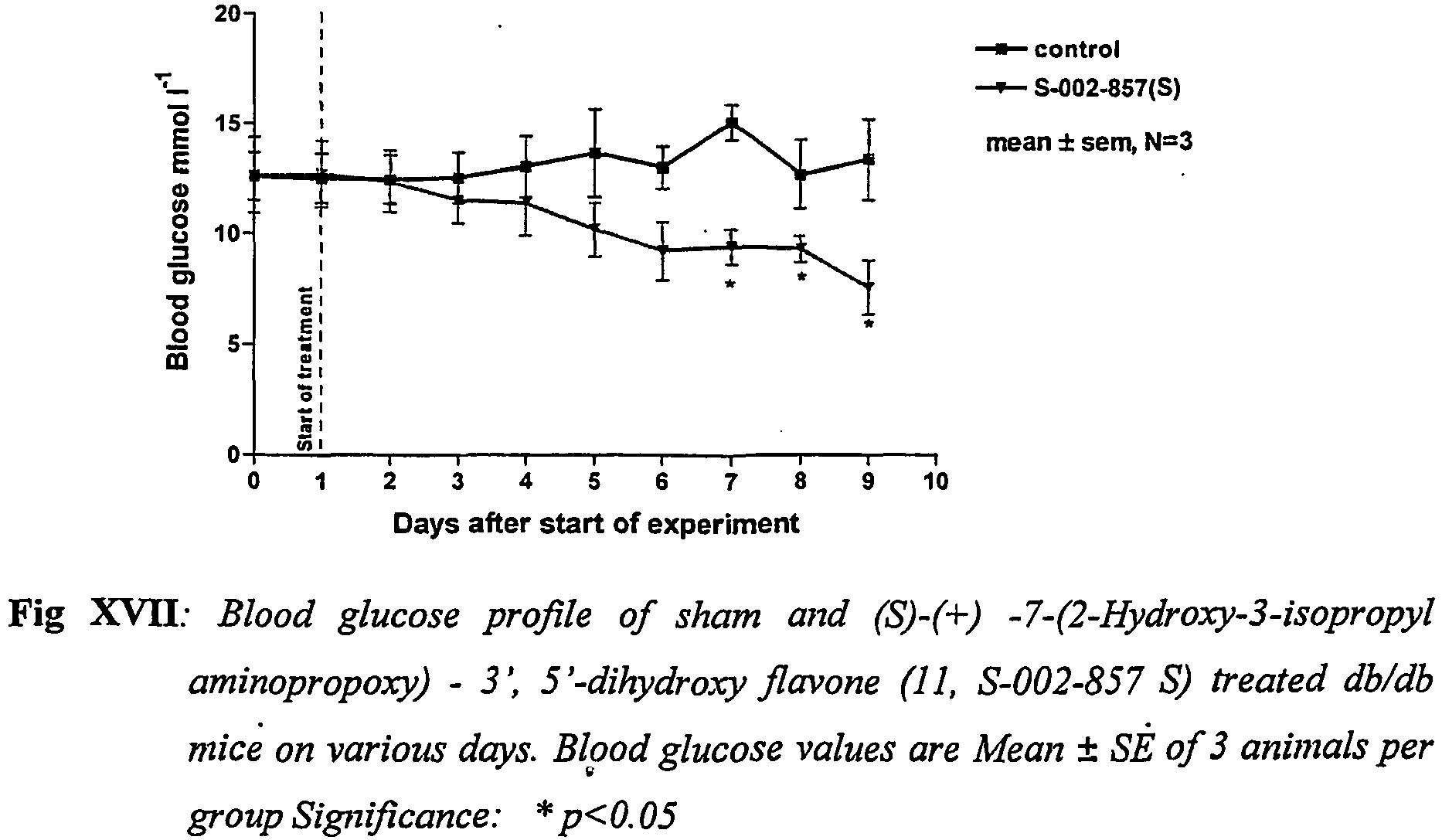
Table 11: Blood glucose profile of sham and (S)-(+) -7-(2-Hydroxy-3-isopropyl aminopropoxy)-3', 5'-dihydroxy flavone (11, S-002-857 S) treated db/db mice post oral glucose load. . Blood glucose (mM) min post glucose load -30 0 30 60 90 120 Sham treated 12.9 ±2.70 17.6 ±5.59 33.2 ±0.19 27.2 ±1.54 22.3 ±0.55 18.7 ±1.64 S-002-857 (S) treated (25 mg/kg) 8.76 ±1.90 13.8 ±2.18 25.3 ±0.58 19.8 ±1.20 15.2 ±0.48 11.6 ±0.58 % change compared to control -32.2 -21.1 -23.7 -26.9 -31.5 -37.6 
Table 12: Serum lipid profile in sham and (S)-(+) -7-(2-Hydroxy-3-isopropyl aminopropoxy)-3',5'-dihydroxyflavone (11, S-002-857 S) treated db/db mice. Serum lipid profile (mg/dl) Triglycerides Cholesterol HDL-Chol Sham treated 133±7.00 171±4.73 56.0±1.00 S-002-857 (S) (25 mg/kg) 124±3.51 152±7.00 65.0±6.03 % change compared to control -6.54 -11.2 +17.3 3', 5'-dihydroxy flavone (11, S-002-857 S) treated db/db mice. Values are
Mean ± SE of 3 animals per group. - Table 13 presents the blood glucose profile of sham and 25.0 mg/kg S-002-857 R treated db/db mice. A marginal fall in blood glucose profile was observed from day 4th in S-002-857 R treated db/db mice compared to sham treated ones, which more or less remained the same till the end of the study. Figure XX is the graphical presentation of blood glucose profile versus days of treatment of vehicle and S-002-857 R at 25 mg/kg dose level, respectively. There was no significant effect on blood glucose profile was observed on any day post treatment. Table 14 and figure XXI presents the effect of S-002-857 (R) on glucose tolerance of the db/db mice. Though, slight improvement in glucose tolerance was observed in db/db mice treated with 25.0 mg/kg S-002-857 R but it was not found statistically significant.
- Table 15 and figure XXII present the lipid profiles of sham and S-002-857 R treated db/db mice. There was found no statistically significant difference between the serum cholesterol, triglycerides and HDL-cholesterol levels of sham and 25.0 mg/kg S-002-857 R treated db/db mice.
Table 13: Blood glucose profile of (R)-(-)-7-(2-hydroxy-3-isopropyl aminopropoxy)-3',5'-dihydroxyflavone (9, S-002-857 R) treated db/db mice compared to sham treated control. Blood glucose (mM) days post treatment 1 2 3 4 5 6 7 8 9 10 Sham treated 12.5 ±1.94 12.4 ±1.90 12.5 ±1.97 13.0 ±2.40 13.6 ±3.43 13.0 ±1.65 15.0 ±1.39 1.2.7 ±2.69 13.3 ±3.18 12.9 ±2.70 S-002-857 R treated (25 mg/kg) 12.5 ±2.55 12.3 ±2.67 12.1 ±2.02 11.5 ±1.86 11.9 ±2.74 11.6 ±2.73 11.7 ±1.78 11.0 ±0.35 11.5 ±1.00 11.9 ±5.21 % change compared to control 0.0 -1.25 -3.28 -11.5 -13.1 -10.7 -22.0 -13.4 -14.0 -8.30 Statistical significance ns ns ns ns ns ns ns ns ns ns 

Table 14: Blood glucose profile of sham and (R)-(-)-7-(2-hydroxy-3-isopropyl aminopropoxy)-3',5'-dihydroxyflavone (9, S-002-857 R) treated db/db mice post oral glucose load. Blood glucose profile (mM) min post glucose load -30 0 30 60 90 120 Sham treated 12.9 ±2.70 17.6 ±5.59 33.2 ±0.19 27.2 ±1.54 22.3 ±0.55 18.7 ±1.64 S-002-857 (R) treated (25 mg/kg) 11.8 ±5.21 16.3 ±3.91 27.6 ±1.53 24.4 ±2.99 20.6 ±2.08 16.0 ±1.73 % change compared to control -8.31 -7.05 -16.7 -10.0 -7.39 -14.3 
Table 15: Serum lipid profile in sham and (R)-(-) - 7-(2-Hydroxy-3-isopropyl aminopropoxy)-3',5'-dihydroxy flavone (9, S-002-857 R) treated db/db mice. Serum lipid profile (mg/dl) Triglycerides Cholesterol HDL-Chol Sham treated 133±7.00 171±4.73 56.0±1.00 S-002-857 (R) treated (25 mg/kg) 130±3.06 160±6.66 59.0±2.65 % change compared to control -1.72 -6.18 +5.35 
- Table 16 and 17 presents the comparative antihyperglycemic and antihyperlipidemic profiles of racemic mixture and the two isomers of S-002-853 in db/db mice. It is evident from the data that S-isomer has marked antihyperglycemic and antihyperlipidemic effect compared to racemic mixture at 25.0 mg/kg dose. R-isomer has insignificant antihyperglycemic or antihyperlipidemic effects
Table 16. Comparative antihyperlipidemic activity of S-002 853 (S), S-002 853 (R) with S-002-853 (racemic mixture) Test dose (mg/kg) S-002-853 (Racemic) S-002-853 (S) S-002-853 (R) TG T-Chol HDL-C TG T-Chol HDL-C TG T-Chol HDL-C 10 13.9* 824 +3.03ns 17.9* 163* +17.4ns - - - 25 -10.1* -4.47 +16.2ns 14.5** 27.8* +33.2* -9.72ns -3.72ns +8.06ns Significance *p<0.05** p<0.01 ns: not significant Table 17. Comparative antihyperglycemic activity of S-002 853 (S), S-002 853 (R) with S-002-853 (raceme mixture) Test dose (mg/kg) S-002-853 (Racemic) S-002-853 (S) S-002-853 (R) Average Fall Day 10 (OGTT) Average Fall Day 10 (GTT) Average Fall Day 10 (OGTT) 10 44.6* (day 6) 15.4* 42.2* (day 8) 27.6* ND ND 25 57.7** (day 7) 35.8* 61.1** (day 6) 45.3** 38.3ns +4.24ns ND: Not done, Significance *p<0.05 **p<0.01 ns: not significant
Claims (13)
- An optically active compound selected from the group consisting of:(a) S-(+)-7-(3-tert-Butylamino-2-hydroxy-propoxy)-3',5'-dibenzyloxy-flavone (7);(b) S-(+)-7-(3-iso-Propylamino-2-hydroxy-propoxy)-3',5'-dibenzyloxy-flavone (10); or(c) S-(+)-7-(3-iso-Propylamino-2-hydroxy-propoxy)-3',5'-dihydroxy-flavone (11).
- A compound according to claim 1, wherein the compound is;

- A compound according to claim 1, wherein the compound is;

- A compound according to claim 1, wherein the salt of the compound is selected from group consisting of hydrochloride, succinates, fumarates and tartrates.
- A compound according to claim 1, wherein the compound exhibits antidiabetic and lipid lowering activity at a dose ranging between 10-250 mg /Kg-body weight.
- A process for preparation of a compound according to claim 1, comprising the steps of:(i) reacting substituted hydroxyflavone of general formula A wherein R1, R2 and R3 are selected from the group consisting of hydrogen, methyl or iso pentenyl; wherein R4, R5 and R6 are selected from the group consisting of O-alkyl, O-benzyl, O-substituted hydroxy, phenyl or combination thereof, with optically active S epichlorohydrin followed by reaction with a base to obtain the inverted 2,3-epoxy propoxy-flavones of compound of formula B,
 (ii) heating the 2,3-epoxy-propoxy-flavones of the formula B as obtained in step (i) under reflux, with an amine in an alcohol to yield propanolamines of formula C wherein R is selected from a group consisting of t-butyl amine, n-butylamine, isobutylamine, iso-propyl amine, 4-phenyl-piperazine-1-ylamine, 4-(2-methoxyphenyl)-piperazin-1-ylamine, and 3, 4-dimethoxy phenethyl amine,
 (iii) subjecting the propanolamine obtained in step (ii) for debenzylation using catalytic hydrogenation process to yield corresponding hydroxy flavone derived propanolamines of general formula C wherein R4, R5, and R6 are selected from the group of H, OH and O-methoxy.
 (iv) converting the compound of formula C into salts by known method, preferably wherein the base is selected from the group consisting of sodium hydroxide, potassium hydroxide and benzyltriethylammonium hydroxide.
 - A process according to claim 6, wherein the amine used is selected from the group consisting of alkylamines from a group of cyclic and acyclic alkyl part.
- A process according to claim 6, wherein the alcohol used is selected from the group consisting of ethanol and propanol.
- A process according to claim 6, wherein the debenzylation is carried out sing Pd-C as catalyst under hydrogen pressure ranging between 40-100 psi (276-690 kPa).
- A process according to claim 6, wherein the salt of general formula is selected from the group consisting of hydrochloride, fumarate and tartrates.
- A compound according to any one of claims 1 to 5 for use in a method of treating type II diabetes and dislipidemia in mammals, said method comprising the step of administering a pharmaceutically effective amount of the compound, optionally with the pharmaceutically acceptable exciepients.
- The compound according to claim 11, wherein the pharmaceutically effective amount of the compound is in the range of 10-100 mg. /kg-body weight.
- The method according to claim 11, wherein ED50 of the compound is in the range of 17.84 to 32.93 mg/kg.
Applications Claiming Priority (2)
| Application Number | Priority Date | Filing Date | Title |
|---|---|---|---|
| IN1803DE2006 | 2006-08-09 | ||
| PCT/IN2007/000326 WO2008018089A1 (en) | 2006-08-09 | 2007-08-02 | R-(-) / s-(+)-7-[3-n-substituted amino-2-hydroxypropoxy] flavones |
Publications (2)
| Publication Number | Publication Date |
|---|---|
| EP2057137A1 EP2057137A1 (en) | 2009-05-13 |
| EP2057137B1 true EP2057137B1 (en) | 2013-10-23 |
Family
ID=38728911
Family Applications (1)
| Application Number | Title | Priority Date | Filing Date |
|---|---|---|---|
| EP07805638.9A Not-in-force EP2057137B1 (en) | 2006-08-09 | 2007-08-02 | S-(+)-7-[3-n-substituted amino-2-hydroxypropoxy]flavones |
Country Status (4)
| Country | Link |
|---|---|
| US (1) | US20110077294A1 (en) |
| EP (1) | EP2057137B1 (en) |
| ES (1) | ES2443041T3 (en) |
| WO (1) | WO2008018089A1 (en) |
Family Cites Families (3)
| Publication number | Priority date | Publication date | Assignee | Title |
|---|---|---|---|---|
| CA1188311A (en) | 1981-05-01 | 1985-06-04 | Edwin S. Wu | Antihypertensive agents |
| US4889941A (en) | 1987-04-23 | 1989-12-26 | Fisons Corporation | Synthetic flavonoids as inhibitors of leukotrienes and 5-lipoxygenase |
| US7635779B2 (en) * | 2004-10-15 | 2009-12-22 | Council Of Scientific & Industrial Research | Oxy substituted flavones as antihyperglycemic and antidyslipidemic agents |
-
2007
- 2007-08-02 WO PCT/IN2007/000326 patent/WO2008018089A1/en not_active Ceased
- 2007-08-02 EP EP07805638.9A patent/EP2057137B1/en not_active Not-in-force
- 2007-08-02 ES ES07805638.9T patent/ES2443041T3/en active Active
- 2007-08-02 US US12/376,909 patent/US20110077294A1/en not_active Abandoned
Also Published As
| Publication number | Publication date |
|---|---|
| WO2008018089A1 (en) | 2008-02-14 |
| WO2008018089A9 (en) | 2014-12-31 |
| ES2443041T3 (en) | 2014-02-17 |
| EP2057137A1 (en) | 2009-05-13 |
| US20110077294A1 (en) | 2011-03-31 |
Similar Documents
| Publication | Publication Date | Title |
|---|---|---|
| JP3906935B2 (en) | N-substituted dioxothiazolidylbenzamide derivative and process for producing the same | |
| IE62159B1 (en) | Agents for lowering the blood pressure | |
| JPH0579057B2 (en) | ||
| EA016026B1 (en) | 3-(1,3-benzodioxol-5-yl)-6-(4-cyclopropylpiperazin-1-yl)-pyridazine, its salts and solvates and its use as histamine h3 receptor antagonist | |
| JP2017081957A (en) | Compound | |
| CN112714761A (en) | Compounds useful as chaperone mediated modulators of autophagy | |
| KR20050044673A (en) | Novel crystalline polymorph of venlafaxine hydrochloride and methods for the preparation thereof | |
| US20110077294A1 (en) | R-(-) / s-(+)-7-[3-n substituted amino-2 hydroxypropoxy] flavones | |
| US20110003808A1 (en) | Octahydroquinolizines for antidiabetic treatment | |
| JP2012505166A (en) | 1-Butyl-2-hydroxyaralkylpiperazine derivatives and their use as antidepressants | |
| JP2001503753A (en) | Aryloxypropanolamine derivatives, their production and use | |
| EP0139921B1 (en) | 2-phenylethylamine derivatives | |
| KR102175744B1 (en) | Composition for inhibiting advanced glycation end product comprising homoisoflavonoid compounds as an active ingredient | |
| EP2716637B1 (en) | Mangiferin aglycone crystal form i and preparation method thereof | |
| CN111233820B (en) | Fingolimod derivative containing crown ether and di (2-methoxyethoxy) structure | |
| CN103796994B (en) | Piperazine derivatives and their preparation methods and their application in the treatment of insulin resistance | |
| JP5496913B2 (en) | Compounds for the treatment of metabolic disorders | |
| EP1807408B1 (en) | Oxy substituted flavones as antihyperglycemic and antidyslipidemic agents | |
| CN116655598B (en) | Medicine for reducing blood sugar and preparation method thereof | |
| WO2011075935A1 (en) | Diphenylethene derivatives and uses thereof | |
| HU191755B (en) | Process for producing spiro-chroman-imidazolidine derivatives | |
| JPS6112689A (en) | Cyclic amide, manufacture and pharmaceutical composition fortreating or preventing complication of diabetes and galactosemia | |
| JPS61197581A (en) | Hydantoin derivative | |
| CN1218049A (en) | Chromene derivatives and salts thereof, and pharmaceuticals containing the same | |
| CN120837463A (en) | Compounds and applications for treating obesity and related diseases |
Legal Events
| Date | Code | Title | Description |
|---|---|---|---|
| PUAI | Public reference made under article 153(3) epc to a published international application that has entered the european phase |
Free format text: ORIGINAL CODE: 0009012 |
|
| 17P | Request for examination filed |
Effective date: 20090309 |
|
| AK | Designated contracting states |
Kind code of ref document: A1 Designated state(s): AT BE BG CH CY CZ DE DK EE ES FI FR GB GR HU IE IS IT LI LT LU LV MC MT NL PL PT RO SE SI SK TR |
|
| AX | Request for extension of the european patent |
Extension state: AL BA HR MK RS |
|
| 17Q | First examination report despatched |
Effective date: 20111206 |
|
| DAX | Request for extension of the european patent (deleted) | ||
| GRAP | Despatch of communication of intention to grant a patent |
Free format text: ORIGINAL CODE: EPIDOSNIGR1 |
|
| INTG | Intention to grant announced |
Effective date: 20130327 |
|
| GRAS | Grant fee paid |
Free format text: ORIGINAL CODE: EPIDOSNIGR3 |
|
| GRAA | (expected) grant |
Free format text: ORIGINAL CODE: 0009210 |
|
| AK | Designated contracting states |
Kind code of ref document: B1 Designated state(s): AT BE BG CH CY CZ DE DK EE ES FI FR GB GR HU IE IS IT LI LT LU LV MC MT NL PL PT RO SE SI SK TR |
|
| REG | Reference to a national code |
Ref country code: GB Ref legal event code: FG4D |
|
| REG | Reference to a national code |
Ref country code: CH Ref legal event code: EP Ref country code: CH Ref legal event code: NV Representative=s name: E. BLUM AND CO. AG PATENT- UND MARKENANWAELTE , CH |
|
| REG | Reference to a national code |
Ref country code: AT Ref legal event code: REF Ref document number: 637535 Country of ref document: AT Kind code of ref document: T Effective date: 20131115 |
|
| REG | Reference to a national code |
Ref country code: IE Ref legal event code: FG4D |
|
| REG | Reference to a national code |
Ref country code: DE Ref legal event code: R096 Ref document number: 602007033485 Country of ref document: DE Effective date: 20131219 |
|
| REG | Reference to a national code |
Ref country code: ES Ref legal event code: FG2A Ref document number: 2443041 Country of ref document: ES Kind code of ref document: T3 Effective date: 20140217 |
|
| REG | Reference to a national code |
Ref country code: NL Ref legal event code: VDEP Effective date: 20131023 |
|
| REG | Reference to a national code |
Ref country code: AT Ref legal event code: MK05 Ref document number: 637535 Country of ref document: AT Kind code of ref document: T Effective date: 20131023 |
|
| REG | Reference to a national code |
Ref country code: LT Ref legal event code: MG4D |
|
| PG25 | Lapsed in a contracting state [announced via postgrant information from national office to epo] |
Ref country code: SE Free format text: LAPSE BECAUSE OF FAILURE TO SUBMIT A TRANSLATION OF THE DESCRIPTION OR TO PAY THE FEE WITHIN THE PRESCRIBED TIME-LIMIT Effective date: 20131023 Ref country code: BE Free format text: LAPSE BECAUSE OF FAILURE TO SUBMIT A TRANSLATION OF THE DESCRIPTION OR TO PAY THE FEE WITHIN THE PRESCRIBED TIME-LIMIT Effective date: 20131023 Ref country code: NL Free format text: LAPSE BECAUSE OF FAILURE TO SUBMIT A TRANSLATION OF THE DESCRIPTION OR TO PAY THE FEE WITHIN THE PRESCRIBED TIME-LIMIT Effective date: 20131023 Ref country code: LT Free format text: LAPSE BECAUSE OF FAILURE TO SUBMIT A TRANSLATION OF THE DESCRIPTION OR TO PAY THE FEE WITHIN THE PRESCRIBED TIME-LIMIT Effective date: 20131023 Ref country code: FI Free format text: LAPSE BECAUSE OF FAILURE TO SUBMIT A TRANSLATION OF THE DESCRIPTION OR TO PAY THE FEE WITHIN THE PRESCRIBED TIME-LIMIT Effective date: 20131023 Ref country code: IS Free format text: LAPSE BECAUSE OF FAILURE TO SUBMIT A TRANSLATION OF THE DESCRIPTION OR TO PAY THE FEE WITHIN THE PRESCRIBED TIME-LIMIT Effective date: 20140223 |
|
| PG25 | Lapsed in a contracting state [announced via postgrant information from national office to epo] |
Ref country code: LV Free format text: LAPSE BECAUSE OF FAILURE TO SUBMIT A TRANSLATION OF THE DESCRIPTION OR TO PAY THE FEE WITHIN THE PRESCRIBED TIME-LIMIT Effective date: 20131023 Ref country code: AT Free format text: LAPSE BECAUSE OF FAILURE TO SUBMIT A TRANSLATION OF THE DESCRIPTION OR TO PAY THE FEE WITHIN THE PRESCRIBED TIME-LIMIT Effective date: 20131023 Ref country code: CY Free format text: LAPSE BECAUSE OF FAILURE TO SUBMIT A TRANSLATION OF THE DESCRIPTION OR TO PAY THE FEE WITHIN THE PRESCRIBED TIME-LIMIT Effective date: 20131023 |
|
| PG25 | Lapsed in a contracting state [announced via postgrant information from national office to epo] |
Ref country code: PT Free format text: LAPSE BECAUSE OF FAILURE TO SUBMIT A TRANSLATION OF THE DESCRIPTION OR TO PAY THE FEE WITHIN THE PRESCRIBED TIME-LIMIT Effective date: 20140224 |
|
| REG | Reference to a national code |
Ref country code: DE Ref legal event code: R097 Ref document number: 602007033485 Country of ref document: DE |
|
| PG25 | Lapsed in a contracting state [announced via postgrant information from national office to epo] |
Ref country code: EE Free format text: LAPSE BECAUSE OF FAILURE TO SUBMIT A TRANSLATION OF THE DESCRIPTION OR TO PAY THE FEE WITHIN THE PRESCRIBED TIME-LIMIT Effective date: 20131023 |
|
| PG25 | Lapsed in a contracting state [announced via postgrant information from national office to epo] |
Ref country code: PL Free format text: LAPSE BECAUSE OF FAILURE TO SUBMIT A TRANSLATION OF THE DESCRIPTION OR TO PAY THE FEE WITHIN THE PRESCRIBED TIME-LIMIT Effective date: 20131023 Ref country code: RO Free format text: LAPSE BECAUSE OF FAILURE TO SUBMIT A TRANSLATION OF THE DESCRIPTION OR TO PAY THE FEE WITHIN THE PRESCRIBED TIME-LIMIT Effective date: 20131023 Ref country code: SK Free format text: LAPSE BECAUSE OF FAILURE TO SUBMIT A TRANSLATION OF THE DESCRIPTION OR TO PAY THE FEE WITHIN THE PRESCRIBED TIME-LIMIT Effective date: 20131023 Ref country code: CZ Free format text: LAPSE BECAUSE OF FAILURE TO SUBMIT A TRANSLATION OF THE DESCRIPTION OR TO PAY THE FEE WITHIN THE PRESCRIBED TIME-LIMIT Effective date: 20131023 Ref country code: IT Free format text: LAPSE BECAUSE OF FAILURE TO SUBMIT A TRANSLATION OF THE DESCRIPTION OR TO PAY THE FEE WITHIN THE PRESCRIBED TIME-LIMIT Effective date: 20131023 |
|
| PLBE | No opposition filed within time limit |
Free format text: ORIGINAL CODE: 0009261 |
|
| STAA | Information on the status of an ep patent application or granted ep patent |
Free format text: STATUS: NO OPPOSITION FILED WITHIN TIME LIMIT |
|
| PG25 | Lapsed in a contracting state [announced via postgrant information from national office to epo] |
Ref country code: DK Free format text: LAPSE BECAUSE OF FAILURE TO SUBMIT A TRANSLATION OF THE DESCRIPTION OR TO PAY THE FEE WITHIN THE PRESCRIBED TIME-LIMIT Effective date: 20131023 |
|
| 26N | No opposition filed |
Effective date: 20140724 |
|
| REG | Reference to a national code |
Ref country code: DE Ref legal event code: R097 Ref document number: 602007033485 Country of ref document: DE Effective date: 20140724 |
|
| PG25 | Lapsed in a contracting state [announced via postgrant information from national office to epo] |
Ref country code: SI Free format text: LAPSE BECAUSE OF FAILURE TO SUBMIT A TRANSLATION OF THE DESCRIPTION OR TO PAY THE FEE WITHIN THE PRESCRIBED TIME-LIMIT Effective date: 20131023 |
|
| PG25 | Lapsed in a contracting state [announced via postgrant information from national office to epo] |
Ref country code: LU Free format text: LAPSE BECAUSE OF FAILURE TO SUBMIT A TRANSLATION OF THE DESCRIPTION OR TO PAY THE FEE WITHIN THE PRESCRIBED TIME-LIMIT Effective date: 20140802 Ref country code: MC Free format text: LAPSE BECAUSE OF FAILURE TO SUBMIT A TRANSLATION OF THE DESCRIPTION OR TO PAY THE FEE WITHIN THE PRESCRIBED TIME-LIMIT Effective date: 20131023 |
|
| REG | Reference to a national code |
Ref country code: IE Ref legal event code: MM4A |
|
| PG25 | Lapsed in a contracting state [announced via postgrant information from national office to epo] |
Ref country code: IE Free format text: LAPSE BECAUSE OF NON-PAYMENT OF DUE FEES Effective date: 20140802 |
|
| PG25 | Lapsed in a contracting state [announced via postgrant information from national office to epo] |
Ref country code: BG Free format text: LAPSE BECAUSE OF FAILURE TO SUBMIT A TRANSLATION OF THE DESCRIPTION OR TO PAY THE FEE WITHIN THE PRESCRIBED TIME-LIMIT Effective date: 20131023 |
|
| PG25 | Lapsed in a contracting state [announced via postgrant information from national office to epo] |
Ref country code: GR Free format text: LAPSE BECAUSE OF FAILURE TO SUBMIT A TRANSLATION OF THE DESCRIPTION OR TO PAY THE FEE WITHIN THE PRESCRIBED TIME-LIMIT Effective date: 20131023 Ref country code: MT Free format text: LAPSE BECAUSE OF FAILURE TO SUBMIT A TRANSLATION OF THE DESCRIPTION OR TO PAY THE FEE WITHIN THE PRESCRIBED TIME-LIMIT Effective date: 20131023 |
|
| PG25 | Lapsed in a contracting state [announced via postgrant information from national office to epo] |
Ref country code: HU Free format text: LAPSE BECAUSE OF FAILURE TO SUBMIT A TRANSLATION OF THE DESCRIPTION OR TO PAY THE FEE WITHIN THE PRESCRIBED TIME-LIMIT; INVALID AB INITIO Effective date: 20070802 Ref country code: TR Free format text: LAPSE BECAUSE OF FAILURE TO SUBMIT A TRANSLATION OF THE DESCRIPTION OR TO PAY THE FEE WITHIN THE PRESCRIBED TIME-LIMIT Effective date: 20131023 |
|
| REG | Reference to a national code |
Ref country code: FR Ref legal event code: PLFP Year of fee payment: 10 |
|
| PGFP | Annual fee paid to national office [announced via postgrant information from national office to epo] |
Ref country code: CH Payment date: 20160822 Year of fee payment: 10 Ref country code: GB Payment date: 20160822 Year of fee payment: 10 Ref country code: DE Payment date: 20160819 Year of fee payment: 10 |
|
| PGFP | Annual fee paid to national office [announced via postgrant information from national office to epo] |
Ref country code: FR Payment date: 20160819 Year of fee payment: 10 |
|
| PGFP | Annual fee paid to national office [announced via postgrant information from national office to epo] |
Ref country code: ES Payment date: 20160825 Year of fee payment: 10 |
|
| REG | Reference to a national code |
Ref country code: DE Ref legal event code: R119 Ref document number: 602007033485 Country of ref document: DE |
|
| REG | Reference to a national code |
Ref country code: CH Ref legal event code: PL |
|
| GBPC | Gb: european patent ceased through non-payment of renewal fee |
Effective date: 20170802 |
|
| PG25 | Lapsed in a contracting state [announced via postgrant information from national office to epo] |
Ref country code: CH Free format text: LAPSE BECAUSE OF NON-PAYMENT OF DUE FEES Effective date: 20170831 Ref country code: LI Free format text: LAPSE BECAUSE OF NON-PAYMENT OF DUE FEES Effective date: 20170831 |
|
| REG | Reference to a national code |
Ref country code: FR Ref legal event code: ST Effective date: 20180430 |
|
| PG25 | Lapsed in a contracting state [announced via postgrant information from national office to epo] |
Ref country code: DE Free format text: LAPSE BECAUSE OF NON-PAYMENT OF DUE FEES Effective date: 20180301 Ref country code: GB Free format text: LAPSE BECAUSE OF NON-PAYMENT OF DUE FEES Effective date: 20170802 |
|
| PG25 | Lapsed in a contracting state [announced via postgrant information from national office to epo] |
Ref country code: FR Free format text: LAPSE BECAUSE OF NON-PAYMENT OF DUE FEES Effective date: 20170831 |
|
| REG | Reference to a national code |
Ref country code: ES Ref legal event code: FD2A Effective date: 20181030 |
|
| PG25 | Lapsed in a contracting state [announced via postgrant information from national office to epo] |
Ref country code: ES Free format text: LAPSE BECAUSE OF NON-PAYMENT OF DUE FEES Effective date: 20170803 |