EP2057016B1 - Multi-ply paper towel - Google Patents
Multi-ply paper towel Download PDFInfo
- Publication number
- EP2057016B1 EP2057016B1 EP07841309.3A EP07841309A EP2057016B1 EP 2057016 B1 EP2057016 B1 EP 2057016B1 EP 07841309 A EP07841309 A EP 07841309A EP 2057016 B1 EP2057016 B1 EP 2057016B1
- Authority
- EP
- European Patent Office
- Prior art keywords
- fabric
- towel
- tensile
- web
- paper towel
- Prior art date
- Legal status (The legal status is an assumption and is not a legal conclusion. Google has not performed a legal analysis and makes no representation as to the accuracy of the status listed.)
- Active
Links
Images















Classifications
-
- B—PERFORMING OPERATIONS; TRANSPORTING
- B32—LAYERED PRODUCTS
- B32B—LAYERED PRODUCTS, i.e. PRODUCTS BUILT-UP OF STRATA OF FLAT OR NON-FLAT, e.g. CELLULAR OR HONEYCOMB, FORM
- B32B29/00—Layered products comprising a layer of paper or cardboard
- B32B29/002—Layered products comprising a layer of paper or cardboard as the main or only constituent of a layer, which is next to another layer of the same or of a different material
- B32B29/005—Layered products comprising a layer of paper or cardboard as the main or only constituent of a layer, which is next to another layer of the same or of a different material next to another layer of paper or cardboard layer
-
- B—PERFORMING OPERATIONS; TRANSPORTING
- B32—LAYERED PRODUCTS
- B32B—LAYERED PRODUCTS, i.e. PRODUCTS BUILT-UP OF STRATA OF FLAT OR NON-FLAT, e.g. CELLULAR OR HONEYCOMB, FORM
- B32B3/00—Layered products comprising a layer with external or internal discontinuities or unevennesses, or a layer of non-planar shape; Layered products comprising a layer having particular features of form
- B32B3/26—Layered products comprising a layer with external or internal discontinuities or unevennesses, or a layer of non-planar shape; Layered products comprising a layer having particular features of form characterised by a particular shape of the outline of the cross-section of a continuous layer; characterised by a layer with cavities or internal voids ; characterised by an apertured layer
- B32B3/30—Layered products comprising a layer with external or internal discontinuities or unevennesses, or a layer of non-planar shape; Layered products comprising a layer having particular features of form characterised by a particular shape of the outline of the cross-section of a continuous layer; characterised by a layer with cavities or internal voids ; characterised by an apertured layer characterised by a layer formed with recesses or projections, e.g. hollows, grooves, protuberances, ribs
-
- D—TEXTILES; PAPER
- D21—PAPER-MAKING; PRODUCTION OF CELLULOSE
- D21H—PULP COMPOSITIONS; PREPARATION THEREOF NOT COVERED BY SUBCLASSES D21C OR D21D; IMPREGNATING OR COATING OF PAPER; TREATMENT OF FINISHED PAPER NOT COVERED BY CLASS B31 OR SUBCLASS D21G; PAPER NOT OTHERWISE PROVIDED FOR
- D21H27/00—Special paper not otherwise provided for, e.g. made by multi-step processes
- D21H27/002—Tissue paper; Absorbent paper
- D21H27/004—Tissue paper; Absorbent paper characterised by specific parameters
- D21H27/005—Tissue paper; Absorbent paper characterised by specific parameters relating to physical or mechanical properties, e.g. tensile strength, stretch, softness
-
- D—TEXTILES; PAPER
- D21—PAPER-MAKING; PRODUCTION OF CELLULOSE
- D21H—PULP COMPOSITIONS; PREPARATION THEREOF NOT COVERED BY SUBCLASSES D21C OR D21D; IMPREGNATING OR COATING OF PAPER; TREATMENT OF FINISHED PAPER NOT COVERED BY CLASS B31 OR SUBCLASS D21G; PAPER NOT OTHERWISE PROVIDED FOR
- D21H27/00—Special paper not otherwise provided for, e.g. made by multi-step processes
- D21H27/30—Multi-ply
-
- B—PERFORMING OPERATIONS; TRANSPORTING
- B32—LAYERED PRODUCTS
- B32B—LAYERED PRODUCTS, i.e. PRODUCTS BUILT-UP OF STRATA OF FLAT OR NON-FLAT, e.g. CELLULAR OR HONEYCOMB, FORM
- B32B2307/00—Properties of the layers or laminate
- B32B2307/50—Properties of the layers or laminate having particular mechanical properties
- B32B2307/54—Yield strength; Tensile strength
-
- B—PERFORMING OPERATIONS; TRANSPORTING
- B32—LAYERED PRODUCTS
- B32B—LAYERED PRODUCTS, i.e. PRODUCTS BUILT-UP OF STRATA OF FLAT OR NON-FLAT, e.g. CELLULAR OR HONEYCOMB, FORM
- B32B2555/00—Personal care
-
- Y—GENERAL TAGGING OF NEW TECHNOLOGICAL DEVELOPMENTS; GENERAL TAGGING OF CROSS-SECTIONAL TECHNOLOGIES SPANNING OVER SEVERAL SECTIONS OF THE IPC; TECHNICAL SUBJECTS COVERED BY FORMER USPC CROSS-REFERENCE ART COLLECTIONS [XRACs] AND DIGESTS
- Y10—TECHNICAL SUBJECTS COVERED BY FORMER USPC
- Y10T—TECHNICAL SUBJECTS COVERED BY FORMER US CLASSIFICATION
- Y10T156/00—Adhesive bonding and miscellaneous chemical manufacture
- Y10T156/10—Methods of surface bonding and/or assembly therefor
- Y10T156/1002—Methods of surface bonding and/or assembly therefor with permanent bending or reshaping or surface deformation of self sustaining lamina
- Y10T156/1039—Surface deformation only of sandwich or lamina [e.g., embossed panels]
Definitions
- the present invention relates generally to high basis weight, premium multi-ply disposable paper towels.
- the towels of the invention exhibit toughness (elevated TEA) and relatively low stiffness (modulus).
- the towels are made with less SAT converting loss than conventional towels and in many cases a converting absorbency increase is realized upon drawing an embossed and glued product.
- a generic absorbent paper towel in accordance with the preamble of claim 1 is for instance known from US 2006/081347 A1 .
- Methods of making paper tissue, towel, and the like are well known, including various features such as Yankee drying, throughdrying, fabric creping, dry creping, wet creping and so forth.
- Conventional wet pressing/dry creping processes have certain advantages over conventional through-air drying processes, including: (1) lower energy costs associated with the mechanical removal of water rather than transpiration drying with hot air; and (2) higher production speeds which are more readily achieved with processes which utilize wet pressing to form a web.
- through-air drying processing has been widely adopted for new capital investment, particularly for the production of soft, bulky, premium quality towel products.
- a wet web may also be dried or initially dewatered by thermal means by way of impingement air drying.
- Suitable rotary impingement air drying equipment is described in United States Patent No. 6,432,267 to Watson and United States Patent No. 6,447,640 to Watson et al.
- Fabric creping has been employed in connection with papermaking processes which include mechanical or compactive dewatering of the paper web as a means to influence product properties. See United States Patent Nos. 4,689,119 and 4,551,199 of Weldon ; 4,849,054 and 4,834,838 of Klowak ; and 6,287,426 of Edwards et al. Operation of fabric creping processes has been 4,440,597 to Wells et al. Newer processes including fabric-creping are described in: United States Application Serial No. 10/679,862 , entitled “Fabric Crepe Process for Making Absorbent Sheet" (Attorney Docket. 2389; GP-02-12) which application, discloses particular papermachine details as well as creping techniques, equipment and properties.
- US 2006/00818347 A1 discloses a cross-machine direction embossing of an absorbent paper product, having an undulatory structure, including ridges extending in the machine direction.
- US 2005/103455 A1 discloses a method of making a paper web, which web can show different properties, such as different basis weights, tensile strengths or GM tensile moduli. In said document it is disclosed a premium paper product and a method for making the same.
- US 6 368 454 B1 discloses a method of making soft, bulky, single-ply tissues, which tissues also present several properties, such as different basis weights or tensile strengths. In particular said document discloses soft single ply tissue and the process for manufacturing of such a tissue.
- a paper product which has improved strength and absorbency characteristics is described in US 2004/0209058 A1 .
- the paper product disclosed in said document is embossed and heat-cured, which results in an attractive and absorbent product.
- a further paper product with absorbency and moisture strike through resistance is disclosed in US 2006/0042767 A1 .
- a process for making absorbent cellulose paper products, such as sheet for towel tissues, is described in WO 2004/033793 A2 .
- the towels exhibit tensile properties equivalent to, and in many respects superior to, single-ply products such as air-laid towels or double-creped towels which are much more expensive to manufacture.
- air-laid products and double-creped products incorporate substantial amounts of latex binder such that converting waste is not readily re-cycled, leading to still higher overall costs and disposal concerns.
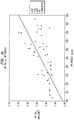
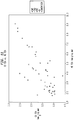
- Figure 1 is a plot of GM TEA versus GM tensile, wherein it is seen that the towels of the invention exhibit very high toughness; that is, elevated TEA as compared with conventional multi-ply products (DRC and AL products shown are single ply products).
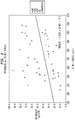
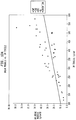
- Figure 2 is a plot of GM modulus versus GM tensile. It is appreciated from Figure 2 that the towels of the invention, while having very high strength, also exhibit a relatively low modulus, potentially having much more cloth-like drape properties and possessing more "softness” or less “stiffness”.
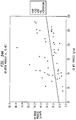
- Figure 3 is a plot of GM modulus versus CD wet tensile. Here again it is seen that the inventive products have a much lower modulus than other multi-ply products with comparable wet strength.
- the multi-ply absorbent towel of the invention has a basis weight of greater than 48.8 g/m 2 (30 pounds/3000 ft 2 ) ream.
- the towel may have, for example, a basis weight of greater than 57.0 g/m 2 (35 pounds/3000 ft 2 ) ream; or in some cases a basis weight of between 52.1 g/m 2 (32 pounds/3000 ft 2 ) ream and 73.2 g/m 2 (45 pounds/3000 ft 2 ) ream.
- the towel may be a two or three-ply paper towel typically embossed with either a nested embossed structure or a point to point embossed structure.
- the multi-ply absorbent towel may have an SAT value of between 7 g/g and 12 g/g; and preferably an SAT value of greater than 7.5 g/g.
- the plies are selected and adhered together such that the towel exhibits a CD TEA of between 1.75 mm-g/mm 2 and 3 mm-g/mm 2 and a MD TEA of between 6 mm-g/mm 2 and 10 mm-g/mm 2 .
- the inventive plies are selected and adhered together such that the towel exhibits a a GM Tensile Modulus, g/cm/%, less than [0.0249 (GM Tensile Strength, g/cm) + 6.06] and preferably a GM Tensile Modulus, g/cm/%, less than [0.0975 (CD Wet Tensile Strength, g/cm) + 5.71], as well as preferably a a GM Break Modulus, g/cm/% of less than [0.175 (CD Wet Tensile, g/cm) + 5.91; (GM Tensile Modulus, g/in/%, less than [0.0083 (GM Tensile Strength, g/3") + 15.4] and preferably a GM Tensile Modulus, g/in/%, less than [0.0325 (CD Wet Tensile Strength, g/3") + 14.5], as well as preferably a GM Break Modulus, g/3"/%
- the towel exhibits an MD bending length of less than 4.5 or 4.25 cm and a MD Tensile Strength of less than about 525.0 g/cm (4000 g/3") ; typically the towel exhibits an MD bending length of between 3 and 4 cm.
- the towel may have a GM TEA value of greater than 3.5 mm-g/mm 2 such as a value of greater than 4 mm-g/mm 2 .
- the towel may consist of a single embossed ply and backing ply and have GM TEA of greater than 3.5 mm-g/mm 2 .
- the towels are prepared from base sheets which are made by way of (i) compactively dewatering a papermaking furnish to form a nascent web; (ii) applying the dewatered web to a translating transfer surface; (iii) fabric creping the web from a transfer surface; and (iv) drying the web to form base sheets.
- the base sheets are embossed and plied as described hereinafter to produce the products of the invention.
- base sheets may be prepared by any other suitable means upon selection of the appropriate fiber, materials, processing parameters and so forth, especially furnish selection and preparation, fabric crepe, overall crepe and fabrics employed in the papermaking process.
- the unique tensile properties of the towels of the invention are surprising given the substantial absence of binder resin in typical products (usually none and optionally less than 0.5% or up to 1-2% by weight) and the fact that the towels usually consist essentially (99.5% +) of cellulosic papermaking fiber.
- the towels of the invention are soft, yet have high strength and toughness, characteristics which are seen in single-ply air-laid or double creped products with substantial amounts of binder resin (latex).
- TAD sheets generally have much less MD stretch than do fabric-creped sheets, but even within this low stretch regime basis weights for some TAD sheets can be reduced by about 5-10% by pulling out some of this stretch without reducing the absorbency. Since absorbency and caliper are closely related, this basis weight reduction does not necessarily come with the concurrent reduction in caliper either, so roll properties can be maintained in converting. However, tensiles will decrease in the CD much faster than the MD. Also, with reduced MD stretch the stiffness of the towel in the MD direction may increase noticeably but may be partially offset by the enhanced void volume of the sheet and the reduction in CD tensile. While the basis weight reduction is easily seen as a main economic advantage of this process, a significant advantage lies in the fact that at a given basis weight absorbency levels greater than normally seen are achievable.
- the products made by way of the inventive sequential process of embossing/adhering/drawing generally have an SAT converting loss of less than 15%, preferably less than 10 percent.
- An SAT converting loss of less than 5 percent is still more preferred; and most preferably the drawn towel has an SAT converting gain over the base sheets from which it is made. A gain of at least 2 percent is especially preferred.
- the embossed/glued towel may be drawn along its machine direction at least about 5 percent, 10 percent, 15 percent, 20 percent, or more.
- the base sheet used in the inventive embossing/plying/drawing process may be a throughdried web or a fabric-creped web as noted above.
- the base sheet has an MD/CD dry tensile ratio of less than 1 or in some cases of less than 0.5.
- the base sheet from which the multi-ply towels of the invention are made has an MD stretch at break of at least 20 percent.
- An MD stretch of 30 percent, 45 percent, 60 percent or more is readily achieved in accordance with the present invention, wherein base sheets having an MD stretch greater than 20 percent and less than 70 percent are readily employed.
- Test specimens are conditioned for 2 hours at 50% relative humidity and 23°C ⁇ 1°C (73.4°F ⁇ 1.8°F) unless otherwise indicated.
- SAT Absorbency of the inventive products
- the simple absorbency tester is a particularly useful apparatus for measuring the hydrophilicity and absorbency properties of a sample of tissue, napkins, or towel.
- a sample of tissue, napkins, or towel 5.08 cm (2.0 inches) in diameter is mounted between a top flat plastic cover and a bottom grooved sample plate.
- the tissue, napkin, or towel sample disc is held in place by a 0.32 cm (1/8 inch) wide circumference flange area.
- the sample is not compressed by the holder.
- De-ionized water at 22.8°C (73°F) is introduced to the sample at the center of the bottom sample plate through a 1 mm. diameter conduit.
- This water is at a hydrostatic head of minus 5 mm.
- Flow is initiated by a pulse introduced at the start of the measurement by the instrument mechanism.
- Water is thus imbibed by the tissue, napkin, or towel sample from this central entrance point radially outward by capillary action.
- the rate of water imbibation decreases below 0.005 gm water per 5 seconds, the test is terminated.
- the amount of water removed from the reservoir and absorbed by the sample is weighed and reported as grams of water per gram of sample or per square meter of sample. Absorbed g/m 2 are used for purposes of calculating SAT converting loss.
- the number of plies used in the towel are tested.
- SAT water absorbent capacity
- the termination criteria for a test are expressed in maximum change in water weight absorbed over a fixed time period. This is basically an estimate of zero slope on the weight versus time graph.
- the program uses a change of 0.005 g over a 5 second time interval as termination criteria; unless "Slow SAT" is specified in which case the cut off criteria is 1 mg in 20 seconds.
- Basis weight refers to the weight of a 278.7 m 2 (3000 ft 2 ream) of product. Consistency refers to percent solids of a nascent web, for example, calculated on a bone dry basis. "Air dry” means including residual moisture, by convention up to about 10 percent moisture for pulp and up to about 6% for paper. A nascent web having 50 percent water and 50 percent bone dry pulp has a consistency of 50 percent.
- Base sheet refers to a unitary cellulosic sheet as manufactured by a papermachine. Base sheets may be layered; however, they have a unitary structure not readily delaminated. A “ply” of a finished product refers to base sheet incorporated into the product.
- MD bending length (cm) is determined in accordance with ASTM test method D 1388-96, cantilever option. Reported bending lengths refer to MD bending lengths unless a CD bending length is expressly specified.
- the MD bending length test was performed with a Cantilever Bending Tester available from Research Dimensions, 1720 Oakridge Road, Neenah, Wisconsin 54956, which is substantially the apparatus shown in the ASTM test method, item 6.
- the instrument is placed on a level, stable surface, horizontal position being confirmed by a built in leveling bubble.
- the bend angle indicator is set at 41.5° below the level of the sample table. This is accomplished by setting the knife edge appropriately.
- the sample is cut with a one inch JD strip cutter available from Thwing-Albert Instrument Company, 14 Collins Avenue, W.
- the movable slide is displaced to the right in a smooth, slow manner at approximately 12.7 cm/min (5 inch/minute) until the specimen touches the knife edge.
- the overhang length is recorded to the nearest 0.1 cm. This is done by reading the left edge of the movable slide.
- Three specimens are preferably run with the Yankee side up and three specimens are preferably run with the Yankee side down on the horizontal platform.
- the MD bending length is reported as the average overhang length in centimeters divided by two to account for bending axis location.
- cellulosic cellulosic sheet
- Papermaking fibers include virgin pulps or recycle (secondary) cellulosic fibers or fiber mixes comprising cellulosic fibers.
- Fibers suitable for making the webs of this invention include: nonwood fibers, such as cotton fibers or cotton derivatives, abaca, kenaf, sabai grass, flax, esparto grass, straw, jute hemp, bagasse, milkweed floss fibers, and pineapple leaf fibers; wood fibers such as those obtained from deciduous and coniferous trees, including softwood fibers, such as northern and southern softwood kraft fibers; and hardwood fibers, such as eucalyptus, maple, birch, aspen, or the like.
- nonwood fibers such as cotton fibers or cotton derivatives, abaca, kenaf, sabai grass, flax, esparto grass, straw, jute hemp, bagasse, milkweed floss fibers, and pineapple leaf fibers
- wood fibers such as those obtained from deciduous and coniferous trees, including softwood fibers, such as northern and southern softwood kraft fibers
- hardwood fibers such as eucalyptus
- Papermaking fibers can be liberated from their source material by any one of a number of chemical pulping processes familiar to one experienced in the art, including sulfate, sulfite, polysulfide, soda pulping, etc.
- the pulp can be bleached if desired by chemical means including the use of chlorine, chlorine dioxide, oxygen and so forth.
- the products of the present invention may comprise a blend of conventional fibers (whether derived from virgin pulp or recycle sources) and high coarseness lignin-rich tubular fibers, such as bleached chemical thermomechanical pulp (BCTMP).
- BCTMP bleached chemical thermomechanical pulp
- "Furnishes” and like terminology refers to aqueous compositions including papermaking fibers, wet strength resins, debonders, and the like for making paper products. Synthetic fibers may also be included in the furnish.
- the "compactively dewatering the web or furnish” refers to mechanical dewatering by wet pressing on a dewatering felt, for example, in some embodiments by use of mechanical pressure applied continuously over the web surface, as in a nip between a press roll and a press shoe wherein the web is in contact with a papermaking felt.
- the terminology "compactively dewatering” is used to distinguish processes wherein the initial dewatering of the web is carried out largely by thermal means as is the case, for example, in United States Patent No. 4,529,480 to Trokhan and United States Patent No. 5,607,551 to Farrington et al. noted above.
- Compactively dewatering a web thus refers, for example, to removing water from a nascent web having a consistency of less than 30 percent or so by application of pressure thereto and/or increasing the consistency of the web by about 15 percent or more by application of pressure thereto.
- Converting loss refers to the loss of absorbency seen when converting base sheet to a finished product.
- the SAT converting loss in percent is calculated as follows: SAT of N ply Base Sheet ⁇ SAT of N ply FP SAT of N ply Base Sheet ⁇ 100 SAT values in g/m 2 are used. See Examples below and Figure 15 .
- the draw ratio is calculated as the ratio of winding speed to the creping fabric speed when making base sheet using a papermachine of the class shown in Figure 5 .
- Draw may be expressed as a percentage by subtracting 1 from the draw ratio and multiply by 100%.
- the "pullout” or “draw” applied to a test specimen is calculated from the ratio of final length (MD) divided by its length prior to MD elongation. Unless otherwise specified, draw refers to elongation with respect to the length of the as-dried web. This quantity may also be expressed as a percentage. For example a 4" test specimen drawn to 5" has a draw ratio of 5/4 or 1.25 and a draw of 25%.
- Fabric side and like terminology refers to the side of the web which is in contact with the creping and drying fabric.
- Dryer side or the like is the side of the web opposite the fabric side of the web.
- FC means a fabric crepe process of the class discussed in detail in connection with Figure 5 or a product produced by that technology as the context indicates.
- TAD refers to products which are throughdried.
- Fpm refers to feet per minute
- mpm refers to meters per minute
- Fpm refers to feet per minute
- Consistency refers to the weight percent fiber of the web.
- Jet/wire velocity delta is the difference in speed between the headbox jet issuing from a headbox and the forming wire or fabric speed in the MD; jet velocity-wire velocity delta is typically expressed in fpm. In cases where a pair of forming fabrics are used, the speed of the fabric advancing the web in the machine direction is used to calculate jet/wire velocity delta.
- MD machine direction
- CD cross-machine direction
- Nip parameters include, without limitation, nip pressure, nip width, backing roll hardness, fabric approach angle, fabric takeaway angle, uniformity, nip penetration and velocity delta between surfaces of the nip.
- Nep width means the MD length over which the nip surfaces are in contact.
- On line and like terminology refers to a process step performed without removing the web from the papermachine in which the web is produced. A web is drawn or calendered on line when it is drawn or calendered without being severed prior to wind-up.
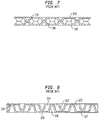
- a "point-to-point” embossed structure is one where embossments on different plies are aligned and adhered to each other as shown generally in Figure 7 .
- a nested embossed structure is a structure wherein embossments on different plies are staggered with respect to each other as shown generally in Figure 8 .
- Predominantly means more than 50% by weight of the named species unless mole percent is specified. Papermaking fiber from which a product is made is "predominantly” softwood fiber if over 50% by weight of fiber in the product is softwood fiber (bone dry).
- a translating transfer surface refers to the surface from which the web is creped into the creping fabric.
- the translating transfer surface may be the surface of a rotating drum as described hereafter, or may be the surface of a continuous smooth moving belt or another moving fabric which may have surface texture and so forth.
- the translating transfer surface needs to support the web and facilitate the high solids creping as will be appreciated from the discussion which follows.
- Calipers and/or bulk reported herein may be 1, 4 or 8 sheet calipers.
- the sheets are stacked and the caliper measurement taken about the central portion of the stack.
- the test samples are conditioned in an atmosphere of 23° ⁇ 1.0°C (73.4° ⁇ 1.8°F) at 50% relative humidity for at least about 2 hours and then measured with a Thwing-Albert Model 89-II-JR or Progage Electronic Thickness Tester with 50.8-mm (2-in) diameter anvils, 539 ⁇ 10 grams dead weight load, and 0.587 cm/sec (0.231 in./sec) descent rate.
- each sheet of product to be tested must have the same number of plies as the product is sold.
- each sheet to be tested must have the same number of plies as produced off the winder.
- base sheet testing off of the papermachine reel single plies must be used. Sheets are stacked together aligned in the MD. On printed product, try to avoid taking measurements in these areas if at all possible. Bulk may also be expressed in units of volume/weight by dividing caliper by basis weight.
- Dry tensile strengths (MD and CD), stretch, ratios thereof, break modulus, stress and strain are measured with a standard Instron test device or other suitable elongation tensile tester which may be configured in various ways, typically using 7.62 or 2.54 cm (3 or 1 inch) (wide strips of tissue or towel, conditioned for 2 hours at 50% relative humidity and 23°C ⁇ 1°C (73.4°F ⁇ 1.8°F), with the tensile test run at a crosshead speed of 5.08 cm/min (2 in/min).
- a tensile property is a "dry" property at break (i.e., peak value), except for modulus, which refers to the "initial" modulus as noted below.
- Tensile ratios are simply ratios of the values determined by way of the foregoing methods. Tensile ratio refers to the MD/CD dry tensile ratio unless otherwise stated. Tensile strength is sometimes referred to simply as "tensile".
- TEA is a measure of strength and is reported CD TEA, MD TEA, or GM TEA.
- Total energy absorbed (TEA) is calculated as the area under the stress-strain curve using a tensile tester as has been previously described above. The area is based on the strain value reached when the sheet is strained to rupture and the load placed on the sheet has dropped to 65 percent of the peak tensile load. Since the thickness of a paper sheet is generally unknown and varies during the test, it is common practice to ignore the cross-sectional area of the sheet and report the "stress" on the sheet as a load per unit, or typically in the units of grams per 3 inches of width. For the TEA calculation, the stress is converted to grams per millimeter and the area calculated by integration. The units of strain are millimeters per millimeter so that the final TEA units become mm-g/mm 2 or simply g/mm.
- modulus of a product is determined by the procedure for measuring tensile strength described above, using a finished product sample with a width of 1 inch, and the modulus recorded is the chord slope of the load/elongation curve measured over the range of 0-100 grams load for towel. That is, modulus is the load at 100g/stretch at 100g. For tissue, 50g values are used. Modulus is reported in g/cm/% (g/in/%).
- Break Modulus is the stress at break divided by the elongation at break, tested on a 7.62 cm (3") wide sample; these values are appreciably higher than the modulus at 0-100 grams load as will be appreciated from the various Figures . Break Modulus is reported in g/cm/% (g/3"/%).
- the wet tensile of the tissue of the present invention is measured using a three-inch wide strip of tissue that is folded into a loop, clamped in a special fixture termed a Finch Cup, then immersed in water.
- the Finch Cup which is available from the Thwing-Albert Instrument Company of Philadelphia, Pa., is mounted onto a tensile tester equipped with a 2.0 pound load cell with the flange of the Finch Cup clamped by the tester's lower jaw and the ends of tissue loop clamped into the upper jaw of the tensile tester.
- the sample is immersed in water that has been adjusted to a pH of 7.0 + or - 0.1 and the tensile is tested after a 5 second immersion time.
- the results are expressed in g/cm (g/3"), dividing by two to account for the loop as appropriate.
- a "GM” value is the square root of the product of the CD and MD values.
- GM Break Modulus is thus: MD tensile / MD Stretch at break ⁇ CD tensile / CD Stretch at break 1 / 2
- Line crepe (sometimes referred to as overall crepe), reel crepe and so forth are similarly calculated as discussed below.
- kglcm means kg force per linear centimeter (PLI or pli pounds force per linear inch).
- P+J hardness indentation
- Velocity delta means a difference in linear speed
- an absorbent paper web is made by dispersing papermaking fibers into an aqueous furnish (slurry) and depositing the aqueous furnish onto the forming wire of a papermaking machine, typically by way of a jet issuing from a headbox.
- Any suitable forming scheme might be used.
- an extensive but non-exhaustive list in addition to Fourdrinier formers includes a crescent former, a C-wrap twin wire former, an S-wrap twin wire former, or a suction breast roll former.
- the forming fabric can be any suitable foraminous member, including single layer fabrics, double layer fabrics, triple layer fabrics, photopolymer fabrics, and the like.
- Non-exhaustive background art in the forming fabric area includes United States Patent Nos.
- the furnish may contain chemical additives to alter the physical properties of the paper produced. These chemistries are well understood by the skilled artisan and may be used in any known combination. Such additives may be surface modifiers, softeners, debonders, strength aids, latexes, opacifiers, optical brighteners, dyes, pigments, sizing agents, barrier chemicals, retention aids, insolubilizers, organic or inorganic crosslinkers, or combinations thereof; said chemicals optionally comprising polyols, starches, PPG esters, PEG esters, phospholipids, surfactants, polyamines, HMCP or the like.
- the pulp can be mixed with strength adjusting agents such as wet strength agents, dry strength agents, debonders/softeners, and so forth. Suitable wet strength agents are known to the skilled artisan. A comprehensive but non-exhaustive list of useful strength aids include urea-formaldehyde resins, melamine formaldehyde resins, glyoxylated polyacrylamide resins, polyamide-epichlorohydrin resins and the like.
- Thermosetting polyacrylamides are produced by reacting acrylamide with diallyl dimethyl ammonium chloride (DADMAC) to produce a cationic polyacrylamide copolymer, which is ultimately reacted with glyoxal to produce a cationic cross-linking wet strength resin, glyoxylated polyacrylamide.
- DMDMAC diallyl dimethyl ammonium chloride
- glyoxal a cationic cross-linking wet strength resin
- glyoxylated polyacrylamide glyoxylated polyacrylamide.
- dialdehydes can be substituted for glyoxal to produce thermosetting wet strength characteristics.
- polyamide-epichlorohydrin wet strength resins an example of which is sold under the trade names Kymene 557LX and Kymene 557H by Hercules Incorporated of Wilmington, Delaware and Amres® from Georgia-Pacific Resins, Inc. These resins and the process for making the resins are described in United States Patent No. 3,700,623 and United States Patent No. 3,772,076 .
- Suitable dry strength agents include starch, guar gum, polyacrylamides, carboxymethyl cellulose and the like. Of particular utility is carboxymethyl cellulose, an example of which is sold under the trade name Hercules CMC, by Hercules Incorporated of Wilmington, Delaware.
- the pulp may contain from about 0 to about 7.5 kg/mton (15 lb/ton) of dry strength agent.
- the pulp may contain from about 0.5 to about 2.5 kg/mton (from about 1 to about 5 lbs/ton) of dry strength agent.
- the nascent web is typically dewatered on a papermaking felt.
- Any suitable felt may be used.
- felts can have double-layer base weaves, triple-layer base weaves, or laminated base weaves.
- Preferred felts are those having the laminated base weave design.
- a wet-press-felt which may be particularly useful with the present invention is Vector 3 made by Voith Fabric. Background art in the press felt area includes United States Patent Nos. 5,657,797 ; 5,368,696 ; 4,973,512 ; 5,023,132 ; 5,225,269 ; 5,182,164 ; 5,372,876 ; and 5,618,612 .
- a differential pressing felt as is disclosed in United States Patent No. 4,533,437 to Curran et al. may likewise be utilized.
- Suitable creping or textured fabrics include single layer or multi-layer, or composite preferably open meshed structures. Fabric construction per se is of less importance than the topography of the creping surface in the creping nip as discussed in more detail below. Long MD knuckles with slightly lowered CD knuckles are greatly preferred for some products.
- Fabrics may have at least one of the following characteristics: (1) on the side of the creping fabric that is in contact with the wet web (the "top” side), the number of machine direction (MD) strands per 2.54 cm (strands per inch) (mesh) is from 10 to 200 and the number of cross-direction (CD) strands per 2.54 cm (strands per inch) (count) is also from 10 to 200; (2) the strand diameter is typically smaller than 0.13 cm (0.050 inch); (3) on the top side, the distance between the highest point of the MD knuckles and the highest point on the CD knuckles is from about 0.0025 to about 0.05 to about 0.076 cm (from about 0.001 to about 0.02 or 0.03 inch); (4) in between these two levels there can be knuckles formed either by MD or CD strands that give the topography a three dimensional hill/valley appearance which is imparted to the sheet; (5) the fabric may be oriented in any suitable way so as to achieve the desired effect on processing and on properties in
- One preferred fabric is a W013 Albany International multilayer fabric.
- Such fabrics are formed from monofilament polymeric fibers having diameters typically ranging from about 0.25 mm to about 1 mm.
- Such fabrics are formed from monofilament polymeric fibers having diameters typically ranging from about 10 mm to about 100 mm.
- This fabric may be used to produce an absorbent cellulosic sheet having variable local basis weight comprising a papermaking fiber reticulum provided with (i) a plurality of cross-machine direction (CD) extending, fiber-enriched pileated regions of relatively high local basis weight interconnected by (ii) a plurality of elongated densified regions of compressed papermaking fibers, the elongated densified regions having relatively low local basis weight and are generally oriented along the machine direction (MD) of the sheet.
- the elongated densified regions are further characterized by an MD/CD aspect ratio of at least 1.5.
- the MD/CD aspect ratios of the densified regions are greater than 2 or greater than 3; generally between about 2 and 10.
- the fiber-enriched, pileated regions have fiber orientation bias along the CD of the sheet and the densified regions of relatively low basis weight extend in the machine direction and also have fiber orientation bias along the CD of the sheet.
- This product is further described in copending application United States Patent Application Serial No. 11/804,246, filed May 16, 2007 , entitled “Fabric Creped Absorbent Sheet with Variable Local Basis Weight” (Attorney Docket No. 20179; GP-06-11).
- the creping fabric may be of the class described in United States Patent No. 5,607,551 to Farrington et al ., Cols. 7-8 thereof, as well as the fabrics described in United States Patent No. 4,239,065 to Trokhan and United States Patent No. 3,974,025 to Ayers .
- Such fabrics may have about 20 to about 60 meshes per inch and are formed from monofilament polymeric fibers having diameters typically ranging from about 0.020 to about 0.064 cm (from about 0.008 to about 0.025 inches). Both warp and weft monofilaments may, but need not necessarily be of the same diameter.
- the filaments are so woven and complimentarily serpentinely configured in at least the Z-direction (the thickness of the fabric) to provide a first grouping or array of coplanar top-surface-plane crossovers of both sets of filaments; and a predetermined second grouping or array of sub-top-surface crossovers.
- the arrays are interspersed so that portions of the top-surface-plane crossovers define an array of wicker-basket-like cavities in the top surface of the fabric, which cavities are disposed in staggered relation in both the machine direction (MD) and the cross-machine direction (CD), and so that each cavity spans at least one sub-top-surface crossover.
- the cavities are discretely perimetrically enclosed in the plan view by a picket-like-alignment comprising portions of a plurality of the top-surface plane crossovers.
- the loop of fabric may comprise heat set monofilaments of thermoplastic material; the top surfaces of the coplanar top-surface-plane crossovers may be monoplanar flat surfaces.
- Specific embodiments of the invention include satin weaves as well as hybrid weaves of three or greater sheds, and mesh counts of from about 4 X 4 to about 47 X 47 per centimeter (10 X 10 to about 120 X 120 filaments per inch). Although the preferred range of mesh counts is from about 9 X 8 to about 22 X 19 per centimeter (18 by 16 to about 55 by 48 filaments per inch).
- a dryer fabric may be used as the creping fabric if so desired. Suitable fabrics are described in United States Patent Nos. 5,449,026 (woven style) and 5,690,149 (stacked MD tape yarn style) to Lee as well as United States Patent No. 4,490,925 to Smith (spiral style).
- a creping adhesive used on the Yankee cylinder is preferably capable of cooperating with the web at intermediate moisture to facilitate transfer from the creping fabric to the Yankee and to firmly secure the web to the Yankee cylinder as it is dried to a consistency of 95% or more on the cylinder, preferably with a high volume drying hood.
- the adhesive is critical to stable system operation at high production rates and is a hygroscopic, re-wettable, substantially non-crosslinking adhesive. Examples of preferred adhesives are those which include poly(vinyl alcohol) of the general class described in United States Patent No. 4,528,316 to Soerens et al. Other suitable adhesives are disclosed in co-pending United States Patent Application Serial No. 10/409,042, filed April 9, 2003 , (US Publication No.
- Suitable adhesives are optionally provided with modifiers and so forth. It is preferred to use crosslinker sparingly or not at all in the adhesive in many cases; such that the resin is substantially non-crosslinkable in use.
- FIG. 5 is a schematic diagram of a papermachine 15 having a conventional twin wire forming section 17, a felt run 14, a shoe press section 16, a creping fabric 18 and a Yankee dryer 20 suitable for making sheet used in connection with the present invention.
- Forming section 17 includes a pair of forming fabrics 22, 24 supported by a plurality of rolls 26, 28, 30, 32, 34, 36 and a forming roll 38 .
- a headbox 40 provides papermaking furnish in the form of a jet to a nip 42 between forming roll 38 and roll 26 and the fabrics. Control of the jet velocity relative to the forming fabrics is an important aspect of controlling tensile ratio as will be appreciated by one of skill in the art.
- the furnish forms a nascent web 44 which is dewatered on the fabrics with the assistance of suction, for example, by way of suction box 46 .
- the nascent web is advanced to a papermaking felt 48 which is supported by a plurality of rolls 50, 52, 54, 55 and the felt is in contact with a shoe press roll 56 .
- the web is of low consistency as it is transferred to the felt. Transfer may be assisted by suction; for example roll 50 may be a suction roll if so desired or a pickup or suction shoe as is known in the art.
- Transfer roll 60 may be a heated roll if so desired.
- roll 56 could be a conventional suction pressure roll.
- roll 54 is a suction roll effective to remove water from the felt prior to the felt entering the shoe press nip since water from the furnish will be pressed into the felt in the shoe press nip.
- using a suction roll or STR at 54 is typically desirable to ensure the web remains in contact with the felt during the direction change as one of skill in the art will appreciate from the diagram.
- Web 44 is wet-pressed on the felt in nip 58 with the assistance of pressure shoe 62 .
- the web is thus compactively dewatered at 58 , typically by increasing the consistency by 15 or more points at this stage of the process.
- the configuration shown at 58 is generally termed a shoe press; in connection with the present invention cylinder 60 is operative as a transfer cylinder which operates to convey web 44 at high speed, typically 305 mpm-1830 mpm (1000 fpm-6000 fpm) to the creping fabric.
- Cylinder 60 has a smooth surface 64 which may be provided with adhesive and/or release agents if needed. Web 44 is adhered to transfer surface 64 of cylinder 60 which is rotating at a high angular velocity as the web continues to advance in the machine-direction indicated by arrows 66 . On the cylinder, web 44 has a generally random apparent distribution of fiber.
- Direction 66 is referred to as the machine-direction (MD) of the web as well as that of papermachine 15 ; whereas the cross-machine-direction (CD) is the direction in the plane of the web perpendicular to the MD.
- MD machine-direction
- CD cross-machine-direction
- Web 44 enters nip 58 typically at consistencies of 10-25 percent or so and is dewatered and dried to consistencies of from about 25 to about 70 by the time it is transferred to creping fabric 18 as shown in the diagram.
- Fabric 18 is supported on a plurality of rolls 68, 70, 72 and a press nip roll or solid pressure roll 74 such that there is formed a fabric crepe nip 76 with transfer cylinder 60 as shown in the diagram.
- the creping fabric defines a creping nip over the distance in which creping fabric 18 is adapted to contact roll 60 ; that is, applies significant pressure to the web against the transfer cylinder.
- backing (or creping) roll 70 may be provided with a soft deformable surface which will increase the width of the creping nip and increase the fabric creping angle between the fabric and the sheet and the point of contact or a shoe press roll could be used as roll 70 to increase effective contact with the web in high impact fabric creping nip 76 where web 44 is transferred to fabric 18 and advanced in the machine-direction.
- creping nip 76 it is possible to influence the nature and amount of redistribution of fiber, as well as delamination/- debonding which may occur at fabric creping nip 76 by adjusting these nip parameters.
- the creping nip parameters can influence the distribution of fiber in the web in a variety of directions, including inducing changes in the z-direction as well as the MD and CD.
- the transfer from the transfer cylinder to the creping fabric is high impact in that the fabric is traveling slower than the web and a significant velocity change occurs.
- the web is creped anywhere from 10-60 percent and even higher during transfer from the transfer cylinder to the fabric.
- Creping nip 76 generally extends over a fabric creping nip width of anywhere from about 0.32 cm to about 2.54 cm, typically 1.27 cm to 5.08 cm). (from about 1/8" to about 2", typically 1 ⁇ 2" to 2"). For a creping fabric with 32 CD strands per inch, web 44 thus will encounter anywhere from about 4 to 64 weft filaments in the nip.
- nip pressure in nip 76 that is, the loading between backing roll 70 and transfer roll 60 is suitably 3.6-18 kglcm (20-100 pounds per linear inch (PLI)), preferably 7.1-12.5 kglcm (40-70 pounds per linear inch (PLI)).
- nip 82 occurs at a web consistency of generally from about 25 to about 70 percent. At these consistencies, it is difficult to adhere the web to surface 84 of cylinder 80 firmly enough to remove the web from the fabric thoroughly.
- a poly(vinyl alcohol)/polyamide adhesive composition as noted above is applied at 86 as needed.
- a suction box may be employed at 67 in order to increase caliper.
- suction of from about 1.7 x 10 4 to about 1.0 x 10 5 Pascal (from about 5 to about 30 inches of mercury) is employed.
- the web is dried on Yankee cylinder 80 which is a heated cylinder and by high jet velocity impingement air in Yankee hood 88 .
- Yankee cylinder 80 which is a heated cylinder and by high jet velocity impingement air in Yankee hood 88 .
- web 44 is creped from the cylinder by creping doctor 89 and wound on a take-up roll 90 .
- Creping of the paper from a Yankee dryer may be carried out using an undulatory creping blade, such as that disclosed in United States Patent No. 5,690,788 .
- Use of the undulatory crepe blade has been shown to impart several advantages when used in production of tissue products. In general, tissue products creped using an undulatory blade have higher caliper (thickness), increased CD stretch, and a higher void volume than do comparable tissue products produced using conventional crepe blades. All of these changes effected by use of the undulatory blade tend to correlate with improved softness perception of the tissue products.
- calender station 85 with rolls 85 ( a ), 85 ( b ) to calender the sheet, if so desired.
- Impingement air dryers are disclosed in the following patents and applications:
- the upper ply is formed with downwardly projecting embossments 114 and the lower ply is formed with upwardly projecting embossments 116 .
- Opposed embossments contact each other and adhesive is advantageously applied to the embossments of one of the plies so that the two plies are adhesively secured together.
- Figure 8 illustrates a conventional two-ply paper product with nested embossments which can be formed in accordance with United States Patent Nos. 3,556,907 and 3,867,225 .
- An upper ply 120 of paper sheet material is provided with downwardly projecting embossments 122 and unembossed areas 124 between the embossments.
- a lower ply 127 of paper sheet material is provided with upwardly extending embossments 126 and unembossed areas 128 between the embossments.
- the two plies are arranged so that the embossments of one ply extend into the spaces between the embossments of the other ply.
- Adhesive 130 is applied to the embossments 126 of the lower ply for adhesively securing the embossments 126 to the unembossed areas 124 of the upper ply.
- an embossing and plying apparatus 200 wherein a first ply 211 is embossed by a first pair of rolls 212 .
- Ply 211 has an outer surface 213 as well as an internal surface 215 .
- a second ply 222 is embossed by rolls at 224 .
- Ply 222 also has an outer surface 223 and in internal surface 225 .
- the two plies are fed to plying nip 230 and plied to form a two-ply structure 240 which may be of a nested or point-to-point embossed structure.
- an adhesive is applied to sheet 211 by way of a rotogravure roll indicated at 242 to secure the sheets to one another; in many cases matched elements in nip 230 suffice for purposes of securing the sheets.
- the towels of the invention may alternatively be plied after embossing only one of the base sheets as will readily be appreciated from Figure 9 .
- the inventive multi-ply structures are also conveniently produced as three-ply structures as shown substantially in Figure 10 .
- a plying station 250 wherein a central ply 252 having local variation basis weight is plied with outer plies 254, 256 .
- Central ply 252 the core of the absorbent structure, may be of the same or different basis weight as compared with the outer plies.
- Plies 254, 256 may have local variations in basis weight if so desired, or may be conventional absorbent sheet.
- the outer surfaces of plies 254, 256 are continuous surfaces.
- the embossing station of Figure 10 includes rolls 258, 260, 262, 264 and 266 which rotate in directions indicated by the arrows and are configured and positioned so that they cooperate to emboss and secure the sheets to each other.
- adhesive is optionally used and it will be appreciated that any suitable plying protocol may be employed.
- multi-ply towels were prepared using fabric-creped base sheet and compared to CWP, DRC, TAD and AL towels of similar composition.
- the towels include 50% by weight of fiber or more softwood fiber such as, for example Douglas fir Kraft fiber or Southern Softwood Kraft fiber.
- Base sheets were produced on a crescent former papermachine from a fiber blend of 80% southern softwood Kraft (SWK) and 20% southern hardwood Kraft (HWK) using the WO 13 fabric noted above.
- the base sheets were made at a fabric crepe of 30 percent and a reel crepe of 10 percent (43 percent line crepe).
- the furnish was treated with 12.5 kg/mton (25 lbs/ton) of a wet strength additive (Amres® 25 HP, Georgia Pacific), 12.5 kg/mton (5 lbs/ton) of a charge control/dry strength agent (Wetcell CMC) and 1.75 kg/mton (3.5 lbs/ton) of a debonder (TQ 1152, Hercules).
- the base sheets were creped from the Yankee dryer at a moisture of 2 percent using a 10-degree beveled crepe blade. The sheets were produced at a reel speed of 549 m/m (1800 fpm).
- the base sheets had physical properties as shown in Table 1.
- Table 1 Average Base Sheet Physical Properties Basis Weight g/m 2 30.28 (lbs/ream) (18.61) Caliper mm/8 sheets 2.92 (mils/8 sheets) (115.1) MD Tensile g/cm 148.6 (g/3") (1132) CD Tensile g/cm 136 (g/3") (1037) GM Tensile g/cm 142.1 (g/3") (1083) MD Stretch (%) 47.5 CD Stretch (%) 8.1 CD Wet Tensile - Finch g/cm 44.5 (g/3") (339) CD Wet/Dry - Finch (%) 32.7 SAT Capacity g/m 2 (2 plies) 590 SAT Capacity (g/g) 9.7 SAT Rate (g/sec
- Table 2 Finished Towel Physical Properties Basis Weight g/m 2 56.5 (lbs/ream) (34.75) Caliper mm /8 sheets 6.01 (mils/8 sheets) (236.5) MD Tensile g/cm 300.0 (g/3") (2278) CD Tensile g/cm 234.0 (g/3") (1783) GM Tensile g/cm 264.3 (g/3") (2014) MD Stretch (%) 34.8 CD Stretch (%) 10.2 MD TEA (mm-g/mm 2 ) 2.64 CD TEA (mm-g/mm 2 ) 1.27 CD Wet Tensile - Finch g/cm 62.3 (g/3") (475) CD Wet/Dry - Finch (%) 26.6 Perf Tensile g/cm 75.1 (g/3") (572) SAT Capacity (g/sq meter) 515 SAT Capacity (g/sq meter) 515 SAT Capacity (g/sq meter) 515 SAT Capacity (g/sq
- the multi-ply towels of the invention have surprisingly high toughness (TEA) at low stiffness; note Figures 2 , 3 in particular.
- TEA toughness
- Figure 11 it is seen that both high CD TEA's and MD TEA's are readily achieved, while in Figure 12 it is seen that the Break Modulus (stiffness) of the inventive towel is substantially lower than other multi-ply products of comparable weight.
- Very high MD stretch is demonstrated in Figure 13 ; Figures 3 , 14 confirm the modulus/stiffness properties as to wet CD tensile.
- FIG 17 shows that only the DRC (single-ply) towel has as much stretch as the invention multi-ply towels.
- Figure 18 again confirms the low modulus/high toughness relationship exhibited by the invention products.
- a heavyweight towel has less SAT converting loss than lower basis weights. This feature is used to advantage especially when drawing the towel along its machine direction as is seen in the following examples.
Landscapes
- Engineering & Computer Science (AREA)
- Mechanical Engineering (AREA)
- Paper (AREA)
- Laminated Bodies (AREA)
- Sanitary Thin Papers (AREA)
Description
- The present invention relates generally to high basis weight, premium multi-ply disposable paper towels. The towels of the invention exhibit toughness (elevated TEA) and relatively low stiffness (modulus). The towels are made with less SAT converting loss than conventional towels and in many cases a converting absorbency increase is realized upon drawing an embossed and glued product. A generic absorbent paper towel in accordance with the preamble of claim 1 is for instance known from
US 2006/081347 A1 . - Methods of making paper tissue, towel, and the like are well known, including various features such as Yankee drying, throughdrying, fabric creping, dry creping, wet creping and so forth. Conventional wet pressing/dry creping processes (CWP) have certain advantages over conventional through-air drying processes, including: (1) lower energy costs associated with the mechanical removal of water rather than transpiration drying with hot air; and (2) higher production speeds which are more readily achieved with processes which utilize wet pressing to form a web. On the other hand, through-air drying processing has been widely adopted for new capital investment, particularly for the production of soft, bulky, premium quality towel products.
- Throughdried, creped (TAD) products and processes are disclosed in the following patents: United States Patent No.
3,994,771 to Morgan, Jr. et al .; United States Patent No.4,102,737 to Morton ; and United States Patent No.4,529,480 to Trokhan . The processes described in these patents comprise, very - Throughdried, creped (TAD) products and processes are disclosed in the following patents: United States Patent No.
3,994,771 to Morgan, Jr. et al .; United States Patent No.4,102,737 to Morton ; and United States Patent No.4,529,480 to Trokhan . The processes described in these patents comprise, very generally, forming a web on a foraminous support, thermally pre-drying the web, applying the web to a Yankee dryer with a nip defined, in part, by an impression fabric, and creping the product from the Yankee dryer. A relatively permeable web is typically required, making it difficult to employ recycle furnish at levels which may be desired. Transfer to the Yankee typically takes place at web consistencies of from about 60% to about 70%. See also, United States Patent No.6,187,137 to Druecke et al. which includes disclosure of peeling a web from a Yankee dryer. As noted in the above, throughdried products tend to exhibit enhanced bulk and softness; however, thermal dewatering with hot air tends to be energy intensive. Wet-press, dry crepe operations, wherein the webs are mechanically dewatered, are preferable from an energy perspective and are more readily applied to furnishes containing recycle fiber, which in many cases tends to form webs with less permeability than virgin fiber. Moreover, line speeds tend to be higher with wet-press operations. - A wet web may also be dried or initially dewatered by thermal means by way of impingement air drying. Suitable rotary impingement air drying equipment is described in United States Patent No.
6,432,267 to Watson and United States Patent No.6,447,640 to Watson et al. - Fabric creping has been employed in connection with papermaking processes which include mechanical or compactive dewatering of the paper web as a means to influence product properties. See United States Patent Nos.
4,689,119 and4,551,199 of Weldon ;4,849,054 and4,834,838 of Klowak ; and6,287,426 of Edwards et al. Operation of fabric creping processes has been4,440,597 to Wells et al. Newer processes including fabric-creping are described in: United States Application Serial No.10/679,862 US 2006/00818347 A1
US 2005/103455 A1 discloses a method of making a paper web, which web can show different properties, such as different basis weights, tensile strengths or GM tensile moduli. In said document it is disclosed a premium paper product and a method for making the same.
US 6 368 454 B1 discloses a method of making soft, bulky, single-ply tissues, which tissues also present several properties, such as different basis weights or tensile strengths. In particular said document discloses soft single ply tissue and the process for manufacturing of such a tissue. A paper product, which has improved strength and absorbency characteristics is described inUS 2004/0209058 A1 . The paper product disclosed in said document is embossed and heat-cured, which results in an attractive and absorbent product. A further paper product with absorbency and moisture strike through resistance is disclosed inUS 2006/0042767 A1 . A process for making absorbent cellulose paper products, such as sheet for towel tissues, is described inWO 2004/033793 A2 . - Other processes for making heavyweight premium paper for absorbent sheet include air-laid (AL) processes and double-crepe (DRC) processes. These processes utilize polymeric binder for strength which makes the product difficult to recycle; and, in any event, these processes are expensive to install and operate. AL and DRC are used in single ply finished products.
- While technology for making absorbent disposable paper products is highly sophisticated, it is typical to "trade" one attribute for another. For example,
- While technology for making absorbent disposable paper products is highly sophisticated, it is typical to "trade" one attribute for another. For example, strength increases are achieved at the expense of other properties such as stiffness (modulus increase) which may be undesirable in a product such as a premium paper towel.
- In view the absorbent paper towel disclosed in
US 2006/0081347 A1 , it is an object of the present invention to provide a multi-ply absorption towel having an improved toughness and relatively low stiffness. Further preferred embodiments are defined independent claims 2 to 7. Moreover, the present invention provides a method of making a paper towel, wherein the method has the features defined inclaim 8. Further preferred embodiments of said methods are defined independent claims 9 to 13. - The towels exhibit tensile properties equivalent to, and in many respects superior to, single-ply products such as air-laid towels or double-creped towels which are much more expensive to manufacture. Moreover, air-laid products and double-creped products incorporate substantial amounts of latex binder such that converting waste is not readily re-cycled, leading to still higher overall costs and disposal concerns.
- Details of the physical properties of the inventive towels are appreciated by considering
Figures 1-3 . -
Figure 1 is a plot of GM TEA versus GM tensile, wherein it is seen that the towels of the invention exhibit very high toughness; that is, elevated TEA as compared with conventional multi-ply products (DRC and AL products shown are single ply products). -
Figure 2 is a plot of GM modulus versus GM tensile. It is appreciated fromFigure 2 that the towels of the invention, while having very high strength, also exhibit a relatively low modulus, potentially having much more cloth-like drape properties and possessing more "softness" or less "stiffness". -
Figure 3 is a plot of GM modulus versus CD wet tensile. Here again it is seen that the inventive products have a much lower modulus than other multi-ply products with comparable wet strength. - Still further features and advantages of the present invention will become apparent from the discussion which follows.
- The invention is described in detail below in connection with numerous examples and the figures. Plots reflecting the corresponding metric data are present in the supplementary "a" Figures. In the Figures:
-
Figure 1 is a plot of GM TEA vs. GM Tensile (g/3") for various products of the invention and various prior art products; -
Figure 1a is a plot of GM TEA vs. GM Tensile (g/cm) for various products of the invention and various prior art products; -
Figure 2 is a plot of GM Modulus (g/in/%) vs. GM Tensile (g/3") for various products of the invention and various prior art products; -
Figure 2a is a plot of GM Modulus (g/cm/%) vs. GM Tensile (g/cm) for various products of the invention and various prior art products; -
Figure 3 is a plot of GM Modulus (g/in/%) vs. CD Wet Tensile (g/3") for various products of the invention and various prior art products; -
Figure 3a is a plot of GM Modulus (g/cm/%) vs. CD Wet Tensile (g/cm) for various products of the invention and various prior art products; -
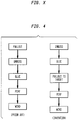
Figure 4 is a flow diagram comparing a prior art converting process with the converting process of the present invention; -
Figure 5 is a schematic diagram of a papermachine useful for making base sheet employed in connection with the present invention; -
Figure 6 is a plot of MD/CD dry tensile ratio versus Jet/Wire Velocity differential showing the effect of the jet/wire velocity differential on MD/CD tensile ratio for various products made by the apparatus ofFigure 5 and various prior art products; -
Figure 7 is a diagram of a multi-ply towel having a point-to-point embossed structure; -
Figure 8 is a diagram of a multi-ply towel having a nested embossed structure; -
Figure 9 is a schematic diagram of an embossing and plying process which may be employed in connection with the present invention to make a two-ply heavyweight paper towel; -
Figure 10 is a schematic diagram of an embossing and plying process which may be employed to make a three-ply towel of the present invention; -
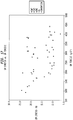
Figure 11 is a plot of CD TEA vs. MD TEA for various products of the present invention and various prior art products; -
Figure 12 is a plot of GM Break Modulus (g/3"/%) vs. GM Tensile (g/3") for various products of the invention and various prior art products; -
Figure 12a is a plot of GM Break Modulus (g/cm/%) vs. GM Tensile (g/cm) for various products of the invention and various prior art products; -
Figure 13 is a plot of CD Stretch vs. MD stretch for various products of the invention and various prior art products; -
Figure 14 is a plot of GM Break Modulus (g/3"/%) vs. CD Wet Tensile (g/3") for various products of the invention and various prior art products; -
Figure 14a is a plot of GM Break Modulus (g/cm/%) vs. CD Wet Tensile (g/cm) for various products of the invention and various prior art products; -
Figure 15 is a plot of SAT Converting Loss vs. Base Sheet MD Stretch for various base sheets; -
Figure 16 is a plot of MD Bending Length vs. MD Tensile (g/3") for various products of the invention and various prior art products; -
Figure 16a is a plot of MD Bending Length vs. MD Tensile (g/cm) for various products of the invention and various prior art products; -
Figure 17 is a plot of GM Stretch vs. GM Tensile (g/3") for various products of the invention and various prior art products; and -
Figure 17a is a plot of GM Stretch vs. GM Tensile (g/cm) for various products of the invention and various prior art products; -
Figure 18 is a plot of GM Modulus (g/in/%) vs. GM TEA for various products of the invention and various prior art products; and -
Figure 18a is a plot of GM Modulus (g/cm/%) vs. GM TEA for various products of the invention and various prior art products. - Generally, the multi-ply absorbent towel of the invention has a basis weight of greater than 48.8 g/m2 (30 pounds/3000 ft2) ream. The towel may have, for example, a basis weight of greater than 57.0 g/m2(35 pounds/3000 ft2) ream; or in some cases a basis weight of between 52.1 g/m2 (32 pounds/3000 ft2) ream and 73.2 g/m2 (45 pounds/3000 ft2) ream. The towel may be a two or three-ply paper towel typically embossed with either a nested embossed structure or a point to point embossed structure. The multi-ply absorbent towel may have an SAT value of between 7 g/g and 12 g/g; and preferably an SAT value of greater than 7.5 g/g. In many cases the plies are selected and adhered together such that the towel exhibits a CD TEA of between 1.75 mm-g/mm2 and 3 mm-g/mm2 and a MD TEA of between 6 mm-g/mm2 and 10 mm-g/mm2.
The inventive plies are selected and adhered together such that the towel exhibits a a GM Tensile Modulus, g/cm/%, less than [0.0249 (GM Tensile Strength, g/cm) + 6.06] and preferably a GM Tensile Modulus, g/cm/%, less than [0.0975 (CD Wet Tensile Strength, g/cm) + 5.71], as well as preferably a a GM Break Modulus, g/cm/% of less than [0.175 (CD Wet Tensile, g/cm) + 5.91;
(GM Tensile Modulus, g/in/%, less than [0.0083 (GM Tensile Strength, g/3") + 15.4] and preferably a GM Tensile Modulus, g/in/%, less than [0.0325 (CD Wet Tensile Strength, g/3") + 14.5], as well as preferably a GM Break Modulus, g/3"/% of less than [0.175 (CD Wet Tensile, g/3") + 45]). - Generally the towel exhibits an MD bending length of less than 4.5 or 4.25 cm and a MD Tensile Strength of less than about 525.0 g/cm (4000 g/3") ; typically the towel exhibits an MD bending length of between 3 and 4 cm. The towel may have a GM TEA value of greater than 3.5 mm-g/mm2 such as a value of greater than 4 mm-g/mm2. In some cases the towel may consist of a single embossed ply and backing ply and have GM TEA of greater than 3.5 mm-g/mm2.
- In preferred embodiments, the towels are prepared from base sheets which are made by way of (i) compactively dewatering a papermaking furnish to form a nascent web; (ii) applying the dewatered web to a translating transfer surface; (iii) fabric creping the web from a transfer surface; and (iv) drying the web to form base sheets. The base sheets are embossed and plied as described hereinafter to produce the products of the invention. As one of skill in the art will appreciate upon consideration of the detailed description which follows, base sheets may be prepared by any other suitable means upon selection of the appropriate fiber, materials, processing parameters and so forth, especially furnish selection and preparation, fabric crepe, overall crepe and fabrics employed in the papermaking process.
- The unique tensile properties of the towels of the invention are surprising given the substantial absence of binder resin in typical products (usually none and optionally less than 0.5% or up to 1-2% by weight) and the fact that the towels usually consist essentially (99.5% +) of cellulosic papermaking fiber. The towels of the invention are soft, yet have high strength and toughness, characteristics which are seen in single-ply air-laid or double creped products with substantial amounts of binder resin (latex).
- It has been discovered, quite surprisingly, that high basis weight, multi-ply paper towels made from throughdried or fabric-creped base sheets can be drawn in the MD such that absorbency properties can be maintained or even increased. Without intending to be bound by theory, this attribute may be due to the more uniform pullout after embossing and gluing. This feature of the invention allows for greater papermachine efficiency, especially higher basis weights, while maintaining desired basis weights in the finished products.
- Conventional wisdom is that as a base sheet is pulled out, the SAT absorbency levels decrease, approximately linearly, with the amount of pullout. So when the high basis weight towels of the invention were drawn and absorbency did not decrease, it is likely that pulling out the internal structure of the sheet "opens" the structure sufficiently to overcome the decrease in basis weight.
- Conventionally, converting takes place generally in the following order: Pullout → Emboss → Glue → Perf → Wind. To take full advantage of the findings of this invention this operational order needs to change to something like: Unwind as slack as possible → Emboss → Glue → Pullout to target weight → Perf → Wind. See
Figure 4 . In this manner, heavier weight sheets can be made on the papermachine, increasing its efficiency and raising the SAT absorbency levels. More tons can be produced at a given speed level and the machine can be run closer to the drying limit rather than the speed limit. This is especially advantageous in connection with the fabric-crepe process described hereinafter, where high levels of fabric crepe are often required. Clearly, pulling these sheets out within the scope of this invention will reduce the CD tensile levels (along with wet CD tensile levels), therefore base sheets with low MD/CD tensile ratios are desired. The fabric-crepe process is especially suitable for producing these types of base sheets with MD/CD tensile ratios as low as 0.4. When these sheets are pulled out in converting, the finished product tensile ratios will end up at the desired "square" for optimum towel performance. - The technology used to produce the base sheets has an effect on the degree to which this pullout effect is realized. For example, TAD sheets generally have much less MD stretch than do fabric-creped sheets, but even within this low stretch regime basis weights for some TAD sheets can be reduced by about 5-10% by pulling out some of this stretch without reducing the absorbency. Since absorbency and caliper are closely related, this basis weight reduction does not necessarily come with the concurrent reduction in caliper either, so roll properties can be maintained in converting. However, tensiles will decrease in the CD much faster than the MD. Also, with reduced MD stretch the stiffness of the towel in the MD direction may increase noticeably but may be partially offset by the enhanced void volume of the sheet and the reduction in CD tensile. While the basis weight reduction is easily seen as a main economic advantage of this process, a significant advantage lies in the fact that at a given basis weight absorbency levels greater than normally seen are achievable.
- Without intending to be bound by theory, it is believed that in connection with the fabric-creped products, this increase is caused by the fact that during the pulling out step, the "folded" areas that occur during the fabric creping process are pulled out rather than the "creped" areas of the sheet which pull out when the base sheets are drawn or pulled. This is similar, in some respects, to the effect seen in
US Patent Publication 2005/0217814A1 . It is believed that this improved pullout occurs because the ply-gluing step randomly attaches the two sheets together, so that when the sheet is pulled a significant number of these "creped" areas are glued to the other sheet so the areas between the creped areas tend to get pulled out. As is shown in the2005/0217814A1 publication, pulling out these areas increases the void volume and specific absorbency of the base sheets. Since the TAD sheets are also creped this same effect is observed but to a degree that permits basis weight reduction with no concurrent decrease in absorbency. - The products made by way of the inventive sequential process of embossing/adhering/drawing generally have an SAT converting loss of less than 15%, preferably less than 10 percent. An SAT converting loss of less than 5 percent is still more preferred; and most preferably the drawn towel has an SAT converting gain over the base sheets from which it is made. A gain of at least 2 percent is especially preferred. The embossed/glued towel may be drawn along its machine direction at least about 5 percent, 10 percent, 15 percent, 20 percent, or more. The base sheet used in the inventive embossing/plying/drawing process may be a throughdried web or a fabric-creped web as noted above.
- In some preferred embodiments the base sheet has an MD/CD dry tensile ratio of less than 1 or in some cases of less than 0.5.
- In especially preferred cases the base sheet from which the multi-ply towels of the invention are made has an MD stretch at break of at least 20 percent. An MD stretch of 30 percent, 45 percent, 60 percent or more is readily achieved in accordance with the present invention, wherein base sheets having an MD stretch greater than 20 percent and less than 70 percent are readily employed. The invention is further described in connection with the examples which follow hereinafter and the general description of tests methods and materials provided immediately below.
- Terminology used herein is given its ordinary meaning with the exemplary definitions set forth immediately below. Test specimens are conditioned for 2 hours at 50% relative humidity and 23°C ± 1°C (73.4°F ± 1.8°F) unless otherwise indicated.
- Absorbency of the inventive products (SAT) is measured with a simple absorbency tester. The simple absorbency tester is a particularly useful apparatus for measuring the hydrophilicity and absorbency properties of a sample of tissue, napkins, or towel. In this test a sample of tissue, napkins, or towel 5.08 cm (2.0 inches) in diameter is mounted between a top flat plastic cover and a bottom grooved sample plate. The tissue, napkin, or towel sample disc is held in place by a 0.32 cm (1/8 inch) wide circumference flange area. The sample is not compressed by the holder. De-ionized water at 22.8°C (73°F) is introduced to the sample at the center of the bottom sample plate through a 1 mm. diameter conduit. This water is at a hydrostatic head of minus 5 mm. Flow is initiated by a pulse introduced at the start of the measurement by the instrument mechanism. Water is thus imbibed by the tissue, napkin, or towel sample from this central entrance point radially outward by capillary action. When the rate of water imbibation decreases below 0.005 gm water per 5 seconds, the test is terminated. The amount of water removed from the reservoir and absorbed by the sample is weighed and reported as grams of water per gram of sample or per square meter of sample. Absorbed g/m2 are used for purposes of calculating SAT converting loss. When testing base sheet for multiply towel, the number of plies used in the towel are tested. For example, 2 plies of base sheet are stacked and tested, then compared with 2-ply finished product made from the base sheet for purposes of determining SAT converting loss. In practice, an M/K Systems Inc. Gravimetric Absorbency Testing System is used. This is a commercial system obtainable from M/K Systems Inc., 12 Garden Street, Danvers, Mass. 01923. WAC, or water absorbent capacity, also referred to as SAT, is actually determined by the instrument itself. WAC is defined as the point where the weight versus time graph has a "zero" slope, i.e., the sample has stopped absorbing. The termination criteria for a test are expressed in maximum change in water weight absorbed over a fixed time period. This is basically an estimate of zero slope on the weight versus time graph. The program uses a change of 0.005 g over a 5 second time interval as termination criteria; unless "Slow SAT" is specified in which case the cut off criteria is 1 mg in 20 seconds.
- Throughout this specification and claims, when we refer to a nascent web having an apparently random distribution of fiber orientation (or use like terminology), we are referring to the distribution of fiber orientation that results when known forming techniques are used for depositing a furnish on the forming fabric. When examined microscopically, the fibers give the appearance of being randomly oriented even though, depending on the jet to wire speed, there may be a significant bias toward machine direction orientation, making the machine direction tensile strength of the web exceed the cross-direction tensile strength.
- Unless otherwise specified, "basis weight", BWT, bwt, and so forth refers to the weight of a 278.7 m2 (3000 ft2 ream) of product. Consistency refers to percent solids of a nascent web, for example, calculated on a bone dry basis. "Air dry" means including residual moisture, by convention up to about 10 percent moisture for pulp and up to about 6% for paper. A nascent web having 50 percent water and 50 percent bone dry pulp has a consistency of 50 percent.
- "Base sheet" refers to a unitary cellulosic sheet as manufactured by a papermachine. Base sheets may be layered; however, they have a unitary structure not readily delaminated. A "ply" of a finished product refers to base sheet incorporated into the product.
- MD bending length (cm) is determined in accordance with ASTM test method D 1388-96, cantilever option. Reported bending lengths refer to MD bending lengths unless a CD bending length is expressly specified. The MD bending length test was performed with a Cantilever Bending Tester available from Research Dimensions, 1720 Oakridge Road, Neenah, Wisconsin 54956, which is substantially the apparatus shown in the ASTM test method,
item 6. The instrument is placed on a level, stable surface, horizontal position being confirmed by a built in leveling bubble. The bend angle indicator is set at 41.5° below the level of the sample table. This is accomplished by setting the knife edge appropriately. The sample is cut with a one inch JD strip cutter available from Thwing-Albert Instrument Company, 14 Collins Avenue, W. Berlin, NJ 08091. Six (6) samples are cut into 2.54 cm x 20.32 cm (1 inch x 8 inch) machine direction specimens. Samples are conditioned at 23°C ± 1°C (73.4°F ± 1.8°F) at 50% relative humidity for at least two hours. For machine direction specimens the longer dimension is parallel to the machine direction. The specimens should be flat, free of wrinkles, bends or tears. The Yankee side of the specimens are also labeled. The specimen is placed on the horizontal platform of the tester, aligning the edge of the specimen with the right hand edge. The movable slide is placed on the specimen, being careful not to change its initial position. The right edge of the sample and the movable slide should be set at the right edge of the horizontal platform. The movable slide is displaced to the right in a smooth, slow manner at approximately 12.7 cm/min (5 inch/minute) until the specimen touches the knife edge. The overhang length is recorded to the nearest 0.1 cm. This is done by reading the left edge of the movable slide. Three specimens are preferably run with the Yankee side up and three specimens are preferably run with the Yankee side down on the horizontal platform. The MD bending length is reported as the average overhang length in centimeters divided by two to account for bending axis location. - The term "cellulosic", "cellulosic sheet" and the like is meant to include any product incorporating fiber having cellulose as a major constituent. "Papermaking fibers" include virgin pulps or recycle (secondary) cellulosic fibers or fiber mixes comprising cellulosic fibers. Fibers suitable for making the webs of this invention include: nonwood fibers, such as cotton fibers or cotton derivatives, abaca, kenaf, sabai grass, flax, esparto grass, straw, jute hemp, bagasse, milkweed floss fibers, and pineapple leaf fibers; wood fibers such as those obtained from deciduous and coniferous trees, including softwood fibers, such as northern and southern softwood kraft fibers; and hardwood fibers, such as eucalyptus, maple, birch, aspen, or the like. Papermaking fibers can be liberated from their source material by any one of a number of chemical pulping processes familiar to one experienced in the art, including sulfate, sulfite, polysulfide, soda pulping, etc. The pulp can be bleached if desired by chemical means including the use of chlorine, chlorine dioxide, oxygen and so forth. The products of the present invention may comprise a blend of conventional fibers (whether derived from virgin pulp or recycle sources) and high coarseness lignin-rich tubular fibers, such as bleached chemical thermomechanical pulp (BCTMP). "Furnishes" and like terminology refers to aqueous compositions including papermaking fibers, wet strength resins, debonders, and the like for making paper products. Synthetic fibers may also be included in the furnish.
- As used herein, the "compactively dewatering the web or furnish" refers to mechanical dewatering by wet pressing on a dewatering felt, for example, in some embodiments by use of mechanical pressure applied continuously over the web surface, as in a nip between a press roll and a press shoe wherein the web is in contact with a papermaking felt. The terminology "compactively dewatering" is used to distinguish processes wherein the initial dewatering of the web is carried out largely by thermal means as is the case, for example, in United States Patent No.
4,529,480 to Trokhan and United States Patent No.5,607,551 to Farrington et al. noted above. Compactively dewatering a web thus refers, for example, to removing water from a nascent web having a consistency of less than 30 percent or so by application of pressure thereto and/or increasing the consistency of the web by about 15 percent or more by application of pressure thereto. - "Converting loss", "SAT converting loss" and like terminology refers to the loss of absorbency seen when converting base sheet to a finished product. The SAT converting loss in percent is calculated as follows:

Figure 15 . - The draw ratio is calculated as the ratio of winding speed to the creping fabric speed when making base sheet using a papermachine of the class shown in
Figure 5 . Draw may be expressed as a percentage by subtracting 1 from the draw ratio and multiply by 100%. The "pullout" or "draw" applied to a test specimen is calculated from the ratio of final length (MD) divided by its length prior to MD elongation. Unless otherwise specified, draw refers to elongation with respect to the length of the as-dried web. This quantity may also be expressed as a percentage. For example a 4" test specimen drawn to 5" has a draw ratio of 5/4 or 1.25 and a draw of 25%. - "Fabric side" and like terminology refers to the side of the web which is in contact with the creping and drying fabric. "Dryer side" or the like is the side of the web opposite the fabric side of the web.
- "FC" means a fabric crepe process of the class discussed in detail in connection with
Figure 5 or a product produced by that technology as the context indicates. "TAD" on the other hand, refers to products which are throughdried. - "FP" means finished product.
- "Fpm" refers to feet per minute "mpm" refers to meters per minute ("Fpm" refers to feet per minute) while "consistency" refers to the weight percent fiber of the web.
- "Jet/wire velocity delta" is the difference in speed between the headbox jet issuing from a headbox and the forming wire or fabric speed in the MD; jet velocity-wire velocity delta is typically expressed in fpm. In cases where a pair of forming fabrics are used, the speed of the fabric advancing the web in the machine direction is used to calculate jet/wire velocity delta.
- "MD" means machine direction and "CD" means cross-machine direction.
- Nip parameters include, without limitation, nip pressure, nip width, backing roll hardness, fabric approach angle, fabric takeaway angle, uniformity, nip penetration and velocity delta between surfaces of the nip.
- "Nip width" means the MD length over which the nip surfaces are in contact.
- "On line" and like terminology refers to a process step performed without removing the web from the papermachine in which the web is produced. A web is drawn or calendered on line when it is drawn or calendered without being severed prior to wind-up.
- A "point-to-point" embossed structure is one where embossments on different plies are aligned and adhered to each other as shown generally in
Figure 7 . A nested embossed structure is a structure wherein embossments on different plies are staggered with respect to each other as shown generally inFigure 8 . - "Predominantly" means more than 50% by weight of the named species unless mole percent is specified. Papermaking fiber from which a product is made is "predominantly" softwood fiber if over 50% by weight of fiber in the product is softwood fiber (bone dry).
- A translating transfer surface refers to the surface from which the web is creped into the creping fabric. The translating transfer surface may be the surface of a rotating drum as described hereafter, or may be the surface of a continuous smooth moving belt or another moving fabric which may have surface texture and so forth. The translating transfer surface needs to support the web and facilitate the high solids creping as will be appreciated from the discussion which follows.
- Calipers and/or bulk reported herein may be 1, 4 or 8 sheet calipers. The sheets are stacked and the caliper measurement taken about the central portion of the stack. Preferably, the test samples are conditioned in an atmosphere of 23° ± 1.0°C (73.4° ± 1.8°F) at 50% relative humidity for at least about 2 hours and then measured with a Thwing-Albert Model 89-II-JR or Progage Electronic Thickness Tester with 50.8-mm (2-in) diameter anvils, 539 ± 10 grams dead weight load, and 0.587 cm/sec (0.231 in./sec) descent rate. For finished product testing, each sheet of product to be tested must have the same number of plies as the product is sold. For testing in general, eight sheets are selected and stacked together. For napkin testing, napkins are enfolded prior to stacking. For base sheet testing off of winders, each sheet to be tested must have the same number of plies as produced off the winder. For base sheet testing off of the papermachine reel, single plies must be used. Sheets are stacked together aligned in the MD. On printed product, try to avoid taking measurements in these areas if at all possible. Bulk may also be expressed in units of volume/weight by dividing caliper by basis weight.
- Dry tensile strengths (MD and CD), stretch, ratios thereof, break modulus, stress and strain are measured with a standard Instron test device or other suitable elongation tensile tester which may be configured in various ways, typically using 7.62 or 2.54 cm (3 or 1 inch) (wide strips of tissue or towel, conditioned for 2 hours at 50% relative humidity and 23°C ± 1°C (73.4°F ± 1.8°F), with the tensile test run at a crosshead speed of 5.08 cm/min (2 in/min).
- Unless otherwise specified, a tensile property is a "dry" property at break (i.e., peak value), except for modulus, which refers to the "initial" modulus as noted below.
- Tensile ratios are simply ratios of the values determined by way of the foregoing methods. Tensile ratio refers to the MD/CD dry tensile ratio unless otherwise stated. Tensile strength is sometimes referred to simply as "tensile".
- TEA is a measure of strength and is reported CD TEA, MD TEA, or GM TEA. Total energy absorbed (TEA) is calculated as the area under the stress-strain curve using a tensile tester as has been previously described above. The area is based on the strain value reached when the sheet is strained to rupture and the load placed on the sheet has dropped to 65 percent of the peak tensile load. Since the thickness of a paper sheet is generally unknown and varies during the test, it is common practice to ignore the cross-sectional area of the sheet and report the "stress" on the sheet as a load per unit, or typically in the units of grams per 3 inches of width. For the TEA calculation, the stress is converted to grams per millimeter and the area calculated by integration. The units of strain are millimeters per millimeter so that the final TEA units become mm-g/mm2 or simply g/mm.
- The modulus of a product (also referred to as stiffness modulus or tensile modulus) is determined by the procedure for measuring tensile strength described above, using a finished product sample with a width of 1 inch, and the modulus recorded is the chord slope of the load/elongation curve measured over the range of 0-100 grams load for towel. That is, modulus is the load at 100g/stretch at 100g. For tissue, 50g values are used. Modulus is reported in g/cm/% (g/in/%).
- "Break Modulus" is the stress at break divided by the elongation at break, tested on a 7.62 cm (3") wide sample; these values are appreciably higher than the modulus at 0-100 grams load as will be appreciated from the various Figures. Break Modulus is reported in g/cm/% (g/3"/%).
- The wet tensile of the tissue of the present invention is measured using a three-inch wide strip of tissue that is folded into a loop, clamped in a special fixture termed a Finch Cup, then immersed in water. The Finch Cup, which is available from the Thwing-Albert Instrument Company of Philadelphia, Pa., is mounted onto a tensile tester equipped with a 2.0 pound load cell with the flange of the Finch Cup clamped by the tester's lower jaw and the ends of tissue loop clamped into the upper jaw of the tensile tester. The sample is immersed in water that has been adjusted to a pH of 7.0 + or - 0.1 and the tensile is tested after a 5 second immersion time. The results are expressed in g/cm (g/3"), dividing by two to account for the loop as appropriate.
- A "GM" value is the square root of the product of the CD and MD values.
- GM Break Modulus is thus:

- "Fabric crepe ratio" is an expression of the speed differential between the creping fabric and the forming wire, and typically calculated as the ratio of the web speed immediately before creping and the web speed immediately following creping, because the forming wire and transfer surface are typically, but not necessarily, operated at the same speed:

- Fabric crepe can also be expressed as a percentage calculated as:

- Line crepe (sometimes referred to as overall crepe), reel crepe and so forth are similarly calculated as discussed below.
- kglcm means kg force per linear centimeter (PLI or pli pounds force per linear inch).
- Pusey and Jones (P+J) hardness (indentation), sometimes referred to simply as P+J, is measured in accordance with ASTM D 531, and refers to the indentation number (standard specimen and conditions).
- Velocity delta means a difference in linear speed.
- According to the present invention, an absorbent paper web is made by dispersing papermaking fibers into an aqueous furnish (slurry) and depositing the aqueous furnish onto the forming wire of a papermaking machine, typically by way of a jet issuing from a headbox. Any suitable forming scheme might be used. For example, an extensive but non-exhaustive list in addition to Fourdrinier formers includes a crescent former, a C-wrap twin wire former, an S-wrap twin wire former, or a suction breast roll former. The forming fabric can be any suitable foraminous member, including single layer fabrics, double layer fabrics, triple layer fabrics, photopolymer fabrics, and the like. Non-exhaustive background art in the forming fabric area includes
United States Patent Nos. 4,157,276 ;4,605,585 ;4,161,195 ;3,545,705 ;3,549,742 ;3,858,623 ;4,041,989 ;4,071,050 ;4,112,982 ;4,149,571 ;4,182,381 ;4,184,519 ;4,314,589 ;4,359,069 ;4,376,455 ;4,379,735 ;4,453,573 ;4,564,052 ;4,592,395 ;4,611,639 ;4,640,741 ;4,709,732 ;4,759,391 ;4,759,976 ;4,942,077 ;4,967,085 ;4,998,568 ;5,016,678 ;5,054,525 ;5,066,532 ;5,098,519 ;5,103,874 ;5,114,777 ;5,167,261 ;5,199,261 ;5,199,467 ;5,211,815 ;5,219,004 ;5,245,025 ;5,277,761 ;5,328,565 ; and5,379,808 . One forming fabric particularly useful with the present invention is Voith Fabrics Forming Fabric 2164 made by Voith Fabrics Corporation, Shreveport, LA. - The furnish may contain chemical additives to alter the physical properties of the paper produced. These chemistries are well understood by the skilled artisan and may be used in any known combination. Such additives may be surface modifiers, softeners, debonders, strength aids, latexes, opacifiers, optical brighteners, dyes, pigments, sizing agents, barrier chemicals, retention aids, insolubilizers, organic or inorganic crosslinkers, or combinations thereof; said chemicals optionally comprising polyols, starches, PPG esters, PEG esters, phospholipids, surfactants, polyamines, HMCP or the like.
- The pulp can be mixed with strength adjusting agents such as wet strength agents, dry strength agents, debonders/softeners, and so forth. Suitable wet strength agents are known to the skilled artisan. A comprehensive but non-exhaustive list of useful strength aids include urea-formaldehyde resins, melamine formaldehyde resins, glyoxylated polyacrylamide resins, polyamide-epichlorohydrin resins and the like. Thermosetting polyacrylamides are produced by reacting acrylamide with diallyl dimethyl ammonium chloride (DADMAC) to produce a cationic polyacrylamide copolymer, which is ultimately reacted with glyoxal to produce a cationic cross-linking wet strength resin, glyoxylated polyacrylamide. These materials are generally described in United States Patent Nos.
3,556,932 to Coscia et al. and3,556,933 to Williams et al. Resins of this type are commercially available under the trade name of PAREZ 631NC by Bayer Corporation. Different mole ratios of acrylamide/DADMAC/glyoxal can be used to produce cross-linking resins, which are useful as wet strength agents. Furthermore, other dialdehydes can be substituted for glyoxal to produce thermosetting wet strength characteristics. Of particular utility are the polyamide-epichlorohydrin wet strength resins, an example of which is sold under the trade names Kymene 557LX and Kymene 557H by Hercules Incorporated of Wilmington, Delaware and Amres® from Georgia-Pacific Resins, Inc. These resins and the process for making the resins are described in United States Patent No.3,700,623 and United States Patent No.3,772,076 . An extensive description of polymeric-epihalohydrin resins is given in Chapter 2: Alkaline-Curing Polymeric Amine-Epichlorohydrin by Espy in Wet Strength Resins and Their Application (L. Chan, Editor, 1994). A reasonably comprehensive list of wet strength resins is described by Westfelt in Cellulose Chemistry and Technology Volume 13, p. 813, 1979. - Suitable dry strength agents include starch, guar gum, polyacrylamides, carboxymethyl cellulose and the like. Of particular utility is carboxymethyl cellulose, an example of which is sold under the trade name Hercules CMC, by Hercules Incorporated of Wilmington, Delaware. According to one embodiment, the pulp may contain from about 0 to about 7.5 kg/mton (15 lb/ton) of dry strength agent. According to another embodiment, the pulp may contain from about 0.5 to about 2.5 kg/mton (from about 1 to about 5 lbs/ton) of dry strength agent.
- The nascent web is typically dewatered on a papermaking felt. Any suitable felt may be used. For example, felts can have double-layer base weaves, triple-layer base weaves, or laminated base weaves. Preferred felts are those having the laminated base weave design. A wet-press-felt which may be particularly useful with the present invention is
Vector 3 made by Voith Fabric. Background art in the press felt area includes United States Patent Nos.5,657,797 ;5,368,696 ;4,973,512 ;5,023,132 ;5,225,269 ;5,182,164 ;5,372,876 ; and5,618,612 . A differential pressing felt as is disclosed in United States Patent No.4,533,437 to Curran et al. may likewise be utilized. - Suitable creping or textured fabrics include single layer or multi-layer, or composite preferably open meshed structures. Fabric construction per se is of less importance than the topography of the creping surface in the creping nip as discussed in more detail below. Long MD knuckles with slightly lowered CD knuckles are greatly preferred for some products. Fabrics may have at least one of the following characteristics: (1) on the side of the creping fabric that is in contact with the wet web (the "top" side), the number of machine direction (MD) strands per 2.54 cm (strands per inch) (mesh) is from 10 to 200 and the number of cross-direction (CD) strands per 2.54 cm (strands per inch) (count) is also from 10 to 200; (2) the strand diameter is typically smaller than 0.13 cm (0.050 inch); (3) on the top side, the distance between the highest point of the MD knuckles and the highest point on the CD knuckles is from about 0.0025 to about 0.05 to about 0.076 cm (from about 0.001 to about 0.02 or 0.03 inch); (4) in between these two levels there can be knuckles formed either by MD or CD strands that give the topography a three dimensional hill/valley appearance which is imparted to the sheet; (5) the fabric may be oriented in any suitable way so as to achieve the desired effect on processing and on properties in the product; the long warp knuckles may be on the top side to increase MD ridges in the product, or the long shute knuckles may be on the top side if more CD ridges are desired to influence creping characteristics as the web is transferred from the transfer cylinder to the creping fabric; and (6) the fabric may be made to show certain geometric patterns that are pleasing to the eye, which is typically repeated between every two to 50 warp yarns. One preferred fabric is a W013 Albany International multilayer fabric. Such fabrics are formed from monofilament polymeric fibers having diameters typically ranging from about 0.25 mm to about 1 mm. Such fabrics are formed from monofilament polymeric fibers having diameters typically ranging from about 10 mm to about 100 mm. This fabric may be used to produce an absorbent cellulosic sheet having variable local basis weight comprising a papermaking fiber reticulum provided with (i) a plurality of cross-machine direction (CD) extending, fiber-enriched pileated regions of relatively high local basis weight interconnected by (ii) a plurality of elongated densified regions of compressed papermaking fibers, the elongated densified regions having relatively low local basis weight and are generally oriented along the machine direction (MD) of the sheet. The elongated densified regions are further characterized by an MD/CD aspect ratio of at least 1.5. Typically, the MD/CD aspect ratios of the densified regions are greater than 2 or greater than 3; generally between about 2 and 10. In most cases the fiber-enriched, pileated regions have fiber orientation bias along the CD of the sheet and the densified regions of relatively low basis weight extend in the machine direction and also have fiber orientation bias along the CD of the sheet. This product is further described in copending application United States Patent Application Serial No.
11/804,246, filed May 16, 2007 - The creping fabric may be of the class described in United States Patent No.
5,607,551 to Farrington et al ., Cols. 7-8 thereof, as well as the fabrics described in United States Patent No.4,239,065 to Trokhan and United States Patent No.3,974,025 to Ayers . Such fabrics may have about 20 to about 60 meshes per inch and are formed from monofilament polymeric fibers having diameters typically ranging from about 0.020 to about 0.064 cm (from about 0.008 to about 0.025 inches). Both warp and weft monofilaments may, but need not necessarily be of the same diameter. - In some cases the filaments are so woven and complimentarily serpentinely configured in at least the Z-direction (the thickness of the fabric) to provide a first grouping or array of coplanar top-surface-plane crossovers of both sets of filaments; and a predetermined second grouping or array of sub-top-surface crossovers. The arrays are interspersed so that portions of the top-surface-plane crossovers define an array of wicker-basket-like cavities in the top surface of the fabric, which cavities are disposed in staggered relation in both the machine direction (MD) and the cross-machine direction (CD), and so that each cavity spans at least one sub-top-surface crossover. The cavities are discretely perimetrically enclosed in the plan view by a picket-like-alignment comprising portions of a plurality of the top-surface plane crossovers. The loop of fabric may comprise heat set monofilaments of thermoplastic material; the top surfaces of the coplanar top-surface-plane crossovers may be monoplanar flat surfaces. Specific embodiments of the invention include satin weaves as well as hybrid weaves of three or greater sheds, and mesh counts of from about 4
X 4 to about 47 X 47 per centimeter (10 X 10 to about 120 X 120 filaments per inch). Although the preferred range of mesh counts is from about 9X 8 to about 22 X 19 per centimeter (18 by 16 to about 55 by 48 filaments per inch). - Instead of an impression fabric, a dryer fabric may be used as the creping fabric if so desired. Suitable fabrics are described in United States Patent Nos.
5,449,026 (woven style) and5,690,149 (stacked MD tape yarn style) to Lee as well as United States Patent No.4,490,925 to Smith (spiral style). - A creping adhesive used on the Yankee cylinder is preferably capable of cooperating with the web at intermediate moisture to facilitate transfer from the creping fabric to the Yankee and to firmly secure the web to the Yankee cylinder as it is dried to a consistency of 95% or more on the cylinder, preferably with a high volume drying hood. The adhesive is critical to stable system operation at high production rates and is a hygroscopic, re-wettable, substantially non-crosslinking adhesive. Examples of preferred adhesives are those which include poly(vinyl alcohol) of the general class described in United States Patent No.
4,528,316 to Soerens et al. Other suitable adhesives are disclosed in co-pending United States Patent Application Serial No.10/409,042, filed April 9, 2003 US 2005/0006040, published January 13, 2005 ), entitled "Improved Creping Adhesive Modifier and Process for Producing Paper Products" (Attorney Docket No. 2394). Suitable adhesives are optionally provided with modifiers and so forth. It is preferred to use crosslinker sparingly or not at all in the adhesive in many cases; such that the resin is substantially non-crosslinkable in use. -
Figure 5 is a schematic diagram of apapermachine 15 having a conventional twinwire forming section 17, afelt run 14, ashoe press section 16, acreping fabric 18 and aYankee dryer 20 suitable for making sheet used in connection with the present invention. Formingsection 17 includes a pair of formingfabrics rolls roll 38. Aheadbox 40 provides papermaking furnish in the form of a jet to a nip 42 between formingroll 38 and roll 26 and the fabrics. Control of the jet velocity relative to the forming fabrics is an important aspect of controlling tensile ratio as will be appreciated by one of skill in the art. The furnish forms anascent web 44 which is dewatered on the fabrics with the assistance of suction, for example, by way ofsuction box 46. - The nascent web is advanced to a papermaking felt 48 which is supported by a plurality of
rolls shoe press roll 56. The web is of low consistency as it is transferred to the felt. Transfer may be assisted by suction; forexample roll 50 may be a suction roll if so desired or a pickup or suction shoe as is known in the art. As the web reaches the shoe press roll it may have a consistency of 10-25 percent, preferably 20 to 25 percent or so as it enters nip 58 betweenshoe press roll 56 andtransfer roll 60.Transfer roll 60 may be a heated roll if so desired. Instead of a shoe press roll, roll 56 could be a conventional suction pressure roll. If a shoe press is employed it is desirable and preferred that roll 54 is a suction roll effective to remove water from the felt prior to the felt entering the shoe press nip since water from the furnish will be pressed into the felt in the shoe press nip. In any case, using a suction roll or STR at 54 is typically desirable to ensure the web remains in contact with the felt during the direction change as one of skill in the art will appreciate from the diagram. -
Web 44 is wet-pressed on the felt in nip 58 with the assistance ofpressure shoe 62. The web is thus compactively dewatered at 58, typically by increasing the consistency by 15 or more points at this stage of the process. The configuration shown at 58 is generally termed a shoe press; in connection with thepresent invention cylinder 60 is operative as a transfer cylinder which operates to conveyweb 44 at high speed, typically 305 mpm-1830 mpm (1000 fpm-6000 fpm) to the creping fabric. -
Cylinder 60 has asmooth surface 64 which may be provided with adhesive and/or release agents if needed.Web 44 is adhered to transfersurface 64 ofcylinder 60 which is rotating at a high angular velocity as the web continues to advance in the machine-direction indicated byarrows 66. On the cylinder,web 44 has a generally random apparent distribution of fiber. -
Direction 66 is referred to as the machine-direction (MD) of the web as well as that ofpapermachine 15; whereas the cross-machine-direction (CD) is the direction in the plane of the web perpendicular to the MD. -
Web 44 enters nip 58 typically at consistencies of 10-25 percent or so and is dewatered and dried to consistencies of from about 25 to about 70 by the time it is transferred tocreping fabric 18 as shown in the diagram. -
Fabric 18 is supported on a plurality ofrolls solid pressure roll 74 such that there is formed a fabric crepe nip 76 withtransfer cylinder 60 as shown in the diagram. - The creping fabric defines a creping nip over the distance in which
creping fabric 18 is adapted to contactroll 60; that is, applies significant pressure to the web against the transfer cylinder. To this end, backing (or creping) roll 70 may be provided with a soft deformable surface which will increase the width of the creping nip and increase the fabric creping angle between the fabric and the sheet and the point of contact or a shoe press roll could be used asroll 70 to increase effective contact with the web in high impact fabric creping nip 76 whereweb 44 is transferred tofabric 18 and advanced in the machine-direction. By using different equipment at the creping nip, it is possible to adjust the fabric creping angle or the takeaway angle from the creping nip. Thus, it is possible to influence the nature and amount of redistribution of fiber, as well as delamination/- debonding which may occur at fabric creping nip 76 by adjusting these nip parameters. In some embodiments it may by desirable to restructure the z-direction interfiber characteristics while in other cases it may be desired to influence properties only in the plane of the web. The creping nip parameters can influence the distribution of fiber in the web in a variety of directions, including inducing changes in the z-direction as well as the MD and CD. In any case, the transfer from the transfer cylinder to the creping fabric is high impact in that the fabric is traveling slower than the web and a significant velocity change occurs. Typically, the web is creped anywhere from 10-60 percent and even higher during transfer from the transfer cylinder to the fabric. - Creping nip 76 generally extends over a fabric creping nip width of anywhere from about 0.32 cm to about 2.54 cm, typically 1.27 cm to 5.08 cm). (from about 1/8" to about 2", typically ½" to 2"). For a creping fabric with 32 CD strands per inch,
web 44 thus will encounter anywhere from about 4 to 64 weft filaments in the nip. - The nip pressure in
nip 76, that is, the loading betweenbacking roll 70 and transfer roll 60 is suitably 3.6-18 kglcm (20-100 pounds per linear inch (PLI)), preferably 7.1-12.5 kglcm (40-70 pounds per linear inch (PLI)). - After fabric creping, the web continues to advance along
MD 66 where it is wet-pressed ontoYankee cylinder 80 in transfer nip 82. Transfer atnip 82 occurs at a web consistency of generally from about 25 to about 70 percent. At these consistencies, it is difficult to adhere the web to surface 84 ofcylinder 80 firmly enough to remove the web from the fabric thoroughly. Typically, a poly(vinyl alcohol)/polyamide adhesive composition as noted above is applied at 86 as needed. - If so desired, a suction box may be employed at 67 in order to increase caliper. Typically, suction of from about 1.7 x 10⁴ to about 1.0 x 10⁵ Pascal (from about 5 to about 30 inches of mercury) is employed.
- The web is dried on
Yankee cylinder 80 which is a heated cylinder and by high jet velocity impingement air inYankee hood 88. As the cylinder rotates,web 44 is creped from the cylinder by crepingdoctor 89 and wound on a take-up roll 90. Creping of the paper from a Yankee dryer may be carried out using an undulatory creping blade, such as that disclosed in United States Patent No.5,690,788 . Use of the undulatory crepe blade has been shown to impart several advantages when used in production of tissue products. In general, tissue products creped using an undulatory blade have higher caliper (thickness), increased CD stretch, and a higher void volume than do comparable tissue products produced using conventional crepe blades. All of these changes effected by use of the undulatory blade tend to correlate with improved softness perception of the tissue products. - There is optionally provided a
calender station 85 with rolls 85(a), 85(b) to calender the sheet, if so desired. - When a wet-crepe process is employed, an impingement air dryer, a through-air dryer, or a plurality of can dryers can be used instead of a Yankee. Impingement air dryers are disclosed in the following patents and applications:
-
United States Patent No. 5,865,955 of Ilvespaaet et al. -
United States Patent No. 5,968,590 of Ahonen et al. - United States Patent No.
6,001,421 of Ahonen et al. - United States Patent No.
6,119,362 of Sundqvist et al. - United States Patent Application No.
09/733,172 6,432,267 . - Throughdrying units are well known in the art and described in United States Patent No.
3,432,936 to Cole et al. United States Patent No.5,851,353 discloses a can-drying system which is also well known in the art. - Preferred aspects of processes including fabric-creping are described in the following co-pending applications: United States Patent Application Serial No.
11/804,246, filed May 16, 2007 11/678,669 11/451,112 US 2006-0289133), filed June 12, 2006 , entitled "Fabric-Creped Sheet for Dispensers" (Attorney Docket No. 20195; GP-06-12); United States Serial No.11/451,111, filed June 12, 2006 US 2006-0289134 ), entitled "Method of Making Fabric-creped Sheet for Dispensers" (Attorney Docket No. 20079; GP-05-10); United States Patent Application Serial No.11/402,609 US 2006-0237154), filed April 12, 2006 , entitled "Multi-Ply Paper Towel With Absorbent Core" (Attorney Docket No. 12601; GP-04-11); United States Patent Application Serial No.11/151,761, filed June 14, 2005 US 2005/0279471 ), entitled "High Solids Fabric-crepe Process for Producing Absorbent Sheet with In-Fabric Drying" (Attorney Docket 12633; GP-03-35); United States Application Serial No.11/108,458, filed April 18, 2005 US 2005-0241787 ), entitled "Fabric-Crepe and In Fabric Drying Process for Producing Absorbent Sheet" (Attorney Docket 12611P1; GP-03-33-1); United States Application Serial No.11/108,375, filed April 18, 2005 US 2005-0217814 ), entitled "Fabric-crepe/Draw Process for Producing Absorbent Sheet" (Attorney Docket No. 12389P1; GP-02-12-1); United States Application Serial No.11/104,014, filed April 12, 2005 US 2005-0241786 ), entitled "Wet-Pressed Tissue and Towel Products With Elevated CD Stretch and Low Tensile Ratios Made With a High Solids Fabric-Crepe Process" (Attorney Docket 12636; GP-04-5); United States Application Serial No.10/679,862 US 2004-0238135), filed October 6, 2003 , entitled "Fabric-crepe Process for Making Absorbent Sheet" (Attorney Docket. 12389; GP-02-12); United States Provisional Patent Application Serial No.60/903,789, filed February 27, 2007 - The above process allows one to control the MD/CD tensile ratio to a much greater extent than in CWP processes (as will be appreciated from
Figure 6 which appears in United States Patent Application Serial No.11/108,375 - Two and three-ply absorbent products are described in the following: United States Patent No.
6,746,558 to Hoeft et al. entitled "Absorbent Paper Product of at Least Three Plies and Method of Manufacture"; United States Patent No.6,261,666 to Enderby et al .; United States Patent No.5,215,617 to Grupe entitled "Method for Making Plied Towels"; and United States Patent No.4,803,032 to Shultz entitled "Method of Spot Embossing a Fibrous Sheet". There is shown inFigure 7 a point-to-point embossed multi-ply structure including upper andlower plies embossments 114 and the lower ply is formed with upwardly projectingembossments 116. Opposed embossments contact each other and adhesive is advantageously applied to the embossments of one of the plies so that the two plies are adhesively secured together. -
Figure 8 illustrates a conventional two-ply paper product with nested embossments which can be formed in accordance with United States Patent Nos.3,556,907 and3,867,225 . Anupper ply 120 of paper sheet material is provided with downwardly projectingembossments 122 andunembossed areas 124 between the embossments. Alower ply 127 of paper sheet material is provided with upwardly extendingembossments 126 andunembossed areas 128 between the embossments. The two plies are arranged so that the embossments of one ply extend into the spaces between the embossments of the other ply.Adhesive 130 is applied to theembossments 126 of the lower ply for adhesively securing theembossments 126 to theunembossed areas 124 of the upper ply. - Referring to
Figure 9 , there is shown an embossing and plyingapparatus 200 wherein afirst ply 211 is embossed by a first pair ofrolls 212. Ply 211 has anouter surface 213 as well as aninternal surface 215. Asecond ply 222 is embossed by rolls at 224. Ply 222 also has anouter surface 223 and ininternal surface 225. The two plies are fed to plying nip 230 and plied to form a two-ply structure 240 which may be of a nested or point-to-point embossed structure. Optionally, an adhesive is applied tosheet 211 by way of a rotogravure roll indicated at 242 to secure the sheets to one another; in many cases matched elements innip 230 suffice for purposes of securing the sheets. - The towels of the invention may alternatively be plied after embossing only one of the base sheets as will readily be appreciated from
Figure 9 . - The inventive multi-ply structures are also conveniently produced as three-ply structures as shown substantially in
Figure 10 . InFigure 10 , there is shown a plyingstation 250 wherein acentral ply 252 having local variation basis weight is plied withouter plies Central ply 252, the core of the absorbent structure, may be of the same or different basis weight as compared with the outer plies.Plies plies - The embossing station of
Figure 10 includesrolls - Utilizing the above procedures, multi-ply towels were prepared using fabric-creped base sheet and compared to CWP, DRC, TAD and AL towels of similar composition. Typically the towels include 50% by weight of fiber or more softwood fiber such as, for example Douglas fir Kraft fiber or Southern Softwood Kraft fiber.
- Base sheets were produced on a crescent former papermachine from a fiber blend of 80% southern softwood Kraft (SWK) and 20% southern hardwood Kraft (HWK) using the WO 13 fabric noted above. The base sheets were made at a fabric crepe of 30 percent and a reel crepe of 10 percent (43 percent line crepe). The furnish was treated with 12.5 kg/mton (25 lbs/ton) of a wet strength additive (
Amres® 25 HP, Georgia Pacific), 12.5 kg/mton (5 lbs/ton) of a charge control/dry strength agent (Wetcell CMC) and 1.75 kg/mton (3.5 lbs/ton) of a debonder (TQ 1152, Hercules). The base sheets were creped from the Yankee dryer at a moisture of 2 percent using a 10-degree beveled crepe blade. The sheets were produced at a reel speed of 549 m/m (1800 fpm).
The base sheets had physical properties as shown in Table 1.Table 1: Average Base Sheet Physical Properties Basis Weight g/m2 30.28 (lbs/ream) (18.61) Caliper mm/8 sheets 2.92 (mils/8 sheets) (115.1) MD Tensile g/cm 148.6 (g/3") (1132) CD Tensile g/cm 136 (g/3") (1037) GM Tensile g/cm 142.1 (g/3") (1083) MD Stretch (%) 47.5 CD Stretch (%) 8.1 CD Wet Tensile - Finch g/cm 44.5 (g/3") (339) CD Wet/Dry - Finch (%) 32.7 SAT Capacity g/m2 (2 plies) 590 SAT Capacity (g/g) 9.7 SAT Rate (g/sec0.5) 0.19 GM Break Modulus g/cm/% 7.28 (g/3"/%) (55.5) - The base sheets were converted to a two-ply finished product using a nested emboss pattern. The finished product physical properties are presented in Table 2.
Table 2: Finished Towel Physical Properties Basis Weight g/m2 56.5 (lbs/ream) (34.75) Caliper mm /8 sheets 6.01 (mils/8 sheets) (236.5) MD Tensile g/cm 300.0 (g/3") (2278) CD Tensile g/cm 234.0 (g/3") (1783) GM Tensile g/cm 264.3 (g/3") (2014) MD Stretch (%) 34.8 CD Stretch (%) 10.2 MD TEA (mm-g/mm2) 2.64 CD TEA (mm-g/mm2) 1.27 CD Wet Tensile - Finch g/cm 62.3 (g/3") (475) CD Wet/Dry - Finch (%) 26.6 Perf Tensile g/cm 75.1 (g/3") (572) SAT Capacity (g/sq meter) 515 SAT Capacity (g/g) 9.1 SAT Rate (g/sec0.5) 0.18 GM Break Modulus g/cm/% 14.2 (g/3"/%)) (107.9) GM Tensile Modulus (g/in/%) 22.9 Roll Diameter (inches) 5.60 Roll Compression (%) 10.6 - Additional product was prepared following like procedures and using like compositions. Details appear in Table 3 below and results are summarized in
Figures 1-3 and 11-18. - It is seen in
Figures 1-3 that the multi-ply towels of the invention have surprisingly high toughness (TEA) at low stiffness; noteFigures 2 ,3 in particular. InFigure 11 it is seen that both high CD TEA's and MD TEA's are readily achieved, while inFigure 12 it is seen that the Break Modulus (stiffness) of the inventive towel is substantially lower than other multi-ply products of comparable weight. Very high MD stretch is demonstrated inFigure 13 ;Figures 3 ,14 confirm the modulus/stiffness properties as to wet CD tensile. - In
Figure 15 it is seen that converting loss is lower for heavyweight fabric-creped towel, whileFigure 16 shows that the invention towel has lower MD bending length than TAD two-ply towel. -
Figure 17 shows that only the DRC (single-ply) towel has as much stretch as the invention multi-ply towels. -
Figure 18 again confirms the low modulus/high toughness relationship exhibited by the invention products.


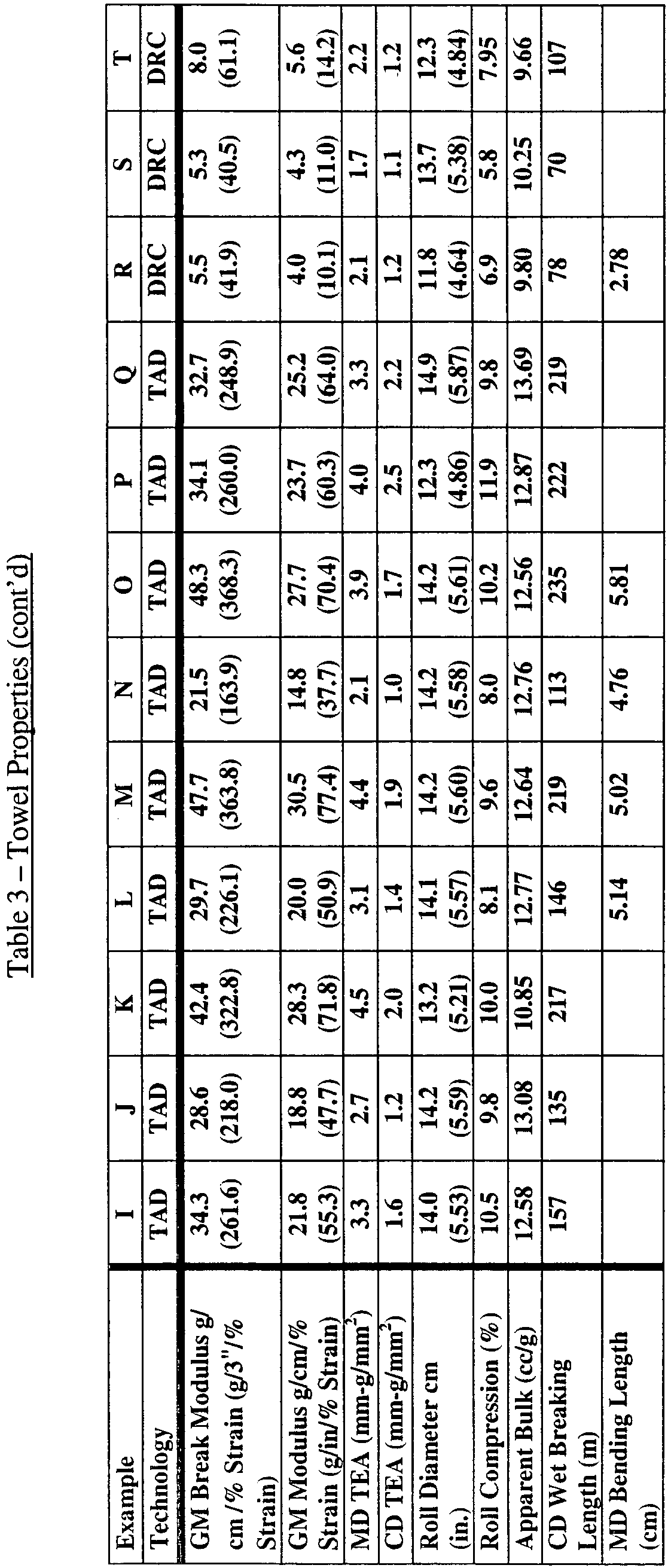
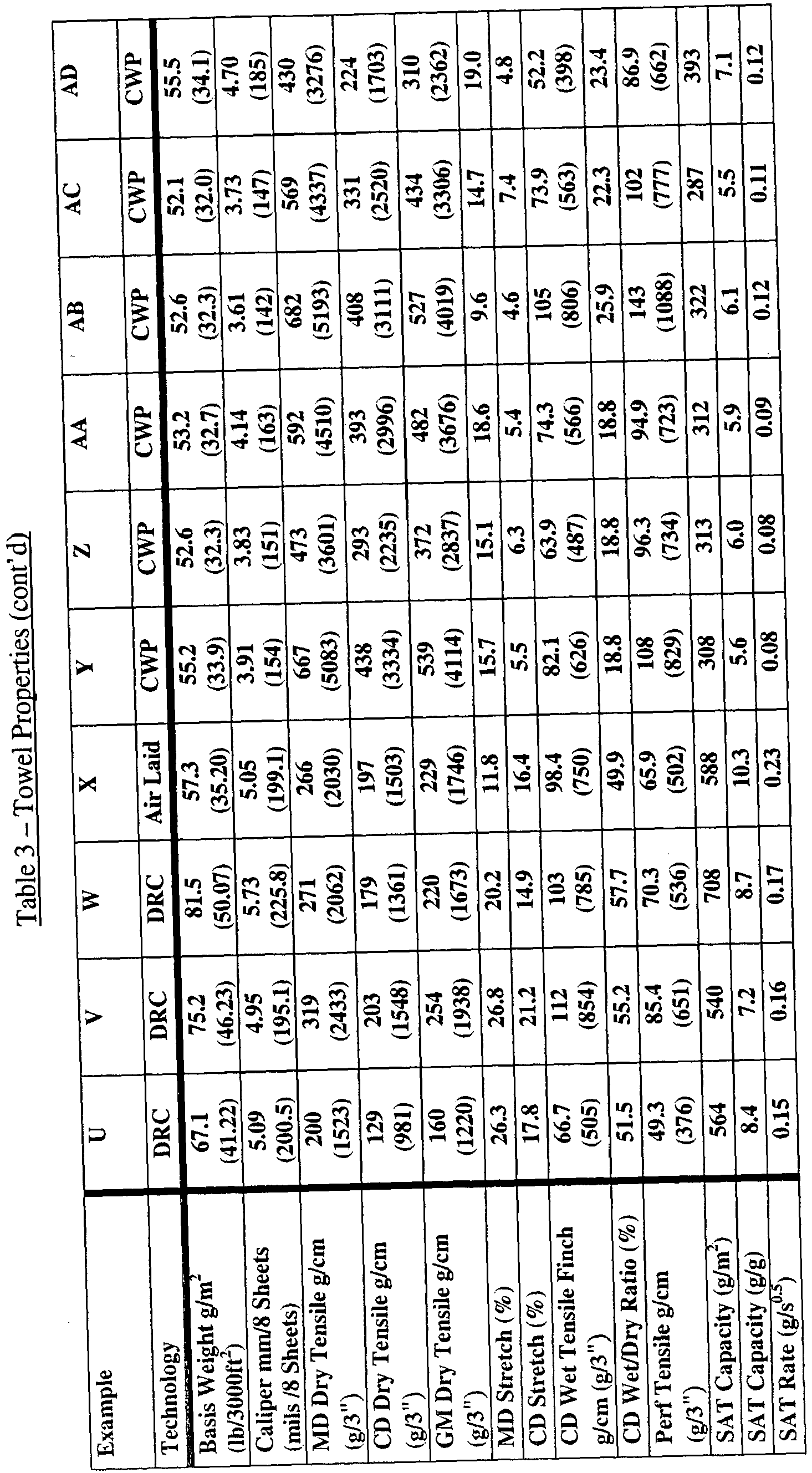

- As is seen in
Figure 15 , a heavyweight towel has less SAT converting loss than lower basis weights. This feature is used to advantage especially when drawing the towel along its machine direction as is seen in the following examples. - Single sheets were conditioned in a TAPPI standard test station and allowed to come to equilibration. Sheets were then taken from the rolls supplied and tested as follows:
- 1) 20.32 cm x 25.4 cm (8" x 10") samples were cut from sheets taken off the rolls;
- 2) Some of these samples were then tested for MD tensile, MD stretch, and SAT for controls;
- 3) Based upon the MD stretch of these samples, the rest of the 20.32 cm x 25.4 cm (8" x 10") sheets were put into a special clamping device and put into the Instron tensile tester where approximately half the MD stretch was pulled out;
- 4) These pulled out samples were then cut into the proper sized samples for tensile and SAT measurements; and
- 5) This procedure was also followed for the FC samples, with an extra sample pulled to the same degree as the TAD samples so that a direct comparison could be made. (Note: these tests clearly show the potential for non-linear behavior with sheet pullout.)
- Results appear in Table 4:
Table 4 - SAT Loss With Pullout MD Stretch SAT Before g/m2 % Pullout SAT After g/m2 Basis Weight 36# TAD High Strength Towel 14.8% 535 7.5 532 33.5 36# TAD High Softness Towel 15.6% 550 7.5 549 33.5 FC Towel 38.5% 508 7.5 520 19.00 477 - It is seen from Table 4 that the sheets exhibited very little SAT loss upon pullout, and that the fabric-creped towel actually exhibited an absorbency increase at 7.5% pullout.
Claims (13)
- An absorbent paper towel (240) having a basis weight between 48.8 g/m2 and 81.4 g/m2 {30 lbs per 3000 ft2 ream and 50 lbs per 3000 ft2 ream} comprising at least a first fabric creped ply (211) and a second fabric creped ply (222) bonded together, each said fabric creped ply (211, 222) having a plurality of interconnected regions of different local basis weights, including at least (A) a plurality of fiber enriched regions of high local basis weight, interconnected by way of (B) a plurality of lower local basis weight linking regions, characterized in that said absorbent paper towel (240) exhibiting an SAT value between 7 g/g and 12 g/g, wherein the towel has a GM TEA of greater than 3.5 mm-g/mm2 and
a GM Tensile Modulus in g/cm/% of less than [0.0249 (GM Tensile Strength, g/cm) + 6.06];
{GM Tensile Modulus in g/in/%, of less than [0.0083 (GM Tensile Strength, g/3") + 15.4]}. - The absorbent paper towel (240) according to Claim 1, wherein the plies (211, 222) are selected and adhered together such that the towel (240) has a GM Tensile Modulus in g/cm/% of less than [0.0975 (CD Wet Tensile Strength, g/cm) + 5.71]; {a GM Tensile Modulus in g/in/% of less than [0.0325 (CD Wet Tensile Strength, g/3") + 14.5]}.
- The absorbent paper towel (240) according to any of Claims 1 and 2, wherein the towel (240) exhibits a CD TEA of between 1.75 mm-g/mm2 and 3 mm-g/mm2 and an MD TEA of between 6 mm-g/mm2 and 10 mm-g/mm2.
- The absorbent paper towel (240) according to any of Claims 1 to 3, wherein the plies (211, 222) are selected and adhered together such that the towel (240) exhibits a GM TEA in mm-g/mm2 of greater than [0.00952 (GM Tensile, g/cm) - 0.75] {GM TEA in mm-g/mm2 of greater than [0.00125 (GM Tensile Strength, g/3") - 0.75]}, as well as a GM Tensile Modulus in g/cm/% of less than [0.0249 (GM Tensile Strength, g/cm) + 6.06], {a GM Tensile Modulus in g/in/% of less than [0.0083 (GM Tensile Strength, g/3") + 15.4]}.
- The absorbent paper towel (240) according to any of Claims 1 to 4, having an SAT value of greater than 7.5 g/g.
- The absorbent paper towel (240) according to any of Claims 1 to 5, such that the towel (240) exhibits a GM Break Modulus in g/cm/% of less than [0.175 (CD Wet Tensile, g/cm) + 5.91], {a GM Break Modulus in g/3"/% of less than [0.175 (CD Wet Tensile, g/3") + 45]}.
- The absorbent paper towel (240) according to any of Claims 1 to 6, wherein the towel (240) exhibits an MD bending length of between 3 cm and 4 cm.
- A method of making a paper towel (240) comprising:a) preparing a plurality of base sheets by way of (i) compactively dewatering a papermaking furnish to form a nascent web (44) having an apparently random distribution of papermaking fiber; (ii) applying the dewatered web (44) having the apparently random fiber distribution to a translating transfer surface (64) moving at a first speed; and (iii) fabric-creping the web (44) from the transfer surface (64) at a consistency of from about 30 to about 60 percent utilizing a patterned creping fabric (18), the creping step occurring under pressure in a fabric creping nip (76) defined between the transfer surface (64) and the creping fabric (18) wherein the fabric (18) is traveling at a second speed slower than the speed of said transfer surface (64), the fabric pattern, nip parameters, such as velocity delta, and web consistency being selected such that the web (44) is creped from the transfer surface (64) and redistributed on the creping fabric (18) to form a web (44) with a structure having a plurality of interconnected regions of different local basis weights including at least (A) a plurality of fiber enriched regions of high local basis weight, interconnected by way of (B) a plurality of lower local basis weight linking regions; and (iv) drying the web (44) to form base sheets;b) embossing the plurality of webs (44) prepared in step (a); andc) plying the embossed webs together to form a multi-ply towel (240),wherein the base sheets are prepared, embossed and adhered together such that the towel (240) exhibits a GM Tensile Modulus in g/cm/% of less than [0.0249 (GM Tensile Strength, g/cm) + 6.06], {GM Tensile Modulus in g/in/%, of less than [0.0083 (GM Tensile Strength, g/3") + 15.4]}, a basis weight between 48.8 g/m2 and 81.4 g/m2 {30 lbs per 3000 ft2 ream and 50 lbs per 3000 ft2 ream}, an SAT value between 7 g/g and 12 g/g, and a GM TEA of greater than 3.5 mm-g/mm2.
- The method of making a paper towel (240) according to claim 8 wherein the base sheets are selected and the steps of embossing, adhering and drawing are controlled such that the drawn towel has an SAT converting loss of less than 15%.
- The method of making a paper towel (240) according to any of Claims 8 and 9, wherein the embossed towel (240) is drawn along its machine direction at least about 5%.
- The method of making a paper towel (240) according to any of Claims 8 to 10, wherein at least one of the base sheet webs (44) is a compactively dewatered, fabric-creped web.
- The method of making a paper towel (240) according to any of Claims 8 to 11, wherein at least one of the base sheet webs (44) has an MD/CD tensile ratio of less than 1.
- The method of making a paper towel (240) according to any of Claims 8 to 12, wherein at least one of the base sheet webs (44) has an MD stretch at break of at least 20%.
Priority Applications (1)
| Application Number | Priority Date | Filing Date | Title |
|---|---|---|---|
| SI200731930A SI2057016T1 (en) | 2006-08-30 | 2007-08-24 | Multi-ply paper towel |
Applications Claiming Priority (2)
| Application Number | Priority Date | Filing Date | Title |
|---|---|---|---|
| US84134606P | 2006-08-30 | 2006-08-30 | |
| PCT/US2007/076712 WO2008027799A2 (en) | 2006-08-30 | 2007-08-24 | Multi-ply paper towel |
Publications (3)
| Publication Number | Publication Date |
|---|---|
| EP2057016A2 EP2057016A2 (en) | 2009-05-13 |
| EP2057016A4 EP2057016A4 (en) | 2011-10-05 |
| EP2057016B1 true EP2057016B1 (en) | 2017-04-26 |
Family
ID=39136739
Family Applications (1)
| Application Number | Title | Priority Date | Filing Date |
|---|---|---|---|
| EP07841309.3A Active EP2057016B1 (en) | 2006-08-30 | 2007-08-24 | Multi-ply paper towel |
Country Status (12)
| Country | Link |
|---|---|
| US (1) | US8409404B2 (en) |
| EP (1) | EP2057016B1 (en) |
| CA (1) | CA2659922C (en) |
| CY (1) | CY1118911T1 (en) |
| DK (1) | DK2057016T3 (en) |
| ES (1) | ES2627035T3 (en) |
| HU (1) | HUE032120T2 (en) |
| LT (1) | LT2057016T (en) |
| PL (1) | PL2057016T3 (en) |
| PT (1) | PT2057016T (en) |
| SI (1) | SI2057016T1 (en) |
| WO (1) | WO2008027799A2 (en) |
Cited By (1)
| Publication number | Priority date | Publication date | Assignee | Title |
|---|---|---|---|---|
| US12091820B2 (en) | 2020-10-09 | 2024-09-17 | Kimberly-Clark Worldwide, Inc. | Embossed tissue |
Families Citing this family (51)
| Publication number | Priority date | Publication date | Assignee | Title |
|---|---|---|---|---|
| US7494563B2 (en) | 2002-10-07 | 2009-02-24 | Georgia-Pacific Consumer Products Lp | Fabric creped absorbent sheet with variable local basis weight |
| US8911592B2 (en) * | 2002-10-07 | 2014-12-16 | Georgia-Pacific Consumer Products Lp | Multi-ply absorbent sheet of cellulosic fibers |
| EP1845193A1 (en) | 2006-04-14 | 2007-10-17 | Georgia-Pacific France | Multi-ply absorbent sheet, roll and process for producing the same |
| LT2057016T (en) * | 2006-08-30 | 2017-07-25 | Georgia-Pacific Consumer Products Lp | Multi-ply paper towel |
| US8273286B2 (en) * | 2007-09-10 | 2012-09-25 | Fram Jerry R | Positive pressure shear impregnator and wetout |
| US8080130B2 (en) * | 2008-02-01 | 2011-12-20 | Georgia-Pacific Consumer Products Lp | High basis weight TAD towel prepared from coarse furnish |
| US7811665B2 (en) | 2008-02-29 | 2010-10-12 | The Procter & Gamble Compmany | Embossed fibrous structures |
| DE102010003451B4 (en) * | 2010-03-30 | 2013-12-24 | Globalfoundries Dresden Module One Llc & Co. Kg | Exchange gate method for large ε metal gate stacks by avoiding a polishing process to expose the dummy material |
| MX336998B (en) | 2010-12-08 | 2016-02-09 | Buckeye Technologies Inc | Dispersible nonwoven wipe material. |
| US9439549B2 (en) * | 2010-12-08 | 2016-09-13 | Georgia-Pacific Nonwovens LLC | Dispersible nonwoven wipe material |
| JP2015508131A (en) | 2012-02-22 | 2015-03-16 | ザ プロクター アンド ギャンブルカンパニー | Embossed fibrous structure and method for producing the same |
| US8968517B2 (en) | 2012-08-03 | 2015-03-03 | First Quality Tissue, Llc | Soft through air dried tissue |
| US20140050890A1 (en) | 2012-08-17 | 2014-02-20 | Kenneth John Zwick | High Basis Weight Tissue with Low Slough |
| US9283730B2 (en) | 2012-08-17 | 2016-03-15 | Kimberly-Clark Worldwide, Inc. | High basis weight creped tissue |
| US8894813B2 (en) * | 2012-08-17 | 2014-11-25 | Kimberly-Clark Worldwide, Inc. | Absorbent barrier tissue |
| FI126174B (en) * | 2012-12-04 | 2016-07-29 | Valmet Automation Oy | Measurement of tissue paper |
| US8834677B2 (en) | 2013-01-31 | 2014-09-16 | Kimberly-Clark Worldwide, Inc. | Tissue having high improved cross-direction stretch |
| US8702905B1 (en) | 2013-01-31 | 2014-04-22 | Kimberly-Clark Worldwide, Inc. | Tissue having high strength and low modulus |
| US9206555B2 (en) | 2013-01-31 | 2015-12-08 | Kimberly-Clark Worldwide, Inc. | Tissue having high strength and low modulus |
| US20140345815A1 (en) * | 2013-05-21 | 2014-11-27 | Craig Robert Hammen | Product having a paper layer and a film layer and methods of forming such a product |
| EP3068619A4 (en) * | 2013-11-14 | 2017-07-05 | Georgia-Pacific Consumer Products LP | Soft, absorbent sheets having high absorbency and high caliper, and methods of making soft, absorbent sheets |
| WO2015176063A1 (en) | 2014-05-16 | 2015-11-19 | First Quality Tissue, Llc | Flushable wipe and method of forming the same |
| US10351998B2 (en) | 2014-09-24 | 2019-07-16 | Gpcp Ip Holdings Llc | Pre-moistened wet wipe products in perforated roll form made of tissue based substrates |
| MX378630B (en) | 2014-11-12 | 2025-03-10 | First Quality Tissue Llc | CANNABIS FIBER, ABSORBENT CELLULOSE STRUCTURES CONTAINING CANNABIS FIBER, AND METHODS FOR PRODUCING THE SAME. |
| CA2968311C (en) | 2014-11-24 | 2023-11-21 | First Quality Tissue, Llc | Soft tissue produced using a structured fabric and energy efficient pressing |
| EP3221134B1 (en) | 2014-12-05 | 2026-05-20 | Structured I Llc | MANUFACTURING PROCESS FOR PAPER RIBS USING 3D PRINTING TECHNOLOGY |
| US9719213B2 (en) * | 2014-12-05 | 2017-08-01 | First Quality Tissue, Llc | Towel with quality wet scrubbing properties at relatively low basis weight and an apparatus and method for producing same |
| US9822285B2 (en) | 2015-01-28 | 2017-11-21 | Gpcp Ip Holdings Llc | Glue-bonded multi-ply absorbent sheet |
| BR112017017435B1 (en) | 2015-03-20 | 2023-05-09 | Kimberly-Clark Worldwide, Inc | CREPATED TISSUE PAPER PRODUCT |
| US9963831B2 (en) | 2015-06-08 | 2018-05-08 | Gpcp Ip Holdings Llc | Soft absorbent sheets, structuring fabrics for making soft absorbent sheets, and methods of making soft absorbent sheets |
| US10138601B2 (en) | 2015-06-08 | 2018-11-27 | Gpcp Ip Holdings Llc | Soft absorbent sheets, structuring fabrics for making soft absorbent sheets, and methods of making soft absorbent sheets |
| US10538882B2 (en) | 2015-10-13 | 2020-01-21 | Structured I, Llc | Disposable towel produced with large volume surface depressions |
| WO2017066465A1 (en) | 2015-10-13 | 2017-04-20 | First Quality Tissue, Llc | Disposable towel produced with large volume surface depressions |
| MX2018004622A (en) | 2015-10-14 | 2019-05-06 | First Quality Tissue Llc | Bundled product and system and method for forming the same. |
| US10774476B2 (en) | 2016-01-19 | 2020-09-15 | Gpcp Ip Holdings Llc | Absorbent sheet tail-sealed with nanofibrillated cellulose-containing tail-seal adhesives |
| CN109154143A (en) | 2016-02-11 | 2019-01-04 | 结构 I 有限责任公司 | Belt or fabric including polymer layer for paper machine |
| US20170314206A1 (en) | 2016-04-27 | 2017-11-02 | First Quality Tissue, Llc | Soft, low lint, through air dried tissue and method of forming the same |
| TW201742967A (en) | 2016-06-07 | 2017-12-16 | 喬治亞-太平洋消費者產品公司 | Soft absorbent sheets, structuring fabrics for making soft absorbent sheets, and methods of making soft absorbent sheets |
| CA3168412C (en) | 2016-08-26 | 2024-10-22 | Structured I, Llc | Method of producing absorbent structures with high wet strength, absorbancy, and softness |
| US10422078B2 (en) | 2016-09-12 | 2019-09-24 | Structured I, Llc | Former of water laid asset that utilizes a structured fabric as the outer wire |
| US11583489B2 (en) | 2016-11-18 | 2023-02-21 | First Quality Tissue, Llc | Flushable wipe and method of forming the same |
| KR20190125312A (en) | 2017-03-02 | 2019-11-06 | 다이오세이시가부시끼가이샤 | Sanitary lamination |
| US10619309B2 (en) | 2017-08-23 | 2020-04-14 | Structured I, Llc | Tissue product made using laser engraved structuring belt |
| JP6461450B1 (en) | 2017-08-31 | 2019-01-30 | 大王製紙株式会社 | Sanitary tissue paper |
| JP6994339B2 (en) * | 2017-09-29 | 2022-01-14 | 大王製紙株式会社 | Blotted paper and its manufacturing method |
| DE102018114748A1 (en) | 2018-06-20 | 2019-12-24 | Voith Patent Gmbh | Laminated paper machine clothing |
| US11697538B2 (en) | 2018-06-21 | 2023-07-11 | First Quality Tissue, Llc | Bundled product and system and method for forming the same |
| US11738927B2 (en) | 2018-06-21 | 2023-08-29 | First Quality Tissue, Llc | Bundled product and system and method for forming the same |
| MX2022002272A (en) | 2019-08-29 | 2022-03-22 | Kimberly Clark Co | Tissue products having macrofolds. |
| AU2019464123A1 (en) | 2019-08-29 | 2022-04-07 | Kimberly-Clark Worldwide, Inc. | Tissue products having macrofolds |
| MX2022015935A (en) | 2020-07-03 | 2023-01-24 | Essity Hygiene & Health Ab | Coreless rolls of a tissue paper product and methods of manufacturing coreless rolls. |
Family Cites Families (113)
| Publication number | Priority date | Publication date | Assignee | Title |
|---|---|---|---|---|
| US3556932A (en) * | 1965-07-12 | 1971-01-19 | American Cyanamid Co | Water-soluble,ionic,glyoxylated,vinylamide,wet-strength resin and paper made therewith |
| US3545705A (en) * | 1967-04-14 | 1970-12-08 | Jwi Ltd | Stainless steel fourdrinier cloth |
| US3432936A (en) * | 1967-05-31 | 1969-03-18 | Scott Paper Co | Transpiration drying and embossing of wet paper webs |
| US3549742A (en) * | 1967-09-29 | 1970-12-22 | Scott Paper Co | Method of making a foraminous drainage member |
| US3867225A (en) * | 1969-01-23 | 1975-02-18 | Paper Converting Machine Co | Method for producing laminated embossed webs |
| US3556907A (en) * | 1969-01-23 | 1971-01-19 | Paper Converting Machine Co | Machine for producing laminated embossed webs |
| US3556933A (en) * | 1969-04-02 | 1971-01-19 | American Cyanamid Co | Regeneration of aged-deteriorated wet strength resins |
| US3858623A (en) | 1969-06-10 | 1975-01-07 | Huyck Corp | Papermakers fabrics |
| US3772076A (en) * | 1970-01-26 | 1973-11-13 | Hercules Inc | Reaction products of epihalohydrin and polymers of diallylamine and their use in paper |
| US3700623A (en) * | 1970-04-22 | 1972-10-24 | Hercules Inc | Reaction products of epihalohydrin and polymers of diallylamine and their use in paper |
| US4071050A (en) * | 1972-09-01 | 1978-01-31 | Nordiska Maskinfilt Aktiebolaget | Double-layer forming fabric |
| US3974025A (en) * | 1974-04-01 | 1976-08-10 | The Procter & Gamble Company | Absorbent paper having imprinted thereon a semi-twill, fabric knuckle pattern prior to final drying |
| SE385486B (en) * | 1974-10-10 | 1976-07-05 | Nordiska Maskinfilt Ab | PROPAGATION WIRE FOR PAPER, CELLULOSE OR SIMILAR MACHINES AND MANUFACTURED THE SAME |
| DE2517228C2 (en) * | 1975-04-18 | 1981-09-24 | Hermann Wangner Gmbh & Co Kg, 7410 Reutlingen | Paper machine fabric and its use in the wet end of a paper machine |
| US3994771A (en) * | 1975-05-30 | 1976-11-30 | The Procter & Gamble Company | Process for forming a layered paper web having improved bulk, tactile impression and absorbency and paper thereof |
| SE397371C (en) * | 1976-02-24 | 1980-08-18 | Nordiska Maskinfilt Ab | PREPARATION VIRUS FOR PAPER, CELLULOSA OR SIMILAR MACHINES |
| GB1572905A (en) | 1976-08-10 | 1980-08-06 | Scapa Porritt Ltd | Papermakers fabrics |
| US4102737A (en) * | 1977-05-16 | 1978-07-25 | The Procter & Gamble Company | Process and apparatus for forming a paper web having improved bulk and absorptive capacity |
| US4161195A (en) | 1978-02-16 | 1979-07-17 | Albany International Corp. | Non-twill paperforming fabric |
| US4149571A (en) | 1978-03-03 | 1979-04-17 | Huyck Corporation | Papermaking fabrics |
| US4184519A (en) | 1978-08-04 | 1980-01-22 | Wisconsin Wires, Inc. | Fabrics for papermaking machines |
| US4314589A (en) * | 1978-10-23 | 1982-02-09 | Jwi Ltd. | Duplex forming fabric |
| US4239065A (en) * | 1979-03-09 | 1980-12-16 | The Procter & Gamble Company | Papermachine clothing having a surface comprising a bilaterally staggered array of wicker-basket-like cavities |
| US4453573A (en) | 1980-02-11 | 1984-06-12 | Huyck Corporation | Papermakers forming fabric |
| US4359069A (en) | 1980-08-28 | 1982-11-16 | Albany International Corp. | Low density multilayer papermaking fabric |
| US4482429A (en) * | 1980-08-29 | 1984-11-13 | James River-Norwalk, Inc. | Paper webs having high bulk and absorbency and process and apparatus for producing the same |
| US4376455A (en) * | 1980-12-29 | 1983-03-15 | Albany International Corp. | Eight harness papermaking fabric |
| US4379735A (en) | 1981-08-06 | 1983-04-12 | Jwi Ltd. | Three-layer forming fabric |
| DE3146385C2 (en) * | 1981-11-23 | 1985-10-31 | Hermann Wangner Gmbh & Co Kg, 7410 Reutlingen | Double-layer fabric as a covering for paper machines |
| US4440597A (en) * | 1982-03-15 | 1984-04-03 | The Procter & Gamble Company | Wet-microcontracted paper and concomitant process |
| SE441016B (en) * | 1982-04-26 | 1985-09-02 | Nordiskafilt Ab | PREPARATION WIRES FOR PAPER, CELLULOSA OR SIMILAR MACHINES |
| US4689119A (en) * | 1982-07-01 | 1987-08-25 | James River Corporation Of Nevada | Apparatus for treating web material |
| US4551199A (en) * | 1982-07-01 | 1985-11-05 | Crown Zellerbach Corporation | Apparatus and process for treating web material |
| US4445638A (en) * | 1982-09-20 | 1984-05-01 | Honeywell Inc. | Hydronic antitrust operating system |
| US4533437A (en) | 1982-11-16 | 1985-08-06 | Scott Paper Company | Papermaking machine |
| SE435739B (en) * | 1983-02-23 | 1984-10-15 | Nordiskafilt Ab | DOUBLE TEXTILE TYPE FORMATION WIRES |
| DE3307144A1 (en) | 1983-03-01 | 1984-09-13 | Hermann Wangner Gmbh & Co Kg, 7410 Reutlingen | PAPER MACHINE COVERING IN A FABRIC BINDING THAT DOES NOT HAVE A SYMMETRY AXIS LONGITUDE |
| US4803032A (en) * | 1983-05-17 | 1989-02-07 | James River-Norwalk, Inc. | Method of spot embossing a fibrous sheet |
| US4490925A (en) * | 1983-06-08 | 1985-01-01 | Wangner Systems Corporation | Low permeability spiral fabric and method |
| US4529480A (en) * | 1983-08-23 | 1985-07-16 | The Procter & Gamble Company | Tissue paper |
| US4528316A (en) * | 1983-10-18 | 1985-07-09 | Kimberly-Clark Corporation | Creping adhesives containing polyvinyl alcohol and cationic polyamide resins |
| JPS60119293A (en) | 1983-11-30 | 1985-06-26 | 日本フィルコン株式会社 | Papermaking fabric |
| US5066532A (en) * | 1985-08-05 | 1991-11-19 | Hermann Wangner Gmbh & Co. | Woven multilayer papermaking fabric having increased stability and permeability and method |
| US5114777B2 (en) * | 1985-08-05 | 1997-11-18 | Wangner Systems Corp | Woven multilayer papermaking fabric having increased stability and permeability and method |
| US4849054A (en) * | 1985-12-04 | 1989-07-18 | James River-Norwalk, Inc. | High bulk, embossed fiber sheet material and apparatus and method of manufacturing the same |
| DE3600530A1 (en) * | 1986-01-10 | 1987-07-16 | Wangner Gmbh Co Kg Hermann | USE OF A PAPER MACHINE TREATMENT FOR THE PRODUCTION OF TISSUE PAPER OR POROESE FLEECE AND THEREFORE SUITABLE PAPER MACHINE TENSIONING |
| US4709732A (en) * | 1986-05-13 | 1987-12-01 | Huyck Corporation | Fourteen harness dual layer weave |
| US4834838A (en) * | 1987-02-20 | 1989-05-30 | James River Corporation | Fibrous tape base material |
| DE3713510A1 (en) * | 1987-04-22 | 1988-11-10 | Oberdorfer Fa F | PAPER MACHINE SCREEN FROM A DOUBLE-LAYER FABRIC |
| US4759976A (en) * | 1987-04-30 | 1988-07-26 | Albany International Corp. | Forming fabric structure to resist rewet of the paper sheet |
| US5277761A (en) * | 1991-06-28 | 1994-01-11 | The Procter & Gamble Company | Cellulosic fibrous structures having at least three regions distinguished by intensive properties |
| DE3817144A1 (en) * | 1988-05-19 | 1989-11-30 | Wangner Gmbh Co Kg Hermann | DOUBLE-LAYER COVERING FOR THE SHEET FORMING AREA OF A PAPER MACHINE |
| EP0346307A3 (en) * | 1988-06-09 | 1991-03-06 | Nordiskafilt Ab | Wet press felt to be used in a papermaking machine |
| US4967085A (en) * | 1989-02-03 | 1990-10-30 | Eastman Kodak Company | X-ray intensifying screen including a titanium activated hafnium dioxide phosphor containing neodymium to reduce afterglow |
| US4942077A (en) * | 1989-05-23 | 1990-07-17 | Kimberly-Clark Corporation | Tissue webs having a regular pattern of densified areas |
| US5054525A (en) * | 1989-06-23 | 1991-10-08 | F. Oberdorfer Gmbh & Co. | Double layer forming wire fabric |
| US5225269A (en) | 1989-06-28 | 1993-07-06 | Scandiafelt Ab | Press felt |
| US5211815A (en) * | 1989-10-30 | 1993-05-18 | James River Corporation | Forming fabric for use in producing a high bulk paper web |
| US5098519A (en) * | 1989-10-30 | 1992-03-24 | James River Corporation | Method for producing a high bulk paper web and product obtained thereby |
| US5023132A (en) * | 1990-04-03 | 1991-06-11 | Mount Vernon Mills, Inc. | Press felt for use in papermaking machine |
| US4973512A (en) | 1990-04-03 | 1990-11-27 | Mount Vernon Mills, Inc. | Press felt for use in papermaking machine |
| US5199467A (en) | 1990-06-06 | 1993-04-06 | Asten Group, Inc. | Papermakers fabric with stacked machine direction yarns |
| US5167261A (en) * | 1990-06-06 | 1992-12-01 | Asten Group, Inc. | Papermakers fabric with stacked machine direction yarns of a high warp fill |
| US5103874A (en) * | 1990-06-06 | 1992-04-14 | Asten Group, Inc. | Papermakers fabric with stacked machine direction yarns |
| US5199261A (en) * | 1990-08-10 | 1993-04-06 | Cummins Engine Company, Inc. | Internal combustion engine with turbocharger system |
| US5215617A (en) * | 1991-02-22 | 1993-06-01 | Kimberly-Clark Corporation | Method for making plied towels |
| CA2069193C (en) * | 1991-06-19 | 1996-01-09 | David M. Rasch | Tissue paper having large scale aesthetically discernible patterns and apparatus for making the same |
| US5245025A (en) * | 1991-06-28 | 1993-09-14 | The Procter & Gamble Company | Method and apparatus for making cellulosic fibrous structures by selectively obturated drainage and cellulosic fibrous structures produced thereby |
| US5219004A (en) * | 1992-02-06 | 1993-06-15 | Lindsay Wire, Inc. | Multi-ply papermaking fabric with binder warps |
| US5368696A (en) | 1992-10-02 | 1994-11-29 | Asten Group, Inc. | Papermakers wet press felt having high contact, resilient base fabric with hollow monofilaments |
| US5372876A (en) | 1993-06-02 | 1994-12-13 | Appleton Mills | Papermaking felt with hydrophobic layer |
| US5607551A (en) * | 1993-06-24 | 1997-03-04 | Kimberly-Clark Corporation | Soft tissue |
| US5690788A (en) * | 1994-10-11 | 1997-11-25 | James River Corporation Of Virginia | Biaxially undulatory tissue and creping process using undulatory blade |
| FI102623B1 (en) * | 1995-10-04 | 1999-01-15 | Valmet Corp | Procedure and apparatus in a paper machine |
| US5618612A (en) | 1995-05-30 | 1997-04-08 | Huyck Licensco, Inc. | Press felt having fine base fabric |
| US5657797A (en) * | 1996-02-02 | 1997-08-19 | Asten, Inc. | Press felt resistant to nip rejection |
| US6350349B1 (en) | 1996-05-10 | 2002-02-26 | Kimberly-Clark Worldwide, Inc. | Method for making high bulk wet-pressed tissue |
| US6119362A (en) * | 1996-06-19 | 2000-09-19 | Valmet Corporation | Arrangements for impingement drying and/or through-drying of a paper or material web |
| US5968590A (en) * | 1996-09-20 | 1999-10-19 | Valmet Corporation | Method for drying a surface-treated paper web in an after-dryer of a paper machine and after-dryer of a paper machine |
| US6001421A (en) * | 1996-12-03 | 1999-12-14 | Valmet Corporation | Method for drying paper and a dry end of a paper machine |
| DK0904451T3 (en) * | 1997-03-31 | 2003-09-22 | Fort James Corp | Soft, bulky, single-layer tissue paper |
| US5851353A (en) * | 1997-04-14 | 1998-12-22 | Kimberly-Clark Worldwide, Inc. | Method for wet web molding and drying |
| US6468392B2 (en) * | 1997-09-26 | 2002-10-22 | Fort James Corporation | Soft chemi-mechanically embossed absorbent paper product and method of making same |
| US6187137B1 (en) | 1997-10-31 | 2001-02-13 | Kimberly-Clark Worldwide, Inc. | Method of producing low density resilient webs |
| US6165319A (en) * | 1998-05-11 | 2000-12-26 | Fort James Corporation | Printed, soft, bulky single-ply absorbent paper having a serpentine configuration and low sidedness and methods for its manufacture |
| WO1999064673A1 (en) * | 1998-06-12 | 1999-12-16 | Fort James Corporation | Method of making a paper web having a high internal void volume of secondary fibers and a product made by the process |
| US6261666B1 (en) | 1998-08-14 | 2001-07-17 | Paper Converting Machine Co. | Two-ply paper products with either nested or foot-to-foot embossments and method of making |
| US6287426B1 (en) | 1998-09-09 | 2001-09-11 | Valmet-Karlstad Ab | Paper machine for manufacturing structured soft paper |
| US6551691B1 (en) | 1999-08-31 | 2003-04-22 | Gerogia-Pacific France | Absorbent paper product of at least three plies and method of manufacture |
| US7037406B2 (en) * | 1999-11-12 | 2006-05-02 | Fort James Corporation | Cross-machine direction embossing of absorbent paper products having an undulatory structure including ridges extending in the machine direction |
| US6432267B1 (en) | 1999-12-16 | 2002-08-13 | Georgia-Pacific Corporation | Wet crepe, impingement-air dry process for making absorbent sheet |
| US6447640B1 (en) | 2000-04-24 | 2002-09-10 | Georgia-Pacific Corporation | Impingement air dry process for making absorbent sheet |
| US6365000B1 (en) * | 2000-12-01 | 2002-04-02 | Fort James Corporation | Soft bulky multi-ply product and method of making the same |
| US6752907B2 (en) * | 2001-01-12 | 2004-06-22 | Georgia-Pacific Corporation | Wet crepe throughdry process for making absorbent sheet and novel fibrous product |
| US6896768B2 (en) * | 2001-04-27 | 2005-05-24 | Fort James Corporation | Soft bulky multi-ply product and method of making the same |
| US7959761B2 (en) | 2002-04-12 | 2011-06-14 | Georgia-Pacific Consumer Products Lp | Creping adhesive modifier and process for producing paper products |
| CA2443885A1 (en) | 2002-10-02 | 2004-04-02 | Fort James Corporation | Paper products including surface treated thermally bondable fibers and methods of making the same |
| DK1985754T3 (en) | 2002-10-07 | 2016-09-19 | Georgia Pacific Consumer Products Lp | A process for producing a bæltekreppet absorbent cellulose layer, and absorbent layer |
| US7662257B2 (en) | 2005-04-21 | 2010-02-16 | Georgia-Pacific Consumer Products Llc | Multi-ply paper towel with absorbent core |
| US7494563B2 (en) * | 2002-10-07 | 2009-02-24 | Georgia-Pacific Consumer Products Lp | Fabric creped absorbent sheet with variable local basis weight |
| US7588660B2 (en) | 2002-10-07 | 2009-09-15 | Georgia-Pacific Consumer Products Lp | Wet-pressed tissue and towel products with elevated CD stretch and low tensile ratios made with a high solids fabric crepe process |
| US7442278B2 (en) * | 2002-10-07 | 2008-10-28 | Georgia-Pacific Consumer Products Lp | Fabric crepe and in fabric drying process for producing absorbent sheet |
| US7789995B2 (en) | 2002-10-07 | 2010-09-07 | Georgia-Pacific Consumer Products, LP | Fabric crepe/draw process for producing absorbent sheet |
| US7585389B2 (en) | 2005-06-24 | 2009-09-08 | Georgia-Pacific Consumer Products Lp | Method of making fabric-creped sheet for dispensers |
| US7503998B2 (en) | 2004-06-18 | 2009-03-17 | Georgia-Pacific Consumer Products Lp | High solids fabric crepe process for producing absorbent sheet with in-fabric drying |
| US7799169B2 (en) * | 2004-09-01 | 2010-09-21 | Georgia-Pacific Consumer Products Lp | Multi-ply paper product with moisture strike through resistance and method of making the same |
| US20060093788A1 (en) * | 2004-10-29 | 2006-05-04 | Kimberly-Clark Worldwide, Inc. | Disposable food preparation mats, cutting sheets, placemats, and the like |
| US7850823B2 (en) | 2006-03-06 | 2010-12-14 | Georgia-Pacific Consumer Products Lp | Method of controlling adhesive build-up on a yankee dryer |
| US7718036B2 (en) * | 2006-03-21 | 2010-05-18 | Georgia Pacific Consumer Products Lp | Absorbent sheet having regenerated cellulose microfiber network |
| LT2057016T (en) * | 2006-08-30 | 2017-07-25 | Georgia-Pacific Consumer Products Lp | Multi-ply paper towel |
| US7608164B2 (en) | 2007-02-27 | 2009-10-27 | Georgia-Pacific Consumer Products Lp | Fabric-crepe process with prolonged production cycle and improved drying |
| US8080130B2 (en) * | 2008-02-01 | 2011-12-20 | Georgia-Pacific Consumer Products Lp | High basis weight TAD towel prepared from coarse furnish |
| US10837505B2 (en) | 2019-02-19 | 2020-11-17 | Wind Solutions, Llc | Redundant seal for wind turbine hydraulic brakes |
-
2007
- 2007-08-24 LT LTEP07841309.3T patent/LT2057016T/en unknown
- 2007-08-24 HU HUE07841309A patent/HUE032120T2/en unknown
- 2007-08-24 WO PCT/US2007/076712 patent/WO2008027799A2/en not_active Ceased
- 2007-08-24 CA CA2659922A patent/CA2659922C/en active Active
- 2007-08-24 DK DK07841309.3T patent/DK2057016T3/en active
- 2007-08-24 PL PL07841309T patent/PL2057016T3/en unknown
- 2007-08-24 PT PT78413093T patent/PT2057016T/en unknown
- 2007-08-24 US US12/438,387 patent/US8409404B2/en active Active
- 2007-08-24 EP EP07841309.3A patent/EP2057016B1/en active Active
- 2007-08-24 ES ES07841309.3T patent/ES2627035T3/en active Active
- 2007-08-24 SI SI200731930A patent/SI2057016T1/en unknown
-
2017
- 2017-05-29 CY CY20171100552T patent/CY1118911T1/en unknown
Cited By (1)
| Publication number | Priority date | Publication date | Assignee | Title |
|---|---|---|---|---|
| US12091820B2 (en) | 2020-10-09 | 2024-09-17 | Kimberly-Clark Worldwide, Inc. | Embossed tissue |
Also Published As
| Publication number | Publication date |
|---|---|
| PT2057016T (en) | 2017-06-05 |
| SI2057016T1 (en) | 2017-07-31 |
| LT2057016T (en) | 2017-07-25 |
| EP2057016A2 (en) | 2009-05-13 |
| EP2057016A4 (en) | 2011-10-05 |
| WO2008027799A3 (en) | 2009-04-30 |
| CY1118911T1 (en) | 2018-01-10 |
| CA2659922C (en) | 2014-10-28 |
| CA2659922A1 (en) | 2008-03-06 |
| US20100224338A1 (en) | 2010-09-09 |
| PL2057016T3 (en) | 2017-08-31 |
| WO2008027799A2 (en) | 2008-03-06 |
| HUE032120T2 (en) | 2017-08-28 |
| US8409404B2 (en) | 2013-04-02 |
| DK2057016T3 (en) | 2017-06-06 |
| ES2627035T3 (en) | 2017-07-26 |
Similar Documents
| Publication | Publication Date | Title |
|---|---|---|
| CA2659922C (en) | Multi-ply paper towel | |
| US8911592B2 (en) | Multi-ply absorbent sheet of cellulosic fibers | |
| US8328985B2 (en) | Method of making a fabric-creped absorbent cellulosic sheet | |
| EP2035220B1 (en) | Fabric creped absorbent sheet with variable local basis weight | |
| EP1761671A2 (en) | Low compaction, pneumatic dewatering process for producing absorbent sheet | |
| EP1907625B1 (en) | Fabric-creped sheet for dispensers | |
| HK1197440B (en) | Fabric creped absorbent sheet with variable local basis weight | |
| HK1129346B (en) | Fabric creped absorbent sheet with variable local basis weight | |
| HK1197439B (en) | Fabric creped absorbent sheet with variable local basis weight | |
| HK1129346A1 (en) | Fabric creped absorbent sheet with variable local basis weight | |
| HK1114579B (en) | Fabric-creped sheet for dispensers |
Legal Events
| Date | Code | Title | Description |
|---|---|---|---|
| PUAI | Public reference made under article 153(3) epc to a published international application that has entered the european phase |
Free format text: ORIGINAL CODE: 0009012 |
|
| 17P | Request for examination filed |
Effective date: 20090312 |
|
| AK | Designated contracting states |
Kind code of ref document: A2 Designated state(s): AT BE BG CH CY CZ DE DK EE ES FI FR GB GR HU IE IS IT LI LT LU LV MC MT NL PL PT RO SE SI SK TR |
|
| AX | Request for extension of the european patent |
Extension state: AL BA HR MK RS |
|
| R17D | Deferred search report published (corrected) |
Effective date: 20090430 |
|
| RIC1 | Information provided on ipc code assigned before grant |
Ipc: D21H 27/30 20060101ALI20090629BHEP Ipc: D21F 11/00 20060101ALI20090629BHEP Ipc: B31F 1/12 20060101AFI20090629BHEP |
|
| DAX | Request for extension of the european patent (deleted) | ||
| REG | Reference to a national code |
Ref country code: DE Ref legal event code: R079 Ref document number: 602007050794 Country of ref document: DE Free format text: PREVIOUS MAIN CLASS: B32B0029080000 Ipc: B31F0001120000 |
|
| A4 | Supplementary search report drawn up and despatched |
Effective date: 20110901 |
|
| RIC1 | Information provided on ipc code assigned before grant |
Ipc: D21H 27/30 20060101ALI20110826BHEP Ipc: D21F 11/00 20060101ALI20110826BHEP Ipc: B31F 1/12 20060101AFI20110826BHEP |
|
| 17Q | First examination report despatched |
Effective date: 20151123 |
|
| GRAP | Despatch of communication of intention to grant a patent |
Free format text: ORIGINAL CODE: EPIDOSNIGR1 |
|
| INTG | Intention to grant announced |
Effective date: 20161117 |
|
| GRAS | Grant fee paid |
Free format text: ORIGINAL CODE: EPIDOSNIGR3 |
|
| GRAA | (expected) grant |
Free format text: ORIGINAL CODE: 0009210 |
|
| AK | Designated contracting states |
Kind code of ref document: B1 Designated state(s): AT BE BG CH CY CZ DE DK EE ES FI FR GB GR HU IE IS IT LI LT LU LV MC MT NL PL PT RO SE SI SK TR |
|
| REG | Reference to a national code |
Ref country code: GB Ref legal event code: FG4D |
|
| REG | Reference to a national code |
Ref country code: CH Ref legal event code: EP |
|
| REG | Reference to a national code |
Ref country code: AT Ref legal event code: REF Ref document number: 887498 Country of ref document: AT Kind code of ref document: T Effective date: 20170515 |
|
| REG | Reference to a national code |
Ref country code: IE Ref legal event code: FG4D |
|
| REG | Reference to a national code |
Ref country code: SE Ref legal event code: TRGR |
|
| REG | Reference to a national code |
Ref country code: RO Ref legal event code: EPE |
|
| REG | Reference to a national code |
Ref country code: DE Ref legal event code: R096 Ref document number: 602007050794 Country of ref document: DE |
|
| REG | Reference to a national code |
Ref country code: PT Ref legal event code: SC4A Ref document number: 2057016 Country of ref document: PT Date of ref document: 20170605 Kind code of ref document: T Free format text: AVAILABILITY OF NATIONAL TRANSLATION Effective date: 20170525 |
|
| REG | Reference to a national code |
Ref country code: DK Ref legal event code: T3 Effective date: 20170601 |
|
| REG | Reference to a national code |
Ref country code: NL Ref legal event code: FP |
|
| REG | Reference to a national code |
Ref country code: FR Ref legal event code: PLFP Year of fee payment: 11 |
|
| REG | Reference to a national code |
Ref country code: EE Ref legal event code: FG4A Ref document number: E013741 Country of ref document: EE Effective date: 20170529 |
|
| REG | Reference to a national code |
Ref country code: ES Ref legal event code: FG2A Ref document number: 2627035 Country of ref document: ES Kind code of ref document: T3 Effective date: 20170726 |
|
| PGFP | Annual fee paid to national office [announced via postgrant information from national office to epo] |
Ref country code: MC Payment date: 20170630 Year of fee payment: 11 |
|
| REG | Reference to a national code |
Ref country code: HU Ref legal event code: AG4A Ref document number: E032120 Country of ref document: HU |
|
| PGFP | Annual fee paid to national office [announced via postgrant information from national office to epo] |
Ref country code: BE Payment date: 20170626 Year of fee payment: 11 |
|
| PGFP | Annual fee paid to national office [announced via postgrant information from national office to epo] |
Ref country code: EE Payment date: 20170726 Year of fee payment: 11 Ref country code: RO Payment date: 20170719 Year of fee payment: 11 |
|
| REG | Reference to a national code |
Ref country code: GR Ref legal event code: EP Ref document number: 20170401380 Country of ref document: GR Effective date: 20171023 |
|
| REG | Reference to a national code |
Ref country code: SK Ref legal event code: T3 Ref document number: E 24447 Country of ref document: SK |
|
| RAP2 | Party data changed (patent owner data changed or rights of a patent transferred) |
Owner name: GPCP IP HOLDINGS LLC |
|
| PGFP | Annual fee paid to national office [announced via postgrant information from national office to epo] |
Ref country code: SI Payment date: 20170707 Year of fee payment: 11 Ref country code: IS Payment date: 20170707 Year of fee payment: 11 Ref country code: DK Payment date: 20170810 Year of fee payment: 11 Ref country code: BG Payment date: 20170712 Year of fee payment: 11 Ref country code: LV Payment date: 20170804 Year of fee payment: 11 Ref country code: PT Payment date: 20170824 Year of fee payment: 11 Ref country code: IE Payment date: 20170809 Year of fee payment: 11 |
|
| REG | Reference to a national code |
Ref country code: DE Ref legal event code: R097 Ref document number: 602007050794 Country of ref document: DE |
|
| PGFP | Annual fee paid to national office [announced via postgrant information from national office to epo] |
Ref country code: SK Payment date: 20170713 Year of fee payment: 11 |
|
| REG | Reference to a national code |
Ref country code: CH Ref legal event code: PUE Owner name: GPCP IP HOLDINGS LLC, US Free format text: FORMER OWNER: GEORGIA-PACIFIC CONSUMER PRODUCTS LP, US Ref country code: CH Ref legal event code: NV Representative=s name: SCHNEIDER FELDMANN AG PATENT- UND MARKENANWAEL, CH |
|
| PLBE | No opposition filed within time limit |
Free format text: ORIGINAL CODE: 0009261 |
|
| STAA | Information on the status of an ep patent application or granted ep patent |
Free format text: STATUS: NO OPPOSITION FILED WITHIN TIME LIMIT |
|
| REG | Reference to a national code |
Ref country code: NL Ref legal event code: PD Owner name: GPCP IP HOLDINGS LLC; US Free format text: DETAILS ASSIGNMENT: CHANGE OF OWNER(S), ASSIGNMENT; FORMER OWNER NAME: GEORGIA-PACIFIC CONSUMER PRODUCTS LP Effective date: 20180123 |
|
| REG | Reference to a national code |
Ref country code: EE Ref legal event code: GB1A Ref document number: E013741 Country of ref document: EE |
|
| REG | Reference to a national code |
Ref country code: SI Ref legal event code: SP73 Owner name: GPCP IP HOLDINGS LLC; US Effective date: 20180206 |
|
| 26N | No opposition filed |
Effective date: 20180129 |
|
| REG | Reference to a national code |
Ref country code: SK Ref legal event code: PC4A Ref document number: E 24447 Country of ref document: SK Owner name: GPCP IP HOLDINGS LLC, ATLANTA, GEORGIA, US Free format text: FORMER OWNER: GEORGIA-PACIFIC CONSUMER PRODUCTS LP, ATLANTA GA, US Effective date: 20180313 |
|
| REG | Reference to a national code |
Ref country code: BE Ref legal event code: PD Owner name: GPCP IP HOLDINGS LLC; US Free format text: DETAILS ASSIGNMENT: CHANGE OF OWNER(S), CESSION; FORMER OWNER NAME: GEORGIA-PACIFIC CONSUMER PRODUCTS LP Effective date: 20180314 |
|
| REG | Reference to a national code |
Ref country code: AT Ref legal event code: PC Ref document number: 887498 Country of ref document: AT Kind code of ref document: T Owner name: GPCP IP HOLDINGS LLC, US Effective date: 20180314 |
|
| REG | Reference to a national code |
Ref country code: HU Ref legal event code: GB9C Owner name: GPCP IP HOLDINGS LLC, US Free format text: FORMER OWNER(S): GEORGIA-PACIFIC CONSUMER PRODUCTS LP, US Ref country code: HU Ref legal event code: FH1C Free format text: FORMER REPRESENTATIVE(S): SBGK SZABADALMI UEGYVIVOEI IRODA, HU Representative=s name: DR. KOCSOMBA NELLI UEGYVEDI IRODA, HU |
|
| REG | Reference to a national code |
Ref country code: GB Ref legal event code: 732E Free format text: REGISTERED BETWEEN 20180503 AND 20180509 |
|
| REG | Reference to a national code |
Ref country code: FR Ref legal event code: PLFP Year of fee payment: 12 |
|
| REG | Reference to a national code |
Ref country code: DE Ref legal event code: R081 Ref document number: 602007050794 Country of ref document: DE Owner name: GPCP IP HOLDINGS LLC, ATLANTA, US Free format text: FORMER OWNER: GEORGIA-PACIFIC CONSUMER PRODUCTS LP, ATLANTA, GA., US |
|
| PGFP | Annual fee paid to national office [announced via postgrant information from national office to epo] |
Ref country code: MT Payment date: 20170816 Year of fee payment: 11 |
|
| REG | Reference to a national code |
Ref country code: EE Ref legal event code: MM4A Ref document number: E013741 Country of ref document: EE Effective date: 20180831 |
|
| REG | Reference to a national code |
Ref country code: LT Ref legal event code: MM4D Effective date: 20180824 Ref country code: DK Ref legal event code: EBP Effective date: 20180831 |
|
| PG25 | Lapsed in a contracting state [announced via postgrant information from national office to epo] |
Ref country code: MC Free format text: LAPSE BECAUSE OF NON-PAYMENT OF DUE FEES Effective date: 20180831 |
|
| REG | Reference to a national code |
Ref country code: CH Ref legal event code: PL |
|
| PG25 | Lapsed in a contracting state [announced via postgrant information from national office to epo] |
Ref country code: LT Free format text: LAPSE BECAUSE OF NON-PAYMENT OF DUE FEES Effective date: 20180824 Ref country code: LV Free format text: LAPSE BECAUSE OF NON-PAYMENT OF DUE FEES Effective date: 20180824 Ref country code: EE Free format text: LAPSE BECAUSE OF NON-PAYMENT OF DUE FEES Effective date: 20180831 Ref country code: LU Free format text: LAPSE BECAUSE OF NON-PAYMENT OF DUE FEES Effective date: 20180824 Ref country code: CY Free format text: LAPSE BECAUSE OF NON-PAYMENT OF DUE FEES Effective date: 20180824 Ref country code: IS Free format text: LAPSE BECAUSE OF FAILURE TO SUBMIT A TRANSLATION OF THE DESCRIPTION OR TO PAY THE FEE WITHIN THE PRESCRIBED TIME-LIMIT Effective date: 20190301 Ref country code: LI Free format text: LAPSE BECAUSE OF NON-PAYMENT OF DUE FEES Effective date: 20180831 Ref country code: CH Free format text: LAPSE BECAUSE OF NON-PAYMENT OF DUE FEES Effective date: 20180831 |
|
| REG | Reference to a national code |
Ref country code: SK Ref legal event code: MM4A Ref document number: E 24447 Country of ref document: SK Effective date: 20180824 |
|
| REG | Reference to a national code |
Ref country code: BE Ref legal event code: MM Effective date: 20180831 |
|
| PG25 | Lapsed in a contracting state [announced via postgrant information from national office to epo] |
Ref country code: SK Free format text: LAPSE BECAUSE OF NON-PAYMENT OF DUE FEES Effective date: 20180824 Ref country code: PT Free format text: LAPSE BECAUSE OF NON-PAYMENT OF DUE FEES Effective date: 20190225 Ref country code: SI Free format text: LAPSE BECAUSE OF NON-PAYMENT OF DUE FEES Effective date: 20180825 Ref country code: GR Free format text: LAPSE BECAUSE OF NON-PAYMENT OF DUE FEES Effective date: 20190307 |
|
| REG | Reference to a national code |
Ref country code: SI Ref legal event code: KO00 Effective date: 20190410 |
|
| PG25 | Lapsed in a contracting state [announced via postgrant information from national office to epo] |
Ref country code: DK Free format text: LAPSE BECAUSE OF NON-PAYMENT OF DUE FEES Effective date: 20180831 |
|
| PG25 | Lapsed in a contracting state [announced via postgrant information from national office to epo] |
Ref country code: RO Free format text: LAPSE BECAUSE OF NON-PAYMENT OF DUE FEES Effective date: 20180824 Ref country code: BE Free format text: LAPSE BECAUSE OF NON-PAYMENT OF DUE FEES Effective date: 20180831 Ref country code: BG Free format text: LAPSE BECAUSE OF NON-PAYMENT OF DUE FEES Effective date: 20190430 |
|
| REG | Reference to a national code |
Ref country code: AT Ref legal event code: UEP Ref document number: 887498 Country of ref document: AT Kind code of ref document: T Effective date: 20170426 |
|
| PG25 | Lapsed in a contracting state [announced via postgrant information from national office to epo] |
Ref country code: IE Free format text: LAPSE BECAUSE OF NON-PAYMENT OF DUE FEES Effective date: 20180824 |
|
| PG25 | Lapsed in a contracting state [announced via postgrant information from national office to epo] |
Ref country code: MT Free format text: LAPSE BECAUSE OF NON-PAYMENT OF DUE FEES Effective date: 20180824 |
|
| REG | Reference to a national code |
Ref country code: HU Ref legal event code: HC9C Owner name: GPCP IP HOLDINGS LLC, US Free format text: FORMER OWNER(S): GEORGIA-PACIFIC CONSUMER PRODUCTS LP, US |
|
| REG | Reference to a national code |
Ref country code: HU Ref legal event code: HC9C Owner name: GPCP IP HOLDINGS LLC, US Free format text: FORMER OWNER(S): GEORGIA-PACIFIC CONSUMER PRODUCTS LP, US |
|
| P01 | Opt-out of the competence of the unified patent court (upc) registered |
Effective date: 20230528 |
|
| PGFP | Annual fee paid to national office [announced via postgrant information from national office to epo] |
Ref country code: PL Payment date: 20240618 Year of fee payment: 18 |
|
| PGFP | Annual fee paid to national office [announced via postgrant information from national office to epo] |
Ref country code: NL Payment date: 20240705 Year of fee payment: 18 |
|
| PGFP | Annual fee paid to national office [announced via postgrant information from national office to epo] |
Ref country code: CZ Payment date: 20240731 Year of fee payment: 18 |
|
| PGFP | Annual fee paid to national office [announced via postgrant information from national office to epo] |
Ref country code: HU Payment date: 20240729 Year of fee payment: 18 |
|
| PGFP | Annual fee paid to national office [announced via postgrant information from national office to epo] |
Ref country code: FI Payment date: 20250814 Year of fee payment: 19 Ref country code: ES Payment date: 20250903 Year of fee payment: 19 |
|
| PGFP | Annual fee paid to national office [announced via postgrant information from national office to epo] |
Ref country code: DE Payment date: 20250702 Year of fee payment: 19 |
|
| PGFP | Annual fee paid to national office [announced via postgrant information from national office to epo] |
Ref country code: TR Payment date: 20250808 Year of fee payment: 19 Ref country code: IT Payment date: 20250722 Year of fee payment: 19 |
|
| PGFP | Annual fee paid to national office [announced via postgrant information from national office to epo] |
Ref country code: GB Payment date: 20250703 Year of fee payment: 19 |
|
| PGFP | Annual fee paid to national office [announced via postgrant information from national office to epo] |
Ref country code: FR Payment date: 20250703 Year of fee payment: 19 Ref country code: AT Payment date: 20250725 Year of fee payment: 19 |
|
| PGFP | Annual fee paid to national office [announced via postgrant information from national office to epo] |
Ref country code: SE Payment date: 20250702 Year of fee payment: 19 |
|
| REG | Reference to a national code |
Ref country code: NL Ref legal event code: MM Effective date: 20250901 |
|
| PG25 | Lapsed in a contracting state [announced via postgrant information from national office to epo] |
Ref country code: HU Free format text: LAPSE BECAUSE OF NON-PAYMENT OF DUE FEES Effective date: 20250825 |
|
| PG25 | Lapsed in a contracting state [announced via postgrant information from national office to epo] |
Ref country code: CZ Free format text: LAPSE BECAUSE OF NON-PAYMENT OF DUE FEES Effective date: 20250824 |