EP2055918A1 - Method and device for estimating the intake air flow rate in an internal combustion engine - Google Patents
Method and device for estimating the intake air flow rate in an internal combustion engine Download PDFInfo
- Publication number
- EP2055918A1 EP2055918A1 EP07425688A EP07425688A EP2055918A1 EP 2055918 A1 EP2055918 A1 EP 2055918A1 EP 07425688 A EP07425688 A EP 07425688A EP 07425688 A EP07425688 A EP 07425688A EP 2055918 A1 EP2055918 A1 EP 2055918A1
- Authority
- EP
- European Patent Office
- Prior art keywords
- flow rate
- maf
- valve means
- air flow
- air
- Prior art date
- Legal status (The legal status is an assumption and is not a legal conclusion. Google has not performed a legal analysis and makes no representation as to the accuracy of the status listed.)
- Granted
Links
- 238000000034 method Methods 0.000 title claims abstract description 32
- 238000002485 combustion reaction Methods 0.000 title claims abstract description 13
- 238000004422 calculation algorithm Methods 0.000 claims abstract description 17
- 238000012937 correction Methods 0.000 claims description 15
- 101150026430 manA gene Proteins 0.000 claims description 3
- 238000004590 computer program Methods 0.000 claims 3
- 239000000446 fuel Substances 0.000 description 7
- 238000010586 diagram Methods 0.000 description 2
- 238000006073 displacement reaction Methods 0.000 description 2
- 230000000694 effects Effects 0.000 description 2
- 238000002347 injection Methods 0.000 description 2
- 239000007924 injection Substances 0.000 description 2
- 238000005259 measurement Methods 0.000 description 2
- 230000007704 transition Effects 0.000 description 2
- 238000011144 upstream manufacturing Methods 0.000 description 2
- 238000013459 approach Methods 0.000 description 1
- 239000003054 catalyst Substances 0.000 description 1
- 230000008859 change Effects 0.000 description 1
- 239000003344 environmental pollutant Substances 0.000 description 1
- 239000012530 fluid Substances 0.000 description 1
- 238000013178 mathematical model Methods 0.000 description 1
- 238000012986 modification Methods 0.000 description 1
- 230000004048 modification Effects 0.000 description 1
- 238000005312 nonlinear dynamic Methods 0.000 description 1
- 231100000719 pollutant Toxicity 0.000 description 1
- 238000011160 research Methods 0.000 description 1
- 230000029058 respiratory gaseous exchange Effects 0.000 description 1
Images


Classifications
-
- F—MECHANICAL ENGINEERING; LIGHTING; HEATING; WEAPONS; BLASTING
- F02—COMBUSTION ENGINES; HOT-GAS OR COMBUSTION-PRODUCT ENGINE PLANTS
- F02D—CONTROLLING COMBUSTION ENGINES
- F02D41/00—Electrical control of supply of combustible mixture or its constituents
- F02D41/02—Circuit arrangements for generating control signals
- F02D41/18—Circuit arrangements for generating control signals by measuring intake air flow
-
- F—MECHANICAL ENGINEERING; LIGHTING; HEATING; WEAPONS; BLASTING
- F02—COMBUSTION ENGINES; HOT-GAS OR COMBUSTION-PRODUCT ENGINE PLANTS
- F02D—CONTROLLING COMBUSTION ENGINES
- F02D2200/00—Input parameters for engine control
- F02D2200/02—Input parameters for engine control the parameters being related to the engine
- F02D2200/04—Engine intake system parameters
- F02D2200/0402—Engine intake system parameters the parameter being determined by using a model of the engine intake or its components
-
- F—MECHANICAL ENGINEERING; LIGHTING; HEATING; WEAPONS; BLASTING
- F02—COMBUSTION ENGINES; HOT-GAS OR COMBUSTION-PRODUCT ENGINE PLANTS
- F02D—CONTROLLING COMBUSTION ENGINES
- F02D2200/00—Input parameters for engine control
- F02D2200/02—Input parameters for engine control the parameters being related to the engine
- F02D2200/04—Engine intake system parameters
- F02D2200/0404—Throttle position
-
- F—MECHANICAL ENGINEERING; LIGHTING; HEATING; WEAPONS; BLASTING
- F02—COMBUSTION ENGINES; HOT-GAS OR COMBUSTION-PRODUCT ENGINE PLANTS
- F02D—CONTROLLING COMBUSTION ENGINES
- F02D2200/00—Input parameters for engine control
- F02D2200/02—Input parameters for engine control the parameters being related to the engine
- F02D2200/04—Engine intake system parameters
- F02D2200/0406—Intake manifold pressure
-
- F—MECHANICAL ENGINEERING; LIGHTING; HEATING; WEAPONS; BLASTING
- F02—COMBUSTION ENGINES; HOT-GAS OR COMBUSTION-PRODUCT ENGINE PLANTS
- F02D—CONTROLLING COMBUSTION ENGINES
- F02D2200/00—Input parameters for engine control
- F02D2200/70—Input parameters for engine control said parameters being related to the vehicle exterior
- F02D2200/703—Atmospheric pressure
-
- F—MECHANICAL ENGINEERING; LIGHTING; HEATING; WEAPONS; BLASTING
- F02—COMBUSTION ENGINES; HOT-GAS OR COMBUSTION-PRODUCT ENGINE PLANTS
- F02D—CONTROLLING COMBUSTION ENGINES
- F02D41/00—Electrical control of supply of combustible mixture or its constituents
- F02D41/30—Controlling fuel injection
- F02D41/32—Controlling fuel injection of the low pressure type
Definitions
- the present invention relates to a method and a device for estimating the intake air flow rate in an internal combustion engine.
- modern motor vehicles are generally provided with an airflow meter (debimeter) which is usually installed in the air intake system of the engine and provides an electric signal indicative of the flow rate of the fresh air supplied to the engine, on the basis of which the electronic control unit calculates the fuel flow rate to be injected into the engine cylinders before opening the intake valves, also as a function of the desired air-fuel ratio.
- an airflow meter debimeter
- new-generation vehicles are known which are provided with an electronic control unit that, among other functions, implements an algorithm to estimate the intake air flow rate in the engine.
- controlling the air-fuel ratio precisely at close to the stoichiometric value is particularly difficult in new-generation motor vehicles provided with a continuously variable intake timing system.
- measuring or precisely estimating the instantaneous mass of air flowing into the cylinders is particularly complicated, mainly owing to the natural supercharging effect that occurs in such engines due to the timing of the pressure waves in the intake manifold when the intake valve is opened.
- the purpose of the present invention is to provide a method for estimating the intake air flow rate in an internal combustion engine that at least partially overcomes the drawbacks of the devices and methods known in the prior art.
- number 1 indicates, as a whole, an internal combustion engine provided with an air intake system 2 and an electronic system 3 for controlling the intake system 2.
- the air intake system 2 comprises an air intake conduit 4, into which the air flows through an air filter 5, and a throttle valve 6 arranged on the air intake conduit 4, which supplies the intake air to the cylinders of the engine 1 (not illustrated in the drawing).
- the throttle valve 6 is operated by means of a specific actuating device, for example a direct current electric motor (not illustrated in the drawing).
- the electronic control system 3 comprises: a temperature sensor 7, arranged at the inlet of the air intake conduit 4 and producing an electric output signal indicative of the temperature T 0 of the intake air at the inlet of the intake conduit 4; a pressure sensor 8 arranged upstream of the throttle valve 6 and producing an electric output signal indicative of the pressure P up of the air at the inlet of the throttle valve 6, a pressure sensor 9 arranged downstream of the throttle valve 6 and producing an electric output signal indicative of the pressure P down of the air at the outlet of the throttle valve 6; a device for detecting the opening angle ⁇ of the throttle valve 6, for example a pair of potentiometers (not illustrated in the drawing); a device for measuring the engine speed RPM (not illustrated in the drawing); and an electronic control unit 10 connected to the temperature sensor 7, to the pressure sensors 8 and 9, to the engine speed RPM measuring device and to the actuating device for operating the throttle valve 6, producing output control signals for the engine 1 and configured to implement the method for estimating the intake air flow rate, according to the present invention described below with reference to the functional flow diagram
- a plurality of correction coefficients which are necessary in order to implement the method for estimating the intake air flow rate, are stored in the electronic control unit 10, and in particular:
- a reference value ⁇ ref is also stored in the electronic control unit 10, said value being indicative of the air pressure drop between the outlet and the inlet of the throttle valve 6 when the air flowing through the narrowest portion of the air intake conduit 4 reaches the speed of sound, equal to 0.5283, a pressure drop threshold value ⁇ tsh , for example between 0.9 and 0.95, and a constant ⁇ relating to the ratio between the specific heat of the air at constant pressure and that at constant volume, equal to 1.4.
- control unit 10 continuously acquires the following values measured by the various sensors listed above, namely:
- the electronic control unit 10 implements two different algorithms, each suitable to calculate an engine intake air flow rate.
- the electronic control unit 10 selects one of the two air flow rates on the basis of a previously defined valuation criterion, and uses the selected value to calculate the fuel flow rate to be injected into the engine cylinders.
- the electronic control unit 10 calculates the ratio P down / P up , which equals the air pressure drop ⁇ between the outlet and the inlet of the throttle valve 6 and, on the basis of the pressure drop ⁇ and the opening angle ⁇ of the throttle valve 6, in the block 12 it implements an algorithm according to a mathematical model known as the "Saint-Venant" equation, which is described in detail in the following documents: " Integrated breathing model and multi-variable control approach for air management in advanced gasoline engine", by A. Miotti, R. Scattolini, A. Musi and C. Siviero, SAE 2006 World Congress, Detroit, MI, USA, April 3-6, 2006 , paper No. 2006-01-0658; and " Internal Combustion Engine Fundamentals" by J.B. Heywood, 1st ed., Mc Graw-Hill, Inc., New York, USA, 1988 .
- the Saint-Venant equation describes the flow rate of a fluid through a nozzle and can thus be used to determine the instantaneous mass of air entering the manifold and flowing through the throttle valve 6.
- the Saint-Venant equation can be used to obtain a precise estimation of the intake air mass, regardless of any possible mechanical timing errors and sudden intake timing variations, but provided the pressure ratio ⁇ at the throttle valve is lower than a threshold value, typically in the region of 0.9.
- the electronic control unit 10 corrects the air mass value ⁇ man calculated in the block 12 using the correction coefficients K Pup and K T0 , and at the output of the block 14 it provides the instantaneous mass of air MAF_SV entering the manifold 4.
- the electronic control unit 10 implements another algorithm based on the so-called " Filling & Emptying" model, suitable to determine the air flowing into the engine cylinders as a function of the opening of the throttle valve 6 and the engine speed RPM, described in detail in documents: " Engine air-fuel ratio and torque control using secondary throttles", Proceedings of IEEE Conference on Decision and Control, by A.G. Stefanopoulou, J.W. Grizzle and J.S. Freudenberg, Orlando, USA, 1994, pages 2748-2753 ; and " Internal Combustion Engine Fundamentals", 1st ed., J.B. Heywood, Mc Graw-Hill, Inc., New York, USA, 1988 .
- the " Filling & Emptying" model can be used to determine the intake air taking into account the variations in the operating characteristics of the positive displacement pump when the engine speed changes. Said variations have a marked influence on the intake air mass flow rate, especially for pressure values ⁇ of almost one.
- the " Filling & Emptying" model can also be used to correctly reproduce the change in condition of the throttle valve "Drive-by-Wire” control, namely the transition from throttle valve control as a function of torque law (in which the throttle valve is controlled indirectly by the objective torque value calculated as a function of the request for power by the driver which is in turn calculated starting from the position of the accelerator pedal), to throttle valve control as a function of mechanical law (in which the throttle valve is controlled directly as a function of the position of the accelerator pedal).
- the electronic control unit 10 corrects the value of the air flow rate ⁇ man calculated in the block 16 using the correction coefficient K T0 and, at the output of block 17 it provides the instantaneous mass of air MAF_FE entering the manifold 4.
- the electronic control unit 10 selects one of the mass air flow values MAF_SV and MAF_FE determined according to the algorithms described above and, in a subsequent phase that is not shown in figure 2 , it uses the selected value to calculate the fuel flow rate to be injected into the engine cylinders.
- the selection of one of the mass air flow values MAF_SV or MAF_FE is performed on the basis of the comparison between the current pressure drop ⁇ , determined in the block 11, and the previously defined pressure drop threshold value ⁇ tsh .
- the electronic control unit 10 selects the mass air flow MAF_SV estimated on the basis of the Saint-Venant equation if the current pressure drop ⁇ is lower than the threshold value ⁇ tsh , i.e. less than 0.9. If, instead, ⁇ is greater than the threshold value ⁇ tsh i.e. more than 0.9 (except in case of a hysteresis, which can also be calibrated), the electronic control unit 10 selects the mass air flow MAF_FE estimated on the basis of the " Filling & Emptying" model.
- the method according to the invention always allows the intake air flow rate to be estimated precisely, regardless of engine operating conditions and the pressure ratio ⁇ at the throttle valve. Furthermore, by appropriately selecting the pressure drop threshold value ⁇ tsh the method according to the invention minimizes the overall mean square deviation of the estimation, for example with values of less than 2%, and achieves much lower error margins than the minimum error in measurements performed using an airflow meter.
- the method according to the invention is relatively simple to implement, in that it does not require numerical values for the coefficients, which are stored directly in the central control unit.
- the method according to the invention also eliminates the need for an airflow meter.
- a single sensor can be used, for example, to directly detect the air pressure drop ⁇ between the inlet and the outlet of the throttle valve.
- the coefficients K TO K Pup can, alternatively, be recalculated each time by the electronic control unit 10 on the basis of the stored reference values.
- the present invention is not limited to use in an indirect injection petrol engine, and can be applied to any internal combustion engine provided with an air intake system.
Landscapes
- Engineering & Computer Science (AREA)
- Chemical & Material Sciences (AREA)
- Combustion & Propulsion (AREA)
- Mechanical Engineering (AREA)
- General Engineering & Computer Science (AREA)
- Combined Controls Of Internal Combustion Engines (AREA)
- Electrical Control Of Air Or Fuel Supplied To Internal-Combustion Engine (AREA)
Abstract
Description
- The present invention relates to a method and a device for estimating the intake air flow rate in an internal combustion engine.
- As known in the prior art, in order to comply with mandatory pollutant emission limits, in new-generation vehicles, and in particular motor vehicles provided with a modern indirect injection petrol engine with three-way catalyst, the air-fuel ratio must be precisely controlled so that it is always close to the stoichiometric value, in order to reduce exhaust gas emissions.
- For that purpose, modern motor vehicles are generally provided with an airflow meter (debimeter) which is usually installed in the air intake system of the engine and provides an electric signal indicative of the flow rate of the fresh air supplied to the engine, on the basis of which the electronic control unit calculates the fuel flow rate to be injected into the engine cylinders before opening the intake valves, also as a function of the desired air-fuel ratio.
- Alternatively, new-generation vehicles are known which are provided with an electronic control unit that, among other functions, implements an algorithm to estimate the intake air flow rate in the engine.
- In particular, controlling the air-fuel ratio precisely at close to the stoichiometric value is particularly difficult in new-generation motor vehicles provided with a continuously variable intake timing system.
- In this type of engine, measuring or precisely estimating the instantaneous mass of air flowing into the cylinders is particularly complicated, mainly owing to the natural supercharging effect that occurs in such engines due to the timing of the pressure waves in the intake manifold when the intake valve is opened.
- In particular, when an airflow meter is used in an engine with a variable timing system, the air mass flowing into the cylinders cannot be measured precisely, due to the slow dynamics of the airflow meter, which is therefore unable to react to the extremely non-linear dynamics of the air passing through the intake conduit, characterized, even in normal driving conditions, by fast transients.
- Research conducted by the applicant has also demonstrated that even when the known algorithms are used it is not possible to obtain a precise estimation of the mass of air entering variable timing engines. In fact, such algorithms do not consider the positive displacement pump effect of the engine at changes in speed, which have a marked influence on the intake air mass flow rate, especially in high pressure areas, for instance with pressure ratios at the throttle valve in the region of 0.9 - 0.95, or any mechanical timing errors, or any sudden changes in the intake timing, nor are they capable of correctly reproducing transitions between torque law and mechanical law in the status of the Drive-by-Wire control system.
- The purpose of the present invention is to provide a method for estimating the intake air flow rate in an internal combustion engine that at least partially overcomes the drawbacks of the devices and methods known in the prior art.
- According to the present invention a method for estimating the intake air flow rate in an internal combustion engine is produced, as set forth in the appended claims.
- In order to better understand the present invention, a non-limiting preferred embodiment thereof will now be described by way of example with reference to the accompanying drawings, in which:
-
figure 1 is a schematic view of an air intake system of an internal combustion engine; and -
figure 2 is a functional flow diagram of the method for estimating the intake air flow rate in an internal combustion engine according to the present invention. - In
figure 1 , number 1 indicates, as a whole, an internal combustion engine provided with anair intake system 2 and anelectronic system 3 for controlling theintake system 2. - In particular, the
air intake system 2 comprises anair intake conduit 4, into which the air flows through anair filter 5, and athrottle valve 6 arranged on theair intake conduit 4, which supplies the intake air to the cylinders of the engine 1 (not illustrated in the drawing). - In particular, the
throttle valve 6 is operated by means of a specific actuating device, for example a direct current electric motor (not illustrated in the drawing). - The
electronic control system 3 comprises: atemperature sensor 7, arranged at the inlet of theair intake conduit 4 and producing an electric output signal indicative of the temperature T0 of the intake air at the inlet of theintake conduit 4; a pressure sensor 8 arranged upstream of thethrottle valve 6 and producing an electric output signal indicative of the pressure Pup of the air at the inlet of thethrottle valve 6, apressure sensor 9 arranged downstream of thethrottle valve 6 and producing an electric output signal indicative of the pressure Pdown of the air at the outlet of thethrottle valve 6; a device for detecting the opening angle α of thethrottle valve 6, for example a pair of potentiometers (not illustrated in the drawing); a device for measuring the engine speed RPM (not illustrated in the drawing); and anelectronic control unit 10 connected to thetemperature sensor 7, to thepressure sensors 8 and 9, to the engine speed RPM measuring device and to the actuating device for operating thethrottle valve 6, producing output control signals for the engine 1 and configured to implement the method for estimating the intake air flow rate, according to the present invention described below with reference to the functional flow diagram infigure 2 . - In particular, in an initial system calibration phase, a plurality of correction coefficients, which are necessary in order to implement the method for estimating the intake air flow rate, are stored in the
electronic control unit 10, and in particular: - a non-linear correction coefficient KTO , as a function of the intake air temperature;
- a multiplicative correction coefficient KPUp as a function of the air pressure at the inlet of the
throttle valve 6; - a first table, not shown in
figure 2 , containing a plurality of values for the opening angle α of thethrottle valve 6 as a function of the engine speed RPM; a second table, not shown infigure 2 , containing a plurality of values for the air pressure drop β between the outlet and the inlet of thethrottle valve 6, as a function of the engine speed RPM; and a third table, not shown infigure 2 , containing a plurality of leakage coefficients C1 for thethrottle valve 6, each determined experimentally as a function of a given value of the opening angle α of thethrottle valve 6 and of a given pressure drop value β. - A reference value β ref is also stored in the
electronic control unit 10, said value being indicative of the air pressure drop between the outlet and the inlet of thethrottle valve 6 when the air flowing through the narrowest portion of theair intake conduit 4 reaches the speed of sound, equal to 0.5283, a pressure drop threshold value β tsh , for example between 0.9 and 0.95, and a constant γ relating to the ratio between the specific heat of the air at constant pressure and that at constant volume, equal to 1.4. - In order to implement the method according to the present invention, the
control unit 10 continuously acquires the following values measured by the various sensors listed above, namely: - the temperature T0 of the intake air;
- the pressure Pup of the air at the inlet of the
throttle valve 6; - the pressure Pdown of the air at the outlet of the
throttle valve 6; and - the engine speed RPM.
- On the basis of the acquired values, the coefficients and the measurements in the stored tables, again with reference to
figure 2 , theelectronic control unit 10 implements two different algorithms, each suitable to calculate an engine intake air flow rate. - The
electronic control unit 10 selects one of the two air flow rates on the basis of a previously defined valuation criterion, and uses the selected value to calculate the fuel flow rate to be injected into the engine cylinders. - In particular, as illustrated in
figure 2 , in theblock 11, theelectronic control unit 10 calculates the ratio Pdown /Pup, which equals the air pressure drop β between the outlet and the inlet of thethrottle valve 6 and, on the basis of the pressure drop β and the opening angle α of thethrottle valve 6, in theblock 12 it implements an algorithm according to a mathematical model known as the "Saint-Venant" equation, which is described in detail in the following documents: "Integrated breathing model and multi-variable control approach for air management in advanced gasoline engine", by A. Miotti, R. Scattolini, A. Musi and C. Siviero, SAE 2006 World Congress, Detroit, MI, USA, April 3-6, 2006, paper No. 2006-01-0658; and "Internal Combustion Engine Fundamentals" by J.B. Heywood, 1st ed., Mc Graw-Hill, Inc., New York, USA, 1988. - As is known, the Saint-Venant equation describes the flow rate of a fluid through a nozzle and can thus be used to determine the instantaneous mass of air entering the manifold and flowing through the
throttle valve 6. - In the specific case, for that purpose, the
electronic control unit 10 calculates a sonic factor fs as a function of the pressure drop β and the constant γ, according to the following formula:
- Next, the
electronic control unit 10 calculates the Saint-Venant equation according to the following formula:
where: - ṁ man1 is the instantaneous mass of air entering the manifold;
- M is the molecular weight of the air;
- R is the gas specific constant:
- C1 is the leakage coefficient;
- Aeq is the total equivalent area of the throttle valve section through which the air flows;
- fs is the sonic factor.
- The Saint-Venant equation can be used to obtain a precise estimation of the intake air mass, regardless of any possible mechanical timing errors and sudden intake timing variations, but provided the pressure ratio β at the throttle valve is lower than a threshold value, typically in the region of 0.9.
- In the
blocks electronic control unit 10 corrects the air mass value ṁman calculated in theblock 12 using the correction coefficients KPup and KT0, and at the output of theblock 14 it provides the instantaneous mass of air MAF_SV entering themanifold 4. - Parallel to the procedure described in the blocks 11-14, in the blocks 15-17 the
electronic control unit 10 implements another algorithm based on the so-called "Filling & Emptying" model, suitable to determine the air flowing into the engine cylinders as a function of the opening of thethrottle valve 6 and the engine speed RPM, described in detail in documents: "Engine air-fuel ratio and torque control using secondary throttles", Proceedings of IEEE Conference on Decision and Control, by A.G. Stefanopoulou, J.W. Grizzle and J.S. Freudenberg, Orlando, USA, 1994, pages 2748-2753; and "Internal Combustion Engine Fundamentals", 1st ed., J.B. Heywood, Mc Graw-Hill, Inc., New York, USA, 1988. - In particular, for that purpose, the
electronic control unit 10 first calculates a correction coefficient KPatm for the pressure Pdown of the air at the outlet of thethrottle valve 6 according to the following formula:
where Prif is a reference atmospheric pressure and Patm is the atmospheric pressure, which can be measured, for example, by a specific sensor incorporated in theelectronic control unit 10. - Next, in the
block 15, theelectronic control unit 10 corrects the pressure Pdown using the correction coefficient KPatm and, on the basis of the opening angle α of thethrottle valve 6 and the corrected pressure value Pdown and engine speed RPM, in theblock 16 it calculates the flow rate ṁcyl of the air entering each engine cylinder, and the flow rate ṁ man2 of the air flowing through themanifold 4 according to the following formulas:


where: - T0 is the intake air temperature;
- V0 is the intake manifold volume;
- Vcyl is the volume displaced by the piston in the cylinder;
- RPM is the engine speed;
- η vol is the volumetric efficiency of the engine;
- f is a polynomial function obtained by multiplying the equivalent area Aeq by the portion of the leakage coefficient Cl that depends solely on the angle α of the
throttle valve 6; and - g is a polynomial function obtained by multiplying the sonic factor fS by the portion of the leakage coefficient Cl that depends solely on the pressure drop β.
- The "Filling & Emptying" model can be used to determine the intake air taking into account the variations in the operating characteristics of the positive displacement pump when the engine speed changes. Said variations have a marked influence on the intake air mass flow rate, especially for pressure values β of almost one.
- The "Filling & Emptying" model can also be used to correctly reproduce the change in condition of the throttle valve "Drive-by-Wire" control, namely the transition from throttle valve control as a function of torque law (in which the throttle valve is controlled indirectly by the objective torque value calculated as a function of the request for power by the driver which is in turn calculated starting from the position of the accelerator pedal), to throttle valve control as a function of mechanical law (in which the throttle valve is controlled directly as a function of the position of the accelerator pedal).
- In the
block 17, theelectronic control unit 10 corrects the value of the air flow rate ṁman calculated in theblock 16 using the correction coefficient KT0 and, at the output ofblock 17 it provides the instantaneous mass of air MAF_FE entering themanifold 4. - As shown in
figure 2 , in theblock 18 theelectronic control unit 10 selects one of the mass air flow values MAF_SV and MAF_FE determined according to the algorithms described above and, in a subsequent phase that is not shown infigure 2 , it uses the selected value to calculate the fuel flow rate to be injected into the engine cylinders. - In particular, the selection of one of the mass air flow values MAF_SV or MAF_FE is performed on the basis of the comparison between the current pressure drop β, determined in the
block 11, and the previously defined pressure drop threshold value β tsh . - In the specific case, the
electronic control unit 10 selects the mass air flow MAF_SV estimated on the basis of the Saint-Venant equation if the current pressure drop β is lower than the threshold value β tsh , i.e. less than 0.9. If, instead, β is greater than the threshold value β tsh i.e. more than 0.9 (except in case of a hysteresis, which can also be calibrated), theelectronic control unit 10 selects the mass air flow MAF_FE estimated on the basis of the "Filling & Emptying" model. - The advantages that can be achieved with the present invention are apparent from an analysis of the characteristics thereof.
- Firstly, thanks to the use of two different calculation algorithms and correction factors, the method according to the invention always allows the intake air flow rate to be estimated precisely, regardless of engine operating conditions and the pressure ratio β at the throttle valve. Furthermore, by appropriately selecting the pressure drop threshold value β tsh the method according to the invention minimizes the overall mean square deviation of the estimation, for example with values of less than 2%, and achieves much lower error margins than the minimum error in measurements performed using an airflow meter.
- Moreover, the method according to the invention is relatively simple to implement, in that it does not require numerical values for the coefficients, which are stored directly in the central control unit. The method according to the invention also eliminates the need for an airflow meter.
- Lastly, from the above description and illustrations, it is clear that modifications and variations are possible without departing from the scope of the present invention as set forth in the appended claims.
- Instead of the two pressure sensors arranged, respectively, upstream and downstream of the throttle valve, a single sensor can be used, for example, to directly detect the air pressure drop β between the inlet and the outlet of the throttle valve.
- The coefficients KTO KPup can, alternatively, be recalculated each time by the
electronic control unit 10 on the basis of the stored reference values. - In particular, it is clear that the present invention is not limited to use in an indirect injection petrol engine, and can be applied to any internal combustion engine provided with an air intake system.
Claims (17)
- Method for estimating the intake air flow rate in an internal combustion engine (1) provided with an air intake system (2), said system comprising valve means (6) for controlling said air flow rate,
characterized in that it comprises the phases of:- implementing a first and a second algorithm suitable to determine respectively a first (MAF_SV) and a second (MAF_FE) intake air flow rate in said engine; and- selecting said first (MAF_SV) or said second (MAF_FE) air flow rate, on the basis of a previously defined selection criterion. - Method according to claim 1, wherein said selection of said first (MAF_SV) or of said second (MAF_FE) air flow rate is performed on the basis of a pressure (Pup ) of the air at the inlet of said valve means (6) and a pressure (Pdown ) of the air at the outlet of said valve means (6).
- Method according to claim 2, wherein said selection of said first (MAF_SV) or of said second (MAF_FE) air flow rate is performed on the basis of a ratio (β) between said pressures (Pup, Pdown ) at the inlet and at the outlet of said valve means (6).
- Method according to claim 3, wherein the selection of said first (MAF_SV) or said second (MAF_FE) air flow rate comprises:- the selection of said first (MAF_SV) air flow rate in case said ratio (β) between said pressures (Pup , Pdown ) at the inlet and at the outlet of said valve means is lower than a previously defined threshold value (β tsh ); or- the selection of said second (MAF_FE) air flow rate in case said ratio (β) between said pressures (Pup , Pdown ) at the inlet and at the outlet of said valve means is greater than said previously defined threshold value (β tsh ).
- Method according to claim 4, wherein said previously defined threshold value (β tsh ) is between 0.9 and 0.95.
- Method according to any of the previous claims, wherein the implementation of said first algorithm comprises:- the determination of said ratio (β) between said pressures (Pup , Pdown ) at the inlet and at the outlet of said valve means;- the determination of an opening angle (α) of said valve means; and- the determination of said first intake air flow rate (MAF_SV) on the basis of said ratio (β) and of said opening angle (α) of said valve means.
- Method according to claim 6, wherein said first air flow rate (MA_SV) is determined on the basis of the following formula:

where:• ṁ man1 is a first instantaneous mass of air entering an intake conduit (4) that is part of said system;• M is the molecular weight of the air;• R is the gas specific constant;• C1 is a leakage coefficient of said valve means;• Aeq is an equivalent surface of the section of said valve means through which said intake air flows and• fs is a factor indicative of said pressure ratio (β). - Method according to claim 6, wherein the implementation of said first algorithm also comprises:- the determination of a least a first correction factor (Kpup,KTO ) of said pressure at the inlet of said valve means (Pup ), and/or of a temperature (TO ) of said intake air; and- the determination of said first air flow rate (MAF_SV) on the basis of said first correction factor (KPup,KTO ) and of said first instantaneous mass of intake air (ṁ man1).
- Method according to any of the previous claims, wherein said first algorithm is based on the "Saint-Venant" model.
- Method according to any of the claims from 1 to 5, wherein the implementation of said second algorithm comprises:- the determination of said opening angle (α) of said valve means (6);- the determination of a speed (RPM) of said engine; and- the determination of said second intake air flow rate (MAF_FE) on the basis of said pressure ( Pdown ) at the outlet of said valve means, of said opening angle (α) of said valve means and of said speed (RPM) of said engine.
- Method according to claim 10, wherein the implementation of said second algorithm also comprises:- the determination of at least a second correction factor (KPdown ) of said pressure (Pdown ) at the outlet of said valve means;- the correction of said pressure (Pdown ) at the outlet of said valve means using said second correction factor (KPdown ); and- the determination of said second (MAF_FE) intake air flow rate, on the basis of said pressure (Pdown ) at the outlet of said valve means corrected using said second correction factor (KPdown ), of said opening angle (α) of said valve means, and of said speed (RPM) of said engine.
- Method according to claim 10 or 11, wherein said second (MAF_FE) air flow rate is determined on the basis of the following formulas:


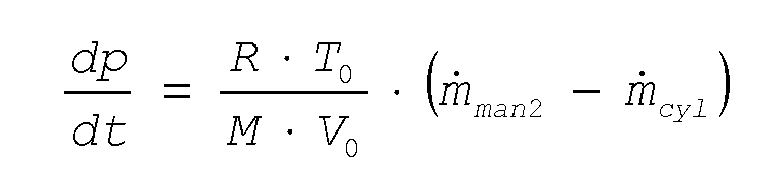
where:• T0 is said intake air temperature;• V0 is a volume of an intake conduit of said air, which is part of said system;• Vcyl is a volume of a cylinder of said engine;• RPM is said engine speed;• η vol is a volumetric efficiency of said engine;• ṁcyl is a mass of air entering said cylinder;• ṁ man2 is a second mass of air entering said intake conduit;• f is a first value as a function of said equivalent surface (Aeq), of said leakage coefficient (C1 ) and of said opening angle (α) of said valve means (6);• g is a second value as a function of said leakage coefficient (C1 ), of said ratio (β) between said second (Pdown ) and said first pressure (Pup ) and of said factor (fs) indicative of said pressure ratio (β). - Method according to claim 12, wherein:- said first value (f) is determined by multiplying said equivalent surface (Aeq) by a first portion of said leakage coefficient (C1 ) that depends solely on said opening angle of said valve means (6); and- said second value (f) is determined by multiplying said factor (fS ) indicative of said pressure ratio (β) by a second portion of said leakage coefficient (C1 ) that depends solely on said ratio (β) between said second (Pdown ) and said first pressure (Pup ).
- Method according to claim 13, wherein the implementation of said second algorithm also comprises:- the determination of said second intake air flow rate (MAF_FE) on the basis of said correction factor (KTO ) of said temperature (TO ) and of said second intake air mass (ṁ man2).
- Method according to any of the claims from 10 to 14, wherein said second algorithm is based on the "Filling and Emptying" model.
- Computer program that can be loaded into the memory of a digital processor, said computer program comprising portions of software codes that are capable of implementing the method according to any of the claims from 1 to 15 when said computer program is run on said digital processor.
- Internal combustion engine (1) comprising an air intake system (2) and a device configured to implement the method for estimating the intake air flow rate according to the claims from 1 to 15.
Priority Applications (6)
| Application Number | Priority Date | Filing Date | Title |
|---|---|---|---|
| EP07425688.4A EP2055918B1 (en) | 2007-10-31 | 2007-10-31 | Method and device for estimating the intake air flow rate in an internal combustion engine |
| US12/260,406 US8224592B2 (en) | 2007-10-31 | 2008-10-29 | Method and device for estimating the intake air flow rate in an internal combustion engine |
| RU2008142971/06A RU2488011C2 (en) | 2007-10-31 | 2008-10-30 | Device to define air flow rate at ice intake and ice |
| CN2008101732586A CN101581254B (en) | 2007-10-31 | 2008-10-31 | Method and device for estimating intake air flow rate in internal combustion engine |
| BRPI0804685-9A BRPI0804685A2 (en) | 2007-10-31 | 2008-10-31 | method and device for estimating the intake air flow in an internal combustion engine |
| JP2008282182A JP5148455B2 (en) | 2007-10-31 | 2008-10-31 | Method and apparatus for evaluating the intake air flow rate of an internal combustion engine |
Applications Claiming Priority (1)
| Application Number | Priority Date | Filing Date | Title |
|---|---|---|---|
| EP07425688.4A EP2055918B1 (en) | 2007-10-31 | 2007-10-31 | Method and device for estimating the intake air flow rate in an internal combustion engine |
Publications (2)
| Publication Number | Publication Date |
|---|---|
| EP2055918A1 true EP2055918A1 (en) | 2009-05-06 |
| EP2055918B1 EP2055918B1 (en) | 2016-06-01 |
Family
ID=39203234
Family Applications (1)
| Application Number | Title | Priority Date | Filing Date |
|---|---|---|---|
| EP07425688.4A Ceased EP2055918B1 (en) | 2007-10-31 | 2007-10-31 | Method and device for estimating the intake air flow rate in an internal combustion engine |
Country Status (6)
| Country | Link |
|---|---|
| US (1) | US8224592B2 (en) |
| EP (1) | EP2055918B1 (en) |
| JP (1) | JP5148455B2 (en) |
| CN (1) | CN101581254B (en) |
| BR (1) | BRPI0804685A2 (en) |
| RU (1) | RU2488011C2 (en) |
Cited By (3)
| Publication number | Priority date | Publication date | Assignee | Title |
|---|---|---|---|---|
| CN105930574A (en) * | 2016-04-15 | 2016-09-07 | 天津大学 | Genetic and neural network algorithm based design method for air intake port model of internal combustion engine |
| AT522649A1 (en) * | 2019-05-29 | 2020-12-15 | Avl List Gmbh | Method and system for determining the amount of air supplied to an internal combustion engine |
| CN113374592A (en) * | 2021-06-18 | 2021-09-10 | 广西玉柴机器股份有限公司 | Control method for calculating air intake flow of diesel engine |
Families Citing this family (14)
| Publication number | Priority date | Publication date | Assignee | Title |
|---|---|---|---|---|
| DE102009031630A1 (en) * | 2009-07-03 | 2011-01-05 | Dr. Ing. H.C. F. Porsche Aktiengesellschaft | Method for determination of value of drive size of internal-combustion engine, involves determining drive size by theoretical model, which illustrates conditions dominant in inlet tract |
| US8364373B2 (en) * | 2010-08-30 | 2013-01-29 | GM Global Technology Operations LLC | Method for controlling internal combustion engines in hybrid powertrains |
| KR101209742B1 (en) * | 2010-11-04 | 2012-12-07 | 기아자동차주식회사 | Valvelift devition compensating method for cvvl mounted engines |
| US8706381B2 (en) * | 2011-05-31 | 2014-04-22 | GM Global Technology Operations LLC | System and method for detection failures of mass airflow sensors in a parallel intake engine |
| CN102841661A (en) * | 2011-06-24 | 2012-12-26 | 鸿富锦精密工业(深圳)有限公司 | Air current pressure drop detection device for cooling fan and cooling fan installation method |
| US9910448B2 (en) | 2013-03-14 | 2018-03-06 | Christopher Max Horwitz | Pressure-based gas flow controller with dynamic self-calibration |
| JP6156429B2 (en) * | 2014-05-26 | 2017-07-05 | トヨタ自動車株式会社 | Control device for internal combustion engine |
| KR101543009B1 (en) * | 2014-12-02 | 2015-08-07 | 현대자동차 주식회사 | Method for controlling exhaust gas recirculation system for engine |
| DE102016205680A1 (en) * | 2016-04-06 | 2017-10-12 | Robert Bosch Gmbh | Method and device for determining a fresh air mass flow in an internal combustion engine |
| JP6328201B2 (en) * | 2016-10-05 | 2018-05-23 | 三菱電機株式会社 | Control device for internal combustion engine |
| IT201800004431A1 (en) * | 2018-04-12 | 2019-10-12 | DEVICE AND METHOD OF CONTROL OF AN INTERNAL COMBUSTION ENGINE WITH COMMANDED IGNITION | |
| CN110857636A (en) * | 2018-08-23 | 2020-03-03 | 联合汽车电子有限公司 | Engine system and method for detecting intake abnormality of engine |
| CN111189514B (en) * | 2019-12-31 | 2021-05-18 | 潍柴动力股份有限公司 | Mass flow sensor output correction method, device, controller and medium |
| CN115307863B (en) * | 2022-10-12 | 2022-12-09 | 中国空气动力研究与发展中心低速空气动力研究所 | Steady flow intake control method and system for engine intake simulation and storage medium |
Citations (5)
| Publication number | Priority date | Publication date | Assignee | Title |
|---|---|---|---|---|
| EP0287932A2 (en) * | 1987-04-21 | 1988-10-26 | Toyota Jidosha Kabushiki Kaisha | Non-linear feedback controller for internal combustion engine |
| WO2002068806A1 (en) * | 2001-02-28 | 2002-09-06 | Renault S.A.S. | Method for calculating the mass of air admitted into the cylinder of an internal combustion engine in a motor vehicle and injection calculator carrying out said method |
| US6591667B1 (en) * | 2001-04-20 | 2003-07-15 | Ford Global Technologies, Llc | Method of determining throttle flow in a fuel delivery system |
| US20030182995A1 (en) * | 2002-03-27 | 2003-10-02 | Siemens Vdo Automotive | Method and computer for determining a setting for correct operation of an internal combustion engine |
| US20060277984A1 (en) * | 2005-04-20 | 2006-12-14 | Thomas Bleile | Method and device for operating an internal combustion engine |
Family Cites Families (3)
| Publication number | Priority date | Publication date | Assignee | Title |
|---|---|---|---|---|
| ATE166430T1 (en) * | 1991-01-14 | 1998-06-15 | Orbital Eng Pty | CONTROL SYSTEM FOR INTERNAL COMBUSTION ENGINE |
| DE19750496A1 (en) * | 1997-11-14 | 1999-05-20 | Bosch Gmbh Robert | Method of determining the air induced into an internal combustion engine |
| US7565236B2 (en) * | 2007-07-20 | 2009-07-21 | Gm Global Technology Operations, Inc. | Airflow estimation method and apparatus for internal combustion engine |
-
2007
- 2007-10-31 EP EP07425688.4A patent/EP2055918B1/en not_active Ceased
-
2008
- 2008-10-29 US US12/260,406 patent/US8224592B2/en not_active Expired - Fee Related
- 2008-10-30 RU RU2008142971/06A patent/RU2488011C2/en not_active IP Right Cessation
- 2008-10-31 BR BRPI0804685-9A patent/BRPI0804685A2/en not_active Application Discontinuation
- 2008-10-31 JP JP2008282182A patent/JP5148455B2/en not_active Expired - Fee Related
- 2008-10-31 CN CN2008101732586A patent/CN101581254B/en not_active Expired - Fee Related
Patent Citations (5)
| Publication number | Priority date | Publication date | Assignee | Title |
|---|---|---|---|---|
| EP0287932A2 (en) * | 1987-04-21 | 1988-10-26 | Toyota Jidosha Kabushiki Kaisha | Non-linear feedback controller for internal combustion engine |
| WO2002068806A1 (en) * | 2001-02-28 | 2002-09-06 | Renault S.A.S. | Method for calculating the mass of air admitted into the cylinder of an internal combustion engine in a motor vehicle and injection calculator carrying out said method |
| US6591667B1 (en) * | 2001-04-20 | 2003-07-15 | Ford Global Technologies, Llc | Method of determining throttle flow in a fuel delivery system |
| US20030182995A1 (en) * | 2002-03-27 | 2003-10-02 | Siemens Vdo Automotive | Method and computer for determining a setting for correct operation of an internal combustion engine |
| US20060277984A1 (en) * | 2005-04-20 | 2006-12-14 | Thomas Bleile | Method and device for operating an internal combustion engine |
Non-Patent Citations (5)
| Title |
|---|
| "Internal Combustion Engine Fundamentals", 1988, MC GRAW-HILL, INC. |
| A. MIOTTI ET AL.: "Integrated breathing model and multi-variable control approach for air management in advanced gasoline engine", SAE 2006 WORLD CONGRESS, 3 April 2006 (2006-04-03) |
| A.G. STEFANOPOULOU; J.W. GRIZZLE; J.S. FREUDENBERG: "Engine air-fuel ratio and torque control using secondary throttles", PROCEEDINGS OF IEEE CONFERENCE ON DECISION AND CONTROL, 1994, pages 2748 - 2753 |
| BIDAN P ET AL: "NONLINEAR CONTROL OF A SPARK-IGNITION ENGINE", IEEE TRANSACTIONS ON CONTROL SYSTEMS TECHNOLOGY, IEEE SERVICE CENTER, NEW YORK, NY, US, vol. 3, no. 1, 1 March 1995 (1995-03-01), pages 4 - 13, XP000508605, ISSN: 1063-6536 * |
| STEFANOPOULOU A G ET AL: "ENGINE AIR-FUEL RATIO AND TORQUE CONTROL USING SECONDARY THROTTLES", PROCEEDINGS OF THE CONFERENCE ON DECISION AND CONTROL. LAKE BUENA VISTA, DEC. 14 - 16, 1994, NEW YORK, IEEE, US, vol. VOL. 3 CONF. 33, 14 December 1994 (1994-12-14), pages 2748 - 2753, XP000679142, ISBN: 0-7803-1969-9 * |
Cited By (4)
| Publication number | Priority date | Publication date | Assignee | Title |
|---|---|---|---|---|
| CN105930574A (en) * | 2016-04-15 | 2016-09-07 | 天津大学 | Genetic and neural network algorithm based design method for air intake port model of internal combustion engine |
| AT522649A1 (en) * | 2019-05-29 | 2020-12-15 | Avl List Gmbh | Method and system for determining the amount of air supplied to an internal combustion engine |
| AT522649B1 (en) * | 2019-05-29 | 2021-04-15 | Avl List Gmbh | Method and system for determining the amount of air supplied to an internal combustion engine |
| CN113374592A (en) * | 2021-06-18 | 2021-09-10 | 广西玉柴机器股份有限公司 | Control method for calculating air intake flow of diesel engine |
Also Published As
| Publication number | Publication date |
|---|---|
| JP2009108865A (en) | 2009-05-21 |
| RU2488011C2 (en) | 2013-07-20 |
| CN101581254B (en) | 2013-11-27 |
| JP5148455B2 (en) | 2013-02-20 |
| RU2008142971A (en) | 2010-05-10 |
| CN101581254A (en) | 2009-11-18 |
| US8224592B2 (en) | 2012-07-17 |
| US20090143998A1 (en) | 2009-06-04 |
| BRPI0804685A2 (en) | 2009-06-16 |
| EP2055918B1 (en) | 2016-06-01 |
Similar Documents
| Publication | Publication Date | Title |
|---|---|---|
| EP2055918B1 (en) | Method and device for estimating the intake air flow rate in an internal combustion engine | |
| US6662640B2 (en) | Air amount detector for internal combustion engine | |
| US7441544B2 (en) | Control device for internal combustion engine | |
| US7438061B2 (en) | Method and apparatus for estimating exhaust pressure of an internal combustion engine | |
| EP2198141B1 (en) | Exhaust-gas recirculation apparatus and exhaust-gas recirculation flow rate estimation method for internal combustion engines | |
| US7529614B1 (en) | System and method for turbo compressor recirculation valve control | |
| CN102575577B (en) | Control device for engine with turbocharger | |
| US7831371B2 (en) | Control apparatus for an internal combustion engine | |
| US20040045526A1 (en) | Method and system for controlling partial pressure of air in an intake manifold of an engine | |
| US7085643B2 (en) | Device for estimating an amount of intake air of an internal combustion engine | |
| JP2007224727A (en) | Control device for internal combustion engine | |
| JP4849588B2 (en) | Control device for internal combustion engine | |
| CN101292081B (en) | Exhaust purification equipment for internal combustion engines | |
| EP1917430B1 (en) | Control system for internal combustion engine | |
| JP4542489B2 (en) | Exhaust manifold internal temperature estimation device for internal combustion engine | |
| CN103282626B (en) | System and method for controlling a motor vehicle internal combustion engine in a transient state | |
| JP2010048133A (en) | Malfunction detecting device for air flow meter | |
| JP2012520968A (en) | Apparatus and method for controlling fuel injection into engine partially depending on recirculated exhaust gas flow rate | |
| JP4665843B2 (en) | Abnormality determination device for internal combustion engine | |
| JP4063164B2 (en) | Control device for internal combustion engine | |
| JP2005083345A (en) | Control device for internal combustion engine | |
| JP2007239650A (en) | Control device for internal combustion engine | |
| JP2006291871A (en) | Control device for internal combustion engine | |
| JP2010248949A (en) | Fuel control device equipped with engine cylinder inflow air amount measuring device | |
| JP3047616B2 (en) | Fuel injection amount control device for internal combustion engine |
Legal Events
| Date | Code | Title | Description |
|---|---|---|---|
| PUAI | Public reference made under article 153(3) epc to a published international application that has entered the european phase |
Free format text: ORIGINAL CODE: 0009012 |
|
| AK | Designated contracting states |
Kind code of ref document: A1 Designated state(s): AT BE BG CH CY CZ DE DK EE ES FI FR GB GR HU IE IS IT LI LT LU LV MC MT NL PL PT RO SE SI SK TR |
|
| AX | Request for extension of the european patent |
Extension state: AL BA HR MK RS |
|
| 17P | Request for examination filed |
Effective date: 20091105 |
|
| AKX | Designation fees paid |
Designated state(s): DE FR IT TR |
|
| 17Q | First examination report despatched |
Effective date: 20091228 |
|
| RIN1 | Information on inventor provided before grant (corrected) |
Inventor name: DE CRISTOFARO, FERDINANDO Inventor name: RIEGEL, ALESSANDRO Inventor name: TAVELLA, DOMENICO |
|
| GRAP | Despatch of communication of intention to grant a patent |
Free format text: ORIGINAL CODE: EPIDOSNIGR1 |
|
| INTG | Intention to grant announced |
Effective date: 20151210 |
|
| GRAS | Grant fee paid |
Free format text: ORIGINAL CODE: EPIDOSNIGR3 |
|
| GRAA | (expected) grant |
Free format text: ORIGINAL CODE: 0009210 |
|
| AK | Designated contracting states |
Kind code of ref document: B1 Designated state(s): DE FR IT TR |
|
| REG | Reference to a national code |
Ref country code: DE Ref legal event code: R096 Ref document number: 602007046503 Country of ref document: DE |
|
| REG | Reference to a national code |
Ref country code: FR Ref legal event code: PLFP Year of fee payment: 10 |
|
| REG | Reference to a national code |
Ref country code: DE Ref legal event code: R097 Ref document number: 602007046503 Country of ref document: DE |
|
| PLBE | No opposition filed within time limit |
Free format text: ORIGINAL CODE: 0009261 |
|
| STAA | Information on the status of an ep patent application or granted ep patent |
Free format text: STATUS: NO OPPOSITION FILED WITHIN TIME LIMIT |
|
| 26N | No opposition filed |
Effective date: 20170302 |
|
| REG | Reference to a national code |
Ref country code: FR Ref legal event code: PLFP Year of fee payment: 11 |
|
| PGFP | Annual fee paid to national office [announced via postgrant information from national office to epo] |
Ref country code: TR Payment date: 20171010 Year of fee payment: 11 Ref country code: FR Payment date: 20171031 Year of fee payment: 11 |
|
| PGFP | Annual fee paid to national office [announced via postgrant information from national office to epo] |
Ref country code: IT Payment date: 20171005 Year of fee payment: 11 |
|
| PGFP | Annual fee paid to national office [announced via postgrant information from national office to epo] |
Ref country code: DE Payment date: 20180122 Year of fee payment: 11 |
|
| REG | Reference to a national code |
Ref country code: DE Ref legal event code: R119 Ref document number: 602007046503 Country of ref document: DE |
|
| PG25 | Lapsed in a contracting state [announced via postgrant information from national office to epo] |
Ref country code: DE Free format text: LAPSE BECAUSE OF NON-PAYMENT OF DUE FEES Effective date: 20190501 |
|
| PG25 | Lapsed in a contracting state [announced via postgrant information from national office to epo] |
Ref country code: FR Free format text: LAPSE BECAUSE OF NON-PAYMENT OF DUE FEES Effective date: 20181031 |
|
| PG25 | Lapsed in a contracting state [announced via postgrant information from national office to epo] |
Ref country code: IT Free format text: LAPSE BECAUSE OF NON-PAYMENT OF DUE FEES Effective date: 20181031 |
|
| PG25 | Lapsed in a contracting state [announced via postgrant information from national office to epo] |
Ref country code: TR Free format text: LAPSE BECAUSE OF NON-PAYMENT OF DUE FEES Effective date: 20181031 |