EP2055899A2 - Systems and methods for controlling seal clearance in a turbine engine - Google Patents
Systems and methods for controlling seal clearance in a turbine engine Download PDFInfo
- Publication number
- EP2055899A2 EP2055899A2 EP08253539A EP08253539A EP2055899A2 EP 2055899 A2 EP2055899 A2 EP 2055899A2 EP 08253539 A EP08253539 A EP 08253539A EP 08253539 A EP08253539 A EP 08253539A EP 2055899 A2 EP2055899 A2 EP 2055899A2
- Authority
- EP
- European Patent Office
- Prior art keywords
- seal
- seal ring
- annular surface
- engine
- support
- Prior art date
- Legal status (The legal status is an assumption and is not a legal conclusion. Google has not performed a legal analysis and makes no representation as to the accuracy of the status listed.)
- Granted
Links
Images


Classifications
-
- F—MECHANICAL ENGINEERING; LIGHTING; HEATING; WEAPONS; BLASTING
- F01—MACHINES OR ENGINES IN GENERAL; ENGINE PLANTS IN GENERAL; STEAM ENGINES
- F01D—NON-POSITIVE DISPLACEMENT MACHINES OR ENGINES, e.g. STEAM TURBINES
- F01D11/00—Preventing or minimising internal leakage of working-fluid, e.g. between stages
- F01D11/02—Preventing or minimising internal leakage of working-fluid, e.g. between stages by non-contact sealings, e.g. of labyrinth type
- F01D11/025—Seal clearance control; Floating assembly; Adaptation means to differential thermal dilatations
-
- F—MECHANICAL ENGINEERING; LIGHTING; HEATING; WEAPONS; BLASTING
- F01—MACHINES OR ENGINES IN GENERAL; ENGINE PLANTS IN GENERAL; STEAM ENGINES
- F01D—NON-POSITIVE DISPLACEMENT MACHINES OR ENGINES, e.g. STEAM TURBINES
- F01D25/00—Component parts, details, or accessories, not provided for in, or of interest apart from, other groups
- F01D25/18—Lubricating arrangements
- F01D25/183—Sealing means
-
- F—MECHANICAL ENGINEERING; LIGHTING; HEATING; WEAPONS; BLASTING
- F02—COMBUSTION ENGINES; HOT-GAS OR COMBUSTION-PRODUCT ENGINE PLANTS
- F02C—GAS-TURBINE PLANTS; AIR INTAKES FOR JET-PROPULSION PLANTS; CONTROLLING FUEL SUPPLY IN AIR-BREATHING JET-PROPULSION PLANTS
- F02C7/00—Features, components parts, details or accessories, not provided for in, or of interest apart form groups F02C1/00 - F02C6/00; Air intakes for jet-propulsion plants
- F02C7/28—Arrangement of seals
-
- F—MECHANICAL ENGINEERING; LIGHTING; HEATING; WEAPONS; BLASTING
- F05—INDEXING SCHEMES RELATING TO ENGINES OR PUMPS IN VARIOUS SUBCLASSES OF CLASSES F01-F04
- F05D—INDEXING SCHEME FOR ASPECTS RELATING TO NON-POSITIVE-DISPLACEMENT MACHINES OR ENGINES, GAS-TURBINES OR JET-PROPULSION PLANTS
- F05D2240/00—Components
- F05D2240/55—Seals
-
- F—MECHANICAL ENGINEERING; LIGHTING; HEATING; WEAPONS; BLASTING
- F05—INDEXING SCHEMES RELATING TO ENGINES OR PUMPS IN VARIOUS SUBCLASSES OF CLASSES F01-F04
- F05D—INDEXING SCHEME FOR ASPECTS RELATING TO NON-POSITIVE-DISPLACEMENT MACHINES OR ENGINES, GAS-TURBINES OR JET-PROPULSION PLANTS
- F05D2250/00—Geometry
- F05D2250/70—Shape
Definitions
- the present disclosure generally relates to turbine engines. More particularly, the present disclosure relates to systems and methods with which seal clearance within the engine can be adjusted to increase the effectiveness of the seals.
- bearing compartments are sealed with a pressurized bearing compartment seal that is intended to inhibit leakage of oil from the bearing compartment.
- the bearing compartment seal is positioned between the bearing compartment and a buffer air cavity into which relatively high-pressure air is pumped. By pumping relatively high-pressure air into the buffer air cavity, the cavity becomes pressurized, thereby creating a positive pressure differential between the buffer air cavity and the bearing compartment. The positive pressure differential promotes air leakage into the bearing compartment and therefore prevents or reduces oil leakage from the bearing compartment.
- the aforementioned positive pressure differential between the buffer air cavity and the bearing compartment is often maintained with secondary seals that seal off the buffer air cavity from the remainder of the engine. Such secondary seals limit the escape of the relatively high-pressure air from the buffer air cavity, thereby maintaining relatively high pressure within the buffer air cavity.
- a method for controlling seal clearance in a turbine engine includes positioning a seal ring within a turbine engine, the seal ring having an inner annular surface and an outer annular surface, the inner annular surface and the outer annular surface both being circular but non-concentric, rotating the seal ring within the engine until the seal ring is placed in an aligned orientation at which a center of a circle that defines the inner annular surface coincides with a centerline of the engine, and securing the seal ring while in the aligned orientation.
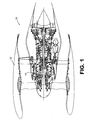
- FIG. 1 is side view of an embodiment of a turbine engine in which the clearance of secondary seals can be adjusted during engine assembly.
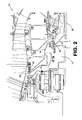
- FIG. 2 is a first detail view of the turbine engine of FIG. 1 , which more clearly illustrates a bearing compartment of the engine.
- FIG. 3 is a second detail view of the turbine engine of FIG. 1 , which more clearly illustrates a bearing compartment seal assembly of the engine.
- FIG. 4 is a third detail view of the turbine engine of FIG. 1 , which more clearly illustrates a knife edge seals of the engine.
- FIGs. 5A and 5B are schematic end views of a turbine shaft and a seal ring of the engine of FIG. 1
- FIG. 6 is a schematic end view of a seal ring and a seal support of the engine of FIG. 1 .
- FIGs. 7A and 7B are schematic end views of a seal ring and a seal support of the engine of FIG. 1 , which illustrate repositioning of the seal ring and seal support in order to reorient the seal ring and seal clearance.
- FIG. 1 illustrates an embodiment of a turbine engine 10 that is mounted within an aircraft engine cowling 12.
- the turbine engine 10 comprises a turbofan engine. It is to be appreciated, however, that the concepts described in the following can be applied to substantially any turbine engine that uses secondary seals to seal a buffer air cavity.
- the turbine engine 10 at least includes a bearing compartment 14, which contains oil that is to be maintained within the compartment. The bearing compartment 14 is more clearly illustrated in FIG. 2 .
- the bearing compartment 14 is defined in part by a stationary annular seal support 16 that extends from the engine casing 18 toward a rotatable turbine shaft 20 of the engine 10.
- the seal support 16 mounts to the casing 18 at various angularly spaced points with seal support mounting flanges 19 (only one such flange shown in FIG. 2 ).
- the positions of the mounting flanges 19 contribute to the positioning of secondary seals used to maintain a positive pressure differential relative to the bearing compartment 14.
- the seal support 16 further supports an annular bearing compartment seal assembly 22 that seals the bearing compartment and therefore limits leakage of oil from the compartment.
- the seal assembly 22 is more clearly illustrated in FIG. 3 .
- the bearing compartment seal assembly 22 comprises an annular seal member 24 that contacts an annular seal land 26 that is provided on an annular seal seat 28 that is supported by the turbine shaft 20 ( FIG. 2 ) and therefore is configured to rotate relative to the seal member.
- the seal member 24 is composed of carbon and the seal land 26 is composed of steel.
- the seal member 24 separates the bearing compartment 14 from an adjacent buffer air cavity 30.
- the buffer air cavity 30 is pressurized by air that is pumped into the cavity via openings 32 and 34 that are respectively provided in the turbine shaft 20 and a seal spacer 38.
- the buffer air cavity 30 is sealed by both the bearing compartment seal member 24 and secondary seals 40.
- the secondary seals 40 comprise annular knife edge seals. More particularly, a set of first knife edge seals 42 are provided on the turbine shaft 20 and a set of second knife edge seals 44 are provided on an annular seal ring 46, which is fixedly secured to the seal support 16.
- the seal ring 46 is mounted to the seal support 16 with a snap ring 48 that is held in place by a retainer member 50.
- small gaps 52 exist between the knife edge seals 42 and a seal land 54 provided on the seal ring 46.
- small gaps 56 exist between the knife edge seals 44 and a seal land 58 provided on the turbine shaft 20.
- the gaps 52, 56 represent the clearance of the knife edge seals 42, 44 that is to be controlled to ensure proper pressurization of the buffer air cavity 30.
- contact between the knife edge seals and their associated seal lands 54, 58 can result in the generation of debris that can adversely affect the engine 10 or its performance.
- a goal in engine design and assembly is to minimize/reduce the clearance of the knife edge seals 42, 44 through the entire circumference of the engine 10 while avoiding actual contact between the knife edge seals and their associated seal lands 54, 58.
- the seal ring 46 fits within an annular groove 60 provided in the seal support 16.
- the groove 60 is defined in part by an inner annular surface 62 that contacts or mates with an outer annular surface 64 of the seal ring 46.
- both annular surfaces 62, 64 are circular and have similar diameters such that the relative angular orientations of the seal support 16 and the seal ring 46 can be adjusted, i.e., the seal ring can be rotated within and relative to the seal support. As described below, such adjustment facilitates adjustment of the relative positions of the seal ring 46 and the turbine shaft 20, which thereby adjusts the size of the gaps 52, 56. This phenomenon can be better understood with reference to the schematic drawings of FIGs. 5A and 5B .
- FIG. 5A Shown in FIG. 5A is a schematic representation of the turbine shaft 20 as positioned within the seal ring 46.
- the gap 56 is visible (in exaggerated dimension) between the seal land 58 of the turbine shaft 20 and the edge of a second knife edge seal 44 of the seal ring 46.
- the seal ring 46 is properly aligned with the turbine shaft 20.
- the seal ring 46 is concentric with the turbine shaft 20. In such an arrangement, the gap 56 is uniform throughout the circumference of the engine 10 and therefore can be made smaller.
- the seal ring 46 is offset relative to the turbine shaft 20, for example due to tolerance accumulation. Therefore, even though the seal ring 46 and the turbine shaft 20 have been designed and manufactured so as to take engine tolerances into account, the result is relatively large clearance at one portion of the gap 56, i.e., near the 12 o'clock position in the example of FIG. 5B , which may permit air to escape relatively easily from the buffer air cavity 30 ( FIG. 4 ). In addition, the offset may result in undesired contact between the knife edge seals 44 and the seal land 58, as indicated at the 6 o'clock position in the example of FIG. 5B . From FIGs.
- FIG. 6 schematically illustrates an end view of the seal ring 46 as positioned within the seal support 16.
- the inner periphery of the seal ring 46 is defined by an inner annular surface 66, which coincides with the edges of the second knife edge seals 44.
- the outer periphery of the seal ring 46 is defined by the outer annular surface 64 first identified in FIG. 4 .
- both the inner annular surface 66 (i.e., the edges of the second knife edge seals 44) and outer annular surface 64 of the seal ring 46 are circular.
- the two circles defined by the outer annular surface 64 and inner annular surface 66 are non-concentric.
- the centers of those two circles are offset from each other such that the seal ring 46 has a larger radial dimension at some angular positions than at other angular positions.
- the seal ring 46 is largest at the 3 o'clock position and smallest at the 9 o'clock position.
- the seal support 16 is defined by the inner annular surface 62 first identified in FIG. 4 and outer periphery 68.
- the outer periphery 68 of the seal support 16 identifies the set of points at which the seal support 16 mounts to the engine casing, for example at the seal support mounting flanges 19 ( FIG. 2 ). It is that set of points that affects the position of the inner annular surface 62, of the seal support 16 and, therefore, the position of the seal ring 46.
- both the inner annular surface 62 and the outer periphery 68 are circular.
- the two circles defined by the inner annular surface 62 and the outer periphery 68 are non-concentric. Specifically, the centers of those two circles are offset from each other such that the seal support 16 has a radial dimension between its inner annular surface 62 and its outer periphery 68 that is greater at some angular positions than at other angular positions. In the example orientation shown in FIG. 6 , that dimension is largest at the 9 o'clock position and smallest at the 3 o'clock position.
- the position of the seal ring 46 can be adjusted for minimum clearance.
- Such adjustment affects not only the position of the second knife edge seals 44 but also the position of the seal land 54 ( FIG. 4 ).
- the positions of those elements affect the uniformity of the gaps 52 and 56 ( FIG. 4 ), and therefore the size of the gaps at discrete angular positions about the circumference of the engine 10.
- such adjustment can be performed during engine assembly. That way, the effects of tolerance accumulation can be observed (e.g., measured) and counteracted before engine service.
- FIGs. 7A and 7B An example of such adjustment is described in relation to FIGs. 7A and 7B below.
- each of the seal ring 46 and the seal support 16 are shown in exaggerated scale to emphasize the non-concentric or eccentric nature of their inner annular surfaces 66 and 62, respectively.
- the center of the circle that defines the inner annular surface 66 of the seal ring 46, and therefore the edges of the second knife edge seals 44 ( FIG. 4 ), is identified by crosshairs 70, while the centerline of the engine 10 ( FIG. 1 ) is identified by point 72.
- the center of the seal ring 46 is offset relative to the centerline of the engine 10, and therefore the centerline of the turbine shaft 20, for example due to tolerance accumulation.
- That offset represents a shift in the position of the second knife edge seals 44 and the seal land 54 that will decrease the uniformity of the gaps 52, 56 ( FIG. 4 ), which affects the extent to which the size of the gaps can be reduced.
- the position of the seal ring and its center 70 can be adjusted by adjusting the angular orientation of one or both of the seal ring and the seal support.
- one or both of the seal ring 46 and seal support 16 can be rotated to "dial in” the center 70 to a desired position, such as that of the engine centerline 72.
- FIGs. 7A and 7B illustrate such adjustment in the counter-clockwise direction.
- the minimum dimension of the seal ring has been identified by reference A and the minimum dimension of the seal support has been identified by reference B.
- the minimum dimension A of the seal ring 46 is at the 3 o'clock position and the minimum dimension B of the seal support 16 is at the 9 o'clock position.
- the knife edge seal clearance can be made more uniform when the seal ring center 70 is moved toward the engine centerline 72.
- the seal ring center 70 is positioned down and to the left of the engine centerline 72 in the orientation of the drawing.
- the seal ring center 70 has been shifted up and to the right so as to coincide with the engine centerline 72.
- that shifting has been achieved by rotating the seal support 16 such that its minimum dimension B moved from the 9 o'clock position to approximately the 12 o'clock position. In practice, such rotation comprises rotating the seal support 16 within and relative to the engine casing 18 ( FIG. 2 ).
- the seal ring 46 has been rotated relative to the seal support such that, after rotation of both the seal ring and the seal support, the minimum dimension of the seal ring moved from the 3 o'clock position to approximately the 4 o'clock position.
- the location of the center of the seal ring 46, and therefore the location of the second knife edge seals 44 and the seal land 54 can be adjusted by changing the angular orientation of the seal support 16 relative to the engine casing 18 and, additionally or in exception, changing the angular orientation of the seal ring relative to the seal support.
- the seal ring 46 and the seal support 16 can be fixed in place to prevent subsequent movement , with the seal support mounting to the engine casing 18 and the seal ring mounting to the seal support.
- the number of positions at which the seal ring center 70 can be positioned is substantially infinite in cases in which angular orientation of the seal ring 46 and/or the seal support 16 is substantially infinitely adjustable.
- seal ring 46 and/or the seal support 16 can only be secured in predetermined angular orientations, for example due to the positions of mounting features (e.g., mounting flanges, lug slots) that are used to secure the seal ring and/or the seal support, adjustment of the seal ring center is finite and can be "indexed” or “clocked” by alternative alignment of the mounting features.
- mounting features e.g., mounting flanges, lug slots
- the offset between the seal ring center and the engine centerline can be determined by a mechanic charged with engine assembly.
- the mechanic can use engine-specific tooling in concert with traditional inspection gauges to measure any offset between the seal ring and the engine centerline.
- the mechanic can then rotate the seal ring 46 within the seal support 16 and rotate the seal support inside engine casing 18 (in that order or reverse order) according to a specific indexing pattern with the intention of mitigating the accumulated tolerance.
- an indexing pattern can comprise a series of indicator marks provided along the outside of seal ring 46 and the seal support 16.
- An appropriate algorithm can then aid the mechanic in aligning the marks in the proper orientation to mitigate the accumulated tolerance.
- Such an algorithm can combine the manufacturing tolerances of the seal support 16, engine casing 18, seal ring 46, as well as overall engine assembly.
- the mechanic can perform a confirmation of the adjustment to ensure that the indicated orientations were correct.
- Such confirmation can be performed, for example, by using a feeler gauge or similar device that measures the gaps between the knife edge seals and their associated seal lands to confirm that the gaps are of a desired uniformity and size around the circumference of the engine.
Landscapes
- Engineering & Computer Science (AREA)
- Mechanical Engineering (AREA)
- General Engineering & Computer Science (AREA)
- Chemical & Material Sciences (AREA)
- Combustion & Propulsion (AREA)
- Turbine Rotor Nozzle Sealing (AREA)
Abstract
Description
- The present disclosure generally relates to turbine engines. More particularly, the present disclosure relates to systems and methods with which seal clearance within the engine can be adjusted to increase the effectiveness of the seals.
- Many turbine engines comprise a bearing compartment that contains various static and moving parts. Oil is used within the bearing compartment to lubricate those parts and reduce wear.
- Typically, bearing compartments are sealed with a pressurized bearing compartment seal that is intended to inhibit leakage of oil from the bearing compartment. In some cases, the bearing compartment seal is positioned between the bearing compartment and a buffer air cavity into which relatively high-pressure air is pumped. By pumping relatively high-pressure air into the buffer air cavity, the cavity becomes pressurized, thereby creating a positive pressure differential between the buffer air cavity and the bearing compartment. The positive pressure differential promotes air leakage into the bearing compartment and therefore prevents or reduces oil leakage from the bearing compartment.
- The aforementioned positive pressure differential between the buffer air cavity and the bearing compartment is often maintained with secondary seals that seal off the buffer air cavity from the remainder of the engine. Such secondary seals limit the escape of the relatively high-pressure air from the buffer air cavity, thereby maintaining relatively high pressure within the buffer air cavity.
- Unfortunately, it can be difficult to maintain a positive pressure differential at low engine power settings. That difficulty is magnified in cases in which tolerance accumulation (i.e., the aggregate effect of the tolerances of the various individual engine parts) increases the clearance of portions of the secondary seals and therefore decreases their effectiveness. In particular, the increased clearance results in greater leakage of air from the buffer air cavity and, therefore, reduced pressure within the buffer air cavity, which may enable oil to escape the bearing compartment.
- In one embodiment, a method for controlling seal clearance in a turbine engine includes positioning a seal ring within a turbine engine, the seal ring having an inner annular surface and an outer annular surface, the inner annular surface and the outer annular surface both being circular but non-concentric, rotating the seal ring within the engine until the seal ring is placed in an aligned orientation at which a center of a circle that defines the inner annular surface coincides with a centerline of the engine, and securing the seal ring while in the aligned orientation.
- The disclosed systems and methods can be better understood with reference to the following drawings. The components in the drawings are not necessarily to scale.
-
FIG. 1 is side view of an embodiment of a turbine engine in which the clearance of secondary seals can be adjusted during engine assembly. -
FIG. 2 is a first detail view of the turbine engine ofFIG. 1 , which more clearly illustrates a bearing compartment of the engine. -
FIG. 3 is a second detail view of the turbine engine ofFIG. 1 , which more clearly illustrates a bearing compartment seal assembly of the engine. -
FIG. 4 is a third detail view of the turbine engine ofFIG. 1 , which more clearly illustrates a knife edge seals of the engine. -
FIGs. 5A and 5B are schematic end views of a turbine shaft and a seal ring of the engine ofFIG. 1 -
FIG. 6 is a schematic end view of a seal ring and a seal support of the engine ofFIG. 1 . -
FIGs. 7A and 7B are schematic end views of a seal ring and a seal support of the engine ofFIG. 1 , which illustrate repositioning of the seal ring and seal support in order to reorient the seal ring and seal clearance. - As described in the foregoing, it can be difficult to maintain a positive pressure differential between a buffer air cavity and a bearing compartment due at least in part to tolerance accumulation that increases the clearance of secondary seals that seal off the buffer air cavity from the remainder of the engine and therefore provides a larger gap for air to escape from the cavity. As described in the following, however, secondary seal clearances can be controlled to counteract such tolerance accumulation and reduce the total area of the gap through adjustment of the positioning of the secondary seals during engine assembly.
- Described in the following are systems and methods for controlling seal clearance. Although specific embodiments are presented, those embodiments are mere example implementations and it is noted that other embodiments are possible. All such embodiments are intended to fall within the scope of this disclosure.
- Turning to the figures, in which like numerals identify corresponding components,
FIG. 1 illustrates an embodiment of aturbine engine 10 that is mounted within an aircraft engine cowling 12. In the example embodiment ofFIG. 1 , theturbine engine 10 comprises a turbofan engine. It is to be appreciated, however, that the concepts described in the following can be applied to substantially any turbine engine that uses secondary seals to seal a buffer air cavity. As indicated inFIG. 1 , theturbine engine 10 at least includes abearing compartment 14, which contains oil that is to be maintained within the compartment. Thebearing compartment 14 is more clearly illustrated inFIG. 2 . - As indicated in
FIG. 2 , thebearing compartment 14 is defined in part by a stationaryannular seal support 16 that extends from theengine casing 18 toward arotatable turbine shaft 20 of theengine 10. The seal support 16 mounts to thecasing 18 at various angularly spaced points with seal support mounting flanges 19 (only one such flange shown inFIG. 2 ). As described below, the positions of themounting flanges 19 contribute to the positioning of secondary seals used to maintain a positive pressure differential relative to thebearing compartment 14. In addition to partly defining thebearing compartment 14, theseal support 16 further supports an annular bearingcompartment seal assembly 22 that seals the bearing compartment and therefore limits leakage of oil from the compartment. Theseal assembly 22 is more clearly illustrated inFIG. 3 . - As indicated in
FIG. 3 , the bearingcompartment seal assembly 22 comprises anannular seal member 24 that contacts anannular seal land 26 that is provided on anannular seal seat 28 that is supported by the turbine shaft 20 (FIG. 2 ) and therefore is configured to rotate relative to the seal member. In some embodiments, theseal member 24 is composed of carbon and theseal land 26 is composed of steel. As is apparent fromFIG. 3 , theseal member 24 separates thebearing compartment 14 from an adjacentbuffer air cavity 30. Thebuffer air cavity 30 is pressurized by air that is pumped into the cavity viaopenings turbine shaft 20 and aseal spacer 38. - With further reference to
FIG. 3 , thebuffer air cavity 30 is sealed by both the bearingcompartment seal member 24 andsecondary seals 40. In the embodiment ofFIG. 3 , thesecondary seals 40 comprise annular knife edge seals. More particularly, a set of firstknife edge seals 42 are provided on theturbine shaft 20 and a set of secondknife edge seals 44 are provided on anannular seal ring 46, which is fixedly secured to theseal support 16. In some embodiments, theseal ring 46 is mounted to theseal support 16 with asnap ring 48 that is held in place by aretainer member 50. With the above configuration, the firstknife edge seals 42 rotate with theturbine shaft 20 during engine operation while the secondknife edge seals 44 remain stationary. - Referring next to
FIG. 4 ,small gaps 52 exist between theknife edge seals 42 and aseal land 54 provided on theseal ring 46. In similar manner,small gaps 56 exist between theknife edge seals 44 and aseal land 58 provided on theturbine shaft 20. Thegaps knife edge seals buffer air cavity 30. Although it is desirable to minimize or at least reduce the clearance of theknife edge seals seal lands engine 10 or its performance. Therefore, in at least some embodiments, a goal in engine design and assembly is to minimize/reduce the clearance of theknife edge seals engine 10 while avoiding actual contact between the knife edge seals and their associatedseal lands - With further reference to
FIG. 4 , theseal ring 46 fits within anannular groove 60 provided in theseal support 16. Thegroove 60 is defined in part by an innerannular surface 62 that contacts or mates with an outerannular surface 64 of theseal ring 46. In some embodiments, bothannular surfaces seal support 16 and theseal ring 46 can be adjusted, i.e., the seal ring can be rotated within and relative to the seal support. As described below, such adjustment facilitates adjustment of the relative positions of theseal ring 46 and theturbine shaft 20, which thereby adjusts the size of thegaps FIGs. 5A and 5B . Shown inFIG. 5A is a schematic representation of theturbine shaft 20 as positioned within theseal ring 46. Thegap 56 is visible (in exaggerated dimension) between theseal land 58 of theturbine shaft 20 and the edge of a secondknife edge seal 44 of theseal ring 46. InFIG. 5A , theseal ring 46 is properly aligned with theturbine shaft 20. Specifically, theseal ring 46 is concentric with theturbine shaft 20. In such an arrangement, thegap 56 is uniform throughout the circumference of theengine 10 and therefore can be made smaller. - Turning to
FIG. 5B , theseal ring 46 is offset relative to theturbine shaft 20, for example due to tolerance accumulation. Therefore, even though theseal ring 46 and theturbine shaft 20 have been designed and manufactured so as to take engine tolerances into account, the result is relatively large clearance at one portion of thegap 56, i.e., near the 12 o'clock position in the example ofFIG. 5B , which may permit air to escape relatively easily from the buffer air cavity 30 (FIG. 4 ). In addition, the offset may result in undesired contact between the knife edge seals 44 and theseal land 58, as indicated at the 6 o'clock position in the example ofFIG. 5B . FromFIGs. 5A and 5B , it can be appreciated that the efficiency of the engine's knife edge seals can be maximized by locating theseal ring 46 circumferentially in a position at which thegaps 52 and 56 (FIG. 4 ) are smaller around the entire circumference of theengine 10. -
FIG. 6 schematically illustrates an end view of theseal ring 46 as positioned within theseal support 16. InFIG. 6 , the inner periphery of theseal ring 46 is defined by an innerannular surface 66, which coincides with the edges of the second knife edge seals 44. The outer periphery of theseal ring 46 is defined by the outerannular surface 64 first identified inFIG. 4 . As is apparent fromFIG. 6 , both the inner annular surface 66 (i.e., the edges of the second knife edge seals 44) and outerannular surface 64 of theseal ring 46 are circular. However, the two circles defined by the outerannular surface 64 and innerannular surface 66 are non-concentric. Specifically, the centers of those two circles are offset from each other such that theseal ring 46 has a larger radial dimension at some angular positions than at other angular positions. In the example orientation shown inFIG. 6 , theseal ring 46 is largest at the 3 o'clock position and smallest at the 9 o'clock position. - With further reference to
FIG. 6 , theseal support 16 is defined by the innerannular surface 62 first identified inFIG. 4 andouter periphery 68. For purposes that will become clear in the following, theouter periphery 68 of theseal support 16 identifies the set of points at which theseal support 16 mounts to the engine casing, for example at the seal support mounting flanges 19 (FIG. 2 ). It is that set of points that affects the position of the innerannular surface 62, of theseal support 16 and, therefore, the position of theseal ring 46. As is apparent fromFIG. 6 , both the innerannular surface 62 and theouter periphery 68 are circular. However, the two circles defined by the innerannular surface 62 and theouter periphery 68 are non-concentric. Specifically, the centers of those two circles are offset from each other such that theseal support 16 has a radial dimension between its innerannular surface 62 and itsouter periphery 68 that is greater at some angular positions than at other angular positions. In the example orientation shown inFIG. 6 , that dimension is largest at the 9 o'clock position and smallest at the 3 o'clock position. - With the configuration described in relation to
FIG. 6 , the position of theseal ring 46 can be adjusted for minimum clearance. Such adjustment affects not only the position of the second knife edge seals 44 but also the position of the seal land 54 (FIG. 4 ). The positions of those elements, in turn, affect the uniformity of thegaps 52 and 56 (FIG. 4 ), and therefore the size of the gaps at discrete angular positions about the circumference of theengine 10. As mentioned above, such adjustment can be performed during engine assembly. That way, the effects of tolerance accumulation can be observed (e.g., measured) and counteracted before engine service. An example of such adjustment is described in relation toFIGs. 7A and 7B below. - Beginning with
FIG. 7A , each of theseal ring 46 and theseal support 16 are shown in exaggerated scale to emphasize the non-concentric or eccentric nature of their innerannular surfaces annular surface 66 of theseal ring 46, and therefore the edges of the second knife edge seals 44 (FIG. 4 ), is identified bycrosshairs 70, while the centerline of the engine 10 (FIG. 1 ) is identified bypoint 72. In such a case, the center of theseal ring 46 is offset relative to the centerline of theengine 10, and therefore the centerline of theturbine shaft 20, for example due to tolerance accumulation. That offset represents a shift in the position of the second knife edge seals 44 and theseal land 54 that will decrease the uniformity of thegaps 52, 56 (FIG. 4 ), which affects the extent to which the size of the gaps can be reduced. To improve the uniformity of the gaps and enable reduction of the size of the gaps, it is desirable to adjust the position of theseal ring 46 such that thecenter 70 generally coincides with theengine centerline 72. Assuming the knife edge seals 42, 44 are dimensioned correctly, thegaps - Due to the eccentricity of the
seal ring 46 and theseal support 16, the position of the seal ring and itscenter 70 can be adjusted by adjusting the angular orientation of one or both of the seal ring and the seal support. In particular, one or both of theseal ring 46 and sealsupport 16 can be rotated to "dial in" thecenter 70 to a desired position, such as that of theengine centerline 72.FIGs. 7A and 7B illustrate such adjustment in the counter-clockwise direction. To aid the reader in identification of the angular movement of theseal ring 46 and theseal support 16, the minimum dimension of the seal ring has been identified by reference A and the minimum dimension of the seal support has been identified by reference B. InFIG. 7A , the minimum dimension A of theseal ring 46 is at the 3 o'clock position and the minimum dimension B of theseal support 16 is at the 9 o'clock position. - As mentioned above, the knife edge seal clearance can be made more uniform when the
seal ring center 70 is moved toward theengine centerline 72. InFIG. 7A , theseal ring center 70 is positioned down and to the left of theengine centerline 72 in the orientation of the drawing. As indicated inFIG. 7B , theseal ring center 70 has been shifted up and to the right so as to coincide with theengine centerline 72. In the example ofFIG. 7B , that shifting has been achieved by rotating theseal support 16 such that its minimum dimension B moved from the 9 o'clock position to approximately the 12 o'clock position. In practice, such rotation comprises rotating theseal support 16 within and relative to the engine casing 18 (FIG. 2 ). In addition to rotating theseal support 16 relative to theengine casing 18, theseal ring 46 has been rotated relative to the seal support such that, after rotation of both the seal ring and the seal support, the minimum dimension of the seal ring moved from the 3 o'clock position to approximately the 4 o'clock position. - As can be appreciated from the above example, the location of the center of the
seal ring 46, and therefore the location of the second knife edge seals 44 and the seal land 54 (FIG. 4 ) can be adjusted by changing the angular orientation of theseal support 16 relative to theengine casing 18 and, additionally or in exception, changing the angular orientation of the seal ring relative to the seal support. - Once the desired orientations have been obtained, the
seal ring 46 and theseal support 16 can be fixed in place to prevent subsequent movement , with the seal support mounting to theengine casing 18 and the seal ring mounting to the seal support. The number of positions at which theseal ring center 70 can be positioned is substantially infinite in cases in which angular orientation of theseal ring 46 and/or theseal support 16 is substantially infinitely adjustable. In cases in which theseal ring 46 and/or theseal support 16 can only be secured in predetermined angular orientations, for example due to the positions of mounting features (e.g., mounting flanges, lug slots) that are used to secure the seal ring and/or the seal support, adjustment of the seal ring center is finite and can be "indexed" or "clocked" by alternative alignment of the mounting features. - In some embodiments, the offset between the seal ring center and the engine centerline can be determined by a mechanic charged with engine assembly. In particular, the mechanic can use engine-specific tooling in concert with traditional inspection gauges to measure any offset between the seal ring and the engine centerline. The mechanic can then rotate the
seal ring 46 within theseal support 16 and rotate the seal support inside engine casing 18 (in that order or reverse order) according to a specific indexing pattern with the intention of mitigating the accumulated tolerance. In some embodiments, an indexing pattern can comprise a series of indicator marks provided along the outside ofseal ring 46 and theseal support 16. An appropriate algorithm can then aid the mechanic in aligning the marks in the proper orientation to mitigate the accumulated tolerance. Such an algorithm can combine the manufacturing tolerances of theseal support 16,engine casing 18,seal ring 46, as well as overall engine assembly. - Once the components have been repositioned in the orientation indicated by the algorithm, the mechanic can perform a confirmation of the adjustment to ensure that the indicated orientations were correct. Such confirmation can be performed, for example, by using a feeler gauge or similar device that measures the gaps between the knife edge seals and their associated seal lands to confirm that the gaps are of a desired uniformity and size around the circumference of the engine.
- Although an algorithm can be used to at least partially automate the adjustment of the seal ring and the seal support, it will be appreciated that the adjustment could be performed manually, either with the aid of mathematics or without.
Claims (15)
- A method for controlling seal clearance in a turbine engine (10), the method comprising:positioning a seal ring (46) within the engine, the seal ring (46) having an inner annular surface (66) and an outer annular surface (64), the inner annular surface (66) and the outer annular surface (64) both being circular but non-concentric;rotating the seal ring (46) within the engine until the seal ring (46) is placed in an aligned orientation at which a center of a circle that defines the inner annular surface (46) coincides with a centerline (72) of the engine; andsecuring the seal ring (46) while in the aligned orientation.
- The method of claim 1, wherein the inner annular surface (66) is defined by an edge of at least one knife edge seal of the seal ring (46).
- The method of claim 1 or 2, wherein positioning the seal ring (46) comprises positioning the seal ring (46) within an annular groove (60) of a seal support (16) such that the outer annular surface (64) contacts an inner annular surface (62) of the groove (60).
- The method of any preceding claim, further comprising:positioning a seal support (16) within the turbine engine, the seal support (16) having an inner annular surface (62) adapted to receive the seal ring (46) and an outer periphery (68) at which the seal support (16) mounts to the engine, the inner annular surface (62) and the outer periphery (68) of the seal support (16) both being circular but non-concentric;also rotating the seal support (16) relative to the engine; andsecuring the seal support (16) to the engine.
- The method of claim 4, wherein the outer annular surface (64) of the seal ring (46) contacts the inner annular surface (62) of the seal support (16) when the seal ring (46) is received by the seal support (16).
- The method of any preceding claim, further comprising determining an offset between the seal ring (46) and the engine centerline (72), and optionally, further comprising using an algorithm to determine proper orientation of the seal ring (46) to counteract the determined offset.
- A method for controlling seal clearance in a turbine engine (10), the method comprising:positioning a seal support (16) within a casing (18) of the turbine engine (10), the seal support (16) having an inner annular surface (62) adapted to receive a seal ring (46) and an outer periphery (68) at which the seal support (16) mounts to the casing (18), the inner annular surface (62) and the outer periphery (68) both being circular but non-concentric such that the seal support (16) has a relatively large radial dimension at a first angular position and a relatively small radial dimension at a second angular position;positioning a seal ring (46) within the seal support (16), the seal ring (46) having an inner annular surface (66) and an outer annular surface (64), the inner annular surface (66) and the outer annular surface (64) of the seal ring (46) both being circular but non-concentric such that the seal ring (46) has a relatively large radial dimension at a first angular position and a relatively small radial dimension at a second angular position;rotating the seal support (16) relative to the casing and rotating the seal ring (46) relative to the seal support (16) until the seal ring (46) is placed in an aligned orientation at which a center of a circle that defines its inner annular surface (66) coincides with a centerline (72) of the turbine engine; andsecuring the seal support (16) to the casing and securing the seal ring (46) to the seal support (16) while the seal support (16) is in the aligned orientation.
- The method of claim 7, wherein the inner annular surface (66) of the seal ring (46) is defined by edges of knife edge seals (44) of the seal ring (46).
- The method of claim 7 or 8, wherein positioning the seal ring (46) comprises placing the outer annular surface (64) of the seal ring (46) in contact with the inner annular surface (62) of the seal support (16).
- A turbine engine (10), for example a turbofan engine, comprising:a seal support (16) adapted to mount to the engine, the seal support (16) having an inner annular surface (62) adapted to receive a seal ring (46) and an outer periphery (68) at which the seal support (16) mounts to the casing, the inner annular surface (62) and the outer periphery (68) both being circular but non-concentric; anda seal ring (46) adapted to mount to the seal support (16), the seal ring (46) having an inner annular surface (66) and an outer annular surface (64), the inner annular surface (68) and the outer annular surface (64) of the seal ring (46) both being circular but non-concentric;wherein a center of a circle that defines the inner annular surface (68) of the seal ring (46) can be adjusted to coincide with a centerline (72) of the turbine engine (10) by rotating the seal support (16) relative to the engine and rotating the seal ring (46) relative to the seal support (16) to counteract tolerance accumulation.
- The engine of claim 10, wherein the seal ring (46) comprises knife edge seals (44) and wherein edges of the knife edge seals (44) define the inner annular surface (66) of the seal ring (46), and/or wherein the seal ring (46) comprises a seal land (54) that adapted to oppose knife edge seals (42) provided on an turbine shaft of the engine.
- The engine of claim 10 or 11, wherein the seal ring (46) mounts within an annular groove (60) of the seal support (16) and wherein the outer annular surface (64) of the seal ring (46) contacts the inner annular surface (62) of the seal support (16) when the seal ring (46) is positioned within the annular groove (60).
- The engine of claim 10, 11 or 12, wherein engine comprises mounting flanges (19) provided on an engine casing (18) to which the seal support (18) mounts.
- The engine of any of claims 10 to 13, further comprising mounting elements that secure the seal ring (46) to the seal support (16), wherein, for example, the mounting elements include a snap ring (48) and a retainer member (50).
- A turbine engine (10), for example a turbofan engine, comprising:an engine casing (18);a seal support (16) adapted to mount to the engine casing (18), the seal support (16) having an inner annular surface (62) adapted to receive a seal ring (46) and an outer periphery (68) at which the seal support (16) mounts to the casing (18), the inner annular surface (62) and the outer periphery (68) both being circular but non-concentric;a seal ring (46) adapted to mount to the seal support (16), the seal ring (46) having an outer annular surface (64) that contacts the inner annular surface (62) of the seal support (16) when the seal ring (46) is mounted to the seal support (16), the seal ring (46) further comprising knife edge seals (44), wherein a first circle that defines the outer annular surface (64) and a second circle that defines edges of the knife edge seals (44) are non-concentric; anda turbine shaft having a seal land (54) adapted opposite the knife edge seals (44) of the seal ring (46) such that the seal land (54) and the knife edge seals (44) are separated by a gap (56);wherein the seal support (16) can be rotated relative to the engine casing (18) and the seal ring (46) can be rotated relative to the seal support (16) to increase the uniformity of the gap (56) between the turbine shaft seal land (54) and the seal ring knife edge seals (44); and wherein, optionally, the turbine shaft also comprises knife edge seals (42) and wherein the seal ring (46) also comprises a seal land (54) adapted to oppose the turbine shaft knife edge seals (42), and wherein uniformity of a gap (52) between the turbine shaft knife edge seals (42) and the seal ring seal land (54) can be increased through rotation of the seal support (16) and the seal ring (46).
Applications Claiming Priority (1)
| Application Number | Priority Date | Filing Date | Title |
|---|---|---|---|
| US11/931,149 US7878756B2 (en) | 2007-10-31 | 2007-10-31 | Systems and methods for controlling seal clearance in a turbine engine |
Publications (3)
| Publication Number | Publication Date |
|---|---|
| EP2055899A2 true EP2055899A2 (en) | 2009-05-06 |
| EP2055899A3 EP2055899A3 (en) | 2012-11-07 |
| EP2055899B1 EP2055899B1 (en) | 2020-01-15 |
Family
ID=40303521
Family Applications (1)
| Application Number | Title | Priority Date | Filing Date |
|---|---|---|---|
| EP08253539.4A Ceased EP2055899B1 (en) | 2007-10-31 | 2008-10-29 | Systems and methods for controlling seal clearance in a turbine engine |
Country Status (2)
| Country | Link |
|---|---|
| US (1) | US7878756B2 (en) |
| EP (1) | EP2055899B1 (en) |
Cited By (4)
| Publication number | Priority date | Publication date | Assignee | Title |
|---|---|---|---|---|
| FR2983518A1 (en) * | 2011-12-06 | 2013-06-07 | Snecma | UNLOCKING DEVICE FOR AXIAL STOP OF A SEALED CROWN CONTACTED BY A MOBILE WHEEL OF AIRCRAFT TURBOMACHINE MODULE |
| EP3023597A1 (en) * | 2014-10-30 | 2016-05-25 | United Technologies Corporation | Sealing systems |
| WO2018136506A1 (en) * | 2017-01-18 | 2018-07-26 | Q.E.D. Environmental Systems, Inc. | Modular pneumatic well pump system |
| DE102018119463A1 (en) * | 2018-08-09 | 2020-02-13 | Rolls-Royce Deutschland Ltd & Co Kg | Maze sealing system and gas turbine engine with a labyrinth sealing system |
Families Citing this family (10)
| Publication number | Priority date | Publication date | Assignee | Title |
|---|---|---|---|---|
| US9869249B2 (en) | 2012-01-31 | 2018-01-16 | United Technologies Corporation | Speed sensor probe location in gas turbine engine |
| US9309775B2 (en) * | 2012-05-21 | 2016-04-12 | United Technologies Corporation | Rotational debris discourager for gas turbine engine bearing |
| US9163522B2 (en) | 2012-08-21 | 2015-10-20 | United Technologies Corporation | Spring carrier and removable seal carrier |
| US10487943B2 (en) | 2016-07-12 | 2019-11-26 | United Technologies Corporation | Multi-ply seal ring |
| US10677082B2 (en) | 2017-05-26 | 2020-06-09 | Pratt & Whitney Canada Corp. | Axially compact pressurized seal |
| US11248492B2 (en) * | 2019-03-18 | 2022-02-15 | Raytheon Technologies Corporation | Seal assembly for a gas turbine engine |
| US11629649B2 (en) | 2020-05-11 | 2023-04-18 | Raytheon Technologies Corporation | Gas turbine engine with speed sensor |
| US11415062B2 (en) | 2020-11-18 | 2022-08-16 | Raytheon Technologies Corporation | Rotating sleeve controlling clearance of seal assembly of gas turbine engine |
| GB202203012D0 (en) | 2022-03-04 | 2022-04-20 | Rolls Royce Plc | Brush seal |
| US12091980B1 (en) | 2023-12-13 | 2024-09-17 | Honeywell International Inc. | Spring biased shroud retention system for gas turbine engine |
Family Cites Families (20)
| Publication number | Priority date | Publication date | Assignee | Title |
|---|---|---|---|---|
| US3385624A (en) * | 1966-04-20 | 1968-05-28 | Baclini David | Eccentric adjusting device |
| US4035044A (en) * | 1976-06-17 | 1977-07-12 | Sadao Miyazaki | Bearing assembly |
| US4222708A (en) * | 1978-06-26 | 1980-09-16 | General Electric Company | Method and apparatus for reducing eccentricity in a turbomachine |
| FR2515734A1 (en) * | 1981-11-05 | 1983-05-06 | Snecma | SYSTEM FOR ADJUSTING THE CENTERING OF A TURBOMACHINE WHEEL AND TURBOMACHINE PROVIDED WITH MEANS FOR APPLYING SAID SYSTEM |
| US4406460A (en) | 1982-11-01 | 1983-09-27 | United Technologies Corporation | Anti-weepage valve for rotating seals |
| US4709545A (en) | 1983-05-31 | 1987-12-01 | United Technologies Corporation | Bearing compartment protection system |
| JPS61286503A (en) * | 1985-06-12 | 1986-12-17 | Toshiba Corp | Labyrinth seal device of steam turbine |
| US4928978A (en) | 1988-04-07 | 1990-05-29 | United Technologies Corporation | Rotating shaft seal |
| EP0382333B1 (en) * | 1989-01-09 | 1993-06-30 | Northern Engineering Industries Plc | Mounting arrangement of segmental members in rotary machines |
| US5630590A (en) | 1996-03-26 | 1997-05-20 | United Technologies Corporation | Method and apparatus for improving the airsealing effectiveness in a turbine engine |
| US6623238B2 (en) * | 1998-08-21 | 2003-09-23 | Honeywell International, Inc. | Air turbine starter with seal assembly |
| US6682307B1 (en) | 1999-05-14 | 2004-01-27 | Siemens Aktiengesellschaft | Sealing system for a rotor of a turbo engine |
| US6309177B1 (en) * | 1999-06-08 | 2001-10-30 | Pratt & Whitney Canada Corp. | Concentricity ring |
| US6382632B1 (en) * | 2001-02-21 | 2002-05-07 | General Electric Company | Repositionable brush seal for turbomachinery |
| US7001145B2 (en) | 2003-11-20 | 2006-02-21 | General Electric Company | Seal assembly for turbine, bucket/turbine including same, method for sealing interface between rotating and stationary components of a turbine |
| US7407369B2 (en) | 2004-12-29 | 2008-08-05 | United Technologies Corporation | Gas turbine engine blade tip clearance apparatus and method |
| US7175388B2 (en) * | 2005-04-21 | 2007-02-13 | Pratt & Whitney Canada Corp. | Integrated labyrinth and carbon seal |
| US7510374B2 (en) * | 2005-07-28 | 2009-03-31 | Honeywell International Inc. | Non-concentric rings for reduced turbo-machinery operating clearances |
| US8517666B2 (en) | 2005-09-12 | 2013-08-27 | United Technologies Corporation | Turbine cooling air sealing |
| US7967560B2 (en) * | 2006-11-07 | 2011-06-28 | United Technologies Corporation | Radially energized oil capture device for a geared turbofan |
-
2007
- 2007-10-31 US US11/931,149 patent/US7878756B2/en not_active Expired - Fee Related
-
2008
- 2008-10-29 EP EP08253539.4A patent/EP2055899B1/en not_active Ceased
Cited By (13)
| Publication number | Priority date | Publication date | Assignee | Title |
|---|---|---|---|---|
| US9957896B2 (en) | 2011-12-06 | 2018-05-01 | Snecma | Unlockable device for axially arresting a sealing ring with which an aircraft turbomachine module rotor wheel makes contact |
| WO2013083905A1 (en) * | 2011-12-06 | 2013-06-13 | Snecma | Unlockable device for axially arresting a sealing ring with which an aircraft turbomachine module rotor wheel makes contact |
| JP2015500424A (en) * | 2011-12-06 | 2015-01-05 | スネクマ | Releasable device for axially constraining a sealing ring in contact with an aircraft turbomachine module rotor wheel |
| FR2983518A1 (en) * | 2011-12-06 | 2013-06-07 | Snecma | UNLOCKING DEVICE FOR AXIAL STOP OF A SEALED CROWN CONTACTED BY A MOBILE WHEEL OF AIRCRAFT TURBOMACHINE MODULE |
| RU2604475C2 (en) * | 2011-12-06 | 2016-12-10 | Снекма | Unlockable device for locking axial direction of sealing ring being in contact with impulse rotor wheel of aircraft turbine machine |
| EP3628822A1 (en) * | 2014-10-30 | 2020-04-01 | United Technologies Corporation | Sealing systems |
| US10280780B2 (en) | 2014-10-30 | 2019-05-07 | United Technologies Corporation | Sealing systems for gas turbine engine vane platforms |
| EP3023597A1 (en) * | 2014-10-30 | 2016-05-25 | United Technologies Corporation | Sealing systems |
| WO2018136506A1 (en) * | 2017-01-18 | 2018-07-26 | Q.E.D. Environmental Systems, Inc. | Modular pneumatic well pump system |
| US10662941B2 (en) | 2017-01-18 | 2020-05-26 | Q.E.D. Environmental Systems, Inc. | Modular pneumatic well pump system |
| DE102018119463A1 (en) * | 2018-08-09 | 2020-02-13 | Rolls-Royce Deutschland Ltd & Co Kg | Maze sealing system and gas turbine engine with a labyrinth sealing system |
| US11073035B2 (en) | 2018-08-09 | 2021-07-27 | Rolls-Royce Deutschland Ltd & Co Kg | Labyrinth sealing system and gas turbine engine with a labyrinth sealing system |
| DE102018119463B4 (en) | 2018-08-09 | 2023-12-28 | Rolls-Royce Deutschland Ltd & Co Kg | Labyrinth seal system and gas turbine engine with a labyrinth seal system |
Also Published As
| Publication number | Publication date |
|---|---|
| US7878756B2 (en) | 2011-02-01 |
| US20090110545A1 (en) | 2009-04-30 |
| EP2055899B1 (en) | 2020-01-15 |
| EP2055899A3 (en) | 2012-11-07 |
Similar Documents
| Publication | Publication Date | Title |
|---|---|---|
| US7878756B2 (en) | Systems and methods for controlling seal clearance in a turbine engine | |
| CN113874601B (en) | Sealing gap adjustment method for steam turbine and steam turbine | |
| EP2964886B1 (en) | Disc arrangement and method of retaining two separate rotating members of a gas turbine engine | |
| EP2358976B1 (en) | Scroll compressor | |
| CN102046921B (en) | Ring flange for securing rotor or stator parts | |
| US4222708A (en) | Method and apparatus for reducing eccentricity in a turbomachine | |
| EP1201968B1 (en) | Cam mechanism with cross roller bearing | |
| US10024434B2 (en) | Shaft seal device and rotary machine | |
| EP1185766B1 (en) | Concentricity ring | |
| EP1424518A2 (en) | Brush seal with adjustable clearance | |
| EP2803883B1 (en) | Shaft seal device and rotary machine with same | |
| US10900367B2 (en) | Sealing unit for turbocharger | |
| EP2639403A2 (en) | Shaft Assembly for a Gas Turbine Engine | |
| CN113530621B (en) | System and method for assembling and shipping steam turbines | |
| US10494944B2 (en) | Seal on the inner ring of a guide vane | |
| EP2466078B1 (en) | Joint for housing alignment | |
| US20190010976A1 (en) | Journal bearing and rotary machine | |
| CN113614402B (en) | Thrust foil bearing, foil bearing unit, turbomachine and foil | |
| US11415025B2 (en) | Distributor sector of a turbomachine comprising an anti-rotation notch with a wear insert | |
| US11162376B2 (en) | Guide vane plate with a chamfered and a cylindrical edge region | |
| JPS5882663A (en) | Grinder for fan shroud of gas turbine engine | |
| RU2713230C2 (en) | Method for creating and repairing turbomachine component and associated turbomachine component | |
| CN105798656A (en) | Positioning fixture for excircle machining of motor stator | |
| US12084989B2 (en) | Curvature adjustment method for stator blade segment, method for manufacturing stationary body of axial-flow rotary machine, and curvature adjustment jig for stator blade segment | |
| KR20250168281A (en) | Wing angle measuring device and wing angle measuring method using the same |
Legal Events
| Date | Code | Title | Description |
|---|---|---|---|
| PUAI | Public reference made under article 153(3) epc to a published international application that has entered the european phase |
Free format text: ORIGINAL CODE: 0009012 |
|
| AK | Designated contracting states |
Kind code of ref document: A2 Designated state(s): AT BE BG CH CY CZ DE DK EE ES FI FR GB GR HR HU IE IS IT LI LT LU LV MC MT NL NO PL PT RO SE SI SK TR |
|
| AX | Request for extension of the european patent |
Extension state: AL BA MK RS |
|
| PUAL | Search report despatched |
Free format text: ORIGINAL CODE: 0009013 |
|
| AK | Designated contracting states |
Kind code of ref document: A3 Designated state(s): AT BE BG CH CY CZ DE DK EE ES FI FR GB GR HR HU IE IS IT LI LT LU LV MC MT NL NO PL PT RO SE SI SK TR |
|
| AX | Request for extension of the european patent |
Extension state: AL BA MK RS |
|
| RIC1 | Information provided on ipc code assigned before grant |
Ipc: F01D 25/18 20060101ALI20121004BHEP Ipc: F01D 11/02 20060101AFI20121004BHEP Ipc: F02C 7/28 20060101ALI20121004BHEP |
|
| 17P | Request for examination filed |
Effective date: 20130507 |
|
| RBV | Designated contracting states (corrected) |
Designated state(s): DE GB |
|
| RAP1 | Party data changed (applicant data changed or rights of an application transferred) |
Owner name: UNITED TECHNOLOGIES CORPORATION |
|
| STAA | Information on the status of an ep patent application or granted ep patent |
Free format text: STATUS: EXAMINATION IS IN PROGRESS |
|
| 17Q | First examination report despatched |
Effective date: 20171023 |
|
| GRAP | Despatch of communication of intention to grant a patent |
Free format text: ORIGINAL CODE: EPIDOSNIGR1 |
|
| STAA | Information on the status of an ep patent application or granted ep patent |
Free format text: STATUS: GRANT OF PATENT IS INTENDED |
|
| INTG | Intention to grant announced |
Effective date: 20190603 |
|
| GRAJ | Information related to disapproval of communication of intention to grant by the applicant or resumption of examination proceedings by the epo deleted |
Free format text: ORIGINAL CODE: EPIDOSDIGR1 |
|
| STAA | Information on the status of an ep patent application or granted ep patent |
Free format text: STATUS: EXAMINATION IS IN PROGRESS |
|
| GRAP | Despatch of communication of intention to grant a patent |
Free format text: ORIGINAL CODE: EPIDOSNIGR1 |
|
| STAA | Information on the status of an ep patent application or granted ep patent |
Free format text: STATUS: GRANT OF PATENT IS INTENDED |
|
| INTC | Intention to grant announced (deleted) | ||
| GRAS | Grant fee paid |
Free format text: ORIGINAL CODE: EPIDOSNIGR3 |
|
| GRAA | (expected) grant |
Free format text: ORIGINAL CODE: 0009210 |
|
| STAA | Information on the status of an ep patent application or granted ep patent |
Free format text: STATUS: THE PATENT HAS BEEN GRANTED |
|
| INTG | Intention to grant announced |
Effective date: 20191118 |
|
| AK | Designated contracting states |
Kind code of ref document: B1 Designated state(s): DE GB |
|
| REG | Reference to a national code |
Ref country code: GB Ref legal event code: FG4D |
|
| REG | Reference to a national code |
Ref country code: DE Ref legal event code: R096 Ref document number: 602008062005 Country of ref document: DE |
|
| REG | Reference to a national code |
Ref country code: DE Ref legal event code: R097 Ref document number: 602008062005 Country of ref document: DE |
|
| PLBE | No opposition filed within time limit |
Free format text: ORIGINAL CODE: 0009261 |
|
| STAA | Information on the status of an ep patent application or granted ep patent |
Free format text: STATUS: NO OPPOSITION FILED WITHIN TIME LIMIT |
|
| 26N | No opposition filed |
Effective date: 20201016 |
|
| REG | Reference to a national code |
Ref country code: DE Ref legal event code: R081 Ref document number: 602008062005 Country of ref document: DE Owner name: RAYTHEON TECHNOLOGIES CORPORATION (N.D.GES.D.S, US Free format text: FORMER OWNER: UNITED TECHNOLOGIES CORPORATION, FARMINGTON, CONN., US |
|
| PGFP | Annual fee paid to national office [announced via postgrant information from national office to epo] |
Ref country code: DE Payment date: 20220616 Year of fee payment: 15 |
|
| PGFP | Annual fee paid to national office [announced via postgrant information from national office to epo] |
Ref country code: GB Payment date: 20230920 Year of fee payment: 16 |
|
| REG | Reference to a national code |
Ref country code: DE Ref legal event code: R119 Ref document number: 602008062005 Country of ref document: DE |
|
| PG25 | Lapsed in a contracting state [announced via postgrant information from national office to epo] |
Ref country code: DE Free format text: LAPSE BECAUSE OF NON-PAYMENT OF DUE FEES Effective date: 20240501 |
|
| GBPC | Gb: european patent ceased through non-payment of renewal fee |
Effective date: 20241029 |
|
| PG25 | Lapsed in a contracting state [announced via postgrant information from national office to epo] |
Ref country code: GB Free format text: LAPSE BECAUSE OF NON-PAYMENT OF DUE FEES Effective date: 20241029 |