EP2055709A2 - Novel red electroluminescent compounds and organic electroluminescent device using the same - Google Patents
Novel red electroluminescent compounds and organic electroluminescent device using the same Download PDFInfo
- Publication number
- EP2055709A2 EP2055709A2 EP08168095A EP08168095A EP2055709A2 EP 2055709 A2 EP2055709 A2 EP 2055709A2 EP 08168095 A EP08168095 A EP 08168095A EP 08168095 A EP08168095 A EP 08168095A EP 2055709 A2 EP2055709 A2 EP 2055709A2
- Authority
- EP
- European Patent Office
- Prior art keywords
- alkyl
- tri
- halogen
- arylsilyl
- aryl
- Prior art date
- Legal status (The legal status is an assumption and is not a legal conclusion. Google has not performed a legal analysis and makes no representation as to the accuracy of the status listed.)
- Withdrawn
Links
- 0 C*1C=Cc(cccc2)c2C=C1 Chemical compound C*1C=Cc(cccc2)c2C=C1 0.000 description 8
- RWGFKTVRMDUZSP-UHFFFAOYSA-N CC(C)c1ccccc1 Chemical compound CC(C)c1ccccc1 RWGFKTVRMDUZSP-UHFFFAOYSA-N 0.000 description 1
Images

Classifications
-
- C—CHEMISTRY; METALLURGY
- C09—DYES; PAINTS; POLISHES; NATURAL RESINS; ADHESIVES; COMPOSITIONS NOT OTHERWISE PROVIDED FOR; APPLICATIONS OF MATERIALS NOT OTHERWISE PROVIDED FOR
- C09K—MATERIALS FOR MISCELLANEOUS APPLICATIONS, NOT PROVIDED FOR ELSEWHERE
- C09K11/00—Luminescent materials, e.g. electroluminescent or chemiluminescent
- C09K11/06—Luminescent materials, e.g. electroluminescent or chemiluminescent containing organic luminescent materials
-
- C—CHEMISTRY; METALLURGY
- C07—ORGANIC CHEMISTRY
- C07F—ACYCLIC, CARBOCYCLIC OR HETEROCYCLIC COMPOUNDS CONTAINING ELEMENTS OTHER THAN CARBON, HYDROGEN, HALOGEN, OXYGEN, NITROGEN, SULFUR, SELENIUM OR TELLURIUM
- C07F15/00—Compounds containing elements of Groups 8, 9, 10 or 18 of the Periodic Table
- C07F15/0006—Compounds containing elements of Groups 8, 9, 10 or 18 of the Periodic Table compounds of the platinum group
- C07F15/0033—Iridium compounds
-
- H—ELECTRICITY
- H10—SEMICONDUCTOR DEVICES; ELECTRIC SOLID-STATE DEVICES NOT OTHERWISE PROVIDED FOR
- H10K—ORGANIC ELECTRIC SOLID-STATE DEVICES
- H10K85/00—Organic materials used in the body or electrodes of devices covered by this subclass
- H10K85/30—Coordination compounds
- H10K85/341—Transition metal complexes, e.g. Ru(II)polypyridine complexes
- H10K85/342—Transition metal complexes, e.g. Ru(II)polypyridine complexes comprising iridium
-
- C—CHEMISTRY; METALLURGY
- C09—DYES; PAINTS; POLISHES; NATURAL RESINS; ADHESIVES; COMPOSITIONS NOT OTHERWISE PROVIDED FOR; APPLICATIONS OF MATERIALS NOT OTHERWISE PROVIDED FOR
- C09K—MATERIALS FOR MISCELLANEOUS APPLICATIONS, NOT PROVIDED FOR ELSEWHERE
- C09K2211/00—Chemical nature of organic luminescent or tenebrescent compounds
- C09K2211/10—Non-macromolecular compounds
- C09K2211/1003—Carbocyclic compounds
- C09K2211/1011—Condensed systems
-
- C—CHEMISTRY; METALLURGY
- C09—DYES; PAINTS; POLISHES; NATURAL RESINS; ADHESIVES; COMPOSITIONS NOT OTHERWISE PROVIDED FOR; APPLICATIONS OF MATERIALS NOT OTHERWISE PROVIDED FOR
- C09K—MATERIALS FOR MISCELLANEOUS APPLICATIONS, NOT PROVIDED FOR ELSEWHERE
- C09K2211/00—Chemical nature of organic luminescent or tenebrescent compounds
- C09K2211/10—Non-macromolecular compounds
- C09K2211/1018—Heterocyclic compounds
- C09K2211/1025—Heterocyclic compounds characterised by ligands
- C09K2211/1029—Heterocyclic compounds characterised by ligands containing one nitrogen atom as the heteroatom
-
- C—CHEMISTRY; METALLURGY
- C09—DYES; PAINTS; POLISHES; NATURAL RESINS; ADHESIVES; COMPOSITIONS NOT OTHERWISE PROVIDED FOR; APPLICATIONS OF MATERIALS NOT OTHERWISE PROVIDED FOR
- C09K—MATERIALS FOR MISCELLANEOUS APPLICATIONS, NOT PROVIDED FOR ELSEWHERE
- C09K2211/00—Chemical nature of organic luminescent or tenebrescent compounds
- C09K2211/10—Non-macromolecular compounds
- C09K2211/1018—Heterocyclic compounds
- C09K2211/1025—Heterocyclic compounds characterised by ligands
- C09K2211/1029—Heterocyclic compounds characterised by ligands containing one nitrogen atom as the heteroatom
- C09K2211/1033—Heterocyclic compounds characterised by ligands containing one nitrogen atom as the heteroatom with oxygen
-
- C—CHEMISTRY; METALLURGY
- C09—DYES; PAINTS; POLISHES; NATURAL RESINS; ADHESIVES; COMPOSITIONS NOT OTHERWISE PROVIDED FOR; APPLICATIONS OF MATERIALS NOT OTHERWISE PROVIDED FOR
- C09K—MATERIALS FOR MISCELLANEOUS APPLICATIONS, NOT PROVIDED FOR ELSEWHERE
- C09K2211/00—Chemical nature of organic luminescent or tenebrescent compounds
- C09K2211/10—Non-macromolecular compounds
- C09K2211/1018—Heterocyclic compounds
- C09K2211/1025—Heterocyclic compounds characterised by ligands
- C09K2211/1029—Heterocyclic compounds characterised by ligands containing one nitrogen atom as the heteroatom
- C09K2211/1037—Heterocyclic compounds characterised by ligands containing one nitrogen atom as the heteroatom with sulfur
-
- C—CHEMISTRY; METALLURGY
- C09—DYES; PAINTS; POLISHES; NATURAL RESINS; ADHESIVES; COMPOSITIONS NOT OTHERWISE PROVIDED FOR; APPLICATIONS OF MATERIALS NOT OTHERWISE PROVIDED FOR
- C09K—MATERIALS FOR MISCELLANEOUS APPLICATIONS, NOT PROVIDED FOR ELSEWHERE
- C09K2211/00—Chemical nature of organic luminescent or tenebrescent compounds
- C09K2211/10—Non-macromolecular compounds
- C09K2211/1018—Heterocyclic compounds
- C09K2211/1025—Heterocyclic compounds characterised by ligands
- C09K2211/1044—Heterocyclic compounds characterised by ligands containing two nitrogen atoms as heteroatoms
-
- C—CHEMISTRY; METALLURGY
- C09—DYES; PAINTS; POLISHES; NATURAL RESINS; ADHESIVES; COMPOSITIONS NOT OTHERWISE PROVIDED FOR; APPLICATIONS OF MATERIALS NOT OTHERWISE PROVIDED FOR
- C09K—MATERIALS FOR MISCELLANEOUS APPLICATIONS, NOT PROVIDED FOR ELSEWHERE
- C09K2211/00—Chemical nature of organic luminescent or tenebrescent compounds
- C09K2211/18—Metal complexes
- C09K2211/185—Metal complexes of the platinum group, i.e. Os, Ir, Pt, Ru, Rh or Pd
-
- C—CHEMISTRY; METALLURGY
- C09—DYES; PAINTS; POLISHES; NATURAL RESINS; ADHESIVES; COMPOSITIONS NOT OTHERWISE PROVIDED FOR; APPLICATIONS OF MATERIALS NOT OTHERWISE PROVIDED FOR
- C09K—MATERIALS FOR MISCELLANEOUS APPLICATIONS, NOT PROVIDED FOR ELSEWHERE
- C09K2211/00—Chemical nature of organic luminescent or tenebrescent compounds
- C09K2211/18—Metal complexes
- C09K2211/188—Metal complexes of other metals not provided for in one of the previous groups
-
- H—ELECTRICITY
- H10—SEMICONDUCTOR DEVICES; ELECTRIC SOLID-STATE DEVICES NOT OTHERWISE PROVIDED FOR
- H10K—ORGANIC ELECTRIC SOLID-STATE DEVICES
- H10K2101/00—Properties of the organic materials covered by group H10K85/00
- H10K2101/10—Triplet emission
-
- H—ELECTRICITY
- H10—SEMICONDUCTOR DEVICES; ELECTRIC SOLID-STATE DEVICES NOT OTHERWISE PROVIDED FOR
- H10K—ORGANIC ELECTRIC SOLID-STATE DEVICES
- H10K50/00—Organic light-emitting devices
- H10K50/10—OLEDs or polymer light-emitting diodes [PLED]
- H10K50/11—OLEDs or polymer light-emitting diodes [PLED] characterised by the electroluminescent [EL] layers
-
- H—ELECTRICITY
- H10—SEMICONDUCTOR DEVICES; ELECTRIC SOLID-STATE DEVICES NOT OTHERWISE PROVIDED FOR
- H10K—ORGANIC ELECTRIC SOLID-STATE DEVICES
- H10K85/00—Organic materials used in the body or electrodes of devices covered by this subclass
- H10K85/30—Coordination compounds
- H10K85/321—Metal complexes comprising a group IIIA element, e.g. Tris (8-hydroxyquinoline) gallium [Gaq3]
- H10K85/324—Metal complexes comprising a group IIIA element, e.g. Tris (8-hydroxyquinoline) gallium [Gaq3] comprising aluminium, e.g. Alq3
-
- H—ELECTRICITY
- H10—SEMICONDUCTOR DEVICES; ELECTRIC SOLID-STATE DEVICES NOT OTHERWISE PROVIDED FOR
- H10K—ORGANIC ELECTRIC SOLID-STATE DEVICES
- H10K85/00—Organic materials used in the body or electrodes of devices covered by this subclass
- H10K85/60—Organic compounds having low molecular weight
- H10K85/615—Polycyclic condensed aromatic hydrocarbons, e.g. anthracene
-
- H—ELECTRICITY
- H10—SEMICONDUCTOR DEVICES; ELECTRIC SOLID-STATE DEVICES NOT OTHERWISE PROVIDED FOR
- H10K—ORGANIC ELECTRIC SOLID-STATE DEVICES
- H10K85/00—Organic materials used in the body or electrodes of devices covered by this subclass
- H10K85/60—Organic compounds having low molecular weight
- H10K85/615—Polycyclic condensed aromatic hydrocarbons, e.g. anthracene
- H10K85/622—Polycyclic condensed aromatic hydrocarbons, e.g. anthracene containing four rings, e.g. pyrene
-
- H—ELECTRICITY
- H10—SEMICONDUCTOR DEVICES; ELECTRIC SOLID-STATE DEVICES NOT OTHERWISE PROVIDED FOR
- H10K—ORGANIC ELECTRIC SOLID-STATE DEVICES
- H10K85/00—Organic materials used in the body or electrodes of devices covered by this subclass
- H10K85/60—Organic compounds having low molecular weight
- H10K85/615—Polycyclic condensed aromatic hydrocarbons, e.g. anthracene
- H10K85/626—Polycyclic condensed aromatic hydrocarbons, e.g. anthracene containing more than one polycyclic condensed aromatic rings, e.g. bis-anthracene
-
- H—ELECTRICITY
- H10—SEMICONDUCTOR DEVICES; ELECTRIC SOLID-STATE DEVICES NOT OTHERWISE PROVIDED FOR
- H10K—ORGANIC ELECTRIC SOLID-STATE DEVICES
- H10K85/00—Organic materials used in the body or electrodes of devices covered by this subclass
- H10K85/60—Organic compounds having low molecular weight
- H10K85/631—Amine compounds having at least two aryl rest on at least one amine-nitrogen atom, e.g. triphenylamine
- H10K85/633—Amine compounds having at least two aryl rest on at least one amine-nitrogen atom, e.g. triphenylamine comprising polycyclic condensed aromatic hydrocarbons as substituents on the nitrogen atom
-
- Y—GENERAL TAGGING OF NEW TECHNOLOGICAL DEVELOPMENTS; GENERAL TAGGING OF CROSS-SECTIONAL TECHNOLOGIES SPANNING OVER SEVERAL SECTIONS OF THE IPC; TECHNICAL SUBJECTS COVERED BY FORMER USPC CROSS-REFERENCE ART COLLECTIONS [XRACs] AND DIGESTS
- Y02—TECHNOLOGIES OR APPLICATIONS FOR MITIGATION OR ADAPTATION AGAINST CLIMATE CHANGE
- Y02E—REDUCTION OF GREENHOUSE GAS [GHG] EMISSIONS, RELATED TO ENERGY GENERATION, TRANSMISSION OR DISTRIBUTION
- Y02E10/00—Energy generation through renewable energy sources
- Y02E10/50—Photovoltaic [PV] energy
- Y02E10/549—Organic PV cells
-
- Y—GENERAL TAGGING OF NEW TECHNOLOGICAL DEVELOPMENTS; GENERAL TAGGING OF CROSS-SECTIONAL TECHNOLOGIES SPANNING OVER SEVERAL SECTIONS OF THE IPC; TECHNICAL SUBJECTS COVERED BY FORMER USPC CROSS-REFERENCE ART COLLECTIONS [XRACs] AND DIGESTS
- Y02—TECHNOLOGIES OR APPLICATIONS FOR MITIGATION OR ADAPTATION AGAINST CLIMATE CHANGE
- Y02P—CLIMATE CHANGE MITIGATION TECHNOLOGIES IN THE PRODUCTION OR PROCESSING OF GOODS
- Y02P70/00—Climate change mitigation technologies in the production process for final industrial or consumer products
- Y02P70/50—Manufacturing or production processes characterised by the final manufactured product
Definitions
- the present invention relates to novel organic electroluminescent compounds exhibiting high luminous efficiency and organic electroluminescent devices using the same.
- OLED organic light-emitting diode
- electroluminescent material The most important factor to determine luminous efficiency in an OLED (organic light-emitting diode) is the type of electroluminescent material. Though fluorescent materials has been widely used as an electroluminescent material up to the present, development of phosphorescent materials is one of the best methods to improve the luminous efficiency theoretically up to four(4) times, in view of electroluminescent mechanism.
- iridium (III) complexes are widely known as phosphorescent material, including (acac)Ir(btp) 2 , Ir(ppy) 3 and Firpic, as the red, green and blue one, respectively.
- phosphorescent material including (acac)Ir(btp) 2 , Ir(ppy) 3 and Firpic, as the red, green and blue one, respectively.
- a lot of phosphorescent materials have been recently investigated in Japan, Europe and America.
- the red materials having no significant problem of life time, have tendency of easy commercialization if they have good color purity or luminous efficiency.
- the above-mentioned iridium complex is a material having very high possibility of commercialization due to its excellent color purity and luminous efficiency.
- the iridium complex is still construed only as a material which is applicable to small displays, while higher levels of EL properties than those of known materials are practically required for an OLED panel of medium to large size.
- the object of the invention is to provide novel organic electroluminescent compounds having the skeletal to give more excellent properties as compared to those of conventional red phosphorescent materials.
- Another object of the invention is to provide novel organic electroluminescent compounds which are applicable to OLED panels of medium to large size.
- Another object of the present invention is to provide organic solar cells comprising the novel organic electroluminescent compounds.
- the present invention relates to novel organic electroluminescent compounds and organic electroluminescent devices employing the same in an electroluminescent layer.
- the organic electroluminescent compounds according to the invention are characterized in that they are represented by Chemical Formula (1): wherein, L is an organic ligand; R 1 through R 5 independently represent hydrogen, (C 1 -C 20 )alkyl, (C 1 -C 20 )alkoxy, (C 3 -C 12 ) cycloalkyl, halogen, tri(C 1 -C 20 )alkylsilyl or tri (C 6 -C 20 ) arylsilyl; R 6 represents hydrogen, (C 1 -C 20 )alkyl, halogen or (C 6 -C 20 )aryl; R 11 through R 14 independently represent hydrogen, (C 1 -C 20 )alkyl, halogen, cyano, tri (C 1 -C 20 ) alkylsilyl, tri (C 6 -C 20 )aryls
- Fig. 1 illustrates a cross-sectional view of OLED comprising Glass 1, Transparent electrode 2, Hole injection layer 3, Hole transport layer 4, Electroluminescent layer 5, Electron transport layer 6, Electron injection layer 7 and Al cathode 8.
- alkyl described herein and any substituents comprising “alkyl” moiety include both linear and branched species.
- aryl means an organic radical derived from aromatic hydrocarbon via elimination of one hydrogen atom.
- Each ring comprises a monocyclic or fused ring system containing from 4 to 7, preferably from 5 to 6 cyclic atoms.
- Specific examples include phenyl, naphthyl, biphenyl, anthryl, tetrahydronaphthyl, indenyl, fluorenyl, phenanthryl, triphenylenyl, pyrenyl, perylenyl, chrysenyl, naphthacenyl and fluoranthenyl, but they are not restricted thereto.
- heteroaryl described herein means an aryl group containing from 1 to 4 heteroatom(s) selected from N, O and S and remaining carbon atom(s) as aromatic cyclic backbone atoms.
- the heteroaryl may be a 5- or 6-membered monocyclic heteroaryl or a polycyclic heteroaryl which is fused with one or more benzene rings, and may be partially saturated.
- Heteroatoms in a heteroaryl group may be oxidized or quaternized to form a divalent aryl group such as N-oxide and quaternary salt.
- monocyclic heteroaryl groups such as furyl, thiophenyl, pyrrolyl, imidazolyl, pyrazolyl, thiazolyl, thiadiazolyl, isothiazolyl, isoxazolyl, oxazolyl, oxadiazolyl, triazinyl, tetrazinyl, triazolyl, tetrazolyl, furazanyl, pyridyl, pyrazinyl, pyrimidinyl, pyridazinyl; polycyclic heteroaryl groups such as benzofuranyl, benzothiophenyl, isobenzofuranyl, benzimidazolyl, benzothiazolyl, benzisothiazolyl, benzisoxazolyl, benzoxazolyl, isoindolyl, indolyl, indazolyl, benzothiadiazolyl, quinolyl, isoquinolyl,
- the naphthyl of Chemical Formula (1) may be 1-naphthyl or 2-naphthyl; the anthryl may be 1-anthryl, 2-anthryl or 9-anthryl; and the fluorenyl may be 1-fluorenyl, 2-fluorenyl, 3-fluorenyl, 4-fluorenyl or 9-fluorenyl.
- the substituents comprising "(C1-C60)alkyl” moiety described herein may contain 1 to 60 carbon atoms, 1 to 20 carbon atoms, or 1 to 10 carbon atoms.
- the substituents comprising "(C6-C60)aryl” moiety may contain 6 to 60 carbon atoms, 6 to 20 carbon atoms, or 6 to 12 carbon atoms.
- the substituents comprising "(C3-C60)heteroaryl” moiety may contain 3 to 60 carbon atoms, 4 to 20 carbon atoms, or 4 to 12 carbon atoms.
- the substituents comprising "(C3-C60)cycloalkyl” moiety may contain 3 to 60 carbon atoms, 3 to 20 carbon atoms, or 3 to 7 carbon atoms.
- the substituents comprising "(C2-C60)alkenyl or alkynyl” moiety may contain 2 to 60 carbon atoms, 2 to 20 carbon atoms, or 2 to 10 carbon atoms.
- the alicyclic ring, or the monocyclic or polycyclic aromatic ring formed from two adjacent groups from R 11 through R 14 in Chemical Formula (1) by linkage via (C 3 -C 12 )alkylene or (C 3 -C 12 )alkenylene with or without a fused ring is benzene, naphthalene, anthracene, fluorene, indene or phenanthrene.
- the compound within the square bracket ([]) serves as a primary ligand of iridium, and L serves as a subsidiary ligand.
- R 11 through R 14 independently represent hydrogen, methyl, ethyl, n-propyl, i-propyl, n-butyl, i-butyl, t-butyl, n-pentyl, i-pentyl, n-hexyl, n-heptyl, n-octyl, 2-ethylhexyl, n-nonyl, trifluoromethyl, fluoro, cyano, trimethylsilyl, tripropylsilyl, tri(t-butyl)silyl, t-butyldimethylsilyl, triphenylsilyl, methoxy, ethoxy, butoxy, methylcarbonyl, ethylcarbonyl, t-butylcarbonyl, phenylcarbonyl, dimethylamino, diphenylamino, phenyl, naphthyl, anthryl, fluorenyl or and the
- the organic electroluminescent compound according to the invention may be exemplified by the compounds represented by one of Chemical Formulas (2) to (5): wherein, L, R 1 , R 2 , R 3 , R 4 , R 5 , R 6 , R 11 , R 13 , R 14 and n are defined as in Chemical Formula (1); R 21 and R 22 independently represent hydrogen, (C 1 -C 20 )alkyl, (C 6 -C 20 )aryl, or R 21 and R 22 may be linked each other via (C 3 -C 12 )alkylene or (C 3 -C 12 )alkenylene with or without a fused ring to form an alicyclic ring, or a monocyclic or polycyclic aromatic ring; R 23 represents (C 1 -C 20 )alkyl, halogen, cyano, tri(C 1 -C 20 )alkylsilyl, tri (C 6 -C 20 ) arylsilyl, (C 1 -C 20
- R 1 through R 5 of Chemical Formula (1) independently represent hydrogen, methyl, ethyl, n-propyl, i-propyl, n-butyl, i-butyl, t-butyl, n-pentyl, i-pentyl, n-hexyl, n-heptyl, n-octyl, ethylhexyl, methoxy, ethoxy, butoxy, cyclopropyl, cyclohexyl, cycloheptyl, fluoro, trimethylsilyl, tripropylsilyl, tri(t-butyl)silyl, t-butyldimethylsilyl or triphenylsilyl; and R 6 represents hydrogen, methyl, ethyl, n-propyl, i-propyl, n-butyl, i-butyl, t-butyl, n-pentyl, i
- the organic electroluminescent compounds according to the present invention can be specifically exemplified by the following compounds, but they are not restricted thereto: wherein, L represents an organic ligand; R 6 represents hydrogen, methyl, ethyl, n-propyl, i-propyl, n-butyl, i-butyl, t-butyl, n-pentyl, i-pentyl, n-hexyl, n-heptyl, n-octyl, ethylhexyl, fluoro, phenyl or naphthyl; R 51 and R 52 independently represent methyl, ethyl, n-propyl, i-propyl, n-butyl, i-butyl, t-butyl, n-pentyl, i-pentyl, n-hexyl, n-heptyl, n-octyl, eth
- the subsidiary ligands (L) of the organic electroluminescent compounds according to the present invention include the following structures: wherein, R 31 and R 32 independently represent hydrogen, (C 1 -C 20 )alkyl with or without halogen substituent(s), phenyl with or without (C 1 -C 20 )alkyl substituent(s) or halogen; R 33 through R 38 independently represent hydrogen, (C 1 -C 20 )alkyl, phenyl with or without (C 1 -C 20 )alkyl substituent(s) , tri(C 1 -C 20 )alkylsilyl or halogen; R 39 through R 42 independently represent hydrogen, (C 1 -C 20 )alkyl, phenyl with or without (C 1 -C 20 )alkyl substituent(s); and
- R 43 represents (C 1 -C 20 )alkyl, phenyl with or without (C 1 -C 20 )alkyl substituent(s), or halogen.
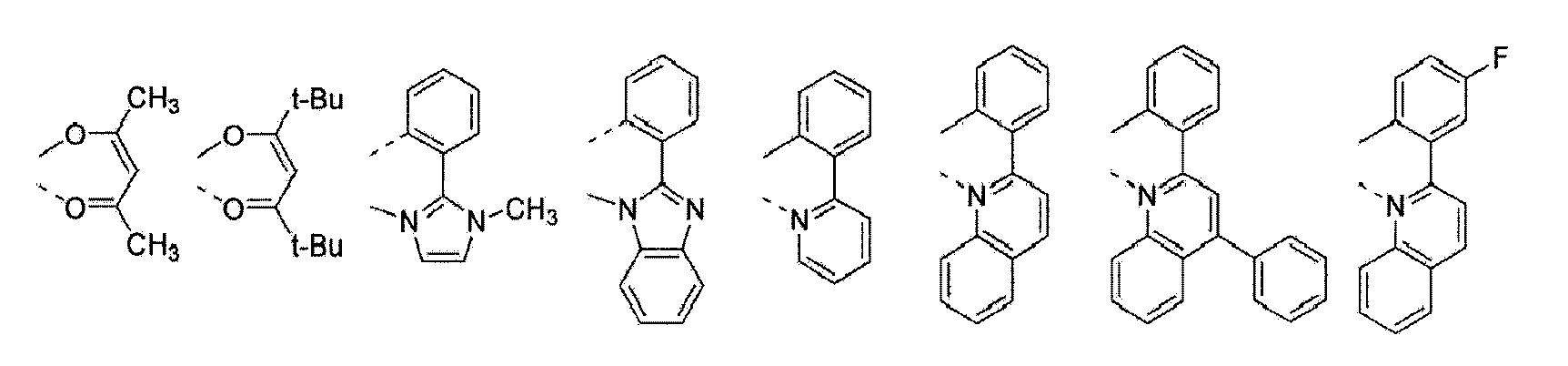
- the subsidiary ligands (L) of the organic electroluminescent compounds according to the present invention can be exemplified by the following structures, but they are not restricted thereto:
- preferable solvent is alcohol or a mixed solvent of alcohol/water, such as 2-ethoxyethanol, and 2-ethoxyethanol/water mixtures.
- the isolated diiridium dimer is then heated with a primary ligand compound in organic solvent to provide an organic phosphorescent iridium compound having the ratio of primary ligand: subsidiary ligand of 1:2 as the final product.
- the reaction is carried out with AgCF 3 SO 3 , Na 2 CO 3 or NaOH being admixed with organic solvent such as 2-ethoxyethanol and 2-methoxyethylether.
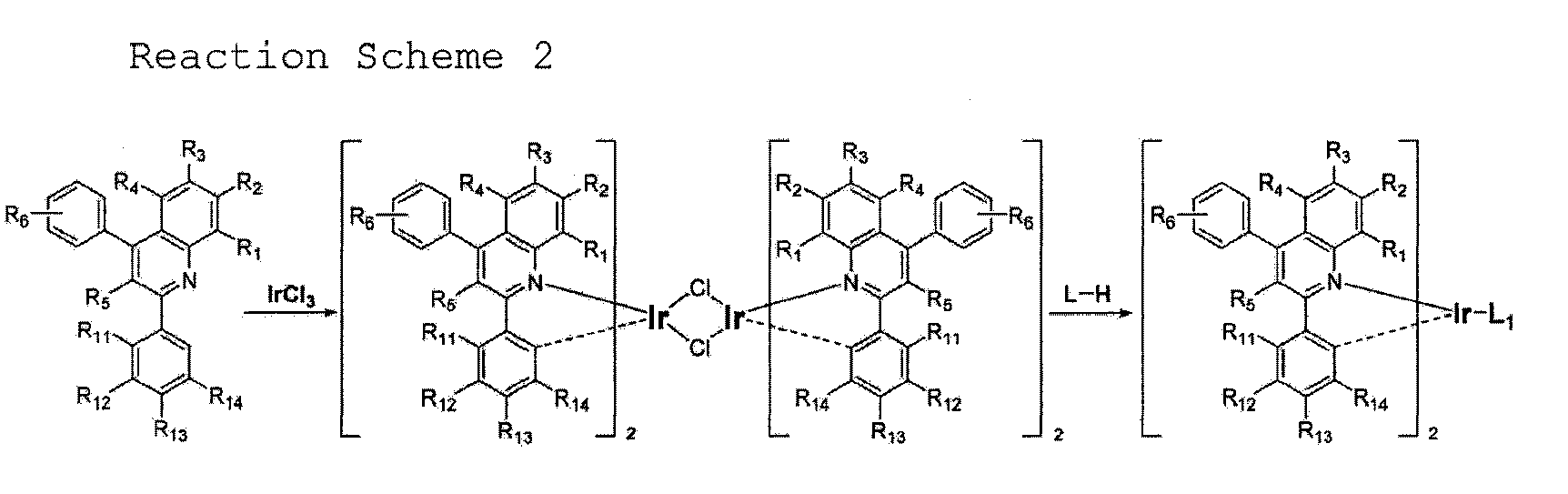
- preferable solvent is alcohol or a mixed solvent of alcohol/water, such as 2-ethoxyethanol, and 2-ethoxyethanol/water mixture.
- the isolated diiridium dimer is then heated with the subsidiary ligand compound (L-H) in organic solvent to provide an organic phosphorescent iridium compound having the ratio of primary ligand: subsidiary ligand of 2:1 as the final product.
- the molar ratio of the primary ligand compound and the subsidiary ligand (L) in the final product is determined by appropriate molar ratio of the reactant depending on the composition.
- the reaction may be carried out with AgCF 3 SO 3 , Na 2 CO 3 or NaOH being admixed with organic solvent such as 2-ethoxyethanol, 2-methoxyethylether and 1,2-dichloroethane.
- the compounds employed as a primary ligand in the present invention can be prepared according to Reaction Scheme (4), on the basis of conventional processes. wherein, R 1 through R 6 and R 11 through R 14 are defined as in Chemical Formula (1).
- the compounds employed as a primary ligand of Chemical Formula (1) which have various substituents, can be prepared from (2-aminophenyl)(phenyl)metanone derivatives and acetophenone derivatives.
- organic solar cells which are characterized by comprising one or more organic electroluminescent compound(s) represented by Chemical Formula (1).
- the present invention also provides an organic electroluminescent device which is comprised of a first electrode; a second electrode; and at least one organic layer(s) interposed between the first electrode and the second electrode; wherein the organic layer comprises one or more compound(s) represented by Chemical Formula (1).
- the organic electroluminescent device is characterized in that the organic layer comprises an electroluminescent region, which comprises one or more organic electroluminescent compound(s) represented by Chemical Formula (1) as electroluminescent dopant in an amount of 0.01 to 10% by weight, and one or more host(s).
- an electroluminescent region which comprises one or more organic electroluminescent compound(s) represented by Chemical Formula (1) as electroluminescent dopant in an amount of 0.01 to 10% by weight, and one or more host(s).
- the host to be applied to the organic electroluminescent device according to the invention is not particularly restricted, but may be exemplified by 1,3,5-tricarbazolylbenzene, polyvinylcarbazole, m-biscarbazolylphenyl, 4,4'4"-tri(N-carbazolyl)triphenylamine, 1,3,5-tri(2-carbazolylphenyl)benzene, 1,3,5-tris(2-carbazolyl-5-methoxyphenyl)benzene, bis(4-carbazolylphenyl)silane or the compounds represented by one of Chemical Formulas (6) to (9):
- R 91 through R 94 independently represent hydrogen, halogen, (C1-C60)alkyl, (C6-C60)aryl, (C4-C60)heteroaryl, a 5- or 6-membered heterocycloalkyl containing one or more heteroatom(s) selected from N, O and S, (C3-C60)cycloalkyl, tri(C1-C60)alkylsilyl, di(C1-C60)alkyl(C6-C60)arylsilyl, tri(C6-C60)arylsilyl, adamantyl, (C7-C60)bicycloalkyl, (C2-C60)alkenyl, (C2-C60)alkynyl, cyano, (C1-C60)alkylamino, (C6-C60)arylamino, (C6-C60)ar(C1-C60)alkyl, (C1-C60)alkyl
- L 1 L 2 M(Q) y wherein, the ligands, L 1 and L 2 independently represent one of the following structures: M is a bivalent or trivalent metal; y is 0 when M is a bivalent metal, while y is 1 when M is a trivalent metal; Q represents (C6-C60)aryloxy or tri(C6-C60)arylsilyl, and the aryloxy and triarylsilyl of Q may be further substituted by (C1-C60)alkyl or (C6-C60)aryl; X represents O, S or Se; ring A represents oxazole, thiazole, imidazole, oxadiazole, thiadiazole, benzoxazole, benzothiazole, benzimidazole, pyridine or quinoline; ring B represents pyridine or quinoline, and ring B may be further substituted by (C1-C60)alkyl, phenyl or naphthyl
- the ligands, L 1 and L 2 are independently selected from the following structures: wherein, X represents O, S or Se; R 101 through R 104 independently represent hydrogen, halogen, (C1-C60)alkyl, (C6-C60)aryl, (C4-C60)heteroaryl, a 5- or 6-membered heterocycloalkyl containing one or more heteroatom(s) selected from N, O and S, (C3-C60)cycloalkyl, tri(C1-C60)alkylsilyl, di(C1-C60)alkyl(C6-C60)arylsilyl, tri(C6-C60)arylsilyl, adamantyl, (C7-C60)bicycloalkyl, (C2-C60)alkenyl, (C2-C60)alkynyl, cyano, (C1-C60)alkylamino, (C6-C60)arylamino, (C6-
- M is a bivalent metal selected from Be, Zn, Mg, Cu and Ni, or a trivalent metal selected from Al, Ga, In and B, and Q is selected from the following structures.
- the compounds represented by Chemical Formula (6) may be specifically exemplified by the compounds with one of the following structures, but they are not restricted thereto.
- the compounds represented by one of Chemical Formulas (7) to (9) may be specifically exemplified by the compounds with one of the following structures, but they are not restricted thereto.
- the electroluminescent layer means the layer where electroluminescence occurs, and it may be a single layer or a multi-layer consisting of two or more layers stacked.
- a mixture of host-dopant is used according to the construction of the present invention, noticeable improvement in device life as well as in luminous efficiency could be confirmed.
- the organic electroluminescent device may further comprise one or more compound(s) selected from arylamine compounds and styrylarylamine compounds, as well as the organic electroluminescent compound represented by Chemical Formula (1).
- arylamine or styrylarylamine compounds include the compound represented by Chemical Formula (10), but they are not restricted thereto: wherein, Ar 11 and Ar 12 independently represent (C1-C60)alkyl, (C6-C60)aryl, (C4-C60)heteroaryl, (C6-C60)arylamino, (C1-C60)alkylamino, a 5- or 6-membered heterocycloalkyl containing one or more heteroatom(s) selected from N, O and S, or (C3-C60)cycloalkyl, or Ar 11 and Ar 12 may be linked via (C3-C60)alkylene or (C3-C60)alkenylene with or without a fused ring to form an alicyclic ring, or
- arylamine compounds and styrylarylamine compounds may be more specifically exemplified by the following compounds, but are not restricted thereto.
- the organic layer may further comprises one or more metal(s) selected from a group consisting of organic metals of Group 1, Group 2, 4 th period and 5 th period transition metals, lanthanide metals and d-transition elements, as well as the organic electroluminescent compound represented by Chemical Formula (1).
- the organic layer may comprise a charge generating layer in addition to the electroluminescent layer.
- the present invention can realize an electroluminescent device having a pixel structure of independent light-emitting mode, which comprises an organic electroluminescent device containing the compound of Chemical Formula (1) as a sub-pixel and one or more sub-pixel (s) comprising one or more compound(s) selected from a group consisting of arylamine compounds and styrylarylamine compounds are patterned in parallel at the same time.
- the organic electroluminescent device is an organic display which comprises one or more compound(s) selected from compounds having electroluminescent peak of wavelength of blue or green, at the same time.
- the compounds having electroluminescent peak of wavelength of blue or green may be exemplified by the compounds represented by one of Chemical Formulas (11) to (15), but they are not restricted thereto.
- Ar 101 and Ar 102 independently represent (C1-C60)alkyl, (C6-C60)aryl, (C4-C60)heteroaryl, (C6-C60)arylamino, (C1-C60)alkylamino, a 5- or 6-membered heterocycloalkyl containing one or more heteroatom(s) selected from N, O and S, or (C3-C60)cycloalkyl or Ar 101 and Ar 102 may be linked via (C3-C60)alkylene or (C3-C60)alkenylene with or without a fused ring to form an alicyclic ring, or a monocyclic or polycyclic aromatic ring; when h is 1, Ar 103 represents (C6-C60)aryl or (C4-C60)heteroaryl or an aryl represented by the following structural formula: when h is 2, Ar 13 represents (C6-C60)arylene, (C4-C60)heteroary
- R 301 through R 304 independently represents hydrogen, halogen, (C1-C60)alkyl, (C6-C60)aryl, (C4-C60)heteroaryl, a 5- or 6-membered heterocycloalkyl containing one or more heteroatom(s) selected from N, O and S, (C3-C60)cycloalkyl, tri(C1-C60)alkylsilyl, di(C1-C60)alkyl(C6-C60)arylsilyl, tri(C6-C60)arylsilyl, adamantyl, (C7-C60)bicycloalkyl, (C2-C60)alkenyl, (C2-C60)alkynyl, cyano, (C1-C60)alkylamino, (C6-C60)arylamino, (C6-C60)ar(C1-C60)alkyl, (C1-C60)alkyl
- L 11 represents (C6-C60)arylene or (C4-C60)heteroarylene
- L 12 represents anthracenylene
- Ar 301 through Ar 304 are independently selected from hydrogen, (C1-C60)alkyl, (C1-C60)alkoxy, halogen, (C4-C60)heteroaryl, (C5-C60)cycloalkyl and (C6-C60)aryl, and the cycloalkyl, aryl or heteroaryl of Ar 301 through Ar 304 may be further substituted by one or more substituent(s) selected from a group consisting of (C6-C60)aryl or (C4-C60)heteroaryl with or without at least one substituent(s) selected from
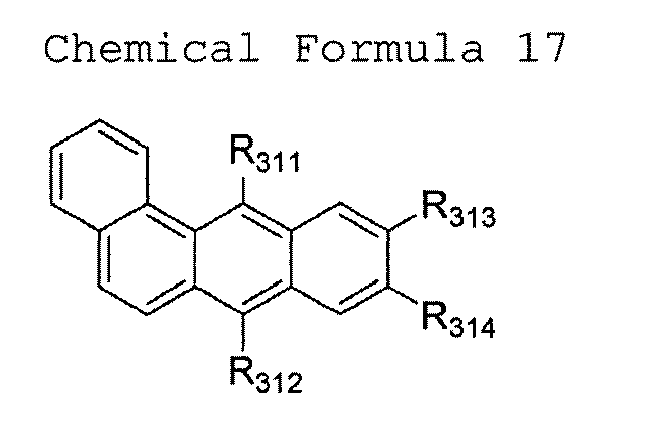
- the compounds represented by Chemical Formula (14) or (15) may be exemplified by anthracene derivatives and benz[a]anthracene derivatives represented by one of Chemical Formulas (16) through (19).
- R 311 and R 312 independently represent (C6-C60)aryl, (C4-C60)heteroaryl or a 5- or 6-membered heterocycloalkyl containing one or more heteroatom(s) selected from N, O and S, or (C3-C60)cycloalkyl and the aryl or heteroaryl of R 311 and R 312 may be further substituted by one or more substituent(s) selected from a group consisting of (C1-C60)alkyl, halo(C1-C60)alkyl, (C1-C60)alkoxy, (C3-C60)cycloalkyl, (C6-C60)aryl, (C4-C60)heteroaryl, halogen, cyano, tri(C1-C60)alkylsilyl, di(C1-C60)alkyl(C6-C60)arylsilyl and tri(C6-C60)aryls
- L 41 and L 42 independently represent a chemical bond, or (C6-C60)arylene or (C3-C60)heteroarylene, and the arylene or heteroarylene of L 41 and L 42 may be further substituted by one or more substituent(s) selected from (C1-C60)alkykl, halogen, cyano, (C1-C60)alkoxy, (C3-C60)cycloalkyl, (C6-C60)aryl, (C3-C60)heteroaryl, tri(C1-C30)alkylsilyl, di(C1-C30)alkyl(C6-C30)arylsilyl and tri(C6-C30)arylsilyl;
- R 201 through R 219 independently represent hydrogen, halogen, (C1-C60)alkyl, (C6-C60)aryl, (C4-C60)heteroaryl, a 5- or 6-membered heterocycloalkyl
- Ar 51 represents (C6-C60)aryl, (C4-C60)heteroaryl, a 5- or 6-membered heterocycloalkyl containing one or more heteroatom(s) selected from N, O and S, (C3-C60)cycloalkyl, adamantyl, (C7-C60)bicycloalkyl, or a substituent selected from the following structures:
- R 220 through R 232 independently represent hydrogen, halogen, (C1-C60)alkyl, (C6-C60)aryl, (C4-C60)heteroaryl, a 5- or 6-membered heterocycloalkyl containing one or more heteroatom(s) selected from N, O and S, (C3-C60)cycloalkyl, tri(C1-C60)alkylsilyl, di(C1-C60)alkyl(C6-C60)arylsilyl, tri(C6-C60)arylsilyl, adamantyl, (C7-C60)bicycloalkyl, (C2-C60)alkenyl, (C2-C60)alkynyl, (C1-C60)alkoxy, cyano, (C1-C60)alkylamino, (C6-C60)arylamino, (C6-C60)ar(C1-C60)alkyl, (C6-
- organic compounds and organometallic compounds with green or blue electroluminescence can be more specifically exemplified by the following compounds, but they are not restricted thereto.
- an organic electroluminescent device it is preferable to displace one or more layer(s) (here-in-below, referred to as the "surface layer") selected from chalcogenide layers, metal halide layers and metal oxide layers, on the inner surface of at least one side of the pair of electrodes.
- the surface layer selected from chalcogenide layers, metal halide layers and metal oxide layers.
- a chalcogenide layer of silicon and aluminum metal (including oxides) on the anode surface of the EL medium layer, and a metal halide layer or a metal oxide layer on the cathode surface of the EL medium layer.
- Examples of chalcogenides preferably include SiO x (1 ⁇ X ⁇ 2), AlO x (1 ⁇ X ⁇ 1.5), SiON, SiAlON, or the like.
- Examples of metal halides preferably include LiF, MgF 2 , CaF 2 , fluorides of lanthanides or the like.
- Examples of metal oxides preferably include Cs 2 O, Li 2 O, MgO, SrO, BaO, CaO, or the like.
- an organic electroluminescent device it is also preferable to arrange, on at least one surface of the pair of electrodes thus manufactured, a mixed region of electron transport compound and a reductive dopant, or a mixed region of a hole transport compound with an oxidative dopant. Accordingly, the electron transport compound is reduced to an anion, so that injection and transportation of electrons from the mixed region to an EL medium are facilitated. In addition, since the hole transport compound is oxidized to form a cation, injection and transportation of holes from the mixed region to an EL medium are facilitated.
- Preferable oxidative dopants include various Lewis acids and acceptor compounds.
- Preferable reductive dopants include alkali metals, alkali metal compounds, alkaline earth metals, rare-earth metals, and mixtures thereof.
- organic electroluminescent compounds according to the invention having a backbone of more excellent EL properties and thermal stability than conventional phosphorescent materials, provide higher quantum efficiency and lower operation voltage as compared to conventional materials.
- an organic electroluminescent compound according to the present invention is applied to an OLED panel, further enhanced results are anticipated in development of OLED's having medium to large size. If the compound is applied to an organic solar cell as a material of high efficiency, more excellent properties are anticipated as compared to conventional materials.
- An OLED device was manufactured by using an organic electroluminescent compound according to the invention.
- an ITO substrate was equipped in a substrate folder of a vacuum vapor-deposit device, and 4,4',4"-tris(N,N-(2-naphthyl)-phenylamino)triphenylamine (2-TNATA) was placed in a cell of the vacuum vapor-deposit device, which was then ventilated up to 10 -6 torr of vacuum in the chamber. Electric current was applied to the cell to evaporate 2-TNATA, thereby providing vapor-deposit of a hole injection layer (3) having 60 nm of thickness on the ITO substrate.
- NPB N,N'-bis( ⁇ -naphthyl)-N,N'-diphenyl-4,4'-diamine
- CBP 4,4'-N,N'-dicarbazole-biphenyl
- Compound 1 organic electroluminescent compound according to the present invention was charged to still another cell.
- the two materials were evaporated at different rates to carry out doping to vapor-deposit an electroluminescent layer (5) having 30 nm of thickness on the hole transport layer.
- the suitable doping concentration is 4 to 10 mol% on the basis of CBP.
- An hole injection layer and a hole transport layer were formed according to the procedure of Example 1, and an electroluminescent layer was vapor-deposited as follows.
- H-40 an electroluminescent host material
- an organic electroluminescent compound (Compound 780) according to the present invention was charged to still another cell.
- the two materials were evaporated at different rates to carry out doping to vapor-deposit an electroluminescent layer (5) having 30 nm of thickness on the hole transport layer.
- the suitable doping concentration is 4 to 10 mol% on the basis of the host.
- a hole blocking layer, an electron transport layer and an electron injection layer were vapor-deposited according to the same procedure as in Example 1, and then Al cathode (8) was vapor-deposited in a thickness of 150 nm by using another vacuum vapor-deposit device to manufacture an OLED.
- a hole injection layer, a hole transport layer and an electroluminescent layer were formed according to the same procedure as in Example 2, and then an electron transport layer and an electron injection layer were vapor-deposited. Thereafter, Al cathode was vapor-deposited in a thickness of 150 nm by using another vacuum vapor-deposit device to manufacture an OLED.
- Compounds (177), (584) and (589) 2-phenylquinoline, 2-styrylquinoline and phenyl(6-phenylpyridin-3-yl)methanone were incorporated, respectively, as a subsidiary ligand. They showed most excellent luminous efficiencies (11.7 cd/A, 12.0 cd/A and 12.5 cd/A, respectively) among the compounds according to the present invention.
- the compound to which ppy or 1-styrylquinoline was incorporated as a subsidiary ligand showed high luminous efficiency of 11 cd/A or more.
- the subsidiary ligands such as 2-phenylquinoline, 2-styrylquinoline, phenyl(6-phenylpyridin-3-yl)methanone, ppy and 1-styrylquinoline had a significant role to enhance the luminous efficiency of the compound.
- the host according to the present invention instead of CBP did not provide significant change in efficiency, color coordinate and operation voltage.
- those hosts can be employed as a phosphorescent host, when being used with dopants according to the invention, instead of CBP as a conventional electroluminescent host.
- the host according to the invention is employed without using a hole blocking layer, the device exhibits comparable or higher luminous efficiency as compared to that using conventional host, and provides decreased power consumption of the OLED due to lowered operation voltage by about 0.8 V ⁇ 1.2 V. If the invention is applied to mass production of OLEDs, the time for mass production can be also reduced to give great benefit on its commercialization.
Landscapes
- Chemical & Material Sciences (AREA)
- Organic Chemistry (AREA)
- Engineering & Computer Science (AREA)
- Materials Engineering (AREA)
- Crystallography & Structural Chemistry (AREA)
- Inorganic Chemistry (AREA)
- Electroluminescent Light Sources (AREA)
- Organic Low-Molecular-Weight Compounds And Preparation Thereof (AREA)
Abstract
Description
- The present invention relates to novel organic electroluminescent compounds exhibiting high luminous efficiency and organic electroluminescent devices using the same.
- The most important factor to determine luminous efficiency in an OLED (organic light-emitting diode) is the type of electroluminescent material. Though fluorescent materials has been widely used as an electroluminescent material up to the present, development of phosphorescent materials is one of the best methods to improve the luminous efficiency theoretically up to four(4) times, in view of electroluminescent mechanism.
- Up to now, iridium (III) complexes are widely known as phosphorescent material, including (acac)Ir(btp)2, Ir(ppy)3 and Firpic, as the red, green and blue one, respectively. In particular, a lot of phosphorescent materials have been recently investigated in Japan, Europe and America.

- Among conventional red phosphorescent materials, several materials have been reported to have good EL (electroluminescence) properties. However, very rare materials among them have reached the level of commercialization. As the best material, an iridium complex of 1-phenyl isoquinoline may be mentioned, which is known to have excellent EL property and to exhibit color purity of dark red with high luminous efficiency. [See A. Tsuboyama et al., J. Am. Chem. Soc. 2003, 125(42), 12971-12979.]

- Moreover, the red materials, having no significant problem of life time, have tendency of easy commercialization if they have good color purity or luminous efficiency. Thus, the above-mentioned iridium complex is a material having very high possibility of commercialization due to its excellent color purity and luminous efficiency.
- However, the iridium complex is still construed only as a material which is applicable to small displays, while higher levels of EL properties than those of known materials are practically required for an OLED panel of medium to large size.
- With intensive efforts of the present inventors to overcome the problems of conventional techniques as described above, they have researched for developing novel organic electroluminescent compounds to realize an organic EL device having excellent luminous efficiency and surprisingly improved lifetime. Thus, the object of the invention is to provide novel organic electroluminescent compounds having the skeletal to give more excellent properties as compared to those of conventional red phosphorescent materials. Another object of the invention is to provide novel organic electroluminescent compounds which are applicable to OLED panels of medium to large size. Another object of the present invention is to provide organic solar cells comprising the novel organic electroluminescent compounds.
- Thus, the present invention relates to novel organic electroluminescent compounds and organic electroluminescent devices employing the same in an electroluminescent layer. Specifically, the organic electroluminescent compounds according to the invention are characterized in that they are represented by Chemical Formula (1):

R1 through R5 independently represent hydrogen, (C1-C20)alkyl, (C1-C20)alkoxy, (C3-C12) cycloalkyl, halogen, tri(C1-C20)alkylsilyl or tri (C6-C20) arylsilyl;
R6 represents hydrogen, (C1-C20)alkyl, halogen or (C6-C20)aryl;
R11 through R14 independently represent hydrogen, (C1-C20)alkyl, halogen, cyano, tri (C1-C20) alkylsilyl, tri (C6-C20)arylsilyl, (C1-C20) alkoxy, (C1-C20)alkylcarbonyl, (C6-C20) arylcarbonyl, di (C1-C20) alkylamino, di (C6-C20) arylamino, phenyl, naphthyl, anthryl, fluorenyl, spirobifluorenyl or
the alkyl, phenyl, naphthyl, anthryl, fluorenyl of R11 through R14, and the alicyclic ring, or the monocyclic or polycyclic aromatic ring formed therefrom by linkage via (C3-C12) alkylene or (C3-C12)alkenylene with or without a fused ring may be further substituted by one or more substituent(s) selected from (C1-C20)alkyl with or without halogen substituent(s), (C1-C20)alkoxy, halogen, tri(C1-C20)alkylsilyl, tri (C6-C20) arylsilyl, (C1-C20) alkylcarbonyl, (C6-C20) arylcarbonyl, di(C1-C20) alkylamino, di (C6-C20) arylamino and (C6-C20) aryl;
provided that R11 through R14 cannot be hydrogen all at the same time; and
n is an integer from 1 to 3. -
-
Fig. 1 is a cross-sectional view of an OLED. - Referring now to the Drawings,
Fig. 1 illustrates a cross-sectional view ofOLED comprising Glass 1,Transparent electrode 2,Hole injection layer 3, Hole transport layer 4,Electroluminescent layer 5, Electron transport layer 6, Electron injection layer 7 andAl cathode 8. - The term "alkyl" described herein and any substituents comprising "alkyl" moiety include both linear and branched species.
- The term "aryl" described herein means an organic radical derived from aromatic hydrocarbon via elimination of one hydrogen atom. Each ring comprises a monocyclic or fused ring system containing from 4 to 7, preferably from 5 to 6 cyclic atoms. Specific examples include phenyl, naphthyl, biphenyl, anthryl, tetrahydronaphthyl, indenyl, fluorenyl, phenanthryl, triphenylenyl, pyrenyl, perylenyl, chrysenyl, naphthacenyl and fluoranthenyl, but they are not restricted thereto.
- The term "heteroaryl" described herein means an aryl group containing from 1 to 4 heteroatom(s) selected from N, O and S and remaining carbon atom(s) as aromatic cyclic backbone atoms. The heteroaryl may be a 5- or 6-membered monocyclic heteroaryl or a polycyclic heteroaryl which is fused with one or more benzene rings, and may be partially saturated. Heteroatoms in a heteroaryl group may be oxidized or quaternized to form a divalent aryl group such as N-oxide and quaternary salt. Specific examples include monocyclic heteroaryl groups such as furyl, thiophenyl, pyrrolyl, imidazolyl, pyrazolyl, thiazolyl, thiadiazolyl, isothiazolyl, isoxazolyl, oxazolyl, oxadiazolyl, triazinyl, tetrazinyl, triazolyl, tetrazolyl, furazanyl, pyridyl, pyrazinyl, pyrimidinyl, pyridazinyl; polycyclic heteroaryl groups such as benzofuranyl, benzothiophenyl, isobenzofuranyl, benzimidazolyl, benzothiazolyl, benzisothiazolyl, benzisoxazolyl, benzoxazolyl, isoindolyl, indolyl, indazolyl, benzothiadiazolyl, quinolyl, isoquinolyl, cinnolinyl, quinazolinyl, quinoxalinyl, carbazolyl, phenathridinyl and benzodioxolyl; and corresponding N-oxides (for example, pyridyl N-oxide, quinolyl N-oxide) and quaternary salts thereof; but they are not restricted thereto.
- The naphthyl of Chemical Formula (1) may be 1-naphthyl or 2-naphthyl; the anthryl may be 1-anthryl, 2-anthryl or 9-anthryl; and the fluorenyl may be 1-fluorenyl, 2-fluorenyl, 3-fluorenyl, 4-fluorenyl or 9-fluorenyl.
- The substituents comprising "(C1-C60)alkyl" moiety described herein may contain 1 to 60 carbon atoms, 1 to 20 carbon atoms, or 1 to 10 carbon atoms. The substituents comprising "(C6-C60)aryl" moiety may contain 6 to 60 carbon atoms, 6 to 20 carbon atoms, or 6 to 12 carbon atoms. The substituents comprising "(C3-C60)heteroaryl" moiety may contain 3 to 60 carbon atoms, 4 to 20 carbon atoms, or 4 to 12 carbon atoms. The substituents comprising "(C3-C60)cycloalkyl" moiety may contain 3 to 60 carbon atoms, 3 to 20 carbon atoms, or 3 to 7 carbon atoms. The substituents comprising "(C2-C60)alkenyl or alkynyl" moiety may contain 2 to 60 carbon atoms, 2 to 20 carbon atoms, or 2 to 10 carbon atoms.
- The alicyclic ring, or the monocyclic or polycyclic aromatic ring formed from two adjacent groups from R11 through R14 in Chemical Formula (1) by linkage via (C3-C12)alkylene or (C3-C12)alkenylene with or without a fused ring is benzene, naphthalene, anthracene, fluorene, indene or phenanthrene. The compound within the square bracket ([]) serves as a primary ligand of iridium, and L serves as a subsidiary ligand. The organic electroluminescent compounds according to the present invention also include the complex with the ratio of primary ligand: subsidiary ligand = 2:1 (n=2) and the complex with the ratio of primary ligand: subsidiary ligand = 1:2 (n=1), as well as tris-chelated complexes without subsidiary ligand (L) (n=3).
- R11 through R14 independently represent hydrogen, methyl, ethyl, n-propyl, i-propyl, n-butyl, i-butyl, t-butyl, n-pentyl, i-pentyl, n-hexyl, n-heptyl, n-octyl, 2-ethylhexyl, n-nonyl, trifluoromethyl, fluoro, cyano, trimethylsilyl, tripropylsilyl, tri(t-butyl)silyl, t-butyldimethylsilyl, triphenylsilyl, methoxy, ethoxy, butoxy, methylcarbonyl, ethylcarbonyl, t-butylcarbonyl, phenylcarbonyl, dimethylamino, diphenylamino, phenyl, naphthyl, anthryl, fluorenyl or

- The organic electroluminescent compound according to the invention may be exemplified by the compounds represented by one of Chemical Formulas (2) to (5):


R21 and R22 independently represent hydrogen, (C1-C20)alkyl, (C6-C20)aryl, or R21 and R22 may be linked each other via (C3-C12)alkylene or (C3-C12)alkenylene with or without a fused ring to form an alicyclic ring, or a monocyclic or polycyclic aromatic ring;
R23 represents (C1-C20)alkyl, halogen, cyano, tri(C1-C20)alkylsilyl, tri (C6-C20) arylsilyl, (C1-C20) alkoxy, (C1-C20) alkylcarbonyl, (C6-C20)arylcarbonyl, phenyl, di (C1-C20)alkylamino, di (C6-C20)arylamino, naphthyl, 9, 9-di (C1-C20)alkylfluorenyl or 9,9-di(C6-C20)arylfluorenyl; and
m is an integer from 1 to 5. - R1 through R5 of Chemical Formula (1) independently represent hydrogen, methyl, ethyl, n-propyl, i-propyl, n-butyl, i-butyl, t-butyl, n-pentyl, i-pentyl, n-hexyl, n-heptyl, n-octyl, ethylhexyl, methoxy, ethoxy, butoxy, cyclopropyl, cyclohexyl, cycloheptyl, fluoro, trimethylsilyl, tripropylsilyl, tri(t-butyl)silyl, t-butyldimethylsilyl or triphenylsilyl; and R6 represents hydrogen, methyl, ethyl, n-propyl, i-propyl, n-butyl, i-butyl, t-butyl, n-pentyl, i-pentyl, n-hexyl, n-heptyl, n-octyl, ethylhexyl, fluoro, phenyl, naphthyl, anthryl, fluorenyl or spirobifluorenyl.
- The organic electroluminescent compounds according to the present invention can be specifically exemplified by the following compounds, but they are not restricted thereto:


R6 represents hydrogen, methyl, ethyl, n-propyl, i-propyl, n-butyl, i-butyl, t-butyl, n-pentyl, i-pentyl, n-hexyl, n-heptyl, n-octyl, ethylhexyl, fluoro, phenyl or naphthyl;
R51 and R52 independently represent methyl, ethyl, n-propyl, i-propyl, n-butyl, i-butyl, t-butyl, n-pentyl, i-pentyl, n-hexyl, n-heptyl, n-octyl, ethylhexyl, phenyl or naphthyl, or R51 and R52 may be linked each other via (C3-C12)alkylene or (C3-C12)alkenylene with or without a fused fing to form an alicyclic ring, or a monocyclic or polycyclic aromatic ring;
R53 represents hydrogen, methyl, ethyl, n-propyl, i-propyl, n-butyl, i-butyl, t-butyl, n-pentyl, i-pentyl, n-hexyl, n-heptyl, n-octyl, 2-ethylhexyl, trimethylsilyl, tripropylsilyl, tri(t-butyl)silyl, t-butyldimethylsilyl, triphenylsilyl, phenyl or naphthyl;
m is an integer from 1 to 3; and
n is an integer from 1 to 3. - The subsidiary ligands (L) of the organic electroluminescent compounds according to the present invention include the following structures:


R33 through R38 independently represent hydrogen, (C1-C20)alkyl, phenyl with or without (C1-C20)alkyl substituent(s), tri(C1-C20)alkylsilyl or halogen;
R39 through R42 independently represent hydrogen, (C1-C20)alkyl, phenyl with or without (C1-C20)alkyl substituent(s); and - R43 represents (C1-C20)alkyl, phenyl with or without (C1-C20)alkyl substituent(s), or halogen.
- The subsidiary ligands (L) of the organic electroluminescent compounds according to the present invention can be exemplified by the following structures, but they are not restricted thereto:


- The processes for preparing the organic electroluminescent compounds according to the present invention are described by referring to Reaction Schemes (1) to (3) shown below:



- Reaction Scheme (1) provides a compound of Chemical Formula (1) with n=1, in which iridium trichloride (IrCl3) and subsidiary ligand compound (L-H) are mixed in a solvent at a molar ratio of 1:2~3, and the mixture is heated under reflux before isolating diiridium dimer. In the reaction stage, preferable solvent is alcohol or a mixed solvent of alcohol/water, such as 2-ethoxyethanol, and 2-ethoxyethanol/water mixtures. The isolated diiridium dimer is then heated with a primary ligand compound in organic solvent to provide an organic phosphorescent iridium compound having the ratio of primary ligand: subsidiary ligand of 1:2 as the final product. The reaction is carried out with AgCF3SO3, Na2CO3 or NaOH being admixed with organic solvent such as 2-ethoxyethanol and 2-methoxyethylether.
- Reaction Scheme (2) provides a compound of Chemical Formula (1) with n=2, in which iridium trichloride (IrCl3) and a primary ligand compound are mixed in a solvent at a molar ratio of 1:2~3, and the mixture is heated under reflux before isolating diiridium dimer. In the reaction stage, preferable solvent is alcohol or a mixed solvent of alcohol/water, such as 2-ethoxyethanol, and 2-ethoxyethanol/water mixture. The isolated diiridium dimer is then heated with the subsidiary ligand compound (L-H) in organic solvent to provide an organic phosphorescent iridium compound having the ratio of primary ligand: subsidiary ligand of 2:1 as the final product.
- The molar ratio of the primary ligand compound and the subsidiary ligand (L) in the final product is determined by appropriate molar ratio of the reactant depending on the composition. The reaction may be carried out with AgCF3SO3, Na2CO3 or NaOH being admixed with organic solvent such as 2-ethoxyethanol, 2-methoxyethylether and 1,2-dichloroethane.
- Reaction Scheme (3) provides a compound of Chemical Formula (1) with n=3, in which iridium complex prepared according to Reaction Scheme (2) and a primary ligand compound are mixed in glycerol at a molar ratio of 1:2~3, and the mixture is heated under reflux to obtain organic phosphorescent iridium complex coordinated with three primary ligands.
- The compounds employed as a primary ligand in the present invention can be prepared according to Reaction Scheme (4), on the basis of conventional processes.

- The compounds employed as a primary ligand of Chemical Formula (1), which have various substituents, can be prepared from (2-aminophenyl)(phenyl)metanone derivatives and acetophenone derivatives.
- Further, the present invention provides organic solar cells, which are characterized by comprising one or more organic electroluminescent compound(s) represented by Chemical Formula (1).
- The present invention also provides an organic electroluminescent device which is comprised of a first electrode; a second electrode; and at least one organic layer(s) interposed between the first electrode and the second electrode; wherein the organic layer comprises one or more compound(s) represented by Chemical Formula (1).
- The organic electroluminescent device according to the present invention is characterized in that the organic layer comprises an electroluminescent region, which comprises one or more organic electroluminescent compound(s) represented by Chemical Formula (1) as electroluminescent dopant in an amount of 0.01 to 10% by weight, and one or more host(s). The host to be applied to the organic electroluminescent device according to the invention is not particularly restricted, but may be exemplified by 1,3,5-tricarbazolylbenzene, polyvinylcarbazole, m-biscarbazolylphenyl, 4,4'4"-tri(N-carbazolyl)triphenylamine, 1,3,5-tri(2-carbazolylphenyl)benzene, 1,3,5-tris(2-carbazolyl-5-methoxyphenyl)benzene, bis(4-carbazolylphenyl)silane or the compounds represented by one of Chemical Formulas (6) to (9):

- In Chemical Formula (6), R91 through R94 independently represent hydrogen, halogen, (C1-C60)alkyl, (C6-C60)aryl, (C4-C60)heteroaryl, a 5- or 6-membered heterocycloalkyl containing one or more heteroatom(s) selected from N, O and S, (C3-C60)cycloalkyl, tri(C1-C60)alkylsilyl, di(C1-C60)alkyl(C6-C60)arylsilyl, tri(C6-C60)arylsilyl, adamantyl, (C7-C60)bicycloalkyl, (C2-C60)alkenyl, (C2-C60)alkynyl, cyano, (C1-C60)alkylamino, (C6-C60)arylamino, (C6-C60)ar(C1-C60)alkyl, (C1-C60)alkyloxy, (C1-C60)alkylthio, (C6-C60)aryloxy, (C6-C60)arylthio, (C1-C60)alkoxycarbonyl, (C1-C60)alkylcarbonyl, (C6-C60)arylcarbonyl, carboxyl, nitro or hydroxyl, or each of R91 through R94 may be linked to an adjacent substituent via (C3-C60)alkylene or (C3-C60)alkenylene with or without a fused ring to form an alicyclic ring, or a monocyclic or polycyclic aromatic ring;
the alkyl, alkenyl, alkynyl, cycloalkyl, heterocycloalkyl, aryl, heteroaryl, arylsilyl, alkylsilyl, alkylamino, or arylamino of R91 through R94, or the alicyclic ring, or the monocyclic or polycyclic aromatic ring formed therefrom by linkage to an adjacent substituent via (C3-C60)alkylene or (C3-C60)alkenylene with or without a fused ring may be further substituted by one or more substituent(s) selected from halogen, (C1-C60)alkyl, (C6-C60)aryl, (C4-C60)heteroaryl, a 5- or 6-membered heterocycloalkyl containing one or more heteroatom(s) selected from N, O and S, (C3-C60)cycloalkyl, tri(C1-C60)alkylsilyl, di(C1-C60)alkyl(C6-C60)arylsilyl, tri(C6-C60)arylsilyl, adamantyl, (C7-C60)bicycloalkyl, (C2-C60)alkenyl, (C2-C60)alkynyl, cyano, (C1-C60)alkylamino, (C6-C60)arylamino, (C6-C60)ar(C1-C60)alkyl, (C1-C60)alkyloxy, (C1-C60)alkylthio, (C6-C60)aryloxy, (C6-C60)arylthio, (C1-C60)alkoxycarbonyl, (C1-C60)alkylcarbonyl, (C6-C60)arylcarbonyl, carboxyl, nitro and hydroxyl.

-
Chemical Formula 9 L1L2M(Q)y
wherein, the ligands, L1 and L2 independently represent one of the following structures:
y is 0 when M is a bivalent metal, while y is 1 when M is a trivalent metal;
Q represents (C6-C60)aryloxy or tri(C6-C60)arylsilyl, and the aryloxy and triarylsilyl of Q may be further substituted by (C1-C60)alkyl or (C6-C60)aryl;
X represents O, S or Se;
ring A represents oxazole, thiazole, imidazole, oxadiazole, thiadiazole, benzoxazole, benzothiazole, benzimidazole, pyridine or quinoline;
ring B represents pyridine or quinoline, and ring B may be further substituted by (C1-C60)alkyl, phenyl or naphthyl with or without (C1-C60)alkyl substituent(s);
R101 through R104 independently represent hydrogen, halogen, (C1-C60)alkyl, (C6-C60)aryl, (C4-C60)heteroaryl, a 5- or 6-membered heterocycloalkyl containing one or more heteroatom(s) selected from N, O and S, (C3-C60)cycloalkyl, tri(C1-C60)alkylsilyl, di(C1-C60)alkyl(C6-C60)arylsilyl, tri(C6-C60)arylsilyl, adamantyl, (C7-C60)bicycloalkyl, (C2-C60)alkenyl, (C2-C60)alkynyl, cyano, (C1-C60)alkylamino, (C6-C60)arylamino, (C6-C60)ar(C1-C60)alkyl, (C1-C60)alkyloxy, (C1-C60)alkylthio, (C6-C60)aryloxy, (C6-C60)arylthio, (C1-C60)alkoxycarbonyl, (C1-C60)alkylcarbonyl, (C6-C60)arylcarbonyl, carboxyl, nitro or hydroxyl, or each of R101 through R104 may be linked to an adjacent substituent via (C3-C60)alkylene or (C3-C60)alkenylene with or without a fused ring to form an alicyclic ring, or a monocyclic or polycyclic aromatic ring;
the alkyl, alkenyl, alkynyl, cycloalkyl, heterocycloalkyl, aryl, heteroaryl, arylsilyl, alkylsilyl, alkylamino, or arylamino of ring A and R101 through R104, or the alicyclic ring, or the monocyclic or polycyclic aromatic ring formed therefrom by linkage to an adjacent substituent via (C3-C60)alkylene or (C3-C60)alkenylene with or without a fused ring may be further substituted by one or more substituent(s) selected from halogen, (C1-C60)alkyl, (C6-C60)aryl, (C4-C60)heteroaryl, a 5- or 6-membered heterocycloalkyl containing one or more heteroatom(s) selected from N, O and S, (C3-C60)cycloalkyl, tri(C1-C60)alkylsilyl, di(C1-C60)alkyl(C6-C60)arylsilyl, tri(C6-C60)arylsilyl, adamantyl, (C7-C60)bicycloalkyl, (C2-C60)alkenyl, (C2-C60)alkynyl, cyano, (C1-C60)alkylamino, (C6-C60)arylamino, (C6-C60)ar(C1-C60)alkyl, (C1-C60)alkyloxy, (C1-C60)alkylthio, (C6-C60)aryloxy, (C6-C60)arylthio, (C1-C60)alkoxycarbonyl, (C1-C60)alkylcarbonyl, (C6-C60)arylcarbonyl, carboxyl, nitro and hydroxyl. - The ligands, L1 and L2 are independently selected from the following structures:


R101 through R104 independently represent hydrogen, halogen, (C1-C60)alkyl, (C6-C60)aryl, (C4-C60)heteroaryl, a 5- or 6-membered heterocycloalkyl containing one or more heteroatom(s) selected from N, O and S, (C3-C60)cycloalkyl, tri(C1-C60)alkylsilyl, di(C1-C60)alkyl(C6-C60)arylsilyl, tri(C6-C60)arylsilyl, adamantyl, (C7-C60)bicycloalkyl, (C2-C60)alkenyl, (C2-C60)alkynyl, cyano, (C1-C60)alkylamino, (C6-C60)arylamino, (C6-C60)ar(C1-C60)alkyl, (C1-C60)alkyloxy, (C1-C60)alkylthio, (C6-C60)aryloxy, (C6-C60)arylthio, (C1-C60)alkoxycarbonyl, (C1-C60)alkylcarbonyl, (C6-C60)arylcarbonyl, carboxyl, nitro or hydroxyl, or each of R101 through R104 may be linked to an adjacent substituent via (C3-C60)alkylene or (C3-C60)alkenylene with or without a fused ring to form an alicyclic ring, or a monocyclic or polycyclic aromatic ring;
R111 through R116 and R121 through R139 independently represent hydrogen, halogen, (C1-C60)alkyl, (C6-C60)aryl, (C4-C60)heteroaryl, a 5- or 6-membered heterocycloalkyl containing one or more heteroatom(s) selected from N, O and S, (C3-C60)cycloalkyl, tri(C1-C60)alkylsilyl, di(C1-C60)alkyl(C6-C60)arylsilyl, tri(C6-C60)arylsilyl, adamantyl, (C7-C60)bicycloalkyl, (C2-C60)alkenyl, (C2-C60)alkynyl, cyano, (C1-C60)alkylamino, (C6-C60)arylamino, (C6-C60)ar(C1-C60)alkyl, (C1-C60)alkyloxy, (C1-C60)alkylthio, (C6-C60)aryloxy, (C6-C60)arylthio, (C1-C60)alkoxycarbonyl, (C1-C60)alkylcarbonyl, (C6-C60)arylcarbonyl, carboxyl, nitro or hydroxyl, or each of R111 through R116 and R121 through R139 may be linked to an adjacent substituent via (C3-C60)alkylene or (C3-C60)alkenylene with or without a fused ring to form an alicyclic ring, or a monocyclic or polycyclic aromatic ring;
the alkyl, alkenyl, alkynyl, cycloalkyl, heterocycloalkyl, aryl, heteroaryl, arylsilyl, alkylsilyl, alkylamino or arylamino of R101 through R104, R111 through R116, and R121 through R139, or the alicyclic ring, or the monocyclic or polycyclic aromatic ring formed therefrom by linkage to an adjacent substituent via (C3-C60)alkylene or (C3-C60)alkenylene with or without a fused ring may be further substituted by one or more substituent(s) selected from halogen, (C1-C60)alkyl, (C6-C60)aryl, (C4-C60)heteroaryl, a 5- or 6-membered heterocycloalkyl containing one or more heteroatom(s) selected from N, O and S, (C3-C60)cycloalkyl, tri(C1-C60)alkylsilyl, di(C1-C60)alkyl(C6-C60)arylsilyl, tri(C6-C60)arylsilyl, adamantyl, (C7-C60)bicyclaalkyl, (C2-C60)alkenyl, (C2-C60)alkynyl, cyano, (C1-C60)alkylamino, (C6-C60)arylamino, (C6-C60)ar(C1-C60)alkyl, (C1-C60)alkyloxy, (C1-C60)alkylthio, (C6-C60)aryloxy, (C6-C60)arylthio, (C1-C60)alkoxycarbonyl, (C1-C60)alkylcarbonyl, (C6-C60)arylcarbonyl, carboxyl, nitro and hydroxyl. - In Chemical Formula (9), M is a bivalent metal selected from Be, Zn, Mg, Cu and Ni, or a trivalent metal selected from Al, Ga, In and B, and Q is selected from the following structures.


- The compounds represented by Chemical Formula (6) may be specifically exemplified by the compounds with one of the following structures, but they are not restricted thereto.

- The compounds represented by one of Chemical Formulas (7) to (9) may be specifically exemplified by the compounds with one of the following structures, but they are not restricted thereto.





- The electroluminescent layer means the layer where electroluminescence occurs, and it may be a single layer or a multi-layer consisting of two or more layers stacked. When a mixture of host-dopant is used according to the construction of the present invention, noticeable improvement in device life as well as in luminous efficiency could be confirmed.
- The organic electroluminescent device according to the invention may further comprise one or more compound(s) selected from arylamine compounds and styrylarylamine compounds, as well as the organic electroluminescent compound represented by Chemical Formula (1). Examples of arylamine or styrylarylamine compounds include the compound represented by Chemical Formula (10), but they are not restricted thereto:

when g is 1, Ar13 represents (C6-C60)aryl or (C4-C60)heteroaryl or an aryl represented by the following structural formula:


R151, R152 and R153 independently represent hydrogen, (C1-C60)alkyl or (C6-C60)aryl;
t is an integer from 1 to 4, w is an integer of 0 or 1; and
the alkyl, aryl, heteroaryl, arylamino, alkylamino, cycloalkyl or heterocycloalkyl of Ar11 and Ar12, or the aryl, heteroaryl, arylene or heteroarylene of Ar13, or the arylene or heteroarylene of Ar21 and Ar22, or the alkyl or aryl of R151 through R153 may be further substituted by one or more substituent(s) selected from a group consisting of halogen, (C1-C60)alkyl, (C6-C60)aryl, (C4-C60)heteroaryl, a 5- or 6-membered heterocycloalkyl containing one or more heteroatom(s) selected from N, O and S, (C3-C60)cycloalkyl, tri(C1-C60)alkylsilyl, di(C1-C60)alkyl(C6-C60)arylsilyl, tri(C6-C60)arylsilyl, adamantyl, (C7-C60)bicycloalkyl, (C2-C60)alkenyl, (C2-C60)alkynyl, cyano, (C1-C60)alkylamino, (C6-C60)arylamino, (C6-C60)ar(C1-C60)alkyl, (C6-C60)aryloxy, (C1-C60)alkyloxy, (C6-C60)arylthio, (C1-C60)alkylthio, (C1-C60)alkoxycarbonyl, (C1-C60)alkylcarbonyl, (C6-C60)arylcarbonyl, carboxyl, nitro and hydroxyl. - The arylamine compounds and styrylarylamine compounds may be more specifically exemplified by the following compounds, but are not restricted thereto.


- In an organic electroluminescent device according to the present invention, the organic layer may further comprises one or more metal(s) selected from a group consisting of organic metals of
Group 1,Group 2, 4th period and 5th period transition metals, lanthanide metals and d-transition elements, as well as the organic electroluminescent compound represented by Chemical Formula (1). The organic layer may comprise a charge generating layer in addition to the electroluminescent layer. - The present invention can realize an electroluminescent device having a pixel structure of independent light-emitting mode, which comprises an organic electroluminescent device containing the compound of Chemical Formula (1) as a sub-pixel and one or more sub-pixel (s) comprising one or more compound(s) selected from a group consisting of arylamine compounds and styrylarylamine compounds are patterned in parallel at the same time.
- Further, the organic electroluminescent device is an organic display which comprises one or more compound(s) selected from compounds having electroluminescent peak of wavelength of blue or green, at the same time. The compounds having electroluminescent peak of wavelength of blue or green may be exemplified by the compounds represented by one of Chemical Formulas (11) to (15), but they are not restricted thereto.


- In Chemical Formula (12), Ar101 and Ar102 independently represent (C1-C60)alkyl, (C6-C60)aryl, (C4-C60)heteroaryl, (C6-C60)arylamino, (C1-C60)alkylamino, a 5- or 6-membered heterocycloalkyl containing one or more heteroatom(s) selected from N, O and S, or (C3-C60)cycloalkyl or Ar101 and Ar102 may be linked via (C3-C60)alkylene or (C3-C60)alkenylene with or without a fused ring to form an alicyclic ring, or a monocyclic or polycyclic aromatic ring;
when h is 1, Ar103 represents (C6-C60)aryl or (C4-C60)heteroaryl or an aryl represented by the following structural formula:



R161, R162 and R163 independently represent hydrogen, (C1-C60)alkyl or (C6-C60)aryl;
i is an integer from 1 to 4, j is an integer of 0 or 1; and
the alkyl, aryl, heteroaryl, arylamino, alkylamino, cycloalkyl or heterocycloalkyl of Ar101 and Ar102, or the aryl, heteroaryl, arylene or heteroarylene of Ar103, or the arylene or heteroarylene of Ar201 and Ar202, or the alkyl or aryl of R161 through R163 may be further substituted by one or more substituent(s) selected from a group consisting of halogen, (C1-C60)alkyl, (C6-C60)aryl, (C4-C60)heteroaryl, a 5- or 6-membered heterocycloalkyl containing one or more heteroatom(s) selected from N, O and S, (C3-C60)cycloalkyl, tri(C1-C60)alkylsilyl, di(C1-C60)alkyl(C6-C60)arylsilyl, tri(C6-C60)arylsilyl, adamantyl, (C7-C60)bicycloalkyl, (C2-C60)alkenyl, (C2-C60)alkynyl, cyano, (C1-C60)alkylamino, (C6-C60)arylamino, (C6-C60)ar(C1-C60)alkyl, (C6-C60)aryloxy, (C1-C60)alkyloxy, (C6-C60)arylthio, (C1-C60)alkylthio, (C1-C60)alkoxycarbonyl, (C1-C60)alkylcarbonyl, (C6-C60)arylcarbonyl, carboxyl, nitro and hydroxyl.
- In Chemical Formula (13), R301 through R304 independently represents hydrogen, halogen, (C1-C60)alkyl, (C6-C60)aryl, (C4-C60)heteroaryl, a 5- or 6-membered heterocycloalkyl containing one or more heteroatom(s) selected from N, O and S, (C3-C60)cycloalkyl, tri(C1-C60)alkylsilyl, di(C1-C60)alkyl(C6-C60)arylsilyl, tri(C6-C60)arylsilyl, adamantyl, (C7-C60)bicycloalkyl, (C2-C60)alkenyl, (C2-C60)alkynyl, cyano, (C1-C60)alkylamino, (C6-C60)arylamino, (C6-C60)ar(C1-C60)alkyl, (C1-C60)alkyloxy, (C1-C60)alkylthio, (C6-C60)aryloxy, (C6-C60)arylthio, (C1-C60)alkoxycarbonyl, (C1-C60)alkylcarbonyl, (C6-C60)arylcarbonyl, carboxyl, nitro or hydroxyl, or each of R301 through R304 may be linked to an adjacent substituent via (C3-C60)alkylene or (C3-C60)alkenylene with or without a fused ring to form an alicyclic ring, or a monocyclic or polycyclic aromatic ring;
the alkyl, alkenyl, alkynyl, cycloalkyl, heterocycloalkyl, aryl, heteroaryl, arylsilyl, alkylsilyl, alkylamino or arylamino of R301 through R304, or the alicyclic ring, or the monocyclic or polycyclic aromatic ring formed therefrom by linkage to an adjacent substituent via (C3-C60)alkylene or (C3-C60)alkenylene with or without a fused ring may be further substituted by one or more substituent(s) selected from halogen, (C1-C60)alkyl, (C6-C60)aryl, (C4-C60)heteroaryl, a 5- or 6-membered heterocycloalkyl containing one or more heteroatom(s) selected from N, O and S, (C3-C60)cycloalkyl, tri(C1-C60)alkylsilyl, di(C1-C60)alkyl(C6-C60)arylsilyl, tri(C6-C60)arylsilyl, adamantyl, (C7-C60)bicycloalkyl, (C2-C60)alkenyl, (C2-C60)alkynyl, cyano, (C1-C60)alkylamino, (C6-C60)arylamino, (C6-C60)ar(C1-C60)alkyl, (C1-C60)alkyloxy, (C1-C60)alkylthio, (C6-C60)aryloxy, (C6-C60)arylthio, (C1-C60)alkoxycarbonyl, (C1-C60)alkylcarbonyl, (C6-C60)arylcarbonyl, carboxyl, nitro and hydroxyl.
Chemical Formula 14 (Ar301)p-L11- (Ar302) q
Chemical Formula 15 (Ar303)r-L12- (Ar304)s
In Chemical Formulas (14) and (15),
L11 represents (C6-C60)arylene or (C4-C60)heteroarylene;
L12 represents anthracenylene;
Ar301 through Ar304 are independently selected from hydrogen, (C1-C60)alkyl, (C1-C60)alkoxy, halogen, (C4-C60)heteroaryl, (C5-C60)cycloalkyl and (C6-C60)aryl, and the cycloalkyl, aryl or heteroaryl of Ar301 through Ar304 may be further substituted by one or more substituent(s) selected from a group consisting of (C6-C60)aryl or (C4-C60)heteroaryl with or without at least one substituent(s) selected from a group consisting of (C1-C60)alkyl, halo(C1-C60)alkyl, (C1-C60)alkoxy, (C3-C60)cycloalkyl, halogen, cyano, tri(C1-C60)alkylsilyl, di(C1-C60)alkyl(C6-C60)arylsilyl and tri(C6-C60)arylsilyl; (C1-C60)alkyl with or without halogen substituent(s), (C1-C60)alkoxy, (C3-C60)cycloalkyl, halogen, cyano, tri(C1-C60)alkylsilyl, di(C1-C60)alkyl(C6-C60)arylsilyl and tri(C6-C60)arylsilyl; and
p, q, r and s independently represent an integer from 0 to 4. - The compounds represented by Chemical Formula (14) or (15) may be exemplified by anthracene derivatives and benz[a]anthracene derivatives represented by one of Chemical Formulas (16) through (19).



- In Chemical Formulas (16) to (18), R311 and R312 independently represent (C6-C60)aryl, (C4-C60)heteroaryl or a 5- or 6-membered heterocycloalkyl containing one or more heteroatom(s) selected from N, O and S, or (C3-C60)cycloalkyl and the aryl or heteroaryl of R311 and R312 may be further substituted by one or more substituent(s) selected from a group consisting of (C1-C60)alkyl, halo(C1-C60)alkyl, (C1-C60)alkoxy, (C3-C60)cycloalkyl, (C6-C60)aryl, (C4-C60)heteroaryl, halogen, cyano, tri(C1-C60)alkylsilyl, di(C1-C60)alkyl(C6-C60)arylsilyl and tri(C6-C60)arylsilyl;
R313 through R316 independently represent hydrogen, (C1-C60)alkyl, (C1-C60)alkoxy, halogen, (C4-C60)heteroaryl, (C5-C60)cycloalkyl or (C6-C60)aryl, and the heteroaryl, cycloalkyl or aryl of R313 and R316 may be further substituted by one or more substituent(s) selected from a group consisting of (C1-C60)alkyl with or without halogen substituent(s), (C1-C60)alkoxy, (C3-C60)cycloalkyl, halogen, cyano, tri(C1-C60)alkylsilyl, di(C1-C60)alkyl(C6-C60)arylsilyl and tri(C6-C60)arylsilyl;
G1 and G2 independently represent a chemical bond or (C6-C60)arylene with or without one or more substituent(s) selected from (C1-C60)alkyl, (C1-C60)alkoxy, (C6-C60)aryl, (C4-C60)heteroaryl and halogen;
Ar41 and Ar42 represent (C4-C60)heteroaryl or aryl selected from the following structures:


L31 represents (C6-C60)arylene, (C4-C60)heteroarylene or a compound represented by the following structure:
R321, R322, R323 and R324 independently represent hydrogen, (C1-C60)alkyl or (C6-C60)aryl, or each of them may be linked to an adjacent substituent via (C3-C60)alkylene or (C3-C60)alkenylene with or without a fused ring to form an alicyclic ring, or a monocyclic or polycyclic aromatic ring;
R331, R332, R333 and R334 independently represent hydrogen, (C1-C60)alkyl, (C1-C60)alkoxy, (C6-C60)aryl, (C4-C60)heteroaryl or halogen, or each of them may be linked to an adjacent substituent via (C3-C60)alkylene or (C3-C60)alkenylene with or without a fused ring to form an alicyclic ring, or a monocyclic or polycyclic aromatic ring.

L41 and L42 independently represent a chemical bond, or (C6-C60)arylene or (C3-C60)heteroarylene, and the arylene or heteroarylene of L41 and L42 may be further substituted by one or more substituent(s) selected from (C1-C60)alkykl, halogen, cyano, (C1-C60)alkoxy, (C3-C60)cycloalkyl, (C6-C60)aryl, (C3-C60)heteroaryl, tri(C1-C30)alkylsilyl, di(C1-C30)alkyl(C6-C30)arylsilyl and tri(C6-C30)arylsilyl;
R201 through R219 independently represent hydrogen, halogen, (C1-C60)alkyl, (C6-C60)aryl, (C4-C60)heteroaryl, a 5- or 6-membered heterocycloalkyl containing one or more heteroatom(s) selected from N, O and S, (C3-C60)cycloalkyl, tri(C1-C60)alkylsilyl, di(C1-C60)alkyl(C6-C60)arylsilyl, tri(C6-C60)arylsilyl, adamantyl, (C7-C60)bicycloalkyl, (C2-C60)alkenyl, (C2-C60)alkynyl, (C1-C60)alkoxy, cyano, (C1-C60)alkylamino, (C6-C60)arylamino, (C6-C60)ar(C1-C60)alkyl, (C6-C60)aryloxy, (C6-C60)arylthio, (C1-C60)alkoxycarbonyl, carboxyl, nitro or hydroxyl, or each of R201 through R219 may be linked to an adjacent substituent via (C3-C60)alkylene or (C3-C60)alkenylene with or without a fused ring to form an alicyclic ring, or a monocyclic or polycyclic aromatic ring; - Ar51 represents (C6-C60)aryl, (C4-C60)heteroaryl, a 5- or 6-membered heterocycloalkyl containing one or more heteroatom(s) selected from N, O and S, (C3-C60)cycloalkyl, adamantyl, (C7-C60)bicycloalkyl, or a substituent selected from the following structures:

- R220 through R232 independently represent hydrogen, halogen, (C1-C60)alkyl, (C6-C60)aryl, (C4-C60)heteroaryl, a 5- or 6-membered heterocycloalkyl containing one or more heteroatom(s) selected from N, O and S, (C3-C60)cycloalkyl, tri(C1-C60)alkylsilyl, di(C1-C60)alkyl(C6-C60)arylsilyl, tri(C6-C60)arylsilyl, adamantyl, (C7-C60)bicycloalkyl, (C2-C60)alkenyl, (C2-C60)alkynyl, (C1-C60)alkoxy, cyano, (C1-C60)alkylamino, (C6-C60)arylamino, (C6-C60)ar(C1-C60)alkyl, (C6-C60)aryloxy, (C6-C60)arylthio, (C1-C60)alkoxycarbonyl, carboxyl, nitro or hydroxyl;
E and F independently represent a chemical bond, CR233R234, NR235, S, O, SiR236R237, PR238, CO, BR239, InR240, Se, GeR241R242, SnR243R244, GaR245 or CR246=CR247;
R233 through R247 independently represent hydrogen, halogen, (C1-C60)alkyl, (C6-C60)aryl, (C4-C60)heteroaryl, a 5- or 6-membered heterocycloalkyl containing one or more heteroatom(s) selected from N, O and S, (C3-C60)cycloalkyl, tri(C1-C60)alkylsilyl, di(C1-C60)alkyl(C6-C60)arylsilyl, tri(C6-C60)arylsilyl, adamantyl, (C7-C60)bicycloalkyl, (C2-C60)alkenyl, (C2-C60)alkynyl, (C1-C60)alkoxy, cyano, (C1-C60)alkylamino, (C6-C60)arylamino, (C6-C60)ar(C1-C60)alkyl, (C6-C60)aryloxy, (C6-C60)arylthio, (C1-C60)alkoxycarbonyl, carboxyl, nitro or hydroxyl, or each of R233 through R247 may be linked to an adjacent substituent via (C3-C60)alkylene or (C3-C60)alkenylene with or without a fused ring to form an alicyclic ring, or a monocyclic or polycyclic aromatic ring;
the aryl, heteroaryl, heterocycloalkyl, adamantyl or bicycloalkyl of Ar51, or the alkyl, alkenyl, alkynyl, cycloalkyl, heterocycloalkyl, aryl, heteroaryl, arylsilyl, alkylsilyl, alkylamino or arylamino of R201 through R232 may be further substituted by one or more substituent(s) selected from halogen, (C1-C60)alkyl, (C6-C60)aryl, (C4-C60)heteroaryl, a 5- or 6-membered heterocycloalkyl containing one or more heteroatom(s) selected from N, O and S, (C3-C60)cycloalkyl, tri(C1-C60)alkylsilyl, di(C1-C60)alkyl(C6-C60)arylsilyl, tri(C6-C60)arylsilyl, adamantyl, (C7-C60)bicycloalkyl, (C2-C60)alkenyl, (C2-C60)alkynyl, (C1-C60)alkaxy, cyano, (C1-C60)alkylamino, (C6-C60)arylamino, (C6-C60)ar(C1-C60)alkyl, (C6-C60)aryloxy, (C6-C60)arylthio, (C1-C60)alkoxycarbonyl, carboxyl, nitro and hydroxyl; x is an integer from 1 to 4; and z is an integer from 0 to 4. - The organic compounds and organometallic compounds with green or blue electroluminescence can be more specifically exemplified by the following compounds, but they are not restricted thereto.








- In an organic electroluminescent device according to the present invention, it is preferable to displace one or more layer(s) (here-in-below, referred to as the "surface layer") selected from chalcogenide layers, metal halide layers and metal oxide layers, on the inner surface of at least one side of the pair of electrodes. Specifically, it is preferable to arrange a chalcogenide layer of silicon and aluminum metal (including oxides) on the anode surface of the EL medium layer, and a metal halide layer or a metal oxide layer on the cathode surface of the EL medium layer. As the result, stability in operation can be obtained.
- Examples of chalcogenides preferably include SiOx (1≤X≤2), AlOx (1≤X≤1.5), SiON, SiAlON, or the like. Examples of metal halides preferably include LiF, MgF2, CaF2, fluorides of lanthanides or the like. Examples of metal oxides preferably include Cs2O, Li2O, MgO, SrO, BaO, CaO, or the like.
- In an organic electroluminescent device according to the present invention, it is also preferable to arrange, on at least one surface of the pair of electrodes thus manufactured, a mixed region of electron transport compound and a reductive dopant, or a mixed region of a hole transport compound with an oxidative dopant. Accordingly, the electron transport compound is reduced to an anion, so that injection and transportation of electrons from the mixed region to an EL medium are facilitated. In addition, since the hole transport compound is oxidized to form a cation, injection and transportation of holes from the mixed region to an EL medium are facilitated. Preferable oxidative dopants include various Lewis acids and acceptor compounds. Preferable reductive dopants include alkali metals, alkali metal compounds, alkaline earth metals, rare-earth metals, and mixtures thereof.
- The organic electroluminescent compounds according to the invention, having a backbone of more excellent EL properties and thermal stability than conventional phosphorescent materials, provide higher quantum efficiency and lower operation voltage as compared to conventional materials. Thus, if an organic electroluminescent compound according to the present invention is applied to an OLED panel, further enhanced results are anticipated in development of OLED's having medium to large size. If the compound is applied to an organic solar cell as a material of high efficiency, more excellent properties are anticipated as compared to conventional materials.
- The present invention is further described with respect to the processes for preparing novel organic electroluminescent compounds according to the invention by referring to Examples, which are provided for illustration only but are not intended to limit the scope of the invention by any means.
-

- In toluene (180 mL) and ethanol (90 mL), dissolved were 3'-bromoacetophenone (15.0 g, 75.4 mmol), phenylboronic acid (11.0 g, 90.5 mmol) and tetrakispalladium (0) triphenylphosphine (Pd(PPh3)4) (8.7 g, 7.5 mmol). Aqueous 2M sodium carbonate solution (180 mL) was added to the solution, and the mixture was stirred under reflux at 120°C for 4 hours. Then, the reaction mixture was cooled to 25°C, and the reaction was quenched by adding distilled water (200 mL). The mixture was extracted with ethyl acetate (300 mL), and the extract was dried under reduced pressure. Purification via silicagel column chromatography gave Compound (A) (10.1 g, 51.5 mmol).
- In acetic acid (172 mL), dissolved were Compound (A) (10.1 g, 51.5 mmol) and 2-aminobenzophenone (10.2 g, 51.5 mmol). Sulfuric acid (H2SO4) was added thereto, and the mixture was stirred at 130°C under reflux. When the reaction was completed, excess amount of NH4OH was added to the reaction mixture, which was then extracted in organic phase. Purification via column chromatography gave Compound (B) (13.4 g, 38.8 mmol).
- In 2-ethoxyethanol (220 mL) and distilled water (74 mL), dissolved were Compound (B) (13.4 g, 38.8 mmol) and iridium chloride (IrCl3) (5.1 g, 17.1 mmol), and the solution was stirred under reflux for 24 hours. When the reaction was completed, the mixture was cooled at room temperature, with solid produced then. The solid was filtered and dried to obtain Compound (C) (9.1 g, 4.8 mmol).
- Compound (C) (9.1 g, 4.8 mmol), 2,4-pentanedione (1.0 g, 9.7 mmol) and Na2CO3 (2.6 g, 24.2 mmol) were dissolved in 2-ethoxyethanol (240 mL), and the solution was heated for 4 hours. When the reaction was completed, the reaction mixture was cooled to room temperature, and the solid precipitate produced was filtered. Purification via silicagel column chromatography and recrystallization gave Compound (104) (5.7 g, 2.7 mmol, overall yield: 16%) as red crystal.
- According to the same procedure as Preparation Example 1, organic electroluminescent compounds (
Compound 1 through Compound 997) in Table 1 were prepared, of which the 1H NMR and MS/FAB data are listed in Table 2.


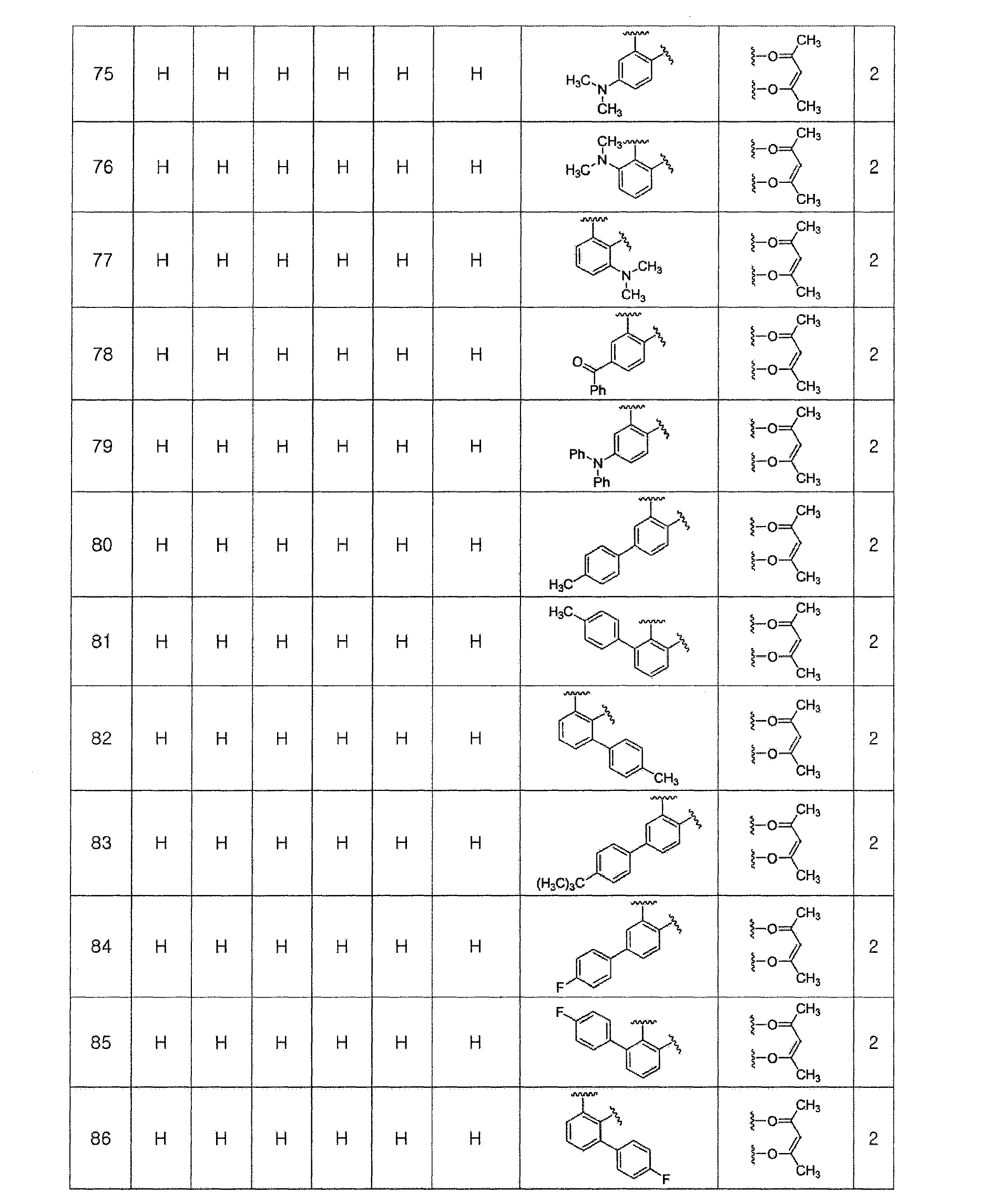


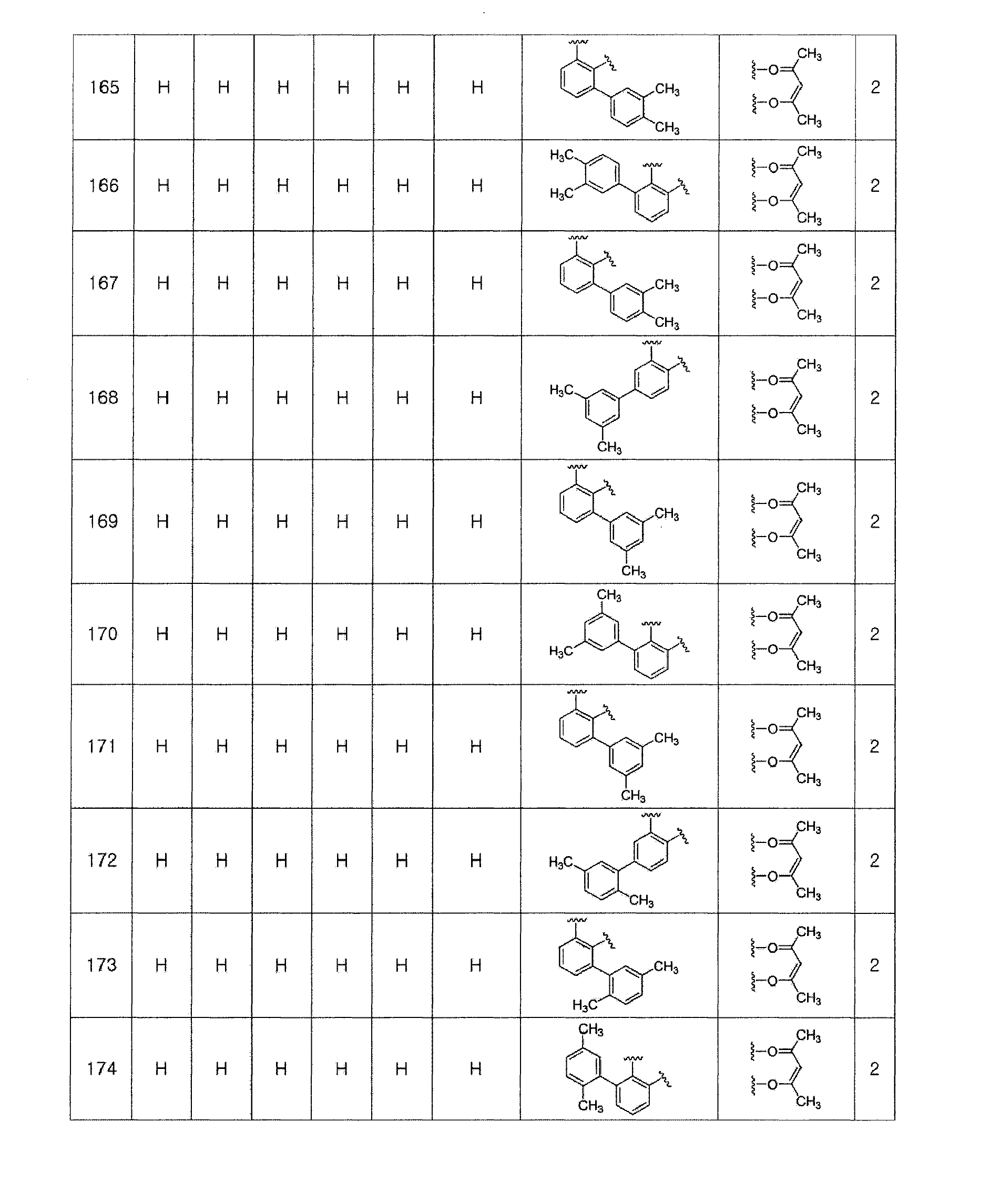


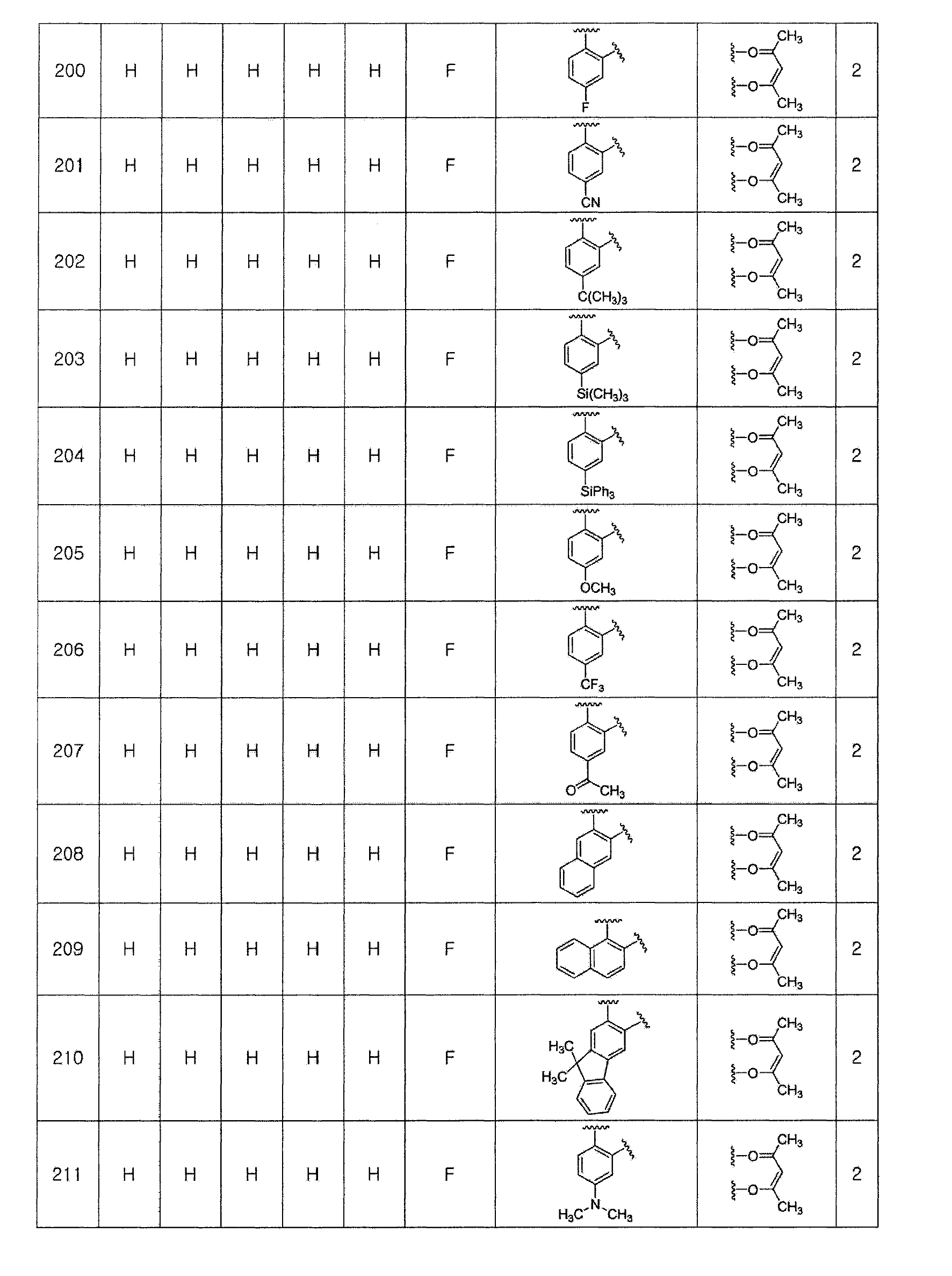


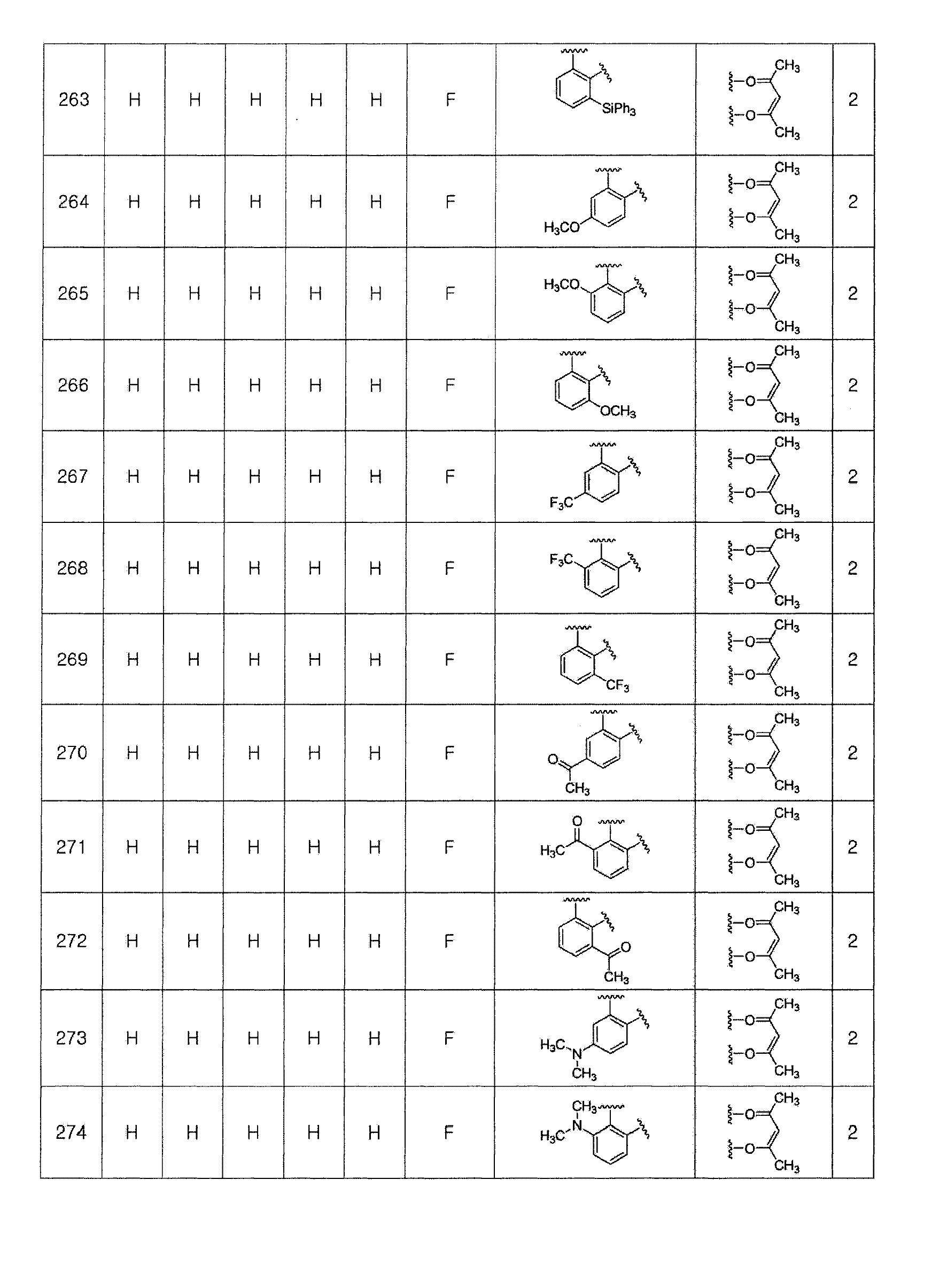


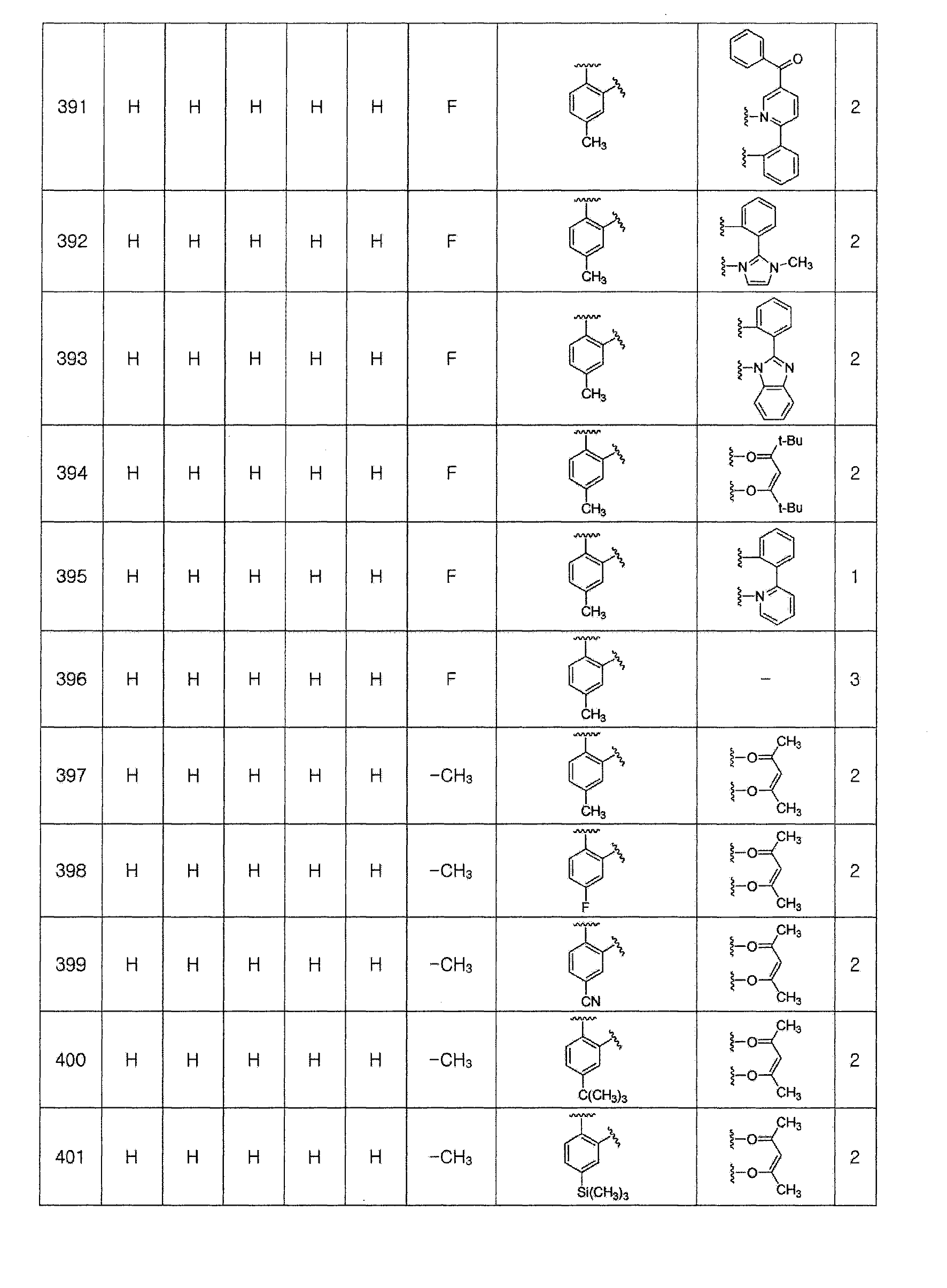


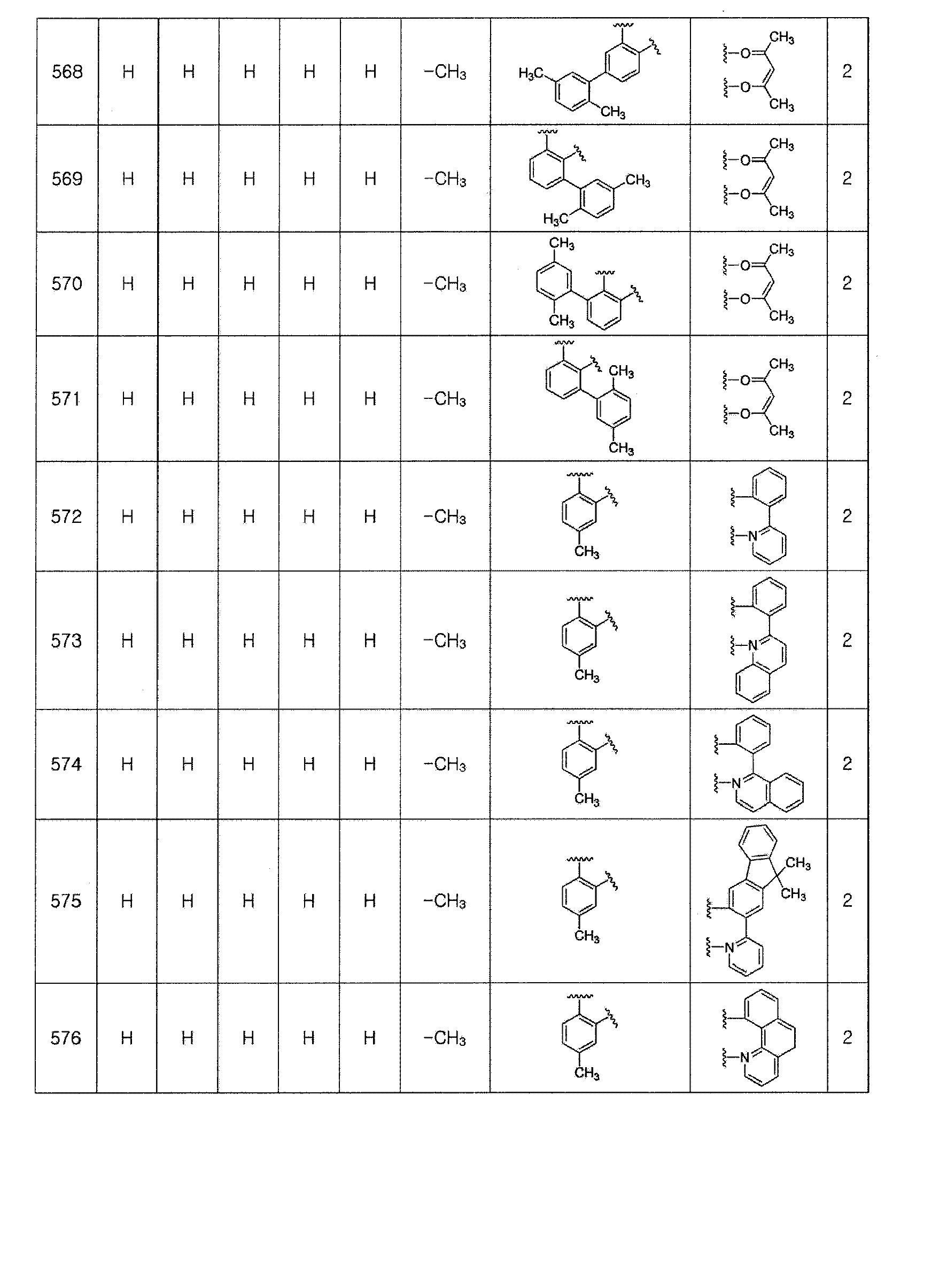


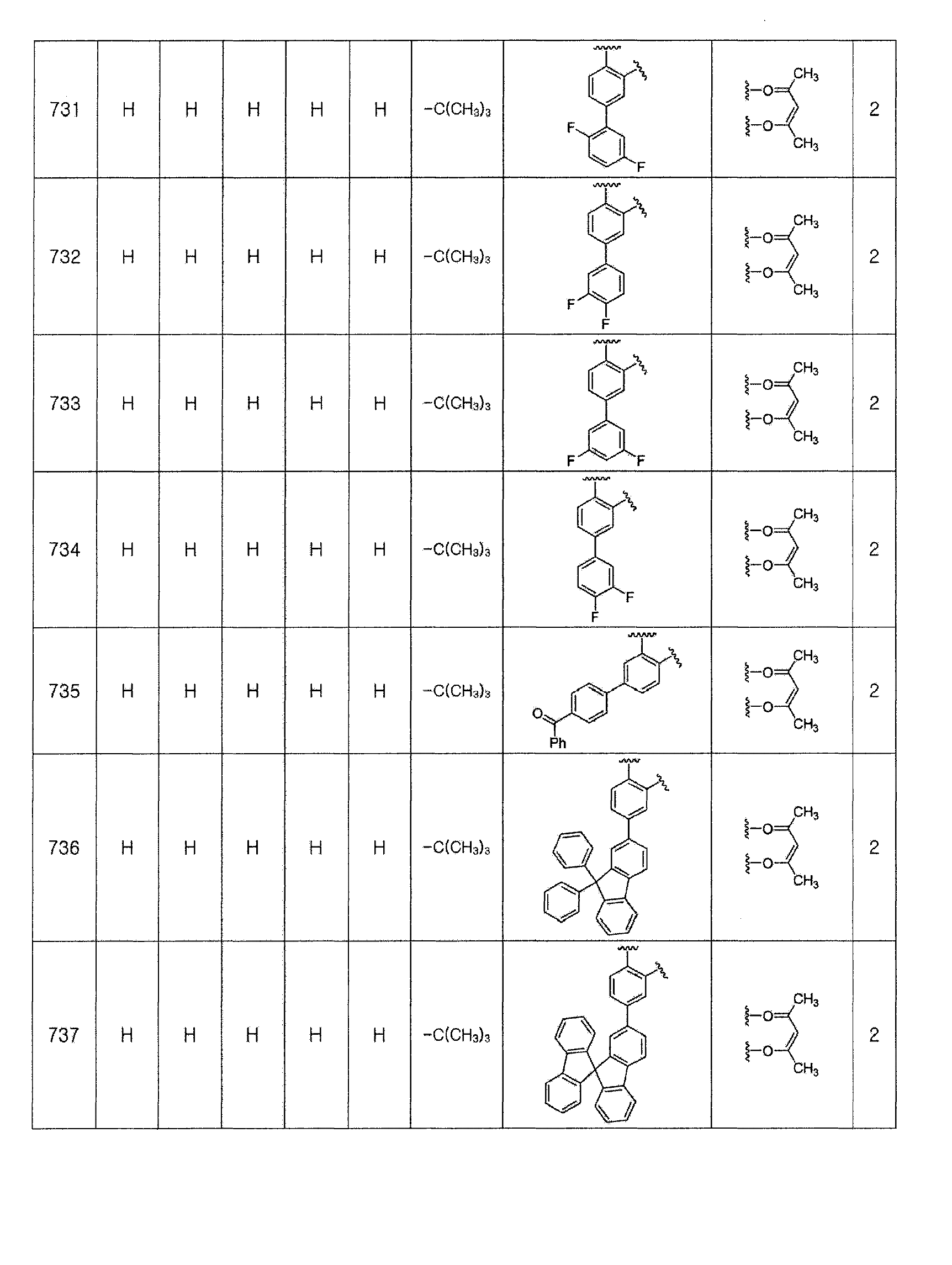


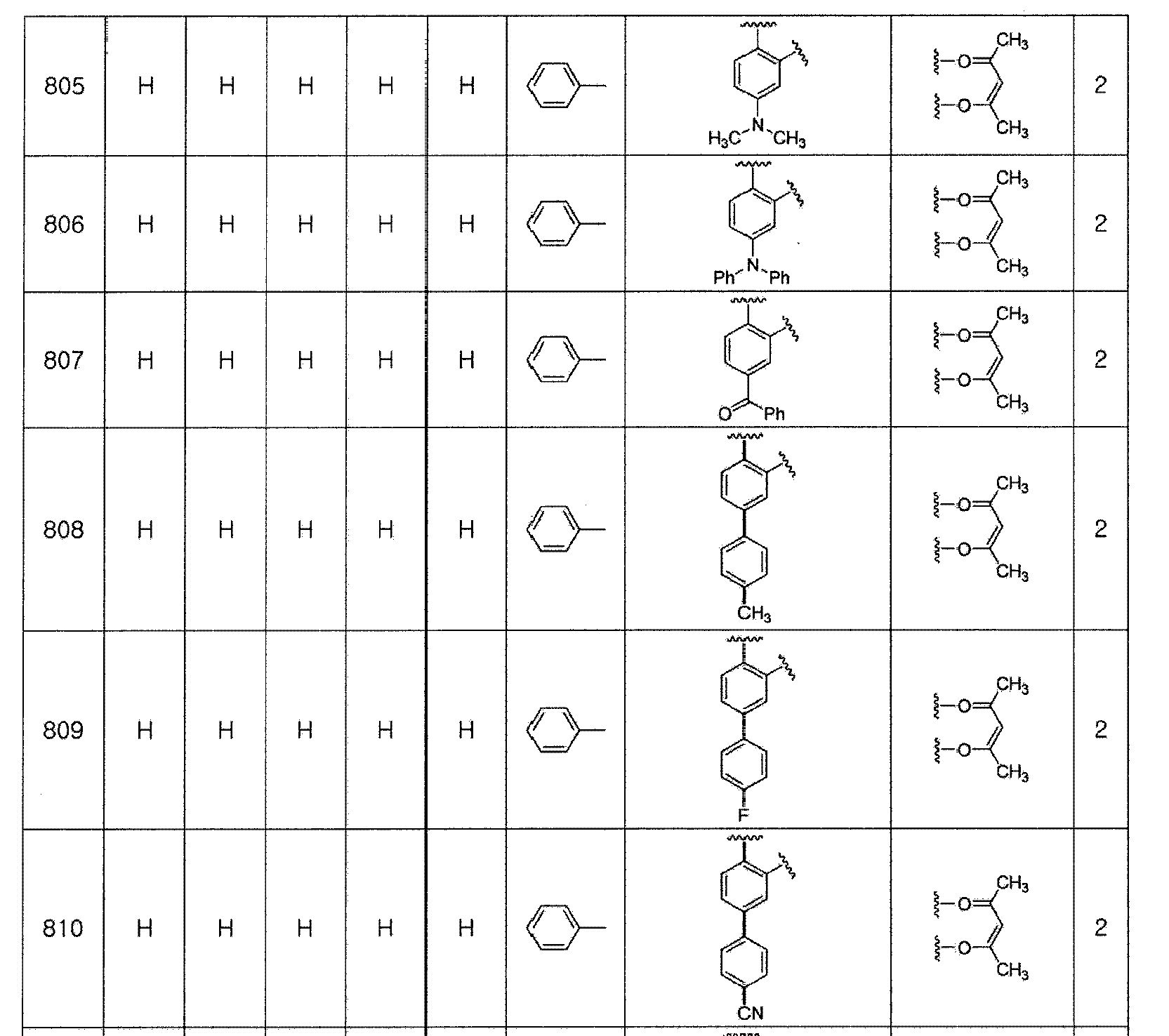


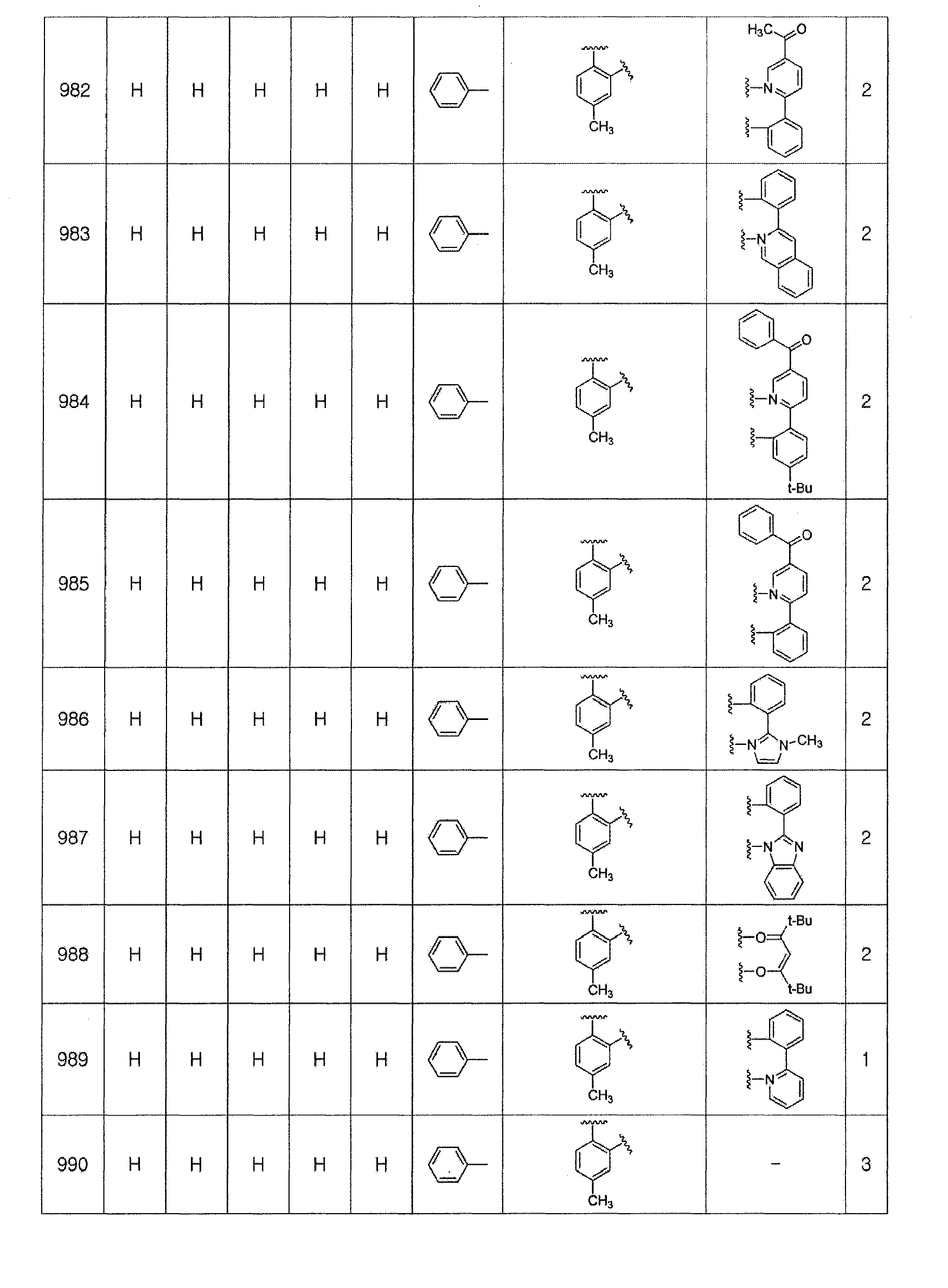

Table 2 Compound No. 1H NMR(CDCl3, 200 MHz) MS/FAB found calculated 83 δ = 8,2 (d, J=10.0 Hz, 2H), 8.1 (d, 2H), 7.7 (m, 2H), 7.6 (m, 4H), 7.5 (m, 2H), 7.4-7.48 (m, 12H), 7.32-7.35 (m, 8H). 7.2 (m, 2H). 5.7(s, 1H), 1.71 (s, 3H). 1.34 (m, 18H), 1.31(s, 3H) 1115 1116.42 84 δ = 8,2 (d, J=10.0 Hz, 2H), 8.1 (d, 2H), 7.7 (m, 2H), 7.6 (m, 4H), 7.4-7.5 (m, 14H), 7.32 (m, 4H). 7.22 (m, 2H). 7.03 (m, 4H), 5.7 (s, 1H), 1.71 (s, 3H). 1.31 (s, 3H) 1039 1040.28 104 δ = 8,2 (d, J=10.0 Hz, 2H), 8.1 (d, 2H), 7.7 (m, 2H), 7.6 (m, 4H), 7.5 (m, 2H), 7.4-7.48 (m, 12H), 7.32 (m, 8H). 7.22 (m, 4H). 5.7(s, 1H), 1.71 (s, 3H). 1.31 (s, 3H) 1003 1004.29 107 δ = 8,2 (d, J=10.0 Hz, 2H), 8.1 (d, 2H), 7.89 (d, 2H), 7.6-7.73 (m. 12H), 7.5-7.54 (m, 4H), 7.4-7.48 (m, 8H), 7.32 (m, 8H), 7.22 (m, 2H), 5.7(s, 1H), 1.71 (s, 3H). 1.31(s, 3H) 1103 1104.32 133 δ = 8,2 (d, J=10.0 Hz, 2H), 8.1 (d, 2H), 7.9 (d, 2H), 7.84 (d. 2H), 7.7-7.77 (m, 4H), 7.6 (m, 6H), 7.55 (m, 4H), 7.4-7.48 (m, 8H), 7.32-7.38 (m, 6H). 7.22-7.28 (m, 4H). 5.7(s, 1H), 1.71 (s, 3H). 1.67(m, 12H), 1.31(s, 3H) 1235 1236.42 302 δ = 8,2 (d, J=10.0 Hz, 2H), 8.1 (d, 2H), 7.7 (m, 2H), 7.6 (m, 4H), 7.4-7.5 (m, 14H), 7.32 (m, 4H). 7.22 (m, 2H). 7.03 (m, 4H), 5.7 (s, 1H), 1.71 (s, 3H). 1.31(s, 3H) 1039 1040.26 698 δ = 8,2 (d, J=10.0 Hz, 2H), 8.1 (d, 2H), 7.7 (m, 2H), 7.6 (m, 4H), 7.4-7.5 (m, 14H), 7.32-7.35 (m, 8H). 7.22 (m, 2H). 5.7 (s, 1H), 1.71 (s, 3H). 1.34 (m, 18H), 1.31(s, 3H) 1115 1116.42 896 δ = 8,2 (d, J=10.0 Hz, 2H), 8.1 (d, 2H), 7.7 (m, 2H), 7.6 (m, 4H), 7.4-7.54 (m, 22H), 7.32 (m, 8H). 7.22 (m, 4H). 5.7 (s, 1H), 1.71 (s, 3H), 1.31(s, 3H) 1155 1156.36 991 δ = 8,2 (d, J=10.0 Hz, 2H), 8.1 (d, 2H), 7.7 (m, 2H), 7.6 (m, 4H), 7.4-7.5 (m, 10H), 7.32 (m, 4H). 7.22 (m, 2H). 6.96 (m, 4H), 6.64 (m, 2H), 5.7 (s, 1H), 1.71 (s, 3H). 1.31(s, 3H) 1075 1076.26 992 δ = 8,2 (d, J=10.0 Hz, 2H), 8.1 (d, 2H), 7.7 (m, 2H), 7.6 (m, 4H), 7.4-7.5 (m, 12H), 7.32 (m, 4H). 7.22 (m, 2H). 6.74-6.80 (m, 4H), 5.7 (s, 1H), 1.71 (s, 3H). 1.31 (s, 3H) 1075 1076.26 - An OLED device was manufactured by using an organic electroluminescent compound according to the invention.
- First, a transparent electrode ITO thin film (15 Ω/□) (2) prepared from glass for OLED (produced by Samsung Corning) (1) was subjected to ultrasonic washing with trichloroethylene, acetone, ethanol and distilled water, sequentially, and stored in isopronanol before use.
- Then, an ITO substrate was equipped in a substrate folder of a vacuum vapor-deposit device, and 4,4',4"-tris(N,N-(2-naphthyl)-phenylamino)triphenylamine (2-TNATA) was placed in a cell of the vacuum vapor-deposit device, which was then ventilated up to 10-6 torr of vacuum in the chamber. Electric current was applied to the cell to evaporate 2-TNATA, thereby providing vapor-deposit of a hole injection layer (3) having 60 nm of thickness on the ITO substrate.

- Then, to another cell of the vacuum vapor-deposit device, charged was N,N'-bis(α-naphthyl)-N,N'-diphenyl-4,4'-diamine (NPB), and electric current was applied to the cell to evaporate NPB, thereby providing vapor-deposit of a hole transport layer (4) of 20 nm of thickness on the hole injection layer.

- In another cell of said vacuum vapor-deposit device, charged was 4,4'-N,N'-dicarbazole-biphenyl (CBP) as an electroluminescent host material, and an organic electroluminescent compound (Compound 1) according to the present invention was charged to still another cell. The two materials were evaporated at different rates to carry out doping to vapor-deposit an electroluminescent layer (5) having 30 nm of thickness on the hole transport layer. The suitable doping concentration is 4 to 10 mol% on the basis of CBP.

- Then, on the electroluminescent layer, bis(2-methyl-8-quinolinato)(p-phenylphenolato)aluminum (III) (BAlq) was vapor-deposited as a hole blocking layer in a thickness of 10 nm in the same manner for NPB, tris(8-hydroxyquinoline)aluminum (III) (Alq) was vapor-deposited as an electron transport layer (6) in a thickness of 20 nm, and then lithium quinolate (Liq) was vapor-deposited as an electron injection layer (7) in a thickness of 1 to 2 nm. Thereafter, an Al cathode (8) was vapor-deposited in a thickness of 150 nm by using another vacuum vapor-deposit device to manufacture an OLED.

- An hole injection layer and a hole transport layer were formed according to the procedure of Example 1, and an electroluminescent layer was vapor-deposited as follows. In another cell of said vacuum vapor-deposit device, charged was H-40 as an electroluminescent host material, and an organic electroluminescent compound (Compound 780) according to the present invention was charged to still another cell. The two materials were evaporated at different rates to carry out doping to vapor-deposit an electroluminescent layer (5) having 30 nm of thickness on the hole transport layer. The suitable doping concentration is 4 to 10 mol% on the basis of the host. Then, a hole blocking layer, an electron transport layer and an electron injection layer were vapor-deposited according to the same procedure as in Example 1, and then Al cathode (8) was vapor-deposited in a thickness of 150 nm by using another vacuum vapor-deposit device to manufacture an OLED.
- A hole injection layer, a hole transport layer and an electroluminescent layer were formed according to the same procedure as in Example 2, and then an electron transport layer and an electron injection layer were vapor-deposited. Thereafter, Al cathode was vapor-deposited in a thickness of 150 nm by using another vacuum vapor-deposit device to manufacture an OLED.
- In order to confirm the performance of the OLED's prepared according to Example 1 through Example 3, the luminous efficiency of the OLED's was measured at 10 mA/cm2. Various properties are shown in Tables 3.
Table 3 Material Host Hole blocking layer EL color Operation voltage Max. luminous efficiency (cd/A) Ex. 1 Compund 1CBP BAlq Red 7.9 11.3 Compound 10 CBP BAlq Red 7.9 9.1 Compound 44 CBP BAlq Red 7.8 11.9 Compound 49 CBP BAlq Red 8.1 12.2 Compound 177 CBP BAlq Red 8.3 11.7 Compound 199 CBP BAlq Red 7.9 10.2 Compound 241 CBP BAlq Red 8.0 10.5 Compound 303 CBP BAlq Red 8.0 9.8 Compound 340 CBP BAlq Red 8.1 10.9 Compound 374 CBP BAlq Red 8.2 11.3 Compound 375 CBP BAlq Red 7.9 10.5 Compound 379 CBP BAlq Red 8.0 10.1 Compound 432 CBP BAlq Red 7.9 10.9 Compound 574 CBP BAlq Red 7.8 9.9 Compound 578 CBP BAlq Red 8.0 11.0 Compound 584 CBP BAlq Red 8.1 12.0 Compound 589 CBP BAlq Red 8.2 12.5 Compound 640 CBP BAlq Red 8.5 10.6 Compound 645 CBP BAlq Red 8.1 10.3 Compound 780 CBP BAlq Red 7.9 11.1 Compound 782 CBP BAlq Red 8.0 11.2 Compound 790 CBP BAlq Red 8.0 10.5 Compound 903 CBP BAlq Red 8.2 10.1 Ex. 2 Compound 10 H-4 BAlq Red 7.9 9.5 Compound 199 H-2 BAlq Red 7.9 10.3 Compound 375 H-7 BAlq Red 7.9 10.9 Compound 780 H-40 BAlq Red 7.8 11.1 Ex. 3 Compound 49 H-8 - Red 7.2 12.0 Compound 303 H-12 - Red 7.0 9.9 Compound 780 H-40 - Red 7.1 11.0 Compound 790 H-64 - Red 6.9 11.0 - Compound (49), to which F was applied to the ligand, affected the HOMO level, and thus showed enhanced luminous efficiency, even though the color cooridinate was lowered as compared to the same before applying F. For Compounds (177), (584) and (589), 2-phenylquinoline, 2-styrylquinoline and phenyl(6-phenylpyridin-3-yl)methanone were incorporated, respectively, as a subsidiary ligand. They showed most excellent luminous efficiencies (11.7 cd/A, 12.0 cd/A and 12.5 cd/A, respectively) among the compounds according to the present invention. The compound to which ppy or 1-styrylquinoline was incorporated as a subsidiary ligand showed high luminous efficiency of 11 cd/A or more. Thus, the subsidiary ligands such as 2-phenylquinoline, 2-styrylquinoline, phenyl(6-phenylpyridin-3-yl)methanone, ppy and 1-styrylquinoline had a significant role to enhance the luminous efficiency of the compound.
- With identical device structure, using the host according to the present invention instead of CBP did not provide significant change in efficiency, color coordinate and operation voltage. Thus it is anticipated that those hosts can be employed as a phosphorescent host, when being used with dopants according to the invention, instead of CBP as a conventional electroluminescent host. When the host according to the invention is employed without using a hole blocking layer, the device exhibits comparable or higher luminous efficiency as compared to that using conventional host, and provides decreased power consumption of the OLED due to lowered operation voltage by about 0.8 V ∼ 1.2 V. If the invention is applied to mass production of OLEDs, the time for mass production can be also reduced to give great benefit on its commercialization.
Claims (9)
- An organic electroluminescent compound represented by Chemical Formula (1):

R1 through R5 independently represent hydrogen, (C1-C20)alkyl, (C1-C20) alkoxy, (C3-C12) cycloalkyl, halogen, tri (C1-C20)alkylsilyl or tri(C6-C20)arylsilyl;
R6 represents hydrogen, (C1-C20)alkyl, halogen or (C6-C20)aryl;
R11 through R14 independently represent hydrogen, (C1-C20)alkyl, halogen, cyano, tri (C1-C20) alkylsilyl, tri(C6-C20)arylsilyl, (C1-C20)alkoxy, (C1-C20) alkylcarbonyl, (C6-C20)arylcarbonyl, di (C1-C20)alkylamino, di (C6-C20) arylamino, phenyl, naphthyl, anthryl, fluorenyl, spirobifluorenyl or
the alkyl, phenyl, naphthyl, anthryl, fluorenyl of R11 through R14, and the alicyclic ring, or the monocyclic or polycyclic aromatic ring formed therefrom by linkage via (C3-C12)alkylene or (C3-C12)alkenylene with or without a fused ring may be further substituted by one or more substituent(s) selected from (C1-C20)alkyl with or without halogen substituent(s), (C1-C20)alkoxy, halogen, tri(C1-C20)alkylsilyl, tri (C6-C20)arylsilyl, (C1-C20)alkylcarbonyl, (C6-C20)arylcarbonyl, di (C1-C20)alkylamino, di (C6-C20)arylamino and (C6-C20)aryl;
provided that R11 through R14 cannot be hydrogen all at the same time; and
n is an integer from 1 to 3. - The organic electroluminescent compound according to claim 1, which is selected from the compound represented by one of Chemical Formulas (2) to (5):


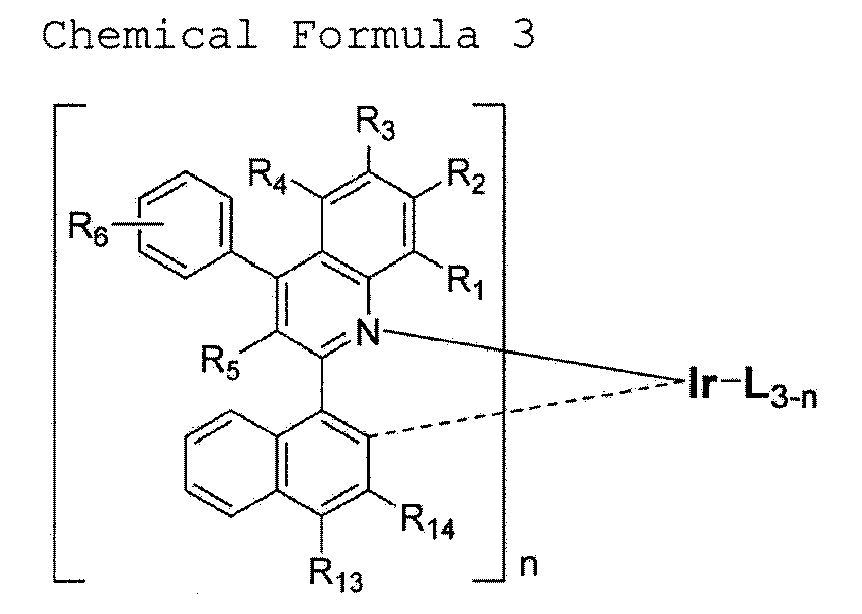


R21 and R22 independently represent hydrogen, (C1-C20)alkyl, (C6-C20)aryl, or R21 and R22 may be linked each other via (C3-C12)alkylene or (C3-C12)alkenylene with or without a fused ring to form an alicyclic ring, or a monocyclic or polycyclic aromatic ring;
R23 represents (C1-C20) alkyl, halogen, cyano, tri(C1-C20)alkylsilyl, tri (C6-C20)arylsilyl, (C1-C20)alkoxy, (C1-C20)alkylcarbonyl, (C6-C20)arylcarbonyl, phenyl, di (C1-C20)alkylamino, di(C6-C20)arylamino, naphthyl, 9,9-di(C1-C20)alkylfluorenyl or 9,9-di(C6-C20)arylfluorenyl; and
m is an integer from 1 to 5. - The organic electroluminescent compound according to claim 1, wherein the ligand (L) has a structure represented by one of the following chemical formulas:


R33 through R38 independently represent hydrogen, (C1-C20)alkyl, phenyl with or without (C1-C20)alkyl substituent(s), tri(C1-C20)alkylsilyl or halogen;
R39 through R42 independently represent hydrogen, (C1-C20)alkyl or, phenyl with or without (C1-C20)alkyl substituent(s); and
R43 represents (C1-C20)alkyl, phenyl with or without (C1-C20)alkyl, or halogen. - An organic electroluminescent device comprising
a first electrode;
a second electrode;
at least one organic layer(s) interposed between the first electrode and the second electrode;
wherein the organic layer comprises an electroluminescent region, which comprises one or more compound(s) An organic electroluminescent compound represented by Chemical Formula (1) :
R1 through R5 independently represent hydrogen, (C1-C20)alkyl, (C1-C20)alkoxy, (C3-C12) cycloalkyl, halogen, tri(C1-C20)alkylsilyl or tri(C6-C20)arylsilyl;
R6 represents hydrogen, (C1-C20)alkyl, halogen or (C6-C20)aryl;
R11 through R14 independently represent hydrogen, (C1-C20)alkyl, halogen, cyano, tri(C1-C20)alkylsilyl, tri(C6-C20)arylsilyl, (C1-C20)alkoxy, (C1-C20)alkylcarbonyl, (C6-C20)arylcarbonyl, di (C1-C20)alkylamino, di (C6-C20)arylamino, phenyl, naphthyl, anthryl, fluorenyl, spirobifluorenyl or
the alkyl, phenyl, naphthyl, anthryl, fluorenyl of R11 through R14, and the alicyclic ring, or the monocyclic or polycyclic aromatic ring formed therefrom by linkage via (C3-C12)alkylene or (C3-C12)alkenylene with or without a fused ring may be further substituted by one or more substituent(s) selected from (C1-C20)alkyl with or without halogen substituent (s), (C1-C20)alkoxy, halogen, tri(C1-C20)alkylsilyl, tri (C6-C20)arylsilyl, (C1-C20)alkylcarbonyl, (C6-C20)arylcarbonyl, di (C1-C20)alkylamino, di (C6-C20)arylamino and (C6-C20)aryl;
provided that R11 through R14 cannot be hydrogen all at the same time; and
n is an integer from 1 to 3; and one or more host(s) selected from 1,3,5-tricarbazolylbenzene, polyvinylcarbazole, m-biscarbazolylphenyl, 4,4',4"-tri(N-carbazolyl)triphenylamine, 1,3,5-tri(2-carbazolylphenyl)benzene, 1,3,5-tris(2-carbazolyl-5-methoxyphenyl)benzene, bis(4-carbazolylphenyl)silane and compounds represented by one of Chemical Formulas (6) to (9).
the alkyl, alkenyl, alkynyl, cycloalkyl, heterocycloalkyl, aryl, heteroaryl, arylsilyl, alkylsilyl, alkylamino, or arylamino of R91 through R94, or the alicyclic ring, or the monocyclic or polycyclic aromatic ring formed therefrom by linkage to an adjacent substituent via (C3-C60)alkylene or (C3-C60)alkenylene with or without a fused ring may be further substituted by one or more substituent(s) selected from halogen, (C1-C60)alkyl, (C6-C60)aryl, (C4-C60)heteroaryl, a 5- or 6-membered heterocycloalkyl containing one or more heteroatom(s) selected from N, O and S, (C3-C60)cycloalkyl, tri(C1-C60)alkylsilyl, di(C1-C60)alkyl(C6-C60)arylsilyl, tri(C6-C60)arylsilyl, adamantyl, (C7-C60)bicycloalkyl, (C2-C60)alkenyl, (C2-C60)alkynyl, cyano, (C1-C60)alkylamino, (C6-C60)arylamino, (C6-C60)ar(C1-C60)alkyl, (C1-C60)alkyloxy, (C1-C60)alkylthio, (C6-C60)aryloxy, (C6-C60)arylthio, (C1-C60)alkoxycarbonyl, (C1-C60)alkylcarbonyl, (C6-C60)arylcarbonyl, carboxyl, nitro and hydroxyl.

wherein, the ligands, L1 and L2 independently represent one of the following structures:
y is 0 when M is a bivalent metal, while y is 1 when M is a trivalent metal;
Q represents (C6-C60)aryloxy or tri(C6-C60)arylsilyl, and the aryloxy and triarylsilyl of Q may be further substituted by (C1-C60)alkyl or (C6-C60)aryl;
X represents O, S or Se;
ring A represents oxazole, thiazole, imidazole, oxadiazole, thiadiazole, benzoxazole, benzothiazole, benzimidazole, pyridine or quinoline;
ring B represents pyridine or quinoline, and ring B may be further substituted by (C1-C60)alkyl, phenyl or naphthyl with or without (C1-C60)alkyl substituent(s);
R101 through R104 independently represent hydrogen, halogen, (C1-C60)alkyl, (C6-C60)aryl, (C4-C60)heteroaryl, a 5- or 6-membered heterocycloalkyl containing one or more heteroatom(s) selected from N, O and S, (C3-C60)cycloalkyl, tri(C1-C60)alkylsilyl, di(C1-C60)alkyl(C6-C60)arylsilyl, tri(C6-C60)arylsilyl, adamantyl, (C7-C60)bicycloalkyl, (C2-C60)alkenyl, (C2-C60)alkynyl, cyano, (C1-C60)alkylamino, (C6-C60)arylamino, (C6-C60)ar(C1-C60)alkyl, (C1-C60)alkyloxy, (C1-C60)alkylthio, (C6-C60)aryloxy, (C6-C60)arylthio, (C1-C60)alkoxycarbonyl, (C1-C60)alkylcarbonyl, (C6-C60)arylcarbonyl, carboxyl, nitro or hydroxyl, or each of R101 through R104 may be linked to an adjacent substituent via (C3-C60)alkylene or (C3-C60)alkenylene with or without a fused ring to form an alicyclic ring, or a monocyclic or polycyclic aromatic ring;
the alkyl, alkenyl, alkynyl, cycloalkyl, heterocycloalkyl, aryl, heteroaryl, arylsilyl, alkylsilyl, alkylamino, or arylamino of ring A and R101 through R104, or the alicyclic ring, or the monocyclic or polycyclic aromatic ring formed therefrom by linkage to an adjacent substituent via (C3-C60)alkylene or (C3-C60)alkenylene with or without a fused ring may be further substituted by one or more substituent(s) selected from halogen, (C1-C60)alkyl, (C6-C60)aryl, (C4-C60)heteroaryl, a 5- or 6-membered heterocycloalkyl containing one or more heteroatom(s) selected from N, O and S, (C3-C60)cycloalkyl, tri(C1-C60)alkylsilyl, di(C1-C60)alkyl(C6-C60)arylsilyl, tri(C6-C60)arylsilyl, adamantyl, (C7-C60)bicycloalkyl, (C2-C60)alkenyl, (C2-C60)alkynyl, cyano, (C1-C60)alkylamino, (C6-C60)arylamino, (C6-C60)ar(C1-C60)alkyl, (C1-C60)alkyloxy, (C1-C60)alkylthio, (C6-C60)aryloxy, (C6-C60)arylthio, (C1-C60)alkoxycarbonyl, (C1-C60)alkylcarbonyl, (C6-C60)arylcarbonyl, carboxyl, nitro and hydroxyl. - The organic electroluminescent device according to claim 4, wherein the organic layer comprises one or more compound(s) selected from a group consisting of arylamine compounds and styrylarylamine compounds, or one or more metal(s) selected from a group consisting of organic metals of Group 1, Group 2, 4th period and 5th period transition metals, lanthanide metals and d-transition elements.
- The organic electroluminescent device according to claim 4, further comprising compounds having the electroluminescent peak with wavelength of blue and green at the same time.
- The organic electroluminescent device according to claim 4, wherein the organic layer comprises an electroluminescent layer and a charge generating layer.
- The organic electroluminescent device according to claim 4, wherein a mixed region of reductive dopant and organic substance, or a mixed region of oxidative dopant and organic substance is placed on the inner surface of one or both electrode(s) among the pair of electrodes.
- An organic solar cell which comprises an organic electroluminescent compound An organic electroluminescent compound represented by Chemical Formula (1):
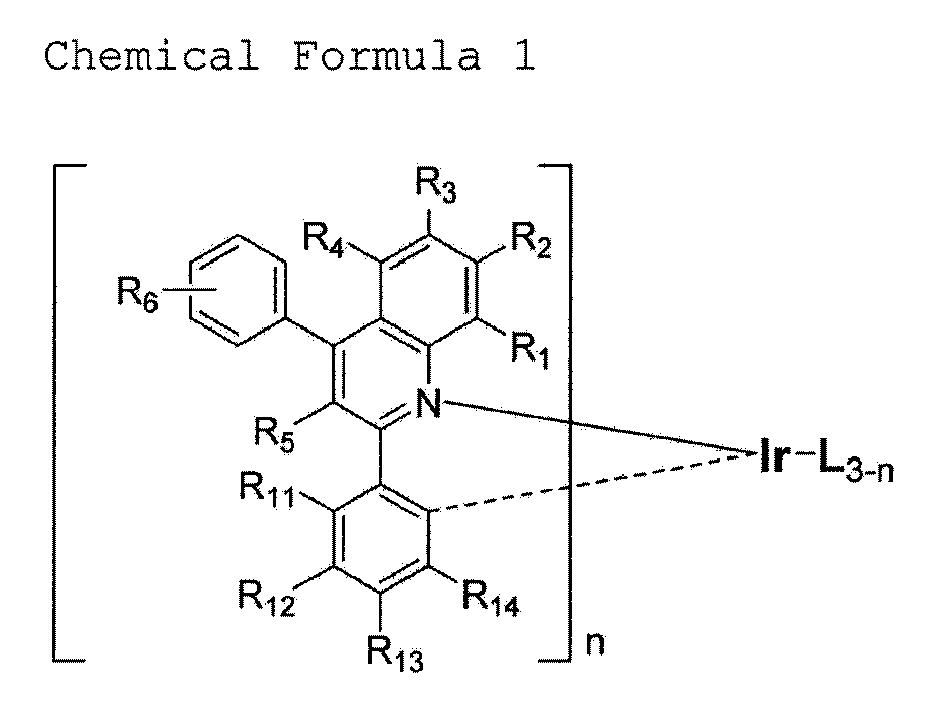
R1 through R5 independently represent hydrogen, (C1-C20)alkyl, (C1-C20)alkoxy, (C3-C12)cycloalkyl, halogen, tri(C1-C20)alkylsilyl or tri(C6-C20)arylsilyl;
R6 represents hydrogen, (C1-C20)alkyl, halogen or (C6-C20)aryl;
R11 through R14 independently represent hydrogen, (C1-C20)alkyl, halogen, cyano, tri (C1-C20)alkylsilyl, tri (C6-C20)arylsilyl, (C1-C20)alkoxy, (C1-C20)alkylcarbonyl, (C6-C20)arylcarbonyl, di(C1-C20)alkylamino, di(C6-C20)arylamino, phenyl, naphthyl, anthryl, fluorenyl, spirobifluorenyl or
the alkyl, phenyl, naphthyl, anthryl, fluorenyl of R11 through R14, and the alicyclic ring, or the monocyclic or polycyclic aromatic ring formed therefrom by linkage via (C3-C12)alkylene or (C3-C12)alkenylene with or without a fused ring may be further substituted by one or more substituent(s) selected from (C1-C20)alkyl with or without halogen substituent(s), (C1-C20)alkoxy, halogen, tri(C1-C20)alkylsilyl, tri (C6-C20)arylsilyl, (C1-C20)alkylcarbonyl, (C6-C20)arylcarbonyl, di (C1-C20)alkylamino, di (C6-C20)arylamino and (C6-C20)aryl;
provided that R11 through R14 cannot be hydrogen all at the same time; and
n is an integer from 1 to 3.
Applications Claiming Priority (1)
| Application Number | Priority Date | Filing Date | Title |
|---|---|---|---|
| KR1020070111327A KR100923655B1 (en) | 2007-11-02 | 2007-11-02 | Novel red phosphorescent compound and organic light emitting device employing it as light emitting material |
Publications (2)
| Publication Number | Publication Date |
|---|---|
| EP2055709A2 true EP2055709A2 (en) | 2009-05-06 |
| EP2055709A3 EP2055709A3 (en) | 2009-05-27 |
Family
ID=40263192
Family Applications (1)
| Application Number | Title | Priority Date | Filing Date |
|---|---|---|---|
| EP08168095A Withdrawn EP2055709A3 (en) | 2007-11-02 | 2008-10-31 | Novel red electroluminescent compounds and organic electroluminescent device using the same |
Country Status (6)
| Country | Link |
|---|---|
| US (1) | US20090174316A1 (en) |
| EP (1) | EP2055709A3 (en) |
| JP (1) | JP2009149607A (en) |
| KR (1) | KR100923655B1 (en) |
| CN (1) | CN101514214A (en) |
| TW (1) | TW200934854A (en) |
Cited By (8)
| Publication number | Priority date | Publication date | Assignee | Title |
|---|---|---|---|---|
| EP3081571A4 (en) * | 2013-12-12 | 2016-11-30 | Mitsubishi Chem Corp | IRIDIUM COMPLEX COMPOUND, PROCESS FOR PRODUCING THE COMPOUND, COMPOSITION CONTAINING THE COMPOUND, ORGANIC ELECTROLUMINESCENT ELEMENT, DISPLAY DEVICE, AND LIGHTING DEVICE |
| CN107635966A (en) * | 2015-12-23 | 2018-01-26 | 株式会社Lg化学 | Compounds and organic electronic devices containing them |
| US9929357B2 (en) | 2014-07-22 | 2018-03-27 | Universal Display Corporation | Organic electroluminescent materials and devices |
| US11581487B2 (en) | 2017-04-26 | 2023-02-14 | Oti Lumionics Inc. | Patterned conductive coating for surface of an opto-electronic device |
| US11730012B2 (en) | 2019-03-07 | 2023-08-15 | Oti Lumionics Inc. | Materials for forming a nucleation-inhibiting coating and devices incorporating same |
| US11751415B2 (en) | 2018-02-02 | 2023-09-05 | Oti Lumionics Inc. | Materials for forming a nucleation-inhibiting coating and devices incorporating same |
| US12069938B2 (en) | 2019-05-08 | 2024-08-20 | Oti Lumionics Inc. | Materials for forming a nucleation-inhibiting coating and devices incorporating same |
| US12101987B2 (en) | 2019-04-18 | 2024-09-24 | Oti Lumionics Inc. | Materials for forming a nucleation-inhibiting coating and devices incorporating same |
Families Citing this family (4)
| Publication number | Priority date | Publication date | Assignee | Title |
|---|---|---|---|---|
| KR100933225B1 (en) * | 2007-11-27 | 2009-12-22 | 다우어드밴스드디스플레이머티리얼 유한회사 | Novel Phosphorescent Compound and Organic Light Emitting Device Employing It as Light Emitting Material |
| KR101597865B1 (en) * | 2011-08-24 | 2016-02-26 | 주식회사 엘지화학 | New compounds and organic electronic device using the same |
| CN103113413B (en) * | 2013-02-07 | 2016-03-02 | 合肥京东方光电科技有限公司 | Dicyclo complex of iridium and preparation method, organic electroluminescence device and preparation method |
| WO2015129994A1 (en) * | 2014-02-25 | 2015-09-03 | 부산대학교 산학협력단 | Novel red light-emitting iridium (iii) complex compound capable of being solution-processed and organic electroluminescent device comprising same |
Family Cites Families (26)
| Publication number | Priority date | Publication date | Assignee | Title |
|---|---|---|---|---|
| US4769292A (en) * | 1987-03-02 | 1988-09-06 | Eastman Kodak Company | Electroluminescent device with modified thin film luminescent zone |
| JP3490727B2 (en) * | 1991-11-28 | 2004-01-26 | 三洋電機株式会社 | Electroluminescent device |
| JPH07133483A (en) * | 1993-11-09 | 1995-05-23 | Shinko Electric Ind Co Ltd | Organic light emitting material for EL device and EL device |
| EP0723701B1 (en) * | 1994-08-11 | 2000-01-12 | Koninklijke Philips Electronics N.V. | Solid-state image intensifier and x-ray examination apparatus comprising a solid-state image intensifier |
| DE69526614T2 (en) * | 1994-09-12 | 2002-09-19 | Motorola, Inc. | Light emitting devices containing organometallic complexes. |
| US5779937A (en) * | 1995-05-16 | 1998-07-14 | Sanyo Electric Co., Ltd. | Organic electroluminescent device |
| JPH1072581A (en) | 1995-09-25 | 1998-03-17 | Toyo Ink Mfg Co Ltd | Light emitting material for organic electroluminescent device and organic electroluminescent device using the same |
| JPH09279134A (en) * | 1996-04-11 | 1997-10-28 | Shinko Electric Ind Co Ltd | Organic EL element |
| US6048630A (en) * | 1996-07-02 | 2000-04-11 | The Trustees Of Princeton University | Red-emitting organic light emitting devices (OLED's) |
| US6303238B1 (en) * | 1997-12-01 | 2001-10-16 | The Trustees Of Princeton University | OLEDs doped with phosphorescent compounds |
| US6097147A (en) * | 1998-09-14 | 2000-08-01 | The Trustees Of Princeton University | Structure for high efficiency electroluminescent device |
| JP3929689B2 (en) * | 2000-03-28 | 2007-06-13 | 富士フイルム株式会社 | Highly efficient red light emitting device, light emitting device material comprising iridium complex and novel iridium complex |
| US6821645B2 (en) | 1999-12-27 | 2004-11-23 | Fuji Photo Film Co., Ltd. | Light-emitting material comprising orthometalated iridium complex, light-emitting device, high efficiency red light-emitting device, and novel iridium complex |
| JP4048521B2 (en) * | 2000-05-02 | 2008-02-20 | 富士フイルム株式会社 | Light emitting element |
| US6645645B1 (en) * | 2000-05-30 | 2003-11-11 | The Trustees Of Princeton University | Phosphorescent organic light emitting devices |
| US6835469B2 (en) * | 2001-10-17 | 2004-12-28 | The University Of Southern California | Phosphorescent compounds and devices comprising the same |
| JP3933591B2 (en) * | 2002-03-26 | 2007-06-20 | 淳二 城戸 | Organic electroluminescent device |
| KR100509603B1 (en) * | 2002-12-28 | 2005-08-22 | 삼성에스디아이 주식회사 | Red emitting compound and organic electroluminescence device |
| US6998492B2 (en) * | 2003-05-16 | 2006-02-14 | Semiconductor Energy Laboratory Co., Ltd. | Organometallic complex and light-emitting element containing the same |
| WO2005003095A1 (en) * | 2003-07-02 | 2005-01-13 | Idemitsu Kosan Co., Ltd. | Metal complex compound and organic electroluminescence device containing the same |
| TWI245068B (en) * | 2003-11-18 | 2005-12-11 | Chi Mei Optoelectronics Corp | Iridium complex as light emitting material and organic light emitting diode device |
| TWI237524B (en) * | 2004-05-17 | 2005-08-01 | Au Optronics Corp | Organometallic compound and organic electroluminescent device including the same |
| JP4478555B2 (en) * | 2004-11-30 | 2010-06-09 | キヤノン株式会社 | Metal complex, light emitting element and image display device |
| CN1321125C (en) * | 2005-04-30 | 2007-06-13 | 中国科学院长春应用化学研究所 | Complexes of red light iridium by using nitrogen heterocycles in quinoline as ligand, and application |
| US20070092759A1 (en) * | 2005-10-26 | 2007-04-26 | Begley William J | Organic element for low voltage electroluminescent devices |
| KR100788262B1 (en) * | 2006-02-27 | 2007-12-27 | (주)그라쎌 | Red light emitting compound and light emitting device employing the same as light emitting material |
-
2007
- 2007-11-02 KR KR1020070111327A patent/KR100923655B1/en not_active Expired - Fee Related
-
2008
- 2008-10-30 TW TW097141731A patent/TW200934854A/en unknown
- 2008-10-30 JP JP2008279779A patent/JP2009149607A/en active Pending
- 2008-10-31 CN CNA2008101895691A patent/CN101514214A/en active Pending
- 2008-10-31 EP EP08168095A patent/EP2055709A3/en not_active Withdrawn
- 2008-11-03 US US12/290,760 patent/US20090174316A1/en not_active Abandoned
Non-Patent Citations (1)
| Title |
|---|
| A. TSUBOYAMA ET AL., J. AM. CHEM. SOC., vol. 125, no. 42, 2003, pages 12971 - 12979 |
Cited By (14)
| Publication number | Priority date | Publication date | Assignee | Title |
|---|---|---|---|---|
| EP3081571A4 (en) * | 2013-12-12 | 2016-11-30 | Mitsubishi Chem Corp | IRIDIUM COMPLEX COMPOUND, PROCESS FOR PRODUCING THE COMPOUND, COMPOSITION CONTAINING THE COMPOUND, ORGANIC ELECTROLUMINESCENT ELEMENT, DISPLAY DEVICE, AND LIGHTING DEVICE |
| US10600974B2 (en) | 2013-12-12 | 2020-03-24 | Mitsubishi Chemical Corporation | Iridium complex compound, process for producing the compound, composition including the compound, organic electroluminescent element, display device, and illuminator |
| US9929357B2 (en) | 2014-07-22 | 2018-03-27 | Universal Display Corporation | Organic electroluminescent materials and devices |
| CN107635966A (en) * | 2015-12-23 | 2018-01-26 | 株式会社Lg化学 | Compounds and organic electronic devices containing them |
| EP3395799A4 (en) * | 2015-12-23 | 2019-06-26 | LG Chem, Ltd. | COMPOUND AND ORGANIC ELECTRONIC DEVICE COMPRISING SAME |
| US10934268B2 (en) | 2015-12-23 | 2021-03-02 | Lg Chem, Ltd. | Compound and organic electronic device comprising same |
| US11581487B2 (en) | 2017-04-26 | 2023-02-14 | Oti Lumionics Inc. | Patterned conductive coating for surface of an opto-electronic device |
| US12069939B2 (en) | 2017-04-26 | 2024-08-20 | Oti Lumionics Inc. | Method for patterning a coating on a surface and device including a patterned coating |
| US11751415B2 (en) | 2018-02-02 | 2023-09-05 | Oti Lumionics Inc. | Materials for forming a nucleation-inhibiting coating and devices incorporating same |
| US12178064B2 (en) | 2018-02-02 | 2024-12-24 | Oti Lumionics Inc. | Materials for forming a nucleation-inhibiting coating and devices incorporating same |
| US11730012B2 (en) | 2019-03-07 | 2023-08-15 | Oti Lumionics Inc. | Materials for forming a nucleation-inhibiting coating and devices incorporating same |
| US12492313B2 (en) | 2019-03-07 | 2025-12-09 | Oti Lumionics Inc. | Materials for forming a nucleation-inhibiting coating and devices incorporating same |
| US12101987B2 (en) | 2019-04-18 | 2024-09-24 | Oti Lumionics Inc. | Materials for forming a nucleation-inhibiting coating and devices incorporating same |
| US12069938B2 (en) | 2019-05-08 | 2024-08-20 | Oti Lumionics Inc. | Materials for forming a nucleation-inhibiting coating and devices incorporating same |
Also Published As
| Publication number | Publication date |
|---|---|
| CN101514214A (en) | 2009-08-26 |
| JP2009149607A (en) | 2009-07-09 |
| EP2055709A3 (en) | 2009-05-27 |
| KR100923655B1 (en) | 2009-10-28 |
| US20090174316A1 (en) | 2009-07-09 |
| TW200934854A (en) | 2009-08-16 |
| KR20090045486A (en) | 2009-05-08 |
Similar Documents
| Publication | Publication Date | Title |
|---|---|---|
| EP2066150B1 (en) | Novel red electroluminescent compounds and organic electroluminescent device using the same | |
| EP2182002B1 (en) | Novel compounds for electronic material and organic electronic device using the same | |
| EP2062958B1 (en) | Novel organic electroluminescent compounds and organic electroluminescent device using the same | |
| EP2062959A2 (en) | Novel red electroluminescent compounds and organic electroluminescent device using the same | |
| EP2085450A1 (en) | Novel organic electroluminescent compounds and organic electroluminescent device using the same | |
| EP2058322A2 (en) | Novel red electroluminescent compounds and organic electroluminescent device using the same | |
| EP2098532A1 (en) | Novel organic electroluminescent compounds and organic electroluminescent device using the same | |
| EP2103665A1 (en) | Novel organic electroluminescent compounds and organic electroluminescent device using the same | |
| EP2055710A1 (en) | Novel organic electroluminescent compounds and organic electroluminescent device using the same | |
| EP2147962A1 (en) | Azaanthracene-derivatives and organic electroluminescent device using the same | |
| EP2108689A2 (en) | Novel organic electroluminescent compounds and organic electroluminescent device using the same | |
| EP2281863A2 (en) | Fluorene-derivatives and organic electroluminescent device using the same | |
| EP2141214A2 (en) | Novel organic electroluminescent compounds and organic electroluminescent device using the same | |
| EP2161319A2 (en) | Benzo(c)phenanthrene derivatives and organic electroluminescent device using the same | |
| US20090174316A1 (en) | Novel red electroluminescent compounds and organi electroluminescent device using the same | |
| WO2010050778A1 (en) | Novel compounds for organic electronic material and organic electronic device using the same | |
| EP2107095A1 (en) | Novel organic electroluminescent compounds and organic electroluminescent device using the same | |
| EP2053112A2 (en) | Novel red electroluminescent compounds and organic electroluminescent device using the same | |
| EP2060579A1 (en) | Novel red electroluminescent compounds and organic electroluminescent device using the same |
Legal Events
| Date | Code | Title | Description |
|---|---|---|---|
| PUAI | Public reference made under article 153(3) epc to a published international application that has entered the european phase |
Free format text: ORIGINAL CODE: 0009012 |
|
| PUAL | Search report despatched |
Free format text: ORIGINAL CODE: 0009013 |
|
| 17P | Request for examination filed |
Effective date: 20081031 |
|
| AK | Designated contracting states |
Kind code of ref document: A2 Designated state(s): AT BE BG CH CY CZ DE DK EE ES FI FR GB GR HR HU IE IS IT LI LT LU LV MC MT NL NO PL PT RO SE SI SK TR |
|
| AX | Request for extension of the european patent |
Extension state: AL BA MK RS |
|
| RIN1 | Information on inventor provided before grant (corrected) |
Inventor name: YOON, SEUNG SOO Inventor name: KIM, SUNG MIN102-HO, SALREMHOUSE Inventor name: KIM, BONG OK Inventor name: KWON, HYUCK JOO224-2001, SAMSUNG RAEMIAN 2 CHA APT Inventor name: CHO, YOUNG JUN101-1111, SAMSUNG APT., Inventor name: EUM, SUNG JIN Inventor name: KIM, JIN HO |
|
| AK | Designated contracting states |
Kind code of ref document: A3 Designated state(s): AT BE BG CH CY CZ DE DK EE ES FI FR GB GR HR HU IE IS IT LI LT LU LV MC MT NL NO PL PT RO SE SI SK TR |
|
| AX | Request for extension of the european patent |
Extension state: AL BA MK RS |
|
| 17Q | First examination report despatched |
Effective date: 20090629 |
|
| RIN1 | Information on inventor provided before grant (corrected) |
Inventor name: YOON, SEUNG SOO Inventor name: KIM, SUNG MIN102-HO, SALREMHOUSE Inventor name: KIM, BONG OK Inventor name: KWON, HYUCK JOO224-2001, SAMSUNG RAEMIAN 2 CHA APT Inventor name: CHO, YOUNG JUN101-1111, SAMSUNG APT., Inventor name: EUM, SUNG JIN Inventor name: KIM, JIN HO |
|
| AKX | Designation fees paid |
Designated state(s): DE FR GB |
|
| STAA | Information on the status of an ep patent application or granted ep patent |
Free format text: STATUS: THE APPLICATION IS DEEMED TO BE WITHDRAWN |
|
| 18D | Application deemed to be withdrawn |
Effective date: 20110908 |