EP2055689A1 - Method for producing an optically active nitro compound - Google Patents
Method for producing an optically active nitro compound Download PDFInfo
- Publication number
- EP2055689A1 EP2055689A1 EP09000403A EP09000403A EP2055689A1 EP 2055689 A1 EP2055689 A1 EP 2055689A1 EP 09000403 A EP09000403 A EP 09000403A EP 09000403 A EP09000403 A EP 09000403A EP 2055689 A1 EP2055689 A1 EP 2055689A1
- Authority
- EP
- European Patent Office
- Prior art keywords
- group
- optically active
- nitro
- compound
- asymmetric
- Prior art date
- Legal status (The legal status is an assumption and is not a legal conclusion. Google has not performed a legal analysis and makes no representation as to the accuracy of the status listed.)
- Granted
Links
Classifications
-
- C—CHEMISTRY; METALLURGY
- C07—ORGANIC CHEMISTRY
- C07B—GENERAL METHODS OF ORGANIC CHEMISTRY; APPARATUS THEREFOR
- C07B53/00—Asymmetric syntheses
-
- C—CHEMISTRY; METALLURGY
- C07—ORGANIC CHEMISTRY
- C07C—ACYCLIC OR CARBOCYCLIC COMPOUNDS
- C07C201/00—Preparation of esters of nitric or nitrous acid or of compounds containing nitro or nitroso groups bound to a carbon skeleton
- C07C201/06—Preparation of nitro compounds
- C07C201/12—Preparation of nitro compounds by reactions not involving the formation of nitro groups
-
- C—CHEMISTRY; METALLURGY
- C07—ORGANIC CHEMISTRY
- C07C—ACYCLIC OR CARBOCYCLIC COMPOUNDS
- C07C231/00—Preparation of carboxylic acid amides
- C07C231/16—Preparation of optical isomers
- C07C231/18—Preparation of optical isomers by stereospecific synthesis
-
- C—CHEMISTRY; METALLURGY
- C07—ORGANIC CHEMISTRY
- C07D—HETEROCYCLIC COMPOUNDS
- C07D213/00—Heterocyclic compounds containing six-membered rings, not condensed with other rings, with one nitrogen atom as the only ring hetero atom and three or more double bonds between ring members or between ring members and non-ring members
- C07D213/02—Heterocyclic compounds containing six-membered rings, not condensed with other rings, with one nitrogen atom as the only ring hetero atom and three or more double bonds between ring members or between ring members and non-ring members having three double bonds between ring members or between ring members and non-ring members
- C07D213/04—Heterocyclic compounds containing six-membered rings, not condensed with other rings, with one nitrogen atom as the only ring hetero atom and three or more double bonds between ring members or between ring members and non-ring members having three double bonds between ring members or between ring members and non-ring members having no bond between the ring nitrogen atom and a non-ring member or having only hydrogen or carbon atoms directly attached to the ring nitrogen atom
- C07D213/24—Heterocyclic compounds containing six-membered rings, not condensed with other rings, with one nitrogen atom as the only ring hetero atom and three or more double bonds between ring members or between ring members and non-ring members having three double bonds between ring members or between ring members and non-ring members having no bond between the ring nitrogen atom and a non-ring member or having only hydrogen or carbon atoms directly attached to the ring nitrogen atom with substituted hydrocarbon radicals attached to ring carbon atoms
- C07D213/36—Radicals substituted by singly-bound nitrogen atoms
- C07D213/38—Radicals substituted by singly-bound nitrogen atoms having only hydrogen or hydrocarbon radicals attached to the substituent nitrogen atom
-
- C—CHEMISTRY; METALLURGY
- C07—ORGANIC CHEMISTRY
- C07D—HETEROCYCLIC COMPOUNDS
- C07D307/00—Heterocyclic compounds containing five-membered rings having one oxygen atom as the only ring hetero atom
- C07D307/02—Heterocyclic compounds containing five-membered rings having one oxygen atom as the only ring hetero atom not condensed with other rings
- C07D307/04—Heterocyclic compounds containing five-membered rings having one oxygen atom as the only ring hetero atom not condensed with other rings having no double bonds between ring members or between ring members and non-ring members
- C07D307/10—Heterocyclic compounds containing five-membered rings having one oxygen atom as the only ring hetero atom not condensed with other rings having no double bonds between ring members or between ring members and non-ring members with substituted hydrocarbon radicals attached to ring carbon atoms
- C07D307/12—Radicals substituted by oxygen atoms
-
- C—CHEMISTRY; METALLURGY
- C07—ORGANIC CHEMISTRY
- C07D—HETEROCYCLIC COMPOUNDS
- C07D307/00—Heterocyclic compounds containing five-membered rings having one oxygen atom as the only ring hetero atom
- C07D307/02—Heterocyclic compounds containing five-membered rings having one oxygen atom as the only ring hetero atom not condensed with other rings
- C07D307/34—Heterocyclic compounds containing five-membered rings having one oxygen atom as the only ring hetero atom not condensed with other rings having two or three double bonds between ring members or between ring members and non-ring members
- C07D307/38—Heterocyclic compounds containing five-membered rings having one oxygen atom as the only ring hetero atom not condensed with other rings having two or three double bonds between ring members or between ring members and non-ring members with substituted hydrocarbon radicals attached to ring carbon atoms
- C07D307/52—Radicals substituted by nitrogen atoms not forming part of a nitro radical
-
- C—CHEMISTRY; METALLURGY
- C07—ORGANIC CHEMISTRY
- C07D—HETEROCYCLIC COMPOUNDS
- C07D309/00—Heterocyclic compounds containing six-membered rings having one oxygen atom as the only ring hetero atom, not condensed with other rings
- C07D309/02—Heterocyclic compounds containing six-membered rings having one oxygen atom as the only ring hetero atom, not condensed with other rings having no double bonds between ring members or between ring members and non-ring members
- C07D309/04—Heterocyclic compounds containing six-membered rings having one oxygen atom as the only ring hetero atom, not condensed with other rings having no double bonds between ring members or between ring members and non-ring members with only hydrogen atoms, hydrocarbon or substituted hydrocarbon radicals, directly attached to ring carbon atoms
-
- C—CHEMISTRY; METALLURGY
- C07—ORGANIC CHEMISTRY
- C07D—HETEROCYCLIC COMPOUNDS
- C07D333/00—Heterocyclic compounds containing five-membered rings having one sulfur atom as the only ring hetero atom
- C07D333/02—Heterocyclic compounds containing five-membered rings having one sulfur atom as the only ring hetero atom not condensed with other rings
- C07D333/04—Heterocyclic compounds containing five-membered rings having one sulfur atom as the only ring hetero atom not condensed with other rings not substituted on the ring sulphur atom
- C07D333/06—Heterocyclic compounds containing five-membered rings having one sulfur atom as the only ring hetero atom not condensed with other rings not substituted on the ring sulphur atom with only hydrogen atoms, hydrocarbon or substituted hydrocarbon radicals, directly attached to the ring carbon atoms
- C07D333/14—Radicals substituted by singly bound hetero atoms other than halogen
- C07D333/20—Radicals substituted by singly bound hetero atoms other than halogen by nitrogen atoms
-
- C—CHEMISTRY; METALLURGY
- C07—ORGANIC CHEMISTRY
- C07B—GENERAL METHODS OF ORGANIC CHEMISTRY; APPARATUS THEREFOR
- C07B2200/00—Indexing scheme relating to specific properties of organic compounds
- C07B2200/07—Optical isomers
Definitions
- the present invention relates to a method for producing an optically active nitro compound and amino compound.
- Optically active nitro compounds and amino compounds are useful for synthetic intermediates for fine chemicals, medicaments, pesticides and so on.
- USP-6,456,664 discloses a process for producing optically active compounds having an electron-withdrawing group by reducing olefin with a silicon compound in the presence of an asymmetric copper complex.
- Said electron-withdrawing groups generally include nitro group, however the process gives poor yield when the process is applied to nitro compounds. Further, it may cause side reaction of isomerization.
- the present invention provides a method for producing an optically active nitro compound having two hydrogen atoms on its ⁇ -cabon atom and having ⁇ -asymmetric carbon atom which comprises making ⁇ , ⁇ -unsaturated nitroolefin having a hydrogen atom on its ⁇ -cabon atom react with at least two organosilicon compounds having at least one silicon-hydrogen bond in the molecule in the presence of an asymmetric copper complex.
- the present invention provides a method for producing an optically active nitro compound having two hydrogen atoms on its ⁇ -cabon atom and having ⁇ -asymmetric carbon atom which comprises making ⁇ , ⁇ -unsaturated nitroolefin having a hydrogen atom on its ⁇ -cabon atom react with an organosilicon compound having at least one silicon-hydrogen bond in the molecule in the presence of an asymmetric copper complex and water.
- the present invention provides a method for producing an optically active amino compound which comprises reducing the nitro compound obtained by the above-mentioned methods.
- optically active nitro compounds having two hydrogen atoms on its ⁇ -cabon atom and having ⁇ -asymmetric carbon atom are given by formula: wherein R a and R b are different from each other and represent organic groups which are inert to the reduction of a nitro compound, and * indicates an asymmetric carbon.
- Typical compounds of the optically active nitro compound are given by formula (1): wherein R 1 and R 2 are different from each other, and each of R 1 and R 2 represents an optionally substituted C1-C10 alkyl group, optionally substituted C3-C10 cycloalkyl group, optionally substituted C6-C14 aryl group or optionally substituted heterocyclic group; said heterocyclic group is pyridyl group, pyrimidinyl group, furyl group, thienyl group, pyrazolyl group, imidazolyl group, oxazolyl group, thiazolyl group, quinolyl, quinazolinyl, dihydropyridyl, tetrahydrofurfuryl and piperidyl group; and the substituent of the alkyl group, cycloalkyl group, aryl group and heterocyclic group is one or more selected from the group consisting of halogen atom, hydroxyl group, cyano group, isocyano
- Examples of the C1-C10 alkyl group for the optionally substituted C1-C10 alkyl group, C1-C10 alkylcarbonyl group, C1-C10 alkylcarbonyloxy group, C1-C10 alkylsulfonyloxy group, C1-C10 alkylcarbonylamino group, C1-C10 alkylpyridyl group and C1-C10 alkylfuryl group include methyl, ethyl, propyl, isopropyl, butyl, isobutyl, sec-butyl, tert-butyl, pentyl and hexyl.
- Examples of the C3-C10 cycloalkyl group for the optionally substituted C3-C10 cycloalkyl group and C3-C10 cycloalkyl group as the substituent include cyclopropyl, cyclopentyl, cyclohexyl and cyclooctyl.
- Examples of the C6-C14 aryl group for the optionally substituted C6-C14 aryl group, C6-C14 aryl group as the substituent, C6-C14 arylsulfonyloxy group and C6-C14 arylcarbonylamino group include phenyl, 3-methylphenyl, 4-methylphenyl, 2,4-dimethylphenyl, 2,6-dimethylphenyl, 1-naphthyl and 2-naphthyl.
- heterocyclic group examples include 2-pyridyl group, 3-pyridyl group, 4-pyridyl group, 2-pyrimidinyl group, 4-pyrimidinyl group, 5-pyrimidinyl group, 2-furyl group, 3-furyl group, 2-thienyl group, 3-thienyl group, 1-pyrazolyl group, 3-pyrazolyl group, 1-imidazolyl group, 2-imidazolyl group 4-imidazolyl group, 2-oxazolyl group, 2-thiazolyl, 2-quinolyl, 8-quinolyl, 2-quinazolinyl, 1,4-dihydro-2-pyridyl, tetrahydrofurfuryl and 2-piperidyl group which may be substituted.
- halogen atom examples include fluorine, chlorine, bromine and iodine
- examples of the C1-C10 alkoxy group include methoxy, ethoxy and butoxy
- examples of the C1-C10 alkylcarbonyl group include acetyl and propionyl.
- the C6-C14 haloaryl group means C6-C14 aryl group substituted by one or more halogen atoms and the typical examples include 4-chlorophenyl, 3-fluorophenyl, 2,4-dichlorophenyl, 2,6-clichlorophenyl and 4-trifluoromethylphenyl.
- Examples of the C1-C10 alkylcarbonyloxy group include acetoxy and propionyloxy.
- the halobenzyloxy group means benzyloxy group substituted by one or more halogen atoms and the typical examples include 4-chlorobenzyloxy and 3-fluorobenzyloxy; and examples of the C1-C10 alkylsulfonyloxy group include methanesulfonyloxy and ethanesulfonyloxy; examples of the C6-C14 arylsulfonyloxy group include benzenesulfonyloxy, 4-methylbenzenesulfonyloxy and naphthalenesulfonyloxy.
- the C6-C14 haloarylsulfonyloxy group means C6-C14 arylsulfonyloxy group substituted by one or more halogen atoms and the typical examples include 4-chlorobenzenesulfonyloxy and 4-bromobenzenesulfonyloxy.
- Examples of the C1-C10 alkylcarbonylamino group include acetamino and propionamino; and examples of the C6-C14 arylcarbonylamino group include benzoylamino, 4-methylbenzoylamino and naphthoylamino.
- the halobenzoylamino group means benzoylamino group substituted by one or more halogen atoms and the typical examples include 4-chlorobenzoylamino and 3-fluorobenzoylamino.
- Examples of the pyridyl group include 2-pyridyl, 3-pyridyl and 4-pyridyl; examples of the pyrimidinyl group include 2-pyrimidinyl, 4-pyrimidinyl and 5-pyrimidinyl; examples of the furyl group include 2-furyl and 3-faryl; examples of the thienyl group include 2-thienyl and 3-thienyl; and examples of the imidazolyl group include 1-imidazolyl, 2-imidazolyl and 4-imidazolyl.
- the halopyridyl group means pyridyl group substituted by one or more halogen atoms and the typical examples include 5-chloropyridin-2-yl, 3,5-dichloropyridin-2-yl and 5-bromopyridin-3-yl.
- Examples of the C1-C10 alkylpyridyl group include 5-methylpyridin-2-yl and 6-methylpyridin-2-yl; and examples of the C1-C10 alkylfuryl group include 5-methyl-2-furyl and 3-methyl-2-furyl.
- Examples of the optionally substituted C1-C10 alkyl group for R 1 and R 2 include methyl, ethyl, propyl, isopropyl, butyl, isobutyl, sec-butyl, tert-butyl, pentyl, hexyl, chloromethyl, trifluoromethyl, hydroxymethyl, 1-hydroxy-1-methylethyl, cyanomethyl, isocyanomethyl, methoxymethyl, ethoxymethyl, benzyl, phenethyl, 4-methylbenzyl, acetonyl, 3,3-dimethyl-2-oxo-butyl, 4-chlorobenzyl, 2,6-dichlorobenzyl, 4-trifluoromethylbenzyl, acetoxymethyl, benzyloxymethyl, 4-chlorobenzyloxymethyl, 2,4-dichlorobenzyloxymethyl, methanesulfonyloxymethyl, benzenesulfonyloxymethyl,
- Examples of the optionally substituted C3-C10 cycloalkyl group for R 1 and R 2 include cyclopropyl, cyclopentyl, cyclohexyl and cyclooctyl, 2,2-dichlorocyclopropyl, 4-chlorocyclohexyl, 2,2-dicyanocyclopropyl, 4-cyanocyclohexyl and 4-isocyanocyclohexyl.
- Examples of the optionally substituted C6-C14 aryl group for R 1 and R 2 include phenyl, 3-methylphenyl, 4-methylphenyl, 2,4-dimethylphenyl, 2,6-dimethylphenyl, 1-naphthyl, 2-naphthyl, 4-chlorophenyl, 3-fluorophenyl, 4-trifluoromethylphenyl, 4-hydroxyphenyl, 4-cyanophenyl, 4-isocyanophenyl, 4-methoxyphenyl, 4-tert-butoxyphenyl, 4-phenylphenyl, 4-acetylphenyl, 4-aminophenyl and 4-acetaminophenyl.
- Examples of the optionally substituted heterocyclic group for R 1 and R 2 include 2-pyridyl, 3-pyridyl, 4-pyridyl, 2-pyrimidinyl, 4-pyrimidinyl, 5-pyrimidinyl, 2-furyl, 3-furyl, 2-thienyl, 3-thienyl, 1-imidazolyl, 2-imidazolyl, 4-imidazolyl, 5-chloropyridin-2-yl, 3,5-dichloropyridin-2-yl, 5-bromopyridin-3-yl, 5-methylpyridin-2-yl, 6-methylpyridin-2-yl, 4-cyanopyridin-2-yl, 2-quinolyl, 8-quinolyl, 2-quinazolinyl, 5-methyl-2-furyl and 3-methyl-2-furyl.
- the ⁇ , ⁇ -unsaturated nitroolefin having a hydrogen atom on its ⁇ -cabon atom used for the reaction of the present invention can be prepared by the reaction of nitromethane with a ketone (nitro-aldol reaction, Henry reaction) optionally followed by dehydration of the obtained nitroalcohol, or prepared by the reaction of an olefin with dinitrogen tetraoxide followed by elimination reaction.
- the preparation of the nitroolefin are well known and referred to many literatures including N. Ono "The Nitro Group in Organic Synthesis" Wiley-VCH, New York, pp.30-44 (2001 ) and Synthesis, p. 1017-1018 (1982 ).
- the asymmetric copper complex used for the present invention is prepared by copper salt and optically active ligand precursor.
- the copper salt examples include copper alkoxides such as copper C1-C6 alkoxides (e.g. copper tert-butoxide), copper carboxylates such as copper C2-C6 carboxylates (e.g. copper acetate) and copper trifluoroacetate, copper sulfonates (e.g. copper trifluoromethanesulfonate), copper halides such as copper chloride and copper bromide, copper sulfate, copper tetrafluoroborate, copper trifluoromethanesulfonamide and copper phosphate.
- copper alkoxides such as copper C1-C6 alkoxides (e.g. copper tert-butoxide)
- copper carboxylates such as copper C2-C6 carboxylates (e.g. copper acetate) and copper trifluoroacetate
- copper sulfonates e.g. copper trifluoromethanesulfonate
- copper halides such as copper
- optically active ligand precursor examples include optically active phosphorus-phosphorus ligand (bidentate phosphine ligand) such as optically active 2,2'-bis(diphenylphosphino)-1,1'-binaphthyl (optically active BINAP), optically active 6,6'-dimethyl-2,2'-bis(diphenylphosphino)-1,1'-biphenyl (optically active BIPHEMS), optically active 2,2'-bis(di-p-tolylphosphino)-1,1'-binaphthyl (optically active p-tol-BINAP), optically active N-(tert-butoxycarbonyl)-4-(diphenylphosphino)-2-[(diphenylphosphino)methyl]pyrrolidine (optically active BPPM), optically active 2,3-o-isopropylidene-2,3-dihydroxy-1,4-bis(diphenylpho
- optically active bidentate phosphine ligand is preferably, used. Further, optically active p-tol-BINAP, optically active JOSIPHOS and 3,5-tBu-MeO-BIPHEP are more preferable.
- optically active ligand precursors have optical isomers, for example, p-tol-BINAP has two optical isomers of (S)-p-tol-BINAP and (R)-p-tol-BINAP.
- Each of the optically active ligand precursors can be used for the objective optically active nitro compound having two hydrogen atoms on its ⁇ -cabon atom and having ⁇ -asymmetric carbon atom
- optically active ligand precursors are available in the market and also prepared by known methods described in R. Noyori "Asymmetric Catalysis in Organic Synthesis” John Wiley & Sons, New York (1994), Chapter 2 ; I Ojima “Catalytic Asymmetric Synthesis” VCH Publishers, New York (1993), Chapter 1 ; J. Am. Chem. Soc., 116, 4062-4066 (1994 ) and so on.
- the asymmetric copper complex is usually prepared by mixing the copper salt with the optically active ligand precursor in an inert solvent such as aromatic hydrocarbons (e.g. toluene, xylene).
- an inert solvent such as aromatic hydrocarbons (e.g. toluene, xylene).
- the amount of the optically active ligand precursor is usually equimolecular or more to the copper salt. Too much ligand precursor may not be beneficial by economical reason.
- the amount of the ligand precursor is usually 1 to 2 parts, preferably 1 to 1.5 parts by mol to 1 part by mol of the copper salt.
- the mixture of the optically active ligand precursor and the copper salt in the solvent can be used as it is, or the mixture is concentrated and then provided for the reaction of the present invention.
- the asymmetric copper complex may be formed in the reaction vessel of the ⁇ , ⁇ -unsaturated nitroolefin having a hydrogen atom on its ⁇ -cabon atom by adding the optically active ligand precursor and the copper salt separately.
- the amount of the asymmetric copper complex is, based on the amount of the copper salt, usually 0.0001 to 0.5 part, preferably 0.0005 to 0.3 part by mol to 1 part by mol of the nitroolefin.
- organosilicon compounds having at least one silicon-hydrogen bond in the molecule used for the reaction of the present invention include poly(methylhydrosiloxane), hydride terminated poly(dimethylsiloxane), 1,1,3,3-tetramethyldisiloxane, 1,1,1,3,5,5,5-heptamethyltrisiloxane, tris(dimethylsilyloxy)methylsilane, tris(trimethylsilyloxy)silane, tetrakis(dimethylsilyloxy)silane, trimethoxysilane, triethoxysilane, phenylsilane, methylphenylsilane, diphenylsilane, diphenylmethylsilane, triphenylsilane, dimethylphenylsilane, 1,2-bis(dimethylsilyl)benzene and 1,4-bis(dimethylsilyl)benzene.
- the optically active nitro compound having two hydrogen atoms on its ⁇ -cabon atom and having ⁇ -asymmetric carbon atom can be produced by making ⁇ , ⁇ -unsaturated nitroolefin having a hydrogen atom on its ⁇ -cabon atom react with at least two organosilicon compounds having at least one silicon-hydrogen bond in the molecule in the presence of an asymmetric copper complex.
- optically active nitro compound nitroolefin, organosilicon compound and asymmetric copper complex are mentioned above.
- two or more kinds of the organosilicon compound are utilized.
- Typical combination is poly(methylhydrosiloxane) and at least one selected from the group consisting of phenylsilane, diphenylsilane and dimethylphenylsilane.
- the mixing ratio by mol of the poly(methylhydrosiloxane) to the phenylsilane, diphenylsilane and dimethylphenylsilane is usually 1 to 0.1-50, preferably 1 to 0.3-25.
- the reaction is usually carried out at -78 to 100°C, preferably 0 to 50°C.
- the reaction time is usually 0.5 to 50 hours.
- the total amount of the organosilicon compounds used for the reaction is usually 1-10 parts by mol to 1 part by mol of the nitroolefin.
- the reaction is usually carried out in an inert solvent.
- the solvent for the reaction include aromatic hydrocarbons such as toluene and xylene; ethers such as diethyl ether, methyl tert-butyl ether and tetrahydrofuran; aliphatic hydrocarbons such as hexane and heptane; halogenated hydrocarbons such as dichloromethane, chloroform and chlorobenzene; esters such as ethyl acetate; nitriles such as acetonitrile; ketones such as acetone; water and mixtures thereof.
- the solvent may be degassed of oxygen or air, under inert gas such as nitrogen and argon.
- the reaction mixture is typically mixed with aqueous tetrabutylammonium fluoride solution, optionally added lipophilic organic solvent, extracted with the organic solvent and concentrated the organic layer to give the nitro compound.
- organic solvent include aromatic hydrocarbons such as toluene and xylene; aliphatic hydrocarbons such as hexane and heptane; halogenated hydrocarbons such as dichloromethane, chloroform, chlorobenzene and dichlorobenzene; and ethers such as diethyl ether and methyl tert-butyl ether.
- the isolated nitro compound can be purified by usual procedures such as distillation, recrystallization and so on.
- the optically active nitro compound having two hydrogen atoms on its ⁇ -cabon atom and having ⁇ -asymmetric carbon atom can be produced by making ⁇ , ⁇ -unsaturated nitroolefin having a hydrogen atom on its ⁇ -cabon atom react with an organosilicon compound having at least one silicon-hydrogen bond in the molecule in the presence of an asymmetric copper complex and water.
- optically active nitro compound nitroolefin, organosilicon compound and asymmetric copper complex are mentioned above.
- one kind of the organosilicon compound is sufficient for the reaction, though two or more kinds of the organosilicon compounds can be used.
- the amount of the organosilicon compound used for the reaction is usually 1-10 parts by mol to 1 part by mol of the nitroolefin.
- the amount of water used for the reaction is usually one or more parts by mol to 1 part by mol of the nitroolefin. Water may be used in a large excess amount as a reaction solvent.
- This method is usually carried out in a solvent and the solvent for the reaction is the same as the solvent for the reaction in the first method.
- the method is usually carried out by mixing the optically active nitro compound, organosilicon compound, asymmetric copper complex and water in the solvent, and the mixing order is not restricted.
- the reaction temperature and reaction time are the same as the first method. Further, the work-up procedures after the reaction are the same as the first method.
- optically active nitro compound produced by the first or second method examples include optically active compounds of 1-nitro-2-phenylpropane, 2-(4-methylphenyl)-1-nitropropane, 2-(4-chlorophenyl)-1-nitropropane, 2-(4-methoxyphenyl)-1-nitropropane, 2-(4-acetylphenyl)-1-nitropropane, 1-nitro-2-(4-trifluoromethylphenyl)propane, 3-methyl-1-nitro-2-phenylbutane, 3-hydroxy-1-nitro-2-phenylpropane, 1-nitro-2,3,3-trimethylbutane, 3-hydroxy-2,3-dimethyl-1-nitrobutane, 2,4,4-trimethyl-1-nitropentane, 1-nitro-2-phenylpentane, 2-(2-naphthyl)-1-nitropropane, 3-(benzoylamino)-1-nitro-2-phenylpropane, 3-acetamino-1-nitro
- the optically active nitro compound produced by the first or second method can be subjected to a reduction process to provide an optically active amino compound, which has two hydrogen atoms on its ⁇ -cabon atom and has ⁇ -asymmetric carbon atom.
- the nitro compound can be subjected to a reduction process without isolation, namely the reaction mixture can be subjected as it is after the reaction of the first or second method.
- optically active amino compound is given by formula (3): wherein R 1 and R 2 have the same meanings given above, and * indicates an asymmetric carbon, which is produced by the reduction of the optically active nitro compound given by formula (1).
- the reduction process is carried out according to a known method for reducing nitro group to amino group.
- Typical method is reduction by hydrogen donor such as hydrogen, formic acid and ammonium formate in the presence of a metal catalyst.
- the metal catalyst include noble metals such as palladium, ruthenium and platinum, and Raney nickel. Both of heterogeneous catalysts and homogeneous catalysts are available as the noble metal catalyst, however, heterogeneous catalysts are preferable because the recovery of the catalyst is easy.
- the noble metal heterogeneous catalysts the noble metal is supported on a suitable carrier such as activated carbon, silica and zeolite.
- the amount of the noble metal on the carrier is usually 0.1-20 parts, preferably 0.2-10 parts by weight to 100 parts by weight of the carrier.
- a carrier having a larger surface area is preferably used because it has higher reactivity.
- the noble metal supported on activated carbon is preferably used.
- the amount of the noble metal used for the reduction is usually 0.02-2 parts by weight to the 100 parts by weight of the optically active nitro compound.
- the amount of the Raney nickel is usually 1-50 parts by weight to 100 parts by weight of the optically active nitro compound.
- the amount of the hydrogen donor is usually 3 parts by mol, practically 10 or more parts by mol to 1 part by mol of the optically active nitro compound.
- the reaction is carried out under pressure or at atmospheric pressure.
- the reaction temperature is usually within the range between -20 and 100°C and the reaction time is usually within the range between 0.5 and 24 hours.
- the reaction is usually carried out in an inert solvent such as alcohol solvents (e.g. methanol, ethanol).
- alcohol solvents e.g. methanol, ethanol
- an addition of the alcohol solvent is preferable.
- reaction mixture is typically subjected to filtration for removing catalyst and then concentration and so on.
- isolated amino compound can be purified by distillation, recrystallization and so on. It can also be purified by forming salt (e.g. HC1 salt), recrystallization and then making free.
- Another typical method is carried out with a reducing agent from nitro group to amino group.
- the reducing agent include metal hydrides such as lithium aluminum hydride and sodium borohydride activated by cobalt chloride.
- the amount of the reducing agent is a theoretical amount or more.
- the reducing reaction is usually carried out in an inert solvent such as ethers (e.g. tetrahydrofuran, diethyl ether) and alcohol solvents (e.g. methanol, ethanol).
- an addition of the alcohol solvent is preferable.
- the reaction temperature is usually within the range between -20 and 100°C and the reaction time is usually within the range between 0.5 and 24 hours.
- the reaction mixture is typically mixed with water or aqueous alkali solution for decomposing the residual reducing agent, extracted with an organic solvent under alkali or neutral condition, and then concentration and so on.
- the isolated amino compound can be purified by distillation, recrystallization and so on. It can also be purified by forming salt (e.g. HCl salt), recrystallization and then making free.
- optically active amino compound produced by the first or second method examples include optically active compounds of 1-amino-2-phenylpropane, 1-amino-2-(4-methylphenyl)propane, 1-amino-2-(4-chlorophenyl)propane, 1-amino-2-(4-methoxyphenyl)propane, 2-(4-acetylphenyl)-1-aminopropane, 1-amino-2-(4-trifluoromethylphenyl)propane, 1-amino-3-methyl-2-phenylbutane, 1-amino-3-hydroxy-2-phenylpropane, 1-amino-2,3,3-trimethylbutane, 1-amino-3-hydroxy-2,3-dimethylbutane, 1-amino-2,4,4-trimethylpentane, 1-amino-2-phenylpentane, 1-amino-2-(2-naphthyl)propane, 1-amino-3
- the present invention will be further illustrated by the following examples; however, the present invention is not limited to these examples.
- the ratio of (R)/(S) is measured by liquid chromatography analysis with optically active column.
- the present invention provides a method for producing optically active nitro compounds and amino compounds which are useful for synthetic intermediates for fine chemicals, medicaments, pesticides and so on.
Landscapes
- Chemical & Material Sciences (AREA)
- Organic Chemistry (AREA)
- Chemical Kinetics & Catalysis (AREA)
- Organic Low-Molecular-Weight Compounds And Preparation Thereof (AREA)
- Catalysts (AREA)
- Low-Molecular Organic Synthesis Reactions Using Catalysts (AREA)
- Pyrane Compounds (AREA)
- Saccharide Compounds (AREA)
- Signal Processing For Digital Recording And Reproducing (AREA)
- Vending Machines For Individual Products (AREA)
- Plural Heterocyclic Compounds (AREA)
Abstract
Description
- The present invention relates to a method for producing an optically active nitro compound and amino compound.
- Optically active nitro compounds and amino compounds are useful for synthetic intermediates for fine chemicals, medicaments, pesticides and so on.
-
USP-6,456,664 discloses a process for producing optically active compounds having an electron-withdrawing group by reducing olefin with a silicon compound in the presence of an asymmetric copper complex. Said electron-withdrawing groups generally include nitro group, however the process gives poor yield when the process is applied to nitro compounds. Further, it may cause side reaction of isomerization. - The present invention provides a method for producing an optically active nitro compound having two hydrogen atoms on its α-cabon atom and having β-asymmetric carbon atom which comprises making α, β -unsaturated nitroolefin having a hydrogen atom on its α-cabon atom react with at least two organosilicon compounds having at least one silicon-hydrogen bond in the molecule in the presence of an asymmetric copper complex.
- Further, the present invention provides a method for producing an optically active nitro compound having two hydrogen atoms on its α-cabon atom and having β -asymmetric carbon atom which comprises making α, β-unsaturated nitroolefin having a hydrogen atom on its α-cabon atom react with an organosilicon compound having at least one silicon-hydrogen bond in the molecule in the presence of an asymmetric copper complex and water.
- Furthermore, the present invention provides a method for producing an optically active amino compound which comprises reducing the nitro compound obtained by the above-mentioned methods.
- The optically active nitro compounds having two hydrogen atoms on its α-cabon atom and having β-asymmetric carbon atom are given by formula:

- The α, β-unsaturated nitroolefins having a hydrogen atom on its α-cabon atom of formula:

- Typical compounds of the optically active nitro compound are given by formula (1):


- Examples of the C1-C10 alkyl group for the optionally substituted C1-C10 alkyl group, C1-C10 alkylcarbonyl group, C1-C10 alkylcarbonyloxy group, C1-C10 alkylsulfonyloxy group, C1-C10 alkylcarbonylamino group, C1-C10 alkylpyridyl group and C1-C10 alkylfuryl group include methyl, ethyl, propyl, isopropyl, butyl, isobutyl, sec-butyl, tert-butyl, pentyl and hexyl.
- Examples of the C3-C10 cycloalkyl group for the optionally substituted C3-C10 cycloalkyl group and C3-C10 cycloalkyl group as the substituent include cyclopropyl, cyclopentyl, cyclohexyl and cyclooctyl.
- Examples of the C6-C14 aryl group for the optionally substituted C6-C14 aryl group, C6-C14 aryl group as the substituent, C6-C14 arylsulfonyloxy group and C6-C14 arylcarbonylamino group include phenyl, 3-methylphenyl, 4-methylphenyl, 2,4-dimethylphenyl, 2,6-dimethylphenyl, 1-naphthyl and 2-naphthyl.
- Examples of the heterocyclic group include 2-pyridyl group, 3-pyridyl group, 4-pyridyl group, 2-pyrimidinyl group, 4-pyrimidinyl group, 5-pyrimidinyl group, 2-furyl group, 3-furyl group, 2-thienyl group, 3-thienyl group, 1-pyrazolyl group, 3-pyrazolyl group, 1-imidazolyl group, 2-imidazolyl group 4-imidazolyl group, 2-oxazolyl group, 2-thiazolyl, 2-quinolyl, 8-quinolyl, 2-quinazolinyl, 1,4-dihydro-2-pyridyl, tetrahydrofurfuryl and 2-piperidyl group which may be substituted.
- The substituents of the alkyl, cycloalkyl, aryl and heterocyclic group are explained in detail below.
- Examples of the halogen atom include fluorine, chlorine, bromine and iodine; examples of the C1-C10 alkoxy group include methoxy, ethoxy and butoxy; and examples of the C1-C10 alkylcarbonyl group include acetyl and propionyl. The C6-C14 haloaryl group means C6-C14 aryl group substituted by one or more halogen atoms and the typical examples include 4-chlorophenyl, 3-fluorophenyl, 2,4-dichlorophenyl, 2,6-clichlorophenyl and 4-trifluoromethylphenyl. Examples of the C1-C10 alkylcarbonyloxy group include acetoxy and propionyloxy. The halobenzyloxy group means benzyloxy group substituted by one or more halogen atoms and the typical examples include 4-chlorobenzyloxy and 3-fluorobenzyloxy; and examples of the C1-C10 alkylsulfonyloxy group include methanesulfonyloxy and ethanesulfonyloxy; examples of the C6-C14 arylsulfonyloxy group include benzenesulfonyloxy, 4-methylbenzenesulfonyloxy and naphthalenesulfonyloxy. The C6-C14 haloarylsulfonyloxy group means C6-C14 arylsulfonyloxy group substituted by one or more halogen atoms and the typical examples include 4-chlorobenzenesulfonyloxy and 4-bromobenzenesulfonyloxy. Examples of the C1-C10 alkylcarbonylamino group include acetamino and propionamino; and examples of the C6-C14 arylcarbonylamino group include benzoylamino, 4-methylbenzoylamino and naphthoylamino. The halobenzoylamino group means benzoylamino group substituted by one or more halogen atoms and the typical examples include 4-chlorobenzoylamino and 3-fluorobenzoylamino. Examples of the pyridyl group include 2-pyridyl, 3-pyridyl and 4-pyridyl; examples of the pyrimidinyl group include 2-pyrimidinyl, 4-pyrimidinyl and 5-pyrimidinyl; examples of the furyl group include 2-furyl and 3-faryl; examples of the thienyl group include 2-thienyl and 3-thienyl; and examples of the imidazolyl group include 1-imidazolyl, 2-imidazolyl and 4-imidazolyl. The halopyridyl group means pyridyl group substituted by one or more halogen atoms and the typical examples include 5-chloropyridin-2-yl, 3,5-dichloropyridin-2-yl and 5-bromopyridin-3-yl. Examples of the C1-C10 alkylpyridyl group include 5-methylpyridin-2-yl and 6-methylpyridin-2-yl; and examples of the C1-C10 alkylfuryl group include 5-methyl-2-furyl and 3-methyl-2-furyl.
- Examples of the optionally substituted C1-C10 alkyl group for R1 and R2 include methyl, ethyl, propyl, isopropyl, butyl, isobutyl, sec-butyl, tert-butyl, pentyl, hexyl, chloromethyl, trifluoromethyl, hydroxymethyl, 1-hydroxy-1-methylethyl, cyanomethyl, isocyanomethyl, methoxymethyl, ethoxymethyl, benzyl, phenethyl, 4-methylbenzyl, acetonyl, 3,3-dimethyl-2-oxo-butyl, 4-chlorobenzyl, 2,6-dichlorobenzyl, 4-trifluoromethylbenzyl, acetoxymethyl, benzyloxymethyl, 4-chlorobenzyloxymethyl, 2,4-dichlorobenzyloxymethyl, methanesulfonyloxymethyl, benzenesulfonyloxymethyl, 4-methylbenzenesulfonyloxymethyl, 4-chlorobenzenesulfonyloxymethyl, tetrahydrofuranyloxymethyl, tetrahydropyranyloxymethyl, aminomethyl, acetaminomethyl, trifluoroacetaminomethyl, benzoylaminomethyl, 4-chlorobenzoylaminomethyl, benzyloxycarbonylaminomethyl, pyridin-2-ylmethyl, pyrimidin-2-ylmethyl, furfuryl, thiophen-2-ylmethyl, imidazol-1-ylmethyl, 5-chloropyridin-2-ylmethyl, 6-methylpyridin-2-ylmethyl and 5-methylfurfuryl.
- Examples of the optionally substituted C3-C10 cycloalkyl group for R1 and R2 include cyclopropyl, cyclopentyl, cyclohexyl and cyclooctyl, 2,2-dichlorocyclopropyl, 4-chlorocyclohexyl, 2,2-dicyanocyclopropyl, 4-cyanocyclohexyl and 4-isocyanocyclohexyl.
- Examples of the optionally substituted C6-C14 aryl group for R1 and R2 include phenyl, 3-methylphenyl, 4-methylphenyl, 2,4-dimethylphenyl, 2,6-dimethylphenyl, 1-naphthyl, 2-naphthyl, 4-chlorophenyl, 3-fluorophenyl, 4-trifluoromethylphenyl, 4-hydroxyphenyl, 4-cyanophenyl, 4-isocyanophenyl, 4-methoxyphenyl, 4-tert-butoxyphenyl, 4-phenylphenyl, 4-acetylphenyl, 4-aminophenyl and 4-acetaminophenyl.
- Examples of the optionally substituted heterocyclic group for R1 and R2 include 2-pyridyl, 3-pyridyl, 4-pyridyl, 2-pyrimidinyl, 4-pyrimidinyl, 5-pyrimidinyl, 2-furyl, 3-furyl, 2-thienyl, 3-thienyl, 1-imidazolyl, 2-imidazolyl, 4-imidazolyl, 5-chloropyridin-2-yl, 3,5-dichloropyridin-2-yl, 5-bromopyridin-3-yl, 5-methylpyridin-2-yl, 6-methylpyridin-2-yl, 4-cyanopyridin-2-yl, 2-quinolyl, 8-quinolyl, 2-quinazolinyl, 5-methyl-2-furyl and 3-methyl-2-furyl.
- The α, β-unsaturated nitroolefin having a hydrogen atom on its α-cabon atom used for the reaction of the present invention can be prepared by the reaction of nitromethane with a ketone (nitro-aldol reaction, Henry reaction) optionally followed by dehydration of the obtained nitroalcohol, or prepared by the reaction of an olefin with dinitrogen tetraoxide followed by elimination reaction. The preparation of the nitroolefin are well known and referred to many literatures including N. Ono "The Nitro Group in Organic Synthesis" Wiley-VCH, New York, pp.30-44 (2001) and Synthesis, p. 1017-1018 (1982).
- Both (E)- and (Z)-nitroolefins can be utilized for the present invention.
- The asymmetric copper complex used for the present invention is prepared by copper salt and optically active ligand precursor.
- Examples of the copper salt include copper alkoxides such as copper C1-C6 alkoxides (e.g. copper tert-butoxide), copper carboxylates such as copper C2-C6 carboxylates (e.g. copper acetate) and copper trifluoroacetate, copper sulfonates (e.g. copper trifluoromethanesulfonate), copper halides such as copper chloride and copper bromide, copper sulfate, copper tetrafluoroborate, copper trifluoromethanesulfonamide and copper phosphate. Both of cuprous (Cu(I)) salts and cupric (Cu(II)) salts are available as copper salts, however, cuprous salts are preferable. Further, cuprous alkoxides, especially, cuprous tert-butoxide is preferable. Cuprous alkoxide is prepared by the reaction of cuprous halide with sodium alkoxide, and it is provided to the reaction.
- Examples of the optically active ligand precursor include optically active phosphorus-phosphorus ligand (bidentate phosphine ligand) such as optically active 2,2'-bis(diphenylphosphino)-1,1'-binaphthyl (optically active BINAP), optically active 6,6'-dimethyl-2,2'-bis(diphenylphosphino)-1,1'-biphenyl (optically active BIPHEMS), optically active 2,2'-bis(di-p-tolylphosphino)-1,1'-binaphthyl (optically active p-tol-BINAP), optically active N-(tert-butoxycarbonyl)-4-(diphenylphosphino)-2-[(diphenylphosphino)methyl]pyrrolidine (optically active BPPM), optically active 2,3-o-isopropylidene-2,3-dihydroxy-1,4-bis(diphenylphosphino) butane (optically active DIOP), optically active 2,3-bis(diphenylphosphino)butane (optically active CHIRAPHOS), optically active 2,4-bis(diphenylphosphino)pentane (optically active BDPP), optically active 5,6-bis(diphenylphosphino)-2-norbornene (optically active NORPHOS), optically active 1-[1',2-bis(diphenylphosphino)ferrocenyl]ethyl alcohol (optically active BPPFOH), optically active 1,2-bis(2,5-diethylphosphorano)ethane (optically active Et-BPE), optically active 1,2-bis(2,5-dimethylphosphorano)benzene (optically active Me-DUPHOS), optically active 1-[2-(diphenylphosphino)ferrocenyl] ethyldicyclohexylphosphine (optically active JOSIPHOS), optically active 6,6'-dimethoxybiphenyl-2,2'-diylbis[di(3,5-di-tert-butylphenyl)phosphine] (optically active 3,5-tBu-MeO-BIPHEP), optically active 6,6'-dimethoxybiphenyl-2,2'-diylbis[di(2-furyl)phosphine] (optically active 2-Furyl-MeO-BIPHEP) and optically active 1-[2-(dicyclohexylphosphino) ferrocenyl]ethyldicyclohexylphosphine; optically active phosphorus-nitrogen ligand (bidentate phosphinite ligand) such as optically active methyl α -glucopyranoside-2,6-dibenzoate-3,4-di[bis(3,5-dimethylphenyl) phosphinite], optically active 1,2-cyclohexyldiamino-N,N'-bis(2-diphenylphosphanylbenzamide) and optically active 2-(2-diphenylphosphanylferrocenyl)-4-isopropyl-4,5-dihydrooxazol; optically active phosphorus-sulfur ligand such as diphenyl-2-(2'-phenylsulfenyl-[1,1']-binaphthalen-2-yl)phosphane and optically active 2-(1-methylsulfenylethyl)-1-(diphenylphosphanyl)ferrocene; optically active nitrogen-nitrogen ligand such as optically active 2,2'-isopropylidene-bis(4-benzyl-2-oxazoline), optically active bis(4-tert-butyl-4,5-dihydrooxazol-2-yl)phenylamine, optically active 4,4'-dibenzyl-4,5,4',5'-tetrahydro-[2,2']-bioxazolyl, optically active (4-phenyl-4,5-dihydrooxazol-2-yl)-[4-phenyloxazolidin-(2E)-ylidene]acetonitrile and optically active 2,6-bis(4-isopropyl-2-oxazolin-2-yl)pyridine; and optically active carben ligand such as optically active 2-[(3N-methylimidazol-1-yl)methyl]-1-trimethylsilylferrocene. Among them, optically active bidentate phosphine ligand is preferably, used. Further, optically active p-tol-BINAP, optically active JOSIPHOS and 3,5-tBu-MeO-BIPHEP are more preferable.
- The optically active ligand precursors have optical isomers, for example, p-tol-BINAP has two optical isomers of (S)-p-tol-BINAP and (R)-p-tol-BINAP. Each of the optically active ligand precursors can be used for the objective optically active nitro compound having two hydrogen atoms on its α-cabon atom and having β-asymmetric carbon atom
- These optically active ligand precursors are available in the market and also prepared by known methods described in R. Noyori "Asymmetric Catalysis in Organic Synthesis" John Wiley & Sons, New York (1994), Chapter 2; I Ojima "Catalytic Asymmetric Synthesis" VCH Publishers, New York (1993), Chapter 1; J. Am. Chem. Soc., 116, 4062-4066 (1994) and so on.
- The asymmetric copper complex is usually prepared by mixing the copper salt with the optically active ligand precursor in an inert solvent such as aromatic hydrocarbons (e.g. toluene, xylene). In the preparation, the amount of the optically active ligand precursor is usually equimolecular or more to the copper salt. Too much ligand precursor may not be beneficial by economical reason. Thus, the amount of the ligand precursor is usually 1 to 2 parts, preferably 1 to 1.5 parts by mol to 1 part by mol of the copper salt.
- The mixture of the optically active ligand precursor and the copper salt in the solvent can be used as it is, or the mixture is concentrated and then provided for the reaction of the present invention. Further, the asymmetric copper complex may be formed in the reaction vessel of the α, β-unsaturated nitroolefin having a hydrogen atom on its α-cabon atom by adding the optically active ligand precursor and the copper salt separately.
- The amount of the asymmetric copper complex is, based on the amount of the copper salt, usually 0.0001 to 0.5 part, preferably 0.0005 to 0.3 part by mol to 1 part by mol of the nitroolefin.
- Examples of the organosilicon compounds having at least one silicon-hydrogen bond in the molecule used for the reaction of the present invention include poly(methylhydrosiloxane), hydride terminated poly(dimethylsiloxane), 1,1,3,3-tetramethyldisiloxane, 1,1,1,3,5,5,5-heptamethyltrisiloxane, tris(dimethylsilyloxy)methylsilane, tris(trimethylsilyloxy)silane, tetrakis(dimethylsilyloxy)silane, trimethoxysilane, triethoxysilane, phenylsilane, methylphenylsilane, diphenylsilane, diphenylmethylsilane, triphenylsilane, dimethylphenylsilane, 1,2-bis(dimethylsilyl)benzene and 1,4-bis(dimethylsilyl)benzene.
- According to the first method of the present invention, the optically active nitro compound having two hydrogen atoms on its α-cabon atom and having β-asymmetric carbon atom can be produced by making α, β-unsaturated nitroolefin having a hydrogen atom on its α-cabon atom react with at least two organosilicon compounds having at least one silicon-hydrogen bond in the molecule in the presence of an asymmetric copper complex.
- The optically active nitro compound, nitroolefin, organosilicon compound and asymmetric copper complex are mentioned above.
- In the method, two or more kinds of the organosilicon compound are utilized. Typical combination is poly(methylhydrosiloxane) and at least one selected from the group consisting of phenylsilane, diphenylsilane and dimethylphenylsilane. In such case, the mixing ratio by mol of the poly(methylhydrosiloxane) to the phenylsilane, diphenylsilane and dimethylphenylsilane is usually 1 to 0.1-50, preferably 1 to 0.3-25.
- The reaction is usually carried out at -78 to 100°C, preferably 0 to 50°C. The reaction time is usually 0.5 to 50 hours. The total amount of the organosilicon compounds used for the reaction is usually 1-10 parts by mol to 1 part by mol of the nitroolefin.
- The reaction is usually carried out in an inert solvent. Examples of the solvent for the reaction include aromatic hydrocarbons such as toluene and xylene; ethers such as diethyl ether, methyl tert-butyl ether and tetrahydrofuran; aliphatic hydrocarbons such as hexane and heptane; halogenated hydrocarbons such as dichloromethane, chloroform and chlorobenzene; esters such as ethyl acetate; nitriles such as acetonitrile; ketones such as acetone; water and mixtures thereof. The solvent may be degassed of oxygen or air, under inert gas such as nitrogen and argon.
- After the reaction, usual work-up procedure gives the objective optically active nitro compound. The reaction mixture is typically mixed with aqueous tetrabutylammonium fluoride solution, optionally added lipophilic organic solvent, extracted with the organic solvent and concentrated the organic layer to give the nitro compound. Examples of the organic solvent include aromatic hydrocarbons such as toluene and xylene; aliphatic hydrocarbons such as hexane and heptane; halogenated hydrocarbons such as dichloromethane, chloroform, chlorobenzene and dichlorobenzene; and ethers such as diethyl ether and methyl tert-butyl ether. The isolated nitro compound can be purified by usual procedures such as distillation, recrystallization and so on. When the objective compound is the optically active amino compound corresponding to the nitro compound, the reaction mixture can be subjected to the following reduction procedure without isolation.
- According to the second method of the present invention, the optically active nitro compound having two hydrogen atoms on its α-cabon atom and having β-asymmetric carbon atom can be produced by making α, β-unsaturated nitroolefin having a hydrogen atom on its α-cabon atom react with an organosilicon compound having at least one silicon-hydrogen bond in the molecule in the presence of an asymmetric copper complex and water.
- The optically active nitro compound, nitroolefin, organosilicon compound and asymmetric copper complex are mentioned above.
- In this method, one kind of the organosilicon compound is sufficient for the reaction, though two or more kinds of the organosilicon compounds can be used. The amount of the organosilicon compound used for the reaction is usually 1-10 parts by mol to 1 part by mol of the nitroolefin.
- The amount of water used for the reaction is usually one or more parts by mol to 1 part by mol of the nitroolefin. Water may be used in a large excess amount as a reaction solvent.
- This method is usually carried out in a solvent and the solvent for the reaction is the same as the solvent for the reaction in the first method. The method is usually carried out by mixing the optically active nitro compound, organosilicon compound, asymmetric copper complex and water in the solvent, and the mixing order is not restricted. The reaction temperature and reaction time are the same as the first method. Further, the work-up procedures after the reaction are the same as the first method.
- Examples of the optically active nitro compound produced by the first or second method include optically active compounds of 1-nitro-2-phenylpropane, 2-(4-methylphenyl)-1-nitropropane, 2-(4-chlorophenyl)-1-nitropropane, 2-(4-methoxyphenyl)-1-nitropropane, 2-(4-acetylphenyl)-1-nitropropane, 1-nitro-2-(4-trifluoromethylphenyl)propane, 3-methyl-1-nitro-2-phenylbutane, 3-hydroxy-1-nitro-2-phenylpropane, 1-nitro-2,3,3-trimethylbutane, 3-hydroxy-2,3-dimethyl-1-nitrobutane, 2,4,4-trimethyl-1-nitropentane, 1-nitro-2-phenylpentane, 2-(2-naphthyl)-1-nitropropane, 3-(benzoylamino)-1-nitro-2-phenylpropane, 3-acetamino-1-nitro-2-phenylpropane, 3-(trifluoroacetamino)-1-nitro-2-phenylpropane, 1-nitro-2-(pyridin-2-yl)propane, 2-(5-chloropyridin-2-yl)-1-nitropropane, 1-nitro-2-[(pyridin-2-yl)methy]propane, 2-(furan-2-yl)-1-nitropropane, 2-furfuyl-1-nitropropane, 1-nitro-2-(thiophen-2-yl)propane, 1-nitro-2-[(tetrahydropyranyloxy)methyl]propane and 1-nitro-2-[(tetrahydrofurfuryloxy)methyl]propane.
- The optically active nitro compound produced by the first or second method can be subjected to a reduction process to provide an optically active amino compound, which has two hydrogen atoms on its α-cabon atom and has β-asymmetric carbon atom. The nitro compound can be subjected to a reduction process without isolation, namely the reaction mixture can be subjected as it is after the reaction of the first or second method.
- Typical example of the optically active amino compound is given by formula (3):

which is produced by the reduction of the optically active nitro compound given by formula (1). - The reduction process is carried out according to a known method for reducing nitro group to amino group.
- Typical method is reduction by hydrogen donor such as hydrogen, formic acid and ammonium formate in the presence of a metal catalyst. Examples of the metal catalyst include noble metals such as palladium, ruthenium and platinum, and Raney nickel. Both of heterogeneous catalysts and homogeneous catalysts are available as the noble metal catalyst, however, heterogeneous catalysts are preferable because the recovery of the catalyst is easy. In the noble metal heterogeneous catalysts, the noble metal is supported on a suitable carrier such as activated carbon, silica and zeolite. The amount of the noble metal on the carrier is usually 0.1-20 parts, preferably 0.2-10 parts by weight to 100 parts by weight of the carrier. A carrier having a larger surface area is preferably used because it has higher reactivity. The noble metal supported on activated carbon is preferably used.
- The amount of the noble metal used for the reduction is usually 0.02-2 parts by weight to the 100 parts by weight of the optically active nitro compound. When Raney nickel is used, the amount of the Raney nickel is usually 1-50 parts by weight to 100 parts by weight of the optically active nitro compound.
- The amount of the hydrogen donor is usually 3 parts by mol, practically 10 or more parts by mol to 1 part by mol of the optically active nitro compound.
- The reaction is carried out under pressure or at atmospheric pressure. The reaction temperature is usually within the range between -20 and 100°C and the reaction time is usually within the range between 0.5 and 24 hours.
- The reaction is usually carried out in an inert solvent such as alcohol solvents (e.g. methanol, ethanol). When the reaction mixture of the first or second method is used as it is, an addition of the alcohol solvent is preferable.
- After the reaction, usual work-up procedure gives the objective optically active amino compound. The reaction mixture is typically subjected to filtration for removing catalyst and then concentration and so on. The isolated amino compound can be purified by distillation, recrystallization and so on. It can also be purified by forming salt (e.g. HC1 salt), recrystallization and then making free.
- Another typical method is carried out with a reducing agent from nitro group to amino group. Examples of the reducing agent include metal hydrides such as lithium aluminum hydride and sodium borohydride activated by cobalt chloride. The amount of the reducing agent is a theoretical amount or more.
- The reducing reaction is usually carried out in an inert solvent such as ethers (e.g. tetrahydrofuran, diethyl ether) and alcohol solvents (e.g. methanol, ethanol). When the reaction mixture of the first or second method is used as it is, an addition of the alcohol solvent is preferable. The reaction temperature is usually within the range between -20 and 100°C and the reaction time is usually within the range between 0.5 and 24 hours.
- After the reaction, usual work-up procedure gives the objective optically active amino compound. The reaction mixture is typically mixed with water or aqueous alkali solution for decomposing the residual reducing agent, extracted with an organic solvent under alkali or neutral condition, and then concentration and so on. The isolated amino compound can be purified by distillation, recrystallization and so on. It can also be purified by forming salt (e.g. HCl salt), recrystallization and then making free.
- In the reduction process, the configuration is maintained and the optically active amino compound corresponding to the configuration of the optically active nitro compound is obtained.
- Examples of the optically active amino compound produced by the first or second method include optically active compounds of 1-amino-2-phenylpropane, 1-amino-2-(4-methylphenyl)propane, 1-amino-2-(4-chlorophenyl)propane, 1-amino-2-(4-methoxyphenyl)propane, 2-(4-acetylphenyl)-1-aminopropane, 1-amino-2-(4-trifluoromethylphenyl)propane, 1-amino-3-methyl-2-phenylbutane, 1-amino-3-hydroxy-2-phenylpropane, 1-amino-2,3,3-trimethylbutane, 1-amino-3-hydroxy-2,3-dimethylbutane, 1-amino-2,4,4-trimethylpentane, 1-amino-2-phenylpentane, 1-amino-2-(2-naphthyl)propane, 1-amino-3-(benzoylamino)-2-phenylpropane, 3-acetamino-1-amino-2-phenylpropane, 1-amino-3-(trifluoroacetamino)-2-phenylpropane, 1-amino-2-(pyridin-2-yl)propane, 1-amino-2-(5-chloropyridin-2-yl)propane, 1-amino-2-[(pyridin-2-yl)methyl]propane, 1-amino-2-(furan-2-yl)propane, 1-amino-2-furfuylpropane, 1-amino-2-(thiophen-2-yl)propane, 1-amino-2-[(tetrahydropyranyloxy)methyl]propane and 1-amino-2-[(tetrahydrofurfuryloxy)methyl]propane.
- The present invention will be further illustrated by the following examples; however, the present invention is not limited to these examples. In the following examples, the ratio of (R)/(S) is measured by liquid chromatography analysis with optically active column.
- In a 10mL Schlenk-flask, 6.8mg of cuprous tert-butoxide and 37.3mg of (S)-p-tol-BINAP were dissolved in 5ml of toluene. After stirring for 30 minutes at room temperature to give an asymmetric copper complex. One hundred microliters (100 µL) of this solution (containing 1 µmol of the asymmetric copper complex) were mixed with 4.9ml of toluene, and 90µL (1.5mmol) of poly(methylhydrosiloxane) (15-40mPas (20°C), d=1.004g/mL, nD20=1.398, produced by Fluka) and 221mg (1.2mmol) of diphenylsilane were added thereto. After stirring for 5 minutes, 1 mmol of (E)-1-nitro-2-phenyl-1-propene was added, and the mixture was further stirred for 24 hours at room temperature. Four milliliters (4mL) of a tetrahydrofuran solution of tetrabutylammonium fluoride (1mol/L) were added to the reaction mixture and stirring was continued for 3 hours. Water was added and the mixture was extracted with diethyl ether (30mL ×2). After drying over sodium sulfate, the solvent was evaporated. The residue was purified by flash chromatography (silica gel, hexane/ethyl acetate) to provide optically active 1-nitro-2-phenylpropane.
Yield: 67%
(R)/(S) = 86/14
1H-NMR (δ, 300MHz, CDCl3, 25°C) 7.34 (m, 2H), 7.25 (m, 3H), 4.58 (dd, J=12.1, 7.5Hz, 1H), 4.49 (dd, J=12.1, 8.1Hz, 1H), 3.64 (m, 1H), 1.39 (d, J=6.8Hz, 3H) - In a 10mL Schlenk-flask, 6.8mg of copper (I) tert-butoxide and 32.7mg (55 µmol) of (S)-p-tol-BINAP were dissolved in 5ml of toluene. After stirring for 30 minutes at room temperature to give an asymmetric copper complex. This solution to the amount containing 1 µmol of the asymmetric copper complex were mixed with 4.9ml of toluene, and 6 µL (0.1mmol) of poly(methylhydrosiloxane) (15-40mPas (20°C), d=1.004g/mL, nD20=1.398, produced by Fluka) were added thereto Further, 185 µL of (1.5mmol) of phenylsilane and 27 µL (1.5mmol) of water were added. After stirring for 5 minutes, 1 mmol of (E)-1-nitro-2-phenyl-1-propene was added, and the mixture was further stirred for 24 hours at room temperature. Four milliliters (4mL) of a tetrahydrofuran solution of tetrabutylammonium fluoride (1mol/L) were added to the reaction mixture and stirring was continued for 3 hours. Water was added and the mixture was extracted with diethyl ether (30mL × 2). After drying over sodium sulfate, the solvent was evaporated. The residue was purified by flash chromatography (silica gel, hexane/ethyl acetate) to provide optically active 1-nitro-2-phenylpropane.
Yield: 60%
(R)/(S) = 89/11 - The same procedure as Example 2, except that 1 µmol of the asymmetric copper complex of (S)-(R)-JOSIPHOS was used in place of 1 µmol of the asymmetric copper complex of (S)-p-tol-BINAP, provided optically active 1-nitro-2-phenylpropane.
Yield: 77%
(R)/(S) = 94/6 - The same procedure as Example 3, except that (E)-2-(4-chlorophenyl)-1-nitro-1-propene was used in place of (E)-1-nitro-2-phenyl-1-propene, provided optically active 2-(4-chlorophenyl)-1-nitropropane.
Yield: 88%
(R)/(S) = 95/5 - The same procedure as Example 4, except that 10 µmol of the asymmetric copper complex of (S)-(R)-JOSIPHOS was used in place of 1 µmol of the asymmetric copper complex of (S)-(R)-JOSIPHOS, provided optically active 2-(4-chlorophenyl)-1-nitropropane.
Yield: 89%
(R)/(S) = 95/5 - The same procedure as Example 5, except that (E)-2-(4-methoxyphenyl)-1-nitro-1-propene was used in place of (E)-2-(4-chlorophenyl)-1-nitro-1-propene, provided optically active 2-(4-methoxyphenyl)-1-nitropropane.
Yield: 94%
(R)/(S) = 95/5
1H-NMR (δ, 300MHz, CDCl3, 25°C) 7.15 (m, 2H), 6.87 (m, 2H), 4.51 (dd, J=11.8, 8.1Hz, 1H), 4.45 (dd, J=11.8, 8.1Hz, 1H), 3.79 (s, 3H), 3.59 (m, 1H), 1.36 (d, J=7.2Hz, 3H) - The same procedure as Example 5, except that (E)-3-hydroxy-2,3-dimethyl-1-nitro-1-butene was used in place of (E)-2-(4-chlorophenyl)-1-nitro-1-propene, provided optically active 3-hydroxy-2,3-dimethyl-1-nitrobutane.
Yield: 66%
(R)/(S) = 95/5 - The same procedure as Example 7, except that 3 µmol of the asymmetric copper complex of (S)-(R)-JOSIPHOS was used in place of 10 µmol of the asymmetric copper complex of (S)-(R)-JOSIPHOS, provided optically active 3-hydroxy-2,3-dimethyl-1-nitrobutane.
Yield: 55%
(R)/(S) = 97/3 - The same procedure as Example 7, except that (S)-p-tol-BINAP was used in place of (S)-(R)-JOSIPHOS, provided optically active 3-hydroxy-2,3-dimethyl-1-nitrobutane.
Yield: 60%
(R)/(S) = 93/7 - The same procedure as Example 9, except that (Z)-2-methyl-1-nitro-3-tetrahydropyranyloxy-1-propene was used in place of (E)-3-hydroxy-2,3-dimethyl-1-nitro-1-butene, provided optically active 2-methyl-1-nitro-3-tetrahydropyranyloxypropane.
Yield: 76%
(R)/(S) = 83/17 - The same procedure as Example 10, except that (S)-(R)-JOSIPHOS was used in place of (S)-p-tol-BINAP, provided optically active 2-methyl-1-nitro-3-tetrahydropyranyloxypropane.
Yield: 62%
(R)/(S) = 93/7 - The same procedure as Example 11, except that 1 µmol of the asymmetric copper complex of (S)-(R)-JOSIPHOS was used in place of 10 µmol of the asymmetric copper complex of (S)-(R)-JOSIPHOS, provided optically active 2-methyl-1-nitro-3-tetrahydropyranyloxypropane.
Yield: 81%
(R)/(S) = 93/7 - The same procedure as Example 11, except that (E)-2-methyl-1-nitro-3-tetrahydropyranyloxy-1-propene was used in place of (Z)-2-methyl-1-nitro-3-tetrahydropyranyloxy-1-propene, provided optically active 2-methyl-1-nitro-3-tetrahydropyranyloxypropane.
Yield: 82%
(R)/(S) = 84/16 - The same procedure as Example 12, except that (E)-2-methyl-1-nitro-3-tetrahydropyranyloxy-1-propene was used in place of (Z)-2-methyl-1-nitro-3-tetrahydropyranyloxy-1-propene, provided optically active 2-methyl-1-nitro-3-tetrahydropyranyloxypropane.
Yield: 77%
(R)/(S) = 83/17 - The same procedure as Example 5, except that (Z)-3-methyl-1-nitro-2-phenyl-1-butene was used in place of (E)-2-(4-chlorophenyl)-1-nitro-1-propene, provided optically active 3-methyl-1-nitro-2-phenylbutane.
Yield: 83%
(R)/(S) = 97/3 - The same procedure as Example 5, except that (E)-1-nitro-2-phenyl-1-pentene was used in place of (E)-2-(4-chlorophenyl)-1-nitro-1-propene, provided optically active 1-nitro-2-phenyl-1-pentane.
Yield: 86%
(R)/(S) = 96/4 - In a 10mL Schlenk-flask, 6.8mg of copper (I) tert-butoxide and 55 µmol of (S)-(R)-JOSIPHOS were dissolved in 5ml of toluene. After stirring for 30 minutes at room temperature to give an asymmetric copper complex. This solution to the amount containing 10 µmol of the asymmetric copper complex were mixed with 4.9ml of toluene, and 6 µL (0.1mmol) of poly(methylhydrosiloxane) (15-40mPas (20°C), d=1.004g/mL, nD20=1.398, produced by Fluka) were added thereto. Further, 185 µL of (1.5mmol) of phenylsilane and 27 µL (1.5mmol) of water were added. After stirring for 5 minutes, 1 mmol of (E)-1-nitro-2-(pyridin-2-yl)-1-propene was added, and the mixture was further stirred for 24 hours at room temperature. Water was added to the reaction mixture and the product was extracted with diethyl ether (30mL×2). After drying over sodium sulfate, the solvent was evaporated. The residue was purified by flash chromatography (silica gel, hexane/ethyl acetate) to provide optically active 1-nitro-2-(pyridin-2-yl)propane.
Yield: 55%
(R)/(S) = 86/14 - The same procedure as Example 5, except that (E)-1-nitro-2-(furan-2-yl)-1-propene was used in place of (E)-2-(4-chlorophenyl)-1-nitro-1-propene, provided optically active 1-nitro-2-(furan-2-yl)propane.
Yield: 72%
(R)/(S) = 95/5 - The same procedure as Example 5, except that (E)-1-nitro-2-(thiophen-2-yl)-1-propene was used in place of (E)-2-(4-chlorophenyl)-1-nitro-1-propene, provided optically active 1-nitro-2-(thiophen-2-yl)propane.
Yield: 73%
(R)/(S) = 92/8 - The same procedure as Example 17, except that (E)-3-hydroxy-1-nitro-2-phenyl-1-propene was used in place of (E)-1-nitro-2-(pyridin-2-yl)-1-propene, provided optically active 3-hydroxy-1-nitro-2-phenylpropane.
Yield: 55%
(R)/(S) = 96/4 - The same procedure as Example 17, except that (Z)-3-hydroxy-1-nitro-2-phenyl-1-propene was used in place of (E)-1-nitro-2-(pyridin-2-yl)-1-propene, provided optically active 3-hydroxy-1-nitro-2-phenylpropane.
Yield: 70%
(R)/(S) = 94/6 - The same procedure as Example 5, except that (Z)-1-nitro-2-phenyl-3-trifluoroacetamino-1-propene was used in place of (E)-2-(4-chlorophenyl)-1-nitro-1-propene, provided optically active 1-nitro-2-phenyl-3-(trifluoroacetamino)propane.
Yield: 73%
(R)/(S) = 89/11 - The same procedure as Example 5, except that (Z)-3-benzoylamino-1-nitro-2-phenyl-1-propene was used in place of (E)-2-(4-chlorophenyl)-1-nitro-1-propene, provided optically active 3-(benzoylamino)-1-nitro-2-phenylpropane.
Yield: 70%
(R)/(S) = 95/5 - In a 10mL Schlenk-flask, 6.8mg of copper (I) tert-butoxide and 55 µmol of (S)-(R)-JOSIPHOS were dissolved in 5ml of toluene. After stirring for 30 minutes at room temperature to give an asymmetric copper complex. This solution to the amount containing 10 µmol of the asymmetric copper complex were mixed with 4.9ml of toluene. Further, 185 µL of (1.5mmol) of phenylsilane and 27 µL (1.5mmoL) of water were added thereto. After stirring for 5 minutes, 1 mmol of (E)-2-(4-acetylphenyl)-1-nitro-1-propene was added, and the mixture was further stirred for 24 hours at room temperature. Four milliliters (4mL) of a tetrahydrofuran solution of tetrabutylammonium fluoride (1mol/L) were added to the reaction mixture and stirring was continued for 3 hours. Water was added and the mixture was extracted with diethyl ether (30mL ×2). After drying over sodium sulfate, the solvent was evaporated. The residue was purified by flash chromatography (silica gel, hexane/ethyl acetate) to provide optically active 2-(4-acetylphenyl)-1-nitropropane.
Yield: 86%
(R)/(S) = 95/5 - In a 10mL Schlenk-flask, 8mg of copper (I) chloride and 8mg of sodium tert-butoxide and 110mg of (S)-p-tol-BINAP were dissolved in 6ml of toluene. After stirring for 15 minutes at room temperature to give an asymmetric copper complex. Into this solution, 360 µL (6.0mmol) of poly(methylhydrosiloxane) (15-40mPas (20°C), d=1.004g/mL, nD20=1.398, produced by Fluka) and 32mg of water were added. After stirring for 5 minutes, 1.5mmol of (E)-1-nitro-2-phenyl-1-propene were added, and the mixture was further stirred for 22 hours at room temperature. 1H-NMR analysis showed that the objective optically active 1-nitro-2-phenylpropane was provided in 50% yield. A by-product, 1-nitro-2-phenyl-2-propene was provided in 4% yield.
The reduction of the nitro compound obtained by the above-mentioned method for producing the optically active amino compound is given by the following example. - Under argon atmosphere, 121mg of optically active 1-nitro-2-phenylpropane (732 µmol) were dissolved in 5mol of dry methanol and 50mg of palladium on charcoal (10%) were added thereto. The obtained suspension was vigorously stirred under hydrogen atmosphere for 24 hours. The mixture was filtered and the solid was washed with methanol. The solvent was evaporated and the residue was dissolved in 2ml of benzene. The solvent was evaporated to give 95mg of an optically active 1-amino-2-phenylpropane as a colorless oil (703 µmol).
Yield: 96% - The present invention provides a method for producing optically active nitro compounds and amino compounds which are useful for synthetic intermediates for fine chemicals, medicaments, pesticides and so on.
-
- 1. A method for producing an optically active nitro compound having two hydrogen atoms on its α-cabon atom and having β-asymmetric carbon atom which comprises making α, β-unsaturated nitroolefin having a hydrogen atom on its α-cabon atom react with at least two organosilicon compounds having at least one silicon-hydrogen bond in the molecule in the presence of an asymmetric copper complex.
- 2. The method according to 1, wherein the organosilicon compounds are poly(methylhydrosiloxane) and at least one selected from the group consisting of phenylsilane, diphenylsilane and dimethylphenylsilane.
- 3. The method according to 1 or 2, wherein the asymmetric copper complex has at least one optically active bidentate phosphine ligand.
- 4. The method according to 1 or 2, wherein the nitro compound is a compound of formula (1):

and the α, β-unsaturated nitroolefin is a compound of formula (2):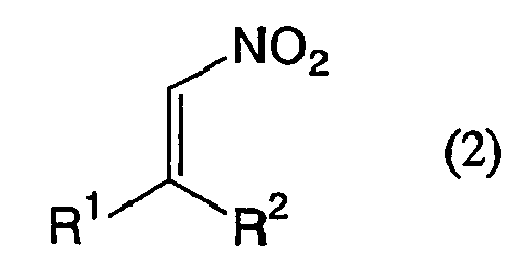
- 5. A method for producing an optically active nitro compound having two hydrogen atoms on its α-cabon atom and having β-asymmetric carbon atom which comprises making α, β-unsaturated nitroolefin having a hydrogen atom on its α-cabon atom react with an organosilicon compound having at least one silicon-hydrogen bond in the molecule in the presence of an asymmetric copper complex and water.
- 6. The method according to 5, wherein the asymmetric copper complex has at least one optically active bidentate phosphine ligand.
- 7. The method according to 5 or 6, wherein the nitro compound is a compound of formula (1):

and the α, β-unsaturated nitroolefin is a compound of formula (2):
- 8. A method for producing an optically active amino compound which comprises reducing the nitro compound obtained by the method described in any of 1-7.
Claims (5)
- A method for producing an optically active nitro compound having two hydrogen atoms on its α-carbon atom and having β-asymmetric carbon atom which comprises making an α, β-unsaturated nitroolefin having a hydrogen atom on its α-carbon atom react with at least one organosilicon compound having at least one silicon-hydrogen bond in the molecule in the presence of an asymmetric copper complex and water.
- The method according to claim 1 wherein the organosilicon compound is at least one selected from the group consisting of poly(methylhydrosiloxane), hydride terminated poly(dimethylsiloxane), 1,1,3,3-tetramethyldisiloxane, 1,1,1,3,5,5,5-heptamethyltrisiloxane, tris(dimethylsilyloxy)methylsilane, tris(trimethylsilyloxy)silane, tetrakis(dimethylsilyloxy)silane, trimethoxysilane, triethoxysilane, phenylsilane, methylphenylsilane, diphenylsilane, diphenylmethylsilane, triphenylsilane, dimethylphenylsilane, 1,2-bis(dimethylsilyl)benzene and 1,4-bis(dimethylsilyl) benzene.
- The method according to claim 1 or 2, wherein the asymmetric copper complex has at least one optically active bidentate phosphine ligand.
- The method according to any of claims 1-3, wherein the nitro compound is a compound of formula (1) :


- A method for producing an optically active amino compound comprising: (i) producing an optically active nitro compound according to the method of any of claims 1-4; and (ii) reducing said nitro compound.
Applications Claiming Priority (2)
| Application Number | Priority Date | Filing Date | Title |
|---|---|---|---|
| JP2003145950 | 2003-05-23 | ||
| EP04733468A EP1641740B1 (en) | 2003-05-23 | 2004-05-17 | Method for producing an optically active nitro compound |
Related Parent Applications (2)
| Application Number | Title | Priority Date | Filing Date |
|---|---|---|---|
| EP04733468.5 Division | 2004-05-17 | ||
| EP04733468A Division EP1641740B1 (en) | 2003-05-23 | 2004-05-17 | Method for producing an optically active nitro compound |
Publications (2)
| Publication Number | Publication Date |
|---|---|
| EP2055689A1 true EP2055689A1 (en) | 2009-05-06 |
| EP2055689B1 EP2055689B1 (en) | 2011-06-29 |
Family
ID=33475286
Family Applications (2)
| Application Number | Title | Priority Date | Filing Date |
|---|---|---|---|
| EP09000403A Expired - Lifetime EP2055689B1 (en) | 2003-05-23 | 2004-05-17 | Method for producing an optically active nitro compound |
| EP04733468A Expired - Lifetime EP1641740B1 (en) | 2003-05-23 | 2004-05-17 | Method for producing an optically active nitro compound |
Family Applications After (1)
| Application Number | Title | Priority Date | Filing Date |
|---|---|---|---|
| EP04733468A Expired - Lifetime EP1641740B1 (en) | 2003-05-23 | 2004-05-17 | Method for producing an optically active nitro compound |
Country Status (10)
| Country | Link |
|---|---|
| US (1) | US7790900B2 (en) |
| EP (2) | EP2055689B1 (en) |
| JP (1) | JP4279872B2 (en) |
| AT (2) | ATE514665T1 (en) |
| DE (1) | DE602004020226D1 (en) |
| DK (1) | DK1641740T3 (en) |
| ES (1) | ES2322763T3 (en) |
| PL (1) | PL1641740T3 (en) |
| PT (1) | PT1641740E (en) |
| WO (1) | WO2004103951A1 (en) |
Families Citing this family (3)
| Publication number | Priority date | Publication date | Assignee | Title |
|---|---|---|---|---|
| DE102004060626B4 (en) * | 2004-12-16 | 2006-12-07 | Consortium für elektrochemische Industrie GmbH | Monoheteroatom-substituted nitroalkanes and a process for their preparation |
| WO2007013681A1 (en) * | 2005-07-29 | 2007-02-01 | Nagase & Co., Ltd. | Guanidine-thiourea compound and process for production of nitro alcohol using the same |
| WO2010004957A1 (en) | 2008-07-08 | 2010-01-14 | 住友化学株式会社 | Chiral iridium aqua complex and method for producing optically active hydroxy compound using the same |
Citations (3)
| Publication number | Priority date | Publication date | Assignee | Title |
|---|---|---|---|---|
| WO1992009545A2 (en) * | 1990-11-21 | 1992-06-11 | Massachusetts Institute Of Technology | New methods for the catalytic reduction of organic substrates |
| WO2002066417A1 (en) * | 2001-02-17 | 2002-08-29 | Chiroblock Gmbh | Method for the production of the enantiomers of 2-substituted beta amino acids |
| US6465664B1 (en) | 1999-09-15 | 2002-10-15 | Massachusetts Institute Of Technology | Asymmetric 1,4-reductions of and 1,4-additions to enoates and related systems |
-
2004
- 2004-05-17 AT AT09000403T patent/ATE514665T1/en not_active IP Right Cessation
- 2004-05-17 EP EP09000403A patent/EP2055689B1/en not_active Expired - Lifetime
- 2004-05-17 DE DE602004020226T patent/DE602004020226D1/en not_active Expired - Lifetime
- 2004-05-17 US US10/556,777 patent/US7790900B2/en not_active Expired - Fee Related
- 2004-05-17 ES ES04733468T patent/ES2322763T3/en not_active Expired - Lifetime
- 2004-05-17 PL PL04733468T patent/PL1641740T3/en unknown
- 2004-05-17 AT AT04733468T patent/ATE426589T1/en active
- 2004-05-17 DK DK04733468T patent/DK1641740T3/en active
- 2004-05-17 JP JP2006500602A patent/JP4279872B2/en not_active Expired - Fee Related
- 2004-05-17 WO PCT/JP2004/006984 patent/WO2004103951A1/en not_active Ceased
- 2004-05-17 EP EP04733468A patent/EP1641740B1/en not_active Expired - Lifetime
- 2004-05-17 PT PT04733468T patent/PT1641740E/en unknown
Patent Citations (3)
| Publication number | Priority date | Publication date | Assignee | Title |
|---|---|---|---|---|
| WO1992009545A2 (en) * | 1990-11-21 | 1992-06-11 | Massachusetts Institute Of Technology | New methods for the catalytic reduction of organic substrates |
| US6465664B1 (en) | 1999-09-15 | 2002-10-15 | Massachusetts Institute Of Technology | Asymmetric 1,4-reductions of and 1,4-additions to enoates and related systems |
| WO2002066417A1 (en) * | 2001-02-17 | 2002-08-29 | Chiroblock Gmbh | Method for the production of the enantiomers of 2-substituted beta amino acids |
Non-Patent Citations (9)
| Title |
|---|
| E.M. CARREIRA AND C. CZEKELIUS: "Catalytic enantioselective conjugate reduction of beta,beta-disubstituted nitroalkenes", ANGEW.CHEM.INT.ED., vol. 42, no. 39, 13 October 2003 (2003-10-13), pages 4793 - 4795, XP002295502 * |
| I OJIMA: "Catalytic Asymmetric Synthesis", 1993, VCH PUBLISHERS |
| J. AM. CHEM. SOC., vol. 116, 1994, pages 4062 - 4066 |
| MAGNUS P ET AL: "Direct conversion of alpha,beta-unsaturated nitriles into cyanohydrins using Mn(dpm)3 catalyst, dioxygen and phenylsilane", TETRAHEDRON LETTERS, ELSEVIER SCIENCE PUBLISHERS, AMSTERDAM, NL, vol. 42, no. 25, 18 June 2001 (2001-06-18), pages 4127 - 4129, XP004241479, ISSN: 0040-4039 * |
| N. ONO: "The Nitro Group in Organic Synthesis", 2001, WILEY-VCH, pages: 30 - 44 |
| N.J. LAWRENCE ET AL: "Polymethylhydrosiloxane: a versatile reducing agent for organic synthesis", J.CHEM.SOC.PERKIN TRANS. 1, 1999, pages 3381 - 3391, XP002295503 * |
| R. NOYORI: "Asymmetric Catalysis in Organic Synthesis", 1994, JOHN WILEY & SONS |
| S. ONGERI ET AL: "Optimization of new chiral ligands for the copper-catalysed enantioselective conjugate addition of Et3Zn to nitroolefins by high-throughput screening of a parallel library", EUR.J.ORG.CHEM., 2001, pages 803 - 807, XP002295504 * |
| SYNTHESIS, 1982, pages 1017 - 1018 |
Also Published As
| Publication number | Publication date |
|---|---|
| ATE426589T1 (en) | 2009-04-15 |
| WO2004103951A1 (en) | 2004-12-02 |
| DK1641740T3 (en) | 2009-07-06 |
| EP2055689B1 (en) | 2011-06-29 |
| EP1641740B1 (en) | 2009-03-25 |
| JP2006524189A (en) | 2006-10-26 |
| US7790900B2 (en) | 2010-09-07 |
| DE602004020226D1 (en) | 2009-05-07 |
| EP1641740A1 (en) | 2006-04-05 |
| JP4279872B2 (en) | 2009-06-17 |
| PT1641740E (en) | 2009-06-25 |
| US20070037976A1 (en) | 2007-02-15 |
| ATE514665T1 (en) | 2011-07-15 |
| ES2322763T3 (en) | 2009-06-26 |
| PL1641740T3 (en) | 2009-09-30 |
Similar Documents
| Publication | Publication Date | Title |
|---|---|---|
| Risgaard et al. | Catalytic asymmetric Henry reactions of silyl nitronates with aldehydes | |
| Simonini et al. | Novel chiral biheteroaromatic diphosphine oxides for lewis base activation of lewis acids in enantioselective allylation and epoxide opening | |
| CN109748841A (en) | A kind of method for catalyzing asymmetric synthesis of chiral β-aminoketone derivatives | |
| CN105732249B (en) | Aryl alcohol compound and synthetic method of escitalopram | |
| Lu et al. | Dipeptide-derived multifunctional phosphonium salt as a catalyst to synthesize highly functionalized chiral cyclopentanes | |
| CN111925356B (en) | Synthesis method and application of chiral quinoline-imidazoline ligand | |
| Rossi et al. | Biheteroaromatic diphosphine oxides-catalyzed stereoselective direct aldol reactions | |
| EP2055689B1 (en) | Method for producing an optically active nitro compound | |
| CN105934423B (en) | The production process of 2,3,6-trimethylphenol | |
| CN106045897A (en) | Method for preparing 3,alpha-diamido-oxoindole compound having optical activity | |
| CN117586310B (en) | Nickel-catalyzed C(sp3)-H bond asymmetric cyclization promoted by a binaphthylamine-derived chiral phosphooxy ligand | |
| Yuan et al. | Reaction of aldimines and difluoroenoxysilane, an unexpected protocol for the synthesis of 2, 2-difluoro-3-hydroxy-1-ones | |
| CN107011218B (en) | A kind of fluorine nitrogen type amination reagent, preparation method and application | |
| CN114105775A (en) | Preparation method of substituted iodobenzene with terminal double bond | |
| JP2009023927A (en) | Method for producing optically active cyanohydrin | |
| CN113173859A (en) | Method for synthesizing chiral alpha-amino alcohol compound | |
| CN115448867B (en) | Chiral pyrrolidine and tetrahydrofuran ring compound and preparation method thereof | |
| CN113024585B (en) | Method for synthesizing alpha-amino acid ester compound with quaternary carbon chiral center | |
| JP2006523661A (en) | Production method of hydroxyalkyne by coupling reaction of acetaldehyde and terminal alkyne | |
| 上田悠介 | Photoinduced Copper-Catalyzed Asymmetric Acylation Reactions | |
| Zeitler | 2.4 Organocatalyst/Photocatalyst Dual Catalysis | |
| Wicks | Inter-and Intramolecular Ring-Opening Reactions of Oxabicyclic Substrates. | |
| JP2007126446A (en) | Process for producing β-hydroxyketone compound | |
| TW202608905A (en) | Chiral aminophosphine ligands, iridium catalysts comprising these ligands and use of these catalysts in asymmetric hydrogenations | |
| CN115057885A (en) | Styrene axis chiral phosphine ligand and synthetic method and application thereof |
Legal Events
| Date | Code | Title | Description |
|---|---|---|---|
| PUAI | Public reference made under article 153(3) epc to a published international application that has entered the european phase |
Free format text: ORIGINAL CODE: 0009012 |
|
| AC | Divisional application: reference to earlier application |
Ref document number: 1641740 Country of ref document: EP Kind code of ref document: P |
|
| AK | Designated contracting states |
Kind code of ref document: A1 Designated state(s): AT BE BG CH CY CZ DE DK EE ES FI FR GB GR HU IE IT LI LU MC NL PL PT RO SE SI SK TR |
|
| 17P | Request for examination filed |
Effective date: 20091020 |
|
| 17Q | First examination report despatched |
Effective date: 20091119 |
|
| AKX | Designation fees paid |
Designated state(s): AT BE BG CH CY CZ DE DK EE ES FI FR GB GR HU IE IT LI LU MC NL PL PT RO SE SI SK TR |
|
| GRAP | Despatch of communication of intention to grant a patent |
Free format text: ORIGINAL CODE: EPIDOSNIGR1 |
|
| GRAS | Grant fee paid |
Free format text: ORIGINAL CODE: EPIDOSNIGR3 |
|
| GRAA | (expected) grant |
Free format text: ORIGINAL CODE: 0009210 |
|
| AC | Divisional application: reference to earlier application |
Ref document number: 1641740 Country of ref document: EP Kind code of ref document: P |
|
| AK | Designated contracting states |
Kind code of ref document: B1 Designated state(s): AT BE BG CH CY CZ DE DK EE ES FI FR GB GR HU IE IT LI LU MC NL PL PT RO SE SI SK TR |
|
| REG | Reference to a national code |
Ref country code: GB Ref legal event code: FG4D |
|
| REG | Reference to a national code |
Ref country code: CH Ref legal event code: EP |
|
| REG | Reference to a national code |
Ref country code: IE Ref legal event code: FG4D |
|
| REG | Reference to a national code |
Ref country code: DE Ref legal event code: R096 Ref document number: 602004033329 Country of ref document: DE Effective date: 20110825 |
|
| REG | Reference to a national code |
Ref country code: NL Ref legal event code: VDEP Effective date: 20110629 |
|
| PG25 | Lapsed in a contracting state [announced via postgrant information from national office to epo] |
Ref country code: SE Free format text: LAPSE BECAUSE OF FAILURE TO SUBMIT A TRANSLATION OF THE DESCRIPTION OR TO PAY THE FEE WITHIN THE PRESCRIBED TIME-LIMIT Effective date: 20110629 |
|
| PG25 | Lapsed in a contracting state [announced via postgrant information from national office to epo] |
Ref country code: SI Free format text: LAPSE BECAUSE OF FAILURE TO SUBMIT A TRANSLATION OF THE DESCRIPTION OR TO PAY THE FEE WITHIN THE PRESCRIBED TIME-LIMIT Effective date: 20110629 Ref country code: GR Free format text: LAPSE BECAUSE OF FAILURE TO SUBMIT A TRANSLATION OF THE DESCRIPTION OR TO PAY THE FEE WITHIN THE PRESCRIBED TIME-LIMIT Effective date: 20110930 Ref country code: AT Free format text: LAPSE BECAUSE OF FAILURE TO SUBMIT A TRANSLATION OF THE DESCRIPTION OR TO PAY THE FEE WITHIN THE PRESCRIBED TIME-LIMIT Effective date: 20110629 Ref country code: FI Free format text: LAPSE BECAUSE OF FAILURE TO SUBMIT A TRANSLATION OF THE DESCRIPTION OR TO PAY THE FEE WITHIN THE PRESCRIBED TIME-LIMIT Effective date: 20110629 |
|
| PG25 | Lapsed in a contracting state [announced via postgrant information from national office to epo] |
Ref country code: BE Free format text: LAPSE BECAUSE OF FAILURE TO SUBMIT A TRANSLATION OF THE DESCRIPTION OR TO PAY THE FEE WITHIN THE PRESCRIBED TIME-LIMIT Effective date: 20110629 |
|
| PG25 | Lapsed in a contracting state [announced via postgrant information from national office to epo] |
Ref country code: CZ Free format text: LAPSE BECAUSE OF FAILURE TO SUBMIT A TRANSLATION OF THE DESCRIPTION OR TO PAY THE FEE WITHIN THE PRESCRIBED TIME-LIMIT Effective date: 20110629 Ref country code: PT Free format text: LAPSE BECAUSE OF FAILURE TO SUBMIT A TRANSLATION OF THE DESCRIPTION OR TO PAY THE FEE WITHIN THE PRESCRIBED TIME-LIMIT Effective date: 20111031 Ref country code: NL Free format text: LAPSE BECAUSE OF FAILURE TO SUBMIT A TRANSLATION OF THE DESCRIPTION OR TO PAY THE FEE WITHIN THE PRESCRIBED TIME-LIMIT Effective date: 20110629 Ref country code: EE Free format text: LAPSE BECAUSE OF FAILURE TO SUBMIT A TRANSLATION OF THE DESCRIPTION OR TO PAY THE FEE WITHIN THE PRESCRIBED TIME-LIMIT Effective date: 20110629 |
|
| PG25 | Lapsed in a contracting state [announced via postgrant information from national office to epo] |
Ref country code: CY Free format text: LAPSE BECAUSE OF FAILURE TO SUBMIT A TRANSLATION OF THE DESCRIPTION OR TO PAY THE FEE WITHIN THE PRESCRIBED TIME-LIMIT Effective date: 20110629 Ref country code: PL Free format text: LAPSE BECAUSE OF FAILURE TO SUBMIT A TRANSLATION OF THE DESCRIPTION OR TO PAY THE FEE WITHIN THE PRESCRIBED TIME-LIMIT Effective date: 20110629 Ref country code: SK Free format text: LAPSE BECAUSE OF FAILURE TO SUBMIT A TRANSLATION OF THE DESCRIPTION OR TO PAY THE FEE WITHIN THE PRESCRIBED TIME-LIMIT Effective date: 20110629 Ref country code: RO Free format text: LAPSE BECAUSE OF FAILURE TO SUBMIT A TRANSLATION OF THE DESCRIPTION OR TO PAY THE FEE WITHIN THE PRESCRIBED TIME-LIMIT Effective date: 20110629 |
|
| PLBE | No opposition filed within time limit |
Free format text: ORIGINAL CODE: 0009261 |
|
| STAA | Information on the status of an ep patent application or granted ep patent |
Free format text: STATUS: NO OPPOSITION FILED WITHIN TIME LIMIT |
|
| PG25 | Lapsed in a contracting state [announced via postgrant information from national office to epo] |
Ref country code: IT Free format text: LAPSE BECAUSE OF FAILURE TO SUBMIT A TRANSLATION OF THE DESCRIPTION OR TO PAY THE FEE WITHIN THE PRESCRIBED TIME-LIMIT Effective date: 20110629 |
|
| 26N | No opposition filed |
Effective date: 20120330 |
|
| PG25 | Lapsed in a contracting state [announced via postgrant information from national office to epo] |
Ref country code: DK Free format text: LAPSE BECAUSE OF FAILURE TO SUBMIT A TRANSLATION OF THE DESCRIPTION OR TO PAY THE FEE WITHIN THE PRESCRIBED TIME-LIMIT Effective date: 20110629 |
|
| REG | Reference to a national code |
Ref country code: DE Ref legal event code: R097 Ref document number: 602004033329 Country of ref document: DE Effective date: 20120330 |
|
| PG25 | Lapsed in a contracting state [announced via postgrant information from national office to epo] |
Ref country code: MC Free format text: LAPSE BECAUSE OF NON-PAYMENT OF DUE FEES Effective date: 20120531 |
|
| REG | Reference to a national code |
Ref country code: CH Ref legal event code: PL |
|
| GBPC | Gb: european patent ceased through non-payment of renewal fee |
Effective date: 20120517 |
|
| PG25 | Lapsed in a contracting state [announced via postgrant information from national office to epo] |
Ref country code: CH Free format text: LAPSE BECAUSE OF NON-PAYMENT OF DUE FEES Effective date: 20120531 Ref country code: LI Free format text: LAPSE BECAUSE OF NON-PAYMENT OF DUE FEES Effective date: 20120531 |
|
| REG | Reference to a national code |
Ref country code: IE Ref legal event code: MM4A |
|
| REG | Reference to a national code |
Ref country code: FR Ref legal event code: ST Effective date: 20130131 |
|
| REG | Reference to a national code |
Ref country code: DE Ref legal event code: R119 Ref document number: 602004033329 Country of ref document: DE Effective date: 20121201 |
|
| PG25 | Lapsed in a contracting state [announced via postgrant information from national office to epo] |
Ref country code: ES Free format text: LAPSE BECAUSE OF FAILURE TO SUBMIT A TRANSLATION OF THE DESCRIPTION OR TO PAY THE FEE WITHIN THE PRESCRIBED TIME-LIMIT Effective date: 20111010 Ref country code: GB Free format text: LAPSE BECAUSE OF NON-PAYMENT OF DUE FEES Effective date: 20120517 Ref country code: FR Free format text: LAPSE BECAUSE OF NON-PAYMENT OF DUE FEES Effective date: 20120531 Ref country code: IE Free format text: LAPSE BECAUSE OF NON-PAYMENT OF DUE FEES Effective date: 20120517 |
|
| PG25 | Lapsed in a contracting state [announced via postgrant information from national office to epo] |
Ref country code: BG Free format text: LAPSE BECAUSE OF FAILURE TO SUBMIT A TRANSLATION OF THE DESCRIPTION OR TO PAY THE FEE WITHIN THE PRESCRIBED TIME-LIMIT Effective date: 20110929 Ref country code: DE Free format text: LAPSE BECAUSE OF NON-PAYMENT OF DUE FEES Effective date: 20121201 |
|
| PG25 | Lapsed in a contracting state [announced via postgrant information from national office to epo] |
Ref country code: TR Free format text: LAPSE BECAUSE OF FAILURE TO SUBMIT A TRANSLATION OF THE DESCRIPTION OR TO PAY THE FEE WITHIN THE PRESCRIBED TIME-LIMIT Effective date: 20110629 |
|
| PG25 | Lapsed in a contracting state [announced via postgrant information from national office to epo] |
Ref country code: LU Free format text: LAPSE BECAUSE OF NON-PAYMENT OF DUE FEES Effective date: 20120517 |
|
| PG25 | Lapsed in a contracting state [announced via postgrant information from national office to epo] |
Ref country code: HU Free format text: LAPSE BECAUSE OF FAILURE TO SUBMIT A TRANSLATION OF THE DESCRIPTION OR TO PAY THE FEE WITHIN THE PRESCRIBED TIME-LIMIT Effective date: 20040517 |