EP2053355A2 - Systems and methods for utilizing pulsed radio frequencies in a ring laser gyroscope - Google Patents
Systems and methods for utilizing pulsed radio frequencies in a ring laser gyroscope Download PDFInfo
- Publication number
- EP2053355A2 EP2053355A2 EP08166988A EP08166988A EP2053355A2 EP 2053355 A2 EP2053355 A2 EP 2053355A2 EP 08166988 A EP08166988 A EP 08166988A EP 08166988 A EP08166988 A EP 08166988A EP 2053355 A2 EP2053355 A2 EP 2053355A2
- Authority
- EP
- European Patent Office
- Prior art keywords
- signal
- transmitting device
- gyroscope
- pulsed
- discharge bore
- Prior art date
- Legal status (The legal status is an assumption and is not a legal conclusion. Google has not performed a legal analysis and makes no representation as to the accuracy of the status listed.)
- Withdrawn
Links
- 238000000034 method Methods 0.000 title claims description 13
- 230000001939 inductive effect Effects 0.000 claims description 20
- 238000005086 pumping Methods 0.000 claims description 4
- 230000008878 coupling Effects 0.000 claims 3
- 238000010168 coupling process Methods 0.000 claims 3
- 238000005859 coupling reaction Methods 0.000 claims 3
- 239000004020 conductor Substances 0.000 description 7
- 239000007789 gas Substances 0.000 description 6
- VYPSYNLAJGMNEJ-UHFFFAOYSA-N Silicium dioxide Chemical compound O=[Si]=O VYPSYNLAJGMNEJ-UHFFFAOYSA-N 0.000 description 2
- 239000006094 Zerodur Substances 0.000 description 2
- 238000010586 diagram Methods 0.000 description 2
- 238000009499 grossing Methods 0.000 description 2
- CPBQJMYROZQQJC-UHFFFAOYSA-N helium neon Chemical compound [He].[Ne] CPBQJMYROZQQJC-UHFFFAOYSA-N 0.000 description 2
- 239000000463 material Substances 0.000 description 2
- 239000000853 adhesive Substances 0.000 description 1
- 230000001070 adhesive effect Effects 0.000 description 1
- 230000003321 amplification Effects 0.000 description 1
- 230000005540 biological transmission Effects 0.000 description 1
- 239000010406 cathode material Substances 0.000 description 1
- 239000003795 chemical substances by application Substances 0.000 description 1
- 230000003750 conditioning effect Effects 0.000 description 1
- 238000000151 deposition Methods 0.000 description 1
- 238000005553 drilling Methods 0.000 description 1
- 230000000694 effects Effects 0.000 description 1
- 238000001914 filtration Methods 0.000 description 1
- 230000001976 improved effect Effects 0.000 description 1
- 230000000977 initiatory effect Effects 0.000 description 1
- 238000004519 manufacturing process Methods 0.000 description 1
- 239000000203 mixture Substances 0.000 description 1
- 238000003199 nucleic acid amplification method Methods 0.000 description 1
- 230000003287 optical effect Effects 0.000 description 1
- 238000007639 printing Methods 0.000 description 1
- 230000001902 propagating effect Effects 0.000 description 1
- 238000007789 sealing Methods 0.000 description 1
- 238000004904 shortening Methods 0.000 description 1
- 239000000377 silicon dioxide Substances 0.000 description 1
- 238000004544 sputter deposition Methods 0.000 description 1
- 239000000758 substrate Substances 0.000 description 1
- 238000004804 winding Methods 0.000 description 1
Images


Classifications
-
- G—PHYSICS
- G01—MEASURING; TESTING
- G01C—MEASURING DISTANCES, LEVELS OR BEARINGS; SURVEYING; NAVIGATION; GYROSCOPIC INSTRUMENTS; PHOTOGRAMMETRY OR VIDEOGRAMMETRY
- G01C19/00—Gyroscopes; Turn-sensitive devices using vibrating masses; Turn-sensitive devices without moving masses; Measuring angular rate using gyroscopic effects
- G01C19/58—Turn-sensitive devices without moving masses
- G01C19/64—Gyrometers using the Sagnac effect, i.e. rotation-induced shifts between counter-rotating electromagnetic beams
- G01C19/66—Ring laser gyrometers
-
- G—PHYSICS
- G01—MEASURING; TESTING
- G01C—MEASURING DISTANCES, LEVELS OR BEARINGS; SURVEYING; NAVIGATION; GYROSCOPIC INSTRUMENTS; PHOTOGRAMMETRY OR VIDEOGRAMMETRY
- G01C19/00—Gyroscopes; Turn-sensitive devices using vibrating masses; Turn-sensitive devices without moving masses; Measuring angular rate using gyroscopic effects
- G01C19/58—Turn-sensitive devices without moving masses
- G01C19/64—Gyrometers using the Sagnac effect, i.e. rotation-induced shifts between counter-rotating electromagnetic beams
- G01C19/66—Ring laser gyrometers
- G01C19/661—Ring laser gyrometers details
- G01C19/665—Ring laser gyrometers details control of the cavity
Definitions
- This invention relates generally to ring laser gyroscopes, and more specifically, to systems and methods for utilizing pulsed radio frequencies within ring laser gyroscopes.
- At least some known ring laser gyroscopes utilize a direct current (D.C.) voltage discharge in order to start and maintain laser beams within a discharge cavity located in a block of the RLG.
- a discharge cavity is also sometimes referred to as a gain bore or discharge bore.
- D.C. electrodes must be in direct contact with a gain medium of the laser that is contained within the discharge bore.
- an interfacial seal is used to bond the electrodes to the laser block. The integrity of such interfacial seals has historically limited the temperature range, reliability, and lifetime of RLGs which employ the interfacial seals.
- the gain necessary to sustain the laser beams within an RLG require discharge currents which are powerful enough to sputter cathode material from the electrodes into the gain medium. This sputtering contaminates the gain medium which results in shortening the laser lifetime and hence gyro reliability and performance. Additionally, the cathode or cathodes, depending upon the RLG configuration, pump gases from the gain medium producing undesirable gas mix changes.
- ring laser gyroscopes employ capacitively coupled radio frequency (RF) energy which maintain the laser beams within the gyroscope through discharge of the RF energy.
- RF radio frequency
- electrodes transmitting RF energy are deposited onto an outer surface of the laser block.
- RLG employs an inductive coil wrapped around one leg of the discharge bore within the laser block.
- the inductive coil may be embedded within the laser block itself.
- a capacitively coupled RF apparatus which includes two plates, is embedded within the laser block. When utilizing such an apparatus, one leg of the discharge bore is juxtaposed between two of the plates.
- RLGs couple continuous wave RF energy into the gain medium of a ring laser gyroscope thereby eliminating the need for electrodes within the discharge bores and the resulting problems associated with the sealing of the laser block.
- dynamic impedance characteristics of the gain medium within the discharge bore can cause problems related to controlling an amount of power delivered to the gain medium when utilizing such continuous wave (CW) RF signals.
- a ring laser gyroscope comprising a gyroscope block having at least one discharge bore containing a gain medium, a radio frequency (RF) transmitting device, and an RF energy source.
- the transmitting device is within the gyroscope block in proximity to at least one discharge bore.
- the RF energy source is configured to apply a pulsed RF signal to the RF transmitting device, the RF transmitting device located such that the pulsed RF signal is applied to the gain medium.
- a method for pumping a gain medium within a discharge bore of a ring laser gyroscope comprises locating an RF transmitting device in proximity to the discharge bore and providing a pulsed RF signal to the transmitting device such that the pulsed RF signal is applied to the gain medium.
- a ring laser gyroscope which comprises a gain medium, a radio frequency (RF) transmitting device, and an RF energy source.
- the RF energy source applies a signal to the RF transmitting device.
- the signal initiates a discharge from the RF transmitting device within the gain medium.
- the signal is a pulsed RF signal having a duty cycle between zero and one.
- FIGURE 1 is a top view of one embodiment of a ring laser gyroscope which includes an inductive coil and a pulsed RF supply.
- FIGURE 2 is a graph illustrating one embodiment of a signal provided by the pulsed RF supply shown in FIGURE 1 .
- FIGURE 3 is a block diagram illustrating one embodiment of a pulsed RF supply for utilization within a ring laser gyroscope.
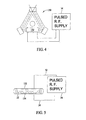
- FIGURE 4 is a top view of a ring laser gyroscope configured with capacitive plates coupled to a pulsed RF supply.
- FIGURE 5 is a side view of the ring laser gyroscope of FIGURE 4 further illustrating the capacitive plates.
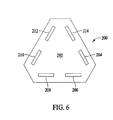
- FIGURE 6 is a top view of a gyroscope block which incorporates multiple pairs of capacitive plates which may be utilized with a pulsed RF supply.
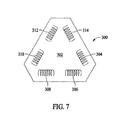
- FIGURE 7 is a top view of a gyroscope block which incorporates multiple inductive coils which may be utilized with a pulsed RF supply.
- FIGURE 1 is a top view of one embodiment of a ring laser gyroscope (RLG) 10 in which a pulsed radio frequency (RF) is applied to a gain medium.
- RLG 10 comprises a gyroscope block 12, transducer mirrors 14, 16, a readout mirror 18, discharge bores 20, 22 and 24, and an inductive coil 26.
- Inductive coil 26 is one embodiment of an RF transmitting device as further described below.
- Gyroscope block 12 in alternative embodiments, is fabricated from one or more of Zerodur.RTM.
- Transducer mirrors 14, 16 and readout mirror 18 are bonded to corners of gyroscope block 12 to form a gas tight seal.
- a gain medium for example, helium neon (HeNe) gas may be employed within discharge bores 20, 22, and 24.
- HeNe helium neon
- counter propagating continuous laser beams 28 are induced within RLG 10. Initiation and maintaining a continuous laser beam within RLG 10 utilizing, for example, RF energy, is sometimes referred to as gain pumping of a gain medium.
- inductive coil 26 is wound around RLG discharge bore 22, for example, and is embedded within gyroscope block 12.
- Inductive coil 26 is fabricated from any suitable conductive material and may be constructed in accordance with well known coil winding techniques. Inductive coil 26 may be embedded by depositing or printing onto gyroscope block 12, for example, or by drilling holes through gyroscope block 12.
- a first terminal 30 of inductive coil 26 is connected by a conductor 32 to a pulsed RF supply 34. Pulsed RF supply 34 is sometimes referred to as an RF energy source.
- a second terminal 36 of inductance coil 26 is connected by conductor 38 to a second terminal of RF supply 34.
- a pulsed RF signal (shown in FIGURE 2 ) is transmitted from pulsed RF supply 34 to an RF transmitting device (e.g., inductive coil 26) which substantially encompasses discharge bore 22 which contains the gain medium of RLG 10.
- This RF signal initiates a discharge which starts and maintains a laser beam within gyroscope block 12.
- the average RF power consumed is reduced by, for example, ten times the base-10 log of the duty cycle of the pulsed RF signal.
- the duty cycle is a number between zero and one.
- altering the duty cycle and/or power envelope of the pulsed RF also provides an additional mechanism to control the laser discharge and the power of the optical laser output beam.
- FIGURE 2 is a graph 50 illustrating a pulsed RF signal 52 and a power envelope 54 generated by pulsed RF signal 52.
- Graph 50 illustrates an approximate 1/3 duty cycle, which is sometimes referred to as a 33% duty cycle.
- Pulsed RF signal 52 is composed of a sequential time series of pulses of frequency f 0 spaced by a time of T.
- the pulse width is ⁇ T where ⁇ is the duty cycle with a unitless range of 0 ⁇ 1.
- utilization of pulsed RF supply 34 configured with a duty cycle of 0.1 will result in an average power of 10 dB less than a ring laser gyroscope which utilizes a continuous wave RF supply.
- power envelope 54 is illustrated as being rectangular, the description should not be construed as being limited to a rectangular power envelope. Any arbitrary shaped power envelope may be incorporated.
- the pulse period T, nor the duty cycle ⁇ are limited to a constant value. In other words, a variable pulse period and/or a variable duty cycle may be incorporated into the embodiments described herein.
- FIGURE 3 is a block diagram of pulsed RF supply 34 which also illustrates a connection to RLG 10.
- Pulsed RF supply 34 includes an RF oscillator 100, an RF driver amplifier 102 configured to amplify an output of RF oscillator 100, an impedance matching device 104 receiving an output of RF driver amplifier 102, and an RF power amplifier 106 receiving the output of impedance matching device 104.
- An output of RF power amplifier 106 is received by an output impedance matching unit 108 which is configured to output the pulsed RF signal onto conductors 32 and 38 for transmission to inductive coil 26.
- Pulsed RF supply 34 further includes a pulse control circuit 110 and a pulse drive circuit 112, which in combination are configured to control a duty cycle of the RF signal output by pulsed RF supply 34.
- Pulse drive circuit 112 in one embodiment, is configured to provide signal conditioning, for example, amplification, filtering, and/or impedance matching, to a signal output by pulse drive circuit 110.
- pulse control circuit 110 is fabricated utilizing a programmable integrated circuit (PIC), a microprocessor, microcontroller or FPGA (field programmable gate array), depending on the level of pulse control desired.
- a method for producing a pulsed RF signal is to modulate the bias current on an active device (i.e., RF driver amplifier 102, RF power amplifier 106) with a high frequency switch.
- Pulse control circuit 110 provides such a switch.
- pulse control circuit 110 is configured to control a duty cycle of the RF signal produced by RF oscillator 100 by switching off and on (e.g., modulating the bias current of) RF driver amplifier 102.
- pulse control circuit 110 is configured as a high frequency switch.
- pulse control circuit 110 is further configured to provide an enabling signal to RF power amplifier 106.
- pulse control circuit 110 which is in one embodiment user configurable, a user is able to control the output of pulsed RF supply 34. Specifically, both the duty cycle of the generated RF signal and the shape of a power envelope output by pulsed RF supply 34 are user programmable.
- inductive coil 26 is one embodiment of an RF transmitting device which can be utilized with the RF energy source of pulsed RF supply 34.
- FIGURE 4 illustrates an alternate embodiment of RLG 150 which may be utilized with pulsed RF supply 34.
- RLG 150 is, similar to RLG 10 (shown in FIGURE 1 ) except that capacitive plates 152 and 154 (capacitive plate 154 not shown in FIGURE 4 ) have been substituted for inductive coil 26.
- FIGURE 5 schematically shows a side view of ring laser gyroscope 150.
- One gain bore section e.g., discharge bore 22
- Capacitive plate 152 is coupled by conductor 32 to pulsed RF supply 34
- capacitive plate 154 is coupled by conductor 38 to pulsed RF supply 34.
- Any suitable conductive material may be used to form the capacitive plates.
- conductive adhesive strips may be utilized to form capacitive plates 152 and 154.
- FIGURE 6 illustrates another alternative embodiment of a portion of a RLG 200 which can be utilized which pulsed RF supply 34.
- RLG 200 includes a gyroscope block 202 and a plurality of pairs of capacitive plates.
- gyroscope block 202 includes six pairs of capacitive plates.
- capacitive plates 204, 206, 208, 210, 212 and 214 are shown.
- capacitive plates which are opposite the discharge bore corresponding to capacitive plates 204, 206, 208, 210, 212 and 214 are not shown.
- the embodiment of FIGURE 6 should be construed as an illustration and not a limitation. Those of skill in the art will understand that a greater or lesser number of such plates may be used in configurations employing the methods and apparatus described herein.
- FIGURE 7 illustrates still another alternative embodiment of a portion of a RLG 300 which includes a gyroscope block 302 and a plurality of conductance coils 304, 306, 308, 310, 312, and 314 that may be employed in place of the capacitive plates 204-214 illustrated in FIGURE 6 .
- At least one advantage to using multiple capacitive plates 204-214 or inductive coils 304-314 for each discharge bore of a RLG is that it allows for the utilization of several phases of the RF drive source. Utilization of several phases of RF power promotes a smoothing of the output power and allows the use of lower frequencies than might otherwise be necessary.
- multiple phases may be employed with any of the embodiments described herein using multiple RF transmitting device, for example, either inductive coils or capacitive plates.
- the capacitive plate pairs may be driven with a phase difference of 90 degrees.
- Other configurations may be similarly driven to maintain the desired smoothing effect. Operation of single and multiple inductive coils and capacitive plates are described in more detail in U.S. Pat. No. 5,381,436 entitled “Ring Laser Gyro Employing Radio Frequency For Pumping of Gain Medium” which issued to Nelson et al., the entire subject matter of which is hereby incorporated by reference in its entirety.
- a method of generating and delivering a pulsed RF signal to an RF energy transmitting apparatus, for example inductive coil 26, is herein provided utilizing components which may be situated on a printed-circuit board (PCB) substrate within a ring laser gyroscope assembly.
- the pulsed RF device described herein utilized for power gas discharge within a ring laser gyroscope provides improved gas discharge lifetime and reduced cost for the gyroscope as compared to the above described DC discharge ring laser gyroscopes.
Landscapes
- Physics & Mathematics (AREA)
- Engineering & Computer Science (AREA)
- Optics & Photonics (AREA)
- Electromagnetism (AREA)
- Power Engineering (AREA)
- General Physics & Mathematics (AREA)
- Radar, Positioning & Navigation (AREA)
- Remote Sensing (AREA)
- Lasers (AREA)
Abstract
Description
- This invention relates generally to ring laser gyroscopes, and more specifically, to systems and methods for utilizing pulsed radio frequencies within ring laser gyroscopes.
- At least some known ring laser gyroscopes (RLGs) utilize a direct current (D.C.) voltage discharge in order to start and maintain laser beams within a discharge cavity located in a block of the RLG. A discharge cavity is also sometimes referred to as a gain bore or discharge bore. In such a utilization, D.C. electrodes must be in direct contact with a gain medium of the laser that is contained within the discharge bore. In order to prevent external materials from leaking around these D.C. electrodes, an interfacial seal is used to bond the electrodes to the laser block. The integrity of such interfacial seals has historically limited the temperature range, reliability, and lifetime of RLGs which employ the interfacial seals.
- Often the gain necessary to sustain the laser beams within an RLG require discharge currents which are powerful enough to sputter cathode material from the electrodes into the gain medium. This sputtering contaminates the gain medium which results in shortening the laser lifetime and hence gyro reliability and performance. Additionally, the cathode or cathodes, depending upon the RLG configuration, pump gases from the gain medium producing undesirable gas mix changes.
- Other known ring laser gyroscopes employ capacitively coupled radio frequency (RF) energy which maintain the laser beams within the gyroscope through discharge of the RF energy. In such gyroscopes, electrodes transmitting RF energy are deposited onto an outer surface of the laser block. Still another known RLG employs an inductive coil wrapped around one leg of the discharge bore within the laser block. In this gyroscope embodiment, the inductive coil may be embedded within the laser block itself. As still another alternative, a capacitively coupled RF apparatus which includes two plates, is embedded within the laser block. When utilizing such an apparatus, one leg of the discharge bore is juxtaposed between two of the plates.
- These RLGs couple continuous wave RF energy into the gain medium of a ring laser gyroscope thereby eliminating the need for electrodes within the discharge bores and the resulting problems associated with the sealing of the laser block. However, dynamic impedance characteristics of the gain medium within the discharge bore can cause problems related to controlling an amount of power delivered to the gain medium when utilizing such continuous wave (CW) RF signals.
- In one aspect, a ring laser gyroscope is provided that comprises a gyroscope block having at least one discharge bore containing a gain medium, a radio frequency (RF) transmitting device, and an RF energy source. The transmitting device is within the gyroscope block in proximity to at least one discharge bore. The RF energy source is configured to apply a pulsed RF signal to the RF transmitting device, the RF transmitting device located such that the pulsed RF signal is applied to the gain medium.
- In another aspect, a method for pumping a gain medium within a discharge bore of a ring laser gyroscope is provided. The method comprises locating an RF transmitting device in proximity to the discharge bore and providing a pulsed RF signal to the transmitting device such that the pulsed RF signal is applied to the gain medium.
- In still another aspect, a ring laser gyroscope is provided which comprises a gain medium, a radio frequency (RF) transmitting device, and an RF energy source. The RF energy source applies a signal to the RF transmitting device. The signal initiates a discharge from the RF transmitting device within the gain medium. The signal is a pulsed RF signal having a duty cycle between zero and one.
- Preferred and alternative embodiments of the present invention are described in detail below with reference to the following drawings:
-
FIGURE 1 is a top view of one embodiment of a ring laser gyroscope which includes an inductive coil and a pulsed RF supply. -
FIGURE 2 is a graph illustrating one embodiment of a signal provided by the pulsed RF supply shown inFIGURE 1 . -
FIGURE 3 is a block diagram illustrating one embodiment of a pulsed RF supply for utilization within a ring laser gyroscope. -
FIGURE 4 is a top view of a ring laser gyroscope configured with capacitive plates coupled to a pulsed RF supply. -
FIGURE 5 is a side view of the ring laser gyroscope ofFIGURE 4 further illustrating the capacitive plates. -
FIGURE 6 is a top view of a gyroscope block which incorporates multiple pairs of capacitive plates which may be utilized with a pulsed RF supply. -
FIGURE 7 is a top view of a gyroscope block which incorporates multiple inductive coils which may be utilized with a pulsed RF supply. -
FIGURE 1 is a top view of one embodiment of a ring laser gyroscope (RLG) 10 in which a pulsed radio frequency (RF) is applied to a gain medium. Utilization of pulsed RF reduces average RF power provided to RLG 10 as compared to RLGs which utilize a continuous wave RF signal to initiate and maintain a laser beam withinRLG 10. RLG 10 comprises a gyroscope block 12,transducer mirrors readout mirror 18,discharge bores inductive coil 26.Inductive coil 26 is one embodiment of an RF transmitting device as further described below. Gyroscope block 12, in alternative embodiments, is fabricated from one or more of Zerodur.RTM. (Zerodur is a registered trademark of SCHOTT AG), silica, or another comparable material having stable temperature expansion characteristics.Transducer mirrors readout mirror 18 are bonded to corners of gyroscope block 12 to form a gas tight seal. A gain medium, for example, helium neon (HeNe) gas may be employed withindischarge bores inductive coil 26, counter propagatingcontinuous laser beams 28 are induced withinRLG 10. Initiation and maintaining a continuous laser beam withinRLG 10 utilizing, for example, RF energy, is sometimes referred to as gain pumping of a gain medium. - In the embodiment illustrated,
inductive coil 26 is wound aroundRLG discharge bore 22, for example, and is embedded within gyroscope block 12.Inductive coil 26 is fabricated from any suitable conductive material and may be constructed in accordance with well known coil winding techniques.Inductive coil 26 may be embedded by depositing or printing onto gyroscope block 12, for example, or by drilling holes through gyroscope block 12. Afirst terminal 30 ofinductive coil 26 is connected by aconductor 32 to apulsed RF supply 34. PulsedRF supply 34 is sometimes referred to as an RF energy source. Asecond terminal 36 ofinductance coil 26 is connected byconductor 38 to a second terminal ofRF supply 34. - A pulsed RF signal (shown in
FIGURE 2 ) is transmitted frompulsed RF supply 34 to an RF transmitting device (e.g., inductive coil 26) which substantially encompassesdischarge bore 22 which contains the gain medium of RLG 10. This RF signal initiates a discharge which starts and maintains a laser beam within gyroscope block 12. By utilizing a pulsed RF signal, as opposed to a continuous wave RF signal to pump the gain medium withindischarge bores RLG 10, the average RF power consumed is reduced by, for example, ten times the base-10 log of the duty cycle of the pulsed RF signal. In the described embodiments, the duty cycle is a number between zero and one. In addition, altering the duty cycle and/or power envelope of the pulsed RF also provides an additional mechanism to control the laser discharge and the power of the optical laser output beam. - The power reduction achieved through utilization of a pulsed RF signal is further illustrated in
FIGURE 2 , which is agraph 50 illustrating apulsed RF signal 52 and apower envelope 54 generated bypulsed RF signal 52.Graph 50 illustrates an approximate 1/3 duty cycle, which is sometimes referred to as a 33% duty cycle. PulsedRF signal 52 is composed of a sequential time series of pulses of frequency f0 spaced by a time of T. The pulse width is αT where α is the duty cycle with a unitless range of 0<α<1. The average power is then the maximum power multiplied by α, or Pave=αPmax. The average power delivered by pulsing the RF signal is 10*log10(α) less than the CW case (α=1). For example, utilization ofpulsed RF supply 34 configured with a duty cycle of 0.1 will result in an average power of 10 dB less than a ring laser gyroscope which utilizes a continuous wave RF supply. - While
power envelope 54 is illustrated as being rectangular, the description should not be construed as being limited to a rectangular power envelope. Any arbitrary shaped power envelope may be incorporated. In addition, neither the pulse period T, nor the duty cycle α are limited to a constant value. In other words, a variable pulse period and/or a variable duty cycle may be incorporated into the embodiments described herein. -
FIGURE 3 is a block diagram ofpulsed RF supply 34 which also illustrates a connection toRLG 10.Pulsed RF supply 34 includes anRF oscillator 100, anRF driver amplifier 102 configured to amplify an output ofRF oscillator 100, animpedance matching device 104 receiving an output ofRF driver amplifier 102, and anRF power amplifier 106 receiving the output ofimpedance matching device 104. An output ofRF power amplifier 106 is received by an outputimpedance matching unit 108 which is configured to output the pulsed RF signal ontoconductors inductive coil 26. -
Pulsed RF supply 34 further includes apulse control circuit 110 and apulse drive circuit 112, which in combination are configured to control a duty cycle of the RF signal output bypulsed RF supply 34.Pulse drive circuit 112, in one embodiment, is configured to provide signal conditioning, for example, amplification, filtering, and/or impedance matching, to a signal output bypulse drive circuit 110. In alternative embodiments,pulse control circuit 110 is fabricated utilizing a programmable integrated circuit (PIC), a microprocessor, microcontroller or FPGA (field programmable gate array), depending on the level of pulse control desired. - In one embodiment, a method for producing a pulsed RF signal is to modulate the bias current on an active device (i.e.,
RF driver amplifier 102, RF power amplifier 106) with a high frequency switch.Pulse control circuit 110 provides such a switch. As illustrated,pulse control circuit 110 is configured to control a duty cycle of the RF signal produced byRF oscillator 100 by switching off and on (e.g., modulating the bias current of)RF driver amplifier 102. In such an embodiment,pulse control circuit 110 is configured as a high frequency switch. - In addition, to control an envelope of RF power output by
pulsed RF supply 34,pulse control circuit 110 is further configured to provide an enabling signal toRF power amplifier 106. By providing controlling signals to bothRF driver amplifier 102 andRF power amplifier 106 utilizingpulse control circuit 110, which is in one embodiment user configurable, a user is able to control the output ofpulsed RF supply 34. Specifically, both the duty cycle of the generated RF signal and the shape of a power envelope output bypulsed RF supply 34 are user programmable. - As described above,
inductive coil 26 is one embodiment of an RF transmitting device which can be utilized with the RF energy source ofpulsed RF supply 34.FIGURE 4 illustrates an alternate embodiment ofRLG 150 which may be utilized withpulsed RF supply 34.RLG 150 is, similar to RLG 10 (shown inFIGURE 1 ) except thatcapacitive plates 152 and 154 (capacitive plate 154 not shown inFIGURE 4 ) have been substituted forinductive coil 26. -
FIGURE 5 schematically shows a side view ofring laser gyroscope 150. One gain bore section (e.g., discharge bore 22) is juxtaposed between embeddedcapacitive plates Capacitive plate 152 is coupled byconductor 32 topulsed RF supply 34, andcapacitive plate 154 is coupled byconductor 38 topulsed RF supply 34. Any suitable conductive material may be used to form the capacitive plates. For example, conductive adhesive strips may be utilized to formcapacitive plates -
FIGURE 6 illustrates another alternative embodiment of a portion of aRLG 200 which can be utilized which pulsedRF supply 34.RLG 200 includes agyroscope block 202 and a plurality of pairs of capacitive plates. Specificallygyroscope block 202 includes six pairs of capacitive plates. InFIGURE 6 ,capacitive plates FIGURE 4 , capacitive plates which are opposite the discharge bore corresponding to capacitiveplates FIGURE 6 should be construed as an illustration and not a limitation. Those of skill in the art will understand that a greater or lesser number of such plates may be used in configurations employing the methods and apparatus described herein. -
FIGURE 7 illustrates still another alternative embodiment of a portion of aRLG 300 which includes agyroscope block 302 and a plurality of conductance coils 304, 306, 308, 310, 312, and 314 that may be employed in place of the capacitive plates 204-214 illustrated inFIGURE 6 . At least one advantage to using multiple capacitive plates 204-214 or inductive coils 304-314 for each discharge bore of a RLG is that it allows for the utilization of several phases of the RF drive source. Utilization of several phases of RF power promotes a smoothing of the output power and allows the use of lower frequencies than might otherwise be necessary. - Multiple phases may be employed with any of the embodiments described herein using multiple RF transmitting device, for example, either inductive coils or capacitive plates. For example, in an embodiment using two pairs of capacitive plates, the capacitive plate pairs may be driven with a phase difference of 90 degrees. Other configurations may be similarly driven to maintain the desired smoothing effect. Operation of single and multiple inductive coils and capacitive plates are described in more detail in
U.S. Pat. No. 5,381,436 entitled "Ring Laser Gyro Employing Radio Frequency For Pumping of Gain Medium" which issued to Nelson et al., the entire subject matter of which is hereby incorporated by reference in its entirety. - A method of generating and delivering a pulsed RF signal to an RF energy transmitting apparatus, for example
inductive coil 26, is herein provided utilizing components which may be situated on a printed-circuit board (PCB) substrate within a ring laser gyroscope assembly. The pulsed RF device described herein utilized for power gas discharge within a ring laser gyroscope provides improved gas discharge lifetime and reduced cost for the gyroscope as compared to the above described DC discharge ring laser gyroscopes. The embodiments of the invention in which an exclusive property or privilege is claimed are defined as follows:
Claims (10)
- A ring laser gyroscope (10) comprising:a gyroscope block (12) comprising at least one discharge bore containing a gain medium;a radio frequency (RF) transmitting device (26) within said gyroscope block in proximity to at least one discharge bore; andan RF energy source (34) configured to apply a pulsed RF signal to said RF transmitting device, said RF transmitting device located such that the pulsed RF signal is applied to the gain medium to produce a continuous laser output within the gyroscope block.
- The gyroscope according to Claim 1, wherein said RF transmitting device comprises at least one inductive coil wound around at least one discharge bore of said gyroscope block or at least one pair of capacitive plates embedded within said gyroscope block such that a portion of at least one discharge bore is juxtaposed between said capacitive plates.
- The gyroscope according to Claim 1, wherein said gyroscope block comprises a plurality of discharge bores, said ring laser gyroscope comprising at least one RF transmitting device within said gyroscope block in proximity to each discharge bore and located so as to encompass the respective discharge bore.
- The gyroscope according to Claim 1, wherein said RF energy source is configured to apply a pulsed RF signal having a duty cycle between 0 and 1 to said RF transmitting device and said RF energy source comprises a pulse control circuit configured to control a duty cycle of a signal output by said RF energy source.
- A ring laser gyroscope according to Claim 1, wherein said RF energy source comprises:a radio frequency oscillator (100);an output (108);at least one active device (102, 104, 106) coupling said radio frequency oscillator to said output; anda pulse control circuit (110) configured to modulate a bias current of said active device to control one or more of the duty cycle and the power envelope of a signal provided at said output,wherein said at least one active device comprises an RF driver amplifier configured to receive a signal from said RF oscillator, said pulse control circuit configured to modulate a bias current of said RF driver amplifier to control the duty cycle of a signal provided at said output or said at least one active device comprises an RF power amplifier configured to receive a signal from said RF oscillator, said pulse control circuit configured to modulate a bias current of said RF power amplifier to control the power envelope of a signal provided at said output.
- A method for pumping a gain medium within a discharge bore of a ring laser gyroscope, said method comprising:locating a radio frequency (RF) transmitting device in proximity to the discharge bore; andproviding a pulsed RF signal to the transmitting device, such that the pulsed RF signal is applied to the gain medium to produce a continuous laser output in the discharge bore.
- A method according to Claim 6, wherein said providing a pulsed RF signal to the transmitting device comprises controlling the duty cycle of a signal applied to the transmitting device.
- A method according to Claim 7, wherein said controlling the duty cycle comprises configuring a pulse control circuit to modulate a bias current of an RF driver amplifier utilized in coupling an RF oscillator to the transmitting device.
- A method according to Claim 6, wherein said providing a pulsed RF signal to the transmitting device comprises controlling the power envelope of a signal applied to the transmitting device.
- A method according to Claim 9, wherein said controlling the power envelope comprises configuring a pulse control circuit to modulate a bias current of an RF power amplifier utilized in coupling an RF oscillator to the transmitting device.
Applications Claiming Priority (1)
| Application Number | Priority Date | Filing Date | Title |
|---|---|---|---|
| US4046907A | 2007-10-24 | 2007-10-24 |
Publications (2)
| Publication Number | Publication Date |
|---|---|
| EP2053355A2 true EP2053355A2 (en) | 2009-04-29 |
| EP2053355A3 EP2053355A3 (en) | 2012-01-25 |
Family
ID=40282424
Family Applications (1)
| Application Number | Title | Priority Date | Filing Date |
|---|---|---|---|
| EP08166988A Withdrawn EP2053355A3 (en) | 2007-10-24 | 2008-10-17 | Systems and methods for utilizing pulsed radio frequencies in a ring laser gyroscope |
Country Status (1)
| Country | Link |
|---|---|
| EP (1) | EP2053355A3 (en) |
Cited By (1)
| Publication number | Priority date | Publication date | Assignee | Title |
|---|---|---|---|---|
| CN105806327A (en) * | 2015-01-15 | 2016-07-27 | 霍尼韦尔国际公司 | Radio frequency ring laser gyroscope including multiple electrode system and impedance matching circuit |
Citations (1)
| Publication number | Priority date | Publication date | Assignee | Title |
|---|---|---|---|---|
| US5381436A (en) | 1993-05-28 | 1995-01-10 | Honeywell, Inc. | Ring laser gyro employing radio frequency for pumping of gain medium |
Family Cites Families (1)
| Publication number | Priority date | Publication date | Assignee | Title |
|---|---|---|---|---|
| US20060165146A1 (en) * | 2005-01-21 | 2006-07-27 | Backes Glen B | Systems and methods for utilizing pulsed radio frequencies in a ring laser gyroscope |
-
2008
- 2008-10-17 EP EP08166988A patent/EP2053355A3/en not_active Withdrawn
Patent Citations (1)
| Publication number | Priority date | Publication date | Assignee | Title |
|---|---|---|---|---|
| US5381436A (en) | 1993-05-28 | 1995-01-10 | Honeywell, Inc. | Ring laser gyro employing radio frequency for pumping of gain medium |
Cited By (2)
| Publication number | Priority date | Publication date | Assignee | Title |
|---|---|---|---|---|
| CN105806327A (en) * | 2015-01-15 | 2016-07-27 | 霍尼韦尔国际公司 | Radio frequency ring laser gyroscope including multiple electrode system and impedance matching circuit |
| CN105806327B (en) * | 2015-01-15 | 2020-09-29 | 霍尼韦尔国际公司 | RF Ring Laser Gyroscope Including Multiple Electrode System and Impedance Matching Circuit |
Also Published As
| Publication number | Publication date |
|---|---|
| EP2053355A3 (en) | 2012-01-25 |
Similar Documents
| Publication | Publication Date | Title |
|---|---|---|
| US2337214A (en) | Ultra short wave apparatus | |
| US7274266B2 (en) | Radio frequency excitation arrangement | |
| EP0146509A3 (en) | External electrode transverse high frequency gas discharge laser | |
| EP0003280A1 (en) | Waveguide gas laser with transverse discharge excitation | |
| US6181719B1 (en) | Gas laser RF power source apparatus and method | |
| US7697587B2 (en) | Systems and methods for utilizing pulsed radio frequencies in a ring laser gyroscope | |
| Lawson et al. | Performance characteristics of a high-power X-band two-cavity gyroklystron | |
| WO2002029774A3 (en) | Frequency modulated liquid crystal beamsteering device | |
| US5196905A (en) | Radio frequency excited ring laser gyroscope | |
| US5381436A (en) | Ring laser gyro employing radio frequency for pumping of gain medium | |
| US20150207292A1 (en) | Laser apparatus using cavity dumping and active mode locking | |
| US5991325A (en) | Laser beam emitting apparatus and method of driving laser light source | |
| US20060165146A1 (en) | Systems and methods for utilizing pulsed radio frequencies in a ring laser gyroscope | |
| EP2053355A2 (en) | Systems and methods for utilizing pulsed radio frequencies in a ring laser gyroscope | |
| US20110037404A1 (en) | Discharge lamp using spread spectrum | |
| US5043630A (en) | Electron gun with electron beam modulated by an optical device | |
| JPS6163073A (en) | Frequency stabilizer of rf exciting laser | |
| US5040184A (en) | Starter circuit for an RF laser | |
| US5357338A (en) | Path length controller with offset bias for a ring laser gyro | |
| CN102096267B (en) | Device and method for suppressing stimulated Brillouin scattering by using electro-optical effect | |
| JP2001144357A (en) | Pockels cell driver, q-switched laser oscillator and circuit for them | |
| RU2064721C1 (en) | Frequency-stabilized gas laser | |
| US7538882B2 (en) | Systems and methods for assisting start of electrodeless RF discharge in a ring laser gyro | |
| US20070030090A1 (en) | Microwave routing element, methods of routing microwaves and systems including same | |
| SU1756981A1 (en) | Method of forming nanosecond microwave pulses |
Legal Events
| Date | Code | Title | Description |
|---|---|---|---|
| PUAI | Public reference made under article 153(3) epc to a published international application that has entered the european phase |
Free format text: ORIGINAL CODE: 0009012 |
|
| 17P | Request for examination filed |
Effective date: 20081017 |
|
| AK | Designated contracting states |
Kind code of ref document: A2 Designated state(s): AT BE BG CH CY CZ DE DK EE ES FI FR GB GR HR HU IE IS IT LI LT LU LV MC MT NL NO PL PT RO SE SI SK TR |
|
| AX | Request for extension of the european patent |
Extension state: AL BA MK RS |
|
| PUAL | Search report despatched |
Free format text: ORIGINAL CODE: 0009013 |
|
| AK | Designated contracting states |
Kind code of ref document: A3 Designated state(s): AT BE BG CH CY CZ DE DK EE ES FI FR GB GR HR HU IE IS IT LI LT LU LV MC MT NL NO PL PT RO SE SI SK TR |
|
| AX | Request for extension of the european patent |
Extension state: AL BA MK RS |
|
| RIC1 | Information provided on ipc code assigned before grant |
Ipc: G01C 19/66 20060101AFI20111221BHEP |
|
| 17Q | First examination report despatched |
Effective date: 20120113 |
|
| AKX | Designation fees paid |
Designated state(s): FR |
|
| REG | Reference to a national code |
Ref country code: DE Ref legal event code: R108 |
|
| STAA | Information on the status of an ep patent application or granted ep patent |
Free format text: STATUS: THE APPLICATION IS DEEMED TO BE WITHDRAWN |
|
| 18D | Application deemed to be withdrawn |
Effective date: 20120524 |
|
| REG | Reference to a national code |
Ref country code: DE Ref legal event code: R108 Effective date: 20121004 |