EP2053159A1 - Household appliance containing a heat transfer fluid - Google Patents
Household appliance containing a heat transfer fluid Download PDFInfo
- Publication number
- EP2053159A1 EP2053159A1 EP07380292A EP07380292A EP2053159A1 EP 2053159 A1 EP2053159 A1 EP 2053159A1 EP 07380292 A EP07380292 A EP 07380292A EP 07380292 A EP07380292 A EP 07380292A EP 2053159 A1 EP2053159 A1 EP 2053159A1
- Authority
- EP
- European Patent Office
- Prior art keywords
- heat transfer
- transfer fluid
- heat
- household appliance
- process air
- Prior art date
- Legal status (The legal status is an assumption and is not a legal conclusion. Google has not performed a legal analysis and makes no representation as to the accuracy of the status listed.)
- Withdrawn
Links
- 239000013529 heat transfer fluid Substances 0.000 title claims abstract description 80
- 238000000034 method Methods 0.000 claims abstract description 53
- 238000001035 drying Methods 0.000 claims abstract description 29
- 238000009835 boiling Methods 0.000 claims abstract description 7
- 238000001704 evaporation Methods 0.000 claims abstract description 7
- 238000009834 vaporization Methods 0.000 claims abstract description 7
- 230000008016 vaporization Effects 0.000 claims abstract description 7
- 238000001816 cooling Methods 0.000 claims description 13
- 239000003507 refrigerant Substances 0.000 claims description 8
- 150000002430 hydrocarbons Chemical class 0.000 claims description 3
- ATUOYWHBWRKTHZ-UHFFFAOYSA-N Propane Chemical compound CCC ATUOYWHBWRKTHZ-UHFFFAOYSA-N 0.000 description 14
- 239000001294 propane Substances 0.000 description 7
- CURLTUGMZLYLDI-UHFFFAOYSA-N Carbon dioxide Chemical compound O=C=O CURLTUGMZLYLDI-UHFFFAOYSA-N 0.000 description 6
- 150000001875 compounds Chemical class 0.000 description 6
- 238000007906 compression Methods 0.000 description 6
- 239000012530 fluid Substances 0.000 description 5
- 238000005057 refrigeration Methods 0.000 description 5
- 238000009833 condensation Methods 0.000 description 4
- 230000005494 condensation Effects 0.000 description 4
- 238000010438 heat treatment Methods 0.000 description 4
- 238000004378 air conditioning Methods 0.000 description 3
- 229910002092 carbon dioxide Inorganic materials 0.000 description 3
- 239000001569 carbon dioxide Substances 0.000 description 3
- 230000006835 compression Effects 0.000 description 3
- 238000010521 absorption reaction Methods 0.000 description 2
- 230000001133 acceleration Effects 0.000 description 2
- 230000007613 environmental effect Effects 0.000 description 2
- 239000007788 liquid Substances 0.000 description 2
- 238000004519 manufacturing process Methods 0.000 description 2
- 238000010792 warming Methods 0.000 description 2
- 150000001335 aliphatic alkanes Chemical class 0.000 description 1
- 238000004458 analytical method Methods 0.000 description 1
- 150000008280 chlorinated hydrocarbons Chemical class 0.000 description 1
- 239000013065 commercial product Substances 0.000 description 1
- 230000001419 dependent effect Effects 0.000 description 1
- 230000000694 effects Effects 0.000 description 1
- 238000005516 engineering process Methods 0.000 description 1
- 230000008020 evaporation Effects 0.000 description 1
- 239000000383 hazardous chemical Substances 0.000 description 1
- 230000020169 heat generation Effects 0.000 description 1
- 230000008676 import Effects 0.000 description 1
- 239000007791 liquid phase Substances 0.000 description 1
- 230000000116 mitigating effect Effects 0.000 description 1
- 239000000203 mixture Substances 0.000 description 1
- 239000012071 phase Substances 0.000 description 1
- 230000000704 physical effect Effects 0.000 description 1
- 239000000047 product Substances 0.000 description 1
- 230000001988 toxicity Effects 0.000 description 1
- 231100000419 toxicity Toxicity 0.000 description 1
- 238000005406 washing Methods 0.000 description 1
Images

Classifications
-
- D—TEXTILES; PAPER
- D06—TREATMENT OF TEXTILES OR THE LIKE; LAUNDERING; FLEXIBLE MATERIALS NOT OTHERWISE PROVIDED FOR
- D06F—LAUNDERING, DRYING, IRONING, PRESSING OR FOLDING TEXTILE ARTICLES
- D06F58/00—Domestic laundry dryers
- D06F58/20—General details of domestic laundry dryers
- D06F58/24—Condensing arrangements
-
- D—TEXTILES; PAPER
- D06—TREATMENT OF TEXTILES OR THE LIKE; LAUNDERING; FLEXIBLE MATERIALS NOT OTHERWISE PROVIDED FOR
- D06F—LAUNDERING, DRYING, IRONING, PRESSING OR FOLDING TEXTILE ARTICLES
- D06F58/00—Domestic laundry dryers
- D06F58/20—General details of domestic laundry dryers
- D06F58/26—Heating arrangements, e.g. gas heating equipment
-
- F—MECHANICAL ENGINEERING; LIGHTING; HEATING; WEAPONS; BLASTING
- F25—REFRIGERATION OR COOLING; COMBINED HEATING AND REFRIGERATION SYSTEMS; HEAT PUMP SYSTEMS; MANUFACTURE OR STORAGE OF ICE; LIQUEFACTION SOLIDIFICATION OF GASES
- F25B—REFRIGERATION MACHINES, PLANTS OR SYSTEMS; COMBINED HEATING AND REFRIGERATION SYSTEMS; HEAT PUMP SYSTEMS
- F25B30/00—Heat pumps
- F25B30/02—Heat pumps of the compression type
-
- D—TEXTILES; PAPER
- D06—TREATMENT OF TEXTILES OR THE LIKE; LAUNDERING; FLEXIBLE MATERIALS NOT OTHERWISE PROVIDED FOR
- D06F—LAUNDERING, DRYING, IRONING, PRESSING OR FOLDING TEXTILE ARTICLES
- D06F58/00—Domestic laundry dryers
- D06F58/20—General details of domestic laundry dryers
- D06F58/22—Lint collecting arrangements
Definitions
- the invention relates to a household appliance comprising a drying chamber for drying wet articles therein, a process air loop for circulating process air to dry the articles and a heat pump, said heat pump comprising a heat transfer loop containing a heat transfer fluid to be circulated through said heat transfer loop, an evaporator heat exchanger for transferring heat from the process air into the heat transfer fluid by evaporating said heat transfer fluid, a liquefier heat exchanger for transferring heat from said heat transfer fluid to the process air by liquefying said heat transfer fluid, a compressor for compressing said heat transfer fluid and driving said heat transfer fluid through said heat transfer loop, and a nozzle for decompressing said heat transfer fluid.
- a household appliance of this type is apparent from EP 0 467 188 B1 . That document contains a detailed description of a household appliance that is configured as a dryer for drying articles which are wet laundry. The document refers to many details of the household appliance that may be necessary or at any rate advantageous in making or using the appliance. Accordingly, the whole content of this document is incorporated herein by reference.
- Drying of wet articles in a household appliance generally requires evaporating the humidity on the articles and transporting away by means of a current of heated process air.
- Such process air loaded with evaporated humidity may be discharged from the appliance, or subjected to a condensation process to recover the transported humidity in liquid form for collection and disposal.
- Such condensation process in turn required to cool the process air, thereby extracting heat. That heat may again be discharged from the appliance simply; in order to keep consumption of energy low however, it may be desired to recover that heat at least to an extent.
- a household appliance has been developed that incorporates a heat pump which recovers energy taken from the process air by evaporating a heat transfer fluid, subsequently compressing that heat transfer fluid and releasing heat from it back into the process air which circulates in an essentially closed loop. While it may be expedient or even required to open such process air loop at least occasionally as described in EP 0 467 188 B1 , pertinent IEC standards require that a dryer that is claimed to recover humidity by condensation keeps any leakage of humidity below 20% of the total humidity present. Problems still to be encountered with such household appliances incorporating heat pumps are high manufacturing costs, relatively long periods needed to dry convenient charges of laundry or the like, and possible environmental hazards from heat transfer fluids applied in such appliances.
- the known alkane R290 or propane has pertinent physical properties that make it highly suitable for the application considered herein, and it is noted that propane has already been used in commercially used refrigeration systems.
- propane has a Global Warming Potential index ("GWP index" in short hereinafter) of 3 that is remarkably low in comparison to a GWP index of 1300 for the conventional heat transfer fluid R134a.
- GWP index Global Warming Potential index
- application of propane which is highly flammable will require dedicated protection of the system against fire hazard. Details of GWP indices of generally known refrigerant compounds are listed in the textbook " Solkane-Product Manual Refrigeration and Air-Conditioning Technology" by H. Buchwald, J. Hellmann, H. König, and C. Meurer, 2nd ed. 08/2000 .
- carbon dioxide or R744 is being considered for application in heat pump systems. While carbon dioxide is not flammable and has a GWP index as low as 1, carbon dioxide has a very low critical temperature that would not allow its application in a heat pump in a household appliance designed according to common practice.
- the present invention provides a solution embodied in the household appliance as defined in the independent claim.
- Preferred embodiments of the invention are defined in the dependent claims.
- a household appliance comprising a drying chamber for drying wet articles therein, a process air loop for circulating process air to dry the articles and a heat pump, said heat pump comprising a heat transfer loop containing a heat transfer fluid to be circulated through said heat transfer loop, an evaporator heat exchanger for transferring heat from the process air into said heat transfer fluid by evaporating said heat transfer fluid, a liquefier heat exchanger for transferring heat from said heat transfer fluid to the process air by liquefying said heat transfer fluid, a compressor for compressing said heat transfer fluid and driving said heat transfer fluid through said heat transfer loop, and a nozzle for decompressing said heat transfer fluid, wherein said heat transfer fluid has a critical temperature above 60°C, a nominal heat of vaporization at boiling point of at least 220 kJ/kg, a GWP index of less than 150 and a lower flammability level of at least 0,1 kg/m 3
- a heat transfer fluid may be used which combines a high critical temperature and a remarkably high volumetric heat capacity as an effective basis for a drying process in a household appliance with application-related environmental properties conforming to pertinent general needs.
- application of a heat transfer fluid is taught that, though flammable, will reduce a hazard potential by a factor of at least 3 in comparison to the hazard potential offered by propane.
- the GWP index of the heat transfer fluid selected in accordance with the invention is reduced by a factor of around 10 in comparison to the GWP index of a conventional heat transfer fluid like R134a, R407C and R410A.
- the predominantly high nominal heat of vaporization at boiling point (to be determined at normal pressure, namely 1 bar or 101,3 kPa) of the heat transfer fluid assures that heat can be absorbed from the process air effectively.
- the effective absorption of heat by the heat transfer fluid also promotes acceleration of the drying process as a whole, so as to alleviate the problem of long duration of the drying process as experienced in prior art appliances with heat pumps.
- the household appliance's drying chamber is a rotatable drum. More preferred, the household appliance is configured as a dryer for drying wet laundry.
- the compressor is a rotary compressor.
- the heat transfer fluid being compressed is kept at a steady flow without vortices and other discontinuities occurring at a major extent. Most important, excess import of heat into the heat transfer fluid prior to being compressed is avoided, which results in an overall improvement of the figure of merit of the compression process.
- the reduced temperature of the heat transfer fluid admitted for compression results in a larger mass flow within the heat transfer loop, yielding a further improvement in heat transport capacity, or allowing use of a somewhat smaller compressor.
- such improved compressor will be somewhat more costly than a more usual compressor with a machine having reciprocating pistons.
- such improved compressor keeps any additional heating of the heat transfer fluid predominantly low, thereby mitigating excess temperatures within the heat pump.
- the heat transfer fluid has a critical temperature above 105°C.
- the heat transfer fluid has a nominal heat of vaporization at boiling point between 230 kJ/kg and 440 kJ/kg.
- said heat transfer fluid has a GWP index between 100 and 150.
- said heat transfer fluid has a lower flammability level of at least 0,12 kg/m 3 .
- the heat transfer fluid comprises at least one fluorinated hydrocarbon compound. Still more preferred, such heat transfer fluid is refrigerant R152a as specified under ASHRAE 34 or DIN 8960 standards.
- the heat pump has a nominal cooling power between 500 W and 3.500 W, thus complying with needs established for application in a household appliance determined to dry wet laundry. Yet more preferred and also in view of the application just specified, the heat pump has a nominal cooling power between 1.500 W and 3.000 W.
- the evaporator heat exchanger has a nominal process air inlet temperature of at least 35°C, thus allowing application of the invention in a household appliance at predominantly high level of temperature, well above levels as usual in refrigeration or air conditioning systems.
- the liquefier heat exchanger has a nominal process air outlet temperature of less than 70°C; thereby it is demonstrated that the invention incorporates a particularly high degree of temperature control within the heat pump, to alleviate any need for additional temperature control in a household appliance where the heat pump has to operate at a predominantly high level of temperature, without an apparent need to resort to additional heat exchangers or other means to dispose of excess heat.
- FIG. 1 shows a household appliance 1 embodied as a dryer 1 for drying wet laundry 3. It should be noted that such dryer 1 may be an appliance determined for drying solely, or an appliance determined for both washing and drying.
- the dryer 1 comprises a drying chamber 2 embodied as a rotatable drum 2 for retaining wet laundry 3 to be dried by a flow of process air circulating in a closed process air loop 4.
- Process air is driven in a clockwise direction through said process air loop 4 by a blower 5.
- the placing of the blower 5 directly adjacent to the drum 2 is only exemplary.
- the process air having taken up humidity from the laundry 3 being tumbled by rotation of the drum 2 traverses a lint filter 6, in order to catch lint released from the laundry 3 and prevent further components within the process air loop 4 from clogging.
- humidity contained therein is brought to condensation.
- Condensate thus obtained is stripped from the process air and collected in condensate collector 7 for disposal after the drying process has been accomplished. Subsequent to cooling and removal of condensate, the process air is heated again and conveyed back to the drum 2 by blower 5, to pick up more humidity and thus dry the laundry 3.
- Sequential cooling and heating of the process air circulating in the process air loop 4 are accomplished by a heat pump 8, 9, 19, 11, 12 comprising a heat transfer loop 8 that contains a heat transfer fluid or refrigerant, namely the fluorinated hydrocarbon compound R152a.
- the heat transfer fluid is circulated through evaporator heat exchanger 9 and liquefier heat exchanger 10.
- evaporator heat exchanger 9 the heat transfer fluid absorbs heat from the process air carrying humidity take up in the drum 2.
- the resulting cooling of the process air results in that humidity condensates to be stripped off and conveyed to condensate collector 7 for later disposal. Details of this are well known in the art and are not detailed in Figure 1 accordingly.
- the heat transfer fluid R152a combines a high critical temperature of 113,26 °C and a remarkably high volumetric heat capacity of 329,5 kJ/kg as an effective basis for a drying process in a household appliance with application-related environmental properties conforming to pertinent general needs, namely a GWP index of only 140 and a lower flammability level of 0,13 kg/m 3 .
- Application of that heat transfer fluid reduces a hazard potential by a factor of at least 3 in comparison to the hazard potential offered by propane.
- the resulting heating of the heat transfer fluid which reaches the evaporator heat exchanger 9 in liquid phase results in the heat transfer fluid to evaporate.
- the heat transfer fluid leaves the evaporator heat exchanger 9 in gas phase through a respective portion of the heat transfer loop 8 and reaches the compressor 11 which is a rotary compressor 11.
- Such rotary compressor 11 is available as a staple commercial product and detailed to some extent in Figure 2 , as explained hereinbelow.
- the heat transfer fluid is compressed and forwarded to the liquefier heat exchanger 10, where it transfers heat to the process air arriving from the evaporator heat exchanger 9 as well, and condensates to its liquid state again.
- the heat transfer fluid passes a nozzle 12 where it is decompressed to a lower pressure level, to enter the evaporator heat exchanger 9 again for absorbing more heat from the process air arriving from the lint filter 6, and completing its circuit.
- the process air is conveyed back to the drum 2 to absorb more humidity from the laundry 3, to complete its own circuit.
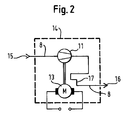
- FIG. 2 Details of an arrangement comprising the rotary compressor 11 are shown in Figure 2 . Accordingly, the compressor 11 in itself is driven by an electric motor 13. The compound of the compressor 11 and the motor 13 is contained in a housing 14, and traversed by the heat transfer loop 8 from an inlet 15 to an outlet 16.
- the housing 14 also contains an internal cooler 17 for cooling the motor 13 and the compressor 11. That cooler 17 is fed by heat transfer fluid exiting the compressor 11, according to common practice for rotary compressors 11.
- the heat transfer fluid upon entry via the inlet 15 does not flood the whole of the housing 14 prior to admission into the compressor 11, so as to provide cooling for the motor 13 and mechanical parts of the compressor 11.
- That type of cooling though quite effective in general, provides for heating up the heat transfer fluid prior to its compression and thus impairs the effectivity of the compression process. Accordingly, resort is made presently to cooling the motor 13 and the compressor 11 by heat transfer fluid after compression, which introduces its own limitations but assures an effective compression process, which improves the heat transfer process in turn.
- the household appliance having a heat pump as disclosed herein features a specific selection of functional components of the heat pump that assures a delicate balance of heat generation and transfer in application to a drying purpose and related operation on one hand with considerations relating to functional safety and environment on the other hand, to assure smooth and highly efficient operation at a properly limited expense in manufacturing and operation.
Landscapes
- Engineering & Computer Science (AREA)
- Textile Engineering (AREA)
- Physics & Mathematics (AREA)
- Mechanical Engineering (AREA)
- Thermal Sciences (AREA)
- General Engineering & Computer Science (AREA)
- Detail Structures Of Washing Machines And Dryers (AREA)
- Drying Of Solid Materials (AREA)
Abstract
The invention relates to a household appliance 1 comprising a drying chamber 2 for drying wet articles 3 therein, a process air loop 4 for circulating process air to dry the articles 3 and a heat pump 8, 9, 10, 11, 12. Said heat pump 8, 9, 10, 11, 12 comprises a heat transfer loop 8 containing a heat transfer fluid to be circulated through said heat transfer loop 8, an evaporator heat exchanger 9 for transferring heat from the process air into said heat transfer fluid by evaporating said heat transfer fluid, a liquefier heat exchanger 10 for transferring heat from said heat transfer fluid to the process air by liquefying said heat transfer fluid, a compressor 11 for compressing the heat transfer fluid and driving the heat transfer fluid through said heat transfer loop 8, and a nozzle 12 for decompressing said heat transfer fluid. Further, said heat transfer fluid has a critical temperature above 60°C, a nominal heat of vaporization at boiling point of at least 220 kJ/kg, a GWP index of less than 150 and a lower flammability level of at least 0,1 kg/m3. Preferably, the household appliance 1 is a dryer 1 for drying wet laundry 3.
Description
- The invention relates to a household appliance comprising a drying chamber for drying wet articles therein, a process air loop for circulating process air to dry the articles and a heat pump, said heat pump comprising a heat transfer loop containing a heat transfer fluid to be circulated through said heat transfer loop, an evaporator heat exchanger for transferring heat from the process air into the heat transfer fluid by evaporating said heat transfer fluid, a liquefier heat exchanger for transferring heat from said heat transfer fluid to the process air by liquefying said heat transfer fluid, a compressor for compressing said heat transfer fluid and driving said heat transfer fluid through said heat transfer loop, and a nozzle for decompressing said heat transfer fluid.
- A household appliance of this type is apparent from
EP 0 467 188 B1 . That document contains a detailed description of a household appliance that is configured as a dryer for drying articles which are wet laundry. The document refers to many details of the household appliance that may be necessary or at any rate advantageous in making or using the appliance. Accordingly, the whole content of this document is incorporated herein by reference. - Related art for household appliances is apparent from documents
WO 2006/029953 A1 that specifies a dishwasher in relation to a laundry dryer or combined laundry washer and dryer,DE 197 38 735 C2 that discloses a household appliance with a different type of heat pump,EP 1 672 294 A2 , andEP 1 672 295 A2 , the latter two disclosing air conditioning devices that have cooling circuits which are in some aspects similar to the heat pump considered herein incorporated therein. - Drying of wet articles in a household appliance generally requires evaporating the humidity on the articles and transporting away by means of a current of heated process air. Such process air loaded with evaporated humidity may be discharged from the appliance, or subjected to a condensation process to recover the transported humidity in liquid form for collection and disposal. Such condensation process in turn required to cool the process air, thereby extracting heat. That heat may again be discharged from the appliance simply; in order to keep consumption of energy low however, it may be desired to recover that heat at least to an extent. To that end, a household appliance has been developed that incorporates a heat pump which recovers energy taken from the process air by evaporating a heat transfer fluid, subsequently compressing that heat transfer fluid and releasing heat from it back into the process air which circulates in an essentially closed loop. While it may be expedient or even required to open such process air loop at least occasionally as described in
EP 0 467 188 B1 , pertinent IEC standards require that a dryer that is claimed to recover humidity by condensation keeps any leakage of humidity below 20% of the total humidity present. Problems still to be encountered with such household appliances incorporating heat pumps are high manufacturing costs, relatively long periods needed to dry convenient charges of laundry or the like, and possible environmental hazards from heat transfer fluids applied in such appliances. To mitigate such hazards that are predominantly related to ozone-destroying properties of such compounds, chlorinated hydrocarbons that had been applied frequently in the past are presently prohibited from use due to pertinent legislation. Two other concerns that have grown to become determinative for the design of heat pump systems containing heat transfer fluids are the Global Warming Potentials of such compounds, that is their effect as infrared backscatterers when dispersed in the atmosphere, and, of course, their flammabilities. - The pickup of humidity from articles to be dried by process air is only effective if the process air is heated over any normal ambient temperature, preferably to a temperature higher than 60°C. That temperature will be brought down by the evaporation process to a somewhat lower temperature. At any rate, a temperature around or above 35°C at an inlet of an evaporator heat exchanger may be expected to pose a problem to a heat pump of the type specified in the introductory chapter and designed in accordance with practice common in the art of refrigeration, in that compressors and refrigerant fluids (generally specified as "heat transfer fluids" herein) from normal refrigeration practice are not suitable for the purpose. It has been considered to obtain relief by reverting to refrigerants of remarkably high critical temperatures so as to ascertain their function at working temperatures up to 60°C, but no thorough analysis and guidance is available so far. Other measures that have been applied to obtain relief are bringing excess heat out of the appliance, by exhaling warm process air in exchange for cooler air and including additional heat exchangers to take excess heat from the heat transfer fluid. All of these measures, however, introduce further complexity and cost.
- The known alkane R290 or propane has pertinent physical properties that make it highly suitable for the application considered herein, and it is noted that propane has already been used in commercially used refrigeration systems. In particular, propane has a Global Warming Potential index ("GWP index" in short hereinafter) of 3 that is remarkably low in comparison to a GWP index of 1300 for the conventional heat transfer fluid R134a. Of course, application of propane which is highly flammable will require dedicated protection of the system against fire hazard. Details of GWP indices of generally known refrigerant compounds are listed in the textbook "Solkane-Product Manual Refrigeration and Air-Conditioning Technology" by H. Buchwald, J. Hellmann, H. König, and C. Meurer, 2nd ed. 08/2000. As to a quantitative classification of refrigerants in view of their flammabilities as expressed in a Lower Flammability Level index, reference is made to European Standard document IEC 60335-2-40, "Household and Similar Electrical Appliances -- Safety - particular Requirements for Electrical heat Pumps, Air-Conditioners and Dehumidifiers", Edition 4.2 2005-07, Annex BB - Table BB.1. Pertinent information on refrigerants or heat transfer fluids is also available in U. S. Standard ASHRAE 34, including a specific nomenclature for such compounds and a classification on security and toxicity of such compounds.
- Also, carbon dioxide or R744 is being considered for application in heat pump systems. While carbon dioxide is not flammable and has a GWP index as low as 1, carbon dioxide has a very low critical temperature that would not allow its application in a heat pump in a household appliance designed according to common practice.
- Accordingly, it is an object of the invention to specify a household appliance as defined in the introductory chapter herein that has a heat pump which is detailed in a way so as to alleviate the problems specified above and allows for quicker drying of articles at an appropriate expense.
- The present invention provides a solution embodied in the household appliance as defined in the independent claim. Preferred embodiments of the invention are defined in the dependent claims.
- According to the invention, there is specified a household appliance comprising a drying chamber for drying wet articles therein, a process air loop for circulating process air to dry the articles and a heat pump, said heat pump comprising a heat transfer loop containing a heat transfer fluid to be circulated through said heat transfer loop, an evaporator heat exchanger for transferring heat from the process air into said heat transfer fluid by evaporating said heat transfer fluid, a liquefier heat exchanger for transferring heat from said heat transfer fluid to the process air by liquefying said heat transfer fluid, a compressor for compressing said heat transfer fluid and driving said heat transfer fluid through said heat transfer loop, and a nozzle for decompressing said heat transfer fluid, wherein said heat transfer fluid has a critical temperature above 60°C, a nominal heat of vaporization at boiling point of at least 220 kJ/kg, a GWP index of less than 150 and a lower flammability level of at least 0,1 kg/m3
- In accordance with the invention, it has been found that a heat transfer fluid may be used which combines a high critical temperature and a remarkably high volumetric heat capacity as an effective basis for a drying process in a household appliance with application-related environmental properties conforming to pertinent general needs. In particular, application of a heat transfer fluid is taught that, though flammable, will reduce a hazard potential by a factor of at least 3 in comparison to the hazard potential offered by propane. Further, the GWP index of the heat transfer fluid selected in accordance with the invention is reduced by a factor of around 10 in comparison to the GWP index of a conventional heat transfer fluid like R134a, R407C and R410A. Indeed, the predominantly high nominal heat of vaporization at boiling point (to be determined at normal pressure, namely 1 bar or 101,3 kPa) of the heat transfer fluid assures that heat can be absorbed from the process air effectively. The effective absorption of heat by the heat transfer fluid also promotes acceleration of the drying process as a whole, so as to alleviate the problem of long duration of the drying process as experienced in prior art appliances with heat pumps.
- In a preferred embodiment of the invention, the household appliance's drying chamber is a rotatable drum. More preferred, the household appliance is configured as a dryer for drying wet laundry.
- In another preferred embodiment of the invention, the compressor is a rotary compressor. In such rotary compressor, the heat transfer fluid being compressed is kept at a steady flow without vortices and other discontinuities occurring at a major extent. Most important, excess import of heat into the heat transfer fluid prior to being compressed is avoided, which results in an overall improvement of the figure of merit of the compression process. In addition, the reduced temperature of the heat transfer fluid admitted for compression results in a larger mass flow within the heat transfer loop, yielding a further improvement in heat transport capacity, or allowing use of a somewhat smaller compressor. On one hand, such improved compressor will be somewhat more costly than a more usual compressor with a machine having reciprocating pistons. On the other hand, such improved compressor keeps any additional heating of the heat transfer fluid predominantly low, thereby mitigating excess temperatures within the heat pump.
- In a further preferred embodiment of the invention, the heat transfer fluid has a critical temperature above 105°C.
- In yet another preferred embodiment of the invention, the heat transfer fluid has a nominal heat of vaporization at boiling point between 230 kJ/kg and 440 kJ/kg.
- In still another preferred embodiment of the invention, said heat transfer fluid has a GWP index between 100 and 150.
- In still a further preferred embodiment of the invention, said heat transfer fluid has a lower flammability level of at least 0,12 kg/m3.
- In yet a further embodiment of the invention, the heat transfer fluid comprises at least one fluorinated hydrocarbon compound. Still more preferred, such heat transfer fluid is refrigerant R152a as specified under ASHRAE 34 or DIN 8960 standards.
- In still another preferred embodiment of the invention, the heat pump has a nominal cooling power between 500 W and 3.500 W, thus complying with needs established for application in a household appliance determined to dry wet laundry. Yet more preferred and also in view of the application just specified, the heat pump has a nominal cooling power between 1.500 W and 3.000 W.
- In still a further preferred embodiment of the invention, the evaporator heat exchanger has a nominal process air inlet temperature of at least 35°C, thus allowing application of the invention in a household appliance at predominantly high level of temperature, well above levels as usual in refrigeration or air conditioning systems.
- In yet another preferred embodiment of the invention, the liquefier heat exchanger has a nominal process air outlet temperature of less than 70°C; thereby it is demonstrated that the invention incorporates a particularly high degree of temperature control within the heat pump, to alleviate any need for additional temperature control in a household appliance where the heat pump has to operate at a predominantly high level of temperature, without an apparent need to resort to additional heat exchangers or other means to dispose of excess heat.
- An exemplary preferred embodiment of the invention is now described with reference to the accompanying drawing, wherein:
- Figure 1
- shows a household appliance configured as a dryer for drying laundry; and
- Figure 2
- shows a compressor configuration.
- The drawing has to be understood to be a sketch showing only such details as are necessarily required for the description subsequent hereto. For further details and indications on how to put the invention into practice, reference is made to the prior art documents cited herein and the pertinent knowledge of a person skilled in the art.
-
Figure 1 shows a household appliance 1 embodied as a dryer 1 for dryingwet laundry 3. It should be noted that such dryer 1 may be an appliance determined for drying solely, or an appliance determined for both washing and drying. - The dryer 1 comprises a
drying chamber 2 embodied as arotatable drum 2 for retainingwet laundry 3 to be dried by a flow of process air circulating in a closed process air loop 4. Process air is driven in a clockwise direction through said process air loop 4 by ablower 5. It should be noted that the placing of theblower 5 directly adjacent to thedrum 2 is only exemplary. Subsequent to traversing thedrum 2, the process air having taken up humidity from thelaundry 3 being tumbled by rotation of thedrum 2 traverses alint filter 6, in order to catch lint released from thelaundry 3 and prevent further components within the process air loop 4 from clogging. By cooling the process air after having traversed thelint filter 6, humidity contained therein is brought to condensation. Condensate thus obtained is stripped from the process air and collected in condensate collector 7 for disposal after the drying process has been accomplished. Subsequent to cooling and removal of condensate, the process air is heated again and conveyed back to thedrum 2 byblower 5, to pick up more humidity and thus dry thelaundry 3. - Sequential cooling and heating of the process air circulating in the process air loop 4 are accomplished by a
heat pump heat transfer loop 8 that contains a heat transfer fluid or refrigerant, namely the fluorinated hydrocarbon compound R152a. The heat transfer fluid is circulated throughevaporator heat exchanger 9 andliquefier heat exchanger 10. Inevaporator heat exchanger 9, the heat transfer fluid absorbs heat from the process air carrying humidity take up in thedrum 2. The resulting cooling of the process air results in that humidity condensates to be stripped off and conveyed to condensate collector 7 for later disposal. Details of this are well known in the art and are not detailed inFigure 1 accordingly. - The heat transfer fluid R152a combines a high critical temperature of 113,26 °C and a remarkably high volumetric heat capacity of 329,5 kJ/kg as an effective basis for a drying process in a household appliance with application-related environmental properties conforming to pertinent general needs, namely a GWP index of only 140 and a lower flammability level of 0,13 kg/m3. Application of that heat transfer fluid reduces a hazard potential by a factor of at least 3 in comparison to the hazard potential offered by propane. In practice, this means that a much larger leakage of R152a is needed in comparison to a leakage of propane to establish a real fire hazard by creating a mixture of heat transfer fluid and air that could be ignited by an inadvertent spark or the like. Further, the GWP index of R152a is reduced by a factor of around 10 in comparison to the GWP index of a conventional heat transfer fluid like R134a, R407C and R410A. Indeed, the predominantly high nominal heat of vaporization at boiling point (to be determined at normal pressure, namely 1 bar or 101,3 kPa) of R152a assures that heat can be absorbed from the process air effectively. The effective absorption of heat by the heat transfer fluid also promotes acceleration of the drying process as a whole.
- The resulting heating of the heat transfer fluid which reaches the
evaporator heat exchanger 9 in liquid phase results in the heat transfer fluid to evaporate. The heat transfer fluid leaves theevaporator heat exchanger 9 in gas phase through a respective portion of theheat transfer loop 8 and reaches thecompressor 11 which is arotary compressor 11. Suchrotary compressor 11 is available as a staple commercial product and detailed to some extent inFigure 2 , as explained hereinbelow. In thecompressor 11, the heat transfer fluid is compressed and forwarded to theliquefier heat exchanger 10, where it transfers heat to the process air arriving from theevaporator heat exchanger 9 as well, and condensates to its liquid state again. Subsequently, the heat transfer fluid passes anozzle 12 where it is decompressed to a lower pressure level, to enter theevaporator heat exchanger 9 again for absorbing more heat from the process air arriving from thelint filter 6, and completing its circuit. After having absorbed heat in theliquefier heat exchanger 10, the process air is conveyed back to thedrum 2 to absorb more humidity from thelaundry 3, to complete its own circuit. - Preferred temperature ranges for the heat transfer fluid or the process air have been specified hereinbefore and are not repeated at this point.
- Details of an arrangement comprising the
rotary compressor 11 are shown inFigure 2 . Accordingly, thecompressor 11 in itself is driven by anelectric motor 13. The compound of thecompressor 11 and themotor 13 is contained in a housing 14, and traversed by theheat transfer loop 8 from aninlet 15 to anoutlet 16. The housing 14 also contains an internal cooler 17 for cooling themotor 13 and thecompressor 11. That cooler 17 is fed by heat transfer fluid exiting thecompressor 11, according to common practice forrotary compressors 11. In contrast to usual practice with reciprocating compressors, the heat transfer fluid upon entry via theinlet 15 does not flood the whole of the housing 14 prior to admission into thecompressor 11, so as to provide cooling for themotor 13 and mechanical parts of thecompressor 11. That type of cooling, though quite effective in general, provides for heating up the heat transfer fluid prior to its compression and thus impairs the effectivity of the compression process. Accordingly, resort is made presently to cooling themotor 13 and thecompressor 11 by heat transfer fluid after compression, which introduces its own limitations but assures an effective compression process, which improves the heat transfer process in turn. - At any rate, the household appliance having a heat pump as disclosed herein features a specific selection of functional components of the heat pump that assures a delicate balance of heat generation and transfer in application to a drying purpose and related operation on one hand with considerations relating to functional safety and environment on the other hand, to assure smooth and highly efficient operation at a properly limited expense in manufacturing and operation.
-
- 1
- Household appliance, dryer
- 2
- Drying chamber, drum
- 3
- Wet articles, laundry
- 4
- Process air loop
- 5
- Blower
- 6
- Lint filter
- 7
- Condensate collector
- 8
- Heat transfer loop
- 9
- Evaporator heat exchanger
- 10
- Liquefier heat exchanger
- 11
- Compressor
- 12
- Nozzle
- 13
- Drive motor
- 14
- Compressor housing
- 15
- Compressor inlet
- 16
- Compressor outlet
- 17
- Internal cooler
Claims (14)
- Household appliance (1) comprising a drying chamber (2) for drying wet articles (3) therein, a process air loop (4) for circulating process air to dry the articles (3) and a heat pump (8, 9, 10, 11, 12), said heat pump (8, 9, 10, 11, 12) comprising a heat transfer loop (8) containing a heat transfer fluid to be circulated through said heat transfer loop (8), an evaporator heat exchanger (9) for transferring heat from the process air into said heat transfer fluid by evaporating said heat transfer fluid, a liquefier heat exchanger (10) for transferring heat from said heat transfer fluid to the process air by liquefying said heat transfer fluid, a compressor (11) for compressing said heat transfer fluid and driving said heat transfer fluid through said heat transfer loop (8), and a nozzle (12) for decompressing said heat transfer fluid, characterized in that said heat transfer fluid has a critical temperature above 60°C, a nominal heat of vaporization at boiling point of at least 220 kJ/kg, a GWP index of less than 150 and a lower flammability level of at least 0,1 kg/m3.
- Household appliance (1) according to claim 1, wherein said drying chamber (2) is a rotatable drum (2).
- Household appliance (1) according to claim 2, which is configured as a dryer (1) for drying wet laundry (3).
- Household appliance (1) according to one of the preceding claims, wherein said compressor (11) is a rotary compressor (11).
- Household appliance (1) according to one of the preceding claims, wherein said heat transfer fluid has a critical temperature above 105°C.
- Household appliance (1) according to one of the preceding claims, wherein said heat transfer fluid has nominal heat of vaporization at boiling point between 230 kJ/kg and 440 kJ/kg.
- Household appliance (1) according to one of the preceding claims, wherein said heat transfer fluid has a GWP index between 100 and 150.
- Household appliance (1) according to one of the preceding claims, wherein said heat transfer fluid has a lower flammability level of at least 0,12 kg/m3.
- Household appliance (1) according to one of the preceding claims, wherein said heat transfer fluid comprises a fluorinated hydrocarbon compound.
- Household appliance (1) according to claim 7, wherein said heat transfer fluid is refrigerant R152a.
- Household appliance (1) according to one of the preceding claims, wherein said heat pump (8, 9, 10, 11, 12) has a nominal cooling power between 500 W and 3.500 W.
- Household appliance (1) according to claim 11, wherein said heat pump (8, 9, 10, 11, 12) has a nominal cooling power between 1500 W and 3.000 W.
- Household appliance (1) according to one of the preceding claims, wherein said evaporator heat exchanger (9) has a nominal process air inlet temperature of at least 35°C.
- Household appliance (1) according to one of the preceding claims, wherein said liquefier heat exchanger (10) has a nominal process air outlet temperature of less than 70°C.
Priority Applications (6)
| Application Number | Priority Date | Filing Date | Title |
|---|---|---|---|
| EP07380292A EP2053159A1 (en) | 2007-10-25 | 2007-10-25 | Household appliance containing a heat transfer fluid |
| CN2008801129101A CN101835933B (en) | 2007-10-25 | 2008-10-10 | Household appliance containing a heat transfer fluid |
| PCT/EP2008/063641 WO2009053257A1 (en) | 2007-10-25 | 2008-10-10 | Household appliance containing a heat transfer fluid |
| EP08841043A EP2207931A1 (en) | 2007-10-25 | 2008-10-10 | Household appliance containing a heat transfer fluid |
| EA201070489A EA016181B1 (en) | 2007-10-25 | 2008-10-10 | Household appliance containing a heat transfer fluid |
| US12/681,935 US8356423B2 (en) | 2007-10-25 | 2008-10-10 | Household appliance containing a heat transfer fluid |
Applications Claiming Priority (1)
| Application Number | Priority Date | Filing Date | Title |
|---|---|---|---|
| EP07380292A EP2053159A1 (en) | 2007-10-25 | 2007-10-25 | Household appliance containing a heat transfer fluid |
Publications (1)
| Publication Number | Publication Date |
|---|---|
| EP2053159A1 true EP2053159A1 (en) | 2009-04-29 |
Family
ID=39244693
Family Applications (2)
| Application Number | Title | Priority Date | Filing Date |
|---|---|---|---|
| EP07380292A Withdrawn EP2053159A1 (en) | 2007-10-25 | 2007-10-25 | Household appliance containing a heat transfer fluid |
| EP08841043A Withdrawn EP2207931A1 (en) | 2007-10-25 | 2008-10-10 | Household appliance containing a heat transfer fluid |
Family Applications After (1)
| Application Number | Title | Priority Date | Filing Date |
|---|---|---|---|
| EP08841043A Withdrawn EP2207931A1 (en) | 2007-10-25 | 2008-10-10 | Household appliance containing a heat transfer fluid |
Country Status (5)
| Country | Link |
|---|---|
| US (1) | US8356423B2 (en) |
| EP (2) | EP2053159A1 (en) |
| CN (1) | CN101835933B (en) |
| EA (1) | EA016181B1 (en) |
| WO (1) | WO2009053257A1 (en) |
Cited By (4)
| Publication number | Priority date | Publication date | Assignee | Title |
|---|---|---|---|---|
| US20100212178A1 (en) * | 2007-10-25 | 2010-08-26 | Bsh Bosch Und Siemens Hausgerate Gmbh | Household appliance containing a heat transfer fluid |
| EP2690214A1 (en) * | 2012-07-27 | 2014-01-29 | Electrolux Home Products Corporation N.V. | Appliance for treating articles |
| EP2690213A1 (en) * | 2012-07-27 | 2014-01-29 | Electrolux Home Products Corporation N.V. | Appliance for treating articles |
| WO2015090431A1 (en) | 2013-12-20 | 2015-06-25 | Electrolux Appliances Aktiebolag | Appliance having a heat pump for treating articles |
Families Citing this family (12)
| Publication number | Priority date | Publication date | Assignee | Title |
|---|---|---|---|---|
| DE102005013051A1 (en) * | 2005-03-18 | 2006-09-21 | BSH Bosch und Siemens Hausgeräte GmbH | Condensation Dryer |
| EP1964965A1 (en) * | 2007-03-02 | 2008-09-03 | BSH Bosch und Siemens Hausgeräte GmbH | Household appliance with heat pump |
| EP2412868A1 (en) | 2010-07-29 | 2012-02-01 | BSH Bosch und Siemens Hausgeräte GmbH | Machine and process for drying humid articles with superheating a refrigerant |
| US8572862B2 (en) * | 2010-10-25 | 2013-11-05 | Battelle Memorial Institute | Open-loop heat-recovery dryer |
| EP2479337B1 (en) * | 2011-01-24 | 2013-08-07 | Electrolux Home Products Corporation N.V. | Household appliance for drying objects |
| EP2573252B1 (en) * | 2011-09-26 | 2014-05-07 | Electrolux Home Products Corporation N.V. | Laundry treatment apparatus with heat pump |
| DE102012202665A1 (en) * | 2012-02-21 | 2013-08-22 | BSH Bosch und Siemens Hausgeräte GmbH | Domestic appliance, in particular tumble dryer, comprising a latent heat storage, and method for its operation |
| FR2994254B1 (en) * | 2012-08-02 | 2018-08-10 | Electricite De France | HEAT PUMP FOR CARRYING HEATING WITH HIGH TEMPERATURE TEMPERATURES OF AN EXTERNAL FLUID, AND INSTALLATION COMPRISING SUCH A HEAT PUMP |
| CN104911882B (en) * | 2014-03-14 | 2018-10-30 | 青岛海尔滚筒洗衣机有限公司 | A kind of dryer or washing-drying integral machine |
| EP2985466A1 (en) | 2014-08-14 | 2016-02-17 | BSH Electrodomésticos España, S.A. | Rotary compressor, heat pump, and household appliance |
| EP3784106A1 (en) * | 2018-04-24 | 2021-03-03 | Illinois Tool Works NC. | Energy recovery from hot wares |
| US12252828B2 (en) | 2022-07-28 | 2025-03-18 | Whirlpool Corporation | Combination washing and drying laundry treating appliance |
Citations (7)
| Publication number | Priority date | Publication date | Assignee | Title |
|---|---|---|---|---|
| EP0467188A1 (en) * | 1990-07-19 | 1992-01-22 | Bosch-Siemens HausgerÀ¤te GmbH | Clothes dryer with heat pump |
| JPH0838795A (en) * | 1994-08-01 | 1996-02-13 | Hitachi Ltd | Dryer |
| DE19738735C2 (en) | 1997-09-04 | 2003-02-20 | Bsh Bosch Siemens Hausgeraete | Condensation dryer with a closed drying air circuit |
| WO2006029953A1 (en) | 2004-09-13 | 2006-03-23 | BSH Bosch und Siemens Hausgeräte GmbH | Drying method for a household appliance and household appliance for carrying the drying method |
| EP1672294A2 (en) | 2004-12-14 | 2006-06-21 | BSH Bosch und Siemens Hausgeräte GmbH | Air conditionig system |
| EP1672295A2 (en) | 2004-12-16 | 2006-06-21 | BSH Bosch und Siemens Hausgeräte GmbH | Air-conditioning device |
| US20070006601A1 (en) * | 2005-07-06 | 2007-01-11 | General Electric Company | System and method for controlling air temperature in an appliance |
Family Cites Families (16)
| Publication number | Priority date | Publication date | Assignee | Title |
|---|---|---|---|---|
| US3218728A (en) * | 1963-04-08 | 1965-11-23 | Fmc Corp | Low pressure carrier gas sublimation |
| US3654705A (en) * | 1971-01-11 | 1972-04-11 | Combustion Power | Fluidized bed vapor compression drying apparatus and method |
| DE2651871C2 (en) * | 1976-11-13 | 1984-12-06 | Linde Ag, 6200 Wiesbaden | Method and device for cooling objects or substances |
| DE3218728A1 (en) * | 1982-05-18 | 1984-03-01 | Telefunken electronic GmbH, 7100 Heilbronn | Ion-beam etching appliance |
| US4876802A (en) * | 1983-12-21 | 1989-10-31 | Gerhard Gergely | Process and means for the heat treatment of powdery or granulate material |
| CH675626A5 (en) * | 1986-08-27 | 1990-10-15 | Sulzer Ag | |
| DE4237695C3 (en) * | 1992-05-13 | 2000-02-24 | Bbc Reaktor Gmbh | Method and device for the non-destructive testing of the implementation of a reactor pressure vessel cover |
| US5680711A (en) * | 1996-03-01 | 1997-10-28 | Moratalla; Jose | Thermal processing system |
| TWI276763B (en) * | 2002-09-06 | 2007-03-21 | Kenneth William Patte Drysdale | Apparatus, method and software for use with an air conditioning cycle |
| JP2005024113A (en) * | 2003-06-30 | 2005-01-27 | Sanyo Electric Co Ltd | Dryer |
| MXPA06003546A (en) * | 2003-09-29 | 2007-02-02 | Self Propelled Res And Dev Spe | Heat pump clothes dryer. |
| JP4286712B2 (en) * | 2004-05-06 | 2009-07-01 | パナソニック株式会社 | Clothes dryer |
| EP1964965A1 (en) * | 2007-03-02 | 2008-09-03 | BSH Bosch und Siemens Hausgeräte GmbH | Household appliance with heat pump |
| EP2053159A1 (en) * | 2007-10-25 | 2009-04-29 | BSH Electrodomésticos España, S.A. | Household appliance containing a heat transfer fluid |
| EP2235249B1 (en) * | 2007-12-11 | 2016-05-25 | BSH Hausgeräte GmbH | Household appliance comprising a first air conduit and a heat pump |
| WO2010087698A2 (en) * | 2009-01-27 | 2010-08-05 | Inhaleness B.V. | Method, device and fuel for hydrogen generation |
-
2007
- 2007-10-25 EP EP07380292A patent/EP2053159A1/en not_active Withdrawn
-
2008
- 2008-10-10 US US12/681,935 patent/US8356423B2/en not_active Expired - Fee Related
- 2008-10-10 CN CN2008801129101A patent/CN101835933B/en not_active Expired - Fee Related
- 2008-10-10 WO PCT/EP2008/063641 patent/WO2009053257A1/en not_active Ceased
- 2008-10-10 EA EA201070489A patent/EA016181B1/en not_active IP Right Cessation
- 2008-10-10 EP EP08841043A patent/EP2207931A1/en not_active Withdrawn
Patent Citations (8)
| Publication number | Priority date | Publication date | Assignee | Title |
|---|---|---|---|---|
| EP0467188A1 (en) * | 1990-07-19 | 1992-01-22 | Bosch-Siemens HausgerÀ¤te GmbH | Clothes dryer with heat pump |
| EP0467188B1 (en) | 1990-07-19 | 2001-04-04 | BSH Bosch und Siemens Hausgeräte GmbH | Clothes dryer with heat pump |
| JPH0838795A (en) * | 1994-08-01 | 1996-02-13 | Hitachi Ltd | Dryer |
| DE19738735C2 (en) | 1997-09-04 | 2003-02-20 | Bsh Bosch Siemens Hausgeraete | Condensation dryer with a closed drying air circuit |
| WO2006029953A1 (en) | 2004-09-13 | 2006-03-23 | BSH Bosch und Siemens Hausgeräte GmbH | Drying method for a household appliance and household appliance for carrying the drying method |
| EP1672294A2 (en) | 2004-12-14 | 2006-06-21 | BSH Bosch und Siemens Hausgeräte GmbH | Air conditionig system |
| EP1672295A2 (en) | 2004-12-16 | 2006-06-21 | BSH Bosch und Siemens Hausgeräte GmbH | Air-conditioning device |
| US20070006601A1 (en) * | 2005-07-06 | 2007-01-11 | General Electric Company | System and method for controlling air temperature in an appliance |
Non-Patent Citations (2)
| Title |
|---|
| "Household and Similar Electrical Appliances", July 2005, article "Safety - particular Requirements for Electrical heat Pumps, Air-Conditioners and Dehumidifiers" |
| H. BUCHWALD ET AL.: "Solkane-Product Manual Refrigeration and Air-Conditioning Technology", August 2000 |
Cited By (7)
| Publication number | Priority date | Publication date | Assignee | Title |
|---|---|---|---|---|
| US20100212178A1 (en) * | 2007-10-25 | 2010-08-26 | Bsh Bosch Und Siemens Hausgerate Gmbh | Household appliance containing a heat transfer fluid |
| US8356423B2 (en) * | 2007-10-25 | 2013-01-22 | Bsh Bosch Und Siemens Haugeraete Gmbh | Household appliance containing a heat transfer fluid |
| EP2690214A1 (en) * | 2012-07-27 | 2014-01-29 | Electrolux Home Products Corporation N.V. | Appliance for treating articles |
| EP2690213A1 (en) * | 2012-07-27 | 2014-01-29 | Electrolux Home Products Corporation N.V. | Appliance for treating articles |
| WO2014016419A3 (en) * | 2012-07-27 | 2014-04-03 | Electrolux Home Products Corporation N.V. | Appliance for treating articles |
| WO2014016426A3 (en) * | 2012-07-27 | 2014-04-03 | Electrolux Home Products Corporation N.V. | Appliance for treating articles |
| WO2015090431A1 (en) | 2013-12-20 | 2015-06-25 | Electrolux Appliances Aktiebolag | Appliance having a heat pump for treating articles |
Also Published As
| Publication number | Publication date |
|---|---|
| US20100212178A1 (en) | 2010-08-26 |
| EA016181B1 (en) | 2012-02-28 |
| US8356423B2 (en) | 2013-01-22 |
| EA201070489A1 (en) | 2010-10-29 |
| CN101835933A (en) | 2010-09-15 |
| EP2207931A1 (en) | 2010-07-21 |
| WO2009053257A1 (en) | 2009-04-30 |
| CN101835933B (en) | 2011-11-02 |
Similar Documents
| Publication | Publication Date | Title |
|---|---|---|
| US8356423B2 (en) | Household appliance containing a heat transfer fluid | |
| EP2132370B1 (en) | Household appliance with heat pump | |
| EP2235249B1 (en) | Household appliance comprising a first air conduit and a heat pump | |
| EP2212463B1 (en) | Household appliance having a heat pump unit and means for cooling a component thereof | |
| CN209310455U (en) | A kind of composition open and close formula Analysis of Heat Pump Drying System being rapidly heated | |
| US8650770B1 (en) | Air cycle heat pump dryer | |
| EP2455526A1 (en) | Machine comprising a heat pump and related set of processes | |
| Mancini et al. | Thermodynamic analysis and experimental investigation of a CO2 household heat pump dryer | |
| WO2009098158A1 (en) | Tumble drier comprising a heat pump and heating system and method for operating the same | |
| WO2011072999A2 (en) | Household appliance comprising an expansion system | |
| EP2551401A1 (en) | A heat pump system for a laundry dryer | |
| EP2025802A2 (en) | Hybrid household drying device | |
| EP2479337B1 (en) | Household appliance for drying objects | |
| EP2690213A1 (en) | Appliance for treating articles | |
| EP2071069A1 (en) | Household appliance comprising a first air conduit and a heat pump | |
| EP2412868A1 (en) | Machine and process for drying humid articles with superheating a refrigerant | |
| JPH0838795A (en) | Dryer | |
| Gopalnarayanan et al. | Heat Pump Refrigerant | |
| EP3084065B1 (en) | Appliance having a heat pump for treating articles | |
| Eikevik et al. | Dimensioning of heat pump dryer components-an economical operation for quality, energy use and water removal” | |
| EP2690214A1 (en) | Appliance for treating articles |
Legal Events
| Date | Code | Title | Description |
|---|---|---|---|
| PUAI | Public reference made under article 153(3) epc to a published international application that has entered the european phase |
Free format text: ORIGINAL CODE: 0009012 |
|
| AK | Designated contracting states |
Kind code of ref document: A1 Designated state(s): AT BE BG CH CY CZ DE DK EE ES FI FR GB GR HU IE IS IT LI LT LU LV MC MT NL PL PT RO SE SI SK TR |
|
| AX | Request for extension of the european patent |
Extension state: AL BA HR MK RS |
|
| AKX | Designation fees paid | ||
| REG | Reference to a national code |
Ref country code: DE Ref legal event code: 8566 |
|
| STAA | Information on the status of an ep patent application or granted ep patent |
Free format text: STATUS: THE APPLICATION IS DEEMED TO BE WITHDRAWN |
|
| 18D | Application deemed to be withdrawn |
Effective date: 20091030 |