EP2053045A1 - Novel imidazole derivatives - Google Patents
Novel imidazole derivatives Download PDFInfo
- Publication number
- EP2053045A1 EP2053045A1 EP07020982A EP07020982A EP2053045A1 EP 2053045 A1 EP2053045 A1 EP 2053045A1 EP 07020982 A EP07020982 A EP 07020982A EP 07020982 A EP07020982 A EP 07020982A EP 2053045 A1 EP2053045 A1 EP 2053045A1
- Authority
- EP
- European Patent Office
- Prior art keywords
- chloro
- formula
- compound
- fluoro
- alkyl
- Prior art date
- Legal status (The legal status is an assumption and is not a legal conclusion. Google has not performed a legal analysis and makes no representation as to the accuracy of the status listed.)
- Ceased
Links
- 0 *c1c(*)nc(*)[n]1-c(c(Cl)ccc1)c1Cl Chemical compound *c1c(*)nc(*)[n]1-c(c(Cl)ccc1)c1Cl 0.000 description 2
Classifications
-
- C—CHEMISTRY; METALLURGY
- C07—ORGANIC CHEMISTRY
- C07D—HETEROCYCLIC COMPOUNDS
- C07D233/00—Heterocyclic compounds containing 1,3-diazole or hydrogenated 1,3-diazole rings, not condensed with other rings
- C07D233/54—Heterocyclic compounds containing 1,3-diazole or hydrogenated 1,3-diazole rings, not condensed with other rings having two double bonds between ring members or between ring members and non-ring members
-
- A—HUMAN NECESSITIES
- A61—MEDICAL OR VETERINARY SCIENCE; HYGIENE
- A61P—SPECIFIC THERAPEUTIC ACTIVITY OF CHEMICAL COMPOUNDS OR MEDICINAL PREPARATIONS
- A61P35/00—Antineoplastic agents
-
- C—CHEMISTRY; METALLURGY
- C07—ORGANIC CHEMISTRY
- C07D—HETEROCYCLIC COMPOUNDS
- C07D233/00—Heterocyclic compounds containing 1,3-diazole or hydrogenated 1,3-diazole rings, not condensed with other rings
- C07D233/54—Heterocyclic compounds containing 1,3-diazole or hydrogenated 1,3-diazole rings, not condensed with other rings having two double bonds between ring members or between ring members and non-ring members
- C07D233/56—Heterocyclic compounds containing 1,3-diazole or hydrogenated 1,3-diazole rings, not condensed with other rings having two double bonds between ring members or between ring members and non-ring members with only hydrogen atoms or radicals containing only hydrogen and carbon atoms, attached to ring carbon atoms
- C07D233/61—Heterocyclic compounds containing 1,3-diazole or hydrogenated 1,3-diazole rings, not condensed with other rings having two double bonds between ring members or between ring members and non-ring members with only hydrogen atoms or radicals containing only hydrogen and carbon atoms, attached to ring carbon atoms with hydrocarbon radicals, substituted by nitrogen atoms not forming part of a nitro radical, attached to ring nitrogen atoms
-
- C—CHEMISTRY; METALLURGY
- C07—ORGANIC CHEMISTRY
- C07D—HETEROCYCLIC COMPOUNDS
- C07D233/00—Heterocyclic compounds containing 1,3-diazole or hydrogenated 1,3-diazole rings, not condensed with other rings
- C07D233/54—Heterocyclic compounds containing 1,3-diazole or hydrogenated 1,3-diazole rings, not condensed with other rings having two double bonds between ring members or between ring members and non-ring members
- C07D233/66—Heterocyclic compounds containing 1,3-diazole or hydrogenated 1,3-diazole rings, not condensed with other rings having two double bonds between ring members or between ring members and non-ring members with hetero atoms or with carbon atoms having three bonds to hetero atoms with at the most one bond to halogen, e.g. ester or nitrile radicals, directly attached to ring carbon atoms
- C07D233/68—Halogen atoms
-
- C—CHEMISTRY; METALLURGY
- C07—ORGANIC CHEMISTRY
- C07D—HETEROCYCLIC COMPOUNDS
- C07D401/00—Heterocyclic compounds containing two or more hetero rings, having nitrogen atoms as the only ring hetero atoms, at least one ring being a six-membered ring with only one nitrogen atom
- C07D401/02—Heterocyclic compounds containing two or more hetero rings, having nitrogen atoms as the only ring hetero atoms, at least one ring being a six-membered ring with only one nitrogen atom containing two hetero rings
- C07D401/04—Heterocyclic compounds containing two or more hetero rings, having nitrogen atoms as the only ring hetero atoms, at least one ring being a six-membered ring with only one nitrogen atom containing two hetero rings directly linked by a ring-member-to-ring-member bond
-
- C—CHEMISTRY; METALLURGY
- C07—ORGANIC CHEMISTRY
- C07D—HETEROCYCLIC COMPOUNDS
- C07D409/00—Heterocyclic compounds containing two or more hetero rings, at least one ring having sulfur atoms as the only ring hetero atoms
- C07D409/02—Heterocyclic compounds containing two or more hetero rings, at least one ring having sulfur atoms as the only ring hetero atoms containing two hetero rings
- C07D409/04—Heterocyclic compounds containing two or more hetero rings, at least one ring having sulfur atoms as the only ring hetero atoms containing two hetero rings directly linked by a ring-member-to-ring-member bond
-
- C—CHEMISTRY; METALLURGY
- C07—ORGANIC CHEMISTRY
- C07D—HETEROCYCLIC COMPOUNDS
- C07D409/00—Heterocyclic compounds containing two or more hetero rings, at least one ring having sulfur atoms as the only ring hetero atoms
- C07D409/14—Heterocyclic compounds containing two or more hetero rings, at least one ring having sulfur atoms as the only ring hetero atoms containing three or more hetero rings
Definitions
- the present invention provides a compound of formula I: wherein
- substituents are: halogen, alkyl, haloalkyl, cycloalkyl, cycloalkylalkyl, alkenyl, haloalkenyl, cycloalkenyl, alkynyl, haloalkynyl, alkyloxy, haloalkyloxy, cycloalkoxy, alkenyloxy, haloalkenyloxy, alkynyloxy, haloalkenyloxy, alkylthio, haloalkylthio, cycloalkylthio, alkenylthio, alkynylthio, alkylcarbonyl, haloalkylcarbonyl, cycloalkylcarbonyl, alkenylcarbonyl, alkynylcarbonyl, alkoxyalkyl, cyano, nitro, hydroxy, mercapto, amino, alkylamino, dialkylamino.
- halogen is fluorine, chlorine, bromine or iodine.
- Cycloalkyl on its own or as part of another substituent is, depending upon the number of carbon atoms mentioned, for example, cyclopropyl, cyclobutyl, cyclopentyl or cyclohexyl.
- Alkynyl on its own or as part of another substituent is, depending upon the number of carbon atoms mentioned, for example, ethynyl, propyn-1-yl, propyn-2-yl, butyn-1-yl, butyn-2-yl, 1-methyl-2-butynyl, hexyn-1-yl or 1-ethyl-2-butynyl.
- the presence of one or more possible asymmetric carbon atoms in a compound of formula I means that the compounds may occur in optically isomeric, that means enantiomeric or diastereomeric forms.
- optically isomeric that means enantiomeric or diastereomeric forms.
- geometric isomerism that means cis-trans or ( E )-( Z ) isomerism may also occur.
- atropisomers may occur as a result of restricted rotation about a single bond.
- Formula I is intended to include all those possible isomeric forms and mixtures thereof.
- the present invention intends to include all those possible isomeric forms and mixtures thereof for a compound of formula I.
- compounds of formula I according to the invention have R 1 which is halogen, C 1 -C 3 alkyl or C 1 -C 3 haloalkyl.
- compounds of formula I according to the invention have R 3 which is fluoro, chloro, bromo or iodo.
- compounds of formula I according to the invention have R 4 which is hydrogen, halogen, C 1 -C 3 alkyl, C 1 -C 3 haloalkyl, C 1 -C 3 alkoxy or C 1 -C 3 haloalkoxy or cyano.
- Preferred individual compounds are:
- novel compounds of formula I have, for practical purposes, a very advantageous level of biological activity for protecting plants against diseases that are caused by fungi as well as by bacteria and viruses.
- the compounds of formula I or compositions, comprising a compound of formula I as active ingredient and an inert carrier, can be applied to the locus of the plant or plant to be treated, simultaneously or in succession with further compounds.
- further compounds can be e.g. fertilizers or micronutrient donors or other preparations which influence the growth of plants. They can also be selective herbicides as well as insecticides, fungicides, bactericides, nematicides, molluscicides or mixtures of several of these preparations, if desired together with further carriers, surfactants or application promoting adjuvants customarily employed in the art of formulation.
- a formulation i.e. a composition comprising the compound of formula I and, if desired, a solid or liquid adjuvant, is prepared in a known manner, typically by intimately mixing and/or grinding the compound with extenders, for example solvents, solid carriers and, optionally, surface-active compounds (surfactants).
- extenders for example solvents, solid carriers and, optionally, surface-active compounds (surfactants).
- Advantageous rates of application are normally from 5g to 2kg of active ingredient (a.i.) per hectare (ha), preferably from 10g to 1 kg a.i./ha, most preferably from 20g to 600g a.i./ha.
- convenient rates of application are from 10mg to 1 g of active substance per kg of seeds.
- the rate of application for the desired action can be determined by experiments. It depends for example on the type of action, the developmental stage of the useful plant, and on the application (location, timing, application method) and can, owing to these parameters, vary within wide limits.
- the invention relates to a method of controlling or preventing infestation of useful plants by phytopathogenic micro-organisms, wherein a compound of formula I is applied as active ingredient to the plants, to parts thereof or the locus thereof.
- the compounds of formula I according to the invention are distinguished by excellent activity at low rates of application, by being well tolerated by plants and by being environmentally safe. They have very useful curative, preventive and systemic properties and are used for protecting numerous useful plants.
- the compounds of formula I can be used to inhibit or destroy the diseases that occur on plants or parts of plants (fruit, blossoms, leaves, stems, tubers, roots) of different crops of useful plants, while at the same time protecting also those parts of the plants that grow later e.g. from phytopathogenic micro-organisms.
- imazamox by conventional methods of breeding (mutagenesis) is Clearfield® summer rape (Canola).
- crops that have been rendered tolerant to herbicides or classes of herbicides by genetic engineering methods include glyphosate- and glufosinate-resistant maize varieties commercially available under the trade names RoundupReady®, Herculex I® and LibertyLink®.
- useful plants is to be understood as including also useful plants which have been so transformed by the use of recombinant DNA techniques that they are capable of synthesising antipathogenic substances having a selective action, such as, for example, the so-called "pathogenesis-related proteins" (PRPs, see e.g. EP-A-0 392 225 ).
- PRPs pathogenesis-related proteins
- Examples of such antipathogenic substances and transgenic plants capable of synthesising such antipathogenic substances are known, for example, from EP-A-0 392 225 , WO 95/33818 , and EP-A-0 353 191 .
- the methods of producing such transgenic plants are generally known to the person skilled in the art and are described, for example, in the publications mentioned above.
- the compounds of formula I are normally used in the form of fungicidal compositions for controlling or protecting against phytopathogenic microorganisms, comprising as active ingredient at least one compound of formula I, in free form or in agrochemically usable salt form, and at least one of the above-mentioned adjuvants.
- Example 2 This example illustrates the preparation of 2-[5-(4-Bromo-phenyl)-2,4-dichloro-imidazol-1-yl]-3,5-dichloro-pyridine (Compound No.I.s.034)
- Magnaporthe grisea (Pyricularia oryzae) / rice / preventive (Action against rice blast)
- 1-week-old barley plants cv. Regina are treated with the formulated test compound in a spray chamber. Two days after application barley plants are inoculated by spraying a spore suspension (2.6 x 10 4 conidia/ml) on the test plants. After an incubation period of 4 days at 20 °C and 95% r. h. the disease incidence is assessed.
- Compounds of formula I according to the invention inhibit fungal infestation in this test to at least 80 %, while under the same conditions untreated control plants are infected by the phytopathogenic fungi to over 80 %.
Landscapes
- Chemical & Material Sciences (AREA)
- Organic Chemistry (AREA)
- Health & Medical Sciences (AREA)
- Chemical Kinetics & Catalysis (AREA)
- General Chemical & Material Sciences (AREA)
- Medicinal Chemistry (AREA)
- Nuclear Medicine, Radiotherapy & Molecular Imaging (AREA)
- Pharmacology & Pharmacy (AREA)
- Life Sciences & Earth Sciences (AREA)
- Animal Behavior & Ethology (AREA)
- General Health & Medical Sciences (AREA)
- Public Health (AREA)
- Veterinary Medicine (AREA)
- Plural Heterocyclic Compounds (AREA)
- Agricultural Chemicals And Associated Chemicals (AREA)
Abstract
The present invention relates to novel imidazole derivatives of formula I as active ingredients which have microbiocidal activity, in particular fungicidal activity:

wherein
R1 is halogen, C1-C4alkyl or C1-C4haloalkyl;
R2 is an optionally substituted aryl or heteroaryl;
R3 is halogen;
R4 is hydrogen, halogen, C1-C4alkyl, C1-C4haloalkyl, C1-C4alkoxy, C1-C4haloalkoxy or cyano;
R5 is halogen;
X is N or C(R); and
R is hydrogen, halogen, C1-C4alkyl, C1-C4haloalkyl, C1-C4alkoxy, C1-C4haloalkoxy or cyano; or an agrochemically usable salt form thereof;
provided that
when X is C(R), R2 cannot be an optionally substituted aryl.
R1 is halogen, C1-C4alkyl or C1-C4haloalkyl;
R2 is an optionally substituted aryl or heteroaryl;
R3 is halogen;
R4 is hydrogen, halogen, C1-C4alkyl, C1-C4haloalkyl, C1-C4alkoxy, C1-C4haloalkoxy or cyano;
R5 is halogen;
X is N or C(R); and
R is hydrogen, halogen, C1-C4alkyl, C1-C4haloalkyl, C1-C4alkoxy, C1-C4haloalkoxy or cyano; or an agrochemically usable salt form thereof;
provided that
when X is C(R), R2 cannot be an optionally substituted aryl.
Description
- The present invention relates to novel imidazole derivatives as active ingredients which have microbiocidal activity, in particular fungicidal activity. The invention also relates to preparation of these active ingredients, to novel heterocyclic derivatives used as intermediates in the preparation of these active ingredients, to preparation of these novel intermediates, to agrochemical compositions which comprise at least one of the novel active ingredients, to preparation of these compositions and to use of the active ingredients or compositions in agriculture or horticulture for controlling or preventing infestation of plants, harvested food crops, seeds or non-living materials by phytopathogenic microorganisms, preferably fungi.
- The present invention provides a compound of formula I:

- R1 is halogen, C1-C4alkyl or C1-C4haloalkyl;
- R2 is an optionally substituted aryl or heteroaryl;
- R3 is halogen;
- R4 is hydrogen, halogen, C1-C4alkyl, C1-C4haloalkyl, C1-C4alkoxy, C1-C4haloalkoxy or cyano;
- R5 is halogen;
- X is N or C(R); and
- R is hydrogen, halogen, C1-C4alkyl, C1-C4haloalkyl, C1-C4alkoxy, C1-C4haloalkoxy or cyano; or an agrochemically usable salt form thereof;
provided that
when X is C(R), R2 cannot be an optionally substituted aryl. - In the above definition aryl includes aromatic hydrocarbon rings like phenyl, naphthyl, anthracenyl, phenanthrenyl and biphenyl, with phenyl being preferred.
- Heteroaryl stands for aromatic ring systems comprising mono-, bi- or tricyclic systems wherein at least one oxygen, nitrogen or sulfur atom is present as a ring member. Examples are furyl, thienyl, pyrrolyl, imidazolyl, pyrazolyl, thiazolyl, isothiazolyl, oxazolyl, isoxazolyl, oxadiazolyl, thiadiazolyl, triazolyl, tetrazolyl, pyridyl, pyridazinyl, pyrimidinyl, pyrazinyl, triazinyl, tetrazinyl, indolyl, benzothiophenyl, benzofuranyl, benzimidazolyl, indazolyl, benzotriazolyl, benzothiazolyl, benzoxazolyl, quinolyl, isoquinolyl, phthalazinyl, quinoxalinyl, quinazolinyl, cinnolinyl and naphthyridinyl.
- The above or below mentioned fused ring, carbocyclic ring, heterocyclic ring, aryl group and heteroaryl group may be optionally substituted. This means that they may carry one or more identical or different substituents. Normally not more than three substituents are present at the same time. Examples of substituents are: halogen, alkyl, haloalkyl, cycloalkyl, cycloalkylalkyl, alkenyl, haloalkenyl, cycloalkenyl, alkynyl, haloalkynyl, alkyloxy, haloalkyloxy, cycloalkoxy, alkenyloxy, haloalkenyloxy, alkynyloxy, haloalkenyloxy, alkylthio, haloalkylthio, cycloalkylthio, alkenylthio, alkynylthio, alkylcarbonyl, haloalkylcarbonyl, cycloalkylcarbonyl, alkenylcarbonyl, alkynylcarbonyl, alkoxyalkyl, cyano, nitro, hydroxy, mercapto, amino, alkylamino, dialkylamino. Typical examples for optionally substituted aryl include 2-fluorophenyl, 3-fluorophenyl, 4-fluorophenyl, 2-chlorophenyl, 3-chlorophenyl, 4-chlorophenyl, 3-bromophenyl, 4-bromophenyl, m-tolyl, p-tolyl, 3-trifluoromethylphenyl, 4-trifluoromethylphenyl, 3-methoxyphenyl, 4-methoxyphenyl, 3-trifluoromethoxyphenyl, 4-trifluoromethoxyphenyl, 3-cyanophenyl, 4-cyanophenyl, 2,4-difluorophenyl, 2,5-difluorophenyl, 2,6-difluorophenyl, 3,4-difluorophenyl, 2,4-dichlorophenyl, 2,5-dichlorophenyl, 2,6-dichlorophenyl, 3,4-dichlorophenyl, 3,4-dimethylphenyl, 3,4-dimethoxyphenyl, 2-chloro-4-fluorophenyl, 2-chloro-5-fluorophenyl, 2-chloro-6-fluorophenyl, 3-chloro-4-fluorophenyl, 3-chloro-6-fluorophenyl, 3-chloro-4-methylphenyl, 3-chloro-4-methoxyphenyl, 4-chloro-2-fluorophenyl, 4-chloro-3-fluorophenyl, 4-chloro-3-methylphenyl, 4-chloro-3-methoxyphenyl, 3-fluoro-4-methoxyphenyl, 3-fluoro-4-methylphenyl, 4-fluoro-3-methoxyphenyl, 4-fluoro-3-methylphenyl, 3-methoxy-4-methylphenyl, 4-methoxy-3-methylphenyl, 2,6-difluoro-4-methylphenyl, 2,6-difluoro-4-trifluoromethylphenyl, 2,6-difluoro-4-methoxyphenyl, 2,6-difluoro-4-trifluoromethoxyphenyl, 2,6-difluoro-4-cyanophenyl, 2,4,6-trifluorophenyl, 2,5,6-trifluorophenyl. Typical examples for optionally substituted heteroaryl include 6-chloropyridin-2-yl, 6-fluoropyridin-2-yl, 6-methoxypyridin-2-yl, 6-methylpyridin-2-yl, 6-chloropyridin-3-yl, 6-fluoropyridin-3-yl, 6-methoxypyridin-3-yl, 6-methylpyridin-3-yl, 2-chloropyridin-4-yl, 2-fluoropyridin-4-yl, 2-methoxypyridin-4-yl, 2-methylpyridin-4-yl, 3,5-dichloropyridin-2-yl, 3,5-difluoropyridin-2-yl, 3-chloro-5-fluoropyridin-2-yl, 3-chloro-5-methylpyridin-2-yl, 3-chloro-5-trifluoromethylpyridin-2-yl, 3-chloro-5-methoxypyridin-2-yl, 3-chloro-5-trifluoromethoxypyridin-2-yl, 3-chloro-5-cyanopyridin-2-yl, 5-chloro-3-fluoropyridin-2-yl, 3-fluoro-5-methylpyridin-2-yl, 3-fluoro-5-trifluoromethylpyridin-2-yl, 3-fluoro-5-methoxypyridin-2-yl, 3-fluoro-5-trifluoromethoxypyridin-2-yl, 3-fluoro-5-cyanopyridin-2-yl, 5-chlorothiophen-2-yl, 5-bromothiophen-2-yl, 5-methoxythiophen-2-yl, 4-methoxyquinolin-2-yl, 4-methylquinolin-2-yl.
- In the above definition halogen is fluorine, chlorine, bromine or iodine.
- The alkyl, alkenyl or alkynyl radicals may be straight-chained or branched.
- Alkyl on its own or as part of another substituent is, depending upon the number of carbon atoms mentioned, for example, methyl, ethyl, propyl, butyl, pentyl, hexyl and the isomers thereof, for example, isopropyl, isobutyl, sec-butyl, tert-butyl, isopentyl or tert-pentyl.
- A haloalkyl group may contain one or more identical or different halogen atoms and, for example, may stand for CH2Cl, CHCl2, CCl3, CH2F, CHF2, CF3, CF3CH2, CH3CF2, CF3CF2 or CCl3CCl2.
- Cycloalkyl on its own or as part of another substituent is, depending upon the number of carbon atoms mentioned, for example, cyclopropyl, cyclobutyl, cyclopentyl or cyclohexyl.
- Alkenyl on its own or as part of another substituent is, depending upon the number of carbon atoms mentioned, for example, ethenyl, allyl, 1-propenyl, buten-2-yl, buten-3-yl, penten-1-yl, penten-3-yl, hexen-1-yl or 4-methyl-3-pentenyl.
- Alkynyl on its own or as part of another substituent is, depending upon the number of carbon atoms mentioned, for example, ethynyl, propyn-1-yl, propyn-2-yl, butyn-1-yl, butyn-2-yl, 1-methyl-2-butynyl, hexyn-1-yl or 1-ethyl-2-butynyl.
- The presence of one or more possible asymmetric carbon atoms in a compound of formula I means that the compounds may occur in optically isomeric, that means enantiomeric or diastereomeric forms. As a result of the presence of a possible aliphatic C=C double bond, geometric isomerism, that means cis-trans or (E)-(Z) isomerism may also occur. Also atropisomers may occur as a result of restricted rotation about a single bond. Formula I is intended to include all those possible isomeric forms and mixtures thereof. The present invention intends to include all those possible isomeric forms and mixtures thereof for a compound of formula I.
- In each case, the compounds of formula I according to the invention are in free form or in an agronomically usable salt form.
- In a first embodiment, compounds of formula I according to the invention have R1 which is halogen, C1-C3alkyl or C1-C3haloalkyl.
- In a second embodiment, compounds of formula I according to the invention have R2 which is an optionally substituted phenyl, naphthyl, pyridyl, thienyl or quinolyl.
- In a third embodiment, compounds of formula I according to the invention have R3 which is fluoro, chloro, bromo or iodo.
- In a fourth embodiment, compounds of formula I according to the invention have R4 which is hydrogen, halogen, C1-C3alkyl, C1-C3haloalkyl, C1-C3alkoxy or C1-C3haloalkoxy or cyano.
- In a fifth embodiment, compounds of formula I according to the invention have R5 which is fluoro, chloro, bromo or iodo.
- In a sixth embodiment, compounds of formula I according to the invention have X which is N, C(H), C(halogen), C(C1-C4alkyl), C(C1-C4haloalkyl), C(C1-C4alkoxy) or C(C1-C4haloalkoxy).
- Preferred subgroups of compounds of formula I according to the invention are those wherein R1 is fluoro, chloro, bromo, iodo, C1-C2alkyl or C1-C2haloalkyl;
- R2 is an optionally substituted phenyl, pyridyl, thienyl or quinolyl;
- R3 is fluoro, chloro or bromo;
- R4 is hydrogen, fluoro, chloro, bromo, C1-C3alkyl, C1-C3haloalkyl, C1-C3alkoxy, C1-C3haloalkoxy or cyano;
- R5 is fluoro, chloro or bromo; and
- X is N, C(H), C(Cl), C(F), C(Br), C(I), C(C1-C3alkyl), C(C1-C3haloalkyl), C(C1-C3alkoxy) or C(C1-C3haloalkoxy).
- More preferred subgroups of compounds of formula I according to the invention are those wherein
- R1 is fluoro, chloro, bromo, methyl or ethyl;
- R2 is phenyl, 3-fluorophenyl, 4-fluorophenyl, 3-chlorophenyl, 4-chlorophenyl, 3-bromophenyl, 4-bromophenyl, m-tolyl, p-tolyl, 3-trifluoromethylphenyl, 4-trifluoromethylphenyl, 3-methoxyphenyl, 4-methoxyphenyl, 3-trifluoromethoxyphenyl, 4-trifluoromethoxyphenyl, 3-cyanophenyl, 4-cyanophenyl, 3,4-difluorophenyl, 3,4-dichlorophenyl, 3,4-dimethylphenyl, 3,4-dimethoxyphenyl, 3-chloro-4-fluorophenyl, 3-chloro-4-methylphenyl, 3-chloro-4-methoxyphenyl, 4-chloro-3-fluorophenyl, 4-chloro-3-methylphenyl, 4-chloro-3-methoxyphenyl, 3-fluoro-4-methoxyphenyl, 3-fluoro-4-methylphenyl, 4-fluoro-3-methoxyphenyl, 4-fluoro-3-methylphenyl, 3-methoxy-4-methylphenyl, 4-methoxy-3-methylphenyl, naphth-2-yl, pyridin-2-yl, pyridin-3-yl, pyridin-4-yl, 6-chloropyridin-2-yl, 6-fluoropyridin-2-yl, 6-methoxypyridin-2-yl, 6-methylpyridin-2-yl, 6-chloropyridin-3-yl, 6-fluoropyridin-3-yl, 6-methoxypyridin-3-yl, 6-methylpyridin-3-yl, 2-chloropyridin-4-yl, 2-fluoropyridin-4-yl, 2-methoxypyridin-4-yl, 2-methylpyridin-4-yl, 5-chlorothiophen-2-yl, 5-bromothiophen-2-yl, 5-methoxythiophen-2-yl, quinolin-2-yl, quinolin-3-yl, 4-methoxyquinolin-2-yl or 4-methylquinolin-2-yl;
- R3 is fluoro or chloro;
- R4 is hydrogen, fluoro, chloro, C1-C2alkyl, C1-C2haloalkyl, C1-C2alkoxy, C1-C2haloalkoxy or cyano;
- R5 is fluoro or chloro; and
- X is N, C(H), C(Cl), C(F), C(Br), C(C1-C2alkyl), C(C1-C2haloalkyl), C(C1-C2alkoxy) or C(C1-C2haloalkoxy).
- Most preferred subgroups of compounds of formula I according to the invention are those wherein
- R1 is fluoro, chloro, methyl or ethyl;
- R2 is 4-fluorophenyl, 4-chlorophenyl, 4-bromophenyl, 6-chloropyridin-3-yl, 6-fluoropyridin-3-yl, 6-methoxypyridin-3-yl, 6-methylpyridin-3-yl, quinolin-2-yl, quinolin-3-yl, 4-methoxyquinolin-2-yl or 4-methylquinolin-2-yl;
- R3 is fluoro or chloro;
- R4 is hydrogen, fluoro, chloro, C1-C2alkyl, C1-C2haloalkyl or C1-C2alkoxy;
- R5 is fluoro or chloro; and
- X is N, C(H), C(Cl) or C(F).
- Especially preferred subgroups of compounds of formula I according to the invention are those wherein
- R1 is chloro or methyl;
- R2 is 4-bromophenyl, 6-chloropyridin-3-yl or quinolin-3-yl;
- R3 is chloro;
- R4 is chloro;
- R5 is chloro; and
- X is N.
- Preferred individual compounds are:
- 2-Chloro-5-[2,5-dichloro-3-(2,4,6-trifluoro-phenyl)-3H-imidazol-4-yl]-pyridine;
- 2-Chloro-5-[2-chloro-5-methyl-3-(2,4,6-trifluoro-phenyl)-3H-imidazol-4-yl]-pyridine;
- 5-[2-Chloro-5-methyl-3-(2,4,6-trifluoro-phenyl)-3H-imidazol-4-yl]-2-methoxy-pyridine;
- 3-[2-Chloro-5-methyl-3-(2,4,6-trifluoro-phenyl)-3H-imidazol-4-yl]-quinoline;
- 3-[2,5-Dichloro-3-(2,4,6-trifluoro-phenyl)-3H-imidazol-4-yl]-quinoline;
- 3-[2-Chloro-3-(2,6-difluoro-4-methoxy-phenyl)-5-methyl-3H-imidazol-4-yl]-quinoline;
- 3-[2,5-Dichloro-3-(2,6-difluoro-4-methoxy-phenyl)-3H-imidazol-4-yl]-quinoline;
- 2-[2-Chloro-5-methyl-3-(2,4,6-trifluoro-phenyl)-3H-imidazol-4-yl]-quinoline;
- 2-[2-Chloro-5-methyl-3-(2,4,6-trifluoro-phenyl)-3H-imidazol-4-yl]-4-methoxy-quinoline;
- 2-[2-Chloro-3-(2,6-difluoro-4-methoxy-phenyl)-5-methyl-3H-imidazol-4-yl]-4-methoxy-quinoline;
- 3,5-Dichloro-2-[2,4-dichloro-5-(6-chloro-pyridin-3-yl)-imidazol-1-yl]-pyridine and
- 3,5-Dichloro-2-[2-chloro-5-(6-chloro-pyridin-3-yl)-4-methyl-imidazol-1-yl]-pyridine.
- Compounds of formula (I.1),
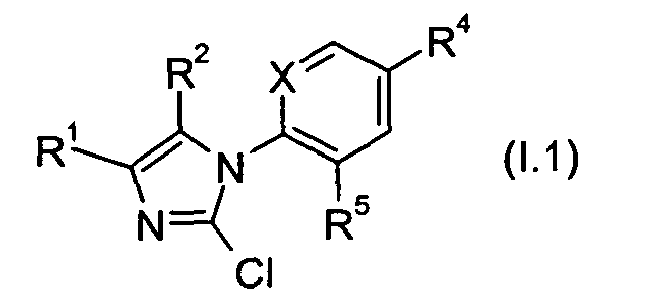
- The compounds of formula I.1, wherein R2, R4, R5 and X are as defined for compound of formula I, and R1 is C1-C4alkyl or C1-C4haloalkyl, can be obtained by reaction of a compound of formula II, wherein R2, R4, R5and X are as defined for compound of formula I, and R1 is C1-C4alkyl or C1-C4haloalkyl, with N-chlorosuccinimide (NCS) or molecular chlorine.

- The compounds of formula I, wherein R2, R3, R4, R5 and X are as defined for compound of formula I, and R1 is Halogen, preferably chlorine or bromine, can be obtained by reaction of a compound of formula III, wherein R2, R4, R5 and X are as defined for compound of formula I, with at least 2 equivalents of N-chlorosuccinimide (NCS), N-bromosuccinimide (NBS) or N-iodosuccinimide (NIS).

- The compounds of formula I.1, wherein R2, R4, R5 and X are as defined for compound of formula I, and R1 is C1-C4haloalkyl, can be obtained by reaction of a compound of formula II, wherein R2, R4, R5 and X are as defined for compound of formula I, and R1 is C1-C4alkyl, with at least 2 equivalents of N-chlorosuccinimide (NCS) or molecular chlorine.

- The compounds of formula II, wherein R2, R4, R5 and X are as defined for compound of formula I, and R1 is C1-C4alkyl, can be obtained by reaction of a compound of formula IV, wherein R2, R4, R5and X are as defined for compound of formula I, with a compound of formula V, wherein R1 is C1-C4alkyl, in the presence of a base, e.g. anhydrous potassium carbonate, as already described in Journal of Medicinal Chemistry 2003, 46, 3463.

- The compounds of formula III, wherein R2, R4, R5 and X are as defined for compound of formula I, can be obtained by reaction of a compound of formula IV, wherein R2, R4, R5 and X are as defined for compound of formula I, with toluenesulfonylmethyl isocyanide, in the presence of a base, e.g. anhydrous potassium carbonate, as already described in Journal of Medicinal Chemistry 2003, 46, 3463.

- The compounds of formula IV, wherein R2, R4, R5 and X are as defined for compound of formula I, can be obtained by reaction of an aldehyde of formula VI, wherein R2 is as defined for compound of formula I, with an amine of formula VII, wherein R4, R5and X are as defined for compound of formula I, as already described in Journal of Medicinal Chemistry 2003, 46, 3463.

- The compounds of formula V, wherein R1 is C1-C4alkyl, can be obtained by reaction of toluenesulfonylmethyl isocyanide, with a compound of formula VIII, wherein R1 is C1-C4alkyl, in the presence of a base, as already described in Journal of Medicinal Chemistry 2003, 46, 3463.

- Surprisingly, it has now been found that the novel compounds of formula I have, for practical purposes, a very advantageous level of biological activity for protecting plants against diseases that are caused by fungi as well as by bacteria and viruses.
- The compounds of formula I can be used in unmodified form or, preferably, together with carriers and adjuvants conventionally employed in the art of formulation.
- Therefore the invention also relates to compositions for controlling and protecting against phytopathogenic micro-organisms, comprising a compound of formula I and an inert carrier, and to a method of controlling or preventing infestation of useful plants by phytopathogenic micro-organisms, wherein a composition, comprising a compound of formula I as active ingredient and an inert carrier, is applied to the plants, to parts thereof or the locus thereof.
- In addition, the invention could be used to protect non-living materials from fungal attack, e.g. lumber, wall boards and paint.
- To this end compounds of formula I and inert carriers are conveniently formulated in known manner to mollifiable concentrates, coat able pastes, directly spray able or dilatable solutions, dilute emulsions, wet table powders, soluble powders, dusts, granulates, and also encapsulations e.g. in polymeric substances. As with the type of the compositions, the methods of application, such as spraying, atomising, dusting, scattering, coating or pouring, are chosen in accordance with the intended objectives and the prevailing circumstances. The compositions may also contain further adjuvants such as stabilizers, antifoams, viscosity regulators, binders or pacifiers as well as fertilizers, micronutrient donors or other formulations for obtaining special effects.
- Suitable carriers and adjuvants can be solid or liquid and are substances useful in formulation technology, e.g. natural or regenerated mineral substances, solvents, dispersants, wetting agents, tackifiers, thickeners, binders or fertilizers. Such carriers are for example described in
WO 97/33890 - The compounds of formula I or compositions, comprising a compound of formula I as active ingredient and an inert carrier, can be applied to the locus of the plant or plant to be treated, simultaneously or in succession with further compounds. These further compounds can be e.g. fertilizers or micronutrient donors or other preparations which influence the growth of plants. They can also be selective herbicides as well as insecticides, fungicides, bactericides, nematicides, molluscicides or mixtures of several of these preparations, if desired together with further carriers, surfactants or application promoting adjuvants customarily employed in the art of formulation.
- A preferred method of applying a compound of formula I, or a composition, comprising a compound of formula I as active ingredient and an inert carrier, is foliar application. The frequency of application and the rate of application will depend on the risk of infestation by the corresponding pathogen. However, the compounds of formula I can also penetrate the plant through the roots via the soil (systemic action) by drenching the locus of the plant with a liquid formulation, or by applying the compounds in solid form to the soil, e.g. in granular form (soil application). In crops of water rice such granulates can be applied to the flooded rice field. The compounds of formula I may also be applied to seeds (coating) by impregnating the seeds or tubers either with a liquid formulation of the fungicide or coating them with a solid formulation.
- A formulation, i.e. a composition comprising the compound of formula I and, if desired, a solid or liquid adjuvant, is prepared in a known manner, typically by intimately mixing and/or grinding the compound with extenders, for example solvents, solid carriers and, optionally, surface-active compounds (surfactants).
- The agrochemical formulations will usually contain from 0.1 to 99% by weight, preferably from 0.1 to 95% by weight, of the compound of formula I, 99.9 to 1% by weight, preferably 99.8 to 5% by weight, of a solid or liquid adjuvant, and from 0 to 25% by weight, preferably from 0.1 to 25% by weight, of a surfactant.
- Whereas it is preferred to formulate commercial products as concentrates, the end user will normally use dilute formulations.
- Advantageous rates of application are normally from 5g to 2kg of active ingredient (a.i.) per hectare (ha), preferably from 10g to 1 kg a.i./ha, most preferably from 20g to 600g a.i./ha. When used as seed drenching agent, convenient rates of application are from 10mg to 1 g of active substance per kg of seeds. The rate of application for the desired action can be determined by experiments. It depends for example on the type of action, the developmental stage of the useful plant, and on the application (location, timing, application method) and can, owing to these parameters, vary within wide limits.
- The invention relates to a method of controlling or preventing infestation of useful plants by phytopathogenic micro-organisms, wherein a compound of formula I is applied as active ingredient to the plants, to parts thereof or the locus thereof. The compounds of formula I according to the invention are distinguished by excellent activity at low rates of application, by being well tolerated by plants and by being environmentally safe. They have very useful curative, preventive and systemic properties and are used for protecting numerous useful plants. The compounds of formula I can be used to inhibit or destroy the diseases that occur on plants or parts of plants (fruit, blossoms, leaves, stems, tubers, roots) of different crops of useful plants, while at the same time protecting also those parts of the plants that grow later e.g. from phytopathogenic micro-organisms.
- It is also possible to use compounds of formula I as dressing agents for the treatment of plant propagation material, in particular of seeds (fruit, tubers, grains) and plant cuttings (e.g. rice), for the protection against fungal infections as well as against phytopathogenic fungi occurring in the soil.
- Furthermore the compounds of formula I according to the invention may be used for controlling fungi in related areas, for example in the protection of technical materials, including wood and wood related technical products, in food storage or in hygiene management.
- Within the scope of the invention, useful plants to be protected typically comprise the following species of plants: cereal (wheat, barley, rye, oat, rice, maize, sorghum and related species); beet (sugar beet and fodder beet); pomes, drupes and soft fruit (apples, pears, plums, peaches, almonds, cherries, strawberries, raspberries and blackberries); leguminous plants (beans, lentils, peas, soybeans); oil plants (rape, mustard, poppy, olives, sunflowers, coconut, castor oil plants, cocoa beans, groundnuts); cucumber plants (pumpkins, cucumbers, melons); fibre plants (cotton, flax, hemp, jute); citrus fruit (oranges, lemons, grapefruit, mandarins); vegetables (spinach, lettuce, asparagus, cabbages, carrots, onions, tomatoes, potatoes, paprika); lauraceae (avocado, cinnamomum, camphor) or plants such as tobacco, nuts, coffee, eggplants, sugar cane, tea, pepper, vines, hops, bananas and natural rubber plants, as well as ornamentals.
- The term "useful plants" is to be understood as including also useful plants that have been rendered tolerant to herbicides like bromoxynil or classes of herbicides (such as, for example, HPPD inhibitors, ALS inhibitors, for example primisulfuron, prosulfuron and trifloxysulfuron, EPSPS (5-enol-pyrovyl-shikimate-3-phosphate-synthase) inhibitors, GS (glutamine synthetase) inhibitors or PPO (protoporphyrinogen-oxidase) inhibitors) as a result of conventional methods of breeding or genetic engineering. An example of a crop that has been rendered tolerant to imidazolinones, e.g. imazamox, by conventional methods of breeding (mutagenesis) is Clearfield® summer rape (Canola). Examples of crops that have been rendered tolerant to herbicides or classes of herbicides by genetic engineering methods include glyphosate- and glufosinate-resistant maize varieties commercially available under the trade names RoundupReady®, Herculex I® and LibertyLink®.
- The term "useful plants" is to be understood as including also useful plants which have been so transformed by the use of recombinant DNA techniques that they are capable of synthesising one or more selectively acting toxins, such as are known, for example, from toxin-producing bacteria, especially those of the genus Bacillus.
- The term "useful plants" is to be understood as including also useful plants which have been so transformed by the use of recombinant DNA techniques that they are capable of synthesising antipathogenic substances having a selective action, such as, for example, the so-called "pathogenesis-related proteins" (PRPs, see e.g.
EP-A-0 392 225 ). Examples of such antipathogenic substances and transgenic plants capable of synthesising such antipathogenic substances are known, for example, fromEP-A-0 392 225 ,WO 95/33818 EP-A-0 353 191 . The methods of producing such transgenic plants are generally known to the person skilled in the art and are described, for example, in the publications mentioned above. - The term "locus" of a useful plant as used herein is intended to embrace the place on which the useful plants are growing, where the plant propagation materials of the useful plants are sown or where the plant propagation materials of the useful plants will be placed into the soil. An example for such a locus is a field, on which crop plants are growing.
- The term "plant propagation material" is understood to denote generative parts of the plant, such as seeds, which can be used for the multiplication of the latter, and vegetative material, such as cuttings or tubers, for example potatoes. There may be mentioned for example seeds (in the strict sense), roots, fruits, tubers, bulbs, rhizomes and parts of plants. Germinated plants and young plants which are to be transplanted after germination or after emergence from the soil, may also be mentioned. These young plants may be protected before transplantation by a total or partial treatment by immersion. Preferably "plant propagation material" is understood to denote seeds.
- The compounds of formula I are, for example, effective against the phytopathogenic fungi of the following classes: Fungi imperfecti (e.g. Botrytis, Pyricularia, Helminthosporium, Fusarium, Septoria, Cercospora and Alternaria) and Basidiomycetes (e.g. Rhizoctonia, Hemileia, Puccinia). Additionally, they are also effective against the Ascomycetes classes (e.g. Venturia and Erysiphe, Podosphaera, Monilinia, Uncinula) and of the Oomycetes classes (e.g. Phytophthora, Pythium, Plasmopara). Outstanding activity has been observed against powdery mildew diseases (e.g. Uncinula necator). Furthermore, the novel compounds of formula I are effective against phytopathogenic bacteria and viruses (e.g. against Xanthomonas spp, Pseudomonas spp, Erwinia amylovora as well as against the tobacco mosaic virus). Good activity has been observed against Asian soybean rust (Phakopsora pachyrhizi).
- Surprisingly, it has now been found that the compounds of formula I, or a pharmaceutical salt thereof, described above have also an advantageous spectrum of activity for the treatment and/or prevention of microbial infection in an animal.
- "Animal" can be any animal, for example, insect, mammal, reptile, fish, amphibian, preferably mammal, most preferably human. "Treatment" means the use on an animal which has microbial infection in order to reduce or slow or stop the increase or spread of the infection, or to reduce the infection or to cure the infection. "Prevention" means the use on an animal which has no apparent signs of microbial infection in order to prevent any future infection, or to reduce or slow the increase or spread of any future infection.
- According to the present invention there is provided the use of a compound of formula I in the manufacture of a medicament for use in the treatment and/or prevention of microbial infection in an animal. There is also provided the use of a compound of formula I as a pharmaceutical agent. There is also provided the use of a compound of formula I as an antimicrobial agent in the treatment of an animal. According to the present invention there is also provided a pharmaceutical composition comprising as an active ingredient a compound of formula I, or a pharmaceutically acceptable salt thereof, and a pharmaceutically acceptable diluent or carrier. This composition can be used for the treatment and/or prevention of antimicrobial infection in an animal. This pharmaceutical composition can be in a form suitable for oral administration, such as tablet, lozenges, hard capsules, aqueous suspensions, oily suspensions, emulsions dispersible powders, dispersible granules, syrups and elixirs. Alternatively this pharmaceutical composition can be in a form suitable for topical application, such as a spray, a cream or lotion. Alternatively this pharmaceutical composition can be in a form suitable for parenteral administration, for example injection. Alternatively this pharmaceutical composition can be in inhalable form, such as an aerosol spray.
- The compounds of formula I are effective against various microbial species able to cause a microbial infection in an animal. Examples of such microbial species are those causing Aspergillosis such as Aspergillus fumigatus, A. flavus, A. terrus, A. nidulans and A. niger, those causing Blastomycosis such as Blastomyces dermatitidis; those causing Candidiasis such as Candida albicans, C. glabrata, C. tropicalis, C. parapsilosis, C. krusei and C. lusitaniae; those causing Coccidioidomycosis such as Coccidioides immitis; those causing Cryptococcosis such as Cryptococcus neoformans; those causing Histoplasmosis such as Histoplasma capsulatum and those causing Zygomycosis such as Absidia corymbifera, Rhizomucor pusillus and Rhizopus arrhizus. Further examples are Fusarium Spp such as Fusarium oxysporum and Fusarium solani and Scedosporium Spp such as Scedosporium apiospermum and Scedosporium prolificans. Still further examples are Microsporum Spp, Trichophyton Spp, Epidermophyton Spp, Mucor Spp, Sporothorix Spp, Phialophora Spp, Cladosporium Spp, Petriellidium spp, Paracoccidioides Spp and Histoplasma Spp.
- The compounds of formula I are normally used in the form of fungicidal compositions for controlling or protecting against phytopathogenic microorganisms, comprising as active ingredient at least one compound of formula I, in free form or in agrochemically usable salt form, and at least one of the above-mentioned adjuvants.
- The compounds of formula I can be mixed with other fungicides, resulting in some cases in unexpected synergistic activities. Mixing components which are particularly preferred are:
- Azoles, such as azaconazole, BAY 14120, bitertanol, bromuconazole, cyproconazole, difenoconazole, diniconazole, epoxiconazole, fenbuconazole, fluquinconazole, flusilazole, flutriafol, hexaconazole, imazalil, imibenconazole, ipconazole, metconazole, myclobutanil, pefurazoate, penconazole, prothioconazole, pyrifenox, prochloraz, propiconazole, simeconazole, tebuconazole, tetraconazole, triadimefon, triadimenol, triflumizole, triticonazole;
- Pyrimidinyl carbinoles, such as ancymidol, fenarimol, nuarimol;
- 2-amino-pyrimidines, such as bupirimate, dimethirimol, ethirimol;
- Morpholines, such as dodemorph, fenpropidine, fenpropimorph, spiroxamine, tridemorph;
- Anilinopyrimidines, such as cyprodinil, mepanipyrim, pyrimethanil;
- Pyrroles, such as fenpiclonil, fludioxonil;
- Phenylamides, such as benalaxyl, furalaxyl, metalaxyl, R-metalaxyl, ofurace, oxadixyl;
- Benzimidazoles, such as benomyl, carbendazim, debacarb, fuberidazole, thiabendazole;
- Dicarboximides, such as chlozolinate, dichlozoline, iprodione, myclozoline, procymidone, vinclozoline;
- Carboxamides, such as boscalid, carboxin, fenfuram, flutolanil, mepronil, oxycarboxin, penthiopyrad, thifluzamide; guanidines, such as guazatine, dodine, iminoctadine;
- Strobilurines, such as azoxystrobin, dimoxystrobin, enestroburin, fluoxastrobin, kresoxim-methyl, metominostrobin, trifloxystrobin, orysastrobin, picoxystrobin, pyraclostrobin;
- Dithiocarbamates, such as ferbam, mancozeb, maneb, metiram, propineb, thiram, zineb, ziram;
- N-halomethylthiotetrahydrophthalimides, such as captafol, captan, dichlofluanid, fluoromides, folpet, tolyfluanid;
- Cu-compounds, such as Bordeaux mixture, copper hydroxide, copper oxychloride, copper sulfate, cuprous oxide, mancopper, oxine-copper;
- Nitrophenol-derivatives, such as dinocap, nitrothal-isopropyl;
- Organo-phosphorus-derivatives, such as edifenphos, iprobenphos, isoprothiolane, phosdiphen, pyrazophos, tolclofos-methyl;
- Pyridazine-derivatives which are known and may be prepared by methods as described in
WO 05/121104 WO 06/001175 WO 07/066601 
- Triazolopyrimidine derivatives which are known and may be prepared by methods as described in
WO98/46607 
- Carboxamide derivatives which are known and may be prepared by methods as described in
WO04/035589 WO06/37632 WO03/074491 WO03070705 

- Benzamide derivatives which are known and may be prepared by methods as described in
WO 2004/016088 , such as N-{-2-[3-chloro-5-(trifluoromethyl)-2-pyridinyl]ethyl}-2-trifluoromethylbenzamide, which is also known under the name fluopyram (formula V.1);
- Various others, such as acibenzolar-S-methyl, anilazine, benthiavalicarb, blasticidin-S, chinomethionate, chloroneb, chlorothalonil, cyflufenamid, cymoxanil, dichlone, diclocymet, diclomezine, dicloran, diethofencarb, dimethomorph, flumorph, dithianon, ethaboxam, etridiazole, famoxadone, fenamidone, fenoxanil, fentin, ferimzone, fluazinam, fluopicolide, flusulfamide, fenhexamid, fosetyl-aluminium, hymexazol, iprovalicarb, cyazofamid, kasugamycin, mandipropamid, methasulfocarb, metrafenone, nicobifen, pencycuron, phthalide, polyoxins, probenazole, propamocarb, proquinazid, pyroquilon, quinoxyfen, quintozene, sulfur, tiadinil, triazoxide, tricyclazole, triforine, validamycin, zoxamide and glyphosate.
- Another aspect of invention is related to the use of a compound of formula I, of a composition comprising at least one compound of formula I or of a fungicidal mixture comprising at least one compound of formula I in admixture with other fungicides, as described above, for controlling or preventing infestation of plants, harvested food crops or non-living materials by phytopathogenic microorganisms, preferably fungal organisms.
- A further aspect of invention is related to a method of controlling or preventing an infestation of crop plants or of non-living materials by phytopathogenic or spoilage microorganisms or organisms potentially harmful to man, especially fungal organisms, which comprises the application of a compound of formula I as active ingredient to the plants, to parts of the plants or to the locus thereof, or to any part of the non-living materials. Controlling or preventing means reducing the infestation of crop plants or of non-living materials by phytopathogenic or spoilage microorganisms or organisms potentially harmful to man, especially fungal organisms, to such a level that an improvement is demonstrated.
- The following non-limiting examples illustrate the above-described invention in more detail.
- 3,5-Dichloro-pyridin-2-ylamine (6 g) and 4-bromo-benzaldehyde (7.02 g) are dissolved in toluene (210 ml). Subsequently, the mixture is stirred for 3 days at reflux in a Dean-Stark apparatus. The reaction mixture is evaporated under reduced pressure, to obtain 12.213 g of [1-(4-bromo-phenyl)-meth-(E)-ylidene]-(3,5-dichloro-pyridin-2-yl)-amine. 1H NMR (300Mhz, CDCl3). 8.96ppm, 1 H, s; 8.23ppm, 1 H, d, J=2.25Hz; 7.81 ppm, 2H, d, J=8.46Hz; 7.72ppm, 1 H, d, J=2.27Hz; 7.55ppm, 2H, d, J=8.45Hz.
- 10 g of toluenesulfonylmethyl isocyanide and 2.31 g of benzyltriethylammonium chloride are dissolved in 100 ml of dichloromethane. 100 ml of a 30% sodium hydroxide solution in water are added and the mixture is cooled down to 0°C. 3.63 ml of methyl iodide are then added, and the reaction mixture is stirred vigorously for 2 h at 0°C. Water is then added, the phases are separated and the aqueous layer is extracted with dichloromethane. The combined organic phases are dried over sodium sulphate and filtrated; the solvent removed under reduced pressure. The black residue is extracted several times with cold diethyl ether and, after evaporation of the solvent, 4.2 g of 1-(toluene-4-sulfonyl)-ethyl isocyanide are isolated. An extra 1.8 g can be recovered again from the remaining residue by extracting it several times with t-butyl-methyl ether at room temperature. 1H NMR (300Mhz, CDCl3) 7.81 ppm, 2H, d, J=8.34Hz; 7.37ppm, 2H, d, J=8.04Hz; 4.52ppm, 1 H, q, J=6.86Hz; 2.42ppm, 3H, s; 1.67ppm, 3H, d, J=6.81 Hz.
- 0.9 g of [1-(4-bromo-phenyl)-meth-(E)-ylidene]-(3,5-dichloro-pyridin-2-yl)-amine is dissolved in 10 ml of N,N-dimethyl-formamide and 8 ml of 1,2-dimethoxy-ethane. 1.084 g of 1-(toluene-4-sulfonyl)-ethyl isocyanide and 0.754 g of anhydrous potassium carbonate are added, and the resulting reaction mixture is heated at 100°C overnight. After cooling down, the mixture is filtrated, the solvents evaporated, the crude material is adsorbed on Isolute® HM-N and purified by chromatography column on silica gel, using a mixture of heptane / ethyl acetate 1:1 as eluent to obtain 0.509 g of 2-[5-(4-bromo-phenyl)-4-methyl-imidazol-1-yl]-3,5-dichloro-pyridine. 1H NMR (300Mhz, CDCl3) 8.31 ppm, 1H, d, J=2.26Hz; 7.73ppm, 1 H, d, J=2.23Hz; 7.61 ppm, 1 H, s; 7.33ppm, 2H, d, J=8.47Hz; 6.88ppm, 2H, d, J=8.45Hz; 2.27ppm, 3H, s.
- A mixture of 0.251 g of 2-[5-(4-bromo-phenyl)-4-methyl-imidazol-1-yl]-3,5-dichtoro-pyridine, 0.096 g of N-chlorosuccinimide and 2.11 ml of chloroform is heated for 90 minutes to 80 °C. Subsequently, the mixture is cooled to room temperature, Isolute® HM-N is added to the reaction mixture and the chloroform is evaporated. The crude mixture is purified by chromatography column on silica gel, using a mixture of heptane / ethyl acetate 6:1 as eluent to obtain of 0.082 g of 2-[5-(4-bromo-phenyl)-2-chloro-4-methyl-imidazol-1-yl]-3,5-dichloro-pyridine. 1H NMR (300Mhz, CDCl3) 8.37ppm, 1 H, d, J=2.25Hz; 7.76ppm, 1 H, d, J=2.27Hz; 7.33ppm, 2H, d, J=8.45Hz; 6.93ppm, 2H, d, J=8.48Hz; 2.03ppm, 3H, s.
- 6 g of [1-(4-bromo-phenyl)-meth-(E)-ylidene]-(3,5-dichloro-pyridin-2-yl)-amine is dissolved in 125 ml of N,N-dimethyl-formamide and 55 ml of 1,2-dimethoxy-ethane. 5.38 g of Toluenesulfonylmethyl isocyanide and 5.02g of anhydrous potassium carbonate are added, and the resulting reaction mixture is heated at 100°C overnight. After cooling down, the mixture is filtrated, the solvents evaporated, the resulting solid is dissolved in 89 ml of methanol, and to this solution are added 4.428 g of anhydrous potassium carbonate. The resulting reaction mixture is heated at reflux of methanol for 4 h. After cooling down, the mixture is filtrated, the solvent evaporated, the resulting solid dissolved in 100 ml of dichloromethane and poured onto 100 ml of water. The organic phase is separated and washed with a sodium bicarbonate saturated aqueous solution (50 ml). The aqueous layer is separated and extracted with 50 ml of dichloromethane. The organic phases are combined, washed with 25 ml of brine, separated, dried over sodium sulphate, filtered and the solvent evaporated under reduced pressure. The crude material is adsorbed on Isolute® HM-N and purified by chromatography column on silica gel, using a mixture of heptane / ethyl acetate 3:7 as eluent to obtain 2.110 g of 2-[5-(4-bromo-phenyl)-imidazol-1-yl]-3,5-dichloro-pyridine. 1H NMR (300Mhz, CDCl3) 8.37ppm, 1H, d, J=2.24Hz; 7.78ppm, 1H, d, J=2.26Hz; 7.68ppm, 1 H, d, J=0.95Hz; 7.32ppm, 2H, d, J=8.58Hz; 7.21 ppm, 1H, d, J=0.96Hz; 6.90ppm, 2H, d, J=8.56Hz.
- A mixture of 0.350 g of 2-[5-(4-bromo-phenyl)-imidazol-1-yl]-3,5-dichloro-pyridine, 0.253 g of N-chlorosuccinimide and 2.5 ml of chloroform is heated for 16 h to 80°C. Subsequently, the mixture is cooled to room temperature and the chloroform is evaporated. The crude mixture is dissolved in 5 ml of dichloromethane and poured onto 5 ml of a 1 N aqueous hydrochloric acid solution. The organic phase is separated and washed successively with a 1 N aqueous sodium hydroxide solution (5 ml) and 5 ml of brine. After separation, the organic phase is dried over sodium sulphate, filtered, and the solvent evaporated under reduced pressure. The crude material is adsorbed on Isolute® HM-N and purified by chromatography column on silica gel, using a mixture of heptane / ethyl acetate 23:2 as eluent to obtain 0.224 g of 2-[5-(4-bromo-phenyl)-2,4-dichloro-imidazol-1-yl]-3,5-dichloro-pyridine. 1H NMR (300Mhz, CDCl3) 8.41 ppm, 1H, d, J=2.24Hz; 7.80ppm, 1 H, d, J=2.23Hz; 7.36ppm, 2H, d, J=8.57Hz; 7.04ppm, 2H, d, J=8.50Hz.
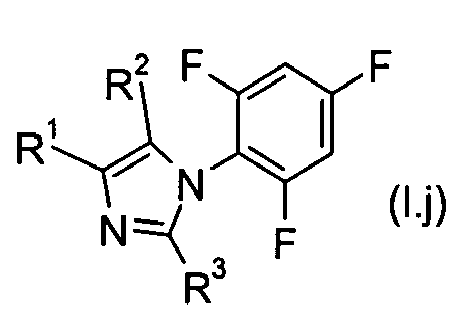
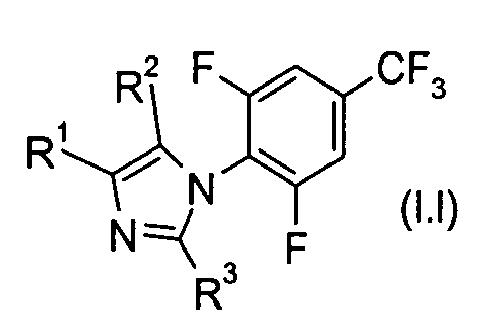
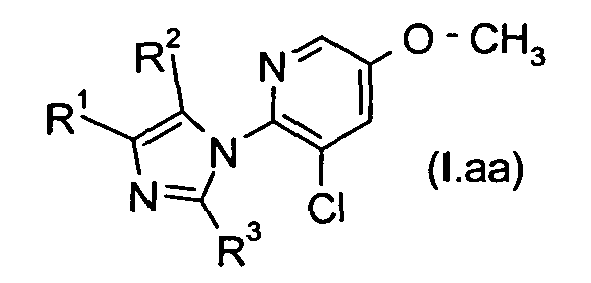
Table 1 below illustrates examples of individual compounds of formula I according to the invention.Table 1: individual compounds of formula I according to the invention Compound No. R1 R2 R3 001 F phenyl F 002 CH3 phenyl F 003 F phenyl Cl 004 Cl phenyl Cl 005 CH3 phenyl Cl 006 F 3-fluorophenyl F 007 CH3 3-fluorophenyl F 008 F 3-fluorophenyl Cl 009 Cl 3-fluorophenyl Cl 010 CH3 3-fluorophenyl Cl 011 F 4-fluorophenyl F 012 CH3 4-fluorophenyl F 013 F 4-fluorophenyl Cl 014 Cl 4-fluorophenyl Cl 015 CH3 4-fluorophenyl Cl 016 F 3-chlorophenyl F 017 CH3 3-chlorophenyl F 018 F 3-chlorophenyl Cl 019 Cl 3-chlorophenyl Cl 020 CH3 3-chlorophenyl Cl 021 F 4-chlorophenyl F 022 CH3 4-chlorophenyl F 023 F 4-chlorophenyl Cl 024 Cl 4-chlorophenyl Cl 025 CH3 4-chlorophenyl Cl 026 F 3-bromophenyl F 027 CH3 3-bromophenyl F 028 F 3-bromophenyl Cl 029 Cl 3-bromophenyl Cl 030 CH3 3-bromophenyl Cl 031 F 4-bromophenyl F 032 CH3 4-bromophenyl F 033 F 4-bromophenyl Cl 034 Cl 4-bromophenyl Cl 035 CH3 4-bromophenyl Cl 036 F m-tolyl F 037 CH3 m-tolyl F 038 F m-tolyl Cl 039 Cl m-tolyl Cl 040 CH3 m-tolyl Cl 041 F p-tolyl F 042 CH3 p-tolyl F 043 F p-tolyl Cl 044 Cl p-tolyl Cl 045 CH3 p-tolyl Cl 046 F 3-trifluoromethylphenyl F 047 CH3 3-trifluoromethylphenyl F 048 F 3-trifluoromethylphenyl Cl 049 Cl 3-trifluoromethylphenyl Cl 050 CH3 3-trifluoromethylphenyl Cl 051 F 4-trifluoromethylphenyl F 052 CH3 4-trifluoromethylphenyl F 053 F 4-trifluoromethylphenyl Cl 054 Cl 4-trifluoromethylphenyl Cl 055 CH3 4-trifluoromethylphenyl Cl 056 F 3-methoxyphenyl F 057 CH3 3-methoxyphenyl F 058 F 3-methoxyphenyl Cl 059 Cl 3-methoxyphenyl Cl 060 CH3 3-methoxyphenyl Cl 061 F 4-methoxyphenyl F 062 CH3 4-methoxyphenyl F 063 F 4-methoxyphenyl Cl 064 Cl 4-methoxyphenyl Cl 065 CH3 4-methoxyphenyl Cl 066 F 3-trifluoromethoxyphenyl F 067 CH3 3-trifluoromethoxyphenyl F 068 F 3-trifluoromethoxyphenyl Cl 069 Cl 3-trifluoromethoxyphenyl Cl 070 CH3 3-trifluoromethoxyphenyl Cl 071 F 4-trifluoromethoxyphenyl F 072 CH3 4-trifluoromethoxyphenyl F 073 F 4-trifluoromethoxyphenyl Cl 074 Cl 4-trifluoromethoxyphenyl Cl 075 CH3 4-trifluoromethoxyphenyl Cl 076 F 3-cyanophenyl F 077 CH3 3-cyanophenyl F 078 F 3-cyanophenyl Cl 079 Cl 3-cyanophenyl Cl 080 CH3 3-cyanophenyl Cl 081 F 4-cyanophenyl F 082 CH3 4-cyanophenyl F 083 F 4-cyanophenyl Cl 084 Cl 4-cyanophenyl Cl 085 CH3 4-cyanophenyl Cl 086 F 3,4-difluorophenyl F 087 CH3 3,4-difluorophenyl F 088 F 3,4-difluorophenyl Cl 089 Cl 3,4-difluorophenyl Cl 090 CH3 3,4-difluorophenyl Cl 091 F 3,4-dichlorophenyl F 092 CH3 3,4-dichlorophenyl F 093 F 3,4-dichlorophenyl Cl 094 Cl 3,4-dichlorophenyl Cl 095 CH3 3,4-dichlorophenyl Cl 096 F 3,4-dimethylphenyl F 097 CH3 3,4-dimethylphenyl F 098 F 3,4-dimethylphenyl Cl 099 Cl 3,4-dimethylphenyl Cl 100 CH3 3,4-dimethylphenyl Cl 101 F 3,4-dimethoxyphenyl F 102 CH3 3,4-dimethoxyphenyl F 103 F 3,4-dimethoxyphenyl Cl 104 Cl 3,4-dimethoxyphenyl Cl 105 CH3 3,4-dimethoxyphenyl Cl 106 F 3-chloro-4-fluorophenyl F 107 CH3 3-chloro-4-fluorophenyl F 108 F 3-chloro-4-fluorophenyl Cl 109 Cl 3-chloro-4-fluorophenyl Cl 110 CH3 3-chloro-4-fluorophenyl Cl 111 F 3-chloro-4-methylphenyl F 112 CH3 3-chloro-4-methylphenyl F 113 F 3-chloro-4-methylphenyl Cl 114 Cl 3-chloro-4-methylphenyl Cl 115 CH3 3-chloro-4-methylphenyl Cl 116 F 3-chloro-4-methoxyphenyl F 117 CH3 3-chloro-4-methoxyphenyl F 118 F 3-chloro-4-methoxyphenyl Cl 119 Cl 3-chloro-4-methoxyphenyl Cl 120 CH3 3-chloro-4-methoxyphenyl Cl 121 F 4-chloro-3-fluorophenyl F 122 CH3 4-chloro-3-fluorophenyl F 123 F 4-chloro-3-fluorophenyl Cl 124 Cl 4-chloro-3-fluorophenyl Cl 125 CH3 4-chloro-3-fluorophenyl Cl 126 F 4-chloro-3-methylphenyl F 127 CH3 4-chloro-3-methylphenyl F 128 F 4-chloro-3-methylphenyl Cl 129 Cl 4-chloro-3-methylphenyl Cl 130 CH3 4-chloro-3-methylphenyl Cl 131 F 4-chloro-3-methoxyphenyl F 132 CH3 4-chloro-3-methoxyphenyl F 133 F 4-chloro-3-methoxyphenyl Cl 134 Cl 4-chloro-3-methoxyphenyl Cl 135 CH3 4-chloro-3-methoxyphenyl Cl 136 F 3-fluoro-4-methoxyphenyl F 137 CH3 3-fluoro-4-methoxyphenyl F 138 F 3-fluoro-4-methoxyphenyl Cl 139 Cl 3-fluoro-4-methoxyphenyl Cl 140 CH3 3-fluoro-4-methoxyphenyl Cl 141 F 3-fluoro-4-methylphenyl F 142 CH3 3-fluoro-4-methylphenyl F 143 F 3-fluoro-4-methylphenyl Cl 144 Cl 3-fluoro-4-methylphenyl Cl 145 CH3 3-fluoro-4-methylphenyl Cl 146 F 4-fluoro-3-methoxyphenyl F 147 CH3 4-fluoro-3-methoxyphenyl F 148 F 4-fluoro-3-methoxyphenyl Cl 149 Cl 4-fluoro-3-methoxyphenyl Cl 150 CH3 4-fluoro-3-methoxyphenyl Cl 151 F 4-fluoro-3-methylphenyl F 152 CH3 4-fluoro-3-methylphenyl F 153 F 4-fluoro-3-methylphenyl Cl 154 Cl 4-fluoro-3-methylphenyl Cl 155 CH3 4-fluoro-3-methylphenyl Cl 156 F 3-methoxy-4-methylphenyl F 157 CH3 3-methoxy-4-methylphenyl F 158 F 3-methoxy-4-methylphenyl Cl 159 Cl 3-methoxy-4-methylphenyl Cl 160 CH3 3-methoxy-4-methylphenyl Cl 161 F 4-methoxy-3-methylphenyl F 162 CH3 4-methoxy-3-methylphenyl F 163 F 4-methoxy-3-methylphenyl Cl 164 Cl 4-methoxy-3-methylphenyl Cl 165 CH3 4-methoxy-3-methylphenyl Cl 166 F naphth-2-yl F 167 CH3 naphth-2-yl F 168 F naphth-2-yl Cl 169 Cl naphth-2-yl Cl 170 CH3 naphth-2-yl Cl 171 F pyridin-2-yl F 172 CH3 pyridin-2-yl F 173 F pyridin-2-yl Cl 174 Cl pyridin-2-yl Cl 175 CH3 pyridin-2-yl Cl 176 F pyridin-3-yl F 177 CH3 pyridin-3-yl F 178 F pyridin-3-yl Cl 179 Cl pyridin-3-yl Cl 180 CH3 pyridin-3-yl Cl 181 F pyridin-4-yl F 182 CH3 pyridin-4-yl F 183 F pyridin-4-yl Cl 184 Cl pyridin-4-yl Cl 185 CH3 pyridin-4-yl Cl 186 F 6-chloropyridin-2-yl F 187 CH3 6-chloropyridin-2-yl F 188 F 6-chloropyridin-2-yl Cl 189 Cl 6-chloropyridin-2-yl Cl 190 CH3 6-chloropyridin-2-yl Cl 191 F 6-fluoropyridin-2-yl F 192 CH3 6-fluoropyridin-2-yl F 193 F 6-fluoropyridin-2-yl Cl 194 Cl 6-fluoropyridin-2-yl Cl 195 CH3 6-fluoropyridin-2-yl Cl 196 F 6-methoxypyridin-2-yl F 197 CH3 6-methoxypyridin-2-yl F 198 F 6-methoxypyridin-2-yl Cl 199 Cl 6-methoxypyridin-2-yl Cl 200 CH3 6-methoxypyridin-2-yl Cl 201 F 6-methylpyridin-2-yl F 202 CH3 6-methylpyridin-2-yl F 203 F 6-methylpyridin-2-yl Cl 204 Cl 6-methylpyridin-2-yl Cl 205 CH3 6-methylpyridin-2-yl Cl 206 F 6-chloropyridin-3-yl F 207 CH3 6-chloropyridin-3-yl F 208 F 6-chloropyridin-3-yl Cl 209 Cl 6-chloropyridin-3-yl Cl 210 CH3 6-chloropyridin-3-yl Cl 211 F 6-fluoropyridin-3-yl F 212 CH3 6-fluoropyridin-3-yl F 213 F 6-fluoropyridin-3-yl Cl 214 Cl 6-fluoropyridin-3-yl Cl 215 CH3 6-fluoropyridin-3-yl Cl 216 F 6-methoxypyridin-3-yl F 217 CH3 6-methoxypyridin-3-yl F 218 F 6-methoxypyridin-3-yl Cl 219 Cl 6-methoxypyridin-3-yl Cl 220 CH3 6-methoxypyridin-3-yl Cl 221 F 6-methylpyridin-3-yl F 222 CH3 6-methylpyridin-3-yl F 223 F 6-methylpyridin-3-yl Cl 224 Cl 6-methylpyridin-3-yl Cl 225 CH3 6-methylpyridin-3-yl Cl 226 F 2-chloropyridin-4-yl F 227 CH3 2-chloropyridin-4-yl F 228 F 2-chloropyridin-4-yl Cl 229 Cl 2-chloropyridin-4-yl Cl 230 CH3 2-chloropyridin-4-yl Cl 231 F 2-fluoropyridin-4-yl F 232 CH3 2-fluoropyridin-4-yl F 233 F 2-fluoropyridin-4-yl Cl 234 Cl 2-fluoropyridin-4-yl Cl 235 CH3 2-fluoropyridin-4-yl Cl 236 F 2-methoxypyridin-4-yl F 237 CH3 2-methoxypyridin-4-yl F 238 F 2-methoxypyridin-4-yl Cl 239 Cl 2-methoxypyridin-4-yl Cl 240 CH3 2-methoxypyridin-4-yl Cl 241 F 2-methylpyridin-4-yl F 242 CH3 2-methylpyridin-4-yl F 243 F 2-methylpyridin-4-yl Cl 244 Cl 2-methylpyridin-4-yl Cl 245 CH3 2-methylpyridin-4-yl Cl 246 F 5-chlorothiophen-2-yl F 247 CH3 5-chlorothiophen-2-yl F 248 F 5-chlorothiophen-2-yl Cl 249 Cl 5-chlorothiophen-2-yl Cl 250 CH3 5-chlorothiophen-2-yl Cl 251 F 5-bromothiophen-2-yl F 252 CH3 5-bromothiophen-2-yl F 253 F 5-bromothiophen-2-yl Cl 254 Cl 5-bromothiophen-2-yl Cl 255 CH3 5-bromothiophen-2-yl Cl 256 F 5-methoxythiophen-2-yl F 257 CH3 5-methoxythiophen-2-yl F 258 F 5-methoxythiophen-2-yl Cl 259 Cl 5-methoxythiophen-2-yl Cl 260 CH3 5-methoxythiophen-2-yl Cl 261 F quinolin-2-yl F 262 CH3 quinolin-2-yl F 263 F quinolin-2-yl Cl 264 Cl quinolin-2-yl Cl 265 CH3 quinolin-2-yl Cl 266 F quinolin-3-yl F 267 CH3 quinolin-3-yl F 268 F quinolin-3-yl Cl 269 Cl quinolin-3-yl Cl 270 CH3 quinolin-3-yl Cl 271 F 4-methoxyquinolin-2-yl F 272 CH3 4-methoxyquinolin-2-yl F 273 F 4-methoxyquinolin-2-yl Cl 274 Cl 4-methoxyquinolin-2-yl Cl 275 CH3 4-methoxyquinolin-2-yl Cl 276 F 4-methylquinolin-2-yl F 277 CH3 4-methylquinolin-2-yl F 278 F 4-methylquinolin-2-yl Cl 279 Cl 4-methylquinolin-2-yl Cl 280 CH3 4-methylquinolin-2-yl Cl - a) 280 compounds of formula (I.a):

- b) 280 compounds of formula (I.b):

- c) 280 compounds of formula (I.c):

- d) 280 compounds of formula (I.d):

- e) 280 compounds of formula (I.e):

- f) 280 compounds of formula (I.f):

- g) 280 compounds of formula (I.g):

- h) 280 compounds of formula (I.h):

- i) 280 compounds of formula (I.i):

- j) 280 compounds of formula (I.j):
- k) 280 compounds of formula (I.k):

- l) 280 compounds of formula (I.l):
- m) 280 compounds of formula (I.m):

- n) 280 compounds of formula (I.n):

- o) 280 compounds of formula (I.o):

- p) 280 compounds of formula (I.p):

- q) 280 compounds of formula (I.q):

- r) 280 compounds of formula (I.r):

- s) 280 compounds of formula (I.s):

- t) 280 compounds of formula (I.t):

- u) 280 compounds of formula (I.u):

- v) 280 compounds of formula (I.v):

- w) 280 compounds of formula (I.w):

- x) 280 compounds of formula (I.x):

- y) 280 compounds of formula (I.y):

- z) 280 compounds of formula (I.z):

- aa) 280 compounds of formula (I.aa):
- ab) 280 compounds of formula (I.ab):

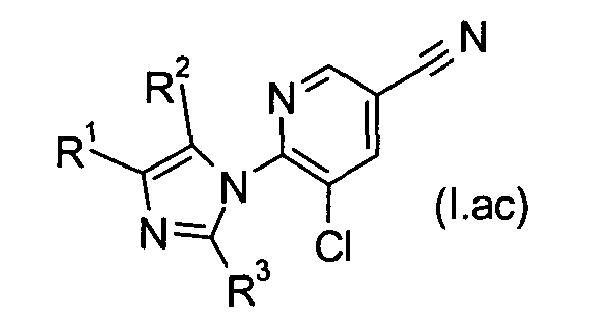
- ac) 280 compounds of formula (I.ac):
- Throughout this description, temperatures are given in degrees Celsius, "m.p." means melting point, "NMR" means nuclear magnetic resonance spectrum; and "%" is percent by weight, unless corresponding concentrations are indicated in other units.
- The following abbreviations are used throughout this description:
m.p. = melting point br = broad s = singlet dd = doublet of doublets d = doublet dt = doublet of triplets t = triplet q = quartet m = multiplet ppm = parts per million - Table 2 shows selected NMR data, all with CDCl3 as the solvent (unless otherwise stated, no attempt is made to list all characterising data in all cases) for compounds of Table 1.
Table 2: Melting point and selected NMR data for compounds of Table 1 Compound Number 1H-NMR data (ppm/number of H's/multiplicity) I.s.034 8.41 ppm, 1H, d, J=2.24Hz; 7.80ppm, 1H, d, J=2.23Hz; 7.36ppm, 2H, d, J=8.57Hz; 7.04ppm, 2H, d, J=8.50Hz. I.s.035 8.37ppm, 1H, d, J=2.25Hz; 7.76ppm, 1H, d, J=2.27Hz; 7.33ppm, 2H, d, J=8.45Hz; 6.93ppm, I.s.034 8.41 ppm, 1 H, d, J=2.24Hz; 7.80ppm, 1 H, d, J=2.23Hz; 7.36ppm, 2H, d, J=8.57Hz; 7.04ppm, 2H, d, J=8.50Hz. 2H, d, J=8.48Hz; 2.03ppm, 3H, s. I.s.210 8.38ppm, 1 H, d, J=2.21 Hz; 8.11ppm. 1H, d, J=2.14Hz; 7.79ppm, 1 H, d, J=2.21 Hz; 7.39ppm, 1 H, dd, J=2.49 and 8.19Hz; 7.20ppm, 1 H, d, J=8.20Hz; 2.23ppm, 3H, s. I.s.269 8.62ppm, 1 H, d, J=2.23Hz; 8.40ppm, 1 H, d, J=2.22Hz; 8.11 ppm, 1H, d, J=2.03Hz; 7.98ppm, 1 H, d, J=8.55Hz; 7.78ppm, 1 H, d, J=2.27Hz; 7.72ppm, 1H, d, J=8.20Hz; 7.68ppm, 1 H, dt, J=1.39 and 8.41 Hz; 7.51 ppm, 1H, dt, J=0.94 and 7.56Hz. I.s.270 8.60ppm, 1 H, d, J=2.20Hz; 8.36ppm, 1 H, d, J=2.25Hz; 7.98ppm, 1 H, d, J=8.45Hz; 7.94ppm, 1 H, d, J=2.03Hz; 7.74ppm, 1 H, d, J=2.33Hz; 7.70ppm, 1 H, d, J=8.09Hz; 7.66ppm, 1H, dt, J=1.39 and 7.19Hz; 7.50ppm, 1H, dt, J=1.02 and 8.01 Hz; 2.30ppm, 3H, s. - The compounds according to the present invention can be prepared according to the above-mentioned reaction schemes, in which, unless otherwise stated, the definition of each variable is as defined above for a compound of formula (I).
- 4 weeks old tomato plants cv. Roter Gnom are treated with the formulated test compound in a spray chamber. Two days after application tomato plants are inoculated by spraying a spore suspension on the test plants. After an incubation period of 4 days at 22 °C / 18 °C and 95% r. h. in a greenhouse the disease incidence is assessed.
- Compounds of formula I according to the invention, in particular compounds I.s.034, I.s.035, I.s.210, I.s.269 and I.s.270 at 200 ppm inhibit fungal infestation in this test to at least 80 %, while under the same conditions untreated control plants are infected by the phytopathogenic fungi to over 80 %.
- 4 weeks old tomato plants cv. Roter Gnom are treated with the formulated test compound in a spray chamber. Two days after application tomato plants are inoculated by spraying a spore suspension on the test plants. After an incubation period of 3 days at 20 °C and 95% r. h. in a greenhouse the disease incidence is assessed.
- Compounds of formula I according to the invention, in particular compound I.s.034 at 200 ppm inhibit fungal infestation in this test to at least 80 %, while under the same conditions untreated control plants are infected by the phytopathogenic fungi to over 80 %.
- 1 week old wheat plants cv. Arina are treated with the formulated test compound in a spray chamber. One day after application wheat plants are inoculated by spraying a spore suspension (1 x 10⁵ uredospores/ml) on the test plants. After an incubation period of 1 day at 20 °C and 95% r. h. plants are kept for 10 days 20 °C / 18 °C (day/night) and 60% r.h. in a greenhouse. The disease incidence is assessed 11 days after inoculation.
- Compounds of formula I according to the invention, in particular compound I.s.035 at 200 ppm inhibit fungal infestation in this test to at least 80 %, while under the same conditions untreated control plants are infected by the phytopathogenic fungi to over 80 %.
- 3 weeks old rice plants cv. Koshihikari are treated with the formulated test compound in a spray chamber. Two days after application rice plants are inoculated by spraying a spore suspension (1 x 10⁵ conidia/ml) on the test plants. After an incubation period of 6 days at 25°C and 95% r. h. the disease incidence is assessed.
- Compounds of formula I according to the invention inhibit fungal infestation in this test to at least 80 %, while under the same conditions untreated control plants are infected by the phytopathogenic fungi to over 80 %.
- 1-week-old barley plants cv. Regina are treated with the formulated test compound in a spray chamber. Two days after application barley plants are inoculated by spraying a spore suspension (2.6 x 10⁴ conidia/ml) on the test plants. After an incubation period of 4 days at 20 °C and 95% r. h. the disease incidence is assessed.
- Compounds of formula I according to the invention inhibit fungal infestation in this test to at least 80 %, while under the same conditions untreated control plants are infected by the phytopathogenic fungi to over 80 %.
- 2 weeks old wheat plants cv. Riband are treated with the formulated test compound in a spray chamber. One day after application wheat plants are inoculated by spraying a spore suspension (106 conidia/ml) on the test plants. After an incubation period of 1 day at 22 °C / 21 °C and 95% r. h. plants are kept at 22 °C / 21 °C and 70% r.h. in a greenhouse. The disease incidence is assessed 16 - 18 days after inoculation.
- Compounds of formula I according to the invention, in particular compounds I.s.034, I.s.035, I.s.210, I.s.269 and I.s.270 at 200 ppm inhibits fungal infestation in this test to at least 80 %, while under the same conditions untreated control plants are infected by the phytopathogenic fungi to over 80 %.
- 5 weeks old grape seedlings cv. Gutedel are treated with the formulated test compound in a spray chamber. One day after application grape plants are inoculated by shaking plants infected with grape powdery mildew above the test plants. After an incubation period of 7 days at 24 °C / 22 °C and 70% r. h. under a light regime of 14/10 h (light/dark) the disease incidence is assessed.
- Compounds of formula I according to the invention, in particular compounds I.s.034, I.s.035, I.s.210, I.s.269 and I.s.270 at 200 ppm inhibit fungal infestation in this test to at least 80 %, while under the same conditions untreated control plants are infected by the phytopathogenic fungi to over 80 %.
Claims (20)
- A compound of formula I:
 R1 is halogen, C1-C4alkyl or C1-C4haloalkyl;R2 is an optionally substituted aryl or heteroaryl;R3 is halogen;R4 is hydrogen, halogen, C1-C4alkyl, C1-C4haloalkyl, C1-C4alkoxy, C1-C4haloalkoxy or cyano;R5 is halogen;X is N or C(R); andR is hydrogen, halogen, C1-C4alkyl, C1-C4haloalkyl, C1-C4alkoxy, C1-C4haloalkoxy or cyano; or an agrochemically usable salt form thereof;
provided that
when X is C(R), R2 cannot be an optionally substituted aryl. - The compound according to claim 1 wherein R1 is halogen, C1-C3alkyl or C1-C3haloalkyl.
- The compound according to either claims 1 or 2 wherein R2 is an optionally substituted phenyl, naphthyl, pyridyl, thienyl or quinolyl.
- The compound according to any one of claims 1 to 3 wherein R3 is fluoro, chloro, bromo or iodo.
- The compound according to any one of claims 1 to 4 wherein R4 is hydrogen, halogen, C1-C3alkyl, C1-C3haloalkyl, C1-C3alkoxy or C1-C3haloalkoxy or cyano.
- The compound according to any one of claims 1 to 5 wherein R5 is fluoro, chloro, bromo or iodo.
- The compound according to any one of claims 1 to 6 wherein X is N, C(H), C(halogen), C(C1-C4alkyl), C(C1-C4haloalkyl), C(C1-C4alkoxy) or C(C1-C4haloalkoxy).
- The compound according to any one of claims 1 to 7 whereinR1 is fluoro, chloro, bromo, iodo, C1-C2alkyl or C1-C2haloalkyl;R2 is an optionally substituted phenyl, pyridyl, thienyl or quinolyl;R3 is fluoro, chloro or bromo;R4 is hydrogen, fluoro, chloro, bromo, C1-C3alkyl, C1-C3haloalkyl, C1-C3alkoxy, C1-C3haloalkoxy or cyano;R5 is fluoro, chloro or bromo; andX is N, C(H), C(Cl), C(F), C(Br), C(I), C(C1-C3alkyl), C(C1-C3haloalkyl), C(C1-C3alkoxy) orC(C1-C3haloalkoxy).
- The compound according to any one of claims 1 to 8 whereinR1 is fluoro, chloro, bromo, methyl or ethyl;R2 is phenyl, 3-fluorophenyl, 4-fluorophenyl, 3-chlorophenyl, 4-chlorophenyl, 3-bromophenyl, 4-bromophenyl, m-tolyl, p-tolyl, 3-trifluoromethylphenyl, 4-trifluoromethylphenyl, 3-methoxyphenyl, 4-methoxyphenyl, 3-trifluoromethoxyphenyl, 4-trifluoromethoxyphenyl, 3-cyanophenyl, 4-cyanophenyl, 3,4-difluorophenyl, 3,4-dichlorophenyl, 3,4-dimethylphenyl, 3,4-dimethoxyphenyl, 3-chloro-4-fluorophenyl, 3-chloro-4-methylphenyl, 3-chloro-4-methoxyphenyl, 4-chloro-3-fluorophenyl, 4-chloro-3-methylphenyl, 4-chloro-3-methoxyphenyl, 3-fluoro-4-methoxyphenyl, 3-fluoro-4-methylphenyl, 4-fluoro-3-methoxyphenyl, 4-fluoro-3-methylphenyl, 3-methoxy-4-methylphenyl, 4-methoxy-3-methylphenyl, naphth-2-yl, pyridin-2-yl, pyridin-3-yl, pyridin-4-yl, 6-chloropyridin-2-yl, 6-fluoropyridin-2-yl, 6-methoxypyridin-2-yl, 6-methylpyridin-2-yl, 6-chloropyridin-3-yl, 6-fluoropyridin-3-yl, 6-methoxypyridin-3-yl, 6-methylpyridin-3-yl, 2-chloropyridin-4-yl, 2-fluoropyridin-4-yl, 2-methoxypyridin-4-yl, 2-methylpyridin-4-yl, 5-chlorothiophen-2-yl, 5-bromothiophen-2-yl, 5-methoxythiophen-2-yl, quinolin-2-yl, quinolin-3-yl, 4-methoxyquinolin-2-yl or 4-methylquinolin-2-yl;R3 is fluoro or chloro;R4 is hydrogen, fluoro, chloro, C1-C2alkyl, C1-C2haloalkyl, C1-C2alkoxy, C1-C2haloalkoxy or cyano;R5 is fluoro or chloro; andX is N, C(H), C(Cl), C(F), C(Br), C(C1-C2alkyl), C(C1-C2haloalkyl), C(C1-C2alkoxy) or C(C1-C2haloalkoxy).
- The compound according to any one of claims 1 to 9 whereinR1 is fluoro, chloro, methyl or ethyl;R2 is 4-fluorophenyl, 4-chlorophenyl, 4-bromophenyl, 6-chloropyridin-3-yl, 6-fluoropyridin-3-yl, 6-methoxypyridin-3-yl, 6-methylpyridin-3-yl, quinolin-2-yl, quinolin-3-yl, 4-methoxyquinolin-2-yl or 4-methylquinolin-2-yl;R3 is fluoro or chloro;R4 is hydrogen, fluoro, chloro, C1-C2alkyl, C1-C2haloalkyl or C1-C2alkoxy;R5 is fluoro or chloro; andX is N, C(H), C(Cl) or C(F).
- The compound according to any one of claims 1 to 10 whereinR1 is chloro or methyl;R2 is 4-bromophenyl, 6-chloropyridin-3-yl or quinolin-3-yl;R3 is chloro;R4 is chloro;R5 is chloro; andX is N.
- A compound selected from2-Chloro-5-[2,5-dichloro-3-(2,4,6-trifluoro-phenyl)-3H-imidazol-4-yl]-pyridine;2-Chloro-5-[2-chloro-5-methyl-3-(2,4,6-trifluoro-phenyl)-3H-imidazol-4-yl]-pyridine;5-[2-Chloro-5-methyl-3-(2,4,6-trifluoro-phenyl)-3H-imidazol-4-yl]-2-methoxy-pyridine;3-[2-Chloro-5-methyl-3-(2,4,6-trifluoro-phenyl)-3H-imidazol-4-yl]-quinoline;3-[2,5-Dichloro-3-(2,4,6-trifluoro-phenyl)-3H-imidazol-4-yl]-quinoline;3-[2-Chloro-3-(2,6-difluoro-4-methoxy-phenyl)-5-methyl-3H-imidazol-4-yl]-quinoline;3-[2,5-Dichloro-3-(2,6-difluoro-4-methoxy-phenyl)-3H-imidazol-4-yl]-quinoline;2-[2-Chloro-5-methyl-3-(2,4,6-trifluoro-phenyl)-3H-imidazol-4-yl]-quinoline;2-[2-Chloro-5-methyl-3-(2,4,6-trifluoro-phenyl)-3H-imidazol-4-yl]-4-methoxy-quinoline;2-[2-Chloro-3-(2,6-difluoro-4-methoxy-phenyl)-5-methyl-3H-imidazol-4-yl]-4-methoxy-quinoline;3,5-Dichloro-2-[2,4-dichloro-5-(6-chloro-pyridin-3-yl)-imidazol-1-yl]-pyridine and3,5-Dichloro-2-[2-chloro-5-(6-chloro-pyridin-3-yl)-4-methyl-imidazol-1-yl]-pyridine.
- A process for the preparation of a compound of formula I.1,


- A process for the preparation of a compound of formula I,


- A process for the preparation of a compound of formula I.1,


- A fungicidal composition for controlling or protecting against phytopathogenic microorganisms, comprising as active ingredient at least one compound as defined in any one of claims 1 to 12, in free form or in agrochemically usable salt form, and at least one adjuvant.
- The composition according to claim 16, which comprises at least one additional fungicidally active compound, preferably selected from the group consisting of azoles, pyrimidinyl carbinoles, 2-amino-pyrimidines, morpholines, anilinopyrimidines, pyrroles, phenylamides, benzimidazoles, dicarboximides, carboxamides, strobilurines, dithiocarbamates, N-halomethylthiotetrahydrophthalimides, copper-compounds, nitrophenols, organo-phosphorus-derivatives, pyridazines, triazolopyrimidines, carboxamides or benzamides.
- The use of a compound as defined in any one of claims 1 to 12 for controlling or preventing infestation of plants, harvested food crops, seeds or non-living materials by phytopathogenic microorganisms.
- A method of controlling or preventing an infestation of crop plants, harvested food crops or non-living materials by phytopathogenic or spoilage microorganisms or organisms potentially harmful to man, which comprises the application of a compound as defined in any one of claims 1 to 12, as active ingredient to the plant, to parts of the plants or to the locus thereof, to seeds or to any part of the non-living materials.
- The method according to claim 19, wherein the phytopathogenic microorganisms are fungal organisms.
Priority Applications (23)
| Application Number | Priority Date | Filing Date | Title |
|---|---|---|---|
| EP07020982A EP2053045A1 (en) | 2007-10-26 | 2007-10-26 | Novel imidazole derivatives |
| EA201000619A EA201000619A1 (en) | 2007-10-26 | 2008-10-24 | NEW IMIDAZOL DERIVATIVES |
| CN200880113284A CN101835773A (en) | 2007-10-26 | 2008-10-24 | Novel imidazole derivatives |
| PCT/EP2008/009043 WO2009053102A1 (en) | 2007-10-26 | 2008-10-24 | Novel imidazole derivatives |
| KR1020107011569A KR20100101580A (en) | 2007-10-26 | 2008-10-24 | Novel imidazole derivatives |
| ES08841505T ES2370098T3 (en) | 2007-10-26 | 2008-10-24 | NEWS DERIVED FROM IMIDAZOL. |
| TW097140814A TW200926981A (en) | 2007-10-26 | 2008-10-24 | Novel imidazole derivatives |
| AT08841505T ATE522517T1 (en) | 2007-10-26 | 2008-10-24 | NEW IMIDAZOLE DERIVATIVES |
| JP2010530350A JP2011500750A (en) | 2007-10-26 | 2008-10-24 | New imidazole derivatives |
| NZ584387A NZ584387A (en) | 2007-10-26 | 2008-10-24 | Novel imidazole derivatives |
| AU2008315562A AU2008315562A1 (en) | 2007-10-26 | 2008-10-24 | Novel imidazole derivatives |
| EP08841505A EP2201000B1 (en) | 2007-10-26 | 2008-10-24 | Novel imidazole derivatives |
| CA2701747A CA2701747A1 (en) | 2007-10-26 | 2008-10-24 | Novel imidazole derivatives |
| GT200800229A GT200800229A (en) | 2007-10-26 | 2008-10-24 | NEWS DERIVED FROM IMIDAZOL |
| MX2010004054A MX2010004054A (en) | 2007-10-26 | 2008-10-24 | Novel imidazole derivatives. |
| CL2008003178A CL2008003178A1 (en) | 2007-10-26 | 2008-10-24 | Imidazole derived compounds; its preparation process; fungicidal composition comprising said compounds; use to control or prevent infestation of plants, harvested food crops, seeds, or non-living materials; and method to control or prevent infestation by phytopathogenic organisms. |
| BRPI0818855 BRPI0818855A2 (en) | 2007-10-26 | 2008-10-24 | IMIDAZOLE DERIVATIVES |
| US12/739,863 US20110224252A1 (en) | 2007-10-26 | 2008-10-24 | Novel imidazole derivatives |
| ARP080104658A AR069037A1 (en) | 2007-10-26 | 2008-10-24 | DERIVATIVES OF PIRIDIN-IMIDAZOL AND PROCEDURES TO PREPARE THEM |
| ZA2010/02439A ZA201002439B (en) | 2007-10-26 | 2010-04-07 | Novel imidazole derivatives |
| IL205148A IL205148A0 (en) | 2007-10-26 | 2010-04-15 | Novel imidazole derivatives |
| MA32785A MA31785B1 (en) | 2007-10-26 | 2010-04-22 | NEW IMIDAZOLE DERIVATIVES |
| CO10048014A CO6190578A2 (en) | 2007-10-26 | 2010-04-23 | NEWS DERIVED FROM IMIDAZOL |
Applications Claiming Priority (1)
| Application Number | Priority Date | Filing Date | Title |
|---|---|---|---|
| EP07020982A EP2053045A1 (en) | 2007-10-26 | 2007-10-26 | Novel imidazole derivatives |
Publications (1)
| Publication Number | Publication Date |
|---|---|
| EP2053045A1 true EP2053045A1 (en) | 2009-04-29 |
Family
ID=39186125
Family Applications (2)
| Application Number | Title | Priority Date | Filing Date |
|---|---|---|---|
| EP07020982A Ceased EP2053045A1 (en) | 2007-10-26 | 2007-10-26 | Novel imidazole derivatives |
| EP08841505A Not-in-force EP2201000B1 (en) | 2007-10-26 | 2008-10-24 | Novel imidazole derivatives |
Family Applications After (1)
| Application Number | Title | Priority Date | Filing Date |
|---|---|---|---|
| EP08841505A Not-in-force EP2201000B1 (en) | 2007-10-26 | 2008-10-24 | Novel imidazole derivatives |
Country Status (6)
| Country | Link |
|---|---|
| EP (2) | EP2053045A1 (en) |
| AU (1) | AU2008315562A1 (en) |
| CA (1) | CA2701747A1 (en) |
| ES (1) | ES2370098T3 (en) |
| MX (1) | MX2010004054A (en) |
| WO (1) | WO2009053102A1 (en) |
Cited By (3)
| Publication number | Priority date | Publication date | Assignee | Title |
|---|---|---|---|---|
| WO2010147969A3 (en) * | 2009-06-16 | 2011-06-09 | Schering Corporation | Gamma secretase modulators |
| WO2011056463A3 (en) * | 2009-11-04 | 2011-09-22 | E. I. Du Pont De Nemours And Company | Fungicidal mixtures |
| WO2009137538A3 (en) * | 2008-05-08 | 2012-04-19 | E. I. Du Pont De Nemours And Company | Fungicidal substituted azoles |
Families Citing this family (11)
| Publication number | Priority date | Publication date | Assignee | Title |
|---|---|---|---|---|
| CA2758071C (en) * | 2009-04-06 | 2018-01-09 | Agios Pharmaceuticals, Inc. | Pyruvate kinase m2 modulators, therapeutic compositions and related methods of use |
| EP2448581B1 (en) | 2009-06-29 | 2016-12-07 | Agios Pharmaceuticals, Inc. | Therapeutic compositions and related methods of use |
| SG10201403696UA (en) | 2009-06-29 | 2014-10-30 | Agios Pharmaceuticals Inc | Therapeutic compounds and compositions |
| CN103153962A (en) | 2010-09-29 | 2013-06-12 | 纳幕尔杜邦公司 | Fungicidal imidazoles |
| CA2821975A1 (en) | 2010-12-17 | 2012-06-21 | Shunqi Yan | N-(4-(azetidine-1-carbonyl)phenyl)-(hetero-) arylsulfonamide derivatives as pyruvate kinase m2 pkm2 modulators |
| WO2012088314A1 (en) | 2010-12-21 | 2012-06-28 | Agios Pharmaceuticals, Inc. | Bicyclic pkm2 activators |
| TWI549947B (en) | 2010-12-29 | 2016-09-21 | 阿吉歐斯製藥公司 | Therapeutic compounds and compositions |
| US9181231B2 (en) | 2011-05-03 | 2015-11-10 | Agios Pharmaceuticals, Inc | Pyruvate kinase activators for use for increasing lifetime of the red blood cells and treating anemia |
| JP6272754B2 (en) | 2011-05-03 | 2018-01-31 | アジオス ファーマシューティカルズ, インコーポレイテッド | Method of using pyruvate kinase activator |
| WO2014139144A1 (en) | 2013-03-15 | 2014-09-18 | Agios Pharmaceuticals, Inc. | Therapeutic compounds and compositions |
| RS64777B1 (en) | 2015-06-11 | 2023-11-30 | Agios Pharmaceuticals Inc | Methods of using pyruvate kinase activators |
Citations (16)
| Publication number | Priority date | Publication date | Assignee | Title |
|---|---|---|---|---|
| US3261873A (en) * | 1961-08-04 | 1966-07-19 | Dow Chemical Co | Substituted 2-halo-4-aminoimidazoles and preparatory process |
| EP0353191A2 (en) | 1988-07-29 | 1990-01-31 | Ciba-Geigy Ag | DNA sequences encoding polypeptides having beta-1,3-glucanase activity |
| EP0392225A2 (en) | 1989-03-24 | 1990-10-17 | Ciba-Geigy Ag | Disease-resistant transgenic plants |
| WO1995033818A2 (en) | 1994-06-08 | 1995-12-14 | Ciba-Geigy Ag | Genes for the synthesis of antipathogenic substances |
| WO1997033890A1 (en) | 1996-03-11 | 1997-09-18 | Novartis Ag | Pyrimidin-4-one derivatives as pesticide |
| WO1998046607A1 (en) | 1997-04-14 | 1998-10-22 | American Cyanamid Company | Fungicidal trifluorophenyl-triazolopyrimidines |
| US20020022728A1 (en) * | 1997-07-24 | 2002-02-21 | Lutz Assmann | Nitrophenyl-sulfonyl-imidazoles and use thereof for controlling vegetable and animal pests |
| WO2003070705A1 (en) | 2002-02-19 | 2003-08-28 | Bayer Cropscience Aktiengesellschaft | Disubstituted pyrazolyl carboxanilides |
| WO2003074491A1 (en) | 2002-03-05 | 2003-09-12 | Syngenta Participations Ag | O-cyclopropyl-carboxanilides and their use as fungicides |
| WO2004016088A2 (en) | 2002-08-12 | 2004-02-26 | Bayer Cropscience S.A. | Novel 2-pyridylethylbenzamide derivative |
| WO2004035589A1 (en) | 2002-10-18 | 2004-04-29 | Syngenta Participations Ag | Heterocyclocarboxamide derivatives |
| WO2005080380A1 (en) * | 2004-02-03 | 2005-09-01 | Eli Lilly And Company | Kinase inhibitors |
| WO2005121104A1 (en) | 2004-06-09 | 2005-12-22 | Sumitomo Chemical Company, Limited | Pyridazine compound and use thereof |
| WO2006001175A1 (en) | 2004-06-28 | 2006-01-05 | Sumitomo Chemical Company, Limited | Pyridazine compound and use thereof |
| WO2006037632A1 (en) | 2004-10-08 | 2006-04-13 | Syngenta Participations Ag | Synergistic fungicidal compositions |
| WO2007066601A1 (en) | 2005-12-07 | 2007-06-14 | Sumitomo Chemical Company, Limited | Pyridazine compound and use thereof |
Family Cites Families (1)
| Publication number | Priority date | Publication date | Assignee | Title |
|---|---|---|---|---|
| WO2004052280A2 (en) | 2002-12-10 | 2004-06-24 | Imclone Systems Incorporated | Anti-angiogenic compounds and their use in cancer treatment |
-
2007
- 2007-10-26 EP EP07020982A patent/EP2053045A1/en not_active Ceased
-
2008
- 2008-10-24 AU AU2008315562A patent/AU2008315562A1/en not_active Abandoned
- 2008-10-24 CA CA2701747A patent/CA2701747A1/en not_active Abandoned
- 2008-10-24 WO PCT/EP2008/009043 patent/WO2009053102A1/en not_active Ceased
- 2008-10-24 MX MX2010004054A patent/MX2010004054A/en not_active Application Discontinuation
- 2008-10-24 EP EP08841505A patent/EP2201000B1/en not_active Not-in-force
- 2008-10-24 ES ES08841505T patent/ES2370098T3/en active Active
Patent Citations (16)
| Publication number | Priority date | Publication date | Assignee | Title |
|---|---|---|---|---|
| US3261873A (en) * | 1961-08-04 | 1966-07-19 | Dow Chemical Co | Substituted 2-halo-4-aminoimidazoles and preparatory process |
| EP0353191A2 (en) | 1988-07-29 | 1990-01-31 | Ciba-Geigy Ag | DNA sequences encoding polypeptides having beta-1,3-glucanase activity |
| EP0392225A2 (en) | 1989-03-24 | 1990-10-17 | Ciba-Geigy Ag | Disease-resistant transgenic plants |
| WO1995033818A2 (en) | 1994-06-08 | 1995-12-14 | Ciba-Geigy Ag | Genes for the synthesis of antipathogenic substances |
| WO1997033890A1 (en) | 1996-03-11 | 1997-09-18 | Novartis Ag | Pyrimidin-4-one derivatives as pesticide |
| WO1998046607A1 (en) | 1997-04-14 | 1998-10-22 | American Cyanamid Company | Fungicidal trifluorophenyl-triazolopyrimidines |
| US20020022728A1 (en) * | 1997-07-24 | 2002-02-21 | Lutz Assmann | Nitrophenyl-sulfonyl-imidazoles and use thereof for controlling vegetable and animal pests |
| WO2003070705A1 (en) | 2002-02-19 | 2003-08-28 | Bayer Cropscience Aktiengesellschaft | Disubstituted pyrazolyl carboxanilides |
| WO2003074491A1 (en) | 2002-03-05 | 2003-09-12 | Syngenta Participations Ag | O-cyclopropyl-carboxanilides and their use as fungicides |
| WO2004016088A2 (en) | 2002-08-12 | 2004-02-26 | Bayer Cropscience S.A. | Novel 2-pyridylethylbenzamide derivative |
| WO2004035589A1 (en) | 2002-10-18 | 2004-04-29 | Syngenta Participations Ag | Heterocyclocarboxamide derivatives |
| WO2005080380A1 (en) * | 2004-02-03 | 2005-09-01 | Eli Lilly And Company | Kinase inhibitors |
| WO2005121104A1 (en) | 2004-06-09 | 2005-12-22 | Sumitomo Chemical Company, Limited | Pyridazine compound and use thereof |
| WO2006001175A1 (en) | 2004-06-28 | 2006-01-05 | Sumitomo Chemical Company, Limited | Pyridazine compound and use thereof |
| WO2006037632A1 (en) | 2004-10-08 | 2006-04-13 | Syngenta Participations Ag | Synergistic fungicidal compositions |
| WO2007066601A1 (en) | 2005-12-07 | 2007-06-14 | Sumitomo Chemical Company, Limited | Pyridazine compound and use thereof |
Non-Patent Citations (2)
| Title |
|---|
| ALMANSA C ET AL: "Synthesis and Structure-Activity Relationship of a New Series of COX-2 Selective Inhibitors: 1,5-Diarylimidazoles", JOURNAL OF MEDICINAL CHEMISTRY, AMERICAN CHEMICAL SOCIETY. WASHINGTON, US, vol. 46, no. 16, 31 July 2003 (2003-07-31), pages 3463 - 3475, XP002278124, ISSN: 0022-2623 * |
| JOURNAL OF MEDICINAL CHEMISTRY, vol. 46, 2003, pages 3463 |
Cited By (4)
| Publication number | Priority date | Publication date | Assignee | Title |
|---|---|---|---|---|
| WO2009137538A3 (en) * | 2008-05-08 | 2012-04-19 | E. I. Du Pont De Nemours And Company | Fungicidal substituted azoles |
| WO2009137651A3 (en) * | 2008-05-08 | 2012-04-26 | E. I. Du Pont De Nemours And Company | Fungicidal substituted azoles |
| WO2010147969A3 (en) * | 2009-06-16 | 2011-06-09 | Schering Corporation | Gamma secretase modulators |
| WO2011056463A3 (en) * | 2009-11-04 | 2011-09-22 | E. I. Du Pont De Nemours And Company | Fungicidal mixtures |
Also Published As
| Publication number | Publication date |
|---|---|
| AU2008315562A1 (en) | 2009-04-30 |
| EP2201000A1 (en) | 2010-06-30 |
| EP2201000B1 (en) | 2011-08-31 |
| WO2009053102A1 (en) | 2009-04-30 |
| CA2701747A1 (en) | 2009-04-30 |
| MX2010004054A (en) | 2010-04-30 |
| ES2370098T3 (en) | 2011-12-12 |
Similar Documents
| Publication | Publication Date | Title |
|---|---|---|
| EP2201000B1 (en) | Novel imidazole derivatives | |
| US20100022526A1 (en) | Pyridazine derivatives, processes for their preparation and their use as fungicides | |
| US20100144674A1 (en) | Pyridazine derivatives | |
| NZ584387A (en) | Novel imidazole derivatives | |
| EP2041113A1 (en) | Novel pyridazine derivatives | |
| EP2201001B1 (en) | Novel imidazole derivatives | |
| US20100029668A1 (en) | Novel pyridazine derivatives | |
| EP2231637B1 (en) | Pyridazine fungicides | |
| WO2009080314A1 (en) | Pyridazine derivatives useful as fungicides and for the treatment of cancer | |
| EP2053044A1 (en) | Novel imidazole derivatives | |
| WO2009127615A1 (en) | Novel imidazole derivatives having microbiocidal activity | |
| WO2008031566A2 (en) | Novel pyridopyrazine n-oxides | |
| EP2274285A1 (en) | Novel pyrazole derivatives | |
| EP2406231A1 (en) | Imidazole derivatives |
Legal Events
| Date | Code | Title | Description |
|---|---|---|---|
| PUAI | Public reference made under article 153(3) epc to a published international application that has entered the european phase |
Free format text: ORIGINAL CODE: 0009012 |
|
| AK | Designated contracting states |
Kind code of ref document: A1 Designated state(s): AT BE BG CH CY CZ DE DK EE ES FI FR GB GR HU IE IS IT LI LT LU LV MC MT NL PL PT RO SE SI SK TR |
|
| AX | Request for extension of the european patent |
Extension state: AL BA HR MK RS |
|
| STAA | Information on the status of an ep patent application or granted ep patent |
Free format text: STATUS: THE APPLICATION HAS BEEN REFUSED |
|
| 18R | Application refused |
Effective date: 20090524 |