EP2053026B1 - Sealing material for solid oxide fuel cells - Google Patents
Sealing material for solid oxide fuel cells Download PDFInfo
- Publication number
- EP2053026B1 EP2053026B1 EP07119365.0A EP07119365A EP2053026B1 EP 2053026 B1 EP2053026 B1 EP 2053026B1 EP 07119365 A EP07119365 A EP 07119365A EP 2053026 B1 EP2053026 B1 EP 2053026B1
- Authority
- EP
- European Patent Office
- Prior art keywords
- weight
- sealing material
- fuel cells
- solid oxide
- oxide fuel
- Prior art date
- Legal status (The legal status is an assumption and is not a legal conclusion. Google has not performed a legal analysis and makes no representation as to the accuracy of the status listed.)
- Not-in-force
Links
- 239000003566 sealing material Substances 0.000 title claims description 36
- 239000000446 fuel Substances 0.000 title claims description 29
- 239000007787 solid Substances 0.000 title claims description 24
- LFQSCWFLJHTTHZ-UHFFFAOYSA-N Ethanol Chemical compound CCO LFQSCWFLJHTTHZ-UHFFFAOYSA-N 0.000 claims description 16
- 239000011521 glass Substances 0.000 claims description 15
- 235000019441 ethanol Nutrition 0.000 claims description 13
- VYPSYNLAJGMNEJ-UHFFFAOYSA-N Silicium dioxide Chemical compound O=[Si]=O VYPSYNLAJGMNEJ-UHFFFAOYSA-N 0.000 claims description 7
- PNEYBMLMFCGWSK-UHFFFAOYSA-N Alumina Chemical compound [O-2].[O-2].[O-2].[Al+3].[Al+3] PNEYBMLMFCGWSK-UHFFFAOYSA-N 0.000 claims description 6
- QVQLCTNNEUAWMS-UHFFFAOYSA-N barium oxide Chemical compound [Ba]=O QVQLCTNNEUAWMS-UHFFFAOYSA-N 0.000 claims description 6
- MRELNEQAGSRDBK-UHFFFAOYSA-N lanthanum(3+);oxygen(2-) Chemical compound [O-2].[O-2].[O-2].[La+3].[La+3] MRELNEQAGSRDBK-UHFFFAOYSA-N 0.000 claims description 6
- 239000002202 Polyethylene glycol Substances 0.000 claims description 4
- 239000011230 binding agent Substances 0.000 claims description 4
- 239000004014 plasticizer Substances 0.000 claims description 4
- 229920001223 polyethylene glycol Polymers 0.000 claims description 4
- 229910052810 boron oxide Inorganic materials 0.000 claims description 3
- BRPQOXSCLDDYGP-UHFFFAOYSA-N calcium oxide Chemical compound [O-2].[Ca+2] BRPQOXSCLDDYGP-UHFFFAOYSA-N 0.000 claims description 3
- ODINCKMPIJJUCX-UHFFFAOYSA-N calcium oxide Inorganic materials [Ca]=O ODINCKMPIJJUCX-UHFFFAOYSA-N 0.000 claims description 3
- 239000000292 calcium oxide Substances 0.000 claims description 3
- JKWMSGQKBLHBQQ-UHFFFAOYSA-N diboron trioxide Chemical compound O=BOB=O JKWMSGQKBLHBQQ-UHFFFAOYSA-N 0.000 claims description 3
- RVTZCBVAJQQJTK-UHFFFAOYSA-N oxygen(2-);zirconium(4+) Chemical compound [O-2].[O-2].[Zr+4] RVTZCBVAJQQJTK-UHFFFAOYSA-N 0.000 claims description 3
- 239000000377 silicon dioxide Substances 0.000 claims description 3
- 235000012239 silicon dioxide Nutrition 0.000 claims description 3
- 229910001928 zirconium oxide Inorganic materials 0.000 claims description 3
- 210000004027 cell Anatomy 0.000 description 24
- 238000012360 testing method Methods 0.000 description 12
- 239000002241 glass-ceramic Substances 0.000 description 10
- 229910052751 metal Inorganic materials 0.000 description 8
- 239000002184 metal Substances 0.000 description 8
- 239000000919 ceramic Substances 0.000 description 7
- 239000000843 powder Substances 0.000 description 7
- 238000007789 sealing Methods 0.000 description 7
- 239000000758 substrate Substances 0.000 description 6
- 239000003792 electrolyte Substances 0.000 description 4
- 239000007789 gas Substances 0.000 description 4
- BASFCYQUMIYNBI-UHFFFAOYSA-N platinum Chemical compound [Pt] BASFCYQUMIYNBI-UHFFFAOYSA-N 0.000 description 4
- 238000010586 diagram Methods 0.000 description 3
- 239000007788 liquid Substances 0.000 description 3
- 239000000463 material Substances 0.000 description 3
- XEEYBQQBJWHFJM-UHFFFAOYSA-N Iron Chemical compound [Fe] XEEYBQQBJWHFJM-UHFFFAOYSA-N 0.000 description 2
- 230000008901 benefit Effects 0.000 description 2
- 210000003850 cellular structure Anatomy 0.000 description 2
- 239000001307 helium Substances 0.000 description 2
- 229910052734 helium Inorganic materials 0.000 description 2
- SWQJXJOGLNCZEY-UHFFFAOYSA-N helium atom Chemical compound [He] SWQJXJOGLNCZEY-UHFFFAOYSA-N 0.000 description 2
- 238000004519 manufacturing process Methods 0.000 description 2
- 238000012986 modification Methods 0.000 description 2
- 230000004048 modification Effects 0.000 description 2
- 229910052697 platinum Inorganic materials 0.000 description 2
- 239000006017 silicate glass-ceramic Substances 0.000 description 2
- 239000002904 solvent Substances 0.000 description 2
- 239000000126 substance Substances 0.000 description 2
- 229910001233 yttria-stabilized zirconia Inorganic materials 0.000 description 2
- RZVAJINKPMORJF-UHFFFAOYSA-N Acetaminophen Chemical compound CC(=O)NC1=CC=C(O)C=C1 RZVAJINKPMORJF-UHFFFAOYSA-N 0.000 description 1
- ZOXJGFHDIHLPTG-UHFFFAOYSA-N Boron Chemical compound [B] ZOXJGFHDIHLPTG-UHFFFAOYSA-N 0.000 description 1
- 229910000287 alkaline earth metal oxide Inorganic materials 0.000 description 1
- 229910052915 alkaline earth metal silicate Inorganic materials 0.000 description 1
- ILRRQNADMUWWFW-UHFFFAOYSA-K aluminium phosphate Chemical class O1[Al]2OP1(=O)O2 ILRRQNADMUWWFW-UHFFFAOYSA-K 0.000 description 1
- QVGXLLKOCUKJST-UHFFFAOYSA-N atomic oxygen Chemical compound [O] QVGXLLKOCUKJST-UHFFFAOYSA-N 0.000 description 1
- 229910052796 boron Inorganic materials 0.000 description 1
- 230000008859 change Effects 0.000 description 1
- 239000011248 coating agent Substances 0.000 description 1
- 238000000576 coating method Methods 0.000 description 1
- 230000000295 complement effect Effects 0.000 description 1
- 238000001816 cooling Methods 0.000 description 1
- 230000007547 defect Effects 0.000 description 1
- 238000013461 design Methods 0.000 description 1
- 230000000694 effects Effects 0.000 description 1
- 238000005538 encapsulation Methods 0.000 description 1
- 238000005516 engineering process Methods 0.000 description 1
- 238000002474 experimental method Methods 0.000 description 1
- 239000002737 fuel gas Substances 0.000 description 1
- 230000004927 fusion Effects 0.000 description 1
- 238000000227 grinding Methods 0.000 description 1
- 239000001257 hydrogen Substances 0.000 description 1
- 229910052739 hydrogen Inorganic materials 0.000 description 1
- 125000004435 hydrogen atom Chemical class [H]* 0.000 description 1
- 229910052742 iron Inorganic materials 0.000 description 1
- 238000002955 isolation Methods 0.000 description 1
- 230000007774 longterm Effects 0.000 description 1
- 238000002844 melting Methods 0.000 description 1
- 230000008018 melting Effects 0.000 description 1
- 229910044991 metal oxide Inorganic materials 0.000 description 1
- 150000004706 metal oxides Chemical class 0.000 description 1
- 229910052914 metal silicate Inorganic materials 0.000 description 1
- 238000000034 method Methods 0.000 description 1
- 239000000203 mixture Substances 0.000 description 1
- 230000003647 oxidation Effects 0.000 description 1
- 238000007254 oxidation reaction Methods 0.000 description 1
- 230000033116 oxidation-reduction process Effects 0.000 description 1
- TWNQGVIAIRXVLR-UHFFFAOYSA-N oxo(oxoalumanyloxy)alumane Chemical compound O=[Al]O[Al]=O TWNQGVIAIRXVLR-UHFFFAOYSA-N 0.000 description 1
- 239000001301 oxygen Substances 0.000 description 1
- 229910052760 oxygen Inorganic materials 0.000 description 1
- 239000002245 particle Substances 0.000 description 1
- 238000011056 performance test Methods 0.000 description 1
- 229920000642 polymer Polymers 0.000 description 1
- 238000002360 preparation method Methods 0.000 description 1
- 230000008569 process Effects 0.000 description 1
- 239000005297 pyrex Substances 0.000 description 1
- 238000011160 research Methods 0.000 description 1
- 229910052710 silicon Inorganic materials 0.000 description 1
- 239000010703 silicon Substances 0.000 description 1
- 125000006850 spacer group Chemical group 0.000 description 1
- 230000007480 spreading Effects 0.000 description 1
- 238000003892 spreading Methods 0.000 description 1
Images



Classifications
-
- C—CHEMISTRY; METALLURGY
- C03—GLASS; MINERAL OR SLAG WOOL
- C03C—CHEMICAL COMPOSITION OF GLASSES, GLAZES OR VITREOUS ENAMELS; SURFACE TREATMENT OF GLASS; SURFACE TREATMENT OF FIBRES OR FILAMENTS MADE FROM GLASS, MINERALS OR SLAGS; JOINING GLASS TO GLASS OR OTHER MATERIALS
- C03C3/00—Glass compositions
- C03C3/04—Glass compositions containing silica
- C03C3/062—Glass compositions containing silica with less than 40% silica by weight
- C03C3/064—Glass compositions containing silica with less than 40% silica by weight containing boron
- C03C3/068—Glass compositions containing silica with less than 40% silica by weight containing boron containing rare earths
-
- C—CHEMISTRY; METALLURGY
- C03—GLASS; MINERAL OR SLAG WOOL
- C03C—CHEMICAL COMPOSITION OF GLASSES, GLAZES OR VITREOUS ENAMELS; SURFACE TREATMENT OF GLASS; SURFACE TREATMENT OF FIBRES OR FILAMENTS MADE FROM GLASS, MINERALS OR SLAGS; JOINING GLASS TO GLASS OR OTHER MATERIALS
- C03C8/00—Enamels; Glazes; Fusion seal compositions being frit compositions having non-frit additions
- C03C8/02—Frit compositions, i.e. in a powdered or comminuted form
-
- C—CHEMISTRY; METALLURGY
- C03—GLASS; MINERAL OR SLAG WOOL
- C03C—CHEMICAL COMPOSITION OF GLASSES, GLAZES OR VITREOUS ENAMELS; SURFACE TREATMENT OF GLASS; SURFACE TREATMENT OF FIBRES OR FILAMENTS MADE FROM GLASS, MINERALS OR SLAGS; JOINING GLASS TO GLASS OR OTHER MATERIALS
- C03C8/00—Enamels; Glazes; Fusion seal compositions being frit compositions having non-frit additions
- C03C8/14—Glass frit mixtures having non-frit additions, e.g. opacifiers, colorants, mill-additions
- C03C8/16—Glass frit mixtures having non-frit additions, e.g. opacifiers, colorants, mill-additions with vehicle or suspending agents, e.g. slip
-
- C—CHEMISTRY; METALLURGY
- C03—GLASS; MINERAL OR SLAG WOOL
- C03C—CHEMICAL COMPOSITION OF GLASSES, GLAZES OR VITREOUS ENAMELS; SURFACE TREATMENT OF GLASS; SURFACE TREATMENT OF FIBRES OR FILAMENTS MADE FROM GLASS, MINERALS OR SLAGS; JOINING GLASS TO GLASS OR OTHER MATERIALS
- C03C8/00—Enamels; Glazes; Fusion seal compositions being frit compositions having non-frit additions
- C03C8/24—Fusion seal compositions being frit compositions having non-frit additions, i.e. for use as seals between dissimilar materials, e.g. glass and metal; Glass solders
-
- H—ELECTRICITY
- H01—ELECTRIC ELEMENTS
- H01M—PROCESSES OR MEANS, e.g. BATTERIES, FOR THE DIRECT CONVERSION OF CHEMICAL ENERGY INTO ELECTRICAL ENERGY
- H01M8/00—Fuel cells; Manufacture thereof
- H01M8/02—Details
- H01M8/0271—Sealing or supporting means around electrodes, matrices or membranes
- H01M8/028—Sealing means characterised by their material
-
- H—ELECTRICITY
- H01—ELECTRIC ELEMENTS
- H01M—PROCESSES OR MEANS, e.g. BATTERIES, FOR THE DIRECT CONVERSION OF CHEMICAL ENERGY INTO ELECTRICAL ENERGY
- H01M8/00—Fuel cells; Manufacture thereof
- H01M8/10—Fuel cells with solid electrolytes
- H01M8/12—Fuel cells with solid electrolytes operating at high temperature, e.g. with stabilised ZrO2 electrolyte
- H01M2008/1293—Fuel cells with solid oxide electrolytes
-
- Y—GENERAL TAGGING OF NEW TECHNOLOGICAL DEVELOPMENTS; GENERAL TAGGING OF CROSS-SECTIONAL TECHNOLOGIES SPANNING OVER SEVERAL SECTIONS OF THE IPC; TECHNICAL SUBJECTS COVERED BY FORMER USPC CROSS-REFERENCE ART COLLECTIONS [XRACs] AND DIGESTS
- Y02—TECHNOLOGIES OR APPLICATIONS FOR MITIGATION OR ADAPTATION AGAINST CLIMATE CHANGE
- Y02E—REDUCTION OF GREENHOUSE GAS [GHG] EMISSIONS, RELATED TO ENERGY GENERATION, TRANSMISSION OR DISTRIBUTION
- Y02E60/00—Enabling technologies; Technologies with a potential or indirect contribution to GHG emissions mitigation
- Y02E60/30—Hydrogen technology
- Y02E60/50—Fuel cells
Definitions
- the present invention relates to a sealing material for solid oxide fuel cells, especially for a sealing material, which can harden quickly at a room temperature without a baking step, for solid oxide fuel cells.
- a solid oxide fuel cell (SOFC) is expected as one of the best prospect green energy in this century, and it has several characteristics of high efficiency, friendly for the environment, quiet, and good reliability, etc.
- SOFC solid oxide fuel cell
- MOLB monoblock layer built
- a planar solid oxide fuel cell has benefits of short current flow path, uniform collection, and high power density of cells. Therefore, the planar solid oxide fuel cell is always a main object of solid oxide fuel cells to be researched and developed.
- a sealing material is needed to separate anode and cathode working chambers and provide sealing performance.
- the sealing material should be fully soaked and adhered with the bipolar plates and the electrolyte to achieve the sealing performance.
- the sealing material and the materials contacting with it should keep thermal matching, chemical stability, dimensional stability, and electrical isolation in an oxidation reduction atmospheres to guarantee the sealing performance could be kept for a long time. Because of the strict requirement of performance, finding appropriate sealing materials is always a tough technological point for developing the planar solid oxide fuel cell.
- low melting glass is usually chosen as a sealing material.
- the glass is composed of a large quantity of alkaline metal oxide and alkaline earth metal oxide. These compositions would move in a fuel cell system easily and react with other fuel cell components. Therefore, for the planar solid oxide fuel cells, technical researchers do a lot of job to develop the sealing materials which can match these fuel cell components. Research works are focused on alkaline metal silicates, alkaline earth metal silicates, alkaline metal boron silicate glass, or glass-ceramics such as Pyrex glass and aluminum phosphates. Nevertheless, various materials have defects that thermal expansion coefficients do not match and stabilities for long term operation are poor for example.
- WO 2005/050751 A discloses an encapsulation for electronic devices comprising 50 to 80 wt.-% of glass frit and 20 to 50 wt.% of an organic medium comprising a polymer and a solvent.
- WO 2004/059761 A1 discloses a high temperature gas seal including ceramic particles, a plasticizer, an organic binder and a solvent.
- the inventors of the present invention design a sealing material for fuel cells to solve the above problems.
- an object of the present invention is to provide a sealing material for solid oxide fuel cells which can harden quickly at room temperature without a high temperature baking step and achieve strength, dimensional, and chemical stabilities.
- a sealing material for solid oxide fuel cells which comprises around 60% to 80% by weight of glass, around 20% to 30% by weight of alcohol, around 0.5% to 3% by weight of a binder, and around 0.01% to 0.1% by weight of polyethylene glycol as a plasticizer.
- the glass comprises around 20% to 40% by weight of silicon dioxide, around 5% to 15% by weight of boron oxide, around 20% to 40% by weight of barium oxide, around 1% to 7% by weight of aluminum oxide, around 3% to 20% by weight of calcium oxide, around 1% to 10% by weight of lanthanum oxide, and around 0.1% to 2% by weight of zirconium oxide.
- the alcohol is polybasic alcohol.
- the alcohol is ethyl alcohol.
- a glass-ceramic powder is prepared by referring to an international formula of glass-ceramic powder.
- the glass-ceramic powder designed according to the present invention comprises around 20% to 40% by weight of silicon dioxide, around 5% to 15% by weight of boron oxide, around 20% to 40% by weight of barium oxide, around 1% to 7% by weight of aluminium oxide, around 3% to 20% by weight of calcium oxide, around 1% to 10% by weight of lanthanum oxide, and around 0.1% to 2% by weight of zirconium oxide.
- the materials of the above formula are mixed together according to each proportion, they are put in an agate jar for grinding 200 minutes to become powder and be fully mixed together. Then, the powder is put in a platinum crucible and heated from a room temperature to around 1500[deg.]C to 1600[deg.]C at a rate of 5[deg.]C per minute, and the temperature of 1500[deg.]C to 1600[deg.]C is kept for 4 hours, so as to generate a fusion effect, and then the glass-ceramic of the present invention is obtained. After cooling, the glass-ceramic is taken out from the platinum crucible and ground by a ball mill to become micron powder, and then the powder with a standard granularity is sieved out from a screen machine.
- Step 2 Manufacture of a sealing material of glass
- the thermal expansion coefficient of the sealing material of the present invention is around 9.48 x 10 ⁇ -6>/[deg.]C.
- the thermal expansion coefficient of the sealing material around 10 x 10 ⁇ -6> m/m/[deg.]C is very similar with that of the metal interconnect and the ceramic substrate.
- the metal interconnect may occur phase change and its thermal expansion coefficient is raised suddenly.
- thermal expansion coefficients of the metal interconnect and the ceramic substrate respectively are around 12.6 x 10 ⁇ -6> m/m/[deg.]C and 10.2 x 10 ⁇ -6> m/m/[deg.]C.
- the consistency of the thermal expansion coefficients of the metal interconnect and the ceramic substrate is hard to be achieved. In this moment, the glass-ceramic which possesses bondability at the high temperature is utilized to complement the difference.
- a scanning electron microscope is utilized for observing a microcosmic structure and morphology of a specimen to confirm a bonding condition of the sealing material with an electrolyte (e.g., yttria stabilized zirconia, YSZ).
- an electrolyte e.g., yttria stabilized zirconia, YSZ.
- a sealing material of glass is coated on a Crofer 22 substrate of 6 x 6 centimeters at a coating speed of 6 millimeters per second to form a test specimen.
- An iron ingot of 2.53 kilograms is placed on the test specimen.
- a high temperature (850[deg.]C) sealing a 0.5 millimeter thick ceramic spacer is placed between two test specimens to avoid the sealing material spreading, and then a test is performed at a pressure of 2.0 pounds per square inch.
- a helium gas with pressure of 2.0 pounds per square inch is filled at a normal temperature, and it is discovered that the pressure is not changed as shown in Fig.3 .
- the sealing material of the present invention has a very good reliability without a high temperature baking step. It is an unprecedented technology in the field of fuel cells.
Landscapes
- Chemical & Material Sciences (AREA)
- Life Sciences & Earth Sciences (AREA)
- Engineering & Computer Science (AREA)
- Chemical Kinetics & Catalysis (AREA)
- General Chemical & Material Sciences (AREA)
- Materials Engineering (AREA)
- Geochemistry & Mineralogy (AREA)
- Organic Chemistry (AREA)
- Manufacturing & Machinery (AREA)
- Sustainable Development (AREA)
- Sustainable Energy (AREA)
- Electrochemistry (AREA)
- Fuel Cell (AREA)
- Glass Compositions (AREA)
Description
- The present invention relates to a sealing material for solid oxide fuel cells, especially for a sealing material, which can harden quickly at a room temperature without a baking step, for solid oxide fuel cells.
- A solid oxide fuel cell (SOFC) is expected as one of the best prospect green energy in this century, and it has several characteristics of high efficiency, friendly for the environment, quiet, and good reliability, etc. Compared to tubular and monoblock layer built (MOLB) type solid oxide fuel cells, a planar solid oxide fuel cell has benefits of short current flow path, uniform collection, and high power density of cells. Therefore, the planar solid oxide fuel cell is always a main object of solid oxide fuel cells to be researched and developed.
- Since there are a fuel gas (hydrogen, anode) and an oxidation gas (oxygen, cathode) existing around both sides of an electrolyte while the planar solid oxide fuel cell is working, a sealing material is needed to separate anode and cathode working chambers and provide sealing performance. In a sealing process, the sealing material should be fully soaked and adhered with the bipolar plates and the electrolyte to achieve the sealing performance. Meanwhile, the sealing material and the materials contacting with it should keep thermal matching, chemical stability, dimensional stability, and electrical isolation in an oxidation reduction atmospheres to guarantee the sealing performance could be kept for a long time. Because of the strict requirement of performance, finding appropriate sealing materials is always a tough technological point for developing the planar solid oxide fuel cell.
- It is a trend to develop intermediate temperature (600[deg.]C to 850[deg.]C) planar solid oxide fuel cells. There are many reports about nucleated glass utilized in high temperature (1000[deg.]C) solid oxide fuel cells for sealing before. However, there are still short of reports about sealing materials for the intermediate temperature planar solid oxide fuel cells.
- For the intermediate temperature planar solid oxide fuel cell adopting metal bipolar plates, low melting glass is usually chosen as a sealing material. Besides silicon, the glass is composed of a large quantity of alkaline metal oxide and alkaline earth metal oxide. These compositions would move in a fuel cell system easily and react with other fuel cell components. Therefore, for the planar solid oxide fuel cells, technical researchers do a lot of job to develop the sealing materials which can match these fuel cell components. Research works are focused on alkaline metal silicates, alkaline earth metal silicates, alkaline metal boron silicate glass, or glass-ceramics such as Pyrex glass and aluminum phosphates. Nevertheless, various materials have defects that thermal expansion coefficients do not match and stabilities for long term operation are poor for example.
-
WO 2005/050751 A discloses an encapsulation for electronic devices comprising 50 to 80 wt.-% of glass frit and 20 to 50 wt.% of an organic medium comprising a polymer and a solvent.WO 2004/059761 A1 discloses a high temperature gas seal including ceramic particles, a plasticizer, an organic binder and a solvent. - Therefore, the inventors of the present invention design a sealing material for fuel cells to solve the above problems.
- In view of the above problems, an object of the present invention is to provide a sealing material for solid oxide fuel cells which can harden quickly at room temperature without a high temperature baking step and achieve strength, dimensional, and chemical stabilities.
- According to one embodiment of the present invention, a sealing material for solid oxide fuel cells is provided, which comprises around 60% to 80% by weight of glass, around 20% to 30% by weight of alcohol, around 0.5% to 3% by weight of a binder, and around 0.01% to 0.1% by weight of polyethylene glycol as a plasticizer.
- The glass comprises around 20% to 40% by weight of silicon dioxide, around 5% to 15% by weight of boron oxide, around 20% to 40% by weight of barium oxide, around 1% to 7% by weight of aluminum oxide, around 3% to 20% by weight of calcium oxide, around 1% to 10% by weight of lanthanum oxide, and around 0.1% to 2% by weight of zirconium oxide.
- Preferably, the alcohol is polybasic alcohol.
Preferably, the alcohol is ethyl alcohol. - Further scope of applicability of the present invention will become apparent from the detailed description given hereinafter. However, it should be understood that the detailed description and specific examples, while indicating preferred embodiments of the invention, are given by way of illustration only, since various changes and modifications within the spirit and scope of the invention will become apparent to those skilled in the art from this detailed description.
- The present invention will become more fully understood from the detailed description given herein below for illustration only, and which thus is not limitative of the present invention, and wherein:
-
FIG. 1 is a manufacturing flow chart of a sealing material for solid oxide fuel cells according to the present invention; -
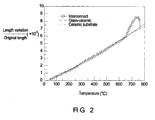
FIG. 2 is a relationship diagram of length and temperature of a thermal expansion test of the sealing material for solid oxide fuel cells according to the present invention; -
FIG. 3 is a relationship diagram of leakage and time of a leakage rate test of the sealing material for solid oxide fuel cells according to the present invention; and -
FIG. 4 is a relationship diagram of leakage and time of another leakage rate test of the sealing material for solid oxide fuel cells according to the present invention - The features and practice of the present invention will be illustrated below in detail through preferred embodiments with reference to the accompanying drawings.
- Firstly, a glass-ceramic powder is prepared by referring to an international formula of glass-ceramic powder. The glass-ceramic powder designed according to the present invention comprises around 20% to 40% by weight of silicon dioxide, around 5% to 15% by weight of boron oxide, around 20% to 40% by weight of barium oxide, around 1% to 7% by weight of aluminium oxide, around 3% to 20% by weight of calcium oxide, around 1% to 10% by weight of lanthanum oxide, and around 0.1% to 2% by weight of zirconium oxide.
- After the materials of the above formula are mixed together according to each proportion, they are put in an agate jar for grinding 200 minutes to become powder and be fully mixed together. Then, the powder is put in a platinum crucible and heated from a room temperature to around 1500[deg.]C to 1600[deg.]C at a rate of 5[deg.]C per minute, and the temperature of 1500[deg.]C to 1600[deg.]C is kept for 4 hours, so as to generate a fusion effect, and then the glass-ceramic of the present invention is obtained. After cooling, the glass-ceramic is taken out from the platinum crucible and ground by a ball mill to become micron powder, and then the powder with a standard granularity is sieved out from a screen machine.
- Around 20% to 30% by weight of alcohol (e.g., ethyl alcohol or polybasic alcohol), around 0.5% to 3% by weight of binder, and around 0.01% to 0.1% by weight of plasticizer (e.g., polyethylene glycol (PEG)) are taken and mixed, and they are stirred by a magnet and heated at 75[deg.]C until becoming a transparent liquid. Afterward around 60% to 80% by weight of glass-ceramic prepared by
step 1 is taken and added into the above transparent liquid, and then the transparent liquid is placed in a mixer machine to be stirred for 2 minutes at a spin rate of 1600 cycles per minute and then for 2 minutes at a spin rate of 1800 cycles per minute for debubbling. Afterward the well mixed sealing material of glass is obtained, and its best advantage is that it could harden quickly at a room temperature without a baking step. A complete flow chart of thestep 1 and 2 is shown inFig.1 . - During an experiment, around 16 millimeters of the sealing material of glass-ceramic, a metal interconnect, and a ceramic substrate are cut into test specimens and a thermal expansion test is performed by using a thermal dilatometer SETARAM DHT 2405, and the test result is shown in
Fig.2 , which shows thermal expansion coefficients of the sealing material of glass-ceramic, the metal interconnect, and the ceramic substrate. According to the result, the thermal expansion coefficient of the sealing material of the present invention is around 9.48 x 10<-6>/[deg.]C. In addition, when the temperature is below 650[deg.]C, the thermal expansion coefficient of the sealing material around 10 x 10<-6> m/m/[deg.]C is very similar with that of the metal interconnect and the ceramic substrate. However, at 650[deg.]C, the metal interconnect may occur phase change and its thermal expansion coefficient is raised suddenly. At 750[deg.]C, thermal expansion coefficients of the metal interconnect and the ceramic substrate respectively are around 12.6 x 10<-6> m/m/[deg.]C and 10.2 x 10<-6> m/m/[deg.]C. At such a high temperature condition, the consistency of the thermal expansion coefficients of the metal interconnect and the ceramic substrate is hard to be achieved. In this moment, the glass-ceramic which possesses bondability at the high temperature is utilized to complement the difference. - In addition, a scanning electron microscope (SEM) is utilized for observing a microcosmic structure and morphology of a specimen to confirm a bonding condition of the sealing material with an electrolyte (e.g., yttria stabilized zirconia, YSZ). After observing, it could be understood that a thickness of a sealing material layer is uniform, the sealing material and the electrolyte are connected very well, and the sealing material is quite dense without any cavity.
- During a leakage rate test of the sealing material of glass, a sealing material of glass is coated on a Crofer 22 substrate of 6 x 6 centimeters at a coating speed of 6 millimeters per second to form a test specimen. An iron ingot of 2.53 kilograms is placed on the test specimen. Through a high temperature (850[deg.]C) sealing, a 0.5 millimeter thick ceramic spacer is placed between two test specimens to avoid the sealing material spreading, and then a test is performed at a pressure of 2.0 pounds per square inch. A helium gas with pressure of 2.0 pounds per square inch is filled at a normal temperature, and it is discovered that the pressure is not changed as shown in
Fig.3 . As shown inFig.4 , similarly, The helium gas with pressure of 2.0 pounds per square inch is filled at temperature of 800[deg.]C for a long time, it is discovered that a leakage rate maintains 1 to 3 x 10<-3> sccm/cm. - As mentioned above, the sealing material of the present invention has a very good reliability without a high temperature baking step. It is an unprecedented technology in the field of fuel cells.
- The invention being thus described, it will be obvious that the same may be varied in many ways. Such variations are not to be regarded as a departure from the spirit and scope of the invention, and all such modifications as would be obvious to one skilled in the art are intended to be included within the scope of the following claims.
Claims (3)
- A sealing material for solid oxide fuel cells, comprising:60% to 80% by weight of glass;20% to 30% by weight of alcohol;0.5% to 3% by weight of a binder;
characterized by0.0 1 % to 0.1 % by weight of polyethylene glycol as a plasticizer,
wherein the glass comprises:20% to 40% by weight of silicon dioxide;5% to 15% by weight of boron oxide;20% to 40% by weight of barium oxide;1% to 7% by weight of aluminium oxide;3% to 200/o by weight of calcium oxide;1% to 10% by weight of lanthanum oxide; and0.1% to 2% by weight of zirconium oxide. - The sealing material for solid oxide fuel cells as claimed in claim 1, wherein the alcohol is polybasic alcohol.
- The sealing material for solid oxide fuel cells as claimed in claim 1, wherein the alcohol is ethyl alcohol.
Priority Applications (1)
| Application Number | Priority Date | Filing Date | Title |
|---|---|---|---|
| EP07119365.0A EP2053026B1 (en) | 2007-10-26 | 2007-10-26 | Sealing material for solid oxide fuel cells |
Applications Claiming Priority (1)
| Application Number | Priority Date | Filing Date | Title |
|---|---|---|---|
| EP07119365.0A EP2053026B1 (en) | 2007-10-26 | 2007-10-26 | Sealing material for solid oxide fuel cells |
Publications (2)
| Publication Number | Publication Date |
|---|---|
| EP2053026A1 EP2053026A1 (en) | 2009-04-29 |
| EP2053026B1 true EP2053026B1 (en) | 2014-04-02 |
Family
ID=39402526
Family Applications (1)
| Application Number | Title | Priority Date | Filing Date |
|---|---|---|---|
| EP07119365.0A Not-in-force EP2053026B1 (en) | 2007-10-26 | 2007-10-26 | Sealing material for solid oxide fuel cells |
Country Status (1)
| Country | Link |
|---|---|
| EP (1) | EP2053026B1 (en) |
Families Citing this family (4)
| Publication number | Priority date | Publication date | Assignee | Title |
|---|---|---|---|---|
| TWI378592B (en) * | 2007-09-04 | 2012-12-01 | Iner Aec Executive Yuan | Sealing material for solid oxide fuel cells |
| DE102010035251B4 (en) * | 2010-02-15 | 2013-09-26 | Schott Ag | High-temperature glass solder and its use |
| DE102013009001A1 (en) | 2013-05-24 | 2014-11-27 | Friedrich-Schiller-Universität Jena | Crystallizing, cristobalite-free and electrically well-insulating glass solders with high thermal expansion coefficients for joining metals and / or ceramics |
| CN118239684A (en) * | 2024-05-28 | 2024-06-25 | 赣州中傲新瓷科技有限公司 | Glass composite powder for sealing zirconia and stainless steel and preparation method thereof |
Citations (1)
| Publication number | Priority date | Publication date | Assignee | Title |
|---|---|---|---|---|
| WO2004059761A2 (en) * | 2002-12-24 | 2004-07-15 | Global Thermoelectric Inc. | High temperature gas seal |
Family Cites Families (5)
| Publication number | Priority date | Publication date | Assignee | Title |
|---|---|---|---|---|
| JP2724509B2 (en) * | 1990-06-14 | 1998-03-09 | 日本特殊陶業株式会社 | Glaze composition |
| EP0828693A4 (en) * | 1996-04-02 | 1998-11-18 | Techneglas Inc | Sealing glass modifier for use with voc-free or low-voc vehicle |
| JP4980718B2 (en) * | 2003-11-12 | 2012-07-18 | イー・アイ・デュポン・ドウ・ヌムール・アンド・カンパニー | Encapsulation assembly for electronic devices |
| KR100590968B1 (en) * | 2004-01-05 | 2006-06-19 | 현대자동차주식회사 | Glass / Ceramic Fiber Sealant for Solid Oxide Fuel Cell and Manufacturing Method Thereof |
| JP2006056769A (en) * | 2004-07-23 | 2006-03-02 | Nippon Sheet Glass Co Ltd | Glass composition for sealing, glass frit for sealing, and glass sheet for sealing |
-
2007
- 2007-10-26 EP EP07119365.0A patent/EP2053026B1/en not_active Not-in-force
Patent Citations (1)
| Publication number | Priority date | Publication date | Assignee | Title |
|---|---|---|---|---|
| WO2004059761A2 (en) * | 2002-12-24 | 2004-07-15 | Global Thermoelectric Inc. | High temperature gas seal |
Also Published As
| Publication number | Publication date |
|---|---|
| EP2053026A1 (en) | 2009-04-29 |
Similar Documents
| Publication | Publication Date | Title |
|---|---|---|
| Sohn et al. | Suitable glass‐ceramic sealant for planar solid‐oxide fuel cells | |
| Ley et al. | Glass-ceramic sealants for solid oxide fuel cells: Part I. Physical properties | |
| US8012895B2 (en) | Sealing material for solid oxide fuel cells | |
| US6541146B1 (en) | Composite sealant materials based on reacting fillers for solid oxide fuel cells | |
| US10658684B2 (en) | Sanbornite-based glass-ceramic seal for high-temperature applications | |
| CN105174719A (en) | Thin, fine grained and fully dense glass-ceramic seal for sofc stack | |
| US20150299026A1 (en) | Glass composition for the use as a sealant | |
| JP2012162445A (en) | High-expansive crystalline glass composition | |
| EP2053026A1 (en) | Sealing material for solid oxide fuel cells | |
| KR101182379B1 (en) | Sealant composition for solid oxide fuel cell, method of preparing the same, and solid oxide fuel cell including the same | |
| CN117098737B (en) | Glass composition for fuel cell stack sealing | |
| Ohara et al. | A new sealant material for solid oxide fuel cells using glass-ceramic | |
| Kurama et al. | Investigation properties of BaO/RO-Al2O3-R2O3-B2O3-SiO2 glass-ceramic sealants for solid oxide fuel cell | |
| Kim et al. | Compositional study of SiO2-Al2O3-CaO-MgO glasses as a sealing material for low temperature SOEC | |
| KR101013845B1 (en) | Method for Manufacturing Sealed Glass for Low Temperature Flat Solid Oxide Fuel Cell | |
| KR101989499B1 (en) | Composition for solid oxide fuel cell sealant, sealant using the same and method for manufacturing the same | |
| US9564643B2 (en) | Engineered glass seals for solid-oxide fuel cells | |
| AU2021218224C1 (en) | Glass composition for fuel cell stack sealing | |
| KR101554567B1 (en) | Sealing material for solid oxide cell and solid oxide cell comprising the same | |
| KR20150049746A (en) | Sealing composite for flat solid oxide fuel cell stack and fuel cell stack using the same | |
| KR101977856B1 (en) | Sealant for solid oxide fuel cell, solid oxide fuel cell comprising the sealant, battery module comprising the solid oxide fuel cell and method of manufacturing the sealant for solid oxide fuel cell | |
| Jinhua et al. | Compatibility between glass sealants and electrode materials of solid oxide fuel cells | |
| KR101482998B1 (en) | Sealing composite for flat solid oxide fuel cell stack | |
| Kueper et al. | Sealant materials for solid oxide fuels and other high-temperature ceramics | |
| Suda et al. | Bonding phase of amorphous silicate gas-tight seals for electrode-supported SOFCs |
Legal Events
| Date | Code | Title | Description |
|---|---|---|---|
| PUAI | Public reference made under article 153(3) epc to a published international application that has entered the european phase |
Free format text: ORIGINAL CODE: 0009012 |
|
| 17P | Request for examination filed |
Effective date: 20080207 |
|
| AK | Designated contracting states |
Kind code of ref document: A1 Designated state(s): AT BE BG CH CY CZ DE DK EE ES FI FR GB GR HU IE IS IT LI LT LU LV MC MT NL PL PT RO SE SI SK TR |
|
| AX | Request for extension of the european patent |
Extension state: AL BA HR MK RS |
|
| AKX | Designation fees paid |
Designated state(s): AT BE BG CH CY CZ DE DK EE ES FI FR GB GR HU IE IS IT LI LT LU LV MC MT NL PL PT RO SE SI SK TR |
|
| 17Q | First examination report despatched |
Effective date: 20100331 |
|
| REG | Reference to a national code |
Ref country code: DE Ref legal event code: R079 Ref document number: 602007035863 Country of ref document: DE Free format text: PREVIOUS MAIN CLASS: C03C0008140000 Ipc: C03C0008020000 |
|
| RIC1 | Information provided on ipc code assigned before grant |
Ipc: C03C 8/02 20060101AFI20130903BHEP |
|
| GRAP | Despatch of communication of intention to grant a patent |
Free format text: ORIGINAL CODE: EPIDOSNIGR1 |
|
| INTG | Intention to grant announced |
Effective date: 20131010 |
|
| RIN1 | Information on inventor provided before grant (corrected) |
Inventor name: WU, SHU-HAN Inventor name: CHENG, LI-CHUN Inventor name: LEE, RUEY-YI Inventor name: YANG, TUNG,YUAN Inventor name: LIN, KIN-FU Inventor name: LIOU, CHIEN-KUO Inventor name: LEE, TZANN-SHENG |
|
| GRAS | Grant fee paid |
Free format text: ORIGINAL CODE: EPIDOSNIGR3 |
|
| GRAA | (expected) grant |
Free format text: ORIGINAL CODE: 0009210 |
|
| AK | Designated contracting states |
Kind code of ref document: B1 Designated state(s): AT BE BG CH CY CZ DE DK EE ES FI FR GB GR HU IE IS IT LI LT LU LV MC MT NL PL PT RO SE SI SK TR |
|
| REG | Reference to a national code |
Ref country code: GB Ref legal event code: FG4D |
|
| REG | Reference to a national code |
Ref country code: AT Ref legal event code: REF Ref document number: 660002 Country of ref document: AT Kind code of ref document: T Effective date: 20140415 Ref country code: CH Ref legal event code: EP |
|
| REG | Reference to a national code |
Ref country code: IE Ref legal event code: FG4D |
|
| REG | Reference to a national code |
Ref country code: DE Ref legal event code: R096 Ref document number: 602007035863 Country of ref document: DE Effective date: 20140515 |
|
| REG | Reference to a national code |
Ref country code: AT Ref legal event code: MK05 Ref document number: 660002 Country of ref document: AT Kind code of ref document: T Effective date: 20140402 |
|
| REG | Reference to a national code |
Ref country code: NL Ref legal event code: VDEP Effective date: 20140402 |
|
| REG | Reference to a national code |
Ref country code: LT Ref legal event code: MG4D |
|
| PG25 | Lapsed in a contracting state [announced via postgrant information from national office to epo] |
Ref country code: IS Free format text: LAPSE BECAUSE OF FAILURE TO SUBMIT A TRANSLATION OF THE DESCRIPTION OR TO PAY THE FEE WITHIN THE PRESCRIBED TIME-LIMIT Effective date: 20140802 Ref country code: BG Free format text: LAPSE BECAUSE OF FAILURE TO SUBMIT A TRANSLATION OF THE DESCRIPTION OR TO PAY THE FEE WITHIN THE PRESCRIBED TIME-LIMIT Effective date: 20140702 Ref country code: CY Free format text: LAPSE BECAUSE OF FAILURE TO SUBMIT A TRANSLATION OF THE DESCRIPTION OR TO PAY THE FEE WITHIN THE PRESCRIBED TIME-LIMIT Effective date: 20140402 Ref country code: GR Free format text: LAPSE BECAUSE OF FAILURE TO SUBMIT A TRANSLATION OF THE DESCRIPTION OR TO PAY THE FEE WITHIN THE PRESCRIBED TIME-LIMIT Effective date: 20140703 Ref country code: FI Free format text: LAPSE BECAUSE OF FAILURE TO SUBMIT A TRANSLATION OF THE DESCRIPTION OR TO PAY THE FEE WITHIN THE PRESCRIBED TIME-LIMIT Effective date: 20140402 Ref country code: CZ Free format text: LAPSE BECAUSE OF FAILURE TO SUBMIT A TRANSLATION OF THE DESCRIPTION OR TO PAY THE FEE WITHIN THE PRESCRIBED TIME-LIMIT Effective date: 20140402 Ref country code: LT Free format text: LAPSE BECAUSE OF FAILURE TO SUBMIT A TRANSLATION OF THE DESCRIPTION OR TO PAY THE FEE WITHIN THE PRESCRIBED TIME-LIMIT Effective date: 20140402 Ref country code: NL Free format text: LAPSE BECAUSE OF FAILURE TO SUBMIT A TRANSLATION OF THE DESCRIPTION OR TO PAY THE FEE WITHIN THE PRESCRIBED TIME-LIMIT Effective date: 20140402 |
|
| PG25 | Lapsed in a contracting state [announced via postgrant information from national office to epo] |
Ref country code: ES Free format text: LAPSE BECAUSE OF FAILURE TO SUBMIT A TRANSLATION OF THE DESCRIPTION OR TO PAY THE FEE WITHIN THE PRESCRIBED TIME-LIMIT Effective date: 20140402 Ref country code: LV Free format text: LAPSE BECAUSE OF FAILURE TO SUBMIT A TRANSLATION OF THE DESCRIPTION OR TO PAY THE FEE WITHIN THE PRESCRIBED TIME-LIMIT Effective date: 20140402 Ref country code: AT Free format text: LAPSE BECAUSE OF FAILURE TO SUBMIT A TRANSLATION OF THE DESCRIPTION OR TO PAY THE FEE WITHIN THE PRESCRIBED TIME-LIMIT Effective date: 20140402 Ref country code: PL Free format text: LAPSE BECAUSE OF FAILURE TO SUBMIT A TRANSLATION OF THE DESCRIPTION OR TO PAY THE FEE WITHIN THE PRESCRIBED TIME-LIMIT Effective date: 20140402 Ref country code: SE Free format text: LAPSE BECAUSE OF FAILURE TO SUBMIT A TRANSLATION OF THE DESCRIPTION OR TO PAY THE FEE WITHIN THE PRESCRIBED TIME-LIMIT Effective date: 20140402 |
|
| PG25 | Lapsed in a contracting state [announced via postgrant information from national office to epo] |
Ref country code: PT Free format text: LAPSE BECAUSE OF FAILURE TO SUBMIT A TRANSLATION OF THE DESCRIPTION OR TO PAY THE FEE WITHIN THE PRESCRIBED TIME-LIMIT Effective date: 20140804 |
|
| REG | Reference to a national code |
Ref country code: DE Ref legal event code: R097 Ref document number: 602007035863 Country of ref document: DE |
|
| PG25 | Lapsed in a contracting state [announced via postgrant information from national office to epo] |
Ref country code: RO Free format text: LAPSE BECAUSE OF FAILURE TO SUBMIT A TRANSLATION OF THE DESCRIPTION OR TO PAY THE FEE WITHIN THE PRESCRIBED TIME-LIMIT Effective date: 20140402 Ref country code: DK Free format text: LAPSE BECAUSE OF FAILURE TO SUBMIT A TRANSLATION OF THE DESCRIPTION OR TO PAY THE FEE WITHIN THE PRESCRIBED TIME-LIMIT Effective date: 20140402 Ref country code: BE Free format text: LAPSE BECAUSE OF FAILURE TO SUBMIT A TRANSLATION OF THE DESCRIPTION OR TO PAY THE FEE WITHIN THE PRESCRIBED TIME-LIMIT Effective date: 20140402 Ref country code: EE Free format text: LAPSE BECAUSE OF FAILURE TO SUBMIT A TRANSLATION OF THE DESCRIPTION OR TO PAY THE FEE WITHIN THE PRESCRIBED TIME-LIMIT Effective date: 20140402 Ref country code: SK Free format text: LAPSE BECAUSE OF FAILURE TO SUBMIT A TRANSLATION OF THE DESCRIPTION OR TO PAY THE FEE WITHIN THE PRESCRIBED TIME-LIMIT Effective date: 20140402 |
|
| PLBE | No opposition filed within time limit |
Free format text: ORIGINAL CODE: 0009261 |
|
| STAA | Information on the status of an ep patent application or granted ep patent |
Free format text: STATUS: NO OPPOSITION FILED WITHIN TIME LIMIT |
|
| 26N | No opposition filed |
Effective date: 20150106 |
|
| PG25 | Lapsed in a contracting state [announced via postgrant information from national office to epo] |
Ref country code: IT Free format text: LAPSE BECAUSE OF FAILURE TO SUBMIT A TRANSLATION OF THE DESCRIPTION OR TO PAY THE FEE WITHIN THE PRESCRIBED TIME-LIMIT Effective date: 20140402 |
|
| REG | Reference to a national code |
Ref country code: DE Ref legal event code: R097 Ref document number: 602007035863 Country of ref document: DE Effective date: 20150106 |
|
| PG25 | Lapsed in a contracting state [announced via postgrant information from national office to epo] |
Ref country code: MC Free format text: LAPSE BECAUSE OF FAILURE TO SUBMIT A TRANSLATION OF THE DESCRIPTION OR TO PAY THE FEE WITHIN THE PRESCRIBED TIME-LIMIT Effective date: 20140402 Ref country code: LU Free format text: LAPSE BECAUSE OF FAILURE TO SUBMIT A TRANSLATION OF THE DESCRIPTION OR TO PAY THE FEE WITHIN THE PRESCRIBED TIME-LIMIT Effective date: 20141026 |
|
| REG | Reference to a national code |
Ref country code: CH Ref legal event code: PL |
|
| REG | Reference to a national code |
Ref country code: IE Ref legal event code: MM4A |
|
| PG25 | Lapsed in a contracting state [announced via postgrant information from national office to epo] |
Ref country code: CH Free format text: LAPSE BECAUSE OF NON-PAYMENT OF DUE FEES Effective date: 20141031 Ref country code: SI Free format text: LAPSE BECAUSE OF FAILURE TO SUBMIT A TRANSLATION OF THE DESCRIPTION OR TO PAY THE FEE WITHIN THE PRESCRIBED TIME-LIMIT Effective date: 20140402 Ref country code: LI Free format text: LAPSE BECAUSE OF NON-PAYMENT OF DUE FEES Effective date: 20141031 |
|
| REG | Reference to a national code |
Ref country code: FR Ref legal event code: PLFP Year of fee payment: 9 |
|
| PG25 | Lapsed in a contracting state [announced via postgrant information from national office to epo] |
Ref country code: IE Free format text: LAPSE BECAUSE OF NON-PAYMENT OF DUE FEES Effective date: 20141026 |
|
| PG25 | Lapsed in a contracting state [announced via postgrant information from national office to epo] |
Ref country code: TR Free format text: LAPSE BECAUSE OF FAILURE TO SUBMIT A TRANSLATION OF THE DESCRIPTION OR TO PAY THE FEE WITHIN THE PRESCRIBED TIME-LIMIT Effective date: 20140402 Ref country code: MT Free format text: LAPSE BECAUSE OF FAILURE TO SUBMIT A TRANSLATION OF THE DESCRIPTION OR TO PAY THE FEE WITHIN THE PRESCRIBED TIME-LIMIT Effective date: 20140402 Ref country code: HU Free format text: LAPSE BECAUSE OF FAILURE TO SUBMIT A TRANSLATION OF THE DESCRIPTION OR TO PAY THE FEE WITHIN THE PRESCRIBED TIME-LIMIT; INVALID AB INITIO Effective date: 20071026 |
|
| REG | Reference to a national code |
Ref country code: FR Ref legal event code: PLFP Year of fee payment: 10 |
|
| REG | Reference to a national code |
Ref country code: FR Ref legal event code: PLFP Year of fee payment: 11 |
|
| REG | Reference to a national code |
Ref country code: FR Ref legal event code: PLFP Year of fee payment: 12 |
|
| PGFP | Annual fee paid to national office [announced via postgrant information from national office to epo] |
Ref country code: DE Payment date: 20211018 Year of fee payment: 15 Ref country code: GB Payment date: 20211022 Year of fee payment: 15 |
|
| PGFP | Annual fee paid to national office [announced via postgrant information from national office to epo] |
Ref country code: FR Payment date: 20211021 Year of fee payment: 15 |
|
| REG | Reference to a national code |
Ref country code: DE Ref legal event code: R119 Ref document number: 602007035863 Country of ref document: DE |
|
| GBPC | Gb: european patent ceased through non-payment of renewal fee |
Effective date: 20221026 |
|
| PG25 | Lapsed in a contracting state [announced via postgrant information from national office to epo] |
Ref country code: FR Free format text: LAPSE BECAUSE OF NON-PAYMENT OF DUE FEES Effective date: 20221031 Ref country code: DE Free format text: LAPSE BECAUSE OF NON-PAYMENT OF DUE FEES Effective date: 20230503 |
|
| PG25 | Lapsed in a contracting state [announced via postgrant information from national office to epo] |
Ref country code: GB Free format text: LAPSE BECAUSE OF NON-PAYMENT OF DUE FEES Effective date: 20221026 |