EP2050954B1 - Actuation via surface chemistry induced surface stress - Google Patents
Actuation via surface chemistry induced surface stress Download PDFInfo
- Publication number
- EP2050954B1 EP2050954B1 EP08166297.5A EP08166297A EP2050954B1 EP 2050954 B1 EP2050954 B1 EP 2050954B1 EP 08166297 A EP08166297 A EP 08166297A EP 2050954 B1 EP2050954 B1 EP 2050954B1
- Authority
- EP
- European Patent Office
- Prior art keywords
- metal structure
- porous metal
- porous
- modifying agent
- nanoporous
- Prior art date
- Legal status (The legal status is an assumption and is not a legal conclusion. Google has not performed a legal analysis and makes no representation as to the accuracy of the status listed.)
- Not-in-force
Links
- 229910052751 metal Inorganic materials 0.000 claims description 121
- 239000002184 metal Substances 0.000 claims description 121
- 239000010931 gold Substances 0.000 claims description 93
- 239000003795 chemical substances by application Substances 0.000 claims description 61
- 238000000034 method Methods 0.000 claims description 47
- 229910052737 gold Inorganic materials 0.000 claims description 39
- PCHJSUWPFVWCPO-UHFFFAOYSA-N gold Chemical compound [Au] PCHJSUWPFVWCPO-UHFFFAOYSA-N 0.000 claims description 38
- QVGXLLKOCUKJST-UHFFFAOYSA-N atomic oxygen Chemical group [O] QVGXLLKOCUKJST-UHFFFAOYSA-N 0.000 claims description 34
- 229910052760 oxygen Inorganic materials 0.000 claims description 33
- 239000001301 oxygen Substances 0.000 claims description 33
- UGFAIRIUMAVXCW-UHFFFAOYSA-N Carbon monoxide Chemical group [O+]#[C-] UGFAIRIUMAVXCW-UHFFFAOYSA-N 0.000 claims description 30
- 229910002091 carbon monoxide Inorganic materials 0.000 claims description 30
- CBENFWSGALASAD-UHFFFAOYSA-N Ozone Chemical compound [O-][O+]=O CBENFWSGALASAD-UHFFFAOYSA-N 0.000 claims description 26
- BASFCYQUMIYNBI-UHFFFAOYSA-N platinum Chemical compound [Pt] BASFCYQUMIYNBI-UHFFFAOYSA-N 0.000 claims description 22
- 230000008859 change Effects 0.000 claims description 18
- 238000001179 sorption measurement Methods 0.000 claims description 18
- 230000008602 contraction Effects 0.000 claims description 15
- 230000002441 reversible effect Effects 0.000 claims description 15
- 229910052697 platinum Inorganic materials 0.000 claims description 11
- 238000011084 recovery Methods 0.000 claims description 9
- 239000000126 substance Substances 0.000 claims description 9
- 239000011148 porous material Substances 0.000 claims description 6
- 125000004429 atom Chemical group 0.000 description 18
- 230000000694 effects Effects 0.000 description 16
- 239000000463 material Substances 0.000 description 13
- 239000002156 adsorbate Substances 0.000 description 12
- 238000002474 experimental method Methods 0.000 description 12
- 239000007789 gas Substances 0.000 description 10
- 230000003647 oxidation Effects 0.000 description 10
- 238000007254 oxidation reaction Methods 0.000 description 10
- 238000006243 chemical reaction Methods 0.000 description 9
- CURLTUGMZLYLDI-UHFFFAOYSA-N Carbon dioxide Chemical compound O=C=O CURLTUGMZLYLDI-UHFFFAOYSA-N 0.000 description 8
- 230000004044 response Effects 0.000 description 8
- 238000012546 transfer Methods 0.000 description 8
- 229910045601 alloy Inorganic materials 0.000 description 7
- 239000000956 alloy Substances 0.000 description 7
- 230000015572 biosynthetic process Effects 0.000 description 6
- 230000002427 irreversible effect Effects 0.000 description 6
- 150000002739 metals Chemical class 0.000 description 6
- 238000000329 molecular dynamics simulation Methods 0.000 description 6
- IJGRMHOSHXDMSA-UHFFFAOYSA-N Atomic nitrogen Chemical compound N#N IJGRMHOSHXDMSA-UHFFFAOYSA-N 0.000 description 5
- MYMOFIZGZYHOMD-UHFFFAOYSA-N Dioxygen Chemical compound O=O MYMOFIZGZYHOMD-UHFFFAOYSA-N 0.000 description 5
- 238000013459 approach Methods 0.000 description 5
- 229910002092 carbon dioxide Inorganic materials 0.000 description 5
- 229910001882 dioxygen Inorganic materials 0.000 description 5
- 238000011161 development Methods 0.000 description 4
- 239000003792 electrolyte Substances 0.000 description 4
- 210000003041 ligament Anatomy 0.000 description 4
- 238000005259 measurement Methods 0.000 description 4
- 230000004048 modification Effects 0.000 description 4
- 238000012986 modification Methods 0.000 description 4
- 239000002070 nanowire Substances 0.000 description 4
- 230000008569 process Effects 0.000 description 4
- 229910002696 Ag-Au Inorganic materials 0.000 description 3
- 239000001569 carbon dioxide Substances 0.000 description 3
- 230000007613 environmental effect Effects 0.000 description 3
- 239000006260 foam Substances 0.000 description 3
- 230000001965 increasing effect Effects 0.000 description 3
- 230000003993 interaction Effects 0.000 description 3
- 239000007788 liquid Substances 0.000 description 3
- 230000007246 mechanism Effects 0.000 description 3
- 229910052755 nonmetal Inorganic materials 0.000 description 3
- 238000007788 roughening Methods 0.000 description 3
- 239000007787 solid Substances 0.000 description 3
- 238000003775 Density Functional Theory Methods 0.000 description 2
- 230000004913 activation Effects 0.000 description 2
- 238000004458 analytical method Methods 0.000 description 2
- 230000003197 catalytic effect Effects 0.000 description 2
- 238000005260 corrosion Methods 0.000 description 2
- 230000007797 corrosion Effects 0.000 description 2
- 238000010494 dissociation reaction Methods 0.000 description 2
- 230000005593 dissociations Effects 0.000 description 2
- 230000005611 electricity Effects 0.000 description 2
- 238000011065 in-situ storage Methods 0.000 description 2
- 239000000203 mixture Substances 0.000 description 2
- 210000003205 muscle Anatomy 0.000 description 2
- 229910052757 nitrogen Inorganic materials 0.000 description 2
- 239000002245 particle Substances 0.000 description 2
- VLTRZXGMWDSKGL-UHFFFAOYSA-N perchloric acid Chemical compound OCl(=O)(=O)=O VLTRZXGMWDSKGL-UHFFFAOYSA-N 0.000 description 2
- 230000009467 reduction Effects 0.000 description 2
- 239000002344 surface layer Substances 0.000 description 2
- 238000006557 surface reaction Methods 0.000 description 2
- 238000012360 testing method Methods 0.000 description 2
- OKTJSMMVPCPJKN-UHFFFAOYSA-N Carbon Chemical compound [C] OKTJSMMVPCPJKN-UHFFFAOYSA-N 0.000 description 1
- 239000004966 Carbon aerogel Substances 0.000 description 1
- GRYLNZFGIOXLOG-UHFFFAOYSA-N Nitric acid Chemical compound O[N+]([O-])=O GRYLNZFGIOXLOG-UHFFFAOYSA-N 0.000 description 1
- BQCADISMDOOEFD-UHFFFAOYSA-N Silver Chemical compound [Ag] BQCADISMDOOEFD-UHFFFAOYSA-N 0.000 description 1
- 238000009825 accumulation Methods 0.000 description 1
- 239000002253 acid Substances 0.000 description 1
- 238000000231 atomic layer deposition Methods 0.000 description 1
- 238000005452 bending Methods 0.000 description 1
- 230000008901 benefit Effects 0.000 description 1
- 238000004364 calculation method Methods 0.000 description 1
- 229910052799 carbon Inorganic materials 0.000 description 1
- 239000003054 catalyst Substances 0.000 description 1
- 238000006555 catalytic reaction Methods 0.000 description 1
- 239000000919 ceramic Substances 0.000 description 1
- 239000011248 coating agent Substances 0.000 description 1
- 238000000576 coating method Methods 0.000 description 1
- 239000002131 composite material Substances 0.000 description 1
- 239000000470 constituent Substances 0.000 description 1
- 230000001351 cycling effect Effects 0.000 description 1
- 230000007547 defect Effects 0.000 description 1
- 230000001419 dependent effect Effects 0.000 description 1
- 238000013461 design Methods 0.000 description 1
- 238000001514 detection method Methods 0.000 description 1
- 238000010586 diagram Methods 0.000 description 1
- 238000009792 diffusion process Methods 0.000 description 1
- 238000006073 displacement reaction Methods 0.000 description 1
- 238000004070 electrodeposition Methods 0.000 description 1
- 230000009881 electrostatic interaction Effects 0.000 description 1
- 238000005516 engineering process Methods 0.000 description 1
- 230000002708 enhancing effect Effects 0.000 description 1
- 238000005530 etching Methods 0.000 description 1
- 238000011049 filling Methods 0.000 description 1
- 238000007710 freezing Methods 0.000 description 1
- 230000008014 freezing Effects 0.000 description 1
- 239000000446 fuel Substances 0.000 description 1
- 239000011521 glass Substances 0.000 description 1
- PQTCMBYFWMFIGM-UHFFFAOYSA-N gold silver Chemical compound [Ag].[Au] PQTCMBYFWMFIGM-UHFFFAOYSA-N 0.000 description 1
- 229910052739 hydrogen Inorganic materials 0.000 description 1
- 239000001257 hydrogen Substances 0.000 description 1
- 125000004435 hydrogen atom Chemical class [H]* 0.000 description 1
- 238000002347 injection Methods 0.000 description 1
- 239000007924 injection Substances 0.000 description 1
- 239000010410 layer Substances 0.000 description 1
- 238000002386 leaching Methods 0.000 description 1
- 230000007774 longterm Effects 0.000 description 1
- 238000005272 metallurgy Methods 0.000 description 1
- 230000004660 morphological change Effects 0.000 description 1
- 239000002105 nanoparticle Substances 0.000 description 1
- 239000007783 nanoporous material Substances 0.000 description 1
- 229910017604 nitric acid Inorganic materials 0.000 description 1
- 229910000510 noble metal Inorganic materials 0.000 description 1
- 230000003287 optical effect Effects 0.000 description 1
- 230000001590 oxidative effect Effects 0.000 description 1
- 238000002360 preparation method Methods 0.000 description 1
- 230000002035 prolonged effect Effects 0.000 description 1
- 238000010926 purge Methods 0.000 description 1
- 238000010791 quenching Methods 0.000 description 1
- 230000000171 quenching effect Effects 0.000 description 1
- 230000009257 reactivity Effects 0.000 description 1
- 229910052709 silver Inorganic materials 0.000 description 1
- 239000004332 silver Substances 0.000 description 1
- 238000004088 simulation Methods 0.000 description 1
- 239000002356 single layer Substances 0.000 description 1
- 239000007784 solid electrolyte Substances 0.000 description 1
- 238000002336 sorption--desorption measurement Methods 0.000 description 1
- 238000001330 spinodal decomposition reaction Methods 0.000 description 1
- 238000005728 strengthening Methods 0.000 description 1
- 238000004448 titration Methods 0.000 description 1
- 229910052723 transition metal Inorganic materials 0.000 description 1
- 150000003624 transition metals Chemical class 0.000 description 1
Images


Classifications
-
- C—CHEMISTRY; METALLURGY
- C23—COATING METALLIC MATERIAL; COATING MATERIAL WITH METALLIC MATERIAL; CHEMICAL SURFACE TREATMENT; DIFFUSION TREATMENT OF METALLIC MATERIAL; COATING BY VACUUM EVAPORATION, BY SPUTTERING, BY ION IMPLANTATION OR BY CHEMICAL VAPOUR DEPOSITION, IN GENERAL; INHIBITING CORROSION OF METALLIC MATERIAL OR INCRUSTATION IN GENERAL
- C23F—NON-MECHANICAL REMOVAL OF METALLIC MATERIAL FROM SURFACE; INHIBITING CORROSION OF METALLIC MATERIAL OR INCRUSTATION IN GENERAL; MULTI-STEP PROCESSES FOR SURFACE TREATMENT OF METALLIC MATERIAL INVOLVING AT LEAST ONE PROCESS PROVIDED FOR IN CLASS C23 AND AT LEAST ONE PROCESS COVERED BY SUBCLASS C21D OR C22F OR CLASS C25
- C23F1/00—Etching metallic material by chemical means
-
- F—MECHANICAL ENGINEERING; LIGHTING; HEATING; WEAPONS; BLASTING
- F05—INDEXING SCHEMES RELATING TO ENGINES OR PUMPS IN VARIOUS SUBCLASSES OF CLASSES F01-F04
- F05D—INDEXING SCHEME FOR ASPECTS RELATING TO NON-POSITIVE-DISPLACEMENT MACHINES OR ENGINES, GAS-TURBINES OR JET-PROPULSION PLANTS
- F05D2230/00—Manufacture
- F05D2230/20—Manufacture essentially without removing material
- F05D2230/25—Manufacture essentially without removing material by forging
-
- F—MECHANICAL ENGINEERING; LIGHTING; HEATING; WEAPONS; BLASTING
- F05—INDEXING SCHEMES RELATING TO ENGINES OR PUMPS IN VARIOUS SUBCLASSES OF CLASSES F01-F04
- F05D—INDEXING SCHEME FOR ASPECTS RELATING TO NON-POSITIVE-DISPLACEMENT MACHINES OR ENGINES, GAS-TURBINES OR JET-PROPULSION PLANTS
- F05D2300/00—Materials; Properties thereof
- F05D2300/10—Metals, alloys or intermetallic compounds
- F05D2300/13—Refractory metals, i.e. Ti, V, Cr, Zr, Nb, Mo, Hf, Ta, W
- F05D2300/133—Titanium
Definitions
- the present invention relates to surface chemistry induced macroscopic strain effects of nanoporous metal structures, and more particularly to the control of macroscopic strain of nanoporous gold through reversible, surface chemistry induced changes of the surface stress.
- Reversible macroscopic dimensional changes (strain) of nanoporous metals such as nanoporous gold or nanoporous platinum can be achieved in an electrochemical environment by controlling the surface stress via the surface electronic charge density which in turn can be controlled by applying an electrical potential.
- a method of controlling macroscopic strain of a porous structure includes contacting a porous structure with a modifying agent which chemically adsorbs to a surface of the porous structure and modifies an existing surface stress of the porous structure.
- a method of controlling macroscopic strain of a porous metal structure includes contacting a porous metal structure with a removing agent for removing a chemically adsorbed modifying agent from the porous metal structure, thereby causing a recovery of about dimensions of the porous metal structure prior to adsorption of the modifying agent.
- a method of controlling macroscopic strain of a porous metal structure includes contacting a porous metal structure with a modifying agent which chemically adsorbs to a surface of the porous metal structure and modifies an existing surface stress of the porous metal structure, thereby causing an at least partially reversible volumetric change of the nanoporous metal structure; and contacting the porous metal structure with a removing agent for removing a chemically adsorbed modifying agent from the porous metal structure, thereby causing an at least partial recovery of about dimensions of the porous metal structure prior to adsorption of the modifying agent.
- FIG. 1 is a schematic diagram of an experimental setup which can measure the macroscopic strain in samples using a dilameter according to one embodiment.
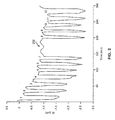
- FIG. 2 is a graphical representation of a typical data set measuring change in length ( ⁇ L, ⁇ m) versus time (min).
- FIG. 3 is a graphical representation of a typical data set measuring strain ( ⁇ L/L) versus time (min) as a function of increasing ozone concentration.
- a method of controlling macroscopic strain of a porous structure or a porous metal structure in one general embodiment includes contacting a porous structure or a porous metal structure with a modifying agent which chemically adsorbs to a surface of the porous structure or the porous metal structure and modifies an existing surface stress of the porous structure or the porous metal structure, wherein the porous structure or porous metal structure is a nanoporous structure comprising gold or platinum and the modifying agent is oxygen, the modifying agent being contacted with the porous structure or porous metal structure by exposure of the porous metal structure to ozone.
- a method of controlling macroscopic strain of a porous metal structure in another general embodiment includes contacting a porous metal structure with a removing agent for removing a chemically adsorbed modifying agent from the porous metal structure, thereby causing a recovery of about original dimensions of the porous metal structure prior to adsorption of the modifying agent, wherein the porous metal structure is a nanoporous structure comprising gold or platinum and the modifying agent is oxygen, the modifying agent being contacted with the porous metal structure by exposure of the porous metal structure to ozone.
- a method of controlling macroscopic strain of a porous metal structure in another general embodiment includes contacting a porous metal structure with a modifying agent which chemically adsorbs to a surface of the porous metal structure and modifies an existing surface stress of the porous metal structure, thereby causing an at least partially reversible volumetric change (reduction or increase, contraction or expansion) of the nanoporous metal structure; and contacting the porous metal structure with a removing agent for removing a chemically adsorbed modifying agent from the porous metal structure, thereby causing an at least partial recovery of about dimensions of the porous metal structure prior to adsorption of the modifying agent, wherein the porous metal structure is a nanoporous structure comprising gold or platinum and the modifying agent is oxygen, the modifying agent being contacted with the porous metal structure by exposure of the porous metal structure to ozone.
- a modifying agent which chemically adsorbs to a surface of the porous metal structure and modifies an existing surface stress of the porous
- a device includes a porous metal structure, which when contacted with a modifying agent which chemically adsorbs to a surface of the porous metal structure, exhibits a volumetric change (contraction or expansion) due to modification of an existing surface stress of the porous metal structure; and a mechanism for detecting the volumetric change.
- the effect is not limited to nanoporous Au, but is a general property of nanoporous materials (including nanoporous metals) with a high surface-to-volume ratio where the interaction of surface atoms with gas phase species leads to a modification of the surface stress of the system.
- Materials with a very high ratio ( ⁇ 10 -3 general ratio) of surface atoms to bulk atoms may have more observable macroscopic dimensional changes, and thus are more usable for actuation, sensing, or direct conversion of chemical energy into mechanical energy.
- an actuator is a device which converts some sort of energy into mechanical work.
- nanoporous Pt and Au have been demonstrated to yield strain amplitudes comparable to those of commercial ferroelectric ceramics.
- the microscopic processes behind the charge-strain response of nanoporous metals in an electrochemical environment are still unclear, it seems to be clear - in a continuum description - that the effect is caused by charge-induced changes in the surface stress ( f ) at the metal-electrolyte interface.
- an actuator may be based on surface-chemistry induced changes of the surface stress at a solid-gas interface which, in turn, drives an elastic macroscopic sample contraction and/or expansion.
- This actuator can be used to directly convert chemical energy into a mechanical response without generating heat or electricity first. While not wishing to be bound by any particular theory, covalent adsorbate-metal interactions seem to play a decisive role in determining both size and even sign of adsorbate-induced changes of f . Although the relative change in f may be large, a macroscopic strain response typically requires the use of high-surface-area material.
- surface chemistry driven actuation will develop into an economically viable technology, as various embodiments provide low materials costs, high efficiency and long-term stability.
- the efficiency can be increased by using less energetic reactions than the oxidation of CO by O 3 used in the present work.
- This may include surface engineering to tailor the surface reactivity, for example by Ag doping to increase the catalytic activity of np-Au towards the dissociation of molecular oxygen which is a lower energy fuel.
- noble metal based systems such as np-Au
- other embodiments use lower-cost, lower-density, and stronger high surface area materials such as carbon aerogels, for example.
- the system includes a porous metal structure 102 , which when contacted with a modifying agent which chemically adsorbs to a surface of the porous metal structure, exhibits a volumetric contraction due to modification of an existing surface stress of the porous metal structure.
- the porous metal structure may be nanoporous gold, as described herein, or may be nanoporous platinum.
- Monolithic samples of nanoporous Au can be obtained by dealloying an Ag-Au alloy which leads to the development of a characteristic three-dimensional open-cell porosity.
- the device includes a mechanism for detecting and/or transferring the volumetric contraction or expansion, such as a piston/displacement sensor unit 104 and environmental cell 106 arrangement, as shown in FIG. 1 , and/or a mechanical lever, optical sensor, electrical switch, etc.
- a mechanism for detecting and/or transferring the volumetric contraction or expansion such as a piston/displacement sensor unit 104 and environmental cell 106 arrangement, as shown in FIG. 1 , and/or a mechanical lever, optical sensor, electrical switch, etc.
- the method comprises contacting a porous material with a modifying agent which chemically adsorbs to a surface of the porous structure and modifies an existing surface stress of the porous structure.
- the method comprises contacting a porous structure with a removing agent for removing a chemically adsorbed modifying agent from the porous structure, thereby causing a volumetric recovery of the porous structure.
- the method comprises contacting a porous structure with a modifying agent which chemically adsorbs to a surface of the porous structure and modifies an existing surface stress of the porous structure, thereby causing an at least partially reversible volumetric change (expansion or contraction) of the nanoporous metal structure; and contacting the porous structure with a removing agent for removing a chemically adsorbed modifying agent from the porous structure, thereby causing an at least partially reversible volumetric recovery of the porous structure.
- the nanoporous structure may be formed from gold or platinum.
- the nanoporous metal structure may be formed using two or more metals (e.g., as an alloy or composite), or a metal and nonmetal (e.g., carbon).
- these nanoporous metal/metal or metal/nonmetal hybrid materials may be prepared by coating a nanoporous metal with another metal or nonmetal by using atomic layer deposition, electro-deposition, or some other suitable method.
- Nanoporous gold may be prepared using methods known in the art.
- Nanoporous Au can be prepared in the form of millimeter-sized monolithic samples by a process called 'dealloying.' In metallurgy, dealloying is defined as selective corrosion (removal) of the less noble constituent from an alloy, usually via dissolving this component in a corrosive environment.
- nanoporous Au may be formed by selectively leaching silver (Ag) from an Ag-Au alloy using either a strong oxidizing acid such as nitric acid (free corrosion) or by applying an electrochemical driving force (electrochemically-driven dealloying). Both methods lead to the development of nanoporous open-cell morphology.
- the porous metal structure is a nanoporous structure comprising gold or platinum, possibly formed with the techniques described herein, or other technique.
- the porous metal structure may have a ratio of surface atoms to bulk atoms of at least about 1x10 -3 .
- the porous metal structure may have a ratio of surface atoms to bulk atoms of more or less than this figure.
- a media pore size of the porous metal structure may be less than about 100 nanometers (nm), less than about 80 nm, less than about 60 nm, etc.
- the porous metal structure may have a median pore size of more or less than this figure.
- the modifying agent may be liquid or gas which can adsorb into the nanoporous metal structure and by being adsorbed modifies the existing surface stress of the porous structure.
- the existing surface stress of the porous structure can be modified by modifying the metal-metal bonding in the surface layer of the nanoporous metal structure, for example by charge transfer.
- the contacting of the modifying agent with the porous metal structure may be effected by exposing the porous metal structure to the pure modifying agent, a mixture containing the modifying agent, etc.
- the modifying agent is oxygen, the modifying agent being contacted with the porous metal structure by exposure of the porous metal structure to ozone.
- This technique of exposing the porous metal structure to a modifying agent is similar to the techniques described herein.
- the porous metal structure may be contacted with the modifying agent for a time sufficient to generate a linear dimensional changes (contraction or expansion) of the porous metal structure of at least about 0.01 %. In other approaches, at least about 0.05%, at least about 0.1%, at least about 0.5%, about 1.0%, or any value between 0 and about 1% (or higher) may be achieved.
- the particular amount of expansion achievable is at least partially dependent upon the metal, the nanoporous structure, and modifying agent used.
- the linear dimensional change may be measured between opposite sides or ends of the porous metal structure.
- the modifying agent upon chemical adsorption to the porous metal structure, may cause an at least partially reversible volumetric change (expansion or contraction) of the nanoporous metal structure, as measured from outer dimensions of the structure, e.g., length, height, width, etc.
- volumetric change is at least partially reversible, it is intended that the porous metal structure may substantially return to its former volume prior to being exposed to the modifying agent, with some irreversible shrinkage being allowed.
- the removing agent may be carbon monoxide, hydrogen, or any other liquid or gas that can remove the modifying agent, preferably without substantially affecting the underlying structure.
- Nanoporous gold is an ideal material for this experiment for several reasons.
- the material is reactive enough to catalyze surface reactions such as ozone dissociation and carbon monoxide oxidation at room temperature, but it is also noble enough to prevent irreversible oxidation.
- nanoporous Au's characteristic sponge-like open-cell foam morphology makes it a high surface area material which also combines high porosity (mass transport) with high strength (sustainable stress).
- ozone exposure can be expected to change the surface stress of Au as oxygen adsorption has been shown to lead to a withdrawal of electrons from the surface atoms (depletion of the Au 5d band).
- the strain measurements were performed in a commercial dilatometer 100 equipped with a small glass chamber 106 for environmental control, in a configuration similar to that shown in FIG. 1 .
- Cuboids (1x1x1 mm 3 ) of nanoporous Au 102 were exposed to alternating cycles of ozone in synthetic air (nominally 80% N 2 , 20% O 2 ) and carbon monoxide at room temperature, and the macroscopic length changes induced by the interaction of nanoporous gold with these gases were monitored in situ 104.
- the gas flow was adjusted to 10 sccm resulting in an instrumental response time of about 1 min, with the ozone concentration varied between 0% and 7.5%.
- the experimental setup was purged with nitrogen (N 2 ). The exposure times were varied between a few minutes to a few hours, and the number of cycles varied between 1 and 100.
- FIG. 2 A typical macroscopic strain versus time data set is shown in FIG. 2 .
- the strain was continuously monitored while the samples were alternately exposed to a mixture of 1-8% O 3 in O 2 and pure CO.
- Splitting the surface catalyzed oxidation of CO by O 3 into two self-limiting half-reactions allows one to switch the surface of nanoporous Au back and forth between an oxygen-covered and clean state.
- ozone exposure leads to oxygen adsorption on the clean Au surface, according to Equation 2.
- Equation 2 Equation 2
- FIG. 2 shows a typical data set.
- the sample dimensions (and thus the strain ⁇ L/L) changes with time as the sample is exposed to alternating cycles of ozone and carbon monoxide.
- Ozone exposure causes shrinkage, and subsequent carbon monoxide exposure leads to expansion and recovery of the original sample dimension.
- the length changes are reversible with a small superimposed irreversible shrinkage.
- an ozone concentration of 7.1 % was used, and the exposure time to both ozone and carbon monoxide was 5 minutes interrupted by 3 minutes of nitrogen purging (except between cycle #7 and cycle #8 202 where the sample was purged for 55 minutes with nitrogen).
- the average length change in Fig. 2 is about 1.7 micron which translates into a strain value of about 0.2%.
- larger ⁇ L/L values have been observed after prolonged ozone exposure (data not shown).
- the measured macroscopic length changes of nanoporous gold upon alternating exposures to ozone and carbon monoxide can be explained by adsorbate induced changes of the surface stress. It is believed that the adsorbate-induced change of the surface stress is related to charge transfer during chemisorption and subsequent reaction of oxygen.
- the efficiency of the actuator can be estimated from the standard Gibbs energy of reaction of the CO oxidation by O 3 (about 420 kJ/mol), and the number of surface atoms (about 1000 mol/m 3 for nanoporous Au with a specific surface area of about 10 m 2 /g and density of 6x10 6 g/m 3 ).
- O 3 about 420 kJ/mol
- the number of surface atoms about 1000 mol/m 3 for nanoporous Au with a specific surface area of about 10 m 2 /g and density of 6x10 6 g/m 3 .
- Using the oxygen saturation coverage of approximately one monolayer (about 10 15 cm -2 ) obtained from the CO titration experiment on nanoporous Au reveals an efficiency in the order of about 1.0%.
- the low efficiency is a direct consequence of the strongly exothermic nature of the driving reaction. In principle, it should be possible to increase the efficiency by selecting reactions which are accompanied by small entropy and enthalpy changes.
- the one-mm-cube samples used in the current study contain only about 10 -6 mol of surface atoms, thus making it a potentially very sensitive sensor material.
- a miniaturized 10-micron cube could still produce an easy to detect 50-nm stroke which would translate into a detection limit of ozone as low as 10 -12 mol. Similar results are believed to be obtainable for other modifying agents.
- the surface stress changes necessary to explain the observed macroscopic dimensional changes can be analyzed within a continuum approach.
- the starting point for such an analysis is the generalized capillary equation for solids which relates the volumetric average of the pressure in the solid to the area average of the surface stress.
- the measured dimensional change ⁇ L/L o is the direct consequence of a surface-stress induced, linear elastic and isotropic lattice strain
- the mean change of surface stress ⁇ f > is related to ⁇ L/L o via Equation 4.
- Equation 4 overestimates the magnitude of ⁇ f > by (in extreme cases) as much as one order of magnitude, in particular for materials with a large Poisson number such as Au.
- Molecular dynamics (MD) simulations offer just such an opportunity to independently test the surface stress-strain response of nanoporous Au.
- fully atomistic MD simulations were performed on the effect of surface stress on the equilibrium shape of realistic models of nanoporous Au and its structural building blocks, the ligaments.
- the embedded atom method (EAM) potential used in this work generates a tensile surface stress of about 1.3 N/m (at 0K) for the Au(100) surface.
- the skeletal network of the computational nanoporous Au samples was generated by simulating the spinodal decomposition during vapor quenching, and freezing the process once the desired length scale was achieved.
- the final structure was obtained by adjusting the ligament diameter to produce the desired porosity (about 70%), and filling the ligament volume with Au atoms. (100)-oriented Au nanowires were used as models for the ligaments. Both samples were created using the atomic positions of bulk fcc Au. The effect of tensile surface stress was studied by equilibrating the samples to zero overall pressure at various temperatures ranging from 0K to 300K. The dimensional changes observed during this relaxation are caused solely by tensile surface stress, and therefore provide a benchmark for the thermodynamic surface stress-strain correlation. The results of this experiment revealed that Equation 4 indeed underestimates the effect of surface stress.
- nanowires In the case of nanowires, the effect of tensile surface stress is an almost uniaxial contraction along the wire axis ( ⁇ L/L is about ⁇ V/V) and the contraction is approximately seven times larger than predicted by Equation 4.
- the nanoporous samples show isotropic contraction ( ⁇ L/L is about 1/3 ⁇ V/V), and the relaxation is weaker, but still three times stronger than predicted by the thermodynamic approach.
- the differences between nanowires and nanoporous Au is consistent with the random network structure of the latter, and their lower surface-to-volume ratio.
- the stronger-than-predicted MD strain response may also reflect the extremely high fraction of step edge and kink site atoms (coordination number 7 and 6, respectively) of these samples.
- the experimentally observed strain levels of up to 0.005 can be explained by surface stress changes of about 6 N/m instead of the about 20 N/m predicted by the thermodynamic approach.
- adsorbate-induced morphology changes may also play an important role, for example by changing the surface-to-volume ratio.
- oxygen induced surface roughening via formation of Au-oxide nanoparticles has recently been observed in the Au(111)/O system.
- morphology changes would be required to be reversible.
- Au atoms released from Au-oxide particles by reaction with CO would be required to heal the defects created by the formation of these Au-oxide particles during O 3 exposure.
- the small irreversible strain component observed in the experiments might also be the result of irreversible morphology changes caused by oxygen-enhanced mass transport.
- the origin of the oxygen-induced tensile surface stress generation observed in the experiments is not fully understood yet.
- residual Ag which is typically in the order of a few percent for the nanoporous Au samples used in the experiments is discussed.
- residual Ag can affect the O/CO surface chemistry in two ways: first, vacancy formation (atomic scale roughening) by chemically induced dealloying of Ag by adsorbed oxygen, and second by increasing the catalytic activity of nanoporous Au.
- vacancy formation atomic scale roughening
- O 2 molecular oxygen
Landscapes
- Chemical & Material Sciences (AREA)
- Chemical Kinetics & Catalysis (AREA)
- General Chemical & Material Sciences (AREA)
- Engineering & Computer Science (AREA)
- Materials Engineering (AREA)
- Mechanical Engineering (AREA)
- Metallurgy (AREA)
- Organic Chemistry (AREA)
- Catalysts (AREA)
Description
- The United States Government has rights in this invention pursuant to Contract No. DE-AC52-07NA27344 between the United States Department of Energy and Lawrence Livermore National Security, LLC for the operation of Lawrence Livermore National Laboratory.
- This application claims priority to provisional
U.S. application serial number 60/980,111 filed on Oct. 15, 2007 - The present invention relates to surface chemistry induced macroscopic strain effects of nanoporous metal structures, and more particularly to the control of macroscopic strain of nanoporous gold through reversible, surface chemistry induced changes of the surface stress..
- Reversible macroscopic dimensional changes (strain) of nanoporous metals such as nanoporous gold or nanoporous platinum can be achieved in an electrochemical environment by controlling the surface stress via the surface electronic charge density which in turn can be controlled by applying an electrical potential.
- It would be desirable to achieve macroscopic strain effects in nanoporous metals by using reversible surface-chemistry-driven changes of the surface stress rather than by application of an electrical current in an electrochemical environment. Here, the surface stress of nanoporous metals would be controlled by surface chemistry induced changes of the surface electronic structure rather than by an externally applied potential. This would allow one to directly convert chemical energy into mechanical energy without generating heat or electricity first.
A summary of some actuating systems is given in Baughman R H: "Muscles made from Metal", Science, Vol. 300, 11 April 2003, pages 268 and 269.
FromWO 2007/103832 A2 and Kramer et al "Surface-Stress Induced Macroscopic Bending of nanoporous Gold Cantilevers", Nano Letters, 2004, Vol. 4, No. 5, pages 793 to 796 actuating systems in liquid media are known. - A method of controlling macroscopic strain of a porous structure is provided. The method includes contacting a porous structure with a modifying agent which chemically adsorbs to a surface of the porous structure and modifies an existing surface stress of the porous structure.
- A method of controlling macroscopic strain of a porous metal structure according to another embodiment includes contacting a porous metal structure with a removing agent for removing a chemically adsorbed modifying agent from the porous metal structure, thereby causing a recovery of about dimensions of the porous metal structure prior to adsorption of the modifying agent.
- A method of controlling macroscopic strain of a porous metal structure according to yet another embodiment includes contacting a porous metal structure with a modifying agent which chemically adsorbs to a surface of the porous metal structure and modifies an existing surface stress of the porous metal structure, thereby causing an at least partially reversible volumetric change of the nanoporous metal structure; and contacting the porous metal structure with a removing agent for removing a chemically adsorbed modifying agent from the porous metal structure, thereby causing an at least partial recovery of about dimensions of the porous metal structure prior to adsorption of the modifying agent.
- Other aspects and embodiments of the present invention will become apparent from the following detailed description, which, when taken in conjunction with the drawings, illustrate by way of example the principles of the invention.
-
FIG. 1 is a schematic diagram of an experimental setup which can measure the macroscopic strain in samples using a dilameter according to one embodiment. -
FIG. 2 is a graphical representation of a typical data set measuring change in length (ΔL, µm) versus time (min). -
FIG. 3 is a graphical representation of a typical data set measuring strain (ΔL/L) versus time (min) as a function of increasing ozone concentration. - The following description is made for the purpose of illustrating the general principles of the present invention and is not meant to limit the inventive concepts claimed herein. Further, particular features described herein can be used in combination with other described features in each of the various possible combinations and permutations.
- Unless otherwise specifically defined herein, all terms are to be given their broadest possible interpretation including meanings implied from the specification as well as meanings understood by those skilled in the art and/or as defined in dictionaries, treatises, etc.
- It must also be noted that, as used in the specification and the appended claims, the singular forms "a," "an" and "the" include plural referents unless otherwise specified.
- A method of controlling macroscopic strain of a porous structure or a porous metal structure in one general embodiment includes contacting a porous structure or a porous metal structure with a modifying agent which chemically adsorbs to a surface of the porous structure or the porous metal structure and modifies an existing surface stress of the porous structure or the porous metal structure, wherein the porous structure or porous metal structure is a nanoporous structure comprising gold or platinum and the modifying agent is oxygen, the modifying agent being contacted with the porous structure or porous metal structure by exposure of the porous metal structure to ozone.
- A method of controlling macroscopic strain ofa porous metal structure in another general embodiment includes contacting a porous metal structure with a removing agent for removing a chemically adsorbed modifying agent from the porous metal structure, thereby causing a recovery of about original dimensions of the porous metal structure prior to adsorption of the modifying agent, wherein the porous metal structure is a nanoporous structure comprising gold or platinum and the modifying agent is oxygen, the modifying agent being contacted with the porous metal structure by exposure of the porous metal structure to ozone.
- A method of controlling macroscopic strain of a porous metal structure in another general embodiment includes contacting a porous metal structure with a modifying agent which chemically adsorbs to a surface of the porous metal structure and modifies an existing surface stress of the porous metal structure, thereby causing an at least partially reversible volumetric change (reduction or increase, contraction or expansion) of the nanoporous metal structure; and contacting the porous metal structure with a removing agent for removing a chemically adsorbed modifying agent from the porous metal structure, thereby causing an at least partial recovery of about dimensions of the porous metal structure prior to adsorption of the modifying agent, wherein the porous metal structure is a nanoporous structure comprising gold or platinum and the modifying agent is oxygen, the modifying agent being contacted with the porous metal structure by exposure of the porous metal structure to ozone.
- A device includes a porous metal structure, which when contacted with a modifying agent which chemically adsorbs to a surface of the porous metal structure, exhibits a volumetric change (contraction or expansion) due to modification of an existing surface stress of the porous metal structure; and a mechanism for detecting the volumetric change.
- Gas-adsorption on the internal surfaces of a nanoporous metal such as gold (Au) can lead to the development of macroscopic strain. Similar to muscles in biological systems, this effect can be used to convert chemical energy directly into mechanical work, and thus opens the door to a new class of surface-chemistry driven actuators and sensors. While not wishing to be bound by any particular theory, this effect is believed to be caused by a modification of the surface stress by adsorption of strongly interacting gas species in combination with a high surface-to-volume ratio of the nanoporous metal. It is believed that adsorbate-induced changes of the surface stress are the consequence of adsorbate-induced changes of the surface electronic structure. For example, it has been observed that ozone exposure of gold surfaces at room temperature leads to the adsorption of atomic oxygen (due to the inertness of gold, molecular oxygen does not chemisorb on gold surfaces). It is also believed that oxygen adsorption on gold leads to a charge transfer from gold to oxygen (the Pauli electronegativity of gold is 2.54, whereas oxygen has a value of 3.44). When applied to high surface-to-volume ratio material such as nanoporous gold, it is believed that this charge redistribution modifies the surface stress of the structure, leading to deformation thereof. The oxygen adsorbed to the gold surface is very reactive and can be removed at room temperature by carbon monoxide exposure leading to the formation of carbon dioxide.
- The following surface reactions were studied in relation to this invention: 1) room temperature ozone exposure leading to chemisorption of oxygen which causes a macroscopic shrinkage of nanoporous gold of up to about 1.0%, 2) removal of chemisorbed oxygen by room-temperature carbon monoxide (CO) oxidation which substantially restores the original sample dimensions. The effect may be utilized, for example, to design chemically-driven actuators and sensors, as well as to convert chemical energy directly into mechanical work.
- The effect is not limited to nanoporous Au, but is a general property of nanoporous materials (including nanoporous metals) with a high surface-to-volume ratio where the interaction of surface atoms with gas phase species leads to a modification of the surface stress of the system. Materials with a very high ratio (≥10-3 general ratio) of surface atoms to bulk atoms may have more observable macroscopic dimensional changes, and thus are more usable for actuation, sensing, or direct conversion of chemical energy into mechanical energy.
- In the most general definition, an actuator is a device which converts some sort of energy into mechanical work. In particular, nanoporous Pt and Au have been demonstrated to yield strain amplitudes comparable to those of commercial ferroelectric ceramics. Although the microscopic processes behind the charge-strain response of nanoporous metals in an electrochemical environment are still unclear, it seems to be clear - in a continuum description - that the effect is caused by charge-induced changes in the surface stress (f) at the metal-electrolyte interface.
- Therefore, in some embodiments, an actuator may be based on surface-chemistry induced changes of the surface stress at a solid-gas interface which, in turn, drives an elastic macroscopic sample contraction and/or expansion. This actuator can be used to directly convert chemical energy into a mechanical response without generating heat or electricity first. While not wishing to be bound by any particular theory, covalent adsorbate-metal interactions seem to play a decisive role in determining both size and even sign of adsorbate-induced changes of f. Although the relative change in f may be large, a macroscopic strain response typically requires the use of high-surface-area material.
- It is believed that surface chemistry driven actuation, as disclosed herein, will develop into an economically viable technology, as various embodiments provide low materials costs, high efficiency and long-term stability. The efficiency can be increased by using less energetic reactions than the oxidation of CO by O3 used in the present work. This may include surface engineering to tailor the surface reactivity, for example by Ag doping to increase the catalytic activity of np-Au towards the dissociation of molecular oxygen which is a lower energy fuel. Furthermore, rather than using noble metal based systems such as np-Au, other embodiments use lower-cost, lower-density, and stronger high surface area materials such as carbon aerogels, for example.
- Now referring to
FIG. 1 , an experimental setup is shown that can detect volumetric contraction and expansion of a material. In particularly preferred embodiments, the system includes aporous metal structure 102, which when contacted with a modifying agent which chemically adsorbs to a surface of the porous metal structure, exhibits a volumetric contraction due to modification of an existing surface stress of the porous metal structure. - The porous metal structure may be nanoporous gold, as described herein, or may be nanoporous platinum. Monolithic samples of nanoporous Au can be obtained by dealloying an Ag-Au alloy which leads to the development of a characteristic three-dimensional open-cell porosity.
- In addition to the porous material, the device includes a mechanism for detecting and/or transferring the volumetric contraction or expansion, such as a piston/
displacement sensor unit 104 andenvironmental cell 106 arrangement, as shown inFIG. 1 , and/or a mechanical lever, optical sensor, electrical switch, etc. - In a particularly preferred method of controlling macroscopic strain of a porous metal structure, the method comprises contacting a porous material with a modifying agent which chemically adsorbs to a surface of the porous structure and modifies an existing surface stress of the porous structure.
- In another method of controlling macroscopic strain of a porous structure, the method comprises contacting a porous structure with a removing agent for removing a chemically adsorbed modifying agent from the porous structure, thereby causing a volumetric recovery of the porous structure.
- In yet another method of controlling macroscopic strain of a porous structure, the method comprises contacting a porous structure with a modifying agent which chemically adsorbs to a surface of the porous structure and modifies an existing surface stress of the porous structure, thereby causing an at least partially reversible volumetric change (expansion or contraction) of the nanoporous metal structure; and contacting the porous structure with a removing agent for removing a chemically adsorbed modifying agent from the porous structure, thereby causing an at least partially reversible volumetric recovery of the porous structure.
- The nanoporous structure may be formed from gold or platinum.
- In some embodiments of the methods, the nanoporous metal structure may be formed using two or more metals (e.g., as an alloy or composite), or a metal and nonmetal (e.g., carbon).
- In some embodiments of the methods, these nanoporous metal/metal or metal/nonmetal hybrid materials may be prepared by coating a nanoporous metal with another metal or nonmetal by using atomic layer deposition, electro-deposition, or some other suitable method.
- Nanoporous gold (nanoporous Au) may be prepared using methods known in the art. Nanoporous Au can be prepared in the form of millimeter-sized monolithic samples by a process called 'dealloying.' In metallurgy, dealloying is defined as selective corrosion (removal) of the less noble constituent from an alloy, usually via dissolving this component in a corrosive environment. For example, nanoporous Au may be formed by selectively leaching silver (Ag) from an Ag-Au alloy using either a strong oxidizing acid such as nitric acid (free corrosion) or by applying an electrochemical driving force (electrochemically-driven dealloying). Both methods lead to the development of nanoporous open-cell morphology.
- In the case of silver-gold (Ag-Au) alloys, this technique leads to the development of a three-dimensional bicontinuous nanoporous structure while maintaining the original shape of the alloy sample. Chemical analysis of the material reveals that almost pure Au may be achieved using this process.
- In the methods, the porous metal structure is a nanoporous structure comprising gold or platinum, possibly formed with the techniques described herein, or other technique.
- In some embodiments of the methods, the porous metal structure may have a ratio of surface atoms to bulk atoms of at least about 1x10⁻³. Of course, the porous metal structure may have a ratio of surface atoms to bulk atoms of more or less than this figure.
- In additional embodiments of the methods, a media pore size of the porous metal structure may be less than about 100 nanometers (nm), less than about 80 nm, less than about 60 nm, etc. Of course, the porous metal structure may have a median pore size of more or less than this figure.
- In other embodiments, the modifying agent may be liquid or gas which can adsorb into the nanoporous metal structure and by being adsorbed modifies the existing surface stress of the porous structure. For example, the existing surface stress of the porous structure can be modified by modifying the metal-metal bonding in the surface layer of the nanoporous metal structure, for example by charge transfer.
- Of course, the contacting of the modifying agent with the porous metal structure may be effected by exposing the porous metal structure to the pure modifying agent, a mixture containing the modifying agent, etc.
- In the methods, the modifying agent is oxygen, the modifying agent being contacted with the porous metal structure by exposure of the porous metal structure to ozone. This technique of exposing the porous metal structure to a modifying agent is similar to the techniques described herein.
- In other embodiments of the methods, the porous metal structure may be contacted with the modifying agent for a time sufficient to generate a linear dimensional changes (contraction or expansion) of the porous metal structure of at least about 0.01 %. In other approaches, at least about 0.05%, at least about 0.1%, at least about 0.5%, about 1.0%, or any value between 0 and about 1% (or higher) may be achieved. The particular amount of expansion achievable is at least partially dependent upon the metal, the nanoporous structure, and modifying agent used. The linear dimensional change may be measured between opposite sides or ends of the porous metal structure.
- In still other embodiments of the methods, the modifying agent, upon chemical adsorption to the porous metal structure, may cause an at least partially reversible volumetric change (expansion or contraction) of the nanoporous metal structure, as measured from outer dimensions of the structure, e.g., length, height, width, etc. By stating that the volumetric change is at least partially reversible, it is intended that the porous metal structure may substantially return to its former volume prior to being exposed to the modifying agent, with some irreversible shrinkage being allowed.
- In other embodiments of the methods, the removing agent may be carbon monoxide, hydrogen, or any other liquid or gas that can remove the modifying agent, preferably without substantially affecting the underlying structure.
- Experiments
- In this section, in-situ strain measurements on nanoporous gold are reported. By using the oxidation of carbon monoxide by ozone, shown in Equation 1, as a driving reaction, reversible, macroscopic strains of up to 0.5% were achieved.
CO + O3 → CO2 + O2 Equation 1
- Nanoporous gold (nanoporous Au) is an ideal material for this experiment for several reasons. First, the material is reactive enough to catalyze surface reactions such as ozone dissociation and carbon monoxide oxidation at room temperature, but it is also noble enough to prevent irreversible oxidation. Second, nanoporous Au's characteristic sponge-like open-cell foam morphology makes it a high surface area material which also combines high porosity (mass transport) with high strength (sustainable stress). Finally, ozone exposure can be expected to change the surface stress of Au as oxygen adsorption has been shown to lead to a withdrawal of electrons from the surface atoms (depletion of the Au 5d band).
- Preparation of Nanoporous Gold
- For the experiments described below, cuboid samples (1x1x1 mm3) of nanoporous Au where prepared by electrochemical etching of an Ag75Au25 alloy in 1-Molar perchloric acid electrolyte in a standard three-electrode electrochemical setup. The resulting Au foam samples had a porosity of about 70%, and exhibited a specific surface area of about 10-15 m2/g and a pore size of about 10-20 nm. The strain measurements were performed in a commercial dilatometer equipped with a sealed sample compartment for environmental control, similar to the apparatus shown in
FIG. 1 . - Measurement of the Macroscopic Strain of Nanoporous Gold by Using a Dilatometer
- The strain measurements (macroscopic length changes) were performed in a
commercial dilatometer 100 equipped with asmall glass chamber 106 for environmental control, in a configuration similar to that shown inFIG. 1 . Cuboids (1x1x1 mm3) ofnanoporous Au 102 were exposed to alternating cycles of ozone in synthetic air (nominally 80% N2, 20% O2) and carbon monoxide at room temperature, and the macroscopic length changes induced by the interaction of nanoporous gold with these gases were monitored insitu 104. The gas flow was adjusted to 10 sccm resulting in an instrumental response time of about 1 min, with the ozone concentration varied between 0% and 7.5%. Initially and between every ozone and carbon monoxide exposure, the experimental setup was purged with nitrogen (N2). The exposure times were varied between a few minutes to a few hours, and the number of cycles varied between 1 and 100. - A typical macroscopic strain versus time data set is shown in
FIG. 2 . In the experiments, the strain was continuously monitored while the samples were alternately exposed to a mixture of 1-8% O3 in O2 and pure CO. Splitting the surface catalyzed oxidation of CO by O3 into two self-limiting half-reactions allows one to switch the surface of nanoporous Au back and forth between an oxygen-covered and clean state. In the first half cycle, ozone exposure leads to oxygen adsorption on the clean Au surface, according to Equation 2.
O3 + Au → Au-O + O2 Equation 2
- Meanwhile, CO exposure in the second half cycle restores the clean Au surface by reacting with adsorbed oxygen towards carbon dioxide according to Equation 3.
CO + Au-O → CO2 + Au Equation 3
- In contrast to oxygen, CO does not form a stable adsorbate layer on Au surfaces at room temperature, and the CO coverage will rapidly approach zero once the CO exposure is interrupted. The data shown in
FIG. 2 reveal that O3 exposure (chemisorption of oxygen) causes a sample contraction, while CO exposure restores the original sample dimensions by reacting with adsorbed oxygen. The strain amplitude increases with both cycle length and the O3 concentration, and typical strain values lie in the range from about 0.05% to about 0.5%. Note that a strain amplitude of 0.5% corresponds to a macroscopic actuator stroke of 5 µm for a one-mm-long sample. A small irreversible component is superimposed on the elastic response, which becomes more pronounced for larger actuator strains. This might indicate plastic yielding or, more consistent with the slow kinetics, stress-driven diffusion creep. - Results From Experimental Testing
-
FIG. 2 shows a typical data set. The sample dimensions (and thus the strain ΔL/L) changes with time as the sample is exposed to alternating cycles of ozone and carbon monoxide. Ozone exposure causes shrinkage, and subsequent carbon monoxide exposure leads to expansion and recovery of the original sample dimension. The length changes are reversible with a small superimposed irreversible shrinkage. In this specific example, an ozone concentration of 7.1 % was used, and the exposure time to both ozone and carbon monoxide was 5 minutes interrupted by 3 minutes of nitrogen purging (except between cycle #7 andcycle # 8 202 where the sample was purged for 55 minutes with nitrogen). The average length change inFig. 2 is about 1.7 micron which translates into a strain value of about 0.2%. However, larger ΔL/L values have been observed after prolonged ozone exposure (data not shown). - Without wishing to be bound by any theory, the observations described above can be explained as follows:
- 1) In an electrochemical environment, on can induce reversible macroscopic dimensional changes in nanoporous gold by applying a potential relative to the electrolyte.
- 2) Such length changes can be explained by changes of the surface stress via changing the surface electronic charge density
- 3) Changes of the surface stress can also occur during adsorption of gas phase species. Adsorbate-induced changes of the surface stress can, but do not have to, be caused by adsorbate-induced charge transfer For example, it is believed that oxygen adsorption on Au(111) induces a charge transfer of about 0.7 eV from gold to oxygen (the Pauli electronegativity of gold is 2.54, whereas oxygen has a value of 3.44).
- 4) Chemisorbed oxygen on Au surfaces can be produced by ozone exposure at room temperature (due to the inertness of Au molecular oxygen does not chemisorb on Au surfaces) according to Equation 2. The oxidation of Au surfaces is accompanied by electron withdrawal from Au surface atoms.
- 5) Oxidized gold surfaces can be reduced by carbon monoxide exposure at room temperature (carbon dioxide formation), according to Equation 3. The reduction of oxidized gold surfaces is accompanied by electron injection to Au surface atoms. Combining Equations 2 and 3 leads to the following gold catalyzed reaction which is accompanied by charge transfer to and from the gold surface, shown as Equation 1.
- Thus the measured macroscopic length changes of nanoporous gold upon alternating exposures to ozone and carbon monoxide can be explained by adsorbate induced changes of the surface stress. It is believed that the adsorbate-induced change of the surface stress is related to charge transfer during chemisorption and subsequent reaction of oxygen.
- Although only the uniaxial strain response, ΔL/L of the system, was recorded, it is truly a 3-dimensional phenomenon where in the limit of small strains the volume change ΔV/V is given by 3ΔL/L. Since nanoporous Au can sustain macroscopic stresses of up to about 200 MPa, the actuator concept described here has a PdV work density of about 3MJ/m3. The advantage of the surface-stress driven actuator concept described here is that maintaining the strain does not require the continuous supply of chemical energy. The efficiency of the actuator can be estimated from the standard Gibbs energy of reaction of the CO oxidation by O3 (about 420 kJ/mol), and the number of surface atoms (about 1000 mol/m3 for nanoporous Au with a specific surface area of about 10 m2/g and density of 6x10⁶ g/m3). Using the oxygen saturation coverage of approximately one monolayer (about 1015 cm-2) obtained from the CO titration experiment on nanoporous Au reveals an efficiency in the order of about 1.0%. The low efficiency is a direct consequence of the strongly exothermic nature of the driving reaction. In principle, it should be possible to increase the efficiency by selecting reactions which are accompanied by small entropy and enthalpy changes. Note that the one-mm-cube samples used in the current study contain only about 10-6 mol of surface atoms, thus making it a potentially very sensitive sensor material. For example, a miniaturized 10-micron cube could still produce an easy to detect 50-nm stroke which would translate into a detection limit of ozone as low as 10-12 mol. Similar results are believed to be obtainable for other modifying agents.
- The surface stress changes necessary to explain the observed macroscopic dimensional changes can be analyzed within a continuum approach. The starting point for such an analysis is the generalized capillary equation for solids which relates the volumetric average of the pressure in the solid to the area average of the surface stress. Assuming that the measured dimensional change ΔL/Lo is the direct consequence of a surface-stress induced, linear elastic and isotropic lattice strain, one can show that the mean change of surface stress <Δf> is related to ΔL/Lo via Equation 4.

where K is the bulk modulus of the solid (220 GPa for Au), α m is the specific surface area (10-15 m2/g), and ρ is the bulk density (19.3 x 10⁶ g/m3 for Au). According to Equation 4, <Δf> of 17-26 N/m would be required to explain a compressive strain of 0.005. It can be shown that Equation 4 overestimates the magnitude of <Δf> by (in extreme cases) as much as one order of magnitude, in particular for materials with a large Poisson number such as Au. - Molecular dynamics (MD) simulations offer just such an opportunity to independently test the surface stress-strain response of nanoporous Au. In these experiments, fully atomistic MD simulations were performed on the effect of surface stress on the equilibrium shape of realistic models of nanoporous Au and its structural building blocks, the ligaments. The embedded atom method (EAM) potential used in this work generates a tensile surface stress of about 1.3 N/m (at 0K) for the Au(100) surface. The skeletal network of the computational nanoporous Au samples was generated by simulating the spinodal decomposition during vapor quenching, and freezing the process once the desired length scale was achieved. The final structure was obtained by adjusting the ligament diameter to produce the desired porosity (about 70%), and filling the ligament volume with Au atoms. (100)-oriented Au nanowires were used as models for the ligaments. Both samples were created using the atomic positions of bulk fcc Au. The effect of tensile surface stress was studied by equilibrating the samples to zero overall pressure at various temperatures ranging from 0K to 300K. The dimensional changes observed during this relaxation are caused solely by tensile surface stress, and therefore provide a benchmark for the thermodynamic surface stress-strain correlation. The results of this experiment revealed that Equation 4 indeed underestimates the effect of surface stress. In the case of nanowires, the effect of tensile surface stress is an almost uniaxial contraction along the wire axis (ΔL/L is about ΔV/V) and the contraction is approximately seven times larger than predicted by Equation 4. The nanoporous samples, on the other hand, show isotropic contraction (ΔL/L is about 1/3 ΔV/V), and the relaxation is weaker, but still three times stronger than predicted by the thermodynamic approach. The differences between nanowires and nanoporous Au is consistent with the random network structure of the latter, and their lower surface-to-volume ratio. Besides the presence of local shear deformation, the stronger-than-predicted MD strain response may also reflect the extremely high fraction of step edge and kink site atoms (coordination number 7 and 6, respectively) of these samples. In view of the MD results, the experimentally observed strain levels of up to 0.005 can be explained by surface stress changes of about 6 N/m instead of the about 20 N/m predicted by the thermodynamic approach.
- So far, only the size of the adsorbate-induced surface stress changes have been discussed, but not their sign. Sample contraction (negative strain) as observed upon O3-exposure in the present case (
FIG. 2 ) requires generation of tensile surface stress. Unfortunately, there are still many open questions regarding the atomistic and electronic origin of adsorbate-induced changes of surface stress. Qualitatively, however, the behavior can be understood in terms of a strengthening of the in-plane metal-metal bonds, e.g., by depopulation of antibonding metal states via charge transfer from the metal to the adsorbate. For the Au/O system, the accumulation of negative charge on oxygen in the Au/O system is consistent with the higher Pauling electronegativity of oxygen (3.44) with respect to gold (2.54), and has indeed been found in density functional theory (DFT) calculations. Note, however, that also the opposite effect has been observed. In electrochemical experiments, expansion of nanoporous Au upon charge depletion in the surface layer was detected, in particular when the potential cycling includes strong OH adsorption/desorption. Such differences may be the result of deviating mechanisms with respect to the stress generation at metal-gas and metal electrolyte interfaces. Whereas charge-induced changes of the surface stress at solidelectrolyte interfaces seem to be dominated by classical electrostatic interaction of surface atoms with the surface excess charge, adsorption on transition metal surfaces typically involves the formation of localized (covalent) bonds whereby directly affecting the metal-metal bonding. Nevertheless, a relief of tensile surface stress upon oxygen adsorption from the gas phase cannot be generally excluded and has indeed been observed for the Pt(111)/O system. - Beyond charge transfer, adsorbate-induced morphology changes may also play an important role, for example by changing the surface-to-volume ratio. Indeed, oxygen induced surface roughening via formation of Au-oxide nanoparticles has recently been observed in the Au(111)/O system. To be consistent with observations, such morphology changes would be required to be reversible. For example, Au atoms released from Au-oxide particles by reaction with CO would be required to heal the defects created by the formation of these Au-oxide particles during O3 exposure. In this context, the small irreversible strain component observed in the experiments might also be the result of irreversible morphology changes caused by oxygen-enhanced mass transport. Clearly, the origin of the oxygen-induced tensile surface stress generation observed in the experiments is not fully understood yet.
- Finally, the role of residual Ag which is typically in the order of a few percent for the nanoporous Au samples used in the experiments is discussed. In principle, residual Ag can affect the O/CO surface chemistry in two ways: first, vacancy formation (atomic scale roughening) by chemically induced dealloying of Ag by adsorbed oxygen, and second by increasing the catalytic activity of nanoporous Au. Although the latter effect is important in the context of using nanoporous Au as a low temperature CO oxidation catalyst which requires the activation of molecular oxygen (O2), it is not relevant for the current study as we use the more reactive ozone to generate atomically adsorbed oxygen species. Nevertheless, CO oxidation experiments were performed on Ag-doped nanoporous Au foam samples using a continuous flow reactor which demonstrated that Ag plays an important role in the activation of molecular oxygen. The effect of vacancies on surface stress induced strain was studied by MD simulations on Au nanowires by randomly removing surface atoms. It was observed that the presence of surface vacancies weakens the surface stress induced strain effect rather than enhancing it. This result implies that morphological changes including the atomic scale roughening discussed in the previous paragraph are not the primary cause of the macroscopic strain effect discussed here.
- While various embodiments have been described above, it should be understood that they have been presented by way of example only, and not limitation. Thus, the breadth and scope of a preferred embodiment should not be limited by any of the above-described exemplary embodiments, but should be defined only in accordance with the following claims and their equivalents.
Claims (9)
- A method of controlling macroscopic strain of a porous structure or a porous metal structure, the method comprising:contacting a porous structure or a porous metal structure with a modifying agent which chemically adsorbs to a surface of the porous structure or porous metal structure and modifies an existing surface stress of the porous structure or porous metal structure,wherein the porous structure or porous metal structure is a nanoporous structure comprising gold or platinum and the modifying agent is oxygen,the modifying agent being contacted with the porous structure or porous metal structure by exposure of the porous metal structure to ozone.
- A method of controlling macroscopic strain of a porous metal structure, the method comprising:contacting a porous metal structure with a removing agent for removing a chemically adsorbed modifying agent from the porous metal structure,thereby causing a recovery of about original dimensions of the porous metal structure prior to adsorption of the modifying agent,wherein the porous metal structure is a nanoporous structure comprising gold or platinum and the modifying agent is oxygen, the modifying agent being contacted with the porous metal structure by exposure of the porous metal structure to ozone.
- A method of controlling macroscopic strain of a porous metal structure, the method comprising:contacting a porous metal structure with a modifying agent which chemically adsorbs to a surface of the porous metal structure andmodifies an existing surface stress of the porous metal structure, thereby causing an at least partially reversible volumetric change of the nanoporous metal structure; andcontacting the porous metal structure with a removing agent for removing a chemically adsorbed modifying agent from the porous metal structure, thereby causing an at least partial recovery of about dimensions of the porous metal structure prior to adsorption of the modifying agent,
wherein the porous metal structure is a nanoporous structure comprising gold or platinum and the modifying agent is oxygen, the modifying agent being contacted with the porous metal structure by exposure of the porous metal structure to ozone. - The method of claim 1, 2 or 3, wherein the metal is gold.
- The method of claim 2 or 3, wherein the removing agent is carbon monoxide.
- The method of claim 1, 2 or 3, wherein the porous structure or porous metal structure has a ratio of surface atoms to bulk atoms of at least about 1x10⁻³.
- The method of claim 1, 2 or 3, wherein a media pore size of the porous structure or porous metal structure is less than about 100 nm.
- The method of claim 1, 2 or 3, wherein the porous structure or porous metal structure is contacted with the modifying agent for a time sufficient to generate a linear dimensional contraction of the porous structure or porous metal structure of at least about 0.1 %.
- The method of claim 1, 2 or 3, wherein the modifying agent, upon chemical adsorption to the porous structure or porous metal structure, causes an at least partially reversible volumetric change of the nanoporous structure or nanoporous metal structure.
Applications Claiming Priority (1)
| Application Number | Priority Date | Filing Date | Title |
|---|---|---|---|
| US98011107P | 2007-10-15 | 2007-10-15 |
Publications (3)
| Publication Number | Publication Date |
|---|---|
| EP2050954A1 EP2050954A1 (en) | 2009-04-22 |
| EP2050954B1 true EP2050954B1 (en) | 2013-05-15 |
| EP2050954B8 EP2050954B8 (en) | 2013-09-11 |
Family
ID=40202934
Family Applications (1)
| Application Number | Title | Priority Date | Filing Date |
|---|---|---|---|
| EP08166297.5A Not-in-force EP2050954B8 (en) | 2007-10-15 | 2008-10-10 | Actuation via surface chemistry induced surface stress |
Country Status (2)
| Country | Link |
|---|---|
| US (2) | US10266949B2 (en) |
| EP (1) | EP2050954B8 (en) |
Families Citing this family (8)
| Publication number | Priority date | Publication date | Assignee | Title |
|---|---|---|---|---|
| EP2236824A3 (en) | 2009-03-13 | 2014-12-17 | Karlsruher Institut für Technologie | Nanoporous carbon actuator |
| WO2011112093A1 (en) | 2010-03-12 | 2011-09-15 | Rijksuniversiteit Groningen | Method for inducing a volumetric change in a nanoporous material |
| US20120077057A1 (en) * | 2010-09-27 | 2012-03-29 | Kysar Jeffrey W | Galvanostatic Dealloying for Fabrication of Constrained Blanket Nanoporous Gold Films |
| WO2017127728A1 (en) * | 2016-01-20 | 2017-07-27 | President And Fellows Of Harvard College | Ozone-activated nanoporous gold and methods of its use |
| KR102802427B1 (en) | 2019-12-30 | 2025-05-02 | 엔테그리스, 아이엔씨. | Metal body with magnesium fluoride region formed |
| JP2022164060A (en) * | 2021-04-15 | 2022-10-27 | 東京エレクトロン株式会社 | Etching method and processor |
| US12601050B2 (en) | 2023-07-27 | 2026-04-14 | Entegris, Inc. | Surface modified substrates and related methods |
| CN121323848B (en) * | 2025-12-17 | 2026-02-06 | 长春建筑学院 | A method and system for detecting stress in recyclable anchor bolt supports |
Family Cites Families (11)
| Publication number | Priority date | Publication date | Assignee | Title |
|---|---|---|---|---|
| US3803043A (en) * | 1966-11-15 | 1974-04-09 | Teledyne Inc | Porous metal hydride bodies |
| US4922641A (en) * | 1989-02-27 | 1990-05-08 | Johnson Sam E | Recoil pad |
| US4977038A (en) * | 1989-04-14 | 1990-12-11 | Karl Sieradzki | Micro- and nano-porous metallic structures |
| US6446909B1 (en) * | 1997-04-18 | 2002-09-10 | Robert C. Michelson | Reciprocating chemical muscle(RCM) and method for using same |
| US6255009B1 (en) * | 1998-03-28 | 2001-07-03 | The United States Of America As Represented By The Secretary Of The Navy | Combined cycle power generation using controlled hydrogen peroxide decomposition |
| US6555945B1 (en) * | 1999-02-25 | 2003-04-29 | Alliedsignal Inc. | Actuators using double-layer charging of high surface area materials |
| US20040137296A1 (en) * | 2001-05-18 | 2004-07-15 | Werner Schunk | Fuel cell |
| US6805972B2 (en) * | 2002-08-27 | 2004-10-19 | Johns Hopkins University | Method of forming nanoporous membranes |
| US20050006640A1 (en) * | 2003-06-26 | 2005-01-13 | Jackson Warren B. | Polymer-based memory element |
| US7135076B2 (en) * | 2003-08-04 | 2006-11-14 | Lockheed Martin Corporation | Memory metal activation system |
| US8096119B2 (en) | 2006-03-02 | 2012-01-17 | Board Of Regents, The University Of Texas System | Fuel-powered actuators and methods of using same |
-
2008
- 2008-10-10 US US12/249,630 patent/US10266949B2/en active Active
- 2008-10-10 EP EP08166297.5A patent/EP2050954B8/en not_active Not-in-force
-
2018
- 2018-08-30 US US16/118,343 patent/US11807946B2/en active Active
Also Published As
| Publication number | Publication date |
|---|---|
| EP2050954B8 (en) | 2013-09-11 |
| US10266949B2 (en) | 2019-04-23 |
| US20180371624A1 (en) | 2018-12-27 |
| US11807946B2 (en) | 2023-11-07 |
| EP2050954A1 (en) | 2009-04-22 |
| US20090101241A1 (en) | 2009-04-23 |
Similar Documents
| Publication | Publication Date | Title |
|---|---|---|
| US11807946B2 (en) | Actuation via surface chemistry induced surface stress | |
| Biener et al. | Surface-chemistry-driven actuation in nanoporous gold | |
| Freund et al. | CO oxidation as a prototypical reaction for heterogeneous processes | |
| Pasquini et al. | Hydride destabilization in core–shell nanoparticles | |
| Detsi et al. | Actuating and sensing properties of nanoporous gold | |
| Hassan et al. | Mesh of ultrasmall Pd/Mg bimetallic nanowires as fast response wearable hydrogen sensors formed on filtration membrane | |
| Kula et al. | High strength metallurgical graphene for hydrogen storage nanocomposites | |
| Barnoush | Hydrogen embrittlement, revisited by in situ electrochemical nanoindentation | |
| Hou et al. | Atomic-scale modeling of cluster-assembled Ni x Al 1− x thin films | |
| Kasai et al. | Hydrogen and hydrogen-containing molecules on metal surfaces | |
| Lambeets et al. | Adsorption and hydrogenation of CO2 on Rh nanosized crystals: Demonstration of the role of interfacet oxygen spillover and comparative studies with O2, N2O, and CO | |
| Fu et al. | Nano-forming of the rare earth La-based metallic glass | |
| Gor et al. | What drives deformation of smart nanoporous materials during adsorption and electrosorption? | |
| Agrawal et al. | Multiscale experiments: state of the art and remaining challenges | |
| Roddatis et al. | Insights into hydrogen gas environment-promoted nanostructural changes in stressed and relaxed palladium by environmental transmission electron microscopy and variable-energy positron annihilation spectroscopy | |
| Dupont et al. | Molecular dynamics study of crystal plasticity during nanoindentation in Ni nanowires | |
| Macchi et al. | Niobium aggregation and vacancylike defect evolution in nanostructured Nb-doped Mg: Their role in the kinetics of the hydride-to-metal phase transformation | |
| Liu et al. | Anomalous low strain induced by surface charge in nanoporous gold with low relative density | |
| Jabraoui et al. | Density functional theory calculations of surface thermochemistry in Al/CuO thermite reaction | |
| Christmann | Adsorption of hydrogen | |
| US20130032006A1 (en) | Method for inducing a volumetric change in a nanoporous material | |
| Pasquini et al. | Local structure at interfaces between hydride-forming metals: A case study of Mg-Pd nanoparticles by x-ray spectroscopy | |
| Jiang-Ni et al. | First principles study of adsorption and reaction of CO on SrTiO3 (100) surface: the role of surface oxygen vacancies | |
| Omiya et al. | Modelling and hydrogen-induced stress characterization of hydrogen-driven soft actuator using water splitting | |
| Akande et al. | Analytical Methods, Modeling Approaches and Challenges of Nanomaterial-Based Hydrogen Storage |
Legal Events
| Date | Code | Title | Description |
|---|---|---|---|
| PUAI | Public reference made under article 153(3) epc to a published international application that has entered the european phase |
Free format text: ORIGINAL CODE: 0009012 |
|
| AK | Designated contracting states |
Kind code of ref document: A1 Designated state(s): AT BE BG CH CY CZ DE DK EE ES FI FR GB GR HR HU IE IS IT LI LT LU LV MC MT NL NO PL PT RO SE SI SK TR |
|
| AX | Request for extension of the european patent |
Extension state: AL BA MK RS |
|
| 17P | Request for examination filed |
Effective date: 20090623 |
|
| 17Q | First examination report despatched |
Effective date: 20090915 |
|
| RAP1 | Party data changed (applicant data changed or rights of an application transferred) |
Owner name: KARLSRUHER INSTITUT FUER TECHNOLOGIE Owner name: LAWRENCE LIVERMORE NATIONAL LABORATORY Owner name: UNIVERSITAET BREMEN |
|
| AKX | Designation fees paid |
Designated state(s): AT BE BG CH CY CZ DE DK EE ES FI FR GB GR HR HU IE IS IT LI LT LU LV MC MT NL NO PL PT RO SE SI SK TR |
|
| REG | Reference to a national code |
Ref country code: DE Ref legal event code: R079 Ref document number: 602008024544 Country of ref document: DE Free format text: PREVIOUS MAIN CLASS: F03G0007000000 Ipc: F01D0005140000 |
|
| GRAP | Despatch of communication of intention to grant a patent |
Free format text: ORIGINAL CODE: EPIDOSNIGR1 |
|
| RIC1 | Information provided on ipc code assigned before grant |
Ipc: C23F 1/00 20060101ALI20121105BHEP Ipc: F01D 5/14 20060101AFI20121105BHEP |
|
| GRAS | Grant fee paid |
Free format text: ORIGINAL CODE: EPIDOSNIGR3 |
|
| GRAA | (expected) grant |
Free format text: ORIGINAL CODE: 0009210 |
|
| AK | Designated contracting states |
Kind code of ref document: B1 Designated state(s): AT BE BG CH CY CZ DE DK EE ES FI FR GB GR HR HU IE IS IT LI LT LU LV MC MT NL NO PL PT RO SE SI SK TR |
|
| REG | Reference to a national code |
Ref country code: GB Ref legal event code: FG4D Ref country code: CH Ref legal event code: EP |
|
| REG | Reference to a national code |
Ref country code: AT Ref legal event code: REF Ref document number: 612264 Country of ref document: AT Kind code of ref document: T Effective date: 20130615 |
|
| REG | Reference to a national code |
Ref country code: IE Ref legal event code: FG4D |
|
| REG | Reference to a national code |
Ref country code: DE Ref legal event code: R096 Ref document number: 602008024544 Country of ref document: DE Effective date: 20130711 |
|
| REG | Reference to a national code |
Ref country code: DE Ref legal event code: R081 Ref document number: 602008024544 Country of ref document: DE Owner name: LAWRENCE LIVERMORE NATIONAL SECURITY,LLC (N.D., US Free format text: FORMER OWNERS: KARLSRUHER INSTITUT FUER TECHNOLOGIE, 76131 KARLSRUHE, DE; LAWRENCE LIVERMORE NATIONAL LABORATORY, LIVERMORE, CALIF., US; UNIVERSITAET BREMEN, 28359 BREMEN, DE |
|
| RAP2 | Party data changed (patent owner data changed or rights of a patent transferred) |
Owner name: LAWRENCE LIVERMORE NATIONAL LABORATORY Owner name: KARLSRUHER INSTITUT FUER TECHNOLOGIE |
|
| REG | Reference to a national code |
Ref country code: AT Ref legal event code: MK05 Ref document number: 612264 Country of ref document: AT Kind code of ref document: T Effective date: 20130515 Ref country code: CH Ref legal event code: NV Representative=s name: R. A. EGLI AND CO. PATENTANWAELTE, CH |
|
| REG | Reference to a national code |
Ref country code: LT Ref legal event code: MG4D |
|
| REG | Reference to a national code |
Ref country code: NL Ref legal event code: VDEP Effective date: 20130515 |
|
| PG25 | Lapsed in a contracting state [announced via postgrant information from national office to epo] |
Ref country code: ES Free format text: LAPSE BECAUSE OF FAILURE TO SUBMIT A TRANSLATION OF THE DESCRIPTION OR TO PAY THE FEE WITHIN THE PRESCRIBED TIME-LIMIT Effective date: 20130826 Ref country code: NO Free format text: LAPSE BECAUSE OF FAILURE TO SUBMIT A TRANSLATION OF THE DESCRIPTION OR TO PAY THE FEE WITHIN THE PRESCRIBED TIME-LIMIT Effective date: 20130815 Ref country code: FI Free format text: LAPSE BECAUSE OF FAILURE TO SUBMIT A TRANSLATION OF THE DESCRIPTION OR TO PAY THE FEE WITHIN THE PRESCRIBED TIME-LIMIT Effective date: 20130515 Ref country code: LT Free format text: LAPSE BECAUSE OF FAILURE TO SUBMIT A TRANSLATION OF THE DESCRIPTION OR TO PAY THE FEE WITHIN THE PRESCRIBED TIME-LIMIT Effective date: 20130515 Ref country code: PT Free format text: LAPSE BECAUSE OF FAILURE TO SUBMIT A TRANSLATION OF THE DESCRIPTION OR TO PAY THE FEE WITHIN THE PRESCRIBED TIME-LIMIT Effective date: 20130916 Ref country code: GR Free format text: LAPSE BECAUSE OF FAILURE TO SUBMIT A TRANSLATION OF THE DESCRIPTION OR TO PAY THE FEE WITHIN THE PRESCRIBED TIME-LIMIT Effective date: 20130816 Ref country code: SI Free format text: LAPSE BECAUSE OF FAILURE TO SUBMIT A TRANSLATION OF THE DESCRIPTION OR TO PAY THE FEE WITHIN THE PRESCRIBED TIME-LIMIT Effective date: 20130515 Ref country code: SE Free format text: LAPSE BECAUSE OF FAILURE TO SUBMIT A TRANSLATION OF THE DESCRIPTION OR TO PAY THE FEE WITHIN THE PRESCRIBED TIME-LIMIT Effective date: 20130515 Ref country code: IS Free format text: LAPSE BECAUSE OF FAILURE TO SUBMIT A TRANSLATION OF THE DESCRIPTION OR TO PAY THE FEE WITHIN THE PRESCRIBED TIME-LIMIT Effective date: 20130915 Ref country code: AT Free format text: LAPSE BECAUSE OF FAILURE TO SUBMIT A TRANSLATION OF THE DESCRIPTION OR TO PAY THE FEE WITHIN THE PRESCRIBED TIME-LIMIT Effective date: 20130515 |
|
| PG25 | Lapsed in a contracting state [announced via postgrant information from national office to epo] |
Ref country code: BG Free format text: LAPSE BECAUSE OF FAILURE TO SUBMIT A TRANSLATION OF THE DESCRIPTION OR TO PAY THE FEE WITHIN THE PRESCRIBED TIME-LIMIT Effective date: 20130815 Ref country code: HR Free format text: LAPSE BECAUSE OF FAILURE TO SUBMIT A TRANSLATION OF THE DESCRIPTION OR TO PAY THE FEE WITHIN THE PRESCRIBED TIME-LIMIT Effective date: 20130515 Ref country code: PL Free format text: LAPSE BECAUSE OF FAILURE TO SUBMIT A TRANSLATION OF THE DESCRIPTION OR TO PAY THE FEE WITHIN THE PRESCRIBED TIME-LIMIT Effective date: 20130515 |
|
| PG25 | Lapsed in a contracting state [announced via postgrant information from national office to epo] |
Ref country code: LV Free format text: LAPSE BECAUSE OF FAILURE TO SUBMIT A TRANSLATION OF THE DESCRIPTION OR TO PAY THE FEE WITHIN THE PRESCRIBED TIME-LIMIT Effective date: 20130515 |
|
| PG25 | Lapsed in a contracting state [announced via postgrant information from national office to epo] |
Ref country code: DK Free format text: LAPSE BECAUSE OF FAILURE TO SUBMIT A TRANSLATION OF THE DESCRIPTION OR TO PAY THE FEE WITHIN THE PRESCRIBED TIME-LIMIT Effective date: 20130515 Ref country code: EE Free format text: LAPSE BECAUSE OF FAILURE TO SUBMIT A TRANSLATION OF THE DESCRIPTION OR TO PAY THE FEE WITHIN THE PRESCRIBED TIME-LIMIT Effective date: 20130515 Ref country code: CZ Free format text: LAPSE BECAUSE OF FAILURE TO SUBMIT A TRANSLATION OF THE DESCRIPTION OR TO PAY THE FEE WITHIN THE PRESCRIBED TIME-LIMIT Effective date: 20130515 Ref country code: BE Free format text: LAPSE BECAUSE OF FAILURE TO SUBMIT A TRANSLATION OF THE DESCRIPTION OR TO PAY THE FEE WITHIN THE PRESCRIBED TIME-LIMIT Effective date: 20130515 Ref country code: SK Free format text: LAPSE BECAUSE OF FAILURE TO SUBMIT A TRANSLATION OF THE DESCRIPTION OR TO PAY THE FEE WITHIN THE PRESCRIBED TIME-LIMIT Effective date: 20130515 |
|
| PG25 | Lapsed in a contracting state [announced via postgrant information from national office to epo] |
Ref country code: IT Free format text: LAPSE BECAUSE OF FAILURE TO SUBMIT A TRANSLATION OF THE DESCRIPTION OR TO PAY THE FEE WITHIN THE PRESCRIBED TIME-LIMIT Effective date: 20130515 Ref country code: RO Free format text: LAPSE BECAUSE OF FAILURE TO SUBMIT A TRANSLATION OF THE DESCRIPTION OR TO PAY THE FEE WITHIN THE PRESCRIBED TIME-LIMIT Effective date: 20130515 Ref country code: NL Free format text: LAPSE BECAUSE OF FAILURE TO SUBMIT A TRANSLATION OF THE DESCRIPTION OR TO PAY THE FEE WITHIN THE PRESCRIBED TIME-LIMIT Effective date: 20130515 |
|
| PLBE | No opposition filed within time limit |
Free format text: ORIGINAL CODE: 0009261 |
|
| STAA | Information on the status of an ep patent application or granted ep patent |
Free format text: STATUS: NO OPPOSITION FILED WITHIN TIME LIMIT |
|
| 26N | No opposition filed |
Effective date: 20140218 |
|
| REG | Reference to a national code |
Ref country code: DE Ref legal event code: R097 Ref document number: 602008024544 Country of ref document: DE Effective date: 20140218 |
|
| PG25 | Lapsed in a contracting state [announced via postgrant information from national office to epo] |
Ref country code: MC Free format text: LAPSE BECAUSE OF FAILURE TO SUBMIT A TRANSLATION OF THE DESCRIPTION OR TO PAY THE FEE WITHIN THE PRESCRIBED TIME-LIMIT Effective date: 20130515 |
|
| REG | Reference to a national code |
Ref country code: IE Ref legal event code: MM4A |
|
| PG25 | Lapsed in a contracting state [announced via postgrant information from national office to epo] |
Ref country code: IE Free format text: LAPSE BECAUSE OF NON-PAYMENT OF DUE FEES Effective date: 20131010 |
|
| PG25 | Lapsed in a contracting state [announced via postgrant information from national office to epo] |
Ref country code: TR Free format text: LAPSE BECAUSE OF FAILURE TO SUBMIT A TRANSLATION OF THE DESCRIPTION OR TO PAY THE FEE WITHIN THE PRESCRIBED TIME-LIMIT Effective date: 20130515 Ref country code: CY Free format text: LAPSE BECAUSE OF FAILURE TO SUBMIT A TRANSLATION OF THE DESCRIPTION OR TO PAY THE FEE WITHIN THE PRESCRIBED TIME-LIMIT Effective date: 20130515 |
|
| PG25 | Lapsed in a contracting state [announced via postgrant information from national office to epo] |
Ref country code: HU Free format text: LAPSE BECAUSE OF FAILURE TO SUBMIT A TRANSLATION OF THE DESCRIPTION OR TO PAY THE FEE WITHIN THE PRESCRIBED TIME-LIMIT; INVALID AB INITIO Effective date: 20081010 Ref country code: LU Free format text: LAPSE BECAUSE OF NON-PAYMENT OF DUE FEES Effective date: 20131010 |
|
| PG25 | Lapsed in a contracting state [announced via postgrant information from national office to epo] |
Ref country code: MT Free format text: LAPSE BECAUSE OF FAILURE TO SUBMIT A TRANSLATION OF THE DESCRIPTION OR TO PAY THE FEE WITHIN THE PRESCRIBED TIME-LIMIT Effective date: 20130515 |
|
| REG | Reference to a national code |
Ref country code: FR Ref legal event code: PLFP Year of fee payment: 8 |
|
| REG | Reference to a national code |
Ref country code: GB Ref legal event code: 732E Free format text: REGISTERED BETWEEN 20160414 AND 20160420 |
|
| REG | Reference to a national code |
Ref country code: CH Ref legal event code: PUE Owner name: LAWRENCE LIVERMORE NATIONAL SECURITY, LLC, US Free format text: FORMER OWNER: LAWRENCE LIVERMORE NATIONAL LABORATORY, DE |
|
| REG | Reference to a national code |
Ref country code: DE Ref legal event code: R082 Ref document number: 602008024544 Country of ref document: DE Representative=s name: BOEHMERT & BOEHMERT ANWALTSPARTNERSCHAFT MBB -, DE Ref country code: DE Ref legal event code: R081 Ref document number: 602008024544 Country of ref document: DE Owner name: LAWRENCE LIVERMORE NATIONAL SECURITY,LLC (N.D., US Free format text: FORMER OWNERS: KARLSRUHER INSTITUT FUER TECHNOLOGIE, 76131 KARLSRUHE, DE; LAWRENCE LIVERMORE NATIONAL LABORATORY, LIVERMORE, CALIF., US |
|
| REG | Reference to a national code |
Ref country code: GB Ref legal event code: S117 Free format text: REQUEST FILED; REQUEST FOR CORRECTION UNDER SECTION 117 FILED ON 18 JULY 2016 Ref country code: GB Ref legal event code: S117 Free format text: CORRECTIONS ALLOWED; REQUEST FOR CORRECTION UNDER SECTION 117 FILED ON 18 JULY 2016, ALLOWED ON 12 SEPTEMBER 2016. |
|
| REG | Reference to a national code |
Ref country code: FR Ref legal event code: PLFP Year of fee payment: 9 |
|
| REG | Reference to a national code |
Ref country code: FR Ref legal event code: TP Owner name: LAWRENCE LIVERMORE NATIONAL SECURITY, LLC, US Effective date: 20160922 Ref country code: FR Ref legal event code: CA Effective date: 20160922 |
|
| REG | Reference to a national code |
Ref country code: GB Ref legal event code: 732E Free format text: REGISTERED BETWEEN 20161027 AND 20161102 |
|
| REG | Reference to a national code |
Ref country code: FR Ref legal event code: PLFP Year of fee payment: 10 |
|
| REG | Reference to a national code |
Ref country code: FR Ref legal event code: PLFP Year of fee payment: 11 |
|
| PGFP | Annual fee paid to national office [announced via postgrant information from national office to epo] |
Ref country code: DE Payment date: 20191029 Year of fee payment: 12 |
|
| PGFP | Annual fee paid to national office [announced via postgrant information from national office to epo] |
Ref country code: FR Payment date: 20191025 Year of fee payment: 12 |
|
| PGFP | Annual fee paid to national office [announced via postgrant information from national office to epo] |
Ref country code: CH Payment date: 20191104 Year of fee payment: 12 |
|
| PGFP | Annual fee paid to national office [announced via postgrant information from national office to epo] |
Ref country code: GB Payment date: 20191028 Year of fee payment: 12 |
|
| REG | Reference to a national code |
Ref country code: DE Ref legal event code: R119 Ref document number: 602008024544 Country of ref document: DE |
|
| REG | Reference to a national code |
Ref country code: CH Ref legal event code: PL |
|
| GBPC | Gb: european patent ceased through non-payment of renewal fee |
Effective date: 20201010 |
|
| PG25 | Lapsed in a contracting state [announced via postgrant information from national office to epo] |
Ref country code: FR Free format text: LAPSE BECAUSE OF NON-PAYMENT OF DUE FEES Effective date: 20201031 Ref country code: DE Free format text: LAPSE BECAUSE OF NON-PAYMENT OF DUE FEES Effective date: 20210501 |
|
| PG25 | Lapsed in a contracting state [announced via postgrant information from national office to epo] |
Ref country code: GB Free format text: LAPSE BECAUSE OF NON-PAYMENT OF DUE FEES Effective date: 20201010 Ref country code: LI Free format text: LAPSE BECAUSE OF NON-PAYMENT OF DUE FEES Effective date: 20201031 Ref country code: CH Free format text: LAPSE BECAUSE OF NON-PAYMENT OF DUE FEES Effective date: 20201031 |