EP2050440A1 - Stable solid pharmaceutical composition comprising candesartan or pharmaceutically acceptable forms thereof - Google Patents
Stable solid pharmaceutical composition comprising candesartan or pharmaceutically acceptable forms thereof Download PDFInfo
- Publication number
- EP2050440A1 EP2050440A1 EP07118772A EP07118772A EP2050440A1 EP 2050440 A1 EP2050440 A1 EP 2050440A1 EP 07118772 A EP07118772 A EP 07118772A EP 07118772 A EP07118772 A EP 07118772A EP 2050440 A1 EP2050440 A1 EP 2050440A1
- Authority
- EP
- European Patent Office
- Prior art keywords
- pharmaceutical composition
- solid pharmaceutical
- stable solid
- composition according
- group
- Prior art date
- Legal status (The legal status is an assumption and is not a legal conclusion. Google has not performed a legal analysis and makes no representation as to the accuracy of the status listed.)
- Withdrawn
Links
- 239000008194 pharmaceutical composition Substances 0.000 title claims abstract description 87
- 239000007787 solid Substances 0.000 title claims abstract description 71
- 239000002053 C09CA06 - Candesartan Substances 0.000 title claims abstract description 48
- 229960000932 candesartan Drugs 0.000 title claims abstract description 48
- SGZAIDDFHDDFJU-UHFFFAOYSA-N candesartan Chemical compound CCOC1=NC2=CC=CC(C(O)=O)=C2N1CC(C=C1)=CC=C1C1=CC=CC=C1C1=NN=N[N]1 SGZAIDDFHDDFJU-UHFFFAOYSA-N 0.000 title claims abstract 3
- 239000000203 mixture Substances 0.000 claims abstract description 70
- 239000004014 plasticizer Substances 0.000 claims abstract description 43
- URAYPUMNDPQOKB-UHFFFAOYSA-N triacetin Chemical compound CC(=O)OCC(OC(C)=O)COC(C)=O URAYPUMNDPQOKB-UHFFFAOYSA-N 0.000 claims abstract description 22
- 150000001860 citric acid derivatives Chemical class 0.000 claims abstract description 18
- 229920000642 polymer Polymers 0.000 claims abstract description 18
- NOOLISFMXDJSKH-UTLUCORTSA-N (+)-Neomenthol Chemical compound CC(C)[C@@H]1CC[C@@H](C)C[C@@H]1O NOOLISFMXDJSKH-UTLUCORTSA-N 0.000 claims abstract description 13
- NOOLISFMXDJSKH-UHFFFAOYSA-N DL-menthol Natural products CC(C)C1CCC(C)CC1O NOOLISFMXDJSKH-UHFFFAOYSA-N 0.000 claims abstract description 13
- 229940041616 menthol Drugs 0.000 claims abstract description 13
- 239000001087 glyceryl triacetate Substances 0.000 claims abstract description 11
- 235000013773 glyceryl triacetate Nutrition 0.000 claims abstract description 11
- 229960002622 triacetin Drugs 0.000 claims abstract description 11
- 229920000058 polyacrylate Polymers 0.000 claims abstract description 10
- 229920000193 polymethacrylate Polymers 0.000 claims abstract description 10
- 150000005846 sugar alcohols Chemical class 0.000 claims abstract description 10
- XNGIFLGASWRNHJ-UHFFFAOYSA-N phthalic acid Chemical class OC(=O)C1=CC=CC=C1C(O)=O XNGIFLGASWRNHJ-UHFFFAOYSA-N 0.000 claims abstract description 8
- CXMXRPHRNRROMY-UHFFFAOYSA-N sebacic acid Chemical class OC(=O)CCCCCCCCC(O)=O CXMXRPHRNRROMY-UHFFFAOYSA-N 0.000 claims abstract description 8
- 235000010443 alginic acid Nutrition 0.000 claims abstract description 7
- 229920000615 alginic acid Polymers 0.000 claims abstract description 7
- QTBSBXVTEAMEQO-UHFFFAOYSA-M Acetate Chemical compound CC([O-])=O QTBSBXVTEAMEQO-UHFFFAOYSA-M 0.000 claims abstract description 6
- VGGSQFUCUMXWEO-UHFFFAOYSA-N Ethene Chemical compound C=C VGGSQFUCUMXWEO-UHFFFAOYSA-N 0.000 claims abstract description 6
- 239000005977 Ethylene Substances 0.000 claims abstract description 6
- 229920001577 copolymer Polymers 0.000 claims abstract description 6
- 125000000391 vinyl group Chemical group [H]C([*])=C([H])[H] 0.000 claims abstract description 6
- 229920002554 vinyl polymer Polymers 0.000 claims abstract description 6
- GHOSNRCGJFBJIB-UHFFFAOYSA-N Candesartan cilexetil Chemical compound C=12N(CC=3C=CC(=CC=3)C=3C(=CC=CC=3)C3=NNN=N3)C(OCC)=NC2=CC=CC=1C(=O)OC(C)OC(=O)OC1CCCCC1 GHOSNRCGJFBJIB-UHFFFAOYSA-N 0.000 claims description 105
- 229960004349 candesartan cilexetil Drugs 0.000 claims description 60
- HQKMJHAJHXVSDF-UHFFFAOYSA-L magnesium stearate Chemical compound [Mg+2].CCCCCCCCCCCCCCCCCC([O-])=O.CCCCCCCCCCCCCCCCCC([O-])=O HQKMJHAJHXVSDF-UHFFFAOYSA-L 0.000 claims description 20
- 229920002153 Hydroxypropyl cellulose Polymers 0.000 claims description 19
- 235000010977 hydroxypropyl cellulose Nutrition 0.000 claims description 19
- 239000001863 hydroxypropyl cellulose Substances 0.000 claims description 19
- 229920002472 Starch Polymers 0.000 claims description 17
- 235000019698 starch Nutrition 0.000 claims description 17
- 239000003826 tablet Substances 0.000 claims description 17
- 239000004480 active ingredient Substances 0.000 claims description 16
- 239000012535 impurity Substances 0.000 claims description 16
- 239000008107 starch Substances 0.000 claims description 16
- 238000000034 method Methods 0.000 claims description 15
- DOOTYTYQINUNNV-UHFFFAOYSA-N Triethyl citrate Chemical group CCOC(=O)CC(O)(C(=O)OCC)CC(=O)OCC DOOTYTYQINUNNV-UHFFFAOYSA-N 0.000 claims description 11
- 239000001069 triethyl citrate Substances 0.000 claims description 11
- 235000013769 triethyl citrate Nutrition 0.000 claims description 11
- VMYFZRTXGLUXMZ-UHFFFAOYSA-N triethyl citrate Natural products CCOC(=O)C(O)(C(=O)OCC)C(=O)OCC VMYFZRTXGLUXMZ-UHFFFAOYSA-N 0.000 claims description 11
- 229920000168 Microcrystalline cellulose Polymers 0.000 claims description 10
- 235000019359 magnesium stearate Nutrition 0.000 claims description 10
- 235000019813 microcrystalline cellulose Nutrition 0.000 claims description 10
- 239000008108 microcrystalline cellulose Substances 0.000 claims description 10
- 229940016286 microcrystalline cellulose Drugs 0.000 claims description 10
- 239000004094 surface-active agent Substances 0.000 claims description 10
- OYPRJOBELJOOCE-UHFFFAOYSA-N Calcium Chemical compound [Ca] OYPRJOBELJOOCE-UHFFFAOYSA-N 0.000 claims description 9
- 229910052791 calcium Inorganic materials 0.000 claims description 9
- 239000002775 capsule Substances 0.000 claims description 9
- 239000007888 film coating Substances 0.000 claims description 9
- 238000009501 film coating Methods 0.000 claims description 9
- 239000011230 binding agent Substances 0.000 claims description 8
- 239000011575 calcium Substances 0.000 claims description 8
- 239000004615 ingredient Substances 0.000 claims description 8
- 239000000314 lubricant Substances 0.000 claims description 8
- 238000004811 liquid chromatography Methods 0.000 claims description 6
- QIQXTHQIDYTFRH-UHFFFAOYSA-N octadecanoic acid Chemical compound CCCCCCCCCCCCCCCCCC(O)=O QIQXTHQIDYTFRH-UHFFFAOYSA-N 0.000 claims description 6
- 239000000843 powder Substances 0.000 claims description 6
- 239000011734 sodium Substances 0.000 claims description 6
- 239000004359 castor oil Substances 0.000 claims description 5
- 235000019438 castor oil Nutrition 0.000 claims description 5
- 239000001913 cellulose Substances 0.000 claims description 5
- 229920003086 cellulose ether Polymers 0.000 claims description 5
- 239000007884 disintegrant Substances 0.000 claims description 5
- MVPICKVDHDWCJQ-UHFFFAOYSA-N ethyl 3-pyrrolidin-1-ylpropanoate Chemical compound CCOC(=O)CCN1CCCC1 MVPICKVDHDWCJQ-UHFFFAOYSA-N 0.000 claims description 5
- ZEMPKEQAKRGZGQ-XOQCFJPHSA-N glycerol triricinoleate Natural products CCCCCC[C@@H](O)CC=CCCCCCCCC(=O)OC[C@@H](COC(=O)CCCCCCCC=CC[C@@H](O)CCCCCC)OC(=O)CCCCCCCC=CC[C@H](O)CCCCCC ZEMPKEQAKRGZGQ-XOQCFJPHSA-N 0.000 claims description 5
- 235000010979 hydroxypropyl methyl cellulose Nutrition 0.000 claims description 5
- 239000001866 hydroxypropyl methyl cellulose Substances 0.000 claims description 5
- 229920003088 hydroxypropyl methyl cellulose Polymers 0.000 claims description 5
- 229920000036 polyvinylpyrrolidone Polymers 0.000 claims description 5
- 235000013855 polyvinylpyrrolidone Nutrition 0.000 claims description 5
- 229940045902 sodium stearyl fumarate Drugs 0.000 claims description 5
- GUBGYTABKSRVRQ-XLOQQCSPSA-N Alpha-Lactose Chemical compound O[C@@H]1[C@@H](O)[C@@H](O)[C@@H](CO)O[C@H]1O[C@@H]1[C@@H](CO)O[C@H](O)[C@H](O)[C@H]1O GUBGYTABKSRVRQ-XLOQQCSPSA-N 0.000 claims description 4
- VTYYLEPIZMXCLO-UHFFFAOYSA-L Calcium carbonate Chemical compound [Ca+2].[O-]C([O-])=O VTYYLEPIZMXCLO-UHFFFAOYSA-L 0.000 claims description 4
- DGAQECJNVWCQMB-PUAWFVPOSA-M Ilexoside XXIX Chemical compound C[C@@H]1CC[C@@]2(CC[C@@]3(C(=CC[C@H]4[C@]3(CC[C@@H]5[C@@]4(CC[C@@H](C5(C)C)OS(=O)(=O)[O-])C)C)[C@@H]2[C@]1(C)O)C)C(=O)O[C@H]6[C@@H]([C@H]([C@@H]([C@H](O6)CO)O)O)O.[Na+] DGAQECJNVWCQMB-PUAWFVPOSA-M 0.000 claims description 4
- GUBGYTABKSRVRQ-QKKXKWKRSA-N Lactose Natural products OC[C@H]1O[C@@H](O[C@H]2[C@H](O)[C@@H](O)C(O)O[C@@H]2CO)[C@H](O)[C@@H](O)[C@H]1O GUBGYTABKSRVRQ-QKKXKWKRSA-N 0.000 claims description 4
- 235000021355 Stearic acid Nutrition 0.000 claims description 4
- 239000003085 diluting agent Substances 0.000 claims description 4
- 238000007908 dry granulation Methods 0.000 claims description 4
- 239000008101 lactose Substances 0.000 claims description 4
- OQCDKBAXFALNLD-UHFFFAOYSA-N octadecanoic acid Natural products CCCCCCCC(C)CCCCCCCCC(O)=O OQCDKBAXFALNLD-UHFFFAOYSA-N 0.000 claims description 4
- 239000001267 polyvinylpyrrolidone Substances 0.000 claims description 4
- 229910052708 sodium Inorganic materials 0.000 claims description 4
- 239000008117 stearic acid Substances 0.000 claims description 4
- 239000000454 talc Substances 0.000 claims description 4
- 229910052623 talc Inorganic materials 0.000 claims description 4
- 238000005550 wet granulation Methods 0.000 claims description 4
- 206010008190 Cerebrovascular accident Diseases 0.000 claims description 3
- 239000004354 Hydroxyethyl cellulose Substances 0.000 claims description 3
- 229920000663 Hydroxyethyl cellulose Polymers 0.000 claims description 3
- 206010020772 Hypertension Diseases 0.000 claims description 3
- 229920000881 Modified starch Polymers 0.000 claims description 3
- WHNWPMSKXPGLAX-UHFFFAOYSA-N N-Vinyl-2-pyrrolidone Chemical compound C=CN1CCCC1=O WHNWPMSKXPGLAX-UHFFFAOYSA-N 0.000 claims description 3
- 208000006011 Stroke Diseases 0.000 claims description 3
- DPXJVFZANSGRMM-UHFFFAOYSA-N acetic acid;2,3,4,5,6-pentahydroxyhexanal;sodium Chemical compound [Na].CC(O)=O.OCC(O)C(O)C(O)C(O)C=O DPXJVFZANSGRMM-UHFFFAOYSA-N 0.000 claims description 3
- 229940063834 carboxymethylcellulose sodium Drugs 0.000 claims description 3
- 230000002490 cerebral effect Effects 0.000 claims description 3
- 238000007907 direct compression Methods 0.000 claims description 3
- 229920000159 gelatin Polymers 0.000 claims description 3
- 235000019322 gelatine Nutrition 0.000 claims description 3
- 208000019622 heart disease Diseases 0.000 claims description 3
- 239000008172 hydrogenated vegetable oil Substances 0.000 claims description 3
- 235000019447 hydroxyethyl cellulose Nutrition 0.000 claims description 3
- UFVKGYZPFZQRLF-UHFFFAOYSA-N hydroxypropyl methyl cellulose Chemical compound OC1C(O)C(OC)OC(CO)C1OC1C(O)C(O)C(OC2C(C(O)C(OC3C(C(O)C(O)C(CO)O3)O)C(CO)O2)O)C(CO)O1 UFVKGYZPFZQRLF-UHFFFAOYSA-N 0.000 claims description 3
- 208000017169 kidney disease Diseases 0.000 claims description 3
- 229940031703 low substituted hydroxypropyl cellulose Drugs 0.000 claims description 3
- 235000000346 sugar Nutrition 0.000 claims description 3
- 239000001828 Gelatine Substances 0.000 claims description 2
- UFHFLCQGNIYNRP-UHFFFAOYSA-N Hydrogen Chemical compound [H][H] UFHFLCQGNIYNRP-UHFFFAOYSA-N 0.000 claims description 2
- 229910000019 calcium carbonate Inorganic materials 0.000 claims description 2
- 235000010216 calcium carbonate Nutrition 0.000 claims description 2
- FUFJGUQYACFECW-UHFFFAOYSA-L calcium hydrogenphosphate Chemical compound [Ca+2].OP([O-])([O-])=O FUFJGUQYACFECW-UHFFFAOYSA-L 0.000 claims description 2
- MKJXYGKVIBWPFZ-UHFFFAOYSA-L calcium lactate Chemical compound [Ca+2].CC(O)C([O-])=O.CC(O)C([O-])=O MKJXYGKVIBWPFZ-UHFFFAOYSA-L 0.000 claims description 2
- 239000001527 calcium lactate Substances 0.000 claims description 2
- 229960002401 calcium lactate Drugs 0.000 claims description 2
- 235000011086 calcium lactate Nutrition 0.000 claims description 2
- 229920003123 carboxymethyl cellulose sodium Polymers 0.000 claims description 2
- KRKNYBCHXYNGOX-UHFFFAOYSA-N citric acid Chemical group OC(=O)CC(O)(C(O)=O)CC(O)=O KRKNYBCHXYNGOX-UHFFFAOYSA-N 0.000 claims description 2
- 229960000913 crospovidone Drugs 0.000 claims description 2
- 235000019700 dicalcium phosphate Nutrition 0.000 claims description 2
- 239000007937 lozenge Substances 0.000 claims description 2
- 229940063002 magnesium palmitate Drugs 0.000 claims description 2
- ABSWXCXMXIZDSN-UHFFFAOYSA-L magnesium;hexadecanoate Chemical compound [Mg+2].CCCCCCCCCCCCCCCC([O-])=O.CCCCCCCCCCCCCCCC([O-])=O ABSWXCXMXIZDSN-UHFFFAOYSA-L 0.000 claims description 2
- AXLHVTKGDPVANO-UHFFFAOYSA-N methyl 2-amino-3-[(2-methylpropan-2-yl)oxycarbonylamino]propanoate Chemical compound COC(=O)C(N)CNC(=O)OC(C)(C)C AXLHVTKGDPVANO-UHFFFAOYSA-N 0.000 claims description 2
- 239000002736 nonionic surfactant Substances 0.000 claims description 2
- 125000005498 phthalate group Chemical group 0.000 claims description 2
- 239000006187 pill Substances 0.000 claims description 2
- 229960000540 polacrilin potassium Drugs 0.000 claims description 2
- 235000013809 polyvinylpolypyrrolidone Nutrition 0.000 claims description 2
- 229920000523 polyvinylpolypyrrolidone Polymers 0.000 claims description 2
- WVWZXTJUCNEUAE-UHFFFAOYSA-M potassium;1,2-bis(ethenyl)benzene;2-methylprop-2-enoate Chemical compound [K+].CC(=C)C([O-])=O.C=CC1=CC=CC=C1C=C WVWZXTJUCNEUAE-UHFFFAOYSA-M 0.000 claims description 2
- 229920003124 powdered cellulose Polymers 0.000 claims description 2
- 235000019814 powdered cellulose Nutrition 0.000 claims description 2
- 239000000829 suppository Substances 0.000 claims description 2
- 229920002785 Croscarmellose sodium Polymers 0.000 claims 1
- 125000000129 anionic group Chemical group 0.000 claims 1
- 229940084030 carboxymethylcellulose calcium Drugs 0.000 claims 1
- 150000001768 cations Chemical class 0.000 claims 1
- 238000004519 manufacturing process Methods 0.000 claims 1
- 235000015424 sodium Nutrition 0.000 claims 1
- 230000000052 comparative effect Effects 0.000 description 19
- 239000000463 material Substances 0.000 description 18
- XLYOFNOQVPJJNP-UHFFFAOYSA-N water Substances O XLYOFNOQVPJJNP-UHFFFAOYSA-N 0.000 description 18
- 239000002245 particle Substances 0.000 description 17
- 239000000546 pharmaceutical excipient Substances 0.000 description 14
- 229940032147 starch Drugs 0.000 description 14
- 239000000126 substance Substances 0.000 description 14
- WSVLPVUVIUVCRA-KPKNDVKVSA-N Alpha-lactose monohydrate Chemical compound O.O[C@@H]1[C@@H](O)[C@@H](O)[C@@H](CO)O[C@H]1O[C@@H]1[C@@H](CO)O[C@H](O)[C@H](O)[C@H]1O WSVLPVUVIUVCRA-KPKNDVKVSA-N 0.000 description 10
- 229960001021 lactose monohydrate Drugs 0.000 description 10
- 229960005069 calcium Drugs 0.000 description 8
- 238000009826 distribution Methods 0.000 description 8
- -1 polyethylene Polymers 0.000 description 8
- 238000002360 preparation method Methods 0.000 description 8
- 230000008569 process Effects 0.000 description 8
- 238000000354 decomposition reaction Methods 0.000 description 7
- 239000012530 fluid Substances 0.000 description 7
- 239000000243 solution Substances 0.000 description 7
- 239000000725 suspension Substances 0.000 description 7
- 239000004372 Polyvinyl alcohol Substances 0.000 description 6
- 239000002552 dosage form Substances 0.000 description 6
- 229920002451 polyvinyl alcohol Polymers 0.000 description 6
- 235000019422 polyvinyl alcohol Nutrition 0.000 description 6
- 238000013112 stability test Methods 0.000 description 6
- 229920002134 Carboxymethyl cellulose Polymers 0.000 description 5
- 235000010948 carboxy methyl cellulose Nutrition 0.000 description 5
- 239000001768 carboxy methyl cellulose Substances 0.000 description 5
- 239000008112 carboxymethyl-cellulose Substances 0.000 description 5
- 229940105329 carboxymethylcellulose Drugs 0.000 description 5
- 238000000576 coating method Methods 0.000 description 5
- 239000008187 granular material Substances 0.000 description 5
- 238000012360 testing method Methods 0.000 description 5
- JZUFKLXOESDKRF-UHFFFAOYSA-N Chlorothiazide Chemical compound C1=C(Cl)C(S(=O)(=O)N)=CC2=C1NCNS2(=O)=O JZUFKLXOESDKRF-UHFFFAOYSA-N 0.000 description 4
- RTZKZFJDLAIYFH-UHFFFAOYSA-N Diethyl ether Chemical compound CCOCC RTZKZFJDLAIYFH-UHFFFAOYSA-N 0.000 description 4
- DBMJMQXJHONAFJ-UHFFFAOYSA-M Sodium laurylsulphate Chemical compound [Na+].CCCCCCCCCCCCOS([O-])(=O)=O DBMJMQXJHONAFJ-UHFFFAOYSA-M 0.000 description 4
- 239000013543 active substance Substances 0.000 description 4
- 239000011248 coating agent Substances 0.000 description 4
- 238000004090 dissolution Methods 0.000 description 4
- 238000009472 formulation Methods 0.000 description 4
- 229960002003 hydrochlorothiazide Drugs 0.000 description 4
- 229920001206 natural gum Polymers 0.000 description 4
- 235000019333 sodium laurylsulphate Nutrition 0.000 description 4
- 230000006641 stabilisation Effects 0.000 description 4
- 238000011105 stabilization Methods 0.000 description 4
- 239000003381 stabilizer Substances 0.000 description 4
- 241000220479 Acacia Species 0.000 description 3
- 244000215068 Acacia senegal Species 0.000 description 3
- WEVYAHXRMPXWCK-UHFFFAOYSA-N Acetonitrile Chemical compound CC#N WEVYAHXRMPXWCK-UHFFFAOYSA-N 0.000 description 3
- LZZYPRNAOMGNLH-UHFFFAOYSA-M Cetrimonium bromide Chemical compound [Br-].CCCCCCCCCCCCCCCC[N+](C)(C)C LZZYPRNAOMGNLH-UHFFFAOYSA-M 0.000 description 3
- PEDCQBHIVMGVHV-UHFFFAOYSA-N Glycerine Chemical compound OCC(O)CO PEDCQBHIVMGVHV-UHFFFAOYSA-N 0.000 description 3
- 229920000084 Gum arabic Polymers 0.000 description 3
- 235000010643 Leucaena leucocephala Nutrition 0.000 description 3
- DNIAPMSPPWPWGF-UHFFFAOYSA-N Propylene glycol Chemical compound CC(O)CO DNIAPMSPPWPWGF-UHFFFAOYSA-N 0.000 description 3
- 235000010489 acacia gum Nutrition 0.000 description 3
- 239000000205 acacia gum Substances 0.000 description 3
- 235000010980 cellulose Nutrition 0.000 description 3
- 229920002678 cellulose Polymers 0.000 description 3
- 239000003795 chemical substances by application Substances 0.000 description 3
- 239000000470 constituent Substances 0.000 description 3
- 229940126534 drug product Drugs 0.000 description 3
- 150000002148 esters Chemical class 0.000 description 3
- 238000005469 granulation Methods 0.000 description 3
- 230000003179 granulation Effects 0.000 description 3
- 238000004128 high performance liquid chromatography Methods 0.000 description 3
- 229960001375 lactose Drugs 0.000 description 3
- 239000003605 opacifier Substances 0.000 description 3
- 239000000825 pharmaceutical preparation Substances 0.000 description 3
- 239000008247 solid mixture Substances 0.000 description 3
- 239000002904 solvent Substances 0.000 description 3
- 239000003981 vehicle Substances 0.000 description 3
- 239000005541 ACE inhibitor Substances 0.000 description 2
- FBPFZTCFMRRESA-FSIIMWSLSA-N D-Glucitol Natural products OC[C@H](O)[C@H](O)[C@@H](O)[C@H](O)CO FBPFZTCFMRRESA-FSIIMWSLSA-N 0.000 description 2
- FBPFZTCFMRRESA-KVTDHHQDSA-N D-Mannitol Chemical compound OC[C@@H](O)[C@@H](O)[C@H](O)[C@H](O)CO FBPFZTCFMRRESA-KVTDHHQDSA-N 0.000 description 2
- FBPFZTCFMRRESA-JGWLITMVSA-N D-glucitol Chemical compound OC[C@H](O)[C@@H](O)[C@H](O)[C@H](O)CO FBPFZTCFMRRESA-JGWLITMVSA-N 0.000 description 2
- NIQCNGHVCWTJSM-UHFFFAOYSA-N Dimethyl phthalate Chemical compound COC(=O)C1=CC=CC=C1C(=O)OC NIQCNGHVCWTJSM-UHFFFAOYSA-N 0.000 description 2
- 239000005715 Fructose Substances 0.000 description 2
- RFSUNEUAIZKAJO-ARQDHWQXSA-N Fructose Chemical compound OC[C@H]1O[C@](O)(CO)[C@@H](O)[C@@H]1O RFSUNEUAIZKAJO-ARQDHWQXSA-N 0.000 description 2
- 229930091371 Fructose Natural products 0.000 description 2
- 102000004286 Hydroxymethylglutaryl CoA Reductases Human genes 0.000 description 2
- 108090000895 Hydroxymethylglutaryl CoA Reductases Proteins 0.000 description 2
- 229930195725 Mannitol Natural products 0.000 description 2
- 239000004141 Sodium laurylsulphate Substances 0.000 description 2
- CZMRCDWAGMRECN-UGDNZRGBSA-N Sucrose Chemical compound O[C@H]1[C@H](O)[C@@H](CO)O[C@@]1(CO)O[C@@H]1[C@H](O)[C@@H](O)[C@H](O)[C@@H](CO)O1 CZMRCDWAGMRECN-UGDNZRGBSA-N 0.000 description 2
- ZFOZVQLOBQUTQQ-UHFFFAOYSA-N Tributyl citrate Chemical compound CCCCOC(=O)CC(O)(C(=O)OCCCC)CC(=O)OCCCC ZFOZVQLOBQUTQQ-UHFFFAOYSA-N 0.000 description 2
- TVXBFESIOXBWNM-UHFFFAOYSA-N Xylitol Natural products OCCC(O)C(O)C(O)CCO TVXBFESIOXBWNM-UHFFFAOYSA-N 0.000 description 2
- 150000001298 alcohols Chemical class 0.000 description 2
- 239000002333 angiotensin II receptor antagonist Substances 0.000 description 2
- 229940044094 angiotensin-converting-enzyme inhibitor Drugs 0.000 description 2
- 230000008901 benefit Effects 0.000 description 2
- 229960000686 benzalkonium chloride Drugs 0.000 description 2
- CADWTSSKOVRVJC-UHFFFAOYSA-N benzyl(dimethyl)azanium;chloride Chemical compound [Cl-].C[NH+](C)CC1=CC=CC=C1 CADWTSSKOVRVJC-UHFFFAOYSA-N 0.000 description 2
- 229960002798 cetrimide Drugs 0.000 description 2
- 150000008280 chlorinated hydrocarbons Chemical class 0.000 description 2
- 239000003086 colorant Substances 0.000 description 2
- 150000001875 compounds Chemical class 0.000 description 2
- 238000007906 compression Methods 0.000 description 2
- 230000006835 compression Effects 0.000 description 2
- 238000000748 compression moulding Methods 0.000 description 2
- DOIRQSBPFJWKBE-UHFFFAOYSA-N dibutyl phthalate Chemical compound CCCCOC(=O)C1=CC=CC=C1C(=O)OCCCC DOIRQSBPFJWKBE-UHFFFAOYSA-N 0.000 description 2
- FLKPEMZONWLCSK-UHFFFAOYSA-N diethyl phthalate Chemical compound CCOC(=O)C1=CC=CC=C1C(=O)OCC FLKPEMZONWLCSK-UHFFFAOYSA-N 0.000 description 2
- 239000006185 dispersion Substances 0.000 description 2
- 239000002934 diuretic Substances 0.000 description 2
- 229940030606 diuretics Drugs 0.000 description 2
- 229940079593 drug Drugs 0.000 description 2
- 239000003814 drug Substances 0.000 description 2
- 230000000694 effects Effects 0.000 description 2
- 239000003995 emulsifying agent Substances 0.000 description 2
- 229960003943 hypromellose Drugs 0.000 description 2
- 230000006872 improvement Effects 0.000 description 2
- 238000010348 incorporation Methods 0.000 description 2
- 239000003112 inhibitor Substances 0.000 description 2
- 150000002576 ketones Chemical class 0.000 description 2
- 239000000594 mannitol Substances 0.000 description 2
- 229960001855 mannitol Drugs 0.000 description 2
- 235000010355 mannitol Nutrition 0.000 description 2
- HEBKCHPVOIAQTA-UHFFFAOYSA-N meso ribitol Natural products OCC(O)C(O)C(O)CO HEBKCHPVOIAQTA-UHFFFAOYSA-N 0.000 description 2
- 229920000136 polysorbate Polymers 0.000 description 2
- 150000003839 salts Chemical class 0.000 description 2
- 239000000600 sorbitol Substances 0.000 description 2
- 229960002920 sorbitol Drugs 0.000 description 2
- 235000010356 sorbitol Nutrition 0.000 description 2
- 238000003860 storage Methods 0.000 description 2
- 239000000811 xylitol Substances 0.000 description 2
- HEBKCHPVOIAQTA-SCDXWVJYSA-N xylitol Chemical compound OC[C@H](O)[C@@H](O)[C@H](O)CO HEBKCHPVOIAQTA-SCDXWVJYSA-N 0.000 description 2
- 235000010447 xylitol Nutrition 0.000 description 2
- 229960002675 xylitol Drugs 0.000 description 2
- HDTRYLNUVZCQOY-UHFFFAOYSA-N α-D-glucopyranosyl-α-D-glucopyranoside Natural products OC1C(O)C(O)C(CO)OC1OC1C(O)C(O)C(O)C(CO)O1 HDTRYLNUVZCQOY-UHFFFAOYSA-N 0.000 description 1
- JNYAEWCLZODPBN-JGWLITMVSA-N (2r,3r,4s)-2-[(1r)-1,2-dihydroxyethyl]oxolane-3,4-diol Chemical class OC[C@@H](O)[C@H]1OC[C@H](O)[C@H]1O JNYAEWCLZODPBN-JGWLITMVSA-N 0.000 description 1
- KAKVFSYQVNHFBS-UHFFFAOYSA-N (5-hydroxycyclopenten-1-yl)-phenylmethanone Chemical compound OC1CCC=C1C(=O)C1=CC=CC=C1 KAKVFSYQVNHFBS-UHFFFAOYSA-N 0.000 description 1
- IIZPXYDJLKNOIY-JXPKJXOSSA-N 1-palmitoyl-2-arachidonoyl-sn-glycero-3-phosphocholine Chemical compound CCCCCCCCCCCCCCCC(=O)OC[C@H](COP([O-])(=O)OCC[N+](C)(C)C)OC(=O)CCC\C=C/C\C=C/C\C=C/C\C=C/CCCCC IIZPXYDJLKNOIY-JXPKJXOSSA-N 0.000 description 1
- VVQNAFBGAWCMLU-UHFFFAOYSA-N 1h-benzimidazole-4-carboxylic acid Chemical class OC(=O)C1=CC=CC2=C1N=CN2 VVQNAFBGAWCMLU-UHFFFAOYSA-N 0.000 description 1
- CTPDSKVQLSDPLC-UHFFFAOYSA-N 2-(oxolan-2-ylmethoxy)ethanol Chemical compound OCCOCC1CCCO1 CTPDSKVQLSDPLC-UHFFFAOYSA-N 0.000 description 1
- QZCLKYGREBVARF-UHFFFAOYSA-N Acetyl tributyl citrate Chemical compound CCCCOC(=O)CC(C(=O)OCCCC)(OC(C)=O)CC(=O)OCCCC QZCLKYGREBVARF-UHFFFAOYSA-N 0.000 description 1
- 229920001817 Agar Polymers 0.000 description 1
- 102000008873 Angiotensin II receptor Human genes 0.000 description 1
- 108050000824 Angiotensin II receptor Proteins 0.000 description 1
- 229920000623 Cellulose acetate phthalate Polymers 0.000 description 1
- 235000013913 Ceratonia Nutrition 0.000 description 1
- 241001060815 Ceratonia Species 0.000 description 1
- 206010011224 Cough Diseases 0.000 description 1
- 229910016523 CuKa Inorganic materials 0.000 description 1
- PYGXAGIECVVIOZ-UHFFFAOYSA-N Dibutyl decanedioate Chemical compound CCCCOC(=O)CCCCCCCCC(=O)OCCCC PYGXAGIECVVIOZ-UHFFFAOYSA-N 0.000 description 1
- SNRUBQQJIBEYMU-UHFFFAOYSA-N Dodecane Natural products CCCCCCCCCCCC SNRUBQQJIBEYMU-UHFFFAOYSA-N 0.000 description 1
- 229920003134 Eudragit® polymer Polymers 0.000 description 1
- 108010010803 Gelatin Proteins 0.000 description 1
- 239000004705 High-molecular-weight polyethylene Substances 0.000 description 1
- 241000124008 Mammalia Species 0.000 description 1
- VVQNEPGJFQJSBK-UHFFFAOYSA-N Methyl methacrylate Chemical compound COC(=O)C(C)=C VVQNEPGJFQJSBK-UHFFFAOYSA-N 0.000 description 1
- AMQJEAYHLZJPGS-UHFFFAOYSA-N N-Pentanol Chemical compound CCCCCO AMQJEAYHLZJPGS-UHFFFAOYSA-N 0.000 description 1
- 229920003171 Poly (ethylene oxide) Chemical group 0.000 description 1
- 239000004698 Polyethylene Substances 0.000 description 1
- ZLMJMSJWJFRBEC-UHFFFAOYSA-N Potassium Chemical compound [K] ZLMJMSJWJFRBEC-UHFFFAOYSA-N 0.000 description 1
- HDSBZMRLPLPFLQ-UHFFFAOYSA-N Propylene glycol alginate Chemical compound OC1C(O)C(OC)OC(C(O)=O)C1OC1C(O)C(O)C(C)C(C(=O)OCC(C)O)O1 HDSBZMRLPLPFLQ-UHFFFAOYSA-N 0.000 description 1
- MUPFEKGTMRGPLJ-RMMQSMQOSA-N Raffinose Natural products O(C[C@H]1[C@@H](O)[C@H](O)[C@@H](O)[C@@H](O[C@@]2(CO)[C@H](O)[C@@H](O)[C@@H](CO)O2)O1)[C@@H]1[C@H](O)[C@@H](O)[C@@H](O)[C@@H](CO)O1 MUPFEKGTMRGPLJ-RMMQSMQOSA-N 0.000 description 1
- 229930006000 Sucrose Natural products 0.000 description 1
- QAOWNCQODCNURD-UHFFFAOYSA-L Sulfate Chemical compound [O-]S([O-])(=O)=O QAOWNCQODCNURD-UHFFFAOYSA-L 0.000 description 1
- HDTRYLNUVZCQOY-WSWWMNSNSA-N Trehalose Natural products O[C@@H]1[C@@H](O)[C@@H](O)[C@@H](CO)O[C@@H]1O[C@@H]1[C@H](O)[C@@H](O)[C@@H](O)[C@@H](CO)O1 HDTRYLNUVZCQOY-WSWWMNSNSA-N 0.000 description 1
- MUPFEKGTMRGPLJ-UHFFFAOYSA-N UNPD196149 Natural products OC1C(O)C(CO)OC1(CO)OC1C(O)C(O)C(O)C(COC2C(C(O)C(O)C(CO)O2)O)O1 MUPFEKGTMRGPLJ-UHFFFAOYSA-N 0.000 description 1
- 238000010521 absorption reaction Methods 0.000 description 1
- ZUAAPNNKRHMPKG-UHFFFAOYSA-N acetic acid;butanedioic acid;methanol;propane-1,2-diol Chemical compound OC.CC(O)=O.CC(O)CO.OC(=O)CCC(O)=O ZUAAPNNKRHMPKG-UHFFFAOYSA-N 0.000 description 1
- 229920006243 acrylic copolymer Polymers 0.000 description 1
- 239000000654 additive Substances 0.000 description 1
- 239000008272 agar Substances 0.000 description 1
- 235000010419 agar Nutrition 0.000 description 1
- 125000000217 alkyl group Chemical group 0.000 description 1
- HDTRYLNUVZCQOY-LIZSDCNHSA-N alpha,alpha-trehalose Chemical compound O[C@@H]1[C@@H](O)[C@H](O)[C@@H](CO)O[C@@H]1O[C@@H]1[C@H](O)[C@@H](O)[C@H](O)[C@@H](CO)O1 HDTRYLNUVZCQOY-LIZSDCNHSA-N 0.000 description 1
- 150000003863 ammonium salts Chemical class 0.000 description 1
- 238000005280 amorphization Methods 0.000 description 1
- 229940127282 angiotensin receptor antagonist Drugs 0.000 description 1
- 239000003945 anionic surfactant Substances 0.000 description 1
- 239000005557 antagonist Substances 0.000 description 1
- 238000013459 approach Methods 0.000 description 1
- 239000007864 aqueous solution Substances 0.000 description 1
- JXLHNMVSKXFWAO-UHFFFAOYSA-N azane;7-fluoro-2,1,3-benzoxadiazole-4-sulfonic acid Chemical compound N.OS(=O)(=O)C1=CC=C(F)C2=NON=C12 JXLHNMVSKXFWAO-UHFFFAOYSA-N 0.000 description 1
- 244000309464 bull Species 0.000 description 1
- DQXBYHZEEUGOBF-UHFFFAOYSA-N but-3-enoic acid;ethene Chemical compound C=C.OC(=O)CC=C DQXBYHZEEUGOBF-UHFFFAOYSA-N 0.000 description 1
- 239000008116 calcium stearate Substances 0.000 description 1
- 235000013539 calcium stearate Nutrition 0.000 description 1
- 125000002915 carbonyl group Chemical group [*:2]C([*:1])=O 0.000 description 1
- 235000010418 carrageenan Nutrition 0.000 description 1
- 239000000679 carrageenan Substances 0.000 description 1
- 229920001525 carrageenan Polymers 0.000 description 1
- 229940113118 carrageenan Drugs 0.000 description 1
- 230000015556 catabolic process Effects 0.000 description 1
- 239000003093 cationic surfactant Substances 0.000 description 1
- 229940081734 cellulose acetate phthalate Drugs 0.000 description 1
- 229940043431 ceratonia Drugs 0.000 description 1
- 150000001805 chlorine compounds Chemical class 0.000 description 1
- 229950006523 cilexetil Drugs 0.000 description 1
- 239000011247 coating layer Substances 0.000 description 1
- 235000019864 coconut oil Nutrition 0.000 description 1
- 239000003240 coconut oil Substances 0.000 description 1
- 239000002537 cosmetic Substances 0.000 description 1
- 239000006184 cosolvent Substances 0.000 description 1
- 239000013078 crystal Substances 0.000 description 1
- VTDCYOLLYVAJSY-UHFFFAOYSA-N cyclohexyl propan-2-yl carbonate Chemical compound CC(C)OC(=O)OC1CCCCC1 VTDCYOLLYVAJSY-UHFFFAOYSA-N 0.000 description 1
- 238000011157 data evaluation Methods 0.000 description 1
- 238000006731 degradation reaction Methods 0.000 description 1
- 238000001514 detection method Methods 0.000 description 1
- 229940096516 dextrates Drugs 0.000 description 1
- 229940099371 diacetylated monoglycerides Drugs 0.000 description 1
- 229960002380 dibutyl phthalate Drugs 0.000 description 1
- 235000014113 dietary fatty acids Nutrition 0.000 description 1
- 235000013681 dietary sucrose Nutrition 0.000 description 1
- FBSAITBEAPNWJG-UHFFFAOYSA-N dimethyl phthalate Natural products CC(=O)OC1=CC=CC=C1OC(C)=O FBSAITBEAPNWJG-UHFFFAOYSA-N 0.000 description 1
- 229960001826 dimethylphthalate Drugs 0.000 description 1
- 235000019329 dioctyl sodium sulphosuccinate Nutrition 0.000 description 1
- 239000002270 dispersing agent Substances 0.000 description 1
- 229960000878 docusate sodium Drugs 0.000 description 1
- 125000003438 dodecyl group Chemical group [H]C([H])([H])C([H])([H])C([H])([H])C([H])([H])C([H])([H])C([H])([H])C([H])([H])C([H])([H])C([H])([H])C([H])([H])C([H])([H])C([H])([H])* 0.000 description 1
- 239000000428 dust Substances 0.000 description 1
- 239000000975 dye Substances 0.000 description 1
- 230000001804 emulsifying effect Effects 0.000 description 1
- 238000005538 encapsulation Methods 0.000 description 1
- 238000005516 engineering process Methods 0.000 description 1
- 239000005038 ethylene vinyl acetate Substances 0.000 description 1
- 239000000194 fatty acid Substances 0.000 description 1
- 229930195729 fatty acid Natural products 0.000 description 1
- 150000004665 fatty acids Chemical class 0.000 description 1
- 239000000796 flavoring agent Substances 0.000 description 1
- 235000019634 flavors Nutrition 0.000 description 1
- 235000013305 food Nutrition 0.000 description 1
- 235000013373 food additive Nutrition 0.000 description 1
- 239000002778 food additive Substances 0.000 description 1
- ZZUFCTLCJUWOSV-UHFFFAOYSA-N furosemide Chemical compound C1=C(Cl)C(S(=O)(=O)N)=CC(C(O)=O)=C1NCC1=CC=CO1 ZZUFCTLCJUWOSV-UHFFFAOYSA-N 0.000 description 1
- 210000001035 gastrointestinal tract Anatomy 0.000 description 1
- 239000008273 gelatin Substances 0.000 description 1
- 235000011852 gelatine desserts Nutrition 0.000 description 1
- 125000005456 glyceride group Chemical group 0.000 description 1
- 150000002334 glycols Polymers 0.000 description 1
- 159000000011 group IA salts Chemical class 0.000 description 1
- 150000002433 hydrophilic molecules Chemical class 0.000 description 1
- 125000002887 hydroxy group Chemical group [H]O* 0.000 description 1
- 230000001077 hypotensive effect Effects 0.000 description 1
- 238000002347 injection Methods 0.000 description 1
- 239000007924 injection Substances 0.000 description 1
- 239000002563 ionic surfactant Substances 0.000 description 1
- 239000000832 lactitol Substances 0.000 description 1
- VQHSOMBJVWLPSR-JVCRWLNRSA-N lactitol Chemical compound OC[C@H](O)[C@@H](O)[C@@H]([C@H](O)CO)O[C@@H]1O[C@H](CO)[C@H](O)[C@H](O)[C@H]1O VQHSOMBJVWLPSR-JVCRWLNRSA-N 0.000 description 1
- 235000010448 lactitol Nutrition 0.000 description 1
- 229960003451 lactitol Drugs 0.000 description 1
- 238000007561 laser diffraction method Methods 0.000 description 1
- 239000010410 layer Substances 0.000 description 1
- 235000010445 lecithin Nutrition 0.000 description 1
- 239000000787 lecithin Substances 0.000 description 1
- 229940067606 lecithin Drugs 0.000 description 1
- 239000007788 liquid Substances 0.000 description 1
- 238000005461 lubrication Methods 0.000 description 1
- 229940057948 magnesium stearate Drugs 0.000 description 1
- 235000010449 maltitol Nutrition 0.000 description 1
- 239000000845 maltitol Substances 0.000 description 1
- VQHSOMBJVWLPSR-WUJBLJFYSA-N maltitol Chemical compound OC[C@H](O)[C@@H](O)[C@@H]([C@H](O)CO)O[C@H]1O[C@H](CO)[C@@H](O)[C@H](O)[C@H]1O VQHSOMBJVWLPSR-WUJBLJFYSA-N 0.000 description 1
- 229940035436 maltitol Drugs 0.000 description 1
- 238000005259 measurement Methods 0.000 description 1
- 238000002844 melting Methods 0.000 description 1
- 230000008018 melting Effects 0.000 description 1
- 229920000609 methyl cellulose Polymers 0.000 description 1
- 235000010981 methylcellulose Nutrition 0.000 description 1
- 239000001923 methylcellulose Substances 0.000 description 1
- 239000011859 microparticle Substances 0.000 description 1
- 238000002156 mixing Methods 0.000 description 1
- 150000004682 monohydrates Chemical class 0.000 description 1
- 125000001421 myristyl group Chemical group [H]C([*])([H])C([H])([H])C([H])([H])C([H])([H])C([H])([H])C([H])([H])C([H])([H])C([H])([H])C([H])([H])C([H])([H])C([H])([H])C([H])([H])C([H])([H])C([H])([H])[H] 0.000 description 1
- DVEKCXOJTLDBFE-UHFFFAOYSA-N n-dodecyl-n,n-dimethylglycinate Chemical compound CCCCCCCCCCCC[N+](C)(C)CC([O-])=O DVEKCXOJTLDBFE-UHFFFAOYSA-N 0.000 description 1
- 239000002105 nanoparticle Substances 0.000 description 1
- KSCKTBJJRVPGKM-UHFFFAOYSA-N octan-1-olate;titanium(4+) Chemical compound [Ti+4].CCCCCCCC[O-].CCCCCCCC[O-].CCCCCCCC[O-].CCCCCCCC[O-] KSCKTBJJRVPGKM-UHFFFAOYSA-N 0.000 description 1
- 239000003921 oil Substances 0.000 description 1
- 235000019198 oils Nutrition 0.000 description 1
- 150000002895 organic esters Chemical class 0.000 description 1
- 230000003647 oxidation Effects 0.000 description 1
- 238000007254 oxidation reaction Methods 0.000 description 1
- 238000004806 packaging method and process Methods 0.000 description 1
- 235000010987 pectin Nutrition 0.000 description 1
- 239000001814 pectin Substances 0.000 description 1
- 229920001277 pectin Polymers 0.000 description 1
- 230000035699 permeability Effects 0.000 description 1
- 239000008016 pharmaceutical coating Substances 0.000 description 1
- XNGIFLGASWRNHJ-UHFFFAOYSA-L phthalate(2-) Chemical compound [O-]C(=O)C1=CC=CC=C1C([O-])=O XNGIFLGASWRNHJ-UHFFFAOYSA-L 0.000 description 1
- 229920001200 poly(ethylene-vinyl acetate) Polymers 0.000 description 1
- 229920000573 polyethylene Polymers 0.000 description 1
- 229920001223 polyethylene glycol Polymers 0.000 description 1
- 229920005862 polyol Polymers 0.000 description 1
- 150000003077 polyols Chemical class 0.000 description 1
- 229920002503 polyoxyethylene-polyoxypropylene Polymers 0.000 description 1
- 229940068965 polysorbates Drugs 0.000 description 1
- 229920002689 polyvinyl acetate Polymers 0.000 description 1
- 239000011118 polyvinyl acetate Substances 0.000 description 1
- 229940100467 polyvinyl acetate phthalate Drugs 0.000 description 1
- 239000011591 potassium Substances 0.000 description 1
- 229910052700 potassium Inorganic materials 0.000 description 1
- 235000010408 potassium alginate Nutrition 0.000 description 1
- 239000000737 potassium alginate Substances 0.000 description 1
- MZYRDLHIWXQJCQ-YZOKENDUSA-L potassium alginate Chemical compound [K+].[K+].O1[C@@H](C([O-])=O)[C@@H](OC)[C@H](O)[C@H](O)[C@@H]1O[C@@H]1[C@@H](C([O-])=O)O[C@@H](O)[C@@H](O)[C@H]1O MZYRDLHIWXQJCQ-YZOKENDUSA-L 0.000 description 1
- 229940069328 povidone Drugs 0.000 description 1
- 238000000634 powder X-ray diffraction Methods 0.000 description 1
- 239000000651 prodrug Substances 0.000 description 1
- 229940002612 prodrug Drugs 0.000 description 1
- 235000010409 propane-1,2-diol alginate Nutrition 0.000 description 1
- 239000000770 propane-1,2-diol alginate Substances 0.000 description 1
- 230000005855 radiation Effects 0.000 description 1
- MUPFEKGTMRGPLJ-ZQSKZDJDSA-N raffinose Chemical compound O[C@H]1[C@H](O)[C@@H](CO)O[C@@]1(CO)O[C@@H]1[C@H](O)[C@@H](O)[C@H](O)[C@@H](CO[C@@H]2[C@@H]([C@@H](O)[C@@H](O)[C@@H](CO)O2)O)O1 MUPFEKGTMRGPLJ-ZQSKZDJDSA-N 0.000 description 1
- 230000003134 recirculating effect Effects 0.000 description 1
- 230000000717 retained effect Effects 0.000 description 1
- 235000010413 sodium alginate Nutrition 0.000 description 1
- 239000000661 sodium alginate Substances 0.000 description 1
- WXMKPNITSTVMEF-UHFFFAOYSA-M sodium benzoate Chemical compound [Na+].[O-]C(=O)C1=CC=CC=C1 WXMKPNITSTVMEF-UHFFFAOYSA-M 0.000 description 1
- 235000010234 sodium benzoate Nutrition 0.000 description 1
- 239000004299 sodium benzoate Substances 0.000 description 1
- AJPJDKMHJJGVTQ-UHFFFAOYSA-M sodium dihydrogen phosphate Chemical compound [Na+].OP(O)([O-])=O AJPJDKMHJJGVTQ-UHFFFAOYSA-M 0.000 description 1
- APSBXTVYXVQYAB-UHFFFAOYSA-M sodium docusate Chemical compound [Na+].CCCCC(CC)COC(=O)CC(S([O-])(=O)=O)C(=O)OCC(CC)CCCC APSBXTVYXVQYAB-UHFFFAOYSA-M 0.000 description 1
- 229910000162 sodium phosphate Inorganic materials 0.000 description 1
- 235000019830 sodium polyphosphate Nutrition 0.000 description 1
- 239000007909 solid dosage form Substances 0.000 description 1
- 238000000527 sonication Methods 0.000 description 1
- 230000000087 stabilizing effect Effects 0.000 description 1
- 229960004274 stearic acid Drugs 0.000 description 1
- 125000004079 stearyl group Chemical group [H]C([*])([H])C([H])([H])C([H])([H])C([H])([H])C([H])([H])C([H])([H])C([H])([H])C([H])([H])C([H])([H])C([H])([H])C([H])([H])C([H])([H])C([H])([H])C([H])([H])C([H])([H])C([H])([H])C([H])([H])C([H])([H])[H] 0.000 description 1
- 229960004793 sucrose Drugs 0.000 description 1
- 150000008163 sugars Chemical class 0.000 description 1
- 229910021653 sulphate ion Inorganic materials 0.000 description 1
- 230000008961 swelling Effects 0.000 description 1
- 229920001059 synthetic polymer Polymers 0.000 description 1
- 230000001225 therapeutic effect Effects 0.000 description 1
- WEAPVABOECTMGR-UHFFFAOYSA-N triethyl 2-acetyloxypropane-1,2,3-tricarboxylate Chemical compound CCOC(=O)CC(C(=O)OCC)(OC(C)=O)CC(=O)OCC WEAPVABOECTMGR-UHFFFAOYSA-N 0.000 description 1
- FRDNONBEXWDRDM-UHFFFAOYSA-N tris(2-ethylhexyl) 2-acetyloxypropane-1,2,3-tricarboxylate Chemical compound CCCCC(CC)COC(=O)CC(C(=O)OCC(CC)CCCC)(OC(C)=O)CC(=O)OCC(CC)CCCC FRDNONBEXWDRDM-UHFFFAOYSA-N 0.000 description 1
- 238000002525 ultrasonication Methods 0.000 description 1
- 229940124549 vasodilator Drugs 0.000 description 1
- 239000003071 vasodilator agent Substances 0.000 description 1
- 229920003169 water-soluble polymer Polymers 0.000 description 1
- 239000001993 wax Substances 0.000 description 1
- 235000010493 xanthan gum Nutrition 0.000 description 1
- 239000000230 xanthan gum Substances 0.000 description 1
- 229920001285 xanthan gum Polymers 0.000 description 1
- 229940082509 xanthan gum Drugs 0.000 description 1
- UHVMMEOXYDMDKI-JKYCWFKZSA-L zinc;1-(5-cyanopyridin-2-yl)-3-[(1s,2s)-2-(6-fluoro-2-hydroxy-3-propanoylphenyl)cyclopropyl]urea;diacetate Chemical compound [Zn+2].CC([O-])=O.CC([O-])=O.CCC(=O)C1=CC=C(F)C([C@H]2[C@H](C2)NC(=O)NC=2N=CC(=CC=2)C#N)=C1O UHVMMEOXYDMDKI-JKYCWFKZSA-L 0.000 description 1
- 239000002888 zwitterionic surfactant Substances 0.000 description 1
Images


Classifications
-
- A—HUMAN NECESSITIES
- A61—MEDICAL OR VETERINARY SCIENCE; HYGIENE
- A61K—PREPARATIONS FOR MEDICAL, DENTAL OR TOILETRY PURPOSES
- A61K9/00—Medicinal preparations characterised by special physical form
- A61K9/20—Pills, tablets, discs, rods
- A61K9/2004—Excipients; Inactive ingredients
- A61K9/2013—Organic compounds, e.g. phospholipids, fats
-
- A—HUMAN NECESSITIES
- A61—MEDICAL OR VETERINARY SCIENCE; HYGIENE
- A61K—PREPARATIONS FOR MEDICAL, DENTAL OR TOILETRY PURPOSES
- A61K9/00—Medicinal preparations characterised by special physical form
- A61K9/20—Pills, tablets, discs, rods
- A61K9/2004—Excipients; Inactive ingredients
- A61K9/2013—Organic compounds, e.g. phospholipids, fats
- A61K9/2018—Sugars, or sugar alcohols, e.g. lactose, mannitol; Derivatives thereof, e.g. polysorbates
-
- A—HUMAN NECESSITIES
- A61—MEDICAL OR VETERINARY SCIENCE; HYGIENE
- A61K—PREPARATIONS FOR MEDICAL, DENTAL OR TOILETRY PURPOSES
- A61K9/00—Medicinal preparations characterised by special physical form
- A61K9/20—Pills, tablets, discs, rods
- A61K9/2004—Excipients; Inactive ingredients
- A61K9/2022—Organic macromolecular compounds
- A61K9/205—Polysaccharides, e.g. alginate, gums; Cyclodextrin
-
- A—HUMAN NECESSITIES
- A61—MEDICAL OR VETERINARY SCIENCE; HYGIENE
- A61K—PREPARATIONS FOR MEDICAL, DENTAL OR TOILETRY PURPOSES
- A61K9/00—Medicinal preparations characterised by special physical form
- A61K9/20—Pills, tablets, discs, rods
- A61K9/2004—Excipients; Inactive ingredients
- A61K9/2022—Organic macromolecular compounds
- A61K9/205—Polysaccharides, e.g. alginate, gums; Cyclodextrin
- A61K9/2059—Starch, including chemically or physically modified derivatives; Amylose; Amylopectin; Dextrin
-
- A—HUMAN NECESSITIES
- A61—MEDICAL OR VETERINARY SCIENCE; HYGIENE
- A61K—PREPARATIONS FOR MEDICAL, DENTAL OR TOILETRY PURPOSES
- A61K9/00—Medicinal preparations characterised by special physical form
- A61K9/48—Preparations in capsules, e.g. of gelatin, of chocolate
- A61K9/4841—Filling excipients; Inactive ingredients
- A61K9/4858—Organic compounds
-
- A—HUMAN NECESSITIES
- A61—MEDICAL OR VETERINARY SCIENCE; HYGIENE
- A61K—PREPARATIONS FOR MEDICAL, DENTAL OR TOILETRY PURPOSES
- A61K9/00—Medicinal preparations characterised by special physical form
- A61K9/48—Preparations in capsules, e.g. of gelatin, of chocolate
- A61K9/4841—Filling excipients; Inactive ingredients
- A61K9/4866—Organic macromolecular compounds
Definitions
- the present invention belongs to the field of pharmaceutical industry, particularly to the field of solid pharmaceutical compositions. Specifically, the invention relates to a stable solid pharmaceutical composition comprising candesartan or its pharmaceutically acceptable forms and at least one plasticizer.
- Candesartan is a selective antagonist of subtype 1 of the angiotensin II receptor (AT 1 -antagonist). It falls in the class of drugs of benzimidazole-7-carboxylic acids and derivatives thereof. These agents exhibit a strong and more effective hypotensive action and are less likely to cause coughing as a side effect when compared to the class of ACE inhibitors.
- candesartan or its pharmaceutically acceptable forms for effective oral administration to a subject has hithereto been complicated by the unique physical and chemical properties of the compound. It is known that candesartan or its pharmaceutically acceptable forms are stable against temperature, moisture and light when they are stored individually in the solid state while when they are incorporated into a pharmaceutical composition the decomposition of the active ingredient is observed. Up to now this problem was solved by several different ways with the main stress on solving the stability problems.
- EP 546358 B1 solves the problem of decomposition of candesartan and/or its pharmaceutically acceptable salts by incorporating an oily substance having a low melting point into the formulation.
- WO 2005/070398 discloses the dispersing of candesartan cilexetil in a solution comprising a co-solvent and water to form a suspension.
- a pharmaceutical formulation containing candesartan cilexetil and one or more fatty acids is disclosed in WO 2005/079751 .
- WO 2005/084648 discloses the use of water-soluble polymers to form a stable pharmaceutical composition of candesartan cilexetil with respect to the levels of impurities.
- WO 2006/079496 discloses as a stabilizing agent a member of a group of materials known as natural gums, for example agar, xanthan gum, gum arabic (acacia), ceratonia, carrageenan.
- WO 2006/079496 further discloses that candesartan cilexetil can be de-stabilized during compression molding of tablets and for that only gentle manipulation of that step has to be undertaken. Such a gentle manipulation was defined as that the main pressure during compression molding is at maximum 20 kN, preferably 10 kN.
- US 2007/0014864 A , US 2007/0014853 A and US 2007/0014854 A disclose pharmaceutical granules containing an active substance having poor water solubility and at least one pharmaceutically acceptable sugar.
- an object underlying the present invention is to provide a stable solid pharmaceutical composition comprising candesartan or its pharmaceutically acceptable forms wherein the term stable composition refers to the total content of impurities originating from the decomposition of candesartan in the pharmaceutical composition and to the retained stable polymorphic form I of candesartan cilexetil.
- the present invention relates to a stable solid pharmaceutical composition
- a stable solid pharmaceutical composition comprising candesartan or its pharmaceutically acceptable forms and at least one plasticizer selected from the group consisting of phthalate esters, sebacates, alginates, citrate esters, polyacrylate and polymethacrylate polymers, polymers and copolymers of ethylene, vinyl and/or acetate, various sugar alcohols, triacetin, menthol and any mixture thereof.
- the plasticizer is preferably selected from the group of citrate esters.
- the present invention relates to a stable solid pharmaceutical composition
- a stable solid pharmaceutical composition comprising candesartan or its pharmaceutically acceptable forms and at least one plasticizer selected from the group consisting of phthalate esters, sebacates, alginates, citrate esters, polyacrylate and polymethacrylate polymers, polymers and copolymers of ethylene, vinyl and/or acetate, various sugar alcohols, triacetin, menthol and any mixture thereof, wherein the total content of impurities does not exceed 10 % area, preferably 6 % area, more preferably 4 % area and most preferably 2 % area determined by liquid chromatography if such a composition is stored for 7 days at 60°C in a closed vessel.
- the plasticizer is preferably selected from the group of citrate esters.
- the present invention relates to the use of a plasticizer selected from the group consisting of citrate esters in a stable solid pharmaceutical composition containing candesartan cilexetil as an active ingredient to retain its stable polymorphic form I.
- the plasticizer is preferably triethyl citrate.
- the present invention relates to a process for the preparation of a stable solid pharmaceutical composition comprising candesartan or its pharmaceutically acceptable forms and at least one plasticizer as described above by a process comprising a step selected from the group consisting of wet granulation, dry granulation and direct compression.
- the present invention relates to a method of treating hypertension, cardiac diseases, cerebral apoplexy or renal diseases in a patient in need thereof by administering a stable solid pharmaceutical composition comprising candesartan or its pharmaceutically acceptable forms according to the present invention.
- an object underlying the present invention is to provide a stable solid pharmaceutical composition comprising candesartan or its pharmaceutically acceptable forms.
- the present invention relates to a stable solid pharmaceutical composition wherein the stability of candesartan or its pharmaceutically acceptable forms is achieved in a very simple way, that is by the addition of an appropriate plasticizer.
- the pharmaceutical composition according to the present invention offers the advantage of a low content of total impurities originating from the decomposition of candesartan and of retaining the stable polymorphic form I of candesartan cilexetil.
- a person skilled in the art is aware of a number of substances defined as stabilizing agents in the pharmaceutical field, as for example natural gums, that could be used in designing a stable solid pharmaceutical composition comprising candesartan or its pharmaceutically acceptable forms. We found that said substances do not provide adequate stabilization of candesartan cilexetil in a solid pharmaceutical composition.
- any kind of rough physical manipulation of candesartan or its pharmaceutically acceptable forms can substantially reduce its stability.
- a person skilled in the art can try substances already known in the state of the art as tablet or capsule lubricant. Examples of said substances are calcium and magnesium stearate, sodium stearyl fumarate, stearic acid and the like. Again, we found that said substances do not provide sufficient stabilization of candesartan or its pharmaceutically acceptable forms in a solid pharmaceutical composition as well.
- surfactants and emulsifying agents as for example docusate sodium, calcium steroyl-2-lactylate, benzalkonium chloride, cetrimide and sodium lauryl sulphate, and emulsifying, gelling and film-forming agents as for example hypromellose, hydroxypropyl cellulose, gelatin, pectin, alginates like sodium and potassium alginate and hypromellose acetate succinate were tested whether they lower the frictional forces between individual particles in a stable solid composition of candesartan or its pharmaceutically acceptable forms. Again we found that none of the selected substances does provide sufficient stabilization of candesartan and its pharmaceutically acceptable forms in a solid pharmaceutical composition as well.
- plasticizers do provide sufficient stabilization of candesartan and its pharmaceutically acceptable forms in a solid pharmaceutical composition.
- plasticizers refers to pharmaceutically acceptable excipients that increase the plasticity or the ductility of the materials they are added to and that are generally applied in the preparation of film coatings for pharmaceutical dosage forms.
- plasticizer refers to a pharmaceutically acceptable excipient that is added to the core of a pharmaceutical composition and not into the coating thereof. Such a plasticizer is used to increase the plasticity and/or decrease the friction between the individual particles (constituents) of a pharmaceutical formulation on the microscopic level due to its lubrication properties.
- the present invention relates to a stable solid pharmaceutical composition
- a stable solid pharmaceutical composition comprising candesartan or its pharmaceutically acceptable forms and at least one plasticizer selected from the group consisting of phthalate esters, sebacates, alginates, citrate esters, polyacrylate and polymethacrylate polymers, polymers and copolymers of ethylene, vinyl and/or acetate, various sugar alcohols, triacetin, menthol and any mixture thereof.
- the plasticizer used in the stable solid pharmaceutical composition according to the present invention may be selected from, but not limited to:
- the plasticizer is selected from the group consisting of phthalate esters, citrate esters, sebacates, polyacrylate and polymethacrylate polymers, various sugar alcohols, triacetin, menthol and any mixture thereof. More preferably, the plasticizer is selected from the group consisting of citrate esters, menthol and triacetin and any mixture thereof. Most preferably, the plasticizer is selected from the group of citrate esters. Even most preferably, the plasticizer is triethyl citrate.
- One or more plasticizers used as a stabilizing agent in a solid pharmaceutical composition according to the present invention can be present in an amount of about less than 20% [w/w] of the final pharmaceutical composition and more preferably in an amount of about between 0.5 and 10% [w/w] of the final pharmaceutical composition.
- candesartan or its pharmaceutically acceptable forms used herein refers to a prodrug that is hydrolyzed to candesartan during absorption from the gastrointestinal tract, more particularly it refers to candesartan cilexetil. Additionally, the term candesartan or its pharmaceutically acceptable forms used herein refers to candesartan or its pharmaceutically acceptable esters as for example cilexetil, or to its pharmaceutically acceptable salts, as for example alkaline salts or ammonium salts, preferably the active ingredient is candesartan cilexetil.
- the concentration of candesartan or its pharmaceutically acceptable forms in the pharmaceutical composition may be between about 1 to about 99% [w/w] , particularly between about 1 to about 30% [w/w] and more particularly between about 1 to about 20% [w/w] determined by HPLC.
- the average particle size of candesartan or its pharmaceutically acceptable forms may be between 1 and 50 ⁇ m, preferably between 1 and 40 ⁇ m, more preferably less than 20 ⁇ m, determined by a laser diffraction method with a Malvern Mastersizer 2000 instrument equiped with the Hydro S dispersion unit, which is appropriate for measuring particle size distributions in the range of 20 nm to 2000 ⁇ m.
- Isopar L is used as dispersant. Usually, 100-800 mg of the substance is dispersed in 5-10 ml of a 2% solution of epicurone (lecithin) in isopar L to get a homogeneous sample suspension.
- the measurement is started after adding the sample suspension into the dispersion unit, homogenizing by sonication for an appropriate time to brake-up agglomerates and recirculating at a stirrer/pump speed rate of about 50-70% of maximum speed.
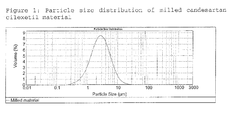
- the following particel size (D10, D50 and D90) values were measured for milled and unmilled candesartan cilexetil material: Table 1.
- D10/50/90 means that at least 10/50/90 % by volume of the particles have a particle size below the specified value.
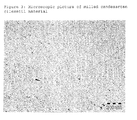
- the good homogeniety of the respective size distribution can be taken form the size distribution profiles as shown in Figures 1 and 2 .
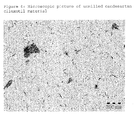
- the microscopic pictures of the milled and the unmilled candesartan cilexetil material confirm the homogenous size distribution especially of the milled material ( Figure 3 ) present in the more prefered size of less than 20 ⁇ m (cf. above).
- the candesartan or its pharmaceutically acceptable forms present in the stable solid pharmaceutical composition according to the present invention can be prepared by any method known from the state of the art as for example disclosed in Jornal of pharmacy and pharmacology. 2005, 57, 273-285 , EP 459136B1 , WO 2003/014112 , WO 2005/021535 , WO 2005/051928 , WO 2005/051929 , EP 1555260 B1 , WO 2006/015134 , WO 2006/050922 , WO 2006/063578 , WO 2006/067215 , WO 2006/103068 , WO 2006/125592 , WO 2007/074399 , WO 2006/134078 , WO 2007/014412 , Wo 2007/054965 , EP 1777224 , WO 2007/042161 , WO 2007/048361 , WO 2005/037821 , WO 2006/076710 , WO 2005/111021 , WO 2006/1222
- candesartan cilexetil exists in polymorphic form I or in amorphous form, more preferably in polymorphic form I as defined by Chem. Pharm. Bull. 47(2) 182-186 (1999 ).
- the stable solid pharmaceutical composition according to the present invention may optionally further contain one or more other active ingredients.
- Suitable other active ingredients can include but are not limited to other angiotensin-II-receptor-antagonists, diuretics, sympathoplegic agents, Ca-channel blockers, vasodilators, ACE inhibitor, angiotensin receptor antagonists, inhibitors of HMG-CoA reductase and any other pharmaceutically acceptable combination, particularly the other active agent is selected from the group consisting of, but is not limited to, angiotensin-II-receptor-antagonists, Ca-channel blockers, diuretics and inhibitors of HMG-CoA reductase.
- candesartan or its pharmaceutically acceptable forms and one or more other active ingredient can be present partly in the intragranular phase and partly in the extragranular phase.
- concentration of candesartan or its pharmaceutically acceptable forms and of one or more other active ingredients in the pharmaceutical composition may be between about 1 to about 99% [w/w], particularly between about 1 to about 30% [w/w] and more particularly between about 2 to about 20% [w/w] determined by HPLC.
- the stable solid pharmaceutical composition according to the present invention may further include one or more pharmaceutically acceptable ingredients, i.e. excipients such as for example diluents, binders, disintegrants, surfactants and lubricants. Other and further excipients can also be included.
- excipients such as for example diluents, binders, disintegrants, surfactants and lubricants.
- Other and further excipients can also be included.
- pharmaceutically acceptable excipients denotes that the additives are used to convert pharmacologically active compounds into pharmaceutical dosage forms suitable for the administration to patients.
- Pharmaceutically acceptable excipients can be solid, liquid or semi-solid and are converted during the process into a state that allows the preparation of a stable solid pharmaceutical composition comprising candesartan or pharmaceutically acceptable forms thereof.
- the pharmaceutically acceptable excipient may be present in the stable solid pharmaceutical composition according to the present invention in an amount of about 1 to about 99% [w/w] , particularly from about 70 to about 99% [w/w], more particularly from about 90 to about 98% [w/w].
- the particle size of the excipients used in the stable solid pharmaceutical composition according to the present invention is within the range of D90 ⁇ 750 ⁇ m, preferably D90 ⁇ 500, in order to ensure the homogeneity of the compression mixture as well as homogeneous granulation and compression.
- D90 means that at least 90% by volume of the particles have a particle size below the specified value.
- the diluents used in the stable solid pharmaceutical composition according to the present invention may be selected from the group consisting of, but are not limited to, microcrystalline cellulose, powdered cellulose, lactose (anhydrous and monohydrate), compressible sugar, fructose, dextrates, sugar alcohols such as mannitol, sorbitol, maltitol, xylitol, lactitol, or other sugars such as saccharose, raffinose, trehalose, fructose or mixture thereof, siliconised microcrystalline cellulose, calcium hydrogenphosphate, calcium carbonate, calcium lactate or any mixture thereof, preferably, microcrystalline cellulose, lactose and mannitol, or any mixtures thereof, more preferably microcrystalline cellulose and lactose.
- the binders used in the stable solid pharmaceutical composition according to the present invention may be selected from the group consisting of, but are not limited to, polyvinylpyrrolidone, microcrystalline cellulose, hydroxyethylcellulose, hydroxypropylcellulose, hydroxypropylmethylcellulose or other cellulose ethers, starch, pregelatinised starch, or polymethacrylate, or any mixtures thereof. It is preferable to use a binder with good water solubility. In view of the practical insolubility of starch in cold water, there is a strong preference for binders with a very good solubility in cold water.
- binders that have a very good solubility in water, such as for example povidone of different K-values and hydroxypropylcellulose, such as for example partially substituted poly(hydroxypropyl) ether of cellulose and/or low substituted poly(hydroxypropyl) ether of cellulose.
- at least one binder is selected from polyvinylpyrrolidone and hydroxypropylcellulose.
- the disintegrants used in the stable solid pharmaceutical composition according to the present invention may be selected from the group consisting of, but are not limited to, crospovidone, starch, pregelatinised starch, sodium strach glycollate, microcrystalline cellulose, carboxymethylcellulose sodium (CMC-Na) or calcium (CMC-Ca), cross-linked CMC-Na, polacrilin potassium, low-substituted hydroxypropylcellulose or any mixtures thereof.
- at least one disintegrant is selected from cross-linked CMC-Na, starch and low-substituted hydroxypropylcellulose.
- the surfactants used in the stable solid pharmaceutical composition according to the present invention may be selected from the group consisting of, but are not limited to:
- the lubricants used in the stable solid pharmaceutical composition according to the present invention may be selected from the group consisting of, but are not limited to, stearic acid or stearic acid salts (such as for example magnesium stearate), magnesium palmitate, magnesium oleate, hydrogenated vegetable oil, hydrogenated castor oil, talc, sodium stearyl fumarate, macrogols or mixtures thereof.
- excipients include at least one lubricant selected from stearic acid, magnesium stearate, hydrogenated vegetable oil, hydrogenated castor oil and talc, more preferably magnesium stearate, hydrogenated castor oil and talc.
- cores/tablets can be coated with conventional materials used for film coating, i.e. as described in Pharmaceutical Coating Technology (G. Cole (ed.), 1995).
- Film coating formulations usually contain the following components:
- flavours In the film coating suspension minor quantities of flavours, surfactants and waxes can be used.
- cellulose derivatives such as the cellulose ethers, or acrylic polymers and copolymers.
- high molecular weight polyethylene glycols such as for example macrogols, polyvinylpyrrolidone, polyvinylalcohol and waxy materials.
- Their function usually is to prevent bad mouth feel and/or taste and in some cases degradation, e.g. oxidation of the active ingredients and/or excipients used.
- Typical cellulose ethers which may be applied as coatings are hydroxyethylcellulose, hydroxypropylcellulose, hydroxypropylmethylcellulose and methylcellulose.
- Acrylic polymers comprise a group of synthetic polymers with diverse functionalities. Some of them can be further modified to enhance swelling and permeability by the incorporation of materials such as water soluble cellulose ethers and starches in order to ensure complete disintegration/dissolution of the film.
- the commonly used plasticizers can be categorized into three groups:
- Vehicles are materials that perform a necessary function in that that they provide the means of conveying the coating materials to the surface of the tablet or particle.
- the major classes of vehicles capable of being used are water, alcohols, ketones, esters and chlorinated hydrocarbons.
- Film coating suspensions can be prepared by using different solvents as for example water, alcohols, ketones, esters and chlorinated hydrocarbons, preferably water.
- composition of a coating suspension (calculated on dry material) which comprises:
- ingredients described as components of the coating layer e.g. colourants, can also be incorporated in the tablet core or divided between tablet core and film coating layer.
- the stable solid pharmaceutical composition according to the present invention can be in the form of tablets, pills, powders, lozenges, sacchets, soft and hard gelatine capsules, suppositories and the like.
- the dosage form is preferably suitable for oral application, more preferably it is in the form of tablets or capsules.
- the stable solid pharmaceutical composition according to the present invention is preferably formulated in a unit dosage form, each dosage form containing about 1 to 100 mg, more usually about 1 to about 50 mg of candesartan cilexetil, preferably from about 2 to 32 mg.
- each dosage form containing about 1 to 100 mg, more usually about 1 to about 50 mg of candesartan cilexetil, preferably from about 2 to 32 mg.
- said other active ingredient can be present in an amount of 6.25 to 50 mg, preferably in an amount of 12.5 to 25 mg.
- the stable solid pharmaceutical composition according to the present invention contains 8 mg of candesartan cilexetil and 12.5 mg of hydrochlorothiazide or 16 mg of candesartan cilexetil and 12.5 mg of hydrochlorothiazide or 32 mg of candesartan cilexetil and 12.5 mg of hydrochlorothiazide or 32 mg of candesartan cilexetil and 25 mg of hydrochlorothiazide.
- unit dosage form refers to physically discrete units suitable as unitary dosages for human objectes and other mammals, each unit containing a predetermined quantity of candesartan cilexetil, calculated to produce the desired therapeutic effect, in association with a suitable pharmaceutical acceptable excipient.
- the term stable refers to a solid pharmaceutical composition comprising candesartan or its pharmaceutically acceptable forms wherein the total content of impurities originating from the decomposition of candesartan does not exceed 10 % area, preferably 6 % area, more preferably 4 % area and most preferably 2 % area determined by liquid chromatography if such a composition is stored for 7 days at 60°C in a closed vessel.
- another aspect of the present invention relates to a stable solid pharmaceutical composition
- a stable solid pharmaceutical composition comprising candesartan or its pharmaceutically acceptable forms wherein the total content of impurities originating from the decomposition of candesartan does not exceed 10 % area, preferably 6 % area, more preferably 4 % area and most preferably 2 % area determined by liquid chromatography if such a composition is stored for 7 days at 60 °C in a closed vessel.
- the term stable refers to a solid pharmaceutical composition comprising candesartan or its pharmaceutically acceptable forms wherein candesartan or its pharmaceutically acceptable forms retain their stable polymorphic form.
- polymorphic stability of candesartan and its pharmaceutically acceptable forms in a solid pharmaceutical composition plays an important role in designing a stable pharmaceutical composition. Namely, it is known that for example candesartan cilexetil can exist in several polymorphic forms. The most stable form is known as polymorphic form I while polymorphic form II and the amorphous form are known to be not stable enough to be used in commercial products.
- this advantage of retainment of polymorphic form I is highly expressed in case when the plasticizer is selected from the group of citrate esters. Furthermore, while citrate esters are known to be useful as plasticizers in coating procedures, we unexpectedly found that said plasticizers are useful as plasticizers in reducing friction between the constituents of the pharmaceutical composition as well.
- another aspect of the present invention is the use of a plasticizer selected from the group consisting of citrate esters in a stable solid pharmaceutical composition containing candesartan cilexetil as an active ingredient to retain its stable polymorphic form I.
- the plasticizer is preferably triethyl citrate, which is widely used in the field of food additive, food packaging, cosmetics and children toys as well. It has a better biodegradability and less biochemical effects as other known plasticizers.
- the present invention relates to a process for the preparation of a stable solid pharmaceutical composition comprising candesartan or its pharmaceutically acceptable forms and at least one plasticizer as described above by a process comprising a step selected from the group consisting of wet granulation, dry granulation and direct compression.
- a method of treating hypertension, cardiac diseases, cerebral apoplexy or renal diseases in a patient in need thereof by administering a stable solid pharmaceutical composition comprising candesartan or its pharmaceutically acceptable forms according to the present invention.
- compositions of the solid pharmaceutical composition comprising candesartan cilexetil Ingredient Composition 1 Composition 2 Comparative Composition 1 Comparative Composition 2 Candesartan cilexetil 4.0 4.0 4.0 4.0 Lactose monohydrate 90.0 90.0 96.0 96.0 Starch 20.0 20.0 20.0 20.0 Menthol 6.0 Triethyl citrate 6.0 Polyvinyl Alcohol 6.0 Hydroxypropyl cellulose 4.0 4.0 4.0 4.0 Calcium carboxymethyl cellulose 5.6 5.6 5.6 5.6 Magnesium stearate 0.4 0.4 0.4 0.4 0.4 0.4 0.4
- hydroxypropyl cellulose and triethyl citrate were dissolved in water and candesartan cilexetil, lactose monohydrate and starch were granulated with the aqueous hydroxypropyl cellulose / triethyl citrate solution in a fluid bed granulator.
- hydroxypropyl cellulose was dissolved in water and candesartan cilexetil, lactose monohydrate, starch and menthol were granulated with the aqueous hydroxypropyl cellulose solution in a fluid bed granulator.
- Comparative Composition 1 WO2005/084648 , example 1
- hydroxypropyl cellulose and polyvinyl alcohol were dissolved in water and candesartan cilexetil, lactose monohydrate and starch were granulated with the aqueous hydroxypropyl cellulose / polyvinyl alcohol solution in a fluid bed granulator.
- Comparative Composition 2 EP 546358 B1 , example 1
- candesartan cilexetil, lactose monohydrate and starch were granulated in a fluid bed granulator with a dissolution of hydroxypropyl cellulose in water.
- Table 3 shows the results of the stability test of the tablets and Table 4 shows the results for the capsules.
- the stability tests were performed after storing the samples for 7 days at 60 °C.
- the content of the candesartan cilexetil impurities was determined by liquid chromatography:
- composition of the present invention provides a remarkable improvement in the stability of candesartan cilexetil as compared to the comparative compositions.
- Candesartan cilexetil compositions Ingredient Composition 1 Comparative Composition 3 Comparative Composition 4 Comparative Composition 5 Comparative Composition 2
- Gum arabic (Acacia) 6.0
- Stearyl Fumarate 6.0
- Lauryl Sulfate 6.0 Hydroxypropyl cellulose 4.0 4.0 4.0 4.0 4.0 4.0 4.0 4.0
- hydroxypropyl cellulose was dissolved in water and candesartan cilexetil, lactose monohydrate, starch and menthol were granulated with the aqueous hydroxypropyl cellulose solution in a fluid bed granulator.
- Comparative Composition 2 ( EP 54635BB1 , example 1), candesartan cilexetil, lactose monohydrate and starch were granulated in a fluid bed granulator with a dissolution of hydroxypropyl cellulose in water. After the granulation step has been performed, calcium carboxymethyl cellulose and magnesium stearate were added to the granules. The obtained compositon was compression-molded into tablets. Table 6.
- Table 6 shows the results of the stability test of the tablets. The stability tests were performed after storing the samples for 1 day at 60 °C. The content of the candesartan cilexetil impurities was determined by liquid chromatography as mentioned above.
- the plasticizer of the present invention provides a remarkable improvement in the stability of candesartan cilexetil as compared with other stabilizing agents (natural gums, lubricants and surfactants).
- a suitable plasticizer can remarkably lower the total amount of impurities originating from the decomposition of candesartan in a solid composition of candesartan cilexetil according to the present invention.
- composition of the stable solid pharmaceutical composition comprising candesartan cilexetil Ingredient Composition 1
- Candesartan cilexetil 32.0 Lactose monohydrate 358.0 Starch 37.0
- Triethyl citrate 6.0
- Hydroxypropyl cellulose 11.0
- Calcium carboxymethyl cellulose 20.0
- the stable solid pharmaceutical composition with ingredients as described in Table 7 was prepared by the same method as described in Example 1.
- the X-ray powder diffraction pattern was measured first at initial time and then after storage for 28 days at 40°C and 50°C for 28 days; the result is shown in Figure 5 .
- the result furthermore demonstrates that polymorphic form I of candesartan cilexetil remains unchanged as there are no additional peaks emerging after storage that would indicate the presence of any other polymorph of candesartan cilexetil.
- the instrument was a PANalytical X'pert PRO powder diffractometer with CuKa radiation.
Landscapes
- Health & Medical Sciences (AREA)
- Life Sciences & Earth Sciences (AREA)
- General Health & Medical Sciences (AREA)
- Chemical & Material Sciences (AREA)
- Medicinal Chemistry (AREA)
- Pharmacology & Pharmacy (AREA)
- Epidemiology (AREA)
- Animal Behavior & Ethology (AREA)
- Public Health (AREA)
- Veterinary Medicine (AREA)
- Molecular Biology (AREA)
- Biophysics (AREA)
- Medicinal Preparation (AREA)
- Pharmaceuticals Containing Other Organic And Inorganic Compounds (AREA)
Abstract
The invention relates to a stable solid pharmaceutical composition comprising candesartan or its pharmaceutically acceptable forms and at least one plasticizer selected from the group consisting of phthalate esters, sebacates, alginates, citrate esters, polyacrylate and polymethacrylate polymers, polymers and copolymers of ethylene, vinyl and/or acetate, various sugar alcohols, triacetin, menthol and any mixture thereof.
Description
- The present invention belongs to the field of pharmaceutical industry, particularly to the field of solid pharmaceutical compositions. Specifically, the invention relates to a stable solid pharmaceutical composition comprising candesartan or its pharmaceutically acceptable forms and at least one plasticizer.
- Candesartan is a selective antagonist of
subtype 1 of the angiotensin II receptor (AT1-antagonist). It falls in the class of drugs of benzimidazole-7-carboxylic acids and derivatives thereof. These agents exhibit a strong and more effective hypotensive action and are less likely to cause coughing as a side effect when compared to the class of ACE inhibitors. - In general, the formulation of candesartan or its pharmaceutically acceptable forms for effective oral administration to a subject has hithereto been complicated by the unique physical and chemical properties of the compound. It is known that candesartan or its pharmaceutically acceptable forms are stable against temperature, moisture and light when they are stored individually in the solid state while when they are incorporated into a pharmaceutical composition the decomposition of the active ingredient is observed. Up to now this problem was solved by several different ways with the main stress on solving the stability problems.
- A number of different types of materials and approaches has already been tried in order to find the solution for stabilizing candesartan cilexetil in a solid pharmaceutical composition.
-
EP 546358 B1 -
WO 2005/070398 discloses the dispersing of candesartan cilexetil in a solution comprising a co-solvent and water to form a suspension. - A pharmaceutical formulation containing candesartan cilexetil and one or more fatty acids is disclosed in
WO 2005/079751 . - As disclosed in
WO 2005/072709 andWO 2006074218 the problem could be solved by forming nanoparticles or microparticles of the drug. -
WO 2005/084648 discloses the use of water-soluble polymers to form a stable pharmaceutical composition of candesartan cilexetil with respect to the levels of impurities. -
WO 2006/079496 discloses as a stabilizing agent a member of a group of materials known as natural gums, for example agar, xanthan gum, gum arabic (acacia), ceratonia, carrageenan. -
WO 2006/079496 further discloses that candesartan cilexetil can be de-stabilized during compression molding of tablets and for that only gentle manipulation of that step has to be undertaken. Such a gentle manipulation was defined as that the main pressure during compression molding is at maximum 20 kN, preferably 10 kN. -
US 2007/0014864 A ,US 2007/0014853 A andUS 2007/0014854 A disclose pharmaceutical granules containing an active substance having poor water solubility and at least one pharmaceutically acceptable sugar. - In particular, a constant need exists for effective, orally deliverable solid pharmaceutical composition comprising candesartan or its pharmaceutically acceptable forms possessing one or more of the following characteristics:
- appropriate disintegration time of the pharmaceutical composition,
- appropriate dissolution profile of the active ingredient,
- appropriate processability,
- ordinary used and cost effective pharmaceutically acceptable excipients,
- appropriate economics of the technological process for the preparation of the final drug product,
- appropriate chemical and physical stability of the final drug product,
- appropriate bioavailability of the final drug product, and being prepared by the technological process of wet and dry granulation in order to:
- increase the uniformity of active ingredient distribution in the formulation,
- densify the granulate, as for example a mixture of an active ingredient and at least one pharmaceutically acceptable excipient,
- enhance the flow rates and rate uniformity, i.e. to improve physical characteristics,
- reduce dust,
- improve the appearance of the solid dosage form,
and wherein the active substance possesses the following characteristics: - appropriate particle size distribution,
- appropriate solubility.
- Therefore, an object underlying the present invention is to provide a stable solid pharmaceutical composition comprising candesartan or its pharmaceutically acceptable forms wherein the term stable composition refers to the total content of impurities originating from the decomposition of candesartan in the pharmaceutical composition and to the retained stable polymorphic form I of candesartan cilexetil.
- In a first aspect, the present invention relates to a stable solid pharmaceutical composition comprising candesartan or its pharmaceutically acceptable forms and at least one plasticizer selected from the group consisting of phthalate esters, sebacates, alginates, citrate esters, polyacrylate and polymethacrylate polymers, polymers and copolymers of ethylene, vinyl and/or acetate, various sugar alcohols, triacetin, menthol and any mixture thereof. The plasticizer is preferably selected from the group of citrate esters.
- In a second aspect, the present invention relates to a stable solid pharmaceutical composition comprising candesartan or its pharmaceutically acceptable forms and at least one plasticizer selected from the group consisting of phthalate esters, sebacates, alginates, citrate esters, polyacrylate and polymethacrylate polymers, polymers and copolymers of ethylene, vinyl and/or acetate, various sugar alcohols, triacetin, menthol and any mixture thereof, wherein the total content of impurities does not exceed 10 % area, preferably 6 % area, more preferably 4 % area and most preferably 2 % area determined by liquid chromatography if such a composition is stored for 7 days at 60°C in a closed vessel. The plasticizer is preferably selected from the group of citrate esters.
- In a third aspect, the present invention relates to the use of a plasticizer selected from the group consisting of citrate esters in a stable solid pharmaceutical composition containing candesartan cilexetil as an active ingredient to retain its stable polymorphic form I. The plasticizer is preferably triethyl citrate.
- In a further aspect, the present invention relates to a process for the preparation of a stable solid pharmaceutical composition comprising candesartan or its pharmaceutically acceptable forms and at least one plasticizer as described above by a process comprising a step selected from the group consisting of wet granulation, dry granulation and direct compression.
- In yet another aspect, the present invention relates to a method of treating hypertension, cardiac diseases, cerebral apoplexy or renal diseases in a patient in need thereof by administering a stable solid pharmaceutical composition comprising candesartan or its pharmaceutically acceptable forms according to the present invention.
-
-
Figure 1 : Particle size distribution of milled candesartan cilexetil material -
Figure 2 : Particle size distribution of unmilled candesartan cilexetil material -
Figure 3 : Microscopic picture of milled candesartan cilexetil material -
Figure 4 : Microscopic picture of unmilled candesartan cilexetil material -
Figure 5 : Comparison: Powder diffraction patterns of stable solid pharmaceutical compositions comprising candesartan cilexetil, and of candesartan cilexetil as pure substance, respectively. - Therefore, an object underlying the present invention is to provide a stable solid pharmaceutical composition comprising candesartan or its pharmaceutically acceptable forms. In contrast to the pharmaceutical compositions according to the prior art described above, the present invention relates to a stable solid pharmaceutical composition wherein the stability of candesartan or its pharmaceutically acceptable forms is achieved in a very simple way, that is by the addition of an appropriate plasticizer. The pharmaceutical composition according to the present invention offers the advantage of a low content of total impurities originating from the decomposition of candesartan and of retaining the stable polymorphic form I of candesartan cilexetil.
- A person skilled in the art is aware of a number of substances defined as stabilizing agents in the pharmaceutical field, as for example natural gums, that could be used in designing a stable solid pharmaceutical composition comprising candesartan or its pharmaceutically acceptable forms. We found that said substances do not provide adequate stabilization of candesartan cilexetil in a solid pharmaceutical composition.
- Further, during our extensive experimental work we found that any kind of rough physical manipulation of candesartan or its pharmaceutically acceptable forms can substantially reduce its stability. We found that even the method of encapsulation can destabilize the active substance in the solid pharmaceutical composition. In order to lower the frictional forces between individual particles present in the solid composition of candesartan or its pharmaceutically acceptable forms, a person skilled in the art can try substances already known in the state of the art as tablet or capsule lubricant. Examples of said substances are calcium and magnesium stearate, sodium stearyl fumarate, stearic acid and the like. Again, we found that said substances do not provide sufficient stabilization of candesartan or its pharmaceutically acceptable forms in a solid pharmaceutical composition as well.
- Further, substances known in the art as surfactants and emulsifying agents, as for example docusate sodium, calcium steroyl-2-lactylate, benzalkonium chloride, cetrimide and sodium lauryl sulphate, and emulsifying, gelling and film-forming agents as for example hypromellose, hydroxypropyl cellulose, gelatin, pectin, alginates like sodium and potassium alginate and hypromellose acetate succinate were tested whether they lower the frictional forces between individual particles in a stable solid composition of candesartan or its pharmaceutically acceptable forms. Again we found that none of the selected substances does provide sufficient stabilization of candesartan and its pharmaceutically acceptable forms in a solid pharmaceutical composition as well.
- Surprisingly, it has been found that some of the substances, known in the pharmaceutical field as plasticizers, do provide sufficient stabilization of candesartan and its pharmaceutically acceptable forms in a solid pharmaceutical composition.
- The general definition used to describe plasticizers refers to pharmaceutically acceptable excipients that increase the plasticity or the ductility of the materials they are added to and that are generally applied in the preparation of film coatings for pharmaceutical dosage forms.
- The term plasticizer used herein, however, refers to a pharmaceutically acceptable excipient that is added to the core of a pharmaceutical composition and not into the coating thereof. Such a plasticizer is used to increase the plasticity and/or decrease the friction between the individual particles (constituents) of a pharmaceutical formulation on the microscopic level due to its lubrication properties.
- Thus, in one aspect, the present invention relates to a stable solid pharmaceutical composition comprising candesartan or its pharmaceutically acceptable forms and at least one plasticizer selected from the group consisting of phthalate esters, sebacates, alginates, citrate esters, polyacrylate and polymethacrylate polymers, polymers and copolymers of ethylene, vinyl and/or acetate, various sugar alcohols, triacetin, menthol and any mixture thereof.
- The plasticizer used in the stable solid pharmaceutical composition according to the present invention may be selected from, but not limited to:
- Phthalate esters (such as for example phthalate esters like polyvinyl acetate phthalate, cellulose acetate phthalate, dibutyl phthalate, diethyl phthalate, dimethyl phthalate, hypromellose phthalate),
- Sebacates (such as for example dibutyl sebacate and diethyl sebacate),
- Alginates (such as for example sodium, potassium, propylene glycol alginate),
- Citrate esters (such as for example triethyl citrate, acetyltriethyl citrate, tributyl citrate, acetyltributyl citrate, acetyltri-2-ethylhexyl citrate),
- Polyacrylate and polymethacrylate polymers such as for example Eudragit and Plastoid polymers,
- Polymers and copolymers of ethylene, vinyl and/or acetate (such as for example polyethylene, polyvinyl alcohol, polyvinyl alcohol/polyvinyl acetate copolymer, ethylene vinyl acetate),
- Various sugar alcohols (such as for example sorbitol, xylitol),
- Various additional plasticizers (such as for example triacetin, menthol, glycofurol, sodium benzoate, sodium polyphosphate, amyl alcohol).
- Preferably, the plasticizer is selected from the group consisting of phthalate esters, citrate esters, sebacates, polyacrylate and polymethacrylate polymers, various sugar alcohols, triacetin, menthol and any mixture thereof. More preferably, the plasticizer is selected from the group consisting of citrate esters, menthol and triacetin and any mixture thereof. Most preferably, the plasticizer is selected from the group of citrate esters. Even most preferably, the plasticizer is triethyl citrate.
- One or more plasticizers used as a stabilizing agent in a solid pharmaceutical composition according to the present invention can be present in an amount of about less than 20% [w/w] of the final pharmaceutical composition and more preferably in an amount of about between 0.5 and 10% [w/w] of the final pharmaceutical composition.
- The term candesartan or its pharmaceutically acceptable forms used herein refers to a prodrug that is hydrolyzed to candesartan during absorption from the gastrointestinal tract, more particularly it refers to candesartan cilexetil. Additionally, the term candesartan or its pharmaceutically acceptable forms used herein refers to candesartan or its pharmaceutically acceptable esters as for example cilexetil, or to its pharmaceutically acceptable salts, as for example alkaline salts or ammonium salts, preferably the active ingredient is candesartan cilexetil.
- The concentration of candesartan or its pharmaceutically acceptable forms in the pharmaceutical composition may be between about 1 to about 99% [w/w] , particularly between about 1 to about 30% [w/w] and more particularly between about 1 to about 20% [w/w] determined by HPLC.
- The average particle size of candesartan or its pharmaceutically acceptable forms may be between 1 and 50 µm, preferably between 1 and 40 µm, more preferably less than 20 µm, determined by a laser diffraction method with a Malvern Mastersizer 2000 instrument equiped with the Hydro S dispersion unit, which is appropriate for measuring particle size distributions in the range of 20 nm to 2000 µm. Isopar L is used as dispersant. Usually, 100-800 mg of the substance is dispersed in 5-10 ml of a 2% solution of epicurone (lecithin) in isopar L to get a homogeneous sample suspension. The measurement is started after adding the sample suspension into the dispersion unit, homogenizing by sonication for an appropriate time to brake-up agglomerates and recirculating at a stirrer/pump speed rate of about 50-70% of maximum speed. The following particel size (D10, D50 and D90) values were measured for milled and unmilled candesartan cilexetil material:
Table 1. D10, D50 and D90 values of milled and unmilled candesartan cilexetil material Milled Unmilled Mean particle diameter 4 µm 57/15µm (with ultrasonication) D10 1.1µm 3.1µm D50 2.8µm 10.5 µm D90 6.8µm 30.6µm Specific surface area 7.2 m2/ 4.2 m2/g - D10/50/90 means that at least 10/50/90 % by volume of the particles have a particle size below the specified value. The good homogeniety of the respective size distribution can be taken form the size distribution profiles as shown in
Figures 1 and2 . In addition, the microscopic pictures of the milled and the unmilled candesartan cilexetil material (Figures 3 and4 ) confirm the homogenous size distribution especially of the milled material (Figure 3 ) present in the more prefered size of less than 20 µm (cf. above). - The candesartan or its pharmaceutically acceptable forms present in the stable solid pharmaceutical composition according to the present invention can be prepared by any method known from the state of the art as for example disclosed in Jornal of pharmacy and pharmacology. 2005, 57, 273-285,
EP 459136B1 WO 2003/014112 ,WO 2005/021535 ,WO 2005/051928 ,WO 2005/051929 ,EP 1555260 B1 ,WO 2006/015134 ,WO 2006/050922 ,WO 2006/063578 ,WO 2006/067215 ,WO 2006/103068 ,WO 2006/125592 ,WO 2007/074399 ,WO 2006/134078 ,WO 2007/014412 ,Wo 2007/054965 ,EP 1777224 ,WO 2007/042161 ,WO 2007/048361 ,WO 2005/037821 ,WO 2006/076710 ,WO 2005/111021 ,WO 2006/122254 ,PCT/EP2007/057803 PCT/EP2007/057804 - Preferably, candesartan cilexetil exists in polymorphic form I or in amorphous form, more preferably in polymorphic form I as defined by Chem. Pharm. Bull. 47(2) 182-186 (1999).
- The stable solid pharmaceutical composition according to the present invention may optionally further contain one or more other active ingredients. Suitable other active ingredients can include but are not limited to other angiotensin-II-receptor-antagonists, diuretics, sympathoplegic agents, Ca-channel blockers, vasodilators, ACE inhibitor, angiotensin receptor antagonists, inhibitors of HMG-CoA reductase and any other pharmaceutically acceptable combination, particularly the other active agent is selected from the group consisting of, but is not limited to, angiotensin-II-receptor-antagonists, Ca-channel blockers, diuretics and inhibitors of HMG-CoA reductase. When two or more other active ingredients are present in the stable pharmaceutical composition according to the present invention, they can be present in the same phase (in the intragranular phase, i.e. in the granulate, or in the extragranular phase) as candesartan or its pharmaceutically acceptable forms or in a different phase as candesartan or its pharmaceutically acceptable forms. Additionally, candesartan or its pharmaceutically acceptable forms and one or more other active ingredient can be present partly in the intragranular phase and partly in the extragranular phase. The concentration of candesartan or its pharmaceutically acceptable forms and of one or more other active ingredients in the pharmaceutical composition may be between about 1 to about 99% [w/w], particularly between about 1 to about 30% [w/w] and more particularly between about 2 to about 20% [w/w] determined by HPLC.
- The stable solid pharmaceutical composition according to the present invention may further include one or more pharmaceutically acceptable ingredients, i.e. excipients such as for example diluents, binders, disintegrants, surfactants and lubricants. Other and further excipients can also be included. The term »pharmaceutically acceptable excipients denotes that the additives are used to convert pharmacologically active compounds into pharmaceutical dosage forms suitable for the administration to patients. Pharmaceutically acceptable excipients can be solid, liquid or semi-solid and are converted during the process into a state that allows the preparation of a stable solid pharmaceutical composition comprising candesartan or pharmaceutically acceptable forms thereof. The pharmaceutically acceptable excipient may be present in the stable solid pharmaceutical composition according to the present invention in an amount of about 1 to about 99% [w/w] , particularly from about 70 to about 99% [w/w], more particularly from about 90 to about 98% [w/w].
- The particle size of the excipients used in the stable solid pharmaceutical composition according to the present invention is within the range of D90<750 µm, preferably D90<500, in order to ensure the homogeneity of the compression mixture as well as homogeneous granulation and compression. D90 means that at least 90% by volume of the particles have a particle size below the specified value.
- The diluents used in the stable solid pharmaceutical composition according to the present invention may be selected from the group consisting of, but are not limited to, microcrystalline cellulose, powdered cellulose, lactose (anhydrous and monohydrate), compressible sugar, fructose, dextrates, sugar alcohols such as mannitol, sorbitol, maltitol, xylitol, lactitol, or other sugars such as saccharose, raffinose, trehalose, fructose or mixture thereof, siliconised microcrystalline cellulose, calcium hydrogenphosphate, calcium carbonate, calcium lactate or any mixture thereof, preferably, microcrystalline cellulose, lactose and mannitol, or any mixtures thereof, more preferably microcrystalline cellulose and lactose.
- The binders used in the stable solid pharmaceutical composition according to the present invention may be selected from the group consisting of, but are not limited to, polyvinylpyrrolidone, microcrystalline cellulose, hydroxyethylcellulose, hydroxypropylcellulose, hydroxypropylmethylcellulose or other cellulose ethers, starch, pregelatinised starch, or polymethacrylate, or any mixtures thereof. It is preferable to use a binder with good water solubility. In view of the practical insolubility of starch in cold water, there is a strong preference for binders with a very good solubility in cold water. There is a variety of binders that have a very good solubility in water, such as for example povidone of different K-values and hydroxypropylcellulose, such as for example partially substituted poly(hydroxypropyl) ether of cellulose and/or low substituted poly(hydroxypropyl) ether of cellulose. Preferably, at least one binder is selected from polyvinylpyrrolidone and hydroxypropylcellulose.
- The disintegrants used in the stable solid pharmaceutical composition according to the present invention may be selected from the group consisting of, but are not limited to, crospovidone, starch, pregelatinised starch, sodium strach glycollate, microcrystalline cellulose, carboxymethylcellulose sodium (CMC-Na) or calcium (CMC-Ca), cross-linked CMC-Na, polacrilin potassium, low-substituted hydroxypropylcellulose or any mixtures thereof. Prefereably, at least one disintegrant is selected from cross-linked CMC-Na, starch and low-substituted hydroxypropylcellulose.
- The surfactants used in the stable solid pharmaceutical composition according to the present invention may be selected from the group consisting of, but are not limited to:
- 1. Anionic surfactants, where the hydrophilic group carries a negative charge, such as for example carbonyl (RCOO-), sulphonate (RSO3 -) or sulphate (ROSO3 -) , examples include potassium laurate, CH3 (CH2) 10COO-K+, and sodium lauryl sulphate, CH3(CH2)11SO4 -Na+.
- 2. Cationic surfactants, where the hydrophilic group carries a positive charge (e.g., quaternary ammonium halides, R4N+Cl-), examples include cetrimide, a mixture consisting mainly of tetradecyl (ca. 68% [w/w]), dodecyl (ca. 22% [w/w]), and hexadecyltrimethylammonium bromides (ca. 7% [w/w]), as well as benzalkonium chloride, a mixture of alkylbenzyldimethylammonium chlorides of the general formula [C6H5CH2N+(CH3)2R]Cl-, where R represents a mixture of the alkyls from C8H17 to C18H37.
- 3. Ampholytic surfactants (also called zwitterionic surfactants), where the molecule contains, or can potentially contain, both a negative and a positive charge, (e.g. , sulfobetaines, RN+(CH3)2CH2CH2SO3 -), examples include N-Dodecyl-N,N-Dimethylbetaine, C12H25N+ (CH3) 2CH2COO-.
- 4. Nonionic surfactants, where the hydrophilic molecule carries no charge but derives its water solubility from highly polar groups such as hydroxyl or polyoxyethylene (-OCH2CH2O-) groups, examples include polyoxyethylated glycol monoethers (e.g. cetomacrogol), sorbitan esters (Spans®) and polysorbates (Tweens®) as well as polyoxyethylene-polyoxypropylene copolymers.
- The lubricants used in the stable solid pharmaceutical composition according to the present invention may be selected from the group consisting of, but are not limited to, stearic acid or stearic acid salts (such as for example magnesium stearate), magnesium palmitate, magnesium oleate, hydrogenated vegetable oil, hydrogenated castor oil, talc, sodium stearyl fumarate, macrogols or mixtures thereof. Preferably, excipients include at least one lubricant selected from stearic acid, magnesium stearate, hydrogenated vegetable oil, hydrogenated castor oil and talc, more preferably magnesium stearate, hydrogenated castor oil and talc.
- Optionally, cores/tablets can be coated with conventional materials used for film coating, i.e. as described in Pharmaceutical Coating Technology (G. Cole (ed.), 1995). Film coating formulations usually contain the following components:
- polymer(s),
- plasticizer(s),
- colourant(s)/opacifier(s),
- vehicle (s) .
- In the film coating suspension minor quantities of flavours, surfactants and waxes can be used.
- The majority of the polymers used in film coating are either cellulose derivatives, such as the cellulose ethers, or acrylic polymers and copolymers. Occasionally encountered are high molecular weight polyethylene glycols, such as for example macrogols, polyvinylpyrrolidone, polyvinylalcohol and waxy materials. Their function usually is to prevent bad mouth feel and/or taste and in some cases degradation, e.g. oxidation of the active ingredients and/or excipients used.
- Typical cellulose ethers which may be applied as coatings are hydroxyethylcellulose, hydroxypropylcellulose, hydroxypropylmethylcellulose and methylcellulose. Acrylic polymers comprise a group of synthetic polymers with diverse functionalities. Some of them can be further modified to enhance swelling and permeability by the incorporation of materials such as water soluble cellulose ethers and starches in order to ensure complete disintegration/dissolution of the film.
- The commonly used plasticizers can be categorized into three groups:
- polyols (glycerol, propylene glycol, macrogols),
- organic esters (phthalate esters, dibutyl sebacetate, citrate esters, triacetin),
- oils/glycerides (castor oil, acetylated monoglycerides, fractionated coconut oil).
- Colourants/opacifiers are classified into several groups:
- organic dyes and their lakes,
- inorganic colours,
- natural colours.
- Vehicles are materials that perform a necessary function in that that they provide the means of conveying the coating materials to the surface of the tablet or particle. The major classes of vehicles capable of being used are water, alcohols, ketones, esters and chlorinated hydrocarbons.
- Different materials from each group can also be combined in defined ratios. Ready-to-use preparations, which are available on the market, can also be used as film coating suspensions.
- Film coating suspensions can be prepared by using different solvents as for example water, alcohols, ketones, esters and chlorinated hydrocarbons, preferably water.
- A composition of a coating suspension (calculated on dry material) which comprises:
- 1-99%, preferably 1-95% by weight of polymer,
- 1-50%, preferably 1-40% by weight of plasticizer,
- 0.1-20%, preferably 0.1-10% by weight of colourant/opacifier,
- Ingredients described as components of the coating layer, e.g. colourants, can also be incorporated in the tablet core or divided between tablet core and film coating layer.
- The stable solid pharmaceutical composition according to the present invention can be in the form of tablets, pills, powders, lozenges, sacchets, soft and hard gelatine capsules, suppositories and the like. The dosage form is preferably suitable for oral application, more preferably it is in the form of tablets or capsules.
- The stable solid pharmaceutical composition according to the present invention is preferably formulated in a unit dosage form, each dosage form containing about 1 to 100 mg, more usually about 1 to about 50 mg of candesartan cilexetil, preferably from about 2 to 32 mg. When one or more other active ingredients are present in the stable solid pharmaceutical composition according to the present invention said other active ingredient can be present in an amount of 6.25 to 50 mg, preferably in an amount of 12.5 to 25 mg. Preferably, the stable solid pharmaceutical composition according to the present invention contains 8 mg of candesartan cilexetil and 12.5 mg of hydrochlorothiazide or 16 mg of candesartan cilexetil and 12.5 mg of hydrochlorothiazide or 32 mg of candesartan cilexetil and 12.5 mg of hydrochlorothiazide or 32 mg of candesartan cilexetil and 25 mg of hydrochlorothiazide. The term »unit dosage form« refers to physically discrete units suitable as unitary dosages for human objectes and other mammals, each unit containing a predetermined quantity of candesartan cilexetil, calculated to produce the desired therapeutic effect, in association with a suitable pharmaceutical acceptable excipient.
- As used herein, the term stable refers to a solid pharmaceutical composition comprising candesartan or its pharmaceutically acceptable forms wherein the total content of impurities originating from the decomposition of candesartan does not exceed 10 % area, preferably 6 % area, more preferably 4 % area and most preferably 2 % area determined by liquid chromatography if such a composition is stored for 7 days at 60°C in a closed vessel.
- Therefore, another aspect of the present invention relates to a stable solid pharmaceutical composition comprising candesartan or its pharmaceutically acceptable forms wherein the total content of impurities originating from the decomposition of candesartan does not exceed 10 % area, preferably 6 % area, more preferably 4 % area and most preferably 2 % area determined by liquid chromatography if such a composition is stored for 7 days at 60 °C in a closed vessel.
- Further, the term stable refers to a solid pharmaceutical composition comprising candesartan or its pharmaceutically acceptable forms wherein candesartan or its pharmaceutically acceptable forms retain their stable polymorphic form. From the state of the art it is known that the polymorphic stability of candesartan and its pharmaceutically acceptable forms in a solid pharmaceutical composition plays an important role in designing a stable pharmaceutical composition. Namely, it is known that for example candesartan cilexetil can exist in several polymorphic forms. The most stable form is known as polymorphic form I while polymorphic form II and the amorphous form are known to be not stable enough to be used in commercial products. We found that, otherwise, stable polymorphic form I of candesartan cilexetil is structurally quite weak and is prone to deformations during any physical manipulations of candesartan cilexetil in the process of preparing a pharmaceutical composition as for example during the course of mixing of the ingredients, granulating, tableting etc. If during the course of tableting some part of otherwise stable polymorphic form I of candesartan cilexetil undergoes amorphisation, this part of candesartan cilexetil will be degraded. Surprisingly, we found that the incorporation of one or more suitable plasticizer into the pharmaceutical composition remarkably lowers the friction between the individual particles of the constituents of the pharmaceutical composition during any physical manipulations of candesartan cilexetil. The consequence is that the crystal structure of polymorphic form I of candesartan cilexetil remains intact and so candesartan cilexetil retaines its polymorphic stability during and after the course of tableting.
- Surprisingly, this advantage of retainment of polymorphic form I is highly expressed in case when the plasticizer is selected from the group of citrate esters. Furthermore, while citrate esters are known to be useful as plasticizers in coating procedures, we unexpectedly found that said plasticizers are useful as plasticizers in reducing friction between the constituents of the pharmaceutical composition as well.
- Therefore, another aspect of the present invention is the use of a plasticizer selected from the group consisting of citrate esters in a stable solid pharmaceutical composition containing candesartan cilexetil as an active ingredient to retain its stable polymorphic form I. The plasticizer is preferably triethyl citrate, which is widely used in the field of food additive, food packaging, cosmetics and children toys as well. It has a better biodegradability and less biochemical effects as other known plasticizers.
- In another aspect, the present invention relates to a process for the preparation of a stable solid pharmaceutical composition comprising candesartan or its pharmaceutically acceptable forms and at least one plasticizer as described above by a process comprising a step selected from the group consisting of wet granulation, dry granulation and direct compression.
- In yet another aspect of the present invention, there is provided a method of treating hypertension, cardiac diseases, cerebral apoplexy or renal diseases in a patient in need thereof by administering a stable solid pharmaceutical composition comprising candesartan or its pharmaceutically acceptable forms according to the present invention.
- For a more complete understanding of the instant invention, reference is made to the following illustrative examples, although it should be clearly understood that the present invention is not limited in and way thereto.
-
Table 2. Compositions of the solid pharmaceutical composition comprising candesartan cilexetil Ingredient Composition 1 Composition 2Comparative Composition 1Comparative Composition 2Candesartan cilexetil 4.0 4.0 4.0 4.0 Lactose monohydrate 90.0 90.0 96.0 96.0 Starch 20.0 20.0 20.0 20.0 Menthol 6.0 Triethyl citrate 6.0 Polyvinyl Alcohol 6.0 Hydroxypropyl cellulose 4.0 4.0 4.0 4.0 Calcium carboxymethyl cellulose 5.6 5.6 5.6 5.6 Magnesium stearate 0.4 0.4 0.4 0.4 - In preparation of
Composition 1, hydroxypropyl cellulose and triethyl citrate were dissolved in water and candesartan cilexetil, lactose monohydrate and starch were granulated with the aqueous hydroxypropyl cellulose / triethyl citrate solution in a fluid bed granulator. In preparation ofComposition 2, hydroxypropyl cellulose was dissolved in water and candesartan cilexetil, lactose monohydrate, starch and menthol were granulated with the aqueous hydroxypropyl cellulose solution in a fluid bed granulator. In Comparative Composition 1 (WO2005/084648 , example 1), hydroxypropyl cellulose and polyvinyl alcohol were dissolved in water and candesartan cilexetil, lactose monohydrate and starch were granulated with the aqueous hydroxypropyl cellulose / polyvinyl alcohol solution in a fluid bed granulator. In Comparative Composition 2 (EP 546358 B1 Table 3. Results of the stability test- tablets Impurities Composition 1 Comparative Composition 1Comparative Composition 2Total content of impurities at the initial time of test (% area) 0.4 0.5 0.8 Total content after 7 days at 60°C (% area) 0.8 3.2 5.9 Table 4. Results of the stability test - capsules Impurities Composition 1 Comparative Composition 1Comparative Composition 2Total content of impurities at the initial time of test (% area) 0.4 0.4 0.5 Total content after 7 days at 60°C (% area) 0.8 1.0 2.0 - Table 3 shows the results of the stability test of the tablets and Table 4 shows the results for the capsules. The stability tests were performed after storing the samples for 7 days at 60 °C. The content of the candesartan cilexetil impurities was determined by liquid chromatography:
- HPLC: Agilent 1100
- Data evaluation: Chemstation
- Column: Eclipse Plus-C18, 50mm x 4.6mm, 1.8 µm particles
-
- Solvent A: 0.01M NaH2PO4, pH 2.5
- Solvent B: acetonitrile
-
Time (min) %A %B 0 55 45 12 5 95 20 5 95 21 55 45 25 55 45 - Post run: 2 min
- Column temperature: 50°C
- Flow rate: 1.2 ml/min
- Detection: UV, 225nm
- Injection: 5 µl.
- As it is evident from the test results, the composition of the present invention provides a remarkable improvement in the stability of candesartan cilexetil as compared to the comparative compositions.
-
Table 5. Candesartan cilexetil compositions Ingredient Composition 1 Comparative Composition 3Comparative Composition 4Comparative Composition 5Comparative Composition 2Candesartan cilexetil 4.0 4.0 4.0 4.0 4.0 Lactose monohydrate 90.0 90.0 90.0 90.0 96.0 Starch 20.0 20.0 20.0 20.0 20.0 Triethyl citrate 6.0 Gum arabic (Acacia) 6.0 Sodium Stearyl Fumarate 6.0 Sodium Lauryl Sulfate 6.0 Hydroxypropyl cellulose 4.0 4.0 4.0 4.0 4.0 Calcium carboxymethyl cellulose 5.6 5.6 5.6 5.6 5.6 Magnesium stearate 0.4 0.4 0.4 0.4 0.4 - In preparing
Composition 1, hydroxypropyl cellulose was dissolved in water and candesartan cilexetil, lactose monohydrate, starch and menthol were granulated with the aqueous hydroxypropyl cellulose solution in a fluid bed granulator. In preparingComparative Compositions EP 54635BB1 Table 6. Results of the stability test - tablets Impurities Composition 1 Comparative Composition 3Comparative Composition 4Comparative Composition 5Comparative Composition 2Total content of impurities at the initial time of test (% area) 0.4 0.6 0.5 0.5 0.6 Total content after 1 day at 60 °C (% area) 0.5 2.1 1.6 1.1 1.2 - Table 6 shows the results of the stability test of the tablets. The stability tests were performed after storing the samples for 1 day at 60 °C. The content of the candesartan cilexetil impurities was determined by liquid chromatography as mentioned above.
- As it is evident from the test results, the plasticizer of the present invention provides a remarkable improvement in the stability of candesartan cilexetil as compared with other stabilizing agents (natural gums, lubricants and surfactants).
- As it has been demonstrated in the Examples 1 and 2, a suitable plasticizer can remarkably lower the total amount of impurities originating from the decomposition of candesartan in a solid composition of candesartan cilexetil according to the present invention.
-
Table 7. Composition of the stable solid pharmaceutical composition comprising candesartan cilexetil Ingredient Composition 1 Candesartan cilexetil 32.0 Lactose monohydrate 358.0 Starch 37.0 Triethyl citrate 6.0 Hydroxypropyl cellulose 21.0 Calcium carboxymethyl cellulose 20.0 Magnesium stearate 1.5 - The stable solid pharmaceutical composition with ingredients as described in Table 7 was prepared by the same method as described in Example 1. The X-ray powder diffraction pattern was measured first at initial time and then after storage for 28 days at 40°C and 50°C for 28 days; the result is shown in
Figure 5 . The comparison between the powder diffraction patterns of stable solid pharmaceutical compositions comprising candesartan cilexetil and the powder diffraction pattern of candesartan cilexetil as pure substance, respectively shows that all characteristic peaks of polymorphic form I of candesartan cilexetil are present in the composition of the present invention. The result furthermore demonstrates that polymorphic form I of candesartan cilexetil remains unchanged as there are no additional peaks emerging after storage that would indicate the presence of any other polymorph of candesartan cilexetil. - The instrument was a PANalytical X'pert PRO powder diffractometer with CuKa radiation.
Claims (18)
- A stable solid pharmaceutical composition comprising candesartan or its pharmaceutically acceptable forms and at least one plasticizer selected from the group consisting of phthalate esters, sebacates, alginates, citrate esters, polyacrylate and polymethacrylate polymers, polymers and copolymers of ethylene, vinyl and/or acetate, various sugar alcohols, triacetin, menthol and any mixture thereof.
- The stable solid pharmaceutical composition according to claim 1 wherein the plasticizer is selected from the group consisting of phthalate esters, citrate esters, sebacates, polyacrylate and polymethacrylate polymers, various sugar alcohols, triacetin, menthol and any mixture thereof.
- The stable solid pharmaceutical composition according to any preceding claims wherein the plasticizer is selected from the group consisting of citrate esters, menthol and triacetin and any mixture thereof.
- The stable solid pharmaceutical composition according to any preceding claims wherein the plasticizer is selected from the group of citrate esters.
- The stable solid pharmaceutical composition according to any preceding claims wherein the plasticizer is triethyl citrate.
- The stable solid pharmaceutical composition according to any preceding claims further comprising at least one pharmaceutically acceptable ingredient selected from the group consisting of one or more diluent, one or more binder, one or more disintegrant, one or more surfactant, one or more lubricant.
- The stable solid pharmaceutical composition according to any preceding claims wherein one or more diluent is selected from the group consisting of microcrystalline cellulose, powdered cellulose, lactose, sugar, sugar alcohols, siliconised microcrystalline cellulose, calcium hydrogenphosphate, calcium carbonate, calcium lactate or any mixtures thereof.
- The stable solid pharmaceutical composition according to any preceding claims wherein one or more binder is selected from the group consisting of polyvinylpyrrolidone, microcrystalline cellulose, hydroxyethylcellulose, hydroxypropylcellulose, hydroxypropylmethylcellulose or other cellulose ethers, starch, pregelatinised starch, or polymethacrylate, or any mixtures thereof.
- The stable solid pharmaceutical composition according to any preceding claims wherein one or more disintegrant is selected from the group consisting of crospovidone, starch, sodium strach glycollate, microcrystalline cellulose, carboxymethylcellulose sodium or calcium, cross-linked carboxymethylcellulose sodium, polacrilin potassium, low-substituted hydroxypropylcellulose or any mixtures thereof.
- The stable solid pharmaceutical composition according to any preceding claims wherein one or more surfactant is selected from the group consisting of anionic or cation surfactant, amoholytic surfactants and nonionic surfactants or any mixtures thereof.
- The stable solid pharmaceutical composition according to any preceding claims wherein one or more lubricant is selected from the group consisting of stearic acid or stearic acid salts, such as for example magnesium stearate, magnesium palmitate, magnesium oleate, hydrogenated vegetable oil, hydrogenated castor oil, talc, sodium stearyl fumarate, macrogols or any mixtures thereof.
- The stable solid pharmaceutical composition according to any preceding claims further optionally comprising film coating.
- The stable solid pharmaceutical composition according to any preceding claims wherein the stable solid pharmaceutical composition is in the form of tablets, pills, powders, lozenges, sacchets, soft and hard gelatine capsules or suppositories, preferably in the form of tablets or capsules.
- The stable solid pharmaceutical composition according to any preceding claims wherein the total content of impurities does not exceed 10 % area, preferably 6 % area, more preferably 4 % area and most preferably 2 % area determined by liquid chromatography if such a composition is stored for 7 days at 60 °C in a closed vessel.
- A process for preparing a stable solid pharmaceutical composition according to any preceding claims comprising a step selected from the group consisting of wet granulation, dry granulation and direct compression.
- A use of a plasticizer selected from the group consisting of citrate esters in a stable solid pharmaceutical composition containing candesartan cilexetil as an active ingredient to retain its polymorphic form I.
- The use according to claim 15 wherein the plasticizer is triethyl citrate.
- Stable solid pharmaceutical composition according to claims 1 to 13 for use in a method of treating hypertension, cardiac diseases, cerebral apoplexy or renal diseases.
Priority Applications (3)
| Application Number | Priority Date | Filing Date | Title |
|---|---|---|---|
| EP07118772A EP2050440A1 (en) | 2007-10-18 | 2007-10-18 | Stable solid pharmaceutical composition comprising candesartan or pharmaceutically acceptable forms thereof |
| PCT/EP2008/059451 WO2009013237A2 (en) | 2007-07-20 | 2008-07-18 | Stable solid pharmaceutical composition comprising candesartan or pharmaceutically acceptable forms thereof |
| EP08775226.7A EP2178510B1 (en) | 2007-07-20 | 2008-07-18 | Stable solid pharmaceutical composition comprising candesartan or pharmaceutically acceptable forms thereof |
Applications Claiming Priority (1)
| Application Number | Priority Date | Filing Date | Title |
|---|---|---|---|
| EP07118772A EP2050440A1 (en) | 2007-10-18 | 2007-10-18 | Stable solid pharmaceutical composition comprising candesartan or pharmaceutically acceptable forms thereof |
Publications (1)
| Publication Number | Publication Date |
|---|---|
| EP2050440A1 true EP2050440A1 (en) | 2009-04-22 |
Family
ID=39315125
Family Applications (1)
| Application Number | Title | Priority Date | Filing Date |
|---|---|---|---|
| EP07118772A Withdrawn EP2050440A1 (en) | 2007-07-20 | 2007-10-18 | Stable solid pharmaceutical composition comprising candesartan or pharmaceutically acceptable forms thereof |
Country Status (1)
| Country | Link |
|---|---|
| EP (1) | EP2050440A1 (en) |
Cited By (3)
| Publication number | Priority date | Publication date | Assignee | Title |
|---|---|---|---|---|
| JP2013119527A (en) * | 2011-12-07 | 2013-06-17 | Tokuyama Corp | Slightly-soluble active pharmaceutical ingredient having improved solubility and stability, and method for producing the same |
| WO2014097209A1 (en) | 2012-12-21 | 2014-06-26 | Adamed Sp. Z O.O. | A pharmaceutical composition containing candesartan cilexetil and amlodipine |
| JP2016106139A (en) * | 2016-03-07 | 2016-06-16 | 株式会社トクヤマ | Sparingly soluble active pharmaceutical intermediate with improved solubility and stability, and method for producing the same |
Citations (6)
| Publication number | Priority date | Publication date | Assignee | Title |
|---|---|---|---|---|
| WO1998053798A1 (en) * | 1997-05-27 | 1998-12-03 | Takeda Chemical Industries, Ltd. | Solid pharmaceutical preparation |
| WO2005084648A1 (en) * | 2004-02-27 | 2005-09-15 | Ranbaxy Laboratories Limited | Pharmaceutical compositions comprising candesartan cilexetil |
| WO2005117591A2 (en) * | 2004-05-28 | 2005-12-15 | Andrx Labs Llc | Novel pharmaceutical formulation containing a biguanide and an angiotensin antagonist |
| CN1947708A (en) * | 2006-09-30 | 2007-04-18 | 上海艾力斯医药科技有限公司 | Time selecting released prepn. contg. angiotensin II 1 receptor antagonist |
| US20070196494A1 (en) * | 2006-02-17 | 2007-08-23 | Arnaud Grenier | Low-friability, patient-friendly orally disintegrating formulations |
| WO2007147514A1 (en) * | 2006-06-20 | 2007-12-27 | Siegfried Generics International Ag | Tablets comprising candesartan cilexetil |
-
2007
- 2007-10-18 EP EP07118772A patent/EP2050440A1/en not_active Withdrawn
Patent Citations (6)
| Publication number | Priority date | Publication date | Assignee | Title |
|---|---|---|---|---|
| WO1998053798A1 (en) * | 1997-05-27 | 1998-12-03 | Takeda Chemical Industries, Ltd. | Solid pharmaceutical preparation |
| WO2005084648A1 (en) * | 2004-02-27 | 2005-09-15 | Ranbaxy Laboratories Limited | Pharmaceutical compositions comprising candesartan cilexetil |
| WO2005117591A2 (en) * | 2004-05-28 | 2005-12-15 | Andrx Labs Llc | Novel pharmaceutical formulation containing a biguanide and an angiotensin antagonist |
| US20070196494A1 (en) * | 2006-02-17 | 2007-08-23 | Arnaud Grenier | Low-friability, patient-friendly orally disintegrating formulations |
| WO2007147514A1 (en) * | 2006-06-20 | 2007-12-27 | Siegfried Generics International Ag | Tablets comprising candesartan cilexetil |
| CN1947708A (en) * | 2006-09-30 | 2007-04-18 | 上海艾力斯医药科技有限公司 | Time selecting released prepn. contg. angiotensin II 1 receptor antagonist |
Non-Patent Citations (1)
| Title |
|---|
| DATABASE CA [online] CHEMICAL ABSTRACTS SERVICE, COLUMBUS, OHIO, US; 20 April 2007 (2007-04-20), GUO, JIANHUI ET AL: "Controlled-release drug composition containing angiotensin II1 receptor antagonist", XP002478507, retrieved from STN Database accession no. 2007:439088 * |
Cited By (3)
| Publication number | Priority date | Publication date | Assignee | Title |
|---|---|---|---|---|
| JP2013119527A (en) * | 2011-12-07 | 2013-06-17 | Tokuyama Corp | Slightly-soluble active pharmaceutical ingredient having improved solubility and stability, and method for producing the same |
| WO2014097209A1 (en) | 2012-12-21 | 2014-06-26 | Adamed Sp. Z O.O. | A pharmaceutical composition containing candesartan cilexetil and amlodipine |
| JP2016106139A (en) * | 2016-03-07 | 2016-06-16 | 株式会社トクヤマ | Sparingly soluble active pharmaceutical intermediate with improved solubility and stability, and method for producing the same |
Similar Documents
| Publication | Publication Date | Title |
|---|---|---|
| EP2178510B1 (en) | Stable solid pharmaceutical composition comprising candesartan or pharmaceutically acceptable forms thereof | |
| EP1275391B1 (en) | Pharmaceutical compositions containing irbesartan and a diuretic | |
| CA2850706C (en) | Pharmaceutical composition with improved bioavailability for high melting hydrophobic compound | |
| US20110027361A1 (en) | Extended release dosage form of paliperidone | |
| WO2009135646A2 (en) | Stable pharmaceutical compositions and their processes for preparation suitable for industrial scale | |
| WO2012043709A1 (en) | Preparation for improving solubility of poorly soluble drug | |
| AU2011288555B2 (en) | Pharmaceutical compositions of metabotropic glutamate 5 receptor (mGlu5) antagonists | |
| JP2009531420A (en) | Sustained release pharmaceutical composition based on a release system comprising an acid soluble polymer and a pH dependent polymer | |
| WO2020127819A2 (en) | Pharmaceutical composition comprising apixaban | |
| US20100136119A1 (en) | Controlled-release preparation containing cilostazol and process for the preparation thereof | |
| EP2033629B1 (en) | Solid pharmaceutical composition comprising valsartan | |
| CA3224531A1 (en) | A pharmaceutical composition comprising combination of sitagliptin and empagliflozin | |
| US20080118564A1 (en) | Pharmaceutical Composition Containing Candesartan Cilexetil as Lipophilic Crystalline Substance | |
| EP1806130B1 (en) | Solid pharmaceutical composition comprising irbesartan | |
| JP5241511B2 (en) | Pharmaceutical composition with improved dissolution | |
| WO2007049292A1 (en) | Pharmaceutical formulation of losartan | |
| JP2018177789A (en) | Solid pharmaceutical composition containing solifenacin succinate | |
| WO2022119543A1 (en) | A process for tablet formulations comprising amorphous dapagliflozin and metformin hydrochloride | |
| KR102727080B1 (en) | A single dosage form of a pharmaceutical composition for the treatment or prevention of hypertension and hypercholesterolemia | |
| EP2044933A1 (en) | Multi particulate matrix system containing galantamine | |
| EP2153822A1 (en) | Granulation of active pharmaceutical ingredients | |
| WO2024261701A1 (en) | Edoxaban formulation. | |
| SI22572A (en) | Stable solid pharmaceutical composition which comprises candesartan or its pharmaceutically acceptable forms | |
| SI22571A (en) | Stable solid pharmaceutical preparation which includes candesartan orits pharmaceutically acceptable forms | |
| HK1002384B (en) | Pharmaceutical compositions containing irbesartan |
Legal Events
| Date | Code | Title | Description |
|---|---|---|---|
| PUAI | Public reference made under article 153(3) epc to a published international application that has entered the european phase |
Free format text: ORIGINAL CODE: 0009012 |
|
| AK | Designated contracting states |
Kind code of ref document: A1 Designated state(s): AT BE BG CH CY CZ DE DK EE ES FI FR GB GR HU IE IS IT LI LT LU LV MC MT NL PL PT RO SE SI SK TR |
|
| AX | Request for extension of the european patent |
Extension state: AL BA HR MK RS |
|
| STAA | Information on the status of an ep patent application or granted ep patent |
Free format text: STATUS: THE APPLICATION HAS BEEN WITHDRAWN |
|
| 18W | Application withdrawn |
Effective date: 20090617 |