EP2049461B1 - Process for the production of biodiesel - Google Patents
Process for the production of biodiesel Download PDFInfo
- Publication number
- EP2049461B1 EP2049461B1 EP07735841A EP07735841A EP2049461B1 EP 2049461 B1 EP2049461 B1 EP 2049461B1 EP 07735841 A EP07735841 A EP 07735841A EP 07735841 A EP07735841 A EP 07735841A EP 2049461 B1 EP2049461 B1 EP 2049461B1
- Authority
- EP
- European Patent Office
- Prior art keywords
- distillation
- biodiesel
- acid
- reaction
- absolute
- Prior art date
- Legal status (The legal status is an assumption and is not a legal conclusion. Google has not performed a legal analysis and makes no representation as to the accuracy of the status listed.)
- Active
Links
Classifications
-
- C—CHEMISTRY; METALLURGY
- C10—PETROLEUM, GAS OR COKE INDUSTRIES; TECHNICAL GASES CONTAINING CARBON MONOXIDE; FUELS; LUBRICANTS; PEAT
- C10L—FUELS NOT OTHERWISE PROVIDED FOR; NATURAL GAS; SYNTHETIC NATURAL GAS OBTAINED BY PROCESSES NOT COVERED BY SUBCLASSES C10G OR C10K; LIQUIFIED PETROLEUM GAS; USE OF ADDITIVES TO FUELS OR FIRES; FIRE-LIGHTERS
- C10L1/00—Liquid carbonaceous fuels
- C10L1/02—Liquid carbonaceous fuels essentially based on components consisting of carbon, hydrogen, and oxygen only
- C10L1/026—Liquid carbonaceous fuels essentially based on components consisting of carbon, hydrogen, and oxygen only for compression ignition
-
- C—CHEMISTRY; METALLURGY
- C07—ORGANIC CHEMISTRY
- C07C—ACYCLIC OR CARBOCYCLIC COMPOUNDS
- C07C67/00—Preparation of carboxylic acid esters
- C07C67/03—Preparation of carboxylic acid esters by reacting an ester group with a hydroxy group
-
- C—CHEMISTRY; METALLURGY
- C07—ORGANIC CHEMISTRY
- C07C—ACYCLIC OR CARBOCYCLIC COMPOUNDS
- C07C67/00—Preparation of carboxylic acid esters
- C07C67/08—Preparation of carboxylic acid esters by reacting carboxylic acids or symmetrical anhydrides with the hydroxy or O-metal group of organic compounds
-
- C—CHEMISTRY; METALLURGY
- C11—ANIMAL OR VEGETABLE OILS, FATS, FATTY SUBSTANCES OR WAXES; FATTY ACIDS THEREFROM; DETERGENTS; CANDLES
- C11C—FATTY ACIDS FROM FATS, OILS OR WAXES; CANDLES; FATS, OILS OR FATTY ACIDS BY CHEMICAL MODIFICATION OF FATS, OILS, OR FATTY ACIDS OBTAINED THEREFROM
- C11C3/00—Fats, oils, or fatty acids by chemical modification of fats, oils, or fatty acids obtained therefrom
- C11C3/003—Fats, oils, or fatty acids by chemical modification of fats, oils, or fatty acids obtained therefrom by esterification of fatty acids with alcohols
-
- C—CHEMISTRY; METALLURGY
- C11—ANIMAL OR VEGETABLE OILS, FATS, FATTY SUBSTANCES OR WAXES; FATTY ACIDS THEREFROM; DETERGENTS; CANDLES
- C11C—FATTY ACIDS FROM FATS, OILS OR WAXES; CANDLES; FATS, OILS OR FATTY ACIDS BY CHEMICAL MODIFICATION OF FATS, OILS, OR FATTY ACIDS OBTAINED THEREFROM
- C11C3/00—Fats, oils, or fatty acids by chemical modification of fats, oils, or fatty acids obtained therefrom
- C11C3/02—Fats, oils, or fatty acids by chemical modification of fats, oils, or fatty acids obtained therefrom by esterification of fatty acids with glycerol
- C11C3/025—Fats, oils, or fatty acids by chemical modification of fats, oils, or fatty acids obtained therefrom by esterification of fatty acids with glycerol with a stoechiometric excess of glycerol
-
- Y—GENERAL TAGGING OF NEW TECHNOLOGICAL DEVELOPMENTS; GENERAL TAGGING OF CROSS-SECTIONAL TECHNOLOGIES SPANNING OVER SEVERAL SECTIONS OF THE IPC; TECHNICAL SUBJECTS COVERED BY FORMER USPC CROSS-REFERENCE ART COLLECTIONS [XRACs] AND DIGESTS
- Y02—TECHNOLOGIES OR APPLICATIONS FOR MITIGATION OR ADAPTATION AGAINST CLIMATE CHANGE
- Y02E—REDUCTION OF GREENHOUSE GAS [GHG] EMISSIONS, RELATED TO ENERGY GENERATION, TRANSMISSION OR DISTRIBUTION
- Y02E50/00—Technologies for the production of fuel of non-fossil origin
- Y02E50/10—Biofuels, e.g. bio-diesel
Definitions
- the present invention concerns a process for the production of biodiesel from triglycerides of fatty acids obtained by means of esterification with glycerol.
- Biodiesel is a liquid fuel with a base of regenerable raw materials, such as vegetable oils or animal fats.
- the molecules of long-chain triglycerides of vegetable oils and animal fats are normally decomposed by means of methanol and a catalyst, obtaining glycerine and simple ester.
- This chemical reaction has been known for a long time: during the Second World War fuel was already produced from rapeseed oil. However, only in recent years has the chemical transformation process been considerably improved. The by-products obtained are only glycerine and fertiliser which, when suitably purified, are equally marketable. The residual auxiliary substances, including the production water, are recycled.
- biodiesel in the engine does not cause a fall in performance with respect to that obtained with traditional diesel fuel.
- biodiesel Once the biodiesel has been separated from the glycerine it is purified by "washing” it in water (liquid-liquid extraction) to remove residual catalysts or soaps, then it is dried and stored.
- Biodiesel is a methyl ester obtained from vegetable oil, animal oil and their fats by transesterification with basic catalysts (sodium hydroxide, potassium hydroxide, sodium methylate, potassium methylate, sodium carbonate, calcium hydrate) with the use of 10-20% methanol as an alcohol to replace glycerol.
- the excess alcohol is generally used to put the reaction in favourable conditions for transesterification.
- the refined oils still contain small quantities of free fatty acids. With alkaline catalysis these small acid fractions are transformed into soaps, giving rise to significant quantities of fatty acids combined with sodium and with potassium, all soluble in glycerine.
- the catalysts may be acids or salts, solids or liquids such as tin and its salts, zinc and its salts, titanium and its salts and esters or sulphuric acid, p-toluensulphonic acid, methanesulphonic acid, phosphoric acid also supported on resins, zeolites and similar.
- the present process also allows operation in the total absence of catalysts.
- the temperatures are between 50 and 300°C, while the pressure is between 0 and 10 bar absolute.
- the ester thus obtained is then cooled and any presence of inorganic and organic acids is neutralised with weak alkali Na 2 CO 3 , K 2 CO 3 , and others.
- 1000gr of acid fatty substance resulting from the refining of rapeseed oil with an acidity of 120 mg KOH/gr, 66gr of glycerol, 4.26gr of 2-ethylhexyl titanate are placed in a stirred reactor SS316 and heated.
- the reaction begins at 130°C and ends at 230°C in 8 hours.
- the absolute pressure up to the sixth hour is 1 bar, in the last 2 hours the absolute pressure is residual 5-10mbar, the final acidity of the triglyceride is 0.5mg KOH/gr.
- the temperature is brought to 30°C, the pressure is brought to one bar absolute and any mineral and organic acids present are neutralised with 4,634 mg of Na 2 CO 3 on gr.
- the methyl ester that forms is deprived of glycerine and of the residual methanol.
- the methyl ester is distilled to obtain biodiesel exclusively by means of the process that uses a thin layer or molecular evaporator with ester distillation feeding temperatures between 0 and +200°C with absolute distillation pressures between 0 and 4 bar and with distillation temperatures between 150 and 200°C in order to obtain biodiesel according to regulations.
- 1000gr of acid fatty substance resulting from the refining of biodiesel glycerol with an acidity of 40 mgKOH/gr, 30gr of glycerol, 1.03gr of tin chloride are placed in a stirred reactor SS316 .
- the reaction begins at 130°C and ends at 230°C in 8 hours at absolute pressure.
- the absolute pressure up to the sixth hour is 1 bar, in the last 2 hours the absolute pressure is residual 1-5mbar, the final acidity of the triglyceride is 0.1 mg KOH/gr.
- the CONTINUOUS THIN FILM distillation process allows biodiesel according to regulations to be obtained according to UNI EN 14214 specifications and in particular as regards methyl ester content and acidity.
Landscapes
- Chemical & Material Sciences (AREA)
- Organic Chemistry (AREA)
- Oil, Petroleum & Natural Gas (AREA)
- General Chemical & Material Sciences (AREA)
- Engineering & Computer Science (AREA)
- Chemical Kinetics & Catalysis (AREA)
- Life Sciences & Earth Sciences (AREA)
- Wood Science & Technology (AREA)
- Liquid Carbonaceous Fuels (AREA)
- Fats And Perfumes (AREA)
- Preparation Of Compounds By Using Micro-Organisms (AREA)
- Organic Low-Molecular-Weight Compounds And Preparation Thereof (AREA)
Abstract
Description
- The present invention concerns a process for the production of biodiesel from triglycerides of fatty acids obtained by means of esterification with glycerol.
- Biodiesel is a liquid fuel with a base of regenerable raw materials, such as vegetable oils or animal fats. To produce biodiesel, the molecules of long-chain triglycerides of vegetable oils and animal fats are normally decomposed by means of methanol and a catalyst, obtaining glycerine and simple ester. This chemical reaction has been known for a long time: during the Second World War fuel was already produced from rapeseed oil. However, only in recent years has the chemical transformation process been considerably improved. The by-products obtained are only glycerine and fertiliser which, when suitably purified, are equally marketable. The residual auxiliary substances, including the production water, are recycled.
- In practice, all vegetable oils and fats, whether they be original or waste (for example waste food oil and fat) and all animal fats are suitable for the production of biodiesel. In particular, vegetable oils that are produced in large quantities, such as rapeseed oil, are used all over the world in numerous biodiesel systems. It has been estimated that in 1999 about 90 biodiesel systems were operating all over the world, producing about 1.3 billion litres.
- Document
WO2005/019153 describes e.g. a method for making alkylesters such as biofuels, from an oil source. - The publication "Rapseed oil methyl esters with low phosphorous content" , from Fett-Lipid, vol101 , no.7, july 1999, pages 261-265 describes how to lower the phosphorous content in rapeseed oil methyl esters used as an alternative diesel engine fuel.
-
- it has a very low sulphur content (< 0.001%) and so it does not contribute to the phenomenon of acid rains,
- it reduces dust emissions up to 50% and is compatible with the catalyst,
- it does not contain benzol or other cancerogenous components, having a high flash point (>1 100°C),
- it is not classified as a dangerous material and so it is easy and safe to handle,
- it is highly biodegradable (99.6% after 21 days) and does not pollute the soil or the water if accidentally spilled,
- it has a high lubricating power and decreases engine wear,
- it has a closed CO2 cycle and so its combustion in the engine produces an emission of CO2 in the same quantity as that absorbed by plants from the air in their growth process.
- Biodiesel is the only fuel that does not contribute to the increase of CO2 in the atmosphere and therefore does not accelerate the greenhouse effect. The biodiesel molecules have very short chains in comparison with traditional diesel fuel, and this factor has a positive influence on the combustion process. Many engine experts therefore consider biodiesel an excellent fuel for self-igniting engines. For this reason too, most vehicle manufacturers (cars, trucks, including the manufacturers of diesel engines) have granted permission to use biodiesel in their products. Various national and international standards govern the quality requirements for biodiesel, establishing the limits of the residues present in the fuel, such as water or glycerine, and in this way the provisions for vehicle manufacturers are satisfied
- Biodiesel may be mixed with traditional diesel fuel, in any percentage, improving its performance. In winter, as with traditional diesel fuel, it is enriched with additives, so that the driving conditions remain absolutely unchanged in sub-zero temperatures; moreover, biodiesel can be kept without problems for a period of at least 12 months.
- The emission values of an engine fed with biodiesel are reduced in comparison with one running on traditional diesel fuel, as indicated in the table below:
SOx 100% less CO 5/10% less HC 20/40% less Dust 40 / 50% less CO2 since growing plants have absorbed C02, the cycle breaks even NOx specific for each engine - the reduction may be as much as 10% - The use of biodiesel in the engine does not cause a fall in performance with respect to that obtained with traditional diesel fuel.
- Biodiesel may be practically obtained from all vegetable fats, from rapeseed oil, sunflower oil and soybean oil to palm oil and olive oil; even exotic oils such as Jatropha walnut oil from Nicaragua or Itolio from the berries of the Guang-Pi tree may be used. If we consider rapeseed oil, in central Europe, 1.2t of oil may be obtained from one hectare of land and transformed entirely into biodiesel. As a by-product of grinding the rapeseed, about 2t of fodder with a high protein value can be obtained, while the esterification of the oil yields 100 kg of glycerine and about 30 kg of potassic fertiliser. Biodiesel may also be produced using waste food oils or fats; from 1t of these almost 1t of biodiesel can be obtained, depending on the quantity of waste present in the raw material. Most waste food fat comes from frying, mostly from restaurants and hotels. This waste is mostly already collected and reused by fodder factories.
- Instead the waste fat and oil produced in the home are unused and are usually disposed of in the drains. This causes pollution of the waste water system. Experts reckon that in central Europe an average of about 5 kg of waste food fat or oil per person per year could be obtained depending on the level of public awareness of collection, thus satisfying 1.5 to 2% of the yearly need for diesel fuel.
- There are three basic ways for producing biodiesel from biolipids (fats and oils of biological origin):
- 1) base-catalysed transesterification of the biolipid;
- 2) direct acid-catalysed transesterification of the biolipid;
- 3) conversion of the biolipid first into its own fatty acids and then into biodiesel.
- Nearly all biodiesel is currently produced by base-catalysed transesterification, as described for example in the patent applications
WO2006/043281 andUS2003/0167681 . The good yield of these processes requires the oil to have specific properties, that is less than 1% (in weight) of suspended particles, and particles smaller than 5µm. For this reason, in the current methods for producing biodiesel, the greatest technological complications are due to the fact that the following steps are necessary: - Filtration to 5 µm;
- Washing with warm water (liquid-liquid separation);
- Decanting;
- Heating of the oil;
- Second decanting;
- Absence of water;
- For this, after the second decanting, the final stage of preparation of the oil is carried out (drying).
- The transesterification reaction for producing biodiesel may be summed up as follows:
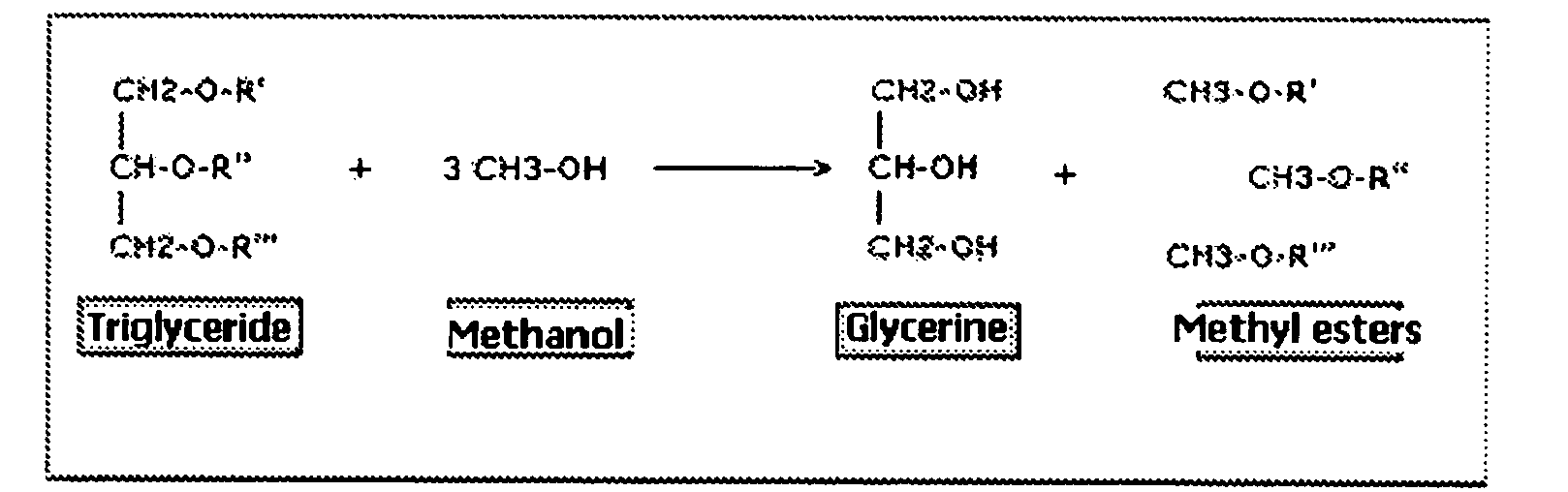
- During the transesterification process the trygliceride reacts with the alcohol in the presence of a catalyst, which is usually a strong base such as NaOH, or KOH.
- The alcohol reacts with the triglycerides to form the monoalkyl ester (or biodiesel), releasing raw glycerol. The reaction between the biolipid (fat or oil) and the alcohol is reversible, so the alcohol must be added in excess to push the reaction towards the right and ensure complete conversion.
- Before the process, particular care must be taken to monitor the quantity of water and of free fatty acids in the initial biolipid. If the level of free fatty acids and/or of humidity is too high, problems may occur with the production of soap (saponification) and the consequent partial or total inactivation of the catalyst. The catalyst is dissolved in the alcohol and the alcohol/catalyst mixture is then loaded into a closed container in which the biolipid (oil or vegetable or animal fats) is added). From then on, the system is totally closed to avoid the loss of alcohol by evaporation.
- The mixture is kept stirring just above the boiling point of the alcohol, to speed up the reaction, even though in some systems it is recommended instead to perform the transformation at environment temperature. The recommended reaction time varies between 1 and 8 hours. The excess alcohol is normally used to ensure the complete conversion of the fat or oil into its esters.
- The glycerine fraction thus obtained is much denser than the biodiesel fraction, and they can therefore be separated by gravity, allowing the glycerine to settle at the base of the container. In other cases a centrifuge may be used to separate the two phases more rapidly.
- Once the glycerine and biodiesel phases have been separated, the excess alcohol in each phase is removed by distillation or partial evaporation. In other systems the alcohol is removed and evaporated before separating the glycerine from the esters. As a secondary product, the separated glycerine still contains unused soaps and catalysts which can be neutralised with an acid and stored as raw glycerine (water and alcohol are removed later, mainly by evaporation, to produce 80-88% pure glycerine).
- Once the biodiesel has been separated from the glycerine it is purified by "washing" it in water (liquid-liquid extraction) to remove residual catalysts or soaps, then it is dried and stored.
- This invention concerns the realisation of a simple and convenient method for producing biodiesel which gives a good yield and which at the same time uses raw materials of plant and/or animal origin.
- How to achieve this aim is specified in claim 1, concerning a process for producing biodiesel from triglycerides obtained by means of esterification with glycerol.
- The present invention therefore describes a method for the production of biodiesel according to the regulation UNI EN 14214, from by-products of the chemical and physical refining of vegetable and/or animal oils, fats and by-products of the refining of glycerine from biodiesel, fatty acids of distillation and non-distillation, hydrolytically cleaved fatty substances and distilled and non-distilled fatty acids, resulting from the cleaving of soaps, for use as biodiesel.
- This process comprises the following phases:
- A) direct esterification with glycerol of fatty acid substances with neutralisation number between 2 and 300,
- B) neutralisation with alkali of the organic and inorganic acids resulting from phase (A)
- C) transesterification reaction with alcohols of the products obtained from phase (B)
- D) distillation of the esters obtained from phase (C) obtaining biodiesel according to regulations, where said distillation takes place by means of a thin layer or molecular evaporator, with absolute distillation pressure between 0 and 4 bar and a distillation temperature between 150 and 200°C.
- The idea behind this invention derives from the following considerations. Biodiesel, generally defined, is a methyl ester obtained from vegetable oil, animal oil and their fats by transesterification with basic catalysts (sodium hydroxide, potassium hydroxide, sodium methylate, potassium methylate, sodium carbonate, calcium hydrate) with the use of 10-20% methanol as an alcohol to replace glycerol. The excess alcohol is generally used to put the reaction in favourable conditions for transesterification.
- The vegetable oils are generally obtained by extraction from seeds, with a solvent or pressure; the animal fats are obtained by hot straining in autoclaves or with a solvent. These fatty substances normally contain free fatty acids, sterols, phospholipids, water, odorous substances and other impurities. The refining of the fatty substances involves the complete removal of all the impurities including the free fatty acids to make them usable in the production of biodiesel, in the food industry and in industry in general.
- However, the refined oils still contain small quantities of free fatty acids. With alkaline catalysis these small acid fractions are transformed into soaps, giving rise to significant quantities of fatty acids combined with sodium and with potassium, all soluble in glycerine.
- The presence of free fatty acids is therefore poorly tolerated in the transesterification reaction system, to the extent that it seriously conditions the result; the presence of water is equally harmful to the system, and the combination of the two negative factors is exponential. The fatty substances obtained from chemical and physical deacidification in the refining phase, understood as a by-product, and those obtained from the cleaving of soaps in the glycerine refining process, understood as a by-product, may have a neutralisation number (nn) between 2 and 300.
- From this derives the intention to develop a process for the transesterification of fatty acids with a neutralisation number between 2 and 300 after direct esterification with glycerol between nn 0 and 30 followed by a further reaction with alcohols such as methanol, ethanol, propanol and butanol, with basic catalysts (such as sodium hydroxide, potassium hydroxide, sodium methylate, potassium methylate, sodium carbonate and potassium carbonate, calcium hydrate) also supported on resins, zeolites and similar or in the total absence of catalysts, with temperatures between 30 and 300°C and with absolute pressures between 1 and 100 bar to obtain biodiesel.
- An acid fatty substance resulting from chemical and/or physical deacidification of oils and/or fats or a mixture of the two, or resulting from the cleaving of the soaps present in the glycerines from biodiesel, or resulting from the distillation of the fatty substances derived from chemical or physical deacidification or a mixture of the 3 above components in any percentage, with nn between 2 and 300, is placed in a reactor with a quantified weight and glycerol is added in the quantity between 0.7 and 20 mole of the necessary stoichiometric value calculated from the neutralisation number of the fatty substance used and made to react to obtain glyceric ester with nn between 0 and 30. Esterification is direct with the development of water and subsequent condensation; the concentration of the catalyst used is between 0.01 and 5% in weight of the total of the substances used.
- The catalysts may be acids or salts, solids or liquids such as tin and its salts, zinc and its salts, titanium and its salts and esters or sulphuric acid, p-toluensulphonic acid, methanesulphonic acid, phosphoric acid also supported on resins, zeolites and similar. The present process also allows operation in the total absence of catalysts. The temperatures are between 50 and 300°C, while the pressure is between 0 and 10 bar absolute. The ester thus obtained is then cooled and any presence of inorganic and organic acids is neutralised with weak alkali Na2CO3, K2CO3, and others. The further transesterification reaction takes place with alcohols such as methanol, ethanol, propanol and butanol, with basic catalysts (such as sodium hydroxide, potassium hydroxide, sodium methylate, potassium methylate, sodium carbonate and potassium carbonate, calcium hydrate) also supported on resins, zeolites and similar, or in the total absence of catalysts, with temperatures between 30 and 300°C and with absolute pressures between 1 and 100 bar to obtain esters. The subsequent distillation of the ester thus obtained takes place by means of a thin layer or molecular evaporator with ester distillation feeding temperatures between 0 and +200°C with absolute distillation pressures between 0 and 20 mbar with distillation temperatures between 150 and 200°C in order to obtain biodiesel according to regulations.
- The fact that distillation takes place only according to the two techniques indicated above cab be explained as follows:
- Distillation (physical separation of molecules by providing heat and defined pressure conditions) is the phase in which the methyl ester previously obtained (phase C) is separated from other molecules with a higher molecular weight. The latter, in particular, are the result of oxidative and polymerisation processes due to the use of lipids, especially in processes such as frying. During distillation, when these molecules are thermally stressed and beyond a certain time limit, they undergo thermal shock with a cracking effect, releasing newly formed molecules. There are therefore new molecules which cause considerable problems since they are molecules with a low weight which distil together with the methyl ester and consequently reduce its purity.
- For this reason methyl ester distilled in non optimum conditions cannot obtain a degree of purity such as to be classified as "biodiesel" according to UNI EN 14214 specifications, for which biodiesel must possess the following requirements:
Characteristic Unit of measure Values Min Max Ester content % (m/m) 96.5 Density at 15°C kg/m^3 860 900 Viscosity at 40°C mm^2/s 3.50 5.00 Flash point °C 120 Sulphur mg/kg 10.0 residue % (m/m) 0.30 Cetane number 51.0 Sulphurated ash % (m/m) 0.02 Water content mg/kg 500 Total contamination mg/kg 24 Corrosion on copper Class 1 Oxidation stability, 110°C h (hours) 6.0 Acidity mg KOH/g 0.5 Iodine number gr 12/100gr 120 Linolenic acid methyl ester % (m/m) 1 2.0 Polyunsaturated methyl esters >=4 double bonds % (m/m) 1 Methanol % (m/m) 0.20 Monoglycerides % (m/m) 0.80 Diglycerides % (m/m) 0.20 Triglycerides % (m/m) 0.20 Free glycerol % (m/m) 6.02 Total glycerol % (m/m) 0.25 Metals group I (Na+K) mg/kg 5.0 Metals group II (Ca+Mg) mg/kg 5.0 Phosphor mg/kg 10.0 - On the basis of these specifications and particularly of the high-acidity methyl ester content, it has been proved in the laboratory and also in industrial systems that it is exclusively with distillation technologies that make use of a thin-layer of molecular evaporator that it is possible to obtain a product defined biodiesel.
- The advantages of the present invention are due to the fact that this process:
- contemplates the esterification of the acidity present in the fatty substances by means of glycerine with the exclusion of methanol, ethanol, propanol, butanol and other alcohols;
- excludes rectifying to eliminate condensation water due to the combination of alcohol and acid in the synthesis process;
- does not require purifications of the initial fatty substance;
- allows considerable energy saving.
- Moreover, classic chemistry contemplates the direct reaction between methanol and fatty acid for the production of biodiesel. However, as biodiesel is a mass product it is important to check the costs of this direct reaction, since high production costs would prevent the use of these by-products. In fact, high excesses of methanol are necessary in order to arrive at low acidity with the direct reaction of fatty acid + methanol. The methanol forms a mixture with the acid-alcohol reaction water which can be separated only with a rectifying column
- The following costs to complete the reaction have been calculated:
- cost of the acid/alcohol reaction (gr/gr)
- rectification of the H2O/alcohol mixture
- reactor dimensions (since we are working with strong excesses of alcohol about 5 times greater than stoichiometry, the dimensions of the reactor are calculated accordingly)
- rectification of the excess methanol used to complete the reaction
- reaction times
- volume of cooling H2O
- investment costs
- From the calculations made, the costs amount to about 0.23euro/kg against 0.02 euro/kg for the reaction with glycerine. This substantial difference in fact allows an industrial use of the present process, which does not occur for the classic technique.
- 1000gr of acid fatty substance resulting from the refining of rapeseed oil with an acidity of 120 mg KOH/gr, 66gr of glycerol, 4.26gr of 2-ethylhexyl titanate are placed in a stirred reactor SS316 and heated. The reaction begins at 130°C and ends at 230°C in 8 hours. The absolute pressure up to the sixth hour is 1 bar, in the last 2 hours the absolute pressure is residual 5-10mbar, the final acidity of the triglyceride is 0.5mg KOH/gr. The temperature is brought to 30°C, the pressure is brought to one bar absolute and any mineral and organic acids present are neutralised with 4,634 mg of Na2CO3 on gr. of product, followed by dehydration of the mass by means of a vacuum; 113gr of methanol and 4.55gr of sodium methylate are introduced into the system. The methyl ester that forms is deprived of glycerine and of the residual methanol. The methyl ester is distilled to obtain biodiesel exclusively by means of the process that uses a thin layer or molecular evaporator with ester distillation feeding temperatures between 0 and +200°C with absolute distillation pressures between 0 and 4 bar and with distillation temperatures between 150 and 200°C in order to obtain biodiesel according to regulations.
- 1000gr of acid fatty substance resulting from the refining of sunflower oil with an acidity of 120 mg KOH/gr, 66gr of glycerol, 4.26gr of 2-ethylhexyl titanate are placed in a stirred reactor SS316 and heated. The reaction begins at 130°C and ends at 230°C in 8 hours. The absolute pressure up to the sixth hour is 1 bar, in the last 2 hours the absolute pressure is residual 5-10 mbar, the final acidity of the triglyceride is 0.5mg KOH/gr. The temperature is brought to 30°C, the pressure is brought to one bar absolute, the mineral and organic acids are neutralised with 4,634 mg of Na2CO3 on gr. of product, followed by dehydration of the mass by means of a vacuum; 113gr of methanol and 4.55gr of sodium methylate are introduced into the system. The methyl ester that forms is deprived of glycerine and of the residual methanol. The methyl ester is then distilled to obtain biodiesel exclusively by means of the process that uses a thin layer or molecular evaporator with ester distillation feeding temperatures between 0 and +200°C with absolute distillation pressures between 0 and 4 bar and with distillation temperatures between 150 and 200°C in order to obtain biodiesel according to regulations.
- 1000gr of acid fatty substance resulting from the refining of almond oil with an acidity of 120 mg KOH/gr, 66gr of glycerol, 4.26gr of 2-ethylhexyl titanate are placed in a stirred reactor SS316 and heated. The reaction begins at 130°C and ends at 230°C in 8 hours. The absolute pressure up to the sixth hour is 1 bar, in the last 2 hours the absolute pressure is residual 5-10mbar, the final acidity of the triglyceride is 0.5 mg KOH/gr. The temperature is brought to 30°C, the pressure is brought to one bar absolute and the mineral and organic acids are neutralised with 4,634 mg of Na2CO3 on gr. of product, followed by dehydration of the mass by means of a vacuum; 113gr of methanol and 4.55gr of sodium methylate are introduced into the system. The methyl ester that forms is deprived of glycerine and of the residual methanol. The methyl ester is distilled to obtain biodiesel exclusively by means of the process that uses a thin layer or molecular evaporator with ester distillation feeding temperatures between -10 and +300°C with absolute distillation pressures between 0 and 1 bar and with distillation temperatures between 80 and 300°C in order to obtain biodiesel according to regulations.
- 1000gr of acid fatty substance resulting from the refining of biodiesel glycerol with an acidity of 40 mgKOH/gr, 30gr of glycerol, 1.03gr of tin chloride are placed in a stirred reactor SS316 . The reaction begins at 130°C and ends at 230°C in 8 hours at absolute pressure. The absolute pressure up to the sixth hour is 1 bar, in the last 2 hours the absolute pressure is residual 1-5mbar, the final acidity of the triglyceride is 0.1 mg KOH/gr.
- The temperature is brought to 30°C, the pressure is brought to one bar absolute and the mineral and organic acids are neutralised with 4,634 mg of Na2CO3 on gr. of product, followed by dehydration of the mass by means of a vacuum; 183gr of methanol and 4.00gr of sodium methylate are introduced into the system. The methyl ester that forms is deprived of glycerine and of the residual methanol. The methyl ester is distilled to obtain biodiesel exclusively by means of the process that uses a thin layer or molecular evaporator with ester distillation feeding temperatures between 0 and +200°C with absolute distillation pressures between 0 and 4 bar and with distillation temperatures between 150 and 200°C in order to obtain biodiesel according to regulations.
- Comparative examples of distillation methods:
-
- Exchange surface 16 m2
- No. revs 200 rpm
-
Methyl ester feed 2000-4000 1/h Methyl ester purity 88% Acidity 0,4 mg of KOH/gr Evaporator project pressure 1 mbar abs Heating fluid temperature 260 °C FEED VACUUM DISTILLATE METHYL ESTER IN THE DISTILLATE DISTILLATION RESIDUE METHYL ESTER IN THE RESIDUE ACIDITY l/h mbar % % % % mg/gr KOH 2000 6 90 98 10 5 0,4 3000 8 90 98 10 7 0,4 4000 9 89 99 11 11 0,3 - The CONTINUOUS THIN FILM distillation process allows biodiesel according to regulations to be obtained according to UNI EN 14214 specifications and in particular as regards methyl ester content and acidity.
- Exchange surface 3 m2
No. revs 200 rpm OPERATIVE CONDITIONS Methyl ester feed 400-600 l/h Methyl ester purity 92% Acidity 0.3 mg of KOH/gr Evaporator project pressure 0,5-1 mbar abs Heating fluid temperature 220°C FEED VACUUM DISTILLATE METHYL ESTER IN THE DISTILLATE DISTILLATION RESIDUE METHYL ESTER IN THE RESIDUE ACIDITY l/h mbar % % % % KOH/gr 400 0,5 94 98 6 1 0,3 500 0,5 94 98 6 3 0,3 600 1 93 99 7 3 0,2 - The CONTINUOUS SHORT PATH distillation process allows biodiesel according to regulations to be obtained according to UNI EN 14214 specifications and in particular as regards methyl ester content and acidity.
-
Exchange surface 30 m2 OPERATIVE CONDITIONS Methyl ester feed 3000-5000 l/h Methyl ester purity 88% Acidity 0.4 mg of KOH/gr Evaporator project pressure 1 mbar abs Heating fluid temperature 260 °C FEED VACUUM DISTILLATE METHYL ESTER IN THE DISTILLATE DISTILLATION RESIDUE METHYL ESTER IN THE RESIDUE ACIDITY l/h mbar % % % % KOH/gr 3000 60 98 90 2 - 2,2 4000 55 98 90 2 1 1,8 5000 55 96 91 3 1 1,7 - The CONTINUOUS FALLING FILM distillation process does not allow biodiesel according to regulations to be obtained according to UNI EN 14214 specifications and in particular as regards methyl ester content and acidity.
-
Exchange surface 30 m2 OPERATIVE CONDITIONS Methyl ester feed 3000-5000 l/h Methyl ester purity 92 % Acidity 0.3 mg of KOH/gr Evaporator project pressure 1 mbar abs FEED VACUUM DISTILLATE METHYL ESTER IN THE DISTILLATE DISTILLATION RESIDUE METHYL ESTER IN THE RESIDUE ACIDITY l/h mbar % % % % KOH/gr 3000 70 97 92 3 3 2 4000 65 96,5 92,5 3,5 3 2 5000 65 96 93 4 3 1,8 - The CONTINUOUS FLASH distillation process does not allow biodiesel according to regulations to be obtained according to UNI EN 14214 specifications and in particular as regards methyl ester content and acidity.
Claims (7)
- Method for the production of biodiesel according to the regulation UNI EN 14214, from by-products of the chemical and physical refining of vegetable and/or animal oils, fats and by-products of the refining of glycerine from biodiesel, fatty acids of distillation and non-distillation, hydrolytically cleaved fatty substances and distilled and non-distilled fatty acids, resulting from the cleaving of soaps, for use as biodiesel comprising the following phases:A) direct esterification with glycerol of fatty acid substances with neutralisation number between 2 and 300 to obtain glyceric esters with nn between 0 and 30, wherein glycerol is present in a quantity between 0.7 and 20mole of the necessary stoichiometric value.;B) neutralisation with alkali of the organic and inorganic acids resulting from phase (A)C) transesterification reaction with alcohols of the products obtained from phase (B)D) distillation of the esters obtained from phase (C) where said distillation takes place by means of a thin layer or molecular evaporator wherein the ester distillation feeding temperature is between 0 and +200°C, the absolute distillation pressure is between 0 and 4 bar and the distillation temperature is between 150 and 200°C.
- Method according to claim 1,
wherein the catalysts used are acids or salts, solids or liquids such as tin and its salts, zinc and its salts, titanium and its salts and esters or sulphuric acid, p-toluensulphonic acid, methanesulphonic acid or phosphoric acid, optionally supported on resins, zeolites and similar. - Method according to claim 2,
wherein the concentration of the catalyst used is between 0.01 and 5% in weight of the total of the substances used. - Method according to one of the claims from 1 to 3,
wherein in phase (A) the pressure is between 0 and 10 bar absolute. - Method according to one of the claims from 1 to 4,
where the reaction (A) takes place without a catalyst. - Method according to one of the previous claims,
wherein the transesterification reaction (C) takes place with alcohols such as methanol, ethanol, propanol and butanol, with the use of basic catalysts, such as sodium hydroxide, potassium hydroxide, sodium methylate, potassium methylate, sodium carbonate, calcium hydrate. - Method according to claim 6,
wherein the reaction takes place at a temperature between 30 and 300°C with absolute pressure between 1 and 100 bar.
Priority Applications (2)
| Application Number | Priority Date | Filing Date | Title |
|---|---|---|---|
| PL07735841T PL2049461T3 (en) | 2006-07-10 | 2007-05-10 | Process for the production of biodiesel |
| EP07735841A EP2049461B1 (en) | 2006-07-10 | 2007-05-10 | Process for the production of biodiesel |
Applications Claiming Priority (3)
| Application Number | Priority Date | Filing Date | Title |
|---|---|---|---|
| EP06116898 | 2006-07-10 | ||
| PCT/IB2007/051763 WO2008007231A1 (en) | 2006-07-10 | 2007-05-10 | Process for the production of biodiesel |
| EP07735841A EP2049461B1 (en) | 2006-07-10 | 2007-05-10 | Process for the production of biodiesel |
Publications (2)
| Publication Number | Publication Date |
|---|---|
| EP2049461A1 EP2049461A1 (en) | 2009-04-22 |
| EP2049461B1 true EP2049461B1 (en) | 2011-09-21 |
Family
ID=37487603
Family Applications (1)
| Application Number | Title | Priority Date | Filing Date |
|---|---|---|---|
| EP07735841A Active EP2049461B1 (en) | 2006-07-10 | 2007-05-10 | Process for the production of biodiesel |
Country Status (5)
| Country | Link |
|---|---|
| EP (1) | EP2049461B1 (en) |
| AT (1) | ATE525344T1 (en) |
| ES (1) | ES2374074T3 (en) |
| PL (1) | PL2049461T3 (en) |
| WO (1) | WO2008007231A1 (en) |
Cited By (1)
| Publication number | Priority date | Publication date | Assignee | Title |
|---|---|---|---|---|
| EP1889899A1 (en) | 2006-08-15 | 2008-02-20 | NOVA Biosource Technologies, LLC | Production of biodiesel and glycerin from high free fatty acid feedstocks |
Families Citing this family (11)
| Publication number | Priority date | Publication date | Assignee | Title |
|---|---|---|---|---|
| US9725397B2 (en) | 2003-01-27 | 2017-08-08 | REG Seneca, LLC | Production of biodiesel and glycerin from high free fatty acid feedstocks |
| CN101215475B (en) * | 2008-01-18 | 2010-05-12 | 河南中盈裕鼎科技有限公司 | Middle and low temperature preparation method for biological diesel oil by using plants fruits and seeds oil and special-purpose distillation tower for the same |
| US20110224451A1 (en) * | 2008-06-11 | 2011-09-15 | Rajiv Kumar Chaturvedi | Process for production of biodiesel |
| US8324413B2 (en) | 2008-12-23 | 2012-12-04 | Texaco Inc. | Low melting point triglycerides for use in fuels |
| GB0913760D0 (en) * | 2009-08-06 | 2009-09-16 | Rothamsted Res Ltd | A method of reducing nitrate leaching from soil |
| ES2556788T3 (en) * | 2011-04-14 | 2016-01-20 | Alfa Laval Corporate Ab | A process for autocatalytic esterification of fatty acids |
| PY1424509A (en) | 2013-06-11 | 2017-09-01 | Renewable Energy Group Inc | METHODS AND DEVICES FOR PRODUCING BIODIESEL AND PRODUCTS OBTAINED FROM IT |
| MY202831A (en) | 2018-10-10 | 2024-05-24 | Basf Se | Method of producing biodiesel |
| CN110172377A (en) * | 2019-06-20 | 2019-08-27 | 成都恒润高新科技股份有限公司 | A method of biodiesel is continuously prepared using waste animal and vegetable oil |
| IT202000001378A1 (en) * | 2020-01-24 | 2021-07-24 | Isuschem S R L | Totally recyclable catalysts for esterification reactions |
| WO2021204610A1 (en) | 2020-04-07 | 2021-10-14 | Basf Se | Energy efficient biodiesel production from natural or industrial waste oil |
Family Cites Families (5)
| Publication number | Priority date | Publication date | Assignee | Title |
|---|---|---|---|---|
| FR2696185B1 (en) * | 1992-09-25 | 1994-12-02 | Inst Francais Du Petrole | Improved process for the production of esters from fatty substances of natural origin. |
| DE19620523C1 (en) * | 1996-05-22 | 1997-04-10 | L U T Labor Und Umwelttechnik | Prodn. of fatty acid mono-ester based fuel |
| ATE218531T1 (en) * | 1997-11-24 | 2002-06-15 | Energea Umwelttechnologie Gmbh | METHOD FOR PRODUCING FATTY ACID METHYL ESTER AND SYSTEM FOR IMPLEMENTING THE METHOD |
| JP4411370B2 (en) * | 1998-10-06 | 2010-02-10 | 株式会社Cdmコンサルティング | Process for producing alkyl esters of fatty acids from fats and oils |
| US6822105B1 (en) * | 2003-08-12 | 2004-11-23 | Stepan Company | Method of making alkyl esters using glycerin |
-
2007
- 2007-05-10 AT AT07735841T patent/ATE525344T1/en active
- 2007-05-10 PL PL07735841T patent/PL2049461T3/en unknown
- 2007-05-10 ES ES07735841T patent/ES2374074T3/en active Active
- 2007-05-10 EP EP07735841A patent/EP2049461B1/en active Active
- 2007-05-10 WO PCT/IB2007/051763 patent/WO2008007231A1/en not_active Ceased
Non-Patent Citations (2)
| Title |
|---|
| BIODIESEL ASSOCIATION OF CANADA - ASSOCIATION CANADIENNE DE BIODIESEL, BIODIESEL BASICS, 2005, pages 1 - 4 * |
| BIOFUEL SYSTEMS GROUP LTD: "Biodiesel Standards", Retrieved from the Internet <URL:www.biofuelsystems.com/specification.htm> [retrieved on 20100430] * |
Cited By (1)
| Publication number | Priority date | Publication date | Assignee | Title |
|---|---|---|---|---|
| EP1889899A1 (en) | 2006-08-15 | 2008-02-20 | NOVA Biosource Technologies, LLC | Production of biodiesel and glycerin from high free fatty acid feedstocks |
Also Published As
| Publication number | Publication date |
|---|---|
| ES2374074T3 (en) | 2012-02-13 |
| WO2008007231A1 (en) | 2008-01-17 |
| EP2049461A1 (en) | 2009-04-22 |
| PL2049461T3 (en) | 2013-04-30 |
| ATE525344T1 (en) | 2011-10-15 |
Similar Documents
| Publication | Publication Date | Title |
|---|---|---|
| EP2049461A1 (en) | Process for the production of biodiesel | |
| US10526564B2 (en) | System and methods for making bioproducts | |
| CN105339468B (en) | Processes for the production of biodiesel and related products | |
| US20100205853A1 (en) | Process for the Preparation of Biodiesel from Vegetable Oils Containing High FFA | |
| CN100467438C (en) | Method and apparatus for producing biodiesel | |
| US20100063309A1 (en) | Biodiesel processes in the presence of free fatty acids and biodiesel producer compositions | |
| US20100043281A1 (en) | Integrated process for the production of biofuels from different types of starting materials and related products | |
| CN103013681A (en) | Method for preparing fatty acid methyl ester by using waste edible oil | |
| EP2479240A1 (en) | Methods and compositions for controlling bulk density of coking coal | |
| US20100058652A1 (en) | Method for Obtaining Fuels from Vegetal and Animal Fat Waste and Installation for Carrying out Said Method | |
| US9347021B2 (en) | Process for the production of aviation biokerosene and aviation kerosene composition | |
| Belozertseva et al. | The choice of feedstock for the biodiesel production with optimal physicochemical and low-temperature properties | |
| CN103224836A (en) | Pretreatment method of high impurity grease | |
| EP2099888B1 (en) | Reconstitution of triglycerides for use as fuel in diesel engines | |
| CN1900224B (en) | Process for preparing biological diesel oil | |
| CN103509583B (en) | A kind of process for purification of biofuel | |
| EP2297282B1 (en) | Method for producing motor fuel | |
| KR100956414B1 (en) | Method for producing biodiesel from fleshing scrap | |
| JP2025527681A (en) | Method and apparatus for producing biodiesel and products obtained therefrom | |
| AU2008276734B2 (en) | Method and apparatus for the batch preparation of biodiesel | |
| TWI582225B (en) | Fast pyrolysis process for obtaining low acid value bio-gasoline and bio-diesel from wasted cooking oils | |
| Skelton | Processing of used cooking oil for the production of biofuels | |
| BG106237A (en) | METHOD FOR THE PRODUCTION OF ALCOHOL ESTERS OF FATTY ACIDS AND THEIR APPLICATION | |
| CN1928019A (en) | Production process for producing biological diesel oil from vegetable oil | |
| ABDULLAH | Optimization of Glycerol Recovery on Effect of Waste Volume and Ph Using Response Surface Methodology (RSM) |
Legal Events
| Date | Code | Title | Description |
|---|---|---|---|
| PUAI | Public reference made under article 153(3) epc to a published international application that has entered the european phase |
Free format text: ORIGINAL CODE: 0009012 |
|
| 17P | Request for examination filed |
Effective date: 20090206 |
|
| AK | Designated contracting states |
Kind code of ref document: A1 Designated state(s): AT BE BG CH CY CZ DE DK EE ES FI FR GB GR HU IE IS IT LI LT LU LV MC MT NL PL PT RO SE SI SK TR |
|
| AX | Request for extension of the european patent |
Extension state: AL BA HR MK RS |
|
| 17Q | First examination report despatched |
Effective date: 20090727 |
|
| GRAP | Despatch of communication of intention to grant a patent |
Free format text: ORIGINAL CODE: EPIDOSNIGR1 |
|
| GRAS | Grant fee paid |
Free format text: ORIGINAL CODE: EPIDOSNIGR3 |
|
| GRAA | (expected) grant |
Free format text: ORIGINAL CODE: 0009210 |
|
| DAX | Request for extension of the european patent (deleted) | ||
| RIN1 | Information on inventor provided before grant (corrected) |
Inventor name: MARINI, LEANDRO Inventor name: PARODI, AUGUSTO |
|
| AK | Designated contracting states |
Kind code of ref document: B1 Designated state(s): AT BE BG CH CY CZ DE DK EE ES FI FR GB GR HU IE IS IT LI LT LU LV MC MT NL PL PT RO SE SI SK TR |
|
| REG | Reference to a national code |
Ref country code: GB Ref legal event code: FG4D |
|
| REG | Reference to a national code |
Ref country code: CH Ref legal event code: EP |
|
| REG | Reference to a national code |
Ref country code: IE Ref legal event code: FG4D |
|
| RAP2 | Party data changed (patent owner data changed or rights of a patent transferred) |
Owner name: A.& A. F.LLI PARODI S.R.L. |
|
| REG | Reference to a national code |
Ref country code: DE Ref legal event code: R096 Ref document number: 602007017369 Country of ref document: DE Effective date: 20111208 |
|
| REG | Reference to a national code |
Ref country code: RO Ref legal event code: EPE |
|
| REG | Reference to a national code |
Ref country code: NL Ref legal event code: T3 |
|
| REG | Reference to a national code |
Ref country code: SE Ref legal event code: TRGR |
|
| PG25 | Lapsed in a contracting state [announced via postgrant information from national office to epo] |
Ref country code: FI Free format text: LAPSE BECAUSE OF FAILURE TO SUBMIT A TRANSLATION OF THE DESCRIPTION OR TO PAY THE FEE WITHIN THE PRESCRIBED TIME-LIMIT Effective date: 20110921 Ref country code: LT Free format text: LAPSE BECAUSE OF FAILURE TO SUBMIT A TRANSLATION OF THE DESCRIPTION OR TO PAY THE FEE WITHIN THE PRESCRIBED TIME-LIMIT Effective date: 20110921 |
|
| REG | Reference to a national code |
Ref country code: CH Ref legal event code: NV Representative=s name: N&G PATENT SERVICES SA |
|
| REG | Reference to a national code |
Ref country code: ES Ref legal event code: FG2A Ref document number: 2374074 Country of ref document: ES Kind code of ref document: T3 Effective date: 20120213 |
|
| LTIE | Lt: invalidation of european patent or patent extension |
Effective date: 20110921 |
|
| PG25 | Lapsed in a contracting state [announced via postgrant information from national office to epo] |
Ref country code: LV Free format text: LAPSE BECAUSE OF FAILURE TO SUBMIT A TRANSLATION OF THE DESCRIPTION OR TO PAY THE FEE WITHIN THE PRESCRIBED TIME-LIMIT Effective date: 20110921 Ref country code: GR Free format text: LAPSE BECAUSE OF FAILURE TO SUBMIT A TRANSLATION OF THE DESCRIPTION OR TO PAY THE FEE WITHIN THE PRESCRIBED TIME-LIMIT Effective date: 20111222 Ref country code: CY Free format text: LAPSE BECAUSE OF FAILURE TO SUBMIT A TRANSLATION OF THE DESCRIPTION OR TO PAY THE FEE WITHIN THE PRESCRIBED TIME-LIMIT Effective date: 20110921 Ref country code: SI Free format text: LAPSE BECAUSE OF FAILURE TO SUBMIT A TRANSLATION OF THE DESCRIPTION OR TO PAY THE FEE WITHIN THE PRESCRIBED TIME-LIMIT Effective date: 20110921 |
|
| REG | Reference to a national code |
Ref country code: GB Ref legal event code: 732E Free format text: REGISTERED BETWEEN 20120216 AND 20120222 |
|
| PG25 | Lapsed in a contracting state [announced via postgrant information from national office to epo] |
Ref country code: BE Free format text: LAPSE BECAUSE OF FAILURE TO SUBMIT A TRANSLATION OF THE DESCRIPTION OR TO PAY THE FEE WITHIN THE PRESCRIBED TIME-LIMIT Effective date: 20110921 |
|
| PG25 | Lapsed in a contracting state [announced via postgrant information from national office to epo] |
Ref country code: SK Free format text: LAPSE BECAUSE OF FAILURE TO SUBMIT A TRANSLATION OF THE DESCRIPTION OR TO PAY THE FEE WITHIN THE PRESCRIBED TIME-LIMIT Effective date: 20110921 Ref country code: IS Free format text: LAPSE BECAUSE OF FAILURE TO SUBMIT A TRANSLATION OF THE DESCRIPTION OR TO PAY THE FEE WITHIN THE PRESCRIBED TIME-LIMIT Effective date: 20120121 |
|
| PG25 | Lapsed in a contracting state [announced via postgrant information from national office to epo] |
Ref country code: PT Free format text: LAPSE BECAUSE OF FAILURE TO SUBMIT A TRANSLATION OF THE DESCRIPTION OR TO PAY THE FEE WITHIN THE PRESCRIBED TIME-LIMIT Effective date: 20120123 Ref country code: EE Free format text: LAPSE BECAUSE OF FAILURE TO SUBMIT A TRANSLATION OF THE DESCRIPTION OR TO PAY THE FEE WITHIN THE PRESCRIBED TIME-LIMIT Effective date: 20110921 |
|
| PLBE | No opposition filed within time limit |
Free format text: ORIGINAL CODE: 0009261 |
|
| STAA | Information on the status of an ep patent application or granted ep patent |
Free format text: STATUS: NO OPPOSITION FILED WITHIN TIME LIMIT |
|
| REG | Reference to a national code |
Ref country code: HU Ref legal event code: AG4A Ref document number: E013147 Country of ref document: HU |
|
| PG25 | Lapsed in a contracting state [announced via postgrant information from national office to epo] |
Ref country code: DK Free format text: LAPSE BECAUSE OF FAILURE TO SUBMIT A TRANSLATION OF THE DESCRIPTION OR TO PAY THE FEE WITHIN THE PRESCRIBED TIME-LIMIT Effective date: 20110921 |
|
| 26N | No opposition filed |
Effective date: 20120622 |
|
| REG | Reference to a national code |
Ref country code: DE Ref legal event code: R097 Ref document number: 602007017369 Country of ref document: DE Effective date: 20120622 |
|
| PG25 | Lapsed in a contracting state [announced via postgrant information from national office to epo] |
Ref country code: MC Free format text: LAPSE BECAUSE OF NON-PAYMENT OF DUE FEES Effective date: 20120531 |
|
| REG | Reference to a national code |
Ref country code: IE Ref legal event code: MM4A |
|
| PG25 | Lapsed in a contracting state [announced via postgrant information from national office to epo] |
Ref country code: IE Free format text: LAPSE BECAUSE OF NON-PAYMENT OF DUE FEES Effective date: 20120510 |
|
| REG | Reference to a national code |
Ref country code: PL Ref legal event code: T3 |
|
| PG25 | Lapsed in a contracting state [announced via postgrant information from national office to epo] |
Ref country code: BG Free format text: LAPSE BECAUSE OF FAILURE TO SUBMIT A TRANSLATION OF THE DESCRIPTION OR TO PAY THE FEE WITHIN THE PRESCRIBED TIME-LIMIT Effective date: 20111221 |
|
| PG25 | Lapsed in a contracting state [announced via postgrant information from national office to epo] |
Ref country code: MT Free format text: LAPSE BECAUSE OF FAILURE TO SUBMIT A TRANSLATION OF THE DESCRIPTION OR TO PAY THE FEE WITHIN THE PRESCRIBED TIME-LIMIT Effective date: 20110921 |
|
| PG25 | Lapsed in a contracting state [announced via postgrant information from national office to epo] |
Ref country code: TR Free format text: LAPSE BECAUSE OF FAILURE TO SUBMIT A TRANSLATION OF THE DESCRIPTION OR TO PAY THE FEE WITHIN THE PRESCRIBED TIME-LIMIT Effective date: 20110921 |
|
| PG25 | Lapsed in a contracting state [announced via postgrant information from national office to epo] |
Ref country code: LU Free format text: LAPSE BECAUSE OF NON-PAYMENT OF DUE FEES Effective date: 20120510 |
|
| REG | Reference to a national code |
Ref country code: FR Ref legal event code: PLFP Year of fee payment: 9 |
|
| REG | Reference to a national code |
Ref country code: FR Ref legal event code: PLFP Year of fee payment: 10 |
|
| REG | Reference to a national code |
Ref country code: FR Ref legal event code: PLFP Year of fee payment: 11 |
|
| REG | Reference to a national code |
Ref country code: FR Ref legal event code: PLFP Year of fee payment: 12 |
|
| PGFP | Annual fee paid to national office [announced via postgrant information from national office to epo] |
Ref country code: DE Payment date: 20180521 Year of fee payment: 12 Ref country code: CH Payment date: 20180523 Year of fee payment: 12 Ref country code: CZ Payment date: 20180511 Year of fee payment: 12 |
|
| PGFP | Annual fee paid to national office [announced via postgrant information from national office to epo] |
Ref country code: NL Payment date: 20180521 Year of fee payment: 12 Ref country code: RO Payment date: 20180510 Year of fee payment: 12 Ref country code: FR Payment date: 20180523 Year of fee payment: 12 Ref country code: PL Payment date: 20180508 Year of fee payment: 12 Ref country code: AT Payment date: 20180522 Year of fee payment: 12 |
|
| PGFP | Annual fee paid to national office [announced via postgrant information from national office to epo] |
Ref country code: HU Payment date: 20180509 Year of fee payment: 12 Ref country code: SE Payment date: 20180516 Year of fee payment: 12 |
|
| PGFP | Annual fee paid to national office [announced via postgrant information from national office to epo] |
Ref country code: GB Payment date: 20180525 Year of fee payment: 12 |
|
| REG | Reference to a national code |
Ref country code: DE Ref legal event code: R119 Ref document number: 602007017369 Country of ref document: DE |
|
| REG | Reference to a national code |
Ref country code: CH Ref legal event code: PL |
|
| REG | Reference to a national code |
Ref country code: NL Ref legal event code: MM Effective date: 20190601 |
|
| REG | Reference to a national code |
Ref country code: AT Ref legal event code: MM01 Ref document number: 525344 Country of ref document: AT Kind code of ref document: T Effective date: 20190510 |
|
| GBPC | Gb: european patent ceased through non-payment of renewal fee |
Effective date: 20190510 |
|
| PG25 | Lapsed in a contracting state [announced via postgrant information from national office to epo] |
Ref country code: AT Free format text: LAPSE BECAUSE OF NON-PAYMENT OF DUE FEES Effective date: 20190510 Ref country code: SE Free format text: LAPSE BECAUSE OF NON-PAYMENT OF DUE FEES Effective date: 20190511 Ref country code: CZ Free format text: LAPSE BECAUSE OF NON-PAYMENT OF DUE FEES Effective date: 20190510 Ref country code: RO Free format text: LAPSE BECAUSE OF NON-PAYMENT OF DUE FEES Effective date: 20190510 Ref country code: LI Free format text: LAPSE BECAUSE OF NON-PAYMENT OF DUE FEES Effective date: 20190531 Ref country code: CH Free format text: LAPSE BECAUSE OF NON-PAYMENT OF DUE FEES Effective date: 20190531 Ref country code: HU Free format text: LAPSE BECAUSE OF NON-PAYMENT OF DUE FEES Effective date: 20190511 |
|
| PG25 | Lapsed in a contracting state [announced via postgrant information from national office to epo] |
Ref country code: DE Free format text: LAPSE BECAUSE OF NON-PAYMENT OF DUE FEES Effective date: 20191203 Ref country code: GB Free format text: LAPSE BECAUSE OF NON-PAYMENT OF DUE FEES Effective date: 20190510 Ref country code: NL Free format text: LAPSE BECAUSE OF NON-PAYMENT OF DUE FEES Effective date: 20190601 |
|
| REG | Reference to a national code |
Ref country code: SE Ref legal event code: EUG |
|
| PG25 | Lapsed in a contracting state [announced via postgrant information from national office to epo] |
Ref country code: FR Free format text: LAPSE BECAUSE OF NON-PAYMENT OF DUE FEES Effective date: 20190531 |
|
| PG25 | Lapsed in a contracting state [announced via postgrant information from national office to epo] |
Ref country code: PL Free format text: LAPSE BECAUSE OF NON-PAYMENT OF DUE FEES Effective date: 20190510 |
|
| PGFP | Annual fee paid to national office [announced via postgrant information from national office to epo] |
Ref country code: ES Payment date: 20240618 Year of fee payment: 18 |
|
| PGFP | Annual fee paid to national office [announced via postgrant information from national office to epo] |
Ref country code: IT Payment date: 20240423 Year of fee payment: 18 |
|
| PG25 | Lapsed in a contracting state [announced via postgrant information from national office to epo] |
Ref country code: IT Free format text: LAPSE BECAUSE OF NON-PAYMENT OF DUE FEES Effective date: 20250510 |