EP2048092A1 - Package of absorbent breast pad and method of packaging the breast pad - Google Patents
Package of absorbent breast pad and method of packaging the breast pad Download PDFInfo
- Publication number
- EP2048092A1 EP2048092A1 EP07744899A EP07744899A EP2048092A1 EP 2048092 A1 EP2048092 A1 EP 2048092A1 EP 07744899 A EP07744899 A EP 07744899A EP 07744899 A EP07744899 A EP 07744899A EP 2048092 A1 EP2048092 A1 EP 2048092A1
- Authority
- EP
- European Patent Office
- Prior art keywords
- breast milk
- absorbent pad
- milk absorbent
- sheet
- region
- Prior art date
- Legal status (The legal status is an assumption and is not a legal conclusion. Google has not performed a legal analysis and makes no representation as to the accuracy of the status listed.)
- Granted
Links
Images

Classifications
-
- A—HUMAN NECESSITIES
- A61—MEDICAL OR VETERINARY SCIENCE; HYGIENE
- A61F—FILTERS IMPLANTABLE INTO BLOOD VESSELS; PROSTHESES; DEVICES PROVIDING PATENCY TO, OR PREVENTING COLLAPSING OF, TUBULAR STRUCTURES OF THE BODY, e.g. STENTS; ORTHOPAEDIC, NURSING OR CONTRACEPTIVE DEVICES; FOMENTATION; TREATMENT OR PROTECTION OF EYES OR EARS; BANDAGES, DRESSINGS OR ABSORBENT PADS; FIRST-AID KITS
- A61F13/00—Bandages or dressings; Absorbent pads
- A61F13/14—Bandages or dressings; Absorbent pads specially adapted for the breast or abdomen
- A61F13/141—Milk breast pads
-
- A—HUMAN NECESSITIES
- A61—MEDICAL OR VETERINARY SCIENCE; HYGIENE
- A61F—FILTERS IMPLANTABLE INTO BLOOD VESSELS; PROSTHESES; DEVICES PROVIDING PATENCY TO, OR PREVENTING COLLAPSING OF, TUBULAR STRUCTURES OF THE BODY, e.g. STENTS; ORTHOPAEDIC, NURSING OR CONTRACEPTIVE DEVICES; FOMENTATION; TREATMENT OR PROTECTION OF EYES OR EARS; BANDAGES, DRESSINGS OR ABSORBENT PADS; FIRST-AID KITS
- A61F13/00—Bandages or dressings; Absorbent pads
- A61F13/00051—Accessories for dressings
- A61F13/00072—Packaging of dressings
-
- A—HUMAN NECESSITIES
- A61—MEDICAL OR VETERINARY SCIENCE; HYGIENE
- A61F—FILTERS IMPLANTABLE INTO BLOOD VESSELS; PROSTHESES; DEVICES PROVIDING PATENCY TO, OR PREVENTING COLLAPSING OF, TUBULAR STRUCTURES OF THE BODY, e.g. STENTS; ORTHOPAEDIC, NURSING OR CONTRACEPTIVE DEVICES; FOMENTATION; TREATMENT OR PROTECTION OF EYES OR EARS; BANDAGES, DRESSINGS OR ABSORBENT PADS; FIRST-AID KITS
- A61F13/00—Bandages or dressings; Absorbent pads
- A61F13/15—Absorbent pads, e.g. sanitary towels, swabs or tampons for external or internal application to the body; Supporting or fastening means therefor; Tampon applicators
- A61F13/551—Packaging before or after use
-
- A—HUMAN NECESSITIES
- A61—MEDICAL OR VETERINARY SCIENCE; HYGIENE
- A61F—FILTERS IMPLANTABLE INTO BLOOD VESSELS; PROSTHESES; DEVICES PROVIDING PATENCY TO, OR PREVENTING COLLAPSING OF, TUBULAR STRUCTURES OF THE BODY, e.g. STENTS; ORTHOPAEDIC, NURSING OR CONTRACEPTIVE DEVICES; FOMENTATION; TREATMENT OR PROTECTION OF EYES OR EARS; BANDAGES, DRESSINGS OR ABSORBENT PADS; FIRST-AID KITS
- A61F13/00—Bandages or dressings; Absorbent pads
- A61F13/15—Absorbent pads, e.g. sanitary towels, swabs or tampons for external or internal application to the body; Supporting or fastening means therefor; Tampon applicators
- A61F2013/15008—Absorbent pads, e.g. sanitary towels, swabs or tampons for external or internal application to the body; Supporting or fastening means therefor; Tampon applicators characterized by the use
- A61F2013/15016—Absorbent pads, e.g. sanitary towels, swabs or tampons for external or internal application to the body; Supporting or fastening means therefor; Tampon applicators characterized by the use for breast; pads for bras
Definitions
- the present invention relates a packed breast milk absorbent pad and a method for packing.
- JP2000-309391A , JP3657537B1 and JP2001-88866A mentioned later disclose the packed breast milk absorbent pad comprising the individual packing envelope and the twofold breast milk absorbent pad packed therein, the packed breast milk absorbent pad comprising the elongated band-like individual packing envelope and a pair of breast milk absorbent pads packed therein side-by-side in the same orientation and the packed breast milk absorbent pad comprising the individual packing envelope and a pair of breast milk absorbent pads packed therein so as to be stacked upon each other in opposite orientations.
- the individual packing envelope having been broken is no more useful, after the breast milk absorbent pad has been used, to put again the used pad thereinto for disposal.
- An object of the present invention is to provide a packed breast milk absorbent pad and a method of packing allowing the breast milk absorbent pad to be easily unpacked from the individual packing envelope so that the same individual packing envelope can be used as the envelope to put again the used pad thereinto for disposal.
- the present invention to achieve the object set forth above has two aspects.
- the present invention relates to, in an aspect thereof, an improvement in a packed breast milk absorbent pad comprising a breast milk absorbent pad having upper and lower ends, a skin-contactable surface as well as a skin-noncontactable surface and an individual packing envelope packing the breast milk absorbent pad therein.
- the first aspect of the present invention is defined by features as will be described below.
- the individual packing envelope is formed of a packing sheet having a longitudinal direction, a transverse direction, first and second side edges extending in the longitudinal direction, and first and second ends extending in the transverse direction wherein the packing sheet is divided by imaginary first and second folds extending in the transverse direction from the first end to the second end and spaced apart from each other in the longitudinal direction into imaginary first, second and third regions.
- the breast milk absorbent pad has first and second sections defined by folding the pad into two with the skin-contactable surface inside, and a temporary fastening zone formed by adhesives on the skin-noncontactable surface of the first section aside toward the upper end in order to fasten the breast milk absorbent pad to an associated brassiere.
- the first region of the packing sheet is folded back toward the skin-noncontactable surface in the first section of the breast milk absorbent pad, then temporarily fastened, in this folded state, to a peel ply provided on an inner surface of the first section of the packing sheet by the temporary fastening zone, and the third region of the packing sheet is folded back toward the second region.
- the first, second and third regions are sealed together along the first and second side edges of the packing sheet to form seal lines.
- a second aspect of the present invention to solve the object set forth above relates to an improvement in a method for packing a breast milk absorbent pad comprising a breast milk absorbent pad having upper and lower ends, a skin-contactable surface as well as a skin-noncontactable surface into an individual packing envelope formed of a packing sheet.
- the second aspect of the present invention comprises steps as will be described below.
- a heat-sealable packing sheet having a longitudinal direction, a transverse direction, first and second side edges extending in the longitudinal direction, and first and second ends extending in the transverse direction.
- the breast milk absorbent pad upon the packing sheet so as to extend astride the first fold in the longitudinal direction and thereby to lie on both the first and second regions of the packing sheet, then folding the third region of the packing sheet along the second fold toward the second region, and thereafter folding the first region of the packing sheet together with the breast milk absorbent pad along the first fold toward the second region so as to fold the breast milk absorbent pad into first and second sections whereupon the first region of the packing sheet is temporarily fixed to the skin-noncontactable surface of the breast milk absorbent pad in the first section thereof aside toward the upper end by intermediary of a temporary fastening zone formed by a pressure-sensitive adhesive on the skin-noncontactable surface for temporarily fixing the breast milk absorbent pad to an associated brassiere, and by intermediary of a peel ply formed on the first region of the packing sheet on the surface thereof opposed to the temporary fastening zone.
- the first aspect of the present invention includes preferred embodiments as will be described below.
- the third region of the packing sheet is folded back toward the second region of the sheet so that a distal end of the third region extends between the first section and the second section of the breast milk absorbent pad.
- the peel ply is formed from a release coated sheet permanently fastened to the inner surface of the first region of the packing sheet by means of a permanent fastening zone formed by adhesive.
- the peel ply is formed by coating of adhesive.
- An end of the permanent fastening zone for the releasable sheet aside toward the upper end of the breast milk absorbent pad extends outward beyond an end of the temporary fastening zone aside toward the upper end of the breast milk absorbent pad.
- a peel strength of the releasable sheet with respect to the temporary fastening zone is in a range of 0.1 to 0.5 N and a peel strength of the seal along the first and second side edges of the packing sheet is in a range of 1.0 to 2.2 N.
- the first end of the packing sheet defining the unpacking outlet of the breast milk absorbent pad is temporarily bonded to an outer surface of the third region of the sheet.
- the first end of the packing sheet defining said unpacking outlet of the breast milk absorbent pad is free rather than being temporarily bonded to the outer surface of the third region of said sheet.
- the seal is preferably provided in the form of heat seal.
- the packed breast milk absorbent pad according to the present invention primarily characterized in that a temporary fastening zone of the breast milk absorbent pad with respect to the individual packing envelope, i.e., in a vicinity of the pad unpacking outlet in order that the breast milk absorbent pad alone can be easily taken out from the envelope merely by pulling the upper end of the breast milk absorbent pad.
- a temporary fastening zone of the breast milk absorbent pad with respect to the individual packing envelope i.e., in a vicinity of the pad unpacking outlet in order that the breast milk absorbent pad alone can be easily taken out from the envelope merely by pulling the upper end of the breast milk absorbent pad.
- the peel ply can be formed without use of the releasable sheet and the cost can be correspondingly saved.
- an end of the permanent fastening zone for the releasable sheet aside toward the upper end of the breast milk absorbent pad extends outward beyond an end of the temporary fastening zone aside toward the upper end of the breast milk absorbent pad, it is ensured that the breast milk absorbent pad can be easily peeled off from the envelope so as to leave the releasable sheet on the peel ply of the envelope when the breast milk absorbent pad is unpacked from the envelope.
- a peel strength of the releasable sheet with respect to the temporary fastening zone is in a range of 0.1 to 0.5 N and a peel strength of the seal along the first and second side edges of the packing sheet is in a range of 1.0 to 2.2 N, it is unlikely that the sealed zones might be unsealed or the envelope might be torn when the breast milk absorbent pad is detached from the releasable sheet and unpacked from the envelope.
- the packing method according to the present invention conveniently permits the breast milk absorbent pad to be folded into two at the same time the first region of the packing envelope is folded onto the second region of the packing envelope. Compared to the case in which the breast milk absorbent is previously folded into two, the process of packing is advantageously simplified.
- the cost can be lowered in comparison with the case in which the sealing is achieved by use of adhesive.
- the first end of the packing sheet defining the unpacking outlet for the breast milk absorbent pad is temporarily bonded to the outer surface of the third region of the sheet, there is no anxiety that dust might enter into the pad after the step of bonding in the process of making the pad.
- the step of bonding the first end is not required.
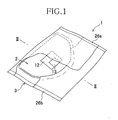
- Fig. 1 is a partially cutaway perspective view of a packaged breast milk absorbent pad
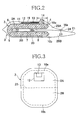
- Fig. 2 is a sectional view taken along the line II-II in Fig. 1
- Fig. 3 is a plan view showing the breast milk absorbent pad with a skin-noncontactable surface lying in the figure's plane.
- a packaged breast milk absorbent pad 1 comprises a breast milk absorbent pad 2 and an individual packing envelope 3.
- the breast milk absorbent pad 2 comprises a body fluid absorbent layer 4 and a body fluid leak-barrier sheet 5 (i.e., outer sheet).
- the absorbent layer 4 comprises, in turn, a body fluid absorbent structure 6 and a body fluid pervious inner sheet 7 covering an inner surface of the body fluid absorbent structure 6.
- the absorbent structure 6 comprises, in turn, a body fluid absorbent core 8.
- the core 8 comprises fluff pulp fibers as a base material and super-absorbent polymer particles or the like mixed with the fluff pulp fibers so as to form a panel having a basis weight preferably in a range of 200 to 300 g/m 2 . While not illustrated, it is particularly preferred to cover the core 8 with a body fluid spreadable shape retaining sheet in order to prevent the polymer particles from falling off.
- the inner sheet 7 is laid so as to face and come in contact with the wearer's skin and made of a thermoplastic synthetic fibrous nonwoven fabric, preferably such as a spun bond or air-through nonwoven fabric having a basis weight preferably in a range of 10 to 35 g/m 2 .
- the inner sheet 7 is intermittently coated with a hot melt adhesive (not shown) by which the inner sheet 7 is kept to cover the absorbent structure 6.
- the skin-noncontactable surface of the absorbent structure 6 is covered with the body fluid leak-barrier sheet (i.e., the outer sheet) 5 which is preferably made of a plastic film having a thickness in a range of 30 to 100 ⁇ m or a thermoplastic synthetic fibrous nonwoven fabric, particularly a spun bond/melt blown/spun bond (SMS) laminated nonwoven fabric having a basis weight of 10 to 35 g/m 2 , or a composite sheet consisting of these plastic film and nonwoven fabric.
- the body fluid leak-barrier sheet i.e., the outer sheet
- the outer sheet 5 which is preferably made of a plastic film having a thickness in a range of 30 to 100 ⁇ m or a thermoplastic synthetic fibrous nonwoven fabric, particularly a spun bond/melt blown/spun bond (SMS) laminated nonwoven fabric having a basis weight of 10 to 35 g/m 2 , or a composite sheet consisting of these plastic film and nonwoven fabric.
- SMS spun bond/melt
- the breast milk absorbent pad 2 is folded into two in such a manner that upper and lower ends 10a, 10b (See Fig. 3 ) are placed upon each other and the inner sheet 7 lies inside so as to define first and second sections 2A, 2B.
- the outer sheet 5 in the first section 2A is provided aside toward the upper end 10a of the pad 2 with a temporary fastening zone 11 formed by a pressure-sensitive adhesive (hot melt adhesive) in order that the pad may be reliably held against any undesirable displacement with respect to a brassiere.
- the temporary fastening zone 11 is covered with a releasable sheet 12 which is, in turn, permanently fixed to the inner surface of the individual packing envelope 3 by a permanent fastening zone 13 formed by a hot melt adhesive.
- a finger grip zone 14 is defined between the upper end 10a and the temporary fastening zone 11. This finger grip zone 14 is appropriately dimensioned so that the upper end 10a of the breast milk absorbent pad 2 can be held by the wearer's fingers without touching the temporary fastening zone 11 when the wearer's unpacks the breast milk absorbent pad 2 from the envelope.
- An end 13a of the permanent fastening zone 13 on the side of the upper end 10a of the pad 2 preferably extends beyond an end 11a of the permanent fastening zone 11 toward the upper end 10a of the pad 2. This is for the reason as follows: Intending to unpack the pad 2 out from the envelope 3 by gripping the upper end 10a with the fingers of the wearer's one hand, the wearer may often hold a first region 19 of the envelope 3 with the fingers of the other hand.
- Fig. 4 is a developed plan view of the individual packing envelope 3.
- the individual packing envelope 3 is made of a flexible and heat-sealable packing sheet 3A which is substantially rectangular as viewed in a direction X.
- the individual packing envelope 3 is contoured by first and second side edges 15a, 15b, first and second ends 16a, 16b, and divided into imaginary first, second and third regions 19, 20, 21 divided by imaginary first and second folds 17, 18 spaced apart one from another in the direction X.
- the third region 21 has a dimension in the direction X smaller than the first and second regions 19, 20 have.
- the packing sheet 3A preferably comprises a plastic film having a thickness in a range of 30 to 100 ⁇ m, or preferably comprises a thermoplastic synthetic fibrous nonwoven fabric having a basis weight in a range of 10 to 35 g/m 2 , particularly such as a spun bond/melt blown/spun bond (SMS) laminated nonwoven fabric, or a laminate consisting of these plastic film and nonwoven fabric.
- a plastic film having a thickness in a range of 30 to 100 ⁇ m or preferably comprises a thermoplastic synthetic fibrous nonwoven fabric having a basis weight in a range of 10 to 35 g/m 2 , particularly such as a spun bond/melt blown/spun bond (SMS) laminated nonwoven fabric, or a laminate consisting of these plastic film and nonwoven fabric.
- SMS spun bond/melt blown/spun bond
- the breast milk absorbent pad 2 is packed therein in a manner as will be described below.
- the breast milk absorbent pad 2 is placed upon the packing sheet 3A so that a fold 22 (See Fig. 3 ) along which the breast milk absorbent pad 2 is to be folded into two may lie just on the first fold 17 of the packing sheet 3A, the first and second sections 2A, 2B of the breast milk absorbent pad 2 may lie respectively on the first and second regions 19, 20 of the packing sheet 3A and the temporary fastening zone 11 may be fixed to the permanent fastening zone 13 previously formed on the packing sheet 3A by intermediary of the releasable sheet 12.
- the third region 21 of the packing sheet 3A is folded back with a distal end of this third region 21 placed on the second section 2B of the breast milk absorbent pad 2, then the assembly is folded into two so that the first region 19 of the packing sheet 3A may be folded back toward the second region 20 and simultaneously the first section 2A of the pad 2 may be folded back just above the second section 2B of the pad 2.
- the packing sheet 3A having been folded in this manner is then subjected to a heat-sealing treatment along the first and second side edges 15a, 15b to form seal lines 26a, 26b and the first end 16a of the packing envelope 3A is temporarily bonded to the opposed outer surface of the third region 21 of the packing sheet 3A by a pressure-sensitive adhesive zone 23 formed by hot melt adhesive so as to define a pad unpacking outlet 24.
- the first end 16a may be free instead of bonding to the outer surface of the third region 21.
- the step of bonding the first end 16a to the third region 21 may be saved.
- the individual packing envelope 3 is formed from the packing sheet 3A in the manner as has been described above and then the pad 2 is packed therein in the twofold state.
- first and second access sites 25A, 25B are defined within the envelope 3 so that respective portions of the pad 2 in vicinities of the upper and lower ends 10a, 10b thereof may occupy these access sites 25A, 25B.
- the pad 2 packed in the envelope 3 in this manner may be unpacked from the bag 3, for example, by handling as will be described below (See Fig. 2 ).
- the wearer may hold the first end 16a of the first region 19 and pull this first end 16a upward as viewed in Fig. 2 to peel the adhesive zone 23 off in the embodiment according to which the first region 19 and the third region 21 are bonded together along the ends thereof (handling of such peeling off is not required in the embodiment according to which the adhesive zone 23 is not provided) until an opening defined between the first and third regions 19, 21 are sufficiently broadened.
- the upper end 10a of the pad 2 may be held and pulled rightward as viewed in Fig. 2 to unpack the pad 2 from the envelope 3 through the pad unpacking outlet 24 (the first case).
- the wearer's fingers may be inserted into the envelope 3 through the unpacking outlet 24, the upper end 10a of the pad 2 may be held with the wearer's fingers and pulled rightward as viewed in Fig. 2 to unpack the pad 2 through the pad unpacking outlet 24 (the second case).
- a relatively high shearing force is exerted on the first region 19 instead of the peel force as in the first case.
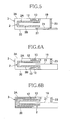
- Fig. 5 In an embodiment schematically illustrated by Fig. 5 is distinguished from the embodiment shown in Fig. 2 in that the third region 21 underlies the pad 2. In this case, it is possible to bond the third region 21 to the second region 20 by hot melt adhesive 27.
- Fig. 6 is a schematic sectional view of the packed breast milk absorbent pad.
- the pad 2 is provided in the first and second sections 2A, 2B with the temporary fastening zones 11 while referring to Fig. 6B , the temporary fastening zone 11 continuously extends in the longitudinal direction.
- the temporary fastening zone 11 may extend over the substantially entire outer surface of the pad 2 except the first end 16a of the packing sheet 3A so far as at least a part thereof is present in a vicinity of the upper end 10a of the pad 2. While not illustrated, a plurality of the temporary fastening zones 11 may be arranged along at least one of the upper and lower ends 10a, 10b of the pad 2 in the transverse direction of in the longitudinal direction so far as at least a part thereof is present in the vicinity of the upper end 10a of the pad 2.
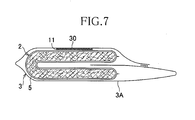
- Fig. 7 is a sectional view similar to Fig. 2 , illustrating another embodiment.
- the packing sheet 3A is coated on its inner surface with a release agent such as silicone to form a peel ply 30 and the temporary fastening zone 11 is fixed directly to this peel ply 30.
- the releasable sheet 12 is not necessary for actual use of the pad.
- adhesives such as hot melt adhesive and pressure-sensitive adhesive, and heat-sealing techniques may selectively utilized.
- a peel strength of the releasable sheet 12 with respect to the temporary fastening zone 11 is preferably in a range of 0. 1 to 0.5 N allowing the pad 2 to be peeled off from the envelope 3 without damaging the sealed line along the first and second side edges 15a, 15b of the packing sheet 3A.
- a peel strength of the seal lines 26a, 26b along the first and second side edges 15a, 15b of the packing sheet 3A is preferably in a range of 1.0 to 2.2 N. If the peel strength is 1.0 N or less, there is a possibility that the seal lines 26a, 26b might be broken at the same time as seal of the pad unpacking outlet 24 is broken in order to unpack the pad 2. If the peel strength is 2.2 N or higher, there is an anxiety that the packing sheet 3A might be damaged.
- the peel strength is measured using Universal Material Tester available from INSTRON JAPAN by a method as will be described below.
- the seal line 26 is removed from the product, the first region 19 is cut away.
- the upper end 10a of the pad 2 and the first end 16a of the packing sheet 3A fastened to the pad 2 or the end of the releasable sheet 12 aside toward the pad unpacking outlet 24 are held by chucks (a distance between chucks: 20 mm and a tensile rate: 500 mm/min) to measure the maximum load. Five measurements according to this method are repeated and an average value is obtained as the peel strength of the releasable sheet 12 with respect to the temporary fastening zone 11.
- a test piece defined by a dimension of 25 mm measured from the seal line 26 at the pad unpacking outlet 24 in a direction in which the seal line 26 is to be peeled off and a dimension of 75 mm measured from the seal line 26 toward a center of the product is cut away from the product.
- the first and second ends 16a, 16b of the packing sheet 3A are held by chucks (a distance between chucks: 30 mm and a tensile rate: 300 mm/min) to measure the maximum load. Five measurements according to this method are repeated and an average value is obtained as the peel strength of the seal line 26.
Landscapes
- Health & Medical Sciences (AREA)
- Life Sciences & Earth Sciences (AREA)
- Engineering & Computer Science (AREA)
- Biomedical Technology (AREA)
- Heart & Thoracic Surgery (AREA)
- Vascular Medicine (AREA)
- Animal Behavior & Ethology (AREA)
- General Health & Medical Sciences (AREA)
- Public Health (AREA)
- Veterinary Medicine (AREA)
- Epidemiology (AREA)
- Corsets Or Brassieres (AREA)
- Packages (AREA)
- Packaging Of Annular Or Rod-Shaped Articles, Wearing Apparel, Cassettes, Or The Like (AREA)
Abstract
Description
- The present invention relates a packed breast milk absorbent pad and a method for packing.
- There have conventionally been proposed packed breast milk absorbent pads provided in the form of an assembly comprising a breast milk absorbent pad itself and an individual pad packing envelope wherein the pad itself is composed of an absorbent structure having its outer surface covered with a leak-barrier sheet and the pad packing envelope temporarily fastens the pad packed therein.
- For example,
JP2000-309391A JP3657537B1 JP2001-88866A - However, in any of the packed breast milk absorbent pads disclosed in
JP2000-309391A JP3657537B1 JP2001-88866A - The individual packing envelope having been broken is no more useful, after the breast milk absorbent pad has been used, to put again the used pad thereinto for disposal.
- An object of the present invention is to provide a packed breast milk absorbent pad and a method of packing allowing the breast milk absorbent pad to be easily unpacked from the individual packing envelope so that the same individual packing envelope can be used as the envelope to put again the used pad thereinto for disposal.
- The present invention to achieve the object set forth above has two aspects.
- The present invention relates to, in an aspect thereof, an improvement in a packed breast milk absorbent pad comprising a breast milk absorbent pad having upper and lower ends, a skin-contactable surface as well as a skin-noncontactable surface and an individual packing envelope packing the breast milk absorbent pad therein.
- The first aspect of the present invention is defined by features as will be described below.
- The individual packing envelope is formed of a packing sheet having a longitudinal direction, a transverse direction, first and second side edges extending in the longitudinal direction, and first and second ends extending in the transverse direction wherein the packing sheet is divided by imaginary first and second folds extending in the transverse direction from the first end to the second end and spaced apart from each other in the longitudinal direction into imaginary first, second and third regions.
- The breast milk absorbent pad has first and second sections defined by folding the pad into two with the skin-contactable surface inside, and a temporary fastening zone formed by adhesives on the skin-noncontactable surface of the first section aside toward the upper end in order to fasten the breast milk absorbent pad to an associated brassiere.
- The first region of the packing sheet is folded back toward the skin-noncontactable surface in the first section of the breast milk absorbent pad, then temporarily fastened, in this folded state, to a peel ply provided on an inner surface of the first section of the packing sheet by the temporary fastening zone, and the third region of the packing sheet is folded back toward the second region.
- The first, second and third regions are sealed together along the first and second side edges of the packing sheet to form seal lines.
- A second aspect of the present invention to solve the object set forth above relates to an improvement in a method for packing a breast milk absorbent pad comprising a breast milk absorbent pad having upper and lower ends, a skin-contactable surface as well as a skin-noncontactable surface into an individual packing envelope formed of a packing sheet.
- The second aspect of the present invention comprises steps as will be described below.
- Providing, as stock material for the individual packing envelope, a heat-sealable packing sheet having a longitudinal direction, a transverse direction, first and second side edges extending in the longitudinal direction, and first and second ends extending in the transverse direction.
- Defining imaginary first, second and third regions on the packing sheet by imaginary first and second folds extending in the transverse direction from the first end to the second end and spaced apart from each other in the longitudinal direction.
- Laying the breast milk absorbent pad upon the packing sheet so as to extend astride the first fold in the longitudinal direction and thereby to lie on both the first and second regions of the packing sheet, then folding the third region of the packing sheet along the second fold toward the second region, and thereafter folding the first region of the packing sheet together with the breast milk absorbent pad along the first fold toward the second region so as to fold the breast milk absorbent pad into first and second sections whereupon the first region of the packing sheet is temporarily fixed to the skin-noncontactable surface of the breast milk absorbent pad in the first section thereof aside toward the upper end by intermediary of a temporary fastening zone formed by a pressure-sensitive adhesive on the skin-noncontactable surface for temporarily fixing the breast milk absorbent pad to an associated brassiere, and by intermediary of a peel ply formed on the first region of the packing sheet on the surface thereof opposed to the temporary fastening zone.
- Sealing the first and second regions of the packing sheet together along the first and second side edges thereof so as to form seal lines.
- The first aspect of the present invention includes preferred embodiments as will be described below.
- The third region of the packing sheet is folded back toward the second region of the sheet so that a distal end of the third region extends between the first section and the second section of the breast milk absorbent pad.
- The peel ply is formed from a release coated sheet permanently fastened to the inner surface of the first region of the packing sheet by means of a permanent fastening zone formed by adhesive.
- The peel ply is formed by coating of adhesive.
- An end of the permanent fastening zone for the releasable sheet aside toward the upper end of the breast milk absorbent pad extends outward beyond an end of the temporary fastening zone aside toward the upper end of the breast milk absorbent pad.
- A peel strength of the releasable sheet with respect to the temporary fastening zone is in a range of 0.1 to 0.5 N and a peel strength of the seal along the first and second side edges of the packing sheet is in a range of 1.0 to 2.2 N.
- The first end of the packing sheet defining the unpacking outlet of the breast milk absorbent pad is temporarily bonded to an outer surface of the third region of the sheet.
- The first end of the packing sheet defining said unpacking outlet of the breast milk absorbent pad is free rather than being temporarily bonded to the outer surface of the third region of said sheet.
- According to the second aspect of the present invention, the seal is preferably provided in the form of heat seal.
- The packed breast milk absorbent pad according to the present invention primarily characterized in that a temporary fastening zone of the breast milk absorbent pad with respect to the individual packing envelope, i.e., in a vicinity of the pad unpacking outlet in order that the breast milk absorbent pad alone can be easily taken out from the envelope merely by pulling the upper end of the breast milk absorbent pad. For further benefit, there is no or substantially no possibility that the envelope might be torn when the pad is unpacked from the envelope and, after the pad has been used, the envelope can be utilized as the envelope for the used pad for disposal.
- In the embodiment wherein the peel ply is formed by coating of adhesive, the peel ply can be formed without use of the releasable sheet and the cost can be correspondingly saved.
- In the embodiment wherein an end of the permanent fastening zone for the releasable sheet aside toward the upper end of the breast milk absorbent pad extends outward beyond an end of the temporary fastening zone aside toward the upper end of the breast milk absorbent pad, it is ensured that the breast milk absorbent pad can be easily peeled off from the envelope so as to leave the releasable sheet on the peel ply of the envelope when the breast milk absorbent pad is unpacked from the envelope.
- In the embodiment wherein a peel strength of the releasable sheet with respect to the temporary fastening zone is in a range of 0.1 to 0.5 N and a peel strength of the seal along the first and second side edges of the packing sheet is in a range of 1.0 to 2.2 N, it is unlikely that the sealed zones might be unsealed or the envelope might be torn when the breast milk absorbent pad is detached from the releasable sheet and unpacked from the envelope.
- The packing method according to the present invention conveniently permits the breast milk absorbent pad to be folded into two at the same time the first region of the packing envelope is folded onto the second region of the packing envelope. Compared to the case in which the breast milk absorbent is previously folded into two, the process of packing is advantageously simplified.
- In the embodiment wherein the seal is provided in the form of heat seal, the cost can be lowered in comparison with the case in which the sealing is achieved by use of adhesive.
- In the embodiment wherein the first end of the packing sheet defining the unpacking outlet for the breast milk absorbent pad is temporarily bonded to the outer surface of the third region of the sheet, there is no anxiety that dust might enter into the pad after the step of bonding in the process of making the pad.
- In the embodiment wherein the first end of the packing sheet defining the unpacking outlet for the breast milk absorbent pad is free from the outer surface of the third region of the sheet, the step of bonding the first end is not required.
-
- [
FIG. 1] Fig. 1 is a partially cutaway perspective view of a packaged breast milk absorbent pad. - [
FIG. 2] Fig. 2 is a sectional view taken along the line II-II inFig. 1 . - [
FIG. 3] Fig. 3 is a plan view showing the breast milk absorbent pad with a skin-noncontactable surface thereof lying in the figure's plane. - [
FIG. 4] Fig. 4 is a developed plan view of an envelope for individually packing the pad. - [
FIG. 5] Fig. 5 is a schematic sectional view showing another embodiment of the packaged pad. - [
FIG. 6] Fig. 6 is a schematic sectional view showing still another embodiment of the packaged pad. - [
FIG. 7] Fig. 7 is a sectional view similar toFig. 2 , showing further another embodiment. -
- 1
- packaged breast milk absorbent pad
- 2
- breast milk absorbent pad
- 2A
- first section
- 2B
- second section
- 3
- packing envelope
- 3A
- packing sheet
- 11
- temporary fastening zone
- 11a
- end
- 13
- permanent fastening zone
- 13a
- end
- 12
- releasable sheet
- 15a
- first side edge
- 15b
- second side edge
- 16a
- first end
- 16b
- second end
- 17
- first fold
- 18
- second fold
- 19
- first region
- 20
- second region
- 21
- third region
- 23
- pressure-sensitive adhesive zone
- 24
- pad unpacking outlet
- 26a, 26b
- seal line
- 30
- peel ply
- The present invention will be described hereunder on the basis of preferred embodiments with reference to the accompanying drawings.
-
Fig. 1 is a partially cutaway perspective view of a packaged breast milk absorbent pad,Fig. 2 is a sectional view taken along the line II-II inFig. 1 andFig. 3 is a plan view showing the breast milk absorbent pad with a skin-noncontactable surface lying in the figure's plane. - Referring to
Fig. 1 , a packaged breast milk absorbent pad 1 comprises a breast milkabsorbent pad 2 and anindividual packing envelope 3. - Referring now to
Fig. 2 , the breast milkabsorbent pad 2 comprises a body fluidabsorbent layer 4 and a body fluid leak-barrier sheet 5 (i.e., outer sheet). Theabsorbent layer 4 comprises, in turn, a body fluidabsorbent structure 6 and a body fluid perviousinner sheet 7 covering an inner surface of the body fluidabsorbent structure 6. Theabsorbent structure 6 comprises, in turn, a body fluidabsorbent core 8. - The
core 8 comprises fluff pulp fibers as a base material and super-absorbent polymer particles or the like mixed with the fluff pulp fibers so as to form a panel having a basis weight preferably in a range of 200 to 300 g/m2. While not illustrated, it is particularly preferred to cover thecore 8 with a body fluid spreadable shape retaining sheet in order to prevent the polymer particles from falling off. - The
inner sheet 7 is laid so as to face and come in contact with the wearer's skin and made of a thermoplastic synthetic fibrous nonwoven fabric, preferably such as a spun bond or air-through nonwoven fabric having a basis weight preferably in a range of 10 to 35 g/m2. Theinner sheet 7 is intermittently coated with a hot melt adhesive (not shown) by which theinner sheet 7 is kept to cover theabsorbent structure 6. - The skin-noncontactable surface of the
absorbent structure 6 is covered with the body fluid leak-barrier sheet (i.e., the outer sheet) 5 which is preferably made of a plastic film having a thickness in a range of 30 to 100 µm or a thermoplastic synthetic fibrous nonwoven fabric, particularly a spun bond/melt blown/spun bond (SMS) laminated nonwoven fabric having a basis weight of 10 to 35 g/m2, or a composite sheet consisting of these plastic film and nonwoven fabric. - The breast milk
absorbent pad 2 is folded into two in such a manner that upper andlower ends Fig. 3 ) are placed upon each other and theinner sheet 7 lies inside so as to define first andsecond sections outer sheet 5 in thefirst section 2A is provided aside toward theupper end 10a of thepad 2 with atemporary fastening zone 11 formed by a pressure-sensitive adhesive (hot melt adhesive) in order that the pad may be reliably held against any undesirable displacement with respect to a brassiere. Thetemporary fastening zone 11 is covered with areleasable sheet 12 which is, in turn, permanently fixed to the inner surface of theindividual packing envelope 3 by apermanent fastening zone 13 formed by a hot melt adhesive. In this way, thetemporary fastening zone 11 is separable from thereleasable sheet 12. Afinger grip zone 14 is defined between theupper end 10a and thetemporary fastening zone 11. Thisfinger grip zone 14 is appropriately dimensioned so that theupper end 10a of the breast milkabsorbent pad 2 can be held by the wearer's fingers without touching thetemporary fastening zone 11 when the wearer's unpacks the breast milkabsorbent pad 2 from the envelope. - An
end 13a of thepermanent fastening zone 13 on the side of theupper end 10a of thepad 2 preferably extends beyond anend 11a of thepermanent fastening zone 11 toward theupper end 10a of thepad 2. This is for the reason as follows: Intending to unpack thepad 2 out from theenvelope 3 by gripping theupper end 10a with the fingers of the wearer's one hand, the wearer may often hold afirst region 19 of theenvelope 3 with the fingers of the other hand. In this case, a peel force is exerted directly upon theend 11a of thetemporary fastening zone 11 in the course of unpacking thepad 2 from theenvelope 3 since theend 13a of thepermanent fastening zone 13 extends beyond theend 11a of thetemporary fastening zone 11 toward theupper end 10a of thepad 2. In other words, assumed that theend 11a of thetemporary fastening zone 11 extends beyond theend 13a of thepermanent fastening zone 13 toward theupper end 10a of thepad 2, the peel force will be exerted upon theend 13a of thepermanent fastening zone 13 lying adjacent to theupper end 10a of thepad 2 and make it difficult to peel thetemporary fastening zone 11 off from thereleasable sheet 12. -
Fig. 4 is a developed plan view of theindividual packing envelope 3. As will be apparent fromFig. 4 , theindividual packing envelope 3 is made of a flexible and heat-sealable packing sheet 3A which is substantially rectangular as viewed in a direction X. Theindividual packing envelope 3 is contoured by first andsecond side edges second ends third regions second folds third region 21 has a dimension in the direction X smaller than the first andsecond regions - The
packing sheet 3A preferably comprises a plastic film having a thickness in a range of 30 to 100 µm, or preferably comprises a thermoplastic synthetic fibrous nonwoven fabric having a basis weight in a range of 10 to 35 g/m2, particularly such as a spun bond/melt blown/spun bond (SMS) laminated nonwoven fabric, or a laminate consisting of these plastic film and nonwoven fabric. - Using the
individual packing envelope 3 formed from thepacking sheet 3A in the manner as has been described above, the breast milkabsorbent pad 2 is packed therein in a manner as will be described below. - Referring to
Fig. 2 andFig. 4 , the breast milkabsorbent pad 2 is placed upon thepacking sheet 3A so that a fold 22 (SeeFig. 3 ) along which the breast milkabsorbent pad 2 is to be folded into two may lie just on thefirst fold 17 of thepacking sheet 3A, the first andsecond sections absorbent pad 2 may lie respectively on the first andsecond regions packing sheet 3A and thetemporary fastening zone 11 may be fixed to thepermanent fastening zone 13 previously formed on thepacking sheet 3A by intermediary of thereleasable sheet 12. From such a state, thethird region 21 of thepacking sheet 3A is folded back with a distal end of thisthird region 21 placed on thesecond section 2B of the breast milkabsorbent pad 2, then the assembly is folded into two so that thefirst region 19 of thepacking sheet 3A may be folded back toward thesecond region 20 and simultaneously thefirst section 2A of thepad 2 may be folded back just above thesecond section 2B of thepad 2. - The
packing sheet 3A having been folded in this manner is then subjected to a heat-sealing treatment along the first andsecond side edges seal lines first end 16a of thepacking envelope 3A is temporarily bonded to the opposed outer surface of thethird region 21 of thepacking sheet 3A by a pressure-sensitive adhesive zone 23 formed by hot melt adhesive so as to define apad unpacking outlet 24. - In the embodiment according to which the
first end 16a defining the unpackingoutlet 24 is sealed by the pressure-sensitive adhesive zone 23, it is unlikely that dust might enter into the envelope. - Alternatively, the
first end 16a may be free instead of bonding to the outer surface of thethird region 21. - In this case, the step of bonding the
first end 16a to thethird region 21 may be saved. - The
individual packing envelope 3 is formed from thepacking sheet 3A in the manner as has been described above and then thepad 2 is packed therein in the twofold state. In the state of thepad 2 packed in this manner, first andsecond access sites envelope 3 so that respective portions of thepad 2 in vicinities of the upper andlower ends access sites - The
pad 2 packed in theenvelope 3 in this manner may be unpacked from thebag 3, for example, by handling as will be described below (SeeFig. 2 ). Specifically, the wearer may hold thefirst end 16a of thefirst region 19 and pull thisfirst end 16a upward as viewed inFig. 2 to peel theadhesive zone 23 off in the embodiment according to which thefirst region 19 and thethird region 21 are bonded together along the ends thereof (handling of such peeling off is not required in the embodiment according to which theadhesive zone 23 is not provided) until an opening defined between the first andthird regions upper end 10a of thepad 2 may be held and pulled rightward as viewed inFig. 2 to unpack thepad 2 from theenvelope 3 through the pad unpacking outlet 24 (the first case). - Alternatively, without further broadening the opening defined between the first and
third regions envelope 3 through the unpackingoutlet 24, theupper end 10a of thepad 2 may be held with the wearer's fingers and pulled rightward as viewed inFig. 2 to unpack thepad 2 through the pad unpacking outlet 24 (the second case). In this case, a relatively high shearing force is exerted on thefirst region 19 instead of the peel force as in the first case. In view of this, it is preferred to use materials having a relative high tensile strength as thepacking sheet 3A. - In an embodiment schematically illustrated by
Fig. 5 is distinguished from the embodiment shown inFig. 2 in that thethird region 21 underlies thepad 2. In this case, it is possible to bond thethird region 21 to thesecond region 20 by hot melt adhesive 27. -
Fig. 6 is a schematic sectional view of the packed breast milk absorbent pad. Referring toFig. 6A , thepad 2 is provided in the first andsecond sections temporary fastening zones 11 while referring toFig. 6B , thetemporary fastening zone 11 continuously extends in the longitudinal direction. - The
temporary fastening zone 11 may extend over the substantially entire outer surface of thepad 2 except thefirst end 16a of thepacking sheet 3A so far as at least a part thereof is present in a vicinity of theupper end 10a of thepad 2. While not illustrated, a plurality of thetemporary fastening zones 11 may be arranged along at least one of the upper andlower ends pad 2 in the transverse direction of in the longitudinal direction so far as at least a part thereof is present in the vicinity of theupper end 10a of thepad 2. -
Fig. 7 is a sectional view similar toFig. 2 , illustrating another embodiment. Thepacking sheet 3A is coated on its inner surface with a release agent such as silicone to form apeel ply 30 and thetemporary fastening zone 11 is fixed directly to this peel ply 30. In this case, thereleasable sheet 12 is not necessary for actual use of the pad. - For bonding and attachment of the respective components, adhesives such as hot melt adhesive and pressure-sensitive adhesive, and heat-sealing techniques may selectively utilized.
- A peel strength of the
releasable sheet 12 with respect to thetemporary fastening zone 11 is preferably in a range of 0. 1 to 0.5 N allowing thepad 2 to be peeled off from theenvelope 3 without damaging the sealed line along the first andsecond side edges packing sheet 3A. - A peel strength of the
seal lines second side edges packing sheet 3A is preferably in a range of 1.0 to 2.2 N. If the peel strength is 1.0 N or less, there is a possibility that theseal lines pad unpacking outlet 24 is broken in order to unpack thepad 2. If the peel strength is 2.2 N or higher, there is an anxiety that thepacking sheet 3A might be damaged. - The peel strength is measured using Universal Material Tester available from INSTRON JAPAN by a method as will be described below.
- After the product has been left for 30 min at a temperature of 20°C and a humidity of 60% for stabilization, the seal line 26 is removed from the product, the
first region 19 is cut away. Theupper end 10a of thepad 2 and thefirst end 16a of thepacking sheet 3A fastened to thepad 2 or the end of thereleasable sheet 12 aside toward thepad unpacking outlet 24 are held by chucks (a distance between chucks: 20 mm and a tensile rate: 500 mm/min) to measure the maximum load. Five measurements according to this method are repeated and an average value is obtained as the peel strength of thereleasable sheet 12 with respect to thetemporary fastening zone 11. - After the product has been left for 30 min at a temperature of 20°C and a humidity of 60% for stabilization, a test piece defined by a dimension of 25 mm measured from the seal line 26 at the
pad unpacking outlet 24 in a direction in which the seal line 26 is to be peeled off and a dimension of 75 mm measured from the seal line 26 toward a center of the product is cut away from the product. Of the test piece having cutaway from the product in this manner, the first andsecond ends packing sheet 3A are held by chucks (a distance between chucks: 30 mm and a tensile rate: 300 mm/min) to measure the maximum load. Five measurements according to this method are repeated and an average value is obtained as the peel strength of the seal line 26.
Claims (10)
- A packed breast milk absorbent pad (1) comprising:a breast milk absorbent pad (2) having upper and lower ends (10a, 10B), a skin-contactable surface (7) as well as a skin-noncontactable surface (5); said pad being characterized in that:an individual packing envelope (3) packing said breast milk absorbent pad therein;said individual packing envelope being formed of a packing sheet (3A) having a longitudinal direction (X), a transverse direction (Y), first and second side edges (15a, 15b) extending in said longitudinal direction, and first and second ends (16a, 16b) extending in said transverse direction;said packing sheet being divided by imaginary first and second folds (17, 18) extending in said transverse direction from said first end to said second end and spaced apart from each other in said longitudinal direction into imaginary first, second and third regions (19, 20, 21);said breast milk absorbent pad further having first and second sections (2A, 2B) defined by folding said pad into two with said skin-contactable surface (7) inside, and a temporary fastening zone (11) formed by adhesive on said skin-noncontactable surface of said first section aside toward said upper end in order to fasten said breast milk absorbent pad to an associated brassiere;said first region of said packing sheet being folded back toward said skin-noncontactable surface in said first section of said breast milk absorbent pad, then temporarily fastened, in this folded state, to a peel ply (30) provided on an inner surface of said first section of said packing sheet by said temporary fastening zone, and said third region of said packing sheet being folded back toward said second region; andsaid first, second and third region being sealed together along said first and second side edges of said packing sheet to form seal lines (26a, 26b).
- The packed breast milk absorbent pad as defined by Claim 1, wherein said third region of said packing sheet is folded back toward said second region of said sheet so that a distal end of said third region extends between said first section and said second section of said breast milk absorbent pad.
- The packed breast milk absorbent pad as defined by Claim 1 or 2, wherein said peel ply is formed by a releasble sheet permanently fastened to the inner surface of said first region of said packing sheet by a permanent fastening zone (13) formed by adhesive.
- The packed breast milk absorbent pad as defined by any one of Claims 1 through 3, wherein said peel ply is formed by coating of adhesive.
- The packed breast milk absorbent pad as defined by any one of Claims 1 through 4, wherein an end of said permanent fastening zone for said releasable sheet aside toward said upper end of said breast milk absorbent pad extends outward beyond an end of said temporary fastening zone aside toward said upper end of said breast milk absorbent pad.
- The packed breast milk absorbent pad as defined by any one of Claims 1 through 5, wherein a peel strength of said releasable sheet with respect to said temporary fastening zone is in a range of 0.1 to 0.5 N and a peel strength of the seal along said first and second side edges of said packing sheet is in a range of 1.0 to 2.2 N.
- The packed breast milk absorbent pad as defined by any one of Claims 1 through 6, wherein said first end of said packing sheet defining said unpacking outlet for said breast milk absorbent pad is temporarily bonded to an outer surface of said third region of said sheet.
- The packed breast milk absorbent pad as defined by any one of Claims 1 through 6, wherein said first end of said packing sheet defining said unpacking outlet for said breast milk absorbent pad is free rather than being temporarily bonded to the outer surface of said third region of said sheet.
- A method for packing a breast milk absorbent pad comprising a breast milk absorbent pad (2) having upper and lower ends (10a, 10b), a skin-contactable surface (7) as well as a skin-noncontactable surface (5) into an individual packing envelope (3) formed of a packing sheet (3A), said method comprising the steps of:providing, as stock material for said individual packing envelope, a heat-sealable packing sheet (3A) having a longitudinal direction (X), a transverse direction (Y), first and second side edges (15a, 15b) extending in said longitudinal direction, and first and second ends (16a, 16b) extending in said transverse direction;defining imaginary first, second and third regions (19, 20, 21) on said packing sheet by imaginary first and second folds (17, 18) extending in the transverse direction from said first end to said second end and spaced apart from each other in said longitudinal direction;laying said breast milk absorbent pad upon said packing sheet so as to extend astride said first fold in said longitudinal direction and thereby to lie on both said first and second regions of said packing sheet, then folding said third region of said packing sheet along said second fold toward said second region, and thereafter folding said first region of said packing sheet together with said breast milk absorbent pad along said first fold toward said second region so as to fold said breast milk absorbent pad into first and second sections (2A, 2B) whereupon said first region of said packing sheet is temporarily fixed to said skin-noncontactable surface of said breast milk absorbent pad in said first section thereof aside toward said upper end by intermediary of a temporary fastening zone (11) formed by a pressure-sensitive adhesive on said skin-noncontactable surface for temporarily fixing said breast milk absorbent pad to an associated brassiere, and by intermediary of a peel ply (30) formed on said first region of said packing sheet on a surface thereof opposed to said temporary fastening zone; andsealing said first and second regions of said packing sheet together along said first and second side edges thereof so as to form seal lines (26a, 26b).
- The method as defined by Claim 9, wherein said seal is provided in the form of heat seal.
Applications Claiming Priority (2)
| Application Number | Priority Date | Filing Date | Title |
|---|---|---|---|
| JP2006160350A JP4841320B2 (en) | 2006-06-08 | 2006-06-08 | Package for breast milk pad and packaging method thereof |
| PCT/JP2007/061571 WO2007142307A1 (en) | 2006-06-08 | 2007-06-07 | Package of absorbent breast pad and method of packaging the breast pad |
Publications (3)
| Publication Number | Publication Date |
|---|---|
| EP2048092A1 true EP2048092A1 (en) | 2009-04-15 |
| EP2048092A4 EP2048092A4 (en) | 2011-02-02 |
| EP2048092B1 EP2048092B1 (en) | 2013-02-27 |
Family
ID=38801553
Family Applications (1)
| Application Number | Title | Priority Date | Filing Date |
|---|---|---|---|
| EP07744899A Not-in-force EP2048092B1 (en) | 2006-06-08 | 2007-06-07 | Packed breast milk absorbent pad and method for packing |
Country Status (12)
| Country | Link |
|---|---|
| US (2) | US20070287979A1 (en) |
| EP (1) | EP2048092B1 (en) |
| JP (1) | JP4841320B2 (en) |
| CN (1) | CN101454226B (en) |
| BR (1) | BRPI0711204B1 (en) |
| EG (1) | EG25415A (en) |
| MA (1) | MA30533B1 (en) |
| MX (1) | MX2008015678A (en) |
| MY (1) | MY176578A (en) |
| TW (1) | TW200810709A (en) |
| UA (1) | UA91434C2 (en) |
| WO (1) | WO2007142307A1 (en) |
Families Citing this family (10)
| Publication number | Priority date | Publication date | Assignee | Title |
|---|---|---|---|---|
| JP5156407B2 (en) * | 2008-01-17 | 2013-03-06 | ユニ・チャーム株式会社 | Method for manufacturing absorbent article package and absorbent article package |
| JP5475333B2 (en) * | 2009-06-05 | 2014-04-16 | 大王製紙株式会社 | Absorbent products |
| CN102973362A (en) * | 2012-12-29 | 2013-03-20 | 福建恒安集团有限公司 | Anti-galactorrhea pad in single package |
| EP2959871A1 (en) * | 2014-06-24 | 2015-12-30 | Mölnlycke Health Care AB | A wound care product |
| JP6634403B2 (en) * | 2017-06-20 | 2020-01-22 | オオサキメディカル株式会社 | Breast milk pad, method for producing the same, and breast milk pad package |
| CN107595480A (en) * | 2017-10-20 | 2018-01-19 | 川田卫生用品(浙江)有限公司 | A kind of disposable breast pad |
| JP6963515B2 (en) * | 2018-01-25 | 2021-11-10 | 大王製紙株式会社 | Individually packaged absorbent articles and rolls |
| GB2588150B (en) * | 2019-10-09 | 2024-02-14 | Mayborn Uk Ltd | Breast pad and method of manufacture |
| CN111616863A (en) * | 2020-06-21 | 2020-09-04 | 顾义明 | Full-protection type application method of environment-friendly hydrogel application |
| CN116807748A (en) * | 2022-02-28 | 2023-09-29 | 常州爱丽葆康护理用品股份有限公司 | Bag breast pads |
Family Cites Families (22)
| Publication number | Priority date | Publication date | Assignee | Title |
|---|---|---|---|---|
| SE464020B (en) * | 1987-06-22 | 1991-02-25 | Moelnlycke Ab | PACKAGING FOR BINDING OR SIMILAR |
| GB8818997D0 (en) * | 1988-08-10 | 1988-09-14 | Smith & Nephew | Sanitary towel packs |
| US5484636A (en) * | 1990-06-05 | 1996-01-16 | The Procter & Gamble Company | Sanitary napkin wrapper and adhesive tab construction for the same |
| JPH07313547A (en) * | 1994-05-27 | 1995-12-05 | Toa Kiko Kk | Breast milk leakage absorption pad package and its packaging method |
| CN2304379Y (en) * | 1995-06-30 | 1999-01-20 | 优你·娇美股份有限公司 | One piece packaged sanitary towel |
| JP3472648B2 (en) * | 1995-06-30 | 2003-12-02 | ユニ・チャーム株式会社 | Sanitary napkin package |
| JPH10127688A (en) * | 1996-11-06 | 1998-05-19 | Kao Corp | Absorbent article packaging structure |
| US6063065A (en) * | 1998-06-08 | 2000-05-16 | Johnson & Johnson Industria E. Comercio Ltda | Prepackaged absorbent article with partially non-coextensive wrapper |
| US6497692B1 (en) * | 1998-10-05 | 2002-12-24 | The Procter & Gamble Company | Individually packaged absorbent article |
| JP4491089B2 (en) * | 1999-02-26 | 2010-06-30 | ピジョン株式会社 | Breast milk pad container |
| JP4067245B2 (en) | 1999-09-20 | 2008-03-26 | ピジョン株式会社 | Breast milk pad container |
| US20020022815A1 (en) * | 2000-08-18 | 2002-02-21 | Belusante Co., Ltd. | Nursing pad |
| US6911022B2 (en) * | 2001-04-20 | 2005-06-28 | The Procter & Gamble Company | Sanitary napkin having a wipe article associated therewith |
| DE60239611D1 (en) * | 2001-05-22 | 2011-05-12 | Uni Charm Corp | INTERLABIAL UPHOLSTERY AND PACKAGING THEREOF |
| JP4230779B2 (en) * | 2001-05-22 | 2009-02-25 | ユニ・チャーム株式会社 | Interlabial pad packaging container for individual packaging |
| DE10127278A1 (en) | 2001-06-05 | 2002-12-12 | Winkler & Duennebier Ag | Hygiene product and method and device for its manufacture |
| JP3657537B2 (en) | 2001-06-07 | 2005-06-08 | ピジョン株式会社 | Absorbent product container, absorbent product manufacturing apparatus, and inspection method |
| JP2003024373A (en) | 2001-07-13 | 2003-01-28 | Uni Charm Corp | Napkin packaging |
| JP4018902B2 (en) | 2001-12-14 | 2007-12-05 | 王子製紙株式会社 | Absorbent product, method for producing the same, method for handling the same, inner bag used therefor, method for producing the same, and lowering using the same |
| US6802833B2 (en) * | 2002-02-01 | 2004-10-12 | Uni-Charm Corporation | Hygiene product |
| JP2004059065A (en) * | 2002-07-29 | 2004-02-26 | Shiseido Co Ltd | Individual package of absorbent article |
| US20040077473A1 (en) | 2002-10-16 | 2004-04-22 | Kimberly-Clark Worldwide, Inc. | Method and apparatus for making pads |
-
2006
- 2006-06-08 JP JP2006160350A patent/JP4841320B2/en not_active Expired - Lifetime
-
2007
- 2007-05-22 TW TW096118214A patent/TW200810709A/en not_active IP Right Cessation
- 2007-06-07 CN CN2007800196585A patent/CN101454226B/en not_active Expired - Fee Related
- 2007-06-07 MX MX2008015678A patent/MX2008015678A/en not_active Application Discontinuation
- 2007-06-07 WO PCT/JP2007/061571 patent/WO2007142307A1/en not_active Ceased
- 2007-06-07 BR BRPI0711204-1A patent/BRPI0711204B1/en not_active IP Right Cessation
- 2007-06-07 UA UAA200814835A patent/UA91434C2/en unknown
- 2007-06-07 MY MYPI20084551A patent/MY176578A/en unknown
- 2007-06-07 EP EP07744899A patent/EP2048092B1/en not_active Not-in-force
- 2007-06-08 US US11/759,974 patent/US20070287979A1/en not_active Abandoned
-
2008
- 2008-12-14 EG EG2008121992A patent/EG25415A/en active
- 2008-12-26 MA MA31516A patent/MA30533B1/en unknown
-
2010
- 2010-10-25 US US12/910,907 patent/US20110040275A1/en not_active Abandoned
Also Published As
| Publication number | Publication date |
|---|---|
| WO2007142307A1 (en) | 2007-12-13 |
| CN101454226B (en) | 2012-06-13 |
| MX2008015678A (en) | 2009-01-12 |
| US20070287979A1 (en) | 2007-12-13 |
| TWI340024B (en) | 2011-04-11 |
| EP2048092B1 (en) | 2013-02-27 |
| UA91434C2 (en) | 2010-07-26 |
| CN101454226A (en) | 2009-06-10 |
| JP2007326622A (en) | 2007-12-20 |
| EP2048092A4 (en) | 2011-02-02 |
| BRPI0711204A2 (en) | 2011-03-22 |
| JP4841320B2 (en) | 2011-12-21 |
| MY176578A (en) | 2020-08-17 |
| US20110040275A1 (en) | 2011-02-17 |
| MA30533B1 (en) | 2009-06-01 |
| EG25415A (en) | 2012-01-02 |
| BRPI0711204B1 (en) | 2018-04-17 |
| TW200810709A (en) | 2008-03-01 |
Similar Documents
| Publication | Publication Date | Title |
|---|---|---|
| EP2048092B1 (en) | Packed breast milk absorbent pad and method for packing | |
| US6225523B1 (en) | Invertible wound dressings and method of making the same | |
| EP1505933B1 (en) | Tampon wrapper with improved opening means | |
| ES2266418T3 (en) | INDIVIDUAL PACKAGE FOR ABSORBENT ARTICLE. | |
| KR100634938B1 (en) | Individually Packaged Absorbent Article and a Method for Making the Same | |
| EP2659866A1 (en) | Absorbent article package and method for folding absorbent article packages | |
| JP5565920B1 (en) | Packaging for men's urine pad | |
| JPH02501278A (en) | Sanitary napkins or similar napkins with side flaps impermeable to fluids | |
| TWI513631B (en) | An individual packaged article having a first individual package, a second individual package and a fixed portion, and a method of manufacturing the same | |
| CN102740819A (en) | absorbent article | |
| CA2785189A1 (en) | Continuous package body of absorbent articles | |
| JP5947582B2 (en) | Absorbent package | |
| JP5075588B2 (en) | Breast milk pad package, method for producing the same, and packaging method for breast pad | |
| JP5498718B2 (en) | Individual absorbent articles | |
| JP3169863B2 (en) | How to individually package sanitary items | |
| CN1126522C (en) | Absorbent article wrapper comprising side flap fastener cover | |
| JP6963515B2 (en) | Individually packaged absorbent articles and rolls | |
| JP7065596B2 (en) | Breast milk pad packaging | |
| JP5306876B2 (en) | Body fluid absorbent packaging | |
| US20040243045A1 (en) | Invertible wound dressings and method of making the same | |
| JP5902905B2 (en) | Individual absorbent articles | |
| CN119947682A (en) | Package comprising a bag and at least two absorbent articles | |
| WO2013018652A1 (en) | Absorbent article | |
| KR20040002038A (en) | Absorbent pad having a peel strip removable at a time and a pack for the same | |
| MXPA00009762A (en) | An individually wrapped absorbent article which uses a minimum amount of wrapper material |
Legal Events
| Date | Code | Title | Description |
|---|---|---|---|
| PUAI | Public reference made under article 153(3) epc to a published international application that has entered the european phase |
Free format text: ORIGINAL CODE: 0009012 |
|
| 17P | Request for examination filed |
Effective date: 20081204 |
|
| AK | Designated contracting states |
Kind code of ref document: A1 Designated state(s): AT BE BG CH CY CZ DE DK EE ES FI FR GB GR HU IE IS IT LI LT LU LV MC MT NL PL PT RO SE SI SK TR |
|
| AX | Request for extension of the european patent |
Extension state: AL BA HR MK RS |
|
| A4 | Supplementary search report drawn up and despatched |
Effective date: 20110107 |
|
| 17Q | First examination report despatched |
Effective date: 20120502 |
|
| REG | Reference to a national code |
Ref country code: DE Ref legal event code: R079 Ref document number: 602007028715 Country of ref document: DE Free format text: PREVIOUS MAIN CLASS: B65D0085160000 Ipc: A61F0013140000 |
|
| RIC1 | Information provided on ipc code assigned before grant |
Ipc: A61F 13/14 20060101AFI20120618BHEP Ipc: A61F 13/551 20060101ALI20120618BHEP |
|
| DAX | Request for extension of the european patent (deleted) | ||
| GRAP | Despatch of communication of intention to grant a patent |
Free format text: ORIGINAL CODE: EPIDOSNIGR1 |
|
| RAP1 | Party data changed (applicant data changed or rights of an application transferred) |
Owner name: UNI-CHARM CORPORATION |
|
| GRAS | Grant fee paid |
Free format text: ORIGINAL CODE: EPIDOSNIGR3 |
|
| GRAA | (expected) grant |
Free format text: ORIGINAL CODE: 0009210 |
|
| AK | Designated contracting states |
Kind code of ref document: B1 Designated state(s): AT BE BG CH CY CZ DE DK EE ES FI FR GB GR HU IE IS IT LI LT LU LV MC MT NL PL PT RO SE SI SK TR |
|
| REG | Reference to a national code |
Ref country code: GB Ref legal event code: FG4D |
|
| REG | Reference to a national code |
Ref country code: CH Ref legal event code: EP |
|
| REG | Reference to a national code |
Ref country code: AT Ref legal event code: REF Ref document number: 598097 Country of ref document: AT Kind code of ref document: T Effective date: 20130315 |
|
| REG | Reference to a national code |
Ref country code: IE Ref legal event code: FG4D |
|
| REG | Reference to a national code |
Ref country code: DE Ref legal event code: R096 Ref document number: 602007028715 Country of ref document: DE Effective date: 20130425 |
|
| REG | Reference to a national code |
Ref country code: SE Ref legal event code: TRGR |
|
| REG | Reference to a national code |
Ref country code: AT Ref legal event code: MK05 Ref document number: 598097 Country of ref document: AT Kind code of ref document: T Effective date: 20130227 |
|
| REG | Reference to a national code |
Ref country code: NL Ref legal event code: T3 |
|
| REG | Reference to a national code |
Ref country code: LT Ref legal event code: MG4D |
|
| PG25 | Lapsed in a contracting state [announced via postgrant information from national office to epo] |
Ref country code: LT Free format text: LAPSE BECAUSE OF FAILURE TO SUBMIT A TRANSLATION OF THE DESCRIPTION OR TO PAY THE FEE WITHIN THE PRESCRIBED TIME-LIMIT Effective date: 20130227 Ref country code: IS Free format text: LAPSE BECAUSE OF FAILURE TO SUBMIT A TRANSLATION OF THE DESCRIPTION OR TO PAY THE FEE WITHIN THE PRESCRIBED TIME-LIMIT Effective date: 20130627 Ref country code: ES Free format text: LAPSE BECAUSE OF FAILURE TO SUBMIT A TRANSLATION OF THE DESCRIPTION OR TO PAY THE FEE WITHIN THE PRESCRIBED TIME-LIMIT Effective date: 20130607 Ref country code: AT Free format text: LAPSE BECAUSE OF FAILURE TO SUBMIT A TRANSLATION OF THE DESCRIPTION OR TO PAY THE FEE WITHIN THE PRESCRIBED TIME-LIMIT Effective date: 20130227 Ref country code: BG Free format text: LAPSE BECAUSE OF FAILURE TO SUBMIT A TRANSLATION OF THE DESCRIPTION OR TO PAY THE FEE WITHIN THE PRESCRIBED TIME-LIMIT Effective date: 20130527 |
|
| PG25 | Lapsed in a contracting state [announced via postgrant information from national office to epo] |
Ref country code: LV Free format text: LAPSE BECAUSE OF FAILURE TO SUBMIT A TRANSLATION OF THE DESCRIPTION OR TO PAY THE FEE WITHIN THE PRESCRIBED TIME-LIMIT Effective date: 20130227 Ref country code: BE Free format text: LAPSE BECAUSE OF FAILURE TO SUBMIT A TRANSLATION OF THE DESCRIPTION OR TO PAY THE FEE WITHIN THE PRESCRIBED TIME-LIMIT Effective date: 20130227 Ref country code: SI Free format text: LAPSE BECAUSE OF FAILURE TO SUBMIT A TRANSLATION OF THE DESCRIPTION OR TO PAY THE FEE WITHIN THE PRESCRIBED TIME-LIMIT Effective date: 20130227 Ref country code: PT Free format text: LAPSE BECAUSE OF FAILURE TO SUBMIT A TRANSLATION OF THE DESCRIPTION OR TO PAY THE FEE WITHIN THE PRESCRIBED TIME-LIMIT Effective date: 20130627 Ref country code: GR Free format text: LAPSE BECAUSE OF FAILURE TO SUBMIT A TRANSLATION OF THE DESCRIPTION OR TO PAY THE FEE WITHIN THE PRESCRIBED TIME-LIMIT Effective date: 20130528 Ref country code: PL Free format text: LAPSE BECAUSE OF FAILURE TO SUBMIT A TRANSLATION OF THE DESCRIPTION OR TO PAY THE FEE WITHIN THE PRESCRIBED TIME-LIMIT Effective date: 20130227 Ref country code: FI Free format text: LAPSE BECAUSE OF FAILURE TO SUBMIT A TRANSLATION OF THE DESCRIPTION OR TO PAY THE FEE WITHIN THE PRESCRIBED TIME-LIMIT Effective date: 20130227 |
|
| PG25 | Lapsed in a contracting state [announced via postgrant information from national office to epo] |
Ref country code: EE Free format text: LAPSE BECAUSE OF FAILURE TO SUBMIT A TRANSLATION OF THE DESCRIPTION OR TO PAY THE FEE WITHIN THE PRESCRIBED TIME-LIMIT Effective date: 20130227 Ref country code: RO Free format text: LAPSE BECAUSE OF FAILURE TO SUBMIT A TRANSLATION OF THE DESCRIPTION OR TO PAY THE FEE WITHIN THE PRESCRIBED TIME-LIMIT Effective date: 20130227 Ref country code: SK Free format text: LAPSE BECAUSE OF FAILURE TO SUBMIT A TRANSLATION OF THE DESCRIPTION OR TO PAY THE FEE WITHIN THE PRESCRIBED TIME-LIMIT Effective date: 20130227 Ref country code: CZ Free format text: LAPSE BECAUSE OF FAILURE TO SUBMIT A TRANSLATION OF THE DESCRIPTION OR TO PAY THE FEE WITHIN THE PRESCRIBED TIME-LIMIT Effective date: 20130227 Ref country code: DK Free format text: LAPSE BECAUSE OF FAILURE TO SUBMIT A TRANSLATION OF THE DESCRIPTION OR TO PAY THE FEE WITHIN THE PRESCRIBED TIME-LIMIT Effective date: 20130227 |
|
| PG25 | Lapsed in a contracting state [announced via postgrant information from national office to epo] |
Ref country code: CY Free format text: LAPSE BECAUSE OF FAILURE TO SUBMIT A TRANSLATION OF THE DESCRIPTION OR TO PAY THE FEE WITHIN THE PRESCRIBED TIME-LIMIT Effective date: 20130227 |
|
| PG25 | Lapsed in a contracting state [announced via postgrant information from national office to epo] |
Ref country code: IT Free format text: LAPSE BECAUSE OF FAILURE TO SUBMIT A TRANSLATION OF THE DESCRIPTION OR TO PAY THE FEE WITHIN THE PRESCRIBED TIME-LIMIT Effective date: 20130227 |
|
| PLBE | No opposition filed within time limit |
Free format text: ORIGINAL CODE: 0009261 |
|
| STAA | Information on the status of an ep patent application or granted ep patent |
Free format text: STATUS: NO OPPOSITION FILED WITHIN TIME LIMIT |
|
| PG25 | Lapsed in a contracting state [announced via postgrant information from national office to epo] |
Ref country code: MC Free format text: LAPSE BECAUSE OF FAILURE TO SUBMIT A TRANSLATION OF THE DESCRIPTION OR TO PAY THE FEE WITHIN THE PRESCRIBED TIME-LIMIT Effective date: 20130227 |
|
| REG | Reference to a national code |
Ref country code: CH Ref legal event code: PL |
|
| 26N | No opposition filed |
Effective date: 20131128 |
|
| REG | Reference to a national code |
Ref country code: DE Ref legal event code: R097 Ref document number: 602007028715 Country of ref document: DE Effective date: 20131128 |
|
| REG | Reference to a national code |
Ref country code: IE Ref legal event code: MM4A |
|
| PG25 | Lapsed in a contracting state [announced via postgrant information from national office to epo] |
Ref country code: CH Free format text: LAPSE BECAUSE OF NON-PAYMENT OF DUE FEES Effective date: 20130630 Ref country code: IE Free format text: LAPSE BECAUSE OF NON-PAYMENT OF DUE FEES Effective date: 20130607 Ref country code: LI Free format text: LAPSE BECAUSE OF NON-PAYMENT OF DUE FEES Effective date: 20130630 |
|
| PG25 | Lapsed in a contracting state [announced via postgrant information from national office to epo] |
Ref country code: MT Free format text: LAPSE BECAUSE OF FAILURE TO SUBMIT A TRANSLATION OF THE DESCRIPTION OR TO PAY THE FEE WITHIN THE PRESCRIBED TIME-LIMIT Effective date: 20130227 |
|
| PG25 | Lapsed in a contracting state [announced via postgrant information from national office to epo] |
Ref country code: TR Free format text: LAPSE BECAUSE OF FAILURE TO SUBMIT A TRANSLATION OF THE DESCRIPTION OR TO PAY THE FEE WITHIN THE PRESCRIBED TIME-LIMIT Effective date: 20130227 |
|
| PG25 | Lapsed in a contracting state [announced via postgrant information from national office to epo] |
Ref country code: HU Free format text: LAPSE BECAUSE OF FAILURE TO SUBMIT A TRANSLATION OF THE DESCRIPTION OR TO PAY THE FEE WITHIN THE PRESCRIBED TIME-LIMIT; INVALID AB INITIO Effective date: 20070607 Ref country code: LU Free format text: LAPSE BECAUSE OF NON-PAYMENT OF DUE FEES Effective date: 20130607 |
|
| REG | Reference to a national code |
Ref country code: FR Ref legal event code: PLFP Year of fee payment: 10 |
|
| PGFP | Annual fee paid to national office [announced via postgrant information from national office to epo] |
Ref country code: NL Payment date: 20160510 Year of fee payment: 10 |
|
| PGFP | Annual fee paid to national office [announced via postgrant information from national office to epo] |
Ref country code: SE Payment date: 20160613 Year of fee payment: 10 |
|
| REG | Reference to a national code |
Ref country code: FR Ref legal event code: PLFP Year of fee payment: 11 |
|
| REG | Reference to a national code |
Ref country code: SE Ref legal event code: EUG |
|
| REG | Reference to a national code |
Ref country code: NL Ref legal event code: MM Effective date: 20170701 |
|
| PG25 | Lapsed in a contracting state [announced via postgrant information from national office to epo] |
Ref country code: SE Free format text: LAPSE BECAUSE OF NON-PAYMENT OF DUE FEES Effective date: 20170608 |
|
| PG25 | Lapsed in a contracting state [announced via postgrant information from national office to epo] |
Ref country code: NL Free format text: LAPSE BECAUSE OF NON-PAYMENT OF DUE FEES Effective date: 20170701 |
|
| REG | Reference to a national code |
Ref country code: FR Ref legal event code: PLFP Year of fee payment: 12 |
|
| PGFP | Annual fee paid to national office [announced via postgrant information from national office to epo] |
Ref country code: DE Payment date: 20180522 Year of fee payment: 12 |
|
| PGFP | Annual fee paid to national office [announced via postgrant information from national office to epo] |
Ref country code: FR Payment date: 20180511 Year of fee payment: 12 |
|
| PGFP | Annual fee paid to national office [announced via postgrant information from national office to epo] |
Ref country code: GB Payment date: 20180606 Year of fee payment: 12 |
|
| REG | Reference to a national code |
Ref country code: DE Ref legal event code: R119 Ref document number: 602007028715 Country of ref document: DE |
|
| GBPC | Gb: european patent ceased through non-payment of renewal fee |
Effective date: 20190607 |
|
| PG25 | Lapsed in a contracting state [announced via postgrant information from national office to epo] |
Ref country code: GB Free format text: LAPSE BECAUSE OF NON-PAYMENT OF DUE FEES Effective date: 20190607 Ref country code: DE Free format text: LAPSE BECAUSE OF NON-PAYMENT OF DUE FEES Effective date: 20200101 |
|
| PG25 | Lapsed in a contracting state [announced via postgrant information from national office to epo] |
Ref country code: FR Free format text: LAPSE BECAUSE OF NON-PAYMENT OF DUE FEES Effective date: 20190630 |