EP2046789B1 - Labelled analogues of halobenzamides as radiopharmaceuticals - Google Patents
Labelled analogues of halobenzamides as radiopharmaceuticals Download PDFInfo
- Publication number
- EP2046789B1 EP2046789B1 EP07805258A EP07805258A EP2046789B1 EP 2046789 B1 EP2046789 B1 EP 2046789B1 EP 07805258 A EP07805258 A EP 07805258A EP 07805258 A EP07805258 A EP 07805258A EP 2046789 B1 EP2046789 B1 EP 2046789B1
- Authority
- EP
- European Patent Office
- Prior art keywords
- group
- diethylaminoethyl
- compound
- carboxamide
- mhz
- Prior art date
- Legal status (The legal status is an assumption and is not a legal conclusion. Google has not performed a legal analysis and makes no representation as to the accuracy of the status listed.)
- Active
Links
- 0 CC(C)CN(*)*I Chemical compound CC(C)CN(*)*I 0.000 description 14
- BXTPXSAZJROOAU-UHFFFAOYSA-N CCN(CCNC(c1cnc(cc(cc2)I)c2n1)=O)C(C)C Chemical compound CCN(CCNC(c1cnc(cc(cc2)I)c2n1)=O)C(C)C BXTPXSAZJROOAU-UHFFFAOYSA-N 0.000 description 1
- LGFIMNNTQAAIEW-UHFFFAOYSA-N CCOC(c1cnc(cc(cc2)I)c2n1)=O Chemical compound CCOC(c1cnc(cc(cc2)I)c2n1)=O LGFIMNNTQAAIEW-UHFFFAOYSA-N 0.000 description 1
- FDYGYVUKJWXELT-UHFFFAOYSA-N CCc(c(C(NCCN(CC)CC)=O)c1Nc2c3cccc2)ccc1C3=O Chemical compound CCc(c(C(NCCN(CC)CC)=O)c1Nc2c3cccc2)ccc1C3=O FDYGYVUKJWXELT-UHFFFAOYSA-N 0.000 description 1
- BTIZYVQRQVOUTH-UHFFFAOYSA-N Cc(cccc12)c1Nc(ccc(I)c1)c1C2=O Chemical compound Cc(cccc12)c1Nc(ccc(I)c1)c1C2=O BTIZYVQRQVOUTH-UHFFFAOYSA-N 0.000 description 1
Images
Classifications
-
- C—CHEMISTRY; METALLURGY
- C07—ORGANIC CHEMISTRY
- C07D—HETEROCYCLIC COMPOUNDS
- C07D471/00—Heterocyclic compounds containing nitrogen atoms as the only ring hetero atoms in the condensed system, at least one ring being a six-membered ring with one nitrogen atom, not provided for by groups C07D451/00 - C07D463/00
- C07D471/02—Heterocyclic compounds containing nitrogen atoms as the only ring hetero atoms in the condensed system, at least one ring being a six-membered ring with one nitrogen atom, not provided for by groups C07D451/00 - C07D463/00 in which the condensed system contains two hetero rings
- C07D471/04—Ortho-condensed systems
-
- A—HUMAN NECESSITIES
- A61—MEDICAL OR VETERINARY SCIENCE; HYGIENE
- A61P—SPECIFIC THERAPEUTIC ACTIVITY OF CHEMICAL COMPOUNDS OR MEDICINAL PREPARATIONS
- A61P17/00—Drugs for dermatological disorders
-
- A—HUMAN NECESSITIES
- A61—MEDICAL OR VETERINARY SCIENCE; HYGIENE
- A61P—SPECIFIC THERAPEUTIC ACTIVITY OF CHEMICAL COMPOUNDS OR MEDICINAL PREPARATIONS
- A61P35/00—Antineoplastic agents
-
- C—CHEMISTRY; METALLURGY
- C07—ORGANIC CHEMISTRY
- C07C—ACYCLIC OR CARBOCYCLIC COMPOUNDS
- C07C233/00—Carboxylic acid amides
- C07C233/57—Carboxylic acid amides having carbon atoms of carboxamide groups bound to carbon atoms of rings other than six-membered aromatic rings
- C07C233/62—Carboxylic acid amides having carbon atoms of carboxamide groups bound to carbon atoms of rings other than six-membered aromatic rings having the nitrogen atom of at least one of the carboxamide groups bound to a carbon atom of a hydrocarbon radical substituted by amino groups
-
- C—CHEMISTRY; METALLURGY
- C07—ORGANIC CHEMISTRY
- C07D—HETEROCYCLIC COMPOUNDS
- C07D209/00—Heterocyclic compounds containing five-membered rings, condensed with other rings, with one nitrogen atom as the only ring hetero atom
- C07D209/02—Heterocyclic compounds containing five-membered rings, condensed with other rings, with one nitrogen atom as the only ring hetero atom condensed with one carbocyclic ring
- C07D209/04—Indoles; Hydrogenated indoles
- C07D209/30—Indoles; Hydrogenated indoles with hetero atoms or with carbon atoms having three bonds to hetero atoms with at the most one bond to halogen, directly attached to carbon atoms of the hetero ring
- C07D209/42—Carbon atoms having three bonds to hetero atoms with at the most one bond to halogen, e.g. ester or nitrile radicals
-
- C—CHEMISTRY; METALLURGY
- C07—ORGANIC CHEMISTRY
- C07D—HETEROCYCLIC COMPOUNDS
- C07D213/00—Heterocyclic compounds containing six-membered rings, not condensed with other rings, with one nitrogen atom as the only ring hetero atom and three or more double bonds between ring members or between ring members and non-ring members
- C07D213/02—Heterocyclic compounds containing six-membered rings, not condensed with other rings, with one nitrogen atom as the only ring hetero atom and three or more double bonds between ring members or between ring members and non-ring members having three double bonds between ring members or between ring members and non-ring members
- C07D213/04—Heterocyclic compounds containing six-membered rings, not condensed with other rings, with one nitrogen atom as the only ring hetero atom and three or more double bonds between ring members or between ring members and non-ring members having three double bonds between ring members or between ring members and non-ring members having no bond between the ring nitrogen atom and a non-ring member or having only hydrogen or carbon atoms directly attached to the ring nitrogen atom
- C07D213/60—Heterocyclic compounds containing six-membered rings, not condensed with other rings, with one nitrogen atom as the only ring hetero atom and three or more double bonds between ring members or between ring members and non-ring members having three double bonds between ring members or between ring members and non-ring members having no bond between the ring nitrogen atom and a non-ring member or having only hydrogen or carbon atoms directly attached to the ring nitrogen atom with hetero atoms or with carbon atoms having three bonds to hetero atoms with at the most one bond to halogen, e.g. ester or nitrile radicals, directly attached to ring carbon atoms
- C07D213/78—Carbon atoms having three bonds to hetero atoms, with at the most one bond to halogen, e.g. ester or nitrile radicals
- C07D213/81—Amides; Imides
-
- C—CHEMISTRY; METALLURGY
- C07—ORGANIC CHEMISTRY
- C07D—HETEROCYCLIC COMPOUNDS
- C07D213/00—Heterocyclic compounds containing six-membered rings, not condensed with other rings, with one nitrogen atom as the only ring hetero atom and three or more double bonds between ring members or between ring members and non-ring members
- C07D213/02—Heterocyclic compounds containing six-membered rings, not condensed with other rings, with one nitrogen atom as the only ring hetero atom and three or more double bonds between ring members or between ring members and non-ring members having three double bonds between ring members or between ring members and non-ring members
- C07D213/04—Heterocyclic compounds containing six-membered rings, not condensed with other rings, with one nitrogen atom as the only ring hetero atom and three or more double bonds between ring members or between ring members and non-ring members having three double bonds between ring members or between ring members and non-ring members having no bond between the ring nitrogen atom and a non-ring member or having only hydrogen or carbon atoms directly attached to the ring nitrogen atom
- C07D213/60—Heterocyclic compounds containing six-membered rings, not condensed with other rings, with one nitrogen atom as the only ring hetero atom and three or more double bonds between ring members or between ring members and non-ring members having three double bonds between ring members or between ring members and non-ring members having no bond between the ring nitrogen atom and a non-ring member or having only hydrogen or carbon atoms directly attached to the ring nitrogen atom with hetero atoms or with carbon atoms having three bonds to hetero atoms with at the most one bond to halogen, e.g. ester or nitrile radicals, directly attached to ring carbon atoms
- C07D213/78—Carbon atoms having three bonds to hetero atoms, with at the most one bond to halogen, e.g. ester or nitrile radicals
- C07D213/81—Amides; Imides
- C07D213/82—Amides; Imides in position 3
-
- C—CHEMISTRY; METALLURGY
- C07—ORGANIC CHEMISTRY
- C07D—HETEROCYCLIC COMPOUNDS
- C07D215/00—Heterocyclic compounds containing quinoline or hydrogenated quinoline ring systems
- C07D215/02—Heterocyclic compounds containing quinoline or hydrogenated quinoline ring systems having no bond between the ring nitrogen atom and a non-ring member or having only hydrogen atoms or carbon atoms directly attached to the ring nitrogen atom
- C07D215/16—Heterocyclic compounds containing quinoline or hydrogenated quinoline ring systems having no bond between the ring nitrogen atom and a non-ring member or having only hydrogen atoms or carbon atoms directly attached to the ring nitrogen atom with hetero atoms or with carbon atoms having three bonds to hetero atoms with at the most one bond to halogen, e.g. ester or nitrile radicals, directly attached to ring carbon atoms
- C07D215/48—Carbon atoms having three bonds to hetero atoms with at the most one bond to halogen
-
- C—CHEMISTRY; METALLURGY
- C07—ORGANIC CHEMISTRY
- C07D—HETEROCYCLIC COMPOUNDS
- C07D215/00—Heterocyclic compounds containing quinoline or hydrogenated quinoline ring systems
- C07D215/02—Heterocyclic compounds containing quinoline or hydrogenated quinoline ring systems having no bond between the ring nitrogen atom and a non-ring member or having only hydrogen atoms or carbon atoms directly attached to the ring nitrogen atom
- C07D215/16—Heterocyclic compounds containing quinoline or hydrogenated quinoline ring systems having no bond between the ring nitrogen atom and a non-ring member or having only hydrogen atoms or carbon atoms directly attached to the ring nitrogen atom with hetero atoms or with carbon atoms having three bonds to hetero atoms with at the most one bond to halogen, e.g. ester or nitrile radicals, directly attached to ring carbon atoms
- C07D215/48—Carbon atoms having three bonds to hetero atoms with at the most one bond to halogen
- C07D215/54—Carbon atoms having three bonds to hetero atoms with at the most one bond to halogen attached in position 3
-
- C—CHEMISTRY; METALLURGY
- C07—ORGANIC CHEMISTRY
- C07D—HETEROCYCLIC COMPOUNDS
- C07D215/00—Heterocyclic compounds containing quinoline or hydrogenated quinoline ring systems
- C07D215/02—Heterocyclic compounds containing quinoline or hydrogenated quinoline ring systems having no bond between the ring nitrogen atom and a non-ring member or having only hydrogen atoms or carbon atoms directly attached to the ring nitrogen atom
- C07D215/16—Heterocyclic compounds containing quinoline or hydrogenated quinoline ring systems having no bond between the ring nitrogen atom and a non-ring member or having only hydrogen atoms or carbon atoms directly attached to the ring nitrogen atom with hetero atoms or with carbon atoms having three bonds to hetero atoms with at the most one bond to halogen, e.g. ester or nitrile radicals, directly attached to ring carbon atoms
- C07D215/48—Carbon atoms having three bonds to hetero atoms with at the most one bond to halogen
- C07D215/54—Carbon atoms having three bonds to hetero atoms with at the most one bond to halogen attached in position 3
- C07D215/56—Carbon atoms having three bonds to hetero atoms with at the most one bond to halogen attached in position 3 with oxygen atoms in position 4
-
- C—CHEMISTRY; METALLURGY
- C07—ORGANIC CHEMISTRY
- C07D—HETEROCYCLIC COMPOUNDS
- C07D217/00—Heterocyclic compounds containing isoquinoline or hydrogenated isoquinoline ring systems
- C07D217/22—Heterocyclic compounds containing isoquinoline or hydrogenated isoquinoline ring systems with hetero atoms or with carbon atoms having three bonds to hetero atoms with at the most one bond to halogen, e.g. ester or nitrile radicals, directly attached to carbon atoms of the nitrogen-containing ring
- C07D217/26—Carbon atoms having three bonds to hetero atoms with at the most one bond to halogen
-
- C—CHEMISTRY; METALLURGY
- C07—ORGANIC CHEMISTRY
- C07D—HETEROCYCLIC COMPOUNDS
- C07D219/00—Heterocyclic compounds containing acridine or hydrogenated acridine ring systems
- C07D219/04—Heterocyclic compounds containing acridine or hydrogenated acridine ring systems with hetero atoms or with carbon atoms having three bonds to hetero atoms with at the most one bond to halogen, e.g. ester or nitrile radicals, directly attached to carbon atoms of the ring system
-
- C—CHEMISTRY; METALLURGY
- C07—ORGANIC CHEMISTRY
- C07D—HETEROCYCLIC COMPOUNDS
- C07D219/00—Heterocyclic compounds containing acridine or hydrogenated acridine ring systems
- C07D219/04—Heterocyclic compounds containing acridine or hydrogenated acridine ring systems with hetero atoms or with carbon atoms having three bonds to hetero atoms with at the most one bond to halogen, e.g. ester or nitrile radicals, directly attached to carbon atoms of the ring system
- C07D219/06—Oxygen atoms
-
- C—CHEMISTRY; METALLURGY
- C07—ORGANIC CHEMISTRY
- C07D—HETEROCYCLIC COMPOUNDS
- C07D219/00—Heterocyclic compounds containing acridine or hydrogenated acridine ring systems
- C07D219/04—Heterocyclic compounds containing acridine or hydrogenated acridine ring systems with hetero atoms or with carbon atoms having three bonds to hetero atoms with at the most one bond to halogen, e.g. ester or nitrile radicals, directly attached to carbon atoms of the ring system
- C07D219/08—Nitrogen atoms
-
- C—CHEMISTRY; METALLURGY
- C07—ORGANIC CHEMISTRY
- C07D—HETEROCYCLIC COMPOUNDS
- C07D235/00—Heterocyclic compounds containing 1,3-diazole or hydrogenated 1,3-diazole rings, condensed with other rings
- C07D235/02—Heterocyclic compounds containing 1,3-diazole or hydrogenated 1,3-diazole rings, condensed with other rings condensed with carbocyclic rings or ring systems
- C07D235/04—Benzimidazoles; Hydrogenated benzimidazoles
- C07D235/24—Benzimidazoles; Hydrogenated benzimidazoles with hetero atoms or with carbon atoms having three bonds to hetero atoms with at the most one bond to halogen, e.g. ester or nitrile radicals, directly attached in position 2
-
- C—CHEMISTRY; METALLURGY
- C07—ORGANIC CHEMISTRY
- C07D—HETEROCYCLIC COMPOUNDS
- C07D241/00—Heterocyclic compounds containing 1,4-diazine or hydrogenated 1,4-diazine rings
- C07D241/36—Heterocyclic compounds containing 1,4-diazine or hydrogenated 1,4-diazine rings condensed with carbocyclic rings or ring systems
- C07D241/38—Heterocyclic compounds containing 1,4-diazine or hydrogenated 1,4-diazine rings condensed with carbocyclic rings or ring systems with only hydrogen or carbon atoms directly attached to the ring nitrogen atoms
- C07D241/40—Benzopyrazines
- C07D241/44—Benzopyrazines with hetero atoms or with carbon atoms having three bonds to hetero atoms with at the most one bond to halogen, e.g. ester or nitrile radicals, directly attached to carbon atoms of the hetero ring
-
- C—CHEMISTRY; METALLURGY
- C07—ORGANIC CHEMISTRY
- C07D—HETEROCYCLIC COMPOUNDS
- C07D241/00—Heterocyclic compounds containing 1,4-diazine or hydrogenated 1,4-diazine rings
- C07D241/36—Heterocyclic compounds containing 1,4-diazine or hydrogenated 1,4-diazine rings condensed with carbocyclic rings or ring systems
- C07D241/38—Heterocyclic compounds containing 1,4-diazine or hydrogenated 1,4-diazine rings condensed with carbocyclic rings or ring systems with only hydrogen or carbon atoms directly attached to the ring nitrogen atoms
- C07D241/46—Phenazines
-
- C—CHEMISTRY; METALLURGY
- C07—ORGANIC CHEMISTRY
- C07D—HETEROCYCLIC COMPOUNDS
- C07D333/00—Heterocyclic compounds containing five-membered rings having one sulfur atom as the only ring hetero atom
- C07D333/50—Heterocyclic compounds containing five-membered rings having one sulfur atom as the only ring hetero atom condensed with carbocyclic rings or ring systems
- C07D333/52—Benzo[b]thiophenes; Hydrogenated benzo[b]thiophenes
- C07D333/62—Benzo[b]thiophenes; Hydrogenated benzo[b]thiophenes with hetero atoms or with carbon atoms having three bonds to hetero atoms with at the most one bond to halogen, e.g. ester or nitrile radicals, directly attached to carbon atoms of the hetero ring
- C07D333/68—Carbon atoms having three bonds to hetero atoms with at the most one bond to halogen
-
- C—CHEMISTRY; METALLURGY
- C07—ORGANIC CHEMISTRY
- C07B—GENERAL METHODS OF ORGANIC CHEMISTRY; APPARATUS THEREFOR
- C07B2200/00—Indexing scheme relating to specific properties of organic compounds
- C07B2200/05—Isotopically modified compounds, e.g. labelled
Definitions
- the present invention relates to the use of aromatic and heteroaromatic analogues of halobenzamides labelled with a suitable radioactive isotope as radiopharmaceuticals for the diagnosis by gamma scintigraphic and positron imaging or for the internal radiotherapeutic treatment of melanoma, and also to some novel aromatic and heteroaromatic analogues of halobenzamides.
- Melanoma is one of the most dangerous skin tumours with a steadily increasing incidence. Specifically, the current incidence of cutaneous melanoma is close to 10 000 new cases diagnosed per year in France. This is a highly invasive cancer, the development of which is rapidly fatal at the metastatic stage. 5-year survival does not exceed 14%, except in the case where the thickness of the tumour is less than 0.76 mm. In the case where the lesion exceeds this thickness, this tumour gives metastases in an unpredictable and silent fashion. This is why a search is currently underway for a method of investigation which makes possible the early evaluation both of the local extension and of the distant extension of the tumour.
- radiopharmaceutical products comprise two functional components, one being radioactive and the other not being radioactive.
- the radioactive component makes possible the detection of the product in the context of the diagnosis and it constitutes the active agent in the case of therapeutic use. It is composed of a radionuclide with appropriate physical properties.
- the nonradioactive component for its part, is composed of a molecule or tracer, optionally biological, intended to accumulate in the target organ, in this case, in the context of the present invention, in the melanoma, and to ensure the absorption of radioactivity by the latter. This nonradioactive component is determining for the biological behaviour of the radiopharmaceutical product in the body, in particular regarding the specificity and the pharmacokinetic profile.
- N -(2-Diethylarninoethyl)-4-iodobenzamide (BZA) forms in particular the subject of more detailed studies, and also N -(2-diethylaminoethyl)-2-iodobenzamide (BZA2), in the medical imaging application and more particularly for the scintigraphic detection of primary ocular melanoma and metastases of cutaneous and ocular melanomas.
- the object of the present invention is the targeting of melanotic lesions by the development of molecules which, administered to the body, will make it possible to vectorize a radioisotope.
- This object results in two fields of applications, namely imaging and radiotherapy.
- the compounds in accordance with the invention are thus of advantage both for their use in imaging, namely for the diagnosis of malignant melanoma, and in vectorized internal radiotherapy, targeting more particularly secondary lesions and primary ocular lesions.
- One of the major advantages of the compounds according to the present invention lies precisely in their mixed potentiality. In other words, according to the chemical variations under consideration, their respective behaviours in the body destine them more particularly for use in medical imaging, for use in radiotherapy or else, and this category of compounds may prove to be particularly attractive, for use both in medical imaging and in radiotherapy.
- some compounds corresponding to the general formula of the compounds in accordance with the invention when they are unlabelled, may also exhibit an innate antitumour activity.
- this particular category of compounds for some already known for their anticancer activity when they are devoid of radionuclides, in particular via the mode of action of intercalating agents, may exhibit the advantage of making possible a radiotherapeutic application which can be combined with an application in chemotherapy.
- the reference is then to compounds intended for an application in radiochemotherapy.
- it is clearly the activity via labelling by a radioactive isotope which is targeted in the present invention.
- the possible activity related to the mechanism of actions innate to the unlabelled compound is generally only to be regarded as an additional advantage.
- phenazine type Derivatives of phenazine type are described in particuar in the document WO 2005/118580 and in the publication S. A. Gamage et al., Bioorganic & Medicinal Chemistry, 2006, 14, 1160-1168 , for their innate anticancer activity. However, the use of such phenazine derivatives for the targeting of melanoma has never been demonstrated.
- a subject-matter of the present invention is the use of a compound of formula (I): in which R 1 represent a radionuclide, Ar is a heteroaryl group, m is an integer varying from 2 to 4, R 2 and R 3 represent, independently of one another, a hydrogen atom, a (C 1 -C 6 )alkyl group, a (C 1 -C 6 )alkenyl group in which the heteroaryl group is a 5- or 6-membered aromatic ring comprising 1 or 2 nitrogen atoms or a bi- or tricyclic aromatic nucleus comprising from 1 to 4 nitrogen atoms or comprising a sulphur atom, at least one of the rings of which has 6 ring members, the other fused ring or rings having 5 or 6 ring members, it being possible for the said heteroaryl group to be monosubstituted by:
- halogen is understood to mean chlorine, fluorine, bromine, iodine or astatine.
- aromatic nucleus is distinct from a phenyl group.
- heteroatom is understood to mean nitrogen, oxygen or sulphur.
- radionuclide is understood to mean an isotope of natural or artificial origin which demonstrates radioactive properties
- the radionuclide can be a radioisotope chosen from 123 I, 124 I, 125 I, 131 I, 75 Br, 76 Br, 77 Br, 18 F, 210 At or 211 At.
- R 1 is an iodine atom chosen from 123 I, 124 I, 125 I and 13I I.
- nuclei having benzene as one of the rings including indole, quinoline, isoquinoline, quinoxaline or benzimidazole for the bicycles and acridine and phenazine for the tricycles.
- heteroaryl can be partially hydrogenated.
- each of the rings forming them, taken in isolation comprises at least one double bond.
- aromatic nucleus include all the positional isomers.
- the compound of formula (I) exhibits a bi- or tricyclic aromatic nucleus as defined above and the R 1 group is bonded to one of the rings and the group is bonded to the other ring or to one of the other rings constituting the bi- or tricyclic group.
- the preferred compound of formula (I) when Ar comprises only one ring, the preferred compound of formula (I) exhibits the R 1 group in the para position with respect to the group
- the preferred compound of formula (I) when Ar is a bi- or tricycle, the preferred compound of formula (I) exhibits the R 1 group bonded to one of the rings and the group bonded to the other ring or to one of the other rings.
- a compound of formula (I) characterized in that Ar is a bior tricyclic heteroaryl as defined above and in that R 1 is bonded to the ring, taken in isolation, not comprising a heteroatom or comprising the least thereof and the group is bonded to another ring comprising the greater number of heteroatom(s).
- An additional subject-matter of the present invention is a compound of formula (I') in which W is chosen from a phenazinyl, imidazopyridyl, quinolyl, quinoxalinyl, acridinyl and acridonyl group, it being possible for the said acridinyl group to be substituted by an anilino group itself substituted by three groups,
- the R 8 radical is situated, when this is possible, on a ring other than that carrying the R 1 group.
- a subject-matter of the present invention is more particularly a compound of formula (Ia) in which R 1 , R 2 , R 3 and m have the same meaning as above, and R 8 represents a hydrogen atom, a (C 1 -C 4 )alkyl group, a (C 1 -C 4 )alkoxy group, an optionally labelled halogen atom, an -SH group, an -OH group or an NR 5 R 6 group where R 5 and R 6 can independently represent a hydrogen atom or a (C 1 -C 4 )alkyl group, for use in a composition intended for the diagnosis and/or treatment of melanoma.
- a subject-matter of the present invention is more particularly the a compound of formula (Ib) in which R 1 , R 2 , R 3 and m have the same meaning as above, and R 8 is as defined above, for use in a composition intended for the diagnosis and/or treatment of melanoma.
- a subject-matter of the present invention is also more particularly a compound of formula (Ic) in which R 1 , R 2 , R 3 and m have the same meaning as above, and R 8 is as defined above, at least one of the substituents chosen from R b , R c and R d represents a (C 1 -C 4 )alkoxy group, at least one of the substituents chosen from R b , R c and R d is chosen from an NHR c group where R e represents a hydrogen, or a COR a group, a COOR a group or an SO 2 R a group, where R a represents an aryl group or a (C 1 -C 10 )alkyl group optionally substituted by an oxo group, and the remaining substituent, chosen from R b , R c and R d , represents a hydrogen or halogen atom, for use in a composition intended for the diagnosis and/or treatment of melanoma.
- Another subject-matter of the present invention is more particularly a compound of formula (If) in which R 1 , R 2 , R 3 and m have the same meaning as above, and R 8 is as defined above, for use in a composition intended for the diagnosis and/or treatment of melanoma.
- a subject-matter of the present invention is more particularly a compound of formula (Ig) in which R 1 , R 2 , R 3 and m have the same meaning as above, and R 8 is as defined above, for use in a composition intended for the diagnosis and/or treatment of melanoma.
- a subject-matter of the present invention is also more particularly a compound of formula (Ih) in which R 1 , R 2 , R 3 and m have the same meaning as above, and R 8 is as defined above, for use in a composition intended for the diagnosis and/or treatment of melanoma.
- a subject-matter of the present invention is also more particularly a compound of formula (Ii) in which R 1 , R 2 , R 3 and m have the same meaning as above, and R 8 is as defined above, for use in a composition intended for the diagnosis and/or treatment of melanoma.
- a subject-matter of the present invention is more particularly a compound of formula (Io) in which R 1 , R 2 , R 3 and m have the same meaning as above, and R 8 is as defined above, for use in a composition intended for the diagnosis and/or treatment of melanoma.
- Another subject-matter of the present invention is more particularly a compound of formula (Ip) in which R 1 , R 2 , R 3 and m have the same meaning as above, and R 8 is as defined above, for use in a composition intended for the diagnosis and/or treatment of melanoma.
- a subject-matter of the present invention is novel compounds of formula (II) in which R' 1 represents a labelled halogen atom, m has the same meaning as above, R 2 and R 3 represent, independently of one another, a (C 1 -C 6 )alkyl group or a (C 1 -C 6 )alkenyl group, and Ar is chosen from the pyridyl, indolyl, imidazopyridinyl, benzimidazolyl, quinolyl, quinolonyl, isoquinolyl, quinoxalinyl, naphthyridinyl and benzothienyl group.
- a subject-matter of the present invention is more particularly, according to a third aspect, novel compounds of formula (I") in which R 2 , R 3 and m have the same meaning as above, R 8 is as defined above and W has the same meaning as above, it being possible for the iodine atom to be labelled 123 I, 124 I, 125 I or 131 I.
- a subject-matter of the present invention is more particularly novel compounds of formula (Id) in which R 2 , R 3 and m have the same meaning as above, and R 8 is as defined above, it being possible for the iodine atom to be labelled.
- a subject-matter of the present invention is more particularly novel compounds of formula (Ie) in which R 2 , R 3 and m have the same meaning as above, and R 8 is as defined above.
- Another subject-matter of the present invention is more particularly novel compounds of formula (Ij) in which R 2 , R 3 and m have the same meaning as above, and R 8 is as defined above, it being possible for the iodine atom to be labelled.
- a subject-matter of the present invention is more particularly novel compounds of formula (Ik) in which R 2 , R 3 and m have the same meaning as above, and R 8 is as defined above, it being possible for the iodine atom to be labelled.
- a subject-matter of the present invention is more particularly novel compounds of formula (Im) in which R 2 , R 3 and m have the same meaning as above, and R 8 is as defined above, it being possible for the.iodine atom to be labelled.
- a subject-matter of the present invention is more particularly novel compounds of formula (In) in which R 2 , R 3 and m have the same meaning as above, and R 8 is as defined above, it being possible for the iodine atom to be labelled.
- Another subject-matter of the present invention is more particularly novel compounds of formula (Iq) in which R 2 , R 3 and m have the same meaning as above, and R 8 is as defined above, it being possible for the iodine atom to be labelled.
- a subject-matter of the present invention is more particularly novel compounds of formula (Ir) in which R 2 , R 3 and m have the same meaning as above, and R 8 is as defined above, it being possible for the iodine atom to be labelled.
- substitution by the group can take place in particular in the 4-position or in the 9-position of the acridine or in the 4-position of the acridone, which are the preferred positions.
- the R 1 group or the iodine atom is preferably in the 2-, 5- or 7-position of the acridine or of the acridone.
- the compound is chosen from:
- m is preferably equal to 2 or 4.
- the compounds of formulae (I), (I'), (I"), (Ia), (Ib), (Ic), (Id), (Ie), (If), (Ig), (Ih), (Ii), (Ij), (Ik), (Im), (In), (Io), (Ip), (Iq), (Ir) and (II) can comprise one or more asymmetric carbon atoms. They can thus exist in the form of enantiomers or of diastereoisomers. These enantiomers, diastereoisomers and their mixtures, including the racemic mixtures, form part of the invention.
- the pharmaceutically acceptable salts of the compounds of formulae (I), (I'), (I"), (Ia), (Ib), (Ic), (Id), (Ie), (If), (Ig), (Ih), (Ii), (Ij), (Ik), (Im), (In), (Io), (Ip), (Iq), (Ir) and (II) include the addition salts with pharmaceutically acceptable acids, such as inorganic acids, for example hydrochloric, hydrobromic, phosphoric or sulphuric acid, and organic acids, such as acetic, trifluoroacetic, propionic, oxalic, succinic, fumaric, malic, tartaric, citric, ascorbic, maleic, glutamic, benzoic, toluenesulphonic, methanesulphonic, stearic and lactic acid.
- pharmaceutically acceptable acids such as inorganic acids, for example hydrochloric, hydrobromic, phosphoric or sulphuric acid,
- the compounds of formulae (I), (I'), (I"), (Ia), (Ib), (Ic), (Id), (Ie), (If), (Ig), (Ih), (Ii), (Ij), (Ik), (Im), (In), (Io), (Ip), (Iq), (Ir) and (II) or their salts can form solvates (namely hydrates); the invention includes such solvates.
- R 1 is preferably a radionuclide possessing ⁇ or ⁇ + emission which can be detected according to conventional radioimaging techniques, for example scintigraphic imaging by single photon emission tomography (SPET) and by positron emission tomography (PET).
- SPET single photon emission tomography
- PET positron emission tomography
- radionuclide possessing ⁇ or ⁇ + emission advantageously exhibits an optimum energy for the measurement by means of a ⁇ -camera or PET camera.
- Mention may in particular be made, as radionuclides acceptable for medical imaging, of 123 I, 124 I, 125 I, 131 I, 18 F, 75 Br, 76 Br and 77 Br.
- 123 I is particularly suitable for SPET scintigraphic diagnosis and 124 I for a PET scintigraphic diagnosis.
- R 1 is preferably a radionuclide possessing ⁇ , ⁇ - or Auger electron emission.
- the radionuclides suitable in this context, capable of providing a cytotoxic effect, can be chosen from 131 I, 125 I, 211 At and 210 At.
- 131 I is particularly suitable for an application in the treatment of melanoma in internal radiotherapy. Furthermore, 125 I, due to its Auger electron emission, can be used in internal radiotherapy provided that it is internalized in the cell.
- the compounds of formulae (I), (I'), (I"), (Ia), (Ib), (Ic), (Id), (Ie), (If), (Ig), (Ih), (Ii), (Ij), (Ik), (Im), (In), (Io), (Ip), (Iq), (Ir) and (II) can be prepared by condensation of an ester of formula (III) in which Ar has the same meaning as in the formulae (I), (I'), (I"), (Ia), (Ib), (Ic), (Id), (Ie), (If), (Ig), (Ih), (Ii), (Ij), (Ik), (Im), (In), (Io), (Ip), (Iq), (Ir) and (II) and R 4 represents a (C 1 -C 6 )alkyl, aryl or heteroaryl group, for example chosen from benzene, pentafluorobenzene, p-nitrobenzene, triazole;
- the condensation of the amine (IV) with the ester (III) can preferably be carried out in the presence or absence of trimethylaluminium by heating at reflux of the dichloromethane, of the toluene or of any other appropriate solvent.
- the compounds of formulae (I) and (II) in which R 2 or R 3 is a hydrogen can preferably be prepared by condensation of the amine (IV) with the ester (III) in which R 4 is a p -nitrophenyl. This reaction can preferably be carried out in tetrahydrofuran at ambient temperature.
- the compounds of formula (III) can be synthesized from the compounds (V) according to various methodologies:
- R 5 is a hydrogen atom: by direct iodination of the aromatic or heteroaromatic part preferably using N -iodosuccinimide at reflux of the acetonitrile or of any other appropriate solvent.
- This iodination can also be carried out in the presence of diiodine, sodium periodate and sulphuric acid.
- the iodination can also be obtained after formation of an organolithium compound at low temperature, followed by treatment with diiodine.
- R 5 is a halogen atom: by direct exchange in the presence of alkali metal iodide, in an acidic medium, and in the presence or absence of a catalyst, such as copper sulphate.
- the halogen/iodine exchange can also be obtained after passing through an organometallic compound (organolithium compound, organomagnesium compound, and the like) at low temperature, followed by treating the latter with diiodine.
- R 5 is an NH 2 group: by a diazotization reaction, the amine being treated at 0°C with sodium nitrite in an acidic medium, and then, after formation of the diazonium salt, by addition of alkali metal iodide and heating.
- This diazotization can also be carried out in an organic medium, the amino derivative being treated with tert-butyl nitrite in the presence of diiodomethane or of diiodine.
- R 5 is an NO 2 or NO group: by reduction, either by catalytic hydrogenation or by using a metal (Fe, Sn, and the like) in the presence of an acid (HCl, HBr, acetic acid, and the like).
- a metal Fe, Sn, and the like
- an acid HCl, HBr, acetic acid, and the like
- the compounds (IIIb) are preferably obtained by reduction of the acridone (IIIa) to give acridane (VI) in the presence of a borane/tetrahydrofuran complex or of any other complexing agent, such as tert-butylamine, diethylamine, dimethylamine, morpholine, pyridine, trimethylamine, triethylamine, triphenylphosphine, dimethyl sulphoxide or dimethyl sulphide and at reflux of the tetrahydrofuran or of any other appropriate solvent.
- a borane/tetrahydrofuran complex or of any other complexing agent such as tert-butylamine, diethylamine, dimethylamine, morpholine, pyridine, trimethylamine, triethylamine, triphenylphosphine, dimethyl sulphoxide or dimethyl sulphide and at reflux of the tetrahydrofuran or of any other appropriate solvent.
- This methodology exhibits the advantage of reducing acridone to acridane without affecting the iodine or the ester functional group, in contrast to the conventional methods using, for example, as reducing agent, lithium aluminium hydride (LiAlH 4 ), which reduces the ester to alcohol, or the Al/Hg (or Na/Hg or Na/ROH) amalgam, which results in the substitution of the iodine by a hydrogen.
- LiAlH 4 lithium aluminium hydride
- acridanes (VI) are subsequently oxidized to acridines (IIIb) by ferric chloride hexahydrate at 50°C or by any other appropriate oxidizing agent, according to the scheme which follows:
- the present invention relates, according to a fifth aspect, to the process for the preparation of a compound of formula (VI)
- R 1 is a halogen atom and R 4 represents a (C1-C4)alkyl, aryl or heteroaryl group of use as synthetic intermediate in the preparation of the compounds of formula (Ia) in which W is an acridonyl group, characterized in that it comprises a stage of reduction of the acridone of formula (IIIa) in which R 1 and R 4 are as defined above, in the presence of a complexing.
- the labelling of the compound of formulae (I), (I'), (I"), (Ia), (Ib), (Ic), (Id), (Ie), (If), (Ig), (Ih), (Ii), (Ij), (Ik), (Im), (In), (Io), (Ip), (Iq), (Ir) and (II) can be carried out by several techniques. For example, it can be carried out by exchange in an acidic medium between the nonradioactive iodinated molecule and a radioactive alkali metal halide.
- the exchange can be carried out by heating, at reflux, an aqueous solution of the compound of formulae (I), (I'), (I"), (Ia), (Ib), (Ic), (Id), (Ie), (If), (Ig), (Ih), (Ii), (Ij), (Ik), (Im), (In), (Io), (Ip), (Iq), (Ir) and (II) in a buffered medium or of the compound of formulae (I), (I'), (I"), (Ia), (Ib), (Ic), (Id), (Ie), (If), (Ig), (Ih), (Ii), (Ij), (Ik), (Im), (In), (Io), (Ip), (Iq), (Ir) and (II) in acetic acid and of the radioactive halide, in the presence or absence of copper sulphate.
- the labelling can also take place between a trialkylstannane precursor of the compound of formulae (I), (I'), (I"), (Ia), (Ib), (Ic), (Id), (Ie), (If), (Ig), (Ih), (Ii), (Ij), (Ik), (Im), (In), (Io), (Ip), (Iq), (Ir) and (II) and an alkali metal halide, such as Na 125 I or Na 131 I, in the presence of an oxidizing agent, such as chloramine-T, peracetic acid or aqueous hydrogen peroxide solution, and an acid, such as hydrochloric acid, acetic acid or an acidic buffer, preferably at ambient temperature and in an appropriate solvent.
- an oxidizing agent such as chloramine-T, peracetic acid or aqueous hydrogen peroxide solution
- an acid such as hydrochloric acid, acetic acid or an acidic buffer, preferably at ambient temperature and in an appropriate solvent.
- They are defined in the same way as the compounds of the abovementioned formulae, except for the R 1 group, which is an -Sn[(C 1 -C 6 )alkyl] 3 group and which can in particular be an -SnBu 3 group.
- R 1 group which is an -Sn[(C 1 -C 6 )alkyl] 3 group and which can in particular be an -SnBu 3 group.
- R 1 group which is an -Sn[(C 1 -C 6 )alkyl] 3 group and which can in particular be an -Sn
- the chemical shifts ⁇ are expressed in ppm (parts per million) and the coupling constants in Hz.
- the following abbreviations are used: s (singlet), bs (broad singlet), d (doublet), dd (split doublet), t (triplet), q (quartet), st (sextet), td (split triplet), m (multiplet).
- the infrared spectra were recorded on a Nicolet Impact 410 FTIR and Vector 22 FT spectrophotometer.
- the direct introduction mass spectra were recorded on a Hewlett Packard 5989A device coupled with a 5890 series 2 GC.
- the elemental analyses for C, H and N were carried out at the Service Central d'Analyse [Central Analytical Service] (CNRS, Vernaison, France).
- the thin layer chromatograms were run on alumina plates (60 F254, type E, Merck) or on silica plates (Kieselgel 60 F254, Merck) and visualized under a UV lamp or with sublimed iodine.
- the column purification of the compounds was carried out using alumina (Merck aluminium oxide 90, standardized (activity stage II-III)) or silica (SDS, 60 ⁇ C.C, 35-70 ⁇ m, Chromagel) as support.
- the medium is heated at reflux for 16 hours and then the reaction is halted with water (130 ml).
- the reaction mixture is extracted with dichloromethane (3 x 100 ml).
- the organic phase is dried over magnesium sulphate and evaporated under vacuum.
- the crude reaction product is purified by chromatography on alumina eluted with a dichloromethane/ethanol (97/3, v/v) mixture, to result in the amide 2 (1.58 g, 3.99 mmol).
- N -(2-diethylaminoethyl)-6-iodo-2-naphthamide (2) (1.00 g, 2.52 mmol) is dissolved in anhydrous dichloromethane (22 ml) under argon at ambient temperature.
- a 2N solution of hydrochloric acid in ether (22 ml) is added to the reaction medium with stirring. The latter is stirred for 10 minutes and then the solvent is evaporated.
- the solid obtained is taken up in anhydrous ether (50 ml). The solution is stirred under argon and at ambient temperature for 24 hours. The precipitate obtained is filtered off, to result in the hydrochloride 3 (1.03 g, 2.38 mmol).
- Triethylamine (1.67 ⁇ l, 1.19 mmol), ethyl chloroformate (0.70 ml, 7.32 mmol) and 4-dimethylaminopyridine (0.45 g, 3.68 mmol) are added, at 0°C, to a solution of 6-iodonicotinic acid (4) ( Newkome, G. R., Moorfield, C. N. and Sabbaghian, B., J. Org. Chem., 1986, 51, 953-954 ) (250 mg, 1.00 mmol) in anhydrous dichloromethane (25 ml). After returning to ambient temperature, the reaction mixture is brought to reflux for 2 hours.
- the compound 9 was prepared according to the procedure described for the preparation of the compound 2, using ethyl 5-iodoindole-2-carboxylate (8) ( Beshore, D. C. and Dinsmore, C: J., Synth. Commun., 2003, 33, 2423-2427 ) as starting material and heating the reaction medium at reflux for 3 hours.
- the compound 12 was prepared according to the procedure described for the preparation of the compound 2, using methyl 4-iodobenzo[ b ]thiophene-2-carboxylate (11) ( Bridges, A. J., Lee, A., Maduakor, E. C. and Schwartz, C. E., Tetrahedron Lett., 1992, 33, 7499-7502 ) as starting material and heating the reaction medium at reflux for 24 hours.
- methyl 4-iodobenzo[ b ]thiophene-2-carboxylate (11) Bridges, A. J., Lee, A., Maduakor, E. C. and Schwartz, C. E., Tetrahedron Lett., 1992, 33, 7499-7502
- the compound 15 was prepared according to the procedure described for the preparation of the compound 2, using ethyl 3-iodoimidazo[1,2- a ]pyridine-2-carboxylate (14) ( Enguchard, C., Renou, J. L., Collot, V., Hervet, M., Rault, S. and Gueiffier, A., J. Org. Chem., 2000, 65, 6572-6575 ) as starting material and heating the reaction medium at reflux for 5 hours.
- the compound 20 was prepared according to the procedure described for the preparation of the compound 2, using ethyl 6-iodoimidazo[1,2- a ]pyridine-2-carboxylate (19) ( Sunberg, R. J., Biswas, S., Murthi, K. K., Rowe, D., McDall, J. W. and Dzimianski, M. T., J. Med. Chem., 1998, 41, 4317-4328 ) as starting material and heating the reaction medium at reflux for 72 hours.
- a solution of sodium nitrite (750 mg, 11.0 mmol) in water (3 ml) is added dropwise to a solution of the amine 23 (2.20 g, 10.7 mmol) in 50% tetrafluoroboric acid (40 ml, 32.1 mmol) at 0°C.
- the solution is stirred at 0°C for 1 hour and then filtered, to result in a white precipitate corresponding to the diazonium salt (3.26 g, 10.7 mmol).
- the latter is dissolved in water (67 ml) and then a solution of potassium iodide (2.79 g, 16.8 mmol) in water (14 ml) is added. The mixture is heated to 70°C.
- 6-Iodo-2-methylquinoline (27) ( Petrow, V. and Sturgeon, B., J. Chem. Soc., 1954, 570-574 ) (7.12 g, 26.5 mmol) and sodium acetate (12.1 g) are dissolved in acetic acid (15 ml). The mixture is heated under argon at 75°C for 10 minutes. A solution of dibromine (4.45 ml, 86.6 mmol) in acetic acid (13 ml) is added dropwise. On completion of the addition, the reaction medium is heated at reflux for 2 hours and then cooled to ambient temperature. The contents of the round-bottomed flask are poured onto crushed ice (200 g) and stirred at ambient temperature for 18 hours.
- a solution of siliver nitrate (9.05 g, 53.8 mmol) in water (83 ml) is added dropwise to a solution of the iodinated compound 28 (9.10 g, 18.0 mmol) in ethanol (132 ml).
- the mixture is heated at reflux for 30 minutes.
- the solution is cooled to ambient temperature, filtered and acidified with an aqueous hydrochloric acid solution (1.5M, 5 ml).
- the filtrate is evaporated by half, basified with a saturated aqueous sodium carbonate solution (100 ml) and extracted with ether, and the ether extract is dried over magnesium sulphate and evaporated.
- the product is purified by chromatography on alumina eluted with an ethyl acetate/cyclohexane (8/2, v/v) mixture, to result in a dark yellow solid 29 (3.96 g, 12.1 mmol).
- the compound 34 was prepared according to the procedure described for the prpearation of the compound 2, using ethyl 1,4-dihydro-6-iodo-4-oxoquinoline-3-carboxylate (33) ( Lin, A. J. and Loo, T. L., J. Med. Chem., 1978, 21, 268-272 ) as starting material and heating the reaction medium at reflux for 5 hours.
- Concentrated hydrochloric acid (576 ⁇ l) is added to a suspension of methyl 5-aminoisoquinoline-3-carboxylate (36) ( Lee, C. H., Bayburt, E. K., DiDomenico, S., Drizin, I., Gomtsyan, A. R., Koenig, J. R., Pemer, R. J., Schmidt, R. G., Turner, S. C., White, T. K. and Zheng, G. Z., US Patent 656417 , 2003 ) (500 mg, 2.47 mmol) in water (4 ml).
- the solution is cooled to 0°C and then a solution of sodium nitrite (166 mg, 2.47 mmol) in water (3 ml) is rapidly added. After stirring at 0°C for 30 minutes, 50% tetrafluoroboric acid (311 ⁇ l, 2.47 mmol) is added. Stirring is continued for 30 minutes. The precipitate formed is filtered off. The diazonium salt obtained is dissolved in water (12 ml) and then a solution of potassium iodide (453 mg, 3.10 mmol) in water (5 ml) is rapidly added. The reaction medium is heated to 80°C.
- reaction mixture is extracted with dichloromethane (3 ⁇ 30 ml) and the organic extract is washed with a 5% aqueous sodium hydrogensulphite solution (40 ml), dried over magnesium sulphate, filtered and evaporated.
- the product is purified by chromatography on alumina eluted with a dichloromethanol/ethanol (99/1, v/v) mixture, to result in an orange precipitate 37 (190 mg, 0.61 mmol).
- Concentrated sulphuric acid 750 ⁇ l is added to a solution of the acid 41 (5.00 g, 22.8 mmol) in anhydrous ethanol (50 ml) under argon. The solution is heated at reflux for 7 hours. After returning to ambient temperature, the solution is evaporated under vacuum, a saturated aqueous sodium bicarbonate solution (50 ml) is added and then the mixture is extracted with dichloromethane. The organic phase is dried over magnesium sulphate and evaporated under vacuum, to produce the ester 42 (3.79 g, 15.3 mmol).
- a solution of sodium nitrite (480 mg, 6.96 mmol) in water (3 ml) is added dropwise at 0°C to a solution of the amine 43 (1.37 g, 6.31 mmol) in 50% tetrafluoroboric acid (10 ml).
- the mixture is stirred at 0°C for one hour and then a solution of potassium iodide (1.57 g, 9.46 mmol) in water (5 ml) is added.
- the solution is stirred at 0°C for one hour and then at 50°C for one hour.
- the reaction mixture is basified with a saturated aqueous sodium bicarbonate solution (60 ml).
- the solution is extracted with dichloromethane.
- the organic phase is washed with a 5% aqueous sodium hydrogensulphite solution (2 ⁇ 30 ml).
- the organic phase is dried over magnesium sulphate and evaporated under vacuum.
- the residue is deposited on a column of alumina eluted with dichloromethane, to result in the iodinated ester 44 (0.68 g, 2.07 mmol).
- the compound 47 was prepared according to the procedure described for the preparation of the compound 32, using N -(2-diethylaminoethyl)-6-iodoisoquinoxaline-2-carboxamide ( 45 ) as starting material.
- the compound 48 was prepared according to the procedure described for the preparation of the compound 2 , using ethyl 6-iodoquinoline-2-carboxylate ( 29 ) and 4-amino- N , N -dipropylbutylamine ( Seguin, H., Gardette, D., Moreau , M. F., Madelmont, J. C. and Gramain, J. C., Synth. Commun., 1998, 28, 4257-4272 ) as starting materials.
- the reaction medium is heated at reflux for 8 hours (360 mg, 0.82 mmol).
- Diphenyliodonium-2-carboxylate ( 50 ) Fieser, L. F.; Haddadin, M. J. Org. Synth. 1966, 46, 107-112 ) (0.88 g, 2.72 mmol) and then copper acetate monohydrate (12 mg) are added, at ambient temperature and with moderate stirring, to a solution of methyl 4-iodoanthranilate ( 51 ) ( Allison, B. D., Hack, M. D., Phuong, V. K., Rabinowitz, M. H. and Rosen, M. D., U.S. Patent 2005/0038032, 2005 ) (0.50 g, 1.80 mmol) in dimethylformamide (30 ml).
- the green mixture obtained is heated at 90-100°C, with stirring, for 12 hours.
- the solvent is subsequently evaporated under vacuum.
- Ethyl acetate (18 ml) and then a 0.1N hydrochloric acid solution (18 ml) are successively added to the crude product.
- the organic phase is then separated by settling and then extracted with a 0.1N aqueous ammonia solution (2 x 9 ml).
- the mixture is then cooled in an ice bath and then filtered under vacuum.
- the precipitate obtained is washed with hot water (5 ml).
- Stage C N- (2-diethylaminoethyl)-9,10-dihydro-1-iodo-9-oxoacridine-4-carboxamide (54)
- the compound 54 was prepared according to the procedure described for the preparation of the compound 2, using methyl 9,10-dihydro-1-iodo-9-oxoacridine-4-carboxylate ( 53 ) as starting material and heating the reaction medium at reflux for 5 hours.
- the compound 55 was prepared according to the procedure described for the preparation of the compound 3 , using N -(2-diethylaminoethyl)-9,10-dihydro-1-iodo-9-oxoacridine-4-carboxamide ( 54 ) as starting material.
- the compound 57 was prepared according to the procedure described for the preparation of the compound 52 , using methyl 5-iodoanthranilate ( 56 ) ( Sy, W. W., Synth. Commun., 1992, 22, 3215-3219 ) as starting material.
- the compound 58 was prepared according to the procedure described for the preparation of the compound 53, using 2-(4-iodo-2-(methoxycarbonyl)phenylamino)-benzoic acid ( 52 ) as starting material.
- the residue obtained is chromatographed on a column of silica eluted with a dichloromethane/ethanol (99.5/0.5, v/v) mixture, to result, in order of elution, in:
- the compound 59 was prepared according to the procedure described for the preparation of the compound 2 , using methyl 9,10-dihydro-2-iodo-9-oxoacridine-4-carboxylate ( 58 ) as starting material and heating the reaction medium at reflux for 1.5 hours in anhydrous toluene.
- the compound 60 was prepared according to the procedure described for the preparation of the compound 3 using N -(2-diethylaminoethyl)-9,10-dihydro-2-iodo-9-oxoacridine-4-carboxamide ( 59 ) as starting material.
- the compound 62 was prepared according to the procedure described for the preparation of the compound 52 , using methyl 6-iodoanthranilate ( 61 ) ( Seltzman, H. H. and Berrang, B. D., Tetrahedron Lett., 1993, 34, 3083-3086 ) as starting material.
- the compound 64 was prepared according to the procedure described for the preparation of the compound 2 , using methyl 9,10-dihydro-3-iodo-9-oxoacridine-4-carboxylate ( 63 ) as starting material and heating the reaction medium at reflux for 6 hours.
- the compound 65 was prepared according to the procedure described for the preparation of the compound 3 , using N -(2-diethylaminoethyl)-9,10-dihydro-3-iodo-9-oxoacridine-4-carboxamide ( 64 ) as starting material.
- Dimethylformamide (3 drops) is added to a solution of 9,10-dihydro-5-iodo-9-oxoacridine-4-carboxylic acid ( 66 ) ( Rewcastle, G. W. and Denny, W. A., Synthesis, 1985, 2, 217-220 ) (1.00 g, 2.74 mmol) in thionyl chloride (30 ml).
- thionyl chloride (30 ml).
- the reaction medium is heated at reflux for 15 minutes and then the thionyl chloride is driven off by evaporation under vacuum.
- the acid chloride is taken up in anhydrous toluene (20 ml) in order to be once again evaporated to dryness.
- the precipitate is dissolved in anhydrous methanol (30 ml) and then calcium carbonate is added (1.20 g). The mixture is subsequently brought to reflux for 3 hours. After returning to ambient temperature, the calcium carbonate is filtered off. The precipitate is taken up in a 1N hydrochloric acid solution (25 ml) and filtered. The aqueous phase is extracted with dichloromethane (3 x 50 ml) and then all the organic phases arc combined, dried over magnesium sulphate, filtered and evaporated to dryness. The residue obtained is chromatographed on a column of alumina eluted with dichloromethane, to result in the ester 67 (0.59 g, 1.56 mmol).
- the compound 68 was prepared according to the procedure described for the preparation of the compound 2 , using methyl 9,10-dihydro-5-iodo-9-oxoacridine-4-carboxylate ( 67 ) as starting material and heating the reaction medium at reflux for 2 hours in anhydrous toluene.
- the compound 69 was prepared according to the procedure described for the preparation of the compound 3 , using N -(2-diethylaminoethyl)-9,10-dihydro-5-iodo-9-oxoacridine-4-carboxamide ( 68 ) as starting material.
- 3-iodoaniline ( 70 ) (6.74 g, 30.8 mmol) and copper chloride (2.03 g, 20.5 mmol) are added, under argon, to a solution of 2-iodoisophthalic acid ( 71 ) ( Rewcastle G. W. and Denny, W. A., Synthesis, 1985, 217-220 ) (6.00 g, 20.6 mmol) in a mixture of anhydrous butane-2,3-diol (25 ml) and anhydrous benzene (45 ml). The reaction mixture is immersed in an oil bath heated beforehand to 120°C.
- the anhydrous N -ethylmorpholine (5.88 ml, 45.9 mmol) is added and then the reaction mixture is stirred at 120°C (external) for 4 hours.
- the solution is treated with a 0.5N aqueous ammonia solution (100 ml) and then with active charcoal (6 g).
- the mixture is subsequently filtered through Celite ® 521 and the filtered residue is washed several times with water (2 x 50 ml).
- the filtrates are acidified with 2N hydrochloric acid (80 ml) and then the aqueous phase is extracted with ethyl acetate (3 x 100 ml).
- the organic phase is filtered through Celite ® 521 in order to remove an inorganic precipitate and is then extracted with a 0.5N aqueous ammonia solution (2 x 100 ml).
- the aqueous phase is acidified with concentrated hydrochloric acid and then concentrated to 2/3 under vacuum.
- the precipitate formed is filtered off and then washed with hot water.
- the precipitate is subsequently taken up in anhydrous ethanol (50 ml) to be dried under vacuum, to result in the acid 72 (2.12 g, 5.34 mmol).
- Stage B 9,10-dihydro-6-iodo-9-oxoacridine-4-carboxylic acid (73) and 9,10-dihydro-8-iodo-9-oxoacridine-4-carboxylic acid (74)
- 2-(3-iodophenylamino)isophthalic acid ( 72 ) (0.89 g, 23.2 mmol) is dissolved in polyphosphoric acid (PPA) (26 g) at 120°C (internal). The mixture is stirred at 120°C (internal) for 2 hours and then poured into boiling water (86 ml). The precipitate formed is filtered off and then dissolved in a 1/1 (v/v) mixture of methanol and a 1N aqueous sodium hydroxide solution (140 ml). The solution is heated to 60°C (internal) and then filtered while hot.
- PPA polyphosphoric acid
- the yellow precipitate formed is filtered off and then taken up in ethanol (20 ml) to be dried under vacuum, to result in a mixture (1/1, dislayed by 1 H NMR) of the acids 73 and 74 (0.71 g, 1.95 mmol).
- Stage C methyl 9,10-dihydro-6-iodo-9-oxoacridine-4-carboxylate (75) and methyl 9,10-dihydro-8-iodo-9-oxoacridine-4-carboxylate (76)
- the red solution obtained is then evaporated under vacuum.
- the mixture is subsequently diluted with water (10 ml), basified with a saturated aqueous sodium carbonate solution (10 ml) and extracted with ethyl acetate (3 x 20 ml).
- the organic phases obtained are combined, dried over magnesium sulphate, filtered and evaporated under vacuum.
- the residue is subsequently separated by chromatography on a column of silica eluted with dichloromethane, to result, in order of elution, in the following products :
- the compound 77 was prepared according to the procedure described for the preparation of the compound 2 , using methyl 9,10-dihydro-6-iodo-9-oxoacridine-4-carboxylate ( 75 ) as starting material and heating the reaction medium at reflux for 2 hours.
- Stage E N -(2-diethylaminoethyl)-9,10-dihydro-6-iodo-9-oxoacridine-4-carboxamide hydrochloride (78).
- the compound 78 was prepared according to the procedure described for the preparation of the compound 3 , using N -(2-diethylaminoethyl)-9,10-dihydro-6-iodo-9-oxoacridine-4-carboxamide ( 77 ) as starting material.
- the compound 83 was prepared according to the procedure described for the prcparation of the compound 2 , using methyl 9,10-dihydro-7-iodo-9-oxoacridine-4-carboxylate ( 82 ) as starting material and heating the reaction medium at reflux for 6 hours.
- Stage E N-(2-diethylaminoethyl)-9,10-dihydro-7-iodo-9-oxoacridine-4-carboxamide hydrochloride (84)
- the compound 84 was prepared according to the procedure described for the preparation of the compound 3, using N-(2-diethylaminoethyl)-9,10-dihydro-7-iodo-9-oxoacridine-4-carboxamide (83) as starting material.
- Stage F N -(2-diethylaminoethyl)-9,10-dihydro-9-oxo-7-(tributylstannyl)-acridine-4-carboxamide (85)
- the compound 85 was prepared according to the procedure described for the preparation of the compound 32 , using N -(2-diethylaminoethyl)-9,10-dihydro-7-iodo-9-oxoacridine-4-carboxamide ( 83 ) as starting material and heating the reaction medium at reflux for 4 hours. The residue obtained is chromatographed on a column of alumina eluted with ethyl acetate.
- the compound 86 was prepared according to the procedure described for the preparation of the compound 2 , using methyl 9,10-dihydro-8-iodo-9-oxoacridine-4-carboxylate ( 76 ) as starting material and heating the reaction medium at reflux for 4 hours in anhydrous toluene.
- the compound 87 was prepared according to the procedure described for the preparation of the compound 3 , using N -(2-diethylaminoethyl)-9,10-dihydro-8-iodo-9-oxoacridine-4-carboxamide ( 86 ) as starting material.
- Methyl 1-iodoacridane-4-carboxylate (88) (140 mg, 0.38 mmol) is dissolved in a mixture of water (2 ml) and ethanol (10 ml) and then FeCl 3 ⁇ 6H 2 O (0.30 g) is added. The solution is stirred at 50°C for 30 minutes and then a saturated aqueous sodium carbonate solution (20 ml) is added. The aqueous phase is subsequently extracted with dichloromethane (3 x 30 ml). The organic phase is dried over magnesium sulphate, filtered and evaporated to dryness.
- the compound 96 was prepared according to the procedure described for the preparation of the compound 88, using methyl N -(2-diethylaminoethyl)-9,10-dihydro-3-iodo-9-oxoacridine-4-carboxylate (64) as starting material.
- the compound 103 was prepared according to the procedure described for the preparation of the compound 32, using N -(2-diethylaminoethyl)-5-iodoacridine-4-carboxamide (101) as starting material and heating at reflux for 32 hours.
- the residue obtained is chromatographed on a column of alumina eluted with a mixture of ethyl acetate and pentane (1/1, v/v), resulting, in order of elution, in:
- N -(2-diethylaminoethyl)acridine-4-carboxamide Atwell, G. J.; Rewcastle, G. W., Baguley, B. C. and Denny, W. A., J. Med. Chem., 1987, 30, 664-669 ). Yield 29%; Rf: 0.33 (Al 2 O 3 , ethyl acetate / pentane (1/1, v/v)); melting point 148-150°C.
- the compound 152 was prepared according to the procedure described for the preparation of the compound 32, using N -(2-diethylaminoethyl)-7-iodoacridine-4-carboxamide (110) as starting material and heating the reaction medium at reflux for 5 hours. The residue obtained is chromatographed on a column of alumina eluted with a mixture of ethyl acetate and pentane (7/3, v/v).
- Stage A methyl 2-iodoacridine-9-carboxylate (117) and methyl 2,7-diiodoacridine-9-carboxylate (118)
- Periodic acid dihydrate (76 mg, 0.33 mmol) and diiodine (216 mg, 0.85 mmol) are added to a solution of methyl acridine-9-carboxylate (116) ( Renotte, R., Sarlet, G., Thunus, L. and Lejeune, R., Luminescence, 2000, 15, 311-320 ) (0.40 g, 1.69 mmol) in a mixture of concentrated sulphuric acid (80 ⁇ l), water (320 ⁇ l) and acetic acid (1 ml). The solution is stirred at reflux for 8 hours. After returning to ambient temperature, water (2 ml) and then a saturated aqueous sodium carbonate solution (10 ml) are added.
- 116 methyl acridine-9-carboxylate
- the medium is extracted with dichloromethane (3 x 20 ml).
- the organic phase is dried with magnesium sulphate, filtered and then evaporated to dryness.
- the residue obtained is purified by chromatography on a column of silica eluted with dichloromethane, to result, in order of elution, in the following products:
- the compound 121 was prepared according to the procedure described for the preparation of the compound 2, using methyl 2,7-diiodoacridine-9-carboxylate (118) as starting compound and heating the reaction medium at reflux for 20 hours in anhydrous toluene.
- a 2N aqueous sodium hydroxide solution (30 ml) is added to a solution of ester 58 (0.30 g, 0.79 mmol) in ethanol (30 ml).
- Stage B 9-chloro- N -(2-diethylaminoethyl)-2-iodoacridine-4-carboxamide (124)
- a suspension comprising 9,10-dihydro-2-iodo-9-oxoacridine-4-carboxylic acid ( 123 ) (0.88 g, 2.41 mmol), thionyl chloride (5 ml) and dimethylformamide (1 drop) is brought to reflux for 45 minutes.
- the thionyl chloride is driven off by evaporating under vacuum (temperature of the bath of the evaporator ⁇ 40°C).
- the acid chloride thus formed is taken up in anhydrous toluene (10 ml) in order to be once again evaporated to dryness.
- a saturated aqueous sodium carbonate sodium (20 ml) is added.
- the aqueous phase is subsequently extracted with dichloromethane (3 x 50 ml).
- the organic phases are combined, dried over magnesium sulphate, filtered and then evaporated to dryness.
- the precipitate obtained is purified on a column of alumina eluted with a dichloromethane / ethanol, 99/1 (v/v), mixture.
- the red solid obtained is taken up in dichloromethane (5 ml) and then a solution of hydrochloric acid (2N) in anhydrous ether (5 ml). The mixture is stirred at ambient temperature for 5 minutes and then the solvents are driven off by evaporation under vacuum.
- the compound 127 was prepared according to the procedure described for the preparation of the compound 125 , using 9-chloro- N -(2-diethylaminoethyl)-5-iodoacridine-4-carboxamide ( 126 ) as starting material.
- Stage B N -(2-diethylaminoethyl)-7-iodo-9-(4-methanesulphonamido-2-methoayanilino)acridine-4-carboxarnide dihydrochloride (129)
- the compound 129 was prepared according to the procedure described for the preparation of the compound 125 , using 9-chloro- N -(2-diethylaminoethyl)-7-iodoacridine-4-carboxamide ( 128 ) as starting material.
- Stage C N -(2-diethylaminoethyl)-7-(tributylstannyl)-9-(4-methanesulphonamido-2-methoxyanilino)acridine-4-carboxamide (131)
- the compound 131 was prepared according to the procedure described for the preparation of the compound 32 , using N -(2-diethylaminoethyl)-7-iodo-9-(4-methanesulphonamido-2-methoxyanilino)acridine-4-carboxamide ( 130 ) (freshly prepared from the dihydrochloride 129 treated with a saturated aqueous sodium carbonate solution and then extracted with dichloromethane) as starting material and heating at reflux for 4.5 hours. The residue obtained is chromatographed on a column of alumina eluted with a mixture of ethyl acetate and methanol (96/4, v/v).
- BTEAlCl 2 ( Kajigaeshi, S., Kakinami, T., Yamasaki, H., Fujisaki, S. and Okamoto, T., Bull. Chem. Soc. Jpn., 1988, 61, 600-602 ) (0.81 g, 2.09 mmol) and calcium carbonate (0.32 mg, 3.08 mmol) are added to the aniline derivative 132 ( Ferlin, M. G., Marzano, C., Chiarelotto, G., Baccichetti, F. and Bordin, F., Eur. J. Med.
- Stage B ethyl N -(5-iodo-4-methanesulphonamido-2-methoxyphenyl)-carbamate (134)
- the compound 137 was prepared according to the procedure described for the preparation of the compound 125 , using 9-chloro- N -(2-diethylaminoethyl)acridine-4-carboxamide ( 136 ) ( Atwell, G. J., Cain, B. F., Baguley, B. C., Finlay, G. J. and Denny, W. A., J. Med. Chem., 1984, 27, 1481-1485 ) and 5-iodo-4-methanesulphonamido-2-methoxyaniline ( 135 ) as starting materials.
- 9-chloro- N -(2-diethylaminoethyl)acridine-4-carboxamide ( 136 ) ( Atwell, G. J., Cain, B. F., Baguley, B. C., Finlay, G. J. and Denny, W. A., J. Med. Chem., 1984, 27, 1481-1485 ) and 5-iodo-4
- Triethylamine (3.03 ml, 21.8 mmol), ethyl chloroformate (3.73 ml, 39.0 mmol) and 4-dimethylaminopyridine (DMAP) (2.40 g, 19.6 mmol) are added, at 0°C, to a solution of 1,6-naphthyridine-2-carboxylic acid ( 138 ) ( Chan, L., Jin, H., Stefanac, T., Lavhui, J.F., Falardeau, G., Wang, W., Bédard, J., May, S. and Yuen, L., J. Med.
- DMAP 4-dimethylaminopyridine
- N -iodosuccinimide (NIS) (691 mg, 3.07 mmol) and para-toluenesulphonic acid (PTSA) (176 mg, 1.02 mmol) are added, at -10°C, to a solution of the ester 139 (517 mg, 2.56 mmol) in tetrahydrofuran (50 ml). The reaction mixture is stirred at -10°C for 10 minutes and then continued, after returning to ambient temperature, for 24 hours. N -iodosuccinimide (576 mg, 2.56 mmol) is then added to the solution.
- the compound 141 was prepared according to the procedure described for the preparation of the compound 2 , using ethyl 8-iodo-1,6-naphthyridine-2-carboxylate ( 140 ) as starting material and heating the reaction medium at reflux for 3 hours. The residue is chromatographed on a column of alumina eluted with ethyl acetate.
- the compound 142 was prepared according to the procedure described for the preparation of the compound 3 , using N -(2-diethylaminoethyl)-8-iodo-1,6-naphthyridine-2-carboxamide ( 141 ) as starting material.
- the compound 143 was prepared according to the procedure described for the preparation of the compound 2 , using ethyl 6-iodoquinoxaline-2-carboxylate ( 44 ) and 4-amino- N , N -dipropylbutylamine ( Seguin, H., Gardette, D., Moreau, M. F., Madelmont, J. C. and Gramain, J. C., Synth. Commun., 1998, 28, 4257-4272 ) as starting materials.
- the reaction medium is heated at reflux for 20 hours. Chromatography results, by order of elution, in the starting ethyl 6-iodoquinoxaline-2-carboxylate ( 44 ).
- the medium is then rapidly filtered through Celite ® 545.
- the Celite is washed with 0.5M aqueous ammonia solution (20 ml).
- the filtrate is poured, with vigorous stirring, onto a 2N aqueous hydrochloric acid solution (140 ml). After stirring for 10 minutes, the solution loses its colour and a pale yellow precipitate is formed.
- the compound 149 was prepared according to the procedure described for the preparation of the compound 32 , using N -(2-diethylaminoethyl)-7-bromophenazine-1-carboxamide ( 148 ) as starting material.
- a solution of diiodine in chloroform (0.95 g, 3.74 mmol, 70 ml) is added dropwise over a period of 5 hours to a solution of the compound 149 (1.14 g, 1.87 mmol) in chloroform (30 ml).
- the reaction medium is stirred at ambient temperature for 18 hours.
- Diiodine (0.27 g, 1.06 mmol) is added and stirring is continued for 7 hours.
- a 5% aqueous sodium carbonate solution (100 ml) is added to the reaction medium. After separating by settling, the organic phase is washed with a 5% aqueous sodium bisulphite solution (2 ⁇ 40 ml), dried over magnesium sulphate, filtered and evaporated under vacuum.
- the Na 125 I and the Na 131 I are supplied by Amersham.
- the Extrelut ® and the sodium citrate/hydrochloric acid pH 4 buffer originate from Merck.
- the radioactivity measurements were carried out, in the case of direct exchange, on an AMBIS 400 (Scanalytics, CSPI, San Diego, CA, USA).
- HPLC purifications were carried out on a Shimadzu device (LC 6A pump, SCL 6B controller, CR 5 A integrator) equipped with a Zorbax 80 ⁇ extend C 18 column (4.6 ⁇ 150 mm) connected in series with a UV spectrophotometer of Shimadzu SPD 6AV type and a Raytest Steffi gamma detector.
- the column is eluted with a water/methanol/0.2% aqueous ammonia mixture with a flow rate of 1 ml / minute and a linear elution gradient for methanol from 70 to 100% over a period of 10 minutes.
- the radiochemical purities were determined after HPLC analysis (HP1100, Hewlett Packard, Les Ulis, France).
- the Purospher RP 18 e column (5 ⁇ m) is coupled to a diode array detector and a Flow one A 500 Radiomatic radioactivity detector (Packard, Canberra, Australia).
- Chromatography is carried out using a water/methanol/0.2% aqueous ammonia mixture with a flow rate of 0.5 ml/minute and a linear elution gradient for methanol from 70 to 100% over a period of 10 minutes.
- the labelled products were identified by comparing their TLC (Rf) or HPLC (Rt) values with those obtained for the corresponding unlabelled compounds.
- An aqueous solution of sodium iodide Na 125 I exhibiting an activity of between 111 and 148 MBq is subsequently added to this mixture.
- the reaction mixture is heated at 120-150°C for one hour.
- the crude reaction product is taken up in 500 ⁇ l of deionized water and the reaction is monitored by thin layer chromatography (alumina, dichloromethane/ethanol (97/3, v/v)).
- a plate analyzer then makes it possible to count the radioactivity and to determine the percentage incorporation of 125 I in the molecule.
- the mixture is purified on an Extrelut ® cartridge (elution with 5 times 3 ml of dichloromethane). After evaporation, the residue is taken up in anhydrous dichloromethane (2 ml) and then in a 2N solution of hydrochloric acid in ether (5 ml), and then evaporated.
- the hydrochloride obtained is taken up in anhydrous ether (5 ml) and evaporated under vacuum.
- the solution is deposited on an Extrelut ® column and the vial is rinsed with a water/ethanol (1/1, v/v, 2 ⁇ 100 ⁇ l) mixture. After ten minutes of contact, the column is eluted with dichloromethane (5 ⁇ 2 ml). The organic phase is evaporated under vacuum and the residue is separated on an HPLC column (elution rate: 1 ml /minute). The retention times obtained are : 7.22 minutes (compound 15 labelled with 125 I) and 16.7 minutes (compound 17 ). The various fractions collected are evaporated under vacuum. The residue is taken up in anhydrous dichloromethane (1 ml) and then in a 2N solution of hydrochloric acid in ether (2 ml).
- a 0.5N hydrochloric acid solution (100 ⁇ l), Na 131 I (100 ⁇ l, 1.30 GBq) and an aqueous solution of chloramine-T monohydrate (1 mg/ml, 100 ⁇ l) are successively added to a solution of the trialkylstannane 32 (0.45 mg) in ethanol (100 ⁇ l) in a vial.
- the vial is sealed and stirred, at ambient temperature, with a vortex for 30 minutes.
- a solution of sodium metabisulphite (20 mg) in water (100 ⁇ l) and then a 3N sodium hydroxide solution (150 ⁇ l) are added and the mixture is stirred with a vortex for a few minutes.
- the solution is deposited on an Extrelut ® column and the vial is rinsed with a water/ethanol (l/l, v/v, 2 ⁇ 100 ⁇ l) mixture. After ten minutes, the column is eluted with dichloromethane (5 ⁇ 2 ml). The organic phase is evaporated under vacuum and the residue is chromatographed on an HPLC column (elution rate : 1 ml /minute). The retention times obtained are : 9.75 minutes (compound 30 labelled with 131 I) and 19.9 minutes (compound 32 ). The various fractions collected are evaporated under vacuum.
- a 0.5N hydrochloric acid solution (100 ⁇ l), Na 131 I (120 ⁇ l, 1.49 GBq) and an aqueous solution of chloramine-T monohydrate (1 mg/ml, 100 ⁇ l) are successively added to a solution of the trialkylstannane 47 (0.45 mg) in ethanol (100 ⁇ l) in a vial.
- the vial is sealed and stirred, at ambient temperature, with a vortex for 20 minutes.
- a solution of sodium metabisulphite (20 mg) in water (100 ⁇ l) and then a 3N sodium hydroxide solution (150 ⁇ l) are added and the mixture is stirred with a vortex for a few minutes.
- a 1% ethanolic acetic acid solution (30 ⁇ l), Na 125 I in sodium hydroxide solution (5 ⁇ l, 11.1 MBq) and an aqueous solution of chloramine-T monohydrate (0.4 mg/ml, 15 ⁇ l) are successively added to a solution of the trialkylstannane 85 (0.12 mg) in ethanol (30 ⁇ l) in a vial.
- the vial is sealed and stirred, at ambient temperature, with a vortex for 10 minutes.
- a 0.1N sodium hydroxide solution (20 ⁇ l) is added and the mixture is stirred with a vortex for a few minutes.
- the solution is deposited on an Extrelut ® column and the vial is rinsed with a water/ethanol (l/l, v/v, 2 ⁇ 100 ⁇ l) mixture. After ten minutes, the column is eluted with dichloromethane (5 ⁇ 2 ml). The organic phase is evaporated under vacuum and the residue is chromatographed on an HPLC column (elution rate: 1 ml /minute). The retention times obtained are: 11.5 minutes (compound 83 labelled with 125 I) and 19.8 minutes (compound 85 ). The various fractions collected are evaporated under vacuum.
- the vial is sealed and stirred, at ambient temperature, with a vortex for 10 minutes.
- a 0.1N sodium hydroxide solution (20 ⁇ l) is added and the mixture is stirred with a vortex for a few minutes.
- the solution is deposited on an Extrelut ® column and the vial is rinsed with a water/ethanol (l/l, v/v, 2 ⁇ 100 ⁇ l) mixture. After ten minutes, the column is eluted with dichloromethane (5 ⁇ 2 ml). The organic phase is evaporated under vacuum and the residue is chromatographed on an HPLC column (elution rate: I ml /minute). The retention times obtained are: 11.0 minutes (compound 101 labelled with 125 I) and 17.7 minutes (compound 103 ). The various fractions collected are evaporated under vacuum.
- the vial is sealed and stirred, at ambient temperature, with a vortex for 10 minutes.
- a 0.1N sodium hydroxide solution (20 ⁇ l) is added and the mixture is stirred with a vortex for a few minutes.
- the solution is deposited on an Extrelut ® column and the vial is rinsed with a water/ethanol (l/l, v/v, 2 ⁇ 100 ⁇ l) mixture. After ten minutes, the column is eluted with dichloromethane (5 ⁇ 2 ml). The organic phase is evaporated under vacuum and the residue is chromatographed on an HPLC column eluted with a water/methanol/0.2% aqueous ammonia mixture with a flow rate of 1 ml/minute and a linear elution gradient for methanol from 70 to 100% over a period of 20 minutes. The retention times obtained are: 15.1 minutes (compound 110 labelled with 125 I) and 23.3 minutes (compound 152 ).
- a 1% ethanolic acetic acid solution (30 ⁇ l), Na 125 I in sodium hydroxide solution (50 ⁇ l, 125.4 MBq) and an aqueous solution of chloramine-T monohydrate (0.25 mg/ml, 15 ⁇ l) are successively added to a solution of the trialkylstannane 131 (0.12 mg) in ethanol (30 ⁇ l) in a vial.
- the vial is sealed and stirred, at ambient temperature, with a vortex for 10 minutes.
- a 0.1N sodium hydroxide solution (20 ⁇ l) is added and the mixture is stirred with a vortex for a few minutes.
- the solution is deposited on an Extrelut ® column and the vial is rinsed with a water/ethanol (l/l, v/v, 2 ⁇ 100 ⁇ l) mixture. After ten minutes, the column is eluted with dichloromethane (5 ⁇ 2 ml). The organic phase is evaporated under vacuum and the residue is chromatographed on an HPLC column (elution rate: 1 ml /minute). The retention times obtained are: 12.4 minutes (compound 130 labelled with 125 I) and 17.8 minutes (compound 131 ). The various fractions collected are evaporated under vacuum.
- the compounds in accordance with the invention were subjected to pharmacological tests which demonstrated their usefulness in the treatment and/or diagnosis of malignant melanoma.
- the B16 F0 melanoma cells are provided by the ATCC and cultured in monolaycrs in culture medium (MEM, Invitrogen) supplemented with 10% foetal calf sacrum and antibiotics. The cultures are maintained by subculturing after trypsinization. The cells of the first passages are frozen and stored in liquid nitrogen. For the transplanting, the cells in culture at confluence are detached by trypsinization and washed with phosphate buffer (PBS). They are resuspended in PBS and injected subcutaneously into the mice (3 ⁇ 10 5 cells; 0.1 ml) in the left flank. After ten days, the tumours are palpables with a percentage of uptake of 98-100%.
- PBS phosphate buffer
- the molecule labelled with 125 I is injected via the caudal vein (0.1 ⁇ mol, 0.5-3.6 MBq/animal) at ten animals per product.
- a caudal vein 0.1 ⁇ mol, 0.5-3.6 MBq/animal
- two mice are sacrificed by inhalation of CO 2 and rapidly frozen in liquid nitrogen.
- the animal is then cryosectioned at -22°C using a Reichert-Jung cryomicrotome (Leica Instruments, Rueil Malmaison, France) into sections with a thickness of 40 ⁇ m which are left to dehydrate under cold conditions for 48 hours.
- the distribution of the radioactivity present in the sections is analyzed using an AMBIS 4000 analyzer (Scanalytics, CSPI, San Diego, CA), which is a proportional counter with a multiwire chamber validated and calibrated beforehand for the monitoring of iodine in the mouse.
- the measurements require acquisition times of 1000 minutes.
- the quantification of the radioactivity in the various organs is carried out from the two-dimensional image of the mouse cross section displayed on the screen, in the defined and delimited regions of interest.
- the value of radioactivity per unit of surface area (cpm/mm 2 ) is converted to concentration (kBq/g) and expressed as percentage of the injected dose/g of tissue (%ID/g).
- the kinetics of the products are monitored by scintigraphic imaging of the mice, after injection of the labelled compound (3.7 MBq), using a dedicated gamma camera (Biospace gamma imager) which makes possible in vivo imaging and its repetition in the same animal.
- tumour concentrations are much higher in comparison with the other organs and reflect a specific affinity for the melanoma, in particular with respect to the organs which are potentially the site of metastases.
- Figure 1 respectively at 3 hours (A) and at 72 hours (B) after the administration of 10 compounds 21, 26, 31, 46, 49, 84, 102, 142, 144 and 151, in comparison with 125 I-BZA.
- the compound 21 exhibits a novel behaviour as, while its tumour concentration is slightly less than that of BZA, the concentration is particularly specific (Table 6 reported above, Figure 1 ).
- the product disappears very rapidly from the nontarget organs, which is in favour of use in imaging, this being the case even within a short period of time after the injection.
- the compound 142 is also noteworthy in this application, with a very high tumour concentration from one hour.
- the compounds 26, 31, 46, 49, 84, 102, 144 and 151 are retained in the tumour with the greatest persistance with, at 72 hours, concentrations respectively 6, 8, 16, 14, 22, 9, 31 and 8 times higher than with BZA ( Figure 1B ).
- elimination route a great disparity also exists according to the compounds. Some exhibit, like BZA, elimination predominantly in the urine; this is the case more particularly of the compounds 7 , 31 and 46 . The two routes are about equivalent for 13 and 102 . On the other hand, elimination by the faecal route predominates for the compounds 10 , 35 or 151 and for the compound 84 , which is the slowest eliminated.
- the dosimetry parameters with regard to the tumour were evaluated, from the experimental data of biodistribution of each molecule, using the MIRD programme and extrapolated to the case of use of the molecules labelled with 131 I.
- the results given in Table 21 below show for several novel compounds, due to their kinetics, an increased potentiality with respect to BZA in terms of dose delivered to the tumour and in particular with the compounds 26, 31, 46, 49, 84, 102 and 151 ( ⁇ 3, 3.7, 4.9, 5.8, 8.4, 3.9 and 3.7 respectively).
- the study relates to 20 C57B16 mice bearing a melanoma grafted subcutaneously by injection of 50 000 B16 F0 cells (0.1 ml).
- the animals On the 17th day, the animals are weighed and the tumours are measured in two dimensions (L, 1), the tumour volume being expressed by L ⁇ 1 2 ⁇ 1/2.
- the mice On the 18t day (D18), the mice are divided into two groups, the labelled compound [ 131 I ]- 31 with a high specific activity is administered by the i.v. route (37 MBq; 0.2 ml) to 10 mice and 10 constitute the control batch.
- the monitoring of the animals is carried out with all the necessary radioprotection measures and in particular the removal of the contaminated bedding, the animals arc weighed and the tumours are measured every two days.
- the compounds of the invention have formed the subject of a cytotoxicity study on murine melanoma (B16 F 0 ), human melanoma (M4Beu) and human fibroblast cell lines in comparison with DACA and with amsacrine, according to the Hoechst test.
- the human fibroblasts were purchased from Biopredic International (Rennes, France).
- the M4Beu melanoma line originates from the laboratory of Dr. J. F. Doré (INSERM, Unit 218, Lyons, France).
- the B16 Fo, M4Beu and fibroblast lines are cultured in 75 cm 2 dishes comprising 12 ml of Eagle's essential medium with Earle's salts and Glutamax (Gibco-BRL, Paisley, Scotland) supplemented with 10% foetal calf serum, a solution of vitamins at 1X (Gibco), 1 mM sodium pyruvate (Gibco), a solution of nonessential amino acids at 1X (Gibco) and 4 ⁇ g/ml of gentamicin (antibiotic).
- the cells are maintained at 37°C in an incubator under an atmosphere comprising 5% CO 2 .
- the cells (5 ⁇ 10 3 ) in 150 ⁇ l of culture medium are inoculated in 96-well plates (NunclonTM, Nunc, Roskilde, Denmark). The plates are incubated for 16 hours (attachment of the cells) before their treatment.
- the stock solutions (200 X) are prepared with DMSO and are then stored at -20°C. 50 ⁇ l of a solution comprising stock solution and culture medium are subsequently added to the various wells (taking into account the different dilutions). Each test is carried out in triplicate.
- the plates After incubating for 48 hours, the plates are turned over on an absorbent paper and then frozen at -80 °C. The amount of cellular DNA is subsequently measured by the Hoechst test. The plates are then defrosted at ambient temperature for 10 minutes. 100 ⁇ l of a 0.01 % (w/v) solution of SDS (sodium dodecyl sulphate) in sterile distilled water are subsequently added using a microvolume dispenser. The plates (96 well) are incubated with stirring at ambient temperature for 30 minutes and are then frozen at -80 °C for one hour. The plates are subsequently defrosted at ambient temperature for 20 minutes.
- SDS sodium dodecyl sulphate
- IC 50 values ( ⁇ M) for the compounds of the invention are summarized in the following Table 22 , in comparison with DACA and with amsacrine.
- the acridonc derivatives 55 to 87 exhibit a mean cytotoxicity of the order of 3 ⁇ M without obvious specificity for the melanoma cells.
- the compound 102 In the case of the iodinated analogues of DACA 91-122 , the compound 102 , with a greater activity than the parent compound with regard to the various cell lines studied, exhibits a noteworthy profile.
- amsacrine type 125 to 137 it is the compound 129 which exhibits the best effectiveness with regard to the M4Beu human cells, close to the values obtained for amscrine.
- the experiment is carried out on 6-well plates where 200 cells are inoculated in 2 ml of DMEM medium. After 20 hours, the medium is withdrawn and replaced with 2 ml of medium comprising the labelled compound at the desired concentration. This study is carried out in comparison with control wells comprising DMEM medium alone. After 48 hours of contact, the medium is withdrawn and 2 ml of DMEM medium are added. The plates are incubated for 8 days and then the medium is withdrawn. The wells are rinsed with PBS and methanol is added for 3 minutes. Once attached, the cells are coloured with crystal violet with a contact time of 3 minutes. Subsequently, the colonies comprising more than 50 cells are counted using a dedicated counter. The growth of the treated colonies of cells is quantified in comparison with the controls. The activity of the product is expressed by a percentage of inhibition : 100 - number of treated colonies / number of control colonies ⁇ 100
- a dose/effect study on the compounds 84, 102 and 151 was carried out, on the one hand with the cold products and, on the other hand, with the labelled products with a high specific activity ( Tables 23 and 24, 26 and 27, and 29 and 30 ). It is apparent, with regard to the study model, which takes into account the inhibition of growth, that the activity of the cold compound 102 is much greater in comparison with the derivatives 84 and 151 , with a more marked difference than that observed during the acute cytotoxicity study (from 15 to 40 ⁇ ). For the group of the labelled compounds with an HSA, the activity observed is clearly related to a radiotoxicity mechanism as the ranges of concentrations differ by a factor of between 300 and 10 5 .
- the present invention relates to a radiopharmaceutical composition
- a radiopharmaceutical composition comprising, as active principle, a compound of formula (I) wherein R 2 and R 3 represent, independently of one another, a (C 1 -C 6 )alkyl group or a (C 1 -C 6 )alkenyl group or of formula (I'), (I"), (Ia), (Ib), (Ic), (Id), (Ie), (If), (Ig), (Ih), (Ii), (Ij), (Ik), (Im), (In), (Io), (Ip), (Iq) or (Ir) or a compound of formula (II) comprising a radionuclide according to the invention or one of its pharmaceutically acceptable salts.
- the said radiopharmaceutical composition advantageously comprises an effective amount of such a compound of formula (I), (I'), (I"), (Ia), (Ib), (Ic), (Id), (Ie), (If), (Ig), (Ih), (Ii), (Ij), (Ik), (Im), (In), (Io), (Ip), (Iq) or (Ir) or of a compound of formula (II) comprising a radionuclide, and also one or more excipients.
- excipients are chosen according to the type of formulation.
- the present invention also relates to a product chosen from a labelled compound of formula (Ip), (Ir), (Ii), (In); (Ih), (Im), (Ig), (Ik), (Io) or (Iq) or a labelled compound of formula (II) or one of its pharmaceutically acceptable salts for use in a labelled compound of formula (II) or one of its pharmaceutically acceptable salts for use in a labelled compound of formula (II) or one of its pharmaceutically acceptable salts for use in a
- radiopharmaceutical composition intended for medical imaging and in particular for the diagnosis of melanomas.
- the present invention also relates to a product chosen from a labelled compound of formula (Ic), (If), (Ij), (Ib), (Ie), (Ia), (Id) or (I"), or a labelled compound of formula (II) or one of its pharmaceutically acceptable salts for use in a radiopharmaceutical composition intended for treatment of melanomas.
- a subject-matter of the present invention is a noninvasive method for the determination of the tissue distribution of tumour cells of melanomas on the human body, comprising the stages of at least one injection of a radiopharmaceutical composition comprising at least one compound of formula (I), (I'), (I"), (Ia), (Ib), (Ic), (Id), (Ie), (If), (Ig), (Ih), (Ii), (Ij), (Ik), (Im), (In), (Io), (Ip), (Iq) or (Ir) or one compound of formula (II) comprising a radionuclide or one of its pharmaceutically acceptable salts and of at least one determination of the concentration of the radioactivity.
- a radiopharmaceutical composition comprising at least one compound of formula (I), (I'), (I"), (Ia), (Ib), (Ic), (Id), (Ie), (If), (Ig), (Ih), (Ii), (Ij), (Ik), (
Landscapes
- Organic Chemistry (AREA)
- Chemical & Material Sciences (AREA)
- Health & Medical Sciences (AREA)
- General Health & Medical Sciences (AREA)
- Veterinary Medicine (AREA)
- Nuclear Medicine, Radiotherapy & Molecular Imaging (AREA)
- General Chemical & Material Sciences (AREA)
- Pharmacology & Pharmacy (AREA)
- Life Sciences & Earth Sciences (AREA)
- Animal Behavior & Ethology (AREA)
- Chemical Kinetics & Catalysis (AREA)
- Public Health (AREA)
- Medicinal Chemistry (AREA)
- Engineering & Computer Science (AREA)
- Bioinformatics & Cheminformatics (AREA)
- Dermatology (AREA)
- Medicines Containing Antibodies Or Antigens For Use As Internal Diagnostic Agents (AREA)
- Medicines That Contain Protein Lipid Enzymes And Other Medicines (AREA)
- Pharmaceuticals Containing Other Organic And Inorganic Compounds (AREA)
- Nitrogen Condensed Heterocyclic Rings (AREA)
Description
- The present invention relates to the use of aromatic and heteroaromatic analogues of halobenzamides labelled with a suitable radioactive isotope as radiopharmaceuticals for the diagnosis by gamma scintigraphic and positron imaging or for the internal radiotherapeutic treatment of melanoma, and also to some novel aromatic and heteroaromatic analogues of halobenzamides.
- Melanoma is one of the most dangerous skin tumours with a steadily increasing incidence. Specifically, the current incidence of cutaneous melanoma is close to 10 000 new cases diagnosed per year in France. This is a highly invasive cancer, the development of which is rapidly fatal at the metastatic stage. 5-year survival does not exceed 14%, except in the case where the thickness of the tumour is less than 0.76 mm. In the case where the lesion exceeds this thickness, this tumour gives metastases in an unpredictable and silent fashion. This is why a search is currently underway for a method of investigation which makes possible the early evaluation both of the local extension and of the distant extension of the tumour.
- During the last decade, a number of radiopharmaceutical products, selected for their potential melanin affinity, have been experimented with but few have had a satisfactory clinical development.
- It should be explained that radiopharmaceutical products comprise two functional components, one being radioactive and the other not being radioactive. The radioactive component makes possible the detection of the product in the context of the diagnosis and it constitutes the active agent in the case of therapeutic use. It is composed of a radionuclide with appropriate physical properties. The nonradioactive component, for its part, is composed of a molecule or tracer, optionally biological, intended to accumulate in the target organ, in this case, in the context of the present invention, in the melanoma, and to ensure the absorption of radioactivity by the latter. This nonradioactive component is determining for the biological behaviour of the radiopharmaceutical product in the body, in particular regarding the specificity and the pharmacokinetic profile.
- More particularly in imaging, monoclonal antibodies which specifically target melanoma have been developed. In addition, various molecules exhibiting an affinity for melanoma have been studied in man, after labelling with 123I : methylene blue, N-[3-(4-morpholino)propyl]-N-methyl-2-hydroxy-5-iodo-3-methylbenzylamine (ERC9) and benzamide structures.
- Furthermore, the document
EP 458 886 - The document
US 5 911 970 for its part describes, inter alia, other benzamide-derived compounds exhibiting a high specificity and affinity with regard to the surface of cancer cells. - There thus exists, on the one hand, a need to have available a specific tracer which makes it possible, from the time of the diagnosis, to carry out an assessment of extension of the disease and then, subsequently, monitoring. Such a tracer should advantageously make possible the differential diagnosis of ocular melanoma, primary lesion, which is often difficult to identify.
- On the other hand, treatments remain defeated with regard to disseminated melanoma and the development of novel specific therapeutic approaches for the treatment of melanoma is essential.
- This is because, while the surgical treatment of melanoma remains the best weapon (operable primary cutaneous tumours and isolated secondary sites), the low effectiveness of the treatments provided to date with regard to the disseminated disease illustrates the need to develop a treatment of melanoma by vectorized internal radiotherapy. To date, the first experimental results, carried out with an α-MSH analogue, arc very preliminary and the ideal tracer remains to be determined.
- Thus, the object of the present invention is the targeting of melanotic lesions by the development of molecules which, administered to the body, will make it possible to vectorize a radioisotope. This object results in two fields of applications, namely imaging and radiotherapy.
- The compounds in accordance with the invention are thus of advantage both for their use in imaging, namely for the diagnosis of malignant melanoma, and in vectorized internal radiotherapy, targeting more particularly secondary lesions and primary ocular lesions. One of the major advantages of the compounds according to the present invention lies precisely in their mixed potentiality. In other words, according to the chemical variations under consideration, their respective behaviours in the body destine them more particularly for use in medical imaging, for use in radiotherapy or else, and this category of compounds may prove to be particularly attractive, for use both in medical imaging and in radiotherapy.
- The examples reported below clearly illustrate, for a few compounds, these various behaviours in terms of specificity, of duration of radioactivity or of antitumour effectiveness.
- Finally, some compounds corresponding to the general formula of the compounds in accordance with the invention, when they are unlabelled, may also exhibit an innate antitumour activity. Thus, in this specific case, this amounts to saying that the nonradioactive component defined above can play, in addition to its role of targeting the melanoma and/or of promoting absorption of radioactivity, a role of cytotoxic agent per se.
- Consequently, this particular category of compounds, the use of which is the subject-matter of the present invention, for some already known for their anticancer activity when they are devoid of radionuclides, in particular via the mode of action of intercalating agents, may exhibit the advantage of making possible a radiotherapeutic application which can be combined with an application in chemotherapy. The reference is then to compounds intended for an application in radiochemotherapy. However, it is clearly the activity via labelling by a radioactive isotope which is targeted in the present invention. In other words, the possible activity related to the mechanism of actions innate to the unlabelled compound is generally only to be regarded as an additional advantage.
- Mention may in particular be made, among unlabelled compounds exhibiting an innate cytotoxic activity which can, after labelling, be used in the radiochemotherapy of melanoma, of certain compounds described in the documents
WO 93/24096 WO 98/17649 US 6 821 983 as analogues of acridinecarboxamide ("DACA"). The targeting of melanoma had not until now been demonstrated for these compounds. The two following publications : - Osman, S., Rowlinson-Busza, G., Luthra, K. S., Aboagye, E. O., Brown, G. D., Brady, F., Myers, R., Gamage, S. A., Denny, W. A., Baguley, B. C., Price, P. M., Cancer Res., 2001, 61, 2935-2944, and
- Saleem, A., Harte, R. J., Matthews, J. C., Osman, S., Brady, F., Luthra, S. K., Brown, G. D., Bleehen, N., Connors, T., Jones, T., Price, P. M., and Aboagye, E. O., J. Clin. Oncology, 2001,19, 1421-1429,
- Derivatives of phenazine type are described in particuar in the document
WO 2005/118580 and in the publication S. A. Gamage et al., Bioorganic & Medicinal Chemistry, 2006, 14, 1160-1168, for their innate anticancer activity. However, the use of such phenazine derivatives for the targeting of melanoma has never been demonstrated. - According to a first aspect, a subject-matter of the present invention is the use of a compound of formula (I):

R1 represent a radionuclide,
Ar is a heteroaryl group,
m is an integer varying from 2 to 4, R2 and R3 represent, independently of one another, a hydrogen atom, a (C1-C6)alkyl group, a (C1-C6)alkenyl group in which the heteroaryl group is a 5- or 6-membered aromatic ring comprising 1 or 2 nitrogen atoms or a bi- or tricyclic aromatic nucleus comprising from 1 to 4 nitrogen atoms or comprising a sulphur atom, at least one of the rings of which has 6 ring members, the other fused ring or rings having 5 or 6 ring members, it being possible for the said heteroaryl group to be monosubstituted by: - an optionally labelled halogen atom,
- a (C1-C4)alkoxy group,
- a (C1-C4)alkyl group
- an -NO2 group,
- an oxo group, or
- an anilino group which can itself be substituted by 1 to 3 groups which can be chosen from a (C1-C4)alkyl or (C1-C4)alkoxy group, a hydroxyl group, a halogen atom or an NHRe group where Re represents a hydrogen, or a CORa group, a COORa group or an SO2Ra group, where Ra represents an aryl group or a (C1-C10)alkyl group optionally substituted by an oxo group,
- In the context of the present invention, the term "halogen" is understood to mean chlorine, fluorine, bromine, iodine or astatine.
- It is specified that, in the context of the present invention, the term "aromatic nucleus" is distinct from a phenyl group.
- The term "heteroatom" is understood to mean nitrogen, oxygen or sulphur.
- Within the meaning of the present invention, the term "radionuclide" is understood to mean an isotope of natural or artificial origin which demonstrates radioactive properties, The radionuclide can be a radioisotope chosen from 123I, 124I, 125I, 131I, 75Br, 76Br, 77Br, 18F, 210At or 211At.
- Advantageously, R1 is an iodine atom chosen from 123I, 124I, 125I and 13II.
- Mention may be made, as example of 5- or 6-membered aromatic ring comprising 1 or 2 heteroatom(s), of pyridine.
- Mention may be made, as example of bi- or tricyclic aromatic nucleus in accordance with the invention, of the nuclei having benzene as one of the rings, including indole, quinoline, isoquinoline, quinoxaline or benzimidazole for the bicycles and acridine and phenazine for the tricycles.
- Mention may be made, as example of bi- or tricyclic aromatic nucleus in accordance with the invention, each of the rings of which, taken in isolation, is an aromatic nucleus comprising at least one heteroatom, of naphthyridine or imidazopyridine for the bicycles.
- Within the meaning of the present invention, the heteroaryl can be partially hydrogenated. However, for the bi- or tricycles, each of the rings forming them, taken in isolation, comprises at least one double bond. In the context of the present invention, the terms "aromatic nucleus", "aryl", and "heteroaryl" include all the positional isomers.
- According to another preferred embodiment, the compound of formula (I) exhibits a bi- or tricyclic aromatic nucleus as defined above and the R1 group is bonded to one of the rings and the group

- According to a favoured embodiment of the present invention, when Ar comprises only one ring, the preferred compound of formula (I) exhibits the R1 group in the para position with respect to the group

- According to another favoured embodiment of the present invention, when Ar is a bi- or tricycle, the preferred compound of formula (I) exhibits the R1 group bonded to one of the rings and the group

- According to yet another favoured embodiment of the present invention, preference is given to the use of a compound of formula (I), characterized in that Ar is a bior tricyclic heteroaryl as defined above and in that R1 is bonded to the ring, taken in isolation, not comprising a heteroatom or comprising the least thereof and the group

- An additional subject-matter of the present invention is a compound of formula (I')

W is chosen from a phenazinyl, imidazopyridyl, quinolyl, quinoxalinyl, acridinyl and acridonyl group, it being possible for the said acridinyl group to be substituted by an anilino group itself substituted by three groups, - at least one of the substituents representing the (C1-C4)alkoxy group,
- at least one of the substituents being chosen from an NHRe group where Re represents a hydrogen, or a CORa group, a COORa group or an SO2Ra group, where R1 represents an aryl group or a (C1-C10)alkyl group optionally substituted by an oxo group, and
- the remaining substituent representing a hydrogen or halogen atom,
R8 represents a hydrogen atom, a (C1-C4)alkyl or (C1-C4)alkoxy group, an optionally labelled halogen atom, an -SH group, an -OH group or an -NR5R6 group where R5 and R6 can independently represent a hydrogen atom or a (C1-C4)alkyl group,
for the use in a composition intended for the diagnosis and/or treatment of melanoma,
In the formulae which follow, the groups of variable definition, in particular the R1 and R8 radicals, can take any position on the heterocycle. According to a specific embodiment, the R1 group is bonded to one of the rings and the group
- According to yet another embodiment, the R8 radical is situated, when this is possible, on a ring other than that carrying the R1 group.
- A subject-matter of the present invention is more particularly a compound of formula (Ia)

R1, R2, R3 and m have the same meaning as above, and
R8 represents a hydrogen atom, a (C1-C4)alkyl group, a (C1-C4)alkoxy group, an optionally labelled halogen atom, an -SH group, an -OH group or an NR5R6 group where R5 and R6 can independently represent a hydrogen atom or a (C1-C4)alkyl group,
for use in a composition intended for the diagnosis and/or treatment of melanoma. - In addition, a subject-matter of the present invention is more particularly the a compound of formula (Ib)

R1, R2, R3 and m have the same meaning as above, and
R8 is as defined above,
for use in a composition intended for the diagnosis and/or treatment of melanoma. - A subject-matter of the present invention is also more particularly a compound of formula (Ic)
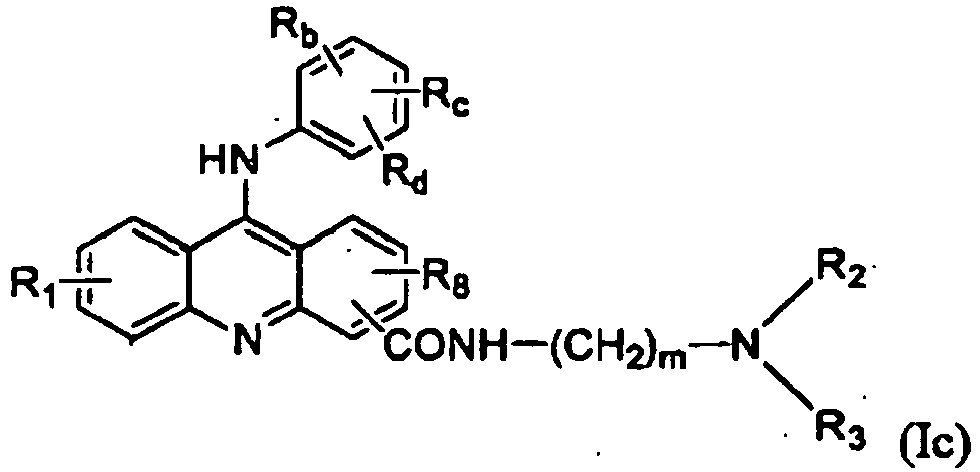
R1, R2, R3 and m have the same meaning as above, and
R8 is as defined above,
at least one of the substituents chosen from Rb, Rc and Rd represents a (C1-C4)alkoxy group,
at least one of the substituents chosen from Rb, Rc and Rd is chosen from an NHRc group where Re represents a hydrogen, or a CORa group, a COORa group or an SO2Ra group, where Ra represents an aryl group or a (C1-C10)alkyl group optionally substituted by an oxo group, and
the remaining substituent, chosen from Rb, Rc and Rd, represents a hydrogen or halogen atom,
for use in a composition intended for the diagnosis and/or treatment of melanoma. - Another subject-matter of the present invention is more particularly a compound of formula (If)

R1, R2, R3 and m have the same meaning as above, and
R8 is as defined above,
for use in a composition intended for the diagnosis and/or treatment of melanoma. - In addition, a subject-matter of the present invention is more particularly a compound of formula (Ig)

R1, R2, R3 and m have the same meaning as above, and
R8 is as defined above,
for use in a composition intended for the diagnosis and/or treatment of melanoma. - A subject-matter of the present invention is also more particularly a compound of formula (Ih)

R1, R2, R3 and m have the same meaning as above, and
R8 is as defined above,
for use in a composition intended for the diagnosis and/or treatment of melanoma. - A subject-matter of the present invention is also more particularly a compound of formula (Ii)

R1, R2, R3 and m have the same meaning as above, and
R8 is as defined above,
for use in a composition intended for the diagnosis and/or treatment of melanoma. - In addition, a subject-matter of the present invention is more particularly a compound of formula (Io)

R1, R2, R3 and m have the same meaning as above, and
R8 is as defined above,
for use in a composition intended for the diagnosis and/or treatment of melanoma. - Another subject-matter of the present invention is more particularly a compound of formula (Ip)

R1, R2, R3 and m have the same meaning as above, and
R8 is as defined above,
for use in a composition intended for the diagnosis and/or treatment of melanoma. - Finally, according to a second aspect, a subject-matter of the present invention is novel compounds of formula (II)

R'1 represents a labelled halogen atom,
m has the same meaning as above,
R2 and R3 represent, independently of one another, a (C1-C6)alkyl group or a (C1-C6)alkenyl group, and
Ar is chosen from the pyridyl, indolyl, imidazopyridinyl, benzimidazolyl, quinolyl, quinolonyl, isoquinolyl, quinoxalinyl, naphthyridinyl and benzothienyl group. - The preferences relating to the respective positions of the R1 substituent and of the group

- In addition, a subject-matter of the present invention is more particularly, according to a third aspect, novel compounds of formula (I")

R2, R3 and m have the same meaning as above,
R8 is as defined above and
W has the same meaning as above, it being possible for the iodine atom to be labelled 123I, 124I, 125I or 131I. - A subject-matter of the present invention is more particularly novel compounds of formula (Id)

R2, R3 and m have the same meaning as above, and
R8 is as defined above, it being possible for the iodine atom to be labelled. - In addition, a subject-matter of the present invention is more particularly novel compounds of formula (Ie)

R2, R3 and m have the same meaning as above, and
R8 is as defined above. - Another subject-matter of the present invention is more particularly novel compounds of formula (Ij)

R2, R3 and m have the same meaning as above, and
R8 is as defined above, it being possible for the iodine atom to be labelled. - In addition, a subject-matter of the present invention is more particularly novel compounds of formula (Ik)
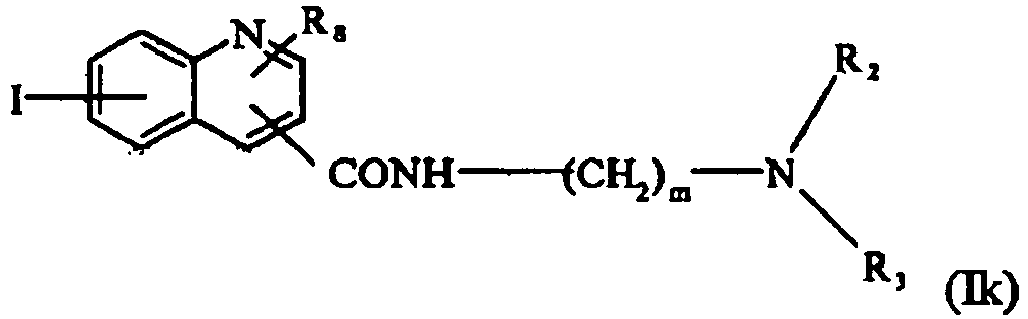
R2, R3 and m have the same meaning as above, and
R8 is as defined above, it being possible for the iodine atom to be labelled. - In addition, a subject-matter of the present invention is more particularly novel compounds of formula (Im)

R2, R3 and m have the same meaning as above, and
R8 is as defined above, it being possible for the.iodine atom to be labelled. - In addition, a subject-matter of the present invention is more particularly novel compounds of formula (In)

R2, R3 and m have the same meaning as above, and
R8 is as defined above, it being possible for the iodine atom to be labelled. - Another subject-matter of the present invention is more particularly novel compounds of formula (Iq)

R2, R3 and m have the same meaning as above, and
R8 is as defined above, it being possible for the iodine atom to be labelled. - In addition, a subject-matter of the present invention is more particularly novel compounds of formula (Ir)

R2, R3 and m have the same meaning as above, and
R8 is as defined above, it being possible for the iodine atom to be labelled. - All the substitutions, including those represented for the compounds of formulae (I), (I'), (I"), (Ia), (Ib), (Ic), (Id), (Ie), (If), (Ig), (Ib), (Ii), (Ij), (Ik), (Im), (In), (Io), (Ip), (Iq) and (Ir) by the R1 and R8 groups, the iodine atom or

- For the compounds of formulae (Ia), (Ib), (Ic), (Id) and (Ie), the substitution by the group

- For these same compounds, the R1 group or the iodine atom is preferably in the 2-, 5- or 7-position of the acridine or of the acridone.
- According to a preferred embodiment of the present invention, the compound is chosen from:
- N-(2-diethylaminoethyl)-6-iodonicotinamide dihydrochloride (7);
- N-(2-diethylaminoethyl)-5-iodoindole-2-carboxamide hydrochloride (10);
- N-(2-diethylaminoethyl)-4-iodobenzo[b]thiophene-2-carboxamide hydrochloride (13);
- N-(2-diethylaminoethyl)-3-iodoimidazo[1,2-a]pyridine-2-carboxamide dihydrochloride (16);
- N-(2-diethylaminoethyl)-6-iodoimidazo[1,2-a]pyridine-2-carboxamide dihydrochloride (21);
- N-(2-diethylaminoethyl)-5-iodobenzimidazole-2-carboxamide dihydrochloride (26);
- N-(2-diethylaminoethyl)-6-iodoquinoline-2-carboxamide dihydrochloride (31);
- N-(2-diethylaminoethyl)-1,4-dihydro-6-iodo-4-oxoquinoline-3-carboxamide hydrochloride (35);
- N-(2-diethylaminoethyl)-5-iodoisoquinoline-3-carboxamide dihydrochloride (39);
- N-(2-diethylaminoethyl)-6-iodoquinoxaline-2-carboxamide dihydrochloride (46);
- N-(4-dipropylaminobut.yl)-6-iodoquinoline-2-carboxamide dihydrochloride (49);
- N-(2-diethyllaminoethyl)-9,10-dihydro-1-iodo-9-oxacridine-4-carboxamide hydrochloride (55);
- N-(2-diethylaminoethyl)-9,10-dihydro-2-iodo-9-oxoacridine-4-carboxamide hydrochloride (60);
- N-(2-diethylaminoethyl)-9,10-dihydro-3-iodo-9-oxoacridine4-carboxamide hydrochloride (65);
- N-(2-diethylaminoethyl)-9,10-dihydro-5-iodo-9-oxoacridine-4-carboxamide hydrochloride (69);
- N-(2-diethylaminoethyl)-9, 10-dihydro-6-iodo-9-oxoacridine-4-carboxamide hydrochloride (78);
- N-(2-diethylaminoethyl)-9,10-dihydro-7-iodo-9-oxoacridine-4-carboxamide hydrochloride (84);
- N-(2-diethylaminoethyl)-9,10-dihydro-8-iodo-9-oxoacridine-4-carboxamide hydrochloride (87);
- N-(2-diethylaminoethyl)-1-iodoacridine-4-carboxamide dihydrochloride (91);
- N-(2-diethylaminoethyl)-2-iodoacridine-4-carboxamide dihydrochloride (95);
- N-(2-diethylaminoethyl)-3-iodoacridine-4-carboxamide dihydrochloride (98);
- N-(2-diethylaminoethyl)-5-iodoacridine-4-carboxamide dihydrochloride (102);
- N-(2-diethylaminoethyl)-6-iodoacridine-4-carboxamide dihydrochloride (107);
- N-(2-diethylaminoethyl)-7-iodoacridine-4-carboxamide dihydrochloride (111);
- N-(2-diethylaminoethyl)-8-iodoacridine-4-carboxamide dihydrochloride (115);
- N-(2-diethylaminoethyl)-2-iodoacridine-9-carboxamide dihydrochloride (120);
- N-(2-diethylaminoethyl)-2,7-diiodoacridine-9-carboxamide dihydrochloride (122);
- N-(2-diethylaminoethyl)-2-iodo-9-(4-methanesulphonamido-2-methoxyanilino)acridine-4-carboxamide dihydrochloride (125);
- N-(2-diethylaminoethyl)-5-iodo-9-(4-methanesulphonamido-2-methoxyanilino)acridine-4-carboxamide dihydrochloride (127);
- N-(2-diethylaminoethyl)-7-iodo-9-(4-methanesulphonamido-2-methoxyanilino)acridine-4-carboxamide dihydrochloride (129);
- N-(2-diethylaminoethyl)-9-(5-iodo-4-methanesulphonamido-2-methoxyanilino)acridine-4-carboxamide dihydrochloride (137);
- N-(2-diethylaminoethyl)-8-iodo-1,6-naphthyridine-2-carboxamide dihydrochloride (142);
- N-(4-dipropylaminobutyl)-6-iodoquinoxaline-2-carboxamide dihydrochloride (144);
- N-(2-diethylaminoethyl)-7-iodophenazine-1-carboxamide dihydrochloride (151);
- and their pharmaceutically acceptable salts.
- For the group of the compounds of formulae (I), (I'), (I"), (Ia), (Ib), (Ic), (Id), (Ie), (If), (Ig), (Ih), (Ii), (Ij), (Ik), (Im), (In), (Io), (Ip), (Iq), (Ir) and (II), m is preferably equal to 2 or 4.
- The compounds of formulae (I), (I'), (I"), (Ia), (Ib), (Ic), (Id), (Ie), (If), (Ig), (Ih), (Ii), (Ij), (Ik), (Im), (In), (Io), (Ip), (Iq), (Ir) and (II) can comprise one or more asymmetric carbon atoms. They can thus exist in the form of enantiomers or of diastereoisomers. These enantiomers, diastereoisomers and their mixtures, including the racemic mixtures, form part of the invention.
- The pharmaceutically acceptable salts of the compounds of formulae (I), (I'), (I"), (Ia), (Ib), (Ic), (Id), (Ie), (If), (Ig), (Ih), (Ii), (Ij), (Ik), (Im), (In), (Io), (Ip), (Iq), (Ir) and (II) include the addition salts with pharmaceutically acceptable acids, such as inorganic acids, for example hydrochloric, hydrobromic, phosphoric or sulphuric acid, and organic acids, such as acetic, trifluoroacetic, propionic, oxalic, succinic, fumaric, malic, tartaric, citric, ascorbic, maleic, glutamic, benzoic, toluenesulphonic, methanesulphonic, stearic and lactic acid.
- The compounds of formulae (I), (I'), (I"), (Ia), (Ib), (Ic), (Id), (Ie), (If), (Ig), (Ih), (Ii), (Ij), (Ik), (Im), (In), (Io), (Ip), (Iq), (Ir) and (II) or their salts can form solvates (namely hydrates); the invention includes such solvates.
- In comparison with the compounds described in the document
EP 458 886 - When the compounds in accordance with the invention of formulae (I), (I'), (I"), (Ia), (Ib), (Ic), (Id), (Ie), (If), (Ig), (Ih), (Ii), (Ij), (Ik), (Im), (In), (Io), (Ip), (Iq), (Ir) and (II) are used for medical imaging purposes, R1 is preferably a radionuclide possessing γ or β+ emission which can be detected according to conventional radioimaging techniques, for example scintigraphic imaging by single photon emission tomography (SPET) and by positron emission tomography (PET).
- Such a radionuclide possessing γ or β+ emission advantageously exhibits an optimum energy for the measurement by means of a γ-camera or PET camera. Mention may in particular be made, as radionuclides acceptable for medical imaging, of 123I, 124I, 125I, 131I, 18F, 75Br, 76Br and 77Br.
- 123I is particularly suitable for SPET scintigraphic diagnosis and 124I for a PET scintigraphic diagnosis.
- When the compounds of the invention of formulae (I), (I'), (I"), (Ia), (Ib), (Ic), (Id), (Ie), (If), (Ig), (Ih), (Ii), (Ij), (Ik), (Im), (In), (Io), (Ip), (Iq), (Ir) and (II) are used for therapeutic purposes, R1 is preferably a radionuclide possessing α, β- or Auger electron emission. The radionuclides suitable in this context, capable of providing a cytotoxic effect, can be chosen from 131I, 125I, 211At and 210At.
- 131I is particularly suitable for an application in the treatment of melanoma in internal radiotherapy. Furthermore, 125I, due to its Auger electron emission, can be used in internal radiotherapy provided that it is internalized in the cell.
- The compounds of formulae (I), (I'), (I"), (Ia), (Ib), (Ic), (Id), (Ie), (If), (Ig), (Ih), (Ii), (Ij), (Ik), (Im), (In), (Io), (Ip), (Iq), (Ir) and (II) can be prepared by condensation of an ester of formula (III)

H2N-(CH2)m-NR2R3 (IV)
in which m, R2 and R3 have the same meaning as in the formulae (I), (I'), (I"), (Ia), (Ib), (Ic), (Id), (Ie), (If), (Ig), (Ih), (Ii), (Ij), (Ik), (Im), (In), (Io), (Ip), (Iq), (Ir) and (III). - The condensation of the amine (IV) with the ester (III) can preferably be carried out in the presence or absence of trimethylaluminium by heating at reflux of the dichloromethane, of the toluene or of any other appropriate solvent.
- This process of synthesis forms part of the invention as regards the compounds of formulae (I") and (II), according to a fourth aspect.
- The compounds of formulae (I) and (II) in which R2 or R3 is a hydrogen can preferably be prepared by condensation of the amine (IV) with the ester (III) in which R4 is a p-nitrophenyl. This reaction can preferably be carried out in tetrahydrofuran at ambient temperature.
- The compounds of formula (III) can be synthesized from the compounds (V) according to various methodologies:

- When R5 is a hydrogen atom: by direct iodination of the aromatic or heteroaromatic part preferably using N-iodosuccinimide at reflux of the acetonitrile or of any other appropriate solvent. This iodination can also be carried out in the presence of diiodine, sodium periodate and sulphuric acid. The iodination can also be obtained after formation of an organolithium compound at low temperature, followed by treatment with diiodine.
- When R5 is a halogen atom: by direct exchange in the presence of alkali metal iodide, in an acidic medium, and in the presence or absence of a catalyst, such as copper sulphate. The halogen/iodine exchange can also be obtained after passing through an organometallic compound (organolithium compound, organomagnesium compound, and the like) at low temperature, followed by treating the latter with diiodine.
- When R5 is an NH2 group: by a diazotization reaction, the amine being treated at 0°C with sodium nitrite in an acidic medium, and then, after formation of the diazonium salt, by addition of alkali metal iodide and heating. This diazotization can also be carried out in an organic medium, the amino derivative being treated with tert-butyl nitrite in the presence of diiodomethane or of diiodine.
- When R5 is an NO2 or NO group: by reduction, either by catalytic hydrogenation or by using a metal (Fe, Sn, and the like) in the presence of an acid (HCl, HBr, acetic acid, and the like). The amine thus obtained is treated according to the protocol described above.
- In the case where Ar is an acridinyl group, the compounds (IIIb) are preferably obtained by reduction of the acridone (IIIa) to give acridane (VI) in the presence of a borane/tetrahydrofuran complex or of any other complexing agent, such as tert-butylamine, diethylamine, dimethylamine, morpholine, pyridine, trimethylamine, triethylamine, triphenylphosphine, dimethyl sulphoxide or dimethyl sulphide and at reflux of the tetrahydrofuran or of any other appropriate solvent. This methodology exhibits the advantage of reducing acridone to acridane without affecting the iodine or the ester functional group, in contrast to the conventional methods using, for example, as reducing agent, lithium aluminium hydride (LiAlH4), which reduces the ester to alcohol, or the Al/Hg (or Na/Hg or Na/ROH) amalgam, which results in the substitution of the iodine by a hydrogen.
- The acridanes (VI) are subsequently oxidized to acridines (IIIb) by ferric chloride hexahydrate at 50°C or by any other appropriate oxidizing agent, according to the scheme which follows:

- This process is novel and also forms part of the invention.
- Thus, the present invention relates, according to a fifth aspect, to the process for the preparation of a compound of formula (VI)

- in which R1 is a halogen atom and R4 represents a (C1-C4)alkyl, aryl or heteroaryl group of use as synthetic intermediate in the preparation of the compounds of formula (Ia) in which W is an acridonyl group,
characterized in that it comprises a stage of reduction of the acridone of formula (IIIa)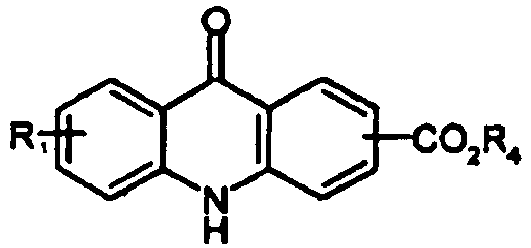
- The process can be followed by a stage of oxidation of the acridanes of formula (VI) thus obtained in order to obtain an acridine of formula (IIIb).
- The labelling of the compound of formulae (I), (I'), (I"), (Ia), (Ib), (Ic), (Id), (Ie), (If), (Ig), (Ih), (Ii), (Ij), (Ik), (Im), (In), (Io), (Ip), (Iq), (Ir) and (II) can be carried out by several techniques. For example, it can be carried out by exchange in an acidic medium between the nonradioactive iodinated molecule and a radioactive alkali metal halide. The exchange can be carried out by heating, at reflux, an aqueous solution of the compound of formulae (I), (I'), (I"), (Ia), (Ib), (Ic), (Id), (Ie), (If), (Ig), (Ih), (Ii), (Ij), (Ik), (Im), (In), (Io), (Ip), (Iq), (Ir) and (II) in a buffered medium or of the compound of formulae (I), (I'), (I"), (Ia), (Ib), (Ic), (Id), (Ie), (If), (Ig), (Ih), (Ii), (Ij), (Ik), (Im), (In), (Io), (Ip), (Iq), (Ir) and (II) in acetic acid and of the radioactive halide, in the presence or absence of copper sulphate. The labelling can also take place between a trialkylstannane precursor of the compound of formulae (I), (I'), (I"), (Ia), (Ib), (Ic), (Id), (Ie), (If), (Ig), (Ih), (Ii), (Ij), (Ik), (Im), (In), (Io), (Ip), (Iq), (Ir) and (II) and an alkali metal halide, such as Na125I or Na131I, in the presence of an oxidizing agent, such as chloramine-T, peracetic acid or aqueous hydrogen peroxide solution, and an acid, such as hydrochloric acid, acetic acid or an acidic buffer, preferably at ambient temperature and in an appropriate solvent.
- The trialkylstannane precursor compounds of the compounds of formulae (I), (I'), (I"), (Ia), (Ib), (Ic), (Id), (Ie), (If), (Ig), (Ih), (Ii), (Ij), (Ik), (Im), (In), (Io), (Ip), (Iq), (Ir) and (II) also form part of the present invention. They are defined in the same way as the compounds of the abovementioned formulae, except for the R1 group, which is an -Sn[(C1-C6)alkyl]3 group and which can in particular be an -SnBu3 group. In the continuation of the description, they are referred to as compounds of formula (VII)

- The following examples illustrate the invention.
- The melting points, uncorrected, were determined on an Electrothermal model IA 9300 capillary apparatus. The NMR spectra were recorded on an Avance DRX-200 (200 MHz for 1H and 50 MHz for 13C) and a Bruker AC 400 (400 MHz for 1H and 100 MHz for 13C). The chemical shifts δ are expressed in ppm (parts per million) and the coupling constants in Hz. The following abbreviations are used: s (singlet), bs (broad singlet), d (doublet), dd (split doublet), t (triplet), q (quartet), st (sextet), td (split triplet), m (multiplet). The infrared spectra were recorded on a Nicolet Impact 410 FTIR and Vector 22 FT spectrophotometer. The direct introduction mass spectra were recorded on a Hewlett Packard 5989A device coupled with a 5890 series 2 GC. The electrospray ionization mass spectra (ESI-MS) were obtained on an Esquire-LC, Brucker. In the case of the organotin compounds, the tin fragments are given for the 120 isotope of tin (isotopic abundance = 33%). The elemental analyses for C, H and N were carried out at the Service Central d'Analyse [Central Analytical Service] (CNRS, Vernaison, France). The thin layer chromatograms (TLC) were run on alumina plates (60 F254, type E, Merck) or on silica plates (
Kieselgel 60 F254, Merck) and visualized under a UV lamp or with sublimed iodine. The column purification of the compounds was carried out using alumina (Merck aluminium oxide 90, standardized (activity stage II-III)) or silica (SDS, 60Å C.C, 35-70 µm, Chromagel) as support. -

- A 2M solution of trimethylaluminium in toluene (7.2 ml, 14.4 mmol) is added to a solution of N,N-diethylethylenediamine (2 ml, 14.1 mmol) in anhydrous dichloromethane (110 ml) under argon at 0°C. Methyl 6-iodo-2-naphthoate (1) (Adcock, W. and Wells, P. R., Aust. J. Chem., 1965, 18, 1351-1364) (3.12 g, 10 mmol), in solution in anhydrous dichloromethane (88 ml), is rapidly added. The medium is heated at reflux for 16 hours and then the reaction is halted with water (130 ml). The reaction mixture is extracted with dichloromethane (3 x 100 ml). The organic phase is dried over magnesium sulphate and evaporated under vacuum. The crude reaction product is purified by chromatography on alumina eluted with a dichloromethane/ethanol (97/3, v/v) mixture, to result in the amide 2 (1.58 g, 3.99 mmol). Yield : 40%; Rf: 0.58 (Al2O3, dichloromethane/ethanol (97/3, v/v)); melting point: 105-107°C; 1H NMR (400 MHz, CDCl3) δ 1.05 (t, 6H, J = 7 Hz), 2.58 (q, 4H, J = 7 Hz), 2.68 (t, 2H, J = 6 Hz), 3.53 (q, 2H, J = 6 Hz), 7.40 (m, 1H), 7.54 (d, 1 H, J = 8.5 Hz), 7.68 (d, 2H, 8,5 Hz), 7.83 (d, 1H, J = 8.5 Hz), 8.18 (s, 1H), 8.23 (s, 1H); 13C NMR (100 MHz, CDCl3) δ 11.8 (2C), 37.3, 46.6 (2C), 51.1, 93.6, 124.4, 127.0, 127.3, 130.2, 131.1, 132.3, 135.0, 135.7, 136.2, 166.9; IR (KBr) v cm-1 : 1537, 1614, 1630, 3303; MS (m/z, %) 281 (M+-115.6), 126 (9), 86 (100), 58 (14).
- N-(2-diethylaminoethyl)-6-iodo-2-naphthamide (2) (1.00 g, 2.52 mmol) is dissolved in anhydrous dichloromethane (22 ml) under argon at ambient temperature. A 2N solution of hydrochloric acid in ether (22 ml) is added to the reaction medium with stirring. The latter is stirred for 10 minutes and then the solvent is evaporated. The solid obtained is taken up in anhydrous ether (50 ml). The solution is stirred under argon and at ambient temperature for 24 hours. The precipitate obtained is filtered off, to result in the hydrochloride 3 (1.03 g, 2.38 mmol). Yield : 94%; melting point: 151-152°C; 1H NMR (200 MHz, d6 -DMSO) δ 1.22 (t, 6H, J = 7 Hz), 3.19 (m, 6H), 3.68 (m, 2H), 7.83 (m, 1H), 7.97 (m, 2H), 8.46 (s, 1H), 8.53 (s, 1H), 9.13 (m, 1 H), 10.33 (m, 1H); IR (KBr) v cm-1: 1297, 1533, 1655, 3252. Anal. Calculated for C17H21IN2O-HCl-H2O: C, 45.30; H, 5.37; N, 6.22. Found: C, 45.26; H, 5.16; N, 6.40.
-

- Triethylamine (1.67 µl, 1.19 mmol), ethyl chloroformate (0.70 ml, 7.32 mmol) and 4-dimethylaminopyridine (0.45 g, 3.68 mmol) are added, at 0°C, to a solution of 6-iodonicotinic acid (4) (Newkome, G. R., Moorfield, C. N. and Sabbaghian, B., J. Org. Chem., 1986, 51, 953-954) (250 mg, 1.00 mmol) in anhydrous dichloromethane (25 ml). After returning to ambient temperature, the reaction mixture is brought to reflux for 2 hours. The solution is evaporated to dryness and then the residue is purified on a column of alumina eluted with dichloromethane, to result in the ester 5 (211 mg, 0.76 mmol) ; yield: 76%; Rf: 0.92 (Al2O3, dichloromethane); melting point: 46-48°C; 1H NMR (200 MHz, CDCl3) δ 1.32 (t, 3H, J = 3 Hz), 4.32 (q, 2H, J = 7 Hz), 7.78 (m, 2H), 8.82 (d, 1H, J = 2 Hz); 13C NMR (50 MHz, CDCl3) δ 14.2, 61.6, 123.3, 125.7, 134.7, 138.0, 151.4, 164.7; IR (KBr) v cm-1: 1268, 1292, 1577, 1711, 3082; MS (m/z, %) 277 (M+, 61), 232 (21), 204 (20), 150 (100), 127 (16), 77 (43), 51 (22).
- The compound 6 was prepared according to the procedure described for the preparation of the compound 2, using ethyl 6-iodonicotinate (5) as starting material and heating the reaction medium at reflux for 20 hours. Yield: 98%; viscous liquid: Rf: 0.60 (Al2O3, dichloromethane/ethanol (97/3, v/v)); 1H NMR (200 MHz, CDCl3) δ 0.83 (t, 6H, J = 7 Hz), 2.37 (q, 4H, J = 7 Hz), 2.47 (t, 2H, J = 6 Hz), 3.28 (q, 2H, J = 6 Hz), 7.38 (m, 1 H), 7.78 (m, 2H), 8.73 (m, 1 H); 13C NMR (50 MHz, CDCl3) δ 11.7 (2C), 37.2, 46.4 (2C), 50.8, 120.9, 129.5, 134.5, 136.1, 148.6, 164.4; IR (CCl4) v cm-1: 1538, 1630, 2927, 2965, 3301; MS (m/z, %) 348 (M++1. 1), 86 (100), 77 (8), 58 (16).
- The compound 7 was prepared according to the procedure described for the preparation of the
compound 3, using N-(2-diethylaminoethyl)-6-iodonicotinamide (6) as starting material. Yield: 70%; melting point: 127-129°C; 1H NMR (200 MHz, d6 -DMSO) δ 1.26 (t, 6H, J = 7 Hz), 3.25 (m, 6H), 3.68 (m, 4H), 8.00 (m, 2H), 8.87 (m, 1H), 9.25 (m, 1H), 10.24 (m, 1H); IR (KBr) v cm-1: 1278, 1529, 1588, 1661, 2661, 3232. Anal. Calculated for C12H18IN3O·2HCl: C, 34.31; H, 4.80; N, 10.00. Found: C, 34.43; H, 4.76; N, 10.08. -

- The compound 9 was prepared according to the procedure described for the preparation of the compound 2, using ethyl 5-iodoindole-2-carboxylate (8) (Beshore, D. C. and Dinsmore, C: J., Synth. Commun., 2003, 33, 2423-2427) as starting material and heating the reaction medium at reflux for 3 hours. Yield: 50%; melting point: 208-210°C; Rf: 0.53 (Al2O3, dichloromethane/ethanol (97/3, v/v)); 1H NMR (200 MHz, d6 -DMSO) δ 1.03 (t, 6H, J = 7 Hz), 2.57 (m, 6H), 3.37 (m, 2H), 7.11 (s, I H), 7.42 (AB spectrum, 2H, J = 8.5 Hz), 8.09 (s, 1H), 8.52 (t, 1H, J = 6 Hz), 11.82 (s, 1H); 13C NMR (50 MHz, d6 -DMSO) δ 11.9 (2C), 37.3, 46.8 (2C), 51.5, 83.3, 101.2, 114.7, 129.8, 129.9, 131.0, 132.8, 135.3, 160.6; IR (KBr) v cm-1 : 1411, 1547, 1635, 2801, 2965, 3250, 3418; MS (m/z, %) 385 (M+, 2), 86 (100), 58 (2).
- The
compound 10 was prepared according to the procedure described for the preparation of thecompound 3, using N-(2-diethylaminoethyl)-5-iodoindole-2-carboxamide (9) as starting material. Yield: 81%; melting point: 217-219°C; 1H NMR (400 MHz, CDCl3) δ 1.29 (m, 6H), 3.28 (m, 6H), 3.72 (m, 2H), 7.22 (s, 1H), 7.31 (d, 1H, J = 8.5 Hz), 7.48 (d, 1H, J = 8. MHz), 8.06 (s, 1H), 9.16 (bs, 1H), 10.59 (bs, 1H), 11.94 (s, 1H); IR (KBr) v cm-1: 1544, 1646, 2468, 2569, 3228. Anal. Calculated for C15H20IN3O·HCl ; C, 42.72; H, 5.02; N, 9.96. Found: C, 43.47; H, 5.20; N, 10.12. -

- The compound 12 was prepared according to the procedure described for the preparation of the compound 2, using methyl 4-iodobenzo[b]thiophene-2-carboxylate (11) (Bridges, A. J., Lee, A., Maduakor, E. C. and Schwartz, C. E., Tetrahedron Lett., 1992, 33, 7499-7502) as starting material and heating the reaction medium at reflux for 24 hours. Yield: 72%; Rf: 0.58 (Al2O3, dichloromethane/ethanol (97/3, v/v)); melting point: 76-78°C; 1H NMR (400 MHz, CDCl3) δ 1.09 (t, 6H, J = 7 Hz), 2.60 (q, 4H, J = 7 Hz), 2.68 (t, 2H, J = 7 Hz), 3.50 (q, 2H, J = 7 Hz), 7.08 (bs, 1H), 7.1 (t, 1H, J = 8 Hz), 7.80 (m, 3H); 13C NMR (100 MHz, CDCl3) δ 12.2 (2C), 37.5, 46.9 (2C), 51.1, 91.4, 122.7, 127.2, 128.4, 134.9, 139.5, 140.0, 142.2, 161.7; IR (KBr) v cm-1: 1560, 1625, 2963, 3287; MS (m/z, %) 402 (M+, 1), 86 (100).
- The compound 13 was prepared according to the procedure described for the preparation of the
compound 3, using N-(2-diethylaminoethyl)-4-iodobenzo[b]thiophene-2-carboxamide (12) as starting material. Yield: 72%; melting point: 163-165°C; 1H NMR (200 MHz, d6 -DMSO) δ 1.28 (t, 6H, J = 7 Hz), 3.25 (m, 6H), 3.70 (m, 2H), 7.26 (t, 1H, J = 8 Hz), 7.92 (d, 1H, J = 8 Hz), 8.00 (d, 1H, J = 8 Hz), 8.22 (s, 1H), 9.42 (m, 1H), 10.29 (m, 1H); IR (KBr) v cm-1: 1535, 1648, 3249. Anal. Calculated for C15H19IN2OS·HCl: C, 41.06; H, 4.59; N, 6.39. Found: C, 41.14; H, 4.79; N, 6.21. -

- The
compound 15 was prepared according to the procedure described for the preparation of the compound 2, using ethyl 3-iodoimidazo[1,2-a]pyridine-2-carboxylate (14) (Enguchard, C., Renou, J. L., Collot, V., Hervet, M., Rault, S. and Gueiffier, A., J. Org. Chem., 2000, 65, 6572-6575) as starting material and heating the reaction medium at reflux for 5 hours. Yield: 70%; viscous liquid; Rf: 0.41 (Al2O3, dichloromethane/ethanol (98/2, v/v)); 1H NMR (200 MHz, CDCl3) δ 0.99 (t, 6H, J = 7 Hz), 2.54 (q, 4H, J = 7 Hz), 2.63 (t, 2H, J = 6.5 Hz), 3.48 (q, 2H, J = 6.5 Hz), 6.89 (t, 1H, J = 7 Hz), 7.24 (m, 1H), 7.48 (d, 1H, J = 9 Hz), 7.77 (m, 1H), 8.19 (d, 1H, J = 7 Hz); 13C NMR (50 MHz, CDCl3) δ 12.2 (2C), 37.2, 47.2 (2C), 51.9, 64.1, 113.7, 117.9, 126.4, 126.6, 139.1, 146.7, 161.5; IR (CCL4) v cm-1: 1217, 1250, 1546, 1662, 2924, 3450; MS (m/z, %): 387 (M+ + 1, 1), 271 (10), 259 (12), 243 (5), 116 (6), 99 (6), 86 (100), 58 (13). - The
compound 16 was prepared according to the procedure described for the preparation of thecompound 3, using N-(2-diethylaminoethyl)-3-iodoimidazo[1,2-a]pyridine-2-carboxamide (15) as starting material. Yield: 60%; melting point: 128-130°C; 1H NMR (200 MHz, d6-DMSO) δ 1.31 (t, 6H, J= 7 Hz), 3.25 (m, 6H), 3.72 (m, 2H), 7.25 (t, 1H, J = 7 Hz), 7.59 (m, 1H), 7.72 (d, 1H, J = 9 Hz), 8.56 (d, 1H, J = 7 Hz), 8.92 (bs, 1H), 10.49 (bs, 1H); IR (KBr) v cm-1: 1535, 1669, 2660, 2974, 3265, 3422. Anal. Calculated for C14H19IN4O·2HCl: C, 36.62; H, 4.61; N, 12.20. Found: C, 36.40; H, 4.92; N, 11.97.
- Bis(tributyltin) (1.30 ml, 2.57 mmol), triphenylphosphine (36 mg, 0.14 mmol), sodium carbonate (149 mg, 1.41 mmol) and palladium diacetate (20 mg, 0.09 mmol) are added, under argon, to a solution of iodinated compound 15 (546 mg, 1.41 mmol) in anhydrous dimethylformamide (8 ml). The solution is heated at 100°C for 4 hours and then at 135°C for 24 hours (the solution becomes black). After returning to ambient temperature, the solution is filtered through Celite® 521 and the filter residue is washed with dimethylformamide (8 ml). The filtrate is evaporated under vacuum. The residue obtained is chromatographed on a column of alumina eluted with a dichloromethane/ethanol (99/1, v/v) mixture, to result, in order to elution, in:
- (45 mg, 0.08 mmol); yield: 6%; viscous liquid; Rf: 0.26 (Al2O3, dichloromethane/ethanol: 99/1 (v/v)); 1H NMR (400 MHz, CDCl3) δ 0.86 (t, 9H, J = 7 Hz), 1.04 (t, 6H, J = 7 Hz), 1.37-1.17 (m, 12H), 1.53 (m, 6H), 2.62 (q, 4H, J = 7 Hz), 2.69 (t, 2H, J = 6 Hz), 3.51 (q, 2H, J = 6 Hz), 6.74 (t, 1H, J = 7 Hz), 7.17 (m, 1H), 7.56 (d, 1H, J = 9 Hz), 7.63 (bs, 1H), 8.20 (d, 1H, J = 7 Hz); 13C NMR (100 MHz, CDCl3) δ 11.8 (2C), 11.9 (3C, 1 J Sn-C= 365 Hz), 13.7 (3C), 27.3 (3C, 3 J Sn-C= 65 Hz), 29.1 (3C, 2 J Sn-C= 21 Hz), 37.0, 46.9 (2C), 51.9, 112.4, 118.1, 125.2, 127.7, 128.3, 148.1, 148.3, 164.1; MS (m/z, %): 493 (M+-57.9), 100 (41), 86 (100), 58 (20).
- (193 mg, 0.74 mmol); yield: 52%; viscous liquid; Rf: 0.16 (Al2O3, dichloromethane/ethanol (99/1, (v/v)); 1H NMR (400 MHz, CDCl3) δ 1.09 (t, 6H, J = 7 Hz), 2.69 (m, 6H), 3.58 (q, 4H, J = 6 Hz),), 6.87 (t, 1H, J= 7 Hz), 7.28 (m, 1H), 7.60 (d, 1H, J = 9 Hz), 7.80 (bs, 1H), 8.19 (m, 2H); 13C NMR (100 MHz, CDCl3) δ 10.6 (2C), 35.9, 45.9 (2C), 50.8, 111.8, 113.2, 117.1, 124.9, 125.5, 139.1, 143.5, 161.8; IR (CCl4) v cm-1: 1489, 1565, 1669, 2971; MS (m/z, %): 260 (M+, 2), 145 (9), 99 (21), 86 (100), 58 (18).
-

- The
compound 20 was prepared according to the procedure described for the preparation of the compound 2, using ethyl 6-iodoimidazo[1,2-a]pyridine-2-carboxylate (19) (Sunberg, R. J., Biswas, S., Murthi, K. K., Rowe, D., McDall, J. W. and Dzimianski, M. T., J. Med. Chem., 1998, 41, 4317-4328) as starting material and heating the reaction medium at reflux for 72 hours. Yield: 83%; viscous liquid; Rf: 0.55 (Al2O3, dichloromethane/ethanol (97/3, v/v)); 1H NMR (200 MHz, CDCl3) δ 1.03 (t, 6H, J = 7 Hz), 2.57 (q, 4H, J = 7 Hz), 2.66 (t, 2H, J = 6.5 Hz), 3.51 (q, 2H, J = 6.5 Hz), 7.34 (m, 2H), 7.68 (m, 1H), 8.06 (s, 1H), 8.39 (t, 1H, J = 1.5 Hz); 13C NMR (50 MHz, CDCl3) δ 12.2 (2C), 37.3, 47.2 (2C), 51.9, 76.5, 113.4, 118.9, 130.9, 133.5, 140.2, 142.6, 161.8; IR (CCl4) v cm-1: 1218, 1251, 1562, 1670, 2971, 3430; MS (m/z, %): 99 (M+ - 287, 11), 86 (100), 58 (11). - The
compound 21 was prepared according to the procedure described for the preparation of thecompound 3, using N-(2-diethylaminoethyl)-6-iodoimidazo[1,2-a]pyridine-2-carboxamide (20) as starting material. Yield: 80%; melting point: 208-210°C; 1H NMR (200 MHz, d6 -DMSO) δ 1.21 (t, 6H, J = 7 Hz), 3.17 (m, 6H), 3.58 (m, 2H), 7.57 (m, 2H), 8.41 (s, 1H), 9.00 (t, 1H, J = 5 Hz), 9.09 (s, 1H), 9.95 (m, 1H); IR (KBr) v cm-1 : 1289, 1600, 1659, 2650, 3100-2900, 3426. Anal. Calculated for C14H19IN4O·2HCl·2H2O: C, 33.96; H, 5.09; N, 11.31. Found: C, 34.33; H, 5.20; N, 11.06. -
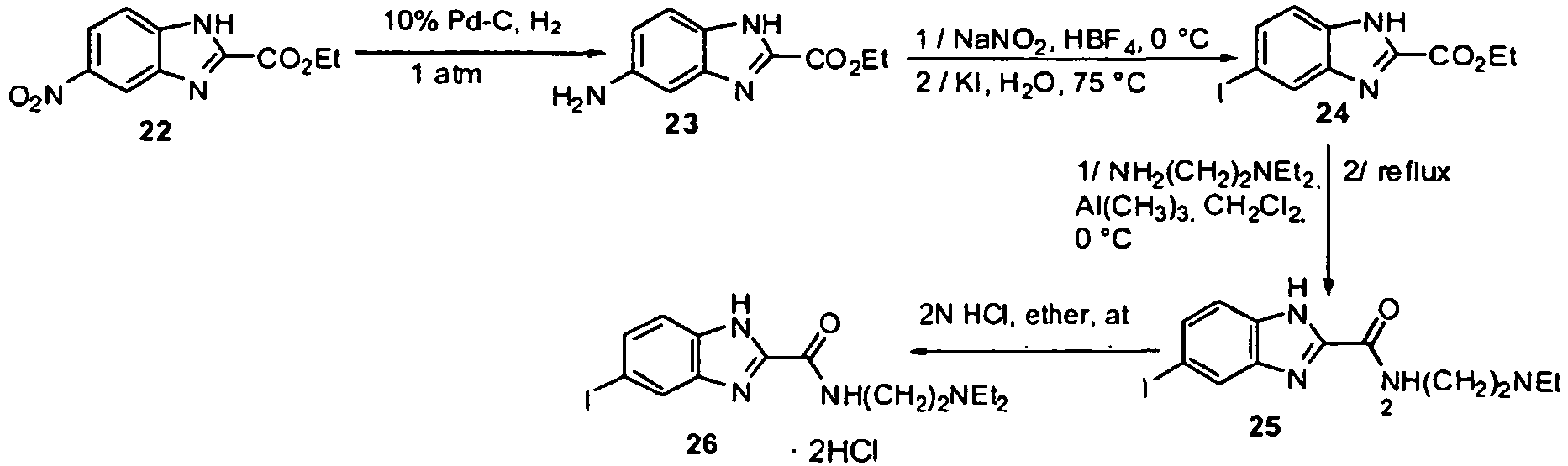
- 10% palladium-on-charcoal (760 mg) is added to a solution of ethyl 5-nitrobenzimidazole-2-carboxylate (22) (Buchel, K. H. Z., Naturforsch., B. 1970, 25, 945-953) (7.00 g, 29.7 mmol) in ethyl acetate (213 ml). The solution is hydrogenated at atmospheric pressure for 18 hours. The reaction medium is filtered through Celite® 521, the filter residue is washed with ethanol and the filtrates are then evaporated to dryness. The orange solid obtained is purified by chromatography on alumina eluted with a dichloromethane/ethanol (97/3, v/v) mixture, to result in the pale orange solid 23 (2.22 g, 10.8 mmol). Yield: 36%; Rf: 0.25 (Al2O3, dichloromethane/ethanol (97/3, v/v)); melting point: 147-149°C; 1H NMR (200 MHz, CDCl3) δ 1.41 (t, 3H, J= 7 Hz), 4.46 (q, 2H, J= 7 Hz), 6.76 (m, 2H), 7.58 (d, 1H, J = 9 Hz); IR (KBr) v cm-1: 1269, 1701, 3370; MS (m/z, %) 205 (M+, 53), 159 (100), 133 (52), 131 (44), 105 (35), 83 (22), 78 (20), 52 (21).
- A solution of sodium nitrite (750 mg, 11.0 mmol) in water (3 ml) is added dropwise to a solution of the amine 23 (2.20 g, 10.7 mmol) in 50% tetrafluoroboric acid (40 ml, 32.1 mmol) at 0°C. The solution is stirred at 0°C for 1 hour and then filtered, to result in a white precipitate corresponding to the diazonium salt (3.26 g, 10.7 mmol). The latter is dissolved in water (67 ml) and then a solution of potassium iodide (2.79 g, 16.8 mmol) in water (14 ml) is added. The mixture is heated to 70°C. When evolution of gas has ceased (2 hours) and after returning to ambient temperature, the medium is basified using a saturated aqueous sodium carbonate solution (pH = 8-9). The solution is extracted with dichloromethane (2 x 80 ml) and the combined organic extracts are washed with a 5% aqueous sodium hydrogensulphite solution (2 × 40 ml), dried over magnesium sulphate, filtered and evaporated to give a brown powder. The product is purified by chromatography on alumina eluted with a dichloromethane/ethanol (99/1, v/v) mixture, to result in the yellow precipitate 24 (407 mg, 1.29 mmol). Yield: 12%; Rf: 0.57 (Al2O3, dichloromethane/ethanol (99/1 v/v)); melting point: 166-168°C; 1H NMR (200 MHz, d6 -DMSO) δ 1.40 (t, 3H, J = 7 Hz), 4.50 (q, 2H, J = 7 Hz), 7.5 (d, 1H, J = 9 Hz), 7.66 (dd, 1H, J = 9, 2 Hz), 8.09 (d, 1H, J = 2 Hz); IR (KBr) v cm-1: 1246, 1310, 1515, 1697, 3287; MS (m/z, %) 316 (M+, 56), 270 (30), 244 (100), 117 (38), 90 (25), 63 (19).
- The
compound 25 was prepared according to the procedure described for the preparation of the compound 2, using ethyl 5-iodobenzimidazole-2-carboxylate (24) as starting material and heating the reaction medium at reflux for 6 hours. Yield 82%; Rf: 0.38 (Al2O3, dichloromethane/ethanol (97/3, v/v)); melting point: 136-138°C; 1H NMR (200 MHz, CDCl3) δ 1.04 (t, 6H, J = 7 Hz), 2.64 (q, 4H, J= 7 Hz), 2.76 (m, 2H), 3.62 (m, 2H), 7.36 (d, 1H, J = 8.5 Hz), 7.52 (d, 1H, J = 8.5), 7.96 (bs, 1H), 8.28 (m, 1H); IR v cm-1: 1420, 1551, 1664, 2966, 3175; MS (m/z, %) 386 (M+, 1), 86 (100), 58 (11). - The
compound 26 was prepared according to the procedure described for the preparation of thecompound 3, using N-(2-diethylaminoethyl)-5-iodobenzimidazole-2-carboxamide (25) as starting material. Yield: 82%; melting point: 217-219°C; 1H NMR (200 MHz, d6-DMSO) δ 1.27 (t, 6H, J = 7 Hz), 3.22 (m, 6H), 3.74 (m, 2H), 7.52 (d, 1H, J = 8.5 Hz), 7.64 (dd, 1H, J = 8.5, 1 Hz), 8.03 (d, 1H, J = 1 Hz), 9.36 (m, 1H), 10.45 (m, 1H); IR (KBr) v cm-1: 1593, 1683, 2979. Anal. Calculated for C14H19IN4O·2HCl·H2O: C, 35.24; H, 4.86; N, 11.74. Found: C, 35.38; H, 4.77; N, 11.79. -

- 6-Iodo-2-methylquinoline (27) (Petrow, V. and Sturgeon, B., J. Chem. Soc., 1954, 570-574) (7.12 g, 26.5 mmol) and sodium acetate (12.1 g) are dissolved in acetic acid (15 ml). The mixture is heated under argon at 75°C for 10 minutes. A solution of dibromine (4.45 ml, 86.6 mmol) in acetic acid (13 ml) is added dropwise. On completion of the addition, the reaction medium is heated at reflux for 2 hours and then cooled to ambient temperature. The contents of the round-bottomed flask are poured onto crushed ice (200 g) and stirred at ambient temperature for 18 hours. The precipitate formed is filtered off, washed with water (60 ml) and placed in a dessicator for 4 hours, to result in the orange solid 28 (9.10 g, 18.0 mmol). Yield: 68%; Rf: 0.86 (Al2O3 cyclohexane/ethyl acetate (8/2, v/v)); melting point: 124-126°C; 1H NMR (400 MHz, CDCl3) δ 7.92 (d, 1H, J = 8.5 Hz), 8.03 (d, 1H, J = 8.5 Hz), 8.14 (d, 1H, J = 9 Hz), 8.26 (m, 2H); 13C NMR (100 MHz, CDCl3) δ 40.8, 94.5, 118.6, 129.1, 131.7, 135.9, 136.4, 139.3, 144.0, 159.0; IR (KBr) v cm-1: 1293, 1480, 1584; MS (m/z, %) 509 (M++6, 1), 507 (M++4, 2), 505 (M++2, 3), 503 (M+, 1), 428 (40), 426 (77), 424 (45), 348 (81), 346 (81), 255 (100), 140 (97), 127 (90), 82 (90), 57 (89).
- A solution of siliver nitrate (9.05 g, 53.8 mmol) in water (83 ml) is added dropwise to a solution of the iodinated compound 28 (9.10 g, 18.0 mmol) in ethanol (132 ml). The mixture is heated at reflux for 30 minutes. The solution is cooled to ambient temperature, filtered and acidified with an aqueous hydrochloric acid solution (1.5M, 5 ml). The filtrate is evaporated by half, basified with a saturated aqueous sodium carbonate solution (100 ml) and extracted with ether, and the ether extract is dried over magnesium sulphate and evaporated. The product is purified by chromatography on alumina eluted with an ethyl acetate/cyclohexane (8/2, v/v) mixture, to result in a dark yellow solid 29 (3.96 g, 12.1 mmol). Yield: 67%; Rf: 0.97 (Al2O3, ethyl acetate/cyclohexane (8/2, v/v)); melting point: 119-121°C; 1H NMR (200 MHz, d6-DMSO) δ 1.42 (t, 3H, J = 7 Hz), 4.46 (q, 2H, J = 7 Hz), 7.97 (d, 1H, J = 9 Hz), 8.16 (m, 2H), 8.55 (d, 1H, J = 9 Hz), 8.64 (s, 1H); 13C NMR (100 MHz, CDCl3) δ 14.4, 62.4, 95.0, 121.8, 130.7, 132.2, 135.6, 136.4, 139.1, 146.4, 148.7, 165.0; IR (KBr) v cm-1: 1307, 1714; MS (m/z, %) 327 (M+, 17), 283 (19), 255 (100), 127 (28), 100 (11).
- The
compound 30 was prepared according to the procedure described for the preparation of the compound 2, using ethyl 6-iodoquinoline-2-carboxylate (29) as starting material and heating the reaction medium at reflux for 6 hours. Yield: 69%; Rf: 0.56 (Al2O3, dichloromethane/ethanol (97/3, v/v)); melting point: 75-77°C; 1H NMR (400 MHz, CDCl3) δ 1.09 (t, 6H, J = 7 Hz), 2.63 (q, 4H, J = 7 Hz), 2.73 (t, 2H, J = 7 Hz), 3.58 (q, 2H, J = 7 Hz), 7.81 (d, 1H, J = 9 Hz), 7.98 (dd, 1H, J = 9 and 2 Hz), 8.16 (d, 1H, J = 8.5 Hz), 8.26 (d, 1H, J = 2 Hz), 8.30 (d, 1H, J = 8.5 Hz), 8.57 (bs, 1H); 13C NMR (100 MHz, CDCl3) δ 12.1 (2C), 37.5, 47.2 (2C), 51.7, 93.7, 119.6, 130.7, 131.8, 136.1, 136.5, 139.4, 145.4, 150.5, 164.1; IR (KBr) v cm-1: 1526, 1663, 2963, 3400; MS (m/z, %) 386 (M+, 1), 86 (100), 58 (11). - The
compound 31 was prepared according to the procedure described for the preparation of thecompound 3, using N-(2-diethylaminoethyl)-6-iodoquinoline-2-carboxamide (30) as starting material. Yield: 69%; melting point: 104-106°C; 1H NMR (200 MHz, d6-DMSO) δ 1.28 (t, 6H, J = 7 Hz), 3.24 (m, 6H), 3.77 (q, 2H, J = 7 Hz), 7.92 (d, 1H, J = 9 Hz), 8.21 (m, 2H), 8.57 (d, 1H, J = 9 Hz), 8.65 (s, 1H), 9.34 (m, 1H), 10.08 (m, 1H); IR v cm-1: 1384, 1523, 1684, 3415. Anal. Calculated for C16H20IN3O·2HCl·2.5H2O: C, 37.30; H, 5.28; N, 8.16. Found: C, 37.35; H, 5.15; N, 8.23.
- Bis(tributyltin) (443 µl, 1.18 mmol) and a spatula tip of tetrakis(triphenylphosphine)palladium are added, under argon, to a solution of the iodinated compound 30 (332 mg, 0.87 mmol) in anhydrous toluene (15 ml) degassed beforehand under argon. The solution is heated at reflux for 8 hours. After returning to ambient temperature, the solution is filtered through Celite® 521 and the filtrate is evaporated under vacuum. The residue obtained is chromatographed on a column of alumina eluted with an ethyl acetate/cyclohexane (6/4, v/v) mixture, to result in the tributylstannane 32 (282 mg, 0.50 mmol); yield: 58%; viscous liquid; Rf: 0.86 (ethyl acetate/cyclohexane (6/4, v/v)); 1H NMR (400 MHz, CDCl3) δ 0.90 (t, 9H, J = 7 Hz), 1.14 (m, 12H), 1.36 (m, 6H), 1.57 (m, 6H), 2.69 (q, 4H, J = 7 Hz), 2.80 (t, 2H, J = 6 Hz), 3.63 (q, 2H, J = 6 Hz), 7.84 (d, 1H, J = 8.5 Hz), 7.96 (s, 1H), 8.04 (d, I H, J = 8.5 Hz), 8.29 (AB spectrum, 2H, J = 8.5 Hz), 8.67 (m, 1H); 13C NMR (100 MHz, CDCl3 ) δ 10.0 (3C, 1 J Sn-C= 333 Hz), 11.8 (2C), 13.7 (3C), 27.4 (3C, 3 J Sn-C= 56 Hz), 29.2 (3C, 2 J Sn-C 20 Hz), 37.4, 47.4 (2C), 51.8, 118.7, 128.2, 128.9, 136.1, 136.9, 137.3, 143.4, 146.5, 149.6, 164.8; IR (CCl4) v cm-1: 1519, 1680, 2926, 2960; ESI-MS m/z 562.2 [M+H]+.
-

- The compound 34 was prepared according to the procedure described for the prpearation of the compound 2, using
ethyl 1,4-dihydro-6-iodo-4-oxoquinoline-3-carboxylate (33) (Lin, A. J. and Loo, T. L., J. Med. Chem., 1978, 21, 268-272) as starting material and heating the reaction medium at reflux for 5 hours. Yield: 81%; Rf: 0.04 (Al2O3, dichloromethane/ethanol (97/3, v/v)); melting point: 234-236°C; 1H NMR (400 MHz, d6 -DMSO) δ 1.13 (t, 6H, J = 7 Hz), 2.85 (m, 6H), 3.69 (q, 2H, J = 6 Hz), 7.33 (d, 1H, J = 8.5 Hz), 7.87 (d, 1H, J = 8.5 Hz), 8.49 (s, 1H), 8.67 (s, 1H), 10.32 (bs, I H); 13C NMR (100 MHz, d6 -DMSO) δ 11.4 (2C), 36.4, 46.6 (2C), 51.4, 89.6, 111.3, 121.5, 127.9, 133.8, 138.7, 140.5, 144.0, 164.2, 174.4; IR (KBr) v cm-1: 1507, 1551, 1633, 2965, 3061; MS (m/z, %) 413 (M+, 1), 86 (100), 58 (10). - The
compound 35 was prepared according to the procedure described for the preparation of thecompound 3, using N-(2-diethylaminoethyl)-1,4-dihydro-6-iodo-4-oxoquinoline-3-carboxamide (34) as starting material. Yield: 92%; melting point: 164-166°C; 1H NMR (200 MHz, d6 -DMSO) δ 1.27 (t, 6H, J = 7 Hz), 3.24 (m, 6H), 3.73 (m, 2H), 7.62 (d, 1H, J = 9 Hz), 8.11 (dd, 1H, J = 9 and 1.5 Hz), 8.51 (d, 1H, J = 1.5 Hz), 8.80 - (d, 1H, J = 6.5 Hz), 10.07 (m, 2H); IR (KBr) v cm-1: 1521, 1618, 1654, 3028, 3514. Anal. Calculated for C16H20IN3O2·2HCl·1.5H2O: C, 37.45; H, 4.91; N, 8.19. Found: C, 37.42; H, 5.08; N, 8.12.
-

- Concentrated hydrochloric acid (576 µl) is added to a suspension of methyl 5-aminoisoquinoline-3-carboxylate (36) (
Lee, C. H., Bayburt, E. K., DiDomenico, S., Drizin, I., Gomtsyan, A. R., Koenig, J. R., Pemer, R. J., Schmidt, R. G., Turner, S. C., White, T. K. and Zheng, G. Z., US Patent 656417 ,2003 ) (500 mg, 2.47 mmol) in water (4 ml). The solution is cooled to 0°C and then a solution of sodium nitrite (166 mg, 2.47 mmol) in water (3 ml) is rapidly added. After stirring at 0°C for 30 minutes, 50% tetrafluoroboric acid (311 µl, 2.47 mmol) is added. Stirring is continued for 30 minutes. The precipitate formed is filtered off. The diazonium salt obtained is dissolved in water (12 ml) and then a solution of potassium iodide (453 mg, 3.10 mmol) in water (5 ml) is rapidly added. The reaction medium is heated to 80°C. When the evolution of gas has ceased (2 hours) and after returning to ambient temperature, the reaction mixture is extracted with dichloromethane (3 × 30 ml) and the organic extract is washed with a 5% aqueous sodium hydrogensulphite solution (40 ml), dried over magnesium sulphate, filtered and evaporated. The product is purified by chromatography on alumina eluted with a dichloromethanol/ethanol (99/1, v/v) mixture, to result in an orange precipitate 37 (190 mg, 0.61 mmol). Yield: 25%; Rf: 0.64 (Al2O3, dichloromethane/ethanol (99/1, v/v)); melting point: 165-167°C; 1H NMR (400 MHz, d6 -DMSO) δ 4.00 (s, 3H), 7.65 (t, 1H, J = 8 Hz), 8.32 (d, 1H, J = 8 Hz), 8.50 (d, 1H, J = 8 Hz), 8.55 (s, 1H), 9.37(s, 1H); 13C NMR (100 MHz, d6 -DMSO) δ 52.6, 99.6, 126.1, 128.5, 130.5, 131.3, 136.4, 142.2, 142.8, 153.8, 165.2; IR (KBr) v cm-1: 1249, 1304, 1710; MS (m/z, %) 313 (M4, 313), 283 (20), 255 (100), 127 (41), 100 (18), 74 (11). - The compound 38 was prepared according to the procedure described for the preparation of the compound 2, using methyl 5-iodoisoquinoline-3-carboxylate (37) as starting material and heating the reaction medium at reflux for 4 hours. Yield: 72%; Rf: 0.47 (Al2O3, dichloromethane/ethanol (97/3, v/v)); viscous liquid; 1H NMR (400 MHz, CDCl3) δ 1.08 (t, 6H, J = 7 Hz), 2.64 (q, 4H, J = 7 Hz), 2.74 (t, 2H, J = 7 Hz), 3.62 (q, 2H, J = 7 Hz), 7.40 (t, 1H, J = 8 Hz), 8.00 (d, 1H, J = 8 Hz), 8.31 (d, 1H, J = 8 Hz), 8.57 (m, 1H), 8.76 (s, 1H), 9.05 (s, 1H); 13C NMR (100 MHz, CDCl3) δ 11.9 (2C), 37.5, 47.3 (2C), 51.8, 99.4, 123.8, 128.3, 129.7, 130.6, 138.1, 142.0, 145.8, 152.0, 164.5; IR (KBr) v cm-1: 1516, 1677, 2971; MS (m/z, %) 397 (M+, 1), 86 (100), 58 (7).
- The compound 39 was prepared according to the procedure described for the preparation of the
compound 3, using N-(2-diethylaminoethyl)-5-iodoisoquinoline-2-carboxamide (38) as starting material. Yield: 72%; melting point: 152-154°C; 1H NMR (200 MHz, d6 -DMSO) δ 1.22 (t, 6H, J = 7 Hz), 3.25 (m, 6H), 3.74 (m, 2H), 7.63 (t, 1H, J = 8 Hz), 8.33 (d, 1H, J = 8 Hz), 8.49 (d, 1H, J = 8 Hz), 8.56 (s, 1H), 9.38 (m, 2H), 9.76 (m, 1H); IR (KBr) v cm-1: 1526, 1684, 3447, 3927. Anal. Calculated for C16H20IN3O·2HCl: C, 40.87; H, 4.72; N, 8.94. Found: C, 40.91; H, 4.75; N, 8.84. -

- Selenium dioxide (16.0 g, 0.14 mol) is added to a solution of 2-methyl-6-nitroquinoxaline (40) (
Higashida, S., Sakurai, M., Yabe, Y., Nishihgaki, T., Komai, T. and Handa, H. ; ) (15.14 g, 80.1 mmol) in toluene (240 ml). The solution is heated at reflux for 2 hours. After returning to ambient temperature, the precipitate obtained is filtered off and washed with toluene (40 ml) and dichloromethane (50 ml). The precipitate (aldehyde) obtained is dissolved in acetone (400 ml) and a 5% aqueous sodium permanganate solution (540 ml) is added fractionwise. The solution is stirred at ambient temperature for 3 hours and then filtered. The filtrate is reduced to half under vacuum and the solution is extracted with ether. The aqueous phase is acidified (pH = 1) with concentrated hydrochloric acid. The precipitate thus obtained is filtered off and placed in a dessicator for 4 days, to result in the acid 41 (5.26 g, 24.0 mmol). Yield: 30%; melting point: 212-214°C; 1H NMR (200 MHz, d6 -DMSO) δ 8.51 (d, 1H, J = 9 Hz), 8.67 (dd, 1H, J = 2.5, 9 Hz), 9.01 (d, 1H, J = 2.5 Hz), 9.62 (s, 1H); 13C NMR (100 MHz, (d6 -DMSO) δ 124.3, 124.9, 132.1, 141.6, 143.2, 146.3, 147.3, 148.8, 164.6; IR (KBr) v cm-1: 1147, 1347, 1526, 1706, 3200-3500; MS (m/z, %) 219 (M+, 37), 175 (100), 129 (37), 102 (39), 75 (37).Patent EP 0 587 311, 1994 - Concentrated sulphuric acid (750 µl) is added to a solution of the acid 41 (5.00 g, 22.8 mmol) in anhydrous ethanol (50 ml) under argon. The solution is heated at reflux for 7 hours. After returning to ambient temperature, the solution is evaporated under vacuum, a saturated aqueous sodium bicarbonate solution (50 ml) is added and then the mixture is extracted with dichloromethane. The organic phase is dried over magnesium sulphate and evaporated under vacuum, to produce the ester 42 (3.79 g, 15.3 mmol). Yield: 67%; melting point: 221-223°C; 1H NMR (200 MHz, CDCl3) δ 1.58 (t, 3H, J = 7 Hz), 4.68 (q, 2H, J = 7 Hz), 8.53 (d, 1H, J = 9 Hz), 8.68 (dd, 1H, J = 2.5, 9 Hz), 9.14 (d, 1H, J = 2.5 Hz), 9.72 (s, 1H); IR (KBr) v cm-1: 1282, 1347, 1531, 1741; MS (m/z, %) 248 (M++1, 4), 203 (36), 175 (100), 128 (23), 101 (32), 75 (24).
- 10% palladium-on-charcoal (300 mg) is added to a solution of the nitrated ester 42 (2.93 g, 11.9 mmol) in ethanol (500 ml). The solution is hydrogenated at atmospheric pressure for 3
hours 45. The reaction medium is filtered through Celite® 545, the filter residue is washed with ethanol and then the filtrates are evaporated to dryness. The orange solid obtained is purified by chromatography on alumina eluted with a dichloromethane/ethanol (99/1, v/v) mixture, to result in the amine 43 (1.69 g, 7.79 mmol). Yield: 66%; Rf: 0.55 (Al2O3, dichloromethane/ethanol (99/1, v/v)); melting point: 181-183°C; 1H NMR (200 MHz, CDCl3) δ 1.49 (t, 3H, J = 7 Hz), 4.38 (m, 2H), 4.56 (q, 2H, J = 7 Hz), 7.16 (d, 1H, J = 2.5 Hz), 7.26 (dd, 1H, J = 2.5, 9 Hz), 8.05 (d, 1H, J = 9 Hz), 9.35 (s, 1H); 13C NMR (100 MHz, CDCl3) δ 14.4, 62.1, 106.9, 123.1, 131.9, 136.6, 138.4, 145.6, 145.9, 150.4, 164.7; IR (KBr) v cm-1: 1299, 1487, 1613, 1701, 3202, 3431; MS (m/z, %) 217 (M+, 23), 145 (100), 117 (19), 90 (16), 63 (14). - A solution of sodium nitrite (480 mg, 6.96 mmol) in water (3 ml) is added dropwise at 0°C to a solution of the amine 43 (1.37 g, 6.31 mmol) in 50% tetrafluoroboric acid (10 ml). The mixture is stirred at 0°C for one hour and then a solution of potassium iodide (1.57 g, 9.46 mmol) in water (5 ml) is added. The solution is stirred at 0°C for one hour and then at 50°C for one hour. After returning to ambient temperature, the reaction mixture is basified with a saturated aqueous sodium bicarbonate solution (60 ml). The solution is extracted with dichloromethane. The organic phase is washed with a 5% aqueous sodium hydrogensulphite solution (2 × 30 ml). The organic phase is dried over magnesium sulphate and evaporated under vacuum. The residue is deposited on a column of alumina eluted with dichloromethane, to result in the iodinated ester 44 (0.68 g, 2.07 mmol). Yield: 33%; Rf: 0.80 (Al2O3, dichloromethane); melting point: 160-162°C; 1H NMR (400 MHz, CDCl3) δ 1.51 (t, 3H, J= 7 Hz), 4.59 (q, 2H, J = 7 Hz), 7.99 (d, 1H, J = 9 Hz), 8.10 (dd, 1H, J = 2 and 9 Hz), 8.62 (d, 1H, J = 2 Hz), 9.51 (s, 1H); 13C NM R (100 MHz, CDCl3) δ 14.3, 62.7, 99.2, 131.6, 138.5, 140.0, 140.7, 143.0, 144.1, 145.7, 163.9; IR (KBr) v cm-1: 1103, 1151, 1230, 1237, 1717; MS (m/z, %) 328 (M+, 19), 284 (43), 256 (100), 128 (29), 101 (50), 75 (30).
- The
compound 45 was prepared according to the procedure described in the preparation of the compound 2, using ethyl 6-iodoquinoxaline-2-carboxylate (44) as starting material and heating the reaction medium at reflux for 7 hours. Yield: 77%; melting point: 60-62°C; Rf: 0.64 (Al2O3, dichloromethane/ethanol (97/3, v/v)); 1H NMR (400 MHz, CDCl3) δ 1.00 (t, 6H, J = 7 Hz), 2.54 (q, 4H, J = 7 Hz), 2.64 (t, 2H, J = 6 Hz), 3.49 (q, 2H, J = 6 Hz), 7.71 (d, 1H, J = 9Hz), 7.96 (dd, 1H, J = 2 and 9 Hz), 8.31 (m, 1H), 8.49 (d, 1H, J = 2 Hz), 9.55 (s, 1H); 13C NMR (100 MHz, CDCl3) δ 12.1 (2C), 37.4, 47.1 (2C), 51.5, 97.9, 130.8, 138.5, 139.5, 139.6, 144.1, 144.3, 144.6, 162.9; IR (KBr) v cm-1: 1517, 1661, 3397; MS (m/z, %) 398 (M+, 1), 86 (100), 58 (15). - The
compound 46 was prepared according to the procedure described for the preparation of thecompound 3, using N-(2-diethylaminoethyl)-6-iodoquinoxaline-2-carboxamide (45) as starting material. Yield: 76%; melting point: 201-203°C; 1H NMR (200 MHz, d6 -DMSO) δ 1.28 (t, 6H, J = 7 Hz), 3.28 (m, 6H), 3.78 (m, 2H), 7.97 (d, 1H, J = 9 Hz), 8.30 (d, 1H, J = 9 Hz), 8.68 (s, 1H), 9.47 (m, 2H), 10.43 (bs, 1H); IR (KBr) v cm-1: 1516, 1674, 2459, 3326. Anal. Calculated for C15H19IN4O·2HCl: C, 38.24; H, 4.49; N, 11.89. Found: C, 38.25; H, 4.45; N, 11.81.
- The compound 47 was prepared according to the procedure described for the preparation of the compound 32, using N-(2-diethylaminoethyl)-6-iodoisoquinoxaline-2-carboxamide (45) as starting material. The residue obtained is chromatographed on a column of alumina eluted with an ethyl acetate/cyclohexane (7/3, v/v) mixture; yield: 47%; viscous liquid; Rf: 0.84 (Al2O3, ethyl acetate/cyclohexane (7/3, v/v)); 1H NMR (200 MHz, CDCl3) δ 0.82 (t, 9H, J = 7 Hz), 1.07 (t, 6H, J= 7 Hz), 1.19 (m, 6H), 1.30 (m, 6H), 1.51 (m, 6H), 2.58 (q, 4H, J = 7 Hz), 2.68 (t, 2H, J = 6 Hz), 3.54 (q, 2H, J = 6 Hz) 7.85 (d, 1 H, J = 8 Hz), 7.98 (d, 1 H, J = 8 Hz), 8.24 (s, 1 H), 8.41 (t, 1 H, J = 6 Hz), 9.59 (s, 1 H); 13C NMR (100 MHz, CDCl3) δ 9.9 (3C, 1 J Sn-C= 348 Hz), 11.8 (2C), 13.6 (3C), 27.3 (3C, 3 J Sn-C= 56 Hz), 29.0 (3C, 2 J Sn-C= 21 Hz), 37.2, 47.3 (2C), 51.6, 128.2, 137.7, 137.9, 140.3, 142.9, 143.4, 143.6, 149.0, 163.6; IR (CCl4) v cm-1: 1521, 1684, 2929, 2961; ESI-MS m/z 563.3 [M+H]+.
-

- The compound 48 was prepared according to the procedure described for the preparation of the compound 2, using ethyl 6-iodoquinoline-2-carboxylate (29) and 4-amino-N,N-dipropylbutylamine (Seguin, H., Gardette, D., Moreau , M. F., Madelmont, J. C. and Gramain, J. C., Synth. Commun., 1998, 28, 4257-4272) as starting materials. The reaction medium is heated at reflux for 8 hours (360 mg, 0.82 mmol). Yield: 39%; viscous liquid; Rf: 0.68 (Al2O3, dichloromethane / ethanol (97/3, v/v)); 1H NMR (CDCl3, 400 MHz) δ 0.80 (t, 6H, J = 7 Hz), 1.44 (st, 4H, J = 7 Hz), 1.60 (m, 4H), 2.39 (t, 4H, J = 7 Hz), 2.50 (t, 2H, J = 7 Hz), 3.47 (q, 2H, J = 6.5 Hz), 7.74 (d, 1 H, J = 9 Hz), 7.90 (dd, 1 H, J = 9.2 Hz), 8.10 (d, 1 H, J = 8 Hz), 8.19 (d, I H, J = 2 Hz), 8.22 (d, 1 H, J = 8 Hz); 13C NMR (CDCl3, 100 MHz) δ 11.9 (2C), 19.5 (2C), 24.1, 27.6, 39.4, 53.5, 55.8 (2C), 93.9, 119.6, 130.7, 131.2, 136.2, 136.5, 138.8, 145.4, 150.3, 164.1; IR (KBr) ∨ cm-1: 1532, 1668, 2956; MS (m/z, %) 453 (M+, 5), 424 (33), 353 (20), 254 (34), 127 (23), 114 (100).
- The
compound 49 was prepared according to the procedure described for the preparation of thecompound 3, using N-(4-dipropylaminobutyl)-6-iodoquinoline-2-carboxamide (48) as starting material. Yield: 97%; melting point: 133-135 °C; 1H NMR (400 MHz, d6 -DMSO) δ 0.87 (t, 6H, J = 7 Hz), 1.66 (m, 8H), 2.94 (m, 4H), 3.05 (m, 2H), 3.38 (m, 2H), 7.89 (d, 1H, J = 9 Hz), 8.12 (d, 1H, J = 9 Hz), 8.16 (d, 1H, J= 8.5 Hz), 8.51 (d, 1H, J = 8.5 Hz), 8.58 (s, 1H), 9.05 (m, 1H), 10.55 (bs, 1H); IR (KBr) v cm-1: 1534, 1663, 2962, 3250-3600. Anal. Calculated for C20H28IN3O·2HCl: C, 45.64; H, 5.75; N, 7.98. Found: C, 46.51; H, 5.99; N, 8.16. -

- Diphenyliodonium-2-carboxylate (50) (Fieser, L. F.; Haddadin, M. J. Org. Synth. 1966, 46, 107-112) (0.88 g, 2.72 mmol) and then copper acetate monohydrate (12 mg) are added, at ambient temperature and with moderate stirring, to a solution of methyl 4-iodoanthranilate (51) (
Allison, B. D., Hack, M. D., Phuong, V. K., Rabinowitz, M. H. and Rosen, M. D., U.S. Patent 2005/0038032, 2005 ) (0.50 g, 1.80 mmol) in dimethylformamide (30 ml). The green mixture obtained is heated at 90-100°C, with stirring, for 12 hours. The solvent is subsequently evaporated under vacuum. Ethyl acetate (18 ml) and then a 0.1N hydrochloric acid solution (18 ml) are successively added to the crude product. The organic phase is then separated by settling and then extracted with a 0.1N aqueous ammonia solution (2 x 9 ml). The aqueous phase recovered is acidified to pH = 6 with a 0.1N hydrochloric acid solution. The mixture is then cooled in an ice bath and then filtered under vacuum. The precipitate obtained is washed with hot water (5 ml). Yield: 80%; melting point: 206-208°C; 1H NMR (400 MHz, d6 -DMSO) δ 3.83 (s, 3H), 7.04 (t, 1H, J = 7.5 Hz), 7.30 (d, 1H, J = 8.5 Hz), 7.47 (m, 2H), 7.62 (d, 1H, J = 8.5 Hz), 7.74 (s, 1H), 7.92 (d, 1H, J = 7.5 Hz), 10.70 (s, 1H), 13.20 (m, 1H); 13C NMR (100 MHz, d6 -DMSO) δ 52.1, 101.9, 115.6, 118.2 (2C), 121.1, 125.3, 128.5, 131.8, 132.8, 133.5, 142.4, 144.4, 166.5, 168.3; IR (KBr) v cm-1: 1220, 1254, 1575, 1685, 3000-3600; MS (m/z, %) 397 (M+, 100), 321 (88), 194 (59), 166 (95), 139 (62), 63 (77), 55 (61). - A solution of 2-(5-iodo-2-(methoxycarbonyl)phenylamino)benzoic acid (52) (1.00 g, 2.52 mmol) in concentrated sulphuric acid (2 ml) is heated, under argon, in an oil bath at 80°C for 30 minutes. After returing to ambient temperature, the green solution is cooled with an ice bath and diluted with water (15 ml). The green precipitate obtained is then filtered off under vacuum, washed with water (4 ml), taken up in anhydrous ethanol and then dried by evaporation under vacuum. The product is purified by chromatography on silica eluted with a dichloromethane / ethanol (99.5/0.5, v/v) mixture, to result in the yellow precipitate 53 (92 mg, 0.24 mmol). Yield: 85%; Rf: 0.65 (SiO2, dichloromethane/ethanol (99.5/0.5, v/v)); melting point: 189-191°C; 1H NMR (200 MHz, CDCl3) δ 4.01 (s, 3H), 7.29 (m, 2H), 7.67 (t, 1H, J = 8.5 Hz), 7.91 (m, 2H), 8.42 (d, 1H, J = 8.5 Hz), 12.07 (bs, 1H); 13C NMR (100 MHz, CDCl3) δ 52.8, 102.4, 113.4, 117.3, 119.8, 121.4, 122.9, 127.5, 134.1, 135.1, 135.3, 138.7, 142.4, 168.6, 176.2; IR (KBr) v cm-1: 1273, 1508, 1613, 1640, 1685, 3217; MS (m/z, %) 379 (M+, 71), 347 (81), 192 (24), 164 (100), 127 (24), 88 (24), 76 (24), 63 (24).
- The compound 54 was prepared according to the procedure described for the preparation of the compound 2, using methyl 9,10-dihydro-1-iodo-9-oxoacridine-4-carboxylate (53) as starting material and heating the reaction medium at reflux for 5 hours. Yield: 64%; Rf: 0.40 (Al2O3, dichloromethane / ethanol (99/1, v/v)); melting point: 248-250°C; 1H NMR (400 MHz, CDCl3) δ 1.04 (t, 6H, J = 6.5 Hz), 2.60 (q, 4H, J= 6.5 Hz), 2.70 (m, 2H), 3.48 (m, 2H), 7.19 (t, 1H, J = 7 Hz), 7.25 (d, 1H, J = 8.5 Hz), 7.36 (d, 1H, J = 8 Hz), 7.57 (m, 2H), 7.81 (d, 1H, J = 8 Hz), 8.34 (d, 1H, J = 8 Hz), 12.75 (s, 1H); 13C NMR (100 MHz, CDCl3) δ 11.7 (2C), 37.1, 46.9 (2C), 51.2, 99.0, 117.5 (2C), 119.9, 121.3, 122.5, 127.4, 130.9, 134.0, 134.8, 139.1, 142.1, 168.4, 176.5; IR (KBr) v cm-1: 1513, 1615, 3281; MS (m/z, %) 463 (M+, 1), 86 (100), 58 (16).
- The compound 55 was prepared according to the procedure described for the preparation of the
compound 3, using N-(2-diethylaminoethyl)-9,10-dihydro-1-iodo-9-oxoacridine-4-carboxamide (54) as starting material. Yield: 81%; melting point: 269-271°C; 1H NMR (400 MHz, d6 -DMSO) δ 1.26 (t, 6H, J = 7 Hz), 3.22 (m, 4H), 3.33 (m, 2H, J = 7 Hz), 3.75 (m, 2H), 7.33 (t, 1H, J = 7 Hz), 7.62 (d, 1H, J = 8 Hz), 7.76 (d, 1H, J = 7 Hz), 7.96 (m, 2H), 8.20 (d, 1H, J = 8 Hz), 9.49 (bs, 1H), 10.39 (bs, 1H), 12.70 (bs, 1H); 13C NMR (100 MHz, d5 -DMSO-) δ 8.3 (2C), 34.3, 46.5 (2C), 49.6, 99.0, 117.7, 118.0, 118.8, 120.4, 122.3, 126.3, 133.0, 134.1, 134.3, 138.6, 141.3, 168.2, 175.2; IR (KBr) v cm-1: 1513, 1577, 1613, 3057, 3100-3500. Anal. Calculated for C20H22IN3O2·HCl·3H2O : C, 43.38; H, 5.28; N, 7.59. Found : C, 43.74; H, 4.99; N, 7.68. -

- The compound 57 was prepared according to the procedure described for the preparation of the compound 52, using methyl 5-iodoanthranilate (56) (Sy, W. W., Synth. Commun., 1992, 22, 3215-3219) as starting material. Yield: 59%; Rf: 0.86 (Al2O3, dichloromethane / ethanol (9/1, v/v)); melting point: 230-232°C; 1H NMR (400 MHz, d6 -DMSO) δ 3.86 (s, 3H), 7.00 (m, 1H), 7.33 (d, 1H, J = 9 Hz), 7.46 (m, 2H), 7.74 (d, 1H, J = 9 Hz), 7.93 (d, 1H, J = 8 Hz), 8.14 (s, 1H), 10.78 (s, 1H), 13.21 (m, 1H); 13C NMR (100 MHz, d6 -DMSO) δ 52.2, 81.5, 117.8, 118.0, 118.7, 119.9, 120.7, 131.7, 133.4, 139.2, 141.8, 142.7, 143.1, 165.5, 168.4; IR (KBr) v cm-1: 1209, 1269, 1508, 1577, 1683, 1719, 2800-3200; MS (m/z, %) 397 (M+, 100), 320 (67), 194 (54), 166 (77), 139 (59), 63 (72).
- The compound 58 was prepared according to the procedure described for the preparation of the compound 53, using 2-(4-iodo-2-(methoxycarbonyl)phenylamino)-benzoic acid (52) as starting material. The residue obtained is chromatographed on a column of silica eluted with a dichloromethane/ethanol (99.5/0.5, v/v) mixture, to result, in order of elution, in:
- Yield: 85%; Rf: 0.41 (SiO2, dichloromethane / ethanol (99.5/0.5, v/v)); melting point: 275-277°C; 1H NMR (200 MHz, CDCl3) δ 4.03 (s, 3H), 7.32 (t, 1H, J = 8.5 Hz), 7.38 (d, I H, J = 8.5 Hz), 7.70 (t, 1H, J = 8.5 Hz), 8.42 (d, 1H, J = 8.5 Hz), 8.65 (d, 1H, J = 2 Hz), 8.99 (d, 1H, J = 2 Hz), 11.65 (bs, 1H); 13C NMR (100 MHz, CDCl3) δ 52.9, 81.9, 115.6, 117.8, 121.7, 122.8, 124.2, 127.3, 134.4, 139.9, 140.9, 142.4, 144.5, 167.3, 176.5; IR (KBr) ν cm-1: 1282, 1430, 1508, 1694, 3262; MS (m/z, %) 379 (M+, 100), 347 (52), 164 (30).
- Methyl 9,10-dihydro-9-oxoacridine-4-carboxylate (Rewcasttle, G. W. and Denny, W. A., Synthesis, 1985, 220-222).
- Yield: 8%; Rf: 0.21 (SiO2, dichloromethane / ethanol (99.5/0.5, v/v)); melting point: 170-172°C (lit.: 172°C).
- The compound 59 was prepared according to the procedure described for the preparation of the compound 2, using methyl 9,10-dihydro-2-iodo-9-oxoacridine-4-carboxylate (58) as starting material and heating the reaction medium at reflux for 1.5 hours in anhydrous toluene. Yield: 88%; Rf: 0.43 (Al2O3, dichloromethane / ethanol (99/l, v/v)); melting point: 250-252°C; 1H NMR (200 MHz, CDCl3) δ 1.08 (t, 6H, J = 7 Hz), 2.67 (q, 4H, J = 7 Hz), 2.75 (t, 2H, J = 6 Hz), 3.56 (m, 2H), 7.21 (t, 1H, J = 8 Hz), 7.30 (d, 1H, J = 8 Hz), 7.61 (t, 1H, J = 8 Hz), 7.65 (bs, 1H), 8.08 (d, 1H, J = 2 Hz), 8.32 (d, 1H, J = 8 Hz), 8.75 (d, 1H, J = 2 Hz), 12.15 (bs, 1H); 13C NMR (100 MHz, CDCl3) δ 11.8 (2C), 37.4, 46.9 (2C), 51.2, 82.0, 117.9, 120.0, 121.2, 122.3, 124.0, 126.8, 134.0, 139.7, 139.8, 140.0 (2C), 166.9, 176.5; IR (KBr) ν cm-1 : 1512, 1617, 3422; MS (m/z, %) 463 (M+, 6), 348 (18), 320 (14), 193 (11), 164 (11), 86 (100), 58 (23).
- The
compound 60 was prepared according to the procedure described for the preparation of thecompound 3 using N-(2-diethylaminoethyl)-9,10-dihydro-2-iodo-9-oxoacridine-4-carboxamide (59) as starting material. Yield: 71%; melting point: 298-300°C; 1H NMR (400 MHz, d6 -DMSO) δ 1.27 (m, 6H), 3.23 (m, 4H), 3.33 (m, 2H), 3.75 (m, 2H), 7.33 (t, 1H, J = 7 Hz), 7.75 (m, 2H), 8.23 (d, 1H, J = 8 Hz), 8.60 (s, 1H), 8.68 (s, 1H), 9.42 (bs, 1H), 10.27 (bs, 1H), 12.19 (bs, 1H); 13C NMR (100 MHz, d6 -DMSO) δ 8.3 (2C), 34.2, 46.4 (2C), 49.5, 83.2, 118.6, 120.5 (2C), 122.3, 123.3, 125.9, 134.3, 138.2, 139.3, 139.8, 140.7, 166.8, 175.3; IR (KBr) v cm-1: 1300, 1517, 1560, 1617, 3200-3400. Anal. Calculated for C20H22IN3O2·HCI-1.75H2O : C, 45.21; H, 5.03; N, 7.91. Found : C, 44.91; H, 4.66; N, 8.07. -

- The compound 62 was prepared according to the procedure described for the preparation of the compound 52, using methyl 6-iodoanthranilate (61) (Seltzman, H. H. and Berrang, B. D., Tetrahedron Lett., 1993, 34, 3083-3086) as starting material. Yield: 67%; melting point: 191-193°C; 1H NMR (200 MHz, d6 -DMSO) δ 3.85 (s, 3H), 6.85 (t, 1H, J = 8 Hz), 7.18 (m, 2H), 7.40 (t, 1H, J= 8 Hz), 7.50 (d, 1H, J= 8 Hz), 7.59 (d, 1H, J= 8 Hz), 7.90 (d, 1H, J = 8 Hz), 9.93 (bs, 1H); 13C NMR (100 MHz, d6 -DMSO) δ 52.6, 93.6, 113.6, 1 14.4, 118.7, 121.1, 131.8, 131.9, 133.0, 133.4, 134.2, 139.0, 145.8, 167.6, 169.9; IR (KBr) ν cm-1: 1247, 1269, 1444, 1575, 1657, 1740, 2700-3200, 3318; MS (m/z, %) 397 (M, 73), 321 (100), 194 (36), 166 (41), 139 (18).
- The compound 63 was prepared according to the procedure described for the preparation of the compound 53, using 2-(3-iodo-2-(methoxycarbonyl)phenylamino)benzoic acid (62) as starting material. Yield: 65%; Rf: 0.41 (SiO2, dichloromethane / ethanol (99.5/0.5, v/v)); melting point: 202-204°C; 1H NMR (200 MHz, CDCl3) δ 4.07 (s, 3H), 7.31 (m, 2H), 7.70 (t, 1H, J = 7 Hz), 7.88 (d, 1H, J = 8.5 Hz), 8.23 (d, 1H, J = 8.5 Hz), 8.41 (d, 1H, J = 8 Hz), 10.56 (bs, 1H); 13C NMR (100 MHz, d6 -DMSO) δ 53.3, 102.0, 118.1, 120.4, 120.5, 122.2, 125.8, 127.8, 128.9, 131.1, 134.1, 137.4, 140.7, 167.0, 176.1; IR (KBr) ν cm-1: 1281, 1431, 1583, 1617, 3000-3600; MS (m/z, %) 379 (M+, 60), 347 (100), 164 (54), 139 (25), 63 (29).
- The compound 64 was prepared according to the procedure described for the preparation of the compound 2, using methyl 9,10-dihydro-3-iodo-9-oxoacridine-4-carboxylate (63) as starting material and heating the reaction medium at reflux for 6 hours. Yield: 38%; Rf: 0.40 (Al2O3, dichloromethane / ethanol (99/1, v/v)); melting point: 215-217°C; 1H NMR (200 MHz, CDCl3) δ 1.49 (t, 6H, J = 7 Hz), 3.37 (m, 4H), 3.52 (m, 2H), 4.08 (m, 2H), 7.00 (d, 1H, J = 8 Hz), 7.19 (t, 1H, J = 8 Hz), 7.59 (m, 3H), 8.21 (d, 1H, J = 8 Hz), 8.77 (bs, 1H), 10.09 (s, 1H); 13C NMR (100 MHz, d6 -DMSO) δ 10.8 (2C), 39.5, 46,8 (2C), 50.3, 102.3, 118.2, 120.3, 120.4, 121.9, 125.7, 127.6, 130.9, 132.0, 133.9, 137.2, 140.9, 166.5, 176.3; IR (KBr) ν cm-1: 1556, 1614, 2960-3230; MS (m/z, %) 463 (M+, 1), 86 (100), 58 (12).
- The compound 65 was prepared according to the procedure described for the preparation of the
compound 3, using N-(2-diethylaminoethyl)-9,10-dihydro-3-iodo-9-oxoacridine-4-carboxamide (64) as starting material. Yield: 87%; melting point: 262-264°C; 1H NMR (400 MHz, d6 -DMSO) δ 1.27 (t, 6H, J = 7 Hz), 3.23 (m, 4H), 3.32 (m, 2H), 3.76 (m, 2H), 7.32 (t, 1H, J = 8 Hz), 7.75 (m, 2H), 7.95 (d, 1H, J = 8.5 Hz), 7.99 (d, 1H, J = 8.5 Hz), 8.21 (d, 1H, J = 8 Hz), 9.05 (m, 1H), 10.17 (bs, 1H), 10.79 (bs, 1H); 13C NMR (100 MHz, d6 -DMSO) δ 8.4 (2C), 34.5, 46.6 (2C), 49.3, 102.6, 118.3, 120.4 (2C), 121.9, 125.7, 127.8, 130.9, 131.6, 133.8, 137.2, 141.0, 166.9, 176.3; IR (KBr) v cm-1: 1427, 1590, 1618, 3200-3400. Anal. Calculated for C20H22IN3O2·HCl-H2O: C, 46.39; H, 4.87; N, 8.12. Found : C, 46.59; H, 4.89; N, 8.06. -

- Dimethylformamide (3 drops) is added to a solution of 9,10-dihydro-5-iodo-9-oxoacridine-4-carboxylic acid (66) (Rewcastle, G. W. and Denny, W. A., Synthesis, 1985, 2, 217-220) (1.00 g, 2.74 mmol) in thionyl chloride (30 ml). The reaction medium is heated at reflux for 15 minutes and then the thionyl chloride is driven off by evaporation under vacuum. The acid chloride is taken up in anhydrous toluene (20 ml) in order to be once again evaporated to dryness. The precipitate is dissolved in anhydrous methanol (30 ml) and then calcium carbonate is added (1.20 g). The mixture is subsequently brought to reflux for 3 hours. After returning to ambient temperature, the calcium carbonate is filtered off. The precipitate is taken up in a 1N hydrochloric acid solution (25 ml) and filtered. The aqueous phase is extracted with dichloromethane (3 x 50 ml) and then all the organic phases arc combined, dried over magnesium sulphate, filtered and evaporated to dryness. The residue obtained is chromatographed on a column of alumina eluted with dichloromethane, to result in the ester 67 (0.59 g, 1.56 mmol). Yield: 57%; Rf: 0.78 (Al7O3, dichloromethane); melting point: 174-176°C; 1H NMR (400 MHz, CDCl3) δ 4.07 (s, 3H), 7.06 (t, 1H, J =7.5 Hz), 7.30 (t, 1H, J = 8Hz), 8.17 (d, 1H, J = 7.5 Hz), 8.46 (m, 2H), 8.69 (d, 1H, J = 8 Hz), 12. 11 (s, 1H); 13 C NMR (100 MHz, CDCl3) δ 52.9, 86.2, 114.3, 120.8, 121.9, 122.5, 123.6, 127.7, 133.8, 137.0, 140.7, 141.5, 144.0, 168.0, 177.6; IR (KBr) v cm-1: 1141, 1279, 1430, 1518, 1608, 3197; MS (m/z, %) 379 (M+, 80), 347 (100), 164 (99), 75 (71), 63 (40).
- The compound 68 was prepared according to the procedure described for the preparation of the compound 2, using methyl 9,10-dihydro-5-iodo-9-oxoacridine-4-carboxylate (67) as starting material and heating the reaction medium at reflux for 2 hours in anhydrous toluene. Yield: 73%; Rf: 0.23 (Al2O3, dichloromethane / ethanol (99/1, v/v)); melting point: 148-150°C; 1H NMR (400 MHz, CDCl3) δ 1.05 (t, 6H, J = 7 Hz), 2.61 (q, 4H, J = 7 Hz), 2.72 (m, 2H), 3.56 (m, 2H), 6.95 (t, 1H, J = 8 Hz), 7.21 (t, 1H, J = 8 Hz), 7.58 (bs, 1H), 7.92 (d, 1H, J = 8 Hz), 8.08 (d, 1H, J = 8 Hz), 8.36 (d, 1H, J = 8 Hz), 8.53 (d, 1H, J = 8 Hz), 12.80 (s, 1H); 13C NMR (100 MHz, CDCl3) δ 11.8 (2C), 37.3, 46.9 (2C), 51.2, 86.3, 118.1, 120.6, 122.2, 122.3, 123.2, 127.6, 131.8, 132.0, 141.1, 141.2, 143.9, 167.9, 177.8; IR (KBr) v cm-1: 1521, 1610, 3200-3500; MS (m/z, %) 463 (M+, 1), 86 (100), 58 (7).
- The compound 69 was prepared according to the procedure described for the preparation of the
compound 3, using N-(2-diethylaminoethyl)-9,10-dihydro-5-iodo-9-oxoacridine-4-carboxamide (68) as starting material. Yield: 82%; melting point: 251-253°C; 1H NMR (400 MHz, d6 -DMSO) δ 1.27 (t, 6H, J = 7 Hz), 3.24 (m, 4H), 3.36 (m, 2H), 3.79 (m, 2H), 7.12 (t, 1H, J = 8 Hz), 7.43 (t, 1H, J = 7.5 Hz), 8.26 (d, 1H, J = 8 Hz), 8.32 (d, 1H, J = 7 Hz), 8.46 (d, 1H, J = 8 Hz), 8.55 (d, 1H, J = 7 Hz), 9.55 (bs, I H), 10.34 (bs, 1H), 12.97 (bs, 1H); 13C NMR (100 MHz, d6 -DMSO) δ 8.3 (2C), 34.2, 46.5 (2C), 49.8, 87.5, 117.4, 120.7, 121.1, 121.3, 123.5, 126.5, 130.8, 133.8, 140.5 (2C), 144.0, 168.1, 176.3; IR (KBr) ν cm-1: 1301, 1428, 1522, 1611, 2650, 2946, 3200-3400. Anal. Calculated for C20H22IN3O2·HCl·H2O : C, 46.39; H, 4.87; N, 8.12. Found : C, 46.03; H, 4.80; N, 8.06. -

- 3-iodoaniline (70) (6.74 g, 30.8 mmol) and copper chloride (2.03 g, 20.5 mmol) are added, under argon, to a solution of 2-iodoisophthalic acid (71) (Rewcastle G. W. and Denny, W. A., Synthesis, 1985, 217-220) (6.00 g, 20.6 mmol) in a mixture of anhydrous butane-2,3-diol (25 ml) and anhydrous benzene (45 ml). The reaction mixture is immersed in an oil bath heated beforehand to 120°C. When the internal temperature reaches approximately 100°C, the anhydrous N-ethylmorpholine (5.88 ml, 45.9 mmol) is added and then the reaction mixture is stirred at 120°C (external) for 4 hours. After returning to ambient temperature, the solution is treated with a 0.5N aqueous ammonia solution (100 ml) and then with active charcoal (6 g). The mixture is subsequently filtered through Celite® 521 and the filtered residue is washed several times with water (2 x 50 ml). The filtrates are acidified with 2N hydrochloric acid (80 ml) and then the aqueous phase is extracted with ethyl acetate (3 x 100 ml). The organic phase is filtered through Celite® 521 in order to remove an inorganic precipitate and is then extracted with a 0.5N aqueous ammonia solution (2 x 100 ml). The aqueous phase is acidified with concentrated hydrochloric acid and then concentrated to 2/3 under vacuum. The precipitate formed is filtered off and then washed with hot water. The precipitate is subsequently taken up in anhydrous ethanol (50 ml) to be dried under vacuum, to result in the acid 72 (2.12 g, 5.34 mmol). Yield: 26%; melting point: 214-216°C; 1H NMR (400 MHz, d6 -DMSO) δ 6.89 (d, 1H, J = 8 Hz), 6.98 (t, 1H, J = 8 Hz), 7.08 (t, 1H, J = 8 Hz), 7.21 (d, 1H, J = 8 Hz), 7.25 (s, 1H), 7.95 (d, 2H, J = 8 Hz), 9.54 (bs, 1H), 13.10 (m, 2H); 13 C NMR (100 MHz, d6 -DMSO) δ 95.1, 116.4, 120.2, 122.0 (2C), 125.2, 129.6, 130.9, 135.0 (2C), 142.8, 145.5, 168.4 (2C); IR (KBr) v cm-1: 1249, 1432, 1584, 1665, 1693, 2800-3200; MS (m/z, %) 383 (M+, 100), 321 (38), 194 (48), 166 (53), 139 (21).
- 2-(3-iodophenylamino)isophthalic acid (72) (0.89 g, 23.2 mmol) is dissolved in polyphosphoric acid (PPA) (26 g) at 120°C (internal). The mixture is stirred at 120°C (internal) for 2 hours and then poured into boiling water (86 ml). The precipitate formed is filtered off and then dissolved in a 1/1 (v/v) mixture of methanol and a 1N aqueous sodium hydroxide solution (140 ml). The solution is heated to 60°C (internal) and then filtered while hot. The filtrate is acidified (pH = 5) with glacial acetic acid (10 ml), concentrated to 2/3 under vacuum and cooled on an ice bath until precipitation occurs. The yellow precipitate formed is filtered off and then taken up in ethanol (20 ml) to be dried under vacuum, to result in a mixture (1/1, dislayed by 1H NMR) of the acids 73 and 74 (0.71 g, 1.95 mmol).
- 60% sodium hydride in mineral oil (10.4 mg, 0.26 mmol) is added to a mixture of 9,10-dihydro-6-iodo-9-oxoacridine-4-carboxylic acid (73) and 9,10-dihydro-8-iodo-9-oxoacridine-4-carboxylic acid (74) (95.0 mg, 0.26 mmol) in anhydrous dimethylformamide (5 ml), stirred beforehand for 10 minutes, at ambient temperature under argon. The mixture is then stirred at ambient temperature for 30 minutes. Methyl iodide (16.2 µl, 0.26 mmol) is subsequently added to the solution, which is stirred at ambient temperature for 18 hours. The red solution obtained is then evaporated under vacuum. The mixture is subsequently diluted with water (10 ml), basified with a saturated aqueous sodium carbonate solution (10 ml) and extracted with ethyl acetate (3 x 20 ml). The organic phases obtained are combined, dried over magnesium sulphate, filtered and evaporated under vacuum. The residue is subsequently separated by chromatography on a column of silica eluted with dichloromethane, to result, in order of elution, in the following products :
- (50 mg, 0.13 mmol); yield: 51%; Rf: 0.58 (SiO2, dichloromethane); melting point: 239-241°C; 1H NMR (400 MHz, CDCl3 δ 4.01 (s, 3H), 7.23 (m, 2H), 7.34 (d, 1H, J = 8 Hz), 7.92 (d, 1H, J = 7.5 Hz), 8.37 (d, 1H, J = 7 Hz), 8.67 (d, 1H, J = 7.5 Hz), 11.64 (bs, 1H); 13C NMR (100 MHz, CDCl3) δ 52.6, 92.5, 113.3, 118.6, 119.0, 120.5, 122.3, 133.8, 134.4, 136.6, 137.2, 140.7, 141.3, 168.4, 176.1; IR (KBr) v cm-1: 1261, 1592, 1611, 1692, 2926, 2961; MS (m/z, %) 379 (M+, 79), 347 (82), 220 (28), 192 (34), 164 (100), 75 (43), 63 (33).
- (32 mg, 0.08 mmol); yield: 32%; Rf: 0.38 (SiO2, dichloromethane); melting point: 258-260°C; 1H NMR (200 MHz, CDCl3) δ 4.03 (s, 3H), 7.30 (t, 1H, J = 8 Hz), 7.61 (d, 1H, J = 8.5 Hz), 7.85 (s, 1 H), 8.13 (d, 1H, J = 8.5 Hz), 8.46 (d, 1H, J = 7.5 Hz), 8.71 (d, 1H, J = 7.5 Hz), 11.77 (bs, 1H); 13C NMR (50 MHz, CDCl3) δ 52.7, 101.5, 120.5, 120.8, 121.3, 122.7, 126.4, 128.5, 131.6, 134.0, 136.9, 140.7, 141.7, 168.5, 174.6; IR (KBr) v cm-1: 1280, 1589, 1609, 1640, 1685, 3271; MS (m/z, %) 379 (M+, 95), 347 (100), 220 (32), 192 (29), 164 (99), 137 (26), 75 (58), 63 (42).
- The compound 77 was prepared according to the procedure described for the preparation of the compound 2, using methyl 9,10-dihydro-6-iodo-9-oxoacridine-4-carboxylate (75) as starting material and heating the reaction medium at reflux for 2 hours. Yield: 65%; Rf: 0.25 (Al2O3, dichloromethane / ethanol (99/1, v/v)); melting point: 208-210°C; 1H NMR (400 MHz, CDCl3) δ 1.25 (t, 6H, J = 7 Hz), 2.95 (m, 4H), 3.04 (m, 2H), 3.72 (m, 2H), 7.22 (t, 1H, J = 7.5 Hz), 7.47 (d, 1H, J = 8.5 Hz), 7.70 (s, 1H), 8.00 (d, 1H, J = 8.5 Hz), 8.25 (d, 1H, J = 7 Hz), 8.51 (d, 1H, J = 8 Hz), 8.67 (bs, 1H), 12.40 (s, 1H); 13C NMR (100 MHz, CDCl3) δ 9.9 (2C), 35.9, 47.9 (2C), 52.5, 101.3, 116.7, 120.5, 120.6, 122.7, 126.5, 128.3, 131.0, 132.0, 133.0, 140.7, 141.2, 168.7, 177.7; IR (KBr) v cm-1: 1301, 1449, 1522, 1560, 1580, 1610, 2966, 3343; MS (m/z, %) 463 (M+, 1), 86 (100), 58 (12).
- The compound 78 was prepared according to the procedure described for the preparation of the
compound 3, using N-(2-diethylaminoethyl)-9,10-dihydro-6-iodo-9-oxoacridine-4-carboxamide (77) as starting material. Yield: 46%; melting point: 266-268°C; 1H NMR (400 MHz, d6 -DMSO) δ 1.27 (t, 6H, J = 7 Hz), 3.23 (m, 4H), 3.34 (m, 2H), 3.76 (m, 2H), 7.37 (t, 1H, J = 7.5 Hz), 7.61 (t, 1H, J = 8.5 Hz), 7.93 (d, 1H, J = 8.5 Hz), 8.26 (s, 1H), 8.38 (d, 1H, J = 7.5 Hz), 8.42 (d, 1H, J = 8 Hz), 9.43 (m, 1H), 10.41 (bs, I H), 12.2 (bs, I H); 13C NMR (100 MHz, d6 -DMSO) δ 8.3 (2C), 34.2, 46.5 (2C), 49.7, 102.2, 118.6, 119.5, 120.4, 121.7, 126.8, 127.4, 130.2, 130.6, 133.6, 139.9, 140.6, 167.9, 176.2; IR (KBr) ν cm-1: 1309, 1450, 1523, 1577, 1611, 3066, 3250-3450. Anal. calculated for C20H22IN3O2·HCl·1.5H2O: C, 45.60; H, 4.97; N, 7.98. Found : C, 45.80; H, 4.71; N, 7.92. - Syntheses of N-(2-diethylaminoethyl)-9,10-dihydro-7-iodo-9-oxoacridine-4-carboxamide hydrochloride (84) and of N-(2-diethylaminoethyl)-9,10-dihydro-9-oxo-7-(tributylstannyl)acridine-4-carboxamide (85).

- The compound 80 was prepared according to the procedure described for the preparation of the
compound 72, using 4-iodoaniline (79) as starting material. Yield: 62%; melting point: 241-243°C; 1H NMR (200 MHz, d6 -DMSO) δ 6.75 (d, 2H, J = 9 Hz), 7.04 (t, 1H, J = 8 Hz), 7.49 (d, 2H, J = 9 Hz), 7.94 (d, 2H, J = 8 Hz), 9.60 (s, 1 H); 13C NM R (100 MHz, d6 -DMSO) δ 83.8, 119.7 (2C), 119.8, 121.4 (2C), 135.1 (2C), 137.4 (2C), 143.3, 143.9, 168.5 (2C); IR (KBr) v cm-1: 1243, 1408, 1505, 1592, 1689, 2800-3200; MS (m/z, %) 383 (M+, 100), 194 (86), 166 (35), 139 (22). - The compound 81 was prepared according to the procedure described for the preparation of the compound 73, using 2-(4-iodophenylamino)isophtalic acid (80) as starting material. Yield: 63%; melting point: 355-357°C; 1H NMR (200 MHz, d6 -DMSO) δ 7.25 (t, 1H, J = 8 Hz), 7.46 (d, 1H, J = 9 Hz), 7.86 (d, 1H, J = 9 Hz), 8.34 (m, 3H), 11.93 (bs, 1H); 13C NMR (100 MHz, d6 -DMSO) δ 85.8, 115.9, 120.4, 121.0, 121.4, 122.2, 131.9, 134.0, 136.9, 139.0, 140.9, 141.6, 169.0, 175.1; IR (KBr) v cm-1: 1148, 1446, 1518, 1609, 1693, 2800-3200; MS (m/z, %) 365 (M+, 95), 347 (100), 319 (23), 164 (33).
- The compound 82 was prepared according to the procedure described for the preparation of the compound 67, using 9,10-dihydro-7-iodo-9-oxoacridine-4-carboxylic acid (81) as starting material. Yield: 60%; Rf 0.85 (Al2O3, dichloromethane); melting point: 224-226°C; NMR 1H (200 MHz, CDCl3) δ 4.01 (s, 3H), 7.14 (d, 1H, J = 8.5 Hz), 7.25 (t, 1 H, J = 8 Hz), 7.89 (dd, 1 H, J = 8.5, 2 Hz), 8.41 (d, 1H, J = 8 Hz), 8.67 (d, I H, J = 8 Hz), 8.72 (d, 1H, J = 2 Hz), 11.76 (s, 1H); 13C NMR (100 MHz, CDCl3) δ 52.7, 85.4, 113.9, 119.6, 120.4, 122.5, 123.2, 134.0, 136.0, 136.9, 139.3, 141.6, 142.3, 168.4, 176.5; IR (KBr) ν cm-1: 1137, 1440, 1518, 1589, 1614, 1692, 3247; MS (m/z, %) 379 (M+, 91), 347 (100), 220 (29), 164 (94), 75 (44), 63 (34).
- The compound 83 was prepared according to the procedure described for the prcparation of the compound 2, using methyl 9,10-dihydro-7-iodo-9-oxoacridine-4-carboxylate (82) as starting material and heating the reaction medium at reflux for 6 hours. Yield: 69%; Rf: 0.27 (Al2O3, dichloromethane / ethanol (99/1, v/v)); melting point: 140-142°C; 1H NMR (400 MHz, CDCl3) δ 1.30 (t, 6H, J = 7 Hz), 3.01 (m, 4H), 3.10 (m, 2H), 3.76 (m, 2H), 7.07 (d, 1H, J = 9 Hz), 7.24 (t, 1H, J = 8 Hz), 7.81 (d, 1H, J = 9 Hz), 8.25 (d, 1H, J = 8 Hz), 8.53 (d, 1H, J = 8 Hz), 8.65 (m, 2H), 12.48 (s, 1H); 13C NMR (100 MHz, CDCl3) δ 10.0 (2C), 35.9, 47.6 (2C), 52.2, 84.9, 116.8, 119.7, 120.4, 122.4, 122.8, 131.9, 132.9, 135.6, 139.2, 141.0, 141.9, 168.6, 176.5; IR (KBr) v cm-1: 1300, 1516, 1613, 1647, 2800-3500; MS (m/z, %) 463 (M+, 4), 86 (100), 58 (7).
- The
compound 84 was prepared according to the procedure described for the preparation of thecompound 3, using N-(2-diethylaminoethyl)-9,10-dihydro-7-iodo-9-oxoacridine-4-carboxamide (83) as starting material. Yield: 99%; melting point: 220-222°C; 1H NMR (400 MHz, d6-DMSO) δ 1.27 (t, 6H, J = 7 Hz), 3.23 (m, 4H), 3.34 (m, 2H), 3.76 (m, 2H), 7.38 (t, 1H, J = 8 Hz), 7.63 (d, 1H, J = 9 Hz), 8.00 (d, 1H, J = 9 Hz), 8.44 (m, 2H), 8.49 (s, 1H), 9.46 (bs, 1H), 10.40 (bs, 1H), 12.38 (bs, 1H); 13C NMR (100 MHz, d6-DMSO) δ 8.3 (2C), 34.2, 46.5 (2C), 49.7, 85.7, 118.5, 120.4, 121.0, 121.6, 122.2, 130.4, 133.7, 134.1, 139.2, 140.1, 141.7, 168.0, 175.2; IR (KBr) ν cm-1: 1303, 1517, 1617, 3200-3400. Anal. Calculated for C20H22IN3O2·HCl·2H2O : C, 44.83; H, 5.08; N, 7.84. Found: C, 44.67; H, 4.43; N, 7.76.
- The compound 85 was prepared according to the procedure described for the preparation of the compound 32, using N-(2-diethylaminoethyl)-9,10-dihydro-7-iodo-9-oxoacridine-4-carboxamide (83) as starting material and heating the reaction medium at reflux for 4 hours. The residue obtained is chromatographed on a column of alumina eluted with ethyl acetate. Yield: 69%; Rf: 0.20 (Al2O3, ethyl acetate); viscous liquid; 1H NMR (200 MHz, CDCl3) δ 0.88 (t, 9H, J = 7 Hz), 1.05 (m, 12H), 1.24 (m, 6H), 1.55 (m, 6H), 2.57 (q, 4H, J = 7 Hz), 2.70 (t, 2H, J = 7 Hz), 3.52 (m, 2H), 7.19 (t, 1H, J = 8 Hz), 7.37 (d, 1H, J = 8 Hz), 7.52 (bs, 1H), 7.75 (d, 1H, J = 8 Hz), 7.90 (d, 1H, J = 8 Hz), 8.54 (s, 1H), 8.65 (d, 1H, J = 8 Hz), 12.40 (bs, 1H); 13C NMR (50 MHz, CDCl3) δ 9.9 (3C, 1 J Sn-c = 324 Hz), 12.1 (2C), 13.7 (3C), 27.4 (3C, 3 J Sn-C = 55 Hz), 29.2 (3C, 2 J Sn-C= 20 Hz), 37,3, 46.9 (2C), 51.1, 117.2, 117.8, 119.5, 121.1, 123.3, 131.3, 131.8, 134.8, 135.1, 140.4, 141.3, 141.4, 168.4, 178.2; IR (CCl4) ν cm-1: 1150, 1505, 1608, 1652, 2928, 2960; ESI-MS m/z 628.2 [M+H]+.
-

- The compound 86 was prepared according to the procedure described for the preparation of the compound 2, using methyl 9,10-dihydro-8-iodo-9-oxoacridine-4-carboxylate (76) as starting material and heating the reaction medium at reflux for 4 hours in anhydrous toluene. Yield: 63%; unstable product; Rf: 0.30 (Al2O3, dichloromethane / ethanol (99/1, v/v)); melting point: 144-146°C; 1H NMR (200 MHz, CDCl3) δ 1.15 (t, 6H, J = 7 Hz), 2.76 (q, 4H, J = 7 Hz), 2.86 (t, 2H, J = 6 Hz), 3.59 (m, 2H), 7.17 (m, 2H), 7.31 (d, 1H, J = 8 Hz), 7.80 (bs, I H), 7.85 (d, 1H, J = 7.5 Hz), 7.95 (d, 1 H, J = 7.5 Hz), 8.54 (d, 1H, J = 7 Hz), 11.30 (bs, 1H); 13C NMR (100 MHz, CDCl3) δ 11.3 (2C), 36.6, 47.0 (2C), 51.3, 92.2, 116.8, 118.5, 118.7, 120.3, 122.4, 131.8, 132.1, 133.6, 136.6, 140.1, 141.3, 168.1, 176.1; IR (KBr) v cm-1: 1298, 1514, 1606, 1645, 2800-3500; MS (m/z, %) 463 (M+, 1), 86 (100), 58 (12).
- The compound 87 was prepared according to the procedure described for the preparation of the
compound 3, using N-(2-diethylaminoethyl)-9,10-dihydro-8-iodo-9-oxoacridine-4-carboxamide (86) as starting material. Yield: 91%; melting point: 228-230°C; 1H NMR (400 MHz, d6 -DMSO) δ 1.25 (t, 6H, J = 7 Hz), 3.30 (m, 6H), 3.71 (m, 2H), 7.37 (m, 2H), 7.71 (d, 1H, J = 8 Hz), 7.90 (d, 1H, J = 7.5 Hz), 8.28 (d, 1H, J = 7.5 Hz), 8.43 (d, 1H, J = 7 Hz), 9.23 (bs, 1H), 9.44 (m, 1H), 12.26 (bs, 1H); 13C NMR (100 MHz, d6 -DMSO) δ 8.3 (2C), 34.2, 46.5 (2C), 49.7, 92.4, 117.5, 117.8, 119.3, 120.4, 121.6, 130.9, 133.4, 134.2, 136.3, 139.3, 141.2, 168.0, 175.0; IR (KBr) v cm-1 : 1295, 1458, 1517, 1560, 1607, 2925, 3200-3400. Anal. Calculated for C20H22IN3O2-HCl·0.5H2O : C, 47.21; H, 4.74; N, 8.26. Found : C, 47.70; H, 5.12; N, 8.29. -

- A 1M solution of BH3-THF (0.82 ml, 0.82 mmol) is added dropwise at reflux, under argon, to a solution of methyl 9,10-dihydro-1-iodo-9-oxoacridine-4-carboxylate (53) (0.26 g, 0.69 mmol) in anhydrous THF (10 ml). The medium is heated at reflux for 45 minutes. After returning to ambient temperature, the reaction is halted with a 3N hydrochloric acid solution (5 ml) and then the medium is basified using a saturated aqueous sodium carbonate solution (pH = 8-9). The reaction mixture is extracted with dichloromethane (3 x 100 ml). The organic phase is dried over magnesium sulphate and evaporated under vacuum. The crude reaction product is purified by chromatography on silica eluted with dichloromethane, to result in the acridane 88 (188 mg, 0.52 mmol); yield: 75%; Rf: 0.91 (SiO2, dichloromethane); melting point: 119-121°C; 1H NMR (400 MHz, CDCl3) δ 3.91 (s, 3H), 4.13 (s, 2H), 6.74 (d, 1H, J = 7.5 Hz), 6.88 (t, 1H, J = 7.5 Hz), 7.10 (m, 2H), 7.26 (d, 1H, J = 8.5 Hz), 7.41 (d, 1H, J = 8.5 Hz), 9.93 (bs, 1H); 13C NMR (100 MHz, CDCl3) δ 38.1, 52.0, 109.0, 109.8, 114.5, 119.5, 121.8, 124.3, 127.6, 128.6, 128.8, 130.1, 137.9, 143.6, 168.8; IR (KBr) v cm-1: 1252, 1269, 1431, 1498, 1585, 1690, 2948, 3304; MS (m/z, %) 365 (M+, 100), 332 (78), 206 (52), 178 (53), 151 (23).
- Methyl 1-iodoacridane-4-carboxylate (88) (140 mg, 0.38 mmol) is dissolved in a mixture of water (2 ml) and ethanol (10 ml) and then FeCl3·6H2O (0.30 g) is added. The solution is stirred at 50°C for 30 minutes and then a saturated aqueous sodium carbonate solution (20 ml) is added. The aqueous phase is subsequently extracted with dichloromethane (3 x 30 ml). The organic phase is dried over magnesium sulphate, filtered and evaporated to dryness. The product obtained 89 is very unstable and is used without purification (121 mg, 0.33 mmol); yield: 87%;1H NMR (400 MHz, CDCl3) δ 4.00 (s, 3H), 7.53 (t, 1H, J = 7 Hz), 7.66 (d, 1H, J = 7 Hz), 7.76 (t, 1H, J = 7 Hz), 7.99 (d, 1H, J = 8 Hz), 8.07 (d, 1H, J = 7 Hz), 8.21 (d, 1H, J = 8 Hz), 8.91 (s, 1H).
- The compound 90 was prepared according to the procedure described for the preparation of the compound 2, using methyl 1-iodoacridine-4-carboxylate (89) as starting material and heating the reaction medium at reflux for 4 hours. Yield: 80%; Rf: 0.40 (Al2O3, dichloromethane / ethanol (99/1, v/v)); melting point: 103-105 °C; 1H NMR (400 MHz, CDCl3) δ 1.15 (t, 6H, J = 7 Hz), 2.78 (q, 4H, J = 7 Hz), 2.88 (t, 2H, J = 7 Hz), 3.83 (m, 2H), 7.63 (t, 1H, J = 7 Hz), 7.85 (t, 1H, J = 8 Hz), 8.07 (d, 1H, J = 8.5 Hz), 8.24 (d, 1H, J = 8 Hz), 8.29 (d, 1 H, J = 8.5 Hz), 8.60 (d, 1H, J = 7.5 Hz), 9.04 (s, 1H), 11.82 (bs, 1H); 13C NMR (100 MHz, CDCl3) δ 11.6 (2C), 38.0, 47.1 (2C), 51.9, 103.8, 126.9, 127.0, 128.0, 128.3, 128.7, 129.4, 131.9, 135.4, 137.1, 142.6, 145.8, 148.1, 165.4; IR (KBr) v cm-1: 1517, 1649, 1654, 2967, 3186, 3300-3500; MS (m/z, %) 447 (M+, 8), 332 (18), 177 (17), 86 (100), 58 (15).
- The compound 91 was prepared according to the procedure described for the preparation of the
compound 3, using N-(2-diethylaminoethyl)-1-iodoacridine-4-carboxamide (90) as starting material. Yield: 71%; melting point: 219-221°C; 1H NMR (400 MHz, d6 -DMSO) δ 1.27 (t, 6H, J = 7 Hz), 3.27 (m, 4H), 3.43 (m, 2H), 4.00 (m, 2H), 7.80 (t, 1H, J = 7.5 Hz), 8.06 (d, 1H, J = 7.5 Hz), 8.40 (d, 1H, J = 7.5 Hz), 8.46 (m, 2H), 8.58 (d, 1H, J = 9 Hz), 9.34 (s, 1H), 10.25 (s, 1H), 11.30 (s, 1H); 13C NMR (100 MHz, d6-DMSO) δ 8.5 (2C), 34.5, 46.9 (2C), 54.9, 105.4, 126.6, 127.4, 127.5, 128.3, 128.8, 132.7, 134.8, 136.8, 142.9, 144.7, 147.4, 165,4, one carbon not observed; IR (KBr) v cm-1: 1394, 1549, 1577, 1624, 2472, 2638, 2975, 3200-3500. Anal. Calculated for C20H22IN3O·2HCl: C, 46.18; H, 4.65; N, 8.08. Found : C, 46.38; H, 4.79; N, 7.99. -

- The compound 92 was prepared according to the procedure described for the preparation of the compound 88, using methyl 9,10-dihydro-2-iodo-9-oxoacridine-4-carboxylate (58) as starting material. Yield: 58%; Rf: 0.93 (SiO2, dichloromethane); melting point: 148-150°C; 1H NMR (400 MHz, CDCl3) δ 3.92 (s, 3H), 4.06 (s, 2H), 6.77 (d, 1H, J = 7.5 Hz), 6.90 (t, 1H, J = 7.5 Hz), 7.06 (d, 1H, J = 7.5 Hz), 7.12 (t, 1H, J = 7.5 Hz), 7.48 (s, 1H), 8.08 (s, 1H), 9.77 (bs, 1H); 13C NMR (100 MHz, CDCl3) δ 31.0, 52.2, 79.2, 112.3, 114.9, 119.4, 121.9, 124.4, 127.5, 128.4, 137.5, 138.3, 141.3, 143.3, 167.7; IR (KBr) v cm-1: 1253, 1263, 1501, 1676, 2941, 3344; MS (m/z, %) 365 (M+, 100), 332 (23), 178 (58), 151 (20), 127 (22).
- The compound 93 was prepared according to the procedure described for the preparation of the compound 89, using methyl 2-iodoacridane-4-carboxylate (92) as starting material. Yield: 93%; very unstable product; 1H NMR (200 MHz, CDCl3) δ 4.14 (s, 3H), 7.62 (t, 1H, J = 7.5 Hz), 7.88 (t, 1H, J = 7.5 Hz), 8.05 (d, 1H, J = 8 Hz), 8.36 (m, 2H), 8.59 (s, I H), 8.86 (s, I H).
- The compound 94 was prepared according to the procedure described for the preparation of the compound 2, using methyl 2-iodoacridine-4-carboxylate (93) as starting material and heating the reaction medium at reflux for 4 hours. Yield: 80%; Rf: 0.41 (Al2O3, dichloromethane / ethanol (99/1, v/v)); melting point: 108-110°C; 1H NMR (400 MHz, CDCl3) δ 1.19 (t, 6H, J = 7 Hz), 2.85 (m, 4H), 2.96 (m, 2H),-3.88 (m, 2H), 7.61 (t, 1H, J = 7 Hz), 7.87 (t, 1H, J = 8 Hz), 8.01 (d, 1H, J = 8.5 Hz), 8.29 (d, 1H, J = 8.5 Hz), 8.51 (s, 1H), 8.71 (s, 1H), 9.10 (s, 1H), 11.88 (bs, 1H); 13C NMR (100 MHz, CDCl3) δ 11.2 (2C), 37.7, 47.2 (2C), 51.7, 91.0, 126.2, 127.1, 128.2, 128.4, 129.4, 129.6, 131.8, 136.3, 140.7, 143.4, 145.0, 147.9, 164.8; IR (KBr) v cm-1: 1516, 1637, 2965, 3182; MS (m/z, %) 447 (M+, 1), 177 (8), 86 (100), 58 (13).
- The compound 95 was prepared according to the procedure described for the preparation of the
compound 3, using N-(2-diethylaminoethyl)-2-iodoacridinc-4-carboxamide (94) as starting material. Yield: 76%; melting point: 215-217°C; 1H NMR (200 MHz, d6 -DMSO) δ 1.26 (t, 6H, J = 7 Hz), 3.24 (m, 4H), 3.41 (m, 2H), 3.83 (m, 2H), 7.73 (m, 1H), 8.01 (t, 1H, J = 8 Hz), 8.23 (d, 1H, J = 8.5 Hz), 8.52 (d, 1H, J = 8.5 Hz), 8.79 (s, 1H), 8.90 (s, 1H), 9.27 (s, 1H), 10.49 (m, 1H), 11.33 (bs, 1H); 13C NMR (100 MHz, d 6-DMSO) δ 8.5 (2C), 34.5, 46.9 (2C), 49.6, 91.2, 125.8, 127.4, 128.0, 128.6, 128.7, 129.1, 132.4, 138.0, 141.0, 142.0, 143.5, 146.9, 164.5; IR (KBr) v cm-1: 1572, 1625, 1649, 2651, 2975, 3200-3500. Anal. Calculated for C20H22IN3O·2HCl·1.5H2O : C, 43.90; H, 4. 97; N,7.68. Found : C, 43.77; H, 4.77; N, 7.54. -

- The compound 96 was prepared according to the procedure described for the preparation of the compound 88, using methyl N-(2-diethylaminoethyl)-9,10-dihydro-3-iodo-9-oxoacridine-4-carboxylate (64) as starting material. Yield: 60%; unstable product; melting point: 106-108°C; 1H NMR (200 MHz, CDCl3) δ 1.26 (t, 6H, J = 7 Hz), 2.99 (m, 6H), 3.91 (q, 2H, J = 6.5 Hz), 3.98 (s, 2H), 6.48 (m, 1H), 6.71 (d, 1H, J = 8 Hz), 6.79 (t, 1H, J = 8 Hz), 6.89 (m, 1H), 7.09 (m, 2H), 7.26 (m, 2H); 13C NMR (50 MHz, CDCl3)
δ 8 8.5 (2C), 31.1, 35.1, 53.4 (2C), 57.0, 90.1, 114.6, 119.2, 121.3, 121.5, 124.5, 127.3, 128.3, 130.9, 131.3, 138.8, 139.6, 168.8; IR (KBr) v cm-1: 1164, 1449; 1636, 2346, 3268; MS (m/z, %) 449 (M+, 1), 86 (100), 58 (10). - The compound 97 was prepared according to the procedure described for the preparation of the compound 89, using N-(2-diethylaminoethyl)-3-iodoacridane-4-carboxamide (96) as starting material. Yield: 73%; Rf: 0.13 (Al2O3, ethyl acetate / pentane (1/1, v/v)); melting point: 81-83°C; 1H NMR (400 MHz, CDCl3) δ 1.04 (t, 6H, J = 7 Hz), 2.69 (m, 4H), 2.91 (m, 2H), 3.81 (m, 2H), 6.95 (bs, 1H), 7.54 (d, 1H, J = 8 Hz), 7.65 (d, 1H, J = 9 Hz), 7.76 (t, 1H, J = 8Hz), 7.80 (d, 1H, J = 9 Hz), 7.94 (d, 1H, J = 8.5 Hz), 8.17 (d, 1H, J = 9 Hz), 8.68 (s, I H); 13C NMR (100 MHz, CDCl3) δ 11.3 (2C), 37.2, 46.8 (2C), 51.6, 97.1, 125.3, 126.5, 126.6, 128.0, 129.5, 130.1, 130.7, 135.1, 136.0, 142.5, 146.2, 149.2, 169.2; IR (KBr) v cm-1: 1458, 1654, 2925, 3200-3500; MS (m/z, %) 447 (M+, 1), 177 (11), 86 (100), 58 (12).
- The compound 98 was prepared according to the procedure described for the preparation of the
compound 3, using N-(2-diethylaminoethyl)-3-iodoacridine-4-carboxamide (97) as starting material. Yield: 83%; melting point: 134-136°C; 1H NMR (200 MHz, CD3 OD) δ 1.47 (t, 6H, J = 7 Hz), 3.49 (q, 4H, J = 7 Hz), 3.62 (t, 2H, J = 7 Hz), 3.97 (t, 2H, J = 7Hz), 7.79 (m, 1H), 8.06 (m, 3H), 8.35 (m, 2H), 9.40 (s, 1H); 13C NMR (100 MHz, d 6 -DMSO) δ 8.8 (2C), 34.1, 46.9 (2C), 49.4, 97.9, 124.9, 126.2, 126.6, 128.7, 128.9, 130.0, 131.6, 135.0, 137.0, 142.3, 145.6, 148.3 169.0; IR (KBr) v cm-1 : 1458, 1560, 1636, 1654, 2924, 3200-3500. Anal. Calculated for C20H22IN3O, 2HCl, H2O : C, 44.63; H, 4.87; N, 7.81. Found : C, 44.58; H, 4.92; N, 7.42. -

- The compound 99 was prepared according to the procedure described for the preparation of the compound 88, using methyl 9,10-dihydro-5-iodo-9-Oxoacridine-4-carboxylate (67) as starting material. Yield: 98%; Rf: 0.94 (SiO2 dichloromethane); melting point: 105-107°C; 1H NMR (400 MHz, CDCl3) 8 3.97 (s, 3H), 4.08 (s, 2H), 6.61 (t, 1H, J = 7.5 Hz), 6.83 (t, 1H, J = 7.5 Hz), 7.03 (d, 1H, J = 7 Hz), 7.24 (d, 1H, J = 7 Hz), 7.58 (d, 1H, J = 8 Hz), 7.84 (d, 1H, J = 8 Hz), 10.16 (bs, 1H); 13C NMR (100 MHz, CDCl3) δ 32.2, 52.2, 84.3, 111.3, 119.6, 121.1, 121.7, 122.7, 128.3, 129.5, 133.3, 137.3, 140.1, 143.0, 168.5; IR (KBr) v cm-1 : 1259, 1443, 1491, 1689, 2924, 3260; MS (m/z, %) 365 (M+, 100), 332 (56), 206 (53), 177 (81), 151 (63), 103 (36), 89 (37), 75 (46).
- The
compound 100 was prepared according to the procedure described for the preparation of the compound 89, using methyl 5-iodoacridane-4-carboxylate (99) as starting material. Yield: 97%; very unstable product; 1H NMR (200 MHz, CDCl3) δ 4.20 (s, 3H), 7.17 (dd, 1H, J = 8.5, 7 MHz), 7.51 (dd, 1H, J = 8.5, 7 Hz), 7.87 (d, 1H, J = 8.5 Hz), 8.03 (d, 1H, J = 8.5 Hz), 8.11 (d, 1H, J = 7 Hz), 8.39 (d, 1H, J = 7 Hz), 8.60 (s, 1H). - The compound 101 was prepared according to the procedure described for the preparation of the compound 2, using methyl 5-iodoacridine-4-carboxylate (100) as starting material and heating the reaction medium at reflux for 3 hours in anhydrous toluene. Yield: 73%; Rf: 0.17 (Al2O3, dichloromethane / ethanol (99/1, v/v)); melting point: 64-66°C; 1H NMR (200 MHz, CDCl3) δ 1.11 (t, 6H, J = 7 Hz), 2.69 (q, 4H, J = 7 Hz), 2.92 (m, 2H), 3.82 (m, 2H), 7.19 (dd, 1H, J = 8.5, 7 Hz), 7.56 (dd, 1H, J = 8.5, 7 Hz), 7.86 (d, 1H, J = 8.5 Hz), 7.98 (d, 1H, J = 8.5 Hz), 8.32 (d, 1H, J = 7 Hz), 8.60 (s, 1H), 8.88 (d, 1H, J = 7 Hz), 11.76 (s, 1H); 13NMR (100 MHz, CDCl3) δ 11.8 (2C), 38.4, 47.5 (2C), 52.4, 102.6, 125.8, 126.1, 127.0, 127.1, 128.2, 129.5, 132.9, 136.0, 138.6, 141.6, 145.8, 146.3, 165.4; IR (KBr) v cm-1: 1648, 1654, 2925, 3200, 3300-3500; MS (m/z, %) 447 (M+, 1), 177 (9), 86 (100), 58 (12).
- The
compound 102 was prepared according to the procedure described for the preparation of thecompound 3, using N-(2-diethylaminoethyl)-5-iodoacridine-4-carboxamide (101) as starting material. Yield: 69%; melting point: 144-146°C; 1H NMR (400 MHz, d6-DMSO) δ 1.27 (t, 6H, J = 7 Hz), 3.26 (m, 4H), 3.43 (m, 2H), 4.10 (m, 2H), 7.48 (t, 1H, J = 7.5 Hz), 7.83 (t, 1H, J = 7.5 Hz), 8.27 (d, 1H, J = 8.5 Hz), 8.46 (d, 1H, J = 8 Hz), 8.60 (d, 1H, J = 7 Hz), 8.84 (d, 1H, J = 7 Hz), 9.36 (s, 1H), 10.72 (bs, 1H), 12.27 (bs, 1H); 13C NMR (100 MHz, d6 -DMSO) δ 8.4 (2C), 34.8, 46.4 (2C), 49.9, 104.0, 125.9, 126.0, 126.9, 127.0, 127.8, 129.3, 133.2, 135.7, 140.1, 141.8, 145.6, 145.8, 165.2; IR (KBr) v cm-1: 1546, 1578, 1654, 2660, 2928, 3300-3500. Anal. Calculated for C20H22IN3·O-2HCl-H2O: C, 44.63; H, 4.87; N, 7.81. Found: C, 44.80; H, 4.73; N, 7.63.
- The compound 103 was prepared according to the procedure described for the preparation of the compound 32, using N-(2-diethylaminoethyl)-5-iodoacridine-4-carboxamide (101) as starting material and heating at reflux for 32 hours. The residue obtained is chromatographed on a column of alumina eluted with a mixture of ethyl acetate and pentane (1/1, v/v), resulting, in order of elution, in:
- Yield: 25%; Rf: 0.79 (Al2O3, ethyl acetate / pentane (1/1, v/v)); viscous liquid; 1H NMR (200 MHz, CDCl3) δ 0.7 (t, 9H, J = 7 Hz), 1.3 (m, 18H), 1.45 (m, 6H), 2.76 (m, 4H), 2.88 (m, 2H), 3.73 (m, 2H), 7.54 (t, 1H, J = 7.5 Hz), 7.64 (dd, 1H, J = 7.5, 8.5 Hz), 8.00 (m, 2H), 8.15 (d, 1H, J = 8.5 Hz), 8.88 (s, 1H), 8.93 (d, 1H, J = 7.5 Hz), 10.59 (bs, 1H); 13C NMR (50 MHz, CDCl3) δ 10.1 (3C, 1 J Sn-C = 343 Hz), 12.2 (2C), 13.7 (3C), 27.4 (3C, 3 J Sn-C = 60 Hz), 29.3 (3C, 2 J sn-C= 20 Hz), 39.1, 47.8 (2C), 52.1, 125.1, 126.0, 126.5, 127.0, 128.8, 129.3, 132.7, 135.3, 139.3, 141.0, 145.0, 146.4, 153.0, 166.7; IR (CCl4) v cm-1: 1286, 1662, 2927, 2959; ESI-MS m/z 612.3 [M+H]+.
- N-(2-diethylaminoethyl)acridine-4-carboxamide ( Atwell, G. J.; Rewcastle, G. W., Baguley, B. C. and Denny, W. A., J. Med. Chem., 1987, 30, 664-669). Yield 29%; Rf: 0.33 (Al2O3, ethyl acetate / pentane (1/1, v/v)); melting point 148-150°C.
-

- The compound 104 was prepared according to the procedure described for the preparation of the compound 88, using methyl 9,10-dihydro-6-iodo-9-oxoacridine-4-carboxylate (75) as starting material. Yield: 76%; unstable product; melting point: 108-110°C; 1H NMR (400 MHz, CDCl3) δ 3.94 (s, 3H), 4.01 (s, 2H), 6.80 (m, 2H), 7.14 (s, 1H), 7.18 (d, 1H, J = 8 Hz), 7.22 (d, 1H, J = 7.5 Hz), 7.79 (d, 1H, J = 8 Hz), 9.82 (bs, I H); 13C NMR (100 MHz, CDCl3) δ 31.2, 52.0, 91.6, 110.8, 119.2, 119.5, 121.3, 123.3, 129.4, 129.9, 130.2, 133.6, 140.5, 143.0, 168.8; IR (KBr) v cm-1: 1266, 1429, 1464, 1507, 1594, 1684,2942,3342.
- The compound 105 was prepared according to the procedure described for the preparation of the compound 89, using methyl 6-iodoacridane-4-carboxylate (104) as starting material. Yield: 88%; very unstable product; 1H NMR (200 MHz, CDCl3) δ 4.12 (s, 3H), 7.54 (dd, 1H, J = 8.5, 7 Hz), 7.67 (m, 2H), 8.06 (d, 1H, J = 8.5 Hz), 8.12 (d, 1H, J = 7 Hz), 8.70 (s, 1H), 8.77 (s, 1H).
- The compound 106 was prepared according to the procedure described for the preparation of the compound 2, using methyl 6-iodoacridine-4-carboxylate (105) as starting material and heating the reaction medium at reflux for 4 hours. Yield: 52%; Rf: 0.37 (Al2O3, dichloromethane / ethanol (99/1, v/v)); melting point: 80-82 °C; 1H NMR (200 MHz, CDCl3) δ 1.16 (t, 6H, J = 7 Hz), 2.79 (m, 6H), 3.77 (q, 2H, J = 6 Hz), 7.65 (dd, 1H, J = 8.5, 7 Hz), 7.70 (d, 1H, J = 9 Hz), 7.78 (d, 1H, J = 9 Hz), 8.06 (d, 1H, J = 8.5 Hz), 8.78 (s, 1H), 8.8 (s, 1H), 8.97 (d, 1H, J = 7 Hz), 11.90 (bs, 1H); 13C NMR (50 MHz, CDCl;) δ 12.0 (2C), 38.0, 47.0 (2C), 51.9, 98.1, 124.6, 126.0, 127.0, 128.9, 129.0, 132.1, 134.8, 135.8, 137.6, 138.4, 146.6, 147.7, 165.5; IR (KBr) v cm-1: 1458, 1559, 1654, 2924, 3300-3500: MS (m/z, %) 447 (M+, 3), 177 (9), 86 (100), 58 (15).
- The compound 107 was prepared according to the procedure described for the preparation of the
compound 3, using N-(2-diethylaminoethyl)-6-iodoacridine-4-carboxamide (106) as starting material. Yield: 72%; melting point: 201-203°C; 1H NMR (400 MHz, d6 -DMSO) δ 1.27 (t, 6H, J = 7 Hz), 3.24 (m, 4H), 3.38 (m, 2H), 3.97 (q, 2H, J = 6 Hz), 7.79 (dd, I H, J = 8.5 and 7 Hz), 7.95 (d, 1H, J = 9 Hz), 8.02 (d, 1H, J = 9 Hz), 8.40 (d, I H, J = 8.5 Hz), 8.77 (d, 1H, J = 7 Hz), 9.11 (s, 1H), 9.37 (s, 1H), 10.47 (bs, I H), 11.33 (t, 1H, J = 6 Hz); 13C NMR (100 MHz, d6-DMSO) δ 8.5 (2C), 34.4, 46.9 (2C), 49.8, 100.5, 124.5, 125.6, 126.5, 127.7, 129.8, 133.4, 134.9, 135.5, 137.2, 139.5, 145.3, 147.2, 165.6; IR (KBr) v cam-1: 1609, 1637, 2970, 3300-3500. Anal. Calculated for C20H22IN3O·2HCL·0.5 H2O : C, 45.39; H, 4.76; N, 7.94. Found : C, 45.23; H, 4.70; N, 7.72. -

- The compound 108 was prepared according to the procedure described for the preparation of the compound 88, using methyl 9,10-dihydro-7-iodo-9-oxoacridine-4-carboxylate (82) as starting material. Yield: 95%; Rf: 0.90 (SiO2, dichloromethane); melting point: 122-124°C; 1H NMR (400 MHz, CDCl3) δ 3.91 (s, 3H), 4.04 (s, 2H), 6.54 (d, 1H, J = 8.5 Hz), 6.79 (t, 1H, J = 7.5 Hz), 7.22 (d, 1H, J = 7 Hz), 7.37 (m, 2H), 7.77 (d, 1H, J = 7.5 Hz), 9.83 (bs, 1H); 13C NMR (100 MHz, CDCl3) δ 30.4, 52.0, 82.9, 110.7, 116.7, 119.1, 121.1, 122.4, 129.4, 133.7, 136.0, 136.8, 138.8, 143.1, 168.9; IR (KBr) v cm-1 : 1194, 1269, 1430, 1466, 1502, 1594, 1682, 2948, 3320; MS (m/z, %) 365 (M+, 100), 333 (50), 206 (40), 177 (65), 151 (44), 127 (30), 103 (29), 89 (33), 75 (42).
- The compound 109 was prepared according to the procedure described for the preparation of the compound 89, using methyl 7-iodoacridane-4-carboxylate (108) as starting material. Yield: 95%; very unstable product; 1H NMR (200 MHz, CDCl3) δ 4.13 (s, 3H), 7.48 (dd, 1H, J = 8.5 and 7 Hz), 7.98 (m, 3H), 8.09 (d, 1H, J = 7 Hz), 8.29 (s, 1H), 8.53 (s, 1H).
- The compound 110 was prepared according to the procedure described for the preparation of the compound 2, using methyl 7-iodoacridine-4-carboxylate (109) as starting material and heating the reaction medium at reflux for 6 hours. Yield: 53%; Rf: 0.33 (Al2O3, dichloromethane / ethanol (99/1, v/v)); melting point: 176-178°C; 1H NMR (200 MHz, CDCl3) δ 1.26 (t, 6H, J = 7 Hz), 2.98 (m, 6H), 3.98 (m, 2H), 7.70 (dd, 1H, J = 8.5 and 7 Hz), 8.06 (d, 1H, J = 9 Hz), 8.16 (m, 2H), 8.47 (s, 1H), 8.78 (s, 1H), 8.98 (d, 1H, J = 7 Hz), 12.0.1 (bs, 1H); 13C NMR (100 MHz, CDCl3) 6 10.8 (2C), 37.2, 47.2 (2C), 51.6, 92.2, 126.1, 127.0, 127.5, 128.3, 130.9, 132.6, 135.8, 136.4, 136.8, 139.8, 146.3, 146.5, 166.1; IR (KBr) v cm-1: 1457, 1515, 1562, 2965, 1665, 3300-3500; MS (m/z, %) 447 (M+, 2), 332 (10), 305 (12), 177 (8), 86 (100), 58 (8).
- The compound 111 was prepared according to the procedure described for the preparation of the
compound 3, using N-(2-diethylaminoethyl)-7-iodoacridine-4-carboxamide (110) as starting material. Yield: 67%; melting point: 213-215°C; 1H NMR (400 MHz, d6-DMSO) δ 1.27 (t, 6H, J = 7 Hz), 3.25 (m, 4H), 3.41 (m, 2H), 3.92 (m, 2H), 7.79 (t, 1H, J = 7.5 Hz), 8.19 (d, 1H, J = 9 Hz), 8.36 (d, 1H, J = 9 Hz), 8.41 (d, 1H, J = 8.5 Hz), 8.74 (m, 2H), 9.28 (s, 1H), 10.57 (bs, 1H), 11.32 (bs, 1H); 13C NMR (100 MHz, d6 -DMSO) δ 8.5 (2C), 34.4, 46.9 (2C), 49.7, 93.3, 125.8, 126.5, 127.2, 128.0, 130.6, 133.3, 135.1, 136.7, 137.8, 139.8, 145.3, 145.7; IR (KBr) v cm-1: 1403, 1585, 1628, 2665, 2953, 3222, 3200-3500. Anal. Calculated for C20H22IN3O·2HCl·2.5H2O : C, 42.50; H, 5.17; N, 7.43. Found : C, 42.78; H, 4.96; N, 7.35.
- The compound 152 was prepared according to the procedure described for the preparation of the compound 32, using N-(2-diethylaminoethyl)-7-iodoacridine-4-carboxamide (110) as starting material and heating the reaction medium at reflux for 5 hours. The residue obtained is chromatographed on a column of alumina eluted with a mixture of ethyl acetate and pentane (7/3, v/v). Yield: 40%; Rf: 0.29 (Al2O3, ethyl acetate / pentane (7/3, v/v)); viscous liquid; 1H NMR (400 MHz, CDCl3) δ 0.90 (t, 9H, J = 7 Hz), 1.13 (t, 6H, J= 7 Hz), 1.21 (m, 6H), 1.37 (st, 6H, J = 7 Hz), 1.60 (m, 6H), 2.74 (q, 4H, J = 7 Hz), 2.85 (t, 2H, J = 6.5 Hz), 3.80 (q, 2H, J = 6.5 Hz), 7.62 (m, 1H), 7.90 (d, 1H, J = 8.5 Hz), 8.12 (m, 2H), 8.21 (d, 1H, J = 8.5 Hz), 8.82 (s, 1H), 8.96 (d, 1H, J = 7 Hz), 12.04 (bs, 1H); 13 C NMR (100 MHz, CDCl3) δ 9.8 (3C, 1 JSn-C = 333 Hz), 11.9 (2C), 13.7 (3C), 27.4 (3C, 3JSn-C = 55 Hz), 29.1 (3C, 2JSn-C = 20 Hz), 38.1, 47.1 (2C), 52.0, 125.2, 126.0, 126.9, 127.7, 128.6, 132.4, 135.0, 136.7, 136.9, 138.0, 141.4, 146.3, 147.7, 166.0; 1R (CCl4) v cm-1: 1464, 1514, 1559, 1657, 2854, 2873, 2928, 2961, 3150-3250; ESI-MS m/z 612.2 [M+H]+.
-

- The compound 112 was prepared according to the procedure described for the preparation of the compound 88, using methyl 9,10-dihydro-8-iodo-9-oxoacridine-4-carboxylate (76) as starting material. Yield: 92%; Rf: 0.97 (SiO2, dichloromethane); melting point: 108-110°C; 1H NMR (400 MHz, CDCb) δ 3.90 (s, 3H), 4.09 (s, 2H), 6.69 (d, 1H, J = 8 Hz), 6.77 (m, 2H), 7.24 (d, 1H, J = 7.5 Hz), 7.36 (d, 1H, J = 8 Hz), 7.77 (d, 1H, J = 8 Hz), 9.77 (bs, 1H); 13C NMR (100 MHz, CDCl3) δ 37.5, 51.9, 101.2, 110.3, 114.8, 115.7, 119.0, 122.5, 128.9, 129.4, 131.4, 133.9, 139.5, 142.8, 168.9; IR (KBr) v cm-1: 1262, 1442, 1501, 1603, 1685, 2960, 3319; MS (m/z, %) 365 (M+, 100), 333 (53), 332 (55), 206 (81), 178 (90), 177 (95), 151 (71), 127 (42), 103 (42), 89 (32), 75 (66), 63 (42).
- The compound 113 was prepared according to the procedure described for the preparation of the compound 89, using methyl 8-iodoacridane-4-carboxylate (112) as starting material. Yield: 90%; very unstable product; 1H NMR (200 MHz, CDCl3) δ 4.11 (s, 3H), 7.51 (dd, 1H, J = 8.5 and 7 Hz), 7.62 (dd, 1H, J = 8.5 and 7 Hz), 8.22 (m, 3H), 8.32 (d, 1H, J = 8.5 Hz), 9.02 (s, 1H).
- The compound 114 was prepared according to the procedure described for the preparation of the compound 2, using methyl 8-iodoacridine-4-carboxylate (113) as starting material and heating the reaction medium at reflux for 16 hours in anhydrous dichloromethane. Yield: 55%; Rf: 0.35 (Al2O3, dichloromethane / ethanol (99/1, v/v)); melting point: 78-80°C; 1H NMR (400 MHz, CDCl3) δ 1.16 (t, 6H, J = 7 Hz), 2.80 (q, 4H, J = 7 Hz), 2.91 (m, 2H), 3.85 (m, 2H), 7.50 (t, 1H, J = 8 Hz), 7.69 (t, 1H, J = 7.5 Hz), 8.16 (m, 2H), 8.27 (d, 1H, J = 8.5 Hz), 8.96 (s, 1H), 8.98 (d, 1H, J = 7 Hz), 11.76 (bs, 1H); 13C NMR (100 MHz, CDCl3) δ 11.4 (2C), 37.7, 47.1 (2C), 51.8, 98.4, 126.1, 127.5, 127.7, 128.2, 130.2, 131.6, 132.4, 135.9, 137.4, 142.4, 146.7, 147.4, 165.6; IR (KBr) v cm-1: 1508, 1546, 1654, 2925, 3200; MS (m/z, %) 447 (M+, 1), 177 (11), 86 (100), 58 (11).
- The compound 115 was prepared according to the procedure described for the preparation of the
compound 3, using N-(2-diethylaminoethyl)-8-iodoacridine-4-carboxamide (114) as starting material. Yield: 72%; melting point: 128-130°C; 1H NMR (400 MHz, d6 -DMSO) δ 1.28 (t, 6H, J = 7 Hz), 3.25 (m, 4H), 3.41 (m, 2H), 3.99 (m, 2H), 7.71 (t, 1H, J = 7.5 Hz), 7.82 (t, 1H, J = 7 Hz), 8.33 (d, 1H, J = 7 Hz), 8.60 (m, 2H), 8.76 (d, 1H, J = 7 Hz), 9.25 (s, 1H), 10.73 (m, 1H), 11.26 (bs, 1H); 13C NMR (100 MHz, d6 -DMSO) δ 8.5 (2C), 34.4, 46.9 (2C), 49.7, 99.2, 125.9, 127.1, 127.3, 127.6, 130.0, 132.6, 133.4, 135.3, 137.8, 142.7, 145.6, 147.1, 165.5; IR (KBr) v cm-1: 1507, 1559, 1653, 3300-3500. Anal. Calculated for C20H22IN3O·2HCl·l.5H2O : C, 43.90; H, 4.97; N, 7.68. Found : C, 43.87; H, 4.77; N, 7.38. -

- Periodic acid dihydrate (76 mg, 0.33 mmol) and diiodine (216 mg, 0.85 mmol) are added to a solution of methyl acridine-9-carboxylate (116) ( Renotte, R., Sarlet, G., Thunus, L. and Lejeune, R., Luminescence, 2000, 15, 311-320) (0.40 g, 1.69 mmol) in a mixture of concentrated sulphuric acid (80 µl), water (320 µl) and acetic acid (1 ml). The solution is stirred at reflux for 8 hours. After returning to ambient temperature, water (2 ml) and then a saturated aqueous sodium carbonate solution (10 ml) are added. The medium is extracted with dichloromethane (3 x 20 ml). The organic phase is dried with magnesium sulphate, filtered and then evaporated to dryness. The residue obtained is purified by chromatography on a column of silica eluted with dichloromethane, to result, in order of elution, in the following products:
- (50 mg, 0.10 mmol); yield: 6%; Rf: 0.50 (SiO2, dichloromethane); melting point: 201-203°C; 1H NMR (400 MHz, CDCl3) δ 4.24 (s, 3H), 8.04 (m, 4H), 8.42 (d, 2H, J = 2 Hz); 13C NMR (100 MHz, CDCl3) δ 53.5, 94.7 (2C), 123.9 (2C), 130.8 (2C), 134.1 (2C), 139.8, 146.8 (2C), 166.7; IR (KBr) v cm-1: 1220, 1720; MS (m/z, %) 489 (M+, 100), 458 (29), 430 (18), 347 (10), 303 (17), 164 (14).
- (98 mg, 0.27 mmol); yield: 16%; Rf: 0.30 (SiO2, dichloromethane); melting point: 106-108°C; 1H NMR (400 MHz, CDCl3) δ 4.20 (s, 3H), 7.58 (m, 1H), 7.79 (m, 1H), 7.95 (m, 2H), 7.98 (d, 1H, J = 8 Hz), 8.20 (d, 1H, J = 8.5 Hz), 8.39 (s, 1H); 13C NMR (100 MHz, CDCl3) δ 53.2, 93.6, 122.5, 123.7, 125.3, 127.8, 130.0, 130.7, 131.3, 134.0, 135.4, 138.9, 147.1, 148.8, 167.4; IR (KBr) v cm-1: 1218, 1728; MS (m/z, %) 363 (M+, 100), 332 (33), 304 (28), 177 (33).
- The compound 119 was prepared according to the procedure described for the preparation of the compound 2, using methyl 2-iodoacridine-9-carboxylate (117) as starting material and heating the reaction medium at reflux for 24 hours in anhydrous toluene. Yield: 58%; Rf: 0.61 (Al2O3, dichloromethane / ethanol (99/1, v/v)); melting point: 83-85°C; 1H NMR (400 MHz, CDCl3) δ 1.00 (t, 6H, J = 7 Hz), 2.58 (q, 4H, J = 7 Hz), 2.78 (t, 2H, J = 6 Hz), 3.79 (q, 2H, J = 6 Hz), 6.85 (m, 1H), 7.55 (m, 1H), 7.80 (m, 1H), 7.91 (d, 1H, J = 9 Hz), 7.96 (d, 1H, J = 9 Hz), 8.08 (d, 1H, J = 9 Hz), 8.17 (d, 1H, J = 8.5 Hz), 8.48 (s, 1H); 13C NMR (50 MHz, CDCl3) δ 11.6 (2C), 37.6, 46.8 (2C), 51.8, 93.1, 122.3, 123.6, 125.6, 127.3, 129.7, 130.7, 131.1, 134.2, 138.9, 140.1, 147.2, 148.7, 166.5; IR (KBr) v cm-1: 1636, 2956, 3200-3400; MS (m/z, %) 447 (M+, 1), 177 (3), 86 (100), 58 (9).
- The compound 120 was prepared according to the procedure described for the preparation of the
compound 3, using N-(2-diethylaminoethyl)-2-iodoacridine-9-carboxamide (119) as starting material. Yield: 78%; melting point: 121-123°C; 1H NMR (400 MHz, d6 -DMSO) δ 1.29 (t, 6H, J = 7 Hz), 3.22 (m, 4H), 3.41 (m, 2H), 3.96 (m, 2H), 7.79 (m, 1H), 8.06 (t, 1H, J = 7.5 Hz), 8.13 (m, 2H), 8.24 (d, 1H, J = 9 Hz), 8.33 (d, 1H, J = 9 Hz), 8.45 (s, 1H), 9.55 (t, 1H, J = 6 Hz), 10.79 (m, 1H); 13C NMR (50 MHz, d6 -DMSO) δ 8.5 (2C), 34.3, 46.6 (2C), 49.3, 94.6, 122.0, 123.2, 126.2, 126.7, 128.8, 128.5, 133.0, 133.9, 140.6, 142.9, 144.4, 146.0, 165.3; IR (KBr) v cm-1: 1420, 1464, 1654, 2400-2600, 2976, 3200-3500. Anal. Calculated for C20H22IN3O-2HCl·1.5H2O : C, 43.90; H, 4.97; N, 7.68. Found : C, 43.73; H, 4.72; N, 7.58. - Synthesis of N-(2-diethylaminoethyl)-2,7-diiodoacridine-9-carboxamide dihydrochloride (122)

- The compound 121 was prepared according to the procedure described for the preparation of the compound 2, using methyl 2,7-diiodoacridine-9-carboxylate (118) as starting compound and heating the reaction medium at reflux for 20 hours in anhydrous toluene. Yield: 57%; Rf: 0.72 (Al2O3, dichloromethane / ethanol (99/1, v/v)); melting point: 209-211 °C; 1H NMR (400 MHz, CDCl3) δ 1.03 (t, 6H, J = 7 Hz), 2.63 (q, 4H, J = 7 Hz), 2.80 (t, 2H, J = 6 Hz), 3.81 (q, 2H, J = 6 Hz), 6.90 (m, 1H), 7.88 (d, 2H, J = 9 Hz), 7.98 (d, 2H, J = 9 Hz), 8.46 (s, 2H); 13C NMR (100 MHz, CDCl3) δ 11.7 (2C), 37.8, 46.7 (2C), 51.7, 94.1 (2C), 123.6 (2C), 130.9 (2C), 134.4 (2C), 138.9, 139.3 (2C), 147.1 (2C), 165.9; IR (KBr) v cm-1: 1637, 2924, 3300-3500; MS (m/z, %) 573 (M+, 1), 458 (2), 430 (3), 303 (7), 86 (100), 58 (12).
- The compound 122 was prepared according to the procedure described for the preparation of the
compound 3, using N-(2-diethylaminoethyl)-2,7-diiodoacridine-9-carboxamide (121) as starting material. Yield: 92%; melting point: 224-226°C; 1H NMR (200 MHz, d6 -DMSO) δ 1.31 (t, 6H, J = 7 Hz), 3.24 (m, 4H), 3.42 (m, 2H), 3.96 (m, 2H), 8.03 (d, 2H, J = 9 Hz), 8.21 (d, 2H, J = 9 Hz), 8.42 (s, 2H), 9.56 (m, 1H), 10.74 (bs, 1H); 13C NMR (50 MHz, d6 -DMSO) δ 8.6 (2C), 34.4, 46.6 (2C), 49.3, 95.3 (2C), 123.4 (2C), 129.6 (2C), 133.9 (3C), 140.3 (2C), 145.5 (2C), 165.0; IR (KBr) v cm-1: 1420, 1663, 2575, 3200-3500. Anal. Calculated for C20H221N3O.2HCl : C, 37.18; H, 3.59; N, 6.50. Found : C, 37.57; H, 3.76; N, 6.18. - Synthesis of N-(2-diethylaminoethyl)-2-iodo-9-(4-methanesulphonamido-2-methoxyanilino)acridine-4-carboxamide dihydrochloride (125)

- A 2N aqueous sodium hydroxide solution (30 ml) is added to a solution of ester 58 (0.30 g, 0.79 mmol) in ethanol (30 ml). The reaction mixture is brought to reflux for 10 minutes and then filtered while hot. After returning to ambient temperature, the filtrate is acidified with glacial acetic acid (pH = 5), concentrated to 2/3 and cooled in an ice bath until precipitation has occurred. The precipitate formed is filtered off and washed with water, then taken up in anhydrous ethanol (30 ml) and, finally, dried under vacuum, to result in the acid 123 (0.26 g, 0.71 mmol); yield: 90%; melting point: > 400°C; 1H NMR (400 M Hz, d6 -DMSO) δ 7.31 (t, 1H, J = 7.5 Hz), 7.64 (d, 1H, J = 7.5 Hz), 7.77 (t, 1H, J = 7.5 Hz), 8.25 (d, 1H, J = 7.5 Hz), 8.59 (m, 2H), 14.45 (bs, 1H); 13C NMR (100 MHz, d6 -DMSO) δ 83.3, 118.4, 120.4, 121.5, 123.1, 124.8, 126.0, 133.9, 136.5, 139.9, 140.7, 143.2, 167.8, 175.5; IR (KBr) v cm-1 : 1165, 1514, 1615, 3000-3400; MS (m/z, %) 365 (M+, 5), 164 (10), 84 (27), 69 (64), 55 (100).
- A suspension comprising 9,10-dihydro-2-iodo-9-oxoacridine-4-carboxylic acid (123) (0.88 g, 2.41 mmol), thionyl chloride (5 ml) and dimethylformamide (1 drop) is brought to reflux for 45 minutes. The thionyl chloride is driven off by evaporating under vacuum (temperature of the bath of the evaporator < 40°C). The acid chloride thus formed is taken up in anhydrous toluene (10 ml) in order to be once again evaporated to dryness. It is subsequently cooled to -5°C and then a solution of N,N-diethylethylenediamine (1.32 ml, 9.24 mmol) in anhydrous dichloromethane (10 ml) is added, under argon, at -5°C. The reaction medium is stirred at ambient temperature for 2 hours. The organic phase is washed with a 10% aqueous sodium carbonate solution (2 x 20 ml) and a saturated aqueous sodium chloride solution (20 ml). The organic phase is dried over magnesium sulphate, filtered and evaporated to dryness. The chlorinated derivative 124 obtained is very unstable and is used without further purification (0.93 g, 1.93 mmol); yield: 80%; 1H NMR (200 MHz, CDCl3) δ 1.23 (t, 6H, J = 7 Hz), 2.95 (m, 6H), 3.93 (m, 2H), 7.70 (t, 1H, J = 7.5 Hz), 7.91 (t, 1H, J = 7.5 Hz), 8.38 (m, 2H), 8.98 (d, 1H, J = 2 Hz), 9.12 (d, 1H, J = 2 Hz), 11.77 (bs, 1H).
- 4-Methanesulphonamido-2-methoxyaniline (Ferlin, M. G., Marzano, C., Chiarelotto, G., Baccichetti, F. and Bordin, F., Eur. J. Med. Chem., 2000, 35, 827-837) (97 mg, 0.45 mmol) and concentrated hydrochloric acid (40 µl) are added to the compound 9-chloro-N-(2-diethylaminoethyl)-2-iodoacridine-4-carboxamide (124) (0.22 g, 0.46 mmol) in solution in anhydrous ethanol (10 ml). The reaction medium is stirred at reflux for 17 hours. After returning to ambient temperature, a saturated aqueous sodium carbonate sodium (20 ml) is added. The aqueous phase is subsequently extracted with dichloromethane (3 x 50 ml). The organic phases are combined, dried over magnesium sulphate, filtered and then evaporated to dryness. The precipitate obtained is purified on a column of alumina eluted with a dichloromethane / ethanol, 99/1 (v/v), mixture. The red solid obtained is taken up in dichloromethane (5 ml) and then a solution of hydrochloric acid (2N) in anhydrous ether (5 ml). The mixture is stirred at ambient temperature for 5 minutes and then the solvents are driven off by evaporation under vacuum. The residue is taken up in anhydrous ether and stirred at ambient temperature under argon overnight. The hydrochloride obtained is filtered off and then washed with anhydrous ether, to result in the compound 125 (96 mg, 0.13 mmol). Yield: 28%; melting point: 235-237°C; 1H NMR (400 MHz, d 6-DMSO) δ 1.29 (t, 6H, J = 7 Hz), 3.14 (s, 3H), 3.24 (m, 4H), 3.37 (m, 2H), 3.48 (s, 3H), 3.80 (m, 2H), 7.04 (d, 1H, J = 8.5 Hz), 7.09 (s, 1H), 7.46 (t, 1H, J = 7.5 Hz), 7.52 (d, 1H, J = 8 Hz), 8.00 (t, 1H, J = 7.5 Hz), 8.16 (d, 1H, J = 8.5 Hz), 8.20 (bs, 1H), 8.85 (s, 1H), 8.89 (bs, 1H), 9.80 (bs, 1H), 10.20 (s, 1H), 10.75 (bs, 1H), 11.75 (m, 1H), 13.83 (bs, 1H); 13C NMR (50 MHz, d 6-DMSO) δ 8.5 (2C), 34.7, 39.5, 46.6 (2C), 49.8, 56.0, 87.0, 104.1, 112.0, 113.7, 116.0, 120.4, 121.8, 123.8, 124.8, 125.2, 127.7, 136.2, 137.3, 137.6, 139.1, 140.4, 142.7, 153.6, 155.3, 166.3; IR (KBr) v cm-1: 1150, 1323, 1510, 1618, 2933, 3200-3500; MS (of the basic form) (m/z, %) 661 (M+, 1), 582 (11), 509 (11), 86 (100), 58 (21). Anal. Calculated for C28H32IN5O4S·2HCl·2.5H2O : C, 43.14; H, 5.04; N, 8.98. Found : C, 43.06; H, 4.74; N, 8.90.
-
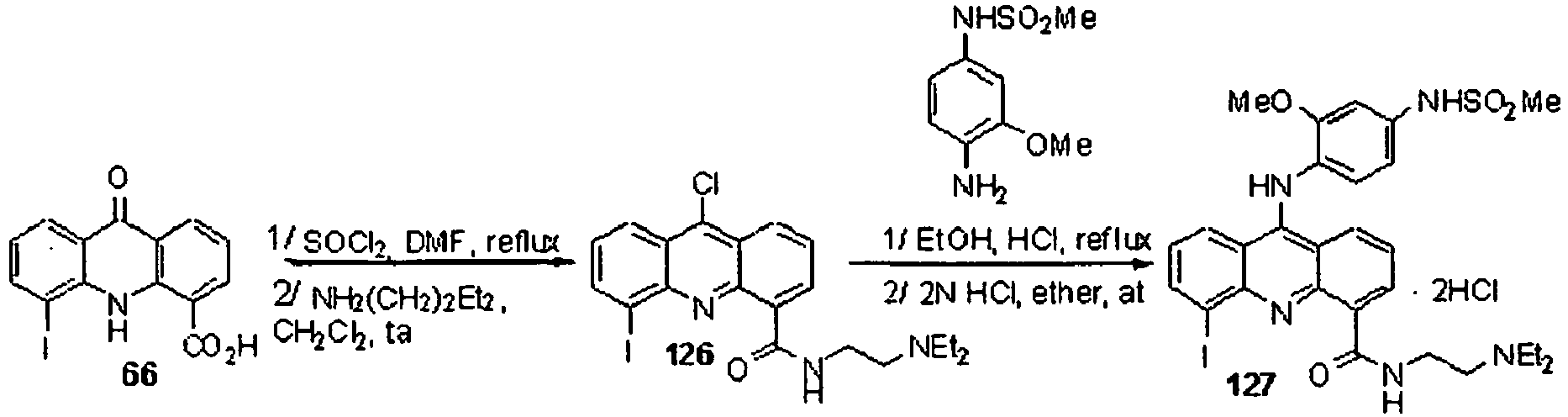
- The compound 126 was prepared according to the procedure described for the preparation of the compound 124, using 9,10-dihydro-5-iodo-9-oxoacridine-4-carboxylic acid (66) as starting material. Yield: 93%; very unstable compound; 1H NMR (200 MHz, CDCl3) δ 1.38 (t, 6H, J = 7 Hz), 3.17 (q, 4H, J = 7 Hz), 3.37 (m, 2H), 4.22 (m, 2H), 7.41 (dd, 1H, J = 9 and 7 Hz), 7.78 (dd, 1H, J = 8.5 and 7 Hz), 8.44 (d, 1H, J = 8.5 Hz), 8.51 (d, 1H, J = 7 Hz), 8.60 (d, 1H, J = 8.5 Hz), 8.99 (d, 1H, J = 7 Hz), 12.40 (m, 1H).
- The compound 127 was prepared according to the procedure described for the preparation of the compound 125, using 9-chloro-N-(2-diethylaminoethyl)-5-iodoacridine-4-carboxamide (126) as starting material. Yield: 38%; melting point: 212-214°C; 1H NMR (400 MHz, d 6-DMSO) δ 1.28 (t, 6H, J = 7 Hz), 3.13 (s, 3H), 3.25 (q, 4H, J = 7 Hz), 3.40 (m, 2H), 3.48 (s, 3H), 3.85 (m, 2H), 7.02 (m, 2H), 7.21 (t, 1H, J = 8 Hz), 7.55 (m, 2H), 8.39 (m, 1H), 8.54 (m, 2H), 8.89 (d, 1H, J = 7 Hz), 10.06 (s, 1H), 10.25 (bs, 1H), 10.81 (m, 1H), 12.00 (bs, 1H), 14.70 (bs, 1H); 13C NMR (100 MHz, d 6-DMSO) δ 8.3 (2C), 34.4, 39.5, 46.4 (2C), 49.5, 55.7, 89.5, 103.7, 111.6, 113.8, 114.2, 117.8, 122.7, 123.5, 125.2, 125.4, 127.5, 129.6, 135.9, 138.9, 139.3, 140.0, 146.0, 153.2, 156.9, 167.6; IR (KBr) v cm-1: 1151, 1325, 1513, 1585, 1613, 2900-3100, 3200-3500; MS (of the basic form) (m/z, %) 661 (M+, 1), 582 (9), 509 (15), 446 (13), 383 (12), 86 (100). Anal. Calculated for C28H32IN5O4S·2HCl·3H2O : C, 42.65; H, 5.11; N, 8.88. Found : C, 42.72; H, 4.81; N, 8.68.
-

- The compound 128 was prepared according to the procedure described for the preparation of the compound 124, using 9,10-dihydro-7-iodo-9-oxoacridine-4-carboxylic acid (81) as starting material. Yield: 96%; very unstable compound; 1H NMR (200 MHz, CDCl3) δ 1.12 (t, 6H, J = 7 Hz), 2.75 (m, 6H), 3.77 (q, 2H, J = 6 Hz), 7.72 (dd, 1H, J = 8.5 and 7 Hz), 8.00 (m, 2H), 8.49 (d, 1H, J = 8.5 Hz), 8.74 (s, 1H), 8.98 (d, 1H, J = 7 Hz), 11.60 (m, 1H).
- The compound 129 was prepared according to the procedure described for the preparation of the compound 125, using 9-chloro-N-(2-diethylaminoethyl)-7-iodoacridine-4-carboxamide (128) as starting material. Yield: 33%; melting point: 208-210°C; 1H NMR (400 MHz, d 6-DMSO) δ 1.28 (t, 6H, J = 7 Hz), 3.13 (s, 3H), 3.24 (m, 4H), 3.37 (m, 2H), 3.49 (s, 3H), 3.80 (m, 2H), 7.06 (d, 1H, J = 8.5 Hz), 7.09 (s, 1H), 7.54 (m, 2H), 7.97 (d, 1H, J = 9 Hz), 8.19 (d, 1H, J = 9 Hz), 8.58 (m, 2H), 8.70 (d, 1H, J = 7.5 Hz), 9.95 (t, 1H, J = 6 Hz), 10.26 (s, 1H), 10.85 (m, 1H), 11.80 (m, 1H), 14.04 (bs, 1H); 13C NMR (100 MHz, d 6-DMSO) δ 8.3 (2C), 34.3, 39.5, 46.4 (2C), 49.5, 55.7, 89.2, 103.7, 111.7, 114.2, 114.8, 119.9, 121.9, 122.7, 123.4, 127.5, 129.1, 133.3, 135.7, 137.9, 138.2, 140.2, 143.2, 153.3, 155.0, 167.2; IR (KBr) v cm-1: 1150, 1324, 1511, 1586, 1618, 2926, 3300-3500; MS (of the basic form) (m/z, %) 661 (M+, 7), 582 (47), 509 (62), 466 (29), 439 (21), 383 (17), 86 (100), 58 (13). Anal. Calculated for C29H32IN5O4S·2HCl·2H2O: C, 43.65; H, 4.97; N, 9.09. Found: C, 43.37; H, 4.64; N, 8.93.

- The
compound 131 was prepared according to the procedure described for the preparation of the compound 32, using N-(2-diethylaminoethyl)-7-iodo-9-(4-methanesulphonamido-2-methoxyanilino)acridine-4-carboxamide (130) (freshly prepared from the dihydrochloride 129 treated with a saturated aqueous sodium carbonate solution and then extracted with dichloromethane) as starting material and heating at reflux for 4.5 hours. The residue obtained is chromatographed on a column of alumina eluted with a mixture of ethyl acetate and methanol (96/4, v/v). Yield: 34%; Rf: 0.48 (Al2O3, ethyl acetate / ethanol (96/4, v/v)); melting point: 139-141°C; IR (KBr) v cm-1 : 1152, 1457, 1507, 1592, 2924; ESI-MS m/z 826.5 [M+H]+. -

- BTEAlCl2 (Kajigaeshi, S., Kakinami, T., Yamasaki, H., Fujisaki, S. and Okamoto, T., Bull. Chem. Soc. Jpn., 1988, 61, 600-602) (0.81 g, 2.09 mmol) and calcium carbonate (0.32 mg, 3.08 mmol) are added to the aniline derivative 132 (Ferlin, M. G., Marzano, C., Chiarelotto, G., Baccichetti, F. and Bordin, F., Eur. J. Med. Chem., 2000, 35, 827-837) (0.40 g, 1.90 mmol) in solution in a mixture of methanol (15 ml) and dichloromethane (40 ml). The reaction medium is stirred at reflux for 45 minutes. After returning to ambient temperature, the mixture is filtered through Celite® 521. The filtrate is subsequently concentrated to 1/3 under vacuum and then the organic phase is washed with a 5% aqueous sodium bisulphite solution (10 ml), a saturated aqueous sodium bicarbonate solution (10 ml), water (10 ml) and finally a saturated aqueous NaCl solution (10 ml). The organic phase is dried over magnesium sulphate, filtered and then evaporated to dryness. The residue obtained is chromatographed on a column of alumina eluted with an acetate / pentane (7/3, v/v) mixture, to result in the iodinated compound 133 (102 mg, 0.30 mmol). Yield: 16%; viscous liquid; Rf: 0.79 (Al2O3, acetate / pentane (7/3, v/v)); 1H NMR (200 MHz, CDCl3) δ 1.29 (t, 3H, J = 7 Hz), 3.78 (s, 3H), 4.01 (m, 2H), 4.19 (q, 2H, J = 7 Hz), 6.31 (s, 1H), 6.84 (bs, 1H), 8.25 (bs, 1H); 13C NMR (100 MHz, CDCl3) δ 14.7, 55.8, 61.2, 72.8, 97.8, 120.5, 128.4, 142.8, 149.8, 153.7; IR (CCl4) v cm-1: 1221, 1529, 3200-3500; MS (m/z, %) 336 (M+, 100), 290 (16), 264 (18), 249 (18), 108 (32), 94 (20), 52 (20).
- To the aminated derivative 133 (0.64 g, 1.90 mmol) in solution in anhydrous pyridine (5 ml) is added dropwise, at -15°C, under argon, methanesulphonyl chloride (0.16 ml, 2.09 mmol) (internal temperature < -5°C). The reaction medium is stored overnight in a refrigerator and then concentrated to 2/3 under vacuum. The mixture is subsequently taken up with water and then the remaining pyridine is neutralized by addition of concentrated hydrochloric acid. The aqueous phase is extracted with dichloromethane (3 × 30 ml). The organic phase is dried over sodium sulphate, filtered and then evaporated to dryness. The residue obtained is chromatographed on a column of alumina eluted with dichloromethane, to result in the compound 134 (0.43 g, 1.05 mmol). Yield: 55%; melting point: 153-155°C; Rf: 0.08 (Al2O3, dichloromethane); 1H NMR (400 MHz, CDCl3) δ 1.31 (t, 3H, J = 7 Hz), 2.94 (s, 3H), 3.87 (s, 3H), 4.21 (q, 2H, J = 7 Hz), 6.45 (s, 1H), 7.14 (s, 1H), 7.19 (s, 1H), 8.53 (bs, 1H); 13C NMR (100 MHz, CDCl3) δ 14.5, 39.8, 56.1, 61.6, 82.4, 106.8, 126.8, 127.4, 132.1, 148.6, 153.2; IR (KBr) v cm-1: 1150, 1337, 1526, 1708, 3195, 3353; MS (m/z, %) 414 (M+, 40), 335 (100), 291 (13), 263 (40), 136 (12).
- The ethyl carbamate 134 (0.60 g, 1.45 mmol) is brought to reflux for 1.5 hours in the presence of a 10% aqueous sodium hydroxide solution (10 ml). After returning to ambient temperature, the reaction medium is adjusted to pH = 8 by addition of concentrated hydrochloric acid. The aqueous phases are extracted with dichloromethane (4 × 50 ml). The organic phases are combined, dried, filtered and then evaporated to dryness, to result in the amine 135 (0.44 g, 1.29 mmol). Yield: 89%; melting point: 110-112°C; Rf: 0.08 (Al2O3, dichloromethane); 1H NMR (400 MHz, d 6-DMSO) δ 2.96 (s, 3H), 3.75 (s, 3H), 5.07 (s, 2H), 6.76 (s, 1H), 7.08 (s, 1H), 8.94 (s, 1H); 13C NMR (100 MHz, d 6-DMSO) δ 40.9, 55.5, 89.7, 111.7, 121.7, 126.0, 138.8, 146.3; IR (KBr) v cm-1 : 1221, 1529, 1723, 3356, 3430; MS (m/z, %) 342 (M+, 19), 263 (100), 136 (18), 121 (12).
- The compound 137 was prepared according to the procedure described for the preparation of the compound 125, using 9-chloro-N-(2-diethylaminoethyl)acridine-4-carboxamide (136) (Atwell, G. J., Cain, B. F., Baguley, B. C., Finlay, G. J. and Denny, W. A., J. Med. Chem., 1984, 27, 1481-1485) and 5-iodo-4-methanesulphonamido-2-methoxyaniline (135) as starting materials. Yield: 33%; melting point: 213-215°C; 1H NMR (400 MHz, d 6-DMSO) δ 1.28 (t, 6H, J = 7 Hz), 3.16 (s, 3H), 3.24 (q, 4H, J = 7 Hz), 3.38 (m, 2H), 3.47 (s, 3H), 3.82 (m, 2H), 7.15 (s, 1H), 7.48 (m, 1H), 7.57 (m, 1H), 8.02 (m, 1H), 8.11 (s, 1H), 8.19 (d, 1H, J = 8 Hz), 8.28 (d, 1H, J = 8 Hz), 8.61 (d, 1H, J = 8Hz), 8.74 (d, 1H, J = 7Hz), 9.50 (bs, 1H), 9.95 (bs, 1H), 10.85 (bs, 1H), 11.80 (bs, 1H), 14.20 (bs, 1H); 13C NMR (50 MHz, d 6-DMSO) δ 8.3 (2C), 34.3, 41.4 (2C), 46.4, 49.5, 56.0, 86.4, 111.1, 113.6, 114.5, 119.7, 120.2, 122.6, 124.5, 124.9, 128.0, 129.1, 133.6, 135.9 (2C), 138.3, 138.8, 139.2, 153.0, 156.0, 167.3; IR (KBr) v cm-1: 1151, 1320, 1522, 1572, 1623, 2927, 3300-3500; MS (of the basic form) (m/z, %) 661 (M+, 2), 582 (24), 509 (25), 456 (74), 383 (73), 340 (40), 128 (27), 86 (100), 58 (19). Anal. Calculated for C28H32IN5O4S·2HCl·2H2O: C, 43.65; H, 4.97; N, 9.09. Found : C, 43.51; H, 4.76; N, 9.03.
-

- Triethylamine (3.03 ml, 21.8 mmol), ethyl chloroformate (3.73 ml, 39.0 mmol) and 4-dimethylaminopyridine (DMAP) (2.40 g, 19.6 mmol) are added, at 0°C, to a solution of 1,6-naphthyridine-2-carboxylic acid (138) (Chan, L., Jin, H., Stefanac, T., Lavallée, J.F., Falardeau, G., Wang, W., Bédard, J., May, S. and Yuen, L., J. Med. Chem., 1999, 42, 3023-3025) (1.00 g, 5.75 mmol) in anhydrous dichloromethane (75 ml). After returning to ambient temperature, the reaction mixture is brought to reflux for 5 hours, the solution is evaporated to dryness and then the residue is purified on a column of alumina eluted with ethyl acetate to result in the ester 139 (517 mg, 2.56 mmol). Yield: 45%; Rf: 0.86 (Al2O3, ethyl acetate); melting point: 106-108°C; 1H NMR (400 MHz, CDCl3) δ 1.41 (t, 3H, J = 7 Hz), 4.49 (q, 2H, J = 7 Hz), 8.02 (d, 1H, J = 6 Hz), 8.21 (d, 1H, J = 8.5 Hz), 8.39 (d, 1H, J = 8.5 Hz), 8.75 (d, 1H, J = 6 Hz), 9.29 (s, 1H); 13C NMR (100 MHz, CDCl3) δ 14.3, 62.0, 122.4, 122.7, 124.0, 137.2, 147.5, 149.7, 152.3, 152.9, 164.6; IR (KBr) v cm-1: 1256, 1734; MS (m/z, %) 202 (M+, 3), 158 (18), 130 (100), 102 (15), 75 (22), 51 (16).
- N-iodosuccinimide (NIS) (691 mg, 3.07 mmol) and para-toluenesulphonic acid (PTSA) (176 mg, 1.02 mmol) are added, at -10°C, to a solution of the ester 139 (517 mg, 2.56 mmol) in tetrahydrofuran (50 ml). The reaction mixture is stirred at -10°C for 10 minutes and then continued, after returning to ambient temperature, for 24 hours. N-iodosuccinimide (576 mg, 2.56 mmol) is then added to the solution. After stirring at ambient temperature for 21 hours, the solution is evaporated under vacuum and then the residue obtained is taken up in a saturated aqueous sodium carbonate solution (50 ml). The aqueous phase is extracted with ethyl acetate (3 × 20 ml). The organic phases are combined, dried over magnesium sulphate, filtered and then evaporated under vacuum. The residue is purified on a column of alumina eluted with an ethyl acetate/cyclohexane (7/3, v/v) mixture, to result in the iodinated ester 140 (527 mg, 1.61 mmol). Yield: 63%; Rf: 0.83 (Al2O3, ethyl acetate / cyclohexane (7/3, v/v)); melting point: 135-137°C; 1H NMR (200 MHz, CDCl3) δ 1.51 (t, 3H, J = 7 Hz), 4.55 (q, 2H, J = 7 Hz), 8.32 (d, 1H, J = 8 Hz), 8.39 (d, 1H, J = 8 Hz), 9.23 (s, 1H), 9.28 (s, 1H); 13C NMR (100 MHz, CDCl3) δ 14.2, 62.7, 100.9, 123.4, 125.2, 137.9, 149.3, 152.8, 153.2, 155.2, 164.3; IR (CCl4) v cm-1: 1126, 1274, 1742; MS (m/z, %) 328 (M+, 18), 284 (18), 256 (100), 228 (8), 129 (29), 101 (52), 75 (25).
- The compound 141 was prepared according to the procedure described for the preparation of the compound 2, using ethyl 8-iodo-1,6-naphthyridine-2-carboxylate (140) as starting material and heating the reaction medium at reflux for 3 hours. The residue is chromatographed on a column of alumina eluted with ethyl acetate. Yield: 73%; melting point: 44-46 °C; Rf: 0.67 (Al2O3, AcOEt); 1H NMR (200 MHz, CDCl3) δ 1.07 (t, 6H, J = 7 Hz), 2.60 (q, 4H, J = 7 Hz), 2.70 (t, 2H, J = 6 Hz), 3.57 (q, 2H, J = 6 Hz), 8.35 (d, I H, J = 8.5 Hz), 8.44 (d, 1H, J = 8.5 Hz), 8.83 (m, 1H), 9.17 (s, 1H), 9.19 (s, 1H); 13C NMR (50 MHz, CDCl3) δ 12.3 (2C), 37.4, 46.9 (2C), 51.4, 100.2, 121.5, 125.3, 138.1, 148.1, 152.8, 154.7, 154.8, 162.8; IR (KBr) v cm-1: 1460, 1516, 1689, 2801, 2926, 2965, 3300-3400; MS (m/z, %) 398 (M+, 1), 86 (100), 58 (15).
- The
compound 142 was prepared according to the procedure described for the preparation of thecompound 3, using N-(2-diethylaminoethyl)-8-iodo-1,6-naphthyridine-2-carboxamide (141) as starting material. Yield: 72%; melting point: 215-217°C; 1H NMR (200 MHz, d 6-DMSO) δ 1.27 (t, 6H, J = 7 Hz), 3.25 (m, 6H), 3.82 (m, 2H), 8.34 (d, I H, J = 8.5 Hz), 8.81 (d, 1H, J = 8.5 Hz), 8.95 (m, 1H), 9.29 (s, 1H), 9.29 (s, I H), 10.75 (bs, 1H); IR (KBr) v cm-1: 1450, 1528, 1624, 1681, 2043, 2240-2750, 2939, 3045, 3250-3550. Anal. Calculated for C15H19IN4O·2HCl·1.5H2O: C, 36.16; H, 4.86; N, 11.25. Found: C, 36.50; H, 4.56; N, 11.03. -

- The compound 143 was prepared according to the procedure described for the preparation of the compound 2, using ethyl 6-iodoquinoxaline-2-carboxylate (44) and 4-amino-N,N-dipropylbutylamine (Seguin, H., Gardette, D., Moreau, M. F., Madelmont, J. C. and Gramain, J. C., Synth. Commun., 1998, 28, 4257-4272) as starting materials. The reaction medium is heated at reflux for 20 hours. Chromatography results, by order of elution, in the starting ethyl 6-iodoquinoxaline-2-carboxylate (44). Yield: 30%; and then in the carboxamide derivative 143. Yield: 60%; melting point: 74-76°C; Rf: 0.83 (Al2O3, dichloromethane / ethanol (97/3, v/v)); 1H NMR (CDCl3, 200 MHz) δ 0.80 (t, 6H, J = 7 Hz), 1.48 (m, 8H), 2.38 (m, 6H), 3.50 (q, 2H, J = 6.5 Hz), 7.72 (d, 1H, J = 9 Hz), 7.99 (dd, 1H, J = 9 and 2 Hz), 8.07 (m, 1H), 8.51 (d, 1H, J = 2 Hz), 9.57 (s, 1H); 13C NMR (CDCl3, 50 MHz) δ 11.9 (2C), 19.8 (2C), 24.6, 27.5, 39.5, 53.6, 56.0 (2C), 98.0, 130.5, 138.5, 139.3, 139.6, 143.9, 144.2, 144.6, 162.9; 1R (KBr) v cm-1: 1539, 1685, 2802, 2869, 2955, 3240-3350; MS (m/z, %) 454 (M+, 4), 425 (23), 354 (7), 255 (13), 128 (23), 114 (100), 72 (21), 70 (22).
- The
compound 144 was prepared according to the procedure described for the preparation of thecompound 3, using N-(4-dipropylaminobutyl)-6-iodoquinoxaline-2-carboxamide (143) as starting material. Yield: 81%; melting point: 175-177°C; 1H NMR (200 MHz, d 6-DMSO) δ 0.88 (t, 6H, J = 7 Hz), 1.67 (m, 8H), 2.95 (m, 6H), 3.39 (m, 2H), 7.93 (d, 1H, J = 9 Hz), 8.24 (dd, 1H, J = 9 and 2 Hz), 8.63 (d, 1H, J = 2 Hz), 9.19 (t, 1H, J = 5.5 Hz), 9.45 (s, 1H), 10.13 (bs, 1H); IR (KBr) v cm-1: 1475, 1541, 1683, 2600-2750, 2800-3000, 3273. Anal. Calculated for C19H27IN4O·2HCl: C, 43.28; H, 5.54; N, 10.63. Found: C, 44.33; H, 5.59; N, 10.75. -

- Butane-2,3-diol (10 ml), 2-bromo-3-nitrobenzoic acid (145) (Culhane, P.J., Organic Syntheses, Wiley, New York, 1944, Collect. Vol I, 125) (4.10 g, 16.7 mmol), cuprous chloride (206 mg) and copper powder (410 mg) are successively added to a solution of 4-bromoaniline (4.30 g, 24.5 mmol) in N-ethylmorpholine (6 ml, 46.9 mmol). The solution is heated at 70°C for 7.5 hours. Heating is halted and a 0.5M aqueous ammonia solution (140 ml) is added with stirring. The medium is then rapidly filtered through Celite® 545. The Celite is washed with 0.5M aqueous ammonia solution (20 ml). The filtrate is poured, with vigorous stirring, onto a 2N aqueous hydrochloric acid solution (140 ml). After stirring for 10 minutes, the solution loses its colour and a pale yellow precipitate is formed. The solution is placed in a refrigerator overnight and the precipitate formed is filtered off and then dried in a desiccator, to result in the diphenylamine 146 (1.76 g, 5.22 mmol) Yield: 31%; melting point: 194-196°C; +H NMR (400 MHz, d 6-DMSO) δ 6.86 (d, 2H, J = 9 Hz), 7.16 (t, 1H, J = 8 Hz), 7.38 (d, 2H, J = 9 Hz), 8.09 (d, 1H, J = 8 Hz), 8.18 (d, 1H, J = 8 Hz), 9.69 (bs, 1H); 13C NMR (100 MHz, CDCl3) δ 114.1, 119.8 (2C), 120.0, 122.0, 130.4, 131.8 (2C), 136.5, 137.8, 140.5, 141.4, 168.1; IR (KBr) v cm-1: 1259, 1437, 1526, 1668, 3328; ESI-MS m/z 334.7 [M-H]+.
- Sodium borohydride (505 mg, 13.3 mmol) is added to a solution of N-(4-bromophenyl)-3-nitroanthranilic acid (146) (1.50 g, 4.45 mmol) in 2N sodium hydroxide solution (75 ml). The reaction medium is heated at reflux for 2 hours. After returning to ambient temperature, the solution is cooled by means of an ice bath and then filtered. The precipitate is washed with precooled 2N sodium hydroxide solution (10 ml). The precipitate is taken up in water (100 ml) and the solution is acidified with stirring by addition of glacial acetic acid until precipitation has occurred (pH = 5). The precipitate obtained is filtered off and then dried in a desiccator, to result in the acid 147 (807 mg, 2.66 mmol). Yield: 60%; melting point: 268-269°C; 1H NMR (200 MHz, d 6-DMSO) δ; 8.12 (m, 2H), 8.34 (d, 1H, J = 9 Hz), 8.45 (m, 2H), 8.60 (d, 1H, J = 2H); IR (KBr) v cm-1: 1396, 1739, 2600-2800; ESI-MS m/z 300.8 [M+H]+.
- A solution of the acid 147 (885 mg, 2.92 mmol) in thionyl chloride (20 ml) under argon is heated at reflux for 30 minutes. The solution is evaporated under vacuum, then the residue is taken up in anhydrous toluene (5 ml) and again evaporated under vacuum. The acid chloride thus obtained is dissolved in anhydrous dichloromethane (30 ml). A solution of N,N-diethylethylenediamine (2.05 ml, 14.6 mmol) in anhydrous dichloromethane (15 ml) is added, under argon and at 0°C, to the solution. After returning to ambient temperature, the reaction medium is stirred for 22 hours. The solution is evaporated under vacuum and then the residue is chromatographed on a column of alumina eluted with ethyl acetate, to result in the compound 148 (1.13 g, 2.82 mmol). Yield: 96%; melting point: 107-109°C; Rf: 0.57 (Al2O3, ethyl acetate); 1H NMR (200 MHz, CDCl3) δ 1.27 (t, 6H, J = 7 Hz), 2.96 (q, 4H, J = 7 Hz), 3.06 (m, 2H), 4.00 (m, 2H), 7.97 (m, 2H), 8.43 (m, 3H), 8.98 (d, 1H, J = 7 Hz), 11.18 (bs, 1H); 13C NMR (50 MHz, CDCl3) δ 11.3 (2C), 37.7, 47.1 (2C), 51.7, 125.6, 129.4, 130.5, 130.7, 131.5, 133.6, 135.2, 135.6, 140.1, 140.8, 143.1, 143.6, 164.7; IR (KBr) v cm-1: 1515, 1653, 2874, 2936, 2966, 3260; ESI-MS m/z 400.7 [M+H]+.
- The compound 149 was prepared according to the procedure described for the preparation of the compound 32, using N-(2-diethylaminoethyl)-7-bromophenazine-1-carboxamide (148) as starting material. The residue obtained is chromatographed on a column of alumina eluted with an ethyl acetate / cyclohexane (7/3, v/v) mixture; yield: 61%; viscous liquid; Rf: 0.84 (Al2O3, ethyl acetate / cyclohexane (7/3, v/v)); 1H NMR (400 MHz, CDCl3) δ 0.89 (t, 9H, J = 7.5 Hz), 1.17 (t, 6H, J = 7 Hz), 1.21 (m, 6H), 1.35 (st, 6H, J = 7.5 Hz), 1.59 (m, 6H), 2.81 (q, 4H, J = 7 Hz), 2.91 (t, 2H, J = 6 Hz), 3.85 (q, 2H, J = 6 Hz), 7.91 (dd, 1H, J = 7 and 8.5 Hz), 7.98 (d, 1H, J = 8.5 Hz), 8.25 (d, 1H, J = 8.5 Hz), 8.36 (d, I H, J = 8.5 Hz), 8.39 (s, 1 H), 8.95 (d, 1 H, J = 7 Hz), 11.29 (bs, 1 H); 13C NMR (100 MHz, CDCl3) δ 10.0 (3C, 1 J Sn-C= 335 Hz), 11.4 (2C), 13.7 (3C), 27.4 (3C, 3 J Sn-C= 56 Hz), 29.1 (3C, 2 J Sn-C= 20 Hz), 37.7, 47.1 (2C), 51.7, 127.5, 129.2, 129.8, 133.7, 135.0, 138.2, 138.4, 140.9, 141.7, 142.2, 143.3, 148.7, 165.1; IR (CCl4) v cm-1: 1465, 1508, 1660, 2854, 2873 2928, 2960; ESI-MS m/z 613.1 [M+H]+.
- A solution of diiodine in chloroform (0.95 g, 3.74 mmol, 70 ml) is added dropwise over a period of 5 hours to a solution of the compound 149 (1.14 g, 1.87 mmol) in chloroform (30 ml). The reaction medium is stirred at ambient temperature for 18 hours. Diiodine (0.27 g, 1.06 mmol) is added and stirring is continued for 7 hours. A 5% aqueous sodium carbonate solution (100 ml) is added to the reaction medium. After separating by settling, the organic phase is washed with a 5% aqueous sodium bisulphite solution (2 × 40 ml), dried over magnesium sulphate, filtered and evaporated under vacuum. The residue obtained is chromatographed on a column of alumina eluted with an ethyl acetate / cyclohexane (7/3, v/v) mixture, to result in the iodonated derivative 150 (397 mg, 0.89 mmol); yield: 47%; melting point: 140-142°C; Rf: 0.56 (Al2O3, ethyl acetate / cyclohexane (7/3, v/v)); 1H NMR (200 MHz, CDCl3) δ 1.12 (t, 6H, J = 7 Hz), 2.76 (q, 4H, J = 7 Hz), 2.85 (m, 2H), 3.79 (q, 2H, J = 6 Hz), 7.93 (dd, 1H, J = 7 and 8.5 Hz), 8.07 (m, 2H), 8.30 (d, 1H, J = 8.5 Hz), 8.68 (s, 1H), 8.97 (d, 1H, J = 7 Hz), 11.0 (m, 1 H); 13C NMR (50 MHz, CDCl3) δ 11.6 (2C), 37.8, 47.1 (2C), 51.7, 97.8, 129.5, 130.2, 130.7, 133.6, 135.7, 138.7, 140.1, 140.4, 141.0, 143.2, 143.5, 164.6; IR (KBr) v cm-1: 1510, 1646, 2872, 2936, 2963, 3243; ESI-MS m/z 448.9 [M+H]+.
- The
compound 151 was prepared according to the procedure described for the preparation of thecompound 3, using N-(2-diethylaminoethyl)-7-iodophenazine-1-carboxamide (150) as starting material. Yield: 84%; melting point: 212-214°C; 1H NMR (200 MHz, d 6-DMSO) δ 1.26 (t, 6H, J = 7 Hz), 3.24 (m, 4H), 3.39 (m, 2H), 3.91 (m, 2H), 8.10 (dd, 1H, J = 7 and 8.5 Hz), 8.37 (m, 3H), 8.69 (d, 1 H, J = 7 Hz), 8.78 (s, 1 H), 10.26 (bs, 1H), 10.46 (m, 1H); IR (KBr) v cm-1: 1508, 1654, 2361, 2588, 2948, 3255. Anal. Calculated for C19H21INO·2HCl: C, 43.78; H, 4.45; N, 10.75. Found: C, 44.85; H, 4.42; N, 10.76. - The chemical structures and physical data of some precursor (unlabelled) iodinated compounds of formulae (1), (1'), (I"), (la), (lb), (Ic), (Id), (Ie), (If), (Ig), (Ih), (Ii), (Ij), (Ik), (Im), (In), (Io), (Ip), (Iq) and (Ir) of the invention before their labelling described below and of some compounds of formula (II) according to the invention are illustrated in the following Table I.
Table I 
No. Q-Ar- m R2 R3 Salt M.p. (°C) 2 
2 Et Et - 105-107 3 HCl 151-152 6 
2 Et Et - Liq 7 2HCl 127-129 9 
2 Et Et - 208-210 10 HCl 217-219 12 
2 Et Et - 76-78 13 HCl 163-165 15 
2 Et Et - Liq 16 2HCl 128-130 20 
2 Et Et - Liq 21 2HCl 208-210 25 2 Et Et - 136-138 26 2HCl 217-219 30 
2 Et Et - 75-77 31 2HCl 104-106 34 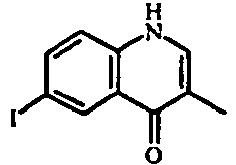
2 Et Et - 234-236 35 2HCl 164-166 38 
2 Et Et - Liq 39 2HCl 152-154 45 
2 Et Et - 60-62 46 2HCl 201-203 48 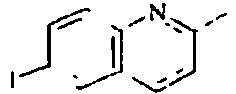
4 Pr Pr - Liq 49 2HCl 133-135 54 
2 Et Et - 248-250 55 2HCl 269-271 59 
2 Et Et - 250-252 60 2HCl 298-300 64 
2 Et Et - 215-217 65 2HCl 262-264 68 
2 Et Et - 148-150 69 2HCl 251-253 77 
2 Et Et - 208-210 78 2HCl 266-268 83 
2 Et Et - 140-142 84 2HCl 220-222 86 
2 Et Et - 144-146 87 2HCl 228-230 90 
2 Et Et - 103-105 91 2HCl 219-221 94 
2 Et Et - 108-110 95 2HCl 215-217 97 
2 Et Et - 81-83 98 2HCl 134-136 101 
2 Et Et - 64-66 102 2HCl 144-146 106 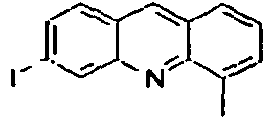
2 Et Et - 80-82 107 2HCl 201-203 110 
2 Et Et - 176-178 111 2HCl 213-215 114 
2 Et Et - 78-80 115 2HCl 128-130 119 
2 Et Et - 83-85 120 2HCl 121-123 121 
2 Et Et - 209-211 122 2HCl 224-226 125 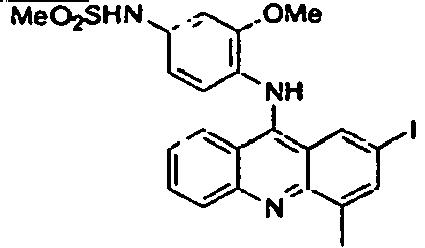
2 Et Et 2HCl 235-237 128 
2 Et Et 2HCl 212-214 129 
2 Et Et 2HCl 208-210 137 
2 Et Et 2HCl 213-215 141 
2 Et Et - Liq 142 2HCl 215-217 143 
4 Pr Pr - 74-76 144 2HCl 175-177 150 
2 Et Et -- 140-142 151 2HCl 212-214 - Et denotes an ethyl radical,
- Pr denotes a propyl radical,
- "Liq" means that the product exists in the form of a liquid,
- M.p. denotes the melting point. - The structures of compounds of formula (VII) which are precursors of the compounds of formulae (I), (I'), (I"), (Ia), (Ib), (Ic), (Id), (Ie), (Ig), (Ih), (Ii), (Ik), (Im), (In) and (II) are illustrated in the following Table II.
Table II 
No. (Bu)3Sn-Ar- m R2 R3 M.p. (°C) 17 
2 Et Et Liq 32 
2 Et Et Liq 47 
2 Et Et Liq 85 
2 Et Et Liq 103 
2 Et Et Liq 131 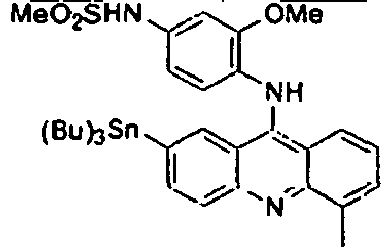
2 Et Et Liq 152 
2 Et Et Liq - Bu denotes a butyl radical - The Na125I and the Na131I are supplied by Amersham. The Extrelut® and the sodium citrate/hydrochloric acid pH = 4 buffer originate from Merck. The radioactivity measurements were carried out, in the case of direct exchange, on an AMBIS 400 (Scanalytics, CSPI, San Diego, CA, USA). In the case of labellings of high specific activity, HPLC purifications were carried out on a Shimadzu device (LC 6A pump, SCL 6B controller, CR5A integrator) equipped with a Zorbax 80Å extend C18 column (4.6 × 150 mm) connected in series with a UV spectrophotometer of Shimadzu SPD 6AV type and a Raytest Steffi gamma detector. The column is eluted with a water/methanol/0.2% aqueous ammonia mixture with a flow rate of 1 ml / minute and a linear elution gradient for methanol from 70 to 100% over a period of 10 minutes. The radiochemical purities were determined after HPLC analysis (HP1100, Hewlett Packard, Les Ulis, France). The Purospher RP18 e column (5 µm) is coupled to a diode array detector and a Flow one A500 Radiomatic radioactivity detector (Packard, Canberra, Australia). Chromatography is carried out using a water/methanol/0.2% aqueous ammonia mixture with a flow rate of 0.5 ml/minute and a linear elution gradient for methanol from 70 to 100% over a period of 10 minutes. The labelled products were identified by comparing their TLC (Rf) or HPLC (Rt) values with those obtained for the corresponding unlabelled compounds.
- The hydrochloride (2-3 mg) is dissolved in 500 µl of a citrate/hydrochloric acid (pH = 4) buffer solution comprising 100 µl of an aqueous copper sulphate solution (5 mg/ml). An aqueous solution of sodium iodide Na125I exhibiting an activity of between 111 and 148 MBq is subsequently added to this mixture. The reaction mixture is heated at 120-150°C for one hour. The crude reaction product is taken up in 500 µl of deionized water and the reaction is monitored by thin layer chromatography (alumina, dichloromethane/ethanol (97/3, v/v)). A plate analyzer then makes it possible to count the radioactivity and to determine the percentage incorporation of 125I in the molecule. After changing to basic pH (>10) using a IN sodium hydroxide solution (100 µl), the mixture is purified on an Extrelut® cartridge (elution with 5
times 3 ml of dichloromethane). After evaporation, the residue is taken up in anhydrous dichloromethane (2 ml) and then in a 2N solution of hydrochloric acid in ether (5 ml), and then evaporated. The hydrochloride obtained is taken up in anhydrous ether (5 ml) and evaporated under vacuum. The radiolabelled compound is thus obtained with a yield and a radiochemical purity given in the following Table III:Table III Starting hydrochloride Heating temperature (Time) Compound of formula (II) labelled with iodine-125 Yield (%) Puritya (%) 
150 °C (1 hour) 
77 97 compound 3
120 °C (1 hour) 
39 98 compound 7 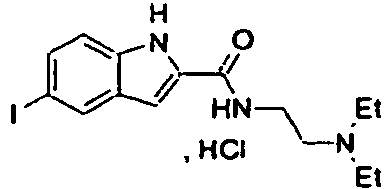
150 °C (1 hour) 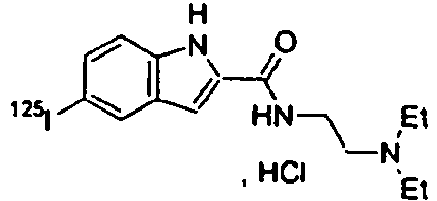
75 98 compound 10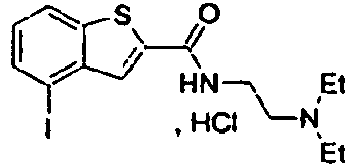
150 °C (1 hour) 
73 99 compound 13 
150 °C (1 hour) 
68 98 compound 21
150 °C (1 hour) 
22 95 compound 26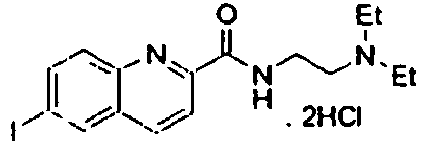
150°C (1 hour) 
92 99 compound 31
150 °C (1 hour) 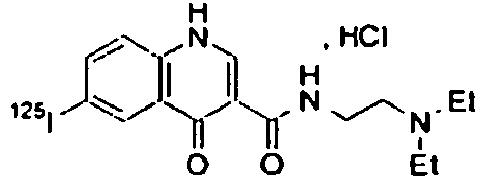
54 99b compound 35
150 °C (1 hour) 
43 96 compound 39 
150°C (1 hour) 
68 99 compound 46
150 °C (hour) 
69 99 compound 49
130 °C (30 minutes) 
69 98c compound 142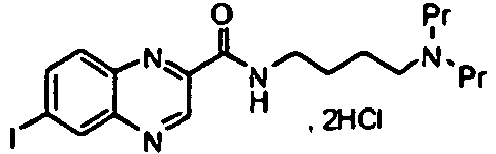
140 °C (18 minutes) 
30d 99 compound 144
130 °C (30 minutes) 
58 99c compound 151aRadiochemical purity after Extrelut®
bTLC, Al2O3, dichloromethane / ethanol (9/1, v/v)
cTLC, Al2O3, ethyl acetate
dpurification by Extrelut® column and then by HPLC : retention time : 10.6 minutes (compound 144) - According to the second alternative, the compounds of formula (VII) are used as intermediates.
- An acetic acid/ethanol (1/1, v/v, 20 µl) mixture, Na125I (5 µl, 18.9 MBq) and peracetic acid (20 µl) are added to a solution of the trialkylstannane 17 (0.43 mg) in ethanol (100 µl) in a vial. The vial is scaled and stirred, at ambient temperature, with a vortex for 30 minutes. A solution of sodium metabisulphite (20 mg) in water (100 µl) and then a 5N sodium hydroxide solution (100 µl) are added and the mixture is stirred with a vortcx for a few minutes. The solution is deposited on an Extrelut® column and the vial is rinsed with a water/ethanol (1/1, v/v, 2 × 100 µl) mixture. After ten minutes of contact, the column is eluted with dichloromethane (5 × 2 ml). The organic phase is evaporated under vacuum and the residue is separated on an HPLC column (elution rate: 1 ml /minute). The retention times obtained are : 7.22 minutes (
compound 15 labelled with 125I) and 16.7 minutes (compound 17). The various fractions collected are evaporated under vacuum. The residue is taken up in anhydrous dichloromethane (1 ml) and then in a 2N solution of hydrochloric acid in ether (2 ml). The solution is evaporated under vacuum. The residue is taken up in anhydrous ether (2 ml) and evaporated under vacuum, to result in [125I]-N-(2-diethylaminoethyl)-3-iodoimidazo[1,2-a]pyridine-2-carboxamide dihydrochloride ([125I] 16) (7.96 MBq). Radiochemical yield: 57%; radiochemical purity: 99%. - A 0.5N hydrochloric acid solution (100 µl), Na131I (100 µl, 1.30 GBq) and an aqueous solution of chloramine-T monohydrate (1 mg/ml, 100 µl) are successively added to a solution of the trialkylstannane 32 (0.45 mg) in ethanol (100 µl) in a vial. The vial is sealed and stirred, at ambient temperature, with a vortex for 30 minutes. A solution of sodium metabisulphite (20 mg) in water (100 µl) and then a 3N sodium hydroxide solution (150 µl) are added and the mixture is stirred with a vortex for a few minutes. The solution is deposited on an Extrelut® column and the vial is rinsed with a water/ethanol (l/l, v/v, 2 × 100 µl) mixture. After ten minutes, the column is eluted with dichloromethane (5 × 2 ml). The organic phase is evaporated under vacuum and the residue is chromatographed on an HPLC column (elution rate : 1 ml /minute). The retention times obtained are : 9.75 minutes (
compound 30 labelled with 131I) and 19.9 minutes (compound 32). The various fractions collected are evaporated under vacuum. The residue is taken up in anhydrous dichloromethane (1 ml) and then in a 2N solution of hydrochloric acid in ether (2 ml). The solution is evaporated under vacuum. The precipitate obtained is taken up in anhydrous ether (2 ml) and evaporated under vacuum, to result in [131I]-N-(2-diethylaminoethyl)-6-iodoquinoline-2-carboxamide dihydrochloride [131I]-(31) (677 MBq). Radiochemical yield: 52%; radiochemical purity: 99%. - A 0.5N hydrochloric acid solution (100 µl), Na131I (120 µl, 1.49 GBq) and an aqueous solution of chloramine-T monohydrate (1 mg/ml, 100 µl) are successively added to a solution of the trialkylstannane 47 (0.45 mg) in ethanol (100 µl) in a vial. The vial is sealed and stirred, at ambient temperature, with a vortex for 20 minutes. A solution of sodium metabisulphite (20 mg) in water (100 µl) and then a 3N sodium hydroxide solution (150 µl) are added and the mixture is stirred with a vortex for a few minutes. The solution is deposited on an Extrelut® column and the vial is rinsed with a water/ethanol (l/l, v/v, 2 × 100 µl) mixture. After ten minutes, the column is eluted with dichloromethane (5 × 2 ml). The organic phase is evaporated under vacuum and the residue is chromatographed on an HPLC column (elution rate: 1 ml /minute). The retention times obtained are: 7.8 minutes (
compound 45 labelled with 131I) and 17.2 minutes (compound 47). The various fractions collected are evaporated under vacuum. The residue is taken up in anhydrous dichloromethane (1 ml) and then in a 2N solution of hydrochloric acid in ether (2 ml). The solution is evaporated under vacuum. The precipitate obtained is taken up in anhydrous ether (2 ml) and evaporated under vacuum, to result in [131I]-N-(2-diethylaminoethyl)-6-iodoquinoxaline-2-carboxamide hydrochloride [131I]-(46) (1.02 GBq). Radiochemical yield: 68%; radiochemical purity: 98%. - A 1% ethanolic acetic acid solution (30 µl), Na125I in sodium hydroxide solution (5 µl, 11.1 MBq) and an aqueous solution of chloramine-T monohydrate (0.4 mg/ml, 15 µl) are successively added to a solution of the trialkylstannane 85 (0.12 mg) in ethanol (30 µl) in a vial. The vial is sealed and stirred, at ambient temperature, with a vortex for 10 minutes. A 0.1N sodium hydroxide solution (20 µl) is added and the mixture is stirred with a vortex for a few minutes. The solution is deposited on an Extrelut® column and the vial is rinsed with a water/ethanol (l/l, v/v, 2 × 100 µl) mixture. After ten minutes, the column is eluted with dichloromethane (5 × 2 ml). The organic phase is evaporated under vacuum and the residue is chromatographed on an HPLC column (elution rate: 1 ml /minute). The retention times obtained are: 11.5 minutes (compound 83 labelled with 125I) and 19.8 minutes (compound 85). The various fractions collected are evaporated under vacuum. The residue is taken up in anhydrous dichloromethane (1 ml) and then in a 2N solution of hydrochloric acid in ether (2 ml). The solution is evaporated under vacuum. The precipitate obtained is taken up in anhydrous ether (2 ml) and evaporated under vacuum, to result in [125I]-N-(2-diethylaminoethyl)-9,10-dihydro-7-iodo-9-oxoacridine-4-carboxamide dihydrochloride [125I]-(84) (6.33 MBq). Radiochemical yield: 57%; radiochemical purity: 99.9%.
- A citrate/hydrochloric acid (pH = 4) buffer solution (20 µl), Na125I in sodium hydroxide solution (8 µL, 29.6 MBq) and an aqueous solution of chloramine-T monohydrate (0.5 mg/ml, 15 µl) are successively added to a solution of the trialkylstannane 103 (0.12 mg) in ethanol (30 µl) in a vial. The vial is sealed and stirred, at ambient temperature, with a vortex for 10 minutes. A 0.1N sodium hydroxide solution (20 µl) is added and the mixture is stirred with a vortex for a few minutes. The solution is deposited on an Extrelut® column and the vial is rinsed with a water/ethanol (l/l, v/v, 2 × 100 µl) mixture. After ten minutes, the column is eluted with dichloromethane (5 × 2 ml). The organic phase is evaporated under vacuum and the residue is chromatographed on an HPLC column (elution rate: I ml /minute). The retention times obtained are: 11.0 minutes (compound 101 labelled with 125I) and 17.7 minutes (compound 103). The various fractions collected are evaporated under vacuum. The residue is taken up in anhydrous dichloromethane (1 ml) and then in a 2N solution of hydrochloric acid in ether (2 ml). The solution is evaporated under vacuum. The precipitate obtained is taken up in anhydrous ether (2 ml) and evaporated under vacuum, to result in [125I]-N-(2-diethylaminoethyl)-5-iodoacridine-4-carboxamidc dihydrochloride [125I]-(102) (19.6 MBq). Radiochemical yield: 66%; radiochemical purity: 99%.
- A citrate/hydrochloric acid (pH = 4) buffer solution (20 µl), Na125I in sodium hydroxide solution (70 µl, 221.3 MBq) and an aqueous solution of chloramine-T monohydrate (0.5 mg/ml, 10 µl) are successively added to a solution of the trialkylstannane 152 (0.12 mg) in ethanol (30 µl) in a vial. The vial is sealed and stirred, at ambient temperature, with a vortex for 10 minutes. A 0.1N sodium hydroxide solution (20 µl) is added and the mixture is stirred with a vortex for a few minutes. The solution is deposited on an Extrelut® column and the vial is rinsed with a water/ethanol (l/l, v/v, 2 × 100 µl) mixture. After ten minutes, the column is eluted with dichloromethane (5 × 2 ml). The organic phase is evaporated under vacuum and the residue is chromatographed on an HPLC column eluted with a water/methanol/0.2% aqueous ammonia mixture with a flow rate of 1 ml/minute and a linear elution gradient for methanol from 70 to 100% over a period of 20 minutes. The retention times obtained are: 15.1 minutes (compound 110 labelled with 125I) and 23.3 minutes (compound 152). The various fractions collected are evaporated under vacuum. The residue is taken up in anhydrous dichloromethane (1 ml) and then in a 2N solution of hydrochloric acid in ether (2 ml). The solution is evaporated under vacuum. The precipitate obtained is taken up in anhydrous ether (2 ml) and evaporated under vacuum, to result in [125I]-N-(2-diethylaminoethyl)-7-iodoacridine-4-carboxamide dihydrochloride [125I]-(111) (66.6MBq). Radiochemical yield: 31%; radiochemical purity: 99%.
- A 1% ethanolic acetic acid solution (30 µl), Na125I in sodium hydroxide solution (50 µl, 125.4 MBq) and an aqueous solution of chloramine-T monohydrate (0.25 mg/ml, 15 µl) are successively added to a solution of the trialkylstannane 131 (0.12 mg) in ethanol (30 µl) in a vial. The vial is sealed and stirred, at ambient temperature, with a vortex for 10 minutes. A 0.1N sodium hydroxide solution (20 µl) is added and the mixture is stirred with a vortex for a few minutes. The solution is deposited on an Extrelut® column and the vial is rinsed with a water/ethanol (l/l, v/v, 2 × 100 µl) mixture. After ten minutes, the column is eluted with dichloromethane (5 × 2 ml). The organic phase is evaporated under vacuum and the residue is chromatographed on an HPLC column (elution rate: 1 ml /minute). The retention times obtained are: 12.4 minutes (compound 130 labelled with 125I) and 17.8 minutes (compound 131). The various fractions collected are evaporated under vacuum. The residue is taken up in anhydrous dichloromethane (1 ml) and then in a 2N solution of hydrochloric acid in ether (2 ml). The solution is evaporated under vacuum. The precipitate obtained is taken up in anhydrous ether (2 ml) and evaporated under vacuum, to result in [125I]-N-(2-diethylaminoethyl)-7-iodo-9-(4-methanesulphonamido-2-methoxyanilino)acridine-4-carboxamide dihydrochloride [125I]-(129) (67.0 MBq). Radiochemical yield: 53%; radiochemical purity: 97%.
- The compounds in accordance with the invention were subjected to pharmacological tests which demonstrated their usefulness in the treatment and/or diagnosis of malignant melanoma.
- Experimental protocol: The selection of the molecules with the pharmacokinetic profile best suited to an application in diagnosis or in therapy is based on the study of their biodistribution after labelling with 125I in the male C57BL6 mouse bearing grafted B16 F0 murine melanoma tumour. The distribution of the radioactivity of the various compounds in the body (tumour and other organs) is quantified using an Ambis 4000 image analyzer on sections of whole animals. While using a smaller number of animals than the conventional counting method, this technique appears to be more predictive of the scintigraphic imaging. All the in vivo experimentation is carried out within the context defined by French legislation relating to animal experimentation.
- The B16 F0 melanoma cells are provided by the ATCC and cultured in monolaycrs in culture medium (MEM, Invitrogen) supplemented with 10% foetal calf sacrum and antibiotics. The cultures are maintained by subculturing after trypsinization. The cells of the first passages are frozen and stored in liquid nitrogen. For the transplanting, the cells in culture at confluence are detached by trypsinization and washed with phosphate buffer (PBS). They are resuspended in PBS and injected subcutaneously into the mice (3 × 10⁵ cells; 0.1 ml) in the left flank. After ten days, the tumours are palpables with a percentage of uptake of 98-100%.
- The molecule labelled with 125I is injected via the caudal vein (0.1 µmol, 0.5-3.6 MBq/animal) at ten animals per product. At various times after administration (1, 3, 6, 24 or 72 hours), two mice are sacrificed by inhalation of CO2 and rapidly frozen in liquid nitrogen. The animal is then cryosectioned at -22°C using a Reichert-Jung cryomicrotome (Leica Instruments, Rueil Malmaison, France) into sections with a thickness of 40 µm which are left to dehydrate under cold conditions for 48 hours.
- The distribution of the radioactivity present in the sections is analyzed using an AMBIS 4000 analyzer (Scanalytics, CSPI, San Diego, CA), which is a proportional counter with a multiwire chamber validated and calibrated beforehand for the monitoring of iodine in the mouse. The measurements require acquisition times of 1000 minutes. The quantification of the radioactivity in the various organs is carried out from the two-dimensional image of the mouse cross section displayed on the screen, in the defined and delimited regions of interest. The value of radioactivity per unit of surface area (cpm/mm2) is converted to concentration (kBq/g) and expressed as percentage of the injected dose/g of tissue (%ID/g).
- In parallel with the autoradiographic study, the kinetics of the products are monitored by scintigraphic imaging of the mice, after injection of the labelled compound (3.7 MBq), using a dedicated gamma camera (Biospace gamma imager) which makes possible in vivo imaging and its repetition in the same animal.
- The biodistribution of the compounds labelled with 125 I, measured by the %ID/g, in the various organs of the melanoma-bearing mouse is represented in the following Tables 1-19 (only the organs where the presence of radioactivity was displayed and quantified are given).
- The radioactivity concentrations measured from 1 to 72 hours in the various organs after the i.v. administration of a compound labelled with 125 I in the C57BL6 mouse bearing a subcutaneously grafted
B 16 melanoma are summarized in Tables 1 to 19. - Concentration of radioactivity in the tissues: tumour (B 16), intestinal contents (Ic), stomach contents (Sc), skeletal muscle (muscle), blood (measured in the heart cavity), urine (bladder), pigmented tissues of the eye (uvea), gall bladder (GB), seminal vesicles (SV) or bone marrow (BM).
Table I : Biodistribution compound 3 (dose=1.50 MBq) 1H 3H 6H 24H 72H Mean Standard deviation Mean Standard deviation Mean Standard deviation Mean Standard deviation Mean Standard deviation B 16 12.99 2.72 1138 2.20 8.95 0.72 6.97 3.87 1.52 0,46 brain 4.37 0.92 0.78 0.24 0.25 0.05 - - - - Ic 7.82 25.85 16.22 18.72 7.67 3.03 1.75 - - Sc 27.82 8.46 24.69 8.37 10.79 3.52 3.10 1.97 - - liver 9.46 1.18 4.75 0.60 2.73 0.36 - - - - muscle 1.92 0.55 0.83 0.17 0.38 0.05 - - - - pancreas 10.18 1.66 8.19 - - - - - - - lunges 11.82 2.16 4.43 0.88 2.12 0.29 - - - - spleen 9.70 3.28 2.59 0.13 8.05 0.20 - - - - kidney 13.30 2.45 5.65 0.77 3.07 0.29 - - - - blood 2.97 0.55 1.77 0.09 1.74 - - - - - uvea 13.21 1.68 13.90 1.79 12.76 2.26 12.28 6.22 7.84 9.38 Table 2 : Biodistribution compound 7 (dose=0.94 MBq) 1H 3H 6H 24H 72H Mean Stanard deviation Mean Standard deviation Mean Standard deviation Mean Standard deviation Mean Standard deviation B 16 15.49 1.70 9.27 1.50 6.97 0.96 2.69 0.74 0.87 0.38 brain 0.64 0.20 0.22 0.14 0.12 0.05 - - - - Ic 13.44 9.46 4.94 1.84 2.98 1.04 - - - - SV 6.79 0.95 3.78 0.38 3.55 0.55 - - - - Sc 34.80 8.68 42.71 10.70 50.21 5.45 1.46 0.51 - - liver 5.14 0.92 3.01 0.30 2.09 0.32 - - - - muscle 1.48 0.18 - - 0.53 0.12 - - - - pancreas 3.94 0.83 2.53 0.63 2.27 0.28 - - - - lungs 7.59 1.58 3.96 0.40 3.21 0.49 - - - - spleen 5.44 4.42 2.68 0.31 2.35 0.50 - - - - kidney 6.08 1.13 3.26 0.46 3.05 0.32 - - 1.09 0.32 blood 6.67 1.00 4.22 0.29 3.71 0.62 - - - - testicles 4.11 0.01 2.43 0.39 2.01 0.24 - - - - thyroid 25.29 59.09 34.36 7.92 111.30 178.80 86.38 uvea 16.66 4.94 12.69 2.16 11.50 1.21 6.07 1.70 2.54 0.32 GB 8.68 6.78 2.13 4.90 1.34 - - - - Table 3 : Biodistribution compound 10 (dose=1.52 MBq) 1H 3H 6H 24H 72H Mean Standard deviation Mean Standard deviation Mean Standard deviation Mean Standard deviation Mean Standard demiation B 16 8.31 3.10 10.22 1.37 9.84 0.86 8.16 4.39 0.84 0.26 brain 4.84 0.69 1.73 0.29 0.74 - 0.00 0.00 - - Ic 76.74 137.12 112.56 80.06 79.85 62.59 3.31 2.34 - - Sc 35.41 21.04 8.52 16.68 21.84 16.62 2.10 1.10 0.04 liver 11.86 1.23 5.21 0.59 3.63 0.41 1.61 0.38 0.61 0.10 muscle 1.50 0.47 0.49 0.13 0.31 0.18 0.19 - - - pancreas 7.15 2.66 2.48 0.05 1.46 - 0.09 0.10 - - lungs 14.41 1.87 3.46 0.74 1.70 0.29 0.37 0.26 - - spleen 8.09 1.35 2.79 0.42 1.68 0.32 1.22 0.30 - - kidney 10.87 1.83 4.19 0.66 2.50 0.38 0.83 0.28 0.71 - blood 1.60 0.27 0.79 0.24 0.67 0.18 0.10 0.11 - - uvea 11.70 1.29 12.78 3.31 13.20 2.81 8.81 2.48 5.86 0.63 Table 4 : Biodistribution compound 13 (dose= 0.71 MBq) 1H 3H 6H 24H 72H Mean Standard deviation Mean Standard deviation Mean Standard deviation Mean Standard deviation Mean Standard deviation B 16 12..47 4.78 9.98 4.29 8.72 4.08 7.28 2.29 1.73 0.47 brain 0.81 0.43 - - - - - - - - Ic 71.13 64.79 73.02 61.60 37.70 35.50 - - - - Sc 20.00 12.68 5.93 3.24 18.77 8.42 - - - - liver 2.21 0.58 1.25 0.37 - - - - - - muscle 0.77 0.23 - - - - - - - - lungs 3.69 1.02 - - - - - - - - spleen 3.88 0.83 - - - - - - - - kidney 5.61 1.08 - - - - - - - - blood 1.37 0.30 - - - - - - - - thyroid 24.03 - 67.21 48.99 139.12 41.99 79.82 66.09 - - uvea 16.09 8.29 19.51 6.38 16.29 4.53 11.06 3.00 9.22 3.38 GB - - 65.56 47.19 - - - - - - Table 5 : Biodistribution compound 16 (dose=0.74 MBq) 1H 3H 6H 24H 72H Mean Standard deviation Mean Standard deviation Mean Standard deviation Mean Standard deviation Mean Standard deviation B 16 2.96 1.79 5.40 3.14 9.87 1.09 5.22 1.61 - - brain 0.33 0.07 0.36 0.29 0.65 0.41 - - - - Ic 58.60 60.15 52.06 17.32 26.14 15.95 - - - - Sc 24.51 4.39 30.71 13.69 48.21 12.16 - - 3.42 liver 4.86 1.51 2.56 0.31 - - - - - - muscle 1.10 0.26 1.30 0.42 - - - - - - lungs 6.48 - 3.38 0.84 4.56 0.36 - - - - spleen 8.16 4.03 12.67 6.38 - - - - kidney 7.12 3.31 5.04 1.18 4.47 0.10 - - - - blood 2.20 2.20 3.93 1.01 - - - - - - uvea 28.30 11.11 16.60 3.65 22.16 11.57 11.17 1.79 2.41 0.05 Table 6 : Biodistribution compound 21 (dose=1.36 MBq) 1H 3H 6H 24H 72H Mean Standard deviation Mean Standard deviation Mean Standard deviation Mean Standard deviation Mean Standard deviation B 16 5.66 2.96 7.14 1.92 8.12 3.35 8.02 2.36 2.67 1.10 Ic 9.48 10.62 78.03 33.12 56.39 46.99 2.68 0.64 - - Sc 4.55 1.23 5.19 1.22 16.57 12.41 - - - - liver 3.97 0.69 0.99 0.16 - - - - - - muscles 0.51 0.17 0.09 0.02 - - - - - - pancreas 7.52 - - - - - - - - - lungs 2.42 1.16 - - - - - - - - spleen 13.07 4.58 - - - - - - - - kidney 2.99 0.71 - - - - - - - - blood 0.68 0.28 - - . - - - - - uvea 17.43 4.63 19.18 5.76 26.81 10.20 11.54 4.32 9.55 2.12 Table 7 : Biodistribution compound 26 (dose=0.47 MBq) 1H 3H 6H 24H 72H Mean Standard deviation Mean Standard deviation Mean Standard deviation Mean Standard deviation Mean Standard deviation B 16 14.78 4.81 16.13 2.94 9.90 3.76 7.06 1.97 4.54 2.10 Ic 105.55 95.85 72.05 50.76 95.86 47.28 3.19 2.13 - - Sc 24.46 10.07 17.98 5.70 8.62 1.67 2.32 2.90 - - liver 13.08 1.74 7.15 1.67 3.38 0.77 - - - - muscle 0.55 - - - - - - - - - pancreas 6.17 - - - - - - - - - lungs 5.16 2.07 3.74 0.31 - - - - - - spleen 11.51 7.04 - - 14.97 2.44 - - - - kidney 6.90 1.09 4.57 0.00 - - - - - - blood 3.31 1.68 1.33 0.26 - - - - - - thyroid 63.44 47.68 34.17 38.00 142.88 1.28 174.73 87.84 uvea 12.87 3.92 24.40 17.72 10.09 2.69 10.44 7.26 1.59 GB - - 160.60 26.81 38.11 - - - - - Table 8 : Biodistribution compound 31 (dose=1.47 MBq) 1H 3H 6H 24H 72H Mean Standard deviation Mean Standard deviation Mean Standard deviation Mean Standard deviation Mean Standard deviation B 16 19.63 8.99 25.35 9.58 17.21 4.64 12.13 5.18 5.93 1.68 brain 1.96 0.42 0.83 0.32 0.37 0.16 - - - - Ic 15.78 17.68 20.65 11.13 23.36 10.68 1.45 - - Sc 48.03 19.55 34.72 14.30 65.36 19.81 2.33 0.27 - - liver 10.92 1.52 8.89 1.74 7.11 1.48 2.25 0.77 1.23 0.45 muscle 1.79 0.22 1.14 0.37 0.95 0.21 - - - - pancreas 9.80 0.82 6.17 1.34 - - - - - - lungs 9.41 1.43 5.58 0.72 5.32 0.89 0.53 - - - spleen 11.56 2.59 10.63 6.37 7.60 2.79 2.66 0.28 1.85 0.24 kidney 11.82 2.14 12.59 4.08 7.60 1.84 0.34 - - - blood 7.01 0.82 5.57 0.98 5.91 0.78 - - - - uvea 32.71 14.88 33.10 8.22 36.62 10.60 22.27 4.72 18.30 6.97 Table 9 : Biodistribution compound 35 (dose=0,56 MBq) 1H 3H 6H 24H 72H Mean Standard deviation Mean Standard deviation Mean Standard deviation Mean Standard deviation Mean Standard deviation B 16 4.69 1.23 4.05 0.78 5.81 1.94 2.74 1.08 2.35 0.75 brain 0.07 0.08 - - 0.08 0.14 0.04 0.07 0.10 0.12 Ic 52.94 54.99 90.12 66.99 61.06 37.95 1.62 0.79 0.70 0.29 Sc 12.74 7.63 9.93 3.52 22.27 25.17 0.13 0.15 - - liver 5.16 0.72 1.84 0.78 0.32 0.29 0.07 0.08 - - muscle 0.92 0.32 0.13 0.00 0.01 0.02 - - - - pancreas 5.74 1.32 0.96 0.02 1.08 0.00 - - - - lungs 2.06 0.44 0.88 0.46 0.15 0.15 0.04 0.09 - - spleen 1.24 0.37 0.28 0.28 0.26 0.30 0.15 0.00 - - kidney 2.80 0.56 0.80 0.52 0.20 0.20 0.03 0.07 - - blood 0.42 0.14 0.23 0.22 0.17 0.22 0.22 0.36 - - thyroid 4.33 0.00 8.55 2.96 5.09 2.72 9.83 1.77 uvea 5.12 0.61 5.66 1.9 5.18 1.56 3.5 1.42 6.79 4.16 Table 10 : Biodistribution compound 39 (dose= 3.63 MBq) 1H 3H 6H 24H 72H Mean Standard deviation Mean Standard deviation Mean Standard deviation Mean Standard deviation Mean Standard deviation B16 7.27 2.43 7.12 5.45 7.92 2.17 7.05 2.42 3.13 1.92 brain 0.30 0.05 0.09 - - - - - - - Ic 42.97 59.32 68.64 52.65 29.16 11.21 1.70 0.46 - - Sc 23.01 17.75 19.05 7.60 28.44 20.08 0.75 0.29 - - liver 3.86 0.28 2.02 0.37 1.54 0.44 0.43 - - - muscle 0.74 0.17 0.43 0.14 - - - - - - pancreas 2.39 0.31 - - - - - - - - lungs 3.68 0.28 2.76 0.41 2.05 0.55 - - - - spleen 2.83 0.25 - - - - - - 1.62 1.43 kidney 4.62 0.47 2.66 0.35 2.11 0.47 - - - - blood 2.15 0.23 2.65 0.19 3.17 0.43 - - - - thyroid 16.89 2.66 35.71 6.74 48.93 38.15 88.65 66.65 132.79 - uvea 18.08 6.80 13.87 4.59 18.02 4.89 14.55 5.32 9.73 1.39 Table 11: Biodistribution compound 46 (dose=1.17 MBq) 1H 3H 6H 24H 72H Mean Standard deviation Mean Standard deviation Mean Standard deviation Mean Standard deviation Mean Standard deviation B 16 17.00 11.06 27.68 7.01 40.70 7.76 21.67 10.77 12.45 1.61 brain 2.34 0.46 1.03 0.18 - - - - - - Ic 15.22 9.50 14.63 3.88 17.45 8.05 - - - - Sc 24.33 6.48 20.33 5.19 21.09 6.85 - - 2.23 0.38 liver 13.18 1.33 8.87 1.11 7.53 1.40 1.49 0.18 - - BM 4.58 0.90 - - - - - - - - muscle 2.04 0.37 0.86 0.22 0.87 0.23 - - - - pancreas 7.60 0.76 - - - - - - - - lungs 7.83 0.59 5.68 1.05 4.46 0.60 - - - - spleen 14.21 14.32 4.69 - - - - - - - kidney 16.46 2.98 9.30 3.31 7.69 0.80 - - - - blood 3.45 0.44 2.91 0.33 3.09 0.52 - - - - thyroid - - 39.76 23.47 83.77 26.14 94.22 27.48 uvea 33.82 3.47 24.79 6.78 32.30 6.52 32.44 5.98 25.26 8.38 GB - - - - 33.38 7.70 - - - - Table 12: Biodistribution compound 49 (dose=1.09 MBq) 1H 3H 6H 24H 72H Mean Standard deviation Mean Stand ard deviati on Mean Standard deviation Mean Standard deviation Mean Standard deviation B 16 19.07 1.29 20.34 8.64 27.38 9.38 18.28 6.20 10.86 3.32 brain - - - - - - - - - - Ic 24.45 11.24 23.54 8.25 26.72 9.87 1.21 0.22 - - Sc 25.53 12.50 24.89 9.33 22.21 9.54 2.16 0.44 - - liver 13.79 1.37 7.77 0.67 3.89 0.72 - - - - muscle 2.00 0.51 1.41 0.38 0.45 0.36 - - - - pancreas 21.47 4.78 9.71 0.94 - - - - - - lungs 8.33 1.07 6.88 1.23 3.34 0.56 - - - - spleen 18.88 7.30 16.71 15.26 - - - - - - kidney 18.29 3.49 13.10 2.90 7.98 1.65 - - - - blood 3.31 0.52 3.47 0.46 2.50 - - - - thyroid 28.75 125.51 113.55 16.38 - - - 53.26 uvea 21.04 4.02 31.76 6.25 28.78 8.39 19.22 5.28 19.78 5.33 GB - - 50.82 14.16 55.80 3.92 - - - - Table 13: Biodistribution compound 84 (dose=1.60 MBq) 1H 3H 6H 24H 72H Mean Standard deviation Mean Standard deviation Mean Standard demiation Mean Standard deviation Mean Standard deviation B 16 12.64 2.85 21.05 8.81 26.27 8.64 27.45 8.26 17.49 2.67 brain 1.61 0.25 1.20 0.28 0.77 0.23 0.15 0.12 - - Ic 22.68 19.59 27.80 10.94 32.99 8.82 5.16 2.77 0.31 - Sc 23.12 5.13 13.44 3.07 24.42 4.89 3.13 1.34 - - liver 14.00 2.78 9.33 0.62 7.37 0.67 1.23 0.18 0.59 0.19 muscle 7.51 0.86 5.84 1.33 4.61 0.92 1.27 1.37 - - pancreas 18.67 3.31 23.73 7.93 23.46 4.68 19.96 6.32 16.83 8.20 lungs 1.87 0.37 1.39 0.19 0.92 0.16 0.22 - - - spleen 8.69 0.64 6.66 1.05 5.14 0.70 - - - - kidney 23.94 2.76 13.99 2.72 9.99 1.47 0.68 0.09 - - blood 13.91 1.42 9.95 0.62 7.24 0.90 0.71 0.32 - - thyroid 17.60 2.28 12.97 1.99 8.95 1.38 0.65 0.38 - - uvea 12.88 5.29 16.32 3.71 36.25 8.52 76.78 44.05 14.93 2.68 GB 15.23 12.36 16.85 6.21 19.51 2.08 27.54 7.08 26.42 4.21 Table 14: Biodistribution compound 102 (dose=1.11 MBq) 1H 3H 6H 24H 72H Mean Standard deviation Mean Standard deviation Mean Standard deviation Mean Standard deviation Mean Standard deviation B 16 18.81 5.94 21.41 4.96 23.62 7.65 13.82 2.53 6.99 2.89 brain 1.05 0.44 0.50 0.22 0.38 0.13 - - - - Ic 155.76 134.50 77.08 125.04 109.20 64.67 4.65 1.93 - - Sc 87.29 55.99 51.74 23.04 60.55 3.62 3.47 1.84 - - liver 17.89 1.82 11.30 1.38 7.64 1.19 1.07 0.19 - - muscles 2.34 0.49 1.34 0.53 1.36 0.60 - - - - pancreas 11.71 2.62 6.70 1.33 z.36 0.72 - - - - lungs 9.62 1.69 6.83 0.97 6.22 1.23 - - - - spleen 21.63 4.57 16.03 11.52 6.20 0.59 - - - - kidney 16.80 2.96 8.22 1.09 6.36 1.59 - - - - blood 4.07 0.86 5.37 0.72 6.46 1.90 - - - - thyroid 21.91 13.58 23.93 - 194.64 - 254.61 - 82.10 4.64 uvea 20.00 6.56 20.14 4.52 16.16 4.88 14.44 3.12 16.59 5.35 GB 281.34 63.99 150.10 55.85 381.20 - - - - - Table 15 : Biodistribution compound 111 (dose = 1,54 MBq) 1H 3H 6H 24H 72H Mean Standard deviation Mean Standard deviation Mean Standard deviation Mean Standard deviation Mean Standard deviation B 16 4.78 0.64 3.98 1.16 4.57 0.70 2.77 1.16 1.67 1.06 Brain 0.28 0.15 0.27 - 0.11 0.08 - - - - Ic 23.92 19.42 30.20 9.86 28.54 11.25 1.83 0.80 0.75 - Sc 10.16 4.07 9.56 2.96 6.06 3.06 0.73 0.27 - - Liver 5.38 1.12 3.62 0.80 2.16 0.19 0.48 0.21 0.42 0.10 muscles 0.30 0.07 - - - - - - - - pancreas 1.38 0.65 0.70 0.22 - - - - - lungs 1.70 0.48 0.88 0.17 0.59 0.02 - - - - spleen 3.11 0.97 1.29 0.39 0.87 0.27 - - - - kidney 3.07 0.64 1.27 0.19 0.77 0.15 - - - - blood 0.75 0.15 0.54 0.21 0.42 0.09 - - - - thyroid 21.00 15.49 - - - - 40.73 45.83 38.07 76.44 uvea 3.83 0.62 4.69 3.01 3.51 0.60 3.45 1.87 1.96 1.14 GB 43.71 - - - 12.79 - - - - - Table 16: Biodistribution compound 129 (dose=2.04 MBq) 1H 3H 6H 24H 72H Mean Standard deviation Mean Standard deviation Mean Standard deviation Mean Standard deviation Mean Standard deviation B 16 0.95 0.43 1.55 0.11 1.25 0.29 1.19 0.25 1.05 0.39 brain 0.12 0.15 0.03 - - - - - - - Ic 43.18 34.20 57.76 45.94 68.46 45.27 2.82 1.02 - - Sc 10.52 6.03 3.49 0.88 3.85 2.19 1.17 0.51 0.89 - liver 8.88 1.04 4.96 0.50 4.95 0.35 1.53 0.31 1.11 0.08 muscles 0.84 0.24 0.48 0.12 0.44 0.14 - - - - pancreas 3.06 0.19 2.50 - 2.96 1.14 - - - - lungs 3.43 0.29 2.91 0.29 2.47 0.31 0.69 0.03 - - spleen 6.28 0.96 7.36 5.03 4.12 0.52 1.65 0.29 0.66 - kidney 13.82 4.09 8.65 3.11 9.85 4.55 3.57 2.06 0.47 0.24 blood 0.53 0.12 0.24 0.05 0.24 0.05 - - - - thyroid - - - - 34.81 19.33 3.00 - 7.65 - uvea 1.80 0.51 1.45 - 1.44 0.40 1.45 0.33 2.09 0.64 GB 20.19 44.60 11.20 166.43 162.30 - - - - Table 17 : Biodistribution compound 142 (dose = 1.50 MBq) 1H 3H 6H 24H 72H Mean Standard deviation Mean Standard deviation Mean Standard-deviation Mean Standard-deviation Mean Standard-deviation B 16 23.22 4.26 13.87 2.71 11.42 3.02 8.37 2.08 3.31 1.02 brain 0.35 0.05 - - - - - - - - Ic 32.83 29.89 47.65 29.30 43.48 20.11 0.82 - - - Sc 17.58 5.69 9.76 3.78 9.17 2.81 0.62 - 2.13 - liver 3.92 0.83 2.27 0.25 1.49 0.31 - - - - muscle 0.86 0.15 0.43 0.20 0.24 0.07 - - - - pancreas 1.78 0.09 - - - - - - - - ungs 2.36 0.31 1.87 0.28 1.26 0.12 - - - - spleen 5.38 5.84 0.93 - - - - - - - kidney 4.01 1.78 1.51 0.20 1.20 0.07 - - - - blood 2.21 0.31 1.88 0.21 1.36 0.06 - - - - thyroid 20.16 14.46 41.44 5.23 56.95 50.29 115.66 60.68 - - uvea 24.1 3.35 20.30 2.36 13.15 5.74 10.00 5.91 13.06 7.12 GB - - 41.51 20.52 28.67 10.68 - - - - Table 18 : Biodistribution compound 144 (dose = 1.09 MBq) 1H 3H 24H 72H Mean Standard deviation Mean Standard-deviation Mean Standard-deviation Mean Standard-deviation B 16 14.69 3.82 44.92 8.05 37.46 9.04 24.02 7.83 brain 0.75 0.12. 0.46 0.10 - - - - Ic 27.28 10.15 29.12 15.08 - - - - Sc 24.11 9.79 34.86 19.88 - - - - liver 12.84 0.70 7.84 0.76 - - - - muscle - - 0.79 0.10 - - - - pancreas 23.88 2.52 13.06 4.65 - - - - lungs 5.81 0.62 4.91 0.71 - - - - spleen 18.70 12.36 6.08 0.96 - - - - kidney 24.42 1.80 17.73 5.71 - - - - blood 1.85 0.18 1.61 0.30 - - - - thyroid - - 60.78 - 44.74 - - - uvea 28.75 15.47 41.75 14.40 32.62 7.44 23.28 9.66 GB - - - - - - - - Table 19: Biodistribution compound 151 (dose= 2.1 MBq) 1H 3H 6H 24H 72H Mean Standard deviation Mean Standard deviation Mean Standard-deviation Mean Standard-deviation Mean Standard-deviation B 16 20.96 2.45 23.65 2.08 27.70 6.08 11.47 3.67 6.26 2.18 brain 1.79 0.07 0.44 0.11 - - - - - - Ic 56.33 51.00 52.72 34.17 52.58 28.94 2.30 1.57 - - Sc 11.25 3.96 14.52 6.14 16.09 7.94 2.95 1.28 - - liver 10.94 1.15 5.83 0.44 4.04 0.73 1.44 0.18 - - muscle 1.27 0.30 0.45 0.11 0.42 - - - - - pancreas 6.63 1.40 1.53 0.05 - - - - - - lungs 8.77 2.62 2.84 0.46 1.40 0.17 - - - - spleen 14.02 7.40 13.84 8.93 18.88 3.12 - - - - kidney 9.45 1.53 3.42 0.52 1.55 0.22 - - - - blood 3.92 0.60 1.39 0.38 - - - - - - thyroid - - 8.63 - 54.71 21.06 214.42 12.74 4.09 uvea 14.19 2.86 17.49 3.09 14.74 5.73 11.64 3.34 11.19 4.07 GB - - 107.29 41.74 - - - - - - - Several molecules exhibit high tumour concentrations which are much higher than that of N-(2-diethylarninoethyl)-4-iodobenzamide (BZA), the reference compound already mentioned above. These values are particularly high for the
compounds - These tumour concentrations are much higher in comparison with the other organs and reflect a specific affinity for the melanoma, in particular with respect to the organs which are potentially the site of metastases. These data are illustrated in
Figure 1 respectively at 3 hours (A) and at 72 hours (B) after the administration of 10compounds - For example, the
compound 21 exhibits a novel behaviour as, while its tumour concentration is slightly less than that of BZA, the concentration is particularly specific (Table 6 reported above,Figure 1 ). The product disappears very rapidly from the nontarget organs, which is in favour of use in imaging, this being the case even within a short period of time after the injection. Thecompound 142 is also noteworthy in this application, with a very high tumour concentration from one hour. - Furthermore, the
compounds Figure 1B ). - For this study, the two mice monitored up to 72 hours are kept in metabolic cages in order to collect the urine and faeces for counting and determination of the cumulative urinary and faecal excretions (Table 20).
Table 20: Urinary and faecal elimination 0-72 hours Urine Faeces Total BZA 83.1% 4.8% 87.9% 3 43.7% 26.7% 70.6% 7 67.3% 5.3% 72.6% 10 21.5% 61.7% 83.2% 13 52.6% 46.7% 99.3% 16 52.6% 24.0% 76.6% 21 36.8% 43.5% 80.3% 26 17.1% 40.7% 57.8% 31 80.7% 11.4% 91.2% 35 23.8% 69.2% 93.0% 39 49.9% 21.2% 71.1% 46 70.2% 18.0% 88.2% 49 67.2% 19.9% 87.1% 84 10.4% 38.4% 48.8% 102 52.8% 46.1% 98.9% 111 9.5% 23.2% 31.7% 129 4.20% 33.2% 37.4% 142 68.9% 29.4% 98.3% 144 45.7% 34.8% 80.5% 151 5.8% 61% 66.8% - The elimination from the body of the compounds studied is highly disparate first in terms of kinetics. It is found that, for some molecules, the elimination kinetics are complete at 72 hours (e.g.: compound 13 or compound 102). If, for the majority of the compounds, significant elimination is observed at 72 hours (>70%), a lower elimination was measured in the case of the
molecules compound 84, is in agreement with the strong tumour retention demonstrated. - Furthermore, in terms of elimination route, a great disparity also exists according to the compounds. Some exhibit, like BZA, elimination predominantly in the urine; this is the case more particularly of the
compounds compounds compound 84, which is the slowest eliminated. - The dosimetry parameters with regard to the tumour were evaluated, from the experimental data of biodistribution of each molecule, using the MIRD programme and extrapolated to the case of use of the molecules labelled with 131I. The results given in Table 21 below show for several novel compounds, due to their kinetics, an increased potentiality with respect to BZA in terms of dose delivered to the tumour and in particular with the
compounds Table 21 Biological period hours Effective period hours Dose absorbed cGy / µCi injected BZA 19.6 17.8 1.00 3 24.0 21.4 1.63 7 19.0 17.3 1.58 10 20.1 18.2 0.89 13 26.7 23.5 1.72 16 7.8 7.5 0.13 21 52.6 41.3 1.38 26 42.9 35.1 3.05 31 38.0 31.8 3.67 35 66.3 49.4 1.36 39 56.3 43.6 1.86 46 66.1 49.3 4.93 49 69.7 51.2 5.75 84 268.9 112.5 8.37 102 43.3 35.4 3.91 111 nd nd nd 129 162.3 88.3 0.49 142 30.2 26.1 3.56 144 nd nd nd 151 35.5 30.0 3.70 nd = not determined - The study relates to 20 C57B16 mice bearing a melanoma grafted subcutaneously by injection of 50 000 B16 F0 cells (0.1 ml). On the 17th day, the animals are weighed and the tumours are measured in two dimensions (L, 1), the tumour volume being expressed by L×12×1/2. On the 18t day (D18), the mice are divided into two groups, the labelled compound [131 I]-31 with a high specific activity is administered by the i.v. route (37 MBq; 0.2 ml) to 10 mice and 10 constitute the control batch. The monitoring of the animals is carried out with all the necessary radioprotection measures and in particular the removal of the contaminated bedding, the animals arc weighed and the tumours are measured every two days. Taking into account the volume of the tumours and ethical considerations, the surviving animals were euthenized on the 20th day after injection, i.e. 38 days after the tumour graft. Tumour growth is markedly slowed down in the treated animals and the difference from the controls, significant from the 6th day after the single administration, persists throughout the duration of the study. The evaluation of the effectiveness of an i.v. administration of [131I]-31 on tumour growth of C57BL6 mice which have received a subcutaneous graft of
B 16melanoma 18 days before treatment is represented inFigure 2 . The times on the abscissa are given with respect to the day of inoculation of the tumours and with respect to the day of treatment. Under these conditions, a significant difference regarding the median of survival was not demonstrated. - Administered with regard to the same model, in two doses of 18.5 MBq respectively 6 and 10 days after induction of the tumours, that is to say with regard to lesions which are less developed, growth is clearly slowed down. The evaluation of the effectiveness of an i.v. administration of [131I]-46 on tumour growth of C57BL6 mice which have received a subcutaneous graft of B16 melanoma is represented in
Figure 3 . The times on the abscissa are given with respect to the day of inoculation of the tumours and with respect to the first day of treatment. Under these conditions, the median of survival is extended and changes from 32 days for the control animals to 39 days for the treated animals. This experiment was repeated according to the same protocol and fully superimposable results were obtained. Unquestionably, effectiveness of the treatment is definitely demonstrated and should be made clear by other models and protocols. - The compounds of the invention have formed the subject of a cytotoxicity study on murine melanoma (B16 F0), human melanoma (M4Beu) and human fibroblast cell lines in comparison with DACA and with amsacrine, according to the Hoechst test.
- Experimental protocol: the human fibroblasts were purchased from Biopredic International (Rennes, France). The M4Beu melanoma line originates from the laboratory of Dr. J. F. Doré (INSERM, Unit 218, Lyons, France). The B16 Fo, M4Beu and fibroblast lines are cultured in 75 cm2 dishes comprising 12 ml of Eagle's essential medium with Earle's salts and Glutamax (Gibco-BRL, Paisley, Scotland) supplemented with 10% foetal calf serum, a solution of vitamins at 1X (Gibco), 1 mM sodium pyruvate (Gibco), a solution of nonessential amino acids at 1X (Gibco) and 4 µg/ml of gentamicin (antibiotic).
- The cells are maintained at 37°C in an incubator under an atmosphere comprising 5% CO2.
- The cells (5 × 10³) in 150 µl of culture medium are inoculated in 96-well plates (Nunclon™, Nunc, Roskilde, Denmark). The plates are incubated for 16 hours (attachment of the cells) before their treatment. The stock solutions (200 X) are prepared with DMSO and are then stored at -20°C. 50 µl of a solution comprising stock solution and culture medium are subsequently added to the various wells (taking into account the different dilutions). Each test is carried out in triplicate.
- After incubating for 48 hours, the plates are turned over on an absorbent paper and then frozen at -80 °C. The amount of cellular DNA is subsequently measured by the Hoechst test. The plates are then defrosted at ambient temperature for 10 minutes. 100 µl of a 0.01 % (w/v) solution of SDS (sodium dodecyl sulphate) in sterile distilled water are subsequently added using a microvolume dispenser. The plates (96 well) are incubated with stirring at ambient temperature for 30 minutes and are then frozen at -80 °C for one hour. The plates are subsequently defrosted at ambient temperature for 20 minutes. 100 µl of a solution of Hoechst 33 342 (30 µg/ml) in TNE 2X (10 mM tris-HCl, 1 mM EDTA, 2 M NaCl, pH = 7.4) are subsequently added. The plates are then incubated for one hour at ambient temperature, with stirring and with the exclusion of light. The fluorescence obtained is measured using a Fluoroskan 96-well at the excitation wavelength at 360 nm and omission wavelength at 460 nm. Under these conditions, the fluorescence is proportional to the cell biomass in each well. The percentage of survival is defined by the fluorescence in each well (treated) with respect to the fluorescence of the control wells (drug-free), the blanks being subtracted (drug-free and cell-free wells).
- The IC50 values (µM) for the compounds of the invention are summarized in the following Table 22, in comparison with DACA and with amsacrine.
Table 22 Compound M4Beu B 16 Fibroblast DACA 1.8 0.19 7.1 amsacrine 0.40 0.035 2.0 55 4.3 2.0 2.7 60 3.7 1.5 1.9 65 30 13 56 69 4.1 3.0 3.7 78 3.6 1.7 2.8 84 4.1 3.6 3.2 87 3.5 5.1 9.5 91 2.4 1.1 2.2 95 2.3 0.28 1.8 98 44 23 nd 102 0.79 0.44 0.71 107 3.5 2.1 2.2 111 3.9 2.2 3.3 115 3.1 1.2 3.0 120 28 9.5 nd 122 5.6 21 3.9 125 2.0 1.0 2.0 127 2.3 0.45 0.78 129 0.68 1.0 0.91 137 2.4 1.0 1.4 151 3.6 3.6 2.7 nd = not determined - Except for the compound 65, the acridonc derivatives 55 to 87 exhibit a mean cytotoxicity of the order of 3 µM without obvious specificity for the melanoma cells.
- In the case of the iodinated analogues of DACA 91-122, the
compound 102, with a greater activity than the parent compound with regard to the various cell lines studied, exhibits a noteworthy profile. - Among the structures of amsacrine type 125 to 137, it is the compound 129 which exhibits the best effectiveness with regard to the M4Beu human cells, close to the values obtained for amscrine.
- Finally, for the
phenazine derivative 151, activities similar to that of DACA were observed. - An in vitro study was carried out in order to evaluate the concept of radiotherapy by irradiation of the Auger electron (125I) and to study the chemotherapeutic effects of the
compounds - 1/ determination of the effects/doses range of the cold compound
- 2/ determination of the effects/doses range of the compound labelled with iodine-125 with a high specific activity (HSA) in comparison with Na125I (without effect under these conditions)
- 3/ study of the overall activity of a moderately active dose of cold product in combination with a range of radiotoxic doses of the same product labelled with iodine-125.
- The experiment is carried out on 6-well plates where 200 cells are inoculated in 2 ml of DMEM medium. After 20 hours, the medium is withdrawn and replaced with 2 ml of medium comprising the labelled compound at the desired concentration. This study is carried out in comparison with control wells comprising DMEM medium alone. After 48 hours of contact, the medium is withdrawn and 2 ml of DMEM medium are added. The plates are incubated for 8 days and then the medium is withdrawn. The wells are rinsed with PBS and methanol is added for 3 minutes. Once attached, the cells are coloured with crystal violet with a contact time of 3 minutes. Subsequently, the colonies comprising more than 50 cells are counted using a dedicated counter. The growth of the treated colonies of cells is quantified in comparison with the controls. The activity of the product is expressed by a percentage of inhibition :

- The results obtained are summarized in the following Tables 23 to 31 :
Table 23 (Chemotherapeutic effects alone) Concentration cold compound 84 47 nM 187.5 nM 750 nM 3.0 µM % of inhibition 8 11 25 100 Table 24 (Radiotherapeutic effects alone) Activity compound [125I]-84 1.5 kBq 6 kBq 12 kBq 24 kBq 48 kBq Concentration of the compound [125I]-84 9.31 pM 37.23 pM 74.5 pM 148.9 pM 297.8 pM % of inhibition 4.5 12.4 29 30 69 Table 25 (Radiotherapeutic and chemotherapeutic effects) Activity compound [125I]-84 0 1.5 kBq 6 kBq 12 kBq 24 kBq 48 kBq Cumulative effect * (% inhib) 17.3 18.3 22 40.3 54 88 *Cumulative effect: Cold compound 84 at the dose of 0.75 µM with labelled [125I]-84 with a high specific activity.Table 26 (Chemotherapeutic effects alone) Concentration cold compound 1023.125 nM 6.25 nM 12.5 nM 25 nM 50 nM % of inhibition 9.5 21 40.5 78.5 89.9 Table 27 (Radiotherapeutic effects alone) Activity compound [125I]-102 1.39 kBq 2.78 kBq 5.55 kBq 11.1 kBq 16.7 kBq 22.2 kBq Concentration of the compound [125I]-102 8.625 pM 17.25 pM 34.5 pM 69 pM 103.5 pM 138 pM % of inhibition 11 14.3 40.3 65.5 79 96.1 Table 28 (Radiotherapeutic and chemotherapeutic effects) Activity compound [125I]-102 0 1.39 kBq 2.78 MBq 5.55 kBq 11.1 kBq 16.7 kBq Cumulative effect * (% inhib) 18.3 30 37.5 59.5 76.5 89 *Cumulative effect: cold compound 102 at a dose of 6.25 nM with labelled [125I]-102 with a high specific activity.Table 29 (Chemotherapeutic effects alone) Concentration cold compound 1512 µM 4 µM 6 µM 8 µM 10 µM % of inhibition 21 74 87 97 100 Table 30 (Radiotherapeutic effects alone) Activity compound [125I]-151 1.5 kBq 3 kBq 6 kBq 12 kBq 24 kBq 48 kBq 96 kBq Concentration of the compound [125I]-151 9.31 pM 18.6 pM 37.2 pM 74.5 pM 148.9 pM 297.8 pM 595.6 pM % of inhibition 7 21 25 28 36 45 74 Table 31 (Radiotherapeutic and chemotherapeutic effects) Activity compound [125I]-151 0 1.5 kBq 3 kBq 6 kBq 12 kBq 24kBq 48 kBq 96 kBq Cumulative effect * (% inhib) 19 28 29 32 39 40 49 82 *Cumulative effect: cold compound 151 at the dose of 2 µM with labelled [125I]-151 with a high specific activity. - A dose/effect study on the
compounds cold compound 102 is much greater in comparison with thederivatives - The third part of the in vitro study, in which a specific dose with an inhibiting effect of approximately 20% is combined with increasing concentrations of labelled compound with an HSA, clearly shows the effects to be additive (Tables 25,28 and 31).
- According to another of its aspects, the present invention relates to a radiopharmaceutical composition comprising, as active principle, a compound of formula (I) wherein R2 and R3 represent, independently of one another, a (C1-C6)alkyl group or a (C1-C6)alkenyl group or of formula (I'), (I"), (Ia), (Ib), (Ic), (Id), (Ie), (If), (Ig), (Ih), (Ii), (Ij), (Ik), (Im), (In), (Io), (Ip), (Iq) or (Ir) or a compound of formula (II) comprising a radionuclide according to the invention or one of its pharmaceutically acceptable salts.
- The said radiopharmaceutical composition advantageously comprises an effective amount of such a compound of formula (I), (I'), (I"), (Ia), (Ib), (Ic), (Id), (Ie), (If), (Ig), (Ih), (Ii), (Ij), (Ik), (Im), (In), (Io), (Ip), (Iq) or (Ir) or of a compound of formula (II) comprising a radionuclide, and also one or more excipients. Such excipients are chosen according to the type of formulation.
- The present invention also relates to a product chosen from a labelled compound of formula (Ip), (Ir), (Ii), (In); (Ih), (Im), (Ig), (Ik), (Io) or (Iq) or a labelled compound of formula (II) or one of its pharmaceutically acceptable salts for use in a
- radiopharmaceutical composition intended for medical imaging and in particular for the diagnosis of melanomas.
- The present invention also relates to a product chosen from a labelled compound of formula (Ic), (If), (Ij), (Ib), (Ie), (Ia), (Id) or (I"), or a labelled compound of formula (II) or one of its pharmaceutically acceptable salts for use in a radiopharmaceutical composition intended for treatment of melanomas.
- Lastly, a subject-matter of the present invention is a noninvasive method for the determination of the tissue distribution of tumour cells of melanomas on the human body, comprising the stages of at least one injection of a radiopharmaceutical composition comprising at least one compound of formula (I), (I'), (I"), (Ia), (Ib), (Ic), (Id), (Ie), (If), (Ig), (Ih), (Ii), (Ij), (Ik), (Im), (In), (Io), (Ip), (Iq) or (Ir) or one compound of formula (II) comprising a radionuclide or one of its pharmaceutically acceptable salts and of at least one determination of the concentration of the radioactivity.
and in which Ar is chosen from a pyridyl, phenazinyl, naphthyridinyl, indolyl, imidazopyridyl, benzimidazolyl, quinolyl, quinolonyl, isoquinolyl, quinoxalinyl, benzothienyl, acridinyl or acridonyl group, it being possible for the said group to be monosubstituted by a methyl group, a methoxy group or an optionally labelled halogen atom, and an acridinyl group substituted by an anilino group which can itself be substituted by 1 to 3 groups which can be chosen from a (C1-C4)alkyl or (C1-C4)alkoxy group, a hydroxyl group, a halogen atom or an NHRe group where Re represents a hydrogen, or a CORa group, a COORa group or an SO2Ra group, where Ra represents an aryl group or a (C1-C10)alkyl group optionally substituted by an oxo group,
and their addition salts with pharmaceutically acceptable acids, for the use in a radiopharmaceutical composition intended for the diagnosis and/or treatment of melanoma.
Claims (15)
- Compound of formula (I):

R1 represents a radionuclide,
Ar is a heteroaryl group,
m is an integer varying from 2 to 4,
R2 and R3 represent, independently of one another, a hydrogen atom, a (C1-C6)alkyl group or a (C1-C6)alkenyl group,
in which the heteroaryl group is a 5- or 6-membered aromatic ring comprising 1 or 2 nitrogen atoms or a bi- or tricyclic aromatic nucleus comprising from 1 to 4 nitrogen atoms or comprising a sulphur atom, at least one of the rings of which has 6 ring members, the other fused ring or rings having 5 or 6 ring members, it being possible for the said heteroaryl group to be monosubstituted by:- an optionally labelled halogen atom,- a (C1-C4)alkoxy group,- a (C1-C4)alkyl group,- an oxo group or- an anilino group which can itself be substituted by 1 to 3 groups which can be chosen from a (C1-C4)alkyl or (C1-C4)alkoxy group, a hydroxyl group, a halogen atom or an NHRe group where Re represents a hydrogen, or a CORa group, a COORa group or an SO2Ra group, where Ra represents an aryl group or a (C1-C10)alkyl group optionally substituted by an oxo group;and in which R1 is bonded to the aromatic nucleus as such or, when the substituent of the aromatic nucleus is an anilino group, R1 can be bonded to the phenyl group of the anilino group,
and in which Ar is chosen from a pyridyl, phenazinyl, naphthyridinyl, indolyl, imidazopyridyl, benzimidazolyl, quinolyl, quinolonyl, isoquinolyl, quinoxalinyl,
benzothienyl, acridinyl or acridonyl group, it being possible for the said group to be monosubstituted by a methyl group, a methoxy group or an optionally labelled halogen atom, and an acridiyl group substituted by an anilino group which can itself be substituted by 1 to 3 groups which can be chosen from a (C1-C4)alkyl or (C1-C4)alkoxy group, a hydroxyl group, a halogen atom or an NHRc group where Re represents a hydrogen, or a CORa group, a COORa group or an SO2Ra group, where Ra represents an aryl group or a (C1-C10)alkyl group optionally substituted by an oxo group,
and their addition salts with pharmaceutically acceptable acids, for use in a radiopharmaceutical composition in the diagnosis and/or treatment of melanoma. - Compound for use according to Claim 1, characterized in that Ar is a bi- or tricyclic aromatic nucleus and the R1 group is bonded to one of these rings and the group
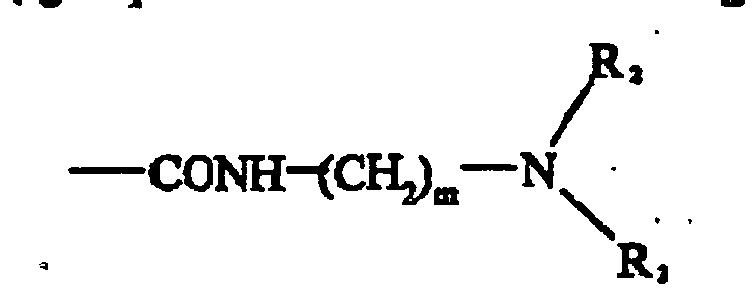
- Compound for use according to any one of the preceding claims, characteized in that alternatively:- the R1 group is in the para position with respect to the group

in that the R1 group is bonded to one of the rings and the group - Ar is a bi- or tricyclic heteroaryl and in that R1 is bonded to the ring, taken in isolation, not comprising a heteroatom or comprising the least thereof and the group
- Compound of formula (I')

W is chosen from a phenazinyl, imidazopyridyl, quinolyl, quinoxalinyl, acridinyl and acridonyl group,
it being possible for the said acridinyl group to be substituted by an aniline group itself substituted by three groups,- at least one of the substituents representing the (C1-C4)alkoxy group,- at least one of the substituents being chosen from an NHRc group where Rc represents a hydrogen, or a CORa group, a COORa group or an SO2Ra group, where Ra represents an aryl group or a (C1-C10)alkyl group optionally substituted by an oxo group, and- the remaining substituent representing a hydrogen or halogen atom,
R1, R2, R3 and m have the same meaning as that defined in any one of Claims 1 to 3, and
R8 represents a hydrogen atom, a (C1-C4)alkyl or (C1-C4)alkoxy group, an optionally labelled halogen atom, an -SH group, an -OH group or an -NR5R6 group where R5 and R6 can independently represent a hydrogen atom or a (C1-C4)alkyl group,
for use in a composition in the treatment of melanoma. - Compound for use in according to any one of the preceding claims, characterized in that the radionuclide is a radioisotope chosen from 113I, 124I, 125I, 131I, 75Br, 76Br, 77Br, 18F, 210At and 211At and is in particular 123I, 124I, 125I, or 131I.
- Compound of formula (II)
 R'1 represents a labelled halogen atom,m has the same meaning as that defined in Claim 1,
R2 and R3 represent, independently of one another, a (C1-C6)alkyl or a (C1-C6)alkenyl group, and
Ar is chosen from the pyridyl, indolyl, imidazopyridinyl, benzimidazolyl, quinolyl, quinolonyl, isoquinolyl, quinoxalinyl, naphthyridinyl and benzothienyl group. - Compound of formula (I")

R2, R3 and m are as defined according to Claim 1, R8 and W are as defined in Claim 4 and the iodine atom, being optionally a 123I, 124I, 125I or 131I. - Compound chosen from :- N-(2-diethylaminoethyl)-6-iodonicotinamide dihydrochloride;- N-(2-diethylaminoethyl)-5-iodoindole-2-carboxamide hydrochloride;- N-(2-diethylaminoethyl)-4-iodobenzo[b]thiophene-2-carboxamide hydrochloride;- N-(2-diethylaminoethyl)-3-iodoimidazo[1,2-a]pyridine-2-carboxamide dihydrochloride;- N-(2-diethylaminoethyl)-6-iodoimidazo[1,2-a]pyridine-2-carboxamide dihydrochloride;- N-(2-diethylaminoethyl)-5-iodobenzimidazole-2-carboxamide dihydrochloride;- N-(2-diethylaminoethyl)-6-iodoquinoline-2-carboxamide dihydrochloride;- N-(2-diethylaminoethyl)-1,4-dihydro-6-iodo-4-oxoquinoline-3-carboxamide hydrochloride;- N-(2-diethylaminoethyl)-5-iodoisoquinolino-3-carboxamide dihydrochloride;- N-(2-diethylaminoethyl)-6-iodoquinoxaline-2-carboxamide dihydrochloride;- N-(4-dipropylaminobutyl)-6-iodoquinoline-2-carboxamide dihydrochloride;- N-(2-diethyllaminoethyl)-9,10-dihydro-1-iodo-9-oxacridine-4-carboxamide hydrochloride;- N-(2-diethylaminoethyl)-9,10-dihydro-2-iodo-9-oxoacridine-4-carboxamide hydrochloride;- N-(2-diethylaminoethyl)-9,10-dihydro-3-iodo-9-oxoacridine-4-carboxamide hydrochloride:- N-(2-diethylaminoethyl)-9,10-dihydro-5-iodo-9-oxoacridine-4-carboxamide hydrochloride;- N-(2-diethylaminoethyl)-9,10-dihydro-6-iodo-9-oxoacridine-4-carboxamide hydrochloride;- N-(2-(diethylaminoethyl)-9,10-dihydro-7-iodo-9-oxoacridine-4-carboxamide hydrochloride;- N-(2-diethylaminoethyl)-9,10-dihydro-8-iodo-9-oxoacridine-4-carboxamide hydrochloride;- N(2-diethylaminoethyl)-1-iodoacridine-4-carboxamide dihydrochloride;- N-(2-diethylaminoethyl)-2-iodoacridine-4-carboxamide dihydrochloride;- N-(2-diethylaminoethyl)-3-iodoacridine-4-carboxamide dihydrochloride;- N-(2-diethylaminoethyl)-5-iodoacridine-4-carboxamide dihydrochloride ;- N-(2-diethylaminoethyl)-6-iodoacridine-4-carboxamide dihydrochloride;- N-(2-diethylaminoethyl)-7-iodoacridine-4-carboxamide dihydrochloride;- N-(2-diethylaminoethyl)-8-iodoacridine-4-carboxamide dihydrochloride;- N-(2-diethylaminoethyl)-2-iodoacridine-9-carboxamide dihydrochloride:- N-(2-diethylaminoethyl)-2,7-diiodoacridine-9-carboxamide dihydrochloride;- N-(2-diethylaminoethyl)-2-iodo-9-(4-methanesulphonamido-2-methoxyanilino)acridine-4-carboxamide dihydrochloride;- N-(2-diethylaminoethyl)-5-iodo-9-(4-methanesulphonamido-2-methoxyanilino)acridine-4-carboxamide dihydrochloride;- N-(2-diethylaminoethyl)-7-iodo-9-(4-methanesulphonamido-2-methoxyanilino)acridine-4-carboxamide dihydrochloride;- N-(2-diethylaminoethyl)-9-(5-iodo-4-methanesulphonamido-2-methoxyanilino)acridine-4-carboxamide dihydrochloride;- N-(2-diethylaminoethyl)-8-iodo-1,6-naphthyridine-2-carboxamide dihydrochloride:- N-(4-dipropylaminobutyl)-6-iodoquinoxaline-2-carboxamide dihydrochloride;- N-(2-diethylaminoethyl)-7-iodophenazine-1-carboxamide dihydrochloride;- and their pharmaceutically acceptable salts.
- Process for the preparation of the compound of formula (I") according to Claim 7 or of the compound of formula (II) according to Claim 6, characterized in that it consists in condensing an ester of formula (III)

H2N-(CH2)m-NR2R3 (IV)
in which R2, R3, m and R1 are as defined in Claim 1 and R4 represents a (C1-C6)alkyl, aryl or heteroaryl group. - Compound of formula (VII)
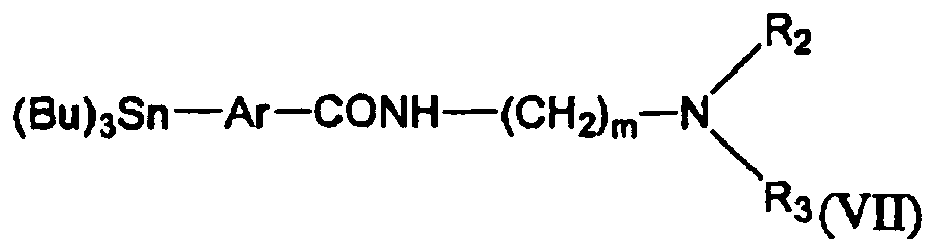
Ar, m, R2 and R3 are as defined in Claim 1 to 3. - Radiopharmaceutical composition comprising, as active principle, a compound of formula (I), wherein R2 and R3 represent, independently of one another, a (C1-C6)alkyl group or a (C1-C6)alkenyl group or of formula (I'), (I") or (II) or one of its pharmaceutically acceptable salts as defined according to any one of Claims 1 to 8.
- Compound of formula (I") as defined according to Claim 7 or compound of formula (II) or of one of its pharmaceutically acceptable salts according to Claim 6, the said compound comprising a radionuclide, for use in a radiopharmaceutical composition in medical imaging.
- Compound for use according to claim 12, wherein the radiopharmaceutical composition is intended for the diagnosis of melanomas.
- Compound (I") as defined according to Claim 7 or compound of formula (II) or of one of its pharmaceutically acceptable salts according to Claim 6 for use in a radiopharmaceutical composition in the treatment of melanomas.
- Process for the preparation of a compound of formula (VI).

characterized in that it comprises a stage of reduction of the acridone of formula (IIIa)
Priority Applications (1)
| Application Number | Priority Date | Filing Date | Title |
|---|---|---|---|
| EP11167370A EP2363399A1 (en) | 2006-07-27 | 2007-07-27 | Labelled analogues of halobenzamides as radiopharmaceuticals |
Applications Claiming Priority (2)
| Application Number | Priority Date | Filing Date | Title |
|---|---|---|---|
| FR0653138A FR2904317A1 (en) | 2006-07-27 | 2006-07-27 | ANALOGUES OF HALOGENOBENZAMIDES BRANDED AS RADIOPHARMACEUTICALS |
| PCT/IB2007/052992 WO2008012782A2 (en) | 2006-07-27 | 2007-07-27 | Labelled analogues of halobenzamides as radiopharmaceuticals |
Related Child Applications (1)
| Application Number | Title | Priority Date | Filing Date |
|---|---|---|---|
| EP11167370A Division-Into EP2363399A1 (en) | 2006-07-27 | 2007-07-27 | Labelled analogues of halobenzamides as radiopharmaceuticals |
Publications (2)
| Publication Number | Publication Date |
|---|---|
| EP2046789A2 EP2046789A2 (en) | 2009-04-15 |
| EP2046789B1 true EP2046789B1 (en) | 2012-09-05 |
Family
ID=37882134
Family Applications (2)
| Application Number | Title | Priority Date | Filing Date |
|---|---|---|---|
| EP07805258A Active EP2046789B1 (en) | 2006-07-27 | 2007-07-27 | Labelled analogues of halobenzamides as radiopharmaceuticals |
| EP11167370A Withdrawn EP2363399A1 (en) | 2006-07-27 | 2007-07-27 | Labelled analogues of halobenzamides as radiopharmaceuticals |
Family Applications After (1)
| Application Number | Title | Priority Date | Filing Date |
|---|---|---|---|
| EP11167370A Withdrawn EP2363399A1 (en) | 2006-07-27 | 2007-07-27 | Labelled analogues of halobenzamides as radiopharmaceuticals |
Country Status (6)
| Country | Link |
|---|---|
| US (1) | US20100061928A1 (en) |
| EP (2) | EP2046789B1 (en) |
| AU (1) | AU2007278041B9 (en) |
| ES (1) | ES2394274T3 (en) |
| FR (1) | FR2904317A1 (en) |
| WO (1) | WO2008012782A2 (en) |
Cited By (1)
| Publication number | Priority date | Publication date | Assignee | Title |
|---|---|---|---|---|
| CN107311927A (en) * | 2017-08-04 | 2017-11-03 | 福建医科大学 | A kind of amino acridones of 10 methyl of two-photon fluorescence probe 2 and its preparation method and application |
Families Citing this family (10)
| Publication number | Priority date | Publication date | Assignee | Title |
|---|---|---|---|---|
| EP2085390A1 (en) | 2008-01-31 | 2009-08-05 | Institut National De La Sante Et De La Recherche Medicale (Inserm) | Labelled analogues of halobenzamides as multimodal radiopharmaceuticals and their precursors |
| EP2285778A4 (en) * | 2008-04-22 | 2011-05-11 | Crc For Biomedical Imaging Dev Ltd | DERIVATIVES OF NICOTINAMIDE |
| EP2876105A4 (en) | 2012-07-19 | 2016-01-13 | Sumitomo Dainippon Pharma Co Ltd | 1- (CYCLOALKYL-CARBONYL) PROLINE DERIVATIVE |
| EP2922540A1 (en) | 2012-11-20 | 2015-09-30 | F. Hoffmann-La Roche AG | Substituted 1,6-naphthyridines |
| HK1226390A1 (en) | 2014-01-14 | 2017-09-29 | 大日本住友制药株式会社 | Condensed 5-oxazolidinone derivative |
| CN110770224B (en) | 2017-03-10 | 2022-11-18 | 罗格斯新泽西州立大学 | Indole derivatives as efflux pump inhibitors |
| CN107903210B (en) * | 2017-12-25 | 2021-01-26 | 三峡大学 | Small molecule inhibitor SLD4650 and application thereof in pharmacy |
| WO2019152883A1 (en) * | 2018-02-02 | 2019-08-08 | Padforward Llc | Inhibitors of protein arginine deiminases |
| KR102302065B1 (en) * | 2018-06-28 | 2021-09-15 | 전남대학교 산학협력단 | A novel radioactive compound for treating melanoma and use thereof |
| WO2025108921A1 (en) | 2023-11-22 | 2025-05-30 | Institut National de la Santé et de la Recherche Médicale | Synthesis of radiopharmaceutical agents |
Family Cites Families (15)
| Publication number | Priority date | Publication date | Assignee | Title |
|---|---|---|---|---|
| US656417A (en) | 1899-12-14 | 1900-08-21 | Robert Hoe | Dispensing-can. |
| FR1525M (en) * | 1961-07-25 | 1962-11-16 | Ile De France | New antiemetic drugs. |
| IE54220B1 (en) * | 1981-12-23 | 1989-07-19 | Ici Plc | Phenol esters |
| CA1261335A (en) * | 1984-08-29 | 1989-09-26 | Hoffmann-La Roche Limited/Hoffmann-La Roche Limitee | Ethylenediamine monoamide derivatives |
| FR2642972B1 (en) * | 1989-02-14 | 1994-08-05 | Inst Nat Sante Rech Med | AGENTS FOR THE DIAGNOSIS AND TREATMENT OF MELANOMAS, HALOGENATED AROMATIC DERIVATIVES SUITABLE FOR USE AS SUCH AGENTS AND THEIR PREPARATION |
| EP0642343B1 (en) | 1992-05-28 | 2000-08-30 | Xenova Limited | Acridine carboxamides for the treatment of cancer |
| AU662434B2 (en) | 1992-08-07 | 1995-08-31 | Sankyo Company Limited | Peptides capable of inhibiting the activity of HIV protease, their preparation and their use |
| US5911970A (en) * | 1993-05-06 | 1999-06-15 | Research Corporation Technologies, Inc. | Methods for cancer imaging and therapy using benzamine compounds |
| GB2333293B (en) | 1996-10-18 | 2000-07-12 | Xenova Ltd | Process for the preparation of N-[2-(dimethylamino)ethyl]acridine-4-carboxamide used as anti cancer compounds |
| US5914327A (en) * | 1996-11-26 | 1999-06-22 | American Cyanamid Company | Biaryl-pyridoquinazolinone derivatives as anti-cancer agents |
| US6821983B2 (en) | 2003-04-04 | 2004-11-23 | Academia Sinica | 5-(9-acridinylamino)-toluidine compounds |
| EA200600203A1 (en) | 2003-08-08 | 2006-08-25 | Янссен Фармацевтика, Н. В. | DERIVATIVES 2- (CHINOXALIN-5-ILSULPHONYLAMINO) BENZAMIDE IN THE QUALITY OF CCK2 MODULATORS |
| DE10351744A1 (en) * | 2003-10-31 | 2005-06-16 | Schering Ag | Thiazolidinones, their preparation and use as pharmaceuticals |
| WO2005118580A2 (en) | 2004-05-12 | 2005-12-15 | The Government Of The United States Of America As Represented By The Secretary, Department Of Health | Tricyclic compounds as inhibitors of the hypoxic signaling pathway |
| EP2085390A1 (en) * | 2008-01-31 | 2009-08-05 | Institut National De La Sante Et De La Recherche Medicale (Inserm) | Labelled analogues of halobenzamides as multimodal radiopharmaceuticals and their precursors |
-
2006
- 2006-07-27 FR FR0653138A patent/FR2904317A1/en active Pending
-
2007
- 2007-07-27 AU AU2007278041A patent/AU2007278041B9/en active Active
- 2007-07-27 EP EP07805258A patent/EP2046789B1/en active Active
- 2007-07-27 US US12/375,044 patent/US20100061928A1/en not_active Abandoned
- 2007-07-27 ES ES07805258T patent/ES2394274T3/en active Active
- 2007-07-27 WO PCT/IB2007/052992 patent/WO2008012782A2/en not_active Ceased
- 2007-07-27 EP EP11167370A patent/EP2363399A1/en not_active Withdrawn
Non-Patent Citations (1)
| Title |
|---|
| BEER H-F ET AL: "[<123>I<18>F] N-(2-aminoethyl)-5-halogeno-2-pyridinecarbox-amides, site specific tracers for MAO-B mapping with SPET and PET", NUCLEAR MEDICINE AND BIOLOGY, ELSEVIER, NY, US, vol. 22, no. 8, 1 November 1995 (1995-11-01), pages 999 - 1004, XP004051704, ISSN: 0969-8051, DOI: 10.1016/0969-8051(95)02022-5 * |
Cited By (1)
| Publication number | Priority date | Publication date | Assignee | Title |
|---|---|---|---|---|
| CN107311927A (en) * | 2017-08-04 | 2017-11-03 | 福建医科大学 | A kind of amino acridones of 10 methyl of two-photon fluorescence probe 2 and its preparation method and application |
Also Published As
| Publication number | Publication date |
|---|---|
| EP2363399A1 (en) | 2011-09-07 |
| ES2394274T3 (en) | 2013-01-30 |
| AU2007278041A1 (en) | 2008-01-31 |
| AU2007278041B2 (en) | 2012-08-16 |
| WO2008012782A2 (en) | 2008-01-31 |
| US20100061928A1 (en) | 2010-03-11 |
| WO2008012782A3 (en) | 2008-06-05 |
| FR2904317A1 (en) | 2008-02-01 |
| EP2046789A2 (en) | 2009-04-15 |
| AU2007278041B9 (en) | 2012-11-22 |
Similar Documents
| Publication | Publication Date | Title |
|---|---|---|
| US20100061928A1 (en) | Labelled analogues of halobenzamides as radiopharmaceuticals | |
| AU2009208631B2 (en) | Labelled analogues of halobenzamides as multimodal radiopharmaceuticals and their precursors | |
| CA2736097C (en) | Carbazole compounds for inhibition of nf-kb activity | |
| EP2818171B1 (en) | Antitumor aza-benzo[f]azulen derivative, method for preparing same, and use thereof | |
| CN101323591A (en) | A class of 5- or 6-substituted naphthalimide compounds and antitumor applications | |
| AU2008274100B2 (en) | Derivatives of 7-alkynyl-1,8-naphthyridones, preparation method thereof and use of same in therapeutics | |
| Zou et al. | Synthesis and evaluation of N-heteroaromatic ring-based analogs of piperlongumine as potent anticancer agents | |
| CN104119330B (en) | Synthesis of berberine derivative and application thereof in preparation of antitumor drug and synergetic adriamycin antitumor drug composition | |
| CN102260260B (en) | 8-phenyl xanthine compound, preparation method, medicine composition including the compound and purpose thereof | |
| Jung et al. | Synthesis and in vitro cytotoxicity of 1, 3-dioxoindan-2-carboxylic acid arylamides | |
| AU2013254326A1 (en) | Labelled quinoxaline derivatives as multimodal radiopharmaceuticals and their precursors | |
| EA003941B1 (en) | 2-aminopyridines containing fused ring substituents | |
| US9045437B2 (en) | 2-aryl-4-quinazolinones and their pharmaceutical compositions | |
| JP2015531379A (en) | Dihydro-6-azaphenalene derivatives for the treatment of CNS, tumor diseases and related disorders | |
| CN102558144A (en) | Aryl urea derivatives | |
| US20170015664A1 (en) | Fused Acridine Derivative and Pharmaceutical Composition, Preparation Method and Use Thereof | |
| US12617787B2 (en) | Merged scaffold TAF1 inhibitors | |
| KR100563195B1 (en) | Novel benzofluorene dione compounds | |
| IE920704A1 (en) | Nitrogen oxides of aza- and diaza-anthracenedione¹derivatives as antitumor agents | |
| CN108947904A (en) | A kind of compound containing seven membered lactams rings and its application | |
| KR20260044232A (en) | Substituted nitrogen-containing cyclic compounds and their uses | |
| KR20050021629A (en) | Novel benzofluorene dione derivatives | |
| TW201305128A (en) | Compound for the treatment of tumours and tumour metastases |
Legal Events
| Date | Code | Title | Description |
|---|---|---|---|
| PUAI | Public reference made under article 153(3) epc to a published international application that has entered the european phase |
Free format text: ORIGINAL CODE: 0009012 |
|
| 17P | Request for examination filed |
Effective date: 20090113 |
|
| AK | Designated contracting states |
Kind code of ref document: A2 Designated state(s): AT BE BG CH CY CZ DE DK EE ES FI FR GB GR HU IE IS IT LI LT LU LV MC MT NL PL PT RO SE SI SK TR |
|
| AX | Request for extension of the european patent |
Extension state: AL BA HR MK RS |
|
| 17Q | First examination report despatched |
Effective date: 20090526 |
|
| DAX | Request for extension of the european patent (deleted) | ||
| GRAP | Despatch of communication of intention to grant a patent |
Free format text: ORIGINAL CODE: EPIDOSNIGR1 |
|
| GRAS | Grant fee paid |
Free format text: ORIGINAL CODE: EPIDOSNIGR3 |
|
| GRAA | (expected) grant |
Free format text: ORIGINAL CODE: 0009210 |
|
| AK | Designated contracting states |
Kind code of ref document: B1 Designated state(s): AT BE BG CH CY CZ DE DK EE ES FI FR GB GR HU IE IS IT LI LT LU LV MC MT NL PL PT RO SE SI SK TR |
|
| REG | Reference to a national code |
Ref country code: GB Ref legal event code: FG4D |
|
| REG | Reference to a national code |
Ref country code: CH Ref legal event code: EP |
|
| REG | Reference to a national code |
Ref country code: AT Ref legal event code: REF Ref document number: 574073 Country of ref document: AT Kind code of ref document: T Effective date: 20120915 |
|
| REG | Reference to a national code |
Ref country code: IE Ref legal event code: FG4D |
|
| REG | Reference to a national code |
Ref country code: DE Ref legal event code: R096 Ref document number: 602007025321 Country of ref document: DE Effective date: 20121031 |
|
| REG | Reference to a national code |
Ref country code: AT Ref legal event code: MK05 Ref document number: 574073 Country of ref document: AT Kind code of ref document: T Effective date: 20120905 |
|
| REG | Reference to a national code |
Ref country code: ES Ref legal event code: FG2A Ref document number: 2394274 Country of ref document: ES Kind code of ref document: T3 Effective date: 20130130 Ref country code: NL Ref legal event code: VDEP Effective date: 20120905 |
|
| PG25 | Lapsed in a contracting state [announced via postgrant information from national office to epo] |
Ref country code: FI Free format text: LAPSE BECAUSE OF FAILURE TO SUBMIT A TRANSLATION OF THE DESCRIPTION OR TO PAY THE FEE WITHIN THE PRESCRIBED TIME-LIMIT Effective date: 20120905 Ref country code: AT Free format text: LAPSE BECAUSE OF FAILURE TO SUBMIT A TRANSLATION OF THE DESCRIPTION OR TO PAY THE FEE WITHIN THE PRESCRIBED TIME-LIMIT Effective date: 20120905 Ref country code: CY Free format text: LAPSE BECAUSE OF FAILURE TO SUBMIT A TRANSLATION OF THE DESCRIPTION OR TO PAY THE FEE WITHIN THE PRESCRIBED TIME-LIMIT Effective date: 20120905 Ref country code: LT Free format text: LAPSE BECAUSE OF FAILURE TO SUBMIT A TRANSLATION OF THE DESCRIPTION OR TO PAY THE FEE WITHIN THE PRESCRIBED TIME-LIMIT Effective date: 20120905 |
|
| REG | Reference to a national code |
Ref country code: LT Ref legal event code: MG4D Effective date: 20120905 |
|
| PG25 | Lapsed in a contracting state [announced via postgrant information from national office to epo] |
Ref country code: LV Free format text: LAPSE BECAUSE OF FAILURE TO SUBMIT A TRANSLATION OF THE DESCRIPTION OR TO PAY THE FEE WITHIN THE PRESCRIBED TIME-LIMIT Effective date: 20120905 Ref country code: SE Free format text: LAPSE BECAUSE OF FAILURE TO SUBMIT A TRANSLATION OF THE DESCRIPTION OR TO PAY THE FEE WITHIN THE PRESCRIBED TIME-LIMIT Effective date: 20120905 Ref country code: SI Free format text: LAPSE BECAUSE OF FAILURE TO SUBMIT A TRANSLATION OF THE DESCRIPTION OR TO PAY THE FEE WITHIN THE PRESCRIBED TIME-LIMIT Effective date: 20120905 Ref country code: GR Free format text: LAPSE BECAUSE OF FAILURE TO SUBMIT A TRANSLATION OF THE DESCRIPTION OR TO PAY THE FEE WITHIN THE PRESCRIBED TIME-LIMIT Effective date: 20121206 |
|
| PG25 | Lapsed in a contracting state [announced via postgrant information from national office to epo] |
Ref country code: EE Free format text: LAPSE BECAUSE OF FAILURE TO SUBMIT A TRANSLATION OF THE DESCRIPTION OR TO PAY THE FEE WITHIN THE PRESCRIBED TIME-LIMIT Effective date: 20120905 Ref country code: RO Free format text: LAPSE BECAUSE OF FAILURE TO SUBMIT A TRANSLATION OF THE DESCRIPTION OR TO PAY THE FEE WITHIN THE PRESCRIBED TIME-LIMIT Effective date: 20120905 Ref country code: IS Free format text: LAPSE BECAUSE OF FAILURE TO SUBMIT A TRANSLATION OF THE DESCRIPTION OR TO PAY THE FEE WITHIN THE PRESCRIBED TIME-LIMIT Effective date: 20130105 Ref country code: NL Free format text: LAPSE BECAUSE OF FAILURE TO SUBMIT A TRANSLATION OF THE DESCRIPTION OR TO PAY THE FEE WITHIN THE PRESCRIBED TIME-LIMIT Effective date: 20120905 Ref country code: BE Free format text: LAPSE BECAUSE OF FAILURE TO SUBMIT A TRANSLATION OF THE DESCRIPTION OR TO PAY THE FEE WITHIN THE PRESCRIBED TIME-LIMIT Effective date: 20120905 Ref country code: CZ Free format text: LAPSE BECAUSE OF FAILURE TO SUBMIT A TRANSLATION OF THE DESCRIPTION OR TO PAY THE FEE WITHIN THE PRESCRIBED TIME-LIMIT Effective date: 20120905 |
|
| PG25 | Lapsed in a contracting state [announced via postgrant information from national office to epo] |
Ref country code: PT Free format text: LAPSE BECAUSE OF FAILURE TO SUBMIT A TRANSLATION OF THE DESCRIPTION OR TO PAY THE FEE WITHIN THE PRESCRIBED TIME-LIMIT Effective date: 20130107 Ref country code: SK Free format text: LAPSE BECAUSE OF FAILURE TO SUBMIT A TRANSLATION OF THE DESCRIPTION OR TO PAY THE FEE WITHIN THE PRESCRIBED TIME-LIMIT Effective date: 20120905 Ref country code: PL Free format text: LAPSE BECAUSE OF FAILURE TO SUBMIT A TRANSLATION OF THE DESCRIPTION OR TO PAY THE FEE WITHIN THE PRESCRIBED TIME-LIMIT Effective date: 20120905 |
|
| PLBE | No opposition filed within time limit |
Free format text: ORIGINAL CODE: 0009261 |
|
| STAA | Information on the status of an ep patent application or granted ep patent |
Free format text: STATUS: NO OPPOSITION FILED WITHIN TIME LIMIT |
|
| PG25 | Lapsed in a contracting state [announced via postgrant information from national office to epo] |
Ref country code: BG Free format text: LAPSE BECAUSE OF FAILURE TO SUBMIT A TRANSLATION OF THE DESCRIPTION OR TO PAY THE FEE WITHIN THE PRESCRIBED TIME-LIMIT Effective date: 20121205 Ref country code: DK Free format text: LAPSE BECAUSE OF FAILURE TO SUBMIT A TRANSLATION OF THE DESCRIPTION OR TO PAY THE FEE WITHIN THE PRESCRIBED TIME-LIMIT Effective date: 20120905 |
|
| 26N | No opposition filed |
Effective date: 20130606 |
|
| REG | Reference to a national code |
Ref country code: DE Ref legal event code: R097 Ref document number: 602007025321 Country of ref document: DE Effective date: 20130606 |
|
| PG25 | Lapsed in a contracting state [announced via postgrant information from national office to epo] |
Ref country code: MC Free format text: LAPSE BECAUSE OF FAILURE TO SUBMIT A TRANSLATION OF THE DESCRIPTION OR TO PAY THE FEE WITHIN THE PRESCRIBED TIME-LIMIT Effective date: 20120905 |
|
| REG | Reference to a national code |
Ref country code: CH Ref legal event code: PL |
|
| REG | Reference to a national code |
Ref country code: IE Ref legal event code: MM4A |
|
| PG25 | Lapsed in a contracting state [announced via postgrant information from national office to epo] |
Ref country code: CH Free format text: LAPSE BECAUSE OF NON-PAYMENT OF DUE FEES Effective date: 20130731 Ref country code: LI Free format text: LAPSE BECAUSE OF NON-PAYMENT OF DUE FEES Effective date: 20130731 |
|
| PG25 | Lapsed in a contracting state [announced via postgrant information from national office to epo] |
Ref country code: IE Free format text: LAPSE BECAUSE OF NON-PAYMENT OF DUE FEES Effective date: 20130727 |
|
| PG25 | Lapsed in a contracting state [announced via postgrant information from national office to epo] |
Ref country code: MT Free format text: LAPSE BECAUSE OF FAILURE TO SUBMIT A TRANSLATION OF THE DESCRIPTION OR TO PAY THE FEE WITHIN THE PRESCRIBED TIME-LIMIT Effective date: 20120905 Ref country code: TR Free format text: LAPSE BECAUSE OF FAILURE TO SUBMIT A TRANSLATION OF THE DESCRIPTION OR TO PAY THE FEE WITHIN THE PRESCRIBED TIME-LIMIT Effective date: 20120905 |
|
| PG25 | Lapsed in a contracting state [announced via postgrant information from national office to epo] |
Ref country code: HU Free format text: LAPSE BECAUSE OF FAILURE TO SUBMIT A TRANSLATION OF THE DESCRIPTION OR TO PAY THE FEE WITHIN THE PRESCRIBED TIME-LIMIT; INVALID AB INITIO Effective date: 20070727 Ref country code: LU Free format text: LAPSE BECAUSE OF NON-PAYMENT OF DUE FEES Effective date: 20130727 |
|
| REG | Reference to a national code |
Ref country code: FR Ref legal event code: PLFP Year of fee payment: 10 |
|
| REG | Reference to a national code |
Ref country code: FR Ref legal event code: PLFP Year of fee payment: 11 |
|
| REG | Reference to a national code |
Ref country code: FR Ref legal event code: PLFP Year of fee payment: 12 |
|
| P01 | Opt-out of the competence of the unified patent court (upc) registered |
Effective date: 20230524 |
|
| PGFP | Annual fee paid to national office [announced via postgrant information from national office to epo] |
Ref country code: GB Payment date: 20250619 Year of fee payment: 19 |
|
| PGFP | Annual fee paid to national office [announced via postgrant information from national office to epo] |
Ref country code: FR Payment date: 20250620 Year of fee payment: 19 |
|
| PGFP | Annual fee paid to national office [announced via postgrant information from national office to epo] |
Ref country code: ES Payment date: 20250801 Year of fee payment: 19 |
|
| PGFP | Annual fee paid to national office [announced via postgrant information from national office to epo] |
Ref country code: DE Payment date: 20250620 Year of fee payment: 19 |
|
| PGFP | Annual fee paid to national office [announced via postgrant information from national office to epo] |
Ref country code: IT Payment date: 20250619 Year of fee payment: 19 |