EP2045282A1 - A method of modifying a macromolecular system - Google Patents
A method of modifying a macromolecular system Download PDFInfo
- Publication number
- EP2045282A1 EP2045282A1 EP09150865A EP09150865A EP2045282A1 EP 2045282 A1 EP2045282 A1 EP 2045282A1 EP 09150865 A EP09150865 A EP 09150865A EP 09150865 A EP09150865 A EP 09150865A EP 2045282 A1 EP2045282 A1 EP 2045282A1
- Authority
- EP
- European Patent Office
- Prior art keywords
- group
- macromolecule
- general formula
- integer
- compound
- Prior art date
- Legal status (The legal status is an assumption and is not a legal conclusion. Google has not performed a legal analysis and makes no representation as to the accuracy of the status listed.)
- Granted
Links
- 0 C*(CCO)OCC*(C)OCCN(C(c1c2cccc1)=O)C2=O Chemical compound C*(CCO)OCC*(C)OCCN(C(c1c2cccc1)=O)C2=O 0.000 description 4
- PHZYUQLIZKTSJE-UHFFFAOYSA-N OC(COCCN(C(c1ccccc11)=O)C1=O)=O Chemical compound OC(COCCN(C(c1ccccc11)=O)C1=O)=O PHZYUQLIZKTSJE-UHFFFAOYSA-N 0.000 description 1
- MWFLUYFYHANMCM-UHFFFAOYSA-N OCCN(C(c1c2cccc1)=O)C2=O Chemical compound OCCN(C(c1c2cccc1)=O)C2=O MWFLUYFYHANMCM-UHFFFAOYSA-N 0.000 description 1
- XUBXAMMSXZKRKG-UHFFFAOYSA-N OCCOCCCN(C(c1ccccc11)=O)C1=O Chemical compound OCCOCCCN(C(c1ccccc11)=O)C1=O XUBXAMMSXZKRKG-UHFFFAOYSA-N 0.000 description 1
Images
Classifications
-
- C—CHEMISTRY; METALLURGY
- C08—ORGANIC MACROMOLECULAR COMPOUNDS; THEIR PREPARATION OR CHEMICAL WORKING-UP; COMPOSITIONS BASED THEREON
- C08G—MACROMOLECULAR COMPOUNDS OBTAINED OTHERWISE THAN BY REACTIONS ONLY INVOLVING UNSATURATED CARBON-TO-CARBON BONDS
- C08G65/00—Macromolecular compounds obtained by reactions forming an ether link in the main chain of the macromolecule
- C08G65/02—Macromolecular compounds obtained by reactions forming an ether link in the main chain of the macromolecule from cyclic ethers by opening of the heterocyclic ring
- C08G65/26—Macromolecular compounds obtained by reactions forming an ether link in the main chain of the macromolecule from cyclic ethers by opening of the heterocyclic ring from cyclic ethers and other compounds
- C08G65/2618—Macromolecular compounds obtained by reactions forming an ether link in the main chain of the macromolecule from cyclic ethers by opening of the heterocyclic ring from cyclic ethers and other compounds the other compounds containing nitrogen
-
- C—CHEMISTRY; METALLURGY
- C08—ORGANIC MACROMOLECULAR COMPOUNDS; THEIR PREPARATION OR CHEMICAL WORKING-UP; COMPOSITIONS BASED THEREON
- C08G—MACROMOLECULAR COMPOUNDS OBTAINED OTHERWISE THAN BY REACTIONS ONLY INVOLVING UNSATURATED CARBON-TO-CARBON BONDS
- C08G65/00—Macromolecular compounds obtained by reactions forming an ether link in the main chain of the macromolecule
- C08G65/02—Macromolecular compounds obtained by reactions forming an ether link in the main chain of the macromolecule from cyclic ethers by opening of the heterocyclic ring
- C08G65/32—Polymers modified by chemical after-treatment
- C08G65/329—Polymers modified by chemical after-treatment with organic compounds
- C08G65/331—Polymers modified by chemical after-treatment with organic compounds containing oxygen
-
- Y—GENERAL TAGGING OF NEW TECHNOLOGICAL DEVELOPMENTS; GENERAL TAGGING OF CROSS-SECTIONAL TECHNOLOGIES SPANNING OVER SEVERAL SECTIONS OF THE IPC; TECHNICAL SUBJECTS COVERED BY FORMER USPC CROSS-REFERENCE ART COLLECTIONS [XRACs] AND DIGESTS
- Y02—TECHNOLOGIES OR APPLICATIONS FOR MITIGATION OR ADAPTATION AGAINST CLIMATE CHANGE
- Y02P—CLIMATE CHANGE MITIGATION TECHNOLOGIES IN THE PRODUCTION OR PROCESSING OF GOODS
- Y02P20/00—Technologies relating to chemical industry
- Y02P20/50—Improvements relating to the production of bulk chemicals
- Y02P20/55—Design of synthesis routes, e.g. reducing the use of auxiliary or protecting groups
Definitions
- the invention relates to methods of modifying a macromolecule, in particular a polymer matrix, by functionalisation with molecular entities comprising a reactive moiety, an alkylene oxide spacer arm and a functional group comprising a protected primary amine.
- a primary amine is a very versatile functional group, which can be used both a starting point for various chemical reactions and for modifying the physiochemical properties of the macromolecular system.
- poly- or oligo-alkylene oxides represent a family of molecular fragments that can be used for such functional arms, while exhibiting a high compatibility towards biological or chemical environments depending on the application.
- the macromolecular systems where such molecular entities are useful for forming amine functionalised products include biological molecules such as proteins and nucleotides, beaded materials for peptide synthesis, resins for chromatography, polymeric materials for filtration, as well as surface layers for use in medicinal components, in vivo or in vitro diagnostic components, analytical systems, etc.
- the primary amine functionality has been obtained as a terminal functional group on a long alkoxide spacer arm attached to a polymer resin.
- the primary amine - alkoxide spacer arm moiety is formed in a stepwise fashion i.e. the alkoxide spacer arm is attached followed by the attachment of the primary amine to the alkoxide spacer arm using reactions as described above.
- the chemistry involved in the methods described above requires quite harsh conditions which often are incompatible with the macromolecular systems. Especially biological macromolecules are degraded, but also resins used for chromatography can be harmed under such conditions. In the later case this is especially important for macroporous resins where the harsh condition will alter the porosity of the resins.
- the mentioned reactions rarely are quantitative, which give rise to undesired side products.
- unsymmetrical alkylene oxides prepared from ethylene glycol in which one terminal group is an amine and one terminal group is a hydroxide do exist. These compounds mainly exist as short oligomeric versions where the separation from the symmetrical alkylene oxides is possible. Moreover, the high cost of producing these molecules and the difficulty in selectively converting the hydroxy functionality into a reactive group that can be reacted with a macromolecular system strongly limit the industrial applicability of these compounds for the functionalisation of macromolecular systems.
- the present invention relates to a method of modifying a macromolecule, in particular a polymer matrix, e.g. polymer matrixes used as solid supports for synthesis as well as for chromatographic purposes.
- a polymer matrix e.g. polymer matrixes used as solid supports for synthesis as well as for chromatographic purposes.
- the present invention relates to a method of modifying a macromolecule, in particular a polymer matrix, the method comprising the steps of
- the compound useful for the modification of macromolecules in particular polymer matrixes, can be represented by compounds of the general formula (I): wherein
- the compounds of the general formula (I) are of the "protected amino"-poly(oxyalkylene)-type.
- the methods are suitable for introducing into macromolecules (e.g. polymer matrixes) a primary amino group via a generally hydrophilic linker.
- the compounds of the general formula (I) comprise a ⁇ P ⁇ -N moiety, representing a primary amino group protected with the protecting group P, wherein the protecting group involves both free valences of the primary amino group.
- protecting groups of the imide type may be those selected from succinic anhydrides/succinic acids (succinimides) and phthalic anhydrides/phthalic acids (phthalimides).
- the protecting group is of the imide type.
- protecting groups are succinic anhydride/succinic acids (succinimides) and phthalic anhydride/phthalic acids (phthalimides), in particular phthalic anhydride/phthalic acids (phthalimides).
- n is an integer of 1-2000, more typically 1-100, or 1-50, or 1-10 or 1-8, such as 1-6, or 1-5, or 1-4, or 1-3, 1-2, or 2-6, or 2-4, or 1.
- R 1 and R 2 are independently selected from the group consisting of hydrogen and C 1-4 -alkyl.
- C 1-4 -alkyl encompasses methyl, ethyl, 1-propyl, 2-propyl, 1-butyl, 2-butyl, tert-butyl and (2-methyl)-prop-1-yl.
- R 1 and R 2 are independently selected from hydrogen and methyl, hence compounds having ethylene glycol and propylene glycol fragments.
- the currently most preferred embodiments are those where all of R 1 and R 2 are hydrogen, i.e. corresponding to compounds having ethylene glycol fragments.
- the reactive group is designed to be capable of reacting with simple functionalities on the macromolecule (e.g. polymer matrix), e.g. amines, alcohol and thiol functionalities, possibly after activation of such groups.
- reactive groups containing small cyclic ether such as oxiranes (epoxides) and oxethanes can be used, but also functional groups such as isocyanates, carboxylic acids, acid chlorides or activated vinylic compounds may be used.
- Particular examples are reactive groups containing oxiranes and oxethanes of which a suitable oxirane-containing reactive groups (X) may be the one derived from epichlorohydrin (see Example 5).
- a reactive group is a carboxylic acid-containing reactive group, e.g. as illustrated in Example 7.
- a CH 2 group is included as a part of the reactive group X, cf. CH 2 (O)CHCH 2 - in Example 5 and HOOCCH 2 - in Example 7.
- the molecular entity is formed via the polyalkoxylation of an N-protected hydroxy alkylamine, followed by the attachment of the reactive moiety via a C-O bond.
- This is a cost efficient route to unsymmetrical polyalkylene oxides, by careful selection of catalysts and reaction time the good control of chain length and purity can be obtained.
- alkylene oxides such as ethylene oxide and propylene oxide the molecular structure and hydrophilicity of the product can be controlled.
- the starting point for this synthesis is the protected hydroxy alkylamine (b).
- Examples of simple, useful alkyl amines include ethanolamine, 3-hydproxypropylamine, 2-hydroxypropylamine. Also more complex amines such as 3-oxy-5-hydroxy-1-pentanamine or 4-hydroxymethyl-benzylamine can be used.
- the amine group on the hydroxyalkyl amine (a) is protected with a protecting group which allows the ethoxylation and subsequent attachment of the reactive moiety. Protection groups such as imides, amides, imines or urea derivatives are quite useful for this purpose.
- the phthalimide protected amine formed from ethanolamine and phthalic anhydride is commercially available in large scale. Compared with simple amide protection, it has the advantage that there are no hydrogen left on the nitrogen atom and as a result it is stable towards nuclephilic attack in subsequent transformations. This is particularly important since the amide proton in regular amide protected amines has a similar acid strength as the terminal hydroxy group in the polyalkoxide, which gives rise to ill defined substitution reactions.
- oxiranes include ethyleneoxide and propyleneoxide or mixtures thereof.
- catalysts are particularly important.
- the conditions previously reported for the reaction between 2-hydroxyethylphthalimide and ethyleneoxide involve high sodium hydroxide catalyst concentrations and temperatures above 160°C, conditions which invariably give rise to highly coloured products with a large molecular weight variations and high levels of impurities.
- lowering of the temperature and the concentration of catalyst give products of acceptable purity.
- Application of lanthanum or lanthanide based catalysts give very pure, almost colourless products, with narrow molecular weight distribution.
- Polyalkoxides based on ethyleneoxide are very hydrophilic and biocompatible. Use of propylene oxide instead of ethylene oxide results in molecules that are comparatively less soluble in water and exhibits some degree of hydrophobic interaction with biomolecules. The two monomers can be copolymerised to tailor the hydrophilicity even further.
- the polyalkoxy derivative is then functionalised with a reactive moiety to form the desired molecular entity, which is used to modify macromolecular systems.
- the reactive moiety should be able to react with functional groups on the macromolecular system such as amines, alcohols, thioles, etc. as discussed above.
- the present invention provides - in one embodiment - a method for the preparation of a compound of the general formula (I) wherein ⁇ P ⁇ -N is a phthalimido group, m is an integer of 1-12, n is an integer of 1-2000, R 1 and R 2 are both hydrogen, and X is a reactive group, said method comprising the steps of:
- the reaction in step (b) is preferably conducted in the absence of atmospheric air (in particular oxygen). Moreover, the reaction is typically conducted under pressure, e.g. 2-10 bar, and at elevated temperature, e.g. 80-200°C, such as 100-190°C.
- the amount of catalyst is typically 0.1-3% based on the amount of phthalimido N-protected ⁇ -hydroxy- ⁇ -amino-C 2-13 -alkane, where the necessary amount correlates with the equivalents of ethylene oxide used, i.e. the more equivalents ethylene oxide used, the higher the amount of catalyst.
- the number of equivalents of ethylene oxide used corresponds to the desirable chain length, i.e. the number "n" in the general formula (I).
- Suitable catalysts are, e.g., those selected from NaOH, KOH, KOCH 3 , MEO-3, and MEO-LA.
- the conversion i step (c) is conducted in order to introduce the reactive group X, either coupling of a reactive group to the molecule via the oxygen atom, or by converting the terminal hydroxyl functionality, e.g. by oxidation to the corresponding carboxylic acid. This is illustrated in the Examples section.
- the complete molecular entity is then used to modify macromolecular systems (macromolecules) such as polymer matrixes, biomolecules (enzymes, proteins, etc.), and materials surfaces.
- macromolecular systems such as polymer matrixes, biomolecules (enzymes, proteins, etc.), and materials surfaces.
- the reactive group on the macromolecular system is an amine group
- the reaction will quite often proceed without a catalyst whereas some catalysts are often needed in the reaction with hydroxyl groups (i.e. alcohols).
- suitable polymer matrixes are those selected from PS, POEPS, POEPOP, SPOCC, PEGA, CLEAR, HYDRA, PEG-polyacrylate copolymers, polyether-polyamine copolymers, and cross-linked polyethylene di-amines, Expansin, Polyamide, Jandagel, PS-BDODMA, PS-HDODA, PS-TTEGDA, PS-TEGDA, GDMA-PMMA, PS-TRPGDA, ArgoGel, Argopore resins, Toyopearl, other cross-linked polyacrylates high capacity PEGA, Fractogel, Sephadex, Sepharose, other cross-linked agaroses, and derivatives of the aforementioned.
- the protection group of the terminal primary amine on the alkoxide side-chain may be removed.
- Phthalimide protection groups are removed by treatment with solutions containing hydrazine or ethylenediamine, whereas imine type protection groups can be hydrolysed under even milder conditions using low concentrations of acids or bases in water.
- Amide type protection groups most often require strong base treatment at elevated temperatures and are thus less favourable.
- macromolecular systems can be rendered functional side-arms of desired hydrophilicity with an easily accessible primary amine as an end group. Such macromolecular systems may be used as such or modified further via chemical modification of the amine group.
- the amine group may be used as a starting point for solid phase chemistry or may be used as an attachment point for more complex molecules, such as proteins, nucleotides or affinity ligands.
- the invention consists in the formation of specific molecular entities and the use of these entities for the modification of macromolecular systems.
- the formation consists of 4 steps:
- the present invention relates to a method of modifying a macromolecule, in particular a polymer matrix, the method comprising the steps of
- the invention provides a compound of the general formula (I): wherein
- X preferably represents CH 2 (O)CHCH 2 - (oxiranyl-methyl).
- the macromolecules referred to herein are mostly based on skeletons derived from organic molecules, it is - in alternative embodiment - envisaged that the method defined herein may be useful for modifying glass substrates (e.g. plates, beads, sticks, etc.).
- the reactive group (X in the compound of the general formula (I)) should be capable of reacting with Si-OH surface groups of the glass substrate in question or surface groups of already derivatised glass substrates.
- a suitable reactive group will often be of the silane type.
- the reactive group X of the compound of the general formula (I) may simply be an electron pair, i.e. that -CH 2 -O-X is -CH 2 -O-, corresponding to a deprotonated terminal -CH 2 -OH group of the polyalkyleneoxide chain.
- a reactive group may, e.g., react with epoxide groups of the macromolecule.
- the synthesis was performed in a 3 liter autoclave equipped with heating mantle, internal cooling coil and mechanical stirrer.
- the catalyst was added to 300 g of N-(2-hydroxyethyl)-phthalimide (HPI, Katwijk Chemie bv, NL).
- the reactor charge was dried at 130°C by nitrogen purge for 20 minutes.
- ethylene oxide was added at the selected temperature in a way to keep the overpressure at the level between 3-5 bar. (See table below).
- EO ethylene oxide
- the product was cooked out 30 minutes at the reaction temperature.
- the obtained ethoxylate was discharged at 40°C and weighed.
- the MEO-3 and the MEO-LA catalysts are heterogeneous Lanthanum catalysts developed by Mexeo, PI. Purities are estimated on the basis of Maldi Tof spectra.
- the alkoxylated N-(2-hydroxyethyl)-phthalimide prepared as described in Example 1 using the MEO-3 catalyst was dried by azeotropic evaporation of acetonitrile (5 mL/g PEG, 2x) and dissolved in THF (5 mL/g PEG) with stirring and exclusion of moisture.
- Sodium hydride [60 wt % dispersion in mineral oil] was added in small portions to the PEG-solution with stirring and exclusion of moisture.
- the deprotonation reaction was stirred at room temperature for 2h.
- Epichlorohydrin was added dropwise and the reaction was stirred at 40°C for 12h.
- the solvent was evaporated in vacuo and the residue was mixed with acetonitrile (25 mL).
- the precipitated sodium salt was separated by centrifugation at 8000 r.p.m. for 20 min and the supernatant was decanted and evaporated in vacuo .
- the products were washed with heptane (3x25 mL) to remove mineral oil and dried under high vacuum.
- Example 2 The product of Example 2 is grafted onto a polymer matrix as in Example 9.
- the polymer matrix obtained in Example 3 is washed in a glass filter funnel with 150 mL methanol followed by the washing with 150 mL butanol. After draining off the solvent, another 50 mL of butanol is added to the beaker and left at room temperature for 2 h. The butanol is drained off and the resin is placed in a round bottom flask. To the resin, 11 mL of ethylene diamine is added followed by the addition of 30 mL of butanol. The mixture is stirred and heated to 90°C for 15 h under inert atmosphere. The resultant product is washed with water followed by 0.5 M HCI until the pH is approx. 1-2. The resin is then drained from solvent and covered with 2 M HCI. The mixture is stirred and heated to 90°C for 2 h. Finally, the resin is washed thoroughly with 1 M NaOH followed by water.
- VO-2000 resin (An oxethane cross-linked PEG based resin commercialised by VersaMatrix A/S) (0.5 mmol OH) washed with DMF and add KOBu t (4 equiv) in DMF (5 mL). Keep the reaction mixture at 100°C and flush with argon. Add oxirane-PEG phthalimide prepared as described in Example 1 using the MEO-3 catalyst (4 equiv) in DMF (5 mL) to the reaction mixture and the reaction allowed to continue for overnight. Filter off the resin, wash with DMF, ethanol, water, ethanol and butanol. Add ethylenediamine (5 equiv) to the resin in butanol and keep the reaction mixture at 90°C for overnight. Wash the resin with butanol, ethanol, water, ethanol, DMF and DCM.
- Fmoc-Gly-OH was attached to the resin with TBTU/NEM activation method.
- the Fmoc group on the pre-weighed resin was cleaved off with 20% piperidine in DMF and the absorbance of the piperidine-fulvene adduct measured at 290 nm and the amino loading of the resin calculated from the OD value.
- Measured loading 0.69 mmol/g
- VA-1900 resin (An acrylamide cross-linked PEG based resin with average PEG chain length is 1900 Dalton commercialised by VersaMatrix A/S) (0.017 mmol NH 2 ) washed with DMF and add carboxyl-PEG phthalimide prepared as described in Example 7 (10 equiv), TBTU (9.6 equiv) and NEM (13.3 equiv) in DMF to the resin and the reaction allowed to continue for 3 h. Filter off the resin, wash with DMF, ethanol, water, ethanol and butanol. Add ethylenediamine (5 equiv) to the resin in butanol and keep the reaction mixture at 90°C for overnight. Wash the resin with butanol, ethanol, water, ethanol, DMF and DCM.
- Fmoc-Gly-OH was attached to the resin with TBTU/NEM activation method.
- the Fmoc group on the pre-weighed resin was cleaved off with 20% piperidine in DMF and the absorbance of the piperidine-fulvene adduct measured at 290 nm and the amino loading of the resin calculated from the OD value.
- Measured loading 0.27 mmol/g
Landscapes
- Chemical & Material Sciences (AREA)
- Organic Chemistry (AREA)
- Health & Medical Sciences (AREA)
- Chemical Kinetics & Catalysis (AREA)
- Medicinal Chemistry (AREA)
- Polymers & Plastics (AREA)
- General Chemical & Material Sciences (AREA)
- Macromolecular Compounds Obtained By Forming Nitrogen-Containing Linkages In General (AREA)
- Polyethers (AREA)
- Other Resins Obtained By Reactions Not Involving Carbon-To-Carbon Unsaturated Bonds (AREA)
- Addition Polymer Or Copolymer, Post-Treatments, Or Chemical Modifications (AREA)
- Epoxy Compounds (AREA)
- Plural Heterocyclic Compounds (AREA)
- Indole Compounds (AREA)
- Low-Molecular Organic Synthesis Reactions Using Catalysts (AREA)
Abstract
Description
- The invention relates to methods of modifying a macromolecule, in particular a polymer matrix, by functionalisation with molecular entities comprising a reactive moiety, an alkylene oxide spacer arm and a functional group comprising a protected primary amine.
- There is a growing need for making specific functionalisation of various macromolecular systems (in short macromolecules) including large biomolecules and polymeric materials. A primary amine is a very versatile functional group, which can be used both a starting point for various chemical reactions and for modifying the physiochemical properties of the macromolecular system.
- For many applications, it is furthermore required to have the functional group attached to the macromolecular system via a long chemical spacer arm in order to ensure optimal access to the functional group. Poly- or oligo-alkylene oxides represent a family of molecular fragments that can be used for such functional arms, while exhibiting a high compatibility towards biological or chemical environments depending on the application.
- The macromolecular systems where such molecular entities are useful for forming amine functionalised products include biological molecules such as proteins and nucleotides, beaded materials for peptide synthesis, resins for chromatography, polymeric materials for filtration, as well as surface layers for use in medicinal components, in vivo or in vitro diagnostic components, analytical systems, etc.
- In the literature, there are a number of methods for introducing primary amines as functional groups on polymer resins used for applications such as solid phase synthesis or chromatography. Most of these methods attach the amine group on the polymer backbone either directly or via a short (less than 10 atom) linker. Examples of that is the direct reaction of a deprotonated phthalimide with a primary alkyl halide followed by hydrazinolysis of the imide, and the reaction of azide with alkyl halides or tosylates followed by reduction. Also the reaction of bromoethyl phthalimide with alkoxide moieties on the macromolecule followed by hydrazinolysis has proven useful in some cases. In some cases, the primary amine functionality has been obtained as a terminal functional group on a long alkoxide spacer arm attached to a polymer resin. In these cases, the primary amine - alkoxide spacer arm moiety is formed in a stepwise fashion i.e. the alkoxide spacer arm is attached followed by the attachment of the primary amine to the alkoxide spacer arm using reactions as described above. The chemistry involved in the methods described above requires quite harsh conditions which often are incompatible with the macromolecular systems. Especially biological macromolecules are degraded, but also resins used for chromatography can be harmed under such conditions. In the later case this is especially important for macroporous resins where the harsh condition will alter the porosity of the resins. In addition, the mentioned reactions rarely are quantitative, which give rise to undesired side products.
- Examples of unsymmetrical alkylene oxides prepared from ethylene glycol in which one terminal group is an amine and one terminal group is a hydroxide do exist. These compounds mainly exist as short oligomeric versions where the separation from the symmetrical alkylene oxides is possible. Moreover, the high cost of producing these molecules and the difficulty in selectively converting the hydroxy functionality into a reactive group that can be reacted with a macromolecular system strongly limit the industrial applicability of these compounds for the functionalisation of macromolecular systems.
- Examples of unsymmetrical peg prepared by direct ethoxylation of an ethanolamine with a amide or imide protection group have been described in the literature.
- Lange and Wahl (Bull. Chim. Soc. Fr. 1951, 340-342) described the ethoxylation of N-acetylethanoamine forming mono and diethoxylated derivatives. Lontjens et al. (Polym. Bull. 30, 1993 pp. 489-494) describe the synthesis of monoamino polyethylene glycols in a high temperature ethoxylation process, which does create a number of by-products. Y-I Huang (J.polym. Sci. 23, 1985, pp. 795-799) describe the ethoxylation of an ethanolamine-benzaldehyde Shiff-base followed by hydrolysis to the monoamine-substituted polyethylene glycol. In these last two examples, the product was reacted via the primary amine primary amine to form the polymeric entities leaving a free hydroxyl group. In no case, a primary amine derivative was obtained.
- Thus, there is a need in the art for molecular entities, which allow the efficient and inexpensive functionalisation of macromolecular systems with an alkoxide spacer arm and a primary amine functionality.
-
-
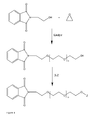
Figure 1 illustrates the preparation of the compound of the general formula (I); m is 1, n inFigure 1 corresponds to n-1 in formula (I), and Z inFigure 1 corresponds to X in formula (I). - The present invention relates to a method of modifying a macromolecule, in particular a polymer matrix, e.g. polymer matrixes used as solid supports for synthesis as well as for chromatographic purposes.
- In particular, the present invention relates to a method of modifying a macromolecule, in particular a polymer matrix, the method comprising the steps of
- (i) providing the macromolecule (e.g. polymer matrix);
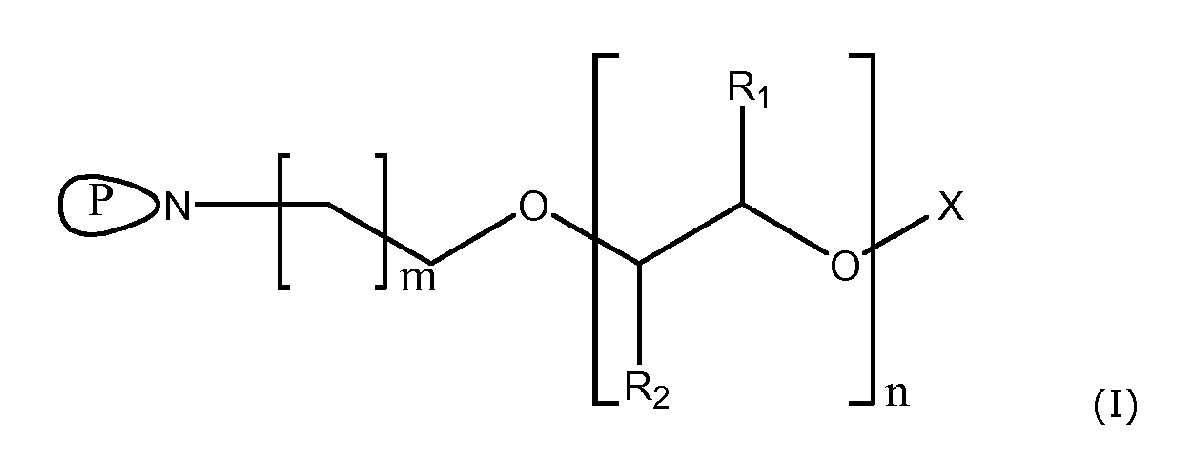
- (ii) providing a compound of the general formula (I):

- N is a primary amino group protected with the protecting group P, wherein the protecting group involves both free valences of the primary amino group;
- m is an integer of 1-12 and n is an integer of 1-2000;
- R1 and R2 are independently selected from the group consisting of hydrogen and C1-4-alkyl; and
- X is a reactive group; and
- (iii) allowing the compound of the general formula (I) to react with the macromolecule (e.g. polymer matrix) so as to form grafts on said macromolecule.
- The compound useful for the modification of macromolecules, in particular polymer matrixes, can be represented by compounds of the general formula (I):

- N is a primary amino group protected with the protecting group P, wherein the protecting group involves both free valences of the primary amino group;
- m is an integer of 1-12 and n is an integer of 1-2000;
- R1 and R2 are independently selected from the group consisting of hydrogen and C1-4-alkyl; and
- X is a reactive group.
- It will be appreciated that the compounds of the general formula (I) are of the "protected amino"-poly(oxyalkylene)-type. Hence, the methods are suitable for introducing into macromolecules (e.g. polymer matrixes) a primary amino group via a generally hydrophilic linker.
- The compounds of the general formula (I) comprise a {P}-N moiety, representing a primary amino group protected with the protecting group P, wherein the protecting group involves both free valences of the primary amino group.
- Protecting groups involving both free valences of the primary amino group are typically those of the imide type [(RC(=O))2N-] and of the imine type [R-C=N-].
- For example, protecting groups of the imide type may be those selected from succinic anhydrides/succinic acids (succinimides) and phthalic anhydrides/phthalic acids (phthalimides).
- In one currently preferred embodiment, the protecting group is of the imide type. Currently most preferred protecting groups are succinic anhydride/succinic acids (succinimides) and phthalic anhydride/phthalic acids (phthalimides), in particular phthalic anhydride/phthalic acids (phthalimides).
- m is an integer of 1-12, e.g. 1-6, such as 1-4, or 1-3, or 1-3, or 1-2, in particular 1. n is an integer of 1-2000, more typically 1-100, or 1-50, or 1-10 or 1-8, such as 1-6, or 1-5, or 1-4, or 1-3, 1-2, or 2-6, or 2-4, or 1.
- R1 and R2 are independently selected from the group consisting of hydrogen and C1-4-alkyl.
- C1-4-alkyl encompasses methyl, ethyl, 1-propyl, 2-propyl, 1-butyl, 2-butyl, tert-butyl and (2-methyl)-prop-1-yl.
- Particular examples are those where R1 and R2 are independently selected from hydrogen and methyl, hence compounds having ethylene glycol and propylene glycol fragments. The currently most preferred embodiments are those where all of R1 and R2 are hydrogen, i.e. corresponding to compounds having ethylene glycol fragments.
- The reactive group is designed to be capable of reacting with simple functionalities on the macromolecule (e.g. polymer matrix), e.g. amines, alcohol and thiol functionalities, possibly after activation of such groups. For this purpose, reactive groups containing small cyclic ether such as oxiranes (epoxides) and oxethanes can be used, but also functional groups such as isocyanates, carboxylic acids, acid chlorides or activated vinylic compounds may be used. Particular examples are reactive groups containing oxiranes and oxethanes of which a suitable oxirane-containing reactive groups (X) may be the one derived from epichlorohydrin (see Example 5). An alternative example of a reactive group is a carboxylic acid-containing reactive group, e.g. as illustrated in Example 7. For both of these examples, a CH2 group is included as a part of the reactive group X, cf. CH2(O)CHCH2- in Example 5 and HOOCCH2- in Example 7.
- In a preferred embodiment of the invention, the molecular entity is formed via the polyalkoxylation of an N-protected hydroxy alkylamine, followed by the attachment of the reactive moiety via a C-O bond. This is a cost efficient route to unsymmetrical polyalkylene oxides, by careful selection of catalysts and reaction time the good control of chain length and purity can be obtained. Moreover, by varying the content of alkylene oxides such as ethylene oxide and propylene oxide the molecular structure and hydrophilicity of the product can be controlled.
- The starting point for this synthesis is the protected hydroxy alkylamine (b). Examples of simple, useful alkyl amines include ethanolamine, 3-hydproxypropylamine, 2-hydroxypropylamine. Also more complex amines such as 3-oxy-5-hydroxy-1-pentanamine or 4-hydroxymethyl-benzylamine can be used.
- The amine group on the hydroxyalkyl amine (a) is protected with a protecting group which allows the ethoxylation and subsequent attachment of the reactive moiety. Protection groups such as imides, amides, imines or urea derivatives are quite useful for this purpose. The phthalimide protected amine formed from ethanolamine and phthalic anhydride is commercially available in large scale. Compared with simple amide protection, it has the advantage that there are no hydrogen left on the nitrogen atom and as a result it is stable towards nuclephilic attack in subsequent transformations. This is particularly important since the amide proton in regular amide protected amines has a similar acid strength as the terminal hydroxy group in the polyalkoxide, which gives rise to ill defined substitution reactions.
- Once the amine group is protected, the free hydroxy group can be reacted with oxiranes in presence of a catalyst to form the polyalkoxy derivative (c). Commonly used oxiranes include ethyleneoxide and propyleneoxide or mixtures thereof. The selection of catalyst and the reaction conditions are particularly important. The conditions previously reported for the reaction between 2-hydroxyethylphthalimide and ethyleneoxide involve high sodium hydroxide catalyst concentrations and temperatures above 160°C, conditions which invariably give rise to highly coloured products with a large molecular weight variations and high levels of impurities. As exemplified in this patent lowering of the temperature and the concentration of catalyst give products of acceptable purity. Application of lanthanum or lanthanide based catalysts give very pure, almost colourless products, with narrow molecular weight distribution.
- Polyalkoxides based on ethyleneoxide are very hydrophilic and biocompatible. Use of propylene oxide instead of ethylene oxide results in molecules that are comparatively less soluble in water and exhibits some degree of hydrophobic interaction with biomolecules. The two monomers can be copolymerised to tailor the hydrophilicity even further.
- The polyalkoxy derivative is then functionalised with a reactive moiety to form the desired molecular entity, which is used to modify macromolecular systems. The reactive moiety should be able to react with functional groups on the macromolecular system such as amines, alcohols, thioles, etc. as discussed above.
- The present invention provides - in one embodiment - a method for the preparation of a compound of the general formula (I)

- (a) providing a phthalimido N-protected α-hydroxy-ω-amino-C2-13-alkane;
- (b) reacting said alkane with ethylene oxide in the presence of a catalyst; and
- (c) converting of functionalizing the terminal OH group of the product obtained in step (b).
- The reaction in step (b) is preferably conducted in the absence of atmospheric air (in particular oxygen). Moreover, the reaction is typically conducted under pressure, e.g. 2-10 bar, and at elevated temperature, e.g. 80-200°C, such as 100-190°C. The amount of catalyst is typically 0.1-3% based on the amount of phthalimido N-protected α-hydroxy-ω-amino-C2-13-alkane, where the necessary amount correlates with the equivalents of ethylene oxide used, i.e. the more equivalents ethylene oxide used, the higher the amount of catalyst. The number of equivalents of ethylene oxide used corresponds to the desirable chain length, i.e. the number "n" in the general formula (I). Suitable catalysts are, e.g., those selected from NaOH, KOH, KOCH3, MEO-3, and MEO-LA.
- The conversion i step (c) is conducted in order to introduce the reactive group X, either coupling of a reactive group to the molecule via the oxygen atom, or by converting the terminal hydroxyl functionality, e.g. by oxidation to the corresponding carboxylic acid. This is illustrated in the Examples section.
- The complete molecular entity is then used to modify macromolecular systems (macromolecules) such as polymer matrixes, biomolecules (enzymes, proteins, etc.), and materials surfaces. In the cases where the reactive group on the macromolecular system is an amine group, the reaction will quite often proceed without a catalyst whereas some catalysts are often needed in the reaction with hydroxyl groups (i.e. alcohols).
- Illustrative examples of suitable polymer matrixes are those selected from PS, POEPS, POEPOP, SPOCC, PEGA, CLEAR, HYDRA, PEG-polyacrylate copolymers, polyether-polyamine copolymers, and cross-linked polyethylene di-amines, Expansin, Polyamide, Jandagel, PS-BDODMA, PS-HDODA, PS-TTEGDA, PS-TEGDA, GDMA-PMMA, PS-TRPGDA, ArgoGel, Argopore resins, Toyopearl, other cross-linked polyacrylates high capacity PEGA, Fractogel, Sephadex, Sepharose, other cross-linked agaroses, and derivatives of the aforementioned.
- In a final step, the protection group of the terminal primary amine on the alkoxide side-chain may be removed. Phthalimide protection groups are removed by treatment with solutions containing hydrazine or ethylenediamine, whereas imine type protection groups can be hydrolysed under even milder conditions using low concentrations of acids or bases in water. Amide type protection groups most often require strong base treatment at elevated temperatures and are thus less favourable.
- Using the above procedure, macromolecular systems can be rendered functional side-arms of desired hydrophilicity with an easily accessible primary amine as an end group. Such macromolecular systems may be used as such or modified further via chemical modification of the amine group.
- The amine group may be used as a starting point for solid phase chemistry or may be used as an attachment point for more complex molecules, such as proteins, nucleotides or affinity ligands.
- In summary, the invention consists in the formation of specific molecular entities and the use of these entities for the modification of macromolecular systems. The formation consists of 4 steps:
- 1. Alkoxylation of a N-protected hydroxy alkyl amine.
- 2. Attachment of an reactive moiety via the free hydroxy terminal of the polyalkyleneoxide.
- 3. Reaction of the reactive moiety with functional groups of the macromolecular system.
- 4. Removal of the N-protective group in order to release a primary amine.
- In a particular embodiment, the present invention relates to a method of modifying a macromolecule, in particular a polymer matrix, the method comprising the steps of
- (i) providing the macromolecule (e.g. polymer matrix);
- (ii) providing a compound of the general formula (I):

- {P}-N is a phthalimido group;
- m is 1 and n is an integer of 1-100;
- R1 and R2 are both hydrogen; and
- X is a reactive group, such as selected from oxethane-containing reactive groups and oxirane-containing reactive groups, in particular oxethane-containing reactive groups or oxirane-containing reactive groups; and
- (iii) allowing the compound of the general formula (I) to react with the macromolecule (e.g. polymer matrix) so as to form grafts on said macromolecule.
- In a further particular embodiment, the invention provides a compound of the general formula (I):

- {P}-N is a phthalimido group;
- m is 1 and n is an integer of 1-100;
- R1 and R2 are both hydrogen; and
- X is an oxethane-containing reactive group or an oxirane-containing reactive group.
- In these embodiments, X preferably represents CH2(O)CHCH2- (oxiranyl-methyl).
- Although the macromolecules referred to herein are mostly based on skeletons derived from organic molecules, it is - in alternative embodiment - envisaged that the method defined herein may be useful for modifying glass substrates (e.g. plates, beads, sticks, etc.). In such instances, the reactive group (X in the compound of the general formula (I)) should be capable of reacting with Si-OH surface groups of the glass substrate in question or surface groups of already derivatised glass substrates. Hence, a suitable reactive group will often be of the silane type.
- In a further alternative, it is envisaged that the reactive group X of the compound of the general formula (I) may simply be an electron pair, i.e. that -CH2-O-X is -CH2-O-, corresponding to a deprotonated terminal -CH2-OH group of the polyalkyleneoxide chain. Such a reactive group may, e.g., react with epoxide groups of the macromolecule.
- The synthesis was performed in a 3 liter autoclave equipped with heating mantle, internal cooling coil and mechanical stirrer.
- The catalyst was added to 300 g of N-(2-hydroxyethyl)-phthalimide (HPI, Katwijk Chemie bv, NL). The reactor charge was dried at 130°C by nitrogen purge for 20 minutes. Afterwards, ethylene oxide was added at the selected temperature in a way to keep the overpressure at the level between 3-5 bar. (See table below). After introduction of 640 g ethylene oxide (EO), the product was cooked out 30 minutes at the reaction temperature. The obtained ethoxylate was discharged at 40°C and weighed.
Catalyst Amount Temperature EO eq. Yield Purity Appearance 1 NaOH 0.5 g 170°C 15.7 970 g +85% Brown liq. 2 KOH 5 g 160°C App. 15 950 g ∼50% Dark brown liq. 3 KOCH3 1.6 g 130°C 15.2 970 g +60% Brown liq 4 MEO-3 1.5 g 130°C 14.5 940 g +95% Light tan liq. 5 MEO-LA 0.9 140°C 2.5 470 g +95% Tan liq. 6 MEO-LA 2.0 g 140°C 10 No data +95% Tan liq. 7 MEO-LA 2.9 g 140°C 33.6 2600 g No data Hard cream coloured solid - The MEO-3 and the MEO-LA catalysts are heterogeneous Lanthanum catalysts developed by Mexeo, PI. Purities are estimated on the basis of Maldi Tof spectra.
- The alkoxylated N-(2-hydroxyethyl)-phthalimide prepared as described in Example 1 using the MEO-3 catalyst was dried by azeotropic evaporation of acetonitrile (5 mL/g PEG, 2x) and dissolved in THF (5 mL/g PEG) with stirring and exclusion of moisture. Sodium hydride [60 wt % dispersion in mineral oil] was added in small portions to the PEG-solution with stirring and exclusion of moisture. The deprotonation reaction was stirred at room temperature for 2h. Epichlorohydrin was added dropwise and the reaction was stirred at 40°C for 12h. The solvent was evaporated in vacuo and the residue was mixed with acetonitrile (25 mL). The precipitated sodium salt was separated by centrifugation at 8000 r.p.m. for 20 min and the supernatant was decanted and evaporated in vacuo. The products were washed with heptane (3x25 mL) to remove mineral oil and dried under high vacuum.
- The product of Example 2 is grafted onto a polymer matrix as in Example 9.
- The polymer matrix obtained in Example 3 is washed in a glass filter funnel with 150 mL methanol followed by the washing with 150 mL butanol. After draining off the solvent, another 50 mL of butanol is added to the beaker and left at room temperature for 2 h. The butanol is drained off and the resin is placed in a round bottom flask. To the resin, 11 mL of ethylene diamine is added followed by the addition of 30 mL of butanol. The mixture is stirred and heated to 90°C for 15 h under inert atmosphere. The resultant product is washed with water followed by 0.5 M HCI until the pH is approx. 1-2. The resin is then drained from solvent and covered with 2 M HCI. The mixture is stirred and heated to 90°C for 2 h. Finally, the resin is washed thoroughly with 1 M NaOH followed by water.
-

- Dissolve PEG-phthalimide prepared as described in Example 1 using the MEO-3 catalyst (1 equiv) in THF (5 mL) and add sodium hydride (60% oil) (1 equiv) with stirring. After 6 h, add epichlorohydrin (1.5 equiv) drop wise to the reaction mixture at 45°C and allowed to stir for 16 h. Add DCM to the reaction mixture, filter off the insoluble impurities. Evaporate the solvent in vacuum to yield the product.
-

- VO-2000 resin (An oxethane cross-linked PEG based resin commercialised by VersaMatrix A/S) (0.5 mmol OH) washed with DMF and add KOBut (4 equiv) in DMF (5 mL). Keep the reaction mixture at 100°C and flush with argon. Add oxirane-PEG phthalimide prepared as described in Example 1 using the MEO-3 catalyst (4 equiv) in DMF (5 mL) to the reaction mixture and the reaction allowed to continue for overnight. Filter off the resin, wash with DMF, ethanol, water, ethanol and butanol. Add ethylenediamine (5 equiv) to the resin in butanol and keep the reaction mixture at 90°C for overnight. Wash the resin with butanol, ethanol, water, ethanol, DMF and DCM.
- Loading: Fmoc-Gly-OH was attached to the resin with TBTU/NEM activation method. The Fmoc group on the pre-weighed resin was cleaved off with 20% piperidine in DMF and the absorbance of the piperidine-fulvene adduct measured at 290 nm and the amino loading of the resin calculated from the OD value. Measured loading = 0.69 mmol/g
-

- Dissolve PEG-phthalimide prepared as described in Example 1 using the MEO-3 catalyst (1 equiv) in 25 mL water/8 mL conc. H2SO4 and add CrO3 in 5 mL water. Stir the solution for 16 h at room temperature. Add 25 mL of water to the reaction mixture and extracted with DCM (3x). Combine the organic layers and washed with water (2x) and saturated NaOH (2x) and dry the organic fraction over Na2SO4 and concentrate in vacuum.
-

- VA-1900 resin (An acrylamide cross-linked PEG based resin with average PEG chain length is 1900 Dalton commercialised by VersaMatrix A/S) (0.017 mmol NH2) washed with DMF and add carboxyl-PEG phthalimide prepared as described in Example 7 (10 equiv), TBTU (9.6 equiv) and NEM (13.3 equiv) in DMF to the resin and the reaction allowed to continue for 3 h. Filter off the resin, wash with DMF, ethanol, water, ethanol and butanol. Add ethylenediamine (5 equiv) to the resin in butanol and keep the reaction mixture at 90°C for overnight. Wash the resin with butanol, ethanol, water, ethanol, DMF and DCM.
- Loading: Fmoc-Gly-OH was attached to the resin with TBTU/NEM activation method. The Fmoc group on the pre-weighed resin was cleaved off with 20% piperidine in DMF and the absorbance of the piperidine-fulvene adduct measured at 290 nm and the amino loading of the resin calculated from the OD value. Measured loading = 0.27 mmol/g
- 15 mL epoxyacrylate resin was washed with distilled water, ethanol and THF and surplus THF were removed by suction. 11.4 g PEG-phthalimide (4 equiv) was dissolved in 6 mL THF and 720 mg sodium hydride (4 equiv) was added. The reaction was violent creating lot of foam. The solution was then added to the resin + 4 mL THF. The coupling proceeded at 45 degrees overnight. The resin was washed with THF, ethanol, water, ethanol and finally butanol. 1.5 mL ethylenediamine was added to 9 mL butanol and added to the resin. The reaction proceeded at 90 degrees overnight. The resin was washed with butanol, ethanol and water.
- Analysis: A Kaiser test was performed on a few beads and turned blue and positive indicating the presence of primary amines on the resin.
- Loading: 15 mL amino-PEG-resin was washed with water, ethanol and DMF but interstitial DMF was not removed by suction. Fmoc-Gly 5.35 g (4 equiv.) and TBTU 5.78 g (4 equiv) and NEM 2.27 mL (4 equiv) were mixed in 18 mL and added to the resin. The coupling was performed at room temperature over the weekend. After the weekend, a 100 µL aliquot of beads was taken out for Fmoc-loading test which gave a loading of 307 µmol NH2/g dry resin.
- The application further relates to the following embodiments:
- Embodiment 1. A method of modifying a macromolecule, the method comprising the steps of
- (i) providing the macromolecule;
- (ii) providing a compound of the general formula (I):
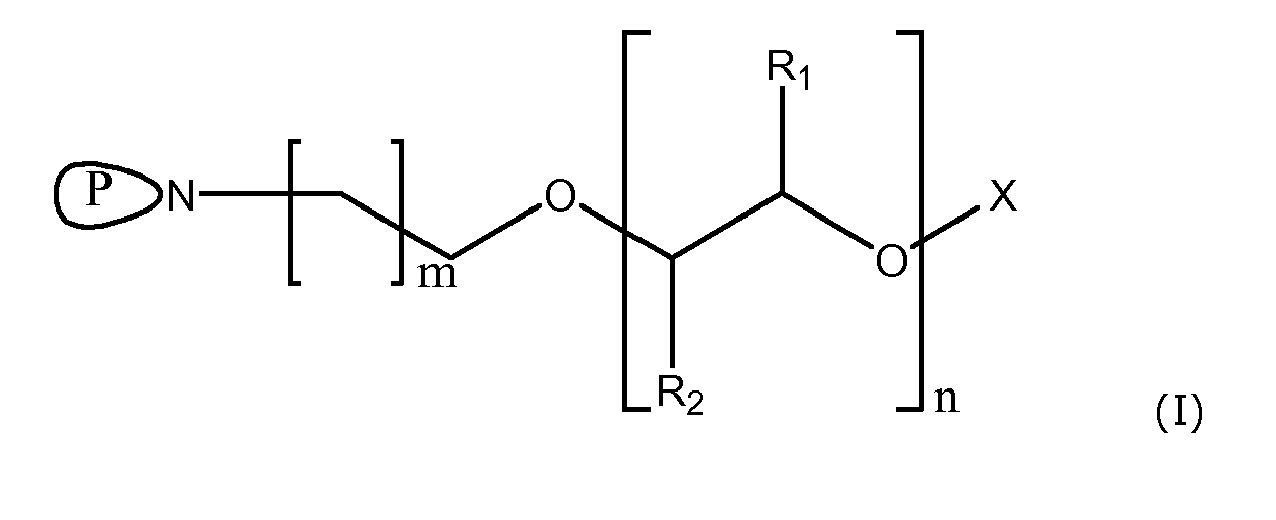
- N is a primary amino group protected with the protecting group P, wherein the protecting group involves both free valences of the primary amino group;
- m is an integer of 1-12 and n is an integer of 1-2000;
- R1 and R2 are independently selected from the group consisting of hydrogen and C1-4-alkyl; and
- X is a reactive group; and
- (iii) allowing the compound of the general formula (I) to react with the macromolecule so as to form grafts on the macromolecule.
- Embodiment 2. The method according to embodiment 1, wherein the macromolecule is a polymer matrix.
- Embodiment 3. The method according to any one of the preceding embodiment, wherein the protecting group {P}-N is a phthalimido group.
- Embodiment 4. The method according to any one of the preceding embodiment, wherein the protecting group {P}-N is a phthalimido group, m is 1, n is 1-10 and X is selected from oxethane-containing reactive groups and oxirane-containing reactive groups.
- Embodiment 5. A method according to embodiment 1, comprising the steps of
- (i) providing the macromolecule;
- (ii) providing a compound of the general formula (I):

- {P}-N is a phthalimido group;
- m is 1 and n is an integer of 1-100;
- R1 and R2 are both hydrogen; and
- X is a reactive group, such as selected from oxethane-containing reactive groups and oxirane-containing reactive groups; and
- (iii) allowing the compound of the general formula (I) to react with the macromolecule so as to form grafts on said macromolecule.
- Embodiment 6. A compound of the general formula (I):

- {P}-N is a phthalimido group;
- m is 1 and n is an integer of 1-100;
- R1 and R2 are both hydrogen; and
- X is an oxethane-containing reactive group or an oxirane-containing reactive group.
- Embodiment 7. A method for the preparation of a compound of the general formula (I)

- (a) providing a phthalimido N-protected α-hydroxy-ω-amino-C2-13-alkane;
- (b) reacting said alkane with ethylene oxide in the presence of a catalyst; and
- (c) converting of functionalizing the terminal OH group of the product obtained in step (b).
Claims (7)
- A method of modifying a macromolecule, the method comprising the steps of(i) providing the macromolecule;(ii) providing a compound of the general formula (I):
 N is a primary amino group protected with the protecting group P, wherein the protecting group involves both free valences of the primary amino group;m is an integer of 1-12 and n is an integer of 1-2000;R1 and R2 are independently selected from the group consisting of hydrogen and C1-4-alkyl; andX is a reactive group selected from carboxylic acids and acid chlorides; and(iii) allowing the compound of the general formula (I) to react with the macromolecule so as to form grafts on the macromolecule.
 - The method according to claim 1, wherein the macromolecule is a polymer matrix.
- The method according to any one of the preceding claims, wherein the protecting group {P}-N is a phthalimido group.
- The method according to any one of the preceding claims, wherein the protecting group {P}-N is a phthalimido group, m is 1, n is 1-10.
- A method according to claim 1, comprising the steps of(i) providing the macromolecule;(ii) providing a compound of the general formula (I):
 {P}-N is a phthalimido group;m is 1 and n is an integer of 1-100;R1 and R2 are both hydrogen; andX is a reactive group selected from carboxylic acids and acid chlorides; and(iii) allowing the compound of the general formula (I) to react with the macromolecule so as to form grafts on said macromolecule.
 - A compound of the general formula (I):
 {P}-N is a phthalimido group;m is 1 and n is an integer of 1-100;R1 and R2 are both hydrogen; andX is selected from carboxylic acids and acid chlorides.
 - A method for the preparation of a compound of the general formula (I)
 (a) providing a phthalimido N-protected α-hydroxy-ω-amino-C2-13-alkane;(b) reacting said alkane with ethylene oxide in the presence of a catalyst; and(c) converting of functionalizing the terminal OH group of the product obtained in step (b).
Priority Applications (1)
| Application Number | Priority Date | Filing Date | Title |
|---|---|---|---|
| EP09150865A EP2045282B1 (en) | 2005-08-26 | 2006-08-25 | A method of modifying a macromolecular system |
Applications Claiming Priority (4)
| Application Number | Priority Date | Filing Date | Title |
|---|---|---|---|
| PCT/DK2005/000547 WO2006021218A1 (en) | 2004-08-27 | 2005-08-26 | Polyether polymer matrix |
| EP06075482 | 2006-03-02 | ||
| EP06775948A EP1922355B1 (en) | 2005-08-26 | 2006-08-25 | A method of modifying a macromolecular system |
| EP09150865A EP2045282B1 (en) | 2005-08-26 | 2006-08-25 | A method of modifying a macromolecular system |
Related Parent Applications (2)
| Application Number | Title | Priority Date | Filing Date |
|---|---|---|---|
| EP06775948A Division EP1922355B1 (en) | 2005-08-26 | 2006-08-25 | A method of modifying a macromolecular system |
| EP06775948.0 Division | 2006-08-25 |
Publications (2)
| Publication Number | Publication Date |
|---|---|
| EP2045282A1 true EP2045282A1 (en) | 2009-04-08 |
| EP2045282B1 EP2045282B1 (en) | 2011-03-23 |
Family
ID=43825119
Family Applications (1)
| Application Number | Title | Priority Date | Filing Date |
|---|---|---|---|
| EP09150865A Not-in-force EP2045282B1 (en) | 2005-08-26 | 2006-08-25 | A method of modifying a macromolecular system |
Country Status (6)
| Country | Link |
|---|---|
| US (1) | US7897698B2 (en) |
| EP (1) | EP2045282B1 (en) |
| JP (2) | JP5021649B2 (en) |
| AT (1) | ATE502971T1 (en) |
| CA (1) | CA2619709C (en) |
| DE (1) | DE602006020940D1 (en) |
Families Citing this family (9)
| Publication number | Priority date | Publication date | Assignee | Title |
|---|---|---|---|---|
| JP5789335B1 (en) | 2014-09-08 | 2015-10-07 | 明成化学工業株式会社 | Dispersant and dispersion composition |
| CN108026115B (en) | 2015-09-30 | 2021-11-09 | 陶氏环球技术有限责任公司 | Multi-head or double-head composition capable of being used for chain shuttling and preparation method thereof |
| EP3356426B1 (en) | 2015-09-30 | 2022-05-25 | Dow Global Technologies LLC | A process for preparing functional polymers through addition of amino and polymeryl groups to aldehyde moieties |
| WO2018064553A1 (en) | 2016-09-30 | 2018-04-05 | Dow Global Technologies Llc | Multi- or dual-headed compositions useful for chain shuttling and process to prepare the same |
| EP3519474B1 (en) | 2016-09-30 | 2024-09-25 | Dow Global Technologies LLC | Process for preparing multi- or dual-headed compositions useful for chain shuttling |
| JP7029448B2 (en) | 2016-09-30 | 2022-03-03 | ダウ グローバル テクノロジーズ エルエルシー | A sealed multi- or dual-head composition useful for chain shuttling, and the process of preparing it. |
| JP7344872B2 (en) | 2017-12-29 | 2023-09-14 | ダウ グローバル テクノロジーズ エルエルシー | Double-headed organoaluminum composition |
| US11613600B2 (en) | 2017-12-29 | 2023-03-28 | Dow Global Technologies Llc | Capped dual-headed organoaluminum compositions |
| CN114058004A (en) * | 2021-11-08 | 2022-02-18 | 金湖金凌新材料科技有限公司 | Cleaning agent for bionic polyether topological structure and preparation method thereof |
Citations (13)
| Publication number | Priority date | Publication date | Assignee | Title |
|---|---|---|---|---|
| FR2358394A1 (en) * | 1976-07-14 | 1978-02-10 | Boehringer Mannheim Gmbh | NEW ESTERS OF HYDROXYSUCCINIMIDE, METHODS FOR THEIR MANUFACTURE AND USE |
| EP0555101A2 (en) * | 1992-02-07 | 1993-08-11 | Research Development Corporation Of Japan | Polyether having heterofunctional groups at both ends, process for the preparation thereof and polymerization initiator therefor |
| WO1997003106A1 (en) * | 1995-07-07 | 1997-01-30 | Shearwater Polymers, Inc. | Poly(ethylene glycol) and related polymers monosubstituted with propionic or butanoic acids and functional derivatives thereof for biotechnical applications |
| WO1999001469A1 (en) * | 1997-07-03 | 1999-01-14 | University Of Nottingham | A method for attaching polyethylene glycol to macromolecules |
| WO2001026692A1 (en) * | 1999-10-08 | 2001-04-19 | Shearwater Corporation | Heterobifunctional poly(ethylene glycol) derivatives and methods for their preparation |
| US20010044526A1 (en) * | 2000-02-22 | 2001-11-22 | Shearwater Corporation | N-maleimidyl polymer derivatives |
| EP1167418A1 (en) * | 1998-05-07 | 2002-01-02 | Nano Carrier Co. | Polyoxyethylene derivatives having optionally protected amino group at one end and process for producing the same |
| US20030083389A1 (en) * | 2001-04-23 | 2003-05-01 | Kao Weiyun John | Bifunctional-modified hydrogels |
| US20030161837A1 (en) * | 2000-01-11 | 2003-08-28 | Aventis Behring Gmbh | Method for the production of conjugates and uses thereof for the prevention and treatment of allergic reactions and autoimmune diseases |
| JP2003268099A (en) * | 2003-04-11 | 2003-09-25 | Nof Corp | Method for producing polyoxyalkylene derivative |
| WO2004012773A1 (en) * | 2002-07-24 | 2004-02-12 | F. Hoffmann-La Roche Ag | Polyalkylene glycol acid additives |
| US20040115615A1 (en) * | 2000-09-04 | 2004-06-17 | Birger Sorensen | Hiv peptides antigens, vaccine compositions, immunoassay kit and a method of detecting antibodies induced by hiv |
| US20050014903A1 (en) * | 2003-01-06 | 2005-01-20 | Antoni Kozlowski | Thiol selective water soluble polymer derivatives |
Family Cites Families (4)
| Publication number | Priority date | Publication date | Assignee | Title |
|---|---|---|---|---|
| JP3465306B2 (en) * | 1993-08-05 | 2003-11-10 | 日本油脂株式会社 | Polyalkylene oxide derivative and production method |
| JP3465307B2 (en) * | 1993-08-05 | 2003-11-10 | 日本油脂株式会社 | Polyalkylene oxide derivative and production method |
| JP3508207B2 (en) * | 1994-05-30 | 2004-03-22 | 日本油脂株式会社 | Method for producing polyoxyalkylene derivative |
| US20080213568A1 (en) * | 2004-08-27 | 2008-09-04 | Versanatrux A/S | Polyether Polymer Matrix |
-
2006
- 2006-08-25 JP JP2008527308A patent/JP5021649B2/en not_active Expired - Fee Related
- 2006-08-25 AT AT09150865T patent/ATE502971T1/en not_active IP Right Cessation
- 2006-08-25 EP EP09150865A patent/EP2045282B1/en not_active Not-in-force
- 2006-08-25 DE DE602006020940T patent/DE602006020940D1/en active Active
- 2006-08-25 US US11/990,455 patent/US7897698B2/en not_active Expired - Fee Related
- 2006-08-25 CA CA2619709A patent/CA2619709C/en not_active Expired - Fee Related
-
2012
- 2012-03-19 JP JP2012062338A patent/JP2012180518A/en not_active Withdrawn
Patent Citations (13)
| Publication number | Priority date | Publication date | Assignee | Title |
|---|---|---|---|---|
| FR2358394A1 (en) * | 1976-07-14 | 1978-02-10 | Boehringer Mannheim Gmbh | NEW ESTERS OF HYDROXYSUCCINIMIDE, METHODS FOR THEIR MANUFACTURE AND USE |
| EP0555101A2 (en) * | 1992-02-07 | 1993-08-11 | Research Development Corporation Of Japan | Polyether having heterofunctional groups at both ends, process for the preparation thereof and polymerization initiator therefor |
| WO1997003106A1 (en) * | 1995-07-07 | 1997-01-30 | Shearwater Polymers, Inc. | Poly(ethylene glycol) and related polymers monosubstituted with propionic or butanoic acids and functional derivatives thereof for biotechnical applications |
| WO1999001469A1 (en) * | 1997-07-03 | 1999-01-14 | University Of Nottingham | A method for attaching polyethylene glycol to macromolecules |
| EP1167418A1 (en) * | 1998-05-07 | 2002-01-02 | Nano Carrier Co. | Polyoxyethylene derivatives having optionally protected amino group at one end and process for producing the same |
| WO2001026692A1 (en) * | 1999-10-08 | 2001-04-19 | Shearwater Corporation | Heterobifunctional poly(ethylene glycol) derivatives and methods for their preparation |
| US20030161837A1 (en) * | 2000-01-11 | 2003-08-28 | Aventis Behring Gmbh | Method for the production of conjugates and uses thereof for the prevention and treatment of allergic reactions and autoimmune diseases |
| US20010044526A1 (en) * | 2000-02-22 | 2001-11-22 | Shearwater Corporation | N-maleimidyl polymer derivatives |
| US20040115615A1 (en) * | 2000-09-04 | 2004-06-17 | Birger Sorensen | Hiv peptides antigens, vaccine compositions, immunoassay kit and a method of detecting antibodies induced by hiv |
| US20030083389A1 (en) * | 2001-04-23 | 2003-05-01 | Kao Weiyun John | Bifunctional-modified hydrogels |
| WO2004012773A1 (en) * | 2002-07-24 | 2004-02-12 | F. Hoffmann-La Roche Ag | Polyalkylene glycol acid additives |
| US20050014903A1 (en) * | 2003-01-06 | 2005-01-20 | Antoni Kozlowski | Thiol selective water soluble polymer derivatives |
| JP2003268099A (en) * | 2003-04-11 | 2003-09-25 | Nof Corp | Method for producing polyoxyalkylene derivative |
Non-Patent Citations (13)
| Title |
|---|
| ABRAHAM SHEENA, BRAHIM SEAN, GUISEPPI-ELIE ANTHONY: "Molecularly engineered hydrogels for implant biocompatibility", ANNUAL INTERNATIONAL CONFERENCE OF THE IEEE ENGINEERING IN MEDICINE AND BIOTECHNOLOGY, vol. 26, no. VII, 2004, pages 5036 - 5039, XP002404145 * |
| DATABASE WPI Week 200404, Derwent World Patents Index; AN 2004-038342, XP002404150 * |
| DELONG SOLITAIRE A., MONN JAMES J., WEST JENNIFER L.: "Covalently immobilized gradients of bFGF on hydrogel scaffolds for directed cell migration", BIOMATERIALS, vol. 26, 27 October 2004 (2004-10-27), pages 3227 - 3234, XP002404147 * |
| KREPPEL F ET AL: "Combined Genetic and Chemical Capsid Modifications Enable Flexible and Efficient De- and Retargeting of Adenovirus Vectors", MOLECULAR THERAPY, ACADEMIC PRESS, SAN DIEGO, CA,, US, vol. 12, no. 1, July 2005 (2005-07-01), pages 107 - 117, XP004974954, ISSN: 1525-0016 * |
| LANGE; WAHL, BULL. CHIM. SOC. FR., 1951, pages 340 - 342 |
| LIU XIAO-HUI, WANG HSU-KUN, NERRON JAMES N., PRESTWICH GLENN D.: "Photopatterning of Antibodies on biosensors", BIOCONJUGATE CHEMISTRY, vol. 11, 2000, pages 755 - 761, XP002404148 * |
| LONTJENS ET AL., POLYM. BULL., vol. 30, 1993, pages 489 - 494 |
| MANTA C ET AL: "POLYETHYLENE GLYCOL AS A SPACER FOR SOLID-PHASE ENZYME IMMOBILIZATION", ENZYME AND MICROBIAL TECHNOLOGY, STONEHAM, MA, US, vol. 33, no. 7, 2003, pages 890 - 898, XP008069324, ISSN: 0141-0229 * |
| MASAYUKI YOKOYAMA ET AL: "SYNTHESIS OF POLY(ETHYLENE OXIDE) WITH HETEROBIFUNCTIONAL REACTIVE GROUPS AT ITS TERMINALS BY AN ANIONIC INITIATOR", BIOCONJUGATE CHEMISTRY, ACS, WASHINGTON, DC, US, vol. 3, no. 4, 1 July 1992 (1992-07-01), pages 275 - 276, XP000288470, ISSN: 1043-1802 * |
| WON CHEEB-YOUB: "Synthesis of heterobifunctional poly(ethylene glycol) containing an acrylol group at one end and an isocyanate group at the other end", POLYMER BULLETIN, vol. 52, 2004, pages 109 - 115, XP002404146 * |
| Y-I HUANG, J.POLYM. SCI., vol. 23, 1985, pages 795 - 799 |
| YONG JOO KIM ET AL: "HETEROBIFUNCTIONAL POLY(ETHYLENE OXIDE ONE POT SYNTHESIS OF POLY(ETHYLENE OXIDE) WITH A PRIMARY AMINO GROUP AT ONE END AND A HYDROXYL GROUP AT THE OTHER END", POLYMER BULLETIN, SPRINGER, HEIDELBERG, DE, vol. 33, no. 1, 1 June 1994 (1994-06-01), pages 1 - 6, XP000459057, ISSN: 0170-0839 * |
| ZHANG S ET AL: "Synthesis of heterobifunctional poly(ethylene glycol) with a primary amino group at one end and a carboxylate group at the other end", REACTIVE & FUNCTIONAL POLYMERS, ELSEVIER SCIENCE PUBLISHERS BV, NL, vol. 56, no. 1, July 2003 (2003-07-01), pages 17 - 25, XP004442204, ISSN: 1381-5148 * |
Also Published As
| Publication number | Publication date |
|---|---|
| JP2009506141A (en) | 2009-02-12 |
| ATE502971T1 (en) | 2011-04-15 |
| US20090209710A1 (en) | 2009-08-20 |
| EP2045282B1 (en) | 2011-03-23 |
| US7897698B2 (en) | 2011-03-01 |
| CA2619709A1 (en) | 2007-03-01 |
| JP2012180518A (en) | 2012-09-20 |
| DE602006020940D1 (en) | 2011-05-05 |
| JP5021649B2 (en) | 2012-09-12 |
| CA2619709C (en) | 2012-05-01 |
Similar Documents
| Publication | Publication Date | Title |
|---|---|---|
| JP2012180518A (en) | Method of modifying macromolecular system | |
| JP3435541B2 (en) | Materials for solid-phase peptide synthesis | |
| US7868132B2 (en) | Method for preparing multi-arm poly (ethylene glycol) amines | |
| KR100948532B1 (en) | Branched polymers and conjugates thereof | |
| CN104245791B (en) | Multi-arm polyethylene glycol derivative, its intermediate and their manufacture method | |
| WO1999048948A1 (en) | Oxirane derivatives and process for producing the same | |
| WO2011148177A2 (en) | Membrane enhanced polymer synthesis | |
| US8067526B2 (en) | Method for producing polyoxalkylene derivative | |
| JPH11335460A (en) | Oxirane derivative and method for producing the same | |
| JP4987719B2 (en) | Polyethylene glycol compound and production method | |
| EP2554565B1 (en) | Multifunctional polyoxyalkylene compound, method for producing same and intermediate of same | |
| US9029568B2 (en) | Branched hetero polyfunctional polyoxyalkylene compound and intermediate thereof | |
| EP1922355B1 (en) | A method of modifying a macromolecular system | |
| KR20080056267A (en) | Process for preparing polymers having terminal amine groups using protected amine salts | |
| ES2363122T3 (en) | METHOD FOR MODIFYING A MACROMOLECULAR SYSTEM. | |
| US20130041134A1 (en) | Methods for preparing polyethylene glycol maleimide using n-(2-hydroxyethyl) maleimide as a starting material |
Legal Events
| Date | Code | Title | Description |
|---|---|---|---|
| PUAI | Public reference made under article 153(3) epc to a published international application that has entered the european phase |
Free format text: ORIGINAL CODE: 0009012 |
|
| AC | Divisional application: reference to earlier application |
Ref document number: 1922355 Country of ref document: EP Kind code of ref document: P |
|
| AK | Designated contracting states |
Kind code of ref document: A1 Designated state(s): AT BE BG CH CY CZ DE DK EE ES FI FR GB GR HU IE IS IT LI LT LU LV MC NL PL PT RO SE SI SK TR |
|
| 17P | Request for examination filed |
Effective date: 20091008 |
|
| 17Q | First examination report despatched |
Effective date: 20091030 |
|
| AKX | Designation fees paid |
Designated state(s): AT BE BG CH CY CZ DE DK EE ES FI FR GB GR HU IE IS IT LI LT LU LV MC NL PL PT RO SE SI SK TR |
|
| GRAP | Despatch of communication of intention to grant a patent |
Free format text: ORIGINAL CODE: EPIDOSNIGR1 |
|
| GRAS | Grant fee paid |
Free format text: ORIGINAL CODE: EPIDOSNIGR3 |
|
| GRAA | (expected) grant |
Free format text: ORIGINAL CODE: 0009210 |
|
| AC | Divisional application: reference to earlier application |
Ref document number: 1922355 Country of ref document: EP Kind code of ref document: P |
|
| AK | Designated contracting states |
Kind code of ref document: B1 Designated state(s): AT BE BG CH CY CZ DE DK EE ES FI FR GB GR HU IE IS IT LI LT LU LV MC NL PL PT RO SE SI SK TR |
|
| REG | Reference to a national code |
Ref country code: GB Ref legal event code: FG4D |
|
| REG | Reference to a national code |
Ref country code: CH Ref legal event code: EP |
|
| REG | Reference to a national code |
Ref country code: IE Ref legal event code: FG4D |
|
| REF | Corresponds to: |
Ref document number: 602006020940 Country of ref document: DE Date of ref document: 20110505 Kind code of ref document: P |
|
| REG | Reference to a national code |
Ref country code: DE Ref legal event code: R096 Ref document number: 602006020940 Country of ref document: DE Effective date: 20110505 |
|
| REG | Reference to a national code |
Ref country code: NL Ref legal event code: VDEP Effective date: 20110323 |
|
| REG | Reference to a national code |
Ref country code: ES Ref legal event code: FG2A Ref document number: 2363122 Country of ref document: ES Kind code of ref document: T3 Effective date: 20110721 |
|
| PG25 | Lapsed in a contracting state [announced via postgrant information from national office to epo] |
Ref country code: LT Free format text: LAPSE BECAUSE OF FAILURE TO SUBMIT A TRANSLATION OF THE DESCRIPTION OR TO PAY THE FEE WITHIN THE PRESCRIBED TIME-LIMIT Effective date: 20110323 Ref country code: SE Free format text: LAPSE BECAUSE OF FAILURE TO SUBMIT A TRANSLATION OF THE DESCRIPTION OR TO PAY THE FEE WITHIN THE PRESCRIBED TIME-LIMIT Effective date: 20110323 Ref country code: GR Free format text: LAPSE BECAUSE OF FAILURE TO SUBMIT A TRANSLATION OF THE DESCRIPTION OR TO PAY THE FEE WITHIN THE PRESCRIBED TIME-LIMIT Effective date: 20110624 Ref country code: LV Free format text: LAPSE BECAUSE OF FAILURE TO SUBMIT A TRANSLATION OF THE DESCRIPTION OR TO PAY THE FEE WITHIN THE PRESCRIBED TIME-LIMIT Effective date: 20110323 |
|
| LTIE | Lt: invalidation of european patent or patent extension |
Effective date: 20110323 |
|
| PG25 | Lapsed in a contracting state [announced via postgrant information from national office to epo] |
Ref country code: CY Free format text: LAPSE BECAUSE OF FAILURE TO SUBMIT A TRANSLATION OF THE DESCRIPTION OR TO PAY THE FEE WITHIN THE PRESCRIBED TIME-LIMIT Effective date: 20110323 Ref country code: FI Free format text: LAPSE BECAUSE OF FAILURE TO SUBMIT A TRANSLATION OF THE DESCRIPTION OR TO PAY THE FEE WITHIN THE PRESCRIBED TIME-LIMIT Effective date: 20110323 Ref country code: BG Free format text: LAPSE BECAUSE OF FAILURE TO SUBMIT A TRANSLATION OF THE DESCRIPTION OR TO PAY THE FEE WITHIN THE PRESCRIBED TIME-LIMIT Effective date: 20110623 Ref country code: SI Free format text: LAPSE BECAUSE OF FAILURE TO SUBMIT A TRANSLATION OF THE DESCRIPTION OR TO PAY THE FEE WITHIN THE PRESCRIBED TIME-LIMIT Effective date: 20110323 Ref country code: AT Free format text: LAPSE BECAUSE OF FAILURE TO SUBMIT A TRANSLATION OF THE DESCRIPTION OR TO PAY THE FEE WITHIN THE PRESCRIBED TIME-LIMIT Effective date: 20110323 |
|
| PG25 | Lapsed in a contracting state [announced via postgrant information from national office to epo] |
Ref country code: BE Free format text: LAPSE BECAUSE OF FAILURE TO SUBMIT A TRANSLATION OF THE DESCRIPTION OR TO PAY THE FEE WITHIN THE PRESCRIBED TIME-LIMIT Effective date: 20110323 |
|
| PG25 | Lapsed in a contracting state [announced via postgrant information from national office to epo] |
Ref country code: EE Free format text: LAPSE BECAUSE OF FAILURE TO SUBMIT A TRANSLATION OF THE DESCRIPTION OR TO PAY THE FEE WITHIN THE PRESCRIBED TIME-LIMIT Effective date: 20110323 Ref country code: PT Free format text: LAPSE BECAUSE OF FAILURE TO SUBMIT A TRANSLATION OF THE DESCRIPTION OR TO PAY THE FEE WITHIN THE PRESCRIBED TIME-LIMIT Effective date: 20110725 |
|
| PG25 | Lapsed in a contracting state [announced via postgrant information from national office to epo] |
Ref country code: SK Free format text: LAPSE BECAUSE OF FAILURE TO SUBMIT A TRANSLATION OF THE DESCRIPTION OR TO PAY THE FEE WITHIN THE PRESCRIBED TIME-LIMIT Effective date: 20110323 Ref country code: IS Free format text: LAPSE BECAUSE OF FAILURE TO SUBMIT A TRANSLATION OF THE DESCRIPTION OR TO PAY THE FEE WITHIN THE PRESCRIBED TIME-LIMIT Effective date: 20110723 Ref country code: CZ Free format text: LAPSE BECAUSE OF FAILURE TO SUBMIT A TRANSLATION OF THE DESCRIPTION OR TO PAY THE FEE WITHIN THE PRESCRIBED TIME-LIMIT Effective date: 20110323 Ref country code: RO Free format text: LAPSE BECAUSE OF FAILURE TO SUBMIT A TRANSLATION OF THE DESCRIPTION OR TO PAY THE FEE WITHIN THE PRESCRIBED TIME-LIMIT Effective date: 20110323 |
|
| PG25 | Lapsed in a contracting state [announced via postgrant information from national office to epo] |
Ref country code: NL Free format text: LAPSE BECAUSE OF FAILURE TO SUBMIT A TRANSLATION OF THE DESCRIPTION OR TO PAY THE FEE WITHIN THE PRESCRIBED TIME-LIMIT Effective date: 20110323 |
|
| PLBE | No opposition filed within time limit |
Free format text: ORIGINAL CODE: 0009261 |
|
| STAA | Information on the status of an ep patent application or granted ep patent |
Free format text: STATUS: NO OPPOSITION FILED WITHIN TIME LIMIT |
|
| 26N | No opposition filed |
Effective date: 20111227 |
|
| PG25 | Lapsed in a contracting state [announced via postgrant information from national office to epo] |
Ref country code: DK Free format text: LAPSE BECAUSE OF FAILURE TO SUBMIT A TRANSLATION OF THE DESCRIPTION OR TO PAY THE FEE WITHIN THE PRESCRIBED TIME-LIMIT Effective date: 20110323 Ref country code: PL Free format text: LAPSE BECAUSE OF FAILURE TO SUBMIT A TRANSLATION OF THE DESCRIPTION OR TO PAY THE FEE WITHIN THE PRESCRIBED TIME-LIMIT Effective date: 20110323 |
|
| PG25 | Lapsed in a contracting state [announced via postgrant information from national office to epo] |
Ref country code: MC Free format text: LAPSE BECAUSE OF NON-PAYMENT OF DUE FEES Effective date: 20110831 |
|
| REG | Reference to a national code |
Ref country code: CH Ref legal event code: PL |
|
| REG | Reference to a national code |
Ref country code: DE Ref legal event code: R097 Ref document number: 602006020940 Country of ref document: DE Effective date: 20111227 |
|
| PG25 | Lapsed in a contracting state [announced via postgrant information from national office to epo] |
Ref country code: LI Free format text: LAPSE BECAUSE OF NON-PAYMENT OF DUE FEES Effective date: 20110831 Ref country code: CH Free format text: LAPSE BECAUSE OF NON-PAYMENT OF DUE FEES Effective date: 20110831 |
|
| REG | Reference to a national code |
Ref country code: IE Ref legal event code: MM4A |
|
| PG25 | Lapsed in a contracting state [announced via postgrant information from national office to epo] |
Ref country code: IE Free format text: LAPSE BECAUSE OF NON-PAYMENT OF DUE FEES Effective date: 20110825 |
|
| PGFP | Annual fee paid to national office [announced via postgrant information from national office to epo] |
Ref country code: GB Payment date: 20120829 Year of fee payment: 7 |
|
| PGFP | Annual fee paid to national office [announced via postgrant information from national office to epo] |
Ref country code: DE Payment date: 20120827 Year of fee payment: 7 Ref country code: FR Payment date: 20120919 Year of fee payment: 7 Ref country code: ES Payment date: 20120827 Year of fee payment: 7 Ref country code: IT Payment date: 20120821 Year of fee payment: 7 |
|
| PG25 | Lapsed in a contracting state [announced via postgrant information from national office to epo] |
Ref country code: LU Free format text: LAPSE BECAUSE OF NON-PAYMENT OF DUE FEES Effective date: 20110825 |
|
| PG25 | Lapsed in a contracting state [announced via postgrant information from national office to epo] |
Ref country code: TR Free format text: LAPSE BECAUSE OF FAILURE TO SUBMIT A TRANSLATION OF THE DESCRIPTION OR TO PAY THE FEE WITHIN THE PRESCRIBED TIME-LIMIT Effective date: 20110323 |
|
| PG25 | Lapsed in a contracting state [announced via postgrant information from national office to epo] |
Ref country code: HU Free format text: LAPSE BECAUSE OF FAILURE TO SUBMIT A TRANSLATION OF THE DESCRIPTION OR TO PAY THE FEE WITHIN THE PRESCRIBED TIME-LIMIT Effective date: 20110323 |
|
| GBPC | Gb: european patent ceased through non-payment of renewal fee |
Effective date: 20130825 |
|
| PG25 | Lapsed in a contracting state [announced via postgrant information from national office to epo] |
Ref country code: DE Free format text: LAPSE BECAUSE OF NON-PAYMENT OF DUE FEES Effective date: 20140301 |
|
| REG | Reference to a national code |
Ref country code: DE Ref legal event code: R119 Ref document number: 602006020940 Country of ref document: DE Effective date: 20140301 |
|
| REG | Reference to a national code |
Ref country code: FR Ref legal event code: ST Effective date: 20140430 |
|
| PG25 | Lapsed in a contracting state [announced via postgrant information from national office to epo] |
Ref country code: IT Free format text: LAPSE BECAUSE OF NON-PAYMENT OF DUE FEES Effective date: 20130825 |
|
| PG25 | Lapsed in a contracting state [announced via postgrant information from national office to epo] |
Ref country code: GB Free format text: LAPSE BECAUSE OF NON-PAYMENT OF DUE FEES Effective date: 20130825 |
|
| PG25 | Lapsed in a contracting state [announced via postgrant information from national office to epo] |
Ref country code: FR Free format text: LAPSE BECAUSE OF NON-PAYMENT OF DUE FEES Effective date: 20130902 |
|
| REG | Reference to a national code |
Ref country code: ES Ref legal event code: FD2A Effective date: 20140908 |
|
| PG25 | Lapsed in a contracting state [announced via postgrant information from national office to epo] |
Ref country code: ES Free format text: LAPSE BECAUSE OF NON-PAYMENT OF DUE FEES Effective date: 20130826 |