EP2043109B1 - Method for solidifying and stabilizing waste acid - Google Patents
Method for solidifying and stabilizing waste acid Download PDFInfo
- Publication number
- EP2043109B1 EP2043109B1 EP20070018947 EP07018947A EP2043109B1 EP 2043109 B1 EP2043109 B1 EP 2043109B1 EP 20070018947 EP20070018947 EP 20070018947 EP 07018947 A EP07018947 A EP 07018947A EP 2043109 B1 EP2043109 B1 EP 2043109B1
- Authority
- EP
- European Patent Office
- Prior art keywords
- waste acid
- acid
- radioactive waste
- mixed
- solidifying agent
- Prior art date
- Legal status (The legal status is an assumption and is not a legal conclusion. Google has not performed a legal analysis and makes no representation as to the accuracy of the status listed.)
- Not-in-force
Links
- 239000002253 acid Substances 0.000 title claims description 193
- 238000000034 method Methods 0.000 title claims description 35
- 239000002699 waste material Substances 0.000 title description 67
- 230000000087 stabilizing effect Effects 0.000 title description 11
- NBIIXXVUZAFLBC-UHFFFAOYSA-N Phosphoric acid Chemical compound OP(O)(O)=O NBIIXXVUZAFLBC-UHFFFAOYSA-N 0.000 claims description 116
- 239000002901 radioactive waste Substances 0.000 claims description 108
- 229910000147 aluminium phosphate Inorganic materials 0.000 claims description 58
- 239000003795 chemical substances by application Substances 0.000 claims description 55
- RILZRCJGXSFXNE-UHFFFAOYSA-N 2-[4-(trifluoromethoxy)phenyl]ethanol Chemical compound OCCC1=CC=C(OC(F)(F)F)C=C1 RILZRCJGXSFXNE-UHFFFAOYSA-N 0.000 claims description 37
- RQPZNWPYLFFXCP-UHFFFAOYSA-L barium dihydroxide Chemical compound [OH-].[OH-].[Ba+2] RQPZNWPYLFFXCP-UHFFFAOYSA-L 0.000 claims description 33
- 229910001863 barium hydroxide Inorganic materials 0.000 claims description 33
- 239000010812 mixed waste Substances 0.000 claims description 31
- 239000008187 granular material Substances 0.000 claims description 17
- LYSTYSFIGYAXTG-UHFFFAOYSA-L barium(2+);hydrogen phosphate Chemical compound [Ba+2].OP([O-])([O-])=O LYSTYSFIGYAXTG-UHFFFAOYSA-L 0.000 claims description 10
- 239000004568 cement Substances 0.000 claims description 8
- 238000003756 stirring Methods 0.000 claims description 8
- 239000010881 fly ash Substances 0.000 claims description 4
- 230000002285 radioactive effect Effects 0.000 claims description 4
- 239000002893 slag Substances 0.000 claims description 4
- 239000000047 product Substances 0.000 description 24
- 238000007906 compression Methods 0.000 description 15
- 230000006835 compression Effects 0.000 description 15
- 238000007711 solidification Methods 0.000 description 14
- 230000008023 solidification Effects 0.000 description 14
- MUBZPKHOEPUJKR-UHFFFAOYSA-N Oxalic acid Chemical compound OC(=O)C(O)=O MUBZPKHOEPUJKR-UHFFFAOYSA-N 0.000 description 9
- XLYOFNOQVPJJNP-UHFFFAOYSA-N water Substances O XLYOFNOQVPJJNP-UHFFFAOYSA-N 0.000 description 8
- QAOWNCQODCNURD-UHFFFAOYSA-N Sulfuric acid Chemical compound OS(O)(=O)=O QAOWNCQODCNURD-UHFFFAOYSA-N 0.000 description 6
- 238000006243 chemical reaction Methods 0.000 description 6
- 238000010586 diagram Methods 0.000 description 6
- 238000005469 granulation Methods 0.000 description 6
- 230000003179 granulation Effects 0.000 description 6
- GRYLNZFGIOXLOG-UHFFFAOYSA-N Nitric acid Chemical compound O[N+]([O-])=O GRYLNZFGIOXLOG-UHFFFAOYSA-N 0.000 description 5
- 229910017604 nitric acid Inorganic materials 0.000 description 5
- 229910019142 PO4 Inorganic materials 0.000 description 4
- 238000007796 conventional method Methods 0.000 description 4
- 238000005202 decontamination Methods 0.000 description 4
- 238000007598 dipping method Methods 0.000 description 4
- 229910001653 ettringite Inorganic materials 0.000 description 4
- 238000010438 heat treatment Methods 0.000 description 4
- 239000007788 liquid Substances 0.000 description 4
- 229910021645 metal ion Inorganic materials 0.000 description 4
- 239000010814 metallic waste Substances 0.000 description 4
- 235000021317 phosphate Nutrition 0.000 description 4
- HEMHJVSKTPXQMS-UHFFFAOYSA-M Sodium hydroxide Chemical compound [OH-].[Na+] HEMHJVSKTPXQMS-UHFFFAOYSA-M 0.000 description 3
- 230000015572 biosynthetic process Effects 0.000 description 3
- 239000000203 mixture Substances 0.000 description 3
- 235000006408 oxalic acid Nutrition 0.000 description 3
- NBIIXXVUZAFLBC-UHFFFAOYSA-K phosphate Chemical compound [O-]P([O-])([O-])=O NBIIXXVUZAFLBC-UHFFFAOYSA-K 0.000 description 3
- 239000010452 phosphate Substances 0.000 description 3
- 230000006641 stabilisation Effects 0.000 description 3
- 238000011105 stabilization Methods 0.000 description 3
- 239000010935 stainless steel Substances 0.000 description 3
- 229910001220 stainless steel Inorganic materials 0.000 description 3
- XUIMIQQOPSSXEZ-UHFFFAOYSA-N Silicon Chemical compound [Si] XUIMIQQOPSSXEZ-UHFFFAOYSA-N 0.000 description 2
- 238000010669 acid-base reaction Methods 0.000 description 2
- AZDRQVAHHNSJOQ-UHFFFAOYSA-N alumane Chemical class [AlH3] AZDRQVAHHNSJOQ-UHFFFAOYSA-N 0.000 description 2
- 239000002956 ash Substances 0.000 description 2
- OYLGJCQECKOTOL-UHFFFAOYSA-L barium fluoride Chemical compound [F-].[F-].[Ba+2] OYLGJCQECKOTOL-UHFFFAOYSA-L 0.000 description 2
- 229910001632 barium fluoride Inorganic materials 0.000 description 2
- QFKJCKFAYFUXRQ-UHFFFAOYSA-N barium;hydrate Chemical compound O.[Ba] QFKJCKFAYFUXRQ-UHFFFAOYSA-N 0.000 description 2
- WUKWITHWXAAZEY-UHFFFAOYSA-L calcium difluoride Chemical compound [F-].[F-].[Ca+2] WUKWITHWXAAZEY-UHFFFAOYSA-L 0.000 description 2
- AXCZMVOFGPJBDE-UHFFFAOYSA-L calcium dihydroxide Chemical compound [OH-].[OH-].[Ca+2] AXCZMVOFGPJBDE-UHFFFAOYSA-L 0.000 description 2
- 229910001634 calcium fluoride Inorganic materials 0.000 description 2
- 239000000920 calcium hydroxide Substances 0.000 description 2
- 229910001861 calcium hydroxide Inorganic materials 0.000 description 2
- 239000001506 calcium phosphate Substances 0.000 description 2
- 229910000389 calcium phosphate Inorganic materials 0.000 description 2
- 235000011010 calcium phosphates Nutrition 0.000 description 2
- 238000011109 contamination Methods 0.000 description 2
- 239000013078 crystal Substances 0.000 description 2
- 230000003588 decontaminative effect Effects 0.000 description 2
- 239000010808 liquid waste Substances 0.000 description 2
- 239000002244 precipitate Substances 0.000 description 2
- 230000001376 precipitating effect Effects 0.000 description 2
- 238000001556 precipitation Methods 0.000 description 2
- 229910052710 silicon Inorganic materials 0.000 description 2
- 239000010703 silicon Substances 0.000 description 2
- 239000007787 solid Substances 0.000 description 2
- 239000002910 solid waste Substances 0.000 description 2
- 239000000126 substance Substances 0.000 description 2
- QORWJWZARLRLPR-UHFFFAOYSA-H tricalcium bis(phosphate) Chemical compound [Ca+2].[Ca+2].[Ca+2].[O-]P([O-])([O-])=O.[O-]P([O-])([O-])=O QORWJWZARLRLPR-UHFFFAOYSA-H 0.000 description 2
- OYPRJOBELJOOCE-UHFFFAOYSA-N Calcium Chemical compound [Ca] OYPRJOBELJOOCE-UHFFFAOYSA-N 0.000 description 1
- BHPQYMZQTOCNFJ-UHFFFAOYSA-N Calcium cation Chemical compound [Ca+2] BHPQYMZQTOCNFJ-UHFFFAOYSA-N 0.000 description 1
- 229910000975 Carbon steel Inorganic materials 0.000 description 1
- 235000008733 Citrus aurantifolia Nutrition 0.000 description 1
- RYGMFSIKBFXOCR-UHFFFAOYSA-N Copper Chemical compound [Cu] RYGMFSIKBFXOCR-UHFFFAOYSA-N 0.000 description 1
- 229910003947 H3AlF6 Inorganic materials 0.000 description 1
- XEEYBQQBJWHFJM-UHFFFAOYSA-N Iron Chemical compound [Fe] XEEYBQQBJWHFJM-UHFFFAOYSA-N 0.000 description 1
- CBENFWSGALASAD-UHFFFAOYSA-N Ozone Chemical compound [O-][O+]=O CBENFWSGALASAD-UHFFFAOYSA-N 0.000 description 1
- 235000011941 Tilia x europaea Nutrition 0.000 description 1
- 230000002411 adverse Effects 0.000 description 1
- 229910052782 aluminium Inorganic materials 0.000 description 1
- XAGFODPZIPBFFR-UHFFFAOYSA-N aluminium Chemical compound [Al] XAGFODPZIPBFFR-UHFFFAOYSA-N 0.000 description 1
- 229910021502 aluminium hydroxide Inorganic materials 0.000 description 1
- WNROFYMDJYEPJX-UHFFFAOYSA-K aluminium hydroxide Chemical compound [OH-].[OH-].[OH-].[Al+3] WNROFYMDJYEPJX-UHFFFAOYSA-K 0.000 description 1
- 230000033228 biological regulation Effects 0.000 description 1
- 229910052791 calcium Inorganic materials 0.000 description 1
- 239000011575 calcium Substances 0.000 description 1
- 229910001424 calcium ion Inorganic materials 0.000 description 1
- 239000010962 carbon steel Substances 0.000 description 1
- 239000003054 catalyst Substances 0.000 description 1
- 238000005341 cation exchange Methods 0.000 description 1
- 229910010293 ceramic material Inorganic materials 0.000 description 1
- 239000013522 chelant Substances 0.000 description 1
- 238000009390 chemical decontamination Methods 0.000 description 1
- 238000005056 compaction Methods 0.000 description 1
- 238000010276 construction Methods 0.000 description 1
- 229910052802 copper Inorganic materials 0.000 description 1
- 239000010949 copper Substances 0.000 description 1
- 238000005260 corrosion Methods 0.000 description 1
- 230000007797 corrosion Effects 0.000 description 1
- HOOWDPSAHIOHCC-UHFFFAOYSA-N dialuminum tricalcium oxygen(2-) Chemical compound [O--].[O--].[O--].[O--].[O--].[O--].[Al+3].[Al+3].[Ca++].[Ca++].[Ca++] HOOWDPSAHIOHCC-UHFFFAOYSA-N 0.000 description 1
- 230000000694 effects Effects 0.000 description 1
- 238000005868 electrolysis reaction Methods 0.000 description 1
- 229910001679 gibbsite Inorganic materials 0.000 description 1
- 230000005484 gravity Effects 0.000 description 1
- 239000004571 lime Substances 0.000 description 1
- 239000002925 low-level radioactive waste Substances 0.000 description 1
- 239000000463 material Substances 0.000 description 1
- 229910052751 metal Inorganic materials 0.000 description 1
- 239000002184 metal Substances 0.000 description 1
- 238000012986 modification Methods 0.000 description 1
- 230000004048 modification Effects 0.000 description 1
- 150000003013 phosphoric acid derivatives Chemical class 0.000 description 1
- 239000000843 powder Substances 0.000 description 1
- 238000011084 recovery Methods 0.000 description 1
- 150000003839 salts Chemical class 0.000 description 1
- 229920006395 saturated elastomer Polymers 0.000 description 1
- 238000000926 separation method Methods 0.000 description 1
- 239000010802 sludge Substances 0.000 description 1
Images


Classifications
-
- G—PHYSICS
- G21—NUCLEAR PHYSICS; NUCLEAR ENGINEERING
- G21F—PROTECTION AGAINST X-RADIATION, GAMMA RADIATION, CORPUSCULAR RADIATION OR PARTICLE BOMBARDMENT; TREATING RADIOACTIVELY CONTAMINATED MATERIAL; DECONTAMINATION ARRANGEMENTS THEREFOR
- G21F9/00—Treating radioactively contaminated material; Decontamination arrangements therefor
- G21F9/04—Treating liquids
- G21F9/06—Processing
- G21F9/08—Processing by evaporation; by distillation
-
- G—PHYSICS
- G21—NUCLEAR PHYSICS; NUCLEAR ENGINEERING
- G21F—PROTECTION AGAINST X-RADIATION, GAMMA RADIATION, CORPUSCULAR RADIATION OR PARTICLE BOMBARDMENT; TREATING RADIOACTIVELY CONTAMINATED MATERIAL; DECONTAMINATION ARRANGEMENTS THEREFOR
- G21F9/00—Treating radioactively contaminated material; Decontamination arrangements therefor
- G21F9/04—Treating liquids
- G21F9/06—Processing
- G21F9/16—Processing by fixation in stable solid media
Definitions
- This invention relates to a method for treating waste acid, and especially, to a method for solidifying and stabilizing waste acid.
- the method of the present invention can improve efficiency of the solidifying steps and stability of the solidified waste acid.
- the radioactive-contaminated metal wastes include stainless steel and carbon steel which are used in the construction of the nuclear power plant. Since of the well worn piping of the nuclear power plant has to be replaced, a large amount of the radioactive-contaminated stainless steel should be treated. Decontaminants and methods for decontaminating have been improved and are applied, such as mechanical decontaminating by hydraulic giant; electrochemical decontaminating by a mixture of phosphoric acid, sulfuric acid, and nitric acid; and chemical decontaminating by decontaminant containing fluoroboric acid.
- the radioactive-contaminated metal wastes can reach regulations on final disposal of low-level waste after treated by the above-mentioned methods.
- Decontaminant containing phosphoric acid and fluoroboric acid are widely applied in the decontamination of the radioactive metal wastes.
- the mixture of phosphoric acid and nitric acid is applied for decontaminating of the metal wastes containing copper and aluminum; the mixture of phosphoric acid, sulfuric acid and nitric acid is applied to electrochemical decontamination suitable for the stainless steel wastes; and the decontaminant containing fluoroboric acid is applied to chemical decontamination.
- the metal ions accumulate in the decontaminant gradually. Then, the metal salts precipitate after reaching the saturated concentration.
- the precipitated material in the decontaminant is disadvantageous to the decontamination process.
- the decontaminant should be regenerated.
- Metal ions of the recycled decontaminant containing phosphoric acid and fluoroboric acid can be removed by way of oxalic acid selective precipitation, electrolysis recovery, and cation exchange, so that the decontaminant can be recovered and reused thereafter. After several times of the regenesis, decontaminant has to be eliminated since the radioactivity thereof is high. The used decontaminant becomes waste acid.
- the treatment of radioactive waste acid still makes progress.
- the used decontaminant containing fluoroboric acid is treated by destroying the BF 4 - chelate therein so that CaF 2 can be precipitated.
- BF 4 which is stable at room temperature, can be hydrolyzed to form HF by aluminum salt as the catalyst, and then CaF 2 is formed after addition of calcium ion.
- the aforementioned reactions are the following formulas: 3HBF 4 + Ah(SO 4 )3 + 9H 2 O ⁇ 2H 3 AlF 6 + 3H 2 SO 4 + 3H 3 BO 3 ; and H 3 AlF 6 + 3Ca(OH) 2 ⁇ 3CaF 2 + Al(OH) 3 + 3H 2 O.
- the amount of aluminum salts has to add more than the concentration of fluoroboric acid so that the efficiency of eliminating fluoroboric acid can be ensured.
- the conventional method for eliminating fluoroboric acid in waste acid is effective but, however, the amount of the secondary waste will increase.
- the conventional methods for treating used decontaminant containing phosphoric acid include selectively precipitating and directly neutralizating.
- the method of selectively precipitating for example, in order to treat 2500 L of used decontaminant containing phosphoric acid, 117 kg of iron powder and 1558.5 kg of oxalic acid is necessary to make phosphoric acid precipitate; 7089 L of water is necessary for solid-liquid separation; and the separated water is needed to neutralize and to eliminate oxalic acid by ultraviolet and ozone. After that, the treated decontaminant has to eliminate the radioactivity further.
- the phosphate ceramic material is applied to treat the solid and liquid wastes.
- the solid waste is grinded to a size in a range between 4 and 75 micrometers, the grinded powder is contacted with phosphate-containing solution to create phosphates of the oxide in a sol-gel, and the sol-gel is solidified.
- the solidified waste is convenient for follow-up treatment.
- the conventional methods for treating waste acid have disadvantages including: (1) a large amount of the neutralizer is necessary to mix with the same amount of waste acid so that the effect of compaction of waste acid is undesired; (2) the solid sludge and liquid waste generated during treating of waste acid have to be treated by another process so that the secondary contamination and the large amount of waste is undesired; (3) heat generated during the treatment of waste acid is hard to control so that the rapid setting caused by heat is disadvantageous to waste acid; and (4) applying neutralizers separately to waste acid is adverse for stabilization of waste acid.
- the aforementioned disadvantages should be eliminated to improve the solidification and stabilization of waste acid.
- Another object of the present invention is to provide a method for solidifying waste acid by applying at least one solidifying agent to radioactive waste acid so that numerous granules in radioactive waste acid are formed.
- the granule is advantageous to reduce the volume of the solidified waste and to improve the mechanical strength thereof.
- Yet another object of the present invention is to provide a method for solidifying radioactive waste acid which can prevent the formation of ettringite.
- the expansion and chap of the solidified waste caused by ettringite can be prevented and the stabilization thereof can be improved.
- Still another object of the present invention is to provide a method for solidifying radioactive waste acid by adding barium hydroxide to form barium hydrogen phosphate.
- the formed granule of barium hydrogen phosphate is firm, tiny, solid to coagulate and easy to disperse in radioactive waste acid.
- Radioactive Waste acid containing granules is easy to flow and to mix with other chemicals.
- the present invention provides a method for solidifying and stabilizing radioactive waste acid including the steps of condensing radioactive waste acid containing phosphoric acid; adding barium hydroxide to the condensed radioactive waste acid and adjusting the pH thereof to form barium hydrogen phosphate; and adding solidifying agents to solidify barium hydrogen phosphate.
- the step of adding barium hydroxide is for adjusting the pH of radioactive waste acid and for stabilizing radioactive waste acid.
- the adjusted pH of radioactive waste acid can improve the formation of barium hydrogen phosphate.
- the solidifying agents are added in batches or continuously so that heat, which is generated by the intense reaction and is disadvantageous to solidification, can be prevented.
- radioactive waste acid containing phosphoric acid can form granules by adding solidifying agents to reduce the volume of waste acid.
- radioactive waste acid containing phosphoric acid can be mixed with another waste acid containing fluoroboric acid.
- the pH of the mixed radioactive waste acid can be adjusted by adding barium hydroxide so that the stability of the mixed waste acid can be kept. The concentration of the solution and metal ions will not obstruct the solidifying reaction of the mixed radioactive waste acid.
- Fig. 1 shows a basic flow diagram of one embodiment of the present invention
- Fig. 2 shows a basic flow diagram of another embodiment of the present invention.
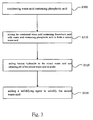
- Fig. 3 shows a basic flow diagram of another embodiment of the present invention.
- a method for solidifying and stabilizing radioactive waste acid of the present invention is to improve the efficiency of the solidifying radioactive waste acid, to solve the problem of heat generated by the acid-base reaction, and to keep the efficiency of solidification which may be influenced by concentration of waste acid metal ions contained therein.
- the conventional method for adjusting pH is adding lime (calcium hydroxide) or sodium hydroxide.
- Calcium phosphate is formed by adding calcium hydroxide in radioactive waste acid containing phosphoric acid.
- low-density ettringite is formed by calcium, which is from calcium phosphate, reacting with tricalcium aluminate in cement.
- the formed ettringite makes the volume of the solidified product of radioactive waste acid expended gradually so that the solidified product becomes chapped.
- mass of the solidified product should be increased with undesired volume.
- crystal of phosphoric acid is easily formed in radioactive waste acid. Crystal is disadvantageous to deliver solidified waste acid in a duct.
- granules can be formed so that volume of the solidified waste acid can be reduced and mechanical strength thereof can be improved.
- Fig. 1 shows a basic flow diagram of one embodiment of the present invention.
- waste acid containing phosphoric acid can be a mixed radioactive waste acid, for example a solution of phosphoric acid and nitric acid, or a solution of nitric acid mixed with phosphoric acid or sulfuric acid.
- waste acid containing waste acid is condensed by heating and stirring so that water therein is evaporated.
- waste acid in the condensed waste is condensed to a concentration of 50% to 65% which is suitable for further solidification.
- step S110 a conversion of phosphate is proceeded. Barium hydroxide is added to the condensed radioactive waste acid.
- the condensed radioactive waste acid is kept stirring so that phosphoric acid can react with barium hydroxide to form barium hydrogen phosphate (BaHPO 4 ) completely.
- the pH of the mixed waste acid can be adjusted to 2.5-4.5.
- the preferred pH is 3.
- a solidifying agent is added so that the radioactive waste acid containing barium hydrogen phosphate can be solidified.
- the solidifying agent should be added to the mixed waste acid in batches or continuously. Temperature of the mixed waste acid during the addition of the solidifying agent should be kept in a range of 30 to 45°C.
- the preferred way for adding solidifying agents is three times in batches. In the first batch, a half of total weight of the solidifying agent is added. In the second and the third batch, one-fourth of total weight of the solidifying agent is added, respectively.
- step S100 3510 g of radioactive waste acid containing phosphoric acid, in which the initial concentration of phosphoric acid is 45%, is held in a beaker, heated by a heating plate and stirred by an automatic stirrer so that water in waste acid is vaporized and the weight percent of water in waste acid is reduced.
- step S110 the obtained 2700 g of the condensed waste acid is divided into two parts.
- the applied amount of the solidifying agent is 310 g, and pH of the solidified product produced from radioactive waste acid containing phosphoric acid is 3.8
- the compression strength of the solidified product which is formed after 12 days and after 28 days are 7.8 and 61.2 kg/cm 2 , after 28 days are 7.8 and 61.2 kg/cm 2 , respectively.
- the applied amount of solidifying agents is 404.5 g, and pH of the solidified product produced from radioactive waste acid containing phosphoric acid is 3.9.
- the compression strength of the solidified product which formed after 12 days and after 28 days are 101.9 and 112.2 kg/cm 2 , respectively.
- Table 1 the method for solidifying and stabilizing radioactive waste acid of the present invention can steadily increase the compression strength of the solidified product.
- the additional amounts of the solidifying agent and the neutralizer make a better characteristic of the solidified product of radioactive waste acid.
- radioactive waste acid containing phosphoric acid before condensing is 1755 g and total volume thereof is 1013.3 ml.
- radioactive waste acid is solidified to form a solidified product.
- the total weight and volume of the solidified product is 1572.5 g and 834 ml, respectively.
- Table 2 the weight and volume of radioactive waste acid can be reduced by the method for solidifying and stabilizing radioactive waste acid of the present invention.
- Fig. 2 shows a basic flow diagram of another embodiment of the present invention.
- the difference between Fig. 1 and Fig. 2 is that in the steps of Fig. 1 , barium hydroxide and the solidifying agent are added to solidify radioactive waste acid, but in the steps of Fig. 2 , barium hydroxide is firstly added to waste acid containing fluoroboric acid and then mixed with radioactive waste acid containing phosphoric acid to form a mixed waste acid.
- a granule is formed by adding a first solidifying agent to the mixed waste acid, and a solidified product of the mixed waste acid is formed by adding a second solidifying agent.
- waste acid containing phosphoric acid is condensed to a concentration of 55%.
- step of S210 barium hydroxide is added to radioactive waste acid containing fluoroboric acid to form a precipitation of barium fluoride (BaF 2 ), and then, is mixed with the condensed radioactive waste acid containing phosphoric acid in the concentration of 55% to form a stable mixed radioactive waste acid.
- the weight ratio of waste acid containing phosphoric acid to waste acid containing fluoroboric acid is six.
- a first solidifying agent is added to the mixed waste by dropping so that a plurality of small granules in the mixed waste acid are formed.
- the first solidifying agent is consisted of cement, slag, and fly ash.
- the formed granules are added to another half of the mixed radioactive waste acid which is kept stirring.
- a second solidifying agent is added to another half of the mixed radioactive waste acid to solidify. After that the granules in the mixed waste acid are as an aggregate in the solidified product. Weight of the formed solidified product can be reduced.
- the second solidifying agent is cement.
- step of S200 6282 g of waste acid containing phosphoric acid is condensed to 5140 g with a concentration of 55%.
- step of S210 barium hydroxide is added to radioactive waste acid containing fluoroboric acid, and then is mixed with the condensed radioactive waste acid containing phosphoric acid to form a mixed waste acid.
- weight of radioactive waste acid containing fluoroboric acid is 860 g
- the applied amount of barium hydroxide is 396 g.
- step of S220 3029 g of the solidifying agent is mixed with the mixed radioactive waste acid to form the granules.
- the weight of liquid in radioactive waste acid can be reduced by the method for solidifying and stabilizing radioactive waste acid of the invention.
- Table 3 Results of granulation of waste acid containing phosphoric acid mixed with fluoroboric acid Concentration of waste acid containing phosphoric acid after condensed (%) Conditions Results of granulation Total weight of waste acid containing phosphoric acid before condensing (g) Total weight of waste acid containing phosphoric acid after condensed (g) Total weight of waste acid containing fluoroboric acid (g) Applied amount of the neutralizer (monohydrous barium hydroxide) (g) Applied amount of the solidifying agent Total weight of the granule after granulation Total weight of the granule after granulation/ mixted waste acid + Applied amount of the neutralizer 55 6282 5140 860 396 3029 7282.2 68.91 50 7500 6747 1122 524 4223 10391 77.72
- the weight of radioactive waste acid containing phosphoric acid before condensing is 1571 g
- total weight of radioactive waste acid containing fluoroboric acid is 215 g
- the weight ratio of the applied amount of the total solidifying agent to the mixed radioactive waste acid is 30.1%.
- the compression strength of the solidified product which formed after 3 days and after 28 days are 25 kg and 28 kg/cm 2 , respectively.
- the result of compression strength after dipping in water for three months is 53.5 kg/cm 2 .
- the solidified product of radioactive waste acid formed by the method of the invention has improved weather resistance and water resistance characteristics.
- the granule is formed by the first solidifying agent and the efficiency of solidification would not be influenced.
- a half of radioactive waste acid is inactivated, and then another half of radioactive waste acid is combined therewith to solidify. Heat of acid-base reaction and rapid setting caused by heat can be prevented to influence the quality of the solidified product of waste acid so that the compression strength of the solidified product can be improved.
- Fig. 3 shows a basic flow diagram of another embodiment of the present invention.
- barium hydroxide is added to radioactive waste acid containing fluoroboric acid, and mixed with radioactive waste acid containing phosphoric acid to form a mixed waste acid.
- the difference is that radioactive waste acid containing fluoroboric acid is mixed with radioactive waste acid containing phosphoric acid to form a mixed waste acid, and then added barium hydroxide to the mixed waste acid.
- the waste acid containing phosphoric acid is condensed to a concentration in a range of 50% to 65%.
- the condensed waste acid of which the concentration is from 50% to 65%, is mixed with waste aid containing fluoroboric acid to form a mixed waste acid.
- the weight ratio of waste acid containing phosphoric acid to waste containing fluoroboric acid is six.
- barium hydroxide is added to the mixed waste acid to adjust the pH of the mixed waste acid.
- the mixed waste acid is held by stirring for one hour so that barium hydroxide can completely react with phosphoric acid and fluoroboric acid in the mixed waste acid which pH is 2.5 to 4.5.
- a solidifying agent is added in bathes when the mixed waste acid is stirring.
- the preferred way for adding the solidifying agent is three times in batches. In the first batch, a half of total weight of the solidifying agent is added. In the second and the third batch, a one-fourth of total weight of the solidifying agent is added, respectively.
- the solidifying agent is consisted of cement, slag, silicon ash, and fly ash. Temperature of the mixed radioactive waste acid during the addition of the solidifying agent should be kept in a range of 30 to 45 °C.
- 5711 g of radioactive waste acid containing phosphoric acid which is indicated as No. B5
- the condensed radioactive waste acid is 5140 g.
- the condensed radioactive waste acid is mixed with 860 g of waste acid containing fluoroboric acid to form a mixed waste acid.
- 840 g of barium hydroxide is added to the mixed waste acid. The mixed radioactive waste acid is held for one hour so that the added barium hydroxide can completely react with the mixed radioactive waste acid.
- a solidifying agent is added to the mixed radioactive waste acid in batches.
- the solidifying agent which the total weight is 1560 g, includes 1200 g of cement, 96 g of slag, 172 g of silicon ash, and 504 g of fly ash.
- the weight ratio of the applied solidifying agent to the mixed radioactive waste acid is 23.74%, and the weight ratio of the solidifying agent with a neutralizer to the mixed radioactive waste acid is 36.83%.
- the compression strength of the solidified product formed after 28 days is 27.0 kg/cm 2 .
- the compression strength of the solidified product after dipped three months is 60 kg/cm 2 .
Landscapes
- Physics & Mathematics (AREA)
- Engineering & Computer Science (AREA)
- General Engineering & Computer Science (AREA)
- High Energy & Nuclear Physics (AREA)
- Processing Of Solid Wastes (AREA)
Description
- This invention relates to a method for treating waste acid, and especially, to a method for solidifying and stabilizing waste acid. The method of the present invention can improve efficiency of the solidifying steps and stability of the solidified waste acid.
- In general, the radioactive-contaminated metal wastes include stainless steel and carbon steel which are used in the construction of the nuclear power plant. Since of the well worn piping of the nuclear power plant has to be replaced, a large amount of the radioactive-contaminated stainless steel should be treated. Decontaminants and methods for decontaminating have been improved and are applied, such as mechanical decontaminating by hydraulic giant; electrochemical decontaminating by a mixture of phosphoric acid, sulfuric acid, and nitric acid; and chemical decontaminating by decontaminant containing fluoroboric acid. The radioactive-contaminated metal wastes can reach regulations on final disposal of low-level waste after treated by the above-mentioned methods.
- Decontaminant containing phosphoric acid and fluoroboric acid are widely applied in the decontamination of the radioactive metal wastes. For example, the mixture of phosphoric acid and nitric acid is applied for decontaminating of the metal wastes containing copper and aluminum; the mixture of phosphoric acid, sulfuric acid and nitric acid is applied to electrochemical decontamination suitable for the stainless steel wastes; and the decontaminant containing fluoroboric acid is applied to chemical decontamination. During the decontamination process, the metal ions accumulate in the decontaminant gradually. Then, the metal salts precipitate after reaching the saturated concentration. The precipitated material in the decontaminant is disadvantageous to the decontamination process. Moreover, if the decontaminant is contaminated by the nuclides and the radioactivity thereof raises, the decontaminant should be regenerated. Metal ions of the recycled decontaminant containing phosphoric acid and fluoroboric acid can be removed by way of oxalic acid selective precipitation, electrolysis recovery, and cation exchange, so that the decontaminant can be recovered and reused thereafter. After several times of the regenesis, decontaminant has to be eliminated since the radioactivity thereof is high. The used decontaminant becomes waste acid.
- At the present day, the treatment of radioactive waste acid still makes progress. In the conventional process, the used decontaminant containing fluoroboric acid is treated by destroying the BF4 - chelate therein so that CaF2 can be precipitated. BF4, which is stable at room temperature, can be hydrolyzed to form HF by aluminum salt as the catalyst, and then CaF2 is formed after addition of calcium ion. The aforementioned reactions are the following formulas:
3HBF4 + Ah(SO4)3 + 9H2O ⇔ 2H3AlF6 + 3H2SO4 + 3H3BO3 ;
and
H3AlF6 + 3Ca(OH)2 ⇔ 3CaF2 + Al(OH)3 + 3H2O.
In the formulas, the amount of aluminum salts has to add more than the concentration of fluoroboric acid so that the efficiency of eliminating fluoroboric acid can be ensured. The conventional method for eliminating fluoroboric acid in waste acid is effective but, however, the amount of the secondary waste will increase. - The conventional methods for treating used decontaminant containing phosphoric acid include selectively precipitating and directly neutralizating. In the method of selectively precipitating, for example, in order to treat 2500 L of used decontaminant containing phosphoric acid, 117 kg of iron powder and 1558.5 kg of oxalic acid is necessary to make phosphoric acid precipitate; 7089 L of water is necessary for solid-liquid separation; and the separated water is needed to neutralize and to eliminate oxalic acid by ultraviolet and ozone. After that, the treated decontaminant has to eliminate the radioactivity further. As described in the
US patent no. 5,645,518 which is titled "Method for stabilizing low-level mixed wastes at room temperature", the phosphate ceramic material is applied to treat the solid and liquid wastes. The solid waste is grinded to a size in a range between 4 and 75 micrometers, the grinded powder is contacted with phosphate-containing solution to create phosphates of the oxide in a sol-gel, and the sol-gel is solidified. The solidified waste is convenient for follow-up treatment. - As described above, the conventional methods for treating waste acid have disadvantages including: (1) a large amount of the neutralizer is necessary to mix with the same amount of waste acid so that the effect of compaction of waste acid is undesired; (2) the solid sludge and liquid waste generated during treating of waste acid have to be treated by another process so that the secondary contamination and the large amount of waste is undesired; (3) heat generated during the treatment of waste acid is hard to control so that the rapid setting caused by heat is disadvantageous to waste acid; and (4) applying neutralizers separately to waste acid is adverse for stabilization of waste acid. The aforementioned disadvantages should be eliminated to improve the solidification and stabilization of waste acid.
- In this regard, it is important to provide a method for solidifying and stabilizing waste acid which prevents formation of secondary contamination, has low cost, simplifies the processes, and improves the efficiency of solidification to eliminate the foregoing drawbacks.
- Accordingly, it is an object of the present invention to provide a method for treating radioactive waste acid to solidify and stabilize by adding barium hydroxide to adjust the pH of waste acid so that radioactive waste acid can be stabilized and the corrosion thereof can be reduced.
- Another object of the present invention is to provide a method for solidifying waste acid by applying at least one solidifying agent to radioactive waste acid so that numerous granules in radioactive waste acid are formed. The granule is advantageous to reduce the volume of the solidified waste and to improve the mechanical strength thereof.
- Yet another object of the present invention is to provide a method for solidifying radioactive waste acid which can prevent the formation of ettringite. The expansion and chap of the solidified waste caused by ettringite can be prevented and the stabilization thereof can be improved.
- Still another object of the present invention is to provide a method for solidifying radioactive waste acid by adding barium hydroxide to form barium hydrogen phosphate. The formed granule of barium hydrogen phosphate is firm, tiny, solid to coagulate and easy to disperse in radioactive waste acid. Radioactive Waste acid containing granules is easy to flow and to mix with other chemicals.
- In order to achieve the above objects, the present invention provides a method for solidifying and stabilizing radioactive waste acid including the steps of condensing radioactive waste acid containing phosphoric acid; adding barium hydroxide to the condensed radioactive waste acid and adjusting the pH thereof to form barium hydrogen phosphate; and adding solidifying agents to solidify barium hydrogen phosphate. The step of adding barium hydroxide is for adjusting the pH of radioactive waste acid and for stabilizing radioactive waste acid. The adjusted pH of radioactive waste acid can improve the formation of barium hydrogen phosphate. In the step of adding the solidifying agents, the solidifying agents are added in batches or continuously so that heat, which is generated by the intense reaction and is disadvantageous to solidification, can be prevented. In the method of present invention, radioactive waste acid containing phosphoric acid can form granules by adding solidifying agents to reduce the volume of waste acid. Moreover, radioactive waste acid containing phosphoric acid can be mixed with another waste acid containing fluoroboric acid. The pH of the mixed radioactive waste acid can be adjusted by adding barium hydroxide so that the stability of the mixed waste acid can be kept. The concentration of the solution and metal ions will not obstruct the solidifying reaction of the mixed radioactive waste acid.
- The invention can be more fully understood by reading the subsequent detailed description and examples with references made to the accompanying drawings, wherein:
-
Fig. 1 shows a basic flow diagram of one embodiment of the present invention; -
Fig. 2 shows a basic flow diagram of another embodiment of the present invention; and -
Fig. 3 shows a basic flow diagram of another embodiment of the present invention. - A method for solidifying and stabilizing radioactive waste acid of the present invention is to improve the efficiency of the solidifying radioactive waste acid, to solve the problem of heat generated by the acid-base reaction, and to keep the efficiency of solidification which may be influenced by concentration of waste acid metal ions contained therein. The conventional method for adjusting pH is adding lime (calcium hydroxide) or sodium hydroxide. Calcium phosphate is formed by adding calcium hydroxide in radioactive waste acid containing phosphoric acid. However, during the solidifying reaction of radioactive waste acid, low-density ettringite is formed by calcium, which is from calcium phosphate, reacting with tricalcium aluminate in cement. The formed ettringite makes the volume of the solidified product of radioactive waste acid expended gradually so that the solidified product becomes chapped. In order to eliminate expansion and chapping of the solidified product of radioactive waste acid, mass of the solidified product should be increased with undesired volume. Besides, crystal of phosphoric acid is easily formed in radioactive waste acid. Crystal is disadvantageous to deliver solidified waste acid in a duct. During the solidifying step of the present invention, granules can be formed so that volume of the solidified waste acid can be reduced and mechanical strength thereof can be improved. The present invention will be apparent from the following detailed description, which proceeds with reference to the accompanying drawings.
-
Fig. 1 shows a basic flow diagram of one embodiment of the present invention. In the embodiment, waste acid containing phosphoric acid can be a mixed radioactive waste acid, for example a solution of phosphoric acid and nitric acid, or a solution of nitric acid mixed with phosphoric acid or sulfuric acid. In step 100 shown inFig. 1 , waste acid containing waste acid is condensed by heating and stirring so that water therein is evaporated. After step 100, waste acid in the condensed waste is condensed to a concentration of 50% to 65% which is suitable for further solidification. Next, in the step S110, a conversion of phosphate is proceeded. Barium hydroxide is added to the condensed radioactive waste acid. During the addition of barium hydroxide, the condensed radioactive waste acid is kept stirring so that phosphoric acid can react with barium hydroxide to form barium hydrogen phosphate (BaHPO4) completely. Furthermore, the pH of the mixed waste acid can be adjusted to 2.5-4.5. In the embodiment, the preferred pH is 3. In step 120, when pH of the mixed waste acid is in a range of 2.5 to 4.5, a solidifying agent is added so that the radioactive waste acid containing barium hydrogen phosphate can be solidified. The solidifying agent should be added to the mixed waste acid in batches or continuously. Temperature of the mixed waste acid during the addition of the solidifying agent should be kept in a range of 30 to 45°C. In the embodiment, the preferred way for adding solidifying agents is three times in batches. In the first batch, a half of total weight of the solidifying agent is added. In the second and the third batch, one-fourth of total weight of the solidifying agent is added, respectively. - The following is a detailed description of the embodiment shown in
Fig. 1 . In the step S100, 3510 g of radioactive waste acid containing phosphoric acid, in which the initial concentration of phosphoric acid is 45%, is held in a beaker, heated by a heating plate and stirred by an automatic stirrer so that water in waste acid is vaporized and the weight percent of water in waste acid is reduced. After the heating step, 2700 g of the condensed waste acid is obtained and the concentration of phosphoric acid in the condensed radioactive waste acid is in a range between 50 % and 65%. In the step of S110, the obtained 2700 g of the condensed waste acid is divided into two parts. Two parts of 1350 g of the condensed waste acid are held in two mixers, and 189 g and 181.6 g of barium hydroxide are added to the mixers, respectively. The mixer is kept running for one hour so that phosphoric acid in the condensed radioactive waste acid is converted to generate barium hydrogen hydroxide. In this step, barium hydroxide is used for adjusting pH of the condensed radioactive waste acid and for stabilizing thereof. After addition of barium hydroxide, barium hydrogen hydroxide is generated and pH of the condensed radioactive waste acid raises to 3. - As mentioned before, in the result of adding 181.6 g of monohydrous barium hydroxide which is used as a neutralizer, the applied amount of the solidifying agent is 310 g, and pH of the solidified product produced from radioactive waste acid containing phosphoric acid is 3.8 The compression strength of the solidified product which is formed after 12 days and after 28 days are 7.8 and 61.2 kg/cm2, after 28 days are 7.8 and 61.2 kg/cm2, respectively. Besides, in the result of adding 189 g of monohydrous barium hydroxide which is used as a neutralizer, the applied amount of solidifying agents is 404.5 g, and pH of the solidified product produced from radioactive waste acid containing phosphoric acid is 3.9. The compression strength of the solidified product which formed after 12 days and after 28 days are 101.9 and 112.2 kg/cm2, respectively. As shown in Table 1 below, the method for solidifying and stabilizing radioactive waste acid of the present invention can steadily increase the compression strength of the solidified product. The additional amounts of the solidifying agent and the neutralizer make a better characteristic of the solidified product of radioactive waste acid.
Table 1 Results of radioactive solidification of waste acid containing phosphoric acid Conditions Result of solidification Applied amount of the neutralizer (monohydrous barium hydroxide) (g) Total weight before condensing (g) Total weight after condensing (g) Applied amount of the solidifying agent (g) pH of the solidified product of waste acid Compression strength after 12 days (kg/cm2) Compression strength after 28 days (kg/cm2) 181.6 1755 1350 310.0 3.8 7.8 61.2 189 1755 1350 404.5 3.9 101.9 112.2 - Assuming that the total weight of radioactive waste acid containing phosphoric acid before condensing is 1755 g and total volume thereof is 1013.3 ml. After adding barium hydroxide, and adding the solidifying agent in batches, radioactive waste acid is solidified to form a solidified product. The total weight and volume of the solidified product is 1572.5 g and 834 ml, respectively. As shown in Table 2 below, the weight and volume of radioactive waste acid can be reduced by the method for solidifying and stabilizing radioactive waste acid of the present invention.
Table 2 Results of solidification of radioactive waste acid containing phosphoric acid Conditions Result of solidification Total weight of waste acid before condensing (g) Total weight of waste acid after condensing (g) Volume of waste acid before condensing (ml) Weight of the solidifying agent (g) Volume of the solidifying agent(ml) Specific gravity of the solidifying agent Weight ratio of IER/ solidifying agent Volume ratio of IER/ solidifying agent 1755 1350 1013.3 1572.5 834 1.88 1.116 1.215 -
Fig. 2 shows a basic flow diagram of another embodiment of the present invention. The difference betweenFig. 1 andFig. 2 is that in the steps ofFig. 1 , barium hydroxide and the solidifying agent are added to solidify radioactive waste acid, but in the steps ofFig. 2 , barium hydroxide is firstly added to waste acid containing fluoroboric acid and then mixed with radioactive waste acid containing phosphoric acid to form a mixed waste acid. A granule is formed by adding a first solidifying agent to the mixed waste acid, and a solidified product of the mixed waste acid is formed by adding a second solidifying agent. In the step of S200 shown inFig.2 , waste acid containing phosphoric acid is condensed to a concentration of 55%. In the step of S210, barium hydroxide is added to radioactive waste acid containing fluoroboric acid to form a precipitation of barium fluoride (BaF2), and then, is mixed with the condensed radioactive waste acid containing phosphoric acid in the concentration of 55% to form a stable mixed radioactive waste acid. In the mixed radioactive waste acid, the weight ratio of waste acid containing phosphoric acid to waste acid containing fluoroboric acid is six. In the step 220, a first solidifying agent is added to the mixed waste by dropping so that a plurality of small granules in the mixed waste acid are formed. The first solidifying agent is consisted of cement, slag, and fly ash. In the step of S230, the formed granules are added to another half of the mixed radioactive waste acid which is kept stirring. Next, a second solidifying agent is added to another half of the mixed radioactive waste acid to solidify. After that the granules in the mixed waste acid are as an aggregate in the solidified product. Weight of the formed solidified product can be reduced. In the embodiment, the second solidifying agent is cement. - The following is a detailed description of the embodiment shown in
Fig. 2 . In the step of S200, 6282 g of waste acid containing phosphoric acid is condensed to 5140 g with a concentration of 55%. In the step of S210, barium hydroxide is added to radioactive waste acid containing fluoroboric acid, and then is mixed with the condensed radioactive waste acid containing phosphoric acid to form a mixed waste acid. In the embodiment, weight of radioactive waste acid containing fluoroboric acid is 860 g, and the applied amount of barium hydroxide is 396 g. In the step of S220, 3029 g of the solidifying agent is mixed with the mixed radioactive waste acid to form the granules. After the granulating, weight of liquid in the mixed radioactive waste acid reduced to 68.91% in comparison with the mixed radioactive waste acid before granulating. In contrast, the steps shown inFig. 2 are carried out by 6747 g of radioactive waste acid containing phosphoric acid with a concentration of 50%, 1122 g of waste acid containing fluoroboric acid, 524 g of barium hydroxide, and 4223 g of the first solidifying agent. After the granulating, weight of liquid in the mixed radioactive acid reduced to 77.72% in comparison with the mixed radioactive waste acid before granulating. The foregoing results are listed in the Table 3. The weight of liquid in radioactive waste acid can be reduced by the method for solidifying and stabilizing radioactive waste acid of the invention.Table 3 Results of granulation of waste acid containing phosphoric acid mixed with fluoroboric acid Concentration of waste acid containing phosphoric acid after condensed (%) Conditions Results of granulation Total weight of waste acid containing phosphoric acid before condensing (g) Total weight of waste acid containing phosphoric acid after condensed (g) Total weight of waste acid containing fluoroboric acid (g) Applied amount of the neutralizer (monohydrous barium hydroxide) (g) Applied amount of the solidifying agent Total weight of the granule after granulation Total weight of the granule after granulation/ mixted waste acid + Applied amount of the neutralizer 55 6282 5140 860 396 3029 7282.2 68.91 50 7500 6747 1122 524 4223 10391 77.72 - In the step of S230, the weight of radioactive waste acid containing phosphoric acid before condensing is 1571 g, total weight of radioactive waste acid containing fluoroboric acid is 215 g applied amount of barium hydroxide is 210 g, and the weight ratio of the applied amount of the total solidifying agent to the mixed radioactive waste acid is 30.1%. After solidifying, the compression strength of the solidified product which formed after 3 days and after 28 days are 25 kg and 28 kg/cm2, respectively. Furthermore, in the water-resistance test of the sample which the compression strength is 74 kg per square centimeter, the result of compression strength after dipping in water for three months is 53.5 kg/cm2. It indicated that the solidified product of radioactive waste acid formed by the method of the invention has improved weather resistance and water resistance characteristics. As shown in Table 4, the granule is formed by the first solidifying agent and the efficiency of solidification would not be influenced. In the steps shown in
Fig. 2 , a half of radioactive waste acid is inactivated, and then another half of radioactive waste acid is combined therewith to solidify. Heat of acid-base reaction and rapid setting caused by heat can be prevented to influence the quality of the solidified product of waste acid so that the compression strength of the solidified product can be improved.Table 4 Results of solidification and granulation of radioactive waste acid containing phosphoric acid mixed with fluoroboric acid Conditions Results of solidification Weight of granule after partially granulation (g) Mixed waste acid Applied amount of cement (g) Applied amount of solidifying agent/Mixed waste acid (%) Compression strength (kg/cm2) Compression strength after dipping 3 months (kg/cm2) Total weight of phosphoric acid before condensing (g) Total weight of waste acid containing fluoroboric acid (g) Applied amount of neutralizer (monohydrous barium hydroxide) (g) After 3 days After 14 days After 28 days 1875 1571 215 210 - 30.1 25 28 1875 1393 189 210 - 31.9 35 51 1657 1231 167 186 - 30.1 21 29 Results of dipping the solidified product 5195 3750 561 262.2 340 34.1 67.5 78.5 74 53.5 4097 2810 423 197 318 31.6 33 52 64 42.5 4097 2810 423 197 283.3 31.2 33.5 48 45 38.3 -
Fig. 3 shows a basic flow diagram of another embodiment of the present invention. In the steps ofFig. 2 , barium hydroxide is added to radioactive waste acid containing fluoroboric acid, and mixed with radioactive waste acid containing phosphoric acid to form a mixed waste acid. In the steps ofFig. 3 , the difference is that radioactive waste acid containing fluoroboric acid is mixed with radioactive waste acid containing phosphoric acid to form a mixed waste acid, and then added barium hydroxide to the mixed waste acid. In the step of S300, the waste acid containing phosphoric acid is condensed to a concentration in a range of 50% to 65%. In the step of S310, the condensed waste acid, of which the concentration is from 50% to 65%, is mixed with waste aid containing fluoroboric acid to form a mixed waste acid. In the mixed waste acid, the weight ratio of waste acid containing phosphoric acid to waste containing fluoroboric acid is six. In the step of S320, barium hydroxide is added to the mixed waste acid to adjust the pH of the mixed waste acid. Next, the mixed waste acid is held by stirring for one hour so that barium hydroxide can completely react with phosphoric acid and fluoroboric acid in the mixed waste acid which pH is 2.5 to 4.5. In step of S330, a solidifying agent is added in bathes when the mixed waste acid is stirring. In the embodiment, the preferred way for adding the solidifying agent is three times in batches. In the first batch, a half of total weight of the solidifying agent is added. In the second and the third batch, a one-fourth of total weight of the solidifying agent is added, respectively. The solidifying agent is consisted of cement, slag, silicon ash, and fly ash. Temperature of the mixed radioactive waste acid during the addition of the solidifying agent should be kept in a range of 30 to 45 °C. - The following is a detailed description of the embodiment shown in
Fig. 3 . In the step of S300, 5711 g of radioactive waste acid containing phosphoric acid, which is indicated as No. B5, is condensed by heating and stirring. The condensed radioactive waste acid is 5140 g. In the step of S310, the condensed radioactive waste acid is mixed with 860 g of waste acid containing fluoroboric acid to form a mixed waste acid. In the step of S320, 840 g of barium hydroxide is added to the mixed waste acid. The mixed radioactive waste acid is held for one hour so that the added barium hydroxide can completely react with the mixed radioactive waste acid. Next, in the step of S30, a solidifying agent is added to the mixed radioactive waste acid in batches. The solidifying agent, which the total weight is 1560 g, includes 1200 g of cement, 96 g of slag, 172 g of silicon ash, and 504 g of fly ash. The weight ratio of the applied solidifying agent to the mixed radioactive waste acid is 23.74%, and the weight ratio of the solidifying agent with a neutralizer to the mixed radioactive waste acid is 36.83%. The compression strength of the solidified product formed after 28 days is 27.0 kg/cm2. The compression strength of the solidified product after dipped three months is 60 kg/cm2. - The result of foregoing steps is shown in Table 5. Besides, two results which indicated as Nos. B6 and B7 shown in Table 5 are similar to the result of No. B5. As the results shown in Table 5 indicated, the solidified product of radioactive waste acid formed by the method of the invention has improved weather resistance and water resistance characteristics. Moreover, the method of the invention prevents intensely exothermic reaction and rapid setting caused by adding the solidifying agents to influence the efficiency and quality of solidification.
Table 5 Results of indirect solidification of radioactive waste acid containing phosphoric acid mixed with fluoroboric acid Conditions Results No. Total weight of waste acid containing phosphoric acid before condensing (g) Total weight of waste acid containing phosphoric acid after condensed (g) Total weight of waste acid containing fluoroboric acid (g) Applied amount of neutralizer (monohydrous barium hydroxide) (g) Applied amount of solidifying agent (%) Applied amount of solidifying agent/Total weight of mixed waste acid (%) Applied amount of solidifying agent + neutralizer/fotal weight of mixed waste acid (%) Compression strength after 28 days (kg/cm2) Compression strength after dipping 3 months (kg/cm2) B5 5711 5140 860 840 1560 23.74 36.83 27.0 60 B6 5711 5140 860 640 1560 23.74 33.48 16.0 43 B7 5711 5140 860 840 1705 25.95 39.73 48.5 103 - While the invention is susceptible to various modifications and alternative forms, specific embodiments thereof have been shown by the way of example in the drawings and are herein described in detail.
Claims (10)
- A method for treating radioactive waste acid containing phosphoric acid comprising steps of:condensing the radioactive waste acid to a concentration of at least 50% of phosphoric acid;adding barium hydroxide to the condensed radioactive waste acid and adjusting the pH of the radioactive waste acid to generate barium hydrogen phosphate; andadding a solidifying agent to react with the barium hydrogen phosphate so that a solidified product of the radioactive waste acid can be formed.
- The method as recited in claim 1, wherein the step of adding the solidifying agent is adding in batches or continuously so that the radioactive waste acid can be controlled in a temperature of 30 to 45 °C.
- The method as recited in claim 1, wherein adjusting the pH of the radioactive waste acid is adjusting the pH to a range between 2.5 and 4.5.
- A method for treating radioactive waste acid containing phosphoric acid and fluoroboric acid comprising steps of:condensing a radioactive waste acid containing phosphoric acid to a concentration of at least 50% of phosphoric acid;adding barium hydroxide to another radioactive waste acid containing fluoroboric acid, mixing the radioactive waste acid containing fluoroboric acid with the condensed radioactive waste acid containing phosphoric acid to form a mixed radioactive waste acid, and dividing the mixed waste into two parts;dropping one part of the mixed radioactive waste acid in a stirrer which contained a first solidifying agent to form at least a granule;mixing the formed granule with another part of the mixed radioactive waste by stirring; andadding a second solidifying agent to the radioactive mixed waste by stirring, placing in stationary so that a solidified product of the mixed radioactive waste acid can be formed.
- The method as recited in claim 4, wherein the first solidifying agent is consisted of cement, slag, and fly ash.
- The method as recited in claim 4, wherein the second solidifying agent is consisted of cement.
- The method as recited in claim 4, wherein a weight ratio of the condensed radioactive waste acid containing phosphoric acid to the radioactive waste acid containing fluoroboric acid is six.
- A method for treating radioactive waste acid containing phosphoric acid and fluoroboric acid according to claim 1, wherein
the condensed radioactive waste acid containing phosphoric acid is mixed with a radioactive waste acid containing fluoroboric acid to form a mixed radioactive waste acid; - The method as recited in claim 8, the step of adding the solidifying agent is adding in batches or continuously so that the mixed radioactive waste acid can be controlled in a temperature of 30 to 45 °C.
- The method as recited in claim 8, wherein adjusting the pH of the mixed radioactive waste acid is adjusting the pH to a range between 2.5 and 4.5.
Priority Applications (1)
| Application Number | Priority Date | Filing Date | Title |
|---|---|---|---|
| EP20070018947 EP2043109B1 (en) | 2007-09-26 | 2007-09-26 | Method for solidifying and stabilizing waste acid |
Applications Claiming Priority (1)
| Application Number | Priority Date | Filing Date | Title |
|---|---|---|---|
| EP20070018947 EP2043109B1 (en) | 2007-09-26 | 2007-09-26 | Method for solidifying and stabilizing waste acid |
Publications (2)
| Publication Number | Publication Date |
|---|---|
| EP2043109A1 EP2043109A1 (en) | 2009-04-01 |
| EP2043109B1 true EP2043109B1 (en) | 2012-05-23 |
Family
ID=39105921
Family Applications (1)
| Application Number | Title | Priority Date | Filing Date |
|---|---|---|---|
| EP20070018947 Not-in-force EP2043109B1 (en) | 2007-09-26 | 2007-09-26 | Method for solidifying and stabilizing waste acid |
Country Status (1)
| Country | Link |
|---|---|
| EP (1) | EP2043109B1 (en) |
Family Cites Families (3)
| Publication number | Priority date | Publication date | Assignee | Title |
|---|---|---|---|---|
| JPH0228118B2 (en) * | 1983-01-21 | 1990-06-21 | Jgc Corp | HOSHASEIHAIEKINOSHORIHOHO |
| JPH04128699A (en) * | 1990-09-20 | 1992-04-30 | Tohoku Electric Power Co Inc | Solidification method for radioactive waste fluid |
| JP3107758B2 (en) * | 1996-10-29 | 2000-11-13 | 株式会社東芝 | Method and apparatus for solidifying radioactive waste |
-
2007
- 2007-09-26 EP EP20070018947 patent/EP2043109B1/en not_active Not-in-force
Also Published As
| Publication number | Publication date |
|---|---|
| EP2043109A1 (en) | 2009-04-01 |
Similar Documents
| Publication | Publication Date | Title |
|---|---|---|
| Priambodo et al. | Fluidized-bed crystallization of iron phosphate from solution containing phosphorus | |
| US20110104792A1 (en) | Low-temperature solidification of radioactive and hazardous wastes | |
| JP4414214B2 (en) | Treatment method of waste ion exchange resin | |
| CN105683097A (en) | Agent for treating hazardous materials | |
| US8227655B2 (en) | Method for solidifying and stabilizing waste acid | |
| EP2043109A1 (en) | Method for solidifying and stabilizing waste acid | |
| JP7247343B2 (en) | Method for conditioning ion exchange resin and apparatus for carrying it out | |
| JP2002059141A (en) | Stabilization technology for industrial waste containing chromium | |
| JP3468250B2 (en) | Treatment of alkaline fly ash | |
| TWI342789B (en) | ||
| US5202062A (en) | Disposal method of radioactive wastes | |
| JPWO2000004982A1 (en) | Exhaust gas treatment agent, its manufacturing method and exhaust gas treatment method | |
| JP3213054B2 (en) | Treatment method for incinerated ash containing heavy metals | |
| JP2000135490A (en) | Treatment of waste liquid | |
| JP4522424B2 (en) | Solidification and stabilization of waste acid solution | |
| US6436025B1 (en) | Co-solidification of low-level radioactive wet wastes produced from BWR nuclear power plants | |
| JP2013193039A (en) | Heavy metal fixing agent used for incineration fly ash and stabilization treatment method of the incineration fly ash | |
| JPS62183896A (en) | Method for stabilizing coal ash | |
| JP2005074321A (en) | Heavy metal treating agent and method for producing the same | |
| JPS59133498A (en) | Method of processing radioactive liquid waste | |
| JP2003245630A (en) | Anaerobic treatment of organic waste | |
| JP2025138465A (en) | Geopolymers, solidified geopolymers, and methods for treating radioactive waste. | |
| JPH11114534A (en) | Special fly ash treatment method | |
| JPH10263501A (en) | Treatment agent for heavy metal-containing waste and method for stabilizing heavy metal-containing waste | |
| JPH0546519B2 (en) |
Legal Events
| Date | Code | Title | Description |
|---|---|---|---|
| PUAI | Public reference made under article 153(3) epc to a published international application that has entered the european phase |
Free format text: ORIGINAL CODE: 0009012 |
|
| 17P | Request for examination filed |
Effective date: 20070926 |
|
| AK | Designated contracting states |
Kind code of ref document: A1 Designated state(s): AT BE BG CH CY CZ DE DK EE ES FI FR GB GR HU IE IS IT LI LT LU LV MC MT NL PL PT RO SE SI SK TR |
|
| AX | Request for extension of the european patent |
Extension state: AL BA HR MK RS |
|
| 17Q | First examination report despatched |
Effective date: 20090518 |
|
| AKX | Designation fees paid |
Designated state(s): AT BE BG CH CY CZ DE DK EE ES FI FR GB GR HU IE IS IT LI LT LU LV MC MT NL PL PT RO SE SI SK TR |
|
| GRAP | Despatch of communication of intention to grant a patent |
Free format text: ORIGINAL CODE: EPIDOSNIGR1 |
|
| GRAS | Grant fee paid |
Free format text: ORIGINAL CODE: EPIDOSNIGR3 |
|
| GRAA | (expected) grant |
Free format text: ORIGINAL CODE: 0009210 |
|
| AK | Designated contracting states |
Kind code of ref document: B1 Designated state(s): AT BE BG CH CY CZ DE DK EE ES FI FR GB GR HU IE IS IT LI LT LU LV MC MT NL PL PT RO SE SI SK TR |
|
| REG | Reference to a national code |
Ref country code: GB Ref legal event code: FG4D |
|
| REG | Reference to a national code |
Ref country code: CH Ref legal event code: EP |
|
| REG | Reference to a national code |
Ref country code: AT Ref legal event code: REF Ref document number: 559405 Country of ref document: AT Kind code of ref document: T Effective date: 20120615 |
|
| REG | Reference to a national code |
Ref country code: IE Ref legal event code: FG4D |
|
| REG | Reference to a national code |
Ref country code: DE Ref legal event code: R096 Ref document number: 602007022799 Country of ref document: DE Effective date: 20120726 |
|
| REG | Reference to a national code |
Ref country code: NL Ref legal event code: T3 |
|
| REG | Reference to a national code |
Ref country code: CH Ref legal event code: NV Representative=s name: BOHEST AG |
|
| REG | Reference to a national code |
Ref country code: LT Ref legal event code: MG4D Effective date: 20120523 |
|
| PG25 | Lapsed in a contracting state [announced via postgrant information from national office to epo] |
Ref country code: SE Free format text: LAPSE BECAUSE OF FAILURE TO SUBMIT A TRANSLATION OF THE DESCRIPTION OR TO PAY THE FEE WITHIN THE PRESCRIBED TIME-LIMIT Effective date: 20120523 Ref country code: IS Free format text: LAPSE BECAUSE OF FAILURE TO SUBMIT A TRANSLATION OF THE DESCRIPTION OR TO PAY THE FEE WITHIN THE PRESCRIBED TIME-LIMIT Effective date: 20120923 Ref country code: CY Free format text: LAPSE BECAUSE OF FAILURE TO SUBMIT A TRANSLATION OF THE DESCRIPTION OR TO PAY THE FEE WITHIN THE PRESCRIBED TIME-LIMIT Effective date: 20120523 Ref country code: LT Free format text: LAPSE BECAUSE OF FAILURE TO SUBMIT A TRANSLATION OF THE DESCRIPTION OR TO PAY THE FEE WITHIN THE PRESCRIBED TIME-LIMIT Effective date: 20120523 |
|
| REG | Reference to a national code |
Ref country code: AT Ref legal event code: MK05 Ref document number: 559405 Country of ref document: AT Kind code of ref document: T Effective date: 20120523 |
|
| PG25 | Lapsed in a contracting state [announced via postgrant information from national office to epo] |
Ref country code: PT Free format text: LAPSE BECAUSE OF FAILURE TO SUBMIT A TRANSLATION OF THE DESCRIPTION OR TO PAY THE FEE WITHIN THE PRESCRIBED TIME-LIMIT Effective date: 20120924 Ref country code: LV Free format text: LAPSE BECAUSE OF FAILURE TO SUBMIT A TRANSLATION OF THE DESCRIPTION OR TO PAY THE FEE WITHIN THE PRESCRIBED TIME-LIMIT Effective date: 20120523 Ref country code: SI Free format text: LAPSE BECAUSE OF FAILURE TO SUBMIT A TRANSLATION OF THE DESCRIPTION OR TO PAY THE FEE WITHIN THE PRESCRIBED TIME-LIMIT Effective date: 20120523 Ref country code: GR Free format text: LAPSE BECAUSE OF FAILURE TO SUBMIT A TRANSLATION OF THE DESCRIPTION OR TO PAY THE FEE WITHIN THE PRESCRIBED TIME-LIMIT Effective date: 20120824 |
|
| PG25 | Lapsed in a contracting state [announced via postgrant information from national office to epo] |
Ref country code: BE Free format text: LAPSE BECAUSE OF FAILURE TO SUBMIT A TRANSLATION OF THE DESCRIPTION OR TO PAY THE FEE WITHIN THE PRESCRIBED TIME-LIMIT Effective date: 20120523 |
|
| PG25 | Lapsed in a contracting state [announced via postgrant information from national office to epo] |
Ref country code: EE Free format text: LAPSE BECAUSE OF FAILURE TO SUBMIT A TRANSLATION OF THE DESCRIPTION OR TO PAY THE FEE WITHIN THE PRESCRIBED TIME-LIMIT Effective date: 20120523 Ref country code: AT Free format text: LAPSE BECAUSE OF FAILURE TO SUBMIT A TRANSLATION OF THE DESCRIPTION OR TO PAY THE FEE WITHIN THE PRESCRIBED TIME-LIMIT Effective date: 20120523 Ref country code: SK Free format text: LAPSE BECAUSE OF FAILURE TO SUBMIT A TRANSLATION OF THE DESCRIPTION OR TO PAY THE FEE WITHIN THE PRESCRIBED TIME-LIMIT Effective date: 20120523 Ref country code: DK Free format text: LAPSE BECAUSE OF FAILURE TO SUBMIT A TRANSLATION OF THE DESCRIPTION OR TO PAY THE FEE WITHIN THE PRESCRIBED TIME-LIMIT Effective date: 20120523 Ref country code: CZ Free format text: LAPSE BECAUSE OF FAILURE TO SUBMIT A TRANSLATION OF THE DESCRIPTION OR TO PAY THE FEE WITHIN THE PRESCRIBED TIME-LIMIT Effective date: 20120523 Ref country code: RO Free format text: LAPSE BECAUSE OF FAILURE TO SUBMIT A TRANSLATION OF THE DESCRIPTION OR TO PAY THE FEE WITHIN THE PRESCRIBED TIME-LIMIT Effective date: 20120523 |
|
| REG | Reference to a national code |
Ref country code: DE Ref legal event code: R097 Ref document number: 602007022799 Country of ref document: DE |
|
| PG25 | Lapsed in a contracting state [announced via postgrant information from national office to epo] |
Ref country code: PL Free format text: LAPSE BECAUSE OF FAILURE TO SUBMIT A TRANSLATION OF THE DESCRIPTION OR TO PAY THE FEE WITHIN THE PRESCRIBED TIME-LIMIT Effective date: 20120523 Ref country code: IT Free format text: LAPSE BECAUSE OF FAILURE TO SUBMIT A TRANSLATION OF THE DESCRIPTION OR TO PAY THE FEE WITHIN THE PRESCRIBED TIME-LIMIT Effective date: 20120523 |
|
| PLBE | No opposition filed within time limit |
Free format text: ORIGINAL CODE: 0009261 |
|
| STAA | Information on the status of an ep patent application or granted ep patent |
Free format text: STATUS: NO OPPOSITION FILED WITHIN TIME LIMIT |
|
| PG25 | Lapsed in a contracting state [announced via postgrant information from national office to epo] |
Ref country code: ES Free format text: LAPSE BECAUSE OF FAILURE TO SUBMIT A TRANSLATION OF THE DESCRIPTION OR TO PAY THE FEE WITHIN THE PRESCRIBED TIME-LIMIT Effective date: 20120903 Ref country code: MC Free format text: LAPSE BECAUSE OF NON-PAYMENT OF DUE FEES Effective date: 20120930 |
|
| 26N | No opposition filed |
Effective date: 20130226 |
|
| REG | Reference to a national code |
Ref country code: DE Ref legal event code: R082 Ref document number: 602007022799 Country of ref document: DE Representative=s name: LANGPATENT ANWALTSKANZLEI IP LAW FIRM, DE |
|
| REG | Reference to a national code |
Ref country code: IE Ref legal event code: MM4A |
|
| REG | Reference to a national code |
Ref country code: DE Ref legal event code: R097 Ref document number: 602007022799 Country of ref document: DE Effective date: 20130226 |
|
| REG | Reference to a national code |
Ref country code: HU Ref legal event code: AG4A Ref document number: E015809 Country of ref document: HU |
|
| PG25 | Lapsed in a contracting state [announced via postgrant information from national office to epo] |
Ref country code: BG Free format text: LAPSE BECAUSE OF FAILURE TO SUBMIT A TRANSLATION OF THE DESCRIPTION OR TO PAY THE FEE WITHIN THE PRESCRIBED TIME-LIMIT Effective date: 20120823 Ref country code: IE Free format text: LAPSE BECAUSE OF NON-PAYMENT OF DUE FEES Effective date: 20120926 |
|
| PGFP | Annual fee paid to national office [announced via postgrant information from national office to epo] |
Ref country code: FI Payment date: 20130924 Year of fee payment: 7 Ref country code: DE Payment date: 20130924 Year of fee payment: 7 |
|
| PG25 | Lapsed in a contracting state [announced via postgrant information from national office to epo] |
Ref country code: MT Free format text: LAPSE BECAUSE OF FAILURE TO SUBMIT A TRANSLATION OF THE DESCRIPTION OR TO PAY THE FEE WITHIN THE PRESCRIBED TIME-LIMIT Effective date: 20120523 |
|
| PGFP | Annual fee paid to national office [announced via postgrant information from national office to epo] |
Ref country code: GB Payment date: 20130924 Year of fee payment: 7 |
|
| PGFP | Annual fee paid to national office [announced via postgrant information from national office to epo] |
Ref country code: CH Payment date: 20131029 Year of fee payment: 7 Ref country code: FR Payment date: 20130926 Year of fee payment: 7 |
|
| PGFP | Annual fee paid to national office [announced via postgrant information from national office to epo] |
Ref country code: NL Payment date: 20130930 Year of fee payment: 7 Ref country code: HU Payment date: 20131107 Year of fee payment: 7 |
|
| PG25 | Lapsed in a contracting state [announced via postgrant information from national office to epo] |
Ref country code: TR Free format text: LAPSE BECAUSE OF FAILURE TO SUBMIT A TRANSLATION OF THE DESCRIPTION OR TO PAY THE FEE WITHIN THE PRESCRIBED TIME-LIMIT Effective date: 20120523 |
|
| PG25 | Lapsed in a contracting state [announced via postgrant information from national office to epo] |
Ref country code: LU Free format text: LAPSE BECAUSE OF NON-PAYMENT OF DUE FEES Effective date: 20120926 |
|
| REG | Reference to a national code |
Ref country code: CH Ref legal event code: PCAR Free format text: NEW ADDRESS: HOLBEINSTRASSE 36-38, 4051 BASEL (CH) |
|
| REG | Reference to a national code |
Ref country code: DE Ref legal event code: R119 Ref document number: 602007022799 Country of ref document: DE |
|
| PG25 | Lapsed in a contracting state [announced via postgrant information from national office to epo] |
Ref country code: FI Free format text: LAPSE BECAUSE OF NON-PAYMENT OF DUE FEES Effective date: 20140926 |
|
| REG | Reference to a national code |
Ref country code: CH Ref legal event code: PL |
|
| GBPC | Gb: european patent ceased through non-payment of renewal fee |
Effective date: 20140926 |
|
| REG | Reference to a national code |
Ref country code: DE Ref legal event code: R119 Ref document number: 602007022799 Country of ref document: DE Effective date: 20150401 |
|
| REG | Reference to a national code |
Ref country code: FR Ref legal event code: ST Effective date: 20150529 |
|
| PG25 | Lapsed in a contracting state [announced via postgrant information from national office to epo] |
Ref country code: NL Free format text: LAPSE BECAUSE OF NON-PAYMENT OF DUE FEES Effective date: 20150401 |
|
| PG25 | Lapsed in a contracting state [announced via postgrant information from national office to epo] |
Ref country code: CH Free format text: LAPSE BECAUSE OF NON-PAYMENT OF DUE FEES Effective date: 20140930 Ref country code: LI Free format text: LAPSE BECAUSE OF NON-PAYMENT OF DUE FEES Effective date: 20140930 Ref country code: DE Free format text: LAPSE BECAUSE OF NON-PAYMENT OF DUE FEES Effective date: 20150401 Ref country code: GB Free format text: LAPSE BECAUSE OF NON-PAYMENT OF DUE FEES Effective date: 20140926 |
|
| PG25 | Lapsed in a contracting state [announced via postgrant information from national office to epo] |
Ref country code: FR Free format text: LAPSE BECAUSE OF NON-PAYMENT OF DUE FEES Effective date: 20140930 Ref country code: HU Free format text: LAPSE BECAUSE OF NON-PAYMENT OF DUE FEES Effective date: 20140927 |