EP2042547A1 - Benzocyclobutene based polymer formulations - Google Patents
Benzocyclobutene based polymer formulations Download PDFInfo
- Publication number
- EP2042547A1 EP2042547A1 EP08172459A EP08172459A EP2042547A1 EP 2042547 A1 EP2042547 A1 EP 2042547A1 EP 08172459 A EP08172459 A EP 08172459A EP 08172459 A EP08172459 A EP 08172459A EP 2042547 A1 EP2042547 A1 EP 2042547A1
- Authority
- EP
- European Patent Office
- Prior art keywords
- carbon atoms
- composition
- group
- integer
- independently
- Prior art date
- Legal status (The legal status is an assumption and is not a legal conclusion. Google has not performed a legal analysis and makes no representation as to the accuracy of the status listed.)
- Granted
Links
- 0 CC(C)CCC(CC12C3C1CCCCC23)[C@]1C[C@](C)*C1 Chemical compound CC(C)CCC(CC12C3C1CCCCC23)[C@]1C[C@](C)*C1 0.000 description 2
Classifications
-
- G—PHYSICS
- G03—PHOTOGRAPHY; CINEMATOGRAPHY; ANALOGOUS TECHNIQUES USING WAVES OTHER THAN OPTICAL WAVES; ELECTROGRAPHY; HOLOGRAPHY
- G03F—PHOTOMECHANICAL PRODUCTION OF TEXTURED OR PATTERNED SURFACES, e.g. FOR PRINTING, FOR PROCESSING OF SEMICONDUCTOR DEVICES; MATERIALS THEREFOR; ORIGINALS THEREFOR; APPARATUS SPECIALLY ADAPTED THEREFOR
- G03F7/00—Photomechanical, e.g. photolithographic, production of textured or patterned surfaces, e.g. printing surfaces; Materials therefor, e.g. comprising photoresists; Apparatus specially adapted therefor
- G03F7/004—Photosensitive materials
- G03F7/022—Quinonediazides
- G03F7/023—Macromolecular quinonediazides; Macromolecular additives, e.g. binders
- G03F7/0233—Macromolecular quinonediazides; Macromolecular additives, e.g. binders characterised by the polymeric binders or the macromolecular additives other than the macromolecular quinonediazides
-
- C—CHEMISTRY; METALLURGY
- C08—ORGANIC MACROMOLECULAR COMPOUNDS; THEIR PREPARATION OR CHEMICAL WORKING-UP; COMPOSITIONS BASED THEREON
- C08L—COMPOSITIONS OF MACROMOLECULAR COMPOUNDS
- C08L65/00—Compositions of macromolecular compounds obtained by reactions forming a carbon-to-carbon link in the main chain; Compositions of derivatives of such polymers
-
- C—CHEMISTRY; METALLURGY
- C08—ORGANIC MACROMOLECULAR COMPOUNDS; THEIR PREPARATION OR CHEMICAL WORKING-UP; COMPOSITIONS BASED THEREON
- C08K—Use of inorganic or non-macromolecular organic substances as compounding ingredients
- C08K5/00—Use of organic ingredients
- C08K5/04—Oxygen-containing compounds
- C08K5/13—Phenols; Phenolates
-
- G—PHYSICS
- G03—PHOTOGRAPHY; CINEMATOGRAPHY; ANALOGOUS TECHNIQUES USING WAVES OTHER THAN OPTICAL WAVES; ELECTROGRAPHY; HOLOGRAPHY
- G03F—PHOTOMECHANICAL PRODUCTION OF TEXTURED OR PATTERNED SURFACES, e.g. FOR PRINTING, FOR PROCESSING OF SEMICONDUCTOR DEVICES; MATERIALS THEREFOR; ORIGINALS THEREFOR; APPARATUS SPECIALLY ADAPTED THEREFOR
- G03F7/00—Photomechanical, e.g. photolithographic, production of textured or patterned surfaces, e.g. printing surfaces; Materials therefor, e.g. comprising photoresists; Apparatus specially adapted therefor
- G03F7/004—Photosensitive materials
- G03F7/008—Azides
- G03F7/0085—Azides characterised by the non-macromolecular additives
-
- G—PHYSICS
- G03—PHOTOGRAPHY; CINEMATOGRAPHY; ANALOGOUS TECHNIQUES USING WAVES OTHER THAN OPTICAL WAVES; ELECTROGRAPHY; HOLOGRAPHY
- G03F—PHOTOMECHANICAL PRODUCTION OF TEXTURED OR PATTERNED SURFACES, e.g. FOR PRINTING, FOR PROCESSING OF SEMICONDUCTOR DEVICES; MATERIALS THEREFOR; ORIGINALS THEREFOR; APPARATUS SPECIALLY ADAPTED THEREFOR
- G03F7/00—Photomechanical, e.g. photolithographic, production of textured or patterned surfaces, e.g. printing surfaces; Materials therefor, e.g. comprising photoresists; Apparatus specially adapted therefor
- G03F7/004—Photosensitive materials
- G03F7/008—Azides
- G03F7/012—Macromolecular azides; Macromolecular additives, e.g. binders
- G03F7/0125—Macromolecular azides; Macromolecular additives, e.g. binders characterised by the polymeric binder or the macromolecular additives other than the macromolecular azides
-
- G—PHYSICS
- G03—PHOTOGRAPHY; CINEMATOGRAPHY; ANALOGOUS TECHNIQUES USING WAVES OTHER THAN OPTICAL WAVES; ELECTROGRAPHY; HOLOGRAPHY
- G03F—PHOTOMECHANICAL PRODUCTION OF TEXTURED OR PATTERNED SURFACES, e.g. FOR PRINTING, FOR PROCESSING OF SEMICONDUCTOR DEVICES; MATERIALS THEREFOR; ORIGINALS THEREFOR; APPARATUS SPECIALLY ADAPTED THEREFOR
- G03F7/00—Photomechanical, e.g. photolithographic, production of textured or patterned surfaces, e.g. printing surfaces; Materials therefor, e.g. comprising photoresists; Apparatus specially adapted therefor
- G03F7/004—Photosensitive materials
- G03F7/038—Macromolecular compounds which are rendered insoluble or differentially wettable
Definitions
- the present application relates to benzocyclobutene-based oligomer and polymer formulations and methods of processing such formulations.
- Arylcyclobutene-based oligomers and polymers, and more specifically benzocyclobutene-based oligomers or polymers are known to be useful as low dielectric constant (insulating) materials in electronics manufacture. While use of various anti-oxidants have been taught and used in BCB for improving stability of the formulation shelf-life, improving stability of cured resin and improving resistance to oxidation during curing, it has generally been understood that cure should occur in a nitrogen atmosphere to avoid undesirable oxidation of the material. See for example Cure and Oxidation Measurements for Cyclotene Advanced Electronics Resins, www.dow.com, printed from website Sept. 2004 .
- Applicants have made the surprising discovery that if hindered phenol containing antioxidants are used, arylcyclobutene-based formulations can be cured in oxygen containing environments such as air without unacceptable degradation in key properties of dielectric constant, water uptake, or transmittance.
- the present invention in a first embodiment is a method comprising
- the present invention is a composition comprising a curable arylcyclobutene-based material comprising acid functionality, an antioxidant compound having hindered phenol functionality, and, preferably, a photoactive compound.
- This embodiment is useful in aqueous development of a film of the composition that has been exposed (preferably imagewise exposed) to activating radiation for the photoactive compound which initiates the desired chemical changes (for example, photocure or photodeactivation of a dissolution inhibitor). Both embodiments may be used with appropriate solvents, coating agents, flow modifiers, and the like.
- the arylcyclobutene material may comprise a monomer of the formula or, more preferably, partially polymerized product (for example, oligomers or curable polymers) of monomer precursor(s) comprising monomers the formula wherein
- the monomer (a) has the formula wherein
- the most preferred monomers are 1,3-bis(2-bicyclo[4.2.0]octa-1,3,5-trien-3-yl ethenyl)-1,1,3,3 tetramethyldisiloxane (referred to herein as DVS-bisBCB).
- the preferred organosiloxane bridged bisbenzocyclobutene monomers can be prepared by methods disclosed for example in U.S. Patents 4,812,588 ; 5,136,069 ; 5,138,081 and WO 94/25903 .
- the arylcyclobutene-based oligomer or polymer comprises acid functionality which enables the material to be developed in aqueous solutions.
- One method for providing such acid functionality is to include acid functional monomers along with the preferred monomers, preferably, prior to partial polymerization of the materials to form oligomers. This approach is generally taught in U.S. Patent 6,361,926 .
- Suitable additional monomers include the formula: wherein
- such additional monomer is selected from the following two formulas wherein
- this alternative monomer preferably a monomer characterized by the presence of a cyclobutarene group and a pendant functionality which at least partially reacts during polymerization of monomers to form a pendant acid group.
- this alternative monomer has the formula: wherein R' and R" and R"' and q are as defined above and R' and R" are preferably hydrogen.
- the BCB material preferably has acid functionality in equivalent weights of up to 600 g/mole of acid functionality, more preferably up to 500 grams/moles of acid functionality.
- the equivalent weight is preferably at least 100 grams/mole of acid functionality, more preferably at least 200 grams/mole of acid functionality.
- the arylcyclobutene materials are preferably B-staged (that is partially polymerized). Other components may be added before or after B-staging. B-staging preferably occurs in solvent but may occur neat (that is without solvent). B-staging preferably occurs at a temperature in the range of 125 to 250°C, more preferably 130 to 200°C. The polymerization may occur for a time determined to provide a partially polymerized resin that provides the desired properties with regard to subsequent processability.
- the curable product has an apparent weight average molecular weight (Mw) as determined by Gel Permeation Chromatography (GPC) in the range of at least 1000, more preferably at least 1500, more preferably still at least 2000 and most preferably at least 5000 g/mol.
- Mw apparent weight average molecular weight
- the maximum Mw is preferably about 300,000, more preferably about 250,0000 g/mol.
- Mw is preferably less than 50,000, more preferably less than 35,000, more preferably still less than 20,000, and most preferably less than 10,000 g/mol.
- antioxidants with hindered phenol functionality perform substantially better in enabling cure of arylcyclobutene, preferably BCB, materials in air without undue degradation of key properties than do other known antioxidants.
- suitable hindered phenol anti-oxidants include the following:
- the Irganox, Irgafos and Tinuvin products are from Ciba Specialty Chemicals Corp. Cyasorb is from Cytec Industries, Inc.
- additional antioxidants include:
- the amount of hindered phenol antioxidant added to the composition is preferably at least 0.2% based on weight of the polymer, more preferably at least 0.5% and most preferably at least 1%.
- the total amount of all antioxidants is preferably less than 10% by weight of polymer, more preferably no greater than 6%, and most preferably no greater than 4%.
- the arylcyclobutene and antioxidant formulation may preferably also include various other components.
- Solvents are useful as a means to facilitate application of the formulation to substrates to form thin films.
- Suitable solvents include, but are not limited to aromatic hydrocarbons such as toluene, xylene and mesitylene; C 3 -C 6 alcohols; methylcyclohexanone; N-methylpyrrolidinone; butyrolactone; dipropylene glycol dimethyl ether isomers (commercially available from The Dow Chemical Company as Proglyde TM DMM), propylene glycol methyl ethyl acetate (PGMEA), Dowanol TM DPMA (di(propylene glycol) methyl ether acetate isomers available from The Dow Chemical Company).
- a mixture of Proglyde TM DMM and PGMEA is preferred.
- solvents such that they can dissolve the monomers prior to B-staging (that is partial polymerization) as well as serve as a suitable solvent carrier for the partially polymerized product for coating purposes.
- the composition may also desirably include photoactive agents which enables one to form an image in the film by imagewise exposure to activating wavelengths of radiation and later development of the image with a suitable developing solution.
- the photosensitive composition generally comprises a photoactive compound which is a photoinitiator that initiates further cure or crosslinking of the curable polymer. Examples of such compounds include peroxides, azo compounds and benzoin derivatives. See, for example, Photoreactive Polymers; Wiley-Interscience Publication; 1989, pp. 102-127 . When exposed to activating radiation, the exposed portions of the composition become insoluble to the developer.
- Suitable developers include 1,3,5-triisopropylbenzene, decalin, Stoddard reagent, and DS2100 from The Dow Chemical Company which is a mixture of Proglyde DMM and Isopar TM L from Exxon-Mobil. See for example, Dissolution Properties of Photobenzocyclobutene Films, Proceedings of the 10th International Conference on Photopolymers, Oct.-Nov., 1994, pp. 453-461 .
- the photosensitive composition comprises a compound which serves as a dissolution inhibitor.
- the dissolution inhibitor ceases to function.
- the developer solution is applied to the layer of the exposed photopolymer composition, those portions that were exposed to activating radiation are removed.
- the photosensitive composition may comprise a photoactive compound and a separate dissolution inhibitor or, preferably the dissolution inhibitor may itself be photoactive.
- Non-limiting examples of suitable photosensitive, dissolution-inhibiting compositions/compounds include diazonaphthoquinone sulfonyl esters of aromatic compounds such as, for example 2,3,4-trihydroxybenzophenone (THBP), 1,1,1-tris(4-hydroxyphenyl)ethane (THPE), or mixtures of THBP and THPE or cumyl phenol. See Photoreactive Polymers; Wiley-Interscience Publication; 1989, p. 187 .
- the developer solution is preferably an aqueous base solution.
- the preferred pH is in the range of 12 to 14.
- suitable developers include NaOH, LiOH, KOH, RbOH, CsOH, Me 4 NOH, Et 4 NOH. See, for example, Photoreactive Polymers, Wiley-Interscience Publication, 1989, p. 216 .
- the dissolution-inhibiting compound for example, the diazonaphthoquinones
- the dissolution-inhibiting compound are activated by exposure to radiation to form carboxylic acid groups which assist in the development of the exposed portions of the film in aqueous solution.
- coating aids include coating aids, adhesion promoters, and fillers.
- the invention is a composition comprising a curable arylcyclobutene-based polymer or oligomer as set forth above, a hindered phenol anti-oxidant as set forth above and an adhesion promoter which is the hydrolyzed or partially hydrolyzed reaction product of alkoxy or acyloxy silanes.
- the silanes preferably have the formula: where R is alky or carboxyl, and R' is alkyl, alkenyl, aryl or vinyl.
- the silane is partially or completely hydrolyzed and condensed to form a polysiloxane.
- the preferable molecular weight range of the polysiloxane is from 250 to 6,000 g/mol.
- the more preferable molecular weight range of the polysiloxane is from 300 to 3,000 g/mol and the most preferable molecular weight range of the polysiloxane is from 400 to 1,000 g/mol.
- the preferable range of the polysiloxane in the self-primed formulation is 0.1% to 10% based on DVS-bisBCB prepolymer.
- the more preferable range of the polysiloxane in the self-primed formulation is 0.2% to 5% based on DVS-bisBCB prepolymer.
- the most preferable range of the polysiloxane in the self-primed formulation is 0.5% to 4% based on DVS-bisBCB prepolymer.
- the arylcyclobutenes are cured in an oxidizing environment.
- oxidizing environment means an environment that has more oxidizing effect on the arylcyclobutenes than an environment having 100 ppm oxygen.
- the oxidizing comprises more than 100 ppm oxygen, more preferably more than 200 ppm oxygen, more preferably still at least 1% by volume oxygen, and more preferably yet at least 5% by volume oxygen.
- the oxidizing environment is air.
- This cure occurs by heating, preferably to a temperature greater than 200°C, more preferably greater than 205°C, and most preferably no less than 210°C, but preferably less than 300°C.
- Time for cure after reaching the desired cure temperature is 15 minutes to 3 hours, depending on temperature.
- Additional process steps preferably include one or more of the following:
- the coated formulation is imagewise exposed to activating radiation before being exposed to suitable developer solutions.
- the preferred photoactive formulations comprise acid functionality and are developable in aqueous base developers as listed above.
- the method of this invention surprisingly provides cured films that show only very small effects on key properties despite the cure in oxidizing environments.
- the dielectric constant of these cured films is less than 3, preferably less than 2.95.
- Dielectric constant is preferably measured by the method described in Proceedings, 33rd International Symposium on Microelectronics, September 2000, p. 81 .
- the dielectric constant as compared to samples cured in nitrogen preferably shows less than a 5% increase in the value.
- the dielectric constant as compared to samples cured in air with no antioxidant preferably shows at least 2% decrease in the value.
- the materials of this invention provide transmittance of 400 nm radiation of at least 90%, preferably at least 95% and transmittance of 375 nm radiation of at least 85%, preferably at least 90%.
- Transmittance is preferably measured with a Perkin-Elmer Lambda 3B UV/Visible Spectrophotometer. Scanning range was from 300 nm to 800 nm.
- the transmittance at 400 nm preferably shows less than a 5% decrease in the value as compared to nitrogen cured samples.
- the transmittance at 375 nm preferably shows less than a 10% decrease in value as compared to nitrogen cured samples.
- the transmittance at 400 nm preferably is more than 5% higher than for samples cured in air with no antioxidant.
- the transmittance at 375 nm is preferably more than 10% higher than for samples cured in air with no antioxidant.
- Water uptake for these samples is preferably less than 2%, more preferably less than 1.9% weight percent based on weight of polymer. Water uptake is measured by the method described in Transaction of ASME, 2000, pp. 28 - 33 . This method includes weighing 4 inch (10cm) wafers having known thickness of coated, cured polymer on it; placing the wafers in 85% relative humidity environment at room temperature until equilibrium is reached, and then reweighing the samples. The weight difference divided by weight of polymer based on volume and density of coated and cured polymer allows one to calculate percent water uptake. Water uptake is preferably at least 10% lower than for samples cured in air with no antioxidant. Water uptake is preferably no more than 25% higher, more preferably no more than 20% higher, than for samples cured in nitrogen.
- additives such as photoactive agents
- use of diazonaphthoquinone compounds as photoactive agents tends to increase the water uptake and increase dielectric constant.
- the dielectric constant preferably is no more than 3.0 and water up-take is preferably no more than 2.1.
- Example 1 BCB-acrylic acid and DVS-bisBCB copolymer cured in air
- BCB-acrylic acid synthesis Procedure of BCB-acrylic acid synthesis is reported in U.S. Patent 6,361,926 .
- BCB-acrylic acid (90 g, 0.517 mole), DVS-bisBCB (110 g, 0.282 mole, mole ratio of BCB-acrylic acid and DVS-bisBCB was 65 to 35) and 300 g of di(propylene glycol) dimethyl ether (Proglyde TM DMM) were placed in a 1L 3-necked flask equipped with a mechanical stirrer, a condenser connected to a nitrogen inlet and a thermometer. The flask was heated with stirring under nitrogen until the desired molecular weight was reached.
- Samples used in Example 1B had Mw of about 5480 g/mole. Resin solution had 40 wt % solids.
- Resin solution described in Example 1A (8.0 g, 3.2 g prepolymer) was mixed with 3.02 g of Proglyde DMM and 4.21 g of propylene glycol methyl ether acetate (PGMEA). Polymer content was 21 wt % and wt ratio of Proglyde DMM to PGMEA was 65 to 35. Irganox 565 from Ciba Specialty Chemicals (65 mg, 2 wt % based on polymer) was added. The solution was filtered with a 1 ⁇ m syringe filter. For water up-take, the solution was applied to a 4 inch (10 cm) silicon wafer, spread at 500 rpm for 10 seconds and spin-coated at 1000 rpm for 30 seconds.
- PGMEA propylene glycol methyl ether acetate
- the wafer was baked at 85°C for 90 seconds.
- UV/visible percentage transmittance the same processing procedure was used to spin-coat the solution on a 4 inch (10 cm) glass wafer.
- the solution was coated at 1150 rpm on top of a high conducting silicon wafer.
- the wafers were then cured in an air-circulating oven which ramped from room temperature to 210°C at 10°C per minute. Temperature was held at 210°C for 90 minutes and then the oven was allowed to cool to room temperature. Nitrogen cure was carried out by heating the oven from room temperature to 250°C at 10°C per minute. Temperature was held at 250°C for 60 minutes and then the oven was allowed to cool to room temperature.
- Example 2 Air curable photosensitive BCB-acrylic acid and DVS-bisBCB copolymer formulated with diazonaphthoquinone as the photoactive component and antioxidant
- Diazonaphthoquinone sulfonate ester (70% esterified) prepared from a 1 to 1 mixture of 2,3,4-trihydroxybenzophenone and 1,1,1-tris(4-hydroxyphenyl)ethane (51.5 g, 18 wt %) was added. Irganox 565 (4.8 g, 2 wt %) and Irgafos 168 (4.8, 2 wt %) were also added. The solution was filtered through a 1 ⁇ m filter.
- the above solution was spread on a 4 inch (10 cm) glass wafer at 500 rpm for 10 seconds followed by spinning at 1500 rpm for 30 seconds.
- the wafer was then baked at 95°C for 2 minutes and then flood exposed with broadband exposure at 250 mJ/cm 2 as calibrated at 365 nm.
- the wafer was cured at 210°C for 90 minutes in an air-circulating oven.
- the experiment was repeated with a cure performed in a nitrogen oven at 250°C for 1 hour.
- the UV spectra of samples cured in air and cured in nitrogen were compared and the nitrogen cured sample was better, but the air cured sample showed transmittance of approximately 90% at 400 nm.
- Example 2A The solution described in Example 2A was spread on a 4 inch (10 cm) high conductivity silicon wafer at 500 rpm for 10 seconds followed by spinning at 1500 rpm for 30 seconds. The wafer was then baked at 95°C for 2 minutes and then cured in an air-circulating oven at 210°C for 90 minutes. The same experiment was performed with a 4 inch (10 cm) silicon wafer.
- Table 2 shows dielectric constant of a BCB-acrylic acid and DVS-bisBCB copolymer formulated with 18 wt % diazonaphthoquinone, 2% Irganox 565, and 2% Irgafos 168 cured in nitrogen and in air percentage based on polymer. Results of a control experiment without any antioxidant is included for comparison. Table 2: 2% Irganox 565 + 2% Irgafos 168, Cured in N 2 2% Irganox 565 + 2% Irgafos 168, Cured in air Without antioxidant Cured in air Dielectric constant 2.9 3.0 3.1 Dissipation factor 0.013 0.014 0.014
- Table 3 shows water absorption of a BCB-acrylic acid and DVS-bisBCB copolymer formulated with 18 wt % diazonaphthoquinone and, 2% Irganox 565 and 2% Irgafos 168 cured in nitrogen and in air, percentage based on polymer. Results of a control experiment without any antioxidant is included for comparison. Table 3: 2% Irganox 565 + 2% Irgafos 168, Cured in N 2 2% Irganox 565 + 2% Irgafos 168, Cured in air Without antioxidant Cured in air Water absorption (%) at 50% relative humidity 1.2 1.3 1.4 Water absorption (%) at 85% relative humidity 2.0 2.1 2.2
- AP3000 from The Dow Chemical Company was applied to a 4-inch (10 cm) silicon wafer at 2000 rpm followed by baking at 150°C for 90 seconds.
- the solution described in Example 2A was then spread on the wafer at 500 rpm for 10 seconds followed by spin-coating at 1000 rpm for 30 seconds.
- the wafer was baked at 85°C for 2 minutes. Film thickness after bake was 3.05 ⁇ m.
- the wafer was exposed at broadband with a Karl Suss exposure tool having a 10 ⁇ m gap between the mask and the film. Exposure dose was 250 mJ/cm 2 as determined by a radiometer calibrated at 365 nm.
- the wafer was placed in a 2.38% tetramethylammonium hydroxide bath for 63 seconds to develop a patterned film. Film thickness after development was 2.77 ⁇ m (91% film retention). The patterned film was cured at 210°C for 90 minutes in a Blue-M oven in air. Film thickness after cure was 2.31 ⁇ m (76% film retention).
- a prepolymer was prepared by heating 25 wt % of DVS-bisBCB in mesitylene.
- the prepolymer solution (10 g) was placed in a vial.
- Mesitylene (2.5 g) was added to dilute the solution to 20%.
- Irganox 565 51 mg, 2 wt% based on DVS-bis BCB prepolymer weight
- Irgaofos 168 51 mg, 2 wt% based on DVS-bisBCB prepolymer weight
- the solution was spread on a glass wafer at 500 rpm for 10 seconds followed by spinning at 1500 rpm for 30 seconds.
- the wafer was baked at 80°C for 90 seconds.
- Another glass wafer was prepared the same way except the solution did not contain any antioxidant.
- the two wafers were cured in an air-circulating oven at 210°C for 90 min. UV-visible spectra of the two wafers were recorded.
- the wafer containing antioxidants has higher than 97% transmittance at 400 nm whereas transmittance of the wafer without antioxidant was 78% at 400 nm.
- the air-curable photo DVS-bisBCB formulation was composed of b-staged DVS-bisBCB resin, 2,6-bis(4-azidobenzylidene)-4-ethylcyclohexanaone (BAC-E), mesitylene, Irganox 565, and Irgafos 168.
- the material was formulated by adding 0.2574 g (2 wt% based on DVS-bisBCB prepolymer weight) of Irganox 565 and 0.2574 g (2 wt% based on DVS-bisBCB prepolymer weight) of Irgafos 168 added to 26.00 g of 49.5% b-staged DVS-bisBCB in mesitylene.
- Four weight percent BAC-E based on DVS-bisBCB prepolymer weight (0.5148 g) was then added.
- the formulation was diluted to 35% BCB by the addition of mesitylene (5.33 g).
- the formulation was then placed on a shaker for 3 hours and at this point a homogeneous solution was produced. This formulation was then capable to give thin films of thickness in the range of 3.3 ⁇ m to 6.0 ⁇ m Proper care must be taken not to let the formulation remain at room temperature for over 24 hours. The formulation was then placed in a -15°C freezer until time of use.
- the formulation was removed from freezer and allowed to reach room temperature before use.
- Film coating on a 4 inch (10 cm) silicon wafer was performed using a spin coating process.
- a 4 inch silicon wafer was placed on a chuck and held in place by vacuum.
- AP3000 from The Dow Chemical Company was applied on the wafer followed by dispensing 3 mL of the formulation in the middle of the silicon wafer using a syringe with a 1 ⁇ m syringe filter.
- the wafer was then rotated at 500 rpm for 5 seconds to spread the resin across the wafer.
- the spin speed was increased to 1000 rpm for 30 seconds followed by a hot plate bake of 75°C for 90 seconds, in hard contact.
- Exposure tool was a Karl Suss Mask Aligner, with measured intensity at 365 nm wavelength.
- the test pattern to be exposed was a series of via banks.
- the wafer was placed in the exposure tool with a 30 ⁇ m exposure gap setting and exposed to 365 nm wavelength for a dose of 200 mJ/cm 2 .
- Developing of the patterned film was done using a puddle develop method. This process used the same spin coater that was previously used in coating the wafers with resin.
- the wafer was placed on a chuck and held down by vacuum.
- the wafer was slowly rotated at 50 rpm for 5 seconds while DS2100 was dispensed on to the wafer until it was completely covered.
- the rotation of the wafer was then stopped, with DS2100 puddled on the film. After 48 seconds the unexposed areas were completely dissolved from the wafer.
- the wafer was then rotated at 50 rpm for 10 seconds while DS2100 was dispensed on the film. With the DS2100 dispense stopped, the wafer spin speed was increased to 3000 rpm for 20 seconds to dry the film.
- the film was then cured for 210°C for 90 minutes in a Blue-M oven in air.
- Example 4A Lithography of photosensitive self-primed DVS-bisBCB polymer containing hindered phenol antioxidant .
- the self-priming photo DVS-bisBCB formulation consisted of pre-hydrolyzed vinyltrimethoxysilane (VTMS) in dilute hydrochloric acid, b-staged DVS-bisBCB resin in mesitylene, BAC-E, mesitylene, Irganox 565 and Irgafos 168.
- VTMS vinyltrimethoxysilane
- BAC-E mesitylene
- Irganox 565 and Irgafos 168 The pre-hydrolyzed VTMS was produced as follows. In a 100mL round bottom flask, 5.35 g of 10 -3 M HCl was added. The flask was then placed in a heating mantle on top of a stirring plate. Two thermocouples were used to assist the controller in monitoring and controlling the reaction temperature.
- the material was formulated in the following fashion with 0.5869 g (2 wt%) of Irganox 565 and 0.5869 g (2 wt%) of Irgafos 168 added to 57.20 g of 51.3% b-staged DVS-bisBCB in mesitylene.
- the next material added to the formulation was BAC-E.
- the amount of BAC-E was 1.027 g (4 wt% based on DVS-bisBCB prepolymer).
- the pre-hydrolyzed VTMS described above was then added to this mixture of DVS-bisBCB b-staged resin at a concentration of 1% based the weight fraction of VTMS in the prehydrolasate and the DVS-bisBCB prepolymer (0.33 g).
- the formulation was then diluted to 40% DVS-bisBCB solids by the addition of mesitylene (8.29 g).
- the formulation was removed from freezer and allowed to reach room temperature before use.
- Film coating on a 4 inch (10 cm) silicon wafer was performed using a spin coating process.
- a 4 inch (10 cm) silicon wafer was placed on a chuck and held in place by vacuum. With the wafer on the chuck, 3 mL of the formulation was dispensed in the middle of the silicon wafer using a syringe with a 1 ⁇ m syringe filter.
- the wafer was then rotated at 500 rpm for 5 seconds to spread the resin across the wafer. The speed was increased to 2500 rpm for 30 seconds followed by a hot plate bake of 75°C for 90 seconds, in hard contact.
- the spin-coated film was ready for patterning. This was done by means of a Karl Suss Mask Aligner, with measured intensity at 365 nm wavelength.
- the test pattern to be exposed was a series of via banks.
- the wafer was placed in the exposure tool with a 30 ⁇ m exposure gap setting and exposed to 365 nm wavelength for a dose of 168 mJ/cm 2 .
- Developing of the patterned film was done using a puddle develop method. This process used the same spin coater that was previously used in coating the wafers with resin.
- the wafer was placed on a chuck and held down by vacuum.
- the wafer was slowly rotated at 50 rpm for 5 seconds while DS2100 was dispensed on to the wafer until it was completely covered.
- the rotation of the wafer was then stopped, with DS2100 puddled on the film. After 37.7 seconds the unexposed areas were completely dissolved from the wafer.
- the wafer was then rotated at 50 rpm for 10 seconds while DS2100 was dispensed on the film. With the DS2100 dispense stopped, the wafer spin speed was increased to 3000 rpm for 20 seconds to dry the film. The film was then cured.
- the modified edge-liftoff test showed a K1c value of 0.39 mPa ⁇ m for Example 4 containing prehydrolyzed VTMS.
- the K1c value of a sample without prehydrolyzed VTMS and without using AP3000 as adhesion promoter was less than 0.24 mPa ⁇ m.
- the mELT method was described in Transaction of the ASME, Vol. 122 (2000), pp. 28-33 .
- Cyclotene TM 3022-57 (24.75 g), from The Dow Chemical Company, containing Agerite MA which is polymerized 1,2-dihydro-2,2,4-trimethylquinoline from R.T. Vanderbilt Co. Inc., was placed in a vial.
- Agerite MA in Cyclotene 3022-57 was 3.5 wt % based on DVS-bisBCB prepolymer.
- Prehydrolyzed VTMS (0.5 g, 3.5 wt% based on DVS-bisBCB prepolymer) prepared as described above was added to the vial. After mixing, a heavy precipitation occurred on the bottom of the glass container. With only 2 additives that went into the formulation, each of which is independently compatible with the prepolymer and solvent, it was determined that Agerite MA and the self-primer, prehydrolyzed VTMS, are incompatible.
- Cyclotene TM 3022-57 (24.825 g), from The Dow Chemical Company, containing Agerite MA which is polymerized 1,2-dihydro-2,2,4-trimethylquinoline from R.T. Vanderbilt Co. Inc., was placed in a vial.
- Agerite MA in Cyclotene 3022-57 was 3.5 wt % based on DVS-bisBCB prepolymer.
- Prehydrolyzed Vinyltriacetoxy silane(VTAS) (0.175 g, 1 wt% based on DVS-bisBCB prepolymer) prepared as described above was added to the vial. After mixing, a precipitation occurred on the bottom of the glass container. With only 2 additives that went into the formulation, each of which is independently compatible with the prepolymer and solvent, it was determined that Agerite MA and the self-primer, prehydrolyzed VTMS, are incompatible.
Landscapes
- Physics & Mathematics (AREA)
- Spectroscopy & Molecular Physics (AREA)
- General Physics & Mathematics (AREA)
- Chemical & Material Sciences (AREA)
- Organic Chemistry (AREA)
- Chemical Kinetics & Catalysis (AREA)
- Medicinal Chemistry (AREA)
- Polymers & Plastics (AREA)
- Health & Medical Sciences (AREA)
- Materials For Photolithography (AREA)
- Compositions Of Macromolecular Compounds (AREA)
- Polymerisation Methods In General (AREA)
- Treatments Of Macromolecular Shaped Articles (AREA)
- Organic Low-Molecular-Weight Compounds And Preparation Thereof (AREA)
- Formation Of Insulating Films (AREA)
- Polymers With Sulfur, Phosphorus Or Metals In The Main Chain (AREA)
- Dental Preparations (AREA)
- Polyoxymethylene Polymers And Polymers With Carbon-To-Carbon Bonds (AREA)
Abstract
Description
- The present application relates to benzocyclobutene-based oligomer and polymer formulations and methods of processing such formulations.
- Arylcyclobutene-based oligomers and polymers, and more specifically benzocyclobutene-based oligomers or polymers (herein collectively referred to as BCB), are known to be useful as low dielectric constant (insulating) materials in electronics manufacture. While use of various anti-oxidants have been taught and used in BCB for improving stability of the formulation shelf-life, improving stability of cured resin and improving resistance to oxidation during curing, it has generally been understood that cure should occur in a nitrogen atmosphere to avoid undesirable oxidation of the material. See for example Cure and Oxidation Measurements for Cyclotene Advanced Electronics Resins, www.dow.com, printed from website Sept. 2004.
- Applicants have made the surprising discovery that if hindered phenol containing antioxidants are used, arylcyclobutene-based formulations can be cured in oxygen containing environments such as air without unacceptable degradation in key properties of dielectric constant, water uptake, or transmittance.
- Thus, the present invention in a first embodiment is a method comprising
- providing a composition comprising a curable arylcyclobutene-based material and an antioxidant compound having hindered phenol functionality, and
- curing the composition by heating in an oxidizing environment.
- As used herein "oxidizing environment" means an environment that has more oxidizing effect on the arylcyclobutenes than an environment having 100 ppm oxygen. According to a second embodiment, the present invention is a composition comprising a curable arylcyclobutene-based material comprising acid functionality, an antioxidant compound having hindered phenol functionality, and, preferably, a photoactive compound. This embodiment is useful in aqueous development of a film of the composition that has been exposed (preferably imagewise exposed) to activating radiation for the photoactive compound which initiates the desired chemical changes (for example, photocure or photodeactivation of a dissolution inhibitor). Both embodiments may be used with appropriate solvents, coating agents, flow modifiers, and the like.
- The arylcyclobutene material may comprise a monomer of the formula or, more preferably, partially polymerized product (for example, oligomers or curable polymers) of monomer precursor(s) comprising monomers the formula

- B1 is an n-valent organic linking group, preferably comprising ethylenic unsaturation, or B1 may be absent. Suitable single valent B1 groups preferably have the formula -CR8=CR9Z, wherein R8 and R9 are independently selected from hydrogen, alkyl groups of 1 to 6, most preferably 1 to 3 carbon atoms, and aryl groups, and Z is selected from hydrogen, alkyl groups of 1 to 6 carbon atoms, aryl groups, -CO2R7 wherein R7 is H, an alkyl group, preferably of up to 6 carbon atoms, an aryl group, an aralkyl group, or an alkaryl group. Most preferably Z is -CO2R7 wherein R7 is an alkyl group, preferably of up to 6 carbon atoms, an aryl group, an aralkyl group, or an alkaryl group. Suitable divalent B1 groups include -(CR8=CR9)o-(Z')o-1, wherein R8 and R9 are as defined previously, o is 1 or 2, and Z' is an alkyl group of 1 to 6 carbon atoms, an aromatic group, or a siloxane group. Most preferably o is 2 and Z' is a siloxane group.
- Ar1 is a polyvalent aromatic or heteroaromatic group and the carbon atoms of the cyclobutene ring are bonded to adjacent carbon atoms on the same aromatic ring of Ar1. Preferably Ar1 is a single aromatic ring;
- m is an integer of 1 or more, preferably 1;
- n is an integer of 1 or more, preferably 2-4 and more preferably 2;
- R1 is a monovalent group, preferably hydrogen, alkyl of up to 6 carbon atoms.
-
- According to one preferred embodiment, the monomer (a) has the formula

- each R3 is independently an alkyl group of 1-6 carbon atoms, trimethylsilyl, methoxy or chloro;
- each R4 is independently a divalent, ethylenically unsaturated organic group, preferably an alkenyl of 1 to 6 carbons, most preferably -CH2=CH2-;
- each R5 is independently hydrogen, an alkyl group of 1 to 6 carbon atoms, cycloalkyl, aralkyl or phenyl; preferably R5 is methyl;
- each R6 is independently hydrogen, alkyl of 1 to 6 carbon atoms, chloro or cyano, preferably hydrogen;
- n is an integer of 1 or more;
- and each q is an integer of 0 to 3, preferably q is 0 (in which case the benzene ring has 3 hydrogen atoms bonded to it).
- The most preferred monomers are 1,3-bis(2-bicyclo[4.2.0]octa-1,3,5-trien-3-yl ethenyl)-1,1,3,3 tetramethyldisiloxane (referred to herein as DVS-bisBCB).
- The preferred organosiloxane bridged bisbenzocyclobutene monomers can be prepared by methods disclosed for example in
U.S. Patents 4,812,588 ;5,136,069 ;5,138,081 andWO 94/25903 - According to one preferred embodiment the arylcyclobutene-based oligomer or polymer comprises acid functionality which enables the material to be developed in aqueous solutions. One method for providing such acid functionality is to include acid functional monomers along with the preferred monomers, preferably, prior to partial polymerization of the materials to form oligomers. This approach is generally taught in
U.S. Patent 6,361,926 . Suitable additional monomers include the formula:
- B2 is a monovalent organic group with acid functionality, preferably also containing ethylenic unsaturation;
- Ar2 is a polyvalent aromatic or heteroaromatic group and the carbon atoms of the cyclobutene ring are bonded to adjacent carbon atoms on the same aromatic ring of Ar2, preferably Ar2 is a single aromatic ring;
- p is an integer of 1 or more, preferably 1; and
- R2 is a monovalent group, preferably hydrogen, alkyl of up to 6 carbon atoms.
- Preferably, such additional monomer is selected from the following two formulas
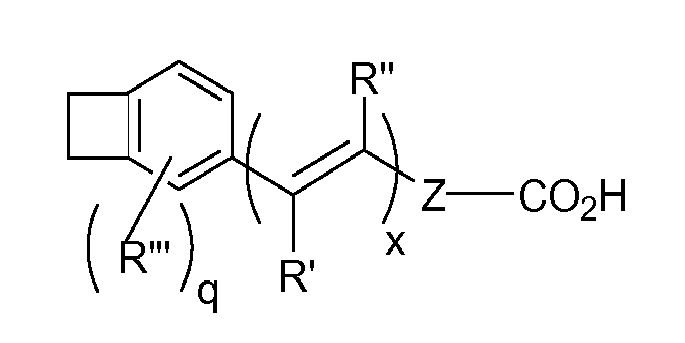
- R' and R" are independently selected from hydrogen, alkyl groups of 1 to 6 carbon atoms, aryl groups, or R' and R" taken together form a cyclic group of 4 to 8 carbon atoms; each R"' is independently an alkyl group of 1-6 carbon atoms, trimethylsilyl, methoxy or chloro;
- Z is a carbon to carbon bond or an aryl group;
- x is an integer from 0 to 3, preferably 1; and
- q is an integer of 0 to 3, preferably 0; or

- R' and R" and R"' and q are as defined above,
- x is 1, y is 0 or 1, and
- Z2 is an aryl group.
- Alternatively a monomer characterized by the presence of a cyclobutarene group and a pendant functionality which at least partially reacts during polymerization of monomers to form a pendant acid group. Preferably, this alternative monomer has the formula:

- According to the preferred embodiment suitable for aqueous development the BCB material preferably has acid functionality in equivalent weights of up to 600 g/mole of acid functionality, more preferably up to 500 grams/moles of acid functionality. The equivalent weight is preferably at least 100 grams/mole of acid functionality, more preferably at least 200 grams/mole of acid functionality.
- Alternative approaches for including acid functionality may also be used, such as are taught in
WO 04/038505 - The arylcyclobutene materials are preferably B-staged (that is partially polymerized). Other components may be added before or after B-staging. B-staging preferably occurs in solvent but may occur neat (that is without solvent). B-staging preferably occurs at a temperature in the range of 125 to 250°C, more preferably 130 to 200°C. The polymerization may occur for a time determined to provide a partially polymerized resin that provides the desired properties with regard to subsequent processability. Preferably, the curable product has an apparent weight average molecular weight (Mw) as determined by Gel Permeation Chromatography (GPC) in the range of at least 1000, more preferably at least 1500, more preferably still at least 2000 and most preferably at least 5000 g/mol. The maximum Mw is preferably about 300,000, more preferably about 250,0000 g/mol. For aqueous developable arylcyclobutene oligomers the Mw is preferably less than 50,000, more preferably less than 35,000, more preferably still less than 20,000, and most preferably less than 10,000 g/mol.
- The inventors have made the surprising discovery that antioxidants with hindered phenol functionality perform substantially better in enabling cure of arylcyclobutene, preferably BCB, materials in air without undue degradation of key properties than do other known antioxidants. Non-limiting examples of suitable hindered phenol anti-oxidants include the following:


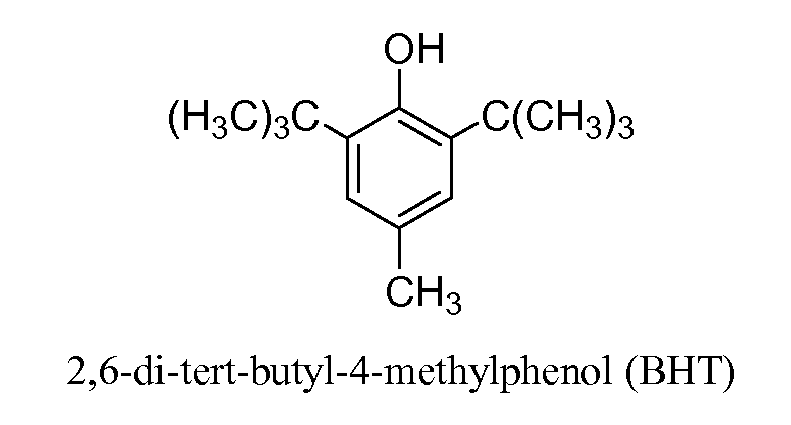


- The Irganox, Irgafos and Tinuvin products are from Ciba Specialty Chemicals Corp. Cyasorb is from Cytec Industries, Inc.
- One may use combinations of hindered phenol antioxidants with other hindered phenol antioxidants or with other classes of antioxidants such as hindered amines, phosphites, thiol compounds. Examples of such additional antioxidants include:


- The amount of hindered phenol antioxidant added to the composition is preferably at least 0.2% based on weight of the polymer, more preferably at least 0.5% and most preferably at least 1%. The total amount of all antioxidants is preferably less than 10% by weight of polymer, more preferably no greater than 6%, and most preferably no greater than 4%.
- The arylcyclobutene and antioxidant formulation may preferably also include various other components.
- Solvents are useful as a means to facilitate application of the formulation to substrates to form thin films. Suitable solvents include, but are not limited to aromatic hydrocarbons such as toluene, xylene and mesitylene; C3-C6 alcohols; methylcyclohexanone; N-methylpyrrolidinone; butyrolactone; dipropylene glycol dimethyl ether isomers (commercially available from The Dow Chemical Company as Proglyde™ DMM), propylene glycol methyl ethyl acetate (PGMEA), Dowanol™ DPMA (di(propylene glycol) methyl ether acetate isomers available from The Dow Chemical Company). A mixture of Proglyde™ DMM and PGMEA is preferred.
- It may be convenient to select solvents such that they can dissolve the monomers prior to B-staging (that is partial polymerization) as well as serve as a suitable solvent carrier for the partially polymerized product for coating purposes.
- The composition may also desirably include photoactive agents which enables one to form an image in the film by imagewise exposure to activating wavelengths of radiation and later development of the image with a suitable developing solution. According to a first approach, the photosensitive composition generally comprises a photoactive compound which is a photoinitiator that initiates further cure or crosslinking of the curable polymer. Examples of such compounds include peroxides, azo compounds and benzoin derivatives. See, for example, Photoreactive Polymers; Wiley-Interscience Publication; 1989, pp. 102-127. When exposed to activating radiation, the exposed portions of the composition become insoluble to the developer. Examples of suitable developers include 1,3,5-triisopropylbenzene, decalin, Stoddard reagent, and DS2100 from The Dow Chemical Company which is a mixture of Proglyde DMM and Isopar™ L from Exxon-Mobil. See for example, Dissolution Properties of Photobenzocyclobutene Films, Proceedings of the 10th International Conference on Photopolymers, Oct.-Nov., 1994, pp. 453-461.
- According to a second preferred approach, the photosensitive composition comprises a compound which serves as a dissolution inhibitor. When the photopolymer composition is exposed to activating radiation, the dissolution inhibitor ceases to function. When the developer solution is applied to the layer of the exposed photopolymer composition, those portions that were exposed to activating radiation are removed. The photosensitive composition may comprise a photoactive compound and a separate dissolution inhibitor or, preferably the dissolution inhibitor may itself be photoactive. Non-limiting examples of suitable photosensitive, dissolution-inhibiting compositions/compounds include diazonaphthoquinone sulfonyl esters of aromatic compounds such as, for example 2,3,4-trihydroxybenzophenone (THBP), 1,1,1-tris(4-hydroxyphenyl)ethane (THPE), or mixtures of THBP and THPE or cumyl phenol. See Photoreactive Polymers; Wiley-Interscience Publication; 1989, p. 187. The developer solution is preferably an aqueous base solution. The preferred pH is in the range of 12 to 14. Examples of suitable developers include NaOH, LiOH, KOH, RbOH, CsOH, Me4NOH, Et4NOH. See, for example, Photoreactive Polymers, Wiley-Interscience Publication, 1989, p. 216.
- In the preferred aqueous developable solutions having dissolution-inhibiting compounds, the dissolution-inhibiting compound (for example, the diazonaphthoquinones) are activated by exposure to radiation to form carboxylic acid groups which assist in the development of the exposed portions of the film in aqueous solution.
- Other components that may be used include coating aids, adhesion promoters, and fillers.
- Notably, the Inventors have made the surprising discovery that when the antioxidants specified herein are used, difficulties previously encountered in regard to compatibility of antioxidant and alkyloxysilane or acyloxysilane based adhesion promoters are substantially avoided. Thus, according to one preferred embodiment the invention is a composition comprising a curable arylcyclobutene-based polymer or oligomer as set forth above, a hindered phenol anti-oxidant as set forth above and an adhesion promoter which is the hydrolyzed or partially hydrolyzed reaction product of alkoxy or acyloxy silanes. The silanes preferably have the formula:

- After preparing the formulation of arylcyclobutene materials and antioxidant (and any additional optional components), the arylcyclobutenes are cured in an oxidizing environment. As used herein "oxidizing environment" means an environment that has more oxidizing effect on the arylcyclobutenes than an environment having 100 ppm oxygen. Preferably, the oxidizing comprises more than 100 ppm oxygen, more preferably more than 200 ppm oxygen, more preferably still at least 1% by volume oxygen, and more preferably yet at least 5% by volume oxygen. Most preferably the oxidizing environment is air. This cure occurs by heating, preferably to a temperature greater than 200°C, more preferably greater than 205°C, and most preferably no less than 210°C, but preferably less than 300°C. Time for cure after reaching the desired cure temperature is 15 minutes to 3 hours, depending on temperature.
- Additional process steps preferably include one or more of the following:
- Coating the formulation from solvent to form a thin film on a substrate. Spin coating is a suitable and preferred method although other coating methods may be employed. Cure would occur after the coating step.
- Patterning the coated films using standard lithographic processes with masks. A reactive ion etching environment is preferably used. Cure may occur before or after this etch step but preferably before.
- If a photoactive formulation is used, the coated formulation is imagewise exposed to activating radiation before being exposed to suitable developer solutions. The preferred photoactive formulations comprise acid functionality and are developable in aqueous base developers as listed above.
- The method of this invention surprisingly provides cured films that show only very small effects on key properties despite the cure in oxidizing environments. The dielectric constant of these cured films is less than 3, preferably less than 2.95. Dielectric constant is preferably measured by the method described in Proceedings, 33rd International Symposium on Microelectronics, September 2000, p. 81. The dielectric constant as compared to samples cured in nitrogen preferably shows less than a 5% increase in the value. The dielectric constant as compared to samples cured in air with no antioxidant preferably shows at least 2% decrease in the value.
- The materials of this invention provide transmittance of 400 nm radiation of at least 90%, preferably at least 95% and transmittance of 375 nm radiation of at least 85%, preferably at least 90%. Transmittance is preferably measured with a Perkin-Elmer Lambda 3B UV/Visible Spectrophotometer. Scanning range was from 300 nm to 800 nm. The transmittance at 400 nm preferably shows less than a 5% decrease in the value as compared to nitrogen cured samples. The transmittance at 375 nm preferably shows less than a 10% decrease in value as compared to nitrogen cured samples. The transmittance at 400 nm preferably is more than 5% higher than for samples cured in air with no antioxidant. The transmittance at 375 nm is preferably more than 10% higher than for samples cured in air with no antioxidant.
- Water uptake for these samples is preferably less than 2%, more preferably less than 1.9% weight percent based on weight of polymer. Water uptake is measured by the method described in Transaction of ASME, 2000, pp. 28 - 33. This method includes weighing 4 inch (10cm) wafers having known thickness of coated, cured polymer on it; placing the wafers in 85% relative humidity environment at room temperature until equilibrium is reached, and then reweighing the samples. The weight difference divided by weight of polymer based on volume and density of coated and cured polymer allows one to calculate percent water uptake. Water uptake is preferably at least 10% lower than for samples cured in air with no antioxidant. Water uptake is preferably no more than 25% higher, more preferably no more than 20% higher, than for samples cured in nitrogen.
- Addition of certain additives, such as photoactive agents, may impact some of the values of the key properties. For instance, use of diazonaphthoquinone compounds as photoactive agents tends to increase the water uptake and increase dielectric constant. For formulations comprising DNQ compounds, the dielectric constant preferably is no more than 3.0 and water up-take is preferably no more than 2.1.
- Procedure of BCB-acrylic acid synthesis is reported in
U.S. Patent 6,361,926 . BCB-acrylic acid (90 g, 0.517 mole), DVS-bisBCB (110 g, 0.282 mole, mole ratio of BCB-acrylic acid and DVS-bisBCB was 65 to 35) and 300 g of di(propylene glycol) dimethyl ether (Proglyde™ DMM) were placed in a 1L 3-necked flask equipped with a mechanical stirrer, a condenser connected to a nitrogen inlet and a thermometer. The flask was heated with stirring under nitrogen until the desired molecular weight was reached. Samples used in Example 1B had Mw of about 5480 g/mole. Resin solution had 40 wt % solids. - Resin solution described in Example 1A (8.0 g, 3.2 g prepolymer) was mixed with 3.02 g of Proglyde DMM and 4.21 g of propylene glycol methyl ether acetate (PGMEA). Polymer content was 21 wt % and wt ratio of Proglyde DMM to PGMEA was 65 to 35. Irganox 565 from Ciba Specialty Chemicals (65 mg, 2 wt % based on polymer) was added. The solution was filtered with a 1 µm syringe filter. For water up-take, the solution was applied to a 4 inch (10 cm) silicon wafer, spread at 500 rpm for 10 seconds and spin-coated at 1000 rpm for 30 seconds. The wafer was baked at 85°C for 90 seconds. For UV/visible percentage transmittance, the same processing procedure was used to spin-coat the solution on a 4 inch (10 cm) glass wafer. For dielectric constant measurement, the solution was coated at 1150 rpm on top of a high conducting silicon wafer. The wafers were then cured in an air-circulating oven which ramped from room temperature to 210°C at 10°C per minute. Temperature was held at 210°C for 90 minutes and then the oven was allowed to cool to room temperature. Nitrogen cure was carried out by heating the oven from room temperature to 250°C at 10°C per minute. Temperature was held at 250°C for 60 minutes and then the oven was allowed to cool to room temperature. Similar procedures were used to make solution samples 1 to 22 with the appropriate amount of antioxidants added. Samples 1 to 13 and samples 14 to 22 were produced and processed on two separate days. As can be seen from looking at Control 1 and Control 16 due to experimental error between the batches the results in one batch are not reasonably compared with results in the other batch. Results are illustrated in Table 1.
Table 1. # Antioxidant dielectric constant T at 400nm, % T at 375nm, % water up-take Control 1 no antioxidant 3.01 94.3 84.9 2.13 2 4% Irganox 565 2.91 97.3 94.4 1.65 3 4% Irgafos 168 2.95 93.7 83.9 2.06 4 2% Irganox 565 2.92 97.2 93.9 1.69 5 2% Irgafos 168 2.94 94.4 85.8 2.09 6 2% Irganox 565 + 2% Irgafos 168 2.90 96.8 93.2 1.76 7 1% Irganox 565 + 1% Irgafos 168 2.92 96.7 92.7 1.74 8 4% Goodrite 2.94 92.4 86.0 1.88 9 4% Irganox 1726 2.96 94.6 85.9 2.02 10 4% Irgafos 12 2.95 94.2 84.8 2.11 11 2% Irganox 565 + 2% Irgafos 12 2.93 97.3 93.8 1.71 12 2% Irganox 1726 + 2% Irgafos 168 2.97 94.4 85.5 2.05 13 2% Irganox 1726 + 2% Irgafos 12 2.98 94.8 86.4 2.14 14 1% Irganox-1330 + 1% Ix-1726 2.98 94.1 86.7 2.15 15 2% Irganox-565 2.92 94.5 87.2 1.8 Control 16 no anti, air cure 3.07 89.3 75.4 2.13 Control 17 no anti, N2 cure 2.87 97.5 95.5 1.56 18 0.7% Ir -1330, 0.7% Ir-1726, Ir-5057 3 93.4 84.2 1.83 19 2% Ir-1330 2.95 94.9 88 1.8 20 1% Ir-1726, 1% Ir-5057 3.08 88.5 73.4 2.17 21 2% Ir-5057 3.04 90.5 78 2.17 22 1% Ir-1330, 1% Ir-5057 2.99 93.8 85.1 1.92 - Five hundred and eighty six grams of a 40% solution of BCB-acrylic acid (65 mole %) and DVS-bisBCB (35 mole %) copolymer with Mw of 5901 g/mole in Proglyde DMM prepared in a similar fashion as Example 1A was placed in a 2 L amber bottle. PGMEA (457 g) and Proglyde DMM (22 g) were added to adjust Progylde DMM to PGMEA ratio to become 45 to 55. Diazonaphthoquinone sulfonate ester (70% esterified) prepared from a 1 to 1 mixture of 2,3,4-trihydroxybenzophenone and 1,1,1-tris(4-hydroxyphenyl)ethane (51.5 g, 18 wt %) was added. Irganox 565 (4.8 g, 2 wt %) and Irgafos 168 (4.8, 2 wt %) were also added. The solution was filtered through a 1 µm filter.
- The above solution was spread on a 4 inch (10 cm) glass wafer at 500 rpm for 10 seconds followed by spinning at 1500 rpm for 30 seconds. The wafer was then baked at 95°C for 2 minutes and then flood exposed with broadband exposure at 250 mJ/cm2 as calibrated at 365 nm. The wafer was cured at 210°C for 90 minutes in an air-circulating oven. The experiment was repeated with a cure performed in a nitrogen oven at 250°C for 1 hour. The UV spectra of samples cured in air and cured in nitrogen were compared and the nitrogen cured sample was better, but the air cured sample showed transmittance of approximately 90% at 400 nm.
- The solution described in Example 2A was spread on a 4 inch (10 cm) high conductivity silicon wafer at 500 rpm for 10 seconds followed by spinning at 1500 rpm for 30 seconds. The wafer was then baked at 95°C for 2 minutes and then cured in an air-circulating oven at 210°C for 90 minutes. The same experiment was performed with a 4 inch (10 cm) silicon wafer.
- Table 2 shows dielectric constant of a BCB-acrylic acid and DVS-bisBCB copolymer formulated with 18 wt % diazonaphthoquinone, 2% Irganox 565, and 2% Irgafos 168 cured in nitrogen and in air percentage based on polymer. Results of a control experiment without any antioxidant is included for comparison.
Table 2: 2% Irganox 565 + 2% Irgafos 168, Cured in N2 2% Irganox 565 + 2% Irgafos 168, Cured in air Without antioxidant Cured in air Dielectric constant 2.9 3.0 3.1 Dissipation factor 0.013 0.014 0.014 - Table 3 shows water absorption of a BCB-acrylic acid and DVS-bisBCB copolymer formulated with 18 wt % diazonaphthoquinone and, 2% Irganox 565 and 2% Irgafos 168 cured in nitrogen and in air, percentage based on polymer. Results of a control experiment without any antioxidant is included for comparison.
Table 3: 2% Irganox 565 + 2% Irgafos 168, Cured in N2 2% Irganox 565 + 2% Irgafos 168, Cured in air Without antioxidant Cured in air Water absorption (%) at 50% relative humidity 1.2 1.3 1.4 Water absorption (%) at 85% relative humidity 2.0 2.1 2.2 - AP3000 from The Dow Chemical Company was applied to a 4-inch (10 cm) silicon wafer at 2000 rpm followed by baking at 150°C for 90 seconds. The solution described in Example 2A was then spread on the wafer at 500 rpm for 10 seconds followed by spin-coating at 1000 rpm for 30 seconds. The wafer was baked at 85°C for 2 minutes. Film thickness after bake was 3.05 µm. The wafer was exposed at broadband with a Karl Suss exposure tool having a 10 µm gap between the mask and the film. Exposure dose was 250 mJ/cm2 as determined by a radiometer calibrated at 365 nm. After exposure, the wafer was placed in a 2.38% tetramethylammonium hydroxide bath for 63 seconds to develop a patterned film. Film thickness after development was 2.77 µm (91% film retention). The patterned film was cured at 210°C for 90 minutes in a Blue-M oven in air. Film thickness after cure was 2.31 µm (76% film retention).
- A prepolymer was prepared by heating 25 wt % of DVS-bisBCB in mesitylene. The prepolymer solution (10 g) was placed in a vial. Mesitylene (2.5 g) was added to dilute the solution to 20%. Irganox 565 (51 mg, 2 wt% based on DVS-bis BCB prepolymer weight) and Irgaofos 168 (51 mg, 2 wt% based on DVS-bisBCB prepolymer weight) were added. The solution was spread on a glass wafer at 500 rpm for 10 seconds followed by spinning at 1500 rpm for 30 seconds. The wafer was baked at 80°C for 90 seconds. Another glass wafer was prepared the same way except the solution did not contain any antioxidant. The two wafers were cured in an air-circulating oven at 210°C for 90 min. UV-visible spectra of the two wafers were recorded. The wafer containing antioxidants has higher than 97% transmittance at 400 nm whereas transmittance of the wafer without antioxidant was 78% at 400 nm.
- The air-curable photo DVS-bisBCB formulation was composed of b-staged DVS-bisBCB resin, 2,6-bis(4-azidobenzylidene)-4-ethylcyclohexanaone (BAC-E), mesitylene, Irganox 565, and Irgafos 168. The material was formulated by adding 0.2574 g (2 wt% based on DVS-bisBCB prepolymer weight) of Irganox 565 and 0.2574 g (2 wt% based on DVS-bisBCB prepolymer weight) of Irgafos 168 added to 26.00 g of 49.5% b-staged DVS-bisBCB in mesitylene. Four weight percent BAC-E based on DVS-bisBCB prepolymer weight (0.5148 g) was then added. The formulation was diluted to 35% BCB by the addition of mesitylene (5.33 g).
- The formulation was then placed on a shaker for 3 hours and at this point a homogeneous solution was produced. This formulation was then capable to give thin films of thickness in the range of 3.3 µm to 6.0 µm Proper care must be taken not to let the formulation remain at room temperature for over 24 hours. The formulation was then placed in a -15°C freezer until time of use.
- The formulation was removed from freezer and allowed to reach room temperature before use. Film coating on a 4 inch (10 cm) silicon wafer was performed using a spin coating process. A 4 inch silicon wafer was placed on a chuck and held in place by vacuum. AP3000 from The Dow Chemical Company was applied on the wafer followed by dispensing 3 mL of the formulation in the middle of the silicon wafer using a syringe with a 1µm syringe filter. The wafer was then rotated at 500 rpm for 5 seconds to spread the resin across the wafer. The spin speed was increased to 1000 rpm for 30 seconds followed by a hot plate bake of 75°C for 90 seconds, in hard contact.
- The above mentioned wafer was patterned as follows. Exposure tool was a Karl Suss Mask Aligner, with measured intensity at 365 nm wavelength. The test pattern to be exposed was a series of via banks. The wafer was placed in the exposure tool with a 30 µm exposure gap setting and exposed to 365 nm wavelength for a dose of 200 mJ/cm2 .
- Developing of the patterned film was done using a puddle develop method. This process used the same spin coater that was previously used in coating the wafers with resin. The wafer was placed on a chuck and held down by vacuum. The wafer was slowly rotated at 50 rpm for 5 seconds while DS2100 was dispensed on to the wafer until it was completely covered. The rotation of the wafer was then stopped, with DS2100 puddled on the film. After 48 seconds the unexposed areas were completely dissolved from the wafer. The wafer was then rotated at 50 rpm for 10 seconds while DS2100 was dispensed on the film. With the DS2100 dispense stopped, the wafer spin speed was increased to 3000 rpm for 20 seconds to dry the film. The film was then cured for 210°C for 90 minutes in a Blue-M oven in air.
- The self-priming photo DVS-bisBCB formulation consisted of pre-hydrolyzed vinyltrimethoxysilane (VTMS) in dilute hydrochloric acid, b-staged DVS-bisBCB resin in mesitylene, BAC-E, mesitylene, Irganox 565 and Irgafos 168. The pre-hydrolyzed VTMS was produced as follows. In a 100mL round bottom flask, 5.35 g of 10-3 M HCl was added. The flask was then placed in a heating mantle on top of a stirring plate. Two thermocouples were used to assist the controller in monitoring and controlling the reaction temperature. While the hydrochloric acid solution was being stirred, 44.04 g of an equal mole ratio mixture of water and VTMS was added. After the addition of VTMS and water mixture was completed, the solution temperature went up to 39°C in 15 minutes. The controller was then started to heat the solution to 50°C to advance the reaction of the VTMS solution, starting to build the molecular weight of the pre-hydrolyzed VTMS. Reaction temperature was held at 50°C for 5 hours and then lowered to room temperature. Molecular weight of the pre-hydrolyzed VTMS was found to 593 after this 5 hour period.
- The material was formulated in the following fashion with 0.5869 g (2 wt%) of Irganox 565 and 0.5869 g (2 wt%) of Irgafos 168 added to 57.20 g of 51.3% b-staged DVS-bisBCB in mesitylene. The next material added to the formulation was BAC-E. The amount of BAC-E was 1.027 g (4 wt% based on DVS-bisBCB prepolymer). The pre-hydrolyzed VTMS described above was then added to this mixture of DVS-bisBCB b-staged resin at a concentration of 1% based the weight fraction of VTMS in the prehydrolasate and the DVS-bisBCB prepolymer (0.33 g). The formulation was then diluted to 40% DVS-bisBCB solids by the addition of mesitylene (8.29 g).
- The formulation was removed from freezer and allowed to reach room temperature before use. Film coating on a 4 inch (10 cm) silicon wafer was performed using a spin coating process. A 4 inch (10 cm) silicon wafer was placed on a chuck and held in place by vacuum. With the wafer on the chuck, 3 mL of the formulation was dispensed in the middle of the silicon wafer using a syringe with a 1µm syringe filter. The wafer was then rotated at 500 rpm for 5 seconds to spread the resin across the wafer. The speed was increased to 2500 rpm for 30 seconds followed by a hot plate bake of 75°C for 90 seconds, in hard contact.
- The spin-coated film was ready for patterning. This was done by means of a Karl Suss Mask Aligner, with measured intensity at 365 nm wavelength. The test pattern to be exposed was a series of via banks. The wafer was placed in the exposure tool with a 30 µm exposure gap setting and exposed to 365 nm wavelength for a dose of 168 mJ/cm2 .
- Developing of the patterned film was done using a puddle develop method. This process used the same spin coater that was previously used in coating the wafers with resin. The wafer was placed on a chuck and held down by vacuum. The wafer was slowly rotated at 50 rpm for 5 seconds while DS2100 was dispensed on to the wafer until it was completely covered. The rotation of the wafer was then stopped, with DS2100 puddled on the film. After 37.7 seconds the unexposed areas were completely dissolved from the wafer. The wafer was then rotated at 50 rpm for 10 seconds while DS2100 was dispensed on the film. With the DS2100 dispense stopped, the wafer spin speed was increased to 3000 rpm for 20 seconds to dry the film. The film was then cured.
- The modified edge-liftoff test (mELT) showed a K1c value of 0.39 mPa√m for Example 4 containing prehydrolyzed VTMS. The K1c value of a sample without prehydrolyzed VTMS and without using AP3000 as adhesion promoter was less than 0.24 mPa√m. The mELT method was described in Transaction of the ASME, Vol. 122 (2000), pp. 28-33.
- Cyclotene™ 3022-57 (24.75 g), from The Dow Chemical Company, containing Agerite MA which is polymerized 1,2-dihydro-2,2,4-trimethylquinoline from R.T. Vanderbilt Co. Inc., was placed in a vial. Agerite MA in Cyclotene 3022-57 was 3.5 wt % based on DVS-bisBCB prepolymer. Prehydrolyzed VTMS (0.5 g, 3.5 wt% based on DVS-bisBCB prepolymer) prepared as described above was added to the vial. After mixing, a heavy precipitation occurred on the bottom of the glass container. With only 2 additives that went into the formulation, each of which is independently compatible with the prepolymer and solvent, it was determined that Agerite MA and the self-primer, prehydrolyzed VTMS, are incompatible.
- Cyclotene™ 3022-57 (24.825 g), from The Dow Chemical Company, containing Agerite MA which is polymerized 1,2-dihydro-2,2,4-trimethylquinoline from R.T. Vanderbilt Co. Inc., was placed in a vial. Agerite MA in Cyclotene 3022-57 was 3.5 wt % based on DVS-bisBCB prepolymer. Prehydrolyzed Vinyltriacetoxy silane(VTAS) (0.175 g, 1 wt% based on DVS-bisBCB prepolymer) prepared as described above was added to the vial. After mixing, a precipitation occurred on the bottom of the glass container. With only 2 additives that went into the formulation, each of which is independently compatible with the prepolymer and solvent, it was determined that Agerite MA and the self-primer, prehydrolyzed VTMS, are incompatible.
Claims (15)
- A composition comprising a comprising B-staged reaction product of acid functional benzocyclobutene monomer and divinylsiloxane-bis-benzocyclobutene monomer and an antioxidant compound having hindered phenol functionality.
- A composition of claim 1 where the B-staged reaction product comprises a partially polymerized product of monomer precursor(s) comprising monomers of the formula
 B1 is -(CR8=CR9)-(Z'), wherein R8 and R9 are independently selected from hydrogen, alkyl groups of 1 to 6, and aryl groups, and Z' is a siloxane group;Ar1 is a polyvalent aromatic or heteroaromatic group and the carbon atoms of the cyclobutene ring are bonded to adjacent carbon atoms on the same aromatic ring of Ar1.R1 is a monovalent group.
 - A composition of claim 2 where said monomers have the formula
 each R3 is independently an alkyl group of 1-6 carbon atoms, trimethylsilyl, methoxy or chloro;each R4 is -CH2=CH2-;each R5 is independently hydrogen, an alkyl group of 1 to 6 carbon atoms, cycloalkyl, aralkyl or phenyl;each R6 is independently hydrogen, alkyl of 1 to 6 carbon atoms, chloro or cyano;n is an integer of 1 or more;and each q is an integer of 0 to 3.
 - A composition of claim 3 where said monomers are 1,3-bis(2-bicyclo[4.2.0]octa-1,3,5-trien-3-yl ethenyl)-1,1,3,3 tetramethyldisiloxane (DVS-bisBCB).
- A composition of any one of claims 2 to 4, wherein the acid functionality is provided by including, along with said monomers, an acid functional monomer of the formula:
 B2 is a monovalent organic group with acid functionality;Ar2 is a polyvalent aromatic or heteroaromatic group and the carbon atoms of the cyclobutene ring are bonded to adjacent carbon atoms on the same aromatic ring of Ar2;p is an integer of 1 or more; andR2 is a monovalent group.
 - A composition of claim 5, wherein the acid functional monomer is selected from the following two formulas:
 R' and R" are independently selected from hydrogen, alkyl groups of 1 to 6 carbon atoms, aryl groups, or R' and R" taken together from a cyclic group of 4 to 8 carbon atoms;each R"' is independently an alkyl group of 1-6 carbon atoms, trimethylsilyl, methoxy or chloro;Z is a carbon to carbon bond or an aryl group;x is an integer from 0 to 3; andq is an integer of 0 to 3;or
 R' and R" are independently selected from hydrogen, alkyl groups of 1 to 6 carbon atoms, aryl groups, or R' and R" taken together from a cyclic group of 4 to 8 carbon atoms;each R"' is independently an alkyl group of 1-6 carbon atoms, trimethylsilyl, methoxy or chloro;q is an integer of 0 to 3;x is 1,y is 0 or 1, andZ2 is an aryl group.
 - A composition of any one of claims 2 to 4, wherein the acid functionality is provided by the presence of monomer of the formula:
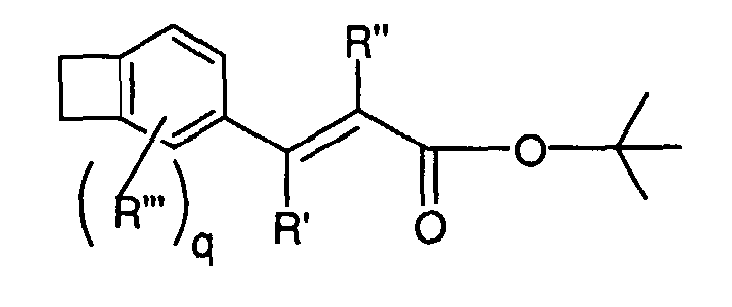 R' and R" are independently selected from hydrogen, alkyl groups of 1 to 6 carbon atoms, aryl groups, or R' and R" taken together from a cyclic group of 4 to 8 carbon atoms;each R"' is independently an alkyl group of 1-6 carbon atoms, trimethylsilyl, methoxy or chloro;q is an integer of 0 to 3.
 - A composition of any one of the preceding claims, wherein the acid functionality is present at equivalent weights of 100 to 600 grams/mole.
- A composition of claim 8, wherein the acid functionality is present at equivalent weights of 200 to 500 grams/moles.
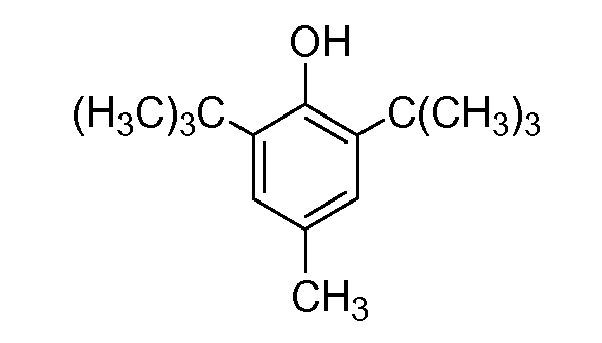
- A composition of any one of the preceding claim where the hindered phenol antioxidant is selected from




- A composition of any one of the preceding claims further comprising an antioxidant which is not a hindered phenol.
- A composition of any one of the preceding claims further comprising a photoactive compound.
- A composition of claim 12 wherein the photoactive compound is selected from diazonaphthoquinone sulfonate esters of trihydroxybenzophenone, diazonaphthoquinone sulfonate esters of tris(hydroxyphenyl)ethane, diazonaphthoquinone sulfonate esters of mixtures of trihydroxybenzophenone, tris(hydroxyphenyl)ethane, and diazonaphthoquinone sulfonate esters of cumyl phenol.
- A composition of any one of the preceding claims wherein the hindered phenol antioxidant is present in amounts of 0.2 to 6 weight percent.
- A composition any one of claims 1 to 10 further comprising an adhesion promoter which comprises the hydrolyzed or partially hydrolyzed reaction product of an alkoxysilane or acyloxysilane.
Applications Claiming Priority (2)
| Application Number | Priority Date | Filing Date | Title |
|---|---|---|---|
| US61854804P | 2004-10-13 | 2004-10-13 | |
| EP05806417A EP1802693B1 (en) | 2004-10-13 | 2005-10-12 | Benzocyclobutene based polymer formulations and methods for processing such formulations in oxidative environments |
Related Parent Applications (2)
| Application Number | Title | Priority Date | Filing Date |
|---|---|---|---|
| EP05806417A Division EP1802693B1 (en) | 2004-10-13 | 2005-10-12 | Benzocyclobutene based polymer formulations and methods for processing such formulations in oxidative environments |
| EP05806417.1 Division | 2005-10-12 |
Publications (2)
| Publication Number | Publication Date |
|---|---|
| EP2042547A1 true EP2042547A1 (en) | 2009-04-01 |
| EP2042547B1 EP2042547B1 (en) | 2010-12-22 |
Family
ID=35695848
Family Applications (2)
| Application Number | Title | Priority Date | Filing Date |
|---|---|---|---|
| EP05806417A Expired - Lifetime EP1802693B1 (en) | 2004-10-13 | 2005-10-12 | Benzocyclobutene based polymer formulations and methods for processing such formulations in oxidative environments |
| EP08172459A Expired - Lifetime EP2042547B1 (en) | 2004-10-13 | 2005-10-12 | Benzocyclobutene based polymer formulations |
Family Applications Before (1)
| Application Number | Title | Priority Date | Filing Date |
|---|---|---|---|
| EP05806417A Expired - Lifetime EP1802693B1 (en) | 2004-10-13 | 2005-10-12 | Benzocyclobutene based polymer formulations and methods for processing such formulations in oxidative environments |
Country Status (7)
| Country | Link |
|---|---|
| US (1) | US8143324B2 (en) |
| EP (2) | EP1802693B1 (en) |
| JP (1) | JP5231017B2 (en) |
| KR (1) | KR101237554B1 (en) |
| AT (2) | ATE492593T1 (en) |
| DE (2) | DE602005022743D1 (en) |
| WO (1) | WO2006044337A1 (en) |
Cited By (2)
| Publication number | Priority date | Publication date | Assignee | Title |
|---|---|---|---|---|
| CN107987278A (en) * | 2017-11-14 | 2018-05-04 | 复旦大学 | A kind of benzocyclobutene functionalization organic siliconresin and preparation method thereof |
| US20240253354A1 (en) * | 2021-05-31 | 2024-08-01 | Canon Kabushiki Kaisha | Substrate joined body |
Families Citing this family (5)
| Publication number | Priority date | Publication date | Assignee | Title |
|---|---|---|---|---|
| US8530119B2 (en) * | 2009-05-20 | 2013-09-10 | Sumitomo Bakelite Co., Ltd. | Positive photosensitive resin composition, cured film, protective film, interlayer insulating film, and semiconductor device and display element using the same |
| US9752051B2 (en) | 2015-04-06 | 2017-09-05 | Rohm And Haas Electronic Materials Llc | Polyarylene polymers |
| FR3063082B1 (en) * | 2017-02-17 | 2019-04-05 | Societe Bic | NOVEL THERMOCHROME PIGMENT COMPOSITION COMPRISING A COMPOUND OF FORMULA (I) AS A REACTIONAL MEDIUM |
| FR3065729B1 (en) | 2017-04-27 | 2020-12-18 | SOCIéTé BIC | NEW COMPOUNDS OF FORMULA (I) AND THEIR USE IN THERMOCHROME PIGMENT COMPOSITIONS |
| CN114736434B (en) * | 2022-04-23 | 2023-11-17 | 浙江科赛新材料科技有限公司 | Preparation method of PTFE fastener with metal detectable function |
Citations (15)
| Publication number | Priority date | Publication date | Assignee | Title |
|---|---|---|---|---|
| US4540763A (en) | 1984-09-14 | 1985-09-10 | The Dow Chemical Company | Polymers derived from poly(arylcyclobutenes) |
| EP0251357A1 (en) * | 1986-06-30 | 1988-01-07 | Shell Internationale Researchmaatschappij B.V. | Engineering thermoplastics containing pendant benzocyclobutene groups |
| US4724260A (en) | 1984-08-27 | 1988-02-09 | The Dow Chemical Company | Unsaturated alkyl monoarylcyclobutane monomers |
| US4783514A (en) | 1986-02-28 | 1988-11-08 | The Dow Chemical Company | Polymeric monoarylcyclobutane compositions |
| US4812588A (en) | 1987-12-14 | 1989-03-14 | The Dow Chemical Company | Polyorganosiloxane-bridged bisbenzocyclobutene monomers |
| US4826997A (en) | 1984-08-27 | 1989-05-02 | The Dow Chemical Company | N-Substituted arylcyclo butenyl-maleimides |
| US4999499A (en) | 1989-09-21 | 1991-03-12 | General Dynamics Corporation | Method of inspecting solder joints with a laser inspection system |
| US5136069A (en) | 1991-03-28 | 1992-08-04 | The Dow Chemical Company | Process for preparing vinylically-unsaturated compounds (II) |
| US5138081A (en) | 1991-04-30 | 1992-08-11 | The Dow Chemical Company | Process for purifying vinylically-unsaturated organosilicon compounds |
| US5185391A (en) | 1991-11-27 | 1993-02-09 | The Dow Chemical Company | Oxidation inhibited arylcyclobutene polymers |
| US5243068A (en) | 1991-03-28 | 1993-09-07 | The Dow Chemical Company | Process for preparing vinylically-unsaturated compounds (II) |
| WO1994025903A1 (en) | 1993-04-29 | 1994-11-10 | The Dow Chemical Company | Partially polymerized resins |
| US6083661A (en) * | 1991-12-10 | 2000-07-04 | The Dow Chemical Company | Photodefineable cyclobutarene compositions |
| US6361926B1 (en) | 1998-10-23 | 2002-03-26 | The Dow Chemical Company | Acid functional polymers based on benzocyclobutene |
| US20040076911A1 (en) * | 2002-10-18 | 2004-04-22 | So Ying Hung | Aqueous developable, photosensitive benzocyclobutene-based oligomers and polymers with high moisture resistance |
Family Cites Families (13)
| Publication number | Priority date | Publication date | Assignee | Title |
|---|---|---|---|---|
| US5449740A (en) | 1986-05-08 | 1995-09-12 | The University Of Dayton | Resin systems derived from insitu-generated bisdienes from bis-benzocyclobutene compounds |
| US4711964A (en) | 1986-05-08 | 1987-12-08 | University Of Dayton | Bisdiene from bis-benzocyclobutene compound |
| US5002808A (en) | 1988-03-23 | 1991-03-26 | The Dow Chemical Company | Adhesion methods employing benzocyclobutene-based organosilane adhesion aids |
| US4831172A (en) * | 1988-03-23 | 1989-05-16 | The Dow Chemical Company | Benzocyclobutene-based organosilane adhesion aids |
| US5156656A (en) | 1991-09-13 | 1992-10-20 | The Dow Chemical Company | Semi-permeable membranes derived from reactive oligomers |
| US5668210A (en) * | 1994-10-24 | 1997-09-16 | The Dow Chemical Company | Adhesion promoter and self-priming arylcyclobutene resin compositions |
| US5868951A (en) | 1997-05-09 | 1999-02-09 | University Technology Corporation | Electro-optical device and method |
| US6596624B1 (en) | 1999-07-31 | 2003-07-22 | International Business Machines Corporation | Process for making low dielectric constant hollow chip structures by removing sacrificial dielectric material after the chip is joined to a chip carrier |
| US6420093B1 (en) * | 2000-02-02 | 2002-07-16 | The Dow Chemical Company | Toughened benzocyclobutene based polymers and their use in building-up printed wiring boards |
| US6593155B2 (en) | 2000-12-28 | 2003-07-15 | Dow Global Technologies Inc. | Method for determination of cure and oxidation of spin-on dielectric polymers |
| JP4997670B2 (en) * | 2001-06-29 | 2012-08-08 | 日本電気株式会社 | Copolymer polymer film production method, copolymer polymer film produced by the above formation method, and semiconductor device using copolymer polymer film |
| JP4289070B2 (en) * | 2003-08-08 | 2009-07-01 | 住友ベークライト株式会社 | Alkali-soluble resin, photosensitive resin composition, and method for forming resin layer |
| WO2006044338A1 (en) * | 2004-10-13 | 2006-04-27 | Dow Global Technologies Inc. | Aqueous developable benzocyclobutene-based polymer composition and method of use of such compositions |
-
2005
- 2005-10-12 WO PCT/US2005/036452 patent/WO2006044337A1/en not_active Ceased
- 2005-10-12 EP EP05806417A patent/EP1802693B1/en not_active Expired - Lifetime
- 2005-10-12 AT AT08172459T patent/ATE492593T1/en not_active IP Right Cessation
- 2005-10-12 AT AT05806417T patent/ATE476468T1/en not_active IP Right Cessation
- 2005-10-12 US US11/665,245 patent/US8143324B2/en active Active
- 2005-10-12 JP JP2007536785A patent/JP5231017B2/en not_active Expired - Fee Related
- 2005-10-12 EP EP08172459A patent/EP2042547B1/en not_active Expired - Lifetime
- 2005-10-12 KR KR1020077010786A patent/KR101237554B1/en not_active Expired - Fee Related
- 2005-10-12 DE DE602005022743T patent/DE602005022743D1/en not_active Expired - Lifetime
- 2005-10-12 DE DE602005025550T patent/DE602005025550D1/en not_active Expired - Lifetime
Patent Citations (16)
| Publication number | Priority date | Publication date | Assignee | Title |
|---|---|---|---|---|
| US4724260A (en) | 1984-08-27 | 1988-02-09 | The Dow Chemical Company | Unsaturated alkyl monoarylcyclobutane monomers |
| US4826997A (en) | 1984-08-27 | 1989-05-02 | The Dow Chemical Company | N-Substituted arylcyclo butenyl-maleimides |
| US4540763A (en) | 1984-09-14 | 1985-09-10 | The Dow Chemical Company | Polymers derived from poly(arylcyclobutenes) |
| US4783514A (en) | 1986-02-28 | 1988-11-08 | The Dow Chemical Company | Polymeric monoarylcyclobutane compositions |
| EP0251357A1 (en) * | 1986-06-30 | 1988-01-07 | Shell Internationale Researchmaatschappij B.V. | Engineering thermoplastics containing pendant benzocyclobutene groups |
| US4812588A (en) | 1987-12-14 | 1989-03-14 | The Dow Chemical Company | Polyorganosiloxane-bridged bisbenzocyclobutene monomers |
| US4999499A (en) | 1989-09-21 | 1991-03-12 | General Dynamics Corporation | Method of inspecting solder joints with a laser inspection system |
| US5243068A (en) | 1991-03-28 | 1993-09-07 | The Dow Chemical Company | Process for preparing vinylically-unsaturated compounds (II) |
| US5136069A (en) | 1991-03-28 | 1992-08-04 | The Dow Chemical Company | Process for preparing vinylically-unsaturated compounds (II) |
| US5138081A (en) | 1991-04-30 | 1992-08-11 | The Dow Chemical Company | Process for purifying vinylically-unsaturated organosilicon compounds |
| US5185391A (en) | 1991-11-27 | 1993-02-09 | The Dow Chemical Company | Oxidation inhibited arylcyclobutene polymers |
| US6083661A (en) * | 1991-12-10 | 2000-07-04 | The Dow Chemical Company | Photodefineable cyclobutarene compositions |
| WO1994025903A1 (en) | 1993-04-29 | 1994-11-10 | The Dow Chemical Company | Partially polymerized resins |
| US6361926B1 (en) | 1998-10-23 | 2002-03-26 | The Dow Chemical Company | Acid functional polymers based on benzocyclobutene |
| US20040076911A1 (en) * | 2002-10-18 | 2004-04-22 | So Ying Hung | Aqueous developable, photosensitive benzocyclobutene-based oligomers and polymers with high moisture resistance |
| WO2004038505A1 (en) | 2002-10-18 | 2004-05-06 | Dow Global Technologies Inc. | Aqueous developable, photosensitive benzocyclobutene-based oligomers and polymers with high moisture resistance |
Non-Patent Citations (7)
| Title |
|---|
| "Dissolution Properties of Photobenzocyclobutene Films", PROCEEDINGS OF THE 10TH INTERNATIONAL CONFERENCE ON PHOTOPOLYMERS, October 1994 (1994-10-01), pages 453 - 461 |
| "Photoreactive Polymers", 1989, WILEY-INTERSCIENCE PUBLICATION, pages: 102 - 127 |
| "Photoreactive Polymers", 1989, WILEY-INTERSCIENCE PUBLICATION, pages: 187 |
| "Photoreactive Polymers", 1989, WILEY-INTERSCIENCE PUBLICATION, pages: 216 |
| CURE AND OXIDATION MEASUREMENTS FOR CYCLOTENE ADVANCED ELECTRONICS RESINS, September 2004 (2004-09-01), Retrieved from the Internet <URL:www.dow.com> |
| TRANSACTION OF ASME, 2000, pages 28 - 33 |
| TRANSACTION OF THE ASME, vol. 122, 2000, pages 28 - 33 |
Cited By (2)
| Publication number | Priority date | Publication date | Assignee | Title |
|---|---|---|---|---|
| CN107987278A (en) * | 2017-11-14 | 2018-05-04 | 复旦大学 | A kind of benzocyclobutene functionalization organic siliconresin and preparation method thereof |
| US20240253354A1 (en) * | 2021-05-31 | 2024-08-01 | Canon Kabushiki Kaisha | Substrate joined body |
Also Published As
| Publication number | Publication date |
|---|---|
| ATE476468T1 (en) | 2010-08-15 |
| US8143324B2 (en) | 2012-03-27 |
| DE602005025550D1 (en) | 2011-02-03 |
| US20090275673A1 (en) | 2009-11-05 |
| EP1802693B1 (en) | 2010-08-04 |
| KR101237554B1 (en) | 2013-02-26 |
| EP2042547B1 (en) | 2010-12-22 |
| DE602005022743D1 (en) | 2010-09-16 |
| JP5231017B2 (en) | 2013-07-10 |
| JP2008516072A (en) | 2008-05-15 |
| WO2006044337A1 (en) | 2006-04-27 |
| EP1802693A1 (en) | 2007-07-04 |
| ATE492593T1 (en) | 2011-01-15 |
| KR20070085328A (en) | 2007-08-27 |
Similar Documents
| Publication | Publication Date | Title |
|---|---|---|
| US8053515B2 (en) | Directly photodefinable polymer compositions and methods thereof | |
| JP2002088158A (en) | Organosiloxane-based polymer compound, photocurable resin composition, pattern forming method, and coating for protecting substrate | |
| US6867325B2 (en) | Organosiloxane polymer, photo-curable resin composition, patterning process, and substrate-protecting coat | |
| US20110171436A1 (en) | Negative-type photosensitive resin composition, pattern forming method and electronic parts | |
| KR100831715B1 (en) | Photo-curable resin composition, patterning process, and substrate protecting film | |
| CN109976091A (en) | The manufacture of photosensitive resin composition, pattern forming method and optoelectronic semiconductor component | |
| EP1802693B1 (en) | Benzocyclobutene based polymer formulations and methods for processing such formulations in oxidative environments | |
| EP1802694B1 (en) | Aqueous developable benzocyclobutene-based polymer composition and method of use of such compositions | |
| JP5054158B2 (en) | Positive photosensitive composition | |
| JP7435110B2 (en) | Polyhydroxyimide, polymer solution, photosensitive resin composition and its uses | |
| TWI391436B (en) | Polymer formulation based on benzocyclobutene and method for processing the same in an oxidizing environment | |
| JP7797902B2 (en) | Method for producing polynorbornene | |
| JP3493140B2 (en) | Organosiloxane polymer compound, photocurable resin composition, and pattern forming method | |
| JP7434853B2 (en) | Crosslinking agents, photosensitive resin compositions, cured films, and electronic devices | |
| JP7338142B2 (en) | Photosensitive resin composition and method for producing electronic device | |
| US20100159217A1 (en) | Negative-type photosensitive resin composition, method for forming patterns, and electronic parts | |
| CN114207038A (en) | Resin composition, method for producing cured product, patterned cured product, interlayer insulating film, covercoat, surface protective film, and electronic component | |
| KR102760209B1 (en) | Photosensitive resin composition and cured film comprising the same | |
| JP2012063788A (en) | Photosensitive resin composition | |
| JP2005173528A (en) | Positive photosensitive resin composition, method for producing relief pattern and electronic component | |
| WO2024063067A1 (en) | Curable branched organopolysiloxane, high energy ray-curable composition containing same, and use thereof | |
| WO2024063066A1 (en) | Curable branched organopolysiloxane, high energy ray-curable composition containing same, and use of same |
Legal Events
| Date | Code | Title | Description |
|---|---|---|---|
| PUAI | Public reference made under article 153(3) epc to a published international application that has entered the european phase |
Free format text: ORIGINAL CODE: 0009012 |
|
| AC | Divisional application: reference to earlier application |
Ref document number: 1802693 Country of ref document: EP Kind code of ref document: P |
|
| AK | Designated contracting states |
Kind code of ref document: A1 Designated state(s): AT BE BG CH CY CZ DE DK EE ES FI FR GB GR HU IE IS IT LI LT LU LV MC NL PL PT RO SE SI SK TR |
|
| RIN1 | Information on inventor provided before grant (corrected) |
Inventor name: STARK, EDMUND J. Inventor name: THURSTON, SHELLENE K. Inventor name: SO, YING HUNG Inventor name: HETZNER, JACK E. |
|
| 17P | Request for examination filed |
Effective date: 20091001 |
|
| 17Q | First examination report despatched |
Effective date: 20091023 |
|
| AKX | Designation fees paid |
Designated state(s): AT BE BG CH CY CZ DE DK EE ES FI FR GB GR HU IE IS IT LI LT LU LV MC NL PL PT RO SE SI SK TR |
|
| GRAP | Despatch of communication of intention to grant a patent |
Free format text: ORIGINAL CODE: EPIDOSNIGR1 |
|
| GRAS | Grant fee paid |
Free format text: ORIGINAL CODE: EPIDOSNIGR3 |
|
| GRAA | (expected) grant |
Free format text: ORIGINAL CODE: 0009210 |
|
| AC | Divisional application: reference to earlier application |
Ref document number: 1802693 Country of ref document: EP Kind code of ref document: P |
|
| AK | Designated contracting states |
Kind code of ref document: B1 Designated state(s): AT BE BG CH CY CZ DE DK EE ES FI FR GB GR HU IE IS IT LI LT LU LV MC NL PL PT RO SE SI SK TR |
|
| REG | Reference to a national code |
Ref country code: GB Ref legal event code: FG4D |
|
| REG | Reference to a national code |
Ref country code: CH Ref legal event code: EP |
|
| REG | Reference to a national code |
Ref country code: IE Ref legal event code: FG4D |
|
| REF | Corresponds to: |
Ref document number: 602005025550 Country of ref document: DE Date of ref document: 20110203 Kind code of ref document: P |
|
| REG | Reference to a national code |
Ref country code: DE Ref legal event code: R096 Ref document number: 602005025550 Country of ref document: DE Effective date: 20110203 |
|
| REG | Reference to a national code |
Ref country code: NL Ref legal event code: T3 |
|
| RAP2 | Party data changed (patent owner data changed or rights of a patent transferred) |
Owner name: DOW GLOBAL TECHNOLOGIES LLC |
|
| PG25 | Lapsed in a contracting state [announced via postgrant information from national office to epo] |
Ref country code: LT Free format text: LAPSE BECAUSE OF FAILURE TO SUBMIT A TRANSLATION OF THE DESCRIPTION OR TO PAY THE FEE WITHIN THE PRESCRIBED TIME-LIMIT Effective date: 20101222 |
|
| LTIE | Lt: invalidation of european patent or patent extension |
Effective date: 20101222 |
|
| PG25 | Lapsed in a contracting state [announced via postgrant information from national office to epo] |
Ref country code: CY Free format text: LAPSE BECAUSE OF FAILURE TO SUBMIT A TRANSLATION OF THE DESCRIPTION OR TO PAY THE FEE WITHIN THE PRESCRIBED TIME-LIMIT Effective date: 20101222 Ref country code: LV Free format text: LAPSE BECAUSE OF FAILURE TO SUBMIT A TRANSLATION OF THE DESCRIPTION OR TO PAY THE FEE WITHIN THE PRESCRIBED TIME-LIMIT Effective date: 20101222 Ref country code: FI Free format text: LAPSE BECAUSE OF FAILURE TO SUBMIT A TRANSLATION OF THE DESCRIPTION OR TO PAY THE FEE WITHIN THE PRESCRIBED TIME-LIMIT Effective date: 20101222 Ref country code: AT Free format text: LAPSE BECAUSE OF FAILURE TO SUBMIT A TRANSLATION OF THE DESCRIPTION OR TO PAY THE FEE WITHIN THE PRESCRIBED TIME-LIMIT Effective date: 20101222 Ref country code: BG Free format text: LAPSE BECAUSE OF FAILURE TO SUBMIT A TRANSLATION OF THE DESCRIPTION OR TO PAY THE FEE WITHIN THE PRESCRIBED TIME-LIMIT Effective date: 20110322 Ref country code: SE Free format text: LAPSE BECAUSE OF FAILURE TO SUBMIT A TRANSLATION OF THE DESCRIPTION OR TO PAY THE FEE WITHIN THE PRESCRIBED TIME-LIMIT Effective date: 20101222 Ref country code: SI Free format text: LAPSE BECAUSE OF FAILURE TO SUBMIT A TRANSLATION OF THE DESCRIPTION OR TO PAY THE FEE WITHIN THE PRESCRIBED TIME-LIMIT Effective date: 20101222 |
|
| PG25 | Lapsed in a contracting state [announced via postgrant information from national office to epo] |
Ref country code: GR Free format text: LAPSE BECAUSE OF FAILURE TO SUBMIT A TRANSLATION OF THE DESCRIPTION OR TO PAY THE FEE WITHIN THE PRESCRIBED TIME-LIMIT Effective date: 20110323 Ref country code: EE Free format text: LAPSE BECAUSE OF FAILURE TO SUBMIT A TRANSLATION OF THE DESCRIPTION OR TO PAY THE FEE WITHIN THE PRESCRIBED TIME-LIMIT Effective date: 20101222 Ref country code: ES Free format text: LAPSE BECAUSE OF FAILURE TO SUBMIT A TRANSLATION OF THE DESCRIPTION OR TO PAY THE FEE WITHIN THE PRESCRIBED TIME-LIMIT Effective date: 20110402 Ref country code: BE Free format text: LAPSE BECAUSE OF FAILURE TO SUBMIT A TRANSLATION OF THE DESCRIPTION OR TO PAY THE FEE WITHIN THE PRESCRIBED TIME-LIMIT Effective date: 20101222 Ref country code: CZ Free format text: LAPSE BECAUSE OF FAILURE TO SUBMIT A TRANSLATION OF THE DESCRIPTION OR TO PAY THE FEE WITHIN THE PRESCRIBED TIME-LIMIT Effective date: 20101222 Ref country code: PT Free format text: LAPSE BECAUSE OF FAILURE TO SUBMIT A TRANSLATION OF THE DESCRIPTION OR TO PAY THE FEE WITHIN THE PRESCRIBED TIME-LIMIT Effective date: 20110422 Ref country code: IS Free format text: LAPSE BECAUSE OF FAILURE TO SUBMIT A TRANSLATION OF THE DESCRIPTION OR TO PAY THE FEE WITHIN THE PRESCRIBED TIME-LIMIT Effective date: 20110422 |
|
| PG25 | Lapsed in a contracting state [announced via postgrant information from national office to epo] |
Ref country code: SK Free format text: LAPSE BECAUSE OF FAILURE TO SUBMIT A TRANSLATION OF THE DESCRIPTION OR TO PAY THE FEE WITHIN THE PRESCRIBED TIME-LIMIT Effective date: 20101222 Ref country code: PL Free format text: LAPSE BECAUSE OF FAILURE TO SUBMIT A TRANSLATION OF THE DESCRIPTION OR TO PAY THE FEE WITHIN THE PRESCRIBED TIME-LIMIT Effective date: 20101222 Ref country code: RO Free format text: LAPSE BECAUSE OF FAILURE TO SUBMIT A TRANSLATION OF THE DESCRIPTION OR TO PAY THE FEE WITHIN THE PRESCRIBED TIME-LIMIT Effective date: 20101222 |
|
| PLBE | No opposition filed within time limit |
Free format text: ORIGINAL CODE: 0009261 |
|
| STAA | Information on the status of an ep patent application or granted ep patent |
Free format text: STATUS: NO OPPOSITION FILED WITHIN TIME LIMIT |
|
| PG25 | Lapsed in a contracting state [announced via postgrant information from national office to epo] |
Ref country code: DK Free format text: LAPSE BECAUSE OF FAILURE TO SUBMIT A TRANSLATION OF THE DESCRIPTION OR TO PAY THE FEE WITHIN THE PRESCRIBED TIME-LIMIT Effective date: 20101222 |
|
| 26N | No opposition filed |
Effective date: 20110923 |
|
| REG | Reference to a national code |
Ref country code: DE Ref legal event code: R097 Ref document number: 602005025550 Country of ref document: DE Effective date: 20110923 |
|
| PG25 | Lapsed in a contracting state [announced via postgrant information from national office to epo] |
Ref country code: MC Free format text: LAPSE BECAUSE OF NON-PAYMENT OF DUE FEES Effective date: 20111031 |
|
| REG | Reference to a national code |
Ref country code: CH Ref legal event code: PL |
|
| GBPC | Gb: european patent ceased through non-payment of renewal fee |
Effective date: 20111012 |
|
| PG25 | Lapsed in a contracting state [announced via postgrant information from national office to epo] |
Ref country code: CH Free format text: LAPSE BECAUSE OF NON-PAYMENT OF DUE FEES Effective date: 20111031 Ref country code: LI Free format text: LAPSE BECAUSE OF NON-PAYMENT OF DUE FEES Effective date: 20111031 |
|
| PG25 | Lapsed in a contracting state [announced via postgrant information from national office to epo] |
Ref country code: GB Free format text: LAPSE BECAUSE OF NON-PAYMENT OF DUE FEES Effective date: 20111012 |
|
| PGFP | Annual fee paid to national office [announced via postgrant information from national office to epo] |
Ref country code: IE Payment date: 20121010 Year of fee payment: 8 |
|
| PG25 | Lapsed in a contracting state [announced via postgrant information from national office to epo] |
Ref country code: LU Free format text: LAPSE BECAUSE OF NON-PAYMENT OF DUE FEES Effective date: 20111012 |
|
| PG25 | Lapsed in a contracting state [announced via postgrant information from national office to epo] |
Ref country code: TR Free format text: LAPSE BECAUSE OF FAILURE TO SUBMIT A TRANSLATION OF THE DESCRIPTION OR TO PAY THE FEE WITHIN THE PRESCRIBED TIME-LIMIT Effective date: 20101222 |
|
| PG25 | Lapsed in a contracting state [announced via postgrant information from national office to epo] |
Ref country code: HU Free format text: LAPSE BECAUSE OF FAILURE TO SUBMIT A TRANSLATION OF THE DESCRIPTION OR TO PAY THE FEE WITHIN THE PRESCRIBED TIME-LIMIT Effective date: 20101222 |
|
| REG | Reference to a national code |
Ref country code: IE Ref legal event code: MM4A |
|
| PG25 | Lapsed in a contracting state [announced via postgrant information from national office to epo] |
Ref country code: IE Free format text: LAPSE BECAUSE OF NON-PAYMENT OF DUE FEES Effective date: 20131012 |
|
| REG | Reference to a national code |
Ref country code: FR Ref legal event code: PLFP Year of fee payment: 12 |
|
| REG | Reference to a national code |
Ref country code: FR Ref legal event code: PLFP Year of fee payment: 13 |
|
| REG | Reference to a national code |
Ref country code: FR Ref legal event code: PLFP Year of fee payment: 14 |
|
| PGFP | Annual fee paid to national office [announced via postgrant information from national office to epo] |
Ref country code: NL Payment date: 20230915 Year of fee payment: 19 Ref country code: IT Payment date: 20230913 Year of fee payment: 19 |
|
| PGFP | Annual fee paid to national office [announced via postgrant information from national office to epo] |
Ref country code: FR Payment date: 20230911 Year of fee payment: 19 |
|
| PGFP | Annual fee paid to national office [announced via postgrant information from national office to epo] |
Ref country code: DE Payment date: 20230830 Year of fee payment: 19 |
|
| REG | Reference to a national code |
Ref country code: DE Ref legal event code: R119 Ref document number: 602005025550 Country of ref document: DE |
|
| REG | Reference to a national code |
Ref country code: NL Ref legal event code: MM Effective date: 20241101 |
|
| PG25 | Lapsed in a contracting state [announced via postgrant information from national office to epo] |
Ref country code: DE Free format text: LAPSE BECAUSE OF NON-PAYMENT OF DUE FEES Effective date: 20250501 |
|
| PG25 | Lapsed in a contracting state [announced via postgrant information from national office to epo] |
Ref country code: NL Free format text: LAPSE BECAUSE OF NON-PAYMENT OF DUE FEES Effective date: 20241101 |
|
| PG25 | Lapsed in a contracting state [announced via postgrant information from national office to epo] |
Ref country code: FR Free format text: LAPSE BECAUSE OF NON-PAYMENT OF DUE FEES Effective date: 20241031 |
|
| PG25 | Lapsed in a contracting state [announced via postgrant information from national office to epo] |
Ref country code: IT Free format text: LAPSE BECAUSE OF NON-PAYMENT OF DUE FEES Effective date: 20241012 |