EP2041725B1 - A method and a system for generating a synthesized image of at least a portion of a head of hair - Google Patents
A method and a system for generating a synthesized image of at least a portion of a head of hair Download PDFInfo
- Publication number
- EP2041725B1 EP2041725B1 EP07789784.1A EP07789784A EP2041725B1 EP 2041725 B1 EP2041725 B1 EP 2041725B1 EP 07789784 A EP07789784 A EP 07789784A EP 2041725 B1 EP2041725 B1 EP 2041725B1
- Authority
- EP
- European Patent Office
- Prior art keywords
- hair
- head
- hairs
- director
- rod
- Prior art date
- Legal status (The legal status is an assumption and is not a legal conclusion. Google has not performed a legal analysis and makes no representation as to the accuracy of the status listed.)
- Not-in-force
Links
Images




Classifications
-
- G—PHYSICS
- G06—COMPUTING OR CALCULATING; COUNTING
- G06T—IMAGE DATA PROCESSING OR GENERATION, IN GENERAL
- G06T13/00—Animation
- G06T13/20—Three-dimensional [3D] animation
- G06T13/40—Three-dimensional [3D] animation of characters, e.g. humans, animals or virtual beings
Definitions
- the present invention relates to methods and systems for simulating the appearance of at least a portion of a head of hair.
- “appearance” is meant the shape of a hair, or a head of hair, implanted in the scalp of a person and subject to the gravitational field, simulation of the shape being complemented, where appropriate, by simulation of the color of the hair or the texture of the hair.
- Realistic hair simulation is one of the most difficult issues when animating virtual humans.
- Human hair is a very complex material, consisting of hundreds of thousands of very thin, inextensible strands that interact with each other and with the body.
- solids or fluids which have been studied for over a century and which are well modeled by now classical equations, hair remains a largely unsolved problem described by no well-accepted model.
- US 2002/0057278 relates to a method for the digital creation of fur effects.
- US2002/0150287 relates to an image processing medium for constructing an image of a head with a hair-style from a hair-style database.
- the first family of models is well suited for animating long, extensible wisps or locks of hair.
- the second efficiently handles non-stretchable straight hair.
- the last increases realism by handling the twisting motion of hair strands while still preventing stretching.
- the present invention is defined in the appended claims and aims to satisfy some or all of these needs and to model hair dynamics accurately while keeping computational costs reasonable.
- the invention provides a method of generating at least one synthesized image of at least a portion of a head of hair in movement, the method comprising:
- directory hair is used to mean a hair modeled using a rod mechanical model in accordance with the invention, that moves in a way suitable for determining the movement of a portion of the head of hair comprising one or more locks, or of one or more target hairs.
- Exemplary embodiments of the invention may allow to calculate the shape of a plurality of director hairs, with the number of director hairs possibly lying in the range 50 to 200, for example.
- the present invention may enable virtual hair to be parameterized from measured features, yielding realistic simulations as depicted in BERTAILS et al., "Super-Helices for Predicting the Dynamics of Natural Hair", ACM Translation Graphics SIGGRAPH, August 2006 , which is incorporated by reference.
- At least one the synthesized image of the hair may be incorporated into at least one image of a human head, which may be a real image or a 3D image.
- Exemplary implementations of a method in accordance with the invention may be employed in the context of advising a customer and/or studying the effects of a hair-care composition and/or promoting a hair-care composition and/or training professionals such as hairdressers or beauticians, for example.
- the method of the invention may also be implemented in the context of animating the hair of a character, of an animal, or of a virtual object integrated in an animation, for example an animated film, a cartoon, an advertising spot, a video game, or indeed an animated sequence broadcast on a computer medium or over a network, such as the Internet for example.
- the method of the invention may be used for generating at least one sequence of images, the images being obtained by superposing images obtained by any image-sensor means, e.g. a video camera, on synthesized images obtained by using the method for generating at least one synthesized image of at least a portion of a head of hair in movement, as defined above.
- image-sensor means e.g. a video camera
- Implementations of a method of the invention may also make it possible to create at least one sequence of synthesized images having a representation that is substantially similar to at least one sequence of real images.
- the invention may make it possible to reproduce the movement of the head of hair of an individual, or of hair on an animal or an object by using at least one sequence of synthesized images resembling one or more sequences of real images of the head of hair of an individual, or hair on an animal or an object.
- the sequence of real images may correspond to a sequence of filmed images, e.g. using a video camera, for example a camera forming part of a mobile telephone.
- head of hair of an individual should be understood as covering not only the hair on an individual's head, but any other collection of hairs on the body of an individual.
- hair of an animal should be understood as covering any set of hairs on an animal, whether a mane or otherwise, and also any set of feathers or of barbs on a single feather.
- hair of an object should be understood as covering any set of thread-like elements intended to simulate or represent a shape substantially similar to the head of hair of an individual or hair on an animal.
- the virtual object may, for example be personified and as a result may have a head of hair, for example when the object is intended to represent an avatar.
- Exemplary embodiments of the invention may use at least one synthesized image obtained by the method of the invention in an animated film, for a synthesized character, in an interactive system, e.g. a video game, or to represent a head of hair of an avatar.
- the shape of the hair may be determined when the hair is stationary or when it is being moved by the action of an external force, for example a force exerted by the wind or by a movement of the head when the person is moving.
- the invention may allow to take into account in the simulation collision between locks of hair and on forces exerted by objects such as combs or other parts of the body.
- Kirchhoff equations for dynamic, inextensible elastic rods are used for accurately predicting hair motion. These equations fully account for the nonlinear behavior of hair strands with respect to bending and twisting.
- Exemplary implementations of the invention provide a robust solution to the problem of simulating a hair, or a head of a hair, through the use of the dynamics of Cosserat rods.
- the method of the invention may be used to simulate the behavior of several hair strands, for example by applying the rod mechanical model to each of the hairs.
- At least one synthesized image of at least one portion of a head of hair in movement may be generated from at least one physical parameter of a portion of a real head of hair.
- At least one synthesized image of at least a portion of a head of hair in movement may be generated from at least two source images of at least a portion of a head of hair.
- the source images may be photographic or video images, sketches, drawings or synthetized images.
- the source images may be part of a scenario for a movie or a video game or images already existing in a movie or video.
- Exemplary embodiments of the invention comprise displaying on a single screen at least one synthesized image and at least one element for adjusting a simulation parameter of the rod mechanical model.
- Exemplary embodiments of the invention may enable a user to select at least one simulation parameter of the rod mechanical model as a function of at least one physical characteristic of a portion of a real head of hair, for example as a function of the curly or straight appearance of the portion of the real head of hair.
- the portion of the head of hair may be rendered for simulation by using target hairs having movement that is associated with the movement of one or more director hairs.
- target hair is used to mean any virtual hair associated with one or more director hairs, or with a lock, while rendering the portion of the head of hair, and presenting movement that is determined by the movement of one or more director hairs.
- a director hair is associated with at least one lock of target hairs to which the movement of the associated director hair is given.
- each director hair is associated with a respective lock of target hairs to which the movement of the associated director hair is given.
- this may make it possible to model heads of hair that are clearly separated into packets of hair, for example heads of hairs that are curly, wavy, or plaited.
- a plurality of director hairs are associated with a set of target hairs, and weights may be given to the director hairs associated with the same set of target hairs, the weights may depend on the hair strand in the set of target hairs.
- the set of target hairs will tend to remain grouped around the director hair and may, for example, be little influenced by the other director hairs during the animation.
- the packet of target hairs constituting the set of target hairs will tend to take on the appearance, during the animation, of a continuum between the various director hairs. This may make it possible, for example, to model a head of hair presenting an appearance that is continuous and smooth.
- the weights of the director hairs that are associated with each target hair may be determined as a function of the distance between the root of a given target hair (in the set of target hairs) and the root of at least one director hair and/or as a function of the distance between the free end of a given target hair (in the set of target hairs) and the free end of at least one director hair.
- the second condition may be useful to prevent from interpolating hair between two director hairs which have free ends located across an obstacle (for example across the shoulder).
- the weights of the director hairs that are associated with the set of target hairs may be determined as a function of the distance between the free end of a given target hair and the free end of at least one director hair in the set of target hairs and/or as a function of the distance between the root of a given director hair and the root of at least one target hair in the set of target hairs.
- a zero weight may be given to a director hair when at least one of those two distances, between the roots of a director hair and a target hair or between their respective free ends, exceeds a predefined value.
- an algorithm for determining the shape of a given target hair during a rendering step may be as follows:
- the algorithm described above makes it possible to generate a portion of a head of hair from a set of director hairs changing smoothly from full interpolation along the director hairs to no interpolation at all (yielding distinct hair clusters), an intermediate state being characterized by a certain degree of interpolation near the roots, and no interpolation near the free ends of the director hairs.
- the tuning of the parameters of the interpolation may for example be guided by the level of curliness of the director hairs: for example, one may choose full interpolation for straight hair (for a smooth overall aspect), semi-interpolation for wavy hair (for a smooth aspect near the roots, clumpy near the tips), and no interpolation for curly hair (for a clumpy aspect from roots to tips).
- the rod mechanical model of the invention is a mechanical model of an inextensible rod having inertia and stiffnesses in twisting and in bending.
- the model may be a discretized version of an continuous unshearable rod model.
- An example of a rod modeled using the method of the invention may comprise a succession of rod elements, each rod element possibly being a model of a rod having constant twisting and bending.
- rod element may be used to cover any helically-shaped element, and also any degenerate element in the form of an arc of a circle and/or a straight segment.
- the motion of rod elements may be coupled during the overall animation of the rod as a whole.
- Figure 9 shows an implementation of the rod mechanical model of the invention.
- a hair, or a portion of a head of hair can be modeled by a rod T made up for example of ten different rod elements S 1 ...S 10 , each of which may be is animated or not.
- the rod T may for example model one hair, or a portion of a head of hair that is stiff (a), wavy (b), curly (c), or very curly (d) .
- the rod may be constituted by helically-shaped elements, with the number of elements lying for example in the range 1 to 10.
- the number of degrees of freedom of the rod mechanical model may range for example from 2 to 100, and better from 20 to 50.
- the rod mechanical model is built upon the Cosserat and Kirchhoff theories of rods.
- rod is used to mean an elastic material that is effectively one dimensional: its length is much greater than the size of its cross section.
- the rod is considered to be an inextensible rod of length L, and s, lying in the range 0 to L, is the arc length along the rod.
- the centerline, r (s,t), is the curve passing through the center of mass of every cross section. This curve describes the shape of the rod at a particular time t but it does not tell how much the rod twists around its centerline.
- the Cosserat model introduces a material frame n i (s,t) at every point of the centerline, as shown in figure 11 .
- material is meant that the frame "flows" along with the surrounding material upon deformation.
- boundary conditions can be useful, for instance, to assemble several inextensible rods in a chain-like, or tree-like geometry ; the boundary conditions at the endpoints of each inextensible rods would then express the continuity of displacement, and the balance of force and moments on the joints.
- the spatial discretization may be done as follows:
- the strand s ⁇ [0,L] is divided into N rod elements S Q as shown in figure 9 (which may also be called segment) indexed by Q (1 ⁇ Q ⁇ N). These rod elements may have different lengths, and N is an arbitrary integer, N ⁇ 1.
- the material bends and twist of the deformable model are defined with piecewise constant functions over these rod elements.
- the functions thus obtained have the following smoothness : the functions ⁇ i ( s , t ) are piecewise constant with respect to s and may be discontinuous at the edge between segments.
- the functions n i ( s , t ) are continuous with respect to the variable s .
- the function r ( s , t ) is continuous with continuous derivatives with respect to the variable s .
- r SH (s, q ) and n i SH (s, q ) represent the parameterization of the Super-Helix in terms of its generalized coordinates q .
- Equation (1b) Since ⁇ is constant, integration of equation (1b) over an element is straightforward.
- per unit of curvilinear length. Therefore, the material frame at coordinate s ⁇ S Q is obtained from the material frame n i , L Q n i s Q L given on the left-hand side of the interval S Q , by a rotation with angle
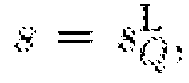
- s ⁇ s Q L and axis parallel to ⁇ : n i s n i , L Q ⁇ + n i , L Q ⁇ cos
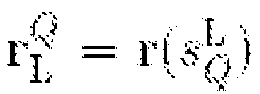
- r L Q r s Q L is the prescribed position of the centerline on the left-hand side of the interval.
- Equation 1c The equations just derived can be used to propagate the centerline and the material frame from the left-hand side s Q L of the element to its right-hand side s Q R .
- the whole rod can then be reconstructed by applying this procedure over every element successively, starting from the scalp where r and n i are prescribed by equation (1c).
- the integration constants are determined by continuity at the element boundaries.
- This orthonormal frame v 0 Q , v 1 Q , v 2 Q is such that v 0 Q is aligned with the constant Darboux vector ⁇ of the element S Q , and that v 2 Q is aligned with ⁇ ⁇ n 0 s Q L at the origin s Q L of the element (this assumes that both the vectors ⁇ and ⁇ ⁇ n 0 s Q L are nonzero).
- n 0 s Q L cos ⁇ v 0 Q + sin ⁇ v 1 Q
- n 1 s Q L ⁇ 1
- n 2 s Q L ⁇ 2
- F (s,t) the total external force applied to the rod per unit length
- ⁇ S the mass of the rod per unit length
- g is the acceleration of gravity.
- the internal energy U in equation (5c) is the elastic energy of the rod.
- the dependence of the stiffnesses on s may be neglected, but not that of the natural twist and the bends: small variations of ⁇ i n s I with s allow for more realistic hair styles.
- the inertia matrix M is a dense square matrix of size 3N, which depends nonlinearly on q.
- the stiffness matrix K has the same size, is diagonal, and is filled with the bending and torsional stiffnesses of the rod.
- the vector q n defines the rest position in generalized coordinates, and is filled with the natural twist or curvature ⁇ i n of the rod over element labelled Q.
- the vector A collects all remaining terms, including air drag, interaction forces and other applied forces, which are independent of q ⁇ and may depend nonlinearly on q and q ⁇ .
- the linear and rotational velocities are functions of q and q ⁇ , which depend linearly on q ⁇ .
- the linear and rotational accelerations are functions of q, q ⁇ and q ⁇ , which depend linearly on q ⁇ .
- each one of the functions intro-duced above such as r ⁇ SH ( s , t ); r ⁇ SH ( s,t ), r ⁇ SH ( s,t ), ⁇ ( s , t ), etc. can be expressed, on every segment S Q , as linear combinations of a fixed set of functions of s or, better, of s ⁇ s Q L , with vector coefficients.
- These fixed set of functions of s can be determined off-line ; there remains to implement the rules for calculating these vector coefficients, which can be derived from the procedure above and involve induction formulae over Q .
- the first step is to compute the perturbation ⁇ [ iQ ] to the orientation of the material frame, due to an arbitrary perturbation to the piecewise constant twist or curvatures.
- the second step is to compute the internal force T( s ).
- X Q is the characteristic function over element S introduced earlier.
- a symbolic expression for T*( s ) is found by solving for T( s ) with the appied forces p and T L , and accelerations of the degrees of freedom ⁇ iQ set to zero; similarly, T p ( s ) is found by solving for T( s ), considering the contributions coming from the applied forces only; finally, the functions ⁇ T( s )/ ⁇ ⁇ iQ are determined by considering the contribution to T( s ) coming from a particular twist or curvature acceleration ⁇ iQ only
- the equation of motion (6) is discrete in space but continuous in time. For its time integration, one can use a classical Newton semi-implicit scheme with fixed time step. The terms q ⁇ , q ⁇ and q in the left-hand side should be evaluated implicitly to improve stability.
- the update rule for q and q ⁇ by the partially implicit scheme outlined previously involves the solution of a linear system whose coefficients are given by the square matrix where s is the time step and the identity matrix; of size 3 N .
- this matrix is non-singular.
- the mass matrix constructed previously has determinant zero and, for very small time steps, this linear system becomes ill-conditionned. This is not a problem if the time step ⁇ is kept large, which is possible for very smooth motions. If, however, the time step ⁇ needs be set to small values, to handle sudden head motions for instance, the previous scheme can become unstable.
- the first method is to no longer neglect the rotational inertia of the cross sections.
- the second method is to modify the algorithm and to keep the material curves only as independent variables, while the twist becomes a dependent variable.
- This new term modifies the expression given previously for the matrix and for the vector A in the equation of motion of the Super-Helix.
- the modified expressions can be found by a reasoning similar to the one given previously.
- Another possibility to improve the stability of the algorithm is to make the twist a dependent variable. This can be done in several ways. One can for instance make the twist of each helical element a function of the curvatures of all the other elements.
- This formula is a discrete version of the solution of the differential equation for ⁇ J ( ⁇ - ⁇ n ) derived previously in the smooth setting.
- the equations of motion for the generalized coordinates q 2 N ( t ) are derived in a manner similar to that explained previously. In particular, the same expressions for the kinetic and elastic energies are used, as well as for the dissipation potential.
- the matrix has dimensions 2 N ⁇ 3 N .
- the matrix has dimensions 3 N ⁇ 2 N .
- the vector B 0 is of size 3 N .
- the matrices and and the vector B 0 reflect the choice of the functions ⁇ i , and depend on the values of these functions and on their gradients with respect to q 2 N , at the current point q 2 N ( t ).
- the matrix A and the vector B are those computed with the original version of the algorithm. In the end, the linear system to be inverted, with matrix ( ⁇ ⁇ ), is no longer ill-conditioned.
- the matrix has dimensions 2 N ⁇ 3 N .
- the matrix has dimensions 3 N ⁇ 2 N.
- the vector B 0 is of size 3 N.
- the matrices and and the vector B 0 reflect the choice of the functions ⁇ i , and depend on the values of these functions and on their gradients with respect to q 2 N , at the current point q 2 N ( t ).
- the matrix A and the vector B are those computed with the original version of the algorithm. In the end, the linear system to be inverted, with matrix ( ⁇ ⁇ ), is no longer ill-conditioned.
- the method for animating a Super-Helix derived earlier starts from a particular functional form, for the material twist and curvatures as a function of the arelength s , namely from piecewise constant functions of s , see equation (3).
- the integration of the kinematical equations (1) and (2) can be made symbolically. Animation of this model by Lagrangian mechanies is then possible, using the energies and potentials given in equation (5).
- An algorithm may be used for processing collisions between hairs and between the hairs and a body or an object, for example.
- Detection may be performed effectively by taking advantage of the time coherence of the movement of hairs, by acting on each time step to retain and update pairs of points that are the closest together. Contacts between volumes of hair can be processed by dissipative penalty forces.
- At least one envelope surface is calculated for each lock, the lock being associated, for example, with a set comprising a plurality of director hairs.
- At least one envelope surface may be calculated for each director hair.
- an envelope surface is calculated for each rod element, as shown in figure 12 .
- envelope surface is used to mean a surface encompassing the element(s) on which the rod mechanical model is applied.
- the parameters defining an envelope surface are explained in greater detail below with the help of an example of envelope cylinder.
- the envelope surface may be calculated differently at least depending on the values of the bending and twisting of the director hair or of the rod element, and depending on the length of the director hair or the rod element.
- a set of envelope cylinders may be generated around a rod element or a director hair or a lock.
- Each rod element may be surrounded, for example, by a varying number of envelope cylinders, e.g. a number lying in the range 1 to 3.
- An envelope cylinder can be generated around a rod element or a director hair of helical shape.
- a rod element, a director hair, or a lock can be modeled, for example, with the help of a varying number of envelope cylinders, e.g. a number lying in the range 1 to 3.
- Collisions may be detected between the envelope surfaces.
- Collisions may be detected between at least one envelope surface and at least one outside surface representative of a body or of an object.
- the outside surface representative of a body or of an object can be modeled, for example, by at least one envelope sphere or at least one envelope plane.
- the distance between at least two main axes of two different envelope surfaces are tracked in time.
- the observed distance may correspond for example to the distance between the main axis of an envelope cylinder and the main axis of another envelope cylinder, or else the distance between the center of an envelope sphere and the main axis of an envelope cylinder, or indeed the distance between the main axis of an envelope cylinder and a point belonging to an envelope plane.
- the distance between a plurality of pairs of points belonging respectively to the main axes of two envelope surfaces may be tracked, with each pair of points defining a tracking segment.
- a tracking segment may correspond, for example, to a segment interconnecting two points belonging to two different main axes of two different envelope cylinders, or indeed one of the points can belong to a main axis of an envelope cylinder while the other point is the center of an envelope sphere, or else one of the points may belong to a main axis of an envelope cylinder and the other may belong to an envelope plane.
- Collisions may be detected between at least two envelope surfaces or between an envelope surface and an outside surface representative of a body or an object, as follows:
- Lagrangian multiplier method may be applied when processing collisions.
- the penalty forces may comprise an elastic normal component and a tangential component that models viscous friction.
- the penalty forces applied during the collision between at least one envelope surface and at least one other envelope surface or outside surface may be a function of the direction of relative displacement projected onto the main axis of one of the envelope surfaces of the surfaces in collision. This may make it possible to take account of the orientation of scales on human hair and to improve the realism of the simulation.
- implementations of the method of the invention may include:
- the volume encompassing an element Q i of a director hair may be made up of a single cylinder encompassing the shape of the director hair, e.g. a helical shape of the director hair when the turns of the helix are sufficiently numerous and close together, or otherwise, a plurality of cylinders, e.g. one or two that are oriented along the local mean tangent of the element. This algorithm is described below.
- the number of turns described by the element Q i , and the pitch ⁇ h of the helix, representing the "tightness" of the turns, may be used as criteria for selecting an encompassing volume that is adapted to the element under consideration. These criteria may be reevaluated on each time step, and the encompassing volumes tend thus to adapt the current shape of the locks of hair.
- the encompassing volume V e of the element may then be calculated as follows:
- guide volume is used to mean the encompassing volume defined from a director hair for the corresponding lock (set of encompassing cylinders).
- the closest-together pairs of points may be tracked between the main axes of the cylinders used as encompassing volumes for different locks, as defined above. This may be reduced to tracking pairs of closest-together segments.
- a list of segment pairs may contain the segment pairs that are the closest together during the simulation.
- the list may be initialized with all of the pairs that might be formed by taking all of the segments adjacent to the roots of the hairs. The list may then be updated on each time step.
- the rod mechanical model of the invention has bending and twisting as its parameters, it may be relatively difficult to impose constraints on the model in terms of position or speed. Nevertheless, it is possible to interact with the model via forces, so the collision responses may be calculated using penalty forces.
- the algorithm may be stabilized by using quadratic regularization for small penetrations. Starting from an arbitrarily-selected regularization depth ⁇ reg , it is possible to calculate the normal reaction force R N exerted between the two closest-together points (detected as being in contact by the preceding algorithm) for example as follows:
- the coefficient of friction u can be modulated by a trigonometric function so as to take account of the anisotropy of the surface state of the hairs.
- Examples of a rod mechanical model in accordance with the invention may incorporate at least one mechanical dissipation parameter for modeling the damping of the movement of the director hair.
- the dissipation parameter may be associated for example with the elasticity of the hair, or with the natural curling of the hair, or indeed with viscous friction, for example relative to air.
- the dissipation parameter may also be associated with contact against an outside surface representative of a body or an object.
- the rod mechanical model may incorporate at least one physical parameter associated with a mechanical property of at least one hair of at least a portion of a head of hair selected from the following list: hair length (L); hair radius (ii) ; main radii (r x , r y ) of the hair, in particular the ellipticity of the hair; spontaneous twisting and bending ( ⁇ n , ⁇ 1 n , ⁇ 2 n ) of the hair about one or more axes; density ( ⁇ ); linear mass of the hair; clamping angle (s) ( ⁇ 0 ) of the hair in the scalp; bending stiffness (es) (EI 1 EI 2 ) of the hair; Young's modulus (E); Poisson's ratio (nu); spontaneous twisting ( ⁇ n ) of the hair; twisting stiffness ( ⁇ J); and porosity of the hair; and in particular, more specifically: density; linear density of the hair; clamping angle(s) of the hair in the scalp; Young's modulus; Poisson's
- At least one of the physical parameters may vary as a function of the arc length measured along the hair.
- each Super-Helix may be deduced from the structural and physical properties of the hair strands composing the clump. Then, friction parameters of the model may be adjusted depending on the damping observed in real motion of the clump. Finally, interactions may be set up between the Super-Helices to account for contacts occurring between the different animated hair groups.
- the volumic density ⁇ may be set to be equal to a typical value for hair, 1.3 grams per cubic centimeter (g ⁇ cm -3 ).
- the actual bends and twist may be equal to their natural values at the free end of the rod, where the role of gravity becomes negligible.
- This parameter measures the amount of internal dissipation within a Super-Helix during motion. It especially accounts for the hair-hair dissipative interactions occurring inside the hair clump whose motion is guided by the Super-Helix.
- the internal friction may be easily adjusted by comparing the amplitude of deformation between the real and the simulated hair clump when vertical oscillatory motion is imposed. Good results may be obtained with ⁇ ⁇ [5 ⁇ 10 -10 , 5 ⁇ 10 -11 ] kilogram cubic meters per second (kg ⁇ m 3 ⁇ s -1 ).
- the air-hair friction parameter may be matched by comparing the duration of damping between the real and the simulated hair clump, for example when imposing a pendulum motion.
- the air-hair friction coefficient v may be chosen in the range 5 ⁇ 10 -6 kilograms per meter second (kg(ms) -1 ) (disciplined hair) to 5 ⁇ 10 5 kg(ms) -1 (fuzzy hair), for example.
- the friction parameter may be directly adjusted from real observations of sliding contacts between the hair clump and a given material, and then multiplied by a cosine function to take account of the orientation of hair fibers with respect to their sliding motion over the external object.
- the invention provides an interactive system for dynamically simulating at least a portion of a head of hair in movement, the system comprising:
- the computer may be located at a point of sale, for example, or in a hairdressing salon, or remotely located and consulted by means of a terminal and a computer and/or telephone network.
- the computer may comprise a personal microcomputer or a server, for example.
- the system may further include a database including information linked to changes in at least one physical parameter of a hair of a portion of a head of hair as a function of a treatment applied to the hair.
- the treatment may be selected from the following list: permanent waving, crimping, decrimping, dyeing, drying of a wet hair, application of a composition to the hair, in particular a coating composition, application of a gel, setting, cutting, conditioning, thickening, lengthening, external climatic events, in particular rain, wind, sun.
- Two treatments may differ from each other at least in the quantity of composition applied, the thickness of the layer of composition applied, the duration of the treatment, the diameter of the crimping iron, the temperature of the crimping iron.
- a treatment may vary as a function of the arc length measured along the hair.
- the device for generating images may be configured to generate a virtual image or sequence of images of the hair after the application of a treatment.
- the device for generating images may be configured to display simultaneously an image or a sequence of images of the hair before treatment and an image or a sequence of images of the hair after application of the treatment.
- an atlas comprising:
- such an atlas may comprise a plurality of sequences of images corresponding to different degrees of one or more physical parameters of the hair.
- the images may be printed out or displayed on a screen or contained in an electronic form in a file.
- the information may comprise one or more of the following: an alphanumeric character, a symbol, a drawing, a color, or a bar code.
- the invention provides a product comprising:
- the image and the associated information may for example be useful for informing the customer or the hairdresser as to the type of hair for which the composition is suitable or the type of result that can be obtained.
- the invention provides a method of characterizing a hair, including the step of enabling a comparison between an image or sequence of images of the hair to be characterized and an image or sequence of images of a virtual hair obtained by the above method.
- the characterization may aim to quantify a physical parameter of the real hair that is the subject of the comparison.
- the characterization method may be implemented at different times, for example to highlight the effects of a treatment or an external event.
- a physical parameter of the hair may be modified as a function of the comparison, in order to enhance the resemblance between at least one image or sequence of images of the hair to be characterized and at least one image or sequence of images of the virtual hair. For example, from one to four or even only one or two physical parameters may be modified.
- a measurement of a physical parameter of the hair and a simulation parameter may be adjusted to achieve the required degree of matching between the images of the hair to be characterized and the virtual hair.
- a simulation parameter may be modified until a predefined degree of matching of the shapes of the hair to be characterized and the virtual hair has been achieved.
- the physical parameter measured may be selected from the following list: the length of the hair, the mean radius of the hair, the ellipticity of the hair, the linear density of the hair, the modulus of elasticity of the hair, its bending moment or moments, its twisting moment, its spontaneous bending, its spontaneous twisting.
- the characterization method may be implemented after receiving an electronic image of the hair to be characterized, in particular a computer image.
- the hair to be characterized may be used itself instead of the image of the hair to be characterized.
- the invention further provides a method of generating digital data defining the shape of a hair, comprising:
- the invention provides a method of prescribing a hair-care composition, comprising:
- the selected hair-care composition may be sent to the subject via a distribution center, for example.
- the invention provides a hair-treatment method, comprising:
- the invention provides a method of modeling the impact of a treatment or an external event applied to a hair, comprising:
- the treatment or the external event may have been selected from a plurality of treatments or external events.
- Such a method shows the appearance of the hair after the treatment has been effected, compares the appearance of the hair before and after the treatment, and shows the result of the treatment in advance, for example to enable the user to make an informed decision as to the treatment to be applied.
- This enables a specific treatment solution to be proposed to a user, for example, including showing them the result that will be obtained with such a treatment.
- the method may show the effect on the appearance of the hair of a treatment for coating it.
- the synthesized image of the treated hair may be calculated by modifying a physical simulation parameter, the modification depending in particular on the selected treatment.
- a sequence of images of the hair after treatment in motion; and a sequence of images of the hair in motion before treatment may be displayed simultaneously on the same screen.
- the treatment to be applied may be one or more from the following list: permanent waving, crimping, combing, decrimping, dyeing, wetting, drying of a wet hair, application of a coating composition to the hair, application of a gel, setting, cutting, conditioning, thickening, lengthening, external climatic events, in particular rain, wind, sun, hair dressing, geometrical constraints due for example to clamping of hair with ties.
- the treatment may vary as a function of the arc length measured along the hair.
- the mechanical effects of coating the hair or of a loss or uptake of moisture by a hair may be simulated, for example.
- the invention provides a hairdresser training method, comprising:
- the invention further provides a method of promoting the sale of a hair-care composition, for example a permanent waving, straightening, and/or smoothing composition for the hair, taking into account information representing one or more physical parameters linked to the shape of the hair, for example two or more physical parameters linked to the shape of the hair.
- a hair-care composition for example a permanent waving, straightening, and/or smoothing composition for the hair
- That promotion may be effected via any communications channel.
- it may be effected by a retailer, directly at a point of sale, by radio, by television, or by telephone, for example in the context of commercials or short messages.
- It could equally be effected via the print press or any other form of document, for example for advertising purposes.
- It could be effected via any other appropriate data processing network, for example via the Internet or via a mobile telephone network.
- It could equally be effected directly on the product itself, in particular on its packaging or on any explanatory material associated with it.
- the invention also provides a method of generating a sequence of synthesized images of a hair in movement, the method comprising the following steps:
- the method may also include the steps consisting in generating at least one sequence of images of said at least one hair or group of hairs as represented and animated in this way.
- the invention also provides a system comprising:
- the system may also include means for displaying said at least one sequence of images, in particular by means of a screen.
- the system may also be configured to generate at least a first sequence of images of hair prior to treatment and a second sequence of images of said hair after said treatment.
- the display means are arranged in such a manner as to display said at least one first sequence and said at least second sequence simultaneously or successively.
- the invention also provides the use of images obtained by the method described above to provide a head of hair for an avatar or to promote the sale of cosmetics, or in a film, or in a video game.
- the invention also provides a computer program product including instructions readable by a computer system including at least a microprocessor, said instructions controlling the operation of the computer system so as to implement the above-described method.
- This method may be implemented by means of an interactive system for representing a hair, including, as shown in Figure 2 :
- Results of the simulation may be displayed with the synthesized image or sequence of images of the hair in a first area of the screen and in a second area of the screen, elements for adjusting physical parameters that influence the mechanical behavior of the hair.
- the system may further include means (not shown) providing a stereoscopic view of the virtual hair.
- the adjustment elements may include a cursor movable between two or more positions corresponding to different values of the physical parameter concerned, for example.
- the physical parameters displayed and that where applicable may be modified may relate directly to the appearance of the hair, for example the length of the hair, or may be linked to mechanical characteristics of the hair, for example the radius or radii of the hair strand, the ellipticity of the hair strand, the spontaneous bend of the hair strand relative to one or more axes, the angle or angles of embedment of the hair strand in the scalp, the spontaneous twist of the hair strand, and/or to characteristics linked to one or more materials constituting the hair, for example its Young's modulus, its Poisson's ratio, its bending moments, its twist moment, the coefficient of elasticity of the hair, the porosity of the hair, the density or the linear density of the hair.
- a physical parameter may vary as a function of the arc length of the hair.
- the twist may be greater at certain points along the hair.
- the variation of certain physical parameters as a function of the arc length may be linked to past treatments effected on the hair and to how it grows, which may vary in time, or how it ages, the hair becoming increasingly older in the direction away from its root.
- the hair may have a distal portion that has been subjected to a bleaching treatment and a proximal portion that has grown since that treatment and has different mechanical characteristics.
- the system may be configured to enable the user to define the manner in which a parameter varies along the hair as a function of the arc length.
- one or more parameters may have a first value over a first portion of the length of the hair and a second value, which may be different from the first, over a second portion of its length.
- the system may include or access a database containing typical values of certain parameters, for example as a function of the ethnic hair type, its color and/or certain treatments effected.
- the system and method described above may be used to characterize a hair, for example by implementing the steps of the method shown in Figure 3 .
- an image or sequence of the hair to be characterized is compared to an image or sequence of a virtual hair obtained by the simulation method described above.
- a physical parameter of the hair may be modified as a function of the result of the comparison, with a view to enhancing the resemblance between the image of the hair to be characterized and the image of the virtual hair.
- the head of hair of a person may be characterized on the basis of the same hair or different hairs, for example three hairs, taken from the same head of hair. For example, one hair may be taken from the crown and one other hair from each side of the head.
- the results of measurements effected on a greater number of hairs may be processed statistically, in order to average values measured or determined by simulation, for example.
- the variations of the parameters characterizing a hair may be measured for hairs situated at different places in the head of hair.
- characterization results may be listed in a database with information concerning the persons from whom the hairs were taken.
- characteristics of a hair may be recorded and thus known at different times in its life cycle, in particular one or more of the physical parameters used to simulate the appearance of the hair. Such information may be useful for prescribing a treatment or choosing a hair-care composition, for example.
- the result of the characterization may be received in electronic form, for example via the computer network 27, and may delivered, in written or oral form, at a point of sale of products, in a beauty or hair salon, at the surgery of a dermatologist, or remotely, for example by connecting to an Internet site server.
- the hair may be characterized manually, semi-automatically or automatically.
- the image or real hair may be acquired by means of a two-dimensional acquisition system such as a scanner 24 or a video camera 25, for example, as shown in Figure 2 , or by means of a three-dimensional acquisition system, such as a stereovision system, for example.
- a two-dimensional acquisition system such as a scanner 24 or a video camera 25, for example, as shown in Figure 2
- a three-dimensional acquisition system such as a stereovision system, for example.
- the hair to be characterized may be used itself instead of the image of the hair to be characterized, for example by applying it to the screen using adhesive tape or any other appropriate fixing means.
- the advice may include the prescription of at least one hair-care composition having an action on a physical parameter of the hair, for example.
- This may be a composition for a form of hair treatment other than a dyeing treatment, for example permanent waving, crimping, straightening, and/or decrimping, or coating of the hair, for example.
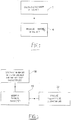
- Figure 4 shows a method of prescribing a hair-care composition, in which:
- this prescription method may be used at a point of sale, in a hairdressing or beauty salon, in a perfume outlet, in a department store, or remotely by means of the computer network 27.
- a product adapted to obtain a required result is handed or sent to the user or used in situ.
- the product may be supplied through any sales channel, in particular through a shop or by mail order, or through a beauty parlor or a hairdressing salon, for example.
- the treatment may be selected from the following list: permanent waving, crimping, decrimping, dyeing, drying of a wet hair, application of a composition to the hair, in particular a coating composition, application of a gel, for example a polymer coating, setting, cutting, conditioning, thickening, lengthening.
- the method and system described above further enable the implementation of a method, shown in Figure 7 , of modeling the impact of a treatment applied to a hair or of exposure to a predetermined event, for example a climatic event, aging or photo aging, the method including:
- the synthesized image of the hair to be treated may be obtained by the method described above.
- the synthesized image of the treated hair may be calculated by modifying a physical parameter of the untreated hair.
- the modification may depend on the treatment selected.
- the system may for example include a database including information reflecting the evolution of physical parameters of a hair as a function of treatments applied to the hair. The same applies to a hair exposed to a predetermined event.
- Two treatments that may be selected for purposes of simulation may differ from each other at least in terms of the quantity of composition applied, the thickness of the layer of composition applied, the distribution of the composition on the hair, the duration of the treatment, the diameter of the crimping iron or the temperature of the crimping iron, for example 180°C or 200°C.
- a treatment whose impact is to be modeled may vary as a function of the arc length measured along the hair.
- An image of sequence of images of the hair after treatment and an image or sequence of images of the hair before treatment may be displayed simultaneously on the same screen.
- This method may further be used for example to simulate the mechanical effects of coating the hair or of a loss or uptake of moisture, linked for example to exposure of the hair to rain or sun.
- the effect of water may be to increase the bend and/or the density of the hair, for example.
- such a method may further be used to demonstrate the resistance of a hair conditioning composition or treatment to external climatic events, for example rain, wind or the action of the sun.
- compositions may further be used to evaluate the effect of a composition as a function of the quantity thereof that was applied to the hair or remains on the hair after rinsing.
- the increase in the weight of the hair after the application of a coating composition may be evaluated, for example.
- the different behavior of a hair when dry or wet may also be evaluated.
- these evaluations may seek to determine a reduction or an increase in the volume of the head of hair.
- Modeling the impact of a treatment may be used to develop new hair-care treatments or compositions, for example. Such modeling may further be used for promotional or educational purposes, for example to explain to a customer or a hairdresser the impact of a treatment on the appearance and/or the behavior of the hair.
- Exemplary embodiments of the invention consist in a hairdresser training method, as shown in Figure 6 , including the following steps:
- the invention may be used to associate with hair-care compositions, information representing physical parameters characteristic of the hair.
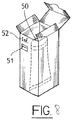
- Figure 8 shows a product including:
- the hair-care composition 50 may be a permanent waving, crimping, straightening, and/or decrimping composition for the hair, for example, or a composition for shaping the hair, for example a hair gel.
- the composition may further be a shampoo.
- the hair-care composition may act on the shape of the hair but also, where applicable, on its color and/or its brilliance. This action may be more or less durable and/or more or less reversible.
- the information 52 may indicate the effectiveness of the composition, for example in terms of variation of physical parameters linked to the shape of the hair or to characteristics of a head of hair for which it is suitable and/or a result that can be achieved.
- the product may further include information associated with the composition and representing parameters not linked to the shape of the hair, for example.
- a parameter that is not linked to the shape of the hair may represent the color and/or the brilliance of the hair, for example, before or after treatment.
- This further information may for example indicate the coordinates in a colorimetric space such as the CIE lab or Munsell space, for example, of the color of the head of hair to be treated or looked up or a shade on a scale of shades.
- a colorimetric space such as the CIE lab or Munsell space
- the information may be expressed in various forms, directly apparent to a person or otherwise.
- the information may include an alphanumeric character, a symbol, a drawing, a color, or a bar code.
- the images may be images of hairs lying in a plane or alternatively perspective images of hairs not entirely contained within one plane.
- Figure 10 shows a comparison between a sequence 100 of images of a real head of hair in movement and a sequence 200 of images of a virtual head of hair obtained by the method of the invention.
- Figures 13A to 13B show various examples or images of real hair versus simulated hair.
- the invention is not limited to the examples that have just been given.
Landscapes
- Physics & Mathematics (AREA)
- General Physics & Mathematics (AREA)
- Engineering & Computer Science (AREA)
- Theoretical Computer Science (AREA)
- Processing Or Creating Images (AREA)
Description
- The present invention relates to methods and systems for simulating the appearance of at least a portion of a head of hair.
- By "appearance" is meant the shape of a hair, or a head of hair, implanted in the scalp of a person and subject to the gravitational field, simulation of the shape being complemented, where appropriate, by simulation of the color of the hair or the texture of the hair.
- Realistic hair simulation is one of the most difficult issues when animating virtual humans. Human hair is a very complex material, consisting of hundreds of thousands of very thin, inextensible strands that interact with each other and with the body. Unlike solids or fluids, which have been studied for over a century and which are well modeled by now classical equations, hair remains a largely unsolved problem described by no well-accepted model.
- The article "Modelling Dynamic hair as a Continuum" to Hadap, Magnenat-Thalmann, 2001, addresses hair dynamic modeling by using fluid dynamics for hair-hair, hair-body and hair-air interactions modeling, and serial rigid multibody chain for individual dynamics modeling
-
US 2002/0057278 relates to a method for the digital creation of fur effects. -
US2002/0150287 relates to an image processing medium for constructing an image of a head with a hair-style from a hair-style database. - Modeling hair dynamics raises a number of difficulties. First, each individual strand has complex nonlinear mechanical behavior, strongly related to its natural shape: smooth, wavy, curly, or fuzzy. Second, the dynamics of a set of strands takes on a collective behavior. Lastly, the simulation of a full head of hair raises obvious issues in terms of efficiency.
- Three families of computational models have been used for simulating the dynamics of individual hair strands in the prior art:
- Mass-spring systems as described in Rosenblum et al., "Simulating the structure and dynamics of human hair: Modeling, rendering, and animation", The Journal of Visualization and Computer Animation 2, 4, 141-148, 1991 and Plante et al., "A layered wisp model for simulating interactions inside long hair", in EG CAS'01, Springer, Computer Science, 139-148, 2001;
- two dimensional projective dynamics as described in Anjyo et al., "A simple method for extracting the natural beauty of hair", 111-120, 1992, in Daldegan et al., "An integrated system for modelling, animating and rendering hair", Computer Graphics Forum 12, 3, 211-221, 1993 and in Lee and Ko, "Natural Hairstyle modelling and animation", Graphical Models 63, 2 (March), 67-85, 2001;
- chains of rigid bodies as described in Hadap and Magnenat-Thalmann, "Modeling dynamic hair as a continuum", Computer Graphics Forum (Eurographics'01) 20, 3, 329-338, 2001 and in Chang et al., "A practical model for hair mutual interactions", in ACM SIGGRAPH Symposium on Computer Animation, 73-80, 2002.
- The first family of models is well suited for animating long, extensible wisps or locks of hair.
- The second efficiently handles non-stretchable straight hair.
- The last increases realism by handling the twisting motion of hair strands while still preventing stretching.
- Although those models have led to very nice visual results, several important hair features have not yet been taken into account. For instance, the deformations of curly hair are quite specific compared to straight hair, but previous work has simply simulated straight extensible hair wisps, with curly strands used only for rendering.
- Moreover, none of the previous models demonstrated nonlinear behaviors such as bending-twisting instabilities or buckling, which have a great impact on realism.
- There exists a need for a system or method of simulating the movement of a hair, or a head of a hair, in a manner that may be useful in the field of cosmetics for example.
- There also exists a need for using new methods of simulating the movement of a hair, or a head of a hair, in the field of animation, in particular in computer animation, for a movie or a video game, for example.
- There also exists a need to facilitate the characterization of human hairs, whether natural or treated.
- The present invention is defined in the appended claims and aims to satisfy some or all of these needs and to model hair dynamics accurately while keeping computational costs reasonable.
- In one of its aspects, the invention provides a method of generating at least one synthesized image of at least a portion of a head of hair in movement, the method comprising:
- calculating the shape of at least one director hair by applying to said director hair at least one mechanical model of an inextensible rod having inertia and stiffnesses in twisting and in bending; and
- generating at least one synthesized image of the portion of the head of hair from the shape of the director hair as calculated in this way.
- The term "synthesized" is synonymous of "virtual".
- The term "director hair" is used to mean a hair modeled using a rod mechanical model in accordance with the invention, that moves in a way suitable for determining the movement of a portion of the head of hair comprising one or more locks, or of one or more target hairs.
- Exemplary embodiments of the invention may allow to calculate the shape of a plurality of director hairs, with the number of director hairs possibly lying in the
range 50 to 200, for example. - Unlike prior art in hair animation, the present invention may enable virtual hair to be parameterized from measured features, yielding realistic simulations as depicted in BERTAILS et al., "Super-Helices for Predicting the Dynamics of Natural Hair", ACM Translation Graphics SIGGRAPH, August 2006, which is incorporated by reference.
- At least one the synthesized image of the hair, for example a sequence of images, may be incorporated into at least one image of a human head, which may be a real image or a 3D image.
- Exemplary implementations of a method in accordance with the invention may be employed in the context of advising a customer and/or studying the effects of a hair-care composition and/or promoting a hair-care composition and/or training professionals such as hairdressers or beauticians, for example.
- The method of the invention may also be implemented in the context of animating the hair of a character, of an animal, or of a virtual object integrated in an animation, for example an animated film, a cartoon, an advertising spot, a video game, or indeed an animated sequence broadcast on a computer medium or over a network, such as the Internet for example.
- The method of the invention may be used for generating at least one sequence of images, the images being obtained by superposing images obtained by any image-sensor means, e.g. a video camera, on synthesized images obtained by using the method for generating at least one synthesized image of at least a portion of a head of hair in movement, as defined above.
- Implementations of a method of the invention may also make it possible to create at least one sequence of synthesized images having a representation that is substantially similar to at least one sequence of real images.
- The invention may make it possible to reproduce the movement of the head of hair of an individual, or of hair on an animal or an object by using at least one sequence of synthesized images resembling one or more sequences of real images of the head of hair of an individual, or hair on an animal or an object.
- The sequence of real images may correspond to a sequence of filmed images, e.g. using a video camera, for example a camera forming part of a mobile telephone.
- The term "head of hair of an individual" should be understood as covering not only the hair on an individual's head, but any other collection of hairs on the body of an individual. The term "hair of an animal" should be understood as covering any set of hairs on an animal, whether a mane or otherwise, and also any set of feathers or of barbs on a single feather.
- The term "hair of an object" should be understood as covering any set of thread-like elements intended to simulate or represent a shape substantially similar to the head of hair of an individual or hair on an animal. The virtual object may, for example be personified and as a result may have a head of hair, for example when the object is intended to represent an avatar.
- Exemplary embodiments of the invention may use at least one synthesized image obtained by the method of the invention in an animated film, for a synthesized character, in an interactive system, e.g. a video game, or to represent a head of hair of an avatar.
- Depending on the parameters chosen for the rod mechanical model, the shape of the hair may be determined when the hair is stationary or when it is being moved by the action of an external force, for example a force exerted by the wind or by a movement of the head when the person is moving. The invention may allow to take into account in the simulation collision between locks of hair and on forces exerted by objects such as combs or other parts of the body.
- In exemplary implementations, Kirchhoff equations for dynamic, inextensible elastic rods are used for accurately predicting hair motion. These equations fully account for the nonlinear behavior of hair strands with respect to bending and twisting.
- Exemplary implementations of the invention provide a robust solution to the problem of simulating a hair, or a head of a hair, through the use of the dynamics of Cosserat rods.
- The method of the invention may be used to simulate the behavior of several hair strands, for example by applying the rod mechanical model to each of the hairs.
- At least one synthesized image of at least one portion of a head of hair in movement may be generated from at least one physical parameter of a portion of a real head of hair.
- At least one synthesized image of at least a portion of a head of hair in movement may be generated from at least two source images of at least a portion of a head of hair. The source images may be photographic or video images, sketches, drawings or synthetized images. The source images may be part of a scenario for a movie or a video game or images already existing in a movie or video.
- Exemplary embodiments of the invention comprise displaying on a single screen at least one synthesized image and at least one element for adjusting a simulation parameter of the rod mechanical model.
- Exemplary embodiments of the invention may enable a user to select at least one simulation parameter of the rod mechanical model as a function of at least one physical characteristic of a portion of a real head of hair, for example as a function of the curly or straight appearance of the portion of the real head of hair.
- The portion of the head of hair may be rendered for simulation by using target hairs having movement that is associated with the movement of one or more director hairs.
- The term "target hair" is used to mean any virtual hair associated with one or more director hairs, or with a lock, while rendering the portion of the head of hair, and presenting movement that is determined by the movement of one or more director hairs.
- In an exemplary implementation of the invention, a director hair is associated with at least one lock of target hairs to which the movement of the associated director hair is given.
- In a variant, each director hair is associated with a respective lock of target hairs to which the movement of the associated director hair is given. By way of example, this may make it possible to model heads of hair that are clearly separated into packets of hair, for example heads of hairs that are curly, wavy, or plaited.
- In another exemplary implementation of the invention, a plurality of director hairs are associated with a set of target hairs, and weights may be given to the director hairs associated with the same set of target hairs, the weights may depend on the hair strand in the set of target hairs.
- If a given director hair has a preponderant weight then the set of target hairs will tend to remain grouped around the director hair and may, for example, be little influenced by the other director hairs during the animation.
- If the weights of the various director hairs on each target hair are balanced, then the packet of target hairs constituting the set of target hairs will tend to take on the appearance, during the animation, of a continuum between the various director hairs. This may make it possible, for example, to model a head of hair presenting an appearance that is continuous and smooth.
- The weights of the director hairs that are associated with each target hair may be determined as a function of the distance between the root of a given target hair (in the set of target hairs) and the root of at least one director hair and/or as a function of the distance between the free end of a given target hair (in the set of target hairs) and the free end of at least one director hair. The second condition may be useful to prevent from interpolating hair between two director hairs which have free ends located across an obstacle (for example across the shoulder).
- The weights of the director hairs that are associated with the set of target hairs may be determined as a function of the distance between the free end of a given target hair and the free end of at least one director hair in the set of target hairs and/or as a function of the distance between the root of a given director hair and the root of at least one target hair in the set of target hairs.
- A zero weight may be given to a director hair when at least one of those two distances, between the roots of a director hair and a target hair or between their respective free ends, exceeds a predefined value.
- In an exemplary implementation of the invention, an algorithm for determining the shape of a given target hair during a rendering step may be as follows:
- Let h be the target hair of shape that is to be calculated.
- 1) During a precalculation step, h is assigned to a main director hair gmain, also written g0, and to other director hairs gi, i ∈ [1..ng], which are selected to be sufficiently close to the main director hair gmain on the scalp, complying with a maximum distance threshold tr that is always selected to be greater than the distance between the main director hair gmain and the target hair h on the scalp. By way of example, this threshold may be set to a value that makes it possible to select not only the main director hair gmain, but also from 3 to 10 neighboring director hairs, for example.
- The initial weight of each director hair on the target hair h may then be calculated as a normalized function of the Euclidean distance on the scalp between the target hair h and the various director hairs gi:


- 2) Thereafter, on each time step:
- the distances of the director hairs gi from the director hair gmain during the movement are observed. Since hairs are freer to move apart close to their tips than close to their roots, this relative movement apart between director hairs may be measured by the distances between their tips. For each director hair gi, the distance

- if


- if


- else wi,j = 0;
- if
- the distances of the director hairs gi from the director hair gmain during the movement are observed. Since hairs are freer to move apart close to their tips than close to their roots, this relative movement apart between director hairs may be measured by the distances between their tips. For each director hair gi, the distance
- The position of the target hair h at the arc length s may then be calculated as follows:


- The algorithm described above makes it possible to generate a portion of a head of hair from a set of director hairs changing smoothly from full interpolation along the director hairs to no interpolation at all (yielding distinct hair clusters), an intermediate state being characterized by a certain degree of interpolation near the roots, and no interpolation near the free ends of the director hairs.
- In practice, the tuning of the parameters of the interpolation may for example be guided by the level of curliness of the director hairs: for example, one may choose full interpolation for straight hair (for a smooth overall aspect), semi-interpolation for wavy hair (for a smooth aspect near the roots, clumpy near the tips), and no interpolation for curly hair (for a clumpy aspect from roots to tips).
- The rod mechanical model of the invention is a mechanical model of an inextensible rod having inertia and stiffnesses in twisting and in bending.
- The model may be a discretized version of an continuous unshearable rod model.
- An example of a rod modeled using the method of the invention may comprise a succession of rod elements, each rod element possibly being a model of a rod having constant twisting and bending.
- The term "rod element" may be used to cover any helically-shaped element, and also any degenerate element in the form of an arc of a circle and/or a straight segment.
- The motion of rod elements may be coupled during the overall animation of the rod as a whole.
-
Figure 9 shows an implementation of the rod mechanical model of the invention. A hair, or a portion of a head of hair can be modeled by a rod T made up for example of ten different rod elements S1...S10, each of which may be is animated or not. The rod T may for example model one hair, or a portion of a head of hair that is stiff (a), wavy (b), curly (c), or very curly (d) . - The rod may be constituted by helically-shaped elements, with the number of elements lying for example in the range 1 to 10.
- The number of degrees of freedom of the rod mechanical model may range for example from 2 to 100, and better from 20 to 50.
- By way of example, the rod mechanical model is built upon the Cosserat and Kirchhoff theories of rods.
- The term "rod" is used to mean an elastic material that is effectively one dimensional: its length is much greater than the size of its cross section.
- The rod is considered to be an inextensible rod of length L, and s, lying in the range 0 to L, is the arc length along the rod.
- The centerline, r(s,t), is the curve passing through the center of mass of every cross section. This curve describes the shape of the rod at a particular time t but it does not tell how much the rod twists around its centerline. In order to keep track of twist, the Cosserat model introduces a material frame ni (s,t) at every point of the centerline, as shown in
figure 11 . By "material" is meant that the frame "flows" along with the surrounding material upon deformation. By convention, n0 is the tangent to the centerline:
- The Kirchhoff model for elastic rod starts from this mathematical description of a Cosserat curve and adds the physical requirement of inextensibility and unshearability. In this case, the frame (ni (s))i=0,1,2 is orthonormal for all s, and there exists a vector Ω(s,t), called the Darboux vector, such that:

- Appropriate boundary conditions must be specified: For example, one end of the hair strand, s = 0, is clamped in the head while the other end, s = L, is the tip is which is stress free. The position of the embedded end, together with the orientation of the initial frame, are imposed by head motion:

- 'Different boundary conditions, such as free boundary conditions on both ends for instance, can be handled by considering as unknowns the endpoind linear acceleration r̈ c(s = 0,t) and rotational acceleration ϕ̇(s = 0,t), and determining them at every timestep by solving the equations for the internal force and moment at this endpoint, these equations being linear with respect to these linear and rotational accelerations. The linear and rotational velocities and the position and orientation of the endpoint s = 0 can then be determined from these accelerations by integrating kinematical equations. Such boundary conditions can be useful, for instance, to assemble several inextensible rods in a chain-like, or tree-like geometry ; the boundary conditions at the endpoints of each inextensible rods would then express the continuity of displacement, and the balance of force and moments on the joints.'
- The rod's material curvatures (κα(s,t))α = 1,2 with respect to the two directions of the cross section and its twist τ(s,t) are defined as the coordinates of the vector Ω(s,t) in the local material frame:

- By introducing a redundant notation for twist, κ0 = τ, it can be referred to these parameters collectively as ((κi(s,t))i = 0,1,2.
- The degrees of freedom of a Kirchhoff rod are its material curvatures and twist ((κi(s,t))i = 0,1,2.
- The spatial discretization may be done as follows:
- The strand s ∈ [0,L] is divided into N rod elements SQ as shown in
figure 9 (which may also be called segment) indexed by Q (1 ≤ Q ≤ N). These rod elements may have different lengths, and N is an arbitrary integer, N ≥ 1. The material bends and twist of the deformable model are defined with piecewise constant functions over these rod elements. qi,Q (t) is the constant value of the curvature κi (for i = 1,2) or twist κ0 = τ (for i = 0) over the rod element SQ at time t. Therefore, an explicit formula for the material curvature and twist reads:
- These generalized coordinates q(t) may be used to reconstruct the rod shape at any given time. Indeed, plugging equation (3) into equation (2), and then equation (2) into equations (1a-1c) yields a differential equation with respect to s. By integrating this equation, the centreline r(s) and the material frames n i(s) are obtained as a function of s and of q(t).
- 'The functions thus obtained have the following smoothness : the functions κi (s,t) are piecewise constant with respect to s and may be discontinuous at the edge between segments. The functions n i (s,t) are continuous with respect to the variable s. The function r(s,t) is continuous with continuous derivatives with respect to the variable s.
- By patching the solutions, it may be found that the model deforms as a helix over every element, and such a model of the invention may be called a Super-Helix. r SH(s,q) and n i SH(s,q) represent the parameterization of the Super-Helix in terms of its generalized coordinates q.
- The reconstruction of the Super-Helix can be carried out symbolically over any particular element


- Since Ω is constant, integration of equation (1b) over an element is straightforward. The material frame 'rotates' around ω with a constant rate of rotation |Ω| per unit of curvilinear length. Therefore, the material frame at coordinate s ∈ SQ is obtained from the material frame


- The equations just derived can be used to propagate the centerline and the material frame from the left-hand side


- Ultimately, this leads to a symbolic expression for the functions r SH(s,q) and n i (s,q) that define the Super-Helix.
- To keep the algebra simple, it can be useful to carry out the calculations associated with every element SQ in a particular frame, called the adapted frame for element Q. This orthonormal frame




- Given a deformable body whose configuration depends on generalized coordinates q(t), Lagrangian mechanics provides a systematic method for deriving its equations of motion, q̈ = a(q,q̇,t). This is done by feeding the Lagrangian equations of motion:


- Other forces, for example a force exerted by a comb, may also be considered.
- The three energies in the equations of motion (4) that are relevant for an elastic rod are:



- The kinetic energy T is defined as a function of the rod velocity, ṙ=dr/dt in the conventional way. The internal energy U in equation (5c) is the elastic energy of the rod. The coefficients (EI)i are the principal bending stiffnesses of the rod in the directions n i (for i = 1,2) while (EI)0 is the twisting stiffness, written µJ (for i = 0).
- The quantities


- Zero natural curvatures (

- Overall, the mechanical properties of the rod may be captured by six entities only, the stiffnesses (EIi)i=0,1,2 and the natural twist and bends


- For the dissipation energy D in equation (5d) a simple heuristic model for capturing visco-elastic effects in hair strands may be chosen, the coefficient γ being the internal friction coefficient.
- All the terms needed in equation (4) are given in equation (5). By plugging the latter into the former, explicit equations of motion are obtained for the generalized coordinate q(t).
- This leads to the equation of motion of a Super-Helix :

- In this equation, the bracket notation is used to emphasize that all functions are given by explicit formula in terms of their arguments.
- In equation (6), the inertia matrix M is a dense square matrix of size 3N, which depends nonlinearly on q. The stiffness matrix K has the same size, is diagonal, and is filled with the bending and torsional stiffnesses of the rod. The vector q n defines the rest position in generalized coordinates, and is filled with the natural twist or curvature

- To compute the matrices(s, q),
 , and the vectors A(t,q,q̇), one has to start from the symbolic expression for the functions rSH (s,t) and

- By time derivation of the symbolic expressions for the functions r SH(s,t) and


- A similar reasoning yields the symbolic expression for the linear and rotational accelerations r̈ SH(s,t) and ϕ̇ (s,t) of a current point s ∈ SQ belonging to element labelled Q, as a function of the linear and translational velocities and accelerations of the origin


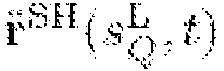


- Many quantities derived below, such as the internal force T(s) are defined likewise by induction, by a similar reasoning.
- In these derivations, one can take advantage of the fact that the linear and rotational velocities depend linearly on q̇, and that the linear and rotational accelerations depend linearly on q̈. For instance, the acceleration can be written as

- One can also take advantage of the fact that each one of the functions intro-duced above, such as r̈SH(s,t); r̈SH(s,t), r̈SH(s,t), ϕ(s,t), etc. can be expressed, on every segment SQ, as linear combinations of a fixed set of functions of s or, better, of

- It is advised to carry out these symbolic calculations and to implement the induction relations with the help of a symbolic calculation software.
- At this point, it is possible to plug the symbolic expressions derived above into the Lagrangian equations of motion (4) and the energies and potentials (5), to derive an explicit, symbolic expression for all the terms in equation (6). To do this, it is convenient to proceed in two steps, detailed below. The first step is to compute the perturbation δθ [iQ] to the orientation of the material frame, due to an arbitrary perturbation to the piecewise constant twist or curvatures. The second step is to compute the internal force T(s).
- Consider all possible perturbations to the constant twist τ = κ 0 or curvatures κ 1 or κ 2 over a particular rod element, labelled Q. Such a perturbation is indexed by a couple [iQ], where i = 0 (when one considers a perturbation to the twist), or i = 1.2 (when either curvature is perturbed). Consider the infinitesimal change of orientation δθ [iQ](s) of the material frame, associated with this perturbation. This quantity is defined by the fact that the infinitesimal change of the material vectors n j (s) when the twist or curvature are perturbed satisfies δn j(s) = δθ [iQ](s) × nj (s)for all j = 0,1,2 and for all s. This quantity can be determined by integrating symbolically the differential equation :
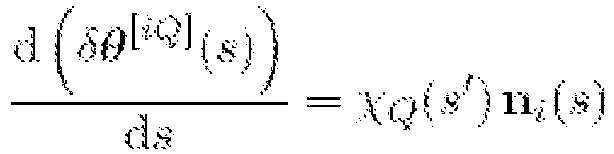
- The internal force T(s) is defined, like in the smooth setting, as the solution of the following differential equation :

endpoint, the relevant value of T L should be used; if the displacement is imposer at the endpoint s = L, the force T L applied by the operator is an additional unknown of the problem - to determine it, one can use the fact that q̈ is ultimately a linear function of this T L . It is convenient to split the internal force into several contributions, using the linearity of T(s) with respect to forces and accelerations :
- Once the functions δθ [iQ](s), T*(s), Tp(s) and ∂T(s)/∂κ̈iQ have been determined symbolically, the equation of motion is given by equation (6) with :




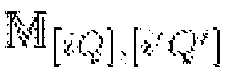 at row [iQ] and column [i'Q']. The function δ [iQ],[i'Q'] is Kronecker's symbol, which is 1 when both i = i' and Q = Q', and 0 otherwise. The coefficient EI [iQ] is the average of the twist stiffness µJ (when i = 0) or bending stiffness (when i = 1, 2) for element Q. All the above integrals can be carried out off-line, since all the functions have been computed symbolically.
- Whenever the anti-derivative of a trigonometric function is needed, as when intergrating equations (1-3) to determine the centerline, or when determining the internal force T(s), or when computing the integrals above, it is recommended to introduce functions that are C ∞-smooth. For instance, the following choice of integration constant avoids the introduction of non smooth functions in the anti-derivative of the sine function :


- The equation of motion (6) is discrete in space but continuous in time. For its time integration, one can use a classical Newton semi-implicit scheme with fixed time step. The terms q̈, q̇ and q in the left-hand side should be evaluated implicitly to improve stability.
- At every time step, the update rule for q and q̇ by the partially implicit scheme outlined previously involves the solution of a linear system whose coefficients are given by the square matrix
 the identity matrix; of size 3N. For ε ≠ 0, this matrix is non-singular. However, the mass matrix
 constructed previously has determinant zero and, for very small time steps, this linear system becomes ill-conditionned. This is not a problem if the time step ε is kept large, which is possible for very smooth motions. If, however, the time step ε needs be set to small values, to handle sudden head motions for instance, the previous scheme can become unstable.
- We found that the matrixis typically of rank 2N, although it is a square matrix of size 3N × 3N. This degeneracy can be easily understood from the smooth setting. Indeed, when the rotational inertia of the cross sections is neglected, as in equation (5b), the Kirchhoff equation for the balance of moments reads M' + n0 × T = 0, where M is the internal moment and T the internal force. When projected along the local tangent direction n0, this equation yields : M' · n0 = 0, hence (M · n0)' -(Ω × n0) · M = 0. This can be rewritten as :

 : when the rotational inertia of the cross sections is neglected, the twist cannot be considered as an independent variable ; instead, its value directly depends on the values of the material curvatures (note that the twist can only be determined from the material curvatures globally, by integration of the above differential equation).
- We give two methods that can be used to improve dramatically the stability of the scheme for small ε. Either method is possible. The first method is to no longer neglect the rotational inertia of the cross sections. The second method is to modify the algorithm and to keep the material curves only as independent variables, while the twist becomes a dependent variable.
- In order to restore the rotational inertia of the cross sections, one has to include an additional term in the kinetic energy, and modify equation (5b) as follows :
 and for the vector A in the equation of motion of the Super-Helix. The modified expressions can be found by a reasoning similar to the one given previously. Another possibility to improve the stability of the algorithm is to make the twist a dependent variable. This can be done in several ways. One can for instance make the twist of each helical element a function of the curvatures of all the other elements. Let κ j,Q be the first (j = 1) or second (j = 2) material curvature associated with element Q, for 1 ≤ Q ≤ N, The twist τQ of the element i of the Super-Helix can be a priori constrained to be given by :

- We suggest two possible sets of choices of the functions Φ Q. Many other sets of choices are possible. The first one reads, for Q = 1, ··· , N :


- When the twists are prescribed functions of the curvatures, the generalized coordinates are a vector q2N (t) of length 2N containing the material curvatures over each element,


 has dimensions 2N × 3N. The matrix
 has dimensions 3N × 2N. The vector B0 is of size 3N. The matrices
 andand the vector B0 reflect the choice of the functions Φ i , and depend on the values of these functions and on their gradients with respect to q2N , at the current point q2N (t). The matrix A and the vector B are those computed with the original version of the algorithm. In the end, the linear system to be inverted, with matrix (··
 ), is no longer ill-conditioned.
 - Here, Δy2N is the unknown increment for the time derivatives of the generalized coordinates of the problem with reduced kinematics, Δy2N = q̇2N (t+ε) - q̇2N (t). The matrixhas dimensions 2N × 3N. The matrixhas dimensions 3N × 2N. The vector B0 is of size 3N. The matricesandand the vector B0 reflect the choice of the functions Φ i , and depend on the values of these functions and on their gradients with respect to q2N , at the current point q2N (t). The matrix A and the vector B are those computed with the original version of the algorithm. In the end, the linear system to be inverted, with matrix (··), is no longer ill-conditioned.
- The method for animating a Super-Helix derived earlier starts from a particular functional form, for the material twist and curvatures as a function of the arelength s, namely from piecewise constant functions of s, see equation (3). With this particular functional form, the integration of the kinematical equations (1) and (2) can be made symbolically. Animation of this model by Lagrangian mechanies is then possible, using the energies and potentials given in equation (5).
- One straightforward extension of this method is to add contributions in the form of Dirac's delta functions δ at the edges between neighbouring elements, that is to replace equation (3) with


- A specific instance of this variant is worth mentionning: one can kinematically constrain the material curvatures to be zero along the rod elements (qi,Q (t) = 0 for all t and Q, and for i = 1,2), and the material twist to have no Dirac contributions (

- Other variants of the model are possible, which are obtained by imposing in equation (3) a different functional dependence on s. Instead of using piecewise constant functions, it is possible to use, for instance, piecewise linear functions. However, the drawback is that the integration of the kinematical equations becomes more involved and/or cannot be made symbolically, making the derivation of the equations of motion more difficult.
- An algorithm may be used for processing collisions between hairs and between the hairs and a body or an object, for example.
- Detection may be performed effectively by taking advantage of the time coherence of the movement of hairs, by acting on each time step to retain and update pairs of points that are the closest together. Contacts between volumes of hair can be processed by dissipative penalty forces.
- In exemplary implementations of the invention, at least one envelope surface is calculated for each lock, the lock being associated, for example, with a set comprising a plurality of director hairs.
- At least one envelope surface may be calculated for each director hair. In a variant, an envelope surface is calculated for each rod element, as shown in
figure 12 . - The term "envelope surface" is used to mean a surface encompassing the element(s) on which the rod mechanical model is applied. The parameters defining an envelope surface are explained in greater detail below with the help of an example of envelope cylinder.
- The envelope surface may be calculated differently at least depending on the values of the bending and twisting of the director hair or of the rod element, and depending on the length of the director hair or the rod element.
- A set of envelope cylinders may be generated around a rod element or a director hair or a lock.
- Each rod element may be surrounded, for example, by a varying number of envelope cylinders, e.g. a number lying in the range 1 to 3.
- An envelope cylinder can be generated around a rod element or a director hair of helical shape.
- A rod element, a director hair, or a lock can be modeled, for example, with the help of a varying number of envelope cylinders, e.g. a number lying in the range 1 to 3.
- Collisions may be detected between the envelope surfaces.
- Collisions may be detected between at least one envelope surface and at least one outside surface representative of a body or of an object.
- The outside surface representative of a body or of an object can be modeled, for example, by at least one envelope sphere or at least one envelope plane.
- In an implementation of the invention, the distance between at least two main axes of two different envelope surfaces are tracked in time.
- The observed distance may correspond for example to the distance between the main axis of an envelope cylinder and the main axis of another envelope cylinder, or else the distance between the center of an envelope sphere and the main axis of an envelope cylinder, or indeed the distance between the main axis of an envelope cylinder and a point belonging to an envelope plane.
- The distance between a plurality of pairs of points belonging respectively to the main axes of two envelope surfaces may be tracked, with each pair of points defining a tracking segment.
- A tracking segment may correspond, for example, to a segment interconnecting two points belonging to two different main axes of two different envelope cylinders, or indeed one of the points can belong to a main axis of an envelope cylinder while the other point is the center of an envelope sphere, or else one of the points may belong to a main axis of an envelope cylinder and the other may belong to an envelope plane.
- Collisions may be detected between at least two envelope surfaces or between an envelope surface and an outside surface representative of a body or an object, as follows:
- when the length of each of the tracking segments is greater than a determined value distmax, there is no collision and the time tracking of the tracking segments of at least two envelope surfaces is interrupted, and under such circumstances, the distances between a plurality of pairs of points in the vicinity of the previously observed pairs of points are tracked; and
- when the length of each of the tracking segments is less than a determined value distmin, elastic penalty forces proportional to the interpenetation between the colliding surfaces may be applied to the rod mechanical model.
- In a variant, a so-called Lagrangian multiplier method may be applied when processing collisions.
- The penalty forces may comprise an elastic normal component and a tangential component that models viscous friction.
- The penalty forces applied during the collision between at least one envelope surface and at least one other envelope surface or outside surface may be a function of the direction of relative displacement projected onto the main axis of one of the envelope surfaces of the surfaces in collision. This may make it possible to take account of the orientation of scales on human hair and to improve the realism of the simulation.
- In order to detect the collisions that might occur between at least two director hairs or between at least two locks of hair, for example, in a manner that is both effective and precise, implementations of the method of the invention may include:
- using adaptive cylindrical encompassing envelopes around the locks, of number and size that adapt automatically over time to the extent to which the lock is wound helically; and
- at each time step, tracking pairs of points that are the closest together between the main axes of the encompassing cylinders.
- The volume encompassing an element Qi of a director hair may be made up of a single cylinder encompassing the shape of the director hair, e.g. a helical shape of the director hair when the turns of the helix are sufficiently numerous and close together, or otherwise, a plurality of cylinders, e.g. one or two that are oriented along the local mean tangent of the element. This algorithm is described below.
- The radius rh and the pitch Δh of a helix can be deduced from the bends and twisting κ1, κ2, τ of the corresponding rod, using the following formulae:


- The number of turns described by the element Qi, and the pitch Δh of the helix, representing the "tightness" of the turns, may be used as criteria for selecting an encompassing volume that is adapted to the element under consideration. These criteria may be reevaluated on each time step, and the encompassing volumes tend thus to adapt the current shape of the locks of hair.
- Using the notation C(a,r) for the cylinder of unity

- {if
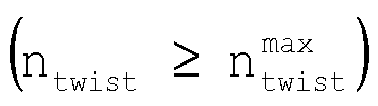


- {if


- {else, Ve =C(r(s i)-r(s i-1),r w).
- Below, the term "guide volume" is used to mean the encompassing volume defined from a director hair for the corresponding lock (set of encompassing cylinders).
- The closest-together pairs of points may be tracked between the main axes of the cylinders used as encompassing volumes for different locks, as defined above. This may be reduced to tracking pairs of closest-together segments.
- A list of segment pairs may contain the segment pairs that are the closest together during the simulation. When starting, the list may be initialized with all of the pairs that might be formed by taking all of the segments adjacent to the roots of the hairs. The list may then be updated on each time step.
- For each pair of segments (segi, segj) :
- it is possible to test the pairs of segments (e.g. nine segments) formed from segments adjacent to segi and segj (the neighborhood of two segments being taken as meaning said segments being adjacent along their common guide volume) and the new closest pair of segments is extracted, that is to replace the preceding pair. This method may make it possible to propagate a detection pair along interacting locks;
- the pair is eliminated and not replaced if itself and all of the pairs formed in its vicinity are constituted by segments of distance greater than a certain threshold distmax, beyond which it is assumed that tracking is no longer necessary; and
- if the distance between the segments segi and segj is less than a threshold distmin (determined by the sum of the radii of the corresponding encompassing cylinders), then a collision-response process is triggered. Furthermore, the pairs constituted by segments adjacent to segi and segj are added to the list of pairs being tracked.
- Given that the rod mechanical model of the invention has bending and twisting as its parameters, it may be relatively difficult to impose constraints on the model in terms of position or speed. Nevertheless, it is possible to interact with the model via forces, so the collision responses may be calculated using penalty forces.
- The algorithm may be stabilized by using quadratic regularization for small penetrations. Starting from an arbitrarily-selected regularization depth δreg, it is possible to calculate the normal reaction force RN exerted between the two closest-together points (detected as being in contact by the preceding algorithm) for example as follows:
- {if (gap ≤ 0) RN = 0
- {if (0 ≤ gap ≤ δ reg )

- {else

- To model friction between contacting locks, the following viscous friction relationship may be used:

- When there is friction between a lock and an external object, the coefficient of friction u can be modulated by a trigonometric function so as to take account of the anisotropy of the surface state of the hairs.
- Examples of a rod mechanical model in accordance with the invention may incorporate at least one mechanical dissipation parameter for modeling the damping of the movement of the director hair.
- The dissipation parameter may be associated for example with the elasticity of the hair, or with the natural curling of the hair, or indeed with viscous friction, for example relative to air.
- The dissipation parameter may also be associated with contact against an outside surface representative of a body or an object.
- The rod mechanical model may incorporate at least one physical parameter associated with a mechanical property of at least one hair of at least a portion of a head of hair selected from the following list: hair length (L); hair radius (ii) ; main radii (rx, ry) of the hair, in particular the ellipticity of the hair; spontaneous twisting and bending (τ n ,κ1 n ,κ2 n ) of the hair about one or more axes; density (ρ); linear mass of the hair; clamping angle (s) (θ0) of the hair in the scalp; bending stiffness (es) (EI1 EI2) of the hair; Young's modulus (E); Poisson's ratio (nu); spontaneous twisting (τn) of the hair; twisting stiffness (µJ); and porosity of the hair; and in particular, more specifically: density; linear density of the hair; clamping angle(s) of the hair in the scalp; Young's modulus; Poisson's ratio; spontaneous twisting of the hair; and porosity of the hair.
- At least one of the physical parameters may vary as a function of the arc length measured along the hair.
- To simulate the motion of a given sample of hair, which may either be a hair wisp or a full head of hair, the physical and geometric parameters of each Super-Helix may be deduced from the structural and physical properties of the hair strands composing the clump. Then, friction parameters of the model may be adjusted depending on the damping observed in real motion of the clump. Finally, interactions may be set up between the Super-Helices to account for contacts occurring between the different animated hair groups.
- The volumic density ρ may be set to be equal to a typical value for hair, 1.3 grams per cubic centimeter (g·cm-3). The mean radius r and the ellipticity
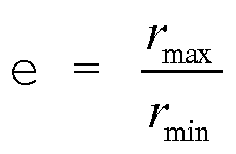
- The natural bending and twist parameters of the Super-Helix model may be set by :

- The actual bends and twist may be equal to their natural values at the free end of the rod, where the role of gravity becomes negligible.
- This parameter measures the amount of internal dissipation within a Super-Helix during motion. It especially accounts for the hair-hair dissipative interactions occurring inside the hair clump whose motion is guided by the Super-Helix. The internal friction may be easily adjusted by comparing the amplitude of deformation between the real and the simulated hair clump when vertical oscillatory motion is imposed. Good results may be obtained with γ ∈ [5×10⁻¹⁰, 5×10-11] kilogram cubic meters per second (kg·m3·s-1).
- Once parameter γ is chosen, the air-hair friction parameter may be matched by comparing the duration of damping between the real and the simulated hair clump, for example when imposing a pendulum motion. The air-hair friction coefficient v may be chosen in the
range 5×10⁻⁶ kilograms per meter second (kg(ms)-1) (disciplined hair) to 5×10⁵ kg(ms)-1 (fuzzy hair), for example. - Contacts between hairs, and between hair obtained by the model of the invention and external objects (such as the body) may be performed through penalty forces which may include a normal elastic response together with a tangential viscous friction force. For simulating realistic contacts between hair and external objects, an anisotropic friction force is used, to take account of the oriented scales covering individual hairs.
- The friction parameter may be directly adjusted from real observations of sliding contacts between the hair clump and a given material, and then multiplied by a cosine function to take account of the orientation of hair fibers with respect to their sliding motion over the external object.
- Independently of or in combination with the above, the invention provides an interactive system for dynamically simulating at least a portion of a head of hair in movement, the system comprising:
- a computer for calculating the shape of at least one director hair by applying to said hair at least one mechanical model of an inextensible rod having inertia, and twisting and bending stiffnesses; and
- a device for generating at least one synthesized image of the portion of a head of hair from the shape of the director hair as calculated in this way.
- The computer may be located at a point of sale, for example, or in a hairdressing salon, or remotely located and consulted by means of a terminal and a computer and/or telephone network. The computer may comprise a personal microcomputer or a server, for example.
- The system may further include a database including information linked to changes in at least one physical parameter of a hair of a portion of a head of hair as a function of a treatment applied to the hair.
- The treatment may be selected from the following list: permanent waving, crimping, decrimping, dyeing, drying of a wet hair, application of a composition to the hair, in particular a coating composition, application of a gel, setting, cutting, conditioning, thickening, lengthening, external climatic events, in particular rain, wind, sun.
- Two treatments may differ from each other at least in the quantity of composition applied, the thickness of the layer of composition applied, the duration of the treatment, the diameter of the crimping iron, the temperature of the crimping iron.
- A treatment may vary as a function of the arc length measured along the hair.
- The device for generating images may be configured to generate a virtual image or sequence of images of the hair after the application of a treatment.
- The device for generating images may be configured to display simultaneously an image or a sequence of images of the hair before treatment and an image or a sequence of images of the hair after application of the treatment.
- Independently of or in combination with the above, the invention provides an atlas comprising:
- at least two images, for example a sequence of images, generated by the above method; and
- information associated with each image or sequence of images linked to at least physical parameter of the director hair.
- For example, such an atlas may comprise a plurality of sequences of images corresponding to different degrees of one or more physical parameters of the hair. The images may be printed out or displayed on a screen or contained in an electronic form in a file.
- The information may comprise one or more of the following: an alphanumeric character, a symbol, a drawing, a color, or a bar code.
- Independently of or in combination with the above, the invention provides a product comprising:
- a hair-care composition;
- an image or a sequence of images generated by the above method; and
- information associated with the image or sequence of images associated with a physical parameter of the director hair.
- The image and the associated information may for example be useful for informing the customer or the hairdresser as to the type of hair for which the composition is suitable or the type of result that can be obtained.
- Independently of or in combination with the above, the invention provides a method of characterizing a hair, including the step of enabling a comparison between an image or sequence of images of the hair to be characterized and an image or sequence of images of a virtual hair obtained by the above method.
- For example, the characterization may aim to quantify a physical parameter of the real hair that is the subject of the comparison.
- Where appropriate, the characterization method may be implemented at different times, for example to highlight the effects of a treatment or an external event.
- Where applicable, a physical parameter of the hair may be modified as a function of the comparison, in order to enhance the resemblance between at least one image or sequence of images of the hair to be characterized and at least one image or sequence of images of the virtual hair. For example, from one to four or even only one or two physical parameters may be modified.
- A measurement of a physical parameter of the hair and a simulation parameter may be adjusted to achieve the required degree of matching between the images of the hair to be characterized and the virtual hair.
- A simulation parameter may be modified until a predefined degree of matching of the shapes of the hair to be characterized and the virtual hair has been achieved.
- The physical parameter measured may be selected from the following list: the length of the hair, the mean radius of the hair, the ellipticity of the hair, the linear density of the hair, the modulus of elasticity of the hair, its bending moment or moments, its twisting moment, its spontaneous bending, its spontaneous twisting.
- The characterization method may be implemented after receiving an electronic image of the hair to be characterized, in particular a computer image. The hair to be characterized may be used itself instead of the image of the hair to be characterized.
- Independently of or in combination with the above, the invention further provides a method of generating digital data defining the shape of a hair, comprising:
- receiving an image of a hair;
- from the shape of the hair in the received image and from a behavioral relationship, generating digital data comprising one or more values of one or more physical parameters linked to a mechanical property of the hair.
- Independently of or in combination with the above, the invention provides a method of prescribing a hair-care composition, comprising:
- determining a characteristic of a hair from a head of hair to be treated by comparing the real hair with at least one images or sequence of images of virtual hair obtained by the above method;
- prescribing a hair-care composition as a function of the characteristic that has been determined.
- The selected hair-care composition may be sent to the subject via a distribution center, for example.
- Independently of or in combination with the above, the invention provides a hair-treatment method, comprising:
- associating with a customer, information linked to the shape of a hair of the customer by comparing the real hair to at least one image or sequence o images of virtual hair obtained by the above method;
- as a function of that information, selecting a hair-care composition from a set of compositions, for example products identified by corresponding identifiers;
- treating the customer using the selected product.
- Independently of or in combination with the above, the invention provides a method of modeling the impact of a treatment or an external event applied to a hair, comprising:
- displaying a synthesized image or sequence of images of a hair;
- displaying a synthesized image or sequence of images of said hair, preferably obtained by the above method, after it has undergone the treatment or the selected external event.
- Where appropriate the treatment or the external event may have been selected from a plurality of treatments or external events.
- Such a method shows the appearance of the hair after the treatment has been effected, compares the appearance of the hair before and after the treatment, and shows the result of the treatment in advance, for example to enable the user to make an informed decision as to the treatment to be applied. This enables a specific treatment solution to be proposed to a user, for example, including showing them the result that will be obtained with such a treatment.
- For example, the method may show the effect on the appearance of the hair of a treatment for coating it.
- The synthesized image of the treated hair may be calculated by modifying a physical simulation parameter, the modification depending in particular on the selected treatment.
- A sequence of images of the hair after treatment in motion; and a sequence of images of the hair in motion before treatment may be displayed simultaneously on the same screen.
- The treatment to be applied may be one or more from the following list: permanent waving, crimping, combing, decrimping, dyeing, wetting, drying of a wet hair, application of a coating composition to the hair, application of a gel, setting, cutting, conditioning, thickening, lengthening, external climatic events, in particular rain, wind, sun, hair dressing, geometrical constraints due for example to clamping of hair with ties.
- The treatment may vary as a function of the arc length measured along the hair.
- The mechanical effects of coating the hair or of a loss or uptake of moisture by a hair may be simulated, for example.
- Independently of or in combination with the above, the invention provides a hairdresser training method, comprising:
- selecting a treatment to be applied to a hair;
- displaying a virtual image or sequence of images generated by the above method of a hair that has undergone the selected treatment.
- The invention further provides a method of promoting the sale of a hair-care composition, for example a permanent waving, straightening, and/or smoothing composition for the hair, taking into account information representing one or more physical parameters linked to the shape of the hair, for example two or more physical parameters linked to the shape of the hair.
- That promotion may be effected via any communications channel. For example it may be effected by a retailer, directly at a point of sale, by radio, by television, or by telephone, for example in the context of commercials or short messages. It could equally be effected via the print press or any other form of document, for example for advertising purposes. It could be effected via any other appropriate data processing network, for example via the Internet or via a mobile telephone network. It could equally be effected directly on the product itself, in particular on its packaging or on any explanatory material associated with it.
- Independently or in combination with the above, the invention also provides a method of generating a sequence of synthesized images of a hair in movement, the method comprising the following steps:
- representing at least one hair or group of hairs by at least one helical rod comprising one or more helical portions; and
- animating said at least one helical rod by using the principles of Lagrangian mechanics.
- The method may also include the steps consisting in generating at least one sequence of images of said at least one hair or group of hairs as represented and animated in this way.
- Independently or in combination with the above, the invention also provides a system comprising:
- computer means enabling at least one hair or group of hairs to be represented by at least one helical rod having one or more helical portions, and enabling said at least one helical rod to be animated using the principles of Lagrangian mechanics; and
- means for generating at least one sequence of images of said at least one hair or group of hairs as represented and animated in this way.
- The system may also include means for displaying said at least one sequence of images, in particular by means of a screen.
- The system may also be configured to generate at least a first sequence of images of hair prior to treatment and a second sequence of images of said hair after said treatment.
- The display means are arranged in such a manner as to display said at least one first sequence and said at least second sequence simultaneously or successively.
- Independently or in combination with the above, the invention also provides the use of images obtained by the method described above to provide a head of hair for an avatar or to promote the sale of cosmetics, or in a film, or in a video game.
- Independently or in combination with the above, the invention also provides a computer program product including instructions readable by a computer system including at least a microprocessor, said instructions controlling the operation of the computer system so as to implement the above-described method.
- The invention can be better understood on reading the following detailed description of non-limiting embodiments thereof and examining the appended drawings, in which:
-
Figure 1 is a block diagram corresponding to an example of a method of generating a synthesized image; -
Figure 2 represents diagrammatically an example of a system for generating a synthesized image of the hair; -
Figure 3 is a block diagram corresponding to an example of a method of characterizing the hair; -
Figures 4 to 7 are block diagrams corresponding to other examples of methods according to the invention; -
Figure 8 represents diagrammatically an example of a product according to the invention; -
Figure 9 is a diagram showing an example of the rod mechanical model applied to a rod made up of ten rod elements; -
Figure 10 shows a comparison between an animated sequence showing the movement of a real head of hair and of a virtual head of hair obtained by the method of the invention; -
Figure 11 shows a frame associated with a director hair; -
Figure 12 shows examples of surface envelopes for collision detection purposes; and -
Figure 13A to 13C are examples of hair simulation. - Each form of modeling just described may be used to generate a synthesized image of hair. The following steps may be executed for this purpose, as illustrated in
Figure 1 : - in a
first step 5, calculating the shape of the hair by applying the above-mentioned model, thereby determining the shape of the hair as a function of one or more physical parameters linked to a mechanical property of the hair; and - in a
second step 6, producing an image or a sequence of images of the hair with shapes calculated in this way. - This method may be implemented by means of an interactive system for representing a hair, including, as shown in
Figure 2 : - a
computer 7, for example a personal computer, where appropriate connected by acomputer network 27 to aremote server 30, for example an Internet site server, thecomputer 7 calculating the shape of a hair by applying one of the modeling methods described above; - a
screen 10 for displaying an image of a hair of shape that has been calculated in this way, for example a liquid crystal screen, a cathode ray tube screen, or plasma screen; and - where appropriate a
printer 9, which may replace thescreen 10. - Results of the simulation may be displayed with the synthesized image or sequence of images of the hair in a first area of the screen and in a second area of the screen, elements for adjusting physical parameters that influence the mechanical behavior of the hair.
- The system may further include means (not shown) providing a stereoscopic view of the virtual hair.
- The adjustment elements may include a cursor movable between two or more positions corresponding to different values of the physical parameter concerned, for example.
- Of course, using a different number of physical parameters does not depart from the scope of the present invention. For example, the physical parameters displayed and that where applicable may be modified may relate directly to the appearance of the hair, for example the length of the hair, or may be linked to mechanical characteristics of the hair, for example the radius or radii of the hair strand, the ellipticity of the hair strand, the spontaneous bend of the hair strand relative to one or more axes, the angle or angles of embedment of the hair strand in the scalp, the spontaneous twist of the hair strand, and/or to characteristics linked to one or more materials constituting the hair, for example its Young's modulus, its Poisson's ratio, its bending moments, its twist moment, the coefficient of elasticity of the hair, the porosity of the hair, the density or the linear density of the hair.
- Where appropriate, a physical parameter may vary as a function of the arc length of the hair. For example, the twist may be greater at certain points along the hair. The variation of certain physical parameters as a function of the arc length may be linked to past treatments effected on the hair and to how it grows, which may vary in time, or how it ages, the hair becoming increasingly older in the direction away from its root. For example, the hair may have a distal portion that has been subjected to a bleaching treatment and a proximal portion that has grown since that treatment and has different mechanical characteristics. Where appropriate, the system may be configured to enable the user to define the manner in which a parameter varies along the hair as a function of the arc length. For example, one or more parameters may have a first value over a first portion of the length of the hair and a second value, which may be different from the first, over a second portion of its length.
- Where appropriate, the system may include or access a database containing typical values of certain parameters, for example as a function of the ethnic hair type, its color and/or certain treatments effected.
- The system and method described above may be used to characterize a hair, for example by implementing the steps of the method shown in
Figure 3 . - In a
first step 18, an image or sequence of the hair to be characterized is compared to an image or sequence of a virtual hair obtained by the simulation method described above. - Then, in the
step 19, a physical parameter of the hair may be modified as a function of the result of the comparison, with a view to enhancing the resemblance between the image of the hair to be characterized and the image of the virtual hair. - The head of hair of a person may be characterized on the basis of the same hair or different hairs, for example three hairs, taken from the same head of hair. For example, one hair may be taken from the crown and one other hair from each side of the head. Where appropriate, the results of measurements effected on a greater number of hairs may be processed statistically, in order to average values measured or determined by simulation, for example. Alternatively, the variations of the parameters characterizing a hair may be measured for hairs situated at different places in the head of hair.
- These characterization results may be listed in a database with information concerning the persons from whom the hairs were taken.
- In this way characteristics of a hair may be recorded and thus known at different times in its life cycle, in particular one or more of the physical parameters used to simulate the appearance of the hair. Such information may be useful for prescribing a treatment or choosing a hair-care composition, for example.
- The result of the characterization may be received in electronic form, for example via the
computer network 27, and may delivered, in written or oral form, at a point of sale of products, in a beauty or hair salon, at the surgery of a dermatologist, or remotely, for example by connecting to an Internet site server. - The hair may be characterized manually, semi-automatically or automatically.
- The image or real hair may be acquired by means of a two-dimensional acquisition system such as a
scanner 24 or avideo camera 25, for example, as shown inFigure 2 , or by means of a three-dimensional acquisition system, such as a stereovision system, for example. - The hair to be characterized may be used itself instead of the image of the hair to be characterized, for example by applying it to the screen using adhesive tape or any other appropriate fixing means.
- Characterization may where appropriate be followed by giving advice. The advice may include the prescription of at least one hair-care composition having an action on a physical parameter of the hair, for example. This may be a composition for a form of hair treatment other than a dyeing treatment, for example permanent waving, crimping, straightening, and/or decrimping, or coating of the hair, for example.
-
Figure 4 shows a method of prescribing a hair-care composition, in which: - in the step 31 a characteristic of a hair of a head of hair to be treated is determined by comparing, for example using the method shown in
Figure 3 , the real hair with a virtual hair obtained by the method shown inFigure 1 , for example; - in the step 32 a recommendation is made that is linked to the prescription of a hair-care composition as a function of the characteristic determined in this way.
- For example, this prescription method may be used at a point of sale, in a hairdressing or beauty salon, in a perfume outlet, in a department store, or remotely by means of the
computer network 27. - Where appropriate, after the
step 32, a product adapted to obtain a required result is handed or sent to the user or used in situ. - The product may be supplied through any sales channel, in particular through a shop or by mail order, or through a beauty parlor or a hairdressing salon, for example.
- The method and the system described above may be used to apply a hair-treatment process, as shown in
Figure 5 , which process includes the following steps: - in the
step 35, associating with a customer a characteristic representing a physical parameter linked to the shape of a hair by comparing, a real hair of the customer to a virtual hair obtained by the method of the invention, for example; - in the
step 36, as a function of that characteristic, selecting a hair-care composition from a set of compositions identified by corresponding characteristics; - in the
step 37, treating the customer with the selected composition. - The treatment may be selected from the following list: permanent waving, crimping, decrimping, dyeing, drying of a wet hair, application of a composition to the hair, in particular a coating composition, application of a gel, for example a polymer coating, setting, cutting, conditioning, thickening, lengthening.
- The method and system described above further enable the implementation of a method, shown in
Figure 7 , of modeling the impact of a treatment applied to a hair or of exposure to a predetermined event, for example a climatic event, aging or photo aging, the method including: - in the
step 38, displaying a synthesized image of a hair; - in the
step 39, selecting a treatment to be applied or a predetermined event; - in the
step 40, displaying a synthesized image or sequence of images of said hair after undergoing the selective treatment or being exposed to said event. - The synthesized image of the hair to be treated may be obtained by the method described above.
- The synthesized image of the treated hair may be calculated by modifying a physical parameter of the untreated hair. The modification may depend on the treatment selected. To this end, the system may for example include a database including information reflecting the evolution of physical parameters of a hair as a function of treatments applied to the hair. The same applies to a hair exposed to a predetermined event.
- Two treatments that may be selected for purposes of simulation may differ from each other at least in terms of the quantity of composition applied, the thickness of the layer of composition applied, the distribution of the composition on the hair, the duration of the treatment, the diameter of the crimping iron or the temperature of the crimping iron, for example 180°C or 200°C.
- A treatment whose impact is to be modeled may vary as a function of the arc length measured along the hair.
- An image of sequence of images of the hair after treatment and an image or sequence of images of the hair before treatment may be displayed simultaneously on the same screen.
- This method may further be used for example to simulate the mechanical effects of coating the hair or of a loss or uptake of moisture, linked for example to exposure of the hair to rain or sun. The effect of water may be to increase the bend and/or the density of the hair, for example.
- By modeling the impact of such events on a treated hair, such a method may further be used to demonstrate the resistance of a hair conditioning composition or treatment to external climatic events, for example rain, wind or the action of the sun.
- The methods described above may further be used to evaluate the effect of a composition as a function of the quantity thereof that was applied to the hair or remains on the hair after rinsing.
- The increase in the weight of the hair after the application of a coating composition may be evaluated, for example.
- The different behavior of a hair when dry or wet may also be evaluated.
- For example, these evaluations may seek to determine a reduction or an increase in the volume of the head of hair.
- Modeling the impact of a treatment may be used to develop new hair-care treatments or compositions, for example. Such modeling may further be used for promotional or educational purposes, for example to explain to a customer or a hairdresser the impact of a treatment on the appearance and/or the behavior of the hair.
- Exemplary embodiments of the invention consist in a hairdresser training method, as shown in
Figure 6 , including the following steps: - in the
step 42, selecting a treatment to be applied to the hair; - in the
step 43, displaying a virtual image or sequence of images of a hair that has undergone the selected treatment, the image(s) being generated by the method defined above. - Thus the effects of a treatment on the hair may be assessed more easily.
- The invention may be used to associate with hair-care compositions, information representing physical parameters characteristic of the hair.
- For example,
Figure 8 shows a product including: - a hair-
care composition 50 in a container; - an
image 51 generated by the method of the invention; and -
information 52 associated with the image, that may represent physical parameters of the hair. - The hair-
care composition 50 may be a permanent waving, crimping, straightening, and/or decrimping composition for the hair, for example, or a composition for shaping the hair, for example a hair gel. The composition may further be a shampoo. The hair-care composition may act on the shape of the hair but also, where applicable, on its color and/or its brilliance. This action may be more or less durable and/or more or less reversible. - The
information 52 may indicate the effectiveness of the composition, for example in terms of variation of physical parameters linked to the shape of the hair or to characteristics of a head of hair for which it is suitable and/or a result that can be achieved. - The product may further include information associated with the composition and representing parameters not linked to the shape of the hair, for example. A parameter that is not linked to the shape of the hair may represent the color and/or the brilliance of the hair, for example, before or after treatment.
- This further information may for example indicate the coordinates in a colorimetric space such as the CIE lab or Munsell space, for example, of the color of the head of hair to be treated or looked up or a shade on a scale of shades.
- The information may be expressed in various forms, directly apparent to a person or otherwise.
- The information may include an alphanumeric character, a symbol, a drawing, a color, or a bar code.
- The images may be images of hairs lying in a plane or alternatively perspective images of hairs not entirely contained within one plane.
-
Figure 10 shows a comparison between asequence 100 of images of a real head of hair in movement and asequence 200 of images of a virtual head of hair obtained by the method of the invention. -
Figures 13A to 13B show various examples or images of real hair versus simulated hair. - The invention is not limited to the examples that have just been given.
- Although the present invention herein has been described with reference to particular embodiments, it is to be understood that these embodiments are merely illustrative of the principles and applications of the present invention. It is therefore to be understood that numerous modifications may be made to the illustrative embodiments and that other arrangements may be devised without departing from the scope of the present invention as defined by the appended claims.


Claims (13)
- A method of generating at least one synthesized image of at least a portion of a head of hair in movement, comprising director hairs and target hairs, the method carried out by a data processing means and comprising the steps of:calculating a shape of a plurality of director hairs by applying to each director hair at least one mechanical model of an inextensible rod having inertia and stiffnesses in twisting and in bending; andassociating, among the target hairs, sets of target hairs with a corresponding plurality of director hairs,giving weights to the plurality of director hairs which are associated with a common set of target hairs, wherein the weights given to each of said director hairs vary over the individual hairs in the set of target hairs,said weights of the director hairs that are associated with said set of target hairs are determined as a function of the distance between the free end of a given individual target hair and the free end of said associated director hair, and as a function of the distance between the root of a given individual target hair and the root of the associated given director hair,wherein a zero weight is given to a director hair when at least one of the two distances exceeds a predefined value,generating at least one virtual image of the at least one portion of the head of hair from the shapes of the director hairs and the target hairs, wherein the shape of a given individual target hair is determined based on a weighted interpolation of the shapes of the associated director hairs.
- A method according to claim 1, in which the rod mechanical model comprises a succession of rod elements, in which each rod element has uniform material twist and curvatures.
- A method according to any preceding claim, in which at least one envelope surface is calculated for each director hair.
- A method according to claim 3, in which collisions are detected between the envelope surfaces.
- A method according to any preceding claim, in which the rod mechanical model incorporates at least one mechanical dissipation parameter modeling the damping of the movement of the director hair.
- A method according to any preceding claim, in which the rod mechanical model incorporates at least one physical parameter associated with a mechanical property of at least one hair of said at least one portion of a head of hair, selected from the following list: hair length (L); hair radius(ii); main radii (rx, ry) of the hair, in particular the ellipticity of the hair; spontaneous twisting and bending (τ n,


- A method according to any preceding claim, in which at least one synthesized image is generated by a computer of at least a portion of a head of hair in movement from at least two source images of at least a portion of a real head of hair.
- A method according to any preceding claim, characterized by the fact that said at least one synthesized image is displayed on the same screen as at least one element for adjusting a simulation parameter of said rod mechanical model.
- A method according to the preceding claim, characterized by the fact that a user is enabled to select with a computer at least one simulation parameter of said red mechanical model as a function of at least one physical characteristic of a portion of a real head of hair, in particular as a function of the smooth or curly appearance of the portion of a real head of hair.
- A computer-implemented method of characterizing a hair, the method comprising:• allowing a comparison to be made between an image of a head of hair to be characterized and an image of a virtual head of hair obtained with a computer by the method according to any one of claims 1 to 9; and• modifying at least one physical parameter of the head of hair as a function of the comparison in order to increase the resemblance between the head of hair to be characterized and the image of the virtual head of hair.
- A computer-implemented method of prescribing a hair care composition, comprising:• determining at least one characteristic of a head of hair for treatment by comparing the real head of hair with a virtual head of hair obtained with a computer by the method according to any one of claims 1 to 9; and• prescribing a hair care composition as a function of the determined characteristic.
- A hair care treatment method, comprising:• associating with a customer information associated with the dynamic behavior of that customer's hair by comparing it with a virtual head of hair obtained with a computer by the method according to any one of claims 1 to 9;• as a function of that information, selecting at least one hair care composition from a set of compositions, and• treating the customer using the selected composition(s).
- A computer-implemented method of modeling the impact of a treatment or an external event applied to a head of hair, comprising: by a computer,• displaying a synthesized image of at least a portion of the head of hair obtained by the method according to any one of claims 1 to 9; and• displaying a synthesized image of said at least one portion of the head of hair after being subjected to the treatment or the selected external event, as obtained by the method according to any one of claims 1 to 9.
Applications Claiming Priority (2)
| Application Number | Priority Date | Filing Date | Title |
|---|---|---|---|
| US81557206P | 2006-06-22 | 2006-06-22 | |
| PCT/IB2007/052432 WO2007148306A2 (en) | 2006-06-22 | 2007-06-22 | A method and a system for generating a synthesized image of at least a portion of a head of hair |
Publications (2)
| Publication Number | Publication Date |
|---|---|
| EP2041725A2 EP2041725A2 (en) | 2009-04-01 |
| EP2041725B1 true EP2041725B1 (en) | 2018-08-01 |
Family
ID=38635367
Family Applications (1)
| Application Number | Title | Priority Date | Filing Date |
|---|---|---|---|
| EP07789784.1A Not-in-force EP2041725B1 (en) | 2006-06-22 | 2007-06-22 | A method and a system for generating a synthesized image of at least a portion of a head of hair |
Country Status (5)
| Country | Link |
|---|---|
| US (1) | US8743124B2 (en) |
| EP (1) | EP2041725B1 (en) |
| JP (1) | JP5060551B2 (en) |
| CA (1) | CA2655798C (en) |
| WO (1) | WO2007148306A2 (en) |
Families Citing this family (19)
| Publication number | Priority date | Publication date | Assignee | Title |
|---|---|---|---|---|
| KR101199481B1 (en) * | 2008-12-22 | 2012-11-09 | 한국전자통신연구원 | Method for generating graphic hair motion and its apparatus |
| US9025030B2 (en) * | 2010-06-08 | 2015-05-05 | Cheryl Garcia | Video system |
| US9070221B1 (en) * | 2012-06-26 | 2015-06-30 | Pixar | Animation engine with hair animation using attenuation fields |
| US20140028822A1 (en) * | 2012-07-30 | 2014-01-30 | Alex A. Khadavi | Hair loss monitor |
| US9222836B2 (en) | 2012-11-01 | 2015-12-29 | Aaron James Conti | Hair colorant system and method |
| US10185789B2 (en) * | 2013-12-03 | 2019-01-22 | Autodesk, Inc. | Techniques for modeling elastic rods in position-based dynamics frameworks |
| US9202312B1 (en) * | 2014-07-18 | 2015-12-01 | Restoration Robotics, Inc. | Hair simulation method |
| US10512321B2 (en) * | 2015-09-04 | 2019-12-24 | Restoration Robotics, Inc. | Methods, systems and instruments for creating partial model of a head for use in hair transplantation |
| EP3296898A1 (en) * | 2016-09-15 | 2018-03-21 | The Procter and Gamble Company | Method and computer-readable medium for simulating a plurality of fibers |
| WO2019226494A1 (en) | 2018-05-21 | 2019-11-28 | Magic Leap, Inc. | Generating textured polygon strip hair from strand-based hair for a virtual character |
| WO2019226549A1 (en) | 2018-05-22 | 2019-11-28 | Magic Leap, Inc. | Computer generated hair groom transfer tool |
| US11308538B1 (en) * | 2018-10-23 | 2022-04-19 | Frédérique Pineau | Computer-readable medium and computer system for extracting cosmetic service information and for locating and interacting with cosmetic service providers |
| US10776981B1 (en) * | 2019-06-07 | 2020-09-15 | Snap Inc. | Entertaining mobile application for animating a single image of a human body and applying effects |
| US11461965B2 (en) * | 2020-05-29 | 2022-10-04 | Unity Technologies Sf | Method for generating splines based on surface intersection constraints in a computer image generation system |
| US11593584B2 (en) | 2020-07-02 | 2023-02-28 | Unity Technologies Sf | Method for computation relating to clumps of virtual fibers |
| CN117396922A (en) * | 2021-03-18 | 2024-01-12 | 数字王国虚拟人(美国)股份有限公司 | Methods and systems for manipulating and transferring computer simulated hair |
| CN115131537B (en) * | 2022-07-22 | 2025-03-14 | 北京字跳网络技术有限公司 | Image processing method, device, equipment and storage medium |
| CN116894916B (en) * | 2023-06-19 | 2024-07-19 | 北京百度网讯科技有限公司 | Method, device, equipment and storage medium for generating hair model of virtual image |
| CN119048625B (en) * | 2024-08-20 | 2025-10-17 | 浙江大学 | Hair piece tangential mapping generation and optimization method based on diffusion model |
Family Cites Families (11)
| Publication number | Priority date | Publication date | Assignee | Title |
|---|---|---|---|---|
| JPH04190294A (en) | 1990-11-26 | 1992-07-08 | Hitachi Ltd | How to display filamentous objects |
| JP3084098B2 (en) | 1991-08-30 | 2000-09-04 | 株式会社日立製作所 | Computer animation interactive processing system and device |
| US5404426A (en) | 1991-05-21 | 1995-04-04 | Hitachi, Ltd. | Method of displaying hair style and apparatus for the same |
| JPH04344575A (en) * | 1991-05-21 | 1992-12-01 | Hitachi Ltd | Hair modeling method and device |
| JPH08153185A (en) | 1994-11-25 | 1996-06-11 | Sony Corp | Head image information complementing apparatus and complementing method |
| US6952218B1 (en) * | 1999-08-06 | 2005-10-04 | Sony Corporation | Method and apparatus for the digital creation of fur effects |
| JP2001357415A (en) * | 2000-04-13 | 2001-12-26 | Sony Corp | Image processing apparatus and method, recording medium, and program |
| US20030184544A1 (en) * | 2000-07-24 | 2003-10-02 | Prudent Jean Nicholson | Modeling human beings by symbol manipulation |
| JP2004206329A (en) | 2002-12-25 | 2004-07-22 | Toshiba Corp | Simulation apparatus, method, and program |
| JP2005321986A (en) * | 2004-05-07 | 2005-11-17 | Pioneer Electronic Corp | Hairstyle proposal system, hairstyle proposal method and computer program |
| FR2875044B1 (en) | 2004-09-07 | 2007-09-14 | Oreal | METHOD AND APPARATUS FOR GENERATING A SYNTHESIS IMAGE OF AT LEAST ONE CILN FRA |
-
2007
- 2007-06-22 CA CA2655798A patent/CA2655798C/en not_active Expired - Fee Related
- 2007-06-22 JP JP2009516053A patent/JP5060551B2/en not_active Expired - Fee Related
- 2007-06-22 EP EP07789784.1A patent/EP2041725B1/en not_active Not-in-force
- 2007-06-22 US US12/305,734 patent/US8743124B2/en not_active Expired - Fee Related
- 2007-06-22 WO PCT/IB2007/052432 patent/WO2007148306A2/en not_active Ceased
Also Published As
| Publication number | Publication date |
|---|---|
| WO2007148306A2 (en) | 2007-12-27 |
| CA2655798A1 (en) | 2007-12-27 |
| WO2007148306A3 (en) | 2008-08-14 |
| EP2041725A2 (en) | 2009-04-01 |
| US20100299106A1 (en) | 2010-11-25 |
| JP2009541840A (en) | 2009-11-26 |
| CA2655798C (en) | 2017-03-07 |
| US8743124B2 (en) | 2014-06-03 |
| JP5060551B2 (en) | 2012-10-31 |
Similar Documents
| Publication | Publication Date | Title |
|---|---|---|
| US8743124B2 (en) | Method and a system for generating a synthesized image of at least a portion of a head of hair | |
| Bertails et al. | Super-helices for predicting the dynamics of natural hair | |
| Bergou et al. | Discrete elastic rods | |
| Iben et al. | Artistic simulation of curly hair | |
| JP7235800B2 (en) | Method and computer readable medium for simulating multiple fibers | |
| Choe et al. | A statistical wisp model and pseudophysical approaches for interactive hairstyle generation | |
| US8379015B2 (en) | Method and a system for generating a synthesized image of a hair | |
| US20190108300A1 (en) | Methods for realistic and efficient simulation of moving objects | |
| Baxter III et al. | A Versatile Interactive 3D Brush Model. | |
| US7418371B2 (en) | Method and system for graphical hairstyle generation using statistical wisp model and pseudophysical approaches | |
| Stuyck et al. | Quaffure: Real-time quasi-static neural hair simulation | |
| JP2006079619A (en) | Method and apparatus for generating a composite image of at least one outer edge of an eyelash | |
| Hadap et al. | Strands and hair: modeling, animation, and rendering | |
| Bertails et al. | Realistic hair simulation: animation and rendering | |
| Kmoch et al. | Hair simulation model for real-time environments | |
| CN110832522A (en) | Method for measuring hair movement characteristics | |
| Bonanni et al. | Multilayered visuo-haptic hair simulation | |
| Kmoch | Natural GPU-friendly dynamic animation of human hair | |
| Somasundaram et al. | WIZ: DreamWorks GPU-Accelerated Interactive Hair/Fur Deformation and Visualization Toolset | |
| Kmoch | Natural GPU-friendly dynamic hair animation | |
| Bonanni et al. | Virtual Hair Handle: A Model for Haptic Hairstyling. | |
| Kim et al. | Porous Models for Enhanced Representation of Saturated Curly Hairs: Simulation and Learning | |
| CN121236294A (en) | Real-time hair simulation method and device based on Cosserat elastic rod model | |
| Battelle | Multilayered Visuo-Haptic Hair Simulation | |
| Hadap | STRANDS AND HAIR |
Legal Events
| Date | Code | Title | Description |
|---|---|---|---|
| PUAI | Public reference made under article 153(3) epc to a published international application that has entered the european phase |
Free format text: ORIGINAL CODE: 0009012 |
|
| 17P | Request for examination filed |
Effective date: 20081223 |
|
| AK | Designated contracting states |
Kind code of ref document: A2 Designated state(s): AT BE BG CH CY CZ DE DK EE ES FI FR GB GR HU IE IS IT LI LT LU LV MC MT NL PL PT RO SE SI SK TR |
|
| AX | Request for extension of the european patent |
Extension state: AL BA HR MK RS |
|
| RIN1 | Information on inventor provided before grant (corrected) |
Inventor name: AUDOLY, BASILE Inventor name: CANI, MARIE-PAULE Inventor name: LEVEQUE, JEAN-LUC Inventor name: BERTAILS, FLORENCE Inventor name: QUERLEUX, BERNARD |
|
| DAX | Request for extension of the european patent (deleted) | ||
| 17Q | First examination report despatched |
Effective date: 20131122 |
|
| STAA | Information on the status of an ep patent application or granted ep patent |
Free format text: STATUS: EXAMINATION IS IN PROGRESS |
|
| REG | Reference to a national code |
Ref country code: DE Ref legal event code: R079 Ref document number: 602007055580 Country of ref document: DE Free format text: PREVIOUS MAIN CLASS: G06T0015700000 Ipc: G06T0013400000 |
|
| GRAP | Despatch of communication of intention to grant a patent |
Free format text: ORIGINAL CODE: EPIDOSNIGR1 |
|
| STAA | Information on the status of an ep patent application or granted ep patent |
Free format text: STATUS: GRANT OF PATENT IS INTENDED |
|
| RIC1 | Information provided on ipc code assigned before grant |
Ipc: G06T 13/40 20110101AFI20171215BHEP |
|
| INTG | Intention to grant announced |
Effective date: 20180123 |
|
| GRAS | Grant fee paid |
Free format text: ORIGINAL CODE: EPIDOSNIGR3 |
|
| GRAJ | Information related to disapproval of communication of intention to grant by the applicant or resumption of examination proceedings by the epo deleted |
Free format text: ORIGINAL CODE: EPIDOSDIGR1 |
|
| GRAL | Information related to payment of fee for publishing/printing deleted |
Free format text: ORIGINAL CODE: EPIDOSDIGR3 |
|
| STAA | Information on the status of an ep patent application or granted ep patent |
Free format text: STATUS: EXAMINATION IS IN PROGRESS |
|
| GRAR | Information related to intention to grant a patent recorded |
Free format text: ORIGINAL CODE: EPIDOSNIGR71 |
|
| STAA | Information on the status of an ep patent application or granted ep patent |
Free format text: STATUS: GRANT OF PATENT IS INTENDED |
|
| GRAA | (expected) grant |
Free format text: ORIGINAL CODE: 0009210 |
|
| STAA | Information on the status of an ep patent application or granted ep patent |
Free format text: STATUS: THE PATENT HAS BEEN GRANTED |
|
| INTC | Intention to grant announced (deleted) | ||
| AK | Designated contracting states |
Kind code of ref document: B1 Designated state(s): AT BE BG CH CY CZ DE DK EE ES FI FR GB GR HU IE IS IT LI LT LU LV MC MT NL PL PT RO SE SI SK TR |
|
| INTG | Intention to grant announced |
Effective date: 20180625 |
|
| REG | Reference to a national code |
Ref country code: GB Ref legal event code: FG4D |
|
| REG | Reference to a national code |
Ref country code: CH Ref legal event code: EP Ref country code: AT Ref legal event code: REF Ref document number: 1025195 Country of ref document: AT Kind code of ref document: T Effective date: 20180815 |
|
| REG | Reference to a national code |
Ref country code: IE Ref legal event code: FG4D |
|
| REG | Reference to a national code |
Ref country code: DE Ref legal event code: R096 Ref document number: 602007055580 Country of ref document: DE |
|
| REG | Reference to a national code |
Ref country code: NL Ref legal event code: MP Effective date: 20180801 |
|
| REG | Reference to a national code |
Ref country code: LT Ref legal event code: MG4D |
|
| REG | Reference to a national code |
Ref country code: AT Ref legal event code: MK05 Ref document number: 1025195 Country of ref document: AT Kind code of ref document: T Effective date: 20180801 |
|
| PG25 | Lapsed in a contracting state [announced via postgrant information from national office to epo] |
Ref country code: BG Free format text: LAPSE BECAUSE OF FAILURE TO SUBMIT A TRANSLATION OF THE DESCRIPTION OR TO PAY THE FEE WITHIN THE PRESCRIBED TIME-LIMIT Effective date: 20181101 Ref country code: LT Free format text: LAPSE BECAUSE OF FAILURE TO SUBMIT A TRANSLATION OF THE DESCRIPTION OR TO PAY THE FEE WITHIN THE PRESCRIBED TIME-LIMIT Effective date: 20180801 Ref country code: NL Free format text: LAPSE BECAUSE OF FAILURE TO SUBMIT A TRANSLATION OF THE DESCRIPTION OR TO PAY THE FEE WITHIN THE PRESCRIBED TIME-LIMIT Effective date: 20180801 Ref country code: IS Free format text: LAPSE BECAUSE OF FAILURE TO SUBMIT A TRANSLATION OF THE DESCRIPTION OR TO PAY THE FEE WITHIN THE PRESCRIBED TIME-LIMIT Effective date: 20181201 Ref country code: PL Free format text: LAPSE BECAUSE OF FAILURE TO SUBMIT A TRANSLATION OF THE DESCRIPTION OR TO PAY THE FEE WITHIN THE PRESCRIBED TIME-LIMIT Effective date: 20180801 Ref country code: AT Free format text: LAPSE BECAUSE OF FAILURE TO SUBMIT A TRANSLATION OF THE DESCRIPTION OR TO PAY THE FEE WITHIN THE PRESCRIBED TIME-LIMIT Effective date: 20180801 Ref country code: SE Free format text: LAPSE BECAUSE OF FAILURE TO SUBMIT A TRANSLATION OF THE DESCRIPTION OR TO PAY THE FEE WITHIN THE PRESCRIBED TIME-LIMIT Effective date: 20180801 Ref country code: GR Free format text: LAPSE BECAUSE OF FAILURE TO SUBMIT A TRANSLATION OF THE DESCRIPTION OR TO PAY THE FEE WITHIN THE PRESCRIBED TIME-LIMIT Effective date: 20181102 Ref country code: FI Free format text: LAPSE BECAUSE OF FAILURE TO SUBMIT A TRANSLATION OF THE DESCRIPTION OR TO PAY THE FEE WITHIN THE PRESCRIBED TIME-LIMIT Effective date: 20180801 |
|
| REG | Reference to a national code |
Ref country code: CH Ref legal event code: PK Free format text: BERICHTIGUNGEN |
|
| RIC2 | Information provided on ipc code assigned after grant |
Ipc: G06T 13/40 20110101AFI20171215BHEP |
|
| PG25 | Lapsed in a contracting state [announced via postgrant information from national office to epo] |
Ref country code: ES Free format text: LAPSE BECAUSE OF FAILURE TO SUBMIT A TRANSLATION OF THE DESCRIPTION OR TO PAY THE FEE WITHIN THE PRESCRIBED TIME-LIMIT Effective date: 20180801 Ref country code: LV Free format text: LAPSE BECAUSE OF FAILURE TO SUBMIT A TRANSLATION OF THE DESCRIPTION OR TO PAY THE FEE WITHIN THE PRESCRIBED TIME-LIMIT Effective date: 20180801 |
|
| PG25 | Lapsed in a contracting state [announced via postgrant information from national office to epo] |
Ref country code: EE Free format text: LAPSE BECAUSE OF FAILURE TO SUBMIT A TRANSLATION OF THE DESCRIPTION OR TO PAY THE FEE WITHIN THE PRESCRIBED TIME-LIMIT Effective date: 20180801 Ref country code: CZ Free format text: LAPSE BECAUSE OF FAILURE TO SUBMIT A TRANSLATION OF THE DESCRIPTION OR TO PAY THE FEE WITHIN THE PRESCRIBED TIME-LIMIT Effective date: 20180801 Ref country code: IT Free format text: LAPSE BECAUSE OF FAILURE TO SUBMIT A TRANSLATION OF THE DESCRIPTION OR TO PAY THE FEE WITHIN THE PRESCRIBED TIME-LIMIT Effective date: 20180801 Ref country code: RO Free format text: LAPSE BECAUSE OF FAILURE TO SUBMIT A TRANSLATION OF THE DESCRIPTION OR TO PAY THE FEE WITHIN THE PRESCRIBED TIME-LIMIT Effective date: 20180801 |
|
| REG | Reference to a national code |
Ref country code: DE Ref legal event code: R097 Ref document number: 602007055580 Country of ref document: DE |
|
| PG25 | Lapsed in a contracting state [announced via postgrant information from national office to epo] |
Ref country code: SK Free format text: LAPSE BECAUSE OF FAILURE TO SUBMIT A TRANSLATION OF THE DESCRIPTION OR TO PAY THE FEE WITHIN THE PRESCRIBED TIME-LIMIT Effective date: 20180801 Ref country code: DK Free format text: LAPSE BECAUSE OF FAILURE TO SUBMIT A TRANSLATION OF THE DESCRIPTION OR TO PAY THE FEE WITHIN THE PRESCRIBED TIME-LIMIT Effective date: 20180801 |
|
| PLBE | No opposition filed within time limit |
Free format text: ORIGINAL CODE: 0009261 |
|
| STAA | Information on the status of an ep patent application or granted ep patent |
Free format text: STATUS: NO OPPOSITION FILED WITHIN TIME LIMIT |
|
| 26N | No opposition filed |
Effective date: 20190503 |
|
| PGFP | Annual fee paid to national office [announced via postgrant information from national office to epo] |
Ref country code: DE Payment date: 20190611 Year of fee payment: 13 |
|
| PG25 | Lapsed in a contracting state [announced via postgrant information from national office to epo] |
Ref country code: SI Free format text: LAPSE BECAUSE OF FAILURE TO SUBMIT A TRANSLATION OF THE DESCRIPTION OR TO PAY THE FEE WITHIN THE PRESCRIBED TIME-LIMIT Effective date: 20180801 |
|
| PGFP | Annual fee paid to national office [announced via postgrant information from national office to epo] |
Ref country code: FR Payment date: 20190628 Year of fee payment: 13 |
|
| PGFP | Annual fee paid to national office [announced via postgrant information from national office to epo] |
Ref country code: GB Payment date: 20190620 Year of fee payment: 13 |
|
| PG25 | Lapsed in a contracting state [announced via postgrant information from national office to epo] |
Ref country code: MC Free format text: LAPSE BECAUSE OF FAILURE TO SUBMIT A TRANSLATION OF THE DESCRIPTION OR TO PAY THE FEE WITHIN THE PRESCRIBED TIME-LIMIT Effective date: 20180801 |
|
| REG | Reference to a national code |
Ref country code: CH Ref legal event code: PL |
|
| REG | Reference to a national code |
Ref country code: BE Ref legal event code: MM Effective date: 20190630 |
|
| PG25 | Lapsed in a contracting state [announced via postgrant information from national office to epo] |
Ref country code: TR Free format text: LAPSE BECAUSE OF FAILURE TO SUBMIT A TRANSLATION OF THE DESCRIPTION OR TO PAY THE FEE WITHIN THE PRESCRIBED TIME-LIMIT Effective date: 20180801 |
|
| PG25 | Lapsed in a contracting state [announced via postgrant information from national office to epo] |
Ref country code: IE Free format text: LAPSE BECAUSE OF NON-PAYMENT OF DUE FEES Effective date: 20190622 |
|
| PG25 | Lapsed in a contracting state [announced via postgrant information from national office to epo] |
Ref country code: LI Free format text: LAPSE BECAUSE OF NON-PAYMENT OF DUE FEES Effective date: 20190630 Ref country code: LU Free format text: LAPSE BECAUSE OF NON-PAYMENT OF DUE FEES Effective date: 20190622 Ref country code: BE Free format text: LAPSE BECAUSE OF NON-PAYMENT OF DUE FEES Effective date: 20190630 Ref country code: CH Free format text: LAPSE BECAUSE OF NON-PAYMENT OF DUE FEES Effective date: 20190630 |
|
| PG25 | Lapsed in a contracting state [announced via postgrant information from national office to epo] |
Ref country code: PT Free format text: LAPSE BECAUSE OF FAILURE TO SUBMIT A TRANSLATION OF THE DESCRIPTION OR TO PAY THE FEE WITHIN THE PRESCRIBED TIME-LIMIT Effective date: 20181201 |
|
| REG | Reference to a national code |
Ref country code: DE Ref legal event code: R119 Ref document number: 602007055580 Country of ref document: DE |
|
| GBPC | Gb: european patent ceased through non-payment of renewal fee |
Effective date: 20200622 |
|
| PG25 | Lapsed in a contracting state [announced via postgrant information from national office to epo] |
Ref country code: GB Free format text: LAPSE BECAUSE OF NON-PAYMENT OF DUE FEES Effective date: 20200622 Ref country code: FR Free format text: LAPSE BECAUSE OF NON-PAYMENT OF DUE FEES Effective date: 20200630 |
|
| PG25 | Lapsed in a contracting state [announced via postgrant information from national office to epo] |
Ref country code: CY Free format text: LAPSE BECAUSE OF FAILURE TO SUBMIT A TRANSLATION OF THE DESCRIPTION OR TO PAY THE FEE WITHIN THE PRESCRIBED TIME-LIMIT Effective date: 20180801 Ref country code: DE Free format text: LAPSE BECAUSE OF NON-PAYMENT OF DUE FEES Effective date: 20210101 |
|
| PG25 | Lapsed in a contracting state [announced via postgrant information from national office to epo] |
Ref country code: HU Free format text: LAPSE BECAUSE OF FAILURE TO SUBMIT A TRANSLATION OF THE DESCRIPTION OR TO PAY THE FEE WITHIN THE PRESCRIBED TIME-LIMIT; INVALID AB INITIO Effective date: 20070622 Ref country code: MT Free format text: LAPSE BECAUSE OF FAILURE TO SUBMIT A TRANSLATION OF THE DESCRIPTION OR TO PAY THE FEE WITHIN THE PRESCRIBED TIME-LIMIT Effective date: 20180801 |