EP2039726A2 - Azo pigment and pigment dispersion - Google Patents
Azo pigment and pigment dispersion Download PDFInfo
- Publication number
- EP2039726A2 EP2039726A2 EP20080015035 EP08015035A EP2039726A2 EP 2039726 A2 EP2039726 A2 EP 2039726A2 EP 20080015035 EP20080015035 EP 20080015035 EP 08015035 A EP08015035 A EP 08015035A EP 2039726 A2 EP2039726 A2 EP 2039726A2
- Authority
- EP
- European Patent Office
- Prior art keywords
- group
- total
- carbon atoms
- aliphatic
- amino group
- Prior art date
- Legal status (The legal status is an assumption and is not a legal conclusion. Google has not performed a legal analysis and makes no representation as to the accuracy of the status listed.)
- Withdrawn
Links
- 239000000049 pigment Substances 0.000 title claims abstract description 111
- 239000006185 dispersion Substances 0.000 title claims description 45
- 125000004432 carbon atom Chemical group C* 0.000 claims abstract description 165
- 125000001931 aliphatic group Chemical group 0.000 claims abstract description 133
- 125000003277 amino group Chemical group 0.000 claims abstract description 97
- 125000000623 heterocyclic group Chemical group 0.000 claims abstract description 42
- 125000004435 hydrogen atom Chemical group [H]* 0.000 claims abstract description 32
- 125000003118 aryl group Chemical group 0.000 claims abstract description 24
- 229910052757 nitrogen Inorganic materials 0.000 claims abstract description 6
- 125000004433 nitrogen atom Chemical group N* 0.000 claims abstract description 6
- 125000002496 methyl group Chemical group [H]C([H])([H])* 0.000 claims description 16
- 125000000217 alkyl group Chemical group 0.000 claims description 13
- 125000006615 aromatic heterocyclic group Chemical group 0.000 claims description 10
- 125000005842 heteroatom Chemical group 0.000 claims description 6
- OKTJSMMVPCPJKN-UHFFFAOYSA-N Carbon Chemical group [C] OKTJSMMVPCPJKN-UHFFFAOYSA-N 0.000 claims description 3
- -1 silver halide Chemical class 0.000 description 50
- 150000001875 compounds Chemical class 0.000 description 43
- OKKJLVBELUTLKV-UHFFFAOYSA-N Methanol Chemical compound OC OKKJLVBELUTLKV-UHFFFAOYSA-N 0.000 description 39
- 125000001424 substituent group Chemical group 0.000 description 34
- 239000013078 crystal Substances 0.000 description 26
- 239000002904 solvent Substances 0.000 description 23
- 229920005989 resin Polymers 0.000 description 20
- 239000011347 resin Substances 0.000 description 20
- 239000000243 solution Substances 0.000 description 15
- XLYOFNOQVPJJNP-UHFFFAOYSA-N water Substances O XLYOFNOQVPJJNP-UHFFFAOYSA-N 0.000 description 15
- 238000001914 filtration Methods 0.000 description 14
- 239000003086 colorant Substances 0.000 description 13
- 230000000694 effects Effects 0.000 description 12
- 239000000463 material Substances 0.000 description 12
- LFQSCWFLJHTTHZ-UHFFFAOYSA-N Ethanol Chemical compound CCO LFQSCWFLJHTTHZ-UHFFFAOYSA-N 0.000 description 11
- 238000006243 chemical reaction Methods 0.000 description 11
- 239000000203 mixture Substances 0.000 description 11
- ZMXDDKWLCZADIW-UHFFFAOYSA-N N,N-Dimethylformamide Chemical compound CN(C)C=O ZMXDDKWLCZADIW-UHFFFAOYSA-N 0.000 description 10
- 229920003171 Poly (ethylene oxide) Polymers 0.000 description 9
- 239000002245 particle Substances 0.000 description 9
- SECXISVLQFMRJM-UHFFFAOYSA-N N-Methylpyrrolidone Chemical compound CN1CCCC1=O SECXISVLQFMRJM-UHFFFAOYSA-N 0.000 description 8
- 235000014113 dietary fatty acids Nutrition 0.000 description 8
- 239000000194 fatty acid Substances 0.000 description 8
- 229930195729 fatty acid Natural products 0.000 description 8
- FXHOOIRPVKKKFG-UHFFFAOYSA-N N,N-Dimethylacetamide Chemical compound CN(C)C(C)=O FXHOOIRPVKKKFG-UHFFFAOYSA-N 0.000 description 7
- 238000010438 heat treatment Methods 0.000 description 7
- 239000004094 surface-active agent Substances 0.000 description 7
- PEDCQBHIVMGVHV-UHFFFAOYSA-N Glycerine Chemical compound OCC(O)CO PEDCQBHIVMGVHV-UHFFFAOYSA-N 0.000 description 6
- NBIIXXVUZAFLBC-UHFFFAOYSA-N Phosphoric acid Chemical compound OP(O)(O)=O NBIIXXVUZAFLBC-UHFFFAOYSA-N 0.000 description 6
- YXFVVABEGXRONW-UHFFFAOYSA-N Toluene Chemical compound CC1=CC=CC=C1 YXFVVABEGXRONW-UHFFFAOYSA-N 0.000 description 6
- 238000010521 absorption reaction Methods 0.000 description 6
- 230000015572 biosynthetic process Effects 0.000 description 6
- 239000012954 diazonium Substances 0.000 description 6
- 238000001035 drying Methods 0.000 description 6
- 238000011156 evaluation Methods 0.000 description 6
- 238000000034 method Methods 0.000 description 6
- 239000003960 organic solvent Substances 0.000 description 6
- BWHMMNNQKKPAPP-UHFFFAOYSA-L potassium carbonate Chemical compound [K+].[K+].[O-]C([O-])=O BWHMMNNQKKPAPP-UHFFFAOYSA-L 0.000 description 6
- 229920006395 saturated elastomer Polymers 0.000 description 6
- LPXPTNMVRIOKMN-UHFFFAOYSA-M sodium nitrite Chemical compound [Na+].[O-]N=O LPXPTNMVRIOKMN-UHFFFAOYSA-M 0.000 description 6
- 238000003786 synthesis reaction Methods 0.000 description 6
- QTBSBXVTEAMEQO-UHFFFAOYSA-N Acetic acid Chemical compound CC(O)=O QTBSBXVTEAMEQO-UHFFFAOYSA-N 0.000 description 5
- 238000000862 absorption spectrum Methods 0.000 description 5
- 125000004442 acylamino group Chemical group 0.000 description 5
- 150000001989 diazonium salts Chemical class 0.000 description 5
- RTZKZFJDLAIYFH-UHFFFAOYSA-N ether Substances CCOCC RTZKZFJDLAIYFH-UHFFFAOYSA-N 0.000 description 5
- 125000002887 hydroxy group Chemical group [H]O* 0.000 description 5
- KFZMGEQAYNKOFK-UHFFFAOYSA-N Isopropanol Chemical compound CC(C)O KFZMGEQAYNKOFK-UHFFFAOYSA-N 0.000 description 4
- PPBRXRYQALVLMV-UHFFFAOYSA-N Styrene Chemical compound C=CC1=CC=CC=C1 PPBRXRYQALVLMV-UHFFFAOYSA-N 0.000 description 4
- MCMNRKCIXSYSNV-UHFFFAOYSA-N Zirconium dioxide Chemical compound O=[Zr]=O MCMNRKCIXSYSNV-UHFFFAOYSA-N 0.000 description 4
- 125000003545 alkoxy group Chemical group 0.000 description 4
- 229920001971 elastomer Polymers 0.000 description 4
- 125000001495 ethyl group Chemical group [H]C([H])([H])C([H])([H])* 0.000 description 4
- 239000000976 ink Substances 0.000 description 4
- ZXEKIIBDNHEJCQ-UHFFFAOYSA-N isobutanol Chemical compound CC(C)CO ZXEKIIBDNHEJCQ-UHFFFAOYSA-N 0.000 description 4
- 239000002687 nonaqueous vehicle Substances 0.000 description 4
- 150000003839 salts Chemical class 0.000 description 4
- 125000000565 sulfonamide group Chemical group 0.000 description 4
- 239000001052 yellow pigment Substances 0.000 description 4
- ZWEHNKRNPOVVGH-UHFFFAOYSA-N 2-Butanone Chemical compound CCC(C)=O ZWEHNKRNPOVVGH-UHFFFAOYSA-N 0.000 description 3
- CSCPPACGZOOCGX-UHFFFAOYSA-N Acetone Chemical compound CC(C)=O CSCPPACGZOOCGX-UHFFFAOYSA-N 0.000 description 3
- WEVYAHXRMPXWCK-UHFFFAOYSA-N Acetonitrile Chemical compound CC#N WEVYAHXRMPXWCK-UHFFFAOYSA-N 0.000 description 3
- 229920000178 Acrylic resin Polymers 0.000 description 3
- 239000004925 Acrylic resin Substances 0.000 description 3
- WVDDGKGOMKODPV-UHFFFAOYSA-N Benzyl alcohol Chemical compound OCC1=CC=CC=C1 WVDDGKGOMKODPV-UHFFFAOYSA-N 0.000 description 3
- IAZDPXIOMUYVGZ-UHFFFAOYSA-N Dimethylsulphoxide Chemical compound CS(C)=O IAZDPXIOMUYVGZ-UHFFFAOYSA-N 0.000 description 3
- XEKOWRVHYACXOJ-UHFFFAOYSA-N Ethyl acetate Chemical compound CCOC(C)=O XEKOWRVHYACXOJ-UHFFFAOYSA-N 0.000 description 3
- LYCAIKOWRPUZTN-UHFFFAOYSA-N Ethylene glycol Chemical compound OCCO LYCAIKOWRPUZTN-UHFFFAOYSA-N 0.000 description 3
- YCKRFDGAMUMZLT-UHFFFAOYSA-N Fluorine atom Chemical compound [F] YCKRFDGAMUMZLT-UHFFFAOYSA-N 0.000 description 3
- CBENFWSGALASAD-UHFFFAOYSA-N Ozone Chemical compound [O-][O+]=O CBENFWSGALASAD-UHFFFAOYSA-N 0.000 description 3
- DNIAPMSPPWPWGF-UHFFFAOYSA-N Propylene glycol Chemical compound CC(O)CO DNIAPMSPPWPWGF-UHFFFAOYSA-N 0.000 description 3
- HEMHJVSKTPXQMS-UHFFFAOYSA-M Sodium hydroxide Chemical compound [OH-].[Na+] HEMHJVSKTPXQMS-UHFFFAOYSA-M 0.000 description 3
- QAOWNCQODCNURD-UHFFFAOYSA-N Sulfuric acid Chemical compound OS(O)(=O)=O QAOWNCQODCNURD-UHFFFAOYSA-N 0.000 description 3
- 230000002378 acidificating effect Effects 0.000 description 3
- 125000003282 alkyl amino group Chemical group 0.000 description 3
- 229910000147 aluminium phosphate Inorganic materials 0.000 description 3
- 239000003945 anionic surfactant Substances 0.000 description 3
- 239000011324 bead Substances 0.000 description 3
- 230000000052 comparative effect Effects 0.000 description 3
- 238000001816 cooling Methods 0.000 description 3
- 239000012043 crude product Substances 0.000 description 3
- 125000004093 cyano group Chemical group *C#N 0.000 description 3
- MTHSVFCYNBDYFN-UHFFFAOYSA-N diethylene glycol Chemical compound OCCOCCO MTHSVFCYNBDYFN-UHFFFAOYSA-N 0.000 description 3
- 230000001747 exhibiting effect Effects 0.000 description 3
- 229910052731 fluorine Inorganic materials 0.000 description 3
- 239000011737 fluorine Substances 0.000 description 3
- 239000007789 gas Substances 0.000 description 3
- 235000011187 glycerol Nutrition 0.000 description 3
- 238000003801 milling Methods 0.000 description 3
- 238000002156 mixing Methods 0.000 description 3
- VLKZOEOYAKHREP-UHFFFAOYSA-N n-Hexane Chemical compound CCCCCC VLKZOEOYAKHREP-UHFFFAOYSA-N 0.000 description 3
- 239000002736 nonionic surfactant Substances 0.000 description 3
- 125000005740 oxycarbonyl group Chemical group [*:1]OC([*:2])=O 0.000 description 3
- 229910000027 potassium carbonate Inorganic materials 0.000 description 3
- JUJWROOIHBZHMG-UHFFFAOYSA-N pyridine Substances C1=CC=NC=C1 JUJWROOIHBZHMG-UHFFFAOYSA-N 0.000 description 3
- HNJBEVLQSNELDL-UHFFFAOYSA-N pyrrolidin-2-one Chemical compound O=C1CCCN1 HNJBEVLQSNELDL-UHFFFAOYSA-N 0.000 description 3
- 235000010288 sodium nitrite Nutrition 0.000 description 3
- RFFLAFLAYFXFSW-UHFFFAOYSA-N 1,2-dichlorobenzene Chemical compound ClC1=CC=CC=C1Cl RFFLAFLAYFXFSW-UHFFFAOYSA-N 0.000 description 2
- ARXJGSRGQADJSQ-UHFFFAOYSA-N 1-methoxypropan-2-ol Chemical compound COCC(C)O ARXJGSRGQADJSQ-UHFFFAOYSA-N 0.000 description 2
- HZAXFHJVJLSVMW-UHFFFAOYSA-N 2-Aminoethan-1-ol Chemical compound NCCO HZAXFHJVJLSVMW-UHFFFAOYSA-N 0.000 description 2
- POAOYUHQDCAZBD-UHFFFAOYSA-N 2-butoxyethanol Chemical compound CCCCOCCO POAOYUHQDCAZBD-UHFFFAOYSA-N 0.000 description 2
- YEJRWHAVMIAJKC-UHFFFAOYSA-N 4-Butyrolactone Chemical compound O=C1CCCO1 YEJRWHAVMIAJKC-UHFFFAOYSA-N 0.000 description 2
- 0 CC1=C*N=C(*)*1 Chemical compound CC1=C*N=C(*)*1 0.000 description 2
- ZHNUHDYFZUAESO-UHFFFAOYSA-N Formamide Chemical compound NC=O ZHNUHDYFZUAESO-UHFFFAOYSA-N 0.000 description 2
- YNAVUWVOSKDBBP-UHFFFAOYSA-N Morpholine Chemical compound C1COCCN1 YNAVUWVOSKDBBP-UHFFFAOYSA-N 0.000 description 2
- LRHPLDYGYMQRHN-UHFFFAOYSA-N N-Butanol Chemical compound CCCCO LRHPLDYGYMQRHN-UHFFFAOYSA-N 0.000 description 2
- AMQJEAYHLZJPGS-UHFFFAOYSA-N N-Pentanol Chemical compound CCCCCO AMQJEAYHLZJPGS-UHFFFAOYSA-N 0.000 description 2
- CTQNGGLPUBDAKN-UHFFFAOYSA-N O-Xylene Chemical compound CC1=CC=CC=C1C CTQNGGLPUBDAKN-UHFFFAOYSA-N 0.000 description 2
- XUIMIQQOPSSXEZ-UHFFFAOYSA-N Silicon Chemical compound [Si] XUIMIQQOPSSXEZ-UHFFFAOYSA-N 0.000 description 2
- RAHZWNYVWXNFOC-UHFFFAOYSA-N Sulphur dioxide Chemical compound O=S=O RAHZWNYVWXNFOC-UHFFFAOYSA-N 0.000 description 2
- DKGAVHZHDRPRBM-UHFFFAOYSA-N Tert-Butanol Chemical compound CC(C)(C)O DKGAVHZHDRPRBM-UHFFFAOYSA-N 0.000 description 2
- 238000005411 Van der Waals force Methods 0.000 description 2
- 229960000583 acetic acid Drugs 0.000 description 2
- 239000002253 acid Substances 0.000 description 2
- RDOXTESZEPMUJZ-UHFFFAOYSA-N anisole Chemical compound COC1=CC=CC=C1 RDOXTESZEPMUJZ-UHFFFAOYSA-N 0.000 description 2
- 125000004391 aryl sulfonyl group Chemical group 0.000 description 2
- 125000004421 aryl sulphonamide group Chemical group 0.000 description 2
- BTANRVKWQNVYAZ-UHFFFAOYSA-N butan-2-ol Chemical compound CCC(C)O BTANRVKWQNVYAZ-UHFFFAOYSA-N 0.000 description 2
- 238000001444 catalytic combustion detection Methods 0.000 description 2
- MVPPADPHJFYWMZ-UHFFFAOYSA-N chlorobenzene Chemical compound ClC1=CC=CC=C1 MVPPADPHJFYWMZ-UHFFFAOYSA-N 0.000 description 2
- 238000005859 coupling reaction Methods 0.000 description 2
- JHIVVAPYMSGYDF-UHFFFAOYSA-N cyclohexanone Chemical compound O=C1CCCCC1 JHIVVAPYMSGYDF-UHFFFAOYSA-N 0.000 description 2
- 125000000113 cyclohexyl group Chemical group [H]C1([H])C([H])([H])C([H])([H])C([H])(*)C([H])([H])C1([H])[H] 0.000 description 2
- 238000006193 diazotization reaction Methods 0.000 description 2
- 125000002147 dimethylamino group Chemical group [H]C([H])([H])N(*)C([H])([H])[H] 0.000 description 2
- 239000002270 dispersing agent Substances 0.000 description 2
- 230000007613 environmental effect Effects 0.000 description 2
- XLLIQLLCWZCATF-UHFFFAOYSA-N ethylene glycol monomethyl ether acetate Natural products COCCOC(C)=O XLLIQLLCWZCATF-UHFFFAOYSA-N 0.000 description 2
- 125000005843 halogen group Chemical group 0.000 description 2
- ZSIAUFGUXNUGDI-UHFFFAOYSA-N hexan-1-ol Chemical compound CCCCCCO ZSIAUFGUXNUGDI-UHFFFAOYSA-N 0.000 description 2
- 239000001257 hydrogen Substances 0.000 description 2
- 229910052739 hydrogen Inorganic materials 0.000 description 2
- 238000003384 imaging method Methods 0.000 description 2
- GTCAXTIRRLKXRU-UHFFFAOYSA-N methyl carbamate Chemical compound COC(N)=O GTCAXTIRRLKXRU-UHFFFAOYSA-N 0.000 description 2
- 125000000250 methylamino group Chemical group [H]N(*)C([H])([H])[H] 0.000 description 2
- 239000003921 oil Substances 0.000 description 2
- 230000001590 oxidative effect Effects 0.000 description 2
- 125000001820 oxy group Chemical group [*:1]O[*:2] 0.000 description 2
- 239000005011 phenolic resin Substances 0.000 description 2
- 125000001997 phenyl group Chemical group [H]C1=C([H])C([H])=C(*)C([H])=C1[H] 0.000 description 2
- 229920006122 polyamide resin Polymers 0.000 description 2
- 229920001225 polyester resin Polymers 0.000 description 2
- 239000004645 polyester resin Substances 0.000 description 2
- 229920005749 polyurethane resin Polymers 0.000 description 2
- UMJSCPRVCHMLSP-UHFFFAOYSA-N pyridine Natural products COC1=CC=CN=C1 UMJSCPRVCHMLSP-UHFFFAOYSA-N 0.000 description 2
- 239000010703 silicon Substances 0.000 description 2
- 229910052710 silicon Inorganic materials 0.000 description 2
- 239000000126 substance Substances 0.000 description 2
- 125000000472 sulfonyl group Chemical group *S(*)(=O)=O 0.000 description 2
- 125000000391 vinyl group Chemical group [H]C([*])=C([H])[H] 0.000 description 2
- 229910052724 xenon Inorganic materials 0.000 description 2
- FHNFHKCVQCLJFQ-UHFFFAOYSA-N xenon atom Chemical compound [Xe] FHNFHKCVQCLJFQ-UHFFFAOYSA-N 0.000 description 2
- 239000008096 xylene Substances 0.000 description 2
- PUPZLCDOIYMWBV-UHFFFAOYSA-N (+/-)-1,3-Butanediol Chemical compound CC(O)CCO PUPZLCDOIYMWBV-UHFFFAOYSA-N 0.000 description 1
- CYSGHNMQYZDMIA-UHFFFAOYSA-N 1,3-Dimethyl-2-imidazolidinon Chemical compound CN1CCN(C)C1=O CYSGHNMQYZDMIA-UHFFFAOYSA-N 0.000 description 1
- RWNUSVWFHDHRCJ-UHFFFAOYSA-N 1-butoxypropan-2-ol Chemical compound CCCCOCC(C)O RWNUSVWFHDHRCJ-UHFFFAOYSA-N 0.000 description 1
- LIPRQQHINVWJCH-UHFFFAOYSA-N 1-ethoxypropan-2-yl acetate Chemical compound CCOCC(C)OC(C)=O LIPRQQHINVWJCH-UHFFFAOYSA-N 0.000 description 1
- JUXXCHAGQCBNTI-UHFFFAOYSA-N 1-n,1-n,2-n,2-n-tetramethylpropane-1,2-diamine Chemical compound CN(C)C(C)CN(C)C JUXXCHAGQCBNTI-UHFFFAOYSA-N 0.000 description 1
- VILCJCGEZXAXTO-UHFFFAOYSA-N 2,2,2-tetramine Chemical compound NCCNCCNCCN VILCJCGEZXAXTO-UHFFFAOYSA-N 0.000 description 1
- SBASXUCJHJRPEV-UHFFFAOYSA-N 2-(2-methoxyethoxy)ethanol Chemical compound COCCOCCO SBASXUCJHJRPEV-UHFFFAOYSA-N 0.000 description 1
- OEPOKWHJYJXUGD-UHFFFAOYSA-N 2-(3-phenylmethoxyphenyl)-1,3-thiazole-4-carbaldehyde Chemical compound O=CC1=CSC(C=2C=C(OCC=3C=CC=CC=3)C=CC=2)=N1 OEPOKWHJYJXUGD-UHFFFAOYSA-N 0.000 description 1
- XNWFRZJHXBZDAG-UHFFFAOYSA-N 2-METHOXYETHANOL Chemical compound COCCO XNWFRZJHXBZDAG-UHFFFAOYSA-N 0.000 description 1
- IZXIZTKNFFYFOF-UHFFFAOYSA-N 2-Oxazolidone Chemical compound O=C1NCCO1 IZXIZTKNFFYFOF-UHFFFAOYSA-N 0.000 description 1
- WFSMVVDJSNMRAR-UHFFFAOYSA-N 2-[2-(2-ethoxyethoxy)ethoxy]ethanol Chemical compound CCOCCOCCOCCO WFSMVVDJSNMRAR-UHFFFAOYSA-N 0.000 description 1
- JTXMVXSTHSMVQF-UHFFFAOYSA-N 2-acetyloxyethyl acetate Chemical compound CC(=O)OCCOC(C)=O JTXMVXSTHSMVQF-UHFFFAOYSA-N 0.000 description 1
- BSQLQMLFTHJVKS-UHFFFAOYSA-N 2-chloro-1,3-benzothiazole Chemical compound C1=CC=C2SC(Cl)=NC2=C1 BSQLQMLFTHJVKS-UHFFFAOYSA-N 0.000 description 1
- UNCQVRBWJWWJBF-UHFFFAOYSA-N 2-chloropyrimidine Chemical compound ClC1=NC=CC=N1 UNCQVRBWJWWJBF-UHFFFAOYSA-N 0.000 description 1
- ZNQVEEAIQZEUHB-UHFFFAOYSA-N 2-ethoxyethanol Chemical compound CCOCCO ZNQVEEAIQZEUHB-UHFFFAOYSA-N 0.000 description 1
- 125000000954 2-hydroxyethyl group Chemical group [H]C([*])([H])C([H])([H])O[H] 0.000 description 1
- 125000004200 2-methoxyethyl group Chemical group [H]C([H])([H])OC([H])([H])C([H])([H])* 0.000 description 1
- QCDWFXQBSFUVSP-UHFFFAOYSA-N 2-phenoxyethanol Chemical compound OCCOC1=CC=CC=C1 QCDWFXQBSFUVSP-UHFFFAOYSA-N 0.000 description 1
- 125000004105 2-pyridyl group Chemical group N1=C([*])C([H])=C([H])C([H])=C1[H] 0.000 description 1
- QCAHUFWKIQLBNB-UHFFFAOYSA-N 3-(3-methoxypropoxy)propan-1-ol Chemical compound COCCCOCCCO QCAHUFWKIQLBNB-UHFFFAOYSA-N 0.000 description 1
- HVCNXQOWACZAFN-UHFFFAOYSA-N 4-ethylmorpholine Chemical compound CCN1CCOCC1 HVCNXQOWACZAFN-UHFFFAOYSA-N 0.000 description 1
- RXQNKKRGJJRMKD-UHFFFAOYSA-N 5-bromo-2-methylaniline Chemical compound CC1=CC=C(Br)C=C1N RXQNKKRGJJRMKD-UHFFFAOYSA-N 0.000 description 1
- GZVHEAJQGPRDLQ-UHFFFAOYSA-N 6-phenyl-1,3,5-triazine-2,4-diamine Chemical compound NC1=NC(N)=NC(C=2C=CC=CC=2)=N1 GZVHEAJQGPRDLQ-UHFFFAOYSA-N 0.000 description 1
- QTBSBXVTEAMEQO-UHFFFAOYSA-M Acetate Chemical compound CC([O-])=O QTBSBXVTEAMEQO-UHFFFAOYSA-M 0.000 description 1
- PAYRUJLWNCNPSJ-UHFFFAOYSA-N Aniline Chemical compound NC1=CC=CC=C1 PAYRUJLWNCNPSJ-UHFFFAOYSA-N 0.000 description 1
- WKBOTKDWSSQWDR-UHFFFAOYSA-N Bromine atom Chemical group [Br] WKBOTKDWSSQWDR-UHFFFAOYSA-N 0.000 description 1
- DKPFZGUDAPQIHT-UHFFFAOYSA-N Butyl acetate Natural products CCCCOC(C)=O DKPFZGUDAPQIHT-UHFFFAOYSA-N 0.000 description 1
- XMUSIROOIDNGIF-UHFFFAOYSA-N C/C(/N)=N\NC(C)=N Chemical compound C/C(/N)=N\NC(C)=N XMUSIROOIDNGIF-UHFFFAOYSA-N 0.000 description 1
- LSSIVFDJOLKHRJ-BYYHNAKLSA-N Cc(c(/N=N/c(nc1)n[n]1-c1nc2ccccc2[s]1)c(NCCO)nc1NCCO)c1C#N Chemical compound Cc(c(/N=N/c(nc1)n[n]1-c1nc2ccccc2[s]1)c(NCCO)nc1NCCO)c1C#N LSSIVFDJOLKHRJ-BYYHNAKLSA-N 0.000 description 1
- KRTCFSULWHYZLP-OCEACIFDSA-N Cc(c(C#N)c(NCCOC)nc1NCCOC)c1/N=N/c(nc1)n[n]1-c1ncc[s]1 Chemical compound Cc(c(C#N)c(NCCOC)nc1NCCOC)c1/N=N/c(nc1)n[n]1-c1ncc[s]1 KRTCFSULWHYZLP-OCEACIFDSA-N 0.000 description 1
- FBPFZTCFMRRESA-FSIIMWSLSA-N D-Glucitol Natural products OC[C@H](O)[C@H](O)[C@@H](O)[C@H](O)CO FBPFZTCFMRRESA-FSIIMWSLSA-N 0.000 description 1
- RPNUMPOLZDHAAY-UHFFFAOYSA-N Diethylenetriamine Chemical compound NCCNCCN RPNUMPOLZDHAAY-UHFFFAOYSA-N 0.000 description 1
- JOYRKODLDBILNP-UHFFFAOYSA-N Ethyl urethane Chemical compound CCOC(N)=O JOYRKODLDBILNP-UHFFFAOYSA-N 0.000 description 1
- PIICEJLVQHRZGT-UHFFFAOYSA-N Ethylenediamine Chemical compound NCCN PIICEJLVQHRZGT-UHFFFAOYSA-N 0.000 description 1
- 229920000877 Melamine resin Polymers 0.000 description 1
- 239000004640 Melamine resin Substances 0.000 description 1
- NTIZESTWPVYFNL-UHFFFAOYSA-N Methyl isobutyl ketone Chemical compound CC(C)CC(C)=O NTIZESTWPVYFNL-UHFFFAOYSA-N 0.000 description 1
- UIHCLUNTQKBZGK-UHFFFAOYSA-N Methyl isobutyl ketone Natural products CCC(C)C(C)=O UIHCLUNTQKBZGK-UHFFFAOYSA-N 0.000 description 1
- WHNWPMSKXPGLAX-UHFFFAOYSA-N N-Vinyl-2-pyrrolidone Chemical compound C=CN1CCCC1=O WHNWPMSKXPGLAX-UHFFFAOYSA-N 0.000 description 1
- AKNUHUCEWALCOI-UHFFFAOYSA-N N-ethyldiethanolamine Chemical compound OCCN(CC)CCO AKNUHUCEWALCOI-UHFFFAOYSA-N 0.000 description 1
- AFBPFSWMIHJQDM-UHFFFAOYSA-N N-methyl-N-phenylamine Natural products CNC1=CC=CC=C1 AFBPFSWMIHJQDM-UHFFFAOYSA-N 0.000 description 1
- 239000000020 Nitrocellulose Substances 0.000 description 1
- 239000002202 Polyethylene glycol Substances 0.000 description 1
- 229920002873 Polyethylenimine Polymers 0.000 description 1
- 239000004743 Polypropylene Substances 0.000 description 1
- 229920001214 Polysorbate 60 Polymers 0.000 description 1
- OFOBLEOULBTSOW-UHFFFAOYSA-N Propanedioic acid Natural products OC(=O)CC(O)=O OFOBLEOULBTSOW-UHFFFAOYSA-N 0.000 description 1
- XBDQKXXYIPTUBI-UHFFFAOYSA-M Propionate Chemical compound CCC([O-])=O XBDQKXXYIPTUBI-UHFFFAOYSA-M 0.000 description 1
- GOOHAUXETOMSMM-UHFFFAOYSA-N Propylene oxide Chemical group CC1CO1 GOOHAUXETOMSMM-UHFFFAOYSA-N 0.000 description 1
- 229920001800 Shellac Polymers 0.000 description 1
- BCKXLBQYZLBQEK-KVVVOXFISA-M Sodium oleate Chemical compound [Na+].CCCCCCCC\C=C/CCCCCCCC([O-])=O BCKXLBQYZLBQEK-KVVVOXFISA-M 0.000 description 1
- ULUAUXLGCMPNKK-UHFFFAOYSA-N Sulfobutanedioic acid Chemical class OC(=O)CC(C(O)=O)S(O)(=O)=O ULUAUXLGCMPNKK-UHFFFAOYSA-N 0.000 description 1
- GSEJCLTVZPLZKY-UHFFFAOYSA-N Triethanolamine Chemical compound OCCN(CCO)CCO GSEJCLTVZPLZKY-UHFFFAOYSA-N 0.000 description 1
- 229920001807 Urea-formaldehyde Polymers 0.000 description 1
- BZHJMEDXRYGGRV-UHFFFAOYSA-N Vinyl chloride Chemical compound ClC=C BZHJMEDXRYGGRV-UHFFFAOYSA-N 0.000 description 1
- 229920002433 Vinyl chloride-vinyl acetate copolymer Polymers 0.000 description 1
- 125000002252 acyl group Chemical group 0.000 description 1
- 125000004423 acyloxy group Chemical group 0.000 description 1
- 239000000654 additive Substances 0.000 description 1
- 230000000996 additive effect Effects 0.000 description 1
- 150000001338 aliphatic hydrocarbons Chemical class 0.000 description 1
- 125000003342 alkenyl group Chemical group 0.000 description 1
- 125000004453 alkoxycarbonyl group Chemical group 0.000 description 1
- 229920000180 alkyd Polymers 0.000 description 1
- 150000003973 alkyl amines Chemical class 0.000 description 1
- 150000001346 alkyl aryl ethers Chemical class 0.000 description 1
- 150000004996 alkyl benzenes Chemical class 0.000 description 1
- 150000005215 alkyl ethers Chemical class 0.000 description 1
- 125000004390 alkyl sulfonyl group Chemical group 0.000 description 1
- 150000001412 amines Chemical class 0.000 description 1
- 229920003180 amino resin Polymers 0.000 description 1
- 125000004397 aminosulfonyl group Chemical group NS(=O)(=O)* 0.000 description 1
- 239000002280 amphoteric surfactant Substances 0.000 description 1
- 125000000129 anionic group Chemical group 0.000 description 1
- 239000012736 aqueous medium Substances 0.000 description 1
- 150000004945 aromatic hydrocarbons Chemical class 0.000 description 1
- 239000003849 aromatic solvent Substances 0.000 description 1
- 125000001769 aryl amino group Chemical group 0.000 description 1
- 125000005162 aryl oxy carbonyl amino group Chemical group 0.000 description 1
- 125000005161 aryl oxy carbonyl group Chemical group 0.000 description 1
- 125000005135 aryl sulfinyl group Chemical group 0.000 description 1
- 125000005279 aryl sulfonyloxy group Chemical group 0.000 description 1
- 125000005110 aryl thio group Chemical group 0.000 description 1
- 125000004104 aryloxy group Chemical group 0.000 description 1
- 125000004429 atom Chemical group 0.000 description 1
- UHOVQNZJYSORNB-UHFFFAOYSA-N benzene Substances C1=CC=CC=C1 UHOVQNZJYSORNB-UHFFFAOYSA-N 0.000 description 1
- 229940092714 benzenesulfonic acid Drugs 0.000 description 1
- 235000019445 benzyl alcohol Nutrition 0.000 description 1
- 229920001400 block copolymer Polymers 0.000 description 1
- 238000009835 boiling Methods 0.000 description 1
- 125000003917 carbamoyl group Chemical group [H]N([H])C(*)=O 0.000 description 1
- 125000001951 carbamoylamino group Chemical group C(N)(=O)N* 0.000 description 1
- 150000001721 carbon Chemical group 0.000 description 1
- 229910052799 carbon Inorganic materials 0.000 description 1
- 125000003178 carboxy group Chemical group [H]OC(*)=O 0.000 description 1
- 239000005018 casein Substances 0.000 description 1
- BECPQYXYKAMYBN-UHFFFAOYSA-N casein, tech. Chemical compound NCCCCC(C(O)=O)N=C(O)C(CC(O)=O)N=C(O)C(CCC(O)=N)N=C(O)C(CC(C)C)N=C(O)C(CCC(O)=O)N=C(O)C(CC(O)=O)N=C(O)C(CCC(O)=O)N=C(O)C(C(C)O)N=C(O)C(CCC(O)=N)N=C(O)C(CCC(O)=N)N=C(O)C(CCC(O)=N)N=C(O)C(CCC(O)=O)N=C(O)C(CCC(O)=O)N=C(O)C(COP(O)(O)=O)N=C(O)C(CCC(O)=N)N=C(O)C(N)CC1=CC=CC=C1 BECPQYXYKAMYBN-UHFFFAOYSA-N 0.000 description 1
- 235000021240 caseins Nutrition 0.000 description 1
- 239000003093 cationic surfactant Substances 0.000 description 1
- 229920006217 cellulose acetate butyrate Polymers 0.000 description 1
- 230000008859 change Effects 0.000 description 1
- 239000003153 chemical reaction reagent Substances 0.000 description 1
- 229910052801 chlorine Inorganic materials 0.000 description 1
- 125000001309 chloro group Chemical group Cl* 0.000 description 1
- 239000011248 coating agent Substances 0.000 description 1
- 238000000576 coating method Methods 0.000 description 1
- 238000001246 colloidal dispersion Methods 0.000 description 1
- 238000007796 conventional method Methods 0.000 description 1
- 125000004122 cyclic group Chemical group 0.000 description 1
- 125000000392 cycloalkenyl group Chemical group 0.000 description 1
- 125000000753 cycloalkyl group Chemical group 0.000 description 1
- HPXRVTGHNJAIIH-UHFFFAOYSA-N cyclohexanol Chemical compound OC1CCCCC1 HPXRVTGHNJAIIH-UHFFFAOYSA-N 0.000 description 1
- IJGRMHOSHXDMSA-UHFFFAOYSA-O diazynium Chemical compound [NH+]#N IJGRMHOSHXDMSA-UHFFFAOYSA-O 0.000 description 1
- ZBCBWPMODOFKDW-UHFFFAOYSA-N diethanolamine Chemical compound OCCNCCO ZBCBWPMODOFKDW-UHFFFAOYSA-N 0.000 description 1
- 229940028356 diethylene glycol monobutyl ether Drugs 0.000 description 1
- XXJWXESWEXIICW-UHFFFAOYSA-N diethylene glycol monoethyl ether Chemical compound CCOCCOCCO XXJWXESWEXIICW-UHFFFAOYSA-N 0.000 description 1
- SBZXBUIDTXKZTM-UHFFFAOYSA-N diglyme Chemical compound COCCOCCOC SBZXBUIDTXKZTM-UHFFFAOYSA-N 0.000 description 1
- SZXQTJUDPRGNJN-UHFFFAOYSA-N dipropylene glycol Chemical compound OCCCOCCCO SZXQTJUDPRGNJN-UHFFFAOYSA-N 0.000 description 1
- 238000009837 dry grinding Methods 0.000 description 1
- 239000000975 dye Substances 0.000 description 1
- 238000002296 dynamic light scattering Methods 0.000 description 1
- 239000003822 epoxy resin Substances 0.000 description 1
- UHKJHMOIRYZSTH-UHFFFAOYSA-N ethyl 2-ethoxypropanoate Chemical compound CCOC(C)C(=O)OCC UHKJHMOIRYZSTH-UHFFFAOYSA-N 0.000 description 1
- 125000000031 ethylamino group Chemical group [H]C([H])([H])C([H])([H])N([H])[*] 0.000 description 1
- 239000010419 fine particle Substances 0.000 description 1
- NVVZQXQBYZPMLJ-UHFFFAOYSA-N formaldehyde;naphthalene-1-sulfonic acid Chemical compound O=C.C1=CC=C2C(S(=O)(=O)O)=CC=CC2=C1 NVVZQXQBYZPMLJ-UHFFFAOYSA-N 0.000 description 1
- 239000012362 glacial acetic acid Substances 0.000 description 1
- 150000002334 glycols Chemical class 0.000 description 1
- 238000000227 grinding Methods 0.000 description 1
- 150000008282 halocarbons Chemical class 0.000 description 1
- TZMQHOJDDMFGQX-UHFFFAOYSA-N hexane-1,1,1-triol Chemical compound CCCCCC(O)(O)O TZMQHOJDDMFGQX-UHFFFAOYSA-N 0.000 description 1
- ACCCMOQWYVYDOT-UHFFFAOYSA-N hexane-1,1-diol Chemical compound CCCCCC(O)O ACCCMOQWYVYDOT-UHFFFAOYSA-N 0.000 description 1
- FUZZWVXGSFPDMH-UHFFFAOYSA-M hexanoate Chemical compound CCCCCC([O-])=O FUZZWVXGSFPDMH-UHFFFAOYSA-M 0.000 description 1
- 230000006872 improvement Effects 0.000 description 1
- 230000003993 interaction Effects 0.000 description 1
- 230000009878 intermolecular interaction Effects 0.000 description 1
- OWFXIOWLTKNBAP-UHFFFAOYSA-N isoamyl nitrite Chemical compound CC(C)CCON=O OWFXIOWLTKNBAP-UHFFFAOYSA-N 0.000 description 1
- 150000002576 ketones Chemical class 0.000 description 1
- 150000002596 lactones Chemical class 0.000 description 1
- 239000007788 liquid Substances 0.000 description 1
- 230000007774 longterm Effects 0.000 description 1
- VZCYOOQTPOCHFL-UPHRSURJSA-N maleic acid Chemical compound OC(=O)\C=C/C(O)=O VZCYOOQTPOCHFL-UPHRSURJSA-N 0.000 description 1
- 239000011976 maleic acid Substances 0.000 description 1
- 150000002689 maleic acids Chemical class 0.000 description 1
- 238000004519 manufacturing process Methods 0.000 description 1
- 239000002609 medium Substances 0.000 description 1
- 239000000113 methacrylic resin Substances 0.000 description 1
- UZKWTJUDCOPSNM-UHFFFAOYSA-N methoxybenzene Substances CCCCOC=C UZKWTJUDCOPSNM-UHFFFAOYSA-N 0.000 description 1
- CRVGTESFCCXCTH-UHFFFAOYSA-N methyl diethanolamine Chemical compound OCCN(C)CCO CRVGTESFCCXCTH-UHFFFAOYSA-N 0.000 description 1
- 125000004170 methylsulfonyl group Chemical group [H]C([H])([H])S(*)(=O)=O 0.000 description 1
- YCWSUKQGVSGXJO-NTUHNPAUSA-N nifuroxazide Chemical group C1=CC(O)=CC=C1C(=O)N\N=C\C1=CC=C([N+]([O-])=O)O1 YCWSUKQGVSGXJO-NTUHNPAUSA-N 0.000 description 1
- 229920001220 nitrocellulos Polymers 0.000 description 1
- 229910017464 nitrogen compound Inorganic materials 0.000 description 1
- 150000002830 nitrogen compounds Chemical class 0.000 description 1
- JCGNDDUYTRNOFT-UHFFFAOYSA-N oxolane-2,4-dione Chemical compound O=C1COC(=O)C1 JCGNDDUYTRNOFT-UHFFFAOYSA-N 0.000 description 1
- 125000004430 oxygen atom Chemical group O* 0.000 description 1
- 125000000636 p-nitrophenyl group Chemical group [H]C1=C([H])C(=C([H])C([H])=C1*)[N+]([O-])=O 0.000 description 1
- 239000003973 paint Substances 0.000 description 1
- UWJJYHHHVWZFEP-UHFFFAOYSA-N pentane-1,1-diol Chemical compound CCCCC(O)O UWJJYHHHVWZFEP-UHFFFAOYSA-N 0.000 description 1
- 239000003208 petroleum Substances 0.000 description 1
- 150000002989 phenols Chemical class 0.000 description 1
- 229960005323 phenoxyethanol Drugs 0.000 description 1
- 125000003170 phenylsulfonyl group Chemical group C1(=CC=CC=C1)S(=O)(=O)* 0.000 description 1
- 229920003023 plastic Polymers 0.000 description 1
- 239000004033 plastic Substances 0.000 description 1
- 229920002037 poly(vinyl butyral) polymer Polymers 0.000 description 1
- 229920000647 polyepoxide Polymers 0.000 description 1
- 229920001223 polyethylene glycol Polymers 0.000 description 1
- 229920001721 polyimide Polymers 0.000 description 1
- 239000009719 polyimide resin Substances 0.000 description 1
- 229920001155 polypropylene Polymers 0.000 description 1
- 229920001451 polypropylene glycol Polymers 0.000 description 1
- 238000002360 preparation method Methods 0.000 description 1
- 125000002924 primary amino group Chemical group [H]N([H])* 0.000 description 1
- 230000008569 process Effects 0.000 description 1
- 239000000047 product Substances 0.000 description 1
- BDERNNFJNOPAEC-UHFFFAOYSA-N propan-1-ol Chemical compound CCCO BDERNNFJNOPAEC-UHFFFAOYSA-N 0.000 description 1
- LLHKCFNBLRBOGN-UHFFFAOYSA-N propylene glycol methyl ether acetate Chemical compound COCC(C)OC(C)=O LLHKCFNBLRBOGN-UHFFFAOYSA-N 0.000 description 1
- 125000004307 pyrazin-2-yl group Chemical group [H]C1=C([H])N=C(*)C([H])=N1 0.000 description 1
- 125000000246 pyrimidin-2-yl group Chemical group [H]C1=NC(*)=NC([H])=C1[H] 0.000 description 1
- 230000001105 regulatory effect Effects 0.000 description 1
- 230000007363 regulatory process Effects 0.000 description 1
- 239000004576 sand Substances 0.000 description 1
- 125000000467 secondary amino group Chemical group [H]N([*:1])[*:2] 0.000 description 1
- 239000004208 shellac Substances 0.000 description 1
- ZLGIYFNHBLSMPS-ATJNOEHPSA-N shellac Chemical compound OCCCCCC(O)C(O)CCCCCCCC(O)=O.C1C23[C@H](C(O)=O)CCC2[C@](C)(CO)[C@@H]1C(C(O)=O)=C[C@@H]3O ZLGIYFNHBLSMPS-ATJNOEHPSA-N 0.000 description 1
- 229940113147 shellac Drugs 0.000 description 1
- 235000013874 shellac Nutrition 0.000 description 1
- 239000004332 silver Substances 0.000 description 1
- 229910052709 silver Inorganic materials 0.000 description 1
- 239000000600 sorbitol Substances 0.000 description 1
- 238000001228 spectrum Methods 0.000 description 1
- 238000003756 stirring Methods 0.000 description 1
- 238000003860 storage Methods 0.000 description 1
- 238000005728 strengthening Methods 0.000 description 1
- 229920005792 styrene-acrylic resin Polymers 0.000 description 1
- 150000005846 sugar alcohols Polymers 0.000 description 1
- 125000000475 sulfinyl group Chemical group [*:2]S([*:1])=O 0.000 description 1
- 125000000020 sulfo group Chemical group O=S(=O)([*])O[H] 0.000 description 1
- HXJUTPCZVOIRIF-UHFFFAOYSA-N sulfolane Chemical compound O=S1(=O)CCCC1 HXJUTPCZVOIRIF-UHFFFAOYSA-N 0.000 description 1
- 229940124530 sulfonamide Drugs 0.000 description 1
- 125000001174 sulfone group Chemical group 0.000 description 1
- 229910052717 sulfur Inorganic materials 0.000 description 1
- 125000004434 sulfur atom Chemical group 0.000 description 1
- 238000004381 surface treatment Methods 0.000 description 1
- 125000000999 tert-butyl group Chemical group [H]C([H])([H])C(*)(C([H])([H])[H])C([H])([H])[H] 0.000 description 1
- 125000004149 thio group Chemical group *S* 0.000 description 1
- YODZTKMDCQEPHD-UHFFFAOYSA-N thiodiglycol Chemical compound OCCSCCO YODZTKMDCQEPHD-UHFFFAOYSA-N 0.000 description 1
- 229950006389 thiodiglycol Drugs 0.000 description 1
- VZCYOOQTPOCHFL-UHFFFAOYSA-N trans-butenedioic acid Natural products OC(=O)C=CC(O)=O VZCYOOQTPOCHFL-UHFFFAOYSA-N 0.000 description 1
- ZIBGPFATKBEMQZ-UHFFFAOYSA-N triethylene glycol Chemical compound OCCOCCOCCO ZIBGPFATKBEMQZ-UHFFFAOYSA-N 0.000 description 1
- JLGLQAWTXXGVEM-UHFFFAOYSA-N triethylene glycol monomethyl ether Chemical compound COCCOCCOCCO JLGLQAWTXXGVEM-UHFFFAOYSA-N 0.000 description 1
- 229920006337 unsaturated polyester resin Polymers 0.000 description 1
- 229920002554 vinyl polymer Polymers 0.000 description 1
Images


Classifications
-
- C—CHEMISTRY; METALLURGY
- C09—DYES; PAINTS; POLISHES; NATURAL RESINS; ADHESIVES; COMPOSITIONS NOT OTHERWISE PROVIDED FOR; APPLICATIONS OF MATERIALS NOT OTHERWISE PROVIDED FOR
- C09B—ORGANIC DYES OR CLOSELY-RELATED COMPOUNDS FOR PRODUCING DYES, e.g. PIGMENTS; MORDANTS; LAKES
- C09B29/00—Monoazo dyes prepared by diazotising and coupling
- C09B29/0025—Monoazo dyes prepared by diazotising and coupling from diazotized amino heterocyclic compounds
- C09B29/0029—Monoazo dyes prepared by diazotising and coupling from diazotized amino heterocyclic compounds the heterocyclic ring containing only nitrogen as heteroatom
- C09B29/004—Monoazo dyes prepared by diazotising and coupling from diazotized amino heterocyclic compounds the heterocyclic ring containing only nitrogen as heteroatom containing a five-membered heterocyclic ring with three nitrogen atoms
-
- C—CHEMISTRY; METALLURGY
- C09—DYES; PAINTS; POLISHES; NATURAL RESINS; ADHESIVES; COMPOSITIONS NOT OTHERWISE PROVIDED FOR; APPLICATIONS OF MATERIALS NOT OTHERWISE PROVIDED FOR
- C09B—ORGANIC DYES OR CLOSELY-RELATED COMPOUNDS FOR PRODUCING DYES, e.g. PIGMENTS; MORDANTS; LAKES
- C09B29/00—Monoazo dyes prepared by diazotising and coupling
- C09B29/34—Monoazo dyes prepared by diazotising and coupling from other coupling components
- C09B29/36—Monoazo dyes prepared by diazotising and coupling from other coupling components from heterocyclic compounds
- C09B29/3604—Monoazo dyes prepared by diazotising and coupling from other coupling components from heterocyclic compounds containing only a nitrogen as heteroatom
- C09B29/3617—Monoazo dyes prepared by diazotising and coupling from other coupling components from heterocyclic compounds containing only a nitrogen as heteroatom containing a six-membered heterocyclic with only one nitrogen as heteroatom
- C09B29/3621—Monoazo dyes prepared by diazotising and coupling from other coupling components from heterocyclic compounds containing only a nitrogen as heteroatom containing a six-membered heterocyclic with only one nitrogen as heteroatom from a pyridine ring
- C09B29/3639—Monoazo dyes prepared by diazotising and coupling from other coupling components from heterocyclic compounds containing only a nitrogen as heteroatom containing a six-membered heterocyclic with only one nitrogen as heteroatom from a pyridine ring from a pyridine ring containing one or more amino groups
-
- C—CHEMISTRY; METALLURGY
- C09—DYES; PAINTS; POLISHES; NATURAL RESINS; ADHESIVES; COMPOSITIONS NOT OTHERWISE PROVIDED FOR; APPLICATIONS OF MATERIALS NOT OTHERWISE PROVIDED FOR
- C09B—ORGANIC DYES OR CLOSELY-RELATED COMPOUNDS FOR PRODUCING DYES, e.g. PIGMENTS; MORDANTS; LAKES
- C09B29/00—Monoazo dyes prepared by diazotising and coupling
- C09B29/34—Monoazo dyes prepared by diazotising and coupling from other coupling components
- C09B29/36—Monoazo dyes prepared by diazotising and coupling from other coupling components from heterocyclic compounds
- C09B29/3604—Monoazo dyes prepared by diazotising and coupling from other coupling components from heterocyclic compounds containing only a nitrogen as heteroatom
- C09B29/3665—Monoazo dyes prepared by diazotising and coupling from other coupling components from heterocyclic compounds containing only a nitrogen as heteroatom containing a six-membered heterocyclic ring with two nitrogen atoms
- C09B29/3669—Monoazo dyes prepared by diazotising and coupling from other coupling components from heterocyclic compounds containing only a nitrogen as heteroatom containing a six-membered heterocyclic ring with two nitrogen atoms from a pyrimidine ring
-
- C—CHEMISTRY; METALLURGY
- C09—DYES; PAINTS; POLISHES; NATURAL RESINS; ADHESIVES; COMPOSITIONS NOT OTHERWISE PROVIDED FOR; APPLICATIONS OF MATERIALS NOT OTHERWISE PROVIDED FOR
- C09D—COATING COMPOSITIONS, e.g. PAINTS, VARNISHES OR LACQUERS; FILLING PASTES; CHEMICAL PAINT OR INK REMOVERS; INKS; CORRECTING FLUIDS; WOODSTAINS; PASTES OR SOLIDS FOR COLOURING OR PRINTING; USE OF MATERIALS THEREFOR
- C09D11/00—Inks
- C09D11/30—Inkjet printing inks
- C09D11/32—Inkjet printing inks characterised by colouring agents
- C09D11/322—Pigment inks
-
- C—CHEMISTRY; METALLURGY
- C09—DYES; PAINTS; POLISHES; NATURAL RESINS; ADHESIVES; COMPOSITIONS NOT OTHERWISE PROVIDED FOR; APPLICATIONS OF MATERIALS NOT OTHERWISE PROVIDED FOR
- C09D—COATING COMPOSITIONS, e.g. PAINTS, VARNISHES OR LACQUERS; FILLING PASTES; CHEMICAL PAINT OR INK REMOVERS; INKS; CORRECTING FLUIDS; WOODSTAINS; PASTES OR SOLIDS FOR COLOURING OR PRINTING; USE OF MATERIALS THEREFOR
- C09D17/00—Pigment pastes, e.g. for mixing in paints
- C09D17/003—Pigment pastes, e.g. for mixing in paints containing an organic pigment
-
- G—PHYSICS
- G03—PHOTOGRAPHY; CINEMATOGRAPHY; ANALOGOUS TECHNIQUES USING WAVES OTHER THAN OPTICAL WAVES; ELECTROGRAPHY; HOLOGRAPHY
- G03G—ELECTROGRAPHY; ELECTROPHOTOGRAPHY; MAGNETOGRAPHY
- G03G9/00—Developers
- G03G9/08—Developers with toner particles
- G03G9/09—Colouring agents for toner particles
- G03G9/0906—Organic dyes
- G03G9/091—Azo dyes
-
- G—PHYSICS
- G03—PHOTOGRAPHY; CINEMATOGRAPHY; ANALOGOUS TECHNIQUES USING WAVES OTHER THAN OPTICAL WAVES; ELECTROGRAPHY; HOLOGRAPHY
- G03G—ELECTROGRAPHY; ELECTROPHOTOGRAPHY; MAGNETOGRAPHY
- G03G9/00—Developers
- G03G9/08—Developers with toner particles
- G03G9/09—Colouring agents for toner particles
- G03G9/0906—Organic dyes
- G03G9/0922—Formazane dyes; Nitro and Nitroso dyes; Quinone imides; Azomethine dyes
-
- G—PHYSICS
- G02—OPTICS
- G02B—OPTICAL ELEMENTS, SYSTEMS OR APPARATUS
- G02B5/00—Optical elements other than lenses
- G02B5/20—Filters
- G02B5/201—Filters in the form of arrays
-
- G—PHYSICS
- G02—OPTICS
- G02B—OPTICAL ELEMENTS, SYSTEMS OR APPARATUS
- G02B5/00—Optical elements other than lenses
- G02B5/20—Filters
- G02B5/22—Absorbing filters
- G02B5/223—Absorbing filters containing organic substances, e.g. dyes, inks or pigments
Definitions
- the present invention relates to an azo pigment and a pigment dispersion containing the azo pigment.
- color recording materials materials for forming a color image have been particularly mainly used.
- recording materials for an inkjet system recording materials for a heat-sensitive transfer system, recording materials for an electrophotographic system, silver halide photosensitive materials of a transfer system, printing inks, recording pens, and the like, have been used extensively.
- Color filters are used in imaging apparatuses such as image pick-up devices such as CCDs, and in displays such as LCDs and PDPs, to record and reproduce color images.
- colorants dye or pigments
- additive color mixing method or subtractive color mixing method are used to display or record full-color images.
- there is no colorant which has an absorption property that can provide a preferred color reproduction range and has fastness under various use conditions and environmental conditions, and improvement is strongly desired.
- the properties required for a pigment that is used in the above respective applications are: having a good absorption property for color reproducibility; having a particle diameter and a particle shape necessary for exhibiting desired transparency; being excellent in fastness under the environmental conditions where the pigment is used, such as light resistance, heat resistance, resistance to oxidative gases such as ozone, and fastness to chemicals such as organic solvents and sulfur dioxide; and having dispersibility into fine particles in a medium used, thus providing a stable dispersion state.
- a pigment having a good yellow hue and fastness to light, humidity, heat, and active gases in the environment, particularly oxidative gases such as ozone is strongly desired.
- Azo pigments are excellent in chromatic characteristics such as hue and tinctorial power and are thus widely used in printing inks, inks for inkjet, electrophotographic materials, and color toners.
- the most typically used yellow azo pigment is a diarylide pigment.
- the diarylide pigment include C.I. Pigment Yellow 12, C.I. Pigment Yellow 13, and C.I. Pigment Yellow 17.
- the diarylide pigment is extremely inferior in fastness, particularly light-fastness, and therefore, the pigment is decomposed and discolored upon exposure of the printed matter to light and is thus not suitable for long-term storage of printed matter.
- azo pigments having fastness improved by increasing their molecular weight or introducing groups having strong intermolecular interaction have also been disclosed (see, for example, Japanese Patent Application Laid-Open (JP-A) No. 56-38354 , U.S. Patent No. 2936306 , and JP-A No. 11-100519 ).
- JP-A Japanese Patent Application Laid-Open
- U.S. Patent No. 2936306 U.S. Patent No. 2936306
- JP-A No. 11-100519 For the purpose of improving hue and fastness, various colorants have been developed (see, for example, JP-A No. 2005-213357 , JP-A No. 2007-41050 , and JP-A No. 2007-41076 ).
- JP-A No. 56-38354 The light resistance of the pigments described in JP-A No. 56-38354 is improved but is still not satisfactory, and the pigments described in U.S. Patent No. 2936306 and JP-A No. 11-100519 have disadvantages such as greenish hue, poor tinctorial power, and inferior chromatic characteristics.
- the colorants described in JP-A No. 2005-213357 , JP-A No. 2007-41050 , and JP-A No. 2007-41076 are poor in solvent resistance and unsatisfactory with respect to fastness.
- the inventors have newly prepared an azo pigment, and found that the pigment is excellent in chromatic characteristics and durability, thereby accomplishing the present invention.
- Exemplary embodiments of the present invention are as follows.
- R 1 represents an aryl group having 6 to 12 carbon atoms in total or an aromatic heterocyclic group having 2 to 12 carbon atoms in total
- R 2 represents a hydrogen atom or a methyl group
- R 3 represents a hydrogen atom, an aliphatic group having 1 to 4 carbon atoms in total, an aliphatic amino group having 1 to 8 carbon atoms in total, or an amino group
- R 4 and R 5 each independently represent an aliphatic amino group having 1 to 8 carbon atoms in total, or an amino group.
- R 1 represents an aromatic heterocyclic group having 2 to 12 carbon atoms in total
- R 2 represents a hydrogen atom
- R 3 represents an alkyl group having 1 to 4 carbon atoms in total, an aliphatic amino group having 1 to 8 carbon atoms in total, or an amino group
- R 4 and R 5 each independently represent an aliphatic amino group having 1 to 8 carbon atoms in total, or an amino group.
- R 1 represents an aromatic heterocyclic group having 2 to 10 carbon atoms in total and having 2 or more heteroatoms in a heterocycle
- R 2 represents a hydrogen atom
- R 3 represents a methyl group, an aliphatic amino group having 1 to 6 carbon atoms in total, or an amino group
- R 4 and R 5 each independently represent an aliphatic amino group having 1 to 8 carbon atoms in total, or an amino group.
- azo pigment or tautomer thereof wherein the azo pigment is represented by the following formula (2) or (3): wherein R 1 and R 4 have the same meanings as those of R 1 and R 4 defined in the formula (1); R 11 represents an aliphatic group having 1 to 4 carbon atoms in total; R 7 represents a hydrogen atom or an aliphatic group having 1 to 8 carbon atoms in total; R 8 represents an amino group or an aliphatic amino group having 1 to 8 carbon atoms in total; and R 9 represents a hydrogen atom or an aliphatic group having 1 to 8 carbon atoms in total.
- R 1 and R 4 have the same meanings as those of R 1 and R 4 defined in the formula (1); R 11 represents an aliphatic group having 1 to 4 carbon atoms in total; R 7 represents a hydrogen atom or an aliphatic group having 1 to 8 carbon atoms in total; R 8 represents an amino group or an aliphatic amino group having 1 to 8 carbon atoms in total; and R 9 represents a hydrogen
- azo pigment or tautomer thereof wherein the azo pigment is represented by the formula (2) wherein R 1 represents an aryl group having 6 to 12 carbon atoms in total or a heterocyclic group having 2 to 12 carbon atoms in total; R 4 represents an aliphatic amino group having 1 to 8 carbon atoms in total; R 7 represents an aliphatic group having 1 to 8 carbon atoms in total; and R 11 represents a methyl group.
- azo pigment or tautomer thereof wherein the azo pigment is represented by the formula (3) wherein R 1 represents an aryl group having 6 to 12 carbon atoms in total or a heterocyclic group having 2 to 12 carbon atoms in total; R 4 represents an amino group or an aliphatic amino group having 1 to 8 carbon atoms in total; R 8 represents an amino group or an aliphatic amino group having 1 to 8 carbon atoms in total; and R 9 represents a hydrogen atom or an aliphatic group having 1 to 8 carbon atoms in total.
- R 1 represents an aryl group having 6 to 12 carbon atoms in total or a heterocyclic group having 2 to 12 carbon atoms in total
- R 4 represents an amino group or an aliphatic amino group having 1 to 8 carbon atoms in total
- R 8 represents an amino group or an aliphatic amino group having 1 to 8 carbon atoms in total
- R 9 represents a hydrogen atom or an aliphatic group having 1 to 8 carbon atoms in total.
- R 1 represents a heterocyclic group having 2 to 12 carbon atoms in total
- R 4 represents an aliphatic amino group having 1 to 8 carbon atoms in total
- R 8 represents an aliphatic amino group having 1 to 8 carbon atoms in total
- R 9 represents an aliphatic group having 1 to 8 carbon groups in total.
- a pigment dispersion comprising at least one of the azo pigment or tautomer thereof according to any one of ⁇ 1> to ⁇ 9>.
- an azo pigment excellent in chromatic characteristics such as tinctorial power and hue as well as in durability such as light resistance and a pigment dispersion excellent in dispersion stability.
- the aliphatic group, aryl group, heterocyclic group and substituent in the invention are described.
- its aliphatic site may be linear, branched or cyclic.
- the aliphatic group may be saturated or unsaturated. Specific examples include an alkyl group, an alkenyl group, a cycloalkyl group and a cycloalkenyl group.
- the aliphatic group may be unsubstituted or have a substituent.
- the aryl group may be a single ring or a condensed ring.
- the aryl group may be unsubstituted or have a substituent.
- the heterocyclic group may be a group having, in its heterocycle, a heteroatom (for example, a nitrogen atom, a sulfur atom or an oxygen atom), and the heterocycle may be a saturated ring or an unsaturated ring.
- the heterocycle may be a single ring or a condensed ring, and may be unsubstituted or have a substituent.
- the substituent in the invention may be any substitutable group such as an aliphatic group, an aryl group, a heterocyclic group, an acyl group, an acyloxy group, an acylamino group, an aliphatic oxy group, an aryloxy group, a heterocyclic oxy group, an aliphatic oxycarbonyl group, an aryl oxycarbonyl group, a heterocyclic oxycarbonyl group, a carbamoyl group, an aliphatic sulfonyl group, an aryl sulfonyl group, a heterocyclic sulfonyl group, an aliphatic sulfonyloxy group, an aryl sulfonyloxy group, a heterocyclic sulfonyloxy group, a sulfamoyl group, an aliphatic sulfonamide group, an aryl sulfonamide group, a heterocyclic sul
- the pigment is in such a state that pigment molecules are strongly bound to one another by cohesive energy attributable to strong interaction among the molecules.
- intermolecular van der Waals force and intermolecular hydrogen bonding are necessary as described in, for example, Journal of Imaging Society of Japan, vol. 43, p. 10 (2004 ).
- introduction of an aromatic group, a polar group and/or a heteroatom into the molecule is conceivable for strengthening the intermolecular van der Waals force.
- Introduction of a substituent containing a hydrogen atom bound to a heteroatom and/or an electron-donating substituent into the molecule for example, is conceivable for forming the intermolecular hydrogen bonding.
- the polarity of the molecule as a whole is preferably higher.
- linear groups such as an alkyl group are preferably shorter.
- the pigment molecule preferably contains an amide bond, a sulfonamide bond, an ether bond, a sulfone group, an oxycarbonyl group, an imido group, a heterocycle, and/or a benzene ring.
- the invention provides an azo pigment represented by formula (1) below or a tautomer thereof (hereinafter referred to collectively as an "azo pigment of the invention” in some cases).
- the azo pigment of the invention has the specific structure represented by the formula (1) below, thereby exhibiting excellent characteristics in chromatic characteristics such as tinctorial power and hue and also exhibiting excellent characteristics in durability such as light resistance and ozone resistance.
- R 1 represents an aliphatic group having 1 to 8 carbon atoms in total, an aryl group having 6 to 12 carbon atoms in total or a heterocyclic group having 2 to 12 carbon atoms in total
- R 2 represents a hydrogen atom or an aliphatic group having 1 to 8 carbon atoms in total
- R 3 represents a hydrogen atom, an aliphatic group having 1 to 4 carbon atoms in total, an aliphatic amino group having 1 to 8 carbon atoms in total, or an amino group
- R 4 and R 5 each independently represent an aliphatic amino group having 1 to 8 carbon atoms in total, or an amino group
- X 2 represents a nitrogen atom or C-CN.
- the aliphatic group having 1 to 8 carbon atoms in total represented by R 1 may have a substituent and may be a saturated aliphatic group or an unsaturated aliphatic group. From the viewpoint of the effect of the invention, the aliphatic group is preferably an aliphatic group having 1 to 4 carbon atoms in total, and more preferably an alkyl group having 1 to 4 carbon atoms in total.
- the substituent that may be substituted on the aliphatic group having 1 to 8 carbon atoms in total represented by R 1 may be any group that is described in the item "substituent in the invention" and is a substitutable group.
- R 1 Specific examples of the aliphatic group having 1 to 8 carbon atoms in total represented by R 1 include a methyl group, an ethyl group, a vinyl group, a cyclohexyl group, and a carbamoylmethyl group.
- the aryl group having 6 to 12 carbon atoms in total represented by R 1 may have a substituent group. From the viewpoint of the effect of the invention, the aryl group is preferably an aryl group having 6 to 10 carbon atoms in total.
- the substituent that may be substituted on the aryl group having 6 to 12 carbon atoms in total represented by R 1 may be any group that is described in the item "substituent in the invention" and is a substitutable group.
- Specific examples of the aryl group having 6 to 12 carbon atoms in total represented by R 1 include a phenyl group, a 4-nitrophenyl group, a 4-acetylaminophenyl group, and 4-methane sulfonylphenyl group.
- the heterocyclic group having 2 to 12 carbon atoms in total represented by R 1 may have a substituent or may be condensed with another ring.
- the substituent that may be substituted on the heterocyclic group having 2 to 12 carbon atoms in total represented by R 1 may be any group that is described in the item "substituent in the invention" and is a substitutable group.
- the heterocyclic group having 2 to 12 carbon atoms in total represented by R 1 is preferably a 5- to 6-membered aromatic heterocyclic group having 2 to 10 carbon atoms in total.
- the heterocyclic group having 2 to 12 carbon atoms in total represented by R 1 is preferably a heterocyclic group obtained from a heterocycle by removing one hydrogen atom from hydrogen atoms on the carbon atoms constituting the heterocycle, that is, a heterocyclic group to be bound via a carbon atom.
- heterocyclic group having 2 to 12 carbon atoms in total represented by R 1 include a 2-pyrimidinyl group, a 3-pyrimidinyl group, a 2-thiazolyl group, a 2-benzothiazolyl group, a 2-benzooxazolyl group, a 2-pyridyl group, and a 2-pyrazinyl group.
- the aliphatic group having 1 to 8 carbon atoms in total represented by R 2 has the same meaning as defined above in the aliphatic group having 1 to 8 carbon atoms in total represented by R 1 , and its preferable range is also the same as defined therein.
- the aliphatic group having 1 to 4 carbon atoms in total represented by R 3 may have a substituent and may be saturated or unsaturated.
- the substituent that may be substituted on the aliphatic group having 1 to 4 carbon atoms in total represented by R 3 may be any group that is described in the item "substituent in the invention" and is a substitutable group.
- the aliphatic group having 1 to 4 carbon atoms in total represented by R 3 is preferably an alkyl group having 1 to 4 carbon atoms in total.
- Specific examples of the aliphatic group having 1 to 4 carbon atoms in total represented by R 3 include a methyl group and an ethyl group.
- the aliphatic group may have a substituent and may be saturated or unsaturated.
- the substituent that may be substituted on the aliphatic amino group having 1 to 8 carbon atoms in total represented by R 3 may be any group that is described in the item "substituent in the invention" and is a substitutable group.
- the aliphatic amino group having 1 to 8 carbon atoms in total may be a primary amino group or a secondary amino group.
- the aliphatic amino group having 1 to 8 carbon atoms in total represented by R 3 is preferably an alkylamino group having 1 to 6 carbon atoms in total. Specific examples include a methylamino group, a dimethylamino group, an ethylamino group, and a methoxypropylamino group.
- the aliphatic amino group having 1 to 8 carbon atoms in total represented by R 4 or R 5 has the same meaning as defined above in the aliphatic amino group having 1 to 8 carbon atoms in total represented by R 3 , and its preferable range is also the same as defined therein.
- R 1 is an aryl group having 6 to 12 carbon atoms in total or an aromatic heterocyclic group having 2 to 12 carbon atoms in total
- R 2 is a hydrogen atom or a methyl group
- R 3 is a hydrogen atom, an aliphatic group having 1 to 4 carbon atoms in total, an aliphatic amino group having 1 to 8 carbon atoms in total, or an amino group
- R 4 and R 5 each independently represent an aliphatic amino group having 1 to 8 carbon atoms in total, or an amino group.
- R 1 is an aromatic heterocyclic group having 2 to 12 carbon atoms in total
- R 2 is a hydrogen atom
- R 3 is an alkyl group having 1 to 4 carbon atoms in total, an aliphatic amino group having 1 to 8 carbon atoms in total, or an amino group
- R 4 and R 5 each independently represent an aliphatic amino group having 1 to 8 carbon atoms in total, or an amino group.
- R 1 is an aromatic heterocyclic group having 2 to 10 carbon atoms in total and having 2 or more heteroatoms in a heterocycle
- R 2 is a hydrogen atom
- R 3 is a methyl group, an aliphatic amino group having 1 to 6 carbon atoms in total, or an amino group
- R 4 and R 5 each independently represent an aliphatic amino group having 1 to 8 carbon atoms in total, or an amino group.
- the azo pigment represented by the formula (1) in the invention is preferably an azo pigment represented by the following formula (2) or (3), and more preferably an azo pigment represented by the following formula (3):
- R 1 and R 4 have the same meanings as those of R 1 and R 4 defined in the formula (1), R 11 represents an aliphatic group having 1 to 4 carbon atoms in total, R 7 represents a hydrogen atom or an aliphatic group having 1 to 8 carbon atoms in total, R 8 represents an amino group or an aliphatic amino group having 1 to 8 carbon atoms in total, and R 9 represents a hydrogen atom or an aliphatic group having 1 to 8 carbon atoms in total.
- the aliphatic group having 1 to 4 carbon atoms in total represented by R 11 may have a substituent and may be saturated or unsaturated.
- the substituent that may be substituted on the aliphatic group represented by R 11 may be any group that is described in the item "substituent in the invention" and is a substitutable group.
- the aliphatic group having 1 to 4 carbon atoms in total represented by R 11 is preferably an alkyl group having 1 to 4 carbon atoms in total, more preferably an unsubstituted alkyl group having 1 to 4 carbon atoms in total. Specific examples include a methyl group, an ethyl group, and a t-butyl group.
- the aliphatic group having 1 to 8 carbon atoms in total represented by R 7 may have a substituent and may be saturated or unsaturated.
- the substituent that may be substituted on the aliphatic group represented by R 7 is not particularly limited and may be a group that is described in the item "substituent in the invention" and is a substitutable group.
- the substituent is preferably a hydroxy group, an alkoxy group, an acylamino group, a sulfonamide group, an imido group, or an alkoxycarbonyl group, more preferably a hydroxy group, an alkoxy group, or an acylamino group.
- the aliphatic group having 1 to 8 carbon atoms in total represented by R 7 is preferably an alkyl group having 1 to 8 carbon atoms in total, more preferably an alkyl group having 1 to 6 carbon atoms in total. Specific examples include a methyl group, an ethyl group, a cyclohexyl group, a 2-hydroxyethyl group, a 2-methoxyethyl group, a 3-methoxypropyl group, and a 2-acetamidoethyl group.
- the aliphatic amino group having 1 to 8 carbon atoms in total represented by R 8 may further have a substituent.
- the aliphatic amino group is preferably an alkyl amino group having 1 to 8 carbon atoms in total, more preferably an alkyl amino group having 1 to 6 carton atoms in total.
- the substituent on the aliphatic amino group having 1 to 8 carbon atoms in total represented by R 8 may be substituted on the aliphatic group moiety thereof or on a nitrogen atom of the amino group.
- the substituent that may be substituted on the aliphatic amino group represented by R 8 is not particularly limited and may be a group that is described in the item "substituent in the invention" and is a substitutable group.
- the substituent is preferably an alkyl group, a hydroxy group, an alkoxy group, an acylamino group or a sulfonamide group, more preferably an alkyl group, a hydroxy group, an alkoxy group, an acylamino group or an aryl sulfonamide group.
- Examples of the aliphatic amino group having 1 to 8 carbon atoms in total represented by R 8 include a methylamino group, a 3-methoxypropylamino group, a 2-hydroxyethylamino group, a 2-acetylaminoethylamino group, a dimethylamino group, and a 2-benzene sulfonamidoethylamino group.
- the aliphatic group having 1 to 8 carbon atoms in total represented by R 9 has the same meaning as defined above in the aliphatic group having 1 to 8 carbon atoms in total represented by R 7 , and its preferable range is also the same as defined therein.
- R 1 is an aryl group having 6 to 12 carbon atoms in total or a heterocyclic group having 2 to 12 carbon atoms in total
- R 4 is an aliphatic amino group having 1 to 8 carbon atoms in total
- R 7 is an aliphatic group having 1 to 8 carbon atoms in total
- R 11 is a methyl group
- R 1 is a heterocyclic group having 2 to 12 carbon atoms in total
- R 4 is an aliphatic amino group having 1 to 8 carbon atoms in total
- R 7 is an aliphatic group having 1 to 8 carbon atoms in total
- R 11 is a methyl group.
- R 1 is an aryl group having 6 to 12 carbon atoms in total or a heterocyclic group having 2 to 12 carbon atoms in total
- R 4 is an amino group or an aliphatic amino group having 1 to 8 carbon atoms in total
- R 8 is an amino group or an aliphatic amino group having 1 to 8 carbon atoms in total
- R 9 is a hydrogen atom or an aliphatic group having 1 to 8 carbon atoms in total
- R 1 is a heterocyclic group having 2 to 12 carbon atoms in total
- R 4 is an aliphatic amino group having 1 to 8 carbon atoms in total
- R 8 is an aliphatic amino group having 1 to 8 carbon atoms in total
- R 9 is an aliphatic group having 1 to 8 carbon groups in total.
- a heterocyclic amine represented by formula (4) below is converted into the corresponding diazonium under non-aqueous acidic conditions and then subjected to coupling reaction with a compound represented by formula (5) below under acidic conditions, followed by post-treatment in a usual manner to give a colorant (intermediate compound).
- the resulting colorant is reacted with R 1 -X, whereby the azo pigment represented by the formula (1) can be produced.
- R 1 to R 5 and X 2 have the same meanings as defined for R 1 to R 5 and X 2 in the formula (1) above, and X represents a leaving group.
- X represents a leaving group.
- R 1 to R 5 and X 2 have the same meanings as those defined in the formula (1), and X represents a leaving group.
- X is not particularly limited insofar as it is used as a leaving group.
- the leaving group represented by X include a halogen atom, an alkyl sulfonyl group and an aryl sulfonyl group. Specific examples include a chlorine atom, a bromine atom, a methane sulfonyl group and a benzene sulfonyl group.
- the compound represented by the formula (4) (hereinafter referred to sometimes as a "heterocyclic amine”) and the compound represented by the formula (5) may be commercially available products or may be those produced by conventional methods known in the art.
- the above diazotization reaction of the heterocyclic amine represented by the formula (4) can be conducted in a usual manner.
- the diazotization reaction can be conducted by reacting the heterocyclic amine with a reagent such as sodium nitrite, nitrosylsulfuric acid or isoamyl nitrite at a temperature of 15°C or less for about 10 minutes to about 6 hours in an acidic solvent such as sulfuric acid, phosphoric acid or acetic acid.
- the coupling reaction can be carried out by reacting the diazonium salt obtained by the above method with the compound represented by the formula (5) for about 10 minute to about 12 hours at 40°C or less, preferably at 25°C or less.
- the precipitated crystals When crystals are precipitated in the reaction solution obtained by the reaction described above, the precipitated crystals may be colleted as such by filtration. Generally, water or an alcohol solvent is added to the reaction solution to precipitate crystals, and the precipitated crystals may be collected by filtration. The crystals thus obtained by filtration may be washed and dried as necessary to give an intermediate compound (intermediate colorant) of the azo pigment represented by the formula (1).
- the intermediate colorant produced as described above is reacted with the corresponding R 1 -X at about 50 to 150°C for about 30 minutes to about 10 hours in the presence of a base such as potassium carbonate or sodium hydroxide in a high boiling point organic solvent such as DMF (dimethylformamide), NMP (N-methyl pyrrolidone), DMAc (dimethylacetamide) or DMSO (dimethylsulfoxide).
- a base such as potassium carbonate or sodium hydroxide
- a high boiling point organic solvent such as DMF (dimethylformamide), NMP (N-methyl pyrrolidone), DMAc (dimethylacetamide) or DMSO (dimethylsulfoxide).
- a base such as potassium carbonate or sodium hydroxide
- a high boiling point organic solvent such as DMF (dimethylformamide), NMP (N-methyl pyrrolidone), DMAc (dimethylacetamide) or DMSO (dimethylsulfoxide).
- the pigment dispersion of the invention comprises at least one of the azo pigments represented by the formula (1) or tautomers thereof.
- the pigment dispersion can thereby be made excellent in chromatic characteristics, durability and dispersion stability.
- the crude product is desirably post-treated as necessary.
- the post-treatment include a pigment particle regulating process by grinding treatment such as solvent salt milling, salt milling, dry milling, solvent milling or acid pasting, or by solvent heating treatment, and a surface treatment process by a resin, a surfactant and a dispersant.
- the azo pigment of the invention is preferably subjected to solvent heating treatment as a post-treatment.
- the solvent used in the solvent heating treatment include, for example, water; an aromatic hydrocarbon solvent such as toluene or xylene; a halogenated hydrocarbon solvent such as chlorobenzene or o-dichlorobenzene; an alcohol solvent such as isopropanol or isobutanol; a polar aprotic organic solvent such as N,N-dimethylformamide, N,N-dimethylacetamide or N-methyl-2-pyrrolidone; glacial acetic acid; pyridine; or mixtures thereof.
- the average particle diameter of the pigment is regulated preferably in the range of 0.01 ⁇ m to 1 ⁇ m.
- the pigment dispersion of the invention may be an aqueous pigment dispersion or a non-aqueous pigment dispersion, but is preferably an aqueous pigment dispersion.
- the aqueous liquid in which the pigment is dispersed may be a mixture based on water to which a hydrophilic organic solvent is added as desired.
- the content of the pigment in the pigment dispersion of the invention is not particularly limited. For example, the content may be 0.1 to 50% by mass.
- hydrophilic organic solvent examples include an alcohol such as methanol, ethanol, propanol, isopropanol, butanol, isobutanol, sec-butanol, tert-butanol, pentanol, hexanol, cyclohexanol, or benzyl alcohol; a polyhydric alcohol such as ethylene glycol, diethylene glycol, triethylene glycol, polyethylene glycol, propylene glycol, dipropylene glycol, polypropylene glycol, butylene glycol, hexanediol, pentanediol, glycerol, hexanetriol, or thiodiglycol; a glycol derivative such as ethylene glycol monomethyl ether, ethylene glycol monoethyl ether, ethylene glycol monobutyl ether, diethylene glycol monomethyl ether, diethylene glycol monobutyl ether, propylene glycol monomethyl ether, propylene glyco
- the aqueous pigment dispersion in the invention may contain an aqueous resin.
- the aqueous resin include a water-soluble resin that is dissolved in water, a water-dispersible resin that is dispersed in water, a colloidal dispersion resin and a mixture thereof.
- Specific examples of the aqueous resin include an acrylic resin, a styrene-acrylic resin, a polyester resin, a polyamide resin, a polyurethane resin, and a fluorine resin.
- the aqueous pigment dispersion in the invention contains an aqueous resin, the content thereof is not particularly limited. For example, the content may be 0.1 to 100% by mass based on the pigment.
- the aqueous pigment dispersion in the invention may contain a surfactant and a dispersant in order to improve the dispersibility of the pigment and the qualities of an image formed by the pigment dispersion.
- the surfactant include an anionic surfactant, a nonionic surfactant, a cationic surfactant, and an amphoteric surfactant. Any surfactant may be used, but an anionic or nonionic surfactant is preferably used.
- the aqueous pigment dispersion in the invention contains a surfactant, the content thereof is not particularly limited. For example, the content may be 0.1 to 100% by mass based on the pigment.
- anionic surfactant examples include, for example, fatty acid salts, alkyl sulfuric acid ester salts, alkyl benzene sulfonic acid salts, alkyl naphthalene sulfonic acid salts, dialkyl sulfosuccinic acid salts, alkyldiaryl ether disulfonic acid salts, alkyl phosphoric acid salts, polyoxyethylene alkyl ether sulfuric acid salts, polyoxyethylene alkyl aryl ether sulfuric acid salts, naphthalene sulfonic acid formalin condensates, polyoxyethylene alkyl phosphoric acid ester salts, glycerol borate fatty acid esters, and polyoxyethylene glycerol fatty acid esters.
- nonionic surfactant examples include, for example, polyoxyethylene alkyl ethers, polyoxyethylene alkylaryl ethers, polyoxyethylene oxypropylene block copolymers, sorbitan fatty acid esters, polyoxyethylene sorbitan fatty acid esters, polyoxyethylene sorbitol fatty acid esters, glycerin fatty acid esters, polyoxyethylene fatty acid esters, polyoxyethylene alkyl amines, fluorine surfactants, and silicon surfactants.
- the non-aqueous pigment dispersion in the invention comprises the azo pigment of the formula (1) dispersed in a non-aqueous vehicle.
- resins used for the non-aqueous vehicle include petroleum resin, casein, shellac, rosin-modified maleic acid resin, rosin-modified phenol resin, nitrocellulose, cellulose acetate butyrate, cyclized rubber, chlorinated rubber, oxidized rubber, hydrochlorinated rubber, phenol resin, alkyd resin, polyester resin, unsaturated polyester resin, amino resin, epoxy resin, vinyl resin, vinyl chloride resin, vinyl chloride-vinyl acetate copolymers, acrylic resin, methacrylic resin, polyurethane resin, silicon resin, fluorine resin, drying oil, synthetic drying oil, styrene/maleic acid resin, styrene/acrylic resin, polyamide resin, polyimide resin, benzoguanamine resin, melamine resin, urea resin, chlorinated polypropylene, butyral resin,
- solvents used for the non-aqueous vehicle include an aromatic solvent such as toluene, xylene or methoxybenzene; an acetate solvent such as ethyl acetate, butyl acetate, propylene glycol monomethyl ether acetate or propylene glycol monoethyl ether acetate; a propionate solvent such as ethoxyethyl propionate; an alcohol solvent such as methanol or ethanol; an ether solvent such as butyl cellosolve, propylene glycol monomethyl ether, diethylene glycol ethyl ether, or diethylene glycol dimethyl ether; a ketone solvent such as methyl ethyl ketone, methyl isobutyl ketone, or cyclohexanone; an aliphatic hydrocarbon solvent such as hexane; a nitrogen compound solvent such as N,N-dimethylformamide, ⁇ -butyrolactam, N-methyl-2-pyrrol
- the pigment dispersion of the invention can be obtained by dispersing the azo pigment in an aqueous or non-aqueous medium by a dispersing machine.
- a dispersing machine that can be used in the invention include, for example, a ball mill, a sand mill, a beads mill, a roll mill, a jet mill, a paint shaker, an attritor, an ultrasonic dispersing machine, and a disperser.
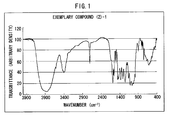
- FIG. 1 shows its infrared absorption chart.
- Exemplary Compound (2)-11 was synthesized in the same manner as in synthesis of Exemplary Compound (2)-1. Its infrared absorption chart is shown in FIG. 2 .
- FIG. 3 shows its infrared absorption chart. Further, Exemplary Compounds (3)-2 and (3)-9 were synthesized respectively in the same manner as in synthesis of Exemplary Compound (3)-1. Their infrared absorption charts are shown in FIGS. 4 and 5 , respectively.
- Example 3 2.5 parts of Exemplary Compound (2)-1, 0.5 part of sodium oleate, 5 parts of glycerin, and 42 parts of water were mixed, and the resulting mixture, together with 100 parts of zirconia beads having a diameter of 0.1 mm, was dispersed at 300 rpm for 6 hours with a planetary ball mill. After the completion of the dispersion, a yellow pigment dispersion was obtained by separating the zirconia beads.
- Example 4 Pigment dispersions were prepared in the same manner as in Example 3 except that the exemplary compounds shown in Table 1 were used respectively in place of Exemplary Compound (2)-1 in Example 3.
- Example 1 A yellow pigment dispersion was prepared in the same manner as in Example 3 except that C.I. Pigment Yellow 128 (trade name: CROMOPHTAL YELLOW 8GN manufactured by Ciba Specialty Chemicals) was used in place of Exemplary Compound (2)-1 in Example 3.
- C.I. Pigment Yellow 128 trade name: CROMOPHTAL YELLOW 8GN manufactured by Ciba Specialty Chemicals
- Example 3 Exemplary Compound (2)-1 A 1.35 A 93.7%
- Example 4 Exemplary Compound (2)-6 A 1.32 A 93.8%
- Example 5 Exemplary Compound (3)-3 A 1.42 A 95.4%
- Example 6 Exemplary Compound (3)-10 A 1.45 A 96.0% Comparative Example 1 P.Y128 A 1.05 B 90.3%
- the pigment dispersions of the invention are excellent in dispersion stability and hue and show high tinctorial power and light resistance. Accordingly, the pigment dispersions of the invention can be used preferably in, for example, inks for printing such as inkjet, color toners for electrophotography, color filters used in displays such as LCDs and PDPs or image pick-up devices such as CCDs, coating materials, and colored plastics.
Landscapes
- Chemical & Material Sciences (AREA)
- Organic Chemistry (AREA)
- Physics & Mathematics (AREA)
- General Physics & Mathematics (AREA)
- Life Sciences & Earth Sciences (AREA)
- Engineering & Computer Science (AREA)
- Materials Engineering (AREA)
- Wood Science & Technology (AREA)
- Pigments, Carbon Blacks, Or Wood Stains (AREA)
- Coloring (AREA)
- Emulsifying, Dispersing, Foam-Producing Or Wetting Agents (AREA)
- Inks, Pencil-Leads, Or Crayons (AREA)
Abstract

Description
- The present invention relates to an azo pigment and a pigment dispersion containing the azo pigment.
- In recent years, as image recording materials, materials for forming a color image have been particularly mainly used. Specifically, recording materials for an inkjet system, recording materials for a heat-sensitive transfer system, recording materials for an electrophotographic system, silver halide photosensitive materials of a transfer system, printing inks, recording pens, and the like, have been used extensively. Color filters are used in imaging apparatuses such as image pick-up devices such as CCDs, and in displays such as LCDs and PDPs, to record and reproduce color images. In these color image recording materials and color filters, colorants (dyes or pigments) of three primary colors based on a so-called additive color mixing method or subtractive color mixing method are used to display or record full-color images. However, there is no colorant which has an absorption property that can provide a preferred color reproduction range and has fastness under various use conditions and environmental conditions, and improvement is strongly desired.
- The properties required for a pigment that is used in the above respective applications are: having a good absorption property for color reproducibility; having a particle diameter and a particle shape necessary for exhibiting desired transparency; being excellent in fastness under the environmental conditions where the pigment is used, such as light resistance, heat resistance, resistance to oxidative gases such as ozone, and fastness to chemicals such as organic solvents and sulfur dioxide; and having dispersibility into fine particles in a medium used, thus providing a stable dispersion state. In particular, a pigment having a good yellow hue and fastness to light, humidity, heat, and active gases in the environment, particularly oxidative gases such as ozone, is strongly desired.
- Azo pigments are excellent in chromatic characteristics such as hue and tinctorial power and are thus widely used in printing inks, inks for inkjet, electrophotographic materials, and color toners. Among them, the most typically used yellow azo pigment is a diarylide pigment. Examples of the diarylide pigment include C.I. Pigment Yellow 12, C.I. Pigment Yellow 13, and C.I. Pigment Yellow 17. However, the diarylide pigment is extremely inferior in fastness, particularly light-fastness, and therefore, the pigment is decomposed and discolored upon exposure of the printed matter to light and is thus not suitable for long-term storage of printed matter.
- In order to overcome this drawback, azo pigments having fastness improved by increasing their molecular weight or introducing groups having strong intermolecular interaction have also been disclosed (see, for example, Japanese Patent Application Laid-Open (JP-A) No.
56-38354 U.S. Patent No. 2936306 , andJP-A No. 11-100519
For the purpose of improving hue and fastness, various colorants have been developed (see, for example,JP-A No. 2005-213357 JP-A No. 2007-41050 JP-A No. 2007-41076 - When full color is displayed by the subtractive color mixing method using 3 colors of yellow, magenta and cyan or 4 colors of the 3 colors and black, use of a yellow pigment inferior in fastness will sometimes cause a change in gray balance in printed matter with time. If a pigment inferior in chromatic characteristics is used, color reproduction is sometimes deteriorated at the time of printing. Accordingly, a yellow pigment and a pigment dispersion satisfying both chromatic characteristics and fastness are desired to attain printed matter maintaining high color reproducibility for a long time.
- The light resistance of the pigments described in
JP-A No. 56-38354 U.S. Patent No. 2936306 andJP-A No. 11-100519 JP-A No. 2005-213357 JP-A No. 2007-41050 JP-A No. 2007-41076 - It is an object of the invention to provide an azo pigment excellent in chromatic characteristics such as tinctorial power and hue, and in durability such as light resistance, and to provide a pigment dispersion excellent in dispersion stability.
In view of the above circumstances, the inventors have newly prepared an azo pigment, and found that the pigment is excellent in chromatic characteristics and durability, thereby accomplishing the present invention. Exemplary embodiments of the present invention are as follows. - <1> An azo pigment represented by the following formula (1) or a tautomer thereof:

<2> The azo pigment or tautomer thereof according to <1>, wherein R1 represents an aryl group having 6 to 12 carbon atoms in total or an aromatic heterocyclic group having 2 to 12 carbon atoms in total; R2 represents a hydrogen atom or a methyl group; R3 represents a hydrogen atom, an aliphatic group having 1 to 4 carbon atoms in total, an aliphatic amino group having 1 to 8 carbon atoms in total, or an amino group; and R4 and R5 each independently represent an aliphatic amino group having 1 to 8 carbon atoms in total, or an amino group.
<3> The azo pigment or tautomer thereof according to <1>, wherein R1 represents an aromatic heterocyclic group having 2 to 12 carbon atoms in total; R2 represents a hydrogen atom; R3 represents an alkyl group having 1 to 4 carbon atoms in total, an aliphatic amino group having 1 to 8 carbon atoms in total, or an amino group; and R4 and R5 each independently represent an aliphatic amino group having 1 to 8 carbon atoms in total, or an amino group.
<4> The azo pigment or tautomer thereof according to <1>, wherein R1 represents an aromatic heterocyclic group having 2 to 10 carbon atoms in total and having 2 or more heteroatoms in a heterocycle; R2 represents a hydrogen atom; R3 represents a methyl group, an aliphatic amino group having 1 to 6 carbon atoms in total, or an amino group; and R4 and R5 each independently represent an aliphatic amino group having 1 to 8 carbon atoms in total, or an amino group. - <5> The azo pigment or tautomer thereof according to <1>, wherein the azo pigment is represented by the following formula (2) or (3):


- <6> The azo pigment or tautomer thereof according to <5>, wherein the azo pigment is represented by the formula (2) wherein R1 represents an aryl group having 6 to 12 carbon atoms in total or a heterocyclic group having 2 to 12 carbon atoms in total; R4 represents an aliphatic amino group having 1 to 8 carbon atoms in total; R7 represents an aliphatic group having 1 to 8 carbon atoms in total; and R11 represents a methyl group.
<7> The azo pigment or tautomer thereof according to <6>, wherein R1 represents a heterocyclic group having 2 to 12 carbon atoms in total; R4 represents an aliphatic amino group having 1 to 8 carbon atoms in total; R7 represents an aliphatic group having 1 to 8 carbon atoms in total; and R11 represents a methyl group. - <8> The azo pigment or tautomer thereof according to <5>, wherein the azo pigment is represented by the formula (3) wherein R1 represents an aryl group having 6 to 12 carbon atoms in total or a heterocyclic group having 2 to 12 carbon atoms in total; R4 represents an amino group or an aliphatic amino group having 1 to 8 carbon atoms in total; R8 represents an amino group or an aliphatic amino group having 1 to 8 carbon atoms in total; and R9 represents a hydrogen atom or an aliphatic group having 1 to 8 carbon atoms in total.
<9> The azo pigment or tautomer thereof according to <8>, wherein R1 represents a heterocyclic group having 2 to 12 carbon atoms in total; R4 represents an aliphatic amino group having 1 to 8 carbon atoms in total; R8 represents an aliphatic amino group having 1 to 8 carbon atoms in total; and R9 represents an aliphatic group having 1 to 8 carbon groups in total. - <10> A pigment dispersion comprising at least one of the azo pigment or tautomer thereof according to any one of <1> to <9>.
- According to the invention, there can be provided an azo pigment excellent in chromatic characteristics such as tinctorial power and hue as well as in durability such as light resistance, and a pigment dispersion excellent in dispersion stability.
-
- FIG. 1
- is an infrared absorption spectrum of Exemplary Compound (2)-1.
- FIG. 2
- is an infrared absorption spectrum of Exemplary Compound (2)-11.
- FIG. 3
- is an infrared absorption spectrum of Exemplary Compound (3)-1.
- FIG. 4
- is an infrared absorption spectrum of Exemplary Compound (3)-2.
- FIG. 5
- is an infrared absorption spectrum of Exemplary Compound (3)-9.
- First, the aliphatic group, aryl group, heterocyclic group and substituent in the invention are described.
In the aliphatic group in the invention, its aliphatic site may be linear, branched or cyclic. The aliphatic group may be saturated or unsaturated. Specific examples include an alkyl group, an alkenyl group, a cycloalkyl group and a cycloalkenyl group. The aliphatic group may be unsubstituted or have a substituent. - The aryl group may be a single ring or a condensed ring. The aryl group may be unsubstituted or have a substituent. The heterocyclic group may be a group having, in its heterocycle, a heteroatom (for example, a nitrogen atom, a sulfur atom or an oxygen atom), and the heterocycle may be a saturated ring or an unsaturated ring. The heterocycle may be a single ring or a condensed ring, and may be unsubstituted or have a substituent.
- The substituent in the invention may be any substitutable group such as an aliphatic group, an aryl group, a heterocyclic group, an acyl group, an acyloxy group, an acylamino group, an aliphatic oxy group, an aryloxy group, a heterocyclic oxy group, an aliphatic oxycarbonyl group, an aryl oxycarbonyl group, a heterocyclic oxycarbonyl group, a carbamoyl group, an aliphatic sulfonyl group, an aryl sulfonyl group, a heterocyclic sulfonyl group, an aliphatic sulfonyloxy group, an aryl sulfonyloxy group, a heterocyclic sulfonyloxy group, a sulfamoyl group, an aliphatic sulfonamide group, an aryl sulfonamide group, a heterocyclic sulfonamide group, an amino group, an aliphatic amino group, an aryl amino group, a heterocyclic amino group, an aliphatic oxycarbonylamino group, an aryl oxycarbonylamino group, a heterocyclic oxycarbonylamino group, an aliphatic sulfinyl group, an aryl sulfinyl group, an aliphatic thio group, an aryl thio group, a hydroxyl group, a cyano group, a sulfo group, a carboxy group, an aliphatic oxyamino group, an aryl oxyamino group, a carbamoylamino group, a sulfamoylamino group, a halogen atom, a sulfamoylcarbamoyl group, a carbamoylsulfamoyl group, a dialiphatic oxyphosphinyl group, and a diaryl oxyphosphinyl group.
- <Azo pigment>
The pigment is in such a state that pigment molecules are strongly bound to one another by cohesive energy attributable to strong interaction among the molecules. To create this state, intermolecular van der Waals force and intermolecular hydrogen bonding are necessary as described in, for example, Journal of Imaging Society of Japan, vol. 43, p. 10 (2004).
For example, introduction of an aromatic group, a polar group and/or a heteroatom into the molecule is conceivable for strengthening the intermolecular van der Waals force. Introduction of a substituent containing a hydrogen atom bound to a heteroatom and/or an electron-donating substituent into the molecule, for example, is conceivable for forming the intermolecular hydrogen bonding. It is also conceivable that the polarity of the molecule as a whole is preferably higher. For this purpose, linear groups such as an alkyl group are preferably shorter.
From this viewpoint, the pigment molecule preferably contains an amide bond, a sulfonamide bond, an ether bond, a sulfone group, an oxycarbonyl group, an imido group, a heterocycle, and/or a benzene ring. - The invention provides an azo pigment represented by formula (1) below or a tautomer thereof (hereinafter referred to collectively as an "azo pigment of the invention" in some cases). The azo pigment of the invention has the specific structure represented by the formula (1) below, thereby exhibiting excellent characteristics in chromatic characteristics such as tinctorial power and hue and also exhibiting excellent characteristics in durability such as light resistance and ozone resistance.
-

- wherein R1 represents an aliphatic group having 1 to 8 carbon atoms in total, an aryl group having 6 to 12 carbon atoms in total or a heterocyclic group having 2 to 12 carbon atoms in total; R2 represents a hydrogen atom or an aliphatic group having 1 to 8 carbon atoms in total; R3 represents a hydrogen atom, an aliphatic group having 1 to 4 carbon atoms in total, an aliphatic amino group having 1 to 8 carbon atoms in total, or an amino group; R4 and R5 each independently represent an aliphatic amino group having 1 to 8 carbon atoms in total, or an amino group; and X2 represents a nitrogen atom or C-CN.
- The aliphatic group having 1 to 8 carbon atoms in total represented by R1 may have a substituent and may be a saturated aliphatic group or an unsaturated aliphatic group. From the viewpoint of the effect of the invention, the aliphatic group is preferably an aliphatic group having 1 to 4 carbon atoms in total, and more preferably an alkyl group having 1 to 4 carbon atoms in total.
The substituent that may be substituted on the aliphatic group having 1 to 8 carbon atoms in total represented by R1 may be any group that is described in the item "substituent in the invention" and is a substitutable group. - Specific examples of the aliphatic group having 1 to 8 carbon atoms in total represented by R1 include a methyl group, an ethyl group, a vinyl group, a cyclohexyl group, and a carbamoylmethyl group.
- The aryl group having 6 to 12 carbon atoms in total represented by R1 may have a substituent group. From the viewpoint of the effect of the invention, the aryl group is preferably an aryl group having 6 to 10 carbon atoms in total.
The substituent that may be substituted on the aryl group having 6 to 12 carbon atoms in total represented by R1 may be any group that is described in the item "substituent in the invention" and is a substitutable group.
Specific examples of the aryl group having 6 to 12 carbon atoms in total represented by R1 include a phenyl group, a 4-nitrophenyl group, a 4-acetylaminophenyl group, and 4-methane sulfonylphenyl group. - The heterocyclic group having 2 to 12 carbon atoms in total represented by R1 may have a substituent or may be condensed with another ring. The substituent that may be substituted on the heterocyclic group having 2 to 12 carbon atoms in total represented by R1 may be any group that is described in the item "substituent in the invention" and is a substitutable group.
- From the viewpoint of the effect of the invention, the heterocyclic group having 2 to 12 carbon atoms in total represented by R1 is preferably a 5- to 6-membered aromatic heterocyclic group having 2 to 10 carbon atoms in total. The heterocyclic group having 2 to 12 carbon atoms in total represented by R1 is preferably a heterocyclic group obtained from a heterocycle by removing one hydrogen atom from hydrogen atoms on the carbon atoms constituting the heterocycle, that is, a heterocyclic group to be bound via a carbon atom.
- Specific examples of the heterocyclic group having 2 to 12 carbon atoms in total represented by R1 include a 2-pyrimidinyl group, a 3-pyrimidinyl group, a 2-thiazolyl group, a 2-benzothiazolyl group, a 2-benzooxazolyl group, a 2-pyridyl group, and a 2-pyrazinyl group.
- The aliphatic group having 1 to 8 carbon atoms in total represented by R2 has the same meaning as defined above in the aliphatic group having 1 to 8 carbon atoms in total represented by R1, and its preferable range is also the same as defined therein.
- The aliphatic group having 1 to 4 carbon atoms in total represented by R3 may have a substituent and may be saturated or unsaturated. The substituent that may be substituted on the aliphatic group having 1 to 4 carbon atoms in total represented by R3 may be any group that is described in the item "substituent in the invention" and is a substitutable group.
From the viewpoint of the effect of the invention, the aliphatic group having 1 to 4 carbon atoms in total represented by R3 is preferably an alkyl group having 1 to 4 carbon atoms in total.
Specific examples of the aliphatic group having 1 to 4 carbon atoms in total represented by R3 include a methyl group and an ethyl group. - In the aliphatic amino group having 1 to 8 carbon atoms in total represented by R3, the aliphatic group may have a substituent and may be saturated or unsaturated. The substituent that may be substituted on the aliphatic amino group having 1 to 8 carbon atoms in total represented by R3 may be any group that is described in the item "substituent in the invention" and is a substitutable group.
The aliphatic amino group having 1 to 8 carbon atoms in total may be a primary amino group or a secondary amino group.
From the viewpoint of the effect of the invention, the aliphatic amino group having 1 to 8 carbon atoms in total represented by R3 is preferably an alkylamino group having 1 to 6 carbon atoms in total. Specific examples include a methylamino group, a dimethylamino group, an ethylamino group, and a methoxypropylamino group. - The aliphatic amino group having 1 to 8 carbon atoms in total represented by R4 or R5 has the same meaning as defined above in the aliphatic amino group having 1 to 8 carbon atoms in total represented by R3, and its preferable range is also the same as defined therein.
- With respect to R1 to R5 in the invention, it is preferable from the viewpoint of the effect of the invention that R1 is an aryl group having 6 to 12 carbon atoms in total or an aromatic heterocyclic group having 2 to 12 carbon atoms in total, R2 is a hydrogen atom or a methyl group, R3 is a hydrogen atom, an aliphatic group having 1 to 4 carbon atoms in total, an aliphatic amino group having 1 to 8 carbon atoms in total, or an amino group, and R4 and R5 each independently represent an aliphatic amino group having 1 to 8 carbon atoms in total, or an amino group.
- It is more preferable that R1 is an aromatic heterocyclic group having 2 to 12 carbon atoms in total, R2 is a hydrogen atom, R3 is an alkyl group having 1 to 4 carbon atoms in total, an aliphatic amino group having 1 to 8 carbon atoms in total, or an amino group, and R4 and R5 each independently represent an aliphatic amino group having 1 to 8 carbon atoms in total, or an amino group.
- It is still more preferable that R1 is an aromatic heterocyclic group having 2 to 10 carbon atoms in total and having 2 or more heteroatoms in a heterocycle, R2 is a hydrogen atom, R3 is a methyl group, an aliphatic amino group having 1 to 6 carbon atoms in total, or an amino group, and R4 and R5 each independently represent an aliphatic amino group having 1 to 8 carbon atoms in total, or an amino group.
- From the viewpoint of the effect of the invention, the azo pigment represented by the formula (1) in the invention is preferably an azo pigment represented by the following formula (2) or (3), and more preferably an azo pigment represented by the following formula (3):
-


- wherein R1 and R4 have the same meanings as those of R1 and R4 defined in the formula (1), R11 represents an aliphatic group having 1 to 4 carbon atoms in total, R7 represents a hydrogen atom or an aliphatic group having 1 to 8 carbon atoms in total, R8 represents an amino group or an aliphatic amino group having 1 to 8 carbon atoms in total, and R9 represents a hydrogen atom or an aliphatic group having 1 to 8 carbon atoms in total.
- The aliphatic group having 1 to 4 carbon atoms in total represented by R11 may have a substituent and may be saturated or unsaturated. The substituent that may be substituted on the aliphatic group represented by R11 may be any group that is described in the item "substituent in the invention" and is a substitutable group.
From the viewpoint of the effect of the invention, the aliphatic group having 1 to 4 carbon atoms in total represented by R11 is preferably an alkyl group having 1 to 4 carbon atoms in total, more preferably an unsubstituted alkyl group having 1 to 4 carbon atoms in total. Specific examples include a methyl group, an ethyl group, and a t-butyl group. - The aliphatic group having 1 to 8 carbon atoms in total represented by R7 may have a substituent and may be saturated or unsaturated. The substituent that may be substituted on the aliphatic group represented by R7 is not particularly limited and may be a group that is described in the item "substituent in the invention" and is a substitutable group. In particular from the viewpoint of the effect of the invention, the substituent is preferably a hydroxy group, an alkoxy group, an acylamino group, a sulfonamide group, an imido group, or an alkoxycarbonyl group, more preferably a hydroxy group, an alkoxy group, or an acylamino group.
The aliphatic group having 1 to 8 carbon atoms in total represented by R7 is preferably an alkyl group having 1 to 8 carbon atoms in total, more preferably an alkyl group having 1 to 6 carbon atoms in total. Specific examples include a methyl group, an ethyl group, a cyclohexyl group, a 2-hydroxyethyl group, a 2-methoxyethyl group, a 3-methoxypropyl group, and a 2-acetamidoethyl group. - The aliphatic amino group having 1 to 8 carbon atoms in total represented by R8 may further have a substituent. The aliphatic amino group is preferably an alkyl amino group having 1 to 8 carbon atoms in total, more preferably an alkyl amino group having 1 to 6 carton atoms in total.
The substituent on the aliphatic amino group having 1 to 8 carbon atoms in total represented by R8 may be substituted on the aliphatic group moiety thereof or on a nitrogen atom of the amino group. - The substituent that may be substituted on the aliphatic amino group represented by R8 is not particularly limited and may be a group that is described in the item "substituent in the invention" and is a substitutable group. In particular from the viewpoint of the effect of the invention, the substituent is preferably an alkyl group, a hydroxy group, an alkoxy group, an acylamino group or a sulfonamide group, more preferably an alkyl group, a hydroxy group, an alkoxy group, an acylamino group or an aryl sulfonamide group.
- Examples of the aliphatic amino group having 1 to 8 carbon atoms in total represented by R8 include a methylamino group, a 3-methoxypropylamino group, a 2-hydroxyethylamino group, a 2-acetylaminoethylamino group, a dimethylamino group, and a 2-benzene sulfonamidoethylamino group.
- The aliphatic group having 1 to 8 carbon atoms in total represented by R9 has the same meaning as defined above in the aliphatic group having 1 to 8 carbon atoms in total represented by R7, and its preferable range is also the same as defined therein.
- With respect to R1, R4, R7, and R11 in the formula (2), it is preferable from the viewpoint of the effect of the invention that R1 is an aryl group having 6 to 12 carbon atoms in total or a heterocyclic group having 2 to 12 carbon atoms in total, R4 is an aliphatic amino group having 1 to 8 carbon atoms in total, R7 is an aliphatic group having 1 to 8 carbon atoms in total, and R11 is a methyl group, and it is more preferable that R1 is a heterocyclic group having 2 to 12 carbon atoms in total, R4 is an aliphatic amino group having 1 to 8 carbon atoms in total, R7 is an aliphatic group having 1 to 8 carbon atoms in total, and R11 is a methyl group.
- With respect to R1, R4, R8, and R9 in the formula (3), it is preferable from the viewpoint of the effect of the invention that R1 is an aryl group having 6 to 12 carbon atoms in total or a heterocyclic group having 2 to 12 carbon atoms in total, R4 is an amino group or an aliphatic amino group having 1 to 8 carbon atoms in total, R8 is an amino group or an aliphatic amino group having 1 to 8 carbon atoms in total, and R9 is a hydrogen atom or an aliphatic group having 1 to 8 carbon atoms in total, and it is more preferable that R1 is a heterocyclic group having 2 to 12 carbon atoms in total, R4 is an aliphatic amino group having 1 to 8 carbon atoms in total, R8 is an aliphatic amino group having 1 to 8 carbon atoms in total, and R9 is an aliphatic group having 1 to 8 carbon groups in total.
- Specific Compound Examples of the pigment represented by the formula (1) in the present invention (hereinafter referred to sometimes as "Exemplary Compounds"), (2)-1 to (2)-17 and (3)-1 to (3)-17, are shown below, but the compounds according to the invention are not limited thereto.
-


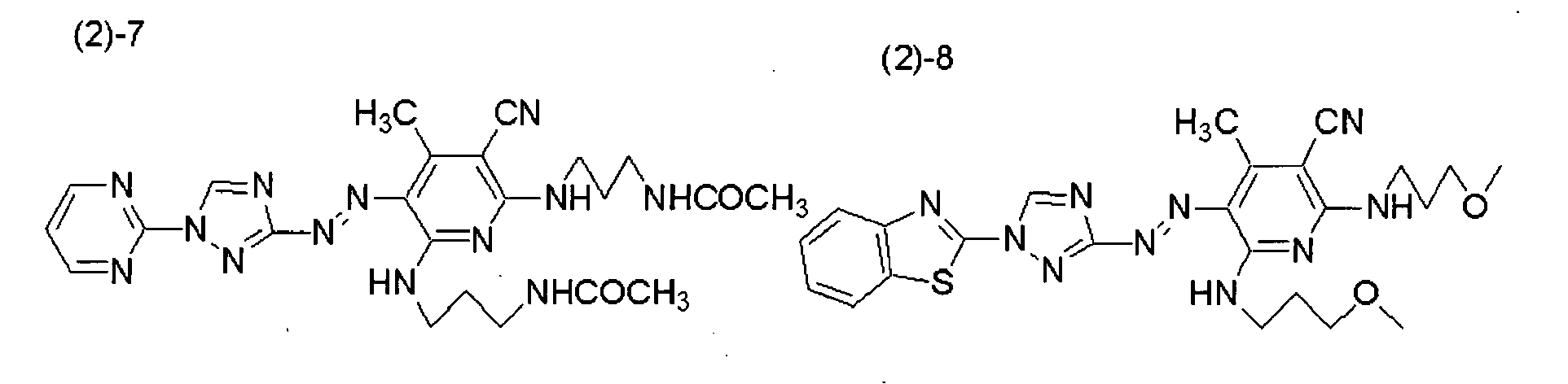


-
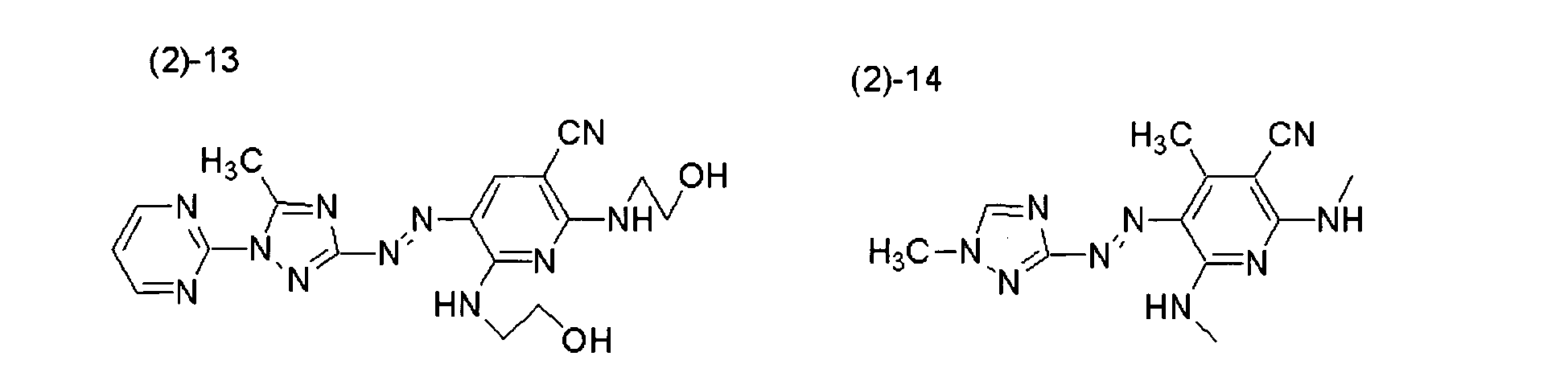


-


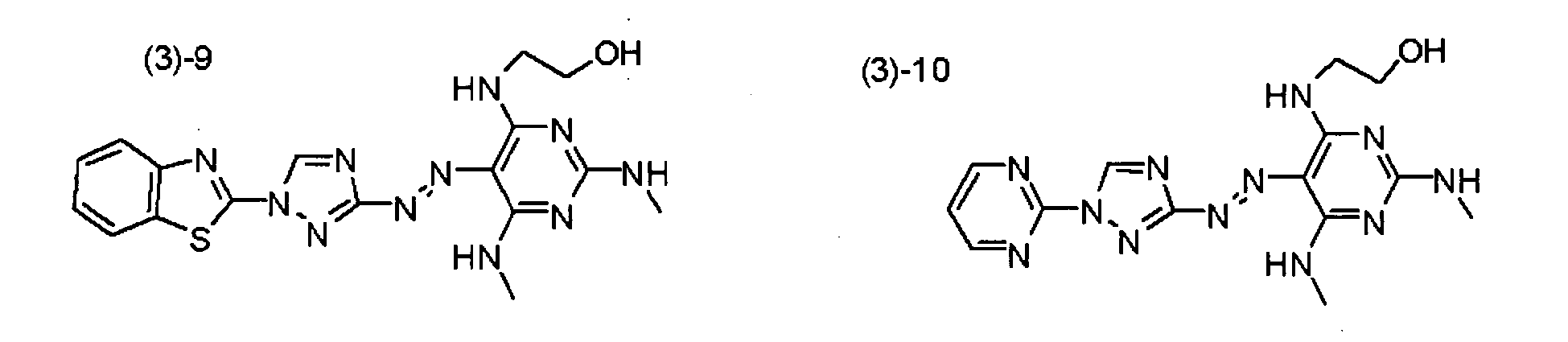

-


- Now, one example of the method for manufacturing the azo pigment represented by the formula (1) is described. For example, a heterocyclic amine represented by formula (4) below is converted into the corresponding diazonium under non-aqueous acidic conditions and then subjected to coupling reaction with a compound represented by formula (5) below under acidic conditions, followed by post-treatment in a usual manner to give a colorant (intermediate compound). The resulting colorant is reacted with R1-X, whereby the azo pigment represented by the formula (1) can be produced.
-

- wherein R1 to R5 and X2 have the same meanings as defined for R1 to R5 and X2 in the formula (1) above, and X represents a leaving group.
One example of the reaction scheme is shown below. -
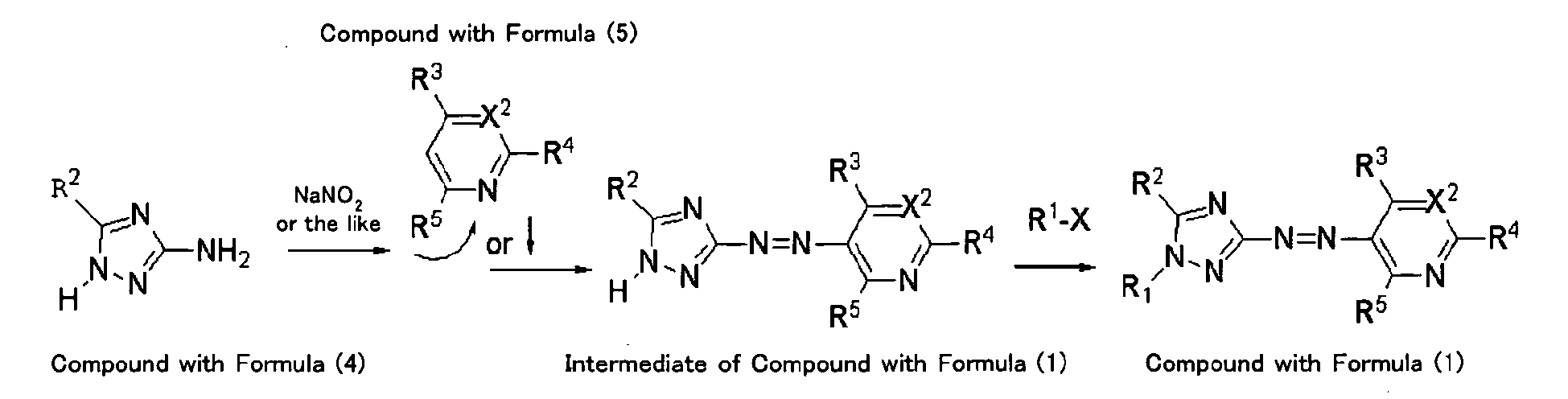
- In the reaction scheme, R1 to R5 and X2 have the same meanings as those defined in the formula (1), and X represents a leaving group. X is not particularly limited insofar as it is used as a leaving group. Preferable examples of the leaving group represented by X include a halogen atom, an alkyl sulfonyl group and an aryl sulfonyl group. Specific examples include a chlorine atom, a bromine atom, a methane sulfonyl group and a benzene sulfonyl group.
- The compound represented by the formula (4) (hereinafter referred to sometimes as a "heterocyclic amine") and the compound represented by the formula (5) may be commercially available products or may be those produced by conventional methods known in the art.
- The above diazotization reaction of the heterocyclic amine represented by the formula (4) can be conducted in a usual manner. For example, the diazotization reaction can be conducted by reacting the heterocyclic amine with a reagent such as sodium nitrite, nitrosylsulfuric acid or isoamyl nitrite at a temperature of 15°C or less for about 10 minutes to about 6 hours in an acidic solvent such as sulfuric acid, phosphoric acid or acetic acid.
The coupling reaction can be carried out by reacting the diazonium salt obtained by the above method with the compound represented by the formula (5) for about 10 minute to about 12 hours at 40°C or less, preferably at 25°C or less. - When crystals are precipitated in the reaction solution obtained by the reaction described above, the precipitated crystals may be colleted as such by filtration. Generally, water or an alcohol solvent is added to the reaction solution to precipitate crystals, and the precipitated crystals may be collected by filtration. The crystals thus obtained by filtration may be washed and dried as necessary to give an intermediate compound (intermediate colorant) of the azo pigment represented by the formula (1).
- The intermediate colorant produced as described above is reacted with the corresponding R1-X at about 50 to 150°C for about 30 minutes to about 10 hours in the presence of a base such as potassium carbonate or sodium hydroxide in a high boiling point organic solvent such as DMF (dimethylformamide), NMP (N-methyl pyrrolidone), DMAc (dimethylacetamide) or DMSO (dimethylsulfoxide). When crystals are precipitated in the reaction solution, the precipitated crystals may be colleted by filtration. Otherwise, an alcohol solvent, water etc. is added to the reaction solution to precipitate crystals, and the precipitated crystals may be collected by filtration. The crystals thus obtained by filtration may be washed and dried as necessary to give a crude product of the azo pigment represented by the formula (1).
- <Pigment dispersion>
The pigment dispersion of the invention comprises at least one of the azo pigments represented by the formula (1) or tautomers thereof. The pigment dispersion can thereby be made excellent in chromatic characteristics, durability and dispersion stability.
When a crude product of the azo pigment of the invention is used for the pigment dispersion of the invention, the crude product is desirably post-treated as necessary.
Examples of the post-treatment include a pigment particle regulating process by grinding treatment such as solvent salt milling, salt milling, dry milling, solvent milling or acid pasting, or by solvent heating treatment, and a surface treatment process by a resin, a surfactant and a dispersant. - The azo pigment of the invention is preferably subjected to solvent heating treatment as a post-treatment. Examples of the solvent used in the solvent heating treatment include, for example, water; an aromatic hydrocarbon solvent such as toluene or xylene; a halogenated hydrocarbon solvent such as chlorobenzene or o-dichlorobenzene; an alcohol solvent such as isopropanol or isobutanol; a polar aprotic organic solvent such as N,N-dimethylformamide, N,N-dimethylacetamide or N-methyl-2-pyrrolidone; glacial acetic acid; pyridine; or mixtures thereof. By the post-treatment with these solvents, the average particle diameter of the pigment is regulated preferably in the range of 0.01 µm to 1 µm.
- The pigment dispersion of the invention may be an aqueous pigment dispersion or a non-aqueous pigment dispersion, but is preferably an aqueous pigment dispersion. In the aqueous pigment dispersion of the invention, the aqueous liquid in which the pigment is dispersed may be a mixture based on water to which a hydrophilic organic solvent is added as desired.
The content of the pigment in the pigment dispersion of the invention is not particularly limited. For example, the content may be 0.1 to 50% by mass. - Examples of the hydrophilic organic solvent include an alcohol such as methanol, ethanol, propanol, isopropanol, butanol, isobutanol, sec-butanol, tert-butanol, pentanol, hexanol, cyclohexanol, or benzyl alcohol; a polyhydric alcohol such as ethylene glycol, diethylene glycol, triethylene glycol, polyethylene glycol, propylene glycol, dipropylene glycol, polypropylene glycol, butylene glycol, hexanediol, pentanediol, glycerol, hexanetriol, or thiodiglycol; a glycol derivative such as ethylene glycol monomethyl ether, ethylene glycol monoethyl ether, ethylene glycol monobutyl ether, diethylene glycol monomethyl ether, diethylene glycol monobutyl ether, propylene glycol monomethyl ether, propylene glycol monobutyl ether, dipropylene glycol monomethyl ether, triethylene glycol monomethyl ether, ethylene glycol diacetate, ethylene glycol monomethyl ether acetate, triethylene glycol monoethyl ether, or ethylene glycol monophenyl ether; an amine such as ethanolamine, diethanolamine, triethanolamine, N-methyldiethanolamine, N-ethyldiethanolamine, morpholine, N-ethylmorpholine, ethylenediamine, diethylenetriamine, triethylenetetramine, polyethyleneimine, or tetramethylpropylenediamine; and other organic solvents such as formamide, N,N-dimethylformamide, N,N-dimethylacetamide, dimethyl sulfoxide, sulfolane, 2-pyrrolidone, N-methyl-2-pyrrolidone, N-vinyl-2-pyrrolidone, 2-oxazolidone, 1,3-dimethyl-2-imidazolidinone, acetonitrile, and acetone.
- The aqueous pigment dispersion in the invention may contain an aqueous resin. Examples of the aqueous resin include a water-soluble resin that is dissolved in water, a water-dispersible resin that is dispersed in water, a colloidal dispersion resin and a mixture thereof.
Specific examples of the aqueous resin include an acrylic resin, a styrene-acrylic resin, a polyester resin, a polyamide resin, a polyurethane resin, and a fluorine resin.
When the aqueous pigment dispersion in the invention contains an aqueous resin, the content thereof is not particularly limited. For example, the content may be 0.1 to 100% by mass based on the pigment. - The aqueous pigment dispersion in the invention may contain a surfactant and a dispersant in order to improve the dispersibility of the pigment and the qualities of an image formed by the pigment dispersion. Examples of the surfactant include an anionic surfactant, a nonionic surfactant, a cationic surfactant, and an amphoteric surfactant. Any surfactant may be used, but an anionic or nonionic surfactant is preferably used.
When the aqueous pigment dispersion in the invention contains a surfactant, the content thereof is not particularly limited. For example, the content may be 0.1 to 100% by mass based on the pigment. - Examples of the anionic surfactant include, for example, fatty acid salts, alkyl sulfuric acid ester salts, alkyl benzene sulfonic acid salts, alkyl naphthalene sulfonic acid salts, dialkyl sulfosuccinic acid salts, alkyldiaryl ether disulfonic acid salts, alkyl phosphoric acid salts, polyoxyethylene alkyl ether sulfuric acid salts, polyoxyethylene alkyl aryl ether sulfuric acid salts, naphthalene sulfonic acid formalin condensates, polyoxyethylene alkyl phosphoric acid ester salts, glycerol borate fatty acid esters, and polyoxyethylene glycerol fatty acid esters.
- Examples of the nonionic surfactant include, for example, polyoxyethylene alkyl ethers, polyoxyethylene alkylaryl ethers, polyoxyethylene oxypropylene block copolymers, sorbitan fatty acid esters, polyoxyethylene sorbitan fatty acid esters, polyoxyethylene sorbitol fatty acid esters, glycerin fatty acid esters, polyoxyethylene fatty acid esters, polyoxyethylene alkyl amines, fluorine surfactants, and silicon surfactants.
- The non-aqueous pigment dispersion in the invention comprises the azo pigment of the formula (1) dispersed in a non-aqueous vehicle. Examples of resins used for the non-aqueous vehicle include petroleum resin, casein, shellac, rosin-modified maleic acid resin, rosin-modified phenol resin, nitrocellulose, cellulose acetate butyrate, cyclized rubber, chlorinated rubber, oxidized rubber, hydrochlorinated rubber, phenol resin, alkyd resin, polyester resin, unsaturated polyester resin, amino resin, epoxy resin, vinyl resin, vinyl chloride resin, vinyl chloride-vinyl acetate copolymers, acrylic resin, methacrylic resin, polyurethane resin, silicon resin, fluorine resin, drying oil, synthetic drying oil, styrene/maleic acid resin, styrene/acrylic resin, polyamide resin, polyimide resin, benzoguanamine resin, melamine resin, urea resin, chlorinated polypropylene, butyral resin, and vinylidene chloride resin. For the non-aqueous vehicle, a photocurable resin may also be used.
- Examples of solvents used for the non-aqueous vehicle include an aromatic solvent such as toluene, xylene or methoxybenzene; an acetate solvent such as ethyl acetate, butyl acetate, propylene glycol monomethyl ether acetate or propylene glycol monoethyl ether acetate; a propionate solvent such as ethoxyethyl propionate; an alcohol solvent such as methanol or ethanol; an ether solvent such as butyl cellosolve, propylene glycol monomethyl ether, diethylene glycol ethyl ether, or diethylene glycol dimethyl ether; a ketone solvent such as methyl ethyl ketone, methyl isobutyl ketone, or cyclohexanone; an aliphatic hydrocarbon solvent such as hexane; a nitrogen compound solvent such as N,N-dimethylformamide, γ-butyrolactam, N-methyl-2-pyrrolidone, aniline, or pyridine; a lactone solvent such as γ-butyrolactone; and a carbamate ester such as a 48:52 mixture of methyl carbamate and ethyl carbamate.
- The pigment dispersion of the invention can be obtained by dispersing the azo pigment in an aqueous or non-aqueous medium by a dispersing machine. Examples of the dispersing machine that can be used in the invention include, for example, a ball mill, a sand mill, a beads mill, a roll mill, a jet mill, a paint shaker, an attritor, an ultrasonic dispersing machine, and a disperser.
- Hereinafter, the present invention is described in more detail by reference to the Examples, but the invention is not limited to these examples. Unless otherwise noted, all the "parts" and "percents" are by weight.
- (Example 1)
[Synthesis of Exemplary Compound (2)-1]
Exemplary Compound (2)-1 is synthesized through the following route: -

- - Synthesis of Intermediate Compound (8) -
3.5 parts of Compound (7) was added to 35 parts of phosphoric acid and dissolved by heating at 30°C. The resulting solution was cooled on ice and kept at -5 to 0°C, and 3.0 parts of sodium nitrite were added thereto and stirred for 1 hour to give a diazonium salt solution. Separately, 10 parts of Compound (2) were dissolved in 30 parts of methanol to prepare a solution of Compound (2). The above diazonium salt solution was added thereto at 8°C or less. Simultaneously with the completion of the addition, the ice bath was removed, and the mixture was stirred for 2 hours. The reaction solution was added to 300 parts of water at 10°C under stirring and stirred for additional 1 hour. Precipitated crystals were separated by filtration and sufficiently washed with water. The crystals were dried to give 12.6 parts of Intermediate Compound (8). The yield was 89.0%. - 20 parts of dimethylacetamide, 0.8 parts of potassium carbonate, and 0.7 part of 2-chloropyrimidine were added to 2.0 parts of Intermediate Compound (8) and then stirred at 90°C for 3 hours. The reaction solution was returned to room temperature, then 100 parts of methanol were added thereto, and the mixture was stirred at room temperature for 1 hour. Precipitated crystals were separated by filtration and washed with methanol. The resulting crystals were added, without drying, to 100 parts of water and then stirred at room temperature for 30 minutes, and the crystals were separated by filtration and washed sufficiently with water. The resulting crystals were added, without drying, to 60 parts of methanol, and dissolved by heating. Thereafter, the sample was stirred for 2 hours under air cooling, and further stirred for 30 minutes under water cooling. The precipitated crystals were separated by filtration and washed with 30 parts of methanol having a temperature of 10°C. The crystals were dried to give 1.3 parts of Exemplary Compound (2)-1 of the invention. The yield was 52.0%.
FIG. 1 shows its infrared absorption chart.
Further, Exemplary Compound (2)-11 was synthesized in the same manner as in synthesis of Exemplary Compound (2)-1. Its infrared absorption chart is shown inFIG. 2 . - (Example 2)
[Synthesis of Exemplary Compound (3)-1]
Exemplary Compound (3)-1 is synthesized through the following route: -

- - Synthesis of Intermediate Compound (9) -
3.0 parts of Compound (7) were added to 30 parts of phosphoric acid and dissolved by heating at 40°C. The resulting solution was cooled on ice and kept at -5 to 0°C, and 2.6 parts of sodium nitrite were added thereto and stirred for 1 hour to give a diazonium salt solution. 4.0 parts of Compound (5) were added to the above diazonium salt solution at 20°C or less, and the mixture was stirred for 30 minutes. Then, the ice bath was removed, and the mixture was stirred for 1 hour. The reaction solution was cooled again, then 100 parts of methanol were added thereto at 15 to 25°C, and the mixture was stirred at 20 to 25°C for additional 1 hour. Precipitated crystals were separated by filtration and washed with 30 parts of methanol, and further sufficiently washed with water. The crystals were dried to give 6.1 parts of Intermediate Compound (9). The yield was 86.5%. - 25 parts of dimethylacetamide, 1.6 parts of potassium carbonate, and 1.6 parts of 2-chlorobenzothiazole were added to 2.5 parts of Intermediate Compound (9) and then stirred at 90°C for 5 hours. The reaction solution was returned to room temperature, then 100 parts of methanol were added thereto, and the mixture was stirred at room temperature for 1 hour. Precipitated crystals were separated by filtration and washed with methanol. The resulting crystals were added, without drying, to 100 parts of water and then stirred at room temperature for 1 hour, and the crystals were separated by filtration and washed sufficiently with water. The resulting crystals were added, without drying, to 50 parts of dimethylacetamide and 50 parts of methanol, and stirred with heating at 80°C for 1 hour. Thereafter, the sample was stirred for 2 hours under air cooling, and the precipitated crystals were separated by filtration and washed with 50 parts of methanol. The crystals were dried to give 1.7 parts of Exemplary Compound (3)-1 of the invention. The yield was 42.5%.
FIG. 3 shows its infrared absorption chart.
Further, Exemplary Compounds (3)-2 and (3)-9 were synthesized respectively in the same manner as in synthesis of Exemplary Compound (3)-1. Their infrared absorption charts are shown inFIGS. 4 and5 , respectively. - (Example 3)
2.5 parts of Exemplary Compound (2)-1, 0.5 part of sodium oleate, 5 parts of glycerin, and 42 parts of water were mixed, and the resulting mixture, together with 100 parts of zirconia beads having a diameter of 0.1 mm, was dispersed at 300 rpm for 6 hours with a planetary ball mill. After the completion of the dispersion, a yellow pigment dispersion was obtained by separating the zirconia beads. - (Examples 4 to 6)
Pigment dispersions were prepared in the same manner as in Example 3 except that the exemplary compounds shown in Table 1 were used respectively in place of Exemplary Compound (2)-1 in Example 3. - (Comparative Example 1)
A yellow pigment dispersion was prepared in the same manner as in Example 3 except that C.I. Pigment Yellow 128 (trade name: CROMOPHTAL YELLOW 8GN manufactured by Ciba Specialty Chemicals) was used in place of Exemplary Compound (2)-1 in Example 3. - (Evaluation)
<Dispersion stability>
The respective pigment dispersions obtained above were measured in a usual manner for their dispersion average particle diameter with a dynamic light scattering particle diameter measuring instrument (trade name: Microtrack UPA150, manufactured by NIKKISO CO., LTD.). When the dispersion average particle diameter of thepigment dispersion 2 hours after preparation and the dispersion average particle diameter of the pigment dispersion stored for 2 days at 70°C were both 150 nm or less, A was given, and when either of the dispersion average particle diameters was 150 nm or more, B was given. The results are shown in Table 1. - <Evaluation of tinctorial power>
Each of the pigment dispersions obtained in the Examples and Comparative Example was applied via a bar coater No. 3 onto art paper. The image density of the resulting coated material was measured with a reflection densitometer (trade name: X-Rite 938, manufactured by X-Rite). The results are shown in Table 1. - <Evaluation of hue>
Hue was evaluated using a reflection spectrum at an image density of 1.0 of a coated material prepared in the same manner as in evaluation of tinctorial power. A sample showing 75% or more reflectance at 580 nm, 15% or less reflectance at 430 nm and 30 to 60% reflectance at 500 nm simultaneously was evaluated as A (good), and a sample outside of this standard was regarded as B (bad). The results are shown in Table 1. - <Evaluation of light resistance>
The coated material with an image density of 1.0 used in evaluation of hue was irradiated with xenon light (160000 lux) for 7 days with a fade meter, and the image density before and after irradiation with xenon light was measured with a reflection densitometer and evaluated in terms of the remaining rate of colorant [(density after irradiation/density before irradiation)×100(%)]. The results are shown in Table 1. -
Table 1 Pigment Dispersion stability Tinctorial power Hue Light resistance Example 3 Exemplary Compound (2)-1 A 1.35 A 93.7% Example 4 Exemplary Compound (2)-6 A 1.32 A 93.8% Example 5 Exemplary Compound (3)-3 A 1.42 A 95.4% Example 6 Exemplary Compound (3)-10 A 1.45 A 96.0% Comparative Example 1 P.Y128 A 1.05 B 90.3% - As is evident from the results in Table 1, the pigment dispersions of the invention are excellent in dispersion stability and hue and show high tinctorial power and light resistance.
Accordingly, the pigment dispersions of the invention can be used preferably in, for example, inks for printing such as inkjet, color toners for electrophotography, color filters used in displays such as LCDs and PDPs or image pick-up devices such as CCDs, coating materials, and colored plastics.
Claims (10)
- An azo pigment represented by the following formula (1) or a tautomer thereof:

- The azo pigment or tautomer thereof according to claim 1, wherein R1 represents an aryl group having 6 to 12 carbon atoms in total or an aromatic heterocyclic group having 2 to 12 carbon atoms in total; R2 represents a hydrogen atom or a methyl group; R3 represents a hydrogen atom, an aliphatic group having 1 to 4 carbon atoms in total, an aliphatic amino group having 1 to 8 carbon atoms in total, or an amino group; and R4 and R5 each independently represent an aliphatic amino group having 1 to 8 carbon atoms in total, or an amino group.
- The azo pigment or tautomer thereof according to claim 1, wherein R1 represents an aromatic heterocyclic group having 2 to 12 carbon atoms in total; R2 represents a hydrogen atom; R3 represents an alkyl group having 1 to 4 carbon atoms in total, an aliphatic amino group having 1 to 8 carbon atoms in total, or an amino group; and R4 and R5 each independently represent an aliphatic amino group having 1 to 8 carbon atoms in total, or an amino group.
- The azo pigment or tautomer thereof according to claim 1, wherein R1 represents an aromatic heterocyclic group having 2 to 10 carbon atoms in total and having 2 or more heteroatoms in a heterocycle; R2 represents a hydrogen atom; R3 represents a methyl group, an aliphatic amino group having 1 to 6 carbon atoms in total, or an amino group; and R4 and R5 each independently represent an aliphatic amino group having 1 to 8 carbon atoms in total, or an amino group.
- The azo pigment or tautomer thereof according to claim 1, wherein the azo pigment is represented by the following formula (2) or (3):


- The azo pigment or tautomer thereof according to claim 5, wherein the azo pigment is represented by the formula (2) wherein R1 represents an aryl group having 6 to 12 carbon atoms in total or a heterocyclic group having 2 to 12 carbon atoms in total; R4 represents an aliphatic amino group having 1 to 8 carbon atoms in total; R7 represents an aliphatic group having 1 to 8 carbon atoms in total; and R11 represents a methyl group.
- The azo pigment or tautomer thereof according to claim 6, wherein R1 represents a heterocyclic group having 2 to 12 carbon atoms in total; R4 represents an aliphatic amino group having 1 to 8 carbon atoms in total; R7 represents an aliphatic group having 1 to 8 carbon atoms in total; and R11 represents a methyl group.
- The azo pigment or tautomer thereof according to claim 5, wherein the azo pigment is represented by the formula (3) wherein R1 represents an aryl group having 6 to 12 carbon atoms in total or a heterocyclic group having 2 to 12 carbon atoms in total; R4 represents an amino group or an aliphatic amino group having 1 to 8 carbon atoms in total; R8 represents an amino group or an aliphatic amino group having 1 to 8 carbon atoms in total; and R9 represents a hydrogen atom or an aliphatic group having 1 to 8 carbon atoms in total.
- The azo pigment or tautomer thereof according to claim 8, wherein R1 represents a heterocyclic group having 2 to 12 carbon atoms in total; R4 represents an aliphatic amino group having 1 to 8 carbon atoms in total; R8 represents an aliphatic amino group having 1 to 8 carbon atoms in total; and R9 represents an aliphatic group having 1 to 8 carbon groups in total.
- A pigment dispersion comprising at least one of the azo pigment or tautomer thereof according to any one of claims 1 to 9.
Applications Claiming Priority (1)
| Application Number | Priority Date | Filing Date | Title |
|---|---|---|---|
| JP2007244243A JP5288755B2 (en) | 2007-09-20 | 2007-09-20 | Azo pigments and pigment dispersions |
Publications (2)
| Publication Number | Publication Date |
|---|---|
| EP2039726A2 true EP2039726A2 (en) | 2009-03-25 |
| EP2039726A3 EP2039726A3 (en) | 2009-06-10 |
Family
ID=40303471
Family Applications (1)
| Application Number | Title | Priority Date | Filing Date |
|---|---|---|---|
| EP20080015035 Withdrawn EP2039726A3 (en) | 2007-09-20 | 2008-08-26 | Azo pigment and pigment dispersion |
Country Status (2)
| Country | Link |
|---|---|
| EP (1) | EP2039726A3 (en) |
| JP (1) | JP5288755B2 (en) |
Citations (6)
| Publication number | Priority date | Publication date | Assignee | Title |
|---|---|---|---|---|
| US2936306A (en) | 1957-05-17 | 1960-05-10 | Ciba Ltd | Azo-dyestuffs |
| JPS5638354A (en) | 1979-09-04 | 1981-04-13 | Hoechst Ag | Disazo compound and production and use as coloring agent |
| JPH11100519A (en) | 1997-08-01 | 1999-04-13 | Clariant Gmbh | Quinoxaline-monoazo-acetarylide pigment |
| JP2005213357A (en) | 2004-01-29 | 2005-08-11 | Fuji Photo Film Co Ltd | Azo dye |
| JP2007041050A (en) | 2005-07-29 | 2007-02-15 | Fujifilm Holdings Corp | Colored curable composition, color filter, and method for manufacturing same |
| JP2007041076A (en) | 2005-07-29 | 2007-02-15 | Fujifilm Holdings Corp | Colored curable composition, color filter, and method for manufacturing same |
Family Cites Families (5)
| Publication number | Priority date | Publication date | Assignee | Title |
|---|---|---|---|---|
| JP4423531B2 (en) * | 2002-07-31 | 2010-03-03 | Dic株式会社 | Aqueous pigment dispersion and method for producing aqueous pigment dispersion |
| JP4332042B2 (en) * | 2004-01-29 | 2009-09-16 | 富士フイルム株式会社 | Color filter and manufacturing method thereof |
| US7601819B2 (en) * | 2004-01-29 | 2009-10-13 | Fujifilm Corporation | Azo dye, colored curable composition, color filter and producing method therefor |
| KR101309062B1 (en) * | 2005-07-29 | 2013-09-16 | 후지필름 가부시키가이샤 | Azo compound, colored curable composition, color filter and manufacturing method therefor |
| JP4689442B2 (en) * | 2005-11-15 | 2011-05-25 | 富士フイルム株式会社 | Colored curable composition, color filter and method for producing the same |
-
2007
- 2007-09-20 JP JP2007244243A patent/JP5288755B2/en not_active Expired - Fee Related
-
2008
- 2008-08-26 EP EP20080015035 patent/EP2039726A3/en not_active Withdrawn
Patent Citations (6)
| Publication number | Priority date | Publication date | Assignee | Title |
|---|---|---|---|---|
| US2936306A (en) | 1957-05-17 | 1960-05-10 | Ciba Ltd | Azo-dyestuffs |
| JPS5638354A (en) | 1979-09-04 | 1981-04-13 | Hoechst Ag | Disazo compound and production and use as coloring agent |
| JPH11100519A (en) | 1997-08-01 | 1999-04-13 | Clariant Gmbh | Quinoxaline-monoazo-acetarylide pigment |
| JP2005213357A (en) | 2004-01-29 | 2005-08-11 | Fuji Photo Film Co Ltd | Azo dye |
| JP2007041050A (en) | 2005-07-29 | 2007-02-15 | Fujifilm Holdings Corp | Colored curable composition, color filter, and method for manufacturing same |
| JP2007041076A (en) | 2005-07-29 | 2007-02-15 | Fujifilm Holdings Corp | Colored curable composition, color filter, and method for manufacturing same |
Non-Patent Citations (1)
| Title |
|---|
| JOURNAL OF IMAGING SOCIETY OF JAPAN, vol. 43, 2004, pages 10 |
Also Published As
| Publication number | Publication date |
|---|---|
| JP2009073934A (en) | 2009-04-09 |
| JP5288755B2 (en) | 2013-09-11 |
| EP2039726A3 (en) | 2009-06-10 |
Similar Documents
| Publication | Publication Date | Title |
|---|---|---|
| JP5624835B2 (en) | Ink set, recording method, recorded matter and printed matter | |
| JP5481177B2 (en) | Azo pigment, method for producing azo pigment, dispersion containing azo pigment, and coloring composition | |
| JP5433173B2 (en) | Azo pigment, method for producing the azo pigment, pigment dispersion containing the pigment, coloring composition, and ink for ink jet recording | |
| AU2009220566B2 (en) | Azo pigment composition, process for producing azo pigment composition, dispersion containing azo pigment composition, coloring composition and ink for inkjet recording | |
| JP5292039B2 (en) | Azo pigment composition, method for producing azo pigment composition, dispersion containing azo pigment composition, coloring composition, and ink for ink jet recording | |
| TWI529220B (en) | Azo pigment or tautomer thereof, process for producing same, pigment dispersion, coloring composition, inkjet recording ink, coloring composition for color filter, and color filter | |
| CN101959971A (en) | Azo pigments, and pigment dispersion, coloring composition and ink for inkjet recording containing the azo pigment | |
| JP5560012B2 (en) | Azo pigment, method for producing azo pigment, and dispersion and coloring composition containing azo pigment | |
| JP5481062B2 (en) | Azo pigment, method for producing azo pigment, dispersion containing azo pigment, and coloring composition | |
| EP2253673B1 (en) | Azo compound, azo pigment, and dispersion, colored composition, ink-jet recording ink, ink-jet recording ink tank, ink-jet recording method and recorded material each containing the azo compound or the azo pigment | |
| JP5380068B2 (en) | Azo compound, azo pigment and dispersion containing azo compound or azo pigment, coloring composition, ink for ink jet recording, ink tank for ink jet recording, ink jet recording method, and recorded matter | |
| EP2039725A2 (en) | Azo pigment and pigment dispersion | |
| EP2039726A2 (en) | Azo pigment and pigment dispersion | |
| JP2010159406A (en) | Azo pigment composition, method for producing azo pigment composition, dispersion containing azo pigment composition, coloring composition, and inkjet recording ink | |
| JP2009102544A (en) | Azo pigments and azo pigment dispersions | |
| EP2253674A1 (en) | Azo pigment, pigment dispersion, coloring composition, and inkjet recording ink | |
| JP2009102547A (en) | Azo pigments and azo pigment dispersions | |
| JP2010059282A (en) | Azo compound, azo pigment, pigment dispersion, coloring composition, and ink for inkjet recording | |
| JP2009215382A (en) | Azo pigment, pigment dispersion material, coloring composition, ink for inkjet recording, and azo compound |
Legal Events
| Date | Code | Title | Description |
|---|---|---|---|
| PUAI | Public reference made under article 153(3) epc to a published international application that has entered the european phase |
Free format text: ORIGINAL CODE: 0009012 |
|
| AK | Designated contracting states |
Kind code of ref document: A2 Designated state(s): AT BE BG CH CY CZ DE DK EE ES FI FR GB GR HR HU IE IS IT LI LT LU LV MC MT NL NO PL PT RO SE SI SK TR |
|
| AX | Request for extension of the european patent |
Extension state: AL BA MK RS |
|
| PUAL | Search report despatched |
Free format text: ORIGINAL CODE: 0009013 |
|
| AK | Designated contracting states |
Kind code of ref document: A3 Designated state(s): AT BE BG CH CY CZ DE DK EE ES FI FR GB GR HR HU IE IS IT LI LT LU LV MC MT NL NO PL PT RO SE SI SK TR |
|
| AX | Request for extension of the european patent |
Extension state: AL BA MK RS |
|
| 17P | Request for examination filed |
Effective date: 20091210 |
|
| AKX | Designation fees paid |
Designated state(s): AT BE BG CH CY CZ DE DK EE ES FI FR GB GR HR HU IE IS IT LI LT LU LV MC MT NL NO PL PT RO SE SI SK TR |
|
| 17Q | First examination report despatched |
Effective date: 20110127 |
|
| STAA | Information on the status of an ep patent application or granted ep patent |
Free format text: STATUS: THE APPLICATION IS DEEMED TO BE WITHDRAWN |
|
| 18D | Application deemed to be withdrawn |
Effective date: 20150616 |