EP2037718A2 - Method and Apparatus Performing Express Forwarding Frames Having Multiple Fragments - Google Patents
Method and Apparatus Performing Express Forwarding Frames Having Multiple Fragments Download PDFInfo
- Publication number
- EP2037718A2 EP2037718A2 EP08164393A EP08164393A EP2037718A2 EP 2037718 A2 EP2037718 A2 EP 2037718A2 EP 08164393 A EP08164393 A EP 08164393A EP 08164393 A EP08164393 A EP 08164393A EP 2037718 A2 EP2037718 A2 EP 2037718A2
- Authority
- EP
- European Patent Office
- Prior art keywords
- node
- frame
- tsq
- fragments
- frame fragments
- Prior art date
- Legal status (The legal status is an assumption and is not a legal conclusion. Google has not performed a legal analysis and makes no representation as to the accuracy of the status listed.)
- Withdrawn
Links
Images


Classifications
-
- H—ELECTRICITY
- H04—ELECTRIC COMMUNICATION TECHNIQUE
- H04W—WIRELESS COMMUNICATION NETWORKS
- H04W74/00—Wireless channel access
- H04W74/002—Transmission of channel access control information
-
- H—ELECTRICITY
- H04—ELECTRIC COMMUNICATION TECHNIQUE
- H04L—TRANSMISSION OF DIGITAL INFORMATION, e.g. TELEGRAPHIC COMMUNICATION
- H04L12/00—Data switching networks
- H04L12/28—Data switching networks characterised by path configuration, e.g. LAN [Local Area Networks] or WAN [Wide Area Networks]
-
- H—ELECTRICITY
- H04—ELECTRIC COMMUNICATION TECHNIQUE
- H04W—WIRELESS COMMUNICATION NETWORKS
- H04W74/00—Wireless channel access
- H04W74/08—Non-scheduled access, e.g. ALOHA
- H04W74/0866—Non-scheduled access, e.g. ALOHA using a dedicated channel for access
- H04W74/0875—Non-scheduled access, e.g. ALOHA using a dedicated channel for access with assigned priorities based access
-
- H—ELECTRICITY
- H04—ELECTRIC COMMUNICATION TECHNIQUE
- H04W—WIRELESS COMMUNICATION NETWORKS
- H04W84/00—Network topologies
- H04W84/02—Hierarchically pre-organised networks, e.g. paging networks, cellular networks, WLAN [Wireless Local Area Network] or WLL [Wireless Local Loop]
- H04W84/10—Small scale networks; Flat hierarchical networks
- H04W84/12—WLAN [Wireless Local Area Networks]
-
- H—ELECTRICITY
- H04—ELECTRIC COMMUNICATION TECHNIQUE
- H04W—WIRELESS COMMUNICATION NETWORKS
- H04W84/00—Network topologies
- H04W84/18—Self-organising networks, e.g. ad-hoc networks or sensor networks
Definitions
- Wireless Local Area Networks have become ubiquitous. Growth in demand for Wireless Local Area Networks (WLANs) is driving the development of new technology to provide higher throughput. To a greater extent this growth is due to the increased number of users and applications desiring wireless transmission and to a lesser extent to the emergence of new applications needing higher transmission rates along a single connection between two points.
- a wireless channel can be reserved for the transmission of a single frame or of a sequence of frames, known as a TXOP (transmit opportunity), while employing asynchronous distributed random channel access methods, as described in the 2007 802.11 standard, which includes the 11e amendment, where the TXOP was introduced, the IEEE Std 802.11TM-2007, (Revision of IEEE Std 802.11-1999), and the Wireless LAN Medium Access Control (MAC) and Physical Layer (PHY) Specifications.
- MAC Wireless LAN Medium Access Control
- PHY Physical Layer
- both the source and destination of the transmission broadcast the reservation duration in order to establish an interference neighborhood.
- a TXOP is a sequence of frames transmitted between a pair of nodes following a single contention for the channel.
- a TXOP holder, the node initiating the TXOP may transmit contention-free after the first transmission to the Responder, which is the node receiving the frames in the TXOP.
- One method of performing reservation is by utilizing frame-by-frame reservation.
- RTS/CTS frames are used to notify neighbors of the start of the reservation.
- the first frame of a TXOP has its duration field set to a time interval long enough to reserve the channel for the transmission of the following frame.
- the reservation time is extended on a frame-by-frame basis, by updating the length of the reservation with each data frame and the acknowledgement that follows.
- a consequence of frame-by-frame reservation is that, if the reservation is denied, it does not require cancellation.
- Another method of performing reservation in wireless LANS is by utilizing start-to-finish reservation. If it is not be possible to extend the time of channel reservation on a frame-by-frame basis, the channel must be reserved for the entire sequence of transmissions, from start to finish, at the time of the reservation request. If the reservation request is denied, or if time remains reserved at the completion of transmission, the reservation must be cancelled.
- a start-to-finish reservation applies to any combination of nodes (i.e., mesh points/Access Points (APs)/stations).
- a node reserves a channel to cover an entire sequence of transmissions, directed to either one or various different destinations, possibly including responses from the destinations. If the reservation is not authorized, or when the transmission sequence is completed, the reserving node releases the remaining reservation time by canceling the reservation.
- each node keeps a NAV for a traffic channel, which is set according to the received reservation requests and responses.
- a NAV is defined as a time period a node must refrain from transmitting on a traffic channel. It is maintained by each station and is updated by the Duration field value of received transmissions, which may serve as TXOP reservation requests or responses to reservation requests.
- a reservation request from the transmission source is either granted or denied by the destination, and notice is sent to the source.
- the response contains in the Duration field the remaining reservation duration in order to notify the neighbors of the destination node.
- Applications for wireless networks include Voice Over Internet Protocol (VoIP), and multimedia (Voice and/or Video), together referred to as VoIP/multimedia.
- VoIP/multimedia applications require a certain Quality of Service (QoS) in order to maintain sufficient quality of the communication. Latency can be an issue for VoIP/multi-media. Meeting QoS requires short total end-to-end over-the-air delays.
- QoS Quality of Service
- the 802.11e amendment to the IEEE 802.11 standard, which is incorporated in the 2007 revision of the standard, provides mechanisms for reducing the over-the-air delays from transmissions in a wireless LAN. These are single hop transmissions.
- the 802.11e mechanisms may not be adequate for meeting latency requirements in wireless networks involving multiple-hop transmissions.
- Wireless mesh networks are such networks.
- a wireless mesh may be an Ad hoc mode mesh (not attached to a wired network) or an infrastructure mode mesh (attached to a wired network).
- both traffic with source and destination in the mesh and traffic bound from/to a wired network may co-exist on a mesh.
- the latency/jitter limit for voice traffic traversing the wired network is lower (40 to 50 milliseconds) than that for traffic staying on the wireless mesh (175-200 milliseconds).
- a mesh will involve multiple-hop flows.
- the mesh backbone network is a multi-hop network.
- the multi-hop path delay will be at least a multiple of the single hop delay.
- Wireless meshes operating on a single channel have novel collision behavior that can impact nearby the latency experienced end to end, over the air.
- a frame may be fragmented into pieces small enough to pass over a link with a smaller Maximum Transmission Unit (MTU) than the original frame size.
- MTU refers to the size (in bytes) of the largest packet or frame that a given layer of a communications protocol can pass onwards. If a receiving host receives a packet which is fragmented, it has to reassemble the packet and hand it over to the higher layer. Reassembly always happens only in the receiving host. Fragmentation can cause excessive retransmissions when fragments encounter packet loss and reliable protocols such as TCP must retransmit all of the fragments in order to recover from the loss of a single fragment.
- One way to reduce delay in a wireless mesh is by providing capacity provisioning.
- the nodes and links of the mesh network must have sufficient capacity to prevent traffic buffer from building up anywhere in the network.
- Proper provisioning involves the use of multiple radios at nodes of high traffic concentration to match traffic profiles.
- Another way to reduce delay in wireless mesh is by providing congestion control. Reducing transmit rate and rerouting traffic can alleviate congestion, given the provisioning. Even with proper provisioning, the stochastic nature of traffic may produce short-term fluctuations which may cause congestion at certain nodes.
- MAC layer prioritized transmission of forwarded QoS traffic across the mesh helps reduce end-to-end delay along a multi-hop path, given congestion control and capacity provisioning. For fast forwarding, QoS traffic would require top priority access when forwarded on a multi-hop path. Lower priority access would be used for all other traffic.
- EDCA offers access prioritization on a single channel. Further prioritization is not possible with EDCA, however. Higher-priority 802.11e traffic (VO/VI) already uses the top-priority access category. A different mechanism is needed for forwarded QoS traffic.
- Embodiments of the invention significantly overcome such deficiencies and provide mechanisms and techniques that provide for express forwarding of frames having multiple fragments which have been designated as time-sensitive QoS (TSQ) frames.
- TSQ time-sensitive QoS
- the method includes maintaining at each respective node of a plurality of nodes of a wireless LAN, a timer (NAV) set to a corresponding time period during which the respective node must refrain from transmitting on a channel.
- the method further includes designating at least two fragments of a frame as a Time Sensitive Quality of Service (TSQ) frame fragments to be express forwarded from a first node to a second node of the plurality of nodes and incrementing a duration field of each of the TSQ frame fragments by a first predetermined time increment (DT0) before the TSQ frame fragments are forwarded by the first node.
- TSQ Time Sensitive Quality of Service
- the method also includes transmitting the TSQ frame fragments by the first node to the second node when a last frame fragment of the frame fragments are ready to be transmitted.
- the method additionally includes receiving a response from the second node wherein non-forwarding neighboring nodes of the plurality of nodes each set their NAV according to a value equal to the duration field of the response, and wherein the second node attempts forwarding of the TSQ frame fragments when acknowledgement of receipt of the TSQ frame fragments is complete.
- FIG. 1 Other embodiments include a computer readable medium having computer readable code thereon for providing express forwarding of frames having multiple fragments.
- the computer readable medium includes instructions for maintaining at each respective node of a plurality of nodes of a wireless LAN, a timer (NAV) set to a corresponding time period during which the respective node must refrain from transmitting on a channel.
- NAV timer
- the computer readable medium further includes instructions for designating at least two fragments of a frame as a Time Sensitive Quality of Service (TSQ) frame fragments to be express forwarded from a first node to a second node of the plurality of nodes and instructions for incrementing a duration field of each of the TSQ frame fragments by a first predetermined time increment (DT0) before the TSQ frame fragments are forwarded by the first node.
- the computer readable medium also includes instructions for transmitting the TSQ frame fragments by the first node to the second node when a last frame fragment of the frame fragments are ready to be transmitted.
- the computer readable medium additionally includes instructions for receiving a response from the second node wherein non-forwarding neighboring nodes of the plurality of nodes each set their NAV according to a value equal to the duration field of the response, and wherein the second node attempts forwarding of the TSQ frame fragments when acknowledgement of receipt of the TSQ frame fragments is complete.
- Still other embodiments include a computerized device, configured to process all the method operations disclosed herein as embodiments of the invention.
- the computerized device includes a memory system, a processor, communications interface in an interconnection mechanism connecting these components.
- the memory system is encoded with a process that provides express forwarding of frames having multiple fragments as explained herein that when performed (e.g. when executing) on the processor, operates as explained herein within the computerized device to perform all of the method embodiments and operations explained herein as embodiments of the invention.
- any computerized device that performs or is programmed to perform up processing explained herein is an embodiment of the invention.
- a computer program product is one embodiment that has a computer-readable medium including computer program logic encoded thereon that when performed in a computerized device provides associated operations providing express forwarding of frames having multiple fragments as explained herein.
- the computer program logic when executed on at least one processor with a computing system, causes the processor to perform the operations (e.g., the methods) indicated herein as embodiments of the invention.
- Such arrangements of the invention are typically provided as software, code and/or other data structures arranged or encoded on a computer readable medium such as an optical medium (e.g., CD-ROM), floppy or hard disk or other a medium such as firmware or microcode in one or more ROM or RAM or PROM chips or as an Application Specific Integrated Circuit (ASIC) or as downloadable software images in one or more modules, shared libraries, etc.
- the software or firmware or other such configurations can be installed onto a computerized device to cause one or more processors in the computerized device to perform the techniques explained herein as embodiments of the invention.
- Software processes that operate in a collection of computerized devices, such as in a group of data communications devices or other entities can also provide the system of the invention.
- the system of the invention can be distributed between many software processes on several data communications devices, or all processes could run on a small set of dedicated computers, or on one computer alone.
- the embodiments of the invention can be embodied strictly as a software program, as software and hardware, or as hardware and/or circuitry alone, such as within a data communications device.
- the features of the invention, as explained herein, may be employed in data communications devices and/or software systems for such devices such as those manufactured by Avaya, Inc. of Lincroft, New Jersey.
- Figure 1 comprises a diagram showing the timing of an express forwarded frame among several nodes is shown
- Figure 2 comprises a diagram showing the timing of multi-channel express forwarding
- Figure 3 depicts a flow diagram of a particular embodiment of a method of performing express forwarding of frames having multiple fragments in accordance with embodiments the invention.
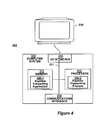
- Figure 4 illustrates an example computer system architecture for a computer system that performs express forwarding of frames having multiple fragments in accordance with embodiments of the invention.
- Express forwarding is a technique used to reduce delay for a designated frame along a multi-hop path by insuring that a forwarding node incurs less delay than single-hop transmissions.
- For a single-channel mesh forwarding delay is reduced by reserving the channel for a forwarded transmission for a sufficiently long time interval to enable the next forwarding node to seize the channel. Immediate access is thus given to nodes, other than the first node on a multi-hop path, forwarding QoS traffic.
- a frame to be express forwarded is designated as a time-sensitive QoS (TSQ) transmission.
- TSQ time-sensitive QoS
- a special flag may be used to mark a transmission as express forwarded, depending on the criteria for a TSQ transmission and/or the information available along its path.
- the TSQ designation may be supplied by the application, for example, a TSQ frame could be a frame of a specified user priority (e.g. VO).
- the TSQ designation may also be supplied by the originating node, for example, if there is differentiation between ad hoc and infrastructure traffic, all voice frames starting or destined to the portal would be designated TSQ by the originating node.
- the TSQ designation can further be used for other criteria.
- a known time increment DT0 is added to the value of the Duration field when a TSQ frame is forwarded.
- the Duration field of the ACK (if any) returned for the TSQ frame received at the destination node is set based on the Duration field of the received frame. All nodes that hear the transmission other than the receiving node set their NAV according to the Duration field
- DT0 should be sufficiently long to enable a forwarding node to process the received frame and prepare it for transmission on the next hop. It must be at least a time slot long.
- FIG. 1 a diagram 10 showing the timing of an express forwarded frame among several nodes is shown.
- Nodes 1-5 are shown, with a three-hop path for an express forwarded frame traversing from node 1 to node 2, node 2 to node 3 and then node 3 to node 4.
- Node 5 is a non-forwarding neighbor node.
- Each node maintains a NAV for the channel 12.
- a first frame 14 is designated as an express forwarded frame, to be forwarded from node 1 to node 2.
- the Duration field is set at value longer than usual when a frame is transmitted to a forwarding node of a multi-hop path.
- the forwarding nodes, 2 and 3, transmit when they complete acknowledgment of the received frame.
- the forwarding nodes, 2 and 3 adjust the Duration value on the received frame by subtracting the increment when setting their NAV.
- the non-forwarding neighbor nodes - e.g. node 5 - set its NAV by the received Duration field.
- node 2 as the intended recipient of the forwarded frame does not set its NAV.
- node 2 will have access to channel 12 before node 5 does, and the frame will be forwarded more quickly, since node 2 can access the channel before node 5 and forward the frame.
- node 2 may transmit when transmission and acknowledgment are completed, whereas the NAV at node 5, which was set to the value of the Duration field, has the value DT0 when the received frame has been acknowledged.
- Neighbor nodes have their NAV still set to at least one time slot when the new forwarding node is ready to transmit (barring any independent NAV-setting request); thus they will not contend for the channel, letting that node transmit before any of them.
- a forwarding node may perform Controlled Channel Access (CCA) before attempting transmission. This avoids collisions with another node that has not heard the received TSQ transmission to set the NAV accordingly. If the channel is busy, the forwarding node backs off a delay from a short contention window CWmin(EF).
- CCA Controlled Channel Access
- TXOPs allow multiple frames to be transmitted with a single contention. TXOPs can be used together with express forwarding. The combination reduces contention and collisions along the forwarding path.
- the Duration field value on each frame of a TXOP to be forwarded is increased by DT0.
- a TXOP may contain exclusively TSQ frames, or a mix of frames, some to be express forwarded and other not.
- the frames to be express forwarded are flagged as TSQ.
- the TSQ frames of a TXOP should be transmitted before the non-TSQ frames in order to reduce the processing delay of the TSQ frames at the receiving node and thus enable their immediate forwarding. All TSQ frames in a given TXOP shall be transmitted to the same node.
- the Duration field on the ACK (if any) for each of the TXOP frames received at the destination node is set based on received frame.
- the receiving node will be able to transmit immediately following the completion and acknowledgment of the TXOP.
- Forwarding of the frames in the received TXOP starts when the NAV expires, which occurs once the entire TXOP has been received and acknowledged. Forwarding of the frames in the received TXOP may involve the segregation of the frames into different TXOPs according to the next hop destination node.
- Frames buffered at the receiving node in the same access category as the received TXOP may be transmitted in the forwarded TXOPs, provided such frames are sent to the same node as the forwarded TXOP and the size of the augmented TXOP does not exceed the TXOP limit for the access category.
- RTS/CTS is the mechanism for reducing the impact of hidden terminals, which are common in a wireless mesh.
- RTS/CTS protection may be used in conjunction with express forwarding. The combination reduces contention and collisions on the forwarding path.
- the RTS of a time-sensitive QoS frame is flagged TSQ and the Duration field on the RTS is increased by the increment DT0.
- the node to which the RTS is addressed responds with a CTS with Duration value set based on the Duration field of the received RTS. If the node receiving the RTS must forward the RTS-protected frame(s), it does so upon acknowledgement of the RTS-protected frame(s).
- Another embodiment involves multi-channel express forwarding.
- An example is shown in the environment 20 of Figure 2 .
- a node may not transmit or decrement the back off delay if the data channel being reserved is busy, unless the channel's NAV is due to expire within a time interval equal to AIFR (advance interval for reservation).
- AIFR advance interval for reservation
- a node When responding to a CC-RTS with a CC-CTS, a node must decline the reservation if the indicated data channel is busy, unless the channel's NAV is due to expire within a time interval equal to (AIFR - RTS_Tx Time) [RTS_Tx Time is the transmit time of a CC-RTS].
- the length of AIFR depends on the access priority of the CC-RTS/CC-CTS. A longer AIFR is used for a higher access priority.
- a frame may be fragmented into pieces small enough to pass over a link with a smaller Maximum Transmission Unit (MTU) than the original frame size.
- MTU refers to the size (in bytes) of the largest packet or frame that a given layer of a communications protocol can pass onwards. If a receiving host receives a packet which is fragmented, it has to reassemble the packet and hand it over to the higher layer. Reassembly always happens only in the receiving host. Fragmentation can cause excessive retransmissions when fragments encounter packet loss and reliable protocols such as TCP must retransmit all of the fragments in order to recover from the loss of a single fragment.
- the express forwarding node will start transmitting only at the end of the last fragment.
- the duration field value on each fragment of the frame to be forwarded is increased by DT0 and the fragments are designated as TSQ.
- the duration field on the ACK for each of the fragments received at the destination node is set based on received fragment duration.
- the NAV at the node to which the fragments are forwarded is set by subtracting DTI from the Duration field value of a received frame if the frame is to be forwarded. Forwarding of the received fragments starts when the NAV expires, which occurs once all the fragments have been received and acknowledged.
- FIG. 3 A flow diagram of a particular embodiment of the presently disclosed method is depicted in Figure 3 .
- the rectangular elements are herein denoted "processing blocks" and represent computer software instructions or groups of instructions.
- the processing blocks represent steps performed by functionally equivalent circuits such as a digital signal processor circuit or an application specific integrated circuit (ASIC).
- ASIC application specific integrated circuit
- the flow diagrams do not depict the syntax of any particular programming language. Rather, the flow diagrams illustrate the functional information one of ordinary skill in the art requires to fabricate circuits or to generate computer software to perform the processing required in accordance with the present invention. It should be noted that many routine program elements, such as initialization of loops and variables and the use of temporary variables are not shown.
- Method 100 begins with processing block 102 which discloses maintaining at each respective node of a plurality of nodes of a wireless LAN, a timer (NAV) set to a corresponding time period during which the respective node must refrain from transmitting on a channel.
- processing block 102 discloses maintaining at each respective node of a plurality of nodes of a wireless LAN, a timer (NAV) set to a corresponding time period during which the respective node must refrain from transmitting on a channel.
- NAV timer
- Processing block 104 states designating at least two fragments of a frame as a Time Sensitive Quality of Service (TSQ) frame fragments to be express forwarded from a first node to a second node of said plurality of nodes.
- TSQ Time Sensitive Quality of Service
- a frame may be fragmented into pieces small enough to pass over a link with a smaller Maximum Transmission Unit (MTU) than the original frame size.
- MTU refers to the size (in bytes) of the largest packet or frame that a given layer of a communications protocol can pass onwards.
- MTU refers to the size (in bytes) of the largest packet or frame that a given layer of a communications protocol can pass onwards.
- the TSQ frame fragments designation is supplied by at least one of an application and an originating node.
- Processing block 108 recites incrementing a duration field of each of the TSQ frame fragments by a first predetermined time increment (DT0) before the TSQ frame fragments are forwarded by the first node.
- DT0 first predetermined time increment
- Processing block 110 discloses transmitting the TSQ frame fragments by the first node to the second node when a last frame fragment of the frame fragments are ready to be transmitted.
- the transmitting the TSQ frame fragments by the first node to the second node further comprises transmitting when the NAV of the second node expires.
- Processing block 114 discloses receiving a response from the second node wherein non-forwarding neighboring nodes of the plurality of nodes each set their NAV according to a value equal to the duration field of the response, and wherein the second node attempts forwarding of the TSQ frame fragments when acknowledgement of receipt of the TSQ frame fragments is complete.
- Processing block 116 states wherein the receiving a response from the second node comprises receiving an acknowledgement (ACK) for each frame fragment received by the second node.
- Processing block 118 recites a duration field of the ACK is set based on a received fragment duration value.
- Processing continues with processing block 120 which discloses wherein a NAV of the second node is set by subtracting a second predetermined time increment (DT1) from a duration value of a received frame when the received frame is to be forwarded.
- DT1 second predetermined time increment
- Processing block 122 states incrementing a duration field of the TSQ frame fragments by a first predetermined time increment (DT0) before the TSQ frame fragments are transmitted by the first node is not performed for a last hop.
- DT0 first predetermined time increment
- Figure 4 is a block diagram illustrating an example computer system 300 (a node) for implementing express forwarding function 340 and/or other related processes to carry out the different functionality as described herein.
- computer system 300 of the present example includes an interconnect 311 that couples a memory system 312 and a processor 313 an input/output interface 314, and a communications interface 315.
- Express forwarding application 340-1 can be embodied as software code such as data and/or logic instructions (e.g., code stored in the memory or on another computer readable medium such as a disk) that support functionality according to different embodiments described herein.
- processor 313 of computer system 300 accesses memory system 312 via the interconnect 311 in order to launch, run, execute, interpret or otherwise perform the logic instructions of the express forwarding application 340-1.
- Execution of express forwarding application 340-1 produces processing functionality in express forwarding process 340-2.
- the express forwarding process 340-2 represents one or more portions of the express forwarding application 340-I (or the entire application) performing within or upon the processor 313 in the computer system 300.
- embodiments herein include the express forwarding application 340-1 itself (i.e., the un-executed or non-performing logic instructions and/or data).
- the express forwarding application 340-1 can be stored on a computer readable medium such as a floppy disk, hard disk, or optical medium.
- the express forwarding application 340-I can also be stored in a memory type system such as in firmware, read only memory (ROM), or, as in this example, as executable code within the memory system 312 (e.g., within Random Access Memory or RAM).
- the device(s) or computer systems that integrate with the processor(s) may include, for example, a personal computer(s), workstation(s) (e.g., Sun, HP), personal digital assistant(s) (PDA(s)), handheld device(s) such as cellular telephone(s), laptop(s), handheld computer(s), or another device(s) capable of being integrated with a processor(s) that may operate as provided herein. Accordingly, the devices provided herein are not exhaustive and are provided for illustration and not limitation.
- references to "a microprocessor” and “a processor”, or “the microprocessor” and “the processor,” may be understood to include one or more microprocessors that may communicate in a stand-alone and/or a distributed environment(s), and may thus be configured to communicate via wired or wireless communications with other processors, where such one or more processor may be configured to operate on one or more processor-controlled devices that may be similar or different devices.
- Use of such "microprocessor” or “processor” terminology may thus also be understood to include a central processing unit, an arithmetic logic unit, an application-specific integrated circuit (IC), and/or a task engine, with such examples provided for illustration and not limitation.
- references to memory may include one or more processor-readable and accessible memory elements and/or components that may be internal to the processor-controlled device, external to the processor-controlled device, and/or may be accessed via a wired or wireless network using a variety of communications protocols, and unless otherwise specified, may be arranged to include a combination of external and internal memory devices, where such memory may be contiguous and/or partitioned based on the application.
- references to a database may be understood to include one or more memory associations, where such references may include commercially available database products (e.g., SQL, Informix, Oracle) and also proprietary databases, and may also include other structures for associating memory such as links, queues, graphs, trees, with such structures provided for illustration and not limitation.
- References to a network may include one or more intranets and/or the Internet, as well as a virtual network. References herein to microprocessor instructions or microprocessor-executable instructions, in accordance with the above, may be understood to include programmable hardware.
- a computer usable medium can include a readable memory device, such as a hard drive device, a CD-ROM, a DVD-ROM, or a computer diskette, having computer readable program code segments stored thereon.
- the computer readable medium can also include a communications link, either optical, wired, or wireless, having program code segments carried thereon as digital or analog signals.
Landscapes
- Engineering & Computer Science (AREA)
- Computer Networks & Wireless Communication (AREA)
- Signal Processing (AREA)
- Mobile Radio Communication Systems (AREA)
Abstract
Description
- The present application claims the benefit of
U.S. Provisional Patent Applications No. 60/972,817, filed on September 17, 2007 - Wireless Local Area Networks (WLANS) have become ubiquitous. Growth in demand for Wireless Local Area Networks (WLANs) is driving the development of new technology to provide higher throughput. To a greater extent this growth is due to the increased number of users and applications desiring wireless transmission and to a lesser extent to the emergence of new applications needing higher transmission rates along a single connection between two points.
- In wireless Local Area Networks (LANs), a wireless channel can be reserved for the transmission of a single frame or of a sequence of frames, known as a TXOP (transmit opportunity), while employing asynchronous distributed random channel access methods, as described in the 2007 802.11 standard, which includes the 11e amendment, where the TXOP was introduced, the IEEE Std 802.11™-2007, (Revision of IEEE Std 802.11-1999), and the Wireless LAN Medium Access Control (MAC) and Physical Layer (PHY) Specifications. In such an environment, both the source and destination of the transmission broadcast the reservation duration in order to establish an interference neighborhood. A TXOP is a sequence of frames transmitted between a pair of nodes following a single contention for the channel. A TXOP holder, the node initiating the TXOP, may transmit contention-free after the first transmission to the Responder, which is the node receiving the frames in the TXOP.
- To date, there are two basic ways of reserving the channel for a TXOP in wireless LANs. One method of performing reservation is by utilizing frame-by-frame reservation. According to the 802.11 distributed channel access MAC protocol, RTS/CTS frames are used to notify neighbors of the start of the reservation. Alternatively, the first frame of a TXOP has its duration field set to a time interval long enough to reserve the channel for the transmission of the following frame. The reservation time is extended on a frame-by-frame basis, by updating the length of the reservation with each data frame and the acknowledgement that follows. A consequence of frame-by-frame reservation is that, if the reservation is denied, it does not require cancellation.
- Another method of performing reservation in wireless LANS is by utilizing start-to-finish reservation. If it is not be possible to extend the time of channel reservation on a frame-by-frame basis, the channel must be reserved for the entire sequence of transmissions, from start to finish, at the time of the reservation request. If the reservation request is denied, or if time remains reserved at the completion of transmission, the reservation must be cancelled.
- A start-to-finish reservation applies to any combination of nodes (i.e., mesh points/Access Points (APs)/stations). A node reserves a channel to cover an entire sequence of transmissions, directed to either one or various different destinations, possibly including responses from the destinations. If the reservation is not authorized, or when the transmission sequence is completed, the reserving node releases the remaining reservation time by canceling the reservation.
- To avoid collisions, each node keeps a NAV for a traffic channel, which is set according to the received reservation requests and responses. A NAV is defined as a time period a node must refrain from transmitting on a traffic channel. It is maintained by each station and is updated by the Duration field value of received transmissions, which may serve as TXOP reservation requests or responses to reservation requests. A reservation request from the transmission source is either granted or denied by the destination, and notice is sent to the source. The response contains in the Duration field the remaining reservation duration in order to notify the neighbors of the destination node. Applications for wireless networks include Voice Over Internet Protocol (VoIP), and multimedia (Voice and/or Video), together referred to as VoIP/multimedia. VoIP/multimedia applications require a certain Quality of Service (QoS) in order to maintain sufficient quality of the communication. Latency can be an issue for VoIP/multi-media. Meeting QoS requires short total end-to-end over-the-air delays. The 802.11e amendment to the IEEE 802.11 standard, which is incorporated in the 2007 revision of the standard, provides mechanisms for reducing the over-the-air delays from transmissions in a wireless LAN. These are single hop transmissions. The 802.11e mechanisms may not be adequate for meeting latency requirements in wireless networks involving multiple-hop transmissions. Wireless mesh networks are such networks.
- A wireless mesh may be an Ad hoc mode mesh (not attached to a wired network) or an infrastructure mode mesh (attached to a wired network). In general, both traffic with source and destination in the mesh and traffic bound from/to a wired network may co-exist on a mesh. The latency/jitter limit for voice traffic traversing the wired network is lower (40 to 50 milliseconds) than that for traffic staying on the wireless mesh (175-200 milliseconds). A mesh will involve multiple-hop flows. The mesh backbone network is a multi-hop network. The multi-hop path delay will be at least a multiple of the single hop delay. Wireless meshes operating on a single channel have novel collision behavior that can impact nearby the latency experienced end to end, over the air. The prevalence of hidden nodes and the interaction of contention-based access with multi-hop flows impose latency increases on both mesh and nearby WLANs beyond what non-mesh experience suggests. Hidden nodes remain hidden after retrial, and their transmissions are dropped. The high correlation of sequentially forwarded frames on a multi-hop flow cause excessive delays to transmissions that have been involved in a collision. For backward compatibility, and for the contention-based access protocol to continue to be used, remedies are needed on the mesh side. For QoS traffic, multi-hop delay must meet the same latency constraints as single-hop delay. There is thus a need for remedies to reduce over-the-air latency. The goal is to reduce the delay experienced on the longest multi-hop path by forwarding frames along a multi-hop path in an accelerated manner.
- A frame may be fragmented into pieces small enough to pass over a link with a smaller Maximum Transmission Unit (MTU) than the original frame size. MTU refers to the size (in bytes) of the largest packet or frame that a given layer of a communications protocol can pass onwards. If a receiving host receives a packet which is fragmented, it has to reassemble the packet and hand it over to the higher layer. Reassembly always happens only in the receiving host. Fragmentation can cause excessive retransmissions when fragments encounter packet loss and reliable protocols such as TCP must retransmit all of the fragments in order to recover from the loss of a single fragment.
- One way to reduce delay in a wireless mesh is by providing capacity provisioning. The nodes and links of the mesh network must have sufficient capacity to prevent traffic buffer from building up anywhere in the network. Proper provisioning involves the use of multiple radios at nodes of high traffic concentration to match traffic profiles.
- Another way to reduce delay in wireless mesh is by providing congestion control. Reducing transmit rate and rerouting traffic can alleviate congestion, given the provisioning. Even with proper provisioning, the stochastic nature of traffic may produce short-term fluctuations which may cause congestion at certain nodes.
- MAC layer prioritized transmission of forwarded QoS traffic across the mesh helps reduce end-to-end delay along a multi-hop path, given congestion control and capacity provisioning. For fast forwarding, QoS traffic would require top priority access when forwarded on a multi-hop path. Lower priority access would be used for all other traffic. EDCA offers access prioritization on a single channel. Further prioritization is not possible with EDCA, however. Higher-priority 802.11e traffic (VO/VI) already uses the top-priority access category. A different mechanism is needed for forwarded QoS traffic.
- Conventional mechanisms such as those explained above suffer from a variety of deficiencies. Embodiments of the invention significantly overcome such deficiencies and provide mechanisms and techniques that provide for express forwarding of frames having multiple fragments which have been designated as time-sensitive QoS (TSQ) frames.
- In a particular embodiment of a method for providing express forwarding of frames having multiple fragments, the method includes maintaining at each respective node of a plurality of nodes of a wireless LAN, a timer (NAV) set to a corresponding time period during which the respective node must refrain from transmitting on a channel. The method further includes designating at least two fragments of a frame as a Time Sensitive Quality of Service (TSQ) frame fragments to be express forwarded from a first node to a second node of the plurality of nodes and incrementing a duration field of each of the TSQ frame fragments by a first predetermined time increment (DT0) before the TSQ frame fragments are forwarded by the first node. The method also includes transmitting the TSQ frame fragments by the first node to the second node when a last frame fragment of the frame fragments are ready to be transmitted. The method additionally includes receiving a response from the second node wherein non-forwarding neighboring nodes of the plurality of nodes each set their NAV according to a value equal to the duration field of the response, and wherein the second node attempts forwarding of the TSQ frame fragments when acknowledgement of receipt of the TSQ frame fragments is complete.
- Other embodiments include a computer readable medium having computer readable code thereon for providing express forwarding of frames having multiple fragments. The computer readable medium includes instructions for maintaining at each respective node of a plurality of nodes of a wireless LAN, a timer (NAV) set to a corresponding time period during which the respective node must refrain from transmitting on a channel. The computer readable medium further includes instructions for designating at least two fragments of a frame as a Time Sensitive Quality of Service (TSQ) frame fragments to be express forwarded from a first node to a second node of the plurality of nodes and instructions for incrementing a duration field of each of the TSQ frame fragments by a first predetermined time increment (DT0) before the TSQ frame fragments are forwarded by the first node. The computer readable medium also includes instructions for transmitting the TSQ frame fragments by the first node to the second node when a last frame fragment of the frame fragments are ready to be transmitted. The computer readable medium additionally includes instructions for receiving a response from the second node wherein non-forwarding neighboring nodes of the plurality of nodes each set their NAV according to a value equal to the duration field of the response, and wherein the second node attempts forwarding of the TSQ frame fragments when acknowledgement of receipt of the TSQ frame fragments is complete.
- Still other embodiments include a computerized device, configured to process all the method operations disclosed herein as embodiments of the invention. In such embodiments, the computerized device includes a memory system, a processor, communications interface in an interconnection mechanism connecting these components. The memory system is encoded with a process that provides express forwarding of frames having multiple fragments as explained herein that when performed (e.g. when executing) on the processor, operates as explained herein within the computerized device to perform all of the method embodiments and operations explained herein as embodiments of the invention. Thus any computerized device that performs or is programmed to perform up processing explained herein is an embodiment of the invention.
- Other arrangements of embodiments of the invention that are disclosed herein include software programs to perform the method embodiment steps and operations summarized above and disclosed in detail below. More particularly, a computer program product is one embodiment that has a computer-readable medium including computer program logic encoded thereon that when performed in a computerized device provides associated operations providing express forwarding of frames having multiple fragments as explained herein. The computer program logic, when executed on at least one processor with a computing system, causes the processor to perform the operations (e.g., the methods) indicated herein as embodiments of the invention. Such arrangements of the invention are typically provided as software, code and/or other data structures arranged or encoded on a computer readable medium such as an optical medium (e.g., CD-ROM), floppy or hard disk or other a medium such as firmware or microcode in one or more ROM or RAM or PROM chips or as an Application Specific Integrated Circuit (ASIC) or as downloadable software images in one or more modules, shared libraries, etc. The software or firmware or other such configurations can be installed onto a computerized device to cause one or more processors in the computerized device to perform the techniques explained herein as embodiments of the invention. Software processes that operate in a collection of computerized devices, such as in a group of data communications devices or other entities can also provide the system of the invention. The system of the invention can be distributed between many software processes on several data communications devices, or all processes could run on a small set of dedicated computers, or on one computer alone.
- It is to be understood that the embodiments of the invention can be embodied strictly as a software program, as software and hardware, or as hardware and/or circuitry alone, such as within a data communications device. The features of the invention, as explained herein, may be employed in data communications devices and/or software systems for such devices such as those manufactured by Avaya, Inc. of Lincroft, New Jersey.
- Note that each of the different features, techniques, configurations, etc. discussed in this disclosure can be executed independently or in combination. Accordingly, the present invention can be embodied and viewed in many different ways.
- Also, note that this summary section herein does not specify every embodiment and/or incrementally novel aspect of the present disclosure or claimed invention. Instead, this summary only provides a preliminary discussion of different embodiments and corresponding points of novelty over conventional techniques. For additional details, elements, and/or possible perspectives (permutations) of the invention, the reader is directed to the Detailed Description section and corresponding figures of the present disclosure as further discussed below.
- The foregoing will be apparent from the following more particular description of preferred embodiments of the invention, as illustrated in the accompanying drawings in which like reference characters refer to the same parts throughout the different views. The drawings are not necessarily to scale, emphasis instead being placed upon illustrating the principles of the invention.
-
Figure 1 comprises a diagram showing the timing of an express forwarded frame among several nodes is shown; -
Figure 2 comprises a diagram showing the timing of multi-channel express forwarding; -
Figure 3 depicts a flow diagram of a particular embodiment of a method of performing express forwarding of frames having multiple fragments in accordance with embodiments the invention; and -
Figure 4 illustrates an example computer system architecture for a computer system that performs express forwarding of frames having multiple fragments in accordance with embodiments of the invention. - Express forwarding is a technique used to reduce delay for a designated frame along a multi-hop path by insuring that a forwarding node incurs less delay than single-hop transmissions. For a single-channel mesh forwarding delay is reduced by reserving the channel for a forwarded transmission for a sufficiently long time interval to enable the next forwarding node to seize the channel. Immediate access is thus given to nodes, other than the first node on a multi-hop path, forwarding QoS traffic.
- A frame to be express forwarded is designated as a time-sensitive QoS (TSQ) transmission. A special flag may be used to mark a transmission as express forwarded, depending on the criteria for a TSQ transmission and/or the information available along its path. The TSQ designation may be supplied by the application, for example, a TSQ frame could be a frame of a specified user priority (e.g. VO). Alternatively, the TSQ designation may also be supplied by the originating node, for example, if there is differentiation between ad hoc and infrastructure traffic, all voice frames starting or destined to the portal would be designated TSQ by the originating node. The TSQ designation can further be used for other criteria.
- In order to process an express forwarded frame, a known time increment DT0 is added to the value of the Duration field when a TSQ frame is forwarded. The Duration field of the ACK (if any) returned for the TSQ frame received at the destination node is set based on the Duration field of the received frame. All nodes that hear the transmission other than the receiving node set their NAV according to the Duration field
- of the received transmission. If the receiving node forwards the frame, it subtracts DT0 from the Duration value of a received frame before setting its NAV, and attempts transmission of the received TSQ frame when acknowledgement of receipt of the TSQ frame is complete. DT0 should be sufficiently long to enable a forwarding node to process the received frame and prepare it for transmission on the next hop. It must be at least a time slot long.
- Referring now to
Figure 1 , a diagram 10 showing the timing of an express forwarded frame among several nodes is shown. Nodes 1-5 are shown, with a three-hop path for an express forwarded frame traversing fromnode 1 tonode 2,node 2 tonode 3 and thennode 3 to node 4. Node 5 is a non-forwarding neighbor node. Each node maintains a NAV for thechannel 12. Afirst frame 14 is designated as an express forwarded frame, to be forwarded fromnode 1 tonode 2. The Duration field is set at value longer than usual when a frame is transmitted to a forwarding node of a multi-hop path. The forwarding nodes, 2 and 3, transmit when they complete acknowledgment of the received frame. In an alternative embodiment of this invention, the forwarding nodes, 2 and 3, adjust the Duration value on the received frame by subtracting the increment when setting their NAV. The non-forwarding neighbor nodes - e.g. node 5 - set its NAV by the received Duration field. Thus,node 2, as the intended recipient of the forwarded frame does not set its NAV. Accordingly,node 2 will have access tochannel 12 before node 5 does, and the frame will be forwarded more quickly, sincenode 2 can access the channel before node 5 and forward the frame. Thus,node 2 may transmit when transmission and acknowledgment are completed, whereas the NAV at node 5, which was set to the value of the Duration field, has the value DT0 when the received frame has been acknowledged. - Contention is reduced when forwarding a TSQ frame for all forwarding nodes other than the first node on path. Neighbor nodes have their NAV still set to at least one time slot when the new forwarding node is ready to transmit (barring any independent NAV-setting request); thus they will not contend for the channel, letting that node transmit before any of them.
- A forwarding node may perform Controlled Channel Access (CCA) before attempting transmission. This avoids collisions with another node that has not heard the received TSQ transmission to set the NAV accordingly. If the channel is busy, the forwarding node backs off a delay from a short contention window CWmin(EF).
- TXOPs allow multiple frames to be transmitted with a single contention. TXOPs can be used together with express forwarding. The combination reduces contention and collisions along the forwarding path. The Duration field value on each frame of a TXOP to be forwarded is increased by DT0. A TXOP may contain exclusively TSQ frames, or a mix of frames, some to be express forwarded and other not. The frames to be express forwarded are flagged as TSQ. Preferably the TSQ frames of a TXOP should be transmitted before the non-TSQ frames in order to reduce the processing delay of the TSQ frames at the receiving node and thus enable their immediate forwarding. All TSQ frames in a given TXOP shall be transmitted to the same node. The Duration field on the ACK (if any) for each of the TXOP frames received at the destination node is set based on received frame. The receiving node will be able to transmit immediately following the completion and acknowledgment of the TXOP. Forwarding of the frames in the received TXOP starts when the NAV expires, which occurs once the entire TXOP has been received and acknowledged. Forwarding of the frames in the received TXOP may involve the segregation of the frames into different TXOPs according to the next hop destination node. Frames buffered at the receiving node in the same access category as the received TXOP may be transmitted in the forwarded TXOPs, provided such frames are sent to the same node as the forwarded TXOP and the size of the augmented TXOP does not exceed the TXOP limit for the access category.
- RTS/CTS is the mechanism for reducing the impact of hidden terminals, which are common in a wireless mesh. RTS/CTS protection may be used in conjunction with express forwarding. The combination reduces contention and collisions on the forwarding path. The RTS of a time-sensitive QoS frame is flagged TSQ and the Duration field on the RTS is increased by the increment DT0. The node to which the RTS is addressed responds with a CTS with Duration value set based on the Duration field of the received RTS. If the node receiving the RTS must forward the RTS-protected frame(s), it does so upon acknowledgement of the RTS-protected frame(s). Forwarding of the received frame or TXOP starts when the NAV expires, which occurs once the frame or TXOP has been received and acknowledged. The express forwarding mechanism works even when the receiving node is not required to observe its NAV after acknowledging receipt of a frame. Express forwarding gives priority access to frames marked TSQ over all other traffic.
- Another embodiment involves multi-channel express forwarding. An example is shown in the
environment 20 ofFigure 2 . When attempting to send a CC-RTS on the Control Channel, a node may not transmit or decrement the back off delay if the data channel being reserved is busy, unless the channel's NAV is due to expire within a time interval equal to AIFR (advance interval for reservation). When responding to a CC-RTS with a CC-CTS, a node must decline the reservation if the indicated data channel is busy, unless the channel's NAV is due to expire within a time interval equal to (AIFR - RTS_Tx Time) [RTS_Tx Time is the transmit time of a CC-RTS]. The length of AIFR depends on the access priority of the CC-RTS/CC-CTS. A longer AIFR is used for a higher access priority. - In certain scenarios, a frame may be fragmented into pieces small enough to pass over a link with a smaller Maximum Transmission Unit (MTU) than the original frame size. MTU refers to the size (in bytes) of the largest packet or frame that a given layer of a communications protocol can pass onwards. If a receiving host receives a packet which is fragmented, it has to reassemble the packet and hand it over to the higher layer. Reassembly always happens only in the receiving host. Fragmentation can cause excessive retransmissions when fragments encounter packet loss and reliable protocols such as TCP must retransmit all of the fragments in order to recover from the loss of a single fragment.
- In order to provide express forwarding for multiple fragments, when multiple fragments of a frame are transmitted, the express forwarding node will start transmitting only at the end of the last fragment. The duration field value on each fragment of the frame to be forwarded is increased by DT0 and the fragments are designated as TSQ. The duration field on the ACK for each of the fragments received at the destination node is set based on received fragment duration. The NAV at the node to which the fragments are forwarded is set by subtracting DTI from the Duration field value of a received frame if the frame is to be forwarded. Forwarding of the received fragments starts when the NAV expires, which occurs once all the fragments have been received and acknowledged.
- A flow diagram of a particular embodiment of the presently disclosed method is depicted in
Figure 3 . The rectangular elements are herein denoted "processing blocks" and represent computer software instructions or groups of instructions. Alternatively, the processing blocks represent steps performed by functionally equivalent circuits such as a digital signal processor circuit or an application specific integrated circuit (ASIC). The flow diagrams do not depict the syntax of any particular programming language. Rather, the flow diagrams illustrate the functional information one of ordinary skill in the art requires to fabricate circuits or to generate computer software to perform the processing required in accordance with the present invention. It should be noted that many routine program elements, such as initialization of loops and variables and the use of temporary variables are not shown. It will be appreciated by those of ordinary skill in the art that unless otherwise indicated herein, the particular sequence of steps described is illustrative only and can be varied without departing from the spirit of the invention. Thus, unless otherwise stated the steps described below are unordered meaning that, when possible, the steps can be performed in any convenient or desirable order. - Referring now to
Figure 3 , a particular embodiment of amethod 100 of performing express forwarding of frames having multiple fragments is shown.Method 100 begins withprocessing block 102 which discloses maintaining at each respective node of a plurality of nodes of a wireless LAN, a timer (NAV) set to a corresponding time period during which the respective node must refrain from transmitting on a channel. -
Processing block 104 states designating at least two fragments of a frame as a Time Sensitive Quality of Service (TSQ) frame fragments to be express forwarded from a first node to a second node of said plurality of nodes. A frame may be fragmented into pieces small enough to pass over a link with a smaller Maximum Transmission Unit (MTU) than the original frame size. MTU refers to the size (in bytes) of the largest packet or frame that a given layer of a communications protocol can pass onwards. As shown inprocessing block 106, the TSQ frame fragments designation is supplied by at least one of an application and an originating node. -
Processing block 108 recites incrementing a duration field of each of the TSQ frame fragments by a first predetermined time increment (DT0) before the TSQ frame fragments are forwarded by the first node. -
Processing block 110 discloses transmitting the TSQ frame fragments by the first node to the second node when a last frame fragment of the frame fragments are ready to be transmitted. As further shown inprocessing block 112, the transmitting the TSQ frame fragments by the first node to the second node further comprises transmitting when the NAV of the second node expires. -
Processing block 114 discloses receiving a response from the second node wherein non-forwarding neighboring nodes of the plurality of nodes each set their NAV according to a value equal to the duration field of the response, and wherein the second node attempts forwarding of the TSQ frame fragments when acknowledgement of receipt of the TSQ frame fragments is complete.Processing block 116 states wherein the receiving a response from the second node comprises receiving an acknowledgement (ACK) for each frame fragment received by the second node.Processing block 118 recites a duration field of the ACK is set based on a received fragment duration value. - Processing continues with
processing block 120 which discloses wherein a NAV of the second node is set by subtracting a second predetermined time increment (DT1) from a duration value of a received frame when the received frame is to be forwarded. -
Processing block 122 states incrementing a duration field of the TSQ frame fragments by a first predetermined time increment (DT0) before the TSQ frame fragments are transmitted by the first node is not performed for a last hop. -
Figure 4 is a block diagram illustrating an example computer system 300 (a node) for implementing express forwarding function 340 and/or other related processes to carry out the different functionality as described herein. - As shown,
computer system 300 of the present example includes aninterconnect 311 that couples amemory system 312 and aprocessor 313 an input/output interface 314, and acommunications interface 315. - As shown,
memory system 312 is encoded with express forwarding application 340-1. Express forwarding application 340-1 can be embodied as software code such as data and/or logic instructions (e.g., code stored in the memory or on another computer readable medium such as a disk) that support functionality according to different embodiments described herein. - During operation,
processor 313 ofcomputer system 300 accessesmemory system 312 via theinterconnect 311 in order to launch, run, execute, interpret or otherwise perform the logic instructions of the express forwarding application 340-1. Execution of express forwarding application 340-1 produces processing functionality in express forwarding process 340-2. In other words, the express forwarding process 340-2 represents one or more portions of the express forwarding application 340-I (or the entire application) performing within or upon theprocessor 313 in thecomputer system 300. - It should be noted that, in addition to the express forwarding process 340-2, embodiments herein include the express forwarding application 340-1 itself (i.e., the un-executed or non-performing logic instructions and/or data). The express forwarding application 340-1 can be stored on a computer readable medium such as a floppy disk, hard disk, or optical medium. The express forwarding application 340-I can also be stored in a memory type system such as in firmware, read only memory (ROM), or, as in this example, as executable code within the memory system 312 (e.g., within Random Access Memory or RAM).
- In addition to these embodiments, it should also be noted that other embodiments herein include the execution of express forwarding application 340-1 in
processor 313 as the express forwarding process 340-2. Those skilled in the art will understand that thecomputer system 300 can include other processes and/or software and hardware components, such as an operating system that controls allocation and use of hardware resources associated with thecomputer system 300. - The device(s) or computer systems that integrate with the processor(s) may include, for example, a personal computer(s), workstation(s) (e.g., Sun, HP), personal digital assistant(s) (PDA(s)), handheld device(s) such as cellular telephone(s), laptop(s), handheld computer(s), or another device(s) capable of being integrated with a processor(s) that may operate as provided herein. Accordingly, the devices provided herein are not exhaustive and are provided for illustration and not limitation.
- References to "a microprocessor" and "a processor", or "the microprocessor" and "the processor," may be understood to include one or more microprocessors that may communicate in a stand-alone and/or a distributed environment(s), and may thus be configured to communicate via wired or wireless communications with other processors, where such one or more processor may be configured to operate on one or more processor-controlled devices that may be similar or different devices. Use of such "microprocessor" or "processor" terminology may thus also be understood to include a central processing unit, an arithmetic logic unit, an application-specific integrated circuit (IC), and/or a task engine, with such examples provided for illustration and not limitation.
- Furthermore, references to memory, unless otherwise specified, may include one or more processor-readable and accessible memory elements and/or components that may be internal to the processor-controlled device, external to the processor-controlled device, and/or may be accessed via a wired or wireless network using a variety of communications protocols, and unless otherwise specified, may be arranged to include a combination of external and internal memory devices, where such memory may be contiguous and/or partitioned based on the application. Accordingly, references to a database may be understood to include one or more memory associations, where such references may include commercially available database products (e.g., SQL, Informix, Oracle) and also proprietary databases, and may also include other structures for associating memory such as links, queues, graphs, trees, with such structures provided for illustration and not limitation.
- References to a network, unless provided otherwise, may include one or more intranets and/or the Internet, as well as a virtual network. References herein to microprocessor instructions or microprocessor-executable instructions, in accordance with the above, may be understood to include programmable hardware.
- Unless otherwise stated, use of the word "substantially" may be construed to include a precise relationship, condition, arrangement, orientation, and/or other characteristic, and deviations thereof as understood by one of ordinary skill in the art, to the extent that such deviations do not materially affect the disclosed methods and systems.
- Throughout the entirety of the present disclosure, use of the articles "a" or "an" to modify a noun may be understood to be used for convenience and to include one, or more than one of the modified noun, unless otherwise specifically stated.
- Elements, components, modules, and/or parts thereof that are described and/or otherwise portrayed through the figures to communicate with, be associated with, and/or be based on, something else, may be understood to so communicate, be associated with, and or be based on in a direct and/or indirect manner, unless otherwise stipulated herein.
- Although the methods and systems have been described relative to a specific embodiment thereof, they are not so limited. Obviously many modifications and variations may become apparent in light of the above teachings. Many additional changes in the details, materials, and arrangement of parts, herein described and illustrated, may be made by those skilled in the art.
- Having described preferred embodiments of the invention it will now become apparent to those of ordinary skill in the art that other embodiments incorporating these concepts may be used. Additionally, the software included as part of the invention may be embodied in a computer program product that includes a computer useable medium. For example, such a computer usable medium can include a readable memory device, such as a hard drive device, a CD-ROM, a DVD-ROM, or a computer diskette, having computer readable program code segments stored thereon. The computer readable medium can also include a communications link, either optical, wired, or wireless, having program code segments carried thereon as digital or analog signals. Accordingly, it is submitted that that the invention should not be limited to the described embodiments but rather should be limited only by the spirit and scope of the appended claims.
Claims (21)
- A method comprising:maintaining at each respective node of a plurality of nodes of a wireless Local Area Network (LAN), a timer (NAV) set to a corresponding time period during which the respective node must refrain from transmitting on a channel;designating at least two fragments of a frame as a Time Sensitive Quality of Service (TSQ) frame fragments to be express forwarded from a first node to a second node of said plurality of nodes;incrementing a duration field of each of said TSQ frame fragments by a first predetermined time increment (DT0) before the TSQ frame fragments are forwarded by said first node;transmitting said TSQ frame fragments by said first node to said second node when a last frame fragment of said frame fragments are ready to be transmitted; andreceiving a response from said second node wherein non-forwarding neighboring nodes of said plurality of nodes each set their NAV according to a value equal to the duration field of the response, and wherein said second node attempts forwarding of said TSQ frame fragments when acknowledgement of receipt of the TSQ frame fragments is complete.
- The method of claim 1 wherein said TSQ frame fragments designation is supplied by at least one of an application and an originating node.
- The method of claim 1 wherein said incrementing a duration field of said TSQ frame fragments by a first predetermined time increment (DT0) before the TSQ frame fragments are transmitted by said first node is not performed for a last hop.
- The method of claim 1 wherein said transmitting said TSQ frame fragments by said first node to said second node further comprises transmitting when said NAV of said second node expires.
- The method of claim 1 wherein said receiving a response from said second node comprises receiving an acknowledgement (ACK) for each frame fragment received by said second node.
- The method of claim 5 wherein a duration field of said ACK is set based on a received fragment duration value.
- The method of claim 1 wherein a NAV of said second node is set by subtracting a second predetermined time increment (DT1) fro a duration value of a received frame when the received frame is to be forwarded.
- A computer readable medium having computer readable code thereon for providing express forwarding of frames having multiple fragments, the medium comprising:instructions for maintaining at each respective node of a plurality of nodes of a wireless Local Area Network (LAN), a timer (NAV) set to a corresponding time period during which the respective node must refrain from transmitting on a channel;instructions for designating at least two fragments of a frame as a Time Sensitive Quality of Service (TSQ) frame fragments to be express forwarded from a first node to a second node of said plurality of nodes;instructions for incrementing a duration field of each of said TSQ frame fragments by a first predetermined time increment (DT0) before the TSQ frame fragments are forwarded by said first node;instructions for transmitting said TSQ frame fragments by said first node to said second node when a last frame fragment of said frame fragments are ready to be transmitted; andinstructions for receiving a response from said second node wherein non-forwarding neighboring nodes of said plurality of nodes each set their NAV according to a value equal to the duration field of the response, and wherein said second node attempts forwarding of said TSQ frame fragments when acknowledgement of receipt of the TSQ frame fragments is complete.
- The computer readable medium of claim 8 further comprising instructions wherein said TSQ frame fragments designation is supplied by at least one of an application and an originating node.
- The computer readable medium of claim 8 further comprising instructions wherein said incrementing a duration field of said TSQ frame fragments by a first predetermined time increment (DT0) before the TSQ frame fragments are transmitted by said first node is not performed for a last hop.
- The computer readable medium of claim 8 further comprising instructions wherein said transmitting said TSQ frame fragments by said first node to said second node further comprises transmitting when said NAV of said second node expires.
- The computer readable medium of claim 8 further comprising instructions wherein said receiving a response from said second node comprises receiving an acknowledgement (ACK) for each frame fragment received by said second node.
- The computer readable medium of claim 12 further comprising instructions wherein a duration field of said ACK is set based on a received fragment duration value.
- The computer readable medium of claim 8 further comprising instructions wherein a NAV of said second node is set by subtracting a second predetermined time increment (DT1) fro a duration value of a received frame when the received frame is to be forwarded.
- A computer system comprising:a memory;a processor;a communications interface;an interconnection mechanism coupling the memory, the processor and the communications interface; andwherein the memory is encoded with an express forwarding application that when performed on the processor, provides an express forwarding process for processing information, the express forwarding process causing the computer system to be capable of performing the operations of:maintaining at each respective node of a plurality of nodes of a wireless Local Area Network (LAN), a timer (NAV) set to a corresponding time period during which the respective node must refrain from transmitting on a channel;designating at least two fragments of a frame as a Time Sensitive Quality of Service (TSQ) frame fragments to be express forwarded from a first node to a second node of said plurality of nodes;incrementing a duration field of each of said TSQ frame fragments by a first predetermined time increment (DT0) before the TSQ frame fragments are forwarded by said first node;transmitting said TSQ frame fragments by said first node to said second node when a last frame fragment of said frame fragments are ready to be transmitted; andreceiving a response from said second node wherein non-forwarding neighboring nodes of said plurality of nodes each set their NAV according to a value equal to the duration field of the response, and wherein said second node attempts forwarding of said TSQ frame fragments when acknowledgement of receipt of the TSQ frame fragments is complete.
- The computer system of claim 15 wherein said TSQ frame fragments designation is supplied by at least one of an application and an originating node.
- The computer system of claim 15 wherein said incrementing a duration field of said TSQ frame fragments by a first predetermined time increment (DT0) before the TSQ frame fragments are transmitted by said first node is not performed for a last hop.
- The computer system of claim 15 wherein said transmitting said TSQ frame fragments by said first node to said second node further comprises transmitting when said NAV of said second node expires.
- The computer system of claim 15 wherein said receiving a response from said second node comprises receiving an acknowledgement (ACK) for each frame fragment received by said second node.
- The computer system of claim 19 wherein a duration field of said ACK is set based on a received fragment duration value.
- The computer system of claim 1 wherein a NAV of said second node is set by subtracting a second predetermined time increment (DT1) fro a duration value of a received frame when the received frame is to be forwarded.
Applications Claiming Priority (1)
| Application Number | Priority Date | Filing Date | Title |
|---|---|---|---|
| US97281707P | 2007-09-17 | 2007-09-17 |
Publications (2)
| Publication Number | Publication Date |
|---|---|
| EP2037718A2 true EP2037718A2 (en) | 2009-03-18 |
| EP2037718A3 EP2037718A3 (en) | 2010-04-21 |
Family
ID=40227945
Family Applications (1)
| Application Number | Title | Priority Date | Filing Date |
|---|---|---|---|
| EP08164393A Withdrawn EP2037718A3 (en) | 2007-09-17 | 2008-09-16 | Method and Apparatus Performing Express Forwarding Frames Having Multiple Fragments |
Country Status (3)
| Country | Link |
|---|---|
| US (1) | US8072955B2 (en) |
| EP (1) | EP2037718A3 (en) |
| KR (1) | KR101487718B1 (en) |
Cited By (2)
| Publication number | Priority date | Publication date | Assignee | Title |
|---|---|---|---|---|
| WO2012048251A3 (en) * | 2010-10-07 | 2012-06-07 | Qualcomm Incorporated | Methods and devices to implement a reduced contention period to facilitate channel access for access terminals operating in a wireless communication environment |
| WO2012167193A3 (en) * | 2011-06-03 | 2013-01-24 | Qualcomm Incorporated | Systems and methods for receiver based clear channel assessment |
Families Citing this family (5)
| Publication number | Priority date | Publication date | Assignee | Title |
|---|---|---|---|---|
| WO2010068405A2 (en) | 2008-12-10 | 2010-06-17 | Marvell World Trade Ltd. | Efficient formats of beacon, announcement, and beamforming training frames |
| US9584179B2 (en) * | 2012-02-23 | 2017-02-28 | Silver Spring Networks, Inc. | System and method for multi-channel frequency hopping spread spectrum communication |
| US9226227B2 (en) | 2012-06-29 | 2015-12-29 | Marvell World Trade Ltd. | Group based beacons |
| US10433180B2 (en) * | 2016-12-22 | 2019-10-01 | Qualcomm Incorporated | Dynamic medium sharing |
| CN120153744A (en) * | 2023-10-12 | 2025-06-13 | 北京小米移动软件有限公司 | Communication method, station equipment and access point equipment |
Family Cites Families (2)
| Publication number | Priority date | Publication date | Assignee | Title |
|---|---|---|---|---|
| US6965942B1 (en) * | 2001-01-12 | 2005-11-15 | 3Com Corporation | Method and system for improving throughput over wireless local area networks with a dynamic contention window |
| JP4184964B2 (en) * | 2001-09-27 | 2008-11-19 | テレフオンアクチーボラゲット エル エム エリクソン(パブル) | Multi-hop routing method for distributed WLAN network |
-
2008
- 2008-09-12 US US12/209,305 patent/US8072955B2/en not_active Expired - Fee Related
- 2008-09-16 EP EP08164393A patent/EP2037718A3/en not_active Withdrawn
- 2008-09-17 KR KR20080091306A patent/KR101487718B1/en not_active Expired - Fee Related
Non-Patent Citations (3)
| Title |
|---|
| ANONYMOUS ED - ANONYMOUS: "IEEE Standard for Information technology-Telecommunications and information exchange between systems-Local and metropolitan area networks-Specific requirements - Part 11: Wireless LAN Medium Access Control (MAC) and Physical Layer (PHY) Specifications; IEEE Std 802.11-2007 (Revision of IEEE Std 802." 12 June 2007 (2007-06-12), IEEE STANDARD; [IEEE STANDARD], IEEE, PISCATAWAY, NJ, USA, PAGE(S) C1 - 1184 , XP017601788 ISBN: 9780738156569 * page 6, line 13 - line 14 * * page 8, line 13 - line 16 * * page 10, line 22 - line 23 * * page 11, line 1 - line 3 * * page 266, line 1 - line 3 * * page 266, line 7 - line 10 * * Figure 9-9 * * |
| BENVENISTE M ET AL: "Express Forwarding in a Multi-hop Wireless Network" IEEE 802.11-07/0415r3 16 May 2007 (2007-05-16), pages 1-21, XP002570765 [retrieved on 2010-02-22] * |
| Mathilde Benveniste: "Express forwarding for single-channel wireless mesh" IEEE 802.11-07/2452r0 16 September 2007 (2007-09-16), pages 1-29, XP002570879 Retrieved from the Internet: URL:https://mentor.ieee.org/802.11/file/07 /11-07-2452-00-000s-express-forwarding-for -single-channel-wireless-mesh.ppt> [retrieved on 2010-03-01] * |
Cited By (10)
| Publication number | Priority date | Publication date | Assignee | Title |
|---|---|---|---|---|
| WO2012048251A3 (en) * | 2010-10-07 | 2012-06-07 | Qualcomm Incorporated | Methods and devices to implement a reduced contention period to facilitate channel access for access terminals operating in a wireless communication environment |
| CN103155681A (en) * | 2010-10-07 | 2013-06-12 | 高通股份有限公司 | Methods and devices to implement a reduced contention period to facilitate channel access for access terminals operating in a wireless communication environment |
| JP2013543327A (en) * | 2010-10-07 | 2013-11-28 | クゥアルコム・インコーポレイテッド | Method and device for implementing reduced contention periods to enable channel access for access terminals operating in a wireless communication environment |
| US8681612B2 (en) | 2010-10-07 | 2014-03-25 | Qualcomm Incorporated | Methods and devices to implement a reduced contention period to facilitate channel access for access terminals operating in a wireless communication environment |
| JP2014239450A (en) * | 2010-10-07 | 2014-12-18 | クゥアルコム・インコーポレイテッドQualcomm Incorporated | Methods and devices to implement reduced contention period to enable channel access for access terminals operating in wireless communication environment |
| EP2892298A1 (en) * | 2010-10-07 | 2015-07-08 | Qualcomm Incorporated | Methods and devices to implement a reduced contention period to facilitate channel access for access terminals operating in a wireless communication environment |
| CN103155681B (en) * | 2010-10-07 | 2016-04-20 | 高通股份有限公司 | The method and apparatus of channel access is carried out with accessing terminal of contributing to operating in a wireless communication environment for realizing competing time period of reducing |
| WO2012167193A3 (en) * | 2011-06-03 | 2013-01-24 | Qualcomm Incorporated | Systems and methods for receiver based clear channel assessment |
| EP2806687A1 (en) * | 2011-06-03 | 2014-11-26 | Qualcomm Incorporated | Systems and methods for receiver based clear channel assessment |
| US9392469B2 (en) | 2011-06-03 | 2016-07-12 | Qualcomm Incorporated | Systems and methods for receiver based clear channel assessment |
Also Published As
| Publication number | Publication date |
|---|---|
| KR101487718B1 (en) | 2015-01-29 |
| US20090323650A1 (en) | 2009-12-31 |
| KR20090029175A (en) | 2009-03-20 |
| EP2037718A3 (en) | 2010-04-21 |
| US8072955B2 (en) | 2011-12-06 |
Similar Documents
| Publication | Publication Date | Title |
|---|---|---|
| JP5039679B2 (en) | Method and apparatus for imposing random delay to avoid hidden terminal collisions in wireless mesh networks | |
| JP4130648B2 (en) | Communication apparatus and communication method | |
| AU2007223302B2 (en) | Transmission control for wireless communication networks | |
| US20070297375A1 (en) | System and method for data transmission in an ad hoc communication network | |
| US20040151144A1 (en) | Emergency call handling in contention-based wireless local-area networks | |
| US8072955B2 (en) | Method and apparatus performing express forwarding frames having multiple fragments | |
| US20050025131A1 (en) | Medium access control in wireless local area network | |
| JP2008546275A (en) | Control and data separation in wireless networks | |
| US8867518B2 (en) | Method and apparatus performing express forwarding bypass for time-critical frames | |
| US7649911B2 (en) | Method of data handling in a WLAN | |
| US8301955B2 (en) | Method and apparatus performing express retransmission of frames | |
| US8126006B2 (en) | Method of providing a medium access protocol | |
| US8243710B1 (en) | Method and apparatus performing express forwarding | |
| JP4335219B2 (en) | Wireless LAN traffic priority control method and apparatus | |
| WO2009154581A1 (en) | Wireless local area networking devices providing protection for high priority packets | |
| US9197482B1 (en) | Optimizing quality of service in wireless networks | |
| JP2010166269A (en) | Method and device for high-speed frame retransmission | |
| EP2081412A2 (en) | Method and Apparatus Performing Express Retransmission of Frames | |
| JP5653470B2 (en) | Method and apparatus for performing high-speed retransmission of frames | |
| Wang et al. | Priority based multiple access for service differentiation in wireless ad-hoc networks | |
| JP2010074346A (en) | Method and apparatus performing express-forwarding frames having multiple fragments | |
| Benveniste | A distributed QoS MAC protocol for wireless mesh | |
| KR100736730B1 (en) | Control Method of Block ACK Data Transmission on MAC | |
| KR100847013B1 (en) | Control Apparatus and Method of Retransmission on MAC for Multiple Receiver to Reduce Data Transmission Delay | |
| CN115226226A (en) | A wireless ad hoc network hybrid adaptive channel access method |
Legal Events
| Date | Code | Title | Description |
|---|---|---|---|
| PUAI | Public reference made under article 153(3) epc to a published international application that has entered the european phase |
Free format text: ORIGINAL CODE: 0009012 |
|
| AK | Designated contracting states |
Kind code of ref document: A2 Designated state(s): AT BE BG CH CY CZ DE DK EE ES FI FR GB GR HR HU IE IS IT LI LT LU LV MC MT NL NO PL PT RO SE SI SK TR |
|
| AX | Request for extension of the european patent |
Extension state: AL BA MK RS |
|
| PUAL | Search report despatched |
Free format text: ORIGINAL CODE: 0009013 |
|
| AK | Designated contracting states |
Kind code of ref document: A3 Designated state(s): AT BE BG CH CY CZ DE DK EE ES FI FR GB GR HR HU IE IS IT LI LT LU LV MC MT NL NO PL PT RO SE SI SK TR |
|
| AX | Request for extension of the european patent |
Extension state: AL BA MK RS |
|
| 17P | Request for examination filed |
Effective date: 20101019 |
|
| 17Q | First examination report despatched |
Effective date: 20101109 |
|
| AKX | Designation fees paid |
Designated state(s): AT BE BG CH CY CZ DE DK EE ES FI FR GB GR HR HU IE IS IT LI LT LU LV MC MT NL NO PL PT RO SE SI SK TR |
|
| STAA | Information on the status of an ep patent application or granted ep patent |
Free format text: STATUS: THE APPLICATION IS DEEMED TO BE WITHDRAWN |
|
| 18D | Application deemed to be withdrawn |
Effective date: 20110520 |