EP2037299A1 - Adhesive optical film and image display device - Google Patents
Adhesive optical film and image display device Download PDFInfo
- Publication number
- EP2037299A1 EP2037299A1 EP07745015A EP07745015A EP2037299A1 EP 2037299 A1 EP2037299 A1 EP 2037299A1 EP 07745015 A EP07745015 A EP 07745015A EP 07745015 A EP07745015 A EP 07745015A EP 2037299 A1 EP2037299 A1 EP 2037299A1
- Authority
- EP
- European Patent Office
- Prior art keywords
- pressure
- sensitive adhesive
- optical film
- film
- weight
- Prior art date
- Legal status (The legal status is an assumption and is not a legal conclusion. Google has not performed a legal analysis and makes no representation as to the accuracy of the status listed.)
- Granted
Links
- 239000012788 optical film Substances 0.000 title claims abstract description 93
- 230000001070 adhesive effect Effects 0.000 title description 14
- 239000000853 adhesive Substances 0.000 title description 13
- 239000004820 Pressure-sensitive adhesive Substances 0.000 claims abstract description 154
- 239000010410 layer Substances 0.000 claims abstract description 138
- 238000006073 displacement reaction Methods 0.000 claims abstract description 41
- 230000035699 permeability Effects 0.000 claims abstract description 22
- 238000010008 shearing Methods 0.000 claims abstract description 4
- 239000010408 film Substances 0.000 claims description 130
- 229920000058 polyacrylate Polymers 0.000 claims description 40
- 230000001681 protective effect Effects 0.000 claims description 40
- 239000003431 cross linking reagent Substances 0.000 claims description 39
- XLYOFNOQVPJJNP-UHFFFAOYSA-N water Chemical compound O XLYOFNOQVPJJNP-UHFFFAOYSA-N 0.000 claims description 23
- 238000005187 foaming Methods 0.000 abstract description 22
- 239000000463 material Substances 0.000 abstract description 21
- 230000010287 polarization Effects 0.000 description 78
- 239000000178 monomer Substances 0.000 description 54
- NIXOWILDQLNWCW-UHFFFAOYSA-M Acrylate Chemical compound [O-]C(=O)C=C NIXOWILDQLNWCW-UHFFFAOYSA-M 0.000 description 53
- -1 alkyl methacrylate Chemical compound 0.000 description 45
- 239000004973 liquid crystal related substance Substances 0.000 description 44
- 239000000243 solution Substances 0.000 description 42
- 238000000034 method Methods 0.000 description 33
- 229920000642 polymer Polymers 0.000 description 31
- XEKOWRVHYACXOJ-UHFFFAOYSA-N Ethyl acetate Chemical compound CCOC(C)=O XEKOWRVHYACXOJ-UHFFFAOYSA-N 0.000 description 21
- 229910052751 metal Inorganic materials 0.000 description 20
- 239000002184 metal Substances 0.000 description 20
- 229920002451 polyvinyl alcohol Polymers 0.000 description 19
- 235000019422 polyvinyl alcohol Nutrition 0.000 description 18
- 239000004372 Polyvinyl alcohol Substances 0.000 description 16
- 239000007787 solid Substances 0.000 description 16
- 125000000217 alkyl group Chemical group 0.000 description 15
- 238000004020 luminiscence type Methods 0.000 description 15
- 230000003287 optical effect Effects 0.000 description 15
- 238000009792 diffusion process Methods 0.000 description 14
- IJGRMHOSHXDMSA-UHFFFAOYSA-N Atomic nitrogen Chemical compound N#N IJGRMHOSHXDMSA-UHFFFAOYSA-N 0.000 description 13
- 239000006087 Silane Coupling Agent Substances 0.000 description 13
- NIXOWILDQLNWCW-UHFFFAOYSA-N acrylic acid group Chemical group C(C=C)(=O)O NIXOWILDQLNWCW-UHFFFAOYSA-N 0.000 description 13
- 229920005601 base polymer Polymers 0.000 description 12
- 230000000052 comparative effect Effects 0.000 description 12
- 210000002858 crystal cell Anatomy 0.000 description 12
- NLKNQRATVPKPDG-UHFFFAOYSA-M potassium iodide Chemical compound [K+].[I-] NLKNQRATVPKPDG-UHFFFAOYSA-M 0.000 description 12
- 238000012360 testing method Methods 0.000 description 12
- 229920000106 Liquid crystal polymer Polymers 0.000 description 11
- 125000004122 cyclic group Chemical group 0.000 description 11
- 229920005672 polyolefin resin Polymers 0.000 description 11
- 229920005989 resin Polymers 0.000 description 10
- 239000011347 resin Substances 0.000 description 10
- HRPVXLWXLXDGHG-UHFFFAOYSA-N Acrylamide Chemical compound NC(=O)C=C HRPVXLWXLXDGHG-UHFFFAOYSA-N 0.000 description 9
- 229920002284 Cellulose triacetate Polymers 0.000 description 9
- NNLVGZFZQQXQNW-ADJNRHBOSA-N [(2r,3r,4s,5r,6s)-4,5-diacetyloxy-3-[(2s,3r,4s,5r,6r)-3,4,5-triacetyloxy-6-(acetyloxymethyl)oxan-2-yl]oxy-6-[(2r,3r,4s,5r,6s)-4,5,6-triacetyloxy-2-(acetyloxymethyl)oxan-3-yl]oxyoxan-2-yl]methyl acetate Chemical compound O([C@@H]1O[C@@H]([C@H]([C@H](OC(C)=O)[C@H]1OC(C)=O)O[C@H]1[C@@H]([C@@H](OC(C)=O)[C@H](OC(C)=O)[C@@H](COC(C)=O)O1)OC(C)=O)COC(=O)C)[C@@H]1[C@@H](COC(C)=O)O[C@@H](OC(C)=O)[C@H](OC(C)=O)[C@H]1OC(C)=O NNLVGZFZQQXQNW-ADJNRHBOSA-N 0.000 description 9
- 150000001875 compounds Chemical group 0.000 description 9
- 239000010419 fine particle Substances 0.000 description 9
- 150000002978 peroxides Chemical class 0.000 description 9
- 238000000576 coating method Methods 0.000 description 8
- 239000012948 isocyanate Substances 0.000 description 8
- 150000002513 isocyanates Chemical class 0.000 description 8
- 238000004040 coloring Methods 0.000 description 7
- 125000002887 hydroxy group Chemical group [H]O* 0.000 description 7
- IQPQWNKOIGAROB-UHFFFAOYSA-N isocyanate group Chemical group [N-]=C=O IQPQWNKOIGAROB-UHFFFAOYSA-N 0.000 description 7
- 238000002360 preparation method Methods 0.000 description 7
- 239000000126 substance Substances 0.000 description 7
- 239000010409 thin film Substances 0.000 description 7
- OZAIFHULBGXAKX-UHFFFAOYSA-N 2-(2-cyanopropan-2-yldiazenyl)-2-methylpropanenitrile Chemical compound N#CC(C)(C)N=NC(C)(C)C#N OZAIFHULBGXAKX-UHFFFAOYSA-N 0.000 description 6
- ZCYVEMRRCGMTRW-UHFFFAOYSA-N 7553-56-2 Chemical compound [I] ZCYVEMRRCGMTRW-UHFFFAOYSA-N 0.000 description 6
- 125000004432 carbon atom Chemical group C* 0.000 description 6
- 230000002209 hydrophobic effect Effects 0.000 description 6
- 229910052740 iodine Inorganic materials 0.000 description 6
- 239000011630 iodine Substances 0.000 description 6
- 239000000203 mixture Substances 0.000 description 6
- 229920001296 polysiloxane Polymers 0.000 description 6
- 230000002265 prevention Effects 0.000 description 6
- 238000012545 processing Methods 0.000 description 6
- 239000000758 substrate Substances 0.000 description 6
- 239000004986 Cholesteric liquid crystals (ChLC) Substances 0.000 description 5
- VYPSYNLAJGMNEJ-UHFFFAOYSA-N Silicium dioxide Chemical compound O=[Si]=O VYPSYNLAJGMNEJ-UHFFFAOYSA-N 0.000 description 5
- 238000010521 absorption reaction Methods 0.000 description 5
- 239000007864 aqueous solution Substances 0.000 description 5
- 230000008901 benefit Effects 0.000 description 5
- 125000003178 carboxy group Chemical group [H]OC(*)=O 0.000 description 5
- 239000011248 coating agent Substances 0.000 description 5
- 238000002347 injection Methods 0.000 description 5
- 239000007924 injection Substances 0.000 description 5
- 229910052757 nitrogen Inorganic materials 0.000 description 5
- 229920000728 polyester Polymers 0.000 description 5
- 229920002635 polyurethane Polymers 0.000 description 5
- 239000004814 polyurethane Substances 0.000 description 5
- 230000008569 process Effects 0.000 description 5
- SMZOUWXMTYCWNB-UHFFFAOYSA-N 2-(2-methoxy-5-methylphenyl)ethanamine Chemical compound COC1=CC=C(C)C=C1CCN SMZOUWXMTYCWNB-UHFFFAOYSA-N 0.000 description 4
- LYCAIKOWRPUZTN-UHFFFAOYSA-N Ethylene glycol Chemical compound OCCO LYCAIKOWRPUZTN-UHFFFAOYSA-N 0.000 description 4
- 239000004977 Liquid-crystal polymers (LCPs) Substances 0.000 description 4
- PPBRXRYQALVLMV-UHFFFAOYSA-N Styrene Chemical compound C=CC1=CC=CC=C1 PPBRXRYQALVLMV-UHFFFAOYSA-N 0.000 description 4
- 239000000654 additive Substances 0.000 description 4
- 239000012298 atmosphere Substances 0.000 description 4
- 238000006243 chemical reaction Methods 0.000 description 4
- 238000005401 electroluminescence Methods 0.000 description 4
- 230000004313 glare Effects 0.000 description 4
- 239000011521 glass Substances 0.000 description 4
- 239000002648 laminated material Substances 0.000 description 4
- 238000010030 laminating Methods 0.000 description 4
- 238000004519 manufacturing process Methods 0.000 description 4
- 229920000139 polyethylene terephthalate Polymers 0.000 description 4
- 239000002861 polymer material Substances 0.000 description 4
- 229920006395 saturated elastomer Polymers 0.000 description 4
- 239000004593 Epoxy Substances 0.000 description 3
- JOYRKODLDBILNP-UHFFFAOYSA-N Ethyl urethane Chemical compound CCOC(N)=O JOYRKODLDBILNP-UHFFFAOYSA-N 0.000 description 3
- 239000004952 Polyamide Substances 0.000 description 3
- YXFVVABEGXRONW-UHFFFAOYSA-N Toluene Chemical compound CC1=CC=CC=C1 YXFVVABEGXRONW-UHFFFAOYSA-N 0.000 description 3
- 125000004018 acid anhydride group Chemical group 0.000 description 3
- 230000000996 additive effect Effects 0.000 description 3
- 229910052782 aluminium Inorganic materials 0.000 description 3
- KGBXLFKZBHKPEV-UHFFFAOYSA-N boric acid Chemical compound OB(O)O KGBXLFKZBHKPEV-UHFFFAOYSA-N 0.000 description 3
- 239000004327 boric acid Substances 0.000 description 3
- 229920002678 cellulose Polymers 0.000 description 3
- 239000001913 cellulose Substances 0.000 description 3
- 235000010980 cellulose Nutrition 0.000 description 3
- 230000008859 change Effects 0.000 description 3
- 239000000470 constituent Substances 0.000 description 3
- 230000001276 controlling effect Effects 0.000 description 3
- 238000007796 conventional method Methods 0.000 description 3
- 229910001873 dinitrogen Inorganic materials 0.000 description 3
- 238000004043 dyeing Methods 0.000 description 3
- 239000000839 emulsion Substances 0.000 description 3
- 239000011888 foil Substances 0.000 description 3
- 230000004048 modification Effects 0.000 description 3
- 238000012986 modification Methods 0.000 description 3
- PXHVJJICTQNCMI-UHFFFAOYSA-N nickel Substances [Ni] PXHVJJICTQNCMI-UHFFFAOYSA-N 0.000 description 3
- 150000002894 organic compounds Chemical class 0.000 description 3
- 229920002647 polyamide Polymers 0.000 description 3
- 239000005020 polyethylene terephthalate Substances 0.000 description 3
- 229920001155 polypropylene Polymers 0.000 description 3
- 239000011241 protective layer Substances 0.000 description 3
- 239000011342 resin composition Substances 0.000 description 3
- 238000003756 stirring Methods 0.000 description 3
- BPSIOYPQMFLKFR-UHFFFAOYSA-N trimethoxy-[3-(oxiran-2-ylmethoxy)propyl]silane Chemical compound CO[Si](OC)(OC)CCCOCC1CO1 BPSIOYPQMFLKFR-UHFFFAOYSA-N 0.000 description 3
- KANZWHBYRHQMKZ-UHFFFAOYSA-N 2-ethenylpyrazine Chemical compound C=CC1=CN=CC=N1 KANZWHBYRHQMKZ-UHFFFAOYSA-N 0.000 description 2
- 125000000954 2-hydroxyethyl group Chemical group [H]C([*])([H])C([H])([H])O[H] 0.000 description 2
- OMIGHNLMNHATMP-UHFFFAOYSA-N 2-hydroxyethyl prop-2-enoate Chemical class OCCOC(=O)C=C OMIGHNLMNHATMP-UHFFFAOYSA-N 0.000 description 2
- FKAWETHEYBZGSR-UHFFFAOYSA-N 3-methylidenepyrrolidine-2,5-dione Chemical compound C=C1CC(=O)NC1=O FKAWETHEYBZGSR-UHFFFAOYSA-N 0.000 description 2
- SXIFAEWFOJETOA-UHFFFAOYSA-N 4-hydroxy-butyl Chemical group [CH2]CCCO SXIFAEWFOJETOA-UHFFFAOYSA-N 0.000 description 2
- UXVMQQNJUSDDNG-UHFFFAOYSA-L Calcium chloride Chemical compound [Cl-].[Cl-].[Ca+2] UXVMQQNJUSDDNG-UHFFFAOYSA-L 0.000 description 2
- VZCYOOQTPOCHFL-OWOJBTEDSA-N Fumaric acid Chemical compound OC(=O)\C=C\C(O)=O VZCYOOQTPOCHFL-OWOJBTEDSA-N 0.000 description 2
- PEEHTFAAVSWFBL-UHFFFAOYSA-N Maleimide Chemical compound O=C1NC(=O)C=C1 PEEHTFAAVSWFBL-UHFFFAOYSA-N 0.000 description 2
- 239000004698 Polyethylene Substances 0.000 description 2
- 239000004642 Polyimide Substances 0.000 description 2
- 239000004734 Polyphenylene sulfide Substances 0.000 description 2
- 239000004743 Polypropylene Substances 0.000 description 2
- GWEVSGVZZGPLCZ-UHFFFAOYSA-N Titan oxide Chemical compound O=[Ti]=O GWEVSGVZZGPLCZ-UHFFFAOYSA-N 0.000 description 2
- MCMNRKCIXSYSNV-UHFFFAOYSA-N Zirconium dioxide Chemical compound O=[Zr]=O MCMNRKCIXSYSNV-UHFFFAOYSA-N 0.000 description 2
- 229920001893 acrylonitrile styrene Polymers 0.000 description 2
- 230000004913 activation Effects 0.000 description 2
- 239000012790 adhesive layer Substances 0.000 description 2
- XAGFODPZIPBFFR-UHFFFAOYSA-N aluminium Chemical compound [Al] XAGFODPZIPBFFR-UHFFFAOYSA-N 0.000 description 2
- 125000003277 amino group Chemical group 0.000 description 2
- MWPLVEDNUUSJAV-UHFFFAOYSA-N anthracene Chemical compound C1=CC=CC2=CC3=CC=CC=C3C=C21 MWPLVEDNUUSJAV-UHFFFAOYSA-N 0.000 description 2
- 125000004429 atom Chemical group 0.000 description 2
- 239000002585 base Substances 0.000 description 2
- CQEYYJKEWSMYFG-UHFFFAOYSA-N butyl acrylate Chemical compound CCCCOC(=O)C=C CQEYYJKEWSMYFG-UHFFFAOYSA-N 0.000 description 2
- 125000000484 butyl group Chemical group [H]C([*])([H])C([H])([H])C([H])([H])C([H])([H])[H] 0.000 description 2
- 239000001110 calcium chloride Substances 0.000 description 2
- 229910001628 calcium chloride Inorganic materials 0.000 description 2
- 238000004132 cross linking Methods 0.000 description 2
- 238000007598 dipping method Methods 0.000 description 2
- 238000001035 drying Methods 0.000 description 2
- 230000000694 effects Effects 0.000 description 2
- 229920001971 elastomer Polymers 0.000 description 2
- 125000003700 epoxy group Chemical group 0.000 description 2
- 239000005038 ethylene vinyl acetate Substances 0.000 description 2
- 238000011156 evaluation Methods 0.000 description 2
- 239000004744 fabric Substances 0.000 description 2
- 229920000578 graft copolymer Polymers 0.000 description 2
- 238000010438 heat treatment Methods 0.000 description 2
- WGCNASOHLSPBMP-UHFFFAOYSA-N hydroxyacetaldehyde Natural products OCC=O WGCNASOHLSPBMP-UHFFFAOYSA-N 0.000 description 2
- 239000003999 initiator Substances 0.000 description 2
- 238000003475 lamination Methods 0.000 description 2
- 238000005259 measurement Methods 0.000 description 2
- 230000007246 mechanism Effects 0.000 description 2
- 238000002156 mixing Methods 0.000 description 2
- 229910052759 nickel Inorganic materials 0.000 description 2
- 229920003207 poly(ethylene-2,6-naphthalate) Polymers 0.000 description 2
- 229920001200 poly(ethylene-vinyl acetate) Polymers 0.000 description 2
- 239000004417 polycarbonate Substances 0.000 description 2
- 229920000515 polycarbonate Polymers 0.000 description 2
- 229920006393 polyether sulfone Polymers 0.000 description 2
- 229920000573 polyethylene Polymers 0.000 description 2
- 229920001721 polyimide Polymers 0.000 description 2
- 229920006254 polymer film Polymers 0.000 description 2
- 229920000098 polyolefin Polymers 0.000 description 2
- 229920000069 polyphenylene sulfide Polymers 0.000 description 2
- 229920000915 polyvinyl chloride Polymers 0.000 description 2
- SCUZVMOVTVSBLE-UHFFFAOYSA-N prop-2-enenitrile;styrene Chemical compound C=CC#N.C=CC1=CC=CC=C1 SCUZVMOVTVSBLE-UHFFFAOYSA-N 0.000 description 2
- 125000001436 propyl group Chemical group [H]C([*])([H])C([H])([H])C([H])([H])[H] 0.000 description 2
- 230000006798 recombination Effects 0.000 description 2
- 238000005215 recombination Methods 0.000 description 2
- 230000009467 reduction Effects 0.000 description 2
- 230000001105 regulatory effect Effects 0.000 description 2
- 239000000377 silicon dioxide Substances 0.000 description 2
- 125000006850 spacer group Chemical group 0.000 description 2
- 238000005507 spraying Methods 0.000 description 2
- KZNICNPSHKQLFF-UHFFFAOYSA-N succinimide Chemical compound O=C1CCC(=O)N1 KZNICNPSHKQLFF-UHFFFAOYSA-N 0.000 description 2
- 150000003457 sulfones Chemical class 0.000 description 2
- 230000001629 suppression Effects 0.000 description 2
- 229920005992 thermoplastic resin Polymers 0.000 description 2
- VZCYOOQTPOCHFL-UHFFFAOYSA-N trans-butenedioic acid Natural products OC(=O)C=CC(O)=O VZCYOOQTPOCHFL-UHFFFAOYSA-N 0.000 description 2
- 238000001771 vacuum deposition Methods 0.000 description 2
- 230000000007 visual effect Effects 0.000 description 2
- JIAARYAFYJHUJI-UHFFFAOYSA-L zinc dichloride Chemical compound [Cl-].[Cl-].[Zn+2] JIAARYAFYJHUJI-UHFFFAOYSA-L 0.000 description 2
- YNGKYBTVHBAUSQ-UHFFFAOYSA-N 1,2-bis(isocyanatomethyl)benzene;2-ethyl-2-(hydroxymethyl)propane-1,3-diol Chemical compound CCC(CO)(CO)CO.O=C=NCC1=CC=CC=C1CN=C=O YNGKYBTVHBAUSQ-UHFFFAOYSA-N 0.000 description 1
- RTTZISZSHSCFRH-UHFFFAOYSA-N 1,3-bis(isocyanatomethyl)benzene Chemical compound O=C=NCC1=CC=CC(CN=C=O)=C1 RTTZISZSHSCFRH-UHFFFAOYSA-N 0.000 description 1
- IAUGBVWVWDTCJV-UHFFFAOYSA-N 1-(prop-2-enoylamino)propane-1-sulfonic acid Chemical compound CCC(S(O)(=O)=O)NC(=O)C=C IAUGBVWVWDTCJV-UHFFFAOYSA-N 0.000 description 1
- WKBPZYKAUNRMKP-UHFFFAOYSA-N 1-[2-(2,4-dichlorophenyl)pentyl]1,2,4-triazole Chemical class C=1C=C(Cl)C=C(Cl)C=1C(CCC)CN1C=NC=N1 WKBPZYKAUNRMKP-UHFFFAOYSA-N 0.000 description 1
- XTKZBPGQKMDFMC-UHFFFAOYSA-N 1-butyl-3-methylidenepyrrolidine-2,5-dione Chemical compound CCCCN1C(=O)CC(=C)C1=O XTKZBPGQKMDFMC-UHFFFAOYSA-N 0.000 description 1
- BGKQCHAKBLWCDU-UHFFFAOYSA-N 1-cyclohexyl-3-methylidenepyrrolidine-2,5-dione Chemical compound O=C1C(=C)CC(=O)N1C1CCCCC1 BGKQCHAKBLWCDU-UHFFFAOYSA-N 0.000 description 1
- GXDLZONOWLZMTG-UHFFFAOYSA-N 1-dodecyl-3-methylidenepyrrolidine-2,5-dione Chemical compound CCCCCCCCCCCCN1C(=O)CC(=C)C1=O GXDLZONOWLZMTG-UHFFFAOYSA-N 0.000 description 1
- SJLLJZNSZJHXQN-UHFFFAOYSA-N 1-dodecylpyrrole-2,5-dione Chemical compound CCCCCCCCCCCCN1C(=O)C=CC1=O SJLLJZNSZJHXQN-UHFFFAOYSA-N 0.000 description 1
- JWYVGKFDLWWQJX-UHFFFAOYSA-N 1-ethenylazepan-2-one Chemical compound C=CN1CCCCCC1=O JWYVGKFDLWWQJX-UHFFFAOYSA-N 0.000 description 1
- OSSNTDFYBPYIEC-UHFFFAOYSA-N 1-ethenylimidazole Chemical compound C=CN1C=CN=C1 OSSNTDFYBPYIEC-UHFFFAOYSA-N 0.000 description 1
- DCRYNQTXGUTACA-UHFFFAOYSA-N 1-ethenylpiperazine Chemical compound C=CN1CCNCC1 DCRYNQTXGUTACA-UHFFFAOYSA-N 0.000 description 1
- PBGPBHYPCGDFEZ-UHFFFAOYSA-N 1-ethenylpiperidin-2-one Chemical compound C=CN1CCCCC1=O PBGPBHYPCGDFEZ-UHFFFAOYSA-N 0.000 description 1
- PBDXUGSZYRYWMI-UHFFFAOYSA-N 1-ethyl-3-heptylidenepyrrolidine-2,5-dione Chemical compound CCCCCCC=C1CC(=O)N(CC)C1=O PBDXUGSZYRYWMI-UHFFFAOYSA-N 0.000 description 1
- BMZZOWWYEBTMBX-UHFFFAOYSA-N 1-ethyl-3-methylidenepyrrolidine-2,5-dione Chemical compound CCN1C(=O)CC(=C)C1=O BMZZOWWYEBTMBX-UHFFFAOYSA-N 0.000 description 1
- CSCSROFYRUZJJH-UHFFFAOYSA-N 1-methoxyethane-1,2-diol Chemical compound COC(O)CO CSCSROFYRUZJJH-UHFFFAOYSA-N 0.000 description 1
- QSWFISOPXPJUCT-UHFFFAOYSA-N 1-methyl-3-methylidenepyrrolidine-2,5-dione Chemical compound CN1C(=O)CC(=C)C1=O QSWFISOPXPJUCT-UHFFFAOYSA-N 0.000 description 1
- HIDBROSJWZYGSZ-UHFFFAOYSA-N 1-phenylpyrrole-2,5-dione Chemical compound O=C1C=CC(=O)N1C1=CC=CC=C1 HIDBROSJWZYGSZ-UHFFFAOYSA-N 0.000 description 1
- BFYSJBXFEVRVII-UHFFFAOYSA-N 1-prop-1-enylpyrrolidin-2-one Chemical compound CC=CN1CCCC1=O BFYSJBXFEVRVII-UHFFFAOYSA-N 0.000 description 1
- NQDOCLXQTQYUDH-UHFFFAOYSA-N 1-propan-2-ylpyrrole-2,5-dione Chemical compound CC(C)N1C(=O)C=CC1=O NQDOCLXQTQYUDH-UHFFFAOYSA-N 0.000 description 1
- JAHNSTQSQJOJLO-UHFFFAOYSA-N 2-(3-fluorophenyl)-1h-imidazole Chemical compound FC1=CC=CC(C=2NC=CN=2)=C1 JAHNSTQSQJOJLO-UHFFFAOYSA-N 0.000 description 1
- OEPOKWHJYJXUGD-UHFFFAOYSA-N 2-(3-phenylmethoxyphenyl)-1,3-thiazole-4-carbaldehyde Chemical compound O=CC1=CSC(C=2C=C(OCC=3C=CC=CC=3)C=CC=2)=N1 OEPOKWHJYJXUGD-UHFFFAOYSA-N 0.000 description 1
- 125000000022 2-aminoethyl group Chemical group [H]C([*])([H])C([H])([H])N([H])[H] 0.000 description 1
- PGMMQIGGQSIEGH-UHFFFAOYSA-N 2-ethenyl-1,3-oxazole Chemical compound C=CC1=NC=CO1 PGMMQIGGQSIEGH-UHFFFAOYSA-N 0.000 description 1
- MZNSQRLUUXWLSB-UHFFFAOYSA-N 2-ethenyl-1h-pyrrole Chemical compound C=CC1=CC=CN1 MZNSQRLUUXWLSB-UHFFFAOYSA-N 0.000 description 1
- ZDHWTWWXCXEGIC-UHFFFAOYSA-N 2-ethenylpyrimidine Chemical compound C=CC1=NC=CC=N1 ZDHWTWWXCXEGIC-UHFFFAOYSA-N 0.000 description 1
- CBECDWUDYQOTSW-UHFFFAOYSA-N 2-ethylbut-3-enal Chemical compound CCC(C=C)C=O CBECDWUDYQOTSW-UHFFFAOYSA-N 0.000 description 1
- HFCUBKYHMMPGBY-UHFFFAOYSA-N 2-methoxyethyl prop-2-enoate Chemical compound COCCOC(=O)C=C HFCUBKYHMMPGBY-UHFFFAOYSA-N 0.000 description 1
- QENRKQYUEGJNNZ-UHFFFAOYSA-N 2-methyl-1-(prop-2-enoylamino)propane-1-sulfonic acid Chemical compound CC(C)C(S(O)(=O)=O)NC(=O)C=C QENRKQYUEGJNNZ-UHFFFAOYSA-N 0.000 description 1
- AGBXYHCHUYARJY-UHFFFAOYSA-N 2-phenylethenesulfonic acid Chemical compound OS(=O)(=O)C=CC1=CC=CC=C1 AGBXYHCHUYARJY-UHFFFAOYSA-N 0.000 description 1
- KGIGUEBEKRSTEW-UHFFFAOYSA-N 2-vinylpyridine Chemical compound C=CC1=CC=CC=N1 KGIGUEBEKRSTEW-UHFFFAOYSA-N 0.000 description 1
- RDRWAAIUFCYJPH-UHFFFAOYSA-N 3-methylidene-1-octylpyrrolidine-2,5-dione Chemical compound CCCCCCCCN1C(=O)CC(=C)C1=O RDRWAAIUFCYJPH-UHFFFAOYSA-N 0.000 description 1
- OFNISBHGPNMTMS-UHFFFAOYSA-N 3-methylideneoxolane-2,5-dione Chemical compound C=C1CC(=O)OC1=O OFNISBHGPNMTMS-UHFFFAOYSA-N 0.000 description 1
- URDOJQUSEUXVRP-UHFFFAOYSA-N 3-triethoxysilylpropyl 2-methylprop-2-enoate Chemical compound CCO[Si](OCC)(OCC)CCCOC(=O)C(C)=C URDOJQUSEUXVRP-UHFFFAOYSA-N 0.000 description 1
- SJECZPVISLOESU-UHFFFAOYSA-N 3-trimethoxysilylpropan-1-amine Chemical compound CO[Si](OC)(OC)CCCN SJECZPVISLOESU-UHFFFAOYSA-N 0.000 description 1
- KBQVDAIIQCXKPI-UHFFFAOYSA-N 3-trimethoxysilylpropyl prop-2-enoate Chemical compound CO[Si](OC)(OC)CCCOC(=O)C=C KBQVDAIIQCXKPI-UHFFFAOYSA-N 0.000 description 1
- NDWUBGAGUCISDV-UHFFFAOYSA-N 4-hydroxybutyl prop-2-enoate Chemical compound OCCCCOC(=O)C=C NDWUBGAGUCISDV-UHFFFAOYSA-N 0.000 description 1
- PRKPGWQEKNEVEU-UHFFFAOYSA-N 4-methyl-n-(3-triethoxysilylpropyl)pentan-2-imine Chemical compound CCO[Si](OCC)(OCC)CCCN=C(C)CC(C)C PRKPGWQEKNEVEU-UHFFFAOYSA-N 0.000 description 1
- DXPPIEDUBFUSEZ-UHFFFAOYSA-N 6-methylheptyl prop-2-enoate Chemical compound CC(C)CCCCCOC(=O)C=C DXPPIEDUBFUSEZ-UHFFFAOYSA-N 0.000 description 1
- NLHHRLWOUZZQLW-UHFFFAOYSA-N Acrylonitrile Chemical compound C=CC#N NLHHRLWOUZZQLW-UHFFFAOYSA-N 0.000 description 1
- 229910001148 Al-Li alloy Inorganic materials 0.000 description 1
- OMPJBNCRMGITSC-UHFFFAOYSA-N Benzoylperoxide Chemical compound C=1C=CC=CC=1C(=O)OOC(=O)C1=CC=CC=C1 OMPJBNCRMGITSC-UHFFFAOYSA-N 0.000 description 1
- 229920001651 Cyanoacrylate Polymers 0.000 description 1
- 239000004985 Discotic Liquid Crystal Substance Substances 0.000 description 1
- VGGSQFUCUMXWEO-UHFFFAOYSA-N Ethene Chemical compound C=C VGGSQFUCUMXWEO-UHFFFAOYSA-N 0.000 description 1
- 239000005977 Ethylene Substances 0.000 description 1
- 108010010803 Gelatin Proteins 0.000 description 1
- 229920000663 Hydroxyethyl cellulose Polymers 0.000 description 1
- 229920002153 Hydroxypropyl cellulose Polymers 0.000 description 1
- VQTUBCCKSQIDNK-UHFFFAOYSA-N Isobutene Chemical group CC(C)=C VQTUBCCKSQIDNK-UHFFFAOYSA-N 0.000 description 1
- CERQOIWHTDAKMF-UHFFFAOYSA-N Methacrylic acid Chemical compound CC(=C)C(O)=O CERQOIWHTDAKMF-UHFFFAOYSA-N 0.000 description 1
- MWCLLHOVUTZFKS-UHFFFAOYSA-N Methyl cyanoacrylate Chemical compound COC(=O)C(=C)C#N MWCLLHOVUTZFKS-UHFFFAOYSA-N 0.000 description 1
- GYCMBHHDWRMZGG-UHFFFAOYSA-N Methylacrylonitrile Chemical compound CC(=C)C#N GYCMBHHDWRMZGG-UHFFFAOYSA-N 0.000 description 1
- 229910019015 Mg-Ag Inorganic materials 0.000 description 1
- 239000004677 Nylon Substances 0.000 description 1
- NYXVMNRGBMOSIY-UHFFFAOYSA-N OCCC=CC(=O)OP(O)(O)=O Chemical compound OCCC=CC(=O)OP(O)(O)=O NYXVMNRGBMOSIY-UHFFFAOYSA-N 0.000 description 1
- ISWSIDIOOBJBQZ-UHFFFAOYSA-N Phenol Chemical class OC1=CC=CC=C1 ISWSIDIOOBJBQZ-UHFFFAOYSA-N 0.000 description 1
- 239000004696 Poly ether ether ketone Substances 0.000 description 1
- 239000002202 Polyethylene glycol Substances 0.000 description 1
- 229920002873 Polyethylenimine Polymers 0.000 description 1
- 239000004721 Polyphenylene oxide Substances 0.000 description 1
- 239000004793 Polystyrene Substances 0.000 description 1
- OFOBLEOULBTSOW-UHFFFAOYSA-N Propanedioic acid Natural products OC(=O)CC(O)=O OFOBLEOULBTSOW-UHFFFAOYSA-N 0.000 description 1
- XTXRWKRVRITETP-UHFFFAOYSA-N Vinyl acetate Chemical compound CC(=O)OC=C XTXRWKRVRITETP-UHFFFAOYSA-N 0.000 description 1
- BZHJMEDXRYGGRV-UHFFFAOYSA-N Vinyl chloride Chemical compound ClC=C BZHJMEDXRYGGRV-UHFFFAOYSA-N 0.000 description 1
- QYKIQEUNHZKYBP-UHFFFAOYSA-N Vinyl ether Chemical class C=COC=C QYKIQEUNHZKYBP-UHFFFAOYSA-N 0.000 description 1
- SMEGJBVQLJJKKX-HOTMZDKISA-N [(2R,3S,4S,5R,6R)-5-acetyloxy-3,4,6-trihydroxyoxan-2-yl]methyl acetate Chemical compound CC(=O)OC[C@@H]1[C@H]([C@@H]([C@H]([C@@H](O1)O)OC(=O)C)O)O SMEGJBVQLJJKKX-HOTMZDKISA-N 0.000 description 1
- URLYGBGJPQYXBN-UHFFFAOYSA-N [4-(hydroxymethyl)cyclohexyl]methyl prop-2-enoate Chemical compound OCC1CCC(COC(=O)C=C)CC1 URLYGBGJPQYXBN-UHFFFAOYSA-N 0.000 description 1
- 239000002250 absorbent Substances 0.000 description 1
- 230000002745 absorbent Effects 0.000 description 1
- 239000006096 absorbing agent Substances 0.000 description 1
- 125000002339 acetoacetyl group Chemical group O=C([*])C([H])([H])C(=O)C([H])([H])[H] 0.000 description 1
- 229940081735 acetylcellulose Drugs 0.000 description 1
- 239000002253 acid Substances 0.000 description 1
- 150000001252 acrylic acid derivatives Chemical class 0.000 description 1
- 230000009471 action Effects 0.000 description 1
- 150000001298 alcohols Chemical class 0.000 description 1
- 239000003513 alkali Substances 0.000 description 1
- 125000004183 alkoxy alkyl group Chemical group 0.000 description 1
- 125000005250 alkyl acrylate group Chemical group 0.000 description 1
- 125000000278 alkyl amino alkyl group Chemical group 0.000 description 1
- 125000005907 alkyl ester group Chemical group 0.000 description 1
- 230000029936 alkylation Effects 0.000 description 1
- 238000005804 alkylation reaction Methods 0.000 description 1
- XYLMUPLGERFSHI-UHFFFAOYSA-N alpha-Methylstyrene Chemical compound CC(=C)C1=CC=CC=C1 XYLMUPLGERFSHI-UHFFFAOYSA-N 0.000 description 1
- 229920005603 alternating copolymer Polymers 0.000 description 1
- PNEYBMLMFCGWSK-UHFFFAOYSA-N aluminium oxide Inorganic materials [O-2].[O-2].[O-2].[Al+3].[Al+3] PNEYBMLMFCGWSK-UHFFFAOYSA-N 0.000 description 1
- 150000001408 amides Chemical class 0.000 description 1
- 238000004458 analytical method Methods 0.000 description 1
- 125000000129 anionic group Chemical group 0.000 description 1
- 229910000410 antimony oxide Inorganic materials 0.000 description 1
- 239000003963 antioxidant agent Substances 0.000 description 1
- 239000004760 aramid Substances 0.000 description 1
- 229920003235 aromatic polyamide Polymers 0.000 description 1
- 239000011324 bead Substances 0.000 description 1
- QRUDEWIWKLJBPS-UHFFFAOYSA-N benzotriazole Chemical class C1=CC=C2N[N][N]C2=C1 QRUDEWIWKLJBPS-UHFFFAOYSA-N 0.000 description 1
- 235000019400 benzoyl peroxide Nutrition 0.000 description 1
- 230000002457 bidirectional effect Effects 0.000 description 1
- 230000033228 biological regulation Effects 0.000 description 1
- 230000015572 biosynthetic process Effects 0.000 description 1
- 230000000903 blocking effect Effects 0.000 description 1
- 238000012662 bulk polymerization Methods 0.000 description 1
- CXKCTMHTOKXKQT-UHFFFAOYSA-N cadmium oxide Inorganic materials [Cd]=O CXKCTMHTOKXKQT-UHFFFAOYSA-N 0.000 description 1
- CFEAAQFZALKQPA-UHFFFAOYSA-N cadmium(2+);oxygen(2-) Chemical class [O-2].[Cd+2] CFEAAQFZALKQPA-UHFFFAOYSA-N 0.000 description 1
- 229910052791 calcium Inorganic materials 0.000 description 1
- 239000011575 calcium Substances 0.000 description 1
- 150000001735 carboxylic acids Chemical class 0.000 description 1
- 125000002091 cationic group Chemical group 0.000 description 1
- 229920002301 cellulose acetate Polymers 0.000 description 1
- 239000013522 chelant Substances 0.000 description 1
- 239000003795 chemical substances by application Substances 0.000 description 1
- 230000003098 cholesteric effect Effects 0.000 description 1
- 229910052804 chromium Inorganic materials 0.000 description 1
- 239000003086 colorant Substances 0.000 description 1
- 239000004020 conductor Substances 0.000 description 1
- 229920001577 copolymer Polymers 0.000 description 1
- 238000007334 copolymerization reaction Methods 0.000 description 1
- 229910052802 copper Inorganic materials 0.000 description 1
- 238000003851 corona treatment Methods 0.000 description 1
- 229920006037 cross link polymer Polymers 0.000 description 1
- LDHQCZJRKDOVOX-NSCUHMNNSA-N crotonic acid Chemical compound C\C=C\C(O)=O LDHQCZJRKDOVOX-NSCUHMNNSA-N 0.000 description 1
- 238000010227 cup method (microbiological evaluation) Methods 0.000 description 1
- 238000005520 cutting process Methods 0.000 description 1
- NLCKLZIHJQEMCU-UHFFFAOYSA-N cyano prop-2-enoate Chemical class C=CC(=O)OC#N NLCKLZIHJQEMCU-UHFFFAOYSA-N 0.000 description 1
- 230000007423 decrease Effects 0.000 description 1
- 230000007547 defect Effects 0.000 description 1
- 230000006866 deterioration Effects 0.000 description 1
- OTARVPUIYXHRRB-UHFFFAOYSA-N diethoxy-methyl-[3-(oxiran-2-ylmethoxy)propyl]silane Chemical compound CCO[Si](C)(OCC)CCCOCC1CO1 OTARVPUIYXHRRB-UHFFFAOYSA-N 0.000 description 1
- 125000003438 dodecyl group Chemical group [H]C([H])([H])C([H])([H])C([H])([H])C([H])([H])C([H])([H])C([H])([H])C([H])([H])C([H])([H])C([H])([H])C([H])([H])C([H])([H])C([H])([H])* 0.000 description 1
- 238000004049 embossing Methods 0.000 description 1
- 239000003995 emulsifying agent Substances 0.000 description 1
- 230000001804 emulsifying effect Effects 0.000 description 1
- UIWXSTHGICQLQT-UHFFFAOYSA-N ethenyl propanoate Chemical compound CCC(=O)OC=C UIWXSTHGICQLQT-UHFFFAOYSA-N 0.000 description 1
- 125000005670 ethenylalkyl group Chemical group 0.000 description 1
- RTZKZFJDLAIYFH-UHFFFAOYSA-N ether Substances CCOCC RTZKZFJDLAIYFH-UHFFFAOYSA-N 0.000 description 1
- 150000002170 ethers Chemical class 0.000 description 1
- 125000005448 ethoxyethyl group Chemical group [H]C([H])([H])C([H])([H])OC([H])([H])C([H])([H])* 0.000 description 1
- 125000001495 ethyl group Chemical group [H]C([H])([H])C([H])([H])* 0.000 description 1
- 238000001704 evaporation Methods 0.000 description 1
- 239000000945 filler Substances 0.000 description 1
- 238000003682 fluorination reaction Methods 0.000 description 1
- 125000001153 fluoro group Chemical group F* 0.000 description 1
- 239000006260 foam Substances 0.000 description 1
- 238000010528 free radical solution polymerization reaction Methods 0.000 description 1
- 239000001530 fumaric acid Substances 0.000 description 1
- 125000000524 functional group Chemical group 0.000 description 1
- 239000008273 gelatin Substances 0.000 description 1
- 229920000159 gelatin Polymers 0.000 description 1
- 235000019322 gelatine Nutrition 0.000 description 1
- 235000011852 gelatine desserts Nutrition 0.000 description 1
- 239000003365 glass fiber Substances 0.000 description 1
- 230000009477 glass transition Effects 0.000 description 1
- 125000003055 glycidyl group Chemical group C(C1CO1)* 0.000 description 1
- 238000007756 gravure coating Methods 0.000 description 1
- 230000005283 ground state Effects 0.000 description 1
- 229920006158 high molecular weight polymer Polymers 0.000 description 1
- 150000004678 hydrides Chemical class 0.000 description 1
- 235000019447 hydroxyethyl cellulose Nutrition 0.000 description 1
- 235000010977 hydroxypropyl cellulose Nutrition 0.000 description 1
- 150000003949 imides Chemical class 0.000 description 1
- 150000002466 imines Chemical class 0.000 description 1
- 238000007654 immersion Methods 0.000 description 1
- 230000006872 improvement Effects 0.000 description 1
- 229910052738 indium Inorganic materials 0.000 description 1
- 229910003437 indium oxide Inorganic materials 0.000 description 1
- PJXISJQVUVHSOJ-UHFFFAOYSA-N indium(iii) oxide Chemical class [O-2].[O-2].[O-2].[In+3].[In+3] PJXISJQVUVHSOJ-UHFFFAOYSA-N 0.000 description 1
- AMGQUBHHOARCQH-UHFFFAOYSA-N indium;oxotin Chemical compound [In].[Sn]=O AMGQUBHHOARCQH-UHFFFAOYSA-N 0.000 description 1
- 239000003112 inhibitor Substances 0.000 description 1
- 238000011835 investigation Methods 0.000 description 1
- PNDPGZBMCMUPRI-UHFFFAOYSA-N iodine Chemical compound II PNDPGZBMCMUPRI-UHFFFAOYSA-N 0.000 description 1
- 238000007733 ion plating Methods 0.000 description 1
- 229920000831 ionic polymer Polymers 0.000 description 1
- 229910052742 iron Inorganic materials 0.000 description 1
- 239000004816 latex Substances 0.000 description 1
- 229920000126 latex Polymers 0.000 description 1
- 239000007788 liquid Substances 0.000 description 1
- 239000011344 liquid material Substances 0.000 description 1
- 229910052749 magnesium Inorganic materials 0.000 description 1
- VZCYOOQTPOCHFL-UPHRSURJSA-N maleic acid Chemical compound OC(=O)\C=C/C(O)=O VZCYOOQTPOCHFL-UPHRSURJSA-N 0.000 description 1
- 239000011976 maleic acid Substances 0.000 description 1
- FPYJFEHAWHCUMM-UHFFFAOYSA-N maleic anhydride Chemical compound O=C1OC(=O)C=C1 FPYJFEHAWHCUMM-UHFFFAOYSA-N 0.000 description 1
- 229910052748 manganese Inorganic materials 0.000 description 1
- 230000028161 membrane depolarization Effects 0.000 description 1
- 229910044991 metal oxide Inorganic materials 0.000 description 1
- 150000004706 metal oxides Chemical class 0.000 description 1
- 150000002739 metals Chemical class 0.000 description 1
- 229920000609 methyl cellulose Polymers 0.000 description 1
- 125000002496 methyl group Chemical group [H]C([H])([H])* 0.000 description 1
- 235000010981 methylcellulose Nutrition 0.000 description 1
- LVHBHZANLOWSRM-UHFFFAOYSA-N methylenebutanedioic acid Natural products OC(=O)CC(=C)C(O)=O LVHBHZANLOWSRM-UHFFFAOYSA-N 0.000 description 1
- MQWFLKHKWJMCEN-UHFFFAOYSA-N n'-[3-[dimethoxy(methyl)silyl]propyl]ethane-1,2-diamine Chemical compound CO[Si](C)(OC)CCCNCCN MQWFLKHKWJMCEN-UHFFFAOYSA-N 0.000 description 1
- ZQXSMRAEXCEDJD-UHFFFAOYSA-N n-ethenylformamide Chemical class C=CNC=O ZQXSMRAEXCEDJD-UHFFFAOYSA-N 0.000 description 1
- SEEYREPSKCQBBF-UHFFFAOYSA-N n-methylmaleimide Chemical compound CN1C(=O)C=CC1=O SEEYREPSKCQBBF-UHFFFAOYSA-N 0.000 description 1
- JTHNLKXLWOXOQK-UHFFFAOYSA-N n-propyl vinyl ketone Natural products CCCC(=O)C=C JTHNLKXLWOXOQK-UHFFFAOYSA-N 0.000 description 1
- 125000002560 nitrile group Chemical group 0.000 description 1
- 125000001400 nonyl group Chemical group [H]C([*])([H])C([H])([H])C([H])([H])C([H])([H])C([H])([H])C([H])([H])C([H])([H])C([H])([H])C([H])([H])[H] 0.000 description 1
- JFNLZVQOOSMTJK-KNVOCYPGSA-N norbornene Chemical compound C1[C@@H]2CC[C@H]1C=C2 JFNLZVQOOSMTJK-KNVOCYPGSA-N 0.000 description 1
- 125000003518 norbornenyl group Chemical group C12(C=CC(CC1)C2)* 0.000 description 1
- 229920001778 nylon Polymers 0.000 description 1
- JRZJOMJEPLMPRA-UHFFFAOYSA-N olefin Natural products CCCCCCCC=C JRZJOMJEPLMPRA-UHFFFAOYSA-N 0.000 description 1
- 230000003647 oxidation Effects 0.000 description 1
- 238000007254 oxidation reaction Methods 0.000 description 1
- VTRUBDSFZJNXHI-UHFFFAOYSA-N oxoantimony Chemical class [Sb]=O VTRUBDSFZJNXHI-UHFFFAOYSA-N 0.000 description 1
- 125000004430 oxygen atom Chemical group O* 0.000 description 1
- 239000002245 particle Substances 0.000 description 1
- 125000002080 perylenyl group Chemical group C1(=CC=C2C=CC=C3C4=CC=CC5=CC=CC(C1=C23)=C45)* 0.000 description 1
- 125000001997 phenyl group Chemical group [H]C1=C([H])C([H])=C(*)C([H])=C1[H] 0.000 description 1
- 125000002467 phosphate group Chemical group [H]OP(=O)(O[H])O[*] 0.000 description 1
- 230000000704 physical effect Effects 0.000 description 1
- 239000000049 pigment Substances 0.000 description 1
- 238000009832 plasma treatment Methods 0.000 description 1
- 239000004014 plasticizer Substances 0.000 description 1
- 238000007747 plating Methods 0.000 description 1
- 229920003229 poly(methyl methacrylate) Polymers 0.000 description 1
- 229920002492 poly(sulfone) Polymers 0.000 description 1
- 229920002037 poly(vinyl butyral) polymer Polymers 0.000 description 1
- 229920002401 polyacrylamide Polymers 0.000 description 1
- 229920001230 polyarylate Polymers 0.000 description 1
- 150000004291 polyenes Polymers 0.000 description 1
- 229920000647 polyepoxide Polymers 0.000 description 1
- 229920001225 polyester resin Polymers 0.000 description 1
- 239000004645 polyester resin Substances 0.000 description 1
- 229920002530 polyetherether ketone Polymers 0.000 description 1
- 229920001223 polyethylene glycol Polymers 0.000 description 1
- 239000011112 polyethylene naphthalate Substances 0.000 description 1
- 229920000193 polymethacrylate Polymers 0.000 description 1
- 239000004926 polymethyl methacrylate Substances 0.000 description 1
- 229920006324 polyoxymethylene Polymers 0.000 description 1
- 229920006380 polyphenylene oxide Polymers 0.000 description 1
- 229920001451 polypropylene glycol Polymers 0.000 description 1
- 229920002223 polystyrene Polymers 0.000 description 1
- 229920005749 polyurethane resin Polymers 0.000 description 1
- 239000004800 polyvinyl chloride Substances 0.000 description 1
- 229920000036 polyvinylpyrrolidone Polymers 0.000 description 1
- 239000001267 polyvinylpyrrolidone Substances 0.000 description 1
- 235000013855 polyvinylpyrrolidone Nutrition 0.000 description 1
- 239000000843 powder Substances 0.000 description 1
- UIIIBRHUICCMAI-UHFFFAOYSA-N prop-2-ene-1-sulfonic acid Chemical compound OS(=O)(=O)CC=C UIIIBRHUICCMAI-UHFFFAOYSA-N 0.000 description 1
- QQONPFPTGQHPMA-UHFFFAOYSA-N propylene Natural products CC=C QQONPFPTGQHPMA-UHFFFAOYSA-N 0.000 description 1
- 125000004805 propylene group Chemical group [H]C([H])([H])C([H])([*:1])C([H])([H])[*:2] 0.000 description 1
- 239000007870 radical polymerization initiator Substances 0.000 description 1
- 238000010526 radical polymerization reaction Methods 0.000 description 1
- 229920005604 random copolymer Polymers 0.000 description 1
- 239000002994 raw material Substances 0.000 description 1
- 230000035484 reaction time Effects 0.000 description 1
- 150000003902 salicylic acid esters Chemical class 0.000 description 1
- 150000003839 salts Chemical class 0.000 description 1
- 238000005488 sandblasting Methods 0.000 description 1
- 229910052814 silicon oxide Inorganic materials 0.000 description 1
- 229920002050 silicone resin Polymers 0.000 description 1
- 239000002689 soil Substances 0.000 description 1
- 239000002904 solvent Substances 0.000 description 1
- 238000004528 spin coating Methods 0.000 description 1
- 230000007480 spreading Effects 0.000 description 1
- 238000003892 spreading Methods 0.000 description 1
- 238000004544 sputter deposition Methods 0.000 description 1
- 229960002317 succinimide Drugs 0.000 description 1
- 125000000542 sulfonic acid group Chemical group 0.000 description 1
- 238000010558 suspension polymerization method Methods 0.000 description 1
- 229920003002 synthetic resin Polymers 0.000 description 1
- 239000000057 synthetic resin Substances 0.000 description 1
- 229920001897 terpolymer Polymers 0.000 description 1
- 229920002803 thermoplastic polyurethane Polymers 0.000 description 1
- 229920001187 thermosetting polymer Polymers 0.000 description 1
- 229910001887 tin oxide Inorganic materials 0.000 description 1
- QHGNHLZPVBIIPX-UHFFFAOYSA-N tin(ii) oxide Chemical class [Sn]=O QHGNHLZPVBIIPX-UHFFFAOYSA-N 0.000 description 1
- 229910052719 titanium Inorganic materials 0.000 description 1
- LDHQCZJRKDOVOX-UHFFFAOYSA-N trans-crotonic acid Natural products CC=CC(O)=O LDHQCZJRKDOVOX-UHFFFAOYSA-N 0.000 description 1
- DQZNLOXENNXVAD-UHFFFAOYSA-N trimethoxy-[2-(7-oxabicyclo[4.1.0]heptan-4-yl)ethyl]silane Chemical compound C1C(CC[Si](OC)(OC)OC)CCC2OC21 DQZNLOXENNXVAD-UHFFFAOYSA-N 0.000 description 1
- 150000001651 triphenylamine derivatives Chemical class 0.000 description 1
- 229910052720 vanadium Inorganic materials 0.000 description 1
- 238000007740 vapor deposition Methods 0.000 description 1
- 125000000391 vinyl group Chemical group [H]C([*])=C([H])[H] 0.000 description 1
- 229920002554 vinyl polymer Polymers 0.000 description 1
- 229910052727 yttrium Inorganic materials 0.000 description 1
- 229910052725 zinc Inorganic materials 0.000 description 1
- 239000011701 zinc Substances 0.000 description 1
- 239000011592 zinc chloride Substances 0.000 description 1
- 235000005074 zinc chloride Nutrition 0.000 description 1
- NWONKYPBYAMBJT-UHFFFAOYSA-L zinc sulfate Chemical compound [Zn+2].[O-]S([O-])(=O)=O NWONKYPBYAMBJT-UHFFFAOYSA-L 0.000 description 1
- 229960001763 zinc sulfate Drugs 0.000 description 1
- 229910000368 zinc sulfate Inorganic materials 0.000 description 1
- 229910052726 zirconium Inorganic materials 0.000 description 1
- 239000004711 α-olefin Substances 0.000 description 1
- PAPBSGBWRJIAAV-UHFFFAOYSA-N ε-Caprolactone Chemical compound O=C1CCCCCO1 PAPBSGBWRJIAAV-UHFFFAOYSA-N 0.000 description 1
Images
Classifications
-
- G—PHYSICS
- G02—OPTICS
- G02B—OPTICAL ELEMENTS, SYSTEMS OR APPARATUS
- G02B1/00—Optical elements characterised by the material of which they are made; Optical coatings for optical elements
- G02B1/10—Optical coatings produced by application to, or surface treatment of, optical elements
- G02B1/14—Protective coatings, e.g. hard coatings
-
- G—PHYSICS
- G02—OPTICS
- G02B—OPTICAL ELEMENTS, SYSTEMS OR APPARATUS
- G02B5/00—Optical elements other than lenses
- G02B5/30—Polarising elements
-
- C—CHEMISTRY; METALLURGY
- C09—DYES; PAINTS; POLISHES; NATURAL RESINS; ADHESIVES; COMPOSITIONS NOT OTHERWISE PROVIDED FOR; APPLICATIONS OF MATERIALS NOT OTHERWISE PROVIDED FOR
- C09J—ADHESIVES; NON-MECHANICAL ASPECTS OF ADHESIVE PROCESSES IN GENERAL; ADHESIVE PROCESSES NOT PROVIDED FOR ELSEWHERE; USE OF MATERIALS AS ADHESIVES
- C09J7/00—Adhesives in the form of films or foils
- C09J7/30—Adhesives in the form of films or foils characterised by the adhesive composition
- C09J7/38—Pressure-sensitive adhesives [PSA]
- C09J7/381—Pressure-sensitive adhesives [PSA] based on macromolecular compounds obtained by reactions involving only carbon-to-carbon unsaturated bonds
- C09J7/385—Acrylic polymers
-
- C—CHEMISTRY; METALLURGY
- C09—DYES; PAINTS; POLISHES; NATURAL RESINS; ADHESIVES; COMPOSITIONS NOT OTHERWISE PROVIDED FOR; APPLICATIONS OF MATERIALS NOT OTHERWISE PROVIDED FOR
- C09J—ADHESIVES; NON-MECHANICAL ASPECTS OF ADHESIVE PROCESSES IN GENERAL; ADHESIVE PROCESSES NOT PROVIDED FOR ELSEWHERE; USE OF MATERIALS AS ADHESIVES
- C09J133/00—Adhesives based on homopolymers or copolymers of compounds having one or more unsaturated aliphatic radicals, each having only one carbon-to-carbon double bond, and at least one being terminated by only one carboxyl radical, or of salts, anhydrides, esters, amides, imides, or nitriles thereof; Adhesives based on derivatives of such polymers
- C09J133/04—Homopolymers or copolymers of esters
-
- C—CHEMISTRY; METALLURGY
- C09—DYES; PAINTS; POLISHES; NATURAL RESINS; ADHESIVES; COMPOSITIONS NOT OTHERWISE PROVIDED FOR; APPLICATIONS OF MATERIALS NOT OTHERWISE PROVIDED FOR
- C09J—ADHESIVES; NON-MECHANICAL ASPECTS OF ADHESIVE PROCESSES IN GENERAL; ADHESIVE PROCESSES NOT PROVIDED FOR ELSEWHERE; USE OF MATERIALS AS ADHESIVES
- C09J5/00—Adhesive processes in general; Adhesive processes not provided for elsewhere, e.g. relating to primers
-
- G—PHYSICS
- G02—OPTICS
- G02B—OPTICAL ELEMENTS, SYSTEMS OR APPARATUS
- G02B5/00—Optical elements other than lenses
- G02B5/04—Prisms
-
- G—PHYSICS
- G02—OPTICS
- G02B—OPTICAL ELEMENTS, SYSTEMS OR APPARATUS
- G02B5/00—Optical elements other than lenses
- G02B5/30—Polarising elements
- G02B5/3025—Polarisers, i.e. arrangements capable of producing a definite output polarisation state from an unpolarised input state
- G02B5/3033—Polarisers, i.e. arrangements capable of producing a definite output polarisation state from an unpolarised input state in the form of a thin sheet or foil, e.g. Polaroid
-
- G—PHYSICS
- G02—OPTICS
- G02F—OPTICAL DEVICES OR ARRANGEMENTS FOR THE CONTROL OF LIGHT BY MODIFICATION OF THE OPTICAL PROPERTIES OF THE MEDIA OF THE ELEMENTS INVOLVED THEREIN; NON-LINEAR OPTICS; FREQUENCY-CHANGING OF LIGHT; OPTICAL LOGIC ELEMENTS; OPTICAL ANALOGUE/DIGITAL CONVERTERS
- G02F1/00—Devices or arrangements for the control of the intensity, colour, phase, polarisation or direction of light arriving from an independent light source, e.g. switching, gating or modulating; Non-linear optics
- G02F1/01—Devices or arrangements for the control of the intensity, colour, phase, polarisation or direction of light arriving from an independent light source, e.g. switching, gating or modulating; Non-linear optics for the control of the intensity, phase, polarisation or colour
- G02F1/13—Devices or arrangements for the control of the intensity, colour, phase, polarisation or direction of light arriving from an independent light source, e.g. switching, gating or modulating; Non-linear optics for the control of the intensity, phase, polarisation or colour based on liquid crystals, e.g. single liquid crystal display cells
- G02F1/133—Constructional arrangements; Operation of liquid crystal cells; Circuit arrangements
- G02F1/1333—Constructional arrangements; Manufacturing methods
- G02F1/1335—Structural association of cells with optical devices, e.g. polarisers or reflectors
-
- G—PHYSICS
- G02—OPTICS
- G02F—OPTICAL DEVICES OR ARRANGEMENTS FOR THE CONTROL OF LIGHT BY MODIFICATION OF THE OPTICAL PROPERTIES OF THE MEDIA OF THE ELEMENTS INVOLVED THEREIN; NON-LINEAR OPTICS; FREQUENCY-CHANGING OF LIGHT; OPTICAL LOGIC ELEMENTS; OPTICAL ANALOGUE/DIGITAL CONVERTERS
- G02F1/00—Devices or arrangements for the control of the intensity, colour, phase, polarisation or direction of light arriving from an independent light source, e.g. switching, gating or modulating; Non-linear optics
- G02F1/01—Devices or arrangements for the control of the intensity, colour, phase, polarisation or direction of light arriving from an independent light source, e.g. switching, gating or modulating; Non-linear optics for the control of the intensity, phase, polarisation or colour
- G02F1/13—Devices or arrangements for the control of the intensity, colour, phase, polarisation or direction of light arriving from an independent light source, e.g. switching, gating or modulating; Non-linear optics for the control of the intensity, phase, polarisation or colour based on liquid crystals, e.g. single liquid crystal display cells
- G02F1/133—Constructional arrangements; Operation of liquid crystal cells; Circuit arrangements
- G02F1/1333—Constructional arrangements; Manufacturing methods
- G02F1/1335—Structural association of cells with optical devices, e.g. polarisers or reflectors
- G02F1/133504—Diffusing, scattering, diffracting elements
-
- G—PHYSICS
- G02—OPTICS
- G02F—OPTICAL DEVICES OR ARRANGEMENTS FOR THE CONTROL OF LIGHT BY MODIFICATION OF THE OPTICAL PROPERTIES OF THE MEDIA OF THE ELEMENTS INVOLVED THEREIN; NON-LINEAR OPTICS; FREQUENCY-CHANGING OF LIGHT; OPTICAL LOGIC ELEMENTS; OPTICAL ANALOGUE/DIGITAL CONVERTERS
- G02F1/00—Devices or arrangements for the control of the intensity, colour, phase, polarisation or direction of light arriving from an independent light source, e.g. switching, gating or modulating; Non-linear optics
- G02F1/01—Devices or arrangements for the control of the intensity, colour, phase, polarisation or direction of light arriving from an independent light source, e.g. switching, gating or modulating; Non-linear optics for the control of the intensity, phase, polarisation or colour
- G02F1/13—Devices or arrangements for the control of the intensity, colour, phase, polarisation or direction of light arriving from an independent light source, e.g. switching, gating or modulating; Non-linear optics for the control of the intensity, phase, polarisation or colour based on liquid crystals, e.g. single liquid crystal display cells
- G02F1/133—Constructional arrangements; Operation of liquid crystal cells; Circuit arrangements
- G02F1/1333—Constructional arrangements; Manufacturing methods
- G02F1/1335—Structural association of cells with optical devices, e.g. polarisers or reflectors
- G02F1/133504—Diffusing, scattering, diffracting elements
- G02F1/133507—Films for enhancing the luminance
-
- G—PHYSICS
- G02—OPTICS
- G02F—OPTICAL DEVICES OR ARRANGEMENTS FOR THE CONTROL OF LIGHT BY MODIFICATION OF THE OPTICAL PROPERTIES OF THE MEDIA OF THE ELEMENTS INVOLVED THEREIN; NON-LINEAR OPTICS; FREQUENCY-CHANGING OF LIGHT; OPTICAL LOGIC ELEMENTS; OPTICAL ANALOGUE/DIGITAL CONVERTERS
- G02F2202/00—Materials and properties
- G02F2202/28—Adhesive materials or arrangements
-
- Y—GENERAL TAGGING OF NEW TECHNOLOGICAL DEVELOPMENTS; GENERAL TAGGING OF CROSS-SECTIONAL TECHNOLOGIES SPANNING OVER SEVERAL SECTIONS OF THE IPC; TECHNICAL SUBJECTS COVERED BY FORMER USPC CROSS-REFERENCE ART COLLECTIONS [XRACs] AND DIGESTS
- Y10—TECHNICAL SUBJECTS COVERED BY FORMER USPC
- Y10T—TECHNICAL SUBJECTS COVERED BY FORMER US CLASSIFICATION
- Y10T428/00—Stock material or miscellaneous articles
- Y10T428/28—Web or sheet containing structurally defined element or component and having an adhesive outermost layer
-
- Y—GENERAL TAGGING OF NEW TECHNOLOGICAL DEVELOPMENTS; GENERAL TAGGING OF CROSS-SECTIONAL TECHNOLOGIES SPANNING OVER SEVERAL SECTIONS OF THE IPC; TECHNICAL SUBJECTS COVERED BY FORMER USPC CROSS-REFERENCE ART COLLECTIONS [XRACs] AND DIGESTS
- Y10—TECHNICAL SUBJECTS COVERED BY FORMER USPC
- Y10T—TECHNICAL SUBJECTS COVERED BY FORMER US CLASSIFICATION
- Y10T428/00—Stock material or miscellaneous articles
- Y10T428/28—Web or sheet containing structurally defined element or component and having an adhesive outermost layer
- Y10T428/2852—Adhesive compositions
Definitions
- the present invention relates to a pressure-sensitive adhesive optical film in which a pressure-sensitive adhesive layer is laminated on at least one side of an optical film.
- the present invention also relates to an image displays such as liquid crystal displays, organic electroluminescence displays and plasma display panels, using the pressure-sensitive adhesive optical film.
- the optical film may be a polarizing plate, a retardation plate, an optical compensation film, a brightness enhancement film, or any laminate thereof.
- a liquid crystal display indispensably requires polarizing elements disposed on both sides of a liquid crystal cell because of an image forming method adopted therein and generally polarizing plates in which a transparent protective film is laminated on one side or both sides of a polarizer are adhered.
- various kinds of optical elements have been used in addition to a polarizing plate in order to improve a display quality of a display.
- a retardation plate for coloration prevention a viewing angle increasing film for improving a viewing angle of a liquid crystal display and a brightness enhancement film for raising a contrast of a display.
- the films each are collectively referred to an optical film.
- a pressure-sensitive adhesive is usually employed in adhering an optical film described above to a liquid crystal cell.
- An optical film and a liquid crystal cell or optical films are usually adhered to each other using a pressure-sensitive adhesive therebetween in order to reduce a light loss.
- a pressure-sensitive adhesive optical film in which a pressure-sensitive adhesive is provided in advance on one surface of an optical film as a pressure-sensitive adhesive layer is generally used because of a merit such as that no necessity arises for a drying step of fix the optical film.
- Triacetylcellulose films have been preferably used as transparent protective films for the polarizing plate.
- triacetylcellulose does not have sufficient resistance to moisture or heat
- polarizing plates including a triacetylcellulose film as a transparent protective film have the drawback that their performance such as polarization degree and hue are reduced, when they are used at high temperature or high humidity.
- light obliquely incident on triacetylcellulose films can cause certain retardation. Such retardation can significantly affect the viewing angle characteristics of liquid crystal displays, as they are getting larger in recent years.
- cyclic olefin resin should be used in place of triacetylcellulose as a material for transparent protective films. Cyclic olefin resin has low moisture permeability and almost no retardation in oblique directions.
- a pressure-sensitive adhesive optical film serving as a polarizing plate and having a transparent protective film made of cyclic olefin resin has a problem in which it can cause foaming in an endurance test where it is allowed to stand in a high-temperature environment while bonded to a glass substrate.
- foaming problem does not occur when triacetylcellulose is used as a material for transparent protective films.
- a method proposed to control the problem of foaming in the pressure-sensitive adhesive optical film includes using a pressure-sensitive adhesive layer having a saturated water absorption ratio of 0.60% by weight or less and an adhesive strength of 600 g/20 mm or less at a peel angle of 90° to the adherend (see Patent Literature 1).
- Patent Literature 1 discloses that if the saturated water absorption ratio is controlled to a low level, foaming can be suppressed.
- foaming cannot be suppressed simply by a reduction in the saturated water absorption ratio.
- Patent Literature 1 JP-A No. 09-281336
- An object of the invention is to provide a pressure-sensitive adhesive optical film that includes an optical film and a pressure-sensitive adhesive layer placed on at least one side of the optical film and can have high durability in high-temperature environments and be prevented from foaming in such environments, even when the optical film on which the pressure-sensitive adhesive layer is placed is made of a material with low moisture permeability.
- Another object of the invention is also to provide an image display using such a pressure-sensitive adhesive optical film.
- the present invention relates to a pressure-sensitive adhesive optical film, comprising:
- the equilibrium moisture content ratio (a) is preferably 0.02% by weight or more, and the displacement amount (b) is preferably 20 ⁇ m or more.
- the equilibrium moisture content ratio (a) and the displace amount (b) with respect to the creep properties are regulated in the pressure-sensitive adhesive layer according to the invention.
- the regulation of the equilibrium moisture content ratio (a) and the displacement amount (b) allows an improvement in durability in high-temperature environments and also allows suppression of foaming in such environments, even when the optical film on which the pressure-sensitive adhesive layer is placed is made of a material with low moisture permeability.
- the pressure-sensitive adhesive layer has an equilibrium moisture content ratio (a) of 0.5% by weight or less.
- the equilibrium moisture content ratio (a) refers to the content of water finally remaining in the pressure-sensitive adhesive layer. As the content of the finally remaining water becomes lower, foaming can be more effectively suppressed.
- foaming cannot be sufficiently suppressed in an endurance test, even though the displacement amount (b) is controlled to be small.
- the displacement amount (b) with respect to creep properties is 600 ⁇ m or less. When the displacement amount (b) is more than 600 ⁇ m, foaming cannot be sufficiently suppressed in an endurance test, even though the equilibrium moisture content ratio (a) is controlled to be low.
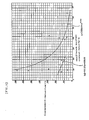
- the pressure-sensitive adhesive layer is regulated so that the equilibrium moisture content ratio (a) and the displacement amount (b) each fall within the above range and satisfy the relation b ⁇ 1036.4 x e -5.124a . While the equilibrium moisture content ratio (a) and the displacement amount (b) are each preferably controlled to be small, the control to satisfy the relation allows suppression of foaming in an endurance test.
- the equilibrium moisture content ratio (a) and the displacement amount (b) are ideally 0% by weight and 0 ⁇ m, respectively.
- the equilibrium moisture content ratio (a) is preferably 0.02% by weight or more, more preferably 0.03% by weight or more, in order to prevent defects due to a reduction in adhesive strength (pressure-sensitive adhesive strength).
- the displacement amount (b) is preferably 20 ⁇ m or more. If the displacement amount (b) is too small, the optical film could undesirably separate from a liquid crystal panel in an endurance test such as a heat or moisture resistance test, even though foaming can be suppressed as desired. From this point of view, the displacement amount (b) is preferably 30 ⁇ m or more, more preferably 40 ⁇ m or more.
- the pressure-sensitive adhesive layer preferably shows a displacement amount (b) of 600 ⁇ m or less when having an equilibrium moisture content ratio (a) of 0.15% by weight or less.
- the displacement amount (b) is preferably 540 ⁇ m or less, more preferably 300 ⁇ m or less, even more preferably 140 ⁇ m or less, still more preferably less than 75 ⁇ m.
- the equilibrium moisture content ratio (a) is preferably 0.13% by weight or less, more preferably 0.12% by weight or less, even more preferably 0.11% by weight or less.
- the pressure-sensitive adhesive layer preferably shows a displacement amount (b) of 350 ⁇ m or less when having an equilibrium moisture content ratio (a) of more than 0.15% by weight to 0.25% by weight.
- the displacement amount (b) is preferably 240 ⁇ m or less, more preferably 130 ⁇ m or less, even more preferably less than 75 ⁇ m.
- the equilibrium moisture content ratio (a) is preferably 0.23% by weight or less, more preferably 0.22% by weight or less, even more preferably 0.21% by weight or less.
- the pressure-sensitive adhesive layer preferably shows a displacement amount (b) of 150 ⁇ m or less when having an equilibrium moisture content ratio (a) of more than 0.25% by weight to 0.5% by weight.
- the displacement amount (b) is preferably 100 ⁇ m or less, more preferably less than 75 ⁇ m. In these ranges, the equilibrium moisture content ratio (a) is preferably 0.45% by weight or less, more preferably 0.43% by weight or less.
- the equilibrium moisture content ratio (a) and the displacement amount (b) preferably satisfy the relation: b ⁇ -541.67a+209.58. Particularly in order to suppress foaming in an endurance test, the relationship described above is preferably satisfied. In particular, the relational expression is preferably satisfied when the equilibrium moisture content ratio (a) is in the range of 0.07 to 0.22% by weight.
- the optical film on which the pressure-sensitive adhesive layer is placed has a water-vapor permeability of 1000 g/m 2 per 24 hours or less at 80°C and 90%R.H.
- the invention is effectively applied to suppress foaming in an endurance test, when such a material with low moisture permeability is used.
- the pressure-sensitive adhesive optical film is a polarizing plate including a polarizer and a transparent protective film placed on at least one side of the polarizer.
- the transparent protective film placed on at least one side preferably has a water-vapor permeability of 1000 g/m 2 per 24 hours or less at 80°C and 90%R.H., and the pressure-sensitive adhesive layer is preferably placed on the transparent protective film.
- the pressure-sensitive adhesive layer is preferably formed from a pressure-sensitive adhesive comprising an acrylic polymer and a crosslinking agent.
- the present invention also relates to an image display, comprising at least one piece of the pressure-sensitive adhesive optical film.
- the pressure-sensitive adhesive optical film of the present invention is used as a piece or combined pieces depend on the various types on the image display such as liquid crystal displays or the like.
- the pressure-sensitive adhesive optical film of the invention includes an optical film and a pressure-sensitive adhesive layer placed on at least one side of the optical film.
- the pressure-sensitive adhesive layer may be placed on one or both sides of the optical film.
- any appropriate type of pressure-sensitive adhesive capable of forming a pressure-sensitive adhesive layer that satisfies the requirements for the equilibrium moisture content ratio (a) and the displacement amount (b) and also satisfies the relation of the equilibrium moisture content ratio (a) and the displacement amount (b) may be used without particular limitations.
- the pressure-sensitive adhesive include rubber pressure-sensitive adhesives, acrylic pressure-sensitive adhesives, silicone pressure-sensitive adhesives, urethane pressure-sensitive adhesives, vinyl alkyl ether pressure-sensitive adhesives, polyvinyl alcohol pressure-sensitive adhesives, polyvinylpyrrolidone pressure-sensitive adhesives, polyacrylamide pressure-sensitive adhesives, and cellulose pressure-sensitive adhesives.
- pressure-sensitive adhesives those that may be preferably used have a high level of optical transparency and weather resistance or heat resistance and exhibits appropriate wettability and pressure-sensitive adhesive properties such as appropriate cohesiveness and adhesiveness.
- Acrylic pressure-sensitive adhesives have such properties and therefore are preferably used.
- Acrylic pressure-sensitive adhesives are also preferred, because a low equilibrium moisture content ratio (a) and a small displacement amount (b) can be designed with them.
- Acrylic pressure-sensitive adhesives contain, as a base polymer, an acrylic polymer having a main skeleton of an alkyl (meth)acrylate monomer unit.
- alkyl (meth)acrylate refers to alkyl acrylate and/or alkyl methacrylate, and "(meth)” has the same meaning with respect to the invention.
- the alkyl (meth)acrylate that forms the main skeleton of the acrylic polymer may have a straight or branched chain alkyl group having 1 to 20 carbon atoms.
- alkyl (meth)acrylate examples include methyl (meth)acrylate, ethyl (meth)acrylate, propyl (meth)acrylate, butyl (meth)acrylate, 2-ethylhexyl (meth)acrylate, isooctyl (meth)acrylate, isononyl (meth)acrylate, isomyristyl (meth)acrylate, and lauryl (meth)acrylate.
- One or more of these alkyl (meth)acrylates may be used alone or in any combination.
- the average number of carbon atoms of the alkyl groups is preferably from 3 to 9.
- an acrylic polymer having a main skeleton of a highly hydrophobic alkyl (meth)acrylate monomer unit is preferred in order to control the equilibrium moisture content ratio (a) to a low level.
- the alkyl (meth)acrylate that may be used in practice preferably has a straight or branched chain alkyl group having 3 to 9 carbon atoms, more preferably having 4 to 8 carbon atoms.
- the alkyl group with a higher number of carbon atoms can be more hydrophobic and therefore is preferred in order to keep the equilibrium moisture content at a low level.
- alkyl (meth)acrylate include butyl (meth)acrylate and isooctyl (meth)acrylate. In particular, isooctyl (meth)acrylate is highly hydrophobic and therefore preferred.
- At least one copolymerizable monomer may be introduced into the acrylic polymer by copolymerization.
- copolymerizable monomers include hydroxyl group-containing monomers such as 2-hydroxyethyl (meth)acrylate, 2-hydroxypropyl (meth)acrylate, 4-hydroxybutyl (meth)acrylate, 6-hydroxyhexyl (meth)acrylate, 8-hydroxyoctyl (meth)acrylate, 10-hydroxydecyl (meth)acrylate, 12-hydroxylauryl (meth)acrylate, and (4-hydroxymethylcyclohexyl)-methyl acrylate; carboxyl group-containing monomers such as include (meth)acrylic acid, carboxyethyl (meth)acrylate, carboxypentyl (meth)acrylate, itaconic acid, maleic acid, fumaric acid, and crotonic acid; acid anhydride group-containing monomers such as maleic anhydride and itaconic
- N-substituted) amide monomers such as (meth)acrylamide, N,N-dimethyl(meth)acrylamide, N,N-diethyl(meth)acrylamide, N-hexyl(meth)acrylamide, N-methyl(meth)acrylamide, N-butyl(meth)acrylamide, N-butyl(meth)acrylamide, N-methylol(meth)acrylamide, and N-methylolpropane(meth)acrylamide; alkylaminoalkyl (meth)acrylate monomers such as aminoethyl (meth)acrylate, aminopropyl (meth)acrylate, N,N-dimethylaminoethyl (meth)acrylate, tert-butylaminoethyl (meth)acrylate, and 3-(3-pyrinidyl)propyl (meth)acrylate; alkoxyalkyl (meth)acrylate monomers such as (meth)acrylamide, N,
- monomers for modification such as vinyl acetate, vinyl propionate, N-vinylpyrolidone, methylvinylpyrrolidone, vinylpyridine, vinylpiperidone, vinylpyrimidine, vinylpiperazine, vinylpyrazine, vinylpyrrole, vinylimidazole, vinyloxazole, vinylinorpholine, N-vinylcarboxylic acid amides, styrene, a-methylstyrene, and N-vinylcaprolactam; cyanoacrylate monomers such as acrylonitrile and methacrylonitrile; epoxy group-containing acrylic monomers such as glycidyl (meth)acrylate; glycol acrylate monomers such as polyethylene glycol (meth)acrylate, polypropylene glycol (meth)acrylate, methoxyethylene glycol (meth)acrylate, and methoxypolypropylene glycol (meth)acrylate; and acrylate ester monomers such as tetra
- the content of the copolymerized monomer in the acrylic polymer is preferably, but not particularly limited to, 0 to 30% by weight, more preferably 0.1 to 15 % by weight, based on the total amount of the constitute monomers.
- hydroxyl group-containing monomers, carboxyl group-containing monomers, and acid anhydride group-containing monomers are preferably used in view of properties for optical film applications, such as adhesion to liquid crystal cells and durability. These monomers can act as reactive sites with the crosslinking agent. Hydroxyl group-containing monomers, carboxyl group-containing monomers, acid anhydride group-containing monomers, or the like are highly reactive with intermolecular crosslinking agents and therefore are preferably used to form a pressure-sensitive adhesive layer with improved cohesiveness and heat resistance.
- a monomer that is highly hydrophobic and highly reactive and copolymerizable in a small amount is preferably used, because it tends to raise the equilibrium moisture content ratio (a).
- 4-hydroxybutyl (meth)acrylate rather than 2-hydroxyethyl (meth)acrylate is preferably used as the hydroxyl group-containing monomer, and hydroxy higher alkyl (meth)acrylate such as 6-hydroxyhexyl (meth)acrylate is more preferably used.
- the hydroxyl group-containing monomer is preferably used in an amount as small as possible, because it tends to raise the equilibrium moisture content ratio (a) as mentioned above.
- the content of the hydroxyl group-containing monomer used as a copolymerizable monomer is preferably from 0.01 to 5% by weight, more preferably from 0.01 to 3% by weight, based on the total amount of the constituent monomers.
- the content of the carboxyl group-containing monomer used as a copolymerizable monomer is preferably from 0.01 to 10% by weight, more preferably from 0.01 to 7% by weight, based on the total amount of the constituent monomers.
- a highly hydrophobic copolymerizable monomer is also preferably used as the copolymerizable monomer in order to control the equilibrium moisture content ratio (a) to a low level.
- maleimide monomers or itaconimide monomers are preferably used as adhesion-modifying monomers, because they are also characterized in that they hardly raise the equilibrium moisture content ratio (a) of the acrylic polymer, when copolymerized into the acrylic polymer.
- the weight average molecular weight of the acrylic polymer is preferably, but not limited to, from about 300,000 to about 2,500,000.
- the acrylic polymer may be produced by a variety of known methods, and, for example, radical polymerization methods such as bulk polymerization, solution polymerization, and suspension polymerization methods may be appropriately selected. Any of various known radical polymerization initiators such as azo initiators and peroxide initiators may be used.
- the reaction temperature is generally from about 50 to about 80°C, and the reaction time is generally from 1 to 8 hours. Ethyl acetate, toluene or the like is generally used as a solvent for the acrylic polymer.
- the concentration of the solution is generally from about 20 to about 80% by weight.
- the pressure-sensitive adhesive is preferable a pressure-sensitive adhesive composition
- a crosslinking agent that may be blended into the pressure-sensitive adhesive
- examples of the crosslinking agent that may be blended into the pressure-sensitive adhesive include organic crosslinking agents and multifunctional metal chelates.
- organic crosslinking agents include epoxy crosslinking agents, isocyanate crosslinking agents, imine crosslinking agents, and peroxide crosslinking agents. These crosslinking agents are used alone or a combination two or more.
- the organic crosslinking agent is preferably an isocyanate crosslinking agent. A combination of the isocyanate crosslinking agent and the peroxide crosslinking agent is preferably used.
- the multifunctional metal chelate may comprise a multivalent metal and an organic compound that are covalently or coordinately bonded to one another.
- Examples of the multivalent metal atom include Al, Cr, Zr, Co, Cu, Fe, Ni, V, Zn, In, Ca, Mg, Mn, Y, Ce, Sr, Ba, Mo, La, Sn, and Ti.
- the organic compound has a covalent or coordinate bond-forming atom such as an oxygen atom.
- Examples of the organic compound include alkyl esters, alcohol compounds, carboxylic acid compounds, ether compounds, and ketone compounds.
- the blending ratio between the base polymer such as an acrylic polymer and the crosslinking agent is not particularly limited, in general, 100 parts by weight of the base polymer (the solids) is preferably blended with about 0.001 to about 20 parts by weight of the crosslinking agent (the solids), more preferably with about 0.01 to about 15 parts by weight of the crosslinking agent (the solids).
- the crosslinking agent is preferably an isocyanate crosslinking agent or a peroxide crosslinking agent.
- the amount of the peroxide crosslinking agent is preferably from about 0.02 to about 2 parts by weight, more preferably from about 0.05 to about 1 part by weight, based on 100 parts by weight of the base polymer (the solids).
- the amount of the isocyanate crosslinking agent is preferably from about 0.001 to about 2 parts by weight, more preferably from about 0.01 to about 1.5 parts by weight, based on 100 parts by weight of the base polymer (the solids).
- the isocyanate crosslinking agent and the peroxide crosslinking agent may be each used within the range described above or preferably used in combination with each other.
- the pressure-sensitive adhesive may conveniently contain various types of additives such as tackifiers, plasticizers, fillers such as glass fibers, glass beads, metal power, or any other inorganic powder, pigments, colorants, antioxidants, ultraviolet absorbers, and silane coupling agents, without departing from the object of the present invention.
- the pressure-sensitive adhesive layer may also contain fine particles so as to have light diffusion properties.
- the additive is preferably a silane coupling agent, and preferably about 0.001 to about 10 parts by weight, more preferably about 0.005 to about 5 parts by weight of a silane coupling agent (the solids) is added to 100 parts by weight of the base polymer (the solids). Any known conventional silane coupling agent may be used without particular limitations.
- silane coupling agents include epoxy group-containing silane coupling agents such as ⁇ -glycidoxypropyltrimethoxysilane, ⁇ -gxycidoxypropyltriethoxysilane, ⁇ -glycidoxypropylmethyldiethoxysilane, and 2-(3,4-epoxycyclohexyl)ethyltrimethoxysilane; amino group-containing silane coupling agents such as 3-aminopropyltrimethoxysilane, N-2-(aminoethyl)-3-aminopropylmethyldimethoxysilane, and 3-triethoxysilyl-N-(1,3-dimethylbutylidene)propylamine; (meth)acrylic group-containing silane coupling agents such as 3-acryloxypropyltrimethoxysilane and 3-methacryloxypropyltriethoxysilane; and isocyanate group-containing silane coupling agents such as 3-isocyanatepropyl
- the type of the base monomer or the copolymerizable monomer, the content of the monomer, the type of the crosslinking agent, the content of the crosslinking agent, the type of the additive, the amount of the additive, or the like may be controlled so that the equilibrium moisture content ratio (a) and the displace amount (b) with respect to the pressure-sensitive adhesive layer of the present invention can each fall within the range and satisfy the relation.
- the pressure-sensitive adhesive layer In order to control the equilibrium moisture content ratio (a) of the pressure-sensitive adhesive layer to a low level, highly hydrophobic monomers are preferably used as described above. In order to reduce the displacement amount (b), the pressure-sensitive adhesive layer should have high cohesiveness.
- methods for reducing the displacement amount (b) effectively use a base polymer with increased molecular weight, a base polymer including a copolymerized high-glass-transition-temperature monomer, or an increased amount of the crosslinking agent to increase the degree of crosslinking.
- an acrylic polymer constituted with a straight or branched chain C 3 to C 9 alkyl (meth)acrylate monomer unit, which is frequently used in practice, may be used as the base polymer.
- the alkyl group with a larger number of carbon atoms can lower the glass transition temperature and generally produce an acrylic polymer with lower cohesiveness, which may tend to increase the displacement amount (b).
- an acrylic polymer produced with a carboxyl group-containing monomer such as acrylic acid is well known to significantly contribute to an increase in the cohesiveness of the resulting pressure-sensitive adhesive layer.
- Such an acrylic polymer tends to reduce the displacement amount (b) but tends to increase the equilibrium moisture content ratio (a) at the same time. Therefore, due consideration should be given to the selection of the composition, because there may be some trade-offs between the equilibrium moisture content ratio (a) and the displacement amount (b) as described above.
- the pressure-sensitive adhesive layer may be formed by a process including the steps of selecting the base monomer (for example, alkyl (meth)acrylate) and the copolymerizable monomer in the preparation of the base polymer and controlling the saturated moisture content, the content of the base polymer, and/or the degree of crosslinking so that the specified residual moisture content ratio (a) and the specified displacement amount (b) can be achieved.
- the base monomer for example, alkyl (meth)acrylate
- the copolymerizable monomer in the preparation of the base polymer and controlling the saturated moisture content, the content of the base polymer, and/or the degree of crosslinking so that the specified residual moisture content ratio (a) and the specified displacement amount (b) can be achieved.
- An anchor coat layer may also be provided between the pressure-sensitive adhesive layer and the optical film in the pressure-sensitive adhesive optical film of the invention.
- the anchor coat layer is preferably made of, but not limited to, a material that has good adhesion to both the pressure-sensitive adhesive layer and the optical film and can form a film with high cohesion.
- Materials having such properties that may be used include various polymers, metal oxide sols, silica sols, and the like. In particular, polymers are preferably used.
- polymers examples include polyurethane resins, polyester resins, and polymers having an amino group in their molecule.
- the polymer to be used may be in any of a solvent-soluble form, a water-dispersible form and a water-soluble form.
- water-soluble polyurethanes, water-soluble polyesters, water-soluble polyamides, and the like, and water-dispersible resins such as ethylene-vinyl acetate copolymer emulsions and (meth)acrylic polymer emulsions
- water-dispersible resins such as ethylene-vinyl acetate copolymer emulsions and (meth)acrylic polymer emulsions
- Water-dispersible types that may be used include emulsions produced by emulsifying various resins such as polyurethanes, polyesters and polyamides with an emulsifying agent; and self-emulsified products produced by introducing a water-dispersible hydrophilic anionic, cationic or nonionic group into any of the above resins. Ionic polymer complexes may also be used.
- optical film that is used to form image display devices such as liquid crystal display devices may be used as the optical film of the pressure-sensitive adhesive optical film of the present invention.
- the optical film to be used preferably has water-vapor permeability at 80°C and 90% R.H. of 1000 g/m 2 per 24 hours or less.
- the water-vapor permeability of the optical film to be used is preferably 800 g/m 2 per 24 hours or less, more preferably 500 g/m 2 per 24 hours or less, even more preferably 200 g/m 2 per 24 hours or less.
- Examples of materials having such a water-vapor permeability include polycarbonate polymers, arylate polymers, polyester polymers such as polyethylene terephthalate and polyethylene naphthalate, amide polymers such as nylon and aromatic polyamides, polyolefin polymers such as polyethylene, polypropylene and ethylene-propylene copolymers, cyclo system- or norbornene structure-containing cyclic olefin resins, and any mixture thereof.
- polymer films for example, resin compositions including (A) thermoplastic resins having substituted and/or non-substituted imido group is in side chain, and (B) thermoplastic resins having substituted and/or non-substituted phenyl and nitrile group in sidechain may be mentioned.
- a film may be mentioned that is made of a resin composition including alternating copolymer comprising iso-butylene and N-methyl maleimide, and acrylonitrile-styrene copolymer.
- a film comprising mixture extruded article of resin compositions etc. may be used.
- Cyclic olefin resin is a generic name for such resins as those disclosed in JP-A Nos. 03-14882 and 03-122137 . Specific examples thereof include ring-opened polymers of cyclic olefins, addition polymers of cyclic olefins, random copolymers of cyclic olefins and ⁇ -olefins such as ethylene and propylene, and graft polymers produced by modification thereof with unsaturated carboxylic acids or derivatives thereof, and hydrides thereof.
- cyclic olefin examples include, but are not limited to, norbornene, tetracyclododecen, and derivatives thereof.
- Commercially available products thereof include Zeonex and Zeonor series manufactured by Nippon Zeon Co., Ltd., Arton series manufactured by JSR Corporation, and Topas series manufactured by Ticona.
- an optical film made of the low water-vapor permeability material may be used as a transparent protective film, a retardation film, or the like for a polarizer.
- a polarizing plate As the optical film for use in the pressure-sensitive adhesive optical film of the present invention, a polarizing plate is exemplified.
- a polarizing plate comprising a polarizer and a transparent protective film provided on one side or both sides of the polarizer is generally used.
- a polarizer is not limited especially but various kinds of polarizer may be used.
- a polarizer for example, a film that is uniaxially stretched after having dichromatic substances, such as iodine and dichromatic dye, absorbed to hydrophilic high molecular weight polymer films, such as polyvinyl alcohol type film, partially formalized polyvinyl alcohol type film, and ethylene-vinyl acetate copolymer type partially saponified film; poly-ene type alignment films, such as dehydrated polyvinyl alcohol and dehydrochlorinated polyvinyl chloride, etc. may be mentioned.
- a polyvinyl alcohol type film on which dichromatic materials such as iodine, is absorbed and aligned after stretched is suitably used.
- thickness of polarizer is not especially limited, the thickness of about 5 to 80 ⁇ m is commonly adopted.
- a polarizer that is uniaxially stretched after a polyvinyl alcohol type film dyed with iodine is obtained by stretching a polyvinyl alcohol film by 3 to 7 times the original length, after dipped and dyed in aqueous solution of iodine. If needed the film may also be dipped in aqueous solutions, such as boric acid and potassium iodide, which may include zinc sulfate, zinc chloride. Furthermore, before dyeing, the polyvinyl alcohol type film may be dipped in water and rinsed if needed.
- polyvinyl alcohol type film By rinsing polyvinyl alcohol type film with water, effect of preventing un-uniformity, such as unevenness of dyeing, is expected by making polyvinyl alcohol type film swelled in addition that also soils and blocking inhibitors on the polyvinyl alcohol type film surface may be washed off. Stretching may be applied after dyed with iodine or may be applied concurrently, or conversely dyeing with iodine may be applied after stretching. Stretching is applicable in aqueous solutions, such as boric acid and potassium iodide, and in water bath.
- a transparent protective film made of the low water-vapor permeability material is preferably attached to the pressure-sensitive adhesive layer-receiving side.
- the other side may receive materials other than the low water-vapor permeability material, such as cellulose polymers such as acetyl cellulose and triacetyl cellulose, acrylic polymers such as poly(methyl methacrylate), and styrene polymers such as polystyrene, acrylonitrile-styrene copolymers (AS resins).
- Examples of materials that may be used to form the transparent protective film also include vinyl chloride polymers, imide polymers, sulfone polymers, polyethersulfone polymers, polyetheretherketone polymers, polyphenylene sulfide polymers, vinyl alcohol polymers, vinylidene chloride polymers, vinyl butyral polymers, polyoxymethylene polymers, epoxy polymers, and any blends thereof.
- the transparent protective film may also be in the form of a cured layer of thermosetting resin or ultraviolet-curable resin such as acrylic, urethane, acrylic urethane, epoxy and silicone resin.
- a thickness of the transparent protective film which can be determined arbitrarily, is 1 to 500 ⁇ m, especially 5 to 200 ⁇ m in viewpoint of strength, work handling and thin layer.
- the transparent protective film is preferably as colorless as possible.
- the thickness-direction retardation (Rth) is more preferably from -80 nm to +60 nm, particularly preferably from -70 nm to +45 nm.
- the transparent protective films when the transparent protective films are provided on both sides of the polarizer, the transparent protective films comprising same polymer material may be used on both of a front side and a back side, and the transparent protective films comprising different polymer materials etc. may be used.
- the polarizer and the transparent protective film are bonded with an aqueous adhesive.
- the aqueous adhesive includes isocyanate based adhesives, polyvinyl alcohol based adhesives, gelatin based adhesives, vinyl based latex based, aqueous polyester based adhesives, and the likes.
- a film with a hard coat layer and various processing aiming for antireflection, sticking prevention and diffusion or anti glare may be used.
- a hard coat processing is applied for the purpose of protecting the surface of the polarization plate from damage, and this hard coat film may be formed by a method in which, for example, a curable coated film with excellent hardness, slide property etc. is added on the surface of the protective film using suitable ultraviolet curable type resins, such as acrylic type and silicone type resins.
- Antireflection processing is applied for the purpose of antireflection of outdoor daylight on the surface of a polarization plate and it may be prepared by forming an antireflection film according to the conventional method etc.
- a sticking prevention processing is applied for the purpose of adherence prevention with adjoining layer.
- an anti glare processing is applied in order to prevent a disadvantage that outdoor daylight reflects on the surface of a polarization plate to disturb visual recognition of transmitting light through the polarization plate, and the processing may be applied, for example, by giving a fine concavo-convex structure to a surface of the protective film using, for example, a suitable method, such as rough surfacing treatment method by sandblasting or embossing and a method of combining transparent fine particle.
- transparent fine particles whose average particle size is 0.5 to 50 ⁇ m, for example, such as inorganic type fine particles that may have conductivity comprising silica, alumina, titania, zirconia, tin oxides, indium oxides, cadmium oxides, antimony oxides, etc., and organic type fine particles comprising cross-linked of non-cross-linked polymers may be used.
- the amount of fine particle used is usually about 2 to 50 weight parts to the transparent resin 100 weight parts that forms the fine concavo-convex structure on the surface, and preferably 5 to 25 weight parts.
- An anti glare layer may serve as a diffusion layer (viewing angle expanding function etc.) for diffusing transmitting light through the polarization plate and expanding a viewing angle etc.
- the above-mentioned antireflection layer, sticking prevention layer, diffusion layer, anti glare layer, etc. may be built in the protective film itself, and also they may be prepared as an optical layer different from the protective film.
- an optical film of the present invention may be used as other optical layers, such as a reflective plate, a transflective plate, a retardation plate (a half wavelength plate and a quarter wavelength plate included), and a viewing angle compensation film, which may be used for formation of a liquid crystal display etc.. These are used in practice as an optical film, or as one layer or two layers or more of optical layers laminated with polarizing plate.
- polarizing plates are; a reflection type polarization plate or a transflective type polarization plate in which a reflective plate or a transflective reflective plate is further laminated onto a polarizing plate of the present invention; an elliptically polarizing plate or a circular polarizing plate in which a retardation plate is further laminated onto the polarizing plate; a wide viewing angle polarization plate in which a viewing angle compensation film is further laminated onto the polarizing plate; or a polarizing plate in which a brightness enhancement film is further laminated onto the polarizing plate.
- a reflective layer is prepared on a polarization plate to give a reflection type polarization plate, and this type of plate is used for a liquid crystal display in which an incident light from a view side (display side) is reflected to give a display.
- This type of plate does not require built-in light sources, such as a backlight, but has an advantage that a liquid crystal display may easily be made thinner.
- a reflection type polarization plate may be formed using suitable methods, such as a method in which a reflective layer of metal etc. is, if required, attached to one side of a polarization plate through a transparent protective layer etc.
- a plate may be mentioned on which, if required, a reflective layer is formed using a method of attaching a foil and vapor deposition film of reflective metals, such as aluminum, to one side of a matte treated protective film.
- a different type of plate with a fine concavo-convex structure on the surface obtained by mixing fine particle into the above-mentioned protective film, on which a reflective layer of concavo-convex structure is prepared may be mentioned.
- the reflective layer that has the above-mentioned fine concavo-convex structure diffuses incident light by random reflection to prevent directivity and glaring appearance, and has an advantage of controlling unevenness of light and darkness etc.
- the protective film containing the fine particle has an advantage that unevenness of light and darkness may be controlled more effectively, as a result that an incident light and its reflected light that is transmitted through the film are diffused.
- a reflective layer with fine concavo-convex structure on the surface effected by a surface fine concavo-convex structure of a protective film may be formed by a method of attaching a metal to the surface of a transparent protective layer directly using, for example, suitable methods of a vacuum evaporation method, such as a vacuum deposition method, an ion plating method, and a sputtering method, and a plating method etc.
- a reflection plate may also be used as a reflective sheet constituted by preparing a reflective layer on the suitable film for the transparent film.
- a reflective layer is usually made of metal, it is desirable that the reflective side is covered with a protective film or a polarization plate etc. when used, from a viewpoint of preventing deterioration in reflectance by oxidation, of maintaining an initial reflectance for a long period of time and of avoiding preparation of a protective layer separately etc.
- a transflective type polarizing plate may be obtained by preparing the above-mentioned reflective layer as a transflective type reflective layer, such as a half-mirror etc. that reflects and transmits light.
- a transflective type polarization plate is usually prepared in the backside of a liquid crystal cell and it may form a liquid crystal display unit of a type in which a picture is displayed by an incident light reflected from a view side (display side) when used in a comparatively well-lighted atmosphere. And this unit displays a picture, in a comparatively dark atmosphere, using embedded type light sources, such as a back light built in backside of a transflective type polarization plate.
- the transflective type polarization plate is useful to obtain of a liquid crystal display of the type that saves energy of light sources, such as a back light, in a well-lighted atmosphere, and can be used with a built-in light source if needed in a comparatively dark atmosphere etc.
- Elliptically polarization plate is effectively used to give a monochrome display without above-mentioned coloring by compensating (preventing) coloring (blue or yellow color) produced by birefringence of a liquid crystal layer of a super twisted nematic (STN) type liquid crystal display.
- a polarization plate in which three-dimensional refractive index is controlled may also preferably compensate (prevent) coloring produced when a screen of a liquid crystal display is viewed from an oblique direction.
- Circularly polarization plate is effectively used, for example, when adjusting a color tone of a picture of a reflection type liquid crystal display that provides a colored picture, and it also has function of antireflection.
- a thickness of a retardation plate also is not especially limited, it is in general approximately from about 20 to 150 ⁇ m.
- polymer materials for example, polyvinyl alcohols, polyvinyl butyrals, polymethyl vinyl ethers, poly hydroxyethyl acrylates, hydroxyethyl celluloses, hydroxypropyl celluloses, methyl celluloses, polycarbonates, polyarylates, polysulfones, polyethylene terephthalates, polyethylene naphthalates, polyethersulfones, polyphenylene sulfides, polyphenylene oxides, polyallyl sulfones, polyvinyl alcohols, polyamides, polyimides, polyolefins, polyvinyl chlorides, cellulose type polymers, or bipolymers, terpolymers, graft copolymers, blended materials of the above-mentioned polymers may be mentioned. These polymer raw materials make oriented materials (stretched film) using a stretching process and the like.
- liquid crystalline polymers for example, various kinds of polymers of principal chain type and side chain type in which conjugated linear atomic groups (mesogens) demonstrating liquid crystalline orientation are introduced into a principal chain and a side chain may be mentioned.
- principal chain type liquid crystalline polymers polymers having a structure where mesogen groups are combined by spacer parts demonstrating flexibility, for example, polyester based liquid crystalline polymers of nematic orientation property, discotic polymers, cholesteric polymers, etc. may be mentioned.
- side chain type liquid crystalline polymers polymers having polysiloxanes, polyacrylates, polymethacrylates, or polymalonates as a principal chain structure, and polymers having mesogen parts comprising para-substituted ring compound units providing nematic orientation property as side chains via spacer parts comprising conjugated atomic groups may be mentioned.
- These liquid crystalline polymers for example, is obtained by spreading a solution of a liquid crystal polymer on an orientation treated surface where rubbing treatment was performed to a surface of thin films, such as polyimide and polyvinyl alcohol, formed on a glass plate and or where silicon oxide was deposited by an oblique evaporation method, and then by heat-treating.
- a retardation plate may be a retardation plate that has a proper retardation according to the purposes of use, such as various kinds of wavelength plates and plates aiming at compensation of coloring by birefringence of a liquid crystal layer and of visual angle, etc., and may be a retardation plate in which two or more sorts of retardation plates is laminated so that optical properties, such as retardation, may be controlled.
- the above-mentioned elliptically polarization plate and an above-mentioned reflected type elliptically polarization plate are laminated plate combining suitably a polarization plate or a reflection type polarization plate with a retardation plate.
- This type of elliptically polarization plate etc. may be manufactured by combining a polarization plate (reflected type) and a retardation plate, and by laminating them one by one separately in the manufacture process of a liquid crystal display.
- the polarization plate in which lamination was beforehand carried out and was obtained as an optical film is excellent in a stable quality, a workability in lamination etc., and has an advantage in improved manufacturing efficiency of a liquid crystal display.
- a viewing angle compensation film is a film for extending viewing angle so that a picture may look comparatively clearly, even when it is viewed from an oblique direction not from vertical direction to a screen.
- a film having birefringence property that is processed by uniaxial stretching or orthogonal bidirectional stretching and a biaxially stretched film as inclined orientation film etc. may be used.
- inclined orientation film for example, a film obtained using a method in which a heat shrinking film is adhered to a polymer film, and then the combined film is heated and stretched or shrunk under a condition of being influenced by a shrinking force, or a film that is oriented in oblique direction may be mentioned.
- the viewing angle compensation film is suitably combined for the purpose of prevention of coloring caused by change of visible angle based on retardation by liquid crystal cell etc. and of expansion of viewing angle with good visibility.
- a compensation plate in which an optical anisotropy layer consisting of an alignment layer of liquid crystal polymer, especially consisting of an inclined alignment layer of discotic liquid crystal polymer is supported with triacetylcellulose film may preferably be used from a viewpoint of attaining a wide viewing angle with good visibility.
- the polarization plate with which a polarization plate and a brightness enhancement film are adhered together is usually used being prepared in a backside of a liquid crystal cell.
- a brightness enhancement film shows a characteristic that reflects linearly polarization light with a predetermined polarization axis, or circularly polarization light with a predetermined direction, and that transmits other light, when natural light by back lights of a liquid crystal display or by reflection from a back-side etc., comes in.
- the polarization plate which is obtained by laminating a brightness enhancement film to a polarization plate, thus does not transmit light without the predetermined polarization state and reflects it, while obtaining transmitted light with the predetermined polarization state by accepting a light from light sources, such as a backlight.
- This polarization plate makes the light reflected by the brightness enhancement film further reversed through the reflective layer prepared in the backside and forces the light re-enter into the brightness enhancement film, and increases the quantity of the transmitted light through the brightness enhancement film by transmitting a part or all of the light as light with the predetermined polarization state.
- the polarization plate simultaneously supplies polarized light that is difficult to be absorbed in a polarizer, and increases the quantity of the light usable for a liquid crystal picture display etc., and as a result luminosity may be improved. That is, in the case where the light enters through a polarizer from backside of a liquid crystal cell by the back light etc.
- a brightness enhancement film does not enter the light with the polarizing direction absorbed by the polarizer into the polarizer but reflects the light once by the brightness enhancement film, and further makes the light reversed through the reflective layer etc. prepared in the backside to re-enter the light into the brightness enhancement film.
- the brightness enhancement film transmits the light to supply it to the polarizer.
- the light from a backlight may be efficiently used for the display of the picture of a liquid crystal display to obtain a bright screen.
- a diffusion plate may also be prepared between brightness enhancement film and the above described reflective layer, etc.
- a polarized light reflected by the brightness enhancement film goes to the above described reflective layer etc., and the diffusion plate installed diffuses passing light uniformly and changes the light state into depolarization at the same time. That is, the diffusion plate returns polarized light to natural light state. Steps are repeated where light, in the unpolarized state, i.e., natural light state, reflects through reflective layer and the like, and again goes into brightness enhancement film through diffusion plate toward reflective layer and the like.
- Diffusion plate that returns polarized light to the natural light state is installed between brightness enhancement film and the above described reflective layer, and the like, in this way, and thus a uniform and bright screen may be provided while maintaining brightness of display screen, and simultaneously controlling non-uniformity of brightness of the display screen.
- By preparing such diffusion plate it is considered that number of repetition times of reflection of a first incident light increases with sufficient degree to provide uniform and bright display screen conjointly with diffusion function of the diffusion plate.
- the suitable films are used as the above-mentioned brightness enhancement film.
- the brightness enhancement film of a type that transmits a linearly polarized light having the above-mentioned predetermined polarization axis by arranging the polarization axis of the transmitted light and entering the light into a polarization plate as it is, the absorption loss by the polarization plate is controlled and the polarized light can be transmitted efficiently.
- the light may be entered into a polarizer as it is, but it is desirable to enter the light into a polarizer after changing the circularly polarized light to a linearly polarized light through a retardation plate, taking control an absorption loss into consideration.
- a circularly polarized light is convertible into a linearly polarized light using a quarter wavelength plate as the retardation plate.
- a retardation plate that works as a quarter wavelength plate in a wide wavelength ranges, such as a visible-light region, is obtained by a method in which a retardation layer working as a quarter wavelength plate to a pale color light with a wavelength of 550 nm is laminated with a retardation layer having other retardation characteristics, such as a retardation layer working as a half-wavelength plate. Therefore, the retardation plate located between a polarization plate and a brightness enhancement film may consist of one or more retardation layers.
- a layer reflecting a circularly polarized light in a wide wavelength ranges such as a visible-light region
- a layer reflecting a circularly polarized light in a wide wavelength ranges may be obtained by adopting a configuration structure in which two or more layers with different reflective wavelength are laminated together.
- a transmitted circularly polarized light in a wide wavelength range may be obtained using this type of cholesteric liquid-crystal layer.
- the polarization plate may consist of multi-layered film of laminated layers of a polarization plate and two of more of optical layers as the above-mentioned separated type polarization plate. Therefore, a polarization plate may be a reflection type elliptically polarization plate or a semi-transmission type elliptically polarization plate, etc. in which the above-mentioned reflection type polarization plate or a transflective type polarization plate is combined with above described retardation plate respectively.
- an optical film with the above described optical layer laminated to the polarizing plate may be formed by a method in which laminating is separately carried out sequentially in manufacturing process of a liquid crystal display etc.
- an optical film in a form of being laminated beforehand has an outstanding advantage that it has excellent stability in quality and assembly workability, etc., and thus manufacturing processes ability of a liquid crystal display etc. may be raised.
- Proper adhesion means such as an adhesive layer, may be used for laminating.
- the optical axis may be set as a suitable configuration angle according to the target retardation characteristics etc.
- methods for producing the pressure-sensitive adhesive optical film include, but are not limited to, a method including applying a pressure-sensitive adhesive solution to the optical film and drying it and a method including forming the pressure-sensitive adhesive layer on a release sheet and transferring it from the release sheet.
- Coating methods that may be used include roll coating methods such as reverse coating and gravure coating and other coating methods such as spin coating, screen coating, fountain coating, dipping, and spraying.
- the thickness of the pressure-sensitive adhesive layer is preferably, but not limited to, from about 10 to about 40 ⁇ m.
- the pressure-sensitive adhesive layer is formed after the anchor coat layer is formed on the optical film.
- an anchor component solution such as an aqueous polyethyleneimine solution may be applied by an application method such as coating, dipping or spraying and dried to form an anchor coat layer.
- the thickness of the anchor coat layer is preferably from about 10 to about 5,000 nm, more preferably from 50 to 500 nm. If the anchor coat layer is too thin, it could fail to have properties as a bulk or fail to exhibit sufficient strength so that the resulting adhesion could be insufficient in some cases. If the anchor coat layer is too thick, the optical properties could be degraded.
- the optical film may be subjected to activation treatment.
- Various methods such as corona treatment, low-pressure UV treatment, and plasma treatment may be used for the activation treatment.
- An antistatic layer may also be formed as needed.
- constituent materials of a release sheet include: proper thin items such as paper; synthetic resin films made of polyethylene, polypropylene, polyethylene terephthalate; a rubber sheet, paper, cloth, unwoven fabric, net, a foam sheet and a metal foil, and a laminate thereof.
- a release treatment imparting a low adherence such as a silicone treatment, a long chain alkylation treatment or a fluorination treatment, may be applied onto a surface of a release sheet when required.
- ultraviolet absorbing property may be given to the above-mentioned each layer of the optical film and the adhesive layer etc. of the pressure-sensitive adhesive optical film of the present invention, using a method of adding UV absorbents, such as salicylic acid ester type compounds, benzophenol type compounds, benzotriazol type compounds, cyano acrylate type compounds, and nickel complex salt type compounds.
- UV absorbents such as salicylic acid ester type compounds, benzophenol type compounds, benzotriazol type compounds, cyano acrylate type compounds, and nickel complex salt type compounds.
- the pressure-sensitive adhesive optical film of the present invention is preferably used to form various types of image displays such as liquid crystal displays.
- Liquid crystal displays may be formed according to conventional techniques. Specifically, liquid crystal displays are generally formed by appropriately assembling a liquid crystal cell and the pressure-sensitive adhesive optical film and optionally other components such as a lighting system and incorporating a driving circuit according to any conventional technique, except that the pressure-sensitive adhesive optical film of the present invention is used. Any type of liquid crystal cell may also be used such as a TN type, an STN type and a n type.
- Suitable liquid crystal displays such as liquid crystal display with which the above pressure-sensitive adhesive optical film has been located at one side or both sides of the liquid crystal cell, and with which a backlight or a reflective plate is used for a lighting system may be manufactured.
- the pressure-sensitive adhesive optical film may be installed in one side or both sides of the liquid crystal cell.
- the pressure-sensitive adhesive optical films may be of the same type or of different type.
- suitable parts such as diffusion plate, anti-glare layer, antireflection film, protective plate, prism array, lens array sheet, optical diffusion plate, and backlight, may be installed in suitable position in one layer or two or more layers.
- organic electro luminescence equipment organic EL display
- a transparent electrode, an organic luminescence layer and a metal electrode are laminated on a transparent substrate in an order configuring an illuminant (organic electro luminescence illuminant).
- a organic luminescence layer is a laminated material of various organic thin films, and much compositions with various combination are known, for example, a laminated material of hole injection layer comprising triphenylamine derivatives etc., a luminescence layer comprising fluorescent organic solids, such as anthracene; a laminated material of electronic injection layer comprising such a luminescence layer and perylene derivatives, etc.; laminated material of these hole injection layers, luminescence layer, and electronic injection layer etc.
- An organic EL display emits light based on a principle that positive hole and electron are injected into an organic luminescence layer by impressing voltage between a transparent electrode and a metal electrode, the energy produced by recombination of these positive holes and electrons excites fluorescent substance, and subsequently light is emitted when excited fluorescent substance returns to ground state.
- a mechanism called recombination which takes place in an intermediate process is the same as a mechanism in common diodes, and, as is expected, there is a strong non-linear relationship between electric current and luminescence strength accompanied by rectification nature to applied voltage.
- an organic EL display in order to take out luminescence in an organic luminescence layer, at least one electrode must be transparent.
- the transparent electrode usually formed with transparent electric conductor, such as indium tin oxide (ITO), is used as an anode.
- ITO indium tin oxide
- cathode in order to make electronic injection easier and to increase luminescence efficiency, it is important that a substance with small work function is used for cathode, and metal electrodes, such as Mg-Ag and Al-Li, are usually used.
- organic EL display of such a configuration an organic luminescence layer is formed by a very thin film about 10nm in thickness. For this reason, light is transmitted nearly completely through organic luminescence layer as through transparent electrode. Consequently, since the light that enters, when light is not emitted, as incident light from a surface of a transparent substrate and is transmitted through a transparent electrode and an organic luminescence layer and then is reflected by a metal electrode, appears in front surface side of the transparent substrate again, a display side of the organic EL display looks like mirror if viewed from outside.
- a retardation plate may be installed between these transparent electrodes and a polarization plate, while preparing the polarization plate on the surface side of the transparent electrode.
- the retardation plate and the polarization plate have function polarizing the light that has entered as incident light from outside and has been reflected by the metal electrode, they have an effect of making the mirror surface of metal electrode not visible from outside by the polarization action. If a retardation plate is configured with a quarter wavelength plate and the angle between the two polarization directions of the polarization plate and the retardation plate is adjusted to ⁇ /4, the mirror surface of the metal electrode may be completely covered.
- linearly polarized light generally gives an elliptically polarized light by the retardation plate, and especially the retardation plate is a quarter wavelength plate, and moreover when the angle between the two polarization directions of the polarization plate and the retardation plate is adjusted to ⁇ /4, it gives a circularly polarized light.
- This circularly polarized light is transmitted through the transparent substrate, the transparent electrode and the organic thin film, and is reflected by the metal electrode, and then is transmitted through the organic thin film, the transparent electrode and the transparent substrate again, and is turned into a linearly polarized light again with the retardation plate. And since this linearly polarized light lies at right angles to the polarization direction of the polarization plate, it cannot be transmitted through the polarization plate. As the result, mirror surface of the metal electrode may be completely covered.
- the water-vapor permeability was measured by the water-vapor permeability test (cup method) according to JIS Z 0208.
- a sample with a diameter of 60 mm obtained by cutting was placed in an about 15 g calcium chloride-containing water-vapor-permeable cup.
- the cup was placed in a thermostat at 80°C and 90% and allowed to stand for 24 hours.
- An increase in the weight of the calcium chloride from before to after the standing was measured and used to calculate the water-vapor permeability (g/m 2 per 24 hours).
- An 80 ⁇ m-thick polyvinyl alcohol film was stretched to 3 times between rolls different in velocity ratio, while it was placed in an aqueous 0.3% iodine solution at 30°C. The film was then stretched to a total draw ratio of 6 times in an aqueous solution containing 4% of boric acid and 10% of potassium iodide at 60°C. The film was then washed by immersion in an aqueous solution containing 1.5% of potassium iodide at 30°C for 10 seconds and then dried at 50°C for 4 minutes to give a polarizer. An 80 ⁇ m-thick saponified triacetylcellulose film was bonded to one side of the polarizer with a polyvinyl alcohol adhesive.
- a 70 ⁇ m-thick cyclic olefin resin film (Zeonor (trade name) manufactured by Nippon Zeon Co., Ltd.) was bonded to the other side of the polarizer with a polyvinyl alcohol adhesive.
- the cyclic olefin resin film had a water-vapor permeability of 127 g/m 2 per 24 hours at 80°C and 90%R.H.
- a crosslinking agent mainly composed of an isocyanate group-containing compound (Coronate L (trade name) manufactured by Nippon Polyurethane Industry Co., Ltd.) and 0.075 parts ofy-glycidoxypropyltrimethoxysilane (KMB-403 (trade name) manufactured by Shin-Etsu Chemical Co., Ltd.) as a silane coupling agent were added in this order to the acrylic polymer solution (A) so that a pressure-sensitive adhesive solution was prepared.
- the pressure-sensitive adhesive solution was uniformly applied with a fountain coater to the surface of a separator made of a polyethylene terephthalate film whose surface had been treated with a silicone release agent.
- the coating was dried in an air circulation type thermostatic oven at 155°C for 3 minutes so that a 25 ⁇ m-thick pressure-sensitive adhesive layer was formed on the surface of the separator.
- the pressure-sensitive adhesive layer-carrying separator was transferred and attached to one side of the polarizing plate (the cyclic olefin resin film side) to form a pressure-sensitive adhesive polarizing plate.
- Pressure-sensitive adhesive solutions were prepared in the same manner as in Example 1, except that the amount of the crosslinking agent mainly composed of an isocyanate group-containing compound was changed as shown in Table 1.
- Pressure-sensitive adhesive polarizing plates were also prepared in the same manner as in Example 1.
- An acrylic polymer solution (A') with an adjusted solids content of 30% was obtained in the same manner as in Example 1, except that the amount of acrylic acid was changed from 5 parts to 8 parts.
- a crosslinking agent mainly composed of an isocyanate group-containing compound (Coronate L (trade name) manufactured by Nippon Polyurethane Industry Co., Ltd.) and 0.075 parts of ⁇ -glycidoxypropyltrimethoxysilane (KMB-403 (trade name) manufactured by Shin-Etsu Chemical Co., Ltd.) as a silane coupling agent were added in this order to the acrylic polymer solution (A') so that a pressure-sensitive adhesive solution was prepared.
- a pressure-sensitive adhesive polarizing plate was prepared in the same manner as in Example 1, except that this pressure-sensitive adhesive solution was used instead.
- Pressure-sensitive adhesive solutions were prepared in the same manner as in Example 3, except that the amount of the crosslinking agent mainly composed of an isocyanate group-containing compound and the amount of the peroxide crosslinking agent were changed as shown in Table 1.
- Pressure-sensitive adhesive polarizing plates were also prepared in the same manner as in Example 1.
- a crosslinking agent mainly composed of an isocyanate group-containing compound (Coronate L (trade name) manufactured by Nippon Polyurethane Industry Co., Ltd.) and 0.01 parts of ⁇ -glycidoxypropyltrimethoxysilane (KMB-403 (trade name) manufactured by Shin-Etsu Chemical Co., Ltd.) as a silane coupling agent were added in this order to the acrylic polymer solution (C) so that a pressure-sensitive adhesive solution was prepared.
- a pressure-sensitive adhesive polarizing plate was also prepared in the same manner as in Example 1.
- Pressure-sensitive adhesive solutions were prepared in the same manner as in Example 6, except that the amount of the crosslinking agent mainly composed of an isocyanate group-containing compound was changed as shown in Table 1.
- Pressure-sensitive adhesive polarizing plates were prepared in the same manner as in Example 1.
- the pressure-sensitive adhesive layer was cut into a 300 mm x 240 mm piece (about 1.5 g) which was folded into a block and then used as a sample for analysis.
- the sample was placed on an aluminum foil and weighed and then transferred to a sample board.
- the sample prepared by this method was placed in a heating oven, and its moisture content was measured.
- the measurement conditions were as follows: a nitrogen flow rate of 300 ml/ minute from a cylinder, a nitrogen flow rate of 200 ml/minute set in the equipment, and a temperature of 110°C in the heating oven. The measurement was continued until the measured value reached the drift value+0.1 ⁇ g/s, and the total amount of moisture was measured.
- the 25 ⁇ m-thick pressure-sensitive adhesive layer was cut into a 10 mm (width) x 30 mm sample.
- An upper part (10 mm x 10 mm) of the sample was attached to a baking plate, autoclaved at 50°C and 50 atm for 15 minutes, and then allowed to stand at room temperature (23°C) for 1 hour.
- a load of 500 g was then applied to the sample (tensile shearing stress was applied in the vertical direction), and 1 hour later, the amount ( ⁇ m) of displacement of the sample was measured.
- the pressure-sensitive adhesive optical films (15 inch samples) were bonded to both sides of a 0.07 mm-thick non-alkali glass plate in the cross Nicol configuration. The samples were then autoclaved at 50°C and 5 atm for 15 minutes to be completely bonded. After the samples were stored at 80°C for 500 hours, foaming was observed and evaluated based on the criteria below. In the observation of foaming, the number of bubbles in the four corner areas (50 mm x 50 mm) of the 15 inch sample was measured with a polarizing microscope.
- Fig. 1 The results are also shown in Fig. 1 .
- Fig. 1 the result of each example is plotted with the symbol for the evaluation in the foaming test.
Landscapes
- Physics & Mathematics (AREA)
- Chemical & Material Sciences (AREA)
- General Physics & Mathematics (AREA)
- Optics & Photonics (AREA)
- Nonlinear Science (AREA)
- Organic Chemistry (AREA)
- Mathematical Physics (AREA)
- Crystallography & Structural Chemistry (AREA)
- Chemical Kinetics & Catalysis (AREA)
- Polarising Elements (AREA)
- Liquid Crystal (AREA)
- Adhesives Or Adhesive Processes (AREA)
- Adhesive Tapes (AREA)
- Laminated Bodies (AREA)
- Holo Graphy (AREA)
Abstract
Description
- The present invention relates to a pressure-sensitive adhesive optical film in which a pressure-sensitive adhesive layer is laminated on at least one side of an optical film. The present invention also relates to an image displays such as liquid crystal displays, organic electroluminescence displays and plasma display panels, using the pressure-sensitive adhesive optical film. The optical film may be a polarizing plate, a retardation plate, an optical compensation film, a brightness enhancement film, or any laminate thereof.
- A liquid crystal display indispensably requires polarizing elements disposed on both sides of a liquid crystal cell because of an image forming method adopted therein and generally polarizing plates in which a transparent protective film is laminated on one side or both sides of a polarizer are adhered. Besides, on a liquid crystal panel, various kinds of optical elements have been used in addition to a polarizing plate in order to improve a display quality of a display. For example, there have been used a retardation plate for coloration prevention, a viewing angle increasing film for improving a viewing angle of a liquid crystal display and a brightness enhancement film for raising a contrast of a display. The films each are collectively referred to an optical film.
- A pressure-sensitive adhesive is usually employed in adhering an optical film described above to a liquid crystal cell. An optical film and a liquid crystal cell or optical films are usually adhered to each other using a pressure-sensitive adhesive therebetween in order to reduce a light loss. In such cases, a pressure-sensitive adhesive optical film in which a pressure-sensitive adhesive is provided in advance on one surface of an optical film as a pressure-sensitive adhesive layer is generally used because of a merit such as that no necessity arises for a drying step of fix the optical film.
- Triacetylcellulose films have been preferably used as transparent protective films for the polarizing plate. However, triacetylcellulose does not have sufficient resistance to moisture or heat, and polarizing plates including a triacetylcellulose film as a transparent protective film have the drawback that their performance such as polarization degree and hue are reduced, when they are used at high temperature or high humidity. In addition, light obliquely incident on triacetylcellulose films can cause certain retardation. Such retardation can significantly affect the viewing angle characteristics of liquid crystal displays, as they are getting larger in recent years. To solve the problem described above, it is proposed that cyclic olefin resin should be used in place of triacetylcellulose as a material for transparent protective films. Cyclic olefin resin has low moisture permeability and almost no retardation in oblique directions.
- However, because cyclic olefin resin has low moisture permeability, a pressure-sensitive adhesive optical film serving as a polarizing plate and having a transparent protective film made of cyclic olefin resin has a problem in which it can cause foaming in an endurance test where it is allowed to stand in a high-temperature environment while bonded to a glass substrate. Such a foaming problem does not occur when triacetylcellulose is used as a material for transparent protective films.
- For example, a method proposed to control the problem of foaming in the pressure-sensitive adhesive optical film includes using a pressure-sensitive adhesive layer having a saturated water absorption ratio of 0.60% by weight or less and an adhesive strength of 600 g/20 mm or less at a peel angle of 90° to the adherend (see Patent Literature 1). Patent Literature 1 discloses that if the saturated water absorption ratio is controlled to a low level, foaming can be suppressed. However, when cyclic olefin resin with low moisture permeability is used as a material for a transparent protective film of a polarizing plate, foaming cannot be suppressed simply by a reduction in the saturated water absorption ratio.
- Patent Literature 1:
JP-A No. 09-281336 - An object of the invention is to provide a pressure-sensitive adhesive optical film that includes an optical film and a pressure-sensitive adhesive layer placed on at least one side of the optical film and can have high durability in high-temperature environments and be prevented from foaming in such environments, even when the optical film on which the pressure-sensitive adhesive layer is placed is made of a material with low moisture permeability.
- Another object of the invention is also to provide an image display using such a pressure-sensitive adhesive optical film.
- As a result of intensive investigations for solving the above problems, the inventors have found that the objects can be achieved with the pressure-sensitive adhesive optical film described below and thus have completed the present invention.
- The present invention relates to a pressure-sensitive adhesive optical film, comprising:
- an optical film; and
- a pressure-sensitive adhesive layer placed on at least one side of the optical film, wherein
- the pressure-sensitive adhesive layer has an equilibrium moisture content ratio (a) of 0.5% by weight or less,
- the pressure-sensitive adhesive layer shows a displacement amount (b) of 600 µm or less in one hour at 23°C, when a tensile shearing stress of 500 gf is applied to an adhesion area of 10 mm x 10 mm having a thickness of 25 µm, and
- the equilibrium moisture content ratio (a) and the displacement amount (b) satisfy the relation: b< 1036.4 x e-5.124a.
- In the pressure-sensitive adhesive optical film, the equilibrium moisture content ratio (a) is preferably 0.02% by weight or more, and the displacement amount (b) is preferably 20 µm or more.
- As described above, the equilibrium moisture content ratio (a) and the displace amount (b) with respect to the creep properties are regulated in the pressure-sensitive adhesive layer according to the invention. The regulation of the equilibrium moisture content ratio (a) and the displacement amount (b) allows an improvement in durability in high-temperature environments and also allows suppression of foaming in such environments, even when the optical film on which the pressure-sensitive adhesive layer is placed is made of a material with low moisture permeability.
- The pressure-sensitive adhesive layer has an equilibrium moisture content ratio (a) of 0.5% by weight or less. The equilibrium moisture content ratio (a) refers to the content of water finally remaining in the pressure-sensitive adhesive layer. As the content of the finally remaining water becomes lower, foaming can be more effectively suppressed. When the equilibrium moisture content ratio (a) is more than 0.5% by weight, foaming cannot be sufficiently suppressed in an endurance test, even though the displacement amount (b) is controlled to be small. The displacement amount (b) with respect to creep properties is 600 µm or less. When the displacement amount (b) is more than 600 µm, foaming cannot be sufficiently suppressed in an endurance test, even though the equilibrium moisture content ratio (a) is controlled to be low. According to the invention, the pressure-sensitive adhesive layer is regulated so that the equilibrium moisture content ratio (a) and the displacement amount (b) each fall within the above range and satisfy the relation b< 1036.4 x e-5.124a. While the equilibrium moisture content ratio (a) and the displacement amount (b) are each preferably controlled to be small, the control to satisfy the relation allows suppression of foaming in an endurance test.
- In order to suppress foaming, the equilibrium moisture content ratio (a) and the displacement amount (b) are ideally 0% by weight and 0 µm, respectively. However, the equilibrium moisture content ratio (a) is preferably 0.02% by weight or more, more preferably 0.03% by weight or more, in order to prevent defects due to a reduction in adhesive strength (pressure-sensitive adhesive strength). In general, the displacement amount (b) is preferably 20 µm or more. If the displacement amount (b) is too small, the optical film could undesirably separate from a liquid crystal panel in an endurance test such as a heat or moisture resistance test, even though foaming can be suppressed as desired. From this point of view, the displacement amount (b) is preferably 30 µm or more, more preferably 40 µm or more.
- In the pressure-sensitive adhesive optical film, the pressure-sensitive adhesive layer preferably shows a displacement amount (b) of 600 µm or less when having an equilibrium moisture content ratio (a) of 0.15% by weight or less. Particularly when the equilibrium moisture content ratio (a) is 0.15% by weight or less, the displacement amount (b) is preferably 540 µm or less, more preferably 300 µm or less, even more preferably 140 µm or less, still more preferably less than 75 µm. In these ranges, the equilibrium moisture content ratio (a) is preferably 0.13% by weight or less, more preferably 0.12% by weight or less, even more preferably 0.11% by weight or less.
- In the pressure-sensitive adhesive optical film, the pressure-sensitive adhesive layer preferably shows a displacement amount (b) of 350 µm or less when having an equilibrium moisture content ratio (a) of more than 0.15% by weight to 0.25% by weight. Particularly when the equilibrium moisture content ratio (a) is more than 0.15% by weight to 0.25% by weight, the displacement amount (b) is preferably 240 µm or less, more preferably 130 µm or less, even more preferably less than 75 µm. In these ranges, the equilibrium moisture content ratio (a) is preferably 0.23% by weight or less, more preferably 0.22% by weight or less, even more preferably 0.21% by weight or less.
- In the pressure-sensitive adhesive optical film, the pressure-sensitive adhesive layer preferably shows a displacement amount (b) of 150 µm or less when having an equilibrium moisture content ratio (a) of more than 0.25% by weight to 0.5% by weight. Particularly when the equilibrium moisture content ratio (a) is more than 0.25% by weight to 0.5% by weight, the displacement amount (b) is preferably 100 µm or less, more preferably less than 75 µm. In these ranges, the equilibrium moisture content ratio (a) is preferably 0.45% by weight or less, more preferably 0.43% by weight or less.
- In the pressure-sensitive adhesive optical film, when the pressure-sensitive adhesive layer has an equilibrium moisture content ratio (a) of from 0.05% by weight to 0.25% by weight, the equilibrium moisture content ratio (a) and the displacement amount (b) preferably satisfy the relation: b≤-541.67a+209.58. Particularly in order to suppress foaming in an endurance test, the relationship described above is preferably satisfied. In particular, the relational expression is preferably satisfied when the equilibrium moisture content ratio (a) is in the range of 0.07 to 0.22% by weight.
- In the pressure-sensitive adhesive optical film, it is preferable that the optical film on which the pressure-sensitive adhesive layer is placed has a water-vapor permeability of 1000 g/m2 per 24 hours or less at 80°C and 90%R.H. The invention is effectively applied to suppress foaming in an endurance test, when such a material with low moisture permeability is used.
- In a preferred embodiment, the pressure-sensitive adhesive optical film is a polarizing plate including a polarizer and a transparent protective film placed on at least one side of the polarizer. In particular, the transparent protective film placed on at least one side preferably has a water-vapor permeability of 1000 g/m2 per 24 hours or less at 80°C and 90%R.H., and the pressure-sensitive adhesive layer is preferably placed on the transparent protective film.
- In the pressure-sensitive adhesive optical film, the pressure-sensitive adhesive layer is preferably formed from a pressure-sensitive adhesive comprising an acrylic polymer and a crosslinking agent.
- The present invention also relates to an image display, comprising at least one piece of the pressure-sensitive adhesive optical film. The pressure-sensitive adhesive optical film of the present invention is used as a piece or combined pieces depend on the various types on the image display such as liquid crystal displays or the like.
-
-
Fig. 1 is a graph in which the characteristics of the pressure-sensitive adhesive layers falling within the scope of the invention (Examples) and those falling outside the scope of the invention (Comparative Examples) are plotted. - The pressure-sensitive adhesive optical film of the invention includes an optical film and a pressure-sensitive adhesive layer placed on at least one side of the optical film. The pressure-sensitive adhesive layer may be placed on one or both sides of the optical film.
- Any appropriate type of pressure-sensitive adhesive capable of forming a pressure-sensitive adhesive layer that satisfies the requirements for the equilibrium moisture content ratio (a) and the displacement amount (b) and also satisfies the relation of the equilibrium moisture content ratio (a) and the displacement amount (b) may be used without particular limitations. Examples of the pressure-sensitive adhesive include rubber pressure-sensitive adhesives, acrylic pressure-sensitive adhesives, silicone pressure-sensitive adhesives, urethane pressure-sensitive adhesives, vinyl alkyl ether pressure-sensitive adhesives, polyvinyl alcohol pressure-sensitive adhesives, polyvinylpyrrolidone pressure-sensitive adhesives, polyacrylamide pressure-sensitive adhesives, and cellulose pressure-sensitive adhesives.
- Among these pressure-sensitive adhesives, those that may be preferably used have a high level of optical transparency and weather resistance or heat resistance and exhibits appropriate wettability and pressure-sensitive adhesive properties such as appropriate cohesiveness and adhesiveness. Acrylic pressure-sensitive adhesives have such properties and therefore are preferably used. Acrylic pressure-sensitive adhesives are also preferred, because a low equilibrium moisture content ratio (a) and a small displacement amount (b) can be designed with them.
- Acrylic pressure-sensitive adhesives contain, as a base polymer, an acrylic polymer having a main skeleton of an alkyl (meth)acrylate monomer unit. As used herein, the term "alkyl (meth)acrylate" refers to alkyl acrylate and/or alkyl methacrylate, and "(meth)" has the same meaning with respect to the invention. The alkyl (meth)acrylate that forms the main skeleton of the acrylic polymer may have a straight or branched chain alkyl group having 1 to 20 carbon atoms. Examples of the alkyl (meth)acrylate include methyl (meth)acrylate, ethyl (meth)acrylate, propyl (meth)acrylate, butyl (meth)acrylate, 2-ethylhexyl (meth)acrylate, isooctyl (meth)acrylate, isononyl (meth)acrylate, isomyristyl (meth)acrylate, and lauryl (meth)acrylate. One or more of these alkyl (meth)acrylates may be used alone or in any combination. The average number of carbon atoms of the alkyl groups is preferably from 3 to 9.
- Among the acrylic polymers, an acrylic polymer having a main skeleton of a highly hydrophobic alkyl (meth)acrylate monomer unit is preferred in order to control the equilibrium moisture content ratio (a) to a low level. Generally, in view of the optical transparency, adequate wettability and cohesiveness, adhesive strength, weather resistance, heat resistance, or the like, the alkyl (meth)acrylate that may be used in practice preferably has a straight or branched chain alkyl group having 3 to 9 carbon atoms, more preferably having 4 to 8 carbon atoms. The alkyl group with a higher number of carbon atoms can be more hydrophobic and therefore is preferred in order to keep the equilibrium moisture content at a low level. Examples of such alkyl (meth)acrylate include butyl (meth)acrylate and isooctyl (meth)acrylate. In particular, isooctyl (meth)acrylate is highly hydrophobic and therefore preferred.
- In order to improve adhesion properties and heat resistance, at least one copolymerizable monomer may be introduced into the acrylic polymer by copolymerization. Examples of copolymerizable monomers include hydroxyl group-containing monomers such as 2-hydroxyethyl (meth)acrylate, 2-hydroxypropyl (meth)acrylate, 4-hydroxybutyl (meth)acrylate, 6-hydroxyhexyl (meth)acrylate, 8-hydroxyoctyl (meth)acrylate, 10-hydroxydecyl (meth)acrylate, 12-hydroxylauryl (meth)acrylate, and (4-hydroxymethylcyclohexyl)-methyl acrylate; carboxyl group-containing monomers such as include (meth)acrylic acid, carboxyethyl (meth)acrylate, carboxypentyl (meth)acrylate, itaconic acid, maleic acid, fumaric acid, and crotonic acid; acid anhydride group-containing monomers such as maleic anhydride and itaconic anhydride; caprolactone addition products of acrylic acid; sulfonic acid group-containing monomers such as styrenesulfonic acid, allylsulfonic acid, 2-(meth)acrylamido-2-methylpropanesulfonic acid, (meth)acrylamidopropanesulfonic acid, sulfopropyl (meth)acrylate, and (meth)acryloyloxynaphthalenesulfonic acid; and phosphate group-containing monomers such as 2-hydroxyethylacryloyl phosphate.
- And monomers for modification exemplified (N-substituted) amide monomers such as (meth)acrylamide, N,N-dimethyl(meth)acrylamide, N,N-diethyl(meth)acrylamide, N-hexyl(meth)acrylamide, N-methyl(meth)acrylamide, N-butyl(meth)acrylamide, N-butyl(meth)acrylamide, N-methylol(meth)acrylamide, and N-methylolpropane(meth)acrylamide; alkylaminoalkyl (meth)acrylate monomers such as aminoethyl (meth)acrylate, aminopropyl (meth)acrylate, N,N-dimethylaminoethyl (meth)acrylate, tert-butylaminoethyl (meth)acrylate, and 3-(3-pyrinidyl)propyl (meth)acrylate; alkoxyalkyl (meth)acrylate monomers such as methoxyethyl (meth)acrylate and ethoxyethyl (meth)acrylate; and succinimide monomers such as N-(meth)acryloyloxymethylenesuccinimide, N-(meth)acryloyl-6-oxyhexamethylenesuccinimide, N-(meth)acryloyl-8-oxyoctamethylenesuccinimide, and N-acryloylinorpholine; maleimide monomers such as N-cyclohexylinaleimide, N-isopropylmaleimide, N-laurylmaleimide, and N-phenylmaleimide; and itaconimide monomers such as N-methylitaconimide, N-ethylitaconimide, N-butylitaconimide, N-octylitaconimide, N-2-ethylhexylitaconimide, N-cyclohexylitaconimide, and N-laurylitaconimide.
- It is also possible to use monomers for modification such as vinyl acetate, vinyl propionate, N-vinylpyrolidone, methylvinylpyrrolidone, vinylpyridine, vinylpiperidone, vinylpyrimidine, vinylpiperazine, vinylpyrazine, vinylpyrrole, vinylimidazole, vinyloxazole, vinylinorpholine, N-vinylcarboxylic acid amides, styrene, a-methylstyrene, and N-vinylcaprolactam; cyanoacrylate monomers such as acrylonitrile and methacrylonitrile; epoxy group-containing acrylic monomers such as glycidyl (meth)acrylate; glycol acrylate monomers such as polyethylene glycol (meth)acrylate, polypropylene glycol (meth)acrylate, methoxyethylene glycol (meth)acrylate, and methoxypolypropylene glycol (meth)acrylate; and acrylate ester monomers such as tetrahydrofurfuryl (meth)acrylate, fluoro(meth)acrylate, silicone (meth)acrylate, and 2-methoxyethyl acrylate.
- The content of the copolymerized monomer in the acrylic polymer is preferably, but not particularly limited to, 0 to 30% by weight, more preferably 0.1 to 15 % by weight, based on the total amount of the constitute monomers.
- Among these copolymerizable monomers, hydroxyl group-containing monomers, carboxyl group-containing monomers, and acid anhydride group-containing monomers are preferably used in view of properties for optical film applications, such as adhesion to liquid crystal cells and durability. These monomers can act as reactive sites with the crosslinking agent. Hydroxyl group-containing monomers, carboxyl group-containing monomers, acid anhydride group-containing monomers, or the like are highly reactive with intermolecular crosslinking agents and therefore are preferably used to form a pressure-sensitive adhesive layer with improved cohesiveness and heat resistance. When having such a functional group, a monomer that is highly hydrophobic and highly reactive and copolymerizable in a small amount is preferably used, because it tends to raise the equilibrium moisture content ratio (a). For example, 4-hydroxybutyl (meth)acrylate rather than 2-hydroxyethyl (meth)acrylate is preferably used as the hydroxyl group-containing monomer, and hydroxy higher alkyl (meth)acrylate such as 6-hydroxyhexyl (meth)acrylate is more preferably used. The hydroxyl group-containing monomer is preferably used in an amount as small as possible, because it tends to raise the equilibrium moisture content ratio (a) as mentioned above. The content of the hydroxyl group-containing monomer used as a copolymerizable monomer is preferably from 0.01 to 5% by weight, more preferably from 0.01 to 3% by weight, based on the total amount of the constituent monomers. The content of the carboxyl group-containing monomer used as a copolymerizable monomer is preferably from 0.01 to 10% by weight, more preferably from 0.01 to 7% by weight, based on the total amount of the constituent monomers.
- A highly hydrophobic copolymerizable monomer is also preferably used as the copolymerizable monomer in order to control the equilibrium moisture content ratio (a) to a low level. For example, maleimide monomers or itaconimide monomers are preferably used as adhesion-modifying monomers, because they are also characterized in that they hardly raise the equilibrium moisture content ratio (a) of the acrylic polymer, when copolymerized into the acrylic polymer.
- The weight average molecular weight of the acrylic polymer is preferably, but not limited to, from about 300,000 to about 2,500,000. The acrylic polymer may be produced by a variety of known methods, and, for example, radical polymerization methods such as bulk polymerization, solution polymerization, and suspension polymerization methods may be appropriately selected. Any of various known radical polymerization initiators such as azo initiators and peroxide initiators may be used. The reaction temperature is generally from about 50 to about 80°C, and the reaction time is generally from 1 to 8 hours. Ethyl acetate, toluene or the like is generally used as a solvent for the acrylic polymer. The concentration of the solution is generally from about 20 to about 80% by weight.
- The pressure-sensitive adhesive is preferable a pressure-sensitive adhesive composition comprising the base polymer blended with a crosslinking agent Examples of the crosslinking agent that may be blended into the pressure-sensitive adhesive include organic crosslinking agents and multifunctional metal chelates. Examples of organic crosslinking agents include epoxy crosslinking agents, isocyanate crosslinking agents, imine crosslinking agents, and peroxide crosslinking agents. These crosslinking agents are used alone or a combination two or more. The organic crosslinking agent is preferably an isocyanate crosslinking agent. A combination of the isocyanate crosslinking agent and the peroxide crosslinking agent is preferably used. The multifunctional metal chelate may comprise a multivalent metal and an organic compound that are covalently or coordinately bonded to one another. Examples of the multivalent metal atom include Al, Cr, Zr, Co, Cu, Fe, Ni, V, Zn, In, Ca, Mg, Mn, Y, Ce, Sr, Ba, Mo, La, Sn, and Ti. The organic compound has a covalent or coordinate bond-forming atom such as an oxygen atom. Examples of the organic compound include alkyl esters, alcohol compounds, carboxylic acid compounds, ether compounds, and ketone compounds.
- While the blending ratio between the base polymer such as an acrylic polymer and the crosslinking agent is not particularly limited, in general, 100 parts by weight of the base polymer (the solids) is preferably blended with about 0.001 to about 20 parts by weight of the crosslinking agent (the solids), more preferably with about 0.01 to about 15 parts by weight of the crosslinking agent (the solids). The crosslinking agent is preferably an isocyanate crosslinking agent or a peroxide crosslinking agent. The amount of the peroxide crosslinking agent is preferably from about 0.02 to about 2 parts by weight, more preferably from about 0.05 to about 1 part by weight, based on 100 parts by weight of the base polymer (the solids). The amount of the isocyanate crosslinking agent is preferably from about 0.001 to about 2 parts by weight, more preferably from about 0.01 to about 1.5 parts by weight, based on 100 parts by weight of the base polymer (the solids). The isocyanate crosslinking agent and the peroxide crosslinking agent may be each used within the range described above or preferably used in combination with each other.
- If necessary, the pressure-sensitive adhesive may conveniently contain various types of additives such as tackifiers, plasticizers, fillers such as glass fibers, glass beads, metal power, or any other inorganic powder, pigments, colorants, antioxidants, ultraviolet absorbers, and silane coupling agents, without departing from the object of the present invention. The pressure-sensitive adhesive layer may also contain fine particles so as to have light diffusion properties.
- The additive is preferably a silane coupling agent, and preferably about 0.001 to about 10 parts by weight, more preferably about 0.005 to about 5 parts by weight of a silane coupling agent (the solids) is added to 100 parts by weight of the base polymer (the solids). Any known conventional silane coupling agent may be used without particular limitations. Examples of silane coupling agents include epoxy group-containing silane coupling agents such as γ-glycidoxypropyltrimethoxysilane, γ-gxycidoxypropyltriethoxysilane, γ-glycidoxypropylmethyldiethoxysilane, and 2-(3,4-epoxycyclohexyl)ethyltrimethoxysilane; amino group-containing silane coupling agents such as 3-aminopropyltrimethoxysilane, N-2-(aminoethyl)-3-aminopropylmethyldimethoxysilane, and 3-triethoxysilyl-N-(1,3-dimethylbutylidene)propylamine; (meth)acrylic group-containing silane coupling agents such as 3-acryloxypropyltrimethoxysilane and 3-methacryloxypropyltriethoxysilane; and isocyanate group-containing silane coupling agents such as 3-isocyanatepropyltriethoxysilane.
- For example, the type of the base monomer or the copolymerizable monomer, the content of the monomer, the type of the crosslinking agent, the content of the crosslinking agent, the type of the additive, the amount of the additive, or the like may be controlled so that the equilibrium moisture content ratio (a) and the displace amount (b) with respect to the pressure-sensitive adhesive layer of the present invention can each fall within the range and satisfy the relation.
- In order to control the equilibrium moisture content ratio (a) of the pressure-sensitive adhesive layer to a low level, highly hydrophobic monomers are preferably used as described above. In order to reduce the displacement amount (b), the pressure-sensitive adhesive layer should have high cohesiveness. For example, methods for reducing the displacement amount (b) effectively use a base polymer with increased molecular weight, a base polymer including a copolymerized high-glass-transition-temperature monomer, or an increased amount of the crosslinking agent to increase the degree of crosslinking. In general, an acrylic polymer constituted with a straight or branched chain C3 to C9 alkyl (meth)acrylate monomer unit, which is frequently used in practice, may be used as the base polymer. In this case, the alkyl group with a larger number of carbon atoms can lower the glass transition temperature and generally produce an acrylic polymer with lower cohesiveness, which may tend to increase the displacement amount (b). For example, an acrylic polymer produced with a carboxyl group-containing monomer such as acrylic acid is well known to significantly contribute to an increase in the cohesiveness of the resulting pressure-sensitive adhesive layer. Such an acrylic polymer tends to reduce the displacement amount (b) but tends to increase the equilibrium moisture content ratio (a) at the same time. Therefore, due consideration should be given to the selection of the composition, because there may be some trade-offs between the equilibrium moisture content ratio (a) and the displacement amount (b) as described above. In an embodiment of the invention, the pressure-sensitive adhesive layer may be formed by a process including the steps of selecting the base monomer (for example, alkyl (meth)acrylate) and the copolymerizable monomer in the preparation of the base polymer and controlling the saturated moisture content, the content of the base polymer, and/or the degree of crosslinking so that the specified residual moisture content ratio (a) and the specified displacement amount (b) can be achieved.
- An anchor coat layer may also be provided between the pressure-sensitive adhesive layer and the optical film in the pressure-sensitive adhesive optical film of the invention. The anchor coat layer is preferably made of, but not limited to, a material that has good adhesion to both the pressure-sensitive adhesive layer and the optical film and can form a film with high cohesion. Materials having such properties that may be used include various polymers, metal oxide sols, silica sols, and the like. In particular, polymers are preferably used.
- Examples of such polymers include polyurethane resins, polyester resins, and polymers having an amino group in their molecule. The polymer to be used may be in any of a solvent-soluble form, a water-dispersible form and a water-soluble form. For example, water-soluble polyurethanes, water-soluble polyesters, water-soluble polyamides, and the like, and water-dispersible resins (such as ethylene-vinyl acetate copolymer emulsions and (meth)acrylic polymer emulsions) may be used. Water-dispersible types that may be used include emulsions produced by emulsifying various resins such as polyurethanes, polyesters and polyamides with an emulsifying agent; and self-emulsified products produced by introducing a water-dispersible hydrophilic anionic, cationic or nonionic group into any of the above resins. Ionic polymer complexes may also be used.
- Any type of optical film that is used to form image display devices such as liquid crystal display devices may be used as the optical film of the pressure-sensitive adhesive optical film of the present invention. The optical film to be used preferably has water-vapor permeability at 80°C and 90% R.H. of 1000 g/m2 per 24 hours or less. In an embodiment of the invention, the water-vapor permeability of the optical film to be used is preferably 800 g/m2 per 24 hours or less, more preferably 500 g/m2 per 24 hours or less, even more preferably 200 g/m2 per 24 hours or less.
- Examples of materials having such a water-vapor permeability that may be used include polycarbonate polymers, arylate polymers, polyester polymers such as polyethylene terephthalate and polyethylene naphthalate, amide polymers such as nylon and aromatic polyamides, polyolefin polymers such as polyethylene, polypropylene and ethylene-propylene copolymers, cyclo system- or norbornene structure-containing cyclic olefin resins, and any mixture thereof.
- Moreover, as is described in Japanese Patent Laid-Open Publication No.
2001-343529 WO 01/37007 - Among these materials, cyclic olefin resins are preferred. Cyclic olefin resin is a generic name for such resins as those disclosed in
JP-A Nos. 03-14882 03-122137 - For example, an optical film made of the low water-vapor permeability material may be used as a transparent protective film, a retardation film, or the like for a polarizer.
- As the optical film for use in the pressure-sensitive adhesive optical film of the present invention, a polarizing plate is exemplified. A polarizing plate comprising a polarizer and a transparent protective film provided on one side or both sides of the polarizer is generally used.
- A polarizer is not limited especially but various kinds of polarizer may be used. As a polarizer, for example, a film that is uniaxially stretched after having dichromatic substances, such as iodine and dichromatic dye, absorbed to hydrophilic high molecular weight polymer films, such as polyvinyl alcohol type film, partially formalized polyvinyl alcohol type film, and ethylene-vinyl acetate copolymer type partially saponified film; poly-ene type alignment films, such as dehydrated polyvinyl alcohol and dehydrochlorinated polyvinyl chloride, etc. may be mentioned. In these, a polyvinyl alcohol type film on which dichromatic materials such as iodine, is absorbed and aligned after stretched is suitably used. Although thickness of polarizer is not especially limited, the thickness of about 5 to 80 µm is commonly adopted.
- A polarizer that is uniaxially stretched after a polyvinyl alcohol type film dyed with iodine is obtained by stretching a polyvinyl alcohol film by 3 to 7 times the original length, after dipped and dyed in aqueous solution of iodine. If needed the film may also be dipped in aqueous solutions, such as boric acid and potassium iodide, which may include zinc sulfate, zinc chloride. Furthermore, before dyeing, the polyvinyl alcohol type film may be dipped in water and rinsed if needed. By rinsing polyvinyl alcohol type film with water, effect of preventing un-uniformity, such as unevenness of dyeing, is expected by making polyvinyl alcohol type film swelled in addition that also soils and blocking inhibitors on the polyvinyl alcohol type film surface may be washed off. Stretching may be applied after dyed with iodine or may be applied concurrently, or conversely dyeing with iodine may be applied after stretching. Stretching is applicable in aqueous solutions, such as boric acid and potassium iodide, and in water bath.
- As a materials forming the transparent protective film prepared on one side or both sides of the above-mentioned polarizer, with outstanding transparency, mechanical strength, heat stability, moisture cover property, isotropy, etc. may be preferable. A transparent protective film made of the low water-vapor permeability material is preferably attached to the pressure-sensitive adhesive layer-receiving side. The other side may receive materials other than the low water-vapor permeability material, such as cellulose polymers such as acetyl cellulose and triacetyl cellulose, acrylic polymers such as poly(methyl methacrylate), and styrene polymers such as polystyrene, acrylonitrile-styrene copolymers (AS resins). Examples of materials that may be used to form the transparent protective film also include vinyl chloride polymers, imide polymers, sulfone polymers, polyethersulfone polymers, polyetheretherketone polymers, polyphenylene sulfide polymers, vinyl alcohol polymers, vinylidene chloride polymers, vinyl butyral polymers, polyoxymethylene polymers, epoxy polymers, and any blends thereof. The transparent protective film may also be in the form of a cured layer of thermosetting resin or ultraviolet-curable resin such as acrylic, urethane, acrylic urethane, epoxy and silicone resin.
- In general, a thickness of the transparent protective film, which can be determined arbitrarily, is 1 to 500 µm, especially 5 to 200 µm in viewpoint of strength, work handling and thin layer.
- The transparent protective film is preferably as colorless as possible. Thus, a transparent protective film is preferably used which has a film-thickness-direction retardation of -90 nm to +75 nm, wherein the retardation (Rth) is represented by the formula: Rth=[(nx+ny)/(2-nz)]d, wherein nx and ny are each a principal refractive index in the plane of the film, nz is a refractive index in the film-thickness direction, and d is the thickness of the film. If a transparent protective film with such a thickness-direction retardation value (Rth) of -90 nm to +75 nm is used, coloring (optical coloring) of the polarizing plate can be almost avoided, which could otherwise be caused by any other transparent protective film. The thickness-direction retardation (Rth) is more preferably from -80 nm to +60 nm, particularly preferably from -70 nm to +45 nm.
- In addition, when the transparent protective films are provided on both sides of the polarizer, the transparent protective films comprising same polymer material may be used on both of a front side and a back side, and the transparent protective films comprising different polymer materials etc. may be used. The polarizer and the transparent protective film are bonded with an aqueous adhesive. The aqueous adhesive includes isocyanate based adhesives, polyvinyl alcohol based adhesives, gelatin based adhesives, vinyl based latex based, aqueous polyester based adhesives, and the likes.
- As the opposite side of the polarizing-adhering surface above-mentioned transparent protective film, a film with a hard coat layer and various processing aiming for antireflection, sticking prevention and diffusion or anti glare may be used.
- A hard coat processing is applied for the purpose of protecting the surface of the polarization plate from damage, and this hard coat film may be formed by a method in which, for example, a curable coated film with excellent hardness, slide property etc. is added on the surface of the protective film using suitable ultraviolet curable type resins, such as acrylic type and silicone type resins. Antireflection processing is applied for the purpose of antireflection of outdoor daylight on the surface of a polarization plate and it may be prepared by forming an antireflection film according to the conventional method etc. Besides, a sticking prevention processing is applied for the purpose of adherence prevention with adjoining layer.
- In addition, an anti glare processing is applied in order to prevent a disadvantage that outdoor daylight reflects on the surface of a polarization plate to disturb visual recognition of transmitting light through the polarization plate, and the processing may be applied, for example, by giving a fine concavo-convex structure to a surface of the protective film using, for example, a suitable method, such as rough surfacing treatment method by sandblasting or embossing and a method of combining transparent fine particle. As a fine particle combined in order to form a fine concavo-convex structure on the above-mentioned surface, transparent fine particles whose average particle size is 0.5 to 50 µm, for example, such as inorganic type fine particles that may have conductivity comprising silica, alumina, titania, zirconia, tin oxides, indium oxides, cadmium oxides, antimony oxides, etc., and organic type fine particles comprising cross-linked of non-cross-linked polymers may be used. When forming fine concavo-convex structure on the surface, the amount of fine particle used is usually about 2 to 50 weight parts to the
transparent resin 100 weight parts that forms the fine concavo-convex structure on the surface, and preferably 5 to 25 weight parts. An anti glare layer may serve as a diffusion layer (viewing angle expanding function etc.) for diffusing transmitting light through the polarization plate and expanding a viewing angle etc. - In addition, the above-mentioned antireflection layer, sticking prevention layer, diffusion layer, anti glare layer, etc. may be built in the protective film itself, and also they may be prepared as an optical layer different from the protective film.
- Further an optical film of the present invention may be used as other optical layers, such as a reflective plate, a transflective plate, a retardation plate (a half wavelength plate and a quarter wavelength plate included), and a viewing angle compensation film, which may be used for formation of a liquid crystal display etc.. These are used in practice as an optical film, or as one layer or two layers or more of optical layers laminated with polarizing plate.
- Especially preferable polarizing plates are; a reflection type polarization plate or a transflective type polarization plate in which a reflective plate or a transflective reflective plate is further laminated onto a polarizing plate of the present invention; an elliptically polarizing plate or a circular polarizing plate in which a retardation plate is further laminated onto the polarizing plate; a wide viewing angle polarization plate in which a viewing angle compensation film is further laminated onto the polarizing plate; or a polarizing plate in which a brightness enhancement film is further laminated onto the polarizing plate.
- A reflective layer is prepared on a polarization plate to give a reflection type polarization plate, and this type of plate is used for a liquid crystal display in which an incident light from a view side (display side) is reflected to give a display. This type of plate does not require built-in light sources, such as a backlight, but has an advantage that a liquid crystal display may easily be made thinner. A reflection type polarization plate may be formed using suitable methods, such as a method in which a reflective layer of metal etc. is, if required, attached to one side of a polarization plate through a transparent protective layer etc.
- As an example of a reflection type polarization plate, a plate may be mentioned on which, if required, a reflective layer is formed using a method of attaching a foil and vapor deposition film of reflective metals, such as aluminum, to one side of a matte treated protective film. Moreover, a different type of plate with a fine concavo-convex structure on the surface obtained by mixing fine particle into the above-mentioned protective film, on which a reflective layer of concavo-convex structure is prepared, may be mentioned. The reflective layer that has the above-mentioned fine concavo-convex structure diffuses incident light by random reflection to prevent directivity and glaring appearance, and has an advantage of controlling unevenness of light and darkness etc. Moreover, the protective film containing the fine particle has an advantage that unevenness of light and darkness may be controlled more effectively, as a result that an incident light and its reflected light that is transmitted through the film are diffused. A reflective layer with fine concavo-convex structure on the surface effected by a surface fine concavo-convex structure of a protective film may be formed by a method of attaching a metal to the surface of a transparent protective layer directly using, for example, suitable methods of a vacuum evaporation method, such as a vacuum deposition method, an ion plating method, and a sputtering method, and a plating method etc.
- Instead of a method in which a reflection plate is directly given to the protective film of the above-mentioned polarization plate, a reflection plate may also be used as a reflective sheet constituted by preparing a reflective layer on the suitable film for the transparent film. In addition, since a reflective layer is usually made of metal, it is desirable that the reflective side is covered with a protective film or a polarization plate etc. when used, from a viewpoint of preventing deterioration in reflectance by oxidation, of maintaining an initial reflectance for a long period of time and of avoiding preparation of a protective layer separately etc.
- In addition, a transflective type polarizing plate may be obtained by preparing the above-mentioned reflective layer as a transflective type reflective layer, such as a half-mirror etc. that reflects and transmits light. A transflective type polarization plate is usually prepared in the backside of a liquid crystal cell and it may form a liquid crystal display unit of a type in which a picture is displayed by an incident light reflected from a view side (display side) when used in a comparatively well-lighted atmosphere. And this unit displays a picture, in a comparatively dark atmosphere, using embedded type light sources, such as a back light built in backside of a transflective type polarization plate. That is, the transflective type polarization plate is useful to obtain of a liquid crystal display of the type that saves energy of light sources, such as a back light, in a well-lighted atmosphere, and can be used with a built-in light source if needed in a comparatively dark atmosphere etc.
- A description of the above-mentioned elliptically polarization plate or circularly polarization plate on which the retardation plate is laminated to the polarization plates will be made in the following paragraph. These polarization plates change linearly polarized light into elliptically polarized light or circularly polarized light, elliptically polarized light or circularly polarized light into linearly polarized light or change the polarization direction of linearly polarization by a function of the retardation plate. As a retardation plate that changes circularly polarized light into linearly polarized light or linearly polarized light into circularly polarized light, what is called a quarter wavelength plate (also called λ/4 plate) is used. Usually, half-wavelength plate (also called λ/2 plate) is used, when changing the polarization direction of linearly polarized light.
- Elliptically polarization plate is effectively used to give a monochrome display without above-mentioned coloring by compensating (preventing) coloring (blue or yellow color) produced by birefringence of a liquid crystal layer of a super twisted nematic (STN) type liquid crystal display. Furthermore, a polarization plate in which three-dimensional refractive index is controlled may also preferably compensate (prevent) coloring produced when a screen of a liquid crystal display is viewed from an oblique direction. Circularly polarization plate is effectively used, for example, when adjusting a color tone of a picture of a reflection type liquid crystal display that provides a colored picture, and it also has function of antireflection.
- As retardation plates, birefringence films obtained by uniaxial or biaxial stretching polymer materials, oriented films of liquid crystal polymers, and materials in which orientated layers of liquid crystal polymers are supported with films may be mentioned. Although a thickness of a retardation plate also is not especially limited, it is in general approximately from about 20 to 150 µm.
- As polymer materials, for example, polyvinyl alcohols, polyvinyl butyrals, polymethyl vinyl ethers, poly hydroxyethyl acrylates, hydroxyethyl celluloses, hydroxypropyl celluloses, methyl celluloses, polycarbonates, polyarylates, polysulfones, polyethylene terephthalates, polyethylene naphthalates, polyethersulfones, polyphenylene sulfides, polyphenylene oxides, polyallyl sulfones, polyvinyl alcohols, polyamides, polyimides, polyolefins, polyvinyl chlorides, cellulose type polymers, or bipolymers, terpolymers, graft copolymers, blended materials of the above-mentioned polymers may be mentioned. These polymer raw materials make oriented materials (stretched film) using a stretching process and the like.
- As liquid crystalline polymers, for example, various kinds of polymers of principal chain type and side chain type in which conjugated linear atomic groups (mesogens) demonstrating liquid crystalline orientation are introduced into a principal chain and a side chain may be mentioned. As examples of principal chain type liquid crystalline polymers, polymers having a structure where mesogen groups are combined by spacer parts demonstrating flexibility, for example, polyester based liquid crystalline polymers of nematic orientation property, discotic polymers, cholesteric polymers, etc. may be mentioned. As examples of side chain type liquid crystalline polymers, polymers having polysiloxanes, polyacrylates, polymethacrylates, or polymalonates as a principal chain structure, and polymers having mesogen parts comprising para-substituted ring compound units providing nematic orientation property as side chains via spacer parts comprising conjugated atomic groups may be mentioned. These liquid crystalline polymers, for example, is obtained by spreading a solution of a liquid crystal polymer on an orientation treated surface where rubbing treatment was performed to a surface of thin films, such as polyimide and polyvinyl alcohol, formed on a glass plate and or where silicon oxide was deposited by an oblique evaporation method, and then by heat-treating.
- A retardation plate may be a retardation plate that has a proper retardation according to the purposes of use, such as various kinds of wavelength plates and plates aiming at compensation of coloring by birefringence of a liquid crystal layer and of visual angle, etc., and may be a retardation plate in which two or more sorts of retardation plates is laminated so that optical properties, such as retardation, may be controlled.
- The above-mentioned elliptically polarization plate and an above-mentioned reflected type elliptically polarization plate are laminated plate combining suitably a polarization plate or a reflection type polarization plate with a retardation plate. This type of elliptically polarization plate etc. may be manufactured by combining a polarization plate (reflected type) and a retardation plate, and by laminating them one by one separately in the manufacture process of a liquid crystal display. On the other hand, the polarization plate in which lamination was beforehand carried out and was obtained as an optical film, such as an elliptically polarization plate, is excellent in a stable quality, a workability in lamination etc., and has an advantage in improved manufacturing efficiency of a liquid crystal display.
- A viewing angle compensation film is a film for extending viewing angle so that a picture may look comparatively clearly, even when it is viewed from an oblique direction not from vertical direction to a screen. As such viewing angle compensation retardation plate, in addition, a film having birefringence property that is processed by uniaxial stretching or orthogonal bidirectional stretching and a biaxially stretched film as inclined orientation film etc. may be used. As inclined orientation film, for example, a film obtained using a method in which a heat shrinking film is adhered to a polymer film, and then the combined film is heated and stretched or shrunk under a condition of being influenced by a shrinking force, or a film that is oriented in oblique direction may be mentioned. The viewing angle compensation film is suitably combined for the purpose of prevention of coloring caused by change of visible angle based on retardation by liquid crystal cell etc. and of expansion of viewing angle with good visibility.
- Besides, a compensation plate in which an optical anisotropy layer consisting of an alignment layer of liquid crystal polymer, especially consisting of an inclined alignment layer of discotic liquid crystal polymer is supported with triacetylcellulose film may preferably be used from a viewpoint of attaining a wide viewing angle with good visibility.
- The polarization plate with which a polarization plate and a brightness enhancement film are adhered together is usually used being prepared in a backside of a liquid crystal cell. A brightness enhancement film shows a characteristic that reflects linearly polarization light with a predetermined polarization axis, or circularly polarization light with a predetermined direction, and that transmits other light, when natural light by back lights of a liquid crystal display or by reflection from a back-side etc., comes in. The polarization plate, which is obtained by laminating a brightness enhancement film to a polarization plate, thus does not transmit light without the predetermined polarization state and reflects it, while obtaining transmitted light with the predetermined polarization state by accepting a light from light sources, such as a backlight. This polarization plate makes the light reflected by the brightness enhancement film further reversed through the reflective layer prepared in the backside and forces the light re-enter into the brightness enhancement film, and increases the quantity of the transmitted light through the brightness enhancement film by transmitting a part or all of the light as light with the predetermined polarization state. The polarization plate simultaneously supplies polarized light that is difficult to be absorbed in a polarizer, and increases the quantity of the light usable for a liquid crystal picture display etc., and as a result luminosity may be improved. That is, in the case where the light enters through a polarizer from backside of a liquid crystal cell by the back light etc. without using a brightness enhancement film, most of the light, with a polarization direction different from the polarization axis of a polarizer, is absorbed by the polarizer, and does not transmit through the polarizer. This means that although influenced with the characteristics of the polarizer used, about 50 percent of light is absorbed by the polarizer, the quantity of the light usable for a liquid crystal picture display etc. decreases so much, and a resulting picture displayed becomes dark. A brightness enhancement film does not enter the light with the polarizing direction absorbed by the polarizer into the polarizer but reflects the light once by the brightness enhancement film, and further makes the light reversed through the reflective layer etc. prepared in the backside to re-enter the light into the brightness enhancement film. By this above-mentioned repeated operation, only when the polarization direction of the light reflected and reversed between the both becomes to have the polarization direction which may pass a polarizer, the brightness enhancement film transmits the light to supply it to the polarizer. As a result, the light from a backlight may be efficiently used for the display of the picture of a liquid crystal display to obtain a bright screen.
- A diffusion plate may also be prepared between brightness enhancement film and the above described reflective layer, etc. A polarized light reflected by the brightness enhancement film goes to the above described reflective layer etc., and the diffusion plate installed diffuses passing light uniformly and changes the light state into depolarization at the same time. That is, the diffusion plate returns polarized light to natural light state. Steps are repeated where light, in the unpolarized state, i.e., natural light state, reflects through reflective layer and the like, and again goes into brightness enhancement film through diffusion plate toward reflective layer and the like. Diffusion plate that returns polarized light to the natural light state is installed between brightness enhancement film and the above described reflective layer, and the like, in this way, and thus a uniform and bright screen may be provided while maintaining brightness of display screen, and simultaneously controlling non-uniformity of brightness of the display screen. By preparing such diffusion plate, it is considered that number of repetition times of reflection of a first incident light increases with sufficient degree to provide uniform and bright display screen conjointly with diffusion function of the diffusion plate.
- The suitable films are used as the above-mentioned brightness enhancement film. Namely, multilayer thin film of a dielectric substance; a laminated film that has the characteristics of transmitting a linearly polarized light with a predetermined polarizing axis, and of reflecting other light, such as the multilayer laminated film of the thin film; an aligned film of cholesteric liquid-crystal polymer; a film that has the characteristics of reflecting a circularly polarized light with either left-handed or right-handed rotation and transmitting other light, such as a film on which the aligned cholesteric liquid crystal layer is supported; etc. may be mentioned.
- Therefore, in the brightness enhancement film of a type that transmits a linearly polarized light having the above-mentioned predetermined polarization axis, by arranging the polarization axis of the transmitted light and entering the light into a polarization plate as it is, the absorption loss by the polarization plate is controlled and the polarized light can be transmitted efficiently. On the other hand, in the brightness enhancement film of a type that transmits a circularly polarized light as a cholesteric liquid-crystal layer, the light may be entered into a polarizer as it is, but it is desirable to enter the light into a polarizer after changing the circularly polarized light to a linearly polarized light through a retardation plate, taking control an absorption loss into consideration. In addition, a circularly polarized light is convertible into a linearly polarized light using a quarter wavelength plate as the retardation plate.
- A retardation plate that works as a quarter wavelength plate in a wide wavelength ranges, such as a visible-light region, is obtained by a method in which a retardation layer working as a quarter wavelength plate to a pale color light with a wavelength of 550 nm is laminated with a retardation layer having other retardation characteristics, such as a retardation layer working as a half-wavelength plate. Therefore, the retardation plate located between a polarization plate and a brightness enhancement film may consist of one or more retardation layers.
- In addition, also in a cholesteric liquid-crystal layer, a layer reflecting a circularly polarized light in a wide wavelength ranges, such as a visible-light region, may be obtained by adopting a configuration structure in which two or more layers with different reflective wavelength are laminated together. Thus a transmitted circularly polarized light in a wide wavelength range may be obtained using this type of cholesteric liquid-crystal layer.
- Moreover, the polarization plate may consist of multi-layered film of laminated layers of a polarization plate and two of more of optical layers as the above-mentioned separated type polarization plate. Therefore, a polarization plate may be a reflection type elliptically polarization plate or a semi-transmission type elliptically polarization plate, etc. in which the above-mentioned reflection type polarization plate or a transflective type polarization plate is combined with above described retardation plate respectively.
- Although an optical film with the above described optical layer laminated to the polarizing plate may be formed by a method in which laminating is separately carried out sequentially in manufacturing process of a liquid crystal display etc., an optical film in a form of being laminated beforehand has an outstanding advantage that it has excellent stability in quality and assembly workability, etc., and thus manufacturing processes ability of a liquid crystal display etc. may be raised. Proper adhesion means, such as an adhesive layer, may be used for laminating. On the occasion of adhesion of the above described polarizing plate and other optical films, the optical axis may be set as a suitable configuration angle according to the target retardation characteristics etc.
- A description is then given of methods for producing the pressure-sensitive adhesive optical film. Examples of methods for forming the pressure-sensitive adhesive layer include, but are not limited to, a method including applying a pressure-sensitive adhesive solution to the optical film and drying it and a method including forming the pressure-sensitive adhesive layer on a release sheet and transferring it from the release sheet. Coating methods that may be used include roll coating methods such as reverse coating and gravure coating and other coating methods such as spin coating, screen coating, fountain coating, dipping, and spraying. The thickness of the pressure-sensitive adhesive layer is preferably, but not limited to, from about 10 to about 40 µm.
- When the anchor coat layer is placed, the pressure-sensitive adhesive layer is formed after the anchor coat layer is formed on the optical film. For example, an anchor component solution such as an aqueous polyethyleneimine solution may be applied by an application method such as coating, dipping or spraying and dried to form an anchor coat layer. The thickness of the anchor coat layer is preferably from about 10 to about 5,000 nm, more preferably from 50 to 500 nm. If the anchor coat layer is too thin, it could fail to have properties as a bulk or fail to exhibit sufficient strength so that the resulting adhesion could be insufficient in some cases. If the anchor coat layer is too thick, the optical properties could be degraded.
- In the process of forming the pressure-sensitive adhesive layer and so on, the optical film may be subjected to activation treatment. Various methods such as corona treatment, low-pressure UV treatment, and plasma treatment may be used for the activation treatment. An antistatic layer may also be formed as needed.
- Examples of constituent materials of a release sheet include: proper thin items such as paper; synthetic resin films made of polyethylene, polypropylene, polyethylene terephthalate; a rubber sheet, paper, cloth, unwoven fabric, net, a foam sheet and a metal foil, and a laminate thereof. In order to enhance releasability from a pressure-sensitive adhesive layer, a release treatment imparting a low adherence, such as a silicone treatment, a long chain alkylation treatment or a fluorination treatment, may be applied onto a surface of a release sheet when required.
- In addition, ultraviolet absorbing property may be given to the above-mentioned each layer of the optical film and the adhesive layer etc. of the pressure-sensitive adhesive optical film of the present invention, using a method of adding UV absorbents, such as salicylic acid ester type compounds, benzophenol type compounds, benzotriazol type compounds, cyano acrylate type compounds, and nickel complex salt type compounds.
- The pressure-sensitive adhesive optical film of the present invention is preferably used to form various types of image displays such as liquid crystal displays. Liquid crystal displays may be formed according to conventional techniques. Specifically, liquid crystal displays are generally formed by appropriately assembling a liquid crystal cell and the pressure-sensitive adhesive optical film and optionally other components such as a lighting system and incorporating a driving circuit according to any conventional technique, except that the pressure-sensitive adhesive optical film of the present invention is used. Any type of liquid crystal cell may also be used such as a TN type, an STN type and a n type.
- Suitable liquid crystal displays, such as liquid crystal display with which the above pressure-sensitive adhesive optical film has been located at one side or both sides of the liquid crystal cell, and with which a backlight or a reflective plate is used for a lighting system may be manufactured. In this case, the pressure-sensitive adhesive optical film may be installed in one side or both sides of the liquid crystal cell. When installing the pressure-sensitive adhesive optical films in both sides, they may be of the same type or of different type. Furthermore, in assembling a liquid crystal display, suitable parts, such as diffusion plate, anti-glare layer, antireflection film, protective plate, prism array, lens array sheet, optical diffusion plate, and backlight, may be installed in suitable position in one layer or two or more layers.
- Subsequently, organic electro luminescence equipment (organic EL display) will be explained. Generally, in organic EL display, a transparent electrode, an organic luminescence layer and a metal electrode are laminated on a transparent substrate in an order configuring an illuminant (organic electro luminescence illuminant). Here, a organic luminescence layer is a laminated material of various organic thin films, and much compositions with various combination are known, for example, a laminated material of hole injection layer comprising triphenylamine derivatives etc., a luminescence layer comprising fluorescent organic solids, such as anthracene; a laminated material of electronic injection layer comprising such a luminescence layer and perylene derivatives, etc.; laminated material of these hole injection layers, luminescence layer, and electronic injection layer etc.
- An organic EL display emits light based on a principle that positive hole and electron are injected into an organic luminescence layer by impressing voltage between a transparent electrode and a metal electrode, the energy produced by recombination of these positive holes and electrons excites fluorescent substance, and subsequently light is emitted when excited fluorescent substance returns to ground state. A mechanism called recombination which takes place in an intermediate process is the same as a mechanism in common diodes, and, as is expected, there is a strong non-linear relationship between electric current and luminescence strength accompanied by rectification nature to applied voltage.
- In an organic EL display, in order to take out luminescence in an organic luminescence layer, at least one electrode must be transparent. The transparent electrode usually formed with transparent electric conductor, such as indium tin oxide (ITO), is used as an anode. On the other hand, in order to make electronic injection easier and to increase luminescence efficiency, it is important that a substance with small work function is used for cathode, and metal electrodes, such as Mg-Ag and Al-Li, are usually used.
- In organic EL display of such a configuration, an organic luminescence layer is formed by a very thin film about 10nm in thickness. For this reason, light is transmitted nearly completely through organic luminescence layer as through transparent electrode. Consequently, since the light that enters, when light is not emitted, as incident light from a surface of a transparent substrate and is transmitted through a transparent electrode and an organic luminescence layer and then is reflected by a metal electrode, appears in front surface side of the transparent substrate again, a display side of the organic EL display looks like mirror if viewed from outside.
- In an organic EL display containing an organic electro luminescence illuminant equipped with a transparent electrode on a surface side of an organic luminescence layer that emits light by impression of voltage, and at the same time equipped with a metal electrode on a back side of organic luminescence layer, a retardation plate may be installed between these transparent electrodes and a polarization plate, while preparing the polarization plate on the surface side of the transparent electrode.
- Since the retardation plate and the polarization plate have function polarizing the light that has entered as incident light from outside and has been reflected by the metal electrode, they have an effect of making the mirror surface of metal electrode not visible from outside by the polarization action. If a retardation plate is configured with a quarter wavelength plate and the angle between the two polarization directions of the polarization plate and the retardation plate is adjusted to π/4, the mirror surface of the metal electrode may be completely covered.
- This means that only linearly polarized light component of the external light that enters as incident light into this organic EL display is transmitted with the work of polarization plate. This linearly polarized light generally gives an elliptically polarized light by the retardation plate, and especially the retardation plate is a quarter wavelength plate, and moreover when the angle between the two polarization directions of the polarization plate and the retardation plate is adjusted to π/4, it gives a circularly polarized light.
- This circularly polarized light is transmitted through the transparent substrate, the transparent electrode and the organic thin film, and is reflected by the metal electrode, and then is transmitted through the organic thin film, the transparent electrode and the transparent substrate again, and is turned into a linearly polarized light again with the retardation plate. And since this linearly polarized light lies at right angles to the polarization direction of the polarization plate, it cannot be transmitted through the polarization plate. As the result, mirror surface of the metal electrode may be completely covered.
- The present invention is more specifically described with some examples which are not intended to limit the scope of the invention. Unless otherwise stated, "part" or "parts" and "%" in each example are by weight.
- The water-vapor permeability was measured by the water-vapor permeability test (cup method) according to JIS Z 0208. A sample with a diameter of 60 mm obtained by cutting was placed in an about 15 g calcium chloride-containing water-vapor-permeable cup. The cup was placed in a thermostat at 80°C and 90% and allowed to stand for 24 hours. An increase in the weight of the calcium chloride from before to after the standing was measured and used to calculate the water-vapor permeability (g/m2 per 24 hours).
- An 80 µm-thick polyvinyl alcohol film was stretched to 3 times between rolls different in velocity ratio, while it was placed in an aqueous 0.3% iodine solution at 30°C. The film was then stretched to a total draw ratio of 6 times in an aqueous solution containing 4% of boric acid and 10% of potassium iodide at 60°C. The film was then washed by immersion in an aqueous solution containing 1.5% of potassium iodide at 30°C for 10 seconds and then dried at 50°C for 4 minutes to give a polarizer. An 80 µm-thick saponified triacetylcellulose film was bonded to one side of the polarizer with a polyvinyl alcohol adhesive. A 70 µm-thick cyclic olefin resin film (Zeonor (trade name) manufactured by Nippon Zeon Co., Ltd.) was bonded to the other side of the polarizer with a polyvinyl alcohol adhesive. The cyclic olefin resin film had a water-vapor permeability of 127 g/m2 per 24 hours at 80°C and 90%R.H.
- To a reaction vessel equipped with a condenser tube, a nitrogen introducing tube, a thermometer, and a stirrer were added 100 parts of butyl acrylate, 5 parts of acrylic acid, 0.075 parts of 2-hydroxyethyl acrylate, 0.3 parts of 2,2'-azobisisobutyronitrile, and ethyl acetate to form a solution. While nitrogen gas was blown into the solution, the solution was then allowed to react at 60°C for 4 hours under stirring to give a solution containing an acrylic polymer with a weight average molecular weight of 2,200,000. Ethyl acetate was then added to the acrylic polymer-containing solution so that an acrylic polymer solution (A) with an adjusted solids content of 30% was obtained.
- Based on 100 parts of the solids of the acrylic polymer solution (A), 0.6 parts of a crosslinking agent mainly composed of an isocyanate group-containing compound (Coronate L (trade name) manufactured by Nippon Polyurethane Industry Co., Ltd.) and 0.075 parts ofy-glycidoxypropyltrimethoxysilane (KMB-403 (trade name) manufactured by Shin-Etsu Chemical Co., Ltd.) as a silane coupling agent were added in this order to the acrylic polymer solution (A) so that a pressure-sensitive adhesive solution was prepared.
- The pressure-sensitive adhesive solution was uniformly applied with a fountain coater to the surface of a separator made of a polyethylene terephthalate film whose surface had been treated with a silicone release agent. The coating was dried in an air circulation type thermostatic oven at 155°C for 3 minutes so that a 25 µm-thick pressure-sensitive adhesive layer was formed on the surface of the separator. The pressure-sensitive adhesive layer-carrying separator was transferred and attached to one side of the polarizing plate (the cyclic olefin resin film side) to form a pressure-sensitive adhesive polarizing plate.
- Pressure-sensitive adhesive solutions were prepared in the same manner as in Example 1, except that the amount of the crosslinking agent mainly composed of an isocyanate group-containing compound was changed as shown in Table 1. Pressure-sensitive adhesive polarizing plates were also prepared in the same manner as in Example 1.
- An acrylic polymer solution (A') with an adjusted solids content of 30% was obtained in the same manner as in Example 1, except that the amount of acrylic acid was changed from 5 parts to 8 parts.
- Based on 100 parts of the solids of the acrylic polymer solution (A'), 0.8 parts of a crosslinking agent mainly composed of an isocyanate group-containing compound (Coronate L (trade name) manufactured by Nippon Polyurethane Industry Co., Ltd.) and 0.075 parts of γ-glycidoxypropyltrimethoxysilane (KMB-403 (trade name) manufactured by Shin-Etsu Chemical Co., Ltd.) as a silane coupling agent were added in this order to the acrylic polymer solution (A') so that a pressure-sensitive adhesive solution was prepared. A pressure-sensitive adhesive polarizing plate was prepared in the same manner as in Example 1, except that this pressure-sensitive adhesive solution was used instead.
- To a reaction vessel equipped with a condenser tube, a nitrogen introducing tube, a thermometer, and a stirrer were added 99 parts of butyl acrylate, 1.0 parts of 4-hydroxybutyl acrylate, 0.3 parts of 2,2'-azobisisobutyronitrile, and ethyl acetate to form a solution. While nitrogen gas was blown into the solution, the solution was then allowed to react at 60°C for 4 hours under stirring to give a solution containing an acrylic polymer with a weight average molecular weight of 1,650,000. Ethyl acetate was then added to the acrylic polymer-containing solution so that an acrylic polymer solution (B) with an adjusted solids content of 30% was obtained.
- Based on 100 parts of the solids of the acrylic polymer solution (B), 0.3 parts of a dibenzoyl peroxide-containing peroxide crosslinking agent (Nyper BO-Y (trade name) manufactured by NOF Corporation), 0.18 parts of trimethylolpropane-xylylene diisocyanate (Takenate D110N (trade name) manufactured by Mitsui Takeda Chemicals, Inc.), and 0.2 parts of an acetoacetyl group-containing silane coupling agent (A-100 (trade name) manufactured by Soken Chemical & Engineering Co., Ltd.) were added in this order to the acrylic polymer solution (B) so that a pressure-sensitive adhesive solution was prepared. A pressure-sensitive adhesive polarizing plate was also prepared similarly to Example 1.
- Pressure-sensitive adhesive solutions were prepared in the same manner as in Example 3, except that the amount of the crosslinking agent mainly composed of an isocyanate group-containing compound and the amount of the peroxide crosslinking agent were changed as shown in Table 1. Pressure-sensitive adhesive polarizing plates were also prepared in the same manner as in Example 1.
- To a reaction vessel equipped with a condenser tube, a nitrogen introducing tube, a thermometer, and a stirrer were added 100 parts of isooctyl acrylate, 0.075 parts of 6-hydroxyethyl acrylate, 0.3 parts of 2,2'-azobisisobutyronitrile, and ethyl acetate to form a solution. While nitrogen gas was blown into the solution, the solution was then allowed to react at 60°C for 4 hours under stirring to give a solution containing an acrylic polymer with a weight average molecular weight of 1,750,000. Ethyl acetate was then added to the acrylic polymer-containing solution so that an acrylic polymer solution (C) with an adjusted solids content of 30% was obtained.
- Based on 100 parts of the solids of the acrylic polymer solution (C), 2.5 parts of a crosslinking agent mainly composed of an isocyanate group-containing compound (Coronate L (trade name) manufactured by Nippon Polyurethane Industry Co., Ltd.) and 0.01 parts of γ-glycidoxypropyltrimethoxysilane (KMB-403 (trade name) manufactured by Shin-Etsu Chemical Co., Ltd.) as a silane coupling agent were added in this order to the acrylic polymer solution (C) so that a pressure-sensitive adhesive solution was prepared. A pressure-sensitive adhesive polarizing plate was also prepared in the same manner as in Example 1.
- Pressure-sensitive adhesive solutions were prepared in the same manner as in Example 6, except that the amount of the crosslinking agent mainly composed of an isocyanate group-containing compound was changed as shown in Table 1. Pressure-sensitive adhesive polarizing plates were prepared in the same manner as in Example 1.
- The pressure-sensitive adhesive optical films (pressure-sensitive adhesive polarizing plates) obtained in the examples and the comparative examples were evaluated as described below. The results are shown in Table 1.
- The pressure-sensitive adhesive layer was cut into a 300 mm x 240 mm piece (about 1.5 g) which was folded into a block and then used as a sample for analysis. The sample was placed on an aluminum foil and weighed and then transferred to a sample board. The sample prepared by this method was placed in a heating oven, and its moisture content was measured. The measurement conditions were as follows: a nitrogen flow rate of 300 ml/ minute from a cylinder, a nitrogen flow rate of 200 ml/minute set in the equipment, and a temperature of 110°C in the heating oven. The measurement was continued until the measured value reached the drift value+0.1 µg/s, and the total amount of moisture was measured. The equilibrium moisture content ratio (%) was calculated according to the formula: equilibrium moisture content ratio (%)={(the total amount ofmoisture)/(the weight of the pressure-sensitive adhesive layer)}x100 (Karl-Fischer moisture meter).
- The 25 µm-thick pressure-sensitive adhesive layer was cut into a 10 mm (width) x 30 mm sample. An upper part (10 mm x 10 mm) of the sample was attached to a baking plate, autoclaved at 50°C and 50 atm for 15 minutes, and then allowed to stand at room temperature (23°C) for 1 hour. A load of 500 g was then applied to the sample (tensile shearing stress was applied in the vertical direction), and 1 hour later, the amount (µm) of displacement of the sample was measured.
- The pressure-sensitive adhesive optical films (15 inch samples) were bonded to both sides of a 0.07 mm-thick non-alkali glass plate in the cross Nicol configuration. The samples were then autoclaved at 50°C and 5 atm for 15 minutes to be completely bonded. After the samples were stored at 80°C for 500 hours, foaming was observed and evaluated based on the criteria below. In the observation of foaming, the number of bubbles in the four corner areas (50 mm x 50 mm) of the 15 inch sample was measured with a polarizing microscope.
- o: non-foaming
- Δ: less than 100 bubbles
- x: 100 or more bubbles
-
[Table 1] Pressure-Sensitive Adhesive Physical Properties of Pressure-Sensitive Adhesive Layer Foaming Acrylic Polymer Type Crosslinking Agent (parts by weight) Equilibrium Moisture Content ratio (%) Creep Properties (Displacement Amount (µm)) Evaluation Number of Bubbles Isocyanate Type Peroxide Type Example 1 A 0.6 - 0.42 62 Δ 3 Example 2 A 0.25 - 0.39 98 Δ 61 Comparative Example 1 A 0.05 - 0.41 153 × 1581 Comparative Example 2 A 0.01 - 0.43 285 × 2157 Comparative Example 3 A' 0.8 - 0.65 65 × 384 Example 3 B 0.18 0.3 0.21 74 ○ 0 Example 4 B 0.1 0.3 0.19 121 Δ 8 Example 5 B 0.02 0.3 0.20 230 Δ 38 Comparative Example 4 B 0.02 0.15 0.20 400 × 241 Comparative Example 5 B 0.02 0.1 0.21 545 × 345 Example 6 C 2.5 - 0.10 63 ○ 0 Example 7 C 0.3 - 0.08 137 ○ 0 Example 8 C 0.15 - 0.11 298 Δ 15 Example 9 C 0.1 - 0.09 539 Δ 37 Comparative Example 6 C 0.05 - 0.09 680 × 347 - The results are also shown in
Fig. 1 . InFig. 1 , the result of each example is plotted with the symbol for the evaluation in the foaming test.
Claims (11)
- A pressure-sensitive adhesive optical film, comprising:an optical film; anda pressure-sensitive adhesive layer placed on at least one side of the optical film, characterized in thatthe pressure-sensitive adhesive layer has an equilibrium moisture content ratio (a) of 0.5% by weight or less,the pressure-sensitive adhesive layer shows a displacement amount (b) of 600 µm or less in one hour at 23°C, when a tensile shearing stress of 500 gf is applied to an adhesion area of 10 mm x 10 mm having a thickness of 25 µm, andthe equilibrium moisture content ratio (a) and the displacement amount (b) satisfy the relation: b< 1036.4 x e-5.124a.
- The pressure-sensitive adhesive optical film according to claim 1, wherein the equilibrium moisture content ratio (a) is 0.02% by weight or more, and the displacement amount (b) is 20 µm or more.
- The pressure-sensitive adhesive optical film according to claim 1, wherein the pressure-sensitive adhesive layer has an equilibrium moisture content ratio (a) of 0.15% by weight or less and shows a displacement amount (b) of 600 µm or less.
- The pressure-sensitive adhesive optical film according to claim 1, wherein the pressure-sensitive adhesive layer has an equilibrium moisture content ratio (a) of more than 0.15% by weight to 0.25% by weight and shows a displacement amount (b) of 350 µm or less.
- The pressure-sensitive adhesive optical film according to claim 1, wherein the pressure-sensitive adhesive layer has an equilibrium moisture content ratio (a) of more than 0.25% by weight to 0.5% by weight and shows a displacement amount (b) of 150 µm or less.
- The pressure-sensitive adhesive optical film according to claim 1, wherein the pressure-sensitive adhesive layer has an equilibrium moisture content ratio (a) of from 0.05% by weight to 0.25% by weight, and the equilibrium moisture content ratio (a) and the displacement amount (b) satisfy the relation: b≤-541.67a+209.58.
- The pressure-sensitive adhesive optical film according to claim 1, wherein the optical film on which the pressure-sensitive adhesive layer is placed has a water-vapor permeability of 1000 g/m2 per 24 hours or less at 80°C and 90%R. H.
- The pressure-sensitive adhesive optical film according to claim 1, wherein the optical film is a polarizing plate comprising a polarizer and a transparent protective film placed on at least one side of the polarizer.
- The pressure-sensitive adhesive optical film according to claim 8, wherein the transparent protective film placed on at least one side has a water-vapor permeability of 1000 g/m2 per 24 hours or less at 80°C and 90%R.H., and the pressure-sensitive adhesive layer is placed on the transparent protective film.
- The pressure-sensitive adhesive optical film according to claim 1, wherein the pressure-sensitive adhesive layer is formed from a pressure-sensitive adhesive comprising an acrylic polymer and a crosslinking agent.
- An image display device, characterized in that comprising at least one piece of the pressure-sensitive adhesive optical film according to any one of claims 1 to 10.
Applications Claiming Priority (3)
| Application Number | Priority Date | Filing Date | Title |
|---|---|---|---|
| JP2006178456 | 2006-06-28 | ||
| JP2007151628A JP5010994B2 (en) | 2006-06-28 | 2007-06-07 | Adhesive optical film and image display device |
| PCT/JP2007/061725 WO2008001601A1 (en) | 2006-06-28 | 2007-06-11 | Adhesive optical film and image display device |
Publications (3)
| Publication Number | Publication Date |
|---|---|
| EP2037299A1 true EP2037299A1 (en) | 2009-03-18 |
| EP2037299A4 EP2037299A4 (en) | 2010-11-24 |
| EP2037299B1 EP2037299B1 (en) | 2012-03-28 |
Family
ID=38845369
Family Applications (1)
| Application Number | Title | Priority Date | Filing Date |
|---|---|---|---|
| EP07745015A Not-in-force EP2037299B1 (en) | 2006-06-28 | 2007-06-11 | Adhesive optical film and image display device |
Country Status (8)
| Country | Link |
|---|---|
| US (2) | US20090324944A1 (en) |
| EP (1) | EP2037299B1 (en) |
| JP (1) | JP5010994B2 (en) |
| KR (1) | KR100968392B1 (en) |
| CN (1) | CN101479632B (en) |
| AT (1) | ATE551625T1 (en) |
| TW (1) | TWI385422B (en) |
| WO (1) | WO2008001601A1 (en) |
Cited By (1)
| Publication number | Priority date | Publication date | Assignee | Title |
|---|---|---|---|---|
| EP2325276A1 (en) * | 2009-11-09 | 2011-05-25 | Nitto Denko Corporation | Optical-use pressure-sensitive adhesive sheet |
Families Citing this family (21)
| Publication number | Priority date | Publication date | Assignee | Title |
|---|---|---|---|---|
| JP2009237037A (en) * | 2008-03-26 | 2009-10-15 | Sumitomo Chemical Co Ltd | Glass substrate having optical film stuck thereto |
| JP5795472B2 (en) * | 2009-11-30 | 2015-10-14 | リンテック株式会社 | Adhesive for attaching conductive film and adhesive sheet for attaching conductive film |
| JP5520785B2 (en) * | 2010-11-10 | 2014-06-11 | 日東電工株式会社 | Insulating tape |
| JP6114004B2 (en) * | 2011-11-10 | 2017-04-12 | 日東電工株式会社 | Adhesive composition and adhesive sheet |
| TWI548129B (en) * | 2012-12-27 | 2016-09-01 | 住華科技股份有限公司 | Organic light emitting diode device |
| JP6048297B2 (en) * | 2013-04-24 | 2016-12-21 | 住友化学株式会社 | Optical laminated body and display device using the same |
| JP6138002B2 (en) | 2013-09-09 | 2017-05-31 | 日東電工株式会社 | Polarizing film with adhesive layer for transparent conductive film, laminate, and image display device |
| JP6585333B2 (en) * | 2013-12-03 | 2019-10-02 | 日東電工株式会社 | Polarizing film, polarizing film with pressure-sensitive adhesive layer, and image display device |
| JP6178229B2 (en) * | 2013-12-09 | 2017-08-09 | 日東電工株式会社 | Liquid crystal panel and image display device |
| JP5871407B1 (en) * | 2014-09-19 | 2016-03-01 | 日東電工株式会社 | Polarizer |
| JP6692599B2 (en) * | 2014-09-19 | 2020-05-13 | 日東電工株式会社 | Polarizing plate with adhesive layer |
| JP5871408B1 (en) * | 2014-09-19 | 2016-03-01 | 日東電工株式会社 | Polarizing plate and optical laminate |
| JP6944759B2 (en) * | 2015-10-13 | 2021-10-06 | 日東電工株式会社 | Polarizing plate with adhesive layer |
| KR20180034188A (en) * | 2016-09-27 | 2018-04-04 | 엘지엠엠에이 주식회사 | Dope composition for preparing optical film and optical film using thereof |
| JP6857477B2 (en) * | 2016-09-30 | 2021-04-14 | 日東電工株式会社 | Organic EL display device |
| CN111163938B (en) | 2017-10-12 | 2022-09-09 | 艾利丹尼森公司 | Low-outgassing cleaning adhesive |
| JP7133354B2 (en) * | 2018-05-17 | 2022-09-08 | 日東電工株式会社 | Polarizing plate with anti-glare layer |
| JP7365772B2 (en) * | 2019-02-07 | 2023-10-20 | 日東電工株式会社 | Adhesive sheets, optical laminates, and image display devices |
| KR20210132074A (en) * | 2019-02-27 | 2021-11-03 | 수미토모 케미칼 컴퍼니 리미티드 | laminate |
| JP6995813B2 (en) * | 2019-03-28 | 2022-01-17 | 日東電工株式会社 | Polarizer |
| JP2021128334A (en) | 2020-02-17 | 2021-09-02 | 日東電工株式会社 | Polarizing film with adhesive layer and image display device |
Family Cites Families (15)
| Publication number | Priority date | Publication date | Assignee | Title |
|---|---|---|---|---|
| JP2881751B2 (en) | 1989-03-10 | 1999-04-12 | 三井化学株式会社 | Plating composition and plating |
| JP2712643B2 (en) | 1989-10-06 | 1998-02-16 | 日本合成ゴム株式会社 | Thermoplastic resin molded product |
| JPH0996722A (en) * | 1995-10-02 | 1997-04-08 | Fuji Photo Film Co Ltd | Protective film for polarizing plate |
| JPH09281336A (en) * | 1996-04-12 | 1997-10-31 | Nitto Denko Corp | Optical film and liquid crystal display |
| TW200806451A (en) * | 1999-10-21 | 2008-02-01 | Konica Minolta Opto Inc | Optical film, its manufacturing method and liquid crystal display device using it |
| WO2001037007A1 (en) | 1999-11-12 | 2001-05-25 | Kaneka Corporation | Transparent film |
| JP2001343529A (en) | 2000-03-30 | 2001-12-14 | Kanegafuchi Chem Ind Co Ltd | Polarizer protective film and method for producing the same |
| JP2001350018A (en) * | 2000-06-05 | 2001-12-21 | Nitto Denko Corp | Optical compensation film, polarizing plate, and liquid crystal display device using the same |
| JP4301544B2 (en) * | 2003-01-07 | 2009-07-22 | 日東電工株式会社 | Image display device manufacturing method, image display device, and adhesive optical film |
| US7749348B2 (en) * | 2003-09-30 | 2010-07-06 | Nitto Denko Corporation | Method for manufacturing polarizing plate, polarizing plate, optical film and image viewing display |
| WO2005033754A1 (en) * | 2003-09-30 | 2005-04-14 | Nitto Denko Corporation | Process for manufacturing polarizing plate, polarizing plate, optical film and image display |
| TWI380900B (en) * | 2004-09-17 | 2013-01-01 | 住友化學股份有限公司 | Optical laminate |
| WO2006075736A1 (en) * | 2005-01-17 | 2006-07-20 | Nitto Denko Corporation | Polarizing plate, method for manufacturing such polarizing plate, optical film and image display device using such optical film |
| JP4807774B2 (en) * | 2005-10-20 | 2011-11-02 | 日東電工株式会社 | Liquid crystal panel and liquid crystal display device |
| WO2007145081A1 (en) * | 2006-06-14 | 2007-12-21 | Nitto Denko Corporation | Polarizer protective film, polarizing plate, and image display device |
-
2007
- 2007-06-07 JP JP2007151628A patent/JP5010994B2/en active Active
- 2007-06-11 EP EP07745015A patent/EP2037299B1/en not_active Not-in-force
- 2007-06-11 CN CN2007800245986A patent/CN101479632B/en active Active
- 2007-06-11 AT AT07745015T patent/ATE551625T1/en active
- 2007-06-11 KR KR1020087026483A patent/KR100968392B1/en active Active
- 2007-06-11 WO PCT/JP2007/061725 patent/WO2008001601A1/en not_active Ceased
- 2007-06-11 US US12/304,817 patent/US20090324944A1/en not_active Abandoned
- 2007-06-27 TW TW096123172A patent/TWI385422B/en active
-
2014
- 2014-11-14 US US14/542,246 patent/US20150062705A1/en not_active Abandoned
Non-Patent Citations (2)
| Title |
|---|
| No further relevant documents disclosed * |
| See also references of WO2008001601A1 * |
Cited By (2)
| Publication number | Priority date | Publication date | Assignee | Title |
|---|---|---|---|---|
| EP2325276A1 (en) * | 2009-11-09 | 2011-05-25 | Nitto Denko Corporation | Optical-use pressure-sensitive adhesive sheet |
| US8691924B2 (en) | 2009-11-09 | 2014-04-08 | Nitto Denko Corporation | Optical-use pressure-sensitive adhesive sheet |
Also Published As
| Publication number | Publication date |
|---|---|
| EP2037299A4 (en) | 2010-11-24 |
| EP2037299B1 (en) | 2012-03-28 |
| CN101479632A (en) | 2009-07-08 |
| KR20090006133A (en) | 2009-01-14 |
| US20090324944A1 (en) | 2009-12-31 |
| KR100968392B1 (en) | 2010-07-07 |
| JP2008033274A (en) | 2008-02-14 |
| US20150062705A1 (en) | 2015-03-05 |
| CN101479632B (en) | 2012-05-23 |
| TW200817734A (en) | 2008-04-16 |
| JP5010994B2 (en) | 2012-08-29 |
| WO2008001601A1 (en) | 2008-01-03 |
| TWI385422B (en) | 2013-02-11 |
| ATE551625T1 (en) | 2012-04-15 |
Similar Documents
| Publication | Publication Date | Title |
|---|---|---|
| EP2037299B1 (en) | Adhesive optical film and image display device | |
| US9321942B2 (en) | Optical pressure-sensitive adhesive, pressure-sensitive adhesive attached optical film, and image display | |
| EP1995612B1 (en) | Adhesive optical film and image display | |
| US8962072B2 (en) | Process for production of adhesive optical film | |
| US20080278672A1 (en) | Pressure-sensitive adhesive optical film and image display | |
| US8980436B2 (en) | Pressure-sensitive adhesive optical film, production method thereof, and image display | |
| US8372492B2 (en) | Pressure-sensitive adhesive optical film and image display | |
| US20090162577A1 (en) | Pressure-sensitive adhesive composition for optical films, pressure-sensitive adhesive optical film and image display | |
| US20090104450A1 (en) | Pressure-sensitive adhesive composition for optical film, pressure-sensitive adhesive layer for optical film, production method thereof, pressure-sensitive adhesive optical film and image display | |
| US20130330550A1 (en) | Anchor-layer-forming coating liquid, pressure-sensitive adhesive layer-carrying optical film and method for producing the film | |
| US20130330544A1 (en) | Method for producing pressure-sensitive adhesive layer-carrying optical film | |
| US20050266239A1 (en) | Retardation pressure-sensitive adhesive layer and method of producing the same, pressure-sensitive adhesive optical film and method of producing the same, and image display | |
| US20060019091A1 (en) | Image display manufacturing method, image display, adhesive optical film | |
| US8388801B2 (en) | Method for separating an optical film bonded to an adherend with a pressure-sensitive adhesive optical film | |
| US10005257B2 (en) | Method for producing pressure-sensitive adhesive layer-carrying optical film | |
| JP5329699B2 (en) | Adhesive optical film and image display device | |
| KR100724323B1 (en) | Optical film with an adhesive and image display apparatus | |
| KR100910331B1 (en) | Optical film with pressure-sensitive adhesive and image display device |
Legal Events
| Date | Code | Title | Description |
|---|---|---|---|
| PUAI | Public reference made under article 153(3) epc to a published international application that has entered the european phase |
Free format text: ORIGINAL CODE: 0009012 |
|
| 17P | Request for examination filed |
Effective date: 20090107 |
|
| AK | Designated contracting states |
Kind code of ref document: A1 Designated state(s): AT BE BG CH CY CZ DE DK EE ES FI FR GB GR HU IE IS IT LI LT LU LV MC MT NL PL PT RO SE SI SK TR |
|
| AX | Request for extension of the european patent |
Extension state: AL BA HR MK RS |
|
| A4 | Supplementary search report drawn up and despatched |
Effective date: 20101025 |
|
| RIC1 | Information provided on ipc code assigned before grant |
Ipc: G02F 1/1335 20060101ALI20110720BHEP Ipc: B32B 27/00 20060101ALI20110720BHEP Ipc: B32B 7/02 20060101ALI20110720BHEP Ipc: G02F 1/13363 20060101ALI20110720BHEP Ipc: C09J 133/00 20060101ALI20110720BHEP Ipc: C09J 7/02 20060101ALI20110720BHEP Ipc: G02B 5/30 20060101AFI20110720BHEP |
|
| GRAP | Despatch of communication of intention to grant a patent |
Free format text: ORIGINAL CODE: EPIDOSNIGR1 |
|
| DAX | Request for extension of the european patent (deleted) | ||
| GRAS | Grant fee paid |
Free format text: ORIGINAL CODE: EPIDOSNIGR3 |
|
| GRAA | (expected) grant |
Free format text: ORIGINAL CODE: 0009210 |
|
| AK | Designated contracting states |
Kind code of ref document: B1 Designated state(s): AT BE BG CH CY CZ DE DK EE ES FI FR GB GR HU IE IS IT LI LT LU LV MC MT NL PL PT RO SE SI SK TR |
|
| REG | Reference to a national code |
Ref country code: GB Ref legal event code: FG4D |
|
| REG | Reference to a national code |
Ref country code: CH Ref legal event code: EP |
|
| REG | Reference to a national code |
Ref country code: AT Ref legal event code: REF Ref document number: 551625 Country of ref document: AT Kind code of ref document: T Effective date: 20120415 |
|
| REG | Reference to a national code |
Ref country code: IE Ref legal event code: FG4D |
|
| REG | Reference to a national code |
Ref country code: DE Ref legal event code: R096 Ref document number: 602007021626 Country of ref document: DE Effective date: 20120524 |
|
| REG | Reference to a national code |
Ref country code: NL Ref legal event code: VDEP Effective date: 20120328 |
|
| PG25 | Lapsed in a contracting state [announced via postgrant information from national office to epo] |
Ref country code: LT Free format text: LAPSE BECAUSE OF FAILURE TO SUBMIT A TRANSLATION OF THE DESCRIPTION OR TO PAY THE FEE WITHIN THE PRESCRIBED TIME-LIMIT Effective date: 20120328 |
|
| LTIE | Lt: invalidation of european patent or patent extension |
Effective date: 20120328 |
|
| PG25 | Lapsed in a contracting state [announced via postgrant information from national office to epo] |
Ref country code: FI Free format text: LAPSE BECAUSE OF FAILURE TO SUBMIT A TRANSLATION OF THE DESCRIPTION OR TO PAY THE FEE WITHIN THE PRESCRIBED TIME-LIMIT Effective date: 20120328 Ref country code: GR Free format text: LAPSE BECAUSE OF FAILURE TO SUBMIT A TRANSLATION OF THE DESCRIPTION OR TO PAY THE FEE WITHIN THE PRESCRIBED TIME-LIMIT Effective date: 20120629 Ref country code: LV Free format text: LAPSE BECAUSE OF FAILURE TO SUBMIT A TRANSLATION OF THE DESCRIPTION OR TO PAY THE FEE WITHIN THE PRESCRIBED TIME-LIMIT Effective date: 20120328 |
|
| REG | Reference to a national code |
Ref country code: AT Ref legal event code: MK05 Ref document number: 551625 Country of ref document: AT Kind code of ref document: T Effective date: 20120328 |
|
| PG25 | Lapsed in a contracting state [announced via postgrant information from national office to epo] |
Ref country code: CY Free format text: LAPSE BECAUSE OF FAILURE TO SUBMIT A TRANSLATION OF THE DESCRIPTION OR TO PAY THE FEE WITHIN THE PRESCRIBED TIME-LIMIT Effective date: 20120328 |
|
| PG25 | Lapsed in a contracting state [announced via postgrant information from national office to epo] |
Ref country code: BE Free format text: LAPSE BECAUSE OF FAILURE TO SUBMIT A TRANSLATION OF THE DESCRIPTION OR TO PAY THE FEE WITHIN THE PRESCRIBED TIME-LIMIT Effective date: 20120328 Ref country code: PL Free format text: LAPSE BECAUSE OF FAILURE TO SUBMIT A TRANSLATION OF THE DESCRIPTION OR TO PAY THE FEE WITHIN THE PRESCRIBED TIME-LIMIT Effective date: 20120328 Ref country code: SI Free format text: LAPSE BECAUSE OF FAILURE TO SUBMIT A TRANSLATION OF THE DESCRIPTION OR TO PAY THE FEE WITHIN THE PRESCRIBED TIME-LIMIT Effective date: 20120328 Ref country code: IS Free format text: LAPSE BECAUSE OF FAILURE TO SUBMIT A TRANSLATION OF THE DESCRIPTION OR TO PAY THE FEE WITHIN THE PRESCRIBED TIME-LIMIT Effective date: 20120728 Ref country code: SE Free format text: LAPSE BECAUSE OF FAILURE TO SUBMIT A TRANSLATION OF THE DESCRIPTION OR TO PAY THE FEE WITHIN THE PRESCRIBED TIME-LIMIT Effective date: 20120328 Ref country code: RO Free format text: LAPSE BECAUSE OF FAILURE TO SUBMIT A TRANSLATION OF THE DESCRIPTION OR TO PAY THE FEE WITHIN THE PRESCRIBED TIME-LIMIT Effective date: 20120328 Ref country code: CZ Free format text: LAPSE BECAUSE OF FAILURE TO SUBMIT A TRANSLATION OF THE DESCRIPTION OR TO PAY THE FEE WITHIN THE PRESCRIBED TIME-LIMIT Effective date: 20120328 Ref country code: EE Free format text: LAPSE BECAUSE OF FAILURE TO SUBMIT A TRANSLATION OF THE DESCRIPTION OR TO PAY THE FEE WITHIN THE PRESCRIBED TIME-LIMIT Effective date: 20120328 |
|
| PG25 | Lapsed in a contracting state [announced via postgrant information from national office to epo] |
Ref country code: SK Free format text: LAPSE BECAUSE OF FAILURE TO SUBMIT A TRANSLATION OF THE DESCRIPTION OR TO PAY THE FEE WITHIN THE PRESCRIBED TIME-LIMIT Effective date: 20120328 Ref country code: PT Free format text: LAPSE BECAUSE OF FAILURE TO SUBMIT A TRANSLATION OF THE DESCRIPTION OR TO PAY THE FEE WITHIN THE PRESCRIBED TIME-LIMIT Effective date: 20120730 |
|
| PG25 | Lapsed in a contracting state [announced via postgrant information from national office to epo] |
Ref country code: AT Free format text: LAPSE BECAUSE OF FAILURE TO SUBMIT A TRANSLATION OF THE DESCRIPTION OR TO PAY THE FEE WITHIN THE PRESCRIBED TIME-LIMIT Effective date: 20120328 Ref country code: MC Free format text: LAPSE BECAUSE OF NON-PAYMENT OF DUE FEES Effective date: 20120630 Ref country code: NL Free format text: LAPSE BECAUSE OF FAILURE TO SUBMIT A TRANSLATION OF THE DESCRIPTION OR TO PAY THE FEE WITHIN THE PRESCRIBED TIME-LIMIT Effective date: 20120328 Ref country code: DK Free format text: LAPSE BECAUSE OF FAILURE TO SUBMIT A TRANSLATION OF THE DESCRIPTION OR TO PAY THE FEE WITHIN THE PRESCRIBED TIME-LIMIT Effective date: 20120328 |
|
| REG | Reference to a national code |
Ref country code: CH Ref legal event code: PL |
|
| PLBE | No opposition filed within time limit |
Free format text: ORIGINAL CODE: 0009261 |
|
| STAA | Information on the status of an ep patent application or granted ep patent |
Free format text: STATUS: NO OPPOSITION FILED WITHIN TIME LIMIT |
|
| REG | Reference to a national code |
Ref country code: CH Ref legal event code: PL |
|
| PG25 | Lapsed in a contracting state [announced via postgrant information from national office to epo] |
Ref country code: IT Free format text: LAPSE BECAUSE OF FAILURE TO SUBMIT A TRANSLATION OF THE DESCRIPTION OR TO PAY THE FEE WITHIN THE PRESCRIBED TIME-LIMIT Effective date: 20120328 |
|
| 26N | No opposition filed |
Effective date: 20130103 |
|
| REG | Reference to a national code |
Ref country code: IE Ref legal event code: MM4A |
|
| REG | Reference to a national code |
Ref country code: DE Ref legal event code: R097 Ref document number: 602007021626 Country of ref document: DE Effective date: 20130103 |
|
| PG25 | Lapsed in a contracting state [announced via postgrant information from national office to epo] |
Ref country code: IE Free format text: LAPSE BECAUSE OF NON-PAYMENT OF DUE FEES Effective date: 20120611 Ref country code: ES Free format text: LAPSE BECAUSE OF FAILURE TO SUBMIT A TRANSLATION OF THE DESCRIPTION OR TO PAY THE FEE WITHIN THE PRESCRIBED TIME-LIMIT Effective date: 20120709 Ref country code: CH Free format text: LAPSE BECAUSE OF NON-PAYMENT OF DUE FEES Effective date: 20120630 Ref country code: LI Free format text: LAPSE BECAUSE OF NON-PAYMENT OF DUE FEES Effective date: 20120630 |
|
| PG25 | Lapsed in a contracting state [announced via postgrant information from national office to epo] |
Ref country code: BG Free format text: LAPSE BECAUSE OF FAILURE TO SUBMIT A TRANSLATION OF THE DESCRIPTION OR TO PAY THE FEE WITHIN THE PRESCRIBED TIME-LIMIT Effective date: 20120628 Ref country code: MT Free format text: LAPSE BECAUSE OF FAILURE TO SUBMIT A TRANSLATION OF THE DESCRIPTION OR TO PAY THE FEE WITHIN THE PRESCRIBED TIME-LIMIT Effective date: 20120328 |
|
| PG25 | Lapsed in a contracting state [announced via postgrant information from national office to epo] |
Ref country code: TR Free format text: LAPSE BECAUSE OF FAILURE TO SUBMIT A TRANSLATION OF THE DESCRIPTION OR TO PAY THE FEE WITHIN THE PRESCRIBED TIME-LIMIT Effective date: 20120328 |
|
| PG25 | Lapsed in a contracting state [announced via postgrant information from national office to epo] |
Ref country code: LU Free format text: LAPSE BECAUSE OF NON-PAYMENT OF DUE FEES Effective date: 20120611 |
|
| PG25 | Lapsed in a contracting state [announced via postgrant information from national office to epo] |
Ref country code: HU Free format text: LAPSE BECAUSE OF FAILURE TO SUBMIT A TRANSLATION OF THE DESCRIPTION OR TO PAY THE FEE WITHIN THE PRESCRIBED TIME-LIMIT Effective date: 20070611 |
|
| REG | Reference to a national code |
Ref country code: FR Ref legal event code: PLFP Year of fee payment: 10 |
|
| REG | Reference to a national code |
Ref country code: FR Ref legal event code: PLFP Year of fee payment: 11 |
|
| REG | Reference to a national code |
Ref country code: FR Ref legal event code: PLFP Year of fee payment: 12 |
|
| PGFP | Annual fee paid to national office [announced via postgrant information from national office to epo] |
Ref country code: FR Payment date: 20200512 Year of fee payment: 14 Ref country code: DE Payment date: 20200527 Year of fee payment: 14 |
|
| PGFP | Annual fee paid to national office [announced via postgrant information from national office to epo] |
Ref country code: GB Payment date: 20200603 Year of fee payment: 14 |
|
| REG | Reference to a national code |
Ref country code: DE Ref legal event code: R119 Ref document number: 602007021626 Country of ref document: DE |
|
| GBPC | Gb: european patent ceased through non-payment of renewal fee |
Effective date: 20210611 |
|
| PG25 | Lapsed in a contracting state [announced via postgrant information from national office to epo] |
Ref country code: GB Free format text: LAPSE BECAUSE OF NON-PAYMENT OF DUE FEES Effective date: 20210611 Ref country code: DE Free format text: LAPSE BECAUSE OF NON-PAYMENT OF DUE FEES Effective date: 20220101 |
|
| PG25 | Lapsed in a contracting state [announced via postgrant information from national office to epo] |
Ref country code: FR Free format text: LAPSE BECAUSE OF NON-PAYMENT OF DUE FEES Effective date: 20210630 |