EP2034613A1 - Turbo encoder and harq processing method applied for the turbo encoder - Google Patents
Turbo encoder and harq processing method applied for the turbo encoder Download PDFInfo
- Publication number
- EP2034613A1 EP2034613A1 EP07743532A EP07743532A EP2034613A1 EP 2034613 A1 EP2034613 A1 EP 2034613A1 EP 07743532 A EP07743532 A EP 07743532A EP 07743532 A EP07743532 A EP 07743532A EP 2034613 A1 EP2034613 A1 EP 2034613A1
- Authority
- EP
- European Patent Office
- Prior art keywords
- sequence
- bit
- coding
- data
- redundant data
- Prior art date
- Legal status (The legal status is an assumption and is not a legal conclusion. Google has not performed a legal analysis and makes no representation as to the accuracy of the status listed.)
- Withdrawn
Links
- 238000003672 processing method Methods 0.000 title claims description 16
- 108091026890 Coding region Proteins 0.000 claims abstract description 55
- 239000000470 constituent Substances 0.000 claims abstract description 54
- 238000000034 method Methods 0.000 claims description 70
- 230000008569 process Effects 0.000 claims description 61
- 230000009897 systematic effect Effects 0.000 description 17
- 238000000926 separation method Methods 0.000 description 12
- 238000007796 conventional method Methods 0.000 description 4
- 238000010586 diagram Methods 0.000 description 3
- 230000006872 improvement Effects 0.000 description 3
- 230000005540 biological transmission Effects 0.000 description 2
- 238000004891 communication Methods 0.000 description 2
- 238000012937 correction Methods 0.000 description 2
- 230000000694 effects Effects 0.000 description 2
- 230000003044 adaptive effect Effects 0.000 description 1
- 230000004075 alteration Effects 0.000 description 1
- 230000008901 benefit Effects 0.000 description 1
- 125000004122 cyclic group Chemical group 0.000 description 1
- 230000007423 decrease Effects 0.000 description 1
- 230000002708 enhancing effect Effects 0.000 description 1
- 238000010295 mobile communication Methods 0.000 description 1
- 230000010363 phase shift Effects 0.000 description 1
- 238000012545 processing Methods 0.000 description 1
- 230000004044 response Effects 0.000 description 1
- 238000012546 transfer Methods 0.000 description 1
Images



Classifications
-
- H—ELECTRICITY
- H03—ELECTRONIC CIRCUITRY
- H03M—CODING; DECODING; CODE CONVERSION IN GENERAL
- H03M13/00—Coding, decoding or code conversion, for error detection or error correction; Coding theory basic assumptions; Coding bounds; Error probability evaluation methods; Channel models; Simulation or testing of codes
- H03M13/29—Coding, decoding or code conversion, for error detection or error correction; Coding theory basic assumptions; Coding bounds; Error probability evaluation methods; Channel models; Simulation or testing of codes combining two or more codes or code structures, e.g. product codes, generalised product codes, concatenated codes, inner and outer codes
- H03M13/2957—Turbo codes and decoding
-
- H—ELECTRICITY
- H03—ELECTRONIC CIRCUITRY
- H03M—CODING; DECODING; CODE CONVERSION IN GENERAL
- H03M13/00—Coding, decoding or code conversion, for error detection or error correction; Coding theory basic assumptions; Coding bounds; Error probability evaluation methods; Channel models; Simulation or testing of codes
- H03M13/63—Joint error correction and other techniques
- H03M13/6306—Error control coding in combination with Automatic Repeat reQuest [ARQ] and diversity transmission, e.g. coding schemes for the multiple transmission of the same information or the transmission of incremental redundancy
-
- H—ELECTRICITY
- H03—ELECTRONIC CIRCUITRY
- H03M—CODING; DECODING; CODE CONVERSION IN GENERAL
- H03M13/00—Coding, decoding or code conversion, for error detection or error correction; Coding theory basic assumptions; Coding bounds; Error probability evaluation methods; Channel models; Simulation or testing of codes
- H03M13/63—Joint error correction and other techniques
- H03M13/635—Error control coding in combination with rate matching
- H03M13/6362—Error control coding in combination with rate matching by puncturing
- H03M13/6368—Error control coding in combination with rate matching by puncturing using rate compatible puncturing or complementary puncturing
- H03M13/6381—Rate compatible punctured turbo [RCPT] codes
-
- H—ELECTRICITY
- H04—ELECTRIC COMMUNICATION TECHNIQUE
- H04L—TRANSMISSION OF DIGITAL INFORMATION, e.g. TELEGRAPHIC COMMUNICATION
- H04L1/00—Arrangements for detecting or preventing errors in the information received
- H04L1/004—Arrangements for detecting or preventing errors in the information received by using forward error control
- H04L1/0056—Systems characterized by the type of code used
- H04L1/0064—Concatenated codes
- H04L1/0066—Parallel concatenated codes
-
- H—ELECTRICITY
- H04—ELECTRIC COMMUNICATION TECHNIQUE
- H04L—TRANSMISSION OF DIGITAL INFORMATION, e.g. TELEGRAPHIC COMMUNICATION
- H04L1/00—Arrangements for detecting or preventing errors in the information received
- H04L1/004—Arrangements for detecting or preventing errors in the information received by using forward error control
- H04L1/0056—Systems characterized by the type of code used
- H04L1/0067—Rate matching
- H04L1/0068—Rate matching by puncturing
-
- H—ELECTRICITY
- H04—ELECTRIC COMMUNICATION TECHNIQUE
- H04L—TRANSMISSION OF DIGITAL INFORMATION, e.g. TELEGRAPHIC COMMUNICATION
- H04L1/00—Arrangements for detecting or preventing errors in the information received
- H04L1/12—Arrangements for detecting or preventing errors in the information received by using return channel
- H04L1/16—Arrangements for detecting or preventing errors in the information received by using return channel in which the return channel carries supervisory signals, e.g. repetition request signals
- H04L1/18—Automatic repetition systems, e.g. Van Duuren systems
- H04L1/1812—Hybrid protocols; Hybrid automatic repeat request [HARQ]
Definitions
- HS-DSCH High Speed-Downlink Shared Channel
- a data arrives at a coding unit as at most one transport block TTI (Transmission Time Interval) by TTI.
- TTI Transmission Time Interval
- CRC Cyclic Redundancy Check
- turbo coding turbo coding
- HARQ modulation (16 QAM/QPSK), etc (for example, see Non-patent document 1).
- a function ⁇ y ⁇ an integral value is obtained , that is , y ⁇ ⁇ y ⁇ ⁇ y + 1
- the conventional HARQ processing method described above causes a problem that the tail bits of the data coding sequence partially exist in the sequence of the Parity 1 and the Parity 2, whereby the above tail bit could be removed, depending upon a rate matching parameter, when the 1st rate matching process is performed.
- the HARQ processing method in accordance with the present invention is an HARQ (Hybrid Automatic Repeat reQuest) processing method that is employed for a turbo encoder for, as a coding output of a data sequence, sequentially outputting a data coding sequence obtained by coding the data sequence, a 1st redundant data sequence, which is outputted from a 1st constituent encoder, with the data coding sequence assumed to be an input, and a 2nd redundant data sequence, which is outputted from a 2nd constituent encoder, with the sequence obtained by interleaving the data coding sequence assumed to be an input, wherein a tail bit, being an end bit for setting the bits held by the 1st constituent encoder and the 2nd constituent encoder back to zero in the sequence obtained by interleaving the data coding sequence, is added to an end of the coding output.
- HARQ Hybrid Automatic Repeat reQuest
- the turbo encoder of the present invention is characterized in improving a performance of the turbo code by improving the 1st rate matching processing method at the time of carrying out the process of outputting the tail bit that is added to an end of the data coding sequence (Systematic sequence), and the HARQ (Hybrid Automatic Repeat reQuest).
- the turbo encoder of the present invention decides the position in which the parity bit is removed according to the method of computing the above-mentioned rate matching parameter when carrying out the 1st rate matching of the HARQ.
- the turbo encoder includes two constituent encoders (the 1st constituent encoder 1 and the 2nd constituent encoder 2).
- One constituent encoder (the 1st constituent encoder 1) directly inputs a data coding sequence, whereas the other constituent encoder (the 2nd constituent encoder 2) inputs a sequence mixed with the data coding sequence by the interleaver 3.
- the data coding sequence (Systematic Bits) Xk is redundant data sequences Zk and Z'k that are output from two constituent encoders (the 1st constituent encoder 1 and the 2nd constituent encoder 2).
- Data coding information X'k obtained by performing an interleaving process for the data coding sequence is not outputted. The reason is that if the decoding side can decode the data coding sequence Xk, performing the interleaving process for its decoding result enables X'k to be obtained.
- information X'k as well obtained by performing an interleaving process for the tail bit has to be outputted.
- the 1st rate matching process of the HARQ process is performed according to the above-mentioned rate matching parameter.
- the number of the input bit from the turbo encoder is caused to match with the number (N IR ) of the bits allocated the virtual IR buffer.
- the bit number subsequent to the 1st rate matching process is caused to match with the total bit number of HS-PDSCH (High Speed-Physical Downlink Shared Channel) to which HS-DSCH (High Speed-Downlink Shared Channel) is mapped at its TTI.
- HS-PDSCH High Speed-Physical Downlink Shared Channel
- HS-DSCH High Speed-Downlink Shared Channel
Landscapes
- Engineering & Computer Science (AREA)
- Physics & Mathematics (AREA)
- Probability & Statistics with Applications (AREA)
- Theoretical Computer Science (AREA)
- Computer Networks & Wireless Communication (AREA)
- Signal Processing (AREA)
- Error Detection And Correction (AREA)
- Detection And Prevention Of Errors In Transmission (AREA)
- Detection And Correction Of Errors (AREA)
Abstract
Description
- The present invention relates to a turbo encoder and an HARQ (Hybrid Automatic Repeat reQuest) processing method applied therefor, and more particularly to an HARQ processing method in the turbo encoder.
- At present, in 3GPP (3rd Generation Partnership Project), standardization is in progress with respect to a W-CDMA (Wideband-Code Division Multiple Access) technique that is one of third-generation mobile communication systems. Moreover, as one theme for the standardization, there is specified an HSDPA (High Speed Downlink Packet Access) system that provides a high-speed packet transfer of maximum approx. 14 Mbps in a downlink.
- The HSDPA employs an adaptive coding modulation technique, and, for example, is characterized in that switching between a QPSK (Quadrature Phase Shift Keying) modulation technique and a 16 QAM (16 Quardrature Amplitude Modulation) technique is made in accordance with radio environments between a base station and a mobile station. Moreover, the HSDPA employs an HARQ (Hybrid Automatic Repeat reQuest) technique.
- The HSDPA is characterized in that, when a mobile station has detected an error with respect to reception data from a base station, the data is retransmitted from the base station in response to a request from the mobile station and the mobile station carries out error correction decoding by employing both the already received data and the retransmitted reception data. Thus, the HARQ effectively utilizes the already received data even if an error exists, thereby enhancing a gain of the error correction decoding and suppressing an increase in the number of times of retransmission.
- As a principal transport channel for use in the HSDPA, there exists HS-DSCH (High Speed-Downlink Shared Channel). In the HS-DSCH, a data arrives at a coding unit as at most one transport block TTI (Transmission Time Interval) by TTI. As a process of coding the HS-DSCH, there exist CRC (Cyclic Redundancy Check) addition, turbo coding, HARQ, modulation (16 QAM/QPSK), etc (for example, see Non-patent document 1).
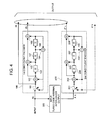
- The conventional (3GPP-Standard) output device of the turbo encoder as mentioned above includes two constituent encoders (
1st constituent encoder 100 and 2nd constituent encoder 200) as shown inFig. 4 . Herein, the 1stconstituent encoder 100 is configured of aswitch 101, operators (adders) 102 to 105, and delay circuits (D) 106 to 108, and 2ndconstituent encoder 200 is configured of aswitch 201, operators (adders) 202 to 205, and delay circuits (D) 206 to 208. - One constituent encoder (the 1st constituent encoder 100) directly inputs a data coding sequence Xk, whereas the other constituent encoder (the 2nd constituent encoder 200) inputs a sequence (a data coding sequence X'k) mixed with the data coding sequence by an interleaver (Turbo Code internal interleaver) 300.
- Specifically, the data coding sequence (Systematic Bits) Xk is redundant data sequences Zk and Z'k that are output by two constituent encoders (the 1st
constituent encoder 100 and the 2nd constituent encoder 200), respectively. Information X'k obtained by performing an interleaving process for the data coding sequence Xk is not outputted. The reason is that if a decoding side can decode the data coding sequence Xk, performing the interleaving process therefor makes it possible to obtain the information X'k for which the interleaving process has been performed. - A tail bit is an end bit for setting the bit held by each constituent encoder (the
1st constituent encoder 100 and the 2nd constituent encoder 200) back to zero after finishing the coding of the data sequence. A rate of the turbo code is 1/3, and the output order is an order of X1, Z1, Z'1, X2, Z2, Z' 2, ..., Xn, Zn, and Z'n [where n=a code block size of the turbo coding]. However, with normal coding of the data sequence, three kinds of codes are outputted, whereas, with coding of the tail bit, four kinds of codes are outputted. That is, according to a route of a signal line shown by dotted lines ofFig. 4 , Xn+1, Zn+1, Xn+2, Zn+2, Xn+3, Zn+3, X'n+1, Z'n+1, X'n+2, Z'n+2, X'n+3, and Z'n+3 are outputted in this order. - In bit separation of the HRAQ, the turbo-coded data sequence, as shown in
Fig. 5 , lines up in an order of a 1st data coding bit (1st Systematic bit), a1st Parity 1 bit, a1st Parity 2 bit, a2nd Parity 1 bit, a2nd Parity 2 bit, a 3rd data coding sequence (3rd Systematic bit), ..., a tail bit, so abit separation unit 400 sequentially separates them into three sequences of
a 1st sequence 401: (all Systematic bits) + (some tail bits of Systematic &Parity 1 & Parity 2),
a 2nd sequence 402: (allParity 1 bits) + (some tail bits of Systematic &Parity 1 & Parity 2), and
a 3rd sequence 403: (allParity 2 bits) + (some tail bits of Systematic &Parity 1 & Parity 2). - The HARQ process is for causing the output bit number of the turbo code to match with a total bit number of a physical channel that is mapped to the HS-DSCH.
- A Hybrid ARQ functionality, as shown in
Fig. 6 , is configured of two rate-matching stages (a 1st rate matching 620 and a 2nd rate matching 640) and one virtual buffer (virtual IR buffer 630). - Further, the 1st rate matching 620 includes a rate matching (RM_P1_1) 621 and a rate matching (RM_P2_1) 622, and the 2nd rate matching 640 includes a rate matching (RM_S) 641 and a rate matching (RM_P1_2) 642, and a rate matching (RM_P2_2) 643.
- The 1st rate matching 620 (1st rate matching stage) causes the input bit number to match with the number of the bits (which are given by a higher layer) of the
virtual IR buffer 630. However, when the input bit number does not exceed a capacity (bit number) of thevirtual IR buffer 630, no process is performed for the data even though this 1st rate matching 620 is transparent hereto. - The 2nd rate matching 640 (2nd rate matching stage) causes the number of the bits subsequent to the process of the 1st rate matching 620 to match with a physical channel bit number at its TTI.
- The 1st rate matching 620 of the HARQ, when the input bit number exceeds a capacity (bit number) of the
virtual IR buffer 630, removes bits that are located at an appropriate position in sequences of the Parity 1 (2nd Sequence) and the Parity 2 (3rd Sequence). The removal position is decided with computation using a rate matching parameter. The data coding sequence (1st Sequence), which is not punctured, is directly inputted into thevirtual IR buffer 630. The so-called puncturing process is a process of extracting the bit from the bit sequence at a constant period. - Next, how to calculate the 1st rate matching parameter in accordance with the conventional method will be explained.
-
- (1) When NIR < NTTI, the number of bits that should be punctured

- (2) Set a=2 when b=2;
a=1 when b=3
In a case of puncturing theParity 1 bit, it follows that b=2.
In a case of puncturing theParity 2 bit, it follows that b=3. -
- (3) Set

where, -


- (4) Computation of the rate matching parameter


- One example of the 1st rate matching process of the HARQ that is performed for the output of the turbo encoder shown in
Fig. 4 is shown inFig. 7 . In this example, the process of the 1st rate matching of the HARQ process at the time that the bit number NTTI subsequent to the channel coding is 1500 and the number NIR of the bits allocated to thevirtual IR buffer 630 is 1200 is exemplified. - In HARQ bit separation, the turbo-coded data is separated into three sequences of a data coding sequence (Systematic), a
Parity 1 sequence (1st parity), and aParity 2 sequence (2nd parity). Each of the data coding sequence, theParity 1 sequence, and theParity 2 sequence is configured of 496-bit code information and 4-bit tail bit information. The 4-bit tail bit information of each sequence has one part of the data coding sequence and each tail bit of theParity 1 sequence and theParity 2 sequence mixed. - Next, in the HARQ 1st rate matching, the rate matching with the capacity NIR =1500 of the
virtual IR buffer 630 is carried out (it is only the parity bit that is punctured). - Upon computing the 1st rate matching parameter in accordance with the conventional,
-

Parity 1 is as follows.


Parity 2 is as follows.


- Non-patent document: "Multiple and channel coding 4.2.3.2 Turbo coding" [3GPP TS 25.212 V7.0.0 (2006-03) p.16-21]
- The conventional HARQ processing method described above causes a problem that the tail bits of the data coding sequence partially exist in the sequence of the
Parity 1 and theParity 2, whereby the above tail bit could be removed, depending upon a rate matching parameter, when the 1st rate matching process is performed. - In the conventional method, trellis termination of the decoding becomes impossible at the time of turbo decoding due to loss of the tail bit of this data coding sequence, and resultantly a decoding performance declines. In particular, when a code redundancy is low (when a large number of the parity bits are punctured), a decline in the performance becomes conspicuous. This demands a configuration such that tail bits of all data coding sequences of the turbo encoder are prevented from being punctured when the bit separation and the 1st rate matching of the HARQ are carried out.
- Thereupon, an object of the present invention is to provide a turbo encoder that is capable of releasing the above-mentioned points at issue and improving a performance of an encoder when a redundancy is low, and an HARQ processing method applied therefor.
- The turbo encoder in accordance with the present invention, which is a turbo encoder for, as a coding output of a data sequence, sequentially outputting a data coding sequence obtained by coding the data sequence, a 1st redundant data sequence, which is outputted from a 1st constituent encoder, with the data coding sequence assumed to be an input, and a 2nd redundant data sequence, which is outputted from a 2nd constituent encoder, with the sequence obtained by interleaving the data coding sequence assumed to be an input, includes a holding means for holding the sequence obtained by interleaving the data coding sequence, and adds a tail bit, being an end bit for setting the bits held by the 1st constituent encoder and the 2nd constituent encoder back to zero in the interleaved sequence held by the holding means, to an end of the coding output.
- The HARQ processing method in accordance with the present invention is an HARQ (Hybrid Automatic Repeat reQuest) processing method that is employed for a turbo encoder for, as a coding output of a data sequence, sequentially outputting a data coding sequence obtained by coding the data sequence, a 1st redundant data sequence, which is outputted from a 1st constituent encoder, with the data coding sequence assumed to be an input, and a 2nd redundant data sequence, which is outputted from a 2nd constituent encoder, with the sequence obtained by interleaving the data coding sequence assumed to be an input, wherein a tail bit, being an end bit for setting the bits held by the 1st constituent encoder and the 2nd constituent encoder back to zero in the sequence obtained by interleaving the data coding sequence, is added to an end of the coding output.
- That is, the turbo encoder of the present invention is characterized in improving a performance of the turbo code by improving the 1st rate matching processing method at the time of carrying out the process of outputting the tail bit that is added to an end of the data coding sequence (Systematic sequence), and the HARQ (Hybrid Automatic Repeat reQuest).
- Namely, in an output device of the turbo encoder of the present invention, the 1st constituent encoder directly inputs a data coding sequence Xk and outputs a redundant data sequence Zk, the 2nd constituent encoder inputs a data coding information X'k mixed with the data coding sequence by the interleaver, and outputs a redundant data sequence Z'k, and a buffer holds the data coding information X'k mixed with the data coding sequence by the interleaver. Thus, the data coding sequence Xk, the redundant data sequences Zk and Z'k, and the data coding information X'k held by the
buffer 4 are outputted in this order from the above-mentioned output device. - In the turbo encoder of the present invention, the order in which the tail bit of not-interleaved data coding sequence, the tail bit of the
Parity 1 and the tail bit of theParity 2 are output is identical to the normal order of the coding output, and the tail bit of the interleaved data coding sequence is outputted lastly. In this case, the tail bit of the interleaved data coding sequence is stored in the buffer, and is added to an end of the coding output. - Further, the turbo encoder of the present invention, in the bit separation that is a process subsequent to the turbo coding, adds the tail bits of all data coding sequences to the data coding sequence, adds the tail bits of all
Parity 1 to theParity 1 sequence, and adds the tail bits of allParity 2 to theParity 2 sequence. - In addition hereto, the turbo encoder of the present invention computes the rate matching parameter when carrying out the 1st rate matching of the HARQ.
- In addition hereto, the turbo encoder of the present invention decides the position in which the parity bit is removed according to the method of computing the above-mentioned rate matching parameter when carrying out the 1st rate matching of the HARQ.
- In the turbo encoder of the present invention, this prevents the tail bit of the data coding sequence from being punctured when the 1st rate matching of the HARQ is carried out, thereby enabling a performance of the encoder to be improved in particular when the redundancy is low (when a large number of the parity bits are punctured).
- Further, in the turbo encoder of the present invention, the above-mentioned process can be realized by adding a simplified circuit, which enables an improvement in the performance of the encoder to be easily realized. Such a decoding process is demanded in particular when a turbo encoding/decoding device has been installed into an appliance such as a portable telephone that is strictly requested to have an error correcting ability.
- In the present invention, an effect that assuming the above-mentioned configuration and operation enables a performance of the encoder to be improved when the redundancy is low (when a large number of the parity bits are punctured).
-
- [
Fig. 1] Fig. 1 is a block diagram illustrating a configuration of the turbo encoder in accordance with one example of the present invention. - [
Fig. 2] Fig. 2 is a view illustrating a bit separation processing method in accordance with one example of the present invention. - [
Fig. 3] Fig. 3 is a view illustrating one example of the 1st rate matching process of the HARQ process that is performed for an output of the turbo encoder shown inFig. 1 . - [
Fig. 4] Fig. 4 is a block diagram illustrating a configuration of the conventional turbo encoder. - [
Fig. 5] Fig. 5 is a view illustrating the conventional bit separation processing method. - [
Fig. 6] Fig. 6 is a view illustrating a flow of the HARQ process in HSDPA. - [
Fig. 7] Fig. 7 is a view illustrating an example of the 1st rate matching process in the HARQ process. -
- 1
- 1st constituent encoder
- 2
- 2nd constituent encoder
- 3
- interleaver
- 4
- buffer
- 5
- bit separation unit
- 6
- 1st rate matching unit
- 11 and 21
- switches
- 12 to 15 and 22 to 25
- operators
- 16 to 18 and 26 to 28
- delay circuits
- 51
- 1st sequence
- 52
- 2nd sequence
- 53
- 3rd sequence
- Next, an example of the present invention will be explained by making a reference to the accompanied drawings.
Fig. 1 is a block diagram illustrating a configuration of the output device of the turbo encoder in accordance with one example of the present invention. InFig. 1 , the output device of the turbo encoder in accordance with one example of the present invention is configured of a 1stconstituent encoder 1, a 2ndconstituent encoder 2, an interleaver (turbo code internal interleaver) 3, and abuffer 4. - The 1st
constituent encoder 1 is configured of aswitch 11, operators (adders) 12 to 15, and delay circuits (D) 16 to 18, and the 2ndconstituent encoder 2 is configured of aswitch 21, operators (adders) 22 to 25, and delay circuits (D) 26 to 28. - The end bit for setting the bit held by each constituent encoder (the 1st
constituent encoder 1 and the 2nd constituent encoder 2) back to zero after finishing the turbo coding of the data sequence is called a tail bit. A performance of the turbo encoder in accordance with one embodiment of the present invention is improved with the process such that the tail bit of the data coding sequence (Systematic sequence) is prevented from being punctured when the rate matching is carried out. The so-called puncturing process is a process of extracting the bit from the bit sequence at a constant period. - In this example, the bit separating process that is performed at the time of carrying out the HARQ (Hybrid Automatic Repeat reQuest) with the tail bit process of the turbo encoder, and the 1st rate matching processing technique will be described. At first, a configuration of the turbo encoder in accordance with one example of the present invention will be explained.
- The turbo encoder includes two constituent encoders (the 1st
constituent encoder 1 and the 2nd constituent encoder 2). One constituent encoder (the 1st constituent encoder 1) directly inputs a data coding sequence, whereas the other constituent encoder (the 2nd constituent encoder 2) inputs a sequence mixed with the data coding sequence by the interleaver 3. - Specifically, the data coding sequence (Systematic Bits) Xk is redundant data sequences Zk and Z'k that are output from two constituent encoders (the 1st
constituent encoder 1 and the 2nd constituent encoder 2). Data coding information X'k obtained by performing an interleaving process for the data coding sequence is not outputted. The reason is that if the decoding side can decode the data coding sequence Xk, performing the interleaving process for its decoding result enables X'k to be obtained. However, in the case of encoding the tail bit, information X'k as well obtained by performing an interleaving process for the tail bit has to be outputted. - At this time, the tail bit information of the interleaved information X'k is stored temporarily into the
buffer 4 in order to easily perform the HARQ process that is later performed. A code rate of the turbo code is 1/3, and the output order is an order of X1, Z1, Z'1, X2, Z2, Z'2, ..., Xn, Zn and Z'n [where n=a code block size of the turbo coding]. However, with the coding of the tail bit, according to a route of a signal line shown by dotted lines ofFig. 1 , Xn+1, Zn+1, Z'n+1, Xn+2, Zn+2, Z'n+2, Xn+3, Zn+3, Z'n+3, X'n+1, X'n+2, and X'n+3 are outputted in this order. That is, the information X'k (in an example ofFig. 1 , X'n+1, X'n+2, and X'n+3) obtained by interleaving the tail bit stored into thebuffer 4 is outputted lastly. -
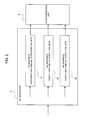
Fig. 2 is a view illustrating a bit separation processing method in accordance with one example of the present invention. InFig. 2 , the bit separating process at the time of the HARQ process is shown. InFig. 2 , this bit separating process is performed in abit separation unit 5 prior to the process by a 1strate matching unit 6. Thebit separation unit 5 performs processes of a1st sequence 51, a2nd sequence 52, and a3rd sequence 53. - The turbo-coded data sequence basically lines up in an order of the data coding bit (Systematic bit), the
Parity 1 bit, and theParity 2 bit, whereby sequentially separating them makes it possible to separate them into three sequences of the Systematic, theParity 1, and theParity 2. However, the tail bit information X' existing in an end of the data sequence lines up in the last of the Systematic sequence. - That is, it follows that
the 1st sequence 51: (all Systematic bits) + (all Systematic tail bits),
the 2nd sequence 52: (allParity 1 bits) + (allParity 1 tail bits), and
the 3rd sequence 53: (allParity 2 bits) + (allParity 2 tail bits). - Next, the 1st rate matching process of the HARQ process will be explained. In the 1st rate matching process, the number NTTI per TTI (Transmission Timing Interval) of the bits subsequent to the turbo coding is caused to match with the bit number NIR of a virtual IR buffer (not shown in the figure) that can be utilized for the above HARQ process.
When NIR ≧ NTTI, no process is performed for the data even though the 1st rate matching stage is transparent hereto.
When NIR < NTTI, the number of the bits that should be punctured. -

- The rate matching parameters of the
Parity 1 bit and theParity 2 bit are computed as follows. - (1) Set a=2 when b=2;
a=1 when b=3
In a case of puncturing theParity 1 bit, it follows that b=2.
In a case of puncturing theParity 2 bit, it follows that b=3. -
- (2) Set

where, -

- (3) Computation of the rate matching parameter


- The 1st rate matching process of the HARQ process is performed according to the above-mentioned rate matching parameter. In this example, similarly to the conventional method described above, the number of the input bit from the turbo encoder is caused to match with the number (NIR) of the bits allocated the virtual IR buffer. Also in the 2nd rate matching process of the HARQ process, similarly to the conventional method described above, the bit number subsequent to the 1st rate matching process is caused to match with the total bit number of HS-PDSCH (High Speed-Physical Downlink Shared Channel) to which HS-DSCH (High Speed-Downlink Shared Channel) is mapped at its TTI.
-
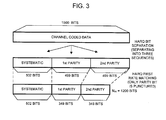
Fig. 3 is a view illustrating one example of the 1st rate matching process of the HARQ process that is performed for an output of the turbo encoder shown inFig. 1 . InFig. 3 , an example of the 1st rate matching process of the HARQ process at the time that the bit number NTTI subsequent to the channel coding is 1500 and the number NIR of the bits allocated to the virtual IR buffer is 1200 (NIR=1200) is shown. - In the bit separation of the HARQ process, the turbo-coded data is separated into three sequences of the data coding (Systematic) sequence, the
Parity 1 sequence, and theParity 2 sequence. In this case, the data coding sequence is configured of 496-bit code information and 6-bit tail bit information, and each of theParity 1 sequence and theParity 2 sequence is configured of 496-bit code information and 3-bit tail bit information. - Next, in the 1st rate matching of the HARQ process, the rate matching with a capacity NIR=1500 of the virtual IR buffer is carried out (it is only the parity bit that is punctured).
- Upon calculating the 1st rate matching parameter with the above-described method,
-

Parity 1 is as follows.


Parity 2 is as follows.


- The position in which the bits of the
Parity 1 and theParity 2 are removed is decided according to the above-mentioned rate matching parameters. - In such a manner, in this example, preventing the tail bit of the data coding sequence from being punctured at the time of carrying out the 1st rate matching of the HARQ process makes it possible to improve a performance in the encoder in particular when the redundancy is low (a large number of the parity bits are punctured).
- Further, in this example, an improvement in the performance of the encoder can be easily realized because an improvement in the performance of the encoder can be realized by adding a simplified circuit. Such a decoding process is demanded in particular when a turbo encoding/decoding device has been installed into an appliance such as a portable telephone that is strictly requested to have an error correcting ability.
- Additionally, while the present invention has been disclosed with respect to the illustrative embodiments and use methods thereof, it will be appreciated that those skilled in the art may readily conceive of alterations to, variations of, and equivalents to these embodiments without departing from a scope of the present invention. For example, while it is envisaged that the tail bit process of the present invention and the rate matching process subsequent to it are applied to the wireless communication system into which an HSDPA (High Speed Downlink Packet Access) function has been installed in W-CDMA (Wideband-Code Division Multiple Access), they are applicable to all wireless communication systems utilizing the turbo coding.
- This application is based upon and claims the benefit of priority from Japanese patent application No.
2006-137145, filed on May 17, 2006
Claims (10)
- A turbo encoder for, as a coding output of a data sequence, sequentially outputting a data coding sequence obtained by coding said data sequence, a 1st redundant data sequence with said data coding sequence assumed to be an input, said 1st redundant data sequence being outputted from a 1st constituent encoder, and a 2nd redundant data sequence with the sequence obtained by interleaving said data coding sequence assumed to be an input, said 2nd redundant data sequence being outputted from a 2nd constituent encoder, wherein said turbo encoder comprises a holding means for holding the sequence obtained by interleaving said data coding sequence, and adds a tail bit, being an end bit for setting the bits held by said 1st constituent encoder and said 2nd constituent encoder back to zero in said interleaved sequence held by said holding means, to an end of said coding output.
- A turbo encoder according to claim 1, characterized in that the tail bit in said interleaved sequence held by said holding means is outputted after each of said data coding sequence, said 1st redundant data sequence, and said 2nd redundant data sequence is outputted.
- A turbo encoder according to claim 1 or claim 2, characterized in that, in a bit separating process for said coding output, the tail bits in said interleaved sequence are all added to said data coding sequence, the tail bits in said 1st redundant data sequence are all added to said 1st redundant data sequence, and the tail bits in said 2nd redundant data sequence are all added to said 2nd redundant data sequence.
- A turbo encoder according to one of claim 1 to claim 3, characterized in, when performing a 1st rate matching process for said coding output, employing information obtained by interleaving said tail bit for computation of its rate matching parameter.
- A turbo encoder according to claim 4, characterized in that a removal position of said 1st and 2nd redundant data sequences is decided with the rate matching parameter computed by employing information obtained by interleaving said tail bit.
- An HARQ (Hybrid Automatic Repeat reQuest) processing method that is employed for a turbo encoder for, as a coding output of a data sequence, sequentially outputting a data coding sequence obtained by coding said data sequence, a 1st redundant data sequence with said data coding sequence assumed to be an input, said 1st redundant data sequence being outputted from a 1st constituent encoder, and a 2nd redundant data sequence with the sequence obtained by interleaving said data coding sequence assumed to be an input, said 2nd redundant data sequence being outputted from a 2nd constituent encoder, wherein a tail bit, being an end bit for setting the bits held by said 1st constituent encoder and said 2nd constituent encoder back to zero in the sequence obtained by interleaving said data coding sequence, is added to an end of said coding output.
- An HARQ processing method according to claim 6, characterized in that the tail bit in said interleaved sequence is outputted after each of said data coding sequence, said 1st redundant data sequence, and said 2nd redundant data sequence is outputted.
- An HARQ processing method according to claim 6 or claim 7, characterized in that, in a bit separating process for said coding output, the tail bits in said interleaved sequence are all added to said data coding sequence, the tail bits in said 1st redundant data sequence are all added to said 1st redundant data sequence, and the tail bits in said 2nd redundant data sequence are all added to said 2nd redundant data sequence.
- An HARQ processing method according to one of claim 6 to claim 8, characterized in, when performing a 1st rate matching process for said coding output, employing information obtained by interleaving said tail bit for computation of its rate matching parameter.
- An HARQ processing method according to claim 9, characterized in that a removal position of said 1st and 2nd redundant data sequences is decided with the rate matching parameter computed by employing information obtained by interleaving said tail bit.
Applications Claiming Priority (2)
| Application Number | Priority Date | Filing Date | Title |
|---|---|---|---|
| JP2006137145 | 2006-05-17 | ||
| PCT/JP2007/060097 WO2007132912A1 (en) | 2006-05-17 | 2007-05-17 | Turbo encoder and harq processing method applied for the turbo encoder |
Publications (2)
| Publication Number | Publication Date |
|---|---|
| EP2034613A1 true EP2034613A1 (en) | 2009-03-11 |
| EP2034613A4 EP2034613A4 (en) | 2009-08-12 |
Family
ID=38693998
Family Applications (1)
| Application Number | Title | Priority Date | Filing Date |
|---|---|---|---|
| EP07743532A Withdrawn EP2034613A4 (en) | 2006-05-17 | 2007-05-17 | ENCODER TURBO AND HARQ PROCESSING METHOD APPLIED FOR TURBO ENCODER |
Country Status (5)
| Country | Link |
|---|---|
| US (1) | US8250429B2 (en) |
| EP (1) | EP2034613A4 (en) |
| JP (1) | JP5170441B2 (en) |
| CN (1) | CN101449467B (en) |
| WO (1) | WO2007132912A1 (en) |
Families Citing this family (5)
| Publication number | Priority date | Publication date | Assignee | Title |
|---|---|---|---|---|
| CN102130757B (en) * | 2010-01-19 | 2015-07-29 | 北京三星通信技术研究有限公司 | Interweaving retransmission device and method |
| US8583993B2 (en) * | 2011-06-17 | 2013-11-12 | Lsi Corporation | Turbo parallel concatenated convolutional code implementation on multiple-issue processor cores |
| KR101286019B1 (en) * | 2012-01-20 | 2013-07-19 | 주식회사 이노와이어리스 | Turbo encoder apparatus |
| US9742440B2 (en) * | 2015-03-25 | 2017-08-22 | Samsung Electronics Co., Ltd | HARQ rate-compatible polar codes for wireless channels |
| US10523386B2 (en) * | 2016-06-24 | 2019-12-31 | Lg Electronics Inc. | Method of processing data block in wireless communication system and apparatus therefor |
Family Cites Families (18)
| Publication number | Priority date | Publication date | Assignee | Title |
|---|---|---|---|---|
| US6332209B1 (en) * | 1998-08-27 | 2001-12-18 | Hughes Electronics Corporation | Method for a general turbo code trellis termination |
| IL141800A0 (en) * | 1999-07-06 | 2002-03-10 | Samsung Electronics Co Ltd | Rate matching device and method for a data communication system |
| WO2001091356A1 (en) * | 2000-05-24 | 2001-11-29 | Samsung Electronics Co., Ltd | Data transmission apparatus and method for an harq data communication system |
| JP2002044047A (en) * | 2000-07-19 | 2002-02-08 | Mitsubishi Electric Corp | Communication device and communication method |
| KR100539862B1 (en) * | 2001-04-04 | 2005-12-28 | 삼성전자주식회사 | Method and apparatus for transporting and receiving data in cdma mobile system |
| US6950975B2 (en) * | 2001-08-03 | 2005-09-27 | Combasis Technology, Inc. | Acceleration of convergence rate with verified bits in turbo decoding |
| WO2003030407A1 (en) * | 2001-09-29 | 2003-04-10 | Lg Electronics Inc. | Method for transferring and /or receiving data in communication system and apparatus thereof |
| JP2004007028A (en) * | 2002-04-26 | 2004-01-08 | Matsushita Electric Ind Co Ltd | Transmission device and transmission method |
| JP3898574B2 (en) * | 2002-06-05 | 2007-03-28 | 富士通株式会社 | Turbo decoding method and turbo decoding apparatus |
| KR20050020526A (en) * | 2003-08-23 | 2005-03-04 | 삼성전자주식회사 | Apparatus and method for bit interleaving in mobile communication system |
| CN1622649A (en) * | 2003-11-25 | 2005-06-01 | 安捷伦科技有限公司 | System and method for generating optimal repeat Tubo code stream |
| US8391410B2 (en) * | 2004-07-29 | 2013-03-05 | Qualcomm Incorporated | Methods and apparatus for configuring a pilot symbol in a wireless communication system |
| US7519896B2 (en) * | 2004-09-22 | 2009-04-14 | Stmicroelectronics Pvt. Ltd. | Turbo encoder and related methods |
| US20080016425A1 (en) * | 2006-04-04 | 2008-01-17 | Qualcomm Incorporated | Turbo decoder with symmetric and non-symmetric decoding rates |
| US8074155B2 (en) * | 2006-09-28 | 2011-12-06 | Broadcom Corporation | Tail-biting turbo coding to accommodate any information and/or interleaver block size |
| US8356232B2 (en) * | 2006-10-06 | 2013-01-15 | Motorola Mobility Llc | Method and apparatus for encoding and decoding data |
| US7949926B2 (en) * | 2006-11-30 | 2011-05-24 | Motorola Mobility, Inc. | Method and apparatus for encoding and decoding data |
| US7873893B2 (en) * | 2007-02-28 | 2011-01-18 | Motorola Mobility, Inc. | Method and apparatus for encoding and decoding data |
-
2007
- 2007-05-17 WO PCT/JP2007/060097 patent/WO2007132912A1/en not_active Ceased
- 2007-05-17 EP EP07743532A patent/EP2034613A4/en not_active Withdrawn
- 2007-05-17 JP JP2008515598A patent/JP5170441B2/en not_active Expired - Fee Related
- 2007-05-17 CN CN2007800179664A patent/CN101449467B/en not_active Expired - Fee Related
- 2007-05-17 US US12/301,119 patent/US8250429B2/en not_active Expired - Fee Related
Non-Patent Citations (3)
| Title |
|---|
| 3GPP: "3rd Generation Partnership Project; Technical Specification Group Radio Access Network; Multiplexing and channel coding (FDD) (Release 7)" INTERNET ARTICLE, [Online] March 2006 (2006-03), XP002534051 Retrieved from the Internet: URL:http://www.3gpp.org/ftp/Specs/html-info/25212.htm> [retrieved on 2009-06-25] * |
| JUNGSUB BYUN: "3GPP2/3GPP Coding Turbo code and Turbo Interleaver Summary" INTERNET ARTICLE, [Online] 23 July 2004 (2004-07-23), XP002534049 Retrieved from the Internet: URL:http://www.stanford.edu/class/ee379b/class_reader/3G_turbocode_interleaver.pdf> [retrieved on 2009-06-24] * |
| See also references of WO2007132912A1 * |
Also Published As
| Publication number | Publication date |
|---|---|
| WO2007132912A1 (en) | 2007-11-22 |
| US8250429B2 (en) | 2012-08-21 |
| JPWO2007132912A1 (en) | 2009-09-24 |
| US20090106618A1 (en) | 2009-04-23 |
| CN101449467A (en) | 2009-06-03 |
| CN101449467B (en) | 2013-12-18 |
| EP2034613A4 (en) | 2009-08-12 |
| JP5170441B2 (en) | 2013-03-27 |
Similar Documents
| Publication | Publication Date | Title |
|---|---|---|
| US7000173B2 (en) | Turbo code based incremental redundancy | |
| KR100407351B1 (en) | Data transmission apparatus and method for an harq data communication system | |
| CN1320796C (en) | Receiver unit and receiving method | |
| US20030079170A1 (en) | Block puncturing for turbo code based incremental redundancy | |
| US20020159384A1 (en) | Apparatus and method for transmitting and receiving data using partial chase combining | |
| CN101572588B (en) | Transmitting apparatus with bit arrangement method | |
| EP1911165B1 (en) | Methods of channel coding for communication systems | |
| US8850283B2 (en) | HARQ procedure with processing of stored soft-bits | |
| EP1605624B1 (en) | Error controller | |
| EP1914896A1 (en) | Transmitter apparatus, coder apparatus and decoder apparatus | |
| EP1914897A1 (en) | Transmitter apparatus | |
| US20090106618A1 (en) | Turbo encoder and harq processing method applied for the turbo encoder | |
| EP1569376A2 (en) | Method and apparatus for re-transmission control | |
| US20050172201A1 (en) | Receiver for a wireless communication device | |
| CN101069357B (en) | Turbo decoder for data block redundant version decoding | |
| EP2139140A2 (en) | Mobile radio apparatus employing data rate matching | |
| EP1912341B1 (en) | Hs-pdsch decoder and mobile wireless communication apparatus incorporating the same | |
| EP1501232B1 (en) | A method and receiver for buffering data employing HARQ and two stage rate matching | |
| EP1482670A1 (en) | A method and receiver for buffering data employing HARQ and two stage matching algorithm with iterative decoding | |
| KR20060095225A (en) | High speed downlink shared channel transmitter in wideband code division multiple access system | |
| EP1883162A1 (en) | Non-periodic puncturing of turbo codes and convolutional codes | |
| CN102904691A (en) | Parallel solution rate matching method and device | |
| EP2408136A2 (en) | Error control apparatus |
Legal Events
| Date | Code | Title | Description |
|---|---|---|---|
| PUAI | Public reference made under article 153(3) epc to a published international application that has entered the european phase |
Free format text: ORIGINAL CODE: 0009012 |
|
| 17P | Request for examination filed |
Effective date: 20081216 |
|
| AK | Designated contracting states |
Kind code of ref document: A1 Designated state(s): AT BE BG CH CY CZ DE DK EE ES FI FR GB GR HU IE IS IT LI LT LU LV MC MT NL PL PT RO SE SI SK TR |
|
| AX | Request for extension of the european patent |
Extension state: AL BA HR MK RS |
|
| DAX | Request for extension of the european patent (deleted) | ||
| RBV | Designated contracting states (corrected) |
Designated state(s): DE FR GB IT |
|
| A4 | Supplementary search report drawn up and despatched |
Effective date: 20090715 |
|
| 17Q | First examination report despatched |
Effective date: 20091023 |
|
| RAP1 | Party data changed (applicant data changed or rights of an application transferred) |
Owner name: LENOVO INNOVATIONS LIMITED (HONG KONG) |
|
| STAA | Information on the status of an ep patent application or granted ep patent |
Free format text: STATUS: EXAMINATION IS IN PROGRESS |
|
| STAA | Information on the status of an ep patent application or granted ep patent |
Free format text: STATUS: THE APPLICATION HAS BEEN WITHDRAWN |
|
| 18W | Application withdrawn |
Effective date: 20180712 |