EP2033656A1 - Satiety-modulating compositions for oral application - Google Patents
Satiety-modulating compositions for oral application Download PDFInfo
- Publication number
- EP2033656A1 EP2033656A1 EP07115641A EP07115641A EP2033656A1 EP 2033656 A1 EP2033656 A1 EP 2033656A1 EP 07115641 A EP07115641 A EP 07115641A EP 07115641 A EP07115641 A EP 07115641A EP 2033656 A1 EP2033656 A1 EP 2033656A1
- Authority
- EP
- European Patent Office
- Prior art keywords
- peptides
- satiety
- composition
- peptide
- saliva
- Prior art date
- Legal status (The legal status is an assumption and is not a legal conclusion. Google has not performed a legal analysis and makes no representation as to the accuracy of the status listed.)
- Withdrawn
Links
- 239000000203 mixture Substances 0.000 title claims abstract description 69
- 108090000765 processed proteins & peptides Proteins 0.000 claims abstract description 125
- 230000036186 satiety Effects 0.000 claims abstract description 114
- 235000019627 satiety Nutrition 0.000 claims abstract description 114
- 102000004196 processed proteins & peptides Human genes 0.000 claims abstract description 98
- 210000003296 saliva Anatomy 0.000 claims abstract description 65
- 238000000756 surface-enhanced laser desorption--ionisation time-of-flight mass spectrometry Methods 0.000 claims abstract description 30
- 102000001848 Salivary Proteins and Peptides Human genes 0.000 claims abstract description 20
- 108010029987 Salivary Proteins and Peptides Proteins 0.000 claims abstract description 20
- 210000000214 mouth Anatomy 0.000 claims abstract description 19
- 239000000813 peptide hormone Substances 0.000 claims abstract description 17
- 238000004458 analytical method Methods 0.000 claims abstract description 12
- 230000002496 gastric effect Effects 0.000 claims abstract description 12
- 238000004519 manufacturing process Methods 0.000 claims abstract description 4
- 238000002360 preparation method Methods 0.000 claims abstract description 4
- 235000013305 food Nutrition 0.000 claims description 31
- NOESYZHRGYRDHS-UHFFFAOYSA-N insulin Chemical compound N1C(=O)C(NC(=O)C(CCC(N)=O)NC(=O)C(CCC(O)=O)NC(=O)C(C(C)C)NC(=O)C(NC(=O)CN)C(C)CC)CSSCC(C(NC(CO)C(=O)NC(CC(C)C)C(=O)NC(CC=2C=CC(O)=CC=2)C(=O)NC(CCC(N)=O)C(=O)NC(CC(C)C)C(=O)NC(CCC(O)=O)C(=O)NC(CC(N)=O)C(=O)NC(CC=2C=CC(O)=CC=2)C(=O)NC(CSSCC(NC(=O)C(C(C)C)NC(=O)C(CC(C)C)NC(=O)C(CC=2C=CC(O)=CC=2)NC(=O)C(CC(C)C)NC(=O)C(C)NC(=O)C(CCC(O)=O)NC(=O)C(C(C)C)NC(=O)C(CC(C)C)NC(=O)C(CC=2NC=NC=2)NC(=O)C(CO)NC(=O)CNC2=O)C(=O)NCC(=O)NC(CCC(O)=O)C(=O)NC(CCCNC(N)=N)C(=O)NCC(=O)NC(CC=3C=CC=CC=3)C(=O)NC(CC=3C=CC=CC=3)C(=O)NC(CC=3C=CC(O)=CC=3)C(=O)NC(C(C)O)C(=O)N3C(CCC3)C(=O)NC(CCCCN)C(=O)NC(C)C(O)=O)C(=O)NC(CC(N)=O)C(O)=O)=O)NC(=O)C(C(C)CC)NC(=O)C(CO)NC(=O)C(C(C)O)NC(=O)C1CSSCC2NC(=O)C(CC(C)C)NC(=O)C(NC(=O)C(CCC(N)=O)NC(=O)C(CC(N)=O)NC(=O)C(NC(=O)C(N)CC=1C=CC=CC=1)C(C)C)CC1=CN=CN1 NOESYZHRGYRDHS-UHFFFAOYSA-N 0.000 claims description 24
- 102400000442 Ghrelin-28 Human genes 0.000 claims description 22
- 101800001586 Ghrelin Proteins 0.000 claims description 19
- 230000001939 inductive effect Effects 0.000 claims description 19
- GNKDKYIHGQKHHM-RJKLHVOGSA-N ghrelin Chemical compound C([C@H](NC(=O)[C@@H](NC(=O)[C@H](CO)NC(=O)CN)COC(=O)CCCCCCC)C(=O)N[C@@H](CC(C)C)C(=O)N[C@@H](CO)C(=O)N1[C@@H](CCC1)C(=O)N[C@@H](CCC(O)=O)C(=O)N[C@@H](CC=1N=CNC=1)C(=O)N[C@@H](CCC(N)=O)C(=O)N[C@@H](CCCNC(N)=N)C(=O)N[C@@H](C(C)C)C(=O)N[C@@H](CCC(N)=O)C(=O)N[C@@H](CCC(N)=O)C(=O)N[C@@H](CCCNC(N)=N)C(=O)N[C@@H](CCCCN)C(=O)N[C@@H](CCC(O)=O)C(=O)N[C@@H](CO)C(=O)N[C@@H](CCCCN)C(=O)N[C@@H](CCCCN)C(=O)N1[C@@H](CCC1)C(=O)N1[C@@H](CCC1)C(=O)N[C@@H](C)C(=O)N[C@@H](CCCCN)C(=O)N[C@@H](CC(C)C)C(=O)N[C@@H](CCC(N)=O)C(=O)N1[C@@H](CCC1)C(=O)N[C@@H](CCCNC(N)=N)C(O)=O)C1=CC=CC=C1 GNKDKYIHGQKHHM-RJKLHVOGSA-N 0.000 claims description 17
- 102000004877 Insulin Human genes 0.000 claims description 16
- 108090001061 Insulin Proteins 0.000 claims description 16
- 108010004460 Gastric Inhibitory Polypeptide Proteins 0.000 claims description 15
- 102100039994 Gastric inhibitory polypeptide Human genes 0.000 claims description 15
- MASNOZXLGMXCHN-ZLPAWPGGSA-N glucagon Chemical compound C([C@@H](C(=O)N[C@H](C(=O)N[C@@H](CCC(N)=O)C(=O)N[C@@H](CC=1C2=CC=CC=C2NC=1)C(=O)N[C@@H](CC(C)C)C(=O)N[C@@H](CCSC)C(=O)N[C@@H](CC(N)=O)C(=O)N[C@@H]([C@@H](C)O)C(O)=O)C(C)C)NC(=O)[C@H](CC(O)=O)NC(=O)[C@H](CCC(N)=O)NC(=O)[C@H](C)NC(=O)[C@H](CCCNC(N)=N)NC(=O)[C@H](CCCNC(N)=N)NC(=O)[C@H](CO)NC(=O)[C@H](CC(O)=O)NC(=O)[C@H](CC(C)C)NC(=O)[C@H](CC=1C=CC(O)=CC=1)NC(=O)[C@H](CCCCN)NC(=O)[C@H](CO)NC(=O)[C@H](CC=1C=CC(O)=CC=1)NC(=O)[C@H](CC(O)=O)NC(=O)[C@H](CO)NC(=O)[C@@H](NC(=O)[C@H](CC=1C=CC=CC=1)NC(=O)[C@@H](NC(=O)CNC(=O)[C@H](CCC(N)=O)NC(=O)[C@H](CO)NC(=O)[C@@H](N)CC=1NC=NC=1)[C@@H](C)O)[C@@H](C)O)C1=CC=CC=C1 MASNOZXLGMXCHN-ZLPAWPGGSA-N 0.000 claims description 13
- YNXLOPYTAAFMTN-SBUIBGKBSA-N C([C@H](N)C(=O)N1CCC[C@H]1C(=O)N[C@@H]([C@@H](C)CC)C(=O)N[C@@H](CCCCN)C(=O)N1[C@@H](CCC1)C(=O)N[C@@H](CCC(O)=O)C(=O)N[C@@H](C)C(=O)N1[C@@H](CCC1)C(=O)NCC(=O)N[C@@H](CCC(O)=O)C(=O)N[C@@H](CC(O)=O)C(=O)N[C@@H](C)C(=O)N[C@@H](CO)C(=O)N1[C@@H](CCC1)C(=O)N[C@@H](CCC(O)=O)C(=O)N[C@@H](CCC(O)=O)C(=O)N[C@@H](CC(C)C)C(=O)N[C@@H](CC(N)=O)C(=O)N[C@@H](CCCNC(N)=N)C(=O)N[C@@H](CC=1C=CC(O)=CC=1)C(=O)N[C@@H](CC=1C=CC(O)=CC=1)C(=O)N[C@@H](C)C(=O)N[C@@H](CO)C(=O)N[C@@H](CC(C)C)C(=O)N[C@@H](CCCNC(N)=N)C(=O)N[C@@H](CC=1NC=NC=1)C(=O)N[C@@H](CC=1C=CC(O)=CC=1)C(=O)N[C@@H](CC(C)C)C(=O)N[C@@H](CC(N)=O)C(=O)N[C@@H](CC(C)C)C(=O)N[C@@H](C(C)C)C(=O)N[C@@H]([C@@H](C)O)C(=O)N[C@@H](CCCNC(N)=N)C(=O)N[C@@H](CCC(N)=O)C(=O)N[C@@H](CCCNC(N)=N)C(=O)N[C@@H](CC=1C=CC(O)=CC=1)C(N)=O)C1=CC=C(O)C=C1 Chemical compound C([C@H](N)C(=O)N1CCC[C@H]1C(=O)N[C@@H]([C@@H](C)CC)C(=O)N[C@@H](CCCCN)C(=O)N1[C@@H](CCC1)C(=O)N[C@@H](CCC(O)=O)C(=O)N[C@@H](C)C(=O)N1[C@@H](CCC1)C(=O)NCC(=O)N[C@@H](CCC(O)=O)C(=O)N[C@@H](CC(O)=O)C(=O)N[C@@H](C)C(=O)N[C@@H](CO)C(=O)N1[C@@H](CCC1)C(=O)N[C@@H](CCC(O)=O)C(=O)N[C@@H](CCC(O)=O)C(=O)N[C@@H](CC(C)C)C(=O)N[C@@H](CC(N)=O)C(=O)N[C@@H](CCCNC(N)=N)C(=O)N[C@@H](CC=1C=CC(O)=CC=1)C(=O)N[C@@H](CC=1C=CC(O)=CC=1)C(=O)N[C@@H](C)C(=O)N[C@@H](CO)C(=O)N[C@@H](CC(C)C)C(=O)N[C@@H](CCCNC(N)=N)C(=O)N[C@@H](CC=1NC=NC=1)C(=O)N[C@@H](CC=1C=CC(O)=CC=1)C(=O)N[C@@H](CC(C)C)C(=O)N[C@@H](CC(N)=O)C(=O)N[C@@H](CC(C)C)C(=O)N[C@@H](C(C)C)C(=O)N[C@@H]([C@@H](C)O)C(=O)N[C@@H](CCCNC(N)=N)C(=O)N[C@@H](CCC(N)=O)C(=O)N[C@@H](CCCNC(N)=N)C(=O)N[C@@H](CC=1C=CC(O)=CC=1)C(N)=O)C1=CC=C(O)C=C1 YNXLOPYTAAFMTN-SBUIBGKBSA-N 0.000 claims description 12
- 102000051325 Glucagon Human genes 0.000 claims description 12
- 108060003199 Glucagon Proteins 0.000 claims description 12
- 229960004666 glucagon Drugs 0.000 claims description 12
- 229940125396 insulin Drugs 0.000 claims description 12
- 101800000221 Glucagon-like peptide 2 Proteins 0.000 claims description 10
- 108010088847 Peptide YY Proteins 0.000 claims description 10
- 102100029909 Peptide YY Human genes 0.000 claims description 10
- 102100040918 Pro-glucagon Human genes 0.000 claims description 10
- 108010003205 Vasoactive Intestinal Peptide Proteins 0.000 claims description 10
- 102400000015 Vasoactive intestinal peptide Human genes 0.000 claims description 10
- TWSALRJGPBVBQU-PKQQPRCHSA-N glucagon-like peptide 2 Chemical compound C([C@@H](C(=O)N[C@H](C(=O)N[C@@H](CC(N)=O)C(=O)N[C@@H](CC=1C2=CC=CC=C2NC=1)C(=O)N[C@@H](CC(C)C)C(=O)N[C@@H]([C@@H](C)CC)C(=O)N[C@@H](CCC(N)=O)C(=O)N[C@@H]([C@@H](C)O)C(=O)N[C@@H](CCCCN)C(=O)N[C@@H]([C@@H](C)CC)C(=O)N[C@@H]([C@@H](C)O)C(=O)N[C@@H](CC(O)=O)C(O)=O)[C@@H](C)CC)NC(=O)[C@H](CC(O)=O)NC(=O)[C@H](CCCNC(N)=N)NC(=O)[C@H](C)NC(=O)[C@H](C)NC(=O)[C@H](CC(C)C)NC(=O)[C@H](CC(N)=O)NC(=O)[C@H](CC(O)=O)NC(=O)[C@H](CC(C)C)NC(=O)[C@@H](NC(=O)[C@@H](NC(=O)[C@H](CC(N)=O)NC(=O)[C@H](CCSC)NC(=O)[C@H](CCC(O)=O)NC(=O)[C@H](CC(O)=O)NC(=O)[C@H](CO)NC(=O)[C@H](CC=1C=CC=CC=1)NC(=O)[C@H](CO)NC(=O)CNC(=O)[C@H](CC(O)=O)NC(=O)[C@H](C)NC(=O)[C@@H](N)CC=1NC=NC=1)[C@@H](C)O)[C@@H](C)CC)C1=CC=CC=C1 TWSALRJGPBVBQU-PKQQPRCHSA-N 0.000 claims description 10
- VBUWHHLIZKOSMS-RIWXPGAOSA-N invicorp Chemical compound C([C@@H](C(=O)N[C@@H](CC(C)C)C(=O)N[C@@H](CC(N)=O)C(=O)N[C@@H](CO)C(=O)N[C@@H]([C@@H](C)CC)C(=O)N[C@@H](CC(C)C)C(=O)N[C@@H](CC(N)=O)C(O)=O)NC(=O)[C@H](CCCCN)NC(=O)[C@H](CCCCN)NC(=O)[C@@H](NC(=O)[C@H](C)NC(=O)[C@H](CCSC)NC(=O)[C@H](CCC(N)=O)NC(=O)[C@H](CCCCN)NC(=O)[C@H](CCCNC(N)=N)NC(=O)[C@H](CC(C)C)NC(=O)[C@H](CCCNC(N)=N)NC(=O)[C@@H](NC(=O)[C@H](CC=1C=CC(O)=CC=1)NC(=O)[C@H](CC(N)=O)NC(=O)[C@H](CC(O)=O)NC(=O)[C@@H](NC(=O)[C@H](CC=1C=CC=CC=1)NC(=O)[C@@H](NC(=O)[C@H](C)NC(=O)[C@H](CC(O)=O)NC(=O)[C@H](CO)NC(=O)[C@@H](N)CC=1NC=NC=1)C(C)C)[C@@H](C)O)[C@@H](C)O)C(C)C)C1=CC=C(O)C=C1 VBUWHHLIZKOSMS-RIWXPGAOSA-N 0.000 claims description 10
- 101800001982 Cholecystokinin Proteins 0.000 claims description 9
- 102000016267 Leptin Human genes 0.000 claims description 9
- 108010092277 Leptin Proteins 0.000 claims description 9
- 101800001268 Pancreatic hormone Proteins 0.000 claims description 9
- 102000052651 Pancreatic hormone Human genes 0.000 claims description 9
- 229940039781 leptin Drugs 0.000 claims description 9
- NRYBAZVQPHGZNS-ZSOCWYAHSA-N leptin Chemical compound O=C([C@H](CO)NC(=O)[C@H](CC(C)C)NC(=O)[C@H](CC(O)=O)NC(=O)[C@H](CC(C)C)NC(=O)[C@H](CCC(N)=O)NC(=O)[C@H](CC=1C2=CC=CC=C2NC=1)NC(=O)[C@H](CC(C)C)NC(=O)[C@@H](NC(=O)[C@H](CC(O)=O)NC(=O)[C@H](CCC(N)=O)NC(=O)[C@H](CC(C)C)NC(=O)[C@H](CO)NC(=O)CNC(=O)[C@H](CCC(N)=O)NC(=O)[C@@H](N)CC(C)C)CCSC)N1CCC[C@H]1C(=O)NCC(=O)N[C@@H](CS)C(O)=O NRYBAZVQPHGZNS-ZSOCWYAHSA-N 0.000 claims description 9
- IZTQOLKUZKXIRV-YRVFCXMDSA-N sincalide Chemical compound C([C@@H](C(=O)N[C@@H](CCSC)C(=O)NCC(=O)N[C@@H](CC=1C2=CC=CC=C2NC=1)C(=O)N[C@@H](CCSC)C(=O)N[C@@H](CC(O)=O)C(=O)N[C@@H](CC=1C=CC=CC=1)C(N)=O)NC(=O)[C@@H](N)CC(O)=O)C1=CC=C(OS(O)(=O)=O)C=C1 IZTQOLKUZKXIRV-YRVFCXMDSA-N 0.000 claims description 9
- URJOZSLMTIRWFW-QGZVFWFLSA-N (4r)-4-(1,3-benzodioxol-5-yl)-5,6-dimethoxy-4,9-dihydro-1h-benzo[f][2]benzofuran-3-one Chemical compound C1=C2OCOC2=CC([C@H]2C3=C(COC3=O)CC3=CC=C(C(=C32)OC)OC)=C1 URJOZSLMTIRWFW-QGZVFWFLSA-N 0.000 claims description 8
- 102100025841 Cholecystokinin Human genes 0.000 claims description 8
- 102400000320 Glicentin Human genes 0.000 claims description 8
- 101800002945 Glicentin Proteins 0.000 claims description 8
- 229940107137 cholecystokinin Drugs 0.000 claims description 8
- 229940112822 chewing gum Drugs 0.000 claims description 7
- 235000015218 chewing gum Nutrition 0.000 claims description 7
- LVRVABPNVHYXRT-BQWXUCBYSA-N 52906-92-0 Chemical compound C([C@H](N)C(=O)N[C@H](C(=O)N1CCC[C@H]1C(=O)N[C@@H]([C@@H](C)CC)C(=O)N[C@@H](CC=1C=CC=CC=1)C(=O)N[C@@H]([C@@H](C)O)C(=O)N[C@@H](CC=1C=CC(O)=CC=1)C(=O)NCC(=O)N[C@@H](CCC(O)=O)C(=O)N[C@@H](CC(C)C)C(=O)N[C@@H](CCC(N)=O)C(=O)N[C@@H](CCCNC(N)=N)C(=O)N[C@@H](CCSC)C(=O)N[C@@H](CCC(N)=O)C(=O)N[C@@H](CCC(O)=O)C(=O)N[C@@H](CCCCN)C(=O)N[C@@H](CCC(O)=O)C(=O)N[C@@H](CCCNC(N)=N)C(=O)N[C@@H](CC(N)=O)C(=O)N[C@@H](CCCCN)C(=O)NCC(=O)N[C@@H](CCC(N)=O)C(O)=O)C(C)C)C1=CC=CC=C1 LVRVABPNVHYXRT-BQWXUCBYSA-N 0.000 claims description 5
- 108010052343 Gastrins Proteins 0.000 claims description 5
- 108090000723 Insulin-Like Growth Factor I Proteins 0.000 claims description 5
- 101710190529 Insulin-like peptide Proteins 0.000 claims description 5
- 101800002372 Motilin Proteins 0.000 claims description 5
- 102400001169 Pancreatic icosapeptide Human genes 0.000 claims description 5
- 102100037505 Secretin Human genes 0.000 claims description 5
- 108010086019 Secretin Proteins 0.000 claims description 5
- 102000013275 Somatomedins Human genes 0.000 claims description 5
- 102000005157 Somatostatin Human genes 0.000 claims description 5
- 108010056088 Somatostatin Proteins 0.000 claims description 5
- 239000007788 liquid Substances 0.000 claims description 5
- 239000004025 pancreas hormone Substances 0.000 claims description 5
- 108010046794 pancreatic eicosapeptide Proteins 0.000 claims description 5
- 229940032957 pancreatic hormone Drugs 0.000 claims description 5
- 229960002101 secretin Drugs 0.000 claims description 5
- OWMZNFCDEHGFEP-NFBCVYDUSA-N secretin human Chemical compound C([C@@H](C(=O)N[C@H](C(=O)N[C@@H](CO)C(=O)N[C@@H](CCC(O)=O)C(=O)N[C@@H](CC(C)C)C(=O)N[C@@H](CO)C(=O)N[C@@H](CCCNC(N)=N)C(=O)N[C@@H](CC(C)C)C(=O)N[C@@H](CCCNC(N)=N)C(=O)N[C@@H](CCC(O)=O)C(=O)NCC(=O)N[C@@H](C)C(=O)N[C@@H](CCCNC(N)=N)C(=O)N[C@@H](CC(C)C)C(=O)N[C@@H](CCC(N)=O)C(=O)N[C@@H](CCCNC(N)=N)C(=O)N[C@@H](CC(C)C)C(=O)N[C@@H](CC(C)C)C(=O)N[C@@H](CCC(N)=O)C(=O)NCC(=O)N[C@@H](CC(C)C)C(=O)N[C@@H](C(C)C)C(N)=O)[C@@H](C)O)NC(=O)[C@@H](NC(=O)CNC(=O)[C@H](CC(O)=O)NC(=O)[C@H](CO)NC(=O)[C@@H](N)CC=1NC=NC=1)[C@@H](C)O)C1=CC=CC=C1 OWMZNFCDEHGFEP-NFBCVYDUSA-N 0.000 claims description 5
- NHXLMOGPVYXJNR-ATOGVRKGSA-N somatostatin Chemical compound C([C@H]1C(=O)N[C@H](C(N[C@@H](CO)C(=O)N[C@@H](CSSC[C@@H](C(=O)N[C@@H](CCCCN)C(=O)N[C@@H](CC(N)=O)C(=O)N[C@@H](CC=2C=CC=CC=2)C(=O)N[C@@H](CC=2C=CC=CC=2)C(=O)N[C@@H](CC=2C3=CC=CC=C3NC=2)C(=O)N[C@@H](CCCCN)C(=O)N[C@H](C(=O)N1)[C@@H](C)O)NC(=O)CNC(=O)[C@H](C)N)C(O)=O)=O)[C@H](O)C)C1=CC=CC=C1 NHXLMOGPVYXJNR-ATOGVRKGSA-N 0.000 claims description 5
- 102400000921 Gastrin Human genes 0.000 claims description 4
- 108010088406 Glucagon-Like Peptides Proteins 0.000 claims description 4
- 108010019494 Histatins Proteins 0.000 claims description 4
- 102000006492 Histatins Human genes 0.000 claims description 4
- AOXOCDRNSPFDPE-UKEONUMOSA-N chembl413654 Chemical compound C([C@H](C(=O)NCC(=O)N[C@H](CC=1C2=CC=CC=C2NC=1)C(=O)N[C@H](CCSC)C(=O)N[C@H](CC(O)=O)C(=O)N[C@H](CC=1C=CC=CC=1)C(N)=O)NC(=O)[C@@H](C)NC(=O)[C@@H](CCC(O)=O)NC(=O)[C@@H](CCC(O)=O)NC(=O)[C@@H](CCC(O)=O)NC(=O)[C@H](CCC(O)=O)NC(=O)[C@H](CCC(O)=O)NC(=O)[C@H](CC(C)C)NC(=O)[C@H](CC=1C2=CC=CC=C2NC=1)NC(=O)[C@H]1N(CCC1)C(=O)CNC(=O)[C@@H](N)CCC(O)=O)C1=CC=C(O)C=C1 AOXOCDRNSPFDPE-UKEONUMOSA-N 0.000 claims description 4
- 239000003629 gastrointestinal hormone Substances 0.000 claims description 4
- 229940034610 toothpaste Drugs 0.000 claims description 4
- 239000000606 toothpaste Substances 0.000 claims description 4
- 102000000541 Defensins Human genes 0.000 claims description 3
- 108010002069 Defensins Proteins 0.000 claims description 3
- 102000036770 Islet Amyloid Polypeptide Human genes 0.000 claims description 3
- 108010041872 Islet Amyloid Polypeptide Proteins 0.000 claims description 3
- 239000000443 aerosol Substances 0.000 claims description 3
- GCYXWQUSHADNBF-AAEALURTSA-N preproglucagon 78-108 Chemical compound C([C@@H](C(=O)N[C@@H]([C@@H](C)CC)C(=O)N[C@@H](C)C(=O)N[C@@H](CC=1C2=CC=CC=C2NC=1)C(=O)N[C@@H](CC(C)C)C(=O)N[C@@H](C(C)C)C(=O)N[C@@H](CCCCN)C(=O)NCC(=O)N[C@@H](CCCNC(N)=N)C(=O)NCC(O)=O)NC(=O)[C@H](CCC(O)=O)NC(=O)[C@H](CCCCN)NC(=O)[C@H](C)NC(=O)[C@H](C)NC(=O)[C@H](CCC(N)=O)NC(=O)CNC(=O)[C@H](CCC(O)=O)NC(=O)[C@H](CC(C)C)NC(=O)[C@H](CC=1C=CC(O)=CC=1)NC(=O)[C@H](CO)NC(=O)[C@H](CO)NC(=O)[C@@H](NC(=O)[C@H](CC(O)=O)NC(=O)[C@H](CO)NC(=O)[C@@H](NC(=O)[C@H](CC=1C=CC=CC=1)NC(=O)[C@@H](NC(=O)CNC(=O)[C@H](CCC(O)=O)NC(=O)[C@H](C)NC(=O)[C@@H](N)CC=1N=CNC=1)[C@@H](C)O)[C@@H](C)O)C(C)C)C1=CC=CC=C1 GCYXWQUSHADNBF-AAEALURTSA-N 0.000 claims description 3
- 229960000553 somatostatin Drugs 0.000 claims description 3
- 239000007921 spray Substances 0.000 claims description 3
- 239000006052 feed supplement Substances 0.000 claims description 2
- 102400001357 Motilin Human genes 0.000 claims 2
- 229940008126 aerosol Drugs 0.000 claims 2
- 238000000034 method Methods 0.000 description 40
- 108090000623 proteins and genes Proteins 0.000 description 39
- 102000004169 proteins and genes Human genes 0.000 description 37
- 235000018102 proteins Nutrition 0.000 description 36
- 239000000047 product Substances 0.000 description 26
- 241000282414 Homo sapiens Species 0.000 description 23
- 235000012054 meals Nutrition 0.000 description 20
- 238000012216 screening Methods 0.000 description 19
- 150000001413 amino acids Chemical group 0.000 description 16
- 235000003642 hunger Nutrition 0.000 description 16
- 239000000090 biomarker Substances 0.000 description 14
- 230000000694 effects Effects 0.000 description 14
- 235000001014 amino acid Nutrition 0.000 description 13
- 229940024606 amino acid Drugs 0.000 description 12
- 235000019789 appetite Nutrition 0.000 description 12
- 230000036528 appetite Effects 0.000 description 12
- 235000012631 food intake Nutrition 0.000 description 12
- 235000019525 fullness Nutrition 0.000 description 12
- 235000019553 satiation Nutrition 0.000 description 12
- 238000012360 testing method Methods 0.000 description 12
- 230000007423 decrease Effects 0.000 description 10
- 241000124008 Mammalia Species 0.000 description 9
- 230000037406 food intake Effects 0.000 description 9
- 238000001514 detection method Methods 0.000 description 8
- 235000005911 diet Nutrition 0.000 description 8
- 230000037213 diet Effects 0.000 description 8
- 239000007787 solid Substances 0.000 description 8
- XLYOFNOQVPJJNP-UHFFFAOYSA-N water Substances O XLYOFNOQVPJJNP-UHFFFAOYSA-N 0.000 description 8
- 238000004260 weight control Methods 0.000 description 8
- 230000002596 correlated effect Effects 0.000 description 7
- 239000003925 fat Substances 0.000 description 7
- 229940088597 hormone Drugs 0.000 description 7
- 239000005556 hormone Substances 0.000 description 7
- 235000016709 nutrition Nutrition 0.000 description 7
- 102000005962 receptors Human genes 0.000 description 7
- 108020003175 receptors Proteins 0.000 description 7
- 239000000126 substance Substances 0.000 description 7
- 102100021099 Beta-defensin 126 Human genes 0.000 description 6
- 101710187155 Beta-defensin 126 Proteins 0.000 description 6
- ROHFNLRQFUQHCH-YFKPBYRVSA-N L-leucine Chemical compound CC(C)C[C@H](N)C(O)=O ROHFNLRQFUQHCH-YFKPBYRVSA-N 0.000 description 6
- 102400001060 Neutrophil defensin 2 Human genes 0.000 description 6
- 101710117153 Neutrophil defensin 2 Proteins 0.000 description 6
- 102400000099 Somatomedin-B Human genes 0.000 description 6
- 101800004225 Somatomedin-B Proteins 0.000 description 6
- 210000004369 blood Anatomy 0.000 description 6
- 239000008280 blood Substances 0.000 description 6
- 230000037396 body weight Effects 0.000 description 6
- 235000019197 fats Nutrition 0.000 description 6
- MTCFGRXMJLQNBG-REOHCLBHSA-N (2S)-2-Amino-3-hydroxypropansäure Chemical compound OC[C@H](N)C(O)=O MTCFGRXMJLQNBG-REOHCLBHSA-N 0.000 description 5
- 101800001486 Ghrelin-28 Proteins 0.000 description 5
- WQZGKKKJIJFFOK-GASJEMHNSA-N Glucose Natural products OC[C@H]1OC(O)[C@H](O)[C@@H](O)[C@@H]1O WQZGKKKJIJFFOK-GASJEMHNSA-N 0.000 description 5
- 102400000956 His1-(31-57)-peptide Human genes 0.000 description 5
- 101500028563 Homo sapiens His1-(31-57)-peptide Proteins 0.000 description 5
- ZDXPYRJPNDTMRX-VKHMYHEASA-N L-glutamine Chemical compound OC(=O)[C@@H](N)CCC(N)=O ZDXPYRJPNDTMRX-VKHMYHEASA-N 0.000 description 5
- AGPKZVBTJJNPAG-WHFBIAKZSA-N L-isoleucine Chemical compound CC[C@H](C)[C@H](N)C(O)=O AGPKZVBTJJNPAG-WHFBIAKZSA-N 0.000 description 5
- 206010033307 Overweight Diseases 0.000 description 5
- 238000003556 assay Methods 0.000 description 5
- 239000012634 fragment Substances 0.000 description 5
- 210000001035 gastrointestinal tract Anatomy 0.000 description 5
- 239000008103 glucose Substances 0.000 description 5
- 229910052500 inorganic mineral Inorganic materials 0.000 description 5
- 239000011707 mineral Substances 0.000 description 5
- 235000010755 mineral Nutrition 0.000 description 5
- 229920001184 polypeptide Polymers 0.000 description 5
- 238000001228 spectrum Methods 0.000 description 5
- 102100021935 C-C motif chemokine 26 Human genes 0.000 description 4
- 101000897493 Homo sapiens C-C motif chemokine 26 Proteins 0.000 description 4
- 102400001114 Insulin-like 3 A chain Human genes 0.000 description 4
- 101800001406 Insulin-like 3 A chain Proteins 0.000 description 4
- DCXYFEDJOCDNAF-REOHCLBHSA-N L-asparagine Chemical compound OC(=O)[C@@H](N)CC(N)=O DCXYFEDJOCDNAF-REOHCLBHSA-N 0.000 description 4
- OUYCCCASQSFEME-QMMMGPOBSA-N L-tyrosine Chemical compound OC(=O)[C@@H](N)CC1=CC=C(O)C=C1 OUYCCCASQSFEME-QMMMGPOBSA-N 0.000 description 4
- 241001465754 Metazoa Species 0.000 description 4
- KZSNJWFQEVHDMF-UHFFFAOYSA-N Valine Natural products CC(C)C(N)C(O)=O KZSNJWFQEVHDMF-UHFFFAOYSA-N 0.000 description 4
- 210000003295 arcuate nucleus Anatomy 0.000 description 4
- 239000012148 binding buffer Substances 0.000 description 4
- 230000001055 chewing effect Effects 0.000 description 4
- 230000020595 eating behavior Effects 0.000 description 4
- 230000035945 sensitivity Effects 0.000 description 4
- 238000006467 substitution reaction Methods 0.000 description 4
- WEVYAHXRMPXWCK-UHFFFAOYSA-N Acetonitrile Chemical compound CC#N WEVYAHXRMPXWCK-UHFFFAOYSA-N 0.000 description 3
- 101800000285 Big gastrin Proteins 0.000 description 3
- DHMQDGOQFOQNFH-UHFFFAOYSA-N Glycine Chemical compound NCC(O)=O DHMQDGOQFOQNFH-UHFFFAOYSA-N 0.000 description 3
- KDXKERNSBIXSRK-YFKPBYRVSA-N L-lysine Chemical compound NCCCC[C@H](N)C(O)=O KDXKERNSBIXSRK-YFKPBYRVSA-N 0.000 description 3
- COLNVLDHVKWLRT-QMMMGPOBSA-N L-phenylalanine Chemical compound OC(=O)[C@@H](N)CC1=CC=CC=C1 COLNVLDHVKWLRT-QMMMGPOBSA-N 0.000 description 3
- AYFVYJQAPQTCCC-GBXIJSLDSA-N L-threonine Chemical compound C[C@@H](O)[C@H](N)C(O)=O AYFVYJQAPQTCCC-GBXIJSLDSA-N 0.000 description 3
- KDXKERNSBIXSRK-UHFFFAOYSA-N Lysine Natural products NCCCCC(N)C(O)=O KDXKERNSBIXSRK-UHFFFAOYSA-N 0.000 description 3
- 102000002419 Motilin Human genes 0.000 description 3
- 102100038991 Neuropeptide Y receptor type 2 Human genes 0.000 description 3
- 101710197945 Neuropeptide Y receptor type 2 Proteins 0.000 description 3
- 208000008589 Obesity Diseases 0.000 description 3
- 150000001720 carbohydrates Chemical class 0.000 description 3
- 235000014633 carbohydrates Nutrition 0.000 description 3
- 230000008859 change Effects 0.000 description 3
- 239000010949 copper Substances 0.000 description 3
- 230000002354 daily effect Effects 0.000 description 3
- 238000011161 development Methods 0.000 description 3
- 235000015872 dietary supplement Nutrition 0.000 description 3
- AUHJXHCVECGTKR-DQNUUZSMSA-N dnc007903 Chemical compound CC[C@H](C)[C@H](N)C(=O)N[C@@H](CCCCN)C(=O)N1CCC[C@H]1C(=O)N[C@@H](CCC(O)=O)C(=O)N[C@@H](C)C(=O)N1[C@H](C(=O)NCC(=O)N[C@@H](CCC(O)=O)C(=O)N[C@@H](CC(O)=O)C(=O)N[C@@H](C)C(=O)N[C@@H](CO)C(=O)N2[C@@H](CCC2)C(=O)N[C@@H](CCC(O)=O)C(=O)N[C@@H](CCC(O)=O)C(=O)N[C@@H](CC(C)C)C(=O)N[C@@H](CC(N)=O)C(=O)N[C@@H](CCCNC(N)=N)C(=O)N[C@@H](CC=2C=CC(O)=CC=2)C(=O)N[C@@H](CC=2C=CC(O)=CC=2)C(=O)N[C@@H](C)C(=O)N[C@@H](CO)C(=O)N[C@@H](CC(C)C)C(=O)N[C@@H](CCCNC(N)=N)C(=O)N[C@@H](CC=2NC=NC=2)C(=O)N[C@@H](CC=2C=CC(O)=CC=2)C(=O)N[C@@H](CC(C)C)C(=O)N[C@@H](CC(N)=O)C(=O)N[C@@H](CC(C)C)C(=O)N[C@@H](C(C)C)C(=O)N[C@@H]([C@@H](C)O)C(=O)N[C@@H](CCCNC(N)=N)C(=O)N[C@@H](CCC(N)=O)C(=O)N[C@@H](CCCNC(N)=N)C(=O)N[C@@H](CC=2C=CC(O)=CC=2)C(N)=O)CCC1 AUHJXHCVECGTKR-DQNUUZSMSA-N 0.000 description 3
- 239000003814 drug Substances 0.000 description 3
- 239000004615 ingredient Substances 0.000 description 3
- 210000004185 liver Anatomy 0.000 description 3
- 238000004949 mass spectrometry Methods 0.000 description 3
- 239000011159 matrix material Substances 0.000 description 3
- 235000021486 meal replacement product Nutrition 0.000 description 3
- 238000005259 measurement Methods 0.000 description 3
- 210000002569 neuron Anatomy 0.000 description 3
- 235000015097 nutrients Nutrition 0.000 description 3
- 235000020824 obesity Nutrition 0.000 description 3
- 230000002093 peripheral effect Effects 0.000 description 3
- 230000001105 regulatory effect Effects 0.000 description 3
- 238000005070 sampling Methods 0.000 description 3
- PCMORTLOPMLEFB-UHFFFAOYSA-N sinapic acid Chemical compound COC1=CC(C=CC(O)=O)=CC(OC)=C1O PCMORTLOPMLEFB-UHFFFAOYSA-N 0.000 description 3
- 210000002784 stomach Anatomy 0.000 description 3
- 235000013343 vitamin Nutrition 0.000 description 3
- 239000011782 vitamin Substances 0.000 description 3
- 229940088594 vitamin Drugs 0.000 description 3
- 229930003231 vitamin Natural products 0.000 description 3
- YBJHBAHKTGYVGT-ZKWXMUAHSA-N (+)-Biotin Chemical compound N1C(=O)N[C@@H]2[C@H](CCCCC(=O)O)SC[C@@H]21 YBJHBAHKTGYVGT-ZKWXMUAHSA-N 0.000 description 2
- NCYCYZXNIZJOKI-IOUUIBBYSA-N 11-cis-retinal Chemical compound O=C/C=C(\C)/C=C\C=C(/C)\C=C\C1=C(C)CCCC1(C)C NCYCYZXNIZJOKI-IOUUIBBYSA-N 0.000 description 2
- 102100021671 60S ribosomal protein L29 Human genes 0.000 description 2
- 101710187787 60S ribosomal protein L29 Proteins 0.000 description 2
- OJSXICLEROKMBP-FFUDWAICSA-N 869705-22-6 Chemical compound C([C@@H](C(=O)N[C@@H](CC(O)=O)C(=O)N[C@H](C(=O)NCC(=O)N[C@@H]([C@@H](C)CC)C(=O)N[C@@H](CCCCN)C(=O)N[C@@H](CC(C)C)C(=O)N[C@@H](CO)C(=O)NCC(=O)N[C@@H](C)C(=O)N[C@@H](CCC(N)=O)C(=O)N[C@@H](CC=1C=CC(O)=CC=1)C(=O)N[C@@H](CCC(N)=O)C(=O)N[C@@H](CCC(N)=O)C(=O)N[C@@H](CC=1NC=NC=1)C(=O)NCC(=O)N[C@@H](CCCNC(N)=N)C(=O)N[C@@H](C)C(=O)N[C@@H](CC(C)C)C(N)=O)C(C)C)NC(=O)[C@H]1N(CCC1)C(=O)[C@H](C)NC(=O)[C@H](CC(N)=O)NC(=O)[C@@H](N)CC=1C=CC=CC=1)C1=CC=CC=C1 OJSXICLEROKMBP-FFUDWAICSA-N 0.000 description 2
- 108010046643 ADP-ribosyl cyclase 2 Proteins 0.000 description 2
- 102100029824 ADP-ribosyl cyclase/cyclic ADP-ribose hydrolase 2 Human genes 0.000 description 2
- 229940121819 ATPase inhibitor Drugs 0.000 description 2
- 102400000069 Activation peptide Human genes 0.000 description 2
- 101800001401 Activation peptide Proteins 0.000 description 2
- 108010024284 Apolipoprotein C-II Proteins 0.000 description 2
- 102100039998 Apolipoprotein C-II Human genes 0.000 description 2
- 239000004475 Arginine Substances 0.000 description 2
- 102400000931 Basic nuclear protein HPS2 Human genes 0.000 description 2
- 101800004235 Basic nuclear protein HPS2 Proteins 0.000 description 2
- 241000283690 Bos taurus Species 0.000 description 2
- 102100036845 C-C motif chemokine 22 Human genes 0.000 description 2
- 102100034871 C-C motif chemokine 8 Human genes 0.000 description 2
- 101710155833 C-C motif chemokine 8 Proteins 0.000 description 2
- 102400000063 C-flanking peptide of NPY Human genes 0.000 description 2
- 101800000226 C-flanking peptide of NPY Proteins 0.000 description 2
- 102100022618 COMM domain-containing protein 6 Human genes 0.000 description 2
- 101710155302 COMM domain-containing protein 6 Proteins 0.000 description 2
- 241000282465 Canis Species 0.000 description 2
- 241000283707 Capra Species 0.000 description 2
- 108010083701 Chemokine CCL22 Proteins 0.000 description 2
- 201000010374 Down Syndrome Diseases 0.000 description 2
- 238000002965 ELISA Methods 0.000 description 2
- 102400001119 Early placenta insulin-like peptide A chain Human genes 0.000 description 2
- 101800001612 Early placenta insulin-like peptide A chain Proteins 0.000 description 2
- 241000283086 Equidae Species 0.000 description 2
- 241000282326 Felis catus Species 0.000 description 2
- 102000000393 Ghrelin Receptors Human genes 0.000 description 2
- 108010016122 Ghrelin Receptors Proteins 0.000 description 2
- 101000930822 Giardia intestinalis Dipeptidyl-peptidase 4 Proteins 0.000 description 2
- 108060003393 Granulin Proteins 0.000 description 2
- 102400000478 Granulin-5 Human genes 0.000 description 2
- 102100028707 Homeobox protein MSX-1 Human genes 0.000 description 2
- 101710138609 Homeobox protein MSX-1 Proteins 0.000 description 2
- 101000604411 Homo sapiens NADH-ubiquinone oxidoreductase chain 1 Proteins 0.000 description 2
- 101000594760 Homo sapiens Nucleoredoxin-like protein 2 Proteins 0.000 description 2
- 101000909267 Homo sapiens Putative DPH3 homolog B Proteins 0.000 description 2
- 101000875780 Homo sapiens Ubiquinone biosynthesis protein COQ4 homolog, mitochondrial Proteins 0.000 description 2
- 101000860835 Homo sapiens Ubiquinone biosynthesis protein COQ9, mitochondrial Proteins 0.000 description 2
- 102400001229 IL-8(9-77) Human genes 0.000 description 2
- 101800005292 IL-8(9-77) Proteins 0.000 description 2
- 101800003586 Insulin-like peptide A chain Proteins 0.000 description 2
- 102400001355 Interleukin-8 Human genes 0.000 description 2
- 108090001007 Interleukin-8 Proteins 0.000 description 2
- XEEYBQQBJWHFJM-UHFFFAOYSA-N Iron Chemical compound [Fe] XEEYBQQBJWHFJM-UHFFFAOYSA-N 0.000 description 2
- 102100021553 Keratin-associated protein 19-6 Human genes 0.000 description 2
- 101710165747 Keratin-associated protein 19-6 Proteins 0.000 description 2
- 102100027575 Keratin-associated protein 7-1 Human genes 0.000 description 2
- 101710182413 Keratin-associated protein 7-1 Proteins 0.000 description 2
- 102400001123 Kisspeptin-14 Human genes 0.000 description 2
- 101800005275 Kisspeptin-14 Proteins 0.000 description 2
- XUJNEKJLAYXESH-REOHCLBHSA-N L-Cysteine Chemical compound SC[C@H](N)C(O)=O XUJNEKJLAYXESH-REOHCLBHSA-N 0.000 description 2
- 101710151321 Melanostatin Proteins 0.000 description 2
- YDGMGEXADBMOMJ-LURJTMIESA-N N(g)-dimethylarginine Chemical compound CN(C)C(\N)=N\CCC[C@H](N)C(O)=O YDGMGEXADBMOMJ-LURJTMIESA-N 0.000 description 2
- 102100038625 NADH-ubiquinone oxidoreductase chain 1 Human genes 0.000 description 2
- 102400001094 Neuropeptide SF Human genes 0.000 description 2
- 101800001355 Neuropeptide SF Proteins 0.000 description 2
- 102400000064 Neuropeptide Y Human genes 0.000 description 2
- 102400000505 Neutrophil-activating peptide 2(74) Human genes 0.000 description 2
- 101800004374 Neutrophil-activating peptide 2(74) Proteins 0.000 description 2
- 102100036205 Nucleoredoxin-like protein 2 Human genes 0.000 description 2
- 102400000441 Obestatin Human genes 0.000 description 2
- 101800000590 Obestatin Proteins 0.000 description 2
- 108090000854 Oxidoreductases Proteins 0.000 description 2
- 102000004316 Oxidoreductases Human genes 0.000 description 2
- 102400000817 P-beta Human genes 0.000 description 2
- 101800000616 P-beta Proteins 0.000 description 2
- 241001494479 Pecora Species 0.000 description 2
- 102000010292 Peptide Elongation Factor 1 Human genes 0.000 description 2
- 108010077524 Peptide Elongation Factor 1 Proteins 0.000 description 2
- 108010029485 Protein Isoforms Proteins 0.000 description 2
- 102000001708 Protein Isoforms Human genes 0.000 description 2
- 101710107246 Protein SYS1 homolog Proteins 0.000 description 2
- 102100025575 Protein SYS1 homolog Human genes 0.000 description 2
- 108010026552 Proteome Proteins 0.000 description 2
- 102100024814 Putative DPH3 homolog B Human genes 0.000 description 2
- 102100040756 Rhodopsin Human genes 0.000 description 2
- 108090000820 Rhodopsin Proteins 0.000 description 2
- 241000283984 Rodentia Species 0.000 description 2
- 102100022320 SPRY domain-containing SOCS box protein 1 Human genes 0.000 description 2
- 101710178378 SPRY domain-containing SOCS box protein 1 Proteins 0.000 description 2
- 102000017852 Saposin Human genes 0.000 description 2
- 108050007079 Saposin Proteins 0.000 description 2
- 102100038583 Secreted Ly-6/uPAR-related protein 1 Human genes 0.000 description 2
- 101710127389 Secreted Ly-6/uPAR-related protein 1 Proteins 0.000 description 2
- FAPWRFPIFSIZLT-UHFFFAOYSA-M Sodium chloride Chemical compound [Na+].[Cl-] FAPWRFPIFSIZLT-UHFFFAOYSA-M 0.000 description 2
- 102400000821 Somatostatin-28 Human genes 0.000 description 2
- 101800004701 Somatostatin-28 Proteins 0.000 description 2
- 229920002472 Starch Polymers 0.000 description 2
- 241000282887 Suidae Species 0.000 description 2
- 102100030956 THAP domain-containing protein 8 Human genes 0.000 description 2
- 101710134080 THAP domain-containing protein 8 Proteins 0.000 description 2
- 101710114434 Thioredoxin domain-containing protein Proteins 0.000 description 2
- UGPMCIBIHRSCBV-XNBOLLIBSA-N Thymosin beta 4 Chemical compound N([C@@H](CC(O)=O)C(=O)N[C@@H](CCSC)C(=O)N[C@@H](C)C(=O)N[C@@H](CCC(O)=O)C(=O)N[C@@H]([C@@H](C)CC)C(=O)N[C@@H](CCC(O)=O)C(=O)N[C@@H](CCCCN)C(=O)N[C@@H](CC=1C=CC=CC=1)C(=O)N[C@@H](CC(O)=O)C(=O)N[C@@H](CCCCN)C(=O)N[C@@H](CO)C(=O)N[C@@H](CCCCN)C(=O)N[C@@H](CC(C)C)C(=O)N[C@@H](CCCCN)C(=O)N[C@@H](CCCCN)C(=O)N[C@@H]([C@@H](C)O)C(=O)N[C@@H](CCC(O)=O)C(=O)N[C@@H]([C@@H](C)O)C(=O)N[C@@H](CCC(N)=O)C(=O)N[C@@H](CCC(O)=O)C(=O)N[C@@H](CCCCN)C(=O)N[C@@H](CC(N)=O)C(=O)N1[C@@H](CCC1)C(=O)N[C@@H](CC(C)C)C(=O)N1[C@@H](CCC1)C(=O)N[C@@H](CO)C(=O)N[C@@H](CCCCN)C(=O)N[C@@H](CCC(O)=O)C(=O)N[C@@H]([C@@H](C)O)C(=O)N[C@@H]([C@@H](C)CC)C(=O)N[C@@H](CCC(O)=O)C(=O)N[C@@H](CCC(N)=O)C(=O)N[C@@H](CCC(O)=O)C(=O)N[C@@H](CCCCN)C(=O)N[C@@H](CCC(N)=O)C(=O)N[C@@H](C)C(=O)NCC(=O)N[C@@H](CCC(O)=O)C(=O)N[C@@H](CO)C(O)=O)C(=O)[C@@H]1CCCN1C(=O)[C@H](CCCCN)NC(=O)[C@H](CC(O)=O)NC(=O)[C@H](CO)NC(C)=O UGPMCIBIHRSCBV-XNBOLLIBSA-N 0.000 description 2
- 102100034998 Thymosin beta-10 Human genes 0.000 description 2
- 102100035000 Thymosin beta-4 Human genes 0.000 description 2
- DTQVDTLACAAQTR-UHFFFAOYSA-N Trifluoroacetic acid Chemical compound OC(=O)C(F)(F)F DTQVDTLACAAQTR-UHFFFAOYSA-N 0.000 description 2
- 229920004890 Triton X-100 Polymers 0.000 description 2
- 239000013504 Triton X-100 Substances 0.000 description 2
- 102100032068 U6 snRNA-associated Sm-like protein LSm6 Human genes 0.000 description 2
- 101710173160 U6 snRNA-associated Sm-like protein LSm6 Proteins 0.000 description 2
- 102100035953 Ubiquinone biosynthesis protein COQ4 homolog, mitochondrial Human genes 0.000 description 2
- 102100028230 Ubiquinone biosynthesis protein COQ9, mitochondrial Human genes 0.000 description 2
- 102100021012 Ubiquitin-fold modifier 1 Human genes 0.000 description 2
- 101710082264 Ubiquitin-fold modifier 1 Proteins 0.000 description 2
- 108010059705 Urocortins Proteins 0.000 description 2
- 102000005630 Urocortins Human genes 0.000 description 2
- 102100028598 Zinc finger HIT domain-containing protein 3 Human genes 0.000 description 2
- 101710141614 Zinc finger HIT domain-containing protein 3 Proteins 0.000 description 2
- 230000009471 action Effects 0.000 description 2
- 239000012190 activator Substances 0.000 description 2
- 239000000362 adenosine triphosphatase inhibitor Substances 0.000 description 2
- 210000000577 adipose tissue Anatomy 0.000 description 2
- 238000000540 analysis of variance Methods 0.000 description 2
- 239000012491 analyte Substances 0.000 description 2
- YDGMGEXADBMOMJ-UHFFFAOYSA-N asymmetrical dimethylarginine Natural products CN(C)C(N)=NCCCC(N)C(O)=O YDGMGEXADBMOMJ-UHFFFAOYSA-N 0.000 description 2
- 102000055102 bcl-2-Associated X Human genes 0.000 description 2
- 108700000707 bcl-2-Associated X Proteins 0.000 description 2
- 230000015572 biosynthetic process Effects 0.000 description 2
- 210000004556 brain Anatomy 0.000 description 2
- 210000004027 cell Anatomy 0.000 description 2
- 235000013339 cereals Nutrition 0.000 description 2
- 239000003795 chemical substances by application Substances 0.000 description 2
- 238000004587 chromatography analysis Methods 0.000 description 2
- 150000001875 compounds Chemical class 0.000 description 2
- 230000001086 cytosolic effect Effects 0.000 description 2
- 238000003795 desorption Methods 0.000 description 2
- 201000010099 disease Diseases 0.000 description 2
- 208000037265 diseases, disorders, signs and symptoms Diseases 0.000 description 2
- 230000035622 drinking Effects 0.000 description 2
- 229940079593 drug Drugs 0.000 description 2
- 230000007937 eating Effects 0.000 description 2
- 238000005516 engineering process Methods 0.000 description 2
- 239000012530 fluid Substances 0.000 description 2
- 235000020803 food preference Nutrition 0.000 description 2
- 102000034356 gene-regulatory proteins Human genes 0.000 description 2
- 108091006104 gene-regulatory proteins Proteins 0.000 description 2
- 230000036541 health Effects 0.000 description 2
- 238000003018 immunoassay Methods 0.000 description 2
- 230000006698 induction Effects 0.000 description 2
- 230000003993 interaction Effects 0.000 description 2
- XKTZWUACRZHVAN-VADRZIEHSA-N interleukin-8 Chemical compound C([C@H](NC(=O)[C@H](CC(O)=O)NC(=O)[C@H](CC=1C2=CC=CC=C2NC=1)NC(=O)[C@@H](NC(C)=O)CCSC)C(=O)N[C@@H](CC(O)=O)C(=O)N[C@@H](CC(O)=O)C(=O)N[C@@H](CC(C)C)C(=O)N[C@@H](CC(N)=O)C(=O)N[C@@H](CC=1C=CC=CC=1)C(=O)N[C@@H]([C@@H](C)O)C(=O)NCC(=O)N[C@@H](CCSC)C(=O)N1[C@H](CCC1)C(=O)N1[C@H](CCC1)C(=O)N[C@@H](C)C(=O)N[C@H](CC(O)=O)C(=O)N[C@H](CCC(O)=O)C(=O)N[C@H](CC(O)=O)C(=O)N[C@H](CC=1C=CC(O)=CC=1)C(=O)N[C@H](CO)C(=O)N1[C@H](CCC1)C(N)=O)C1=CC=CC=C1 XKTZWUACRZHVAN-VADRZIEHSA-N 0.000 description 2
- 229940096397 interleukin-8 Drugs 0.000 description 2
- 210000000936 intestine Anatomy 0.000 description 2
- 150000002500 ions Chemical class 0.000 description 2
- 229960000310 isoleucine Drugs 0.000 description 2
- 230000005923 long-lasting effect Effects 0.000 description 2
- 238000001819 mass spectrum Methods 0.000 description 2
- 238000001840 matrix-assisted laser desorption--ionisation time-of-flight mass spectrometry Methods 0.000 description 2
- 230000007246 mechanism Effects 0.000 description 2
- 230000004048 modification Effects 0.000 description 2
- 238000012986 modification Methods 0.000 description 2
- 235000012149 noodles Nutrition 0.000 description 2
- 239000002417 nutraceutical Substances 0.000 description 2
- 235000021436 nutraceutical agent Nutrition 0.000 description 2
- 235000015927 pasta Nutrition 0.000 description 2
- 108010079103 peptide YY (1-36) Proteins 0.000 description 2
- 229910052700 potassium Inorganic materials 0.000 description 2
- 239000002243 precursor Substances 0.000 description 2
- RZIMNEGTIDYAGZ-HNSJZBNRSA-N pro-gastrin Chemical compound N([C@@H](CC(C)C)C(=O)NCC(=O)NCC(=O)N[C@@H](CCC(N)=O)C(=O)NCC(=O)N1CCC[C@H]1C(=O)NCC(=O)NCC(=O)NCC(=O)NCC(=O)N[C@@H](C)C(=O)N[C@@H](CC(O)=O)C(=O)NCC(=O)NCC(=O)N[C@@H](CCCCN)C(=O)N[C@@H](CCCCN)C(=O)N[C@@H](CCC(N)=O)C(=O)NCC(=O)N1CCC[C@H]1C(=O)NCC(=O)NCC(=O)N[C@@H](CCC(O)=O)C(=O)N[C@@H](CCC(O)=O)C(=O)N[C@@H](CCC(O)=O)C(=O)N[C@@H](CCC(O)=O)C(=O)NCC(=O)N[C@@H](C)C(=O)NCC(=O)NCC(=O)N[C@@H](CC=1C2=CC=CC=C2NC=1)C(=O)N[C@@H](CCSC)C(=O)N[C@@H](CC(O)=O)C(=O)N[C@@H](CC=1C=CC=CC=1)C(N)=O)C(=O)[C@@H]1CCC(=O)N1 RZIMNEGTIDYAGZ-HNSJZBNRSA-N 0.000 description 2
- 230000008569 process Effects 0.000 description 2
- 235000011962 puddings Nutrition 0.000 description 2
- 230000003979 response to food Effects 0.000 description 2
- 230000003938 response to stress Effects 0.000 description 2
- 230000002207 retinal effect Effects 0.000 description 2
- 150000003839 salts Chemical class 0.000 description 2
- 230000001953 sensory effect Effects 0.000 description 2
- GGYTXJNZMFRSLX-DFTNLTQTSA-N somatostatin-28 Chemical compound N([C@@H](C)C(=O)N[C@@H](CCSC)C(=O)N[C@@H](C)C(=O)N1[C@@H](CCC1)C(=O)N[C@@H](CCCNC(N)=N)C(=O)N[C@@H](CCC(O)=O)C(=O)N[C@@H](CCCNC(N)=N)C(=O)N[C@@H](CCCCN)C(=O)N[C@@H](C)C(=O)NCC(=O)N[C@@H]1C(N[C@@H](CCCCN)C(=O)N[C@@H](CC(N)=O)C(=O)N[C@@H](CC=2C=CC=CC=2)C(=O)N[C@@H](CC=2C=CC=CC=2)C(=O)N[C@@H](CC=2C3=CC=CC=C3NC=2)C(=O)N[C@@H](CCCCN)C(=O)N[C@H](C(=O)N[C@@H](CC=2C=CC=CC=2)C(=O)N[C@H](C(=O)N[C@@H](CO)C(=O)N[C@@H](CSSC1)C(O)=O)[C@@H](C)O)[C@@H](C)O)=O)C(=O)[C@@H]1CCCN1C(=O)[C@H](CC(N)=O)NC(=O)[C@H](CO)NC(=O)[C@H](CC(N)=O)NC(=O)[C@H](C)NC(=O)[C@@H](N)CO GGYTXJNZMFRSLX-DFTNLTQTSA-N 0.000 description 2
- 235000014347 soups Nutrition 0.000 description 2
- 102000005896 stannin Human genes 0.000 description 2
- 235000019698 starch Nutrition 0.000 description 2
- 239000013589 supplement Substances 0.000 description 2
- 101710166906 tRNA N(3)-methylcytidine methyltransferase METTL6 Proteins 0.000 description 2
- 102100029735 tRNA N(3)-methylcytidine methyltransferase METTL6 Human genes 0.000 description 2
- 210000001550 testis Anatomy 0.000 description 2
- 108010044465 thymosin beta(10) Proteins 0.000 description 2
- 108010079996 thymosin beta(4) Proteins 0.000 description 2
- 210000001519 tissue Anatomy 0.000 description 2
- 239000000777 urocortin Substances 0.000 description 2
- 239000004474 valine Substances 0.000 description 2
- 230000000007 visual effect Effects 0.000 description 2
- 230000004580 weight loss Effects 0.000 description 2
- AOFUBOWZWQFQJU-SNOJBQEQSA-N (2r,3s,4s,5r)-2,5-bis(hydroxymethyl)oxolane-2,3,4-triol;(2s,3r,4s,5s,6r)-6-(hydroxymethyl)oxane-2,3,4,5-tetrol Chemical compound OC[C@H]1O[C@](O)(CO)[C@@H](O)[C@@H]1O.OC[C@H]1O[C@H](O)[C@H](O)[C@@H](O)[C@@H]1O AOFUBOWZWQFQJU-SNOJBQEQSA-N 0.000 description 1
- BEJKOYIMCGMNRB-GRHHLOCNSA-N (2s)-2-amino-3-(4-hydroxyphenyl)propanoic acid;(2s)-2-amino-3-phenylpropanoic acid Chemical compound OC(=O)[C@@H](N)CC1=CC=CC=C1.OC(=O)[C@@H](N)CC1=CC=C(O)C=C1 BEJKOYIMCGMNRB-GRHHLOCNSA-N 0.000 description 1
- IVCOLVXXCVGZJW-CCPSMLFMSA-N (3S)-3-[[(2S)-2-[[(2S)-2-[[(2S)-2-[[(2S,3S)-2-[[(2S)-2-[[(2S)-2-[[(2S)-2-[[(2S)-1-[(2S)-2-[[(2S)-2-[[(2S)-2-[[(2S)-5-amino-2-[[(2S)-2-[[(2S)-4-amino-2-[[(2S)-6-amino-2-[[(2S,3S)-2-[[(2S)-2-[[(2S)-2-[[(2S)-2-[[(2S)-2-[[2-[[(2S)-2-[[(2S)-1-[(2S)-2-[[(2S)-6-amino-2-[[(2S)-2-[[(2S)-2-[[(2S)-5-amino-2-[[(2S)-5-amino-2-[[(2S,3S)-2-[[(2S)-2-amino-3-(4-hydroxyphenyl)propanoyl]amino]-3-methylpentanoyl]amino]-5-oxopentanoyl]amino]-5-oxopentanoyl]amino]propanoyl]amino]-5-carbamimidamidopentanoyl]amino]hexanoyl]amino]propanoyl]pyrrolidine-2-carbonyl]amino]-3-hydroxypropanoyl]amino]acetyl]amino]-5-carbamimidamidopentanoyl]amino]-3-methylbutanoyl]amino]-3-hydroxypropanoyl]amino]-4-methylsulfanylbutanoyl]amino]-3-methylpentanoyl]amino]hexanoyl]amino]-4-oxobutanoyl]amino]-4-methylpentanoyl]amino]-5-oxopentanoyl]amino]-3-hydroxypropanoyl]amino]-4-methylpentanoyl]amino]-3-carboxypropanoyl]pyrrolidine-2-carbonyl]amino]-3-hydroxypropanoyl]amino]-3-(1H-imidazol-5-yl)propanoyl]amino]-5-carbamimidamidopentanoyl]amino]-3-methylpentanoyl]amino]-3-hydroxypropanoyl]amino]-3-carboxypropanoyl]amino]-5-carbamimidamidopentanoyl]amino]-4-[[(2S)-1-[[(2S)-1-[[2-[[(2S)-1-[[(2S)-1-[[(2S)-1-[[(2S)-1-amino-1-oxo-3-phenylpropan-2-yl]amino]-3-carboxy-1-oxopropan-2-yl]amino]-4-methylsulfanyl-1-oxobutan-2-yl]amino]-3-(1H-indol-3-yl)-1-oxopropan-2-yl]amino]-2-oxoethyl]amino]-4-methylsulfanyl-1-oxobutan-2-yl]amino]-1-oxo-3-(4-sulfooxyphenyl)propan-2-yl]amino]-4-oxobutanoic acid Chemical compound CC[C@H](C)[C@H](NC(=O)[C@@H](N)Cc1ccc(O)cc1)C(=O)N[C@@H](CCC(N)=O)C(=O)N[C@@H](CCC(N)=O)C(=O)N[C@@H](C)C(=O)N[C@@H](CCCNC(N)=N)C(=O)N[C@@H](CCCCN)C(=O)N[C@@H](C)C(=O)N1CCC[C@H]1C(=O)N[C@@H](CO)C(=O)NCC(=O)N[C@@H](CCCNC(N)=N)C(=O)N[C@@H](C(C)C)C(=O)N[C@@H](CO)C(=O)N[C@@H](CCSC)C(=O)N[C@@H]([C@@H](C)CC)C(=O)N[C@@H](CCCCN)C(=O)N[C@@H](CC(N)=O)C(=O)N[C@@H](CC(C)C)C(=O)N[C@@H](CCC(N)=O)C(=O)N[C@@H](CO)C(=O)N[C@@H](CC(C)C)C(=O)N[C@@H](CC(O)=O)C(=O)N1CCC[C@H]1C(=O)N[C@@H](CO)C(=O)N[C@@H](Cc1cnc[nH]1)C(=O)N[C@@H](CCCNC(N)=N)C(=O)N[C@@H]([C@@H](C)CC)C(=O)N[C@@H](CO)C(=O)N[C@@H](CC(O)=O)C(=O)N[C@@H](CCCNC(N)=N)C(=O)N[C@@H](CC(O)=O)C(=O)N[C@@H](Cc1ccc(OS(O)(=O)=O)cc1)C(=O)N[C@@H](CCSC)C(=O)NCC(=O)N[C@@H](Cc1c[nH]c2ccccc12)C(=O)N[C@@H](CCSC)C(=O)N[C@@H](CC(O)=O)C(=O)N[C@@H](Cc1ccccc1)C(N)=O IVCOLVXXCVGZJW-CCPSMLFMSA-N 0.000 description 1
- XKEXPKRXNCVBFB-UHFFFAOYSA-N 1$l^{3}-stannacyclohexa-1,3,5-triene Chemical compound C1=CC=[Sn]C=C1 XKEXPKRXNCVBFB-UHFFFAOYSA-N 0.000 description 1
- QKNYBSVHEMOAJP-UHFFFAOYSA-N 2-amino-2-(hydroxymethyl)propane-1,3-diol;hydron;chloride Chemical compound Cl.OCC(N)(CO)CO QKNYBSVHEMOAJP-UHFFFAOYSA-N 0.000 description 1
- ZOOGRGPOEVQQDX-UUOKFMHZSA-N 3',5'-cyclic GMP Chemical compound C([C@H]1O2)OP(O)(=O)O[C@H]1[C@@H](O)[C@@H]2N1C(N=C(NC2=O)N)=C2N=C1 ZOOGRGPOEVQQDX-UUOKFMHZSA-N 0.000 description 1
- GUBGYTABKSRVRQ-XLOQQCSPSA-N Alpha-Lactose Chemical compound O[C@@H]1[C@@H](O)[C@@H](O)[C@@H](CO)O[C@H]1O[C@@H]1[C@@H](CO)O[C@H](O)[C@H](O)[C@H]1O GUBGYTABKSRVRQ-XLOQQCSPSA-N 0.000 description 1
- USFZMSVCRYTOJT-UHFFFAOYSA-N Ammonium acetate Chemical compound N.CC(O)=O USFZMSVCRYTOJT-UHFFFAOYSA-N 0.000 description 1
- 239000005695 Ammonium acetate Substances 0.000 description 1
- DCXYFEDJOCDNAF-UHFFFAOYSA-N Asparagine Natural products OC(=O)C(N)CC(N)=O DCXYFEDJOCDNAF-UHFFFAOYSA-N 0.000 description 1
- 102400000948 Big gastrin Human genes 0.000 description 1
- 208000031648 Body Weight Changes Diseases 0.000 description 1
- OYPRJOBELJOOCE-UHFFFAOYSA-N Calcium Chemical compound [Ca] OYPRJOBELJOOCE-UHFFFAOYSA-N 0.000 description 1
- 101800001099 Cholecystokinin-39 Proteins 0.000 description 1
- 101800004067 Cholecystokinin-58 Proteins 0.000 description 1
- VYZAMTAEIAYCRO-UHFFFAOYSA-N Chromium Chemical compound [Cr] VYZAMTAEIAYCRO-UHFFFAOYSA-N 0.000 description 1
- 102100025012 Dipeptidyl peptidase 4 Human genes 0.000 description 1
- 206010061818 Disease progression Diseases 0.000 description 1
- 102000002322 Egg Proteins Human genes 0.000 description 1
- 108010000912 Egg Proteins Proteins 0.000 description 1
- 101710170658 Endogenous retrovirus group K member 10 Gag polyprotein Proteins 0.000 description 1
- 101710186314 Endogenous retrovirus group K member 21 Gag polyprotein Proteins 0.000 description 1
- 101710162093 Endogenous retrovirus group K member 24 Gag polyprotein Proteins 0.000 description 1
- 102100039715 Endogenous retrovirus group K member 6 Gag polyprotein Human genes 0.000 description 1
- 101710094596 Endogenous retrovirus group K member 8 Gag polyprotein Proteins 0.000 description 1
- 101710177443 Endogenous retrovirus group K member 9 Gag polyprotein Proteins 0.000 description 1
- 229930091371 Fructose Natural products 0.000 description 1
- 239000005715 Fructose Substances 0.000 description 1
- RFSUNEUAIZKAJO-ARQDHWQXSA-N Fructose Chemical compound OC[C@H]1O[C@](O)(CO)[C@@H](O)[C@@H]1O RFSUNEUAIZKAJO-ARQDHWQXSA-N 0.000 description 1
- 108091006027 G proteins Proteins 0.000 description 1
- 102000030782 GTP binding Human genes 0.000 description 1
- 108091000058 GTP-Binding Proteins 0.000 description 1
- 101710177291 Gag polyprotein Proteins 0.000 description 1
- 102400000920 Gastrin-14 Human genes 0.000 description 1
- 102400000949 Gastrin-52 Human genes 0.000 description 1
- 101800004422 Gastrin-52 Proteins 0.000 description 1
- 102400000922 Gastrin-6 Human genes 0.000 description 1
- 101800002467 Gastrin-6 Proteins 0.000 description 1
- 102400000947 Gastrin-71 Human genes 0.000 description 1
- 101800001254 Gastrin-71 Proteins 0.000 description 1
- 108010063919 Glucagon Receptors Proteins 0.000 description 1
- 102100040890 Glucagon receptor Human genes 0.000 description 1
- 239000004471 Glycine Substances 0.000 description 1
- 235000010469 Glycine max Nutrition 0.000 description 1
- 244000068988 Glycine max Species 0.000 description 1
- 101000943960 Homo sapiens Putative uncharacterized protein encoded by LINC00474 Proteins 0.000 description 1
- 208000013016 Hypoglycemia Diseases 0.000 description 1
- 108010021625 Immunoglobulin Fragments Proteins 0.000 description 1
- 102000008394 Immunoglobulin Fragments Human genes 0.000 description 1
- 101710203526 Integrase Proteins 0.000 description 1
- 102100021027 Keratin-associated protein 17-1 Human genes 0.000 description 1
- 101710167433 Keratin-associated protein 17-1 Proteins 0.000 description 1
- QNAYBMKLOCPYGJ-REOHCLBHSA-N L-alanine Chemical compound C[C@H](N)C(O)=O QNAYBMKLOCPYGJ-REOHCLBHSA-N 0.000 description 1
- ODKSFYDXXFIFQN-BYPYZUCNSA-P L-argininium(2+) Chemical compound NC(=[NH2+])NCCC[C@H]([NH3+])C(O)=O ODKSFYDXXFIFQN-BYPYZUCNSA-P 0.000 description 1
- HNDVDQJCIGZPNO-YFKPBYRVSA-N L-histidine Chemical compound OC(=O)[C@@H](N)CC1=CN=CN1 HNDVDQJCIGZPNO-YFKPBYRVSA-N 0.000 description 1
- FFEARJCKVFRZRR-BYPYZUCNSA-N L-methionine Chemical compound CSCC[C@H](N)C(O)=O FFEARJCKVFRZRR-BYPYZUCNSA-N 0.000 description 1
- 125000000393 L-methionino group Chemical group [H]OC(=O)[C@@]([H])(N([H])[*])C([H])([H])C(SC([H])([H])[H])([H])[H] 0.000 description 1
- QIVBCDIJIAJPQS-VIFPVBQESA-N L-tryptophane Chemical compound C1=CC=C2C(C[C@H](N)C(O)=O)=CNC2=C1 QIVBCDIJIAJPQS-VIFPVBQESA-N 0.000 description 1
- KZSNJWFQEVHDMF-BYPYZUCNSA-N L-valine Chemical compound CC(C)[C@H](N)C(O)=O KZSNJWFQEVHDMF-BYPYZUCNSA-N 0.000 description 1
- GUBGYTABKSRVRQ-QKKXKWKRSA-N Lactose Natural products OC[C@H]1O[C@@H](O[C@H]2[C@H](O)[C@@H](O)C(O)O[C@@H]2CO)[C@H](O)[C@@H](O)[C@H]1O GUBGYTABKSRVRQ-QKKXKWKRSA-N 0.000 description 1
- 102100024575 Late cornified envelope protein 3E Human genes 0.000 description 1
- ROHFNLRQFUQHCH-UHFFFAOYSA-N Leucine Natural products CC(C)CC(N)C(O)=O ROHFNLRQFUQHCH-UHFFFAOYSA-N 0.000 description 1
- 239000004472 Lysine Substances 0.000 description 1
- FYYHWMGAXLPEAU-UHFFFAOYSA-N Magnesium Chemical compound [Mg] FYYHWMGAXLPEAU-UHFFFAOYSA-N 0.000 description 1
- 229920002774 Maltodextrin Polymers 0.000 description 1
- 102000014171 Milk Proteins Human genes 0.000 description 1
- 108010011756 Milk Proteins Proteins 0.000 description 1
- 239000004368 Modified starch Substances 0.000 description 1
- 229920000881 Modified starch Polymers 0.000 description 1
- ZOKXTWBITQBERF-UHFFFAOYSA-N Molybdenum Chemical compound [Mo] ZOKXTWBITQBERF-UHFFFAOYSA-N 0.000 description 1
- 240000007594 Oryza sativa Species 0.000 description 1
- 235000007164 Oryza sativa Nutrition 0.000 description 1
- 102000018886 Pancreatic Polypeptide Human genes 0.000 description 1
- 108700020479 Pancreatic hormone Proteins 0.000 description 1
- 102400000608 Peptide YY(3-36) Human genes 0.000 description 1
- 101800001672 Peptide YY(3-36) Proteins 0.000 description 1
- 108010064851 Plant Proteins Proteins 0.000 description 1
- 108010076039 Polyproteins Proteins 0.000 description 1
- 239000004793 Polystyrene Substances 0.000 description 1
- ZLMJMSJWJFRBEC-UHFFFAOYSA-N Potassium Chemical compound [K] ZLMJMSJWJFRBEC-UHFFFAOYSA-N 0.000 description 1
- 102100033384 Putative uncharacterized protein encoded by LINC00474 Human genes 0.000 description 1
- BUGBHKTXTAQXES-UHFFFAOYSA-N Selenium Chemical compound [Se] BUGBHKTXTAQXES-UHFFFAOYSA-N 0.000 description 1
- MTCFGRXMJLQNBG-UHFFFAOYSA-N Serine Natural products OCC(N)C(O)=O MTCFGRXMJLQNBG-UHFFFAOYSA-N 0.000 description 1
- 108010087230 Sincalide Proteins 0.000 description 1
- 229930006000 Sucrose Natural products 0.000 description 1
- CZMRCDWAGMRECN-UGDNZRGBSA-N Sucrose Chemical compound O[C@H]1[C@H](O)[C@@H](CO)O[C@@]1(CO)O[C@@H]1[C@H](O)[C@@H](O)[C@H](O)[C@@H](CO)O1 CZMRCDWAGMRECN-UGDNZRGBSA-N 0.000 description 1
- NINIDFKCEFEMDL-UHFFFAOYSA-N Sulfur Chemical compound [S] NINIDFKCEFEMDL-UHFFFAOYSA-N 0.000 description 1
- 239000005864 Sulphur Substances 0.000 description 1
- AYFVYJQAPQTCCC-UHFFFAOYSA-N Threonine Natural products CC(O)C(N)C(O)=O AYFVYJQAPQTCCC-UHFFFAOYSA-N 0.000 description 1
- 239000004473 Threonine Substances 0.000 description 1
- 102100038034 Transcription cofactor vestigial-like protein 4 Human genes 0.000 description 1
- 101710176201 Transcription cofactor vestigial-like protein 4 Proteins 0.000 description 1
- QIVBCDIJIAJPQS-UHFFFAOYSA-N Tryptophan Natural products C1=CC=C2C(CC(N)C(O)=O)=CNC2=C1 QIVBCDIJIAJPQS-UHFFFAOYSA-N 0.000 description 1
- 102000010989 Type 6 Cyclic Nucleotide Phosphodiesterases Human genes 0.000 description 1
- 108010037638 Type 6 Cyclic Nucleotide Phosphodiesterases Proteins 0.000 description 1
- 235000019742 Vitamins premix Nutrition 0.000 description 1
- 240000008042 Zea mays Species 0.000 description 1
- 235000005824 Zea mays ssp. parviglumis Nutrition 0.000 description 1
- 235000002017 Zea mays subsp mays Nutrition 0.000 description 1
- HCHKCACWOHOZIP-UHFFFAOYSA-N Zinc Chemical compound [Zn] HCHKCACWOHOZIP-UHFFFAOYSA-N 0.000 description 1
- 235000004279 alanine Nutrition 0.000 description 1
- 125000001931 aliphatic group Chemical group 0.000 description 1
- 150000001408 amides Chemical class 0.000 description 1
- 229940043376 ammonium acetate Drugs 0.000 description 1
- 235000019257 ammonium acetate Nutrition 0.000 description 1
- 235000021120 animal protein Nutrition 0.000 description 1
- 238000013459 approach Methods 0.000 description 1
- ODKSFYDXXFIFQN-UHFFFAOYSA-N arginine Natural products OC(=O)C(N)CCCNC(N)=N ODKSFYDXXFIFQN-UHFFFAOYSA-N 0.000 description 1
- 238000003491 array Methods 0.000 description 1
- 125000003118 aryl group Chemical group 0.000 description 1
- 229960001230 asparagine Drugs 0.000 description 1
- 235000009582 asparagine Nutrition 0.000 description 1
- 230000006399 behavior Effects 0.000 description 1
- 230000009286 beneficial effect Effects 0.000 description 1
- WQZGKKKJIJFFOK-VFUOTHLCSA-N beta-D-glucose Chemical compound OC[C@H]1O[C@@H](O)[C@H](O)[C@@H](O)[C@@H]1O WQZGKKKJIJFFOK-VFUOTHLCSA-N 0.000 description 1
- 239000013060 biological fluid Substances 0.000 description 1
- 230000033228 biological regulation Effects 0.000 description 1
- 229960002685 biotin Drugs 0.000 description 1
- 235000020958 biotin Nutrition 0.000 description 1
- 239000011616 biotin Substances 0.000 description 1
- 238000010241 blood sampling Methods 0.000 description 1
- 210000001124 body fluid Anatomy 0.000 description 1
- 239000010839 body fluid Substances 0.000 description 1
- 230000004579 body weight change Effects 0.000 description 1
- 235000021152 breakfast Nutrition 0.000 description 1
- 239000000872 buffer Substances 0.000 description 1
- 235000012970 cakes Nutrition 0.000 description 1
- 239000011575 calcium Substances 0.000 description 1
- 229910052791 calcium Inorganic materials 0.000 description 1
- 230000023852 carbohydrate metabolic process Effects 0.000 description 1
- 235000021256 carbohydrate metabolism Nutrition 0.000 description 1
- 230000015556 catabolic process Effects 0.000 description 1
- 238000010609 cell counting kit-8 assay Methods 0.000 description 1
- 210000003169 central nervous system Anatomy 0.000 description 1
- PBAYDYUZOSNJGU-UHFFFAOYSA-N chelidonic acid Natural products OC(=O)C1=CC(=O)C=C(C(O)=O)O1 PBAYDYUZOSNJGU-UHFFFAOYSA-N 0.000 description 1
- 239000003153 chemical reaction reagent Substances 0.000 description 1
- 108010018351 cholecystokinin 12 C-terminal fragment Proteins 0.000 description 1
- QFLBZJPOIZFFJQ-UHFFFAOYSA-N cholecystokinin 33 Chemical compound C=1NC2=CC=CC=C2C=1CC(C(=O)NC(CCSC)C(=O)NC(CC(O)=O)C(=O)NC(CC=1C=CC=CC=1)C(N)=O)NC(=O)CNC(=O)C(CCSC)NC(=O)C(C=1C=CC(OS(O)(=O)=O)=CC=1)NC(=O)C(CC(O)=O)NC(=O)C(CCCNC(N)=N)NC(=O)C(CC(O)=O)NC(=O)C(CO)NC(=O)C(C(C)CC)NC(=O)C(CCCNC(N)=N)NC(=O)C(NC(=O)C(CO)NC(=O)C1N(CCC1)C(=O)C(CC(O)=O)NC(=O)C(CC(C)C)NC(=O)C(CC(N)=O)NC(=O)C(CCC(N)=O)NC(=O)C(CC(C)C)NC(=O)C(CC(N)=O)NC(=O)C(CCCCN)NC(=O)C(NC(=O)C(NC(=O)C(CO)NC(=O)C(CCSC)NC(=O)C(CCCNC(N)=N)NC(=O)CNC(=O)C(CO)NC(=O)C1N(CCC1)C(=O)C(C)NC(=O)C(N)CCCCN)C(C)CC)C(C)C)CC1=CNC=N1 QFLBZJPOIZFFJQ-UHFFFAOYSA-N 0.000 description 1
- 229910052804 chromium Inorganic materials 0.000 description 1
- 239000011651 chromium Substances 0.000 description 1
- 230000001149 cognitive effect Effects 0.000 description 1
- 210000001072 colon Anatomy 0.000 description 1
- 235000020940 control diet Nutrition 0.000 description 1
- ARUVKPQLZAKDPS-UHFFFAOYSA-L copper(II) sulfate Chemical compound [Cu+2].[O-][S+2]([O-])([O-])[O-] ARUVKPQLZAKDPS-UHFFFAOYSA-L 0.000 description 1
- 235000005822 corn Nutrition 0.000 description 1
- 238000010219 correlation analysis Methods 0.000 description 1
- 230000000875 corresponding effect Effects 0.000 description 1
- 239000006071 cream Substances 0.000 description 1
- 235000011950 custard Nutrition 0.000 description 1
- XUJNEKJLAYXESH-UHFFFAOYSA-N cysteine Natural products SCC(N)C(O)=O XUJNEKJLAYXESH-UHFFFAOYSA-N 0.000 description 1
- 235000018417 cysteine Nutrition 0.000 description 1
- 230000001419 dependent effect Effects 0.000 description 1
- 238000013461 design Methods 0.000 description 1
- 235000021185 dessert Nutrition 0.000 description 1
- 235000011850 desserts Nutrition 0.000 description 1
- 235000013325 dietary fiber Nutrition 0.000 description 1
- 230000029087 digestion Effects 0.000 description 1
- 210000002249 digestive system Anatomy 0.000 description 1
- 230000005750 disease progression Effects 0.000 description 1
- 230000002124 endocrine Effects 0.000 description 1
- 210000003890 endocrine cell Anatomy 0.000 description 1
- 230000003203 everyday effect Effects 0.000 description 1
- 210000003499 exocrine gland Anatomy 0.000 description 1
- 235000012041 food component Nutrition 0.000 description 1
- 239000005417 food ingredient Substances 0.000 description 1
- 230000006870 function Effects 0.000 description 1
- SSBRJDBGIVUNDK-QOGDCIHTSA-N gastrin-14 Chemical compound C([C@@H](C(=O)NCC(=O)N[C@@H](CC=1C2=CC=CC=C2NC=1)C(=O)N[C@@H](CCSC)C(=O)N[C@@H](CC(O)=O)C(=O)N[C@@H](CC=1C=CC=CC=1)C(N)=O)NC(=O)[C@H](C)NC(=O)[C@H](CCC(O)=O)NC(=O)[C@H](CCC(O)=O)NC(=O)[C@H](CCC(O)=O)NC(=O)[C@H](CCC(O)=O)NC(=O)[C@H](CCC(O)=O)NC(=O)[C@H](CC(C)C)NC(=O)[C@@H](N)CC=1C2=CC=CC=C2NC=1)C1=CC=C(O)C=C1 SSBRJDBGIVUNDK-QOGDCIHTSA-N 0.000 description 1
- FMIHGWZLPSIAFY-WGFKALLTSA-N gastrin-34 Chemical compound C([C@@H](C(=O)NCC(=O)N[C@@H](CC=1C2=CC=CC=C2NC=1)C(=O)N[C@@H](CCSC)C(=O)N[C@@H](CC(O)=O)C(=O)N[C@@H](CC=1C=CC=CC=1)C(O)=O)NC(=O)[C@H](C)NC(=O)[C@H](CCC(O)=O)NC(=O)[C@H](CCC(O)=O)NC(=O)[C@H](CCC(O)=O)NC(=O)[C@H](CCC(O)=O)NC(=O)[C@H](CCC(O)=O)NC(=O)[C@H](CC(C)C)NC(=O)[C@H](CC=1C2=CC=CC=C2NC=1)NC(=O)[C@H]1N(CCC1)C(=O)CNC(=O)[C@H](CCC(N)=O)NC(=O)[C@H](CCCCN)NC(=O)[C@H](CCCCN)NC(=O)[C@H](CO)NC(=O)[C@H]1N(CCC1)C(=O)[C@H](CC(O)=O)NC(=O)[C@H](C)NC(=O)[C@@H](NC(=O)[C@H](CC(C)C)NC(=O)[C@H](CC=1N=CNC=1)NC(=O)[C@H]1N(CCC1)C(=O)[C@H]1N(CCC1)C(=O)CNC(=O)[C@H](CCC(N)=O)NC(=O)[C@H]1N(CCC1)C(=O)CNC(=O)[C@H](CC(C)C)NC(=O)[C@@H](N)CCC(N)=O)C(C)C)C1=CC=C(O)C=C1 FMIHGWZLPSIAFY-WGFKALLTSA-N 0.000 description 1
- OKGNKPYIPKMGLR-ZPCKCTIPSA-N gastrins Chemical class C([C@@H](C(=O)N[C@@H](CC(C)C)C(=O)N[C@H](C(=O)N[C@@H](C)C(=O)N[C@@H](CC(O)=O)C(=O)N[C@@H](CC(C)C)C(=O)N[C@@H](C)C(=O)N[C@@H](CCCCN)C(=O)N[C@@H](CCCCN)C(=O)N[C@@H](CCC(N)=O)C(=O)NCC(=O)N1CCC[C@H]1C(=O)N[C@@H](CC=1C2=CC=CC=C2NC=1)C(=O)N[C@@H](CCSC)C(=O)N[C@@H](CCC(O)=O)C(=O)N[C@@H](CCC(O)=O)C(=O)N[C@@H](CCC(O)=O)C(=O)N[C@@H](CCC(O)=O)C(=O)N[C@@H](CCC(O)=O)C(=O)N[C@@H](C)C(=O)N[C@@H](CC=1C=CC(O)=CC=1)C(=O)NCC(=O)N[C@@H](CC=1C2=CC=CC=C2NC=1)C(=O)N[C@@H](CCSC)C(=O)N[C@@H](CC(O)=O)C(=O)N[C@@H](CC=1C=CC=CC=1)C(N)=O)C(C)C)NC(=O)[C@H]1N(CCC1)C(=O)[C@H]1N(CCC1)C(=O)CNC(=O)[C@H](CCC(N)=O)NC(=O)[C@H](CC(C)C)NC(=O)CNC(=O)[C@H](CC(C)C)NC(=O)[C@H]1N(CCC1)C(=O)[C@H]1NC(=O)CC1)C1=CN=CN1 OKGNKPYIPKMGLR-ZPCKCTIPSA-N 0.000 description 1
- 210000003731 gingival crevicular fluid Anatomy 0.000 description 1
- 230000004110 gluconeogenesis Effects 0.000 description 1
- ZDXPYRJPNDTMRX-UHFFFAOYSA-N glutamine Natural products OC(=O)C(N)CCC(N)=O ZDXPYRJPNDTMRX-UHFFFAOYSA-N 0.000 description 1
- 230000004116 glycogenolysis Effects 0.000 description 1
- 230000013595 glycosylation Effects 0.000 description 1
- 238000006206 glycosylation reaction Methods 0.000 description 1
- 210000003494 hepatocyte Anatomy 0.000 description 1
- 210000001320 hippocampus Anatomy 0.000 description 1
- HNDVDQJCIGZPNO-UHFFFAOYSA-N histidine Natural products OC(=O)C(N)CC1=CN=CN1 HNDVDQJCIGZPNO-UHFFFAOYSA-N 0.000 description 1
- BHEPBYXIRTUNPN-UHFFFAOYSA-N hydridophosphorus(.) (triplet) Chemical compound [PH] BHEPBYXIRTUNPN-UHFFFAOYSA-N 0.000 description 1
- 229910052739 hydrogen Inorganic materials 0.000 description 1
- 230000002209 hydrophobic effect Effects 0.000 description 1
- 230000002218 hypoglycaemic effect Effects 0.000 description 1
- 230000002267 hypothalamic effect Effects 0.000 description 1
- 210000003016 hypothalamus Anatomy 0.000 description 1
- 235000015243 ice cream Nutrition 0.000 description 1
- 230000009474 immediate action Effects 0.000 description 1
- 239000012729 immediate-release (IR) formulation Substances 0.000 description 1
- 238000001114 immunoprecipitation Methods 0.000 description 1
- 238000012994 industrial processing Methods 0.000 description 1
- 238000001990 intravenous administration Methods 0.000 description 1
- PNDPGZBMCMUPRI-UHFFFAOYSA-N iodine Chemical compound II PNDPGZBMCMUPRI-UHFFFAOYSA-N 0.000 description 1
- 238000004255 ion exchange chromatography Methods 0.000 description 1
- 229910052742 iron Inorganic materials 0.000 description 1
- AGPKZVBTJJNPAG-UHFFFAOYSA-N isoleucine Natural products CCC(C)C(N)C(O)=O AGPKZVBTJJNPAG-UHFFFAOYSA-N 0.000 description 1
- 238000002372 labelling Methods 0.000 description 1
- 239000008101 lactose Substances 0.000 description 1
- 239000012263 liquid product Substances 0.000 description 1
- 239000011777 magnesium Substances 0.000 description 1
- 229910052749 magnesium Inorganic materials 0.000 description 1
- 238000012423 maintenance Methods 0.000 description 1
- WPBNNNQJVZRUHP-UHFFFAOYSA-L manganese(2+);methyl n-[[2-(methoxycarbonylcarbamothioylamino)phenyl]carbamothioyl]carbamate;n-[2-(sulfidocarbothioylamino)ethyl]carbamodithioate Chemical compound [Mn+2].[S-]C(=S)NCCNC([S-])=S.COC(=O)NC(=S)NC1=CC=CC=C1NC(=S)NC(=O)OC WPBNNNQJVZRUHP-UHFFFAOYSA-L 0.000 description 1
- 239000000463 material Substances 0.000 description 1
- 102000006240 membrane receptors Human genes 0.000 description 1
- 108020004084 membrane receptors Proteins 0.000 description 1
- 230000002503 metabolic effect Effects 0.000 description 1
- 229910021645 metal ion Inorganic materials 0.000 description 1
- 229930182817 methionine Natural products 0.000 description 1
- 239000011785 micronutrient Substances 0.000 description 1
- 235000013369 micronutrients Nutrition 0.000 description 1
- 235000013336 milk Nutrition 0.000 description 1
- 239000008267 milk Substances 0.000 description 1
- 210000004080 milk Anatomy 0.000 description 1
- 235000021239 milk protein Nutrition 0.000 description 1
- 108010076432 minigastrin Proteins 0.000 description 1
- 235000019426 modified starch Nutrition 0.000 description 1
- 229910052750 molybdenum Inorganic materials 0.000 description 1
- 239000011733 molybdenum Substances 0.000 description 1
- 238000012544 monitoring process Methods 0.000 description 1
- 238000000491 multivariate analysis Methods 0.000 description 1
- BPGXUIVWLQTVLZ-OFGSCBOVSA-N neuropeptide y(npy) Chemical compound C([C@@H](C(=O)N[C@@H]([C@@H](C)CC)C(=O)N[C@@H](CC(N)=O)C(=O)N[C@@H](CC(C)C)C(=O)N[C@@H]([C@@H](C)CC)C(=O)N[C@@H]([C@@H](C)O)C(=O)N[C@@H](CCCN=C(N)N)C(=O)N[C@@H](CCC(N)=O)C(=O)N[C@@H](CCCN=C(N)N)C(=O)N[C@@H](CC=1C=CC(O)=CC=1)C(O)=O)NC(=O)[C@H](CC=1N=CNC=1)NC(=O)[C@H](CCCN=C(N)N)NC(=O)[C@H](CC(C)C)NC(=O)[C@H](C)NC(=O)[C@H](CO)NC(=O)[C@H](CC=1C=CC(O)=CC=1)NC(=O)[C@H](CC=1C=CC(O)=CC=1)NC(=O)[C@H](CCCN=C(N)N)NC(=O)[C@H](C)NC(=O)[C@H](CC(C)C)NC(=O)[C@H](CC(O)=O)NC(=O)[C@H](CCC(O)=O)NC(=O)[C@H](C)NC(=O)[C@H]1N(CCC1)C(=O)[C@H](C)NC(=O)[C@H](CC(O)=O)NC(=O)[C@H](CCC(O)=O)NC(=O)CNC(=O)[C@H]1N(CCC1)C(=O)[C@H](CC(N)=O)NC(=O)[C@H](CC(O)=O)NC(=O)[C@H]1N(CCC1)C(=O)[C@H](CCCCN)NC(=O)[C@H](CO)NC(=O)[C@H]1N(CCC1)C(=O)[C@@H](N)CC=1C=CC(O)=CC=1)C1=CC=C(O)C=C1 BPGXUIVWLQTVLZ-OFGSCBOVSA-N 0.000 description 1
- GRZXCHIIZXMEPJ-HTLKCAKFSA-N neutrophil peptide-2 Chemical compound C([C@H]1C(=O)N[C@H]2CSSC[C@H]3C(=O)N[C@H](C(N[C@@H](C)C(=O)NCC(=O)N[C@@H](CCC(O)=O)C(=O)N[C@@H](CCCNC(N)=N)C(=O)N[C@@H](CCCNC(N)=N)C(=O)N[C@@H](CC=4C=CC(O)=CC=4)C(=O)NCC(=O)N[C@H](C(=O)N[C@@H](CSSC[C@H](NC(=O)[C@H](CC=4C=CC(O)=CC=4)NC(=O)[C@@H](N)CSSC[C@H](NC2=O)C(O)=O)C(=O)N[C@@H](CCCNC(N)=N)C(=O)N[C@@H]([C@@H](C)CC)C(=O)N2[C@@H](CCC2)C(=O)N[C@@H](C)C(=O)N3)C(=O)N[C@H](C(=O)N[C@@H](CC=2C=CC(O)=CC=2)C(=O)N[C@@H](CCC(N)=O)C(=O)NCC(=O)N[C@@H](CCCNC(N)=N)C(=O)N[C@@H](CC(C)C)C(=O)N[C@@H](CC=2C3=CC=CC=C3NC=2)C(=O)N[C@@H](C)C(=O)N1)[C@@H](C)CC)[C@@H](C)O)=O)[C@@H](C)CC)C1=CC=CC=C1 GRZXCHIIZXMEPJ-HTLKCAKFSA-N 0.000 description 1
- URPYMXQQVHTUDU-OFGSCBOVSA-N nucleopeptide y Chemical compound C([C@@H](C(=O)N[C@@H]([C@@H](C)CC)C(=O)N[C@@H](CC(N)=O)C(=O)N[C@@H](CC(C)C)C(=O)N[C@@H]([C@@H](C)CC)C(=O)N[C@@H]([C@@H](C)O)C(=O)N[C@@H](CCCNC(N)=N)C(=O)N[C@@H](CCC(N)=O)C(=O)N[C@@H](CCCNC(N)=N)C(=O)N[C@@H](CC=1C=CC(O)=CC=1)C(N)=O)NC(=O)[C@H](CC=1NC=NC=1)NC(=O)[C@H](CCCNC(N)=N)NC(=O)[C@H](CC(C)C)NC(=O)[C@H](C)NC(=O)[C@H](CO)NC(=O)[C@H](CC=1C=CC(O)=CC=1)NC(=O)[C@H](CC=1C=CC(O)=CC=1)NC(=O)[C@H](CCCNC(N)=N)NC(=O)[C@H](C)NC(=O)[C@H](CC(C)C)NC(=O)[C@H](CC(O)=O)NC(=O)[C@H](CCC(O)=O)NC(=O)[C@H](C)NC(=O)[C@H]1N(CCC1)C(=O)[C@H](C)NC(=O)[C@H](CC(O)=O)NC(=O)[C@H](CCC(O)=O)NC(=O)CNC(=O)[C@H]1N(CCC1)C(=O)[C@H](CC(N)=O)NC(=O)[C@H](CC(O)=O)NC(=O)[C@H]1N(CCC1)C(=O)[C@H](CCCCN)NC(=O)[C@H](CO)NC(=O)[C@H]1N(CCC1)C(=O)[C@@H](N)CC=1C=CC(O)=CC=1)C1=CC=C(O)C=C1 URPYMXQQVHTUDU-OFGSCBOVSA-N 0.000 description 1
- 239000010466 nut oil Substances 0.000 description 1
- 235000019488 nut oil Nutrition 0.000 description 1
- 210000000496 pancreas Anatomy 0.000 description 1
- 210000004923 pancreatic tissue Anatomy 0.000 description 1
- 230000037361 pathway Effects 0.000 description 1
- 238000010647 peptide synthesis reaction Methods 0.000 description 1
- 230000003836 peripheral circulation Effects 0.000 description 1
- 239000000825 pharmaceutical preparation Substances 0.000 description 1
- COLNVLDHVKWLRT-UHFFFAOYSA-N phenylalanine Natural products OC(=O)C(N)CC1=CC=CC=C1 COLNVLDHVKWLRT-UHFFFAOYSA-N 0.000 description 1
- 230000026731 phosphorylation Effects 0.000 description 1
- 238000006366 phosphorylation reaction Methods 0.000 description 1
- 230000035479 physiological effects, processes and functions Effects 0.000 description 1
- 239000010773 plant oil Substances 0.000 description 1
- 235000021118 plant-derived protein Nutrition 0.000 description 1
- 229920002223 polystyrene Polymers 0.000 description 1
- 235000021395 porridge Nutrition 0.000 description 1
- 239000011591 potassium Substances 0.000 description 1
- 239000000843 powder Substances 0.000 description 1
- 238000011533 pre-incubation Methods 0.000 description 1
- 238000007781 pre-processing Methods 0.000 description 1
- 238000011137 process chromatography Methods 0.000 description 1
- 238000012545 processing Methods 0.000 description 1
- 238000003498 protein array Methods 0.000 description 1
- 238000002331 protein detection Methods 0.000 description 1
- 238000011002 quantification Methods 0.000 description 1
- 238000003127 radioimmunoassay Methods 0.000 description 1
- 238000011160 research Methods 0.000 description 1
- 230000000717 retained effect Effects 0.000 description 1
- 239000012465 retentate Substances 0.000 description 1
- 235000009566 rice Nutrition 0.000 description 1
- 210000003079 salivary gland Anatomy 0.000 description 1
- 229920006395 saturated elastomer Polymers 0.000 description 1
- 230000028327 secretion Effects 0.000 description 1
- 239000011669 selenium Substances 0.000 description 1
- 229910052711 selenium Inorganic materials 0.000 description 1
- 238000002864 sequence alignment Methods 0.000 description 1
- PCMORTLOPMLEFB-ONEGZZNKSA-N sinapic acid Chemical compound COC1=CC(\C=C\C(O)=O)=CC(OC)=C1O PCMORTLOPMLEFB-ONEGZZNKSA-N 0.000 description 1
- 210000000813 small intestine Anatomy 0.000 description 1
- 235000011888 snacks Nutrition 0.000 description 1
- 239000007974 sodium acetate buffer Substances 0.000 description 1
- 239000011780 sodium chloride Substances 0.000 description 1
- 108010036625 somatosin Proteins 0.000 description 1
- NHXLMOGPVYXJNR-UHFFFAOYSA-N srif Chemical compound N1C(=O)C(C(C)O)NC(=O)C(CCCCN)NC(=O)C(CC=2C3=CC=CC=C3NC=2)NC(=O)C(CC=2C=CC=CC=2)NC(=O)C(CC=2C=CC=CC=2)NC(=O)C(CC(N)=O)NC(=O)C(CCCCN)NC(=O)C(NC(=O)CNC(=O)C(C)N)CSSCC(C(O)=O)NC(=O)C(CO)NC(=O)C(C(O)C)NC(=O)C1CC1=CC=CC=C1 NHXLMOGPVYXJNR-UHFFFAOYSA-N 0.000 description 1
- 238000010561 standard procedure Methods 0.000 description 1
- 108010019924 stannin Proteins 0.000 description 1
- 239000008107 starch Substances 0.000 description 1
- 238000003860 storage Methods 0.000 description 1
- 239000005720 sucrose Substances 0.000 description 1
- 235000000346 sugar Nutrition 0.000 description 1
- 150000005846 sugar alcohols Chemical class 0.000 description 1
- 239000006228 supernatant Substances 0.000 description 1
- 238000000672 surface-enhanced laser desorption--ionisation Methods 0.000 description 1
- 238000001356 surgical procedure Methods 0.000 description 1
- 230000009747 swallowing Effects 0.000 description 1
- 230000002195 synergetic effect Effects 0.000 description 1
- 238000003786 synthesis reaction Methods 0.000 description 1
- 239000006188 syrup Substances 0.000 description 1
- 235000020357 syrup Nutrition 0.000 description 1
- 230000035922 thirst Effects 0.000 description 1
- 238000001269 time-of-flight mass spectrometry Methods 0.000 description 1
- 239000011573 trace mineral Substances 0.000 description 1
- 235000013619 trace mineral Nutrition 0.000 description 1
- 238000013518 transcription Methods 0.000 description 1
- 230000035897 transcription Effects 0.000 description 1
- OUYCCCASQSFEME-UHFFFAOYSA-N tyrosine Natural products OC(=O)C(N)CC1=CC=C(O)C=C1 OUYCCCASQSFEME-UHFFFAOYSA-N 0.000 description 1
- 235000015112 vegetable and seed oil Nutrition 0.000 description 1
- 235000019871 vegetable fat Nutrition 0.000 description 1
- 238000009423 ventilation Methods 0.000 description 1
- 235000019155 vitamin A Nutrition 0.000 description 1
- 239000011719 vitamin A Substances 0.000 description 1
- 238000010792 warming Methods 0.000 description 1
- 238000005406 washing Methods 0.000 description 1
- 230000004584 weight gain Effects 0.000 description 1
- 235000019786 weight gain Nutrition 0.000 description 1
- 239000013585 weight reducing agent Substances 0.000 description 1
- 235000013618 yogurt Nutrition 0.000 description 1
- 239000011701 zinc Substances 0.000 description 1
- 229910052725 zinc Inorganic materials 0.000 description 1
Images


Classifications
-
- A—HUMAN NECESSITIES
- A61—MEDICAL OR VETERINARY SCIENCE; HYGIENE
- A61K—PREPARATIONS FOR MEDICAL, DENTAL OR TOILETRY PURPOSES
- A61K38/00—Medicinal preparations containing peptides
- A61K38/16—Peptides having more than 20 amino acids; Gastrins; Somatostatins; Melanotropins; Derivatives thereof
- A61K38/17—Peptides having more than 20 amino acids; Gastrins; Somatostatins; Melanotropins; Derivatives thereof from animals; from humans
- A61K38/1703—Peptides having more than 20 amino acids; Gastrins; Somatostatins; Melanotropins; Derivatives thereof from animals; from humans from vertebrates
- A61K38/1709—Peptides having more than 20 amino acids; Gastrins; Somatostatins; Melanotropins; Derivatives thereof from animals; from humans from vertebrates from mammals
- A61K38/1729—Cationic antimicrobial peptides, e.g. defensins
-
- A—HUMAN NECESSITIES
- A61—MEDICAL OR VETERINARY SCIENCE; HYGIENE
- A61K—PREPARATIONS FOR MEDICAL, DENTAL OR TOILETRY PURPOSES
- A61K38/00—Medicinal preparations containing peptides
- A61K38/16—Peptides having more than 20 amino acids; Gastrins; Somatostatins; Melanotropins; Derivatives thereof
- A61K38/17—Peptides having more than 20 amino acids; Gastrins; Somatostatins; Melanotropins; Derivatives thereof from animals; from humans
- A61K38/22—Hormones
Definitions
- the current invention relates to methods and means for screening peptides responsible for inducing satiety from saliva, to compositions comprising or consisting of one or more of such peptides, and the use of these compositions for manipulating a state of hunger or appetite, or satiety (and/or satiation) in a mammal.
- Such compositions can, therefore, be used to treat overweight or overweight related diseases, prevent weight gain, induce weight loss, for slimming etc.
- Food consumption in mammals is under control of a complex interplay between mechanisms of the central nervous system and the peripheral body.
- the brain senses peripheral signals from the gastrointestinal tract, pancreas, and adipose tissue that reflect the body's nutritional state, and consequently employs several pathways to anticipate and adjust food intake and energy expenditure.
- mammalian eating behavior is a complex interplay between hunger or appetite and satiety.
- the opposite of hunger and appetite is satiety, which is the physiological and psychological experience of "fullness" that comes after eating and/or drinking.
- Satiety agents may play a role in a search for a safe yet effective method to control weight.
- a suitable class is formed from bio-markers, which are substances, and derivatives from central and peripheral processes, which relate systematically to food consumption, individual energy balance, and subjectively scored ratings for appetite. These bio-markers provide information about the metabolic physiology and nutritional state of the individual, and may be used as profiling tool for understanding the regulation of food intake and energy balance in relation to overweight and obesity (see e.g. De Graaf, C. et al. "Bio-markers of satiation and satiety”J. Am. J. Clin. Nutr. 2004, 79, 946-961 ).
- saliva is secreted from exocrine glands and is suffused with lots of peptides and proteins.
- human saliva has multiple essential functions in relation to oral and general health, as well as to food processing and digestion that takes place in the upper parts of the gastrointestinal tract. Local synthesis and secretion of substances by the salivary glands is, thus, essential in maintaining a healthy oral environment and breakdown of for instance food starches.
- saliva and in particular parotid saliva and also gingival crevicular fluids of the perodontium represents an ultrafiltrate of the blood and contains many blood-born factors, it is a potential source of novel diagnostic markers and targets.
- Aydin, S. et al. "A comparison of leptin and ghrelin levels in plasma and saliva of young healthy subjects" Peptides 2005, 26, 647-652 investigate the correlation between overnight-fasting levels of leptin and ghrelin in saliva and plasma, using ELISA or RIA assays. It suggests that measurement of ghrelin and leptin in saliva may be an acceptable alternative to plasma sampling for diagnostic fluid and predicts disease progression.
- Aydin et al. is silent on a direct correlation between the level of specific bio-markers in saliva, in particular stimulated saliva or parotid saliva, and the perceived satiety status in a subject, nor does it mention to apply these bio-markers in weight control.
- Schipper, R. G. et al. "SELDI-TOF-MS of saliva: methodology and pretreatment effects.” J. Chromatogr. B Analyt. Technol. Biomed. Life Sci. 2007, 15, 847, 45-53 , and Schipper, R. G. et al. "Salivary protein/peptide profiling with SELDI-TOF-MS”Ann NY Acad Sci 1098 (2007) 498-503 , found that SELDI-TOF-MS allows for detection of specific bio-markers in human saliva. However, both do not discuss possibilities on modulating satiety.
- compositions such as food or feed products, food supplements, meal replacement products and other products to be used in weight control plan, that have an improved and immediate satiety and/or satiation effect.
- the inventors have found methods and means allowing for the detection of peptides in saliva that have a direct correlation with perceived satiety in a mammalian subject. These allow for a rapid and reliable screening of the level of satiety in subject, or changes in the level of satiety, as well as for the satiety-inducing properties of compounds, compositions, food supplements, food products and nutraceuticals.
- screening methods also allow for an easy, cost-effective and rapid screening of satiety levels or change in satiety levels in a subject without having to collect blood samples at multiple times, which is unpleasant for the subject under study, more laborious and expensive.
- blood sampling is known to cause a mild stress response in certain individuals.
- a stress response may influence feelings of hunger and satiety as well as the bio-marker levels under study, which is highly disadvantageous and may be circumvented by the method and means provided by the current invention.
- the screening method provided for makes it possible to select peptides that modulate satiety locally, i.e. within the oral cavity of the mammalian subject.
- these peptides show immediate action in the oral cavity, without requiring the peptides to enter the blood stream, the stomach and the intestine of the mammalian subject. From this screening method it was derived that thirty masses demonstrated a strong correlation with all subjectively scored satiety ratings, while seven peptides were significantly correlated to body mass index (BMI).
- BMI body mass index
- the screening method allows for a selection of peptides which can advantageously be included in pharmaceutical and/or food compositions and supplements, to provide the consumer with a certain level of satiety, depending on the satiety-inducing properties of the peptide(s).
- These compositions and supplements may be used in weight control, in particular in cases of overweight and obesity. Since the screening method focuses on the availability and effect of such peptide bio-markers in the oral cavity, it is possible to select peptides which have satiety-modulating effects and/or a satiation inducing effect upon release in the oral cavity. Hence, the peptide comprising food supplements particularly strived for need not be swallowed.
- the present invention thus pertains to a method for determining the satiety status of a mammalian subject comprising (a) determining in a sample of saliva from the subject the levels of one or more peptides; and (b) correlating said levels with the satiety status, i.e. determining the satiety status of the mammalian subject there from.
- the satiety status of a human subject may be defined as set out in the examples section by answering a questionnaire on satiety, desire to eat, appetite, fullness, hunger, thirst, general well being, eating behavior, food preference or selection etc.
- satiety may be measured by monitoring ethology: the eating behavior or pattern, food searching behavior, food intake, food preferences etc.
- the screening method may preferably be carried out on saliva obtained from mammalian subjects, most preferably on human subjects although the method may also be adapted for use in various animals, bovine, canines, cats, horses, sheep, goats, pigs and rodents. It may be readily carried out on whole saliva which can be easily sampled, but is more preferably carried out on parotid saliva or stimulated saliva that is rich in parotid saliva, in order to obtain optimal results for determining satiety.
- the screening method comprises the detection of at least one peptide(s) having oral activity, and that may increase or decrease upon food intake of the mammal after a period of fasting / food deprivation or after a change in diet / food supply.
- the screening method comprises the sequential or simultaneous detection of 2, 3, 4, 5, 6, 7, 8, 9, 10 or more peptides that increase or decrease with changes in the level of satiety in the mammal, in order to increase the sensitivity and consistency/reproducibility of the method.
- the screening method comprises the detection of 2 to 6 satiety peptides, with at least 1 up-regulated peptide and 1 down-regulated peptide in saliva samples, as an optimal number yielding sufficient sensitivity and practicality.
- the peptides according to the invention that correlate with satiety may correlate positively or negatively, i.e. may increase or decrease in saliva with induction of experiencing satiety in the subject.
- the above method may comprise multiple sampling and measuring, e.g. before/after food intake, to track any changes in the levels of satiety peptides.
- the method involves a single measurement, comparing the figures thus obtained with a database of peptides.
- the method comprises the sequential detection of peptide levels in saliva obtained from the subject under two different conditions.
- the two different conditions and comparison of the two obtained mass spectra from saliva samples may for instance reflect the peptide spectrum before and after uptake of a substance, a composition, a food product, a medicament or before and after the subject has undergone a certain treatment, all of which may alter the perceived level of satiety of the subject.
- Changes in the level of satiety peptides in saliva may be determined as the fold increase/decrease after food intake and induction of satiety, or alternatively as the relative increase or decrease as compared to peptides in the saliva sample that remain relatively constant and/or are unaffected by satiety or food intake. Satiety peptides may also be measured as increases/decreases in absolute level (i.e. concentration) in saliva. In addition or as an alternative, the satiety peptides of the invention may also be correlated to one another; i.e.
- the increase of one or more satiety peptides in saliva may be determined by a correlation to a relative decrease in one or more (other) satiety peptides, or as the ratio of two or more peptides.
- the step of determining the peptide peptides in a sample of saliva may be carried out using Surface-Enhanced Laser Desorption/Ionization Time-Of-Flight Mass Spectrometry (SELDI-TOF MS).
- SELDI-TOF-MS combines matrix-assisted laser-desorption/ionization time-of-flight mass spectrometry (MALDI-TOF-MS) to surface chromatography. It utilizes sample chips which display various kinds of chemically enriched and active surfaces that bind protein and peptide molecules based on established principles such as ion exchange chromatography, metal ion affinity, or hydrophobic affinity. The subset of proteins and peptides retained to a certain surface can be varied by changing the properties (e.g. pH, salt concentration) of the binding buffer and the stringency of the washing steps for removal of unbound or weakly bound molecules and salts, which can interfere with the analysis. Protein detection is then accomplished by TOF-MS. This technology advantageously enables rapid and high-throughput detection of critical proteins and peptides directly from complex biological fluids without labor- intensive pre-processing and requiring only minute amounts of sample.
- MALDI-TOF-MS time-of-flight mass spectrometry
- the inventors studied the usefulness of the technique by investigating the characteristics of the human saliva proteome in a food intake-related context.
- subjects were exposed to a lunch-induced hunger to satiety shift and saliva samples were collected before and after consumption.
- Saliva samples were then analyzed by SELDI-TOF-MS, which allowed tracking changes of its composition based on about 190 of the most abundant masses. Thirty masses demonstrated a strong correlation with all subjectively scored satiety ratings, while 7 peaks were significantly correlated to body mass index (BMI). More details are given in the accompanying examples.
- the step of determining the level of satiety peptides in saliva may be carried out by applying an antibody-based assay, i.e. an immuno-assay.
- an antibody-based assay i.e. an immuno-assay.
- monoclonal antibodies are commercially available from various suppliers all of which may be successfully applied, taking into account the manufacturers recommendations for use.
- Suitable immuno-assays for determining the level of a satiety peptide in saliva comprise various antibody-based assays known in the art and for instance described in Current Protocols in Immunology, J.E. Coligan et al, Wiley Interscience 2006 .
- Suitable assays comprise ELISA, RIA, protein arrays, gel-shift and immunoprecipitation assays.
- the method of the invention is carried out using a solid carrier comprising one antibody specific for one or more saliva satiety peptide(s) of the invention.
- a solid carrier for carrying out the method of the invention comprises one or more antibodies or functional fragments thereof specific for gastrointestinal and/or pancreatic peptide hormones.
- the current invention provides a solid carrier, preferably in the form of a (micro)-array, protein chip, test-dipstick or test-tube, suitable for carrying out the method of the invention, the carrier comprising one or more monoclonal or polyclonal antibodies or functional fragments thereof such as Fab, Fab2, scFv and VHH, that are specific for a satiety peptide present in saliva.
- the solid carrier of the invention comprises antibodies with specificity for several target peptides in distinct areas on the carrier in order to facilitate the sequential or simultaneous detection of at least 2, 3, 4, 5, 6, 7, 8, 9, 10 or more peptides that increase or decrease with changes in the level of satiety in the mammal.
- the solid carrier of the invention preferably comprises antibodies or functional antibody fragments which are specific for a gastrointestinal and/or pancreatic peptide hormone.
- the present invention also refers to a method for identifying a peptide correlating with a level of satiety in a mammal using SELDI-TOF MS, wherein the method comprises: i) subjecting a sample of saliva from the mammal to SELDI-TOF mass spectrometry, ii) correlating the peaks / molecular masses in the obtained spectrum with a state of satiety in the mammal and iii) determining the peptide identity of the satiety correlated peaks in the SELDI-TOF mass spectrum.
- This method may form an integral part of the above determination of the satiety status of a mammalian subject, or it may be part of the formation of a data base of satiety peptides, which in turn may be applied for the determination of the satiety status of a mammalian subject.
- the method for determining the satiety status of a mammalian subject is also applicable to the screening and the development of novel food products and diets that induce desired levels of satiety.
- the method may also be applied for screening compounds, compositions, food ingredients / nutrients, food products and nutraceuticals for their capability of inducing or reducing satiety in a mammal.
- the invention may particularly be used to study satiety inducing capabilities of various combinations of substances and food products.
- the identified satiety peptides may be applied to design a solid carrier comprising antibodies or functional fragments thereof that are specific for the satiety peptide identified, and which may be applied in carrying out the method of the invention.
- the present invention pertains to the use of one or more peptides for the manufacture of a preparation for locally modulating satiety and/or satiation of a mammalian subject within the oral cavity of a mammalian subject.
- the invention is particularly directed to the use of these peptides in food applications.
- mammalian subject favorably includes human beings, but also comprises various animals, such as bovine, canines, cats, horses, sheep, goats, pigs and rodents.
- the peptide(s) present in the composition modulate(s) satiety locally, within the oral cavity, without the need for these peptides to pass on and enter the blood stream, the stomach and/or intestine.
- the preparation is meant to be administered orally; intravenous administration does not form part of the invention.
- the invention does not exclude the occurrence of the bio-marker peptides contained in the composition in other parts of the gastrointestinal tract, provided that these peptides have their action in the oral cavity.
- the above screening method is a good indicator to establish this. For this purpose, it is especially desired that the peptides and peptide hormones have an oral receptor.
- the degree of satiety may vary between hunger and appetite on the one side, and satiety, i.e. the physiological and psychological experience of "fullness” that comes after eating and/or drinking, on the opposite side. Hence, hunger and satiety form the respective low and high ends of the “satiety scale".
- “modulating satiety” may involve either inducing or reducing satiety, the latter corresponding to a feeling of hunger or appetite.
- “Satiation” or “enhanced satiation” refers to earlier meal termination due to an earlier feeling of fullness.
- “satiety” and “satiation” are used interchangeably.
- the peptides are preferably those screened peptides found in the SELDI-TOF MS screening method.
- peptides and “peptide bio-markers” are used interchangeably, and are meant to include peptide modifications, such as glycosylations, phosphorylations, O-octanoylations and/or O-decanoylations.
- peptide includes proteins and peptide hormone.
- the peptides referred to are differentially present in samples from multiple subjects or from a test subject at different conditions. Therein, “differentially present” refers to differences in the quantity, frequency or modification of a peptide.
- the peptides are preferably selected from the group consisting of gastrointestinal and pancreatic peptide hormone(s) and salivary peptides. With “salivary peptides” it is understood peptides which are naturally present in saliva. It preferably concerns salivary proteins and peptides ranging from 2 to 100 kDa, more preferably low-mass saliva proteins/peptides ( ⁇ 10 kDa).
- the peptides are more selected from the group of peptides found in the aforementioned SELDI-TOF-MS-based satiety screening method, and presented in table 1, in which 30 peptides show to have a high level of correlation with satiety.
- the satiety-modulating effect of these peptides is reflected in the SELDI-TOF-MS satiety correlation coefficient
- the numbers in table 1 are derived from SELDI-TOF-MS analysis on human saliva.
- composition may further comprises PYY3-36, since it appeared to be found in the saliva satiety screening method, despite its relatively low satiety correlation coefficient.
- peptides either as a satiety-reducing or satiety-inducing agent can be directly derived from table 1:
- the sign of the correlation coefficient r satiety corresponds to its satiety- or hunger-inducing effect: a negative value corresponds to a satiety-reducing effect, a positive value is associated with a satiety-inducing effect.
- Table 1 Potential satiety-affecting peptides according to SELDI-TOF-MS peptide peak m / z r satiety r desire r fullness r hunger neuropeptide SF A2 1361 -0.73 c 0.73 c -0.71 c 0.67 b kisspeptin-14 B3 1737 -0.76 c 0.75 c -0.76 c 0.69 c - (unknown) B6 1951 -0.82 c 0.76 c -0.84 c 0.78 c insulin-like 3A chain D6 2780 -0.83 c 0.84 c -0.83 c 0.85 c early placenta insulin-like peptide A chain P-beta D8 2874 -0.81 c 0.78 c -0.79 c 0.70 c ghrelin-28 (O-octanoylated) E8 3370 -0.72 c 0.64 b -0.73 c 0.64 b neutrophil
- Gastrointestinal and pancreatic peptide hormones that are particularly suitable to be applied in the context of the invention comprise the following: insulin, insulin ⁇ -chain, insulin ⁇ -chain, insulin-like peptides 1-3, somatostatin-14 and -28, gastrin, cholecystokinin (CCK), secretin, motilin, vasoactive intestinal peptide (VIP), gastric inhibitory polypeptide, enteroglucagon, peptide YY (P-YY), pancreatic hormone, pancreatic icosapeptide, ghrelin, glucagon, glucagon-like peptide 1 (GLP-1), glucagon-like peptide 2 (GLP-2), glicentin, glucose-dependent insulinotropic polypeptide (GIP) and amylin.
- insulin insulin ⁇ -chain
- insulin ⁇ -chain insulin-like peptides 1-3, somatostatin-14 and -28
- gastrin cholecysto
- Salivary peptides preferably comprise defensins, somatomedins, histatins and leptins. These peptides are preferably applied in combination with one or more of the aforementioned gastrointestinal and/or pancreatic peptide hormone(s).
- the most preferred salivary peptides are somatomedin B, neutrophil defensin-2, histatin-2 and beta-defensin 126, the levels of which can be readily determined in saliva and that show a high correlation to perceived satiety.
- leptin a peptide hormone synthesized and secreted by fat tissue, preferably in combination with the above mentioned group of gastrointestinal and pancreatic peptide hormones.
- gastrointestinal and pancreatic peptide hormones and salivary peptides the ones for which oral receptors are known to exist are the most preferred candidates, especially if time over which an effect is to be established plays an important role, as is often the case.
- these include ghrelin, cholecystokinin (CCK) and leptin (Bohlender et al., 2003; Gröschl et al., 2005; Herness et al., 2002).
- the proteins or peptides according to the invention comprise or consist of those provided in Table 5, and in SEQ ID NO: 1-96. Encompassed herein are also variants and fragments of the proteins/peptides or of the variants. "Variants” include any protein or peptide which comprises at least 70, 80, 90, 95, 98, 99% or more amino acid sequence identity to one or more of the peptides of SEQ ID NO: 1-96. Sequence alignment can be carrier out using for example the programs " Needle” or “Water” of EmbossWin (e.g. version 2.10.0), using default parameters. "Needle” uses the Needleman and Wunsch global alignment algorithm to align two sequences over their entire length, maximizing the number of matches and minimizes the number of gaps.
- Needle is preferably used when aligning sequences of similar lengths. For comparing sequence identity between sequences of dissimilar lengths, it is preferred that local alignment algorithms are used, such as the Smith Waterman algorithm ( Smith TF, Waterman MS (1981) J. Mol. Biol 147(1);195-7 ), used e.g. in the EmbossWIN program "water”. Default parameters for "needle” and “water” are gap opening penalty 10.0 and gap extension penalty 0.5, using the Blosum62 matrix for proteins. "Fragments" of proteins or peptides (or of variants) include parts thereof, such as at least 5, 10, 15, 20, 30, or more contiguous amino acids.
- amino acids having aliphatic side chains is glycine, alanine, valine, leucine, and isoleucine; a group of amino acids having aliphatic-hydroxyl side chains is serine and threonine; a group of amino acids having amide-containing side chains is asparagine and glutamine; a group of amino acids having aromatic side chains is phenylalanine, tyrosine, and tryptophan; a group of amino acids having basic side chains is lysine, arginine, and histidine; and a group of amino acids having sulphur-containing side chains is cysteine and methionine.
- Preferred conservative amino acids substitution groups are: valine-leucine-isoleucine, phenylalanine-tyrosine, lysine-arginine, alanine-valine, and asparagine-glutamine.
- Substitutional variants of the amino acid sequence disclosed herein are those in which at least one residue in the disclosed sequences has been removed and a different residue inserted in its place.
- the amino acid change is conservative.
- Preferred conservative substitutions for each of the naturally occurring amino acids are as follows: Ala to ser; Arg to lys; Asn to gln or his; Asp to glu; Cys to ser or ala; Gln to asn; Glu to asp; Gly to pro; His to asn or gln; Ile to leu or val; Leu to ile or val; Lys to arg; gln or glu; Met to leu or ile; Phe to met, leu or tyr; Ser to thr; Thr to ser; Trp to tyr; Tyr to trp or phe; and, Val to ile or leu.
- the particularly preferred peptides comprise insulin-like peptide A chain, insulin B chain, ghrelin and glucagons, or similar forms thereof, in accordance with the above-given homology test.
- the invention is not limited to saliva as the source of these peptides.
- the terms "salivary peptides", and "gastrointestinal- and/or pancreatic hormone peptides” are not regarded binding in terms of their actual source.
- the peptides which are subject of the invention may be derived from all kinds of other (natural) sources. The skilled person will be determine those with the information given above, and with the aid of the sequence listings attached.
- the peptides of the invention are preferably applied in a dosage in the range of 0.01 nM and 1 mM, preferably less than 0.1 mM, the specific dosages depending on the actual peptides used.
- satiety-reducing insulin alpha chain, insulin-like peptides 1 - 3 and glicentin, and satiety-inducing beta-defensin 126 and somatomedin B are preferably applied in concentrations in the range of 1-300 nM, while satiety-reducing ghrelin-28 (O-octanoylated), insulin-beta chain and glucacon, and satiety-reducing neutrophil defensin-2 and histatin are typically used in higher amounts, e.g. 10 - 2000 nM.
- synergistic mixtures of the peptides may reduce the required amounts.
- the invention pertains to a composition for administration to the oral cavity of a mammalian subject, wherein the composition comprises a satiety-manipulating amount of one or more of the aforementioned gastrointestinal- and/or pancreatic hormone peptides, and/or salivary peptides.
- the composition contains one or more salivary peptides.
- the composition comprises one or more gastrointestinal- and/or pancreatic hormone peptides selected from the group consisting of insulin ⁇ chain, insulin ⁇ chain, insulin-like peptides 1-3, somatostatin, gastrin, secretin, motilin, vasoactive intestinal peptide (VIP), gastric inhibitory polypeptide, enteroglucagon, pancreatic hormone, pancreatic icosapeptide, ghrelin, glucagon, glucagon-like peptide 2 (GLP-2), glicentin, glucose-dependent insulinotropic polypeptide (GIP).
- pancreatic hormone peptides selected from the group consisting of insulin ⁇ chain, insulin ⁇ chain, insulin-like peptides 1-3, somatostatin, gastrin, secretin, motilin, vasoactive intestinal peptide (VIP), gastric inhibitory polypeptide, enteroglucagon, pancreatic hormone, pancreatic icosapeptide, ghrelin, glucagon
- the composition is intended for oral use, and directed to achieve a local effect in the oral cavity of the mammalian subject.
- the composition is not saliva, although it may comprise processed saliva components.
- the peptides are preferably obtained from a more processable source. Hence, the composition may conveniently be described as being compounded. Its fabrication involves an industrial processing step other than storage.
- the term "satiety-modulating” is understood to comprise either “satiety-inducing" and “satiety-reducing”. The actual effect is dependent on the choice of peptides.
- the effect of a "test" composition comprising or consisting of one or more peptides of the invention on satiety can be determined by scoring for example the period of fullness until the next meal.
- a satiety inducing effect is seen if the period of the feeling of fullness is significantly longer than in the controls, such as for example at least 1%, 2%, 3%, 5%, 10%, 20% longer, or more.
- the satiety inducing effect can be determined by measuring the amount of food consumed (until a pleasant feeling of fullness is reached) during a meal that is taken after a certain period (e.g 4 hours) following use of the test composition. The same test can be done for satiety reducing peptides and compositions, whereby the feeling of fullness is significantly shorter after use of the composition (e.g. chewing or contact with the oral cavity) compared to controls.
- An effect on satiation can be determined by e.g. scoring the time point of meal termination.
- a satiation inducing effect is seen if the amount of food or consumed calories at meal termination is significantly less than in the controls, such as for example at least 1%, 2%, 3%, 4%, 5%, 10% 20%, or more.
- the composition can also score the body weight reduction or the body weight change compared to a control diet.
- Body weight of a subject being administered regular amounts of the test compositions e.g. once daily, twice daily, or more
- the same test can be done for satiation reducing peptides and compositions, whereby the time-point of meal termination is significantly longer after use of the composition (e.g. chewing or contact with the oral cavity) compared to controls.
- subjective ratings before and at certain time intervals after use of the composition(s) can be assessed (e.g. subjective hunger, fullness, satiety, desire to eat, etc.) using, for example, the Visual Analogue Scale (VAS), as known in the art (see e.g. Luscombe-Marsh et al., Am. J. Clin. Nutr. (2005) 81:762-772 or Moran et al., J. Clin. Endocrinol. Metabol. (2005)90:5205-5211 ).
- VAS Visual Analogue Scale
- the peptides can be synthesized by chemical peptide synthesis using standard methods. Alternatively, they can be isolated from natural sources.
- a satiety-inducing composition is preferably free from peptides having a satiety correlation coefficient r satiety ⁇ -0.70, more preferably ⁇ -0.65, while a satiety-reducing composition does preferably not contain any peptides having a satiety correlation coefficient r satiety > 0.70, more preferably > 0.65.
- the composition contains only those peptides having the same sign for their satiety correlation coefficient r satiety , as obtained from SELDI-TOF-MS .
- the composition may be a pharmaceutical preparation. If so, it is intended for oral administration. However, it is preferred that the composition is a nutritional food or feed product, or a food or feed supplement.
- the peptides are preferably not encapsulated (unprotected), i.e. freely dispersed in the composition. This guarantees immediate release of the peptides in the oral cavity upon consumption, especially desired in for those peptides for which oral receptors exist.
- the food product is a meal replacement or weight control product containing one or more of the aforementioned satiety-modulating peptides.
- the term "meal replacer" refers to a product which is intended to replace one or more conventional meals a day as part of a body weight loss or body weight management plan; they are of controlled calorie content and are generally eaten as a single product.
- the term also includes products which are eaten as part of a meal replacement weight loss or weight control plan, for example snack products which are not intended to replace a whole meal by themselves but which may be used with other such products to replace a meal or which are otherwise intended to be used in those plans; these products typically have a calorie content in the range of 50 - 150 kcal per serving.
- the meal replacement or weight control product includes all foodstuffs which are to be swallowed.
- meal replacement products include liquid products such as milk or soya-based drinks, soluble powders used to prepare those drinks and drinks prepared there from, bars, soups, cereal or noodle or pasta-based products, desserts such as rice puddings, custards, and the like and porridge and the like.
- the meal replacement is a ready-to-drink liquid, a liquid produced from a soluble powdered product, a soup, a dessert, a bar, a cereal based or pasta based or noodle based product, or, a soluble powdered product.
- the calorie content of the meal replacement is preferably in the range of from 50 kilocalories (kcals) to 600 kcals, more preferably 100 kcals to 500 kcals, most preferably 150 kcals to 450 kcals per serving.
- Other food products intended to be used as part of a body weight loss or body weight control plan typically have fewer calories per serving (or per 100 g of product) than their non-diet' equivalents.
- the calorie content of these foods is deliberately restricted accordingly. Examples include the so-called low-calorie options of every day foods such as icecream, cream, cakes, puddings, yoghurt etc.
- Meal replacement products do not generally fall in this category as there may be no full calorie equivalent product and also it is necessary to provide a reasonable number of calories per meal replaced.
- the amounts of protein, fat, carbohydrate and other ingredients in the food product will vary according to the product format of the composition and also, where required, according to national or regional legislation.
- the edible composition will typically comprise proteinaceous material other than the satiety-modulating peptides. It is preferred that the product comprises at least 1wt% protein based on the weight of the product. Preferably the product comprises protein in an amount of from 1.5 to 25 wt%, preferably 2 to 20 wt%.
- the protein may be chosen from any source, including milk proteins, egg proteins, animal proteins and plant proteins.
- the protein provides up to 75 % of the total calories of the product, more preferably between 10 % and 40 %, most preferably between 15 and 35 %.
- the food product may comprise edible fats, preferably in an amount of up to 60 or 70 % by weight based on the weight of the product, more preferably from 0.5 to 30 or 35 wt%, most preferably from 0.75 to 20 wt% fat. Any suitable fat may be used for example, animal fats, vegetable fats, plant oils, nut oils, seed oils, or mixtures thereof. Saturated or unsaturated (mono-unsaturated and poly-unsaturated) fats may be used.
- the food products may also comprise one or more carbohydrates, preferably in an amount of from 1 to 95 % by weight based on the weight of the product, more preferably 2 to 60 wt%, most preferably 5 to 50 wt%, such as 10 to 40 wt%.
- Any suitable carbohydrate may be used, for example sucrose, lactose, glucose, fructose, corn syrup, sugar alcohols, maltodextrins, starch, modified starch or mixtures thereof.
- the food product may also comprise soluble or insoluble dietary fibres, for example in an amount of from 0.1 to 50 % by weight based on the weight of the product, preferably 0.5 to 20 wt%.
- compositions form part of a diet, it is beneficial to include health-promoting ingredients into the composition, to provide a healthy nutritional balance.
- Typical health-promoting ingredients are vitamins, minerals and trace elements, summarized as micronutrients. Often, these nutrients are not present in adequate amounts in a diet to meet the daily requirements.
- the composition preferably comprises added vitamins and/or minerals, preferably selected from at least one of vitamins A, B1, B2, B3, B5, B6, B11, B12, biotin, C, D, E, H, and K and minerals calcium, magnesium, potassium, zinc, iron, iodine, manganese, molybdenum, phosphorous, selenium and chromium.
- vitamins and/or minerals may be added by the use of vitamin premixes, mineral premixes and mixtures thereof or alternatively they may be added individually.
- the food application is preferably one with long oral cavity residence times, to facilitate a long-lasting effect or maintenance of satiety modulation.
- the satiety-modulating peptide bio-markers of the invention are incorporated into a composition intended for use in the oral cavity without the need for swallowing.
- such compositions typically do not contain any caloric components, although this is not excluded.
- Typical examples are sprays, aerosols, toothpaste and chewing gum. Consumption of these types of food applications typically involves long-lasting oral cavity residence times and excellent release properties.
- the satiety-modulating peptide bio-markers are incorporated in a chewing gum or a toothpaste, most preferably a chewing gum.
- the use of chewing gum is a surprising one, since chewing is normally known to activate the digestive system. Therefore, conventional diets often teach to avoid chewing gum.
- EXAMPLE 1 Determining satiety status of human subjects with SELDI-TOF-MS
- Subjects chose their lunch from a menu, which was served at exactly 12:30 p.m., and was finished within 20 minutes.
- the served lunch meals were between 2500 and 3300 kJ. Water was usually available ad libitum . Every 15 min subjects donated stimulated saliva, rich in parotid saliva, by chewing on a 25-cm2 piece of parafilm (Parafilm® M) for up to 1 min and spitting into a 12 ml polystyrene tube (Greiner Bio-One, Kremsmünster, Austria). The saliva was immediately placed into a freezer at - 40°C.
- VAS visual analogue line scale
- SELDI-TOF-MS analysis was performed when testing of subjects was finished and all samples were collected.
- the SELDI-TOF-MS technology (Ciphergen Biosystems, Fremont, CA, USA) consisted of three major components: the ProteinChip array, a mass spectrometer, and the data analysis software. All common chemicals and reagents were of analytical grade and were obtained from Merck (Darmstadt, Germany), Sigma Aldrich (St Louis. MI), and ACROS Organics (Geel, Belgium), unless stated otherwise. Protein chips, buffers, 3,5-dimethoxy-4-hydroxycinnamic acid, and calibrants were purchased from Ciphergen Biosystems (Ciphergen Biosystems, Fremont, CA).
- Ammonium acetate was purchased from ICN Biomedicals (Aurora, OH).
- IMAC ProteinChip arrays were used and spots were first loaded with 50 ⁇ l 0.1 M copper sulphate by vigorous shaking at room temperature for 10 min. After a short wash with water the chip surface was neutralised using 150 ⁇ l sodium acetate buffer (pH 4.0) followed by a short wash with water and preincubation with binding buffer (0.1 M Tris-HCl, pH 7.4, containing 0.1 % Triton X-100, and 100 mM or 500 mM NaCl). Saliva samples were thawed, centrifuged for 2 min at 1000 g at 4°C, and stored on ice.
- Matrix was applied twice (0.8 ⁇ l each time and 1 minute apart), and allowed to air dry again prior to reading on a ProteinChip Reader IIC instrument (Ciphergen Biosystems, Fremont, CA). The following settings were used: detector sensitivity 9; detector voltage 2900; positions 20 to 80 were read with an increment of 10 (resulting in 7 different sampling positions); 50 laser shots were collected on each position (total shots collected and averaged: 350/sample); two warming shots were fired at each position, which were not included in the collection; lag time focus of 241 ns. Laser intensity was optimised for each chip type. Calibration was done with a mixture of proteins with masses ranging from 7 to 30 kDa.
- the study was aimed at gaining insight into the human saliva proteome composition and its changes over time in response to food consumption.
- 18 subjects, 9 men and 9 women were exposed to a lunch-induced hunger-satiety shift, while collecting whole saliva every 15 min.
- Saliva was quantitatively analyzed for peptide and protein masses by SELDI-TOF-MS, and relative mass intensities of these spectra were related to BMI and subjectively rated scores for satiety across time. This allowed quantification and identification of various expressed peptides as salivary peptides associated with food consumption, perceived satiety, and body mass.
- Peak intensity represents ion current (coefficient of variation) averaged over the 18 subj ects peak m/z intensity peak m/z intensity peak m/z intensity A1 1293 9.3(0.46) H2 4717 1.8 (1.39) 02 9734 1.1 (0.91) A2 1361 3.5 (1.20) H3 4786 0.9 (2.44) 03 9846 0.5 (0.80) A3 1396 3.9 (1.43) H4 4806 6.7(0.81) 04 9935 0.3 (0.67) A4 1434 19.0(0.37) H5 4820 2.1 (0.90) 05 10240 0.7 (1.00) A5 1439 4.1 (0.58) H6 4836 5.5 (0.75) 06 10338 3.8 (0.71) A6 1479 5.5 (1.12) H7 4899 3.4 (0.59) 07 10424 2.0(0.65) A7 1567 8.0 (0.74) H8 4919 19.4 (0.45) 08 10648 0.7 (0.86) A8 1593 0.8(3.13) H9 4943 5.9 (0.85) 09 107
- M/z-values with highly significant correlations to satiety ratings (0.70 ⁇
- PYY is a naturally occurring human hormone produced by produced in the small intestine and colon, in particular by specialized endocrine cells (L-cells) in the gut in proportion.
- the GI peptide hormone YY belongs to the pancreatic polypeptide (PP) family along with PP and neuropeptide Y (NPY). These peptides mediate their effects through the NPY receptors of which there are several subtypes (Y1, Y2, Y4, and Y5).
- PP pancreatic polypeptide
- NPY neuropeptide Y
- PYY exists in two endogenous forms: PYY(1-36) and PYY(3-36). The latter is produced by the action of the enzyme dipeptidyl peptidase-IV (DPP-IV).
- PYY(1-36) binds to and activates at least three Y receptor subtypes (Y1, Y2, and Y5), whereas PYY(3-36) is more selective for Y2 receptor (Y2R).
- the hypothalamic arcuate nucleus a key brain area regulating appetite, has access to nutrients and hormones within the peripheral circulation. NPY neurons within the arcuate nucleus express the Y2R.
- PYY(3-36) concentrations rise.
- Ghrelin is a hormone produced by P/D1 cells lining the fundus of the human stomach that stimulate appetite. Ghrelin levels increase before meals and decrease after meals.
- Obestatin is a hormone that was found, in late 2005, to decrease appetite. Both obestatin and ghrelin are encoded by the same gene; the gene's product breaks apart to yield the two peptide hormones. Receptors for ghrelin are expressed by neurons in the arcuate nucleus and the ventromedial hypothalamus. The ghrelin receptor is a G-protein coupled membrane receptor, formerly known as the GHS receptor (growth hormone secretagogue receptor). A recent study found that gastric bypass surgery not only reduces the gut's capacity for food, but also dramatically lowers ghrelin levels (28).
- Ghrelin is also made by a small population of neurons in the arcuate nucleus and plays a role in neurotrophy, particularly in the hippocampus, and is essential for cognitive adaption to changing environments and the process of learning. Ghrelin exists in the body as an inactive and an active octanoylated form.
- Glucagon is a 29-amino acid polypeptide acting as an important hormone in carbohydrate metabolism and facilitates the body to maintain proper blood sugar levels.
- the polypeptide has a molecular weight of 3485 daltons.
- the hormone is synthesized and secreted from alpha cells ( ⁇ -cells) of the islet of Langerhans, which are located in the endocrine portion of the pancreas.
- Glucagon helps maintain the level of glucose in the blood by binding to glucagon receptors on hepatocytes, causing the liver to release glucose through glycogenolysis. As these stores become depleted, glucagon stimulates the liver to synthesize glucose by gluconeogenesis, that is released into the bloodstream. Both of these mechanisms lead to glucose release by the liver, preventing the development of hypoglycemia. Table 6.
Landscapes
- Health & Medical Sciences (AREA)
- Life Sciences & Earth Sciences (AREA)
- Pharmacology & Pharmacy (AREA)
- Proteomics, Peptides & Aminoacids (AREA)
- Gastroenterology & Hepatology (AREA)
- Chemical & Material Sciences (AREA)
- Engineering & Computer Science (AREA)
- Bioinformatics & Cheminformatics (AREA)
- Immunology (AREA)
- Medicinal Chemistry (AREA)
- Veterinary Medicine (AREA)
- Zoology (AREA)
- Epidemiology (AREA)
- Animal Behavior & Ethology (AREA)
- General Health & Medical Sciences (AREA)
- Public Health (AREA)
- Endocrinology (AREA)
- Marine Sciences & Fisheries (AREA)
- Medicines That Contain Protein Lipid Enzymes And Other Medicines (AREA)
- Peptides Or Proteins (AREA)
Abstract
The invention pertains to the use of one or more peptides for the manufacture of a preparation for locally modulating satiety of a mammalian subject within the oral cavity of a mammalian subject, wherein the one or more peptides are selected from the group consisting of gastrointestinal and pancreatic peptide hormones, and salivary peptides. The invention also pertains to compositions for such use. The one or more peptides preferably exhibit a satiety correlation coefficient |r| in the range of 0.70 - 0.95 from SELDI-TOF-MS analysis on saliva.
Description
- The current invention relates to methods and means for screening peptides responsible for inducing satiety from saliva, to compositions comprising or consisting of one or more of such peptides, and the use of these compositions for manipulating a state of hunger or appetite, or satiety (and/or satiation) in a mammal. Such compositions can, therefore, be used to treat overweight or overweight related diseases, prevent weight gain, induce weight loss, for slimming etc.
- Food consumption in mammals is under control of a complex interplay between mechanisms of the central nervous system and the peripheral body. In general the brain senses peripheral signals from the gastrointestinal tract, pancreas, and adipose tissue that reflect the body's nutritional state, and consequently employs several pathways to anticipate and adjust food intake and energy expenditure. Hence mammalian eating behavior is a complex interplay between hunger or appetite and satiety. The opposite of hunger and appetite is satiety, which is the physiological and psychological experience of "fullness" that comes after eating and/or drinking.
- Health concerns nowadays focus on methods to prevent overweight and obesity. Presently, weight control is attempted through diets and prescription medication. However, diets generally do not provide a healthy nutritional balance and are difficult to accommodate in modem lifestyles. Drugs often have considerable risks associated with their use, and their administration is not preferred over longer time periods.
- Satiety agents may play a role in a search for a safe yet effective method to control weight. A suitable class is formed from bio-markers, which are substances, and derivatives from central and peripheral processes, which relate systematically to food consumption, individual energy balance, and subjectively scored ratings for appetite. These bio-markers provide information about the metabolic physiology and nutritional state of the individual, and may be used as profiling tool for understanding the regulation of food intake and energy balance in relation to overweight and obesity (see e.g. De Graaf, C. et al. "Bio-markers of satiation and satiety"J. Am. J. Clin. Nutr. 2004, 79, 946-961).
- One of the most accessible and valuable fluids for profiling bio-markers in particular is mammalian saliva. Saliva is secreted from exocrine glands and is suffused with lots of peptides and proteins. On the one hand, human saliva has multiple essential functions in relation to oral and general health, as well as to food processing and digestion that takes place in the upper parts of the gastrointestinal tract. Local synthesis and secretion of substances by the salivary glands is, thus, essential in maintaining a healthy oral environment and breakdown of for instance food starches. On the other hand, since saliva and in particular parotid saliva and also gingival crevicular fluids of the perodontium, represents an ultrafiltrate of the blood and contains many blood-born factors, it is a potential source of novel diagnostic markers and targets.
- However, up to present no bio-markers have been identified to directly monitor perceived satiety in mammalian saliva. Aydin, S. et al. "A comparison of leptin and ghrelin levels in plasma and saliva of young healthy subjects" Peptides 2005, 26, 647-652 investigate the correlation between overnight-fasting levels of leptin and ghrelin in saliva and plasma, using ELISA or RIA assays. It suggests that measurement of ghrelin and leptin in saliva may be an acceptable alternative to plasma sampling for diagnostic fluid and predicts disease progression. However, Aydin et al. is silent on a direct correlation between the level of specific bio-markers in saliva, in particular stimulated saliva or parotid saliva, and the perceived satiety status in a subject, nor does it mention to apply these bio-markers in weight control.
- Recently, Weinberger, S. R. et al. "Surface-enhanced laser desorption-ionization retentate chromatography mass spectrometry (SELDI-RC-MS): a new method for rapid development of process chromatography conditions." J. Chromatogr. B Analyt. Technol. Biomed. Life Sci. 2002, 782, 307-316 introduced surface-enhanced laser desorption/ionization time-of-flight (SELDI-TOF) mass spectrometry using ProteinChips).
US-A-2004/0033613 successfully applies SELDI-TOF-MS in the field of diagnostic proteomics to detect several disease-associated proteins and protein expression patterns in a variety of biological tissues and body fluids, including saliva. Similarly, Schipper, R. G. et al. "SELDI-TOF-MS of saliva: methodology and pretreatment effects." J. Chromatogr. B Analyt. Technol. Biomed. Life Sci. 2007, 15, 847, 45-53, and Schipper, R. G. et al. "Salivary protein/peptide profiling with SELDI-TOF-MS"Ann NY Acad Sci 1098 (2007) 498-503, found that SELDI-TOF-MS allows for detection of specific bio-markers in human saliva. However, both do not discuss possibilities on modulating satiety. - Hence, there is a need to develop and provide pharmaceutical or nutritional or neutraceutical compositions, such as food or feed products, food supplements, meal replacement products and other products to be used in weight control plan, that have an improved and immediate satiety and/or satiation effect.
- It is an objective of the invention to provide pharmaceutical and nutritional compositions which manipulate mammalian (human or animal) eating behavior, either by inducing a feeling of hunger or appetite, or a feeling of satiety and/or satiation.
- Thereto, as a first step, the inventors have found methods and means allowing for the detection of peptides in saliva that have a direct correlation with perceived satiety in a mammalian subject. These allow for a rapid and reliable screening of the level of satiety in subject, or changes in the level of satiety, as well as for the satiety-inducing properties of compounds, compositions, food supplements, food products and nutraceuticals.
- These screening methods also allow for an easy, cost-effective and rapid screening of satiety levels or change in satiety levels in a subject without having to collect blood samples at multiple times, which is unpleasant for the subject under study, more laborious and expensive. In addition blood sampling is known to cause a mild stress response in certain individuals. A stress response may influence feelings of hunger and satiety as well as the bio-marker levels under study, which is highly disadvantageous and may be circumvented by the method and means provided by the current invention.
- The screening method provided for makes it possible to select peptides that modulate satiety locally, i.e. within the oral cavity of the mammalian subject. Advantageously, these peptides show immediate action in the oral cavity, without requiring the peptides to enter the blood stream, the stomach and the intestine of the mammalian subject. From this screening method it was derived that thirty masses demonstrated a strong correlation with all subjectively scored satiety ratings, while seven peptides were significantly correlated to body mass index (BMI).
- The inventors have now found that the screening method allows for a selection of peptides which can advantageously be included in pharmaceutical and/or food compositions and supplements, to provide the consumer with a certain level of satiety, depending on the satiety-inducing properties of the peptide(s). These compositions and supplements may be used in weight control, in particular in cases of overweight and obesity. Since the screening method focuses on the availability and effect of such peptide bio-markers in the oral cavity, it is possible to select peptides which have satiety-modulating effects and/or a satiation inducing effect upon release in the oral cavity. Hence, the peptide comprising food supplements particularly strived for need not be swallowed.
- In a first aspect the present invention thus pertains to a method for determining the satiety status of a mammalian subject comprising (a) determining in a sample of saliva from the subject the levels of one or more peptides; and (b) correlating said levels with the satiety status, i.e. determining the satiety status of the mammalian subject there from.
- The satiety status of a human subject may be defined as set out in the examples section by answering a questionnaire on satiety, desire to eat, appetite, fullness, hunger, thirst, general well being, eating behavior, food preference or selection etc. When the method of the invention is applied to non-human mammals, satiety may be measured by monitoring ethology: the eating behavior or pattern, food searching behavior, food intake, food preferences etc.
- The screening method may preferably be carried out on saliva obtained from mammalian subjects, most preferably on human subjects although the method may also be adapted for use in various animals, bovine, canines, cats, horses, sheep, goats, pigs and rodents. It may be readily carried out on whole saliva which can be easily sampled, but is more preferably carried out on parotid saliva or stimulated saliva that is rich in parotid saliva, in order to obtain optimal results for determining satiety.
- The screening method comprises the detection of at least one peptide(s) having oral activity, and that may increase or decrease upon food intake of the mammal after a period of fasting / food deprivation or after a change in diet / food supply. Preferably the screening method comprises the sequential or simultaneous detection of 2, 3, 4, 5, 6, 7, 8, 9, 10 or more peptides that increase or decrease with changes in the level of satiety in the mammal, in order to increase the sensitivity and consistency/reproducibility of the method. Most preferably, the screening method comprises the detection of 2 to 6 satiety peptides, with at least 1 up-regulated peptide and 1 down-regulated peptide in saliva samples, as an optimal number yielding sufficient sensitivity and practicality. The peptides according to the invention that correlate with satiety may correlate positively or negatively, i.e. may increase or decrease in saliva with induction of experiencing satiety in the subject.
- The above method may comprise multiple sampling and measuring, e.g. before/after food intake, to track any changes in the levels of satiety peptides. Alternatively, the method involves a single measurement, comparing the figures thus obtained with a database of peptides. Preferably the method comprises the sequential detection of peptide levels in saliva obtained from the subject under two different conditions. The two different conditions and comparison of the two obtained mass spectra from saliva samples may for instance reflect the peptide spectrum before and after uptake of a substance, a composition, a food product, a medicament or before and after the subject has undergone a certain treatment, all of which may alter the perceived level of satiety of the subject.
- Changes in the level of satiety peptides in saliva may be determined as the fold increase/decrease after food intake and induction of satiety, or alternatively as the relative increase or decrease as compared to peptides in the saliva sample that remain relatively constant and/or are unaffected by satiety or food intake. Satiety peptides may also be measured as increases/decreases in absolute level (i.e. concentration) in saliva. In addition or as an alternative, the satiety peptides of the invention may also be correlated to one another; i.e. the increase of one or more satiety peptides in saliva may be determined by a correlation to a relative decrease in one or more (other) satiety peptides, or as the ratio of two or more peptides.
The step of determining the peptide peptides in a sample of saliva may be carried out using Surface-Enhanced Laser Desorption/Ionization Time-Of-Flight Mass Spectrometry (SELDI-TOF MS). - SELDI-TOF-MS combines matrix-assisted laser-desorption/ionization time-of-flight mass spectrometry (MALDI-TOF-MS) to surface chromatography. It utilizes sample chips which display various kinds of chemically enriched and active surfaces that bind protein and peptide molecules based on established principles such as ion exchange chromatography, metal ion affinity, or hydrophobic affinity. The subset of proteins and peptides retained to a certain surface can be varied by changing the properties (e.g. pH, salt concentration) of the binding buffer and the stringency of the washing steps for removal of unbound or weakly bound molecules and salts, which can interfere with the analysis. Protein detection is then accomplished by TOF-MS. This technology advantageously enables rapid and high-throughput detection of critical proteins and peptides directly from complex biological fluids without labor- intensive pre-processing and requiring only minute amounts of sample.
- The inventors studied the usefulness of the technique by investigating the characteristics of the human saliva proteome in a food intake-related context. In a longitudinal setting, subjects were exposed to a lunch-induced hunger to satiety shift and saliva samples were collected before and after consumption. Saliva samples were then analyzed by SELDI-TOF-MS, which allowed tracking changes of its composition based on about 190 of the most abundant masses. Thirty masses demonstrated a strong correlation with all subjectively scored satiety ratings, while 7 peaks were significantly correlated to body mass index (BMI). More details are given in the accompanying examples.
- In another embodiment, the step of determining the level of satiety peptides in saliva may be carried out by applying an antibody-based assay, i.e. an immuno-assay. For the peptides at dispute, in particular the preferred gastrointestinal and pancreatic peptide hormones, monoclonal antibodies are commercially available from various suppliers all of which may be successfully applied, taking into account the manufacturers recommendations for use. Suitable immuno-assays for determining the level of a satiety peptide in saliva comprise various antibody-based assays known in the art and for instance described in Current Protocols in Immunology, J.E. Coligan et al, Wiley Interscience 2006. Suitable assays comprise ELISA, RIA, protein arrays, gel-shift and immunoprecipitation assays. Most preferably the method of the invention is carried out using a solid carrier comprising one antibody specific for one or more saliva satiety peptide(s) of the invention. A solid carrier for carrying out the method of the invention comprises one or more antibodies or functional fragments thereof specific for gastrointestinal and/or pancreatic peptide hormones.
In another aspect the current invention provides a solid carrier, preferably in the form of a (micro)-array, protein chip, test-dipstick or test-tube, suitable for carrying out the method of the invention, the carrier comprising one or more monoclonal or polyclonal antibodies or functional fragments thereof such as Fab, Fab2, scFv and VHH, that are specific for a satiety peptide present in saliva. Preferably the solid carrier of the invention comprises antibodies with specificity for several target peptides in distinct areas on the carrier in order to facilitate the sequential or simultaneous detection of at least 2, 3, 4, 5, 6, 7, 8, 9, 10 or more peptides that increase or decrease with changes in the level of satiety in the mammal. The solid carrier of the invention preferably comprises antibodies or functional antibody fragments which are specific for a gastrointestinal and/or pancreatic peptide hormone. - The present invention also refers to a method for identifying a peptide correlating with a level of satiety in a mammal using SELDI-TOF MS, wherein the method comprises: i) subjecting a sample of saliva from the mammal to SELDI-TOF mass spectrometry, ii) correlating the peaks / molecular masses in the obtained spectrum with a state of satiety in the mammal and iii) determining the peptide identity of the satiety correlated peaks in the SELDI-TOF mass spectrum.
This method may form an integral part of the above determination of the satiety status of a mammalian subject, or it may be part of the formation of a data base of satiety peptides, which in turn may be applied for the determination of the satiety status of a mammalian subject. - The method for determining the satiety status of a mammalian subject is also applicable to the screening and the development of novel food products and diets that induce desired levels of satiety. The method may also be applied for screening compounds, compositions, food ingredients / nutrients, food products and nutraceuticals for their capability of inducing or reducing satiety in a mammal. The invention may particularly be used to study satiety inducing capabilities of various combinations of substances and food products. In addition, the identified satiety peptides may be applied to design a solid carrier comprising antibodies or functional fragments thereof that are specific for the satiety peptide identified, and which may be applied in carrying out the method of the invention.
- In another aspect the present invention pertains to the use of one or more peptides for the manufacture of a preparation for locally modulating satiety and/or satiation of a mammalian subject within the oral cavity of a mammalian subject. The invention is particularly directed to the use of these peptides in food applications.
- As in foregoing, "mammalian subject" favorably includes human beings, but also comprises various animals, such as bovine, canines, cats, horses, sheep, goats, pigs and rodents.
- With "locally" it is understood that the peptide(s) present in the composition modulate(s) satiety locally, within the oral cavity, without the need for these peptides to pass on and enter the blood stream, the stomach and/or intestine. In view thereof, the preparation is meant to be administered orally; intravenous administration does not form part of the invention. It is stressed that the invention does not exclude the occurrence of the bio-marker peptides contained in the composition in other parts of the gastrointestinal tract, provided that these peptides have their action in the oral cavity. The above screening method is a good indicator to establish this. For this purpose, it is especially desired that the peptides and peptide hormones have an oral receptor.
- The degree of satiety may vary between hunger and appetite on the one side, and satiety, i.e. the physiological and psychological experience of "fullness" that comes after eating and/or drinking, on the opposite side. Hence, hunger and satiety form the respective low and high ends of the "satiety scale". Thus, "modulating satiety" may involve either inducing or reducing satiety, the latter corresponding to a feeling of hunger or appetite. "Satiation" or "enhanced satiation" refers to earlier meal termination due to an earlier feeling of fullness. In the context of the invention, "satiety" and "satiation" are used interchangeably.
The peptides are preferably those screened peptides found in the SELDI-TOF MS screening method. - Throughout the description, the terms "peptides" and "peptide bio-markers" are used interchangeably, and are meant to include peptide modifications, such as glycosylations, phosphorylations, O-octanoylations and/or O-decanoylations. Here below, the term "peptide" includes proteins and peptide hormone. As in the art, the peptides referred to are differentially present in samples from multiple subjects or from a test subject at different conditions. Therein, "differentially present" refers to differences in the quantity, frequency or modification of a peptide.
- The peptides are preferably selected from the group consisting of gastrointestinal and pancreatic peptide hormone(s) and salivary peptides. With "salivary peptides" it is understood peptides which are naturally present in saliva. It preferably concerns salivary proteins and peptides ranging from 2 to 100 kDa, more preferably low-mass saliva proteins/peptides (< 10 kDa).
- The peptides are more selected from the group of peptides found in the aforementioned SELDI-TOF-MS-based satiety screening method, and presented in table 1, in which 30 peptides show to have a high level of correlation with satiety. The satiety-modulating effect of these peptides is reflected in the SELDI-TOF-MS satiety correlation coefficient |rsatiety|. It is found that is especially preferred to select a salivary peptide which scores a SELDI-TOF-MS satiety correlation coefficient |rsatiety| in the range of 0.70 - 0.95, preferably at least 0.75, especially at least 0.80. The numbers in table 1 are derived from SELDI-TOF-MS analysis on human saliva.
- In addition, the composition may further comprises PYY3-36, since it appeared to be found in the saliva satiety screening method, despite its relatively low satiety correlation coefficient.
- The use of the peptides either as a satiety-reducing or satiety-inducing agent can be directly derived from table 1: The sign of the correlation coefficient rsatiety corresponds to its satiety- or hunger-inducing effect: a negative value corresponds to a satiety-reducing effect, a positive value is associated with a satiety-inducing effect.
Table 1 - Potential satiety-affecting peptides according to SELDI-TOF-MS peptide peak m/z r satiety r desire rfullness r hunger neuropeptide SF A2 1361 -0.73c 0.73c -0.71c 0.67b kisspeptin-14 B3 1737 -0.76c 0.75c -0.76c 0.69c - (unknown) B6 1951 -0.82c 0.76c -0.84c 0.78c insulin-like 3A chain D6 2780 -0.83c 0.84c -0.83c 0.85c early placenta insulin-like peptide A chain P-beta D8 2874 -0.81c 0.78c -0.79c 0.70c ghrelin-28 (O-octanoylated) E8 3370 -0.72c 0.64b -0.73c 0.64b neutrophil defensin-2 hypothetical protein C21 orf89 insulin B chain E9 3438 -0.80c 0.75c -0.78c 0.74c histatin-2 glucagon F1 3480 -0.70c 0.64b -0.72c 0.63b C-flanking peptide of NPY Peptide YY (3-36) F8 4051 0.46a -0.39 0.50a -0.36 BAX protein, cytoplasmic isoform γ H1 4688 0.82c -0.74c 0.85c -0.70c urocortin Cyt c oxidase PP VIII-liver/heart, mit. precursor H7 4899 0.72c -0.64b 0.74c -0.63b thymosin beta-10 thymosin beta-4 H8 4919 0.72c -0.63b 0.74c -0.59b - (unknown) H9 4943 0.78c -0.70c 0.80c -0.70c beta-defensin 126 I1 4964 0.72c -0.64b 0.75c -0.67b somatomedin B I2 5005 0.70c -0.59b 0.71c -0.57b - (unknown) I4 5121 0.74c -0.65b 0.77c -0.64b granulin-5 J6 5681 -0.71c 0.70c -0.69c 0.72c small inducible cytokine A22 M5 8098 0.73c 0.66b -0.75c 0.68c glicentin IL-8(9-77) neutrophil-activating peptide 2 (74) - (unknown) M6 8122 -0.80c 0.74c -0.83c 0.77c - (unknown) M9 8334 -0.75c 0.69c -0.80c 0.73c basic nuclear protein HPS2 N3 8725 -0.78c 0.73c -0.83c 0.74c CSL-type zinc finger-containing protein 1 apolipoprotein C-II N4 8922 -0.70c 0.62b -0.72c 0.68c small inducible cytokine A8 interleukin-8 activation peptide secreted Ly-6/uPAR-related protein 1 ubiquitin-fold modifier 1 keratin-associated protein 19-6 N6 9123 -0.92c 0.88c -0.91c 0.82c U6 snRNA-associated Sm-like protein LSm6 Saposin D Down syndrome critical regulatory protein 10 N8 9281 -0.76c 0.69c -0.77c 0.71c keratin-associated protein 7-1 NADH dehydrogenase 1 α subcomplex subunit 3 ATPase inhibitor N9 9507 -0.90c 0.87c -0.92c 0.86c hypothetical protein C9orf27 keratin-associated protein 17-1 Late cornified envelope protein 3E stannin retinal rod rhodopsin-sensitive cGMP PDE γ-subunit O1 9645 -0.71c 0.66b -0.70c 0.58b COMM domain-containing protein 6 thioredoxin domain-containing protein C9orf121 T5 17613 0.77c -0.70c 0.79c -0.69c HERV-K_3q21.2 provirus ancestral Gag polyprotein 60S ribosomal protein L29 protein SYS1homolog zinc finger HIT domain-containing protein 3 ADP-ribosyl cyclase 2 U7 30081 0.71c -0.66b 0.71c -0.68c methyltransferase-like protein 6 THAP domain-containing protein 8 ubiquinone biosynthesis protein COQ9 U8 30941 0.73c -0.65b 0.74c -0.63b homeobox protein MSX-1 SPRY domain-containing SOCS box protein 1 tissue-type plasmonigen activator chain A testis expressed sequence 264 protein transcription cofactor vestigial-like protein 4 NG,NG-dimethylarginine methylaminohydrolase 1 U9 30991 0.70c -0.64b 0.69c -0.60b elongation factor 1-δ a: * p < 0.05; b: * p < 0.01; c: * p < 0.001 - Gastrointestinal and pancreatic peptide hormones that are particularly suitable to be applied in the context of the invention comprise the following: insulin, insulin α-chain, insulin β-chain, insulin-like peptides 1-3, somatostatin-14 and -28, gastrin, cholecystokinin (CCK), secretin, motilin, vasoactive intestinal peptide (VIP), gastric inhibitory polypeptide, enteroglucagon, peptide YY (P-YY), pancreatic hormone, pancreatic icosapeptide, ghrelin, glucagon, glucagon-like peptide 1 (GLP-1), glucagon-like peptide 2 (GLP-2), glicentin, glucose-dependent insulinotropic polypeptide (GIP) and amylin.
- Salivary peptides preferably comprise defensins, somatomedins, histatins and leptins. These peptides are preferably applied in combination with one or more of the aforementioned gastrointestinal and/or pancreatic peptide hormone(s). The most preferred salivary peptides are somatomedin B, neutrophil defensin-2, histatin-2 and beta-defensin 126, the levels of which can be readily determined in saliva and that show a high correlation to perceived satiety. In another embodiment it is preferred to use leptin, a peptide hormone synthesized and secreted by fat tissue, preferably in combination with the above mentioned group of gastrointestinal and pancreatic peptide hormones.
Of the above gastrointestinal and pancreatic peptide hormones and salivary peptides the ones for which oral receptors are known to exist are the most preferred candidates, especially if time over which an effect is to be established plays an important role, as is often the case. These include ghrelin, cholecystokinin (CCK) and leptin (Bohlender et al., 2003; Gröschl et al., 2005; Herness et al., 2002). - The proteins or peptides according to the invention comprise or consist of those provided in Table 5, and in SEQ ID NO: 1-96. Encompassed herein are also variants and fragments of the proteins/peptides or of the variants. "Variants" include any protein or peptide which comprises at least 70, 80, 90, 95, 98, 99% or more amino acid sequence identity to one or more of the peptides of SEQ ID NO: 1-96. Sequence alignment can be carrier out using for example the programs " Needle" or "Water" of EmbossWin (e.g. version 2.10.0), using default parameters. "Needle" uses the Needleman and Wunsch global alignment algorithm to align two sequences over their entire length, maximizing the number of matches and minimizes the number of gaps. Needle is preferably used when aligning sequences of similar lengths. For comparing sequence identity between sequences of dissimilar lengths, it is preferred that local alignment algorithms are used, such as the Smith Waterman algorithm (Smith TF, Waterman MS (1981) J. Mol. Biol 147(1);195-7), used e.g. in the EmbossWIN program "water". Default parameters for "needle" and "water" are gap opening penalty 10.0 and gap extension penalty 0.5, using the Blosum62 matrix for proteins.
"Fragments" of proteins or peptides (or of variants) include parts thereof, such as at least 5, 10, 15, 20, 30, or more contiguous amino acids.
Optionally, in determining the degree of amino acid similarity, the skilled person may also take into account so-called "conservative" amino acid substitutions, as will be clear to the skilled person. Conservative amino acid substitutions refer to the interchangeability of residues having similar side chains. For example, a group of amino acids having aliphatic side chains is glycine, alanine, valine, leucine, and isoleucine; a group of amino acids having aliphatic-hydroxyl side chains is serine and threonine; a group of amino acids having amide-containing side chains is asparagine and glutamine; a group of amino acids having aromatic side chains is phenylalanine, tyrosine, and tryptophan; a group of amino acids having basic side chains is lysine, arginine, and histidine; and a group of amino acids having sulphur-containing side chains is cysteine and methionine. Preferred conservative amino acids substitution groups are: valine-leucine-isoleucine, phenylalanine-tyrosine, lysine-arginine, alanine-valine, and asparagine-glutamine. Substitutional variants of the amino acid sequence disclosed herein are those in which at least one residue in the disclosed sequences has been removed and a different residue inserted in its place. Preferably, the amino acid change is conservative. Preferred conservative substitutions for each of the naturally occurring amino acids are as follows: Ala to ser; Arg to lys; Asn to gln or his; Asp to glu; Cys to ser or ala; Gln to asn; Glu to asp; Gly to pro; His to asn or gln; Ile to leu or val; Leu to ile or val; Lys to arg; gln or glu; Met to leu or ile; Phe to met, leu or tyr; Ser to thr; Thr to ser; Trp to tyr; Tyr to trp or phe; and, Val to ile or leu.
The particularly preferred peptides comprise insulin-like peptide A chain, insulin B chain, ghrelin and glucagons, or similar forms thereof, in accordance with the above-given homology test.
Obviously, the invention is not limited to saliva as the source of these peptides. Hence, the terms "salivary peptides", and "gastrointestinal- and/or pancreatic hormone peptides" are not regarded binding in terms of their actual source. The peptides which are subject of the invention may be derived from all kinds of other (natural) sources. The skilled person will be determine those with the information given above, and with the aid of the sequence listings attached.
The peptides of the invention are preferably applied in a dosage in the range of 0.01 nM and 1 mM, preferably less than 0.1 mM, the specific dosages depending on the actual peptides used. As an example, satiety-reducing insulin alpha chain, insulin-like peptides 1 - 3 and glicentin, and satiety-inducing beta-defensin 126 and somatomedin B (insulin-like growth factor) are preferably applied in concentrations in the range of 1-300 nM, while satiety-reducing ghrelin-28 (O-octanoylated), insulin-beta chain and glucacon, and satiety-reducing neutrophil defensin-2 and histatin are typically used in higher amounts, e.g. 10 - 2000 nM. However, synergistic mixtures of the peptides may reduce the required amounts. - In yet another aspect the invention pertains to a composition for administration to the oral cavity of a mammalian subject, wherein the composition comprises a satiety-manipulating amount of one or more of the aforementioned gastrointestinal- and/or pancreatic hormone peptides, and/or salivary peptides.
In one preferred embodiment, the composition contains one or more salivary peptides.
Alternatively, the composition comprises one or more gastrointestinal- and/or pancreatic hormone peptides selected from the group consisting of insulin α chain, insulin β chain, insulin-like peptides 1-3, somatostatin, gastrin, secretin, motilin, vasoactive intestinal peptide (VIP), gastric inhibitory polypeptide, enteroglucagon, pancreatic hormone, pancreatic icosapeptide, ghrelin, glucagon, glucagon-like peptide 2 (GLP-2), glicentin, glucose-dependent insulinotropic polypeptide (GIP). Thus, mixtures of two, three, four, five, or more peptides according to the invention are included herein.
The composition is intended for oral use, and directed to achieve a local effect in the oral cavity of the mammalian subject. The composition is not saliva, although it may comprise processed saliva components. As mentioned above, the peptides are preferably obtained from a more processable source. Hence, the composition may conveniently be described as being compounded. Its fabrication involves an industrial processing step other than storage.
In line with the above, the term "satiety-modulating" is understood to comprise either "satiety-inducing" and "satiety-reducing". The actual effect is dependent on the choice of peptides. The effect of a "test" composition comprising or consisting of one or more peptides of the invention on satiety can be determined by scoring for example the period of fullness until the next meal. A satiety inducing effect is seen if the period of the feeling of fullness is significantly longer than in the controls, such as for example at least 1%, 2%, 3%, 5%, 10%, 20% longer, or more. In addition or alternatively, the satiety inducing effect can be determined by measuring the amount of food consumed (until a pleasant feeling of fullness is reached) during a meal that is taken after a certain period (e.g 4 hours) following use of the test composition. The same test can be done for satiety reducing peptides and compositions, whereby the feeling of fullness is significantly shorter after use of the composition (e.g. chewing or contact with the oral cavity) compared to controls. - An effect on satiation can be determined by e.g. scoring the time point of meal termination. A satiation inducing effect is seen if the amount of food or consumed calories at meal termination is significantly less than in the controls, such as for example at least 1%, 2%, 3%, 4%, 5%, 10% 20%, or more. When using the composition over a longer time period (several weeks or more), one can also score the body weight reduction or the body weight change compared to a control diet. Body weight of a subject being administered regular amounts of the test compositions (e.g. once daily, twice daily, or more) is preferably significantly controlled (reduced or less increased) compared to the control subjects. The same test can be done for satiation reducing peptides and compositions, whereby the time-point of meal termination is significantly longer after use of the composition (e.g. chewing or contact with the oral cavity) compared to controls.
In human subjects subjective ratings before and at certain time intervals after use of the composition(s) can be assessed (e.g. subjective hunger, fullness, satiety, desire to eat, etc.) using, for example, the Visual Analogue Scale (VAS), as known in the art (see e.g. Luscombe-Marsh et al., Am. J. Clin. Nutr. (2005) 81:762-772 or Moran et al., J. Clin. Endocrinol. Metabol. (2005)90:5205-5211). - The peptides can be synthesized by chemical peptide synthesis using standard methods. Alternatively, they can be isolated from natural sources.
- A satiety-inducing composition is preferably free from peptides having a satiety correlation coefficient rsatiety <-0.70, more preferably <-0.65, while a satiety-reducing composition does preferably not contain any peptides having a satiety correlation coefficient rsatiety > 0.70, more preferably > 0.65. In one embodiment, the composition contains only those peptides having the same sign for their satiety correlation coefficient rsatiety, as obtained from SELDI-TOF-MS.
In principle, the composition may be a pharmaceutical preparation. If so, it is intended for oral administration. However, it is preferred that the composition is a nutritional food or feed product, or a food or feed supplement. It may be in liquid, semi-solid or solid form.
Because of their desired oral activity, the peptides are preferably not encapsulated (unprotected), i.e. freely dispersed in the composition. This guarantees immediate release of the peptides in the oral cavity upon consumption, especially desired in for those peptides for which oral receptors exist. - In one embodiment the food product is a meal replacement or weight control product containing one or more of the aforementioned satiety-modulating peptides. The term "meal replacer" refers to a product which is intended to replace one or more conventional meals a day as part of a body weight loss or body weight management plan; they are of controlled calorie content and are generally eaten as a single product. The term also includes products which are eaten as part of a meal replacement weight loss or weight control plan, for example snack products which are not intended to replace a whole meal by themselves but which may be used with other such products to replace a meal or which are otherwise intended to be used in those plans; these products typically have a calorie content in the range of 50 - 150 kcal per serving. Generalized, the meal replacement or weight control product includes all foodstuffs which are to be swallowed.
Examples of meal replacement products include liquid products such as milk or soya-based drinks, soluble powders used to prepare those drinks and drinks prepared there from, bars, soups, cereal or noodle or pasta-based products, desserts such as rice puddings, custards, and the like and porridge and the like.
It is especially preferred that the meal replacement is a ready-to-drink liquid, a liquid produced from a soluble powdered product, a soup, a dessert, a bar, a cereal based or pasta based or noodle based product, or, a soluble powdered product.
The calorie content of the meal replacement is preferably in the range of from 50 kilocalories (kcals) to 600 kcals, more preferably 100 kcals to 500 kcals, most preferably 150 kcals to 450 kcals per serving.
Other food products intended to be used as part of a body weight loss or body weight control plan typically have fewer calories per serving (or per 100 g of product) than their non-diet' equivalents. The calorie content of these foods is deliberately restricted accordingly. Examples include the so-called low-calorie options of every day foods such as icecream, cream, cakes, puddings, yoghurt etc. Meal replacement products do not generally fall in this category as there may be no full calorie equivalent product and also it is necessary to provide a reasonable number of calories per meal replaced.
The amounts of protein, fat, carbohydrate and other ingredients in the food product will vary according to the product format of the composition and also, where required, according to national or regional legislation.
The edible composition will typically comprise proteinaceous material other than the satiety-modulating peptides. It is preferred that the product comprises at least 1wt% protein based on the weight of the product. Preferably the product comprises protein in an amount of from 1.5 to 25 wt%, preferably 2 to 20 wt%. The protein may be chosen from any source, including milk proteins, egg proteins, animal proteins and plant proteins. It is further preferred that the protein provides up to 75 % of the total calories of the product, more preferably between 10 % and 40 %, most preferably between 15 and 35 %.
The food product may comprise edible fats, preferably in an amount of up to 60 or 70 % by weight based on the weight of the product, more preferably from 0.5 to 30 or 35 wt%, most preferably from 0.75 to 20 wt% fat. Any suitable fat may be used for example, animal fats, vegetable fats, plant oils, nut oils, seed oils, or mixtures thereof. Saturated or unsaturated (mono-unsaturated and poly-unsaturated) fats may be used.
The food products may also comprise one or more carbohydrates, preferably in an amount of from 1 to 95 % by weight based on the weight of the product, more preferably 2 to 60 wt%, most preferably 5 to 50 wt%, such as 10 to 40 wt%. Any suitable carbohydrate may be used, for example sucrose, lactose, glucose, fructose, corn syrup, sugar alcohols, maltodextrins, starch, modified starch or mixtures thereof.
The food product may also comprise soluble or insoluble dietary fibres, for example in an amount of from 0.1 to 50 % by weight based on the weight of the product, preferably 0.5 to 20 wt%.
If the satiety-manipulating compositions form part of a diet, it is beneficial to include health-promoting ingredients into the composition, to provide a healthy nutritional balance. Typical health-promoting ingredients are vitamins, minerals and trace elements, summarized as micronutrients. Often, these nutrients are not present in adequate amounts in a diet to meet the daily requirements. The composition preferably comprises added vitamins and/or minerals, preferably selected from at least one of vitamins A, B1, B2, B3, B5, B6, B11, B12, biotin, C, D, E, H, and K and minerals calcium, magnesium, potassium, zinc, iron, iodine, manganese, molybdenum, phosphorous, selenium and chromium. The vitamins and/or minerals may be added by the use of vitamin premixes, mineral premixes and mixtures thereof or alternatively they may be added individually. - The food application is preferably one with long oral cavity residence times, to facilitate a long-lasting effect or maintenance of satiety modulation.
- In a preferred embodiment, the satiety-modulating peptide bio-markers of the invention are incorporated into a composition intended for use in the oral cavity without the need for swallowing. Hence, such compositions typically do not contain any caloric components, although this is not excluded. Typical examples are sprays, aerosols, toothpaste and chewing gum. Consumption of these types of food applications typically involves long-lasting oral cavity residence times and excellent release properties.
It is particularly preferred that the satiety-modulating peptide bio-markers are incorporated in a chewing gum or a toothpaste, most preferably a chewing gum. Especially where intended for satiety-inducing application, the use of chewing gum is a surprising one, since chewing is normally known to activate the digestive system. Therefore, conventional diets often teach to avoid chewing gum. -
-
Figure 1 : PC (principal component) scores for the time points for the 2 D model for PC1 and PC2. The scores of the time points appear to cluster in those before lunch, those immediately after lunch and a set consisting of the remaining time points. -
Figure 2 : PC (principal component) scores of peptides and proteins (peak intensities). Twenty-nine coded dots are components significantly related to satiety. Their interrelationships show that 38% of the variation was accounted for in one dimension. - Healthy subjects, 9 males and 9 females, aged between 23 and 63 years were tested at the sensory research facilities of the Agrotechnology & Food Sciences Group, Wageningen, The Netherlands. The subjects were paid for their involvement, and gave written informed consent according to the guidelines of the ethical committee of Wageningen UR, Wageningen, The Netherlands. Anthropometrical measurements including weight and height were made according to the study protocol by trained personnel. BMI was calculated as weight divided by height squared. Each individual subject was tested alone in a quiet furnished room with appropriate ventilation and lighting. Testing took place over a 4¾-hour session, from 11:45 a.m. to 16:30 p.m. All subjects had their own breakfast as usual at least 3 hours before starting the testing session. Subjects chose their lunch from a menu, which was served at exactly 12:30 p.m., and was finished within 20 minutes. The served lunch meals were between 2500 and 3300 kJ. Water was usually available ad libitum. Every 15 min subjects donated stimulated saliva, rich in parotid saliva, by chewing on a 25-cm2 piece of parafilm (Parafilm® M) for up to 1 min and spitting into a 12 ml polystyrene tube (Greiner Bio-One, Kremsmünster, Austria). The saliva was immediately placed into a freezer at - 40°C. Also every 15 min subjects were asked to rate "how satiated are you", "how is your desire to eat", "how full are you", and "how hungry are you", using 100-mm non-structured visual analogue line scales (VAS) all on one page and anchored at their ends by the descriptors "very little" and "very much".
- SELDI-TOF-MS analysis was performed when testing of subjects was finished and all samples were collected. The SELDI-TOF-MS technology (Ciphergen Biosystems, Fremont, CA, USA) consisted of three major components: the ProteinChip array, a mass spectrometer, and the data analysis software. All common chemicals and reagents were of analytical grade and were obtained from Merck (Darmstadt, Germany), Sigma Aldrich (St Louis. MI), and ACROS Organics (Geel, Belgium), unless stated otherwise. Protein chips, buffers, 3,5-dimethoxy-4-hydroxycinnamic acid, and calibrants were purchased from Ciphergen Biosystems (Ciphergen Biosystems, Fremont, CA). Ammonium acetate was purchased from ICN Biomedicals (Aurora, OH). In the present study, IMAC ProteinChip arrays were used and spots were first loaded with 50 µl 0.1 M copper sulphate by vigorous shaking at room temperature for 10 min. After a short wash with water the chip surface was neutralised using 150 µl sodium acetate buffer (pH 4.0) followed by a short wash with water and preincubation with binding buffer (0.1 M Tris-HCl, pH 7.4, containing 0.1 % Triton X-100, and 100 mM or 500 mM NaCl). Saliva samples were thawed, centrifuged for 2 min at 1000 g at 4°C, and stored on ice. Aliquots were taken from supernatants of the centrifuged saliva, and diluted 1 to 100 in the binding buffer and applied, at random and in duplicate, to the IMAC-Cu chip and incubated for 1 hour shaking on a mixer. Spots were then washed six times with 150 µl of binding buffer for 10 minutes (three times with and without 0.1 % Triton X-100). Before application of the matrix another short wash with water was performed with HPLC-grade water and air-dried for 10 minutes. Sinapinic acid (SPA; (Ciphergen Biosystems, Fremont, CA) was prepared in 50% acetonitrile/0.1 % trifluoroacetic acid according to the manufacturer's instructions. Matrix was applied twice (0.8 µl each time and 1 minute apart), and allowed to air dry again prior to reading on a ProteinChip Reader IIC instrument (Ciphergen Biosystems, Fremont, CA). The following settings were used: detector sensitivity 9; detector voltage 2900; positions 20 to 80 were read with an increment of 10 (resulting in 7 different sampling positions); 50 laser shots were collected on each position (total shots collected and averaged: 350/sample); two warming shots were fired at each position, which were not included in the collection; lag time focus of 241 ns. Laser intensity was optimised for each chip type. Calibration was done with a mixture of proteins with masses ranging from 7 to 30 kDa. After baseline subtraction, peak labelling was performed (CiphergenExpress Software; version 3.0) for peaks with a signal-to-noise (S/N) ratio of≥5 in the m/z range from 1.0 kDa to 35 kDa, and then normalized by total ion current. One hundred ninety peaks common to all spectra were selected and compared with regard to their peak intensity by calculating the average of the duplicate measures.
Mass values obtained from the analyses were searched against Swiss-Prot protein database using the TagIdent tool of ExPASy (27)
(http://us.expasy.org/tools/tagident) with restriction to human classification, pI setting at 5.0 ± 10, and mass tolerance of 10 Da.
Data of all four satiety ratings are expressed as the mean ± SEM. A first correlation analysis was done between BMI, and session means of individual masses (m/z values) obtained from the SELDI-TOF-MS spectra. Further 'across-time' analysis correlated the average values of the 18 subjects at each of the 20 time points of the entire 4¾-hour session with each of the four different sensory ratings on 100-mm VAS and masses (m/z values) by SELDI-TOF-MS. For statistical significance, analysis of variance (ANOVA) was used, and differences with P values of 0.05 or less were considered to be statistically significant. Data were analysed by using Statistica (StatSoft). The resulting SELDI-TOF-MS data set of peak intensities was converted and loaded into a multivariate analysis package (GenStat). Principal components analysis (PCA) was performed to explore the proteomic data sets. - The study was aimed at gaining insight into the human saliva proteome composition and its changes over time in response to food consumption. Hereto, within a test session of 4¾ hours, 18 subjects, 9 men and 9 women, were exposed to a lunch-induced hunger-satiety shift, while collecting whole saliva every 15 min. Saliva was quantitatively analyzed for peptide and protein masses by SELDI-TOF-MS, and relative mass intensities of these spectra were related to BMI and subjectively rated scores for satiety across time. This allowed quantification and identification of various expressed peptides as salivary peptides associated with food consumption, perceived satiety, and body mass.
Using IMAC-Cu protein chips in the SELDI-TOF-MS analyses, a total number of 190 peaks in human saliva (from all 18 subjects and 20 time points) were detected with masses between 1293 to 33171 Dalton (130 from 1-10 kDa, 46 from 10-20 kDa, and 14 from 20-40 kDa). The majority of peaks was between 1200 and 15000, demonstrating that the sensitivity of this approach and protein chip type appears to be high mainly for peptides between 1200 and 15000.Table 2. Experimental masses (m/z) detected in human saliva by SELDI-TOF-MS on IMAC ProteinChips. Peak intensity represents ion current (coefficient of variation) averaged over the 18 subj ects peak m/z intensity peak m/z intensity peak m/z intensity A1 1293 9.3(0.46) H2 4717 1.8 (1.39) 02 9734 1.1 (0.91) A2 1361 3.5 (1.20) H3 4786 0.9 (2.44) 03 9846 0.5 (0.80) A3 1396 3.9 (1.43) H4 4806 6.7(0.81) 04 9935 0.3 (0.67) A4 1434 19.0(0.37) H5 4820 2.1 (0.90) 05 10240 0.7 (1.00) A5 1439 4.1 (0.58) H6 4836 5.5 (0.75) 06 10338 3.8 (0.71) A6 1479 5.5 (1.12) H7 4899 3.4 (0.59) 07 10424 2.0(0.65) A7 1567 8.0 (0.74) H8 4919 19.4 (0.45) 08 10648 0.7 (0.86) A8 1593 0.8(3.13) H9 4943 5.9 (0.85) 09 10727 0.9 (0.89) A9 1659 2.9 (1.45) 11 4964 2.4 (1.00) P1 10814 9.2(0.60) B1 1693 10.6(0.54) 12 5005 6.1 (0.80) P2 10837 16.5 (0.61) B2 1722 6.8 (0.15) 13 5075 2.7 (1.41) P3 11017 2.7 (0.30) B3 1737 8.1 (0.89) 14 5121 5.8(0.74) P4 11133 3.2(0.59) B4 1754 1.6(0.63) 15 5141 2.4 (0.71) P5 11189 2.7 (0.48) B5 1902 3.9(0.95) 16 5148 1.6(0.81) P6 11200 4.5(0.18) B6 1951 2.6 (1.04) 17 5155 3.2(0.63) P7 11468 1.1 (1.00) B7 2028 1.1 (1.55) 18 5269 2.0(1.35) P8 11498 2.8 (1.21) B8 2070 4.5 (1.07) 19 5303 1.3 (1.54) P9 11580 0.4 (1.00) B9 2117 13.4 (0.62) J1 5360 1.0 (0.60) Q1 11704 3.5 (0.46) C1 2234 4.9 (0.78) J2 5377 2.0(1.45) Q2 11716 6.9 (0.58) C2 2255 2.6 (1.35) J3 5415 6.7(0.88) Q3 11886 1.7(0.47) C3 2274 2.3 (0.99) J4 5518 1.5 (0.93) Q4 11907 1.0 (0.60) C4 2316 2.6 (1.12) J5 5572 1.7(0.47) Q5 12130 0.3(0.67) C5 2387 4.2(0.74) J6 5681 2.1 (1.05) Q6 12502 0.6(0.67) C6 2462 5.1 (0.84) J7 5727 1.6(0.50) Q7 12588 2.9 (0.59) C7 2480 2.5 (1.44) J8 5852 1.6(0.44) Q8 12641 8.8 (0.53) C8 2503 4.8 (0.63) J9 6223 4.7 (0.91) Q9 12673 5.6(0.68) C9 2553 1.0 (2.20) K1 6289 6.5 (0.43) R1 12865 1.0 (0.50) D1 2587 2.2 (1.27) K2 6313 11.6(0.69) R2 13160 0.9(0.67) D2 2619 27.2 (0.30) K3 6380 3.4 (0.53) R3 13337 1.2 (0.33) D3 2697 1.0(1.50) K4 6623 8.3 (0.87) R4 13440 4.0 (0.58) D4 2711 1.0(1.10) K5 6636 17.7 (1.07) R5 13449 2.1 (0.52) D5 2746 12.3 (0.76) K6 6721 1.0 (0.70) R6 13530 2.0 (0.40) D6 2780 1.8 (2.06) K7 6777 4.6 (0.87) R7 13544 3.5 (0.60) D7 2822 3.1 (1.00) K8 6818 1.8(0.67) R8 13636 1.9(0.63) D8 2874 8.5 (1.02) K9 6884 1.7 (0.94) R9 13661 3.2 (0.53) D9 2908 0.5 (1.60) L1 7137 6.9 (0.58) S1 13783 2.2(0.86) E1 2967 2.6 (1.42) L2 7146 3.9(0.49) S2 13810 3.7(0.92) E2 3010 22.8 (0.36) L3 7212 0.7 (2.00) S3 14131 0.4 (0.75) E3 3021 50.8 (0.39) L4 7253 0.7(0.57) S4 14282 5.4 (0.52) E4 3033 2.6 (1.35) L5 7315 7.2(0.68) S5 14495 1.4 (0.57) E5 3157 22.2 (0.44) L6 7338 4.1 (0.63) S6 14641 14.4 (0.60) E6 3214 1.2 (1.42) L7 7447 1.8 (0.44) S7 14657 7.5 (0.59) E7 3285 13.2(0.56) L8 7537 0.6(0.50) S8 14849 1.9 (0.68) E8 3370 24.4 (0.42) L9 7647 1.9 (0.58) S9 14861 3.5 (0.69) E9 3438 29.5(0.27) M1 7701 1.8(0.72) T1 15491 13.6 (0.41) F1 3480 16.8 (0.65) M2 7744 8.3 (0.47) T2 15510 27.9 (0.46) F2 3502 2.3 (1.74) M3 7757 18.2(0.51) T3 15674 3.3(0.42) F3 3592 2.3 (0.70) M4 7837 2.1 (0.33) T4 17574 0.6 (1.67) F4 3643 4.5 (0.76) M5 8098 5.1 (1.06) T5 17613 1.9 (1.52) F5 3661 9.1 (0.84) M6 8122 4.0 (0.98) T6 20437 0.3 (0.68) F6 3915 3.6 (0.50) M7 8228 0.8 (1.13) T7 23741 0.3 (0.66) F7 3994 6.1 (1.15) M8 8280 6.2 (1.00) T8 23949 0.2(0.49) F8 4051 3.4 (1.06) M9 8334 0.8 (0.75) T9 25469 0.2(0.50) F9 4086 0.9 (1.78) N1 8414 1.3(0.77) U1 26743 0.2(0.52) G1 4129 9.4 (0.46) N2 8549 0.9 (0.78) U2 28073 0.2(0.49) G2 4183 6.8 (0.59) N3 8725 1.0 (1.10) U3 29040 0.2 (0.50) G3 4370 14.0(0.29) N4 8922 1.6 (1.31) U4 29110 0.4 (0.49) G4 4414 1.8 (0.83) N5 9028 1.5 (1.60) U5 29740 0.2(0.49) G5 4501 3.7 (1.19) N6 9123 0.6 (0.83) U6 29956 0.4 (0.48) G6 4519 5.0(0.56) N7 9197 1.3 (0.62) U7 30081 0.2(0.50) G7 4564 2.5 (0.76) N8 9281 0.6 (1.00) U8 30941 0.6(0.83) G8 4590 2.0(1.85) N9 9507 1.0(0.90) U9 30991 0.9 (0.67) G9 4614 1.2(0.58) O1 9645 0.5 (0.80) V1 33171 0.2(0.49) H1 4688 2.4 (0.92) Table 3. Experimental masses (m/z) by SELDI-TOF-MS analysis (IMAC ProteinChip) on human saliva with correlation coefficients (r) in relation to VAS ratings for satiety, desire to eat, fullness, and hunger across 20 time points averaged over 18 subjects. M/z-values with highly significant correlations to satiety ratings (0.70<|r|<0.95) are in bold peak m/z r satiety r desire r fullness r hunger peak m/z r satiety r desire r fullness r hunger A1 1293 -0.52a 0.55a -0.54a 0.51a K9 6884 -0.68c 0.57b -0.71c 0.57b A2 1361 -0.73c 0.73c -0.71c 0.67b L3 7212 -0.68c 0.63b -0.70c 0.70c A4 1439 -0.67b 0.71c -0.67b 0.71c M1 7701 0.53a -0.45a 0.55a -0.43 A8 1593 -0.49a 0.38 -0.56b 0.45a M2 7744 0.64b -0.55a 0.66b -0.52a B1 1693 -0.59b 0.51a -0.62b 0.48a M3 7757 0.53a -0.48a 0.54a -0.40 B2 1722 -0.65b 0.60b -0.64b 0.62b M5 8098 -0.73c 0.66b -0.75c 0.68c B3 1737 -0.76c 0.75c -0.76c 0.69c M6 8122 -0.80c 0.74c -0.83c 0.77c B6 1951 -0.82c 0.76c -0.84c 0.78c M7 8228 -0.61b 0.50a -0.66b 0.53a C6 2462 0.63b -0.54a 0.66b -0.52a M8 8280 -0.60b 0.58b -0.59b 0.55a D5 2746 0.61b -0.59b 0.59b -0.68c M9 8334 -0.75c 0.69c -0.80c 0.73c D6 2780 -0.83c 0.84c -0.83c 0.85c N1 8414 0.47a -0.47a 0.45a -0.51a D8 2874 -0.81c 0.78c -0.79c 0.70c N3 8725 -0.78c 0.73c -0.83c 0.74c E3 3021 -0.64b 0.61b -0.61b 0.59b N4 8922 -0.70c 0.62b -0.72c 0.68c E4 3033 0.62b -0.54a 0.64b -0.50a N6 9123 -0.92c 0.88c -0.91c 0.82c E5 3157 0.53a -0.45a 0.57b -0.48a N7 9197 -0.54a 0.48a -0.50a 0.39 E6 3214 -0.57b 0.50a -0.59b 0.49a N8 9281 -0.76c 0.69c -0.77c 0.71c E7 3285 0.46a -0.41 0.47a -0.45a N9 9507 -0.90c 0.87c -0.92c 0.86c E8 3370 -0.72c 0.64b -0.73c 0.64b O1 9645 -0.71c 0.66b -0.70c 0.58b E9 3438 -0.80c 0.75c -0.78c 0.74c O2 9734 -0.67b 0.64b -0.70c 0.58b F1 3480 -0.70c 0.64b -0.72c 0.63b O3 9846 0.54a -0.48a 0.56a -0.48a F7 3994 0.67b -0.61b 0.65b -0.61b 04 9935 0.56b -0.49a 0.58b -0.48a F8 4051 0.46a -0.39 0.50a -0.36 O8 10648 -0.64b 0.54a -0.64b 0.46a F9 4086 0.54a -0.47a 0.56a -0.45a P1 10814 -0.48a 0.38 -0.53a 0.37 G1 4129 -0.50a 0.45a -0.54a 0.43 P2 10837 -0.48a 0.40 -0.51a 0.36 G2 4183 -0.45a 0.46a -0.43 0.52a P3 11017 -0.54a 0.45a -0.58b 0.44 G4 4414 -0.55a 0.68c -0.58b 0.70c Q3 11886 0.54a -0.50a 0.54a -0.51a G5 4501 0.46a -0.50a 0.49a -0.56a Q4 11907 0.52a -0.42 0.50a -0.44 G9 4614 -0.50a 0.50a -0.56a 0.55a Q5 12130 -0.59b 0.53a -0.60b 0.43 H1 4688 0.82c -0.74c 0.85c -0.70c Q6 12502 -0.47a 0.45a -0.48a 0.44 H5 4820 0.53a -0.49a 0.57b -0.52a Q7 12588 -0.53a 0.50a -0.60b 0.46a H6 4836 0.65b -0.57b 0.58c -0.57b Q8 12641 -0.56a 0.49a -0.58b 0.43 H7 4899 0.72c -0.64b 0.74c -0.63b Q9 12673 -0.56b 0.50a -0.58b 0.45a H8 4919 0.72c -0.63b 0.74c -0.59b R1 12865 -0.46a 0.38 -0.50a 0.34 H9 4943 0.78c -0.70c 0.80c -0.70c R8 13636 -0.61b 0.53a -0.65b 0.47a I1 4964 0.72c -0.64b 0.75c -0.67b S1 13783 -0.67b 0.59b -0.71c 0.60b I2 5005 0.70c -0.59b 0.71c -0.57b S2 13810 -0.44a 0.35 -0.46a 0.35 I3 5075 0.68b -0.59b 0.69c -0.57b T1 15491 0.66b -0.56a 0.67b -0.53a I4 5121 0.74c -0.65b 0.77c -0.64b T2 15510 0.64b -0.57b 0.64b -0.50a I5 5141 0.62b -0.54a 0.63b -0.53a T3 15674 0.63b -0.53a 0.65b -0.49a I9 5303 -0.57b 0.49a 0.28 0.50a T4 17574 0.64b -0.59b 0.67b -0.55a J6 5681 -0.71c 0.70c -0.69c 0.72c T5 17613 0.77c -0.70c 0.79c -0.69c J8 5852 -0.61b 0.52a -0.68b 0.53a T6 20437 0.53a -0.45a 0.55a -0.42 J9 6223 -0.68b 0.60b -0.72c 0.67b U5 29740 0.65b -0.60b 0.67b -0.58b K1 6289 -0.57b 0.53a -0.62b 0.55a U6 29956 0.51a -0.53a 0.51a -0.53a K2 6313 -0.48a 0.44 -0.52a 0.50a U7 30081 0.71c -0.66b 0.71c -0.68c K4 6623 -0.58b 0.51a -0.62b 0.59b U8 30941 0.73c -0.65b 0.74c -0.63b K5 6636 -0.49a 0.45a -0.53a 0.55a U9 30991 0.70c -0.64b 0.69c -0.60b K7 6777 -0.50a 0.47a -0.50a 0.51a V1 33171 0.53a -0.48a 0.51a -0.43 K8 6818 -0.67b 0.59b -0.73c 0.63b a: * p < 0.05; b: * p < 0.01; c: * p < 0.001 - From the 190 peaks, 29 had a strong correlation (0.70<r<0.95) with all four subjective satiety ratings across time during the hunger-satiety test session (table 5). The mean intensities of 7 peaks were significantly correlated to BMI, table 4.
Table 4. Significant correlations (r = correlation coefficient) between BMI and the session mean of peak intensity of experimental masses (m/z) detected in human saliva by SELDI-TOF-MS on IMAC ProteinChips including 20 repeated observations in time in 18 subjects. M/z 8122 (M6) (bold) also highly related negatively to satiety. M/z-values 6721 (K6), 13,160 (R2), and 23,949 (T8) (italic) were not significantly related to satiety ratings. peak m/z r BMI peak m/z r BMI G5 4501 -0.49 P3 11017 0.66 K6 6721 0.58 R2 13160 0.58 M6 8122 0.53 T8 23949 0.55 P1 10814 0.56 p < 0.05 - The 30 peptides and proteins from the present ProteinChip analyses, which strongly correlated with the four satiety ratings, were searched in the SwissProt protein database using TagIdent (ExPASy). As shown in Table 5, several peptides and proteins were reported to have a similar molecular weight to some of the m/z values found. Some of the molecular weights are most likely metabolically-related substances, in particular gastrointestinal and pancreatic peptide hormones; e.g. 2780 (D6) (insulin-like 3 A chain or insulin-like peptide A-chain]), 3370 (E8) (ghrelin-28 [octynoylated]), 3438 (E9) (insulin B chain), 3480 (F1) (glucagon), and 5005 (I2) (somatomedin B). Furthermore, as illustrated in Table 4, there are m/z values that possibly corresponded to specific salivary peptides, i.e. 3370 (E8) (neutrophil defensin-2), 3438 (E9) (histatin-2), and 4964 (I1) (beta-defensin 126). The m/z 8122 (M6), related both to satiety and BMI, was not yet identified.
Table 5. Experimental masses (m/z) by SELDI-TOF-MS analysis (IMAC-Cu ProteinChip) on human saliva compared to identified peptides and proteins with similar molecular weight from SwissProt database (TagIdent tool of ExPASy) with restriction to human classification and mass tolerance of 10 Da peak m/z peptide/protein description accession number (- SEQ ID No: ) molecular weight (Da) A2 1361 neuropeptide SF O15130 - 1 1368.56 B3 1737 kisspeptin-14 Q15726 - 2 1742.91 B6 1951 unknown D6 2780 insulin-like 3A chain P51460 - 3 2777.20 early placenta insulin-like peptide A chain Q14641 - 4 2789.17 D8 2874 P-beta Q9H300 - 5 2876.23 E8 3370 ghrelin-28 (O-octanoylated) Q9UBU3 - 6 3371.3 neutrophil defensin-2 P59665 - 7 3377.01 hypothetical protein C21 orf89 P59042 - 8 3376.80 E9 3438 insulin B chain P01308 - 9 3429.96 histatin-2 P15515 - 10 3444.69 F1 3480 glucagon P01275 - 11 3482.79 C-flanking peptide of NPY P01303 - 12 3474.91 F8 4050 Peptide YY - 13 H1 4688 BAX protein, cytoplasmic isoform γ Q07815 - 14 4678.22 urocortin P55089 - 15 4697.29 H7 4899 Cyt c oxidase PP VIII-liver/heart, mit. precursor P10176 - 16 4893.78 thymosin beta-10 P63313 - 17 4894.48 H8 4919 thymosin beta-4 P62328 - 18 4921.46 H9 4943 unknown I1 4964 beta-defensin 126 Q9BYW3 - 19 4957.89 12 5005 somatomedin B P04004 - 20 5011.54 14 5121 unknown J6 5681 granulin-5 P28799 -21 5671.30 M5 8098 small inducible cytokine A22 000626 - 22 8090.47 glicentin P01275 - 23 8100.74 IL-8(9-77) P10145-24 8099.44 neutrophil-activating peptide 2 (74) P02775 - 25 8106.44 M6 8122 unknown M9 8334 unknown N3 8725 basic nuclear protein HPS2 P04554 - 26 8723.00 CSL-type zinc finger-containing protein 1 Q9H4G8 - 27 8720.7 N4 8922 apolipoprotein C-II P02655 - 28 8914.92 small inducible cytokine A8 P80075 - 29 8914.44 interleukin-8 P10145 - 30 8922.45 activation peptide P00747 - 31 8922.12 secreted Ly-6/uPAR-related protein 1 P55000 - 32 8924.23 ubiquitin-fold modifier 1 P61960 - 33 8927.36 N6 9123 keratin-associated protein 19-6 Q3LI70 - 34 9125.27 U6 snRNA-associated Sm-like protein LSm6 P62312 - 35 9127.57 Saposin D P07602 - 36 9126.58 N8 9281 Down syndrome critical regulatory protein 10 P59022 - 37 9285.92 keratin-associated protein 7-1 Q8IUC3 - 38 9288.31 NADH dehydrogenase 1 α subcomplex subunit 3 O95167 - 39 9278.85 N9 9507 ATPase inhibitor Q9UII2 - 40 9516.56 hypothetical protein C9orf27 Q9P2X8 - 41 9514.92 keratin-associated protein 17-1 Q9BYP8 - 42 9503.83 Late cornified envelope protein 3E Q5T5B0 - 43 9506.64 stannin 075324 - 44 9497.10 O1 9645 retinal rod rhodopsin-sensitive cGMP PDE γ- P18545 - 45 9643.13 subunit T5 17613 COMM domain-containing protein 6 Q7Z4G1 - 46 9638.10 thioredoxin domain-containing protein C9orf121 Q5VZ03 - 47 17614.32 HERV-K_3q21.2 provirus ancestral Gag P62688 - 48 17611.30 polyprotein 60S ribosomal protein L29 P47914 - 49 17620.88 U7 30081 protein SYS1 homolog Q8N2H4 - 50 17614.90 zinc finger HIT domain-containing protein 3 Q15649 - 51 17607.28 ADP-ribosyl cyclase 2 Q10588 - 52 30082.05 U8 30941 methyltransferase-like protein 6 Q8TCB7 - 53 30077.21 THAP domain-containing protein 8 Q8NA92 - 54 30081.65 ubiquinone biosynthesis protein COQ9 075208 - 55 30940.50 homeobox protein MSX-1 P28360 - 56 30939.64 SPRY domain-containing SOCS box protein 1 Q96BD6 - 57 30941.55 tissue-type plasmonigen activator chain A P00750 - 58 30938.54 U9 30991 testis expressed sequence 264 protein Q9Y619 - 59 30946.53 transcription cofactor vestigial-like protein 4 Q14135 - 60 30947.54 NG,NG-dimethylarginine methylaminohydrolase 1 094760 - 61 30990.58 elongation factor 1-δ P29692 - 62 30990.64 - PYY is a naturally occurring human hormone produced by produced in the small intestine and colon, in particular by specialized endocrine cells (L-cells) in the gut in proportion. The GI peptide hormone YY belongs to the pancreatic polypeptide (PP) family along with PP and neuropeptide Y (NPY). These peptides mediate their effects through the NPY receptors of which there are several subtypes (Y1, Y2, Y4, and Y5). PYY exists in two endogenous forms: PYY(1-36) and PYY(3-36). The latter is produced by the action of the enzyme dipeptidyl peptidase-IV (DPP-IV). PYY(1-36) binds to and activates at least three Y receptor subtypes (Y1, Y2, and Y5), whereas PYY(3-36) is more selective for Y2 receptor (Y2R). The hypothalamic arcuate nucleus, a key brain area regulating appetite, has access to nutrients and hormones within the peripheral circulation. NPY neurons within the arcuate nucleus express the Y2R. In response to food ingestion plasma PYY(3-36) concentrations rise.
Ghrelin is a hormone produced by P/D1 cells lining the fundus of the human stomach that stimulate appetite. Ghrelin levels increase before meals and decrease after meals. It is considered the counterpart of the hormone leptin, produced by adipose tissue, which reduces appetite when present at higher levels. Obestatin is a hormone that was found, in late 2005, to decrease appetite. Both obestatin and ghrelin are encoded by the same gene; the gene's product breaks apart to yield the two peptide hormones. Receptors for ghrelin are expressed by neurons in the arcuate nucleus and the ventromedial hypothalamus. The ghrelin receptor is a G-protein coupled membrane receptor, formerly known as the GHS receptor (growth hormone secretagogue receptor). A recent study found that gastric bypass surgery not only reduces the gut's capacity for food, but also dramatically lowers ghrelin levels (28). Ghrelin is also made by a small population of neurons in the arcuate nucleus and plays a role in neurotrophy, particularly in the hippocampus, and is essential for cognitive adaption to changing environments and the process of learning. Ghrelin exists in the body as an inactive and an active octanoylated form.
Glucagon is a 29-amino acid polypeptide acting as an important hormone in carbohydrate metabolism and facilitates the body to maintain proper blood sugar levels. The polypeptide has a molecular weight of 3485 daltons. The hormone is synthesized and secreted from alpha cells (α-cells) of the islet of Langerhans, which are located in the endocrine portion of the pancreas. Glucagon helps maintain the level of glucose in the blood by binding to glucagon receptors on hepatocytes, causing the liver to release glucose through glycogenolysis. As these stores become depleted, glucagon stimulates the liver to synthesize glucose by gluconeogenesis, that is released into the bloodstream. Both of these mechanisms lead to glucose release by the liver, preventing the development of hypoglycemia.Table 6. Amino acid sequences (N to C-termini) of a selection of identified peptides and proteins from SwissProt database (TagIdent tool ofExPASy) with restriction to human classification Insulin α chain G IVEQCCTSICSLYQLENYCN (SEQ ID NO : 63) Insulin β chain FVNQHLCGSHLVEALYLVCGERGFFYTPKT (SEQ ID NO : 64) Insulin-like 3A chain AAATNPARYCCLSGCTQQDLLTLCPY (SEQ ID NO : 65) Somatostatins Somatostatin-14 AGCKNFFWKTFTSC (SEQ ID NO : 66) somatostatin-28 SANSNPAMAPRERKAGCKNFFWKTFTSC (SEQ ID NO : 67) Gastrins Gastrin-6 YGWMDF (SEQ ID NO : 68) Gastrin-14 WLEEEEEAYGWMDF (SEQ ID NO : 69) Gastrin-34 QLGPQGPPHLVADPSKKQGPWLEEEEEAYGWMDF (SEQ ID NO: 70) Gastrin-52 DLELPWLEQQGPASHHRRQLGPQGPPHLVADPSKKQGPWLEEEEEAYG WMDF (SEQ ID NO : 71) Gastrin-71 
Cholecystokinin (CCK) CCK-8 DYMGWMDF (SEQ ID NO : 73) CCK-12 ISDRDYMGWMDF (SEQ ID NO : 74) CCK-33 KAPSGRMSIVKNLQNLDPSHRISDRDYMGWMDF (SEQ ID NO : 75) CCK-39 YIQQARKAPSGRMSIVKNLQNLDPSHRISDRDYMGWMDF (SEQ ID NO : 76) CCK-58 
Cholecystokinin 
Secretin HSDGTFTSELSRLREGARLQRLLQGLV (SEQ ID NO : 79) Motilin FVPIFTYGELQRMQEKERNKGQ (SEQ ID NO : 80) vasoactive intestinal peptide (VIP) HSDAVFTDNYTRLRKQMAVKKYLNSILN (SEQ ID NO : 81) peptide YY (PYY) 3-36 IKPEAPGEDASPEELNRYYASLRHYLNLVTRQRY (SEQ ID NO : 82) pancreatic hormone APLEPVYPGDNATPEQMAQYAADLRRYINMLTRPRY SEQ ID NO : 83) pancreatic icosapeptide HKEDTLAFSEWGSPHAAVPR (SEQ ID NO : 84) ghrelin-28 GSS(octanyl)FLSPEHQRVQQRKESKKPPAKLQPR (SEQ ID NO : 85) Glucagon HSQGTFTSDYSKYLDSRRAQDFVQWLMNT (SEQ ID NO : 86) glucagon-like peptide 1 (GLP-1) HDEFERHAEGTFTSDVSSYLEGQAAKEFIAWLVKGRG (SEQ ID NO : 87) glucagon-like peptide 2 (GLP-2) HADGSFSDEMNTILDNLAARDFINWLIQTKITD (SEQ ID NO : 88) glicentin 
gastric inhibitory polypeptide / glucose-dependent insulinotropic polypeptide (GIP) YAEGTFISDYSIAMDKIHQQDFVNWLLAQKGKKNDWKHNITQ (SEQ ID NO : 90) Amylin KCNTATC ATQRLANFLV HSSNNFGAIL SSTNVGSNTY (SEQ ID NO : 91) Neutrophil defensin-2 CYCRIPACIAGERRYGTCIYQGRLWAFCC (SEQ ID NO : 92) somatomedin B (insulin-like growth factor) DQESCKGRCTEGFNVDKKCQCDELCSYYQSCCTDYTAECKPQVT (SEQ ID NO : 93) Histatin-2 RKFHEKHHSHREFPFYGDYGSNYLYDN (SEQ ID NO : 94) Beta-defensin 126 NWYVKKCLNDVGICKKKCKPEEMHVKNGWAMCGKQRDCCVPAD (SEQ ID NO : 95) Leptin 
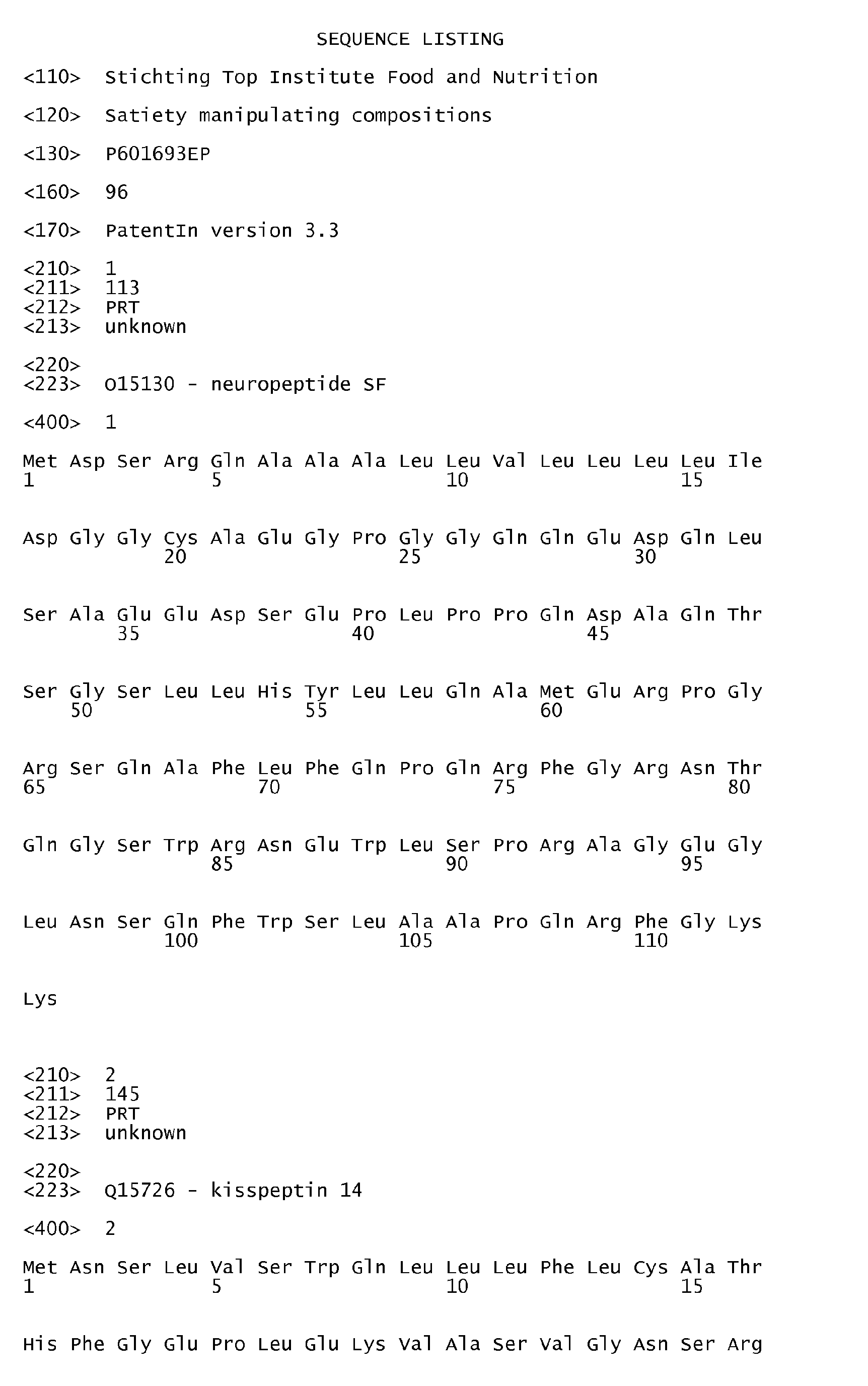


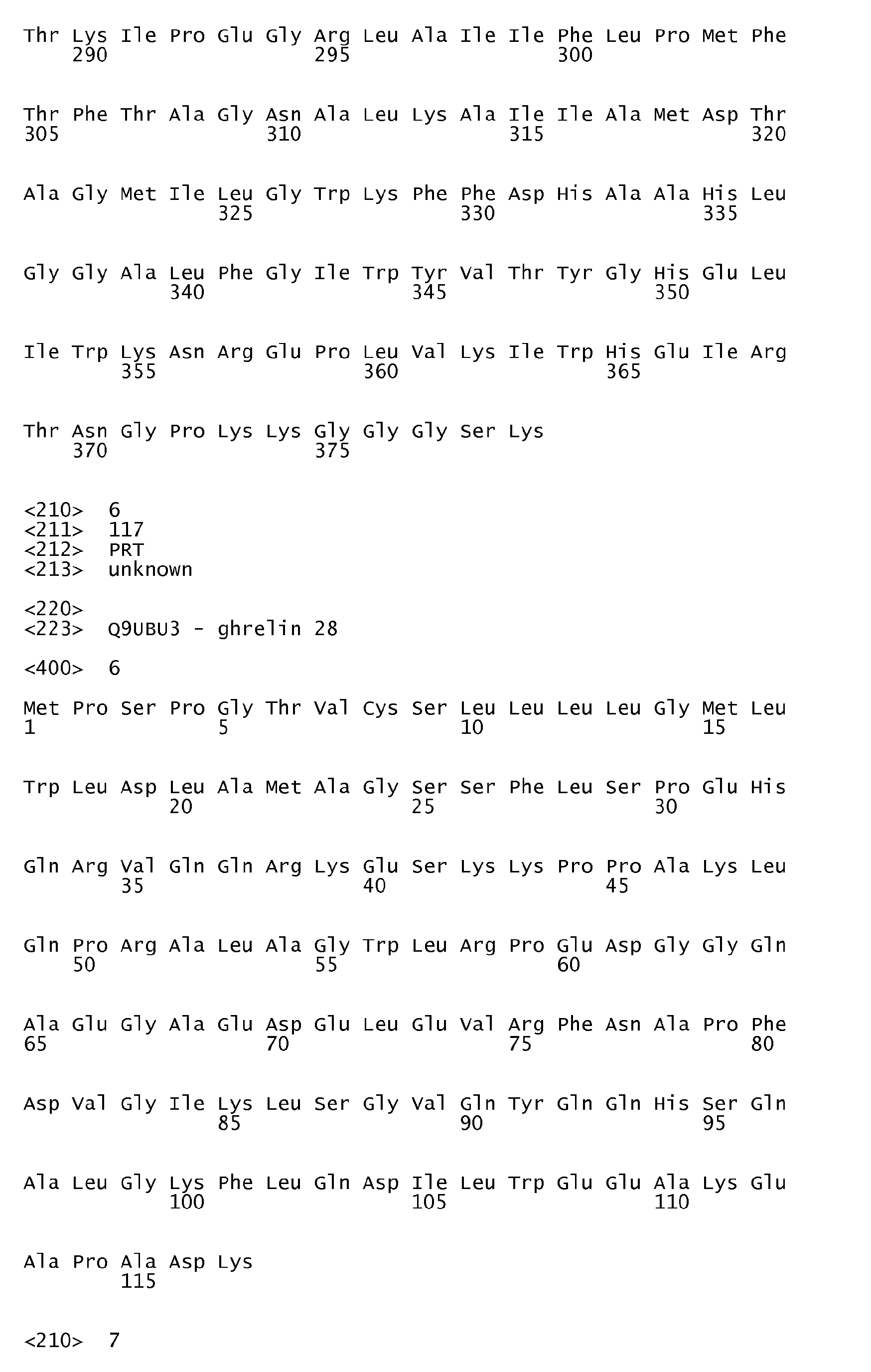


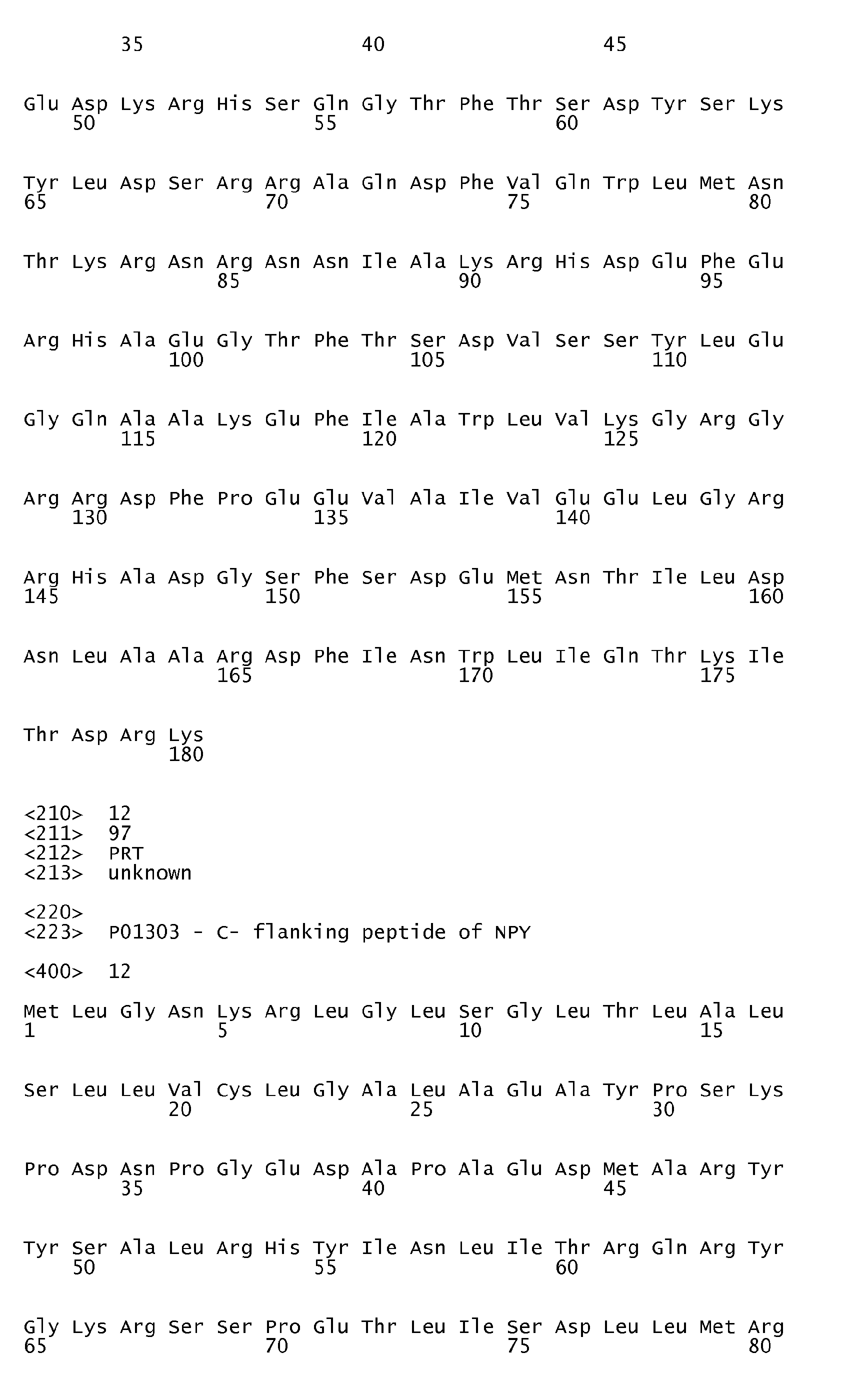


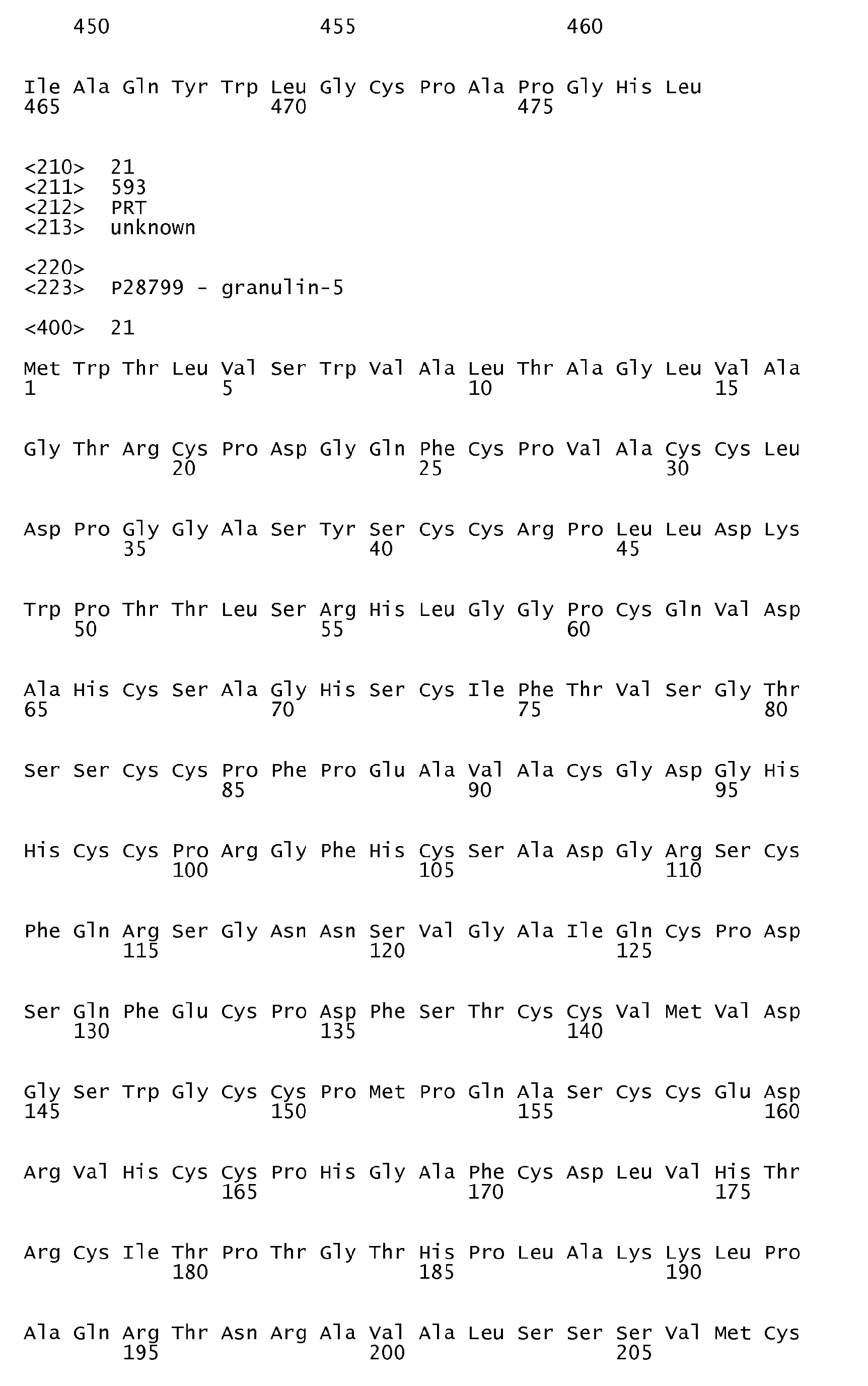


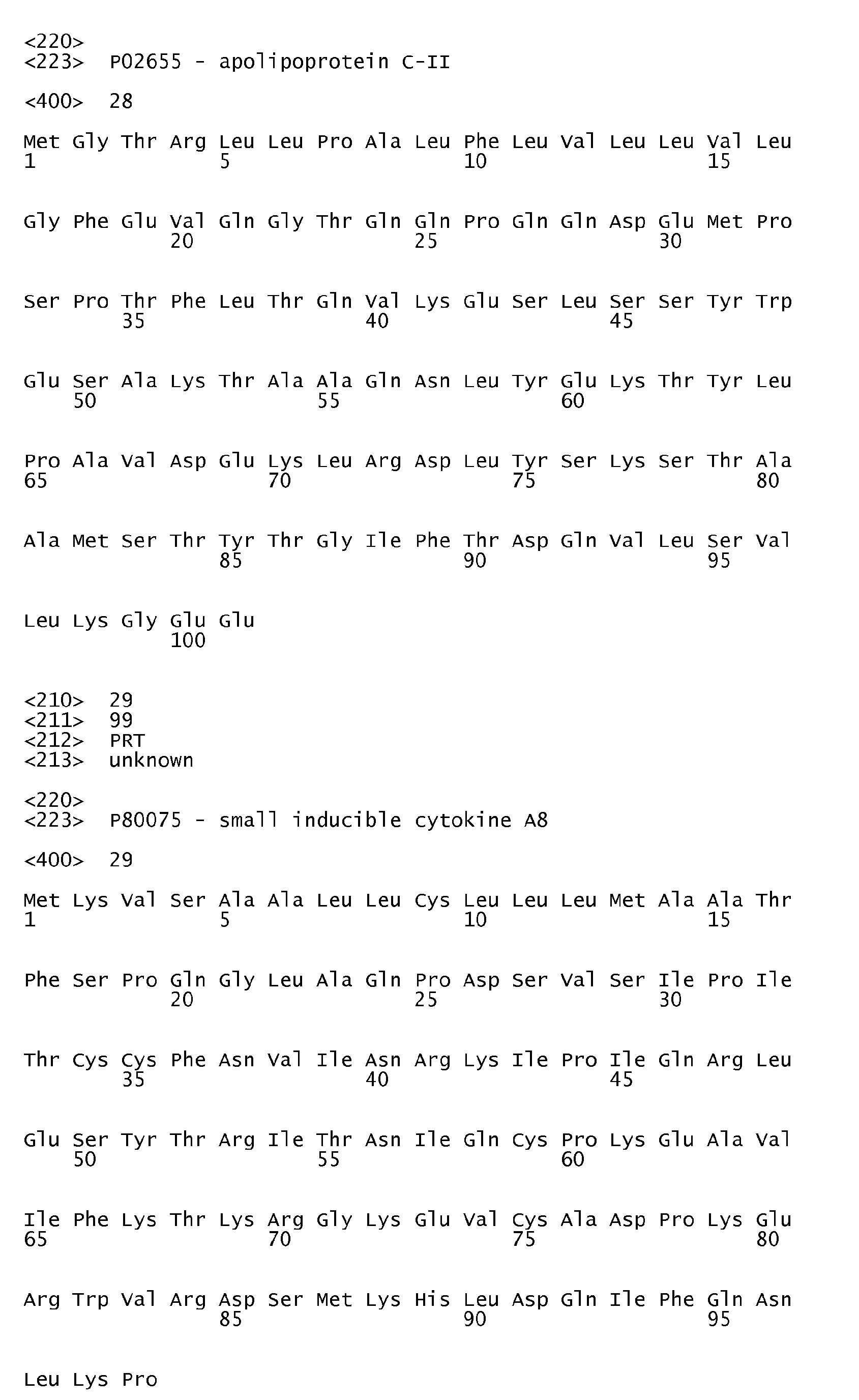


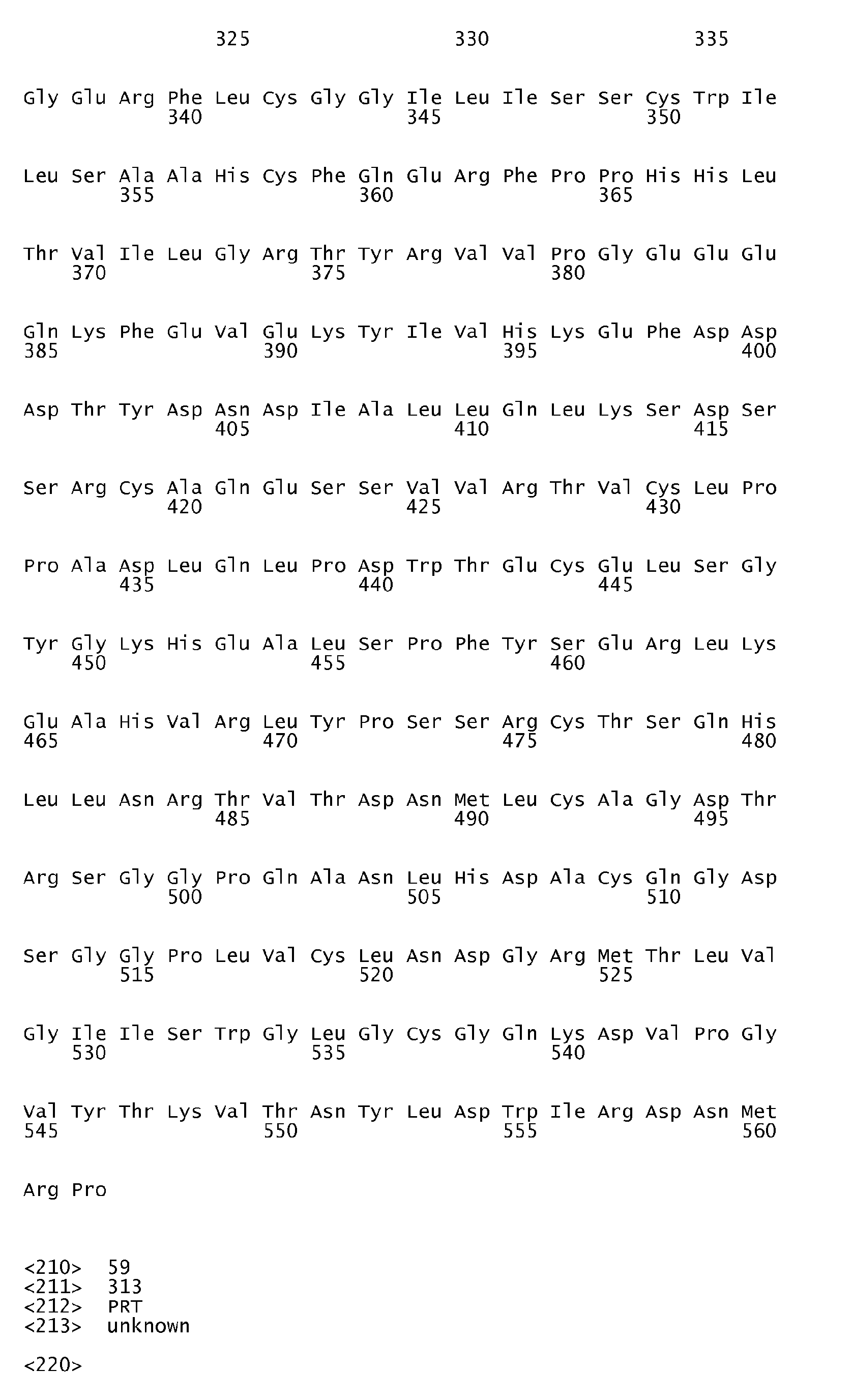


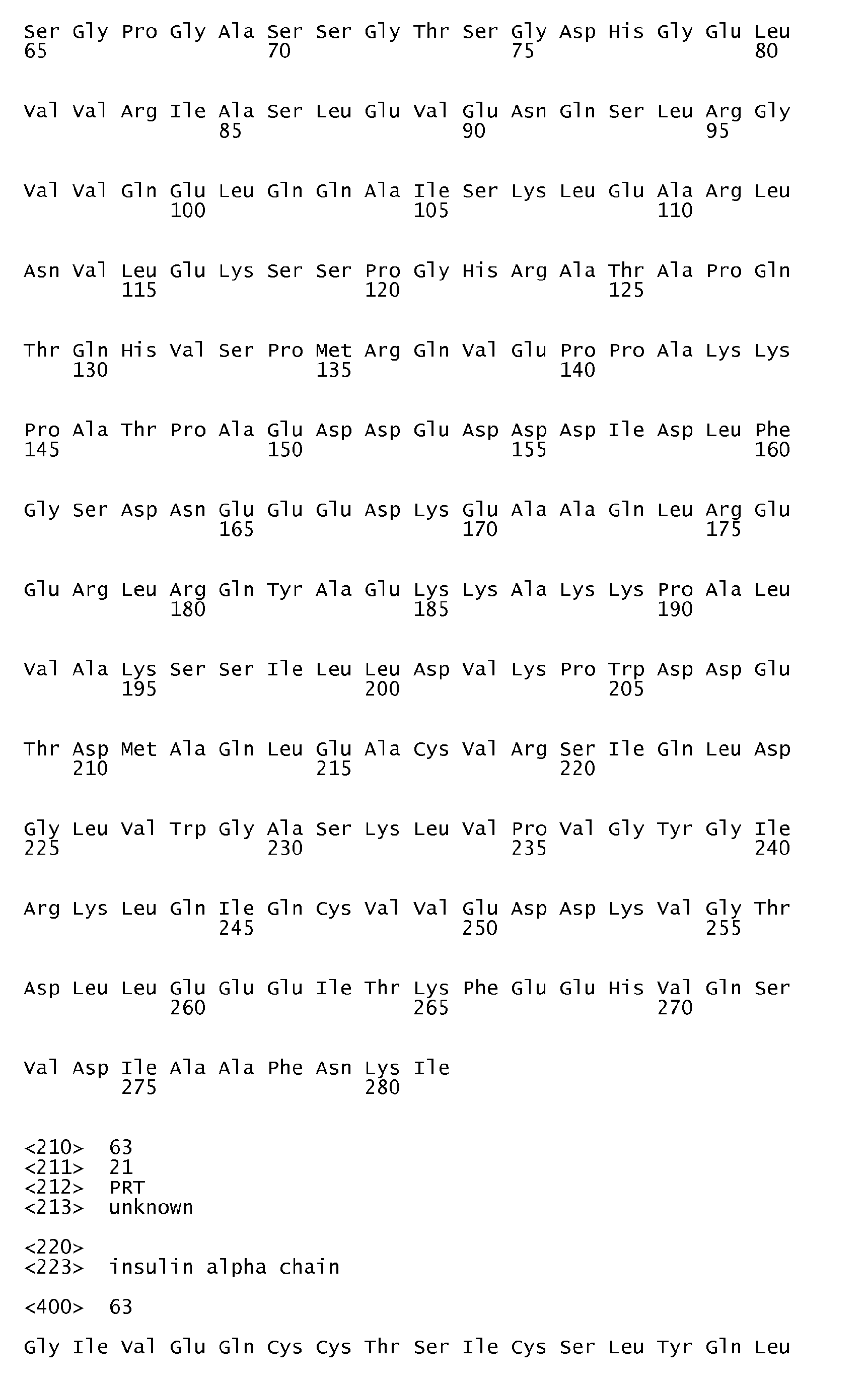


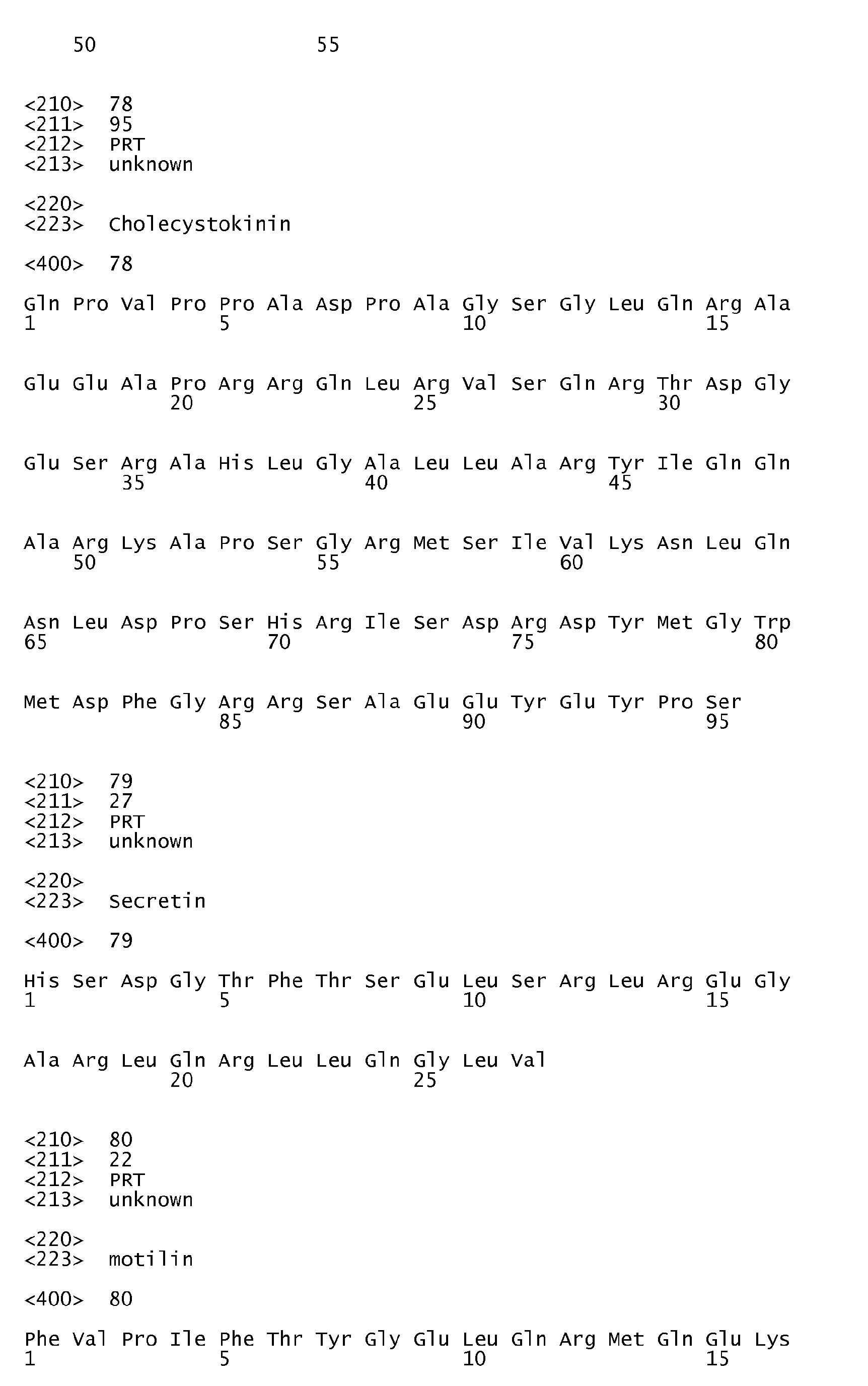


Claims (13)
- Use of one or more peptides for the manufacture of a preparation for locally modulating satiety of a mammalian subject within the oral cavity of a mammalian subject, wherein said one or more peptides are selected from the group consisting of gastrointestinal and pancreatic peptide hormones, and salivary peptides.
- The use according to claim 1, wherein said one or more peptides exhibit a satiety correlation coefficient |r| in the range of 0.70 - 0.95 from SELDI-TOF-MS analysis.
- The use according to claim 1 or 2, for inducing satiety.
- The use according to claim 1 or 2, for reducing satiety.
- The use according to claim 1 or 2, wherein said gastrointestinal- and/or pancreatic peptide hormones are selected from the group consisting of insulin α chain, insulin β chain, insulin-like peptides 1-3, somatostatin, gastrin, cholecystokinin (CCK), secretin, motilin, vasoactive intestinal peptide (VIP), gastric inhibitory polypeptide, enteroglucagon, peptide YY (PYY), pancreatic hormone, pancreatic icosapeptide, ghrelin, glucagon, glucagon-like peptide 1 (GLP-1), glucagon-like peptide 2 (GLP-2), glicentin, glucose-dependent insulinotropic polypeptide (GIP) and amylin.
- The use according to claim 1 or 2, wherein said salivary peptides are selected from the group consisting of defensins, somatomedins, histatins and leptin.
- The use according to any one of the preceding claims, wherein said composition is incorporated in a spray, aerosol, toothpaste, or chewing gum.
- A composition for administration to the oral cavity of a mammalian subject, said composition comprising a satiety-modulating amount of one or more salivary peptides, provided that said composition is not saliva.
- The composition according to claim 9, wherein said salivary peptides are selected from the group consisting of defensins, somatomedins, histatins and leptin.
- A composition for administration to the oral cavity of a mammalian subject, said composition comprising a satiety-modulating amount of one or more gastrointestinal- and/or pancreatic hormone peptides, whereby said peptides are selected from the group consisting of insulin α chain, insulin β chain, insulin-like peptides 1-3, somatostatin, gastrin, secretin, motilin, vasoactive intestinal peptide (VIP), gastric inhibitory polypeptide, enteroglucagon, pancreatic hormone, pancreatic icosapeptide, ghrelin, glucagon, glucagon-like peptide 2 (GLP-2), glicentin, glucose-dependent insulinotropic polypeptide (GIP), provided that said composition is not saliva.
- The composition according to any one of claims 8 - 10, wherein said composition is a liquid or semi-liquid composition and/or wherein said peptides are freely dispersed within said composition.
- The composition according to any one of claims 8 - 11, being a food or feed supplement or composition.
- The composition according to claim 12, being incorporated in a spray, aerosol, toothpaste, or chewing gum.
Priority Applications (2)
| Application Number | Priority Date | Filing Date | Title |
|---|---|---|---|
| EP07115641A EP2033656A1 (en) | 2007-09-04 | 2007-09-04 | Satiety-modulating compositions for oral application |
| PCT/NL2007/050482 WO2008041849A2 (en) | 2006-10-04 | 2007-10-04 | Methods and means for determining satiety on saliva |
Applications Claiming Priority (1)
| Application Number | Priority Date | Filing Date | Title |
|---|---|---|---|
| EP07115641A EP2033656A1 (en) | 2007-09-04 | 2007-09-04 | Satiety-modulating compositions for oral application |
Publications (1)
| Publication Number | Publication Date |
|---|---|
| EP2033656A1 true EP2033656A1 (en) | 2009-03-11 |
Family
ID=38962664
Family Applications (1)
| Application Number | Title | Priority Date | Filing Date |
|---|---|---|---|
| EP07115641A Withdrawn EP2033656A1 (en) | 2006-10-04 | 2007-09-04 | Satiety-modulating compositions for oral application |
Country Status (1)
| Country | Link |
|---|---|
| EP (1) | EP2033656A1 (en) |
Cited By (1)
| Publication number | Priority date | Publication date | Assignee | Title |
|---|---|---|---|---|
| CN113274483A (en) * | 2021-03-23 | 2021-08-20 | 中南民族大学 | Cyclic peptide capable of reducing insulin and properly reducing blood sugar |
Citations (1)
| Publication number | Priority date | Publication date | Assignee | Title |
|---|---|---|---|---|
| US20050277579A1 (en) * | 2004-05-03 | 2005-12-15 | Ranga Krishnan | Compositions for affecting weight loss |
-
2007
- 2007-09-04 EP EP07115641A patent/EP2033656A1/en not_active Withdrawn
Patent Citations (1)
| Publication number | Priority date | Publication date | Assignee | Title |
|---|---|---|---|---|
| US20050277579A1 (en) * | 2004-05-03 | 2005-12-15 | Ranga Krishnan | Compositions for affecting weight loss |
Non-Patent Citations (7)
| Title |
|---|
| BRANGE J ET AL: "Insulin structure and stability.", PHARMACEUTICAL BIOTECHNOLOGY 1993, vol. 5, 1993, pages 315 - 350, XP002467249, ISSN: 1078-0467 * |
| CLEMENT S ET AL: "Oral insulin product hexyl-insulin monoconjugate 2 (HIM2) in type 1 diabetesmellitus: the glucose stabilization effects of HIM2", DIABETES TECHNOLOGY AND THERAPEUTICS, MARY ANN LIEBERT, LARCHMONT, NY, US, vol. 4, no. 4, 2002, pages 459 - 466, XP008087129, ISSN: 1520-9156 * |
| DE GRAAF CEES ET AL: "Biomarkers of satiation and satiety.", THE AMERICAN JOURNAL OF CLINICAL NUTRITION JUN 2004, vol. 79, no. 6, June 2004 (2004-06-01), pages 946 - 961, XP002466991, ISSN: 0002-9165 * |
| LAVIN J H ET AL: "Interaction of insulin, glucagon-like peptide 1, gastric inhibitory polypeptide, and appetite in response to intraduodenal carbohydrate.", THE AMERICAN JOURNAL OF CLINICAL NUTRITION SEP 1998, vol. 68, no. 3, September 1998 (1998-09-01), pages 591 - 598, XP002466989, ISSN: 0002-9165 * |
| LE MAGNEN J: "[Effect of postprandial administration of insulin on dietary intake in white rats, and the caloric mechanism of appetite.]", JOURNAL DE PHYSIOLOGIE 1956, vol. 48, no. 4, 1956, pages 789 - 802, XP002466988, ISSN: 0021-7948 * |
| RODIN J ET AL: "Effect of insulin and glucose on feeding behavior.", METABOLISM: CLINICAL AND EXPERIMENTAL SEP 1985, vol. 34, no. 9, September 1985 (1985-09-01), pages 826 - 831, XP002466990, ISSN: 0026-0495 * |
| STILL J G: "Development of Oral Insulin: Progress and Current Status", DIABETES/METABOLISM RESEARCH AND REVIEWS, WILEY, LONDON,, GB, vol. 18, 2002, pages S29 - S37, XP003011705, ISSN: 1520-7552 * |
Cited By (1)
| Publication number | Priority date | Publication date | Assignee | Title |
|---|---|---|---|---|
| CN113274483A (en) * | 2021-03-23 | 2021-08-20 | 中南民族大学 | Cyclic peptide capable of reducing insulin and properly reducing blood sugar |
Similar Documents
| Publication | Publication Date | Title |
|---|---|---|
| Neyraud et al. | Proteomic analysis of human whole and parotid salivas following stimulation by different tastes | |
| Brand-Miller et al. | The glycemic index of foods influences postprandial insulin-like growth factor–binding protein responses in lean young subjects | |
| Park et al. | Lifestyle plus exercise intervention improves metabolic syndrome markers without change in adiponectin in obese girls | |
| Sedlackova et al. | Comparison of a high-carbohydrate and high-protein breakfast effect on plasma ghrelin, obestatin, NPY and PYY levels in women with anorexia and bulimia nervosa | |
| Gunturiz Albarracín et al. | Adiponectin and leptin adipocytokines in metabolic syndrome: what is its importance? | |
| Rein et al. | Artificial intelligence identified peptides modulate inflammation in healthy adults | |
| Wang et al. | Effect of lactoferrin on taste and smell abnormalities induced by chemotherapy: a proteome analysis | |
| AU2003210923A1 (en) | Compositions and methods for promoting lipid mobilization, glycogen mobilization, or both, in humans | |
| Blaska et al. | “Satiety molecules”—nesfatin-1 and glucagon-like peptide 1 in blood serum in patients with anorexia nervosa and obesity | |
| JP2022118233A (en) | Agent containing imidazole dipeptide | |
| WO2008041849A2 (en) | Methods and means for determining satiety on saliva | |
| Silletti et al. | Effect of NaCl and sucrose tastants on protein composition of oral fluid analysed by SELDI-TOF-MS | |
| Harthoorn et al. | Salivary biomarkers associated with perceived satiety and body mass in humans | |
| Kayri et al. | Combination of Soy Protein, Amylopectin, and Chromium Stimulates Muscle Protein Synthesis by Regulation of Ubiquitin–Proteasome Proteolysis Pathway after Exercise: Kayri et al. | |
| Samad | Serum levels of leptin, zinc and tryptophan with obesity: A case-control study. | |
| Abdou et al. | Evaluation of insulin-like growth factor-1, total ghrelin, and insulin resistance in nutritionally stunted Egyptian children | |
| US20190201482A1 (en) | Products and methods using lunasin enriched soy extract mixtures to reduce free fatty acid levels, increase leptin levels and increase adiponectin levels in plasma | |
| Bugajska et al. | Characteristics of amino acid profiles and incretin hormones in patients with gallstone disease: a pilot study | |
| Osaki et al. | Increased plasma levels of glucose-dependent insulinotropic polypeptide are associated with decreased postprandial energy expenditure after modern Japanese meals | |
| Ali Deeb et al. | Effectiveness of aspartame on insulin, triglycerides, and blood glucose concentration in adult type 2 diabetic patients | |
| AU2016348517B2 (en) | Method for inducing satiety | |
| Sun et al. | Caloric restriction alters galanin and its receptor in hypothalamus of wistar rats | |
| Pedroza-García et al. | Lipids, carbohydrates, or proteins, what do you prefer? An update review of physiological factors for food choice Lípidos, carbohidratos o proteínas,¿ cuál es tu preferencia? Una actualización de los factores | |
| Rao | Enteropancreatic effects of acute and short-term whey protein preload on metabolic and reproductive parameters in polycystic ovary syndrome | |
| Ohsumi et al. | Effect of quality and quantity of dietary protein on 4E-BP1 and S6K1 phosphorylation of brains in aged rats |
Legal Events
| Date | Code | Title | Description |
|---|---|---|---|
| PUAI | Public reference made under article 153(3) epc to a published international application that has entered the european phase |
Free format text: ORIGINAL CODE: 0009012 |
|
| AK | Designated contracting states |
Kind code of ref document: A1 Designated state(s): AT BE BG CH CY CZ DE DK EE ES FI FR GB GR HU IE IS IT LI LT LU LV MC MT NL PL PT RO SE SI SK TR |
|
| AX | Request for extension of the european patent |
Extension state: AL BA HR MK RS |
|
| AKX | Designation fees paid | ||
| REG | Reference to a national code |
Ref country code: DE Ref legal event code: 8566 |
|
| STAA | Information on the status of an ep patent application or granted ep patent |
Free format text: STATUS: THE APPLICATION IS DEEMED TO BE WITHDRAWN |
|
| 18D | Application deemed to be withdrawn |
Effective date: 20090912 |