EP2031907A1 - A signalling method - Google Patents
A signalling method Download PDFInfo
- Publication number
- EP2031907A1 EP2031907A1 EP07290921A EP07290921A EP2031907A1 EP 2031907 A1 EP2031907 A1 EP 2031907A1 EP 07290921 A EP07290921 A EP 07290921A EP 07290921 A EP07290921 A EP 07290921A EP 2031907 A1 EP2031907 A1 EP 2031907A1
- Authority
- EP
- European Patent Office
- Prior art keywords
- virtual
- mobile terminal
- radio resources
- block
- partition
- Prior art date
- Legal status (The legal status is an assumption and is not a legal conclusion. Google has not performed a legal analysis and makes no representation as to the accuracy of the status listed.)
- Granted
Links
Images



Classifications
-
- H—ELECTRICITY
- H04—ELECTRIC COMMUNICATION TECHNIQUE
- H04W—WIRELESS COMMUNICATION NETWORKS
- H04W72/00—Local resource management
- H04W72/20—Control channels or signalling for resource management
- H04W72/23—Control channels or signalling for resource management in the downlink direction of a wireless link, i.e. towards a terminal
-
- H—ELECTRICITY
- H04—ELECTRIC COMMUNICATION TECHNIQUE
- H04W—WIRELESS COMMUNICATION NETWORKS
- H04W72/00—Local resource management
- H04W72/12—Wireless traffic scheduling
- H04W72/1263—Mapping of traffic onto schedule, e.g. scheduled allocation or multiplexing of flows
- H04W72/1268—Mapping of traffic onto schedule, e.g. scheduled allocation or multiplexing of flows of uplink data flows
Definitions
- the invention relates to a method of signaling to a mobile terminal the radio resources that will be used in a wireless communication between the mobile terminal and the base station, to a computer program product comprising computer executable instructions to perform the method in accordance with the invention, and to a communication network comprising means for performing the method in accordance with the invention.
- FDM frequency division multiplexing
- OFDM frequency division multiplexing
- a single transmitter transmits on many (typically dozens to thousands) different orthogonal frequencies. These frequencies are also referred to as sub-carriers, the totality of available sub-carriers forming an OFDM spectrum.
- the sub-carriers can be regarded as radio resources that are used in FDM systems for transmission of data between a base station and the mobile terminals served by the base station.
- the FDM spectrum can be regarded as a plurality of radio resources of which some will be selected out for communication with a particular mobile terminal.
- the plurality of radio resources relate to a plurality of codes is in code division multiplexing (CDMA).
- a (geographical) transmission area for transmission of the radio resources is subdivided into a number of transmission cells, wherein each of them being served by a respective base station or node B.
- Mobile terminals e.g. user equipments or mobile stations, present inside the transmission cells are allocated resources, i.e. radio resources, for communication inside the transmission system.
- the allocation of the radio resources is controlled by the base station. The allocation of the resources has to be signaled to each mobile terminal.
- a method of signaling to a mobile terminal the radio resources that will be used in a wireless communication between the mobile terminal and a base station The base station is the serving base station with respect to the mobile terminal.
- the base station provides a plurality of radio resources.
- the plurality of radio resources is split into a set of partitions, wherein each partition of the set of partitions comprises a set of virtual blocks.
- Each virtual block of the set of virtual blocks is exclusively mapped to one or more radio resources of the plurality of radio resources.
- an identification format according to which a collection of one or more virtual blocks of the set of virtual blocks is identifiable is employed.
- At least a first virtual block is allocated for communication between the mobile terminal and the base station.
- the at least first virtual block is identifiable by a first specification according to the identification format.
- the first specification is sent to the mobile terminal.
- a block identifier is assigned to each partition of the set of partitions.
- the at least first virtual block is comprised in a first partition of the set of partitions and the first partition is associated with a first block identifier, wherein the first block identifier is sent to the mobile terminal.
- the available plurality of radio resources is split into a set of partitions and each partition is split into a set of virtual blocks.
- Each virtual block or collection of one or more virtual blocks in a partition is identifiable according to a pre-given identification format.
- the at least first virtual block employed for communication between the mobile terminal and the base station is thus identified by a first specification and the first block identifier specifies the first partition to which the at least first virtual block belongs.
- the first block identifier and the first specification are then sent, for example in a message, to the mobile terminal.
- an identification format is particularly advantageous as the virtual blocks in the set of virtual blocks can be identified simply by a first specification which can be expressed in form of a number. Similarly, the first block identifier can be expressed by a number. This provides the advantage that the signaling of the radio resources relating to the at least first virtual block that will be used for communication with the mobile terminal by the base station can be done with relative low overhead as according to this embodiment of the invention only the first block identifier and the first specification have to be transmitted to the mobile terminal.
- direct signaling is employed in order to send the first block identifier and bitmap signaling is employed to send the first specification to the mobile terminal.
- bitmap signaling is employed to send the first specification to the mobile terminal.
- the first block identifier is given by a first sequence of bits and the first specification is given by another sequence of bits or a plurality of sequences of bits. All bit sequences will be in particular due to the usage of an identification format relatively short. This provides the advantage that the number of bits employed for signaling that the at least first virtual block of the first partition is employed for communication with the mobile terminal can be kept relatively small and thus resources of the base station can be saved.
- the mobile terminal is adapted to determine the at least first virtual block specified in accordance with the identification format and to use the radio resources associated with the at least first virtual block for communication with the base station.
- the identification format must be known to the mobile terminal in advance so that the mobile terminal is able to use the first specification and the first block identifier in order to determine that the at least first virtual block will be employed for communication between the base station and the mobile terminal.
- the mobile terminal is then enabled to use the radio resources that relate to the at least first virtual block for uplink communication with the base station.
- a timing indication is sent to the mobile terminal.
- the timing indication specifies for how many time transmission intervals the first partition and the at least first virtual block will be employed for communication with the mobile terminal.
- consecutive block numbers are assigned according to the identification format to at least a portion of the set of virtual blocks of the first partition.
- the at least first virtual block relates to a total number of virtual blocks having consecutive block numbers assigned and the first specification comprises the lowest block number assigned to the virtual blocks of the number of blocks and the total number of virtual blocks.
- the total number of virtual blocks lies in the range between 1 and the maximum number of virtual blocks that can be allocated for the mobile terminal per time transmission interval.
- the identification format follows a tree approach for specifying the at least first virtual block.
- the identification format employs a Pascal's triangle in order to specify the at least first virtual block.
- the set of virtual blocks of a partition comprises a set of distributed virtual resource blocks (D-VRBs) and a set of localized virtual resource blocks (L-VRBs).
- the at least first virtual block relates to one or more D-VRBs of the set of D-VRBs and/or one or more L-VRBs of the set of L-VRBs.
- the first specification allows to identify the one or more D-VRBs and/or one or more L-VRBs relating to the first virtual block.
- the sizes of the distributed virtual resource blocks are adaptable.
- the allocation of the virtual resource blocks is carried out by a scheduler which is a component of the base station. Since the sizes of the D-VRBs are adaptable and may vary from one time transmission interval to the next, they provide some flexibility for the scheduler, in particular when the radio resources of the plurality of radio resources that are associated with the virtual resource blocks have to be allocated for a large amount of mobile terminals.
- the partitions of the set of partitions are equally sized.
- all partitions comprise the same, non-overlapping amount of radio resources.
- an indicator which indicates which identification format is employed for describing the virtual blocks.
- the indicator thus specifies whether direct signaling, bitmap signaling or a tree approach is employed for describing and identifying the virtual blocks.
- the identification format could for example be selected by an algorithm such that the lowest signaling overhead is required for signaling which radio resources have been allocated for a mobile terminal.
- an indicator which indicates distributed or localized transmission with respect to the at least first virtual block is further sent to the mobile terminal.
- the allocation of a distributed or localized virtual resource block is signaled to the mobile terminal by use of the indicator.
- the radio resources relate to sub-carriers and the plurality of radio resources relates to an OFDM spectrum.
- a computer program product for signaling to a mobile terminal the radio resources that will be used in a wireless communication between the mobile terminal and a base station which serves the mobile terminal, wherein the base station provides a plurality of radio resources and wherein the computer program product comprises a computer usable medium including a computer readable program, wherein the computer readable program when executed on a computer causes the computer to perform steps according to the method in accordance with the invention.
- the network comprises a base station which provides a plurality of radio resources and a mobile terminal.
- the communication network further has means for splitting the plurality of radio resources into a set of partitions, wherein each partition comprises a set of virtual blocks and wherein each virtual block of the set of virtual blocks is exclusively mapped to one or more radio resources of the plurality of radio resources.
- the communication network further has means for assigning a block identifier to each partition of the set of partitions and means for using an identification format according to which a collection of one or more virtual blocks of the set of virtual blocks of a partition is identifiable.
- the communication network further comprises means for allocating at least a first virtual block of a first partition of the set of partitions for communication between the mobile terminal and the base station, wherein the first partition is associated with a first block identifier and wherein the at least first virtual block is identifiable by a first specification according to the identification format.
- the communication network further comprises means for sending the first block identifier and the first specification to the mobile terminal.
- a communication network component comprising:
- FIG. 1 shows a schematic block diagram of a wireless communication network 100.
- the communication network 100 comprises a base station 102 and a mobile terminal 104.
- the base station 102 comprises a microprocessor 106, storage 108, and an antenna 110.
- the mobile terminal 104 comprises a microprocessor 112 and storage 114.
- the microprocessor 106 executes a computer program product 116 and a scheduler 118 that are both stored on the storage 108 and loaded for execution into the microprocessor 106.
- the microprocessor 112 of the mobile terminal 104 executes a computer program product 120 that is stored on the storage 114 and loaded for execution into the microprocessor 112.
- the antenna 110 is employed for establishing a radio connection to the mobile terminal 104 and therefore provides a plurality of radio resources 122.
- the plurality of radio resources 122 might relate to a band of sub-carriers that are orthogonal with respect to each other and that can be employed as carriers to transmit information to the mobile terminal 104 by use of OFDM techniques.
- the plurality of radio resources 122 might alternatively relate to a plurality of codes that can be employed to transmit information to the mobile terminal 104 by use of code division multiple access (CDMA) techniques.
- CDMA code division multiple access
- radio resources of the plurality of radio resources 122 For communication with the mobile terminal 104, not all radio resources of the plurality of radio resources 122 will be employed. In particular, a selection of radio resources of the plurality of radio resources 122 will be allocated for communication with the mobile terminal 104.
- the computer program product 116 is adapted to split logically the plurality of radio resources 122 into a set of partitions.
- the set of partitions consists according to the example illustrated with reference to Fig. 1 of a first partition 124 and a second partition 126.
- the computer program product splits each partition into a set of virtual blocks.
- the first partition 124 comprises the virtual blocks 128, 130, and 132.
- the second partition 126 comprises virtual blocks 134, 136, and 138.
- Each virtual block relates to a selection of radio resources of the plurality of radio resources, wherein the radio resources are uniquely comprised in the corresponding virtual block.
- a real radio resource comprised in the virtual block 128 will not be included in one of the other virtual blocks 130 to 138.
- the computer program product 116 is further adapted to assign a first block identifier 140 to the first partition 124 and a second block identifier 142 to the second partition 126.
- the first and second identifiers 140, 142 allow according to a pregiven identification format 144 to identify the first and second partitions 124 and 126.
- the identification format 144 is stored in machine-readable form in the storage 144 so that it is accessible for the microprocessor 106.
- the identification format 144 might be provided by the manufacturer of the base station or by the manufacturer of the parts of the base station that take care of allocation and signaling radio resources to mobile stations served by the base station.
- the scheduler 118 is then able to allocate one or more of the virtual blocks of one or more partitions for communication with the mobile terminal 104. For example, the scheduler 118 might allocate the virtual blocks 130 and 132 of the first partition 124 for communication with the mobile terminal 104.
- the identification format 142 provides a possibility that allows to identify the virtual blocks 130 and 132 by use of a specification 146.
- consecutive numbers are assigned to each virtual block of a partition.
- number '1' is assigned to the virtual block 128,
- number '2' is assigned to the virtual block 130, and
- number '3' is assigned to the virtual block 132.
- the above mentioned specification 146 then comprises the numbers '2' and '3' for identifying the virtual blocks 130 and 132.
- consecutive numbers are assigned to each virtual block of a partition.
- number '1' is assigned to the virtual block 128, number '2' is assigned to the virtual block 130, and number '3' is assigned to the virtual block 132.
- the above mentioned specification 146 then comprises the number '2' and an indication that the block following to virtual block 130 is allocated for the mobile terminal 104.
- a first identifier 148 that equals the first block identifier 124 and the specification 146 is then sent in a message 150 to the mobile terminal 102 before the actual virtual blocks identifiable by use of the first identifier 148 and the specification 146 are used in the communication between the mobile terminal 104 and the base station 102.
- the mobile terminal 104 comprises an antenna (not shown in Fig. 1 ) for receiving the message 150.
- the computer program product 120 is then able to extract the first identifier 148 and the specification 150 from the message 150 and to determine the actual virtual blocks corresponding to the first identifier 148 and the specification 146 by use of the identification format 144 which is known to the mobile terminal as a copy of it is stored on the storage 114.
- the mobile terminal 104 is then able to use the virtual blocks allocated for the mobile terminal in uplink and downlink communications with the base station 102.
- the first identifier 148 and the specification 146 can be sent to the mobile terminal 104 in form of two bit sequences. As the first identifier 148 and the specification 146 relate to simple numbers, the lengths of the two bit sequences are relatively short. The method in accordance with the invention is therefore particularly advantageous as relative few resources of the base station must be used and reserved for the transmission of the message 150.
- FIG. 2 shows a flow diagram illustrating steps performed by a method of signalling to a mobile terminal the radio resources that will be used in a wireless communication between the mobile terminal and a base station according to the invention.
- a plurality of radio resources provided by the base station is split into a set of partitions, wherein each partition comprises a set of virtual blocks, and wherein each virtual block of the set of virtual blocks is exclusively mapped to one or more radio resources of the plurality of radio resources.
- a block identifier is assigned to each partition of the set of partitions and according to step 204, an identification format according to which a collection of one or more virtual blocks of the set of virtual blocks of a partition is identifiable is employed.
- step 206 at least a first virtual block of a first partition of the set of partitions is allocated for communication between the mobile terminal and the base station.
- the first partition is associated with a first block identifier and the at least first virtual block is identifiable by a first specification according to the identification format.
- step 208 the first block identifier and the first specification are sent to the mobile terminal.
- Figure 3 illustrates how radio resources of a plurality of radio resources are split into various partitions and virtual blocks.
- a set of physical resource blocks 300 that is provided by a base station and that might relate to a set of sub-band carriers of an OFDM spectrum is grouped into several physical resource blocks 302, 304, 306, and so on.
- the resource block are indicated in Fig. 3 by PRB 0, PRB 1,..., PRB 11.
- the set of physical blocks 300 is further assigned to a set of virtual resource blocks 308.
- the set of virtual blocks 308 is further divided into a set of distributed virtual resource blocks (D-VBRs) and localized virtual resource blocks (L-VBRs).
- D-VBRs distributed virtual resource blocks
- L-VBRs localized virtual resource blocks
- a physical resource block is associated with two D-VRBs or with one L-VRB.
- resource block 302 (PRB 0) is associated with D-VRB 310 (D-VRB 0) and D-VRB 312 (D-VRB 1), whereas resource block 306 (PRB 4) is associated with L-VRB 314 (L-VRB 0).
- the set of virtual resource blocks 308 is divided into equally spaced partitions 1, 2, and so one. It should be mentioned that the block sizes of the D-VRBs might not be fixed. Instead, their sizes might be adaptable. For example, the D-VRBs 310 and 312 might be merged into one D-VRB whenever appropriate.
- the scheduler associated with the corresponding base station might allocate for one or more time transmission interval (TTI) D-VRBs and/or L-VRBs of one or more partition for the mobile terminal.
- TTI time transmission interval
- different TTIs may be composed of pure D-VRBs or of pure L-VRBs or of a combination thereof.
- FIG. 4 shows a block diagram of a signaling message 400.
- the signaling message 400 comprises an ID 402 that relates to the receiving mobile terminal.
- the mobile terminal is therefore able to identify itself as addressee of the message 400.
- the message comprises an indicator 404 which is used to indicate distributed or localized transmission and/or the indentification format.
- the indicator is therefore used to indicate whether the allocated resources consist of pure D-VRBs or of pure L-VRBs.
- the indicator 404 might also be employed to indicate which identification format is employed.
- whether direct signaling, bitmap signaling or tree based signaling or something else is employed.
- the selection whether direct signaling, bitmap signaling, or tree based signaling is employed could be done by use of an algorithm which selects the way of signaling so that the lowest signaling overhead is required.
- the signaling message comprises a resource assignment indicator 406 that relates to the first block identifier and the specification according to fig. 1 .
- the resource assignment indicator 406 is employed to signal the identifier and specification of the partition and resource blocks that are allocated for the mobile terminal.
- the message 400 further comprises a time indication 408 which indicates for how many TTIs the allocated virtual blocks will be employed with respect to the receiving mobile terminal.
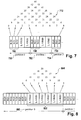
- FIG. 5 illustrates how the identification format is used to identify virtual blocks by use of a tree approach.
- a partition 500 comprises a set of resource groups (RGs) 502 and a set of L-VRBs 504.
- the physical resource blocks (PRBs) consisting of one or more radio resources, e.g. sub-carriers, are mapped to the LVRs or DVRBs.
- a RG comprises equidistantly spaced DVRBs.
- the RG0 comprises D-VRB0 and D-VRB8
- the RG1 comprises D-VRB1 and D-VRB9 (cf. fig. 3 ).
- Each RG thus comprises a D-VRB of each partition.
- the identification format provides a tree structure 506 that is defined for each partition.
- the bottom line of the tree structure 506 comprises the numbers in the range between 0 and 7 so that a number can be assigned in a one-to-one relationship to a RG of the set of RGs 502.
- RG 508 (RGO in partition 500) is associated with the number 0, RG 510 is associated with number 1, RG 512 is associated with number 2, and RG 7 512 is associated with number 7.
- RG 508 relates only to the radio resources mapped to RG0 and that are located in the partition 500.
- RG 508 corresponds indeed to D-VRBO 310 of fig.3 .
- the method is particularly advantageous as only by use of two short number, the allocated RGs can be signaled to the mobile terminal. If the number '15' is signaled without block identifier, then the allocation of all the RG0, RG1, and RG2 of all partitions is signaled.
- the identification format could alternatively specify that, when for example the number 15 is signaled, only the RGs 508 and 512, the RGs at the edge of the "tree" ending at the number 15 are allocated for the mobile terminal.
- Figure 6 provides a further illustration how the identification format is used to identify virtual blocks by use of a tree approach. It is assumed that the plurality of radio resources has been split in four partitions, wherein a first partition 600 and a second partition 606 are shown in Fig. 6 .
- the first partition 600 has a set of resource groups (RGs) 602 and a set of L-VRBs 604.
- the second partition 606 comprises a set of RGs 608.
- the set of RGs 602 and the set of RGs 608 both comprise RGO to RG7, but RGO of the set of RGs 602 relates to different physical resources that RGO of the set of RGs 608.
- the identification format provides a tree structure 610.
- a number of the lowest row of the tree structure 610 is assigned to one RG of each set of RGs.
- the number 0 is assigned to D-VRBO of RGO (cf. with fig. 3 )
- the number 1 is assigned to D-VRB8 of RG 0.
- the number 9 according to the tree structure 610 is signaled to a mobile terminal, then it is indicated to the mobile terminal that the complete RG 0 of all four partitions has been allocated for the mobile terminal. If the number 4 is signaled, then according to the tree structure 610, it is indicated that only D-VRBO and DVRB8 of RG0 (the part of the RG0 in the first partition 600 and the second partition 606) have been allocated for the terminal.
- Figure 7 provides a further illustration how the identification format is used to identify virtual blocks by use of a tree approach.
- the plurality of radio resources is split into a set of partitions comprising a first partition 700, a second partition 702, and a third partition 704.
- the first partition 700 comprises a set of RGs 706, the second partition 702 comprises a set of RGs 708, and the third partition 704 comprises a set of RGs 710.
- the set of RGs 706 comprises the D-VRBs of the RG0, RG1, and RG2 that lie in the first partition 700.
- the set of RGs 708 comprises the D-VRBs of the RG0, RG1, and RG2 that lie in the second partition 702.
- the set of RGs 710 comprises the D-VRBs of the RG0, RG1, and RG2 that lie in the third partition 704.
- a tree structure 712 provides in its bottom line a set of numbers such that a number can be assigned to each D-VRB of a RG of the set of RGs 706, 708, 710, and so on.
- a single number indicates that a plurality of D-VRBs has been allocated for the mobile terminal. For example, when the number 17 is signaled, then it is indicated that according to the tree structure 712 the D-VRBs of the set of resource groups 706 have been allocated for the mobile terminal.
- Figure 8 provides yet another illustration how the identification format is used to identify virtual blocks by use of a tree approach.
- the plurality of radio resources provided by a base station is split into a set of partitions comprising a first partition 800.
- the first partition 800 has a set of L-VRBs 802.
- a tree structure 804 provides in its lowest row a set of numbers assigned in a one-to-one relationship to each L-VRB of the set of L-VRBs.
- the base station might sent the number assigned to the L-VRB according to the tree structure 804 to the mobile terminal.
- numbers in higher rows of the tree structure 804 can be used to signal that a plurality of L-VRBs has been allocated for the mobile terminal. For example, when the number 13 along with the block identifier for the partition 800 is sent to the mobile terminal, then it is indicated that L-VRB2, L-VRB3, and L-VRB4 of partition 800 are allocated for the terminal.
- Figure 9 provides a further illustration how the identification format is used to identify virtual blocks by use of a tree approach.
- the plurality of radio resources provided by a base station is split into a set of partitions comprising a first partition 900 and a second partition 902.
- the first partition 900 has a first set of L-VRBs 904 and the second partition 902 has a second set of L-VRBs 906.
- a tree structure 908 provides in its lowest row a set of numbers assigned in a one-to-one relationship to each L-VRB of the first and second set of L-VRBs 904, 906.
- the base station might sent the numbers assigned to the L-VRBs according to the tree structure 908 to the mobile terminal.
- numbers in higher rows of the tree structure 908 can be used to signal that a plurality of L-VRBs have been allocated for the mobile terminal. For example, when the number 5 is sent to the mobile terminal, then it is indicated that L-VRB1 of the first partition 900 and L-VRB0 of the second partition 902 are allocated for the terminal.
Landscapes
- Engineering & Computer Science (AREA)
- Computer Networks & Wireless Communication (AREA)
- Signal Processing (AREA)
- Mobile Radio Communication Systems (AREA)
Abstract
- splitting the plurality of radio resources into a set of partitions (124, 126), wherein each partition of the set of partitions comprises a set of virtual blocks (128,..., 138), wherein each virtual block of the set of virtual blocks is exclusively mapped to one or more radio resources of the plurality of radio resources;
- using an identification format (144) according to which a collection of one or more virtual blocks of the set of virtual blocks is identifiable;
- allocating at least a first virtual block (130, 132) for communication between the mobile terminal and the base station, first block identifier the at least first virtual block being identifiable by a first specification (146) according to the identification format;
- sending first block identifier the first specification to the mobile terminal.
Description
- The invention relates to a method of signaling to a mobile terminal the radio resources that will be used in a wireless communication between the mobile terminal and the base station, to a computer program product comprising computer executable instructions to perform the method in accordance with the invention, and to a communication network comprising means for performing the method in accordance with the invention.
- In frequency division multiplexing (FDM), a method that is frequently employed by for example wireless communication systems, multiple signals are sent out at the same time, but in different frequencies. In OFDM, a single transmitter transmits on many (typically dozens to thousands) different orthogonal frequencies. These frequencies are also referred to as sub-carriers, the totality of available sub-carriers forming an OFDM spectrum.
- The sub-carriers can be regarded as radio resources that are used in FDM systems for transmission of data between a base station and the mobile terminals served by the base station. In that sense, the FDM spectrum can be regarded as a plurality of radio resources of which some will be selected out for communication with a particular mobile terminal. As another example, the plurality of radio resources relate to a plurality of codes is in code division multiplexing (CDMA).
- A (geographical) transmission area for transmission of the radio resources is subdivided into a number of transmission cells, wherein each of them being served by a respective base station or node B. Mobile terminals, e.g. user equipments or mobile stations, present inside the transmission cells are allocated resources, i.e. radio resources, for communication inside the transmission system. The allocation of the radio resources is controlled by the base station. The allocation of the resources has to be signaled to each mobile terminal.
- It is an object of the invention to provide an alternative method of signaling to a mobile terminal the radio resources that will be used in a wireless communication between the mobile terminal and the base station serving the mobile terminal.
- According to a first aspect of the invention, there is provided a method of signaling to a mobile terminal the radio resources that will be used in a wireless communication between the mobile terminal and a base station. The base station is the serving base station with respect to the mobile terminal. In accordance with an embodiment of the invention, the base station provides a plurality of radio resources. According to a step of the method in accordance with the invention, the plurality of radio resources is split into a set of partitions, wherein each partition of the set of partitions comprises a set of virtual blocks. Each virtual block of the set of virtual blocks is exclusively mapped to one or more radio resources of the plurality of radio resources. Then, an identification format according to which a collection of one or more virtual blocks of the set of virtual blocks is identifiable is employed. Furthermore, at least a first virtual block is allocated for communication between the mobile terminal and the base station. The at least first virtual block is identifiable by a first specification according to the identification format. According to a further step in accordance with the method, the first specification is sent to the mobile terminal.
- In accordance with an embodiment of the invention, a block identifier is assigned to each partition of the set of partitions. The at least first virtual block is comprised in a first partition of the set of partitions and the first partition is associated with a first block identifier, wherein the first block identifier is sent to the mobile terminal.
- Thus, the available plurality of radio resources is split into a set of partitions and each partition is split into a set of virtual blocks. Each virtual block or collection of one or more virtual blocks in a partition is identifiable according to a pre-given identification format. The at least first virtual block employed for communication between the mobile terminal and the base station is thus identified by a first specification and the first block identifier specifies the first partition to which the at least first virtual block belongs.
- The first block identifier and the first specification are then sent, for example in a message, to the mobile terminal.
- The use of an identification format is particularly advantageous as the virtual blocks in the set of virtual blocks can be identified simply by a first specification which can be expressed in form of a number. Similarly, the first block identifier can be expressed by a number. This provides the advantage that the signaling of the radio resources relating to the at least first virtual block that will be used for communication with the mobile terminal by the base station can be done with relative low overhead as according to this embodiment of the invention only the first block identifier and the first specification have to be transmitted to the mobile terminal.
- In accordance with an embodiment of the invention, direct signaling is employed in order to send the first block identifier and bitmap signaling is employed to send the first specification to the mobile terminal. This means that the first block identifier is given by a first sequence of bits and the first specification is given by another sequence of bits or a plurality of sequences of bits. All bit sequences will be in particular due to the usage of an identification format relatively short. This provides the advantage that the number of bits employed for signaling that the at least first virtual block of the first partition is employed for communication with the mobile terminal can be kept relatively small and thus resources of the base station can be saved.
- In accordance with an embodiment of the invention, the mobile terminal is adapted to determine the at least first virtual block specified in accordance with the identification format and to use the radio resources associated with the at least first virtual block for communication with the base station. Thus, the identification format must be known to the mobile terminal in advance so that the mobile terminal is able to use the first specification and the first block identifier in order to determine that the at least first virtual block will be employed for communication between the base station and the mobile terminal. Moreover, the mobile terminal is then enabled to use the radio resources that relate to the at least first virtual block for uplink communication with the base station.
- In accordance with an embodiment of the invention, a timing indication is sent to the mobile terminal. The timing indication specifies for how many time transmission intervals the first partition and the at least first virtual block will be employed for communication with the mobile terminal.
- In accordance with an embodiment of the invention, consecutive block numbers are assigned according to the identification format to at least a portion of the set of virtual blocks of the first partition. The at least first virtual block relates to a total number of virtual blocks having consecutive block numbers assigned and the first specification comprises the lowest block number assigned to the virtual blocks of the number of blocks and the total number of virtual blocks.
- In accordance with an embodiment of the invention, the total number of virtual blocks lies in the range between 1 and the maximum number of virtual blocks that can be allocated for the mobile terminal per time transmission interval.
- In accordance with an embodiment of the invention, the identification format follows a tree approach for specifying the at least first virtual block.
- In accordance with an embodiment of the invention, the identification format employs a Pascal's triangle in order to specify the at least first virtual block.
- In accordance with an embodiment of the invention, the set of virtual blocks of a partition comprises a set of distributed virtual resource blocks (D-VRBs) and a set of localized virtual resource blocks (L-VRBs). The at least first virtual block relates to one or more D-VRBs of the set of D-VRBs and/or one or more L-VRBs of the set of L-VRBs. The first specification allows to identify the one or more D-VRBs and/or one or more L-VRBs relating to the first virtual block.
- In accordance with an embodiment of the invention, the sizes of the distributed virtual resource blocks are adaptable. In particular, the allocation of the virtual resource blocks is carried out by a scheduler which is a component of the base station. Since the sizes of the D-VRBs are adaptable and may vary from one time transmission interval to the next, they provide some flexibility for the scheduler, in particular when the radio resources of the plurality of radio resources that are associated with the virtual resource blocks have to be allocated for a large amount of mobile terminals.
- In accordance with an embodiment of the invention, the partitions of the set of partitions are equally sized. Thus, all partitions comprise the same, non-overlapping amount of radio resources.
- In accordance with an embodiment of the invention, an indicator which indicates which identification format is employed for describing the virtual blocks. The indicator thus specifies whether direct signaling, bitmap signaling or a tree approach is employed for describing and identifying the virtual blocks. The identification format could for example be selected by an algorithm such that the lowest signaling overhead is required for signaling which radio resources have been allocated for a mobile terminal.
- In accordance with an embodiment of the invention, an indicator which indicates distributed or localized transmission with respect to the at least first virtual block is further sent to the mobile terminal. Thus, the allocation of a distributed or localized virtual resource block is signaled to the mobile terminal by use of the indicator.
- In accordance with an embodiment of the invention, the radio resources relate to sub-carriers and the plurality of radio resources relates to an OFDM spectrum.
- According to a second aspect of the invention, there is provided a computer program product for signaling to a mobile terminal the radio resources that will be used in a wireless communication between the mobile terminal and a base station which serves the mobile terminal, wherein the base station provides a plurality of radio resources and wherein the computer program product comprises a computer usable medium including a computer readable program, wherein the computer readable program when executed on a computer causes the computer to perform steps according to the method in accordance with the invention.
- According to a third aspect of the invention, there is provided a communication network. In accordance with an embodiment of the invention, the network comprises a base station which provides a plurality of radio resources and a mobile terminal. The communication network further has means for splitting the plurality of radio resources into a set of partitions, wherein each partition comprises a set of virtual blocks and wherein each virtual block of the set of virtual blocks is exclusively mapped to one or more radio resources of the plurality of radio resources. The communication network further has means for assigning a block identifier to each partition of the set of partitions and means for using an identification format according to which a collection of one or more virtual blocks of the set of virtual blocks of a partition is identifiable. The communication network further comprises means for allocating at least a first virtual block of a first partition of the set of partitions for communication between the mobile terminal and the base station, wherein the first partition is associated with a first block identifier and wherein the at least first virtual block is identifiable by a first specification according to the identification format. The communication network further comprises means for sending the first block identifier and the first specification to the mobile terminal.
- According to a fourth aspect, there is provided a communication network component comprising:
- means for splitting a plurality of radio resources of a base station into a set of partitions, wherein each partition of the set of partitions comprises a set of virtual blocks, each virtual block of the set of virtual blocks is exclusively mapped to one or more radio resources of the plurality of radio resources;
- means for using an identification format according to which a collection of one or more virtual blocks of the set of virtual blocks is identifiable;
- means for allocating at least a first virtual block for communication between a mobile terminal and the base station, the at least first virtual block being identifiable by a first specification according to the identification format, the base station serving the mobile terminal;
- means for sending the first specification to the mobile terminal.
- In the following embodiments of the invention will be described in greater detail by way of example only making reference to the drawings in which:
- Figure 1
- shows a schematic block diagram of a wireless communication network,
- Figure 2
- shows a flow diagram illustrating steps performed by a method in accordance with the invention,
- Figure 3
- illustrates how radio resources of a plurality of radio resources are split into various partitions and virtual blocks,
- Figure 4
- shows a block diagram of a signaling message,
- Figure 5
- illustrates how the identification format is used to identify virtual blocks by use of a tree approach,
- Figure 6
- provides a further illustration how the identification format is used to identify virtual blocks by use of a tree approach,
- Figure 7
- provides a further illustration how the identification format is used to identify virtual blocks by use of a tree approach,
- Figure 8
- provides yet another illustration how the identification format is used to identify virtual blocks by use of a tree approach, and
- Figure 9
- provides a further illustration how the identification format is used to identify virtual blocks by use of a tree approach.
-
Figure 1 shows a schematic block diagram of awireless communication network 100. Thecommunication network 100 comprises abase station 102 and amobile terminal 104. Thebase station 102 comprises amicroprocessor 106,storage 108, and anantenna 110. Themobile terminal 104 comprises amicroprocessor 112 andstorage 114. - The
microprocessor 106 executes acomputer program product 116 and ascheduler 118 that are both stored on thestorage 108 and loaded for execution into themicroprocessor 106. Themicroprocessor 112 of themobile terminal 104 executes acomputer program product 120 that is stored on thestorage 114 and loaded for execution into themicroprocessor 112. - The
antenna 110 is employed for establishing a radio connection to themobile terminal 104 and therefore provides a plurality ofradio resources 122. The plurality ofradio resources 122 might relate to a band of sub-carriers that are orthogonal with respect to each other and that can be employed as carriers to transmit information to themobile terminal 104 by use of OFDM techniques. The plurality ofradio resources 122 might alternatively relate to a plurality of codes that can be employed to transmit information to themobile terminal 104 by use of code division multiple access (CDMA) techniques. - For communication with the
mobile terminal 104, not all radio resources of the plurality ofradio resources 122 will be employed. In particular, a selection of radio resources of the plurality ofradio resources 122 will be allocated for communication with themobile terminal 104. - The
computer program product 116 is adapted to split logically the plurality ofradio resources 122 into a set of partitions. The set of partitions consists according to the example illustrated with reference toFig. 1 of afirst partition 124 and asecond partition 126. Furthermore, the computer program product splits each partition into a set of virtual blocks. Thefirst partition 124 comprises thevirtual blocks second partition 126 comprisesvirtual blocks virtual block 128 will not be included in one of the othervirtual blocks 130 to 138. - The
computer program product 116 is further adapted to assign afirst block identifier 140 to thefirst partition 124 and asecond block identifier 142 to thesecond partition 126. The first andsecond identifiers pregiven identification format 144 to identify the first andsecond partitions identification format 144 is stored in machine-readable form in thestorage 144 so that it is accessible for themicroprocessor 106. Theidentification format 144 might be provided by the manufacturer of the base station or by the manufacturer of the parts of the base station that take care of allocation and signaling radio resources to mobile stations served by the base station. - The
scheduler 118 is then able to allocate one or more of the virtual blocks of one or more partitions for communication with themobile terminal 104. For example, thescheduler 118 might allocate thevirtual blocks first partition 124 for communication with themobile terminal 104. Theidentification format 142 provides a possibility that allows to identify thevirtual blocks specification 146. - According to an example of the
identification format 142, consecutive numbers are assigned to each virtual block of a partition. Thus, number '1' is assigned to thevirtual block 128, number '2' is assigned to thevirtual block 130, and number '3' is assigned to thevirtual block 132. The above mentionedspecification 146 then comprises the numbers '2' and '3' for identifying thevirtual blocks - According to another example of the
identification format 142, consecutive numbers are assigned to each virtual block of a partition. Thus, number '1' is assigned to thevirtual block 128, number '2' is assigned to thevirtual block 130, and number '3' is assigned to thevirtual block 132. The above mentionedspecification 146 then comprises the number '2' and an indication that the block following tovirtual block 130 is allocated for themobile terminal 104. - A
first identifier 148 that equals thefirst block identifier 124 and thespecification 146 is then sent in amessage 150 to themobile terminal 102 before the actual virtual blocks identifiable by use of thefirst identifier 148 and thespecification 146 are used in the communication between themobile terminal 104 and thebase station 102. - The
mobile terminal 104 comprises an antenna (not shown inFig. 1 ) for receiving themessage 150. Thecomputer program product 120 is then able to extract thefirst identifier 148 and thespecification 150 from themessage 150 and to determine the actual virtual blocks corresponding to thefirst identifier 148 and thespecification 146 by use of theidentification format 144 which is known to the mobile terminal as a copy of it is stored on thestorage 114. Themobile terminal 104 is then able to use the virtual blocks allocated for the mobile terminal in uplink and downlink communications with thebase station 102. - The
first identifier 148 and thespecification 146 can be sent to themobile terminal 104 in form of two bit sequences. As thefirst identifier 148 and thespecification 146 relate to simple numbers, the lengths of the two bit sequences are relatively short. The method in accordance with the invention is therefore particularly advantageous as relative few resources of the base station must be used and reserved for the transmission of themessage 150. - The functionality of splitting the plurality of
radio resources 122 into partitions and virtual blocks and of allocating virtual blocks for themobile terminal 104 has been split according to the example described above between thecomputer program product 116 and thescheduler 118. It is therefore evident to the skilled person that those functionalities can be provided by two different components of thebase station 102. It is however also evident to the skilled person that both functionalities could by provided by a single computer program and/or by a single component of thebase station 102. -
Figure 2 shows a flow diagram illustrating steps performed by a method of signalling to a mobile terminal the radio resources that will be used in a wireless communication between the mobile terminal and a base station according to the invention.
According to step 200, a plurality of radio resources provided by the base station is split into a set of partitions, wherein each partition comprises a set of virtual blocks, and wherein each virtual block of the set of virtual blocks is exclusively mapped to one or more radio resources of the plurality of radio resources.
According to step 202, a block identifier is assigned to each partition of the set of partitions and according to step 204, an identification format according to which a collection of one or more virtual blocks of the set of virtual blocks of a partition is identifiable is employed. Then, according tostep 206, at least a first virtual block of a first partition of the set of partitions is allocated for communication between the mobile terminal and the base station. The first partition is associated with a first block identifier and the at least first virtual block is identifiable by a first specification according to the identification format. According to step 208, the first block identifier and the first specification are sent to the mobile terminal. -
Figure 3 illustrates how radio resources of a plurality of radio resources are split into various partitions and virtual blocks. A set of physical resource blocks 300 that is provided by a base station and that might relate to a set of sub-band carriers of an OFDM spectrum is grouped into several physical resource blocks 302, 304, 306, and so on. The resource block are indicated inFig. 3 byPRB 0,PRB 1,...,PRB 11. - The set of
physical blocks 300 is further assigned to a set of virtual resource blocks 308. The set ofvirtual blocks 308 is further divided into a set of distributed virtual resource blocks (D-VBRs) and localized virtual resource blocks (L-VBRs). InFig.3 , the D-VRBs are indicated by D-VRB 0 to 11 and the L-VRBs are indicated by L-VRB 0 to L-VRB 5. According to this example, a physical resource block is associated with two D-VRBs or with one L-VRB. For example, the resource block 302 (PRB 0) is associated with D-VRB 310 (D-VRB 0) and D-VRB 312 (D-VRB 1), whereas resource block 306 (PRB 4) is associated with L-VRB 314 (L-VRB 0). - Furthermore, the set of virtual resource blocks 308 is divided into equally spaced
partitions VRBs - For communication with a mobile terminal, the scheduler associated with the corresponding base station might allocate for one or more time transmission interval (TTI) D-VRBs and/or L-VRBs of one or more partition for the mobile terminal. In this way, different TTIs may be composed of pure D-VRBs or of pure L-VRBs or of a combination thereof.
-
Figure 4 shows a block diagram of asignaling message 400. Thesignaling message 400 comprises anID 402 that relates to the receiving mobile terminal. The mobile terminal is therefore able to identify itself as addressee of themessage 400. Furthermore, the message comprises anindicator 404 which is used to indicate distributed or localized transmission and/or the indentification format. - In particular, the indicator is therefore used to indicate whether the allocated resources consist of pure D-VRBs or of pure L-VRBs. The
indicator 404 might also be employed to indicate which identification format is employed. Thus, whether direct signaling, bitmap signaling or tree based signaling or something else is employed. The selection whether direct signaling, bitmap signaling, or tree based signaling is employed could be done by use of an algorithm which selects the way of signaling so that the lowest signaling overhead is required. - The signaling message comprises a
resource assignment indicator 406 that relates to the first block identifier and the specification according tofig. 1 . Thus, theresource assignment indicator 406 is employed to signal the identifier and specification of the partition and resource blocks that are allocated for the mobile terminal. Themessage 400 further comprises atime indication 408 which indicates for how many TTIs the allocated virtual blocks will be employed with respect to the receiving mobile terminal. -
Figure 5 illustrates how the identification format is used to identify virtual blocks by use of a tree approach. Apartition 500 comprises a set of resource groups (RGs) 502 and a set of L-VRBs 504. The physical resource blocks (PRBs) consisting of one or more radio resources, e.g. sub-carriers, are mapped to the LVRs or DVRBs. A RG comprises equidistantly spaced DVRBs. For example, the RG0 comprises D-VRB0 and D-VRB8, the RG1 comprises D-VRB1 and D-VRB9 (cf.fig. 3 ). Each RG thus comprises a D-VRB of each partition. - The identification format provides a
tree structure 506 that is defined for each partition. The bottom line of thetree structure 506 comprises the numbers in the range between 0 and 7 so that a number can be assigned in a one-to-one relationship to a RG of the set of RGs 502. For example, RG 508 (RGO in partition 500) is associated with thenumber 0,RG 510 is associated withnumber 1,RG 512 is associated withnumber 2, andRG 7 512 is associated withnumber 7. Note thatRG 508 relates only to the radio resources mapped to RG0 and that are located in thepartition 500. Thus,RG 508 corresponds indeed to D-VRBO 310 offig.3 . In order to signal to a mobile terminal that RGO ofpartition 500 has been allocated for communication with the mobile terminal, it is sufficient to signal the number assigned according to thetree structure 506 to RGO and the block identifier for thepartition 500. - If instead only the number "0" is signaled without the block identifier, then it is indicated that the complete RGO has been allocated for the mobile terminal. It is appreciated by the skilled person that the tree structure along with block identifiers for each partition allow for a large variety of possibilities to specify the RGs allocated for a mobile terminal.
- For example, when the RGs 508-512 are allocated for the mobile terminal, then it is sufficient to signal the number '15' of the third bottom row of the
tree structure 506 along with the block identifier of thepartition 500 to the mobile terminal. Thus, the method is particularly advantageous as only by use of two short number, the allocated RGs can be signaled to the mobile terminal. If the number '15' is signaled without block identifier, then the allocation of all the RG0, RG1, and RG2 of all partitions is signaled. - The identification format could alternatively specify that, when for example the
number 15 is signaled, only theRGs number 15 are allocated for the mobile terminal. -
Figure 6 provides a further illustration how the identification format is used to identify virtual blocks by use of a tree approach. It is assumed that the plurality of radio resources has been split in four partitions, wherein afirst partition 600 and asecond partition 606 are shown inFig. 6 . Thefirst partition 600 has a set of resource groups (RGs) 602 and a set of L-VRBs 604. Thesecond partition 606 comprises a set ofRGs 608. The set ofRGs 602 and the set ofRGs 608 both comprise RGO to RG7, but RGO of the set ofRGs 602 relates to different physical resources that RGO of the set ofRGs 608. - The identification format provides a
tree structure 610. A number of the lowest row of thetree structure 610 is assigned to one RG of each set of RGs. Thus, thenumber 0 is assigned to D-VRBO of RGO (cf. withfig. 3 ), thenumber 1 is assigned to D-VRB8 ofRG 0. - If the number 9 according to the
tree structure 610 is signaled to a mobile terminal, then it is indicated to the mobile terminal that thecomplete RG 0 of all four partitions has been allocated for the mobile terminal. If thenumber 4 is signaled, then according to thetree structure 610, it is indicated that only D-VRBO and DVRB8 of RG0 (the part of the RG0 in thefirst partition 600 and the second partition 606) have been allocated for the terminal. -
Figure 7 provides a further illustration how the identification format is used to identify virtual blocks by use of a tree approach. The plurality of radio resources is split into a set of partitions comprising afirst partition 700, asecond partition 702, and athird partition 704. Thefirst partition 700 comprises a set ofRGs 706, thesecond partition 702 comprises a set ofRGs 708, and thethird partition 704 comprises a set ofRGs 710. In particular, the set ofRGs 706 comprises the D-VRBs of the RG0, RG1, and RG2 that lie in thefirst partition 700. The set ofRGs 708 comprises the D-VRBs of the RG0, RG1, and RG2 that lie in thesecond partition 702. The set ofRGs 710 comprises the D-VRBs of the RG0, RG1, and RG2 that lie in thethird partition 704. - A
tree structure 712 provides in its bottom line a set of numbers such that a number can be assigned to each D-VRB of a RG of the set ofRGs - Thus, when only DVRBs are allocated for a mobile terminal and a tree approach according to the
tree structure 712 is employed, it is sufficient to signal the numbers assigned to the allocated D-VRBs to the mobile terminal. - Moreover, it is also possible by signaling a single number to indicate that a plurality of D-VRBs has been allocated for the mobile terminal. For example, when the
number 17 is signaled, then it is indicated that according to thetree structure 712 the D-VRBs of the set ofresource groups 706 have been allocated for the mobile terminal. -
Figure 8 provides yet another illustration how the identification format is used to identify virtual blocks by use of a tree approach. The plurality of radio resources provided by a base station is split into a set of partitions comprising afirst partition 800. Thefirst partition 800 has a set of L-VRBs 802. Atree structure 804 provides in its lowest row a set of numbers assigned in a one-to-one relationship to each L-VRB of the set of L-VRBs. In order to signal that a L-VRB of the set of L-VRBs has been allocated to a mobile terminal, the base station might sent the number assigned to the L-VRB according to thetree structure 804 to the mobile terminal. Furthermore, numbers in higher rows of thetree structure 804 can be used to signal that a plurality of L-VRBs has been allocated for the mobile terminal. For example, when thenumber 13 along with the block identifier for thepartition 800 is sent to the mobile terminal, then it is indicated that L-VRB2, L-VRB3, and L-VRB4 ofpartition 800 are allocated for the terminal. -
Figure 9 provides a further illustration how the identification format is used to identify virtual blocks by use of a tree approach. The plurality of radio resources provided by a base station is split into a set of partitions comprising afirst partition 900 and a second partition 902. Thefirst partition 900 has a first set of L-VRBs 904 and the second partition 902 has a second set of L-VRBs 906. - A
tree structure 908 provides in its lowest row a set of numbers assigned in a one-to-one relationship to each L-VRB of the first and second set of L-VRBs VRBs tree structure 908 to the mobile terminal. - Furthermore, numbers in higher rows of the
tree structure 908 can be used to signal that a plurality of L-VRBs have been allocated for the mobile terminal. For example, when thenumber 5 is sent to the mobile terminal, then it is indicated that L-VRB1 of thefirst partition 900 and L-VRB0 of the second partition 902 are allocated for the terminal. -
- 100
- Communication network
- 102
- Base station
- 104
- Mobile terminal
- 106
- Microprocessor
- 108
- Storage
- 110
- Antenna
- 112
- Microprocessor
- 114
- Storage
- 116
- Computer program product
- 118
- Scheduler
- 120
- Computer program product
- 122
- Plurality of radio resources
- 124
- First partition
- 126
- Second partition
- 128
- Virtual block
- 130
- Virtual block
- 132
- Virtual block
- 134
- Virtual block
- 136
- Virtual block
- 138
- Virtual block
- 140
- Block identifier
- 142
- Block identifier
- 144
- Identification format
- 146
- Specification
- 148
- First block identifier
- 150
- Message
- 300
- Set of physical resources
- 302
- Resource block
- 304
- Resource block
- 306
- Resource block
- 308
- Set of virtual resources
- 310
- Distributed virtual resource block
- 312
- Distributed virtual resource block
- 314
- Localized virtual resource block
- 400
- Signaling message
- 402
- Identifier
- 404
- Indicator
- 406
- Resource assignment identifier
- 408
- Timing indicator
- 500
- Partition
- 502
- Set of resource groups
- 504
- Set of L-VRBs
- 506
- Tree structure
- 508
- Resource group
- 510
- Resource group
- 512
- Resource group
- 514
- Resource group
- 600
- First partition
- 602
- Set of resource groups
- 604
- Set of L-VRBS
- 606
- Second partition
- 608
- Set of resource groups
- 610
- Tree structure
- 700
- First partition
- 702
- Second partition
- 704
- Third partition
- 706
- Set of resource groups
- 708
- Set of resource groups
- 710
- Set of resource groups
- 712
- Tree structure
- 800
- First partition
- 802
- Set of L-VRBs
- 804
- Tree structure
- 900
- First partition
- 902
- Second partition
- 904
- First set of L-VRBs
- 906
- Second set of L-VRBs
- 908
- Tree structure
Claims (10)
- A method of signalling to a mobile terminal (104) the radio resources that will be used in a wireless communication between the mobile terminal and a base station (102), wherein the base station provides a plurality of radio resources (122), the method comprising:- splitting the plurality of radio resources into a set of partitions (124, 126), wherein each partition of the set of partitions comprises a set of virtual blocks (128,..., 138), wherein each virtual block of the set of virtual blocks is exclusively mapped to one or more radio resources of the plurality of radio resources;- using an identification format (144) according to which a collection of one or more virtual blocks of the set of virtual blocks is identifiable;- allocating at least a first virtual block (130, 132) for communication between the mobile terminal and the base station, the at least first virtual block being identifiable by a first specification (146) according to the identification format;- sending the first specification to the mobile terminal.
- The method of claim 1, wherein a block identifier (140, 142) is assigned to each partition of the set of partitions, wherein the at least first virtual block is comprised in a first partition (124), wherein the first partition is associated with a first block identifier (148), wherein the first block identifier is further sent to the mobile terminal.
- The method of claim 1, wherein the mobile terminal is adapted to determine the at least first virtual block specified in accordance with the identification format and to use the radio resources associated with the at least first virtual block for uplink communication to the base station.
- The method of claim 2, further comprising sending a timing indication (408), the timing indication specifying for how many time transmission intervals the first partition and the at least first virtual block will be employed for communication with the mobile terminal.
- The method according to claim 1, wherein the identification format (144) follows a tree approach (506; 610; 712; 804; 908) for specifying the at least first virtual block.
- The method of claim 1, wherein the set of virtual blocks of a partition comprises a set of distributed virtual resource blocks (D-VRBs) and a set of localized virtual resource blocks (L-VRBs), wherein the at least first virtual block relates to one or more D-VRBs of the subset of D-VRBs and/or one or more L-VRBs of the subset of L-VRBs, wherein the one or more D-VRBs and/or one or more L-VRBs are identifiable by the first specification.
- The method according to claim 6, wherein an indicator (404) indicating distributed or localized transmission and/or the identification format with respect to the at least first virtual block is further sent to the mobile terminal.
- A computer program product for signalling to a mobile terminal the radio resources that will be used in a wireless communication between the mobile terminal and a base station, wherein the base station provides a plurality of radio resources, the computer program product comprising a computer useable medium including a computer readable program, wherein the computer readable program when executed on a computer causes the computer to:- split the plurality of radio resources into a set of partitions, wherein each partition of the set of partitions comprises a set of virtual blocks, each virtual block of the set of virtual blocks is exclusively mapped to one or more radio resources of the plurality of radio resources;- use an identification format according to which a collection of one or more virtual blocks of the set of virtual blocks is identifiable;- allocate at least a first virtual block for communication between the mobile terminal and the base station, the at least first virtual block being identifiable by a first specification according to the identification format;- send first block identifier the first specification to the mobile terminal.
- A communication network component comprising:- means for splitting a plurality of radio resources of a base station into a set of partitions, wherein each partition of the set of partitions comprises a set of virtual blocks, each virtual block of the set of virtual blocks is exclusively mapped to one or more radio resources of the plurality of radio resources;- means for using an identification format according to which a collection of one or more virtual blocks of the set of virtual blocks is identifiable;- means for allocating at least a first virtual block for communication between a mobile terminal and the base station serving the mobile terminal, the at least first virtual block being identifiable by a first specification according to the identification format;- means for sending the first specification to the mobile terminal.
- A communication network comprising:- a base station, the base station providing a plurality of radio resources;- a mobile terminal;- one or more communication network components according to claim 9.
Priority Applications (8)
| Application Number | Priority Date | Filing Date | Title |
|---|---|---|---|
| AT07290921T ATE436158T1 (en) | 2007-07-23 | 2007-07-23 | SIGNALING PROCEDURES |
| ES07290921T ES2329630T3 (en) | 2007-07-23 | 2007-07-23 | A SIGNALING METHOD. |
| EP07290921A EP2031907B1 (en) | 2007-07-23 | 2007-07-23 | A signalling method |
| DE602007001535T DE602007001535D1 (en) | 2007-07-23 | 2007-07-23 | signaling method |
| PCT/EP2008/059508 WO2009013260A1 (en) | 2007-07-23 | 2008-07-21 | A signalling method |
| JP2010517378A JP5174164B2 (en) | 2007-07-23 | 2008-07-21 | Signaling method |
| US12/177,500 US8121081B2 (en) | 2007-07-23 | 2008-07-22 | Method and apparatus signaling resource allocation |
| CN200810130005.0A CN101355803B (en) | 2007-07-23 | 2008-07-23 | Signaling method |
Applications Claiming Priority (1)
| Application Number | Priority Date | Filing Date | Title |
|---|---|---|---|
| EP07290921A EP2031907B1 (en) | 2007-07-23 | 2007-07-23 | A signalling method |
Publications (2)
| Publication Number | Publication Date |
|---|---|
| EP2031907A1 true EP2031907A1 (en) | 2009-03-04 |
| EP2031907B1 EP2031907B1 (en) | 2009-07-08 |
Family
ID=38896036
Family Applications (1)
| Application Number | Title | Priority Date | Filing Date |
|---|---|---|---|
| EP07290921A Active EP2031907B1 (en) | 2007-07-23 | 2007-07-23 | A signalling method |
Country Status (8)
| Country | Link |
|---|---|
| US (1) | US8121081B2 (en) |
| EP (1) | EP2031907B1 (en) |
| JP (1) | JP5174164B2 (en) |
| CN (1) | CN101355803B (en) |
| AT (1) | ATE436158T1 (en) |
| DE (1) | DE602007001535D1 (en) |
| ES (1) | ES2329630T3 (en) |
| WO (1) | WO2009013260A1 (en) |
Families Citing this family (10)
| Publication number | Priority date | Publication date | Assignee | Title |
|---|---|---|---|---|
| US9307426B2 (en) | 2008-06-13 | 2016-04-05 | Telefonaktiebolaget L M Ericsson (Publ) | Method and apparatus for testing mobile terminals in an OFDM system |
| MY152088A (en) * | 2008-06-13 | 2014-08-15 | Ericsson Telefon Ab L M | Method and apparatus for testing mobile terminals in an ofdma system |
| WO2010047539A2 (en) * | 2008-10-22 | 2010-04-29 | Lg Electronics Inc. | Method and apparatus for mapping resource unit in wireless communication system |
| WO2010127708A1 (en) * | 2009-05-08 | 2010-11-11 | Nokia Siemens Networks Oy | Method, apparatus and computer readable medium embodying a program for resource allocation |
| EP2448348A4 (en) * | 2009-06-22 | 2015-11-04 | Fujitsu Ltd | COMMUNICATION SYSTEM, TRANSMISSION STATION, MOBILE STATION, AND COMMUNICATION METHOD |
| WO2011160249A1 (en) | 2010-06-21 | 2011-12-29 | 1/5Nokia Siemens Networks Oy | Signaling for configurable dual-cluster resource assignments |
| JP4938117B2 (en) * | 2010-08-16 | 2012-05-23 | 株式会社エヌ・ティ・ティ・ドコモ | Signaling method, base station apparatus, mobile terminal apparatus and radio communication system |
| CN104811328B (en) * | 2014-01-27 | 2018-08-10 | 新华三技术有限公司 | virtual network resource management method and device |
| AU2015305371B2 (en) | 2014-08-21 | 2019-11-21 | Dignity Health | Systems and methods for using eye movements to determine traumatic brain injury |
| JP6208191B2 (en) * | 2015-10-06 | 2017-10-04 | ノキア ソリューションズ アンド ネットワークス オサケユキチュア | Computer-readable medium embodying method, apparatus and program for resource allocation |
Citations (3)
| Publication number | Priority date | Publication date | Assignee | Title |
|---|---|---|---|---|
| US20030058923A1 (en) | 2001-03-30 | 2003-03-27 | Hung-Kun Chen | Selective frequency hopping for hit avoidance in wireless communications system and method |
| US6819930B1 (en) | 2000-11-03 | 2004-11-16 | Lucent Technologies Inc. | Apparatus and method for use in allocating a channel resource in wireless multiple access communications systems |
| GB2434279A (en) | 2006-01-17 | 2007-07-18 | Siemens Ag | Signalling resource allocations to localised and distributed users |
Family Cites Families (9)
| Publication number | Priority date | Publication date | Assignee | Title |
|---|---|---|---|---|
| CN1723647B (en) * | 2002-10-26 | 2010-08-25 | 韩国电子通信研究院 | Frequency Hopping Orthogonal Frequency Division Multiple Access Method Using COMB Pattern Symbols |
| JP3929994B2 (en) * | 2003-05-16 | 2007-06-13 | 株式会社エヌ・ティ・ティ・ドコモ | Packet mobile communication method and base station |
| ATE453304T1 (en) * | 2005-05-25 | 2010-01-15 | Ericsson Telefon Ab L M | PACKET CLASSIFICATION IN A RADIO ACCESS SYSTEM |
| EP1949716A4 (en) * | 2005-08-25 | 2012-03-21 | Nokia Corp | UNIFIED ENTRY FORMAT FOR COMMON COMMAND SIGNALING |
| CN101390356B (en) * | 2006-02-24 | 2013-07-10 | 华为技术有限公司 | Method and apparatus for wireless resource allocation |
| WO2007119148A2 (en) * | 2006-04-13 | 2007-10-25 | Nokia Corporation | Method providing efficient and flexible control signal for resource allocation |
| US8073062B2 (en) * | 2007-02-08 | 2011-12-06 | Motorola Mobility, Inc. | Method and apparatus for downlink resource allocation in an orthogonal frequency division multiplexing communication system |
| US9137821B2 (en) * | 2007-05-02 | 2015-09-15 | Qualcomm Incorporated | Flexible signaling of resources on a control channel |
| EP2159938A4 (en) * | 2007-06-18 | 2013-09-18 | Mitsubishi Electric Corp | COMMUNICATION METHOD, WIRELESS COMMUNICATION SYSTEM, TRANSMITTER AND RECEIVER |
-
2007
- 2007-07-23 ES ES07290921T patent/ES2329630T3/en active Active
- 2007-07-23 EP EP07290921A patent/EP2031907B1/en active Active
- 2007-07-23 AT AT07290921T patent/ATE436158T1/en not_active IP Right Cessation
- 2007-07-23 DE DE602007001535T patent/DE602007001535D1/en active Active
-
2008
- 2008-07-21 WO PCT/EP2008/059508 patent/WO2009013260A1/en not_active Ceased
- 2008-07-21 JP JP2010517378A patent/JP5174164B2/en not_active Expired - Fee Related
- 2008-07-22 US US12/177,500 patent/US8121081B2/en not_active Expired - Fee Related
- 2008-07-23 CN CN200810130005.0A patent/CN101355803B/en not_active Expired - Fee Related
Patent Citations (3)
| Publication number | Priority date | Publication date | Assignee | Title |
|---|---|---|---|---|
| US6819930B1 (en) | 2000-11-03 | 2004-11-16 | Lucent Technologies Inc. | Apparatus and method for use in allocating a channel resource in wireless multiple access communications systems |
| US20030058923A1 (en) | 2001-03-30 | 2003-03-27 | Hung-Kun Chen | Selective frequency hopping for hit avoidance in wireless communications system and method |
| GB2434279A (en) | 2006-01-17 | 2007-07-18 | Siemens Ag | Signalling resource allocations to localised and distributed users |
Also Published As
| Publication number | Publication date |
|---|---|
| ES2329630T3 (en) | 2009-11-27 |
| US20090029711A1 (en) | 2009-01-29 |
| DE602007001535D1 (en) | 2009-08-20 |
| CN101355803B (en) | 2011-09-14 |
| ATE436158T1 (en) | 2009-07-15 |
| CN101355803A (en) | 2009-01-28 |
| JP2010534437A (en) | 2010-11-04 |
| US8121081B2 (en) | 2012-02-21 |
| JP5174164B2 (en) | 2013-04-03 |
| WO2009013260A1 (en) | 2009-01-29 |
| EP2031907B1 (en) | 2009-07-08 |
Similar Documents
| Publication | Publication Date | Title |
|---|---|---|
| US8121081B2 (en) | Method and apparatus signaling resource allocation | |
| US11991100B2 (en) | Localized and distributed transmission | |
| EP2056500B1 (en) | Transmission device and transmission method | |
| CN109526056B (en) | Resource selection method and device under multi-carrier, computer equipment and storage medium | |
| US7894391B2 (en) | Method and apparatus for transmitting/receiving resource allocation information through bitmap in a mobile communication system using shared control channel | |
| US20080101211A1 (en) | Method of assigning uplink acknowledgement channels in scheduled packet data systems | |
| KR20130049582A (en) | Method and apparatus for resource allocation scheme in wireless multi-carrier system | |
| CN107736065A (en) | A kind of resource allocation information indicating means, base station and user equipment | |
| CN104144502A (en) | Physical downlink control information acquisition method, device, terminal and system | |
| KR20090097077A (en) | Diversity Subchannel Configuration Device and Method in Wireless Communication System | |
| KR20190051065A (en) | Method and transmitter for resource allocation in a carrier | |
| RU2693268C1 (en) | Method and device for resource allocation | |
| JP2016029846A (en) | Resource allocation apparatus and method using codebook based on resource size and burst size in broadband wireless communication system | |
| JP2020136822A5 (en) | ||
| CN107734665A (en) | Resource instruction, determine method and device, network side equipment and mobile communication terminal | |
| JP2020528228A (en) | Bandwidth division configuration method and network equipment, terminals | |
| US20200177355A1 (en) | Downlink Control Information Transmission Method, Apparatus, and System | |
| KR20080104518A (en) | Device and Method for Group-based Uplink Resource Request in Wireless Communication System | |
| KR102678039B1 (en) | Resource determination, information transmission method and device, storage medium, processor | |
| CN101730233A (en) | Resource processing methods | |
| EP2410805A1 (en) | Communication system, communication apparatus, and frequency allocation method | |
| EP2749100B1 (en) | Method and device for increasing the address space for mobile terminals in a wireless network | |
| CN102223712A (en) | Transmission method, base station and user equipment for measurement reference signals | |
| KR101447745B1 (en) | Method and apparatus for transmitting/receiving uplink resource information in single carrier frequency division multiple access system | |
| CN109155999B (en) | Data transmission method, equipment and system |
Legal Events
| Date | Code | Title | Description |
|---|---|---|---|
| PUAI | Public reference made under article 153(3) epc to a published international application that has entered the european phase |
Free format text: ORIGINAL CODE: 0009012 |
|
| 17P | Request for examination filed |
Effective date: 20080604 |
|
| AK | Designated contracting states |
Kind code of ref document: A1 Designated state(s): AT BE BG CH CY CZ DE DK EE ES FI FR GB GR HU IE IS IT LI LT LU LV MC MT NL PL PT RO SE SI SK TR |
|
| AX | Request for extension of the european patent |
Extension state: AL BA HR MK RS |
|
| GRAP | Despatch of communication of intention to grant a patent |
Free format text: ORIGINAL CODE: EPIDOSNIGR1 |
|
| GRAS | Grant fee paid |
Free format text: ORIGINAL CODE: EPIDOSNIGR3 |
|
| GRAA | (expected) grant |
Free format text: ORIGINAL CODE: 0009210 |
|
| AK | Designated contracting states |
Kind code of ref document: B1 Designated state(s): AT BE BG CH CY CZ DE DK EE ES FI FR GB GR HU IE IS IT LI LT LU LV MC MT NL PL PT RO SE SI SK TR |
|
| REG | Reference to a national code |
Ref country code: GB Ref legal event code: FG4D |
|
| REG | Reference to a national code |
Ref country code: CH Ref legal event code: EP |
|
| REG | Reference to a national code |
Ref country code: IE Ref legal event code: FG4D |
|
| REF | Corresponds to: |
Ref document number: 602007001535 Country of ref document: DE Date of ref document: 20090820 Kind code of ref document: P |
|
| AKX | Designation fees paid |
Designated state(s): AT BE BG CH CY CZ DE DK EE ES FI FR GB GR HU IE IS IT LI LT LU LV MC MT NL PL PT RO SE SI SK TR |
|
| REG | Reference to a national code |
Ref country code: ES Ref legal event code: FG2A Ref document number: 2329630 Country of ref document: ES Kind code of ref document: T3 |
|
| PG25 | Lapsed in a contracting state [announced via postgrant information from national office to epo] |
Ref country code: SI Free format text: LAPSE BECAUSE OF FAILURE TO SUBMIT A TRANSLATION OF THE DESCRIPTION OR TO PAY THE FEE WITHIN THE PRESCRIBED TIME-LIMIT Effective date: 20090708 |
|
| PG25 | Lapsed in a contracting state [announced via postgrant information from national office to epo] |
Ref country code: AT Free format text: LAPSE BECAUSE OF FAILURE TO SUBMIT A TRANSLATION OF THE DESCRIPTION OR TO PAY THE FEE WITHIN THE PRESCRIBED TIME-LIMIT Effective date: 20090708 Ref country code: FI Free format text: LAPSE BECAUSE OF FAILURE TO SUBMIT A TRANSLATION OF THE DESCRIPTION OR TO PAY THE FEE WITHIN THE PRESCRIBED TIME-LIMIT Effective date: 20090708 Ref country code: LT Free format text: LAPSE BECAUSE OF FAILURE TO SUBMIT A TRANSLATION OF THE DESCRIPTION OR TO PAY THE FEE WITHIN THE PRESCRIBED TIME-LIMIT Effective date: 20090708 Ref country code: IS Free format text: LAPSE BECAUSE OF FAILURE TO SUBMIT A TRANSLATION OF THE DESCRIPTION OR TO PAY THE FEE WITHIN THE PRESCRIBED TIME-LIMIT Effective date: 20091108 |
|
| PG25 | Lapsed in a contracting state [announced via postgrant information from national office to epo] |
Ref country code: LV Free format text: LAPSE BECAUSE OF FAILURE TO SUBMIT A TRANSLATION OF THE DESCRIPTION OR TO PAY THE FEE WITHIN THE PRESCRIBED TIME-LIMIT Effective date: 20090708 Ref country code: MC Free format text: LAPSE BECAUSE OF NON-PAYMENT OF DUE FEES Effective date: 20090731 Ref country code: PL Free format text: LAPSE BECAUSE OF FAILURE TO SUBMIT A TRANSLATION OF THE DESCRIPTION OR TO PAY THE FEE WITHIN THE PRESCRIBED TIME-LIMIT Effective date: 20090708 |
|
| PG25 | Lapsed in a contracting state [announced via postgrant information from national office to epo] |
Ref country code: PT Free format text: LAPSE BECAUSE OF FAILURE TO SUBMIT A TRANSLATION OF THE DESCRIPTION OR TO PAY THE FEE WITHIN THE PRESCRIBED TIME-LIMIT Effective date: 20091109 Ref country code: BG Free format text: LAPSE BECAUSE OF FAILURE TO SUBMIT A TRANSLATION OF THE DESCRIPTION OR TO PAY THE FEE WITHIN THE PRESCRIBED TIME-LIMIT Effective date: 20091008 |
|
| PG25 | Lapsed in a contracting state [announced via postgrant information from national office to epo] |
Ref country code: CZ Free format text: LAPSE BECAUSE OF FAILURE TO SUBMIT A TRANSLATION OF THE DESCRIPTION OR TO PAY THE FEE WITHIN THE PRESCRIBED TIME-LIMIT Effective date: 20090708 Ref country code: RO Free format text: LAPSE BECAUSE OF FAILURE TO SUBMIT A TRANSLATION OF THE DESCRIPTION OR TO PAY THE FEE WITHIN THE PRESCRIBED TIME-LIMIT Effective date: 20090708 Ref country code: EE Free format text: LAPSE BECAUSE OF FAILURE TO SUBMIT A TRANSLATION OF THE DESCRIPTION OR TO PAY THE FEE WITHIN THE PRESCRIBED TIME-LIMIT Effective date: 20090708 Ref country code: DK Free format text: LAPSE BECAUSE OF FAILURE TO SUBMIT A TRANSLATION OF THE DESCRIPTION OR TO PAY THE FEE WITHIN THE PRESCRIBED TIME-LIMIT Effective date: 20090708 |
|
| PLBE | No opposition filed within time limit |
Free format text: ORIGINAL CODE: 0009261 |
|
| STAA | Information on the status of an ep patent application or granted ep patent |
Free format text: STATUS: NO OPPOSITION FILED WITHIN TIME LIMIT |
|
| PG25 | Lapsed in a contracting state [announced via postgrant information from national office to epo] |
Ref country code: SK Free format text: LAPSE BECAUSE OF FAILURE TO SUBMIT A TRANSLATION OF THE DESCRIPTION OR TO PAY THE FEE WITHIN THE PRESCRIBED TIME-LIMIT Effective date: 20090708 Ref country code: BE Free format text: LAPSE BECAUSE OF FAILURE TO SUBMIT A TRANSLATION OF THE DESCRIPTION OR TO PAY THE FEE WITHIN THE PRESCRIBED TIME-LIMIT Effective date: 20090708 |
|
| 26N | No opposition filed |
Effective date: 20100409 |
|
| PG25 | Lapsed in a contracting state [announced via postgrant information from national office to epo] |
Ref country code: IE Free format text: LAPSE BECAUSE OF NON-PAYMENT OF DUE FEES Effective date: 20090723 |
|
| PG25 | Lapsed in a contracting state [announced via postgrant information from national office to epo] |
Ref country code: GR Free format text: LAPSE BECAUSE OF FAILURE TO SUBMIT A TRANSLATION OF THE DESCRIPTION OR TO PAY THE FEE WITHIN THE PRESCRIBED TIME-LIMIT Effective date: 20091009 |
|
| PG25 | Lapsed in a contracting state [announced via postgrant information from national office to epo] |
Ref country code: MT Free format text: LAPSE BECAUSE OF FAILURE TO SUBMIT A TRANSLATION OF THE DESCRIPTION OR TO PAY THE FEE WITHIN THE PRESCRIBED TIME-LIMIT Effective date: 20090708 Ref country code: LU Free format text: LAPSE BECAUSE OF NON-PAYMENT OF DUE FEES Effective date: 20090723 |
|
| PG25 | Lapsed in a contracting state [announced via postgrant information from national office to epo] |
Ref country code: HU Free format text: LAPSE BECAUSE OF FAILURE TO SUBMIT A TRANSLATION OF THE DESCRIPTION OR TO PAY THE FEE WITHIN THE PRESCRIBED TIME-LIMIT Effective date: 20100109 |
|
| PG25 | Lapsed in a contracting state [announced via postgrant information from national office to epo] |
Ref country code: TR Free format text: LAPSE BECAUSE OF FAILURE TO SUBMIT A TRANSLATION OF THE DESCRIPTION OR TO PAY THE FEE WITHIN THE PRESCRIBED TIME-LIMIT Effective date: 20090708 |
|
| PG25 | Lapsed in a contracting state [announced via postgrant information from national office to epo] |
Ref country code: CY Free format text: LAPSE BECAUSE OF FAILURE TO SUBMIT A TRANSLATION OF THE DESCRIPTION OR TO PAY THE FEE WITHIN THE PRESCRIBED TIME-LIMIT Effective date: 20090708 |
|
| REG | Reference to a national code |
Ref country code: CH Ref legal event code: PCOW Free format text: ALCATEL LUCENT;3, AVENUE OCTAVE GREARD;75007 PARIS (FR) Ref country code: CH Ref legal event code: PL |
|
| PG25 | Lapsed in a contracting state [announced via postgrant information from national office to epo] |
Ref country code: CH Free format text: LAPSE BECAUSE OF NON-PAYMENT OF DUE FEES Effective date: 20110731 Ref country code: LI Free format text: LAPSE BECAUSE OF NON-PAYMENT OF DUE FEES Effective date: 20110731 |
|
| PG25 | Lapsed in a contracting state [announced via postgrant information from national office to epo] |
Ref country code: SE Free format text: LAPSE BECAUSE OF FAILURE TO SUBMIT A TRANSLATION OF THE DESCRIPTION OR TO PAY THE FEE WITHIN THE PRESCRIBED TIME-LIMIT Effective date: 20090708 |
|
| REG | Reference to a national code |
Ref country code: GB Ref legal event code: 732E Free format text: REGISTERED BETWEEN 20130926 AND 20131002 |
|
| REG | Reference to a national code |
Ref country code: FR Ref legal event code: GC Effective date: 20131018 |
|
| REG | Reference to a national code |
Ref country code: FR Ref legal event code: PLFP Year of fee payment: 9 |
|
| REG | Reference to a national code |
Ref country code: FR Ref legal event code: CA Effective date: 20150521 |
|
| REG | Reference to a national code |
Ref country code: FR Ref legal event code: CA Effective date: 20150521 |
|
| REG | Reference to a national code |
Ref country code: FR Ref legal event code: PLFP Year of fee payment: 10 |
|
| PGFP | Annual fee paid to national office [announced via postgrant information from national office to epo] |
Ref country code: IT Payment date: 20160725 Year of fee payment: 10 |
|
| REG | Reference to a national code |
Ref country code: FR Ref legal event code: PLFP Year of fee payment: 11 |
|
| PGFP | Annual fee paid to national office [announced via postgrant information from national office to epo] |
Ref country code: NL Payment date: 20180131 Year of fee payment: 11 |
|
| PG25 | Lapsed in a contracting state [announced via postgrant information from national office to epo] |
Ref country code: IT Free format text: LAPSE BECAUSE OF NON-PAYMENT OF DUE FEES Effective date: 20170723 |
|
| REG | Reference to a national code |
Ref country code: NL Ref legal event code: MM Effective date: 20180801 |
|
| PG25 | Lapsed in a contracting state [announced via postgrant information from national office to epo] |
Ref country code: NL Free format text: LAPSE BECAUSE OF NON-PAYMENT OF DUE FEES Effective date: 20180801 |
|
| REG | Reference to a national code |
Ref country code: DE Ref legal event code: R082 Ref document number: 602007001535 Country of ref document: DE Representative=s name: METACOM LEGAL RECHTSANWAELTE, DE Ref country code: DE Ref legal event code: R082 Ref document number: 602007001535 Country of ref document: DE Representative=s name: METACOM LEGAL, DE Ref country code: DE Ref legal event code: R081 Ref document number: 602007001535 Country of ref document: DE Owner name: WSOU INVESTMENTS, LLC, LOS ANGELES, US Free format text: FORMER OWNER: ALCATEL LUCENT, PARIS, FR Ref country code: DE Ref legal event code: R082 Ref document number: 602007001535 Country of ref document: DE Representative=s name: BARKHOFF REIMANN VOSSIUS, DE |
|
| REG | Reference to a national code |
Ref country code: GB Ref legal event code: 732E Free format text: REGISTERED BETWEEN 20200820 AND 20200826 |
|
| REG | Reference to a national code |
Ref country code: ES Ref legal event code: FD2A Effective date: 20201201 |
|
| PG25 | Lapsed in a contracting state [announced via postgrant information from national office to epo] |
Ref country code: ES Free format text: LAPSE BECAUSE OF NON-PAYMENT OF DUE FEES Effective date: 20190724 |
|
| REG | Reference to a national code |
Ref country code: DE Ref legal event code: R082 Ref document number: 602007001535 Country of ref document: DE Representative=s name: METACOM LEGAL RECHTSANWAELTE, DE Ref country code: DE Ref legal event code: R082 Ref document number: 602007001535 Country of ref document: DE Representative=s name: METACOM LEGAL, DE Ref country code: DE Ref legal event code: R082 Ref document number: 602007001535 Country of ref document: DE Representative=s name: METACOM LEGAL NAGEL MARKOWSKY VOSSIUS RECHTSAN, DE |
|
| P01 | Opt-out of the competence of the unified patent court (upc) registered |
Effective date: 20230606 |
|
| PGFP | Annual fee paid to national office [announced via postgrant information from national office to epo] |
Ref country code: GB Payment date: 20251127 Year of fee payment: 19 |
|
| PGFP | Annual fee paid to national office [announced via postgrant information from national office to epo] |
Ref country code: FR Payment date: 20251226 Year of fee payment: 19 |
|
| PGFP | Annual fee paid to national office [announced via postgrant information from national office to epo] |
Ref country code: DE Payment date: 20251229 Year of fee payment: 19 |