EP2031234A1 - Génération d'électricité dans une turbomachine au moyen d'un moteur Stirling - Google Patents
Génération d'électricité dans une turbomachine au moyen d'un moteur Stirling Download PDFInfo
- Publication number
- EP2031234A1 EP2031234A1 EP08161860A EP08161860A EP2031234A1 EP 2031234 A1 EP2031234 A1 EP 2031234A1 EP 08161860 A EP08161860 A EP 08161860A EP 08161860 A EP08161860 A EP 08161860A EP 2031234 A1 EP2031234 A1 EP 2031234A1
- Authority
- EP
- European Patent Office
- Prior art keywords
- turbomachine
- piston
- working chamber
- flow
- engine
- Prior art date
- Legal status (The legal status is an assumption and is not a legal conclusion. Google has not performed a legal analysis and makes no representation as to the accuracy of the status listed.)
- Granted
Links
Images


Classifications
-
- F—MECHANICAL ENGINEERING; LIGHTING; HEATING; WEAPONS; BLASTING
- F02—COMBUSTION ENGINES; HOT-GAS OR COMBUSTION-PRODUCT ENGINE PLANTS
- F02C—GAS-TURBINE PLANTS; AIR INTAKES FOR JET-PROPULSION PLANTS; CONTROLLING FUEL SUPPLY IN AIR-BREATHING JET-PROPULSION PLANTS
- F02C7/00—Features, components parts, details or accessories, not provided for in, or of interest apart form groups F02C1/00 - F02C6/00; Air intakes for jet-propulsion plants
- F02C7/32—Arrangement, mounting, or driving, of auxiliaries
-
- F—MECHANICAL ENGINEERING; LIGHTING; HEATING; WEAPONS; BLASTING
- F02—COMBUSTION ENGINES; HOT-GAS OR COMBUSTION-PRODUCT ENGINE PLANTS
- F02C—GAS-TURBINE PLANTS; AIR INTAKES FOR JET-PROPULSION PLANTS; CONTROLLING FUEL SUPPLY IN AIR-BREATHING JET-PROPULSION PLANTS
- F02C6/00—Plural gas-turbine plants; Combinations of gas-turbine plants with other apparatus; Adaptations of gas-turbine plants for special use
- F02C6/18—Plural gas-turbine plants; Combinations of gas-turbine plants with other apparatus; Adaptations of gas-turbine plants for special use using the waste heat of gas-turbine plants outside the plants themselves, e.g. gas-turbine power heat plants
-
- Y—GENERAL TAGGING OF NEW TECHNOLOGICAL DEVELOPMENTS; GENERAL TAGGING OF CROSS-SECTIONAL TECHNOLOGIES SPANNING OVER SEVERAL SECTIONS OF THE IPC; TECHNICAL SUBJECTS COVERED BY FORMER USPC CROSS-REFERENCE ART COLLECTIONS [XRACs] AND DIGESTS
- Y02—TECHNOLOGIES OR APPLICATIONS FOR MITIGATION OR ADAPTATION AGAINST CLIMATE CHANGE
- Y02E—REDUCTION OF GREENHOUSE GAS [GHG] EMISSIONS, RELATED TO ENERGY GENERATION, TRANSMISSION OR DISTRIBUTION
- Y02E20/00—Combustion technologies with mitigation potential
- Y02E20/14—Combined heat and power generation [CHP]
-
- Y—GENERAL TAGGING OF NEW TECHNOLOGICAL DEVELOPMENTS; GENERAL TAGGING OF CROSS-SECTIONAL TECHNOLOGIES SPANNING OVER SEVERAL SECTIONS OF THE IPC; TECHNICAL SUBJECTS COVERED BY FORMER USPC CROSS-REFERENCE ART COLLECTIONS [XRACs] AND DIGESTS
- Y02—TECHNOLOGIES OR APPLICATIONS FOR MITIGATION OR ADAPTATION AGAINST CLIMATE CHANGE
- Y02T—CLIMATE CHANGE MITIGATION TECHNOLOGIES RELATED TO TRANSPORTATION
- Y02T50/00—Aeronautics or air transport
- Y02T50/60—Efficient propulsion technologies, e.g. for aircraft
Definitions
- the present invention relates to the generation of electricity in turbomachines, in particular with double flows, such as aircraft turbojets.
- the aircraft power supply is generally provided by electromechanical generators integrated into the turbojet engines of these aircraft and driven by a power take-off on high pressure compressors of turbojets.
- the object of the invention is in particular to provide a simple, economical and efficient solution to the problem of generating electricity in turbomachines with a double flow, making it possible to avoid the drawbacks of the known technique.
- the invention proposes a turbomachine with a double flow, comprising an exhaust casing connected by radial arms to coaxial cylindrical walls delimiting flow veins of a primary flow of hot exhaust gases and a secondary flow of cold air, characterized in that it is equipped with at least one Stirling cycle heat engine mounted at the end of a radial arm and comprising two heat exchangers for heating and cooling respectively for a working fluid, formed in portions of the radial arm respectively intercepting the primary flow and the secondary flow.
- the Stirling Cycle Engine commonly known as the Stirling Engine or Hot Air Engine, takes advantage of the temperature difference between the primary exhaust stream and the secondary cold air stream to generate heat. mechanical energy, which can be converted into electrical energy. This type of engine is characterized by a very good performance which can reach 40% of the theoretical maximum, by a very good reliability and a long life.
- the theoretical cycle of operation of such an engine comprises four successive phases: an isochoric heating phase followed by an isothermal expansion phase of the working fluid, then an isochoric cooling phase followed by an isothermal compression phase of the fluid. job.
- the Stirling engine also comprises a working chamber located outside the primary and secondary flows and in which is arranged a displacer piston associated with a movable element of a power generation system, the working chamber communicating with the exchangers for the circulation of the working fluid.
- the heating and cooling exchangers are connected by a regenerator intended to accumulate thermal energy during the cooling phase of the Stirling cycle and to give off thermal energy during the heating phase.
- This regenerator is a heat accumulator exchanger that increases the performance of the Stirling engine.
- the regenerator is housed in a portion of the radial arm located between the flow streams of the primary flow and the secondary flow, so that the heat exchange between the working fluid and the regenerator is not disturbed by the primary and secondary flows.
- the working chamber is preferably arranged at the radially inner end of the radial arm and radially inside the internal cylindrical wall defining the flow vein of the primary flow.
- the displacer piston is arranged in such a way as to seal the working chamber in two zones, the first of which is connected to the heat exchanger and the second of which is connected to the heat exchanger. cooling exchanger by a thermally insulated conduit passing through the heat exchanger and the regenerator.
- This arrangement reduces the size of the device while providing a space for the regenerator.
- the displacer piston comprises a cylindrical cavity extending in the direction of displacement of the piston and inside which is mounted a fixed permanent magnet, the displacer piston being provided with a winding of electric wire. arranged around the cylindrical cavity and connected to an electrical interface for driving the displacer piston.
- the working chamber comprises a wheel connected to the movable member of the energy generating system and the displacer piston by rods.
- the Stirling engine is sealed and filled with an inert gas under pressure such as helium.
- an inert gas under pressure such as helium.
- it may comprise a supply of gas under pressure, for example in the working chamber or in one of the exchangers, so as to increase the pressure of the working fluid and therefore the performance of the Stirling engine.
- the radial arm advantageously comprises exchange fins thermally on its external and / or internal surface located in the flow veins of the primary and secondary flows.
- the movable element of the energy generation system is supported by an elastic return means fixed in the working chamber and has a cylindrical cavity extending in its direction of movement and inside which is disposed a fixed permanent magnet, the movable element being provided with a winding of electric wire arranged around the cylindrical cavity and connected to an electrical interface to allow a conversion of the mechanical energy into electrical energy .
- the invention thus makes it possible to generate electricity, to provide for the electrical power supply of an aircraft for example, and this without having to draw useful mechanical energy in the turbomachine.
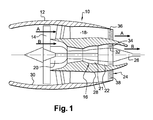
- the figure 1 represents a turbofan engine 10 and comprising a nacelle 12 in which a fan wheel 14 is mounted upstream of a motor body 16 essentially comprising, from upstream to downstream, a compressor 20, a combustion chamber 21, a turbine 22, an exhaust casing 24 and an exhaust cone 26.
- the fan wheel 14 is rotated by the turbine 22 of the turbojet, in a manner well known to those skilled in the art.
- the blower 14 generates a secondary air flow A, which flows backward around the turbojet in a blower line 18, and which provides a portion of the thrust of the engine.
- Part of the air entering the engine forms a primary flow B which feeds the inlet compressor 20 of the turbojet, then is mixed with fuel in the combustion chamber 21.
- the combustion gases leaving the combustion chamber cause the turbine 22 and are ejected between two coaxial walls 32, 34 of the exhaust casing 24 and exit the turbojet engine by flowing along the ejection cone 26.
- the fan duct 18 is formed of two substantially cylindrical coaxial walls, respectively internal 28 and outer 30.
- the inner wall 28 of the fan duct is generally called I.F.D. (Inner Fan Duct) while the outer wall 30 is generally called O.F.D. (Outer Fan Duct) and is surrounded by the nacelle 12.
- the two coaxial walls, respectively inner 32 and outer 34, of the exhaust casing 24 are connected by structural radial arms 36.
- each radial arm 36 of the exhaust casing 24 connects the coaxial walls 32, 34 of this casing to the cylindrical walls 28, 30 of the fan duct 18, so that a portion of the arm 36 intercepts the primary stream B while another part of that arm intercepts the secondary flow A.
- the arm 36 may not extend to the outer wall 30.
- Fines 38 are advantageously formed on the outer surface of the radial arms 36, at the parts of these arms intercepting the primary flows B and secondary A, and are schematically represented in FIG. figure 1 . Their function will be explained later.
- the figure 2 is a sectional view and on a larger scale of a radial arm 36 of the exhaust casing 24, in which are housed the heat exchangers of a Stirling cycle engine.
- this engine is designed and arranged to make the best use of the available space in the radial arm 36 and take advantage of the temperature difference between the hot gases of the primary flow B and the cold air of the secondary flow A to generate electrical or mechanical energy.
- the Stirling engine comprises a working chamber 40 in which are arranged a displacer piston 42 and a working piston 44 formed by a movable element of a generator system. 'electric energy.
- the displacer piston 42 is housed in a duct 46, for example of cylindrical shape and extending from upstream to downstream, and is formed of a piece of shape complementary to that of the duct, for sliding in this duct. sealed way by prohibiting the flow of air around the piston in the conduit.
- the displacer piston 42 comprises an open cylindrical cavity, for example on the upstream side of the piston, and having an axis parallel to and preferably coinciding with the axis of the piston, in which is mounted a cylindrical magnet 48 fixed to a wall of the chamber 40.
- the piston also comprises an electrical winding 50 disposed around the cavity and intended to allow an electromagnetic drive of the piston 42 in translation in its conduit 46, this coil being connected to an electrical interface 52 comprising for example a phase-shifter circuit.
- the conduit 46 of the displacer piston 42 is mounted in a correspondingly shaped orifice of a plate 54 connected to the walls of the radial arm 36 so that the displacer piston 42 and the plate 54 sealingly share the working chamber 40 in a zone upstream 56 which communicates with a heating exchanger 58 located in the part of the arm which intercepts the primary flow B, and a downstream zone 60 which communicates with a cooling exchanger 62 disposed in the part of the arm which intercepts the secondary flow A, situated at the radially outer end of this arm 36.
- the working chamber 40 and the heat exchangers 58 and cooling 62 contain a working fluid, such as air or an inert gas under pressure, that the displacer piston 42 alternately pushes in the heat exchanger 58 or in the cooling exchanger 62, as will be specified in the following.
- a working fluid such as air or an inert gas under pressure
- the arrangement of the heat exchangers 58 and cooling 62 which are respectively in thermal contact with the primary flow B of hot gases and with the secondary flow A of cold air, allows a heat exchange from the primary flow to the cooling fluid. working when it is in the heat exchanger 58, and working fluid to the secondary flow, when the working fluid is in the cooling exchanger 62.
- the radial arm 36 may have fins 38 on its outer surface and fins on its inner surface.
- the outer fins extend in a direction substantially parallel to the axis of the turbomachine so as to minimize their aerodynamic impact on the flow of primary and secondary flows.
- These fins 38 also make it possible to reinforce the rigidity of the radial arm.
- the Stirling engine further comprises a heat exchanger 64 of a known type, called regenerator.
- This regenerator 64 is formed for example of foam or metal slats and is housed in a portion of the radial arm located between the flow veins of the primary and secondary streams, in a space 66 commonly called intervein. This arrangement makes it possible to prevent heat exchanges between the working fluid and this regenerator 64 from being disturbed by heat exchanges with the primary and secondary flows.
- the working chamber 40 and the cooling exchanger 62 are connected by a thermally insulated connection duct 68, which passes through the heating exchanger 58 and the regenerator 64.
- the duct 68 also makes it possible to reduce the "dead" volume. fluid contained in the exchangers 58 and 62.
- the working chamber 40 comprises a linear-type electric power generation system comprising a hollow cylindrical piston 44 open downstream, which is supported by a resilient return waterproof membrane 70.
- the assembly formed by the piston 44 and the elastic membrane 70 forms a sealed end wall of the working chamber 40, so that a translation of the piston 44 upstream or downstream causes a reduction, respectively an increase, in the volume of the chamber working 40.
- a magnet 72 for example of cylindrical shape, is fixed on a wall of the working chamber 40 so as to be inserted into the cylindrical piston 44 of the power generation system.
- This piston comprises an electric winding 74 connected to the electrical interface 52 in order to convert the mechanical energy of the piston 44 into electrical energy, when the latter is displaced in translation along its axis, facing the magnet 72 .
- the Stirling engine advantageously comprises a supply of pressurized fluid 76, connected to a reserve of inert gas such as helium, with a valve intended for maintenance operations, to increase the pressure of the working fluid and thus improve the energy efficiency of the Stirling engine.
- the Stirling engine describes a thermodynamic cycle comprising four phases represented respectively in the Figures 3 to 6 .
- the Stirling engine is in an isochoric cooling phase of the working fluid.
- the electrical interface 52 controls a progressive displacement 78 of the displacer piston 42 in translation upstream, to an extreme position where it comes substantially in abutment against the radial arm 36 (this position of the displacer piston is visible on the figure 4 ).
- This movement of the displacer piston reduces the volume of the zone 56 of the working chamber, and pushes a major portion 80 of the working fluid contained in the heat exchanger 58 through the regenerator 64 and the cooling exchanger 62 to fill the downstream part of the working chamber.
- the working fluid transfers thermal energy to the regenerator 64 as it passes therethrough, and passes through the cooling exchanger 62 into the downstream portion of the working chamber.
- the working fluid then undergoes an isothermal compression phase, represented on the figure 4 .
- the volume occupied by the working fluid decreases as its pressure increases, due to an upstream displacement 82 of the piston 44 of the electrical energy generation system, under the effect of the elastic membrane. 70, to an extreme position away from the piston 44 relative to its magnet 72 (visible on the figure 5 ).
- a phase of isochoric heating of the working fluid represented on the figure 5 , and during which the electrical interface 52 controls a downstream translation 84 of the displacer piston 42, to an extreme position away from this piston relative to its magnet 48, so as to reduce the volume of the zone 60 of the working chamber, which tends to push at least part 86 of the working fluid contained in the cooling exchanger 62 through the regenerator 64 and the heat exchanger 58 to the upstream portion 56 of the chamber working.
- the working fluid receives thermal energy stored in the regenerator, and is thus warmed on arriving in the heating exchanger 58.
- the Stirling cycle ends with an isothermal expansion phase of the working fluid, represented on the figure 6 .
- the volume of the working fluid increases while its pressure decreases.
- the increase in volume of this fluid causes a downstream displacement 88 of the piston 44 of the energy generation system and the elastic membrane 70 which supports it, so that the piston returns to the position it occupies during the cooling phase.
- the piston 44 of the energy generation system thus goes back and forth around its magnet 70, which generates electrical energy that can be recovered by means of the electrical interface. 52.
- the invention therefore allows the generation of electrical energy from the thermal energy contained in the exhaust gas of a turbomachine, using a Stirling cycle heat engine.
- the figure 7 represents another embodiment of the invention, wherein the drive of the displacer piston 42 is provided by a mechanical device of a type common in Stirling engines.
- the piston is a U-section piece open downstream and the drive device of this piston comprises a wheel 90 which is arranged in the working chamber 40, between the displacer piston 42 and the piston 44 of the generating system of energy, and which is rotatably mounted on an axis 92 perpendicular to a median plane of the radial arm 36 and fixed to the walls of this arm.
- the wheel 90 is connected to the displacer piston 42 by a first rod 94 whose upstream end is mounted in a yoke 96, or any another similar means, secured to the piston 42 and disposed on its downstream face, for example in the center of this downstream face, the downstream end of the rod 94 being mounted in a yoke 98 or the like fixed on the periphery of the wheel 90.
- This wheel is also connected to the piston 44 of the energy generation system by a second rod 100 whose downstream end is mounted in a yoke 102 or the like integral with the piston 44 and disposed on its upstream face, for example in the center of this upstream face, the upstream end of the rod 100 being mounted in a yoke 104 or the like attached to the wheel 90, for example at a distance from the center of the wheel equal to a quarter of the radius of this wheel.
- the attachment clevises of the first and second links 94, 100 on the wheel 90 are at approximately 90 degrees to the center of the wheel so that the movement of the second link 100 is about a quarter of a second late. relative to the movement of the first link 94.
- the wheel 90 also forms a flywheel of the energy generation system.
- the invention is not limited to the generation of electrical energy and it is of course possible to directly exploit the mechanical energy provided by the piston of the energy conversion system, whether for the drive of a device reciprocating in translation similar to the movement of the piston, or for a rotational drive by the use of a rod and wheel or rod and crank system for example, to convert the piston movement into rotation movement.
- the invention makes it possible to take advantage of the thermal energy lost in a turbomachine by following a principle of cogeneration.
- the generation of electricity generally requires a mechanical energy sample at the turbojet compressor to power an electromechanical generator.
- the invention avoids having to make this collection of useful mechanical energy using the thermal energy of the exhaust gas, and thus allows an improvement in the performance of the turbojet, resulting in a gain in specific consumption of the order of one percent.
Landscapes
- Engineering & Computer Science (AREA)
- Chemical & Material Sciences (AREA)
- Combustion & Propulsion (AREA)
- Mechanical Engineering (AREA)
- General Engineering & Computer Science (AREA)
- Engine Equipment That Uses Special Cycles (AREA)
- Connection Of Motors, Electrical Generators, Mechanical Devices, And The Like (AREA)
Abstract
Description
- La présente invention concerne la génération d'électricité dans les turbomachines, en particulier à double flux, telles que les turboréacteurs d'avions.
- L'alimentation électrique des avions est en général assurée par des génératrices électromécaniques intégrées aux turboréacteurs de ces avions et entraînées par une prise de puissance sur des compresseurs haute pression des turboréacteurs.
- La puissance mécanique ainsi prélevée n'étant pas utilisée pour la propulsion, ce type de générateur électrique pénalise de façon sensible les performances des turboréacteurs.
- II est déjà connu d'entraîner un générateur électrique au moyen d'un moteur fonctionnant selon un cycle de Stirling, mais un tel générateur est une machine lourde conçue pour fonctionner en co-génération avec des moyens de chauffage d'immeubles ou de bâtiments comme décrit par exemple dans le document
GB-A-2 391 299 - L'invention a notamment pour but d'apporter une solution simple, économique et efficace au problème de la génération d'électricité dans les turbomachines à double flux, permettant d'éviter les inconvénients de la technique connue.
- Elle a également pour but la génération d'électricité dans une turbomachine selon un principe de cogénération, en tirant parti de l'énergie thermique dissipée dans les gaz d'échappement.
- Elle a encore pour but l'intégration d'un moteur Stirling dans une turbomachine d'une façon qui minimise l'augmentation du poids total de la turbomachine et l'encombrement du moteur Stirling et des moyens associés de génération d'énergie électrique.
- L'invention propose à cet effet une turbomachine à double flux, comprenant un carter d'échappement relié par des bras radiaux à des parois cylindriques coaxiales délimitant des veines d'écoulement d'un flux primaire de gaz d'échappement chauds et d'un flux secondaire d'air froid, caractérisée en ce qu'elle est équipée d'au moins un moteur thermique à cycle de Stirling monté en bout d'un bras radial et comportant deux échangeurs thermiques de chauffage et de refroidissement respectivement d'un fluide de travail, formés dans des parties du bras radial interceptant respectivement le flux primaire et le flux secondaire
- Le moteur thermique à cycle de Stirling, couramment appelé « moteur Stirling » ou moteur à air chaud, permet de tirer parti de la différence de température entre le flux primaire de gaz d'échappement et le flux secondaire d'air froid pour générer de l'énergie mécanique, susceptible d'être convertie en énergie électrique. Ce type de moteur se caractérise par un très bon rendement qui peut atteindre 40% du maximum théorique, par une très bonne fiabilité et une grande longévité.
- Le cycle théorique de fonctionnement d'un tel moteur comprend quatre phases successives : une phase de chauffage isochore suivie d'une phase de détente isotherme du fluide de travail, puis une phase de refroidissement isochore suivie d'une phase de compression isotherme du fluide de travail.
- Le moteur Stirling comprend également une chambre de travail située en dehors des flux primaire et secondaire et dans laquelle est agencé un piston déplaceur associé à un élément mobile d'un système de génération d'énergie, la chambre de travail communiquant avec les échangeurs pour la circulation du fluide de travail.
- Avantageusement, les échangeurs de chauffage et de refroidissement sont reliés par un régénérateur destiné à accumuler de l'énergie thermique pendant la phase de refroidissement du cycle de Stirling et céder de l'énergie thermique pendant la phase de réchauffement.
- Ce régénérateur est un échangeur formant accumulateur thermique qui permet d'augmenter les performances du moteur Stirling.
- Selon une autre caractéristique de l'invention, le régénérateur est logé dans une partie du bras radial située entre les veines d'écoulement du flux primaire et du flux secondaire, afin que les échanges thermiques entre le fluide de travail et le régénérateur ne soient pas perturbés par les flux primaire et secondaire.
- Pour des raisons analogues, la chambre de travail est de préférence agencée à l'extrémité radialement interne du bras radial et radialement à l'intérieur de la paroi cylindrique interne délimitant la veine d'écoulement du flux primaire.
- Selon un mode de réalisation préféré de l'invention, le piston déplaceur est agencé de manière à partager de façon étanche la chambre de travail en deux zones, dont la première est reliée à l'échangeur de chauffage et dont la seconde est reliée à l'échangeur de refroidissement par un conduit thermiquement isolé traversant l'échangeur de chauffage et le régénérateur.
- Cet agencement permet de réduire l'encombrement du dispositif tout en ménageant un espace pour le régénérateur.
- Dans une première forme de réalisation, le piston déplaceur comporte une cavité cylindrique s'étendant dans la direction de déplacement du piston et à l'intérieur de laquelle est monté un aimant permanant fixe, le piston déplaceur étant pourvu d'un enroulement de fil électrique agencé autour de la cavité cylindrique et relié à une interface électrique pour l'entraînement du piston déplaceur.
- Dans une autre forme de réalisation, la chambre de travail comprend une roue reliée à l'élément mobile du système de génération d'énergie et au piston déplaceur par des biellettes.
- Avantageusement, le moteur Stirling est scellé et rempli d'un gaz inerte sous pression tel que l'hélium. En variante, il peut comprendre une amenée de gaz sous pression, par exemple dans la chambre de travail ou dans l'un des échangeurs, de manière à augmenter la pression du fluide de travail et par conséquent, les performances du moteur Stirling.
- Le bras radial comporte avantageusement des ailettes d'échange thermique sur sa surface externe et/ou interne située dans les veines d'écoulement des flux primaire et secondaire.
- Dans le mode de réalisation préféré de l'invention, l'élément mobile du système de génération d'énergie est supporté par un moyen élastique de rappel fixé dans la chambre de travail et comporte une cavité cylindrique s'étendant dans sa direction de déplacement et à l'intérieur de laquelle est disposé un aimant permanent fixe, l'élément mobile étant pourvu d'un enroulement de fil électrique agencé autour de la cavité cylindrique et relié à une interface électrique pour permettre une conversion de l'énergie mécanique en énergie électrique.
- L'invention permet ainsi de générer de l'électricité, pour pourvoir à l'alimentation électrique d'un aéronef par exemple, et cela sans devoir prélever de l'énergie mécanique utile dans la turbomachine.
- L'invention sera mieux comprise et d'autres détails, avantages et caractéristiques de celle-ci apparaîtront plus clairement à la lecture de la description suivante faite à titre d'exemple non limitatif, en référence aux dessins annexés dans lesquels :
- la
figure 1 est une vue schématique en coupe axiale d'une turbomachine selon l'invention ; - la
figure 2 est une vue schématique partielle en coupe longitudinale et à plus grande échelle d'un bras de carter d'échappement de la turbomachine de lafigure 1 ; - la
figure 3 est une vue semblable à lafigure 2 et illustre la phase de refroidissement du cycle de Stirling du moteur thermique intégré au bras de carter d'échappement ; - la
figure 4 est une vue semblable à lafigure 3 et illustre la phase de compression du cycle de Stirling ; - la
figure 5 est une vue semblable à lafigure 3 et illustre la phase de chauffage du cycle de Stirling ; - la
figure 6 est une vue semblable à lafigure 3 et illustre la phase de détente du cycle de Stirling ; - la
figure 7 est une vue semblable à lafigure 2 et représente une variante de l'invention. - La
figure 1 représente un turboréacteur à double flux 10 et comportant une nacelle 12 dans laquelle une roue de soufflante 14 est montée en amont d'un corps de moteur 16 comprenant essentiellement, d'amont en aval, un compresseur 20, une chambre de combustion 21, une turbine 22, un carter d'échappement 24 et un cône d'éjection 26. - La roue de soufflante 14 est entraînée en rotation par la turbine 22 du turboréacteur, d'une façon bien connue de l'homme du métier. Pendant le fonctionnement du moteur, la soufflante 14 génère un flux d'air secondaire A, qui s'écoule vers l'arrière autour du turboréacteur dans une conduite de soufflante 18, et qui fournit une partie de la poussée du moteur. Une partie de l'air entrant dans le moteur forme un flux primaire B qui alimente le compresseur d'entrée 20 du turboréacteur, puis est mélangé à du carburant dans la chambre de combustion 21. Les gaz de combustion sortant de la chambre de combustion entraînent la turbine 22 puis sont éjectés entre deux parois coaxiales 32, 34 du carter d'échappement 24 et sortent du turboréacteur en s'écoulant le long du cône d'éjection 26.
- La conduite de soufflante 18 est formée de deux parois coaxiales sensiblement cylindriques, respectivement interne 28 et externe 30. La paroi interne 28 de la conduite de soufflante est généralement appelée I.F.D. (Inner Fan Duct) tandis que la paroi externe 30 est généralement appelée O.F.D. (Outer Fan Duct) et est entourée par la nacelle 12.
- Les deux parois coaxiales, respectivement interne 32 et externe 34, du carter d'échappement 24 sont reliées par des bras radiaux structuraux 36.
- Dans l'exemple représenté, chaque bras radial 36 du carter d'échappement 24 relie les parois coaxiales 32, 34 de ce carter aux parois cylindriques 28, 30 de la conduite de soufflante 18, de sorte qu'une partie du bras 36 intercepte le flux primaire B tandis qu'une autre partie de ce bras intercepte le flux secondaire A. En variante, le bras 36 peut ne pas s'étendre jusqu'à la paroi externe 30.
- Des ailettes 38 sont avantageusement formées sur la surface externe des bras radiaux 36, au niveau des parties de ces bras interceptant les flux primaire B et secondaire A, et sont schématiquement représentées en
figure 1 . Leur fonction sera expliquée par la suite. - La
figure 2 est une vue en coupe et à plus grande échelle d'un bras radial 36 du carter d'échappement 24, dans lequel sont logés les échangeurs thermiques d'un moteur à cycle de Stirling. - Comme cela sera expliqué dans ce qui suit, ce moteur est conçu et agencé pour utiliser au mieux l'espace disponible dans le bras radial 36 et tirer parti de la différence de température entre les gaz chauds du flux primaire B et l'air froid du flux secondaire A pour générer de l'énergie électrique ou mécanique.
- Dans une partie radialement interne par rapport à l'axe de la turbomachine, le moteur Stirling comprend une chambre de travail 40 dans laquelle sont agencés un piston déplaceur 42 et un piston de travail 44 formé par un élément mobile d'un système de génération d'énergie électrique.
- Le piston déplaceur 42 est logé dans un conduit 46, par exemple de forme cylindrique et s'étendant de l'amont vers l'aval, et est formé d'une pièce de forme complémentaire à celle du conduit, pour coulisser dans ce conduit de façon étanche en interdisant l'écoulement d'air autour du piston dans le conduit. Le piston déplaceur 42 comprend une cavité cylindrique ouverte, par exemple du côté amont du piston, et d'axe parallèle à et de préférence confondu avec l'axe du piston, dans laquelle est monté un aimant cylindrique 48 fixé à une paroi de la chambre de travail 40. Le piston comprend également un bobinage électrique 50 disposé autour de la cavité et destiné à permettre un entraînement électromagnétique du piston 42 en translation dans son conduit 46, ce bobinage étant relié à une interface électrique 52 comprenant par exemple un circuit déphaseur.
- Le conduit 46 du piston déplaceur 42 est monté dans un orifice de forme correspondante d'une plaque 54 reliée aux parois du bras radial 36 de sorte que le piston déplaceur 42 et la plaque 54 partagent de manière étanche la chambre de travail 40 en une zone amont 56 qui communique avec un échangeur de chauffage 58 situé dans la partie du bras qui intercepte le flux primaire B, et une zone aval 60 qui communique avec un échangeur de refroidissement 62 disposé dans la partie du bras qui intercepte le flux secondaire A, située à l'extrémité radialement externe de ce bras 36. La chambre de travail 40 et les échangeurs de chauffage 58 et de refroidissement 62 contiennent un fluide de travail, tel que de l'air ou un gaz inerte sous pression, que le piston déplaceur 42 repousse alternativement dans l'échangeur de chauffage 58 ou dans l'échangeur de refroidissement 62, comme cela sera précisé dans ce qui suit. L'agencement des échangeurs de chauffage 58 et de refroidissement 62, qui sont respectivement en contact thermique avec le flux primaire B de gaz chauds et avec le flux secondaire A d'air froid, permet un échange de chaleur du flux primaire vers le fluide de travail lorsque celui-ci se trouve dans l'échangeur de chauffage 58, et du fluide de travail vers le flux secondaire, lorsque le fluide de travail se trouve dans l'échangeur de refroidissement 62.
- Afin de maximiser les échanges de chaleur précités et comme cela a déjà été mentionné en référence à la
figure 1 , le bras radial 36 peut comporter des ailettes 38 sur sa surface externe et des ailettes sur sa surface interne. Les ailettes externes s'étendent selon une direction sensiblement parallèle à l'axe de la turbomachine de manière à réduire au mieux leur impact aérodynamique sur l'écoulement des flux primaire et secondaire. Ces ailettes 38 permettent également de renforcer la rigidité du bras radial. - Dans le mode de réalisation représenté sur la
figure 2 , le moteur Stirling comprend en outre un échangeur thermique 64 d'un type connu, appelé régénérateur. Ce régénérateur 64 est formé par exemple de mousse ou de lamelles en métal et est logé dans une partie du bras radial située entre les veines d'écoulement des flux primaire et secondaire, dans un espace 66 couramment appelé interveine. Cette disposition permet d'éviter que des échanges de chaleur entre le fluide de travail et ce régénérateur 64 ne soient perturbés par des échanges thermiques avec les flux primaire et secondaire. - II est avantageux que les volumes des échangeurs 58 et 62, qui sont des volumes « morts », soient minimisés et que les surfaces d'échange thermique et le volume de la chambre de travail soient augmentés.
- La chambre de travail 40 et l'échangeur de refroidissement 62 sont reliés par un conduit de liaison 68 thermiquement isolé, qui traverse l'échangeur de chauffage 58 et le régénérateur 64. Avantageusement, le conduit 68 permet aussi de réduire le volume « mort » de fluide contenu dans les échangeurs 58 et 62.
- La chambre de travail 40 comporte un système de génération d'énergie électrique du type linéaire comprenant un piston cylindrique creux 44 ouvert vers l'aval, qui est supporté par une membrane élastique étanche de rappel 70. L'ensemble formé par le piston 44 et la membrane élastique 70 forme une paroi mobile étanche d'extrémité de la chambre de travail 40, de sorte qu'une translation du piston 44 vers l'amont ou vers l'aval provoque une réduction, respectivement un accroissement, du volume de la chambre de travail 40.
- Un aimant 72, par exemple de forme cylindrique, est fixé sur une paroi de la chambre de travail 40 de manière à être inséré dans le piston cylindrique 44 du système de génération d'énergie. Ce piston comporte un bobinage électrique 74 relié à l'interface électrique 52 afin de réaliser une conversion de l'énergie mécanique du piston 44 en énergie électrique, lorsque celui-ci est déplacé en translation selon son axe, en regard de l'aimant 72.
- Le moteur Stirling comporte avantageusement une amenée de fluide sous pression 76, reliée à une réserve de gaz inerte tel que l'hélium, avec une valve destinée aux opérations de maintenance, pour augmenter la pression du fluide de travail et ainsi améliorer le rendement énergétique du moteur Stirling.
- En fonctionnement, le moteur Stirling décrit un cycle thermodynamique comportant quatre phases représentées respectivement dans les
figures 3 à 6 . - Sur la
figure 3 , le moteur Stirling se trouve dans une phase de refroidissement isochore du fluide de travail. Pendant cette phase, l'interface électrique 52 commande un déplacement progressif 78 du piston déplaceur 42 en translation vers l'amont, jusqu'à une position extrême où il vient sensiblement en butée contre le bras radial 36 (cette position du piston déplaceur est visible sur lafigure 4 ). Ce mouvement du piston déplaceur réduit le volume de la zone 56 de la chambre de travail, et pousse une majeure partie 80 du fluide de travail contenu dans l'échangeur de chauffage 58 à travers le régénérateur 64 et l'échangeur de refroidissement 62 pour remplir la partie aval de la chambre de travail. Le fluide de travail cède de l'énergie thermique au régénérateur 64 lors de son passage à travers ce dernier, et traverse l'échangeur de refroidissement 62 pour arriver dans la partie aval de la chambre de travail. - Le fluide de travail subit ensuite une phase de compression isotherme, représentée sur la
figure 4 . Le volume occupé par le fluide de travail diminue au fur et à mesure que sa pression augmente, du fait d'un déplacement vers l'amont 82 du piston 44 du système de génération d'énergie électrique, sous l'effet de la membrane élastique de rappel 70, jusqu'à une position extrême d'éloignement du piston 44 par rapport à son aimant 72 (visible sur lafigure 5 ). - A la phase de compression succède une phase de chauffage isochore du fluide de travail, représentée sur la
figure 5 , et au cours de laquelle l'interface électrique 52 commande une translation vers l'aval 84 du piston déplaceur 42, jusqu'à une position extrême d'éloignement de ce piston par rapport à son aimant 48, de manière à réduire le volume de la zone 60 de la chambre de travail, ce qui tend à pousser une partie 86 au moins du fluide de travail contenu dans l'échangeur de refroidissement 62 à travers le régénérateur 64 et l'échangeur de chauffage 58 vers la partie amont 56 de la chambre de travail. Lors de son passage à l'intérieur du régénérateur 64, le fluide de travail reçoit de l'énergie thermique stockée dans le régénérateur, et se trouve donc réchauffé en arrivant dans l'échangeur de chauffage 58. - Le cycle de Stirling se termine par une phase de détente isotherme du fluide de travail, représentée sur la
figure 6 . Au cours de cette phase, le volume du fluide de travail s'accroît tandis que sa pression diminue. L'augmentation de volume de ce fluide provoque un déplacement vers l'aval 88 du piston 44 du système de génération d'énergie et de la membrane élastique 70 qui le supporte, de sorte que le piston revient dans la position qu'il occupe pendant la phase de refroidissement. - Au cours d'un cycle de Stirling, le piston 44 du système de génération d'énergie accomplit donc un va et vient autour de son aimant 70, ce qui génère de l'énergie électrique qui peut être récupérée au moyen de l'interface électrique 52.
- L'invention permet donc la génération d'énergie électrique à partir de l'énergie thermique contenue dans les gaz d'échappement d'une turbomachine, en utilisant un moteur thermique à cycle de Stirling.
- La
figure 7 représente un autre mode de réalisation de l'invention, dans lequel l'entraînement du piston déplaceur 42 est assuré par un dispositif mécanique d'un type courant dans les moteurs Stirling. Le piston est une pièce à section en U ouverte vers l'aval et le dispositif d'entraînement de ce piston comprend une roue 90 qui est disposée dans la chambre de travail 40, entre le piston déplaceur 42 et le piston 44 du système de génération d'énergie, et qui est montée rotative sur un axe 92 perpendiculaire à un plan médian du bras radial 36 et fixé aux parois de ce bras. La roue 90 est reliée au piston déplaceur 42 par une première biellette 94 dont l'extrémité amont est montée dans une chape 96, ou tout autre moyen analogue, solidaire du piston 42 et disposée sur sa face aval, par exemple au centre de cette face aval, l'extrémité aval de la biellette 94 étant montée dans une chape 98 ou analogue fixée sur la périphérie de la roue 90. Cette roue est également reliée au piston 44 du système de génération d'énergie par une seconde biellette 100 dont l'extrémité aval est montée dans une chape 102 ou analogue solidaire de ce piston 44 et disposée sur sa face amont, par exemple au centre de cette face amont, l'extrémité amont de la biellette 100 étant montée dans une chape 104 ou analogue fixée à la roue 90, par exemple à une distance du centre de la roue égale au quart du rayon de cette roue. Les chapes de fixation des première et seconde biellettes 94, 100 sur la roue 90 font avec le centre de la roue un angle de 90 degrés environ de sorte que le mouvement de la seconde biellette 100 présente un retard d'un quart de cycle environ par rapport au mouvement de la première biellette 94. La roue 90 forme également un volant d'inertie du système de génération d'énergie. - L'invention n'est pas limitée à la génération d'énergie électrique et il est bien entendu possible d'exploiter directement l'énergie mécanique fournie par le piston du système de conversion d'énergie, que ce soit pour l'entraînement d'un équipement selon un mouvement de va et vient en translation semblable au mouvement du piston, ou pour un entraînement en rotation par l'utilisation d'un système à bielle et roue ou à bielle et manivelle par exemple, pour convertir le mouvement du piston en mouvement de rotation.
- D'un point de vue général, l'invention permet de mettre à profit de l'énergie thermique perdue dans une turbomachine en suivant un principe de cogénération. Dans un turboréacteur d'aéronef, par exemple, la génération d'électricité nécessite en général un prélèvement d'énergie mécanique au niveau du compresseur du turboréacteur pour alimenter un générateur électromécanique. L'invention évite d'avoir à réaliser ce prélèvement d'énergie mécanique utile en utilisant l'énergie thermique des gaz d'échappement, et permet ainsi une amélioration des performances du turboréacteur, se traduisant par un gain en consommation spécifique de l'ordre du pourcent.
Claims (12)
- Turbomachine à double flux (10), comprenant un carter d'échappement (24) relié par des bras radiaux (36) à des parois cylindriques coaxiales (28, 30, 32, 34) délimitant des veines d'écoulement d'un flux primaire (B) de gaz d'échappement chauds et d'un flux secondaire (A) d'air froid, la turbomachine étant caractérisée en ce qu'elle est équipée d'au moins un moteur thermique à cycle de Stirling monté en bout d'un bras radial (36) et comportant deux échangeurs thermiques, de chauffage (58) et de refroidissement (62) respectivement d'un fluide de travail, formés dans des parties du bras radial (36) interceptant respectivement le flux primaire (B) et le flux secondaire (A).
- Turbomachine (10) selon la revendication 1, caractérisée en ce que les deux échangeurs de chauffage (58) et de refroidissement (62) sont reliés par un régénérateur (64) destiné à accumuler de l'énergie thermique pendant la phase de refroidissement du cycle de Stirling et céder de l'énergie thermique pendant la phase de réchauffement.
- Turbomachine (10) selon la revendication 2, caractérisée en ce que le régénérateur (64) est logé dans une partie du bras radial (36) située entre les veines d'écoulement du flux primaire (B) et du flux secondaire (A).
- Turbomachine selon l'une des revendications précédentes, caractérisée en ce que le moteur Stirling comprend une chambre de travail (40) située en dehors des flux primaire (B) et secondaire (A) et dans laquelle est agencé un piston déplaceur (42) associé à un élément mobile (44) d'un système de génération d'énergie, cette chambre de travail (40) communiquant avec les deux échangeurs (58, 62) pour la circulation d'un fluide de travail.
- Turbomachine (10) selon la revendication 4, caractérisée en ce que la chambre de travail (40) est agencée à l'extrémité radialement interne du moteur thermique.
- Turbomachine (10) selon la revendication 4 ou 5, caractérisée en ce que le piston déplaceur (42) est agencé de manière à partager de façon étanche la chambre de travail (40) en deux zones, dont la première (56) est reliée à l'échangeur de chauffage (58) et dont la seconde (60) est reliée à l'échangeur de refroidissement (62).
- Turbomachine (10) selon la revendication 6, caractérisée en ce que la seconde zone (60) est reliée à l'échangeur de refroidissement (62) par un conduit thermiquement isolé (68) traversant l'échangeur de chauffage (58) et le régénérateur (64).
- Turbomachine (10) selon l'une des revendications 4 à 7, caractérisée en ce que le piston déplaceur (42) comporte une cavité cylindrique s'étendant dans la direction de déplacement du piston et à l'intérieur de laquelle est montée un aimant permanant fixe (48), le piston déplaceur étant pourvu d'un enroulement de fil électrique (50) agencé autour de la cavité cylindrique et relié à une interface électrique (52) pour l'entraînement du piston déplaceur (42).
- Turbomachine (10) selon l'une des revendications 4 à 7, caractérisée en ce que la chambre de travail (40) comprend une roue (90) reliée à l'élément mobile (44) du système de génération d'énergie et au piston déplaceur (42) par des biellettes (94, 100), pour l'entraînement du piston déplaceur (42).
- Turbomachine (10) selon l'une des revendications 4 à 9, caractérisée en ce que le moteur Stirling comprend une amenée de gaz inerte sous pression (76) dans la chambre de travail (40) ou l'un des échangeurs (58, 62).
- Turbomachine (10) selon l'une des revendications 4 à 10, caractérisée en ce que l'élément mobile (44) du système de génération d'énergie est supporté par un moyen élastique de rappel (70) fixé dans la chambre de travail (40) et comporte une cavité cylindrique s'étendant dans sa direction de déplacement et à l'intérieur de laquelle est disposé un aimant permanent fixe (72), l'élément mobile (44) étant pourvu d'un enroulement de fil électrique (74) agencé autour de la cavité cylindrique et relié à une interface électrique (52) pour permettre une conversion de l'énergie mécanique en énergie électrique.
- Turbomachine (10) selon l'une des revendications précédentes, caractérisée en ce que le bras radial (36) comporte des ailettes d'échange thermique (38) sur sa surface externe et/ou interne située dans les veines d'écoulement des flux primaire (B) et secondaire (A).
Applications Claiming Priority (1)
| Application Number | Priority Date | Filing Date | Title |
|---|---|---|---|
| FR0706072A FR2920483B1 (fr) | 2007-08-30 | 2007-08-30 | Generation d'electricite dans une turbomachine |
Publications (2)
| Publication Number | Publication Date |
|---|---|
| EP2031234A1 true EP2031234A1 (fr) | 2009-03-04 |
| EP2031234B1 EP2031234B1 (fr) | 2010-10-13 |
Family
ID=39469574
Family Applications (1)
| Application Number | Title | Priority Date | Filing Date |
|---|---|---|---|
| EP08161860A Active EP2031234B1 (fr) | 2007-08-30 | 2008-08-05 | Génération d'électricité dans une turbomachine au moyen d'un moteur Stirling |
Country Status (10)
| Country | Link |
|---|---|
| US (1) | US7685828B2 (fr) |
| EP (1) | EP2031234B1 (fr) |
| JP (1) | JP2009057969A (fr) |
| CN (1) | CN101377175A (fr) |
| CA (1) | CA2639217A1 (fr) |
| DE (1) | DE602008002974D1 (fr) |
| ES (1) | ES2354133T3 (fr) |
| FR (1) | FR2920483B1 (fr) |
| RU (1) | RU2470175C2 (fr) |
| UA (1) | UA97357C2 (fr) |
Families Citing this family (15)
| Publication number | Priority date | Publication date | Assignee | Title |
|---|---|---|---|---|
| US8144125B2 (en) | 2006-03-30 | 2012-03-27 | Cypress Semiconductor Corporation | Apparatus and method for reducing average scan rate to detect a conductive object on a sensing device |
| US8144126B2 (en) | 2007-05-07 | 2012-03-27 | Cypress Semiconductor Corporation | Reducing sleep current in a capacitance sensing system |
| US8099944B2 (en) * | 2008-10-08 | 2012-01-24 | The Invention Science Fund I, Llc | Hybrid propulsive engine including at least one independently rotatable propeller/fan |
| US20100108806A1 (en) * | 2008-10-08 | 2010-05-06 | Searete Llc, A Limited Liability Corporation Of The State Of Delaware | Hybrid propulsive engine including at least one independently rotatable propeller/fan |
| US20100126178A1 (en) * | 2008-10-08 | 2010-05-27 | Searete Llc, A Limited Liability Corporation Of The State Of Delaware | Hybrid propulsive engine including at least one independently rotatable turbine stator |
| US20100083632A1 (en) * | 2008-10-08 | 2010-04-08 | Searete Llc, A Limited Liability Corporation Of The State Of Delaware | Hybrid propulsive engine including at least one independently rotatable compressor rotor |
| JP5572471B2 (ja) * | 2010-07-28 | 2014-08-13 | 川崎重工業株式会社 | ガスタービンの中間冷却装置、これを用いたガスタービン |
| DE102011122071B4 (de) * | 2011-12-22 | 2013-10-31 | Eads Deutschland Gmbh | Stirlingmotor mit Schlagflügel für ein emissionsfreies Fluggerät |
| CN106499514A (zh) * | 2016-12-29 | 2017-03-15 | 深圳智慧能源技术有限公司 | 能回收燃机尾气热能和lng冷能的联合循环发电系统 |
| US11371379B2 (en) | 2017-08-22 | 2022-06-28 | General Electric Company | Turbomachine with alternatingly spaced turbine rotor blades |
| US11156128B2 (en) | 2018-08-22 | 2021-10-26 | General Electric Company | Embedded electric machine |
| JP7269761B2 (ja) | 2019-03-15 | 2023-05-09 | 三菱重工業株式会社 | 原料流体の処理プラント、及び原料流体の処理方法 |
| US11428160B2 (en) | 2020-12-31 | 2022-08-30 | General Electric Company | Gas turbine engine with interdigitated turbine and gear assembly |
| US12149154B2 (en) | 2021-07-22 | 2024-11-19 | General Electric Company | Electric machine having a hybrid insulative-conductive manifold |
| CN116378792B (zh) * | 2023-04-10 | 2025-08-05 | 西安交通大学 | 基于热压解耦的废旧电厂改造的复合储能系统及运行方法 |
Citations (6)
| Publication number | Priority date | Publication date | Assignee | Title |
|---|---|---|---|---|
| GB2041090A (en) | 1979-01-31 | 1980-09-03 | Rolls Royce | By-pass gas turbine engines |
| DE3031872A1 (de) | 1980-08-23 | 1982-04-01 | Klöckner-Humboldt-Deutz AG, 5000 Köln | Brennkraftmaschine mit einem zusatzmotor |
| US4796430A (en) * | 1987-08-14 | 1989-01-10 | Cryodynamics, Inc. | Cam drive for cryogenic refrigerator |
| JPH01151724A (ja) * | 1987-12-08 | 1989-06-14 | Mitsubishi Heavy Ind Ltd | スターリングエンジンとガスタービンの複合機関 |
| US5269133A (en) * | 1991-06-18 | 1993-12-14 | General Electric Company | Heat exchanger for cooling a gas turbine |
| GB2391299A (en) | 2002-06-18 | 2004-02-04 | Bosch Gmbh Robert | Heating device in combination with a heat to power converter and generator for producing electricity |
Family Cites Families (16)
| Publication number | Priority date | Publication date | Assignee | Title |
|---|---|---|---|---|
| GB1516041A (en) * | 1977-02-14 | 1978-06-28 | Secr Defence | Multistage axial flow compressor stators |
| US4254618A (en) * | 1977-08-18 | 1981-03-10 | General Electric Company | Cooling air cooler for a gas turbofan engine |
| US4187675A (en) * | 1977-10-14 | 1980-02-12 | The United States Of America As Represented By The Secretary Of The Air Force | Compact air-to-air heat exchanger for jet engine application |
| SU1325179A1 (ru) * | 1985-10-08 | 1987-07-23 | Предприятие П/Я А-1619 | Силова установка |
| CA2046797A1 (fr) * | 1990-08-01 | 1992-02-02 | Franklin D. Parsons | Montage d'echangeur de chaleur dans un canal de flux d'une turbine a gaz pour refroidir l'air chaud de prelevement |
| US5376827A (en) * | 1993-05-27 | 1994-12-27 | General Electric Company | Integrated turbine-generator |
| JP3365005B2 (ja) * | 1993-10-26 | 2003-01-08 | 石川島播磨重工業株式会社 | タービン静翼の冷却装置 |
| GB2301632B (en) * | 1995-03-18 | 1998-06-24 | Rolls Royce Plc | Aircraft compound cycle propulsion engine |
| US6430931B1 (en) * | 1997-10-22 | 2002-08-13 | General Electric Company | Gas turbine in-line intercooler |
| TW426798B (en) * | 1998-02-06 | 2001-03-21 | Sanyo Electric Co | Stirling apparatus |
| JP2001073873A (ja) * | 1999-09-07 | 2001-03-21 | Yoshihiko Haramura | 遊星歯車を用いてディスプレーサを駆動するスターリングサイクル機器 |
| AU2001213231A1 (en) * | 2000-11-10 | 2002-05-21 | Marek Kovac | Bypass gas turbine engine and cooling method for working fluid |
| GB2372157B (en) * | 2001-02-09 | 2005-07-06 | Rolls Royce Plc | A gas turbine with an electrical machine |
| JP4248303B2 (ja) * | 2003-05-09 | 2009-04-02 | 本田技研工業株式会社 | 燃焼機関およびスターリング機関を備える動力装置 |
| US7514810B2 (en) * | 2006-12-15 | 2009-04-07 | General Electric Company | Electric power generation using power turbine aft of LPT |
| FR2920482B1 (fr) * | 2007-08-30 | 2009-10-30 | Snecma Sa | Ventilation et pressurisation de composants dans une turbomachine |
-
2007
- 2007-08-30 FR FR0706072A patent/FR2920483B1/fr not_active Expired - Fee Related
-
2008
- 2008-08-05 ES ES08161860T patent/ES2354133T3/es active Active
- 2008-08-05 EP EP08161860A patent/EP2031234B1/fr active Active
- 2008-08-05 DE DE602008002974T patent/DE602008002974D1/de active Active
- 2008-08-26 CA CA002639217A patent/CA2639217A1/fr not_active Abandoned
- 2008-08-28 JP JP2008219005A patent/JP2009057969A/ja active Pending
- 2008-08-28 US US12/200,266 patent/US7685828B2/en active Active
- 2008-08-29 RU RU2008135296/06A patent/RU2470175C2/ru not_active IP Right Cessation
- 2008-08-29 UA UAA200810773A patent/UA97357C2/ru unknown
- 2008-09-01 CN CNA2008102139687A patent/CN101377175A/zh active Pending
Patent Citations (6)
| Publication number | Priority date | Publication date | Assignee | Title |
|---|---|---|---|---|
| GB2041090A (en) | 1979-01-31 | 1980-09-03 | Rolls Royce | By-pass gas turbine engines |
| DE3031872A1 (de) | 1980-08-23 | 1982-04-01 | Klöckner-Humboldt-Deutz AG, 5000 Köln | Brennkraftmaschine mit einem zusatzmotor |
| US4796430A (en) * | 1987-08-14 | 1989-01-10 | Cryodynamics, Inc. | Cam drive for cryogenic refrigerator |
| JPH01151724A (ja) * | 1987-12-08 | 1989-06-14 | Mitsubishi Heavy Ind Ltd | スターリングエンジンとガスタービンの複合機関 |
| US5269133A (en) * | 1991-06-18 | 1993-12-14 | General Electric Company | Heat exchanger for cooling a gas turbine |
| GB2391299A (en) | 2002-06-18 | 2004-02-04 | Bosch Gmbh Robert | Heating device in combination with a heat to power converter and generator for producing electricity |
Also Published As
| Publication number | Publication date |
|---|---|
| EP2031234B1 (fr) | 2010-10-13 |
| RU2008135296A (ru) | 2010-03-10 |
| DE602008002974D1 (de) | 2010-11-25 |
| UA97357C2 (en) | 2012-02-10 |
| FR2920483A1 (fr) | 2009-03-06 |
| FR2920483B1 (fr) | 2009-10-30 |
| JP2009057969A (ja) | 2009-03-19 |
| CN101377175A (zh) | 2009-03-04 |
| ES2354133T3 (es) | 2011-03-10 |
| US7685828B2 (en) | 2010-03-30 |
| RU2470175C2 (ru) | 2012-12-20 |
| CA2639217A1 (fr) | 2009-02-28 |
| US20090058089A1 (en) | 2009-03-05 |
Similar Documents
| Publication | Publication Date | Title |
|---|---|---|
| EP2031234B1 (fr) | Génération d'électricité dans une turbomachine au moyen d'un moteur Stirling | |
| CA2751395C (fr) | Generation thermoelectrique pour turbine a gaz | |
| EP1662636B1 (fr) | Turbomachine comportant un générateur de courant électrique intégré | |
| EP1366280B1 (fr) | Groupe electrogene a mouvement lineaire alternatif a base de moteur stirling, et procede mis en oeuvre dans ce groupe electrogene | |
| FR2656657A1 (fr) | Turbomachine refroidie par air et procede de refroidissement de cette turbomachine. | |
| CA2965396C (fr) | Echangeur de chaleur et turbomoteur comportant un tel echangeur | |
| EP2031233B1 (fr) | Ventilation et pressurisation de composants dans une turbomachine au moyen d'un moteur Stirling | |
| FR3004487A1 (fr) | Procede de controle du fonctionnement d'un circuit ferme fonctionnant selon un cycle de rankine et circuit utilisant un tel procede. | |
| EP4129828B1 (fr) | Aéronef comprenant un dispositif d alimentation en hydrogène intégrant un système de chauffage de l hydrogène positionné dans le fuselage de l aéronef | |
| EP4493800A1 (fr) | Procede d'assemblage d'un film antiadhesif sur un substrat metallique par frappe à chaud | |
| FR3057035B1 (fr) | Turbine a volume variable et systeme de conversion d’energie thermomecanique l’incorporant | |
| EP2808528B1 (fr) | Moteur à détente de fluide | |
| FR3120898A1 (fr) | Dispositif de refroidissement d’un fluide pour une turbomachine | |
| FR3007790A1 (fr) | Groupe turbopropulseur d'aeronef comprenant un circuit de recuperation et de conversion d'energie thermique | |
| FR3032749A1 (fr) | Moteur thermoacoustique | |
| EP4222365B1 (fr) | Moteur à cycle stirling | |
| FR3033831A1 (fr) | Moteur pour aeronefs | |
| FR3010739A1 (fr) | Refroidissement d'une machine electrique d'un vehicule automobile | |
| FR3070725B1 (fr) | Turbopompe cinetique avec un dispositif de variation de vitesse pour un circuit ferme, en particulier de type a cycle de rankine, notamment pour un vehicule automobile | |
| FR3033837A1 (fr) | Perfectionnements aux groupes de puissance pour aeronefs | |
| FR3077122A1 (fr) | Systeme a cycle thermodynamique de rankine integre a une boucle de climatisation pour vehicule automobile | |
| FR3034144A1 (fr) | Reacteur electro-thermoelectrique | |
| FR3036736A1 (fr) | Turbomachine d’aeronef | |
| FR2928230A1 (fr) | Generateur electro thermique a piston oscillant | |
| FR2969713A1 (fr) | Moteur thermique a combustion externe |
Legal Events
| Date | Code | Title | Description |
|---|---|---|---|
| PUAI | Public reference made under article 153(3) epc to a published international application that has entered the european phase |
Free format text: ORIGINAL CODE: 0009012 |
|
| AK | Designated contracting states |
Kind code of ref document: A1 Designated state(s): AT BE BG CH CY CZ DE DK EE ES FI FR GB GR HR HU IE IS IT LI LT LU LV MC MT NL NO PL PT RO SE SI SK TR |
|
| AX | Request for extension of the european patent |
Extension state: AL BA MK RS |
|
| 17P | Request for examination filed |
Effective date: 20090319 |
|
| AKX | Designation fees paid |
Designated state(s): DE ES FR GB IT SE |
|
| GRAP | Despatch of communication of intention to grant a patent |
Free format text: ORIGINAL CODE: EPIDOSNIGR1 |
|
| GRAS | Grant fee paid |
Free format text: ORIGINAL CODE: EPIDOSNIGR3 |
|
| GRAA | (expected) grant |
Free format text: ORIGINAL CODE: 0009210 |
|
| AK | Designated contracting states |
Kind code of ref document: B1 Designated state(s): DE ES FR GB IT SE |
|
| REG | Reference to a national code |
Ref country code: GB Ref legal event code: FG4D Free format text: NOT ENGLISH |
|
| REF | Corresponds to: |
Ref document number: 602008002974 Country of ref document: DE Date of ref document: 20101125 Kind code of ref document: P |
|
| REG | Reference to a national code |
Ref country code: SE Ref legal event code: TRGR |
|
| REG | Reference to a national code |
Ref country code: ES Ref legal event code: FG2A Effective date: 20110228 |
|
| PLBE | No opposition filed within time limit |
Free format text: ORIGINAL CODE: 0009261 |
|
| STAA | Information on the status of an ep patent application or granted ep patent |
Free format text: STATUS: NO OPPOSITION FILED WITHIN TIME LIMIT |
|
| 26N | No opposition filed |
Effective date: 20110714 |
|
| REG | Reference to a national code |
Ref country code: DE Ref legal event code: R097 Ref document number: 602008002974 Country of ref document: DE Effective date: 20110714 |
|
| PGFP | Annual fee paid to national office [announced via postgrant information from national office to epo] |
Ref country code: ES Payment date: 20120806 Year of fee payment: 5 |
|
| PGFP | Annual fee paid to national office [announced via postgrant information from national office to epo] |
Ref country code: SE Payment date: 20130725 Year of fee payment: 6 Ref country code: DE Payment date: 20130722 Year of fee payment: 6 |
|
| PGFP | Annual fee paid to national office [announced via postgrant information from national office to epo] |
Ref country code: GB Payment date: 20130725 Year of fee payment: 6 |
|
| PGFP | Annual fee paid to national office [announced via postgrant information from national office to epo] |
Ref country code: IT Payment date: 20130724 Year of fee payment: 6 |
|
| REG | Reference to a national code |
Ref country code: ES Ref legal event code: FD2A Effective date: 20141010 |
|
| PG25 | Lapsed in a contracting state [announced via postgrant information from national office to epo] |
Ref country code: ES Free format text: LAPSE BECAUSE OF NON-PAYMENT OF DUE FEES Effective date: 20130806 |
|
| REG | Reference to a national code |
Ref country code: DE Ref legal event code: R119 Ref document number: 602008002974 Country of ref document: DE |
|
| REG | Reference to a national code |
Ref country code: SE Ref legal event code: EUG |
|
| GBPC | Gb: european patent ceased through non-payment of renewal fee |
Effective date: 20140805 |
|
| PG25 | Lapsed in a contracting state [announced via postgrant information from national office to epo] |
Ref country code: IT Free format text: LAPSE BECAUSE OF NON-PAYMENT OF DUE FEES Effective date: 20140805 |
|
| REG | Reference to a national code |
Ref country code: DE Ref legal event code: R119 Ref document number: 602008002974 Country of ref document: DE Effective date: 20150303 |
|
| PG25 | Lapsed in a contracting state [announced via postgrant information from national office to epo] |
Ref country code: SE Free format text: LAPSE BECAUSE OF NON-PAYMENT OF DUE FEES Effective date: 20140806 |
|
| PG25 | Lapsed in a contracting state [announced via postgrant information from national office to epo] |
Ref country code: DE Free format text: LAPSE BECAUSE OF NON-PAYMENT OF DUE FEES Effective date: 20150303 Ref country code: GB Free format text: LAPSE BECAUSE OF NON-PAYMENT OF DUE FEES Effective date: 20140805 |
|
| REG | Reference to a national code |
Ref country code: FR Ref legal event code: PLFP Year of fee payment: 9 |
|
| REG | Reference to a national code |
Ref country code: FR Ref legal event code: PLFP Year of fee payment: 10 |
|
| REG | Reference to a national code |
Ref country code: FR Ref legal event code: CD Owner name: SAFRAN AIRCRAFT ENGINES, FR Effective date: 20170719 |
|
| REG | Reference to a national code |
Ref country code: FR Ref legal event code: PLFP Year of fee payment: 11 |
|
| PGFP | Annual fee paid to national office [announced via postgrant information from national office to epo] |
Ref country code: FR Payment date: 20250827 Year of fee payment: 18 |