EP2031026A1 - Synthesis of triphenodioxazine pigments - Google Patents
Synthesis of triphenodioxazine pigments Download PDFInfo
- Publication number
- EP2031026A1 EP2031026A1 EP07017056A EP07017056A EP2031026A1 EP 2031026 A1 EP2031026 A1 EP 2031026A1 EP 07017056 A EP07017056 A EP 07017056A EP 07017056 A EP07017056 A EP 07017056A EP 2031026 A1 EP2031026 A1 EP 2031026A1
- Authority
- EP
- European Patent Office
- Prior art keywords
- sulfonic acid
- dichlorobenzene
- formula
- toluene
- mixture
- Prior art date
- Legal status (The legal status is an assumption and is not a legal conclusion. Google has not performed a legal analysis and makes no representation as to the accuracy of the status listed.)
- Withdrawn
Links
- 239000000049 pigment Substances 0.000 title description 19
- 230000015572 biosynthetic process Effects 0.000 title description 3
- 238000003786 synthesis reaction Methods 0.000 title description 3
- AHWXCYJGJOLNFA-UHFFFAOYSA-N [1,4]benzoxazino[2,3-b]phenoxazine Chemical compound O1C2=CC=CC=C2N=C2C1=CC1=NC3=CC=CC=C3OC1=C2 AHWXCYJGJOLNFA-UHFFFAOYSA-N 0.000 title description 2
- 238000000034 method Methods 0.000 claims abstract description 22
- 150000001875 compounds Chemical class 0.000 claims abstract description 12
- 230000003647 oxidation Effects 0.000 claims abstract description 8
- 238000007254 oxidation reaction Methods 0.000 claims abstract description 8
- 125000004433 nitrogen atom Chemical group N* 0.000 claims abstract description 6
- 239000003495 polar organic solvent Substances 0.000 claims abstract description 6
- 238000002360 preparation method Methods 0.000 claims abstract description 6
- LSNNMFCWUKXFEE-UHFFFAOYSA-M Bisulfite Chemical compound OS([O-])=O LSNNMFCWUKXFEE-UHFFFAOYSA-M 0.000 claims abstract description 5
- 125000005843 halogen group Chemical group 0.000 claims abstract description 4
- 125000002373 5 membered heterocyclic group Chemical group 0.000 claims abstract description 3
- 125000004070 6 membered heterocyclic group Chemical group 0.000 claims abstract description 3
- 229910052757 nitrogen Inorganic materials 0.000 claims abstract description 3
- 125000004430 oxygen atom Chemical group O* 0.000 claims abstract description 3
- RFFLAFLAYFXFSW-UHFFFAOYSA-N 1,2-dichlorobenzene Chemical compound ClC1=CC=CC=C1Cl RFFLAFLAYFXFSW-UHFFFAOYSA-N 0.000 claims description 45
- 239000000203 mixture Substances 0.000 claims description 26
- AFVFQIVMOAPDHO-UHFFFAOYSA-N Methanesulfonic acid Chemical compound CS(O)(=O)=O AFVFQIVMOAPDHO-UHFFFAOYSA-N 0.000 claims description 24
- UGNWTBMOAKPKBL-UHFFFAOYSA-N tetrachloro-1,4-benzoquinone Chemical compound ClC1=C(Cl)C(=O)C(Cl)=C(Cl)C1=O UGNWTBMOAKPKBL-UHFFFAOYSA-N 0.000 claims description 18
- CSKNSYBAZOQPLR-UHFFFAOYSA-N benzenesulfonyl chloride Chemical compound ClS(=O)(=O)C1=CC=CC=C1 CSKNSYBAZOQPLR-UHFFFAOYSA-N 0.000 claims description 14
- -1 3-methyl anisol Chemical compound 0.000 claims description 13
- 229940098779 methanesulfonic acid Drugs 0.000 claims description 12
- NPDACUSDTOMAMK-UHFFFAOYSA-N 4-Chlorotoluene Chemical compound CC1=CC=C(Cl)C=C1 NPDACUSDTOMAMK-UHFFFAOYSA-N 0.000 claims description 10
- FUNUTBJJKQIVSY-UHFFFAOYSA-N 2,4-Dichlorotoluene Chemical compound CC1=CC=C(Cl)C=C1Cl FUNUTBJJKQIVSY-UHFFFAOYSA-N 0.000 claims description 9
- CHLICZRVGGXEOD-UHFFFAOYSA-N 1-Methoxy-4-methylbenzene Chemical compound COC1=CC=C(C)C=C1 CHLICZRVGGXEOD-UHFFFAOYSA-N 0.000 claims description 7
- 239000001257 hydrogen Substances 0.000 claims description 6
- 229910052739 hydrogen Inorganic materials 0.000 claims description 6
- 125000004435 hydrogen atom Chemical group [H]* 0.000 claims description 5
- HDECRAPHCDXMIJ-UHFFFAOYSA-N 2-methylbenzenesulfonyl chloride Chemical compound CC1=CC=CC=C1S(Cl)(=O)=O HDECRAPHCDXMIJ-UHFFFAOYSA-N 0.000 claims description 4
- MVPPADPHJFYWMZ-UHFFFAOYSA-N chlorobenzene Chemical compound ClC1=CC=CC=C1 MVPPADPHJFYWMZ-UHFFFAOYSA-N 0.000 claims description 4
- SRSXLGNVWSONIS-UHFFFAOYSA-N benzenesulfonic acid Chemical compound OS(=O)(=O)C1=CC=CC=C1 SRSXLGNVWSONIS-UHFFFAOYSA-N 0.000 claims description 3
- 229940092714 benzenesulfonic acid Drugs 0.000 claims description 3
- 229910052736 halogen Chemical group 0.000 claims description 3
- 150000002367 halogens Chemical group 0.000 claims description 3
- LYGJENNIWJXYER-UHFFFAOYSA-N nitromethane Chemical compound C[N+]([O-])=O LYGJENNIWJXYER-UHFFFAOYSA-N 0.000 claims description 3
- JIRHAGAOHOYLNO-UHFFFAOYSA-N (3-cyclopentyloxy-4-methoxyphenyl)methanol Chemical compound COC1=CC=C(CO)C=C1OC1CCCC1 JIRHAGAOHOYLNO-UHFFFAOYSA-N 0.000 claims description 2
- ZPQOPVIELGIULI-UHFFFAOYSA-N 1,3-dichlorobenzene Chemical compound ClC1=CC=CC(Cl)=C1 ZPQOPVIELGIULI-UHFFFAOYSA-N 0.000 claims description 2
- OCJBOOLMMGQPQU-UHFFFAOYSA-N 1,4-dichlorobenzene Chemical compound ClC1=CC=C(Cl)C=C1 OCJBOOLMMGQPQU-UHFFFAOYSA-N 0.000 claims description 2
- IBSQPLPBRSHTTG-UHFFFAOYSA-N 1-chloro-2-methylbenzene Chemical compound CC1=CC=CC=C1Cl IBSQPLPBRSHTTG-UHFFFAOYSA-N 0.000 claims description 2
- OSOUNOBYRMOXQQ-UHFFFAOYSA-N 1-chloro-3-methylbenzene Chemical compound CC1=CC=CC(Cl)=C1 OSOUNOBYRMOXQQ-UHFFFAOYSA-N 0.000 claims description 2
- LBLYYCQCTBFVLH-UHFFFAOYSA-N 2-Methylbenzenesulfonic acid Chemical compound CC1=CC=CC=C1S(O)(=O)=O LBLYYCQCTBFVLH-UHFFFAOYSA-N 0.000 claims description 2
- 150000001412 amines Chemical class 0.000 claims description 2
- ZVSKZLHKADLHSD-UHFFFAOYSA-N benzanilide Chemical compound C=1C=CC=CC=1C(=O)NC1=CC=CC=C1 ZVSKZLHKADLHSD-UHFFFAOYSA-N 0.000 claims description 2
- KCXMKQUNVWSEMD-UHFFFAOYSA-N benzyl chloride Chemical class ClCC1=CC=CC=C1 KCXMKQUNVWSEMD-UHFFFAOYSA-N 0.000 claims description 2
- 125000001797 benzyl group Chemical group [H]C1=C([H])C([H])=C(C([H])=C1[H])C([H])([H])* 0.000 claims description 2
- 150000008422 chlorobenzenes Chemical class 0.000 claims description 2
- 150000002148 esters Chemical class 0.000 claims description 2
- 150000002170 ethers Chemical class 0.000 claims description 2
- 150000002576 ketones Chemical class 0.000 claims description 2
- 125000001997 phenyl group Chemical group [H]C1=C([H])C([H])=C(*)C([H])=C1[H] 0.000 claims description 2
- 239000002798 polar solvent Substances 0.000 claims description 2
- 150000002431 hydrogen Chemical class 0.000 claims 1
- XLYOFNOQVPJJNP-UHFFFAOYSA-N water Substances O XLYOFNOQVPJJNP-UHFFFAOYSA-N 0.000 description 27
- 238000001914 filtration Methods 0.000 description 22
- VEXZGXHMUGYJMC-UHFFFAOYSA-M Chloride anion Chemical compound [Cl-] VEXZGXHMUGYJMC-UHFFFAOYSA-M 0.000 description 13
- 238000001035 drying Methods 0.000 description 13
- 239000000843 powder Substances 0.000 description 13
- 238000009835 boiling Methods 0.000 description 11
- 239000012065 filter cake Substances 0.000 description 11
- WNOOWIBIFWUFKE-UHFFFAOYSA-N 2,5-dichloro-3,6-bis[(1-ethyl-2-oxo-3h-benzimidazol-5-yl)amino]cyclohexa-2,5-diene-1,4-dione Chemical compound C1=C2N(CC)C(=O)NC2=CC(NC=2C(=O)C(Cl)=C(C(C=2Cl)=O)NC2=CC=C3N(C(NC3=C2)=O)CC)=C1 WNOOWIBIFWUFKE-UHFFFAOYSA-N 0.000 description 8
- 239000011541 reaction mixture Substances 0.000 description 8
- SDCULNUHRZODAC-UHFFFAOYSA-M sodium;2,5-dimethylbenzenesulfonate Chemical compound [Na+].CC1=CC=C(C)C(S([O-])(=O)=O)=C1 SDCULNUHRZODAC-UHFFFAOYSA-M 0.000 description 8
- 238000000576 coating method Methods 0.000 description 7
- UIIMBOGNXHQVGW-UHFFFAOYSA-M Sodium bicarbonate Chemical compound [Na+].OC([O-])=O UIIMBOGNXHQVGW-UHFFFAOYSA-M 0.000 description 6
- 239000011230 binding agent Substances 0.000 description 6
- 239000002904 solvent Substances 0.000 description 6
- 239000011248 coating agent Substances 0.000 description 5
- 239000010985 leather Substances 0.000 description 5
- AZUYLZMQTIKGSC-UHFFFAOYSA-N 1-[6-[4-(5-chloro-6-methyl-1H-indazol-4-yl)-5-methyl-3-(1-methylindazol-5-yl)pyrazol-1-yl]-2-azaspiro[3.3]heptan-2-yl]prop-2-en-1-one Chemical compound ClC=1C(=C2C=NNC2=CC=1C)C=1C(=NN(C=1C)C1CC2(CN(C2)C(C=C)=O)C1)C=1C=C2C=NN(C2=CC=1)C AZUYLZMQTIKGSC-UHFFFAOYSA-N 0.000 description 4
- FXHOOIRPVKKKFG-UHFFFAOYSA-N N,N-Dimethylacetamide Chemical compound CN(C)C(C)=O FXHOOIRPVKKKFG-UHFFFAOYSA-N 0.000 description 4
- 239000000654 additive Substances 0.000 description 4
- 230000000996 additive effect Effects 0.000 description 4
- 239000006185 dispersion Substances 0.000 description 4
- MDNUYTTZYLIWAI-UHFFFAOYSA-N 2,5-dichloro-3,6-bis[(1-methyl-2-oxo-3h-benzimidazol-5-yl)amino]cyclohexa-2,5-diene-1,4-dione Chemical compound C1=C2N(C)C(=O)NC2=CC(NC=2C(=O)C(Cl)=C(C(C=2Cl)=O)NC2=CC=C3N(C(NC3=C2)=O)C)=C1 MDNUYTTZYLIWAI-UHFFFAOYSA-N 0.000 description 3
- OLSHHFCQRNBAAK-UHFFFAOYSA-N 6-amino-3-ethyl-1h-benzimidazol-2-one Chemical compound C1=C(N)C=C2NC(=O)N(CC)C2=C1 OLSHHFCQRNBAAK-UHFFFAOYSA-N 0.000 description 3
- ZAMOUSCENKQFHK-UHFFFAOYSA-N Chlorine atom Chemical compound [Cl] ZAMOUSCENKQFHK-UHFFFAOYSA-N 0.000 description 3
- 239000000460 chlorine Substances 0.000 description 3
- 229910052801 chlorine Inorganic materials 0.000 description 3
- 238000004040 coloring Methods 0.000 description 3
- 238000004043 dyeing Methods 0.000 description 3
- 239000000945 filler Substances 0.000 description 3
- 230000005012 migration Effects 0.000 description 3
- 238000013508 migration Methods 0.000 description 3
- 230000001590 oxidative effect Effects 0.000 description 3
- 239000004033 plastic Substances 0.000 description 3
- 229920003023 plastic Polymers 0.000 description 3
- 238000006798 ring closing metathesis reaction Methods 0.000 description 3
- 229910000030 sodium bicarbonate Inorganic materials 0.000 description 3
- 235000017557 sodium bicarbonate Nutrition 0.000 description 3
- 239000007921 spray Substances 0.000 description 3
- 239000000758 substrate Substances 0.000 description 3
- 150000005109 triphenodioxazines Chemical class 0.000 description 3
- 229940077398 4-methyl anisole Drugs 0.000 description 2
- OSBUXLMNFNCSKH-UHFFFAOYSA-N O1C2=C(Cl)C3=NC4=CC=5NC(=O)N(CC)C=5C=C4OC3=C(Cl)C2=NC2=C1C=C1N(CC)C(=O)NC1=C2 Chemical compound O1C2=C(Cl)C3=NC4=CC=5NC(=O)N(CC)C=5C=C4OC3=C(Cl)C2=NC2=C1C=C1N(CC)C(=O)NC1=C2 OSBUXLMNFNCSKH-UHFFFAOYSA-N 0.000 description 2
- 208000012641 Pigmentation disease Diseases 0.000 description 2
- 239000004698 Polyethylene Substances 0.000 description 2
- 239000004793 Polystyrene Substances 0.000 description 2
- CIUQDSCDWFSTQR-UHFFFAOYSA-N [C]1=CC=CC=C1 Chemical class [C]1=CC=CC=C1 CIUQDSCDWFSTQR-UHFFFAOYSA-N 0.000 description 2
- 150000004982 aromatic amines Chemical class 0.000 description 2
- 239000003795 chemical substances by application Substances 0.000 description 2
- 239000003431 cross linking reagent Substances 0.000 description 2
- 229920001971 elastomer Polymers 0.000 description 2
- 125000001495 ethyl group Chemical group [H]C([H])([H])C([H])([H])* 0.000 description 2
- WQYVRQLZKVEZGA-UHFFFAOYSA-N hypochlorite Chemical compound Cl[O-] WQYVRQLZKVEZGA-UHFFFAOYSA-N 0.000 description 2
- 239000012948 isocyanate Substances 0.000 description 2
- 150000002513 isocyanates Chemical class 0.000 description 2
- NUJOXMJBOLGQSY-UHFFFAOYSA-N manganese dioxide Chemical compound O=[Mn]=O NUJOXMJBOLGQSY-UHFFFAOYSA-N 0.000 description 2
- 238000004519 manufacturing process Methods 0.000 description 2
- 125000002496 methyl group Chemical group [H]C([H])([H])* 0.000 description 2
- 239000003921 oil Substances 0.000 description 2
- 238000005580 one pot reaction Methods 0.000 description 2
- 230000019612 pigmentation Effects 0.000 description 2
- 229920000573 polyethylene Polymers 0.000 description 2
- 229920002223 polystyrene Polymers 0.000 description 2
- 229920000915 polyvinyl chloride Polymers 0.000 description 2
- 239000004800 polyvinyl chloride Substances 0.000 description 2
- BWHMMNNQKKPAPP-UHFFFAOYSA-L potassium carbonate Chemical compound [K+].[K+].[O-]C([O-])=O BWHMMNNQKKPAPP-UHFFFAOYSA-L 0.000 description 2
- 125000002924 primary amino group Chemical group [H]N([H])* 0.000 description 2
- 150000003254 radicals Chemical class 0.000 description 2
- 238000010992 reflux Methods 0.000 description 2
- 239000005060 rubber Substances 0.000 description 2
- 150000003460 sulfonic acids Chemical class 0.000 description 2
- YBBRCQOCSYXUOC-UHFFFAOYSA-N sulfuryl dichloride Chemical class ClS(Cl)(=O)=O YBBRCQOCSYXUOC-UHFFFAOYSA-N 0.000 description 2
- 239000004753 textile Substances 0.000 description 2
- IRLYGRLEBKCYPY-UHFFFAOYSA-M 2,5-dimethylbenzenesulfonate Chemical compound CC1=CC=C(C)C(S([O-])(=O)=O)=C1 IRLYGRLEBKCYPY-UHFFFAOYSA-M 0.000 description 1
- ULOIAOPTGWSNHU-UHFFFAOYSA-N 2-butyl radical Chemical compound C[CH]CC ULOIAOPTGWSNHU-UHFFFAOYSA-N 0.000 description 1
- IIVWHGMLFGNMOW-UHFFFAOYSA-N 2-methylpropane Chemical compound C[C](C)C IIVWHGMLFGNMOW-UHFFFAOYSA-N 0.000 description 1
- KTOQRRDVVIDEAA-UHFFFAOYSA-N 2-methylpropane Chemical compound [CH2]C(C)C KTOQRRDVVIDEAA-UHFFFAOYSA-N 0.000 description 1
- MHEBKJBEJUTXJQ-UHFFFAOYSA-N 6-amino-3-methyl-1h-benzimidazol-2-one Chemical compound C1=C(N)C=C2NC(=O)N(C)C2=C1 MHEBKJBEJUTXJQ-UHFFFAOYSA-N 0.000 description 1
- WKBOTKDWSSQWDR-UHFFFAOYSA-N Bromine atom Chemical compound [Br] WKBOTKDWSSQWDR-UHFFFAOYSA-N 0.000 description 1
- HNUALPPJLMYHDK-UHFFFAOYSA-N C[CH]C Chemical compound C[CH]C HNUALPPJLMYHDK-UHFFFAOYSA-N 0.000 description 1
- DGAQECJNVWCQMB-PUAWFVPOSA-M Ilexoside XXIX Chemical compound C[C@@H]1CC[C@@]2(CC[C@@]3(C(=CC[C@H]4[C@]3(CC[C@@H]5[C@@]4(CC[C@@H](C5(C)C)OS(=O)(=O)[O-])C)C)[C@@H]2[C@]1(C)O)C)C(=O)O[C@H]6[C@@H]([C@H]([C@@H]([C@H](O6)CO)O)O)O.[Na+] DGAQECJNVWCQMB-PUAWFVPOSA-M 0.000 description 1
- 229920000297 Rayon Polymers 0.000 description 1
- YUDRVAHLXDBKSR-UHFFFAOYSA-N [CH]1CCCCC1 Chemical compound [CH]1CCCCC1 YUDRVAHLXDBKSR-UHFFFAOYSA-N 0.000 description 1
- 230000032683 aging Effects 0.000 description 1
- 125000003545 alkoxy group Chemical group 0.000 description 1
- 238000004061 bleaching Methods 0.000 description 1
- GDTBXPJZTBHREO-UHFFFAOYSA-N bromine Substances BrBr GDTBXPJZTBHREO-UHFFFAOYSA-N 0.000 description 1
- 229910052794 bromium Inorganic materials 0.000 description 1
- 229920002301 cellulose acetate Polymers 0.000 description 1
- 229910001919 chlorite Inorganic materials 0.000 description 1
- 229910052619 chlorite group Inorganic materials 0.000 description 1
- QBWCMBCROVPCKQ-UHFFFAOYSA-N chlorous acid Chemical compound OCl=O QBWCMBCROVPCKQ-UHFFFAOYSA-N 0.000 description 1
- 238000006482 condensation reaction Methods 0.000 description 1
- KPUWHANPEXNPJT-UHFFFAOYSA-N disiloxane Chemical class [SiH3]O[SiH3] KPUWHANPEXNPJT-UHFFFAOYSA-N 0.000 description 1
- 239000000839 emulsion Substances 0.000 description 1
- 229920006351 engineering plastic Polymers 0.000 description 1
- QUPDWYMUPZLYJZ-UHFFFAOYSA-N ethyl Chemical compound C[CH2] QUPDWYMUPZLYJZ-UHFFFAOYSA-N 0.000 description 1
- 239000004744 fabric Substances 0.000 description 1
- 239000000835 fiber Substances 0.000 description 1
- 239000000976 ink Substances 0.000 description 1
- 239000000543 intermediate Substances 0.000 description 1
- 239000013067 intermediate product Substances 0.000 description 1
- 238000002955 isolation Methods 0.000 description 1
- 239000004922 lacquer Substances 0.000 description 1
- 239000002649 leather substitute Substances 0.000 description 1
- 239000000155 melt Substances 0.000 description 1
- WCYWZMWISLQXQU-UHFFFAOYSA-N methyl Chemical compound [CH3] WCYWZMWISLQXQU-UHFFFAOYSA-N 0.000 description 1
- 238000003801 milling Methods 0.000 description 1
- 239000012778 molding material Substances 0.000 description 1
- 125000004108 n-butyl group Chemical group [H]C([H])([H])C([H])([H])C([H])([H])C([H])([H])* 0.000 description 1
- 125000004123 n-propyl group Chemical group [H]C([H])([H])C([H])([H])C([H])([H])* 0.000 description 1
- 125000000449 nitro group Chemical group [O-][N+](*)=O 0.000 description 1
- 150000007524 organic acids Chemical class 0.000 description 1
- 239000003960 organic solvent Substances 0.000 description 1
- 239000003973 paint Substances 0.000 description 1
- 150000002978 peroxides Chemical class 0.000 description 1
- 230000000485 pigmenting effect Effects 0.000 description 1
- 229920000728 polyester Polymers 0.000 description 1
- 229920003009 polyurethane dispersion Polymers 0.000 description 1
- 229910000027 potassium carbonate Inorganic materials 0.000 description 1
- 229920005989 resin Polymers 0.000 description 1
- 239000011347 resin Substances 0.000 description 1
- 239000011734 sodium Substances 0.000 description 1
- 229910052708 sodium Inorganic materials 0.000 description 1
- 238000009987 spinning Methods 0.000 description 1
- 239000007858 starting material Substances 0.000 description 1
- 239000000126 substance Substances 0.000 description 1
- 125000001424 substituent group Chemical group 0.000 description 1
- QAOWNCQODCNURD-UHFFFAOYSA-N sulfuric acid Substances OS(O)(=O)=O QAOWNCQODCNURD-UHFFFAOYSA-N 0.000 description 1
- 229920001059 synthetic polymer Polymers 0.000 description 1
- 229920003002 synthetic resin Polymers 0.000 description 1
- 239000000057 synthetic resin Substances 0.000 description 1
- 238000005406 washing Methods 0.000 description 1
Classifications
-
- C—CHEMISTRY; METALLURGY
- C09—DYES; PAINTS; POLISHES; NATURAL RESINS; ADHESIVES; COMPOSITIONS NOT OTHERWISE PROVIDED FOR; APPLICATIONS OF MATERIALS NOT OTHERWISE PROVIDED FOR
- C09B—ORGANIC DYES OR CLOSELY-RELATED COMPOUNDS FOR PRODUCING DYES, e.g. PIGMENTS; MORDANTS; LAKES
- C09B19/00—Oxazine dyes
- C09B19/02—Bisoxazines prepared from aminoquinones
Definitions
- the invention relates to a particularly advantageous process for the preparation of triphenodioxazine compounds by oxidative ring closure in aprotic-polar organic solvents.
- These compounds are particularly useful as pigments for coloring plastics including both solvent-free and solvent-containing masses of plastics or plastic resins. These include oil-based or aqueous paint systems and lacquers of various kinds. These compounds are also suitable for spin coloring of viscose or cellulose acetate, for pigmenting of polyethylene, polystyrene, polyvinylchloride, rubber or artificial leather. They can also be used for printing graphic fabrics, for coloring paper masses, for coating of textiles or for any other pigment printing process. The resulting pigmentations have excellent fastness to heat, light and weathering and chemicals. The pigments retain good strength of color and have good application properties. In particular, they have good fastness to migration, blooming, overcoating and solvents.
- the preparation process disclosed in DE-A-44 42 291 starts from unsubstituted amino compounds, which are easily obtainable.
- the pigment synthesis is performed with manganese dioxide in concentrated sulfuric acid and requires the isolation of intermediate products.
- An after treatment of the crude pigment in an organic solvent is often necessary to obtain the required pigment properties.
- the object of the invention is to provide a novel process for producing triphenodioxazine pigments of formula (I) in high yields.
- these pigments can be prepared by oxidation of the respective 2,5-bisarylamino-1,4-benzoquinones in aprotic-polar solvents, but only in the presence of an organic acid. This finding was very surprising because the same process does not work result-effectively with triphenodioxazines of the PV 23 type.
- the present invention therefore provides a process for the preparation of compounds of the general formula (I) where
- Preferred compounds of formula (I) are those with formulae (Ia), (IIa), (IIIa) and (IIIb) where X is hydrogen or halogen, R 1 , R 2 , R 3 and R 4 , independently from one another, are hydrogen, a C 1-8 alkyl radical, a substituted or unsubstituted phenyl, benzyl, benzanilide or naphthyl radical, a substituted or unsubstituted C 5-6 cycloalkyl radical.
- the substituents R 1 , R 2 , R 3 and R 4 are preferably hydrogen, a methyl radical, an ethyl radical, an n- or iso-propyl radical, a n-, iso-, sec- or tert-butyl radical, a cyclohexyl radical, a substituted or unsubstituted benzanilide radical, a naphthyl radical, an unsubstituted phenyl radical, a phenyl radical substituted one or more times by radicals selected from the group consisting of halogen, preferably chlorine, nitro, C 1-8 alkyl radicals, preferably C 1-8 alkyl radicals, and C 1-8 alkoxy radicals.
- halogen preferably chlorine, nitro, C 1-8 alkyl radicals, preferably C 1-8 alkyl radicals, and C 1-8 alkoxy radicals.
- aprotic-polar organic solvents which can be used in the present process are ethers, esters, ketones, amines, nitromethane, chlorobenzenes, and chlorotoluenes.
- Advantageous are chlorobenzene, 1,2-dichlorobenzene, 1,3-dichlorobenzene, 1,4-dichlorobenzene, 2-chloro toluene, 3-chloro toluene, 4-chloro toluene, 2,4-dichloro toluene, 3-methyl anisol, 4-methyl anisol, especially 1,2-dichlorobenzene, 4-chloro toluene, 2,4-dichloro toluene and 4-methyl anisol.
- the solvent is judiciously used in a 3- to 20-fold amount, preferably 5- to 15-fold amount, based on the weight of the compound of formula (II).
- organic sulfonic acids which can be used in the present process are methane sulfonic acid, benzene sulfonic acid, toluene sulfonic acid and xylene sulfonic acid.
- the amounts of the organic sulfonic acids can range from 10 to 360 mol %, preferably from 40 to 240 mol %, based on the compound of formula (II).
- the temperatures of the present oxidation process can be from 20 to 200°C, preferably from 60 to 180°C, particularly from 100 to 170°C, especially preferred from 120 to 160°C.
- oxidizing and ring closure agents which can be used in the present process are aromatic sulfonyl chlorides, such as benzenesulfonylchloride, toluenesulfonylchloride and chloranil. Especially preferred are mixtures of benzenesulfonylchloride or toluenesulfonylchloride with chloranil.
- the amounts of the oxidizing and ring closure agents can range from 70 to 240 mol %, preferably from 90 to 260 mol %, based on the compound of formula (II).
- the amount by weight of chloranil to sulfonylchloride preferably ranges from 1 : 10 to 1 : 2, especially from 1 : 3 to 1 : 5.
- the starting compounds of general formula (II) can be prepared by methods well-known to the skilled artisan, e.g. by a condensation reaction of one equivalent of chloranil with two equivalents of an aromatic amine "H 2 N-A-ring system".
- the pigments formed by a process according to the invention are suitable for the mass pigmentation of suitable substrates including synthetic polymers, synthetic resins and regenerated fibers optionally in the presence of solvents.
- suitable substrates including synthetic polymers, synthetic resins and regenerated fibers optionally in the presence of solvents.
- substrates more particularly include oil, water and solvent based surface coatings, polyester spinning melts, polyethylene, polystyrene and polyvinyl chloride molding materials, rubber, synthetic and natural leather.
- the pigments can be used in the manufacture of printing inks, for the mass coloration of paper and for coating and printing textiles, as well as in the dying of leather.
- the pigments When applied to the above-mentioned substrates the pigments are found to be resistant to migration and fast to light, and show fastness to washing, chlorite, hypochlorite and peroxide bleaching, rubbing, overspraying and solvents. Notably, the pigments display high tinctorial power, good opacity and good heat stability and high light fastness.
- Leather is used in the production of a variety of goods such as shoes, upholstery, garment, and lately in increasing amounts in the automotive industry. Leather is used for dashboards, steering-wheel covers, door panels, gear lever handles, seat covers and headrests. As the interior of cars is subject to extreme changes of temperature, intense sunlight, and considerable wear and tear, the pigments employed in the dying process therefore need to fulfill demanding specifications such as: high light fastness, high heat resistance, high resistance to migration, high perspiration resistance.
- the filter cake is washed with 1,5 L of hot 1,2-dichlorobenzene and then suspended in boiling water, collected by filtration and washed with water until free of chloride. Drying at 80°C yielded 114 g of a green-metallic powder of the following formula.
- reaction mixture is then heated to 145°C for 4 hours, cooled to 100°C and collected by filtration.
- the filter cake is washed with 150 ml of hot 1,2-dichlorobenzene and then suspended in boiling water, collected by filtration and washed with water until free of chloride. Drying at 80°C yielded 12,2 g of a green-metallic powder of the following formula.
- reaction mixture is then heated to 145°C for 4 hours, cooled to 100°C and collected by filtration.
- the filter cake is washed with 150 ml of hot 4-chlorotoluene and then suspended in boiling water, collected by filtration and washed with water until free of chloride. Drying at 80°C yielded 12.1 g of a green-metallic powder of the following formula.
- reaction mixture is then heated to 145 °C for 4 hours, cooled to 100°C and collected by filtration.
- the filter cake is washed with 150 ml of hot 2,4-dichlorotoluene and then suspended in boiling water, collected by filtration and washed with water until free of chloride. Drying at 80°C yielded 12 g of a green-metallic powder of the following formula.
- the reaction mixture is then heated to 145°C for 4 hours, cooled to 100°C and collected by filtration.
- the filter cake is washed with 150 ml of hot 2,4-dichlorotoluene and then suspended in boiling water, collected by filtration and washed with water until free of chloride. Drying at 80°C yielded 9.3 g of a green-metallic powder of the following formula.
- reaction mixture is then heated to 145°C for 4 hours, cooled to 100°C and collected by filtration.
- the filter cake is washed with 150 ml of hot 2,4-dichlorotoluene and then suspended in boiling water, collected by filtration and washed with water until free of chloride. Drying at 80°C yielded 12.7 g of a green-metallic powder of the following formula.
- 2,5-dimethylbenzenesulfonate the temperature is raised to 130°C, and 32 ml of methanesulfonic acid are added. The temperature is then raised to 140°C and 36 ml of benzenesulfonyl chloride are added. The reaction mixture is then heated for 3 h at 160°C, cooled to 100°C and collected by filtration. The filter cake is washed with 500 ml of hot 1,2-dichlorobenzene and then suspended in boiling water, collected by filtration and washed with water until free of chloride. Drying at 80°C yielded 80.9 g of a green-metallic powder of the following formula.
- the filter cake is washed with 150 ml of hot 1,2-dichlorobenzene and then suspended in boiling water, collected by filtration and washed with water until free of chloride. Drying at 80°C yielded 10.6 g of a green-metallic powder of the following formula.
- the temperature is then raised to 140°C and 72 ml of benzenesulfonyl chloride are added.
- the reaction mixture is then heated for 3 h at 155°C, cooled to 100°C and collected by filtration.
- the filter cake is washed with 1500 ml of hot 1,2-dichlorobenzene and then suspended in boiling water, collected by filtration and washed with water until free of chloride. Drying at 80°C yielded 273 g of a green-metallic powder as a mixture of the following formulae.
- the pigments so obtained show excellent pigment properties like dispersibility, color strength, excellent heat and light stability when applied in engineering plastics or coatings.
- Pigment Blue 80 in a non-ageing finish for automotive upholstery.
- Automotive crust leather is furnished with a bottom coat employing the following mixture 600 g of a binder combination composed of a polyurethane-binder and a polyacrylatebinder 300 g of an additive combination composed of fillers and wax-dispersions 100 g of Pigment Blue 80
- This mixture is applied by spray dyeing (coating quantity 60 g/m 2 ), dried, hot pressed at 90°C at 50 bar in a through-feed process, followed by 6 h of milling.
- a colour coat consisting of 550 g of a binder combination composed of a polyurethane-binder and a polyacrylatebinder 220 g of an additive combination composed of fillers and wax-dispersions 100 g of Pigment Blue 80 110 g of water 20 g of a cross-linking agent based on isocyanate is applied by spray dyeing (coating quantity 25 g/m 2 ) and dried
- a top finish consisting of 450 g of a delustered polyurethane-dispersion 140 g of a binder combination composed of a polyurethane-binder and a polyacrylatebinder 220 g of an additive combination composed of fillers and wax-dispersions 270 g of water 70 g of an additive combination composed of siloxane emulsions and wash-dispersions 70 g of a cross-linking agent based on isocyanate is applied twice by spray dyeing (coating quantity 20 g/m 2 ) and dried after every application.
Landscapes
- Chemical & Material Sciences (AREA)
- Organic Chemistry (AREA)
- Nitrogen And Oxygen Or Sulfur-Condensed Heterocyclic Ring Systems (AREA)
- Low-Molecular Organic Synthesis Reactions Using Catalysts (AREA)
- Nitrogen Condensed Heterocyclic Rings (AREA)
Abstract

X are halogen atoms,
the rings labeled A are linearly or angularly fused in position 1,2; 2,3 or 3,4, and in position 8,9; 9,10 or 10,11, to a 5- or 6-membered heterocyclic ring containing in the ring one nitrogen atom and one oxygen atom, or containing in the ring two nitrogen atoms,
comprising an oxidation of a 3,6-bisarylamino-2,5-dihalobenzoquinone of the formula (II)
Description
- The invention relates to a particularly advantageous process for the preparation of triphenodioxazine compounds by oxidative ring closure in aprotic-polar organic solvents.
-
US 5,565,563 ,DE-A-44 42 291 , andEP-A-0 889 046 describe triphenodioxazine compounds of the following general formula
- X represents hydrogen or halogen atoms.
- The rings labeled A carry rings which are fused linearly or angularly and consist of radical members, among others, of the formulae -NR1-(CO)m-NH-, -NR1-(CO)-O-, or -CR1=CH-CO-NH-.
- These compounds are particularly useful as pigments for coloring plastics including both solvent-free and solvent-containing masses of plastics or plastic resins. These include oil-based or aqueous paint systems and lacquers of various kinds. These compounds are also suitable for spin coloring of viscose or cellulose acetate, for pigmenting of polyethylene, polystyrene, polyvinylchloride, rubber or artificial leather. They can also be used for printing graphic fabrics, for coloring paper masses, for coating of textiles or for any other pigment printing process. The resulting pigmentations have excellent fastness to heat, light and weathering and chemicals. The pigments retain good strength of color and have good application properties. In particular, they have good fastness to migration, blooming, overcoating and solvents.
- The preparation process disclosed in
US 5,565,563 andEP-A-0 889 046 starts from intermediates i.e. amino compounds, which are ortho-substituted by an alkoxy group and are obtainable only by way of a relatively complex synthesis. - The preparation process disclosed in
DE-A-44 42 291 starts from unsubstituted amino compounds, which are easily obtainable. The pigment synthesis is performed with manganese dioxide in concentrated sulfuric acid and requires the isolation of intermediate products. An after treatment of the crude pigment in an organic solvent is often necessary to obtain the required pigment properties. - The object of the invention is to provide a novel process for producing triphenodioxazine pigments of formula (I) in high yields.
- It was found surprisingly that these pigments can be prepared by oxidation of the respective 2,5-bisarylamino-1,4-benzoquinones in aprotic-polar solvents, but only in the presence of an organic acid. This finding was very surprising because the same process does not work result-effectively with triphenodioxazines of the PV 23 type.
- The present invention therefore provides a process for the preparation of compounds of the general formula (I)

- X represents halogen atoms, preferably chlorine or bromine, especially chlorine;
- the rings labeled A are linearly or angularly fused in position 1,2; 2,3 or 3,4, and in position 8,9; 9,10 or 10,11 to a 5- or 6-membered heterocyclic ring containing in the ring one nitrogen atom and one oxygen atom, or containing in the ring two nitrogen atoms,
- comprising an oxidation of a 3,6-bisarylamino-2,5-dihalobenzoquinone of the formula (II)

- Preferred compounds of formula (I) are those with formulae (Ia), (IIa), (IIIa) and (IIIb)


- The substituents R1, R2, R3 and R4, independently from one another, are preferably hydrogen, a methyl radical, an ethyl radical, an n- or iso-propyl radical, a n-, iso-, sec- or tert-butyl radical, a cyclohexyl radical, a substituted or unsubstituted benzanilide radical, a naphthyl radical, an unsubstituted phenyl radical, a phenyl radical substituted one or more times by radicals selected from the group consisting of halogen, preferably chlorine, nitro, C1-8 alkyl radicals, preferably C1-8 alkyl radicals, and C1-8 alkoxy radicals.
- Examples for aprotic-polar organic solvents which can be used in the present process are ethers, esters, ketones, amines, nitromethane, chlorobenzenes, and chlorotoluenes. Advantageous are chlorobenzene, 1,2-dichlorobenzene, 1,3-dichlorobenzene, 1,4-dichlorobenzene, 2-chloro toluene, 3-chloro toluene, 4-chloro toluene, 2,4-dichloro toluene, 3-methyl anisol, 4-methyl anisol, especially 1,2-dichlorobenzene, 4-chloro toluene, 2,4-dichloro toluene and 4-methyl anisol.
The solvent is judiciously used in a 3- to 20-fold amount, preferably 5- to 15-fold amount, based on the weight of the compound of formula (II). - Examples for organic sulfonic acids which can be used in the present process are methane sulfonic acid, benzene sulfonic acid, toluene sulfonic acid and xylene sulfonic acid. The amounts of the organic sulfonic acids can range from 10 to 360 mol %, preferably from 40 to 240 mol %, based on the compound of formula (II).
- The temperatures of the present oxidation process can be from 20 to 200°C, preferably from 60 to 180°C, particularly from 100 to 170°C, especially preferred from 120 to 160°C.
- Examples for oxidizing and ring closure agents which can be used in the present process are aromatic sulfonyl chlorides, such as benzenesulfonylchloride, toluenesulfonylchloride and chloranil. Especially preferred are mixtures of benzenesulfonylchloride or toluenesulfonylchloride with chloranil. The amounts of the oxidizing and ring closure agents can range from 70 to 240 mol %, preferably from 90 to 260 mol %, based on the compound of formula (II).
- If a mixture of chloranil with said sulfonylchlorides is used, the amount by weight of chloranil to sulfonylchloride preferably ranges from 1 : 10 to 1 : 2, especially from 1 : 3 to 1 : 5.
- The starting compounds of general formula (II) can be prepared by methods well-known to the skilled artisan, e.g. by a condensation reaction of one equivalent of chloranil with two equivalents of an aromatic amine "H2N-A-ring system".
- It is also possible to make the compound of formula (I) in a one-pot reaction starting from one equivalent of chloranil and two equivalents of said aromatic amine "H2N-A-ring system".
- The pigments formed by a process according to the invention are suitable for the mass pigmentation of suitable substrates including synthetic polymers, synthetic resins and regenerated fibers optionally in the presence of solvents. These substrates more particularly include oil, water and solvent based surface coatings, polyester spinning melts, polyethylene, polystyrene and polyvinyl chloride molding materials, rubber, synthetic and natural leather. Furthermore, the pigments can be used in the manufacture of printing inks, for the mass coloration of paper and for coating and printing textiles, as well as in the dying of leather.
When applied to the above-mentioned substrates the pigments are found to be resistant to migration and fast to light, and show fastness to washing, chlorite, hypochlorite and peroxide bleaching, rubbing, overspraying and solvents. Notably, the pigments display high tinctorial power, good opacity and good heat stability and high light fastness. Leather is used in the production of a variety of goods such as shoes, upholstery, garment, and lately in increasing amounts in the automotive industry. Leather is used for dashboards, steering-wheel covers, door panels, gear lever handles, seat covers and headrests. As the interior of cars is subject to extreme changes of temperature, intense sunlight, and considerable wear and tear, the pigments employed in the dying process therefore need to fulfill demanding specifications such as: high light fastness, high heat resistance, high resistance to migration, high perspiration resistance. - There now follows a series of examples which serve to illustrate the invention.
- 90 g of 5-amino-1-ethyl-1,3-dihydrobenzimidazol-2-one and 42 g of anhydrous sodium hydrogencarbonate are suspended in 1000 g of dimethylacetamide and the mixture is heated up to 70°C. 62 g of chloranil are added over 2 h. The mixture is heated under reflux for 1 h, cooled down to 100°C, filtered at 100°C, washed with 1000 g of hot dimethylacetamide and washed with water until free of chloride. Drying at 80°C under reduced pressure yields 105 g of a brown powder of the following formula

- Yield 81 %
- 53 g of 2,5-dichloro-3,6-bis(1-ethyl-2-oxo-1,3-dihydrobenzimidazol-5-yl)amino-1,4-benzoquinone (as obtained in Example 1 a) and 28 g of potassium carbonate are suspended in 400 g of dimethylacetamide and the mixture is heated up to reflux. Under inlet of air (ca. 50 l/h) the mixture is refluxed for 10 h, filtered at 100°C, washed with 400 g of hot dimethylacetamide and washed with water until free of chloride. Drying at 80°C under reduced pressure yields 21 g of a green-metallic powder of the following formula

- Yield 40 %
- 132 g of 2,5-dichloro-3,6-bis(1-ethyl-2-oxo-1,3-dihydrobenzimidazol-5-yl)amino-1,4-benzoquinone (as obtained in Reference Example 1 a), and 10 g of chloranil are suspended in 1250 g of 1,2-dichlorobenzene. The mixture is then heated. Between 80 - 100°C there are added 40 g of methanesulfonic acid. At around 135 - 140°C there are added 45 g of benzenesulfonyl chloride. The reaction mixture is then heated to 145°C for 4 hours, cooled to 100°C and collected by filtration. The filter cake is washed with 1,5 L of hot 1,2-dichlorobenzene and then suspended in boiling water, collected by filtration and washed with water until free of chloride. Drying at 80°C yielded 114 g of a green-metallic powder of the following formula.

- Yield: 87,3 %
- 13,2 g of 2,5-dichloro-3,6-bis(1-ethyl-2-oxo-1,3-dihydrobenzimidazol-5-yl)amino-1,4-benzoquinone (as obtained in Reference Example 1a), and 1,25 g of chloranil and 1 g of sodium 2,5-dimethylbenzenesulfonate are suspended in 125 ml of 1,2-dichlorobenzene. The mixture is then heated. Between 80 - 100°C there are added 4 ml of methanesulfonic acid. At around 135 - 140°C there are added 4,5 ml of benzenesulfonyl chloride. The reaction mixture is then heated to 145°C for 4 hours, cooled to 100°C and collected by filtration. The filter cake is washed with 150 ml of hot 1,2-dichlorobenzene and then suspended in boiling water, collected by filtration and washed with water until free of chloride. Drying at 80°C yielded 12,2 g of a green-metallic powder of the following formula.

- Yield: 93.1 %
- 13,2 g of 2,5-dichloro-3,6-bis(1-ethyl-2-oxo-1,3-dihydrobenzimidazol-5-yl)amino-1,4-benzoquinone (as obtained in Reference Example 1a), and 3,1 g of sodium 2,5-dimethylbenzenesulfonate are suspended in 125 ml of 4-chlorotoluene. The mixture is then heated. Between 80 - 100°C there are added 4 ml of methanesulfonic acid. At around 135 - 140°C there are added 4.5 ml of benzenesulfonyl chloride. The reaction mixture is then heated to 145°C for 4 hours, cooled to 100°C and collected by filtration. The filter cake is washed with 150 ml of hot 4-chlorotoluene and then suspended in boiling water, collected by filtration and washed with water until free of chloride. Drying at 80°C yielded 12.1 g of a green-metallic powder of the following formula.

- Yield: 92.4 %
- 13,2 g of 2,5-dichloro-3,6-bis(1-ethyl-2-oxo-1,3-dihydrobenzimidazol-5-yl)amino-1,4-benzoquinone (as obtained in Reference Example 1a), and 1,25 g of chloranil and 1 g of sodium 2,5-dimethylbenzenesulfonate are suspended in 125 ml of 2,4-dichlorotoluene. The mixture is then heated. Between 80 - 100°C there are added 4 ml of methanesulfonic acid. At around 135 - 140°C there are added 4.5 ml of benzenesulfonyl chloride. The reaction mixture is then heated to 145 °C for 4 hours, cooled to 100°C and collected by filtration. The filter cake is washed with 150 ml of hot 2,4-dichlorotoluene and then suspended in boiling water, collected by filtration and washed with water until free of chloride. Drying at 80°C yielded 12 g of a green-metallic powder of the following formula.

- Yield: 91.6 %
- 13,2 g of 2,5-dichloro-3,6-bis(1-ethyl-2-oxo-1,3-dihydrobenzimidazol-5-yl)amino-1,4-benzoquinone (as obtained in Reference Example 1 a), and 1,25 g of chloranil and 1 g of sodium 2,5-dimethylbenzenesulfonate are suspended in 125 ml of 2,4-dichlorotoluene. The mixture is then heated. Between 80 - 100°C there are added 9,8 g of benzenesulfonic acid. At around 135 - 140°C there are added 4.5 ml of benzenesulfonyl chloride. The reaction mixture is then heated to 145°C for 4 hours, cooled to 100°C and collected by filtration. The filter cake is washed with 150 ml of hot 2,4-dichlorotoluene and then suspended in boiling water, collected by filtration and washed with water until free of chloride. Drying at 80°C yielded 9.3 g of a green-metallic powder of the following formula.

- Yield: 71 %
- 13,2 g of 2,5-dichloro-3,6-bis(1-ethyl-2-oxo-1,3-dihydrobenzimidazol-5-yl)amino-1,4-benzoquinone (as obtained in Reference Example 1 a), and 1 g of chloranil and 1 g of sodium 2,5-dimethylbenzenesulfonate are suspended in 125 ml of 2,4-dichlorotoluene. The mixture is then heated. Between 80 - 100°C there are added 4 ml of methanesulfonic acid. At around 135 - 140°C there are added 6.7 g of toluenesulfonyl chloride. The reaction mixture is then heated to 145°C for 4 hours, cooled to 100°C and collected by filtration. The filter cake is washed with 150 ml of hot 2,4-dichlorotoluene and then suspended in boiling water, collected by filtration and washed with water until free of chloride. Drying at 80°C yielded 12.7 g of a green-metallic powder of the following formula.
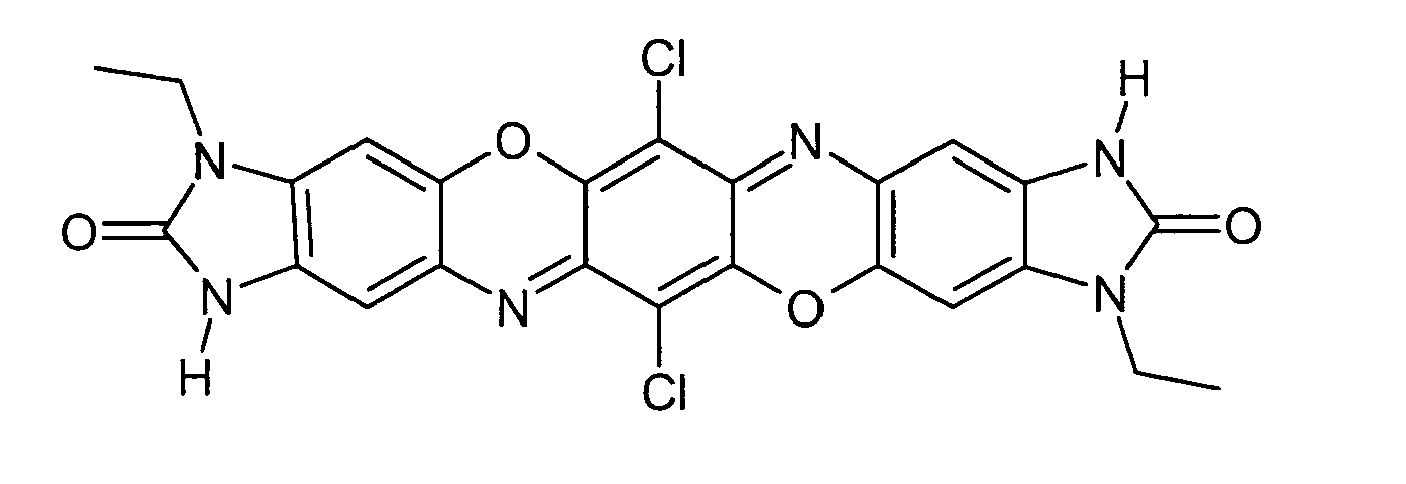
- Yield: 97 %
- 75,4 g of 5-amino-1-ethyl-1,3-dihydrobenzimidazol-2-one and 19,7 g of anhydrous sodium hydrogencarbonate are suspended in 1 L of 1,2-dichlorobenzene and the mixture is heated up to 82°C. Over a period of 2 h are added 27 g of chloranil. The mixture is heated for 5 h. After the addition of 24.8 g of sodium
- 2,5-dimethylbenzenesulfonate the temperature is raised to 130°C, and 32 ml of methanesulfonic acid are added. The temperature is then raised to 140°C and 36 ml of benzenesulfonyl chloride are added. The reaction mixture is then heated for 3 h at 160°C, cooled to 100°C and collected by filtration. The filter cake is washed with 500 ml of hot 1,2-dichlorobenzene and then suspended in boiling water, collected by filtration and washed with water until free of chloride. Drying at 80°C yielded 80.9 g of a green-metallic powder of the following formula.

- Yield: 77.3 %
- 12,5 g of 2,5-dichloro-3,6-bis(1-methyl-2-oxo-1,3-dihydrobenzimidazol-5-yl)amino-1,4-benzoquinone (obtained in analogy to Example 1 a), and 1,25 g of chloranil are suspended in 125 ml of 1,2-dichlorobenzene. The mixture is then heated. Between 80 - 100°C there are added 4 ml of methanesulfonic acid. At around 135 - 140°C there are added 4.5 ml of benzenesulfonyl chloride. The mixture is then heated to 145°C for 4 hours, cooled to 100°C and collected by filtration. The filter cake is washed with 150 ml of hot 1,2-dichlorobenzene and then suspended in boiling water, collected by filtration and washed with water until free of chloride. Drying at 80°C yielded 10.6 g of a green-metallic powder of the following formula.

- Yield: 85.6 %
- 125 g of 2,5-dichloro-3,6-bis(1-methyl-2-oxo-1,3-dihydrobenzimidazol-5-yl)amino-1,4-benzoquinone (obtained in analogy to Example 1 a), and 10 g of chloranil and 31 g of sodium 2,5-dimethylbenzenesulfonate are suspended in 1250 ml of 1,2-dichlorobenzene. The mixture is then heated. Between 80 - 100°C there are added 40 ml of methanesulfonic acid. At around 135 - 140°C there are added 45 ml of benzenesulfonyl chloride. The mixture is then heated to 160°C for 4 hours, cooled to 100°C and collected by filtration. The filter cake is washed with 1,5 L of hot 1,2-dichlorobenzene and then suspended in boiling water, collected by filtration and washed with water until free of chloride. Drying at 80°C yielded 119,8 g of a green-metallic powder of the following formula.

- Yield: 96.6 %
- 12,5 g of 2,5-dichloro-3,6-bis(1-methyl-2-oxo-1,3-dihydrobenzimidazol-5-yl)amino-1,4-benzoquinone (obtained in analogy to Example 1a), and 1,25 g of chloranil and 1 g of sodium 2,5-dimethylbenzenesulfonate are suspended in 125 ml of 4-methylanisole. The mixture is then heated. Between 80 - 100°C there are added 4 ml of methanesulfonic acid. At around 135 - 140°C there are added 4,5 ml of benzenesulfonyl chloride and 4,5 ml of benzenesulfonyl chloride. The mixture is then heated to 140°C for 4 hours, cooled to 100°C and collected by filtration. The filter cake is washed with 150 ml of hot 4-methylanisole and then suspended in boiling water, collected by filtration and washed with water until free of chloride. Drying at 80°C yielded 10.5 g of a green-metallic powder of the following formula

- Yield: 85.1 %
- 130,4 g of 5-amino-1-methyl-1,3-dihydrobenzimidazol-2-one, 141,6 g of 5-amino-1-ethyl-1,3-dihydrobenzimidazol-2-one and 134,4 g of anhydrous sodium hydrogencarbonate are suspended in 2,5 L of 1,2-dichlorobenzene and the mixture is heated up to 82°C. Over a period of 2 h are added 197,6 g of chloranil. The mixture is heated for 5 h. After the addition of 50 g of sodium 2,5-dimethylbenzenesulfonate the temperature is raised to 130°C, and 65 ml of methanesulfonic acid are added. The temperature is then raised to 140°C and 72 ml of benzenesulfonyl chloride are added. The reaction mixture is then heated for 3 h at 155°C, cooled to 100°C and collected by filtration. The filter cake is washed with 1500 ml of hot 1,2-dichlorobenzene and then suspended in boiling water, collected by filtration and washed with water until free of chloride. Drying at 80°C yielded 273 g of a green-metallic powder as a mixture of the following formulae.

- R1 = R2 = Ethyl
- R1 = R2 = Methyl
- R1 = Methyl, R2 = Ethyl
- Yield: 64.7 %
- The pigments so obtained show excellent pigment properties like dispersibility, color strength, excellent heat and light stability when applied in engineering plastics or coatings.
- Application of Pigment Blue 80 in a non-ageing finish for automotive upholstery.
- Automotive crust leather is furnished with a bottom coat employing the following mixture
600 g of a binder combination composed of a polyurethane-binder and a polyacrylatebinder 300 g of an additive combination composed of fillers and wax-dispersions 100 g of Pigment Blue 80 - This mixture is applied by spray dyeing (coating quantity 60 g/m2), dried, hot pressed at 90°C at 50 bar in a through-feed process, followed by 6 h of milling.
- On top of this bottom layer a colour coat consisting of
550 g of a binder combination composed of a polyurethane-binder and a polyacrylatebinder 220 g of an additive combination composed of fillers and wax-dispersions 100 g of Pigment Blue 80 110 g of water 20 g of a cross-linking agent based on isocyanate - Finally a top finish consisting of
450 g of a delustered polyurethane-dispersion 140 g of a binder combination composed of a polyurethane-binder and a polyacrylatebinder 220 g of an additive combination composed of fillers and wax-dispersions 270 g of water 70 g of an additive combination composed of siloxane emulsions and wash-dispersions 70 g of a cross-linking agent based on isocyanate
Claims (8)
- A process for the preparation of compounds of the general formula (I)
 X are halogen atoms,the rings labeled A are linearly or angularly fused in position 1,2; 2,3 or 3,4, and in position 8,9; 9,10 or 10,11, to a 5- or 6-membered heterocyclic ring containing in the ring one nitrogen atom and one oxygen atom, or containing in the ring two nitrogen atoms,comprising an oxidation of a 3,6-bisarylamino-2,5-dihalobenzoquinone of the formula (II)
- The process as claimed in claim 1, wherein the compounds of formula (I) are those with formulae (Ia), (IIa), (IIIa) and (IIIb)
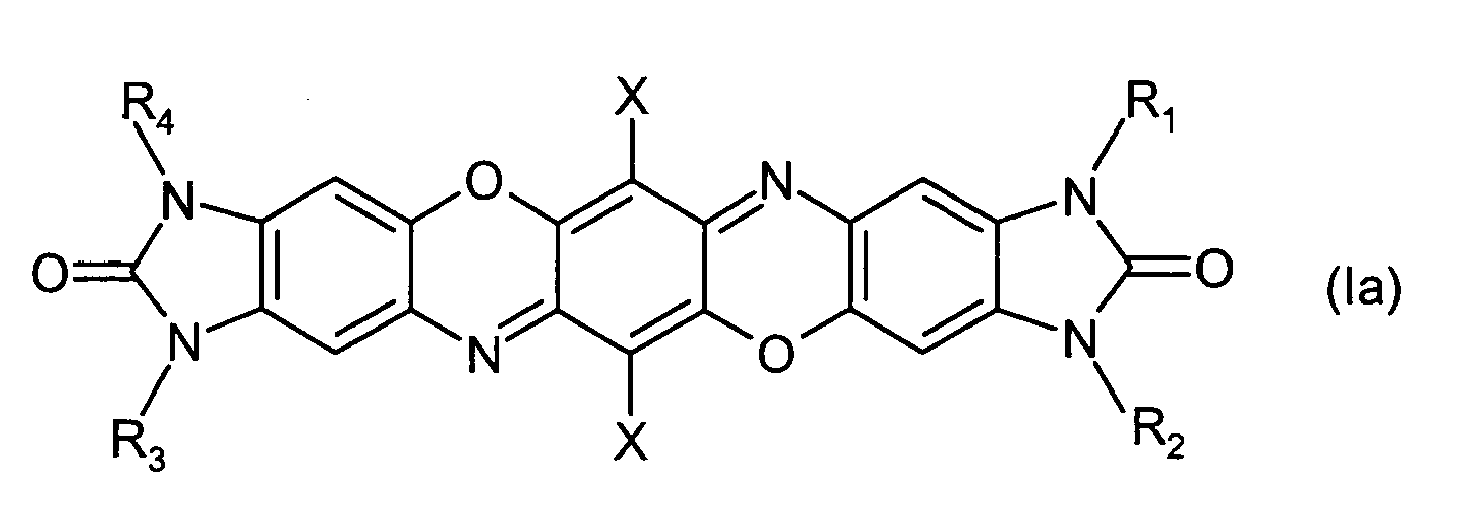


- The process as claimed in claim 1 or 2, in which the aprotic-polar organic solvents are ethers, esters, ketones, amines, nitromethane, chlorobenzenes, chlorotoluenes, or a mixture thereof.
- The process as claimed in any of claims 1 to 3, wherein the aprotic-polar solvents are selected from the group consisting of chlorobenzene, 1,2-dichlorobenzene, 1,3-dichlorobenzene, 1,4-dichlorobenzene, 2-chloro toluene, 3-chloro toluene, 4-chloro toluene, 2,4-dichloro toluene, 3-methyl anisol, 4-methyl anisol, and nitromethane.
- The process as claimed in any of claims 1 to 4, wherein the organic sulfonic acid is selected from the group consisting of methane sulfonic acid, benzene sulfonic acid, toluene sulfonic acid and xylene sulfonic acid.
- The process as claimed in any of claims 1 to 5, wherein the organic sulfonic acid is used in an amount from 10 to 360 mol %, based on the compound of formula (II).
- The process as claimed in any of claims 1 to 6, wherein the oxidation is performed at a temperature of 120 to 160°C.
- The process as claimed in any of claims 1 to 7, wherein the oxidation is carried out by means of benzenesulfonylchloride, toluenesulfonylchloride and/or chloranil.
Priority Applications (5)
| Application Number | Priority Date | Filing Date | Title |
|---|---|---|---|
| US12/673,998 US20110098466A1 (en) | 2007-08-31 | 2006-06-12 | Synthesis Of Triphenodioxazine Pigments |
| EP07017056A EP2031026A1 (en) | 2007-08-31 | 2007-08-31 | Synthesis of triphenodioxazine pigments |
| CN200880023765A CN101688064A (en) | 2007-08-31 | 2008-08-12 | synthesis of triphenodioxazine pigments |
| PCT/EP2008/006613 WO2009027014A2 (en) | 2007-08-31 | 2008-08-12 | Synthesis of triphenodioxazine pigments |
| JP2010522214A JP2010536897A (en) | 2007-08-31 | 2008-08-12 | Synthesis of triphenodioxazine pigments |
Applications Claiming Priority (1)
| Application Number | Priority Date | Filing Date | Title |
|---|---|---|---|
| EP07017056A EP2031026A1 (en) | 2007-08-31 | 2007-08-31 | Synthesis of triphenodioxazine pigments |
Publications (1)
| Publication Number | Publication Date |
|---|---|
| EP2031026A1 true EP2031026A1 (en) | 2009-03-04 |
Family
ID=39186193
Family Applications (1)
| Application Number | Title | Priority Date | Filing Date |
|---|---|---|---|
| EP07017056A Withdrawn EP2031026A1 (en) | 2007-08-31 | 2007-08-31 | Synthesis of triphenodioxazine pigments |
Country Status (5)
| Country | Link |
|---|---|
| US (1) | US20110098466A1 (en) |
| EP (1) | EP2031026A1 (en) |
| JP (1) | JP2010536897A (en) |
| CN (1) | CN101688064A (en) |
| WO (1) | WO2009027014A2 (en) |
Families Citing this family (2)
| Publication number | Priority date | Publication date | Assignee | Title |
|---|---|---|---|---|
| CN103254657A (en) * | 2013-05-30 | 2013-08-21 | 常熟常红织造有限公司 | Benzophenoxazine dye and synthesis method thereof |
| KR102385658B1 (en) * | 2016-09-14 | 2022-04-13 | 디아이씨 가부시끼가이샤 | Benzimidazolonedioxazine compound |
Citations (12)
| Publication number | Priority date | Publication date | Assignee | Title |
|---|---|---|---|---|
| US2016504A (en) * | 1932-04-29 | 1935-10-08 | Gen Aniline Works Inc | Dyestuffs of the oxazine series and a process of preparing them |
| GB879170A (en) * | 1957-05-10 | 1961-10-04 | Geigy Ag J R | Improvements relating to dioxazine dyestuffs and their use |
| US3143546A (en) * | 1962-04-18 | 1964-08-04 | Geigy Ag J R | Process for the production of pigments of the dioxazine series |
| GB996743A (en) * | 1962-04-18 | 1965-06-30 | Geigy Ag J R | Process for the production of pigments of the dioxazine series |
| DE1243303B (en) * | 1962-04-18 | 1967-06-29 | Geigy Ag J R | Process for the production of pigments of the dioxazine series |
| GB1346332A (en) * | 1970-11-16 | 1974-02-06 | Ciba Geigy Ag | Dioxazine pigments and processes for their manufacture |
| DE3239321A1 (en) * | 1981-11-02 | 1983-05-11 | Sandoz-Patent-GmbH, 7850 Lörrach | Dioxazine compounds |
| GB2108995A (en) * | 1981-11-02 | 1983-05-25 | Sandoz Ltd | Dioxazine dyestuffs |
| EP0184711A2 (en) * | 1984-12-08 | 1986-06-18 | Bayer Ag | Dioxazine pigments |
| EP0889046A1 (en) * | 1997-06-25 | 1999-01-07 | Clariant Finance (BVI) Limited | Triphendioxazines and their use as pigments |
| DE19800273A1 (en) * | 1998-01-07 | 1999-07-08 | Clariant Gmbh | Process for the preparation of bisoxazine compounds |
| EP1125986A2 (en) * | 2000-02-10 | 2001-08-22 | Clariant Finance (BVI) Limited | New Triphendioxazine pigments |
Family Cites Families (1)
| Publication number | Priority date | Publication date | Assignee | Title |
|---|---|---|---|---|
| GB0029476D0 (en) * | 2000-12-04 | 2001-01-17 | Clariant Int Ltd | Process for the preparation of triphenodioxazine pigments |
-
2006
- 2006-06-12 US US12/673,998 patent/US20110098466A1/en not_active Abandoned
-
2007
- 2007-08-31 EP EP07017056A patent/EP2031026A1/en not_active Withdrawn
-
2008
- 2008-08-12 JP JP2010522214A patent/JP2010536897A/en not_active Withdrawn
- 2008-08-12 WO PCT/EP2008/006613 patent/WO2009027014A2/en not_active Ceased
- 2008-08-12 CN CN200880023765A patent/CN101688064A/en active Pending
Patent Citations (12)
| Publication number | Priority date | Publication date | Assignee | Title |
|---|---|---|---|---|
| US2016504A (en) * | 1932-04-29 | 1935-10-08 | Gen Aniline Works Inc | Dyestuffs of the oxazine series and a process of preparing them |
| GB879170A (en) * | 1957-05-10 | 1961-10-04 | Geigy Ag J R | Improvements relating to dioxazine dyestuffs and their use |
| US3143546A (en) * | 1962-04-18 | 1964-08-04 | Geigy Ag J R | Process for the production of pigments of the dioxazine series |
| GB996743A (en) * | 1962-04-18 | 1965-06-30 | Geigy Ag J R | Process for the production of pigments of the dioxazine series |
| DE1243303B (en) * | 1962-04-18 | 1967-06-29 | Geigy Ag J R | Process for the production of pigments of the dioxazine series |
| GB1346332A (en) * | 1970-11-16 | 1974-02-06 | Ciba Geigy Ag | Dioxazine pigments and processes for their manufacture |
| DE3239321A1 (en) * | 1981-11-02 | 1983-05-11 | Sandoz-Patent-GmbH, 7850 Lörrach | Dioxazine compounds |
| GB2108995A (en) * | 1981-11-02 | 1983-05-25 | Sandoz Ltd | Dioxazine dyestuffs |
| EP0184711A2 (en) * | 1984-12-08 | 1986-06-18 | Bayer Ag | Dioxazine pigments |
| EP0889046A1 (en) * | 1997-06-25 | 1999-01-07 | Clariant Finance (BVI) Limited | Triphendioxazines and their use as pigments |
| DE19800273A1 (en) * | 1998-01-07 | 1999-07-08 | Clariant Gmbh | Process for the preparation of bisoxazine compounds |
| EP1125986A2 (en) * | 2000-02-10 | 2001-08-22 | Clariant Finance (BVI) Limited | New Triphendioxazine pigments |
Also Published As
| Publication number | Publication date |
|---|---|
| CN101688064A (en) | 2010-03-31 |
| WO2009027014A3 (en) | 2009-12-17 |
| WO2009027014A2 (en) | 2009-03-05 |
| US20110098466A1 (en) | 2011-04-28 |
| JP2010536897A (en) | 2010-12-02 |
Similar Documents
| Publication | Publication Date | Title |
|---|---|---|
| US5097027A (en) | Heterocyclic compounds | |
| EP0975697B1 (en) | Thiazine indigo pigments, solid solutions thereof and their preparation | |
| EP1046681B1 (en) | Hybrid pigments | |
| US20030139498A1 (en) | Bridged perinones/quinophthalones | |
| EP2031026A1 (en) | Synthesis of triphenodioxazine pigments | |
| CH688237A5 (en) | Triphendioxazine compounds. | |
| US6255482B1 (en) | Triphendioxazine compounds | |
| EP1341851B1 (en) | Process for the preparation of triphenodioxazine pigments | |
| IT9048328A1 (en) | PIGMENT DYES | |
| DE4442291A1 (en) | Di:chloro-tri:pheno:di:oxazine derivs. used for pigmenting plastics | |
| US4065462A (en) | Iminoisoindolinone metal complex | |
| US4413131A (en) | 4,5,6,7-Tetrahalo-isoindolin-1-one derivatives | |
| US3816448A (en) | Bis-(3-imino-isoindolinone)pigments | |
| US3912732A (en) | Dioxazine dyestuffs | |
| EP2989102B1 (en) | Carbazole dioxazine pigments | |
| US2016013A (en) | Dyestuffs of the oxazine series and their production | |
| US6512115B2 (en) | Preparation of pigments | |
| US3157667A (en) | Organic dyestuffs | |
| US5095103A (en) | Polycyclic aromatic azacyclic compounds useful in dyeing | |
| US2278260A (en) | Dioxazine dyestuffs | |
| US3107243A (en) | Dioxazine dyestuffs | |
| Smith | Terence Chamberlain | |
| Chamberlain | Dioxazine violet pigments | |
| US6617453B1 (en) | Triphendioxazine compounds | |
| JPH0327383A (en) | Hetero cyclic compound |
Legal Events
| Date | Code | Title | Description |
|---|---|---|---|
| PUAI | Public reference made under article 153(3) epc to a published international application that has entered the european phase |
Free format text: ORIGINAL CODE: 0009012 |
|
| AK | Designated contracting states |
Kind code of ref document: A1 Designated state(s): AT BE BG CH CY CZ DE DK EE ES FI FR GB GR HU IE IS IT LI LT LU LV MC MT NL PL PT RO SE SI SK TR |
|
| AX | Request for extension of the european patent |
Extension state: AL BA HR MK RS |
|
| RAP1 | Party data changed (applicant data changed or rights of an application transferred) |
Owner name: CLARIANT FINANCE (BVI) LIMITED |
|
| 17Q | First examination report despatched |
Effective date: 20091002 |
|
| 17P | Request for examination filed |
Effective date: 20090904 |
|
| AKX | Designation fees paid |
Designated state(s): AT BE BG CH CY CZ DE DK EE ES FI FR GB GR HU IE IS IT LI LT LU LV MC MT NL PL PT RO SE SI SK TR |
|
| R17C | First examination report despatched (corrected) |
Effective date: 20100426 |
|
| STAA | Information on the status of an ep patent application or granted ep patent |
Free format text: STATUS: THE APPLICATION HAS BEEN WITHDRAWN |
|
| 18W | Application withdrawn |
Effective date: 20100618 |