EP2028206A1 - Polyaromatic polyisocyanate compositions - Google Patents
Polyaromatic polyisocyanate compositions Download PDFInfo
- Publication number
- EP2028206A1 EP2028206A1 EP07114803A EP07114803A EP2028206A1 EP 2028206 A1 EP2028206 A1 EP 2028206A1 EP 07114803 A EP07114803 A EP 07114803A EP 07114803 A EP07114803 A EP 07114803A EP 2028206 A1 EP2028206 A1 EP 2028206A1
- Authority
- EP
- European Patent Office
- Prior art keywords
- aniline
- mixture
- aromatic
- isomers
- process according
- Prior art date
- Legal status (The legal status is an assumption and is not a legal conclusion. Google has not performed a legal analysis and makes no representation as to the accuracy of the status listed.)
- Ceased
Links
- 239000000203 mixture Substances 0.000 title claims abstract description 85
- 229920001228 polyisocyanate Polymers 0.000 title claims abstract description 32
- 239000005056 polyisocyanate Substances 0.000 title claims abstract description 32
- 229920000768 polyamine Polymers 0.000 claims abstract description 53
- 238000004519 manufacturing process Methods 0.000 claims abstract description 21
- 125000003118 aryl group Chemical group 0.000 claims abstract description 19
- 238000006243 chemical reaction Methods 0.000 claims abstract description 17
- 150000001412 amines Chemical class 0.000 claims abstract description 16
- PAYRUJLWNCNPSJ-UHFFFAOYSA-N Aniline Chemical compound NC1=CC=CC=C1 PAYRUJLWNCNPSJ-UHFFFAOYSA-N 0.000 claims description 92
- WSFSSNUMVMOOMR-UHFFFAOYSA-N Formaldehyde Chemical compound O=C WSFSSNUMVMOOMR-UHFFFAOYSA-N 0.000 claims description 69
- VEXZGXHMUGYJMC-UHFFFAOYSA-N Hydrochloric acid Chemical compound Cl VEXZGXHMUGYJMC-UHFFFAOYSA-N 0.000 claims description 38
- 238000000034 method Methods 0.000 claims description 29
- 230000008569 process Effects 0.000 claims description 23
- 150000004985 diamines Chemical class 0.000 claims description 8
- 239000003377 acid catalyst Substances 0.000 claims description 4
- 150000004982 aromatic amines Chemical class 0.000 claims description 3
- WSFSSNUMVMOOMR-NJFSPNSNSA-N methanone Chemical compound O=[14CH2] WSFSSNUMVMOOMR-NJFSPNSNSA-N 0.000 abstract description 7
- 239000000243 solution Substances 0.000 description 16
- HEMHJVSKTPXQMS-UHFFFAOYSA-M Sodium hydroxide Chemical compound [OH-].[Na+] HEMHJVSKTPXQMS-UHFFFAOYSA-M 0.000 description 12
- IJGRMHOSHXDMSA-UHFFFAOYSA-N Atomic nitrogen Chemical compound N#N IJGRMHOSHXDMSA-UHFFFAOYSA-N 0.000 description 10
- 239000010410 layer Substances 0.000 description 10
- 239000011541 reaction mixture Substances 0.000 description 10
- XLYOFNOQVPJJNP-UHFFFAOYSA-N water Substances O XLYOFNOQVPJJNP-UHFFFAOYSA-N 0.000 description 10
- 239000000047 product Substances 0.000 description 9
- UPMLOUAZCHDJJD-UHFFFAOYSA-N 4,4'-Diphenylmethane Diisocyanate Chemical compound C1=CC(N=C=O)=CC=C1CC1=CC=C(N=C=O)C=C1 UPMLOUAZCHDJJD-UHFFFAOYSA-N 0.000 description 8
- -1 Methylene di-phenylene Chemical group 0.000 description 8
- 150000001875 compounds Chemical class 0.000 description 8
- 229910000041 hydrogen chloride Inorganic materials 0.000 description 8
- IXCSERBJSXMMFS-UHFFFAOYSA-N hydrogen chloride Substances Cl.Cl IXCSERBJSXMMFS-UHFFFAOYSA-N 0.000 description 8
- 239000012074 organic phase Substances 0.000 description 8
- 239000012071 phase Substances 0.000 description 8
- VOZKAJLKRJDJLL-UHFFFAOYSA-N 2,4-diaminotoluene Chemical compound CC1=CC=C(N)C=C1N VOZKAJLKRJDJLL-UHFFFAOYSA-N 0.000 description 7
- 239000012535 impurity Substances 0.000 description 7
- 239000004814 polyurethane Substances 0.000 description 7
- 229920002635 polyurethane Polymers 0.000 description 7
- 239000000376 reactant Substances 0.000 description 7
- OKKJLVBELUTLKV-UHFFFAOYSA-N Methanol Chemical compound OC OKKJLVBELUTLKV-UHFFFAOYSA-N 0.000 description 6
- 230000001143 conditioned effect Effects 0.000 description 6
- 125000006840 diphenylmethane group Chemical class 0.000 description 6
- 239000012948 isocyanate Substances 0.000 description 6
- 238000004508 fractional distillation Methods 0.000 description 5
- 125000000524 functional group Chemical group 0.000 description 5
- 229910052757 nitrogen Inorganic materials 0.000 description 5
- 238000010626 work up procedure Methods 0.000 description 5
- YGYAWVDWMABLBF-UHFFFAOYSA-N Phosgene Chemical compound ClC(Cl)=O YGYAWVDWMABLBF-UHFFFAOYSA-N 0.000 description 4
- 239000007864 aqueous solution Substances 0.000 description 4
- 230000015572 biosynthetic process Effects 0.000 description 4
- MVPPADPHJFYWMZ-UHFFFAOYSA-N chlorobenzene Chemical compound ClC1=CC=CC=C1 MVPPADPHJFYWMZ-UHFFFAOYSA-N 0.000 description 4
- 238000002124 flame ionisation detection Methods 0.000 description 4
- 239000007789 gas Substances 0.000 description 4
- 150000002513 isocyanates Chemical class 0.000 description 4
- 239000007788 liquid Substances 0.000 description 4
- 239000000463 material Substances 0.000 description 4
- 238000006386 neutralization reaction Methods 0.000 description 4
- 238000000926 separation method Methods 0.000 description 4
- 238000013019 agitation Methods 0.000 description 3
- 230000009286 beneficial effect Effects 0.000 description 3
- 230000008901 benefit Effects 0.000 description 3
- 239000003054 catalyst Substances 0.000 description 3
- 238000006555 catalytic reaction Methods 0.000 description 3
- 238000004587 chromatography analysis Methods 0.000 description 3
- 230000003247 decreasing effect Effects 0.000 description 3
- CZZYITDELCSZES-UHFFFAOYSA-N diphenylmethane Chemical compound C=1C=CC=CC=1CC1=CC=CC=C1 CZZYITDELCSZES-UHFFFAOYSA-N 0.000 description 3
- 238000004821 distillation Methods 0.000 description 3
- 238000001640 fractional crystallisation Methods 0.000 description 3
- ANSXAPJVJOKRDJ-UHFFFAOYSA-N furo[3,4-f][2]benzofuran-1,3,5,7-tetrone Chemical compound C1=C2C(=O)OC(=O)C2=CC2=C1C(=O)OC2=O ANSXAPJVJOKRDJ-UHFFFAOYSA-N 0.000 description 3
- 238000005227 gel permeation chromatography Methods 0.000 description 3
- 239000000543 intermediate Substances 0.000 description 3
- 238000002156 mixing Methods 0.000 description 3
- 238000001448 refractive index detection Methods 0.000 description 3
- 150000004998 toluenediamines Chemical class 0.000 description 3
- 150000004961 triphenylmethanes Chemical class 0.000 description 3
- GEYOCULIXLDCMW-UHFFFAOYSA-N 1,2-phenylenediamine Chemical class NC1=CC=CC=C1N GEYOCULIXLDCMW-UHFFFAOYSA-N 0.000 description 2
- SQMOOVFBFVTTGF-UHFFFAOYSA-N 1-benzyl-1-phenylhydrazine Chemical compound C=1C=CC=CC=1N(N)CC1=CC=CC=C1 SQMOOVFBFVTTGF-UHFFFAOYSA-N 0.000 description 2
- 238000005160 1H NMR spectroscopy Methods 0.000 description 2
- ZAMOUSCENKQFHK-UHFFFAOYSA-N Chlorine atom Chemical compound [Cl] ZAMOUSCENKQFHK-UHFFFAOYSA-N 0.000 description 2
- 238000005481 NMR spectroscopy Methods 0.000 description 2
- 229930040373 Paraformaldehyde Natural products 0.000 description 2
- 239000004721 Polyphenylene oxide Substances 0.000 description 2
- 229920002396 Polyurea Polymers 0.000 description 2
- 239000004372 Polyvinyl alcohol Substances 0.000 description 2
- 238000010521 absorption reaction Methods 0.000 description 2
- 239000002253 acid Substances 0.000 description 2
- QWCKQJZIFLGMSD-UHFFFAOYSA-N alpha-aminobutyric acid Chemical compound CCC(N)C(O)=O QWCKQJZIFLGMSD-UHFFFAOYSA-N 0.000 description 2
- 238000004458 analytical method Methods 0.000 description 2
- 239000012267 brine Substances 0.000 description 2
- 239000006227 byproduct Substances 0.000 description 2
- 239000003795 chemical substances by application Substances 0.000 description 2
- 239000000460 chlorine Substances 0.000 description 2
- 229910052801 chlorine Inorganic materials 0.000 description 2
- 150000008422 chlorobenzenes Chemical class 0.000 description 2
- 238000010276 construction Methods 0.000 description 2
- 229920001971 elastomer Polymers 0.000 description 2
- 239000003822 epoxy resin Substances 0.000 description 2
- 239000006260 foam Substances 0.000 description 2
- 238000004817 gas chromatography Methods 0.000 description 2
- LNEPOXFFQSENCJ-UHFFFAOYSA-N haloperidol Chemical compound C1CC(O)(C=2C=CC(Cl)=CC=2)CCN1CCCC(=O)C1=CC=C(F)C=C1 LNEPOXFFQSENCJ-UHFFFAOYSA-N 0.000 description 2
- 125000004435 hydrogen atom Chemical group [H]* 0.000 description 2
- 238000002347 injection Methods 0.000 description 2
- 239000007924 injection Substances 0.000 description 2
- ZFSLODLOARCGLH-UHFFFAOYSA-N isocyanuric acid Chemical compound OC1=NC(O)=NC(O)=N1 ZFSLODLOARCGLH-UHFFFAOYSA-N 0.000 description 2
- 125000002496 methyl group Chemical group [H]C([H])([H])* 0.000 description 2
- 125000001570 methylene group Chemical group [H]C([H])([*:1])[*:2] 0.000 description 2
- 230000004048 modification Effects 0.000 description 2
- 238000012986 modification Methods 0.000 description 2
- 229920002866 paraformaldehyde Polymers 0.000 description 2
- 229920000647 polyepoxide Polymers 0.000 description 2
- 229920005906 polyester polyol Polymers 0.000 description 2
- 229920000570 polyether Polymers 0.000 description 2
- 235000019422 polyvinyl alcohol Nutrition 0.000 description 2
- 229920002451 polyvinyl alcohol Polymers 0.000 description 2
- 238000004064 recycling Methods 0.000 description 2
- HPALAKNZSZLMCH-UHFFFAOYSA-M sodium;chloride;hydrate Chemical compound O.[Na+].[Cl-] HPALAKNZSZLMCH-UHFFFAOYSA-M 0.000 description 2
- 239000007787 solid Substances 0.000 description 2
- 239000002904 solvent Substances 0.000 description 2
- 239000003381 stabilizer Substances 0.000 description 2
- 239000000126 substance Substances 0.000 description 2
- 238000005406 washing Methods 0.000 description 2
- BGJSXRVXTHVRSN-UHFFFAOYSA-N 1,3,5-trioxane Chemical compound C1OCOCO1 BGJSXRVXTHVRSN-UHFFFAOYSA-N 0.000 description 1
- WZCQRUWWHSTZEM-UHFFFAOYSA-N 1,3-phenylenediamine Chemical compound NC1=CC=CC(N)=C1 WZCQRUWWHSTZEM-UHFFFAOYSA-N 0.000 description 1
- YBRVSVVVWCFQMG-UHFFFAOYSA-N 4,4'-diaminodiphenylmethane Chemical compound C1=CC(N)=CC=C1CC1=CC=C(N)C=C1 YBRVSVVVWCFQMG-UHFFFAOYSA-N 0.000 description 1
- GFYLESPRRMAABM-UHFFFAOYSA-N 4-(1-phenylethyl)benzene-1,2,3-triamine Chemical compound NC1=C(C(=C(C=C1)C(C1=CC=CC=C1)C)N)N GFYLESPRRMAABM-UHFFFAOYSA-N 0.000 description 1
- 238000004566 IR spectroscopy Methods 0.000 description 1
- 238000004497 NIR spectroscopy Methods 0.000 description 1
- PTSIWTZNEIAHHQ-UHFFFAOYSA-N O=C=Nc1ccc(Cc(cc2Cc(cc3)ccc3N=C=O)ccc2N=C=O)cc1 Chemical compound O=C=Nc1ccc(Cc(cc2Cc(cc3)ccc3N=C=O)ccc2N=C=O)cc1 PTSIWTZNEIAHHQ-UHFFFAOYSA-N 0.000 description 1
- 229920000538 Poly[(phenyl isocyanate)-co-formaldehyde] Polymers 0.000 description 1
- 239000004952 Polyamide Substances 0.000 description 1
- QAOWNCQODCNURD-UHFFFAOYSA-N Sulfuric acid Chemical compound OS(O)(=O)=O QAOWNCQODCNURD-UHFFFAOYSA-N 0.000 description 1
- 230000002378 acidificating effect Effects 0.000 description 1
- MMCPOSDMTGQNKG-UHFFFAOYSA-N anilinium chloride Chemical compound Cl.NC1=CC=CC=C1 MMCPOSDMTGQNKG-UHFFFAOYSA-N 0.000 description 1
- 150000004984 aromatic diamines Chemical class 0.000 description 1
- 239000007795 chemical reaction product Substances 0.000 description 1
- 239000013626 chemical specie Substances 0.000 description 1
- 238000000576 coating method Methods 0.000 description 1
- 238000010924 continuous production Methods 0.000 description 1
- 238000001816 cooling Methods 0.000 description 1
- 230000001627 detrimental effect Effects 0.000 description 1
- NKDDWNXOKDWJAK-UHFFFAOYSA-N dimethoxymethane Chemical compound COCOC NKDDWNXOKDWJAK-UHFFFAOYSA-N 0.000 description 1
- HNPSIPDUKPIQMN-UHFFFAOYSA-N dioxosilane;oxo(oxoalumanyloxy)alumane Chemical class O=[Si]=O.O=[Al]O[Al]=O HNPSIPDUKPIQMN-UHFFFAOYSA-N 0.000 description 1
- ZZTCPWRAHWXWCH-UHFFFAOYSA-N diphenylmethanediamine Chemical compound C=1C=CC=CC=1C(N)(N)C1=CC=CC=C1 ZZTCPWRAHWXWCH-UHFFFAOYSA-N 0.000 description 1
- 230000000694 effects Effects 0.000 description 1
- 239000000806 elastomer Substances 0.000 description 1
- 239000008393 encapsulating agent Substances 0.000 description 1
- 239000012530 fluid Substances 0.000 description 1
- DYDNPESBYVVLBO-UHFFFAOYSA-N formanilide Chemical compound O=CNC1=CC=CC=C1 DYDNPESBYVVLBO-UHFFFAOYSA-N 0.000 description 1
- 238000002290 gas chromatography-mass spectrometry Methods 0.000 description 1
- 239000002638 heterogeneous catalyst Substances 0.000 description 1
- 238000004128 high performance liquid chromatography Methods 0.000 description 1
- 238000011065 in-situ storage Methods 0.000 description 1
- 229910052500 inorganic mineral Inorganic materials 0.000 description 1
- 238000004811 liquid chromatography Methods 0.000 description 1
- 238000004949 mass spectrometry Methods 0.000 description 1
- 229910021645 metal ion Inorganic materials 0.000 description 1
- 239000011707 mineral Substances 0.000 description 1
- SYSQUGFVNFXIIT-UHFFFAOYSA-N n-[4-(1,3-benzoxazol-2-yl)phenyl]-4-nitrobenzenesulfonamide Chemical class C1=CC([N+](=O)[O-])=CC=C1S(=O)(=O)NC1=CC=C(C=2OC3=CC=CC=C3N=2)C=C1 SYSQUGFVNFXIIT-UHFFFAOYSA-N 0.000 description 1
- KUDPGZONDFORKU-UHFFFAOYSA-N n-chloroaniline Chemical class ClNC1=CC=CC=C1 KUDPGZONDFORKU-UHFFFAOYSA-N 0.000 description 1
- VBEGHXKAFSLLGE-UHFFFAOYSA-N n-phenylnitramide Chemical class [O-][N+](=O)NC1=CC=CC=C1 VBEGHXKAFSLLGE-UHFFFAOYSA-N 0.000 description 1
- 230000003472 neutralizing effect Effects 0.000 description 1
- 239000012044 organic layer Substances 0.000 description 1
- 238000004806 packaging method and process Methods 0.000 description 1
- 238000005191 phase separation Methods 0.000 description 1
- DYFXGORUJGZJCA-UHFFFAOYSA-N phenylmethanediamine Chemical compound NC(N)C1=CC=CC=C1 DYFXGORUJGZJCA-UHFFFAOYSA-N 0.000 description 1
- 229920002647 polyamide Polymers 0.000 description 1
- 229920000582 polyisocyanurate Polymers 0.000 description 1
- 229920000642 polymer Polymers 0.000 description 1
- 150000003141 primary amines Chemical class 0.000 description 1
- 238000004886 process control Methods 0.000 description 1
- 239000002994 raw material Substances 0.000 description 1
- 230000009257 reactivity Effects 0.000 description 1
- 230000008707 rearrangement Effects 0.000 description 1
- 238000006462 rearrangement reaction Methods 0.000 description 1
- 239000000565 sealant Substances 0.000 description 1
- 150000003335 secondary amines Chemical class 0.000 description 1
- 239000011973 solid acid Substances 0.000 description 1
- 238000004611 spectroscopical analysis Methods 0.000 description 1
- 230000003068 static effect Effects 0.000 description 1
- 238000003756 stirring Methods 0.000 description 1
- 239000001117 sulphuric acid Substances 0.000 description 1
- 235000011149 sulphuric acid Nutrition 0.000 description 1
- 239000002937 thermal insulation foam Substances 0.000 description 1
- 150000004992 toluidines Chemical class 0.000 description 1
- AAAQKTZKLRYKHR-UHFFFAOYSA-N triphenylmethane Chemical compound C1=CC=CC=C1C(C=1C=CC=CC=1)C1=CC=CC=C1 AAAQKTZKLRYKHR-UHFFFAOYSA-N 0.000 description 1
- 238000000870 ultraviolet spectroscopy Methods 0.000 description 1
- 239000002023 wood Substances 0.000 description 1
Classifications
-
- C—CHEMISTRY; METALLURGY
- C08—ORGANIC MACROMOLECULAR COMPOUNDS; THEIR PREPARATION OR CHEMICAL WORKING-UP; COMPOSITIONS BASED THEREON
- C08G—MACROMOLECULAR COMPOUNDS OBTAINED OTHERWISE THAN BY REACTIONS ONLY INVOLVING UNSATURATED CARBON-TO-CARBON BONDS
- C08G12/00—Condensation polymers of aldehydes or ketones with only compounds containing hydrogen attached to nitrogen
- C08G12/02—Condensation polymers of aldehydes or ketones with only compounds containing hydrogen attached to nitrogen of aldehydes
- C08G12/04—Condensation polymers of aldehydes or ketones with only compounds containing hydrogen attached to nitrogen of aldehydes with acyclic or carbocyclic compounds
- C08G12/06—Amines
- C08G12/08—Amines aromatic
-
- C—CHEMISTRY; METALLURGY
- C07—ORGANIC CHEMISTRY
- C07C—ACYCLIC OR CARBOCYCLIC COMPOUNDS
- C07C209/00—Preparation of compounds containing amino groups bound to a carbon skeleton
- C07C209/68—Preparation of compounds containing amino groups bound to a carbon skeleton from amines, by reactions not involving amino groups, e.g. reduction of unsaturated amines, aromatisation, or substitution of the carbon skeleton
- C07C209/78—Preparation of compounds containing amino groups bound to a carbon skeleton from amines, by reactions not involving amino groups, e.g. reduction of unsaturated amines, aromatisation, or substitution of the carbon skeleton from carbonyl compounds, e.g. from formaldehyde, and amines having amino groups bound to carbon atoms of six-membered aromatic rings, with formation of methylene-diarylamines
-
- C—CHEMISTRY; METALLURGY
- C07—ORGANIC CHEMISTRY
- C07C—ACYCLIC OR CARBOCYCLIC COMPOUNDS
- C07C263/00—Preparation of derivatives of isocyanic acid
- C07C263/10—Preparation of derivatives of isocyanic acid by reaction of amines with carbonyl halides, e.g. with phosgene
Definitions
- the present invention relates to polyaromatic polyisocyanate compositions especially beneficial for the manufacture of polyurethanes, polyisocyanurates, polyureas and related products by means of phosgenation of particular polyamine compositions produced by economically beneficial means.
- Aromatic polyamines are used for various applications in the chemical industry, for example, as the curing agent of epoxy resins, as components in polyurethanes or polyureas and as raw materials of polyamides.
- aromatic polyamines are useful as intermediates for manufacturing the corresponding polyisocyanates by reaction with phosgene.
- Polyurethanes are a widely employed group of polymers, with applications as diverse as insulation foam for construction and in domestic and industrial appliances, as flexible foams in furniture and automotive seating, as semi-rigid foams in packaging, as elastomers in shoe soles and in coatings, sealants and encapsulants.
- the polyisocyanates themselves can be used as the binding component in many products based on, for example, various types of wood pieces or granulated rubber.
- aniline and 2,4-TDA with aniline as the main aromatic amine and 2,4-TDA as a relatively minor component, is provided for clarity but it is to be understood not to limit the scope of the invention.
- Products formed when producing polyamine mixtures from formaldehyde, aniline and 2,4-TDA include the dinuclear species AA & AB, the trinuclear species AAB & ABA, the tetranuclear species AAAB & AABA etc. in various isomeric forms [where A denotes aniline and B denotes 2,4-TDA]. Since here B is a minor component, the species BB, ABB, AABB, etc would only be present at lower levels and are not considered in the following descriptions, even though their presence in the mixtures might affect the properties of the polyamines, the derived corresponding polyisocyanates or the derived reaction products of the polyisocyanates with various other products.
- present in the polyamine mixture will be :- 4,4'-MDA (plus the 2,4'-MDA and 2,2'-MDA isomers - not shown) and various isomers of MTA and isomers of the different types of tri-nuclear polyamines formed just from aniline or from aniline and TDA :- and isomers of the different types of tetra-nuclear and higher molecular weight polyamines (not shown).
- PMTA the entire mixture of all the isomers of all the AA, AB, AAB, ABA, AAAB, AABA, etc polyamines
- PMTI the corresponding mixture of polyisocyanates
- formaldehyde materials capable of yielding the desired "CH 2 O" species under the conditions of the process may also be used, for example, paraformaldehyde, trioxane, dimethoxymethane (formal) and aqueous solutions of formaldehyde (formalin) at various concentrations.
- Stabilisers such as methanol, polyvinylalcohol, etc. may be present in the formalin.
- Gaseous formaldehyde may also be employed.
- mononuclear aromatic monoamines which can be used include aniline, o- and m-substituted anilines such as toluidines and alkyl anilines, chloroanilines, anisidines and nitroanilines.
- aniline is used.
- diamines or higher functionality amines which can be used include the diaminobenzene isomers such as 1,3-phenylene diamine, alkyl-substituted diaminobenzenes such as the isomers of TDA, isomers of methylene diphenylene diamine such as 4,4'-MDA and mixtures of various mixtures of isomers and homologues of aniline-formaldehyde condensates known generally as PMDA.
- Particularly suitable mixtures are those containing from about 65 per cent to about 80 per cent 2,4-tolulene diamine and the balance 2,6-tolulene diamine.
- the commercially available mixture containing about 80 per cent 2,4- and about 20 per cent 2,6-tolulene diamine is very useful.
- the used acid catalyst may be a mineral acid such as hydrochloric or sulphuric acid or a heterogeneous catalyst such as those described in Trends in industrial catalysis in the polyurethane industry, App. Catal A : General, 221, 303-335 (2001 ) or delaminated zeolite catalysts ( WO 03/082803 ).
- Use of hydrochloric acid or gaseous hydrogen chloride in combination with aniline with an appropriate water content is preferred.
- An additional benefit of the present invention is the production of polyisocyanate mixtures corresponding to the particular polyamine mixtures with improved reactivity due to the relatively low levels of so-called hydrolysable chlorine impurities.
- the process used in converting the polyamine mixture to the corresponding polyisocyanate mixture can be any of those described in the prior art or used commercially hitherto.
- Aniline and hydrochloric acid are mixed together and, optionally, the temperature of the resulting mixture is controlled to a prescribed level, preferably in the range 30 to 90°C.
- Formaldehyde is added to the aniline/hydrochloric acid mixture, optionally by means of mixing equipment, whilst maintaining the temperature below a prescribed level, preferably in the range 30 to 90°C.
- This mixture may be maintained at low temperature for some time or the TDA can be added within a few minutes of the end of the formaldehyde addition at a temperature preferably in the range 30 to 90°C.
- reaction mixture formed from aniline, hydrochloric acid and formaldehyde may be allowed to continue to react at a somewhat higher temperature prior to addition of the TDA, depending upon the exact product composition required.
- the TDA may be added in molten form or in solution in a solvent or pre-dispersed in aniline.
- Some of the hydrochloric acid may also be added at this time, either separately or included with the aniline/TDA or all the hydrochloric acid can be added initially to the desired fraction of the aniline.
- the reaction mixture is brought to higher temperatures for an extended time, either following a simple linear temperature ramp or as a more complex temperature/time profile in order to convert the various secondary amine species to primary amines and thus obtain the desired mixture of polyamine oligomers and their corresponding isomer ratios.
- the final temperature at this stage can be greater than 100°C in order to carry out the final chemical rearrangements at an economically beneficial rate.
- Neutralisation of the acidic reaction mixture is then carried out by reaction with a suitable quantity of base. Preferably, this involves reaction with a slight stoichiometric excess of aqueous sodium hydroxide although any of the neutralisation options described in the prior art may also be applied.
- the neutralisation may be carried out on the polyamine mixture after cooling below the final reaction temperature or, preferably, at substantially the same temperature as the reaction in suitably designed equipment capable of withstanding the high temperatures and elevated pressures. Separation of the organic phase comprising of the predominantly aniline/TDA/polyamine mixture and the brine phase is then carried out with conventional phase separation devices.
- the organic phase can be washed with additional aqueous material and the brine phase can be washed with additional aniline of suitable quality i.e. impurities may be present in the washing fluids.
- Unreacted aniline and TDA are then removed from the organic mixture by any appropriate means preferentially by fractional distillation, to yield the final mixture of desired polyaromatic polyamines with amounts of the free mononuclear amines below or substantially below a total of 200 ppm by weight, preferably below 50 ppm by weight.
- the aniline and TDA may be recycled.
- the removal of the mononuclear amines is generally accompanied by removal of some higher molecular weight compounds such as, for example, dinuclear polyamines.
- the recycling stream of aniline, TDA and higher molecular weight polyamines could be subjected to further treatment, for example, fractional distillation, to modify the composition before addition back to the process.
- the unmodified stream containing predominantly mononuclear amines such as aniline and TDA plus the higher molecular weight polyamines and add this stream back to the production process.
- the presence of the higher molecular weight compounds in the recycle will have a small effect on the composition of the polyamine mixture produced but this can be adequately compensated for by changes to the ratios of the various reactants viz: aniline, TDA, formaldehyde.
- the composition of the recycling stream can be monitored by on-line or off-line analysis for process control. Examples of suitable techniques include IR, Raman, NIR and UV-Vis spectroscopies or LC, HPLC, GC, GC-MS or NMR techniques, where these abbreviations have their well-known conventional meanings.
- the polyamine mixture may be used directly for example as the curing agent for epoxy resins or may be hydrogenated to form the corresponding mixture of cycloaliphatic polyamines or may be processed further, for example by fractional distillation or fractional crystallisation, to produce more than one stream of different polyamine composition for example for production of the corresponding polyisocyanates.
- the polyaromatic polyamine mixture can be converted to the corresponding polyisocyanates by reaction with phosgene in any of the methods described in the prior art.
- the derived polyisocyanate compositions are thus available for further use for a wide variety of applications, including use without further modification as the isocyanate component of polyurethanes or other applications, as the isocyanate component of prepolymers (by reaction with, for example, di- or polyfunctional polyether or polyester polyols or other materials with isocyanate-reactive functional groups) or variants (by formation of uretonimine, isocyanurate or other functional groups) and for further processing.
- This further processing such as by means of fractional distillation and/or fractional crystallisation can be used to separate some or all of the lower molecular weight components in the polyisocyanate mixture to produce a polyisocyanate mixture with a different composition.
- the separated lower molecular weight polyisocyanates may themselves be used without further modification as the isocyanate component of polyurethanes or other applications, as the isocyanate component of prepolymers (by reaction with, for example, di- or polyfunctional polyether or polyester polyols or other materials with isocyanate-reactive functional groups) or variants (by formation of uretonimine, isocyanurate or other functional groups) and for further processing.
- This further processing such as by means of further fractional distillation and/or further fractional crystallisation can be used to produce other compositions such as, for example, relatively pure 4,4'-MDI; mixtures of predominantly 4,4'-MDI and 2,4'-MDI; mixtures of MDI and MTI isomers in various proportions; mixtures of predominantly MTI isomers; or relatively pure individual MTI isomers.
- Toluene diamine (the "80/20" mixture of 2,4- and 2,6-TDA isomers) was preheated in an oven at 95 °C .
- 75.4g (0.81 mol.) aniline was weighed, then heated on a stirrer/hotplate and 75.0 g (0.61 mol.) of the liquid TDA was added, mixed, transferred to a sample bottle and stored in an oven at 65 °C.
- aniline In a nitrogen current, 466.0 g (4.98 mol.) of aniline was added to a 1-liter pressure-reactor, agitation was started and the aniline was temperature conditioned at 20 °C. Then 152,8 g (1.27 mol.) of 30.4 % hydrochloric acid was added drop-wise in 14 minutes, such that the temperature increased up to 41 °C. The solution was conditioned for 10 minutes at 40 °C. Next, 146.8 g (2.30 mol.) of 47 % formaldehyde was pumped in to the stirred reactor during 180 minutes with a flow rate of 0.71 ml/min while maintaining the temperature at 40 °C.
- the reactor was closed, the temperature was increased to 90 °C and the reactor was pressurized up to 0.5 barg. The temperature was maintained for 30 minutes at 90 °C, followed by a temperature increase to 130 °C in 20 minutes (pressure to 1.5 barg), and maintaining the temperature for 90 minutes at 130 °C.
- composition of the raw amine as determined by gel permeation chromatography using refractive index detection was as follows: Aniline : 28.1 wt% Toluene diamine isomers : 2.1 wt% Diphenylmethanes : 43.8 wt% Triphenylmethanes : 16.5 wt% Polyamines (tetra + penta + etc) : 9.4 wt%
- the diphenyl methanes are a mixture of MDA isomers and MTA isomers.
- the individual MDA isomers can be determined by gas chromatographic analysis using flame ionisation detection which gave the following results :- 4,4'-MDA : 30.2 wt% 2,4'-MDA : 3.8 wt% 2,2'-MDA : 0.1 wt%
- the amount of MTA isomers can be estimated by difference as 9.7 wt% [43.8-30.2-3.8-0.1].
- the presence of minor amounts of diphenylmethane impurity species such as N-methylated variations of the main compounds [e.g. H 2 N-Ph-CH 2 -Ph-NH-CH 3 ] are acknowledged to give some inaccuracies in the determination of the MTA concentration, but these will not detract significantly from the calculated abundance.
- the total amount of N-methyl groups present in the polyamine mixture was measured by 1 H-NMR of a solution of the polyamine in deuterated chlorobenzene, after removal of labile H-atoms by exchange with D 2 O.
- the ratio of N-methyl groups compared to methylene groups between aromatic rings was found to be 0.2 to 99.8 (no unreacted amino-benzyl-aniline species were detected : -CH 2 -N- peaks not observed).
- Toluene diamine (the "80/20" mixture of 2,4- and 2,6-TDA isomers) was preheated in an oven at 95 °C.
- 75.4 g (0.81 mol.) aniline was weighed, heated on stirrer/hotplate and 150.2 g (1.23 mol.) of liquid TDA was added, mixed, transferred to a sample bottle and stored in an oven at 65 °C.
- the reactor was closed, the temperature was increased to 90 °C and the reactor was pressurized up to 0.5 bars. The temperature was maintained for 30 minutes at 90 °C, followed by a temperature increase to 130 °C in 20 minutes (pressure to 1.5 barg), and maintaining the temperature for 90 minutes at 130 °C.
- composition of the raw amine as determined by gel permeation chromatography using refractive index detection was as follows: Aniline : 30.9 wt% Toluene diamine isomers : 2.4 wt% Diphenylmethanes : 41.5 wt% Triphenylmethanes : 17.3 wt% Polyamines (tetra + penta + etc) : 7.8 wt%
- the diphenyl methanes are a mixture of MDA isomers and MTA isomers.
- the individual MDA isomers can be determined by gas chromatographic analysis using flame ionisation detection which gave the following results :- 4,4'-MDA : 16.5 wt% 2,4'-MDA : 2.4 wt% 2,2'-MDA : 0.1 wt%
- the amount of MTA isomers can be estimated by difference as 22.5 wt% [41.5-16.5-2.4-0.1].
- the presence of minor amounts of diphenylmethane impurity species such as N-methylated variations of the main compounds [e.g. H 2 N-Ph-CH 2 -Ph-NH-CH 3 ] are acknowledged to give some inaccuracies in the determination of the MTA concentration, but these will not detract significantly from the calculated abundance.
- Example 2 After removal of unreacted aniline and TDA by distillation, the polyamine mixture obtained from Example 2 was subjected to phosgenation using the following procedure.
- the polyamine mixture was heated in oven at 95 °C and 500 g monochlorobenzene was warmed in another oven at 45 °C.
- the mixture was slowly heated up to 110 °C to obtain a transparent liquid.
- Nitrogen was purged through the solution to remove excess Phosgene.
- the excess monochlorobenzene was removed by using a Rotavap to obtain 25 g of a polyisocyanate mixture.
- the dynamic viscosity of the polyisocyanate product was 338 cP and the NCO value was 35.7%.
- the relative amounts of MDI, MTI and the tri-phenylmethane versions (denoted below as 3-MDI and 3-MTI) of the polyisocyanate mixture were determined by gas chromatography using flame ionisation detection and were as follows (quoted relative to the total of the 3-MDI tri-isocyanate isomers) : Di-isocyanate (MDI) isomers : 7.8 MTI isomers : 6.8 3-MDI isomers : 1.0 3-MTI isomers : 2.6
- Toluene diamine (the "80/20" mixture of 2,4- and 2,6-TDA isomers) was preheated in an oven at 95 °C.
- aniline In a nitrogen current, 468.0 g (5.0 mol.) of aniline was added to a 1-liter pressure-reactor, agitation was started and the aniline was temperature conditioned at 20 °C. Then 25 g (0.21 mol.) of 31.3 % hydrochloric acid was added drop-wise in 1.5 minutes, such that the temperature increased up to 26 °C. The solution was conditioned for 10 minutes at 40 °C.
- the reactor was closed, the temperature was increased to 90 °C and the reactor was pressurized up to 0.5 bar. The temperature was maintained for 30 minutes at 90 °C, followed by a temperature increase to 130 °C in 20 minutes, and maintaining the temperature for 90 minutes at 130 °C.
- reaction mixture 634 g was transferred to a 1-liter reactor and heated to 100 °C. 18 g (0.23 mol) of sodium hydroxide solution (50 wt%) was added and the mixture stirred for 5 minutes : separation of the layers was easily achieved in 5 minutes.
- the bottom layer (organic phase) was collected and the top layer (aqueous pahse) was discharged.
- the organic phase was returned to the reactor and 122 g. hot water was added, stirred for 5 minutes and the phases allowed to separate for 5 minutes.
- the bottom layer (organic phase) was collected and the top layer (water phase) was discharged.
- the organic phase was rinsed for another 4 times with 100 g of hot water each time to yield 544 g of the raw amine mixture.
- composition of the raw amine as determined by gel permeation chromatography using refractive index detection was as follows: Aniline : 30.8 wt% Toluene diamine isomers : 0.7 wt% Diphenylmethanes : 35.2 wt% Triphenylmethanes : 20.3 wt% Polyamines (tetra + penta + etc) : 13.1 wt%
- the diphenyl methanes are a mixture of MDA isomers and MTA isomers.
- the individual MDA isomers can be determined by gas chromatographic analysis using flame ionisation detection which gave the following results :- 4,4'-MDA : 21.0 wt% 2,4'-MDA : 4.1 wt% 2,2'-MDA : 0.3 wt%
- the amount of MTA isomers can be estimated by difference as 9.8 wt% [35.2-21.0-4.1- 0.3].
- the presence of minor amounts of diphenylmethane impurity species such as N- methylated variations of the main compounds [e.g. H 2 N-Ph-CH 2 -Ph-NH-CH 3 ] are acknowledged to give some inaccuracies in the determination of the MTA concentration, but these will not detract significantly from the calculated abundance.
- the total amount of N-methyl groups present in the polyamine mixture was measured by 1 H-NMR of a solution of the polyamine in deuterated chlorobenzene, after removal of labile H-atoms by exchange with D 2 O.
- the ratio of N-methyl groups compared to methylene groups between aromatic rings was found to be 0.1 to 99.9 (no unreacted amino-benzyl-aniline species were detected : -CH 2 -N- peaks not observed).
Landscapes
- Chemical & Material Sciences (AREA)
- Organic Chemistry (AREA)
- Chemical Kinetics & Catalysis (AREA)
- Health & Medical Sciences (AREA)
- Medicinal Chemistry (AREA)
- Polymers & Plastics (AREA)
- Polyurethanes Or Polyureas (AREA)
- Organic Low-Molecular-Weight Compounds And Preparation Thereof (AREA)
Abstract
Production of aromatic polyamine mixtures from formaldehyde, a mono-nuclear aromatic monoamine and one or more aromatic di- or higher functionality amines and conversion of these polyamine mixtures to the corresponding polyisocyanates by phosgenation.
Description
- The present invention relates to polyaromatic polyisocyanate compositions especially beneficial for the manufacture of polyurethanes, polyisocyanurates, polyureas and related products by means of phosgenation of particular polyamine compositions produced by economically beneficial means.
- Aromatic polyamines are used for various applications in the chemical industry, for example, as the curing agent of epoxy resins, as components in polyurethanes or polyureas and as raw materials of polyamides. In particular, aromatic polyamines are useful as intermediates for manufacturing the corresponding polyisocyanates by reaction with phosgene. Polyurethanes are a widely employed group of polymers, with applications as diverse as insulation foam for construction and in domestic and industrial appliances, as flexible foams in furniture and automotive seating, as semi-rigid foams in packaging, as elastomers in shoe soles and in coatings, sealants and encapsulants. The polyisocyanates themselves can be used as the binding component in many products based on, for example, various types of wood pieces or granulated rubber.
- It is an object of the present invention to provide a process for the production of certain polyamine mixtures to be used as intermediates in the production of the corresponding polyisocyanates.
- We have found that this object is achieved by the production of polyamine mixtures from formaldehyde, a mono-nuclear aromatic monoamine and one or more aromatic di- or higher functionality amines.
- Production of polyamine mixtures with formaldehyde and two or more aromatic amines leads to a complex mixture of compounds.
In the following description, the following terms are used :- - MDA : methylene dianiline (also known as diaminodiphenylmethane) which, unless specified otherwise, also denotes the various isomeric forms.
- PMDA : the complex mixture of polyaromatic polyamines, including MDA, formed by the acid-catalysed reaction of aniline with formaldehyde
- TDA : toluene diamine (also know as diaminotoluene) which, unless specified otherwise, also denotes the various isomeric forms.
- MTA : Methylene di-phenylene, mono-methyl, triamine (also known as triaminomethyl-diphenylmethane) which, unless specified otherwise, also denotes the various isomeric forms.
- PMTA : the complex mixture of polyaromatic polyamines, including MDA and MTA, formed by the acid-catalysed reaction of aniline and TDA with formaldehyde.
- Conversion of the polyamines to the corresponding polyisocyanates by phosgenation produces respectively MDI, PMDI, TDI, MTI and PMTI.
- The following description based on the use of aniline and 2,4-TDA, with aniline as the main aromatic amine and 2,4-TDA as a relatively minor component, is provided for clarity but it is to be understood not to limit the scope of the invention.
- Products formed when producing polyamine mixtures from formaldehyde, aniline and 2,4-TDA include the dinuclear species AA & AB, the trinuclear species AAB & ABA, the tetranuclear species AAAB & AABA etc. in various isomeric forms [where A denotes aniline and B denotes 2,4-TDA]. Since here B is a minor component, the species BB, ABB, AABB, etc would only be present at lower levels and are not considered in the following descriptions, even though their presence in the mixtures might affect the properties of the polyamines, the derived corresponding polyisocyanates or the derived reaction products of the polyisocyanates with various other products.
- Thus, present in the polyamine mixture will be :-
4,4'-MDA (plus the 2,4'-MDA and 2,2'-MDA isomers - not shown)
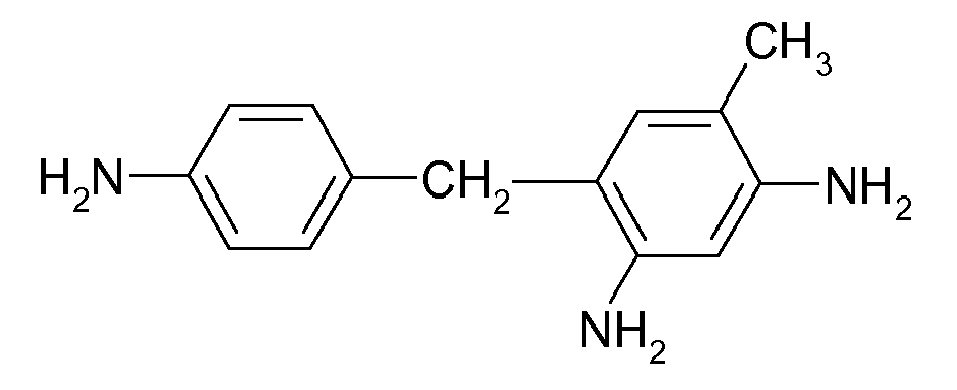


- It is to be understood that these structures are only representative of some of the compounds present in the polyamine mixture. There will also be higher molecular weight oligomers and various isomers of each of the different molecular weight oligomers. Phosgenation of the polyamine gives the corresponding polyisocyanates and relatively minor levels of side products produced from various reactions between species.
4,4'-MDI (plus the 2,4'-MDI and 2,2'-MDI isomers - not shown)


- It is to be understood that these structures are only representative of some of the compounds present in the polyisocyanate mixture. There will also be higher molecular weight oligomers and various isomers of each of the different molecular weight oligomers and side products produced from various reactions between species.
- For simplicity, the entire mixture of all the isomers of all the AA, AB, AAB, ABA, AAAB, AABA, etc polyamines is termed PMTA and the corresponding mixture of polyisocyanates is termed PMTI.
- Instead of formaldehyde, materials capable of yielding the desired "CH2O" species under the conditions of the process may also be used, for example, paraformaldehyde, trioxane, dimethoxymethane (formal) and aqueous solutions of formaldehyde (formalin) at various concentrations. Stabilisers such as methanol, polyvinylalcohol, etc. may be present in the formalin. Gaseous formaldehyde may also be employed.
- Examples of mononuclear aromatic monoamines which can be used include aniline, o- and m-substituted anilines such as toluidines and alkyl anilines, chloroanilines, anisidines and nitroanilines. Preferably aniline is used.
- Examples of diamines or higher functionality amines which can be used include the diaminobenzene isomers such as 1,3-phenylene diamine, alkyl-substituted diaminobenzenes such as the isomers of TDA, isomers of methylene diphenylene diamine such as 4,4'-MDA and mixtures of various mixtures of isomers and homologues of aniline-formaldehyde condensates known generally as PMDA. Particularly suitable mixtures are those containing from about 65 per cent to about 80 per cent 2,4-tolulene diamine and the balance 2,6-tolulene diamine. The commercially available mixture containing about 80 per cent 2,4- and about 20 per cent 2,6-tolulene diamine is very useful.
- The used acid catalyst may be a mineral acid such as hydrochloric or sulphuric acid or a heterogeneous catalyst such as those described in Trends in industrial catalysis in the polyurethane industry, App. Catal A : General, 221, 303-335 (2001) or delaminated zeolite catalysts (
WO 03/082803 - An additional benefit of the present invention is the production of polyisocyanate mixtures corresponding to the particular polyamine mixtures with improved reactivity due to the relatively low levels of so-called hydrolysable chlorine impurities.
- Other additional benefits arising from various embodiments of the present invention include :-
- (a) production of polyamine mixtures with low levels of nitrogen-methylated [so-called N-methyl or N-CH3] functional groups which, ultimately, give polyisocyanate products with low levels of so-called hydrolysable chlorine impurities.
- (b) economic attractiveness from the use of relatively low levels of hydrochloric acid catalyst and, hence, use of lower levels of neutralising sodium hydroxide, together with minimisation of the scale of the work-up and effluent treatment equipment and the amount of effluent.
- (c) the process can be operated as a batch, continuous or semi-continuous process.
- (d) the reactants can be brought together by a variety of different methods such as dip-pipes in to continuous stirred tank reactors or, preferably, by injection in to a flowing stream through a number of injection points, followed by mixing with static mixers or other mixing devices.
- (e) the mono-amine and di-amine reactants may be provided in pure form or with low levels of impurities which do not affect the polyamine or polyisocyanate production or work-up processes nor have significant detrimental effects on final polyisocyanate product quality or derived polyurethane products.
- (f) the formaldehyde may be provided in any suitable form, for example, as a gas, as solid paraformaldehyde or, preferably, as an aqueous solution (commonly termed formalin). The formalin may be of any suitable concentration, preferably greater that 40% formaldehyde by weight and may contain various stabilisers such as methanol and/or polyvinylalcohol. Preferably, the formalin contains low levels of di- and poly-valent metal ions to avoid formation of a rag layer after neutralisation of the acid reaction mixture.
- (g) the hydrochloric acid may be provided as an aqueous solution, preferably with concentration greater that 30% by weight HCl or, optionally, it may be created in situ by absorption of gaseous hydrogen chloride, optionally derived from a phosgenation plant, either in to water or by absorption in to aniline containing an appropriate amount of water to avoid formation of aniline hydrochloride solids.
- (h) solid acids may be used as catalyst.
- (i) the mono-amine and di-amine reactants may be introduced to the manufacturing equipment independently, as a pre-formed mixture, with or without added hydrochloric acid or gaseous HCl or, preferably, the mono-amine may be mixed with the acid catalyst prior to introduction of the formaldehyde, the resulting reaction mixture then being reacted with the di-amine, optionally dissolved in additional mono-amine or solvent, and subsequently heated to higher temperatures to complete the rearrangement reactions. The final temperature of the reaction mixture is preferentially at least 120°C.
- (j) the process for the production and work-up of the polyamine mixture and the subsequent process for the production and work-up of the polyisocyanate can be monitored and optionally controlled by means of a range of on-line analytical techniques such as near-infrared spectroscopy, UV-visible spectroscopy, gas chromatography, liquid chromatography, nuclear magnetic resonance spectrometry, mass spectrometry and the like, optionally using chemometric or other numerical or computer-based techniques for data processing.
- (j) the process for the production and work-up of the polyamine mixture may be retro-fitted to existing plant designed and constructed for the production of PMDA with relatively straightforward additional engineering design and construction.
- The process used in converting the polyamine mixture to the corresponding polyisocyanate mixture can be any of those described in the prior art or used commercially hitherto.
- The object of the present invention in providing a process for the production of certain polyamine mixtures to be used as intermediates in the production of the corresponding polyisocyanates will now be described in terms of the reactions occurring using formaldehyde (as an aqueous solution), aniline (as the mononuclear aromatic monoamine) and the so-called "80:20" mixture of 2,4'-TDA and 2,6'-TDA (as the mononuclear aromatic diamine - hereafter simply referred to as TDA) although it is to be understood that such a description is provided for the purpose of clarity and is not limiting in any way. Likewise, descriptions of the chemical reactions or chemical species present during the reactions are also given for the benefit of clarity only and not as any distinguishing aspect of the invention.
- Aniline and hydrochloric acid are mixed together and, optionally, the temperature of the resulting mixture is controlled to a prescribed level, preferably in the range 30 to 90°C. Formaldehyde is added to the aniline/hydrochloric acid mixture, optionally by means of mixing equipment, whilst maintaining the temperature below a prescribed level, preferably in the range 30 to 90°C. This mixture may be maintained at low temperature for some time or the TDA can be added within a few minutes of the end of the formaldehyde addition at a temperature preferably in the range 30 to 90°C. Alternatively, the reaction mixture formed from aniline, hydrochloric acid and formaldehyde may be allowed to continue to react at a somewhat higher temperature prior to addition of the TDA, depending upon the exact product composition required. The TDA may be added in molten form or in solution in a solvent or pre-dispersed in aniline. Some of the hydrochloric acid may also be added at this time, either separately or included with the aniline/TDA or all the hydrochloric acid can be added initially to the desired fraction of the aniline. Overall, the relative amounts of the various species brought together are :-
- aniline : in the range 1.5 to 4.0 moles, preferably 1.7 to 3.5 moles per mole of formaldehyde,
- HCl : in the range 0.05 to 0.60 moles, preferably 0.1 to 0.35 moles per mole of formaldehyde,
- TDA : in the range 0.1 to 0.8 moles, preferably 0.2 to 0.5 moles per mole of formaldehyde.
- After addition of the TDA, the reaction mixture is brought to higher temperatures for an extended time, either following a simple linear temperature ramp or as a more complex temperature/time profile in order to convert the various secondary amine species to primary amines and thus obtain the desired mixture of polyamine oligomers and their corresponding isomer ratios. The final temperature at this stage can be greater than 100°C in order to carry out the final chemical rearrangements at an economically beneficial rate.
- Such temperatures require that the reaction mixture is maintained above atmospheric pressure.
- Neutralisation of the acidic reaction mixture is then carried out by reaction with a suitable quantity of base. Preferably, this involves reaction with a slight stoichiometric excess of aqueous sodium hydroxide although any of the neutralisation options described in the prior art may also be applied. The neutralisation may be carried out on the polyamine mixture after cooling below the final reaction temperature or, preferably, at substantially the same temperature as the reaction in suitably designed equipment capable of withstanding the high temperatures and elevated pressures. Separation of the organic phase comprising of the predominantly aniline/TDA/polyamine mixture and the brine phase is then carried out with conventional phase separation devices. Secondary washing and subsequent separation of the phases is also preferentially carried out viz: the organic phase can be washed with additional aqueous material and the brine phase can be washed with additional aniline of suitable quality i.e. impurities may be present in the washing fluids.
- Unreacted aniline and TDA are then removed from the organic mixture by any appropriate means preferentially by fractional distillation, to yield the final mixture of desired polyaromatic polyamines with amounts of the free mononuclear amines below or substantially below a total of 200 ppm by weight, preferably below 50 ppm by weight. The aniline and TDA may be recycled. To ensure very low residual TDA going forward to phosgenation, the removal of the mononuclear amines is generally accompanied by removal of some higher molecular weight compounds such as, for example, dinuclear polyamines. The recycling stream of aniline, TDA and higher molecular weight polyamines could be subjected to further treatment, for example, fractional distillation, to modify the composition before addition back to the process. However, it is preferable to use the unmodified stream containing predominantly mononuclear amines such as aniline and TDA plus the higher molecular weight polyamines and add this stream back to the production process. The presence of the higher molecular weight compounds in the recycle will have a small effect on the composition of the polyamine mixture produced but this can be adequately compensated for by changes to the ratios of the various reactants viz: aniline, TDA, formaldehyde.The composition of the recycling stream can be monitored by on-line or off-line analysis for process control. Examples of suitable techniques include IR, Raman, NIR and UV-Vis spectroscopies or LC, HPLC, GC, GC-MS or NMR techniques, where these abbreviations have their well-known conventional meanings.
- After removal of unreacted aniline and TDA, the polyamine mixture may be used directly for example as the curing agent for epoxy resins or may be hydrogenated to form the corresponding mixture of cycloaliphatic polyamines or may be processed further, for example by fractional distillation or fractional crystallisation, to produce more than one stream of different polyamine composition for example for production of the corresponding polyisocyanates.
- After removal of unreacted aniline and TDA, the polyaromatic polyamine mixture can be converted to the corresponding polyisocyanates by reaction with phosgene in any of the methods described in the prior art. The derived polyisocyanate compositions are thus available for further use for a wide variety of applications, including use without further modification as the isocyanate component of polyurethanes or other applications, as the isocyanate component of prepolymers (by reaction with, for example, di- or polyfunctional polyether or polyester polyols or other materials with isocyanate-reactive functional groups) or variants (by formation of uretonimine, isocyanurate or other functional groups) and for further processing.
- This further processing such as by means of fractional distillation and/or fractional crystallisation can be used to separate some or all of the lower molecular weight components in the polyisocyanate mixture to produce a polyisocyanate mixture with a different composition. The separated lower molecular weight polyisocyanates may themselves be used without further modification as the isocyanate component of polyurethanes or other applications, as the isocyanate component of prepolymers (by reaction with, for example, di- or polyfunctional polyether or polyester polyols or other materials with isocyanate-reactive functional groups) or variants (by formation of uretonimine, isocyanurate or other functional groups) and for further processing.
- This further processing such as by means of further fractional distillation and/or further fractional crystallisation can be used to produce other compositions such as, for example, relatively pure 4,4'-MDI; mixtures of predominantly 4,4'-MDI and 2,4'-MDI; mixtures of MDI and MTI isomers in various proportions; mixtures of predominantly MTI isomers; or relatively pure individual MTI isomers.
- The present invention is explained by means of the following examples, but the present invention is not limited to or by these examples.
- Toluene diamine (the "80/20" mixture of 2,4- and 2,6-TDA isomers) was preheated in an oven at 95 °C . In a beaker, 75.4g (0.81 mol.) aniline was weighed, then heated on a stirrer/hotplate and 75.0 g (0.61 mol.) of the liquid TDA was added, mixed, transferred to a sample bottle and stored in an oven at 65 °C.
- In a nitrogen current, 466.0 g (4.98 mol.) of aniline was added to a 1-liter pressure-reactor, agitation was started and the aniline was temperature conditioned at 20 °C. Then 152,8 g (1.27 mol.) of 30.4 % hydrochloric acid was added drop-wise in 14 minutes, such that the temperature increased up to 41 °C. The solution was conditioned for 10 minutes at 40 °C. Next, 146.8 g (2.30 mol.) of 47 % formaldehyde was pumped in to the stirred reactor during 180 minutes with a flow rate of 0.71 ml/min while maintaining the temperature at 40 °C.
- Next the temperature was increased and after reaching 60 °C, 141.1 g of the Toluene diamine/Aniline solution (respectively 0.58 and 0.76 moles) was added. The overall ratio of reactants used at this stage is thus An/TDA/F/HCl = 2.50/0.25/1.0/0.55
- The reactor was closed, the temperature was increased to 90 °C and the reactor was pressurized up to 0.5 barg. The temperature was maintained for 30 minutes at 90 °C, followed by a temperature increase to 130 °C in 20 minutes (pressure to 1.5 barg), and maintaining the temperature for 90 minutes at 130 °C.
- Next the temperature was decreased in 15 minutes to 80 °C and the solution collected and stored for convenience in an oven at 80 °C.
- 748 g of the reaction mixture was transferred to a 1-liter reactor and heated to 100 °C. 103 g (1.29 mol) of sodium hydroxide solution (50 wt%) was added and the mixture stirred for 5 minutes : separation of the layers was easily achieved in 5 minutes. The bottom layer (water phase) was discharged and 96 g. hot water was added to the remaining organic layer, stirred for 5 minutes and the phases allowed to separate for 5 minutes (temperature > 95 °C). The bottom layer (organic phase) was collected and the top layer (water phase) was discharged. The organic phase was rinsed for another 4 times with 100 g of hot water each time to yield 691 g of the raw amine mixture.
- The composition of the raw amine as determined by gel permeation chromatography using refractive index detection was as follows:
Aniline : 28.1 wt% Toluene diamine isomers : 2.1 wt% Diphenylmethanes : 43.8 wt% Triphenylmethanes : 16.5 wt% Polyamines (tetra + penta + etc) : 9.4 wt% - The diphenyl methanes are a mixture of MDA isomers and MTA isomers. The individual MDA isomers can be determined by gas chromatographic analysis using flame ionisation detection which gave the following results :-
4,4'-MDA : 30.2 wt% 2,4'-MDA : 3.8 wt% 2,2'-MDA : 0.1 wt% - The amount of MTA isomers can be estimated by difference as 9.7 wt% [43.8-30.2-3.8-0.1]. The presence of minor amounts of diphenylmethane impurity species such as N-methylated variations of the main compounds [e.g. H2N-Ph-CH2-Ph-NH-CH3] are acknowledged to give some inaccuracies in the determination of the MTA concentration, but these will not detract significantly from the calculated abundance.
- After removal of the bulk of the unreacted mononuclear amines by distillation, the total amount of N-methyl groups present in the polyamine mixture was measured by 1H-NMR of a solution of the polyamine in deuterated chlorobenzene, after removal of labile H-atoms by exchange with D2O. The ratio of N-methyl groups compared to methylene groups between aromatic rings was found to be 0.2 to 99.8 (no unreacted amino-benzyl-aniline species were detected : -CH2-N- peaks not observed).
- Toluene diamine (the "80/20" mixture of 2,4- and 2,6-TDA isomers) was preheated in an oven at 95 °C. In a beaker, 75.4 g (0.81 mol.) aniline was weighed, heated on stirrer/hotplate and 150.2 g (1.23 mol.) of liquid TDA was added, mixed, transferred to a sample bottle and stored in an oven at 65 °C.
- In a nitrogen current, 466.3 g (4.98 mol.) of Aniline was added to a 1-liter pressure-reactor, agitation started and conditioned at 20 °C, then 152,8 g (1.27 mol.) of 31.3 % hydrochloric acid was added drop wise in 8 minutes; the temperature increased to 39 °C. The solution was conditioned for 10 minutes at 40 °C.
- Next, 146.8 g (2.30 mol.) of 47 % formaldehyde was pumped in to the stirred reactor during 180 minutes with a flow rate of 0.71 ml/min while maintaining the temperature at 40 °C.
- Next the temperature was increased to 60 °C when 214.7 g of the Toluene diamine/Aniline solution (respectively 1.17 and 0.77 moles) was added. The overall ratio of reactants used at this stage is thus An/TDA/F/HCl = 2.50/0.5/1.0/0.57
- The reactor was closed, the temperature was increased to 90 °C and the reactor was pressurized up to 0.5 bars. The temperature was maintained for 30 minutes at 90 °C, followed by a temperature increase to 130 °C in 20 minutes (pressure to 1.5 barg), and maintaining the temperature for 90 minutes at 130 °C.
- Next the temperature was decreased in 15 minutes to 80 °C and the solution collected and stored for convenience in an oven at 80 °C.
- 805g of the reaction mixture was neutralised and worked-up in the same way as in the previous example to yield 798 g raw amine.
- The composition of the raw amine as determined by gel permeation chromatography using refractive index detection was as follows:
Aniline : 30.9 wt% Toluene diamine isomers : 2.4 wt% Diphenylmethanes : 41.5 wt% Triphenylmethanes : 17.3 wt% Polyamines (tetra + penta + etc) : 7.8 wt% - The diphenyl methanes are a mixture of MDA isomers and MTA isomers. The individual MDA isomers can be determined by gas chromatographic analysis using flame ionisation detection which gave the following results :-
4,4'-MDA : 16.5 wt% 2,4'-MDA : 2.4 wt% 2,2'-MDA : 0.1 wt% - The amount of MTA isomers can be estimated by difference as 22.5 wt% [41.5-16.5-2.4-0.1]. The presence of minor amounts of diphenylmethane impurity species such as N-methylated variations of the main compounds [e.g. H2N-Ph-CH2-Ph-NH-CH3] are acknowledged to give some inaccuracies in the determination of the MTA concentration, but these will not detract significantly from the calculated abundance.
- After removal of unreacted aniline and TDA by distillation, the polyamine mixture obtained from Example 2 was subjected to phosgenation using the following procedure.
- The polyamine mixture was heated in oven at 95 °C and 500 g monochlorobenzene was warmed in another oven at 45 °C.
- In a beaker, 475 g of the warm monochlorobenzene was weighed, kept warm on a stirrer/hotplate and 25.0 g of the hot polyamine mixture added, mixed, and after all the polyamine had dissolved, transferred to a sample bottle and stored in an oven at 45 °C.
- In a nitrogen current, 500 g of monochlorobenzene was added to a reaction vessel and cooled to 5 °C. 96 g of phosgene was added in 17 minutes, the mixture was cooled to 10 °C and the polyamine/monchlorobenzene solution added drop-wise while stirring during an addition time of 8 minutes; the temperature increased to 28.0 °C.
- The mixture was slowly heated up to 110 °C to obtain a transparent liquid.
- Nitrogen was purged through the solution to remove excess Phosgene. The excess monochlorobenzene was removed by using a Rotavap to obtain 25 g of a polyisocyanate mixture.
- The dynamic viscosity of the polyisocyanate product was 338 cP and the NCO value was 35.7%. The relative amounts of MDI, MTI and the tri-phenylmethane versions (denoted below as 3-MDI and 3-MTI) of the polyisocyanate mixture were determined by gas chromatography using flame ionisation detection and were as follows (quoted relative to the total of the 3-MDI tri-isocyanate isomers) :
Di-isocyanate (MDI) isomers : 7.8 MTI isomers : 6.8 3-MDI isomers : 1.0 3-MTI isomers : 2.6 - Toluene diamine (the "80/20" mixture of 2,4- and 2,6-TDA isomers) was preheated in an oven at 95 °C.
- In a beaker, 75.4g (0.81 mol.) aniline was weighed, then heated on a stirrer/hotplate and 75.2 g (0.62 mol.) of the liquid TDA was added, mixed, transferred to a sample bottle and stored in an oven at 65 °C.
- In a nitrogen current, 468.0 g (5.0 mol.) of aniline was added to a 1-liter pressure-reactor, agitation was started and the aniline was temperature conditioned at 20 °C. Then 25 g (0.21 mol.) of 31.3 % hydrochloric acid was added drop-wise in 1.5 minutes, such that the temperature increased up to 26 °C. The solution was conditioned for 10 minutes at 40 °C.
- Next, 146.8 g (2.30 mol.) of 47 % formaldehyde was pumped in to the stirred reactor during 178 minutes with a flow rate of 0.71 ml/min while maintaining the temperature at 40 °C.
- Next the temperature was increased and after reaching 60 °C, 144 g of the Toluene diamine/Aniline solution (respectively 0.59 and 0.77 moles) was added. The overall ratio of reactants used at this stage is thus An/TDA/F/HCl = 2.50/0.26/1.0/0.09
- The reactor was closed, the temperature was increased to 90 °C and the reactor was pressurized up to 0.5 bar. The temperature was maintained for 30 minutes at 90 °C, followed by a temperature increase to 130 °C in 20 minutes, and maintaining the temperature for 90 minutes at 130 °C.
- Next the temperature was decreased in 15 minutes to 80 °C and the solution collected and stored for convenience in an oven at 80 °C.
- 634 g of the reaction mixture was transferred to a 1-liter reactor and heated to 100 °C. 18 g (0.23 mol) of sodium hydroxide solution (50 wt%) was added and the mixture stirred for 5 minutes : separation of the layers was easily achieved in 5 minutes.
- The bottom layer (organic phase) was collected and the top layer (aqueous pahse) was discharged.
- The organic phase was returned to the reactor and 122 g. hot water was added, stirred for 5 minutes and the phases allowed to separate for 5 minutes. The bottom layer (organic phase) was collected and the top layer (water phase) was discharged. The organic phase was rinsed for another 4 times with 100 g of hot water each time to yield 544 g of the raw amine mixture.
- The composition of the raw amine as determined by gel permeation chromatography using refractive index detection was as follows:
Aniline : 30.8 wt% Toluene diamine isomers : 0.7 wt% Diphenylmethanes : 35.2 wt% Triphenylmethanes : 20.3 wt% Polyamines (tetra + penta + etc) : 13.1 wt% - The diphenyl methanes are a mixture of MDA isomers and MTA isomers. The individual MDA isomers can be determined by gas chromatographic analysis using flame ionisation detection which gave the following results :-
4,4'-MDA : 21.0 wt% 2,4'-MDA : 4.1 wt% 2,2'-MDA : 0.3 wt% - The amount of MTA isomers can be estimated by difference as 9.8 wt% [35.2-21.0-4.1- 0.3]. The presence of minor amounts of diphenylmethane impurity species such as N- methylated variations of the main compounds [e.g. H2N-Ph-CH2-Ph-NH-CH3] are acknowledged to give some inaccuracies in the determination of the MTA concentration, but these will not detract significantly from the calculated abundance.
- After removal of the bulk of the unreacted mononuclear amines by distillation, the total amount of N-methyl groups present in the polyamine mixture was measured by 1H-NMR of a solution of the polyamine in deuterated chlorobenzene, after removal of labile H-atoms by exchange with D2O. The ratio of N-methyl groups compared to methylene groups between aromatic rings was found to be 0.1 to 99.9 (no unreacted amino-benzyl-aniline species were detected : -CH2-N- peaks not observed).
Claims (13)
- Process for manufacturing aromatic polyamine mixtures comprising the step of reacting formaldehyde with at least one mono-nuclear aromatic monoamine and one ore more aromatic di- or higher functionality amines.
- Process according to claim 1 wherein the mononuclear aromatic monoamine is used as the main aromatic amine.
- Process according to claim 1 or 2 wherein the mono-nuclear aromatic monoamine comprises aniline.
- Process according to claim 3 wherein the amount of aniline is in the range 1.5 to 4.0 moles per mole of formadehyde.
- Process according to any one of the preceding claims wherein the aromatic di- or higher functionality amines comprises one or more of the isomers of tolulene diamine.
- Process according to claim 5 wherein a mixture of about 80 wt% 2,4'-tolulene diamine and about 20 wt% 2,6'-tolulene diamine is used.
- Process according to claim 5 or 6 wherein the amount of tolulene diamine is in the range 0.1 to 0.8 moles per mole of formaldehyde.
- Process according to any one of the preceding claims wherein reaction is carried out in the presence of an acid catalyst.
- Process according to claim 8 wherein the acid catalyst comprises hydrochloric acid.
- Process according to claim 9 wherein the amount of hydrochloric acid is in the range 0.05 and 0.60 moles per mole of formaldehyde.
- Aromatic polyamine mixtures obtainable by the process as defined in any one of the preceding claims.
- Process for manufacturing polyaromatic polyisocyanate compositions comprising the step of phosgenating the aromatic polyamine mixtures as defined in claim 11.
- Polyaromatic polyisocyanate compositions obtainable by the process as defined in claim 12.
Priority Applications (5)
| Application Number | Priority Date | Filing Date | Title |
|---|---|---|---|
| EP07114803A EP2028206A1 (en) | 2007-08-23 | 2007-08-23 | Polyaromatic polyisocyanate compositions |
| PCT/EP2008/059079 WO2009024407A1 (en) | 2007-08-23 | 2008-07-11 | Process for preparing polyaromatic polyisocyanate compositions |
| CN200880103877A CN101855266A (en) | 2007-08-23 | 2008-07-11 | Process for preparing polyaromatic polyisocyanate compositions |
| EP08775013A EP2183295A1 (en) | 2007-08-23 | 2008-07-11 | Process for preparing polyaromatic polyisocyanate compositions |
| US12/673,076 US20110190535A1 (en) | 2007-08-23 | 2008-07-11 | Process for preparing polyaromatic polyisocyanate compositions |
Applications Claiming Priority (1)
| Application Number | Priority Date | Filing Date | Title |
|---|---|---|---|
| EP07114803A EP2028206A1 (en) | 2007-08-23 | 2007-08-23 | Polyaromatic polyisocyanate compositions |
Publications (1)
| Publication Number | Publication Date |
|---|---|
| EP2028206A1 true EP2028206A1 (en) | 2009-02-25 |
Family
ID=38961802
Family Applications (2)
| Application Number | Title | Priority Date | Filing Date |
|---|---|---|---|
| EP07114803A Ceased EP2028206A1 (en) | 2007-08-23 | 2007-08-23 | Polyaromatic polyisocyanate compositions |
| EP08775013A Withdrawn EP2183295A1 (en) | 2007-08-23 | 2008-07-11 | Process for preparing polyaromatic polyisocyanate compositions |
Family Applications After (1)
| Application Number | Title | Priority Date | Filing Date |
|---|---|---|---|
| EP08775013A Withdrawn EP2183295A1 (en) | 2007-08-23 | 2008-07-11 | Process for preparing polyaromatic polyisocyanate compositions |
Country Status (4)
| Country | Link |
|---|---|
| US (1) | US20110190535A1 (en) |
| EP (2) | EP2028206A1 (en) |
| CN (1) | CN101855266A (en) |
| WO (1) | WO2009024407A1 (en) |
Families Citing this family (5)
| Publication number | Priority date | Publication date | Assignee | Title |
|---|---|---|---|---|
| WO2013057069A1 (en) | 2011-10-21 | 2013-04-25 | Bayer Intellectual Property Gmbh | Polycyclic aromatic polyamines and methods for production thereof |
| CN103874680B (en) * | 2011-10-21 | 2016-07-06 | 拜耳知识产权有限责任公司 | The method producing light color polyisocyanates |
| EP3898578A1 (en) * | 2018-12-20 | 2021-10-27 | Basf Se | Manufacturing method for an aromatic isocyanate compound |
| CN113527116A (en) * | 2021-07-21 | 2021-10-22 | 江西同宇新材料有限公司 | Preparation method of aminophenol containing methylene |
| CN113980239B (en) * | 2021-11-09 | 2023-01-10 | 美瑞新材料股份有限公司 | Method for preparing thermoplastic polyurethane elastomer by using nitroaniline isomer mixture and product thereof |
Citations (3)
| Publication number | Priority date | Publication date | Assignee | Title |
|---|---|---|---|---|
| US4162358A (en) * | 1978-08-28 | 1979-07-24 | Texaco Development Corporation | Polyaromatic amine curing agents for epoxy resins |
| DD254387A1 (en) * | 1986-12-10 | 1988-02-24 | Schwarzheide Synthesewerk Veb | METHOD FOR PRODUCING POLYURETHANE RAW MATERIALS |
| DE19613554A1 (en) * | 1996-04-04 | 1997-11-06 | Bayer Ag | Economic preparation of aromatic poly:amine mixtures with integrated fractionation and purification |
Family Cites Families (15)
| Publication number | Priority date | Publication date | Assignee | Title |
|---|---|---|---|---|
| US3012008A (en) * | 1957-03-29 | 1961-12-05 | Ici Ltd | Polyisocyanate compositions |
| BE634519A (en) * | 1962-07-05 | |||
| DE1174759B (en) * | 1963-02-08 | 1964-07-30 | Bayer Ag | Process for the production of polyisocyanates with a biuret structure |
| GB1057795A (en) * | 1964-04-09 | 1967-02-08 | Mobay Chemical Corp | Organic polyisocyanates |
| US3936483A (en) * | 1964-04-09 | 1976-02-03 | Mobay Chemical Corporation | Organic polyisocyanates |
| US3459781A (en) * | 1965-11-22 | 1969-08-05 | Du Pont | Liquid polyisocyanates and their stepwise preparation |
| US3857890A (en) * | 1969-07-25 | 1974-12-31 | Upjohn Co | Process for preparing methylene-di-anilines |
| DE2127263A1 (en) * | 1971-06-02 | 1973-01-04 | Bayer Ag | PROCESS FOR THE PRODUCTION OF AROMATIC POLYAMINES |
| US4189443A (en) * | 1974-04-26 | 1980-02-19 | Bayer Aktiengesellschaft | Method for making a polyamine |
| US4008275A (en) * | 1975-08-18 | 1977-02-15 | The Upjohn Company | Process for isolating 4,4'-diaminodiphenylmethane |
| DE2557500A1 (en) * | 1975-12-19 | 1977-06-30 | Bayer Ag | PROCESS FOR PRODUCING POLYAMINES |
| DE3032358A1 (en) * | 1980-08-28 | 1982-04-08 | Bayer Ag, 5090 Leverkusen | NEW POLYISOCYANATES OR POLYISOCYANATE MIXTURES OF THE DIPHENYLMETHANE SERIES, METHOD FOR THE PRODUCTION THEREOF, AND THEIR USE AS CONSTRUCTION COMPONENT IN THE PRODUCTION OF POLYURETHANE PLASTICS BY THE ISOCYANATE POLYADDITION PROCESS |
| DE3417684A1 (en) * | 1984-05-12 | 1985-11-14 | Bayer Ag, 5090 Leverkusen | NEW TRIISOCYANATES, A METHOD FOR THE PRODUCTION THEREOF AND THEIR USE FOR THE PRODUCTION OF POLYURETHANE PLASTICS |
| DE3417683A1 (en) * | 1984-05-12 | 1985-11-14 | Bayer Ag, 5090 Leverkusen | NEW CYCLOALIPHATIC TRIISOCYANATES, A METHOD FOR THE PRODUCTION THEREOF AND THEIR USE IN THE PRODUCTION OF POLYURETHANE PLASTICS |
| KR101273845B1 (en) * | 2005-12-08 | 2013-06-11 | 헌트스만 인터내셔날, 엘엘씨 | Process for preparing diaminodiphenylmethanes |
-
2007
- 2007-08-23 EP EP07114803A patent/EP2028206A1/en not_active Ceased
-
2008
- 2008-07-11 US US12/673,076 patent/US20110190535A1/en not_active Abandoned
- 2008-07-11 WO PCT/EP2008/059079 patent/WO2009024407A1/en not_active Ceased
- 2008-07-11 EP EP08775013A patent/EP2183295A1/en not_active Withdrawn
- 2008-07-11 CN CN200880103877A patent/CN101855266A/en active Pending
Patent Citations (3)
| Publication number | Priority date | Publication date | Assignee | Title |
|---|---|---|---|---|
| US4162358A (en) * | 1978-08-28 | 1979-07-24 | Texaco Development Corporation | Polyaromatic amine curing agents for epoxy resins |
| DD254387A1 (en) * | 1986-12-10 | 1988-02-24 | Schwarzheide Synthesewerk Veb | METHOD FOR PRODUCING POLYURETHANE RAW MATERIALS |
| DE19613554A1 (en) * | 1996-04-04 | 1997-11-06 | Bayer Ag | Economic preparation of aromatic poly:amine mixtures with integrated fractionation and purification |
Also Published As
| Publication number | Publication date |
|---|---|
| EP2183295A1 (en) | 2010-05-12 |
| US20110190535A1 (en) | 2011-08-04 |
| CN101855266A (en) | 2010-10-06 |
| WO2009024407A1 (en) | 2009-02-26 |
Similar Documents
| Publication | Publication Date | Title |
|---|---|---|
| US6576788B1 (en) | Method for producing mixtures consisting of diphenylmethane diisocyanates and polyphenylene-polymethylene-polyisocyanates containing a reduced amount of chlorinated secondary products and with a reduced iodine color index | |
| KR101183761B1 (en) | Process for the preparation of polyamines of the diphenylmethane series at a low degree of protonation | |
| KR101232431B1 (en) | Process for the preparation of polyisocyanates of the diphenylmethane series | |
| JP4114718B2 (en) | Preparation of MDI, especially 2,4'-MDI | |
| US20100185011A1 (en) | Process for preparing mixtures of diphenyl-methane diisocyanates and polyphenyl-polymethylene polyisocyanates | |
| WO2009077795A1 (en) | Process for the preparation of polyisocyanates of the diphenylmethane series | |
| MXPA03002071A (en) | Process for producing polyisocyanates of the diphenyl methane series having a reduced color value. | |
| CA2399483A1 (en) | Process for the production of polyisocyanates of the diphenylmethane series with a reduced color value | |
| US20110190535A1 (en) | Process for preparing polyaromatic polyisocyanate compositions | |
| KR20060041636A (en) | Preparation of Di- and Poly-isocyanates of Diphenylmethane Series with Limited Acidity | |
| EP1960346B2 (en) | Process for preparing diaminodiphenylmethanes | |
| US7205439B2 (en) | Process for the preparation of di- and polyamines of the diphenylmethane series | |
| WO2026068450A1 (en) | Process for preparing a polyisocyanate mixture comprising methylene diphenyl diisocyanate (mdi) | |
| MXPA00010183A (en) | Method for producing mixtures consisting of diphenylmethane diisocyanates and polyphenylene-polymethylene-polyisocyanates containing a reduced amount of chlorinated secondary products and with a reduced iodine colour index |
Legal Events
| Date | Code | Title | Description |
|---|---|---|---|
| PUAI | Public reference made under article 153(3) epc to a published international application that has entered the european phase |
Free format text: ORIGINAL CODE: 0009012 |
|
| AK | Designated contracting states |
Kind code of ref document: A1 Designated state(s): AT BE BG CH CY CZ DE DK EE ES FI FR GB GR HU IE IS IT LI LT LU LV MC MT NL PL PT RO SE SI SK TR |
|
| AX | Request for extension of the european patent |
Extension state: AL BA HR MK RS |
|
| STAA | Information on the status of an ep patent application or granted ep patent |
Free format text: STATUS: THE APPLICATION HAS BEEN REFUSED |
|
| 18R | Application refused |
Effective date: 20090419 |